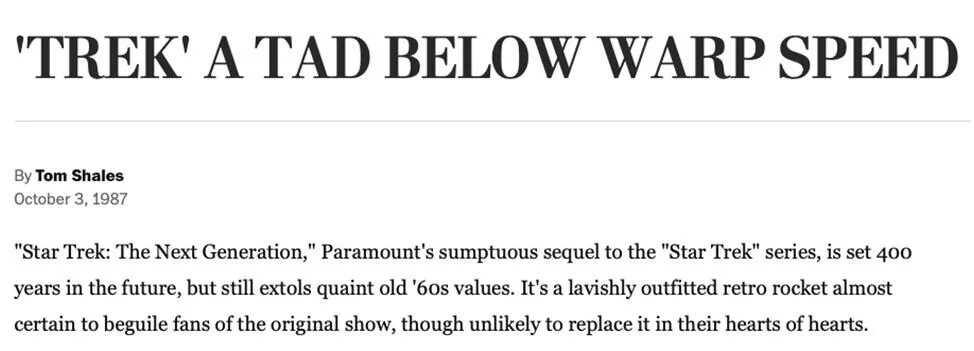
In my Star Trek book, I’ve written about how TOS was initially misconstrued (and summarily dismissed) as a children’s program when it first aired, primarily because serious science fiction television was associated with drama anthologies, while the cheap space operas of the 1950s had been pitched at children. It was only in its final season that reviewers were engaging with Star Trek as serious intergenerational fare that dealt with contemporary social issues in science fiction guise. TNG more deliberately targeted the family audience by making the Enterprise a family spaceship, to the notable discomfort of Picard, and through the inclusion of young Wesley Crusher (Wil Wheaton).
While Picard’s showrunner Michael Chabon has defended the dark turn of Picard by saying Star Trek always reflects the time in which it is made, it is worth remembering the significant cultural unrest in the 1960s when TOS aired. As such, Stephen Kelly argues that “the idea that the grittiness of shows such as Picard makes it mature and relevant, while the ethos of yesteryear Star Trek is now naive or too old-fashioned to survive, feels misjudged. The hope, optimism and sincerity of the original 60s series was in itself a radical act”.
All the same, by the end of season one, Picard brings a peaceful resolution by affirming the values that the Federation appears to have abandoned, and Riker seems to bring Starfleet to its senses in backing Picard.
Chabon suggests “the space we found for Picard is not ‘dark Federation’” – which makes me think of Blake’s 7 (1978-1981) – “It’s one of people who live and work at or beyond the margins of the Federation who travel beyond its boundaries”. But is it also beyond the boundaries of family fare? Certainly, I was disappointed in this regard.
Pearson
When the Science Museum in London had a Star Trek exhibition back in 1995, Máire Messenger Davies and I distributed a questionnaire to visitors asking why they were visiting. There were grandparents bringing their grandchildren in order to introduce them to the franchise. So, this comes back to what audiences CBS is targeting, is it the old audience or the new audience? That could be seen as a failure in both Picard and Discovery, because what you want to do is precisely to cultivate an intergenerational loyalty – think of Disney, or Star Wars – they want it to be passed down the generations, and yet if you put in either too much sexual or violent content, that’s hard to do.
Baker
If you want a franchise to survive over decades and generations, you have to repopulate that fan base.
Pearson
However, what CBS is intending to do as a franchising strategy is having a range of programs for different demographics, with an animated series aimed at a younger audience. Increasingly with transmedia products within a franchise, they’re trying to target different audiences with different content. This seems to be what CBS is now going to do with Star Trek and wanting to proliferate the number of series they’re producing.
Baker
The kickback some of the fans who are parents or grandparents is that they don’t necessarily want their kids watching a separate Star Trek, and I feel that way too. I want new Star Trek we can watch together and then chew the fat together afterwards as well.
Pearson
That speaks to what is television, in that television became increasingly fragmented with the proliferation of cable and then the streaming services which clearly target multiple niche audiences. Netflix does have family versions of horror and science fiction to watch together, so it’s trying to address that audience.
Baker
Yes, one of my current research projects, with Jessica Balanzategui and Diana Sandars, looks at the darker science fiction, fantasy, and horror content on Netflix that’s nonetheless pitched at a family audience under the genre tag “Family Watch Together TV”. It’s still a really controversial strategy because trying to get that balance right between something that’s edgy enough for adults to enjoy but not so creepy that your youngest child can’t sleep at night is really tricky. For example, the Lost in Space (2018-) remake and The Dark Crystal: Age of Resistance (2019 -) both come under that umbrella on Netflix and are rated TV-PG in the United States. Of course, when those shows come up on a parent’s feed, it will often be sitting next to a creepier show at a higher classification, so you may well click there next into even darker content.
Pearson
When I think of family science fiction viewing here in the UK, I think of the reinvented Doctor Who (1963-1989, 2005-), which was designed precisely for that intergenerational audience. It was broadcast in the early evening when children would be able to watch with the family. I remember there were complaints about content that wasn’t suitable for children in Doctor Who because it was very much marketed by the BBC as family viewing.
Going back to the pandemic, which inevitably we must these days, I was reading in The Guardian how the viewing of terrestrial, broadcast television has really increased during the COVID-19 crisis, because people want to watch TV together, they want comforting television. There’s a show over here called The Repair Shop (2017-) about repairing old items which is now apparently a big hit because everybody’s watching it together.
Baker
It comes back to the old-fashioned water-cooler TV, so you can watch things together and discuss them at the same time, in the same week. As much as we’ve said that Picard is very much informed by the new Netflix-era streaming era, it was still released on that week-by-week drip feed, to try to reinstate that water-cooler moment, so you felt that if you wanted to be in that conversation, you had to be watching it at the same time.
Pearson
That’s very interesting in terms of the strategy – whether you drop all the episodes at once or you space them out as in the broadcast era. I find myself getting frustrated because I know they’ve got all the episodes, so why aren’t they giving them to me? Why do I have to wait?
Baker
We’ve become newly enculturated to watching episodes back-to-back in one or more “epic viewing” sessions, as I call it in The Age of Netflix. Our expectations have changed.
Pearson
On the other hand, what are the pleasures of television? The pleasure of the weekly drop is that you have more time to contemplate, you do have time to get caught up in that ongoing conversation. After both Discovery and Picard, I would read all the recaps, I would look to see what the fans were saying, and I found that very helpful because the storytelling is so intense that I think you need the collective intelligence to help you figure out what the hell is going on and what you might feel about it.
Baker
I find that very interesting, because it’s an amplification of what was around even in the 1950s with early television, when they did some studies that said prediction and anticipation were key pleasures of TV watching, particularly with serialised stories. It’s talking to other people before the next episode drops which is part of the fun. So even though we're in a new era, doing the weekly drop is re-instigating something that’s been there since the very beginning of TV, that pleasure/pain of anticipation, making you wait.
Pearson
Yet I also want to know what’s going to happen, so I want to binge. With Better Call Saul (2015-), I decided I would wait until all the episodes dropped before watching.
Baker
Everyone’s got so used to that way of viewing, that it’s too frustrating to watch it bit by bit.
Pearson
But after binging Better Call Saul I don’t know if I will have the energy to then read recaps and reviews the way that I would if I had watched week by week. So, it’s a question of which pleasure you prioritise. Do you want the time to reflect and read and talk to other people, or do you want it all at once?
Baker
Then that has flow on effects, because if you’re waiting, there are certain places online you can’t go.
Pearson
Exactly, this came up with my Facebook feeds around Picard. I hadn’t watched the final episode of Picard, because it dropped just as we went into lockdown. I had a friend coming over every week and we were cooking dinner and watching the weekly episode of Picard together, and then occasionally we FaceTimed with her sister in Israel to discuss it afterwards. We were very much treating it as appointment television.
When the final episode dropped in lockdown, I really didn’t want to watch it without my friend coming over. It became symbolic of all the things we were losing in our lives. Then another friend said I might not want to watch it if I was feeling delicate. I was feeling very delicate at that point! So, I waited for a long time. That meant I would just have to very quickly scroll past everything in my Facebook feed that related to the finale, because I hadn’t seen it yet. But you can’t avoid reading the headlines!
Negotiating television is much harder than it used to be in terms of viewing practices and preferences because of choices about binging or watching individual episodes as well as decisions about which streaming services you want to subscribe to. CBS All Access used both Discovery and Picard to drive subscriptions in the United States, successfully it seems. Internationally the shows appeared on Netflix and Amazon. I signed up for both platforms because I had to watch new Trek shows.
Baker
Some of my friends who are also Star Trek fans thought they had too many subscriptions already and were waiting for all the episodes of Picard to drop, so they could watch the entire season in a free trial period.
Pearson
Will the next step be bundled streaming packages?
Baker
At this stage that seems inevitable, unless some of the providers fold before then. When there are TV shows that everyone’s talking about and you’re supposed to be watching them, but they’re all on different providers, it’s just unsustainable.
Pearson
Even if their price point is low, if you have several subscriptions it's going to add up over the course of a year. It points to the importance of the flagship program that attracts new subscribers to streaming services.
Baker
I probably did what Amazon wanted me to, which is that I signed up specifically for Picard, and then I found The Marvellous Mrs. Maisel (2017-) and The Man in the High Castle (2015-2019). The industry logic is that you have these flagship shows, and then ideally, it’s the rest of the catalogue that keeps you there.
Pearson
I think that’s true, but they have to have enough in the catalogue to keep you in there. Mrs. Maisel, The Man in the High Castle, also Transparent (2014-2019), these were the shows that were getting the buzz, and I felt out of the conversation around those shows so like you started to watch or plan to watch them.
Here in the UK, Discovery is on Netflix, but Picard is on Amazon. Why might CBS’s international division make that call? There’s so much to research around this from both an industry and an audience perspective.
And now content will start to dry up with the impact of COVID-19 on the industry. I presume production on Picard season two has now been delayed. Will the streamers be able to turn out enough new flagship shows to drive subscriptions and then maintain those viewers?
Baker
There will come a point when no new content is coming through, and those streaming services with the stronger catalogue will be in a better position to survive.
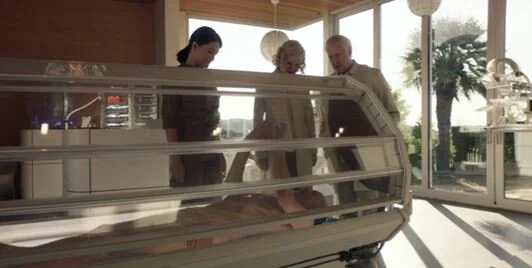
Thinking about Picard season two, we really need to discuss that finale. Picard is now both an XB like Seven and a synth like Soji (Isa Briones), but without her additional longevity and non-human capabilities because apparently – as fan Legate Damar argues – “anybody who knows Picard knows that Picard wouldn’t want any of that”.
Pearson
What’s the average life span of a human in the twenty-fourth century? Having gone through all that, wouldn’t he want a younger body and more time? I’d be perfectly happy to adjust to a new body!
Baker
I had to go and look it up. In the TNG pilot, Doctor McCoy (DeForest Kelley) is 137, which would potentially give the 94-year-old Picard another 43 years without his neural condition. On the other hand, that doesn’t mean McCoy’s longevity is the ‘average’, and he’s pretty frail.
Pearson
And Picard asks, “Ten years? Twenty years?” So, he does want at least some more time.
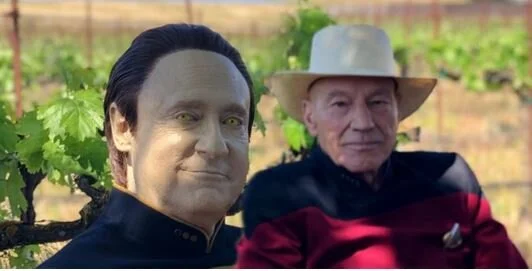
A related question is if they could download Picard, why couldn’t they download Data (Brent Spiner)?