

Where Are the Hypertexts Now? Mark Bernstein on Storyspace, Eastgate, AI, and the Future of Electronic Literature
/Mehulkumar Desai and Deena Larsen interview Mark Bernstein
Introduction
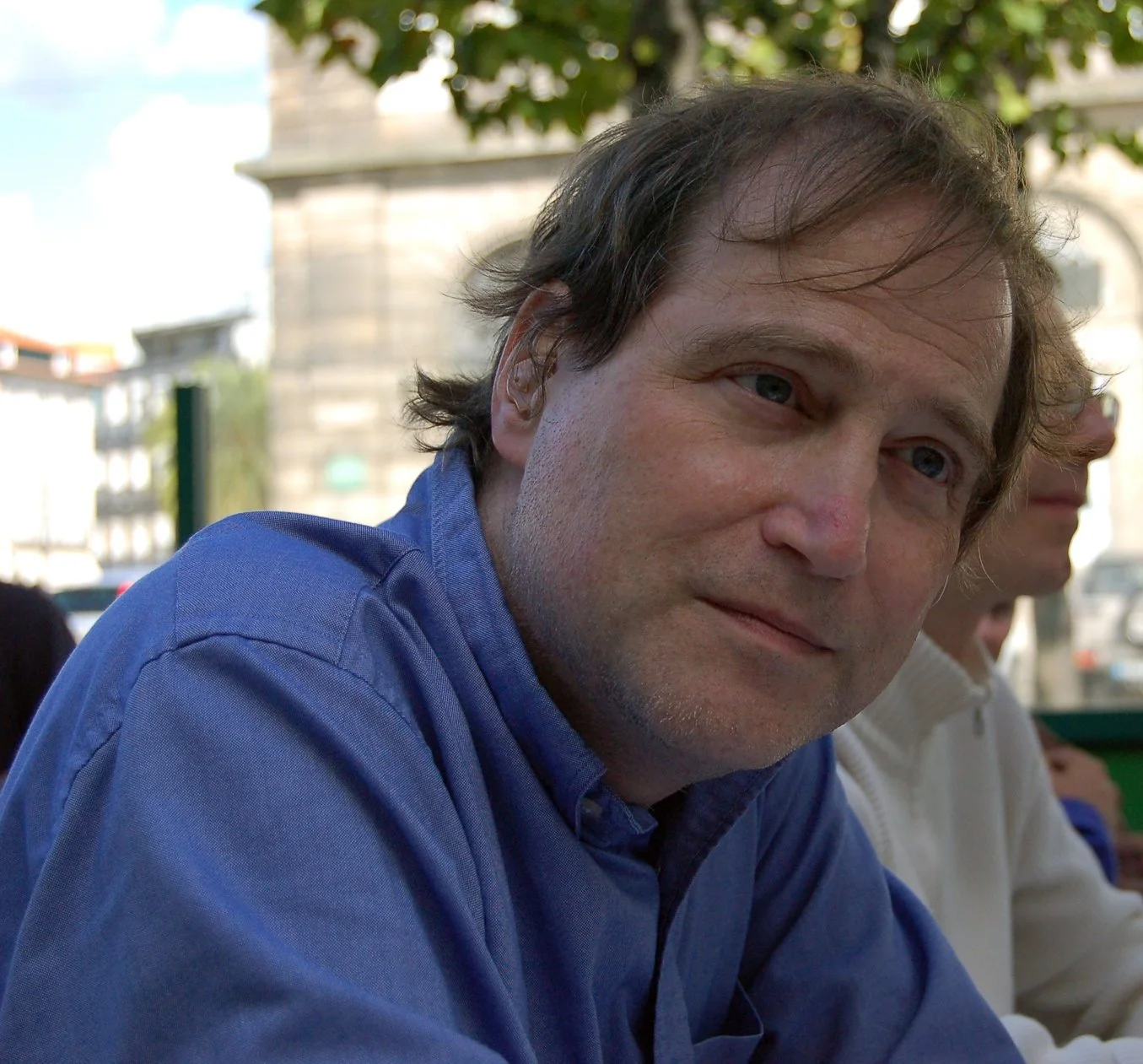
Figure 1. Mark Bernstein
Mark Bernstein is a visionary in hypertext and electronic publishing. He founded Eastgate Systems, the first publisher of electronic literature, in 1982, to advance nonlinear, intertwingled storytelling and thought through creating tools, publishing non-linear works, authoring peer-reviewed scholarly articles, fostering discourse, and much more. In this interview, Mark Bernstein reflects on hypertext, electronic literature, Storyspace, Eastgate Systems, literary publishing, large language models, and the continuing problem of form, structure, and reading in digital literary culture. Bernstein covers his work as a theorist, software designer, publisher, critic, and creative practitioner, situating hypertext within the humanities and arguing that “Computing is a Humanism.”[1]
Interdisciplinarity, Literary Machines, and the Formation of Hypertext
Mehul: Your career is unusual in that you are simultaneously theorist, toolmaker, publisher, critic, and creative practitioner. Which of those roles has most shaped the others? Did building tools teach you how literature works, or did literary practice teach you what software had to become? And, looking back, do you think this achievement was only possible because these capacities developed together, that without strength in any one of them, the larger body of work you created might not have come into being in the same way?
Mark: I’ve worn several hats in the hypertext area, but so have others. Cathy Marshall, of course. Bob Stein at Voyager. David Millard at Southampton.
I do believe that science and scholarship demand that we use everything at hand to address a problem. If you are trying to solve a problem in philosophy, as Gödel was back in the late 1920s, and if set theory seems to give you a handle on that problem, then you ought to study mathematics. Many in the humanities have lost track of this, or assume that they are incapable of actually engaging with science and mathematics. That’s wrong. Many scientists suspect that Critical Theory is obscurantist and so can be ignored. That’s also a mistake.
Three factors affect this:
First, the Two Cultures problem is both real and complicated (Snow 1959).[2]
Second: the educational systems of Western Europe and much of East Asia—I am woefully ignorant of South Asia, alas!— invite or require students to specialize quite early, and tend to make it difficult to change disciplines or to learn about fields far from one’s own. American post-secondary education tends to delay this specialization and to give students greater choice in constructing a curriculum. (Menand 2001).
Third: for most of my career, computation was in short supply. It still is—I really need a bigger Macintosh!—but in the 20th century the shortage was always acute. Andy van Dam (at Brown University) recalls having to get large grants to obtain a few minutes of machine time, on computers that might now suffice to run a refrigerator. This shortage was not uniform, of course; there were more resources in the US (and in the Soviet Union) than in Western Europe, and resources were even scarcer elsewhere. This influenced the way people worked and the ways people imagined they might work: Europeans (Dijkstra, Wirth, Naur, Nygard & Dahl) were more systematic, more formal, and paid less attention to things like user interfaces because the opportunities for a European student to use a computer were so limited. That scarcity impacted (and still impacts) the reception of literary machines in much of the world.

Figure 2. Mark Bernstein (on the right) with a colleague in a Conference
I’ve always wanted to do science, and I’ve always been interested in the arts.
My mother was a newspaper writer before kids, and a watercolor painter after kids. My father was a psychiatrist who ought to have been a philosopher. He studied sculpture and woodworking. Aunt Tanya made exquisite furniture in her basement workshop, Uncle Eddie, a teacher, was an accomplished painter. Aunt Hermia was an actress. Uncle Lionel made large figurative sculptures in wood. Most of them were voracious readers; they argued about books and pictures and plays and movies.
Lots of my aunts and uncles worked as doctors or nurses, and they always emphasized that this, too, is an art form and that its practice almost always depends on manual skill as well as knowledge. The eldest, Uncle Fred (an orthopedic surgeon), provides the framing of my next book on Computing as a Humanism. He believed that, while not everyone was capable of being a physician, if one were capable then practicing medicine was the only moral choice. Computers, he thought, were for unfortunate people who could not themselves cure suffering, but who might be in a position to help doctors to do so. In retrospect, he was not quite as wrong as I once thought.
Yet, who would not be interested in the arts? I know some people are not, but I don’t understand that. As an undergraduate, I majored in chemistry with a minor in ancient history. Recently, I’ve been looking into the development of writing as a way to understand information; it turns out that we know a surprising amount about the process.
Computers as Literary Machines and the Question of Language Models
Deena: I’m curious as to what first gave you that intuition in the 1980s. Was it programming itself, early human-computer interaction, or something about language and computation more broadly?
Mark: I had an early sense that computers are literary machines, that their natural métier is language rather than numerical integration. That seemed preposterous in the 1980s and many people still think it is zany, but it’s clearly true. I have always found dialogue with machines to be fascinating. I love to make software; some of my colleagues do not.
One influence might have been Oliver Selfridge’s A Primer for FORTRAN IV On-Line (1972) which was open to a variety of interesting problems, chess, orbit simulations, and making art. Many years later, I got to know Oliver socially; his work on Pandemonium, a very early gesture at neural networks, remains brilliant (Selfridge 1958). It takes determination to allude to Paradise Lost in computer science research. I certainly was excited as an undergraduate by Ted Nelson’s Computer Lib/Dream Machines (1987), which I devoured in Swarthmore’s old science library.
Deena: Do you think today’s large language models (LLM) prove your early intuition that computers are “literary machines,” or do they change what that phrase means?
Mark: Of course! LLMs are the wonder of our time, our most remarkable and least expected achievement. They are amazing works of art. They know nothing but language, but it turns out that knowing something about language lets you do far more than anyone expected.
Mehul: And do you see the rise of such LLMs as a threat to human creativity, or as another medium through which creativity can be extended? More specifically, do you regard them as a danger to electronic literature and its creative practices, or as a new condition under which those practices might evolve?
Mark: They’re a threat to human creativity only in the sense that the billionaire thieves and knaves who control so much of the AI Industry and the fascists they promote may yet kill us all. Or they may impoverish us, ushering in an era when no one will have time for art or beauty. I don’t think LLMs are a danger. Working with Claude to accomplish some mundane business tasks implicitly draws on cutting edge hypertext theory. I just wrote a paper about reading afternoon, a story with Claude. It was rather fun.
Storyspace, Dynamic Links, and Reader-Sensitive Structures
Mehul: You published Storyspace at Eastgate, and many electronic literature creators still admire the way its structures help writers design complex works. In your paper “Storyspace 3” (2016), you write that “the distinctive feature of Storyspace is its dynamic link,” especially the guard field, which can activate or deactivate links according to the reader’s prior path. Do you think this kind of reader-sensitive, cyclic hypertext structure is still difficult to achieve in contemporary tools such as Twine, web platforms, or AI-assisted writing systems?
Mark: Storyspace (1991) was written by Jay Bolter, Michael Joyce, and John B. Smith. Eastgate published it when a previous publishing contract fell through. I did write Storyspace for Windows, and then Storyspace 2 and 3. Storyspace 4 is coming. Dynamic links can certainly be built in Twine, but you need to want them. Many of the early Storyspace writers were steeped in textual theory and cared a lot about structure and narrative. Twine has tended to prefer other things.
Mehul: What does Storyspace still make possible, formally or imaginatively, that newer tools tend to overlook?
Mark: Link density matters. The TINAC Manifesto said something like "Three links per writing space, or it’s not a hypertext.” Storyspace makes links easy, and guard fields avoid meaningless tangle. Dynamic links are important for generating forward momentum; too little attention has been given to that. The core contribution of Storyspace to literary hypertext may have been its understanding that reader choice does not chiefly concern plot. It’s not the question of what happens that concerns us, or not only that, but also how we learn about it. That’s what we talk about when we talk about hypertext.

Figure 3. Storyspace: the pioneering hypertext environment (Storyspace 3)
Hypertext Between Disciplines
Mehul: So can we say hypertext belongs between disciplines? To understand it properly, you need literature, computing, design, philosophy, history, and media theory.
Mark: The main point is that hypertext really belongs in the humanities, as does the study of Computing. Computing is a Humanism.
Mehul: But educational systems, disciplinary prejudice, and unequal access to computing have made that kind of cross-disciplinary work harder than it should be.
Mark: Scholarship has always been difficult.
Mehul: So, do you think these factors have shaped, or even constrained, our understanding of hypertext? In particular, did the Two Cultures divide, early disciplinary specialization, and unequal access to computation limit the growth and reception of hypertext as both a technical and literary form?
Mark: The scarcity of computing didn’t help. But, really, the world welcomed literary computing with an extraordinarily open mind. We started publishing in 1988; by 1992, we were on the front page of the New York Times Book Review. Later, of course, the literary world eventually soured on structuralism and postmodernism, and sometimes used hypertext and a metonym for the excesses of Continental Theory. That was a rough time; I simply didn’t know what that sort of critical storm feels like.
Hypertext, Public Policy, and Political Complexity
Mehul: As an author as well as publisher and pioneer in hypertext, what do you think hypertext's possibilities could be to inform our times now?
Mark: Our times may not wish to be informed, or so it seems. The very first time I gave a keynote talk, way back in the 80s, I argued that a central contribution of hypertext would be in public policy, in enabling our legislators to understand the questions on which they would vote. That was a mistake. Our politicians don’t want to understand complex questions; they want to be reelected or, failing that, to obtain profitable lobbying positions. We dreamed of policy documents that would let legislators understand the questions on which they were called to vote. We dreamed of new ways to tell stories. We ended up with Marvel/DC/Disney Sequel Machines. The politicians did not care; they wanted to get reelected, or to get paid.
Deena: Yes, and thank you for hosting the Decision Process: How to Succeed in Government hypertext that I did for government planning back in the 1990s, which the Federal government abandoned in the mid-2000s!
Deena: Another example of a hypertext delving into politics would be your work on The Election of 1912 (Bernstein 1988), which delves deeply into the intertwingled politics of that era. How would a similarly complex hypertext shed light on today's politics?
Mark: The Election of 1912 (Bernstein 1988) could not be very deep because it was released in 1988 and had to fit on an 800K floppy disk. Text, graphics, the political simulation, all had to squeeze into a tiny amount of disk space and even less memory. My view in The Election of 1912 (Bernstein 1988) was that Theodore Roosevelt tried, and ultimately failed, to combine the best elements of two American parties. Or, at any rate, he tried to extract the worst elements — the racism and grift of the 19th century Democratic party, the isolationism and complacency of the old GOP. The simulation was an argument for coalition, and seemed to be pertinent to the end of the Reagan era. I did not foresee how badly things would turn out; if Reagan were around today, he’d be a Democrat.
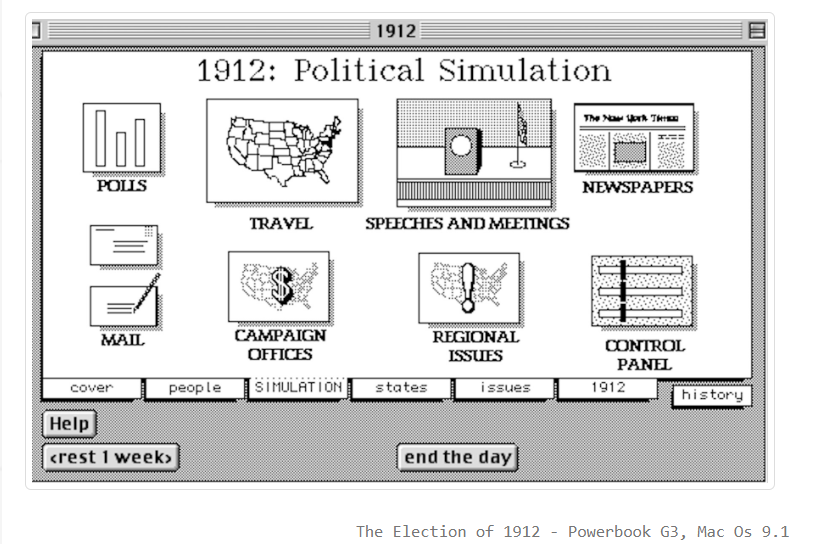
Figure 4. The Election of 1912 by Mark Bernstein
I think The Election of 1912 (Bernstein 1988) might be regarded as an attempt to get more information and more textual information into simulations. Chris Crawford’s Balance of Power (1985) is a similarly polemic political simulation. Sid Meier’s Railroad Tycoon (1990) tried to teach people rather a lot about locomotives. But Crawford and Meier were trying to minimize reading and to get on with the game. I was looking in a different direction.
We have some fine big hypertexts on historical topics: for example, Edward L. Ayers’s Valley of the Shadow, Landow’s Victorian Web, Crane’s Perseus and Kiesling’s Topos Text. Many people would list Wikipedia, too, but it’s becoming entirely hopeless on history, both. because Wikipedia remains at the mercy of factions and cranks, and because Wikis have never regained the hypertextual richness of Ward Cunningham’s original wiki. I think we have real opportunities to explore a new hypertextual historiography. Recently, I’ve been working on reading ancient historical work along with an AI and collaboratively making hypertextual notes of the discussion. I think that might prove pedagogically valuable. I’ve always been interested in polyvocal hypertext[3], and now it’s easy to try.
Mehul: An example of this type of historiography would be your work, Those Trojan Girls, which has been read as a bridge between classical Storyspace practice and newer interactive forms, combining the Eastgate inheritance with stretchtext and sculptural structures. How can we promote these interactive practices today?
Mark: Those Trojan Girls embraces some of the conventions and concerns of interactive fiction as well. We just need to get on with the work.
Hypertext, Society, and the Liveness of the Reader
Mehul: Matthew Arnold famously described literature as a “criticism of life,” and literary critics have often spoken of literature as a mirror of society. Do you think hypertext may be a more powerful medium than print for representing the complexity of social life, because it can organize ideas through nodes, links, multiple pathways, and competing voices? In other words, can hypertext better capture the interconnected, polyvocal, and non-linear nature of society and human experience?
Mark: Absolutely. The best literary hypertexts do this brilliantly. Michael Joyce’s afternoon, a story, or Mary-kim Arnold’s “Lust”, for example, are polished lyrical evocations of small corners of experience that contain multitudes.
Remember, too, that hypertext makes manifest our new understanding of reading. In the early 20th century, it was possible to think of text as a transmission medium; the writer encoded thoughts, the reader received them. It turns out the situation is vastly more complicated and that the reader plays a more active and central role. Barthes’s author is not entirely dead, but the reader turns out to be a lot livelier than once we thought. Hypertext prevents us from averting our eyes and ignoring the liveness of the reader; the hypertext writer knows that readers always have choices and never really know enough to choose. It is not difficult, following Sontag, to imagine an erotics of hypertext.
I think we promote hypertext best when we write and read hypertexts, and when we take hypertext seriously.
Resistance to Electronic Literature and the Question of Canon
Mehul: At the same time, I have noticed, especially in India, that many traditional literature scholars are reluctant to accept electronic literature as literature. They often do not seem to enjoy or value the aesthetics of digital and hypertextual forms. What do you think explains this resistance? Is it simply unfamiliarity with technology, or is there also a deeper anxiety that electronic literature requires scholars to revise their print-based theories, methods, and assumptions about what literature is?
Mark: What leads people to become Professors of English? At some point, a young person decides that they might enjoy spending time thinking about Trollope and Pynchon. Spending that time pondering octopus neurology or electromagnetic fields might seem less attractive. Literary machines might seem too far from the conventional trappings of literary scholarship.
A general rethinking of Modernism and Postmodernism is also a factor here. Early hypertext theory practiced high modernism in robes borrowed from the postmoderns. When people — I’m thinking Michael Chabon, for example — wanted to reject the reflexive ironic stance of the postmodern moment, the hypertextual aesthetic seemed replete with ironic detachment and lacked the good old-fashioned joys of plot. I think that was an illusion, and in Those Trojan Girls I did try to show a counter-argument.
People love to revise their print-based theories. That’s the fun part! But they don’t necessarily enjoy the trappings of technology. They don’t want to lose the leather club chair and the finely-printed edition by the stone fireplace. They don’t actually have the chair or the fireplace. . .
Mehul: Could this resistance also be understood as a form of disciplinary gatekeeping, where established ideas of literary value and scholarly authority are used to exclude newer digital forms from serious literary canons and discussion?
Mark: This has long been understood as a function of literary criticism. Literary hypertext benefits from this type of analysis as well: see, for example, Astrid Ensslin’s wonderful book on Canonizing Hypertext (Continuum 2007). Her Pre-Web Digital Publishing and the Lore of Electronic Literature (Cambridge University Press 2022) is an interesting look at our small literary magazine, The Eastgate Quarterly and the interaction with readers and critics, though for some reason Ensslin thinks an eight-issue run is an anomalously short lifetime for small magazine. The Dial lasted four years, BLAST lasted two issues, Locus Solus managed five.
Navigation, Structure, and the Web
Deena: Your work repeatedly returns to the problem of navigation, The Bookmark and the Compass (1988), Deeply Intertwingled Hypertext (1991), Patterns of Hypertext (1998), and later reflections on links and orientation. Why has navigation remained the central aesthetic and intellectual problem of hypertext, and have the mainstream digital forms and recently-developed tools succeeded in solving it?
Mark: Early hypertext research was deeply worried about navigation. People expected that hypertext might be confusing, that people would get lost in hyperspace. This turned out to be a mistake, but it’s understandable: we had almost no experience with reading hypertexts, and building the first systems was so difficult (and slow) that there was plenty of time to worry about what might go wrong.
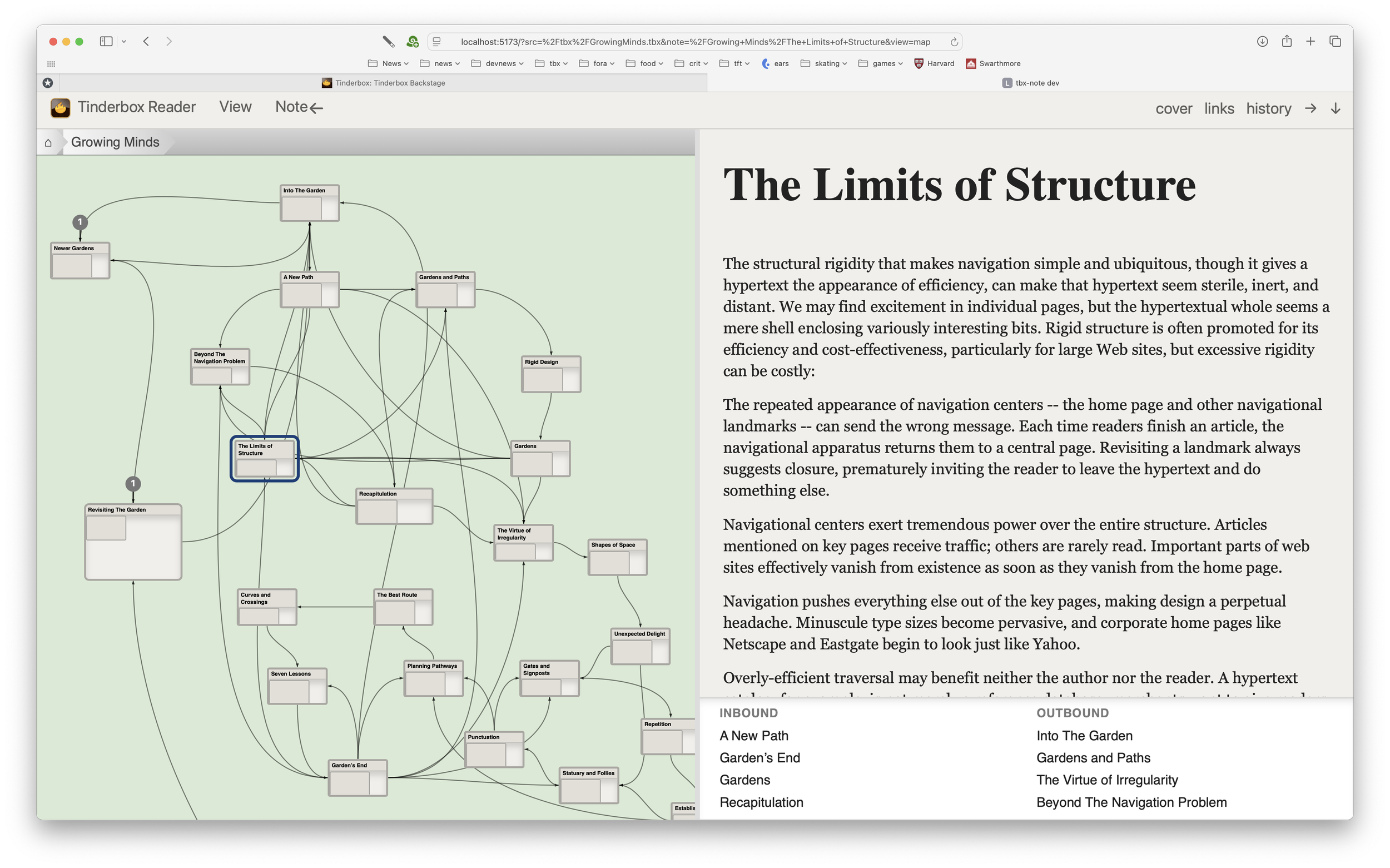
Figure 5. A Tinderbox Reader view of Hypertext Gardens by Mark Bernstein
I had pretty much declared the “navigation problem” solved by 1991. George P. Landow came to the same conclusion a bit sooner. People don’t get lost in hypertexts, except in the same ways they get lost in books. Getting lost, anyway, is not a terrible thing: tell the truth but tell it slant.
When the World Wide Web exploded, it seemed a triumph of hypertext. But it soon turned out that people tended not to write interesting link structures for the Web. Leslie Carr at Southampton was the first to identify this: though the Web could have been hypertextual, people tended to write isolated small islands. Later, of course, the Web degenerated into a swamp of popups blocking your view of One Weird Trick clickbait ads.
In the end, though, the hypertext intuition is that information has structure. That structure is often complex, it often seems messy, but hypertext researchers are all structuralists. That can be an uncomfortable epistemological stance, but I think that the success of large language models suggests that the structuralist intuition is not arbitrary. No one ever doubted that language has structure or questioned whether that structure mattered; it turns out that knowing what seems to be the statistically-probable things to say right now is also, often, the smart and helpful thing to say right now.

Figure 6. A Screenshot from Mark Bernstein’s keynote Speech, “Where Are the Hypertexts?”
“Where Are the Hypertexts?”: Retrospect, AI, and Tools for Thought
Mehul: Thirty-five years after you first asked, ‘Where are the hypertexts?’, we live inside a world saturated with links, feeds, note systems, and algorithmic pathways, yet not necessarily in the literary or critical hypertext culture you imagined in that seminal keynote. Looking back from Storyspace and Eastgate to Tinderbox, social media, and AI, what part of your original vision has come about and may possibly happen in future?
Mark: I’m not convinced there will be much of a future. Let us suspend our disbelief.
People are lazier, and time moves more slowly, than I understood when I first asked this, back in 1989. The lack of hypertexts ought to have set off alarm bells; certainly, by my 1999 talk "Where Again Are The Hypertexts?” we ought to have understood that hypertexts were harder to create and to read than we once thought. In the early years, we worried that the problem would be technical, or perhaps the problem of disorientation. In practice, though, we walked right into the brick wall of rhetoric, text, and discourse. And then — completely unexpectedly — one of our greatest and most unlikely dreams came true. Machines learned to write meaningful text based on stochastic statistical models of language. That ought not to have worked, but here we are. Our conversations with AI are deeply hypertextual.
There’s a lot of ferment in “Tools for Thought” right now. If the world doesn’t end right away, there are huge opportunities. Right now, I’m experimenting with hypertext visualizations based on organic forms and the architectural ornament of Louis H. Sullivan.
We urgently need a textual medium that is better than books. For most of the history of hypertext, that’s been heretical. Today, I think everyone understands the need. People are still reluctant to think seriously about what this could mean. That’s chiefly cowardice, augmented by nostalgia for an imagined past.

Figure 7. A Tinderbox Reader view of Hypertext Gardens by Mark Bernstein
Mehul: Following from that, what kinds of problems should future hypertext authoring systems try to solve? What should the next generation of literary tools make easier for writers and readers?
Mark: I recently made a list of outstanding research issues, and several of them point directly to this question.
One problem is reader traversal: understanding the reader’s trajectory through the hypertext. We have often modeled movement through hypertext rather mechanically, often as a Markov process: the reader moves from one node to another, and we count or predict those movements. But readers do much more than move. They remember, hesitate, compare, return, revise, and speculate. So one thing future systems should make easier is a richer understanding of how readers actually make meaning as they move through a work.
Another issue is how we write hypertexts that LLMs can use effectively. We now have machines that can read, summarize, reorganize, and continue texts, but we have not yet learned how to design hypertexts for them as serious readers or collaborators. I am especially interested in whether LLMs can make hypertextual notes for their successors, notes that preserve structure, uncertainty, context, and useful paths of attention, rather than simply producing summaries. I am also interested in polyvocal hypertexts, and in LLMs with character. Literary hypertext has always been good at sustaining multiple voices, partial perspectives, and conflicting accounts. LLMs may help us extend that tradition, not only by generating dialogue, but by helping writers manage distinct voices and complex points of view over time.
In the 1990s, there was a tendency to stage competitions between text and hypertext, or between print and electronic writing. Those drag races were not very helpful, but recent developments in LLMs, especially around introspection and self-description, may let us revisit some of those questions more productively. Andy Clark’s idea of the Extended Mind (1988) is useful here. If thinking is distributed across notebooks, screens, links, prompts, and collaborators, then hypertext may be one of the forms through which extended cognition becomes literary.
A further question is how we learn alongside an LLM. Is this a new form of learning augmentation in Engelbart’s sense? Engelbart was not merely interested in doing chores faster. He wanted tools that could enlarge our capacity to think, organize, collaborate, and solve problems (Engelbart 1962). The next generation of literary tools should not simply help writers produce more text. They should help writers perceive structure, discover relationships, sustain complexity, and revise their own understanding.
Finally, hypertext may help us understand one of the surprising facts of the present moment: that a statistical model of language, with limited knowledge and no lived experience of the world, can nevertheless read and write interesting hypertexts. That should surprise us. Hypertext has always foregrounded relation, context, recurrence, and the reader’s active construction of meaning. Perhaps LLMs seem so capable in this space because hypertextuality is not just an ornament added to language. It may be one of the ways language itself thinks.
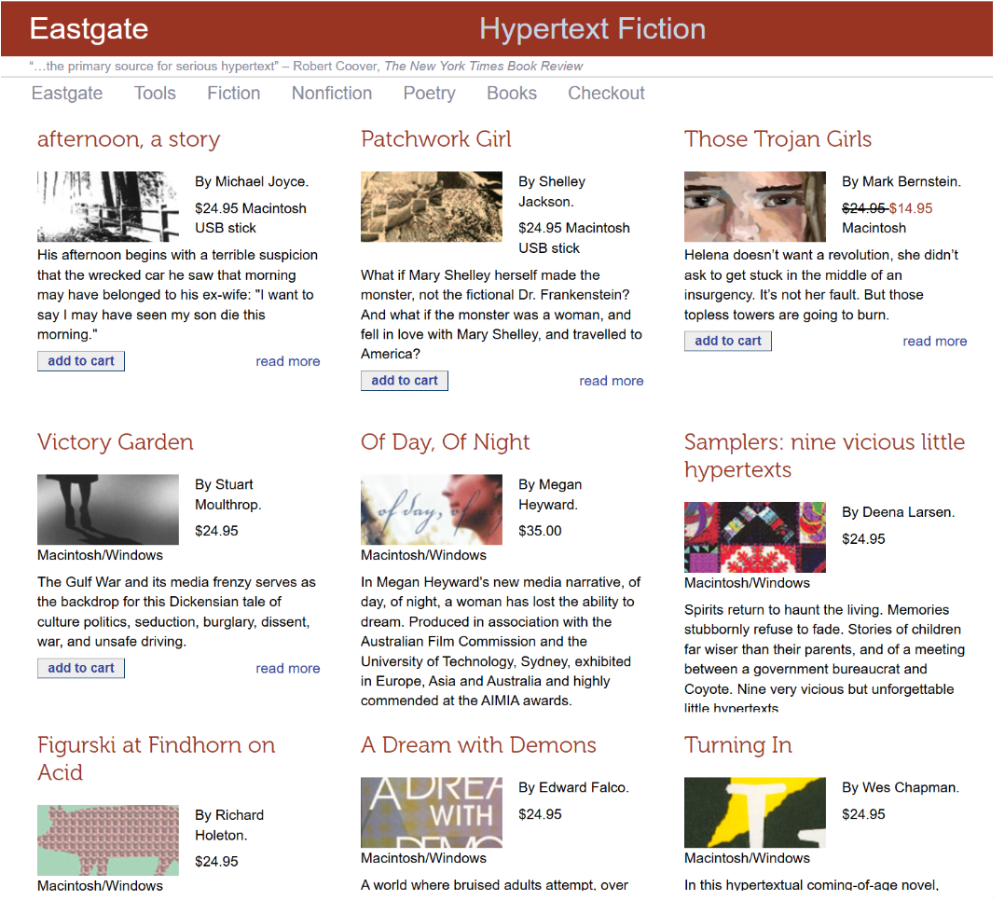
Figure 8. Homepage of Eastgate
Eastgate, Publishing, and Electronic Literature
Deena: At Eastgate, you helped publish and sustain what many regard as the core canon of serious hypertext fiction. What insights did you bring to the table, as a publisher, about electronic literature that the wider software industry, university presses, and later platform companies failed to understand? And how, if at all, can the print-centered publishing industry be persuaded to accept electronic literature as a serious publishing form rather than treating it as peripheral, experimental, or institutionally inconvenient?
Mark: The industry and the publishing world assumes that the natural inclination of the computer is numeric, and that computing in the humanities is exceptional and transgressive. This would come as a surprise to the people who started to study computing in the 1920s and 1930s; they were interested in probing the limits of thought and the nature of language. Missile trajectories came later.
It is important to keep in mind that publishers and booksellers in our time confront terribly difficult problems. They are not hostile to new media, but new media cannot answer the problems they are facing. They just don’t have time to think deeply about things like hypertext. No hypertext seems likely to make much difference to the prospect for survival of any bookseller, much less any major publisher.
Of course, to be able to write software and to publish experimental literary hypertext does require a certain interdisciplinary confidence, a willingness to learn what is needed. In short, “Computing is humanism.”
Notes
[1] In other words, computing touches on language, literature, and liberal arts—and belongs to the humanities as well as the sciences.
[2] C. P. Snow examines the gap between the sciences and humanities in this seminal work.
[3] See, for example, (Bernstein, M. Conversations with Friends: Hypertexts with Characters, 1996, in Hypermedia Design, Workshops in Computing, Springer, London).
References
Ayers, E. L. (Ed.). (n.d.). The Valley of the Shadow: Two communities in the American Civil War. University of Virginia. https://valley.lib.virginia.edu/
Barthes, R. (1977). The death of the author. In S. Heath (Trans.), Image, music, text (pp. 142-148). Fontana Press. https://monoskop.org/images/0/0a/Barthes_Roland_Image-Music-Text.pdf
Bernstein, M. (1988). The bookmark and the compass: Orientation tools for hypertext users. ACM SIGOIS Bulletin, 9(4), 34-45. https://doi.org/10.1145/51640.51645
Bernstein, M. (1991) "Deeply Intertwingled Hypertext: The Navigation Problem Reconsidered", Technical Communication, 38(1), 41-47.
Bernstein, M. (1998). Patterns of hypertext. In Proceedings of the Ninth ACM Conference on Hypertext and Hypermedia (pp. 21-29). Association for Computing Machinery. https://doi.org/10.1145/276627.276630
Bernstein, M. (2016). Storyspace 3. In Proceedings of the 27th ACM Conference on Hypertext and Social Media (pp. 201-206). Association for Computing Machinery. https://dl.acm.org/doi/10.1145/2914586.2914624
Bernstein, M. (2016). Those Trojan girls [Hypertext fiction]. Eastgate Systems. https://www.eastgate.com/catalog/ThoseTrojanGirls.html
Bernstein, M., & Sweeney, E. (1988). The election of 1912: A hypertext study of the Progressive Era [Hypertext simulation]. Eastgate Systems.
Clark, A., & Chalmers, D. J. (1998). The extended mind. Analysis, 58(1), 7-19. https://doi.org/10.1093/analys/58.1.7
Crane, G. R. (Ed.). (n.d.). Perseus Digital Library. Tufts University. https://www.perseus.tufts.edu/
Crawford, C. (1985). Balance of power [Video game]. Mindscape.
Engelbart, D. C. (1962). Augmenting human intellect: A conceptual framework. Stanford Research Institute. https://www.lri.fr/~mbl/ENS/FONDIHM/2018/papers/Englebart-Augmenting62.pdf
Ensslin, A. (2007). Canonizing hypertext: Explorations and constructions. Continuum.
Ensslin, A. (2022). Pre-web digital publishing and the lore of electronic literature. Cambridge University Press.
Joyce, M. (1990). Afternoon, a story [Hypertext fiction]. Eastgate Systems.
Kiesling, B. (n.d.). ToposText. Aikaterini Laskaridis Foundation. https://topostext.org/
Landow, G. P. (Ed.). (n.d.). The Victorian Web. https://victorianweb.org/
Menand, L. (2001). The marketplace of ideas: Reform and resistance in the American university. W. W. Norton.
Meier, S. (1990). Railroad Tycoon [Video game]. MicroProse.
Nelson, T. H. (1987). Computer lib/Dream machines (Rev. ed.). Microsoft Press. Original work published 1974.
Selfridge, O. G., in D. V. Blake and A. M. Uttley (eds.). (1959). Proceedings of the Symposium on Mechanisation of Thought Processes, pp. 511-529, London: Her Majesty's Stationary Office.
Selfridge, O. G. (1972). A primer for FORTRAN IV on-line. MIT Press.
Snow, C. P. (1959). The two cultures and the scientific revolution. Cambridge University Press.
Sontag, S. (1966). Against interpretation and other essays. Farrar, Straus and Giroux.
Biographies
Mark Bernstein is a pioneering figure in hypertext, electronic literature, and tools for thought. As the founder and Chief Scientist of Eastgate Systems, he has played a defining role in advancing serious hypertext publishing and shaping how writers, researchers, and thinkers explore interconnected ideas. Bernstein is the creator of Tinderbox, an influential visual note-making and knowledge-management environment, and has led the continued development of Storyspace, the landmark platform associated with foundational works of hypertext fiction. He has also contributed extensively to hypertext scholarship as a researcher, author, editor, publisher, and conference leader. Before entering computing, Bernstein studied at Swarthmore College and earned a Ph.D. in physical chemistry from Harvard University. His enduring work bridges technology, literature, design, and human thought, establishing him as one of the field’s most significant innovators.
Mehulkumar Desai is a research scholar at the Indian Institute of Technology (Indian School of Mines), Dhanbad, and a HASTAC scholar (2026-27). His research lies at the intersection of Electronic literature, Interactive Digital Narratives, Digital Humanities, and the Creative Industries. He examines how born-digital literary forms, narrative interactivity, and new media practices reshape contemporary cultural production, with particular attention to emerging practices in the Global South. Mehul is a co-founder of the Indian Consortium for Interactive Digital Narratives (ICIDN), established in collaboration with Dr. Shanmugapriya T. He also serves on the core committee of Electronic Literature India. His work integrates scholarship, creative practice, and community building within the fields of Electronic literature and Interactive Digital Narratives.
Deena Larsen is an American new media and hypertext fiction author who has been involved in the creative electronic writing community since the early 1990s when she first interviewed Mark Bernstein for her Masters Thesis: Hypertexts and Hyperpossibilities. Her first works, Marbles Springs and Samplers, were published by Eastgate Systems. Her work is in online journals such as the Iowa Review Web, Cauldron and Net, frAme, inFLECT, Drunken Boat, New River, and Blue Moon Review. Since May 2007, the Deena Larsen Collection of early electronic literature has been housed at the Maryland Institute for Technology in the Humanities, and her work is collected in The Next Museum, Archive, and Preservation Space. She has been an artist in residence at Washington State University Vancouver and currently works to promote electronic literature throughout the world. She retired from a 30-year career as a technical writer and strategic planner with the U.S. Federal government. Eastgate Systems still houses her Storyspace derived work from that time, The Decision Guidebook: How to Succeed in Government.