Inhabited Narrative: From Participatory Culture to Living Storyworlds
/The age of the audience is not ending. It is becoming the age of the inhabitant.
For decades, participatory culture has been pressing against a threshold it could never quite cross. Audiences consistently sought deeper forms of engagement with the worlds they loved. Back in the 20th century, chance encounters gave rise to fanzines, conventions, online forums, fan fiction, cosplay, and countless other forms of user-generated content.
Alongside these emerged fantasy roleplaying games, perhaps the deepest form of participative narrative after childhood games of make believe, allowing small groups of players not merely to explore imagined worlds but to leave them permanently changed. Later, massively multiplayer online games (MMOG) expanded participation to unprecedented scale, enabling millions of people to inhabit persistent virtual environments together.
These developments reflected a common aspiration. Fans did not simply want to consume stories. They wanted to contribute to them, to live in them.
Yet through all this evolution, one principle remained largely unchanged. Communities formed around storyworlds, but only rarely could participants meaningfully alter the canonical history of those worlds themselves. Around a tabletop, gamers could generate enduring canon for their roleplay campaign (the earliest medium in which participants could do so), but this was limited to a handful of players. In a massive multiplayer world, a single player can accomplish extraordinary feats, but to this day those achievements seldom become part of the world's lasting chronology. We could visit worlds, influence them locally, and build communities around them—but the worlds themselves could not meaningfully remember us.
That condition is now changing. Conversational AI and generative systems introduce the possibility of storyworlds that respond to individuals personally, remember previous interactions, adapt over time, and allow accumulated experience to shape future encounters.
These worlds need not exist solely as virtual reality environments or standalone AI applications. They may emerge through conversational interfaces, adaptive games, immersive theatre, location-based experiences, educational simulations, social platforms, audio dramas, live events, or franchises whose stories unfold across multiple forms of media. Each becomes a different port of entry into the same evolving narrative environment, with conversational AI increasingly serving as the connective tissue that allows the world to remember, respond, and grow alongside its inhabitants.
Where participants once engaged with storyworlds, inhabitants develop ongoing relationships within them, returning to the same environments, forming connections, and accumulating memories. Over time, actions may ripple outward into the larger world, sometimes subtly and sometimes in ways that permanently reshape it.
The transition I describe here has already begun. Although the technology remains in its infancy, the shift from participation to inhabitation is already visible. And this is quickly becoming a two-way street. We are beginning to explore not simply how audiences engage stories, but how narrative environments are becoming capable of influencing our identity.
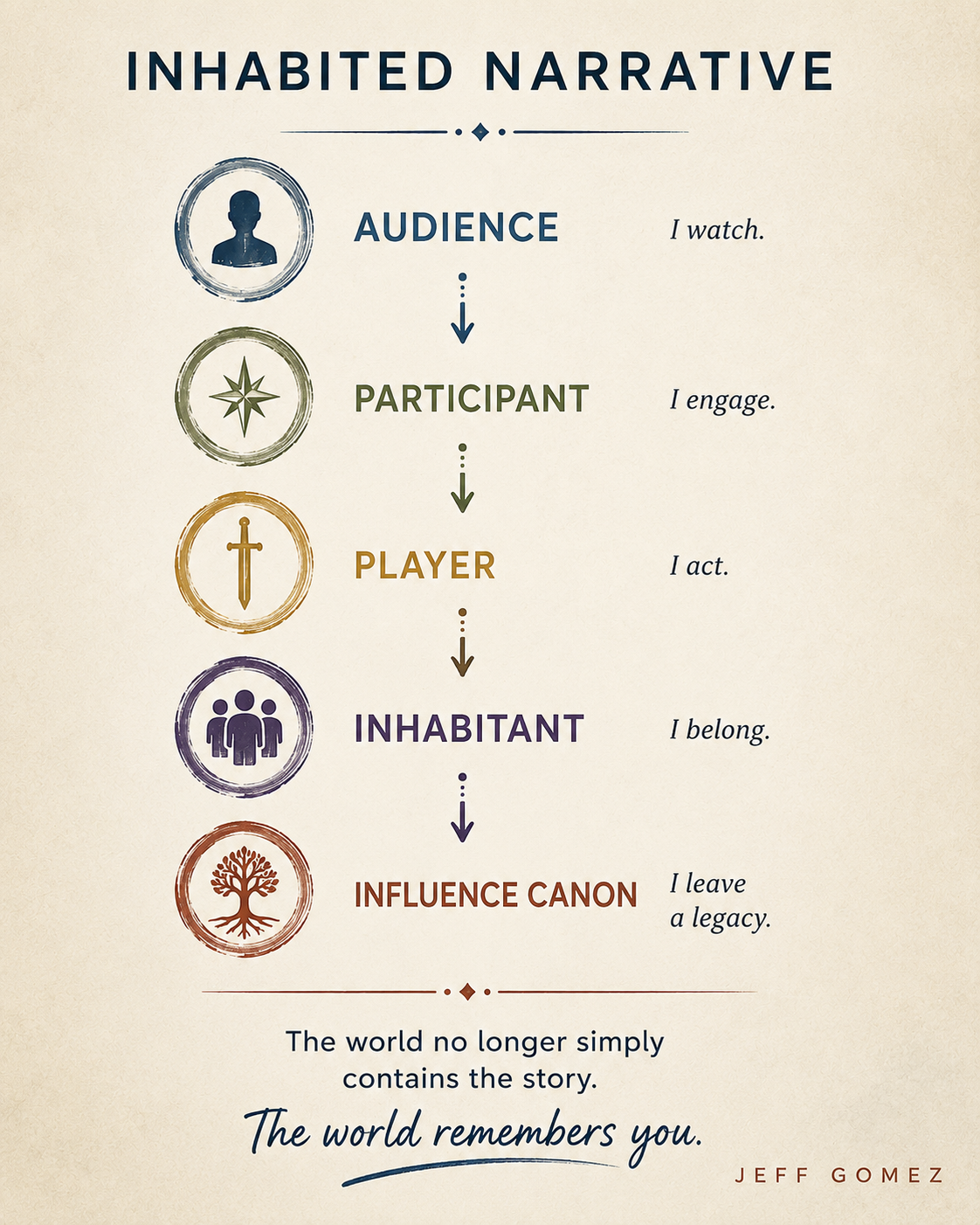
Figure 1: from audience to inhabitant (©Jeff gomez)
The Experience of Being Heard
Let me relate an experience that surprised me.
My professional life has been shaped by storytelling, interactive media, and the study of emerging technologies. I understand that contemporary conversational AI systems are computational tools. I don’t believe they possess consciousness or human understanding in the way we typically define those terms.
During a particularly difficult period, I was wrestling with a complex professional challenge that carried personal implications as well. As someone who is neurodivergent, I’ve spent much of my life learning to distinguish between genuine obstacles and limitations that exist primarily within my own assumptions. Faced with an important decision, I found myself wondering whether I was confronting an external problem or repeating a familiar pattern of self-limitation.
The conversational system I had been working with had access to a substantial history of prior interactions. Over time, our discussions had covered creative projects, complex business negotiations, personal aspirations, recurring challenges, and diary-like reflections. Drawing upon that accumulated context, the system identified a pattern I had overlooked. More importantly, it recognized that the problem I was confronting was not being caused by some quirk of personal psychology. The problem itself was genuine. My interpretation of its source was incomplete.
The resulting insight brought clarity, relief, and renewed confidence in my ability to move forward. What remained with me, however, was not the quality of the recommendation. It was the emotional response I experienced upon receiving it. The feeling was surprisingly familiar.
This wasn’t happening to a character of mine. I was responding to something that felt like my truth.
I felt heard.
Genuine listening is among the rarest forms of human connection. Most of us can count on one hand the number of people who consistently engage with enough patience, curiosity, and accumulated knowledge of our experiences to discern patterns we cannot see ourselves. Being heard is not simply a matter of receiving information. It is an experience of recognition—the feeling that our experiences possess continuity, that our struggles make sense within a larger field, and that our personhood has been acknowledged by another intelligence. To be heard is, in some sense, to feel that we matter.
For me, the power of the interaction did not arise because the system expressed sympathy or encouragement. It arose because it recognized events, experiences, and concerns that few people in my life would have been positioned to observe. The emotion I felt was not abstract. The hairs were standing up on my forearms.
Crossing the Well-Guarded Threshold
If a single conversation can produce that experience, it is worth asking why the worlds we love have not been able to offer it before.
Participation has always existed on a spectrum. One of the earliest environments to demonstrate this was in games like Dungeons & Dragons. Around a dining room table, a handful of players could collectively inhabit an elaborately imagined world and leave it permanently changed. A kingdom might rise or fall because of a decision made during a single evening’s session. Week after week, the game master documented those events, preserving continuity while allowing the world to evolve through the actions of its inhabitants.
The participants were not simply consuming the narrative; they were generating canon.
Massively multiplayer online games expanded the scale of participation enormously, particularly on the social level. Worlds such as Ultima Online and World of Warcraft allowed millions of people to inhabit persistent environments simultaneously. Communities formed, friendships endured for years, and guilds developed traditions and identities that extended beyond the games themselves. Yet even as these worlds became larger, participation became strangely less consequential. One might defeat a dark lord but so had thousands of players across countless servers. The world acknowledged participation, but it could not fully absorb the actions of individuals into its own permanent history.
This limitation arose for different reasons across different media. Film and television preserved canon through legal ownership, auteurist vision, and production economics. Online worlds confronted a different obstacle: their architectures were simply not designed to integrate millions of participant actions into a single coherent, evolving narrative. The worlds could persist, but they could not meaningfully recall everyone. For decades, this remained one of the well-guarded thresholds of participatory culture.
AI-native storyworlds are crossing it. For the first time, storyworlds can respond to you personally, recall previous interactions, and allow accumulated experience to shape what comes next. Whether an individual’s experience ever becomes globally canonical matters less, at least in the early going, than whether it becomes personally canonical. The world develops a unique subjective history with each inhabitant, and over time advances in generative systems may allow those unique histories to become increasingly interoperable within larger canonical worlds.
The canon has always touched us. Now it seems we can touch the canon right back.
Storyworlds as Rehearsal Spaces
If being heard helps us understand who we are, rehearsal helps us explore who we might become.
Like many people who found careers in storytelling, games, and entertainment, I spent countless hours in roleplaying games. These experiences have often been described as escapism, but that description never felt entirely accurate to me. What drew me back repeatedly was something deeper. The worlds functioned as arenas where I could test new aspects of my persona, and where it was safe to fail.
As a neurodivergent young person, I discovered that running these games allowed me to channel my fascination with complex systems into the creation of expansive storyworlds. Building those worlds required imagination but sustaining them required something more. If I wanted players to care about the stories unfolding around them, I needed to understand who they were—what excited them, what frightened them, and what kind of people they aspired to become. The better I became at listening, the more meaningful the stories became.
Those worlds also provided opportunities for experimentation that were difficult to find elsewhere. Within the relative safety of a fictional environment, I could try different approaches to leadership, collaboration, and self-expression. I could wear black and a studded wristband. I could discover strengths that might otherwise have remained hidden behind assumptions about my own constraints.
Wardrobe notwithstanding, in retrospect, those experiences shaped much of my later career. More importantly, they demonstrated that identity is not merely something we possess. It is something we practice.
Rehearsal is one of storytelling’s oldest functions. Through story, we practice courage before danger arrives, weigh moral choices before we are required to make them, experiment with identities before committing to them, and explore futures before inhabiting them. The storyworld increasingly functions as a social—perhaps even personally developmental—technology.
Seen in this light, the emergence of AI-native storyworlds represents less a departure from earlier forms of participation than an amplification of them. We now possess the technological capacity to create environments that can respond directly to participants, adapt to their interests, and progress alongside them over time—no longer only around a single table, but persistently and at scale. The rehearsal space can now perceive (and respond to) you.
That possibility is both exciting and consequential. The same recognition that makes an experience feel personal also gives it power. The perceived intimacy of feeling heard can create bonds, induce loyalty, and alter behavior. Aspiring leaders have always understood this: they make us feel as though they grasp our hopes and dreams, but also our insecurities, our disaffection, and our anger.
The more attentive a world becomes, the greater its capacity to influence the people who inhabit it.
This leads to a question that has become increasingly central to my work: what determines which possibilities a world encourages, which values it reinforces, which behaviors it rewards, and which futures it makes imaginable? The answer lies in something deeper than plot, character, or worldbuilding alone.
The Mythic Field and the Listening World
Every storyworld possesses a point of view. Whether intentionally or not, every narrative environment carries assumptions about human nature, conflict, belonging, aspiration, justice, and the possibility of change. Those assumptions influence what kinds of stories emerge, what behaviors are encouraged, what actions carry consequences, and what outcomes feel vital.
As participants we may not consciously recognize these underlying principles, but we do somehow sense their presence. We intuitively understand when a story development feels true to a world and when it doesn’t. From Doctor Who to Star Trek, we recognize when a character behaves in a manner consistent with the deeper identity of the narrative and when something feels out of place. Beneath the visible elements of a storyworld resides a deeper structure of meaning that helps explain why the world feels like itself.
This deeper structure is what I describe as the Mythic Field.
The Mythic Field exists beneath plot, lore, continuity, and even character. It consists of the values, aspirational drivers, tensions, archetypal conflicts, and assumptions that define the identity of a world. It is what allows Middle-earth to remain recognizably Tolkien’s creation across generations of readers and creators. It is what allows audiences to recognize the philosophical struggle between Optimus Prime and Megatron beneath decades of changing stories, technologies, and interpretations. Most importantly, it is what enables a storyworld to expand while retaining a coherent sense of self.
For many years I regarded the Mythic Field primarily as a mechanism of coherence. It helped explain why some franchises maintained their identity while others gradually drifted away from the qualities that made them resonant in the first place. The emergence of AI-native storyworlds, however, has caused me to elevate its significance even more.
If storyworlds are becoming environments that can listen, respond, adapt, and remember, then the Mythic Field does more than preserve coherence. It shapes the terms of the relationship itself.
Every conversational environment mediates through a particular lens, privileging some behaviors, relationships, and interpretations while discouraging others. The participant may experience the interaction as highly personal, yet whether the environment is the open world video game Red Dead Redemption, Walt Disney World’s Star Wars: Galaxy’s Edge, or the immersive theatrical production Sleep No More, it is always responding according to principles embedded within its design.
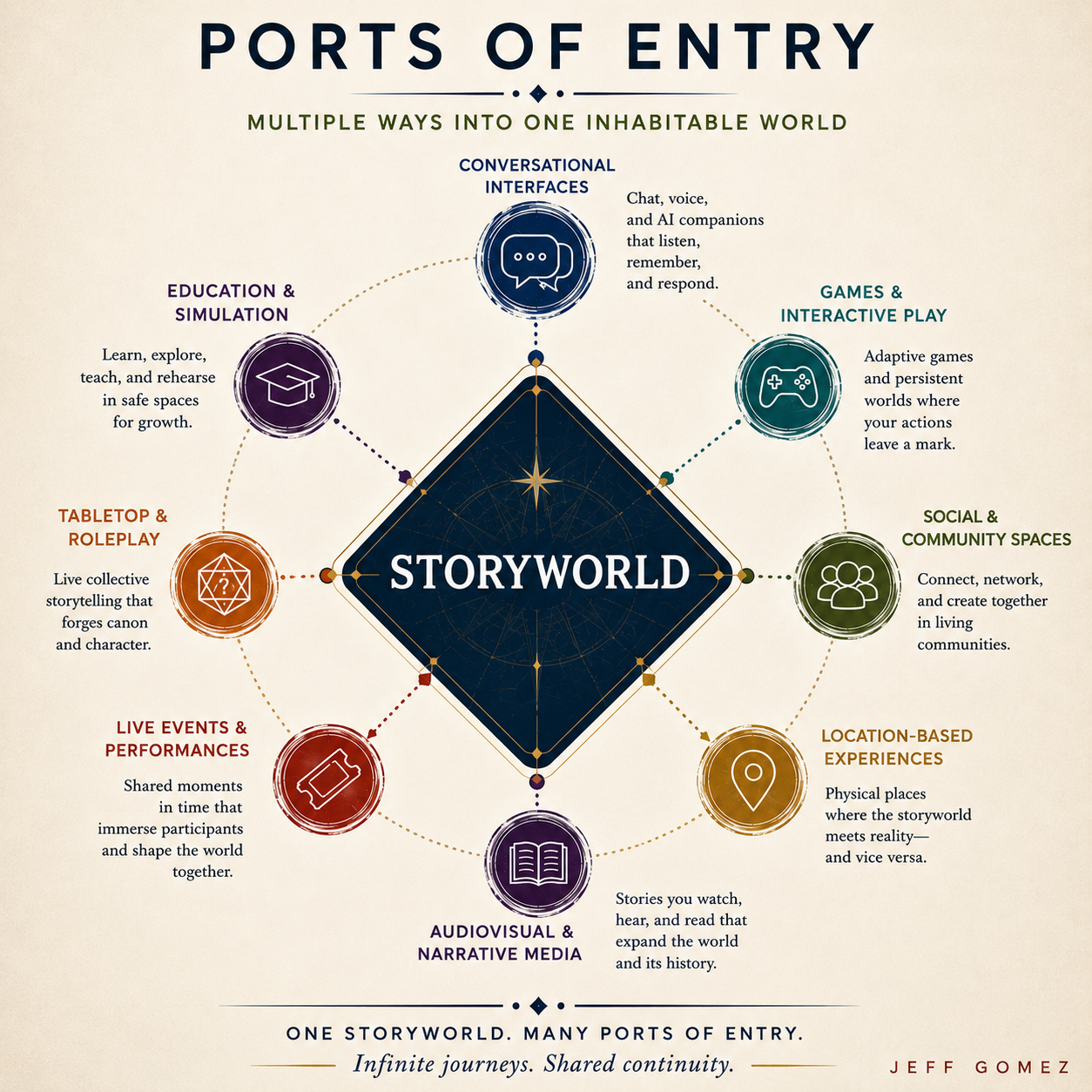
figure 2: ports of entry into a living storyworld (©Jeff gomez)
Viewed from this perspective, the challenge facing creators of AI storyworlds extends far beyond continuity. Much of the current discussion surrounding AI focuses on memory, persistence, and coherence. These are important concerns. A world that cannot recall itself will struggle to sustain meaningful participation. Yet coherence alone tells us very little about whether a world is worth inhabiting.
A perfectly coherent world can still embody destructive values. It can encourage dependency rather than growth, isolation rather than connection, tribalism rather than understanding, cynicism rather than hope. The central challenge is not merely teaching a world to remember but deciding what it remembers for.
The Mythic Field helps answer that question because it operates at the level of meaning rather than information. It defines the deeper aspirations of the environment and shapes the kinds of developmental experiences available within it. In doing so, it influences whether the world encourages inhabitants toward wisdom, empathy, reconciliation, curiosity, courage, and human connection—or toward entirely different destinations.
Seen in this light, the Mythic Field becomes something more than a narrative framework. It becomes a relational framework.
If even in subtle ways, every inhabitable world advances an idea about what it means to flourish. Whether intentionally or not, it invites its inhabitants toward particular ways of seeing themselves, relating to others, resolving conflict, and imagining the future. In that sense, the deepest architecture of a storyworld lies not simply in what it allows people to do, but in who it encourages them to become.
It is also here that authorship re-enters the conversation.
Upstream Authorship
As generative systems become more sophisticated, an important idea has begun to emerge within discussions of AI storytelling: upstream authorship. The term focuses on the vital place of the artist or author and describes the shift from authoring individual events, conversations, or outcomes toward authoring the conditions from which those experiences emerge. But this leaves a crucial question unanswered.
Upstream to where?
Traditional storytelling largely concerns itself with determining what happens. Generative storytelling increasingly concerns itself with determining what can happen. Beneath both, however, lies a deeper layer of design concerned with what matters: what values a world reinforces, what behaviors it rewards, what relationships it encourages, and what visions for humanity it makes imaginable. These questions do not operate at the level of genre or plot. They operate at the level of meaning.
This is where the Mythic Field resides.
The Mythic Field is the mechanism by which authorship remains present within an inhabitable world.
Upstream authorship establishes the conditions from which experiences emerge; the Mythic Field ensures those experiences remain grounded in a coherent system of meaning.
Far from disappearing, the creator becomes distributed throughout the environment. The values embedded within the Mythic Field continue to shape every interaction, and the worldview of the storyteller remains present within the interpretive architecture of the world itself. Participants may never meet the creators responsible for the environment, and they may never know their names, yet the vision, aesthetics, philosophy, and moral imagination of those creators continue to influence how the world is navigated.
In this sense, authorship has not been replaced by generative systems. It has become infrastructural. The creator no longer governs every story that emerges from the world. Instead, the creator governs the conditions through which stories acquire resonance.
So, the question has moved beyond whether people will form deeper relationships within these worlds. In many cases, they already have. The question now is, how can we more clearly define and give language to this powerful new modality of authorship?
Inhabited Narrative
Conversations about AI-mediated relationships often drift toward extremes. Some observers dismiss them as artificial, or as a fundamentally harmful substitute for human connection. Others embrace them uncritically, imagining a future in which machines satisfy emotional needs that people have failed to meet in one another. Neither perspective feels adequate to what is emerging.
Human beings have always fallen in love with fictional characters, carried lessons from novels and films into daily life, and found courage through mythology and belonging through fandom. The difference today is that these worlds are beginning to speak back to millions of us, often in deeply intimate ways.
Soon, the technology will allow for highly detailed and immersive storyworlds to be generated far more commonly. What many observers regard as novelty will prove to be the earliest large-scale examples of inhabitation. Given the opportunity, people will not merely visit these elaborate worlds. They’ll seek to live within them.
Latitude’s AI Dungeon and Voyage RPG platforms utilize large language models to construct infinite fantasy, sci-fi, or custom storyworlds that continuously adapt to open-ended textual inputs without breaking the structural bounds of the user's chosen universe. Immersive AI storyworld generators such as World Labs and Storycaster are accessible to mass audiences and even more elaborate models are months rather than years away from release.
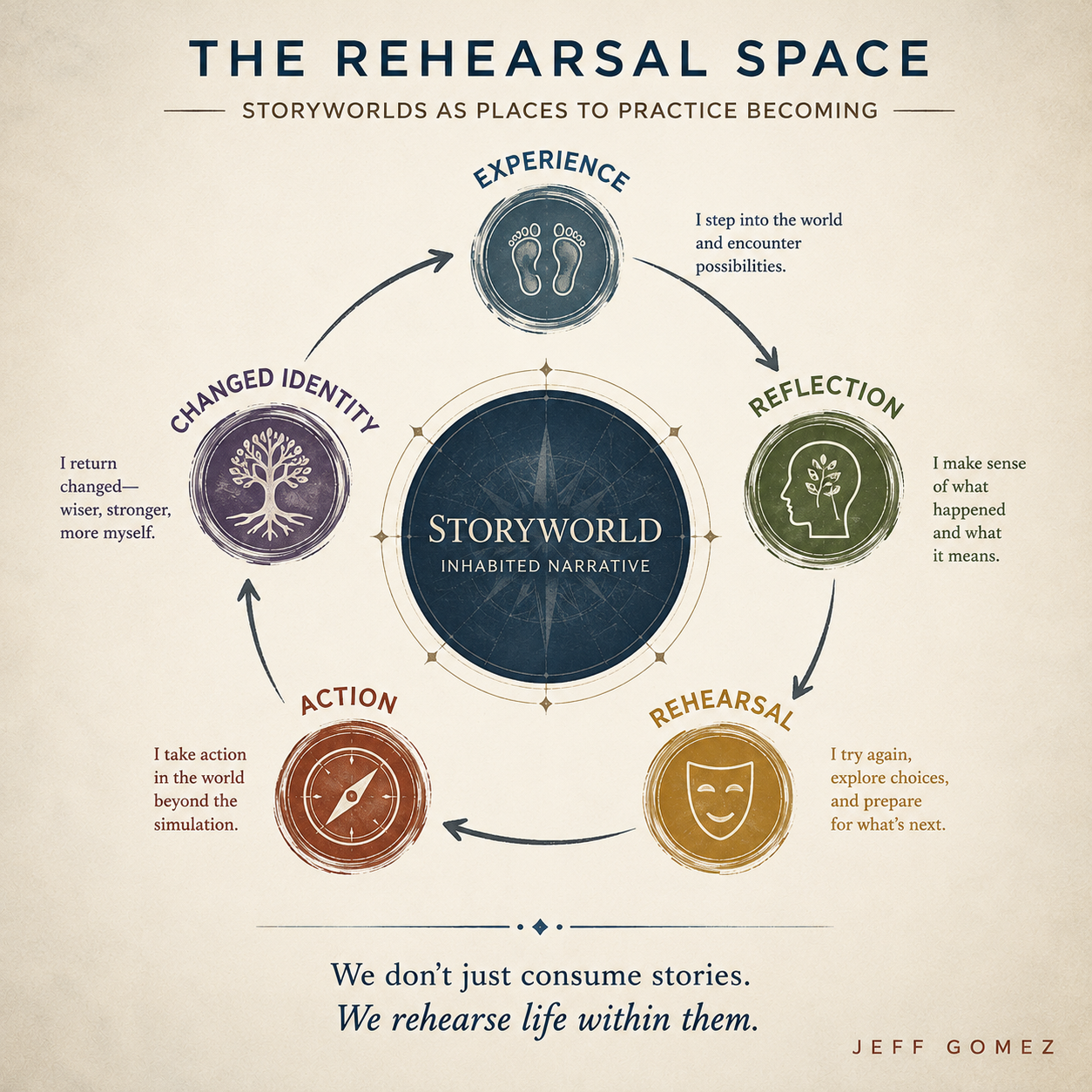
figure 3: the storyworld as rehearsal space (©Jeff gomez)
Yet every rehearsal space carries risks. A world can encourage growth, or it can encourage withdrawal. It can strengthen a person’s capacity for human connection, or it can become a substitute for connection. It can help people navigate complexity, or it can shelter them from it. The fact that a system responds does not mean it cares. We may come to love our machines, but they cannot truly love us back. Important dimensions of human reciprocity remain absent. That’s precisely why we must become intentional about their design—and to the messages infused beneath those designs.
Think back to my emotional experience with the conversational AI system. I was not holding a controller. There was no avatar onscreen. When we enter these worlds, the ones most profoundly shaped by the narrative are ourselves. To be truly heard often evokes passion. Our responses will be somatic, embodied, emotional.
This is precisely why the Mythic Field matters. As inhabitable worlds become places where people gather, learn, love, grieve, create, and search for meaning, the values embedded within those worlds become increasingly consequential.
For centuries, storytelling has helped human beings make sense of themselves and their place in the world. Today we stand at the threshold of a new medium capable of generating living storyworlds that can directly and personally engage with us at extraordinary scale. Such a development is unprecedented in human history. Whether these worlds divide us or unite us, diminish us or elevate us, will depend largely upon what they reveal to us about our lives. That responsibility belongs not only to technologists and designers, but to storytellers, scholars, artists, and participants alike.
The question is no longer whether inhabitable worlds will exist. It is whether we will become thoughtful enough to design them in ways that deepen rather than diminish our humanity. The age of the audience is not ending. It is becoming the age of the inhabitant. With that transition stories may become not merely places we visit, but places where we practice becoming more fully ourselves.
Biography
Jeff Gomez is CEO of Starlight Runner Entertainment and a narrative systems architect whose work has helped shape global entertainment franchises including Avatar, Pirates of the Caribbean, Halo, Spider-Man, Transformers, and Magic: The Gathering. A pioneer of transmedia storytelling, he has spent more than three decades exploring how storyworlds evolve across media, communities, and emerging technologies. His recent work examines the emergence of inhabitable storyworlds—persistent narrative environments where conversational AI, participatory culture, and coherent story architecture transform audiences into inhabitants. Through concepts such as the Mythic Field, upstream authorship, and narrative governance, he explores how storyworlds may become places where identity, meaning, and human development are increasingly shaped through interaction.