

GLOBAL GENRES—My Whole Bloody Affair: Why Kill Bill Vol. 1 is Punker than Kill Bill Vol. 2
/This contribution is part of a series of posts on genre and the ‘global shuffle’. This post contains sensitive language.
I've never seen the Ramones live. I’ve only heard the stories of four leather-clad nerds who played harder and faster than any band in recorded history. Henry Rollins said they sounded like “musical assault.” Nobody sounded quite like this prior to 1974; the year the Ramones made their debut at club CBGBs in New York. The Ramons played fast, didn’t talk much, and wrote songs that evoked Nazi imagery, teen violence, and self-harm. They rejected the hedonistic cock-rockism of bands like Led Zeppelin and The Rolling Stones. The Ramones were angry nerds, which is why the “cock rock” purists at Rolling Stone and NME said they were “dumb,” “unoriginal,” and “repetitive.” One reviewer described the Ramones as “the sound of 10,000 toilets flushing.” The Ramones responded to the critics with what Michael Enright called “cartoonish violence and ironic posturing.” Guitarist Johnny Ramone strapped booster rockets to the rhythm and blues and launched it from CBGBs up toward Rolling Stone headquarters in midtown; Joey Ramone crooned about teenage lobotomies, sniffing glue, and what The Queers later described as “love songs for the retarded.” When the Ramones appeared as cartoons on the cover of Road to Ruin (1978), the critics called it “juvenile” and “camp,” but the Ramones were mocking the self-seriousness of ‘70s hard rock, and they were serious about it (purposefully blending the lines between Hanna-Barbera cartoons and genre violence).
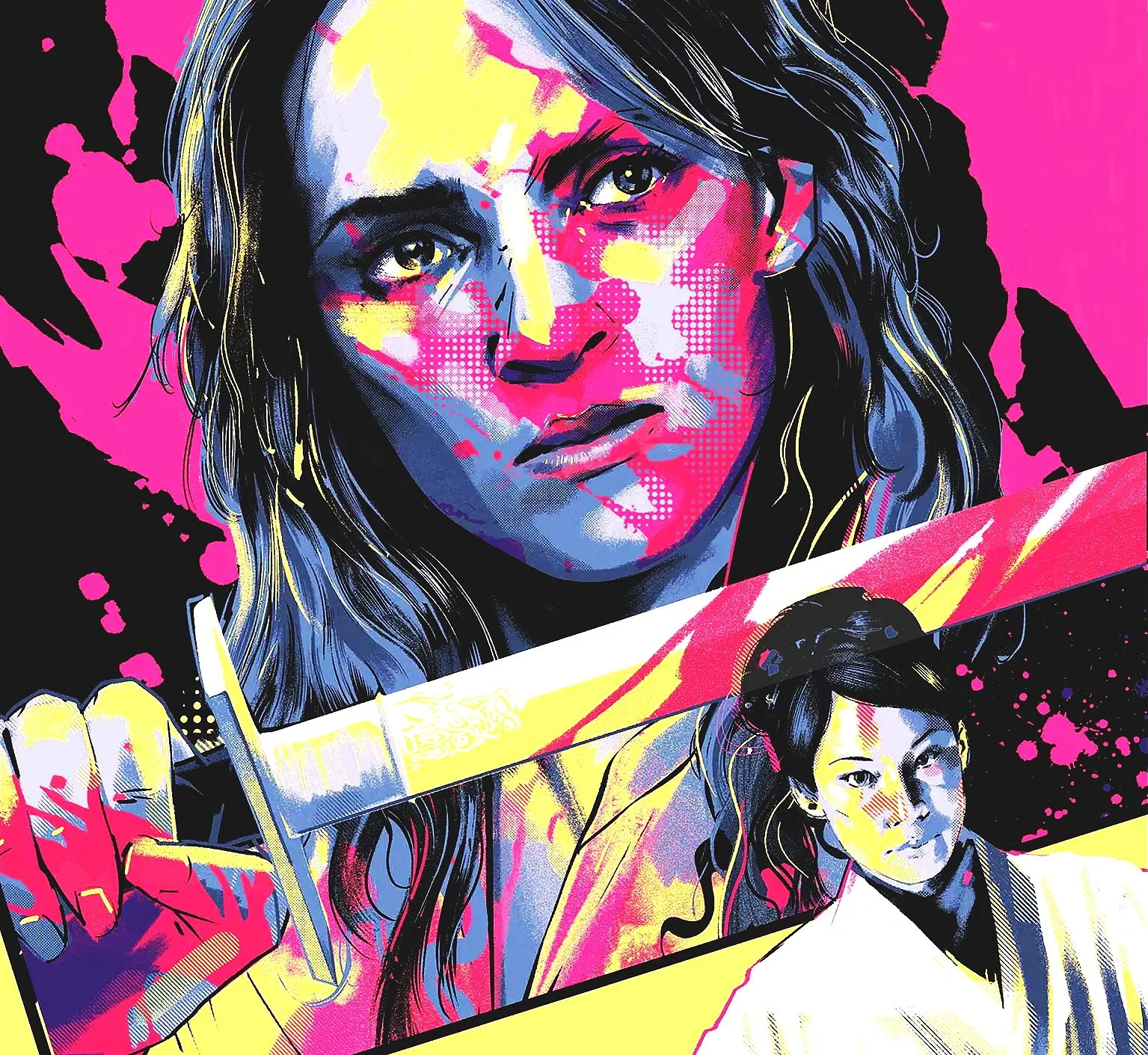
Kill Bill
“For me, punk is about real feelings,” Joey Ramone said. The Ramones moved bodies with down-stroking guitars, love songs, cartoon violence, and angry nerd shit that felt, at the time, revolutionary. The Ramones were progenitors of what film scholar Linda Williams described as “body genres” that activate visceral reactions. But cinema, we’re told, is not supposed to move bodies like the mosh pit at CBGBs. “Gratuitous” spectacles cause you to cheer or stomp your feet, not cinema. Williams challenged this sort of high art snobbery in her 1991 essay “Film Bodies: Gender, Genre, and Excess,” arguing that genres like horror and porn deliberately produce bodily responses (e.g., physical jolts or gasps). Film spectatorship, for Williams, was not a disembodied experience. Williams graffitied across the accepted narratives of film scholarship a decade before Tarantino released Kill Bill Vol. 1 (2003), his fastest and most “gratuitously” violent body genre film, and one of the punkest films of the 2000s; nothing before or after has matched its blend of velocity and cartoonish rage (the product of a director who sat atop the angry-male nerd kingdom of weebs). Kill Bill Vol. 2 (2004), released six months after the original, was, by comparison, a much more mature and methodically paced melodrama with Tarantino complicating The Bride’s trauma and her relationship to Bill, the man who attempted to kill her (and their baby). In the first film, The Bride’s trauma is unleashed with pornographic levels of rage—never complicating or interrogating The Bride’s vengeful wrath the way Vol. 2 does. Vol. 1 is a much more Japanese film (this will be explained).
In terms of average shot length, Kill Bill Vol. 1’s snap zooms and rapid cuts ditch long hangout scenes and extended verbal sparring in films like Reservoir Dogs (1992) and Pulp Fiction (1994). In contrast to the dialogue density of Kill Bill Vol. 2, Vol. 1 is more kinetic and physical—a visual feast that bursts into gustatory sizzles, cracks, and bone-crunching splatterpunk excess. Vol. 1 is a lean-as-fuck hour and fifty-one minutes of sushied, slice-and-dice movement and sound (Vol. 2 is 26 minutes longer and much less frenetic). Kill Bill Vol. 1 dragged the audience into the mosh pit and sprayed us with blood.
I saw Kill Bill Vol. 1 on opening day: October 10, 2003. I was 18. I practically shrieked when The Bride (Uma Thurman cross-dressing as Bruce Lee) whooshed her blade through bodies that squirted, sprayed, and spouted pornographic amounts of blood. It was, for my brain-rotted millennial gamer brain, the most hilariously transgressive shit I’d ever seen that was not a video game. Blood literally erupted from the decapitated stumps of Japanese Yakuza men. It was phallic and perverse. I won’t psychoanalyze the vulgar glory of blood launching into the air through exploding Chinese condoms (a Hong Kong cinema special effect), but it caused my body to jolt. I chuckled nervously, at first, looking around to see if I was alone; faces flickered with spatters of red and yellow, but nobody was moving. The theater was in a post-9/11 “War on Terror” daze of fear and anxiety, except for a group of teenage weebs who looked like they’d spent the past 14-hours playing Grand Theft Auto purely for the lulz. The rest of the audience looked like sterile and catatonic. The weebs, my fellow Tarantino-heads, were giggling their asses off. I joined them like we were front row at a pro wrestling match in Japan watching Akira Hokuto surgically slice open her forehead with a razorblade. They didn’t see me, but we moved our bodies together. It was mimetic. It was charged. We were moshing our bodies together.
“[W]hat may especially mark these body genres as low,” writes Williams, “is the perception that the body of the spectator is caught up in an almost involuntary mimicry of the emotion or sensation of the body on the screen.” Warm blood flowed through my neck and engulfed my face. I jerked my legs forward and kicked the seat in front of me—not caring about the person sitting in it. The sheer volume of blood was honestly kind of astounding. It felt like a new genre of revenge porn, and for the record, it was. Tarantino was staging a beatdown of the critics who labeled him a “racist anti-racist” and accused him of appropriating cultures (and other directors). They said he was “dumb” and “unoriginal.” These were the same critics who’d previously dragged Tarantino for sadism, homophobia, misogyny, and for his “gratuitous” use of the N-word. Director Spike Lee noted the number of times the N-word was used in Jackie Brown (38 times). In the September 1996 issue of Premiere, writer and self-identified “snoot” David Foster Wallace described Tarantino’s violence as a commercialized, low-culture Lynch who did to Lynchian violence what Pat Boone did to the rhythm and blues: “homogenize it, churn it until it's smooth and cool and hygienic enough for mass consumption.” This was the same logic critics used to delegitimize the Ramones for “appropriating” the rhythm and blues.
This is not not true. Johnny Ramone was technically just playing sped-up Chuck Berry riffs—Chuck Berry but dumber, whiter, and angrier. Tarantino poached from Italian and Japanese genre movies and made it more American (i.e., dumber). This is punk. Why is this punk? It’s always easier to define what punk’s not versus what punk is, but punk tends to sound “revisionist” and “dumb” to the people who aren’t punk. Tarantino turned Shaw Brothers kung-fu into sped-up Chuck Berry riffs. Tarantino’s favorite mainstream film critic, Pauline Kael, described Pulp Fiction (1994), his second film, as a film with “no serious undercurrents.” I read this two ways: (1) Pulp Fiction isn’t very deep, and (2) Tarantino is punker than David Lynch. Not everyone agreed. Film critic Jan Wahl called Tarantino’s violence as “soulless,” questioning his use of “gruesome, graphic violence,” to which Tarantino responded on behalf of all his fans, “Because it’s so much fun, Jan, get it?!?!”
Vol. 1 is, in its most stripped-down form, a joyfully punk distillation of Tarantino’s core gestures as a filmmaker: excess, repetition, pastiche, exploitation, and provocation, like Marcel Duchamp drawing a mustache on the Mona Lisa or Bart Simpson launching a paper plane into his teacher’s “tiny skull-sized kingdom,” to quote David Foster Wallace, who famously opined that “Quentin Tarantino is interested in watching somebody's ear getting cut off; David Lynch is interested in the ear.” DFW meant, I think, that Lynch’s severed ear in Blue Velvet (1986) was a metaphor—deeper, in his view, than the ear in Reservoir Dogs, which was just cartilage and blood. But Tarantino’s violence was commenting on itself. It was dumb, and that was the point. But Tarantino purposefully soundtracking Mr. Blonde’s ear-slicing with a Dylan-esque pop song was cartooning his violence. It was an intentional juxtaposition that was not quite “camp,” and Tarantino amplified the juxtaposition to Maxell-levels on Kill Bill Vol. 1, producing what Kenneth Turan at the LA Times described as the “most graphically violent film ever made by a mainstream American company.”
Tarantino’s riotously punk ethos flies slightly off the handles in his view that Kill Bill Vol. 1 is a movie that…children can enjoy. This is a provocation, for sure, but an earnest one—a generational one. Tarantino was 11 when he saw Sam Peckinpah’s The Wild Bunch (1969), which was, at the time, one of the most violent movies ever made. Tarantino was raised by a “swinging” single white woman who dated black athletes—a feminist, for her time. Jan Wahl was a different genre of feminist when she confronted Tarantino’s on national TV: “I’d like to see you walk down the street and get attacked by some kids who’ve just seen your movie.” Tarantino responded with a punk-rock snarl: “All the movies that I’m basing my movies on are the movies I saw as a kid, and kids go to a movie theater, and they can tell the difference. Maybe you couldn’t when you were a kid, but I could.”
One of the defining characteristics of Tarantinian punk is how he collapses the distinctions between youth, sex, violence, and gender norms (e.g., Uma Thurman as Bruce Lee, castrating the critical mass). This is why teenage boys (and weebs) worship Tarantino: he satiates their basest desires and does not apologize for it. It’s liberating. It’s what a mainstream Hollywood filmmaker should do: feed his audience and starve his critics. When I discovered Tarantino as a teenage boy, I was borderline aroused. His perversions (e.g., severed ears and bad words) made me feel something physical and grotesquely primal. I also felt like I was watching Saturday morning cartoons in my milk-stained pajamas. Tarantino and his fans, I include myself in this group, are fundamentalist about three things: 1) Violence is fun 2) Words are not violence 3) Kids can watch violent movies. Tarantino communicates this with the first instance of red blood splatter in Kill Bill Vol. 1, which appears inside Vernita Green’s suburban home as a bloody fingerpainting hung on kitchen walls where you’d normally see something cute and cozy—the portrait of a child with the family dog, for example. For Tarantino, extreme violence is not unsafe for children because children can differentiate between real violence, performative violence, and cartoon violence, e.g., a blood-stained fingerpainting.
Allow me to wax parental for a sec: juvenile delinquency is, at least I think so, a response to prepubescent trauma, e.g., seeing your parents brutally murdered in front of you by a psychotic assassin. Kill Bill Vol. 1 flashes back to O-Ren Ishii exacting revenge of the man who killed her parents in such a way, which Tarantino unleashes into bursts of animated gore and gunfire—the most belligerently juvie-punk sequence in the film. Punk, for Tarantino (and the Ramones) is coded in the primal desire to splash your high school bully’s blood across their PE locker. Vol. 1’s “mini boss,” Gogo Yubari (O-Ren’s bodyguard), is a Japanese schoolgirl who swings a chain mace and titters uncontrollably and sadistically. Gogo is a deliberate paring of kawaii culture with punk nihilism. In a flashback, we see Gogo guzzling cold sake before disemboweling a predatory Japanese pervert—a businessmen with a hard-on for teenage girls. I laughed uncontrollably as the businessman’s guts poured down Gogo’s legs, staining her white tennis shoes as a visual representation of innocence, violence, and sex. Gogo is a Japanese Sex Pistol—what UK punk impresario Malcolm McLaren described as a “sexy young assassin”—a mid-2000s collage of Japanese sadism (e.g., Takako Chigusa in Battle Royale, 2000), “Hit Me Baby One More Time”-era Britney Spears, manga, and UK punk. The weebs were obsessed. Tarantino supercharges these tendencies with Vol. 1’s Crazy 88 climax. The sequence opens with The Bride standing legs apart at the center of a glass pit. She is surrounded by masked yakuza. She draws her Hanzō sword and swings at a yakuza who cries with exaggerated agony, like a pre-recorded laugh track: “Aah! Aah! Aah!” Three yakuza swoop in from behind as The Bride leans back and draws her blade across their chests. Blood sprays across the glass like abstract expressionist paint. Another yakuza hurdles forward; The Bride pinches his eyeball and snatches it out of his skull. I winced. The teenage weebs looked like they were on a rollercoaster drop. When The Bride grabbed a yakuza and spanked him with her sword, ordering him to go home to his mother, everyone in the theater lolled. It felt like a Three Stooges bit. It was not “camp.” It was purposefully vaudeville. It was Moe poking Curly in the eye and slapping-the-shit out of him on repeat.
The juxtaposition of extreme violence and slapstick in Vol. 1 produced pain (tension) and pleasure (release). This is repeated on loop by Tarantino like the mechanics of a hack-and-slash video game. Vol. 1 was Tarantino feeding us a looping, staccato cadence of dismembered limbs, gore, and genre signifiers, e.g., Lady Snowblood (1973). But the true joy was found in Tarantino’s uninhibited violence, not his genre references. And for the record, Tarantino’s violence is never camp. It’s slapstick, exaggerated, and intentional—never in quotation marks (to “quote” Susan Sontag). Tarantino is totally earnest in his desire to puncture and release along a cathartic loop of swooshes, bangs, and aahs. Whether body genres can be camp or not is a point of debate but hear me out: camp generates aesthetic and ironic distance; body genres, on the other hand, draw the viewer closer and confront them. Body genres are in your face and relentless, like drowning in a mosh pit and trying to claw your way out (except you like the feeling). I felt like this when The Bride somersaulted into the air and swung her sword down into a yakuza’s skull—literally slicing him in half like a hot knife through butter. “I want to suggest that the success of these genres [body genres] is measured by the degree to which the audience sensation mimics what is seen on the screen,” writes Williams. Tarantino was referencing Ichi the Killer (2001)—where a yakuza gets cut in half—but I didn’t know that. I also didn’t know that Johnny Ramone was playing sped-up Chuck Berry riffs until years later. I just liked that Johnny played hard and fast with a warrior-like desire for regimentation and repetition. A one-woman killing machine cutting a man in half didn’t need to be interrogated; it needed to be felt, like Johnny’s riffs. It needed to make you cringe, scream, laugh. No film in history has brought its audience closer to gigglegasming than Kill Bill Vol. 1. Also, body genres, according to Williams, often center the female body in the spectatorial experience of pain and pleasure, inviting both a male and female gaze—blending elements of feminism and post-feminism. From Tarantino’s POV, this is partially why he referred to Vol. 1 was an empowering feminist statement—a “girl power” movie.
Stepping over puddles of blood, The Bride enters a freshly snowed Japanese garden. The tonal shift reorients us toward the elegance of O-Ren Ishii (Lucy Liu) in a white kimono, as she slowly unsheathes her katana and an ambient water fountain lulls our senses. There’s a slight pause before Tarantino plays a disco cover of The Animals’ “Don’t Let Me Be Misunderstood.” Moments later, a streak of blood cuts across the snow like an exclamation mark. The next sentence is a schoolyard diss: “Silly Caucasian girls like to play with samurai swords,” says O-Ren, as the two assassins clash swords and intersect cultural and generic identities in way that is quintessentially Tarantino. The action slows. Something resembling a maimed raccoon zooms across the screen. It lands on the snow. The camera pans up to reveal O-Ren’s exposed brain. I gasped as a catatonic O-Ren commented on the quality of the blade that just scalped her: “It was truly a Hanzō sword.” She’s a real-life cartoon, like Mr. Blonde conversing with a severed ear or Joey Ramone singing about teens wanting to be lobotomized.
Vol. 2, released about six months later with a completely unique marketing campaign, was more character-driven and significantly less bloody. Bill’s death scene in Vol. 2 is bloodless and quiet (the result of Pai Mei’s Five-Point Exploding Heart Technique). Vol. 2 has more prolonged dialogue scenes and introspection in desert landscapes—very Americana. It is composed with natural palettes and lighting that situate the viewer in the natural world. Vol. 1 is a high-contrast kinetic gore-fest that moves with the elasticity of Japanese anime and hack-and-slash, button-mashing PS2 games. Vol. 2 delves into the psychology of The Bride’s revenge arc. It’s a melodramatic body genre film that flickers with punk rebellion, like early Rolling Stones, but it’s not punk. Tarantino views Kill Bill as a single experience, The Whole Bloody Affair. I do not. These are two films with distinct visual and tonal identities. It’s Americana vs. Japanese exploitation. That is how they were first experienced by audiences in the mid-2000s, and no amount of film editing can alter history (don’t quote me on that).
Still, Vol. 1 is the personification of punk as a cinematic expression—a visual assault on the brain, but especially the body; it is generically more Japanese exploitation than Spaghettini Western—the genre anchor of the second film. For those of you who weren’t there in 2003, like those of us who weren’t there in 1974, there was nothing quite like the angry full-frontal slapstick of Kill Bill Vol. 1; it remains Tarantino’s punkest manifestation of all the things that make him problematic for his critics and so much fun for his audience. Punk, for me, is giving the people what they want and denying the critics what they want for us—what they consider “cinema” vs. “trash.” Vol. 2 is, in many ways, though not quite sonically, more of a vibe-based post-punk film that was more critically praised than the original, i.e., not as fun.
Biography
Art Tavana is an award-winning journalist and author of Goodbye, Guns N’ Roses (ECW Press). His byline has appeared in VICE, Pitchfork, Spin, Billboard, Consequence, L.A. Weekly, HelloGiggles, The Village Voice, The A.V. Club, Playboy, Penthouse, USA Today, and The Hollywood Reporter. Art’s writing has been cited in works by major literary and cultural figures, including Bret Easton Ellis’s White and Pam Houston’s Without Exception: Reclaiming Abortion, Personhood, and Freedom.