

OSCARS WATCH 2026—Thoughts on the Oscars from Someone Who Wrote a Book About Them
/This piece is part of a series of critical responses based on the films nominated for the 98th Academy Awards.
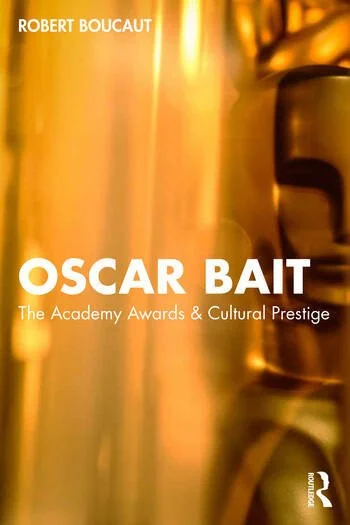
Oscar Bait: The Academy Awards & Cultural Prestige (Boucaut 2025)
Last year I released my first monograph, Oscar Bait: The Academy Awards & Cultural Prestige (Routledge). The book is a comprehensive account of the modern Academy Awards, operationalising the colloquial ‘Oscar bait’ into an academic framework to understand the complex mediatisation constructing awards worthiness in Hollywood. In my sample years of 2019 – 2021, I explore how the modern Oscars navigate social expectations around representative, diverse filmmaking, the new social and traditional media spaces that support today’s celebrity labour, and what the modern Oscars can communicate about filmic worth.
As a long-time Oscars enthusiast, completing this project has certainly complicated my relationship with Hollywood’s film culture, and my thoughts on engaging with the Oscars since. Picking up on some of my book’s themes, this piece offers some insights and opinions on the current Oscars season. In the spirit of blogging, it is decidedly less academic, so I’m sure we’ll disagree on some hot takes. While writing my book, my sensible mentors helped me to tone down some instinctual snark (‘going so hard on Joker may be alienating!’), but alas, the time has come to expunge such compulsions—strays will be copped!
Following the race from Australia is expensive!
I don’t doubt the same being the case from wherever else you may be reading this from—unless you yourself are an Academy voter with access to its members-only streaming service for your consideration (hello if you are!).
Of course, knowing what films are likely to be awards contenders across the year is something of a guessing game, particularly if you aren’t interested in the promotional strategies going on: seeing Weapons or Sinners earlier in 2025 out of sheer interest only to have it ticked off your Oscars watchlist would have been a happy bonus!
But, for the most part the glut of awards hopefuls dropped around the change of the calendar year means audiences will have to make some tough choices and pick some favourites. In a cost-of-living crisis and in-between seasonal contracts (shout out to the precariously employed academics) I only forked out AUD$24 (approx. US$17) a ticket for a handful of Best Picture and Acting nominees currently in theatres (apologies to The Secret Agent, I am still determined to get to you—Song Sung Blue, not so much…). To be a real completionist and assuming you hadn’t caught them in cinemas earlier in the year, you may also be looking at subscriptions to at least three different streaming services (Apple TV at $12.99 for a month to watch F1; Netflix at $9.99 for a month of ‘Standard with Ads’ for Train Dreams and Frankenstein; HBO Max at $11.99 for a month of ‘Basic with Ads’ for Sinners, Weapons, and One Battle After Another). And there’s the $6.99 rental of If I Had Legs I’d Kick You to cheer on our Aussie hopeful Rose Byrne, a film that barely exists otherwise.

Netflix at the Oscars: Train Dreams, KPop Demon Hunters & Frankenstein
Besides an indulgent whinge about how expensive life and culture is right now, these sentiments point to an ongoing problem facing the Academy in terms of relevance and investment: that of the unengaged cinema viewer. My book charts a time in the Oscars history where ceremony viewership was on a drastic downward decline, with producers of the telecast throwing whatever gimmicks might work at the wall to excite a casual viewer. In 2020, for example, there were a slew of non-cinematic celebrity presenters recruited into the host-less ceremony, which in practice only achieved a bloating of the runtime (George MacKay quipped late in the proceedings, “time is of the essence, which is why I’m here to introduce myself before introducing someone else, who will in turn introduce someone else”). And in 2022, the Twitter poll decided ‘Oscar Fan Favourite’ and ‘Oscar Cheer Moment’ shoutouts drew the ire of Academy members for cheapening the austerity of their ceremony (and, in an entirely predictable turn, these were even (allegedly) hijacked by Zack Snyder’s online stans using bots—and the Oscar Cheer Moment is, ahem, ‘The Flash Enters the Speed Force’).
Missteps like these make the Oscars’ identity crisis all the more pronounced and exacerbate the divide between the assembled cinematic elites and the home viewers. Efforts to inject more star power or to cut the runtime are clumsily integrated and fail to address an underlying threat to the Oscars in the demise of a Hollywood monoculture. More organic efforts to represent box office successes at the awards—for example, the nominations of franchise fare like Black Panther: Wakanda Forever or Joker—perhaps mark a more significant investment. The potential for cinematic prestige to accommodate genuine admiration amongst the voting cohort for broader popularity or box office achievement marks a more meaningful cultural shift, and one that a nomination haul like Sinners may be a direct beneficiary of.
So, if the Academy’s logic that a ceremony representing more popular films translates into a higher and more invested audience shares, they may be stung by the general pressures hitting the regular cinema-goer’s wallets. Having to budget selectively to only see some films in cinemas at a given moment sits poorly with the Oscars campaign machine, where a perceived recency bias from Academy voters sees most of the relevant films screening all at once. Interestingly, my book inadvertently serves to capture this broadcast tension in its twilight, with the unexpected recent announcement that the exclusive global rights to the ceremony will move to YouTube from 2029. What Frankenstein’s monster of a ceremony will be stitched together from recognisable telecast formulas past for the Oscars YouTube age?
But what of the films?
Hot take—they are pretty good! Out of the 2026 Best Picture nominations (that I’ve seen) there has been a better-than-usual hit rate of genuinely interesting work. One Battle After Another was maybe the tightest long film I’ve ever seen: snappy and exhilarating, with an instantly classic original score, it’s a presumptive winner I am on board with. Train Dreams is the kind-of slow and slight story that could easily slip into pretentious and boring—for me, it was staggering in its meditative focus, and Joel Edgerton could have certainly made the Best Actor cut. Hamnet has proven to be divisive amongst the critics, some who found it emotionally manipulative versus those leaving the cinema in a heaving puddle—I, and the one stranger also in my midday screening, fell in the latter camp. The opening scene of Sentimental Value—a narrated essay from the point of view of a family home—signals the sharp, original and playful work to follow. Bugonia and Frankenstein are maybe default inclusions as good enough works from their auteur helmers, but were good enough, nonetheless. I was fairly ho-hum on Sinners, but I think it is a fun inclusion for the race (particularly Wunmi Mosaku’s nomination). And I agree with my fresh crop of first year students—Timothee Chalamet was very good in Marty Supreme.
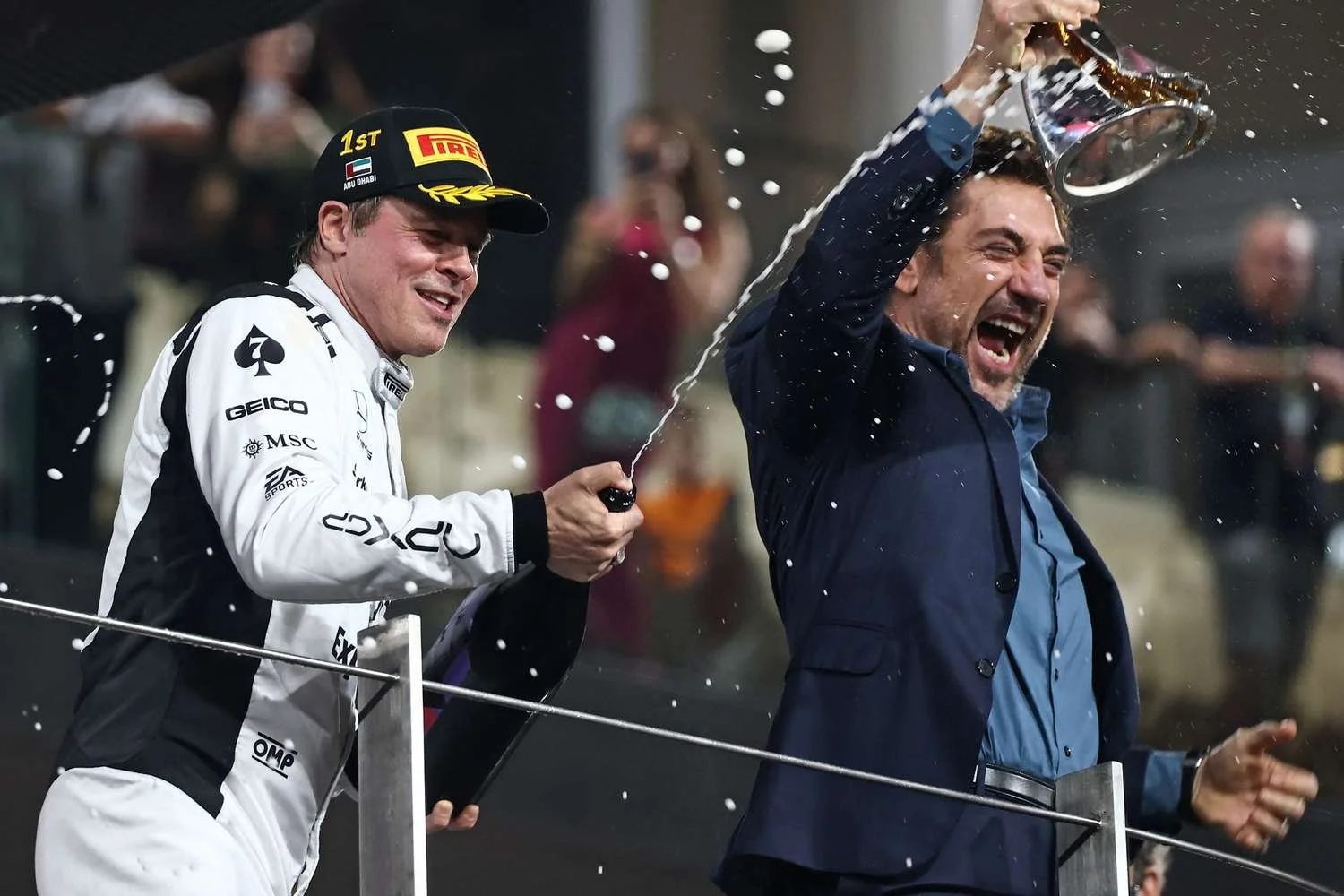
Still Got It! Brad Pitt and Javier Bardem in F1. Credit: Beata Zawrzel/NurPhoto
And then there’s F1, an obvious outlier as the season’s biggest surprise inclusion. I’m obliged to have thoughts on F1 given this film sits in the centre of the Venn diagram that is my long-term research projects: on one hand, the Oscars and prestige in film, and Apple TV as a supportive streaming service on the other (with Alexander Beare—shameless plug of published works here and here). I’ll declare my distaste for car films generally before connecting F1 to a film from my book’s corpus, Ford v Ferrari (yes, yes, I know they are such different films and car races, Dad!). As a Best Picture nominee in 2020, Ford v Ferrari was seen as something of a nostalgic antidote: sure, it only has one substantive speaking role for a woman (the aggrieved wife), but isn’t it fun to enjoy a film that’s “just guys being dudes who love fast cars” (Murray 2020)?
From this, my reaction to F1 getting a Best Picture nod was that we should never be surprised when a handsomely shot, vaguely conservative car film makes the cut! At least F1 features more speaking roles for women, including Kerry Condon as the racing team’s technical director (yes, Brad Pitt sleeps with her). The Academy’s now-decade-long quest to diversify its membership away from the ‘stale, pale and male’ stereotype has certainly seen some strides—most acutely in the continued appearances of films not performed in English across its top categories. Such efforts are perhaps better understood to be making more space for diverse nominees rather than overriding the prevailing tastes of Oscars past. Not only is F1 about cars, its narrative casts Pitt as an ageing guy who has still got it—he just lives to drive cars, man, and the young guns who wrote him off when he steps up to the wheel sure do learn a thing or two when he turns out to be right about everything. What could be a more reassuring message to the average demographic of Oscar voter? Vroom vroom!
As for performances, it was a bumper crop this year—and with options to spare (pour one out for Chase Infiniti and her phenomenal debut in One Battle After Another—do we really think Kate Hudson did something better?). It’s exciting to see the Supporting acting categories still undecided, with precursor awards given across a fair spread. As much affection I have for Amy Madigan’s Aunt Gladys in Weapons (an excellent sprinter), and as much as Inga Ibsdotter Lilleaas and Wunmi Mosaku were the hearts of their ensemble casts in Sentimental Value and Sinners respectively, I can’t go past Teyana Taylor in One Battle After Another. A showy performance, sure—but one requiring such strength and impact to pull off, for it to reverberate across the entirety of the plot to come. Out of the Supporting men, Benicio del Toro’s performance was my favourite for how thoughtfully and playfully he filled the corners of One Battle After Another with life.
Another refreshing detail of this race is not having an effusive celebrity biopic draining all the actorly discourse of interest (Blue Moon and Song Sung Blue are both biographical performances but of more subcultural figures; Marty Mauser of Marty Supreme is a fictional construct loosely based on the real-life Marty Reisman). Performances like Rami Malek’s in Bohemian Rhapsody or Renee Zelwegger’s in Judy absorb glowing praise for how ‘convincing’ their ‘transformations’ were—rather than being challenging works, their films affirm broadly held beliefs about their central figures, thus tying an actor’s success with an already beloved entity.
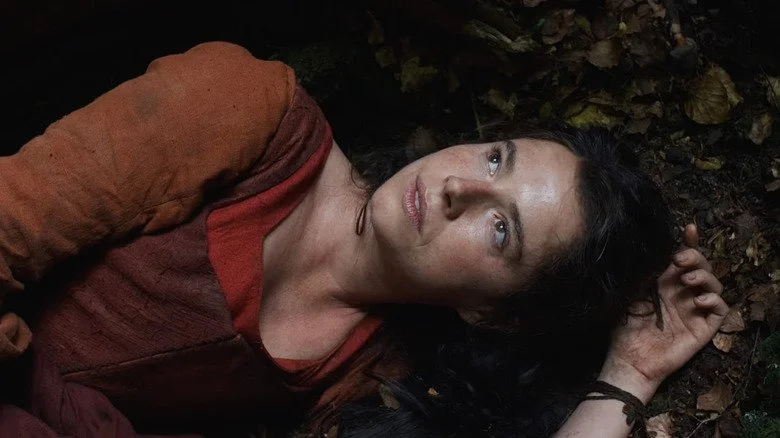
Jessie Buckley in Hamnet. Credit: Focus Features
If biographical acting makes for obvious Oscar bait, then a performance like Jessie Buckley’s in Hamnet demonstrates how these stereotypes are malleable in practice. Spoiler alert: Buckley’s Anne is a mystically grounded, ethereal figure—she’s sensual yet unknowable when being courted by Will Shakespeare—she is intensely visceral when she’s giving birth to her child—and, the kicker, she howls in the most desperate anguish when her child passes. That’s a lot of ‘Big Acting’ to showcase, almost to the point where it could be a cliched awards grab. And yet, the critical and industrial goodwill afforded to Buckley and director Chloé Zhao insulates her from such critique. The same evaluative logic worked for Olivia Colman in The Favourite: “a period piece about a queer monarch…in a love triangle, in the middle of a war…on the verge of mental breakdown caused in part by the trauma of losing multiple children—oh, and she has gout” (Be Kind Rewind 2019, a terrific video essayist covering Hollywood history). Buckley’s work in Hamnet is surely a lot—but it’s astonishing.
The Continued Fun of Following the Oscars
Writing a book about the modern Oscars hasn’t exhausted my interest in them. I theorised Oscar-worthiness as a discursively mediated phenomenon: that is, the fickle label of Oscar bait is given meaning and utility by an orbiting film and celebrity promotional ecosystem. That the stereotype endures in the collective imagination is itself some kind-of testament to the ongoing value of the Oscars in Hollywood’s global mythology. There are several further interesting threads rising from this season ripe for more reflections: the cancelled nominee and the blast radius of a scandal (Josh Safdie problematic, but Chalamet unscathed), or the snubbed pop sensation (Ariana Grande should have just won last year!), or the unquenching need to document historic firsts (or seconds, like Emma Stone “37, is now the second-youngest person in Oscar history to reach seven career nominations”; Davis 2026).
Looking at an Oscars season in isolation inevitably invokes threads from and links to Oscars of recent and distant pasts. Connecting the dots paints an interesting cultural legacy.
References
Be Kind Rewind 2019, A Best Actress 2019 Hot Take, YouTube, March 4, https://youtu.be/OI5QwWphDM8?si=pKlUHv9DqYtzfN5s.
Boucaut, R 2025, Oscar Bait: The Academy Awards & Cultural Prestige, Routledge.
Davis, C 2026, ‘Oscars Diversity Report: ‘Sinners’ Ties Record for Most Black Nominees From a Single Film, Plus Milestones for Chloe Zhao, Guillermo del Toro and More’, Variety, January 22, https://variety.com/2026/film/awards/oscars-diversity-report-2026-sinners-latinos-women-1236632578/.
Gonzalez, U 2022, ‘Did Zack Snyder Stans Rig the Oscar ‘Fan Favourite’ Vote With Online Bots? (Exclusive)’, The Wrap, May 12, https://www.thewrap.com/zack-snyder-oscar-fan-favorite-rig-vote-bots/.
Murray, I 2020, ‘Oscars 2020: Ford v Ferrari Should Win Best Picture’, GQ, February 6, https://www.gq.com/story/academy-awards-2020-ford-v-ferrari-should-win-best-picture.
Biography
Robert Boucaut is a Lecturer in Media at Adelaide University—his research interests include prestige media texts and celebrities, streaming services and programming imperatives, and mediated gender. His book Oscar Bait: The Academy Awards & Cultural Prestige (Routledge) builds new frameworks for analysing Hollywood media ecosystems and awards. He has published works in International Journal of Communication, Critical Studies in Television, and Media International Australia.