

EMMYS WATCH 2025 — Laughing at Her/Laughing with Her: Dichotomies of the Aging Woman in Hacks
/‘Emmys Watch 2025’ showcases critical responses to the series nominated for Outstanding Drama, Outstanding Comedy, and Outstanding Limited Series at that 77th Primetime Emmy Awards. Contributions to this theme explore critical understandings of some series nominated in these categories.
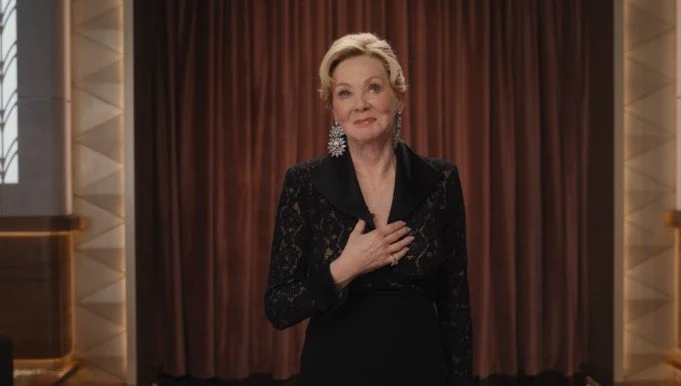
deborah vance in Hacks
Women often face a cruel dilemma: they’re considered too young to be taken seriously, and then they are suddenly too old to be relevant. This dichotomy is central to women’s experience in comedy performances regardless of medium. Hacks (HBO Max, 2021- present) places this tension at the center of its story through Deborah Vance, a legendary comedian whose decades-long career in Las Vegas has made her wealthy, yet increasingly invisible. What the show dramatizes so sharply is the difference between laughing at Deborah and laughing with her—a distinction that reflects the cultural struggle aging women regularly face.
On the surface, Deborah’s aging can act as a punchline. Jokes about her age, her sequined costumes, and her dependence on outdated one-liners echo throughout the first season. In this manner, older women are presented as the joke rather than performers. Audiences are encouraged to laugh at her for being out of touch, and for not knowing when to hang up the hat and leave the stage. However, from its debut, Hacks has centered the tension between traditional expectations of an aging celebrity and Deborah’s refusal to fade into stereotype.
Early seasons crafted laughter through the dual lens of mocking Deborah’s age and outdated Vegas shtick and showcasing her determination to succeed as she reclaims her voice. Throughout the series, we laugh both at her and withher, often oscillating between the two in quick succession. In season four, the stakes are higher, the world is younger, and Deborah’s comedic agency is put to the test. Deborah is now in command of Late Night with Deborah Vance, a late-night show that positions her as the first woman to hold down the prestigious 11:30 p.m. slot. This accomplishment is more than symbolic—it invites a new kind of scrutiny. When viewers and focus groups signal that she’s “not relatable” to 25- to 45-year-olds, the laughter risks turning at her again, but Deborah’s response—absurd, yet bold and relentless—reminds audiences that she’s not merely the subject of their amusement; she owns it. When Deborah confronts a focus group’s critique, attempts a guest booking war with Jimmy Kimmel, or stages surreal revenge pranks (like righting the power dynamic through underwear placement), it’s comedic aggression that reasserts her authority. We laugh—not at her age, but with her as she attempts to bend the jokes to her will.
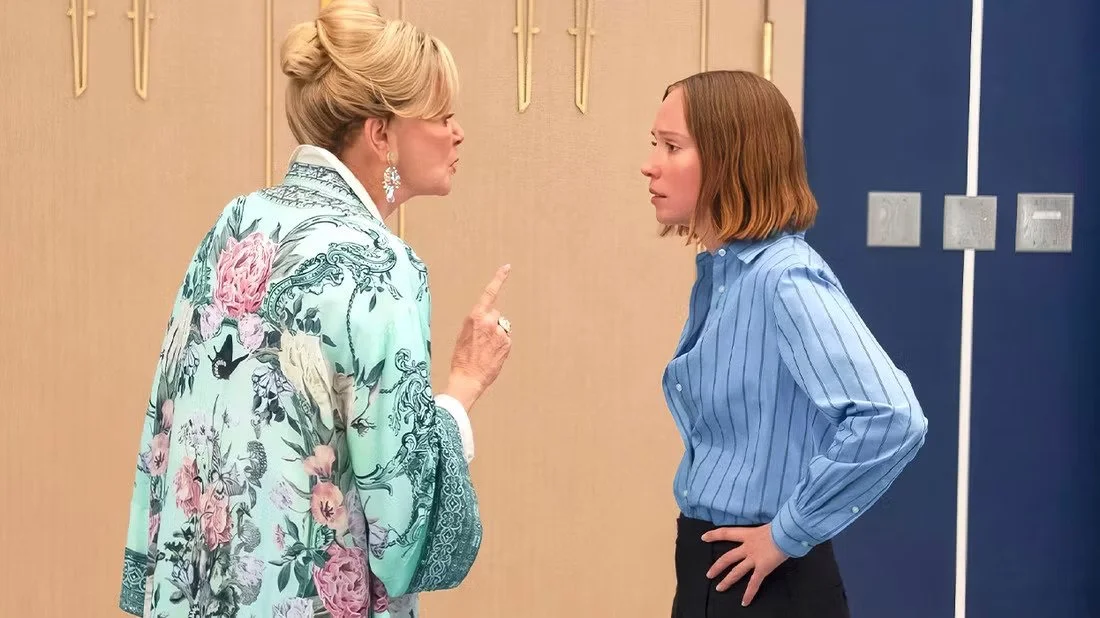
Once fighting together, now Deborah and Ava fight each other for relevancy and control
Notably, Hacks does not employ just a single leading character - rather it is a dual focus on Deborah Vance and Ava Daniels, a younger, more daring comic whose previous jokes pushed too far. Together, Deborah and Ava balance each other to successful means (though it is a constant struggle). More than mere commentary on age, Hacks works to show the importance of women working together across temporal divides. Rather than viewing one another as “too different”, it reveals how success is a balancing act that can often only been found through working with others.
Yet this reclamation comes at a cost: a volatile relationship with Ava arises, and the young writer, who once helped reinvent Deborah, turns to blackmail in order to achieve the title of head writer. An emotional and professional war breaks out between the two women as allies-turned-enemies struggle for power. Their feud—public, vicious, and intimate— is weaponized with humor, forcing us to reflect: are we laughing with Deborah through her mastery, or at the farce of a woman visibly struggling to maintain control as the industry continues to shift underfoot after seemingly finding her way in early seasons?
As this tension continues to weigh on her, Deborah encounters comedy legend Carol Burnett in a waiting room. Deborah, once the older character and mentor, becomes young again as she talks to Burnett, referencing the inspiration Burnett provided and continues to provide Deborah. Carol makes a joke regarding her own age, yet it is not self-deprecating, rather it is relational, giving Deborah space to reflect upon her own relationship with Ava. These moments of vulnerability help audiences recalibrate our laughter— not as derision, but compassion.
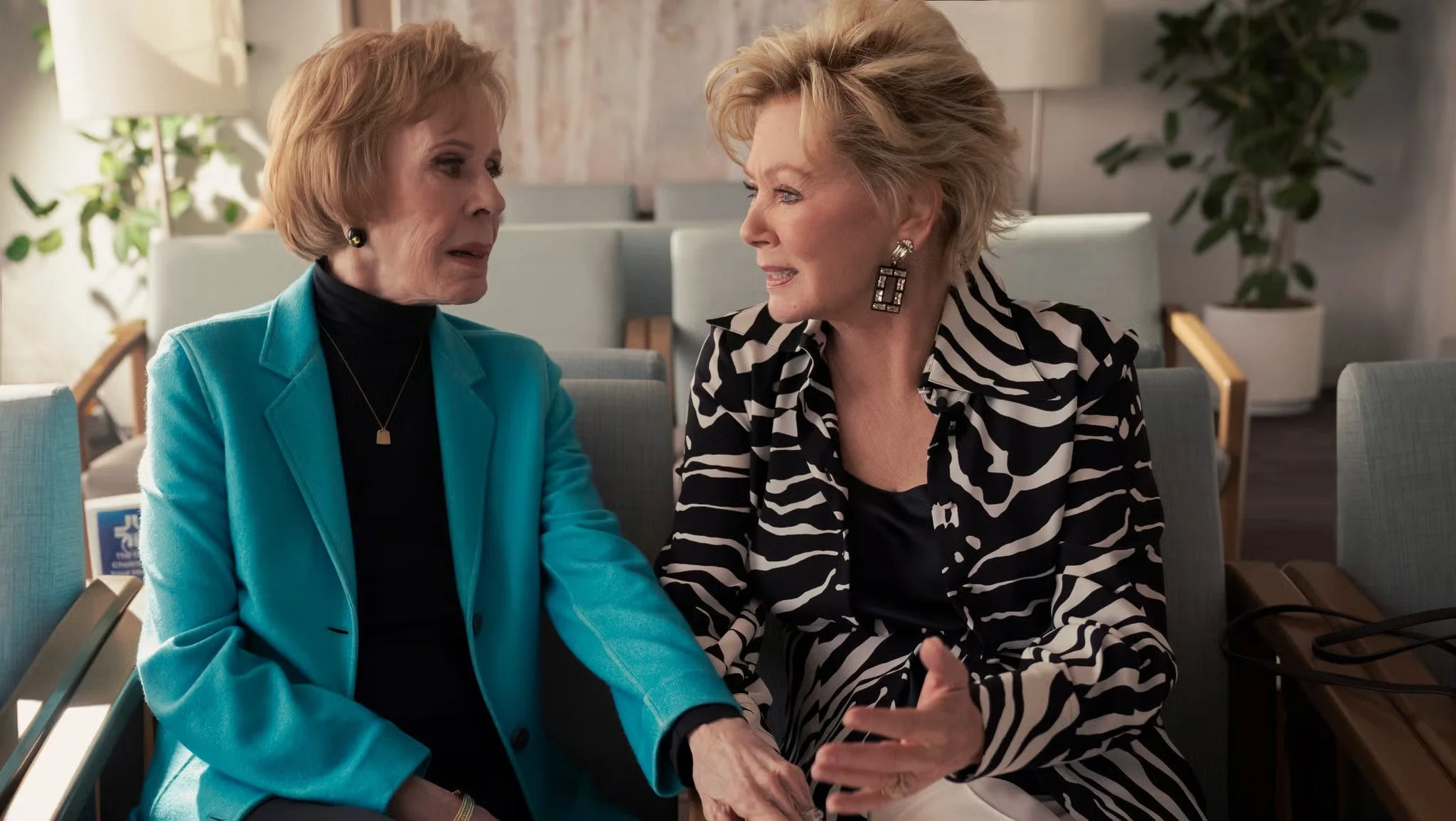
Carol Burnett makes a guest appearance on this season of Hacks, reminding Deborah aging in comedy is not a decline, but can serve as site of connection and resilience between women
The thematic arc culminates in the season finale (spoilers): Deborah refuses to fire Ava despite corporate pressure. She walks away and ultimately escapes her non-compete with a stand-up residency. When the press mistakenly publishes her obituary, it’s a darkly comedic moment about public perception, mortality, and the erasure of women in comedy. The laugh here is layered: part grief at the idea of her erasure, part relief that she’s continuing to adapt and strive in a difficult and unforgiving industry.
Throughout Deborah and Ava’s emotional evolutions, laughter remains central, and with this relationship that defies age-barriers, both women are made sharper, riskier, more vulnerable. Now, Deborah is no longer just performing on the stage; she’s defying it. And the audience follows as they laugh with her at her boldness and bruises, not at the warping of age or industry constraints. Hacks complicates the with/at dichotomy by showing Deborah balancing self-mockery with sharp, biting observation. She refuses to let her comedy become a form of erasure. Instead, she insists that her experience—particularly as an aging woman—is a legitimate source of authority, wit, and insight.
By depicting a mature character as dynamic, flawed, and capable of growth as Deborah Vance, Hacks disrupt stereotypes that reduce aging to decline or irrelevance. Deborah and Ava’s ever-evolving relationship also reveal the significance in intergenerational conversations, illustrating how different stages of life can and should intersect to inform one another. These narratives expand cultural imagination by showing that creativity, ambition, and humor do not diminish with age, but rather evolve in ways that are deeply resonant and socially necessary.
Biography
Ashton Leach is a PhD Candidate in the Communications Arts department at the University of Wisconsin-Madison. In 2020, she earned her bachelor’s degree in English- Film and Media Studies and History at Hendrix college in Arkansas, and completed her master’s in Communication Arts- Film at UW in 2023. Her current research focuses on cultural conversations and representations of geriatric intimacy. Her other research interests include regional identity, true crime media, and genre films as political commentary.