

Interactive Narratives and Meaningful Design: An Interview with Hartmut Koenitz
/In this interview, Renata Frade sits down with Hartmut Koenitz — a leading scholar, designer, and theorist in interactive digital narratives — to explore the evolving relationship between storytelling, human–computer interaction, and meaning-making in digital culture. Koenitz is a Professor in Media Technology at Södertörn University (Sweden), a visiting researcher at the University of Amsterdam, formerly a research fellow at Trinity College Dublin, and currently President of the Association for Research in Digital Interactive Narratives (ARDIN), the organization that organizes the International Conference on Interactive Digital Storytelling (ICIDS) and supports a global community of researchers and practitioners in interactive narrative.
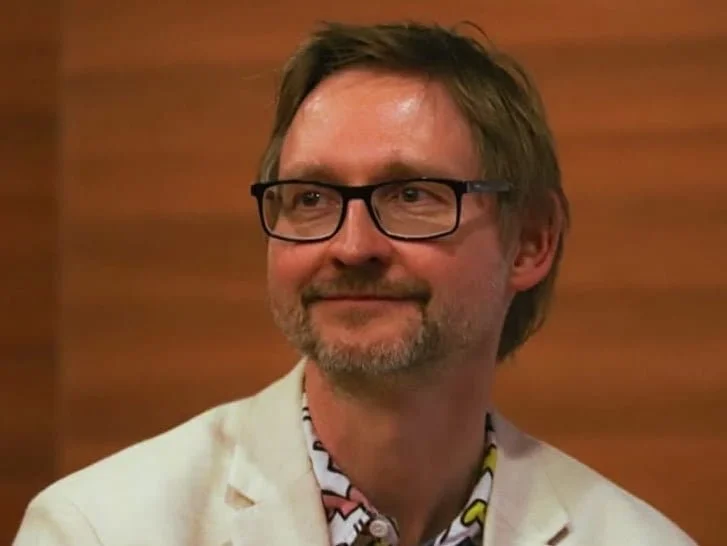
Figure 1: Koenitz during ICIDS 2024
Throughout the conversation, Frade and Koenitz discuss how interactive narratives reshape our understanding of user experience, complexity, and participation across media forms — from games and XR to journalistic interactivity. By bridging theory and design practice, they examine how interactive storytelling frameworks can inform not only creative practice but also civic and cultural engagement in an era of rapidly changing digital interfaces. This discussion situates Koenitz's work within broader conversations about storytelling, HCI, and participatory digital cultures.
Frade: How did you become one of the leading researchers in interactive digital narratives? Was there a specific moment or work that changed the way you think about storytelling?
Koenitz: As a university student, I was drawn to both narration and computation — two areas I initially saw as separate paths requiring an eventual choice. It was during my MA thesis that I discovered the notion of interactive narrative, and from that moment it was clear I had found my subject.
I have always been willing to ask difficult questions and challenge received assumptions. For example: does narrative theory — developed to analyze print literature, film, and theater — still apply when interactivity enters the picture? For me, the answer is clearly no, which means we must develop something appropriate to the different context. I did that with my SPP model, inspired by cybernetics, cybernetic art theory, and systems thinking, which fully accounts for the dynamic nature of interactive digital narrative. Continuous collaboration with researchers like Christian Roth and Anca Serbanescu, and the integration of key insights by others — on double hermeneutics by Veli-Matti Karhulahti or on retellings by Mirjam Palosaari Eladhari — has driven the model forward since 2010, culminating in my 2023 Routledge book Understanding Interactive Digital Narrative: Immersive Expressions for a Complex Time.
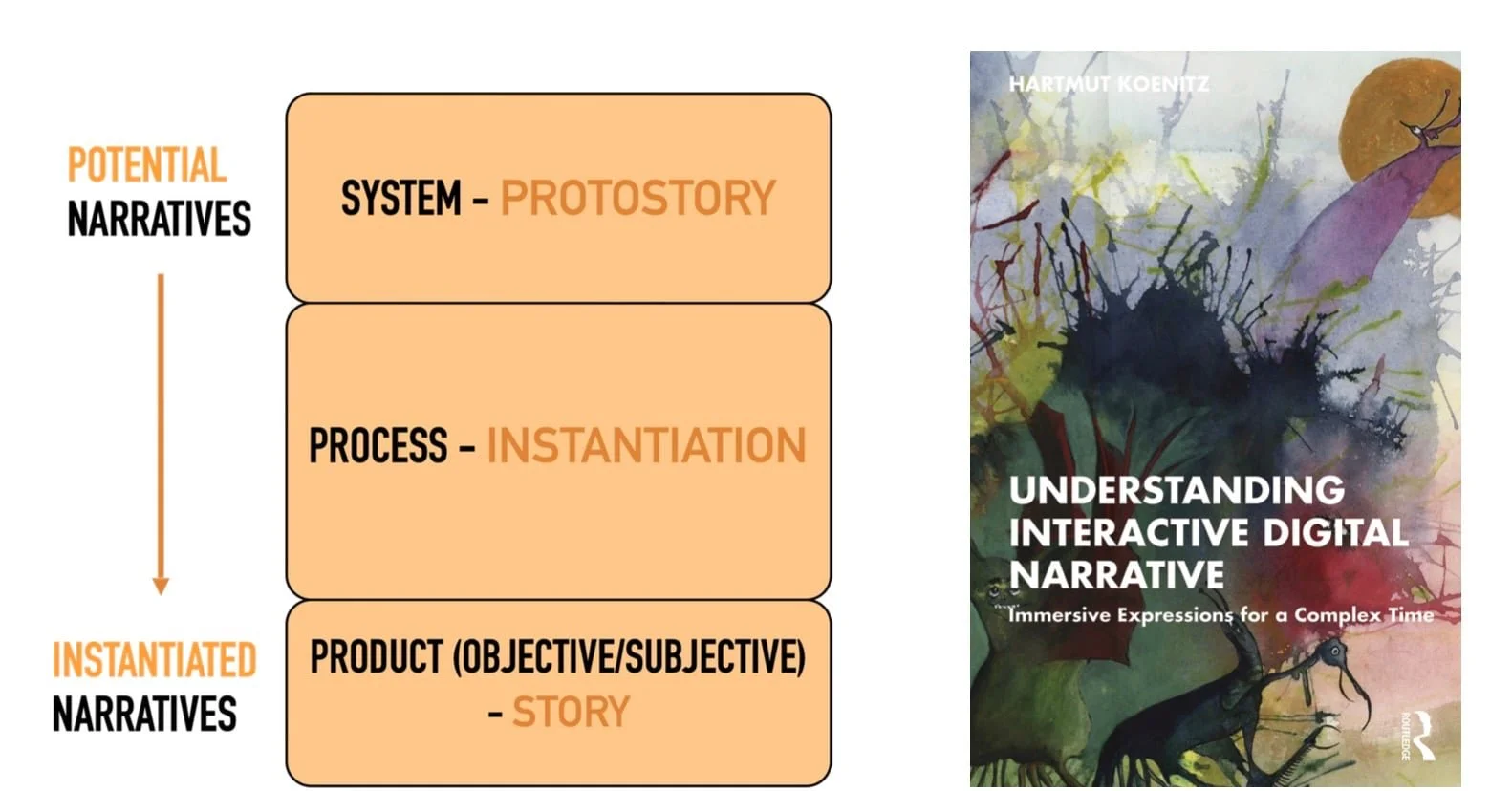
Figure 2: High-level view of Koenitz’ SPP model, explained in his monograph (right)
Frade: What does it mean to you to serve as President of ARDIN at this moment — when digital narratives are being so profoundly transformed by AI and XR?
Koenitz: I am very happy to help build a home for people working in interactive digital narratives. The field's interdisciplinary nature often means researchers feel they do not belong anywhere. ARDIN provides that home, and I have repeatedly witnessed the excitement when people discover they are not alone — that a community understands and supports them.
I co-founded ARDIN in 2018, as a necessary step after a decade of the ICIDS conference without an accompanying association. One of my key initiatives has been connecting with the Global South, because we need truly global perspectives — from African oral storytelling traditions to many other narrative forms around the world. In 2024, ICIDS was held for the first time in South America, in Barranquilla; in 2026, we will be in Bangkok. I also launched the first academic journal dedicated to the field, which integrates interactive works directly into articles so readers become interactors and can experience what authors are writing about.
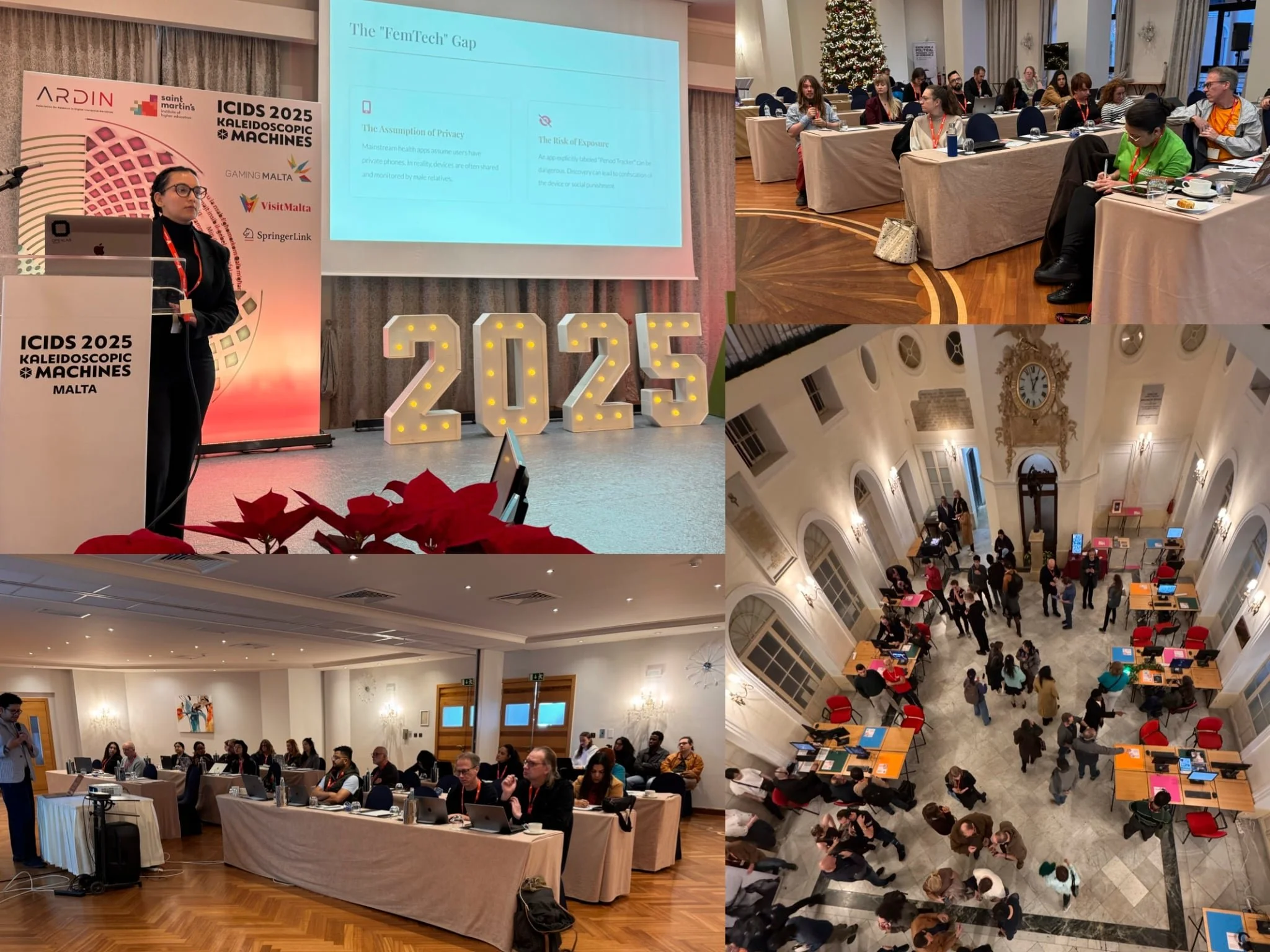
Figure 3: Impressions from the ICIDS 2025 conference (clockwise: paper presentation by Pakezea Anwar, participants during panel session, art exhibition opening, ARDIN emerging scholars academy/doctoral consortium)
On generative AI: the transformations are profound. GenAI can bring about highly dynamic interactive digital narratives that were simply not possible before — much more in line with the vision of experiences that truly adapt to an interactor's choices. ARDIN has launched a summer training school, where participants apply the latest AI technology to complex historical topics. GenAI is empowering many more creators to make the leap from traditional storyteller to system builder — technology that once required an advanced computer science degree is now in many more hands. In my own work, I support this with my authoring tool ASAPS, which integrates GenAI on several levels.
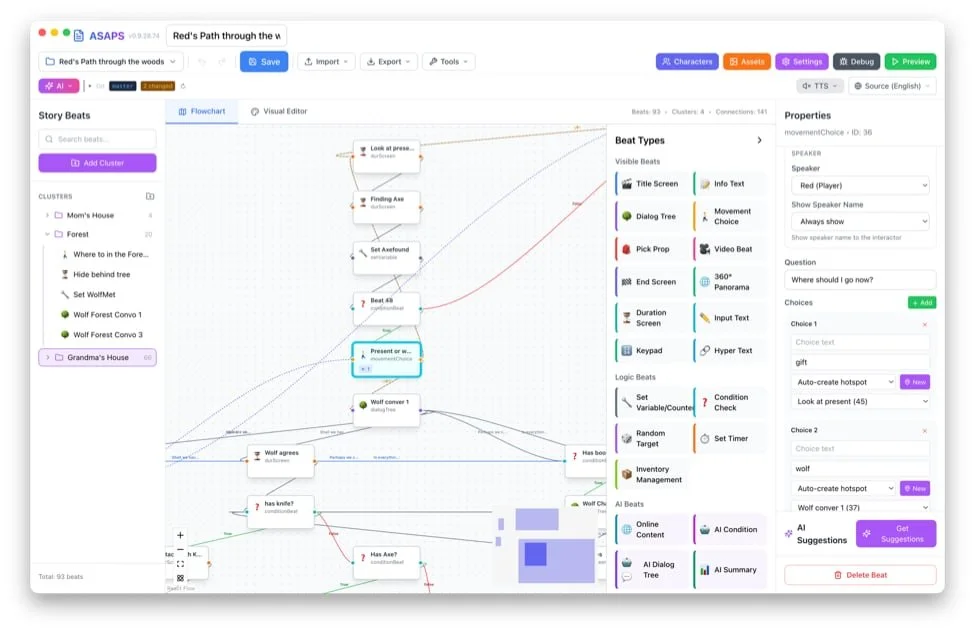
Figure 4: The authoring tool ASAPS (Advanced Stories Authoring and Presentations System), available at (https://github.com/sumo961/ASAPS_New)
That said, not everything brought about by GenAI is positive. We must stay critical of data biases brought about by Global North dominance, training artifacts such as sycophancy and hallucination, the effects on workplaces and on workers entering training data — many in the Global South and paid very little — as well as the environmental impact of AI data centers.
On XR: I remain somewhat more cautious. There have been many great works, but the mass consumer breakthrough has not yet arrived. Apple's Vision Pro features excellent technology, yet adoption remains limited. Meta's reported $80 billion loss in its VR effort speaks for itself along with the recent layoffs at its Metaverse division and its refocus on mobile over VR. There are, however, positive signs with AR glasses and Gaussian splatting — a breakthrough technology that makes 3D acquisition far more accessible.
Frade: You often argue that interactive narratives require a new theoretical vocabulary. Which concepts do you consider most urgent? How do you distinguish a genuinely meaningful interactive narrative from one that is merely technically sophisticated? And in what ways can interactive experiences promote civic engagement rather than just entertainment?
Koenitz: Dynamic narratives are not covered by theory built to analyze fixed ones. There has been some confusion on this point: scholars like Louise Michelle Rosenblatt (as far back as 1938), Roland Barthes, and Wolfgang Iser all demonstrated that reception is dynamic. But dynamic reception does not change the fact that a dynamic artifact is a fundamentally different object from a fixed one. I address this through the distinction between Interactivity 1 — dynamic perception through interpretation and speculation — and Interactivity 2 — the ability to influence the narrative artifact through planning and execution. I can speculate widely about a film, but I cannot decide where to move my avatar next in a film; that requires an Interactive Digital Narrative.
Meaning can come from relatively simple but well-considered interactive narrative design. In the mobile game Florence, the interactor must make space on their shelves to allow a partner to move in — an act many of us recognize as emotionally significant. In Unpacking, a problematic relationship is conveyed by the absence of space for the partner: you cannot find a place for their university degree, and you understand immediately what that means. Both examples deliver meaningful interactive narrative design without high-budget cinematics. The general lesson: first consider when interactive means can convey something; only then ask what technology is needed.
Interactive Digital Narratives are particularly well-suited to representing complex issues — climate change, migration, international conflicts — because they can present multiple perspectives within the same artifact, empower interactors to move between them, observe the consequences of decisions, and replay to explore different paths. This idea was the foundation of the EU COST Action INDCOR (Interactive Narrative Design for Complexity Representations), which I led from 2019 to 2025 and grew from 20 to more than 250 participants.
Frade: Games, extended reality, and interactive journalism seem like distinct worlds, yet you bring them together in your research. What do they share at the narrative level?
Koenitz: On a foundational level, all forms of interactive narrative share the same essential quality: the artifact is dynamic, no longer static. The silos you describe are a product of professional tradition, not narrative logic. Interactive journalists could learn from game designers — and do, when brought together by initiatives like the JoLT project led by my colleague Lindsay Grace with the Knight Foundation. Unfortunately, the silos prevent exchange and progress. I have attended VR-oriented conferences where common interactive narrative design challenges are presented as entirely novel, ignoring decades of work by game designers and academics. At the same time, solutions found by VR designers do not transfer back to game design. It is time to end the silo situation.
Frade: Does interactive journalism have the potential to deepen public understanding of complex issues — or does it risk oversimplifying them through gamification?
Koenitz: That is a loaded question in a productive sense. Gamification can absolutely serve the representation of complex issues — for instance, when real-world mechanics such as supply chains can be conveyed through game-like design. The key question is: can we create a level of abstraction that is true to the issue but less overwhelming? Do we create space for insights that emerge from the interactor's own experience of the work? If design elements commonly understood as gamification serve that goal, they are valuable. If not, they are not.
Frade: How has the relationship between humans and digital interfaces changed the way we tell and receive stories? Are we becoming more or less the authors of our own narrative experience?
Koenitz: Interactive Digital Narrative provides opportunities to convey narratives in ways not possible in film, print literature, or stage drama. Much has changed since Eliza, Joseph Weizenbaum's 1966 therapy chatbot, in terms of visual fidelity and interface modality. Yet it is striking that GenAI's breakthrough came by reusing Weizenbaum's chatbot concept. Many people now have regular conversations with ChatGPT or Claude, co-creating narratives with them. There is a danger of dependence on this AI co-creator but also a chance to use it as a sparring partner for creative expression. The educational challenge of our time is ensuring it is the positive creative application of GenAI that prevails — if it does, our role as authors of our own narratives will not diminish but gain additional powers.
Frade: Henry Jenkins popularized the concept of participatory culture. How do you see interactive narrative within — or beyond — that conceptual framework?
Koenitz: Interactive Digital Narratives have a considerable role in participatory culture, especially when understood as systems that require participation to instantiate individual experiences. Without a participant, an IDN remains unfulfilled potential — it needs to be completed through the actions of an interactor. At the same time, IDNs generate retellings in various forms, from gameplay recordings to fan fiction continuing the narrative, further enriching participatory culture. In that sense, IDN sits squarely within Jenkins's framework while also extending it: the work is not just received and remixed, it is literally incomplete until someone acts within it.
Frade: With the rise of generative AI, the role of the author in interactive narrative is being redefined. Is this a threat, an opportunity, or both?
Koenitz: The answer depends on how one understands authorship. Authorship can mean being in control of every aspect of a work — every line of text presented to the interactor, every option in a dialog tree. It can also mean designing a system whose dialog options are populated on the fly by a large language model according to predefined parameters. Both are valid and require genuine craft and expertise. Those who see writing as the only correct form of authorship will perceive GenAI as a threat, and I understand that. But I see a genuine opportunity for an expansion of system design — and I look forward to artifacts that take advantage of GenAI in a thoughtful, deliberate way.
“Interactive Digital Narratives are particularly well-suited to representing complex issues — because they can present multiple perspectives within the same artifact, empower interactors to move between them, and let them observe the consequences of decisions.”
Frade: What advice would you give to young researchers and designers who want to work at the intersection of narrative, technology, and human experience?
Koenitz: Follow your instincts and find your own way. Work on interactive narratives is deeply rewarding — it is both an intellectual challenge (how do we understand this new form?) and a technical one (how do we make IDNs actually happen?), connecting computer science, design, narrative studies, and artistic sensibility. That breadth can also feel daunting, and there is no guarantee that a given university or design studio will have an expert on the topic. That is exactly why I recommend reaching out to ARDIN — it is always better to do this kind of work with others.
Biographies
Hartmut Koenitz is a Professor in Media Technology at Södertörn University (Sweden), visiting researcher at the University of Amsterdam, and formerly a research fellow at Trinity College Dublin. He is President of the Association for Research in Digital Interactive Narratives (ARDIN) and author of Understanding Interactive Digital Narrative: Immersive Expressions for a Complex Time (Routledge, 2023). His SPP model and the EU COST Action INDCOR have shaped the field of interactive digital narrative studies internationally.
Renata Frade is a tech feminism researcher and PhD in Information and Communication in Digital Platforms (Universidade de Aveiro / Universidade do Porto, 2025, Distinction and Honours). She is currently a Postdoctoral Researcher at the Católica Doctoral School, Universidade Católica Portuguesa, where she investigates the transformative social and cultural effects of digitalisation, with a focus on women in tech communities, AI, gender, and platform governance. Cátedra Oscar Sala / Instituto de Estudos Avançados / Universidade de São Paulo Artificial Intelligence researcher. Journalist (B.A. in Social Communication from PUC-Rio University) and M.A. in Literature from UERJ. Henry Jenkins' transmedia alumni and attendee at M.I.T., Rede Globo TV and Nave school events/courses. Speaker, activist, community manager, professor and content producer on women in tech, diversity, inclusion and transmedia since 2010 (such as Gartner, IEEE international symposium, Girls in Tech Brazil, Mídia Ninja, Digitalks, MobileTime etc). Published in 21 academic and fiction books (poetry and short stories). Renata Frade is interested in Literature, Activism, Feminism, Civic Imagination, Technology, Digital Humanities, Cyberculture, HCI.