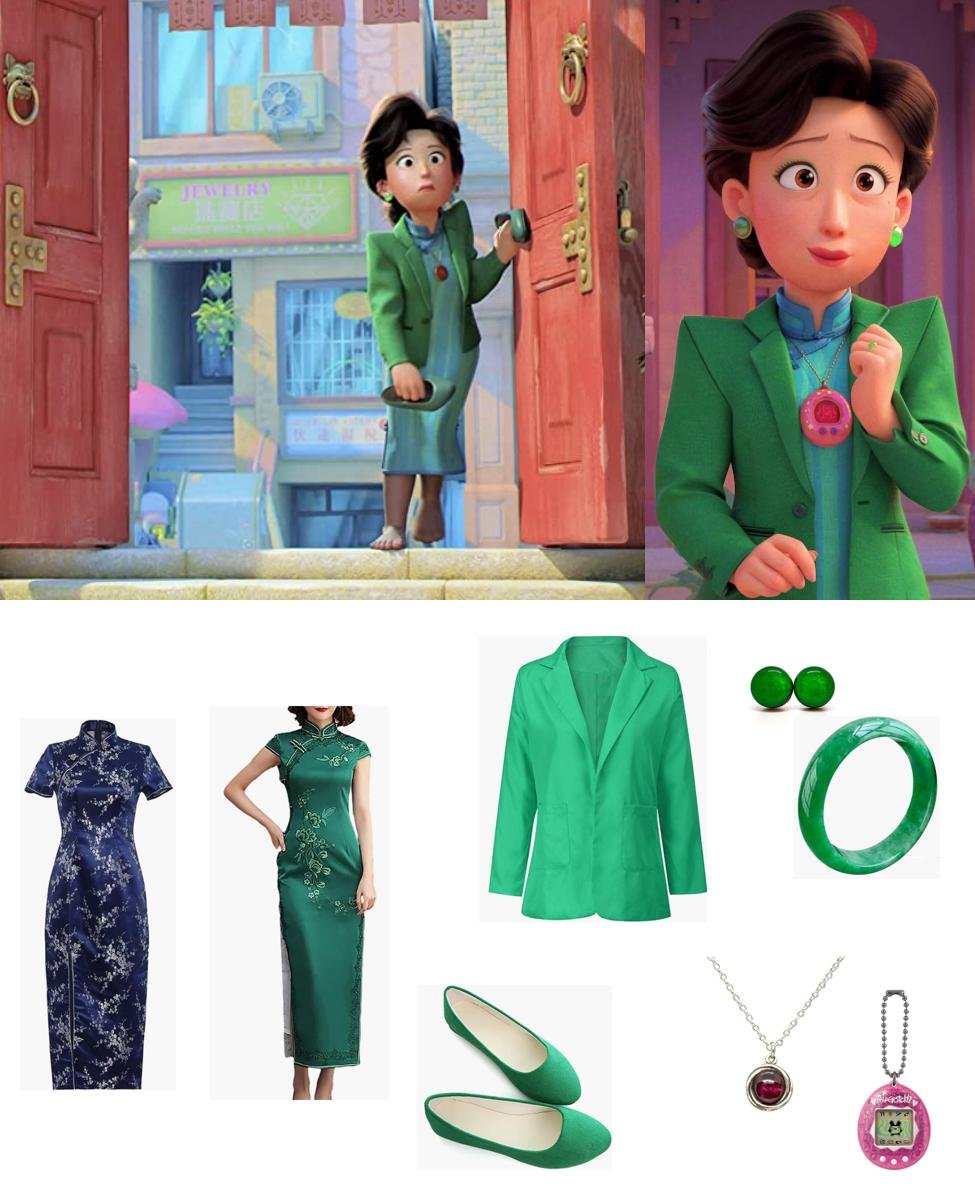
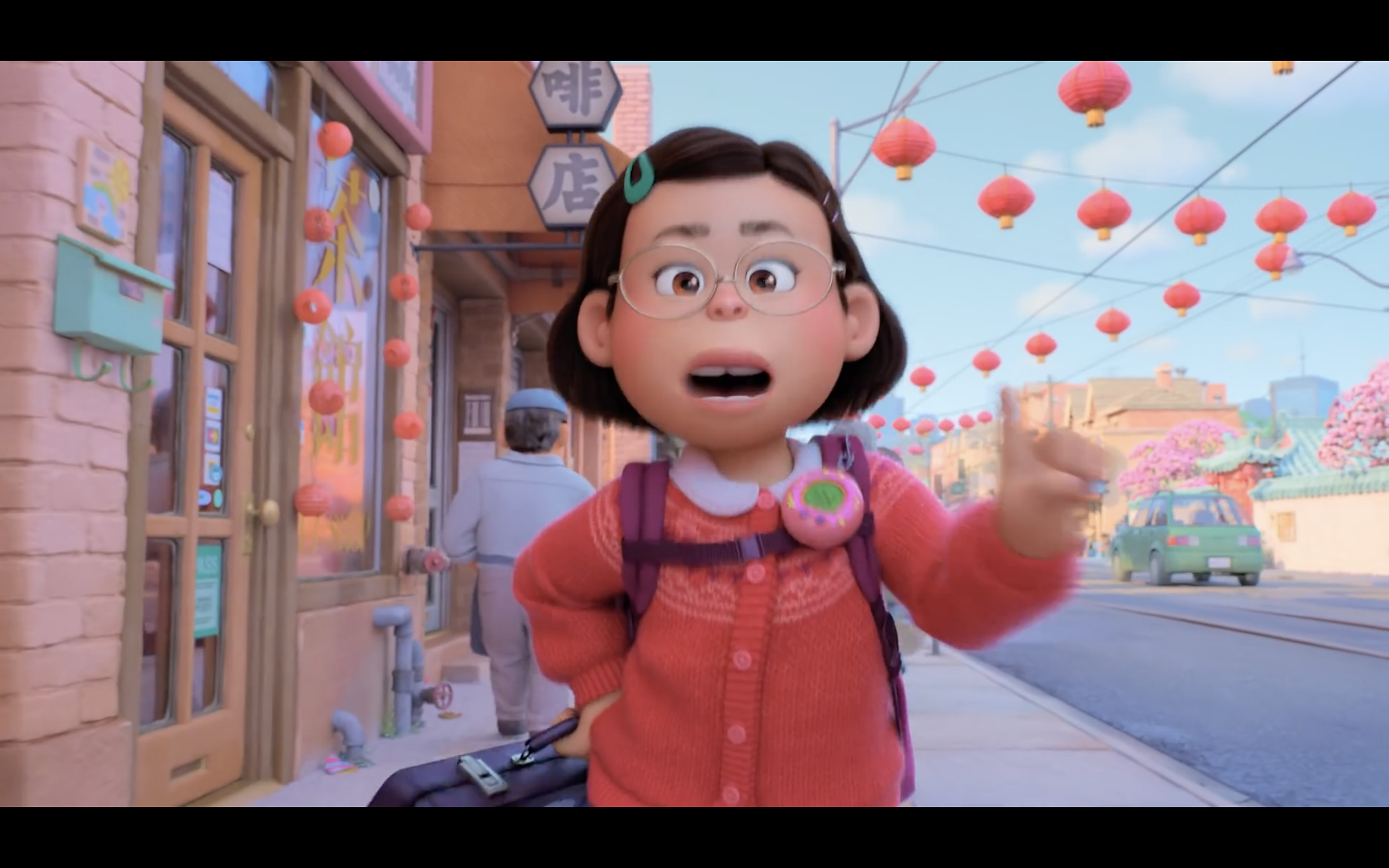
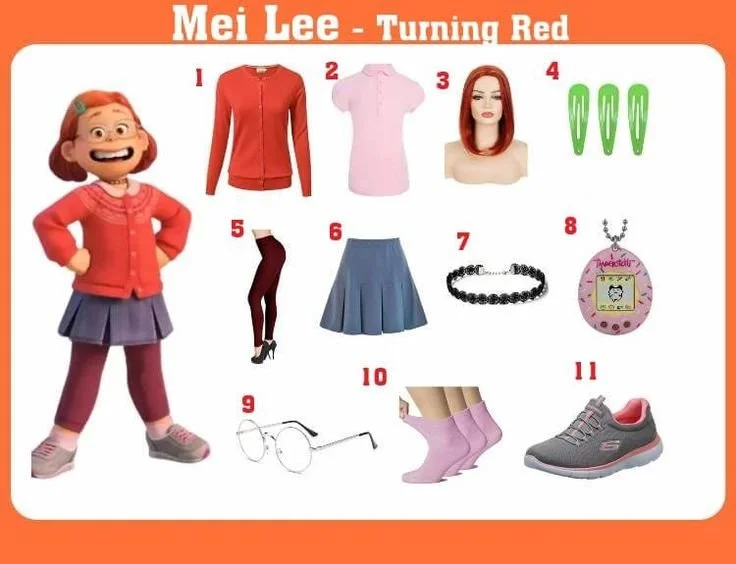
The remaining elements help confirm her authority by adding intimidating aspects. The stripes on her dress serve to elongate her height, thus making her seem taller and authoritative. This trait is enhanced by Ming being taller than all the younger characters, including her daughter, and equal height to the significant adult characters. The blazer with shoulder pads, pantyhose, and pumps contribute to a “working woman” aesthetic that also defines Ming’s livelihood in America— an early photo flashback shows her and her family attending a business convention, for example. In addition Mei and Ming are both involved in the operations of their established family temple, and Mei’s deviation from her duties causes tension between the two, demonstrating the emphasis on business industry that Ming places on herself and her family. Mei also briefly wears the blazer during a presentation to her parents in an attempt to emulate the maturity and expertise her mother is associated with. Interestingly, Ming’s blazer is always present when she conducts business or runs errands, likely to project an image of confidence to her community. However, within her closed household, she usually wears only her dress, possibly to signify being more genuine and comforting with her immediate family.
Thus, it becomes obvious that Ming’s costume helps contextualize her experiences within a diasporic context. With Mei’s family in Toronto and her grandmother and aunts in Florida, it can be inferred that a majority of her family has relocated from China to the Western hemisphere. While Mei is raised within Toronto’s Chinatown, she and her mother spend a significant amount of time outside its confines. In these less familiar contexts Ming utilizes her costume to encourage respect despite being a perpetual foreigner. Eventually, she expects mutual respect consistently from others, as shown when she becomes visibly frustrated with the school’s security guard while attempting to approach Mei during class. Evidently, Ming’s costume acts as a defense mechanism to reassure herself to maintain her authority in any context.
Despite the story mainly featuring Chinese-Canadian characters, it focuses more on the generational mother-daughter relationships. Mei’s affinity toward modern, Western trends does intensify tension with her mother, but this merely represents general conflicts of interest that characterize diminishing maternal relationships. In addition to representing an affirmative position within a foreign context, Ming’s blazer symbolizes her overprotectiveness towards her daughter. The wide shoulder-pads assist in Ming’s body overshadowing Mei during furious acts of maternal protection, demonstrating a perceived control over her. The blazer also clashes with the casual outfits that surround her, further characterizing her overprotectiveness as strange, and according to Mei’s peers, embarrassing or “psycho”. Refreshingly, the source of Mei’s shame is not of her family’s Chineseness; only once does another character disparage their traditions, as nemesis Tyler briefly yells for Mei to “go back...to your creepy temple.” Instead, it’s Ming’s closeness that is perceived as strange by others, instead of her culture, which diasporic films tend to hyperfocus on as sources of conflict.
Certainly, though, Ming’s cultural designs inform her confidence. Production designer Rona Liu and director Domee Shi describe Ming as “controlled and elegant”, and her design aims to emulate the ladies of 1960s Hong Kong (Yamanaka). Historically, this period is said to be the “second golden age” for qipaos amidst the less glamorous Communist China (Lee). Ming also wears the dress well; the stiff collars serve to display a woman’s good posture, and Ming is almost always poised and composed, emulating the traditional values of the outfit.
Interestingly, Ming’s qipao also differs drastically from the costume choices of her relatives. Mei’s aunts are dressed very immigrant and very 2000s— chunky sandals, zebra-print boots, tracksuits, and, of course, a puffer vest for the predictably cold weather. While the relatives dress casually, Ming’s costume emulates elegance and professionalism. Considering that Ming is geographically isolated from her relatives in Florida, her outfit maintenance can help provide an impression of success and assurance, especially as her own mother, who, like Ming, maintains high expectations for her daughter.
Halfway through the film, a shift in Ming’s role becomes apparent. Around her Toronto community, Mei, and her husband, she is able to intimidate and welcomes respect. However, around her mother and relatives (referred to Mei as “aunties”), she becomes defensive and more timid. Despite being the same height as her mother, she looks downward when being addressed, and her voice becomes less firm. During the climax Ming’s internal fragility and frustration with her family act as a deviation of her otherwise consistent character. Her blazer can then be interpreted as a shield from her family to preserve an internal pride that becomes diminished around her family.
Once the family’s generational tensions are resolved, though, their accommodation can be expressed through new additions to their costumes. Prior to the climax Ming wears a pendant that holds her sealed panda spirit, but after it breaks it is replaced with a red tamagotchi, a relic of the trendy concert that Mei attends. The theme of cultural adjustment continues across Mei’s family, as her grandmother’s jade bracelet is replaced by a red 4-Town charm, which represents a band that the family consistently disapproved of. The combination of modern media and the red colors symbolize a coherent acceptance of the family’s adjustment to a new era defined by acceptance.
Ming’s costume successfully characterizes her complexity and authority within Turning Red’s narrative. First, small details and ornamentation establish her as a character prior to the start of the film. The blazer, pendant, and ring allude to previous struggles of adjustment, angst, and determination in relation to her family and diaspora. The dominant green-blue tones demonstrate her alignment with the traditional expectations of family and tradition, creating a symbolic cohesion that defines the film. While the blazer and dress represent aspects of clashing worlds, the color and silhouettes allow for an elegant combination to guide our expectations of her poised character. Turning Red’s creative team undoubtedly succeeded in using her costume to extend her character in an evident demonstration of costume and narrative design.
Works Cited
Lee, Ching Yee. “How the Qipao Became the Quintessence of Chinese Elegance.” The Collector, 21 Feb. 2022, thecollector.com/how-qipao-became-timeless-chinese- elegance/.
Shan, Jun. “Importance of Jade in Chinese Culture.” ThoughtCo., 6 Dec. 2018, thoughtco.com/ about-jade-culture-629197.
Tangcay, Jazz. “‘Turning Red’: How Anime and Teen Bedrooms All Feature in Production Design.” Variety, 11 Mar 2022, variety.com/2022/artisans/news/turning-red-how-anime- teen- bedrooms-and-easter-eggs-all-feature-in-production-design-1235202044/.
Wolf, Mark. “World Design.” The Routeledge Companion to Imaginary Worlds, 1st Edition, Routeledge, 17 September 2017.
Yamanaka, Jeanine. “Creating the Look of Disney and Pixar’s ‘Turning Red’.” SoCal Thrills, 8 Mar. 2022, socalthrills.com/disney-and-pixar-creating-the-look-of-turning-red/.
Alice Shu is a USC undergraduate (class of 2025) studying Communications and East Asian Area Studies. She comes from a Chinese-American and Bay Area background that has informed her interests in intercultural communication. While at USC, she has developed interests in fandom studies and entertainment industries, particularly themed entertainment. Her favorite attraction, predictably, is the Mad Tea Party. She currently works with social media platforms on sales and marketing.