Comics & Stuff: The Interviews (3 of 4)

Michael Saler

The relations among history, memory and nostalgia are major concerns in comics by Art Spiegelman, Joe Sacco, Marjane Satrapi, Jason Lutes and many others. Your own explorations of graphic novels tends to highlight their fluid, multidimensional and open-ended nature, but do you find that contemporary narratives continue to risk forms of reification and closure despite their metafictionality? I’m thinking about Seth, who in effect has reified himself as a person, perhaps inadvertently – can Seth ever take off his hat and tie? Has he, like the characters he represents, become a captive of his his possessions and nostalgic yearnings?

Henry Jenkins

Each of the authors you identify here raise their own questions -- several of them are folks I considered writing about in this book, but let me bracket them and focus on Seth, who I do write about. 

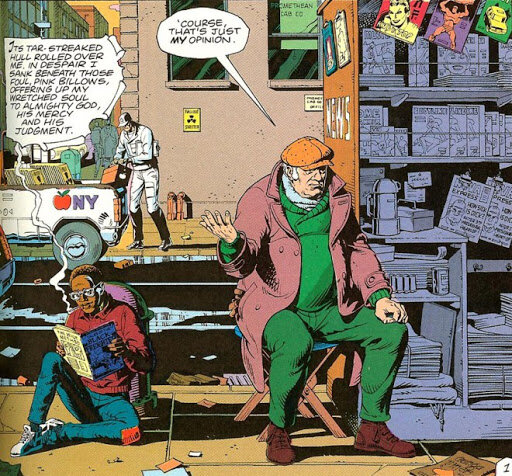
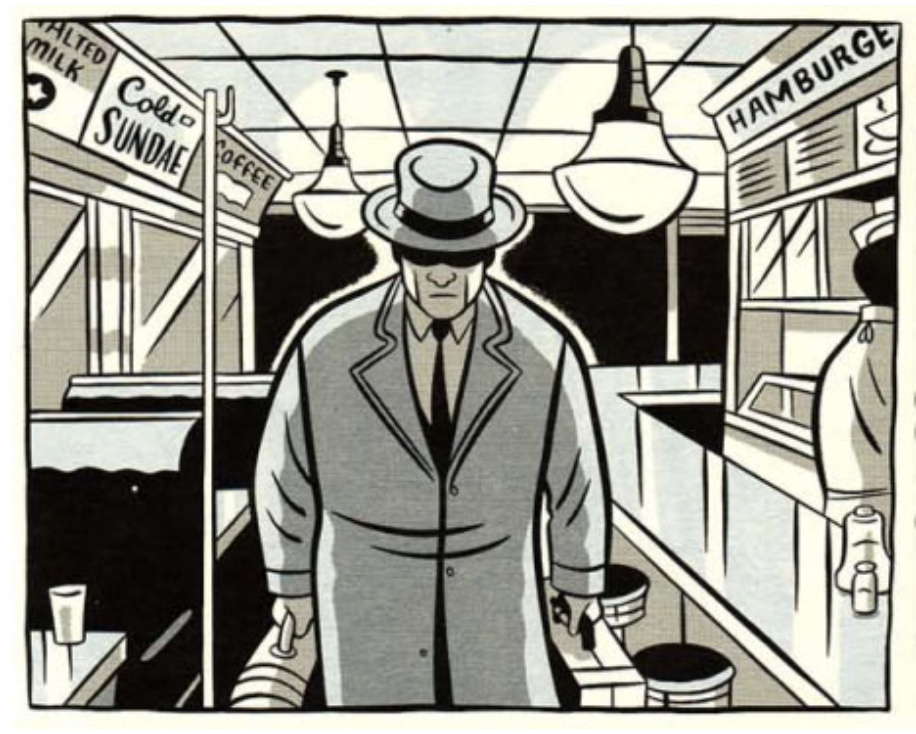
You are absolutely right that in some ways, Seth has turned himself -- his living persona -- into a caricature who seems to have stepped directly off the pages of his graphic novels. He talks about his persona, his lifestyle as being  one of his creative projects. He represents a kind of dandy-ish self-fashioning which serves to situate him in the mid-century world that his characters want to get back to. And this certainly makes it easy to recognize Seth’s self-representation in his graphic novels, whether he acknowledges the connection or not. He constructs himself there as a sensitive soul for whom nostalgia borders on mental illness. 
Screen Shot 2020-05-28 at 10.16.06 AM.png

You are absolutely right that in some ways, Seth has turned himself -- his living persona -- into a caricature who seems to have stepped directly off the pages of his graphic novels. He talks about his persona, his lifestyle as being  one of his creative projects. He represents a kind of dandy-ish self-fashioning which serves to situate him in the mid-century world that his characters want to get back to. And this certainly makes it easy to recognize Seth’s self-representation in his graphic novels, whether he acknowledges the connection or not. He constructs himself there as a sensitive soul for whom nostalgia borders on mental illness. 

Screen Shot 2020-05-28 at 10.17.11 AM.png

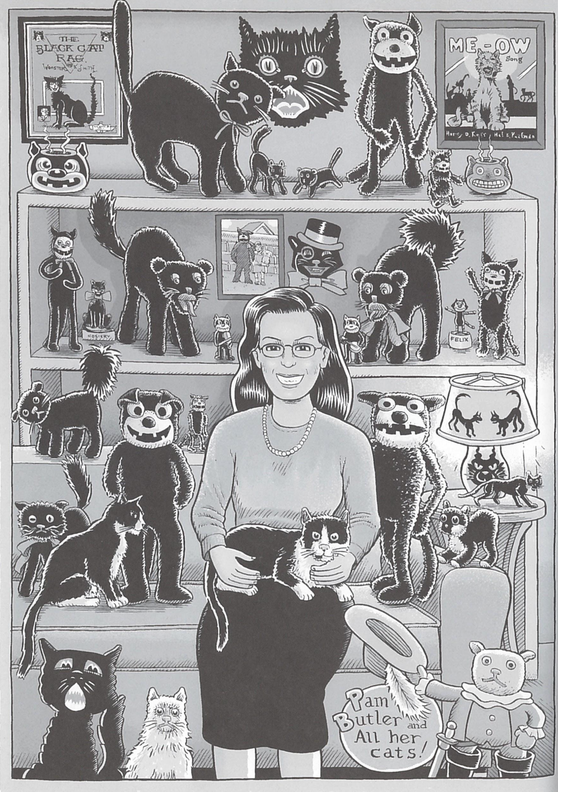
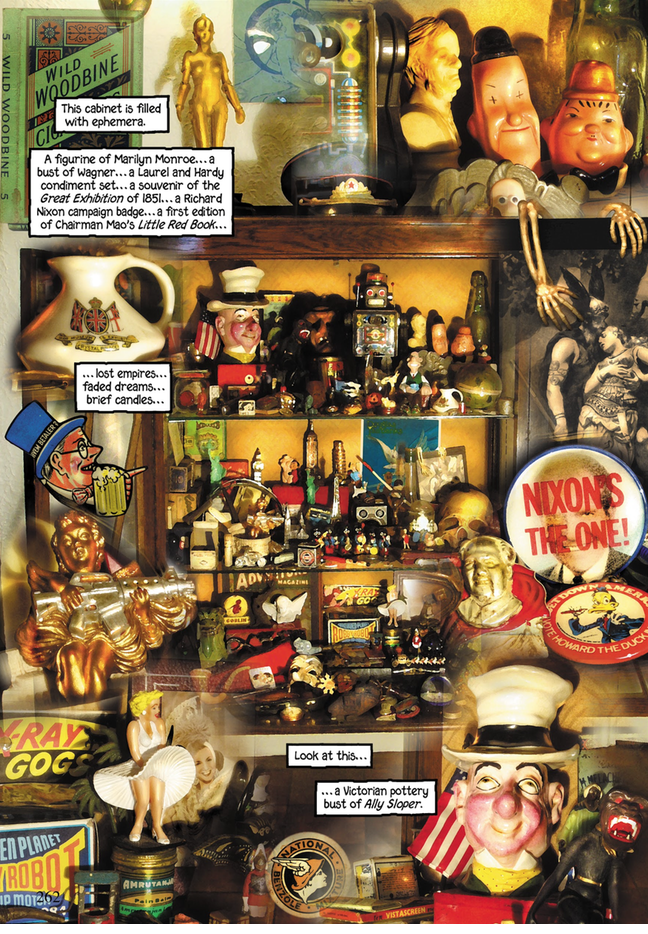
As I suggested in my analysis, some of these representations of fans and collectors would offend me in other contexts. Yet, there is a sense that Seth owns these stereotypes. They are representations of self and not others. They are understood from the inside and not the outside. They are sometimes self-parody and sometimes self-pity. If the character seems overwhelmed, the artist is still showing his mastery in finding a way to express these relationships through his work. I am really fascinated by the ambivalence he shows towards his own community and by the ambivalence he arouses in me as I look at these otherwise stereotypical constructions.  Is he possessed by his possessions? Almost certainly, but part of what makes the meta-text dizzying, is that he knows—and expects us to know—that he is possessed by his possessions.
Screen Shot 2020-05-28 at 10.18.10 AM.png

William Proctor

I am a massive fan of Bryan Talbot’s work, ever since I was first introduced to his work in ‘Nemesis the Warlock’ in the British weekly science fiction comic 2000AD (which remains one of the last survivors of the UK comics collapse of the late-1980s and early-90s). Nevertheless, I was stunned when you informed me that you’d be exploring Talbot’s magnificent Alice in Sunderlandfor Comics and Stuff back in 2013 when we first met, principally because I was born-and-bred in Sunderland, and couldn’t get my head around how you would interpret the city (once the biggest industrial town in England, but now a pale shadow of its former self, thanks to the Tory/ Thatcher government of the late-70s and throughout the 80s). As you recount in Comics and Stuff, you and I visited the Talbots, and went around many of the sites represented in Alice in Sunderland. We also visited the museum, which at the time had a focus on the mining heritage that has now disappeared (again, courtesy of Thatcher and the Tories). I am very interested in your impressions of Sunderland, coming from a radically different national context yourself. Was it quite an alien, discombobulating experience?

Henry Jenkins

Well, as I’ve shared before, the first time I read this book I had a crisis of faith mid-way through when Talbot suggests that perhaps Sunderland doesn’t exist. I had been taking it on faith, never having heard of Sunderland before, and not bothered to look it up on a map, and I was drawn by Talbot’s account by the historical and literary richness of this place I had never heard of. 

Talbot’s device of the one “fake story” in the sealed envelope encourages us to question what we are reading. But his account uses Sunderland as a microcosm for all of the great movements of British history, going back to the Age of Reptiles, and finds a way to link in such a broad array of culturally significant works of art, literature, and media. 

Having had this lapse of faith, I needed to ground my reading of this book in reality, I wanted to trace some of the routes Talbot takes in the book which is, among other things, organized by his character’s movements through space. As for the town itself, it was not “alien” or “discombobulating,” but it is a very British place, representing a different kind of Englishness than what motivates Anglophile trips to Londontown or Oxford. I had already been to Birmingham, Manchester, Blackpool,and Liverpool, all of which evoke a more working class view of British life, though each is better known in America than Sunderland. Regardless, I had a blast and was much appreciated of what you and the Talbots were willing to share with me of the place.

Screen Shot 2020-05-28 at 10.19.41 AM.png

William Proctor

You describe Talbot’s Alice in Sunderlandas “a hypertext in printed form.” What do you mean by this?

Henry Jenkins

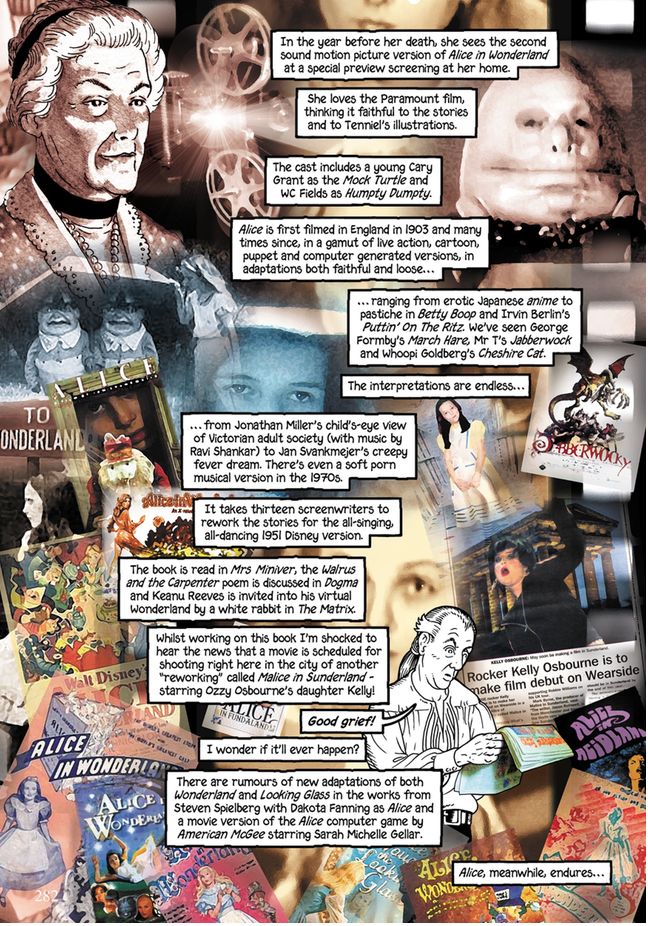
I was trying to get at the way that the book is structured through associations and digressions, that it works on multiple levels simultaneously and that on different readings I have tended to favor one level over another. Is it about local history and geography, national culture, the nature of death and decay, the cultural status of comics, an account of how Lewis Carroll was inspired to write Alice in Wonderland or a case for a multicultural Britain, among just a few of its core themes and structures? All of the above and much more. And that’s why it might be interesting to reconfigure the content to trace through the various strands.

Talbot is insistent that he does not feel that the story would work in hypertext because there is a deep logic to the sequence in which things unfold and that giving readers total freedom to move through links across its pages would result in a less satisfying dramatic form. I can see that and I ultimately bow to his claims about his own text. But I have had so many students, who are studying how to craft interactive stories, say that they learned a ton from following how he leads readers from place to place, thematically, temporally, and geographically, all at the same time.

In the context of the book, I end up discussing it in relation to three Victorian era practices which also rely on an aesthetics of accumulation—the cabinet of curiosities, the music hall, and the collage. Each seems more appropriate, in the end, for talking about how Talbot draws on forms of storytelling appropriate to the context where the core events of this pictorial essay occurs.
Screen Shot 2020-05-28 at 10.21.55 AM.png

Michael Saler

You discuss the “enchantments” of material culture and of collecting (highlighted by the work of Kim Deitch, Bryan Talbot and Emil Ferris) as well as their “disenchantments” (highlighted by Seth and Chester Brown) and conclude on an ambivalent note yourself: “Sooner or later, our stuff will engulf us.” You show that ambivalence is innate to collecting, just as complementaries are intrinsic to sequential art. How might the disenchanting aspects of collecting be challenged by digital culture, with the cloud as the ultimate repository of things? Might we be more willing to let go of the material object as we become accustomed to thinking of existence in virtual as well as material terms? And might there be a fundamental “manna” to tangible objects that virtual representations will never have: have collectibles become our secular reliquaries?

Henry Jenkins

One of my points of entry into the book was Will Straw’s writing about the new forms of historical consciousness that we find in digital spaces. He was arguing that people there can gather around a particular bit of cultural real estate, assemble information, contest theories, share finds, build archives and encyclopedias, and so forth. I traced this through in terms of the 1939 New York World’s Fair (another shared obsession) and its relationship to the forms of Retrofuturism which informs Dean Motter’s work. And I got the ultimate fanboy honor—Motter chose to run a version of that essay in his graphic novel, Terminal City.  I ended up not writing as much about Straw’s work in Comics and Stuff, but I think his ideas about historicity shadow the argument of the book. If we think of communities who gather around and make meaning from meaningful objets, then networked communication is a huge asset for such relationships.

That said, as a collector, I want to own things, especially media, which is probably the primary focus of my collecting.  On one side of my desk is a wall of comics—including some of the earliest comics I read—and on the other wall are DVDs. As a child, I used to lay awake at night and imagine which movies I wanted to own, assuming scarcity in a world of celluloid prints. Each selected film was precious. Now I am a completist. I have all of the surviving works of Alfred Hitchcock (and am starting on Alma’s films). I have been collecting the films of John Ford, Frank Capra, The Marx Brothers, Charlie Chaplin… I believe anything is better in a boxed set. I don’t want to trust the cloud or more importantly, some streaming service to provide my access—“on demand”—to such materials. They are not really “on demand” when they are on the streaming services one day and gone the next month. And the same thing happens on YouTube for different reasons -- a collector posts some rare film one day, then the next time you look for it the film’s gone because the owner got a take-down notice. I dig the idea of the “infinite jukebox” -- I really do -- but it is a long way from being a reality and until it is, I want to own these things. And getting deeper into the psychology of the collector, I want to display them. I am about at the limits of this -- until now, I have kept all of the DVDs in their boxes but I am running out of shelves and need to find a more compact way to house some of them if my collecting habits are going to continue.

So, yes, in some senses, the digital changes the context of collecting from a solitary to a more networked relationship and it gives us access to things we could never find before. In the book, I contrast the responses of Seth (who values the search as an adventure) and Kim Deitch (who starts many of his stories by buying things on e-Bey and then starting to trace their secret origins through systematic research). The two express the ambivalent response of the collector to the changes digital media is bringing to their lives. But few collectors are ready to trade access for ownership any more than I do.  And so far, we are talking about mass produced items. Add scarcity to the mix. Add uniqueness and historical significance to the mix. Add what Walter Benjamin called “aura.” Add the connection of this object to a loved one (as Joyce Farmer or Roz Chast are discussing). And we want to own the thing itself -- not just look at it on our computer screen. I want toownthe school bell that my great grandfather used to call his students together. I want to ownmy father’s copies of the Pogo books. And I do. The problem is that the more my expertise grows and my interest expands, the more things I must own and I am running out of space.

8656451338_1dbc8a7003_k.jpg

Interviewers

Ichigo Mina Kaneko is a PhD candidate and Provost’s Fellow in Comparative Media and Culture at USC. She holds a BS in Media, Culture, and Communication from NYU and was formerly Covers Associate at The New Yorkerand Editorial Associate at TOON Books. Her research focuses on disaster and speculative ecologies in postwar Japanese literature, comics and cinema.

William Proctor is Principal Lecturer in Comics, Film and Transmedia at Bournemouth University. He is the co-editor of the books Transmedia Earth: Global Convergence Cultures (with Matthew Freeman) and the award-winning Disney's Star Wars: Forces of Production, Promotion, and Reception (with Richard McCulloch). William is a leading expert on the history and theory of reboots, and is currently preparing his debut monograph on the topic for publication, Reboot Culture: Comics, Film, Transmedia for Palgrave Macmillan. He has also published widely on a broad array of subjects including Batman, James Bond, Stephen King,  Star Trek, Star Wars, and other forms of popular culture. William is also co-editor on the forthcoming edited collection Horror Franchise Cinema (with Mark McKenna) and he is associate editor of the website Confessions of an Aca-Fan.   

Michael Saler is professor of history at the University of California, Davis, where he teaches modern European intellectual and cultural history. He is the author of As If: Modern Enchantment and the Literary Prehistory of Virtual Reality (Oxford University Press, 2012) and The Avant-Garde in Interwar England: Medieval Modernism and the London Underground (Oxford University Press, 2001); coeditor of The Re-Enchantment of the World: Secular Magic in a Rational Age (Stanford University Press, 2009) and editor of The Fin-de-siècle World (Routledge, 2015). He is currently working on a history of modernity and the imagination.
Comics and Stuff: The Interviews (2 of 4)

Screen Shot 2020-05-26 at 5.56.20 PM.png

Michael Saler

You state, “I hope to contribute a new conceptual and methodological vocabulary for thinking about graphic novels.” Many of the categories you explore – material culture, collecting, nostalgia, history and memory – are the explicit focus of the “graphic novels” you analyze so insightfully. How might your approach help us to revisit the superhero comics that have been studied in more traditional ways? Given Lee and Kirby’s own penchant for self-referentiality and nostalgia, for example, how might The Fantastic Four be understood using the insights you provide inComics and Stuff?

Henry Jenkins

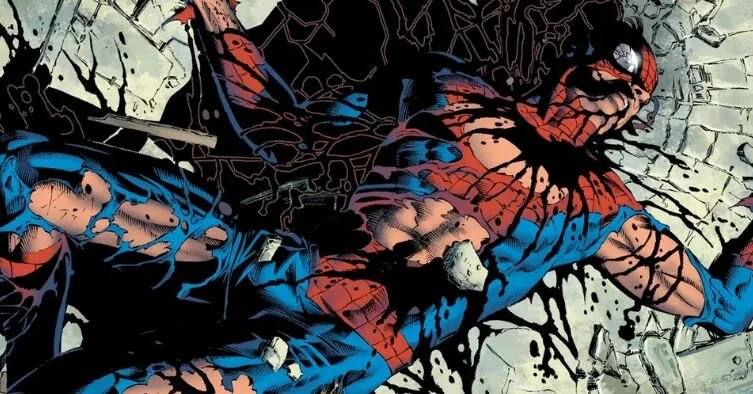
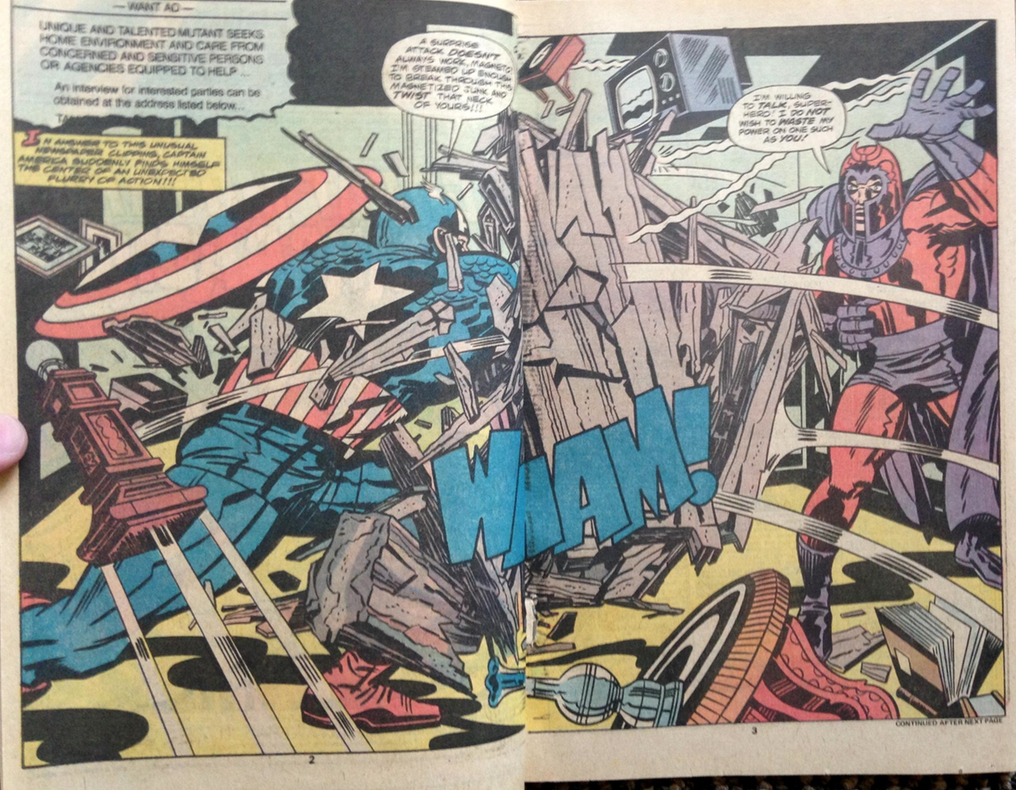
Let me be clear that I am not an expert on Kirby, Lee and the Fantastic Four. I am not the person to do this work. But let me point in the right direction. We might start with Kirby’s extraordinary splash pages, which are, like the work of Harvey Kurtzman or Will Elder which I discuss briefly in Comics and Stuff, are great examples of scanability in comics. Often, theyare focused on actions occuring across the full space of the page. We generally would look at this panel in terms of Kirby’s dynamism, the kinetic force of Captain America smashing through the door. What happens if we decenter our gaze and focus on the bricabrac being thrown about here? Some of it is fairly generic, other parts of it are pretty distinct and on further focus, become points of interest in its own right. Are these objects we could trace across the book? Do they accrue meaning and significance for the character or for the author? Do they help us map the world where the comics take place?  Or are they artistic flourishes? 

Screen Shot 2020-05-26 at 5.57.35 PM.png

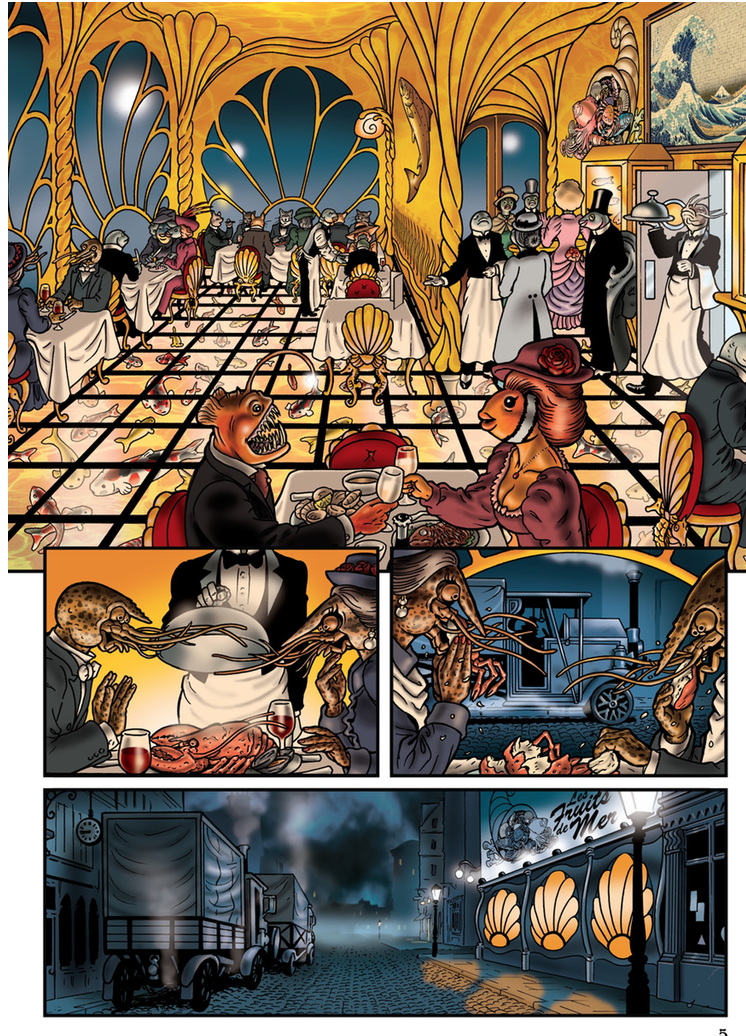
We might also think about the whole phenomenon of Kirby-Tech which I reference in passing in Comics and Stuff: the idea that Kirby adds lots of details to his design of certain mechanisms and technologies, which helps make them seem more concrete to the reader. Here, we see an example from The Fantastic Four. See I did get there. Yet, these technologies seem designed for the quick impression and they become less plausible (but more fascinating) if we study them closely. They operate differently say that the details I discuss in relation to Bryan Talbot’s Grandville universe, where he has carefully worked through a steampunk future occupied mostly by anthropromorphic animals. I use this page as an example in Comics and Stuff. The more we study the details here, the more the world comes to life for us, though also, the funnier his play with anthropromorphism becomes.

Screen Shot 2020-05-26 at 5.58.33 PM.png
Screen Shot 2020-05-26 at 5.58.42 PM.png

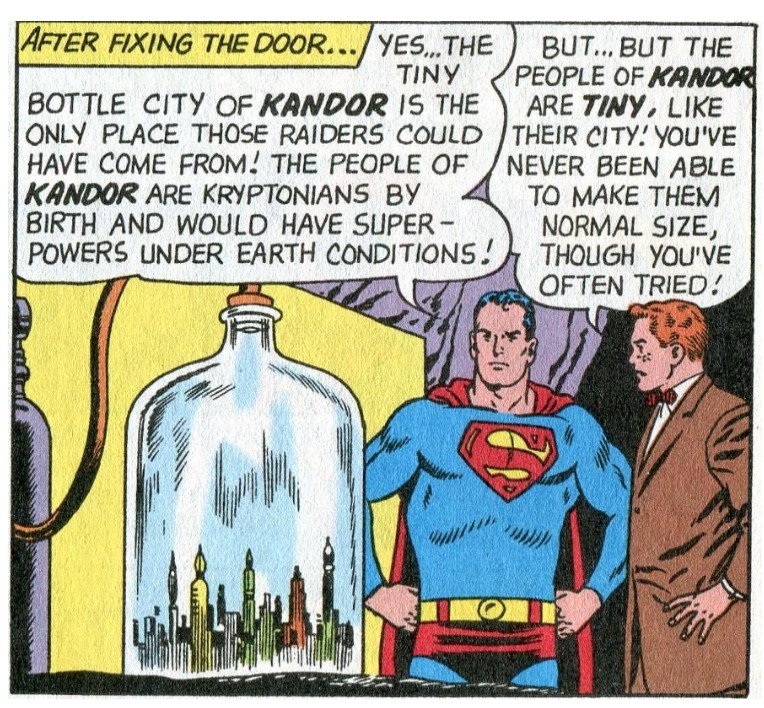
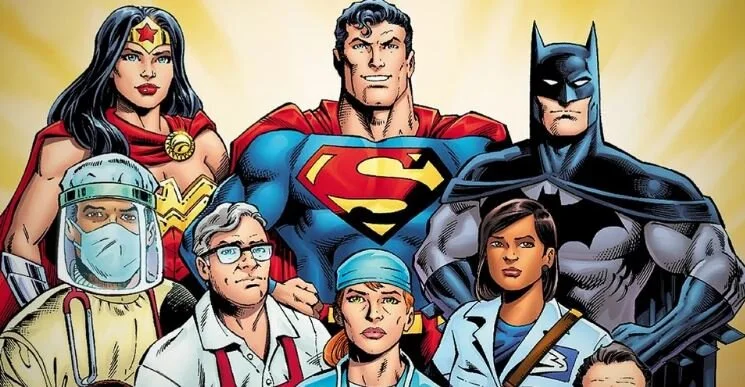
Finally, I find myself thinking about those moments where we see the superhero as collector. I am thinking about Superman with the bottled city of Kandor, which always fascinated me as a kid, or the various objects gathered in the Bat Cave and the Hall of Justice. Some of these things have history -- point us back to specific stories, some of them are fascinating yet are given no backstory. What’s striking is how consistently some of these details (The giant Joker card, the oversized penny, the dinosaur, in the case of the Bat Cave) surface across generations of writers and artists, suggesting that they emerge from the mythology surrounding the character but do not reflect the personal obsessions of their artists.  And that would be one way to shift the focus of meaningful objects -- towards a study of what the superheroes themselves hold onto from their adventures, why these objects and not others, and how we come to accept these objects (bizarre as some of them may be) as recurring background details.

I am not sure I got at all the parts of your question, but as I said, there are others out there who are more immersed in the analysis of Jack Kirby’s work than I am. As for Stan Lee, I used to say—every comics fans should here him talk once

Screen Shot 2020-05-26 at 6.00.35 PM.png

William Proctor

On page 3, you casually throw in the term ‘auteur’, as if it is axiomatic and requires no explanation. What do you think of the problems associated with the term—thorny concept that it is—and how might it apply to comics given that the term originated in film criticism? Do you believe that graphic novelists deserve the auteur appellation while mainstream comics writers do not? What impact does this have on the cultural distinctions identified above?  

Henry Jenkins

Let’s be clear -- the auteur theory originates in film but it’s really just the French term for author and that discourse goes back a lot further in relation to books. So the most simple claim is that graphic novels, like other books, have authors, and in the case of most of the books I discuss inComics and Stuff, the writer and artist is typically the same person making some of the counter-arguments about film auteurs -- that film is a deeply collaborative medium -- less convincing here. 

Accepting the concept of the auteur is part of the Faustian Bargain -- all arts which have gained cultural respectability have had to make claims about the author or the artist as part of the price of admission. In comics, such arguments go back at least as far as “The Good Duck Artist” (i.e. Carl Barks before he was named) or perhaps Lynn Ward, as he lent his cultural reputation to graphic storytelling or Winsor MacCay and George Herrman when they were celebrated by Gilbert Seldes. In other words, like it or not, that ship has sailed many decades ago.

I also would point out the ways that the auteur critics helped to elevate many popular genres, such as the western, the musical, the melodrama, and the film noir, which had previously had some disrepute, just as contemporary comics creators are actively insisting that we pay more attention to children’s comics or horror comics or early comic strips. That was really the parallel I was trying to make here. And the auteur critics were interested in moments where the artist was at war with their material, that is, the places where the artist expressed themselves through their reworking of commercial genre conventions and within studio constraints. Again, the parallels with the struggles over, say, authorship within superhero comics produced by the two big brands seem strong. 

That said, I also draw on the mise-en-scene critics, such as V. F. Perkins, who said we should pay attention to how characters got defined through the details of their setting, an approach that seems especially well directed towards my focus on comics and stuff.

William Proctor

You observe that the term ‘graphic novel’ is ‘problematic.’ Roger Sabin has written that the term was ‘an invention of publishers’ public relations department’ that sought to ‘sell adult comics to a wider public by giving them another name: specially by associating them with novels, and disassociating them from comics’ (Sabin 1993, 165). What are your thoughts on the genre being named ‘comics’ and do you think its association with humour and ‘kid’s stuff’ is the primary reason why comics have remained in the cultural gutter for so long in the US? 

Henry Jenkins

Let’s accept that the term, graphic novel, is a marketing phrase but also part of Spigelman’s “Faustian Bargain,” allowing the curators, educators, and critics to call this something other than comics and thus allowing them to have a face turn in their relationship to the medium. (Not to be pedantic, but comics is a medium and not a genre, as Scott Mccloud has demonstrated, and that’s why I think the problematic reputation of superhero comics has to do with the genre and not comics per se.) 

Douglas Wolk says that what distinguishes comic books and graphic novels is “the binding.” But I make the case in my book that the nature of the binding matters -- comics were going to be treated as trash as long as they were published on cheap paper that was not meant to last beyond a few readings and thus disposable. The fact that graphic novels are now bound in hardcover and meant to reside on library shelves for decades represents a significant change in status. The fact that they were perceived as a children’s medium and thus something that people “outgrew” does not help, nor did it help that they were perceived as targeting the “semi-literate” rather than understood as tapping multiple literacies. As I outline in the introduction, many things needed to change before comics achieved the cultural status at least some graphic novels enjoy today.

William Proctor

It is fascinating that the differences you illustrate in commercial terms between top-selling mainstream comics (or in the vernacular, ‘floppies’) compared with graphic novels (and to a lesser extent, trade compilations). As you state, comparing single issue sales, which are distributed to comic specialty retailers, with graphic novels on the New York Times best-seller list and “a different pattern emerges.” What do you think this teaches us about the market?

Henry Jenkins

Comics sold in speciality shops and graphic novels sold in bookstores are appealing to two different audiences: there’s almost no crossover between the top selling titles in the two markets. Superhero comics still dominate the Diamond List (with limited room for other genres); the openness to other genres grows as we look at bound compilations sold through the direct market and then the tide shifts towards more realism and autobiographical, historical or journalistic stories once we get to the bookstore circuit. And it’s worth noting that in most cases, bookstore sales swamp direct market sales, just because they are reaching a larger audience. This is the paradox: ‘alternative’ comics now outsell “mainstream comics.” As comics become graphic novels, there is a tendency to shed their relationship to the pulp genres from which they originated and to move towards the kinds of literary genres that appeal to bookish people. The graphic novels which get taught in Literature classes or get nominated for book awards follow the genres and narrative tropes, get evaluated by the same criteria, as the other works that are receiving this same recognition. We can go back to what I said about Fun Home -- as good a book as it is, there are places where it seems to be pandering to the hit Literature professor who wants to add a splash of color to his Freshman survey class.

Ichigo Mina Kaneko

I’m really interested in how you discuss collecting as a material practice but also a “structure of feeling,” drawing upon the work of Raymond Williams. Many of the comics you look at feel very intimate in both their storytelling and the stories they tell, conveying relationships to things in intensely personal ways. Do you think comics as a medium allows for particular intimacies to emerge between artist and reader? Are comics inclined toward certain “structures of feelings”?

Henry Jenkins

I do not think comics as a medium are necessarily inclined towards certain ‘Structures of Feelings’. We need only look at the fairly significant shifts in the tone of superhero comics through the years to see that even within a given genre, comics are more responsive to shifting structures of feelings within the culture at large. But it is quite possible to see something shared across a certain school of comics at a particular historical juncture. 

That’s the whole point of Williams’ concept: the culture shifts in ways that are hard to describe, but which we feel, we recognize, and we respond to. A certain affect becomes part of how we remember a historical moment and link together works across artists and perhaps across media. 

For many of these collector artists, there is a certain nostalgia for the past -- a longing for older things, even as there is often a critique of the historical context that gave rise to those objects in the first place. We can see both Seth and Kim Deitch as dealing explicitly with those conflicting feelings as they relate to the popular culture of the early-to-mid-20th Century. They are drawn to the aesthetics of that period, yet they are clear they would not have liked to live during that era. The result can be a certain shame or pathos which gets expressed in some of these works. Seth depicts himself as crippled by his longing for a lost era, where-as Deitch depicts himself as drawn to conspiracy theories and occult speculations as he seeks truths about the past that can no longer be recovered.

Screen Shot 2020-05-26 at 7.29.39 PM.png

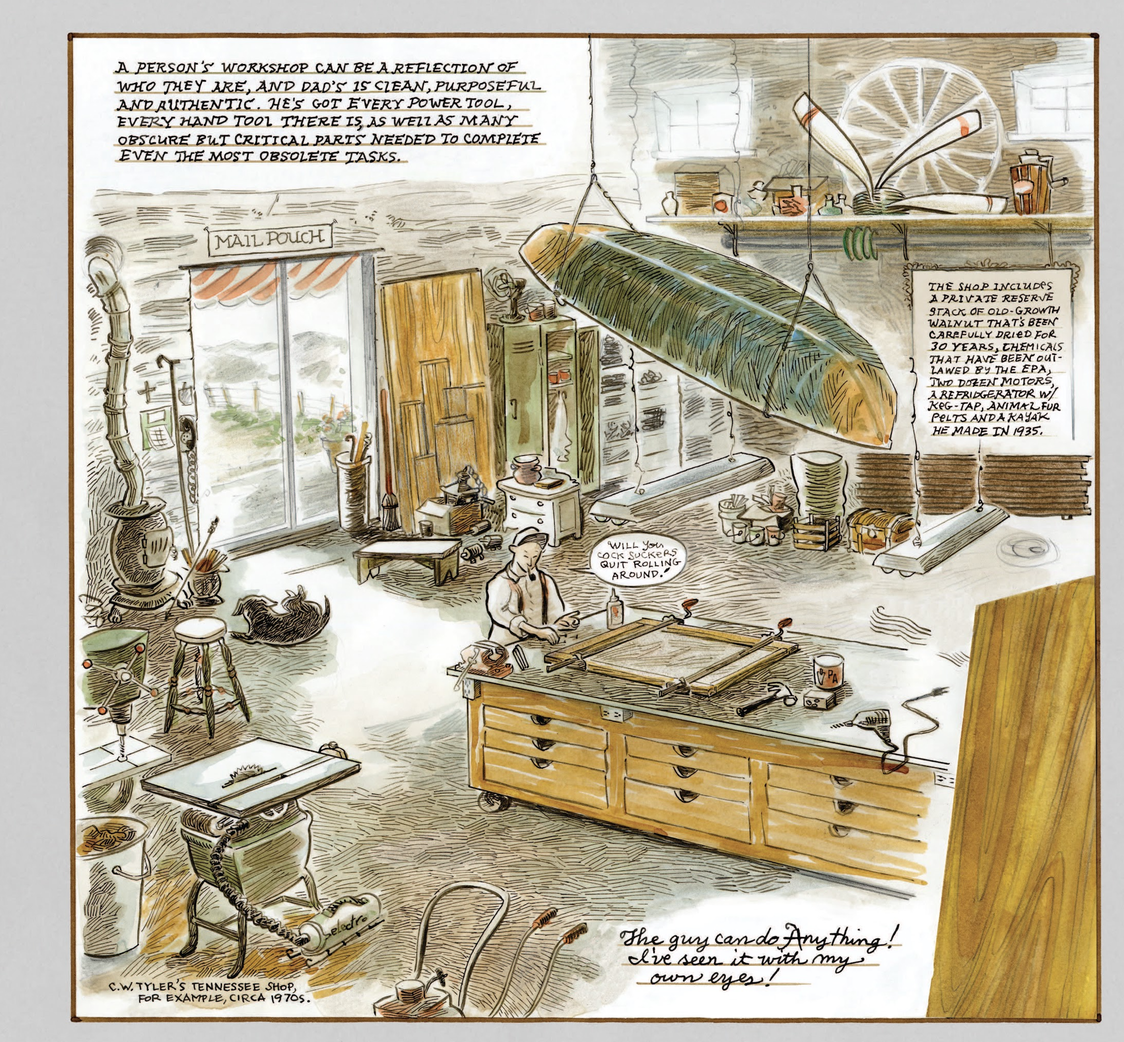
A different kind of sadness surrounds the passing of the prior generation which impacts the works of Carol Tyler, Joyce Farmer, and Roz Chast and for Tyler in particular, there is a recognition of the toxic damage the “greatest generation” brought in their path because of their unprocessed, “bottled up” feelings from the war. And finally, these same older materials produce a kind of existential dread that runs through Jeremy Love’s Bayou, since there is no place for a black author in that world, even through acts of nostalgic imagining. He has no longing for that era, even as he reproduces it beautifully in his work. So, it is hard to put this structure of feelings into words, except that it has to do with working through our feelings for the past, a sense of belatedness perhaps, often masks a sense of distaste for the current moment and an aftertaste of disenchantment.

Interviewers

Ichigo Mina Kaneko is a PhD candidate and Provost’s Fellow in Comparative Media and Culture at USC. She holds a BS in Media, Culture, and Communication from NYU and was formerly Covers Associate at The New Yorkerand Editorial Associate at TOON Books. Her research focuses on disaster and speculative ecologies in postwar Japanese literature, comics and cinema.

William Proctor is Principal Lecturer in Comics, Film and Transmedia at Bournemouth University. He is the co-editor of the books Transmedia Earth: Global Convergence Cultures (with Matthew Freeman) and the award-winning Disney's Star Wars: Forces of Production, Promotion, and Reception (with Richard McCulloch). William is a leading expert on the history and theory of reboots, and is currently preparing his debut monograph on the topic for publication, Reboot Culture: Comics, Film, Transmedia for Palgrave Macmillan. He has also published widely on a broad array of subjects including Batman, James Bond, Stephen King,  Star Trek, Star Wars, and other forms of popular culture. William is also co-editor on the forthcoming edited collection Horror Franchise Cinema (with Mark McKenna) and he is associate editor of the website Confessions of an Aca-Fan.   

Michael Saler is professor of history at the University of California, Davis, where he teaches modern European intellectual and cultural history. He is the author of As If: Modern Enchantment and the Literary Prehistory of Virtual Reality (Oxford University Press, 2012) and The Avant-Garde in Interwar England: Medieval Modernism and the London Underground (Oxford University Press, 2001); coeditor of The Re-Enchantment of the World: Secular Magic in a Rational Age (Stanford University Press, 2009) and editor of The Fin-de-siècle World(Routledge, 2015). He is currently working on a history of modernity and the imagination


Comics & Stuff: The Interviews (1 of 4)

My newest book, Comics and Stuff, was released last month by New York University Press. Creating this work—my such solo authored book since Convergence Culture—was a labor of love, done over many years, on time borrowed from other, often more pressing projects. As I release the book, I wanted to shift the microphone here—first, to William Proctor, the blog's Associate Editor, and also to two colleagues and thinking partners, Ichigo Mina Kaneko and Michael Saler—who were among the book's first readers. Over the next week, they grill me hard about various aspects of comics and stuff. Coming soon: An announcement of the schedule for a Zoom Book Club coming up in Zoom, where you will have a chance to ask me questions in real time and where a range of other comic scholars who influenced this book, one way or another, will come, hang out, and share their thoughts about comics and other stuff.

Henry Jenkins

cands.jpg

William Proctor

What first attracted you to the concept of 'stuff'? Why do you think the comics medium is especially insightful as a lens with which to analyze our 'stuff'? 

Henry Jenkins

This project was started in a bass-ackward fashion. I was invited to propose a digital book concept to the Annenberg Innovation Lab, and I saw an opportunity to explore what comic studies might look like in an interactive book context. I wanted to respond to several challenges in comics studies: first, the problem of reproducing comics for analysis in a book whose format was often smaller than the original publication venue and where it was often too expensive to reproduce color images. This desire led me to focus my initial thinking around questions of mise-en-scene, which is under-emphasized in current comic studies in favor of sequentiality and breakdown. 

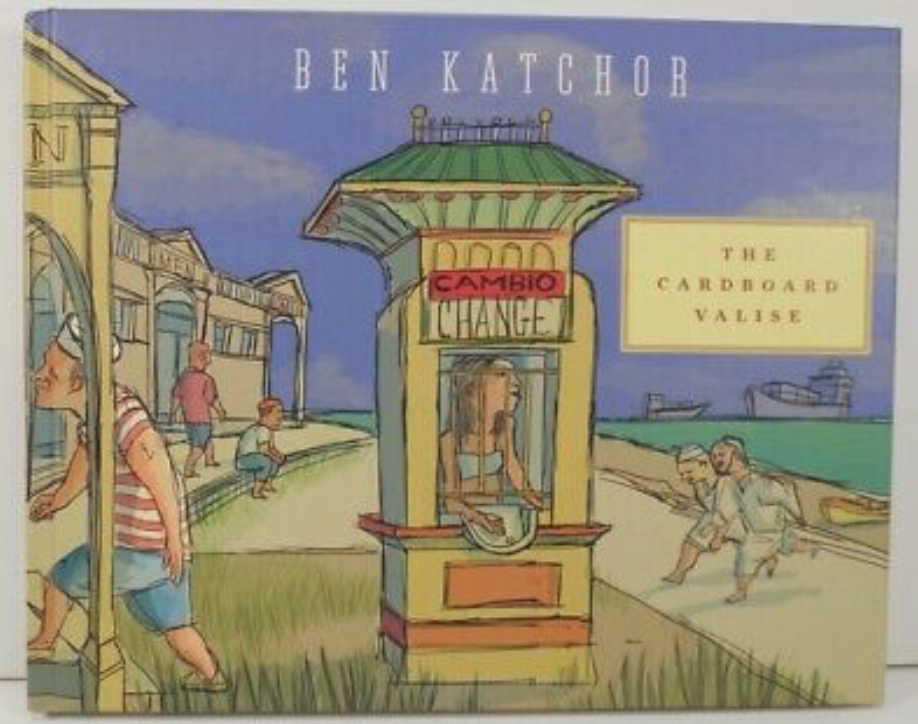
I started to make an initial list of graphic novels that spoke to me, that had been neglected by other scholars, and that lent themselves into this mode of analysis. As the project continued, I would abandon some artists from that initial list and pick up others, but the core of that list shaped the final book. (If any one is curious, I ended up publishing an essay on Spigelman’s In the Shadow of No Towersas a stand-alone essay and still have hopes to publish other essays -- one on Dylan Horrack’s Hicksvilleand Sam Zabell and the Magic Pen  and one of Ben Katchor with a focus on The Cardboard Valise. Maybe someday. Anyone editing an anthology where they might fit?). 

Screen Shot 2020-05-25 at 10.59.35 AM.png

My vision was to release a series of stand-alone essays about different comics artists, one per month, which would be assembled into a single work when they were completed, much as a series of monthly floppy comics might come together to form a graphic novel or in the case of C. Tyler’s A Soldier’s Heart, a series of graphic novels might be gathered into an omnibus. By this point, I was jokingly calling the project, Comics and Stuff. I had my title before I really knew what the book was going to be about. In the end, it proved too difficult to achieve a digital book with the properties I imagined but I clung to the impulse to generate a book around this corpus of materials. 

Screen Shot 2020-05-25 at 11.00.40 AM.png

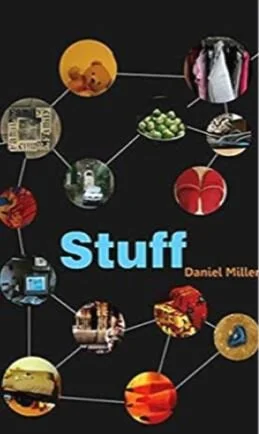
In a playful mood, I did a search one day on Amazon for books about “stuff” and found Daniel Miller’s Stuff, which utterly fascinated me, and it was in reading that book that the core concept started to take shape for me. I am a pack rat bordering on hoarder so the problem of stuff has personal significance to me. I had written an essay some years back about Dean Motter (Mister X, Terminal City), nostalgia, retrofuturism and the collector mentality in comics. 

Otherwise, I had never written about collecting despite writing much about fandom through the years and this project offered me a chance to dig into collecting more deeply. And the more I read Miller and outward from him to others (such as Bill Brown) the idea of looking at literary texts in relation to material culture started to grow on me. I was struck by the fact that such scholarship was becoming more common in literature and art history but had not really crossed over, at that time, to the study of popular culture. So,  all of this led me deeper and deeper down a rabbit hole, looking at still life painting and other genres that throughout media history had encouraged a focus on material practices and everyday life.

The final key element came when I was in residence at Microsoft Research New England and the team there asked me about comics as stuff. And that was when I recalled that I had already written about comics as stuff for Sherry Turkle’s book, Evocative Objects: Things We Think With. In the end, it seems like my route to Comics and Stuff, no longer a gag title, was over-determined, but it seemed fairly random at the beginnings of this process.

In the end, the book put forward four main propositions: 

●     Stuff is used to refer to material objects and the emotional investments we make in them, which translates them into our possessions.

●     Comics are stuff, once disposable, now more highly valued, and the struggles over their enduring value inform the artist’s perception of themselves as collectors and inheritors.

●     Comics depict stuff through their mise-en-scene and such details reflect the artists’ world views in important ways.

●     Comics narrate our relations with stuff and the central narratives deal with collecting and inheritance, though the book also explores the recurring theme of material objects (especially toys) being brought to life.

William Proctor

 In the opening to the book, you address the ‘Faustian deal’ articulated by Maus creator Art Spiegelman regarding the legitimacy of comics in recent years. Where do you think the medium stands now in reference to comics-as-art? How does this attitude compare with, say, France, where comics (or bande dessinèes) have been viewed as ‘Le Neuvième D’art (the ninth art) since at least the 1960s? It may be surprising to some that France are the second-highest producer of comics in their different forms, with Japan in pole position, and the US in third place. In addition to the examples you give, Sabrina by Nick Drnaso became the first graphic novel to be nominated for the Man Booker Prize, Britain’s most prestigious literary award, and March: Book Three by Andrew Aydin and John Lewis about the Civil Rights Movement won the National Book Award for Young People’s Literature in 2016. We can see how cultural distinctions within the medium continue to persist, as well as outside it. The history of comics “as trash” seems to remain for certain comics, while others have been elevated to the status of art. Do cultural distinctions exist for superhero comics, for instance? What maintains these distinctions and do you think they’re helpful? 

Henry Jenkins

For me, personally, I think the battle to establish graphic novels as a legitimate art form has largely been won in the Anglo-American context. It may not be as well established an art form here as in France. Some would describe it as a middle brow form of expression here, but the kind of signifiers you describe above have helped to shift its status. 

 Superheros may be an exception, but they are not the only one: right now, the exceptions are defined by genre and thus not dependent on individual artists and their output. The same bias is attached to Superhero films, even if we’ve now seen Black Panther and Joker get best picture nominations. Again, it has to do with the genre elements which seem alien to a segment of the critical and curatorial community.  

But, this takes us back to what makes legitimation a “Faustian bargain.” Respectability comes at the potential price of losing some of the pop vitality of the form,  respectability comes with the loss of some of the disreputable and transgressive elements, which is part of what led us to love comics in the first place. Spigelman’s Mausseems to deftly play them against each other -- the funny animals attracting readers who would not be invested in a holicaust narrative and vice-versa. On the other side, I struggle with the literary pretensions of something like Alison Bechdel’s Fun House (at the risk of making a controversial hot-take) where-as the Broadway version was less invested in embracing cultural hierarchies. I’d like Fun House more (I do like it) if Bechdel was less determined to impress me with her good taste. Remember Charlie the Tuna: We want tuna that tastes good, not tuna with good taste. 

So far, the Superhero comic’s primary bid for cultural respectability has come through self-criticism so that Watchman has the best claim to having succeeded at the “Faustian Bargain” Spiegelman describes. The recent television series took the superhero genre elements towards historical reconstructionism (the Tulsa bombings) and political satire, allowing it to receive a high degree of critcal praise. The Oklahoma Department of Education has now added the Tulsa bombings to the state history standards off the back of its evocation in Watchman. And Watchman was just nominated for a Peabody Award which recognizes “stories that matter.” It is not the first superhero series to be so recognized—Jessica Jones previously was acknowledged by the Peabody Awards, again a superhero story that matters because of that Faustian deal between social import and pop culture vitality.

Ichigo Mina Kaneko

As you describe in your book, comics are embedded in practices of collecting in part because they themselves were historically ephemeral objects not meant to last. With comics becoming a more durable medium that has begun to form something of its own “archive,” how do you envision comics’ relation to “stuff” shifting? How might the formation of something like a “comics archive” or “comics canon” influence the way these collecting impulses appear in comics moving forward?  

Henry Jenkins

I personally am reluctant to see things solidify into a comics canon though there is a very good chance that something like that may be happening. I would be happier with a more expansive notion of a comics archive. The sense of rediscovering interesting and forgotten comics is part of what really excites me about the current moment. It’s great that we are seeing so many older comics put back into print again in hardcover editions that are meant to last, showing respect for outstanding works from previous generations of creators. I love having access to such beautiful editions of Gasoline Alley, Pogo, Barnaby, Little Nemo in Slumberland, Krazy Kat, Basil Wolverton, Will Eisner, Harvey Kurtzman and Will Elder,  and so much more. But a canon is about what gets excluded as much as it is about what gets included.  I like inhabiting a world where different comics artists are pimping for their predecessors, trying to get us to pay attention to something they think matters, rather inhabiting a world where -- like contemporary literature departments -- a handful of authors and their works dominate the discussions. 

The fact that so many of the artists are collectors of older paper materials contributes to the focus on stuff in their books. So many of the things they draw exist in the real world -- the artists are showing their possessions (and their obsessions) to the world! There’s a thin line in many cases between collecting comics and collecting movie stills or old records or old toys (as Kim Deitch suggests) or mid-century modern bric-a-brac (as Seth shows us). I love that Carol Tyler still has her pre-teen diary of going to a Beatles concert which she can draw on for her latest graphic novel or that Mimi Pond geeked out on our podcast about napkin holders, silverware, and coffee-makers she recalls from her years working as a waitress in an coffee house.

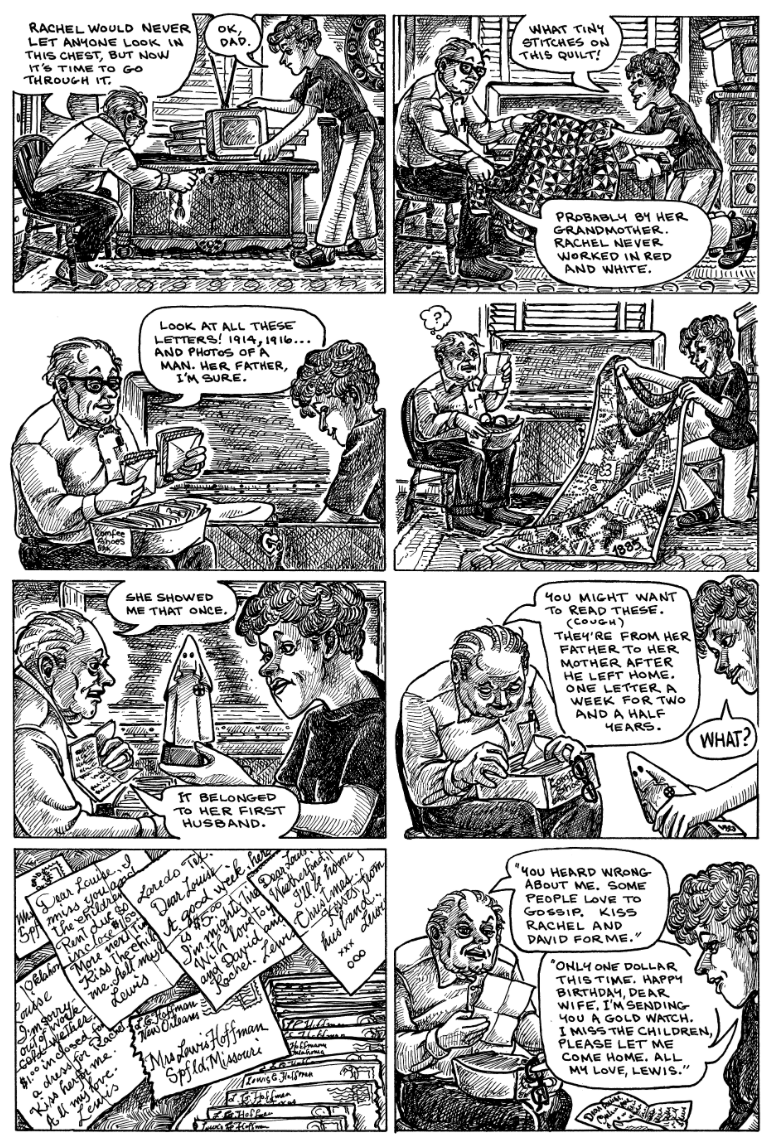
I corresponded recently with Joyce Farmer about the Klu Klux Klan figurine she depicts near the end of Special Exits. She shared, “I gave the 9" plaster statuette of the Ku Klux Klan figure to my son with a careful explanation of how I got it and that it probably belonged in a museum of African-American history. He found it too strange to display in his home and it ended up on a shelf in his garage. After some sort of verbal altercation with his wife about either the statue or me (or both) his wife smashed it on the garage floor, thus ending up in the garbage.” I learned this too late to include it in the book but somehow I was tickled to know what happened to this particular object that appeared in one highly memorable panel.

Screen Shot 2020-05-25 at 5.55.40 PM.png

I have digressed away from your core question here. Insofar as canons create a shared language, a set of meaningful references, things which artists can assume most people know, it may allow artists to shorthand certain ideas and push into new territories. Insofar as canons set limits on what we read, a canon may deter experimentation and exploration of older materials. I am not that worried though, because comic artists are an eccentric and cantankerous lot; they tend to march to their own drummer and they tend to love to debate the merits of old comics. They do not have the herd mentality of the average literature professor.

William Proctor

What encouraged you to exclude more mainstream comics from your analysis? Are there any examples of material culture—‘stuff’—in superhero comics, for instance? 

Henry Jenkins

Almost certainly, though there will be differences in how it functions there.  I borrow from art history a distinction between Megalographic  (“the depiction of those things in the world that are great -- the legends of the gods, the battles of the heroes, the crises of history) and  Rhopographic works (“the depiction of those things which lack importance, the unassuming material base of life.”) 

Curiously, for art historians, the Meglaographic was historically the domain of great art, while the still life (a classic example of the Rhopographic) tended to be dismissed as humble or domesticated art. In comics, the superhero comic has many elements of the Megalographic  (the epic battles, the god-like characters) but has contributed to the medium’s disreputability where-as the turn towards more realistic depiction of everyday life has been part of what has given it artistic status. And in depicting everyday reality, these graphic novels ground themselves in details from our material culture. 

Screen Shot 2020-05-25 at 11.06.30 AM.png

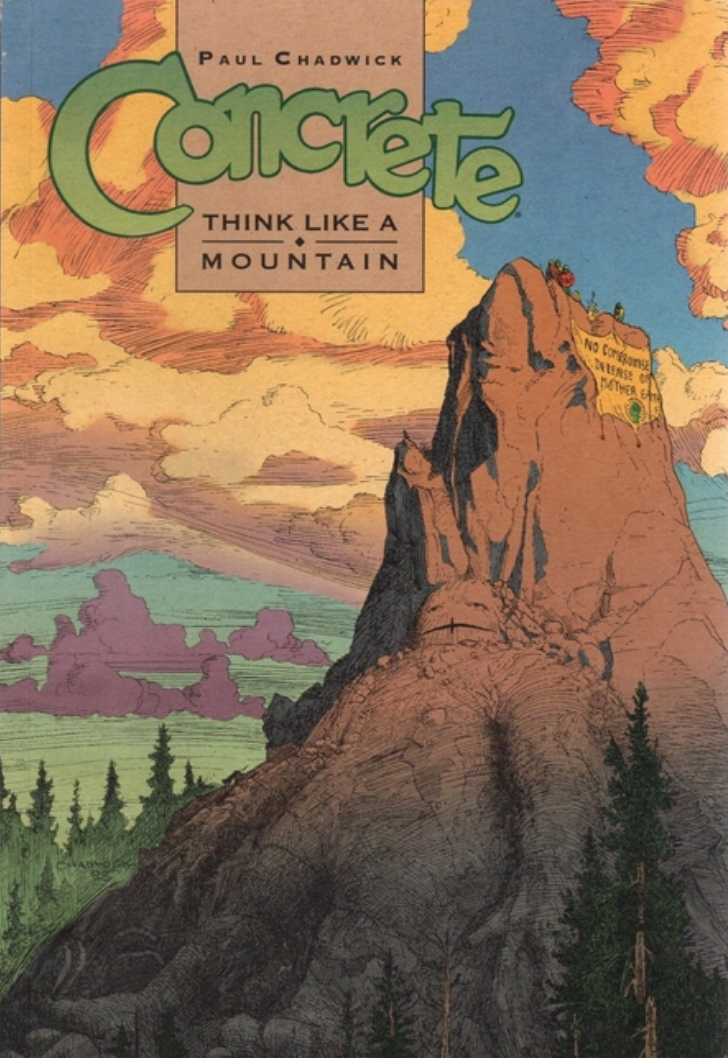
I am interested in the ways Paul Chadwick’s Concrete uses such details in a superhero context. These two illustrations show the contrast it establishes between an interest in the interior spaces associated with its characters and a fascination with the natural world, both rendered with great attention to details. My copies of the books are at the office right now and thus out of reach so I am limited to what I can find scanned on the web. In the early chapters,  rather than mask his identity, Concrete (and his government handlers)  decide to saturate the media with his story, resulting in compassion fatigue and disinterests. Here, many frames show pop culture artifacts in the background that reflect this media strategy, and there’s something to be explored about the celebrity of the superhero through these commodities. 

In later stories, we see many details of the natural world, including animals in their burrows, details the characters do not notice but which also exist without regard to Concrete’s actions. This is part of a systematic interest in environmentalism throughout Chadwick’s work, culminating in a series of issues centered around more radical forms of environmental justice activism such as spiking trees. These details often serve to decenter the superhero from his own narrative,contributing to the anti-heroic perspective this comic takes towards the superhero narrative. We might see the artwork as drawing more or less equally on the still life and landscape traditions. I am passionate about Chadwick’s work within the superhero genre and beyond and hope to write about it someday, though even this is from an alternative rather than mainstream superhero title. 

Screen Shot 2020-05-25 at 11.08.17 AM.png

I would love to see other examples of how the model of analysis Comics and Stuff offers might work in relation to superhero titles. The challenge there is that for most contemporary artists working for the big two the pressure to crank out pages results in a lack of time to fill in the kinds of environmental details that intrigue the alternative writers I discuss. And the collaborative nature of their output -- that is, the separation of artists and authors means there is often less space for anyone’s personal worldview as a collector, say, to enter the picture. I love superhero comics. I hope readers can point to some good examples there worth exploring more fully. Or perhaps stuff there plays different roles I just have not considered yet. I will certainly offer a No Prize to anyone who shows me the gaps here.

EVcx7G_UYAE5ovm.jpg

Interviewers

Ichigo Mina Kaneko is a PhD candidate and Provost’s Fellow in Comparative Media and Culture at USC. She holds a BS in Media, Culture, and Communication from NYU and was formerly Covers Associate at The New Yorkerand Editorial Associate at TOON Books. Her research focuses on disaster and speculative ecologies in postwar Japanese literature, comics and cinema.

William Proctor is Principal Lecturer in Comics, Film and Transmedia at Bournemouth University. He is the co-editor of the books Transmedia Earth: Global Convergence Cultures (with Matthew Freeman) and the award-winning Disney's Star Wars: Forces of Production, Promotion, and Reception (with Richard McCulloch). William is a leading expert on the history and theory of reboots, and is currently preparing his debut monograph on the topic for publication, Reboot Culture: Comics, Film, Transmedia for Palgrave Macmillan. He has also published widely on a broad array of subjects including Batman, James Bond, Stephen King,  Star Trek, Star Wars, and other forms of popular culture. William is also co-editor on the forthcoming edited collection Horror Franchise Cinema (with Mark McKenna) and he is associate editor of the website Confessions of an Aca-Fan.   


Return and Renewal: Star Trek: Picard (3 of 3) Djoymi Baker & Roberta Pearson

Pearson

All of this discussion about the characters and their backstories raises the issue of how well the producers addressed that dilemma of attracting a new audience with new characters. What is the difference between fans like us who know the storyworld and the characters, and a new viewer who has to work harder to understand the rules of the storyworld and for whom the characters will not have that very strong emotional resonance that they have for us?

Baker

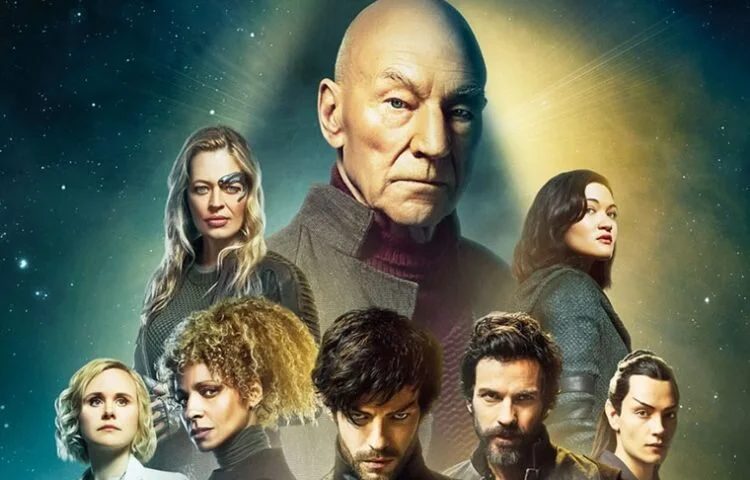
It’s an interesting point, whether viewers can connect with the Picard if they’re not already familiar with those characters, whether it’s Seven, or Riker and Troi, or even Picard himself. Brad Newsome gave a review as a non-Star Trek viewer, saying the pilot episode hooked him in regardless.

Capture.JPG

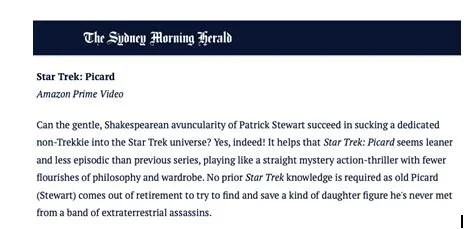
If you go to Rotten Tomatoes and you just glance over the stats for reviews of the season, the first episode gets 100% but by the finale it goes down to 59%. I’m wondering with a new viewer such as Newsome, who initially felt they had an entry point into this narrative world they had not been familiar with, whether they continued to feel part of the journey.

You’ve written about this with Messenger Davies, that there are often many scenes across the Star Trek franchise where you need that backstory to fully understand what’s going on at least in terms of the way characters are interacting with one another.

Pearson

I think you do. Characters, I argue in the Star Trek book, are constructed through a narrative function, a constellation of traits, a setting and their relationships with other characters that inform who they are and how they act. That’s why I think it’s so hard to reinvent a character like Picard, if you take away his narrative function of command, take him out of his normal setting of the starship and take away all his old crew. His essential character traits and behaviours still remain – he continues to be a man of great moral integrity and high principles, he still drinks Earl Grey tea (although now the decaf version) and he still quotes Shakespeare, although not until the final episode. But the absent Enterprise and the absent crew inevitably make him a different character to the one whom we got to know through seven seasons of TNG. In the second episode, when Picard has determined to return to space in search of Bruce Maddox he tells his Romulan caretakers that he has deliberately not called on his old crew to accompany them because he knows that they would agree and that helping him would cause trouble for them. However, as mentioned above, the narrative arc of the first episode is to re-establishes his narrative function as a commander – that’s why it’s so thrilling in the final episode to see him pilot a starship for the first time in twenty years. And it gives him a new crew to replace the old. So, it could be argued that the show presents a character who is not Picard, or not Picard as we have known him, at the beginning and by the end restores the character to the one that we do know. But we should remember to discuss the fact that some fans think that the synth Picard is not really Picard.

Speaking of characters, we do have to mention all those returning characters who show up presumably to please the fans, but then get killed. You’ve got Maddox (John Ales), who is killed by Agnes Jurati (Alison Pill), Seven’s adopted son Icheb (Casey King), and Hugh (Jonathan Del Arco). It’s like a slaughter of the backstory characters.

Baker

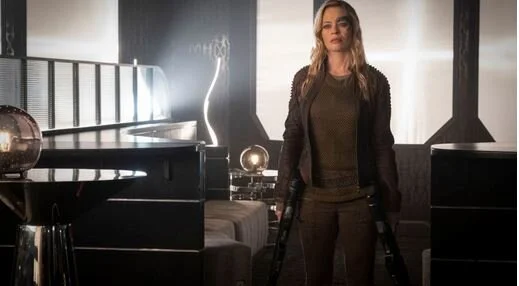
It’s not just that Seven’s adopted son Icheb dies. Christian Blauvelt, writing for IndieWire, argues that the drilling of Icheb’s eye socket is “probably the most brutal moment ever in any incarnations of ‘Star Trek’”, and suggests it underscores Seven’s transformation into gritty, traumatised vigilante. It’s such a visceral, confronting scene.

More broadly, Variety argues Picard “is different from its predecessor in nearly every respect – texture, tone, format, production value, even the likelihood of characters dropping an f-bomb”. People’s responses to that shift in tone have been pretty varied. Fan Tina C. writes, “The violent, dark, dystopian, vulgar hellscape they’ve supplanted is not Star Trek”.

This is part of a bigger shift, though. As Andrew Lynch and Alexa Scarlata point out in a forthcoming chapter in Science Fiction Television and the Politics of Space, adult science fiction on subscription video-on-demand (SVOD) services is shifting the genre into grittier terrain than their broadcast equivalents, including the Star Trek franchise. Bryan Fuller, creator of Star Trek: Discovery, acknowledges there’s a tricky balance to be achieved between the more adult content possible on CBS All Access and the desire to maintain Star Trek’s “younger viewers”.

If we look at parental advisory sites such as Common Sense Media, the parental backlash to both Discovery and Picard suggests many feel that balance has not been achieved: “Now I can't even watch it with my kids… Wish they would had kept it family friendly”. These are adults who want to bring children into the world of Star Trek by watching it with them together as a family. It’s worth noting that for the most part these are parents who enjoy Picard themselves, but lament the shift of the franchise from family to older teen/adult viewing. For others, a Star Trek that is not family friendly is “not Star Trek” at all.

Capture2.JPG

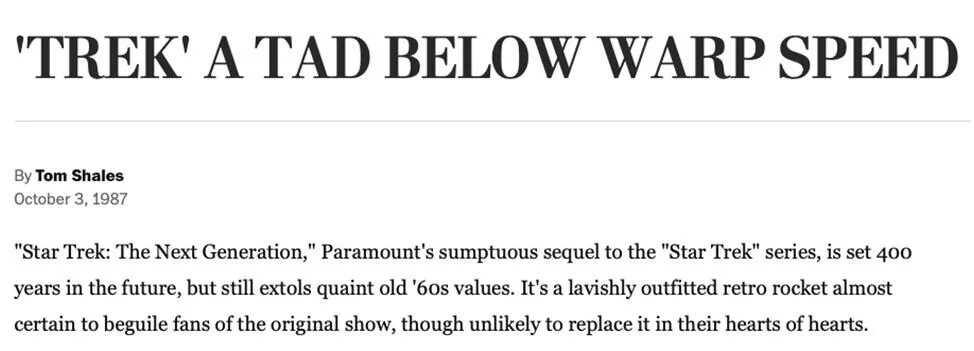
In my Star Trek book, I’ve written about how TOS was initially misconstrued (and summarily dismissed) as a children’s program when it first aired, primarily because serious science fiction television was associated with drama anthologies, while the cheap space operas of the 1950s had been pitched at children. It was only in its final season that reviewers were engaging with Star Trek as serious intergenerational fare that dealt with contemporary social issues in science fiction guise. TNG more deliberately targeted the family audience by making the Enterprise a family spaceship, to the notable discomfort of Picard, and through the inclusion of young Wesley Crusher (Wil Wheaton).

While Picard’s showrunner Michael Chabon has defended the dark turn of Picard by saying Star Trek always reflects the time in which it is made, it is worth remembering the significant cultural unrest in the 1960s when TOS aired. As such, Stephen Kelly argues that “the idea that the grittiness of shows such as Picard makes it mature and relevant, while the ethos of yesteryear Star Trek is now naive or too old-fashioned to survive, feels misjudged. The hope, optimism and sincerity of the original 60s series was in itself a radical act”.

All the same, by the end of season one, Picard brings a peaceful resolution by affirming the values that the Federation appears to have abandoned, and Riker seems to bring Starfleet to its senses in backing Picard.

Chabon suggests “the space we found for Picard is not ‘dark Federation’” – which makes me think of Blake’s 7 (1978-1981) – “It’s one of people who live and work at or beyond the margins of the Federation who travel beyond its boundaries”. But is it also beyond the boundaries of family fare? Certainly, I was disappointed in this regard.

Pearson

When the Science Museum in London had a Star Trek exhibition back in 1995, Máire Messenger Davies and I distributed a questionnaire to visitors asking why they were visiting. There were grandparents bringing their grandchildren in order to introduce them to the franchise. So, this comes back to what audiences CBS is targeting, is it the old audience or the new audience? That could be seen as a failure in both Picard and Discovery, because what you want to do is precisely to cultivate an intergenerational loyalty – think of Disney, or Star Wars – they want it to be passed down the generations, and yet if you put in either too much sexual or violent content, that’s hard to do.

Baker

If you want a franchise to survive over decades and generations, you have to repopulate that fan base.

Pearson

However, what CBS is intending to do as a franchising strategy is having a range of programs for different demographics, with an animated series aimed at a younger audience. Increasingly with transmedia products within a franchise, they’re trying to target different audiences with different content. This seems to be what CBS is now going to do with Star Trek and wanting to proliferate the number of series they’re producing.

Baker

The kickback some of the fans who are parents or grandparents is that they don’t necessarily want their kids watching a separate Star Trek, and I feel that way too. I want new Star Trek we can watch together and then chew the fat together afterwards as well.

Pearson

That speaks to what is television, in that television became increasingly fragmented with the proliferation of cable and then the streaming services which clearly target multiple niche audiences. Netflix does have family versions of horror and science fiction to watch together, so it’s trying to address that audience.

Baker

Yes, one of my current research projects, with Jessica Balanzategui and Diana Sandars, looks at the darker science fiction, fantasy, and horror content on Netflix that’s nonetheless pitched at a family audience under the genre tag “Family Watch Together TV”. It’s still a really controversial strategy because trying to get that balance right between something that’s edgy enough for adults to enjoy but not so creepy that your youngest child can’t sleep at night is really tricky. For example, the Lost in Space (2018-) remake and The Dark Crystal: Age of Resistance (2019 -) both come under that umbrella on Netflix and are rated TV-PG in the United States. Of course, when those shows come up on a parent’s feed, it will often be sitting next to a creepier show at a higher classification, so you may well click there next into even darker content.

Pearson

When I think of family science fiction viewing here in the UK, I think of the reinvented Doctor Who (1963-1989, 2005-), which was designed precisely for that intergenerational audience. It was broadcast in the early evening when children would be able to watch with the family. I remember there were complaints about content that wasn’t suitable for children in Doctor Who because it was very much marketed by the BBC as family viewing.

Going back to the pandemic, which inevitably we must these days, I was reading in The Guardian how the viewing of terrestrial, broadcast television has really increased during the COVID-19 crisis, because people want to watch TV together, they want comforting television. There’s a show over here called The Repair Shop (2017-) about repairing old items which is now apparently a big hit because everybody’s watching it together.

Baker

It comes back to the old-fashioned water-cooler TV, so you can watch things together and discuss them at the same time, in the same week. As much as we’ve said that Picard is very much informed by the new Netflix-era streaming era, it was still released on that week-by-week drip feed, to try to reinstate that water-cooler moment, so you felt that if you wanted to be in that conversation, you had to be watching it at the same time.

Pearson

That’s very interesting in terms of the strategy – whether you drop all the episodes at once or you space them out as in the broadcast era. I find myself getting frustrated because I know they’ve got all the episodes, so why aren’t they giving them to me? Why do I have to wait?

Baker

We’ve become newly enculturated to watching episodes back-to-back in one or more “epic viewing” sessions, as I call it in The Age of Netflix. Our expectations have changed.

Pearson

On the other hand, what are the pleasures of television? The pleasure of the weekly drop is that you have more time to contemplate, you do have time to get caught up in that ongoing conversation. After both Discovery and Picard, I would read all the recaps, I would look to see what the fans were saying, and I found that very helpful because the storytelling is so intense that I think you need the collective intelligence to help you figure out what the hell is going on and what you might feel about it.

Baker

I find that very interesting, because it’s an amplification of what was around even in the 1950s with early television, when they did some studies that said prediction and anticipation were key pleasures of TV watching, particularly with serialised stories. It’s talking to other people before the next episode drops which is part of the fun. So even though we're in a new era, doing the weekly drop is re-instigating something that’s been there since the very beginning of TV, that pleasure/pain of anticipation, making you wait.

Pearson

Yet I also want to know what’s going to happen, so I want to binge. With Better Call Saul (2015-), I decided I would wait until all the episodes dropped before watching.

Baker

Everyone’s got so used to that way of viewing, that it’s too frustrating to watch it bit by bit.

Pearson

But after binging Better Call Saul I don’t know if I will have the energy to then read recaps and reviews the way that I would if I had watched week by week. So, it’s a question of which pleasure you prioritise. Do you want the time to reflect and read and talk to other people, or do you want it all at once?

Baker

Then that has flow on effects, because if you’re waiting, there are certain places online you can’t go.

Pearson

Exactly, this came up with my Facebook feeds around Picard. I hadn’t watched the final episode of Picard, because it dropped just as we went into lockdown. I had a friend coming over every week and we were cooking dinner and watching the weekly episode of Picard together, and then occasionally we FaceTimed with her sister in Israel to discuss it afterwards. We were very much treating it as appointment television.

When the final episode dropped in lockdown, I really didn’t want to watch it without my friend coming over. It became symbolic of all the things we were losing in our lives. Then another friend said I might not want to watch it if I was feeling delicate. I was feeling very delicate at that point! So, I waited for a long time. That meant I would just have to very quickly scroll past everything in my Facebook feed that related to the finale, because I hadn’t seen it yet. But you can’t avoid reading the headlines!

Negotiating television is much harder than it used to be in terms of viewing practices and preferences because of choices about binging or watching individual episodes as well as decisions about which streaming services you want to subscribe to. CBS All Access used both Discovery and Picard to drive subscriptions in the United States, successfully it seems. Internationally the shows appeared on Netflix and Amazon. I signed up for both platforms because I had to watch new Trek shows.

Baker

Some of my friends who are also Star Trek fans thought they had too many subscriptions already and were waiting for all the episodes of Picard to drop, so they could watch the entire season in a free trial period.

Pearson

Will the next step be bundled streaming packages?

Baker

At this stage that seems inevitable, unless some of the providers fold before then. When there are TV shows that everyone’s talking about and you’re supposed to be watching them, but they’re all on different providers, it’s just unsustainable.

Pearson

Even if their price point is low, if you have several subscriptions it's going to add up over the course of a year. It points to the importance of the flagship program that attracts new subscribers to streaming services.

Baker

I probably did what Amazon wanted me to, which is that I signed up specifically for Picard, and then I found The Marvellous Mrs. Maisel (2017-) and The Man in the High Castle (2015-2019). The industry logic is that you have these flagship shows, and then ideally, it’s the rest of the catalogue that keeps you there.

Pearson

I think that’s true, but they have to have enough in the catalogue to keep you in there. Mrs. Maisel, The Man in the High Castle, also Transparent (2014-2019), these were the shows that were getting the buzz, and I felt out of the conversation around those shows so like you started to watch or plan to watch them.

Here in the UK, Discovery is on Netflix, but Picard is on Amazon. Why might CBS’s international division make that call? There’s so much to research around this from both an industry and an audience perspective.

And now content will start to dry up with the impact of COVID-19 on the industry. I presume production on Picard season two has now been delayed. Will the streamers be able to turn out enough new flagship shows to drive subscriptions and then maintain those viewers?

Baker

There will come a point when no new content is coming through, and those streaming services with the stronger catalogue will be in a better position to survive.

Thinking about Picard season two, we really need to discuss that finale. Picard is now both an XB like Seven and a synth like Soji (Isa Briones), but without her additional longevity and non-human capabilities because apparently – as fan Legate Damar argues – “anybody who knows Picard knows that Picard wouldn’t want any of that”.

Pearson

What’s the average life span of a human in the twenty-fourth century? Having gone through all that, wouldn’t he want a younger body and more time? I’d be perfectly happy to adjust to a new body!

Baker

I had to go and look it up. In the TNG pilot, Doctor McCoy (DeForest Kelley) is 137, which would potentially give the 94-year-old Picard another 43 years without his neural condition. On the other hand, that doesn’t mean McCoy’s longevity is the ‘average’, and he’s pretty frail.

Pearson

And Picard asks, “Ten years? Twenty years?” So, he does want at least some more time.

A related question is if they could download Picard, why couldn’t they download Data (Brent Spiner)?

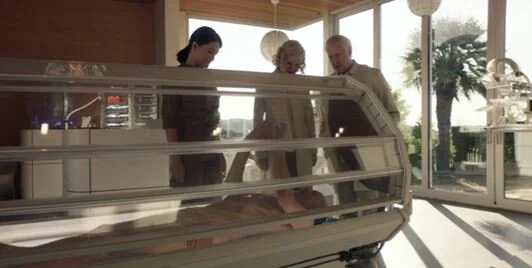
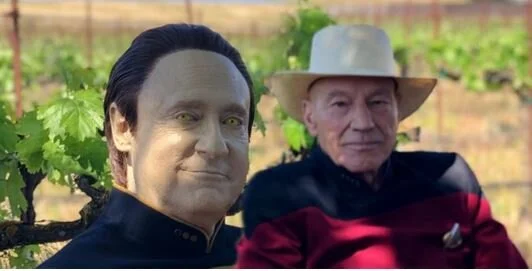
Picard wakes in his synthetic body

Picard wakes in his synthetic body

Baker

I had to watch it again to see if I could figure that out, and even then, I had to go online and see whether anyone had a reasonable explanation. According to Chabon, the idea is that this Data is an incomplete “simulated reconstruction”.

Pearson

There’s also a practical problem, in that 71-year-old Brent Spiner said ages ago that he couldn’t keep playing Data because he’s ageing, and an android isn’t supposed to age. In Picard, you see the real Spiner in the character of Dr Altan Inigo Soong and then you compare him with Data, and you can see the make-up and post-production work and lighting to make those scenes work.

Baker

As well as the publicity photos, where you can see him in make-up but before the CGI.

Brent Spiner and Patrick Stewart relax between takes

Brent Spiner and Patrick Stewart relax between takes

Pearson

I found the idea that one positronic neuron from Data could be used to make Soji and Dahj quite implausible. That being said, I bought Data as the same character as he had been in TNG. The speech patterns were the same, the facial expressions were the same. To see Picard and Data together even in the dream sequences was very emotionally resonant.

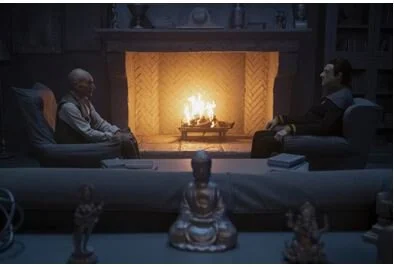
If we’re thinking about the primary arc of the season being Picard’s redemption and resurrection, it’s not only that he feels he has to redeem himself with regard to the Romulans, it’s also because of his guilt over Data’s sacrificing himself for Picard in Nemesis. Picard is able to come to terms with his guilt by having a chance to say goodbye to Data. Data then becomes an important element of Picard’s narrative arc.

Baker

I thought the dream sequences were beautiful, partly because we see Picard’s regret over Data’s sacrifice.

Pearson

I loved the dream sequences, especially the first one in which the two play poker, since that harks back to TNG. Although have to say that fans thought that Data’s holding five queens in his hand would become an important plot point and it didn’t.

Deceased Picard and Data

Deceased Picard and Data

Baker

I feel sorry for Data, though, in that it’s unclear whether he’s been experiencing the real passage of time, on his own, in a grey room. It seems like a sad place for him to have been after making that sacrifice. No wonder he wants it to end.

Pearson

The scene where they terminate him is very touching, and it does give Picard a chance to quote Shakespeare again.

Baker

This brings us to whether the synth Picard who farewells Data is still really Picard. As fan SilenceKit puts it, this raging philosophical “debate is the point”. By not resolving the existential issues around Picard II, the finale leaves an open space for everyone to talk about it between the seasons before they are (hopefully) unpacked when the series returns.

If he’s quoting Shakespeare and making speeches, that seems pretty Picard!

Pearson

Absolutely! That comes back to my theory of character. I'd be inclined to argue it is Picard. He’s got all his memories, he’s quoting Shakespeare, he looks and sounds like Picard. He’s doing all the things Picard should do.

The interesting thing in the second season will be if he has glitches, if there are things he doesn’t remember, or if he behaves uncharacteristically.

Baker

Although I wonder if that will make season two a little too like Dr Hugh Culber (Wilson Cruz) over on Discovery (albeit in a different context and without ‘killing your gays’ along the way)? We have two cases of a character coming to terms with being in a new body.

Pearson

At the beginning of the season, Picard gets the news about the abnormality from Dr Moritz Benayoun (David Paymer), who served with him on the Stargazer, which was a nice touch. But we knew that Picard wasn’t going to die because by the time the first season dropped, the second season had been greenlit. As soon as it becomes clear that the season is centred around synths, that’s the obvious solution. The downloading into the synth body comes as no surprise. There’s also preparation for this in his discussions with Dahj in which he reassures her that she is indeed as real as he is. So, Picard himself will probably believe that he is the real Picard.

Baker

It poses a potential Altered Carbon (2018-) scenario. They've strategically made the new Picard mortal, but if knowledge of this technology goes public, anyone without those moral qualms will want to download themselves and live forever.

Pearson

My assumption is that there’s only one synth prototype. Picard says to Soong that he’s sorry to have taken the synth body that Soong had intended for himself. But if there was a successful prototype, they could roll it out.

Baker

I felt there was an inference that Maddox may have been needed, but it wasn’t clear.

There are some practical plot holes in the finale but also some incomplete philosophical issues that are raised. I hope that they don’t drop the ball on all of those in season two, that they actually do something with them.

Pearson

Beyond those first two episodes, which introduce the Picard character, I was as confused as anybody else as to the overall plot.

Wherever it goes, Star Trek always needs to reinvent itself for each new period of TV. It gets reinvented not just in industrial terms but also in ideological terms because it has to reflect the time in which it’s being produced.

If people say Picard isn’t Star Trek, what do they want? Do they want every new series simply to replicate TOS? Does it have to be Gene Roddenberry’s vision of the universe? As I point out in our book, writers like Ron Moore were contesting Roddenberry’s view of the Star Trek universe in terms of the lack of conflict among characters because they found it too constraining. You can’t preserve Trek in amber.

Baker

It brings us back to nostalgia. There’s a pleasure in returning to our favourites, but deep down we all know that it has to move to on, for cultural reasons, for industry reasons. People won’t watch it in if it’s an exact replica. They might think they will, but TV has simply changed too much over the years.

Pearson

A franchise can’t survive on just the core fan base. It has to pull in other viewers.

maxresdefault.jpg

Djoymi Baker is Lecturer in Cinema Studies at RMIT University, Australia. With a background in the television industry, she writes on topics such as streaming, genre studies, fandom, and myth in popular culture. Djoymi is the author of To Boldly Go: Marketing the Myth of Star Trek (2018) and the co-author of The Encyclopedia of Epic Films (2014). Her current research examines children’s television and intergenerational spectatorship.

Roberta Pearson is Professor of Film and Television Studies at the University of Nottingham, UK. She is the co-author of Star Trek and American Television (2014), editor of Reading Lost: Perspectives on a hit television show (2009) and the co-editor of several titles including Storytelling in the Media Convergence Age: Exploring Screen Narratives (2015), A Critical Dictionary of Film and Television Theory (2014) and Cult Television (2004).


Return and Renewal: Star Trek-Picard (2 of 3) Djoymi Baker & Roberta Pearson

Pearson

What did you think about the first episode of Picard,, Djoymi?

Baker

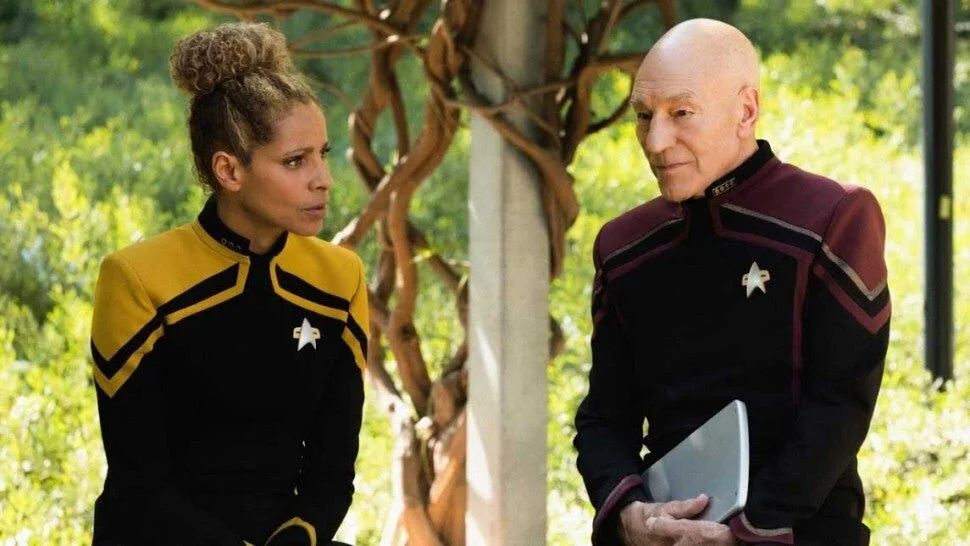
I hadn’t read those transmedia stories before seeing it, and I avoided the online news around it because I wanted to go in fresh. The location at Château Picard for me really harked back to the fourth season TNG episode “Family”, when Picard returns home to recover from being assimilated by the Borg, the alien cyborg collective. There’s a narrative arc in that episode that I think we see again at the start of Picard. In “Family”, Picard has lost his way, he’s not the man he thought he was. Because of his trauma, Picard is initially inclined to stay home in France. By the end of “Family,” he realises that his true home is space. This is mirrored in the beginning of Picard. There are different reasons why he feels disenfranchised from that world or why he’s distressed, but it’s that same kind of trajectory from a Picard who has withdrawn from the world in many respects, to one who re-enters it, or is somewhat dragged into it in this case.

Pearson

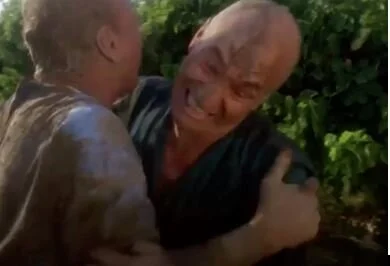
I hadn't thought of that. Then again, it also shows us how much he’s changed. He’s not wrestling with his brother in the vineyard as he did in “Family”. Early in the season, in the action sequences it’s Laris, Zhaban and Dahj who needs to protect Picard. It’s analogous to seeing your parents ageing. Your parents are meant to protect you, and then they get older and suddenly it’s reversed. Picard, who has been a really commanding and authoritative figure who protected others, now needs to be looked after, although of course he resents that.

Picard fights his brother Robert (Jeremy Kemp) in TNG’s “Family,”

Picard fights his brother Robert (Jeremy Kemp) in TNG’s “Family,”

Baker

There’s that wonderful part in one of the action sequences in Picard when he has to stop – along the lines of ‘Yes, I know we’re in deadly danger, but I just need a moment to catch my breath. I’ll be with you as soon as I can!’

Pearson

The actor himself is 79, and he’s in great shape for his age, but even so he is an old man. The Romulans are effectively his caretakers, they fuss over him. He’s now an enfeebled patriarch.

Baker

I know that some fans felt that his falling out with Starfleet combined with an isolationist Federation wasn't the Utopian future that Gene Roddenberry had imagined, and yet the trajectory of the first season of Picard is to get us to that final episode by which stage Picard has come back to the values he believes in. That there is still hope for that future.

Pearson

Isn't it interesting the way that the return to values inadvertently mirrors our current crisis? I don’t know about there in Australia, but certainly in the UK, in the context of COVID-19 there’s been a lot of talk about the welfare state, the NHS, and the BBC, which are all seen as being absolutely central to dealing with the crisis. There’s a master narrative that’s going on about returning to earlier values after the crisis is resolved. I know that Picard was made before COVID-19, but Patrick Stewart himself was very anti-Brexit. The rescuing of the Romulans due to the responsibility that strong and wealthy states or interplanetary federations have to migrants and refugees is an argument against being isolationist. This I think would very much have appealed to Stewart and may have helped to bring him back into the Trek fold. The Brexit resonance is deliberate, the COVID-19 resonance not deliberate but very telling now.

Coming back to fans who object to the depiction of the Federation in Picard, have they not watched Deep Space Nine (1993-1999)? Because I was such a huge TNG fan, I was one of those people who undervalued DS9 at the time of its original broadcast. I’ve recently re-watched the entire series and now realise why some fans make a claim for it as the best Trek ever. I still retain my allegiance to TNG but now very much admire DS9. My admiration stems in part from the fact that it broke with Roddenberry’s utopian vision of the future and critiqued the abandoning of the Federation’s and Starfleet’s values in the desperate bid to win the Dominion War. Even Captain Sisko has to let go of his principles. That being said, even TNG critiqued the Federation in the episode in which the Native American population on Dorvan V needs to be relocated due to the Federation agreement with the Cardassians. And of course, the origin of the Maquis who resist the Cardassian treaty is in TNG. So, fans who think that Discovery and Picard aren’t ‘true’ Trek need to reacquaint themselves with DS9 and TNG.

Baker

Some of the fan online debates about whether or not Picard is really Star Trek, come back to what you were saying that each new iteration is trying to maintain a fan base but at the same time make it Star Trek for a new generation. In Marketing the Myth of Star Trek, I talk about the way that J.J. Abrams’ 2009 feature film was marketed as “Not your father’s Star Trek”. (Just as an aside, I don’t know where mothers who watched Star Trek went in that). When we look at way in which Picard is put together, we can see the shift in industry trends. I know that DS9 in later seasons had a very serialised structure, but it’s still different to the shorter season streaming series structure. Picard has 10 episodes that the cast and crew discuss as being a “10-hour movie”, despite the weekly episode drop. We see that kind of comparison made again and again in the streaming era. That necessarily changes the dynamic.

I felt there was a lot of exposition, and perhaps because it was using the 10-hour-movie logic, often the pacing seemed off. Sometimes when the pace slowed down it was for reasons that as a nostalgic fan I appreciated, such as dropping in on old friends. I have no idea, though, how those episodes would have gone across for a new audience member. Why are we spending a whole episode…

Pearson

… making pizza!

Baker

Exactly!

Pearson

I absolutely agree with you and I think it was very interesting, particularly that episode, “Nepenthe”, when he drops in on Will Riker (Jonathan Frakes), Deanna Troi (Martina Sirtis) and their daughter Kestra (Lulu Wilson). Because my complaint about both Discovery and Picard is so much plot, so little time. The first episode of Picard is all about heavy chunks of exposition being dropped in. I remember fans commenting on that at the time, that it was quite slow, and when was the story actually going to start? In the first few episodes they set up so many multiple plot points they can’t resolve them at the end. Yet while it’s crammed full of plot, the narrative essentially pauses for a whole episode when Picard visits Riker and Troi. The episode gives the audience their backstory since their marriage and since Nemesis. But the death of their son Thad, who suffered from an illness that required them to move to the isolated planet, is not connected to the central narrative. An entire episode out of a 10-episode series is devoted to catching up on beloved characters, but could perhaps have been better used to forward the narrative, resolve some plot points and set up others. Riker, of course, does return in the final episode somewhat improbably as the commodore of the Federation fleet, when he is only a captain. Nonetheless, I loved the episode because of my nostalgic desires, and it delivered pleasure not pain. It was lovely to see the trio reunited.

Going back to the differences between TV2 and TV4, the former had longer seasons. And while most shows of the period had about twenty four episodes, the Star Trek series had twenty six. When we interviewed Brannon Braga for our book, he complained about that, saying that it put a heavy burden on the writers. But with twenty six episodes a year over a seven-season run, both characters and a sense of the everyday could be fully developed. One of my favourite TNG episodes is the fourth season “Data’s Day”, which as the title indicates does focus in part on the everyday lives of the Enterprise crew. While the A plot line focuses on some typical Romulan skulduggery, the B plot concerns Data’s preparations for O’Brien and Keiko’s wedding. It’s Dr Crusher teaching Data to tap dance that I remember, not the android’s solving of the supposed death of a Vulcan ambassador. And even though DS9 did become intensely serialised in its last season, across its seven seasons it had many episodes that were about the characters and their everyday lives on the station. One of my favourite episodes is when Jake Sisko (Cirroc Lofton) is trying to get his father Benjamin (Avery Brooks) back from an alternate spatio-temporal continuum in the fourth season “The Visitor”. It’s all about the depth of feeling between those two characters.

By contrast, the 10 episodes of the Discovery and Picard series leave very little time for character development or for exploring the relationships between characters. That’s one reason for the old fans’ disappointment in with Discovery, the sense that it wasn’t really Star Trek. There seemed to be none of the affectionate interaction between characters the TV2 series had accustomed us to. That’s why fans reacted so well to the Picard pizza episode. The new characters weren’t well developed and many of their interactions seemed to be hostile and aggressive, so it was a relief to see the old friends reunited.

Baker

I guess it comes back to that idea of feeling like you are living with characters and sharing their temporality with them. That sensation is more aligned with that larger series format when you have 26 episodes. For Picard, it’s working very hard to try to make us care about these new characters that are going to be on La Sirena moving forwards. Lots of backstory, but I couldn’t care less about Elnor (Evan Evagora). Even if I did, having set up this poignant history between Elnor and Picard, they then leave him in the Borg cube, and he seems inconsequential. There seems to be a lot of exposition set up for season two, in that Elnor doesn’t really have a function in season one.

Pearson

I have to get this on the record, Elnor seems like he’s drifted into Picard from the wrong franchise. He is straight out of The Lord of the Rings, with his long hair and his sword and even his name. He’s an elf! And the episode establishing Elnor and Picard’s backstory seems entirely wasted. Why do we need to know about a sect of warrior female Romulan nuns who aside from Elnor do not appear again? Like the pizza episode it might have been better used to advance the narrative, but as I’ve said the pizza episode at least delivers pleasant nostalgia while the Elnor episode simply introduces a very annoying character who seems to have no narrative function. I think he is the Wesley of Picard, the character the fans will love to hate. And poor Seven of Nine, getting lumbered with him on the Borg cube, while the action takes place elsewhere. She must find him very annoying!

But to be fair to the producers and the dilemma they face of attracting new fans and appeasing old ones, the new, younger characters such as Elnor have probably been included to appeal to a younger demographic. And many in that young demographic are accustomed to long haired sword-wielding heroes. And I suppose that the Picard/Elnor relationship picks up on a long running theme from TNG concerning Picard’s regrets at having chosen Starfleet and his career over family life, so there is at least that resonance with the character’s backstory.

Elrond or Elnor?

Elrond or Elnor?

Baker

I do want to talk about the ex-Borg (or XB as they’re called here) Seven of Nine, because I did love what they did with that character as a whole.

She no longer has the shiny skin-tight suit she wore in Star Trek: Voyager (1995-2001) that caused controversy on and off the set. Instead, it’s replaced with earthy-toned street wear with an aesthetic of “natural minimalism”. (Stewart confesses he had no idea about the catsuit, which means that he didn’t watch Voyager!) Seven’s reimagining as a vigilante character who roams the lawless realms of space abandoned by the Federation is one of the more finely drawn of the series, I think.

Seven of Nine

Seven of Nine

I feel that the audience is encouraged to share Seven’s satisfaction in killing Narissa (Peyton List), one of the antagonists of the series. But following on from this, there’s a lovely scene in the final episode between Seven and Rios (Santiago Cabrera), when Seven reflects that she had gone against her promise to “never again kill somebody just because it's what they deserve, just because it feels wrong for them to still be alive”. Seven is rightly angered by the Federation’s hypocrisy but here is calling herself out as well, and the audience with her.

I didn’t love the way Seven is introduced to Picard in episode four, “Absolute Candor”, in that I think it reveals a persistent gender bias in both the early twenty-first and late twenty-fourth centuries.

When Picard’s hired ship, La Sirena, comes under attack from a Bird of Prey, an unknown, beaten-up little space craft comes to their rescue with some admirable manoeuvres. The pilot hails them:

Rios: Open a channel, put him on

Raffi: He’s asking permission to beam over. His ship’s breaking up… his shields are failing

Picard: Raffi, beam him in directly here.

Rios: Do it…

Raffi: Got him.

[Seven beams aboard].

Picard: Seven of Nine!

Seven: You owe me a ship, Picard.

Seven promptly collapses, and her tag line then appears all over the internet. It’s a terrific line.

I think the use of the masculine personal pronouns he/him before Seven appears is supposed to be funny somehow, because they’re all making this assumption it’s a male pilot, but to me that was just a cheap shot, lazy casual sexism. It’s out of place in both the contemporary and futuristic centuries. Why would so many of the crew members make the assumption that the “magnificent pilot” (to use Rios’ words) is male? Why would male pronouns be the automatic linguistic default, either among characters or the supposedly “universal” translator (which may or may not be in operation here given that several languages are used)?

At the end of the final episode, Seven appears to have joined the crew of La Sirena, inexplicably leaving the XBs. For a series so weighty in exposition, this seems like a jump that hopefully will get explained in season two.

Similarly, Seven’s intertwining hands with Raffi feels like rushed queer baiting, even though Voyager producer Jeri Taylor and fans had been advocating for Seven to be queer for years. If there’s going to be an attraction there, I want to see it on screen.

Having said all that, I really want to spend more time with the new Seven.

Pearson

I wanted a spin off about Seven as a Fenris Ranger although I will settle for her being part of Picard’s new crew. It will be interesting to see how the relationship between her and Picard progresses. They, along with poor Hugh, are one of the very few people who have been successfully reclaimed from the Borg collective. In one episode the two bond over their experience revealing that neither has ever felt fully human again. Of all the new crew she’s my favourite precisely because she is a returning character and one whom we got to know very well during the course of four seasons in Voyager. I hope that Picard might reveal a little more about her experiences between returning to Earth and rescuing La Sirena. Jeri Ryan is a really terrific actor and I must say with envy that she still looks great at 52 even if she has been liberated from the catsuit.

Baker

I have to say this show is doing a great job with hot middle-aged women and I love that.

115302_8725b-startreke.jpg

Djoymi Baker is Lecturer in Cinema Studies at RMIT University, Australia. With a background in the television industry, she writes on topics such as streaming, genre studies, fandom, and myth in popular culture. Djoymi is the author of To Boldly Go: Marketing the Myth of Star Trek (2018) and the co-author of The Encyclopedia of Epic Films (2014). Her current research examines children’s television and intergenerational spectatorship.

Roberta Pearson is Professor of Film and Television Studies at the University of Nottingham, UK. She is the co-author of Star Trek and American Television (2014), editor of Reading Lost: Perspectives on a hit television show (2009) and the co-editor of several titles including Storytelling in the Media Convergence Age: Exploring Screen Narratives (2015), A Critical Dictionary of Film and Television Theory (2014) and Cult Television (2004).


Return and Renewal: Star Trek: Picard (1 of 3) Djoymi Baker & Roberta Pearson

We have another conversation for your reading pleasure, this time centered on Star Trek: Picard.. Like many Trekkies (or Trekkers, if you prefer) the return of Patrick Stewart as Jean-Luc Picard for the first time since 2002’s disastrous Nemesis created an orgy of fan-gasms across the networked world, and we’re no different here at Confessions of an Aca-Fan. But how did the series fare? Did it live up to expectations? Or did Alex Kurtzman continue to anger the hard-core fanbase as he had with the Abrams’ films and Discovery? Djoymi Baker and Roberta Pearson share their thoughts. Engage!

pic_social_1200x627.jpg

Djoymi Baker

Star Trek: Picard (2020-) continues the story of Jean-Luc Picard (Sir Patrick Stewart), who was first introduced in the syndicated television series Star Trek: The Next Generation (TNG 1987-1994), a sequel that eclipsed the commercial and critical success of The Original Series (TOS 1966-1969).

The LA Times, writing in 1988, noted that TNG “earned the highest ratings of any weekly syndicated show in the past decade”. It went on to be the first syndicated show nominated for an Emmy for best drama. Stewart last played Picard in the commercially unsuccessful Star Trek: Nemesis (Stuart Baird 2002), and Picard picks up the character in 2399, some twenty years after the events of that feature film.

This at least avoids the “prequelitis” that plagued Star Trek: Enterprise (2001-2005) and Star Trek: Discovery (2017-), both set before the adventures of Captain James T. Kirk (William Shatner) and his crew depicted in TOS. Enterprise struggled to get around the weight of continuity through a Temporal Cold War, while Discovery ended season two by travelling some 900 years into the future to get away from all that baggage.

Basing a series around Picard means the programme is more securely tethered to the original (Prime) timeline, but the twenty-year gap allows both for some changes and an unknown future. In the series premiere, suitably named “Remembrance”, Picard is back on Earth, having retired to his family vineyard, Château Picard, in La Barre, France, where he lives with two Romulan refugees, and his dog, Number One (played by DeNiro, a rescue dog). We learn that Picard oversaw a plan to evacuate Romulans before their sun went supernova, but when the fleet was destroyed by an attack from artificial lifeforms, Starfleet and the Federation banned all “synths” and called off the Romulan rescue plans, leading Picard to resign in protest. The arrival of a mysterious young woman called Dahj (Isa Briones) pulls him back into a new space adventure, this time without the support of Starfleet or the Federation.

Capture.JPG

I was a Star Trek fan long before I became a Star Trek scholar, so I anticipated the return of Jean-Luc Picard like re-visiting a long-lost friend. Even in the early days of television in the 1950s, commentators recognised that viewers could develop this kind of emotional connection to a television character over time, calling it a “parasocial relationship”. Star Trek: Picard may be moving on from TNG’s retro-future, but CBS nonetheless counted on at least a portion of the audience being return viewers still heavily invested in TNG’s characters.

As one of those viewers, the prospect of returning to Picard filled me with nostalgia, but of a very specific kind that harks back to its 17th century origins combining two even older Greek words: nostos (homecoming) and algia (variously translated as longing, loss, or even pain). Svetlana Boym describes the feeling of nostalgia as a type of grieving “for the unrealized dreams of the past and visions of the future that have become obsolete”. This seems particularly apt as we return to a character who is no longer in the futuristic Star Trek of the past, but rather a new Star Trek future. From this perspective, nostalgia - so often discussed as a warm, fuzzy feeling – is fraught with the impossibility of return. As a Star Trek fan, I know it’s never going to be the same, and yet I still want it, I want the pleasure with the pain.

Returning to Picard and teaming him up with new characters was always going to be a challenge, even before they threw in an isolationist Federation. Despite the eventual success of TNG, reviews were initially pretty mixed, in part because “at first brush, the crew of the new Starship Enterprise doesn't seem as intriguingly colorful as the original bunch”, as Tom Shales put it for The Washington Post in 1987. He even calls Picard “a grim bald crank who would make a better villain”.

Capture.JPG

My point isn’t to critique Shales as such, but rather to note that changing the cast of characters within a pre-existing story is a tricky business, as is changing story world while keeping pre-existing characters.

Actor Michelle Hurd, who plays Picard’s former Starfleet colleague and new crew member Raffi Musiker, says “Patrick is so respectful of the fans, anything that doesn’t ring true to his ear we’ll literally stop, say no this isn’t right, we should do something here, the fans will know”. Inevitably, there has nonetheless been considerable debate about Star Trek: Picard’s vision of the future (more of which later), and the character of Picard more specifically, particularly in regards to the season one finale.

Roberta, did you have that same nostalgic pang? Given that you previously wrote on the development of Jean-Luc Picard in your book Star Trek and American Television with Máire Messenger Davies, what did you think about how Star Trek: Picard handled that character?

Pearson

As a viewer, I would have liked the next season of TNG but as a TV studies scholar know that this wouldn’t have been possible given the changes in both the larger society and the industry since TNG concluded in 1994. I agree about nostalgia. I remember being similarly nostalgic when TNG debuted in 1987. I had been a fan since the original series in the 1960s and had survived on reruns, the films and the various Trek books. Therefore, I was both delighted at the prospect of new Trek and worried that it wouldn’t live up to my expectations – that nothing could possibly equal TOS. Turned out I was wrong since TNG in my opinion surpasses the original. Don’t think I would say that same about Picard surpassing TNG, but they are two very different shows, one made for the requirements of TV2 and the other for the requirements of TV4 if that’s where we are now. It’s interesting that there are far more differences between TV2 and TV4 than there were between TV1 and TV2. TNG is in many ways much closer to TOS than it is to Picard.

I was tremendously excited when I heard about Picard but again anxious, in part because of Discovery about which I have mixed feelings. It was lovely to see new Trek, but I shared some of the reservations of long-term fans who thought it wasn’t ‘true’ Trek – all that violence and those very strange Klingons! It also, as has Picard, tried to cram too much plot into too few episodes and as a result could become very confusing with many plot points unresolved at the end.

Launching a new Trek show poses a dilemma for the producers. The franchise desperately needs to reinvigorate itself by casting off some of the immensely complicated backstory continuity in order to bring in a new audience. This is what the producers tried to do with Enterprise, but they found it very difficult to write a prequel to TOS, when the fans at least knew the fictional future. But the producers also have to cater for the existing fan base, because they know it’s that loyal audience that’s going to be the repeat viewers and the purchasers of ancillary products such as the novels. Therefore despite the repeated claims of casting off the backstory, Discovery and Picard have offered numerous Easter eggs that appeal to esoteric fan knowledge. This is really important for increasing fan pleasure, giving a sense of mastery, and probably doesn’t decrease the pleasure of new viewers since the Easter eggs aren’t crucial to the narrative.

how-to-watch-star-trek-picard-episode-dates-750x480.jpg

Picard is the only Star Trek show that has ever been named after a character. It was almost an announcement that you had to know the backstory, you had to know this character, and as it turns out, you ideally also had to know an awful lot more. I think that was a really big gamble in terms of attracting a new audience. Yet Picard is one of the most popular characters in the Star Trek universe alongside Kirk and Spock. Leonard Nimoy has passed away, and William Shatner is difficult and getting quite old, so it made sense to go with Stewart, who is well-beloved and has had an amazing career since the end of TNG. He’s now one of Britain’s foremost classical actors. When I interviewed Stewart for the book, he said that he would never go back to being Picard because the story had ended, and he’d said everything he wanted to say about the character. Interestingly in the more recent interviews for Picard he said he was only persuaded to come back to come back to it because the character was going to change. That again immediately signalled a break with the past because that’s the only way the producers could persuade him to do the show. Stewart didn’t want to make the eighth season of TNG even if that’s what I and undoubtedly many other fans would have liked.

So, coming back to nostalgia, I think we were already prepared for that pain of returning to the old only to find it unfamiliar. The particular pain for me was in the depiction of the Picard character. Picard at the outset is a diminished man in many ways. He’s older and visibly frail, he feels that his career has failed, he’s alienated from Starfleet. In way, he’s been stripped of everything that previously defined his character – his commanding presence, his starship, his crew. But by the end he has acquired another starship and another crew and is able to declare “Engage” once more and go off in search of adventure. The whole arc of the narrative for season one is about his redemption and resurrection both figuratively and literally as he is downloaded into a synth who will hopefully last at least through the scheduled season two.

All that being said, I very much enjoyed the first two episodes which did draw on the backstory by being set in the Picard Chateau which we saw in the episode “Family” and which has featured in numerous fanfics. I liked the new characters – the Romulan housekeepers Zhaban (Jamie McShane) and Laris (Orla Brady) and his dog Number One. Stewart over the past few years has himself become a real fan of Pit Bulls so that was his choice for the show.

Baker

But they didn’t take the dog into space! There was clearly an opening there.

Pearson

I wanted Number One and the Romulans to go along with Picard.

Baker

That whole household at the Château was lovely, and – as an aside – I did like that Romulus must have been more diverse than we thought previously because there are now Irish-sounding Romulans and Australian-sounding Romulans.

Pearson

And their fashion has improved too. They’re not wearing those rather naff, padded shoulder 1980s looking uniforms.

I did read some of the transmedia stories around Picard. There’s the Star Trek: Picard - Countdown prequel comic book which explains the background to the Romulan characters. Laris and Zhaban are part of the Romulan diaspora and Picard rescues them. Because they've been vintners previously – they ran their own vineyard - they bond with Picard and come back with him to the Château. Raffi also appears in the comic book, as well as the Pocket PIC novel The Last Best Hope by Una McCormack. The book fills out that character explains the backstory of Picard’s and Raffi’s relationship during the Romulan resettlement period, which the show doesn’t do very well. But I still hate the fact that she calls him JL which indicates a degree of intimacy surpassing that which he had with any TNG character.

Star Trek: Picard – Countdown, image IDW Publishing

Star Trek: Picard – Countdown, image IDW Publishing

Djoymi Baker is Lecturer in Cinema Studies at RMIT University, Australia. With a background in the television industry, she writes on topics such as streaming, genre studies, fandom, and myth in popular culture. Djoymi is the author of To Boldly Go: Marketing the Myth of Star Trek (2018) and the co-author of The Encyclopedia of Epic Films (2014). Her current research examines children’s television and intergenerational spectatorship.

Roberta Pearson is Professor of Film and Television Studies at the University of Nottingham, UK. She is the co-author of Star Trek and American Television (2014), editor of Reading Lost: Perspectives on a hit television show (2009) and the co-editor of several titles including Storytelling in the Media Convergence Age: Exploring Screen Narratives (2015), A Critical Dictionary of Film and Television Theory (2014) and Cult Television (2004).

Horror, Adventure and Adaptation: Locke & Key from Comics to Netflix (3 of 3)

Julia Round & Terrence Wandtke

JR

I’m glad you mentioned the McGuffin of Ellie taking the Shadow Key in Episode 9 – there’s no good reason behind it except to set up the final showdown! Those sorts of horror clichés always irk me! Along similar lines, there were a few other disappointments for me. They were mostly to do with simplification – the creation of the Matchstick Key and the Echo Key for example. But by contrast, I really liked the moments where the Netflix series edged towards something more complicated and more meta – Netflix’s Scot (who seems to be an amalgamation of Scot and Jamal from the comic) as a horror buff worked well for me, and although the Savini Squad were less memorable characters I liked the nod to horror royalty. One early moment that I appreciated for similar reasons was Kinsey’s ‘Final Girl’ speech in Episode 1 – it was nicely self-reflexive and I started to wonder if the television series was going to draw heavily on cinematic horror (which would have been great). That was another thing I liked about the comic to be honest – particularly near its start it seemed to draw on visuals from a lot of classic horror movies (Night of the Living Dead, I Spit on Your Grave).

Locke and Key Volume One

Locke and Key Volume One

But overall, I think the comic book is able to do something quite special with the horror genre via its particular self-awareness and great use of the medium – that could have translated into the Netflix series, but didn’t. The story’s uncanny elements, its mirrors, shadows, caves and haunted houses all invite a reading of Locke & Key as symbolic horror, and there are lots of metaphorical phrases in the comic book that similarly nod to its motifs. For example when speaking about moving the family to Lovecraft, Nina says ‘They needed a few doors closed between them and what happened’ (Vol. 1). Towards the end of the series Rendell explains ‘Your body is a lock. Death is the key’, and the understanding that ‘Keys turn both ways’ is pivotal to the Lockes’ final victory (Vol. 6).

Capture.JPG

But for me the more interesting aspect of the Locke & Key comic is its use of phrases that sound metaphorical but in fact are literalized in the story. Nina says things like ‘I swear the locks in this house have minds of their own’ (Vol. 1); and Kinsey realizes ‘Ideas can’t really be killed. Not for good’ (Vol. 5) when the emotions she removes from her head remain alive as tiny anthropomorphic characters. This sort of merging and manipulation of the physical and spiritual runs throughout the comic book – demons become iron, emotions become flesh, characters change gender and size and ethnicity and corporeality.

I find that fascinating and I think that Hill plays with horror and metaphor in a very unique way. I’m not sure this comes across in the Netflix series; it seems to aim more for Whedon-style one-liners than subtle allusions. By contrast the comics page has the advantage of being able to offer visual immediacy but also time for thoughtfulness. So comics are a great place to tread that line between emotional engagement and knowing self-referentiality – not least because so much is asked of the reader! That’s why things like the Crown of Shadows work much better for me on the page – the reader has to immerse themselves (and perhaps look more closely than we would like!) to spot subtle changes, and their discomfiting effects may be felt even if we don’t consciously notice them.

Capture.JPG

TW

In order to appreciate the series, I tried to restrain my love of comics and my love of the way this particular series crafted word and image with nuance.  I also love film and television but, like you, felt the Netflix series failed to work with that same level of nuance.  The establishment of the Savini Squad was a nice start but the reference seemed to just set up laughs about low-budget horror and the cameo of Tom Savini himself.  This was a missed opportunity not only because it leads mostly to the fans’ thrill at recognizing horror royalty but also because it fails largely to explore the unconscious connection between humor and horror (acceptance and abjection).  Some negative reviews of the Netflix series suggested the show lacked the budget to realize the comic book’s fantastic elements with digital effects (like opening the lid on someone’s head with the head key to reveal their psychology in a symbolic world).  I’m not comfortable with this criticism as some of the best horror films and shows have been low-budget.  However, I do think the show lacked the confidence and perhaps imagination to create an experience like the strange, funny, and horrifying moment where Kinsey’s anthropomorphized emotions drown in a bottle of their own tears.  Instead, we have the first episode’s initially eerie threat of the mirror key resolved by Tyler chasing after his mother with a rope tied around his waist.  

It’s only fair to mention that there have been positive reviews but some of those reviewers do operate with an implicit sense of the source material in mind.  Still, for others who do not, they often marvel at the originality of the series’ ideas.  Although I don’t necessarily agree, I’m trying to keep these appreciations in mind and look forward to the next season promised by Netflix.  We often impose standards on current serial narratives (whether comic book and television) that we didn’t just two decades ago.  For instance, the first season of The X-Files had promise but only later gained truly solid creative footing; while fans look back on the clumsiness of that season affectionately, few season one episodes show up on those “best of” lists.  I’m hoping that the network’s support will cause the show runners to be more adventurous: in particular, to use Laysla De Oliveira more effectively and explore the fluidity of identity through not only the identity key and Dodge / Gabe but also the adolescent experience of the Lockes.  This would certainly then be fertile ground for the family and teen drama established this season.

I’ve also read what I consider to be somewhat forced comparisons between Stranger Things and Locke & Key.  Undoubtedly, this is motivated by the fact that Stranger Things will soon come to an end and Netflix will need something to feed that niche audience.  This could also be a beneficial as the influence of Stanger Things’ 1980s-era kids’ adventure aesthetic could feed some more horror into Locke & Key’s 2000s-era family and teen drama aesthetic; those 1980s stylings are less concerned with what’s “appropriate” than those 2000s stylings based on a time that firmly embraced television ratings in the US.  In any case, I loved having this conversation with you Julia and hope we can do it again: maybe for the second season and to talk a bit about the unexpected but definitely upcoming comic book crossover between Locke & Key and Neil Gaiman’s Sandman (with Sandman a television series also promised by Netflix).

sm.jpg

Julia Round’s research examines the intersections of Gothic, comics and children’s literature. Her books include Gothic for Girls: Misty and British Comics (University Press of Mississippi, 2019, and winner of the Broken Frontier Award for Best Book on Comics), Gothic in Comics and Graphic Novels: A Critical Approach (McFarland, 2014), and the co-edited collection Real Lives Celebrity Stories (Bloomsbury, 2014). She is a Principal Lecturer at Bournemouth University, co-editor of Studies in Comics journal (Intellect Books) and the book series Encapsulations (University of Nebraska Press), and co-organiser of the annual International Graphic Novel and Comics Conference (IGNCC). She shares her work at www.juliaround.com.

Terrence Wandtke is a Professor of Literature and Media Studies at Judson University in Elgin, IL where classes taught include Comic Books and Graphic Novels and Media Theory. He has directed the school’s film and media program, served as the area chair of Comics and Comic Art for the Popular Culture Association Conference, and currently acts as the editor of the Comics Monograph Series for the Rochester Institute of Technology. He is author of The Comics Scare Returns: The Resurgence in Contemporary Horror Comics (RIT), The Dark Night Returns: The Contemporary Resurgence in Crime Comics (RIT), and The Meaning of Superhero Comic Books (McFarland); he is the editor of the collections Robert Kirkman: Conversations (forthcoming UP of Mississippi), Ed Brubaker: Conversations (UP of Mississippi), and The Amazing Transforming Superhero: Essays on the Revision of Characters in Comic Books, Film, and Television (McFarland).    


Horror, Adventure and Adaptation: Locke & Key from Comics to Netflix (2 of 3)

Julia Round & Terrence Wandtke

JR

I think that’s another great point, just keeping the focus on Rodriguez’s art for a bit longer – it is a really interesting fit for this sort of comic. He’s an amazingly talented artist and can really capture emotion but with great clarity in his lines and quite vibrant coloring. His work looks so unique! Personally I find it almost cartoony at times (that’s not a negative by the way) – but at the same time he really conveys the despair and hopelessness of particular characters – in Tyler’s hunched shoulders and shadowed eyes, for example.

Locke & Key Volume 4

Locke & Key Volume 4

I saw Joe Hill and Gabriel Rodriguez speak at Comic-Con some years back when Locke & Key was still being published, and I hadn’t realized until then that Rodriguez is a trained architect. It really shows in his rendering of Keyhouse! As well as the schematics that appear on the inside covers of the trade paperbacks, the house itself looks properly creepy, but realistic – I can image it actually existing in some Gothic corner of America. It’s a classic haunted house with all its turrets and angles, but anchored in reality.

Locke & Key: Grindhouse

Locke & Key: Grindhouse

TW

Of course, the haunted house is another element of the story that could easily be clichéd but the comic manages to use recognizable Gothic design to evoke House on Haunted Hill without crossing over into The Addams Family.  (As you mentioned in regard to the comfy feel of the quirky town, the Netflix series keeps the house brightly lit with an atmosphere of antique opulence that makes the space much more wonder-filled.)   A bit more on the comic book series in that regard: once in the Keyhouse mansion, the Locke family becomes largely dysfunctional with Nina drinking away her feelings after losing her husband and killing one of the intruders.  Tyler, the older son, lives in the midst of anger and guilt; Kinsey, the only girl, struggles with her sadness over perceived inadequacies, and Bode, the younger son, deals with the way others question his childish attempts to understand and normalize the violence he has experienced.

Keyhouse becomes a place where they alternately stew and cope and it’s quickly revealed that their father’s murder by high school thugs was orchestrated from a distance by the ghostly woman in the well.  Again, this could be another tiresome horror convention but in the comic it is dealt with deftly enough that the haunted house merely reflects the horror of the Lockes’ everyday life.  Also, in regard to the panel design, Rodriguez’s other architectural design for the comic, he loves using inset panels.  Smaller panels are regularly set atop/inside larger panels, often placing everyday life within the context of the depiction of horror.  And while I do have several more things to say about the comic series, we should definitely talk more about the Netflix adaptation.  From what you’ve already stated, I think you’re a bit more appreciative (despite some general disappointment).

Capture.JPG

JR

I think whenever you adapt material into a new medium there are going to be disappointments and I certainly wasn’t happy with all the changes that the Netflix series made.  I’ve already mentioned the cutesy small town feel and, along similar lines, your point about the space of the house feeling much more ‘wonder-filled’ is excellently put. There seemed a lot of other plot changes that were designed to hype up the drama and align the TV series more easily with new generic expectations. This is something we’ve seen before in comics-to-television adaptations – The CW’s iZombie and Fox’s Lucifer both mutilated their source material to make it fit into the more familiar structures of television detective drama. Netflix’s Locke & Key literally opens with a man on fire! – that’s about the most dramatic start I can think of and it’s a far cry from the subtle trauma of the comic.

Comics scholar Pascal Lefèvre talks about the different ontologies (the concepts attached to a particular medium) of comics and the screen and claims that these produce four main problems of adaptation. These are the need to add/delete material from a long-running comic, the loss of narrative complexity that the comics page layout allows; the dilemma of translating artwork to photography, and the addition of sound/movement compared to comics’ silence and stillness. We’ve already spoken a bit about the first three of these: the addition of a dramatic start, and the loss of Rodriguez’s page layouts with their repeated sequences and embedded panels, and his artistic style and architectural skill. So with Lefèvre’s final point in mind I’d just mention the soundtrack, which was generally OK but edged towards the mawkish at points – like Billie Eilish’s ‘You should see me in a crown’ playing when the Crown of Shadows is worn in Episode 9. Great song! – but too literal, and too intrusive.  

I guess what I’m saying is that a lot of the subtlety of the comic seemed abandoned quite quickly in favour of a ‘fantastic adventure’ set against a small town high school backdrop and usual teenage problems. That said, some things were done really well – the casting worked for me, particularly Laysla De Oliveira as Dodge (playing both male and female incarnations flawlessly), and Darby Stanchfield as Nina Locke. It also reinforced one of the things I liked about the Locke & Key comic, which is that it has (at least) three strong, independent and memorable female leads – this definitely translated across into the television show for me.

Capture.JPG

TW

I’m glad that you mentioned the medium-based considerations of adaptation.  We’ve seen creators who don’t understand comics (Ang Lee with Hulk) who try to approximate comic aesthetics in film in a way that disrupts the film experience in a bizarre way; creators who do understand comics (Zack Snyder with Watchmen) who try to replicate comic frames in way that clumsily hampers the film’s portrayal of time; and creators who do understand comics (Shari Springer Berman with American Splendor) who reimagine the comic experience through live action and animation and create an intertextual experience.  Carlton Cuse, Meredith Averill, and Aron Eli Coleite don’t attempt any of this with Locke & Key but rather regard the comic book as narrative source material for television story they’re crafting—and despite my appreciation of the comic book, I’m just fine with that.  We’ve seen this done effectively with a few of the series that you mentioned at the beginning of our conversation.

Even though the comics format is used exceedingly well to represent the Locke & Key story in its original form, it is not uniquely tied to the medium and I always thought it could be successfully adapted.  And one other disclaimer to make along those lines: despite the love of horror that I know we share, I was initially game for the genre-based tonal shift to family and teen drama.  So much can be done within a series like Gilmore Girls with a world based on small town whimsy, quirky/funny characters, and the incidental presence of good pop music.  (And the dark fantasy of the comic book could provide a twist and new depth to this familiar territory.)  However, the believable family dynamics and compelling drama that represent teen angst is difficult to carry off and often needs a brilliant writer like Amy Sherman-Palladino at the helm.

Unfortunately, after consciously bringing these family and teen elements to the forefront, I think the series falls down in this regard.  Once the mythology is established in the comic book, we have several loosely defined stand-alone issues in “Keys to the Kingdom.”  With the mythology leading to a further exploration of horror, we have a Calvin and Hobbes homage that exposes the darkly humorous and horrible underbelly of Calvin’s overactive imagination (represented through Bode).  To again clarify, I was not looking for that sort of metatextuality in the Netflix series but I am using this stand-alone as point of contrast for what is not so successful in the new narrative context.

Once the mythology is established in the television series, we have a very roughly defined stand-alone episode in “The Black Door” (leading to teen drama).  After seeing Rendell kill a friend via one of the memory jars in the previous episode, the story revolves around Kinsey and Tyler’s reaction.  While their shock is understandable (especially because most flashbacks represent an ideal father), their reactions are not and come from an easily accessed set of stock situations for teen drama.  Hoping to visit the sea cave connected to the deaths of her father’s friends, Kinsey puts her own interests in front of her friends and convinces them to film their horror opus in the caves.  To begin, why does the now fearless Kinsey require anyone to accompany her to the caves?  Regardless, when her friends are put in danger and their film equipment destroyed, she learns an important lesson about her own impulses and behavior.

And reeling from this revelation about his father, Tyler fails to show at the conveniently ill-timed fundraiser organized by the good girl Jackie and instead drinks at a party and has sex with the bad girl Dodge.  To begin, why does Tyler fall harder than Kinsey when his memories of his father fall are less favorable than everyone else’s memories?  Regardless, when he deals with the aftermath (especially by learning that Dodge is not just bad but seemingly evil with a capital “E”), he again acts responsibly in regard to the keys, his family, and of course the good girl Jackie.  While I am focusing on a low point of the series for me, I think it is important to deal with it in these terms.  The family and teen drama are too often cheapened with quick resolutions that point to lessons learned about the values of family and friendship.  Nina’s fall back into alcoholism barely lasts two episodes before she visits the local AA group.  (Curiously, her alcoholic calm allows her to remember the keys—an interesting idea that could complicate straightforward family values if explored further.)

Regardless, I was also very impressed with the casting: especially with Laysla De Oliveira as Dodge (so good!) and more reservedly do with Emilia Jones as Kinsey and Connor Jessup as Tyler; I was a bit disappointed by the too-cute Jackson Robert Scott but have hopes he’ll grow into his character.  Although he replaces one of my favorite comic characters, I did like the small-town quirkiness of Kinsey’s horror-film-loving friend, Scot Cavendish, effectively played by Petrice Jones.  Unfortunately, outside the narrative framework provided by the comic book and Scot’s insecure one-liners, I find writing for these good characters to be sometimes lazy, predictable, and strangely mixed.

For instance, at the end of an exposition-heavy penultimate episode, the somewhat expendable Ellie tells the Locke kids to stay at Keyhouse while she retrieves that so very important Crown of Shadows.  What could go wrong with this plan?  Certainly not a confrontation with the series’ supernatural antagonist that then sets up the culminating excitement of the final episode!  Also, due to the way the series sets up a viewer’s bias toward Scot (over Kinsey’s choice of Gabe) as a boyfriend, the big twist of the last episode is nearly spoiled.  And again in reference to tone, the last episode makes a strange move from a family and teen drama with supernatural elements to a campy horror adventure with overly clever dialogue of the unlikely teenage team of monster-slayers (like that of Buffy the Vampire Slayer).

Curiously, I am targeting the final episode as a problem but the way that it sets up the twist is actually one of the most pleasant moments of the series for me (as long as I regard it in isolation from the rest of the series).  When the Locke clan gathers around for a too standard family hug that is awkwardly posed for the camera, we move into the horrible revelation of Dodge’s plan that will undermine their happiness.  Through a montage that re-presents and supplements familiar scenes of the series narrative thus far, we see that Dodge has used the identity key to systematically infiltrate Kinsey’s life as Gabe and the Lockes’ last episode “triumph” was part of Dodge’s larger plan.  Although not perfect, the over-the-top happy family motif was undermined and replaced with sort of dread (albeit a dread that really serves to encourage us to watch the next season).  Julia, you’ve already mentioned some of the less successful horror contrivances with the man on fire and the sometimes overbearing soundtrack.  Are there other portions that succeed (or fail further) in terms of your expectations for Locke & Key as a horror series?

keyhouse-e1576268989171.jpg

Julia Round’s research examines the intersections of Gothic, comics and children’s literature. Her books include Gothic for Girls: Misty and British Comics (University Press of Mississippi, 2019, and winner of the Broken Frontier Award for Best Book on Comics), Gothic in Comics and Graphic Novels: A Critical Approach (McFarland, 2014), and the co-edited collection Real Lives Celebrity Stories (Bloomsbury, 2014). She is a Principal Lecturer at Bournemouth University, co-editor of Studies in Comics journal (Intellect Books) and the book series Encapsulations (University of Nebraska Press), and co-organiser of the annual International Graphic Novel and Comics Conference (IGNCC). She shares her work at www.juliaround.com.

Terrence Wandtke is a Professor of Literature and Media Studies at Judson University in Elgin, IL where classes taught include Comic Books and Graphic Novels and Media Theory. He has directed the school’s film and media program, served as the area chair of Comics and Comic Art for the Popular Culture Association Conference, and currently acts as the editor of the Comics Monograph Series for the Rochester Institute of Technology. He is author of The Comics Scare Returns: The Resurgence in Contemporary Horror Comics (RIT), The Dark Night Returns: The Contemporary Resurgence in Crime Comics (RIT), and The Meaning of Superhero Comic Books (McFarland); he is the editor of the collections Robert Kirkman: Conversations (forthcoming UP of Mississippi), Ed Brubaker: Conversations (UP of Mississippi), and The Amazing Transforming Superhero: Essays on the Revision of Characters in Comic Books, Film, and Television (McFarland).    


Horror, Adventure and Adaptation: Locke & Key from Comics to Netflix (1 of 3)

We’re massive fans of Joe Hill and Gabriel Rodriguez’s Locke and Key comic book series here at Confessions of an Aca-Fan, and after a troubled history, we finally got the Netflix adaptation in February 2020 in the days before the world changed irrevocably. This week, we have two of the very best comics scholars, Dr Julia Round and Professor Terrence Wandtke, digging deep into the adaptation and the comic series to share their thoughts. Be warned: there are spoilers within.

Horror, Adventure and Adaptation: Locke and Key From Comics to Netflix (1 of 3)

Julia Round & Terrence Wandtke

Capture.JPG

JR

Over the past decade television seems to have caught up with the comic book zeitgeist and we’ve seen shows as diverse as The Walking Dead (AMC, 2010), Richie Rich (Netflix, 2015) and Lucifer (Fox, 2016) – all adapted from comic books. The pace quickened once Daredevil kickstarted the Marvel Netflix Universe (2015) and today it might seem that subscription television channels have slowly but surely become homes for ever-increasing numbers of comics adaptations. If you’re reading this blog then you’re probably already well aware and have your own opinions on many of the choices that have been made when bringing comic book properties to the small screen. But whether you’re a fidelity purist or in support of any changes that might make comics more accessible to a wider television audience, Netflix’s most recent offering, Locke & Key, raises many questions about the storytelling capabilities of these different media and platforms, the success of horror on the small screen, and the demands of adapting new mythologies and storyworlds.

Capture.JPG

Locke & Key has a particularly troubled history when it comes to adaptation – two pilots were previously made (for Fox, 2010 and Hulu, 2018) but neither got picked up. So when Netflix’s first season finally premiered on 7 February 2020 I already had pretty mixed feelings of excitement, anticipation, and nervousness. Joe Hill and Gabriel Rodriguez’s comic-book miniseries (IDW, 2008-2013) ran for 37 issues plus a handful of additional one-shots (with some new ones now planned for this year!) I discovered the comic shortly after it had finished thanks to my partner (a non-comics-reader) and I loved it – for me it was a genuinely original piece of comic-book horror that read well, looked fantastic, and had enough twists and originality to delight most fans of the genre, so I had quite a lot invested in the television adaptation. Having now watched it, I don’t feel entirely let down, but Netflix definitely failed to capture some of the things I loved best about the books and in particular there were shifts in tone and aesthetic that didn’t always work for me. Terry, what were your initial thoughts on the comic and the Netflix series?

TW

I’ve been struggling with my objectivity on this because I appreciate the Locke & Key comic books so much.  While far from perfect, there are things to love in the comic book series ranging from a keen sense of horror to its genre-bending, from an intricately planned visual narrative to it structural and artistic experimentation.  And ultimately, the comic series builds a rich mythology that made it not only effective as a serial narrative but also deeply pleasurable as a narrative background for its stand-alone issues: self-conscious and playful comic book meta-narratives.  After now having some distance from my initial viewing of the Netflix series, I can state with a fair amount of certainty that my unfavorable opinion of the television show is not unreasonable.  While comic book meta-narratives would never translate well, the rich mythology certainly would.  Overall, the story was rushed and despite a few good moments, it seemed to serve the limited patience associated with the audience of lesser CW network shows.

But first, in regard to the comic books: I know I’m not alone in my appreciation of them, considering the series’ relatively high sales figures and award wins (including the Eisner and the British Fantasy Award).  Joe Hill probably provided the impetus for the original sell-out of the first issue, a writer who had some name recognition due to the novel Heart-Shaped Box (but who is known, for better or worse, as Stephen King’s son).  With that kind of horror pedigree, the series has to deal with certain expectations.  On one hand, it really brings the horror and on the other hand, it avoids expectations (by expanding the narrative and avoiding some genre trappings).  The title refers to the Locke family, who move to the Keyhouse mansion, filled with magical keys and located in the town of Lovecraft. The starting point could be considered clichéd or classic depending on its execution: family trauma leading to the terror of a haunted house.  However, the comic avoids cliché in several ways with one of the most significant being Rodriguez’s graphic detail and fantastic layouts that place the reader in the center of the murder of Rendell Locke and the unlikely escape of his family.  In addition to positioning children (and the reader) in the midst of what seems like genuine jeopardy, the revelation of the incident is paced effectively by Hill; it’s doled out in segments, much like trauma is in the lives of those who experience it (unable to extricate themselves from repeated experiences of loss, sorrow, pain, and guilt). Again, I give credit to Rodriguez who is so good with panel structure that repeats what has come before with clear variation to evoke the crawl of time and/or the return to a tragic memory. 

JR

I totally agree that Rodriguez’s art is fantastic at conveying that sense of endless repetition, where characters are either trapped in their own memories or just enduring the banality of their new lives. I did a quick bit of analysis of the comics and (based on a random sample of ten issues) there’s an average of three sequences of repeated panel composition and form (across three panels or more) in each issue. These sequences often go on for pages at a time, so this is a significant feature of this comic. I’d argue that this foregrounds feelings of claustrophobia and entropy – showing locations as static and unchanging spaces within which time passes, often pointlessly (Vol. 2: p29, p113). And as you say, the technique is used particularly in sequences linked with death and sadness. For example at their father’s funeral (Vol. 1) a layout of the same long thin horizontal panels is repeated across two pages as various family members come to (uselessly) comfort Tyler.  Later, when Bode demonstrates his use of the Ghost Key to Kinsey, there’s another double page sequence of repeated panels with his corpse-like body in the foreground (Vol. 1). Freud argues that the uncanny not only relates to doubles, doppelgangers and reflections, but also to the involuntary repetition of acts, so I’d definitely read these repeated panel compositions and sequences as creating an uncanny atmosphere.

Capture.JPG

To be honest this is one of the things I am less keen on in the Netflix adaptation: there doesn’t seem to be much sense of trauma or loss, and the tone is much more ‘Disney adventure’ than PTSD. There are a LOT of happy family flashback scenes with Rendell Locke – but rather than underlining what the family has lost, I found I had trouble really perceiving him as dead and gone due to the amount of screen time he gets! Tone is obviously a tricky thing to identify and comment on, so to be a bit more precise I guess the whole mise en scene of the Netflix show just doesn’t feel creepy or isolated enough to me – it’s more High School Musical than Halloween. The town has been renamed from Lovecraft to Matheson (ha!) and all the shown or named locations seem intended to reinforce a retro, small-town vibe – from the ice cream parlor where Scot works, to the jokes about Bill and Phil’s clam chowders.

TW

In some ways, the title and name of the town in the comic seemed too obvious as well, but my inclination to groan at these contrivances was quickly overcome.  The narrative space of the Locke & Key comic exists somewhere between the cute contrivances of post-Code fantasy comics and the genuine terror of EC horror comics at their best (and Hill and Rodriguez add in a self-consciousness one might associate with Alan Moore’s better horror comics).  At the start, the most interesting thing about Keyhouse is not its haunting so much as its magic keys: an element that seems to be the stuff of children’s literature but becomes simultaneously full of not only wonder but also dread.  One of the later collected volumes uses the term “dark fantasy” to describe what happens and while it is now an overused term, it effectively evokes the experience of the keys.  Bode discovers the ghost key and enjoys the freedom of bodiless flight but the reader is consistently treated to his physical form lying corpse-like in front of the door/portal.  Rodriguez’s style walks a borderline between realism and caricature that can often be effectively extended to the grotesque at moments like these.

Capture.JPG

Julia Round’s research examines the intersections of Gothic, comics and children’s literature. Her books include Gothic for Girls: Misty and British Comics (University Press of Mississippi, 2019, and winner of the Broken Frontier Award for Best Book on Comics), Gothic in Comics and Graphic Novels: A Critical Approach (McFarland, 2014), and the co-edited collection Real Lives Celebrity Stories (Bloomsbury, 2014). She is a Principal Lecturer at Bournemouth University, co-editor of Studies in Comics journal (Intellect Books) and the book series Encapsulations (University of Nebraska Press), and co-organiser of the annual International Graphic Novel and Comics Conference (IGNCC). She shares her work at www.juliaround.com

Terrence Wandtke is Professor of Literature and Media Studies at Judson University in Elgin, IL where classes taught include Comic Books and Graphic Novels and Media Theory. He has directed the school’s film and media program, served as the area chair of Comics and Comic Art for the Popular Culture Association Conference, and currently acts as the editor of the Comics Monograph Series for the Rochester Institute of Technology. He is author of The Comics Scare Returns: The Resurgence in Contemporary Horror Comics (RIT), The Dark Night Returns: The Contemporary Resurgence in Crime Comics (RIT), and The Meaning of Superhero Comic Books (McFarland); he is the editor of the collections Robert Kirkman: Conversations (forthcoming UP of Mississippi), Ed Brubaker: Conversations (UP of Mississippi), and The Amazing Transforming Superhero: Essays on the Revision of Characters in Comic Books, Film, and Television (McFarland).    


Crisis in the Direct Market: A Virtual Roundtable (5 of 5)

Part V

Todd Allen, Shawna Kidman, William Proctor and Phillip Vaughan

4104_3619_2.png

WP:

Looks like there’s a war brewing between Diamond and DC

TA

Oh, there’s no way Diamond can regard the DC situation as anything besides “shots fired.”  If there’s a notice that DC intends to end this alternate distribution when quarantine is over, I haven’t seen it clearly stated.  Since it’s likely DCBS and Midtown are effectively getting larger discounts over this, Diamond just lost the DC orders for two top 10 (likely top 5) accounts.  That’s blood in the water.  And you wonder why a recently retired Diamond exec came out with strong words?  We’ll have to wait and see how it shakes out 

Surgery has been needed for awhile, but which surgery will be needed isn’t something we’re likely to know until the other side of quarantine, however long that takes… unless it’s so long that the bottom falls out of the DM in the middle.  The small business loan program didn’t really work as advertised in its first incarnation for quarantine relief and if that doesn’t get straightened out, we could be looking at a comic shop graveyard with that alone. 

And remember, it’s not like the US bookstore chains are rocks of financial stability.  Barnes & Noble has been sweating bullet for a few years and recently was acquired by the owners of Waterstones.  Books A Million has had unpleasant rumors for a similar amount of years.  Hastings went bankrupt in 2016. 

That leaves you with independent bookstores (which seemed healthier, but everyone has the same quarantine problems) and mail order options like Amazon. 

I’ve always thought this system should have three legs - print/periodical, print/book and digital/either and add webcomics. 

For print/periodical, we need to be concerned if there are going to be enough distribution outlets left for this to be viable.  It would be good to have some form of mass market periodical.   

Capture.JPG

Dan DiDio was not wrong about wanting to use Walmart comics as a feeder system.  I’m not sure about the implementation of the plan, but that sort of plan could be useful.  Walmart, Target, bookstores… the magazine section of the grocery stores has shrunken and doesn’t seem as prominent as it used to, so I’m not sure how viable that would be.  But to get a seat at the table in those markets (as opposed to being hidden in the third-party stocked collectibles aisle at Walmart), they’re going to have to produce something that looks a little more like the rest of selection in that aisle.  Magazine size, magazine length, magazine price.  Judge Dredd Megazine might be the template for this.   

The Walmart comics aren’t necessarily coming from the wrong place in terms of features, i.e. a Batman family title, a Superman family title, a Justice League family title, but good luck getting somebody to fork over $10 for miscellaneous reprints and 12 pages of new story.  This needs to be closer to the old DC dollar comics in composition.  All new stories.  You probably need at least 20 pages of the lead feature and I’m not so sure 40 pages and a complete story for the lead wouldn’t be a better way to go.  Lead with Batman, then have the rest of the Batman family rotating through the backups -- Nightwing, Robin, Batgirl, Manbat… maybe some aligned detective-type characters like The Question and Elongated Man.  That sort of thing. 

What would have happened if Marvel had this kind of a package out for the Avengers movies?  40 pages of Avengers, and then 15 pages of Captain American, Iron Man, Thor and Hulk features.  Where people could find it without having to hunt down a specialty store. 

Now, the trouble with this format would be a lot of expense and there’s no guarantee it would work.  It’s also completely unclear how much shelf space there is for this sort of thing, so its totally not clear how much you could expand if the first title was sustainable.  But it’s something that hasn’t been tried seriously enough.  Possibly because the Direct Market would cast so much shade on it and try to undermine it. 

superheroes-without-capes.jpg

If the DM shrinks, a possible workaround is to switch over to more of a European format.  48-72 pages/issue with a spine… that can be stocked in bookstores.  Think about it.  In the science fiction world, Doc Savage and Perry Rhodan paperbacks were essentially pulp magazines in paperback format.  And DC was experimenting with the Euro-format not too long ago. 

Past that, it wouldn’t hurt if publishers took the single issue a little more seriously as a storytelling unit.  I don’t think it’s necessarily at its lowest point, but there’s room for improvement.  Let’s face it, we’ve all read too many first issues where you had no feel for the new series and weren’t even sure where the premise was intended to go.  That’s writing for the tpbs, not writing an effective serial. 

Now, would any of these things help independent comics?  That depends on what kind of returns they’d get from the bookstore market on the Euro-format.  It’s the non-returnability of the DM that’s let low circulation indie comics survive and in a small number of circumstances, thrive. 

For books, I do feel that there are too many epic sagas and not enough book that can be enjoyed as a discrete, standalone unit.  This is also more of an issue for the company owned characters with decades of material behind them, but it’s good to be able to pick up a graphic novel and read it without being lost.  (To the point of Hickman’s X-Men reboot -- I was on a trivia panel playing comics trivia against Mark Waid for 20 years and even I had to pause and ask myself “wait… which character is that” a few times.  A friend who hadn’t read X-Men at all since Morrison or Whedon was even more lost at times.  Decent comic, but NOT new reader friendly by a long shot.) 

Incidentally, you ever notice how when all the DM folks whine and moan about how you can’t make a profit with original graphic novels, they conveniently ignore that DC seems to be doing just fine with their YA OGN line?  Or maybe they’re just approaching them as books and dropping all the pretense? 

For digital, the specifically comic book market needs to open it up for more vendors, full stop.  I’m looking at you, Marvel.  That Amazon exclusive has strangled most of the competition in the cradle… exactly like Amazon wanted it to. 

I’m also waiting for more digital book/collected edition forward apps.  Nobody has an exclusive on the digital tpbs, but everyone is obsessed with the weekly cash flow of single issues.  Even though the book format has been the grown format. 

Dogma is powerful. 

I’m also waiting to see if any DM contractions increase the digital serial to printed collection edition model.  Everyone swears (with vitriol) that if it worked, more publishers would be doing it.  And that’s some kindergarten logic.  All it means is that it's currently more profitable to do with print serialization.  If the size of the market changes, that might change, too. 

f785ce9aa046b8e80b5e1f1403e9e71e_XL.jpg

SK

Unfortunately, I think the likely outcome of this pandemic is that a lot of retailers will close their doors. Those that stay alive may be able to do so by growing their subscription business, an endeavor which could be more successful if Diamond’s power (and cut of the profits) shrinks and DC and Marvel start distributing directly. Based on all of your wonderful insight, it seems like a reduction in titles could also help. (It’s worth noting that crises in this industry have always been connected to overproduction and have often resulted in fewer titles and fewer publishers). In short, distribution and retail need to become more streamlined, and publishing needs to follow suit and adjust to new needs. Of course, building efficiency is just another way of saying laying off workers, reducing costs, increasing profits. So none of this bodes well for the people who constitute this industry from the ground up, the people that are already in the most vulnerable positions. A “stabilized” industry will not bring stability to everyone.

PV

Just saw these interesting (and worrying!) statistics from my friend, Tony Foster, publisher of ComicScene magazine, a UK based magazine about comics which sells on the newsstand as well as subscription. He posted this to Facebook:

How does Covid-19 impact comics?

For ComicScene we saw 50% sales drop in stores for Issue 12.

Only 10% of usual print sales for issue 13 via subs & mail (digital sales are non-existent) without comic stores/newsagents.

Loss of potential move into US comic shops.

I think issue twelve sat on the shelves longer than usual so not sure why the drop either, unless people stopped shopping in WHSmiths before the lockdown kicked in, it’s possible as I didn’t venture into the High Street for around a month before the lockdown. I now notice a link has gone out to this survey here 

TA 

10% sounds like a reasonable number for subs.  There was speculation, likely based on when Diamond’s list of Marvel orders, that DCBS + Midtown could account for 10% of US sales and there are other sub services out there.  Not sure we’re going to see any sales estimates for those new distributors, though. 

Oh, my.  We will probably see more of these, but a $300K Go Fund Me for the NYC outpost of Forbidden Planet is certainly eye popping.  

WP 

I wonder if a solution right now could be to continue issuing new comics in digital form, but include a token-of-purchase that customers can exchange for a hard-copy once retailers are up-and-running again? This could allow stores to recoup costs while servicing readers and shoring up the industry during the pandemic.  

Has anyone got any further thoughts on what immediate solutions there might be worth exploring? And what about the consequences after the pandemic? Does the Direct Market require a system reboot? Has the current situation exposed the frailties of the current distribution model? What about Diamond? Personally, I think there’s an opportunity here to address many factors, and if they end up continuing as before, that would be a great shame.

Is the Direct Market doomed?    

TA 

The digital token for a hard copy idea was proposed by Comichub and was shouted down by the retailers fairly decisively.  Supposedly, at least one publisher that had been up for it backed out immediately because of how loudly the retailer community objected.  Granted, the Comichub scheme was rushed and I don’t think they’d gotten as many publishers on board as implied, but a good chunk of the retailers absolutely don’t want their customers pointed towards digital during the shutdown.  They’re afraid that a percentage of them might stick with digital and they don’t want to risk losing even 10%-20% of their customers. 

Yes, that could broadly fall under exposing the frailties of the market.  It sure sounds like a lot of stores are on the edge and a 10% loss of customers could push them over the cliff.  I really don’t think anyone can predict what’s going to happen to the DM over the next year.  We need to see how many shops survive the quarantine period.  I’ve been hearing very mixed stories about how much success comic retailers have had trying to get federal relief money and loans.  Then we need to see how fast the customers come, when they’re allowed to shop again.  That roll out will almost certainly be a city by city and state by state process.  Then we need to see if there’s a second wave of the virus and corresponding quarantine in the Fall.  In some areas, particularly if there’s a second wave, a shop could theoretically be closed for 4-6 months in 2020.  That’s a lot of downtime.  Wait and see.  It really depends on how many stores survive and which stores survive, in terms of the independent publishers. 

The most fascinating potential positive to come out of this is the revelation that DC Comics is no longer Diamond exclusive and interested in there being multiple distributors.  Don’t get me wrong, I think their obviously rushed plan to launch using mail order retailers was just about the worst way to implement conceivable.  That said, I think retailers would have been very receptive to a new distributor entering the market if it had been introduced in a less obnoxious way.  Diamond could use some competition and DC might be large enough to build a business around.  That said, because of how they chose to roll out their initial solution, the following questions would need to be answered about a “proper” distributor starting up. 

  • As long as Diamond still carries DC, how many retailers would boycott a new DC-backed distributor out of the memory of DCBS and Midtown being set up as distributors and DC shipping books while most stores were closed for business?

  • Are there going to be enough stores left to support a distributor (or how long until new ones start to open)?

  • Are there enough independent publishers with meaningful sales who aren’t exclusive to Diamond that would make this more viable as a business?

  • If Diamond’s already fragile enough to institute a vendor pay freeze and then a repayment plan for money they owed, would this destabilize Diamond?

In principle, most distribution options would be great.  In execution, it remains to be seen. The comics industry is notorious for short term planning that fouls up the big picture moving forward. 

Still, it seems like the big question is going to be around general economic recovery - how many stores survive and how many of a store’s customers will still be employed with disposable incomes.  That’s what will dictate whether things change.  The DM is slow to embrace change.

this-artist-created-a-flipbook-reimagining-essent-2-623-1586810995-15_dblbig.jpg

Todd Allen is the author of Economics of Digital Comics. He covered the comic book industry for over a decade reporting for Publishers Weekly, Chicago Tribune, The Beat and Comic Book Resources.  As a contributing editor to The Beat, his work has been nominated for an Eisner and named to TIME’s Top 25 blogs of 2015.  He was admitted to the Mystery Writers of America for the Division and Rush webcomic.  He taught eBusiness in the Arts, Entertainment & Media Management department of Columbia College Chicago and has consulting on digital topics for organizations like American Medical Association, National PTA, McDonald’s, Sears, TransUnion and Navistar. 

Dr Shawna Kidman is an Assistant Professor of Communication at UC San Diego where she teaches courses in media studies. Her research on the media industries has been published in Velvet Light Trap, the International Journal of Learning and Media, and the International Journal of Communication. She is the author of Comic Books Incorporated (UC Press, 2019) a history of the U.S. comic book industry and its seventy year convergence with the film and television business.

Dr William Proctor is Principal Lecturer in Comics, Film & Transmedia at Bournemouth University, UK. He has published on an assortment of topics related to popular culture, and is the co-editor on Transmedia Earth: Global Convergence Cultures (with Dr Matthew Freeman, 2018 for Routledge), and the award-winning Disney’s Star Wars: Forces of Production, Promotion and Reception (with Dr Richard McCulloch, 2019 for University of Iowa Press). William is currently working a history of comic book and film reboots for Palgrave Macmillan titled: Reboot Culture: Comics, Film, Transmedia.

Phillip Vaughan is a Senior Lecturer and Programme Director of the MDes in Comics & Graphic Novels at the University of Dundee. He has worked on productions with the BBC, Sony, DC Comics, Warner Bros, EIDOS, Jim Henson and Bear Grylls. He also has credits on published work such as Braveheart, Farscape, Star Trek, Wallace and Gromit, Teletubbies, Tom & Jerry, Commando and Superman. He is the editor of the UniVerse line of comics publications and also the Art Director of Dundee Comics Creative Space and the Scottish Centre for Comics Studies. 

Crisis in the Direct Market: A Virtual Roundtable (4 of 5)

CSH1.png

Part IV

Todd Allen, Shawna Kidman, William Proctor & Phillip Vaughan

PV

The situation now seems to be changing on a day to day basis in the US, much like the Covid-19 crisis itself. It is hard to keep up! This new report out today fans the flames a bit:  

We are getting very mixed messages here, and the whole situation, let's be honest is a bit of a shambles. What it does look like is that DC is ready to make the break from Diamond, in  the long term. This article on Bleeding Cool also casts shade on the DC deal.

Obviously DC Comics want to keep the market moving, but is this the right strategy? I still think that digital distribution can paper over (no pun intended!) some of the cracks in the short term, but the publisher's show no movement on this. There is no evidence that readers would shun print forever if they were to access comics digitally for a few (hopefully!) months. The industry is again holding itself back, and is trying to please everyone, except it seems the consumer, which is odd. Readers will lose interest in titles if they are not regularly updated, and it does seem like a case of shooting yourself in the foot. Ultimately, if done right, physical and digital comics can co-exist. But in times of crisis, does the comic book industry not need to look at every option to survive? The current system lacks innovation, and certainly seems to exist mostly as a nostalgia market. Where are the new readers? Where is the blow back from the massive success of the film and TV franchises. I have often said, this is a one way street, mining comics for the best IP, but putting nothing back financially. It's a dangerous precedent, and once the big properties have been used up, what is left? Maybe a ‘pruning’ of the market is necessary to pull focus? I have lost track of some books which have multiple versions or titles, such as X-Men and even Spider-Man. What is a new reader entry point here? Where do you start?

WP

I strongly believe the new reader angle is a myth. Superhero comics deal in esoterica (in the main). Targeting the fan demographic is a double-edged sword (which is what happened in the 1970s): on the one hand, you have your faithful and loyal customers as a base. Great!  But then that fannish drive works to deter new readers from picking up a book. I’ve been reading comics all my life, and I’ve read my fair share of DC/ Marvel titles too. So when I heard that Jonathan Hickman was moving onto the X-Men books, I dove in. I bought the jump-on series (two of them), House of X, and Dawn of X. And I hold my hands up and admit: I struggled to understand fully what was going on. Conversely, we have The Immortal Hulk by Al Ewing (which we mentioned earlier). Aside from a lead-in from Civil War II (which I didn’t follow entirely, but got the gist), it’s truly accessible. But the majority of the titles published by the big two demand a great deal—and as I said above, Douglas Wolk’s notion of the ‘super-reader’ is a case in point.  I agree with Phil that a market prune may not only be necessary, but a way to address the quality of product. Even readers that are die-in-the-wool fans complain about the glut, mainly because it hits their wallets and purses, but also because it just takes too much time and energy to keep up! So while The New 52 was a way to provide new readers with access points, most of which failed to do so in a clean way. They may have rebooted Superman, but they largely kept Batman’s continuity the same (albeit with the time frame contracted). It wasn’t long before DC started to prune the line, and release new number ones. It’s exhausting and mindless (or seems that way). So many titles languish below 30K. That’s not even breaking even in a lot of cases. It’s unsustainable. 

I don’t know the reasons why Dan Didio left DC, but he seemed to be the executive driver behind a lot of this (I could be wrong). However, with DC’s next regeneration in 2016, Rebirth, they decided to focus entirely on fans again, the new reader story being more of a myth, but one could certainly blame the books for that. Look what happened to Superman comics in 1986 when John Byrne was poached from Marvel and produced The Man of Steel! Sales soared to a million copies, spread across the Superman titles, and only started to lose momentum when Byrne departed in 1988. It is possible!

BREAKING NEWS.

Just received this in my email box

PV

Lots of interesting articles are appearing, almost hourly! This real-time discussion is very interesting. Saw this earlier.

Brian Hibbs is very vocal in all this, but understandably he has a bit of a bias in all this.

This feed has some very insightful updates: https://twitter.com/comichron

Earlier I saw a very interesting Twitter update from creator Erik Larsen

1.jpg

He argues:

2.jpg

His feed is fairly opinionated, and I don’t really agree with most of this, but it is interesting nonetheless. Some of this does remind me of my recent comic buying habits when we still had a physical store here in Dundee. I started to get way behind on reading the weekly releases from Marvel, DC, Image, IDW et al. The comics just piled up, some still unread years later. I decided that I would ‘wait for the trades’ in most instances. The benefits being, I could read the story arc in one go, I didn’t lose track of issues whereabouts (or storylines!), and the cost of a trade versus the weekly US comics (after conversion to GBP) was significantly lower (not sure what the price difference is in the US?). It no longer made sense to me to buy weekly releases, unless it was something really attention grabbing, or a first issue, or a book by one of my favorite creators. This cut my pull list down by a lot! The retailer still got my business, but just not on such a regular basis.

20200501-100509-St Johns Superheroes.jpg

TA

It seems like we’re circling around a few of the same problems.

I probably should make an amendment to my description of the subscription situation in the US, in light of DC’s distribution effort being centered around how much of it is actually done.  Marvel does has subscriptions, but it’s not particularly emphasized… to the point they outsourced fulfillment to one of the larger comic shop chains that does retail.  That’s Midtown.  The other way people subscribe, and this is probably more common for single issue comics is by monthly mail order.

The difference between a monthly mail order and a “normal” subscription is that you fill out a form once a month for what comics you want… usually 2 or 3 months ahead of time (I experimented with one of those when I was in junior high or high school and the screwed up my orders too much.)  Some of them you can basically say “send me each issue of Batman.”  Some they want to to just fill out a form each month.  And of course, you never know when something’s going to ship late, etc., etc.

DCBS is probably the largest company that does this and has some of the deeper discounts.  Westfield Comics is another that comes to mind.  Midtown has a healthy business of mail order.  Mile High Comics, another one of the very largest shops, has one.  There are a lot of them out there. 

DCBS is definitely the most hated, and hate is the operative word if you look at retailer reactions to this, because they discount deeper than most.  Many comic retailers consider people opting for lower prices through mail order as an existential threat.  When the mail order services are able to operate normally (or close to it), but the shops are closed for walk-in traffic, it gets a little more serious.

Now, almost every store also has an in-store subscription.  Some people call it a pull list.  Some people call it a club.  But it’s usually a variation on “tell me what you want me to hold back for you and I’ll give you a discount.”  Typically, it’s a 10% discount, though it varies by store.  Mail order operations typically offer at least 35% (but postage will eat up some of that).  I used to get retailers bent out of shape when I’d say my hometown store would give me 20%-- before rounding off -- and everything had a bag… and I didn’t even need a pull list.  That’s above average.  Tim also sold his shop about six months ago, so he may be the calmest retailer in comics -- he doesn’t have to deal with this!

Now… the current problem with an in-store subscription is you now have to worry if your retailer is physically able to receive shipments (not everyone can) and if their cash flow is such that they can pay rent AND acquire new stock they may have to sit on for awhile.  And this is one of the real problems with new comics starting up before most of the country is out of quarantine.  Not everyone’s going to be able to acquire and hold those comics until they’re open.

So what percentage of the market has SOME form of subscription?  Probably somewhere in the 10-20% for “through the mail” subscription options.  I don’t think I’ve ever heard numbers for that.  In-store subscriptions?  I want to say it’s likely something like 30% industry-wide, but that’s going to vary a lot by stores.

On the topic of publishers selling directly to retailers, most of the ones who aren’t exclusive to Diamond do sell to retailers.  Marvel also tried to do that when they bought Heroes World and it was a full-on disaster.  Which is not to say it could never be done right, but DC and Marvel would need a larger scale setup than the independent publishers do.

coronavirus-pandemic-superheroes-comics-dustin-rogers-1-5e74820abd1b5__700.jpg

With the question of how to factor in the aftermarket, I take that to mean the role of back issues in the comic shop world.  And to be completely honest, that topic is going to depend almost entirely on which retailer you’re talking to.  Most of the shops I’ve frequented as an adult haven’t really been back issue forward.  Some of them barely have them at all.

I hear two things about back issues from most of those shops.  First, the advent of the trade paperback collection has lowered the demand for back issues in the *individual* shop, sometimes to the point where the only thing you’re going to have much call for are “key issues.”  (First appearance, landmark storyline, etc.)

Second, having a proper back issue section takes a lot of floor space.  Shops in the cities are a lot less likely to have that kind of space.  You sometimes see larger back issue selections in rural settings.

So what seems to have happened is the back issue market has become a bit more of a specialty market.  It’s concentrated on larger stores, particularly ones with warehouse or storage space.  A lot of was done at conventions (beware the scope creep of a year of lost comic conventions).  A lot of it is done by mail order.  A lot of it is done by mail order.  Mile High Comics and Midtown comics are both well known for selling back issues off their websites and mail order catalog tradition goes back decades for this.

With new readers and accessibility, it’s not clear to me how much the publishers are looking for new readers.  Particularly Marvel.  What the general theme of business tends to be is along the lines of “We’ve got 100 readers.  We’re not going to get 150 readers.  Can we make those readers spend like 150 readers?”

Which, in practical terms, works something like “We’ve got 100 X-Men readers.  75 of them will buy two titles.  50 of them will buy 3 titles.  20 of them will buy 6 titles.  We better make 6 titles to fill the demand.”  That’s an oversimplification, but it’s a way to look at all the spinoff and crossover titles.  You’re extracting more cash from a static audience.  That, until you reach a certain level of saturation, another X-Men or Spider-Man or Batman title is going to sell more than starting a Dominic Fortune or Bulletman series (unless somebody can catch lightning in a bottle).

Would reducing the various lines of comics result in the surviving titles selling more?  Probably, if it was done right.  Would it result in more comics overall being sold?  Only if it brings in new blood or brings in lapsed fans who left in disgust over the diaspora of spinoff titles.  (Yes, comics publishers are a LOT more interested in courting old fans than making new ones.  Seems it’s easier.)

A reduced line could end up being more profitable for the retailers (fewer titles with larger sales = easier to manage your inventory), but less profitable for the publishers (fewer overall sales).  And that’s the sort of thing where you’re not likely to know which way it's going to break until its been released into the wild.

Also, if you want to go down that road, you’re wanting the publishers to have layoffs.  Less titles means a smaller staff and fewer freelancers.  Not all of which are going to be able to make enough money in indie comics.

The strange thing about the current system really is that it’s only ideal for particularly large stores whose overall sales numbers make it easier to absorb the risk with less popular titles or digital, where you don’t have inventory costs in the first place.  But changing it the way some people suggest could mean a downsizing.

download.png

We’re also in an era when nobody laughs at the notion that AT&T or Disney could decide it would be better ROI to license/outsource the comics.  Keep the IP.  Keep the merchandising.  Keep 3-5 licensing editors.  Take someone else’s money and a piece of the royalties.  Nobody knows how that would end up working, but it’s not a crazy notion, particularly when AT&T and Disney are having quarantine-related cash flow issues.

You ever notice how movies tend to drive more comics sales for self-contained works?  Watchmen sold like crazy when the movie was announced.  Hellboy and Sin City did well.  Batman did in the 80s, but not so much in the Nolan years.  Marvel and movies?  Let’s not go there.

The problem with the most obvious gateway to new readers isn’t just the overwhelming amount of continuity, it’s the new reader figuring out where to start.  “Hey, that Iron Man movie was cool.  I should get an Iron Man comic.  But… why are there 25 different Iron Man books and five of them say “volume 1?  Never mind.”  And it’s worse with X-Men.

Watchmen used to be just the one volume.  Hellboy and Sin City were clearly marked series of modest length.  A superhero?  You better hope the bookstore has somebody well versed in the character and what they’re carrying.  Comic stores DO win hands down for curation, but there aren’t nearly enough of them to properly capitalize on films and television.  (And we’ll ignore the question of how many shops a non-collector is afraid to enter.  Hey, it’s a lot  better than it was in the ‘80s.)

It sounds like most of the roundtable has moved over to reading collected editions (which is sure to make a few retailers angry with us).  There are a few more “benefits” to reading the tpbs.  Heidi MacDonald, my longtime editor at Publishers Weekly and The Beat, came up with the Satisfying Chunk theory.  Which is to say, a comic should have enough substance to it to please you.  Too many recent comics don’t really hold up as an individual unit.  They take 5 minutes to read and it’s not really what you’d call a complete chapter.

Write it off to the “decompressed storytelling” trend.  Blame it on people writing for the tpbs.  It just doesn’t always work and I wonder if everyone from editorial on down takes the individual comic seriously enough as a story unit.

That and you’re not waiting for the final late issue if you only read the collections.  Between decompression and the odd late issue, I’ve only read Warren Ellis in the tpbs since the aughts.  It just works out better for me.

So the big takeaway is that everyone loves Immortal Hulk?

Incidentally, while the debate over whether to have ANY digital rages on, it appears that DC met my proposal halfway:

https://www.comicsbeat.com/dc-expands-their-digital-first-program-with-reprints-from-dc-giants/

They’re releasing the original content from their Walmart 100 Page Giants as digital firsts.  Which is to say they’re going to have new Superman and Batman comics (and Mark Russell on Swamp Thing), but it’s not technically starting up new titles like I’d been thinking might be a good compromise.  On the other hand, most retailers don’t really pay much attention to the Walmart books and most of them don’t sell particularly well in the Direct Market, so perhaps its almost as good as interim material?  Certainly, it was material they already had in the can and could repurpose quickly.

47101662_1585774195238132_r.jpeg

WP

So, what do we think may be a potential balm for the industry going forward? Can it continue with the DM and Diamond, or does it need some surgery? 

PV

Possible Solutions: Severe surgery needed!

Not sure how feasible this is, but the use of the postal system much like our subscription model seems like it is working here in the U.K., but I imagine logistics are more complicated in the US. Could a print on demand option be added to digital purchases? This would mean that no surplus print runs and over stock would exist. Plenty of printers have kept running during the crisis, so this could work. These print editions could be deluxe editions, taking advantage of techniques and processes that can only be utilised in high end printing, such as special finishes and paper stock, making these editions more collectible.

For digital I think we need a more accessible and usable interface, and no barriers to payment (it is very convoluted to actually buy comics through the Comixology app due to them not wanting to give Apple their 30% cut!). The guided view in Comixology is not very popular among traditional comics readers. Madefire have made interesting innovations in this area, but the danger is that comics become ‘bad’ animation sequences or worse still sit in between comics and animation, a deadly hybrid that alienates both audiences. The ‘timeline’ and pacing of the comic read has to be in the control of the reader. Also, extra bells and whistles, such as sound effects and transitions can be distracting, and actually take you out of the story.

For all their critics, music providers such as iTunes/Apple Music and Spotify (with their subscription format) have cornered the market and they have managed to monetise it as well. New music audiences access music this way. There was plenty of resistance to this model from music artists at first but this seems to have settled down. Maybe print comics will become like vinyl records, and have a huge comeback as a collectible, but niche market. We need to look for the new mainstream if comics as a whole are to survive. Some kids don’t even realise their favourite Marvel film is based on a comic book!

supernurse.jpg

Todd Allen is the author of Economics of Digital Comics. He covered the comic book industry for over a decade reporting for Publishers Weekly, Chicago Tribune, The Beat and Comic Book Resources.  As a contributing editor to The Beat, his work has been nominated for an Eisner and named to TIME’s Top 25 blogs of 2015.  He was admitted to the Mystery Writers of America for the Division and Rush webcomic.  He taught eBusiness in the Arts, Entertainment & Media Management department of Columbia College Chicago and has consulting on digital topics for organizations like American Medical Association, National PTA, McDonald’s, Sears, TransUnion and Navistar. 

Dr Shawna Kidman is an Assistant Professor of Communication at UC San Diego where she teaches courses in media studies. Her research on the media industries has been published in Velvet Light Trap, the International Journal of Learning and Media, and the International Journal of Communication. She is the author of Comic Books Incorporated (UC Press, 2019) a history of the U.S. comic book industry and its seventy year convergence with the film and television business.

Dr William Proctor is Principal Lecturer in Comics, Film & Transmedia at Bournemouth University, UK. He has published on an assortment of topics related to popular culture, and is the co-editor on Transmedia Earth: Global Convergence Cultures (with Dr Matthew Freeman, 2018 for Routledge), and the award-winning Disney’s Star Wars: Forces of Production, Promotion and Reception (with Dr Richard McCulloch, 2019 for University of Iowa Press). William is currently working a history of comic book and film reboots for Palgrave Macmillan titled: Reboot Culture: Comics, Film, Transmedia.

Phillip Vaughan is a Senior Lecturer and Programme Director of the MDes in Comics & Graphic Novels at the University of Dundee. He has worked on productions with the BBC, Sony, DC Comics, Warner Bros, EIDOS, Jim Henson and Bear Grylls. He also has credits on published work such as Braveheart, Farscape, Star Trek, Wallace and Gromit, Teletubbies, Tom & Jerry, Commando and Superman. He is the editor of the UniVerse line of comics publications and also the Art Director of Dundee Comics Creative Space and the Scottish Centre for Comics Studies. 


Crisis in the Direct Market: A Virtual Roundtable (3 of 5)

6.jpg

Todd Allen, Shawna Kidman, William Proctor & Phillip Vaughan

Part III

TA

Brian Azzarello had an infamous quote, probably a year or two prior to that about the NY Times List.  It was something to the effect that the top DC releases of the week usually made that list, so he didn’t really see what the big deal about being on it was.  That might have been when they still broke out the lists into more categories, though.

The Times cancelled the comics bestseller lists for a while and now they only report monthly, which might negate some of the DM material that spikes on its week of release and then slows way down.  The current list (https://www.nytimes.com/books/best-sellers/graphic-books-and-manga/) has no DM-centric titles on it.  Mainstream publisher YA and manga only.

Still, the lack of any DM-centric title shows some potential disconnect with the mass audience, regardless of how popular Raina is.

Speaking of “is it in continuity or not,” there’s always the old Grant Morrison/Mark Waid Hypertime concept that only sporadically got used.

Sometimes the Elseworlds are popular enough to spawn sequels.  Dark Knight, Gotham by Gaslight, Superman & Batman: Generations, The Nail, Earth X and the Marvel “Noir” titles fall into that category.

Kingdom Come, that was a little messy how they continued it on and off in various ways.  DC really didn’t even promote it heavily when Alex Ross did a follow up (not really a sequel) in Justice Society.  Most people only remember the original.

In a similar vein to Henry’s analysis, I used to break out the top creator owned indie DM sales (as opposed to licensed comics) when I analyzed the month Diamond estimates for The Beat.  Even in the Direct Market, once you get past DC and Marvel, the licensed material often sells better than the original creations.  If you take Image out of the equation, it’s pretty stark.

And the apple cart has been upset.  DC has enlisted two “new” distributors to handle East and West Coast distribution.  Shipping for April 27th.

Better, folks have been snooping around and it appears that the two “distributors” may really be a rebranded Midtown Comics for the East Coast and Discount Comic Book Service for the West Coast.  (And “Lunar” that services the West Coast absolutely has a 260 area code, which suggests the Fort Wayne, Indiana region, so it seems likely.)

1.jpg

So the first question retailer of a certain age will be asking themselves is “how is this not going to turn into a fiasco like Heroes World.”  Back in the 1990s, Marvel decided to do a vertical integration so they could be their own distributor.  They bought a small-ish East Coast distributor called Heroes World and… it was a mess.  Heroes World did not have the infrastructure to handle national distribution for Marvel.  At all.  Orders were screwed up all over the place.  Comics did not get to the right places at the right time to suit anyone. 

Plus, having Marvel pulled from their catalogs was the straw the broke the camel’s back for the old system where the Direct Market had multiple, often regional distributors.  Capital City and Diamond emerged as the two distributors left standing.  Diamond secured an exclusive from DC.  Capital City was trying to arrange an exclusive with Image, which sold much better back then.  Image opted to go exclusive with Diamond and Capital City shut down.  There wasn’t enough volume without DC, Image or Marvel.  That’s how Diamond came to rule the distribution space.

So as I’m typing this, the retailers of a certain age are not having a very good reaction.

So the first question becomes whether this is a temporary distribution arrangement?  As of right now, Diamond does still appear to be intending to reopen in Mid-May.  So perhaps this is only for a few weeks? 

Are other publishers who will try to use these “alternate” distributors and do they have have capacity for that before things break?

This is wild!

Now, the rationale here is likely that Midtown and DCBS are both top 10 retailers.  Possibly top 5.  They’re also some of the largest mail order operations out there (Midtown does subscription fulfillment for Marvel), so there will be some familiarity with high volume shipping.  Quite this high a volume?  Well, I guess we’re going to find out.

So we’ve now entered the scenario where retailers have to figure out how many shelf copies they can afford to order when they’re not open for walk-in business or not even open at all.  The can of worms is opening.

And now just in, because the information rollout wasn’t particularly complete, Batman is being held back until June, per its writer:

James Tynion IV

@JamesTheFourth

Just got the go ahead to let all of you know that we're holding BATMAN #92 back for a June release, so we can make sure to get it to as many of you as possible on its release day. I am very, very excited for you all to read it! #PunchlineIsComing

This could blunt the worst of the potential speculator price gouging, depending on how many retailers are willing and able to receive product in June.  Still, it just raises more questions about what title can wait for a month and which can’t.

We’re definitely picking an interesting time to be doing a roundtable.

2.png

WP

This just in! From Newsarama

Saturday afternoon DC issued a letter to the Direct Market retail community addressing its initial plans to deal with effects the coronavirus crisis has had distribution in the comic industry.

Here is the full text of the letter:

To Direct Market Retailers:

First, the entire team here at DC hopes that you, your family and your employees are staying safe and healthy during this very tough and precarious time. We know that you have been waiting for DC to comment on the state-of-affairs and to address any measures we will take to help our community lighten the burden of the disruption to our business, and we’ve been working hard on a long-term, solution-focused plan. Here is how we will help:

Periodicals and books with in-store dates between March 18, 2020 and June 24, 2020 will be fully returnable. We’ll even provide credit for your separate return shipping of these items only.

Additionally, because we anticipate that continued disruption to business operations will create regional volatility, DC is exploring a multi-distributor model to provide us with the flexibility needed during this crisis to get new content to our readers on an ongoing basis. In the short-term, we continue to engage in active conversations with Diamond to help us solve the distribution issues that have arisen and hope to get new product to stores that want or need it as soon as possible. We will provide additional information about how we’ll make that happen in the coming days.

Thanks for your patience with us. DC will continue to monitor the situation, continue to speak with you directly, and continue to support you through the days ahead. You are the lifeblood of this industry.

All best,

The DC Team  

3.jpg

TA

Wow.  DC sends that letter out the next day instead of with the initial announcement?  That’s astounding.  I suppose they’re in a rush trying to get things set up so that the 4/27 books can come get shipped. 

Incidentally, here’s a confirmation that Midtown and DCBS are effectively the distributors: https://www.newsarama.com/49873-inside-dc-s-new-print-distribution-pla-and-the-new-distributors-involved.html

It’s probably best to break this thing down by publisher / retailer / reader perspectives so we can see the dynamics.

This is really more about precisely how DC has implemented a plan than the plan itself.

DC has clearly been eyeing a move like this for some time.  We know this because it turns out they’re no longer exclusive with Diamond.  I gather that there were a few rumors about this awhile back, but nobody took them seriously because something that big would generally come with a little more fanfare.

In my lead-in piece, I spoke to the problem of comics distribution being a single point of failure, something I’ve been writing about since the early aughts.  Someone took that single point of failure seriously and apparently plans were being laid to address it.

Done properly, that could be a good thing for industry as a whole.  This appears to be arranged hastily, but the intentions could be better than the retailers are giving them credit for.

What we don’t know is whether Midtown and DCBS were always conceived of as the initial alternate distribution partners or not.  The choice of those two businesses is key to how incredibly poorly the retailers have reacted to the announcement.

For the sake of argument, let’s say that DC was still exploring options and wargaming new distribution options when the COVID-19 quarantines dropped.  We know that they did not want to stop shipping books (and would need to switch printers to do so).  When Diamond shut their warehouses, if DC wanted to continue shipping books, they needed to find that new alternate distributor NOW. 

Diamond also suspended vendor payments and then went on a payment plan.  If there’s a chance that your (at the moment) sole vendor for your primary product line might not be able to pay you, of course you start looking into alternatives.  If Diamond goes under, DC is out a lot of money and as is already obvious, replacing Diamond’s distribution network isn’t easily done in a week.

The rumor mill suggests they may have talked to their bookstore distributor.  If they did, not enough came of it and it seems like a potential bad fit.  Book distributors would need to be retrained to be gentle enough while packing single issues for those to arrive at stores in mint condition.

While the retailers whose stores have been shut down during quarantine may still be worried about their customers breaking their weekly shopping habit, there’s not always much they can do about it.  As a publisher, DC is correct to be concerned about that now.  The desire for them to get customers back in the habit before it’s broken is real.  The only problem with that desire is whether it causes further chaos in the market, but DC is clearly trying to restore the ability to the reader to maintain the weekly buying habit and make it less likely they’re gone long enough to fall out of the hobby.  At some point, everyone needs to be concerned about that contingency.

Whatever the interim steps, they ended up going to two of the largest mail order operations.  And as of Friday, we can pretty safely call them the largest mail order operators in comics.  Midtown has processed postal subscriptions for Marvel for a few years now.  While you have to wonder how they’re going to handle the increase in volume, this is absolutely not new to them.  Discount Comic Book Service is a mail order subscription service.  Packing and shipping comics is what they do and they’re one of the largest accounts in the distribution chain.  We’ll get to the baggage they carry with the retail community in a bit, but if you need comics shipped in a week or two, they are a logical choice.

Jim Lee, the current DC publisher, has been around long enough to remember the Heroes World fiasco and perhaps that’s part of why this is being split to Midtown handling the East Coast and DCBS handling the West Coast.  This is going to be a significant increase in volume and its best to spread that around.  It also builds in some redundancy.  If one distributor can’t handle their load, maybe some of that load can be shifted to the other.

Pragmatically, the load depends on how many retailers consent to order from these new distributors, but if many abstain, that actually helps the logistics and at least two of your largest accounts have their books.  At a very cynical level, it’s true that having DCBS and Midtown up and running and taking new material is a consolation prize at the very least, though one hopes that isn’t the primary motive.

They’ve offered returnability and even free shipping on the returns for what they currently expect the quarantine and/or immediate aftermath to be.  If they’re determined to be shipping, that’s the most they can offer if we take the “just not shipping” option off the table, which is a different discussion.

They’ve further paused some of the larger titles like Batman and Superman until June, so they’re holding back for when more stores are open for that.  That’s still a concession of sorts.

From DC’s perspective, they’re trying to do the right thing.  How much you agree with that is another matter entirely, but you can see some effort.

5.jpg

The questions in my mind:

DCBS is in Fort Wayne, Indiana. That’s something like a 5 hour drive EAST of the Mississippi.  Weird place to service the West Coast.  If I were picking a retailer with a large mail order operation to service the West Coast, I’d have been talking to Mile High Comics in the Denver region.  Shorter shipping.  Did they approach Mile High?  I have no idea.  Fort Wayne for the West Coast is just odd, however you slice it.

Is this a long term play or just placeholders for the duration of quarantine?  Right now, Diamond is hoping to reopen in mid-May.  Is that mid-May day because DC forced their hand with this alternate distribution play?  Does DC expect Diamond will be unable to reopen until June or later.  It seems like if this isn’t a long term play, they’re risking years of ill will from the retail community for three weeks of shipping what’s mostly the lower sales tier of their lineup.

Are the new “distributor” names new entities that DC has a percentage of ownership in?  Which is to say, is this an attempt at building out a vertical integration.  You’d want to be very careful about that, since that will bring up bad memories of Heroes World for the retailers even more strongly than this already is.

Diamond already invited questions about their cash flow when they suspended vendor payments.  How much cash will this peel away from Diamond, both short term and long term?  Is Diamond fragile enough to sustain structural damage from this?

Employee Appreciation 2018_640x640.jpg

Retailer:

Wow, but the majority of retailers on social media were livid.  It’s important to remember that the comic book retailer community is a group of small business owners who are in this line of work because of their love of the medium.  They take things personally, both as an assault on their livelihood and as an assault on comics itself.  In their situation, they have a lot of valid complaints.  Here’s some of the complaints I’ve observed.

●     As I was saying earlier, at first blush this arrangement reeks of Marvel buying the Heroes World distributor.  Heroes World couldn’t handle the increased volume and far too many shops had their orders absolutely mangled.  It was so bad, some shops just stopped ordering Marvel.  Those retailers will need to see this working to believe it and, frankly, because of the rest of the baggage they still may not care.

●     An awful lot of stores are closed and are having trouble paying their rent.  They absolutely do not want to be spending money on books they can’t sell for an unknown amount of time.  The stores that are open for “curbside pickup” seem tepid about this, at best.  They don’t know how frequently they’re really going to be getting visits from customers during lockdown.  Nobody knows how quickly walk-in customers will return and how many won’t.  The majority of stores closed for walk-in business absolutely do not want stores in other regions being able to sell new comics while they can’t.  That’s an uneven playing field.

●     A lot of stores are having trouble with speculators swooping in and buying up hot books, so the regular walk-in customers can’t get them, and then flipping them for outrageous prices on eBay.  This is setting up a potential speculator gold rush and we’re prime for a speculator crash.  Nobody wins in a crash.

●     Retailers do not want to buy books from competitors.  They do not want competitors having their business data or ordering data.  While this hasn’t been a thing lately, back when there were four times as many comic shops in the Heroes World era of retailing, you’d see unscrupulous retailers pretend to want to buy a rival store, just to get a look at which comics were selling for them, and then open a competing store in the same neighborhood with knowledge of what local tastes were.  That really happened.  Retailers have long memories.  Realistically, this is more of a valid concern for stores in perhaps a 60 mile radius of New York City, where Midtown operates several branches, but it makes people deeply uncomfortable to be buying from competitors.

●     DCBS runs a heavily discounted mail order subscription service.  They’ll typically let you pre-order new comics at 35%-40% off with some items at 50%.  It’s your classic low margin/high volume operation.  Remember what I was saying about how much retailers hate it when publishers offer subscriptions at a discount?  DCBS is a fellow retailer offering *everything* at a discount.  Many stores view them as an existential threat to steal their customer.  You see retailers suggest that DCBS should not be allowed to offer those discounts.  It is a deep and burning hatred and you’d have to be either totally unfamiliar with the retailer community or blind not to see this coming.

1.jpg

Asking them to use DCBS as a distributor?  A significant number of retailers find that worse than just insulting.  Plus, if DCBS is the distributor that has the new comics while the local shop is closed, they’re an even bigger threat to steal customers.

It’s fairly common for a retailer to have their order for a random comic “shorted,” or have a smaller number of copies arrived than ordered.  When a comic is shorted from DCBS, some of these retailers will be considering the possibility the DCBS shorted them so they could sell copies to their own (DCBS) customers.  It may not be the case, but the thought will occur to them.

None of the retailers are happy about Midtown being a distributor.  They have similar complaints about Midtown, but at least Midtown has a string of successful brick & mortar locations and that means something in the retail community. 

Which is to say, the retailers view this as a very serious conflict of interest that’s piled on top of some pre-existing baggage.  A second layer of channel conflict.

Wait until the retailers realize how much extra publicity DCBS is getting out of this...

●     The retailers were put off that the roll out didn’t tell them up front what their terms were going to be.  This part isn’t really fair.  If you email your terms of service, discount schedule and shipping costs to all the retailers, it’ll be on a news site within 15 minutes for all to see.  And with retailers this annoyed, I expect we’ll see terms leaked within the week.  (Note: I wonder if there’s extra shipping costs with the West Coast hub being in the NE corner of Indiana?  If so, that’s a legit beef.)

●     Retailers were scoffing at how weak the first week’s offering of new books is.  There’s a real question as to who’d make a special trip during quarantine for that lineup.

●     They’re being given a whole 4 days’ notice to get an account set up and their orders in.

●     Retailers are concerned that this is a direct attack on Diamond.  Really, with the limited amount of information we’ve been given, there’s no reason to think it isn’t.  Diamond is the primary distributor for the Direct Market.  DC is the #2 publisher and there’s a big gap between DC and #3.  If Diamond goes under, comic stores can not live on DC alone.  Some of them might be able to live without DC, though and the way this was rolled out seems to be making some of the retailers approach it as they’ve been offered a choice.  It likely wasn’t intended as such, but one doesn’t always control how the message is interpreted.

●     The cynical view that this was just a way to ensure the top mail order companies continued operations has absolutely been taken by some.  They aren’t completely wrong, though one hopes that’s an overstated concern.

●     Finally, there’s a sentiment of bewilderment that some bare bones distributor website were set up under new names.  It took perhaps less than an hour for the retailer community to discover and it came off as a feeble attempt to conceal the participants, which only added to the animosity over channel conflicts.

We’ll have to wait and see how many retailers choose to participate in this.  Not rewarding perceived bad behavior on DC’s part has been discussed.

1.png

Readers:

The gordian knot of trying to have retail during a national quarantine has obscured the role of the customer in the retail chain.

It is not clear to anyone what percentage of comics readers have lost their jobs and aren’t currently able to purchase comics, even if they’re available.  I would further suspect that those numbers are going to be higher in places where the comic stores are in quarantine.  That’s fairly intuitive.  It isn’t clear how quickly the folks who’ve been laid off due to the virus will be employed again and able to resume their comics purchases or who will fall out entirely.  These are some of the major variables.

We also don’t know whether DC’s alternate distribution plan means that digital comics are about to return.  As I type this, the single issues slated for the week of April 27th are not scheduled on Comixology, but that’s pretty quickly changed.

These are the likely user cases that jump out at me and this is what DC _and_ the retail community need to be thinking about.

●     Can still afford to buy comics and reads them in book form.

Print or digital, these readers can go about their business normally or close to normally.  There should be no change in procedure for digital tpb/graphic novel readers.  Almost all the book trade material is proceeding normally.  Readers of print books might need to switch where they’re buying their books if their local comic shop or bookstore (yes, some of these readers go to bookstores instead of comic shops for this format) is completely closed down, but so far the book trade is moving along slowly.  You’re not worried about the reading habit changing nearly as much here.  The outliers here will be publishers that have Diamond for bookstore distribution.  If they don’t have copies sitting in the Ingram (book distributor) warehouse, they’re going to be shut down for a while.

●     Can afford to buy comics and buys new single issues digitally.

If the issues come out, this crowd can continue as though nothing has changed.  While there are no (well, perhaps a few from smaller players) new issues coming out, you hope these folks are sampling some of the ubiquitous back issue sales or getting new digital tpbs, because otherwise you’re risking them breaking the habit and needing to *remember* to come back and check for new comics.

●     Can afford to buy comics and buys new single issues in print.

OK, this is going to get complicated.

●     If there are new comics and there store is open or they’re on a pull-list and their store has curb-side pickup and their store is ordering new issues while they’re closed for walk-in business, then the normal shopping habit should be intact -- as long as they’re comfortable making trips to the store in the current health climate. Let’s not just automatically assume people want to leave the house.

●     If there are new comics and their local shop isn’t getting them for whatever reason or if they don’t want to leave the house, this is when choices start up.  Does this reader:

○     Wait for their store to open (and the health situation to improve), hope the store will have everything that came out while it was closed and drop a big pile of cash to catch up

○     Look for a mail order option.  (Which folks who aren’t comfortable making a lot trips outside the house might automatically gravitate to.  This is only going to further upset retailers with DCBS being a distributor.)

○     Wait it out and switch to book format.  Now, this is a tricky thing.  The retailers anecdotally tell me that once somebody switches to the book format, they don’t usually go back.  In the case of DC, they have a delay of a few months before the collected edition comes out, so it’s not a simple matter of “I’ll get the trade paperback of what I missed and then switch back.”  You’ll still be behind.

○     Drop out because the speculators have jacked up the prices on single issues with lower print runs during quarantine.

○     Drop out because it’s just too hard to get your comics in print and you fall out of the habit.

●     Can’t afford to buy new comics right now and buys comics in a print book format.

As long as the books stay in print, they either start buying again when they can afford to or they drop out of comics.  If they come back, there’s a question of whether they’re catching up or just picking up where things are.  There’s always a risk, should they be fans of heavy continuity series that they feel they get too far behind to catch up or they might drop out of a couple titles, but let’s face it -- it’s logistically easier tracking down two volumes of a book series than 12 single issues.

●     Can’t afford to buy new comics right now and buys comics in a single issue format.

And here’s what I’d postulate is the biggest at risk customer.

○     Let’s say they have an in-store/subscription or pullbox.  How long is their local shop going to continue to pull issues for them?  Are they racking up credit card debt from their in-store subscription?

○     If they’re no longer on a pull list or were kicked off one for non-payment, how many back issues are they going to need to catch up on?  Can they afford all that?  Are they going to get priced gouged on back issues because of short print runs and speculator activity during quarantine?  Is catching up even affordable after they’ve resumed their job or found a new one?

○     Is it going to be necessary to switch to digital or book format because of back issue availability?

○     Is it too much work to get caught back up and they drop out?

○     Do they drop out simply from being out of the habit too long?

So if we step back and look at the system as a whole, your big risk management bullets are:

●     Attempting to keep comics available to the customers who can currently afford them in the format they normally buy them and minimize any changes to their regular buying habit.  The retailers really don’t have much control on this and it potentially creates a conflict of interest between the publishers and stores that have to be closed for awhile.

●     Retailers are going to be very concerned about unclaimed in-store subscriptions and pull lists.  That’s a normal concern, but the circumstances make it goofier here, particularly if they’re trying to buy comics too fill those pull lists without a way for customer to come in and pick them up.

●     Everyone needs to be concerned about back issue availability when people can’t walk in and shop.  Printing to order when finances of retailers dictate small or no orders is not a good long term strategy.

●     The more publishers that start releasing early, the bigger the risks.

And you fellows in the UK are trying to tell me it’s easier to just pick up 2000 A.D. while you’re at the grocer?  PSHAW!

But that’s what the DC alternate distribution system looks like to me.  Now we wait and see if anyone else bites on one.  Marvel does have a relationship with Midtown and very deliberately has used a standalone catalog (separate from the Diamond catalog) for their solicitations… 

2.jpg

BP

Phil and I said that British Comics are readily available at retailers as they’re not part of the Direct Market, but in the main, we receive our comics as regularly as ever because we are subscribers, and the US publishers don’t have such a service. The ‘big two’ here are DC Thompson and Rebellion, and they’ve been largely unaffected by the pandemic when it comes to distribution. And for 2000AD, The Beano, The Phoenix, and a whole armada of children’s comics, these are weekly releases, not monthly. Judge Dredd: The Megazine is a monthly anthology comic—still shipping and delivering. The war comic Commando publishes eight issues per month (four bi-weekly)—still shipping and delivering. If these titles were part of the Direct Market, they’d be in the same situation, without a doubt. So is the problem not the Direct Market, and by extension, the naked fact that US comics largely have one outlet, the comics specialty stores? What might have happened if, as Chuck Dixon argued recently, they hadn’t thrown the baby out with the bath-water by circumnavigating the news-stands to a large extent? One of the problems for the US is more than Diamond’s monopoly—it’s that any distribution system that does not include the specialty retailers is doomed, hence the back-pedalling about releasing comics digitally during the pandemic. Such a move would by-pass the specialty stores entirely, signifying that the relationship between production, distribution, and circulation are so tightly knitted that the market is more or less paralyzed. Go digital not only cuts out Diamond, but would have disastrous consequences for retailers, and the publishers understand that without a network of retailers to ship their lines to, then post-pandemic, the landscape would be a wasteland for floppies. So I’d argue that the current model in the US is exacerbating the current problem. If comics are to have any future at all, then some serious remodelling is required both right now, and after the pandemic. For all intents and purposes, It could be a good thing, but in my experience, all parties will want to maintain hold on their power (if we can call it power given the state of the industry overall).

Another aspect is related to quantity. This is not a new insight, but a broader discursive universe that has been criticized since at least the 1980s. Why did Marvel have such a tightly knit continuity in the 1960s and 70? They produced between 12 and 15 books maximum. But in the combat for market-share, both the big two kept pushing their lines higher and higher (and increasing the price count along the way). Between 1962 and 1961, the price of a comic remained constant at 10 cents, but from 1962 to 1981, the price increased by 500 percent (according to Bradford Wright). In today’s market, the prices have mushroomed even further. We have had $2.99 and $3.99 comics for some time, but recently, some issue number ones have been priced at $4.99, $5.99, with some at $7.99 and $9.99. Alan Moore argued in the early 1980s that publishers should focus on 15 books per month, his idea being that sales will improve considerably if managed more cohesively, with a focus on quality. I’ve heard the same from independent retailers. Imagine a line of books created by the very best artists and writers, with an editorial team that could have proper quality control, books that don’t crossover so regularly, don’t push readers to purchase tie-ins that hardly tie-in, don’t require an advanced degree in quantum mechanics to fully understand broader continuity esoterica. One of the reasons I think The Immortal Hulk is a great series is that it largely exists without the need to tie-in, crossover, and eventize. I understand that fans enjoy tracking and charting continuity etc., but there’s no need to frustrate that hobby by trimming the line. How many books sell in the lower ranges in the pre-COVID world? How many books would DC and Marvel sell if the likes of Brian Bendis, Kelly Sue DeConnick, Scott Snyder, Grant Morrison, Gail Simone, G. Willow Wilson, Tom King etc. weren’t buried by an armada of pap? I don’t mean to disrespect all other creators—they all have talent—but imagine a world where there isn’t a heady rush to publish in excess of 50 books a month (maybe more) per company. I’ve heard the quality/ quantity issue raised so many times by fans and retailers that it’s worth thinking about. I’m sure the big two will argue that they need all those books to at least break even, with the top-selling 80K-100K brining in most of the profits (and those books are fewer and further between than ever before), but the point is that readers would perhaps be able to afford to stay in tune with the line if there was less of them, and such a manoeuvre may attract older fans back to the fold if the quality was there. The situation is one of the reasons why I bowed out from the weekly grind, and I’ve heard similar accounts from others in volume. 

236820.jpg

Todd Allen is the author of Economics of Digital Comics. He covered the comic book industry for over a decade reporting for Publishers Weekly, Chicago Tribune, The Beat and Comic Book Resources.  As a contributing editor to The Beat, his work has been nominated for an Eisner and named to TIME’s Top 25 blogs of 2015.  He was admitted to the Mystery Writers of America for the Division and Rush webcomic.  He taught eBusiness in the Arts, Entertainment & Media Management department of Columbia College Chicago and has consulting on digital topics for organizations like American Medical Association, National PTA, McDonald’s, Sears, TransUnion and Navistar. 

Dr Shawna Kidman is an Assistant Professor of Communication at UC San Diego where she teaches courses in media studies. Her research on the media industries has been published in Velvet Light Trap, the International Journal of Learning and Media, and the International Journal of Communication. She is the author of Comic Books Incorporated (UC Press, 2019) a history of the U.S. comic book industry and its seventy year convergence with the film and television business.

Dr William Proctor is Principal Lecturer in Comics, Film & Transmedia at Bournemouth University, UK. He has published on an assortment of topics related to popular culture, and is the co-editor on Transmedia Earth: Global Convergence Cultures (with Dr Matthew Freeman, 2018 for Routledge), and the award-winning Disney’s Star Wars: Forces of Production, Promotion and Reception (with Dr Richard McCulloch, 2019 for University of Iowa Press). William is currently working a history of comic book and film reboots for Palgrave Macmillan titled: Reboot Culture: Comics, Film, Transmedia.

Phillip Vaughan is a Senior Lecturer and Programme Director of the MDes in Comics & Graphic Novels at the University of Dundee. He has worked on productions with the BBC, Sony, DC Comics, Warner Bros, EIDOS, Jim Henson and Bear Grylls. He also has credits on published work such as Braveheart, Farscape, Star Trek, Wallace and Gromit, Teletubbies, Tom & Jerry, Commando and Superman. He is the editor of the UniVerse line of comics publications and also the Art Director of Dundee Comics Creative Space and the Scottish Centre for Comics Studies. 

Crisis in the Direct Market: A Virtual Roundtable (2 of 5)

17virus-comic-batman-superJumbo.jpg

Todd Allen, Shawna Kidman, William Proctor & Phillip Vaughan

SK

What strikes me most about Todd's description is how familiar so many of these problems are. A glut of titles, many with very low sales, limited shelf space, the big publishers sacrificing long term strategy to maintain short term market share, and the intransigence and rigidity of an industry ruled by a duopoly in production and a monopoly in distribution. These are decades-old struggles within comic book publishing, compounded by the big problem you note, the one that only gets worse over time: how small the community is.  And of course, you see all of this reflected in the content, as Billy explains here so well--the creative output over the last decade shows all the cracks underlying the business side.

Even so, I don't think comic books are about to disappear. The fact that publishing at DC and Marvel have yielded unimpressive returns since the 1970s, and have held on nonetheless, suggests that the value of this business to media conglomerates is in fact as R&D, as opposed to the bottom line. Right now, that's a good thing for the big guys--it means they may be allowed to operate at a loss this next year. Independent comic shops won't have the same flexibility unfortunately. But the fact that graphic novel sales at Scholastic book fares were booming (before Covid-19), and that indie comics continue to be a vibrant and influential source of creativity in contemporary culture suggests that innovation on the fringes of this medium, both in content and business strategy, remains possible.

Also, people are not going to stop writing or reading comic books any time soon. Media forms of any kind rarely perish (video did not in fact kill the radio star). That said, I think there is a possibility that the business model could drastically change, that consumer and buying practices could transform, that big companies or even whole sectors of the industry could die off. All of these things have in fact happened simultaneously before, in the 1950s and again in the 1970s. And only the first time did a "crisis" precipitate the transformation (although, as I've argued, the 1954 crisis was more flash than substance, and really only facilitated changes that were likely coming anyway). With an actual crisis this time around, we're in somewhat new territory.

49b8c23e-adc8-4112-9bab-79f37728fc4e-236856_RGB.jpg

TA

This time could be a little different in terms of format.  I have no doubts that book and digital formats are sticking around.  How prominent the single issue remains may depend on how the Direct Market retailers fare during the quarantine(s).  Archie is the only publisher with what I’d consider a real newsstand channel left.  You see very few single issues at bookstores anymore.

At a certain point, you could reach a threshold through a combination of closed retail outlets and readers shifting formats during quarantine(s) that the printed single issue doesn’t make sense any more.  Or perhaps the number of retail outlets shrinks so that fewer print single issues make sense and the smaller stuff goes to digital-first and then a collected edition in print.  The digital first to print has been done a bit over the last few years for titles that weren’t finding their place in the DM.

Now, the numbers being thrown around from when Diamond’s Marvel orders for all their accounts leaked, it sure looks like if the _bottom_ 20% of the market went under, that might not even register as a speed bump.  There are a lot of tiny accounts out there.  If the mid-list of Diamond accounts takes a hit or the indie friendly stores take a hit, things could get serious in a hurry.

It really all depends how the retail sector can weather the storm and it’s far too early to know.  For that matter, we probably need to get past the fall and potential second wave of COVID-19 before we can be sure of anything.  Right now, we aren’t even sure how long the coasts will be under quarantine or how many customers will be allowed in a store when reopening is possible.

WP

Here’s a few comments from readers, which indicate that they’re not a homogenous audience, but have different thoughts and criticisms. Might be worth responding to what they’re saying (and I know this isn’t methodologically rigorous in academic terms, but it would be productive to include readers to some degree. I’ve not included names. As a discourse, I find it fascinating (maybe that’s just me). Readers are clearly tuned into the situation, although they bring different perspectives.

Capture.JPG
Capture 2.JPG
Capture3.JPG
1.JPG
2.JPG
3.JPG
4.JPG

TA

Well, one could go cynical and point out that the fellow rattled off 17 comics he thought were well done… out of ~400 new releases each month and comment on the batting average there.  And that’s what your local retailer was complaining about with too many titles and not enough quality.  And I’d agree that Immortal Hulk is one of the best things out there.  More amazingly, Immortal Hulk is one of Marvel’s best selling ongoing titles.  Some of it grew out of speculator activity, but anytime a legitimately excellent title sells well, that’s a victory for the industry.

Now here’s an interesting phrase that’s a bit reductionist, but cuts to the heart of the matter:

I think it’s more than fair to say YA graphic novels have never been healthier and more profitable.  Raina Telgemeier and Dav Pilkey are more popular than anything the Direct Market is putting out and they’re primarily sold in bookstores and school book fairs. 

The Scholastic Book Fair is probably something no one has heard about outside of the U.S.  It comes in a couple flavors. Scholastic is a publisher that sells books in schools, and not just their own titles.  If it’s a larger school, they’ll show up in the gym and have the books right there.  When I was a kid, and I’d assume this still applies to smaller schools, my grade school had something like 25 kids per grade, so we’d get something like an 4-8 page catalog and the books would get shipped to the school.

Scholastic moves huge numbers and they’re invisible to everywhere book sales are tracked.  It’s not on the Diamond charts.  It’s not on Bookscan’s charts.  I’ve been told a popular book on the Scholastic circuit can easily move over 100,000 copies.  And they do comics.  Raina and Dav are a couple of the most popular creators, but Marvel had a run of popularity there with things like Ms. Marvel and Squirrel Girl.  Things that weren’t exactly setting the Direct Market on fire, but did well in other markets.

It’s also worth noting I’ve heard many retailers complain that they have trouble ordering these mainstream-published YA graphic novels through Diamond and some aren’t even listed.  A sizable number of retailers, if not most, who do a strong business in YA graphic novels order them through bookstore distributors, so those numbers may well be invisible to most of the published sales trackers, as well.

download.png

The reason that reader quote is reductionist is that the Direct Market is so thoroughly intertwined with the “Superhero Industrial Complex.” (A term I’ve heard a few times over the last couple years.)  Let me try to tease out the ways how this functionally works.  Unfortunately, it’s got convoluted over the years.

So the first thing we need to put out there is that for the majority of Direct Market comic shops, DC and Marvel pay the bills.  The number of shops that heavily stock independent comics traditionally was around 250.  I suspect it’s krept up a little higher in the last few years as more shops have tried to diversify, so let’s call it 250-350 shops.  The number of Diamond accounts is a bit over 2500 (though that includes some mail order operations, stores that really are convention booths and likely a few fans banded together to form buying clubs have snuck in), but let’s use that as a round number.  It’s hard for an independent comic to sell over 10,000 copies of an issue these days.  That’s averaging 4 copies per store if they were selling evenly across the market.  That’s not the case, but it’s a good illustration about indie comics are going to be pre-order only at most stores. 

That’s how heavily the Direct Market is the DC and Marvel show.  If DC or Marvel take another sales dip, stores are going to close.  Full stop and irregardless of the current COVID-19 situation.  Two questions arise: are any of those golden 250-350 indy friendly shops going to take enough of a hit to close and can some of those sales be transferred over to the bookstores or digital.

1.JPG

Here’s one of the odd things about comics: the common wisdom, and I want to say one of the publishers might have done a study on this at some point, is that when a comic shop closes, a big chunk of the readers just drop out of comics.  Either they’re in an area where there’s not another shop they can get to easily or they can’t find another one they like.  The readers switching venues in the DM is not a given and for indies, the odds are smaller of finding a comparable replacement store unless they’re fortunate to live in the right city.

Unfortunately, the way we usually see the Bookscan data on graphic novel sales is the annual Brian Hibbs column and that column has been delayed as he’s been dealing with mail order while his store is closed due to the shelter in place orders.  I haven’t gotten a good look at the 2019 Bookscan numbers, but my impression from the snippets I’ve seen is that 2019 wasn’t great year for DM centric comics in the bookstore market, unless they were having outsized sales in the independent bookstores that bookscan doesn’t track.

The trend has been that even indie DM comics have their book editions sell better in the DM than in the bookstore markets.  If you give a retailer the opportunity to comment on something like Saga breaking through in the bookstore market, odds are the retailer will tell you that such a breakout hit was only possible because of the word of mouth being spread about because of the single issues.  That’s practically a political talking point with retailers.  It’s also a hypothesis.  I don’t think we’ve seen this tested with DM material and there’s an open question whether independent publishers have the marketing resources to completely launch original graphic novels in the bookstore market without buzz from the single issues.  Maybe they do and maybe they don’t.

If the Superhero Industrial Complex burned down and those indie friendly shops stuck around?  Sure, there would be a minor sales decrease for the indie publishers, but it could well be business as usual.  I’m just not sure that you can completely separate the DM from capes.  It would be a healthier market if you could.

1.JPG

Why is the Superhero Industrial Complex in turmoil?  Let’s look past the cash grab motives for this and look at the editorial content: too much of the material is inaccessible.  Much of the superhero output is “the story of the universe,” not “the story of this character in this title.”  Too much time is spent setting up crossover “Events” and then a block of stories will have to tie into that Event.  It frequently screws up the flow of the title and Events popping up are frequently terrible for reading the book collections of a title.  As graphic novel sales climb and expose a wider market, the superhero world makes it harder to enjoy that format.  As an Englishman I know is wont to say in situations like this, “Skill!”

Not all titles are like that.  Immortal Hulk is blissfully off in its own corner of the Marvel universe.  It’s largely self-contained… so far.

I’ve long had the theory that the superhero editorial suites need to read less epic fantasy novels and more detective novels.

What are the big names in epic fantasy?  Lord of the Rings. Wheel of Time.  A Song of Ice and Fire. Long stories over several books, where if you pick it up in the middle, you’re going to be lost.

Pick up a Nero Wolfe novel and it really doesn’t matter where in the series you are, with a notable exception or two you can just read it.  With most detective series, there may be some character arcs you’ll better appreciate reading it in order, but you can read a random novel in the series just fine.  Oh sure, there will be the odd trilogy, but continuity isn’t as much of a requirement.

I found humor when DC started up the Black Label imprint.  Why, because DC (I think this was Dan DiDio talking) was talking about how so many of their evergreen titles were out of continuity.  Highlights from old volumes they transferred over to Black Label when it launched: The Dark Knight, All-Star Superman, Watchmen, The Killing Joke, Kingdom Come, The Long Halloween, New Frontier.

1.png

Were these popular because they were out of continuity or were they popular because they were self-contained books that you could sit down without needing to have read the preceding 12 issues to understand?

Don’t get me wrong, there’s a place for longer stories.  A place for an epic saga.  But if all you do is multi-volume sagas for decades old characters, it can get really tricky for a casual reader to just pick something up and I think that’s working against DC and Marvel when they get away from the collector market.

Incidentally, the rumor is picking up steam that Diamond is going to be resuming shipments in mid-May.  I’ve been hearing this for a couple weeks and there seems to be at least one publisher saying that’s the plan.  There are so many questions about this:

●     How many publishers are shipping while not all the stores are open

●     Are publishers going to be able to print consistently, vis-a-vis printers being open and staying open - i.e. Will the flow of new issues start and stop?

●     Will there be another quarantine mandated pause in the Fall?

The can of worms that is unequal distribution based on quarantine status looks like it's about to be opened and we’ll be finding out what the effects are in due time.

100.jpg

WP

Well, Watchmen has now been subsumed into DC continuity with Doomsday Clock, right? And titles like The Dark Knight Returns may be ‘out-of-continuity’ from one perspective, but it’s included in Grant Morrison’s map in Multiversity, albeit on an alternative world. I think that there’s some editorial disingenuity with these ‘canonical’ vs ‘apocryphal’ stories. post-Crisis, DC claimed that the multiverse was dead and buried, but that wasn’t strictly true. Marv Wolfma complained that his original plan was for the whole DC universe to reset and reboot with all-new #1 issues in the wake of the Crisis across the entire line, but that didn’t happen. It was ultimately Dick Giordano who rejected Wolfman’s proposal, and so what happened next is that the DCU was left even more complex and convoluted than before. Only Superman and Wonder Woman were rebooted fully, and even then, at different times (after Crisis). Batman may have had Millers’ Year One, but in the main line of books, the character ‘remembered’ the Pre-Crisis continuity, so the idea that Crisis would streamline and simplify matters is simply a myth.  So trying to appeal to new readers has always been an Achilles Heel for DC (and by extension, Marvel), often due to editorial chaos. ‘The New 52’ was the same: Batman didn’t reboot but had his continuity contracted in temporal terms. Green Lantern neither. Superman was rebooted again with Grant Morrison’s Action Comics, but again, that pesky pre-Flashpoint continuity kept causing trouble (especially for new readers, if they existed at all outside of older readers jumping back on-board). So, Wolfman’s idea that Crisis would address the rampant chaos inaugurated by the multiverse—in the Silver Age story “The Flash of Two Worlds”—did not in fact prevent DC from experimenting with out-of-continuity tales (or ‘imaginary stories,’ if we go back into the ‘60s). Many of the Elseworlds stories are in continuity right now (again, on alternative Earths). In many readers’ minds, DC has screwed the pooch with a lack of editorial control. I’ve heard it said that DC’s character population refuses to be contained, but that’s surely madness! They’re not living beings, but fictional creations that exist in continuity (or outside of it) by editorial fiat (or as the case may be, editorial malfeasance). Perhaps that’s purposeful. Maybe—and I’m speculating widely here— having an imaginary world that is wracked with continuity issues gives them the rationale for reboots, retcons, relaunches and general continuity patches, as with what happened in the 1980s with the Legion of Superheroes. Byrne’s The Man of Steel showed that Superman emerged as an adult, thus Superboy didn’t exist in continuity, but as the character was formative for the Legion, they had to provide a continuity patch with the Time Trapper story where the Legion were said to exist in a “pocket universe” (I thought the multiverse was dead?!). The Killing Joke has been in-continuity for some time, although its status shifts every now and then. Currently, Barbara Gordon/ Batgirl still remembers being assaulted by the Joker, and the events in the story. From a reader’s perspective, or what Douglas Wolk refers to as the ‘super-readers’—fans for whom continuity knowledge forms the backbone of their engagement and pleasure—it’s not too tough to see where they’re coming from when they argue that the DCU is a mess, and always has been. Sure, Marvel has issues too, but they’ve never rebooted before (although they do retcon and relaunch).

SuperheroShowcase360x300.jpg

Incidentally, I also think The Immortal Hulk is one of the best books out there right now (although I only buy the trades because of the reasons I spoke of earlier).

I think the fact that Raina Telgemeier and others sell more than anything the Direct Market puts out is interesting. Henry Jenkins discusses this in his new book, Comics and Stuff, wherein he identifies different patterns between Diamond sales and the New York Times. Jenkins states:

“Let’s consider, for example, which comics were selling best in September 2015. According to Diamond, the comics distributor that supplies US specialty shops, ninety-two of the top-one-hundred- selling comics were superhero titles, with most of the other top-selling comics linked to media franchises (Star Wars, The Walking Dead, and Fight Club). Because so many of the top-selling superheroes have already been brought to the big or small screen, many top titles are marketed around a release in another media. Ninety-one of the top one hundred sellers were published by either DC or Marvel, with Image’s Walking Dead the only title not by the two majors to break into the top twenty sellers. However, if we look at the graphic novels on the New York Times Best Sellers list (based on bookstore sales) over this same period, a different pattern emerges. Among the top ten sellers in paperback and hardback, only one is a superhero title (Batman: The Killing Joke, also the only work published by DC or Marvel) and only one title (The Walking Dead) overlaps with the Diamond list. Eleven out of the twenty titles were written by women; ve were written by Raina Telgemeier (Drama, Smile,Sisters, and two Baby-Sitters Club books). The overwhelming majority included some depiction of everyday life, including such perennial sellers as Fun Home,Maus, and Persepolis. Comics are a curious case where “mainstream” titles are increasingly niche and “alternative” titles are increasingly mainstream. In practice, there is a third, intermediate category—works purchased as “graphic novels” through the comic book shops. Superhero stories exist here beside other genres, including fantasy, space opera, and crime/noir. In September 2015, the top-selling titles in this group included Saga, Descender, Chrononauts, Mad Max: Fury Road, Fade Out, The Walking Dead, and Lady Killer” (2020, 7).

I think that’s quite an insight captured in a nutshell.

100.jpg

Todd Allen is the author of Economics of Digital Comics. He covered the comic book industry for over a decade reporting for Publishers Weekly, Chicago Tribune, The Beat and Comic Book Resources.  As a contributing editor to The Beat, his work has been nominated for an Eisner and named to TIME’s Top 25 blogs of 2015.  He was admitted to the Mystery Writers of America for the Division and Rush webcomic.  He taught eBusiness in the Arts, Entertainment & Media Management department of Columbia College Chicago and has consulting on digital topics for organizations like American Medical Association, National PTA, McDonald’s, Sears, TransUnion and Navistar. 

Dr Shawna Kidman is an Assistant Professor of Communication at UC San Diego where she teaches courses in media studies. Her research on the media industries has been published in Velvet Light Trap, the International Journal of Learning and Media, and the International Journal of Communication. She is the author of Comic Books Incorporated (UC Press, 2019) a history of the U.S. comic book industry and its seventy year convergence with the film and television business.

Dr William Proctor is Principal Lecturer in Comics, Film & Transmedia at Bournemouth University, UK. He has published on an assortment of topics related to popular culture, and is the co-editor on Transmedia Earth: Global Convergence Cultures (with Dr Matthew Freeman, 2018 for Routledge), and the award-winning Disney’s Star Wars: Forces of Production, Promotion and Reception (with Dr Richard McCulloch, 2019 for University of Iowa Press). William is currently working a history of comic book and film reboots for Palgrave Macmillan titled: Reboot Culture: Comics, Film, Transmedia.

Phillip Vaughan is a Senior Lecturer and Programme Director of the MDes in Comics & Graphic Novels at the University of Dundee. He has worked on productions with the BBC, Sony, DC Comics, Warner Bros, EIDOS, Jim Henson and Bear Grylls. He also has credits on published work such as Braveheart, Farscape, Star Trek, Wallace and Gromit, Teletubbies, Tom & Jerry, Commando and Superman. He is the editor of the UniVerse line of comics publications and also the Art Director of Dundee Comics Creative Space and the Scottish Centre for Comics Studies. 

Crisis in the Direct Market: A Virtual Roundtable (1 of 5)

Last week, we brought you three installments focused on the consequences of the coronavirus pandemic on the distribution of US comics. These were ‘Comics, Covid, and Capitalism,: A Brief History of the Direct Market’ by William Proctor, and ‘Is There a Way For Comics to Move Forward During COVID-19?’ by Todd Allen in two parts (here and here). This week on Confessions of an Aca-Fan , we have a virtual round-table featuring Proctor and Allen, who are joined by Shawna Kidman (UC San Diego) and Phillip Vaughan (University of Dundee) who have been discussing the implications of the current ‘pause’ on the circulation of US comics, possible solutions, and the impact of Diamond Distribution’s monopoly on the market. During the conversation, more news filtered through about decisions and key shifts, so it was a productive time to be engaged in the topic, and we hope readers think so too. You will see our usual panoply of images peppered throughout, but on this occasion, we wanted to highlight some of the art and imagery being shared online which are anchored to the theme of coronavirus, superheroes, comics, and more. It is quite moving to see what superheroes mean to so many people during times of crisis (‘crisis’ being a common motif for DC Comics).

Image 1.jpg

US Comics & The Direct Market: A Virtual Round-Table (1 of 5)

Todd Allen, Shawna Kidman, William Proctor and Phillip Vaughan

WP

I’m from the UK, so my experience was a little different to the US system. As a child of the 1980s, I was unaware that we were witnessing the death throes of an entire industry as shelves were brimming with titles for both boys and girls, many of which had started in the British Comics renaissance of the early 1970s. Girls comics from Mandy and Jinty to Jackie and Misty. Boys’ comics from Battleand Warlord to The Beano, and The Dandy(and, of course, 2000AD). Today, the only survivors are The Beano, 2000AD, Judge Dredd: The Megazine, and the war comic, Commando, while a glut of franchise comics have replaced the (often radical content) of the 1970s and 80s, the majority of them relying on crappy free-gifts to attract children’s gimlet gazes. US superhero comics were available, naturally, but their arrival on British shores was not as timely as in America. Many times, we would hunt for the next issue of The Amazing Spider-Man, only to find that it was either missing or that an even earlier issue was released retroactively. Jumble sales were one of the ways we might find missing issues, but until the Direct Market, superhero material was difficult to find in chronological terms. I have heard that US comics were often used as ballast on ships at the time, and that issues were shipped out-of-order, if at all. Of course, we had annuals that we would receive every Christmas, but until the rise of specialty comic retailers, superhero comics didn’t rule the roost. This could simply be my own experience, however, as Marvel had a UK imprint during the 80s, but I didn’t engage that much with the content until much later (although I did regularly purchase Transformers, which was published by Marvel UK). Maybe I’m misremembering (which is entirely possible!). What is interesting is that during the current lockdown, I’m still receiving my 2000AD, Judge Dredd: The Megazine, Rebellion’s new series of old British comic titles (with all-new material. I have purchased the latest issues of Commando on eBay, and I even bought The Beano at the supermarket the other day. Why is this? I think Philip Vaughan will be able to answer this best.

NHS.jpg

PV

Much like Billy, my early memories were getting my comics from the local newsagents. I have vague memories of the early 1970’s, and getting some pocket money to go to the shops to buy sweets and comics. The choice of publications seemed endless, and 20p could go a long way! I distinctly remember buying the Marvel UK version of Star Wars Weekly, the comic adaptation of the film for 10p from the newsagents at the bottom of my street (in 1978, yes we actually had to wait for this in the UK!). It was somewhat disappointingly printed in black and white. This was supplemented by a weekly delivery of The Beano and The Dandy, humour comics from local Dundee comics powerhouse DC Thomson. These comics were delivered with my parents' local newspaper, The Dundee Courier. This gave me early exposure to comics as a medium. So newsagents, and to a lesser extent, supermarkets were stacked with plenty of comics which included British classics like The New Eagle, Tiger, Roy of the Rovers, Victor, Warlord, Commando and of course 2000AD. I would not graduate to the more adult 2000AD until around 1984. Back to Marvel UK, and they had the reprint market pretty much sewn up. I was aware of a few titles, all of which reprinted the US comics, but in black and white. Again these were freely available in newsagents. But things were starting to change. A turning point for me was the UK reprints of both Transformers and Secret Wars. The Transformers comic produced by Marvel UK was a clever blend of full-colour US reprint material and freshly commissioned UK strips by top British talent. Secret Wars was the start of ‘event’ comics, and by the time it moved onto ‘Secret Wars II’, crossover comics were well and truly underway in the US. We were lucky that we got the crossover issues pretty much provided for us in one comic, to a certain extent! Again these publications were readily available and accessible at the local shops. But I started to notice one-off copies of Marvel and DC comics appearing in certain newsagents. They would usually have a COMAG sticker on them, were on import, and generally were sporadic issues of popular titles like X-Men, The Amazing Spider-man, The Incredible Hulk, Superman and Batman. I was amazed to find out though that these could be ordered to the newsagent, along with my regular UK comics! This was a revelation. Plus the cover price, whilst higher than UK comics, was not too prohibitive (40p if my mind serves me right). At this point, I didn't even know what the direct market in the US was, as we had a pretty good system here in the UK and I assumed it would be similar in other countries. This system UK hinged on the ‘Sale or Return’ philosophy of comics publishers; the retailers took no risk on the comics they received.

SUPERHEROES-WEAR-MASKS-1024x576.png

The biggest change to my comic buying habit though started in 1989, when I learned that there was a dedicated comic shop housed within an indoor market here in Dundee. This ‘shop’ was called ‘The Black Hole’ and it operated pretty much like an american comic retailer, as far as I could tell. There was a listing guide, and you could tick off what you wanted from a large list of US publishers including Marvel, DC, and smaller publishers like Dark Horse. This indeed was a game changer for me. I did not know it at the time, but my comics colleague at the University of Dundee, Chris Murray, would also frequent this establishment! The main difference in this set-up was that the stock could not be returned, comics which were not collected became back-issue stock. A burden to the retailer really.  

5312_Capture.png

So, what does this tell us about the different systems between the US and the UK? My observation here during the lockdown, is that, as of yet, the distribution has not been affected much at all. WHSmiths, the biggest high street provider of magazines and comics has shut down a number of its stores (hopefully temporarily), however you can still get the comics which are still being published (such as The Beano, 2000AD, Judge Dredd Megazine, Commando and even some of the Panini Marvel/DC reprints) from the larger supermarkets that are still open during the crisis. From an outsider's point of view, the comics industry in the US is in crisis, with direct market retailers shutting down, some for good, and many creators being told by the publishers to put their ‘pencils down’. In the UK, freelance creators are still being commissioned as per usual. We also seem to operate a more robust subscription model. I have been a subscriber to 2000AD/Judge Dredd Megazine for over 15 years. So far the deliveries and issues have been uninterrupted. I am unsure why the subscription route has not been taken in the US, is it to do with issues over printing, or distribution? The Diamond monopoly was always a problem waiting to happen, and this has exposed how precarious the US system really is. 

Image 4.jpeg

I have not even touched upon digital distribution. There is obviously a resistance to this from most ‘bricks and mortar’ retailers, which I totally understand, however the comics industry is way behind innovations in other mediums such as streaming TV/Film services, iTunes/Spotify music distribution and even book distribution via Kindle etc. Digital comics and the interfaces designed to view them have just not captured the imagination of most comics readers. This does mean that if the printed material cannot be distributed, then the entire industry grinds to a halt. Most continuing US comics are in limbo right now, and I do hope they survive this hiatus, but it seems there was no contingency plan whatsoever, and this is a shame for the retailers, publishers, readers and creators alike. No one really wins here.

 WP             

I think it’s worth exploring further if a US subscription model of the sort we have in the UK would have made all the difference. Is the primary reason for not doing this anything to do with Diamond’s monopoly? I’m thinking that a subscription service would effectively cut Diamond out of at least some of their distribution power? I suppose subscriptions would usually be arranged through the publishers rather than the distributor, thus providing alternative circuits that maybe Diamond would push back on to maintain their grip on the industry. Perhaps Todd Allen has some thoughts on this.

 TA 

The decline of subscription services over the years have probably been a combination of a few things.  If you go back and look at the house ads in American comics of the 1970s, you'll see plenty of ads for subscriptions, often full page ads and usually with a discount involved.  Buy two and get the third free, that sort of thing.  As the Direct Market started to take hold in the 80s, I think towards the end of the 80s, those subscriptions offers got phased out.  Direct Market retailers can be extremely possessive about the comic market and generally complain any time a new market opens or if someone outside the DM is offering a discount (the driving reason why new issue releases in digital are at print list price), so I can’t imagine that retailers weren’t complaining about subscription discounts.  On the publisher side, as the business started to move towards non-returnable sales to the Direct Market and away from advertising as a larger revenue stream, I suspect the profit and effort of processing discounted subscriptions may have been less appealing and been a factor in it being discontinued.  I can tell you that when Marvel decided to cancel all the secondary Spider-Man titles in ‘08 and instead release Amazing Spider-Man three times a month, they offered a substantial discount to anyone who wanted to subscribe.  I want to say it was 30% or 40%.  The retailers screamed so loud, you’d have thought someone had come into their individual stores and robbed them at gunpoint.  And from the perspective of those retailers, that’s what had happened.  Until the collected editions started picking up steam in the bookstores, the DM retailers were the only game in town for the publishers and they guarded that status like a jealous god for as long as they could.  For single issues, they’re still the only game in town. Subscriptions are a textbook example of channel conflict between retail and manufacturing.  I used to use it as an example when I was an eBusiness professor because it was such a no-shades-of-grey case study.

Image 2.jpeg

For the collector side of things, let me start with my anecdotal experience with subscriptions in the mid-80s.  In 1984, I was living in a small rural town and didn’t yet have access to the Direct Market.  DC was starting to launch some DM-only titles like the “Baxter” (better paper) editions of New Teen Titans and Legion of Superheroes.  The only way I could get New Teen Titans was a subscription and I’m not sure if there was much of a discount on it at the time.  I still remember having to do a lot of convincing over the price of a subscription, but that could have been because those Baxter books were so much more expensive than the regular titles.  And around this time Marvel started reprinting their Doctor Who comics from Doctor Who Weekly/Monthly… again, DM-only, Baxter format.  That one was a bundled discount and I want to say I also had subscriptions to Avengers and X-Men.  I think perhaps my Grandmother got me that.  Here’s the thing about subscriptions - back in the ‘80s (and I would assume at any time leading up to the 80s), subscriptions sounded a lot more normal to adults than going to a store that sold only comics and was frequently in a dodgy neighborhood.  And if there was a discount attached to the subscription, well that was what “normal” magazines did and they were saving money.

header.jpg

The downside to this, and my experience seemed to be typical, was a number of inconveniences.  First off, you never knew how beat up a comic would be by the time it arrived.  Pure mint wasn’t likely, but sometimes you’d get near mint.  Every once in a while, you’d get an issue that was absolutely mangled and you might want to be extra gentle while reading it, which wasn’t cool.  Every now and again, an issue would fail to show up.  Which could be a royal pain with serialized stories and not always easy to replace because of timing.  And timing was part of the inconvenience of subscriptions.  You weren’t always sure when it was going to show up.  My recollections may not be precise after all these years, but as I remember it, Direct Market comics would show up one or two weeks before the newsstand editions and then the subscription copies would arrive another week or two after the newsstand.  So if the mail (or perhaps the processing of subscriptions) was running a little slow, you could be a full issue behind and by the time you were sure they’d forgotten to send you an issue, it might still be available - or worse, you could get charged extra for a back issue. 

Which is to say, reading copies only and you’d best not be in a hurry to read it.  If you were a collector, it wasn’t the best system.  I recall my mother being mystified that I was getting them later than the newsstand.  Whatever Better Homes & Gardens type magazine she subscribed to arrived at the same time or earlier, so I’m thinking the comics publishers didn’t put the same attention to subscription as the glossy magazine publishers did.  Then again, comics were never ad revenue-driven like the glossies. 

When I finally got access to the DM, and particularly when I was able to drive myself to the shop, I transitioned out of subscriptions.  More timely, ultimately more reliable and I didn’t have any mangled copies unless I chose to buy a mangled copy. 

As the US market shrank and become more of a collector market and less of a reader market, the subscriptions became less viable.  They were never really intended for collectors.

Image 6.jpg

 SK

Even with all of the resistance and problems you describe here, it's surprising to me that a large-scale subscription service or digital-based distributor hasn't stepped in (against the will of both Diamond and the retailers) to remake the entire market. (ComiXology is doing this on some level, but it hasn’t actually changed fundamentals or upset existing infrastructure). That’s not true for every other media business, with companies like Spotify, Netflix, Amazon, Steam (the list goes on and on), wreaking havoc on retailers big and small, and undermining established distribution companies with a lot more capital and power than Diamond has ever had. And remember that Netflix and Amazon both started selling physical media products, but in a way that was streamlined, affordable for consumers, utilized the mail system (which alas, may now be at risk…), and served fans very well. Why has there been no interloper in this business? Perhaps it's just not a big enough market to attract investment and interest? 

Regardless, readers have shown considerable loyalty to both the physical product and the physical stores they buy them in. Those spaces provide a sense of community, as do comic book conventions. This is a face-to-face, touch-the-product, gather together, kind of business. Perhaps that has been its armor for all these years, its protection against a tech takeover. Which is why this current crisis is so worrisome and might also have the potential to upend the current system. Even once the economy "reopens" people are very likely going to want to avoid public spaces as much as possible, and large gatherings and conventions are unlikely to come back at all, at least for the next 12-18 months. That could mean a kind of rupture in the system and could be, as all of you note, particularly bad for retailers. I would say that the possible demise of Diamond could be a kind of silver lining here, but I just don't know what might emerge in its place. 

Crisis or not, I think another way of thinking about this is asking where change emanates from--who the likely instigators will be and how that might impact the medium's future. Will it be from outsiders? Investors buying up parts of the business on the cheap? Or from within? From small-scale innovators with big ideas? Or established powerhouses with lots of capital?  Perhaps Amazon/ComiXology will become a more aggressive presence and move into print? When the industry faced trouble in the 1950s, it was the big players, the center of the established industry--DC, Archie, Dell--who took control and dictated what the business would look like in the future. They took over distribution and they crafted the Code; everyone else just had to follow along with their (rather narrow) vision. In the 1970s, though, it was the Underground and indie publishers who brought change by introducing the direct market. Once they proved that it worked and pointed the medium in a new direction, DC and Marvel adopted it, and the current system was born (for better and worse, depending on the decade or the issue). At this point, DC and Marvel are not in a position to innovate. They are beholden to their parent companies who have much bigger fish to fry. And retailers and small publishers will be struggling just to survive. So who is likely to lead the way in this time of crisis? 

The truth is, as a historian, I don’t feel like I can offer a great deal of insight into the short term impact of this crisis or the possible resolutions. Instead, I find myself thinking about the long term trajectories of the business. Where was comic book publishing heading two months ago, and how does Covid-19 impact that? Does it just amplify and/or hasten a transformation that was already underway? Or does it actually change the industry’s course, and set it on a new path forward?

image 5.jpg

WP

Great questions, Shawna! I think your point about whether the pandemic is amplifying or hastening a transformation, or transition, that had already started is worth delving into. I did my PhD on reboots (which I’m currently retconning into a monograph) and I charted the term itself, its etymology, its first uses as a way to describe superhero comics that wiped the slate clean of continuity in order to begin again from scratch, mainly in the quest for that fabled demographic—the new reader. But I also aimed to historicize the economics of the industry from its heyday at its inception (the Golden Age), its resurgence in the late 50s (the Silver Age), its downturn in the 70s and 80s, before the Direct Market emerged and (seemingly) solved many problems. So, the cycle of boom and bust interests me, but also the way in which reboots, and other associated “strategies of regeneration” (event-comics, retcons, relaunches, generic refreshes etc) have become mobilized more and more as the decades passed. (As an aside, I also aim to establish conceptual distinctions between these strategies as many journalists and academics use the terms interchangeably, which is of course a discussion for another day). Todd emphasizes the litany of relaunches in the 2010s early on in his excellent book The Economics of Digital Comics, and I think it’s worth exploring here in response to Shawna’s queries as it indicates just how fragile the market already was prior to the pandemic.

4456-2971-2.53289236.jpg.gallery.jpg

In fact, it’s probably fair to say that since at least 2005, the big two have found it necessary to head from event-series to event-series, and relaunch to retcon to reboot: Infinite Crisis, Final Crisis, Flashpoint, ‘The New 52,’ Marvel Now, All-New Marvel Now, Convergence, Rebirth, Doomsday Clock, etc. As Todd points out, there have been gains in some cases following relaunches, but these gains tend to drop off significantly (hence, requiring another sales generator). After The New 52—or as I saw older fans calling it at the time, ‘The Ewww 52’—DC did overtake Marvel for a time, but then the lower-charting titles ended up being culled, and sales declined. As we know, new number ones always sell more—that old speculator myth is to blame; that number ones fetch a higher profit margin later in the day, an absurd notion when we’re talking about books that have high-print runs. So the constant renumbering and relaunching indicates an industry in crisis. It was nine years between the conclusion of Crisis on Infinite Earths in 1985-86 and the next attempt at rebooting the universe in 1994 with Zero Hour: Crisis in Time—which didn’t reboot the universe at all, but certainly led to the reboot of The Legion of Superheroes (which incidentally was the first time the term reboot was used to describe a media franchise beginning again from scratch). Julius Schwartz said, “every ten years, the universe needs an enema,” but what we’re seeing in the 21st Century is an almost constant, if inconsistent, shaking up their respective lines on an annual basis. Of course, this has also been criticized by fans, some of whom complain about “event-fatigue,” and the symptoms of this hit Marvel hardest of all when they published Civil War II in 2016, and sales started to decline as each issue arrived. I would suggest that rather than boom and bust, we are witnessing micro-booms and micro-busts on an almost continuous basis (Todd may have additional thoughts on this). Marvel’s ‘flood the zone’ strategy has largely backfired. Comic store owner Brian Hibbs claimed that the industry “is on its knees” early in 2019 (so well in advance of COVID). He said:  

"National sales are very poor – there are comics in the national top 100 that aren’t even selling twenty thousand copies. A significant number of stores have closed — perhaps as many as 10% of outlets," Hibbs said. "Want a clear and current example of Marvel’s preposterous 'flood the zone' strategy? War of the Realms is supposed to be their major Q2 project in 2019, but in the first month alone they’re asking us to buy into TWO issues of the series being released with no sales data, as well as FOUR different tie-in-mini-series. All six of these comics (which are built around a six-issue storyline) will require final orders from us before we’ve sold a single comic to an actual reader. Is there anyone in this room thinks that this is good? That this is sustainable? That this will sell more comics to more readers? That this will sell any copies to people who aren’t already on board Marvel’s periodicals already?" 

My local comic book retailer is often up-in-arms about the overproduction of books, his chagrin centered on the fact that, in his mind, the publishers won’t listen to retailers or readers. In fact, the main reason that I have stopped buying floppies over the past couple of years—it’s like an addiction, I needed to wean myself off—is that I cannot condone the amount of money I was spending to keep up-to-date. At one point, it was over £200 per month. And then 95% of what I read wasn’t great, either. So I’m a trade guy now, more or less, and will pick up books that have been reviewed well by fans and reviewers that I trust. So well done to DC and Marvel for forcing my hand (and maybe others too, if sales are to be believed). So in a nutshell, I would say that you’re right to ask if the pandemic has hastened what was occuring at any rate (although my more cynical self would argue that it wouldn’t matter much as there seems to be a power struggle between retailers, publishers, and Diamond). I hear that Jim Lee is auctioning off sketches, with proceeds going into a fund to support retailers on the cusp of collapse. Perhaps I’m being unkind, but this is not as altruistic as it might seem. As Chief Creative Officer for DC Comics, he is well aware that losing retailers means losing profit centers for books (there’s that cynical self again! I’m a comfortable Marxist, so I tend to look on the darker side of capitalist enterprises).    

One of Jim Lee’s sketches for auction: Stephanie Brown as Batgirl

One of Jim Lee’s sketches for auction: Stephanie Brown as Batgirl

In your book, Comic Books Incorporated, you show how licensing overtook publishing in the 1970s, Shawna. Obviously, this situation has accelerated in the 21st Century since Bryan Singer’s X-Men and Sam Raimi’s Spider-Man raked it in at the box office—and let’s not forget, DVD sales that make more money by a wide margin than cinemas per se (which is also changing with streaming etc.) Do you think that comic books have been on the endangered species list since the 1970s, Shawna? Are comic books more a Research and Development portfolio for blockbuster films, TV series, and other transmedia expressions, as Dennis O’Neil complained a while back (and academics like Derek Johnson, Will Brooker, and others)?

TA

Lots to unpack here, so let’s take it in order. 

On the lack of a digital distributor coming in, that’s an incredibly complicated topic.  I’ve been down the startup path a couple times, personally, so I can speak with experience here. 

If you want to have a comic *book* digital distribution startup, you need a LOT of money.  Tech staff is not cheap and a lot of the people you want will live in expensive cities.  SF, NYC and LA do not make for a low payroll, nor does tech.  You’re going to need to spend a LOT on advertising.  Some of the publishers are going to demand some upfront money before content is handed over. 

A lot of the deep-pocketed Venture Capital firms absolutely do not get content plays.  Particularly in San Francisco.  That’s my theory on why Transmedia has never taken off up here: too much emphasis on engineering.  This is compounded by needing to compete with Amazon, which a lot of VCs are very reluctant to do.  That’s in turn compounded by Amazon having Marvel on an exclusive contract.  It makes it more difficult to raise the big money. 

IMG_0971___Super_Portrait.jpg

If you go for the smaller money, what you’re likely to hear is “well, can’t you build out this little part of it and then we’ll see how it’s doing in six months?” 

That’s actually the most self-destructive thing you can do.  We’ve seen what launching with an incomplete set of publishers and a shoestring budget looks like and it simply hasn’t worked.   

If you look at the webcomics world, WebToons has made a lot of noise by launching with a selection of established Manga/Manhwa and building audiences for new material around that, along with some pre-existing webcomics.  If you look at Tapas, they operated off the same template. 

If you want to play in the comic book world and you don’t have DC or Marvel to be your primary traffic driver, you’re going to need a couple years of runway and a marketing budget to grow that audience. 

Really, comics are unusual in exactly how small a community it is.  Whether it’s print or digital, there are so many exclusive deals you just don’t see in other types of publishing.  It’s great for the entity holding the exclusive, but it’s terrible for competition and innovation. 

It also doesn’t happen that there have been some spectacular crash and burns in this space.  When I was with Aerbook, we specifically had investors point at their huge disappointment with Graphic.ly, which would be formally dissolving a few months later.  Some of the wells have been poisoned, on top of it being a content play and on top of competing with Amazon. 

There will be another player.  Honestly, most of the publishers want one.  Nobody likely being trapped in one and a publisher, whose identity I’m going to protect in this instance, once told me “we traded in Diamond for Amazon.”  The question is how long that’s going to take to happen. 

csh.jpeg

Now, all that said, a new player wouldn’t change anything if the publishers won’t release the books and I do think releasing serialized single issues when most of the retail channel has been forced to close the doors will cause more long term problems that it fixes.  If you’re a publisher, you shouldn’t want to kill your primary channel.  You should want to growing all your channels and becoming less dependent on a single one. 

Alas, long term planning has NOT been a hallmark of comics publishing in a very long time.  Things tend to be about grabbing cash as quickly as possible.  And really, if the quarantine is slow to lift and/or we have a repeat in the Fall, short term survival is going to be the only priority for a lot of people.  This is uncharted territory. 

With the explosion of low circulation titles, you’ve got a couple things going on.  

Historically, DC and Marvel (especially Marvel) have been known to flood the shelves to keep shelf space away from smaller players.  You used to hear a LOT of complaints about this going back to the 90s.  That’s not always going to be the case today, but there may be a kernal of that in the current situation. 

What’s happening now seems to be publishers deciding they can keep the lights on more easily if they have 30 low selling titles, than trying to get 10 titles to sell large amounts. 

It’s a little easier to describe this for the indie publisher.  Indie publishers have a hard time getting over 10K in sales for a single issue.  For that matter, 5K copies is a victory for a lot of them.  That’s just what the market has been dictating for the last decade or so.  If a publisher bundles their printing to get the unit cost down...  If the publisher prints overseas in some cases, to get the unit cost down a little more… If the publisher’s page rates are low enough… you add all this up and suddenly the publisher is able to see some minor profit on titles that sell 3K-4K.  And if you have the editorial capacity to publish enough of these smaller titles, that sliver of profit adds up and you keep the lights on. 

EWDVLuOVcAYAC-e.jpg

What many of the indie publishers found was that the market would support a lot more 3K titles than anyone had previously supposed. 

DC and Marvel, particularly Marvel, are just doing this with higher profile titles.  Still, a 12K circulation book for Marvel is a lot more like a 3K circulation book for an indie.  It’s how they’re making their quarterly numbers. And make no mistake about it, Marvel is a business that emphasizes their numbers. 

The truly ironic thing here is that this publishing model works a lot better for digital than brick and mortar retail.  In digital, you have infinite shelf space.  In digital, the shop is paying a royalty on what sells, not buying issues on a non-returnable basis and hoping they sell, tying up working capital with that gamble. 

This has evolved into the current reality where more and more stores are ceasing to order the entire DC and Marvel lines for the shelf.  A lot of these titles are in-store subscription only.  Without a shelf presence, these titles will have a very large problem gaining new readers and will be more susceptible to reader attrition.  It’s usually a death sentence and if you look at it from the perspective of how someone browsing in a shop would find such titles, it’s no wonder that it’s a revolving door for these small titles.  The mechanics exist to extract cash from the big fish who have in-store subscriptions for as long as they’ll tolerate the title and then throw a new one at them.  And, of course, to issue a cornucopia of variant covers for the speculators for that new #1 when the replacement series launches. 

Is this healthy?  Not really.  But it’s kept the lights on for the publishers up and down the sales chart. 

Boosting_healthcare1.jpg

This system can work for retailers if they have enough large selling titles (like how Batman used to sell, and the indie friendly shops really miss Saga), then those cash cows can mitigate the risk of stocking smaller titles for the shelves.  Which is to say the retailer is making enough on Batman that it doesn’t matter if a couple issues of a third tier Spider-Man spin-off and a couple indie titles didn’t sell through this month.  Big selling cash cows create the fudge factor for a store to have a complete line. 

This is one of the reason why I’ve always looked at the sales charts in terms of sales bands.  It tells you how healthy the retail side of things is. 

Would dropping the number of titles published increase the circulation of the remaining titles?  For DC and Marvel, yes.  That seems likely and it might solve some of the problems of the retailers.  The thing is, I’m not convinced it would mean more money for DC and Marvel and they’d have to sell that dip in operating income to corporate, were it the case. 

For indies, I’m not sure whether you’d see a particularly drastic change or not.  There are a lot of niche audiences aggregated in independent comics and you’d need to look at the individual segments.  Would it change things enough to help retailers?  I’m really not sure how big a difference that would make, past the retailers stocking a larger percentage of titles.  You’d need to have a serious conversation about that with the 250-350 stores that are heavily invested in independent comics.

Capture.JPG

Todd Allen is the author of Economics of Digital Comics. He covered the comic book industry for over a decade reporting for Publishers Weekly, Chicago Tribune, The Beat and Comic Book Resources.  As a contributing editor to The Beat, his work has been nominated for an Eisner and named to TIME’s Top 25 blogs of 2015.  He was admitted to the Mystery Writers of America for the Division and Rush webcomic.  He taught eBusiness in the Arts, Entertainment & Media Management department of Columbia College Chicago and has consulting on digital topics for organizations like American Medical Association, National PTA, McDonald’s, Sears, TransUnion and Navistar. 

Dr Shawna Kidman is an Assistant Professor in the Department of Communication at UC San Diego, specializing in media industries. I write and teach about broadcast and cable history, streaming content and digital distribution, copyright law, media audiences, and contemporary issues related to pop culture and society. My newly released history of the comic book industry explains why comics are ubiquitous in Hollywood, and how they came to take over corporate multimedia production of the 21st century. Covering 80 years of history, I show how many current trends in the media business—like transmedia storytelling, the cultivation of fans, niche distribution models, and creative financial structuring—have roots in the comic business. As a result, even though comic books themselves have a relatively minuscule audience, and have suffered declining sales for decades, the form and its marquee brands and characters continue to gain in global prominence and popularity.

Dr William Proctor is Principal Lecturer in Comics, Film & Transmedia at Bournemouth University, UK. He has published on an assortment of topics related to popular culture, and is the co-editor on Transmedia Earth: Global Convergence Cultures (with Dr Matthew Freeman, 2018 for Routledge), and the award-winning Disney’s Star Wars: Forces of Production, Promotion and Reception (with Dr Richard McCulloch, 2019 for University of Iowa Press). William is currently working a history of comic book and film reboots for Palgrave Macmillan titled: Reboot Culture: Comics, Film, Transmedia.

Phillip Vaughan is a Senior Lecturer and Programme Director of the MDes in Comics & Graphic Novels at the University of Dundee. He has worked on productions with the BBC, Sony, DC Comics, Warner Bros, EIDOS, Jim Henson and Bear Grylls. He also has credits on published work such as Braveheart, Farscape, Star Trek, Wallace and Gromit, Teletubbies, Tom & Jerry, Commando and Superman. He is the editor of the UniVerse line of comics publications and also the Art Director of Dundee Comics Creative Space and the Scottish Centre for Comics Studies. 


Is There a Way for Comics to Move Forward During COVID-19? (2 of 2) Todd Allen

everything-you-need-to-know-about-digital-comics_33xq.jpg

Why Digital Sales Stalled Out

Before discussing the potential stop gaps and what things might look like in the future, it’s necessary to understand what went wrong with digital comics sales.  Too many retailers are shouting from the rooftops that people simply prefer paper and it seems like it might also be a case of the digital side of the industry, and Amazon in particular, dropping the ball.

15% of sales in the number you’d hear about digital comics for several years.  It seemed to plateau after Amazon bought Comixology.  More recently, the water cooler talk has been that digital is only 12% of sales.  This means digital sales may have actually gone down.

It seems like digital comics stalled out early, and it’s even stranger to talk about a non-growth segment of the Amazon empire, but there are some pretty basic reasons for it, if you go back and look at the history of digital media.  It boils down to three things: device, DRM and Amazon Payments.

Digital music took off with the iPod.  eBooks took off with the Kindle.  What is the device for digital comics?  Originally, it was the iPad.  If you’ve ever priced an iPad, you’ll find they’re not the cheapest things out there, but that’s when digital comics started to take off.  With the first digital tablet.

By all accounts, sales stopped rising when Amazon bought Comixology and switched them over to their in-house payment system.  They wanted to avoid Apple taking 30% of all transactions.  That means you can’t actually buy inside the Comixology app on an iPad, you have to go to the Comixology/Amazon website and buy it, then download it to the app.  It’s a sub-standard user experience on what had established itself as the primary consumption device at that point.

dc-comics-ipad-iphone.jpg

The speculation was that when Amazon fully integrated the Comixology platform into the Kindle platform, the growth would increase.  After all, it was the Kindle that brought eBooks to the front.  Here’s the problem: far too many Kindle’s aren’t well suited for reading comics.  The beloved Kindle Paperwhite?  Black and white device and physically too small.  You need a Kindle Fire for color and you probably only want a 10-inch Kindle if you want to read a comic as a full page.

Digital comics would be much better off if someone branded a cheap android 10” to 12” tablet as a designated comics reader and created an inexpensive entry-level device for that purpose. 

The other thing that let music really make the jump to dominant digital sales was the combination of the platform independent .mp3 format and music going DRM-free.  Buy your file and play it where you want to play it.

Digital comics tend to have proprietary formats and it is very much in Amazon’s interests to keep it that way.  eBooks tend to be this way, too.  It keeps people in one eReader and one commerce system.  Digital audio books, on the other hand are more like music.  You can play them with whatever you listen to music on, so it doesn’t matter as much which ecosystem the files are purchased from.

DRM is just something that comics seem to be saddled with.  All the Hollywood players still require DRM.  That includes Marvel (Disney), DC (Warner/AT&T) and almost every licensed comic.  And even if the comic was DRM-free, the files aren’t portable between browsers because there’s no universal, open source file format that suits everyone.

DC first.jpg

Add Marvel’s exclusive with Amazon to the file format issues and you see why Amazon has something akin to a functional monopoly, even if they don’t really have that many exclusive publishers.  Marvel is a large enough player to make most of the digital consumers move to Amazon to keep all their comics in the same browser.  The main question is whether Marvel will renew that exclusive deal?

A comics reading device is desirable because the standard comic book is not formatted in a way that’s compatible with a computer screen or a smart phone screen.  Can comic books be formatted in ways more compatible with viewing on a monitor?  Absolutely, but most publishers don’t take that approach.  That’s more of a webcomics thing.

A person can absolutely read a comic book on a computer monitor, it just requires scrolling and it’s a little clunky from a UIX perspective and that contributes to the lower than expected adoption rate.

What percentage of sales should digital comics be?  If you look at the book market in general, probably 20%.  If you look at specific genres, perhaps a bit higher.  If you compare it with the science fiction/fantasy genre, quite a bit higher perhaps 50%.  You don’t want to know how heavily some of the romance estimates have favored digital. What generally happen with eBook genres like SF/F and especially romance is that the high volume readers jump in.  Then again, eBook readers generally realize more savings on new releases than digital comics readers.  Print and digital cover prices tend to remain the same for comics and that’s absolutely not the case elsewhere, even though publishers generally keep a higher percentage of the digital list price.  (This can be chalked up as a concession to retailers and enough digital readers were willing to pay cover price that it stuck, even if growth has capped.)

Can publishers survive by ditching print comics and moving to digital?  Digital alone?  Absolutely not.  The penetration rate of digital comics is much too small.  Digital serial and then a printed collected edition?  That’s been done before and warrants careful monitoring.

MarvelDCFight.jpg

What Can Be Done Right Now?

Short term, this is a real mess.

If publishers release new issues digitally, the retail world risks losing customers and that whole question of how to release the issues in print crops up, as does the secondary issue of readers switching to collected edition book format if they miss 3+ issues of a title due to quarantine.

If publishers release new issues in print AND digital, they create have and have-not classes among retailers, based on where they live.  They will inevitably stoke the fires of profiteering speculators to new heights.  They create an increasing potential burden of how shops staying under lockdown longer will have to navigate restocking potential months worth of issues at once.

On the retailer side, it seems like it’s a great time to focus on back issues, current inventory and graphic novels that can still be restocked through the bookstore distributors while waiting to ride this out.  Curate your remaining stock and recommend things that you can order.  Except that you probably need a website or you’re going to be limited to hitting the emails to your subscriber list.  There is no easy answer here.

At a certain point, publishers are going to need to publish something.  Especially if this lasts well into the summer.  They have creators who need to eat.

The simplest solution may be to start some interim digital titles.

Do not put out Batman #95 digitally.  Do a few issues of Batman vs. Virus-Man digitally and then when distribution is ready to resume, Batman #95 comes out in print and digital, just like the title always did.  Batman Vs. Virus-Man can eventually come out as a trade paperback or perhaps as 100 Page Giant.

This way, no one has their collection interrupted.  No one feels compelled to switch to collected editions because they missed the end (or even the entire) Batman arc.  Stores don’t have to try and get several issues of Batman in stock all at once and hope they sell through.  It’s a better way to do things.  If enough stores can hold on long enough to re-open and the unknown length of quarantine regionally is definitely the biggest problem for the entire supply chain trying to plan for this time period.

It would be the easiest thing in the world for DC and Marvel to adopt the old 1940s Justice Society format for Justice League and Avengers.  Split the team off into solo missions and have a different team handle the solo chapters.  That could be up and running digitally in a couple of weeks.

It also wouldn’t be a bad idea to have some more “interim” digital material built up in case there’s a secondary quarantine period in the Fall, which appears to be a genuine risk.

Is it a good idea for independent publishers to launch interim titles digitally?  That’s hard to say.  The retail community is taking a justifiably hard line against being cut out of the commerce chain.  Short runs of new projects only is probably the closest thing to a safe option there.

Hypothetical interim digital projects aren’t likely to keep any publisher profitable, but it’s a potential way to blunt the losses during quarantine and keep the creators working in some capacity.  It’s closer in nature to retailers trying to sell back stock while they’re closed to browsing customer.  It’s a patch, but it also might end up being the direction things move in if the Direct Market doesn’t emerge from quarantine intact.

IMG_3060.jpg

Todd Allen is the author of Economics of Digital Comics. He covered the comic book industry for over a decade reporting for Publishers Weekly, Chicago Tribune, The Beat and Comic Book Resources.  As a contributing editor to The Beat, his work has been nominated for an Eisner and named to TIME’s Top 25 blogs of 2015.  He was admitted to the Mystery Writers of America for the Division and Rush webcomic.  He taught eBusiness in the Arts, Entertainment & Media Management department of Columbia College Chicago and has consulting on digital topics for organizations like American Medical Association, National PTA, McDonald’s, Sears, TransUnion and Navistar. 

Is There a Way for Comics to Move Forward During COVID-19? (1 of 2) Todd Allen

allen.jpg

Todd Allen

Setting the Stage

The problem with most public discussions of how the comic book industry will function during and after the COVID-19 pandemic is that of perspective.  It’s usually “all about me.”  The retailers need one thing, the publishers another and no one has really bothered to ask the reader what they want.  And as this happens we hear more rumors than facts.  Alas, so far even the craziest rumors have seemed to contain at least a grain of truth.

Publishers

The publishers are at the top of the food chain.  They have two primary needs:

  • Keep the cash flow moving

  • Keep the talent from bolting to a different career.

  • And if the publisher is owned by a larger entity, particularly a publicly traded entity, you can add:

  • What does my parent company need me to do so we’re not all fired or outsourced?

In an ideal world, all this is balanced out by a need to preserve the existing marketplace.  Unfortunately, we’re not in an ideal marketplace and the perception of AT&T-owned DC Comics and Disney-owned Marvel Comics has been that they really didn’t give a tinker’s damn about preserving the market until the retailers started an uprising.  Was that because of DC and Marvel leadership being concerned about cash flow and prevent talent flight or was it orders from upstairs?  Nobody seems to be certain about that, but it seems to be where we are.  It’s fair to say any changes they’ve made have been quickly stepping backwards after discovering that retailers were extremely angry about things that would obviously make Direct Market retailers extremely angry.

At some point, publishers are going to need cash flow just to keep their doors open.  The smaller publishers may well have smaller reserves and face a choice of publishing new material (if anyone has a way to buy it) or going under quicker than a larger publisher, but let’s not dismiss the overhead costs of a larger organization out of hand and let’s also remember that AT&T/Warner and Disney are both hobbled by the lack of movie theaters and theme parks during quarantine.  A lot of money is being borrowed to keep the boats afloat, so let’s not automatically assume DC and Marvel are sitting on huge reserves of cash.

At some point, if the creators employed by the various publishers have been told to go “pens down” and pause, they may need to get a different job.  Creator-owned series that don’t typically ship 12 issues in a year can keep on working and perhaps release more issues in a row without a break (or, dare we say, simply meet their deadlines in some cases), but if this pause interferes with when they get their royalties, then they’re in the same boat – time to get a new job.

comics closed.jpg

Retailers

The retailers are on an uneven playing field.  You have a handful of shops that are theoretically still open and a handful of primarily mail order operations.  In these, instances, if you’re able to do business, it’s natural to want a steady flow of new material.

One step down the quarantine ladder, you have the stores that are doing curbside pickup, delivery and a *little bit* of mail order.  Let’s be real – these retailers are primarily servicing their in-store subscribers.  They’re happy to have SOME cash flow, but they’re likely not even close to covering their bills during a lockdown.  They might be happen to have some new product, but it probably needs to be subscribers-only for inventory control purposes.  There’s not a whole lot of point in having shelf copies if nobody can come in and look at the shelf.  In practical terms, buying for the shelves is negative cash flow.  Especially when it’s not certain when the stores will be open for browsing.  We should remember that it currently appears likely not all regions will come out of lockdown at the same time, too.

And then you have a number of stores that are simply closed for the duration.  No cash flow this month and no cash flow until they reopen, whenever that is.  What’s the point in getting and paying for new product that you can’t sell?

maxresdefault.jpg

Readers

The readers are the big question mark and it’s not clear to me that everyone is taking the uncertainty with readers seriously enough, up and down the food chain.

  • How many readers cannot currently afford to buy comics because they’ve lost their job?

  • How many of those readers will be able to return to their jobs after quarantine lifts and how many will still be unemployed?

  • How many readers are going to break their weekly habit and fall out of comics?

  • How many readers are going to try digital while the shops are shuttered and switch reading formats permanently?

  • How quickly will readers catch up on issues they missed while the shops were closed?  (Or for that matter how quickly can they afford to?)

  • Will multiple months away from single issue comics cause more readers to switch to collected editions permanently?

There are a lot of unanswered questions about what will happen to the readers and how they might return.  How many people leave comics after the interruption and whether a percentage of readers switch formats to either books or digital will effect both the publishers and the retailers.  Perhaps a profound effect.

Are bookstores part of the equation?  Sure.  But bookstores aren’t as uniquely vulnerable as the Direct Market retailers, due to diversification of product and suppliers.  Bookstores also aren’t going to rescue the single issue comics if things take a turn for the worst, but we’ll get to that in a bit.

comic-book1.jpg

The Distributor Problem

Single point of failure is a business concept where if one unit of a system fails, then the entire system fails.  The comic book industry is getting a demonstration in single point of failure during COVID-19.

The primary distributor for single issue comics, many would say a functional monopoly is Diamond Comics.  Diamond ceased accepting new comics into their warehouses on the week of March 23rd, 2020.  Billy was mentioning Tony Panaccio’s comments, originally made in 2004.  Since then Diamond has tightened their grip on publisher exclusives for the single issue market, but there are many ways to get graphic novels through bookstore distribution channels – and many retailers do.  There are still publishers that are exclusively Diamond for single issues, books and bookstore distribution of those books… just not as many as there were in the past.

On the one hand, retailers whose stores were shuttered for lockdown or reduced to curbside pickup may have found this to be a blessing in disguise.  It prevented them for having to pay for shelf stock they’d be sitting on for several weeks, if not months, without a realistic chance of selling it.  Diamond shutting down their warehouses may well have prevented several retailers from having to declare bankruptcy over shipments made during lockdown.  In certain contexts, you can look at it as a temporary solution as much as a problem.

On the other hand, many of the major publishers lost their exclusive distributor, so single issue cash flow just went out the window, save any digital monies… but we’ll come back to digital in a bit.

This doesn’t mean that all print cash flow ceased.  If a publisher had a different distributor for books, retailers have been able to order trade paperbacks and graphic novels through the bookstore distributors.  For now, at least.  However, should a publisher be exclusive to Diamond in both single issue and the bookstore market, that single point of failure shuts them down for print.

Further, Diamond initially suspended payments to vendors and then announced a repayment plan.  While it’s better for publishers to have a payment plan in place and not be standing in line as an unsecured creditor at a bankruptcy hearing, that’s not good for cash flow.  It’s even worse for cash flow if you’re exclusive to them and your only cash flow channel is now digital.

Rumors abound now about how healthy Diamond’s own cash flow is.  Are they taking an extra conservative stance to ensure they have funds to wait out an extended quarantine period or is their own cash flow suspect?  No one seems to know and that there’s even any question of their health is a disturbing development for the comic book industry.

Even more rumors abound about comic book publishers sending out feelers for alternate distribution methods, possibly attempting to enlist bookstore distributors to distribute single issue comics.  I’ve personally spoken with someone (not a publisher) working to put together an alternate distribution platform for some of the remaining non-Diamond exclusive material that’s out there. While having some redundancies in distribution is a good thing, there’s more than a little question of how quickly such a scheme could be implemented, what kind of material will ship and all this brings the market back around to the question of whether enough retailers are in a position to accept orders in a fiscally responsible way.

hero_nuclear_blast.jpg

The Ways It Could Fall Apart

The Direct Market seems to be in as fragile a position as it’s ever been in and there are a LOT of ways that it could go wrong and the flaws in the market and some of the publisher programs are in danger of getting fatally exposed.

(i) Death by inventory

There are too many ways that excess inventory could kill the comic book industry.  Diamond’s shut down prevented retailers from having to purchase inventory while still under lockdown, so that form of this crisis is likely averted, but that doesn’t mean the danger is over.

When Diamond resumes shipments, or perhaps when one of the rumored alternate distribution schemes is implemented, will publishers drop too many delayed books too quickly?  Will there be 3 issues of Batman on the first week?  10 X-titles?  Worse, could a reader not return until the third week of resumed shipping and get hit with 15+ X-titles? 

If there’s too much, too soon and the readers aren’t all swimming in cash after the quarantine, they may be making decisions about which titles to drop a little sooner than anticipated.  Or walking away in frustration.

If shipping resumes before all regions of the country are out of quarantine, then some retailers will have some serious calculations to do about how many issues they can order at once… and that’s assuming everything is still available to order by the time their doors open.

If retailers are taking an understandably conservative approach to ordering for the shelf for the first month or two after reopening, walk-in readers may conceivably get frustrated with the lack of shelf copies in the series they read and drop out.  It’s common for a store to have more walk-in business than subscriber business.  Will retailers be able to re-order if they’re not stocking the shelves deeply?  That really depends on how the publishers feel about over-printing after being without cash flow and I think we’ve all heard retailers complaining about lack of over-printing for the X-Men relaunch, so it’s a real open question.

deadbatman.jpg

(ii) Death by Speculator

If shipping starts up before the entire country is out of lockdown, this is a potential gold rush for speculators.  For the sake of argument, buy out the local store in Mississippi and flip it on ebay to desperate fans in California.  You know there are speculators drooling over this.  I’d even expect some opportunistic retailers with shuttered shops to take their deliveries at home and try their hand at it.

While the limited availability of such things can drive sales, much like the frenzy around DC’s Walmart titles on eBay when they first came out, speculator booms always turn into speculator busts and might just drive off readers in states still under quarantine out of sheer frustration (or drive them to the collected editions), to say nothing of the added headaches for their retailers.

(iii) Death by Broken Reader Habits

The Direct Market is predicated on the idea of loyal readers making a weekly trek to the shop to pick up this week’s comics.  It doesn’t always work that way in practice, but the idea is that the purchases become a habit or ritual.  Momentum exists and if the reflex is to pick up this week’s issue of <insert superhero here>, then it may take several issues of the reader being disappointed in the title before they get around to dropping it.  Longer sales patterns.  Weekly cash flow.  It’s a good system and most stores in the United States will likely be closed for somewhere between 4-16 weeks.  The habit is broken and it remains to be seen if it will be re-established.  If your business is predicated on the cash flow of weekly purchases and the customers aren’t coming in as frequently, this could be a deadly readjustment period.  The worst case scenario is readers breaking the weekly habit and checking out, be it for financial reasons or re-examining their reading habit.

Capture.JPG

(iv) Death by Retail Attrition

No one knows how many direct market retailers are going to close before their area comes out of quarantine.  There have been reports of stores closing already, before anyone has had a chance to gauge how quickly the readers will return.  At a certain point, this could push the market over the edge.  Rent may be delayed, but more stores will eventually need to pay it regardless of whether they were open.  Not everyone has an understanding landlord.

The recent leak of Diamond’s Marvel orders by individual store/account proved that the 80-20 rule applies to comics and the bulk of orders really do come from the top 20% of retailers, if not the top 10%.  Still, the death of 1000 cuts could start here in the following ways:

  • Conventional wisdom says the bulk of indie comics sales come from 250-350 stores.  Indie publisher could feel minimal to no impact from a wave of store closings if the stores going under are almost exclusively DC/Marvel, but 25 stores closing in that golden group could clip 10% of their market overnight.  A few strategic closings and indie publishers could be in real trouble.  And interruptions in the weekly buying habit could hit indies just as hard as the big boys.

  • If you’ve seen DC and Marvel’s Diamond sales estimates lately, the vast expanse of the lower end of their line isn’t setting the world on fire.  While a low-to-mid-range shop likely isn’t ordering a high number of those individual titles, how long before the death of 1000 cuts starts to effect the viability of the lower third to half of their lines, at minimum, and require either re-staffing or a change in attitude towards single issues?

  • A shift in reading habits could disrupt the retail system.  If 10-20% of readers shifted from print to digital and stuck with it after the quarantine lifted, that could be enough to shutter a swath of barely profitable retailers.  Similarly, an extended period away from single issue comics opens a window for the reader to switch to the book format.  An unseemly number of retailers still seem to regard the collected edition as an invalid format and seem ill equipped to transition from a newsstand business model to a bookstore business model, if that’s where the market is moving. If there is a second quarantine period in the Fall and a second interruption of single issues, it could be even harder on this segment of retailers.

  • If Diamond’s suspension of vendor payments and subsequent repayment plan really is an indication of shallow reserves there, it becomes a serious question how many accounts Diamond can afford to lose and remain cash flow positive.  And that’s before unpaid bills as some shops will inevitably close.  If EVERY publisher doesn’t have an alternative distribution scheme, Diamond going under could be a cascading failure as the previously surviving retailers look for new product.

The longer quarantines remain in place nationally, the greater the risk of the Direct Market being damaged enough that it experiences a partial collapse. 

Does this mean that comics would go away? 

Of course not, but it might mean a shift towards digital and book format, which we’ll get into the next installment.

———————————————————————————————————————

Todd Allen is the author of Economics of Digital Comics. He covered the comic book industry for over a decade reporting for Publishers Weekly, Chicago Tribune, The Beat and Comic Book Resources.  As a contributing editor to The Beat, his work has been nominated for an Eisner and named to TIME’s Top 25 blogs of 2015.  He was admitted to the Mystery Writers of America for the Division and Rush webcomic.  He taught eBusiness in the Arts, Entertainment & Media Management department of Columbia College Chicago and has consulting on digital topics for organizations like American Medical Association, National PTA, McDonald’s, Sears, TransUnion and Navistar. 

Comics, COVID and Capitalism: A Brief History of the Direct Market

Capture.JPG

Comics, COVID and Capitalism

By William Proctor

Never has the term “these are unprecedented times” become such a cliché so swiftly. As the global death toll continues to climb on a daily basis, the coronavirus pandemic shows no signs of letting up, plummeting the world into a genuine crisis that we have not seen for generations. As much as COVID-19 infects our citizens and our families, it has also spread virulently into the corporate organs of the economic body, with global neoliberal capitalism confronted by as perfect an enemy that it has ever faced. Since at least January 2020, it has become clear to many that the pandemic has exposed numerous weaknesses within the arteries of capitalism, its veins and arteries struggling to pump nutrients to its most vital organs. In a sense, the pandemic has exposed the capitalist system as a fragile, diseased thing. In the context of all this turbulence, turmoil and tragedy, it is perhaps very much a ‘first-world problem’ to think about the commercial shock-waves rippling throughout the comic book industry. Yet it could most certainly be argued that examining the current distribution model for US comics, undergirded as it is by one major corporation—Diamond Comics Distributors—may provide insights into the impact of coronavirus on the stark economic realities that we are now facing, also allowing for a teasing out of the problems and pitfalls with the distribution system as it currently stands; an unfair, inequitable, and monopolistic system that may have, to some extent, ‘saved’ comics during the 1980s and ‘90s, but has over time grown increasingly problematic, to say the least. To most comic fans, retailers and scholars, the history is well-known, but it is worth offering a very brief history of what is known as The Direct Market. Prior to the Direct Market, comics were distributed to news-stands and news-agents, in the same way that magazines were (and in many cases, continue to be). Some of us will fondly remember spinner racks in newsagents and Mom and Pop stores, shelves buckling under the weight of so many four-color treasures. New-stand distribution, however, ended up severely cramping the commercial potential of the comics medium. As Shawna Kidman emphasizes in Comic Book Incorporated (2019), the market during the 1950s and 60s may have seemed in rude health, publishing in excess of 500 hundred comics each month, but the market became strained by too much content that the news-stands simply did not have the shelf-space to carry, not by a long chalk (the average being 65 in Kidman’s account). There was also “an oversupply problem with physical and financial repercussions, reports of entrenched anticompetitive practices, and souring relationships between distributors and retailers along delivery routes. Demand was also in critical decline” (Kidman 2019, 49). 

unnamed.jpg

Like all good media histories, Kidman expertly punctures more than a few myths in her book, perhaps the most notable being the impact that Fredric Wertham’s anti-comics crusade had on the industry. Although not the only genre in his rifle-sight, Wertham attacked superheroes for various reasons. In his view, Batman comics promoted homosexuality due to the living arrangements at Wayne Manor, with Bruce, Dick Grayson and Alfred participating in a gay ménage-a-trois (of course, as Will Brooker has shown, .Batman was open to gay readings very early on).

Capture.JPG

Moreover, Superman was a “symbol of violent race superiority” who “undermines the authority and dignity of the ordinary man and woman in the minds of children,” and moreover, unfairly made children believe a man could fly. Wonder Woman was little more than “a veritable lesbian recruitment poster.”  However, the DC Trinity—Superman, Batman, and Wonder Woman—continued to be published throughout the so-called ‘comic book scare,’ and as we know, it was crime and horror comics that came under the close scrutiny of US senators, leading to the collapse of E.C Comics (and by extension, the self-regulatory Comics Code). It was the senators that highlighted the crime and horror genres as cause for concern, not Wertham, who worried more about ‘jungle comics’ and, to a lesser extent, superheroes, as Kidman highlights. 

ec+web+cover+image.jpg

Editor Julius Schwartz successfully revived the superhero genre in the 1950s with reboots of The Flash, Green Lantern, The Atom, and Hawkman, giving birth to the so-called Silver Age in turn. In 1961, the publication of Fantastic Four #1 and the ascendancy of Marvel Comics began chipping away at DC’s market hegemony. Yet by the time Marvel eventually overtook DC as market-leaders in 1971, the same issues related to news-stand distribution came back to the fore. Sales were declining across the industry, but DC felt the brunt of market-forces more than Marvel—who has been saved by Star Wars, according to Jim Shooter—and ended the decade on the ropes. Prices went up, sales declined, distribution halted for a time due to horrendous storms across the East-Coast, and recession began to bite. New DC editor Jenette Kahn’s company-wide initiative, The DC Explosion, failed so dramatically that it has become known as ‘The DC Implosion’ in fan and industry circles. It was also in the 1970s that revenue from licensing outstripped publishing for the first time, and DC’s new corporate masters, Warner Communications, saw comics more as an IP farm for other endeavors, especially film and TV. As Kidman points out, comics became “a loss leader for Warner’s other entertainment subsidiaries,'' and domestic publishing began to lose money. Enter the Direct Market. 

elle1_flashes.jpg

In many ways, the Direct Market was inspired by the way in which underground Adult Comix circumvented news-stand distribution, their wares being sold mainly in head-shops (probably by necessity as news-stands wouldn’t carry Adult Comix due to their seditious nature). Established by comic-con organizer Phil Seuling, the Direct Market would largely do away with news-stand distribution, triggering the rise of specialty comic book stores that continue to dominate the market today. As a result, the American comic book landscape changed dramatically in the 1970s and ‘80s (although it wouldn’t be until the early 1990s before the new system completely did away with news-stand distribution).

crumb2-1200x675.jpg

It may be true that the Direct Market would prove to be a nostrum for the struggling industry, but over time, it expanded into a monopoly, one that would arguably create the largest burden for retailers, not publishers. This would have a knock-on effect for the smallest, independent retailers most of all. Prior to the Direct Market, publishers sold their fleet of titles to news-stands and newsagents on a ‘sale-or-return’ basis, meaning that publishers agreed to ‘buy back’ unsold items, which worked very well during the boom years in the 1940s when over 70% of print runs were sold, yet became unsustainable as readership declined. In the Direct Market system, retailers do not have the luxury of the sale-or-return safety net: if titles didn’t sell, then retailers would be left to foot the bill. I have witnessed the impact of this model on small, independent outlets, such as Paradox Comics where I live in Bournemouth, UK. Its owner Andy Hine often expresses how tough it is to order the right number of comics, which titles, and how many. Of course, he can order the titles for those readers who have a regular pull-list, but knowing how many to order for the shelves so people can pop in and pick up a title is almost impossible to determine. With so many relaunches and reboots in recent years, it is a dizzying task to know the best route to take if Andy is left with comics that he can’t sell nor return. While large corporate franchises such as Forbidden Planet may be able to absorb the costs of mass ordering, independent retailers like Andy cannot do the same.

EFifFprW4AABYfR.jpg

This situation has led to a significant contraction of the number of comics retailers in the decades since the Direct Market was established, lending weight to the naked fact that even superhero comics are less a form of popular culture nowadays than an insular subcultural ghetto (despite the genre appearing to be as healthy as ever with the proliferation of blockbuster films and TV shows dominating the landscape). As former Vice President of Product Development for Crossgen Entertainment, Tony Panaccio, explains in Todd Allen’s The Economics of Digital Comics (2014):

“In 1992, there were about 10,000 retail specialty shops that made up what we called The Direct Market…[in 2014], that number is reduced dramatically lower and somewhat in dispute. Promoters of the industry claim that there are as many as 3,500 in operation [in 2004]. After three years of canvassing, via phone, Internet and direct-in-person contact, [we] were able to ascertain the existence of only a little more than 2,000 such Direct Market specialty shops for comics last year” (2003).   

original.jpg

Three of the largest distributors in the 1980s were Capital City, Heroes World, and Diamond Distributors. In 1994, Marvel acquired Heroes World so it could use it as its exclusive distributor but as written by Alex Hearn for New Statesmen, this 

“landgrab led to every other publisher to attempt the same thing, but by the end of the next year, it was clear that the diseconomies of scale that that fragmentation introduced were unsustainable. Distributors started to fold, until just one, Diamond, was left. When an editorial initiative in early 1997 failed for Marvel, they signed up with Diamond we well, guaranteeing one company a stranglehold on the industry.”  

In 1997, Diamond’s position as “the sole source of most new comics products to comics specialty shops” saw the company investigated by the U.S Justice Department (DOJ) for alleged antitrust violations and market monopolization. However, on November 6 2000, the DOJ concluded its investigation, claiming that “legal actions because of allegations of monopolistic practices are unwarranted,” the reason being that publishing is a much larger universe than comic books, thus Diamond did not benefit from a monopoly on book distribution per se. Tony Panacchio expressed his discontent with this decision, again captured by Todd Allen:  

“In my mind, Diamond is one of the worst cases of monopoly in American publishing, and the resulting power and influence wielded by Diamond in the marketplace is unfair and illegal. It is fundamentally unjust that this criminal conduct is allowed to continue while thousands of retailers, thousands of creators and dozens of publishers locked outside the premier vendor club suffer under a system that was constructed solely for the purpose of entrenching and rewarding a select minority […] Diamond’s primary business model is to shrink the comics industry down to its lowest common denominator and squeeze out any potential competition for its premier publishers.” 

Document.png

Although Todd Allen stresses that Panacchio’s view “is an extreme one,” he also states that there is “at least circumstantial evidence to take this viewpoint seriously.” And given what has happened more recently to comics publishing during the pandemic, I strongly believe that Diamond’s iron-fisted grip on the industry has now become counter-intuitive; and perhaps that’s not a bad thing. 

That being said, there have been rumblings that the Direct Market has been under pressure to shift its model in recent years. On the website Pipeline Comics, Augie De Blieck Jr wrote in 2018, that we were in the midst of a “retail apocalypse,” that the Direct Market “as it exists today is doomed,” that comics publishing is not as profitable a venture as it was during the medium’s heyday (and that’s being diplomatic).

 “there’s too little profit in selling $2.99 or $3.99 comics, with too few buyers who want to pay that much for a monthly comic [or as the case may be, bi-monthly, or even weekly]. With those razor thin margins, who’s getting paid? The retailers, who get nearly half the money from every comic sold, but still can’t sell enough to stay alive? The distributor who, if it wasn’t effectively a monopoly and didn’t ship ‘The Walking Dead’ trades, might as well be dead already? The publishers, who have big fancy offices in expensive real estate markets and have come to rely on blockbuster publishing stunts and short-term insanity like variant covers to artificially boost sales numbers to keep their quarterly earnings looking for their parent companies?” 

Good questions to ask, for sure, but questions that have become much more marked in the time of COVID-19. As the US and the UK headed in national lockdown, it swiftly became clear that Diamond’s monopoly would bite the comics industry where it hurts the most: the cash nexus. How would readers obtain their comics? Would there be a wholesale shift to digital publication, a strategy that would leave retailers with no product to sell? Writing for The Daily Beast, Asher Albein suggests that the industry faces an existential crisis that they have never seen before: 

“World War II couldn’t do it. An industry crash in the 1990s couldn’t do it. Now, for the first time in the history of the medium, monthly comics are grinding to a halt due to the novel coronavirus pandemic […] last month, Diamond Comics Distributors—the monopoly that supplies monthly comics to reatilers in the United States and Britain—announced that it was refusing to accept new product from comics’ largest publishers, including Marvel, DC, Image, and Boom Studios. ‘Product distributed by Diamond and slated for an on-sale date of April 1stor later will not be shipped to retailers until further notice,’ Diamond chairman and CEO Steve Geppi said in a statement. ‘Our freight networks are feeling the strain and already experiencing delays, while our distribution centers in New York, California, and Pennsylvania were all closed late last week,’ Geppi’s statement continued. ‘Our home office in Maryland instituted a work from home policy, and experts say that we can expect further closures. Therefore my only logical conclusion is to cease the distribution of new weekly product until there is greater clarity on the progress made toward stemming the spread of this disease’”.  

super covid.jpg

On the one hand, Geppi is right to heed the advice of medical experts (I’m looking at you Messrs Trump and Johnson). Yet on the other, the fact that Diamond remain in situ as the only distributor in operation for an entire industry demonstrates how troublesome the current model is. Of course, even with more competition and more distributors, the situation would surely be the same. COVID-19 doesn’t discriminate between business models, regardless of monopolistic practices. But like many of our infrastructures—political, cultural, medical, as well as economic—the pandemic is running riot, burning through whatever foundations exist, cutting down the best laid plans of mice, men and corporate chiefs—although to be blunt, there doesn’t appear to have been any contingency plans whatsoever, best laid or otherwise (I’m still looking at you Trump and Johnson). Yes, the pandemic has caught everyone off guard, granted, but did our governments and corporations believe that market-forces would protect us all from the anarchy of nature? It would appear so on the strength of evidence. 

e50bd589865a2d4836f37078cb6311a3.jpg

It wouldn’t be the digital age without a few bare-knuckle scrapes on social media between creators and fans, some of whom have been mocking new series, Marvel’s New Warriors (which, to be honest, I initially thought was a parody comic, but as it turns out, it’s a superhero title for the woke generation, complete with characters called Snowflake and Safespace). To be sure, I’m glad Marvel are thinking of ways to diversify its character population further, but this is so on-the-nose that, as I said, it seems like a piss-take.

marvel-snowflake-e1584707857754.jpeg

But it is interesting that some comics creators on social media have been claiming that that the industry has been through downturns like this in the past as the medium has historically cycled through boom and bust periods at certain junctures. I would argue, however, that the industry has not faced a crisis of this magnitude before (and that includes Crisis on Infinite Earths, Zero Hour: Crisis in Time, Infinite Crisis, Identity Crisis, Final Crisis, Heroes in Crisis, and all the rest of the crises that are don’t have Crisis in the title). Although superheroes remain the dominant genre, comic books belong to a much broader medium, and in the 1950s, the biggest seller was not superheroes, but Dell’s Disney comics. More than this, the comic book market is not as stable as it once was nor has it been for over twenty years, perhaps even longer. More egregiously, Diamond released news about the distribution pause not by contacting retailers first and foremost, but by apparently leaking it to Bleeding Cool. Owner of Grumpy Old Man’s Comics in Seattle, Alan LaMont, said that

“For Diamond to leak this out to Bleeding Cool and other news outlets without first contacting the retailers is highly irresponsible and shows the overall lack of respect Diamond has towards its retailers in general, if in fact they did.” 

Whether or not this is accurate is difficult to ascertain, but other retailers have repeatedly said that communication between Diamond, and the big two, DC and Marvel, such as Ryan Seymour of Comic Town in Columbus, Ohio, who explained that:

 “The lack of transparency and candor from Diamond and the big two really is mind-boggling. This change could be a result of their chosen printer companies closing down. Maybe it is a financial thing, where Diamond cannot cover their expenses or that publishers are not extending any credit?” 

While I first shrugged off the idea that a corporate monolith like Diamond may be struggling in economic terms, news emerged on 13thApril that the company would be furloughing some of its staff: 

"As you know, COVID-19 is having a dramatic impact on businesses around the globe and unfortunately, Diamond is no exception. As a result, we have made the difficult decision to furlough some employees. This was not a decision we made lightly, and we only do so to protect our company's financial future and preserve jobs. We have taken several steps already to mitigate our financial exposure including delaying payment to publishers, extending vendor payment terms and significantly reducing executive compensation. It is our goal that, on the other side of this crisis, our furloughed employees will return to their roles." 

Superheroes.png

I can’t help but think that a company as large and profitable as Diamond could weather the current crisis, but I won’t pretend to be an expert in economic mathematics nor business studies. But it seems to be as clear-as-crystal that the people who will suffer the most during the pandemic are the workers, not the executives. I would also add that Diamond may indeed enjoy a monopoly regardless of the decision of the US Department of Justice, but the companies and creators have a role to play too.  I guess we’ll have to wait and see how things turn out, but more and more people seem to be watching the watchmen nowadays. 

Even as I write this, the situation is changing. DC have announced that they’ll be shipping new comics soon via other distributors, perhaps firing the first warning shots in the ‘Crisis on Distribution War's’ Event coming soon.   

Capture.JPG

Over a number of instalments, four of us will be discussing the Direct Market, the impact of the pandemic on the comics industry, possible solutions and contingencies, as well as what the future may hold the current distribution system post-Crisis (he says optimistically). We’ll also be getting into the differences between the US and UK distribution models as, perhaps surprising to many, most UK comics continue to be published during the lockdown. Join Todd Allen, Shawna Kidman, Philip Vaughan and myself to find out why!  

We’re watching the watchmen too.

RsSifyjcAPyJmpp-800x450-noPad.jpg

Dr William Proctor is Principal Lecturer in Comics, Film & Transmedia at Bournemouth University, UK. He has published on an assortment of topics related to popular culture, and is the co-editor on Transmedia Earth: Global Convergence Cultures (with Dr Matthew Freeman, 2018 for Routledge), and the award-winning Disney’s Star Wars: Forces of Production, Promotion and Reception (with Dr Richard McCulloch, 2019 for University of Iowa Press)).


Material Culture Studies: An Annotated Bibliography (2 of 2) Soledad Altrudi

WILD THINGS.jpg

OBJECTS IN EVERYDAY LIFE

Affective objects

Attfield, J. (2000). Wild things: The material culture of everyday life. Oxford: Berg.

Attfield’s work is grounded in material culture studies, with which it shares the exploration of how modern artefacts are appropriated by consumers and thus transformed from manufactured products to become the stuff of everyday life, and how they have a direct involvement with matters of identity. However, this book centers more on the design stage of objects, the study of which Attfield wants to dislodge from traditional aesthetic frames devised by conventional art and to present as just one more aspect of the material culture of the everyday. Moreover, while acknowledging that design in this context refers not to a good design aesthetic but to a form of objectifying sociality, she also posits that things remain wild because they never merely “do what they are told;” that is, they fail to always act as their makers intended because things have an attitude and they talk back in their dynamic existence in the material world.

Csikszentmihalyi, M., & Halton, E. (1981). The meaning of things: Domestic symbols and the self. Cambridge University Press

The meaning of things is, essentially, an empirical analysis of the interactions between persons and objects. As a whole, this work is representative of studies of material culture of the late 1970s and early 1980s in that it seeks to demonstrate that objects do not merely reflect culture but actively contribute to meaning processes. Its greatest contribution is the schematization of object-person relationships in 3 levels, the one pertaining to the individual self (things express and anticipate qualities of the self), the social self (objects as symbols of social integration and differentiation, as well as role models of socialization) and the cosmic self (they also signify broader, more existential meanings). Moreover, although race and class difference are absent from analysis, there is a good discussion on the relations of people with objects as they grow older and why that might be. However, while this book grants objects agentic capacity, as makers and users of the humans who make them and use them, it fails to consider the ontology of objects outside the specific instances in which those are made meaningful to persons. And even when it does, it concentrates solely in the symbolic meaning of things as applied to the development of self- and social psychic consciousness.

Edwards, E. (1999). Photographs as objects of memory. In Candlin, F., & Guins, R. (Ed.s) (2008). The object reader. Routledge

The focus of this chapter is on the photograph and its presentational forms as material culture because, Edwards argues, it is precisely that materiality what grants photographs a privileged position as conduits of memory. Put differently, it is not just the image that is contemplated but the material form in which it is presented what works to make photographs a socially salient object, one specifically created to remember. Thus, far from considering this materiality as neutral support, Edwards delves on its plasticity as an object that can be handled, framed, crumpled, caressed, put under a pillow or wept over, which ultimately makes it an intrinsically active thing that demands a physical engagement. Overall, this chapter is a great addition to material culture studies as it presents photographs in a new light that, without discounting the image itself, adds a new layer of complexity to these everyday, fascinating objects.

Hallam, E., & Hockey, J. (2001). Death, memory and material culture. Oxford: Berg Publishers

The starting point for this work is that facing death, ours or that of a loved one, entails ritualized social practices that mobilize domains of material objects, visual images and written text. This sets the tone, as the rest of the book focuses on artifacts and embodied social practices, both of which are crucial ways of producing and sustaining memories that, by connecting our present with the past, provide a sense of recovery of those lost. While the authors cover a spectrum of materials and detail how they were employed in specific cultures and times, they also stress the role of space - the spatial context of objects and the spatially located practices - as yet another fundamental dimension of material cultures of death. Ultimately, this book demonstrates that the material dimensions of memory making are significant because they constitute social and cultural processes through which lives are remembered (and futures, imagined) and also because they mark our deaths and remind us of our own mortality. Although the elaborate articulation of these terms marks this book as a unique contribution to the field of material studies, other salient contributions of this book include: 1) the recovery of marginalized memory practices via its attention to what occurs in domestic spheres; 2) its demonstration of the flexibility of (many different) objects to be re-contextualized and made to signify different things; and 3) the acknowledgment of the disturbing and powerful social agency that materialities can have.

Memento mori: small two-sided ivory pendant produced in the Netherlands around 1500. View of young woman / View of cadaver ‘Ecce Finem’ © Trustees of the Wernher Foundation

Memento mori: small two-sided ivory pendant produced in the Netherlands around 1500. View of young woman / View of cadaver ‘Ecce Finem’ © Trustees of the Wernher Foundation

Miller, D. (2008). The comfort of things. Cambridge: Polity.

Although this book follows a similar methodology to The meaning of things (see above), its output is entirely different. Here, Miller has transformed the information his team gathered on a random street in London about the stuff that people have in their homes into a rich ethnographic account broken into thirty individual stories. Clearly aligned with his dialectical conceptual perspective, these “portraits” explore the roles of objects in our relationships to each other and to ourselves, ultimately showing that the closer our relationships are with objects, the closer those are too with people. 

Moran, A., & O'Brien, S. (Eds.). (2014). Love objects: Emotion, design and material culture. London: Bloomsbury.

Appropriately titled, this anthology focuses on material embodiments of love and, like Miller, explores the potency of objects in our lives and the relationships that exist between people and them. Additionally, although it does look at objects as symbols and representations, it also casts them as active participants in and mediators of our relationships. However, the contribution that this work makes to this list is a gender studies perspective to the analysis of a set of less studied objects, such as the playboy’s pipe, sex shops for women in London or amateur female shoemaking, as well as objects traditionally linked with the female, domestic sphere. 

Turkle, S. (2008). “Objects inspire”. In Candlin, F., & Guins, R. (2008). The object reader. London: Routledge.

This is a short article that explores the role of objects as things that inspire, focusing specifically in the importance of objects in the development not just of an interest but a love for science. After relaying the overdetermined stories of Lacan (who was inspired by knots) and Sacks (who found reassuring stability in the periodic table), Turkle explains that those objects that "speak to" a child are important not because of the ideas they inspire but because they provide children with the feeling of having a "charge," a "thrill" or a "secret theory" that leads them to want to have more. This emotion constitutes the transitional space of learning. 

Turkle, S. (Ed.). (2007). Evocative objects: Things we think with. Cambridge, MA: MIT press.

This book is a fundamental resource in material culture studies as it contributed to popularizing the study of objects as things that are part of ourselves (and vice versa). Organized as a series of brief autobiographical essays, this collection explores in-depth how objects can be companions to our emotional lives as well as provocations of thought processes. In addition to providing a detailed examination of objects in their connections to daily life, the book also engages with them as intellectual practice and so intersperses excerpts from other theorists, from Levi-Strauss to Sontag to Piaget, to add to the analysis. The piece, as whole, effectively demonstrates the potency of objects in our everyday lives as they bring together intellect and emotion.

Clockwise: A comic, a rolling pin, a suitcase. In Turkle (2007), Evocative objects

Clockwise: A comic, a rolling pin, a suitcase. In Turkle (2007), Evocative objects

TECHNOLOGICAL ARTIFACTS AS MATERIAL CULTURE

Akrich, M. (1992). The De-Scription of Technical Objects. In Wiebe Bijker and John Law (Eds). Shaping Technology / Building Society: Studies in Sociotechnical Change. Cambridge, MA: MIT Press, 1994

This text is part of the cluster of works that constitute a more radical approach to the study of things, such as that represented by Actor Network Theory, in that Akrich posits technical objects as full participants in the building of heterogenous networks that bring together human and nonhuman actants. Moreover, this is a good piece to engage with notions of user appropriation, namely how those who interact with, in this case, technical objects are able to invent new practices and applications and thus alter the “script” inscribed in those objects by designers.  

Eglash, R. (2006). Technology as material culture. In Tilley, C., S. Kuchler, M. Rowlands, & P. Spyer (Eds.), Handbook of material culture (pp. 329-340. London: SAGE. 

In this piece, Eglash provides an overview of the history of social analysis of technology. Although to certain audiences this might be too brief and elementary of an overview, its strength lies in the useful mapping of fundamental thinkers and key works. After describing the more commonly known perspectives of technological determinism and social construction, Eglash focuses on actor-network-theory as a site of postmodernist analysis, and ends with a rather abstract discussion on complexity theory and its synthesis with technological analysis. 

Latour, B.  (1994). Where are the Missing Masses? The Sociology of a Few Mundane Artifacts. In Wiebe Bijker and John Law (Eds). Shaping Technology / Building Society: Studies in Sociotechnical Change. Cambridge, MA: MIT Press.

The missing masses the title mentions refers to the sum of those nonhumans that, although hidden, make up our morality and constrain our daily activities in the world (which is reminiscent of Miller’s theoretical insight about the humility of things). From doors to speed bumps, these objects have been recipients of force as well as values, duties and ethics. Thus, the premise of this short text is that we need to rethink society by adding to it the facts and the artifacts that make up large sections of our social ties (which also means revising traditional social theories where the missing masses truly are). 

Magaudda, P. (2014). The broken boundaries between science and technology studies and cultural sociology: Introduction to an interview with Trevor Pinch. Cultural Sociology, 8(1), 63-76

Although this piece has a strong focus on Science and Technology Studies (STS) and musical technologies, it is a good resource to understand how this field and cultural studies intersect when it comes to the analysis of things. In particular, it highlights the centrality of objects and materiality in classical STS empirical studies, even if those are sometimes solely read as signifiers of a complex social world (which is also the case in some cultural studies works), as well as the key role material culture—and technical objects in particular—plays in shaping social processes and cultural universes.

Capture.JPG

Kline, R. and Pinch, T. (1996). Users as Agents of Technological Change: The Social Construction of the Automobile in the Rural United States. Technology and Culture 37(4), 763–795

This work takes the case of the introduction of the car in rural Unites States to demonstrate an empirical application of the authors’ model of social construction of technology (known as SCOT, developed elsewhere) and as such represents a seminal piece in the field of STS. Like Akrich’s, this text highlights how manipulation and physical engagement with objects by users can altogether expand the repertoire of things’ purposes, abilities or even identities—like a car becoming a butter churner. Moreover, it also shows not only how gender norms are reified through objects, but how institutional power can constrict and limit the fungibility of objects.

Vannini, P. (Ed.). (2009). Material culture and technology in everyday life: ethnographic approaches. New York: Peter Lang.

In conversation with modern material culture studies, Material culture and technology in everyday life conceives "material culture" and "technology" as one overlapping generative site from which to study the "attitude" of everyday life and the practices it manifests (sometimes known as techne). In other words, to study material culture is to look at the technology underpinning our culture, and to study technology is to study the material characteristics of everyday life. The interesting thing about the book is the multiple perspectives it encompasses as it provides accounts of different treatments of nonhuman others and their materiality, from SCOT and ANT to approaches that see objects as acquiring cultural meaning via narratives, to the author's preferred understanding: interactionist approaches that see material technoculture residing neither in nonhuman objects nor in human actors, but instead in the emergent product of their interaction. Additionally, the work includes more explicitly methodological and empirical chapters, as well as longer empirical studies, in line with the importance that the author assigns to ethnography as the method par excellence to study the mundane of everyday life.

COMMUNICATION MEDIA & MATERIALITY

Bazin, A. (1960). The Ontology of the Photographic Image. Film Quarterly13(4), 4–4.

In this piece, Bazin reflects on the idea of the preservation of life by a representation of life and, by discussing mummies, statuettes, paintings and ultimately photographs in these terms, he is exploring the role that material objects play in memory keeping and death related rituals. Additionally, this work reflects on the photographic camera as a nonliving agent able to automatically form a realistic, objective image of the world, which ultimately enables photography to embalm time and grants it a heightened quality of credibility.

Brown, B. (2015). Other things. Chicago [Illinois]: The University of Chicago Press

Extending his theoretical interest centered on the thingness of things (which is different from objecthood), Brown attempts here to connect that line of work with renewed interest and newer approaches to the study of things (some of which are mentioned here) while providing a historical analysis of the literary and visual arts’ approach or apprehension of the object world in the form of a series of broad-ranging readings on “other things,” from Achille’s shield, a piece of sand glass to a cellphone. Overall, while he recognizes the fact that, no matter how banal, objects have unanticipated force, Brown rejects a “flat ontology” and challenges the retreat into the object characteristic of posthumanist approaches.

Garvey, E. (2012). Alternative histories in African-American scrapbooks. In Writing with scissors: American scrapbooks from the Civil War to the Harlem Renaissance (pp. 131–171). Oxford, UK: Oxford University Press.

This chapter in Garvey’s book is a significant addition to this list of material culture studies because it demonstrates a comparatively less explored facet of stuff, which is that things that circulate can also create communities. While the histories those scrapbooks told in the 19th and early 20th century were meant to fill the gaps in mainstream accounts that failed to properly assert African American importance in the country’s history, the scrapbooks themselves had a life and presence within black communities as they were made available for others to read in people’s homes or passed hand to hand. In this context, these mediated interrelationships in a way that not only helped nurture and sustain a shared identity but also created a counterpublic.

Left to right: Page of Alexander Gumby’s scrapbook. In Garvey (2012), Writing with scissors. Reel to Reel, installation by Jeff Shore and Jon Fisher. On the cover of Sterne (2012), MP3.

Left to right: Page of Alexander Gumby’s scrapbook. In Garvey (2012), Writing with scissors. Reel to Reel, installation by Jeff Shore and Jon Fisher. On the cover of Sterne (2012), MP3.

Gillespie, T., Boczkowski, P. J., & Foot, K. A. (Eds.). (2014). Media technologies: Essays on communication, materiality, and society. Cambridge, MA: MIT Press

Understading media technologies as complex sociomaterial phenomena, this book seeks to shed light on the often-understudied materiality of devices and networks (without disregarding its relationship and strong linkages with the symbolic) following approaches that stem from the meeting point between communication and media studies on the one hand and science and technology on the other. Of more relevance for this list is this book’s Part I, which specifically focuses on the materiality of mediated knowledge and expression, and considers how communication technology studies might also engage more fully with the materiality of the devices themselves without necessarily opening itself to charges of simple technological determinism.

McLuhan, M. “The medium is the message.” In, McLuhan, M. A., & Lapham, L. H. (1994). Understanding media: The extensions of man. Cambridge, MA: MIT Press. 

With his now over-cited phrase “the medium is the message,” McLuhan’s work is another cornerstone of a list that wants to bring together material culture and communication studies together in dialog.  Treating the sign as the thing, media appear in this analysis as constitutive of civilization and of being itself, as extensions of ourselves and our senses, rather than as mere holders of (or means for) content.

Sterne, J. (2012). MP3 the meaning of a format. Durham, N.C: Duke University Press.

In this account, Sterne goes over the mutual-shaping process by which the development of the MP3 influenced and was influenced by cultural shifts, one that extends back to the early days of psychoacoustics at AT&T’s Bell Labs, while simultaneously highlighting the interconnected histories of sound and communication in the 20th century. This book works to demonstrate how analog but also digital things (because software and data have their own materialities) like compression and formats shape the cultural practices of listening to music, communicating and representing, and how communication technologies, in all their physicality as well as their articulation with particular practices, are a fundamental part of what it means to speak or hear.

———————————————-

Soledad Altrudi is a PhD candidate at USC’s Annenberg School for Communication and Journalism, where she works at the intersection of STS and media studies, and explores the various effects that technology has on our environment as well as on human/non‐human‐other entanglements. Her dissertation focuses on Parque Nacional Patagonia as a case of rewilding in the Anthropocene, one that entails not only a conservation strategy but also works as a device for ordering human-nonhuman interactions in a highly mediatized environment.


Material Culture Studies: An Annotated Bibliography (1 of 2) Soledad Altrudi

I am often asked about the “stuff” in the title of my new book, Comics and Stuff. While work on material culture is now common place across many different fields in the humanities and social sciences (from Literary studies to art history to sociology and anthropology), it is still less well known in media studies or more broadly in the study of popular culture. So one goal of my book is to open up space for interdisciplinary discussions between scholars of popular media and scholars of material culture. I have found digging into this “stuff” illuminating in part because it helps us to map the relations between popular culture and everyday life through a lens other than (though not necessarily excluding) fandom studies. Stuff, like other aspects of culture, is “ordinary” in the ways that Raymond Williams famously used that term. We use our stuff to map our identities, to express our pleasures, to make meaning and order of our lives. There are many schools for thinking about material culture but I have found that focus on “stuff” as resources from which identity construction and meaning making emerges to be the most generative for my own work. The following bibliography was produced by Soledad Altrudi, one of my PhD candidates, as the end product of an independent readings semester she did with me last fall. This is a somewhat different mix of scholarship than I drew upon in my book, though many of the readings overlap. I wanted to share it with my blog readers to suggest the wide array of working being done today on material culture and everyday life and to provide some potential background reading that might help expand and inform the conversations my book hopes to initiate. Dig into this stuff and share your thoughts—Henry Jenkins

————————

Material Culture Studies – An Annotated Bibliography

Soledad Altrudi

The term “material culture” and “material culture studies” (MCS) appeared during the 20th century from within the fields of archeology and socio-cultural anthropology, although its roots can be found in museum-based studies of technology of the 19th century. Back then, artifacts like spears, knives or shields were taken as material vehicles through which different cultures were retroactively understood and ordered across time and space in a “scientific manner.” However, MCS’s emergence as a distinct field of study can be traced back to the 1970s and 1980s, when a battle was fought against mainstream social science to try to demonstrate that things did matter; that is, that focusing on material things was not synonymous with fetichizing them but rather that material forms constituted a key mechanism for social reproduction and ideological dominance.

Despite its narrow origins, MCS presently involves researchers from a wide range of fields, making interdisciplinarity one of its salient characteristics. But not all theoretical traditions engage with material culture in the same way. For example, “classic” critical approaches rooted in Marxist theory are concerned with production-based analyses that present material culture solely as an instance of capitalist ideology, as commodities that alienated subjects are no longer able to appropriate through consumption. Structuralist and semiotic analyses give more capabilities to objects and instead approach them as signs that refer to something other than themselves, as signifiers that point to culturally created and sustained signifieds. There are also more “radical” approaches to the study of things, such as actor-network-theory, which significantly extend the concept of agency beyond the human actors and make it a property of ‘non-humans’ too.

The bibliography you will find below focuses on cultural approaches to material culture, which share with the semiotic-structural tradition an insistence on objects as holders of important cultural meanings that do some sort of “cultural work,” like establishing identity or social status (although it also it breaks apart from that tradition because it is not equally committed to a strong model of linguistic structuralism). The study of objects within the realm of cultural studies is situated in a world that is filled with ongoing, local and vernacular processes of reinterpretation and appropriation, regardless of the intention of material goods as manufactured. In this context, culture is dynamically constituted through meaningful people-object interactions. 

This post intends to be an annotated, in-depth exploration of the study of material culture, mostly from this perspective. Thus, it reviews the field of “material culture studies” as an interdisciplinary space that takes things as its object of study. The first part is intended to cover the theoretical foundations of cultural approaches to the study of stuff, although it also includes more “radical” approaches. The second leaves the high theoretical ground to explore the roles that both objects in general and technological artifacts in particular play in everyday life. Finally, the last section concentrates on the connections of MCS and the field of communication, and considers the materiality of media technologies.

1) Theoretical Foundations:

Cultural approaches to material culture

Appadurai, A. (1986). The Social Life of Things: commodities in cultural perspective. Cambridge: Cambridge University Press

The contributors in this volume set out to reexamine commodities and the cultural determination of their value, conceiving them neither as value-free objects nor as just the result of human labor. In the introduction, Appadurai lays the theoretical ground on which the essays stand on, namely the idea that objects have social lives (or “cultural biographies”) and that what he calls the “commodity situation” is but one aspect of it, “the situation in which its exchangeability (past, present or future) for some other thing is its socially relevant feature.” In this biographical approach, things move in and out of the commodity state, depending on certain standards that define its exchangeability and the social environment or arena in which they are situated and exchanged. Although the idea of studying things through the idiom of life histories has a complex history of its own, this edited collection has been very influential in the study of material things because of its embrace of a cultural perspective for the analysis of objects and their meanings through successive recontextualizations.

Capture2.JPG

Daston, L. (2004). Things that talk: Object lessons from art and science. New York: Zone Books.

Concerned with how talkativeness and thingness hang together, this book tries to “make things eloquent,” that is to make things talk without resorting to ventriloquism. In this sense, the essays in this collection aim to transcend the opposition between matter and meaning, and thus take for granted that things are simultaneously material and meaningful—that matter constrains meanings and vice versa. Some chapters focus on malleable things, like the Rorschach test, to show that even those have a bony materiality that needs to be accounted for, while others look at more stolidly functional things, like soap (and its bubbles), but highlight the “aura of the symbolic” they also radiate. Therefore, by emphasizing that things communicate by what they are as well as by how they mean, Things that talk constitutes a fantastic (and much needed) addition to the study of material culture.

Capture.JPG

Hicks, D. (2010) ‘The material-cultural turn’. In Hicks, D., & Beaudry, M. (2010). The Oxford handbook of material culture studies (pp. 25–98).  Oxford: Oxford University Press.

This chapter offers a very detailed yet effective historical overview of the study of “material culture,” from the early stages in museum-based studies of “technology” and “primitive art” to current debates over this idea, such as considering things as events and things as effects. This makes The material-cultural turn an excellent resource for continuous reference for those interested in this “field” as it excels at tracking important developments, punctuated as “turns,” in academic conceptions (from structuralist and semiotic approaches to practice theory and more agential approaches) as well as maps key scholars whose contributions have shaped material culture studies (such as Chris Tilley, Arjun Appadurai, Ian Hodder, Daniel Miller, Bruno Latour and Tim Ingold, among others).

Capture.JPG

Kopytoff, I. (1986). The cultural biography of things: commoditization as process. In Appadurai, A. (1986). The social life of things: Commodities in cultural perspective (pp. 64–91). Cambridge University Press

Although the entire work edited by Appadurai became a seminal resource for the study of material culture, Kopytoff’s chapter is particularly salient as it complements the idea of the “commodity situation” (as opposed to a fixed condition) by continuing to adopt a biographical line of analysis. In particular, he focuses on “the common” and “the singular” as it pertains to objects, and introduces the notions of saleability as the indicator of commodity status as well as non-saleability, which is what imparts to a thing a special aura of apartness from the mundane and the common. The main argument is that commodities can be singularized by being pulled out of their commodity sphere, particularly in the context of complex societies that present a clear yearning for singularization.

Mauss, M. (2009). Gifts and the obligation to return gifts. In F. Candlin & G. Raiford (Eds.), The object reader (pp. 21–31). London: Routledge.

This short text provides a detailed account of the rationale behind the system of exchange and obligation that constitutes the focus of the book The Gift. Building on the idea that gifts given among people in Polynesia and the American Northwest have to be reciprocated, Mauss locates the operating figure in the hau, the spiritual power of the thing (known as toanga), which always seeks to return to original owner and place of origin. Underlying these exchange patterns is the belief that things themselves are actually a part of the giver, which means that to give something is to give a part of oneself. Thus, the exchange is first and foremost a pattern of spiritual bonds between things which are to some extent parts of persons thus yielding proper human relationships.

410B738aiVL.jpg

McCracken, G. (1988). Culture and consumption: new approaches to the symbolic character of consumer goods and activities. Bloomington: Indiana University Press

Building from the fields of consumer behavior and anthropology, this book focuses on the inter-relation between culture and consumption, and provides a "systematic enquiry into the cultural and symbolic properties of consumer goods." After a historical overview of the making of the modern consumer with stops in the XVI, XVIII and XIX centuries, the book arrives at its linchpin: McCracken's model of how the meanings that operate in the culturally constituted world are transferred to consumer goods via certain mechanisms (advertisement and fashion) and then transferred to consumers via symbolic action (certain rituals). A crucial contribution this book makes to the study of material culture is its analysis on how material objects substantiate the cultural categories that organize everyday experience in the world. However, in McCracken's framework, things just signify -ideas, values, cultural properties, etc.; that is, they act as the vessels through which cultural principles and categories are made visible. In this sense, this book represents earlier stages in the study of stuff that disregard not just the material specificity of things but also how things can enact reality.

cc.jpg

Miller, D. (1987). Material Culture and Mass Consumption. Oxford: Blackwell

Although rather abstract and highly theoretical, this earlier work by Miller comes as a response to the prevailing structuralist approach to consumption at the time of publication. Focused on material culture, mass consumption and theories of objectification, this book also outlines some of Miller’s key concepts including the humility of things (that apparently banal everyday objects order our world and mediate social relations silently), the idea of context in the study of material culture (that the pervasive presence of artifacts constitutes the context for modern life) and the extended application of anthropological studies of objects to the world of modern industrial capitalism (as opposed to the predominant focus on pre-industrial and non-Western situations). Overall, by departing from Marxist critical readings of objects as alienating commodities, this book highlights the productive nature of consumption as it discusses how modern consumers constantly transform those commodities into things of everyday use beyond what their intended, manufactured purpose was.

41w1NVuduFL._SX331_BO1,204,203,200_.jpg

Miller, D. (2005). Materiality: an introduction. In Miller, D. (Ed.). (2005). Materiality. Duke University Press.

In this introduction to the homonymous book, Miller relies on philosophy to theoretically transcend the duality of subject–object as part of a wider attempt to distance himself from theories of representation (like semiotic analysis) that appreciate objects as signs and symbols that represent subjects (which reduces the former to the latter). Building on the work of Goffman, Gombrich, Hegel, Marx, Simmel, Maus and Bourdieu, among others, Miller revisits his argument about “the humility of things,” discusses the process and dialectics of objectification as well as how notions of agency and power affect materiality and material culture, and ultimately argues that it is necessary to show how the things that people make, make people.

materiality.jpg

Miller, D. (2010). Stuff. Cambridge: Polity.

Building on previous insight and ethnographic studies, Stuff continues to make the case for the replacement of a theory of stuff as representation with stuff as one part of a process of objectification—objects make us as part of the very same process by which we make them. Less theoretical and more empirical, Miller exemplifies his exploration through discussions of particular forms of clothing, housing, the Internet and cell phones, and life-stage shifts in relationships with the inanimate. Through these explorations, the book charts a path towards material culture studies not only by rejecting the popular view of stuff (as objects signifying) but also by presenting theories of material culture and demonstrating how those can be applied to the messy world of everyday life.

Capture.JPG

Woodward, I. (2007). Understanding material culture. London: SAGE

Also embracing a more positive/productive account of consumption and an approach that studies objects and people’s relations with them, this book seeks to demonstrate that “people require objects to understand and perform aspects of selfhood, and to navigate the terrain of culture more broadly.” However, what sets this book apart is the useful review of the diverse theoretical approaches to material objects as culture it provides, which transforms into a very valuable (and didactic) resource.

71FvlzVMXbL.jpg

New Materialisms: Others as Agents

Tsing, A. L., Bubandt, N., Gan, E., & Swanson, H. A. (Eds.). (2017). Arts of Living on a Damaged Planet: Ghosts and Monsters of the Anthropocene. Minneapolis: University of Minnesota Press.

Here the authors turn to the figures of "ghosts" and "monsters" to unsettle the human and its presumed center stage in modern life by highlighting the web of histories and bodies from which life emerges, and by attuning us to worlds otherwise. Thus, by paying attention to how subjects become with others, they partake in an analysis that resembles Miller’s discussion of objectification and that ultimately displaces the human subject from the center stage.  In its place, the authors place “open-ended assemblages,” gatherings that coalesce in coordination across many kinds of temporal rhythms and spatial arcs, always in flux, always remaking us as well as our others.

image_large.jpg

Mitman, G., Armiero, M., & Emmett, R. (2018). Future Remains: A Cabinet of Curiosities for the Anthropocene. Chicago: The University of Chicago Press.

Organized as a collection of objects found in a "Cabinet of Curiosities form the Anthropocene," this book is a good contribution to the study of things because it invites readers to see objects not just through the lens of human agency but through the lives of nonhuman beings who also shape and are shaped by those relationships and processes embodied in material forms. The essays rely on a multitude of artifacts, from a recycled kimchi jar to a documentary to the pesticide pump, to highlight how human hubris informs those material forms (as well as how other forces at play also get inscribed). Other emotional responses to the Anthropocene, such as acceptance, guilt and ingenuity are evoked in the chapters that discuss how artifacts, from cars to marine animal satellite tags, impact the bodies of nonhuman others both intentionally and not. Although eclectic by design, this juxtaposition feels somewhat disjointed at times, and some of the works seem too broad or focus more on the Anthropocene as a complex trope. However, as a collection of curiosities dotted with emotional investment, the items unsettle culture/nature binaries and provoke wonder-full thinking.

FR.jpg

Mol, A. (2002). The Body Multiple: Ontology in Medical Practice. Durham, NC: Duke University Press. 

In this book, Mol sets out to demonstrate that it is possible to engage in an ethnography of disease. Describing this effort as a study in empirical philosophy, her epistemology is based on focusing on the daily practices of patients and doctors, which are the "who" that enacts the "what." This constant foregrounding of practicalities and events (the reason why she calls the work a praxiography instead of ethnography) renders an account of a disease as a story about practices that develops over multiple sites and that entails vascular doctors and patients, but equally so a patient’s dog, microscopes, tints, knives, tables, etc. This multiplicity is not synonymous with plurality, however; in the ontology of medical practice that Mol proposes, there is one disease with many accounts that eventually coordinate (in various ways) as there is only one body that is multiple but that hangs together. The author’s insistence on objects as part of events aligns her work with newer approaches to the study of material culture, particularly those informed by Ingold. Overall, this is a remarkable book that seeks to transcend the subject/object divide but that does so by looking at the medical field.

514ArgRY2ZL._SX328_BO1,204,203,200_.jpg

Olsen, B. (2006). Scenes from a troubled engagement. In Tilley, C., S. Kuchler, M. Rowlands, & P. Spyer (Eds.) (2006), Handbook of material culture (pp. 85-103). London: SAGE.

In this book chapter, Olsen effectively traces the influence of post-structuralism in material culture studies and offers a nuanced account of this influx. He specifically focuses on the post-structuralist contributions of textualism and intertext as they apply to the study of objects, which ultimately permitted the understanding of material culture as a text that can be re-read by different people in new contexts. While this represents a significant source of theoretical inspiration, Olsen notes that it ultimately conflates text and materiality as ontological entities, failing to fully appreciate that material culture is in the world in a fundamentally different way from text and language. Olsen also discusses the contribution of post-structuralism to academic writing, which allowed a questioning of how literary forms intervened in the construction of the object. However, he Olsen quickly points out that in celebrating new ways of writing as they try to let complexity and hybridity shine through, there is a risk of creating a representational form that tries to be isomorphic with the represented, which is odd given the legacy that questions such mimicry.

————————————-

Soledad Altrudi is a PhD candidate at USC’s Annenberg School for Communication and Journalism, where she works at the intersection of STS and media studies, and explores the various effects that technology has on our environment as well as on human/non‐human‐other entanglements. Her dissertation focuses on Parque Nacional Patagonia as a case of rewilding in the Anthropocene, one that entails not only a conservation strategy but also works as a device for ordering human-nonhuman interactions in a highly mediatized environment.


Take Part in a Collective Storytelling Challenge and Inspire Others!

Take part in a collective storytelling challenge and inspire others!

Sangita Shresthova

In the midst of the profound turmoil that has affected us all over the past weeks, our Civic Paths group brainstormed ways in which the civic imagination could be helpful to us and others. To come up with ideas, we first turned inward to understand our own unpredictable responses to fast shifting realities. We acknowledged the shock, grief, anger, uncertainty, fear, dread, and confusion. We then turned to what we had learned through our work on the Popular Culture and Civic Imagination casebook (featured here over the past weeks) to understand how we might begin to respond. This led to an exploration of how imagining and using imagination to connect with others could, in some small way, comfort us and help us see things differently, even for a moment.  

Growing out of this, we are excited to launch “Reflections from the Future”, a participatory storytelling challenge that invites people to take a minute to imagine a future far beyond our current moment and share this imagination to inspire others to share their visions too.  The collection will also become an enduring archive that preserves our imaginations at this current time. 

We invite participants (that is all of you!) to submit their responses to the prompt below, via a simple form. The responses will then populate the Atlas of the Civic Imagination, a creative archive of our visions and aspirations. Accessible to all, this archive will then inform others to create, analyze and act. We chose the Atlas for this because we are committed to including perspectives from many places and walks of life. In fact, we are currently building out ways to submit in other languages (reach out of if this is of interest).  

So, please join us! Respond to the prompt, participate, and help us populate the collection. 

You can respond directly (just fill out the form). You can also share the prompt with others (students, community members, friends, and colleagues). 

We know accessing imagination and hope is hard right now. We also believe it matters and leave you with a quote from Vaclav Havel that we return to often:

“Hope... is not the same as joy that things are going well, or willingness to invest in enterprises that are obviously headed for early success….. The more unpromising the situation in which we demonstrate hope, the deeper that hope is. Hope is not the same thing as optimism. It is not the conviction that something will turn out well, but the certainty that something makes sense, regardless of how it turns out.” (Vaclav Havel, Disturbing the Peace, pp. 181-182)

Capture.JPG

Take part in a collective storytelling challenge and inspire others!

Link to challenge prompt is here!

2060: Reflections from the Future

Often, as people imagine future changes that lead to a better world, they start by imagining a crisis -- something that forces existing precarious circumstances to their breaking point, causing people to come together and try something different. Right now, our world is confronting a painful health crisis of unprecedented proportions and it is predicted it will be followed by an economic crisis of the same scope and scale. Recognizing this, let’s use this moment to initiate a process of reflection and intervention and bring our imaginative selves to the realities we face today. 

Draw on what inspires you, respond to our prompt, and contribute to a collective brainstorm that taps our imagination at a time when imagining takes courage. All responses will become part of 2060: Reflections from the Future, a public and shared collection that connects our current hopes, concerns, and aspirations.  Artists, thinkers, and community leaders working in various fields and formats with then also bring our collective visions to life.

BRAINSTORM PROMPT:

Think about the current moment, your situation and what you see around you - your fears and concerns. Take a deep breath. Inhale. Exhale. Now, think about something that inspires you. This could be a story from anywhere (popular culture, folklore, faith, childhood, etc.).  It could be non-fiction, fiction or even fantasy. It could be something you have noticed happening around you recently. It could be a person in your life. Hold on to your inspiration as you start to turn to the future. Imagine it is now the year 2060, that is 40 years from now and the world is as you would like it to be. What’s possible? What could this future world look like? What are you curious about? What could it feel like? Imagine how people may live, engage, move around, learn, communicate, take care of themselves etc.. Imagine how things work and are organized.

Now, answer these questions create your response and add to the brainstorm:

  • Think your hopes for 2060. Set the scene by describing your future world briefly.

  • What are three keywords that you would want to have define this future world?

  • What is a key thing that has changed between 2020 and 2060? And, why?  

  • What will people want to remember when they think back on 2020?

  • What story, thing, event, or person inspires you? Describe it and tell us why it resonates.

COMPOSE YOUR RESPONSE

Here are some ideas about what you could do to respond (mixing and matching is welcome):

  • You can answer our questions directly,You can author a short creative response based on our prompts, and/orYou can create a scenario inspired by these prompts.

We welcome participation at all levels - short, long, simple or complex.

Share your response in any format you like - write, draw, record audio, make a short video (anything else works too, but note that the google form submission option only supports text and links). 

SUBMIT YOUR RESPONSE

MOST POPULAR OPTION - FILL OUT A FORM

This is the quickest and easiest option. Collect your content (prepare it ahead of time so you can paste it in) and share it with us via this google form. The upside of this option is that it is quick. The downside is that you cannot format your story. You will also be limited to adding text and links to images, video and other media. We will add your response to the collection for you.  

CREATIVE FAN AND GROUP COORDINATOR/EDUCATOR OPTION - UPLOAD TO ATLAS

This is a slightly more involved, but more direct option. Collect your content (prepare it ahead of time and paste it in). Submit your story directly to the Atlas of the Civic Imagination. To do this you will need to create an Atlas account. Once your account is approved, you can generate a group/code that will allow you to contribute stories (as a storyteller). You can also use the code to invite others to contribute stories directly (as storytellers). Though it involves 2 steps, this set up only takes a few minutes and is great for those who are coordinating groups of storytellers. It is also great for those who want to get more creative with their multimedia stories! You will also have the ability to edit your contribution and add media (audio, video, images) directly.  
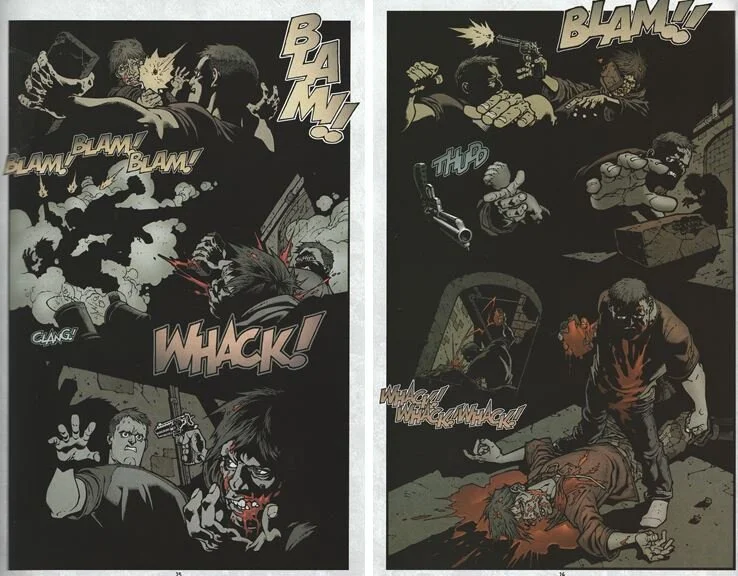
About Us: Over the last 6 years, Henry Jenkins’s Civic Imagination Project team, based at the University of Southern California, has worked with communities all over the world to develop tools for unlocking the imagination and harnessing unbridled creativity for real world action because we believe that we need hope and imagination to mobilize and sustain our collective efforts. Our group believes that to make the world a better place everyone needs to be able to imagine what a better world looks like, even now, especially now. 

Track the project through the Atlas of the Civic Imagination.