

Foreword: Feminism with a Dance Beat!
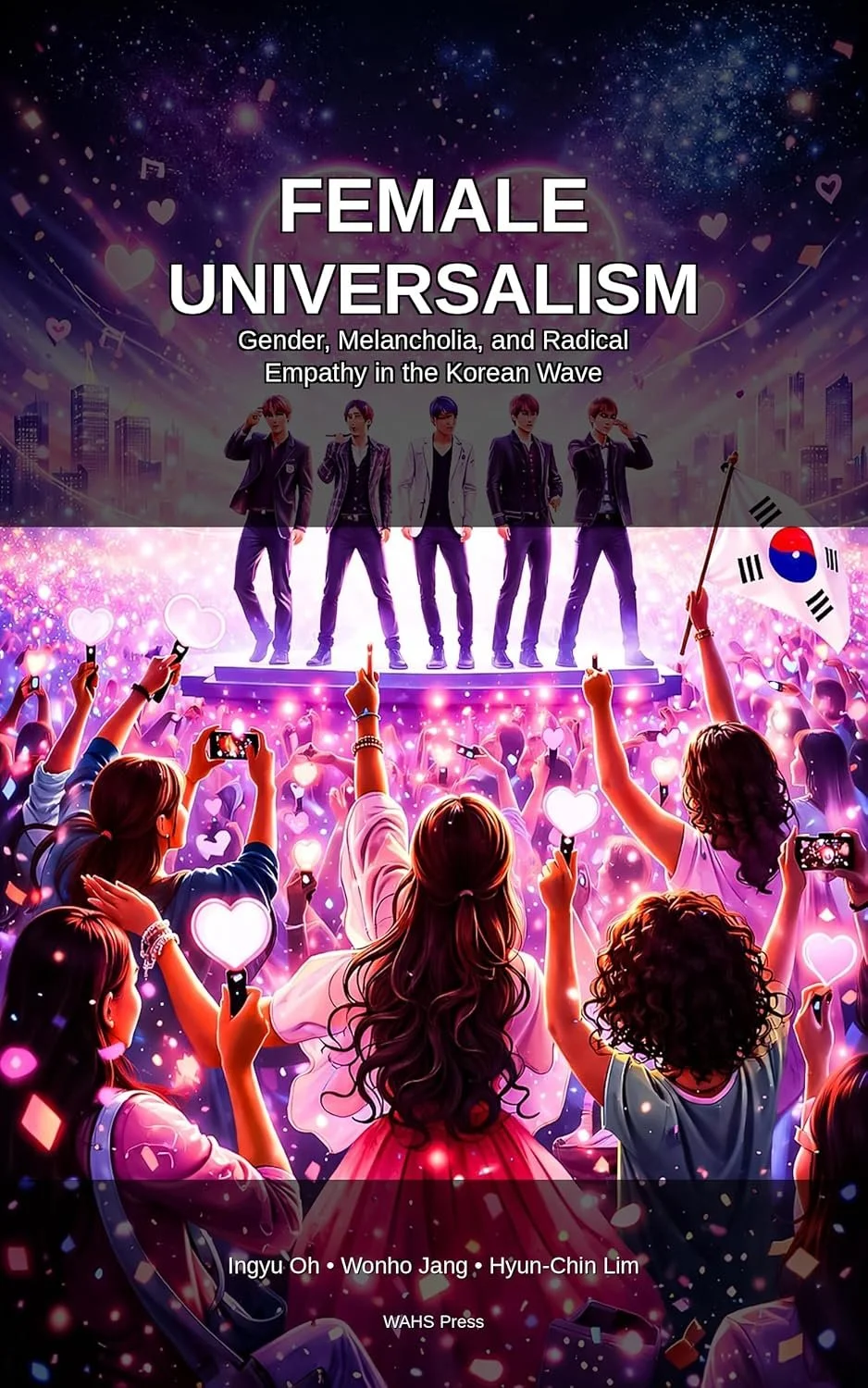
/Today I want to share the foreword I wrote for a new book, Female Universalism: Gender, Melancholia, and Radical Empathy in the Korean Wave. I have gotten to know Ingyu Oh, the book’s primary author, through a series of Hallyu related events, most recently a forum he organized around K-Pop Demon Hunters here in Los Angeles. In what follows, I provide some overview of the theories he and his collaborators Wonho Jang and Hyun—Chin Lim offer in their book and try to provide a larger context in relation to transcultural fandom and global feminisms. The book itself can be downloaded on Kindle from Amazon for only $7.99 US. If you are interested in K-Pop or K-Drama, this is something you should read.
“Another typical morning, with a piece of bread in my mouth,
I start the day like any other.
All day long, with an iced americano in hand,
I’m dead tired.
This scene in the subway, do I remember it from last night’s dream?
Oh, nevermind. I actually experience this every day. And so, nothing happens.
On this typical day, of this busy life,
I see that kid and
The previously peaceful sky comes crashing down
And the once imminent darkness turns to red
It feels like I’ve forgotten something
Strangely, it feels like I’m about to cry for no reason
I think it’s better to just let the moment pass
Because I simply hate thinking”
When I taught a class in Western Fandom Studies at Shanghai University in June 2024, my students were fascinated by the idea that feminists could be sex positive and that being a fan could be an expression of a feminist identity. They wanted to know more about fan feminisms. Many described themselves as “Sister Fans.” Sister fans are aspirational, seeking the sibling relations lacking in their everyday lives, but also seeking inspiration for their own small acts of resistance to gender constraints.
The young Shanghai women were struggling with questions of gender identity in a culture where we see many examples of hyperfeminine performance — women wearing lacy and flouncy outfits, made of soft puffy materials, and in pastel colors (pink, lavender, peach), all designed to make them attractive to men. But many of the women rejected such identities by adopting a less performative identity, wearing little to no make-up, t-shirts, jeans, and tennis shoes, clothing which would be typical on an American college campus but stood out in China.
Lenore Wang (2024), my guide on this trip through Chinese fandom, had a dialogue on my blog, Pop Junctions, with my former student Do Own Kim, considering what this music means in China and Korea. She places “Tom Boy” in the larger context of [G}ID-Le’s music:
As a way to rebel against the imbalance and strange eyes of society, girls need an obvious expression that fits their ideas, which is the best part of (G)-Idle. In (G)-Idle’s song, they talked about body anxiety (Allergy, 2023), fighting back to the male gaze (Nxde, 2022), and trying to break the stereotype of Tomboy and femininity (Tomboy, 2022). In their song ‘I want that’, they discuss domestic violence through their performance in MV. (n,p.)
Both women in the discussion saw [G}-Idle and the other “girl crush” groups they discussed as engaging with popular feminism, as providing resources that helped their faithful followings confront issues they faced in their everyday lives as women. Wang continues:
We can see that they are not only cool and confident in their appearance but try to use such ways to discuss the inequality in reality, which draws fan’s attention and arouses their resonance. After the release of ’Nxde’, lots of girls (even not fans) use the lyric ‘I’m born nude, you’ve got a dirty mind’ to fight back against the strange eyes and verbal bullying. So, the expression and the power they express in the song gives those girls the power to say something instead of feeling shy/pretending they are cool/hiding their interests like they use rather than just those ascribed to the artist’s intent. (n.p.)
As her discussion continues, she places the ways K-pop empowers its female fans in a larger historical and global context, referring back to an iconic pop star of my own generation: “Much like Madonna in the 1980s, [G]ID-LE and other “girl crush” k-pop groups play around with competing gender and sexual identities across their work and thus encourages East Asian women to imagine their own gender identity as more malleable.” (n.p.)
The phrase “Tomboy” gained new currency in China thanks to [G]I-DLE’s 2022 song which proclaims being a tomboy as a means of escaping male objectification, a work of popular feminism, that was recognized by most of the young Chinese women who I spoke with but almost none of the men. The group’s personas have been heavily groomed to reflect gender-typical norms of beauty, glamor, and sexuality, even as their lyrics speak of alternative gender constructions. The women were struggling with the contradictions between the two.
Pop culture materials — such as “Tom Boy” and other Girl Crush songs – offered them a context for discussing what kind of woman they wanted to be in their performance of self. These texts, with their playful and even silly, candy-colored surfaces asserting their innocence of political meaning, were accessible to them in Shanghai where-as more overtly political texts were generally not. They might access writings by American or Korean feminist on the web using a VPN in order to provide greater context for the debates represented by these popular feminist texts.
These young women have often had to resist parental pressures to marry and settle down in their hometowns across China, choosing instead to pursue educational and work opportunities, and thus independence, that has contributed to a wave of urbanization, especially for women, in contemporary China. Their independence, and potential sense of isolation, are further shaped by the reality that their identities were forged in response to China’s One Child policy which ended in 2016. They are single children in a society that has traditionally placed a high value on fraternal relations, and thus fandom becomes a way of forming and strengthening social bonds with others of their generation.
Pop feminism, as Sarah Banet-Weiser (n.d., with Gil and Rottenberg) notes, often links personal empowerment with consumer culture and the performance of self in everyday life:
For me popular feminism refers to practices and conditions that are accessible to a broad public, from organizing marches to hashtag activism to commodities. Popular feminism is also… a ‘happy’ feminism, one that is about uplift, that is decidedly not about being what Sara Ahmed has called a ‘feminist killjoy’. As I argue in my book, seeing and hearing a safely affirmative feminism in spectacularly visible ways often eclipses a feminist critique of structure, as well as obscuring the labour involved in producing oneself according to the parameters of popular feminism. (n.p.)
Banet-Weiser offers a powerful critique of the commodification of feminism in the west and what gets left out, the watering down of critique, the turning away from difficult subjects within feminism. I see this critique as explaining many aspects of fan feminisms as they operate in the west, but it is less convincing to me in the Chinese context where the popular feminist discourses introduce topics, start conversations these women are finding nowhere else. Rather than turning away from the difficult topics, the release of such popular feminist texts often occasion considerable discussion, research, and writing as they seek to make sense of ideas that do not simply fit into their lifeworlds. Given the context in which these Chinese women operate, even these small steps can have transformative effects. For many fan women in China, K-pop music offered a more outspoken version of popular feminism, one that provoked them to reflect more deeply on their own condition and which sparked aspirational fantasies of things being otherwise.
Several Shanghai fans told me that they had found in fandom a sense of trust and female solidarity they had found lacking in their families or among school mates, a trust born from shared interests amongst chosen families. The contradiction between the girl group’s own personas and their celebration of “Tom boys” has only encouraged these young Shanghai women to more passionately debate Chinese gender norms – how far can you go towards gender neutrality, not yet nonbinary, without losing that sense of femininity deemed important for attracting a romantic partner.
When I asked one “sister fan” whether she considered herself a “Tom boy”, her teacher pre-emptively announced that she was “not the type.” but the girl explained that she aspired to be, and that these K-pop idols helped to inspire such thoughts, but she lacked the courage to face the likely pushback from her parents.
Ingyu Oh, Wonho Jang, and Hyu-Chin Lim have helped me to much better understand the gender dynamics of Hallyu, not simply in Korea or China, but on a global scale. They have proposed what they call “female universalism,” as a postcolonial response to the project of modernity which they suggest was dominated by the culture of white males assumed – but never fully accepted – as “universal.” Instead, they argue that contemporary Korean pop culture has an ideal feminine and at least potentially feminist subject:
Female universalism, as it emerges through Hallyu, affirms that women's subjectivity cannot be reduced to a single normative role but must be understood as fluid, performative, and diverse... Hallyu narratives dignify a multiplicity of women's aspirations, ranging from the traditional pursuit of love and family to contemporary ambitions of becoming CEOs, prosecutors, scientists, idols, or politicians... the unifying principle is not uniformity but recognition: women should be free to pursue their dreams without being constrained by patriarchal scripts."
This taste culture is drawn –for example – towards androgynous men and more fluid conceptions of gender (such as those that appealed to my Chinese students). They concluded: the main reason women of all races, ethnicities, and standards of living want to participate in Hallyu fandom and its activism was due to their “gendered melancholia” resulting from the widespread sexism and male domination in society. See the lyrics that began this piece as a powerful example of such a discourse. This book offers a distinct contribution to the question of popular feminism (or fan feminism) which has been a central consideration in fandom studies from its conception. How does fandom allow women to more fully express their desires, their fantasies, but also their discontents in relation to the resources mass culture offers them and in a vernacular that reflects their investments as fans? You will learn much more about these concepts as you read this book.
What I hope to do here is first to offer some explanations for the media trends that have made the expansion of this Female Universalism through K-Pop and K-drama possible, the ways that what gendered melancholia may also give rise to expressions of collective joy and solidarity, and how this sense of pleasurable identification – as women – may inspire what my own research team has described as civic imagination.
For these ideas to become “universal,” women around the world need access to hear and absorb these particular performances. Writers such as Lori Morimoto and Bertha Chin (2013) have taught us that transcultural fandom surfaces at the junction of access and affinity. What I call the global shuffle – the increased mobility and access to pop cultural materials across cultural and national borders, including in configurations unrelated to traditional trade routes – creates access to other people’s culture in ways we might never have imagined a few decades ago. My global shuffle model reflects a world where Hollywood’s dominance over the international box office is in decline and local cultural production is thriving. Many more countries are producing media that commands their local box office but is also attracting interests around the planet. Media producers in Korea, Japan, China, India, and not far behind, Thailand and Vietnam are generating global fan followings. Streaming media companies, such as Netflix, are seeking entry into global markets and governments are demanding investment in those local media industries as a precondition for access to their consumers. When Netflix enters the game, the works produced are necessarily impure, looking inward to a domestic audience and outward to the global consumer and in the case of Asian media producers, looking specifically towards western markets. As Swapnil Rai (2025) writes, “global streaming companies like Netflix or Disney+ impose a degree of genre imperialism by suggesting the formats and themes that local companies should produce. The current process for co‑productions by streamers outside of the U.S. is not an open system in which local people produce what they want….Netflix’s stated objective is to produce things that succeed locally, but also are very exportable globally.” (121) The result is a form of hybrid media, riddled with contradictions, one that often assumes the quality of universalism implied by this book’s account.
Having made such content, the streaming networks find it profitable to transport them elsewhere, making them available to consumers who would not have encountered them otherwise. As Michael Curtin (2020) writes:
After almost a century of American hegemony, the topographies of media industries are today growing more plastic and complicated as media institutions scale their ambitions and operations in an increasingly porous and dynamic environment….Remarkably, adaptations move “up” and “down” as well as “across.” That is, content and aesthetics not only circulate widely, they are also refashioned to address different topographies of imagination. And they create new topographies…. We are witnessing new patterns of interaction between media users and producers, as well as among users themselves. Once seen primarily as consumers, today viewers and fans amply express themselves in a variety of ways and media producers systematically monitor this discourse, creating feedback loops that shape story lines and characters. (96-97)
In this process, transcultural fans play a vital role in educating each other about the cultural traditions from which this content emerged and attracting new fan audiences to help sustain the content flow. Networked communication between fans enables contact across historically separated spheres of cultural influence as people forge shared identities together online.
When I turn my attention to my own country, the United States, I see two factors contributing on the audience side to the expanding interest in global popular culture. On the one hand, there are diasporic audiences, first, second and even third generation immigrants who still seek some contact back to the countries where their families historically originated. Becky Pham (forthcoming), a former student of mine, recently completed an extensive study of Vietnamese-American youth living in Los Angeles. She found them drawn towards Korean popular culture because of a representational gap, an absence of Asian faces and stories in American media. While much of their media consumption was targeted at assimilation with their classmates from other racial and cultural backgrounds, they still sought out Asian, and especially Korean, media to reflect something of their shared experiences as Asians. At the same time, though, they often encountered pushback from their Korean classmates who felt that K-pop and K-dramas were their own exclusive property, uniquely Korean in their style and outlook. Pham found that the same music which allowed them to feel seen was also still allowing them to feel marginalized within the coalition surrounding Asian-American identity. This context made the few Vietnamese performers in K-Pop groups especially important to them and encouraged them to still seek ways to import new Vietnamese groups to North America, fueling what is potentially the next wave of the global shuffle, as they introduce their tastes to their classmates. Our own research (Jenkins, Ford and Green, 2015) saw much cross-pollination occurring within an MIT dormitory as roommates played songs for each other and as clusters of folks watched media from their home countries in the common rooms.
On the other hand, there are what I have called the “Pop Cosmopolitans” (Jenkins, 2006), people who seek to escape the parochialism of their own countries by engaging with popular culture from elsewhere. Historically, rich elites have sought distinction by demonstrating their appreciation of art, wine, opera, classical music, art cinema, and the like from elsewhere, while excluding forms of popular culture from their taste culture. Today, fans express their cosmopolitanism through their deep knowledge of pop culture from elsewhere. Around the world children in elementary schools are drawing pictures inspired by Japanese manga and anime, learning the moves to their favorite K-pop song, or consuming Squid Games or Narcos. My young female students at the University of Southern California almost all have a history of engagement with K-Pop. Some of them discovered it through Korean-American friends, but certainly not all of them. Some of them have participated in global fan networks but certainly not all of them. A few, increasingly few, have sampled K-pop and dismissed it as not for them.
As this book suggests, what connects them has to do with the way K-pop and K-drama speaks to them about their shared experiences with women around the world. When I go to K-pop concerts, the faces I see are not simply Asian faces, but also Black, Brown, and White faces. Contrary to the idea that this exchange of cultural goods results in a monoculture, the global shuffles creates strong incentives to maintain greater cultural diversity. Despite the theory that cultural works are deodorized as they enter other markets, transcultural fans deeply appreciate cultural differences and are actively seeking to learn more about these other pop culture traditions. Streaming media creates the push, diasporic audiences and pop cosmopolitans create the pull, which creates the global shuffle.
Access can lead to affinity, which we might understand as a mixture of desire and familiarity. To feel affinity we do what people always do with popular culture – we make it our own, we claim some sense of connection with and ownership over these cultural resources, they claim affiliation and membership within the community of others who share those interests and passions. However, fan nationalism asserts itself along that same borderlands, as those who come from the nation of origin for a cultural good seek to police the conduct of those from elsewhere attaching themselves to those same goods. They want to force them to consume these materials in the right way according to the cultural traditions of its originating culture or they seek to simply repel those unwanted populations being drawn to their popular culture. As Pham’s cases suggest, fan nationalists are often aggressive at trying to transform the cultural products, now circulating more feely, back into their own personal preserve to share only with whom they wish.
The global circulation of media makes K-dramas and K-pop accessible to diverse audiences around the world. Networked communication allows them to forge transnational identities as fans. The mixture of diasporic and pop cosmopolitan audiences makes them willing to try new forms of pop culture. All of these are necessary but not sufficient conditions for explaining the emergence of the Korean Wave as we understand it today.
On this point, I agree with these authors. These economic, technological and social factors would not explain why fans of K-Pop and K-drama are so overwhelmingly female. Mixing together both quantitative and qualitative findings, Oh, Jang, and Lim amply demonstrate that the fan following for K-pop and K-drama worldwide is overwhelmingly female, that these women recognize that these works speak to them about the gendered dimensions of their lives, and that this recognition drives their investments as fans.
Female universalism enters as fans, gaining access to cultural material previously closed to their view and contact with fellow fans in different national contexts, discovering their shared gender experiences of disempowerment, marginalization, and oppression. They recognize that regardless of the differences they encounter, they have a shared sense of frustration and disappointment as women. What initially confused me, the ways that Chinese fans, despite long histories of geopolitical conflicts their country has had with Korea, find their solace and joy through Korean pop idols, requires a shift towards radical empathy and retrospective learning as they find ways to identify as women with these Korean pop idols and their fans around the world. We see those feelings, which may not always be put into words as Betty Friedan (2014) described in The Feminine Mystique more than fifty years ago, gain such vivid and engaging expression through Halliyu. Popular feminism is the secret sauce which has made K–pop pop!
Oh, Jang and Lim also tell us something else that is important – that women creators (not only singers but writers, directors, producers) are heavily represented in and through Haliyu media. And this may be how it differs from earlier studies of popular feminism where women audiences were often addressed by male media-makers and needed to make adjustments in order to make them fit their own fantasies more fully.
In her classic book, The Desire to Desire: The Women’s Films of the 1940s, Mary Anne Doane (1987) called attention to a historic period of focus on women’s stories through Hollywood cinema that emerged as men were away fighting World War II. What Hollywood perceived as women’s interests dominated the screen and actresses were the top box office performers across the board. Genres like the medical melodrama (Dark Victory), the maternal melodrama (Mildred Pierce) and the paranoid gothic (Gaslight) gained popularity, she argues, because they expressed female desires and fears, because they centered their stories around women, because they were addressed to a feminine subject.
But, at the same time, she argues that male dominance over the media industry contributed to an ideological shift as the narratives progress: the promise of professional success for women leads to plot resolutions that contain female ambition, punish women for their demands, and put them back in place within patriarchy. Those same industrial factors shape the American media industry down to the present day. As I am writing this foreword, the Annenberg Inclusion Initiative has launched its annual data tracking women’s roles within Hollywood. The figures, as of the end of 2025, show that of the top 100 films at the Box Office, only nine women worked as directors on these movies, representing a decline from 2024’s 13.4 percent. (Galuppo, 2025)
Fandom Studies (Jenkins, 1992), from the start, focused attention on the other side of the camera, centering on the various ways that women have needed to retrofit Hollywood’s cultural products, produced by men for male consumers, to reflect their own needs and desires. We turned our attention to women as grassroots cultural producers, writing fan fiction, recording fan music, editing fan videos, and constructing fan costumes. Fan genres, such as slash (what is known as Boys Love in East Asia), reworked masculinity and male sexuality to reflect a softer, more gentle and supportive, style, while other fan women took secondary characters from male-centered action-adventure series and allowed them to explore their own professional ambitions. “Slash” differs from Boy’s Love in a significant way: “slash” is a genre mostly for amateur fan writers, whereas BL is today a large category of commercial production intended to respond to the tastes of women across East Asia. Over time, the popularity of slash stories has had impact on the entertainment industry as concepts like “bromance” have become more mainstream and we are seeing women’s professional lives more fully represented on the screen. And these women, often, discovered Boys Love, seeking out content that shows beautiful boys loving each other in beautiful ways and more directly address the fantasies these western fans were constructing around Star Trek, Star Wars or Harry Potter, for example. This growing recognition of their own tastes in the BL stories consumed elsewhere paved the way for commercial ventures such as the Canadian series, Heated Rivalry, a same-sex romance between two male hockey players.
Oh, Jang, and Lim help us to understand the social, political, and economic consequences of a media industry dominated by women and producing media aimed primarily at women as these cultural works circulate and get consumed on a global scale. K-pop is feminism you can dance to. This is one of our best cases for how diversifying the media industry can expand the marketplace and for how female artists may help articulate the most intense feelings of female spectators. Such a context does not diminish the importance of fandom – women need to help each other interpret the lyrics, expand upon the stories, much as the women I met in Shanghai were trying to do when they went from consuming [G]I-dle music videos to reading Korean and American feminist writers and having study group meetings to more fully integrate these insights into their own lives as Chinese women. Across this book, the authors map the overarching themes that constitute female universalism.
When I first encountered Oh, Jang and Lim’s account of female universalism, what gave me pause was their focus on gendered melancholia. Everyday despair and depression is certainly what gets represented through K-dramas along with utopian alternatives – worlds where men care deeply and respect the women in their lives, worlds where women’s professional accomplishments are respect, and so forth. And these themes carry over to some K-pop music, as my [G]I-dle example above illustrates, which also articulate both active songs of protest (“Nxde,”) as well as songs of more mundane depression (“Fate,”) while “Tom Boy” articulates an alternative construction of gender, one imagined as free from the male gaze and patriarchal constraints. These songs – and many which do not seem to explicitly speak a popular feminist discourse at all – express forms of liberatory joy that is very much in the air when one encounters K-pop and its fans. These authors discuss such pleasure in terms of Julia Kristeva’s notion of “jouissance as a rediscovery of pleasure that emerges after prolonged repression.” The authors discuss this release from constraint primarily on an individual psychological level, but it also can be understood as collective joy, which in turn, provides the context for political recognition and even activism.
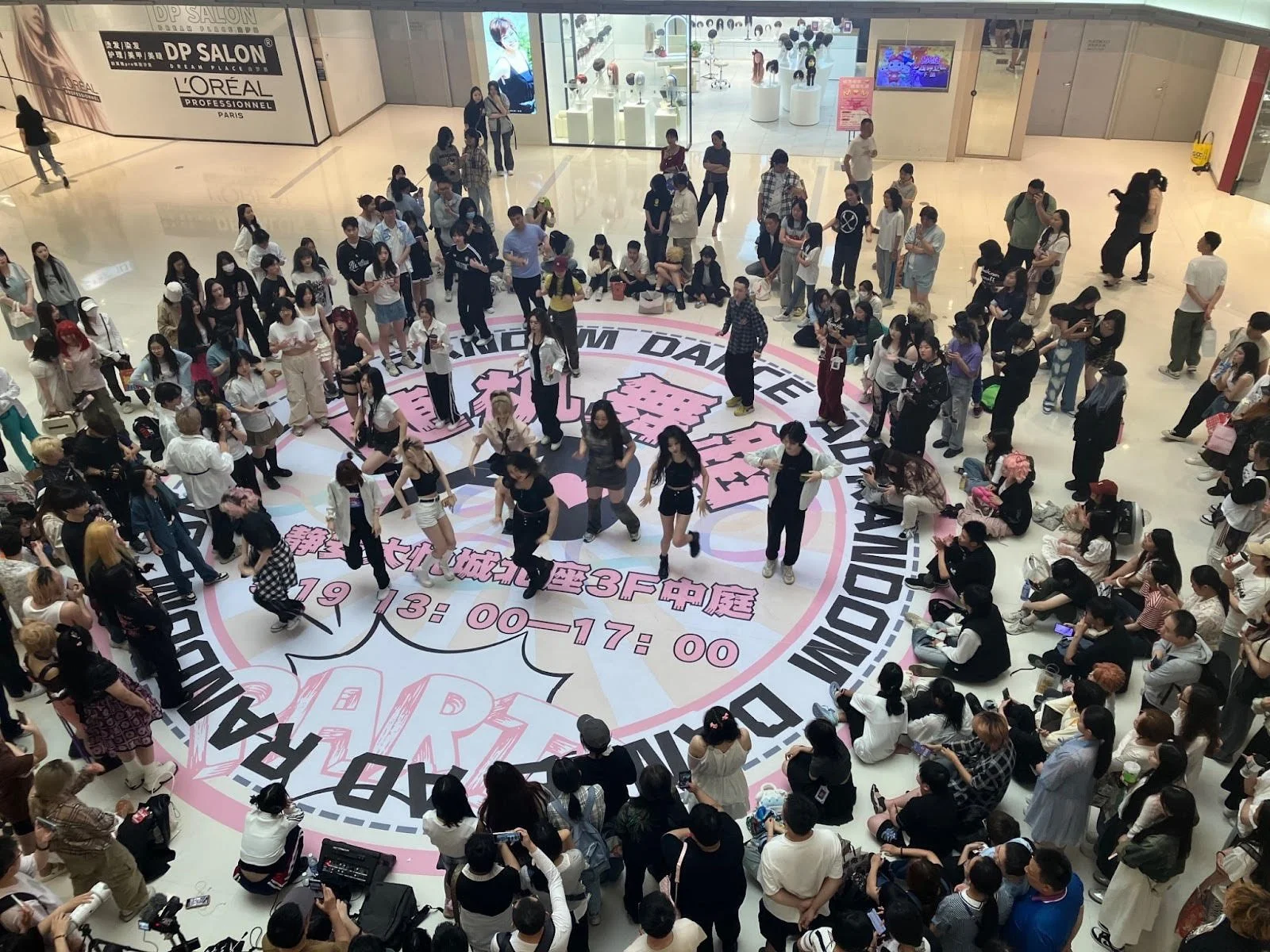
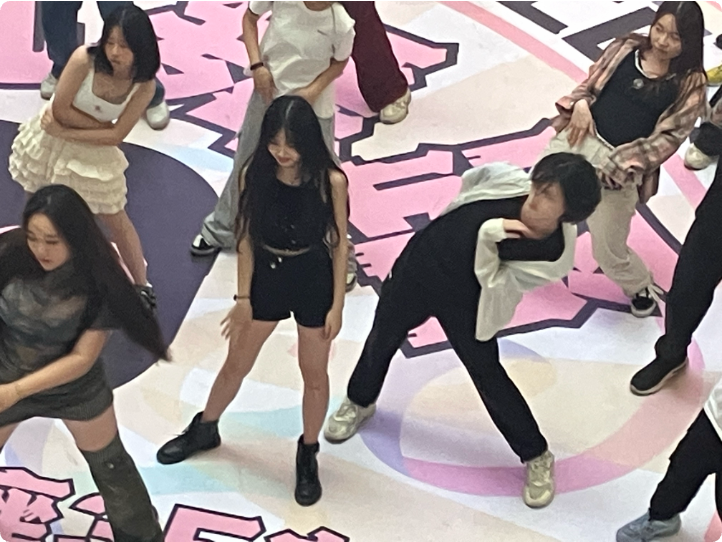
In 2024, I watched a Random Playlist K-Pop Dance celebration at a local mall as several hundred —mostly— women came together to demonstrate their skill and mastery over the complex choreographies associated with K-Pop. If they recognize a song and know the associated moves, they come to the center of the ring until the next song fragment starts. Sometimes there is only one woman in the center of the stage dancing her heart out in a moment of sudden glory, and other times dozens of women are out there dancing together in a safe space, which is more about female empowerment than couple formation. Women are dancing with women, men are generally incidental – included if they want to participate on the women’s terms, sometimes accepted and embraced, but hardly the focus of these women’s attention. They are taking joy in their own bodies and in participating within a larger community of women. In his now classic 1979 essay, “In Defense of Disco,” Richard Dyer (1979) writes, “Its passion and intensity embody or create an experience that negates the dreariness of the mundane and everyday. It gives us a glimpse of what it means to live at the height of our emotional and experiential capacities — not dragged down by the banality of organized routine life. Given that everyday banality, work, domesticity, ordinary sexism and racism, are rooted in the structures of class and gender of this society, the flight from that banality can be seen as — is — a flight from capitalism and patriarchy themselves as lived experiences.” In some cases, Random Playlist Dance (RPD) is literally what Barbara Ehrenreicht (2007) described as “dancing in the streets” as these women occupy shopping malls by day or parking garages by night.
Kedi Zhou, Yuqi Yang, and Xinyue Zhang (2025) —three students on my research team—wrote an in -depth examination of the Random Playlist Dance (RPD) as a specific community-based practice, using Richard Dyr’s framework to explain why it attracts such diverse participation:
RPD offers an ephemeral, affective escape from the mundane realities of everyday life. In these moments, fans experience excitement, build connections, and find a sense of belonging in a community that shares the same cultural language. However, the utopian nature of this space is inherently fleeting, subject to external regulating forces. It is not a fully realized utopia but rather constrained by the very structure that allows it to exist. RPD exists as a contradictory site—deeply tied to global capitalist entertainment systems while simultaneously shaped by additional layers of precarity beyond capitalism, which includes state regulation and sociocultural pressure, particularly in conservative cultural contexts. (n.p.)
They argue that these public dances are one of the places where gender and sexual norms are contested in China. These fans are rejecting the constrained roles offered women in their society but not the pleasures they take in their own femininity. These spaces also provide a space where same sex couples can celebrate together in a China that still displays a high degree of homophobia. As Dyer found in looking at Disco through a Gay male frame, the feels here carry implicit and often explicit political resonances.
It is not simply that women feel sad watching K-dramas or that K-pop singers become professional mourners helping to sing the sadness away. Rather, the upbeat nature of so-much K-Pop music allows them to feel, at least momentarily, what utopia might feel like and motivates them to work harder to achieve something of those same feelings in the real world.
I am excited by the model this book offers us of a transition from gender melancholy to radical empathy to feminist empowerment, fan activism, and ultimately, we hope, social change. For the past decade plus, my research group at University of Southern California’s Annenberg School of Communication and Journalism has been studying what we call the civic imagination (Jenkins, Peters-Lozario, and Shresthova, 2020). Before we can create a better world, we need to imagine what a better world looks like. We see moments where we experience utopianism as key entry points into the civic imagination. We need to see ourselves as civic agents who are capable of making change. We need to identify with other members of our community – something like what Benedict Anderson (2016) described as the imagined community though we prefer the imagining community because participants are actively reshaping that community through their collective imagination. We need to imagine a process through which the desired change can be obtained. We need to form empathetic bonds with people whose experiences are radically different from ours. Those who felt most shut out of the system may need to imagine equality and justice before they directly obtain them. Through this process, the spaces of our everyday lives become endowed with special meaning, often because of the ways they are transformed through the utopian imagination.
In 1989, at the peak of her critical and commercial success, John Fiske wrote about the political transformation he was observing in young women who were fans of Madonna (including his own daughter who was an important inspiration for Fiske to tackle this topic). The Madonna phenomenon involved heated debates about feminist self-representation, sex positivity, the male gaze, and the spectacle of women’s bodies. The young fans were increasingly adopting her distinctive style for inspiration regarding how to express themselves through how they adorned their bodies. Madonna saw herself as a vehicle for women’s desires, encouraging women to seek erotic pleasure and embracing diverse forms of sexuality.
Fiske described a step-by-step process that took her female fans from watching her provocative music videos to engaging in more overtly political forms of feminist empowerment: “The teenage girl fan of Madonna who fantasizes her own empowerment can translate this fantasy into behavior, and can act in a more empowered way socially, thus winning more social territory for herself. When she meets others who share her fantasies and freedom there is the beginning of a sense of solidarity, of a shared resistance, that can support and encourage progressive action on the microsocial level.” (136)
I can’t help but see strong parallels between the experiences of these young fans in the 1980s and the K-pop phenomenon of our current moment. Here, again, we see women occupying meaningful space (on the dance floor in a Shanghai shopping mall, in the streets of Seoul during the Lightstick Uprising), recognizing shared experiences and embodying through their dress and conduct in public spaces, and ultimately seeing themselves as change agents collectively prepared to confront patriarchy and in the Korean case, topple governments.
K-pop fandom constitutes what the political philosopher Peter Dahlgren calls a “civic culture.” Dahlgren (2003) stresses how cultural factors and social interactions (such as those experienced within fandom) shape our understanding of political agency. Dahlgren’s model starts with social connections or what he calls “links” between participants. A community is imagined because many of the members who feel kinship with each other may never meet in person and yet feel as if they belonged to the same social grouping. We might push further and say that fandom as a civic culture is an imagining community, stressing the process of “dreaming” of a better world and the formation of social connections through shared fantasies. Dahlgren introduced a highly influential model which traces the necessary conditions for civic communities based on shared knowledge, values, trust, spaces, practices, and identities, which provided the foundation for the work we do on the civic imagination.
Oh, Jang, and Lim’s account of K-Pop provides us something more – tracing the affective context through which K-pop fans transform their perceived experiences of gender melancholia into the basis for collective joy (“Juisance”) and radical empathy and into the kinds of expressions of empowerment which pave the way for social change. Western fandom studies has been surprisingly slow to adopt models of affect and its relationship to social change that have gained prominence elsewhere in the humanities and the social sciences. If this book provides the statistics to demonstrate the impact of K-pop on the world, it also digs into the psychological origins of “the feels” which fans associate with their favorite pop idols and through this, explore what emotional and social dynamics here have shaped Hallyu’s impact on the world. Fans and fan scholars alike should read it closely. So should those interested more broadly in the intersection between culture and politics.
Sources
Anderson, Benedict (2016) Imagined Communities: Reflections on the Origins and Spread of Nationalism (London: Verso).
Banet-Weisser, Sarah, Rosalind Gil and Catherine Rottenberg (n.d.) “Postfeminism, Popular Feminism and Neoliberal Feminism?” https://research.gold.ac.uk/id/eprint/37600/1/ICCE-Gill2019a.pdf
Chin, Bertha & Morimoto, Lori Hitchcock. 2013. “Towards a theory of transcultural fandom, Participations: Journal of Audience & Reception Studies 10(1): 92–108.
Curtin, Michael (2020) “Post Americana: Twenty-First Century Media Globalization,” Media Industries, 7.1
Dahlgren, Peter (2003) “Reconfiguring Civic Culture in the New Media Milieu” in John Corner (ed.) Media and the Restyling of Politics (Thousand Oaks, CA: Sage).
Doane, Mary Anne (1987) The Desire to Desire: The Woman’s Films of the 1940s (Bloomington: Indiana University Press).
Dyer, Richard. 1979. "In Defense of Disco," Gay Left 8, Summer
Ehrenreich, Barbara (2007) Dancing in the Streets: A History of Collective Joy (New York: Holt)
Fiske, J. (1989). Understanding Popular Culture. London: Routledge.
Friedan, Betty (2014) The Feminine Mystique, 50th Anniversary edition (New York: W.W. Norton And Company)
Galuppo, Mia, (2025) “FIlms Directed by Women Drop to Seven Year Low in 2025, Study Finds,” Hollywood Reporter, December 31 https://www.hollywoodreporter.com/movies/movie-news/films-directed-by-women-drop-to-seven-year-low-1236461394/
Jenkins, Henry (1992) Textual Poachers: Television Fans and Participatory Culture (New York: Routledge).
Jenkins, Henry. 2006. “Pop Cosmopolitanism: Mapping Cultural Flows in an Age of Media Convergence.” In Fans, Bloggers, and Gamers: Exploring Participatory Culture.152-172. New York: New York University Press.
Jenkins, Henry, Sam Ford, and Joshua Green. 2015. Spreadable Media: Mapping Value and Meaning in a Networked Culture. New York: New York University Press.
Jenkins, Henry, Gabriel Peters-Lozarrio, and Sangita Shresthova (2020) Popular Culture and the Civic Imagination: Case Studies in Creative Social Change (New York: New York University Press).
Do Own (Donna) Kim, Lenore Wang and Henry Jenkins (2024), ““Girl Crush” K-pop Idols: A Conversation between Korean, Chinese, and US Aca-fans,” Pop Junctions, March 18, https://henryjenkins.org/blog/2024/3/18/girl-crush-k-pop-idols-part-i
Pham, Becky (Forthcoming) “Ambivalent, But Imagining Anyway:
Vietnamese American Youth’s Engagement with Asia-Originated Popular Media and the Civic Imagination” in Henry Jenkins, Sangita Shresthova, and Kedi Zhou (eds.) The Global Handbook of the Civic Imagination ( )
Straubhaar, Joseph, Swapnil Rai, Melissa Santillana and Silvia Dalben (2025) Transnational Streaming Television: Reshaping Global Flows and Power (New York: Routledge).
Zhou, Kedi, Yuqi Yang, and Xinyue Zhang (2025) “Precarious Utopia: The Affective Politics of Transcultural Entertainment in K-Pop Random Play Dance,” International Journal of Cultural Studies, June 22. https://journals.sagepub.com/doi/full/10.1177/13678779251351650?_gl=1*1iy69u6*_up*MQ..*_ga*MTM5ODUzMDM3MS4xNzY3ODEyNDE3*_ga_60R758KFDG*czE3Njc4MTI0MTYkbzEkZzEkdDE3Njc4MTI0MjUkajUxJGwwJGgxNDIxMzAyMDgw
Biography
Henry Jenkins is the Provost Professor of Communication, Journalism, Cinematic Arts and Education at the University of Southern California. He arrived at USC in Fall 2009 after spending more than a decade as the Director of the MIT Comparative Media Studies Program and the Peter de Florez Professor of Humanities. He is the author and/or editor of twenty books on various aspects of media and popular culture, including Textual Poachers: Television Fans and Participatory Culture, Hop on Pop: The Politics and Pleasures of Popular Culture, From Barbie to Mortal Kombat: Gender and Computer Games, Convergence Culture: Where Old and New Media Collide, Spreadable Media: Creating Meaning and Value in a Networked Culture, and By Any Media Necessary: The New Youth Activism. His most recent books are Participatory Culture: Interviews (based on material originally published on this blog), Popular Culture and the Civic Imagination: Case Studies of Creative Social Change, and Comics and Stuff. He is currently writing a book on changes in children’s culture and media during the post-World War II era. He has written for Technology Review, Computer Games, Salon, and The Huffington Post.