

EMMYS WATCH 2025 — Shrinking The Bear: A Closer Look at Two Divergent Outstanding Comedy Nominees
/‘Emmys Watch 2025’ showcases critical responses to the series nominated for Outstanding Drama, Outstanding Comedy, and Outstanding Limited Series at that 77th Primetime Emmy Awards. Contributions to this theme explore critical understandings of some series nominated in these categories.
At the climax of the season’s final episode, a character we’ve come to know threatens suicide. He walks to the edge of a train platform, fully prepared to throw himself in front of an oncoming express train. This character has spent the season agonizing over deep personal pain, inflicted on himself and others, his mental health dwindling from an already precarious position. His suicide attempt is the emotional climax of his arc for the season.
To a casual reader, you might assume I’m referring to The Bear; a character being internally tormented to the point of self-harm is as much a neat description of the FX show’s protagonist, Carmy Berzatto (Jeremy Allen-White), as it is of the actual character to whom I’m alluding. Since 2022 and its first season’s exploration of family trauma and workplace drama interwoven with the darkly comedic antics of an eatery in transition, The Bear has gained a reputation for being a deep, dark dramedy; in essence, a series balancing humorous and serious emotional tones and subject matter. It’s also a series whose roots in the funnier side of things have been existentially contested. Last year Pop Junctions hosted a brilliant piece by Megan Robinson illustrating the exasperated humor of the second season’s “Fishes” (2023), an episode exploring the familial eruption of the Berzatto clan over a dinner that ends in a literal car crash. It’s true that The Bear has had a knack for knockout humor that can be both subtle and spectacular: I would personally cite “Forks” (2023), the episode focusing on abrasive anti-hero Richie Jerimovich (Ebon Moss-Bachrach) that includes a purgatory of fork-cleaning, a fist-pumping Taylor Swift car karaoke moment and a pizza preparation that’s shot and soundtracked like a Mission Impossible ticking clock action beat. However, despite its humor The Bear has dwelt in storytelling realms involving mental health, self-harm, personal meltdowns and suicide; to assume the character in the first paragraph comes from The Bear wouldn’t be a stretch.
But the character in the first paragraph isn’t from The Bear: it’s Shrinking’s Louis Winston (Brett Goldstein), the repentant barista who accidentally killed the wife of Jimmy Laird (Jason Segel) in a car crash. Louis’s suicide attempt, halted by Jimmy in the final scene of “The Last Thanksgiving” (2024), is a dark turn that’s treated seriously and lacks any kind of comedic or lighthearted undertone until Jimmy’s arrival. In isolation, the scene and the ones leading up to it, where Louis is slowly spurned by his co-workers and disinvited from their Thanksgiving party once they learn of his past, wouldn’t be indicative of what many might consider a “comedy”. But as part of the larger narrative tapestry of Shrinking – which, yes, includes a lot of laughs – it’s representative of the kind of dramedy The Bear used to represent.
The Bear: Nominated for Outstanding comedy series

Shrinking: nominated fr outstanding comedy series
Before I explain further, a few caveats. First, I put aside the Television Academy’s frankly unhelpful rules about genre eligibility; saying a series should have “the majority of its running time of at least six episodes [being] primarily comedic” does not provide firm guidance on genre rules. Where once The Bear might have fit that bill, I argue it has since outgrown it. Second, I don’t wish to turn this piece into a reductive delimiting of the types and trends of comedy that pigeon-hole shows into narrow definitions of genre. Part of the appeal of genre’s mutable edges is to make texts slippery, mixing and reconfiguring to present something new. Jacques Derrida’s influential paper ‘The Law of Genre’ (1980) invites this kind of slippage when he highlights the ability for texts to undergo “a sort of participation without belonging – a taking part in without being part of” multiple genres (p. 59). Both The Bear and Shrinking mix heavy subject matter with comedic frames featuring jokester characters, silly plots and humorous dialogue, showcasing mental health and trauma alongside farce and wry asides. Respective first season episodes “Review” (The Bear, 2022) and “Imposter Syndrome” (Shrinking, 2023) are potently dramatic, yet supremely funny examples demonstrating both shows’ dramedy strengths.
Despite how it might have begun, The Bear has inched further from comedy to focus on drama in its third season. Competing against Shrinking’s second season for Outstanding Comedy Series at this year’s Emmys, The Bear’s third season doubles down on character development that is galvanised by interpersonal drama, contemplative cinematography and a morose atmosphere at the expense of brevity, wit or warmth. The season’s tone is set by its first and best episode, “Tomorrow” (2024), an absorbing half-hour collage of non-linear, largely dialogue-free flashbacks briefly intercut with present-day scenes, entirely scored by an immaculate Nine Inch Nails cue. There is a near-absence of humor in “Tomorrow” and its temporal vignettes; exploring Carmy’s workplace trauma under Chef David (Joel McHale) and its enduring influence on his work ethic, taunting the viewer with scenes of his happy relationship with Claire (Molly Gordon) set prior to their rupture at the end of the second season, further highlights his dysfunctional familial relationships before and after the suicide of his brother Mikey (Jon Bernthal). The episode’s quiet, foreboding and low-energy pacing is shot through almost all subsequent episodes, underscoring the season’s main plotlines including Carmy’s failure to reconcile with Claire, Sydney’s (Ayo Edibiri) indecision regarding co-ownership of The Bear, the tension surrounding a food critic’s forthcoming review, and the shock closing of the hugely successful neighboring restaurant Ever, where both Carmy and Richie staged. When things are funny, they’re either perfunctory or all-too-brief, as in the flashback episode “Napkins” (2024) and its warm ending chat between Tina (Liza Colón-Zayas) and Mikey; their banter and repartee cap a lengthy episode that excruciatingly details Tina’s forced redundancy and failed attempts to find a new job. In some cases the season’s humor has even been a source of frustration for viewers and critics, as in “Children” (2024)’s focus on the Fak family – the series’ primary comedic relief characters – and the stunt cast appearance of their relative played by an able but out of-place John Cena.
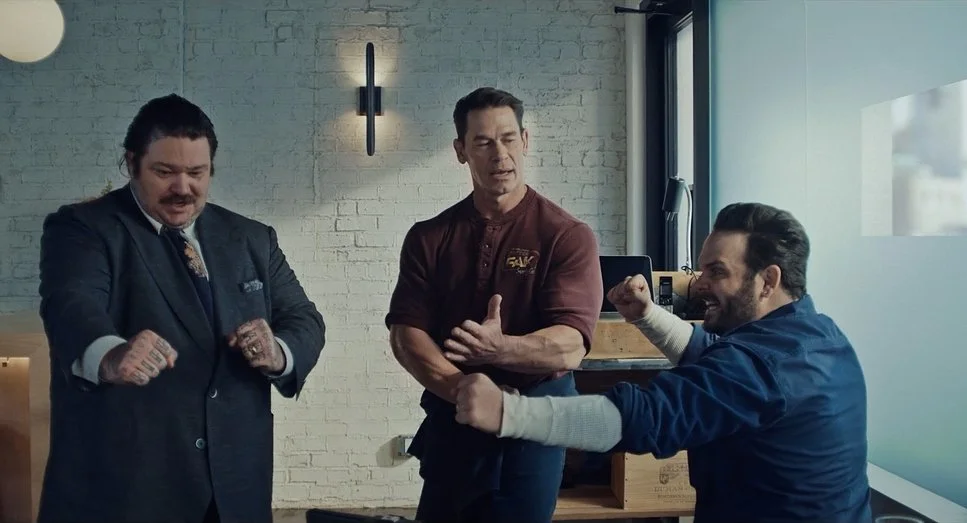
john cena in The bear (“children”, season 3)
Don’t get me wrong: The Bear is still a superb series. Throughout its third season – and its more recent fourth, calling ahead to what will surely be another nomination next year – The Bear is a show that excels at introspective and interpersonal character drama. I’d argue that its “serious” elements are what appeal most to creator and showrunner Christopher Storer, who directed seven, and wrote or co-wrote eight, of the season’s ten episodes. Its cast is high-caliber and absolutely deserving of their many accolades. Its cinematography, soundtrack, editing and production are worthy of high praise. Several of its episodes – “Tomorrow”, “Napkins” and the episode-long pre-service meeting of “Next” (2024) – are sublime pieces of television. The Bear is still worthy of acclaim. It’s just, unfortunately, not much of a funny show anymore.
By contrast, Shrinking is a very funny show despite its at-times similarly bleak subject matter. As with The Bear, Shrinking’s second season darkens its tone at the end of its first episode “Jimmying” (2024) by introducing Louis, the source of Jimmy’s grief that sets up the show’s initial premise. Jimmy’s gradual progression towards recognition and acceptance of Louis’s genuine repentance is the emotional spine of the season, interspersed with plenty of the light-hearted yet character-driven storytelling that made its first season successful. An episode like “Last Drink” (2024) exemplifies this balance: on one hand there’s the drama of the car accident’s aftermath and the final bourbon Paul (Harrison Ford) shares with Jimmy before he quits drinking; on the other, there’s the endearing goofiness of Louis justifying his ownership of a Miss Congeniality poster to his girlfriend Sarah (Meredith Hagner), and Derek’s (Ted McGinley) visit to Mac’s (Josh Hopkins) dog-pictured microbrewery and his subsequent inability to be mad at Mac for kissing his wife.
The abundance of chuckles in Shrinking’s dialogue, set pieces and character beats also makes the second season’s other grounded plot elements even more potent. As examples, Brian (Michael Urie) and Charlie (Devin Kawaoka) face set-backs in their quest for adoption, but deal with them in part thanks to a hilarious oceanic group therapy session in “Get In The Sea” (2024); Paul’s Parkinson’s diagnosis further impacts his health, but he loses little of his cantankerous wit when dealing with Jimmy or when forging a new friendship with his quirky former patient Raymond (Neil Flynn); Gaby (Jessica Williams) verbally spars with her recovering addict sister Courtney (Courtney Taylor) over the care of their elderly mother (Vernee Watson), but processes this in part thanks to her awkwardly endearing relationship with Derrick #2 (Damon Wayans Jr.). Both drama and comedy genres are consistently woven well together in service to each other, the end result usually moves the audience towards a smile, if not always a laugh.
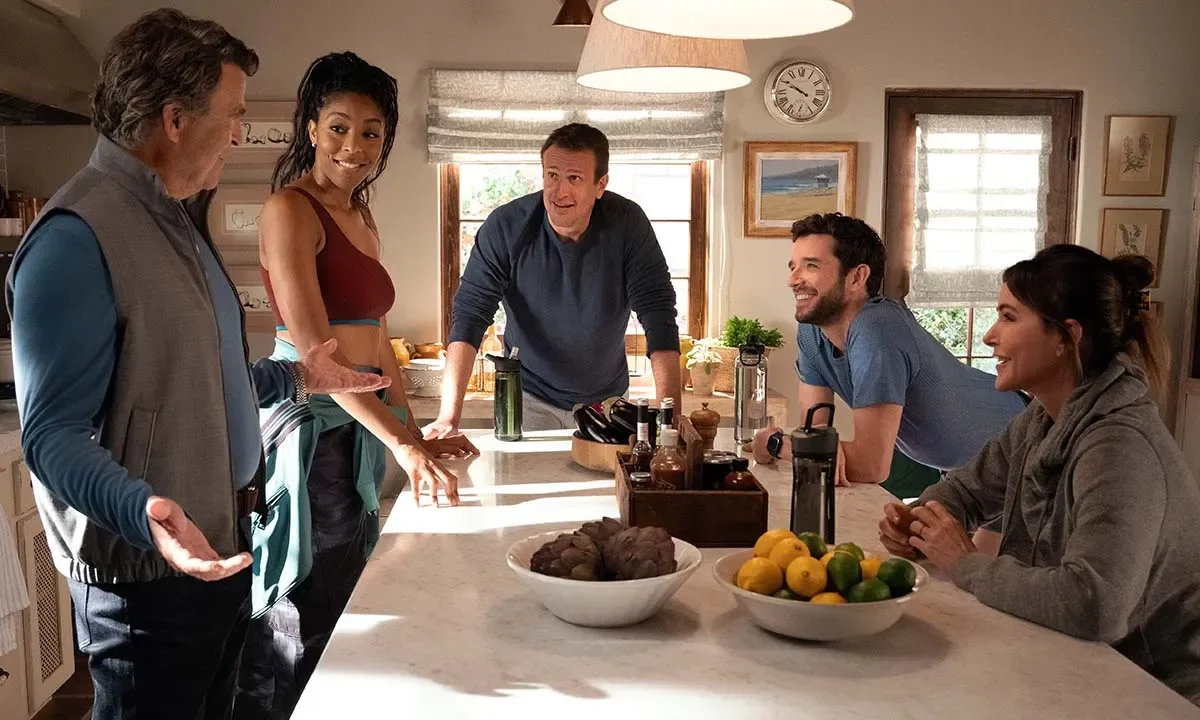
shrinking (“get in the sea”, season 2)
To that end, Shrinking is a dramedy that gestures towards a heightened sense of reality. In a manner like creator Bill Lawrence’s previous work on Scrubs (2001-2010) and Ted Lasso (2020-2023), Shrinking’s second season exists in a world where a therapist can get away with significant substance abuse and illegal actions with his patients without losing his licence. A major scene in “Last Drink” is Brian recounting the history of his and Alice’s (Lukita Maxwell) meetings with Louis to a devastated Jimmy; the emotionally heavy confrontation is made lighter by Brian’s exaggerated accents, performative gestures and verbal diarrhea. For a more subtle example from the same episode, Liz’s (Christa Miller) anguished attempt to phone Derek in the wake of her infidelity leads to Derek rejecting her call while making breakfast for his friends in Gaby’s kitchen. Though the weight of the moment isn’t fully lost, the downbeat score of the scene and Derek’s understandably sad expression are briefly and comedically undercut by the sight gag of the Caucasian Derek wearing a borrowed apron emblazoned with “My Black Ass Can Cook”. Despite its move into deeper dramatic territory than its first season explored, Shrinking never forgets its comedic frame exists to serve that drama. Even the season’s darkest moment, Louis’s suicide attempt, is tempered by the subsequent game Jimmy plays with Louis in trying to guess the identities of other commuters on the train platform – something Louis used to do with his girlfriend – without losing any of its dramatic potency. Shrinking is a show whose comedy leans towards hope, even if there’s some darkness on the way to the light at tunnel’s end, and which takes itself seriously but only to a point. It’s a comedy first, and a drama second.
The Bear has become the reverse: a drama series that infrequently employs comedy in a world far more grounded than Shrinking’s. While The Bear’s third season is earnest in how it tackles topics of family, connection and personal growth, it does so without Shrinking’s comedic approach to teasing out drama and in a manner that prioritises realistic impact. Emotionally devastating moments are largely played straight in episodes that rarely contrast with humor for long. Consider “Ice Chips” (2024), the episode focusing on Sugar (Abby Elliott) in labor while unwillingly being assisted by her estranged mother Donna (Jamie-Lee Curtis). As the closest analog to the second season’s “Fishes” it similarly employs the stressful, exasperated family humor that Robinson explored in her Pop Junctions piece, but with its micro focus on Sugar and Donna –the only main characters seen until the episode’s ending – “Ice Chips” unpacks more of their strained personal relationship and attempts to reconcile, both of which largely elide humor. Much of “Ice Chips” is a serious moment of emotional catharsis for both mother and daughter as the latter enters motherhood herself. While uplifting, and ultimately heartfelt, the drama is given priority over the (very sparse) comedy.
The same favoring of drama over comedy is true of The Bear’s third season finale, “Forever” (2024). Aside from Luca’s (Will Poulter) fannish inquisition of a celebrity chef and Richie’s reuniting with the team at Ever who he met when staging, the episode is a largely dour, somber “funeral” for Ever’s closure. Key scenes explore Carmy’s failed attempt to confront Chef David over their traumatic work relationship, Sydney’s continued agonizing over signing The Bear’s co-owner documents while being courted for Adam’s (Adam Shapiro) new restaurant, and several real-world celebrity chefs exhorting the benefits of culinary work and the connections made by food. In an inverse of Shrinking’s finale capping a dark moment with light, “Forever” concludes with a fun impromptu party for the Ever crew in Sydney’s apartment – right before Sydney abruptly has a panic attack and the critic’s review of The Bear is finally released. Sydney’s panic and Carmy’s upset reaction to the (presumably negative) review end the season with an ominous “To Be Continued”.
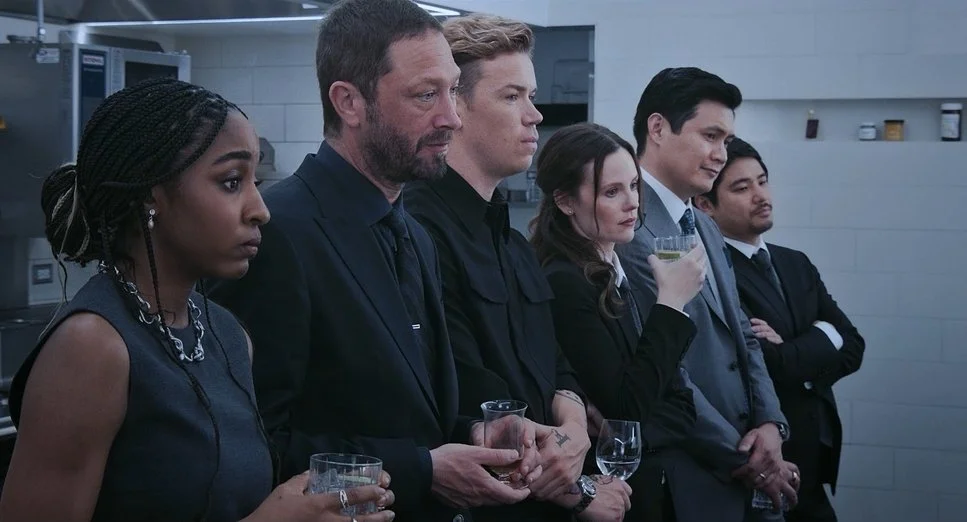
the bear (“forever, season 3)
In the end, what are we left with for these two Emmy contenders for Outstanding Comedy Series?
If asked the question “Is The Bear a comedy?”, I would have said “Yes” for its first season, “Somewhat” for its second, and “Not really” for its third (and, for that matter, its fourth). Drama can certainly bring the funnies, but I would argue that—to be a dramedy—the overall tone and approach to narrative needs some kind of a levity, a quirkiness, a wry wit or even black comedy undergirding that supports its storytelling with just a dash of distance from realism; in this regard, The Bear’s third season fails to deliver. Recalling the slippery nature of genre and Derrida’s idea of participation without belonging, the season could have shifted nomination gears and really shaken up the Emmys’ attempts at categorization. If The Bear’s third season had instead competed for Outstanding Drama Series – against such shows as The Pitt (2025), Severance (2022-2025) and The White Lotus (2021-2025) that are similarly dramas effectively using comedy for key moments – I could see an intriguing battle taking place. As it stands, in a manner similar to Hacks (2021-2025) and its deserved victory last year, we’re more likely to see The Bear pipped at the post in favor of The Studio (2025) as the current favourite to win Outstanding Comedy. The Bear no longer feels like a comedy.
Concurrently, if asked the question “Is Shrinking a comedy?”, despite its second season’s heavier themes, further unpacking of grief and deeper focus on mental health, my emphatic and enthusiastic “Yes” is supported by the show’s expert (though not always perfect) genre-mixing. In the grand tradition of prior Outstanding Comedy winners Ted Lassoand Hacks, Shrinking threads the needle by being truly funny and deeply dramatic when needed. Maybe in future The Bear’s Carmy could lie on the couch to benefit from Jimmy’s therapizing and absorb some of Shrinking’s comedic spirit.
Or perhaps, much like the restaurant’s transformation from The Beef to The Bear, the series could end its Comedy service and reopen to a different audience next year as a contender for Best Drama Series. Go on, Television Academy and Emmy voters. Let it rip.
References
Berman, M. 2025, “Is ‘The Bear’ Really A Comedy? And Other 2025 Emmy Nomination Observations”. Forbes, accessed 25 August 2025, https://www.forbes.com/sites/marcberman1/2025/07/15/is-the-bear-really-a-comedy-and-other-2025-emmy-nomination-observations/.
Derrida, J. & Ronell, A. 1980, “The Law of Genre”. Critical Inquiry 7(1), pp. 55-81.
Giorgis, H. 2024, “Everyone Knows The Bear Isn’t a Comedy”. The Atlantic, accessed 25 August 2025, https://www.theatlantic.com/culture/archive/2024/09/the-bear-emmys-comedy/679895/.
Gordinier, J. 2022, “A Conversation with the Guy Who created The Bear”. Esquire, accessed 27 August 2025, https://www.esquire.com/entertainment/tv/a40681092/the-bear-creator-christopher-storer-interview/.
Heritage, S. 2024, “The Bear is not a comedy and it’s time to stop pretending it is”. The Guardian, accessed 25 August 2025, https://www.theguardian.com/tv-and-radio/article/2024/jul/18/the-bear-emmys-comedy.
Nine Inch Nails. 2020, “Nine Inch Nails – Together (Audio Only)”. YouTube, accessed 27 August 2025, https://www.youtube.com/watch?v=ehNXOIpRr6c.
Robinson, M. 2024, “EMMYS WATCH 2024 – The Bear”. Pop Junctions, accessed 25 August 2025, https://henryjenkins.org/blog/2024/9/12/emmys-watch-2024-the-bear.
Romano, E. 2024, “Did We Really Need John Cena in The Bear?” Men’s Health, accessed 27 August 2025, https://www.menshealth.com/entertainment/a61485298/the-bear-season-3-john-cena-fak/.
Scherer, J. 2024, “The Bear recap: Is Marcus the kindest, softest, sincerest man in Chicago?” The AV Club, accessed 27 August 2025, https://www.avclub.com/the-bear-review-season-3-episode-5-children-1851570756.
Sepinwall, A. 2024, “‘The Bear’ Season 3 is everything you’ve been waiting for and (maybe too much) more”. Rolling Stone, accessed 27 August 2025, https://www.rollingstone.com/tv-movies/tv-movie-reviews/the-bear-season-3-review-1235045666/.
Television Academy. 2025, “77th Emmy Awards: 2024-2025 Rules and Procedures”. Television Academy, accessed 26 August 2025, https://www.televisionacademy.com/files/assets/Downloads/2025-rules-procedures-v2.1.pdf.
VanArendonk, K. 2024, “Is The Bear a Comedy? And Should I Care?” Vulture, accessed 25 August 2025,https://www.vulture.com/article/the-bear-comedy-debate.html.
Biography
Chris Comerford is a Lecturer in Communication and Media at the University of Wollongong, Australia. His research explores digital and screen media developments, fan cultures, serious leisure and digital pedagogies. Chris’s current project is an analysis of television's shifting cultural, social and industrial boundaries in the streaming era. He is the author of Cinematic Digital Television: Negotiating the Nexus of Production, Reception and Aesthetics (Routledge, 2022).