Gay Bombay: An Interview with Parmesh Shahani (Part One)

Parmesh Shahani, a recent alum of the Comparative Media Studies Masters Program, now consulting for some of the leading magazines and media companies in India, has published an exciting new book, Gay Bombay: Globalization, Love and (Be)Longing in Contemporary India. The book, which was adopted from his thesis, is a tour de force which manages to apply multiple modes of analysis -- ethnographic, historical, institutional, and autobiographical -- to explore a moment of change as his home country adjusts to what is at once an economic, a sexual, and a media revolution. As one of his thesis advisors, I had a chance to watch this manuscript take shape as he learned how to balance the competing conceptual frames needed to understand and explicate this complex set of transitions. Some of the most compelling aspects of the book are the most confessional: Shahani draws on his own sexual experiences to offer insights into how people are living these changes through their bodies. It is a daring approach, especially given the recent history of homophobic backlash in India, but it also sheds insights that no more distanced writing could offer. In my classes, we read the manifesto introduction to Hop on Pop: The Politics and Pleasures of Popular Culture which talks about the importance of writing about "culture that sticks to your skin" and the value of first person perspectives for describing our experiences with popular culture. I recall his enthusiasm as we discussed this material and was happy to see him push this idea to the limits as he was writing his thesis.

So, I hope I can be forgiven a teacher's pride in seeing one of my students make good as I share with you this interview with Shahani about his book, about the place of gay culture in India, and about the methods behind his research.

You write, "Gay does not mean what it does in America, or in the west at large. They have creatively played with it, modified it, made it their own." So what does gay mean in an Indian context?

Homosexuality isn't an alien concept in India. A brief flashback. Ancient Indian texts from the Vedic period and the Kama Sutra all indicate that ancient Hinduism had place for a 'third sex'. Even pre- colonial India was generally tolerant, but things changed under British rule, and in 1861, the British legal system was imposed on to India as the Indian Penal Code. Section 377 of this code was an offshoot of the British 1860 anti sodomy law, and thus male same sex acts were criminalized. The British also collected, translated, rearranged and sometimes rewrote Indian history as part of their 'Orientalist' agenda during the two centuries of their rule and part of their rearrangement included eliminating or marginalizing all traces of positive same-sex references.

Flash forward to today. In contemporary urban India (My research was based solely within this context), while there is no guilt-based taboo against homosexuality, being gay has its own unique set of connotations and experiences because of the cultural and social structures, and family pressures that insist on conformity to traditional patriarchal, heteronormative values.

Family, social and community connections are the primary ties, and gay people do not want to let go of these at all. People hardly come out, and even if they do, they want to accommodate their gay identity within the established framework. In the west, if families are un- accepting, then gay men often move away and form separate communities but almost all the people I interviewed for the book who were living in India were adamant that they were very connected to their families and did not want to move away from them at all.

The second aspect is the institution of heterosexual marriage. It is almost like a compulsory stage of life, and for many gay people, this is the biggest challenge that they have to negotiate. Sometimes they manage to avoid it, but many times, they don't, which creates a whole new set of problems. The pressure to conform is even more intense when the gay person is effeminate and thus visibly marked different. Rebellion against this pressure can sometimes mean banishment but in most cases, the gay person is not thrown out, but pressured to change his ways in order to maintain the family honour.

The third aspect is the law. The Indian penal code continues to criminalize same sex behaviour, and this is really problematic in several ways - in terms of the limitations to health and safe sex outreach, in terms of the restrictions to same sex partnerships in terms of cohabitation and planning a life together, etc. At the same time, there are also so many global influences, whether it is the coverage of gay marriage in the US that gets reported on regularly in India, or films like Brokeback Mountain, or gay dance parties and so on.

When urban Indian gay men construct an idea of their gayness, they draw upon all of these different components and create an imagination with global influences but rooted very much in the local realities. I think that to be gay in Gay Bombay signifies being 'glocal'; and gayness here stands for Indianized gayness. So, one might dance in a Western style disco anywhere else in the world, but one can only munch on a post-dance jalebi sweet in India. The online-offline group Gay Bombay, around which my book is based, is certainly inspired by Western notions of what it means to be gay - its dance parties, PFLAG style meets, website, etc, have all drawn from Western experiences; but they have been customized, glocalized, and made uniquely Indian. For example, several support group meets take place around uniquely Indian festivals such as Holi (festival of colours) and Raksha Bandhan (which celebrates brother-sister love), and the festivals are appropriated to meet the needs of the group.

How are debates about how we label sexual identities tied up with concerns about

westernization and globalization?

Oh, they are very tied up. In fact, this is the main line of attack used whenever the discourse around homosexuality becomes too public, or too threatening. It seems that being gay is something that needs to be prevented from happening to the impressionable young men and women of the country! Right wing Hindu fundamentalist groups like the Vishwa Hindu Parishad (World Hindu Council) and Rashtriya Swayamsevak Sangh (National Brotherhood of Volunteers) are only too happy to jump on the "anti-Indian culture" bandwagon at any given time. I write in the book about how the current Indian prime minister, Manmohan Singh was clearly flustered by a question about same sex marriages by a Canadian journalist and emphasized that these kinds of things were not appreciated in India. The lesbian themed movie Fire (1998) was deemed as an attack by "ultra westernized elite" on "the traditional set up" through "explicit lesbianism and other perversities" by the right-wing newspaper The Organizer.

Concerns about the negative impact of globalization are also expressed by certain

members of the gay community. The English speaking upper middle classes have largely been the beneficiaries of globalization (jobs, travel, media consumption, internet usage, etc.), but for the non-gay identified homosexuals from the working classes, life might have become harder.

Globalization is also viewed as a positive prism to promote the decriminalization of

homosexuality. This point of view wonders if it is right for a country that aspires to

be part of global scene to victimize its minorities. As the journalist Karan Thapar

writes in a recent Hindustan Times article, "by continuing to do so we make a mockery of our commitment to human rights leave aside all the Geneva conventions we have signed up to. So, for the sake of our democracy, this must be repealed."

On a lighter note, some of my interviewees, especially the older ones, were very

uncomfortable with what they felt were the Westernized aesthetics of the younger

generation. One of them was particularly dismayed at the younger lot's disdain for body hair and mustaches, something that he described as inherently Indian.

How are shifts in the status of gay people in India being represented in Indian popular culture, especially in Bollywood films?

I'm not at all satisfied with the way gay people are currently being represented in

Bollywood films. Given the number of gay people within the film industry itself, I'd

have liked that the representation be more nuanced! However there have certainly been

some shifts over the years and these give me hope there will be progress in future.

We should remember that Bollywood has a long tradition of having comic sequences or songs featuring cross-dressing male stars. For instance, Amitabh Bachchan in a sari in

1981's Laawaris (The Orphan), Rishi Kapoor in a dress in 1975's Rafoo Chakkar (The Runaways), Aamir Khan in a gown in 1995's Baazi (Game), and there are so many more

examples. Post the economic reforms of the 1990s, we begin to see the gay sidekick as a regular comic character in many Bollywood films, like Hum Hain Rahi Pyaar Ke (Companions on the Road of Love, 1993), Raja Hindustani (Indian King, 1996) and Taal (Rhythm, 1999). These markedly effeminate, comic gay characters are ridiculed but also indulgently patronized by the protagonists, and effectively neutralized. Thus, the camp phenomenon Bobby Darling (who often plays himself in his on screen appearances) is teased and mocked in whatever film he is a part of, but his place in the youth gang is never in doubt. It is of course understood that he will never behave transgressively with the hero, coo over him or insinuate desire for him. He is accepted, despite being different, because his loyalty as a friend and overall integration into the master narrative overrule his effeminate behavior and implied homosexuality.

In recent years, the camp comic has been replaced in films like Page 3 (2004) and Let's Enjoy (2004) with the debauched, decadent gay designer, hitting on straight men with impunity for his own sexual gratification. I suppose all of this mirrors Hollywood and its initial portrayals of gay men as comic characters or villains. It is still very rare to find somewhat complex gay characters, as in films like Bombay Boys (1998) and Split Wide Open (1999). I want to point to three films that make me hopeful about change, and one trend that I believe is going to accelerate the process. These three films are 2003's Kal Ho Na Ho (If Tomorrow Does Not Come), 2005's My Brother Nikhil and 2007's Honeymoon Travels Pvt. Ltd.

In Kal Ho Na Ho, there is a funny 'gay' subplot between the two lead actors, played by stars Shah Rukh Khan and Saif Ali Khan, who form the two corners of the love triangle in the film, with actress Preity Zinta as the third. Shah Rukh and Saif's characters pretend to be gay throughout the film, much to the disapproval of Kantaben, the housekeeper. They constantly caress each other and spout double- entendre dialogue to shock old Kantaben, and they take us on the ride with them. It is not us, the viewers, but Kantaben who is old fashioned. Shah Rukh and Saif also camped it up with each other as emcees of the annual Filmfare Awards in 2004 (India's Oscar equivalent) - a show that was broadcast to millions of viewers over television. I find the casual breeziness with both these stars treat gayness, both on film as well as on stage, energizing. What's the big deal, they seem to suggest. Get over it. (The film, incidentally also featured a gay kiss between two white New Yorkers in one song sequence, and an overtly camp Indian wedding planner!)

I was very impressed with My Brother Nikhil in 2005, a Bollywood film that dealt with the trials and tribulations of a gay champion swimmer who is found to be HIV positive (based on the real life story of Dominic D'Souza). Its debutant director Onir had managed to portray homosexuality with decency, sensitivity, romance, and something that was completely incidental to the story, which I thought was amazing.

The 2007 film Honeymoon Travels Pvt. Ltd. had two gay sub-plots. The story was about six couples on a honeymoon package tour vacation in Goa. During the course of the vacation, two of the respective husbands on the trip get attracted to each other. One comes out to his wife, who is furious about the deception, but they land up becoming friends. The other one gets back in the closet and says nothing to his newly married wife. The film won the Best Film award at the inaugural Indian Queer Media Awards in 2007, that honor sensitive media representations of LBGT characters.

The trends that I think will accelerate a more vibrant, complex portrayal of gay

characters are that of multiplex cinemas and a corporate-managed portfolio-style

approach towards film making. Over the past five years, both these trends have enabled a wide spectrum of Bollywood films being made, right from the low-budget indie like Bheja Fry (Brain Fry) to the giant mega-expensive Singh is Kinng type of extravaganza. At the lower end of the spectrum, there is enough of a chance for creativity and diversity; studios are now bankrolling different type of efforts and small-sized theatres and the ancillary satellite/DVD markets are ensuring that the shelf life of these low budget films gets extended.

Parmesh Shahani is based in Bombay, India, where he works on new media, venture capital and innovation for Mahindra & Mahindra and also serves as the Editorial Director of Verve magazine. He is also a research affiliate with the MIT Convergence Culture Consortium. His prior work experiences have included founding India's first youth website, business development for Sony's Indian television channel operations, writing and editing copy for Elle magazine and the Times of India group, helping make a low-budget feature film and teaching as a visiting faculty member at a Bombay college. Parmesh holds undergraduate degrees in commerce and education from the University of Bombay, and a graduate degree in Comparative Media Studies, from MIT. His first book - Gay Bombay: Globalization, Love and (Be)Longing in Contemporary India (New Delhi, London, Los Angeles, Singapore: Sage Publications) was released in April 2008.
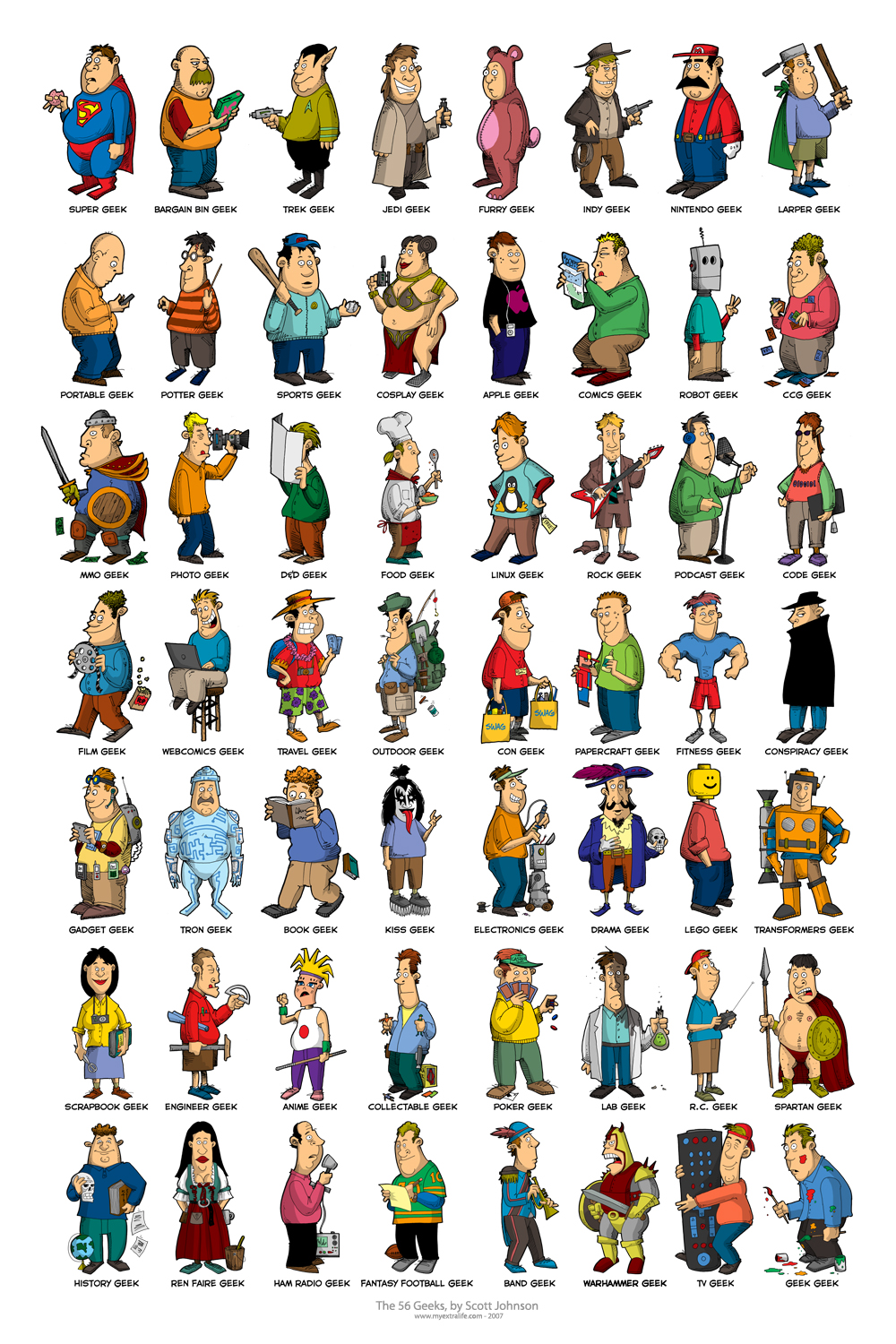
How Big a Geek Are You?

A few weeks ago, MIT launched a new video through its home page which was intended to prove to the world that MIT folks are not all geeks. (By the way, sorry not to be able to embed the video here but in the name of Youtube, the MIT geeks have decided they need to lock down their content rather than allowing it to spread!) It's an effective video which calls attention to many of the things I love about MIT but it left me frustrated. For one thing, most of the folks they depict still come across looking like geeks, not that there's anything wrong with that! And I thought the video would have been more effective if it broadened our definition of geek to include all of the rest of us at MIT who don't participate in the robotics competition or spend most of our time talking to our shoes. I'm proud to be a geek -- and to be geekish about culture and art. To my mind, saying that MIT isn't all geekish because it teaches the humanities is another way of saying that the humanities are cut off from the things that made MIT famous and I don't accept that core premise.

geeks2.jpg

So, rather than teaching our incoming students to feel proud because they aren't geeks, we hit them with a geek entrance exam, inspired by our colleague Junot Diaz's The Brief, Wondrous Life of Oscar Wao, which won the Pulitzer Prize for Literature. Diaz's writing is full of in joke references to games, comics, animated series, and pop music, all of which form the raw material for the various characters to construct their own personal mythologies.

Make no mistake -- Junot Diaz is a geek; he's also a hep cat. Both sides of his personality were on display during his appearance on The Colbert Report earlier this summer. In writing this book, it is clear that Diaz was struggling to make sense of his own geekish impulses and perhaps, this award winning book is his way of reflecting on how and why he belongs at MIT. It's an amazing book which I recommend to anyone reading this blog.

Every year we select a book to send to our graduate students to read over the summer. The books are carefully chosen to help set the tone and establish some key themes for the coming year. This year, we chose Oscar Wao and our graduate students are lucky enough to be able to sit down for a conversation with the author later this week. To get in the spirit, I put together a little quiz which includes many, though not all, of the geek references in the novel. We used it to break the ice as the graduate students got to show off their geek expertise. I thought you might also enjoy working their way through the quiz. I didn't bother to put together the answers. That's what Wikipedia is for, silly!

To show how geeky my students are, they ended up using ChaCha, the new text-message based research service, to track down answers to some of the hard to identify terms.

How Big a Geek Are You?

The following are geek culture references from Junot Diaz's The Brief Wondrous

Life of Oscar Wao.

How many of them can you identify?

How many other CMS students do you need to talk with to figure out what they all

are?

What digital resources would you use to track down this information?

Muhammad Ali

Akira

Lloyd Alexander

Appleseed

Isaac Asimov

Atari

Jeans Pierre Aumont

Balrogs

Billy Batson

Battle of the Planets

"Beam Me Up"

Big Blue Marble

Biggie Smalls

Blake's 7

Ben Bova

Bon Jovi

Brotherhood of Evil Mutants

Edgar Rice Burroughs

Captain America

Captain Horlock

Chaka

Chakobsa

Champions

Clay's Ark

Daniel Clowes

Dark Knight Returns

DC

D&D

Samuel Delaney

Deathstroke

DM

Doctor Who

Dr. Manhattan

Dr. Zaius

Dorsai

Dune

Eightball

Elvish

Encyclopedia Brown

The Exorcist

The Eyes of Mingus

Fantasy Games Unlimited

Final Fantasy

George Foreman

The Fountainhead

Galactus

Galadriel

Gamma World

Gen. Urko

Ghost

Gondolin

Good People of Sur

Gorilla Grod

Gary Gygax

Green Lantern

Hardware

Hector Lavoe

Robert Heinlein

Frank Herbert

Herculoids

Hernandez Brothers

Tracy Hickman

Harry Houdini

Robert E. Howard

Ill Will

Incredible Journey

Intellivision

Jabba the Hutt

Jack Kirby

Jedi

The Jeffersons

Kaneda

The Great Kazoo

Stephen King

Land of the Lost

Stan Lee

Ursula Le Guin

Lensman

Lothlorien

H.P. Lovecraft

Luba

Magic

Manhunter

Man Without a Face

Marvel

Mary Jane

Master Killer

John Merrick

Frank Miller

Minas Tirith

Miracle Man

Maria Montez

Alan Moore

Mordor

Morlock

My Side of the Mountain

"Nanoo-Nanoo"

Neo Tokyo

New Order

Andre Norton

"Oh Mighty Isis"

Palomar

Phantom of the Opera

Phantom Zone

Planet of the Apes

Roman Polaski

Project A

Rat Pack

Lou Reed

Return of the King

Robotech Macross

Rorshach

The Sandman

Sauron

Doc Savage

Shazam

Sindarin

Slan

"Doc" Smith

Robert Smith

Solomon Grundy

Sound of Music

Space Ghost

Squadron Supreme

Olaf Stapledon

Star Blazers

Star Trek

Street Fighter

Tom Swift

Sycorax

Take Back the Night

Teen Titans

Tetsuo

The Terminator 2

This Island Earth

Three's Company

J.R.R. Tolkien

Tomoko

Tribe

Tripods

Twilight Zone

U2

Ultraman

Adrian Veidt

Veritech Fighter

Virus

The Watcher

Watchman

Watership Down

Margaret Weis

H.G. Wells

What If

What's Happening

Wonder Woman

X-Men

Zardoz

Impressions from Two Comic-Con Newbies

By now, some of you will have seen the spot NBC has been running during the Olympics celebrating the enormous audience response to the screening of the first episode of Heroes' third season at Comic-Con. I was lucky enough to be there in Hall H and if anything, the advertisements underplays the excitement of watching an episode of one of my favorite series with some 6000 other fans. There were so many crowd pleasing moments in the episode and so much evidence that they had gone back to the drawing board and responded to fan reactions to the lackluster second season. It was as if the episode had been designed and produced simply to be shown at Comic-Con!

And indeed, this may be the case, given the growing centrality of this convention to the way cult media operates in America today and given the particular history of Heroes at this convention.

I went to Comic Con for the first time this year. As it happens, a long time friend, Kristin Thompson, was also attending for the first time. Thompson, a noted film scholar, is the co-author of the Observations on film art and Film Art blog. I featured her here last year in an interview ( Part One, Part Two, Part Three) focused on her recent book, The Frodo Franchise, which studies the production of Lord of the Rings and its related media offshoots. She was speaking on a panel focused on the forthcoming Hobbit movie, while I was at San Diego purely in vacation mode with my wife and son along. We got together Sunday night after all of the events were over to record our initial impressions of the event. This transcript is being cross-posted on both of our blogs.

Next time, I am going to share some impressions of the specific previews and panels I attended.

On Different Tracks

We started off by talking about what we had each concentrated on.

HJ: It's very clear that it's like six or seven different conventions I could have gone to in the course of the weekend, and it would be a totally different experience depending on which one you went to.

KT: Yeah, I had that impression that there were probably people here mainly to buy stuff, some people here mainly to see celebrities and get autographs and so on.

HJ: And even on that there was a split between the film and the TV people. And there's a whole comics track. Under other circumstances I would have just been spending my entire time at comics panels, because they're the strongest comics sessions anywhere in the country.

Coming Alone vs. Having Something Specific To Do

KT: I was happy that I had something to anchor myself, though. I don't think I'd like to come here, at least for the first time, alone and not having anything specific to do.

HJ: Luckily Henry and Cynthia were along, but it was overwhelming a bit, trying to negotiate and keep up with three people in a space that congested. So that was its own kind of challenge. Sometimes I was thinking it would be great just to be a single person navigating through the space and not have to have large-scale logistics! The scale of it just blows you away. I've been on the floor at E3, which is supposed to be one of the largest entertainment trade shows. I've done South by Southwest. But neither of them are anywhere near the scale of Comic-Con.

The Scale of the Event

KT: They always say 125,000, because that's the number of tickets they sell, but then you've got all the exhibitors and the people who are presenting on panels. It must be another few tens of thousands packed into that building.

HJ: Yeah, at least.

KT: I was kind of amazed that it worked as well as it did.

HJ: Yeah, they did a remarkable job in just managing crowd control. Getting people in and out of things with some degree of order. Some more bullying guards than others, but it was probably necessary to keep the peace.

KT: Yeah, there were a LOT of guards and guides and so on, but people seemed really to be polite, on the whole. I was taking the shuttle bus from a hotel down the street [from my hotel] every day and then coming back by shuttle bus. This morning the bus was quite late compared to other days. It was supposed to come every ten minutes, and we were there maybe twenty. And people who were arriving made this very neat horse-shoe shaped line on the sidewalk. It was very orderly.

HJ: Almost no signs of anyone breaking in line, despite the intensity of some people's desire to get into things. Someone commented behind me about 'honor among geeks,' and that's probably a good description. There's a strong honor code.

KT: The venue seems to be up to having that many people in it. I hardly had to wait for rest rooms at all.

HJ: No, the facilities are good.

We ended up doing a fair amount of what they call here 'camping,' which is sitting in several panels in a row because there was something we really wanted to see. But you end up trapped in a space with no access to food. Hall H at least has rest-room facilities in the space.

KT: I didn't try camping myself. But I was going to this action-figure panel because it involved Toy Biz, which did the action figures for Lord of the Rings. I heard from people in line that a lot of them were there for the next panel, which was on Sanctuary, which I know nothing about, but they were very devoted and were saying, "They shouldn't have put this in such a small room."

HJ: There is a sense that you vote with your body at Comic-Con. One of my newest fandoms is Middleman, which is a new ABC family show, and it was in a small room, but we packed it. There was a sense of accomplishment. The producer looked out and said, 'This may be the whole audience for the show,' because it hasn't gotten much publicity yet. There was a sense that just being there was show of support for things.

KT: I wonder how many of the companies have people at those panels--in the audience. I hadn't realized it, but there was somebody from New Line--who's probably not from New Line anymore--and then some Warner Bros. people, supposedly, sitting out in the audience for the Hobbit one. That kind of surprised me. Why bother?

HJ: At the larger sessions it seemed they had blocked off four or five rows of space just for the studio people. Rarely were they occupied to anywhere near that extent, so it was maybe overkill. But there were a few sessions where there were a significant number of people. The Battlestar Gallactica, for example. There was a large studio contingent there for that. Suits and friends and family and other writers, because that was a kind of last hurrah for that production. They just wrapped shooting the last episode two weeks ago, so this would have been a major last gathering of a lot of those people. They said they really hadn't had a chance to have a wrap party yet, so in a sense it probably was.

The Hall H Experience

KT: Did you have the Hall H experience at all?

HJ: We went to see Heroes one morning, which was the first time, they said, a TV show had made it into Hall H. We managed to be there for Watchmen and a few of the other movies that followed it.

KT: I avoided it for a while because I kept hearing that there would be incredibly long lines, and I pictured just sitting there for hours and hours and hours reading and possibly not getting into what I wanted to see anyway. So I avoided it until yesterday [Saturday], and I went to the Terminator Salvation one. I wanted really to go to the Pixar one, so I went to get in line very early, and ended up getting in on time for Terminator Salvation.

HJ: Well, for Heroes we waited for about an hour outside and then got in. Then there was a fairly long wait to get started, but then we knew that there were several things after that that we wanted to see as well.

KT: And was it full?

HJ: It was packed. But Heroes has been a kind of success story of Comic-Con. They showed the pilot there before it debuted, and Heroes is pretty desperate at this point to rekindle fan enthusiasm. Last season is largely seen as a bust. Hence their decision not to come back from the strike. They did a partial season and put it off to the fall, because the ratings were plummeting and they were getting bad buzz from fans. So they wanted to come back this year with a killer. They showed the entire opening episode, which was definitely a fan-pleaser. They had figured out what had gone wrong the first season and had put together something that was going to please. So there was lots of extended applause at key moments. It's kind of fascinating to watch an episode of a TV show with 6500 other people.

The Exhibition Hall

KT: I only discovered the comics section today, as I was about ready to leave, because I hadn't really been aware of which sections were devoted to it. I sort of thought it was all random, but obviously they do devote one big section to all the people who are selling old comic books. I suppose you could just stay in one part of the hall and never see the rest of it.

HJ: I felt I barely made a dent in the hall. The first day I didn't quite realize how big it was, so I was just going up every aisle, and the second and third day I was going on targeted missions. But it still was just so immense that there's no way you could see it all.

KT: And it's so congested.

HJ: Especially if you get to the studio side of things.

Autographs and Planning

KT: I could not figure out what was going on at the Warner Bros. exhibit, but they were constantly surrounded by lines and lines and lines of people who were obstructing the aisles around them. I guess they had people from their TV shows signing.

HJ: They seemed to. I kept stumbling into people. You wander around one corner and there's Peter Mayhew of Chewbacca fame sitting there, and Will Frakes suddenly would pop up at another table. Neither was particularly advertised. Then there were all the advertised autographed stuff. There were a lot of people there that you would know in another context.

KT: I don't know how you would find out about all of those things in advance. I don't think Lynda Barry was listed in the program as doing autographs, but she was at the Drawn and Quarterly booth at certain times. I missed her entirely. I got her autograph because I was sitting in the audience before her presentation and she sat down beside me.

HJ: They seemed to have a certain number of people who were there to do autographs, but then there were all these other people randomly. I guess you had to follow a particular company and maybe they posted on the Web.

KT: Yes, I was doing autographs at certain times for my book, and it was just on TheOneRing.net and The Frodo Franchise. You have to really investigate, go in with a plan.

HJ: It seems to be the case: The more you plan, the more you can get out of the experience.

KT: We were selling copies of my book at this very small booth, and I was there for an hour at different times of day on three days. I think almost everyone, if not everyone, who bought a copy came to the booth specifically to buy it. There were no impulse purchases. I don't think people buy books at Comic-Con.

HJ: I looked at comics while I was there, but I would buy them from my dealer back in Boston or online at Amazon or Mile High Comics. Why I would weigh my suitcase down with comics in the age when it's so easy to buy stuff digitally?

KT: Not new ones.

HJ: Not new ones. Collectibles, sure.

KT: Unless you have them signed.

Fan Culture hangs on at Comic-Con

HJ: Usually the cons I go to are small-scale, very intimate, you know a high number of the people who are coming. It's fan-driven and fan-focused. This was like Creation Con on steroids!

KT: Though technically speaking, it is run by fans; there's a committee.

HJ: There were still places and niches and corners where the fan stuff still ruled. You wouldn't see fanzines there, but then you wouldn't see them at most fan-run cons these days, since everything's moved to the Web.

KT: Well, there's Artists' Alley, which is way over in the corner. That seems to be fans who are aspiring to be pros but haven't really made it yet.

HJ: Well, it was a mix. I mean, you'd see Paul Chadwick there [author of Concrete series, published by Dark Horse Comics] or Kim Deitch [author of graphic novels such as The Boulevard of Broken Dreams and Shadowland], who were independent and weren't necessarily going to be there with a company, but yeah, it's definitely a lot of wannabes in some of that space.

And then fans show themselves through costumes. For all the jokes about women in Princess Leia costumes--and I saw maybe a dozen Princess Leia slave-girl outfits--it was still a way in which fans asserted their presence. There were some quite remarkable pieces of fan performance going on there. There was someone doing Cocteau's Beauty and the Beast, which had quite a spectacular Beast costume--a little more arty than one expects at a fan con.

Genre

KT mentioned having seen Focus Features' Hamlet 2 preview.

HJ: The role of comedy here interests me a lot. I'm always intrigued: What're the borders of what a fan text is and what isn't a fan text? Here comedy seems to creep into fandom in a more definitive way than I've seen elsewhere. So there was the focus on Hamlet 2, there was Harold and Kumar, The Big Bang Theory [TV series, 2007-08], but then just a bunch of panels on writing for sit-coms. So it's probably just the industry's priorities, but it's interesting that it doesn't extend to drama. You can imagine a lot of people there being into The Wire or The Shield or some equivalent, and it didn't cross over in that direction.

KT: I suppose it's what the studios think the fans want. It's true there was a lot of comedies, and martial arts, and war material.

HJ: I think martial arts probably has crept into fandom pretty definitively over time. But it's interesting to see where the boundaries are. We stumbled across one booth that had just a porn star signing her pictures, and it sort of outraged my son. Pornography isn't fandom in his world view, but he thought nothing of going up to get wrestlers to sign autographs. Probably in any other fan con, the strong presence of wrestling performers would be out of keeping with fandom.

The Economics of It

KT: I was struck by how cheap it is, basically. How much was it for a single day pass?

HJ: Twenty-five dollars for a single day pass. It's not bad at all for the scale of what you get. [Four-day passes are $75.]

KT: Some of the smaller tables rented for something like $380 for the full period, which I thought was kind of cheap. But obviously they need both sides of it. They need the exhibitors to attract the people and they need the people to attract the exhibitors, so keeping the cost down makes perfect sense.

HJ: The scale at which companies brought in people was also truly remarkable. I certainly have been to cons where they might have two or three performers from a show, but they brought the entire regulars of Heroes down, as well as the entire writing team. And Heroes is a large, large cast. They scarcely had time for anyone to say anything, but all lined up there on a panel, it was a pretty spectacular display. And Watchmen did pretty much the same thing. All the main characters in Watchmen were there with the director.

KT: That reminds me of the coverage that the film events and I suppose the television events, too, get in the trade press. I'm sure you read some of these articles about how, 'Oh, it's all becoming so much Hollywood. The big media companies are coming in and taking over,' and so on. It struck me that Hall H is really kind of a world unto itself.

HJ: It is.

KT: It's separate. You have to go out of the building and get in this line, and then you have to go out of the building when you exit. It's quite a hike to get there if you're around D or C in the exhibition hall. I think probably they don't see much of the rest of the con.

HJ: It does seem largely cut off. That's the sort of classic place where people camp. And so there's almost an interesting tactical advantage in being one of the filler programs between the main events, if you can really maneuver into that. It's like being right after a hit TV show or between two hit TV shows. You're going to get exposure to people who wouldn't otherwise. Yesterday Chuck was between Battlestar Gallactica and the Fringe panel. I've never seen Chuck, but I wanted to see Battlestar and I wanted to see J. J. Abrams [executive producer of Lost and one episode of Fringe], so we stuck through it. And we'll probably give Chuck a shot come fall as a result of being exposed to it in that way. There's lots of things that get sandwiched in that probably get a boost off of this. Or they could hurt themselves.

KT: Bring the wrong scenes or whatever.

HJ: Wrong scenes or just the people are inarticulate. There's certainly a range of comfort level up there.

In terms of the press coverage, the fact that Entertainment Weekly put Watchmen on its cover this week a year before the film comes out, purely on the basis of it playing at Comic-Con, says something about the publicity value of this thing.

KT: Yes, for the films there's no doubt about its publicity value. I just think that if the big entertainment journalists plant themselves in Hall H and don't pay a lot of attention, then you get coverage that makes it sound as though the movies are just taking over everything.

<

strong>HJ: It's odd. It's certainly every bit as spectacular a place to do TV as it is to do film. And comics. I couldn't believe the betrayal I was committing in not seeing the full writers of Mad magazine in the 1960s or seeing Forrest J. Ackerman and his staff--things that were really significant to me as a kid. But they were competing with other things that I valued even more. So there are things that you would have killed to get to in any other context that you pass up because there's so much going on at once. You can't get to it all.

The Gender Composition of the Attendees and the Industry

HJ: One of the things that struck me was the gender composition here was much--well, certainly there were more guys than girls, but compared to, say, E3 or many other cons I've gone to, the gender balance was surprisingly solid. There were an awful lot of women there.

KT: Yeah, they remarked on that on the Harry Potter panel this morning, saying that, unlike those cons, there were probably more women than men in that particular room.

HJ: That makes sense.

KT: When I went to the One Ring Celebration, it was maybe 95% women. I suspect it's partly a factor of whether a con has gaming facilities. Gamers will come, and they're mostly going to be guys, although probably not as much as it used to be.

HJ: Historically, if you go to Creation cons, which are more star-centered, men turn out much more, whereas if you go to a fan-driven con, which is fanzine oriented, women turn out much more. But because this combines everything, you've got just such a spread of people.

I've seen people argue that Comic-Con is becoming powerful and it's exaggerating the power of fan men at the expense of fan women, that the fan-boy mafia is taking over the entertainment industry. Certainly you see it on the producers' side, that an awful lot of the guys onstage would have been in the audience a decade before--and they're mostly guys. But what's interesting is to see the audiences that they're trying to respond to and engage with has a large female component, and that's got to have an impact over time on what plays here and what doesn't.

KT: One of the people on the 'Masters of the Web' panel on Thursday morning was making the point that now the younger studio executives are either people who had their own Websites a few years ago or they were in college when the big Websites were being formed. Now they've grown up into adulthood reading that stuff, and they're now in position of power and will continue to be in the industry.

HJ: It was fascinating just to watch the producers, writers, stars, to see which ones were really comfortable in the space and which ones weren't. Someone like Joss Whedon just grew up in that space. That's his world. He was totally in his element, and he would understand what questions were being asked and how to respond to them and could use in-joke references to the culture, whereas someone like Alan Ball (executive producer), who no doubt in another context would be totally articulate and interesting, seemed to feel uncomfortable. Moving from Six Feet Under to True Blood, he doesn't yet know how to "speak fan." On the other hand, Zack Snyder [director of 300] has got to be the most totally inarticulate person I've seen on a stage in a long time. Watchmen is going to be his second movie, and he totally works with images, but the ability to use words did not seem to be his strong suit. Some of them who have done multiple fan shows seem really comfortable, and others just looked in shellshock up there.

MacArthur's Participatory Learning Initiative Goes International

I've been showcasing this week some of the work we've been doing with the MacArthur Foundation on new media literacies. If you are feeling inspired, you might consider submitting something to the second round of the foundation's Digital Media and Learning Competition. Here are the details which were just released this week: MACARTHUR'S $2 MILLION DIGITAL MEDIA AND LEARNING COMPETITION FOCUSES ON PARTICIPATORY LEARNING, GOES INTERNATIONAL

Chicago, IL (August 18, 2008) - The John D. and Catherine T. MacArthur Foundation, in collaboration with the University of California, Irvine, Duke University and the virtual network HASTAC, announced today a second annual open-call competition that will provide $2 million in awards to innovators shaping the field of digital media and learning. The Digital Media and Learning Competition, supported through a grant to the University of California, Irvine and administered by HASTAC, has been expanded to pilot international submissions and introduce a new category focusing on young innovators aged 18-25.

"Digital media are helping to make the world smaller, spread ideas, and encourage collaboration across borders and among people who otherwise might not have an opportunity to work together," said MacArthur President Jonathan Fanton. "To ensure support for the freshest thinking and most innovative applications of digital media to learning, we have expanded this year's competition to include international submissions and ideas from young people, who are often the pioneers of the digital space."

Awards will be given in two categories:

* Innovation in Participatory Learning Awards will support projects that demonstrate new modes of participatory learning, in which people take part in virtual communities, share ideas, comment on one another's projects, and advance goals together. Successful projects will promote participatory learning in a variety of environments: through the creation of new digital tools, modification of existing ones, or use of digital media in some other novel way. Submissions will be accepted from applicants in Canada, People's Republic of China, India, Japan, Mexico, the Netherlands, Nigeria, Russia, Singapore, South Africa, the United Kingdom, and the United States, countries in which HASTAC or MacArthur have significant experience. Winners will receive between $30,000 and $250,000.

* Young Innovator Awards are designed to encourage young people aged 18-25 to think boldly about "what comes next" in participatory learning and to contribute to making it happen. Winners will receive funding to do an internship with a sponsor organization to help bring their most visionary ideas from the "garage" stage to implementation. For this competition cycle, submissions will only be accepted from applicants in the United States. Winners will receive between $5,000 and $30,000.

This year's competition will include an online forum where applicants can post their ideas, solicit feedback, offer their services, and connect with other applicants and potential collaborators. All material posted to this "Digital Media and Learning Scratchpad" is publicly accessible. Participation is voluntary and not required for application.

"Participatory learning allows people to work together online toward some collective purpose, sharing knowledge, insights, and expertise, and most important, learning together," said Cathy N. Davidson, John Hope Franklin Humanities Institute Professor at Duke University and HASTAC co-founder.

The open competition will be administered by the Humanities, Arts, Science and Technology Advanced Collaboratory (HASTAC), which was founded and is primarily operated at two university centers, the University of California Humanities Research Institute at the University of California, Irvine and the John Hope Franklin Center at Duke University. Applications will be judged by an expert panel of scholars, educators, entrepreneurs, journalists, and other digital media specialists.

"With the digital media and learning initiative, the MacArthur Foundation is playing a leading role in reshaping both institutional and informal learning practices," said David Theo Goldberg, HASTAC co-founder and director of the University of California's Humanities Research Institute. "Traditional learning practices are being supplemented and supplanted by new digital media, which both enable and extend their reach through virtual institutions like HASTAC. This is a natural partnership."

Competition winners will join an existing community of 17 awardees from last year, including a mobile musical laboratory, a digital humanitarian assistance game derived from existing military simulation technology, and a mobile phone project hat connects young African social entepreneurs with young North American professionals. Winners also will be invited to showcase their work at a conference that will include venture capitalists, entrepreneurs, educators and new media experts seeking the best ideas about digital participatory learning.

Applications are due Oct. 15, 2008 and winners will be publicly announced in April 2009. Detailed information on the competition is available online at www.dmlcompetition.net.

How Fan Fiction Can Teach Us a New Way to Read Moby-Dick (Part Two)

Last time, I shared with you part of our teacher's strategy guide on "Reading in a Participatory Culture." Today, I am running the second part of our discussion of fan fiction. This time, we apply concepts from the study of fan reading and writing practices to talk about the teaching of Melville's Moby-Dick. I've received several questions off-line about the context of this material in the guide itself. We've heard two conflicting pieces of advice, which I think reflects two different kinds of teachers. On the one hand, we hear that teachers want lesson plans they can rip and read which are carefully calibrated to the standards and indeed, the first part of the guide provides precisely that. Because we are focusing on local schools for our testing phase, we've focused on our own state standards, though we are also attentive to national trends in this area. We've already started a small scale teacher training program for the folks field testing our guide this year. Teachers at our workshop were able to take some of our lessons, go straight to work, and produce good results without reading the rest of the guide.

We also hear, though, that certain teachers want to learn a new approach to teaching and want to understand more fully the philosophy behind the approach. While we are offering a wealth of resources specific to Moby-Dick, we also very much want the exercises and philosophy to be flexible enough that they can be applied to the full range of books that get taught in high school English and language arts classes. We've produced a seperate "expert voices" section that provides more detailed background. The material I am running on the blog right now is from that section. We have heard from some teachers so far that they do find this material very helpful but my bet, from interacting with them, is that other teachers won't ever look at it because the pace of their work life won't allow it. We've tried to design things so teachers can dig as deep as they want or work only on the top level.

One of the goals of the guide is to draw on several decades of ethnographic work on how and why people read in order to encourage teachers to be open to a much broader range of interpretations through their classes. One of the ways we do so is being very self reflective about the reading practices that shaped the guide itself. We have foregrounded four different readers who were involved in producing the guide -- Wyn Kelly as a literary scholar; Rudy Cabrera as a performer; Ricardo Pitts-Wiley as a creative artist; and myself as a media scholar and fan. I thought you might enjoy this video, created by Deb Lui, for the Guide, which introduces these four readers and the ways they approach Moby Dick.

Now, enjoy Part Two of the section on fan fiction and literature. And again, I would appreciate any feedback you may have about the approach we have taken to this section of the guide. Here, I introduce a new conceptual framework for thinking about what aspects of texts provide the most fertile openings for fan interventions.

Reading Moby-Dick As a Fan

Fans are searching for unrealized potentials in the story that might provide a springboard for their own creative activities. We might identify at least five basic elements in a text that can inspire fan interventions. Learning to read as a fan often involves learning to find such openings for speculation and creative extension. [1]

  • Kernels -- pieces of information introduced into a narrative to hint at a larger world but not fully developed within the story itself. Kernels typically pull us away from the core plot line and introduce other possible stories to explore. For example, consider the meeting between the captains of the Pequod and the Rachel which occurs near the end of Melville's novel (Chapter cxxviii). Captain Gardiner of the Rachel is searching for a missing boat, lost the night before, which has his own son aboard. He solicits Ahab's help in the search. In doing so, he tells Ahab, "For you too have a boy, Captain Ahab - though but a child, and nestling safely at home now - a child of your old age too." The detail is added here to show how much Ahab is turning his back on all that is human in himself. Yet, this one phrase contains the seeds of an entire story of how and why Ahab had a son at such a late age, what kind of father Ahab might have been, and so forth. We may also wonder how Gardiner knows about Ahab's son, since the book describes him as a "stranger." The John Huston film version goes so far as to suggest that Gardiner was also from New Bedford, which opens up the possibility that the two men knew each other in the past. What might their previous relationship have looked like? Were they boyhood friends or bitter rivals? Were their wives sisters or friends? Did the two sons know each other? Might Ahab's wife have baby-sat for Gardiner's son? Soon, we have the seeds of a new story about the relationship between these two men.
  • Holes -- plot elements readers perceive as missing from the narrative but central to their understanding of its characters. Holes typically impact the primary plot. In some cases, "holes" simply reflect the different priorities for writers and readers who may have different motives and interests. For example, consider the story of how Ahab lost his leg. In many ways, this story is central to the trajectory of the novel but we receive only fragmentary bits of information about what actually happened and why this event has had such a transformative impact on Ahab, while other seamen we meet have adjusted more fully to the losses of life and limb that are to be expected in pursuing such a dangerous profession. What assumptions do you make as a reader about who Ahab was -- already a captain, a young crewmember on board some one else's ship -- or where he was when this incident occurred? In fandom, one could imagine a large number of different stories emerging to explain what happened, and each version might reflect a different interpretation of Ahab's character and motives.
  • Contradictions -- Two or more elements in the narrative which, intentionally or unintentionally, suggest alternative possibilities for the characters. Are the characters in Moby-Dick doomed from the start, as might be suggested by the prophecies of Elijah and Gabriel? Does this suggest some model of fate or divine retribution, as might be implied by Father Mapple's sermon about Jonah? Or might we see the characters as exerting a greater control over what happens to them, having the chance to make a choice which might alter the course of events, as is implied by some of the exchanges between Ahab and Starbuck? Different writers could construct different stories from the plot of Moby-Dick depending on how they responded to this core philosophical question about the nature of free will. And we can imagine several stories emerging around the mysterious figure of Elijah. Is Elijah someone gifted with extraordinary visions? Is he a mad man? Does he have a history with Ahab that might allow him insights into the Captain's character and thus allow Elijah to anticipate what choices Ahab is likely to make?
  • Silences -- Elements that were systematically excluded from the narrative with ideological consequences. As Wyn Kelley notes in "Where Are the Women?," many writers have complained about the absence of female characters in Moby-Dick, suggesting that we can not fully understand the world of men without also understanding the experience of women. Some works -- such as the John Huston version -- call attention to the place of women in whaling culture, if only incidentally. Melville hints at this culture only through a few scattered references to the families that Ahab and Starbuck left behind. These references can provide the starting point for a different story, as occurs in Sena Jeter Naslund's novel, Ahab's Wife; we might imagine another version of the story where Ahab was female, as occurs in Moby-Dick: Then and Now, or we might use the plot of Moby-Dick as the starting point for creating a totally different story set in another kind of world where women can play the same kind of roles as the men play in Melville's novel, as occurs in the Battlestar Galactica episode, "Scar."
  • Potentials -- Projections about what might have happened to the characters that extend beyond the borders of the narrative. Many readers finish a novel and find themselves wanting to speculate about "what happens next." As Pugh writes, "Whenever a canon closes, someone somewhere will mourn it enough to reopen it....Even though we may feel that the canonical ending is 'right' artistically, if we liked the story we may still not be ready for it to end, for the characters and milieu that have become real to us to be folded up and put back in the puppeteer's box." For example, we might well wonder what kind of person Ishmael becomes after being rescued. Melville offers us some hints -- even if only because Ishmael chooses to tell this story in the first place. Yet, in our world, someone like Ishmael might be wracked with "survivor guilt," feeling responsibility for the deaths of his friends, or wondering why he alone made it through alive. How might Ishmael have dealt with these powerful emotions? How might these events have changed him from the character we see at the start of the novel? Might we imagine some future romance helping to "comfort" and "nurse" him through his "hurts"?

The examples above suggest several additional aspects of reading a narrative as a fan. First, fans generally focus on characters and their relationships as their point of entry. Clearly, Melville's novel, with its digressions and fragmentation, raises many more character issues than it resolves -- for example, the richly drawn but only occasionally explored friendship between Ishmael and Queequeg or the comradeship between Queequeg, Daggoo, and Tashtego, or the relationship between Ahab and Fedallah or... Second, fans look for worlds that are richer, have greater potentials, than can be used up within a single story. They are particularly interested in back story -- the untold narratives that explain how the characters became the people we encounter within a particular story. Many contemporary television series reward this fan interest by parceling out bits and fragments of back story over time. Here, again, part of the pleasure of reading Moby-Dick is absorbing all of the incidental details about the ship, its crew, the other ships, and life in New Bedford, and through chapters such as "The Town-Ho's Story," Melville tells us again and again that this world is full of stories beyond the ones the novel tells.

For the most part, fan reading practices are directed at popular television series or films, but there's no reason why they can't be applied to works from the literary canon. Teachers might find that students respond well to being asked to look at Moby-Dick and other literary texts through this lens. Here's a process you might follow:

  • Encourage students to find examples of Kernels, Holes, Contradictions, Silences, and Potentials.
  • Ask them to consider what purposes these elements play within the original novel.
  • Invite them to speculate on how these elements might provide the basis for additional stories.
  • Tell them to find other passages that shed insight into the core character relationships here.
  • Discuss what elements would need to be in place for a new story to feel like it belongs in this fictional world.
  • Have students write stories reflecting their insights.
  • Share stories between students, especially those working with the same elements, so that they have a sense of the very different ways writers might build upon these same starting points.

Ricardo Pitts-Wiley took a very similar approach with the students in the Rhode Island correctional program, asking them to select a character and explore the novel from their point of view. Students were encouraged to develop a character sketch which described what kind of person the character would be if he or she were alive today. These character sketches were then combined to construct a plot in which these characters met at the Spouter Inn and set out on a quest together. Such an approach might tap the techniques of fantasy role play games to sketch out the events of the story, and then the student writers might contribute to a shared narrative of the experience. Such techniques led to the writing of the Wild Cards series of fantasy novels, for example. [2]

The "Transformative Work" of Fan Culture

Fan stories are not simply "extensions" or "continuations" of the original series. They are constructing arguments through new stories rather than critical essays. Just as a literary essay uses text to respond to text, fan fiction uses fiction to respond to fiction. You will find all kinds of argumentation about interpretation woven through most fan-produced stories. A good fan story references key events or bits of dialogue as evidence to support its particular interpretation of the characters' motives and actions. Secondary details are deployed to suggest the story might have plausibly occurred in the fictional world depicted in the original. There are certainly bad stories that don't dig deeply into the characters or which fall back on fairly banal interpretations, but good fan fiction emerges from a deep respect for the original work and reflects a desire to explore some aspect of it that has sparked the fan writer's imagination or curiosity.

Fan fiction is speculative but it is also interpretative. And more than this, it is creative. The fan writer wants to create a new story that is entertaining in its own right and offer it to perhaps the most demanding audience you could imagine -- other readers who are deeply invested experts about the original work. The new story may operate within any number of genres that have emerged from the realm of fan fiction and which represent shared ways of reading and rewriting favorite works.

Novelist Michael Chabon is a fan of the creative works of fans and has written an essay discussing the value of fan fiction in relation to Sherlock Holmes. He argues:

All enduring popular literature has this open-ended quality, and extends this invitation to the reader to continue, on his or her own, with the adventure....It creates a sense of an infinite horizon of play, an endless game board; it spawns, without trying, a thousand sequels, diagrams, and web sites....Through parody and pastiche, allusion and homage, retelling and reimagining the stories that were told before us and that we have come of age loving -- amateurs -- we proceed, seeking out the blank places in the map that our favorite writers, in their greatness and negligence, have left for us, hoping to pass on to our own readers -- should we be lucky enough to find any -- some of the pleasure that we ourselves have taken in the stuff we love: to get in on the game. All novels are sequels; influence is bliss.

[3]

Not all writers would agree that writing fan fiction is a logical or legitimate extension of critical interpretation. Fantasy writer Robin Hobb has raised sharp concerns about how fan fiction impacts her own creative process:

Every fan fiction I've read to date, based on my world or any other writer's world, has focused on changing the writer's careful work to suit the foible of the fan writer. Romances are invented, gender identities changed, fetishes indulged and endings are altered. It's not flattery. To me, it is the fan fiction writer saying, 'Look, the original author really screwed up the story, so I'm going to fix it. Here is how it should have gone.'...The tragic ending is re-written, or a dead character is brought back to life, for example. The intent of the author is ignored. A writer puts a great deal of thought into what goes into the story and what doesn't. If a particular scene doesn't happen 'on stage' before the reader's eyes, there is probably a reason for it. If something is left nebulous, it is because the author intends for it to be nebulous. To use an analogy, we look at the Mona Lisa and wonder. Each of us draws his own conclusions about her elusive smile. We don't draw eyebrows on her to make her look surprised, or put a balloon caption over her head. Yet much fan fiction does just that. Fan fiction closes up the space that I have engineered into the story, and the reader is told what he must think rather than being allowed to observe the characters and draw his own conclusions.

[4]

By contrast, consider this statement from the introduction to an important anthology of scholarly essays about fan fiction:

Work in progress is a term used in the fan fiction world to describe a piece of fiction still in the process of being written but not yet completed....The appeal of works in progress lies in part in the ways fans engage with an open text; it invites responses, permits shared authorship, and enjoins a sense of community....Every fan story is in this sense a work in progress, even when the story has been completed....In most cases, the resulting story is part collaboration and part response to not only the source text, but also the cultural context within and outside the fannish community in which it is produced....When the story is finally complete and published, likely online but perhaps in print, the work in progress among the creators shifts to the work in progress among the readers....The source text in many cases are serial, in progress, and constantly changing, as are the fan stories set in these universes.

[5]

These writers see both the fan text and the source text as open-ended, subject to revision and expansion, providing raw material for further speculation and creative elaboration. This idea of the text as open and collaborative contrasts sharply with Hobb's notion that writers should have the last word on what happens to their characters and that any addition by fans is to be understood as signaling a flaw or error in the original work. Fans would find Hobb's suggestion that their stories tell the reader "what he must think rather than being allowed to observe the characters and draw his own conclusions" particularly baffling: since no fan story is regarded as in any way definitive or as precluding other acts of authorship. To the contrary, fans take great pleasure in reading and writing a broad range of different interpretations of the shared characters, and fan authors often may construct a number of mutually contradictory conceptions of the characters or situations even within their own body of work.

Some fans have adopted the legal term, Transformative Works, to defend their creative practices against such challenges. A transformative use is one that, in the words of the U.S. Supreme Court, "adds something new, with a further purpose or different character, altering the [source] with new expression, meaning, or message." Moby-Dick: Then And Now is a transformative work in so far as it revises and updates Melville's novel. Moby-Dick is a transformative work in so far as it takes sources, such as the story of "Jonah", as raw materials for its own storytelling. And fan fiction is transformative in so far as it transforms the critical insights we are discussing here into the starting point for new stories, developing new conceptualizations of the characters or expanding the narrative in new directions.

The Organization of Transformative Works (http://transformativeworks.org/) has emerged within fandom as an advocacy group defending the rights of readers to remix and rewrite the contents of their culture for the purposes of sharing their own interpretations and speculations. Here's part of the mission statement of the Organization for Transformative Works:

  1. We value transformative fanworks and the innovative communities from which they have arisen, including media, real person fiction, anime, comics, music and vidding.
  2. We value our identity as a predominantly female community with a rich history of creativity and commentary.
  3. We value our volunteer-based infrastructure and the fannish gift economy that recognizes and celebrates worth in myriad and diverse activities.
  4. We value making fannish activities as accessible as possible to all those who wish to participate.
  5. We value infinite diversity in infinite combinations. We value all fans engaged in transformative work: fans of any race, gender, culture, sexual identity, or ability. We value the unhindered cross-pollination and exchange of fannish ideas and cultures while seeking to avoid the homogenization or centralization of fandom.

The Organization for Transformative Works has been developing a series of short documentaries in partnership with Project NML that are designed to introduce students to the basics of another fan remix practice -- vidding. Vids are music videos which combine footage from the source text with music -- sometimes original, more often also appropriated -- for the purposes of critical commentary or artistic expression. The tradition of vids goes back to the early 1970s when fan artist Kandy Fong first began to set slides of scenes from Star Trek to music. [6] Through the years, this production practice has spread across many fan communities and in the process, fans have refined their craft and embraced new technologies that support their production and distribution. In these videos, vidders talk about this kind of transformative work in their own words, explaining what motivates them to re-edit the footage, discussing what they see as good or bad practices, and sharing some examples of their work. The videos excerpted in these documentary segments reflect some current popular fandoms, including Harry Potter, Doctor Who, Battlestar Galactica, Buffy the Vampire Slayer, and Will and Grace.

As with fan fiction, these vids start with a recognition of an unrealized potential in the original source material. While the fan fiction writer can create new situations for the characters, the vidder works with found footage, trying to use the images to illustrate a particular interpretation of the original text. The footage may be removed from context or shift perspectives to suggest alternative ways of understanding the characters. Some vids are playful and parodic, encouraging us to laugh with and sometimes at the original (see the Will and Grace video sampled here which has fun with the relationship between the music and the character's gestures); many others strive for a more serious and sometimes melodramatic tone.

The Organization for Transformative Works is seeking to document the history of this amateur media production practice and to provide a shared portal through which fan video makers can share their work. These videos are an extension of their effort to educate the public about their fan practices. The Organization for Transformative Works is mounting a legal and political defense of fan culture, one which acknowledges fan culture as a site of creative expression, as an alternative way of thinking about how stories get produced and circulated, and as a space which supports diversity and experimentation.

There has also emerged a strong set of arguments about the educational benefits of the fan community as a space of informal learning, especially for younger fans. [7] James Paul Gee has described the fan community, alongside other sites of informal learning, as "affinity spaces," asking why people learn more, participate more actively, engage more deeply with popular culture than they do with the content of their textbooks [8]. Affinity spaces offer powerful opportunities for learning, Gee argues, because they are sustained by common endeavors that bridge across differences in age, class, race, gender, and educational level, because people can participate in various ways according to their skills and motives, because they depend on peer-to-peer teaching with each participant constantly motivated to acquire new knowledge or refine his or her existing skills, and because they allow each participant to feel like an expert while tapping the expertise of others.

More and more literacy experts are recognizing that enacting, reciting, and appropriating elements from preexisting stories is a valuable and organic part of the process by which children develop cultural literacy. Educators like to talk about 'scaffolding,' the ways that a good pedagogical process works in a step-by-step fashion, encouraging kids to try out new skills that build on those they have already mastered, providing support for these new steps until the learner feels sufficient confidence to take them on her own. In the classroom, scaffolding is provided by the teacher. In a participatory culture, the entire community takes on some responsibility for helping newbies find their way. Many young writers began composing stories on their own as a spontaneous response to popular culture. For these young writers, the next step was the discovery of fan fiction on the internet, which provided alternative models for what it meant to be an author. At first, they might only read stories, but the fan community provides many incitements for readers to cross that last threshold into composing and submitting their stories. And once a fan submits, the feedback he or she receives inspires further and improved writing.

Many fan fiction website provide a process of mentoring, known as "beta-reading," through which more experienced writers critique and support emerging contributors. Fans learn both from the feedback they receive and from the process of sharing feedback with others. As a consequence, fans become better readers and writers. As educational researcher Rebecca Black argues, the fan community can often be more tolerant of linguistic errors than traditional classroom teachers and more helpful in enabling learners to identify what they are actually trying to say because reader and writer operate within the same frame of reference, sharing a deep emotional investment in the content being explored. [9] The fan community promotes a broader range of different literary forms -- not simply fan fiction but various modes of commentary -- than the exemplars available to students in the classroom, and often they showcase realistic next steps for the learner's development rather than showing only professional writing that is far removed from anything most students will be able to produce.

Much of what works here works because fan fiction exists outside of school and the people who participate do so out of deep personal and social motivations, rather than because they are assigned to write a story for a grade. Yet, this does not mean that educators can not learn a good deal from fan fiction, and this Teachers' Strategy Guide has been informed by our own research on fan cultures as sites for reading and creating stories. We believe strongly that there is a value in learning to engage with works of fiction creatively as well as critically, that the process of creating a transformative work often motivates much closer reading of the original text, that it is empowering for young people to think of themselves as authors and thus to find their own expressive voices, especially in the context of today's participatory culture. Pitts-Wiley's work with the incarcerated youth shows a similar understanding of how we might motivate reading by encouraging young people to look at established literary texts as the springboard for their own creative expression.

Sources

[1] Camille Bacon-Smith, Enterprising Women: Television Fandom and the Creation of Popular Myth (Philadelphia: University of Pennsyvania Press, 1992).

[2] George R.R. Martin, "On the Wild Cards Series," in Pat Harrington and Noah Wardrip-Fruin (eds.) Second Person: Role Play and Story in Games and Playable Media (Cambridge: MIT Press, 2007).

[3] Michael Chabon, "Fan Fictions: On Sherlock Holmes," in Maps and Legends: Reading and Writing Along the Borderlands (San Francisco: McSweeneys, 2008)

[4] Robin Hobb, as quoted in Justin, "In Defense of Fan Fiction," Swifty, Writing, November 9 2005 (link).

[5]Kristina Busse and Karen Hellekson, "Work in Progress," in Karen Hellekson and Kristina Busse (eds.) Fan Fiction and Fan Communities in the Age of the Internet (Jefferson, NC: McFarland and Company, 2006).

[6] Francesca Coppa, "Celebrating Kandy Fong: Founder of Fan Music Video," In Media Res, November 19 2007 (link)

[7] Henry Jenkins, Convergence Culture: Where Old and New Media Collide (New York: New York University Press, 2006).

[8] James Paul Gee, Situated Language and Learning: A Critique of Traditional Schooling (New York: Routledge, 2004)

[9] Rebecca Black, Adolescents and Online Fan Fiction (New York: Peter Lang, 2008).

Announcing Media in Transition 6: Stone and Papyrus, Storage and Transmission

Media in Transition 6: stone and papyrus, storage and transmission

International Conference

April 24-26, 2009

Massachusetts Institute of Technology

CALL FOR PAPERS

In his seminal essay "The Bias of Communication" Harold Innis distinguishes between time-based and space-based media. Time-based media such as stone or clay, Innis agues, can be seen as durable, while space-based media such as paper or papyrus can be understood as portable, more fragile than stone but more powerful because capable of transmission, diffusion, connections across space. Speculating on this distinction, Innis develops an account of civilization grounded in the ways in which media forms shape trade, religion, government, economic and social structures, and the arts.

Our current era of prolonged and profound transition is surely as media-driven as the historical cultures Innis describes. His division between the durable and the portable is perhaps problematic in the age of the computer, but similar tensions define our contemporary situation. Digital communications have increased exponentially the speed with which information circulates. Moore's Law continues to hold, and with it a doubling of memory capacity every two years; we are poised to reach transmission speeds of 100 terabits per second, or something akin to transmitting the entire printed contents of the Library of Congress in under five seconds.

Such developments are simultaneously exhilarating and terrifying. They profoundly challenge efforts to maintain access to the vast printed and audio-visual inheritance of analog culture as well as efforts to understand and preserve the immense, enlarging universe of text, image and sound available in cyberspace.

What are the implications of these trends for historians who seek to understand the place of media in our own culture?

What challenges confront librarians and archivists who must supervise the migration of print culture to digital formats and who must also find ways to preserve and catalogue the vast and increasing range of words and images generated by new technologies?

How are shifts in distribution and circulation affecting the stories we tell, the art we produce, the social structures and policies we construct?

What are the implications of this tension between storage and transmission for education, for individual and national identities, for notions of what is public and what is private?

We invite papers from scholars, journalists, media creators, teachers, writers and visual artists on these broad themes. Potential topics might include:

  • The digital archive
  • The future of libraries and museums
  • The past and future of the book
  • Mobile media
  • Historical systems of communication
  • Media in the developing world
  • Social networks
  • Mapping media flows
  • Approaches to media history
  • Education and the changing media environment
  • New forms of storytelling and expression
  • Location-based entertainment
  • Hyperlocal media and civic engagement
  • New modes of circulation and distribution
  • The transformation of television -- from broadcast to download
  • Backlashes against media change
  • Virtual worlds and digital tourism
  • The continuity principle: what endures or resists digital transformation?
  • The fate of reading

Submissions

Abstracts of no more than 500 words or full papers should be sent to Brad Seawell at seawell@mit.edu no later than Friday, Jan. 9, 2009. We will evaluate abstracts and full papers on a rolling basis and early submission is highly encouraged. All submissions should be sent as attachments in a Word format. Submitted material will be subject to editing by conference organizers.

Email is preferred, but submissions can be mailed to:

Brad Seawell

MIT 14N-430

77 Massachusetts Avenue

Cambridge, MA 02139

Please include a biographical statement of no more than 100 words. If your paper is accepted, this statement will be used on the conference Web site.

Please monitor the conference Web site at http://web.mit.edu/comm-forum/mit6for registration information, travel information and conference updates.

Abstracts will be accepted on a rolling basis until Jan. 9, 2009.

The full text of your paper must be submitted no later than Friday, April 17. Conference papers will be posted to the conference Web site and made available to all conferees.

How Fan Fiction Can Teach Us a New Way to Read Moby-Dick (Part One)

I'm back after an extended time on the road -- most of it I was able to spend off line, recollecting my thoughts. This is the longest time I've spent off line in almost a decade and I consider it a major moral victory. Don't get me wrong -- digital technologies have dramatically expanded my productivity, the computer has become an extension of my mind, but it also means that I sometimes can't hear myself think or separate out my own priorities from those that others, more insistent than I am, want to impose upon me. For that reason, I have come to really appreciate time when I am not online, time when I am out in the natural world and engaged with my closest friends and family all the more. I have lots to report on both my thoughts and experiences during this downtime and it's going to take me several weeks to fully catch up.

The weeks before the trip were a mad frenzy. I have spent a good portion of my summer focused on developing a Teacher's Strategy Guide on "Reading in a Participatory Culture," which will be deployed by six schools in the coming year and will eventually roll out to a much larger public. My partners in crime on this particular project include Wyn Kelly, a Melville scholar and colleague in the MIT Literature department; Jenna McWilliams, Project NML's Curriculum Specialist, and Deb Lui, a recently graduated CMS Masters student who is our primary documentary producer on this project. The initiative is funded by the MacArthur Foundation. The Project nml team is headed by Erin Reilly.

I've mentioned the guide here before. It is inspired by the remarkable pedagogical and artistic approach taken by Ricardo Pitts-Wiley, the Artistic Director of the Mixed Magic Theater. Ricardo worked to get incarcerated youth to read Moby-Dick by having them rewrite and update Melville's novel for the 21st century. Here's a section from an interview with him which I did for the guide:

I had an opportunity--and this was probably the best part of the experience for me--as a teacher to release their imaginations. Boy oh boy, no matter how much I write I'll never be able to fully capture the degree to which their imaginations were released and they released me, too, to say you don't have to play by the ABC game. You don't have to go by the numbers. You can rethink these characters and it's okay, and you can honor them and rethink them at the same time. When we started the writing process, I started by saying, "Pick a character and write a story about the character." They all chose their favorite character in the novel and wrote a story about just their character.

One of the young men who chose Ahab--it was a great story, too! Ahab was at home. He had just come back from a very successful voyage of drug dealing for WhiteThing, his boss. It was so successful that he worried that he was now a threat to the great omnipotent WhiteThing. He was making some decisions that it was time for him to either challenge the boss for control or to get out of the business. He's home, he's got this young wife, she's pregnant, and the drug lord sends agents looking for him. In looking for him, they kill his wife and unborn child. They don't get him. His revenge is based on what they did to him.

Another one chose Elijah, the prophet, and the awful dilemma of being able to see the future and no one believing or understanding what you're trying to tell them. "I'm going to warn you about this, but if don't heed my warning this is what's going to happen," and the awful dilemma that you face. His story was about 9/11. "I'm trying to tell you this is going to happen," and then nobody listened, and how awful he felt that he knew and couldn't stop it.

Another one chose Stubb, who is kind of cantankerous. He started his story, "I'm Stubb, linebacker, middle linebacker." That just was so right. I mean, you take a character and you sum it up just like that. He's playing a football game. His girlfriend, a cheerleader, gunned down on the sideline, drive-by.

Another one chose Queequeg and he made him a pimp. Wow, why a pimp? He says, "Well, when we meet Queequeg he's selling human heads, shrunken heads," so he's a peddler in human flesh. He's exotic. He's tall. He's good looking, and fiercely loyal and dangerous. That's a pimp.

Another kid chose Ishmael. He started off by saying, "Ishmael was a Navy Seal who was so high strung they kicked him out of the Navy." If you know anything about Navy Seals, I don't know how it's possible to be too high strung, but he was. Then you go back and you see he read that first chapter where Ishmael is saying, "I feel like I'm following behind funeral processions. I feel like I need to get into a fight with somebody. I better get out of here and go handle my own anxiety before I either commit suicide or lay a whole community of people to waste because I'm mad. Time to get out. Time to go to sea. I'll get away." It's a brilliant description: he was a Navy Seal who was too high strung so they kicked him out. That's exactly what Ishmael is. If you go back to Ishmael in the Bible, the discarded son, the one who got nothing, it makes a lot of sense.

Those are just examples. They were extreme, but at the same time the more extreme they got, the closer they got back to the root of the characters. And they met at the Spouter's Inn. Ultimately all these characters met at the Spouter's Inn and they rallied around Ahab who had been wronged and they knew it. In his story Pip was a soul singer, an entertainer, and they all came. He was there, but everybody thought Pip was crazy, but they took him on the voyage because they needed levity and entertainment even though they recognized that there was a message in his music, so to speak.

He later used these character sketches as loose inspiration for the creation of his own stage production, Moby-Dick: Then and Now, which remixed passages from the original novel with a more contemporary retelling set in the world of the drug trade. We are using the Mixed Magic Theater production as a point of entry into understanding the creative process and the relationship between readers and writers in new ways. When I first met Ricardo, I was taken by how much his approach had in common with what fan fiction writers do with more contemporary works. He was inviting his young students to become better readers by getting inside Melville's novel and reworking it on their own terms. What emerged might, in fan terms, be described as an alternative universe story, one where we understand the characters and their relationships better by inserting them into a new context. As the Strategy Guide has evolved, fan practices have come to play a larger and larger role in our pedagogical approach. We have, for example, been working with Laura Shaprio and Francesca Coppa (as a collaboration with the Organization for Transformative Works) to develop a series of short videos about fan vidding as part of the mix of materials we make available to teachers.

Today, I wanted to share with you a section from the guide which is intended to explain to teachers what fan fiction is and how it might inform their classroom practices. I am not so much advocating that they take existing fan fiction into the schoolroom. I suspect what is valuable to young fan fiction writers is precisely what would get lost if we imposed teacherly standards on their production. Rather, I am interested in drawing on the reading and interpretation practices that inform fan fiction to open up new ways for students and teachers to talk about fictional works. My hope is that we can teach students not only to read critically but also creatively and free them to make the books they read for school into resources for their own imaginative speculations.

I want to know what fans think of this material and so I am posting it here in hopes of soliciting your comments. There are so many teachers and librarians in fandom that I suspect you have a special stake in making sure we get this material right and a special insight into how we might bridge between these two worlds. We are in a process of iterative design with this material; we will be collaborating closely with the teachers and students involved in our study to refine and revise this material over the coming year. So, let me know what you think. Pass along your thoughts and suggestions -- through the blog comments or through personal e-mail at henry3@mit.edu.

Reading Critically and Reading Creatively

If there is a shared agenda within the diversity and fragmentation that has often characterizes the American media literacy movement, it has come through a focus on five core questions students and teachers have been taught to apply to a range of texts:

  • 1. Who created this message?
  • 2. What creative techniques are used to attract my attention?
  • 3. How might different people understand this message differently from me?
  • 4. What lifestyles, values, and points of view are represented in, or omitted from, this message?
  • 5. Why is this message being sent?

Throughout the Teachers' Strategy Guide, we address each of these core questions, although not always in the same language. When we talk about context in our discussion of remix, we are really trying to consider who created the message and why; we also encourage students to identify the techniques deployed within the remix. Our discussion of Motives for Reading helps to explain how and why "different people understand this message differently from me," and that recognition of differences in interpretation and experience are central to our understanding of how to negotiate a multicultural space. Throughout, we have reinforced the value of close reading. Through various case studies, we've applied these skills and inquiries to a range of different kinds of media texts including music videos ("Ahab"), films (several versions of Moby-Dick, Pirates 3, Star Trek: The Wrath of Khan), musical recordings (Oceana), and television shows (Battlestar Galactica) as well as our central texts -- a novel (Moby-Dick) and a stage production (Moby-Dick: Then and Now). Within various media, we have focused on different critical approaches, including considerations of narrative (Star Trek: The Wrath of Khan), acting (Patrick Stewart in Moby-Dick), art direction (Pirates 3), and camera work/editing (John Huston's Moby-Dick). We have embraced the core goals of the media literacy tradition, but we are also expanding its vocabulary and introducing some new perspectives. We are trying to reflect through our pedagogy some significant shifts in the media environment at a time when more and more young people are entering the participatory culture.

In this section, we want to turn our attention to question 4 -- "What lifestyles, values, and points of view are... omitted from this message?" Here, pay attention to the word, "omitted." What's not in the text is seen here as consciously or unconsciously excluded; often there's a hint that certain ideas or perspectives are being silenced, marginalized, or repressed. This formulation sets the reader in ideological opposition to the text while maintaining a clear separation between producers and consumers. This understanding reflects a moment when the power of mass media was extensive and the average consumer had no real way to respond to the media's agenda except through critical analysis. In a participatory culture, however, any given work represents a provocation for further creative responses. When we read a blog or a post on a forum, when we watch a video on YouTube, the possibility exists for us to respond -- either critically or creatively. We can write a fierce rebuttal of an argument with which we disagree or we can create a new work which better reflects our point of view.

Schools have historically taught students how to read with the goal of producing a critical response; we want to encourage you to also consider how to teach students how to engage creatively with texts. Under this model, we should still be concerned with what's not in the text; the difference is in what we do about it. Yochai Benkler argues that we look at the world differently in a participatory culture; we look at it through the eyes of someone who can participate. [2] Just as we saw in the Motives for Reading unit, we read for different things depending on our goals, we also watch for different things if we want to use the experience of reading as the starting point for writing criticism or as a springboard for creative expression At its worst, reading critically teaches us to write off texts with which we disagree. At its best, reading creatively empowers us to rewrite texts that don't fully satisfy our interests. Keep in mind that we may rewrite a text out of fascination or out of frustration, though many writers are motivated by a complex merger of the two.

Reading Fan Fiction

Fan fiction represents a vivid example of reading creatively and critically. Fan fiction refers to original stories and novels which are set in the fictional universes of favorite television series, films, comics, games or other media properties. Some of the earliest fan fiction was inspired by Star Trek in the 1960s. Today, fans write thousands of stories each year devoted to hundreds of different media texts. The writers are often amateur; the stories are labors of love. Many of these stories are distributed online. Historically, women wrote the majority of fan stories, though men have become more actively involved as fan fiction has moved onto the Web. Some stories are written by teens; many more are written by adults. Harry Potter and various anime/manga fandoms have become central sites for youth expression.

Some of the stories are appropriate for high school students; some are more sexually explicit. Fans typically include some kinds of rating at the start of the story indicating its graphicness, often using the same G, PG, R, and X ratings used for motion pictures. There is no consistent relationship between the ratings of the "source text" (the original work which inspired the story) and the ratings of the fan text -- so one can imagine a Sex and the City story that only deals with shopping and a Harry Potter story depicting carnal relations between the characters.

Fan authors and critics have developed their own vocabulary for talking about these works with many of the terms reflecting fan-oriented genres or describing the complex set of negotiations between the fan text and the source text. Some of the terms reflect the desire of fans to be as respectful as possible to the original work, such as the distinction between stories that are "in" or "out of character"; others, such as "alternate universe," signal works which break more dramatically with the original material. Fans generally scorn "Mary Sue or Barry Sue" stories where authors insert idealized conceptions of themselves into the fictional world often at the expense of the more established characters. Fans often use Author's Notes (AN) to explain the relationship of their stories to the source text. Even the concept of the original work as a "source" tells us a great deal about the ways fans think about the creative process.

In her book, The Democratic Art, poet Sheenagh Pugh discusses what motivates large numbers of women to write fan fiction. [3] She suggests that some fans want "more from" the original source material because they felt something was missing and some write because they want "more of" the original source material, because the story raises expectations that are not fulfilled. Pugh discusses stories as addressing two related questions -- "what if" and "what else." Pugh's discussion moves between fans writing about science fiction or cop shows and fans writing about literary classics (for example, Jane Austen's novels). She focuses mostly on the work of amateur writers yet she also acknowledges that a growing number of professional writers are turning their lenses on canonical literature and extending it in new directions. She opens her book, for example, with a discussion of John Reed's Snowball's Chance (2001) which rewrites George Orwell's Animal Farm. Other examples might include Isabelle Allende's Zorro (based on a pulp magazine character), Gregory Maguire's Wicked (The Wizard of Oz), Jean Rhys's Wide Sargasso Sea (Jane Eyre), Tom Stoppard's Rosencrantz and Guildenstern Are Dead (Hamlet), J.M. Coetzee's Foe (Robinson Crusoe), Linda Berdoll's Mr. Darcy Takes a Wife (Pride and Prejudice), Nicholas Meyer's Seven Percent Solution (Sherlock Holmes), Alice Randall's The Wind Done Gone (Gone With the Wind), and Sena Jeter Naslund's Ahab's Wife (Moby-Dick).

While such works are sometimes described as post-modern, such practices run throughout the history of literature and as Abigail Derecho notes, this mode of creative reworking of canonical literature has been a way some female authors have asserted their perspectives onto their culture. [4] If anything, modern conceptions of copyright have slowed down a long-standing tendency of people to retell existing stories. Fan fiction revitalizes that creative impulse, operating in a world where many different people might retell the same story and in the process, expand the range of potential interpretations of the source material. Here, for example, a veteran fan fiction writer speaks about what motivates her to read and write such stories:

What I love about fandom is the freedom we have allowed ourselves to create and recreate our characters over and over again. Fanfic rarely sits still. It's like a living, evolving thing, taking on its own life, one story building on another, each writer's reality bouncing off another's and maybe even melding together to form a whole new creation. A lot of people would argue that we're not creative because we build on someone else's universe rather than coming up with our own. However, I find that fandom can be extremely creative because we have the ability to keep changing our characters and giving them new life over and over. We can kill and resurrect them as often as we like. We can change their personalities and how they react to situations. We can take a character and make him charming and sweet or coldblooded and cruel. We can give them an infinite, always-changing life rather than the single life of their original creation. We have given ourselves license to do whatever we want and it's very liberating.... If a story moves or amuses us, we share it; if it bothers us, we write a sequel; if it disturbs us, we may even re-write it! We also continually recreate the characters to fit our images of them or to explore a new idea. We have the power and that's a very strong siren. If we want to explore an issue or see a particular scenario, all we have to do is sit down and write it.

[5]

This statement beautifully captures our participatory model of reading: the text as written is the starting point; readers may be motivated to respond to the work by creating new works. Literary works do not simply enlighten us; they also inspire us or perhaps more accurately, they provoke us.

To understand this provocation, we might consider two closely related concepts -- negative capability and the encyclopedic impulse. The term, "negative capability," emerges from the writings of the poet John Keats, who first coined the term by explaining: "I mean Negative Capability, that is when man is capable of being in uncertainties, Mysteries, doubts without any irritable reaching after fact & reason." We use the term to refer to any meaningful gap or detail in a text which allows readers to draw on their own imaginations. [6] Consider, for example, a horror film where the monster remains in the shadows and thus becomes more terrifying as we flesh it out in our minds. The less the filmmaker shows us, the more we are able to imagine something that terrifies us. The minute the monster comes into the light, we are stuck with whatever the filmmaker thought we would find fearsome.

As we have seen above, all art works are incomplete and depend on the "beholder's share" to put together the pieces, to read across the gutter, to fill in the gaps, choose your own metaphor. Some artists purposefully create nooks and corners for their more creative readers to play in, while other authors want to close things down as much as possible. We might read J.K. Rowling (Harry Potter) as an author who is torn between these impulses -- sometimes wanting to encourage fan readers and writers to take the story in their own directions, increasingly attempting to close off speculations that differ with her own interpretations through verbal response or continued annotation of her fiction, even through legal action.

Closely related to this artistic practice of negative capability is an encyclopedic impulse on the part of readers who want to know all of the details of a favorite story. For a work to become a cult movie, Umberto Eco suggests, it must come to us as a "completely furnished world so that its fans can quote characters and episodes as if they were aspects of the private sectarian world." [7] The work must contain a rich array of information that can be drilled, practiced, and mastered by devoted fans. Yet, the text will ultimately fall short of the fan's hunger to know everything, and so part of what motivates fans to write their own stories is this desire to get "more from" and "more of" a work that has given them pleasure. Negative capability describes this phenomenon from the point of view of the producer, who wants to create opportunities for audience engagement and participation; the encyclopedic impulse describes it from the point of view of the consumer who demands coherence and continuity and who is motivated towards further speculation and expression.

Many literary critics would describe a great book as one where everything is there for a reason and nothing is missing that wouldn't detract from our experience as a whole. Director's cuts and DVD extras suggest otherwise. At least in the worlds of film and television, many things remain on the cutting room floor -- some of what gets left out improves the work by its absence, some of it might have made a meaningful contribution, and some may radically transform our understanding of the whole. DVDs often label these segments "deleted scenes," inviting us to take pleasure in seeing behind the scenes in the production process and second guessing the creative decisions of the producers. For example, the DVD for Aliens includes a scene where Ripley reacts to the news that her daughter has grown up and died during the time she has been in suspended animation in space; the scene can provide a different understanding of what motivates her intense efforts to protect and rescue the young girl Newt. A scene added for the Director's Cut of Bladerunner, linking Deckard's dream of a unicorn (in the original cut) with a shot of an origami unicorn left outside his dorm (in the director's cut) implies that he may be a replicant, because people from the Corporation know the contents of his dreams.

We might contrast this focus on deleted scenes with a genre of fan fiction called "missing scenes." Here, fans add to the fiction, offering their own versions of what might have happened during scenes absent from the original source. These scenes may be as simple as showing how other characters reacted to the news of the events shown in a particular episode; they might show us what happened before or after a key turning point, allowing us a deeper understandings of the character's motivations or the impact of their actions. So, the term, "deleted scenes," holds onto the idea that authors get to determine what belongs in their story, while the term, "missing scenes," allows fans to decide for themselves what parts of the story they want to see. Both can represent creative contributions to our understanding of the work but they have different kinds of status because our culture tends to value the original author over their readers. Many fans will distinguish between canon (elements contributed by the author) and fanon (speculations proposed by fans), with the first providing an agreed upon baseline in their conversation while the second is taken as apocrypha.

[1] Center for Media Literacy, "Five Key Questions Form Foundation for Media Literacy," http://www.medialit.org/reading_room/article677.html

[2] Yochai Benkler, The Wealth of Networks: How Social Production Transforms Markets and Freedom (New Haven: Yale University Press, 2007).

[3]Sheenagh Pugh, The Democratic Genre: Fan Fiction in a Literary Context (London: Seren, 2006) . See also Henry Jenkins, Textual Poachers: Television Fans and Participatory Culture (New York: Routledge, 1992).

[4]Abigail Derecho, "Archontic Literature: A Definition, a History, and Several Theories of Fan Fiction," in Karen Hellekson and Kristina Busse (eds.) Fan Fiction and Fan Communities in the Age of the Internet (Jefferson, NC: McFarland and Company, 2006).

[5] Henry Jenkins, "'Normal Female Interest In Men Bonking': Selections from the Terra Nostre Underground and Strange Bedfellows," in Fans, Bloggers, and Gamers: Exploring Participatory Culture (New York: New York University Press, 2006).

[6] Geoffrey Long, Transmedia Storytelling: Business, Aesthetics, and Production in the Jim Henson Company, Master's Thesis, Comparative Media Studies Program, MIT, http://cmsw.mit.edu/transmedia-storytelling-jim-henson-company/

[7] Umberto Eco, "Casablanca: Cult Movies and Intertextual Collage," in Travels in Hyperreality (New York: Harcourt Brace, 1986).

Reforming a Mean World: Hero Reports

"In times of terror, when everyone is something of a conspirator, everybody will be in

the position of having to play detective" --Walter Benjamin 1938

In the research on media effects, one of the most fully developed findings is what is known as the "mean world syndrome." Research finds that the average citizen grossly over-estimates how dangerous her neighborhood is because she reads the newspaper and assumes that the crime reports are actually a sample of the whole and thus amplifies them accordingly. In practice, a higher portion of violent crimes get reported than most people assume, although there are statistical biases as a result of the under-representation of crimes based on the race and class of the victims.

A larger problem is created by the over-representation of crime and the under-represented of everyday acts of kindness and generosity. The news often shows us people acting at their very worst without allowing us to see those moments where people help each other out. How might this under-reporting of good deeds also contribute to the mean world syndrome?

This is a question which is guiding a new research initiative being launched by Alyssa Wright, an MIT Media Lab student who is affiliated with the Center for Future Civic Media. The center is a collaboration between the Media Lab and the Comparative Media Studies Program and has been funded by the Knight Foundation. As one of the co-Directors of the Center, I've listened to lots and lots of proposals for projects that might enhance civic engagement and community consciousness, some good, some bad.

Alysa's project, Hero Reports, is among one of the very best I've heard. It's practical enough that she's already begun to implement it in New York City. It's provocative enough that it's already begun to attract media interest. It was featured several weeks ago on WNYC The Takeaway. And it is suggestive enough that it has generated great conversations with everyone I've mentioned it to.

Wright says the project was inspired by New York's "See Something, Say Something" Campaign in the wake of 9/11. The campaign sought to solicit everyday citizens in New York City to be on the look out for suspicious activity. They became, in effect, agents in the war on terror. Maybe playing this role left them feeling more in control over their situation. Or perhaps, the act of performing this role left them in a permenant state of alert and anxiety, depending on your perspective. Given how broad the mandate is, it is no surprise that the city received many many reports. One recent advertisement boasted that the government had received 1944 such reports. The New York Times found, however, that very few of these reports resulted in arrests and that the bulk of the reports were directed at brown people whose suspicious activity mostly consisted of being brown in public.

Often, we see what we are looking for and our cultural biases literally color what we see. A campaign that invites us to look for suspicious behavior forces us to scrutinize our neighbors for signs and symptoms of terroristic activity. So, Wright wants us to reverse our lens and look for people who are doing things that are socially constructive. She wants us to find evidence of the good conduct that surrounds us all the time and bring it to greater public attention - the person who goes out of their way to help someone else, the people who intervene to stop a domestic dispute or a violent act, the people who give up their seats on the subway to accommodate a passenger with special needs, the person who cares enough to contribute to the homeless or give directions to someone who seems lost.

She is collecting these reports via her website and she's investigating news reports of everyday heroicism that she reads in the newspaper trying to flesh out a portrait of the ways that her fellow New Yorkers are making life better within their communities. She is also deploying state of the art mapping tools to construct accounts of "everyday heroicism" in different neighborhoods, hoping that they can be read alongside maps which show crime rates and other negative factors, to give us a fuller sense of the places where we live. Ideally, such maps can become a source of local pride as people work to improve the perceptions of their communities by doing good deeds.

What follows are some of Wright's reflections about the project:

Hero Reports was inspired by the "See Something, Say Something" Campaign in NYC. What disturbed you about that campaign and how do you see Hero Reports as responding to that concern?

I was in New York on 9/11, and I was very scared. In its wake, I saw myself start to evaluate safety with different checklists. And it's still "different" than it was before. Just today, I was on a subway car and there were all these men with luggage. The trigger goes up. "Why are there so many attended packages on the train?" but then I pieced together another, probably more likely, story. It's the end of a 4th of July weekend and a lot of people travel at the end of a 4th of July weekend. and ohh right. i'm on the subway that goes to the airport. It's all about context but after 9/11 and after the anthrax scare in particular, the only context I absorbed was fear.

What got me thinking about a project, were 3 rather contemporaneous events:

1) how people responded to cherry blossoms. when i walked around with cherry blossoms, I was under the radar. i was a girl, white, wearing makeup. and yet i was walking around with a backpack that looked like a weapon. people didn't "see something" let alone "say something."

2) i went to Madrid and learned about March 11 bombings. and i rode their metro. and

guess what. they still had cans to throw away garbage (the MTA got rid of most garbage

cans, the few remaining are supposedly "bomb proof") AND they weren't surrounded by

instructions to say something. i'm not sure when it happened, but i left that trip CONVINCED that because of its history, Spain can recognize the encroaching signs of

facism.

but then there's 3) --> the followup in the See Something series. "Last Year, 1,944 New

Yorkers Saw Something and Said Something." I can't recall the first time I saw the

initial 'See Something, Say Something' campaign, but I do recall the first 1,944. It was

a bus. and as i watched it go by, I turned and said something to the effect of: "what

the fuck is that? what the hell does that number mean?"

And that's when things became a bit comical. Like the farce was over. I mean, are we

supposed to be impressed by that number?

These three combined with another lesson from Cherry Blossoms, the power of the Iraq Body Count (IBC) database. I am forever in debt to Hamit Dardagan who started keeping count of _news reports_. Now that was a number I wanted to see. And that was a number that gave context. They took what already existed and aggregated. Together these left-to-the-archives reports found new "life." A life whose range included my exploding backpack and a Bush speech citing IBC as his body count reference.

I see Hero Reports akin to IBC. Essentially Hero Reports starts with collecting what

already exists--the stories of everyday heroes. That aggregation holds the possibility

of for social change, and the seeds for many other projects. Artistic, academic,

political, economic. ..

But back to my thoughts about See Something: The campaign makes me feel caught in the role of civilian detective. In its most dramatic version, they tell me I can be a hero

no different than the army solider, engaging with the monster on the ground. But even as I reject that version, my vision and behavior is effected. I'm caught in a dichotomy.

Having grown up in the 80s, all of this feels soooooooo much like the war on drugs.

I believe that the MTA had best intentions. If there was ever a time when New Yorkers needed to know that they had agency in the city's security--that they weren't helpless--it was after 9/11. Whether intentional or not, the campaign has nonetheless been proven ineffective and most activism done in response has been critical in nature. Its important to have critical work, it has a strong place in the dialog. but because this is a formula that we have been doing for much longer than the war on terror, we also need to build another formula. So Hero Reports offers an alternative approach.

You've used the suggestive phrase, "Everyday Acts of Courage," to describe what you hope to find through your project. Give us a sense of what you mean by this concept?

Everyone can be a hero -- cape and all. At its beginning, I was very much inspired by the battles of Terrifca and Fantistico, dueling real life superhero and villain, that roam the streets of New York. They were not waiting around in silence or stirring in anger. They were taking matters into their own hands, and bringing the extravagance of camp into a dialog with the civilian detectives.

In my opinion, the term "hero" has been co-opted by institutions like Hollywood and the government. The firefighter is the hero. Iron Man is the hero. Because these her stories are so enrolling, the everyday person does not need to be heroic. Our myths

set it up so that its a loss and not a gain, to get involved. Our misinterpretations of

equity (e.g., should I help the old lady across the street, or will she be offended), our

laws (e.g., the Seinfeld Good Samaritan Law) and our technologies (e.g., the iPod) create an attention span where we select not to see others. And if we do see, we decide it is someone else's responsibility to help in an accident, someone else job to put out the

fire; someone else's good nature to return the wallet.

We are constantly trained not to get involved, and this is gendered and classed in

particular ways. And we continue to build systems that support this lack of involvement.

It helps explain, why I find myself pissed off at people---and at myself---all the time.

Why the hell does this man need to spread his knees three feet wide while we're all

packed in like sardines? Why the hell does this woman on crutches have to stand against a pole? And why doesn't anyone say anything? Why don't I say? And why when I saw an accident on 14th street, why was my instinct not to help?

Hero Reports proposes to value the opposite.

What is a Hero Map? What do you see as the value of mapping where "everyday acts of courage" occurs?

In its present iteration, a Hero Map is the positioning of a Hero Report to a GPS location, and correspondingly a neighborhood. This mapping gives the heroic moment a collective memory, which in turns gives the Hero Report political and economic weight.

Typically an heroic moment, particularly an everyday heroism, has a very narrow frame.

These moments are not connected to each other, but appear as disconnected blips on the radar. When they do appear, the attention is on the self and the individual. What did

it take for said person to take that risk? Would I do the same? It does not reflect other

cultural factors like race, gender, and class. This focus on the individual stops any

possibility of these moments gaining a larger perspective, and cultural impact. By

aggregating them, and mapping them, we give the heroic moment weight. This weight can be placed back onto a community, a cultural bias, and a neighborhood.

For instance, consider the power of the Hero Map in how we evaluate real estate. In the

search for a home (aka apartment) one might look at crime rates, school systems,

transportation access AND hero statistics. How would this inclusion change our

priorities? And our economy? The perspective fits into a more general trend of

aggregating neighborhood specific, qualitative data. Rottenneighbors' search for local

dirt is directly relates to potential power of Hero Reports. But also sites like

Outside.In and Everyblock illustrate this trend of filtering importance through

geography. It's as if ranking systems are no longer as useful.

You are hoping to present 1944 reports of civic heroism to the transit authority. What's the significant of that number and how far along are you towards meeting that goal?

The significance of this number is still being investigated by conspiracy theorists. The MTA claims that 1,944 New Yorkers Saw Something, and Said Something. It's an objectless number that can easily translate into racialized forms of perception. But this objectless number, also makes it useless. And comical. What does 1,944 number mean? In a city of 8 million?

I'm fascinated by the number's lack of context, its classified nature, its broadcasting

with pride and perhaps most circuitously its connections to D-Day. (read here the letter

Eisenhower wrote to the troops.

Because of this fascination, one goal of Hero Reports is to collect the same number of

reports into a book and present it to the mayor. How such a book will be curated/edited

is still unclear, but at its heart, it would be a transparent narrative of security.

We are 300 into this goal number, but much more are needed, before we being to edit.

(And editing here being akin to what the MTA did. About 4000 New Yorkers actually said

something.)

What is the most interesting story you've received so far? What kinds of incidents are

you hearing about the most?

Actually, I find what I'm hearing the most to be the most interesting. A LOT of things happen with taxi drivers. This is significant because the majority of taxi drivers are the skin color (brown) most targeted by this campaign. That means, that while only brown people were arrested in this See Something campaign, brown people are the city's most consistent heroes. This reinterpretation of a community bias I extremely powerful.

Another recurring theme is "proof" that a personal hero story wasn't as impossible as it

seemed. From my personal archives, there are two examples of this.

The first is a story about the stones of my engagement ring falling out and the women

who dropped on their knees to help find it. For me, this incredible moment is re-enacted with a story from taxi driver and his finding of a passenger's ring.

The second is when on a cold winter night transfer, an out of service train gave myself and a friend a subway ride home. This illegal moment of courage was verified when a transit worker told me of the time when he was out of uniform, and a train picked him up. (not written up yet). He concludes with: "See! We're not so mean. We're people too."

Besides the patterns, there are some amazing stories. A number of the more dramatic are covered in the press, and I've taken the content from such news articles. The latest in this category is someone giving birth on a subway platform. Here, the media did cover

how strangers came together to make it happen. (Though I suppose something would have happened regardless) Most times, however, the media coverage of these dramatic stories neglect the heroes. For instance, the other week there was a pitbull attack. When I interviewed him, the man had a story about police incompetence and expressed amazement towards a neighborhood. When this man screamed "Help!" it wasn't a Kitty Genovese moment. People came pouring out of their home to help. "And Louis was amazing." Now there's no mention of Louis in the news coverage. Louis doesn't sell. Part of Hero Reports is to spin Louis's story so that he sells. Turning the ordinary into the extraordinary. That's what Hollywood does, when Hollywood does it well. It is at the heart of novels, theater and comedy.

Its about the framing. Tackling how this sort of everyday heroism can sell is the

challenge of Hero Reports. ("Sell" here not being synonymous with "make money", but

rather sell meaning, create cultural weight and urgency.) Hero Reports is more likely to

fail than succeed. But personally I think technologists (especially at the lab) should

be taking on such challenges and such risk. We're so afraid it's not going to work, that

we don't play with failure. And when it comes down to it, not only do most things not

work, but by not tackling these questions we contribute to this society of suspicion and

isolation.

Augmented Learning: An Interview with Eric Klopfer (Part One)

For the past five years, Eric Klopfer has helped to lead the Education Arcade, the MIT based research group which is seeking to explore the pedagogical uses of computer and video games. One of his biggest contributions has been to insist that our research reflect the realities which teachers encounter with trying to deploy learning games in the classroom. Well before the Arcade launched, Klopfer has been doing cutting edge work on Augmented Reality Games. Here's a description I wrote four years ago for Technology Review of one of the games he helped to create:

In early February, a powerful demonstration of augmented reality took place at Boston's Museum of Science. Eric Klopfer, an MIT professor of urban studies and planning, along with a team of researchers from the Education Arcade (an MIT-based consortium devoted to promoting the pedagogical use of computer and video games) conducted what they called "a Hi-Tech Who Done It." The activity was designed for middle-school kids and their parents. Participants were assigned to teams, consisting of three adult-child pairs, and given a handheld. For the next few hours, they would search high and low for clues of the whereabouts and identity of the notorious Pink Flamingo Gang. Thieves have stolen an artifact and substituted a fake in its place. Thanks to museum's newly installed Wi-Fi network and the players' location-aware handhelds, each gallery offered the opportunity to interview cyber-suspects, download objects, examine them with virtual equipment, and trade their findings.

Each parent-child unit was assigned a different role--biologists, detectives, or technologists--enabling them to use different tools on the evidence they gathered. As I followed the eager participants about the museum, they used walkie-talkies to share information and to call impromptu meetings to compare notes; at one point, a hyperventilating sixth grade girl lectured some other kid's parents about what she learned about the modern synthetic material found in the sample picked up near the shattered mummy case. Racing against time and against rival teams, the kids, parents in tow, sprinted from hall to hall.

I was with one of the teams when they solved the puzzle. A young girl thrust her arms in the air and shouted, "We are the smartest people in the whole museum!" What a visceral experience of empowerment! The same girl said that everyone else in her family was smart in science but that on this occasion, she felt like a genius.

Talking to the parents afterward, one woman told the research team, "This is the longest time I've ever spent having a substantial conversation with my son in as long as I can remember--without any fighting." Many of the others had in the past dragged their kids to the museum kicking and screaming. This time, however, these same kids wanted to go back and spend more time looking at exhibits they had brushed past in their investigations.

The activity had forced the kids to really pay attention to what they were looking at, to ask and answer new questions, and to process the information in new ways. These kids weren't moving in orderly lines through the science museum; they owned that space. It wasn't a sanctuary; it was their playground.

But there was nothing chaotic about their play. This was hard work, and it engaged every corner of their brains. Though the robbery was imaginary, the kids had to go through something akin to the real-world scientific process to solve the mystery--gathering evidence, forming hypotheses, challenging each other's interpretations, and in the end, presenting the data to the judges to see how close they came to figuring out all of the case's nuances.

As this description suggests, Klopfer's games blend fantasy and reality, combines the capability of location-aware mobile devices with the power of direct observation, and merge together individual and collaborative modes of problem solving. And what's more, Klopfer has been working with teachers to get them not only to deploy his own games but to develop their own games which take advantage of the resources and concerns of their own local communities. He's been a huge influence on the games-oriented students who have come through the Comparative Media Studies Program, leading to thesis projects such as Karen Schrier's Reliving the Revolution, which simulated the first shots of the American revolution. And I recently featured Klopfer's handheld work as part of an account of the history of our serious games research.

Now, it's my pleasure to direct your attention to Augmented Learning: Research and Design of Mobile Educational Games, newly released from the MIT Press. As the title suggests, he shares some of the insights he has gained from his extensive research on mobile and augmented reality games, research which will be of great interests to those interested in developing their own learning games as well as to teachers who want to harness the power of gaming through their classrooms. The book is written in the matter of fact and pragmatic style I've come to associate with Klopfer. He reflects back on his own work, offers frank assessment of the existing mobile games space, and proposes some basic design and instructional principles which should guide all future work in this space. If your ideas about learning games begin and end with the commercial marketplace, Klopfer will shake up many of your preconceptions, offering radically different approaches to what a learning game looks like which take advantage of social dynamics and real world spaces rather than relying on 3d graphics and complex AI. He offers a model of what we can do right now for very little money using existing technologies.

He was kind enough to agree to an interview here. In part one, we explore in more depth his concept of augmented reality games and in the second part, we will explore the field of serious games more generally.

Most contemporary mobile games consist of casual games ported onto the mobile phone. Yet such games do not exploit most of the unique properties of mobile technology. How do you define those properties and what do you see as the limits of current games being developed for such platforms?

I think that in the near term mobile games for cell phones will continue to primarily take the form of ported casual games. There are a couple of reasons for this. First, these games fit the playing habits of people playing mobile games. That is, they can be played for a few minutes at a time while riding the train, standing in line, etc. Second, the development costs of mobile games is disproportionately high, primarily because of the current need to develop a single game hundreds of times for each different phone and carrier. As the industry moves towards consolidation of platforms through things like the iPhone, Windows Mobile, Symbian, and Google's Android, I think we'll start to see developers make a move to develop new and interesting games on mobile devices. We've already seen this on the Nintendo DS, which has broken a lot of new ground in the mobile games space, and also has sold phenomenally well.

Because of the powerful hardware in cell phones, I think we'll see even more innovative work on this platform.

When Kurt Squire and I sat down to make our first big push into mobile educational games we defined a number of characteristics that we attempted to tap into, namely:

  • portability - can take the computer to different sites and move around within a location
  • social interactivity - can exchange data and collaborate with other people face to face
  • context sensitivity - can gather data unique to the current location, environment, and time, including both real and simulated data
  • connectivity - can connect handhelds to data collection devices, other handhelds, and to a common network that creates a true shared environment
  • individuality - can provide unique scaffolding that is customized to the individual's path of investigation.

These principles have guided much of our work, and we're starting to see more of this in the marketplace. Apple is going to make a big push for mobile games on the iPhone and this will mean taking advantage of these unique properties, and other companies will follow.

Much of your own work has focused on the development of augmented reality games. Can you explain that concept and offer some illustrations for the kind of work you've done in this area?

Augmented Reality, as we define it, is a digital layer of information spatially overlaid on the real environment. While others narrowly define this space to include heads up displays using helmets and goggles with precise positioning providing real time visual overlaid information, we use the term broadly enough to include location-based games on handhelds and mobile phones which provide additional virtual data or information at given locations. Specifically we focus on what we call "lightly" augmented reality. That is, we provide a minimal amount of virtual information, and players use a lot of real world information as a part of game play.

For example, our most recent game TimeLab, starts with a video that sets the players 100 years in the future when global climate change has wreaked havoc on Cambridge. They are then sent back in time to present day to study ballot initiatives that could potentially remediate the effects of global climate change in the future. Players walk around the MIT campus and surrounding areas collecting information (real and virtual) on methods of reducing climate change and the impact of climate change on Cambridge. For example, at one point they look across the Charles River to the Hancock Tower that currently uses a beacon to provide information about the weather, and consider whether a more comprehensive weather warning system could be of use to warn future area residents of frequent severe weather. As players stand on Memorial Drive near the MIT campus, they consider how 100 years in the future that location is often under water from floods, and think about ways that those floods could be prevented. In the end, the players choose a number of ballot initiatives that they must debate, and through some simple game mechanics ultimately find out whether those measures are approved and what impact they have.

Some would argue that augmented reality games don't look or act very much like commercial entertainment titles. Is that an advantage or a disadvantage in terms of getting teachers to engage with these activities?

In most cases this is an advantage. Game is still a four-letter word in most schools, and teachers will sometimes ask us if we can call it a "simulation" or "technology-enabled activity" instead. I'm less concerned with the label than with the learning and engagement so I usually oblige. In terms of the actual experience, while students sometimes elaborate 3D games with holographic images to emerge from the handhelds (this is MIT), they quickly engage with our much more primitive map-based interfaces. Finally in terms of game play, the format of the games are quite flexible and can be changed by the teachers or the students themselves to create games that involve varying degrees of collaboration and competition.

You've developed tools which enable teachers to design educational games that are appropriate to their own locations. Can you give us a sense of how educators have been using those tools? How might my readers get access to those tools?

Our Outdoor Augmented Reality Toolkit, which is a drag and drop authoring tool for location based games on Windows Mobile devices, has been used by dozens of researchers and educators around the world. We're putting the final touches on our first public release, which should be available within the next few weeks on our website (http://education.mit.edu/drupal/ar).

In many cases teachers are using this to localize an existing game that has been created elsewhere. At a minimum this means importing new maps and GPS coordinates, and making sure that players need not walk into the middle of a road or a lake to get the information that they need. But ideally, this means making some changes to the content to localize it a bit better including some local history and personality, or incorporating unique features of the geography.

The tool is easy enough for a non-programmer to use (technically) to create an AR game from scratch. But this still requires a fair bit of thought in terms of the actual game design. We expect this feature to be used by educational institutions like museums, zoos, and science centers. In many cases we expect that teachers will wind up doing this kind of design as a class activity, rather than solo, and we're designing new versions to specifically support this kind of design.

Your augmented reality games combine elements of simulation with the direct observation of the real world. Why is "reality" an important element to tap for educational games?

Many of our AR games are built around socio-scientific problems, that is issues that require both an understanding of the underlying science as well as an understanding of the social and real world context for the problem. We've found that the AR games do a good job of integrating these two components. When using AR to study problems that are seemingly "entirely scientific," players tend to think more holistically considering many of the subtle real world constraints - how will this impact me or the people I know? What will the community think? How will this impact what I see around me? It is much harder to generate these kinds of considerations in a purely virtual experience we have found. Many of our games are explicitly designed around these tradeoffs.

Eric Klopfer is the Director of the MIT Teacher Education Program, and the Scheller Career Development Professor of Science Education and Educational Technology at MIT. The Teacher Education Program prepares MIT undergraduates to become math and science teachers. Klopfer's research focuses on the development and use of computer games and simulations for building understanding of science and complex systems. His research explores simulations and games on desktop computers as well as handhelds. He currently runs the StarLogo project, a desktop platform that enables students and teachers to create computer simulations of complex systems. He is also the creator of StarLogo TNG, a new platform for helping kids create 3D simulations and games using a graphical programming language. On handhelds, Klopfer's work includes Participatory Simulations , which embed users inside of complex systems, and Augmented Reality simulations, which create a hybrid virtual/real space for exploring intricate scenarios in real time. He is the co-director of The Education Arcade, which is advancing the development and use of games in K-12 education. Klopfer's work combines the construction of new software tools with research and development of new pedagogical supports that support the use of these tools in the classroom. He is the co-author of the book, Adventures in Modeling: Exploring Complex, Dynamic Systems with StarLogo, and the author of Augmented Learning: Research and Design of Mobile Educational Games for MIT Press.

Adopting (and Defending) Little Brother

I don't get to read very many novels. The nature of my work means that there is always a massive pile of nonfiction for me to plow through and when I have time to relax, I tend to consume other media rather than read literary fiction (comics being the exception). But I always make time for the latest work of Cory Doctorow, who is my favorite contemporary science fiction writer. When I heard Cory's new novel, Little Brother, had hit the book shelves, I grabbed it to take with me on my long flight to Australia. (Gee, I've managed to get three blog posts just off of the media I consumed between here and Australia!) It turned out to be ideal reading on one level -- I didn't want to put the book down once I started reading it -- and less than ideal on another -- the book left me really paranoid dealing with airport security and customs people and when I tried to read it to cope with my jet lag in the hotel room, I stayed up all night just to finish it. Don't try this trick at home, Kids. But you will want to read Little Brother, the sooner, the better, because this book has the makings of a political movement.

The title of Little Brother pays tribute to George Orwell, but the content is shaped by our own "9/11 changed everything" society. It's as timely as the day's headlines: literally since I started reading the book just as the Supreme Court was ruling that Habeas Corpus applied at Gitmo. The book was written for young adult readers but, as the cliche goes, it's fun for children of all ages.

Marcus, the book's protagonist, is a hacker/gamer/geek who has learned how to work around the various control mechanisms of his school but he is ill-prepared for confronting what happens after a terrorist attack destroys the Bay Bridge in San Francisco and takes out a chunk of the BART tunnels as well. Homeland Security basically occupies San Francisco, which becomes more and more like a Police State as the book progresses. He and his friends, who had skipped school to play an ARG, are taken into custody, shipped off to a secret prison camp on Treasure Island, and subjected to torture -- well, assuming waterboarding DOES count as torture.

When Marcus is released, he takes everything he has learned about technology and uses it to try to overturn what the federally-sanctioned thugs have done to America's tradition of freedoms and liberties. He hacks game systems and deploys them as an alternative social network which allows young people to communicate under the noses of their parents and teachers. Along the way, the book addresses some core debates about whether we should trade off some of our freedom to insure greater security in a post-911 political landscape and provides very specific instructions on how to create an alternative political culture and technological infrastructure.

If the details supplied by the novel aren't enough on their own, the book ends with Afterwords by digital security expert Bruce Schneier on the importance of good Crypto and by XBox Hacker Andrew "Bunnie" Huang, as well as a bibliography for where to go to learn more about the technoculture and political dimensions of the narrative. And Doctorow has partnered with the DIY website, The Instructables, to provide some How To pieces. And the book takes seriously what we are calling the New Media Literacies, including the ability to network and pool knowledge to accomplish tasks far bigger than any individual can accomplish on their own. Indeed, I plan to assign the book in a class I'm teaching this fall on Civic Engagement and New Media Literacy. All of this reflects Doctorow's unique perspective as a key player in the Electronic Frontier Foundation and as one of the masterminds behind Boing Boing.

So far, I've made the book sound a bit too much like agit prop -- on the right side, to be sure, but pedantic at best -- but it's also a damn fine read. Sure, there's a little bit of preaching to the choir going on here, no doubt. I found the book affirmed many of my most deeply held political beliefs and as such, it is one which I plan to pass along to some of the young adult readers in my family in hopes of undoing the job the public schools have been doing on them lately. At heart, the book is about the right, no, the obligation to question authority and to stand up for the American tradition of civil liberties even when -- especially when -- it is hard. Little Brother articulates a very different notion of patriotism and what a hero is than we've seen from the dominant media in recent years.

The young people quickly adopt a slogan, "Don't Trust Anyone Over 25," which they think reflects the generational gap in perspective between those who grew up online and understand how the security hysteria is destroying cyberculture and those who didn't and who are drawn towards a more authoritarian mind set. But the book itself keeps complicating that distinction between Digital Natives and Immigrants, offering vivid vignettes of a teacher who forces the students to think for themselves even if it means that he will ultimately lose his job, of a reporter who is willing to speak truth to power, and of parents who stand by their kids when they need their support the most. Doctorow wants his young readers to take their own political agency seriously, to find their voice as citizens, and to tap the resources that are available to them to transform their society, but he also wants them to recognize allies where-ever they may find them and continually situates Marcus's contemporary resistance in a much longer history of countercultural politics.

It doesn't hurt that Doctorow fills the book with local color details about San Francisco, a city he knows well, or that he makes every step in the process seem plausible and only slightly amplified from things we've already seen happen in the past eight years. It also doesn't hurt that Little Brother is also the best plotted book Doctorow has ever written. Up until now, I've liked the tone and world building of his fiction better than the plots; like many contemporary SF writers, he has a tendency to build rich and interesting societies and then not really know what to do with them. I'm OK with that because Eastern Standard Tribe and Down and Out in the Magic Kingdom are some of the best drawn worlds I've seen in SF since the original cyberpunks.

But this time, he held his plot together throughout, allowing the action and relations to build chapter by chapter, and taking his protagonist on the trajectory from Rebel Without a Cause to the leader of a youth movement, even as he deals with the anxiety, fear, and confusion someone in that position would face. He manages to throw in issues with his peers, parents, and teachers, as well as a touchingly drawn first love story, which adds some emotional resonance to the high flying political drama. Most adults for young readers stop there, acknowledging all of the fears and uncertainties of growing up, without leaving their young fans with any sense that they hold in their hands the potential to change the world. Doctorow trusts his readers enough to take them seriously as political agents and in that sense, I am hoping it will do for my young nephews's generation what books like the ACLU Student Rights Handbook or Jerry Farber's The Student as Nigger did for mine.

Neil Gaiman has been similarly smitten with this book and shared on his blog his own hopes for how it will impact young readers:

I think it'll change lives. Because some kids, maybe just a few, won't be the same after they've read it. Maybe they'll change politically, maybe technologically. Maybe it'll just be the first book they loved or that spoke to their inner geek. Maybe they'll want to argue about it and disagree with it. Maybe they'll want to open their computer and see what's in there. I don't know. It made me want to be 13 again right now and reading it for the first time, and then go out and make the world better or stranger or odder.

Indeed, there are early signs that young readers are responding to the book's challenges by putting some of its ideas into action. Doctorow has created a website which documents the various ways his work is being appropriated and remixed. And there are already some interesting stories to be found there. For example, one group of coders is hard at work developing the ParanoidLinux program described in the novel:

Paranoid Linux is an operating system that assumes that its operator is under assault from the government (it was intended for use by Chinese and Syrian dissidents), and it does everything it can to keep your communications and documents a secret. It even throws up a bunch of "chaff" communications that are supposed to disguise the fact that you're doing anything covert. So while you're receiving a political message one character at a time, ParanoidLinux is pretending to surf the Web and fill in questionnaires and flirt in chat-rooms. Meanwhile, one in every five hundred characters you receive is your real message, a needle buried in a huge haystack.

~Cory Doctorow (Little Brother, 2008)

When those words were written, ParanoidLinux was just a fiction. It is our goal to make this a reality. The project officially started on May 14th, and has been growing ever since. We welcome your ideas, contributions, designs, or code. You can find us on freenode's irc server in the #paranoidlinux channel. Hope to see you there!

Doctorow has shared a YouTube video produced by some young readers who dfamatize the opening passages from the novel:

A reader and former Senior House resident Alec Resnick wrote me to ask me whether I could think of another book which had been so carefully designed to launch a resistance movement. Certainly science fiction authors have been trying to use the genre as a means of political commentary since before any one thought to call it science fiction. H.G. Wells saw himself as a political novelist and was only retrospectively understood as writing SF. The Futurians were an influential group in the early history of science fiction fandom who saw the genre as a tool for social change. They included Isaac Asimov, James Blish, Damon Knight, and Frederik Pohl. Check out Space Merchants for a good example of the kind of social criticism these guys smuggled into what were then dime paperbacks. On the conservative end of the spectrum, we could certainly read a writer like Robert Heinlein as making the case for mandatory military service as tied to voting in Starship Troopers, for example. We can see the feminist science writers of the 1960s as explicitly bound up with movements for social change and science fiction was very popular with the leaders of the anti-war movements of the 1960s. And then, of course, there's George Orwell himself who certainly saw the value of mixing politics and speculative fiction -- I'm never sure whether we can call 1984 science fiction or not but it's certainly swimming in the same stream. Many of these books include commentary on current developments and sometimes blue prints for alternative social structures.

But I don't know of another book which provides so much detailed information on how to transform its alternative visions into realities. And as such, this may be the most subversive book aimed at young readers in the past decade. I fear that in the current political climate a lot of teachers and librarians are going to end up battling school boards and angry parents to make sure young people have access to this book. If they do so, it will be a battle worth fighting.

If you want to sample the book, Doctorow has made it available for free download, but trust me, you are going to want to own a copy. What good is a political page turner without any pages to turn!

What Happened Before YouTube?

G'day Mates. The following op-ed piece, which I co-authored with John Hartley, appeared yesterday morning in the Sydney Morning Herald. The text is a mash up of two pieces -- one by me, one by Hartley -- which will appear in a forthcoming book on Youtube being written by Jean Burgess and Joshua Green and due out by the end of this year. I am here in Brisbane, Australia this week participating in a conference being hosted by Queensland University of Technology's Center of Excellence for Creative Industries and Innovation. The conference's theme is "Creating Value: Between Commerce and Commons." And this editorial is a pretty good representation of the core themes of my talk. I want to place YouTube in a larger historical context and in the process, to call attention to the conscious decisions being made by a variety of groups to Youtube or not to Youtube, rather than treating YouTube as the origin point for participatory culture and as the inevitable hub around which all amateur media making orbits. The plentitude of YouTube can leave us with the sense that everything and everyone is there, not inviting us to ask questions about which groups have opted out or been excluded and why, or to question whether YouTube represents the best possible model for supporting participatory culture. The longer version of this piece contains an extended discussion of some of the choices being made in the fan vidding community around these issues and describes some of the concerns that the history of women's role in remix video may be written out of the history of YouTube. All of this was informed by conversations I've had in and around USC's DIY conference earlier in the year.

I have long regarded the Creative Industries program here as a sibling of what we are doing in Comparative Media Studies. I have featured a number of QUT folks in the past through my blog -- Alan McKee, Axel Bruns, and Jean Burgess. They are doing extraordinary work in the areas of civic media, new media literacy, participatory culture, intellectual property law, globalization, and creative industries, that is, on many of the themes which also animate our own work at MIT. It's been great to be here so far, getting to know more of the researchers at the Center and what they are doing, and cementing relations with long time friends and colleagues.

YouTube: home port for lip-syncers, karaoke singers, trainspotters, birdwatchers, skateboarders, hip hoppers, small time wrestling federations, educators, third wave feminists, churches, proud parents, poetry slammers, gamers, human rights activists, hobbyists. It gets 10 hours of new content every minute.Where did all that come from?

There is much that is new about YouTube, but there is also much that is old. The emergence of `Do-It-Yourself' cultures of all kinds over the past several decades paved the way for the early embrace, quick adoption, and diverse use of new media. YouTube has gone from nowhere to cultural ubiquity in a couple of years because we already know what to do with it.

Among its precursors were the zines of the political and cultural avant garde of the 1970s and 80s, closely tied to the growth of punk rock and the emergence of `Riot Grrl' feminism. They were also part of a much larger history of amateur publishing. In the case of the science fiction fan community, this could be traced back to the 1920s.

And these DIY or DIWO: `do it with others' impulses spilled over from print zines to include the production of mix tapes and home videos.

Modern cyberculture can trace its roots back to the 1960s, with `people's radio,' early video activism, underground newspapers and comics; all efforts to deploy low cost media tools and practices towards alternative ends.

Many early netizens explicitly embraced the value of participatory culture. These utopian pioneers would greet YouTube's amateurs not as mindless kids but as the fulfilment of their own hopes and a validation of their predictions.

The rhetoric of the `digital revolution' has assumed that new media displace the old. But YouTube exemplifies what Henry Jenkins calls a `convergence culture,' with its complex interactions and collaborations between corporate and grassroots media.

YouTube does not so much change the conditions of production as it alters the contexts of circulation and reception. Amateur, activist and avant garde works now reach a larger public. Yet, many of those earlier advocates remain skeptical that a commercial firm like YouTube can truly enable alternative politics. If we want to see a more democratic culture, they argue, we need anti-corporate outlets, greater diversity among participants, more debate about whose work gets seen and how it is valued.

But as Geekcorps founder Ethan Zuckerman says, any medium sufficiently powerful to enable the distribution of cute cat pictures can also, under the right circumstances, be deployed to bring down a government.

Right now, people are learning how to produce, upload and circulate content. What happens next is up to us all. With YouTube, there is almost infinite scope for creative content and new ideas to be produced by just anyone, without the need for avant

garde leadership, expert filtering or institutional control. The so-called `long tail' of self-made content is accessible to anyone near a computer terminal.

While most people can read, very few publish in print. Hence active contribution to science, journalism and even fictional storytelling has been restricted to expert elites, while most of the general population makes do with ready-made entertainment.

But the internet does not distinguish between literacy and publication. So now we are entering a new kind of digital literacy, where everyone is a publisher and whole populations have the chance to contribute as well as consume.

We can certainly use the internet for daydreaming, mischief and time-wasting, but it is equally possible to move on to other levels of functionality, and other purposes, including science, journalism and works of the imagination. You can already find all this on YouTube.

If we see YouTube as operating without a history, we erase the politics behind those struggles to prepare the way, and we may end up accepting far less than what we bargained for, or what might be possible if we participate.

By reclaiming what happened before, we will have a basis for judging how well YouTube really is serving the cause of participatory culture and the growth of knowledge among all sections of society. We may also find openings for `a critique, a goal, a community, and a context' of the kind that motivated earlier DIY media-makers.

As they say in The Matrix: `I don't know the future. I didn't come here to tell you how this is going to end. I came here to tell you how it's going to begin.'

Professor Henry Jenkins co-directs the comparative media studies program at the Massachusetts Institute of Technology. Tomorrow he will speak at the Australian Research Council Centre for Creative Innovation at the Queensland University of Technology, where Professor John Hartley is the research director.

Designing Accessible Games

Last Week, I spent some time going around the GAMBIT lab with game designer Warren Spector (System Shock, Thief, Deus Ex, now working for Disney) to talk with the teams who will be developing this summer's games. You may recall that every summer some 60 Singaporean students and faculty from ten different institutions come to MIT to work with our students to develop playable games. Each team of eight students has about eight weeks from conceptualization to user testing to develop a game which we hope will be, in some sense, innovative. Some are trying new game mechanics or testing new genres; others are designed to be technically innovative. I can't tell you anything about this year's games: it's a lab policy not to talk publicly about games still under development. But I can tell you that Warren and I were both very excited about we saw and I can't wait to introduce some of these games to my readers in the fall. You can check out some of the lab's work last summer here. In the meantime, I wanted to share with you some thoughts from Eitan Glinert, who has contributed to this blog several times in the past. Eitan is a friendly neighborhood computer science major who has become very much a part of the Comparative Media Studies Program in his two years at MIT. Last summer, he was part of the team that developed AudiOdyssey, a sound based game designed for the visually impaired. The game provided the basis for his master's thesis which explores issues of accessibility and game design. I know this topic will be of interest to many of my regular readers who work in and around the games industry, so I asked him to offer a preview of the thesis.

Hi everyone, it's Eitan Glinert. In the past I've guest blogged here covering video gaming conferences and talking about important developments in the gaming industry. Well, I just finished MIT and Henry has agreed to let me write one last post about my thesis concerning accessibility in video games. Today's post will be a bit more technical than usual as my thesis is intended to serve as a tool for game developers to use to make better games, however I think it is an interesting read as it provides insight into how one designs and creates a game interface.

For those of you interested you can read the entire thing here.

Accessibility refers to who can play a game, and is generally used to describe opening games up to disabled users. In contrast, usability refers to how well a user interface can be used by the target audience(s). While most developers agree that usability is important, many also feel that making accessible games is an altruistic mission, and that the benefits of accessibility do not outweigh the added costs. This is not the case! Aside from humanitarian reasons here are many important justifications for making games accessible:

    - Any added cost is certainly offset by an increased potential market, as an accessible game is one which impaired individuals can purchase. Furthermore, accessibility design themes tend to make games more usable for everyone, resulting in a game which will be easier to use for a broad section of the

population.
    - While making a game accessible may incur extra costs it is likely not as high as one might expect, especially if accessibility is considered from the outset. This post outlines several design principles which, if kept in mind from the beginning of development, can have big payoff for little

investment.

    - Even those who are not disabled now

might be someday. The sad fact is that impairments tend to be acquired as people grow older, and as the age of the gamer increases, so does the likelihood that he or she has accessibility concerns.

Of course, it is not possible to make every game user interface accessible to everyone, nor is it advisable to attempt to do so in all cases. What is usable for some may be unusable for others, even within the same disability group! Consider visual impairments - some people have trouble viewing high contrast elements, while others are unable to view low contrast details. Rather than implying that accessibility is some sort of magical solution to usability woes, the goal of this post is to impart two key ideas onto the reader:

Key Idea # 1) When developing a game one should think about which user groups could play an accessible version, and which interface changes could help achieve that end without changing the core game aesthetic or incurring huge added costs.

Key Idea # 2) Even if it is not clear how to make a game accessible, there are certain design principles which can be followed that tend to increase usability across the board. This increase in usability may in turn lead to accessibility.

Here are some of the basic design principles which can be followed to increase usability and accessibility:

Probably the easiest rule to remember is the importance of simplicity. Keeping the game output simple is helpful as it reduces confusion and makes it easier for the user to pick out critical information. For many impaired individuals the interface bottleneck

lies in discovering what the system is saying - legally blind people tend to slowly scan the screen for information, the completely blind use screen readers to read text, and mentally impaired individuals might need longer to parse given options. A simplified output helps reduce the time spent in this phase.

On the input side simplicity is still important, but even better are configurable or alternate control schemes. Configurable control schemes are especially important for motor impaired individuals as frequently they are unable to use all of the elements of an interface controller. Some motor impaired individuals have specialized controllers which are easy to remap with configurable controls. Impaired individuals are also generally willing to spend more time configuring controls. Many computer games offer such functionality, but consoles titles seldom do. Alternate controls tend to make the largest difference when the control schemes are highly varied.

Even better for some people than configurable controls are partial artificial intelligence (AI) controls. While rare now, there are several such schemes on the horizon, perhaps most notably EA's family play controls. Passing sections of control over to the AI not only helps impaired users but also novices who haven't had a chance to

learn how to play the game. A great example of this is Gordon's Trigger

Finger, a Half Life 2 modification that has AI auto-movement and aiming, while the user just worries about shooting. The result is a first person shooter which motor impaired users can play with only one switch.

All modern games have two main forms of output, audio and video. Two of the broad disabled groups are visual and hearing impairments. Therefore any system that outputs information in only one format will always be inaccessible to one of these groups. Redundant audio for all visual effects, and vice versa, is the ideal way to overcome this

problem. Closed captioning for all audio can make most games accessible to the hard of hearing, while sound effects and speech output can make a large number of games usable by the blind. An added benefit of redundant audio and visual output is that the game feels more natural to all users, as humans are used to hearing a noise when an action takes place; think how odd it sounds watching fireworks to see the explosions, but only hear them a split second later.

There are several common game elements and mechanics that tend to hurt accessibility. Mandatory timers that cannot be disabled greatly reduce usability as they require the user to quickly uptake and process information, and punish those who cannot do so rapidly. Complicated controls with large numbers of commands are highly

problematic, but can be mitigated through menu browsing as the user won't need to mentally recall all the options and fewer buttons are required for action selection.

Two disabilities that affect large portions of the population and are relatively easy to accommodate are hearing impairments and colorblindness. Closed captioning of both speech and sound effects removes reliance on audio, and has many benefits for groups beyond the hard of hearing. As for colorblindness, games should avoid relying on

color alone to convey information, and instead should also use secondary cues such as position, shape, and texture for differentiation purposes. Red and green with the same saturation should especially be avoided, as these colors are generally the hardest to tell apart.

Finally, user centric design and development, or having people who are actually in the targeted user group involved in the development process, is critically important and cannot be overstressed. When designing accessible UIs it is crucial for the developers to remember that they are not the users, and to actually get impaired users involved from the beginning. Design advice from these users is generally valuable, and can save time and money by pointing out accessibility issues before they are even implemented. Once the UI actually exists, it is just as important to conduct broad testing across all potential user groups who might want to play the game. Testing always brings the worst usability bugs to light, and once identified the developers can make appropriate decisions about the value of implementing changes.

While these general rules are useful for developing highly usable games which tend be accessible to many groups, they certainly do not cover every nuance of game design for all user groups. For more on universally accessible game design I highly recommends reading Unified

Design of Universally Accessible Games or playing Game Over! which teaches

several of these design points.

Recap of design themes:

    - Simplicity

    - Alternate and configurable

control schemes

    - Redundant audio/visual output

    - Partial AI control where possible

    - Browse and select for actions

    - No mandatory timers

    - Closed Captioning

    - Never rely on color alone, especially

red/green

    - User centric design

    - Broad user testing

    - Think about usability and the UI

from the beginning

For more information check out my

website or send me e-mail at eitan -at- eitanglinert [dot] com.

Searching for America in the Era of Web 2.0

Hitting the open road "in search of America" is a grand American tradition. Think On the Road! Think Easy Rider! Think National Lampoon's Summer Vacation! This summer, Alex, David, and Danbee, three MIT students are traveling across America, trying to get a sense of what the country is thinking, on the eve of a historic election, and they are reporting on what they see and hear using videoblogging, Twitter, and Flickr, among other digital tools. They even have a way that online readers can chip in towards gas money. You can follow their adventures over at This American Summer.

Here's how they describe their project:

Q: What do you hope to accomplish?

A: Collect stories, walk through a field of corn, see mountains, eat raw oysters, tour breweries, and talk to people. We want to see what this country has to offer. Gain a deeper understanding for the way people live their lives and interact with their neighbors.

Q: That sounds cool. Can I come?

A: Unfortunately our van is at maximum capacity, but thanks the power of the Internet you can still join us. With the help of wireless broadband, we will be online and hoping to hear from you. We have a forum where you can discuss issues you want us to address or just chew the fat. Our route is posted and flexible so if you know a fun or interesting place, drop us a line and we might take a look. We will be posting video, pictures, journals, GPS data, music playlists, and even our budget information.

Q: I thought the Internet was just for funny pictures of my cat. How can you do all that?

A: Let me break it down for you. We have a Canon Rebel XT digital camera for photos and Canon Vixia HF100 digital camcorder for video. Our editing is done in Final Cut Express HD 3.5. The online services we are using include...

* Wordpress: The blogging software we're using to run the whole show

* BBPress Forums: A place where you can post questions for us and all our audience members to see

* Blip.tv: The web service that is hosting our webisodes

* Flickr: Where we will have our online photo collection

* Google Maps: With a GPS tracker, we can show you exactly where we've been

* Twitter: For the most up to date information on what we are doing

* Last.fm: A playlist of every song we listen to in the van

* Facebook: A way for fans to keep in touch

The students involved are from East Campus, a dorm which is across the street from Senior House, where I am housemaster. I met them recently when I gave a talk at East Campus on the role of new media in the current presidential campaigns and I was very impressed by their ambition and persistence. I certainly plan to check in on their travels from time to time this summer and hope that some of my readers will find this project of interest.

Of course, they are not the only ones trying to get a sample of what America is thinking and doing this summer. Here are a few other projects that might interest you:

Think MTV -- MTV has brought on a team of 51 young citizen journalists to help them cover the presidential campaign. Here's some background:

Using short-form videos, blogs, animation, photos and podcasts, the reports will be distributed through MTV Mobile, Think.MTV.com, more than 1,800 sites in The Associated Press' Online Video Network and a soon-to-launch Wireless Application Protocol site. The Street Team '08 reporters were carefully selected after an extensive nationwide search, and they represent every aspect of today's youth audience -- from seasoned student-newspaper journalists to documentary filmmakers, the children of once-illegal immigrants and community organizers.

They are conservative and liberal, from big cities and small towns, but all are tied together through a passion for politics and a yearning to make the youth voice heard during this pivotal election. The correspondents will begin reporting early next month after an intensive MTV News orientation in New York, during which they'll be armed with laptops, video cameras and cell phones and challenged to uncover the untold political stories that matter most to young people in their respective states.

"Recent MTV research shows young people believe their generation will be a major force in determining who is elected in the upcoming local and national elections," said Ian Rowe, MTV's vice president of public affairs and strategic partnership, "and Street Team '08 will be a key way for our audience to connect with peers, as well as get informed and engaged on the local and political issues that matter to them most."

Patchwork Nation -- The Christian Science Monitor wants to move beyond the "Red State/Blue State" cliches and follow the campaign from the perspective of Eleven different kinds of communities. They explain:

We've identified 11 places across the US that represent distinct types of voter communities. They are Monied 'Burbs, Minority Central, Evangelical Epicenters, Tractor Country, Campus and Careers, Immigration Nation, Industrial Metropolis, Boom Towns, Service Worker Centers, Emptying Nests, and Military Bastions. For example, Sioux Center, Iowa, typifies Tractor Country.

As the 2008 campaign progresses, the Monitor will write about what issues matter in each of these communities, how the issues affect residents' votes, and how the candidates tailor their messages to a particular audience.

This site is based on evidence that people's voting patterns are at least partly informed by where they live. People of the same race and age and family situation may vote differently depending on whom they connect with and what they see on their streets and in their local news. In some areas, people live for NASCAR; in others, residents like opera. Some towns open for business early and some stay up late. Some cities see Sunday mornings as church time, others see it as $30 brunch time or more work time. And Starbucks and Wal-Marts aren't everywhere ... yet.

Off the Bus -- In an effort to break out of the themes and ideas most often covered by the professional media, the Huffington Post is offering what it calls "ground level coverage" of the presidential campaign. News is filed by bloggers across the country and periodically they are tapping the collective intelligence of their readers. Here's a description of a recent project they launched in concert with newstrust.net:

Think of this 'news hunt' as a scavenger hunt for good journalism on John McCain. All week, from Monday, June 2nd, through Sunday, June 8th, we will collectively review hundreds of news articles and opinions about the candidate, using the NewsTrust review tools. Together, we will rate the news based on quality, not just popularity -- by evaluating each article's fairness, sourcing, context and other core principles of good journalism. This focus on quality information and news literacy can help us all make more informed decisions as citizens, as well as re-build the trust that has been lost between the news media and the public.

So, want to 'find" America this summer? You can do so using the web! And given current gas prices, that's not a bad idea!

What Does Popular Culture Have to Do With Civic Media?

The following post originally appeared on the Media Shift Idea Lab blog, which is run by the Knight Foundation as part of their ongoing focus on civic media and citizen journalism. If you don't know this blog, you should. Regular contributors include such key thinkers in this area as Dan Gilmor, Jay Rosen, Gail Robinson, Ian Rowe, J.D. Lasica, Leslie Rule, Mark Glaser, Lisa Williams, and many others. It is a great space to go and learn about how new technologies and cultural processes are being deployed to enhance civic engagement. I had the chance to hang out with many of these folks last week at a conference we hosted at MIT. The Center for Future Civic Media is collaborating with the MIT Communications Forum to host an ongoing series of conversations about media and civic engagement. This past term, we hosted two such exchanges --- "Our World Digitized: The Good, the Bad and the Ugly," an exchange between University of Chicago law professor Cass Sunstein (Infotopia: How Many Minds Produce Knowledge) and Harvard University law professor Yochai Benkler (The Wealth of Networks) and "Youth and Civic Engagement" with University of Washington political science professor Lance Bennett, actvist Alan Khazei (Be the Change), and our own Ingeborg Endter (formerly with the Computer Clubhouse project, now a key player at the Center for Future Civic Media.) These events are now available on audiocast: you can find "Our World Digitized" here and "Youth and Civic Engagement" here. What follows are some personal reflections on a theme touched upon in the first exchange and explored more deeply in the second -- the relationship of popular culture to civic engagement.

Despite its title, the goal of the Benkler/Sunstein exchange was not to sort through which of us was "the good, the bad, or the ugly" or even to present a debate between an Internet critic and an advocate. My own sense is that both Sunstein and Benkler have more complex, more multivalent perspectives on contemporary digital culture than is generally acknowledged. I know that both writers are ones I regularly teach in my classes and both raise questions which we need to address if we are to develop a sophisticated understanding of how and why civic engagement operates in the digital era. Our discussion was far reaching and defies easy description or summary here. You will have to listen to it yourself.

Near the end of the session, one of my graduate students, Lana Swartz (bless her soul!), asked a question about how popular media and participatory culture fit into their ongoing discussion about the state of American democracy. Neither speaker was fully prepared to address this question, though Sunstein showed in the process a previously unsuspected enthusiasm for Lost. As a moderator, I had not felt it was my place to introduce my own perspectives on this question so I wanted to take advantage of this space to spell out a bit more about why I think Sunstein should pay more attention to the way popular culture gets discussed on the web.

A core premise running through Sunstein's two most recent books, Republic.com and Infotopia is this concern that despite or perhaps even because of the dramatic expansion of the information environment brought about by the introduction of the web, most of us are accessing a much narrower range of opinion than previous generations in part because of our tendency to filter out news that is not personally interesting to us, in part because many of the forums we frequent do not have strong mechanisms for insuring diversity of perspective, and in part because such groups tend to develop very firm yet polarizing consensus over time which further narrows what gets said. I first read Sunstein's argument when I was asked to be a respondent to his article, "The Daily We," for Boston Review.

At the time, I wrote:

Sunstein assumes that we join virtual communities primarily on the basis of ideological identifications. Yet, many, if not most, Net discussion groups are not defined along party affiliations but rather around other kinds of shared interests--hobbies or fandoms, for example--which frequently cut across political lines. The fact that you and I both watch Buffy the Vampire Slayer may or may not mean that we share the same views on gun control. Many ideological questions may surface in such contexts: aviation buffs debate the naming of an airport after Ronald Reagan, the fans of a particular soap opera debate the moral choices made by a character. Sometimes these exchanges produce flame wars, sometimes mutual understanding. Still, they bring together people who would have had little or no prior contact and thus constitute contexts where more diverse opinions can be heard. We should not underestimate such exchanges by maintaining a crisp separation of political dialogue from other kinds of social interaction.

Then as now, I find Sunstein's argument most convincing when he is speaking about those communities which are defined explicitly around political communication, i.e. the kinds of communities that law professors are most likely to spend time studying. Yet, they seem to break down as we move towards other kinds of communities, such as the fan communities which I most often explore.

While ideological perspectives certainly play a role in defining our interests as fans and media consumers, they are only one factor among others. So, we may watch a program which we find entertaining but sometimes ideologically challenging to us: I know conservatives who watched The West Wing and laugh at The Daily Show; I know liberals who enjoy 24 even if they might disagree about the viability of torture as a response to global terrorism. Television content provides a "common culture" which often bridges between other partisan divides within the culture, even in the context of culture war discourses which use taste in popular media as a wedge issue to drive us apart.

So, a fan group online is apt to be far more diverse in its perspectives than a group defined around, say, a political candidate or a social issue. This is not to suggest that fan communities do not form firm consensus perspectives which block some other ideas from being heard, but they form them around different axis -- such as desired sets of romantic partnerships between characters -- which may or may not reflect ideological schisms. There may be rich discussions, then, about the philosophy of education which should rule at Hogwarts, just not on which character constitutes the most appropriate life partner for Harry Potter.

At the same time, the nature of popular culture means that it continually raises social, political, and ethical issues; popular media projects something of our hopes and fears and as such, it provides us a context for talking through our values. Research for example shows that fans of reality television shows spend more time talking about ethical issues than trying to predict the outcomes. Indeed, on a fan discussion group, there is an active desire for diversity of background and perspective to sustain the conversation and allow all participants to get new insights which refreshes their relationship with the series. In some cases, the community is engaged in a collective activity of problem solving, as in the case of the Survivor spoilers I discussed in Convergence Culture or for that matter, the various groups online trying to figure out the mysteries of Lost.

In many cases, these groups are seeking to make predictions which have, in the end, right or wrong answers: someone's going to win Survivor; someday, we hope, we will know what's really going on on that island. As such, they split around competing theories, often adopting perspectives which are adversarial in the same sense that a court of law is adversarial: competing sides contest each claim made in the hopes of getting closer to the truth. Such communities, thus, have mechanisms built into them that insure that competing truth claims get heard and that the relationship between them get played out at a fairly deep level. Many of these mechanisms look very much like the solutions which Sunstein proposed for insularity and polarity in Infotopia, but they are being applied to less "serious matters."

Again, though, we can't assume that no important civic discussions take place here. Consider, for example, the representation of an American political campaign depicted in the final season of The West Wing, which was depicted as a contest between Alan Alda as a thoughtful maverick Republican (closely model on John McCain) and Jimmy Smitts as a minority candidate who refuses to play old style race politics (modeled on Barack Obama). In the course of the season, both fictional candidates rehearsed themes, issues, and rhetorical styles which were designed to play to a "purple America" and were intended to be a utopian alternative to the 2004 campaign cycle. More and more, it looks like this fictional campaign was in fact a rehearsal for our current presidential season and that the program, in effect, market tested a range of new ways of framing the relationship between the two parties. Surely, we have to see such a process as deeply bound up with our contemporary understanding of civic engagement. The program both educated us about core civic concerns and gave us a new framework for thinking about what a good candidate might look like. And because the program was watched by people from all ideological stripes, it offered a context for a bi-partisan or "post-partisan" exchange at the same time we were incapable of talking to our neighbors about politics in the real world.

In Convergence Culture, I argue that we are learning through play skills which we are increasingly deploying towards more serious purposes: in this case, a generation of young people may have found their voice in online debates and discussions around their favorite television programs. In this space, they felt empowered to express and argue for their points of view, precisely because talking about popular culture lowered the stakes for everyone involved. And it was through these conversations that they developed a strong sense of social ideals and values which they carry with them as they venture into real world political debates. I am unshamed to say that much of what I now believe about diversity and social justice I learned growing up watching Star Trek in the 1960s, watching a multiracial crew operate as friends and team members on the bridge, seeing how they responded to the challenges posed by alien societies radically different from their own.

And this brings us to the second of the MIT Communication Forum events on youth and civic engagement. For me, one of the most exciting development of the past year has been watching the dramatic increase in youth participation in the Democratic and Republican primaries, seeing so many young people vote for the first time. Our speaker, W. Lance Bennett, edited an important new collection of essays for the MacArthur Foundation's Digital Learning and Youth series at the MIT Press, which is essentially reading for anyone who wants to understand what current research tells us about young people's civic lives online. You can read the book for free online.

In his introduction to that book, Bennett outlines conflicting claims about young people's relations to civic life: one which sees them as apathetic, ill-informed, and disinterested because they tend to shy away from traditional civic organizations, tend to get news from nontraditional sources, and tend to be skeptical if not cynical about the claims made by political leaders. The other sees strong signs that their experience as media producers and participants in online communities, are giving them a much greater sense of empowerment, creating a stronger sense of shared social responsibilities, and are leading them to feel more comfortable speaking out about what they believe in. Bennett argues that those who want to get young people more involved in the political process, including the designers of future civic media or the developers of school curriculum about politics, need to spend more time studying the kinds of civic lives young people do find engaging and examining the language which speaks to this generation.

Bennett notes that most campaigns spend little time addressing young people's concerns because they are seen as a hard to reach demographic which rarely makes a difference in elections. We will see whether these patterns hold, given the amount of attention now being paid for the centrality of the youth vote to the Obama campaign. As we look back through the aftermath of the current campaign season, we will certainly want to think long and hard about what impact YouTube parodies, Saturday Night Live, The Daily Show, and Stephen Colbert had on young people's engagement and participation in this election and will want to pay attention to how each of the major candidates have tapped into references to these shows as a way of reaching young voters.

So, what does popular culture have to do with civic media? More than many law professors might assume...

Is Obama a Secret Vulcan?

The following is adapted from my opening remarks at the Future of Civic Media conference we hosted at MIT last week. A few weeks ago, I was interviewed by National Public Radio about Star Trek's Mr. Spock for their "In Character" series. Midway through the interview, the reporter asked me a question which in retrospect was an obvious one but which I had never really given much thought before: What contemporary figure has the same qualities as Mr. Spock?

The fan boy in me immediately went searching through contemporary science fiction television. I considered and then discarded Gaius Baltar from Battlestar Galactica as probably too obscure to make sense to an NPR audience. I thought about Syler from Heroes as another prospect, no doubt influenced by the casting of Zachary Quinto to play Spock for the forthcoming Star Trek prequel movie. In both cases, you had characters who are defined through their otherworldly intelligence. Syler, like Spock, is someone who can bitch slap you with his brain. And in both cases, there is a deep distrust of that intelligence and their rationality is seen not as impartial but as self-absorbed and antisocial.

But, then, my mind went in a very different direction and before I quite knew what I was saying, I found myself talking about Barack Obama. Now, I grant you, I've got Obama on the mind these days but hear me out.

At the time, my main point was that Spock was an explicitly mixed race character on American television at a time when most programs hadn't come to grips with identity politics. Star Trek's Spock was born of a human mother and a Vulcan father. Throughout the course of the series and especially in the feature films, he struggles to make his peace with the conflicting pulls on his identity. And because he is a man literally of two worlds, he is seen as being capable of translating between Terrans and many of the other races they encounter as they "boldly go where no man [one] has gone before."

A similar construction of multiracial identity has taken shape around Obama who has sought to construct himself as not only post-partisan but also post-racial. It's striking what a high percentage of media coverage of Obama describes him as African-American, despite the fact that he has a white mother. Early on, there was a lot of press about whether he would be "black enough" to gain the support of African-American voters, just as the press was quick to remind us that Toni Morrison had once described Bill Clinton as the first Black President (a phrase now totally removed from its context). Now, the press is trying hard to get us worried about whether white voters are ready to support an African-American candidate for president. But, if you look at how Obama has constructed himself, it is as someone at home with both blacks and whites, someone whose mixed racial background has forced him to become a cultural translator, and thus he is someone who can help America work through some of its racial divides. This was very much a subtext in his speech about race in the wake of the Rev. Wright controversy and it is precisely this sense of Obama as a man of two worlds which was called into crisis by those videos.

Listen to the speech which Amanda, Spock's mother, delivers in the NPR broadcast about being beaten up as a child because the others don't think he's Vulcan enough and you will hear echoes there of some of the stories we've heard about Obama's struggle to figure out who he was growing up.

I've been surprised by how quickly the blogosphere picked up on the Spock/Obama comparison. Almost immediately, I started to see people construct graphics around the Spock/Obama theme, which clearly resonated with people other than myself.

Obamawhite1.png

This image predates the interview and was submitted to a contest to depict what would happen if Trekkers ruled the world, so I am certainly not the only one to see a connection.

obama spock 2.jpg

I have to say I would have chosen a picture where Obama wasn't smiling. A smiling Vulcan is just plain creepy!

Take a look at these two photographs and see if you don't start to think that Spock and Obama were separated at birth.

rolling_stone_obama.jpg

spock2.GIF

After all, editorial cartoonists are already starting to play up Obama's over-sized ears as the feature they can get away with caricaturing, because it wasn't part of the minstrel show stereotypes through which racists have historically constructed images of African-Americans. Add to this the long and angular shape of his face and the way he turns his face slightly upward as he speaks and you have someone who looks like he could have been born a Vulcan and had an "ear job."

But from there, we can see more complex analogies: for example, might we see his search for his spiritual identity in an Afro-centric church as a parallel to Spock's return to Vulcan to participate in the purifying ritual of Kolinahr as a way of reclaiming his roots in his father's culture? Is there any question that McCoy sees Spock as an "elitist," because he is frightened by his intelligence and because he is uncomfortable making small talk? And surely we can see Obama as the living embodiment of the Vulcan philosophy of IDIC ("Infinite Diversity in Infinite Combination"?)

Gene Roddenberry, the producer behind the classic Star Trek series, consciously modeled James T. Kirk (JTK) after the qualities that he admired in John F. Kennedy (JFK) and that he saw the series as a way of keeping the ideal of "Camelot" alive during the more cynical LBJ era. Kirk is the youngest captain in the history of Star Trek, much as Kennedy first burst of the national consciousness as a charismatic, courageous, P.T. Boat captain and was at the time the youngest person elected as president. The original Star Fleet was modeled in part on the Peace Corps and was also clearly intended to build on growing public interest in NASA's plans for putting a man on the moon, both aspects of the JFK agenda. And there's some possibility that the "Final Frontier" was a self conscious reworking of JFK's "New Frontier." Much as Kennedy's foreign policy sought to win over unaligned developing nations through "weapons of peace" in a cold war context, Classic Trek sees Star Fleet as doing ideological battle with the Romulan-Klingon Alliance and trying to hold onto the loyalty of unaligned and developing planets. So, in so far as people are reading Obama in relation to our shared myths about the Kennedy era, then it also makes sense to think of his campaign through the lens of Star Trek.

For me, the connection makes sense on a somewhat deeper and more personal level. I am a first generation Star Trek fan and I've long argued that many of my deepest political convictions - especially those surrounding equality and diversity - emerged from my experience of watching the program as a young man growing up in Atlanta during the Civil Rights era. In many ways, my commitments to social justice was shaped in reality by Martin Luther King and in fantasy by Star Trek. Star Trek did this not through the explicit and heavy handed social commentary in episodes like "Let This Be Your Last Battlefield" which featured aliens who were half white and half black (in the most literal sense) but because of the idealized image of a multiracial community depicted on the series. Later generations have looked upon the figure of Uhura as tokenism, pointing out rightly that she never got to do anything more than tell the captain that "hailing frequencies" were open. Yet, Nichols has long told the story of talking with Martin Luther King during a civil rights march and being told that her mere presence on the Bridge was a visual reminder that his dream might come true in the future. Star Trek featured the first inter-racial kiss on American television. My colleague, Shigeru Miyagawa, tells the story of growing up in Alabama and having Sulu be the only Asian-American character he saw on American television. And then there's Chekov, a Russian character on American television, in the midst of the Cold War - a friendly acknowledgement of the Soviet contributions to space exploration.

So, we should read Spock in this context - as one more example of the ability of the Enterprise crew to embrace diversity. The program often fell short of its ideals, then and in subsequent decades, and it is easy to find points to criticize Star Trek's racial politics. For a good discussion of these issues, check out Daniel Bernardi's Star Trek and History: Race-Ing Toward a White Future. But for me and many others of my generation, it held up a set of ideals; it encouraged us to imagine a more utopian society which escaped the limitations which I saw all around me growing up in a South which was actively struggling with the legacy of segregation. And I have found through that years that this idealized image of a multiracial and multicultural, hell, multiplanetary community, was part of what Star Trek meant to a large number of first generation fans of the series. For more discussion of this theme, check out my essay on the Gaylaxians movement, originally in Science Fiction Audiences, later reprinted in Fans, Bloggers, and Gamers.

In its own small way, Star Trek and Spock may have helped to prepare the way for Obama's victory in the Democratic primaries, helping us to imagine a different set of relationships between the races. Nowhere was this social utopian vision more fully expressed than the "great friendship" between Kirk and Spock and so we can see some legacy of this theme of acceptance across racial boundaries emerging through the slash fan fiction which became one of the major legacies of early Star Trek fan culture. The other "non-white" characters may have been more suggestions than fully developed figures - at least on the original series - but Spock was someone we got to know and care about because, not despite, his differences. This is one reason why so many fans of my generation were upset when Kirk praises Spock for being "the most human" person he has ever known during his funeral eulogy in Star Trek: The Wrath of Khan. Can you imagine the uproar if someone praised Obana's "whiteness"?

Of course, Roddenberry's embrace of science fiction as a vehicle for the utopian imagination was itself informed by more than a century of science fiction being deployed as a political tool - going back to the novels of H.G. Wells and Edward Bellamy, taking shape around 1950s novels like Space Merchants and City, and extending into the feminist science fiction of the 1960s, all of which shaped Star Trek in one way or another. Given this tradition, it was scarcely a surprise when I stumbled onto a whole line of SF-themed shirts supporting Obama, including not only one linking him with Spock, but also those connecting him with Buffy the Vampire Slayer, Battlestar Galactica, and The Matrix. And surely, we can see the political uses of science fiction when we see how the Anonymous movement is deploying Guy Fawlkes masks clearly inspired by V for Vendetta. Or, for that matter, is it any accident that Rolling Stone describes Obama as "A New Hope," evoking the title of the original Star Wars film.

I wish I could say all of this flashed in my mind when I started babbling about Spock and Obama. In reality, I was improvising, but the more I've thought about it, the more helpful the analogy has become as a way of thinking about why Obama's candidacy has so sparked my imagination.

And, by the way, check out this video on Youtube from one of Leonard Nimoy's appearances at a science fiction convention in which he describes an encounter with none other than Barack Obama. So, Obama is not a "secret moslem," he's not a "secret vulcan," but he may be a secret Trekker! :-)

YouTomb: Monitoring the Limits of Participatory Culture

While we have been focusing lately on issues of remix culture, it seems an opportune moment to give a shout out to a very worthy project of the MIT Free Culture organization. Known as YouTomb, the project seeks to monitor which videos get taken down from YouTube and why. As the FAQ for the site explains:

When a user-submitted video is suspected to infringe copyright, the rights holder is contacted and given the option to take down the video in question. In addition, rights holders can submit DMCA takedown notifications at any time that cause YouTube to immediately remove alleged infringing content.

MIT Free Culture became especially interested in the issue after YouTube announced that it would begin using filtering technology to scan users' video and audio for near-matches with copyrighted material. While automating the takedown process may make enforcement easier, it also means that content falling under fair-use exceptions and even totally innocuous videos may receive some of the collateral damage.

As YouTube is not very transparent with the details surrounding this process and the software used, YouTomb was conceived to shed light on YouTube's practices, to educate the general public on the relevant copyright issues, and to provide helpful resources to users who have had their videos wrongfully taken down.

The data being collected by this team of student researchers should prove extremely useful in future legal battles over whether currently filtering technologies violate fair use provisions and thus constitute a form of unjustifiable censorship of participatory culture.

Keep up the good fight!

MC Lars, "Ahab," and Nerdcore

My major focus this month is on developing a teachers strategy guide for Project nml on "Reading in a Participatory Culture," which uses as its major case studies: Herman Melville's Moby Dick and Ricardo Pitts-Wiley's Moby Dick: Then and Now. I've written about this project here before in essays on "The Whiteness of the Whale" and "Was Herman Melville a Proto-Fan?" A central theme in the project has to do with how we bring contemporary cultural concepts of remix culture into conversation with the study of more traditional literary texts. We want to get teachers to think a bit more about writers as existing in conversation with their cultures rather than as original creators. Teachers have long asked students to write about Biblical Allusions in Moby Dick, say, without fully working through what it means that Melville draws upon, reworks, and ascribes new meaning to the story of Jonah, who surfaces directly through sermons or discussions of whaling lore and implicitly through the fate of Ahab's crew.

As I was speaking on this project recently, a member of the audience shared with me via his iPod a recording of MC Lars's song, "Ahab," which has now become an integral part of my work on the project. I thought I would share with you today some work in progress which looks at MC Lars and the Nerdcore movement as a way into thinking about contemporary remix culture. Hope you Enjoy.

MC Lars, along with Sir Frontalot, mc chris, Optimus Rhyme and Baddd Spellah, is widely considered to be a founder of the so-called "nerdcore" movement. Nerdcore refers to a subgenre of hip hop music whose themes and images are drawn from subject matter generally considered of interest to geeks: games, science and science fiction, computers and digital culture, and cult media in particular. Like other nerdcore performers, MC Lars often incorporates allusions to films, television shows, comics, and novels into his work.

For example, consider his video for "Space Game" which not only celebrates the virtues of early arcade games but also makes references to characters from Star Wars (Darth Maul, Boba Fett, Sith girls, etc.), Lost in Space (Dr. Smith), Classic Star Trek (Captain Kirk, Scotty, Spock) Star Trek: The Next Generation (Q, The Borg) , 2001:A Space Odyssey (Hal), The Matrix (Neo and Morpheus), X-Men (Magnito), Superman (Zod), even Doctor Seuss ("The Obleck"). In the later verses, the song lays claim to being "postmodernist" (under the banner of Robert Ventura and Andy Warhol) and lays smack down on modernists such as T.S. Elliot, Ezra Pound, Virginia Wolfe, Joseph Conrad, Franz Kafka, e.e. cummings, Wallace Stephens, and Frank Lloyd Wright. Watching this video with your students might be a good way to help them understand what an allusion is and how it creates a juncture between old and new stories and in this case, between high art and popular culture.

Several of MC Lars songs, including "iGeneration" and "Download this Song,"constitute manifestos for those who have grown up in a world where music is easy to access and where remix is part of what it means to consume popular culture. As one critic explained, "MC Lars is a member of what he dubs the "iGeneration," a group born and raised in the time of the Ninja Turtles, cassette tapes and new wave music, who now live in the age of Desperate Housewives, Sidekicks and screamo bands. These are the kids who have grown up using the Internet as a part of their every day life. They can conveniently carry 5,000 songs in their pocket, but are faced with the glooming fact that the world's oil supply and Social Security will both run out in their lifetime. MC Lars is the hero of this new generation, addressing their thoughts and every day struggles in his music."

The "iGeneration" has in return deployed all of the resources of participatory culture to do their own mash-ups to MC Lars songs, such as this version of "iGeneration" which combines characters from the Japanese Anime, Naruto, with a visual style associated with iPod advertising, and another fan video which deploys images from advertising, news, The Matrix, and Battleship Potemkin. So, how do the two different image tracks deployed here change the meaning or bring to the surface different aspects of the original song?

"Ahab" should be understood in this larger context, one of several songs which MC Lars, has composed based on cannonical literary works which he reads with the same playful irreverence with which he approaches icons of science fiction culture. "RapBeth" represents his hip hop ode to William Shakespeare, while "Mr. Raven" signals his respect for Edgar Allen Poe.

MC Lars has a degree in English Literature from Oxford University and has said that he would have pursued a career as an English teacher if he hadn't found success as a hip hop performer.

He jokingly told one interviewer, "I read Moby Dick, and I thought it was a great book but it was really long, so I tried to put it into three minutes." "Ahab" does manage to include a high number of reference points in the novel, some of which are expressed through the lyrics (such as the reference to the gold doubloon which Ahab nails to the mast or the shoutouts to Queequeg), some through the visual iconography of the video (for example, the scar on Mc Lars's face or his peg leg). For example, the line, " Hey Ishmael... can I call you annoying?," plays upon "Call Me Ishmael," which is probably the single most famous phrase in Melville's novel. The repeated chorus, " Peg leg, sperm whale, jaw bone, what!," not only refers to some of the recurring icons of the narrative but also hints at the novel's linkage of Ahab's leg with the Ivory of the whale. The conflict between Ahab and Starbuck is hinted at by "You're Never going to find him! He's a big sperm whale. The ocean is enormous!" while other lines hint at Ahab's self absorption and solitude, "excuse me while I go be melancholy in my room!" Another lyric neatly captures a key subplot in the novel: "Pip went insane when he almost drowned, So profound when he shrieks like a little sailor clown." The visual logic of the video, which takes us under water and then into the mouth and through the belly of the whale, may hint at the story of Jonah, who is swallowed by a great fish, which Melville reads as a whale, while the hectoring figure in the turban here may suggest Elijah's warning.

What other references to the novel do you and your students identify here?

Would the song even make sense if the listener did not have at least a broad exposure to the major themes and plot twists of this classic American novel? That's the essence of an allusion: MC Lars is able to shorthand Moby Dick because so many of his listeners will already know the story through other media representations if not through a direct experience of the book. MC Lars simply has to point us in the right direction and our mind fills in all the rest with much of the humor here stemming from the brevity with which he is able to sum up elements of such a vast and intimidating work.

Yet, the song also suggests some of the interpretations of the song which arise in high school literature classes. Ahab described himself as a "monomaniac," draws parallels to Oedipus, talks about "hubris" as his "tragic flaw," defines the book's conflict as "man vs. beast," and sums up the book's message as "revenge is never sweat." All of this is the stuff of Spark Notes and bad high school essays, suggesting a work which isn't simply familiar to us the first time we read it, but also may come predigested, neatly broken down into familiar modes of literary analysis.

The sense that "Ahab" is responding to the rituals of the English classroom is further hinted at through the visuals here, which depict a group of students re-enacting Moby Dick, and ends with a shot from the wings as the performance concludes and the audience applauds. The Nerdcore movement, in general, tends to embrace low tech and amateur looking graphics in many of its videos, hinting at the Do-It-Yourself culture which inspires them and their audiences. Ironically, here, the stagecraft is more elaborate than would be likely to be seen in any school play, making, perhaps, a reference to the spectacular and equally unlikely high school productions of films like Apocalypse Now depicted in the cult classic, Rushmore. Either way, though, the visuals reinforce lyrics which connect Moby Dick back to the classroom, suggesting that the video may be in some sense a thumbing of the nose at the practices of secondary education, even as it is also an affectionate tribute to the novel itself.

Like many examples or remix, the song combines its primary source -- Moby Dick -- with a range of other allusions. "Ahab" evokes a range of contemporary reference points which would have been anachronistic in Melville's novels, such as Steve Wozniak, the Mariana Trench, Titanic, and Finding Nemo (suggested by the clown fish at the end of the video) Is the suggestion here that the novel remains relevant to contemporary concerns or that it is hopelessly out of date?

A tossed off reference to "a Supergrass beat" acknowledges another group whose music MC Lars has sampled for this song. Remix often gets described as "plagiarism," yet in fact, it can be seen as the opposite of plagiarism: plagiarists usually seek to cover their tracks, masking the sources of their material, and taking claim for them. Remix, on the other hand, depends on our recognition of that the material is being borrowed and often depends on our understanding of the specific contexts it is borrowed from. This song would be meaningless if we did not recognize its references to Herman Melville. And it says something about the ethics within this community that the songwriter wanted to acknowledge the beats that he sampled, even if the reference makes little sense within the context of its re-purposing of Moby Dick.

So, the above discussion suggests some questions which you and your students might want to ask about any remix:

What was the context within which the remix was produced?

In this case, we read "Ahab" in relation to Nerdcore as a specific subgenre of hip hop, one which makes extensive use of allusions to forms of culture which are valued by its "nerd" audience, including video games, science fiction, and cult media. In this case, we also saw it as part of a larger strand in MC Lars's work which appropriates themes from works commonly taught in high school and college literature classes, acknowledging his own educational background and professional experiences.

What content is being repurposed here?

In this case, the primary source material is Moby Dick and to beats taken from a song by Supergrass. The song also makes a series of topical references.

What relationship is being posited between the remix and the original work?

"Ahab" is a good natured parody, one which deflates the elevated reputation of the original novel, even as it pays respect to its potential continued relevence to the present day. The song may be harsher towards some of the ways novels get taught through schools. Like several of MC Lars' other songs, "Ahab" blurs between high art and popular culture, suggesting an ongoing criticism of cultural hierarchies.

Are the works of the same or different genre?

Moby Dick is a literary epic with tragic overtones; "Ahab" is a music video with comic overtones.

Are the works of the same or different media?

Moby Dick was a printed novel; "Ahab" was a music video distributed primarily through YouTube.

How does the remix tap or transform the original meaning?

Some of both. The song remains surprisingly faithful to the themes and narrative of the original novel, even as it shifts the tone by which we understand these elements.

What techniques are deployed in reworking the original?

There's a lot going on here. First, the song compresses the complex and lengthy novel into a series of evocative phrases which summarize key themes and plot elements. Second, the song relies on anachronisms to hint at the relationship between past and present. Third, the song incorporates key phrases from literary analysis to suggest a particular set of interpretations of the novel. Fourth, the staging of the music video is intended to evoke a school pageant, again hinting at the relationship of this text and higher education. Fifth, the song's bouncy beat transforms the tone and spirit of the original book, inviting us to have fun with the story rather than taking it totally seriously.

I welcome any feedback from serious nerdcore fans: "Ahab" was really my introduction to the genre and I want to get this right. I'd also love to be in touch with MC Lars, if he's out there reading this.

"What Is Remix Culture?": An Interview with Total Recut's Owen Gallagher (Part Two)

What criteria should we use to evaluate good and bad remixes?

I think that, as with any work of art, the criteria for judging whether a remix is 'good' or 'bad' is largely subjective and what some people passionately love, others will think is a complete waste of time. I believe there is no artistic work in existence that everyone on planet earth would unanimously agree is 'good.'

Having said that, for the purposes of the Total Recut Video Remix Challenge, I have set some general criteria for the public and for the judges to use as guidelines when rating the videos. These are overall impact, which will account for 50% of the marks, creativity for 25% and communication for the remaining 25%. If you were to analyse a video remix that is generally accepted as being 'good', for example Titanic 2: the Surface by Robert Blankenheim, we can see that the video is exceptionally well produced, so much so that you could easily believe that is a genuine trailer for a new Titanic movie! The basic idea behind the piece is very clever and well executed on every level. Personally, I think that believability is a recurring theme in many of the most popular and well received video remixes. For these types of remixes, it is a huge challenge to convince the viewers that what they are watching is real. There is a long history of people messing with media channels to communicate a message effectively, e.g. Orson Welles War of the Worlds broadcast and I feel that speaking to an audience in a language that they are intimately familiar with, e.g. movie trailers, is an excellent way to communicate a message. The Adbusters movement have been 'culture-jamming' for decades, mostly in the medium of print, but I expect a lot of video remixed work to emerge in this niche in the future.

But what about 'bad' remixes? Well, it is fantastic to see that so many amateur video makers are trying their hand at producing video remixes, however, as with every art form, the ratio is usually about 10% quality, 90% garbage. The ratio holds true in the case of video remixes. Here is an example of a particularly poor effort, but hopefully the creator will stick at it and improve as they produce more work. Having said that, production skills are not necessarily the be all and end all. Sometimes, the idea is strong enough to bring the video popularity even if the production values are not 100%.

An interesting debate has sprung up around so-called 'YouTube Poop' videos. To some people, these types of videos seem to make no sense, are offensive and are even difficult to watch. People said similar things about punk. Personally, I think that YouTube Poop videos are some of the most potent examples of remixed videos out there, and although they may not be attempting to communicate a particular underlying message, bearing more resemblance to stream-of-consciousness poetry, they have their own artistic merit. But I am certain that many people would consider them to be 'bad' remixes.

The statement above implies that you think the current influx of remixes and recuts is a product of shifts in the technological environment. Yet, we could point to a much older history of cut-ups, collages, montages, scratch video, fan video, running back across much of the 20th century. Remix was part of 20th century life well before digital tools and platforms arrived. What factors do you think have given rise to our current remix culture?

I agree with you that remix itself is by no means a new phenomenon. In fact, it dates back as far as we can trace human history. The earliest example I am aware of is the anagram, which is essentially taking the building blocks of a word, i.e. the letters, remixing them into a new order that creates a new word and a secondary meaning and association by connecting the first word to the newly formed second word. There have been examples of remix in every creative art since time immemorial. For example, in art, the obvious one is collage. In music, folk music was spread by word of mouth, and so when one person would learn a new song from someone else, they would often apply their own variations to it, essentially remixing it to suit their own style.

In more recent times, in the history of recorded music, music remixes date back at least to the 1950's, when Bill Buchanan and Dickie Goodman remixed Orson Welle's War of the Worlds with various musical snippets. In the world of film and video, recuts and remixes have been in existence since the art of editing was invented. Some of the most well known filmmakers that experimented in the field of remix and montage as far back as the 1920s include the Russians, Sergei Eisenstein and his mentor Lev Kuleshov. Joseph Cornell and Hans Richter also experimented in the genre in the early part of the 20th Century.

The distinct difference between the work that was produced by these masters and the video remixes that we see today on Total Recut and YouTube, are that now the tools of production have been democratized. What was once an art form confined to professionals who could afford expensive film-making equipment and distribution companies with established networks and connections, is now affordable to the majority of creators in the western world. Anyone with a computer and an internet connection today can produce and distribute their work for costs close to zero. Every new computer comes shipped with editing software, video content is widely available on video sharing networks like YouTube and the Internet Archive, and it is easy to reach a potentially large audience by uploading your video to one of these sites.

The net result is that the medium is evolving. Video remix includes everything from movie trailer recuts, political parodies, music mash-ups, subvertisements, fan made vids, machinima, overdubs and many others. There is no doubt in my mind that many other sub-genres will evolve as more and more people begin to experiment in this area.

In your thesis, you suggest that video recuts are "stifled by overzealous copyright owners who are over-protective of their work." What can you tell us about current legal responses to the remix community? Are there any signs that the studios are becoming more accepting of remix culture as remixes become more widespread on sites like YouTube and are finding their way back into commercial media channels?

Of recent times there has been a serious crackdown on video sites like YouTube where copyright owners have made claims of copyright infringement and the videos have been taken down, in compliance with the DMCA. Unfortunately, many remixed videos that legitimately make fair use of copyrighted content are being caught in the crossfire of outright piracy. I feel it is very important to highlight the distinction here as this is possibly the number one reason why the remix community gets targeted and bullied by 'overzealous' copyright owners. If somebody rips an episode of Lost from DVD, for example, and uploads five ten minute segments of the episode to YouTube unchanged and without permission, this is piracy and should definitely not be condoned. ABC Studios would be completely within their rights to request that YouTube remove these infringing videos from their site. However, if someone were to sample small clips from various episodes of Lost, recut them, add effects and overlay a soundtrack from the classic 80's TV show The A-Team, this would clearly be a fair use of the copyrighted material.

Unfortunately, the filtering technology that has been developed to track copyrighted material cannot distinguish between these different types of videos, and fair use video remixes are being wrongfully taken down from YouTube every day. One of the problems here is that the creators of these ingenious videos are unaware that they are within their rights to file counter notifications against copyright infringement claims that they believe to be false. In my own case, I had three of my remix videos removed by the BBC, Paramount Pictures and 20th Century Fox, which led to my YouTube account being disabled. Three strikes and you're out. Each of the videos were less than three minutes long, and the use of copyrighted material in them was clearly fair use. I filed counter notification claims with each of the allegators through YouTube, which is a relatively straightforward process. The BBC conceded that my video was a fair use and the other two companies did not respond within the DMCA time limit and so my three videos were put back up and my account was reinstated.

I am certain that there are many other people out there who have had similar experiences but did not realise they could do anything to get their videos put back up. I would encourage anyone who feels that their work is fair use to file counter notifications and to make sure that their videos are put back online. Alternatively, they can upload them to Total Recut!

On a more positive note, I have noticed a trend among some of the larger media corporations that suggests that they are becoming more accepting of user generated remix videos that sample from their copyrighted material. Some, including Sony Pictures, Lionsgate and Warner Bros have even dabbled with remix contests of their own to coincide with the release of their movies including School of Rock, A Scanner Darkly and Rambo. We have also recorded a significant exponential increase in the number of video recuts being uploaded to the web every day and less being taken down, which suggests that more people are getting interested in the area and that copyright owners are beginning to realise the potential benefits of allowing, and possibly even encouraging their fans to play with the content they produce.

In my opinion, video remixes are a free form of advertising for copyright owners and also create more devoted fans of the original work. In a few years, we will all look back and it will be mind boggling to think that big media companies tried to stop fans of their content from creating remixed videos that actually served to promote the original work, as well as being entertaining pieces in themselves.

Your site features a space for political remixes. Do you see remix as an important form of political speech?

I personally feel that remix is one of the best ways for people to voice their opinions and increase their chances of being heard. What better way is there of communicating how you would like George Bush to act than to literally change the words that come out of his mouth? With the current build up to the presidential elections in the United States, we are seeing and hearing a lot of media surrounding the actions and words of Barack Obama, Hillary Clinton and John McCain. A plethora of remixed videos have sprung up with Obama , Clinton and McCain as the subjects. I think that having the tools to be able to create videos like these and express personal opinions to a wide audience is extremely empowering for individual users in the digital age. Members of Obama's campaign realise the potential power of grass roots creativity and a video contest has been hosted this month by the folks at moveon.org with a view to creating a 30 second spot for the presidential candidate that will air on national television. No doubt, many of these will be video remixes and we look forward to seeing the finished pieces.

Many people use political parodies as a way to highlight the issues that particular politicians are facing and suggesting courses of action. When Tony Blair was considering his resignation as Prime Minister, a fantastic remix appeared illustrating Blair's internal debate. Another classic video that has done the rounds is the Blair Bush Endless Love remix. This video is interesting in that it pokes fun at the perceived notion of the apparently odd relationship between a submissive Tony Blair and a dominant George Bush.

I have tried my own hand at one or two political remixes in the past. Being from Ireland, I decided to poke a little fun at the two candidates for the Irish General elections last year, Bertie Ahern and Enda Kenny, the two candidates for Taoiseach (Prime Minister) of the country at the time. One video showed Enda Kenny as if he was auditioning for American Idol and coming up against a decidedly unimpressed Simon Cowell. The other clip showed Bertie Ahern as if he were pitching a business idea in the Dragons Den I think it is very important that citizens of a country can air their views about their political leaders, and I feel that video remix is one of the most powerful ways to do this.

What are your hopes for the future of remix culture? How do remixes relate to the larger Free Culture movement?

I see remix gradually becoming more mainstream and more widely accepted as a creative form in its own right. Ever more examples of commercialised remix are appearing on our TV and computer screens every day. Many people involved in remix culture detest the idea of the commercialisation of this type of work as they see it as a grass roots, perhaps even rebellious movement, and one that gives a voice to the individual. I don't see this going away. Even if a lot more commercial remix work is created, the tools that enable individuals to transform and recreate the media and culture around them and the new channels of free distribution that enable their work to reach huge audiences are here to stay. My hopes for the future of remix culture would be for this type of work to seep into all walks of life. I would love to see even more educational institutions adopting it as a technique of learning, for example, asking students to create a remixed video about George Washington rather than handing in a written report. In the professional arena, I would love to see more video remix artists being headhunted by studios based on the remix work they showcase online or being commissioned to create new work.

Before this can happen, however, remix artists need to stop being afraid of frivolous legal threats. A large number of remix artists are very careful about revealing their true identities online and use anonymous alter-egos for fear of being sued. I would hope that remix artists will eventually feel as though they don't need to do this anymore, as it could be stifling potential opportunities for them. The copyright issues surrounding remix work are a headache for everyone interested in freely expressing themselves using digital media. Of course, fair use enables the use of small samples of copyrighted material for non-commercial purposes, but I envisage new business models emerging around copyright cleared remix work in the not too distant future.

In terms of the larger Free Culture movement, there are many people and organisations doing fantastic work to help combat the ongoing problem of corporate greed that has seen the copyright term extended to a ridiculous degree in the latter half of the 20th century. Organisations such as Creative Commons, the Electronic Frontier Foundation, the Center for Social Media, the Convergence Culture Consortium and FreeCulture.org are all doing incredible work to prevent the scales from tipping too far in the wrong direction and of course individuals, such as our judging panel for the Total Recut Video Remix Challenge, provide invaluable insights through their written and spoken words that help to raise much needed awareness of the issues surrounding remix culture.

We are hosting the Total Recut Remix Challenge primarily to the same end, and we invite anyone with an interest in this area to enter the contest and help us to raise awareness of the changes that need to take place so that we can build a society where copyright owners are fairly rewarded for their artistic labours and artists can freely express themselves by drawing inspiration from the culture around them. Every voice counts.

"What is Remix Culture?": An Interview with Total Recut's Owen Gallagher (Part One)

Several weeks ago, I announced here that I was serving as part of a panel of other "remix experts" as judges for a video competition being hosted by the website, toralrecut.com. Participants are being asked to submit videos which address the question, "What is Remix Culture?" The contest is intended to help educate the public about the debates surrounding remix, copyright, and fair use. As someone currently developing a teacher's strategy guide for teaching remix in the context of high school literature classes, I am very interested to see what kinds of materials emerge from this competition. The submissions will become visible on the site soon and the public is being encouraged to help rank the submissions. In the spirit of sparking further conversation around the issues the contest is exploring, I asked Owen Gallagher, the mastermind behind TotalRecut, if he would respond to some questions about the contest and about remix culture more generally. Alas, his responses got lost in my dreaded spam filter and are just now seeing the light of day. In this two part conversation, he explains why he created the site and sponsored the contest, identifies some of his favorite videos, and offers some insights into the politics and aesthetics of remix video.

Here's a brief bio Owen shared with us:

Owen Gallagher (28) is a graphic, web and digital media designer, an accomplished musician and a graduate of the University of Ulster, Northern Ireland with a first class honours Masters degree in Design Communications. Originally from Dublin, Ireland, he has been travelling around the United Kingdom and the United States for the past 12 months as part of the NCGE / Kauffman Foundation Global Scholars Entrepreneurship Program. Gallagher is the founder of TotalRecut.com, an online social networking community for fans and creators of video remixes, recuts, and mash-ups that facilitates online collaboration between video artists. Total Recut has been shortlisted for a number of prestigious awards including the Golden Spiders Awards, the NICENT 25k Awards and the BBC Innovation Labs.

Gallagher is the CEO and Creative Director of GDG Interactive, a web design and development business based in Ireland. In his spare time, he dabbles in video art and has created a number of political video remixes that received significant media attention in his home country. He is an avid piano and guitar player and has composed and recorded over 100 songs as well as performing in various bands since he was 16. He is a qualified music teacher and has taught piano and guitar to a number of students. He has also acted as a part time Assistant Lecturer of Design at the University of Ulster, Northern Ireland teaching web design, flash animation and digital video production.

Gallagher is passionately involved in remix culture and has a particular interest in Intellectual Property law as it applies to creative content. His Masters thesis, entitled 'Video Recuts and the Remix Revolution: Whose Rights Are Being Infringed?' explores some of the issues surrounding the appropriation of previously published content, focusing on the delicate balance between copyright and freedom of expression.

What can you tell us about your new contest? What are its goals? What kinds of videos are acceptable?

The Total Recut Video Remix Challenge is a contest that we are hosting to try to encourage people to think about the issues around remix culture and creating remixed media. We want people to create a short video remix that uses footage from any source to communicate the message: 'What is Remix Culture?' The video can be anything from 30 seconds to 3 minutes long. The idea of the contest is to produce a series of videos that raise awareness and help people to more clearly understand what is going on in the world of digital content creation, remix and intellectual property. Ideally, the videos will be educational and will communicate a clear message but we essentially want our entrants to be creative and portray what remix culture means to them. The prizes include a laptop computer loaded with all of the software needed to create high quality remixes, a digital camcorder, a digital media player and lots of Total Recut goodies.

The contest began taking entries in May and judging will begin in June. We have an exceptional judging panel of some of the elite thought-leading personalities involved in remix culture today including yourself, Larry Lessig, Pat Aufderheide, Kembrew McLeod, JD Lasica and Mark Hosler. The contest is open to everyone so I would encourage anyone who is even slightly interested in video remix to put a video together and enter the contest in May to be in with a chance of winning.

The Video Remix Challenge was an idea that developed out of my Masters project at the University of Ulster, Northern Ireland, which was very much focused on Remix Culture and intellectual property issues as applied to the digital creative arts, in particular, online video production. As part of the project, I developed a basic version of the Total Recut website and set up a small scale video remix contest where the idea was to create a 60 second PSA commercial using found footage to portray a particular theme e.g. Environmental Issues, Safe Sex or Drug Abuse. At the time, I was also working as a part time lecturer, teaching an interactive design class to undergraduate students at the University of Ulster, so I decided to use the students as guinea pigs and get them to produce a remixed video for their project, which had to be entered into my contest, as a requirement of their design brief. It worked like a charm and the end result was over thirty highly creative remixed videos on a diverse range of socially conscious issues which the students themselves rated and commented on, before a small judging panel decided on the final winners. Following the success of this contest and the ongoing development of Total Recut as a whole, I decided that I wanted to try and host a larger scale contest. My original idea was to try to open it up to other Universities in the U.K. and Ireland and build from there, but it has now scaled to the point where it is open to anyone who wants to enter. The basic premise of the Video Remix Challenge is to create a short form video remix that portrays what 'Remix Culture' means to you, using found footage from any source.

The reason this is such an interesting theme to pursue is because of the ongoing debate about copyright and freedom of expression in the developing landscape of user generated digital content. This is a debate that a lot of people feel very strongly about. There are extremists on both sides, some advocating the complete freedom of all content and others fighting tooth and nail to extend copyright terms and protect their assets. Then there are those who are trying to seek a middle ground - a balance between these two opposing views. This is where Total Recut and this contest reside.

The current landscape places too much emphasis on the copyright owner's control over how their content is used and leaves little room for new artists to exercise their rights to freedom of expression. However, a free-for-all where all content is free would result in no compensation for copyright owners, which would mean less incentives for people to produce new creative works. The balanced approach enables copyright owners to make money from their work, but also enables other artists to freely use samples from the entire pool of creative works to express themselves. This contest encourages people to draw inspiration from the culture around them, from the culture they grew up with and to use these images and sounds to produce something innovative with a brand new meaning.

The goals of the contest are to generate a number of creative video pieces that will help to raise awareness of these issues and perhaps help to educate people about the true nature of copyright, which is to promote the production of new creative works for society at large, by providing creators with a degree of protection over their work for a limited time. This message has been twisted and distorted almost beyond recognition by the likes of Disney and some of the larger corporations that own the copyrights to most of the content out there. Instead of creative works existing to benefit society, some of the corporations feel that creative works exist to make more money for them, for as long as possible. That is why they lobby for copyright term extensions and unfortunately, they have historically been successful in these attempts.

Ironically, many of Disney's most successful works are based on Public Domain stories, which they would not have been able to create in the first place, had the original copyright owners tried to exercise the kind of control that Disney now displays over their works. There is an excellent educational remix video created by Eric Faden of Bucknell University, that uses short samples from Disney movies to communicate messages about copyright and fair use. Here's the link.

In terms of the types of videos that are acceptable in our Video Remix Challenge, we are encouraging our entrants to be aware of, and exercise their fair use rights. The Center for Social Media at the American University of Washington have some excellent resources and guidelines. We are also encouraging people to use Public Domain and Creative Commons licensed material in their work, many of which can be found at the Internet Archive and Creative Commons respectively.

The videos will first be rated by the public and whittled down to the ten best videos, which will then be given to the judges to decide on three winners. We are very excited to see what kind of work will be produced. Going by my previous contest, there will be quite a mix of quality in terms of production skill, but sometimes the best ideas simply shine through.

Tell us more about Total Recut. How did this site come about? What are your overarching goals? What kinds of resources does it offer the remix community?

I remember very distinctly when I came up with the idea for Total Recut. I was lying out in the sun in Portugal, contemplating what I might consider putting forward as a proposal for my then upcoming Masters Degree, and the idea came to me. I wanted to create a collaborative environment for artists to be able to take existing media, remix it in some way and produce something completely new.

My interest in remix stemmed from an early age - I have always been into collage and mixed media and studied Fine Art in Dublin, Ireland before undertaking my Design degree in Donegal, but even before that, I always remember playing with toys as a young boy. My brother and I were the proud owners of many Star Wars figures and vehicles, Transformers, Thundercats, MASK, He-Man, G.I. Joe, Action Man and a whole host of other toys from various movies and TV shows. Our games always consisted of us combining these different realities and storylines, mixing them up and making up our own new narratives. It was not unusual to have Optimus Prime fighting side by side with Luke Skywalker against Mumm-Ra and Skeletor. So, from a very early age it seemed completely normal for me to combine the things I loved in new ways that seemed entertaining to me. I think that my generation and those younger than me have grown up expecting this sort of interaction with their media, on their own terms.

The idea that some corporation can tell you that you are not allowed to play with media seems ridiculous and wrong. Unfortunately, there are many who seem to believe that their control over how content is used should be absolute and unquestioned. I created Total Recut as a way to gather people together who believe that we, as a society, should be able to freely build on the works of the past. If this is successfully prevented by corporations, the practical result is that people will stop making new things out of old things for fear of being sued. Innovation will chill and the overall quality and quantity of new work being produced will be lower. Luckily, there are millions of people who refuse to accept the corporate line and they are continuing to produce new work, despite the veiled shallow threats by overzealous copyright owners.

So, when I was considering how to practically put a community of this nature together, my initial idea was to create a site for digital artists - I had the idea of taking public domain paintings and posting the images on the site, cutting them up into squares and then asking participants to choose a square each and reinterpret it in their own style. The remixed square would be uploaded to the site again and the end result would be a very interesting collaborative collage of styles inspired by the work of an artistic master.

Through my Masters research, I realised that one of the hottest technologies at the time was online video and so I decided to refocus the project to centre on remixed video work. I discovered a thriving underground community of video producers who were creating work as diverse as movie trailer recuts and machinima to remixed political parody and mashed-up music videos. One of the first remixed videos I saw was a movie trailer recut, created by Robert Ryang, of the Stanley Kubrick movie, 'The Shining', which casts the classic horror in a completely new light. Another amazing video remix that I came across early on was a political piece created by Chris Morris where segments of George Bush's State of the Union speech were recut to create a new narrative. Some of the most technically accomplished and entertaining remixes I have seen were created by a Parisian remix artist called Antonio da Silva, known online as AMDS Films. He created a number of remixes, one of the best of which is Neo vs Robocop.

So, I set about creating a site 'for fans and creators of video remixes, recuts and mash-ups that provides resources and collaborative opportunities for video remix artists in a social networking environment.' The end result was Total Recut, but the site is constantly developing. Each week, something new is added or changed based on the feedback from our members and advisors. The main focus at the moment is the Video Remix Challenge but we have a plethora of new ideas and potential directions of where we are going to steer the site in the future.

The site works on a number of different levels. Primarily it is a place where people can find and watch entertaining or thought-provoking remixed videos. Our current categories are Movie Trailer Recuts, Political, Machinima, Advertising, Educational, Music Videos and Others. This category list is by no means exhaustive and we are looking at adding to it in the near future.

Secondly, the site acts as a showcase for video remix artists, to enable them to put their work in front of the eyes of a receptive audience. We also provide a growing library of Public Domain and Creative Commons licensed video work for people to download and remix in their own projects. We are working on developing our Tutorials section, which will eventually become a 'Remix Academy' with courses and grades for people to learn everything they need to know to produce a video remix. Information and links to literature and websites about remix culture, intellectual property issues and key players in the scene are included in the Remix Culture section. We also provide remix tools where users can gain access to video editing software, conversion tools and video downloading software. The community section includes a blog, forums, user profiles and job opportunities. Virtually every aspect of the site is set up to be similar to a wiki environment, which essentially means that all registered members have the ability to add things to the site or update information about any of the content.

With regard to long term goals for Total Recut, we would love to build up the community to the point where we are considered the primary online location for people to find the very best in video remix work and talent. We intend to host more regular contests and provide links between our remix artist members and potential employers. As the site scales up, we intend to take it global and offer a multilingual version of the site to accommodate the Asian and European markets and eventually become a truly global community website for remix culture.

You write, "Video recuts...are a new art-form enabled by the convergence of emerging technologies." How do you respond to those who ask whether remixes and recuts are not creative because they build on the works of others rather than working with original material?

This is an area in which I have a huge amount of interest and have considered pursuing as a research area for my PhD - the origin of originality. It is of particular interest to me because I am what I consider to be an 'original content creator.' I write songs and lyrics using nothing but my mind, a pen and paper and a guitar. Are my songs original? If I use a combination of different chords and a variety of words to create sentences that rhyme, am I not using elements that have been used by other people in the past? What makes my songs original, in my opinion, is the unique way in which I composite the words, chords and melody. In this way, every song is created using the basic building blocks of language and music, but combined in a slightly different way.

Coming from a Graphic Design background, I often come across other designers who are adamant that their work is completely original. The nature of a Graphic Designer's work is to combine elements from different sources in creative ways to produce new pieces of work. Similar to a collage artist who takes pieces of different photos, images etc and brings them together to create new meanings. Is the finished piece not original because it is made up of building blocks from a variety of sources? In the same way, when a video remix artist combines pieces of video from different sources in new ways to create new meanings, is this not original and innovative?

Yes, remix artists build on the works of others. But do so-called creators of 'original material' not build on the works of others also? Would you consider Shakespeare's Romeo and Juliet to be an original piece of work? Even though the idea was based on a story by William Painter, which was based on a poem by Arthur Brooke? No matter how far back you go in the origin of a piece of work, you will find that the idea was built on or inspired by the work of someone else before it. I consider remixed videos to be original works. The finished piece is more than the sum of its parts.

More Transmedia News

I've been meaning to do another post on this topic for a while. First, I was inspired by a story in Fast Company, sent to me by Jesse Alexander, which described a gathering of Hollywood's fan boy elite to talk about the futures of cross-platform storytelling:

Tim Kring, the lanky, goateed guy at the head of the table, created Heroes, NBC's hit television show about superpowered people. To his right, in a black hoodie and narrow black-framed glasses is Damon Lindelof, cocreator of Lost, ABC's island-fantasy juggernaut, as well as producer of next year's eagerly anticipated Star Trek movie, directed by J.J. Abrams. Across the way is Lindelof's buddy Jesse Alexander, co-executive producer of Heroes (formerly of Lost and the pioneering she-geek hit Alias). Nearby is Rob Letterman, the self-described nerdy director of DreamWorks' next mega-franchise movie, Monsters vs. Aliens. He's chatting up video-game creator Matt Wolf, who's developing a project with Alexander....The long-haired bearded guy pouring straight bourbon is Ron Moore, creator of the new Battlestar Galactica, the SciFi Channel's acclaimed reimagining of the classic series. The guy eating pizza on the couch is Javier Grillo-Marxauch, a veteran producer of Lost and NBC's paranormal series Medium, who's now having his own fantasy graphic novel, Middleman, turned into a series on ABC Family.

so, how come I never get invited to parties like this?

The article goes on to introduce the concept of transmedia entertainment and to suggest that it is one of the hotest topics in the entertainment world today:

"In five years," Kring is saying, "the idea of broadcast will be gone."

"Right," says Lindelof. "Instead of watching Heroes on NBC, you'll go to nbc.com and download the show to your device, and the show will be deleted as soon as you finish watching it -- unless you pay $1.99; then you get audio commentary. You enhance it. It's like building your Transformer and putting little rocket ships on the side." ...

In the analog era, such efforts might have fallen under the soulless rubric of "cross-promotion," but today they have evolved and mashed up into a new buzzword: "transmedia." The difference is that cross-promotion has nothing to do with developing or expanding an established narrative. A Happy Days lunch box, in other words, does nothing to advance the story of Fonzie's personal journey.

While such merchandising campaigns still exist, transmedia offers one big plot twist: X-ray vision. Today's audience, steeped in media and marketing, sees through crass ploys to cash in. So the Geek Elite are taking a different approach. Rather than just shill their products in various media, they are building on new and emerging platforms to expand their mythological worlds. Viewers watch an episode of Heroes, then follow one character's adventure in a graphic novel. They tune in to Lost, then explore the island's twisted history in an online game. It is this "transmedia storytelling," as Alexander puts it, that ultimately lures the audience into buying more stuff -- today, DVDs; tomorrow, who knows what.

The article offers a pretty good snapshot of where the industry's thinking is at in terms of transmedia properties and certainly offers an up date on my discussion of The Matrix in Convergence Culture.

This week, the New York Times reported on the plans to release a suplamentary dvd to more or less coincide with the release of the Watchmen movie next year:

The second film, tentatively called Tales of the Black Freighter, follows a side Watchmen storyline about a shipwreck and will arrive in stores five days after the main movie rolls out in theaters. The DVD will also include a documentary-style film called Under the Hood that will delve into the characters' backstories.

Those of you who have read Alan Moore's original graphic novel will recognize both of those titles as materials which are complexly woven into the narrative, offering us a glimpse into the way popular culture might have evolved -- towards pirate comics -- in a world where superheroes are real (Black Freighter) and a sense of the ways superheroes might be covered as cultural celebrities (Under the Hood). As the producers have striped down Watchmen for the screen, they have pushed these elements to the margins. In another era, they would have been left on the cutting room floor, but instead, they are becoming the backbone of Warner Brother's transmedia strategy for the film.

The article also noted:

In addition, the studio plans a dozen 22- to 26-minute Webisodes to help make the complex story easier for the uninitiated to digest. Called "The Watchmen Motion Comic," it will be a panel-by-panel slide show of the graphic novel narrated by an actor.

Keep in mind that Warner Brothers was the studio which sponsored the Wachowski Brothers's transmedia development around the Matrix franchise.

All of this suggests how central transmedia entertainment has become to the thinking inside Hollywood today. So it is great to have a chance to share with my readers some insights from a real master of this practice.