

EMMYS WATCH 2026 — ‘Rich People are like, So Gross’: Screening SoCal Class Consciousness in Beef and Margot’s Got Money Troubles
/‘Emmys Watch 2026’ showcases critical responses to the series nominated in the 78th Primetime Emmy Awards.
When I first moved to LA as a PhD student in 2014, neighborhoods like Korea Town, Echo Park, and Silver Lake were brimming with fellow University of Southern California grad students, acutely aware of our place in the gentrification of it all. Nonetheless, we felt we belonged to a more eclectic (and, indeed, tragically hip) enclave. Professors lived up in the Silver Lake Hills or Downtown high rises or suburban sprawls. But not us: we were on the ground. Not to mention our counterparts on the West Side, amongst a monolith of Westwood designer athleisure and luxury cars. Barack Obama was still in office, and millennial optimism was at its zenith until 2016, when a new wave of resistance solidified after the bubbling up of the Black Lives Matter movement in 2013. Popular media, too, inhabited resistance politics, albeit often superficially or performatively to tap into emergent trends of political and social consciousness.
Thirteen years later, the resistance is back, but different. Specifically, dynamics of ‘haves and have nots’ are explored to reveal systemic inequality, the myth of meritocracy, and generational divides as young people witness a decline in the standard of living. COVID, the Writer’s Strike, and Trump 2.0 have also exacerbated the declining quality of life and potential for upward mobility for millennials and Gen Z, particularly for the creative classes behind television’s writers room.

In FX’s You’re the Worst, twenty-something Silver Lake residents battle the excruciating dating landscape in a rapidly gentrifying east Hollywood. Nearly 10 years later, Beef asks if love is incompatible with the hyper individualistic nature of neoliberal capitalist society.

In HBO’s Hacks, hip, creative, and ‘woke’ Ava Daniels (Hannah Einbinder) butts heads with Deborah Vance’s (Jean Smart) initial lack of social and political consciousness, establishing an intergenerational Hollywood conflict that writers have been highlighting in Trump 2.0 narratives. In Beef and Margot’s Got Money Troubles, generational wealth disparity is at the forefront of both series’ tension, and intellectual exploration.
As Elizabeth Alsop argues, series of the past year, from Pluribus (Apple TV, 2025–) to The Pitt (HBO, 2025), are “symptomatic of a post-Trump, post–Peak TV era, defined by austerity and omni-crisis”: “prestige series offered up an unrulier crew of extrajudicial truth-seekers—an assortment of renegades, rebels, and dudes, outmatched and mostly underresourced, united by an eagerness to redress systemic wrongs.”
While the newest season of Beef (Netflix, 2023–), and first season of Margot’s Got Money Troubles (Apple TV, 2026–), didn’t exhibit this same direct or outwardly level of rebellion or resistance, they have instead acknowledged class consciousness in a non-traditional Southern California setting (monolithic middle class/affluence). As UK television scholarship is rooted in class consciousness, our colleagues abroad will always remind us how US television holds blind spots with regards to class quite as directly, while we always screen relevant material during those themed weeks in our courses: 1970s Norman Lear programming from All in the Family (1971-1979, CBS), Roseanne (1988-1997, CBS), Shameless (2011-2021, Showtime), Superstore (2015-2021, ABC). And, of course, class is complicated by nationality, ethnicity, race, gender and sexuality.
So, while Beef and Margot are less politically overt, they remind me of what Jafar Panahi recently discussed as social filmmaking:
We make social films with the subject of politics. There are big differences between political and social films. I have to say again that political films have a definition because I think political films are partisan films. From the beginning, they make it clear what’s good and what’s bad. Meaning, anyone who agrees with my party is in the good group, and anyone who doesn’t agree is not in that. But in social films, we don’t have purely good or purely bad characters. And those films don’t portray anyone in an evil fashion. And they allow everyone to speak what they have to say.
In 2026, making overtly political media feels riskier than in the previous decade, or before Trump 2.0. Los Angeles specifically, and SoCal broadly, as a site of class consciousness is as complicated and ever pervasive as the area’s vast freeways and wealth inequality. Watching series like Transparent (Amazon, 2014-2019), You’re the Worst (FX, 2014-2019), The New L Word: Generation Q (Showtime, 2019-2023), Hacks (HBO, 2021-2026), Nobody Wants This (Netflix, 2024-) always thrilled, and captured 2010s nichecasting, and a type of social TV, observing moral ambiguity and modern life.
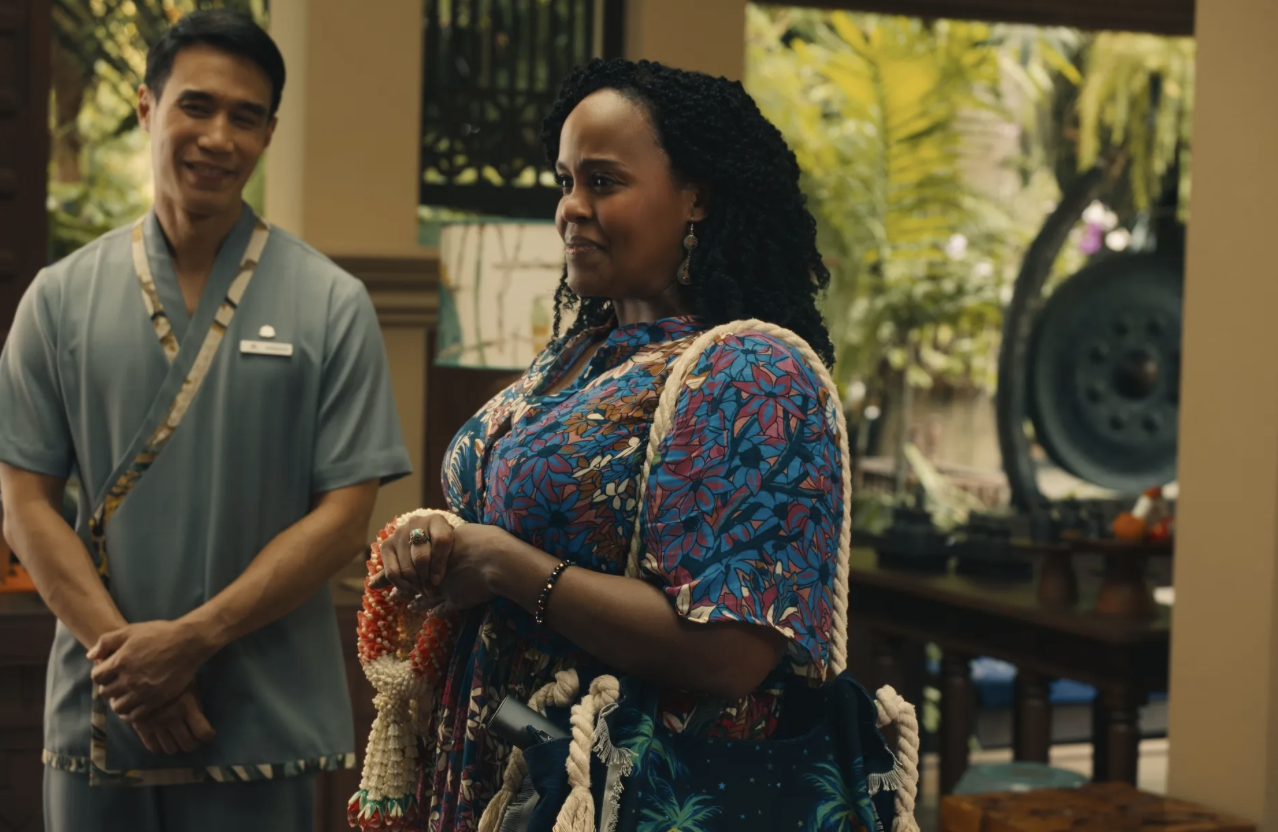
In White Lotus, Natasha Rothwell, the representative of the working classes throughout the series’ three seasons, chooses money over love, mirroring Beef’s Chairwoman Park’s core argument on modern love.
When the first season of Beef premiered, I was far from my own LA days, deep in my maternity leave, and it was the first series my husband and I binged since our baby’s birth. We felt transported back to that distinctively So Cal space of haves-vs-have-nots, but in such a specific Korean-American milieu. Steve Yeun and Ali Wong were so manic, so brilliant: like Inside Out characters of the SoCal class struggle. Young Mazino and Yeun’s lives, as well as the Korean church culture, felt like a sociological glimpse into one of California and LA’s most influential diasporas. Being parents to a newborn suddenly didn’t feel so hard when we immersed ourselves into showrunner Lee Sung Jin’s world. And it was rightfully more poetic and complex than Mike White’s White Lotus (HBO, 2021-), which many had hoped would present a more deterministic conclusion when it comes to the haves-vs-have-nots premise.
Ultimately, Lotus, Beef, and Margot deliver a thesis counter to the popular ‘eat the rich’ narratives: money matters. And those without it (or without enough of it) will do what they see fit to gain more. Whether Natasha Rothewell in White Lotus, or Spaeny in Beef, or Fanning in Margot, contemporary programming around wealth disparity acknowledges the socioeconomic realities of systemic inequality, in a way that, often, popular television and media eschew, again, in favor of a presumed middle-class level of comfort. In White Lotus, Natasha Rothwell, the representative of the working classes throughout the series three seasons, chooses money over love, mirroring Beef’s Chairwoman Park’s core argument on modern love.
After numerous awards and accolades, the beginning of another Trump presidency, the new season of Beef was never going to live up to the first season. Perhaps because it should have remained a one-off miniseries. But any major streaming success will hardly ever stop at one season.
Critiques against new leads Carey Mulligan and Oscar Isaac in a Korean-led series also reflected casting patterns: acquire the biggest ‘get’ over socially or culturally relevant practices. Nonetheless, the Korean-ness and Korean American characters and spaces of the series was still integral. While we see Lindsay (Carey Mulligan) and Josh (Oscar Issac) characters up against the younger Austin (Charles Melton) and Ashley (Cailee Spaeny), Chairwoman Park (Youn Yuh-jung) and Dr Kim (Song Kang-ho)’s wealth as billionaires show the real ‘big bad.’
This mirrors current (and perennial) discourse that encourages the working classes to cease attempting to rise to the ranks of the uber wealthy, whose net worth is unattainable. In a particularly telling scene, Park’s assistant and translator conveys to Lindsay, the country club interior designer, that her style is ‘colonial,’ in a most pejorative sense.
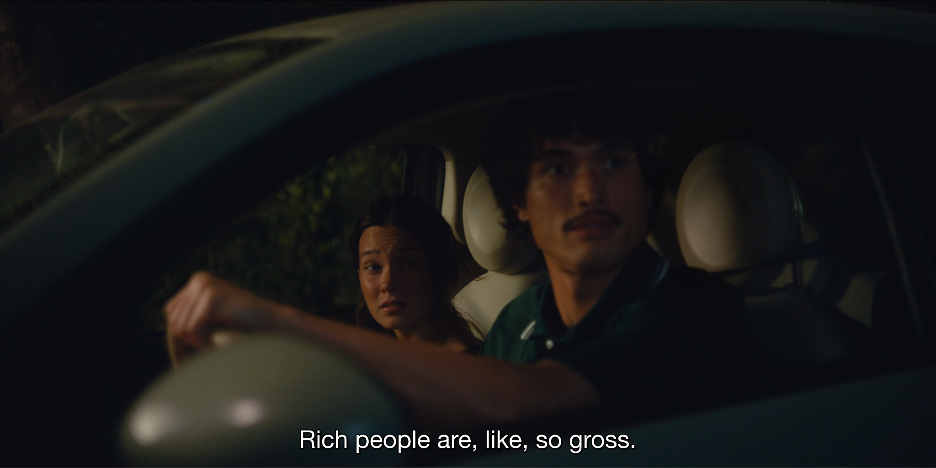
Beef Photo via Netflix/TV Scholar
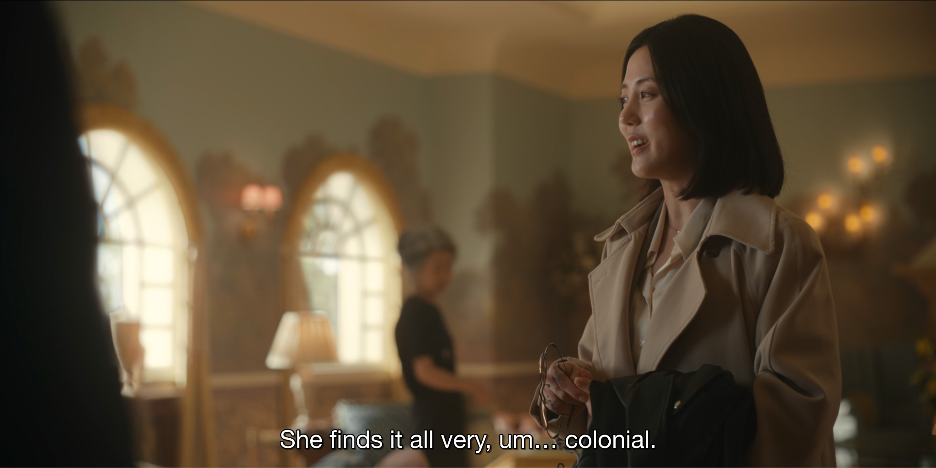
Beef Photo via Netflix/TV Scholar
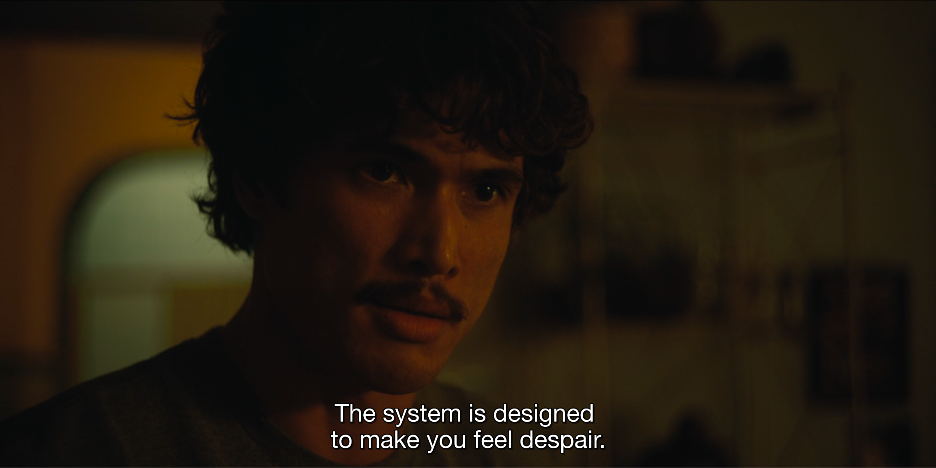
Beef Photo via Netflix/TV Scholar
Korean new money, here, certainly outranks Lindsay’s ties with British aristocracy. In the aptly titled season opener, “All the Things We’re Never Going to Have,” Melton’s Austin tells Ashley, after expressing financial fears given her new medical condition and lack of upward mobility:
Late-stage Capitalism. It’s all about fighting, right?
The system. The system is designed to make you feel despair.
Like, the disparity is systemic. You know what I mean?
While Austin continues to think of their situation, and wealth redistribution, in a global, and intellectual way (and ultimately pseudo intellectual buzz word-y), Ashley is more interested in directly retrieving the money from Josh, their boss at the country club. After Ashley and Austin blackmail Lindsay and Josh, their lives become even more intertwined, and combative, as with Season 1’s vehicular collision. By the season finale, Ashley has emulated Lindsay’s sartorial style, affect and temperament, and eventually, replaced Josh as the country club general manager. Josh has learned that the wealthy clientele at the club he believed were his friends helped turn on him, which has led him to the common white-collar fate of jail for embezzling funds.
Bookending Austin’s treatise on late-stage capitalism Chairwoman Park succinctly gets to the core of her critique of love in a capitalistic society: “It is a system of nature. System of the self. Love lives in this system. All relationships exist in this system. They are all the same, another way to serve the self. That is why I’m not crying right now.”

Netflix / In the finale of Beef (season 2), Ashley, Lindsay, Austin and Josh attempt to bring down billionaire Park in a madcap Korean crescendo. Ultimately, they fail, mirroring the billionaire oligarchy's ability to distract and pit everyday citizens against each other while only strengthening in power. Whereas the first season of Beef focused on a ‘haves against have-nots’ narrative, the second season escalated the reveal of systemic inequality against a Southern California backdrop.
In Margot, we see Elle Fanning as our titular heroine, fresh out of Sentimental Value (2026), more vividly fighting the power as a recent single mom and sex worker. Unlike Beef, or the previous example of White Lotus, Margot is not seeking riches (yet), but simply a stable income
Set in the Orange Country suburb of Fullerton, a college freshman at a local community college, in contrast to her best friend at New York University, Margot’s young and handsome professor (Michael Angarano) is shocked she is at such a lowly institution. Margot’s own shared apartment is not unlike Ashley and Austin’s, with shades of beige, twinkle lights, and tapestries strewn across the communal living room. We see life happen for Margot, her friends, and family surrounding strip malls and parking lots in a seemingly unremarkable corner of the OC, and the original Margot book’s author Rufi Thorpe helps nail that Californian suburban malaise akin to Greta Gerwig’s Sacramento homage, Lady Bird (2017).

In Margot, Fanning’s titular single mother turned sex worker lives in a sun soaked SoCal shared apartment, complete with worn furniture and bright, Gen Z palettes, as well as animal prints that mirror her mother’s fashion style.
Margot learns her professor/baby daddy Michael may be an English professor at a community college but comes from an affluent family. In contrast to Phifer’s animal print based sartorial choices, Marcia Gay Harden appears as Michael’s old money mother Elizabeth, an old-world outsider mirroring Mulligan’s Lindsay. As Harden told The Wrap, her styling was intentional:
My backstory was that she comes from the East Coast and lives in California but hasn’t adjusted to the temperature and still dresses like her mother — like, extra, extra conservative, doesn’t show her knees, still wears stockings.
Their affair leads to an unexpected pregnancy, and rather than a conservative statement, Margot simply seems that the baby is part of her, and her future—much to the chagrin of her mother, played by Michelle Phifer, who is reminded of her lack of maternal instinct and her father, a former wrestler and recovering addict played by Nick Offerman, rises to the chance to bond with his daughter and new grandson. Margot’s future as a writer is unclear, and she also drops out of college.
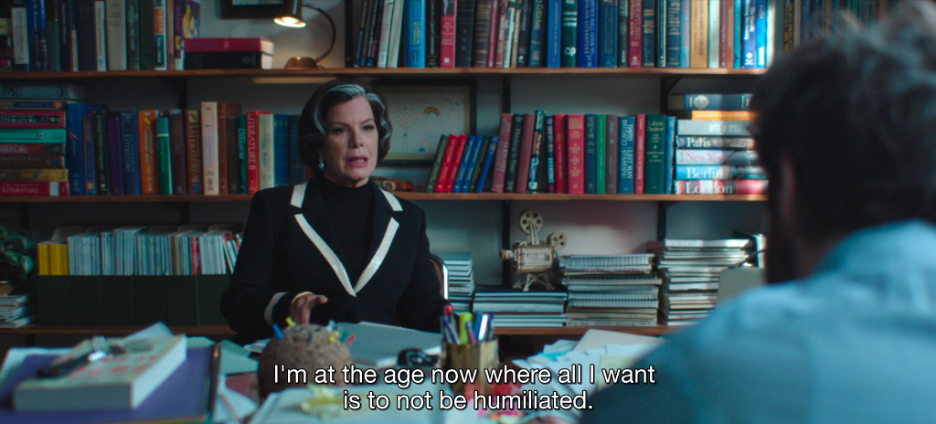
Margot APPLE/TV Scholar
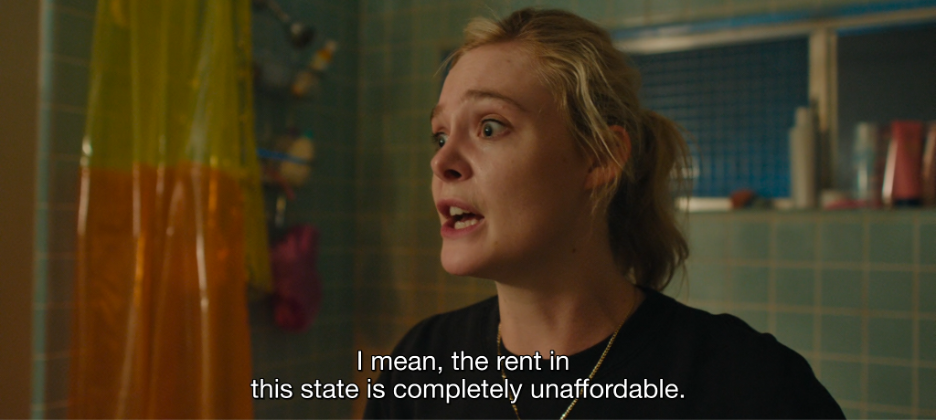
Margot/ APPLE/TV Scholar
The simple premise of the series is, indeed, a new single mom that needs money. With no familial financial support or ability to return to in-person work, she begins an Only Fans account. Yet she incorporates her writing prowess into her new money making, as well as her creativity and ingenuity. Critics and sex workers praised the series’ refreshing take in stark contrast to the debacle of Sydney Sweeney’s Only Fans career on the finale season of Euphoria (HBO, 2019-2026).
Like Beef’s Ashley, Margot must make sense of the socioeconomic inequalities of her status as women without a safety net. Ashley works towards IVF, while Margot finds a flexible mode of employment that also fulfills her creative proclivities. Margot defies the stereotypes of both the teen single mother and sex worker. Rather than a high-stakes ending, Margot and her motley crew village help her win her custody battle over Michael and his family’s vast riches put into lawyer fees.
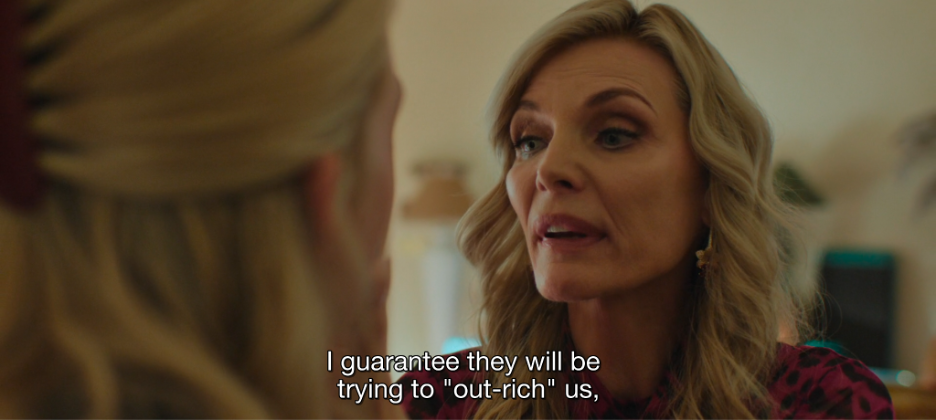
APPLE//TV Scholar. Margot and her village win out over her child’s father’s vast wealth in a custody battle climax in the season 1 finale.
In 2022, Michel Ghanem’s TV Scholar newsletter questioned if wealth was overrepresented on television, citing Big Little Lies (HBO, 2017-2019), Succession (HBO, 2018-2023), Loot (Apple TV, 2022-), The White Lotus, as well as And Just Like That (HBO, as often out of touch with the socioeconomic realities of our contemporary milieu. The fine line between social satire, cautionary tale, and lifestyle aspiration is tricky in the polysemy of media representing the affluent, as I recall the idyllic coastal setting of Lies led to an even greater increase in tourism (including bachelorette party surges).
Likewise, the rise of the ‘quiet luxury’ trend was directly attributed to Succession.
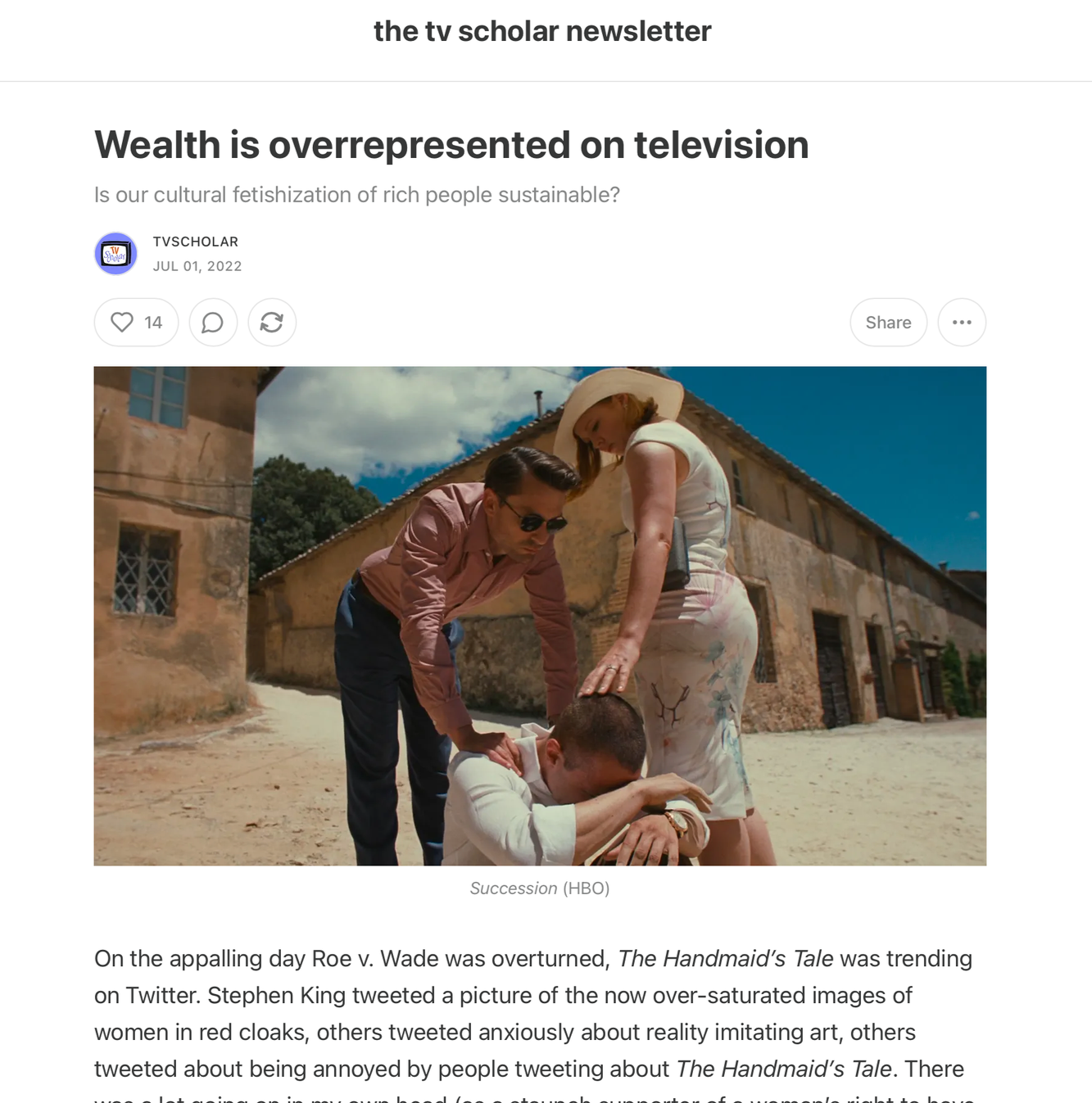
The TV Scholar Newsletter questioned the rise of television’s obsession with wealth. Shortly after, class consciousness infiltrated contemporary television discourse amidst financial crisis and decreased standard of living, especially for Gen Z.
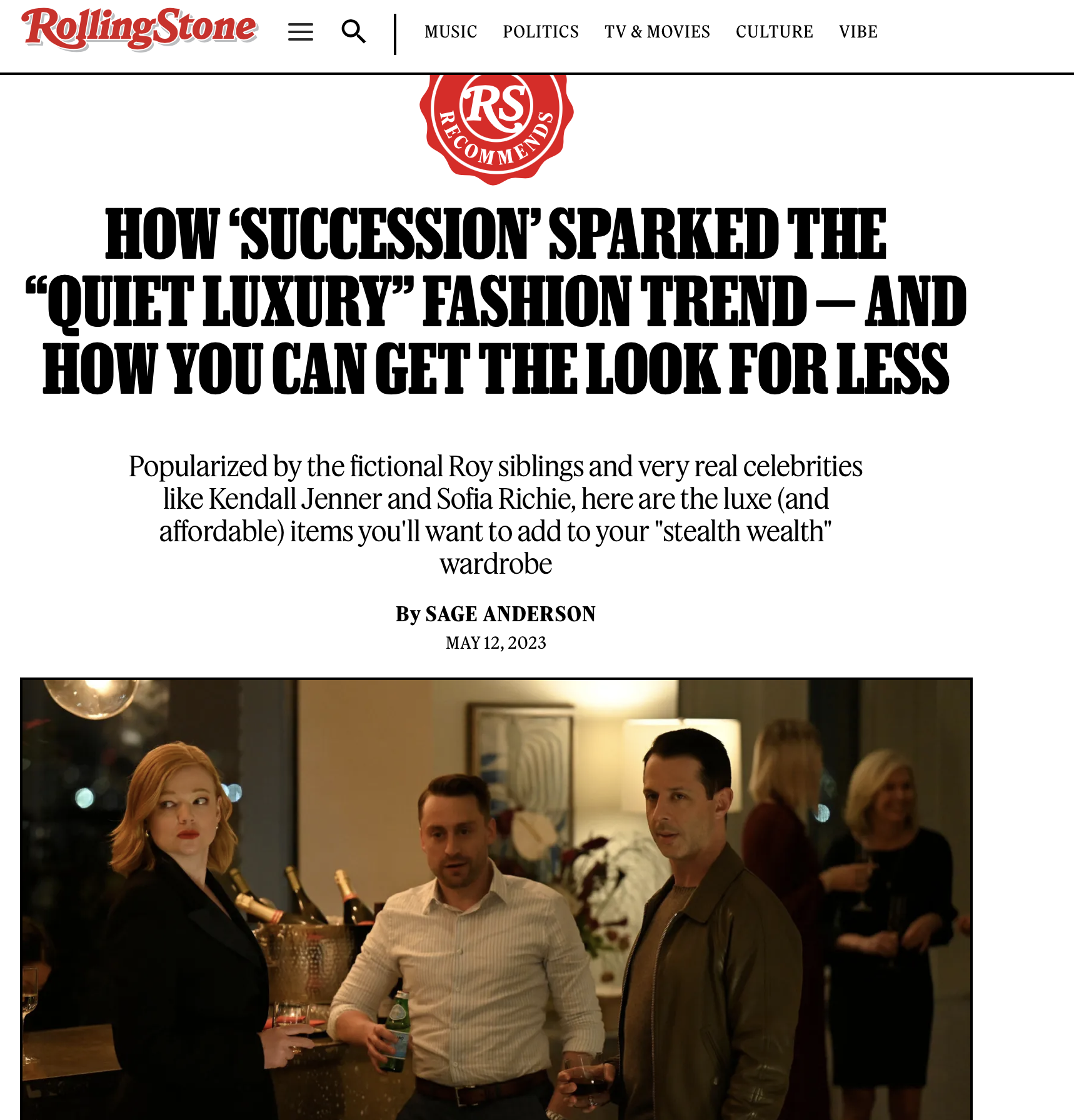
Rolling Stone and other publications credit Succession as the catalyst to the “Quiet Luxury” trend.
Indeed, in a few years after, the social, political, and cultural landscape revealed an increased wealth disparity and decreased standard of living for all but those in the top strata of wealth. Young people, already grappling with post-COVID, faced the brunt of this inequality. As we now approach a new Emmy’s Award season, with The Pitt already taking a lead in the Creative Arts categories, I can’t help but also think of last year’s Oscars season. 2025 films like Jay Kelly (Noah Baumbauch) and After the Hunt (Guadagnino) seemed to bemoan the wokeism of younger generations. Independent films like Eva Victor’s Sorry, Baby served as a balm, as did the sprawl and intergenerational tensions, and closures, of Joachim Trier’s Sentimental Value, Kleber Mendonça Filho’s The Secret Agent, and Paul Thomas Anderson’s One Battle After Another.
As One Battle After Another surmised: the revolution will not be televised, but we can pass the torch and shed some hope for the next generation.
Biography
Stefania Marghitu is an assistant professor in film and television in the department of Journalism and Creative Media at the University of Alabama. She is the author of Teen TV (Routledge, 2021). She has also published work in journals such as Feminist Media Studies, New Review of Film and Television Studies, Communication, Culture and Critique, and Intermédialités. She is currently working on the edited collection Feminist Approaches to Media Authorship (under contract with Routledge, co-edited with Theresa Trimmel) and a monograph on women showrunners in US television.