

OSCARS WATCH 2026—“Some Achieve Greatness”: Shakespeare, the Prestige Mediator in 'Hamnet'
/This piece is part of a series of critical responses based on the films nominated for the 98th Academy Awards. In this contribution, Lauren A. Sowa discusses Hamnet, which is nominated for Best Picture, Best Director, Best Adapted Screenplay, Best Actress, Best Production Design, Best Costume Design, Best Original Score, and Best Casting.
As a life-long attendee, fan, and (youth) participant in ballet and opera, I was actually rather unbothered by comments made by Timothée Chalamet, this year’s frontrunner for the Best Actor Oscar. I am used to this subset of my interests being overlooked and scoffed at by many. When my peers were clamoring to get tickets to NSYNC concerts, I was much happier with season subscriptions with my mom to the Lyric Opera, Joffrey Ballet, and (my absolute favorite) Chicago Shakespeare Theatre – which means I was obviously really, REALLY cool in junior high. But I always followed the original you-do-you, Laertes’ advice from Hamlet, “to thine own self be true”. With these forms of entertainment as my long-standing interests, I have always found the cultural hierarchies debate fascinating: what is considered mid, mass, pop, high, low, etc. (Macdonald, 2011) and the categorizations and opinion making that follows. Chalamet’s statement, and the subsequent battle cry from the arts community (“once more unto the breach, dear friends, once more” – Henry V), has brought up some generative questions with which to grapple especially as it relates to Hamnet (2025) receiving 8 Oscar nominations. To be clear, I am not interested in adding to the array of think pieces about how Chalamet ruined his image in saying opera and ballet were dying art forms (“reputation is an idle and most false imposition; oft got without merit, and lost without deserving” – Othello). When he stated he doesn’t want to be a part of art that “no one cares about anymore,” giving ballet and opera as examples, he evokes a sentiment of how culture is classified and understood. He is not wrong in noticing that the classical arts have less mass appeal than pop art (“therein lies the rub” – Hamlet). Given this logic, if the classical arts have a connotation of decline because the masses no longer engage with them/or they are inaccessible, why does William Shakespeare—arguably just as distant from everyday popular consumption—continue to carry enormous cultural prestige, especially in industries like awards-season filmmaking? I am taking the trendy and hip adaptations out of the equation here. This is not about how Shakespearean themes and influence permeate contemporary storytelling. I am interested in how classic Shakespeare, the figure and the plays, have maintained mass relevance while also giving off a connotation of prestige. And furthermore, how does the “Shakespeare prestige” work in its favor when it comes to the Academy Awards?
To understand Shakespeare’s mutable cultural position today, it helps to remember that he was rarely treated as an untouchable figure of high culture. The sophisticated and prestigious connation we associate with Shakespeare is a far more recent development. As clearly depicted in Hamnet, William Shakespeare was a part of the merchant class. He was educated, worked as a Latin tutor, but was not in the upper-echelons of society. From the onset, Shakespeare’s works were accessible to audiences of various social standings. Liza Picard (2003) cites the account of a foreigner’s visit to the Globe theatre that exemplifies the nature of Shakespeare’s plays to transcend class hierarchy. The foreign playgoer describes the experience:
They play on a raised platform, so that everyone has a good view. For whoever cares to stand below only pays one English penny, but if he wishes to sit he enters by another door and pays another penny, while if he desires to sit in the most comfortable seats, which are cushioned, where he not only sees everything well but can also be seen, he pays yet another English penny at another door (as cited in Picard, 2003, p. 223).
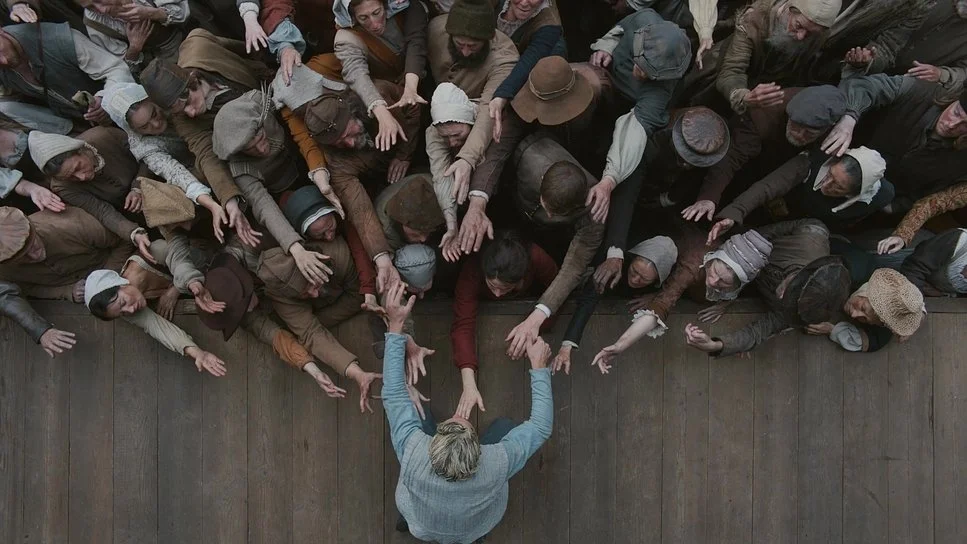
performance of hamlet at the globe in hamnet (2025)
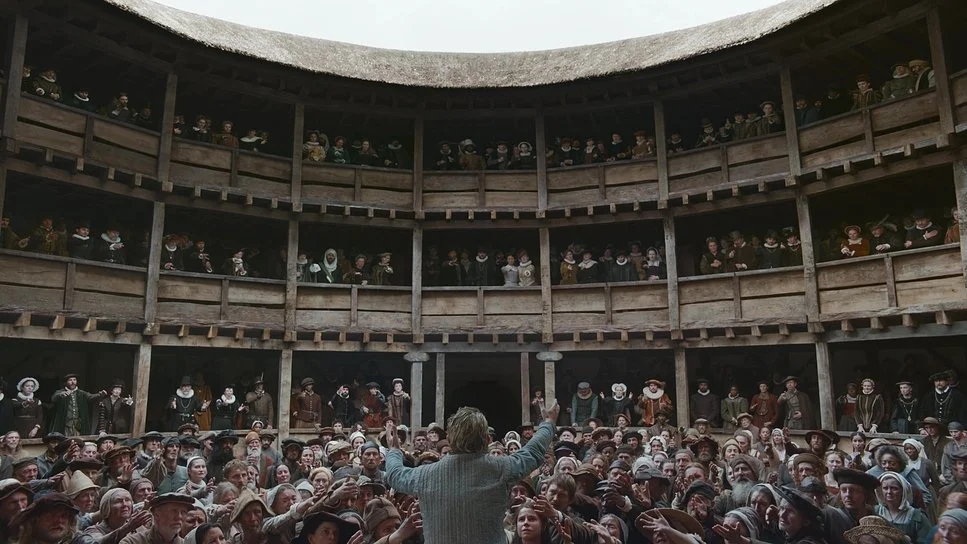
There are three distinct levels of audiences in attendance for Shakespeare’s plays. Depending on their financial status, they can pay for additional comforts and perks. However, the play they have all come to witness speaks to all the distinct social classes. As we see in Hamnet, the diverse audience are all deeply moved by Hamlet’s soliloquies. Shakespeare’s work resonated with the groundlings as much as it did for the wealthy, the court, and even the Queen herself (Beauclerk, 2010). From the onset, his plays transcended social class and were not only made available to, but his verse and themes were enjoyed by a cross section of the masses. He was their Taylor Swift—his work popular, catchy, emotional, and capturing the human experience (especially a good break-up, thank you, Ophelia). So, why would we bestow such strict social and educational shackles on storytelling that initially included all? Even in nineteenth century America, Shakespeare was a household name, and his plays widely known. Levine explains how “the theatre, like the church, was one of the earliest and most important cultural institutions established in frontier cities. And almost everywhere the theater blossomed Shakespeare was a paramount force” (1990, p. 18). Levine traces the rich history of Shakespeare performances on riverboats and even parody performances. Parody is only entertaining if the audiences have enough knowledge of the original text to understand and appreciate the humor and satire of a lampooned performance. Thus, Levine asserts the common and intimate knowledge average Americans had of Shakespeare (1990). However, a transformation occurred during the end of the nineteenth century and into the beginning of the twentieth century where, for Americans, the “theater no longer functioned as an expressive form that embodied all classes within a shared public space” (Levine, 1990, p. 68) such as it had for 16th century Londoners. The causes are hard to explain and slow to take effect, but essentially between the class struggles of the Astor Place Riots and advertising that eliminated the boisterous entertainment of the plays, “Shakespeare [did not] much longer remain the common property of all Americans” (p. 68). It is because of this complicated conversion that Shakespeare becomes the status symbol and “cultural deity” we see him today (p. 53). Ultimately, Shakespeare’s current prestige is historically constructed and the shift between cultural hierarchies creates a tension about where Shakespeare sits.
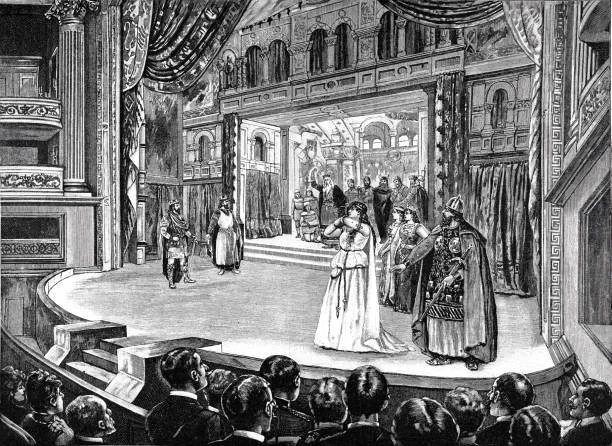
The Chalamet discourse is fascinating in that he stumbled into what I see as a key element in the dilemma of cultural hierarchies. Adorno and Horkheimer (2002 [1947]), and later Macdonald (2011) worried that mass culture would erode the integrity of high art by transforming it into easily consumable entertainment. Chalamet separates himself from classical artists by saying films are an art form that is more popular. Many of the opera and ballet artists responded with sentiments of “your movie is literally about ping-pong.” And bam! Cultural hierarchies. This inadvertently reveals a cultural paradox: while forms like opera and ballet are framed as relics of niche culture at best and elite culture at worst, works that evoke Shakespeare continue to function as both popular storytelling and a marker of prestige—an ambiguity that helps explain why films like Hamnet remain so attractive to awards institutions. Of course, films that center the ballet (Black Swan [2010]) or opera (Amadeus [1984], Maria [2024]) also carry a similar prestige that are recognized by the Academy. This demonstrates that these classical forms are not culturally irrelevant; rather, their prestige is reactivated when they circulate through the more accessible medium of film. Shakespeare simply occupies this position more consistently, allowing works associated with ‘William Shakespeare’ to move fluidly between elite cultural authority and popular cinematic storytelling.
Which brings us to Chloé Zhao’s Hamnet. The film is an adaptation of Maggie O’Farrell 2020 novel of the same name; it had received multiple literary awards (cue prestige!). The narrative centers on Agnes Hathaway and tells the story of her and William Shakespeare as parents and their extreme grief in the wake of the death of their young son, Hamnet. Importantly, the narrative does not adapt one of Shakespeare’s plays directly. Rather, the focus is on a fictionalized emotional narrative around the Shakespeare family and specifically focuses on Agnese as a mother. Less central, but also poignant, is this story depicts the circumstances that may have shaped the writing of Hamlet. The film draws upon Shakespeare’s cultural aura without requiring audiences to engage with the formal complexities of the plays themselves. Having a basic knowledge of Hamlet adds to the experience, but is not essential but any means.

hamnet (2020) novel by maggie o’farrell

hamnet is nominated in 8 oscar categories
This dynamic allows Hamnet to operate effectively within Oscar awards culture. The film carries the weight of Shakespearean prestige while remaining accessible in the ever popular, historical fiction drama genre. The audience is not expected to have the same familiarity with Shakespeare’s language, theatrical conventions, or characters (as the previously stated 19th century frontier audiences did) to understand and engage with this piece. That said, its mere association with Shakespeare signals the seriousness and artistic legitimacy loved by the Academy. Certainly it’s “Oscar bait” (Boucaut, 2025); as Boucaut explains in a previous post in this series, it holds all the key elements for a well-made film to get attention in this arena: well-acted drama, portrayal of deep grief, historical fiction, Oscar winning director, and … Shakespeare. What I find compelling is how Shakespeare functions as a kind of cultural shorthand: we invoke the Bard and it immediately situates the film within a lineage of “important” storytelling. It was a strong choice of literary material to adapt for film.

chalamet in the king (2019)
Cinema as an art form acts as a powerful mediator of cultural hierarchy. Hamnet exemplifies this at a unique moment when the classical arts feel under-attack. Ultimately, the reaction to Chalamet’s comments reveals less about the death of classical arts and more about the shifting ways cultural prestige circulates. Opera and ballet may genuinely struggle to attract mass audiences within their traditional institutional spaces—so do movie theatres. But going to the movies is still more accessible to broad audiences than ballet and opera. And the aesthetic authority— Shakespeare’s in particular— is significant when reframed through popular media. Chalamet did after all play the Shakespearean hero, Henry V, in The King (Netflix, 2019).
Shakespeare’s enduring prestige is not the result of being frozen in an elite cultural sphere, but rather of his remarkable ability to move between cultural registers. It makes me think of the Shakespeare Bridge in Los Feliz, my old neighborhood in Los Angeles. It’s a bridge built in 1927 and the reason for the name is unclear other than it gives romantic, Tudor vibes. Shakespeare, to this day, is still like this bridge—transcending hierarchies and connecting many spaces. The Bard was once popular entertainment for London’s masses; today he continues to function simultaneously as both mass storytelling and cultural high art. Films like Hamnet simply remind us that these categories have always been far more fluid than cultural gatekeepers might prefer to admit; all’s well that ends well!
References
Adorno, T. W., & Horkheimer, M. 2002 [1947]. The culture industry: Enlightenment as mass deception. In Dialectic of enlightenment: Philosophical fragments (G. S. Noerr, Ed.; E. Jephcott, Trans.; pp. 94–136). Stanford University Press. (Original work published 1947)
Boucaut, R 2025, Oscar Bait: The Academy Awards & Cultural Prestige, Routledge.
Levine, L. (1990). Highbrow/ lowbrow: The emergence of cultural hierarchy in America. Boston, MA: Harvard Univeristy Press.
MacDonald, D. (2011). Masscult and midcult: Essays against the American grain. New York, NY: New York Review Books Classics.
Picard, L. (2003). Elizabeth’s london: Everyday life in Elizabethan london. New York, NY: St. Martin’s Press.
Biography
Lauren Alexandra Sowa is a Visiting Assistant Professor of Communication at Pepperdine University. She received her Ph.D. from the Annenberg School of Communication and Journalism at the University of Southern California and has a BFA in Acting from NYU's Tisch School of the Arts. Her research focuses on intersectional feminism and representation within production cultures, television, and popular culture and has been published in The International Journal of Communication and Communication, Culture and Critique. These interests stem from her several-decade career in the entertainment industry as member of SAG/AFTRA and AEA. Lauren is a proud "Disney Adult" and enthusiast of many fandoms. Lauren is also a Pop Junctions associate editor.