

EMMYS WATCH 2025 — Shrinking and Mental Healthcare ‘Comedy’
/‘Emmys Watch 2025’ showcases critical responses to the series nominated for Outstanding Drama, Outstanding Comedy, and Outstanding Limited Series at that 77th Primetime Emmy Awards. Contributions to this theme explore critical understandings of some series nominated in these categories.

Jason Segel and Brett Goldstein in Shrinking Season 2
Shrinking has grown from two Emmy nods for its first season to five for Season 2. While hardly a case of field domination, advancing to compete for Outstanding Comedy Series sees it filling a niche in the sweepstakes of prestige television comedy left open since Ted Lasso—the heart-warming dramedy that takes mental healthcare seriously.
That both series share creative personnel shouldn’t be a huge surprise (like producer Bill Lawrence and cast-member/writer/producer Brett Goldstein). And nor is it a coincidence that both shows have become leading figures of Apple TV+ as a streaming service in terms of homepage visibility, awards campaigning, and broader marketing materials for Apple.
My colleague Dr. Alexander H Beare and I have been developing a research project about Apple TV+ as a unique player in the current Subscription Video On-Demand (SVOD) marketplace, theorising how their original and curated content supports the imperatives of Apple as a parent company. Given Apple TV+ has been reported by Variety as a loss-making service that haemorrhages more than US$1 billion per year (Spangler 2025), these imperatives are clearly more ideological than economic.
With this piece, I look to reflect on where Shrinking has come from, and how the unsteady storytelling that comes with addressing mental health within formulas of television comedy is so characteristic of Apple TV+. Spoilers incoming, obviously.
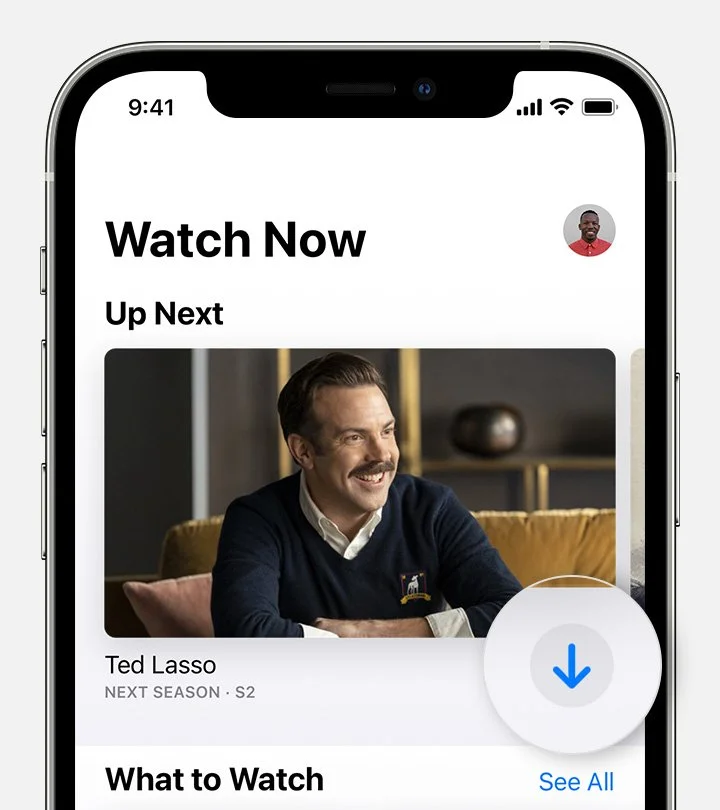
iPhone graphic featuring Ted Lasso being streamed on Apple TV+. Source
From Ted to Jimmy
Ted Lasso was the first major hit and Emmys-sweeper for Apple TV+ as a SVOD—premiering during global lockdowns during the COVID19 pandemic, it was praised as quintessential comfort viewing. Tanya Horeck (2021) noted this period for its rise in “Kind TV”—whereas comedy narratives have often poised central, antisocial characters as cringey, cynical figures (think Veep or The Office UK), Kind TV repositions antisocial tendencies as foibles for characters who otherwise wholly mean good (think Parks and Recreation or The Office US). As a protagonist, Ted of Ted Lasso (played by Jason Sudeikis) unifies the players, administrative staff, and fans of an English Premier League (EPL) football team through visions of kindness and optimism.
The massive, rapid success of Ted Lasso positioned it as more than just a television comedy and instead something of an all-encompassing philosophy of kindness. In our published research, Beare and I (2024) note how the show was quickly integrated into the cultural zeitgeist: it drove a major push in advertising EPL football to North American audiences, it was intertextually referenced in The White Lotus Season 2, and its cast even met with US President Joe Biden to promote mental health awareness (White 2023).
We argued that Ted Lasso as a character was particularly primed to represent an entire ideological disposition of Apple as a parent company—the kind-of inspirational figure who would readily fit into one of Apple’s infamous Think Different advertisements despite being a fictional character (Beare & Boucaut 2024). Indeed, we quickly observed the show’s characters becoming central in Apple’s broader marketing materials of the time and saw how the show’s slogan of ‘Believe’ was utilised in ways that deliberately evoked Think Different associations.
Advertisements of tech products like iPhones and iPads (which feature prominently as product placement in the shows’ narratives, as this YouTube piece by The Wall Street Journal (2021) interrogates) would simultaneously promote their content imperatives by featuring their starring players, and series paratexts would foreground the shows’ creative uses of Apple tech(Blunden 2020). This strategy would extend to other original comedies such as Loot (starring Maya Rudolph), Mythic Quest (starring Rob McElhenney), Stick (starring Owen Wilson), and Shrinking (starring Jason Segel).
The protagonist of Shrinking is Jimmy—a therapist who, after experiencing the tragic loss of his wife, tries to work through his grief while rebuilding his relationship to therapy. He fits a Lasso-nian archetype in how the show reifies his capacity to think different. This storytelling formula that straddles dramatically heavy themes with light-hearted and affirmative comedy stylings (which also tracks across the spread of shows just listed) carries interesting implications for how challenge and progress are represented in its storyworld.
Is Shrinking a Workplace Comedy?
By taking on mental healthcare as its thematic drive with characters that are actually therapists, one can argue that Shrinking is something of a comedic enquiry into therapy practice on an institutional level. Naturally, it draws from vocationally-specific settings and aesthetics (therapy offices, patient consultations, wellness jargon) in the stories it tells. Yet, the narratives that take shape in Shrinking suggest it is more occupied with mental health as a big picture concept, rather than anything too specific or tethered.

Shrinking cast promotional photo, (from left) Luke Tennie, Ted McGinley, Lukita Maxwell, Michael Urie, Christa Miller, Jessica Williams, Jason Segel, and Harrison Ford
What Shrinking exemplifies best amongst the Apple TV+ suite of original comedies is that the workplace setting is to be approached only secondarily as an occupation: instead, the primary function of these workplaces is to construct a pseudo family.
In the cast photo shown above, only a handful of characters are professional therapists—yet the contrivances by which they keep returning to the central therapy office as a setting are profound. Take Brian (Michael Urie), Jimmy’s best friend, an estate lawyer. When the two begin reconnecting early in the series, Brian starts giving legal advice to Jimmy’s clients on criminal matters and repeatedly interrupts Jimmy’s sessions with patients. Then there’s Liz (Christa Miller), Jimmy’s neighbour—from the outset of the series, Liz steps in as a caregiver to Jimmy’s neglected daughter, Alice (Lukita Maxwell), steadily becomes best friends with Jimmy’s coworker, Gaby (Jessica Williams), and starts a business with Jimmy’s patient, Sean (Luke Tennie). Sean, who suffers from PTSD and has anger management issues, is kicked out of his parents’ home, and so he moves in with Jimmy and Alice. Jimmy’s boss, Paul (Harrison Ford), has also been a confidant to Alice throughout Jimmy’s spiral (making Paul a rival figure to Liz)—Paul also suffers from Parkinson’s disease, and eventually starts a relationship with his neurologist, Dr. Julie (Wendie Malick, not pictured). Gaby is not only Jimmy’s coworker but his dead wife Tia’s (Lilan Bowden, not pictured) best friend—she and Jimmy start sleeping together. There’s even Louis, played by Ted Lasso alum and executive producer Brett Goldstein (not pictured)—Louis was the drunk driver responsible for the accident that killed Tia, and after unsuccessfully seeking forgiveness from Jimmy, Alice and Brian start befriending him out of sympathy.
It maybe reads like there’s a lot going on in that crude summary. However, the cumulative effect of these storylines across two seasons is a show that is ostensibly about the mental healthcare industry feeling remarkably insular and narrow in scope. Rather than being content with supporting characters circulating around Jimmy as a central protagonist, they must insistently relate to one another on very meaningful terms. There’s no understanding in Shrinking of peripheral figures or extended social circles: instead, everyone fits into a pseudo-family structure.
The effect of this is, out of necessity, somewhat degrading to therapy as a practice. What we see of Jimmy’s patients (outside of Sean) are therapy sessions characterised by infantile complaining or unthreateningly compulsive behaviours: because the purpose of the show is to affirm Jimmy’s think different approach to mental health, his patients present with issues that he can work through with plain speaking. Grace, your husband is an abusive asshole – just leave him already! Alan, stop trying to be such a player, and maybe women would see a real you who is attractive. Dan, not everybody is a jerk, actually, so small talk with a barista isn’t really that bad…
So, Shrinking certainly depicts a ‘workplace’—but despite its preoccupation with engaging big-picture mental health thematically, its actual priority of constructing interpersonal relationships of affirmative trust makes its workplace just a convenient backdrop. Therapy is a setting for the show’s central relationships, and its background cast of patients present with frustrating problems that can be solved through Jimmy’s no-bullshit approach. It might be a storytelling convenience to have a jovial interaction between Jimmy’s patient and his lawyer-best friend in the hallways of his therapy office but doing so problematises the show’s understandings of ethics and boundaries—in thinking different about therapy, Shrinking undermines therapy as an entire practice and occupation.
As for the ‘comedy’…
Is Shrinking funny?
Well, my scholarly contention is not really, but…
Obviously, comedy is subjective, television generic formulas have long been porous and straddled—et cetera, et cetera, et cetera. Individual mileage for this style of show will vary, and the most meaningful factor for this is probably how receptive one is for feel-good, affirmative messaging as a storytelling priority.
That’s not to say that Shrinking isn’t without its pleasures. Jason Segel occupies a Lasso-nian central figure with a more grounded presence than Jason Sudeikis did, which makes Jimmy much less cloying, and the pronounced struggles that he goes through more compelling and believable. The rest of the cast is strong—so while the situations of the show don’t readily support memorable jokes, the characters at least have an easy chemistry. It makes sense why Segel, Williams, Urie and Ford make up the totality of the show’s Emmy’s endorsements alongside its Outstanding Comedy Series nod.
But in picking up on the storytelling mission where Ted Lasso left off, Shrinking perhaps over-relies on its cast’s chemistry to carry its interest. By Season 3, Ted Lasso was barely recognisable as a TV comedy—its episodes were long, subdued and meandering, with so little apparent drive towards inducing laughter. For Kind TV, heartwarming affirmation remains the goal—but where this was once achieved through absurdist and heightened situations, texts like these have shifted towards such outcomes being achieved through dramatic, contained, articulated trauma for its characters to overcome.
I wonder whether localising trauma like this—in grieving a dead wife and mother, in an abusive partner or parent figure, in a degenerative disease, in a confidence-busting divorce—is just another neoliberal fantasy of self-fulfilment. These backstories are woven into these comedies to give characters complexity and to justify their antisocial tendencies. Trauma is apparently a formula of the Apple TV+ original comedy: naming, facing, and embracing trauma allows it to be neatly contained within a feel-good narrative, and then overcome with positively affirmative messaging—with the help of iPhones and Facetime, of course.
References
Beare, Alexander H & Robert Boucaut 2024, ‘Positive masculinity or toxic positivity? Apple TV+’s Ted Lasso as a capitalist utopia’, Critical Studies in Television, vol. 20, no. 2, pp. 1-16. https://doi.org/10.1177/17496020241228162
Blunden, M 2020, ‘Mythic Quest cast use iPhones to shoot hit Apple TV+ show remotely’, The Standard, 22 May, available at https://www.standard.co.uk/news/tech/appletv-mythic-quest-filming-iphone-a4447431.html.
Horeck, T 2021, ‘‘Netflix and Heal’: The Shifting Meanings of Binge-Watching during the COVID-19 Crisis’, Film Quarterly, vol. 75, no. 1, pp.35-40. https://doi.org/10.1525/fq.2021.75.1.35
Spangler, T 2025, ‘Apple Is Losing Over $1 Billion per Year on Streaming Service, Has 45 Million Apple TV+ Subscribers (Report)’, Variety, 20 March, available at https://variety.com/2025/digital/news/apple-tv-plus-streaming-losses-1-billion-per-year-1236344052/.
The Wall Street Journal 2021, Hundreds of iPhones are in ‘Ted Lasso.’ They’re more strategic than you think. | WSJ, YouTube, 14 September, available at https://www.youtube.com/watch?v=8xAvVfJ_xyI&ab_channel=WallStreetJournal.
White, A 2023, ‘Jason Sudeikis, ‘Ted Lasso’ Cast Promote Mental Health Awareness at White House With Surprise Appearance by Trent Crimm Actor’. The Hollywood Reporter, 20 March, available at https://www.hollywoodreporter.com/tv/tv-news/ted-lasso-jason-sudeikis-white-house-trent-crimm-1235356995/
Biography
Robert Boucaut is a Lecturer in Media at The University of Adelaide—his research interests include prestige media texts and celebrities, streaming services and programming imperatives, and mediated gender. His book Oscar Bait: The Academy Awards & Cultural Prestige (Routledge) builds new frameworks for analysing Hollywood media ecosystems and awards. He has published works in International Journal of Communication, Critical Studies in Television, and Media International Australia.