Ed Finn: So I run the Center for Science and the Imagination at Arizona State University. And our mission is to inspire collective imagination for better futures. And that means that we have lots of different plates spinning all the time, and different really cool projects. So we, I feel like we are part of this solarpunk movement and engage with a lot of writers who do solarpunk stuff. And we do lots of other things, too. And I'm really delighted to be hanging out with you all and to meet you, Sarena. You know, it's great to find our fellow travelers out there in the world. So, you know, there are a few things that we're doing now that are new directions for us. And the big category that we're starting to fill up that I see as a sprawling, multi-year project with lots of different things is to really drill down on this word imagination. And that's something that I think you and I have in common Henry. Yeah, well, maybe we'll talk more about that. So we have a project right now, where we had originally wanted to do a big, like a big conference, you know, a big get together, invite lots of people to Phoenix to hang out and talk about imagination that that plan was quickly scrapped in the year of the pandemic. And instead, we're doing a series of virtual workshops, where we're trying to do some of the same thing and connect to people who think about imagination in different communities and different areas of practice, with a goal of not just hanging out with all the people we already know, but starting to meet new people who traffic in this idea, and play with imagination, and start to wrestle with the notion of what does applied imagination mean, we just launched a new fellowship, the call is open now until I think April 5, for people who want to propose projects around applied imagination. And the project description is incredibly short. Because it's really open, we're really open to all sorts of different ideas about what we want to see what people come up with, as we're in this exploratory phase of thinking about what imagination means. So if anyone listening to this is interested, if the I don't know what the timing of this will be, when that comes out, but you know, that's a chance to get $10,000 to do something really cool that you wanted to do.
EF: I also am the Academic Director of Future Tense, which is this partnership, ASU has with Slate Magazine, and with the New America Foundation, and we publish an original piece of science fiction, every month, quite a few of those, I think, connect to - they all have that same fundamental optimism, many of them engage with environmental issues. And I think you could, you know, connect to solarpunk or tag as solarpunk. And we publish each of those stories with a nonfiction response essay by some kind of technical expert, and we have original artwork that goes with each of those stories. And I really love that part of the job and, you know, engaging with all of these different writers. And I think it's a nice microcosm of what CSI does in general, which is use science fiction as a kind of method, a tool, an invitation to talk to all sorts of people in the, you know, genre, and community who are big science fiction readers, but also people who don't really think about science fiction or don't think of themselves as science fiction fans, and use that as this invitation to think about the future. And to start to question well, what do I want, you know, what is the world that I want to work towards? A couple of other things. We've got cooking, we have this new anthology that's in its final edits right now called Cities of Light. This is a follow up to a collection we released maybe two years ago called the Weight of Light. And these are near future, technically-grounded stories about solar energy and it's very solarpunk, a set of explorations around what it's going to be like to live in a more, you know, ecologically thoughtful future, and really approaching that from a sort of systems engineering and urban culture point of view. Recognizing that it's the social problems that are going to be the big problems we have to solve, you know, we can wave our hands and imagine all of the, you know, all the solar panels you want, but then what is it? What is it gonna be like to live in that world, right? And what are the new problems you're gonna have, because waving your magic wand to solve the technical problem isn't going to actually fix all of the other things we have to talk about. So I love those collections. And those are partnerships, we work with policy researchers and technical experts at ASU and this second anthology was done in partnership with NREL, the National Renewable Energy Lab, in Colorado. And so it's really great to, again, bridge these different fields and modes of thinking about the future.
EF: And, you know, another piece of this for me, and another new direction that I'm working on right now is starting to think more about world building as a related practice, another kind of imagination. So I'm teaching a class that I'm making up, as I teach it, sometimes to the chagrin of my students, around worldbuilding. And that's been really fun. And, you know, thinking about how worldbuilding might be one of the toolkits or a set of methods for communities to start to imagine their own futures, and be more grounded, because imagination itself is, can be such a fluffy, abstract concept. Sometimes it's hard for people to really latch on to it. But you say, "Well, you know, look, we're going to make a world we're going to make this future," I think that can be a more grounded way to do it. So it's tremendous fun. There are so many awesome things going on that I rarely can remember even a third of them. And I'm very happy that way. I'm very happy to be part of this sort of collective of awesome people at CSI. And I think the origin story is a good one. And it sort of explains maybe why we're in this interesting place that we are. So in 10 years ago, 2011, Neil Stephenson, the science fiction writer wrote this essay called "Innovation Starvation," about how we seem to have lost our ambitions for the future. We're not thinking big anymore. We're not doing big stuff. We're doing little stuff. And our feelings about the future are no longer fundamentally optimistic. They're pretty dystopian, or disaffected. And it's a sort of a, you know, thought piece polemic. And he was at an event at the New America Foundation in Washington, DC, this is also at the very beginning of that whole Future Tense partnership. And Michael Crow, who's the president of ASU was there, too. And Neil, talked about this idea. And Crow in a very Michael Crow way said, Well, maybe this is actually your fault, Neil, you know, instead of blaming, like the scientists, the engineers, you know, all these other people for not thinking big about the future, maybe what we need are better stories, we need the stories that are optimistic visions of the future that inspire people to work towards those different visions. And so that conversation struck a spark. And here at ASU, we started thinking about, well, what if we, what if we actually took that seriously? What would it look like to try to move the needle on that, try to change our collective relationship with the future, and I really liked the way you put it Sarena, before, you know, we can't just expect some people in lab coats or some people in Silicon Valley to, you know, make the future better for us. And if you do, if you do let those people do it, it's probably not going to turn out very well. You know, we have to all be involved. And I think the biggest problem we face right now, is that not enough people are empowered and invited to talk about the future, and to feel like they are participating in that. And that is what we need to change. And science fiction is a fundamental piece of that toolkit.
EF: So we started to, we came up with this idea for the Center for Science and the Imagination. And imagined bringing together people in academia but also out in the science fiction community, other kinds of storytellers and creators and artists, and different communities of practice, right, whether that's a neighborhood or a group of people doing policy around AI, and trying to reach them and connect them to these broader publics so that everybody can talk together. And that's one of the great things about a science fiction story is that it can put everybody on the same page. And you can have an interesting and compelling debate about a set, a bundle of technical and social and political issues in the safe space because it's fiction, you know, it's not real. So you don't have to like put on all of your battle armor. You can take some risks and speculate. And everybody can do it the technical expert, who might say, "Oh, well, I know all about, you know, this technical problem, but I'm not an ethicist. You know, I can't talk about that." And the member of the general public says, "Well, I don't know about the technical issues, but this doesn't feel right to me." And the ethicist who might say, "I can't talk about any of the technical stuff." So you know, getting everybody into the room together to have that conversation is really, really powerful. And thinking about those stories, not as prophecies or predictions, but just as invitations to possible futures, to start to have that debate about, well, what - there are lots of possibilities we've been focusing on, only a few of them but are missing these other ones - and then what do we actually want, instead of just spending all of our time worrying about the stuff that we don't want. That's what science fiction is really good for. So it's tremendous fun, and I can't wait to see what the next 10 years of this crazy ride are going to be like.
SU: I love the way that you describe is like a convergence of thought experiments, from different angles. That's really cool.
CM: I mean, I really appreciate both what you offered. And I and there's also like an interesting place between them, right, and thinking about your current work Sarena, and just sort of how the cultural context - so whether it's Asian or Asian American sort of different communities, whether by ethnicity, origin, or other ways we might define it, or engineering, are going to have different views on these things, right, and bring a different kind of valence and different qualities of imagination, to the futures that they envision. So that feels like visiting these different lenses on futures does free us up and offer us things that we didn't think about? Right, like whole new ways to see the world?
SU: Absolutely. When I think especially when you're dealing with climate change, like there's no one solution, you know, it's like hyper localization is really important for dealing with climate change solutions. And so yeah, what works for one group of people or one location, or one, you know, climate, or whatever, is not going to work for everything. So you have to look at it from various angles.
EF: Yeah, and it's not even really... there's going to be lots of things that don't work, right, they're just going to keep changing and evolving. And stories can be helpful with that your one little epiphany I had a few years ago is that I think stories are a really useful and important way to talk about climate change. Because climate change is so big, it's slow, relatively, you know, it's slow, except for the times when it's happening way too fast. And it's kind of abstract. And so, we're not good at that kind of storytelling, we're not good at that kind of risk assessment, you know, this thing that might happen probably will happen 30 years from now, you know, that's tough. Humans are not well set up for that kind of foresight as individuals. But stories are really good at encapsulating complex systems and having a foreground and a background and representing ambiguity and complexity. And so you can create a narrative about climate change with characters and you can control you know, you can leap around the time and space, and so you can make it more meaningful. And that I think, is the thing we struggle with right now is to make meaning out of the abstract crisis of climate change. And a lot of that is about dealing with change, right? Margaret Atwood called it everything change when she came to visit us several years ago, 2014 maybe. And I thought that was a really good way of talking about it, right? That it's not that we're going to solve a lot of these problems. But it's also not that we have to just give up or feel like the problem, you know, that things are hopeless. It's just that we have to recognize that there's a lot of change coming, and we have to figure out how to navigate that change and try to steer the things that we can.
CM: I mean, it seems like it sort of normalizes both change and response. Not, and part of me feels like there's a there's a parallel to science generally. And this idea that science is a straight line in which we you know, we get it right that we get more right more, right, as opposed to like, a very meandering path in which we got we thought it was this and then we realized it was that, and in the way that you're describing it, to me is similar, it's to recognize change is the constant in some sense, although the rate of change is not a constant. And we continue to respond to it. And it sort of gives license to making mistakes and to the trials and tribulations that are part of what it is to be human. But it doesn't mean you give up hope. And I feel like this is - I can't quite put my finger on it. And maybe you both have thoughts - but this to me feels like a fundamental divergence from like, how journalism treats it, right? And journalism feels really challenged to me in figuring out how to convey the change that Margaret Atwood spoke about, whether it's just climate change or everything change, is like it's trying to give graphs or it's trying to do "he said, she said," but it seems like it's fundamentally, traditional journalism feels fundamentally overmatched by this challenge. And I feel like where it does a little bit better is where it does some kind of storytelling and humanizes. But it feels to me like, the work that y'all are doing is way more, has a lot more potential. And maybe there's stuff that journalists can learn from it?
EF: Well, I think that there are some, I think journalism getting is getting better at that. And I think it's, you see people doing more data and analytics and making them more interesting, you know, looking like maps and graphs and connecting the local to the global. But I also think there's interesting things happening around speculative journalism. And that's an area where I want to sort of see if we can incubate some more cool things where you can combine that storytelling and the grounded, you know, the grounded reality of today. But I think some of it is that that one of the challenges is that journalists feel like a primary job is to be the voice of critique, right? And that sort of the truth-bringer and to, and to say, well, we have to talk about all the things that are wrong now. And that's a really important job. And, you know, that's a role that the Fourth Estate has to play. But we also need those narratives of hope. And, you know, I think that maybe I would love to hear what you think about this Sarena, you know, is it that hope doesn't sell, right? And people like news of fresh disasters, that's what people want out of their newspapers, and I can think of certain TV networks that have made a big business out of fear, fear and despair. You know, but I don't know, I think that, at least in our experience, there are a lot of people who were like, it's like they found water in the desert, you know, when they see "Oh, optimistic science fiction, optimistic futures, it's so great that you're doing that." What do you think?
SU: Well, it's just so much easier to imagine what goes wrong than what goes right. You know, it's just, it's easier. And it, you know, and you're right, it is sensationalized by the, by the news, certainly. And there's a sort of catharsis to it, I think, from the audience's point of view. And I think that can happen with the hopeful narratives, too. You know, sometimes people talk about the danger of optimism being like, "Well, everything's fixed rate. So now I can just go on with my life."
CM: Do you think do you think humans are sort of, are we hardwired, in some sense to respond more to fear and, you know, kind of gloom and the negative as a survival strategy? Is the argument that, and then, you look at Hollywood, or the news, or any of these other sources, where we hear stories, and there's way more of, you know, there's way more Mad Max, than there is, you know, whatever the alternatives are, which none, of course, come to mind at the moment. And I think it seems like also we sort of, optimism or hope can be belittled as like a fairy tales, right? Like, what you're talking about here is, is to say being optimistic doesn't mean that all things, all problems go away, it just means that we have the capacity to take on these challenges, and will continue to grapple with them, but it is possible, right? That there's some hope. But I feel like in that sense, for climate, which feels so overwhelming to most of us, it feels especially important that y'all are engaging the space to say, you know, you have licensed to imagine, and that's healthy. And that's part of perhaps what's going to feed our solutions and feed the way that we either, you know, make it through the day when the change happens. Or that gives us the tools to imagine the changes that we want to, we need to make to be able to make it through the day.
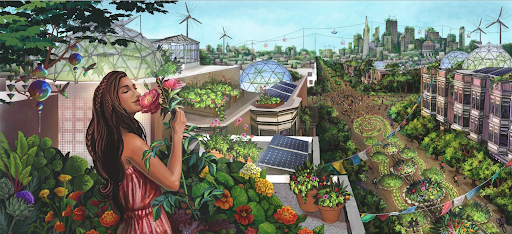
SU: Yeah, so like, there are two ways to get people to do what you want them to do. You make it uncomfortable for them to be where they are, so that they want to move to a different, you know, place, or you make it really enticing to be where you want them to be. And you know, so all the negative messaging all the disaster narratives, this is, you know, this is the first one this is you know, "If we continue along this path, here's how bad it's going to get." And so but you know, solarpunk, and the more positive messaging, it takes this the second approach of like, "If we change directions, look how cool it can be." And, there's a lot of science fiction that has done this over the years, we're just doing it specifically with environmental issues. And so, you know, you make it look pretty, and you make it look cool, and you know, show that there's a different trajectory, you just got to change a little bit, you know, maybe a lot but, but oftentimes, you know, like a lot of the technology that exists in solarpunk narratives, it already exists, it's just an issue of accessibility mostly. So, you know, to make it more attractive, you take away, you know this... reframe it. You know, are wind turbines ugly or are they beautiful, they're just wind turbines. It's just the messaging around it that makes people decide that they're beautiful or ugly. So, yeah.
HJ: So I think one of the limits that journalists face is a temporal one, right. And we talked to two indigenous journalists about climate change a couple of weeks back on the show. And what we discovered is they feel felt a need for historical context, that is completely removed from news. And that the ability to project forward consequences may be outside of the realm of speculative journalism, which is a hard concept for most journalists to get, in my experience, but speculative journalism might free people to think longer views. But climate change really requires going backwards and forwards in time, which is the forte of science fiction, as a genre.
EF: And I think any, any, any serious conversation about the future needs to deal with the past, right, and recognize that the past is how you can think about the future in a more grounded way. And I think one of our big challenges as a society, especially those sort of Western European industrial, you know, capitalist society that we have right now, is that we're narrowing down more and more into this tiny sliver of the present, you know, forgetting about the past and forgetting about the future. And it's a kind of practice, it's a mental practice, you have to engage in to try to break out of that and think more broadly. And so I think that, you know, indigenous knowledge and indigenous peoples different cultures that in various ways say, "Well, no, we're not, we're really not into this, like, endless news cycle immediate, you know, sort of tyranny of the present, the tyranny of the contemporary," have to have to find ways to tell those stories and remind people that the history and the future are there, waiting for us to think about them.
CM: I like the history and the future being one way to do that. And I think that culture skipping or kind of contextual skipping can be another way to do that, right? Because that's not, that may be the same time, but people exist in very different, you know, sort of physical contexts with different practices, right. So that's another way to show to kind of normalize the difference and expand what we see as being possible. It feels like a lot of this is sort of a casting off the constraints that we imagine around us, which, as you say, Ed, are getting narrower and narrower, exactly at the time that they need to get broader, right. It's kind of classic innovation, when you're under stress, you kind of lock down and go back to what we know, as opposed to opening up and being willing to experiment and push our boundaries. So it feels like this work is well suited to say the least for this time, right? Like just what the doctor ordered.
EF: Yeah, getting back to what Serena was saying, I think people want to feel good. They don't want to feel bad, right? And you have to give people - but a lot of our structure and the stories that we tell are these stories about feeling bad. And so you need to give people a new vocabulary. Actually, a new grammar, I think is a better metaphor, for how to do that, how to feel good, how to be hopeful. And sure, because as you said, Sarena, it's easier to be a critic, right? It's easier to knock things down than it is to build them up. And so you have to be braver to advance a positive vision of the future. But I think that's something that we should try to celebrate.
SU: Yeah, I saw a quote recently, that was something like people love stories about people rising up in situations of disaster, and you know, the feel good story of helping others, but they scoff at the idea of building a society that is based on that very thing.
HJ: So I'm very cognizant of the fact that a lot of our listeners may be encountering solarpunk for the first time through this conversation, since it's an emerging movement. So could we try to get a definition on the table? I know, Serena, you started us down that path, with your opening comments, but could we elaborate on that definition, just a little bit more?