How Journalists Might Better Meet the Information Needs of Communities: An Interview with Andrea Wenzel

Andrea Wenzel, the author of the 2020 book, Community-Centered Journalism: Engaging People, Exploring Solutions, and Building Trust, graduated several years ago from the USC Annenberg School of Communication and Journalism. While there, she worked with the Metamorphosis research group which has developed a distinctive vocabulary for talking about the narrative resources and networks that inform community life. I was lucky enough to have her as a student in my PhD seminar on the Cultural Studies of Communication and to have introduced her to my former MIT student and sometimes writing partner, Sam Ford, with whom she has been doing some collaborations around understanding the special challenges of providing quality journalism in small towns and rural America. Community-Centered Journalism explores a range of alternative models for how journalists might more productively engage with the citizens in their local areas to insure that their information needs are adequately met, that they are empowered to participate meaningfully in the decisions that impact their lives, and that trust is built and maintained across the process. This book could not be more cutting edge in the ways it explores what’s happening to news today even as it addresses core challenges which I recognized from my time as a local reporter almost forty years ago. For those of us who are invested in alternative models of participation, the book provides frameworks for thinking about how journalism might fit within a more participatory culture. I hope this interview will serve to introduce Community-Centered Journalism to readers who would not have encountered this book otherwise.
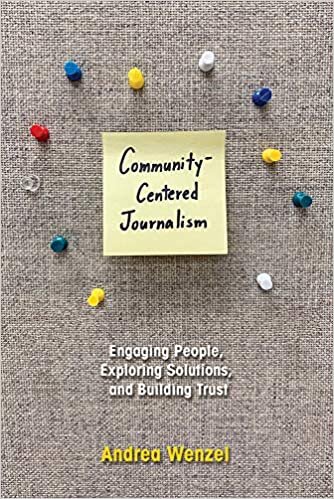

61sYMl1UX0L._SX332_BO1,204,203,200_.jpg


You write in your introduction that “dominant journalism norms and practices...often act as barriers to strengthening ties with local storytelling networks.” What are some examples of these “local storytelling networks?” What value do these networks bring to civic life? 


Local storytelling networks basically refer to the idea that in every geographic community you have different kinds of actors involved in telling that community’s story. There hopefully is some sort of local media, but often community organizations and other networks of residents also play an important role in how people find out what is happening in their area. Researchers have found that when ties between different actors in local storytelling networks are strong, residents tend to have higher rates of civic participation and a shared understandings of community issues. But the health of these networks depends on their being trust between these different parties, and in communities that have historically been stigmatized by negative news coverage that is often not the case. 

What aspects of dominant journalism seem to be having harmful consequences on how they operate? What other factors contribute to the relative strength of such networks?

 Probably the most problematic journalism norm that still circulates in many newsroom is the idea of “objectivity.” While that norm can be interpreted in many ways, the dominant interpretation has had the effect of creating distance between journalists and communities, and reinforcing whiteness. Even when journalists don’t intend for this to be the case, traditional ideas about what makes an authoritative source lead to overrepresenting people in positions of power, who are often white men. At the same time, many journalists avoid collaborating with community organizations due to fears of been perceived to be biased. All of this can strain relationships between residents and community groups and local media. Those relationships can also be complicated by factors such as political polarization, or divisions along lines of race, ethnicity, class, and language.

Speak about the paradoxes of local journalism. In many places, there is little or no local news being produced, but where it is being produced, it often plays a central role in the life of the community and is often a site of innovation in terms of how reporters relate to their readers. 

 We know too well that local journalism has been in crisis for some time, with a failed business model, and countless news outlets closing or becoming ghost newspapers that do not serve local information needs. At the same time, places that may at a glance have very little in the way of traditional news outlets can still be rich with communication resources. And, unfortunately, places that have multiple news outlets may not be serving all the communities in their coverage footprint equitably—complicating some interpretations of the idea of news deserts.

In my book I look at several cases where local journalists work to build relationships with residents and existing communication assets to develop coverage with and for communities. This includes initiatives I was involved in that grew from a process of assessing information needs and assets, discussing findings with groups of researchers, journalists, and community stakeholders, then collaboratively designing interventions that that combined elements of solutions journalism and engaged journalism. 

This community-centered process led to a project in rural Western Kentucky where an outlet called the Ohio County Monitor reimagined the local tradition of having society columnists to start a new community contributors project to give residents a chance to share first-person perspectives on a range of issues. They also organized listening tours in the cafes of convenience stations around the county where groups of local regulars would gather for coffee and conversation at self-described “liars tables”—which despite their name were often the best way to find out what was happening in the area. 

wenzel-headshot 1.png

A similar community-centered process alto led to the creation of the Germantown Info Hub in a majority Black neighborhood of Philadelphia where residents wanted an alternative to historically negative and crime-centric coverage of their community. That project has grown into a community journalism project where a community organizer and a community reporter conduct outreach, share neighborhood stories online and on a community radio show, and host community discussions. 

 How might we contrast solutions journalism with a more conventional notion of watchdog journalism?


Solutions journalism, using the definition espoused by the Solutions Journalism Network, is essentially a call for journalists to rigorously report not just on problems but on responses to social problems. It challenges the traditional theory of change associated with watchdog journalism—that just adding sunlight to reveal a problem will automatically lead to change. Proponents of solutions journalism argue that in order for people to take agency to improve a situation they need to understand what change is possible, how it works, and the limitations of such efforts. 

 What relationship might we posit between engaged journalism and so-called citizen journalism?  Can one be engaged and objective at the same time?


Engaged journalism is a term that can and has been interpreted in many ways. I think of it as a range of practices that aim to build relationships between journalists and the public, to assess and respond to their information needs and interests, and to involve the public to varying degrees in the journalistic process. That involvement could include citizen journalism, but it can also involve people in different ways—contributing to the creation of stories or discussion of them. There can be a real spectrum of participation depending on the interest and labor citizens are able to contribute, and the degree of comfort professional journalists have in sharing editorial power. As I alluded earlier I think the dominant interpretation of objectivity has been operationalized in journalism in a way that is problematic. At the same time, I think most practitioners of engaged journalism would say they are not advocates for any particular issue but rather advocates for a community and its information needs.  


In the early 1980s, I was hired to be a feature writer for the Smyrna Neighbor Newspaper in what was then still a semi-rural suburb of Atlanta. Having never lived in that community before, I had little sense of what the needs or interests of the community were and felt bunkered in the newspaper office not sure where to go in search of good stories. Previously, my work as a student journalist had been within communities -- my high school and my university -- where I knew the people well. What are some of the options that a young reporter today might have as they sought to develop a deeper understanding of the community and its needs?

This is a great question and one that I think many new (and not so new) journalists grapple with. One of the competencies that I wish were taught more universally in journalism schools (or in newsrooms) is how to adapt community organizing strategies for journalism. These strategies often center the idea of relationship building and understanding local power dynamics and being mindful of one’s own positionality with these dynamics. Organizations like Free Press News Voices do a lot of great work and have some helpful online resources. I’ve seen them work with journalists on strategies like having one-on-one meetings with community stakeholders, asset mapping to understand local communication resources and power dynamics, and convening community discussions.  Another strategy I’ve seen work well is to have accountability conversations where journalists who cover a community join residents to talk about their coverage, creating 2-way feedback loops and opportunities to build relationships. And even for new reporters who may have limited resources, a lot can be accomplished by simply showing up to be in the community when not working on a story—be it for a community meeting or to go to a coffee shop (in a non-pandemic reality). People appreciate reporters who show up to get to know a community and not simply to extract quotes. The Listening Post Collective has some great tips about how to get to know the information needs of a community and build relationships.

As you describe across the book, your own journalistic experience and research has included work in public radio in Chicago and Afghanistan, in Los Angeles, Philadelphia, and Kentucky. What similarities and differences have you found in the informational needs of these very different communities?

A lot of the argument I make in my book is that you can’t impose a one-size-fits-all approach to local journalism. The same things that make an intervention responsive to a community’s information needs is the same thing that prevents it from really being scalable. That said, I’ve definitely seen a lot of common themes pop up in all the places you note here. This probably has something to do with the fact that many of the people I have spoken with in my work have come from communities that have been marginalized or stigmatized in one way or another. There have been common frustrations with feeling like outsiders—coming from another country or another part of a city—have not represented their stories in a way that felt fair or respectful to them. People in all of these places also shared with me a hunger to see more stories that highlighted community-driven solutions—be they a farmer in Afghanistan or a community organizer in South Los Angeles. Finally, while the specific information needs varied, in each there were often gaps between the actionable information residents often prioritized and the ideas journalists might have of what would make a story compelling or newsworthy—some of these complaints connect with calls by some to rethink a hierarchy of information needs in journalism. Reflecting back on what I learned from all of these different contexts, my big take away was actually pretty simple—community-centered projects are not really scalable, but a community-centered process is portable. I think listening to and working with communities to respond to both information needs and assets is our best hope for strengthening the communication health of communities. 

Andrea Wenzel is an assistant professor of journalism and communication at Temple University. She is the author of Community-Centered Journalism: Engaging People, Exploring Solutions and Building Trust (University of Illinois Press, 2020). As a Knight News Innovation Fellow with Columbia University’s Tow Center for Digital Journalism, she has led projects on local news with a focus on marginalized groups in rural, small town, suburban and urban communities. Her projects have explored issues of equity and inclusion, engaged journalism, and solutions journalism. She is the co-founder of the community journalism project, the Germantown Info Hub.

How Do You Like It So Far?: Sarena Ulibarri and Ed Finn on Solarpunk (Part Two)


unnamed.png


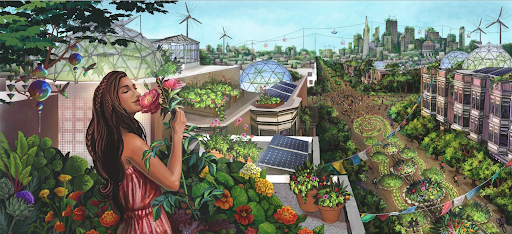
HJ: A lot of the worldbuilding is going on not simply in the stories, but in the art and people are designing solarpunk worlds whichever radically different aesthetic from much science fiction art previously, they definitely don't look like the Apple store that Serena was talking about. 


SU: Yeah, I think the aesthetic is really important to the movement. I think it's what gets people's attention, more than the messaging necessarily, at least in the beginning. And yeah, it's kind of, it's a nature-based, it's kind of maximalist. And it's inspired by Art Nouveau, oftentimes - not all solarpunk is but I think Art Nouveau is a really important aspect of the aesthetic. Not only because it's a beautiful way to work in like nature imagery, but also historically, the Art Nouveau movement was a reaction against industrialization and capitalism. So it kind of fits in that way too. Art Nouveau rejects the idea that beauty is something that's just reserved for the rich. This was an artistic movement that everybody is entitled to a beautiful world. And that beauty and practicality are not mutually exclusive. So that's very much in line with solarpunk ideals. I'd love to see more solarpunk works really fully embrace the Art Nouveau aspect.

The_river_ver_2_by_owen_c.jpg


EF: Yeah and art is this technology for feeling, right? It's helping you. And I think imagination, one of its fundamental jobs is empathy, and allowing us to imagine the lives of other people and to feel things that we haven't felt before. And I think that some of the most interesting solarpunk art that we've been involved with at CSI has done that.


We did this project a few years ago called Luna City, which was like an immersive, theatrical experience of living in a city and on the moon in 2175, you got to go on a tour of this neighborhood. And it had lots of bamboo and a river running through the middle of it, and all these green plants totally unlike, you know, the Star Trek future or the 2001 future, and really organic and everybody was wearing these like flowing, you know, robes that that don't feel like space futures at all. And that I think was really powerful as a way to - it was a solarpunk future on the moon, right? It was a way to experience this integration of technology and the natural and the human in a way where, where people could actually live there. You can actually say, like, "Oh, I can actually live here." Whereas if you pause, you will get a lot of this sort of classic science fiction, these really Stark, modernist lines and you're like, "Would I want to live there?" You know, like, where do you put your trash? You know, does nobody own anything? Or always the most challenging question, "How could you raise a child?"

 CM: Everything is sharp, it's all pointy!

tumblr_p51eeih1gz1x6vcixo1_500.jpg


tumblr_p51eeih1gz1x6vcixo5_540.jpg

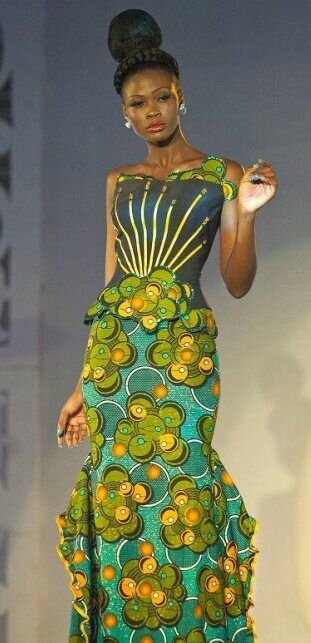
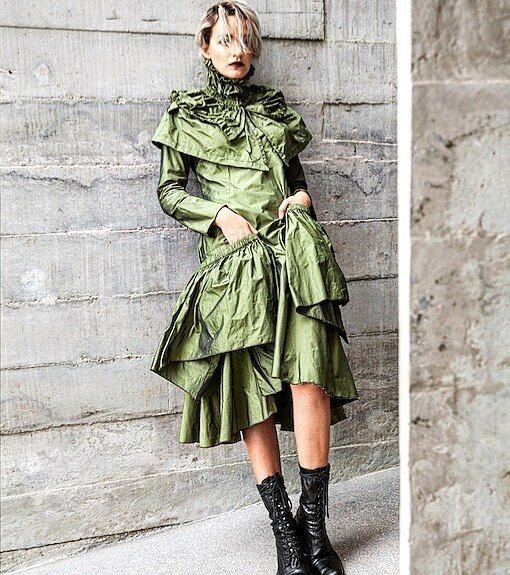
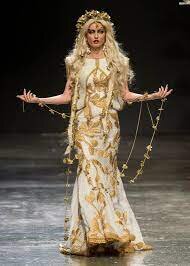
HJ: Well, you're touching on the design aspect and the fashion aspect of, again, if you look up solarpunk online and add fashion, you will see these remarkable designs taking place there as well, which is how it starts to bleed over into a lifestyle or a way of living in the world that solarpunk might represent. So can either you say a little more about fashion or music or some of these other embodied aspects of solarpunk?


SU: I keep waiting to see like really good solarpunk cosplay. And maybe when we come back to being able to do you know, cons again, after the pandemic, maybe we will be able to see more of that. But I, it's I've seen it mostly conceptual, rather than really embodied. But I might just be running in the wrong circles to really be seeing it. I think there's ton of ton of potential. And there's some really interesting, like sustainable fabrics, you know, mushroom leather, for example. And, you know, things like that, using different types of sources to create fashion. That I yeah, that I think have a lot of potential and are right now just very niche and probably too expensive to really be considered like solarpunk. But I mean, what if you can not only grow your own food, but what if you can grow your own clothes, like that would be amazing. That would be a really interesting change to fashion.

Unknown.jpeg


EF: I think the other place you see it is in, you know, weird and amazing research projects. So I had a student who's graduated from ASU, he's at MIT now, who was really interested in different fashion futures, solar futures, solarpunk futures, he was working on growable robots at our, when he was with us. So the idea that you would have something that would sort of grow on its way to Mars, and then it could be a robot once it got there. But he also did some really cool stuff with fashion. And I think that fashion is always pushing the boundaries of material science in lots of ways, right? They turned to the underwear manufacturers, when they were designing the first spacesuits for the Apollo program, because those are the people who really knew how to, you know, create support and structure. And the fashion now I think in solarpunk is looking for these, like, you know, programmable fabrics, and all this stuff that you can, is like right on the cusp, and you can do in a prototype that might or might not light on fire, but you know, isn't... I'm really excited, I agree with you Sarena, that, I think in the next few years, we're going to start to see a lot more wild and interesting stuff. Because people, that's another way in which you also make the future really personal, you know, if you make the future, something that you can put on and wear. I think there's a great interest in that. And fashion is this space where it there's a lot of ecological consequences to fast fashion, you know, disposable clothing. And it's one of those areas where I think there's a big imaginative shift that is maybe coming in the next few years.


CM: Yeah, I mean, I think it's, as you say, it's both palpable, when you can wear it, it feels real. But it also makes it feel possible, right to me, and so it feels in that way, it's like embodying the kind of solarpunk future that we're talking about in a way that says it's not only in the future, it starts now. And then the last piece, which is really important is ideally, it's cool, right? Like because this is you know, we know this from the Black Panthers and elsewhere like you want the revolution to look cool, so you want to be part of it. Right? It doesn't want to be that bad Star Trek or whatever that other futuristic version, in which there is no fashion there is no style. It's we're wearing uniforms.


EF: Lycra, it's lycra.


CM: Exactly! No, I want the flowy gowns from the moon or whatever the thing is right, that were grown in your backyard and yet look fabulous and don't stain!


SU: Yeah, and well it helps personalize it as well. Right? Not the monochrome jumpsuit, but the, you know, the really personalized, handmade, artistic piece of fashion.


CM: I mean, that feels to me like it's a reminder of the provocation that, it's back to what you said earlier, that it is personalized, that is localized, that the future doesn't need to be mass produced, but that we can imagine a different way of having sustainable futures which are indeed tied to precisely not that mass approach to things, so that to me feels like a profitable literally and figuratively, a really interesting space to dig into as something that maybe another earlier you know, edge of where solarpunk meets our current world. I'm sure there are other spaces like that, that feel kind of ripe for, that you can see, kind of emergent?


SU: Well, have you seen the Chobani commercial?


CM: No.


SU: Okay, look up the most recent Chobani commercial, it is absolutely solarpunk. And it's designed in this very like, yeah, actually one of the artists was a winner of a solarpunk art contest. So, I mean, it doesn't just look that way. It is like intentionally drawing from solarpunk aesthetic. It's a very short little story about like, you know, the future of sustainable farming. And so I was really kind of skeptical of it at first, because big corporation using solarpunk aesthetic, like, I don't know how I feel about that. But I looked into Chobani as a company, I think that they're doing about the best they can do in terms of sustainable sourcing and recycling and things like that, and they have goals, they have, like measurable goals that they're working towards. And so, you know, it's not the same as if, say Coca Cola was doing this. You know, there's been a lot of greenwashing and stuff.


CM: There goes our Coca Cola sponsorship.


SU: Oh sorry, you can cut that out!


HJ: Nope, in our dreams...


CM: That's a great indication, right? When the private sector, when they pick up on a thing, they're like, "There's some value here," right? "This is a story we want to tell." And I hear the ambivalence, too.


SU: But you know, I thought about it for a while. And I debated, am I behind this or not? And I think I'm happy that the solarpunk aesthetic is reaching more people, even if it is through a yogurt commercial.


EF: I think there are a few areas where our technical reach is still way ahead of our, certainly our moral grasp, but also sometimes just our imagination grasp. And I think synthetic biology is one of those areas where we have no idea what we can do right now, we can do so many things. And the tools are terrifying and incredible. And we have some great science fiction about synthetic biology and you know, different futures we could work towards. But I feel like we haven't even scratched the surface. And this idea of you know, growing stuff, like growing tools, growing building materials, growing infrastructure, right is really interesting and exciting the intersection of biology and material science, because there's so much of our built environment that feels, it's so industrialized, that it's almost magical, you know, we have no idea where it comes from, how it's made, what it costs to do it. And we're going to need to learn a lot more about those things and sort of demystify some of these industrial processes and open up some of these black boxes, and then maybe create new kinds of magic, where it's like, "Oh, it's local," like the farmers market is magical, you know, you go to the farmers market and eat this, buy this food that was grown here, wherever you are. And there's something amazing about that, and it tastes really good. Now, so that kind of localization and starting to create a new, new imagination, feedback loops, if that makes sense, around different - and where you actually know who all the people are, right? And you know, where your stuff comes from. Is at once incredibly mundane and boring. And we're talking about like, you know, your plates, or I don't know, building a new building or something. But it also I think, could be really amazing. They're doing all this crazy stuff with, I think, as Sarena mentioned, mushrooms and fungi before, right. I don't even know what is going to happen. But I think that's going to be a major set of transformations as people - all of those people who aren't probably talking to one another right now, start to talk together more and say like, "Oh, we've got this thing. We could do it for this."


SU: Yeah, I think that's a big part of what's going on right now is just everyone's in their own little corners. And it's not, it's not the collaboration that it could be. Another thing that I was reminded of when you were talking, I'm not even sure what remind me of this, but I saw an article about, there's like a robotic squid or something like that, that's helping to clean up the coral reefs. And so it looks like a squid or a fish or something and so it can kind of sneak in without disturbing the natural sea life, but its job is to go in there and remove waste and repair damages to the reefs and things like that. So, you know, there's all kinds of little, not little, that's probably a major project, but all kinds of projects like that that are that are happening. They're just not, large scale, they're not being utilized quite as much as they could be yet.


CM: To come back to kind of solar from that, from those sorts of developments to solarpunk, it seems like one of the neat things is to be able to kind of place those in conversation with each other, right? As not isolated developments around how we're using fungi or, you know, kind of the intersection of biology and mechanical things, but rather to see them as on this journey towards the future that we want, or more of the future that we want, that embodies some certain set of values, even not really precisely defined ones, but sort of a general direction. And that to me, that's what you could call, I don't know if solarpunk is a philosophy, but as an orientation for the people who are creating or using those tools or practices or technologies, that to me feels really valuable, right, to say, not just that we're, yes, you're cleaning up the reef, but it's within this broader context of this direction that we're going, and that that would seem to offer opportunities to put those different practices to collide them with each other and to see what comes.


SU: Yeah, I absolutely agree with you. I have nothing to add to it. That's, yeah.


EF: Picking up on something Sarena said before, you have to give people permission. And a lot of people don't feel like they have permission to do this right now. And also, the stories are not, at least the stories we make at CSI, are not intended to be the final answer. They're really just prompts to get people to do to do their own storytelling, right? And I think that what you really want is to inspire this sense of agency and responsibility. So people start to say, "Well, what about our reef?" Right? What if we started, what if we became custodians of this and started to feel a sense of responsibility and agency around it to start to care for it? Then we're gonna figure out a way, like, we're going to start with that goal, and then we'll figure out how we pay for it, and what the, you know, how we do it, and how we account for everybody's time and make it sort of make sense in the rest of the world. But changing that fundamental orientation, and then getting people, not to say, well, we have to, like write the story for everybody, right? But to inspire people to say, "Well, here's the goal, now you figure it out. What does this mean for you and your community?" in a way that's exciting and inspiring. I think that becomes for me, I think of that as imagination is this shared practice. It's a thing we do together as humans. And so how do we set the ground for that? How do we foster, cultivate, support that kind of shared imagination?


HJ: So thought shared imagination is not just U.S. based, but global, I think I'm struck Sarena by how many translations your press has been involved with in this space. So where are some of the other hubs of this dialogue? Where else in the world are people taking up the call of solarpunk and trying to contribute to this conversation?


SU: So, we have to start this with a shout out to Brazil, because they were the ones that created the first solarpunk anthology. That's the one that you mentioned, my small press had translated into English so that it could be part of this conversation. And it's a really interesting collection. I think most of the stories don't quite fit what we would call solarpunk now, they're, a lot of them are pretty dark, and they highlight, just because a corporation is green, that doesn't mean they're not still an evil corporation. But they're really good stories. They're a really good glimpse into speculative fiction from a part of the world we don't see much in translation from. And I don't know if Brazil is really producing a lot of solarpunk now, they might be, but from what I understand, there's a lot of innovation going on within Brazilian science fiction, like they just they love the punks, they've got all kinds of new punks that are very like Brazil-centric. And hopefully, we'll see a lot more of that going global at some point. But in terms of the other countries, Italy is a large one. That's largely thanks to Francesco Verso sorry, Francesco Verso, I probably still mispronounce it, who is, he's translated a lot of solarpunk fiction into Italian and has really just been a big voice for the movement worldwide. But also in Italy, people like Commando Jugendstil, they're an Italian collective of artists and writers. I published two of their stories in my Glass and Gardens anthology, but they've been doing a lot of really cool stuff with both artwork and fiction, in Italy. And then, with the Multispecies Cities anthology, we tried to, we centered Asia Pacific region, partially because there hadn't been a whole lot of those voices involved in solarpunk conversation. So the Multispecies Cities anthology is not exclusively Asian and Asian American, but it is majority Asian and Asian American voices. And we made that decision about two years ago, but it seems like even more important now, in light of the rising hate crimes against Asian Americans that we're elevating these voices, and showcasing better futures, that are free of that type of violence. So it's just interesting how the world and fiction are interact that way. But yeah, Australia has also been pretty well represented in solarpunk. I think there's a lot of, a lot of Australians seem to be very, very aware of immediate climate change issues.


EF: Yeah, my sense is that there are a lot of parts of the world where solarpunk doesn't really have to be a reaction to an overbearing, existing, sort of Western superstructure, because, you know, that never got built in the first place, right? And there's much more openness to say, well, we don't have to work through 100 years of industrialization, and all of the problems that that came with that we just need to live in the world now and adapt to conditions. We still have to deal with all the problems that that industrialization is causing us, even though it happened in other places and benefited other people, but, I think there's an openness. And in some ways, I'm speculating a little bit here, but my sense is that it connects to more traditional values and approaches of like, "Well, what does it mean to be in a community? How are we responsible to one another? And, how do we make things and care for our things?" You know, that solarpunk is not necessary, necessarily revolutionary, it's just something that makes sense. And it's a way to, it's just a different lens to talk about practices that people might have been doing for 1000s of years.

Green-New-Deal-1_0.jpeg


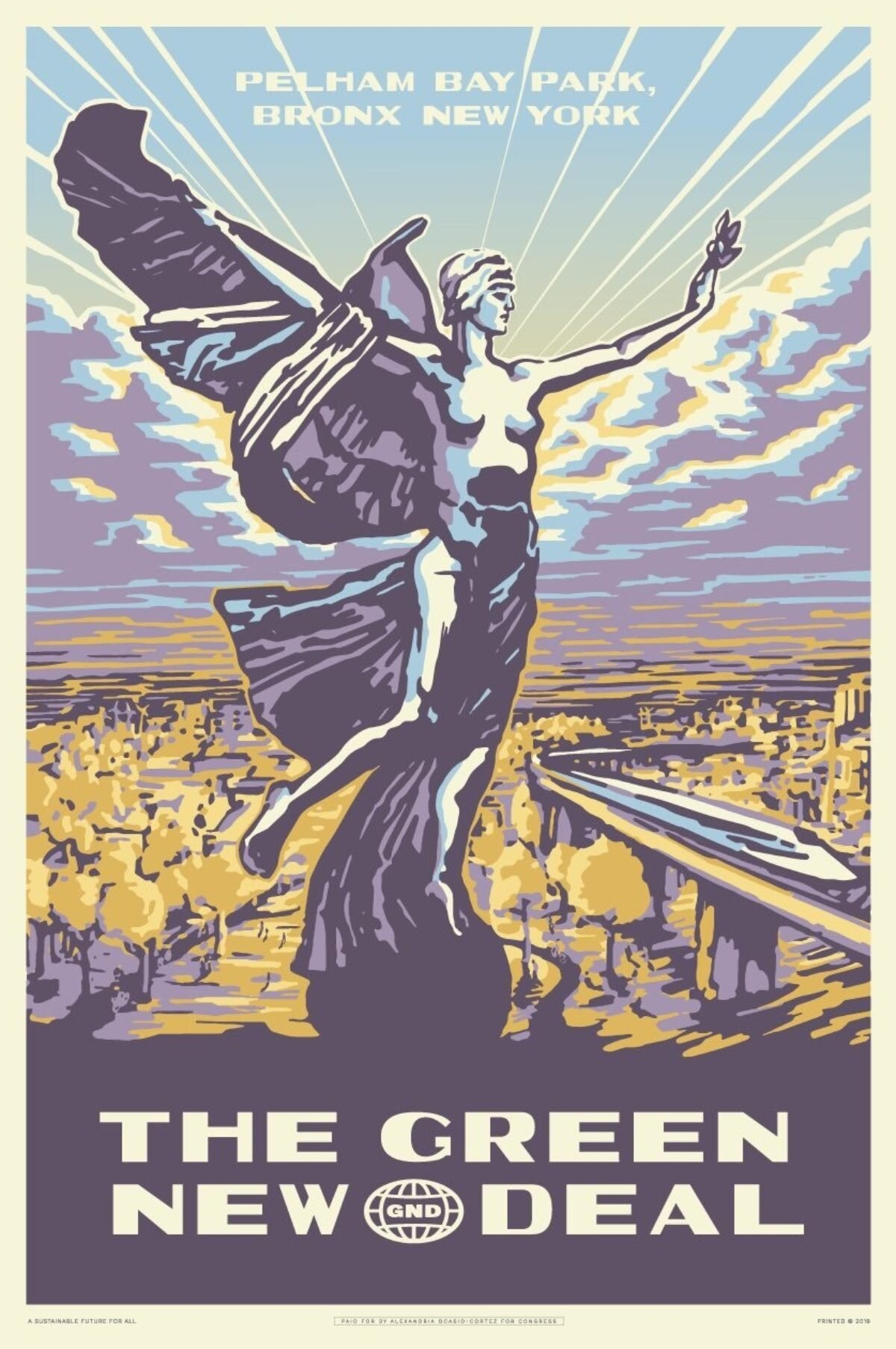
HJ: Is AOC, a solarpunk writer that is, can we think of something like the Green New Deal, and particularly the way it's being promoted actively through speculative storytelling, as a political outgrowth of the solarpunk movement? Or is that going too far, in thinking about what solarpunk is?


SU: I would say, yes. I think she's very much a solarpunk storyteller. And the Green New Deal is a sort of solarpunk imagining, and, to quote, I believe it's Jay Springett, who is a solarpunk writer, that "solarpunks can only be in dialogue with each other. And occasionally in chorus," is something like what his quote is. Meaning, there are plenty of people within the solarpunk community who are not entirely on board with the Green New Deal and who, you know, rightfully, point out some of its limitations and all that. So it is not like the epitome of a solarpunk, you know, policy, but, is it moving the trajectory of the world in a more solarpunk direction? I think so.


EF: Yeah, I think that I agree, radical change is possible, big changes are possible. And it's okay to talk about big changes. I think those are, that's a shift in registers, that was unimaginable, I think, two years ago. I was really struck last year by these huge aid packages that everybody was on board with, you know, the republicans in Congress, being totally on board with these massive, federal investments and giving everybody a check to support people during this incredibly hard year. And even a couple years ago, that would have been pretty unthinkable. So I think that the idea of change is something that everybody is a lot more open to right now. And that we can collectively imagine better futures. And not just do that as an armchair exercise, but actually try stuff and make big bets. You know, try big experiments, that feels like a shift, you know, that feels like a radical break, caused by all sorts of things, political, environmental, you know, epidemiological, and we have to make the best of it, right? We have to we have to try to address these challenges while we have the chance.


CM: Well, you have given me at least a good deal of hope about our capacity to address these challenges and some of the practices and, and ways of engaging that will help us on that journey. So I appreciate you joining us today. It's really been a great conversation.


HJ: Yes, thank you so much!


SU: Thank you. This was great.


EF: Yeah, thanks for having us, this was awesome.


HJ: So a few weeks back, we had the folks from Pop Culture Collaborative on the show. And it strikes me that solarpunk is just a fabulous example of what they're describing as narrative change. That is, this genre that has emerged from a social political need to think about sustainable futures has spread outward in a variety of different directions. But it is designed to have us think about better futures, to dream bigger, to use narrative as a tool, as a way of getting people to think differently about the world they live in.


CM: I mean, I was talking to my kids last night, who were saying something about how the future was terrible, and the planet was going to end, and we were all going to die. And I immediately came to solarpunk. And I said, you know, actually, that's not - I felt obligated just, first of all, to acknowledge that that doesn't have to be the future, that we can think about the future and other ways. And I realized how from, you know, from Hollywood, and kind of big picture, narrative change, all the way down to how we interact with our communities, that sort of optimism and the freedom to think of futures that are appealing. And as we heard, beautiful, right? And this whole, the notion of solarpunk that it is this chance to change how we think about our futures and to imagine the futures that we want, and to imagine beauty in the futures and inclusivity. And many of the vestigial and ongoing challenges of our age. But to reimagine those, and to speculate then on how we get there.


HJ: And part of what I love about it, is that it's a global conversation. So we're bringing in Brazil and Australia and Japan and Korea...


CM: Italy


HJ: ...Africa, into this question about a sustainable future, you know, and it's emerging at this moment where Trump has pulled us out of the global Paris negotiations on the environment.


CM: And what I like about all those different perspectives is, one is, it sort of implicitly pushes back on this notion that efficiency is going to win, and bigger and better. And we need a global solution, but to acknowledge regional, national, local, very local solutions to our challenges, and also allows those many different cultures, both in those particular countries and within those countries, to imagine the futures that they want, right. So it doesn't have to be one big future that we all agree on, but rather that it can feed from many different traditions and cultural contexts and different ways of living. That which, on one hand is more inclusive, because people can see themselves in that future. But it's also really fun for the rest of us, in the same way that we'd like food from all over the world, to imagine these futures and these ways of creating them, that are based on different sets of practices and dynamics. So that to me just feels infinitely more generative in terms of the possibility set of what futures and elements of our futures could look like.


HJ: Well, I think there's a fascinating trajectory to be drawn from the punk rock movement, which comes out of Reagan's America and Thatcher's Britain.


CM: Right.

91259f366bda2f672d47599a1f694256.jpg


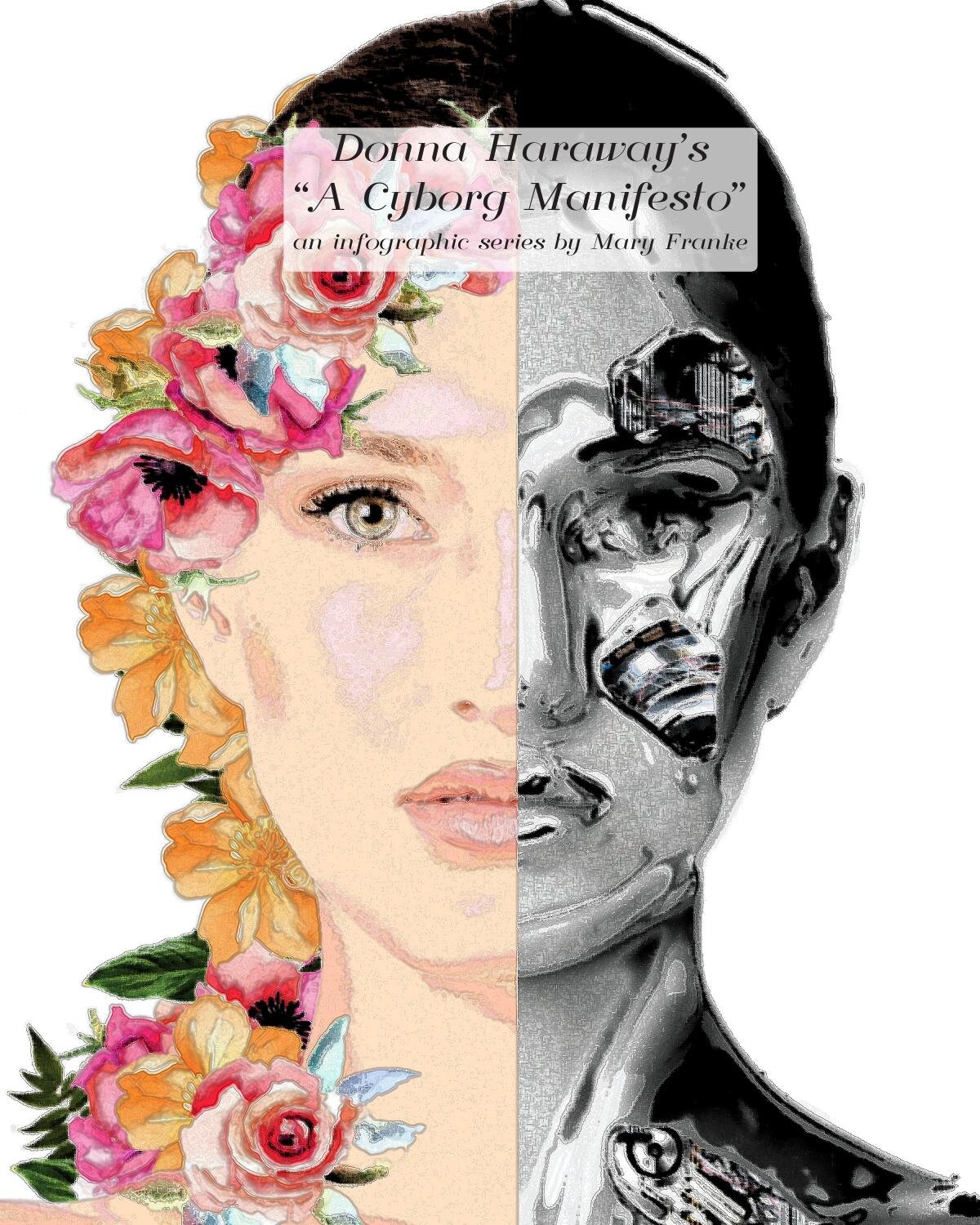
HJ: And is angry as hell, right? To cyberpunk, which has a certain ambivalence about technological change, and progressively became more and more rancid, in its vision of the future. And at once embraced the integration of human and machine, the cyborg identity, so forth, but then, at the same time, was horrified by it. And it's that push-me-pull-you around technology that it sought to express.

6450f1cbc04c31f67fd3611277e4ada5.jpg


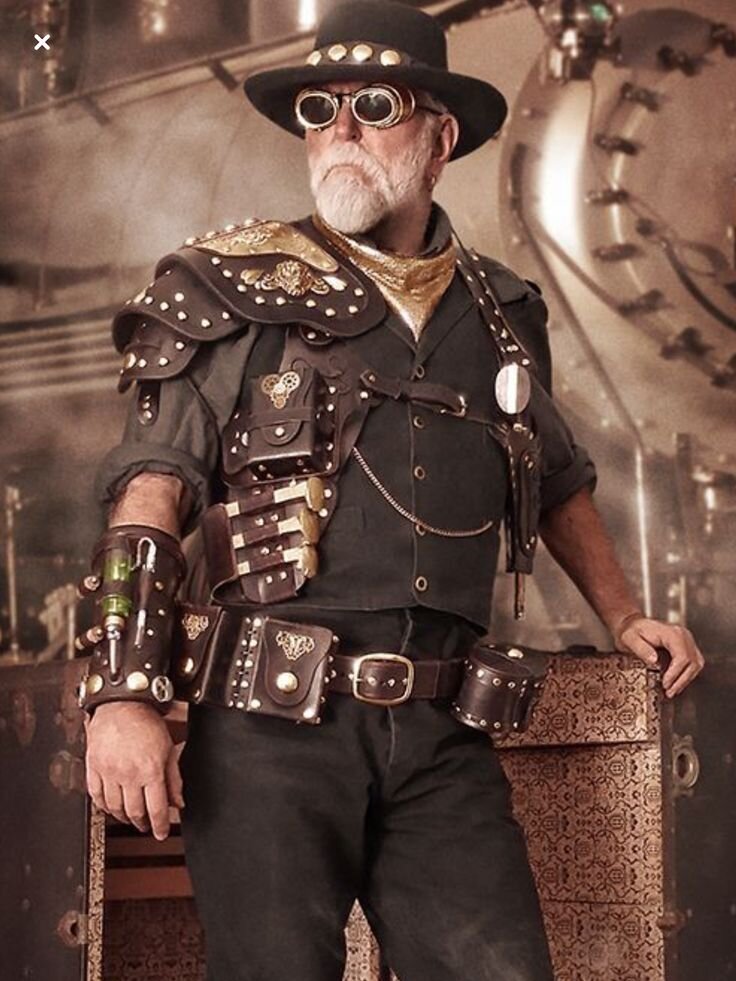
So then the steampunks say, "Wait, we've got to go back and reclaim the beauty of the machine and our relations with it," but go back to the steam snorting era of the past, which is precisely what the cyberpunk creators were trying to push back against. So they designed alternative paths. But solarpunk now is designing alternative futures and holding on to the beauty that the steampunk creators embraced. But doing so in a way that is high tech, low tech, but above all, integrating nature and machine together in a new way. And what's striking about all of those movements is that they are artistic movements, not just literary genres. Each of them in their own way became spread across all of the arts, painting, music, fashion...


CM: Furniture, everything!


HJ: ...by those different aesthetics, you can hear it in the music associated with each of those movements. There's an anger to cyberpunk music, there is a quirkiness about old, creating your own inventions for steampunk music, and there's a kind of new age, natural integration that goes into solarpunk music. So all of that comes together. But each of them are both DIY in one way or another. Maybe steampunk the most, in that it really was inspired by a few books, but was built ground up by the fans, through cosplay, and maker culture, and so forth. But solarpunk is not far behind in that, and each of them, because they have a distinct attitude toward the machine and society, have become activist movements as well with again, solarpunk, maybe, in the clearest trajectory toward narrative change that starts with speculation ends up in activism. 


CM: And I love how, I mean, that was an amazing description of those different movements, and really interesting to think about how they're responding kind of as you observed with the original punk, to different elements of their time, right, in different sort of what's happening then. And so what we heard in the conversation today was that what made it punk was taking back control of products, in some sense, right, regaining control, which also takes us back to Cory Doctorow's book way back when? A natural feature of our world today around technology, and the DIY-ness of it, right, so some of these things, DIY, have endured over these different movements, and others may be responding to the political leadership or what's happening. And now you have the, as you note, the environmental piece, right, which, even though the climate crisis has long been happening, we're maybe now reaching fever pitch. So you see that being baked in more deeply to the movement. So I love that, you know, maybe the shared DNA mixed with the new elements of the day that that really do respond. And I think that, it seems to me that both the that backbone, along with the adjustments and additions of today's concerns are what make it so relevant, right? What make it speak to us now, because it's speaking about the worlds that we're inhabiting, and the worlds that we could be inhabiting, in a way that's very, you know, that's palpable. And hopefully, that's actionable, right? Where we feel like we can make a difference. And to me, that's, that's tremendously exciting.


HJ: You know, and I think that we, if there's one strand running through the last eight or nine months of, you know, last two seasons, really of this podcast, it has been the power of speculation going back to the stuff we did, you know, at the beginning of the pandemic, were science fiction writers, like Bruce Sterling and talking about Japanese... But that was a darker speculation.


CM: Yeah. 


HJ: Now, as we're in the Biden era, and we're looking at maybe some end of the pandemic, it's now time to think about how do we build back better, as Biden would put it? Or how do we talk about what we want rather than what we don't want as our guests put today? Or how do we extend the horizon to tell the story of climate change, not in that news frame, that is so hyper, located in time, as the way we talked about it last week. So the theme of speculation, I think's become an important one. After all, how do we like it so far? What's coming next, as a phrase?


CM: Well, speaking of what's coming next and speculation I am, I could not be more excited about our next show when we're gonna have SB Divya and Jonathan Keats. So we have, Divya is a science fiction writer, solarpunk writer, scientist, and remarkable thinker about the future. And Jonathan, as an artist, I think he calls himself an experimental philosopher, among other things, and author, really has done remarkable thought experiments that change your idea about as with Divya's work about what, or challenge your ideas about what humans are, about time and how we think about time and the nature of time. So I'm really excited to continue this, our own speculation about speculation.


HJ: It's gonna be fun.


CM: So next week we're going to continue building on these themes with SB Divya and Jonathan Keats. Divya is a scientist and engineer, and author and editor, recently has a great book out called Machinehood, and other solarpunk things in the works and out there. And Jonathan Keats is an experimental philosopher, author and just troublemaker. 


CM: This show could not happen without our amazing production team, which includes Josh Chang, Sophie, Madej and Alexander Yeh. They are all amazing and the core of our enterprise.


HJ: We also thank University of Southern California Annenberg School and the MacArthur Foundation for their support for our activities, even though we're no longer recording out of the wonderful studios at Annenberg, but are recording wherever our laptop happens to be at any given moment in time.


CM: And most of the time, we are here in Los Angeles, like the USC campus, which rests on the historical lands of the Tongva and Gabrielino People and we appreciate their stewardship. In addition to finding us wherever you find your podcasts, we are on the web and howdoyoulikeitsofar.org, all one word as it were, and on social at H-D-Y-L-I-S-F, both on Twitter and Instagram. So check us out, say hello!


How Do You Like It So Far?: Sarena Ulibarri and Ed Finn on Solarpunk (Part One)

Last time, I shared a transcript for an episode of our How Do You Like It So Far? podcast featuring James Paul Gee. We are slowly adding transcripts for all of our episodes. Here’s another one from one of this season’s episodes, focusing on the science fiction genre/movement, Solarpunk. It’s also part of a season long consideration of science, the environment, the imagination, and sustainable futures. If you would prefer to listen to the episode, follow this link.

unnamed.jpg


Sarena Ulibarri: So, there are two ways to get people to do what you want them to do: you make it uncomfortable for them to be where they are, so that they want to move to a different, you know, place, or you make it really enticing to be where you want them to be. And you know, so all the negative messaging all the disaster narratives, this is, you know, this is the first one this is, you know, "If we continue along this path, here's how bad it's going to get." And so but you know, solarpunk and the more positive messaging, it takes the second approach of like, "If we change directions, look how cool it can be." And, you know, there's a lot of science fiction that has done this over the years, we're just doing it specifically with environmental issues.


Colin Maclay: Hello, and welcome to How do you like it so far, a podcast about popular culture and our changing world. I'm Colin Maclay. 


Henry Jenkins: And I'm Henry Jenkins.


HJ: Solarpunk is a hot, emerging new sub-genre of science fiction in the tradition of cyberpunk and steampunk, which is exploring sustainable environmental futures. We're going to be exploring what it is, why it's emerging, what some of its implications are, How it contributes to a global conversation about sustainability, with two really solid guests, Serena Ulibarri, who is an author and editor of among other things, Glass and Gardens, which is now a multi-part solarpunk anthology series, also Biketopia, and Adventures in Zookeeping. And she is joined by Ed Finn, who is the director of the Center for Science and the Imagination at Arizona State University, a center that has a deep investment in solarpunk. So we'd like to start things off by having each of you tell us a little bit about what you're doing right now, in the area of science fiction, and how you got to this place, what your origin story was. Maybe Serena, you could start us off?


SU: Sure. So my name is Serena Ulibarri and I am a writer and an editor, I run a small press called World Weaver Press. And our most recent project is, it's an anthology of many different authors, most of whom are from the Asia Pacific area, or of Asian American ancestry. And it is called Multispecies Cities. The concept is science fiction stories about better futures, with a focus on more than human issues. So urban spaces that are centered around a balance of nature and humanity rather than just being human centric. So that's the that's the most recent project that we've been doing. It was co-funded by, let me see if I can get this right, the Research Institute for Humanity and Nature in Kyoto, Japan, and a couple of my coeditors are involved with interdisciplinary projects through that Institute. It was pretty cool to work with everybody from around the world on that. So my niche is solarpunk, which I suspect we'll talk more about in depth later, but it's essentially optimistic science fiction with an environmental focus. And I have published about 50 short stories, about half a dozen of which can be considered solarpunk. I have always been interested in environmental issues and trying to work them into my fiction


SU: But, it was when I went to the Clarion workshop in 2014. That was when I really sort of became more aware of climate fiction in general. One of my instructors was Jeff VanderMeer, who's definitely written some things that can be considered climate fiction, you know, Annihilation, and well, a lot of his stuff can be considered climate fiction. And one of my classmates was Marian Womack, who has since published a couple of climate fiction novels most recently called one called The Swimmers. And so they write climate fiction and both of them write climate fiction kind of from this like, Gothic, uncanny, weird angle. And that was different than what I'd been doing, which is sort of the more classic, just dystopian Mad Max wasteland sort of angle. So I was kind of considering if I could kind of go that direction, but then one of my other classmates was from Singapore. And one night he was telling us about these biodomes in Singapore and they have giant colorful solar collectors and I was just like, "What are you talking about? This is, I've never seen anything like this." And I pull up some images on my phone and show him to him like, "Is this what you're talking about?" He says, "Yeah, that's my hood, we live in the future." And it was just like this instant paradigm shift. For me, it was like, the future doesn't have to be, you know, a dystopian wasteland. And it also doesn't have to look like an Apple store. The future can look like, you know, plants and animals and colorful and you know, so I've definitely learned some things about Singapore since then to know that it is not, you know, solarpunk in the in the social aspect, for sure. But just the aesthetic of it was a sort of instant paradigm shift for me. And when I heard the term solarpunk about a year later, it was just like, that was it, though, that term and encapsulated everything that I was already trying to work toward.


HJ: OK, Ed?

nUhHKMvb_400x400.jpg


Ed Finn: So I run the Center for Science and the Imagination at Arizona State University. And our mission is to inspire collective imagination for better futures. And that means that we have lots of different plates spinning all the time, and different really cool projects. So we, I feel like we are part of this solarpunk movement and engage with a lot of writers who do solarpunk stuff. And we do lots of other things, too. And I'm really delighted to be hanging out with you all and to meet you, Sarena. You know, it's great to find our fellow travelers out there in the world. So, you know, there are a few things that we're doing now that are new directions for us. And the big category that we're starting to fill up that I see as a sprawling, multi-year project with lots of different things is to really drill down on this word imagination. And that's something that I think you and I have in common Henry. Yeah, well, maybe we'll talk more about that. So we have a project right now, where we had originally wanted to do a big, like a big conference, you know, a big get together, invite lots of people to Phoenix to hang out and talk about imagination that that plan was quickly scrapped in the year of the pandemic. And instead, we're doing a series of virtual workshops, where we're trying to do some of the same thing and connect to people who think about imagination in different communities and different areas of practice, with a goal of not just hanging out with all the people we already know, but starting to meet new people who traffic in this idea, and play with imagination, and start to wrestle with the notion of what does applied imagination mean, we just launched a new fellowship, the call is open now until I think April 5, for people who want to propose projects around applied imagination. And the project description is incredibly short. Because it's really open, we're really open to all sorts of different ideas about what we want to see what people come up with, as we're in this exploratory phase of thinking about what imagination means. So if anyone listening to this is interested, if the I don't know what the timing of this will be, when that comes out, but you know, that's a chance to get $10,000 to do something really cool that you wanted to do. 


EF: I also am the Academic Director of Future Tense, which is this partnership, ASU has with Slate Magazine, and with the New America Foundation, and we publish an original piece of science fiction, every month, quite a few of those, I think, connect to - they all have that same fundamental optimism, many of them engage with environmental issues. And I think you could, you know, connect to solarpunk or tag as solarpunk. And we publish each of those stories with a nonfiction response essay by some kind of technical expert, and we have original artwork that goes with each of those stories. And I really love that part of the job and, you know, engaging with all of these different writers. And I think it's a nice microcosm of what CSI does in general, which is use science fiction as a kind of method, a tool, an invitation to talk to all sorts of people in the, you know, genre, and community who are big science fiction readers, but also people who don't really think about science fiction or don't think of themselves as science fiction fans, and use that as this invitation to think about the future. And to start to question well, what do I want, you know, what is the world that I want to work towards? A couple of other things. We've got cooking, we have this new anthology that's in its final edits right now called Cities of Light. This is a follow up to a collection we released maybe two years ago called the Weight of Light. And these are near future, technically-grounded stories about solar energy and it's very solarpunk, a set of explorations around what it's going to be like to live in a more, you know, ecologically thoughtful future, and really approaching that from a sort of systems engineering and urban culture point of view. Recognizing that it's the social problems that are going to be the big problems we have to solve, you know, we can wave our hands and imagine all of the, you know, all the solar panels you want, but then what is it? What is it gonna be like to live in that world, right? And what are the new problems you're gonna have, because waving your magic wand to solve the technical problem isn't going to actually fix all of the other things we have to talk about. So I love those collections. And those are partnerships, we work with policy researchers and technical experts at ASU and this second anthology was done in partnership with NREL, the National Renewable Energy Lab, in Colorado. And so it's really great to, again, bridge these different fields and modes of thinking about the future.


EF: And, you know, another piece of this for me, and another new direction that I'm working on right now is starting to think more about world building as a related practice, another kind of imagination. So I'm teaching a class that I'm making up, as I teach it, sometimes to the chagrin of my students, around worldbuilding. And that's been really fun. And, you know, thinking about how worldbuilding might be one of the toolkits or a set of methods for communities to start to imagine their own futures, and be more grounded, because imagination itself is, can be such a fluffy, abstract concept. Sometimes it's hard for people to really latch on to it. But you say, "Well, you know, look, we're going to make a world we're going to make this future," I think that can be a more grounded way to do it. So it's tremendous fun. There are so many awesome things going on that I rarely can remember even a third of them. And I'm very happy that way. I'm very happy to be part of this sort of collective of awesome people at CSI. And I think the origin story is a good one. And it sort of explains maybe why we're in this interesting place that we are. So in 10 years ago, 2011, Neil Stephenson, the science fiction writer wrote this essay called "Innovation Starvation," about how we seem to have lost our ambitions for the future. We're not thinking big anymore. We're not doing big stuff. We're doing little stuff. And our feelings about the future are no longer fundamentally optimistic. They're pretty dystopian, or disaffected. And it's a sort of a, you know, thought piece polemic. And he was at an event at the New America Foundation in Washington, DC, this is also at the very beginning of that whole Future Tense partnership. And Michael Crow, who's the president of ASU was there, too. And Neil, talked about this idea. And Crow in a very Michael Crow way said, Well, maybe this is actually your fault, Neil, you know, instead of blaming, like the scientists, the engineers, you know, all these other people for not thinking big about the future, maybe what we need are better stories, we need the stories that are optimistic visions of the future that inspire people to work towards those different visions. And so that conversation struck a spark. And here at ASU, we started thinking about, well, what if we, what if we actually took that seriously? What would it look like to try to move the needle on that, try to change our collective relationship with the future, and I really liked the way you put it Sarena, before, you know, we can't just expect some people in lab coats or some people in Silicon Valley to, you know, make the future better for us. And if you do, if you do let those people do it, it's probably not going to turn out very well. You know, we have to all be involved. And I think the biggest problem we face right now, is that not enough people are empowered and invited to talk about the future, and to feel like they are participating in that. And that is what we need to change. And science fiction is a fundamental piece of that toolkit. 


EF: So we started to, we came up with this idea for the Center for Science and the Imagination. And imagined bringing together people in academia but also out in the science fiction community, other kinds of storytellers and creators and artists, and different communities of practice, right, whether that's a neighborhood or a group of people doing policy around AI, and trying to reach them and connect them to these broader publics so that everybody can talk together. And that's one of the great things about a science fiction story is that it can put everybody on the same page. And you can have an interesting and compelling debate about a set, a bundle of technical and social and political issues in the safe space because it's fiction, you know, it's not real. So you don't have to like put on all of your battle armor. You can take some risks and speculate. And everybody can do it the technical expert, who might say, "Oh, well, I know all about, you know, this technical problem, but I'm not an ethicist. You know, I can't talk about that." And the member of the general public says, "Well, I don't know about the technical issues, but this doesn't feel right to me." And the ethicist who might say, "I can't talk about any of the technical stuff." So you know, getting everybody into the room together to have that conversation is really, really powerful. And thinking about those stories, not as prophecies or predictions, but just as invitations to possible futures, to start to have that debate about, well, what - there are lots of possibilities we've been focusing on, only a few of them but are missing these other ones - and then what do we actually want, instead of just spending all of our time worrying about the stuff that we don't want. That's what science fiction is really good for. So it's tremendous fun, and I can't wait to see what the next 10 years of this crazy ride are going to be like.


SU: I love the way that you describe is like a convergence of thought experiments, from different angles. That's really cool.


CM: I mean, I really appreciate both what you offered. And I and there's also like an interesting place between them, right, and thinking about your current work Sarena, and just sort of how the cultural context - so whether it's Asian or Asian American sort of different communities, whether by ethnicity, origin, or other ways we might define it, or engineering, are going to have different views on these things, right, and bring a different kind of valence and different qualities of imagination, to the futures that they envision. So that feels like visiting these different lenses on futures does free us up and offer us things that we didn't think about? Right, like whole new ways to see the world?


SU: Absolutely. When I think especially when you're dealing with climate change, like there's no one solution, you know, it's like hyper localization is really important for dealing with climate change solutions. And so yeah, what works for one group of people or one location, or one, you know, climate, or whatever, is not going to work for everything. So you have to look at it from various angles.


EF: Yeah, and it's not even really... there's going to be lots of things that don't work, right, they're just going to keep changing and evolving. And stories can be helpful with that your one little epiphany I had a few years ago is that I think stories are a really useful and important way to talk about climate change. Because climate change is so big, it's slow, relatively, you know, it's slow, except for the times when it's happening way too fast. And it's kind of abstract. And so, we're not good at that kind of storytelling, we're not good at that kind of risk assessment, you know, this thing that might happen probably will happen 30 years from now, you know, that's tough. Humans are not well set up for that kind of foresight as individuals. But stories are really good at encapsulating complex systems and having a foreground and a background and representing ambiguity and complexity. And so you can create a narrative about climate change with characters and you can control you know, you can leap around the time and space, and so you can make it more meaningful. And that I think, is the thing we struggle with right now is to make meaning out of the abstract crisis of climate change. And a lot of that is about dealing with change, right? Margaret Atwood called it everything change when she came to visit us several years ago, 2014 maybe. And I thought that was a really good way of talking about it, right? That it's not that we're going to solve a lot of these problems. But it's also not that we have to just give up or feel like the problem, you know, that things are hopeless. It's just that we have to recognize that there's a lot of change coming, and we have to figure out how to navigate that change and try to steer the things that we can.


CM: I mean, it seems like it sort of normalizes both change and response. Not, and part of me feels like there's a there's a parallel to science generally. And this idea that science is a straight line in which we you know, we get it right that we get more right more, right, as opposed to like, a very meandering path in which we got we thought it was this and then we realized it was that, and in the way that you're describing it, to me is similar, it's to recognize change is the constant in some sense, although the rate of change is not a constant. And we continue to respond to it. And it sort of gives license to making mistakes and to the trials and tribulations that are part of what it is to be human. But it doesn't mean you give up hope. And I feel like this is - I can't quite put my finger on it. And maybe you both have thoughts - but this to me feels like a fundamental divergence from like, how journalism treats it, right? And journalism feels really challenged to me in figuring out how to convey the change that Margaret Atwood spoke about, whether it's just climate change or everything change, is like it's trying to give graphs or it's trying to do "he said, she said," but it seems like it's fundamentally, traditional journalism feels fundamentally overmatched by this challenge. And I feel like where it does a little bit better is where it does some kind of storytelling and humanizes. But it feels to me like, the work that y'all are doing is way more, has a lot more potential. And maybe there's stuff that journalists can learn from it?


EF: Well, I think that there are some, I think journalism getting is getting better at that. And I think it's, you see people doing more data and analytics and making them more interesting, you know, looking like maps and graphs and connecting the local to the global. But I also think there's interesting things happening around speculative journalism. And that's an area where I want to sort of see if we can incubate some more cool things where you can combine that storytelling and the grounded, you know, the grounded reality of today. But I think some of it is that that one of the challenges is that journalists feel like a primary job is to be the voice of critique, right? And that sort of the truth-bringer and to, and to say, well, we have to talk about all the things that are wrong now. And that's a really important job. And, you know, that's a role that the Fourth Estate has to play. But we also need those narratives of hope. And, you know, I think that maybe I would love to hear what you think about this Sarena, you know, is it that hope doesn't sell, right? And people like news of fresh disasters, that's what people want out of their newspapers, and I can think of certain TV networks that have made a big business out of fear, fear and despair. You know, but I don't know, I think that, at least in our experience, there are a lot of people who were like, it's like they found water in the desert, you know, when they see "Oh, optimistic science fiction, optimistic futures, it's so great that you're doing that." What do you think?
 

SU: Well, it's just so much easier to imagine what goes wrong than what goes right. You know, it's just, it's easier. And it, you know, and you're right, it is sensationalized by the, by the news, certainly. And there's a sort of catharsis to it, I think, from the audience's point of view. And I think that can happen with the hopeful narratives, too. You know, sometimes people talk about the danger of optimism being like, "Well, everything's fixed rate. So now I can just go on with my life."


CM: Do you think do you think humans are sort of, are we hardwired, in some sense to respond more to fear and, you know, kind of gloom and the negative as a survival strategy? Is the argument that, and then, you look at Hollywood, or the news, or any of these other sources, where we hear stories, and there's way more of, you know, there's way more Mad Max, than there is, you know, whatever the alternatives are, which none, of course, come to mind at the moment. And I think it seems like also we sort of, optimism or hope can be belittled as like a fairy tales, right? Like, what you're talking about here is, is to say being optimistic doesn't mean that all things, all problems go away, it just means that we have the capacity to take on these challenges, and will continue to grapple with them, but it is possible, right? That there's some hope. But I feel like in that sense, for climate, which feels so overwhelming to most of us, it feels especially important that y'all are engaging the space to say, you know, you have licensed to imagine, and that's healthy. And that's part of perhaps what's going to feed our solutions and feed the way that we either, you know, make it through the day when the change happens. Or that gives us the tools to imagine the changes that we want to, we need to make to be able to make it through the day.


SU: Yeah, so like, there are two ways to get people to do what you want them to do. You make it uncomfortable for them to be where they are, so that they want to move to a different, you know, place, or you make it really enticing to be where you want them to be. And you know, so all the negative messaging all the disaster narratives, this is, you know, this is the first one this is you know, "If we continue along this path, here's how bad it's going to get." And so but you know, solarpunk, and the more positive messaging, it takes this the second approach of like, "If we change directions, look how cool it can be." And, there's a lot of science fiction that has done this over the years, we're just doing it specifically with environmental issues. And so, you know, you make it look pretty, and you make it look cool, and you know, show that there's a different trajectory, you just got to change a little bit, you know, maybe a lot but, but oftentimes, you know, like a lot of the technology that exists in solarpunk narratives, it already exists, it's just an issue of accessibility mostly. So, you know, to make it more attractive, you take away, you know this... reframe it. You know, are wind turbines ugly or are they beautiful, they're just wind turbines. It's just the messaging around it that makes people decide that they're beautiful or ugly. So, yeah.


HJ: So I think one of the limits that journalists face is a temporal one, right. And we talked to two indigenous journalists about climate change a couple of weeks back on the show. And what we discovered is they feel felt a need for historical context, that is completely removed from news. And that the ability to project forward consequences may be outside of the realm of speculative journalism, which is a hard concept for most journalists to get, in my experience, but speculative journalism might free people to think longer views. But climate change really requires going backwards and forwards in time, which is the forte of science fiction, as a genre.


EF: And I think any, any, any serious conversation about the future needs to deal with the past, right, and recognize that the past is how you can think about the future in a more grounded way. And I think one of our big challenges as a society, especially those sort of Western European industrial, you know, capitalist society that we have right now, is that we're narrowing down more and more into this tiny sliver of the present, you know, forgetting about the past and forgetting about the future. And it's a kind of practice, it's a mental practice, you have to engage in to try to break out of that and think more broadly. And so I think that, you know, indigenous knowledge and indigenous peoples different cultures that in various ways say, "Well, no, we're not, we're really not into this, like, endless news cycle immediate, you know, sort of tyranny of the present, the tyranny of the contemporary," have to have to find ways to tell those stories and remind people that the history and the future are there, waiting for us to think about them.


CM: I like the history and the future being one way to do that. And I think that culture skipping or kind of contextual skipping can be another way to do that, right? Because that's not, that may be the same time, but people exist in very different, you know, sort of physical contexts with different practices, right. So that's another way to show to kind of normalize the difference and expand what we see as being possible. It feels like a lot of this is sort of a casting off the constraints that we imagine around us, which, as you say, Ed, are getting narrower and narrower, exactly at the time that they need to get broader, right. It's kind of classic innovation, when you're under stress, you kind of lock down and go back to what we know, as opposed to opening up and being willing to experiment and push our boundaries. So it feels like this work is well suited to say the least for this time, right? Like just what the doctor ordered.


EF: Yeah, getting back to what Serena was saying, I think people want to feel good. They don't want to feel bad, right? And you have to give people - but a lot of our structure and the stories that we tell are these stories about feeling bad. And so you need to give people a new vocabulary. Actually, a new grammar, I think is a better metaphor, for how to do that, how to feel good, how to be hopeful. And sure, because as you said, Sarena, it's easier to be a critic, right? It's easier to knock things down than it is to build them up. And so you have to be braver to advance a positive vision of the future. But I think that's something that we should try to celebrate.


SU: Yeah, I saw a quote recently, that was something like people love stories about people rising up in situations of disaster, and you know, the feel good story of helping others, but they scoff at the idea of building a society that is based on that very thing.


HJ: So I'm very cognizant of the fact that a lot of our listeners may be encountering solarpunk for the first time through this conversation, since it's an emerging movement. So could we try to get a definition on the table? I know, Serena, you started us down that path, with your opening comments, but could we elaborate on that definition, just a little bit more?

file-20170719-13545-7rjaa1.jpg


SU: Yeah. So let me just read off what my current working definition is. So that I get all the words right.


CM: So I love that you acknowledge that there's a current working definition that that too is evolving, right? Like that's right.


SU: Yeah. So it's been changing since ever since I heard the word. Okay, so here's the current definition that I like. Solarpunk is a movement of artists, writers and activists interested in changing the trajectory of our world for the better. As a genre of fiction, solarpunk is optimistic science fiction stories that engage with issues of climate change and social injustice. Solarpunk stories don't always show the specific solutions that led to a better world, but they do always strive to show that better futures are possible.


EF: I'm going to go with Serena's definition, as a working definition. But I will add that I think, to me, solarpunk is fundamentally a style or aesthetic, it's a relationship with the future. Or, to quote Kim Stanley Robinson, who is quoting Raymond Williams, it's a structure of feeling. And Robinson is one of I think, someone who's been doing solarpunk for decades, as a great example of this. But he had this wonderful essay in the New Yorker, last year, near the beginning of the pandemic, talking about imagination, and how this shows us, our response to COVID demonstrates that big shifts are possible, right, and it's that kind of big shift and thinking that we're going to need to contend with climate change. But I really like that idea that, you know, it's not technical solutions. And it's not even particular practices, or particular stories, but it's this structure of feeling, the set of relationships we have with the future that need to evolve. And solarpunk does that it's this idea that the future is not unchangeable, or hopeless, or out of your hands, it's something that you can make, you know, you can manipulate, and you can craft in an artistic way, or a technical or, you know, an engineering sort of way, but you can make it your own, and that all of the tools are there, right? And the spirit is there, you just have to find it. I really love that as a sort of, you know, kind of a philosophical or an aesthetic set of principles.


CM: I mean, that, to me is like that's what feels like what I connect with the punk part of it, right of the kind of DIY, you can do it, you don't have to follow past rules. And the way that you've both described movement, not as like being narrowly bounded by certain rules, but rather, you know, that the kind of orientation and mindset. Are there other elements of like punk ness that that you see in there? Or is that wrong?


SU: Yeah, I think you're right on with that. And it definitely, solarpunk definitely has aspects of like the crafters movement, and like the Do It Yourself ethos. It's not anti-technology, it's not primitivist solarpunks tend to embrace technology, but they try to reclaim it, you know, being able to fix the machine, rather than just upgrade to the newest model, I think is a very kind of solarpunk thing, and to older generations, that might not sound very revolutionary, but like to a millennial, where everything is proprietary and built with planned obsolescence, and nothing can ever be fixed, you just have to get the new one. You know, and I think that is kind of revolutionary. So, you know, just being able to break out of that complacency, that sort of bondage to like the corporate gods and be able to take back control of the products you consume, whether it's technology, or whether it's food, you know, gardening and, you know, or... Yeah, just being able to take back control of the products you consume. I think that's, that's a big part of the, the punk aspect of solarpunk.


CM: And I mean, and that seems like a real that's a provocation, right? Because that sort of flies in the face of so much of the world that we live in right now, which is precisely not that.


EF: I was just gonna say the other punk thing is it's performative. You know, you're showing people how to do it, and that there's an artistic engagement part of it, and that, you know, I think the best solarpunk is stuff that gets you to do it too, if that makes sense.

HJ: So I was gonna note that the solarpunk manifesto defines solarpunk as, quote, "at once a vision of the future, a thoughtful provocation, a way of living, and a set of achievable goal proposals to get there." And I was really taken with that definition, because it's sort of, it's a full action plan, right? It takes you from speculation to achievement, towards social change. And this is I think, many of science fiction genres do this. But this is a particularly powerful demonstration of how fiction could contribute to change.


SU: I think I see the, like, achievable proposals part as just meaning that the solution should be based on like science and policy and social reform, like there can be hand waving about precisely how we get there, because it's writing fiction. It's not an instruction manual, it doesn't have to be specific. It can just present ideas and then let those ideas inspire real world change, but I have seen like a lot of sort of magical solutions floating around in climate fiction. And I think that can be very problematic, because we need a way we need Be able to see a way forward, that doesn't depend on the sudden appearance of a supernatural being or, the earth, you know, the emergence of a new superpower or something like that. So I think achievable proposals is a way of kind of saying, it needs to be based in some kind of reality, even it is speculative. 


CM: I think that it also connects back to the worldbuilding aspect, right, where there's a sense of coherence of the story that you're assembling. And to me, that's, you know, that's something that I've been kind of experiment, dabbling with whatever, in recent years, and find that really compelling, both because then it shows not the perfect, the only world that we'll have, but at least the way these different things can fit together, which gives you some tools to understand the way a system works, and that, you know, whatever decisions we make, and actions we take are gonna have implications. So then some of them will be positive and others may not be right. But that it feels more authentic to make it a coherent whole, of imagined, even if it's just one possible future. But that, to me feels like a, you know, a valuable part of this kind of storytelling and imagination.


EF: Yeah, and to make it really concrete, right, the best worldbuilding has real stuff in it - physical objects that feel textured and banged up and that have their own histories that it's, you know, it's a future that has a past of its own, is another important part of worldbuilding. And there's coherence but maybe not too much, right? You still need conflict and tension. And you know, it's not a monolithic, magical, unicorn, rainbow happy lands, you know, there's still going to be problems, or there aren't going to be humans, because humans, you know, we need problems, I think, to survive. So, there's still challenges and we're never all going to agree on anything. But there's this idea that there are compelling, believable chunks of the future, some of which you can build, and make and use right now. Right? And that that's how you make the big future is you start with the little pieces of it. And you build outward from your own set of practices in your own community. And if enough people do that, we're going to change the world.


How Do You Like It So Far? What Is a Human with James Paul Gee (Part Two)

CM: With so many of those forces and such diverse forces of socialization all around us, how do we even begin to think about... my voice had me up last night saying very unkind things all through the night and I'm not worried so much. Body image isn't the main thing that drives me, but then there's 50 or 75 or a thousand other things. We have our whole economic, social, educational, all these edifices are built on those things that feed the voices that we hear. How do you start to think about beginning to change those dynamics?

JPG: Cognitive behavioral therapy is based on trying to lower that voice, but we're finding out newer and newer stuff that is going to lead to therapeutic things. But the fundamental thing is this, because we are herd animals that come out of the primate line, humans are a immensely tropic to status in the sense of what do other people think of me. One of the reasons this voice bothers you so much is you were socialized to care way too much about what society thinks of you, groups think of you, what your identities signals mean to you. That is one problem. The other problem is your voice is healthier and pretty healthy when you feel you belong and you feel safe, because the way the vagus nerve in the body works is if you feel threatened or unsafe as many Americans do, it turns on two parts of the nerve that you really go to fleeing, fighting, hiding, trying to protect yourself, and it absolutely turns off the part of the nerve that makes you pro-social and open to others.

JPG: At a biological point of view, unless you turn off the unsafe signals, whether they're mentally unsafe, it does no good to send a kid to school and think he's going to learn, you're no good for people to collaborate. Now, the other thing I had to say is we moderates have totally give up on the idea of arguing about what is good. What I think we ought to do is, evolution doesn't care whether you flourish, only whether you survive, but you, you care whether you flourish. Therefore we need to say, how do humans flourish? Not just survive. How do they flourish? And see, now we have a test for that. It isn't going to just be subjective. We certainly want you to argue for the good, but it's not a totally subjective matter because if your system is full of inflammation from stress chemicals, it is slowly eating your organs, and it even goes into your brain and begins to destroy parts of your brain.

JPG: I think we can all agree whether we were communist or Nazis that an organism that is destroying itself from the inside out through inflammation just like little knife blades stabbing at it is not flourishing. We could agree on that. The what you could do is you say, "Well, this will certainly be true with school. Let's check if the kids in school are flourishing." First of all, because if they're not, they can't learn. And second of all, if they're not, you should be in jail; you're taking care of your donkeys poorly.

JPG: Anyway, but when you get to the flourishing thing, well, you can use this test, but it still means you've got to make choices about what is good for human beings. One choice that I make, and you have to argue with, remember, you cannot just say it's true, so you've got to believe it, is that if something I do is toxic to others, in the end, it's not good for me. Now, I can't convince you by simple truth, but I could put that into a game or into other stuff and you'd say, "Wait a minute. I thought that it didn't harm me because Joe here is unhappy, but now I see this could be bad." Anyway, we have to reach it.

JPG: See, it's the humanities. We got to get them out of school, we got to get them out of canonical lists, and we've certainly got to get away from the liberals who say anything anybody writes or makes is equally good as anything else. That's not true. It's not true that people make better stuff because they're more gifted; it's because they have drawn on their life experiences and had life experiences in a way that not only took effort but care. I don't doubt that everybody could produce a good piece of art, but that doesn't mean everybody did. I certainly don't think all the great pieces of art hanging on the walls.

JPG: But I do think that the function of media and art was to give you design sensations, experiences, where you could learn and understand in ways that you can't by being just let free in the world. And that's a responsibility. To me, every designer, an architect, a media designer, game designer, and author, they are teachers. You are teaching people. What do teachers and parents do? They say, "I have to design this experience, mentor it, guide you so you don't kill yourself or you don't learn something that seems so spiffy and later find out it's absolutely toxic"


Pictures-of-Mother-Animal-Teaching-Their-Baby-7.jpg


JPG: No humans... I don't know any culture that... And by the way, animals don't do this. Animals don't just turn the young loose... most of them, many, many species don't turn the animals loose and say, "Hey, I hope you catch onto what we caught on to." They pass it down. They teach and they often do it through designing, and it's a niche and environment where the child can observe the right thing or be with them in the right way. In many ways, if you're an ethical designer, you are a modern shaman, a modern parent, a modern teacher it's an ethical responsibility, and you better take it. But if you sit around and say, "Well, everything's as good as everything else." Well, look at the state of the world that got us.

HJ: I kept reading this, but we're going down this path toward education, and I kept reading this book through the shadow of your other books, and you edge toward education and edge off it again. There are moments you talk about grades as fetishes as an example of what a fetish is. Near the end, I think we're reaching this conclusion that if we were wrong about what a human is, then education is inhumane or non-human, designed for the wrong species.

JPG: Exactly, in conclusion. It might work for martians. I don't know. I don't know what a martian is like. What this book has to do with education, it says, if you don't know what a donkey is and also realize that because a donkey is something, it doesn't mean every donkey's the same, then you should not be teaching donkeys. The game issue is this, I've always argued that games where you are making choices in a virtual world is an exterior version of our talking to ourselves. It's what we do in our imagination; we role play. Games invented a technology that allowed us to take this function of talking to ourselves and thinking about it while we do it, and put it out externally with content that maybe we could never have gotten or I have no access to.

JPG: That is a powerful technology if used correctly. What you say is that technology, which is really an external imagination, needs to be developed so it makes up for the weaknesses of our imagination: that my side bias, the nagging torture of ourselves, and supplements the good parts of it, which is imagining new identity signals that go wider and worlds that can actually be changed. The message is, I'd like a game designer to say, "Wow, I better up my game." I'd like a school to say, "I better go study what a human is." That's its message. Otherwise, you're right, Henry, when you have school systems today where many of the kids have such high stress levels that they're sick and inflammation, and you're not speaking to any of what their voices are telling them of how inferior and bad they are because they didn't get Bill Gates' money, then I don't know why you bother to teach them because they're not listening to you. They're listening to this.

JPG: You've got to say, "Hey, listen to me," and they're only gonna listen to you if you say, "There's hope, what you're going to tell me now is going to be a voice from the outside of hope, and I'm going to put it into my voices and maybe I'll throw a few other ones off," and do it. That's what education was supposed to be doing. At its best, it's what it did for you and me. It made us aware of what some of these voices were, who should be thrown out, who should be in.

JPG: But education has been co-opted at the university level by grant getting and marketing. I think as the humanities and arts have died because no one wants to pay for them anymore, they are making a huge comeback outside of school. Art didn't die. A bunch of kids are doing it as you know, and they're doing it in the way it was always meant to be done, as a participatory experience that made people think about experience, in a way that was motivating and not alienating, but was novel and exciting. As the humanities die... they will come back in the younger generation and get back their function. I hope that as that happens... Look, we self domesticated ourselves, we changed ourselves in history radically, we are the sort of species who can do it again.

HJ: One of the passages in the book that really moved me stayed with me as I reflected on it is your description of learning poetry, which speaks directly to what you were just saying about the humanities. I think you and I come from more or less the same class roots and through similar processes, although, I never quite got poetry. My wife gave me a poetry book of Elizabeth Browning's poems when we first got married, and I sat down one night and was so proud of myself, I read it and every line connected with every other line, and I was understanding it. When I woke up the next morning and realized that numbers after each line were actually page numbers, and I was reading the titles of the poems, not the poems-

JPG: Could have been a great poem. I remember, I went to a Catholic seminary that I was in for six years and never left, and they banned most books and they certainly didn't teach poetry. Then when I came out, I got a degree in philosophy and became a theoretical linguist, syntactician. Then I got my first job at Hampshire College, which is a very liberal college where people don't have to stay in any class. They graduate by projects. The classes are there to help, but they can leave. They don't need classes to graduate. They had one of the very first cognitive science programs in the country, and they were right next to UMass Amherst, which was the second best linguistics department, and they weren't too far from MIT, which was the best.

JPG: It was a good job until I discovered that I made... and my first course was called on government binding. I went in there and there were 84 students. I thought, "Well, this is an erudite college that is willing to take Chomsky and syntax at this level as undergraduates Two stayed, because they had come thinking it was about S and M. By the way, the two that stayed are both today full professors of linguistics. The little group of us linguists got together. Most of the students wanted to do humanities. They said, "We got to attract them somehow." I had heard of this field stylistics where you did the linguistics with poetry. I hadn't seen much of it. I suggested it. I said, "If any of you guys know literature or poetry, we could do this."

JPG: They said, "Well, I know literature and poetry out of school. I don't like it. Why don't you teach it, Jim?" I was living with a woman at the time who was educated, and I went back and said, "What the hell do I do now? I never read any poetry," and she said, "Well, just go get a Norton anthology of modern poetry and sit there and read it, see if it moves you." Well, I was just blown out of the water. As a linguist, just blown out of the water. To me, it was like what I called semantic saturation. Every part of it is saturated with meaning, and in the best poetry, with participatory meaning. There were often several interpretations and they were juxtaposing with other interpretations of meaning that invites you into that poem.

GUEST_af01abae-16d1-46ed-b663-d931beec2138.jpeg

JPG: I then read Moby Dick, and I thought, "God, best novel." Later when I then taught this class, of course, on linguistics and poetry and literature, it was to get these kids to take syntax by exposing it to them, and yet I had got hooked on the poetry and literature. When I would do it in class, they always... whatever we've got to do, they had had it in school and they hated it. Then we would actually look at what it meant as a piece of language in an experience you're having with it, and they would say, "God, this is really good. How come no one told us?"

JPG: I realized no book had been ruined for them more than Moby Dick. They thought it was the story of a whale. I said to myself, "It is just amazingly good I did not read Moby Dick in school." It's not the story the whale as you know, it's a story of everything. I also found out though, that once you showed these people that they, themselves, as speakers of language are in their daily life, using language poetically deeply to make meaning that humans are all very good at language if you traumatize them and they have to make sense, they start telling a story. I would show them that that human language from children and adults, when people cared and were passionate and forgot enough about their internal voice to put their passion in there trying to make sense, that was already strong language, and that the poets were part of that tradition. They had no trouble understanding that.

JPG: School just ruined it for them. Poetry then has been important to me ever since. I have three volumes of poetry published and more written. My poetry story is sad. I've never wanted to write poetry though I like to read it, but one time, a few years ago I had, for the first time in my life, serious allergies and I was seriously depressed. All of a sudden I found myself, I was in the car and Betty was driving, getting out a legal pad and writing with a pen, which I had not done for decades, poetry. Couldn't stop myself. Just absolutely could not stop. Just wrote poem after poem. I had no sense of composing them. They came out. Somebody publishing things saw some of them and said, "Wow, let's publish these poems," and they did. Then I went for allergy treatments that worked, and I've never had an urge to write a poem since.

HJ: Writing poetry was an allergic reaction.

JPG: I said to my allergist, I said, "Is writing poetry a symptom of allergy?" And he said, "I've never heard that." I gave him a copy of my poetry book and said, "Well it is, here it is." I have no idea, but it was an amazing experience because this idea when you start with a muse, it was that experience. I enjoyed the hell out of it. It was lovely. I would love to be able to do it again. I keep trying to get sick, but living on the farm, my immune system's too good now. Anyway, it was an amazing experience, but it also, by the way, when I read them myself later, it gives me just more respect for real poets. Look at the tremendous impact that the young woman poet at the inauguration had on the society and put that together with the fact of all these right wingers and elitists saying poetry is irrelevant. You can't get a job with it. It doesn't matter to society at all. You say those are the voices. There are some voices you need to get out of your head.

HJ: Well, one of the things that I think struck me about Amanda... Gorman is her name?

CM: Yeah.

HJ: Her poem, was it had features that would not be reproducible in text. That is, her gestures are part of the point. It's a multi-modal experience of poetry as is the intonation of the voice. And that's all the stuff that gets stripped aside when we create textbooks and bring poetry into the classroom.

JPG: Right. That's because when we made poetry and plays and Shakespeare canonical, we made them part of our textual world when they had not ever been part of textual worlds. We did exactly the same with the Bible. The New Testament, Old Testament, oral stories thousands of years old told by multiple groups. They were part of the voice they heard, and in a sense, knew came from outside them from their ancestors. Then when you put that into the text, the so-called religions of the book, what happens is it floats away from the way in which is indigenously embedded into culture, into earth, into landscape, and becomes this universal abstraction that is not very meaningful and has to be policed by people as texts, not as participation in life.

JPG: Yes, but see, the good thing is people saw it's a poem that she said and the power of saying it. Think about it, for people who have heard Trump speak for four years, what it sounded like to know what language with care sounds like. Notice, by the way, she did not need me to tell her; you have to tell the truth, but tell it slant.

HJ: You said right before we went on the air that you see this as your final book, and you end this with an homage to the editor of The Examined Life. Is the examined life something we only get to when we are retired and therefore can look back or is it process of ongoing examining?

JPG: The issue for me over the examined life is given that I was raised in this fanatically devout Catholic world, but with a lot of background on theology, and then got degrees in philosophy and linguistics and then went on to work in a lot of areas, and when I came to the humanities, indigenously, indirectly, everything in my life that has led me to believe the saying "an unexamined life is not worth living." That was a cardinal belief of mine. That means you're living that life. It doesn't mean you do it at the end. The real question for me in retirement is, is it true? Are people in this world now with such lack of safety and equality, are the people who examine their lives happier or the people who don't? How many people in the history of the world even had the opportunity to examine their lives when they're living out of trash.

JPG: An old person comes and says... well, I don't know if this has happened to you yet, Henry, but it certainly happened to me. As you get older, you realize you don't know much. You don't know. I don't think not knowing is a detriment to doing good work. I think it might be better. But you have to still trust your moral intuitions of what's worth doing, or you can't do it. I think what I'm doing there is trying to find out is there some ground other than my arrogance or fear that the examined life is an important thing for humans to do at a moral level. I'm examining that question without an answer to it, because the book is saying that it is interesting, probably important, but it certainly is interesting, before you die to know what a human was. It's fascinating because I'd like to know.

JPG: That's why I wrote the book, but not because I know, we're only beginning to know, I wanted to give everybody the tools to ask the question for themselves. Not to come up with my answer, but to say, "Okay, here was my attempt. Now you take your turn." I did that because I think it's important and interesting to me, but of course nobody has to do it. I think we all, as academics, baby boomers in particular, we bear some responsibility for the state of the world. We were the most privileged generation in history. The baby boom did not have necessarily great intuitions about how to take care of the earth or even how to take care of their own children. As we get older, we need to do like the old, old Catholics did, a self examination and wonder whether it's worth doing.

JPG: Now, it's my last book because no one needs more books from me now. My limit was up. What I want to do, and I'm trying to do this with some people now, is work with much younger people who do not have all of the voices. They have some bad voices in their head, but they're not the ones in mine. For the first time I met somebody who does not have Saint Augustan in their mind. That's a new thing in history. And trying to get them to say, "Look, you have to take this further." That doesn't mean agreeing with me; that means taking this intuition that we've got to keep harping on, "How do we get humans to flourish?" Because if they don't flourish, the world will not end, but the world that is livable for them will end. We need young people to do it now. So I'm perfectly glad to help them, write stuff for them, model stuff for them. Bu they are the ones that are going to have to carry it into the future.

JPG: That's a lot of what you do, Henry. I think that's our moral obligation to do that, so that we pass on... Remember, all these animals, parrots, whales, they pass on the knowledge of the elders so that not the species, but the group they're in, can get good at what they have to do to live and not have to rediscover over and over again. That's the job among parrots and among whales for the elders. That's our job now.

HJ: Well, that's a powerful place to wrap things up. It's been great having this conversation.

JPG: It's fun to talk to you guys. Yeah, it's great. This was very, very good.


HJ: That little bit of music you just heard is from Bing Crosby's song from the '40s, Swinging on a Star, which has interesting things to say about animal intelligence and education, so right at you, Jim. Right after the conversation was recorded and James Paul Gee tells us there's no such thing as an incompetent cat, someone sent me a cute cat video where a cat has his head in the sink, the water is running all over it, and he's trying to lick up air because his mouth is not in the line of water. I sent it to Jim and said, "This seems to me and incompetent cat." He wrote back and said, "Oh yeah, but humans laugh at it all the time just the lord it over the poor cat."


HJ: The more I looked at it, and later that day got a video where a cat had his head caught in a Kleenex box and is desperately trying to get it off, I realized that most of the cute cat videos are videos of cats caught in a human world trying to do things humans do simply, but things that aren't in the nature of cats at all. They're not bad cats. They're cats doing a bad job of pretending to be human.

CM: That is awesome. My first reaction was, of course, my cats drink out of the tap all the time. Every day they just sit there whenever I go to the bathroom, they're like, "All right, let us get some water." I have videos of them drinking water, either alone or together, both of them drinking from the same stream in a way that I find miraculous that they can get their, they can catch a droplet, at a time, of water and have the patience to do that. I think in addition your observation that cat failings are basically about human failings in some sense or interacting with the human environment, our cats are also incredibly adept at interacting with the human environment, able to open doors and unlocked things. My old cat used to be able to lock a door, which I found amazing.

CM: It is funny, but they are good at being them. We are introducing the distortions into their world. I guess, arguably, kind of what he said is we introduced the distortions into our world as well. The way that we are training this little voice in our heads to run amok in ways that undermine so much of society and undermine us individually, I feel like it's part of this cycle that we make work or make challenges for ourselves. I think generally when I was reflecting on this conversation, a lot of it for me was about how the digital world, or it spurred thoughts on how the digital world amplifies and distorts and otherwise changes all these ways of being human in ways that make us less human and less communal and less of ourselves. I felt an indictment of technology fairly strongly.

HJ: Yes. I think that's partially right. I think an indictment of human culture. He calls humans throughout the book man-made monsters. The sense that we created a monstrous version of ourselves by the ways we designed environments that are inappropriate for us, starting maybe with the home and the family, but particularly for him, I think he's thinking about education because after a lifelong career in education, talking about education, I think some of his frustrations with the failure of educational reform are just beneath the surface when he speaks and writes on this topic, which is why I think we saw more of that as we got deeper into the humanities. I also think though that Jim has always been celebrating video games as a space of learning and as a space that teachers can learn from and bring certain design principles back into their class.

HJ: I've always been moved by Jim's passion and discovery of video games well past the age where most people today would experience them, and his willingness to lecture and play video games live at the same time. I sure as hell couldn't.

CM: That's awesome.

HJ: He's out there playing the game, showing us features of the game, explaining the educational dimensions of the game. It was just so clear that this was an environment he's really comfortable with, but the farm also seems to be an environment that he feels especially comfortable with. It's fascinating to me as someone who's known him for a long time to suddenly see this... to mix my metaphors, a flowering of animal imagery in his speech, the way he's drawing on this new found fascination with the natural world, and his writing is speaking as an analogy to think about what we need to do for humans. In that space, one wonders if a well-designed social media system would not be like the mound that, as he's talking about, a kind of symbiotic relationship the termites have to their environment and toward other species, which allow them to think in ways that go well beyond the mental capacity of the species. I think that fantasy of collective intelligence is something many of us had when we first started thinking about the online world.

CM: Yeah. The reality, of course, is that it feels often that rather than developing practices and technologies and so on that support that collective intelligence, it's more about hoarding. It's more about being king of the mountain and more about who gets there first, and that rather than creating that mound space classically, rather than growing the pie or growing the mound, it's about dividing it up right, or dividing it and owning the mound, whether it's a technology company or whatever other power that be is. We get in our own way of building on that more ambitious example. I wonder, I imagine that one of the appeals of animals is that they don't have that voice in their head in the same way, so they're not, perhaps... they're competing of course, but in a much more collaborative way, as we know from all kinds of research, for survival. We, on the other hand, have this real... we've incorporated some real distortions into the ways that we work together or work against one another.

HJ: One of the ways we can reverse that, I think, is for humans to engage with animals more on their own terms. I was very moved this summer by this Netflix documentary, My Octopus Teacher, and it's about a guy who is deep... a filmmaker who's deeply depressed, goes through an island and just began swimming with his camera every day and meets this octopus under the water and becomes fascinated with the octopus's world. But more than that, the octopus begins to welcome him in. That over time, they build a trust relationship, and the octopus and humans are cuddling together, which is very not the major of octopuses, or octopi, which are solo creatures, but he comes to really respect the way the octopus adapts to his environment, the way the octopus uses his smarts to get away from predators, just the way the octopus lives his life.

HJ: Over the 90 minutes, we are into the world of the octopus, which is not an animal that's easy to humanize, but the film really turns it into an important figure that we come to care about over the course of the story without anthropomorphizing the octopus in any way. It remains an octopus who thinks and lives in an octopus world, and the human is the one who has to adapt to learn from the octopus.

CM: I mean, what you don't mention... I very much enjoyed that movie too, was that the guy, the protagonist, one of the protagonists, not the octopus, he's not especially human, he's not particularly warm or engaging. He's aloof and hard to reach, and that ultimately, I felt like the octopus made him more human in the way that he describes at the end, his relationship with his son and how he sees the world. It was really the octopus that was teaching him about humanity in a funny way. Which I think is powerful of how far we get away from who we are.


CM: The other thing it reminded me of was the movie AlphaGo, which is about the technology that that plays the incredibly complex game Go and beats humans, and how the Go champion says that watching AlphaGo play made him more human. It's funny how it may not be humans that inspire us to be human, but not humans to help us to appreciate our humanity.

HJ: Yeah, well, in James Paul Gee's case, it must be pigs.

CM: Well, thank you so much, Henry. That was a great conversation. I'm looking forward to reading the book.

HJ: See you next week when we will be talking to Warren Hedges who studies fantasy, nationalism, white supremacy, and has interesting reflections on the QAnon Shaman, who was one of the insurrectionists who was often photographed inside the Capitol building in early January.

CM: Huge and undying thanks to our amazing producers Sophie Madej and Josh Chang.

HJ: We also thank University of Southern California Annenberg School and the MacArthur Foundation for their support for our activities, even though we're no longer recording out of the wonderful studios at Annenberg, but are recording wherever our laptop happens to be at any given moment in time.

CM: Most of the time we are here in Los Angeles, like the USC campus, which rests on the historical lands of the Tongva and Gabrielino people, and we appreciate their stewardship. In addition to finding us wherever you find your podcasts, we are on the web at howdoyoulikeitsofar.org, all one word as it were. And on social at H-D-Y-L-I-S-F both on Twitter and Instagram. So check us out, say hello!


How Do You Like It So Far?: What Is a Human with James Paul Gee (Part One)

If you have not been listening to our How Do You Like It So Far? podcast this season, you have missed a series of enlightening conversations about, among other things, how news and science fiction have helped us to better understand what makes us human and how we relate to the natural world. I wanted to flag these timely episodes for my readers by sharing transcripts of two key installments.

The first features James Paul Gee, an old friend, an important educational researcher and theorist who made a strong case for what educators could learn from video game designers. He talked with us about his most recent and (he claims) final book, What Is a Human?, a work strongly influenced by his retirement to a farm in Arizona and the observations he has made about animal intelligence. You can find the podcast episode here. If you want to listen to more of our episodes, you can find them at our homepage.


image.jpg


James Paul Gee:Humans are not motivated by truth. Period. They're motivated by comfort, but comfort isn't trivial to them. It means you've got to assuage my fear of death, my finitude, my fear that I don't belong, my fear that I'm unsafe. You've got to assuage that. Anything that will assuage that is very attractive to human beings. Now, that doesn't mean truth isn't attractive. It means you got to make it attractive. The biggest problem we have is the bad guys are really, really good at making up comfort stories that aren't true, but we, and I know it's not easy, but we should be making up comfort stories that are true to show people that truth can be comforting.

Colin Maclay:Hello, and welcome How Do You Like It So Far, a podcast about popular culture and our changing world. I'm Colin Maclay.

Henry Jenkins: And I'm Henry Jenkins. We are joined today by James Paul Gee who Wikipedia describes as a retired American researcher who worked in psycholinguistics, discourse analysis, sociolinguistics, bilingual education and new literacy studies, and as this conversation here today will suggest he's also now actively interested in animal intelligence, evolutionary biology, and essentially what makes us human. I knew him as a thinking partner for 15 years on the space of digital media and learning where we did a number of different appearances together, recently wrote a piece, in dialogue with each other. Today he's going to talk about his new book What Is a Human? And he has fascinating things to say, not only about humans, but animals. Welcome to the show, Jim, it's been a while since we've done a conversation together, but it's fun to be back together.

JPG: Yes indeed.

HJ: Your book is called What is Human? So let's cut to the chase, what is human?

JPG: What Is a Human? Yes, let's cut to the chase. Now, of course, the whole book is about it. But if I was going to put it in a very short way; humans are self domesticated, herd animals who hear voices. That is what they are. It's very interesting how they got there. What is interesting is that today a body of literature is coming out from many different fields, evolutionary biology and neuroscience and anthropological work, all sorts of work that is throwing great light on not just what humans are, but what animals are. This work is exciting, but disappointing in the way that anybody who reads it says, "First of all, we're finding out the humans aren't the least bit like what we thought they were, but then we were wrong about all other animals too." One message is, the other animals are a lot smarter than you thought, and you are a lot stupider than you thought.

978-3-030-50382-6.jpeg


JPG: Now, what do I mean by itself, domesticated, herd animal hearing voices. Well, this came out of an evolutionary set of changes that interacted. They didn't happen linearly. We domesticate animals, and the properties, by breeding them. Domesticated animals have certain properties, both in their brains and genes and body, that you could tell they've been domesticated - if a Martian came down, he'd say, "Well, somebody domesticated these guys." Trouble is, who did it? Well, we did it. We did it to ourselves. The way we did it was very, very consequential. In most animals of art that we came from, the primates, they can only really live in fairly small groups. That's because they cannot tolerate strangers, and because they settle their issues through strength, through reactive anger, immediately getting angry. The bullies are the bosses, right? They've worked it out in an interesting way. Some of them like baboons have so much stress in their systems that basically they're in misery, but they survive. That's all evolution cares about.

JPG: Now, some point in human history, very early, probably before homo-sapiens humans got the beginning of an ability to time travel, that is to think in their heads of a different time and a different place, and to begin to read the minds of others. Then eventually they're... It didn't start full blown, but they got that. One of the things they discovered when they got that is; well, a bully isn't always going to win. If a small group of weaklings get together and use this planning function, as a stealth function, as a function to get ready, they can always beat the bully. What that did is, through human history, it eradicated, just normal evolutionary terms, highly aggressive males that lash out, and it put a premium on collaborative planning ahead of time.

JPG: In the beginning, this was good because hunting gatherer groups lived in a fairly egalitarian way and bullies just were excluded, either thrown out or killed. This planning function worked pretty well, but you were still a creature that lived at most with 100 other people. You had a happy little camper group. But this mental power readily, by again, good evolutionary grounds, could go out of control because it's the same power that allows you to lie, allows you to see, allows you to think; "Is this true or not? Is that person telling the truth or not?" There is a fair amount of literature that learning to lie fuel the human brain. It's certainly built this planning function. Think about it.

JPG: Any creature that's got the capacity to lie, some of the primates have it already, is going to be heavily advantaged in an evolutionary race. The only way you're going to defend yourself is get better at detecting lies. Then the liars are going to have to get better and the detectors are going to get better. It's a race. Then the best liar biases. The best liar is a self deceiver, one who believes his own lies. This ability to create stories, fictions, lies to be able to manipulate others has taken the form in humans. It has this form in sperm whales as well, by the way, of identity signals. Humans are herd animals, but they're herd animals that are not always subject to aggression because they could be controlled by planning.

JPG: But that planning, in the best way to control them, is to send signals that we are us and therefore safe, and you are them and therefore not safe. Humans took identity signals just way out of all control, our dialects are identity signals. That allowed us to be able to live in groups the size of nations, because we have identity signals that are different levels. For example, chimpanzees could never eat in a restaurant with strangers, and humans do it all the time. But they're not strangers because they're sending you their identity signals that they're safe.

JPG: Now, the trouble with identity signals is they can unify and they can divide. As we see in America, identity signals that used to mean Americans now means just your Americans, and then they split. This has been a constant hassle with human beings.

JPG: Now to the voices. The capacity to time travel and think about your own thoughts is bound to also make you wonder, this part of me that's thinking about myself, how can I think about myself? There's two cells and the brain is splitting. You know Julian Jaynes in the old days, an hypothesis that's probably not physically true, but it's true in an important metaphorical way. As humans began to be able talk to themselves, which is essential for planning ahead of time, then they thought the voices were coming from outside from God and stuff, and that they were being told what to do. Then it changed this theory, they caught on, "Whoa! It's inside of me." That capacity to talk to yourself, which we now know the biology of is called the default system in your brain, and it is the capacity that operates when you stop focusing on something and you just sit there or even when you're sleeping, the brain never turns off. It just activates the default mode, which is introspection.

JPG: You talking to yourself, not necessarily. Also, your ability to plan, your ability to imagine is introspection. But this division between a self that sees and evaluate and the self that acts gives rise to the feeling that one of those is corporeal, the self that is being told what to do or being assessed or being... and one of them is kind of not corporeal. It is somehow spiritual because it's... you can notice by the way, humans can... I'm doing it right now. You are too. You can look at yourself almost like you're in a third person game, and be thinking in the default mode, "What am I saying? What are these people thinking?"

JPG: That gave humans two things. The idea that that self might be able to go elsewhere, either live forever or... Then 40,000 years ago, you get shaman, going into caves and there's pictures, which are certainly part of a ritual. In the picture is animals that they hunt, but also creatures that are half human and half animal, which is the shaman. The shaman is there because the community is concerned, the animals are running out. They're hunting them and they're leaving. The shaman is going to go into this religious ceremony for their community, and he's going to take this part of him that isn't necessarily corporeal, and he's going to, for the community because he's going to not only get to talk to him now, it's going to talk to the spirits and he's going to go to their land where they're incorporeal part is, their spirits.

JPG: He's going to beg them to stay, to allow themselves to be hunted and form a relationship. Now, that idea of time traveling in space and time for a community to get forces that aren't in our bodies that are spirits or gods or devils or angels that the shaman does, is done all over the world to this day. It's not the least bit uncommon. It's still there. The evidence, the shaman is a healer because he's doing this to heal some remedy and a person in the community. Here's the fascinating evidence. When a shaman does this, goes on, has a vision, comes back, and the vision heals you, may have camps, you may have something else. It works only under one condition. And that is, first of all, the whole ritual has to be done communally in a group that knows each other, and everybody in the room must believe it and everybody has to participate. When they do, it works. Now, that's another finding we know. Nothing surprising at all, because to humans, there is absolutely no difference between mental distress and physical distress; both of them produce a stress hormones that are inflammatory and damage you.

JPG: You can only really heal yourself by getting rid of them. Community that is stressed by inequality or drought is just as if you are out there beating them up. The cure is the same. It is either you use the body or the mind to stop the stress hormones. Now, let me just conclude to say that you and I live in the country with the most anxiety, depression in the world. We can measure that by the amount of stress hormones in your body, and we are off the chart. You talk about the hockey stick, I mean, we are off the chart. Inequality gives rise to this. The evidence for that is now beyond belief that high inequality gives rise to stresses because each person feels it doesn't really matter because it's all rigged. Then they get physically sick and they have massive health bills.

JPG: What happens; people look for a sense of belonging and mattering that will make them feel safe, and that they create identity signals around that. If they can't find one that is healthy, for others, they find one thats toxic, because humans have a dire need to belong, they're herd animals, and therefore they will find their belonging where they find it. And a society that lets them find it any old way they do looks just like ours.

HJ: Now, even reading the book, seeing it brought together in that way is really, really powerful.

JPG: Well, thank you.

pr14_023.png

HJ: I think you you've already started down the path I was going to take us next, which is this book is full of metaphors, analogies, comparisons, one whole string of which has to do with the animals and humans. And you begin the book talking about termites. As you go along, you'll get deeper and deeper into mammals and particularly barnyard animals for reasons that will become clear, but also you're talking more about monkeys, you're talking about fish and birds, even sea monkeys at one point, although metaphorically, a metaphor built on a metaphor. No reptiles that I noticed, but-

JPG: It's an oversight. You could use anything. Look, I just found out recently the best example of a social animal that does... identity is so strong, it constantly is driving their culture are naked mole-rats. Again, I told you, animals are out there. You're not watching, Henry. I'm not watching. They're out there doing all sorts of stuff. Now there are people who actually... I think it's a great story. For years people taught... I actually wrote an article about this years and years ago, that only in songbirds, only males sing. That's quasi true in the United States, but birds didn't originate here. Around the world, we now know it's not the least bit uncommon for females to sing. Then of course you get the inevitable story from a graduate student who's now become famous saying, "Well, back when I was working with Joe, I certainly heard the females singing, but I wasn't about to tell Joe because he said I was crazy."

JPG: The thing is, when you look, it's always different. It's not right. Now, back to the metaphor. First thing to say is, here's another human property, but this is the property of all animals. Evolution would never make you care much about truth. It couldn't. There's no mechanism in which it could for two reasons. One is, you only see the parts of the world that you have the senses for. Other animals have different senses and see vastly different things than you do. Many of them much, much better, but not all. Therefore, you're not seeing the world. You're just seeing your world, the human one. What the Germans call your [German].

JPG: But second of all, anything that you believe or... we learn from our experience, and any lesson you learn from experience, if it works to keep you alive and pass on your genes but is false, it will get passed on. But if it's true and doesn't work, it won't get passed on. Evolution cannot be tropic to truth for those two reasons. Furthermore, humans use beliefs, that is, these conscious beliefs that come out of our thinking to ourselves and mulling and talking to others. We use beliefs as identity signals of who we belong to. We do not use them in primarily the truth. That is why every human is deeply prone to what we call confirmation bias, but a word that uses much better is my side bias. The beliefs are the identity signals of your side, and your side is what's keeping you alive. Remember this, sense of needing to matter and belong.

JPG: Therefore, you're not about to care whether they are true or not, because your beliefs are a cheerleading for your team and your team is all you've got. By the way, confirmation bias is as bad or worse in educated people as it is in uneducated people.

JPG: All right. Metaphors. First of all, the only way you can do novel work, and this includes science, if you were trying to understand and do domain, by definition, you don't know how to describe it correctly. You don't know all the true things about it. The all the way in is a metaphor. You first try to make a metaphor and learn something, and then it may be, maybe you cash out the metaphor later into actual descriptors. Now, some of the animals stuff, like the termite mounds, are not so much metaphors as fodder for humans to think because those animals all had different niches they had to survive in, and over billion of years, they solved problems that humans have been utterly unable to solve.

JPG: Over the last three years, I've taught a class in architecture at ASU with some architects, and the mound is a masterpiece of architecture, of self-designed, self changing, self-transforming architecture that is in and of the earth. It's masterpiece we've noticed. We have plenty to learn from it. Now, think about this; the American army is stuff is tried for untold amount of times to get an airplane that could hover the way a hummingbird does and make it out of not metal because if you try to do that, hovering with metal, it just breaks very quickly. Well, hummingbirds have been doing it for millions of years. We still can't do it. Not surprisingly, people want to look at what they did.

JPG: It turns out though, you can get inspiration, but you still got to... you've got to get as smart as evolution was. By the way, as you know, there are adaptive system ways now to discover stuff. Metaphor is a crucial, but the part that really interests me, and with your work in civics is important, I think, and that is, humans are not motivated by truth. Period. They're motivated by comfort, but comfort isn't trivial to them. It means you've got to assuage my fear of death, my fear of finitude, my fear that I don't belong, my fear that I'm unsafe. You've got to assuage that. Anything that will assuage that is very attractive to human beings.

JPG: Now, that doesn't mean truth isn't attractive. It means you got to make it attractive. The biggest problem we have is the bad guys are really, really good at making up comfort stories that aren't true, but we, and I know it's not easy, but we should be making up comfort stories that are true to show people that truth can be comforting. With the issue where we were talking about of unintended consequences, we humans now know, boy, stuff I believe that seems to work out in the short run sometimes really screws me in the long run. Well, then you can say, "Well, that's because in the short run, truth matters less than in the long run because sooner or later the world bites you." We have segregated the arts, the humanities and sciences in ways in which the function of storytelling or explanatory sense-making or motivating is in one side of the fence and the function truth is the other.

JPG: Then the side that can tell stories, we have put into school and made it canonical so everybody thinks nobody should have it because it's just classist elitism to. We have a society that has utter disdain for science, so we're in a mess. The only people I know... Henry, I'm sure you know many people who are doing this, but activist artists in participatory projects are doing this. They are activism around facts, but not ones that are not speaking to the needs of human beings. I mean, a good example would be, is we hear about white privilege all the time. The first thing to say is, it's so trivially true, I don't know why we'd have to mention it. There is no soul that doesn't know it's true. We've been talking about it forever, but we haven't done much about it. It's still there.

JPG: Talking and getting angry, but not doing anything just leaves the victims to be victims. Well, the reason is, if you wanted to do something, you'd have to get a team, that is, you'd have to do this planning function to get a coalition of people together, across some degree of diversity so that you could win. Telling them this simple truth when they have no job or three jobs and they're on opioids or they're... lost their house, that white privilege is hardly going to motivate them joining the coalition. Now, if your way of being in the world is saying, "I'm so moral that I will not collaborate with other people who don't agree with me in everything and won't own up to the facts that are important to me," good. Then what you ought to do is go to war and you see if humans in the beginning had had that attitude, the bullies would still be winning.

JPG: If we keep that attitude, the bullies are going to be back. I know as a former academic, even saying that white privilege is probably not the most motivating coalition-builder is probably the end of my career, but the career is already over.

HJ: Yes, it's nice to be at the point where got no fuck left to give.

JPG: There's really nothing bad you could do to me that I haven't already done to myself.

HJ: Well, a lot of where you're coming from comes from your new experiences as a gentleman farmer. I think one of the things the book maps is your progression from white trash to gentlemen farmer over the course of a lifetime. What are some of the lessons you're learning from your pigs, your goats, the other animals that you're talking about?

JPG: Tremendous amount of lessons. The irony is my brother's an identical twin, and so we both came out of white trash. At one point he lived in Cottonwood where I live and I lived in Sedona. Sedona is a fancy place, Cottonwood is rural. He couldn't take it. It was like going back to our relatives. He fled. Then I moved over here and it felt very comfortable. Thing about farming, one of the reasons I wanted to do it is it'd become very clear to me that one of the biggest mistakes humans made in their evolution history was standing up because most of the information is on the ground for us terrestrial creatures. If you get a pig or if you have a dog or you get any animal, the information they get off the ground chemically and electrically, and microorganisms off the ground is so far superior to what we have when we stood up and lost all the senses that would allow us, like smell, to be grounded.

JPG: Then we exasperated that by moving to cities, closing out microorganisms, polluting them. Returning to a farm... my farm is not a farm to farm the animals for food, it is to have the great pleasure to see domesticated animals, like ourselves, sheep, goats, pigs, donkeys, live out their entire life. Most of those domesticated animals don't get to do that. That's what it's about. But what they really teach you is, first of all, you don't know who an animal is. They're not humans and anthropomorphism is not necessary... They are absolute beings. They have their own forms of excellence and specialists. The one thing they are better at than humans by far is competence. You do not see incompetent pigs, you do not see incompetent birds. You don't. But I think I once saw a competent human, and that could have been I was drunk.

pig-fence.jpg

JPG: But the thing is, you learn a lot about the nature of that creature. First of all, you learn that everyone is an individual. That saying that there's a donkey nature, by no means, every donkey isn't different. It means there's limits to what you can do to the donkey, if you want it to flourish. In many ways, this is what inspired me, is I thought about, "Wow, if our school system had as bad a theory of donkeys as they have as humans and education, all the donkeys would be dead or stupidified." It's a metaphor in one way, but it's also to really go back to the ground being now in these architecture classes. Our theme this year is farming the future. That is, as the future gets cataclysmic and people have to participate and they won't be able to engage this industrial destruction of the earth, how do we get back to the earth in a participatory communal way?

JPG: There's movements like restorative agriculture, many others, that are really all about us, for a change, getting down back to the ground. We're going to have to do that or the earth will be dead. We're going to have to go back and take care of it. I think that anybody who lives with animals respectfully know that at one level they are like a different being, but at the very deepest level, there is a minimal difference between you and them. We share the same DNA. You look at the pig or the donkey, it has a tongue like yours, it sneezes just like you, it yawns. I look at these animals and I said, "Wow, the people who don't believe in evolution, why did God make every one of them yawn?"

JPG: I mean, it doesn't make sense. It yawns just like you and me. One of the great things is I have sheep and goats, and they separated evolutionarily a long time ago, but not as long as we did from chimpanzees. You can see that even though they'd been separated for several million years, in evolutionary time, that was yesterday. They look at each other and say, "Well, we're the same, guys." They can sense, and that's because they have identity signals of what goats or sheep are safe, and they can readily send them to each other and get into the same herd. And yet humans can't do it with other humans.

farm-sets-slider.jpg

JPG: Anyway, the farm is a metaphor, but also a way to deal with the crisis of my retirement, which metaphorically, Henry, I retired January 2020, and then the whole world did. And I felt, "Wow. I didn't know I mattered that much to these people."

HJ: Well, there are places as I'm reading the book where you are speaking with such a lovingness of your pigs and critique of humans, and I'm fully convinced you like pigs better than you like humans.

JPG: I do. Look, every animal is special in its own way. But you cannot look at a pig, and pigs first of all, are weird because they care the most about food. They just deeply care about food, and they have no hard time finding food. Why are they so smart? I mean, they are incredibly smart. In fact, they outsmart me every day, and I say, "What are you guys doing? It seems like all you guys ever do is eat, and now we're out here and I look like a fool because you just figured that out." They never look unhappy. If they're unhappy, they go to sleep. If it's raining, they stand out in it. If they need some sun, they lay in it... See, they don't have any voice saying to them, "Boy, you should feel bad about how obese you are. You really should feel... It means your worthless." A pig doesn't care.

JPG: By the way, this voice inside of us that talk to us, it is the source of most of our power, but also a lot of our grief. The profession that is made out like a bandit because of this voice is therapy. But there is a very interesting case where a woman who was a scientist, actually studying the brain, got a stroke and lost that internal voice. One of the reasons is the internal voice is fueled by what's called the phonological loop, the ability to retain something for a couple of minutes, so it should keep cycling it. She lost that, so she could no longer hear a voice talking... she couldn't do introspection.

JPG: She had two effects. One was a lot of fear, and the other one was absolute joy that the voice had quit. It came back after years. But if you asked many people today, especially in a highly unequal society and a highly polarized society, "Would you just assume that we turn this voice off so you can be closer to a pig?" In an election that would win by a landslide because they're not living our lives. None of us got damaged by the virus. I'm sitting, we're sitting in nice, safe spaces with full salaries or pensions. The voice tortures me, but I didn't pay a very big price for that torture compared to what many people have paid.

JPG: Now, the way we have to help humans besides making truth motivating is we have to get people to turn the voice off as a voice of criticism and an anxiety and self hatred that is social, is sold to you by the society, and to turn the parts where it is planning and trying to think how to collaborate by getting into other people's perspectives on. Jaynes's bi-caramel mind is actually right. When the humans thought the other voice was coming from outside and then we found that; well, it's actually due to an internal mechanism in the brain. We thought, "Well, it's wrong," but you see the real truth of the matter is those voices are coming from outside you because where did you get the voices? You got them from your socialization, your family, your religions, your history, your media, and the voice that's talking to you, even though you say you feel it's Henry. Nope, it's Henry and a whole bunch of other people.

JPG: Some of those people need to be jettisoned from the voice. As long as you pretend it's your unique little voice, "I got to be me," and you keep those forces of culture and history that are no good, then you're just gonna make money for the therapists.

What Makes LEGO LEGO?: An Interview with Jonathan Rey Lee (Part Three)


Artwork by Mike Doyle

Artwork by Mike Doyle

Throughout the book, you sprinkle case studies of art projects which in one way or another deconstruct the playscripts you associate with LEGO. What are some examples? What allows these artists to expand the creative potentials of LEGO that are ideologically discouraged elsewhere? Are these artists cheating or are they operating from a different conception of creativity? How has the company responded to these alternatives?


I absolutely loved working on these sections and strongly believe there much more work to be done in analyzing LEGO art and fan productions.  I call these sections “Post-scripts” because how LEGO scripts its toys is only the beginning of actual play.  Artists and fans not only prove that the LEGO system can do more than its messaging suggests but also show us playful ways of questioning and challenging this messaging. 

One example from the book is how Mike Doyle builds stunning decaying housesusing LEGO that completely subvert the usual geometrical regularity of LEGO construction.  Doyle simultaneously reimagines construction play by finding clever ways to twist LEGO construction techniques into irregular forms and by challenging the suburban ideals of LEGO architecture with profound artistic meditations on decay.  Other examples I explore include experimental brick-built poetrythat explores the relationship between LEGO and poetic composition, a Death Star refashioned in LEGO Friends stylethat plays with gendered stereotypes, a working Turing Machinethat uses LEGO elements to demonstrate core principles of digitality, stop-motion brickfilmsthat reimagine Star Wars, a series of artistic mediations on emotional detachment in LEGO, and an interactive art installationwhere passersby build a collaborative LEGO city.  In the spirit of bricolage, many of these examples partially support the prevailing LEGO ideology by retaining some of its core elements while simultaneously remixing these ideological elements in transformative ways.  

For the most part, I think LEGO would embrace these examples.  Because LEGO is so comfortable sending mixed messages, it’s often happy to either overlook or playfully acknowledge these creative departures even if they would never integrate these ideas into official playscripts.  Unfortunately, there have also been some very contentious situations where LEGO has reacted badly to art (see work by Ai Weiwei and Zbigniew Libera) that has political leanings that it feels would tarnish its brand image.  What’s interesting is that no matter how carefully LEGO cultivates its brand, the broader cultural significance of LEGO manages to evolve beyond its control.  To be sure, a lot of this creative work ultimately bolsters LEGO’s bottom line, but it does so in a way that shows the potential of the medium to transcend its corporate messaging.  


 Erica Rand (Barbie’s Queer Accessories) has discussed the broad range of transgressive play children engage with around Barbie and its associated products. What room is there for children to engage with transgressive play with LEGOS?

 One of my favorite things about toys is that no matter how strongly they are infused with ideological content, the nature of play leaves ample space for players to reinterpret and potentially transgress their implicit meanings.  For instance, while Barbie might be saturated with heteronormative messaging, the physical toys offer no material barriers to playing out same-sex relationships.  Contrast this with fans trying to disrupt the heteronormativity of a narrative television show like Star Trekby creating Kirk/Spock slash fic or fan vids.  To do this, fans have to essentially become amateur media producers, an investment that goes well beyond typical media consumption.  Because toys are designed for retelling narratives, the actual play performed with any toy will always vary more than the messages built into the toy itself.  This is the greatest potential of LEGO as a medium of bricolage.  

 At the same time, there might be ways in which it might be harder to perform transgressive play with LEGO than with Barbie (although I should dig much deeper into Barbie before I definitively state that).  When LEGO provides scripts or norms that allow for a high degree of creativity, it becomes easy to innovate within those norms in ways that only reinforce those norms. Because creativity produces newness, it can feeltransgressive even when it’s actually not.  So, when some consumer activism rejected the Barbie-like gendering of LEGO Friends, it sometimes called for a return to a nostalgically misremembered ideal of LEGO abstraction that itself contained implicit norms that were much more difficult to see and transgress.  Transgressive play in LEGO would ideally not only challenge the surface social messaging of LEGO toys but would also reimagine LEGO’s core ideologies surrounding creativity and play.  Even my own deconstructive work is not always transgressive when it exposes but does not actively refashion what LEGO means.  That’s why it was particularly invigorating for me to draw on some of the playfully or pointedly transgressive work that fans and artists are already doing to reimagine the meaningfulness of LEGO.  

Given the stress on materiality that has surrounded LEGOfrom the start, what have been the consequences of the increasing number of digital games (and now digital animation) that have been released under the LEGO brand? How has the brick been remediated in recent years?

How does the kind of digital thinking involved in LEGO construction change between material and virtual environments? In LEGO Worlds, interlocking material elements are represented as pixilated shapes that snap to an invisible grid.

How does the kind of digital thinking involved in LEGO construction change between material and virtual environments? In LEGO Worlds, interlocking material elements are represented as pixilated shapes that snap to an invisible grid.

I think the ongoing success of LEGO remediating the brick helps demonstrate that the material and digital are not as opposed as the often-panicked rhetoric triggered by the rapid rise of digital technologies might suggest.  If anything, our contemporary media culture increasingly embraces the convergence of material and virtual and—despite initially faltering by overreacting to the rise of videogames in the 90’s—LEGO keeps proving that.  

 LEGO seems to somehow transcend material/virtual distinctions.  LEGO makes physical toys that have a kind of digital, pixilated feel, it makes videogames that have a kind of analog, toy-like feel, and it makes hybrid products like LEGO Dimensions that integrate material and virtual components. To explain this blending of digital and analog experience, I try to nuance and expand our ordinary definition of digitality beyond just naming the presence of computer technologies.  Instead, I like to look at digital thinking as any kind of thinking based on dividing the world into discrete and countableelements.  Thinking this way, material objects can absolutely embody digital logics (think of an abacus as a tool for materializing digital information).  In my opinion, the digitality always already in LEGO toys meant that LEGO was poised to pioneer the convergence of material and virtual play long before it started producing videogames and became a major transmedia phenomenon.  

 This is slightly off-topic, but I’m working on similar arguments for games as well.  Videogames are often called “digital games” because they use computer technology, but they often pursue a very analog ideal—after all, the point of VR is to create virtual experiences that feel materially real.  And board games are called “analog games,” but they often use digital logics such as dividing a map into discrete and countable spaces.  More often than not, it’s the board game rather than the videogame that feels mathy and discrete.  


 You suggest that Convergence Culture considers “toys not to be full participants in transmedia storytelling.” I think you may be misreading my work. True, toys figure little in the case study of The Matrix in that book but I have written elsewhere about the importance of action figures as authoring tools for transmedia play and stressed the influence that Mattel's He-Man and the Masters of the Universe franchise had on today’s transmedia storytellers. Yet, I am excited by the new directions your focus on LEGO’s material worlds contributes to transmedia theory. What can scholars of transmedia logics learn by paying more attention to LEGO?


I was wondering what you’d think of that, so I’m glad you brought it up!  You are absolutely right that I could have expanded that section to include many compelling examples (from you or other scholars) of how play has figured in transmedia studies.  I singled out Convergence Culture alongside Linda Hutcheon’s A Theory of Adaptation as field-shaping texts that shed light on broad tendencies in the ongoing discourses of these fields.  Since it still feels to me like most discourses around transmedia and adaptation privilege narrative over play, I read these foundational texts with a particular awareness of the primacy of narrative texts as paradigm-shaping examples.  I don’t think we necessarily need to revolutionize transmedia studies to permanently shift the paradigm to centralize participatory, performative, or playful media.  Yet, from my own perspective as a scholar primarily interested in play, I can’t help but wonder what transmedia studies might have looked like if your He-Man analysis had replaced TheMatrix as the foundational paradigm in Convergence Culture.  

 That being said, there is a lot of value to narrative-centric perspectives in many instances where media culture has developed a hierarchical relationship between narrative and play.  In these cases, transmedia studies understandably tends to theorize how participatory, performative, or playful elements supplement a foundational paradigm of narrative textuality.  For instance, the discussion around how toys are leveraged as authoring tools for creating fan videos in Convergence Culture offers an excellent example of how play becomes relevant within a paradigm in which the primary transmedia story is the narrative text (the fan video) rather than the toy.  This kind of analysis is important and can productively complement more play-centric approaches, but I believe we still have plenty of untapped potential to analyze cultural moments where toys truly do take center stage.  

 By demonstrating what it looks like for a transmedia franchise to prioritize storytelling play over canonical narratives, LEGO can offer scholars alternative paradigms for thinking about transmedia phenomena.  For instance, what different questions of textuality might arise when we compare how traditional media circulate fully-formed texts as products with how LEGO circulates the material elements of a medium as its primary product?  What different questions of participation might arise when we compare how ‘prosumers’ construct media responses with how LEGO players perform scripted creative play with products designed to be reconstructed through materially-mediated bricolage?  I believe that asking these different questions will not merely shift transmedia studies in a new direction but will instead help us more deeply consider some of the participatory, performative, or playful aspects already at play in narrative textuality.  After all, there an intuitive connection between play and participatory media that suggests we might genuinely expand our understanding of media culture by better accounting for play.  

 I can only speculate about where all this might lead, but I find something deeply compelling about play as a model of convergence because playis an active verb—it is the interaction and interplay that creates convergences.  To me, play expresses something special yet familiar at the heart of mediateness (materiality, bricolage, interactivity?) that I find difficult to express in other ways. While my work doesn’t primarily aim to theorize this, I hope my attempts to grapple with the distinctive media-specificity of LEGO play allow these kinds of questions to emerge in ways that will be explored much more articulately by future scholars.  

 Much has been made of the self-reflexivity and self-parody of the LEGO films. Are these qualities subversive or are they a continuation of the logics that have long surrounded LEGO? 

As others have noted, postmodern irony is not always subversive and may only commodify problematic messages.  For example, the “Hulu Sellouts” ad campaign depicts celebrity athletes being paid comically absurd amounts of money to mechanically recite ad copy.  These self-reflexive, self-parodic postmodern ads leverage celebrities to sell products precisely by ironically exposing the fiction of using celebrities to sell products. Very entertaining but hardly subversive.  

Similarly, LEGO parodies are often more playful than subversive, especially when LEGO commodifies its playful brand image.  LEGO often sells its toys by advertising a spirit of playfulness that is not actually included in the box.  As I note in the book, LEGO’s videogame and television adaptations often seem much more self-reflexive and self-parodic than its physical sets.  But even The LEGO Movieconsistently parodies consumerism while simultaneously celebrating LEGO as commodity.  I wonder if LEGO finds it easier to use more author-controlled narrative media to form its playful brand identity be while finding it harder to interject genuine playfulness into its more player-dependent material toys.  In any event, the construction of LEGO playfulness is too literally its selling pointto be all that subversive.  

 In my opinion, the most interesting part of LEGO’s self-reflexivity is their awareness of the medium.  Whereas many transmedia franchises want audiences to lose themselves in the story so that they are not thinking about the medium (helping build continuity between the experience of books, films, videogames, etc.), LEGO wants audiences to see the seams of how the medium is put together.  This is very compelling, but I wouldn’t call it particularly subversive since it never really breaks free from the consumerism and scripting that drive LEGO toys.  Yet, I do have hope that LEGO’s self-reflexivity can inspire players to develop their own self-awareness so they can actively transform or transcend what LEGO means.  In other words, there is possibility in players making more out of this truly remarkable construction system than they are given.  

 And that’s really the tension that defines LEGO’s scripted creative play—finding generative possibilities in playing with a materially and ideologically constrained system.  

Jonathan Rey Lee researches material play media, especially toys and board games. He has published articles on LEGO, Catan, and the Star Wars CCG. His book Deconstructing LEGO: The Medium and Messages of LEGO Play was published by Palgrave Macmillan in 2020. Jonathan received his Ph.D. in Comparative Literature from UC Riverside, where he studied nineteenth-century realist novels and philosophy (especially Wittgenstein). He currently teaches interdisciplinary humanities and writing courses for the University of Washington and Cascadia College.

What Makes LEGO LEGO?: An Interview with Jonathan Rey Lee (Part Two)

While the idea of creating a toy for both boys and girlswas part of the brand message from the start, you critique the implicit and explicit construction of gender around the brand. What are the mechanisms by which gender ideologies are structured into the LEGO culture?

 This is such an important question!  Countless commercial toys are marketed as if children’s gendered differences came already fully formed, although toys absolutely contribute to gendered socialization.  Childhood is an incredibly formative time for establishing social identities, so we need to interrogate why our contemporary children’s culture is so strongly gendered. I am no child psychologist so this is a bit of a hot take, but I might go so far as to say that our society will never be able to develop a genuinely equitable gender dynamic without also reimagining children’s culture.  

Some of the feminized stereotypes of LEGO Friends on display in a Toys R Us (photo by Jonathan McIntosh).

Some of the feminized stereotypes of LEGO Friends on display in a Toys R Us (photo by Jonathan McIntosh).

 The most clearly gendered dynamic I explore in the book is the feminized stereotypes of the LEGO Friends product line, which hits pretty much every cliché from the pink-and-purple pastels to the preponderance of fluffy animals and cupcakes.  This has drawn a lot of well-deserved criticism from LEGO fans, parents, activists, and scholars, so it’s important to keep digging deeper into how gendered dynamics unfold pretty much anywhere you look with LEGO.  Subtle gendered ideologies popped up no matter what I was intending to analyze, often having to do with the masculinization of core aspects of LEGO play (such as the rational organization of suburban spaces in the Town Plan or the action-packed militarized play of LEGO Star Wars). 

 I also consider how LEGO bodies play with assumptions about embodied gender and how LEGO problematically masculinizes construction play and feminizes social play.  This shows that gendering is not just something children bring to toys but is also ideologically infused into the toys themselves.  Like many who grew up loving LEGO, I find this deeply disappointing because I personally believe LEGO could appeal to both girls and boys without relying on such reductive stereotypes.  

 LEGO is often discussed as fostering open-ended creativity and there has been some critique of the rise of playsets, especially those linked to particular media franchises, as scripting children’s play. Yet, you suggest the situation is more complex than this.  From the start, you suggest LEGO has been shaped by tensions between “freedom and constraint.” Explain. 

 This is one of the first things people mention when I talk about the cultural impact of LEGO and it’s easy to see why. Intuitively, a Star Wars playset feels more scripted than a generic space set and a generic space set feels more scripted than a simple box of bricks.  This is not wrong per se, but we can nuance this narrative in a few ways. 

 Briefly, the first way to complicate this narrative is to recognize that there was no moment in LEGO history where the system consisted entirely of random abstract blocks.  LEGO was always representational, ideological, and socializing.  In the book, for instance, I explore how the early Town Plan that popularized LEGO toys was based on a strongly suburban ideology with clear socializing tendencies (brand logos like Esso and Volkswagen appeared on LEGO sets as early as 1956).  It’s important to avoid nostalgically overstating early LEGO abstraction in ways that unintentionally make it harder to see and critique the scripts that have accompanied LEGO all along.  

This early set from 1961 shows that LEGO was never just abstract blocks. The bricks themselves contain clearly architectural elements and the road signs and Esso logo clearly represent particular cultural institutions.

This early set from 1961 shows that LEGO was never just abstract blocks. The bricks themselves contain clearly architectural elements and the road signs and Esso logo clearly represent particular cultural institutions.

 The second way to complicate this narrative is to see freedom and constraint as two sides of the same coin.  LEGO creativity is a form of bricolage, the creative reassembly of already significant elements.  LEGO is all about discovering new possibilities within the things you already have, which is to say it’s all about finding freedom in constraints. Every time LEGO weaves a fragment of ideological content into its design, it simultaneously adds to the scripts that constrain play and adds new meaningful elements to play with.  In other words, LEGO scripting is inextricable from LEGO’s creative possibility space.  So, instead of characterizing constraints as simply limiting creative freedom, this book asks critical questions about how what kinds of ideological entanglements this interplay of freedom and constraint produces.  


 Your book identifies five “playscripts” surrounding LEGO play, each of which links to larger histories of the logics of children’s play. Can you break these down for us?

 If toys are things and play is an activity, playscriptsare explicit messages or implicit norms that suggest how toys are to be played with (Robin Bernstein has done fantastic workon toys as scriptive thingswhere she breaks down this idea in much more detail). Like theatrical scripts, toy playscripts prompt players to play in certain ways while also leaving space for interpretation and expression.  Unlike theatrical scripts, toy playscripts tend to be more implicit and function more like ideologies or social norms.  In this way, toy playscripts are perhaps closer to improv theater—a set of broad guidelines and constraints for how a scene might play out with a significant degree of freedom in how to reinterpret or reassemble the given elements.The five playscripts I name in this book, which can overlap and combine in interesting ways, are construction play, dramatic play, digital play, transmedia play, and attachment play:


o  Construction play is what people might first think of when they think of LEGO: the piecing together of physical bricks into structures.  While it’s tempting to think of this physical construction as abstract or neutral, LEGO has been scripting construction play according to an ethos of suburban architectural design that continues to shape the medium.

o  Dramatic play is what people might first think when they think of dolls: the puppeteering of characters to dramatize scenes or stories.  This involves creatively reassembling fragmented storytelling props to build new scenes.  With LEGO, players literally build the stages for their dramatic play, which significantly complicates the scripting of such performances (including adding a problematic gendered dynamic).

o  Digital play might make people think first of videogames, but I see digitality as something that bridges material and virtual spaces.  This only makes sense if we move beyond only thinking of digitality in terms of the technology involved (videogames use so-called ‘digital’ technology) to the type of thinkinginvolved.  So, I look at how all LEGO play—material and virtual—plays with digital ways of thinking, like how discrete, indivisible LEGO elements are pieced together into larger assemblages.

o  Transmedia play is an evolution of dramatic play in which the core narrative elements are drawn from licensed media franchises.  This is interesting because transmedia play in LEGO usually involves translating narrative media (which tell canonical stories) into playscripts (principles for telling player-created stories) associated with a play medium (LEGO).  So, a child playing with LEGO Star Wars may feel pulled simultaneously by the sometimes-conflicting scripts of the source narratives, the LEGO media narratives, and the toys themselves.  

o  Attachment play is more about the larger cultural idea that playing together is a way to reinforce social bonds.  In a sense, the material connectivity of LEGO serves as a metaphor for the social connectivity of people playing with LEGO.  I explore this through how the characters in The LEGO Movie and The LEGO Movie 2mediate their relationships primarily through the toy stories they tell with LEGO.  

Jonathan Rey Lee researches material play media, especially toys and board games. He has published articles on LEGO, Catan, and the Star Wars CCG. His book Deconstructing LEGO: The Medium and Messages of LEGO Play was published by Palgrave Macmillan in 2020. Jonathan received his Ph.D. in Comparative Literature from UC Riverside, where he studied nineteenth-century realist novels and philosophy (especially Wittgenstein). He currently teaches interdisciplinary humanities and writing courses for the University of Washington and Cascadia College.


What Makes LEGO LEGO?: An Interview with Jonathan Rey Lee (Part One)

Sometime in the late 1960s, Santa Claus brought me my very first LEGO set. My brother and I spent hours assembling houses and other structures using its distinctive snap-on bricks. I am pretty sure those original bricks ended up in a random bucket at our family lake house where for decades to come it would be a good way to spend rainy days when we couldn’t go out and swim or boat. I was never a hardcore LEGO fan — not of the kind we’ve heard so much about since but like most children of my generation, LEGO lurks in some distant memories.


This is one of many stories one can tell about LEGOS. My old MIT colleague Eric Von Hipple has used LEGO’s relations with its most dedicated consumers as a primary example to illustrate his concept of Lead Users. We featured Matthew Shifrin on our How Do You Like It So Far? podcast not very long ago, discussing his campaign to get the company to offer braille versions of their instructions to support the wide interest the product enjoys amongst the visually impaired. And last year, I enjoyed the reality competition program, LEGO Masters, which issued a series of challenges to some dedicated brick builders.


Jonathan Rey Lee’s Deconstructing LEGO: The Medium and Messages of LEGO Play offers a number of other stories and insights, discussing LEGO as both a toy company and a media producer. This is a book that will be of much interest to my readers who are concerned with the study of play, children’s culture, transmedia storytelling, and participatory culture, and that surely covers most of you. At first, I wondered how anyone could fill a book theorizing this deceptively simple product, but the deeper we get into this substantive analysis, the more I wanted to learn. Lee writes with wit and thoughtfulness, tracing diverse conceptual frames by which we might reflect on LEGO’s impact on contemporary culture and showcasing diverse projects (commercial, artistic) to which LEGOS have been applied. I am delighted to share just a small glimpse into what you can learn from Lee’s book in the interview which follows.

An image of Deconstructing LEGO photographed by Aaron Legg, whose Storm Trippin’ brickfilms starring the two depicted minifigure characters are featured in one of the book’s Post-scripts.

An image of Deconstructing LEGO photographed by Aaron Legg, whose Storm Trippin’ brickfilms starring the two depicted minifigure characters are featured in one of the book’s Post-scripts.


Let's start with the basic question: Why write a book about LEGO?

Well, the short answer is that it was largely a series of fortunate accidents.  The long answer goes back to a transformative encounter I had as an undergraduate with J.M. Coetzee’s brilliant novel Foe, which exposed the central ideological fictions of colonialism by rewriting the classic tale of Robinson Crusoe.  This encounter inspired me to study literature and haunted me well into graduate school, where I found myself searching for critical frameworks to help articulate my feelings toward this novel. After exploring a variety of perspectives, I thought I’d see what Adaptation Studies had to offer, so I set my sights on attending the Penn Humanities Forum on Adaptation.  This was in 2012.  I really wanted to participate but didn’t feel like I had anything to contribute to discussions of literature-to-film adaptation, so I was frantically searching for a different way in.  I eventually came up with the idea of presenting LEGO Star Warsas a form of playful adaptation.  


I had such great conversations at the forum that I started thinking it would be worth trying to refine my presentation into an article, but when I started researching the topic in earnest, I was completely shocked at how little scholarship I could find (quick shoutout to the often-unheralded Maaike Lauwaert, who should be credited as an early pioneer in studying LEGO).  Even though recent years have shown a marked uptick in publications, there can’t be many pop culture phenomena with more widespread cultural impact and less published scholarship than LEGO.  


Unable to find the theoretical frameworks I needed, I ended up writing a more philosophical article on LEGO to serve as a background theory and again set out to write the LEGO Star Wars article.  I just kept collecting material and brainstorming ideas until I had maybe 60 single-spaced pages of text and no clue about how to make it cohere into a single article.  I had already started drafting the book I was intending to write on literary reference and the philosophy of language when I realized that my fun little side project had somehow become more book-like than my main project.  In the end, I just threw up my hands and decided that this seemed to be happening anyway, so I might as well just roll with it. 

I suppose I’d say that rather than making a conscious decision to study LEGO, I just kept following my intuition as a researcher until I ended up writing the book that I would have liked to have read back in 2012.  


You tell us that LEGO is a “toy medium” and a “media toy.” Explain the distinction you are making here. Why is it important to you to think of LEGO as a “toy” as opposed to others you cite who discuss it as a building material or tool?


I used that kind of mirrored language because I wanted to commit to a both/and approach (instead of an either/or approach) that could explain LEGO as a genuine hybrid that fully embodies the characteristics of both toy and medium.  The nuance between the two terms is that “toy medium” indicates how LEGO deploys its toy elements as part of a complex meaning-making system (medium), while “media toy” indicates how LEGO situates its toys within larger media franchises, including both its own LEGO brand and many licensed tie-ins.  A toy like Meccano is more toy medium than media toy and a toy like G.I. Joe is more media toy than toy medium, but LEGO fits squarely in both camps.  

I would say that much of what makes LEGO interesting comes from how it bridges toy and medium.  At the same time, I find it particularly telling that there seems to be more resistance to treating LEGO as a toy (which seems blatantly obvious) than to treating LEGO as a medium (which seems much less obvious).  Although I don’t think anyone honestly believes that LEGO is nota toy, I do see fans and scholars occasionally trying to downplay its toy status to divert attention to how LEGO functions as a ‘serious’ medium.  At its core, I believe this reflects a deeply ingrained cultural bias that trivializes everything to do with childhood, play, and toys.  This is the sentiment that the father in The LEGO Movie expresses when he argues that LEGO is ‘not a toy’ to justify his adult hobbyist play and his exclusion of his son from that play.  


A novelty shirt that quotes the father from The LEGO Movie arguing that LEGO is “not a toy.”

A novelty shirt that quotes the father from The LEGO Movie arguing that LEGO is “not a toy.”


While I understand the temptation to overstate things when cultural pressures trivialize what you care about, this kind of thinking can damage pop culture scholarship by reinforcing the misguided notion that some parts of culture are worthy of study and some are not.  However, when we recognize that popular culture phenomena are always worthy of study because they are meaningful to people, we can better understand the depth of our cultural practices.  While people have certainly done many ‘serious’ things with LEGO, I believe the most serious thing about LEGO is how its toys have shaped generations of children’s play.  

You write, “While I believe LEGO has incredible potential for promoting creativity, being a product of a capitalist system means that LEGO is necessarily branded and commodified in ways that ideologically inflect the kinds of creativity it promotes.” What do you see as the potentials and what do you see as the constraints that come with LEGO?


LEGO has many ways of promoting creativity, so I’ll answer this first from the material perspective and then again from the ideological perspective.  Materiality matters for any toy or medium because that’s where creative thinking becomes real.  So, the creative potential of LEGO starts with its well-designed material system—how the bricks click together.  I am constantly amazed by how LEGO makes such a wide, flexible possibility space so accessible and fun.  Children build genuinely creative things with LEGO bricks, while dedicated artists and fans build things of jaw-dropping beauty and complexity from the same pieces. 

Of course, like any medium, LEGO has material limitations.  But many of those limitations only add to the unique creative problem solving needed to build with LEGO.  So, I’d say the main material detriment is just that LEGO is extremely expensive. Ink and paper (and word processing) are extremely cheap, so my creative vision for novel-writing will run out long before my material resources will.  Most LEGO builders experience the opposite—their collection runs out long before their creative vision.  So, our ability to be creative in LEGO is directly impacted by our ability to participate in LEGO consumption, which raises vital questions of economic access.  

 Ideologically, LEGO genuinely values creativity but also has a branded vision of what creativity looks like.  In something of a spin-off article in the Cultural Studies of LEGO, I deconstruct how LEGO Foundation research reports on creativity and The LEGO Movie construct a particular vision of creativity again tied to capitalist consumption.  This is symptomatic of a larger trend in consumer culture toward thinking that the best ways to promote educational or creative development in children are to buy more and more of the ‘right’ products.  So, the issue here is not that LEGO stifles creative expression but rather that LEGO sells particular visions of creativity that strongly suggest certain potentially problematic values.  

 No toys are entirely neutral, so there’s not much point in arguing against ideological content in toys altogether. Nor do I think the LEGO ideologies are uncomplicatedly bad.  Still, I want to challenge some of these ideologies because—let’s face it—we live in a culture where corporate authorship plays a major role in children’s ideological formation, and even benevolent corporations are not always rewarded for promoting more ethical ideologies over more profitable ones.  I believe my responsibility as a media scholar is to deconstruct corporately-authored media products—not necessarily so that we can change a company’s trajectory as consumer activists (although it’s great when that happens), but because nuanced critical understandings are some of our best antidotes against being captivated by corporately-constructed ideologies.  


You place LEGO alongside Froebel’s gifts, building blocks (and I might add, erector sets and Lincoln Logs). What distinguishes LEGO from earlier generations of construction toys? In other words, what makes LEGO LEGO?

“Construction toys” is already an odd, somewhat fuzzy category.  It might make more sense to think of “construction toys” as naming several parallel histories, including that of abstract educational/developmental toys like building blocks, that of engineering-oriented toys like Meccano and Erector Set, and that of architectural toys like Richter Blocks and Lincoln Logs.  And even within these particular histories, each different construction system has its own unique material characteristics that provide highly distinctive play experiences.  In particular, one of the most distinctive things that makes LEGO LEGO is how it draws a little bit from each of these three traditions, simultaneously promoting abstract, engineering-oriented (especially TECHNIC), and architectural thinking.  

And more than mixing different construction toy traditions, LEGO is also a hybrid between construction toys and other toy genres such as dolls, action figures, and playsets.  Consequently, LEGO promises distinct and sometimes contradictory kinds of play in ways that sometimes send mixed messages about what kind of toy it is.  For example, one core LEGO strategy is the “hard fun” mentality of advertising the implicit developmental benefits of a construction toy masked within bright, thematic, consumer-oriented play.  A big part of what this book is about is deconstructing the sometimes strange, sometimes questionable ideological formations that arise when LEGO tries to hold all these types of meaning together.  

 Jonathan Rey Lee researches material play media, especially toys and board games. He has published articles on LEGO, Catan, and the Star Wars CCG. His book Deconstructing LEGO: The Medium and Messages of LEGO Play was published by Palgrave Macmillan in 2020. Jonathan received his Ph.D. in Comparative Literature from UC Riverside, where he studied nineteenth-century realist novels and philosophy (especially Wittgenstein). He currently teaches interdisciplinary humanities and writing courses for the University of Washington and Cascadia College.

Feeding the Civic Imagination: Call for Papers


freedom-from-want-Disney-artist-and-illustrator-Charles-Boyer.jpg


The Civic Paths research group invites you to contribute to a special issue of the cultural studies journal, Lateral. Details are below.

Forum: Feeding the Civic Imagination!

Abstract proposals of 200 words due July 30, 2021 (form)
Completed submissions of 2,000 words due January 15, 2022

You stroll by a bakery. The door opens, spilling the smell of fresh bread onto the street. You cannot resist. Soon you hold a warm loaf in your hands. Your fingers scrape the flaky golden-brown crust. Will you taste it or wait to share it? Will you be motivated to learn more about where this food came from? Will you be inspired to embark on your own baking adventure? Or, perhaps you stumble onto a cooking video on YouTube. Mesmerized, you watch spices sizzle before other ingredients are added to create a Punjabi-style cauliflower sabji. Before you know it, you are transported to another time and place, immersed in a memory of a meal shared many years ago. In an instant, the past collides with the present, inviting you to weave together the sprawling connections that are revealed.

Food can nourish and inspire us. Food can be used to shame us. Food can connect us to each other. Food can divide us. Food can remind us of the past. It can also inspire us to think about the future, to imagine culinary possibilities, even as we encounter real world constraints, tensions, and challenges. With a mindfulness towards how food has historically often been used in framing racist, gendered, ableist, fatphobic, heteropatriarchal, colonialist, and ethnonationalist imaginings of civic participation, we aim to channel our collective energies and shared emotions in relation to food to pave the way for tangible social change. It’s not about choosing one food item over another. It’s about reaffirming and challenging our beliefs in the power of food to protect our rights and fight for justice. It’s about charting paths through the creative, ambivalent, or painful ways that food shows up in our lives. How can we imagine more just and inclusive ways to involve food in civic imagining?

Help us explore these connections! This is a call to practitioners, artists, community leaders, scholars, and others who want to share their lived and observed experiences with baking, cooking, and eating as a shared, emotional, critical, challenging, creative, civic, even nostalgic experience. We invite you to contribute to a Lateral Forum focused on food and civic imagination, curated by the Civic Paths Group at the University of Southern California. The Civic Paths Group explores continuities between online participatory culture and civic engagement through outreach, creative work, popular culture, storytelling, research, and academic inquiry. 

We define civic imagination as the capacity to imagine alternatives to current cultural, social, political, or economic conditions; one cannot change the world unless one can imagine what a better world might look like. Civic Imagination is the foundation of a greater process in which members of a society come together to share their memories and future change they want to see in their world. We think of imagination as a force with power, and collective imaginations as civic arenas where serious issues can be explored, critiqued, and aspirational futures can be crafted through, among other things, eating, cooking, and baking. Whether it is cooking a recipe passed down over generations, fighting food injustice, valuing the fleeting experience of a shared meal, relearning how we relate to what we eat, exploring a flavor combination learned over YouTube, or deepening the connections we make by sharing our bakes on social media in the midst of a pandemic lockdown, food has the power to connect, challenge, and inspire us.

For this Lateral Forum, we welcome contributions focusing on different dimensions of the relationships (emergent and long standing) between appreciating and questioning food, cooking, baking, imagination, and memory. Some questions of special interest include:

  • How does food inspire or stifle an inclusive imagination? How can we encourage ways to involve food in civic imagination and debates on justice?

  • How can we inspire our shared imagination as we prepare meals, serve dishes and eat what we made? How does food connect with our memories and aspirations?

  • How can the media and popular culture support food and civic imagination? What are the opportunities? What are the challenges? How to reckon with the history and heritage of the food we fuse?

  • How do we connect imagination, cooking, and political meaning?

  • How can we confront the structural barriers and limitations around food justice, that go beyond a poor food system onto the legacies of settler colonialism?

  • How can we resist and imagine alternatives to (racist, sexist, ableist) power structures that dictate who and which bodies are “allowed” to interact with foods?

  • What has the pandemic taught us about food and framing the imagination? What examples and approaches need to be documented at this moment in time?

  • How can we cook with civic imagination? What are the “recipes” that could guide us?

  • How do we want cooking practices to look like in the future?

We aim to create a space for these conversations around food and the civic imagination. We are open to experiences, case studies, annotated recipes, or critical short pieces that provoke thought and reflection. Written submissions should adhere to the 2,000 word limit. Media-rich and interactive pieces that make use of Lateral as an open-access, web-based platform will be scoped on a case-by-case basis.


"I Don't Want to Be Flesh": Feminist Transhumanism in Years and Years (Part Two)


“I Don’t Want to Be Flesh”: Feminist Transhumanism in Years and Years (Part Two)

by Daisy Reid

This brings me to the second half of this study, which explores the ways in which Bethany’s representation in Years and Years frustrates both the hyper-masculine tropes commonly attached to transhumanist doctrine, and popular feminist technoscientific understandings of cyborgian human-technology configurations, in order to open up an undertheorized category of what we might term feminist transhumanism.

Feminist interventions such as Donna Haraway’s A Cyborg Manifesto have long considered the philosophical and political implications of our multitudinous bodily entanglements with technology: “We are all chimeras,” Haraway famously writes, “theorized and fabricated hybrids of machine and organism; in short, we are cyborgs” (7). Emphasising boundary porosity as a site of socialist-feminist potential, Haraway’s cyborg is ultimately a celebration of multiplicity, insisting that such distinctions as human/machine, human/animal, and natural/artificial are ultimately untenable in a world where everyone can be partly someone else.

In attempting to anchor Davies’ representation of Bethany Lyons within a theoretical framework, Haraway’s cyborg is certainly a seductive, if not the default, figure to explore. When Bethany’s body is fully integrated with technological interfaces, with transmitters embedded in her fingers and cameras fitted into her eyes, she becomes a hybrid being imbued with a radical new potential to enact political disruption – and this, it should be noted, she eventually does, by using her tech to expose government-sponsored death camps throughout the UK. As such, she seems the epitome of the “transgressed boundaries, potent fusions, and dangerous possibilities” (14) that lie at the heart of Haraway’s feminist cyborg myth. 


page_1.jpg


However, posthuman[1]thinkers such as Katherine Hayles have suggested that the Harawayian cyborg is in fact “no longer the most compelling metaphor through which to understand out contemporary situation” (165). Hayles suggests that, as a figure defined by its boundary-crossing potential, Haraway’s cyborg remains somewhat paradoxically invested in the very existence of the binaries and split it purports to refute.

To put it another way, if Bethany’s implants are what make her a cyborg, then the label “cyborg” becomes locked to certain bodies – thereby suggesting an essentialised difference between such tech-assisted bodies as Bethany’s, and “pure,” or “natural” bodies belonging to other, non-transhumanist bodies.

In a critique of Haraway levied from a disability studies perspective, crip scholar Alison Kafer contends that the common practice of looking to biotechnologies such as cochlear implants or prosthetic limbs as exemplary of the cyborg condition suggests that “there is an original purity that, thanks to assistive technology, has only now been mixed, hybridized, blurred” (108).

In such a hasty framing, we can identify an oblique investment in the maintenance of essentialising categories, rather than their dissolution via an emphasis on the dynamic and co-evolving flows of an interconnected system – this latter framework being one that, according to the likes of Hayles, is more productive for theorising the present posthuman moment.

Nor, indeed, would Haraway herself be at all content if Bethany’s transhumanism were framed as cyborgian in her own use of the term. Transhumanism in its present, post-Extropian form is deeply anthropocentric in scope, and as such is far too invested in developing something like a human-exceptionalist Nietzschean Übermensch, than one could reasonably hope to reconcile with Haraway’s own dedication to “sympoiesis,” or a philosophical mode that aims to de-centre the human by demonstrating the transversal relationality between human and other-than-human beings. In fact, Haraway has oft expressed her frustration with the manner in which A Cyborg Manifesto has been co-opted for transhumanist theorising, denouncing such initiatives as “a kind of techno-masculinism of a self-caricaturing kind” (Gane & Haraway 146). 

This, indeed, is a facet that renders Bethany’s narrative in Years and Years particularly interesting. Transhumanism has been well documented as being predominantly the interest of men; TheGuardian’s 2017 exposé on the subject was unselfconsciously entitled “When man meets metal: rise of the transhumans” (Adams, emphasis mine), and of the movement’s key figures, from Elon Musk and Bryan Johnson to Kevin Warwick, there is a notable dearth of female names.

Indeed, one might go so far as contend that the very project of enhancing the human body using technology and cybernetics echoes the masculinist principles of Enlightenment thinking; Fuller and Lipinska even describe it as “ultra-Enlightenment” (25), giving primacy to the white male symbolic domain of rationality and logic over and above the more feminine-allied notions of affect, emotionality, and matter.

Francesca Ferrando additionally notes that the transhumanist aim of uploading the mind as “software” and leaving the bodily “hardware” behind, “genealogically stands as a cyber twist to the dualism which has been structural to the hegemonic Western tradition of thought: the symbolic flesh (a.k.a. body/material/female/black/nature/object, etc.) shall be overcome by symbolic data (a.k.a. mind/virtual/male/white/culture/subject etc.)” (3).

What, then, is at stake for the transhumanist narrative in Years and Years in the fact that Davies makes Bethany a female character – or, more specifically, that she is Black and female?

One perspective might be that this question is presaged by the scene to which we have periodically returned throughout this paper, in which Bethany’s parents assume she is transgender, rather than transhuman. That Bethany aspires to be, “Not male. Or female. But better” (Years and Years E1) again recalls Haraway, in her provocative statement that, “The cyborg is a creature in a post-gender world.”

However, retrospective interviews have revealed that Haraway was dissatisfied with the way this comment had been construed; she did not, she claims, intend to suggest that, “Ah, that means it doesn’t matter whether you’re a man or a woman anymore” (Gane and Haraway 137).

Instead, she retroactively likens her use of the term “post-gender” to the way in which women-of-colour theorists employ the term “intersectional,” identifying the ways in which race, gender, and class “torque” one another to form a cyborgian, non-totalising subjectivity. As Cox glosses, “Women of colour readily demonstrate the queer torqueing of identity categories, since they are a priori excluded from full integration into any one social grouping…They stand at the margins of these identity labels and destabilize or queer them from this outside position” (324).

From this perspective, as a Black biracial woman, Bethany always already occupies a cyborgian post-gender subjectivity by virtue of her very non-adherence to unitary hegemonic identity categories. Her desire to become transhuman, however, is motivated by an entirely different impetus: rather than queering normative identarian classifications with recourse to the outsider position afforded by her cyborgian status as a woman of colour, Bethany appears to wish to exist in a techno-utopian world in which masculinity and femininity do not exist at all; in other words, the “post-gender world” that Haraway insists is a misinterpretation of her original writerly intention.

Bethany thus suggests that she wants to take on an unmarked identity, a neutral space of rationality and liberty that surpasses the split of sexually dimorphic biologies and the arbitrary power structures we attach to them. We might deduce, then, that what she wishes to inhabit is a form of subjectivity that has, historically, been the domain of white masculinity: that of being the default, the objective, the free and unimpeded. As such, Bethany’s desire to transcend her feminine corporeal frame in order to become immaterial, rational “data” might indeed be approximated to a desire to become, in a vastly expanded sense, transgender; that is, to take on an alternative mode of embodied performativity that has, historically, been frequently attributed to maleness. 


By way of contextualising this, we might briefly look to the show’s transgender character of Lincoln Lyons, Bethany’s younger cousin. Lincoln’s transition throughout the series is so unanimously accepted by her family as to almost fly under the radar in terms of plot; one or two older characters comment vaguely upon her new habits of wearing skirts and ribbons, gently acknowledging that a change is taking place in her gender presentation, but the need for a spectacularised coming-out narrative is completely evinced.

Nor, indeed, is Lincoln depicted as encountering the tired prejudices of so-called “TERFs” (or “Gender Criticals”), and their violent indictment of transwomen as threatening or aberrant, that are so rife in the United Kingdom at the present moment. In Years and Years, Lincoln simply starts presenting as female around 2027, and that is that; no need for further discussion or debate.

In a similar manner, Daniel Lyons – Bethany’s uncle – is unquestionably accepted as a gay man, without this facet of his identity ever being either flattened or ignored, nor made out to be a point of contention. Given that Russell T Davies has been demonstrably committed to chronicling authentic LGBTQ+ stories for much of his career, most famously through the 1999 TV series Queer as Folk, this decision to depict an unquestioning acceptance of gender and sexuality as fluid and non-totalising signals Davies’ broader investment in tracking the historical progression and speculated futures of queer and trans* subjectivities across a cross-section of British culture.

Beyond this, the myriad parallels that are drawn throughout the series between transhumanism and transgenderism, from Bethany’s “coming-out” narrative to the nurse’s offhand comment about surgery regulation, plant the seed in the viewer’s mind that the perceived ontological split between human and technology will, in the future, be universally considered as much of an arbitrary social construct as gender norms will grow to become.

Further, to return to the nurse’s comparison between face lifts, gender reassignment, and transhuman surgery, we might note a subtle insinuation that, like its surgical predecessors, biohacking will soon become a properly regulated process absorbed into the medical industrial complex – a nod, of course, not only to Bethany’s later public-funded surgeries, but also to the potentially radical medical futures to which transhumanism might give rise in our own lives.

With all these overlapping perspectives in mind, we might now briefly revisit Bethany’s “coming out” episode. Given that transhumanism is still a relatively obscure, borderline eccentric philosophy in today’s society, as viewers of this scene we are implicitly aligned with Celeste: requiring an explanation as to what “transhuman” entails, and cultivating a deep scepticism about what we hear in response.

This scene is represented as happening in 2024, by which time it is fair to predict that the dangers and more extreme cases of biohacking may have started to filter into the mainstream media, most likely framed as a subversive countercultural threat that targets vulnerable young people (again, a familiar narrative to many LGBTQ+ folks). Celeste’s enraged rejection of Bethany’s “coming out” is thus conversant with the trope of the queer and/or trans* teen coming out to a prejudiced family, in addition tothe way in which one might anticipate a parent to respond to their daughter wanting to engage in potentially dangerous biohacking activity – a more extreme iteration, perhaps, of a mother being unable to stomach the idea of her daughter getting an illicit tattoo or piercing.

The incident with Lizzie’s eye only seems to corroborate Celeste’s (and, implicitly, our) perspective: transhumanism is a threat, both bodily on an individual scale, and existential on a societal, moral scale. However, the show’s unique format in spanning such an extended timeframe permits for such perceptions to shift, organically and believably, within its characters – and, therefore, for we as viewers to imagine our own worldviews shifting with them.

By the end, Davies depicts transhumanist biohacking as gradually becoming the new normal, incrementally shifting from its cultural perception as a “wacky cyborg plan” to a sort of natural “evolution” (Renstrom) in professional and medical development. As such, it becomes as seamlessly integrated into the quotidian social and economic life of the Lyons family as their much-used, Alexa-like virtual assistant, “Señor” (incidentally, a superb example of what Bruce Sterling terms “design fiction,” or a believable diegetic prototype of a fictional object – and another example of a technology to which the older Lyons were originally resistant, and yet which is transformed into an object of necessity, even affection, by the end.

Transhuman biohacks, we surmise, are a similarly conceived design fiction that will follow an analogous trajectory). Tracking the progression of biohacking from a transgressive and threatening subcultural activity in early episodes of Years and Years, to a government-sponsored and meticulously regulated process at a later point in the narrative, thus encourages viewers, via the shifting perception of Celeste, to question the ways in which our contemporary scepticisms, disbeliefs, or even prejudices against transhumanist philosophy or biohacking activity might evolve towards something like wide acceptance in coming decades.

In his particular depiction of LGBTQ+ subjectivities, Davies seems to suggest that such an evolution echoes the ways in which mainstream antipathy and moral panic directed towards the queer and trans* community in the UK might continue to progress into something like widespread inclusiveness, and acceptance to the point of being unremarkable – yet without straying into erasure.

That said, to stake a claim that Bethany’s desire to become transhuman is ultimately a desire to discard her own femininity in favour of a body that performs as maleis to overlook the myriad embodied pleasures and textured impressions to which her transhuman and biohacked, yet unquestionably feminine, body gives her access.

In Episode Five’s scene that shows her sitting in a hospital gown, glowing with happiness at the result of the “upgrade” that has rendered her body a fully integrated human-machine interface, Bethany attempts to explain the novel sensations she is experiencing to her parents. She sits with her hands spread open over an electronic tablet, almost resembling a seer in her posture (fig. 1). Slow piano music begins to build as she interacts with the screen using only small twitches of her bionically altered fingers. At no point does she need to touch the device itself; it dances in perfect harmony with her thoughts.

As Bethany’s thoughts speed up, her musings becoming more layered and complex, new windows build above the screen in a clean visual reflection of her cognitive processes. Stacks of images extend beyond the edges of the device and appear to float just above it, forming a quivering, almost magical material-immaterial interface between the tablet and Bethany’s innermost thoughts. Settled in this visionary-like position, tablet in hand, she speaks dreamily to her parents as the camera slowly zooms in on her face:

I’m trying to explain it in ways you can understand. But the connection is so much more. While we were talking, at exactly the same time, I wondered about the Eighty Days of Rain. Where it came from. Why it was. What comes next. And I keyed into satellites, just 30 seconds ago, so I can see the course of El Niño. And I can tap into pressure sensors along the Atlantic coast. And barometric readings from ships at sea. If I put all that together…I am there. I’m inside it. The tide. The depth of the sea. And the curl of the waves. Within me…It’s joy. In my head. It is absolute joy. (Years and Years E5)


Fig 2. Bethany (Lydia West)’s technological “integration.” Russell T Davies, Years and Years Episode 5, HBO & BBC, 2019, 31:08. Screen capture from HBO Max. 

Fig 2. Bethany (Lydia West)’s technological “integration.” Russell T Davies, Years and Years Episode 5, HBO & BBC, 2019, 31:08. Screen capture from HBO Max. 


Bethany’s transhuman experience ultimately speaks less to a dissolving of her embodiment, as to its radical extension and recalibration. The profoundly spiritual affect imbuing the scene, assembled through a combination of Bethany’s prophet-like posture, blissful intonation, and the meditative soundtrack, implements a strict break with the techno-hyper-masculinist affect one might associate with the transhumanist cyborg transformations depicted in, for example, Robocopor Iron Man– although it is worth pointing out that Bethany’s characterisation also resists pigeonholing into the trope of the sexualised female cyborg, as is epitomised by characters such as Ava in Ex Machina.

MV5BMTUxNzc0OTIxMV5BMl5BanBnXkFtZTgwNDI3NzU2NDE@._V1_.jpg


Instead, Bethany’s feminine transhumanist experience is one of embodied joy, of emotion, and – notably – of calm oneness with the tides, a domain maintaining cultural associations to femininity, organicism, and nature. Nor is her experience strictly anthropocentric; she pursues avenues of relationality with other-than-human entities, exerting neither mastery nor violence over what she finds, but rather dwelling within them and responding with what we might see as a feminist ethics of care.


The “data” to which Bethany aspires cannot, therefore, be reduced to a brute overcoming of fleshly femininity in order to achieve Robocop-esque characteristics of masculine rationality, progress, and technoculture – the Extropian-inflected “techno-masculinist” transhumanism lambasted by Donna Haraway. Instead, it is posited as something organic and affective, sensual and deep, allowing her to inhabit several non-isomorphic and intersectional categories simultaneously yet without losing either her identity or her embodied materiality in the process.

This framing of a feminine-allied transhumanist transformation is reiterated in the closing scene of the final episode, in which the character of Edith Lyons is becoming one of the first subjects to upload their brain to the cloud. In the year 2034, she is living out the dream that Bethany was so admonished for coveting as a teenager. Edith muses upon the process slowly, ecstatically, as she lays in an airy laboratory:

“I’m not a piece of code. I’m not information. All these memories, they’re not just facts, they’re so much more than that. They’re my family. And my lover. They’re my mum, and my brother who died years ago. They’re love. That’s what I’m becoming now. Love. I am…love” (Years and Years E6).

Even as she participates in the extreme, fringe limits of transhumanism – that of relinquishing the body altogether and downloading the brain as code – Edith, too, rejects the overly masculinist undergirding of transhuman transformation as one grounded in logic, in violence, in sovereignty, in mastery, and in individualism.

As another figure of what we might term feminist transhumanism, she too emphasises relationality and symbiosis in her transformation, expressing a sprawling sense of interconnectedness, affect, care, and a profoundly feminine positionality that rejects reduction of memories into hard code and an attendant disavowal of the (feminine, subjective, natural) flesh.

Just as Russell T Davies prompts viewers to imagine slow changes in the ways we will culturally perceive biohacking and technological modifications in the future, so too do such scenes as this lead us to imagine a gradually developing future of transhumanist philosophy that is uncoupled from the cult of Elon Musk and Extropianism, transforming from “techno-masculinism of a self-caricaturing kind” to a relational philosophy embedded in a feminist ethics of care, radical political potential, and an intersectional formation of gendered subjectivity.

And yet even Bethany’s “fully integrated” feminist transhuman futurity, transplanted straight from science fiction as the image seems to be, may not be far off as one might expect. Today, when biohacking attempts are successful, they are often described in a language of expanded embodiment, of (extra)sensory pleasures, and of blissful interconnectedness that strongly recall Bethany’s own description of being transported “inside” a wave, a tide, or an electronic connection.

In a 2019 study, scholar London Brickley describes his encounter with Matt Henna, a lifelong science fiction fan and biohacker who had embedded neodymium (N52) magnets under the flesh of his fingers five years before. Brickley writes,

As the fingers healed and the nerves grew back around the magnetic strips embedded within, his sensitivity to the metal’s vibrating pull was becoming ever more acute. This new sense allowed him to communicate with the world around him in a whole new way, and he was learning to interpret its whispers. He can now sense when he is around power structures by how his nerves begin to hum. He can run his hand over his electronics and feel the boundaries of their presence, is even able to diagnose his laptop’s dying battery whenever the pulse of its heart starts to slow and skip a beat. He can sense the kind of electricity that is in the air. (10)


For Matt, as for Bethany, to be a biohacker – a transhuman, a cyborg, a human-machine hybrid – is not so much to uncouple mind from body, as to radically reimagine the entanglement between the two. Corporeal sensation and affect still reign supreme; for Matt as for Bethany, one can hardly say that the body is disposed of altogether. Instead, it becomes embroiled in a whole cacophony of more-than-human forces, structures, and networks to which our sensory capacities in their present form do not permit us access.

The body is not disavowed; it becomes something new. Brickley sharply articulates the nature of the shift, as he notes that the integration of mechanical parts into the organic body:

transforms the hacker into someone/something that no longer simply communicates with other human users through technology but communicates with other technology through the body. The classical digital paradigm of bodies communicating a message through a digital medium or screen…becomes inverted, as the communication now takes place between the pieces of electronic tech using the organic flesh as the medium of transport. (22)


The experience of Matt and other biohackers might therefore be approximated to a proto-iteration of the sort of feminist transhumanist transformation embodied by Bethany Lyons – a state in which transhumanist subjects will not yet have attained the status of pure data like Edith Lyons, but will still inhabit an embodiment far different to ours as we currently understand it. One will be able to live digitally through technological embodiment; to experience the rich textures and diffuse pleasures of a transversally interconnected more-than-human world, all the while without doing away with the sensations, consciousness, and phenomenology of the organic flesh, nor discarding its intersectional torques and gendered subjectivities.

Extrapolating from the underground practices of present-day transhumanist subcultures, to the queer techno-dystopian/techno-utopian future imagined by Russell T Davies, an examination of Bethany’s storyline in Years and Years thus permits one to reflect creatively and critically upon the future of biohacking, cyborg identities, and a speculative transhumanism that might be queer, feminist, and intersectional in scope rather than violently masculine; a feminist transhumanist turn that, indeed, might be upon us sooner than we expect.


Works Cited

Adams, Tim. “When man meets metal: rise of the transhumans.”Guardian, 29 Oct 2017, https://www.theguardian.com/technology/2017/oct/29/transhuman-bodyhacking-transspecies-cyborg. Accessed 21 Feb 2021.

Banbury, Tamara. “Where’s My Jet Pack? Online Communication Practices and Media Frames of the Emergent Voluntary Cyborg Subculture.” Unpublished MA Thesis, Carleton University, 2019. https://curve.carleton.ca/system/files/etd/387fa17a-003c-4dd9-a1bd-7fc3b8e27cc3/etd_pdf/12c315671b2bc4dbcbaec32c0c7f4aa0/banbury-wheresmyjetpackonlinecommunicationpractices.pdf. Accessed 26 Feb 2021.

Brickley, London. “Bodies Without Borders: The Sinews and Circuitry of ‘folklore’+.” Western Folklore, vol. 78, no. 1, 2019, pp. 5-19.

Cox, Lara. “Decolonial Queer Feminism in Donna Haraway’s ‘A Cyborg Manifesto’ (1985).” Paragraph, vol. 41, no. 3, 2018, pp. 317-332.

Davies, Russell T, creator. Years and Years. BBC and HBO, 2019.

Davies, Russell T. Screenplay of Years and Years, Episode 1http://downloads.bbc.co.uk/writersroom/scripts/Years-and-Years-Ep1.pdf. Accessed 24 February 2021.

Delaney, Brigid. “Years and Years is riveting dystopian TV – and the worst show to watch right now.” The Guardian, 7 Apr 2020, https://www.theguardian.com/tv-and-radio/2020/apr/07/years-and-years-is-riveting-dystopian-tv-and-the-worst-show-to-watch-right-now. Accessed 26 Feb 2021.

Ferrando, Francesca. “Is the post-human a post-woman? Cyborgs, robots, artificial intelligence and the futures of gender: a case study.” European Journal of Futures Research, vol. 2, no. 43, 2014, pp. 1-17.

Fuller, Steve, and Veronika Lipinska. “Transhumanism.” Social Epistemology Review and Reply Collective, vol. 3, no. 11, 2014, pp. 25-29.

Gane, Nicholas, and Donna Haraway. “When We Have Never Been Human, What Is To Be Done? Interview with Donna Haraway.” Theory, Culture & Society, vol. 23, no. 7-8, 2006, pp. 135-158.

Haraway, Donna. “A Cyborg Manifesto: Science, Technology, and Socialist-Feminism in the Late Twentieth Century.” In Manifestly Harawayby Donna Haraway and Cary Wolfe, University of Minnesota Press, 2016, pp. 5-90.

Hayles, Katherine N. “Unfinished Work: From Cyborg to Cognisphere.” Theory, Culture & Society, vol. 23, no. 7-8, 2006, pp. 159-166.

Kafer, Alison. Feminist, Queer, Crip. Indiana University Press, 2013.

Oremus, Will. “Choose Your Own Sixth Sense: DIY superpowers for the cyborg on a budget.” Slate, 14 Mar 2013, https://slate.com/technology/2013/03/cyborgs-grinders-and-body-hackers-diy-tools-for-adding-sensory-perceptions.html. Accessed 22 Feb 2021.

Regis, Ed. “Meet the Extropians.” Wired, 1 Oct 1994, https://www.wired.com/1994/10/extropians/. Accessed 22 Feb 2021.

Renstrom, Joelle. “What Would It Mean for Humans to Become Data?” Slate, 30 Jul 2019, https://slate.com/technology/2019/07/years-and-years-finale-bethany-transhumanist.html#:~:text=Years%20and%20Years'%20transhumanist%20character%20demonstrates%20the%20conundrum,by%20merging%20human%20and%20machine.&text=In%20the%20premiere%20of%20the,scheduled%20a%20talk%20with%20them. Accessed 22 Feb 2021.

Rogers, Adam. “HBO’s Years and Years Unlocks Sci-Fi’s Ultimate Potential.” Wired, 11 Jul 2019, https://www.wired.com/story/review-years-and-years-hbo/. Accessed 26 Feb 2021.

Rothblatt, Martine. “Mind is Deeper Than Matter: Transgenderism, Transhumanism, and the Freedom of Form.” The Transhumanist Reader: Classical and Contemporary Essays on the Science, Technology, and Philosophy of the Human Future. Edited by Max More and Natasha Vita-More. Wiley & Sons, Inc, 2013, pp. 317-326.

Subba, Nikhil. “Elon Musk’s new co could allow uploading, downloading thoughts: Wall Street Journal.” Reuters, 27 Mar 2017, https://www.reuters.com/article/us-musk-neuralink/elon-musks-new-co-could-allow-uploading-downloading-thoughts-wall-street-journal-idUSKBN16Y2GC. Accessed 21 Feb 2021.

“Years and Years: Series 1 (2019.)” Rotten Tomatoes, 2019,https://www.rottentomatoes.com/tv/years_and_years/s01. Accessed 26 Feb 2021. 


[1]The terms “transhuman” and “posthuman” are often confused. While transhumanism refers to ideologies of human enhancement through science and technology, posthumanism is a philosophical praxis that critiques the Western intellectual traditions of humanism and anthropocentrism. Both transhumanism and posthumanism share a common interest in the ontological dimension of technology, but transhumanism is centred upon augmenting the human condition – while posthumanism is broadly invested in dismantling human exceptionalist discourse by drawing attention to humankind’s embroilment in an extensive network of relations with more-than-human entities, processes, and interlocutors. 

Daisy Reid is a graduate student in Comparative Literature at the University of Southern California. Her research interests include speculative and science fictions, critical plant studies, posthumanism, (feminist) materialisms, and the Environmental Humanities. Her current work focuses on SF depictions of plant life and fungi in their manifold imbrications with issues of gender, sexuality, erotics, and desire.


"I Don't Want to Be Flesh": Feminist Transhuman Futures in Years and Years (Part One)

If you have not watched Russell T. Davies’ Years and Years, currently playing in the United States on HBO Max, you have missed something … memorable. Imagine This Is Us set in a near future UK when the world continues to collapse around us in plausible yet forward looking ways. We refract this dystopian world through the eyes of various members of one extended family whose lives is touched by the turmoil that surrounds him. For me, it did not always work but it hit a lot of raw nerves and it has been hard to get it out of my head. I’ve thought about the series often across the past year since I first watched it. More than anything else I saw, it captured the structure of feeling of the world at the current moment. I was delighted when Daisy Reid, a PhD student in Comparative Literature, chose to write about the series in my Science Fiction as Media Theory seminar. I asked her if I could share what she wrote here.


MV5BZTk2YWM0NGMtNzg0MS00MDBkLThmMDYtYjdhMWZjMjgyZDc4XkEyXkFqcGdeQXVyMTkzODUwNzk@._V1_.jpg


“I Don’t Want to Be Flesh”: Feminist Transhuman Futures in Years and Years

by Daisy Reid

The year is 2024. Donald Trump is approaching the end of his second term as President of the United States; extreme storms, floods, and heatwaves around the world have become so common as to be barely newsworthy; Angela Merkel has just died, leaving Germany in mourning. And, in a visibly upper-middle-class home in London, a seventeen-year-old girl initiates a nerve-wracking conversation with her parents.


Shifting uncomfortably in her seat, she begins. “I think I’ve been uncomfortable for a very long time…Ever since I was born. I don’t think I belong in this body. Oh my God.” Her parents’ eyes are full of sympathy, willing her on.

In reality, they have already snooped on their daughter’s internet history and found searches for “trans helpline,” “a trans life,” and “trans for teens.” They have all the right words prepared. They strain closer. When Bethany finally works herself up to it, blurting out, “I think I’m trans,” her parents, Celeste and Stephen, practically fall over themselves in their rush to comfort her. They assure her of their unwavering love and their wholehearted support for her transition from female to male. For her parents, this explains everything – from their daughter’s withdrawn nature, to her constant hiding behind screens and tech. They are confident they can get her the help she needs.

Bethany, however, is briefly thrown by their reaction. She is not transsexual, she corrects them, but transhuman: “I said, I’m not comfortable with my body. So I want to get rid of it. This…thing. All the arms and legs and every single bit of it. I don’t want to be flesh. I’m really sorry, but I want to escape this thing. And become digital.” Pressed by her parents, she continues, “I want to live forever. As information. Because that’s what transhumans are, mum. Not male. Or female. But better. Where I’m going, there’s no life or death, there’s only data. I will be data.”

Her parents stare at her, visibly dumbstruck, before the scene jump-cuts to Bethany running up the stairs, eyes streaming with tears, and the bedroom door slamming violently in her wake. Celeste is hot on her heels, charging after her with shouts and threats, positively boiling over with rage. In many ways, this has settled neatly back into the recognisable trope from which it was only briefly derailed: that of the troubled young person sharing a theretofore concealed aspect of their identity to their family, and being subsequently banished in disgrace.

            Such runs a key scene in the first episode of Years and Years, a six-part TV drama created by Russell T Davies and jointly produced by the BBC and HBO in 2019. The show follows the multigenerational Lyons family over a period from 2019 to 2034, tracking their interlocking lives against a snowballing backdrop of global economic, political, environmental, and technological turmoil. The show is, of course, ultimately fictional in scope – Brigid Delaney of The Guardian refers to it as “dystopian TV,” Adam Rogers of Wired designates it a work of “sci-fi,” and Rotten Tomatoes simply calls it “a nihilistic projection of the future” – but, in a similar vein to such productions as Black Mirror, its core discomfort can be located in the very plausibility of the nightmarish world it constructs.

The global events we witness unfolding in Years and Years, from banking collapse, blackouts, and mass flooding, to the rise of far-right populist politics in Europe and an eerily prescient outbreak of “monkey flu,” are grimly aligned with an entirely conceivable version of the future towards which we all seem to be headed. Indeed, notes in the screenplay alert producers to the real-life events upon which the plot points are based: in a scene featuring a town of shipping containers cobbled together for an influx of refugees, for example, the script reads, “They’re being suggested now, in 2017 – search ‘shipping container homes’ or Container City” (Davies, “Episode One” 27).

Grounded as the show is within a reasoned extrapolation of contemporary reality rather than pure imaginative fiction, a “what if” scenario that inputs our current situation and pumps out a projection of where it could take us, this paper proposes that one can look to the transhuman storyline of Bethany Lyons (played by Lydia West) as taking seriously the idea that such concepts as uploading one’s brain as software, and enhancing the organic body with machinic implants, might begin a slow transition from the domains of science fiction and cyberpunk cultural production to that of tenable reality within the next few decades.

The science fictional mode is thus deployed in Years and Yearsas a metanarrative in order to not only speculate upon the future of human-technology interfacing, but also to question the very role of sci-fi in shaping it.

Bethany’s 15-year narrative arc throughout the show sees her maintaining her transhumanist impulses despite her parents’ initial explosive reaction. She soon receives public funding to have telephone technology embedded in her hand, and eventually becomes “fully integrated” with implants in every finger, digital lenses in her eyes, and the ability to interact with electronic devices using a tiny “wafer” embedded in her brain. Her transformation is, notably, facilitated by her career as a data miner; the government sponsors her surgeries, which in turn guarantee her high-earning employment in the public sector while vast sectors of industry are phased out due to automation.

This paper proposes examining the progression of Bethany’s speculative transhumanist future in Years and Yearsthrough the diffractive lens of real-life transhumanisms past and present, tracking elements of Bethany’s story back to the underground activity of fringe “biohacking” communities in existence today, in addition to exploring its links to, and tensions with, the masculine genealogies of Extropianism and Silicon Valley pro-market capitalists.

Anchoring the depiction of Bethany’s transhuman journey in dialogue with the posthuman and cyborg philosophies of Katherine Hayles and Donna Haraway respectively, in addition to outlining the myriad ways in which Bethany’s transhuman subjectivity both complicates and epitomises theories of gender performativity and intersectionality, this paper goes on to propose that Bethany’s is a uniquely feminist transhuman futurity that resists dissolution into the hyper-masculine tropes typical of Extropian technical progressivism by insisting upon symbiosis, relationality, and an ethics of care – thereby positing a recalibrated form of transhumanist embodiment that permits one to live digitallywithoutdisavowing the materiality of the feminine flesh, nor the attendant forces of affect, sensuality, connection, or emotion.


The term “transhumanism” was first coined in 1951 by Julian Huxley, younger brother of the novelist Aldous Huxley. An extension of what he termed “evolutionary humanism,” Huxley’s transhumanism essentially suggested that humans should be able to take an active role in their own evolutionary advancement. As such, he proposed implementing population-wide improvements via mechanisms of social and cultural control, so as to shape a more refined stage in the development of the species as a whole. Huxley’s transhumanist thinking ultimately strayed uncomfortably into the realm of eugenics, but his core doctrine of pushing humankind into the next “phase” of its evolutionary development persisted, and was picked up again in the 1980s and 1990s by the so-called Extropian movement in Southern California.

A group of majority cis-male, white, affluent techno-progressivists, the Extropians believed in the basic premise of fighting “entropy – the natural tendency of things to run down, degenerate, and die out – with its polar opposite, ‘extropy’” (Regis). Extropian transhumanism eschewed Huxley’s eugenicist angle, but instead proposed freely taking the work of humankind’s evolution into one’s own hands with recourse to developments in the realms of technology and science.

Such thinking drew directly and self-consciously from the techno-utopian aesthetics at the heart of much sci-fi, manga, and cyberpunk, taking seriously the potential for the widespread availability of such speculative technologies as brain-computer integration, cryonics, bionics, and advanced AI that would afford humans an expanded level of cognitive, sensory, and bodily being in the world.

Fast-forward to today, and transhumanism continues to exist as a fringe movement (albeit a growing one) largely associated with libertarians and pro-market Silicon Valley billionaires such as Elon Musk; in fact, the latter is currently pumping funding into the development of so-called “neural lace” technology, hoping to one day “implant[] tiny brain electrodes that may one day upload and download thoughts” (Subba). The sustaining transhumanist mission in the twenty-first century, propagated by the likes of Musk alongside such institutions as Humanity+ and the U.S. Transhumanist Party, is to radically extend the capacities and possibilities of the human form through technological upgrades, with a view to eventually transcending the final limitation imposed upon the human form: overcoming death itself, by activating a cyberpunk future in which we are no longer restrained by the ageing and flawed materiality of the human body.

Much like the young Bethany Lyons, many transhumanists ultimately hope to live forever as information – and, again mirroring Bethany’s fraught “coming-out” experience, they are treated with a hearty dose of scepticism, if not outright ridicule, within both the media and intellectual circles.

            How, then, are we to understand the progression depicted in Years and Years from transhumanism being framed as a fringe ideology, a silly notion entertained by a troubled and vulnerable teenager – to its depiction in later episodes as a highly regulated and widely practiced tenet of modern Western society, with transhumanist body modifications a necessary prerequisite for stable participation in the work economy? As is characteristic of Years and Years, we can track the show’s projected future back to rumblings in the present moment.

Briefly putting to one side the hyper-visible, Musk-esque Silicon Valley superstars of transhumanism, we might instead turn to the “biohackers,” an underground community that has been steadily expanding since the early 2000s, as a key point of reference for understanding the show. Otherwise known as “grinders,” biohackers are known to actively insert microchips, implants, and magnets into their flesh in an attempt to speed up the transition to a transhuman future akin to that depicted towards the end of Years and Years. At present, these implants are relatively undeveloped; cybernetics professor Dr Kevin Warwick, for example, has a radio frequency transmitter inserted into his arm that automatically unlocks the doors of his university lab as he enters (perhaps, incidentally, the inspiration for one of Bethany’s own implants, which unlocks the doors of her workplace without the need for a key-card). Will Oremus of Slate suggests that we call these biohackers “practical transhumanists”: “people who would rather become cyborgs right now than pontificate about the hypothetical far-off future,” while Carleton University’s Tamara Banbury, a PhD candidate and biohacker herself, employs the designation, “voluntary cyborgs.”

Being medically unnecessary, such body modification procedures cannot currently be legally performed by health professionals – so biohackers regularly resort to self-surgery in order to attain their transhumanist goals, which has led to abundant images of gore and infection circulating among online community spaces for grinders, such as biohack.me. As a result of the risky lengths to which biohackers will willingly and very visibly go for transhumanist body modifications, journalistic exposés frequently frame them as an extreme subculture, teetering discomfortingly between pseudo-intellectualism, idiocy, and an outright threat, both to the bodily health of its individual members and the moral economy of society writ large. 

The lack of regulation, countercultural leanings, and dangerous reputation that encircle the biohacking movement in its minor percolations in the present moment can be understood as an important precursor to a particularly visceral scene in Episode Three of Years and Years. Depicted as the year 2026, the episode sees Bethany and her friend Lizzie sneaking out to get digital implants inserted into their eyes without their parents’ knowledge. Unqualified foreign practitioners carry out the surgery on a boat off the British coast, working under the radar so as to avoid detection – but they end up botching the operation, and Lizzie’s new eye jerks about crazily, her vision transplanted into a laptop nearby rather than “integrated” into her head (fig 1). 

Fig 1. Lizzie (Shannon Heyes)’s digital eye. Russell T Davies, Years and Years Episode 5, HBO & BBC, 2019, 50:42. Screen capture from HBO Max. 

Fig 1. Lizzie (Shannon Heyes)’s digital eye. Russell T Davies, Years and Years Episode 5, HBO & BBC, 2019, 50:42. Screen capture from HBO Max. 

Extrapolating a few years from the bungled self-surgeries that are routinely posted on biohack.me, this scenario seems like a perfectly feasible successor to the underground activities of grinders happening in the present moment. As such, we might see such pursuits, in both Years and Yearsand its real-life subcultural referents, as the darker, lower-budget underside of the glossy transhuman future imagined by the likes of Elon Musk.

Pursuant to the surgery, as the characters of Lizzie, Bethany, and Celeste seek proper medical help in an NHS hospital, a nurse observes, “It’s been going on for decades. Cruise ships arrive at the docks, specially adapted as hospitals….And people go on board for cheap operations. It was facelifts in the 90s. Gender reassignments in the 2000s. Now they’ve discovered transhumans” (Years and Years E3). In other words, Lizzie’s is not a unique case; in Davies’ imagined future, unregulated individual biohacking is exceeding its obscure status to become a more popular pursuit, exposing a growing influx of young grinders to its many health risks.

It is worth dwelling here, however, upon the fact that the nurse frames transhuman surgery as something of a logical follow-on to gender reassignment surgery in terms of its cultural positioning – again, recalling the lexical mix-up depicted in Bethany’s “trans” coming-out scene.

This comparison between transhumanism/biohacking and transgenderism is one that persists on a number of levels throughout the show, and it is a crucial one to investigate in terms of parsing out Russell T Davies’ speculations upon how transhumanism might be incrementally absorbed into something like social normativity. Trans* thinkers such as Martina Rothblatt have long posited a continuity between transgenderism and transhumanism, predicting that, “First comes the realization that we are not limited by our sexual anatomy. Then comes the awakening that we are not limited by our anatomy at all” (318).

While it certainly merits clarifying that gender reassignment is a medical treatment and, as such, can hardly be approximated to a biohacking “enhancement” of the body, Rothblatt’s suggestion that both transgenderism and transhumanism pertain to a sense of morphological freedom over the way the body is shaped and performs in society is one that does seem to hold considerable weight in Davies’ speculative future.

By way of contextualising this, we might briefly look to the show’s transgender character of Lincoln Lyons, Bethany’s younger cousin. Lincoln’s transition throughout the series is so unanimously accepted by her family as to almost fly under the radar in terms of plot; one or two older characters comment vaguely upon her new habits of wearing skirts and ribbons, gently acknowledging that a change is taking place in her gender presentation, but the need for a spectacularised coming-out narrative is completely evinced. Nor, indeed, is Lincoln depicted as encountering the tired prejudices of so-called “TERFs” (or “Gender Criticals”), and their violent indictment of transwomen as threatening or aberrant, that are so rife in the United Kingdom at the present moment. In Years and Years, Lincoln simply starts presenting as female around 2027, and that is that; no need for further discussion or debate. In a similar manner, Daniel Lyons – Bethany’s uncle – is unquestionably accepted as a gay man, without this facet of his identity ever being either flattened or ignored, nor made out to be a point of contention. Given that Russell T Davies has been demonstrably committed to chronicling authentic LGBTQ+ stories for much of his career, most famously through the 1999 TV series Queer as Folk, this decision to depict an unquestioning acceptance of gender and sexuality as fluid and non-totalising signals Davies’ broader investment in tracking the historical progression and speculated futures of queer and trans* subjectivities across a cross-section of British culture. Beyond this, the myriad parallels that are drawn throughout the series between transhumanism and transgenderism, from Bethany’s “coming-out” narrative to the nurse’s offhand comment about surgery regulation, plant the seed in the viewer’s mind that the perceived ontological split between human and technology will, in the future, be universally considered as much of an arbitrary social construct as gender norms will grow to become. Further, to return to the nurse’s comparison between face lifts, gender reassignment, and transhuman surgery, we might note a subtle insinuation that, like its surgical predecessors, biohacking will soon become a properly regulated process absorbed into the medical industrial complex – a nod, of course, not only to Bethany’s later public-funded surgeries, but also to the potentially radical medical futures to which transhumanism might give rise in our own lives.

With all these overlapping perspectives in mind, we might now briefly revisit Bethany’s “coming out” episode. Given that transhumanism is still a relatively obscure, borderline eccentric philosophy in today’s society, as viewers of this scene we are implicitly aligned with Celeste: requiring an explanation as to what “transhuman” entails, and cultivating a deep scepticism about what we hear in response. This scene is represented as happening in 2024, by which time it is fair to predict that the dangers and more extreme cases of biohacking may have started to filter into the mainstream media, most likely framed as a subversive countercultural threat that targets vulnerable young people (again, a familiar narrative to many LGBTQ+ folks).

Celeste’s enraged rejection of Bethany’s “coming out” is thus conversant with the trope of the queer and/or trans* teen coming out to a prejudiced family, in addition tothe way in which one might anticipate a parent to respond to their daughter wanting to engage in potentially dangerous biohacking activity – a more extreme iteration, perhaps, of a mother being unable to stomach the idea of her daughter getting an illicit tattoo or piercing.

The incident with Lizzie’s eye only seems to corroborate Celeste’s (and, implicitly, our) perspective: transhumanism is a threat, both bodily on an individual scale, and existential on a societal, moral scale. However, the show’s unique format in spanning such an extended timeframe permits for such perceptions to shift, organically and believably, within its characters – and, therefore, for we as viewers to imagine our own worldviews shifting with them.

By the end, Davies depicts transhumanist biohacking as gradually becoming the new normal, incrementally shifting from its cultural perception as a “wacky cyborg plan” to a sort of natural “evolution” (Renstrom) in professional and medical development. As such, it becomes as seamlessly integrated into the quotidian social and economic life of the Lyons family as their much-used, Alexa-like virtual assistant, “Señor” (incidentally, a superb example of what Bruce Sterling terms “design fiction,” or a believable diegetic prototype of a fictional object – and another example of a technology to which the older Lyons were originally resistant, and yet which is transformed into an object of necessity, even affection, by the end.

Transhuman biohacks, we surmise, are a similarly conceived design fiction that will follow an analogous trajectory). Tracking the progression of biohacking from a transgressive and threatening subcultural activity in early episodes of Years and Years, to a government-sponsored and meticulously regulated process at a later point in the narrative, thus encourages viewers, via the shifting perception of Celeste, to question the ways in which our contemporary scepticisms, disbeliefs, or even prejudices against transhumanist philosophy or biohacking activity might evolve towards something like wide acceptance in coming decades.

In his particular depiction of LGBTQ+ subjectivities, Davies seems to suggest that such an evolution echoes the ways in which mainstream antipathy and moral panic directed towards the queer and trans* community in the UK might continue to progress into something like widespread inclusiveness, and acceptance to the point of being unremarkable – yet without straying into erasure.

MORE TO CoME

Daisy Reid is a graduate student in Comparative Literature at the University of Southern California. Her research interests include speculative and science fictions, critical plant studies, posthumanism, (feminist) materialisms, and the Environmental Humanities. Her current work focuses on SF depictions of plant life and fungi in their manifold imbrications with issues of gender, sexuality, erotics, and desire.


Science Fiction Representations of Cyborgs in Kim Ch’o-yŏp’s“My Space Heroine”

Seoyeon Lee, a PhD student in East Asian Languages and Cultures, is a student this semester in my seminar, Science Fiction As Media Theory. For her first assignment, she wrote about Kim Ch’o-yŏp’s“My Space Heroine”, a work little known outside of South Korea. I thought there would be broader interest out there on this topic. For those who would like to know more about Korean science fiction, check out this episode of How Do You Like It So Far?, the podcast that I co-host with Colin Maclay.


cyborg grinding3.jpg


Science Fiction Representation of Cyborgs in Kim Ch’o-yŏp’s“My Space Heroine”

by Seoyeon Lee

Introduction

As a techno-dystopian locale for human trafficking and prostitution, Asia has been depicted against a dark, rainy background full of neon signs in Blade Runner (1982), Ghost in the Shell(1995), and Blade Runner 2049(2017). The Western fear of and fascination with technologized Asia recently shifted from Tokyo and Hong Kong to Seoul, for example, in the cyberpunk film Cloud Atlas(2012), which presents the SF trope of a female cyborg as the very image of a futuristic East Asia. In this film, South Korea in 2144 is depicted as a dystopia governed by transnational corporations that divide the world into the upper-level and the underworld, where the genetically transformed human clones are treated as slave labor.Cyborgs or humanoids in an Asian female figure are no longer unfamiliar in science fiction (hereafter SF) literature, film, and animations. 


Cloud Atlas3.jpg


At this point, a clear SF pattern is drawn from the Western imagination of the Asianized future: Otherizing the Orient by either over-simplifying or over-fantasizing it in order to alienate it from the Western criteria of humanity and humanism. Facing the West’s projection of its technological fear and fantasies of Asia, how does Asia respond? Are Asian SF writers, especially women writers, able to reappropriate the pattern of yellow peril anxieties of technologized Asia in the age of globalization? Considering that SF cultural products are often associated with various factors, such as transnational capitalism, state censorship, and global technological innovations, how do Korean SF women writers conform to or deviate from the status quo? This paper examines the SF literary representation of female cyborgs in Kim Ch’o-yŏp’s“My Space Heroine” (2019) from a feminist viewpoint.

Kim Ch’o-yŏp (김초엽1993~) isa South Korean SF woman writer who is interested in the theme of marginalized identity. Kim majored in chemistry at Pohang University of Science and Technology, and she won the Grand Prize at the 2ndKorea SF Awards with her novella “Book Missing Inside Library” during her graduate year in 2017. Kim’s SF short story, “My Space Heroine” (“Na ŭi uju yŏngung e kwanhayŏ” 나의우주영웅에관하여), which I will discuss in this paper, is included in her first SF collection bookIf We Cannot Move at the Speed of Light, which has been a sensation since its publication in 2019. Given that only a small number of studies on Kim Ch’o-yŏp’s selective SF works have been published and no English translations of her works exist, this paper as the first case study aims to explore the trope of cyborgs in Kim’s short story. In the plot, thefemale protagonist Ka Yun and her idol, aunt Jaegyeong become cyborgs through the SF concept of “Pantropy” to explore a new time-space in the universe. Through the process of becoming a cyborg, Ka Yun understands Jaegyeong’s choice of death; and meanwhile, Kim seeks the possibility to build an alternative world that reflects reality and imagines a future. In other words, Kim’s world-building provides an avenue to understand the characters and the world away from a familiar perspective while questioning the criteria of normality. In this respect, I argue that the SF concept of the female cyborg not only reflects on Otherness to challenge the binary demarcation of the center and the periphery, but also blurs the boundary of the nation-state, race and gender while imagining an alternate future.


Kim's short story collection.jpg


Science Fiction Concept of Cyborgs: “My Space Heroine”

As Darko Suvin has argued in “On the Poetics of the Science Fiction Genre,” “SF is a literary genre whose necessary and sufficient conditions are the presence and interaction of estrangement and cognition, and whose main formal device is an imaginative framework alternative to the author’s empirical environment” (Suvin 118). According to Suvin, SF is a literature of cognitive estrangement. It is neither metaphysical nor entirely naturalistic, but a meta-empirical genre that emphasizes a strong relationship with the real world(s). SF, thus, does not simply play the role of the prophet that imagines the near or real future of our society in a pessimistic or optimistic way, but rather aims to unfold the present as history in the form of “some future worlds’ remote past” (Jameson 217). 

When it comes to the literary aesthetics of cognitive estrangement, Kim Ch’o-yŏp deploys the SF trope of a cyborg in her short story. If the definition of a cyborg is “a hybrid of machine and organism” (Haraway 291) that is not afraid of “their joint kinship with animals and machines” (295), then Kim’s “My Space Heroine” is a great example to delve into. This short story depicts a female cyborg who changes bodily fluids and organs to complete the global mission of exploring an unknown space in the universe. Kim herself has become a “cyborg” since she was medically diagnosed as having a hearing impairment and wore a hearing aid from her early teens. When asked how it felt as a cyborg to live with a disability, Kim responded that “We are all in symbiosis with technology and we are hybrids of machines and organisms. … We already acknowledge the potential impact of becoming a cyborg which dismantles various dichotomies between machine and organism, human and non-human, and so on. If we cannot stop obsessing about the concept of normality, however, cyborg technology would merely become a means to fulfill the practice of normality. What kind of cyborg shall/should we eventually become?”[1]This response highlights Kim’s main idea of (becoming) a cyborg that is often combined with a transformed body and extended mind to question the criteria for being human.

In Kim’s SF short story, the second-generation female astronaut, Ka Yun, tried to understand the mysterious death of her heroine, aunt Jaegyeong, the first astronaut to participate in the Aeronautics and Space Administration Project. In order to pass through a black hole like a tunnel and arrive at a new time-space in the universe, the selected astronauts were trained to rebuild their bodies through “Pantropy,” a so-called “cyborg grinding project.” During the multilevel training, the original human body is supplemented with artificial organs, skins, and blood vessels to endure the acceleration of gravity and pressure inside the tunnel. After their body fluids were replaced, both Jaegyeong and Ka Yun became cyborgs, hybrids of metal machines and nanobots. Although the first attempt of the project failed due to an unexpected explosion, Ka Yun, inspired by her long-time heroine Jaegyeong, was selected as the final member of the project to accomplish the incomplete mission. Through the process of becoming a cyborg, Ka Yun realized the reality of Jaegyeong’s death and gradually changed her feelings about Jaegyeong from a sense of admiration to betrayal to sympathy. Ka Yun understood why Jaegyeong was not in the spacecraft the day before launch but dived into the deep sea, where her marginalized identity as a disabled Asian single mother was finally liberated from the oppression of normality through the practice of becoming a cyborg.

            Throughout the story that addresses Jaegyeong’s mysterious death from Ka Yun’s perspective, Kim employs the SF trope of a cyborg both to reflect the hierarchical dualism of reality and to imagine an alternate future free from the various social regulations and norms. In particular, when Jaegyeong was selected as the first woman tunnel astronaut, she was embroiled in controversy due to her background: 

[Jaegyeong] was at the center of controversy over the selection of qualified astronauts, when the press released the fact that her skinny, small body had less muscle mass and a lower bone density, which were below the standard of the normal human body. She even had chronic vestibular disorders and was an Asian woman who once experienced pregnancy and childbirth. People were curious about how such an inappropriate agent, Jaegyeong, was chosen to be the representative of human beings. It was not emphasized that Jaegyeong was one of the three final selectees, and the other two astronauts were white men from the Aeronautics and Space Administration headquarters.[2]

While Jaegyeong was criticized for beingan imperfect candidate who did not fit into the standardized image of a white male astronaut, she was simultaneously admired as a heroine who was the representative of gender and racial minority groups. Jaegyeong met Yu Jin, Ka Yun’s mother, in an online community, where a single mom raising her non-marital child communicated with others. Jaegyeong and Yu Jin took turns taking care of their daughters and later built an alternative family relationship to live together. This alternate concept of family is considered a big threat to the normative social structure and challenges the heteronormative perspective of family kinship. Jaegyeong acknowledged that a double-edged sword was facing her as if she was the very person to be underrepresented or overrepresented, but she was not able to escape this double burden. In this light, Kim successfully illustrates the tension between fear of losing normative power as hegemony and a fascination for embracing differences in reality through the SF representation of a female cyborg Jaegyeong.

In addition to Kim’s reflection of reality through Jaegyeong’s fragile and disabled body, Jaegyeong’s ironic choice of becoming a cyborg mermaid highlights the subversive version of imagining the alternative future where human normativity is challenged. On the night before the spacecraft was launched, Jaegyeong decided to explore the deep sea rather than achieving the glorious title of being the first Asian woman astronaut. The next day, the media concluded that Jaegyeong committed suicide due to stress, and the public condemned her impulsive choice while proposing a new model of an ideal human that was the opposite image of Jaegyeong. Ka Yun, however, underwent the cyborg grinding process as Jaegyeong did and thought about Jaegyeong’s purpose of jumping into the deep sea as a cyborg body. During the actual diving training that checked whether the transformed cyborg body could withstand pressure, Ka Yun felt an unexplainable sense of freedom under the sea. At this moment, she realized that “what Jaegyeong wanted indeed was not the way of entering the space tunnel but becoming a new human. That is to say, cyborg grinding itself was what she had wanted from the very beginning” (Kim 306). Ka Yun envisioned the alternative space where Jaegyeong already became a cyborg mermaid and breathed freely with her newly implanted gills in the deep sea. This possibility of living in a new world resonated with what Jaegyeong mentioned before: “I want to become a human beyond human” (281). Jaegyeong’s words do not simply mean that she prefers sea to space in order to seek her freedom with her cyborg body. Rather, Jaegyeong’s pursuit of liberation is closely connected with the question of why humans explore new space. For Jaegyeong, regardless of whether the destination is deep space or a dark sea, becoming a cyborg itself provides the opportunity to imagine an alternative future in which a new human, i.e., posthuman decenters the dominant discourse of Western humanity.

 It was not a surprise that the collection of Kim’s SF short stories became a sensational best-seller in South Korea, given that her posthuman narrative not merely reflected global technological innovations in contemporary Korean society but challenged the status quo from the perspective of race, gender, and disability. Although Kim’s vivid embodiment of cyborgs differs from cinematic visualization of cyborgs, her world-building as a communicative form in a written text reveals the power of literary imagination. It refuses to imitate the collective imagery of cyborgs driven by mass communication of audio-visual media; rather, it pushes the boundaries of reality to envision an alternative future making invisible visible.

Conclusion

This paper analyzed Kim Ch’o-yŏp’s “My Space Heroine” to examine the role of the SF trope of cyborgs. Kim provided a creative avenue to empower the act of storytelling through the SF effect of cognitive estrangement. By telling the story about another future, Kim imagined a world that reflects reality impacted by technological innovations and questions current norms to explore the uncertainties. The writer’s scientific imaginations played a significant role in avoiding the reproduction of the Other and blurring the boundary between the center and the periphery. In particular, Kim represented the image of a female cyborg, who was largely marginalized in history, to represent oppressive society and subverted the Western dominant paradigm of normality. Both Jaegyeong and Ka Yun as Asian women astronauts became cyborgs to complete the space mission, but their destinations were different. While thinking about Jaegyeong’s mysterious choice of diving into the deep sea, Ka Yun later realized that Jaegyeong was overrepresented as a part of minority groups and underrepresented as an unqualified agent. Becoming a new human, i.e., a cyborg, was the only way for Jaegyeong to escape the double burden and contest the Western ideal of humanity. Rather than entering the space tunnel to become the first Asian woman astronaut, Jaegyeong chose to belong to nowhere but herself while exploring how to become a cyborg. 

By analyzing Kim’s SF work, I argue that SF as a literary genre is neither a means to propagate science technology nor a mere entertainment to amuse the public; rather it crosses the boundary of science and fiction and its in-betweenness ultimately makes SF writing reflect the present and imagine an alternative future. In this context, SF writers, as well as the audience, should consider the concept of a cyborg that represents the Other within or beyond reality.


Bibliography

Haraway, Donna Jeanne."A Cyborg Manifesto: Science, Technology, and Socialist-Feminism in the Late Twentieth Century.” In The Cybercultures Reader, 291-324. Edited by David Bell and Barbara M. Kennedy. London: Routledge, 2000.

Jameson, Fredric. “Progress versus Utopia; or, Can We Imagine the Future?” In Science Fiction Criticism: An Anthology of Essential Writings, 211-24. Edited by Rob Latham. Bloomsbury Academic, 2017.

Kim, Ch’o-yŏp. “Na ŭi uju yŏngung e kwanhayŏ.” In Uri ka pit ŭi sokto ro kal su ŏptamyŏn, 273-319.Seoul: Hŏbŭl, 2019.

Suvin, Darko. “On the Poetics of the Science Fiction Genre.” In Science Fiction Criticism: An Anthology of Essential Writings, 116-27. Edited by Rob Latham. Bloomsbury Academic, 2017.


[1]The Korean essay appears in Ch’o-yŏp Kim, “Shinch'ewa kamgagi pyŏnhyŏngdoen uridŭrŭi chilmun,” Sisa-In169, Sisa-In co., Itd. https://www.sisain.co.kr/news/articleView.html?idxno=35180

[2]This is my translation from Korean. The original text is found in Ch’o-yŏp Kim, “Na ŭi uju yŏngung e kwanhayŏ,” in Uri ka pit ŭi sokto ro kal su ŏptamyŏn(Seoul: Hŏbŭl, 2019), 279-80.


SEOYEON LEE is a second-year Ph.D. student majoring in East Asian Languages and Cultures at the University of Southern California. She graduated from Ewha Womans University with a bachelor's and a master's degree in Chinese Language and Literature. Her current research centers on science fiction literature in Korea and China. In particular, she is interested in the intersection of contemporary Korean and Chinese science fiction writers’ works while exploring possibilities of imagining an alternative world beyond the boundaries of gender and race. 


CBS's Clarice: In the Shadows of Lamb and Hannibal


Kyle Moody and Nicholas Yanes are the editors of a recent anthology, Hannibal for Dinner: Essays on America’s Finest Cannibal on Television. I was curious to see what they thought of Clarice, the new series also based on characters from Silence of the Lamb and other books by Thomas Harris. Their book was covered by USA Today. Below is what they shared with mel

CBS's Clarice

In the Shadows of Lambs and Hannibals

by

Kyle Moody, Ph.D. and Nicholas Yanes, Ph.D.


Clarice-Rebecca-Breeds.jpg


We have spent the last several years with Bryan Fuller’s and NBC’s Hannibal(now streaming on Netflix and Amazon Prime). With our book, Hannibal for Dinner: Essays on America’s Favorite Cannibal on Television– now published through McFarland Press – it is time for us to look at the future of the characters created by Thomas Harris. As of now, this future is CBS’s Clarice, currently airing Thursday nights on the broadcast network and streaming the next day on Paramount+. (Clarice’s homepage can be found here.)


It is somewhat odd to talk about this show because of the differences between Clarice and Hannibal. The productions are obviously separated by  multiple years (Hannibal ended its broadcast run in 2015, while Claricebegan airing this year). However, the impact Hannibal had on the broadcast and TV environment cannot be overstated, and it is clear that Clarice had to find its own identity by navigating in the shadow of what came before. 


After all, Hannibal was one of the rare shows to inspire a passionate fandom - a feat which remains unusual for modern scripted network programs (we see you out there, #Fannibals!); it also launched its titular Dr. Lecter – Danish actor Mads Mikkelsen – into superstardom with him appearing in Marvel’s Doctor Strange, Rogue One: A Star Wars Story, and set to star as Gellert Grindelwald in future Fantastic Beasts films.And as we are in the midst of the Streaming Wars, Hannibal became a streaming sensation when it finally landed on Netflix during the COVID-19 pandemic, allowing others to catch up on the show during the Peak TV era.

lionsgate-2710001-210354-Full-Image_GalleryBackground-en-US-1527792694874._RI_.jpg


The visual language Hannibal deployed is a major reason for its continued longevity; as a matter of fact, our book uses academic examinations to tackle those tableaus that generated excitement and produced multiple meanings. The recurring black stag, the sensual crosscutting between violence and banal activities, the layout of bodies in ghastly yet beautiful displays, the presentation of meals in a manner that entices and disgusts – all of this was produced weekly during Hannibal’s initial run. Fuller’s production was aesthetically pleasing and cinematic, subverting the cinematic and violent boundaries of network television. But Hannibal was so much more than a visual tableau. 


In many ways, Hannibal retained such a loyal fanbase because it made the audience an accessory to Dr. Lecter’s crimes. Viewers knew that Hannibal was a monster, but the artistry of his work caused us to see him as an artist. So, for some fans, Hannibal is less a show about a serial killer and more a show about a culinary artist whose preferred materials are human parts.


Legal Issues and a Missing Doctor 


Due to complicated rights agreements between Hannibal and Thomas Harris’s estate, Clarice can not legally show or mention Dr. Hannibal Lecter. This sets up a massive obstacle for the CBS series because the star of this franchise is not Starling or Graham, it is Lecter. Our over educated and culturally refined cannibal is more than the primary antagonist; he is the center of gravity that these stories will always orbit around. 

silencehed.jpg


Remember, some of the most riveting moments of Hannibal and Silence of the Lambs are when Dr. Lecter is facing off against FBI agent turned patient Will Graham in Lecter’s office for psychiatric sessions or when he is verbally manipulating Starling. Hannibal did this to such a great extent by using the visuals of “mind palaces” and by focusing on subtext; creative decisions derived from Hannibal’s presence which showed the ways that Lecter was a master manipulator and polite interloper. (Contributors further explored this perspective by examining the ways Lecter used psychology and Gothic imagery, along with elements of mythology, to create mental palaces that helped guide Will Graham, Jack Crawford, and later Lecter himself to decode the scenes of the crime.)


With that said, it was surprising to see Clarice start in a psychologist’s office with a combative meeting between Agent Starling and her FBI therapist. This opening scene is clearly crafted to echo Hannibal the character and Hannibal the show without being able to discuss them. Furthermore, allusions to an “inmate” with whom Clarice became “intimate” are all that remain in this framing device. Moreover, while the sessions between Graham and Lecter in Hannibal and the encounters between Starling and Lecter in Silence of the Lambs were layered with subtext and pushed the characters to evolve, Clarice’s session seems to simply function as an exposition drop to help bridge Silence of the Lambs o this show.


Soon after discussions of her personality and PTSD, she is shuttled to a crime scene that is shot much like a Hannibal crime scene, but without the shot composition and strong writing that characterized Fuller’s show. In other words, it tries to echo the ghoulishly artistic style of Hannibal, but comes off as a generic procedural show with a different filter.

 The lack of Dr. Lecter in Clarice not only deprives another actor of the opportunity to bring this character to life, it means that the show suffers from the lack of a memorable villain. Leaving Clarice with no mirror to highlight her weaknesses and strengths as Lecter did.


Gender Uncomplicated

In addition to the lack of Lecter leaving Clarice devoid of a main villain to push the heroine forward, it is one of the many elements that erases the issues of gender complexity from this franchise. After all, with Hannibal not being legally allowed to appear in this show, Clarice becomes a world that communicates the misogyny of the Silence of the Lambs without understanding it. Jonathan Demme’s masterful adaptation of Harris’s second novel emphasized the demure size of Jodie Foster’s Clarice in a largely male world of violence and bureaucracy, but found time to ensure that Clarice was a force of her own, driven by a clarity of purpose.

Clarice, on the other hand, is focused on building a world where Clarice can show up week after week, solve a crime, slowly integrate with her FBI team of doubters, and move away from her “inmate.” Moving away from Hannibal proves to be a more difficult task when the show borrows liberally from the visual elements of its predecessor without totally understanding how the visual vocabulary and cinematic language was applied in the first place.

That may not be a bad thing for our heroine on the surface. After all, Clarice is finding her voice and strength throughout the first two episodes, illustrating how her intellect and background in behavioral sciences is essential for unraveling the mysteries of the murdered women in the pilot. While Starling gains one male ally in her new team, her main allies are the women in her life. One bright spot in the world is Clarice’s fellow agent and friend Ardelia Mapp, played with scene-stealing verve by Devyn A. Tyler. She generates questions and frustrations for Starling all while letting her stay in her Washington D.C. loft, even keeping a book of names titled “People I’m Sending to Hell.” Clarice and Ardelia present a hopeful vision of the world and a strong shared chemistry; their scenes together are easily the highlights of the pilot. 

Whether the dynamic between Clarice and Ardelia remains platonic or becomes romantic, it is important to remember that one of the many reasons Hannibal developed such a loyal fanbase was because the world Bryan Fuller crafted was unapologetically queer. It became a show that clearly communicated that people of any sexual/gender orientation were welcomed. In contrast, while Clarice is in no way homophobic, it is clearly falling back on sterotypical and common gender norms within popular crime dramas, especially those present on “America’s most watched network.” Now, part of this can stem from how our culture’s views of people who aren’t cisgendered heterosexuals has evolved. After all, most people were not offended by Buffalo Bill’s depiction as someone with gender dysmorphia in the 1980s and 1990s, but this has changed. 


Just Another Procedural

Clarice is trying to differentiate itself from other criminal procedurals by focusing on some key issues: our culture’s renewed interests in everyday people becoming celebrities, mental health, and women in toxic workplaces. As a result, Claricepresents three main questions. Will Starling be able to overcome her trauma from Silence of the Lambs? Will Starling be able to accept her fame and use it to benefit her work? And will Starling be able to earn the respect of all the men on her team?

The answer to all these questions is yes.

Anyone who watches criminal procedurals – especially criminal procedurals on CBS – already knows the narrative formulas this show will deploy. Clarice is exactly what we feared Hannibal would be when it first aired, a procedural that warps Harris’s characters into a mold that doesn’t fit them. Hannibal took this saleable premise (different killer each week, solved by Will Graham and the FBI) and forced the show to be imagined through Dr. Lecter’s pristine tastes. 

In our book, co-editor Nicholas Yanes was able to interview Nick Antosca. Antosca was not only one of the writers on Hannibalbut he also co-wrote the series finale. When asked why he felt Hannibal was never a ratings hit, Antosca simply responded, “It was too weird. It’s not for everyone.” And he is right. Hannibal was a unique show that demanded a high level of engagement from viewers if they wanted to fully appreciate its various flavors. 


In contrast, Clarice is a solid, watchable CBS show at this time. It’s the Abel Gideon of Thomas Harris televisual adaptations; it knows how to grab our attention, but it doesn’t do anything noteworthy with it just yet. Clariceis ultimately a warm and friendly weekly crime procedural wearing Harris’s license and the visual storytelling of Hannibal like Buffalo Bill wore a skin suit, but has the potential and the lineage to evolve into something so much more.


More about Kyle Moodyand Nicholas Yanes can be found by following them on Twitter.


Kyle Moody (Ph.D., University of Iowa) is an Associate Professor of Communications Media at Fitchburg State University, where he teaches courses on social media, message design, new and emerging media, and media history. His research interests include the production of culture through new media practices, online community formation, information creation and dissemination, and examining how cultural practices are impacted by a changing media landscape. His recent work has been published by McFarland Press and Springer, along with Iowa Journal of Communication. He lives in Worcester, Massachusetts with his wife and two children. 


Nicholas Yanes (Ph.D., University of Iowa) is a freelance writer and vagabond. His first book, The Iconic Obama examined the 2008 presidential election and its relationship to popular culture. Outside of academia, he is a freelance writer who has contributed to CNBCPrime, MGM, ScifiPulse, Sequart, the Casual Games Association, Shudder’s blog The Bite, and several other publications. His academic and professional interests center on researching and analyzing entertainment industries

Jack Benny and American Radio Comedy (Part 4)

One of my Black students recently told the class that he assumed any media product to come up before the 1960s (and in some cases, well after) was problematic in terms of the racial dynamics between white and Black characters. What might surprise him about the relationship between Jack Benny and Rochester?


Fig-15_Fuller-ch-5-Benny-and-Roch-Look-Magazine-May-1950.jpg


 Let me first say that I, as a white cis woman in 2021 can’t presume to speak for anyone else, present or past, for how they might interpret such things as interracial relationships on an old radio comedy program, then or now, given that the commercial network radio system 1930s-50s was so completely dominated by white corporate power.

Back in the day, there was a range of interpretive positions that listeners of color might take (that could provide some interesting context for listeners today). Many African-Americans in the 1930s refused to listen to network radio, as almost no programs included black artists. (White actors routine spoke in ‘verbal blackface’ to voice small roles). When Eddie Anderson won the new, continuing role on the Jack Benny Jell-O comedy program in 1938 (one of the highest rated/most listened to shows on the air,) there was great interest in him and the show from the black community. The Chicago Defender and other African-American newspapers started carrying radio schedule listings, and they called the show the Rochester program with Jack Benny.


unnamed.png


Rochester was wildly popular with both white and black listeners, for different reasons. African American listeners could enjoy the character’s sharp wit and puncturing of his boss’s ego (Rochester called his employer “Boss” more often than “Mr. Benny”, which was a small victory towards parity in the workplace). White listeners could feel that Rochester was “safe” as a servant eternally tied to housework. In my book I describe how Benny’s writers saddled the Rochester character in the first several years with belittling stereotypes (gambling, drinking, calling attention to his skin color, etc.).

287px-Eddie_anderson_home_postcard.JPG

But by World War II, Anderson’s character solidified a major continuing role and gained more autonomy to criticize the “boss.” Scripts allowed him to further develop his personality. Anderson simultaneously starred in several of the big-budget black cast musicals released from the Hollywood studios (such as Cabin in the Sky) as well as virtually co-starred in three very profitable Paramount films with Jack Benny. 

jackbennyshow3.jpg


After World War II, the younger generation of African-Americans grew increasingly impatient with the lack of progression in black representation on network radio and television. They expressed great frustration with roles limited to valets and maids and waiters, and that spilled over to anger at the older black performers who enacted these roles. Eddie Anderson got caught in the middle of this cultural change. His Rochester character in the latter radio years and throughout Jack Benny’s 15 years in television shared a remarkably intimate and convivial relationship with “the boss,” and their repartee is truly hilarious.  Some have described their relationship as like the “Odd Couple” of later TV fame, two older men sharing the house and Rochester being like a domestic partner as well as Jack’s sharpest critic.  Eddie Anderson, because he did few other performances apart from the Benny programs on his own in the 1950s and 1960s (ill health curtailed his career), has not been recognized sufficiently as a superb comic performer who brought a unique voice and sense of timing to amplify his continuing role in Benny’s narrative world. 

 I’d like to mention several other authors who have done marvelous work exploring the historical constraints and cultural contexts in which African-American performers at mid-century worked –


Petty, Miriam J. Stealing the show: African American performers and audiences in 1930s Hollywood


Savage, Barbara Dianne. Broadcasting freedom: Radio, war, and the politics of race, 1938-1948


Watts, Jill. Hattie McDaniel: Black Ambition, White Hollywood


I especially point readers and scholars interested in the African-American actors’ experience in radio to this fabulous unpublished study ----  Edmerson, Estelle. "A descriptive study of the American Negro in United States professional radio, 1922-1953." MA thesis, University of California, Los Angeles, 1954. Edmerson undertook extensive interviews with black performers, and this report is a treasure. It is difficult to access, however, being available only on microfilm through interlibrary loan, but I have made a digital version that I can share with those who contact me. 


  Benny, like many of the comedians of that period, was Jewish, yet this is played down on the program. Can you speak about the ways that ethnic humor operated on the program? Was Mel Blanc (or Mr. Kitzel) there to deflect attention away from Benny’s own ethnicity. I just heard an episode where the Benny cast imitated the folks on Allen’s Alley to great effect and it really called attention to the more subtle ways that ethnicity was dealt with on the Benny show.


I am indebted to Holly A Pearse’s essay “As Goyish as Lime Jell-O?: Jack Benny and the American Construction of Jewishness,” which has helped me better understand Benny’s approach to ethnic representation in his own performance. Unlike many Jewish comedians who were raised in the densely-populated immigrant ethnic enclaves of New York City and the East Coast, Benjamin Kubelsky grew up in Waukegan, Illinois, the son of a Lithuanian Jewish barkeep and haberdasher in a relatively small industrial town an hour north of Chicago which had multiple ethnic groupings but only a small Jewish population. Renaming himself Jack Benny, as a performer, sought to emphasize a Midwestern white identity. He almost never incorporated Yiddish words or phrases into his vaudeville or radio performances. 

 There were long traditions of ethnic performance in vaudeville, of course, in which performers either exaggerated their own identities or took on ethnic costumes and language as part of their act. Historians have described how what Robert Snyder called these “voices of the city” brought constructed stereotypes (always a mix of benign and harmful) of Irish, Scotch, German, Italian, Greek, Scandinavian, Russian and other white immigrant ethnicities (as well as Black, Latino and Asian) to audiences in cities and towns across America. Humor involving these ethnic characters both reinforced stereotypes for audiences as well as sometimes made them seem part of a rich, vibrant American “melting pot.”

 Radio inherited these approaches to representation of ethnicity from vaudeville. It seems that radio broadcast creation, with cost limitations on production on the one hand, and freedom to imagine characters (from the audience point of view) on the other, used ethnic voices quite frequently.  In a storytelling world constrained by lack of visual cues, voice accent, tone and inflection carried a great deal of weight. Without other ways of distinguishing between different characters at the microphone, ethnic accents added an all-too-easy differentiation. I believe that in the case of Jack Benny’s early radio broadcast years, his writer Harry Conn often turned to ethnic voices among the supporting cast members to yield a quick laugh at the difference they represented from Jack’s midwestern voice. Conn used German, Yiddish, Greek or Scottish voices for bit players in Jack Benny’s skits.  After Conn left the program in 1936, these ethnic voices were not used very often by the new writers (Morrow and Beloin) who chose to use the regular cast members more intensively. 

 It seems that Jack Benny and his writers offloaded Jewish identity onto a pair of part-time cast members over the course of his radio career. In the 1933-1936 era Jack Benny used comedian Sam Hearn to voice the character of Shlepperman. Shlepperman was a Jewish immigrant with city smarts and a heavy Yiddish accent. In the skits in which he appeared, he usually poped in towards the end for a surprise twist, in places where he was unexpected.  Hearn did not want to relocate to California when Jack moved the radio show to Hollywood, so the character faded out.   

Kathy Fuller-Seeley is the William P. Hobby Centennial Professor of Media Studies in the Radio-TV-Film Department at the University of Texas at Austin; her research specializations are in US radio, film and TV history. Recent publications include: Jack Benny and the Golden Age of American Radio Comedy (California 2017);“Archaeologies of Fandom: Using Historical Methods to Explore Fan Cultures of the Past,” in The Routledge Companion to Media Fandom (Routledge 2018); and (edited) Jack Benny's Lost Radio Broadcasts, Volume One: May 2 - July 27, 1932 (BearManor 2020).

D_savXUVAAAdzuc.jpeg


The Mr. Kitzel character was added to the Benny radio program in 1946, a time when interracial and inter-religious tolerance was being promoted by progressive groups. Kitzel was first encountered on the Benny program selling hot dogs in the stands at the Rose Bowl football game. His call of “pickle in the middle and the mustard on top” gained notice in popular culture. Kitzel was the opposite type of character than Shlepperman – a naïve and gentle greenhorn, a barely assimilated Jewish immigrant who constantly misunderstood Anglo American culture and who transposed Anglo names into Yiddish idiom.  Jack Benny encounters him in brief interchanges – Kitzel does not become a fully integrated cast member.


Kitzel’s character is similar in ways to Mrs. Pansy Nussbaum, the Jewish housewife character Fred Allen incorporated into his “Allen’s Alley” radio skits from the early 1940s until his radio show ended. Both transpose Anglo-American words and names into Yiddish sound-alikes, in ways that emphasize their lack of American knowledge on the one hand, but I suppose make the listener laugh with kindness and perhaps pity rather than contempt for their lack of understanding. Social critics in the latter 1940s lodged complaints about the stereotypes at play in both these characters, but Allen and Benny both defended their creations, emphasizing their universal humanity and the opportunities they offered to laugh at human frailty.

hqdefault.jpg


 Henry, you mention Mel Blanc’s characters on the Benny radio and TV program, that’s interesting. Only some of Blanc’s vocal inventions were ethnic characters (I am thinking Polly the Parrot, Carmichael the Bear, the Maxwell’s sputtering engine, the train announcer sending people to Anaheim, Azusa and Cucamonga, the English race horse, etc.). Other characters, however, had strong ethnic identity. Professor Le Blanc the violin teacher shared Jack’s whiteness. However, the Mexican character Mel played, who answered only “Si, Sigh, Sew, and Sue” to Jack’s queries about his family and occupation, have garnered substantial criticism in the years since the skits were aired for their ugly stereotyping (similar to Blanc’s voicing of the Speedy Gonzales in Warner Bros. cartoons of the same era. 

 Snyder, Robert W. The Voice of the City: Vaudeville and Popular Culture in New York


Pearse, Holly A. “As Goyish as Lime Jell-O? Jack Benny and the American Construction of Jewishness” Jewish Cultural Studies (2008) 272-290,


Jack Benny and American Radio Comedy (Part Three)

Another striking feature is the way that Benny’s program interacts with other contemporary series -- the various spinoff series featuring Dennis Day, Fred Harris, and others, or the role that the Colemans perform on the show. What factors made these kinds of intertextual connections possible?


400px-Jack_Benny_group_photo.jpg

Well, we see plenty of spin-off programs today on network TV, cable and streaming, between a dozen versions of NCIS, or Young Sheldon or r Frazier reboots, etc.  Marketers might call it “brand extension,” a way of giving consumers plenty more of what seems to be popular at the moment.  But using existing product ideas to fill the schedule, instead of gambling on a new and untried narrative idea, has a long history. These kinds of spinoffs happened fairly frequently back in network radio programming days, as The Great Gildersleeve show, for instance was spun off from Fibber McGee and Molly, and I believe Beulah was spun off from Gildersleeve. The sponsors who provided the production money for radio programs were conservative and looked for “sure bets,” or already-familiar performers, characters and situations that could almost be guaranteed to draw a fairly large and loyal audience.  Radio critics in the 1940s complained constantly about the lack of innovation in radio. A half dozen other radio comedy programs borrowed heavily from Jack Benny’s format (such as those starring at one time or another Jack Carson and Groucho Marx and Bob Hope).


350px-Fitchphil1.jpg


So, it was not unexpected that every major character or performer from Jack Benny’s program was tapped by bright advertising executives who pitched spin-offs to sponsors. A Day in the Life of Dennis Day turned the Dennis character into a small-town soda jerk.  The Phil Harris and Alice Faye Show turned Phil from a drunken lout into a devoted father with loutish band members. Former tenor Kenny Baker was back on the radio in Glamor Manor. There was even a Mel Blanc show, that did not have a strong premise, and did not last long.

250px-Denday.jpg


I happen to be a fan of The Halls of Ivy,(NBC radio 1950-1952) the gentle sitcom-like program starring movie star Ronald Colman and his wife Benita Colman. Colman had been reluctant to appear on Jack Benny’s radio program in 1946, worrying that it was beneath his dignity and afraid of failing as a comic performer.


ivyposter-1.jpg


The Colmans were a marvelous counterpoint to Benny’s social faux-pas, and quite a hit on appearances on Benny’s show. They were convinced to try a show of their own.  It turned out to be a popular show and extended his career. He plays the president of a small college, and Benita carries over her character from the Benny show appearances as the level-headed spouse who solves many of their daily problems. 

 The most unfortunate attempt at Benny radio show spinoff, in my opinion, was a program for Eddie Anderson, called The Adventures of Rochester.  Franco American spaghetti was pitched a daytime, 15-minutes program in early 1950 that took the marvelous Rochester character and regretfully removed everything interesting about him; the existing pilot episodes turn Rochester into a gullible and not very bright fellow who is the constant victim of the get-rich schemes of his feckless friends. The show turns Rochester into a hapless “Amos” character from Amos n Andy.  Just as well that the sponsor ultimately turned down the opportunity.  There are reports in the radio industry trade press that Anderson had originally hoped to pitch a daily 15-minute program called The Five O’Clock Shadow that would have his character parody private eye who-done-its. It’s a shame that this project did not find a sponsor, but a forthright African-American lead character, even with a Benny-show-pedigree, was probably too progressive in terms of racial representation for conservative sponsors to be brave enough to back.  (my book pages 178-179)

The real hallmark of Benny’s interactions with other programs was his ongoing feud with Fred Allen. Here, listeners went back and forth between the two shows as the comics threw insults at each other, and Benny developed a mean impersonation of Allen’s nasal voice. What can you tell us about the circumstances around which this interplay was allowed on radio?

Jack Benny and his writers crafted many superb running gags and recurring comic situations, some of which played out over a few episodes and some which cropped up time and again over the years. One of the longest running, and a favorite with Benny fans, is his feud with fellow radio comedian Fred Allen, which lasted from late 1936 up to Allen’s death 20 years later.  The genius to its longevity and popularity was that the contexts in which it played out changed over time. Celebrity feuds are a kind of easy, gratuitous laugh-getter for comics. They tend to get boring pretty quickly if there is not ingenuity in the writing behind it. Readers today might consider the current Jimmy Kimmel-Matt Damon mock feud, or the way that Jerry Seinfeld’s TV character could say “hello, Newman,” with all the pretend-hate in the world distilled into it. The Bob Hope/Bing Crosby frenemy [friend-enemy] rivalry that made their “Road to…” movies so popular also made feuding work in the 1940s. On the other hand, in my book I talk about the insult humor popular in various cultures, particularly between groups of young men. Throwing “the dozens” back in the 1930s and 1940s is not distant from comic rap battles today, and some of the fun of the Benny-Allen feud comes from their creativity and ingenuity in creating topper insults. Allen was much better at adlibbing than Benny, who occasionally would howl wishing that he could get even “if my writers were here.”


fred-jack-fight.jpg


Radio lore claims that the Benny-Allen feud started accidentally with an ad-lib. On December 30, 1936, Fred Allen’s show, which broadcast from New York, featured amateur performers, and Allen had 10-year-old violinist Stuart Canin on the show. Canin played a marvelous version of Shubert’s short composition “The Bee,” and won prize money for being on the program. Allen supposedly adlibbed that the boy played much better than Jack Benny. I believe Allen broadcast on Wednesday evenings, Benny on Sunday. It was not that next Sunday, but several weeks later, that Allen repeated the insult, Benny’s cast members did their usual work of insulting their boss by noting Allen’s quip. Benny shot an insult back east across the ether waves, and from January through early March 1937, there was a radio ratings bonanza as millions of radio listeners tuned in each show to see what new cracks would fly. 

Fred Allen crashes Jack’s stage show in NYC in 1947, terrific and only 3 minutes long


Fred Allen show, where Jack Benny crashes the show and becomes “King for a Day”, its terrific!


Benny show, how Benny and Allen met Jan 15 1950


Benny’s side of the jokes were pretty tame, he made fun of the bags under Fred Allen’s eyes. Allen, who did most of his own writing, each week would add a few new insulting jokes to his already-prepared script at the last minute. Truly, listening to the feud is not all that hilarious, there were some “hits” and plenty of “misses” in the attempts at humor. But radio performers talking about each other, (or throwing guff at each other) had been generally frowned upon by the program sponsors, who were loath to give free advertising to any other company during the airtime they paid so dearly for. Ratings for both the Benny and Allen comedy shows shot to new highs during these weeks and there was tremendous coverage of the uproar in newspaper radio columns, and lots of talk about it in popular culture.  Benny brought his radio cast east to New York for a March 14 show, and the feud came to a climax with a live broadcast from the Waldorf-Astoria. To me the denouement was a bit of a letdown, the two went into another room, and came back singing a snarky song about friendship. 

What I learned in my research, from lots of digging into the columns of radio journalists, that in 1937 it was supposed to be kept “top secret” that the feud was actually manufactured by a fast-thinking advertising agency account executive   Don Stauffer. His company, Young & Rubicam, held both the Benny and Allen radio show accounts (Jell-O and Sal Hepatica, a particularly awful tasting antacid). When Stauffer heard Allen make the Benny comment, he pitched the idea of a mock feud to the two comics, who agreed to do it. The public was supposed to think it was a product of Benny and Allen, but increasing ratings and getting lots of free publicity had a lot to do with it.

Stuart Canin is still with us at 94, and he recently gave a marvelous interview at a Jack Benny convention that I will link to. I enjoyed getting to ask him if the people in his neighborhood heard him on the air and listened to the feud’s progress and he said yes indeed. 

That should have been the end of the feud, as I mentioned it was getting a bit tiresome (as some newspaper radio reviewers noted). But here is where long public memory, and the smart comic twists and Benny and Allen and their writers (long after the Young & Rubicam agency ceased to their listened producers) gave the comedians the later laughs. 

Paramount film studio contributed to the new chapters in the feud, as the movie executives had signed Jack Benny to a film contract, and very much wanted to translate his radio stardom into film stardom. (two wonderful books Catherine Jurica’s Hollywood’s Greatest Year 1938, and Susan Ohmer’s George Gallup in Hollywood provide the background to Hollywood’s slump and looking to the rival medium for new star power). Paramount hired film director Mark Sandrich away from RKO (he had become famous making the Astaire/Rogers musicals), and gave Sandrich the assignment of making Benny a top box office star. Sandrich decided that the way to do that was to craft a film around Jack Benny’s radio personality, and his cast members, making a kind of visual version of the radio show (grafted onto some typical music and dance numbers featuring pretty chorus girls). Sandrich had brought Benny’s hugely popular cast member Eddie “Rochester” Anderson into the first one, a sleeper hit in June 1939 titled Man About Town.

gettyimages-1137241806-1024x1024.jpg


Sandrich then upped the game in April 1940’s “Buck Benny Rides Again” by incorporating the comic insults of Benny by Fred Allen, Allen’s voice emanating from a radio. Another huge box office hit resulted. Sandrich made a third film co-starring Benny and Allen, using the Feud as a take-off point for a bunch of slapstick blustering.


MV5BMjkyZmUwNGMtYmNhNS00ZGU0LWJmMDgtZGExNTlmNmIxZDdjXkEyXkFqcGdeQXVyMDUyOTUyNQ@@._V1_UY1200_CR83,0,630,1200_AL_.jpg


The resulting comedy, Christmas 1940’s release “Love Thy Neighbor” is really a dreadful film, Allen is clearly miserable and the slapstick is forced, and even Rochester has little to do in it. Nevertheless, the film made oodles of money for Paramount. And Stuart Canin appeared on stage in New York at the film’s premiere and was awarded a big scholarship for his future study of music. Sandrich then pleaded to move on to something else, and he created hit films with Bing Crosby. 

During World War II, Jack Benny travelled extensively to put on episodes of his radio program at US military training camps across the US during the prime-time network season, and then Benny toured with USO troops to North Africa, Europe and the Pacific in the summers. Everywhere he went, soldiers greeted Benny with homemade signs touting the feud, making playful insults about Benny or his rival Allen. I mention this just to demonstrate that the feud remained in enlisted men’s memories and it gave them pleasure to hope for a frustrated reaction from their beloved comic Benny. (Allen appeared in the early 1940s as a guest panelist on the delightfully erudite quiz show “Information, Please” and host Clifton Fadiman always asked him questions snarky questions about Jack Benny, another way outside their own programs that the popularity of the feud continued. (Allen, however, had serious health issues that took him off the air for most of the War. He was able to return in late1944).

The most successful way (in my opinion) that the Benny-Allen feud remained evergreen was in the ways the two comics worked it into occasional show narratives in the post-World War II years. Allen appeared as a guest star on Benny’s radio program ten times between 1944 and spring 1953 (second most frequent guest after stuffy British actor Ronald Colman and his wife Benita, another excellent example of a continuing narrative gag). Along with devising his famous “Allen’s Alley group of quirky ethnic characters who responded comically to his interview questions, Fred Allen also had a running gag on his own show of a campaign to “Bring Back Vaudeville,” enlisting Jack Haley and other old variety stars in satirical sketches on the craziness of entertainment in the old days.  When Allen came west to Los Angeles to appear on Benny’s radio program, the episode’s narrative would often revolve around Benny and Allen being asked to reminisce about their early days in vaudeville – how did they form the ideas for their acts, how did the two performers meet, how did one ask the other for advice on becoming a star. Benny and Allen would tell Rashomon-like substantially different versions of the same memories. They worked in references to the oddest acts in vaudeville – Fink’s Mules, Swain’s Rats and Cats, Japanese “flash” acts in which performers (tucked into barrels) would be tossed in the air by the acrobats who were lying on their backs, using their feet. Fred Allen took great delight in the opportunity that gave him to make jokes about Benny having to look out the “bung hole” of the barrel. Benny and Allen playfully insulted each other and fashioned a great deal of funny material that mixed nostalgic with the snark.  


Kathy Fuller-Seeley is the William P. Hobby Centennial Professor of Media Studies in the Radio-TV-Film Department at the University of Texas at Austin; her research specializations are in US radio, film and TV history. Recent publications include: Jack Benny and the Golden Age of American Radio Comedy (California 2017);“Archaeologies of Fandom: Using Historical Methods to Explore Fan Cultures of the Past,” in The Routledge Companion to Media Fandom (Routledge 2018); and (edited) Jack Benny's Lost Radio Broadcasts, Volume One: May 2 - July 27, 1932 (BearManor 2020).

Jack Benny and the History of Radio Comedy: An Interview with Kathy Fuller-Seeley (Part Two)

One of the shifts I observe is a change from the focus on performers to characters. Even the announcer and the members of the band become characters without losing their ability to function in their more traditional roles. The development of bandmembers as characters looks forward to late night television, for example.

 I think that you are absolutely right, Henry, that the Benny radio show (and his TV years) lend themselves to connections to late night talk-show television in the vein of Johnny Carson’s “The Tonight Show,” and all who have followed him. Johnny moving from his opening monologue to ritual kidding of the announcer/second banana Ed McMahon, to making jokes about the bandmembers, to interweaving interviews with guests, with occasional comedy commercials and short humorous skits involving Carson himself. Carson always spoke about his huge admiration for Jack Benny and Fred Allen as mentors for comedy writing and performance. Carson’s alma mater the University of Nebraska has even digitized Carson’s senior thesis, a 45-minute audio presentation that he made in 1949 on Benny and Allen in radio comedy, “How to Write Comedy for Radio.” It’s worth a listen. 

 How might you compare the relations of Jack Benny and Mary Livingstone to other husband-and-wife comedy teams, a tradition best remembered today in terms of Burns and Allen, but wide spread in vaudeville and radio comedy?

qzyok0ohafd6yzkd.jpg


I think that the Jack Benny/Mary Livingstone duo offered radio listeners in the 1930s a different “twist” on the typical husband and wife pairings of radio and film (more like a serial continuing of a combative comedy relationship than devoted marital bliss).  Mary (Sadye Marks Benny) joined the Benny/Canada Dry radio program July 27 1932, after its first 13 weeks on air, as a young woman from small town New Jersey who had a crush on Jack the radio performer. In the next 3 months they flirted and even eventually professed their love for each other (as is detailed in a new volume of published scripts from these “lost broadcasts.”) But Benny and his writer Harry Conn, found they felt that they had just written the show’s narrative into a corner, so they shifted gears and retreated -- Mary remained on the show as Jack’s pseudo-secretary handling fan mail, but they did not date further. From 1933-1938 or so, Jack and Mary were among the top couples in radio broadcasting (as described in the radio fan magazines, who lavished detail on their new California home, their married relationship off-mike and adoption of their daughter Joan), However on the air Mary was limited to being known as his dimwitted heckling sidekick. When singer Kenny Baker joined the program in 1937, Benny and Conn made his character oafish, and consequentially, the Mary character became sharper in her criticisms of Jack’s foibles. When Eddie Anderson as the Rochester character joined as Benny’s valet and home companion in 1939, Mary’s character became more independent and acid-sharp in her comments. The Jack/Mary relationship (IMHO) was something like the sparring of screwball comedy films in which the female is the smart puncturer of the pretentions of the male boasting windbag. Yet the Benny show radio narrative never comes to the conclusion of coupling at the altar and taming of the woman. The Mary character becomes more distant and brittle in the 1940s (which has something to do with Mary Benny’s own increasing anxiety in front of the microphone) and faded out in the early1950s on the radio, replaced by the close relationship between housemates Jack and Rochester. She would appear only rarely on Benny’s television program, limited to a few times in the mid-1950s when the shows were filmed instead of live.

burnsallen1400.jpg


It’s worth noting that in the 1930s, there were not many radio comedy “married couples” to emulate (the idea that we get from sitcoms from the 1950s onward). While there were talkative husbands and wives in the morning breakfast programs. and in the afternoon soap operas, but there were few in the randy world of radio comedy.  In the 1930s, George Burns and Gracie Allen’s characters (who appeared as a team in vaudeville, radio and film) were NOT written as married. Gracie chased after men in a crazy desirous way, while George wryly commented on her transgressions. Radio fan magazines meanwhile presented a different narrative, providing lots of detail about their happy private married lives and the children they adopted. It was only in about 1940, with their radio ratings slipping, that George and Gracie changed their radio narrative and had them become a married couple. They felt that listeners felt they had “aged out” of accepting them in the dating age, and being a married couple refreshed their humor, for years to come. Fred Allen and Portland Hoffa were also featured in the radio fan magazines as a top radio comedy couple, but she always played the role of a 13-year-old fan visiting the show (which led Fred to make occasional wry commentary about what the censors would do with dialogue about them staying in hotels together).

portland.jpg


Among the domestic radio comedies of the 30s and 40s,” Fibber McGee and Molly” were perhaps the most prominent married couple on radio in its “golden age”, with Fibber getting into trouble with some crazy get-rich scheme and redoubtable Molly responding with an “Oh, Dearie.” “Vic and Sade” and the “Easy Aces” were also married couples on radio traversing domestic issues.

ZIV_Company_advertisement_for_Easy_Aces_radio_program_transcriptions_(1945).jpg


“The Goldbergs” and “Amos n Andy” also of course joked about married life, but not in the way we think of in terms of male-female comedy teams. The “Ethel and Albert” 15-minute daily program written by Peg Lynch in the mid-1940s, was among the very first domestic narratives to be labelled as a “situation comedy” by radio critics (John Crosby and Jack Gould), along with “Life with Luigi”, “My Favorite Husband” (starring Lucille Ball in a role similar to her TV work) and the hugely popular “Adventures of Ozzie and Harriet.”


For contemporary consumers, even for many in the advertising industry, the ways that the concept of integrated advertising is often a surprise. What are some of the ways that Benny and the others in the cast engaged with the sponsors around the program? How might we compare these approaches to more contemporary forms of product placement?


Commercial advertisements were the absolute bane of radio for listeners from the 1920s through the 1950s. (Fifties television inherited that same annoying structure). Bleating, blaring, loud and noisy commercials that listeners could only avoid by switching the set off or twisting the dial were the heavy price American audiences paid for “free” entertainment. Kathy Newman has charted the wide public outrage and campaigns mounted by consumer groups and federal agencies to try to limit the incessant ads. Cynthia Meyers examines the huge role ad agencies played in adapting print advertising to the aural medium, creating and formatting the American system of radio broadcasting, and its creation of program content as well as ads. 

IMG_3591.jpg


Jack Benny found himself between these two forces, trying to cajole audiences to tolerate the ads and wrestling with ad agencies and sponsors for the creative freedom to have the commercials in mid-program not constitute such a jarring disruption. I think this is a particularly “fun” media industries research topic, as Jack Benny quickly became known in ad agency circles as the “best salesman” in network radio. His first three sponsors, on the other hand, were appalled at Benny and writer Harry Conn’s attempts to combine humor and advertising, and each sought to fire him. I am currently publishing the scripts from Benny’s first 2 years on radio (which do not exist in recorded form), and even reading the Canada Dry commercials that Benny and Conn wrote is slightly shocking and hilarious. The upper-crusty “champagne of ginger ales” was connected with cannibalism, torture, and illegal liquor consumption. The company was horrified and wanted to fire Benny immediately, but their ad agency N.W. Ayer&Sons noted all the positive mail they were receiving, with delighted listeners complimenting the humorous ads. 


In Fall 1934, Benny’s liberal sprinkling of jesting Jell-O references into his new show took a declining old grocery product and turned it into one of the largest-selling packaged foods in America, launching a pop culture phenomenon. Ironically, General Foods wished to move him out of Jell-O to sell the much more mundane Grape Nuts cereal in 1941, but Benny was having such fun with gelatin jokes that he refused to go. Only sugar rationing at the start of World War II and lack of product on the shelves forced Benny to switch products, and he soon parted ways with the corporate sponsor. 

06e713df99031585b3a53e045a8646e7.jpg


Benny and his writers tackled a huge challenge with the program’s new sponsor in 1943, Lucky Strike cigarettes. Lucky Strike commercials were infamous as the most obnoxious of all American radio ads, the very essence of “irritant advertising.” Company president George Washington Hill insisted on the horrific, shouted prattle, claiming that even if listeners hated the commercials, they definitely remembered the name of the product.   In my opinion, Jack Benny and his writers worked a miracle – they devised a new addition to the comedy program in 1946, a comedy singing quartet supposedly managed by announcer Don Wilson, whose job it was to sing a popular tune with lyrics adapted to tout the praises of Luckies. The Sportsmen Quartet were brilliantly insane -- manically energetic and always losing control in a chain-reaction musical crash of whoops and hollering, causing Jack to lose his temper and scream at them to stop. The pandemonium was one of the first new comic inventions network radio had seen in several years, and critics and audiences adored it. What I appreciate about the Sportsmen’s commercials is that their song lyrics take the same obnoxious advertising slogans heard at the start and end of each Benny show (LSMFT!) and turn them into gibberish. Apparently, GW Hill thought the comedy commercials were fine, as he was pleased to see his ad slogans repeated (Hill died soon afterwards, but his minions allowed the Sportsmen to continue.) Perhaps audiences found the songs and performances to be a kind of delicious nonsense that took some of the sting out of the obligatory “irritant” ads. 


All throughout Jack Benny’s radio career, he and his writers took the sponsor’s product and turned it into joking by-play that was thoroughly enmeshed in the show’s narrative; the products became comic elements of the show through repetition and playing up the enjoyable part of drinking soda pop or eating fruity gelatin desserts (or even smoking). Ad executives at various times tried these same tactics with other products and other performers, but failed again and again. There was some kind of alchemy between Benny’s mode of comedy and the products he was asked to promote.  I am not sure, that as hard as any advertiser might try, that a similar convivial integration could ever happen today in media – perhaps we consumers are far too cynical now to put up with it. But I do have a CD in my car with Sportsmen’s comedy commercials clipped from Benny’s shows, that I listen to when I want to sing along and laugh.

Meyers, Cynthia B. A word from our sponsor: Admen, advertising, and the golden age of radio

Newman, Kathleen M. Radio active: Advertising and consumer activism, 1935-1947

 Kathy Fuller-Seeley is the William P. Hobby Centennial Professor of Media Studies in the Radio-TV-Film Department at the University of Texas at Austin; her research specializations are in US radio, film and TV history. Recent publications include: Jack Benny and the Golden Age of American Radio Comedy (California 2017);“Archaeologies of Fandom: Using Historical Methods to Explore Fan Cultures of the Past,” in The Routledge Companion to Media Fandom (Routledge 2018); and (edited) Jack Benny's Lost Radio Broadcasts, Volume One: May 2 - July 27, 1932 (BearManor 2020).


Jack Benny and American Radio Comedy: An Interview with Kathy Fuller-Seeley (Part One)

 When I was in middle school, there was for a brief time an amazing radio station in Atlanta that was totally programmed with classic radio comedy and drama, which sent me down a rabbit hole trying to learn everything I could about old time radio. Ever since, I have been a fan. Witness my earlier post celebrating the wonders of the Columbia Radio Workshop and my discovery of the OTRCAT website where you could find full runs of vintage series at 5 bucks a disc, This past year, I have fallen down that rabbit hole again because of the number of shows that can be found on podcasts. Somehow vintage Dragnet, Lux Theater, Damon Runyon Theater, and Jack Benny show, among others, have put me to sleep during the pandemic, My interest in Jack Benny goes back to middle school but has taken on renewed interest since I moved to the Eastern Columbia Building in Downtown LA, just a few doors down from the May Company where Jack met his future wife, Mary Livingstone, and the home of a department store which many fans believe is where Jack went Christmas Shopping in a famous episode of the series.

9780520295056.jpg

For Christmas this year, among other things, my wife gave me a copy of Kathryn H. Fuller-Seeley’s Jack Benny and the Golden Age of American Radio Comedy, a wonderful book which provides the historical context I needed to listen to the great Jack Benny and Fred Allen episodes with a new level of appreciation. She offers so many different frames for understanding the historical importance of the program in terms of its place in the evolution of radio comedy, in historical representations of race and gender, in terms of cross-overs between radio shows and in terms of the comedian’s relationship with his sponsors, all important insights into American cultural history and in terms of what they teach us about the evolution of American radio. Because of my great love of this book, I reached out to its author, who is an old friend, and asked if she would agree to be interviewed. She has shared some rich tidbits from the book here, but if the is of interest, you will want to read the whole book.

Classic radio comedy and drama has been a neglected topic in media studies for a long time but we are starting to see more scholarship in this space, including your book. What factors are contributing to greater scholarly interest in these vintage radio programs?

That’s a great question, Henry, and I have a shorter answer, or a longer one that could become a 30-page lit review, haha. My views might be quite idiosyncratic, as I was trained in a history PhD program in the late 1980s, versus a media studies program, and of course I have opinions that might differ from others!

My work stands, of course, on the shoulders of giants. Within media studies, the formative books in the US radio history field have come from Michele Hilmes and Susan Douglas, (the former first investigating the ways Hollywood interacted with radio, the latter coming from a technological history background to chart the formation of early radio broadcasting).  Erik Barnouw published his epic trilogy on broadcasting history in 1966-70. 

The only claim I might make is that my book is the first academic book to take a sustained look at Jack Benny’s radio career. I learned so much about him from Hilmes, Douglas and Barnouw. Because of their examples and their mentorship, there is now a vibrant field of radio history and radio/audio-media studies. Increasing interest in historical and contemporary comedy and humor studies, in media studies and American Studies, is also encouraging scholars to study outstanding performers of the past.

Why nobody had tackled the topic of Jack Benny before was a mystery to me, but perhaps it was due to commercial network radio being even more of a “bad object” to US media scholars than television. (The British could at least be proud of the BBC). Jack Benny was US radio’s most iconic performer, so perhaps he shouldered that burden of not being worthy of discussion. Radio’s ephemeral nature, existing only as audio, and broadcast live by the networks back in its “golden age,” meant that many media scholars, drawn to the visuality of film, overlooked radio.

US radio seemed (to most critics) completely compromised by corporate control. The dominance of two networks, the “sameness” of top-rated radio programs (dominated by a small handful of comedians and singers from 1932-1955), the overwhelming prevalence of commercial concerns through advertising and the control of programming by advertising agencies and sponsors, all kept scholars away. The paucity of substantial critical radio criticism until after 1946 (when John Crosby, Jack Gould and others) did not help.  And the lack of extensive official collections of recordings and contextual documents (apart from the amazing NBC collection at the Wisconsin Historical Society) make studying US radio history a huge challenge. 

However, there has long been a parallel stream of US radio history research that comes from US history, American Studies and history of technology, areas that have studied radio broadcasting as a major mid-20thcentury cultural and political force. (topics include FDR’s fireside chats, the propaganda of Father Coughlin and Huey Long, ethnic radio in Chicago, Amos ‘n Andy, Fred Allen, radio’s role in World War II,etc.) Historians are often immersed in paper archives, so a lack of actual broadcast recordings did not totally deter them, as they delved into scripts, corporate, government or personal archives and technical documents. 

Fans and collectors of what became known as “Old Time Radio” also played a significant role in enabling the study of radio history. As Nora Patterson’s research shows, it was the work of fans from the 1930s to the 1970s (continuing today with the wonderful International Jack Benny Club and other organizations and individuals) diving into dumpsters to retrieve transcription discs, creating and sharing taped versions of old shows, that created program archives. Old radio shows, broadcast live, were almost never “re-run,” and recordings of programs were not officially kept by the networks or sponsors, or often even the performers. Fans over the years assembled checklists of programs, located rare recordings of rehearsals and repeat performances for the West Coast, and through their passion for the old shows, made a substantial chunk of old radio accessible to listeners today (and now programs are increasingly available in digital format). I was fortunate when studying Jack Benny’s radio program (encompassing over 900 episodes across 23 years) that about 700 recordings have been assembled by fans. My other contribution to Jack Benny research has been to labor to make the other approximately 240 episodes for which there are no recordings (Benny’s early formative years 1932-1935) available published in script form, dug up from the Benny papers at UCLA. The scripts are fascinating to read.  See Jack Benny's Lost Radio Broadcasts, Volume One: May 2 - July 27, 1932 (by Jack Benny and Harry Conn, edited and with introduction by Kathy Fuller-Seeley) Bear Manor, 2020.

If you want a brief bibliography of some of my favorite classic US radio history books, it would include, these, plus others I have mentioned in subsequent responses….


Hilmes, Michele. Radio voices: American broadcasting, 1922-1952.

Hilmes, Michele.  Hollywood and Broadcasting

Douglas, Susan. Listening In: Radio and the American Imagination   

Douglas, Susan, Inventing American Broadcasting

Barnouw, Erik. A History of Broadcasting in the United States: 1. A Tower of Babel: to 1933. Vol. 1. 

Barnouw, Erik. A history of broadcasting in the United States: Volume 2: The golden web: 1933 to 1953.

Barnouw, Erik. The Image Empire: A History of Broadcasting in the United States, Volume III--from 1953

 Havig, Alan. Fred Allen's radio comedy

 Ely, Melvin.  The Adventures of Amos n Andy

 Cohen, Lizabeth,. Making a New Deal: Industrial Workers in Chicago

 Wertheim, Arthur Frank. Radio comedy

 Horten, Gerd. Radio goes to war: The cultural politics of propaganda during World War II

Brinkley, Alan. Voices of Protest: Huey Long, Father Coughlin, & the Great Depression

Lenthall, Bruce. Radio's America: The Great Depression and the Rise of Modern Mass Culture.  

I am of course very interested in the transition which Jack Benny makes from vaudeville to radio. What are some aspects of vaudeville that stay with him and what needs to be shed as he makes those adjustments?

 In the book I talk about Jack’s earliest episodes of his radio program in May 1932, and it seemed to me that, at that moment,  he had not really thought through how radio was going to be different from vaudeville. Jack had been on the vaudeville stage since age 16, as he moved around the small time Midwestern circuits being a violinist who interjected a bit of musical humorous byplay into his performances (first with a partner, but after World War I as a single). He learned how to perform comedy lines during his time in the Navy, participating in a variety show for charity. By 1920, he played the violin less and began talking more. In the mid-1920s he rose from regional circuits to top national vaudeville houses. Benny began to model his routines on those of the newer “suave” comics like Frank Fay, who wore fine evening dress and spoke directly and informally to the audience, telling tales and stand-up jokes (and in Fay’s case, slaying any hecklers in the audience).

Frank Faye

Frank Faye


Jack Benny followed Fay’s career path to become a prominent (albeit much better-liked) “master of ceremonies” at the legendary Palace in New York and in top vaudeville theaters across the US.  Benny now was a genial “Broadway Romeo,” a middle-class white Midwesterner with almost no references to ethnicity in his jokes or tone of voice, well-dressed, mild-mannered, but still the fellow for whom things always go wrong. As “MC” Benny interacted with the other acts he introduced, and he told his stories standing at the front of the stage. 

azu_ms421_b5_f30_001_m.jpg


That was the character Jack Benny brought to radio. What he had NOT counted upon was how much new material radio demanded at each performance. No longer would one well-crafted 17-minute monologue last an entire year as Benny traversed the country from week to week across the vaudeville circuit. His material was eaten up in a single performance, broadcast to a national audience.   For the Canada Dry radio show, Benny needed to provide about 15 minutes of comic patter between the songs played by George Olsen’s band and sung by former Ziegfeld Follies chanteuse Ethel Shutta (Olsen’s wife).   I write in my book that Benny, panicking after his fourth bi-weekly radio appearances, had run through all his best material. Benny had always been dependent in vaudeville on comedy writers to help provide him material that he would then personalize and hone. Now he hired a full-time writer, former vaudevillian Harry Conn, and the two of them started crafting a kind of comedy that moved away from Benny simply performing monologues, and brought in the best of his Palace Theater-like exchanges with the other program members. As the band and singer remained the same each week, Benny and Conn crafted radio personas for them too, and Jack interacted with them in increasing amounts of dialogue. Then Benny and Conn began to interweave skits and film parodies and visiting guests, and began to turn the show into what was something like a workplace situation comedy.  Only the upheaval of changing to new sponsors and casts four different times kept that format from becoming more ingrained into the program until 1934.

Henry’s question had been about Jack Benny’s vaudeville routine. If we were only to look at Benny’s radio career, we would think that he left his vaudeville format behind in 1932. However, all throughout this period Jack continued to appear as MC and performer at vaudeville-like stage shows at the biggest picture palaces across the land, and at state fairs or other major events.


k4.jpg


During World War II he took his stage shows to military camps in the US and overseas with the USO.  When Benny finally capitulated in October 1950 to travel to New York to perform a live television program, he reverted back to appearing before a small studio audience, standing on stage before a curtain. In a way, Benny returned to his vaudeville MC roots for television, mixing talk in front of a seated audience with staged skits involving guest stars and his radio regulars.  As Benny’s television program in the 1950s and 1960s became more structured like a situation comedy, he took his vaudeville format to Las Vegas and successfully performed there into the 1970s. Vaudeville monologues never really ended for Jack Benny, they just moved to other places. 

Jack Benny’s program lasted for several decades on radio and then on television. What are some of the ways that they were able to keep this program fresh for audiences over a duration that would be unheard of in contemporary television (with perhaps the exceptions of Saturday Night Live or The Simpsons).


d6c22858b3a8c83c15db2ac81ced2a7e.jpg

The reasons for Jack Benny’s longevity in show business are many. One is character – Benny’s own comedy persona, a likeable everyman, and a person listeners and viewers could both relate to and feel superior to  – he’s the eternal loser, a classic schlemiel in Yiddish comedy. The other comic characters he surrounded himself with were memorable, a group of quirky friends, each with flaws, but an ability to get along with the rest. 

 Another is the large collection of staple comedy bits -- Benny’s writers created a large number of comic routines, scenes and interactions that could be endlessly recycled (comfortable familiarity) but also slightly twisted or tweaked each time to make it seem new or refreshed. Benny and his writers were wise to never lean too hard on any one character or routine, so that the audience might tire of them from repetition. A character could not have a major role for weeks, and then when the character returned, it was like they had never left. Superb writing and terrific comic performances played a role. 

 The pseudo-situation comedy format that Benny and his writers devised on radio also was especially flexible, and so perhaps listeners did not tire of it as quickly as a more limited program structure. Benny always said he wanted to do many different kinds of shows to provide variety, and a radio episode could be the running of the radio program, another might take place right after the show ended or beforehand during rehearsal. The gang could go off on an adventure together (like a multi-episode trip to Yosemite). The whole episode could take place at Jack’s house involving Rochester and domestic issues. Or a guest star would interact with Jack. Or the cast would perform a parody of a current film. Radio’s ability to take the performers to any location made this much easier (there were not costs to build sets or create costumes). Benny’s television programs by the mid-1950s would often be more limited to his home place, or the TV studio stage from which he gave his opening monologues. 

 It’s worth mentioning that one reason for Benny’s longevity was that radio sponsors and networks in the 1930s, 40s and 50s were far more willing to continue an existing show that earned adequate ratings/listenership. There was less competition for audiences between rival shows broadcast at the same time, and conservative sponsors were convinced to deepen connections between their star performer and the products they wished to promote. Starting in the 1960s on network television, production became so expensive, and the race to get high ratings was so heated, that programs did not have the luxury of developing over several seasons, and shows were cancelled if they did not immediately become hits.  

Kathy Fuller-Seeley is the William P. Hobby Centennial Professor of Media Studies in the Radio-TV-Film Department at the University of Texas at Austin; her research specializations are in US radio, film and TV history. Recent publications include: Jack Benny and the Golden Age of American Radio Comedy (California 2017);“Archaeologies of Fandom: Using Historical Methods to Explore Fan Cultures of the Past,” in The Routledge Companion to Media Fandom (Routledge 2018); and (edited) Jack Benny's Lost Radio Broadcasts, Volume One: May 2 - July 27, 1932 (BearManor 2020).

Just a Spoonful of Sugar: Permissive Childrearing and Walt Disney's Mary Poppins (Part Two)

Last time, I shared the first part of my reading of Mary Poppins from my book in progress about children’s culture from 1948-1968. As I hoped, I have already gotten some great responses. 

Alex Halavais posted “Kid’s Carnival” on his blog, which is well worth reading.  He writes about “the inversion of power: kids being kids without the pesky interference of grown-ups” in children’s media, an important theme which he especially explores through the example of Pippy Longstockings. He concludes about the absent parents in children’s fictions, “we don’t know how to write good parents. It isn’t easy to do. “  

But one of the striking things about the period I am studying is that there was often an effort to depict good parents in part because these stories were aimed as much at adults as at children and because they written in response to an explosion of new advice literature for Baby Boom era parents that could not avoid the challenge of discussing what good parents did. John Watson gets picked on a lot because he was so stuffy about the relations of parents and children. But there wer many more books after the war addressing these questions and most of them sought to imagine new kinds of relations between adults and children, an issue which was understood in part through the lens of anti-fascism. I will trace in this book how attitudes emerged through the Child Study movement of the Poogressive Era that would become much more widespread by the 1950s and 1960s, popularized by Benjamin Spock, but actually shaped by the thinking and advocacy of many female writers of the period. Early on, I define this discourse, which I label with many qualifications, as permissive.


Permissiveness:


  • uses empathetic reflection to “take stock” and attempt to understand children’s motivations and drivers 


  • values children’s sensuality, curiosity, push for independence, passion, playfulness as part of how they process the world 


  • seeks to protect the rights of children to find their own voices, to pursue just solutions, to engage democratically with others in their own community


  • Offers opportunities for children to achieve catharsis by working through emotional conflicts via expressive means, such as drawing pictures, writing stories, acting them out using dolls or other household materials.


  • Seeks to minimize conflict by decreasing the use of authoritative statements in favor of discussions and explanations 


  • seeks indirect rather than direct means to shape children’s characters 


  • Is known for what it permits and accommodates rather than what it disciplines, constraints, limits and thwarts 


  • gives children security and freedom to work through their own problems, watches from distance, provides resources when needed 


  • embraces play as a mode of learning and as a means of communication, especially between parents and children


There are some permissive era works -- Peanuts for example -- which depend on the absence of adults, but there are many more which explore, as Mary Poppins does, the reformed relations between parents and children. And as this definition suggests, permissiveness involves more than just a shift in the authority structure of the American family.

On Facebook, Patrick Herron notes: “Reminds me of Lakoff's description in "Don't Think of an Elephant" of “strict father morality” (conservative) and “nurturant parent morality” (progressive) political frames.” This is a good point and one could argue that these distinctive ideological formulations, both of which model the American public on the structure of the family, came from the debates I am mapping here. The backlash against permissiveness has been a hallmark of conservative thought, which stresses a more discipline-centered family and dismisses engagement with children’s emotional development as producing “sniwflakes.” Both the left and the right map their aspirations for the nation onto their ideas about family life, which is the reverse side of what Lakoff is discussing.

Thanks to both for provoking further reflection through thoughtful critical engagement with the work. I welcome further such comments, since it’s going to be a while before I can send out this work for peer review and since I am not yet getting invites to give public talks on this project.

Now, back to Mary Poppins


Poppins’ approach is perhaps best summed up by the lyrics of “A Spoonful of Sugar,” which she sings as she is encouraging the Banks children to put away their toys. A disorderly nursery was one of Watson’s  pet peeves:

“Children with toys all over the floor do not have time at the end of the day to clear them all up carefully -- handle them gently and stack them away in order. You buy a toy box but the toys are dumped in by the armful and thrown about the room at random the next day until the child comes upon the one he wants.” (142)

. Watson encourages parents to take out only one toy at a time and replace it before offering another.


201208143238-marry-poppins-spoonful-restricted-exlarge-169.jpg


Mary Poppins, however, approaches the problem in her own distinctive way:

In ev'ry job that must be done

There is an element of fun

You find the fun and SNAP!

The job's a game

and ev'ry task you undertake

Becomes a piece of cake

A lark! A spree! It's very clear to see, that a...

Spoonful full of sugar helps the medicine go down

The medicine go down

The medicine go down

Just a spoonful of sugar helps the medicine go down

In a most delightful way 

Mary Poppins issues no commands but rather she offers an invitation. She redirects their attention, using pleasure (the sugar) to inspire them to embrace the desired task and by the end of the song, the children do not want to stop, even to go on an outing. She has, in true permissive fashion, made cleaning the room into a game rather than a chore. Sugar (Mintz, 1985) was indeed a magic substance in the post-war period, added to breakfast cereals to insure that children ate them, used as a reward for good behavior in the form of suckers or candy canes at the dentist or the barbers, and resulting ultimately in a generation which was highly susceptible to childhood onset diabetes and cavities. Later in the film, Mary Poppins will get the children to take their medicine by customizing its flavor to their individual tastes: strawberry for Michael, Lime Cordial for Jane, and Rum Punch for herself. 


Mary Poppins’ mastery over child psychology is also suggested by another number where she gets the children to go to sleep by suggesting the exact opposite:

Stay awake, don't rest your head

Don't lie down upon your bed

While the moon drifts in the skies

Stay awake, don't close your eyes

Though the world is fast asleep

Though your pillow's soft and deep

You're not sleepy as you seem

Stay awake, don't nod and dream

Here, again, she does not need to issue orders, she doesn’t turn bedtime into a struggle and she does not demand that they sleep on a schedule,  but simply waits patiently for what Dreikurs describes as “logical consequences” to unfold. As Jean Webb (2002) notes in regard to the novel, Mary Poppins, as an “educator,” refuses to answer children’s questions and rarely offers direct morals, letting children make discoveries on their own as a consequence of the remarkable experiences she offers them. She exposes the Banks children  to other worlds rich in laughter, imagination, and creativity, teaching them to listen to other voices (whether those of Chimney Sweeps and Bird Ladies or a neighboring dog). When she does deliver messages, they are messages that Mr. Banks might respect, but they are often presented by Julie Andrews  in a teasing fashion. 

The book has no real equivalent to the “Spoonful of Sugar” or “Stay Awake” scenes, one of the many ways that the story was reconceptualized for a 1964 audience. There is an interesting sequence in the book, though, where Michael does naughty things all day, more or less, without any conscious motivation: 

“Michael woke up one morning with a curious feeling inside him. He knew, the moment he opened his eyes, that something was wrong but he was not quite sure what it was…. Throughout the rest of the day nothing went right with him. The hot, heavy feeling inside him made him do the most awful things, and as soon as he’d done them, he felt extraordinarily pleased and glad and thought out some more at once.” (Travers, 1934, 81, 83). 

Mary Poppins seeks to redirect his behavIor through one of her outings -- in this case, a trip around the world where he encounters stereotypical representations of various races (no doubt the reason the scene is not in the film -- another example of where racist representations are excluded but alternative ones are not provided).  In the end, she needs to settle his bad feelings with a glass of milk and a few moments of her affectionate attention:

“She stood there without saying a word, watching the milk slowly disappear. He could smell the crackling, white apron and the faint flavor of toast that hung about her so deliciously...And he thought how warm he was and how happy he felt and how lucky he was to be alive.” (Travers, 102)

There is no suggestion that this “naughty” boy needs to be disciplined. Rather, whatever bad feelings within him must be displaced by the good feelings that can only be generated through loving care. And, even if these ideas will be more fully elaborated through the film’s musical numbers, this structure of feeling points towards the permissive paradigm as it will be more fully articulated by postwar writers like Dreikurs.


Disney’s Mary Poppins is, in the end, structured around the project of “saving Mr. Banks,” helping the father to develop a more constructive relationship with his children. No such plot exists in Travers’ original novel, where, as Webb (2002)  suggests, the focus is on helping the children, “Travers is implying that the demands and stresses of capitalism separate the middle-class Banks family from the enjoyment and wonder of childhood, despite their desires.” (116)  Mr. Banks, whose name defines him through his job, must make a similar discovery in the film when he brings his children with him to his workplace. Despite his efforts to teach them the virtues of capitalist empire building, Michael refuses to give over his tuppence as a deposit, wanting instead to make a compassionate gift to the Bird Woman outside the Cathedral. When the children’s disruptions result in a run on the bank, the father faces the threat of being fired by the institution he cherishes so much. By this point, he has also found his home in a state of anarchy, overrun by soot-covered Chimney Sweeps, and in the aftermath, he has a conversation with Bert about the importance of spending more time with his children. Again, using reverse psychology, Bert tells him:

 When your little tykes are crying, you haven’t time to dry their tears and see those grateful little faces smiling up at you…. You’ve got to grind, grind, grind at that grindstone though childhood slips like sand through a sieve. And all too soon, they’ve up and grown, and then, they’ve flown and it’s too late for you to give. 

Dick Van Dyke plays Bert as an adult who has remained in touch with his inner child, who remains imaginative, playful, and jocular, who finds creative expression through his work, who understands the emotional life of children, and who still maintains the ability to speak to the adult world. In this scene, he becomes a translator between Mr. Banks and his children, helping him to take the “bitter pill” of adult life with “a spoonful of sugar.” Mr. Banks retains his dignity and maturity throughout the scene but at the bank, the father seems to internalize the other man’s anarchic spirit:  laughing, telling jokes, rejecting the dignity and decorum expected of him. The moment is rendered all the more ironic by the fact that Banks -- reverting to a boyish state -- confronts Van Dyke as  another character: the ancient bank president, who embodies the fossilization of the capitalist patriarchy.


Everyone is convinced that he might try to kill himself without the job that has defined his life, but instead, they discover he has been working in the basement, repairing the children’s kite, and he takes the children and their mother in tow to the local park, where everyone decides to fly a kite:

When you send it flying up there

All at once you're lighter than air

You can dance on the breeze

Over houses and trees

With your fist holding tight

To the string of your kite

Only then, when the children care more about their father than they do about their nanny, does Mary Poppins make her departure, flying off into the sunset, like the gunman at the end of a classic western film, having set things right within the Bank’s household. Julie Andrews play a remarkably similar plot function the following year in The Sound of Music, where as the nanny, Maria, she transforms the Van Trapp household, which was run with military precision and discipline, into one full of song and rich in emotion, as the father learns to play and in this case, perform with his children.

The persistence of such narratives suggests how deeply grounded these conflicting patterns of child-rearing were in the culture of the 1960s. It was as if the whole culture was rediscovering the pleasures of childhood play -- of turning bread and water into tea and cakes, as Bert describes it -- and the importance of fathers spending more time with their families.

Perhaps they were.


Just a Spoonful of Sugar: Permissive Childrearing and Walt Disney's Mary Poppins (Part One)

57643988.jpg

I have described my current book project as “my second childhood book,” since it is the second book I have produced about children (following The Children’s Culture Reader) and since it involves a return to core texts which helped to define my own childhood growing up in America in the 1960s. I started this book more than twenty years ago but life got in the way and in any case, I am much better situated to write this book now than I could have then.

I am roughly half-way through writing it, so it is still several years away, but I wanted to share a bit of a sneak peak with readers this week, hoping to solicit some feedback on the core argument I am making about a paradigm shift in how different generations understood the role of parenting.

Here, I am painting with broad strokes but my research has found the roots of permissive parenting in the progressive era and the work of the Child Study movement, led by mothers and female researchers who formed an alliance to try to reform and reimagine the American family. I hope to share some other bits of this work in progress as the writing takes shape.

This segment comes at the end of the introduction and as its title suggests, explores the ways competing ideas about parenting run through Walt Disney’s Mary Poppins (1964) which as it happens is the first film I remember seeing in a cinema.

Just a Spoonful of Suger

Across this book, my approach is to situate some of the most popular children’s fictions of the era in relation to the debates around child development and psychology that preoccupied my parent’s generation, seeing the first as implicitly and in some cases explicitly addressing the concerns of the later. What advice, for example, would Dr. Spock have given to the parents of Dennis the Menace or how might Margaret Mead made sense of the imaginary worlds depicted by Dr. Seuss? 


By children’s fictions, I mean fictions for and about the nature of childhood regardless of the medium through which they are told. I am suggesting some vital connections between these two expressions of ideal parenting and childhood. These links may or may not have been fully understood by the works’ creators. In some cases, there was direct contact between child-rearing advocates and children’s media-makers; they shared the same publications; they worked in the same organizations, and in some cases, the creators actively participated in the child study movement and shaped their works to reflect pedagogical insights. Yet, even here, keep in mind the various agents who process such works between their site of creation and their site of reception. Margaret Mead (1954b) makes a similar point in Childhood in Contemporary Cultures, where she describes an experiment -- “Modern Children’s Stories”-- which sought to create a children’s book to reflect insights from the Child Study movement: 

It became increasingly clear that, after all, five-year-old children don’t buy books and that the children’s needs or preferences had to be mediated by layers of other people -- mothers, fathers, grandmothers, aunts, librarians, publishers, bookstore buyers, experts -- all of whom had a full quota of fears and hope and a much more substantial quota of firmly entrenched values and prejudices than the children for whom the story had been designed …. The cultural process by which artists and writers, sensitive to changing values, prefigure those values in their work and the guardians of public taste and morals accept and reject what they produce had proved to be too complex and sensitive for such self-conscious activity. (455). 


This is what Jacqueline Rose (1984) described as the “impossibility” of children’s fiction -- such works tell us far more about adults, their values, their aspirations, their emotional needs, than such stories tell us about children’s actual experiences.

Just as child-rearing advice needs to negotiate the transition from prewar and postwar paradigms, the creators of children’s fiction similarly had to negotiate around the persistence of genre conventions, the assumptions of gatekeepers, and the biases and tastes of parents and grandparents. Consequently, we can assume that there will be residual elements at play in even the most progressive children’s texts -- some nostalgic tug towards earlier versions of proper parenting and idealized childhood. At the same time, the works discussed here made it through all of those filters and into many American households, showing some “fit” with the values with which parents were raising their children. 

Childhood in Contemporary Cultures models how cultural analysis might address such problems. Mead and Wolfenstein (1954) explain, “Songs and stories, pictures, dances, and theatrical shows are among the gifts which a child may receive from his culture.” (231) These works are ways that the culture transmits its most cherished values to the next generation. These texts tell children how adults view them, how they are meant to behave, what risks and opportunities the world offers them, and how they should feel about their circumstances. These “gifts” in many cases are literal -- these materials are things adults offer to children as treats or rewards, or at best, they are options that adults tolerate. Often, also, these are media that adults consume along with their children in the case of film and television and even works that parents read to their children in the case of chapter and picture books. 

In her essay, “The Image of the Child in Contemporary Films,” Wolfenstein (1954) argues that consequently,  media representations of childhood “embody a complex mixture of fantasy and reality… memories and dreams of adults about their own lost childhood, as well as feelings about those mysterious beings, their own children.” (277) If permissive parents no longer believed they could “produce” children according to their own specifications, they did hope to “shape” childhood through the cultural materials they provided to their children.

Though she was writing several years before, Wolfenstein might easily have been describing the emotional trajectory of  Walt Disney’s Mary Poppins (1964). P. L. Travers’ original novel was published in 1934, the film is set in 1910, but in fact, Disney’s movie, from start to finish, pits permissive ideas about child-rearing against more discipline-centered approaches, offering a model for a thoroughly modern upbringing.  If the story, as a recent film reminded us, centers around “saving Mr. Banks,” what he must be saved from are out-dated concepts about child development (which are extensions of his ideas about work that leave him cut off from his own family).

John Watson would certainly recognize the problems the characters confront at the opening of the story, where Mr. Banks advertises in the London Times in order to replace yet another Nanny. Writing in 1928, Watson acknowledges: 

Nurses are the weakest link in infant culture today. They are untrained, green and poorly mannered. They are either bullies or sentimentalists. It is no unusual thing for a home to have a succession of five nurses per year -- nor for a child to have had from 25-40 nurses and governesses from birth to 12 years of age. (147)


The Disney film establishes two very different sets of criteria by which a Nanny might be selected, the first “requirements” coming from Mr. Banks and the other, a contract of sorts by which the Banks’ children describe what they need and how they might curve their misconduct if they receive fair and just treatment.  No such scene exists in the original novel. There, we only learn:

 Mr. Banks went off with his black bag, and Mrs. Banks went into the drawing-room and sat there all day long writing letters to the papers and begging them to send some Nannies to her at once as she was waiting; and upstairs in the Nursery, Jane and Michael watched at the window and wondered who would come. They were glad Katie Nanna had gone, for they had never liked her. She was old and fat and smelt of Barley-water. (4-5)


To understand the contrast between the two approaches as represented in the Disney film,  it might be helpful to consider a chart the child psychologist, Rudolf Dreikurs offered in his book, Children: The Challenge, published in 1964, the same year Disney’s Mary Poppins was released. Here, he maps the difference between two competing paradigms.


Autocratic Society **********************************Democratic Society

Authority Figure  *******************************Knowledgeable Leader

Power                  ********************************* Influence

Pressure             ********************************* Stimulation

Demanding         *********************************  Winning Cooperation

Punishment        *********************************  Logical consequences

Reward              *********************************    Encouragement

Imposition          ****************************   Permit -- Self-determination

Domination        *********************************    Guidance

Children Seen, Not Heard *********************  Listen! Respect the child


Because I Said To   *************************** Because it is Necessary                                                


Now, consider the ways Mr. Banks describes his ideal candidate.


Required. Nanny. Firm, Respectable, No nonsense. 

A British nanny must be a gen'ral!

The future empire lies within her hands

And so the person that we need to mold the breed

Is a nanny who can give commands!

A british bank is run with precision;

a british home requires nothing less!

Tradition,discipline, and rules must be the tools,

Without them,disorder,chaos,moral disintegration;

In short you have a ghastly mess!


Here, and throughout the rest of the song, the key words and concepts -- “precision”, “firmness,” “discipline,” “rules” on the one hand and disorder and moral disintegration on the other -- come directly from the discipline-centered child-rearing advice of the early 20th century.  Ada Hart Arlitt’s The Child From One to Six (1930) warned that the child “will not know that there are laws that govern the universe unless he knows that there are laws that govern the home.” The home was to be regulated not by “mother love” but by the “kitchen time-piece.”  Here, we speak to a core concern of the behaviorist model: the idea that children should be fed and put to bed on a fixed schedule rather than giving over to their demands or desires.

Elsewhere, in the film, Mr. Banks sings, “It's 6:03 and the heirs to my dominion Are scrubbed and tubbed and adequately fed.” The central metaphors running through the prewar discourse emphasize industrial (Or in Bank’s case, commercial) processes. For John Watson, the home was to be run like a taylorized factory. Mr. Banks sums up his desire to prepare children for the competitive environment of British capitalism: “The children must be molded,shaped and taught/ That life's a looming battle to be faced and fought.” 


As in the pre-war models, the best methods for achieving these goals required the father to be the head of the household and for those under his “command” to maintain authority over the young. Like Watson, going hand in hand with this emphasis on patriarchal power within the home is a distrust of maternal sentimentality or what Banks refers to as “the slipshod, sugery, female thinking they get around here all day long.” Banks is portrayed as seeking a polite distance from his children: “I'll pat them on the head And send them off to bed.” Here, Banks follows Watson’s advice on such matters:

“There is a sensible way of treating children. Treat them as though they were young adults… Let your behavior always be objective and kindly firm. Never hug and kiss them, never let them sit in your lap. If you must, kiss them once on the forehead when they say good night. Shake hands with them in the morning. Give them a pat on the head if they have made an extraordinarily good job of a difficult task. Try it out. In a week’s time you will find how easy it is to be perfectly objective with your child and at the same time kindly. You will  be utterly ashamed of the mawkish, sentimental way you have been handling it.” (82)


The children’s advertisement represents a profoundly different model of the relations between children and adults:

If you want this choice position

Have a cheery disposition

Rosy cheeks, no warts!

Play games, all sorts

You must be kind, you must be witty

Very sweet and fairly pretty

Take us on outings, give us treats

Sing songs, bring sweets

Never be cross or cruel

Never give us castor oil or gruel

Love us as a son and daughter

And never smell of barley water

The conversation between parents and children models something closer to the family council Dreikurs (1964) describes: “Each member has the right to bring up a problem. Each has the right to be heard. Together, all seek for a solution to the problem and the majority opinion is upheld.” (301) The children assume that they have the right to contribute to solving the problem and that their insights will be helpful to the adults.The children’s attempt to assert their voice in the process is only heard because their mother insists that the parents should listen to what they have to say.

The children’s criteria emphasize an affectionate relationship, the opposite of the anti-sentimentalist approach advocated by Watson and Mr. Banks. If Banks wants a nanny who can give commands, they want one with a “cheery disposition.” She is defined by the ways that she engages with them through jokes, songs, outings, and games, and not through the expectations she places upon them. She is to win their cooperation through what she permits and the guidance she offers. And as if to dramatize this process of winning cooperation, the next verse functions as a negotiation in which the children agree not to misbehave if the nanny agrees to better respond to their needs.

If you won't scold and dominate us

We will never give you a cause to hate us

We won't hide your spectacles

So you can't see

Put toads in your bed

Or pepper in your tea

Here, they hint at some of the pranks that led Katie Nana to flee in horror, describing the Banks children as “little beasts” who need a “ruddy zookeeper.” Instead, they suggest that the nanny’s discipline-centered approach provoked them to act out, a perspective shared by many permissive child-rearing experts. Mr. Banks rejects such values outright, tearing up the children’s advertisement and tossing the bits in the chimney. But when Mary Poppins arrives, she is holding the children’s advert, taped together, much to Mr. Bank’s bafflement and confusion. Her arrival represents an experiment in how a more permissive household might operate.  


"Wish You Were Here": Imaginative Mobilities and Disembodied Intimacy in Postcards (Part Two)

 “Wish you were here”: Imaginative Mobilities and Disembodied Intimacy in Postcards 

by Sui Wang

Disembodied intimacy: a paper encounter 

Epistolary communication has always been concerned with performance and interpretation. The former is expressed through disembodiment from the physical bodies and the latter often resorts to semiotic imagining. “Within a discourse of disembodiment, there is a complex relation between the imagined body of epistolary discourse and the real ‘flesh and blood’ corporeality of the epistolary actors (Milne 7).” The conscious references to the embodiments, combined with the materiality of the epistolary medium, make up for the absence of physical bodies and convey a sense of intimacy, immediacy and presence. There is an old Chinese saying that goes “I could visualize you by seeing your handwriting (见字如面).” It is a common greeting at the beginning of, often times, a hand-written letter, meaning that this letter contains the writer’s spirits. Writing as physical labor requires a presence of body thus gives handwriting the corporeality that enables the readers to conjure the image of people. As a proxy of the sender, the postcard turns into an embodiment, a sign of physicality, and a performed identity with visual and textual cues. 

nick-collage-1024x745.jpg

In the graphic novel Griffin and Sabine, London-based postcard designer Griffin enters into an epistolary romance with stamp illustrator Sabine, who lives on one of the South Pacific islands. Their relationship begins when Sabine sends him a greeting postcard expressing her affection for his artwork. They exchange their thoughts on family, school and art. They also exchange their work -- every card they send to each other is designed or handmade by themselves, so the mass-produced feature of postcard does not apply in their case. Sabine writes in one card with an eye and window: 

“I share your sight. When you draw and paint, I see what you’re doing while you do it. I know your work almost as well as I know my own.” 

Sabine convinces Griffin of the telepathic co-presence through their correspondences, in which she writes about how she knows about his work. Suffering from a lonely soul and a miserable past, Griffin develops an intimacy with this stranger. He replies, 

“I want to hear everything. Write in detail. Tell me all about yourself. I demand to know—please. ” 

Their next correspondence takes the form of a letter, which allows them longer lengths to expound on their life stories. In the letter, Griffin recalls how his parents died and he moved to his mother’s stepsister’s Vereker house. After working under her for three years, he went to art school. When he was about to graduate, he heard of Vereker’s death, which traumatizes him to this day. He adds that Sabine’s correspondence fills the void left by Vereker’s death. It is worth noting that Griffin sees Sabine’s postcard/letter as comfort, company, and an embodiment of her to “fill the void.” Similarly, Sabine develops a yearning for his cards. The postcard exchange facilitates a disembodied intimacy between them, which opens the door for a spiritual communion instead of the face-to-face physical connection. “I have always craved a closeness that I could not find here. Now I feel it with you. My kinsmen are responsive to me—but there is no one to reach my heart, and you who are so far away, have been closer to me than any man on the islands.” 

In this card, Sabine fantasizes bodily proximity with Griffin, while their disembodied encounter makes the proximity ambivalent. After Sabine denies his request for selfie, Griffin comes to a poignant epiphany: Sabine doesn’t exist -- it’s all his imagination. He thus abandons all hope and decides that “I mustn’t write again.” While the previous correspondences confirm their mutual affection, the disembodied nature of epistolary communication eventually endangers their romance and pushes Sabine to make the move. For ages, the fragility and illusiveness of disembodied intimacy have haunted the epistolary romance. In 84 Charing Cross Road, the protagonist, Hanff, had not got to visit the bookstore in person during their twenty-year long correspondence. When she finally visited the place after the owner Doel died, the bookstore was already closed. The same anxiety over authenticity troubles epistolary relationships of today, for instance, email romance and cyber dating. In contemporary cases, there seems to be a lck of any tangible artifact. No postcard, no paper, no handwriting. The material condition has fundamentally changed, hence the reworking of intimacy: people have invented new ways to build intimacy in digital world, which in turn is being tested and performed in a hybrid online-and-offline environment. 

Collectibles in the cabinet 

The postcard has a long shelf life and even longer after-shelf-life. The oldest ones can circulate for decades. Their possible last stop is the collector’s room. Postcard collection completes the cycle of private-public, moving it from the private domain to (quasi-)public exhibit. The life of a postcard as collectible is not completely separated from its life as gift, souvenir or epistolary vehicle. Many tourists send the postcard to themselves or friends for the sake of keeping their collection. A postcard from Chicago in 1908 reads: 

“Dear Elizabeth, 

I owed you a card of Mrs. Palmer’s house knowing you have a collection. It is brownstone however and not this red. We are all well. I suppose father will go to Lake Forest first and after to [Meutor?]. I have enjoyed being at home this winter very much. There is no news. Hope you are all well. 

Yours Nellie.” 

Nellie sent this card to Elizabeth not only for greeting but as a gift for her collection. When a postcard enters into a collection, its textual information and expressivity will be weakened, which shows a process of de-contextualization and de-privatization. As Naomi Schor writes on her postcard collection of Paris: 

“Postcards are organized in series, and their very seriality negates their individual mnemonic properties; what matters in the case of my postcard collection is not the contiguity between an individual card and the environment from which it was detached; rather it is the contiguity I restore between a single card and its immediate predecessor and follower in a series I am attempting to reconstitute, or the contiguity I create between cards linked by some common theme.” (255) 

The fragmentariness of the postcard takes on another layer of meaning. Instead of being an “in media res” of personal narratives, it is put back to a numbered published series. In this case, the “context collapse” does not seem to matter any longer. To be precise, the context is re-invented, or, returns to its barest starting point. In the postcard collection, the visual on the verso often takes the leading role, while the handwritten texts (if there is any) on the recto become the ornamentation. The sides flip again. The postcard regains its commodity value on the collecting market; this time, it is not only a cheap picture carrier, promo card, or a random souvenir that collects dust on the shelf, but a real collectible. Just as the collections of other kinds, the rarity denotes the value of collectibles and the trend keeps changing, responding to the zeitgeist. In this sense, the postcard collection reiterates the previous point on how the postcard serves as “a sign of time”. 

Nowadays, the collecting culture of the postcard is intricately linked with the pen pal community. On the forum of the international postcard association “Postcrossing”, many initiatives of postcard exchanges are for the purpose of collection. By collecting postcards of different places around the globe, the collectors meet new friends, exchange cultural traditions, and curate their typologies of places. “Postcrossing” even has a special section for trading, requests and offers where postcard fiends can specify their needs for cards (written/unwritten, stamped/unstamped, of specific places or themes) and complete their collection. Instead of adhering to the original published order, they can be very creative about their collections in terms of how the cards are picked and arranged. In the postcrossing community, postcard exchanges can fulfill the tasks of greeting, correspondence and trading in a one-time, single move. At the turn of the 20th century, the picture postcard offered a convenient and cheap means for long-distance communication; it brought together families, friends, lovers and strangers, albeit asynchronously. The distance and travelling time have romanticized the sender’s journey, as well as the receiver’s waiting. Its physical weight is light, while cultural weight is heavy. It functions as an epistolary vehicle, aesthetic object, souvenir and collectible. The enmeshed roles render it a cornucopia of meanings and enable it to travel between the private and public domains. Today’s email, mobile message and social media remediate different functions of the postcard, but none of them provides the imaginative mobilities, disembodied but materialized intimacy and curatorial serendipity that the postcard evokes. 

Works Cited 

Baldwin, Brooke. “On the Verso: Postcard Messages as a Key to Popular Prejudices.” 1988. The Journal of Popular Culture. 22: 15-28. https://doi.org/10.1111/j.0022-3840.1988.2203_15.x 

Bantock, Nick. Griffin & Sabine: An Extraordinary Correspondence. , 1991. Print. 

Baranowska, Mafgorzata. “The mass‐produced postcard and the photography of emotions.” 1995. Visual Anthropology, 7:3, 171-189, DOI: 10.1080/08949468.1995.9966647 

Belk, Russ W. “Been There, Done That, Bought the Souvenirs: Of Journeys and Boundary Crossing.” 1997. Consumer Research: Postcards From the Edge. Edited by Stephen Brown and Darach Turley. London and New York: Routledge: 22–45. 

Benjamin, Walter. The Work of Art in the Age of Mechanical Reproduction. United States: Prism Key Press, 2010. Print. 

Cure, Monica. Picturing the Postcard. University of Minnesota Press. Kindle Edition. 

Dotterrer, Steven, and Galen Cranz. “The Picture Postcard: Its Development and Role in American Urbanization.” The Journal of American Culture 5.1 (1982): 44–50. Web. 

Farfan, Peny. “The Picture Postcard is a sign of the times’: Theatre Postcards and Modernism.” Theatre History Studies, vol. 32, 2012, p. 93-119. Project MUSE, doi:10.1353/ths.2012.0018. 

Ferguson, Sandra. “A Murmur of Small Voices: On the Picture Postcard in Academic Research”. Archivaria, Vol. 60, Sept. 2006, pp. 167-84. https://archivaria.ca/index.php/archivaria/article/view/12520. 

Heinrich von Stephan, from an address to the 1865 Austro German Postal Conference, re-printed in Staff, Picture Postcard 44. 

Hoskins, Janet. “Postcards from the Edge of Empire: Images and Messages from French Indochina.” 2007. IIAS Newsletter: 44. 16 – 17. 

Jenkins, Henry. Comics and Stuff. NYU Press. 2020. 

Kelly, Ryan, and Daniel Gooch. “Understanding Participation and Opportunities for Design from an Online Postcard Sending Community.” Proceedings of the Designing Interactive Systems Conference on - DIS '12 (2012): n. pag. Web. 

Klinghammer, Waldemar. “Eine Reise nach Norwegen und Spitzbergen auf der ‘Auguste Victoria’.” Humoristische Schilderung aus der Kleinstâderperspektive. Rudolstadt: Verlag der Fürstlich priv. Hochdrückerei. 1903. 

Andriotis, Konstantinos, and Mišela Mavrič. “POSTCARD MOBILITY: going beyond image and text.” Annals of Tourism Research 40 (2013): 18–39. Web. 

Laverrenz, Viktor. In das Land der Fjorde: Reisebriefe aus Norwegen. Berlin: N.p. 1901. 

Lash, Scott, and Celia Lury. Global Culture Industry: The Mediation of Things. Cambridge: Polity, 2007. Print 

Marsh, Allison. “Greetings from the Factory Floor: Industrial Tourism and the Picture Postcard.” 2008. Curator: The Museum Journal. 51. 377-391. 10.1111/j.2151-6952.2008.tb00324.x. 

Milne, Esther. Letters, Postcards, Email (Routledge Research in Cultural and Media Studies) Taylor and Francis. Kindle Edition. 

McLuhan, M., & Lapham, L. H. Understanding media: The extensions of man. Cambridge, MA: MIT Press, Inc. (Originally published 1964) 

Östman, Jan-ola. " The postcard as media". Text & Talk 24.3. 2004. pp.423-442. https://doi.org/10.1515/text.2004.017 Web. 

Prosser, Rosslyn. “The Postcard: The Fragment.” Life Writing. 2011. 8:2, 219-225, DOI: 10.1080/14484528.2011.559737 

Rogan, Bjarne. “An Entangled Object: The Picture Postcard as Souvenir and Collectible, Exchange and Ritual Communication.” 2005. Cultural Analysis. 4. 

Schor, Naomi. “Collecting Paris.” The Cultures of Collecting. 1994. Cambridge: Harvard University Press, p. 252-74. 

Sheller, Mimi, and John Urry. “The New Mobilities Paradigm.” Environment and Planning A: Economy and Space, vol. 38, no. 2, Feb. 2006, pp. 207–226, doi:10.1068/a37268. 

Trained as a media scholar and a journalist, Sui Wang’s work explore the media history of modern China and Japan with focuses on visual culture and sonic media. She is a second-year master student in East Asian studies at University of Southern California. Currently, she is working on her master thesis, which investigates how the listenership of overseas Chinese radio stations makes their diasporic identities. In her leisure time, she loves rewatching Chris Marker and writing short stories in Amazon reviews. You can read more of her other work at www.suiwang.org