On Race and American Television: An Interview with NPR's Eric Deggans (Part Two)

Broadcast and Cable News is over-whelmingly presented by older white men. What do you see as the consequences of these casting decisions? Why does it matter who “presents” the news and does this matter more in an era where news and opinion are mixed so fluidly than it did in an era where news was presumed to be objective? There's two effects here. First, news reports are delivered by people that news producers believe are liked and respected by the audience. Anchors are authority figures on their programs. The best of them exude a sense of expertise, gravitas and believability. If the news is delivered mostly by white males, the audience gets a not-so-subtle message about who in life is considered authoritative enough to deliver the day's news, and who is not.

Beyond that, I know from my brief stint as a guest anchor on CNN's Reliable Sources, that TV anchors exert a lot of influence over the content of their broadcasts, particularly on cable news. So restricting the field of anchors to white males also helps lock out a wider range of perspectives when it comes to picking story subjects, guests for shows and strategies for telling stories. it's no wonder that a recent analysis of five weeks of select cable news shows found 84% of the guests were white; 90% of O'Reilly's guests were white.


Near the end of your book, you stress the value of media literacy as a means of combating some of the noxious trends you identify. Many of my readers are supporters of media literacy education. What are the key lessons would you wish media literacy educators to take away from reading your book?

The biggest lesson here is that profitability and moneymaking guide the lion's share of decisions made in TV and media. Roger Ailes figured out that most consistent viewers of cable news are older and more conservative, so he figured out a cable news channel to cater to their perspective in Fox News. TV producer Mike Fliess figured out how to get huge ratings among female viewers by building a dating shows around a princess fantasy, so The Bachelor was born. CBS found powerful summertime ratings by building up young, white stars within its Big Brother reality show and exporting them to other reality shows. And because the American public isn't very tolerant of people who fail, news outlets do a terrible job of covering poverty and the poor. That's why modern advocates for diversity in media are trying hard to show that TV shows with more diverse casts make more money; because if you can show that a certain strategy brings profits, it is much easier to get media outlets to try that strategy.

I wanted to get your thoughts on a controversy around race in the media that erupted after your book was published -- i.e. the #cancelcolbert controversy, which in many ways illustrates many key themes you discuss, both in the role of cable television and the role of new media. How do you think this controversy reflects the ways racial politics is playing out in the media at the current moment?

I wrote about it here. Part of the problem with the cancelcolbert controversy is that it is complex. Suey Park, the activist who started the protest, admits that she doesn't really believe Colbert's show should be canceled because someone who manages comedy Central's Twitter account for the show tweeted a joke without context that has Asian stereotypes in it. Her point is that using such stereotypes in a joke -- even when the real joke is that the person using the stereotypes is an idiot -- is still offensive. And she rightly doubts that anyone would tell a similar joke like that on a major TV shows about black people -- because black people are more likely to object and raise a stink in a way Asians often do not.

So I think Park started this controversy as a way to make comedians think more about the jokes they were telling -- not because she actually thought Colbert was racist. But that creates a situation where activists aren't being totally honest about why they are starting protests, which leave them open to charges of unfairly race-baiting. Park may feel she has achieved her goal by starting the national conversation about Asian stereotypes she wanted. But I'm afraid future protests may fall on more resistant ears if people feel they can't necessarily trust activists when they say why they are objecting to something.

There seems to be some concerted effort with the casting decisions for this fall’s shows to try to change some of the trends we’ve seen in recent years in terms of the lack of racial diversity on prime time entertainment television. You’ve been raising lots of questions about how racial stereotypes may or may not be reproduced through these series. What should we be looking for as the public gets its first look at these series? A student asked me recently whether it was better to be represented on television in a stereotypical manner or not to be represented at all. Clearly, there are other more desirable options than this binary, but it replicates logics I have heard from entertainment executives, so I wondered how you would have addressed this query.

Look for characters that seem like people and not a collection of stereotypes. In comedies, look for shows where the humor springs from who the character is, not what ethnicity they are. If a person of color is the star of a show, look to see if any other people of color are cast around them as spouses, lovers, friends or relatives. Often, TV shows cast one non-white person in a prominent role and surround them with white characters. Look to see if the characters of color have real lives; often characters of color mostly used to move the plot along or to help the white characters, sometimes to the exclusion of their own well-being.

Eric Deggans is NPR’s first full-time TV critic, crafting stories and commentaries for broadcasts such as Morning Edition and All Things Considered, along with an array of written contributions to NPR.org and the website’s blogs such as Code Switch, Monkey See and The Two Way. He came to NPR in September 2013 from the Tampa Bay Times newspaper in Florida, where he served as TV/Media Critic and in other roles for nearly 20 years. A journalist for more than two decades, he is also the author of Race-Baiter: How the Media Wields Dangerous Words to Divide a Nation, a look at how prejudice, racism and sexism fuels some elements of modern media, published in October 2012 by Palgrave Macmillan. He guest hosted CNN’s media analysis show Reliable Sources many times in fall 2013, joining a select group of journalists and media critics filling in for departed host Howard Kurtz. That year, he also earned the Florida Press Club’s first-ever Diversity award, honoring his coverage of issues involving race and media. He received the Legacy award from the National Association of Black Journalists’ A&E Task Force, an honor bestowed to “seasoned A&E journalists who are at the top of their careers.” Eric also serves on the board of educators, journalists and media experts who select the George Foster Peabody Awards for excellence in electronic media.

On Race and American Television: An Interview with Eric Deggans (Part One)

I wrote in the spring to share some of my experiences serving as a jury member for the Peabody Awards. One of the real pleasures of this process is getting locked in the room with a dozen really fascinating people from many different backgrounds who care passionately about television and who make arguments for and against programs. By the end of the process, you either feel very close to the guy across the table for you or you are not on speaking terms. In my case, for much of the time, the guy across the table from me was Eric Deggans, NPR's first full time television critic, and the author of the recent book, Race-Baiter: How the Media Wields Dangerous Words to Divide a Nation. Not only did I find myself either agreeing with or convinced by Deggans' arguments throughout the process but I've also regularly been catching up with his journalistic work ever since.  I find him an essential voice as we see ongoing struggles over diversity within American media -- from last spring's #cancelColbert brew-ha-ha to  what it means that we are seeing some increase in the number of people of color on entertainment television this fall.

Deggans' book provides a big picture of a news and entertainment medium under change -- or in most cases, a medium that urgently needs to change and yet refuses to do so. His discussion of racialized politics in American media spans from talk radio and cable news to reality television and fictional programs. He not only goes after the usual suspects -- Russ Limbaugh, Fox News -- but also shows how some of the same logics and practices surfaces on networks such as MSNBC or even PBS which claim to be more progressive and should know better. This book should be required reading for every media student in the country -- both those who will be entering the media industry in some ways and those who are seeking to become better critics and more skeptical consumers. Deggans asks hard questions and doesn't back away from a fight, but he also brings an insider's perspective to help us understand what's taking place inside the news room and production studio as bad calls get made and offensive comments reach the air.

Deggans was nice enough to let me reverse the lens and interview him about some of the book's core themes and about some recent developments in American television. As we get ready for the start of the fall television season, not to mention this November's mid-term elections, I hope that his comments will give us plenty to think about.

Let’s start with the word, Race-Baiter, which is the title of your book. What do you see as the stakes in this term -- for you, for others who use it -- and what does it help us to see about the arguments you are constructing across the book?

The struggle over the definition of the term "race-baiter" is a microcosm of the way some media outlets and political movements have sought to redefine words to serve their current polemical and political interests. In the same way some conservatives managed to turn the word "feminism" into a derogatory term, even for women who clearly believe in the ideas of feminism, others have sought to re-define the word race-baiter from its early uses in describing white politicians who encouraged racial hatred among white people to further their political goals. Now, some idealogues use the term to refer to people of color and white liberals who make allegations of prejudice or racism; the presumption is that these claims are unfounded and unfair -- made mostly to gain political or economic advantage.
This is really a different struggle; a way to invalidate the idea of institutional racism or prejudice without ever really arguing the concept directly. Conservative media outlets such as Fox News generally behave as if the institutions of American society are currently fair and treat everyone equally. So, absent overwhelming evidence, they are severely skeptical of any claims that people of color have less wealth, are incarcerated more often, have a tougher time getting good housing or have a tougher time getting into good colleges because of institutional prejudice or racism.
If the term race-baiter can be successfully shifted to refer to people who try to raise questions about institutional racism, then they have created an effective tool for silencing people without ever arguing the concept directly. Because they create a situation where the argument begins with the assumption that American society is fair and people who talk about racism are simply doing so for selfish reasons.
I made it the title of my book because Fox News star Bill O'Reilly tried to silence me in exactly that way, calling me "one of the biggest race-baiters in the country" for my work as chair of the National Association of Black Journalists' media monitoring committee. It's a group which help develop suggestions of best practices when it comes to coverage of race by journalists and it also recommends nominees to the NABJ board for the group's Best Practices and Thumbs Down awards. Guess which news outlet won the thumbs down award the year O'Reilly called me a race-baiter?    

For me, part and parcel of resisting such media outlets is redefining the term race-baiter and refusing to accept the new focus conservative media outlets have tried to attach to it. and that will mostly happen by educating the public on how race works in America, how media works, how political speech works and how some media outlets convert these prejudices and stereotypes in big profits.


The second part of the title, “How the media wields dangerous words to divide a nation,” implies a strong sense of intentionality. To what degree do you feel that the various media organizations in this book are intentionally seeking to be divisive,to what degree do you think they are indifferent to the choices they make? And does intentionally matter, given the consequences of this divisiveness?

I'm not sure intentionality is possible to discern or even necessary. One of the big problems in analyzing race-based controversies and issues, is that people too often try to peer into the soul of the person at the heart of the controversy and conclude whether or not they are a bigot. But such determinations are often impossible, requiring mind reading of one sort or another. What you can do is look at the actions of a person or institution and look at the results of their actions. If a news outlet consistently features a pundit who compares a black female congress woman to Whitney Houston and tells her to put down the crack pipe because he doesn't like her political arguments; if another media outlet misidentifies a photo of a young, shirtless black man with his underwear showing flipping "the bird" to the camera, as slain Florida teenager Trayvon Martin -- and then has to admit the photo came from a white supremacist website -- then you have to question how those media outlets handle reporting on racial issues.
Different media outlets are superserving the interests of their target audience in order to build loyal followings. But when those tactics include spreading stereotypes and misinformation to reinforce the worldview of one race over the perspectives of others, you have a problem -- particularly in news coverage.  

You write early in the book about “the Tyranny of the Broad Niche,” suggesting that a key factor in how race gets depicted on television has to do with the ways some demographic segments are viewed as more economically valuable than others. Can you tell us more about how this “Broad Niche” logic works and what it’s consequences has been in terms of cultural diversity on American television?

Broadcast television in particular is struggling to maintain an audience and its advertising revenue. Advertisers pay most for audiences that are hardest to reach. So that means the most valuable audience in broadcast television per capita is young males, particularly young white males. That's because more women watch TV than men and people of color watch TV proportionally more than white people.
This means a great many TV shows are aimed at the broad niche of young white men. So most late night comedy shows on TV are now hosted by white men popular with young white male viewers. Seth MacFarlane is a huge force at the Fox network because his animated comedy Family Guy draws a significant number of young male viewers. Unequal standard of beauty exist for women and men on TV shows. There is a lack of diversity among lead roles for network TV shows. In fact,  BuzzFeed featured a story showing that men are 49% of the population, but 57% of characters on the top four broadcast TV networks. White men are 30% of the population, but 50 percent of characters. Asian and Latino men are 11 percent of the population but less than 2 percent of the characters (there are as many robots and magical creatures on TV as Asian and Latino men). The perceived desires of this niche affect programming that everyone watches, giving us all a distorted idea of who gets to have a starring role in real life society, as well.

Eric Deggans is NPR’s first full-time TV critic, crafting stories and commentaries for broadcasts such as Morning Edition and All Things Considered, along with an array of written contributions to NPR.org and the website’s blogs such as Code Switch, Monkey See and The Two Way. He came to NPR in September 2013 from the Tampa Bay Times newspaper in Florida, where he served as TV/Media Critic and in other roles for nearly 20 years. A journalist for more than two decades, he is also the author of Race-Baiter: How the Media Wields Dangerous Words to Divide a Nation, a look at how prejudice, racism and sexism fuels some elements of modern media, published in October 2012 by Palgrave Macmillan. He guest hosted CNN’s media analysis show Reliable Sources many times in fall 2013, joining a select group of journalists and media critics filling in for departed host Howard Kurtz. That year, he also earned the Florida Press Club’s first-ever Diversity award, honoring his coverage of issues involving race and media. He received the Legacy award from the National Association of Black Journalists’ A&E Task Force, an honor bestowed to “seasoned A&E journalists who are at the top of their careers.” Eric also serves on the board of educators, journalists and media experts who select the George Foster Peabody Awards for excellence in electronic media.


The Democratic Surround: An Interview with Fred Turner (Part Three)

Henry: At a time when schools are also closing their arts programs, it is striking to read about how much importance were placed on children’s arts education during the Cold War era. Can you share with us what the rationale for such programs would have been? Fred: It goes back to the notion that the personality of the individual mirrored and could actually shape the nation to which they belonged. The adults of the 1950s had seen a generation of Germans fall into line behind Hitler and many thought they were seeing the same thing in Russia with Stalin. Social scientists often explained these trends by arguing that these nations had inculcated authoritarian personality styles in their children. Authoritarian children were rigid, obedient, unable to reason or create independently, and above all, intolerant of those who were different from themselves. Democratic children were meant to be flexible, independent, reasoning, creative and collaborative.

In this context, the arts offered an ideal venue for producing the kinds of children who would grow up to be democratic citizens. The Museum of Modern Art in New York, for instance, not only created arts programs for local children, but took those programs to trade shows and fairs around Europe – particularly in formerly fascist Italy. They built these odd, aquarium-like rooms into which only children and a teacher or two could enter. Parents waited outside, watching their children make art together, through portholes. Foreign and American journalists who saw these environments thought they were marvelous examples of the ways that the next generation could escape the authoritarianism that haunted their parents’ childhood. Henry: You close the book with the line, “the children of the 1960s did not only overthrow their parent’s expectations. They also fulfilled them.” Explain. What did they overthrow? What did they fulfill? Are there some senses in which the 1960s counterculture was less radical than its parent’s generation?

Fred: For a long time, I think we’ve imagined the years after World War II as a single, long episode of Leave It To Beaver – a colorless world, racially segregated, emotionally repressed, blind to the myriad differences between people, cultures, nations. And we’ve imagined that it was only in the 1960s that Americans freed themselves from its shackles.

As I hope this book shows, that story is at best half-true. The social movements of the 1960s and 1970s had an extraordinary impact on American life. But they could not have happened I think without earlier calls for sexual liberation from Margaret Mead, or for aesthetic democracy from John Cage and Herbert Bayer, or racial diversity from Ruth Benedict. These figures called for the very society that the counterculturalists of the 1960s tried to create: a creative, collaborative, individual-centered polity, designed to help every member achieve personal fulfillment. They also called for kinds of media that would help create that society. The New Communalists in particular knew these calls well and took them to the communes with them. So did the makers of Happenings and Be-Ins.

Along the way though, they also lost track of the radical political vision that animated so many in their parents’ generation. For the members of the Committee for National Morale, the Bauhaus refugees, and even key figures in the Cold War USIA, the goal was not simply to increase individual self-fulfillment. It was to build an America and a world that celebrated its diversity – racial, sexual, religious, political. And it was to do it by bringing together the power of the state, the power of the university, and the power of the corporation.


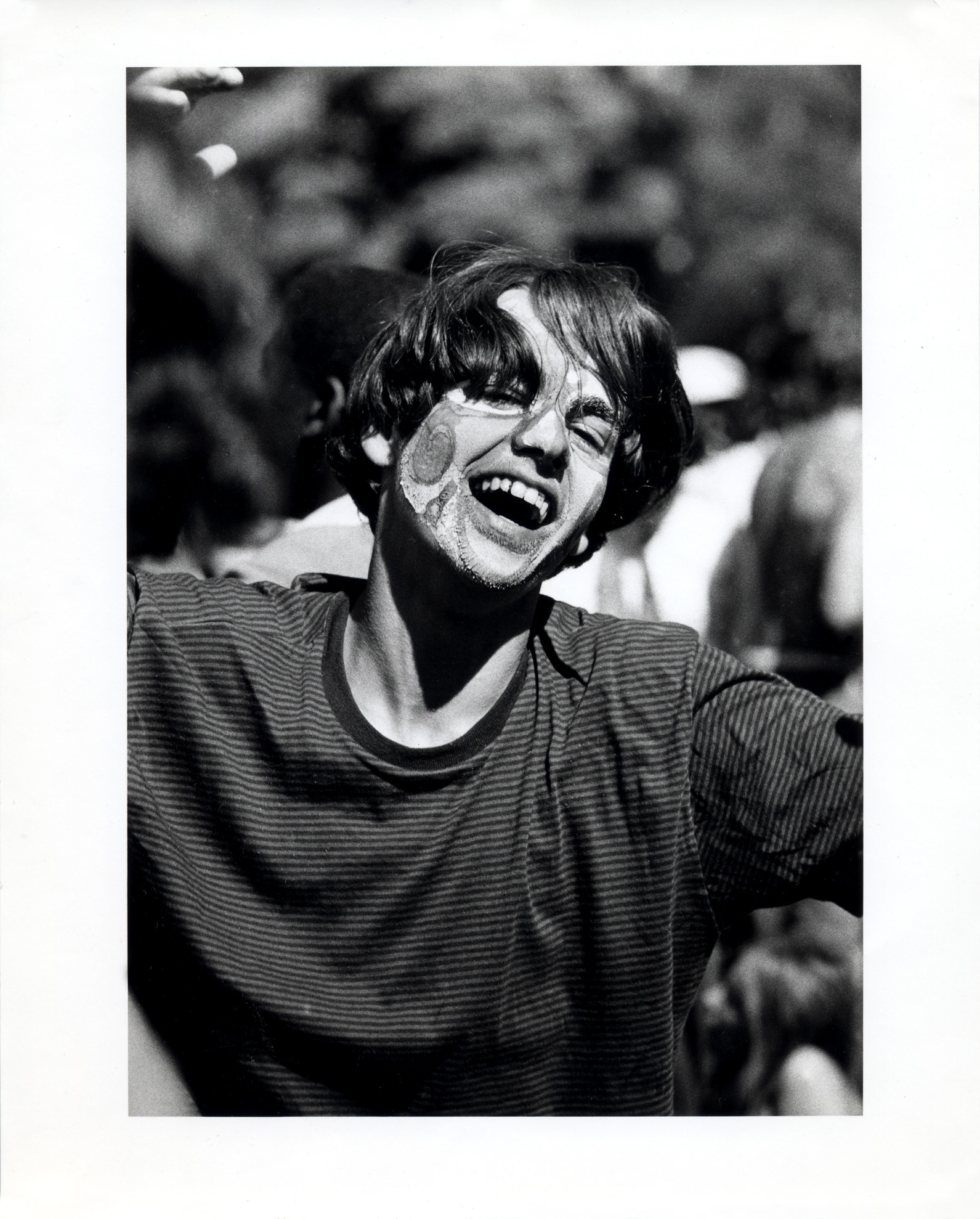
Fig 4 Human Be In Hippie

Hippie at the Human Be-In, January 14, 1967, Golden Gate Park, San Francisco. Photograph by Gene Anthony©www.wolfgangsvault.com. Used by permission.


Within the New Communalist movement at least, the children of the 1960s turned away from embracing racial, sexual, and political difference. And they turned away from the state and to some extent, the university, as well. They turned toward personal style, a politics of expression, and to the world of business. There, I’m afraid, far too many pursued self-fulfillment as if self-fulfillment alone constituted social change. In that sense, the most expressively radical movements of the 1960s helped set the stage for the conservative neoliberal society we inhabit today.

Henry: What could today’s intellectuals learn from their counterparts during this post-war period? Are there virtues we as scholars have lost that are worth reclaiming?

Fred: Courage! And faith in the power of ideas.

I think that one of the legacies of the Vietnam era for our generation has been a fear that engaging with state policy or trying to directly influence public life will somehow harm either our ideas or the state itself. Having seen what happened at CENIS in the 1960s, I very much understand that fear. But I think we’ve taken it too far.

Our ideas, even our most academic ideas, can have a far wider influence that we think. In the 1940s, professional anthropologists’ belief that cultures had modal personality styles became the basis of very popular campaigns for creativity and democracy across the United States and Europe. The idea itself emerged within the research world; it travelled beyond thanks to the determined efforts of figures like Margaret Mead to speak to the wider world in a public idiom.

But it also travelled because Mead and others like her were not afraid to mix it up with people in power. Today we need to do two things I think: first, campus-based writers like you and I need to keep trying to speak outward, to the world beyond the walls, in plain English. Second, we need to work with and if necessary build new kinds of institutions to support the kind of society we want. New social networks, new peer-to-peer collaborations are nowhere near enough. What we need are places where people who are unlike one another can gather and work together, slowly, over time. We are far too entranced with the power of networks today. What we need are not better ways to contact others like ourselves, but better ways to work across our differences. What we need are not better networks, but better institutions.

With that said though, I’m hopeful. If the kind of civic imagination I’ve chronicled in The Democratic Surround could have flourished at the height of the Cold War, it can certainly come back to life today.


Fred Turner is an associate professor of communication at Stanford University. He has written several books about media, technology, and American cultural history, including the widely acclaimed From Counterculture to Cyberculture: Stewart Brand, the Whole Earth Network, and the Rise of Digital Utopianism.

The Democratic Surround: An Interview with Fred Turner (Part Two)

Henry: I was struck as I read your description of the aesthetic practices of the surround that you are evoking many categories that also shaped the aesthetics of new media -- including notions of interactivity, nonlinearity, immersion, multimodality, and transmedia. These links are implicit in the book, but I know you think about new media, so I wanted to see if you might be willing to speak about the similarities and differences in how these ideas operated in these two periods.  

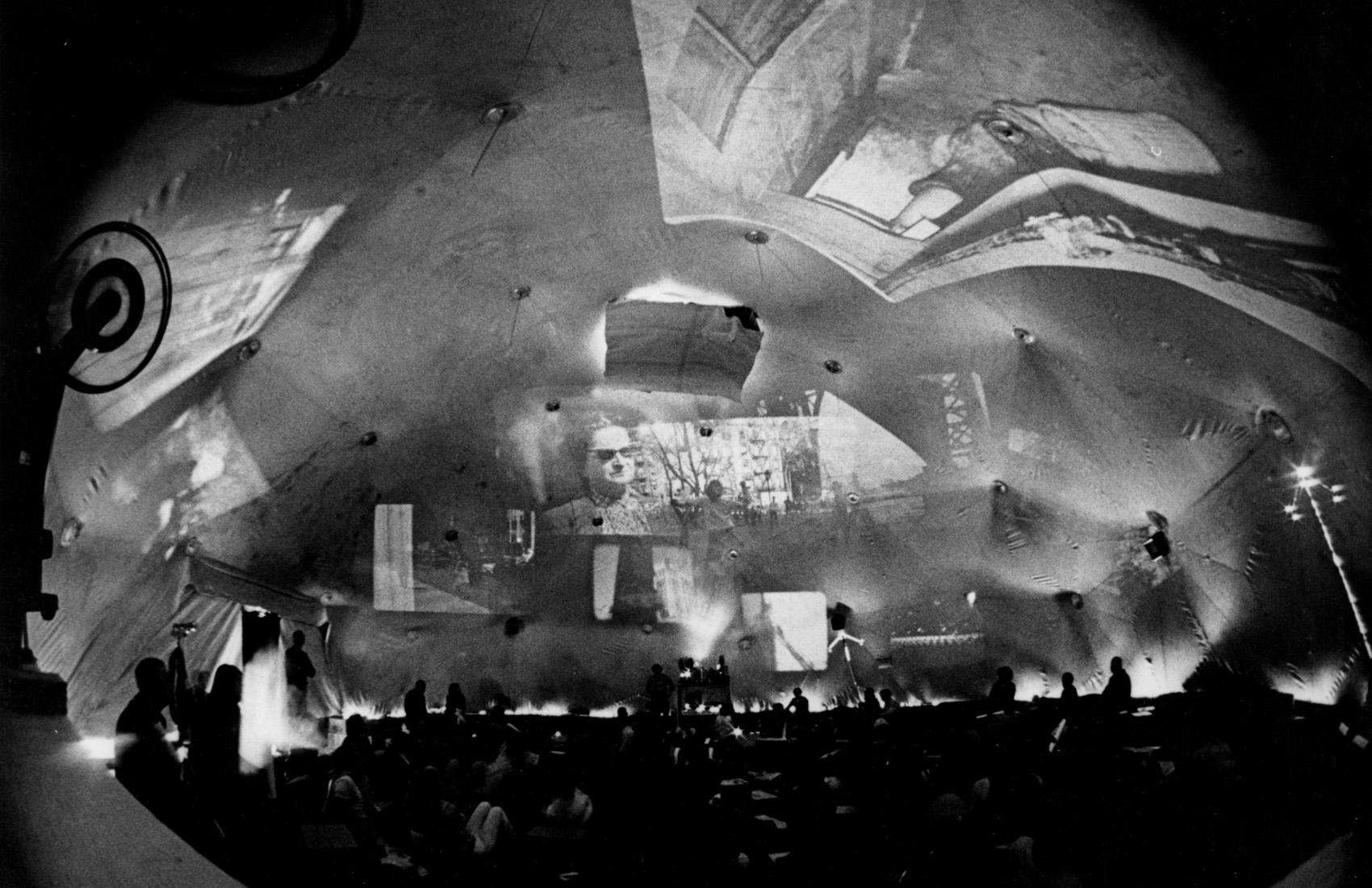
Fred: Happy to. In many ways, the book is an effort to write a genealogical history of the categories you’ve named. In the time I’m writing about, the essential distinction was between immersing audiences and surrounding them. Walt Disney and his team, for instance, designed media to be like carnival rides. They tried to immerse their viewers not only in narrative, but in kinesthetic experiences that would cause them to disengage their critical faculties and just go with the flow. In 1958 they sent a movie about the United States to the World’s Fair in Brussels. It was shown in what they called “Circarama” – eleven film projectors showing the moving in 360 degrees just over the viewers’ heads. Journalists who saw the show were thrilled to see the bodies of the spectators all swaying in time together. To the Committee for National Morale or Herbert Bayer and his Bauhaus colleagues, people swaying together would have smacked of hypnotic fascism. The whole point of aesthetic experience in their view was to awaken the reason, to individuate citizens by creating aesthetic conditions under which they could have unique individual experiences, but together, as an egalitarian group. In that context, it wasn’t just what was on the screen that mattered; it was how viewers moved between the screens. In the propaganda exhibitions that Bayer designed for the Museum of Modern Art in World War II, visitors could see pictures overhead, at their feet, and at various heights along the wall. They came in all sizes and interspersed with text. They were quintessentially multi-modal media – and that was key. Bayer and his team wanted viewers to practice doing the linking work themselves. They were to engage, even interact with the whole pattern of images and not just any one message they might contain.   Fig 2 Cage Prepping Piano John Cage preparing a piano, circa 1960. Photograph by Ross Welser. Courtesy of the John Cage Trust.     The same thing was true later with John Cage’s soundscapes. You’ll remember that his most famous piece, 4’33”, features a piano player who sits down at the keyboard but never plays a note. Cage is asking his audience to see that they are surrounded by the sounds of their environment. He’s asking them to knit those sounds together in the way that would be most meaningful for them. No piano player, no conductor, no musical dictator demands their attention. The audience, like the sounds themselves, are meant to be free, interacting with one another on equal terms. In that sense, practices of interactivity, multimedia display and design, non-linear aesthetics – they were all tools meant to liberate and democratize the senses. They were meant to be alternatives not simply to commercial entertainment, but to the kind of media immersion that many – though not Walt Disney – still feared could produce authoritarians. The trouble is, these new modes for making liberated citizens also meant a new mode of management. In each case I’ve studied, a team of experts built an environment and selected an array – an often very rich array – of media for audiences to engage. Audience members moved freely, selected what mattered to them, congregated, dispersed – and based on all the archival records I’ve seen, many really did experience themselves as free in these spaces. But of course they weren’t. Or not completely. They may have had more control of their bodies and their senses and their reasoning faculties than, say, the swaying viewers of Disney’s Circarama, but the visitors to surrounds inhabited a thoroughly curated world. They could interact, but the terms of their interaction had been set for them, before they even entered the rooms. Even in Cage’s 4’33”, a designer hovered behind the experience – Cage himself. Today we’re surrounded by digital media and I think we’re just waking up to the quandary these experiences represent. On the one hand, we want the kind of individualized agency that surrounds seem to offer; on the other, simply entering those spaces opens us up to management and surveillance. Some of those modes are top-down – curators really can and do shape what we see, and some of those curators come from states and corporations with agendas that have little to do with democratizing our lives. Other modes are more psychological. If anything defines our historical moment, it’s the off-loading of the labor of production and self-management onto the individual citizen. You can see this in free-lancing and internships and any number of other places. But you can also see it in media. The modes of interactivity and multi-media storytelling that empower audiences to make their own unique sense of the media around them usually invite them to make sense of that media specifically – media which have often been pre-selected and pre-digested for them.   Fig 3 Moviedrome Interior of Stan VanDerBeek’s Movie-Drome, Gate Hill Cooperative, Stony Point New York, circa 1963-65. Photograph by Stan VanDerBeek. Courtesy of the Estate of Stan VanDerBeek.         You can see this to some degree online. But you can see it much more clearly in the ways that so many material environments are becoming multi-media experience machines. Think of airplanes, with TVs on every seatback. Or think of sports bars, with all the games on at once. Or think of the apps on your cell phone. We’ve entered a world in which the interactivity and multi-modality that once promised to free us from fascism has in fact brought us into ever closer relationships with large institutional forces. Now, just to be clear: I’m not at all arguing that corporations or states are necessarily authoritarian. I am arguing that we need to see that the terms of our media freedom these days are a lot more constrained than we may think.


Henry: The Democratic Surround explicitly seeks to push beyond some of the encrusted ideological critiques of the Cold War and the idea of domestic containment. You want us to understand that in many ways, the leading thinkers and artists of this period were pursuing a progressive, even multicultural agenda, for whatever blind spots or complicities they might seem to display. What do you see as some of the most significant misperceptions about American thought during the 1950s? What do you see as the value of rethinking this period?

Fred: The history of the Cold War that we’ve inherited has largely been written by a generation of scholars who grew up in the 1960s and came of professional age in the 1980s. They witnessed the Vietnam War, the recession of the 1970s, the rise of Reagan and Thatcher. Out of those times, their generation has carried a deep fear of the government, a faith in the power of self-organized networks, and a belief that personal expression, properly organized, represents the highest form of politics. These beliefs have made it harder for them to see the complexity of the 1940s and the 1950s and much harder for all of us to deal with the complexities of our own time. The canonical story runs something like this: After World War II, America settled into a pattern of ubiquitous repression in its foreign policy, its domestic race relations, and its family life. When a new generation realized how personal politics could be, they took to the streets, and only once they got there did political change begin. This story contains some large grains of truth, but it misses crucial distinctions. World War II, for instance, gave rise to the military-industrial establishment, but it also sparked a radical critique of American racism. That critique flourished not only among disenfranchised bohemians, but among elite intellectuals and public officials. By 1948 or so, large numbers of Americans supported a very radical vision of world government. It wasn’t the Communism of the 1930s, but it was a deeply collectivist vision of global unity. That vision has been read in recent years as an oppressive universal humanism, an effort to turn the entire world American, white and middle-class. In the 1950s, the United States would certainly leverage that vision in an effort to contain Communism abroad. But the vision itself, then and now, contained within it the seeds of our own celebration of human diversity. A second belief: that the personal only became political in the 1960s. This claim seems to have been born out by the host of identity-based political movements that emerged in the 1970s. But it’s not true. The effort to distinguish America from Germany at the start of World War II set loose a critique of racism, anti-Semitism, and even gender conformity – in the late 1940s and early 1950s – that has largely been forgotten. Figures like Margaret Mead and Ruth Benedict believed that the personalities of a given culture made that culture what it was. Democracy in their view was always simultaneously a political and a psychological phenomenon. Freedom consisted in the ability to be oneself; a free society empowered individuals to fulfill their potential, together. What matters here is not only that the personalization of politics that we associate with the 1960s began a generation earlier. What matters is that it lived in the epicenter of American intellectual and political life. Writers who grew up during the Vietnam War, as I did, remain deeply suspicious of the state, for very good reasons. Yet governments are not monoliths. As I dug into the archives of America’s premier Cold War propaganda agency, the United States Information Agency (USIA), I found extraordinary arguments going on about the nature of democracy, about the degree to which Americans should impose their agendas on others, and the like. During World War II, members of the Committee for National Morale advised President Roosevelt and his cabinet; at the height of the Cold War, John Cage lectured at the same 1958 World’s Fair at which the USIA was promoting our national goals – and he spoke in terms that would have been entirely familiar and congenial to the most ardent American propagandists. I point this out to show that during the 1940s and 1950s, the American intellectual landscape had not yet been cordoned off into countries of ardent Cold Warriors confronted by equally ardent strivers after civil and human rights. Nor had the state as a whole become an exclusively oppressive force, internally or even internationally. I don’t mean to downplay the tensions of the time. I’m well schooled in McCarthy’s witch trials, the race riots of the 1940s, the very real gender re-segregation that took place after World War II, and the darkness of the Cold War closet. But I believe that if we can jettison the notion that only bohemian, expressive politics lead to social change of a personal kind, we can begin to see our own lives in a new light. In our moment, it isn’t our personal expression that’s under attack. On the contrary, we live in an era in which the mainstream mass media celebrate our array of sexual and racial identities. Think of the TV show Modern Family, for instance. Right now, it’s our institutions that are suffering. Have you looked up at a highway bridge lately? Have you popped into a public school and counted the number of kids in an average classroom? Have you looked at more than a decade of war and wondered how it is that the government has been able to keep troops in the field so long with nary a peep from the American public? And how has the left responded to these events? Well, we had Occupy – a movement organized around the collective expression of identity in public places and the building of mostly temporary networks. Meantime, the right has had the Tea Party – a movement anchored in already existing institutions, often churches, aimed at building new institutions, and it has already had an extraordinary effect on our government. Occupy has certainly framed the debate – it’s important know who’s part of the 99% and who isn’t. But it’s the Tea Party that has actually changed – or really, paralyzed – government policy. I’m hoping that if we can look back into the 1940s and the 1950s, we can see a world in which it is possible to work for radical political transformation within and around the most powerful institutions of our day – including the media and the government.

Henry: Anthropologists, Sociologists, and Psychologists (not to mention early Communication scholars) play key roles in shaping policies in the United States during this period. Why were these disciplines so central to the thinking of the American government during the war and post-war years? What factors have shaped a shift in the status of these humanistic fields in the subsequent decades? Today, many universities are closing down their anthropology programs, for example, and our educational policies are very much driven by a STEM agenda.

Fred: These are pretty tough questions! I’ll do my best. I think the answer to the first question has to do with the kind of country America was at the time. In the 1930s and 1940s, the United States was not yet a global hegemon. In a lot of ways, it was a somewhat backward place – largely rural, racially divided, and not yet even fully unified geographically the way it is today by the highway system. Within this world, anthropologists especially, but also psychologists and sociologists, seemed to offer a window on the world beyond our shores. They seemed to understand how things really worked – in far away Asia and Africa, in the urban jungles of our own cities, in the tropics of our minds. They also shared an understanding that individual personalities and cultures mirrored one another and that communication – mediated and interpersonal – shaped both. When World War II began, scholars in these fields seemed to have a uniquely sharp-eyed view of the international field in which the United States now felt compelled to play. They also seemed to understand how to motivate the American people to go to war. But that’s not quite enough to explain their appeal over time I think. For that, we need to acknowledge the technicist character of some of their analyses. Mead, Bateson, Allport, Fromm – they were humanists. But many of their colleagues committed acts of highly technicized social science – field and laboratory experiments for instance, quantitative content analysis, and the like. These sorts of scientistic activity produced the actionable results that government leaders needed. And even where they didn’t, they produced the image of social scientists as men of action (and yes, they were almost all men). How did such scholars lose their place at the table? Vietnam. One of the most painful moments I had researching this book came as I read through the history of the Center for International Studies (CENIS) at MIT. CENIS was a social science think tank funded partly by the CIA. In its papers, you can see social scientists like Walt Rostow and Ithiel de Sola Pool turning the pro-democratic tools of the 1940s into instruments for crushing Asian communism. It’s horrifying. I don’t think American intellectuals have quite forgotten what happened there. Some of the best and brightest social scientists of the 1950s and 1960s, working with the very best of intentions, helped mastermind a national atrocity. This is part of the reason that the historiography of this period remains so stark. The generation of scholars who grew up during Vietnam identified with personal liberation movements here and with post-colonial liberation abroad. Some even tended to conflate the two. This has created a slow-burning identity crises within several fields. If a field is designed to map more or less universal rules of social engagement and if the application of universal rules is an essentially oppressive, colonizing endeavor, then what is the proper job of a social scientist? You can see the legacy of Vietnam in the anxiety for scholars of culture, and particularly anthropologists of the 1980s and 1990s, to be “reflexive” in their work – that is, to so thoroughly disclose the biases of their own social position as to inoculate themselves against charges of intellectually colonizing the Other. For what it’s worth, I don’t agree that the social sciences have faded from view. I do see that the lion’s share of funding from the government now goes to STEM disciplines. I think that happens because the outcomes of training in those areas can be so clearly linked to things Congressman care about – jobs, profits, economic growth. But the power of STEM per se isn’t new. The space race and the Cold War drove research in that area to a level of funding and creative abandon that would be hard to imagine today except perhaps in the privately funded stratospheres of Google and Apple and Microsoft. Even with government funding down, the social sciences remain intellectually pretty hardy. Psychology in particular remains very strong. Communication has been reinvigorated by the rise of digital media. Anthropology’s role has certainly shifted -- partly I think because America has changed. After World War II, we became a much more cosmopolitan nation, and as we did, we no longer needed anthropologists to manage our first contacts with foreign peoples. Sociology has split I think into a more technicist, campus-bound wing, and a more public-facing style. Just think of the popularity of Malcolm Gladwell – not a social scientist, but certainly a purveyor of sociology.


Fred Turner is an associate professor of communication at Stanford University. He has written several books about media, technology, and American cultural history, including the widely acclaimed From Counterculture to Cyberculture: Stewart Brand, the Whole Earth Network, and the Rise of Digital Utopianism.

The Democratic Surround: An Interview with Fred Turner (Part One)

I was lucky enough to have gotten to know the social-cultural-technological historian Fred Turner during some time he spent at MIT at the start of his academic career, and we have stayed in touch off and on ever since. I have lost count of the number of times I have taught chapters from his landmark book, From Counterculture to Cyberculture, or the number of times that I have ended up citing this book in my own research on participatory culture and politics. It came out in a moment when there was so much focus on new media that it was as if the world had developed amnesia -- discussing everything as if it had been invented yesterday rather than understanding the ideologies and cultures that had led up to the digital revolution. Turner's book helped to place the utopian rhetoric I was hearing at MIT around "new media" in a richer, more nuanced, and more historically grounded perspective. It quickly became essential reading in the Comparative Media Studies program at MIT, which I headed at the time, and indeed, it has been core reading at programs all over the world. Turner's new book, The Democratic Surround:Multimedia and American Liberalism from World War II to the Psychedelic Sixties expands the terrain even further, showing us how the counterculture itself emerged from the theories of media, culture, psychology, and political persuasion that took shape during World War II and achieved their greatest impact during the Cold War Period. As with the first book, Turner offers what might once have been considered intellectual history -- a focus on key thinkers, who in this case, include anthropologists, psychologists, artists and art critics, musicians, communication scholars, photographers, curators, policy makers, and many others -- but combines it with social, technological, political and cultural history. The book is full of fascinating people -- from Margaret Mead, John Cage, Buckmeister Fuller, to Andy Warhol and Marshall Mcluhan -- and he not only reminds us of their own contributions to society, but shows the strong connections across their work.

He shows us how the media (and especially museum and World's Fair installations of the period) reflected larger aesthetic theories about the forms of perception required to foster a democratic personality, which were in turn shaped by new models of psychology and anthropology, all of which were put in the service of the Cold War. Beyond that, through, he transforms how we think about the politics of the period, pushing through the encrusted critique of the Cold War and the domestic containment of the 1950s, to identify the liberal/progressive impulses that inspired these thinkers, showing how they were more open to diversity, equality, and freedom than had been acknowledge by many recent writers. He doesn't ignore the blindspots and complicity in their thinking, but he does help us to appreciate why Family of Man, say, was seen as such a transformative work at the time that it commanded the attention of audiences around the world. He challenges assumptions about the propagandistic use of media during the Cold War to focus on what people at the time understood as a more "democratic" approach to spectatorship and in the process, implicitly at least, he suggests some of the roots of the focus on interactivity, nonlinearity, multimodality, immersion, and transmedia in our own times.

Because of his journalistic background, he is an engaging, vivid writer, one who tells compelling stories, but he is also a first rate archival historian and a world class theorist and critic of media practices. His work is at once programatic -- in that he now takes us on a history of media and politics from the World War II to the present -- and also boldly original -- constantly forcing us to look again at things we thought we already knew. I have no doubts that The Democratic Surround is going to be as important a book as From Counterculture to Cyberculture.  Everywhere I have traveled this summer, people have been reading and talking about this book, but if you have missed it so far, you are in for a treat.

I am proud to be presenting the following interview with Turner about the book and its implications for those of us interested in the contemporary media environment.

Henry: Let’s start with the title, The Democratic Surround. Can you explain this concept? In particular, can you speak to the connections your book makes between a political concept -- democracy -- and an aesthetic approach -- the surround? How did these two concepts come together during the period your book documents?

Fred: Well, the book stretches from the late 1930s to the late 1960s and across that time, the thing I’m calling the “surround” took three forms: It was an actual, existing genre of mediated communication; a tool for producing more democratic citizens; and a model of how to organize a well-run democracy. To their promoters, surrounds could help Americans experience a deeply liberating alternative to totalitarian systems. Fifty years later, we can see that surrounds also gave rise to a new mode of management, a mode of self-regulation through media that dramatically shapes our lives today. To see how the aesthetic and political came together the way they did, we have to go back to World War II. The story takes a bit to tell, but it’s worth it.

In the late 1930s, many Americans were terrified – and baffled – by the rise of fascism. Hitler had taken over Germany, Mussolini had grabbed Italy, Franco had overrun Spain, and Imperial Japan had invaded China. Everyone wondered: How had so many sophisticated nations fallen under the sway of dictators? And particularly Germany – despite World War I, Germany remained a beacon of culture for American intellectuals and artists. How had the home of Goethe and Beethoven fallen for Adolf Hitler?

A surprising number of Americans argued that it must have been mass media that had brought Hitler to power. First, Hitler had taken control of the German media and dramatically restricted what his citizens could see and hear. Second, many believed that the one-to-many dynamics of broadcasting and the print press themselves could turn people into authoritarians: Just being one of the many, tuned in to a single leader, forced you to practice being part of a faceless crowd.

If the problem was mass media itself, many feared could America go the way of Germany – especially because by the time Hitler invaded Poland, fascism had visibly metastasized in the United States. To take just one example, in February, 1939, twenty-two thousand Americans rallied in Madison Square Garden to support German-style fascism here. They cheered under a giant banner that read “Stop Jewish Domination of Christian America.”

Fig 1 Bund Parade 10 30 39

German-American Bundists parade swastikas and American flags down East 86th Street, New York, October 30, 1939. Photograph from the New York World-Telegram. Library of Congress, Prints and Photographs Division, NWT&S Collection, LC-USZ62-117148.

All of this left American leaders with a dilemma at the start of World War II: How could they use media to stir their citizens to take arms against fascism without turning them into fascists?

Two groups actually set out to answer this question, starting about 1941. The first consisted of about 60 social scientists who called themselves the Committee for National Morale. They were really a Who’s Who of American social science at the time -- Margaret Mead, Gregory Bateson, Gordon Allport, the list went on and on. Together they believed that every country drew its strength from the individual personalities of its citizens. And if mass media had produced authoritarian personalities in Germany, Americans would need to develop a kind of media that would that would produce a democratic personalities here.

In the Committee’s view, authoritarians were psychologically fractured, unable to reason, bigoted and obedient. Democrats, they argued, should be highly individuated and highly collaborative. They should reason and choose, and above all, embrace the diversity of American society.

To produce such personalities members of the Committee proposed creating exhibitions at museums and in other public halls, surrounding individuals with images and sounds, and freeing them to move among them. These aesthetic environments would give Americans a chance to practice doing the individual work of making meaning of the world around them, but they would do these things in person, together. Surrounded by images, they would collaborate in forming their own democratic personalities and at the same time, a mode of being together that was unified, not massified, American not German.

The members of the Committee didn’t know how to build these environments. But in the late 1930s, a generation of Bauhaus artists had just fled to the United States from Germany. They carried with them very sophisticated designs for multi-screen displays and immersive theaters, and they were more than happy to apply their skills to promoting American democracy. Throughout World War II people like Herbert Bayer and Laszlo Moholy-Nagy designed museum exhibitions and media to promote the war effort. They created the spaces that the American social scientists had dreamed of – spaces in which Americans could practice moving their bodies individually together, looking high and low at the world around them, and arriving at a new mode of political unity in the process.

Once the Cold War began, the exhibition designs they created became cornerstones of two seemingly contradictory developments: American anti-Communist propaganda abroad and avant-garde art here at home. In the 1950s, America built a series of multi-media exhibition spaces abroad with the explicit intent of turning the psyches of potential allies and enemies in more democratic (meaning, pro-American) directions. The most famous of these was probably the 1959 American National Exhibition in Moscow, where Nixon and Khrushchev had their Kitchen Debate. At the same time, artists such as John Cage opened up the soundscape and the world of performance, with an equally explicit desire to engage their audiences in a world of aesthetic democracy – a place in which every sound, no matter how lowly, would be equal to every other, a world in which the European hierarchies of the symphony no longer held sway. By the late 1960s, Cage’s experiments in particular had helped transform the pro-democratic propaganda aesthetics of the 1940s into the Happenings and the Be-Ins of the counterculture.

Henry: Many of my readers will know your groundbreaking work, From Counterculture to Cyberculture. In many ways, this new book represents that infinite regress that historians are prone to do. In many ways, you could have called it From the Cold War to the Counterculture. How do you explain the relationship between the two projects?

Fred: I hope the historical regress here won’t be quite infinite! I began The Democratic Surround as a way to solve a puzzle I first saw when I was writing From Counterculture to Cyberculture. I’d always been told that the generation of 1968 had rejected the culture of the 1940s and the 1950s. But when I was researching the Whole Earth Catalog crew, I saw that they were steeped in ideas and books from those periods. When they headed out to build their communes, the New Communalists of the 1960s tucked books by their parents’ generation into their backpacks. They read Norbert Weiner, Buckminster Fuller, Erich Fromm, Karen Horney, Margaret Mead, Gregory Bateson – and I wondered why. When I went back to those books, I saw the appeal. These thinkers were far more radical than we remember. They and other leading liberal intellectuals of the period challenged the prejudice that ran through American society. They called for the United States to become much more egalitarian, diverse and accepting than it was. Some, like Mead’s teacher and friend, anthropologist Ruth Benedict, called loudly and publicly for racial equality in America more than a decade before the civil rights movement of the 1950s and ‘60s. Mead herself gained national renown in part by urging American women to become sexually liberated. And all of these figures saw the personal as political in a way would suffuse the countercultural movements of the 1960s.

By going back to these figures, I’ve been trying to do a few things. On the historical front, I want to de-mythologize the sixties. We’ve labored for too long under the illusion that hippies represented a break in American history and an alternative to mainstream American life. As I hope my last book showed, the New Communalists were in many ways an opening wedge for the hyper-individualized, tech-centered ways many of us live and work today. On the contemporary front, I want to decouple our claims about the social impact of digital media from the dreams to which they’ve become attached. Those dreams flowered in the 1940s, and not only in the technical worlds that brought us computers. They flowered in social science, politics, propaganda – all across public life. Today, we inhabit a multi-screen world in which we manage our lives in terms set by any number of organizations that remain invisible behind the screens. We often imagine that it is somehow digital media that have brought us this world. But they didn't, or at least, they didn’t do it alone.

Fred Turner is an associate professor of communication at Stanford University. He has written several books about media, technology, and American cultural history, including the widely acclaimed From Counterculture to Cyberculture: Stewart Brand, the Whole Earth Network, and the Rise of Digital Utopianism.

The Steampunk Scene in Brazil: Strategies of Sociality

One of the pleasures of running this blog is the chance to engage with readers all over the world, who are able to share with me  what's happening in their countries. The phenomenon I discuss here -- from participatory culture and politics to new media literacies to transmedia entertainment -- are playing out right now on a global scale. Thanks to these contacts, I have been able to share with my readers new developments in Russia, China, India, Poland,  among many other examples, and I look forward to sharing other such cases in the future. Recently, I have corresponded with Éverly Pegoraro who has been researching the Steampunk scene in Brazil. And after some back and forth, I am happy to be able to share with you today some of her findings -- in words and images. By the way, readers in Brazil may be interested to know that there is now a Portuguese edition of our most recent book -- Spreadable Media: Creating Meaning and Value in a Networked Culture (with Sam Ford and Joshua Green)-- which is published there as Cultura  da Conexão: Criando Valor e Significado por Meio da Mídia Propagável. You can learn more at the Aleph website. Thanks so much to our friend, Maurico Mota, for his hard work to make this book approachable to our friends down in Brazil.


Steampunk scene in Brazil: strategies of sociality by Éverly Pegoraro  

What motivates steampunks? For some, just nostalgia. For others, daydreams. Amid fans and critics, the fact is that steampunk and other retrofuturistic movements extrapolate elements from the literary imagination as the basis for generating creative urban experiences. A meaningful example of this process may be perceived in Brazil. The steampunk "scene" in Brazil has already a substantial number of participants, spread across 13 states. Steamers, as they are known here amongst fans, participate in many activities.

Each Brazilian state holds a different group of steamers. For the past three years, I’ve had the opportunity to follow one of the most active steamer . groups in Paraná state in southern Brazil, Steampunk Council of Paraná Lodge. In this space, generously provided by Professor Jenkins, I will share some impressions about the research, which is part of my doctorate thesis.

Unlike other countries, Brazilian steamers are organized in lodges (a Masonry inspiration) in each State, which are administered by local councils. All are supported by Steampunk Council. The Steampunk Council’s mission is summarized on their official web site:

The Steampunk Council was conceived with the central idea of ​​democratization, flexibility and sustainability of steampunk movement. It is less an organization and more a concept, on which representatives of steampunk community can create their lodges, as the cells are called from the concept of the Council. [ ... ] The Steampunk Council's mission is to provide mechanisms for the dissemination of steampunk culture, provide reference material, promote all sorts of related events, encouraging cultural production of this sort of subjectivity and paying tribute to all those who create and produce material of Steampunk culture in all possible forms. (Available at http://www.steampunk.com.br/conselho-steampunk/)

Each regional group is autonomous to develop their own activities. The Steampunk Council of Paraná Lodge has existed for about four years and is managed by a group of the most active founding members. Besides them, there are many participants, some more regular and active (about 25 people), others only occasional visitors. Adopting the fluid, ephemeral and diversified characteristics of neotribes characterized by Maffesoli (1987), they form a heterogeneous group, across genders, ethnicities and ages (ranging from 14 to 50 years). Members are from different social classes, studying and/or working in many areas, such as writers, musicians, housewives, professors, and service providers.

As organized groups, they have the opportunity to create more permanent social ties than the relative ephemerality of the neotribos. This is a strong characteristic of Paraná’s group. The several proposed activities during the year encourage face to face interaction amongst the participants and create spaces where each discovers and develops artistic, literary, media production skills.

The Steamers’ creations blend the imagery of the nineteenth century, the individual preferences of media culture and the creativity of each participant. The Victorian aesthetic is strongly present in this urban culture, especially in the costumes and in the context of the stories. But steampunk enables a wide dimension of contextualization that are not directly inserted in Victorian Era.

Therefore, the selection of this period is not exclusively due to the visual. Steamers say they seek values ​​from the Victorian imaginary. They want more romanticism, sensibility and personal investment -- in other words, less mechanical and utilitarian relationships.

[Steampunk] refers to a time when people cared more about delicacy, gentleness, there had been a different culture, a more educated one. I find it interesting to extrapolate the technology of this period and advance it as if it had been nothing after, to increase the capacity of a technology that actually has not developed much. I find it interesting to explore more things that sometimes were not explored in the past. (Brazilian steamer)   What fascinates me is the Victorian aesthetic, the well done style, with the smallest details, it has the seriousness of the men, the femininity of the women, the clothes […] the court society, the social rules. And there is also the convenience of the technology how we have today, the clothes are not made ​​by hand, not everything is very expensive, we have the benefits of communication, medicine, entertainment, movie theaters. (Brazilian steamer)


We see the old aesthetic is beautiful, more farfetched. A time when people had more free time to take care of themselves, but the values ​​were different. It's interesting you deal with an older aesthetic, but with current values​​, especially for women. The corset is nice, but nobody wants to live as it was before. So, it's cool to have that aesthetic, an aesthetic that people will look strange, for it’s old, but with values […] the female steampunk characters are not housewives, all professions in steampunk can be applied for men or for women.(Brazilian steamer)

The interviewees' statements above indicate an attempt to retrieve the values ​​and behaviors of an idealized past. Such desires suggest the search for a less rationalist and mechanical subjectivity and the need to invest more deeply in relationships.

Homi K. Bhabha (2011) offers some interesting clues to consider the social articulations that occur in these inter-spaces of difference and minorities, in which there are complex processes of negotiation and cultural hybridisms. He conceives such cultural hybridism as a third space that enables new positions of meaning and representation. The negotiations that take place in these spaces allow hybrid agencies that do not seek cultural supremacy. Such movements are articulated in the “arts of the present”, defined by the author as the performances by which different minority group elaborates strategies of survival, identity formation, political contestation, social relations, and aesthetic manifestations. The steamers below talk about why they participate in this urban culture:

We're putting a question to rethink who we are, it’s not to think who we may be in the future, it’s to rethink who we are today. Which were our real choices in the past that brought us here, and based on which choices we could have made. That's what draws me into steampunk. (Brazilian steamer)


I think it's a fascination for a time that is chronologically so close, but so radically different from our reality. (Brazilian steamer writer)


I do not think the nineteenth century so far, not so different. […] Over the past 200 years, more things happened than between 1400 and 1600. […] The planet got smaller because of communication technology, for better and for worse. […] The nineteenth century, for being so close, is a rich context to be described and to criticize the current moment. What is science fiction? It’s to put into perspective our reality through the accentuation of problems and defects from that historical moment. (Brazilian steamer writer)

Freedom of expression […] It's a hobby to get away a little bit of our ordinary everyday, encouraging people to do something different. It’s for the pleasure [...] to meet different people, search new experiences. (Brazilian steamer)

Brazillian steamers’ strategies of visuality and sociality are acts of resistance to contemporary spatiotemporal compressions, providing an inter-space of temporality and hybrid culture, which combines different historical periods. However, steampunk hasn’t derived from a pure and simple import of Europeanised customs, which, in turn, would result in similar actions to the Brazilian Belle Époque. Neither has it intended to celebrate a tradition originated from English distant past of ladies and gentlemen.

Besides the fascination with the Victorian imaginary, what unites Brazilian steamers, no doubt, is the science fiction in its various products, questioning the inventions that marked the transition to the modern world, especially in science and technology. This identification is made clear in the narratives constructed individually and collectively by the steamers. Some seek to insert elements of  history and Brazilian literature, as in the following example:

I tried to imagine how it would be a world in which the Baron [Mauá – Brazilian historical character] was even more influent, decisive to the directions of our country. So, I thought that the Abolitionist Campaign would be more successful with, let’s say, not only the prohibition of the slave trade in the 1850’s, but with the release of all slaves and with the attraction of foreign and specialized labor and, most importantly, a world in which there had not been the Paraguayan War, what would’ve stopped the waste of lives and money we had in reality. (Brazilian steamer writer)

The events that promote steampunk and encourage sociality among the participants are the main feature of the Brazilian group. Aiming to give visibility to their initiatives, steamers often attend events of other youth cultures, such as Victorian picnics (an event that has become a reference there). Each activity promoted by Steampunk Council of Paraná Lodge has a specific theme, in honor of historical characters and events, often from a specifically Brazilian context. They do not have a fixed schedule, but each event usually involves music, dance, literature and individual performances. The three major events promoted by Paraná steamers are named as the Steampunk Picnics, Steam Coffee (In Portuguese, Cafés a Vapor) and the workshops to learn how to customize clothing and objects.

The Steampunk Picnics are annual events held at parks in Curitiba, capital of Paraná state. The steamers enjoy the sunny Saturday or Sunday afternoons to do the “steampunk scene”, where they go dressed in their costumes, play games and participate on sweepstakes, gymkhanas and photographic sessions.

Convescote Steampunk, março de 2012. Curitiba, Paraná, BrazilConvescote Steampunk, março de 2012. Curitiba, Paraná, Brazil  


Convescote Steampunk, março de 2012. Curitiba, Paraná, Brazil_2 The customization workshops occur every two or three months (there is no strict regularity) in Curitiba. They are also used as a shop window for steamers to exhibit their artistic abilities. They are artisans, designers, stylists and photographers who take the opportunity to promote their work and, in some cases, sell them.

After posting on their blog (http://pr.steampunk.com.br/) and on the group's profile on Facebook (in Portuguese: Loja Paraná do Conselho Steampunk), the interested ones meet on a Saturday afternoon to learn basic techniques of steampunk styling. The workshops are taught by the older group members or by some guest who has a specific skill that can be useful in customizing clothing and accessories. During an afternoon, someone is highly unlikely to finish the process. But the steamers themselves make clear that the workshop will explain the basic technique. It is up to each person to develop (and even enhance) what was taught.
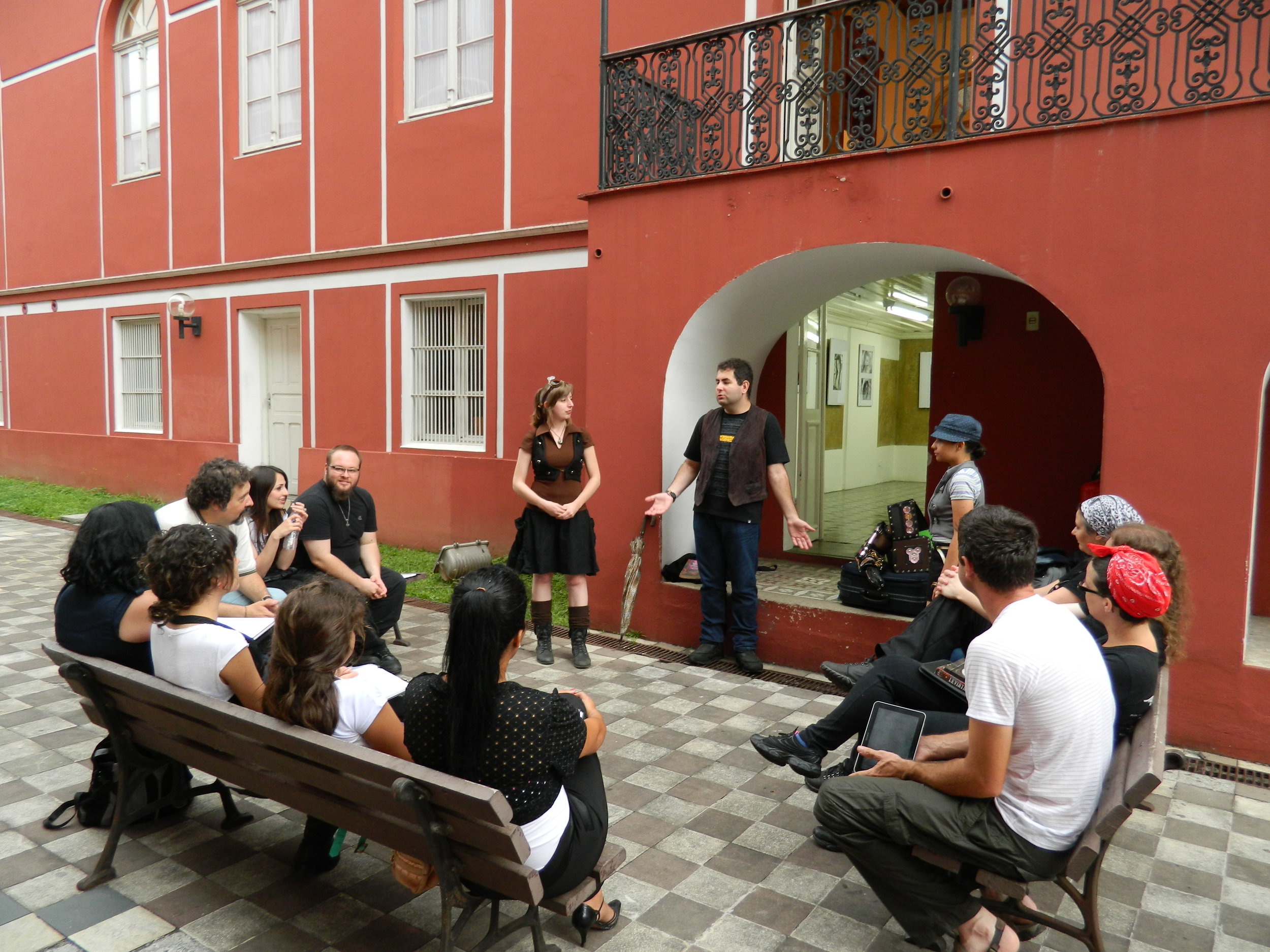
During workshops, Brazilian ......During workshops, Brazilian steamers discuss alternatives to materialize their imaginative ability

The workshops are characterized as a meaningful moment of sociality among the steamers, because there is sharing, exchange of ideas and interaction among them, while they discuss alternatives to materialize what they imagine. Tutors seek to encourage creativity by presenting a variety of objects made at home. The “students” identify themselves with these possibilities and discuss alternatives to adapt them to their purposes. Tutors share the difficulties to develop the techniques, aiming to ease the situation for those who are beginners.
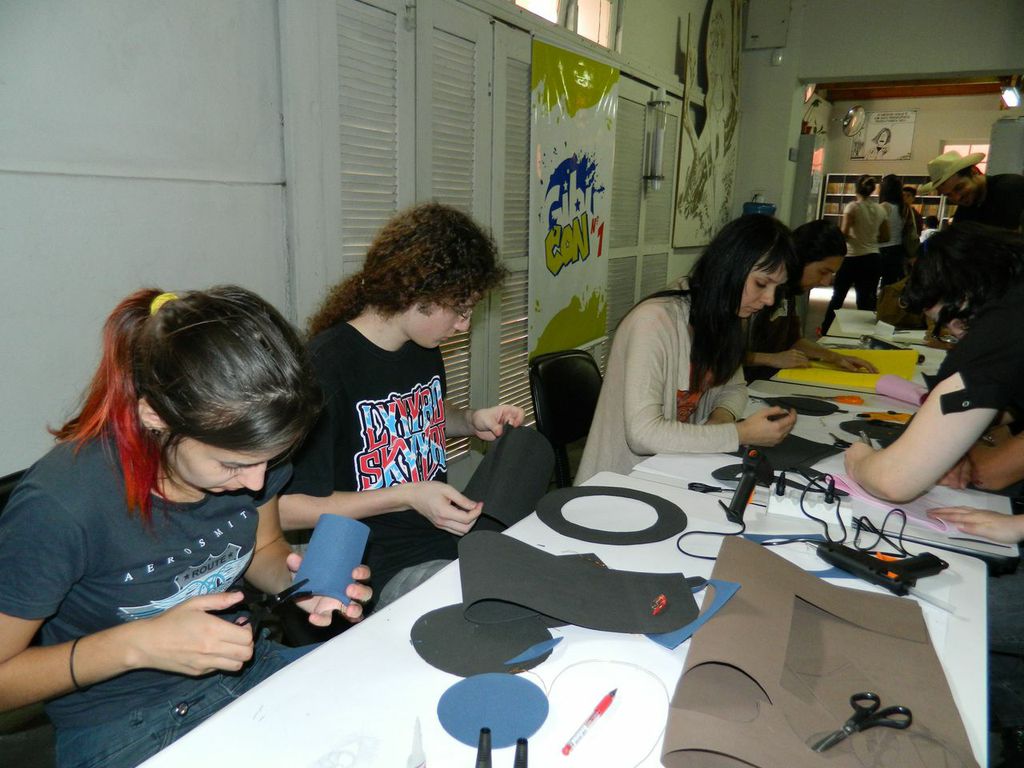
Workshop to Make Mini and Top HatsWorkshop to make mini and top hats

Customizations are used in the practice of steamplay (adaptation of the term cosplay to the steampunk universe), when steamers perform their steampunk character, constructing their identities and embodying their clothing and accessories as well as their historical and social context. Public performances happen in the events that Steampunk Council of Paraná Lodge promotes or participates. Several factors influence the character creation, such as preferences and hobbies of each participant or their ability to afford the steamplay.

Steam Coffees are evening events. As an example, the night of Steam Coffee: The steampunk evolution (Tribute to Charles Darwin) began with the performance of a traditional tribal dance, created by two dancers for the event. According to one of them, the ethnic tribal dance joins elements and techniques of folk dances from around the world. The steampunk concept appears on the mix of industrial music and the aesthetic of the costumes.
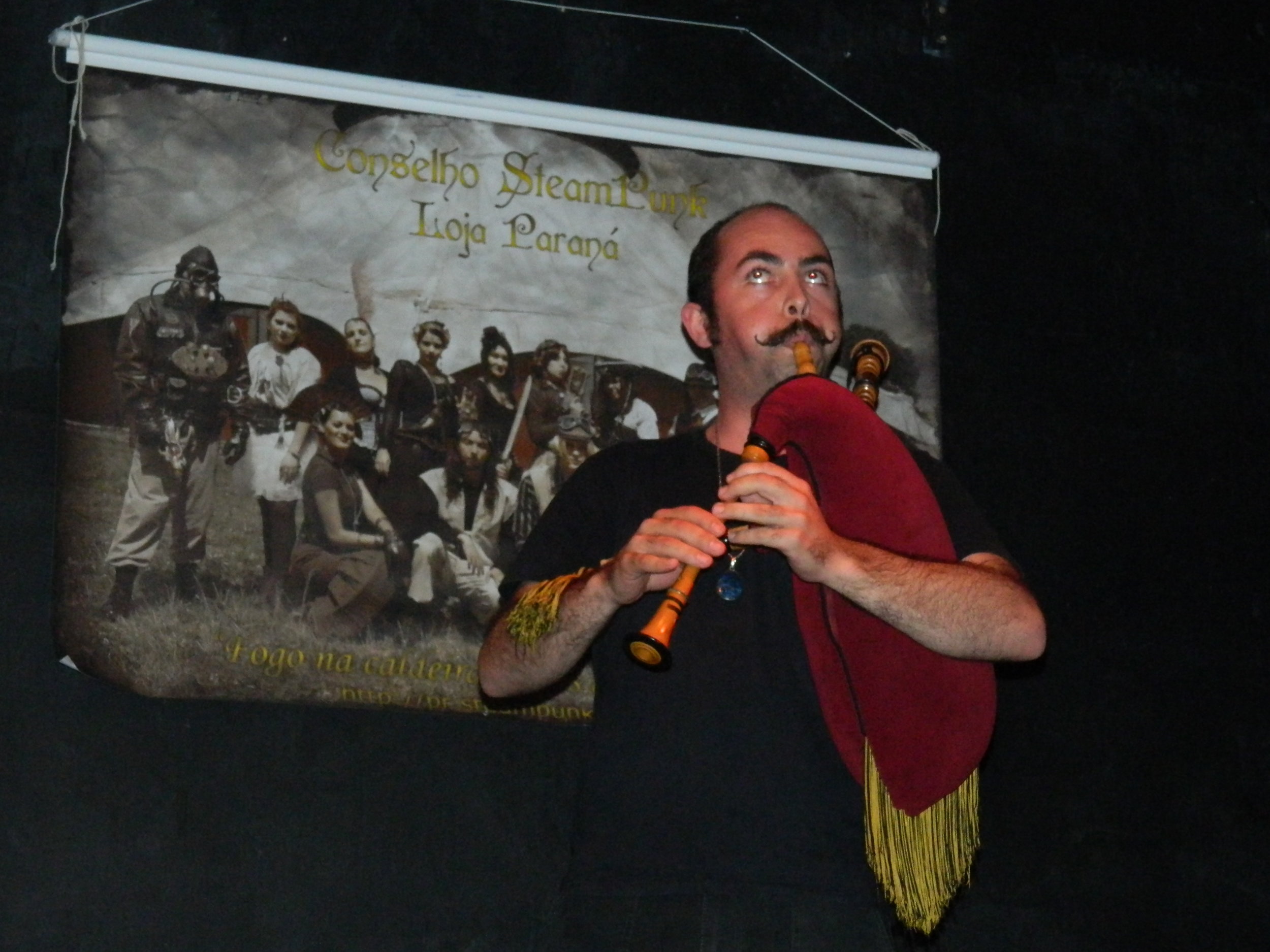
 

Musical performance at Brazilian steampunk eventMusical performance at Brazilian steampunk event
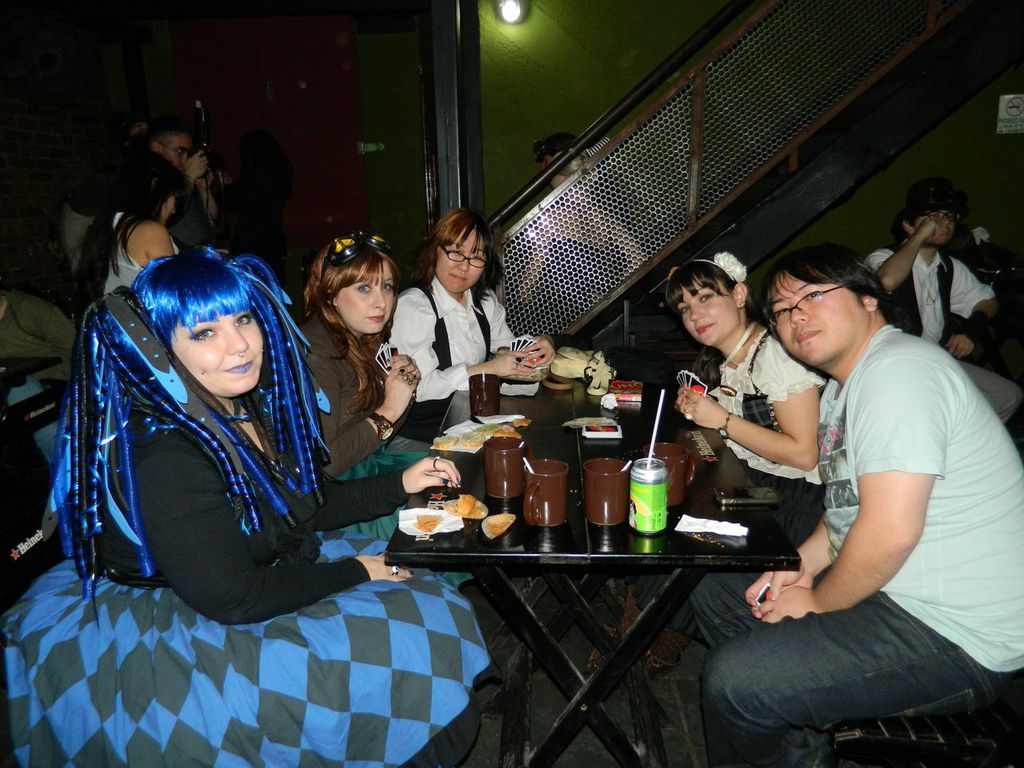
Steampunk Event in CuritibaSteampunk event in Curitiba, Paraná, Brazil
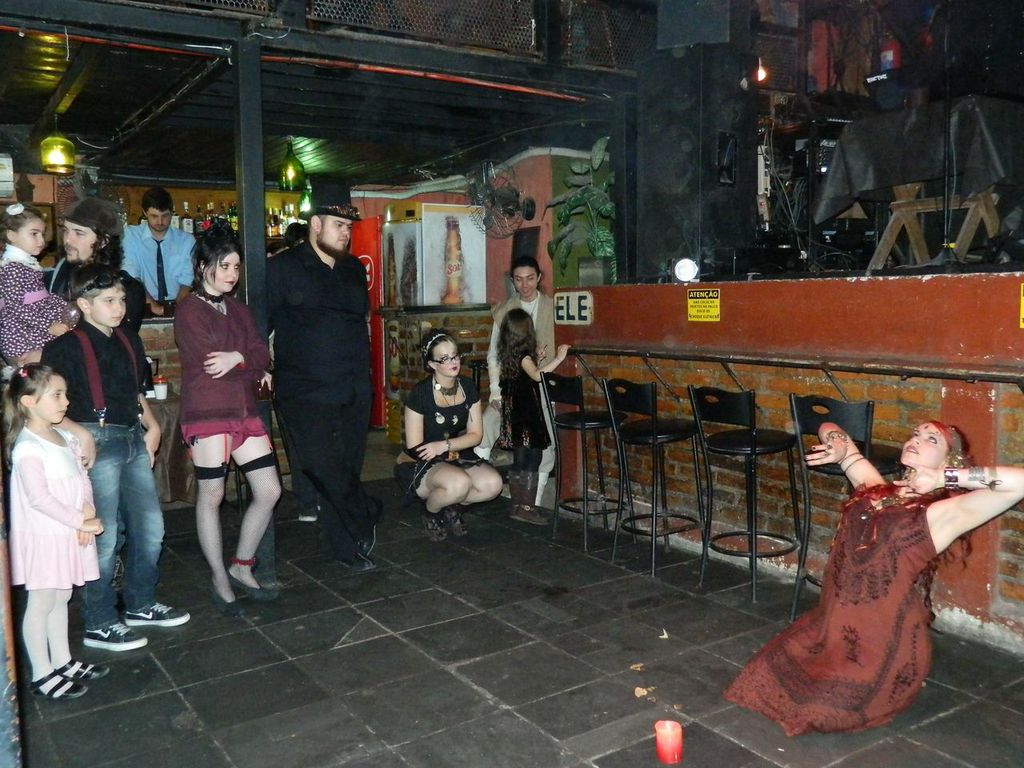
Performance of a a Traditional Tribal DancePerformance of a traditional tribal dance, created to a Brazilian steampunk event  

Participants of a Brazilian Steampunk EventParticipants of a Brazilian steampunk event    

During the event, the participants had fun with a steampunk musical repertoire of a steamer DJ who shared music videos. Some steamers shared a steampunk tale written by one of the participants of Curitiba’s group, who is also a writer. Indeed, the practice of writing tales, editing magazines and creating all kind of steampunk media products (even if they’re not mainstream, but only released on the internet) is common among steamers. As pointed out by Jenkins (2010), these informal learning communities encourage participants to develop writing skills and styles as well as to build confidence in their own abilities before entering in the professional market.

Members of Steampunk Council of Paraná Lodge share a wide range of cultural interests drawn from the content of media culture products over which they claim a sense of ownership and mastery. Practices similar to those discussed by de Certeau (1998) and Jenkins (2010) in terms of bricolage or “poaching.” Steamers appropriate different science fiction books, movies, comics and RPG games, but giving them new meanings, expanding the stories, deepening their interpretations of the characters and reimagining the story world. The creations may even suggest impossible mixtures through the insertion of fictional or historical characters from different periods in the same narrative.

Similarly to what Jenkins (2010) describes, such practices involve a form of aesthetic perversion of the traditional limits imposed by the dominant cultural hierarchies which outline the desirable and undesirable cultures. Thus, they build a cultural and social identity through appropriation and modification of cultural products.

The first Brazilian steampunk photo roman – Curitiba’s steamers are pride to point out it as the first one – is a striking example. Steampunk Carnivale[1]photo roman (http://www.youtube.com/watch?v=Ehm8RJ8KVwo) is a collective production involving performances by the various members of Steampunk Council of Paraná Lodge, who customized their costumes and accessories and collaborated to generate the plot. The work – which combined science ficton and intrigue -- was shared via Youtube.

Despite the understandable limitations of an amateur production, this photo roman can be characterized as contributing to an urban culture that has taken shape around a common interest in steampunk retrofuturism with the production and exchange of such products acting as part of what Thornton (1995) describes as a micromedia circuit. What matters here is not so much the aesthetic merits of the community’s productions or their comparison with more mainstream cultural products but rather the social and cultural dimensions of participants interactions with each other.

The cultural products that emerge from the steamers’ appropriation and remixing practices do not always fully cohere. Participants continually negotiate their relationship to the genre and to pre-existing culture materials according to their most immediate interests. As an example, note the following explanations of two steamers of Curitiba:

I really like gothic, so I wanted to make a gothic steamplay. I’ve brought a little bit of everything: I have keys, the belt that has potions, also weapons, which were made in the workshops. [ ... ] I’ve watched the movie The Crucible (and also read the book), and I’ve been writing the story for me. [...] Harry Potter has also influenced a little bit, so that my wand is from Harry Potter, it is not customized, I did not want to change it. (Brazilian steamer)   One of my ideas is inspired by Assassin's Creed games, which there are murders [...] it is like a secret society, fighting against the old Knights Templar. (Brazilian steamer)

This is how steamers – between pirates and nomads (Jenkins, 2010) – create their performances and products in an experience that is both individual and collective, within a vast network of connections that constitute this participatory culture.


Brazilian steamer at Steam Coffee. Curitiba, Paraná, Brazil, 2012.Brazilian steamer at Steam Coffee. Curitiba, Paraná, Brazil, 2012


Brazilian steamersBrazilian steamers

Steamers start from the media culture products that most interest them and become producers of new texts including fictional narratives, photo romans, illustrations, photographic essays, customized objects, crafts, dance and music performances, fashion and accessories, magazines, events. These acts of cultural expression are informed by two competing logics: the Do It Yourself (DIY) aesthetic from the punk movement and the contemporary conception of Do It Together (DIT) as it has taken shape around the Maker movement. One emphasizes individual, the other collective production. Thus, even though DIY logic prevails, the premise is surrounded by a mutual aid policy: each steamer helps the others with his skills in making products and accessories, embodying the DIT logic of participatory culture.

This idea is summarized in the interview with one of the forerunners in Paraná, Carlos Alberto Machado:

People sometimes send e-mail asking: 'do you sell steampunk clothing?'. 'We are not selling, what we do is teach you how to do,' I say. [ ... ] Paraná is the state that is promoting more workshops. And the workshops are bringing a lot of people and a lot of good things. There is the shyest person who ends up getting more outgoing, and makes friends. [ ...] We do not call it as a class, the idea is not to teach you the 'abc'. The idea is to encourage the participants to bring things and the group teaches the group. [...] They bring this knowledge and show them what they do to encourage the participants to try to do something similar. (Brazilian steamer)

Thus, the interest in steampunk by Curitiba’s group is structured through the desire to interact and be part of a community that shares broader cultural and social interests. Sociality grows from mutual interests, reflecting the group’s particular interpretative conventions as they are shaped by individual and collective acts of story telling, performance, and cultural production. While there is a strong emphasis here on self-creation, we should recall that all of this activity occurs within a consumerist context, where critical interactions between man and technology coexist with leisure, hedonism, and consumption. Their retrofuturist imaginings emerge from a particular local context and get circulated through a micromedia circuit.

Brazilian steampunk reinserts questions that turn away from traditional political participation. Steampunk encourages its participants to return again and again to the core question: “what if had it been different?”. Besides, creating a story of an invented past is a way to discuss current and relevant issues. It’s not an attempt to return to past, not about engaging with an exotic foreignness, but an inter-space that mixes criticism, socio-temporal concern, hedonism, entertainment. More than the fascination for the historical period of Victorian Age itself, what prevails is the will of the steamers to recreate their own fictitious historical memory, which is strongly impacted by media culture.


Éverly Pegoraro is a Brazilian university lecturer and PhD candidate in Communication and Culture at State University of Midwestern Paraná, Brazil . His doctoral research deals with the relationship between visuality and sociality in steampunk. He is the leader of the Communication and Sociocultural Interfaces research group. Contact:everlyp@yahoo.com.br ou https://www.facebook.com/everly.pegoraro.


References

Bhabha, Homi (2011).O entrelugar das culturas. In: COUTINHO, Eduardo (Org.). O bazar global e o clube dos cavalheiros ingleses: textos seletos. [The global bazaar and the English gentlemen's club: selected texts].Rio de Janeiro: Rocco.

Certeau, Michel. de. (1998). A invenção do cotidiano. Artes de fazer [The practice of everyday life].(3rd ed.). Petrópolis, Brazil: Vozes. Conselho Steampunk. http://www.steampunk.com.br/.

Deleuze, Gilles; Guattari, Felix. (1995a). Mil Platôs. [Thousand Plateaus]. Vol. 1. São Paulo: Ed. 34. ______. Mil Platôs. (1995b). [Thousand Plateaus].Vol. 2. São Paulo: Ed. 34.

Jenkins, Henry. (2010). Piratas de textos.Fans, culturaparticipativa y televisión.[Textual Poachers: Television Fans and Participatory Culture]. Barcelona: Paidós.

Maffesoli, Michel. (1987). O tempo das tribos.O declínio do individualismo nas sociedades de massa. [The time of tribes.The decline of individualism in Mass Society]. Rio de Janeiro, Brazil: Forense—Universitária.

Thornton, Sarah. (1995). Club cultures: Music, media andsubcultural capital. Cambridge, England: Polity.


[1] Although the name of the photo roman refers to Carnival, one of Brazil's major festive periods, the theme has no direct reference to the subject. Curitiba is not known for its Carnival tradition. Besides, in the days of this festivity, there is an alternative event for those who do not enjoy Carnival: Zombie Walk. As the organizers of the event use to say: “in Curitiba, Carnival is a horror”.

Welcome Back From Where-Ever Your Summer Journeys Took You

photo 2  


The above image was shared with me by a reader, Robert Spadoni, who spotted this mural outside Gap, Arizona, while driving with his family across the American west. Robert shared the following story:

We hadn't seen a business or residence for a couple of hours at least, and hardly any cars. We pulled over to change drivers, and for no reason, just to be goofy, I pulled way in to the edge of this gigantic deserted turnout on the side of the road, right up to this empty structure. I'm a huge fan of the Original Series of Star Trek, and my 12 year old exclaimed, "The Star Trek symbol!" I was getting ready to say something like, "Yeah, It DOES kinda look like that," when I looked up. Apparently, from my searches, this mural is below the radar even of Google—I didn't think there was anything left that was.


Robert asked me to share a few thoughts. For me, this is a great example of the ways that each of us construct our own personal mythology from the culture around us, increasingly mixing and matching elements that have very distinctive histories and meanings. I suppose you could call this "postmodern," since it reflects the breaking down of traditional kinds of fixed social identities and coherent cultural narratives, in favor of a process of continuous self-fashioning and ongoing appropriation and remixing. The result can be surprising juxtapositions of images and meanings. And on one level, what we see here -- without knowing anything beyond what Robert shares -- can seem idiosyncratic, highly personal, perhaps undecipherable to someone not on the same wave length with the artist. Someone like Frederic Jameson might talk about this in terms of the flattening of affect and the implosion of meaning, but I don't think either is what is going on here -- certainly not for the original artist and not to Robert, his family, or myself. We recognize the icons being deployed here; we understand some possible meanings for them, and if anything, there is too much meaning here for us to put easily into words.

At a most basic level, the image bridges between "Space, the final frontier" and the kinds of frontier imagery we associate with the American west. Yet, what is striking to me is the way that the Star Trek images are mapped not onto the rootless cowboy moving endlessly across the western badlands, but rather onto images associated with native Americans. Just as we've seen the emergence of Afro-Futurism which uses the juxtaposition of science fiction imagery with historic experiences of race, we have seen First Nation people all over the planet embrace images from science fiction as a means of inserting themselves into our imaginings of the future, as a way of signaling that their culture may be traditional but that it is not stuck in the past, that they will carry their traditions with them into the future. I have no way of knowing here whether the artist is native American or appropriating native American images for his or her own purposes, opening up some tensions around what we see as appropriate or inappropriate forms of appropriation. Even in an era of remix culture, as we discuss in my Reading in a Participatory Culture book, there are power relations such that the appropriation of minority identities and expressions by dominant groups have different political meanings than the appropriation of majority cultures by minority communities. (We might think about this image in relation to the character of Chakotay in Star Trek: Voyager, a character who was variously read in terms of expanding representations within a multicultural narrative or in terms of the exploitation of stereotypes about tribal communities in ways that did not necessarily speak to how First Nation peoples understand themselves and their own cultural experiences.)

And part of what I find compelling about Robert's image and story is that we don't have any answers about who the author is, what motivated them to produce this mural, and in what ways they are seeking to make meaning of the relationship between Star Trek and Native American cultural traditions.

I am sharing this image (and my speculations about it) today as a signal that the blog is back up after my typical summer hiatus. I've had a very productive summer, which has included so far, the completion of my next book, By Any Media Necessary: Mapping Youth and Participatory Politics, which we sent off to be peer reviewed a few weeks ago and which we hope will come out in the not-too-distant future. I've also made significant progress on several other fronts, including a new essay on the current state of fandom studies, which will be published in the Journal of Fandom Studies; an essay on the history of aesthetic experimentation that has surrounded Daredevil in the Marvel universe; a collaborative essay on the many different political uses that have been made of the Superhero in recent years;  and some early work on a new project -- a series of critical essays on 9 different contemporary graphic novelists. So, I may not be coming back from the break rested, but I do come back with a strong sense of accomplishment and a determination to hit the deck running as we move into the new academic year.

We have a great line-up of interviews for the coming term, which I will start sharing in just a few days.

The World is Yours: A Film About Hip Hop and the Internet

Marguerite de Bourgoing was among the first students I got to know when I arrived at USC, and she has been blessed with the entrepreneurial spirit. In 2010, I featured on the blog her grassroots media franchise, LAstereo.tv, which deploys YouTube and social network sites to showcase the Los Angeles hip hop scene.  At the time, I wrote, "de Bourgoing represents the Trojan spirit at its best — a social and cultural entrepreneur who is taking what she’s learned as a media maker and deploying it to serve her larger community." SInce then, she's taken this work much further, producing a documentary exploring the roles which new media has played in building and promoting contemporary hip hop culture, and she asked if I'd be willing to share a progress report with my readers, since she's currently running a Kickstarter campaign to push this project even further. So what follows is her account of what she's trying to do and why it matters. Full disclosure: I am one of the talking heads included in the film (even though I know less about hip hop than the average bear). She is collaborating on the film with my colleague, Taj Frazier,  from USC's Annenberg School of Communication and Journalism, a gifted scholar whose work touches on the politics of race, globalization, sports, and popular music. The World is Yours: A Film About Hip Hop and the Internet by Marguerite de Bourgoing

The World Is Yours  looks at the web 2.0 revolution by following the rise of hip-hop artists. In these times of disruption, we face both angst and great opportunities--depending on your viewpoint and how you address it. Hip hop has always been ahead of the curve in technology, and its underground culture is bypassing the mainstream again. The words “the world is yours" were first immortalized by Shakespeare: "Why, then, the world’s mine oyster, which I with a sword will open." Hip hop's take echoes the engrained DIY ethos that has made it the most influential culture of the last 40 years and taken it from rags to riches.

Thanks to social media, today these words make even more sense: one can now access the world through one’s own perspective and interests and eschew the uniform vision constructed by the media. Spheres of influences are spreading and multiplying. Young hip-hop artists are creating their own movements and communicating directly to their fans without taking the traditional PR route. These young artists have re-appropriated the idea that it is better to make yourself discoverable than to be discovered.

The World is Yours probes the most innovative and enterprising of these artists. It focuses in particular on three different movements that have each been seminal in the recent changes that occurred in hip-hop and what those changes mean for the music industry.

Shooting star Wiz Khalifa went from being dropped by major label Warner Bros to becoming the biggest hip-hop breakthrough artist of 2011 with the massive international hit “Black & Yellow” — all thanks to the support of his fans, the “Taylor Gang.” He shows us why radio isn’t the be all end all for a rising artist, and how it’s essential to build a buzz on your own. Today he is one of America’s biggest stars.

Wiz Khalifa
​Wiz Khalifa Pic: Kasey Stokes/ LA Stereo TV

Lil B's bizarre creativity set a new precedent in the amount of music released by one artist in a short timespan. A marketing genius who does it all on his own, Lil B has been setting trends in style, fashion, music, and new producers ever since his first viral hit “Vans” in 2007 with Bay Area group The Pack. Since going solo, he has developed a strong cult following around his alter-ego, the BasedGod, which is cultivated through social media twenty-two hours a day. (see clip below)

lil_b_kasey_1

Lil B Pic: Kasey Stokes/ LA Stereo TV

Finally, media darlings Odd Future took the music industry by storm becoming the first DIY evangelists of this hip-hop generation, doing all production,  graphics and videos by themselves. We focus on their sound mixing engineer/dj/producer/singer Syd the Kyd, the only woman of the collective and one of the group’s pillars, whose homemade studio enabled the artists to created a cohesive sound before catching everyone else’s attention.

billboard_2

​Odd Future Pic: Julian Berman

The Internet is giving birth to a new face of hip-hop, introducing artists who less than five years ago would have never been given a chance of making it as a rap artist. There is more diversity than ever in the new hip-hop landscape. Queens born Albanian chef Action Bronson raps about foodChildish Gambino is stand-up comedian Donald Glover, Iggy Azalea is a white Australian woman, Detroit’s Danny Brown was turned down by 50 Cent for wearing skinny jeans,  and Harlem-born rapper Asap Rocky takes inspiration from Houston. These are just a few examples of new artists who all owe their careers to the internet. New models are being created: Chance the Rapper collaborated with Justin Bieber on the strength of his free album Mac Miller has his own series on MTV, Macklemore was the first independent act in years to have several hit songs on the radio.

obamabased

​Thank you Based God or #TYBG - an ode to Lil B- is one of the biggest long running internet memes

In the film, we talk with the people who have identified those cultural shifts along the way (like Henry Jenkins!) as well as people who contributed to those changes. We focus on key moments like the closing of hip-hop record store Fat Beats, or the making of multi-million dollar rap lyrics website Rap Genius. We look at how this movement fits in the history of hip-hop and the recording music industry.  From the fans' perspective on some of their favorite artists, to the camaraderie of The Foreign Exchange, the multimedia vision of a QD3 and the birth of a new music group The Internet composed of Odd Future’s Syd the Kyd and Matt Martians, the film offers offers unique point of views documented over several years.

DC_212

​The closing of Fat Beats Pic: Kasey Stokes/ LA Stereo TV

The World Is yours is the ultimate guide on how to navigate the digital era today.  One tweet, Vine, and Instagram post at a time, these artists and their communities are redefining the media landscape and pointing to the opportunities brought by these changes. This film is a reminder to think outside the box and cut new paths made possible by technology. The World Is Yours and everything in it if you get up and get it.
To find out how you can help and be in the film, check out our Kickstarter campaign.
The following clip is a excerpt of an abridged version of the film that just aired in France on France O that features artists rapper Lil B. We are working on getting the film out in the US.

Transforming Television: An Interview with Denise Mann (Part Three)

We both agree that the Writer’s Strike represented a key battle in the struggle to define digital extensions as part of creative content and not simply as part of the promotion of a series. Some years out from the strike, what do you see as its lasting impact on the way the industry operates? What won what in these struggles? The honeymoon period during which creators were given carte-blanche to experiment with the media corporations’ IP was short-lived. In the period leading up to the strike, the Alliance of Motion Picture and Television Producers (AMPTP) stubbornly refused to acknowledge the creative labor involved in these short-form, content-promotional hybrids. The WGA strike of 2007-8 signaled an important response by the exploited members of the writing community that their creative digital labor needed to be rewarded with credit and income.

Disney launched the first volley across the bow of the WGA’s minimum basic agreements by engineering a deal with Apple iTunes to stream its TV series online; however, they failed to arrange an appropriate compensation package for the writers whose original work was being replayed on a new distribution platform. To make matters worse, the networks placed ads inside this digital content, which allowed them to earn additional revenues, thereby undermining their claim that this content constituted promotions.

In the period leading up to the strike, Cuse and Lindelof were able to use their considerable leverage during the making of Lost to negotiate on behalf of not just the WGA members, but also the other talent guilds to ensure that all creators received payment for their work on derivative content such as “The Lost Diaries” webseries. This precedent helped the WGA negotiate terms for all digital content created by guild-represented writers; however, the sanction lacked teeth, as more and more studios formed their own in-house social media marketing groups to oversee these “content-promotion hybrids” going forward.

While the WGA achieved a symbolic victory—an agreement to pay writers for their creative labor regarding digital content, they have lost out in two ways:  first, writers are still earning “digital pennies” for creating derivative content given the uneven measurement system associated with online entertainment; secondly, the big media companies are shoring up the infrastructural walls surrounding digital content by creating in-house social media marketing divisions and limiting creator involvement.

In many ways, transmedia is playing a secondary role in the industry’s current thinking to the idea of second screen content. What do you think is motivating this obsession with the Second Screen? What functions does the second screen perform for the industry? for audiences? Why is the second screen easier to comprehend and implement than the more ambitious ideas about wired television so many industry leaders have been promoting?

As Jennifer Holt and Kevin Samson explain in the introduction to Connected Viewing: Selling, Streaming, and Sharing (2014)  “connected viewing” practices eschew the top-down, bottom-up binary that has governed so much media industry scholarship around digital, in favor of what Michael Curtin has called “a matrix era”—namely, “a transition from the one-to-many distribution strategies of the broadcast networks to a moment ‘characterized by interactive exchanges, multiple sites of productivity, and diverse modes of interpretation and use.”  While one could argue that these interactive systems and multiple sites of productivity engender enhanced creative exchanges between production cultures and audiences, the industry’s current focus on “second screen” over “transmedia storytelling” experiences seems designed to help studios manage consumer data more efficiently via their infrastructural strengths: marketing and distribution.

Furthermore, by controlling marketing and distribution, the media companies are able to facilitate a disturbing trend—developing sophisticated analytics designed to harvest consumer preferences via algorithms and other, digital measurement strategies. In the last decade, Hollywood has fallen far behind their Silicon Valley counterparts—Google, Facebook, and Netflix—when it comes to managing the sale of big data to advertisers through products such as Adsense and Adwords. The latter, in combination with tools like Google Analytics, provided publishers with access to a composite portrait of consumer behavior designed to help advertisers deliver targeted online ads.

In contrast, transmedia storytelling strategies were creator-dependent activities designed to empower creators and audiences via “multiple sites of productivity” and “diverse modes of interpretation and use.” Teasers, trailers, and interstitial video already circulate between broadcast TV series; now, via second screen experiences, all of these new forms of online promotions and branded entertainment can be enlisted to access a composite of consumer information. By bringing these digital production activities in-house—hiring low-paid creative labor to execute all this digital, promotional churn—big media companies will be able to navigate the online advertising space more effectively, unimpeded by talent guild restrictions.

Denise Mann has been the head of the UCLA School of Theater, Film and Television’s Producers Program since 1996 and is an Associate Professor in the Department of Film, Television and Digital Media. In that capacity, she teaches graduate and undergraduate courses on contemporary entertainment industry practices as well as critical studies seminars on film and television history and theory. She is the editor of Wired TV: Laboring Over an Interactive Future (Rutgers University Press, 2014) and the author of Hollywood Independents: The Postwar Talent Takeover (University of Minnesota Press, 2008). Previously, Professor Mann co-edited Private Screenings: Television and the Female Consumer (University of Minnesota Press, 1992).

Transforming Television: An Interview with Denise Mann (Part Two)

Your dust cover frames the book in terms of the development of the “post-network” television era in relation to “the introduction of broadband into the majority of homes and the proliferation of popular, participatory Web 2.0 companies.” What role has technological change played in shaking up established modes of production and distribution or arrangements of labor? In the early days of broadband and Web 2.0, the networks tolerated an exceptional degree of collaboration with thought leaders and cutting-edge companies outside of Hollywood proper; these outsiders included executives from Silicon Valley, entrepreneurial writer-producers and digital producers, among others. The result of this momentary largess was a vast array of transmedia storytelling experiments associated with the networks’ most valuable media franchises, including Smallville, Lost, Heroes, Ghost Whisperer, among others.

Furthermore, the networks jumped into the digital distribution waters headfirst by making broadcast content available via Apple iTunes, Hulu, and the CBS Digital Audience initiative, as well as their own network websites. During previous periods of upheaval—economic, cultural, and technological—the Hollywood studios have tolerated the cultural experiments of creative insiders who embraced these new technologies, such as sound, radio, television, cable, and most recently, digital; however, these shifts cannot be reduced to technological developments alone; instead, we’ve seen a history of cultural convergence as Hollywood embraces alternative creative models during periods of social-economic change in the U.S.

As seen in your book, What Made Pistachio Nuts, the beginning of sound had a damaging effect on Hollywood’s traditional operations, as did the social-economic crisis prompted by the Depression; the studios responded to these combined threats by looking to alternative aesthetic forms, such as Vaudeville, to enhance their own offerings. In other words, Hollywood’s earliest days demonstrated this tendency--the “emergence of convergence”—best seen in the studios efforts to import Vaudeville’s stars by integrating their performance strategies into Hollywood’s traditional narrative system. This history of convergence was also amply on display during the 1940s, 1950s, and 1960s, as Hollywood embraced, emulated, or assimilated other cultural outsiders, such as the German Expressionists, the Italian Neo-realists, and the French New Wave.

Furthermore, Hollywood has always demonstrated a willingness to advance the business logic of key cultural-industrial entrepreneurs, such as Walt Disney, George Lucas, and more recently, Apple’s Steve Jobs and Pixar’s John Lasseter, among countless others. The big media corporations’ internalization of these epochal changes tends to take place slowly, in incremental steps, over several decades; however, the studios responded rather quickly to Lucas’ game-changing creation, Star Wars, by making sure their boiler-plate contracts with talent granted the studios 100% ownership of all licensed merchandise.

Most agree that Walt Disney’s introduction of the multi-platform, cross-promotable, media franchise in the 1950s is one of the key drivers of today’s modern media corporation. Disney has continued to inspire imitators, as other studios try to replicate its use of Marvel to generate a “shared universe” of characters across their film, television, theme park, and other formats.

In contrast, the networks appear to be more risk-adverse organizations, unwilling to invest too much of their intellectual or infrastructural capital to overhaul their aging system without concrete evidence that online advertising will soon outpace their analog revenues. Even though the early experiments in transmedia storytelling  proved popular with millennial audiences, the networks disbanded them, preferring to bring these interactive content-promotional campaigns in-house via their newly created social marketing divisions; notably, this retrenchment is also evident in the networks current emphasis on tech-driven “connected audience” strategies over cultural experimentation via creator-driven transmedia storytelling initiatives.

As we think about what I call transmedia, do you see some tensions between the desire for coherence and continuity within an expanded story world and challenges to creative autonomy within a dispersed production sphere strongly governed by licensing agreements? 

Transmedia storytelling was embraced by a variety of independent-minded production personnel who were eager to disrupt the rigid storytelling conventions of most Hollywood big media franchises; furthermore, it was an effort to bypass the usual gatekeepers—agents, managers, attorneys, and the battery of studio executives overseeing development, marketing, business affairs, and consumer products divisions.

As you point out in your Wired TV essay, “The Reign of the Mothership,” the term “transmedia” originated around major media franchises targeting children; Marsha Kinder demonstrated how characters from key franchises, such as Super Mario Brothers and Teenage Mutant Ninga Turtles, became part of a “transmedia supersystem” and revenue generator for the media companies. It wasn’t until later that you used the Matrix example to expand the definition to include the various stakeholders in the creative authorship of the storytelling associated with various platforms linked to a particular media franchise.

Derek Johnson’s essay in Wired TV sheds light on the history of film and television licensing, focusing on the period from the 1950s to the present when studios mimicked the structured business models used by fast-food restaurants and gas stations to organize their management of licensed properties. In particular, Derek Johnson, as well as media scholar M.J. Clarke, Transmedia Television (2012), describe network and studio licensing divisions engagement of  independent vendors—comic book writers, game designers, and novelization authors—in “work-for-hire” agreements that allow these creative personnel to earn revenue and deliver profits to the studios by creating stories for additional platforms linked to media corporation-owned media franchises. In this scenario, licensed vendors are often made to feel like second-class citizens in comparison to the studios’ highly valued above-the-line creative personnel—showrunners, directors, and producers, and so forth.

Notably, the latter are protected by the talent guilds, whereas licensed vendors must cover production costs, insurance, and other major expenditures themselves, placing them in a high-risk, low satisfaction segment of the creative labor force. Johnson explains the paradoxical lengths that NBC-Universal went to in order to limit fan engagement with their Battlestar Galactica Videomaker contest; they forced this unpaid labor force to sign contracts analogous to the onerous “work-for-hire” arrangements with licensed vendors rather than reward this advance guard of fans for their loyalty and commitment to keeping their series active in the Zeitgeist.  Johnson’s case-study underscores the themes running throughout Wired TV—that media corporations have been over-zealous in their management of their IP, preventing them from benefiting fully from the spreadable nature of media in the digital ecosystem.

Denise Mann has been the head of the UCLA School of Theater, Film and Television’s Producers Program since 1996 and is an Associate Professor in the Department of Film, Television and Digital Media. In that capacity, she teaches graduate and undergraduate courses on contemporary entertainment industry practices as well as critical studies seminars on film and television history and theory. She is the editor of Wired TV: Laboring Over an Interactive Future (Rutgers University Press, 2014) and the author of Hollywood Independents: The Postwar Talent Takeover (University of Minnesota Press, 2008). Previously, Professor Mann co-edited Private Screenings: Television and the Female Consumer (University of Minnesota Press, 1992).

Transforming Television: An Interview with Denise Mann (Part One)

Ever since I came to Los Angeles five years ago, I have been collaborating with Denise Mann in producing the Transmedia Hollywood, now Transforming Hollywood, conferences -- events which bring together industry leaders, creative artists, activists, journalists, and academics to reflect on the trends which are reshaping the entertainment industry. Mann has been the director of the Producers Program at UCLA since 1996 and brings to our collaboration a solid network of industry contacts,a front line perspective on the production process, and above all, a deep grasp of current theoretical and conceptual models within industry studies. Mann has brought all of these things together with her new book, Wired TV: Laboring Over an Interactive Future, which brings together some of the top thinkers working on production studies, media audiences and fandom studies, transmedia and franchise entertainment, branding and labor practices. Her goal is to understanding the ways that the television industry has -- and for her, more importantly, has not -- changed in response to the shifting possibilities for audience engagement, alternative systems of distribution, and new creative practices made possible in the new media environment. As this interview suggests, much of her work centers around the ways that the American broadcast and cable industries have resisted change, have stuck to old imperatives and business models, even as they are confronting disruptive and potentially transformative forces in the culture around them. The focus here on creative labor is an important intervention, both in the ways it complicates sometimes reductive models based on free and precarious labor, but also because of the ways that it cautions us about being too optimistic about the creative possibilities of transmedia storytelling.

At the same time, in this interview and in the book, she's also flagging for us alternative systems of production, financing, distribution, and consumption/reception that have emerged as new players are taking advantage of the opportunities posed by digital media to enter the industry from unexpected directions and demonstrate that things could be different. The past year or so has seen ample examples that such strategies are destabilizing television as we know it, though it is too soon to tell which of these innovations will have a lasting impact. I was struck at this year's Transforming Hollywood conference by how many of the so-called independent media producers still measured success in terms of getting picked up by a broadcast or cable network and the ways that this desire for mainstream embrace could act as a conservative force on their alternative visions for television content or production practices.

All of this is to say that Wired TV is an important and timely book. So, I was eager to get Denise Mann to share her vision for this project and some core insights that emerged from it with my readers.

Let’s start with the title of the book. First, what do you mean by “Wired TV”? Does this refer to transmedia, multimedia, second screen, cross-platform delivery, twitter flows, or all of the above? Second, what significance do you attach to the concepts of “Labor” or “Laboring” to our understanding of these new forms of television as compared to what is now a more common emphasis on fandom or consumption or reception? And finally, what do you mean by an “interactive future”? What changes do you envision happening from here in terms of how we -- producers and consumers -- interact with television?

The title of the book, Wired TV, references all of the above—transmedia, multimedia, second screen, cross-platform delivery, twitter flows, and more. The theoretical hunch underlying the collection is that the traditional network television industry’s failure to adapt to the digital economy is a function of its over-reliance on an intractable system of workplace bureaucracies and rigid affiliations.

In Wikinomics (2006), Don Talbott and Anthony Williams argued that corporations must learn to open their doors to the global mind hive as a means to generate innovative solutions to otherwise unanswerable questions. While their conclusion is a bit simplistic overall, the central thesis is nonetheless compelling: visionary experiments, such as Wikipedia and the Human Genome Project, offer undeniable proof of the potential of mass collaborative activities undertaken on a global scale. According to the authors, even staunchly conservative U.S. organizations, such as Proctor and Gamble, IBM, and Lego,  have been able to reboot their waning industries by loosening their grip on proprietary intellectual capital—the intangible knowledge amassed by corporations to generate value.

The networks, I argue, have been notoriously “closed door” about sharing both their financial assets (their IP) and their intellectual capital (as evidenced by their over-reliance on aging, unreliable divisions, such as development, marketing, and licensing). The book’s focus on labor assumes that production studies and audience studies cannot be understood in isolation—that Stuart Hall’s notion of coders and encoders as two sides of the same coin has become even more relevant in the Web 2.0 era.

Key creative personnel associated with specific network series—Smallville, Lost, Heroes, The Ghost Whisperer, etc.—understood their primary obligation  to deliver broad audiences to advertisers; however, they were eager to embrace the creative opportunities of transmedia storytelling, even as they acknowledged its commercial upside—the fact that fans were seeding grassroots social media marketing campaigns. The economic value of these interactive campaigns has not been lost on advertisers, many of which are actively seeking to cut out the Hollywood middlemen by hiring production personnel to create interactive forms of branded entertainment (e.g., Asylum 626, and so forth).

While the creative industries scholarship generally aligns itself with a Marxist critique of the knowing exploitation of unpaid fan labor by industry, this collection offers a more nuanced view, juxtaposing essays that critique the media companies’ calculated misuse of fan labor (Levin Russo, Kozinets) with essays (Johnson, Brooker, Mann) that invoke the social value of these content-promotional hybrids. The paradox exposed across the collection as a whole is that the networks would have benefited in the long term by showing a greater tolerance for these experimental systems of exchange between creators and fans; however, the industry’s refusal to “let go” of their bureaucratic grip on their IP has undermined their ability to engage audiences as they continue to migrate online.

In the title of our recent conference, we talk about “Transforming Hollywood,” which implies that some key things are changing about the nature of this medium. How does Hollywood need to be transformed to make way for the possibilities your book considers?  What changes have already happened? In what ways has Hollywood resisted those changes?

In the latest edition of Transforming Hollywood, you and I focused less on the networks proper and more on the various innovators and thought leaders emerging in competing industries—in particular, the streaming video-on-demand companies or SVODS (Netflix, Hulu, Amazon Studios), as well as progressive and cutting edge cable companies (BET, PIVOT), web-based production companies (Geek and Sundry, Nerdists), and scholars analyzing the consequences of this vast, cultural-industrial revolution. Aymar Jean Christian focused on a different type of revolution taking place among independent web-creators, who see themselves as artists first and foremost (although a number are seeing their work being turned into professional-length series by the cable companies and SVODS).

While the networks initially perceived YouTube’s user-generated mash-ups and illegal downloads as a flagrant violation of their IP rights, with time, the media companies embraced YouTube’s amateur aesthetic and its one billion a month user-base as a viable means of expanding their promotional reach and a way to redirect viewers back to their broadcast series.

Notably, the cable networks have been more expansive in their use of a second layer of innovative outsider—namely the transmedia producers, such as Starlight Runner Entertainment, and digital marketers, such as Campfire—who share expertise in crafting story-driven promotions. The cable networks have been more tolerant of these affiliations in large part because of their more targeted approach to audience and the positive impact of these campaigns on their subscriber base. In contrast, the networks are still reliant on delivering broad audiences to advertisers and affiliates. As a result of these age-old affiliations, the networks’ infrastructural rigidity has made them less agile in terms of accommodating the new, algorithm-curated, video-on-demand capabilities of their latest competitors: the video streaming-on-demand companies.

The growing number of programmers in the digital space has been a boon for talent, prompting the current expansion or “renaissance” in the television space—many seeing this growth as an outgrowth of the decline of independent filmmaking in the theatrical space. As Fox and other networks struggle to dismantle the highly dysfunctional and wasteful pilot system, they have been outpaced by the rapid growth of cable networks and SVODs. The latter have demonstrated a willingness to commit to full series without forcing creators to go through the typical gauntlet of development notes and arduous pilot production schedules; instead, more and more creators are able to secure deals based solely on promising pilot scripts, graphic novels, international formats, web-series, and other less expensive alternatives. In one telling instance, fans were able to exert their considerable influence on the marketplace by using Kickstarter to fund the adaptation of a favorite TV series, Veronica Mars, into a feature film. BET has benefited from its core audiences’ fascination with Twitter to expand its reach to a wider audience.

Broadcasters have watched in dismay as Netflix enlisted high-priced Hollywood creators to create House of Cards without regard to production costs as a way to strengthen their core revenue source--subscribers. At the other end of the budgetary spectrum, the multi-channel networks or MCNs (e.g., Maker Studios, Machinima, and Fullscreen) have aggregated thousands of YouTube creators in order to amass tens of thousands of online users.

In my panel, I focused on this relatively new trend—the formation of a new business model around the proliferation of YouTube content creators. Most MCNs pursued this new business model shortly after YouTube started investing $100 million to augment the production budgets of a hundred or so YouTube talent partners. To serve this growing group of YouTubers with significant user counts, the MCNs inserted themselves as business allies, taking a percentage of the advertising dollars offered by YouTube and up to 50% of the IP, in exchange for providing amateur creators with these added services.

The results have been controversial, as thousands of YouTube creators have signed contracts with most earning little or no profits for their considerable efforts; in contrast, the small handful of creators, who have been able to secure a living despite YouTube’s restrictive terms, are resentful of the MCNs for profiting from their creative labor.  The MCNs—considered by many critics to be a blatant power-grab by a handful of business-savvy digital industry leaders—has raised the ire of the once democratic YouTube community by exploiting a wide swath of user-generated content creators to increase leverage with online advertisers.  At the same time, the MCNs have commanded the attention of several Hollywood media companies, which recognize their inability to access YouTube’s growing audience of online users. Notably, Disney recently acquired Maker Studios for $500 million, while Warner Bros. continues to kick the tires at Machinima.

Denise Mann has been the head of the UCLA School of Theater, Film and Television’s Producers Program since 1996 and is an Associate Professor in the Department of Film, Television and Digital Media. In that capacity, she teaches graduate and undergraduate courses on contemporary entertainment industry practices as well as critical studies seminars on film and television history and theory. She is the editor of Wired TV: Laboring Over an Interactive Future (Rutgers University Press, 2014) and the author of Hollywood Independents: The Postwar Talent Takeover (University of Minnesota Press, 2008). Previously, Professor Mann co-edited Private Screenings: Television and the Female Consumer (University of Minnesota Press, 1992).

Critical Making, Social Media, and DIY Citizenship: An Interview with Matt Ratto and Megan Boler (Part Two)

And finally, the last part of your title, “Social Media,” implies some model of how media change -- and the availability of new technological resources -- may be shaping what counts as citizenship and political discourse right now. So, what assumptions does your book make about the relationship between new media technologies and political empowerment?


MR: We think the book actually calls up both the possibilities and the problems with social media as a site for political action. The ‘problems’ of course include private ownership of platforms, popularity echo-chamber (filter bubble), lack of public accountability – any of these factors can change at any moment, of course. But in terms of possibilities, one examines increased freedom for connectivity, ‘routing around’ traditional media outlets and systems--all of which poses some challenge to government control and censorship and makes for complex terrain. Readers will find in the collection examples of both good and ill without being either socially or technologically determinist.


While we were motivated to organize the conference and edit this book based on our significantly optimistic or politically hopeful trajectories, promises, and accomplishments already achieved through creative social media uses, the chapters aptly capture what can rightly be termed “pessimism of the intellect and optimism of the will.” Readers will note Ron Deibert’s Foreword, marked by his serious warnings about the end of the free and open internet as we know it.  Further, essays such as Jenson’s on the limits of creative production in school contexts, essays on surveillance practices as outlined by McPhail et al, and Bissonette’s critique of TV news formats such as iReport represent, on this continuum, the more pessimistic view.


Some of the examples discussed throughout the work probably would be most often described as “citizen journalism.”  What roles do you see citizens playing in shaping the informational resources available to their communities? 


MB: Part IV of our book, “DIY Media: Redistributing Authority and Sources in News Media” includes a diverse array of perspectives on the roles citizens play in shaping and distributing information in new media landscapes.  Having been researching for over ten years the motivations and practices of those who produce what I term “digital dissent” or alternative media for the web 2.0 environment, it is clear that people are hungry for trusted sources, for interlocutors who can help “filter” or “make sense of” information produced by traditional authorities. People’s hunger for trusted sources runs parallel to the increased capacities and possibilities to produce alternative interpretations given the new media landscapes and modes of access to expression and dissemination.


Citizens, people, users of the world wide web, increasingly make it part of their daily lives and work to create, shape and share information with their communities.  It is now widely recognized that news is consumed predominantly via mediated platforms like FB where “friends” have pre-selected, in a sense vetted and culled, news or information believed worthy of recommending and spreading.  Given the information saturation and inundation of the information economy, understandably people require signposts and directions for making choices regarding sources.


Frustrations with traditional news media coverage after September 11, 2001 catalyzed everyday citizens to become media makers and producers of digital dissent.  I term ‘digital dissent producers’ those who elected to produce blogs, videos, or engage in public expression specifically to contest corporate-owned media and its often predictable agenda-setting, point of view, choice of content, and use of sources. The shifting understandings of truth or what we have come to identify as “sense making” is especially apparent in the challenges to the authority of traditional news sources and the rise in citizen journalism that has corresponded with crises of public faith in traditional news authorities. The crises of faith with respect to news institutions is closely related to the quite real crises and public skepticism towards electoral political sphere and traditional social and state institutions ranging from news to schools, government to democracy.


Regarding alternative media, Chris Atton emphasizes the importance of alternative media reflecting the  “practices of decentralized, directly-democratic, self-managed, and reflexive ‘networks in the everyday’.” The Chapters included in this section outline diverse kinds of alternative news-making or interventions , ranging from the production of feminist ‘zines (which pre-date so-called Web 2.0 capacities; Reitsamer and Zobl), to DIY experimentation with technologies and “vox pop” rituals aptly illustrating critical making (McVeigh-Schultz).  With a bit less optimism, other chapters analyse the blurry lines between amateur/professional “alternative” interventions such as the controversy sparked by KONY 2012 Campaign (Meikle), the ongoing agenda-setting influence of powerful media institutions (Ananny) and in his chapter on CNN’s iReport, Bissonette argues that “Citizen journalism remains tilted towards commercial gain, not democratic discourse.”

We are witnessing a seachange in how information is currated through what might be called a 'remix' traditional/institutional sources and filters, intermixed with personal/networked sources and filters. The effect is a (still inudating) number of differing entry points, pathways of information, be those a combination of platforms (from Reddit to Facebook to Twitter) that facilitate information, crowd-sourced or other "trusted filter"significantly determining directions and pathways. And of course, all of his moves alongside the invisible politics of ranking performed by the algorithms of Google, for example.

Indeed, the whistleblowing events brought about by Assange, Manning, and Snowden are not only related to the technological crises surrounding surveillance and privacy, but truth and propaganda and their function within the information economy.  And it’s crucial to point out that in both instances, Assange and Snowden partnered with and used traditional, established news organizations (the Guardian and the New York Times).


For the past decade, it’s been a cliché that young people learn more about contemporary social concerns through entertainment sources, including “fake news” programs, than through traditional journalism. Megan, you’ve done extensive research into this space. So, what is your current sense of the ways people use the Daily Show and other such programs in relation to more traditional forms of journalism? What do you see as the strengths and limits of the kind of civic knowledge that emerges from these sources?


MB: The October, 2010 Rally for Sanity and/or Fear organized by Stewart and Colbert  in Washington D.C. drew nearly half a million people from all across North America, (“Woodstock with the Clothes on”, as one attendee described it to us), demonstrating that those long accused of being slacktivists and couch potatoes are in essence a standing reserve of political and cultural criticality.  Following years of questionable scholarship asserting such claims as the “cynicism effect”--that viewing The Daily Show may result in decreased civic engagement such as electoral voting--this monumental rally demonstrated indubitably that viewers of so-called “fake news” are at the ready to be mobilized and called into action.


A recent and ongoing sign of the power of satire as a news format are the increasing number of popular “fake news” shows found even in some of the most repressive governmental regimes, such as Egyptian political satirist Bassem Youssef’s show Al Bernameg, now in Season 3 following the events of 2011.


There can be little doubt that satirists, bloggers, citizen journalists, and independent video producers around the world are taking action daily and dissenting from mainstream media agendas.  What matters is that dissenting voices are being aired through increasingly broad and multiformat channels. Corporate-owned news and papers of record are being forced to watch their step by the 24/7 surveillance of a vibrant public demanding accountability. 

All of this raises interesting points regarding the ways in which "fake news" can be conflated with entertainment, and then -- as noted in your question -- is turned into a cliche, about young people as disengaged -- of course there are distinctions to be made between different forms of popular cultural entertainment and how they do or don't cultivate a critical sensibility towards political institutions and practices.  The comedians may claim to be only interested in the laugh. But those who watch, think critically, and take numerous forms of action do come away each night with renewed political convictions--not least of which is to question a news media that too often fails in its responsibility to speak truth to power


Megan Boler is Professor of media and education at the Ontario Institute for Studies in Education, University of Toronto. Her books include Feeling Power: Emotions and Education (Routledge 1999); Democratic Dialogue in Education (Peter Lang 2004); Digital Media and Democracy: Tactics in Hard Times (MIT Press, 2008); and DIY Citizenship: Critical Making and Social Media (eds. Ratto and Boler, MIT Press, 2014). Funded by Canadian Social Science and Humanities Research Council for the last ten years, her previous research “Rethinking Media Democracy and Citizenship” examined the motivations of producers of web-based challenges to traditional news.  Her current funded research “Social Media in the Hands of Young Citizens” is a mixed-methods study of women participants’ experience in the Occupy Wall Street movement, including interviews with women in seven North American cities. Her web-based productions include the official study guide to the documentary The Corporation (dirs. Achbar and Abbott 2003), and the multimedia website Critical Media Literacy in Times of War. More at: www.meganboler.net

Matt Ratto is an Assistant Professor in the Faculty of Information at the University of Toronto and directs the Semaphore Research cluster on Inclusive Design, Mobile and Pervasive Computing and, as part of Semaphore, the Critical Making lab. His work explores the intersections between digital technologies and the human life world, with a particular focus on new developments that trouble the divide between online and offline modes of production. He coined the term ‘critical making” in 2007 to describe work that combines humanities insights and engineering practices, and has published extensively on this concept. A current project involves the development of a cost-effective software and hardware toolchain for the scanning, design, and 3D printing of lower-limb prostheses for use in the developing world.

Critical Making, Social Media, and DIY Citizenship: An Interview with Matt Ratto and Megan Boler (Part One)

In 2010, a group of forward thinking scholars, activists, media-makers, and citizen journalists gathered at the University of Toronto to participate in a conference which sought to explore the ways that the emergence of new media platforms and practices was impacting our civic and political lives. I was lucky enough to be asked to be one of the key note speakers at this event, which was organized by Matt Ratto and Megan Boler, and several of my USC colleagues (past or future) Anne Balsamo and Mike Ananny as well as a number of my USC graduate students Kevin Driscoll, Joshua McVeigh-Schultz, and Lana Swartz, among them, participated. In some ways, the discussions at that conference anticipated some of the top political stories of the past few years, from Occupy Wall Street to the "Arab Spring," from "Binders of Women" to KONY 2012, as we grappled to come up with frameworks for thinking about how the public sphere was shifting in response to the emergence of social media, the ways that community based hacker and maker spaces were allowing people to envision new kinds of civic media technologies and rituals, and the ways that the "digital divide" and "participation gap" threatened the democratic potentials that many of us see within this new media landscape. The conversations at the event were critical -- both in the sense that they asked hard questions and refused to accept simple solutions and in the sense that these exchanges were urgently needed if we were to hammer out together some frameworks for understanding how political life operates in the digital age.And the conference also provided hacker and maker space tools where people could work on projects together, putting their ideas into action.

Some years later, Ratto and Boler have released an important new book, DIY Citizenship: Critical Making and Social Media, published earlier this spring, by The MIT Press, whose contributors are drawn from the conference participants, though in many cases, their arguments were updated to reflect the many ground-breaking stories of social media and political change we've seen in the past few years. The essays here could not be more timely; they represent a range of important theoretical and conceptual models, but they are also deeply grounded in concrete case studies and practical experiences. And the result is a book that should matter to anyone who cares about the future of democracy around the world.

I had asked the editors if they could share with us some core insights, specifically helping us to understand the central concepts of the book, and what they see as some of the most important developments to occur since the conference. I am happy to share this interview over the next two installments of my blog.


Let’s start by mapping out some of the keywords from your title. DIY citizenship, as developed by you and your contributors, seems to be an especially expansive concept. So, can you share with us a working definition. What relationship does it have to what I and others like to call participatory culture? 


Matt Ratto (MR): The concept of DIY Citizenship was originally used by Hartley to extend traditional notions of citizenship associated with civil, political, and social rights.  To these, Hartley added ‘DIY citizenship’ generally meaning the right to self-determine one’s own identity through engagements with the concepts and ideas on offer within the media. According to Hartley, the DIY citizen is one who creates their identity and individuality through a process of choosing from the semiotic material on offer.

While this was the starting place for the book and for the conference that preceded it, we also highlight issues with this definition. In the introduction, we note linkages between Hartley’s notion and the atomistic sense of self that is assumed within liberalism – this is most easily revealed in the obvious connections between Hartley’s ‘DIY citizen’ and the self that is typically assumed by marketing departments. This is namely a fluid, consumerist model of the self that presupposes that we are all equally free to choose from a set of options (nicely provided for us by social institutions) what kind of being that we want to be. It is increasingly obvious that this is not at all true and even, to take it one step further, that the various discourses of semiotic self-determination is often leveraged to hide or underplay structural restrictions that impinge on our ability to choose for ourselves our own identities.

Here we can see one connection to the simplistic notions of participatory culture that were previously to be found in early work on Free Libre Open Source Software that emphasized open participation by all. While the rhetoric was about freedom and openness, the communities themselves were often anything but – and for sometimes good reasons since the work involved often required very specific forms of expertise (e.g. the writing of Linux device drivers.) This is one connection we might draw between DIY Citizenship and Participatory Culture –both are manifested and driven forward by a central contradiction that exists between openness and closedness, between a reliance on a sovereign, DIY self and the self that is imposed upon us.


Megan Boler (MB): More specifically, examining the characteristics of participatory culture (Jenkins 2006), it becomes apparent that indeed many of the projects described in this edited collection exemplify quite precisely ‘participatory culture’ at work:

‘1. With relatively low barriers to artistic expression and civic engagement 2. With strong support for creating and sharing one’s creations with others 3. With some type of informal mentorship whereby what is known by the most experienced is passed along to novices 4. Where members believe that their contributions matter 5. Where members feel some degree of social connection with one another (at the least they care what other people think about what they have created).’ 

We suggest that beyond its reiteration of the practices of participatory culture, the notion of DIY citizenship pushes us to ask questions about self- and collectively-determined political affinities, coalitions, and aims - and how we work to construct both them and ourselves. One can conceivably have all sorts of DIY activities that are not explicitly seeking political voice or membership or effect.


MR: Exactly, Megan, and many of these activities do seek to intervene in the semiosphere and in this sense can be understood as political activity. This aspect of participatory culture is emphasized in our use of “DIY citizenship” but equally in the development of "critical making" that occurs within the collection. Whereas DIY citizenship emphasizes the dialectic between sovereign and structured self, the term critical making emphasizes the reflexive, praxis oriented engagements and interventions that emerge from diverse indy or collective energies. Critical making is about reflecting on how we build ourselves, our cultures, and our institutions through processes of material engagement. Thus the ‘critical making’ is key to distinguishing the "politics" of culture as well as an extension of participatory culture.


One of the challenges that have historically clung to the word, DIY, is the focus on individualism. You in English is especially slippery since it can be both singular and plural. So, the you in YouTube and its slogan, “Broadcast Yourself,” has often been read in terms of personal expression, where-as most notions of the civic start with the idea of shared interests and collective action.  Some have suggested a shift to talk about “doing it ourselves.” How have you and the other contributors to the volume addressed this issue? 


MB: Yes, the very term “DIY” ideally provokes debate of this sort.  “DIY” was chosen for the title and the common referent because of its more common usage, but the underlying question is not of small consequence.  As suggested increasingly in diverse scholarly works about social media and networks, there are genuine questions about how best to describe the contemporary experiences of “self” and “individual,” -- whether a coherent notion of the individual is indeed even possible any longer;  whether and how this individual is distinct from the liberal individual -- all questions that poses  a persistent challenge to many critical scholars. Yet--at the same time--the notion of ‘yourself’ cannot be avoided, and will always be overdetermined. To substitute DIO or DIT loses a signifier that has much broader connotations in our contemporary culture.  In our Introduction we address this fraught question, and outline alternative conceptions such as  “DIT” (Do it together), DIY as in the plural, DIO (do it ourselves). My own research suggests that we may need to develop a new concept like “collective individualism,” to try and capture the  collectivity of the You so distinctively featured in this mediated era of pluralistic self-expression.  I come to this having been intensively studying the recent shifts from “collective” to “connective” action, a shift which arguably is closely tied to the growing  role of networked connectivities that increasingly constitute our globalized collective identities. Social media and networks encourage new forms of connectivity, which are distinct from a collective identity but not solely an aggregation of individuals.


One of the striking features of the original conference you hosted and now of this collection was the ways you were exploring a way to bridge between new forms of activism and the emergence of Maker culture, which has not always been understood in political terms. What might this collection teach us about the political and civic dimensions of the Maker movement? Another way to ask this would be what is “critical” about “critical making.” 


MR: Yes,  this bridging is definitely an important part of the overall project - and to explore the bridge between maker culture and academic practices as well! This occurred more at the conference where we supplemented more standard academic talks and plenaries with a HackSpace where other kinds of projects could be encountered. (The academy still need to work on incorporating such forms within our larger scholastic practices - but this is a longer term project…). More importantly, an obvious aspect of maker culture today is that it increasingly follows a larger social trope of innovation and entrepreneurship. While there is nothing wrong with this, this move does de-emphasize some of the more overtly political maker actions of the past. In some ways, the move from ‘hackers’ to ‘makers’ mirrors the move from Free Software to Open Source. Both discursive developments are about depoliticizing the processes while maintaining their pragmatic effects - a sort of stripping away of the value-laden aspects while keeping the utilitarian. Despite this, there are still makers who remain focused on moving beyond the linguistic to other forms of political activity. Understanding making as critical - whether the making of gardens, of new forms of media-- is a key focus of the collection.  As we note in the Introduction, “Critical making signals the ways in which productions--whether of video, web-based communications, gardens, radio transmitters, or robots--are understood as politically transformative activities….Critical making invites reflection on the relationship  of the maker” to processes of production.


Megan Boler is Professor of media and education at the Ontario Institute for Studies in Education, University of Toronto. Her books include Feeling Power: Emotions and Education (Routledge 1999); Democratic Dialogue in Education (Peter Lang 2004); Digital Media and Democracy: Tactics in Hard Times (MIT Press, 2008); and DIY Citizenship: Critical Making and Social Media (eds. Ratto and Boler, MIT Press, 2014). Funded by Canadian Social Science and Humanities Research Council for the last ten years, her previous research “Rethinking Media Democracy and Citizenship” examined the motivations of producers of web-based challenges to traditional news.  Her current funded research “Social Media in the Hands of Young Citizens” is a mixed-methods study of women participants’ experience in the Occupy Wall Street movement, including interviews with women in seven North American cities. Her web-based productions include the official study guide to the documentary The Corporation (dirs. Achbar and Abbott 2003), and the multimedia website Critical Media Literacy in Times of War. More at: www.meganboler.net

Matt Ratto is an Assistant Professor in the Faculty of Information at the University of Toronto and directs the Semaphore Research cluster on Inclusive Design, Mobile and Pervasive Computing and, as part of Semaphore, the Critical Making lab. His work explores the intersections between digital technologies and the human life world, with a particular focus on new developments that trouble the divide between online and offline modes of production. He coined the term ‘critical making” in 2007 to describe work that combines humanities insights and engineering practices, and has published extensively on this concept. A current project involves the development of a cost-effective software and hardware toolchain for the scanning, design, and 3D printing of lower-limb prostheses for use in the developing world.


Stories That Matter: An Insider's Perspective on the Peabody Awards

Over the weekend, I went to New York to attend the Peabody Awards Ceremony. The Peabody Awards have been given each year since 1941 in recognition of outstanding work in audiovisual media. Initially, it was an award, granted by an independent group housed at the University of Georgia Journalism School, which recognized outstanding accomplishment in radio (created in part because the Pulitzers refused to recognize Broadcast journalism), but through the years, the Peabody has expanded to include broadcast and cable television and more recently still, audiovisual content distributed on the web. The Peabody Awards distinguish themselves from, say, the Emmy Awards or the Golden Globes in multiple ways. There are no fixed categories; the Peabody jury can award as few or as many programs as they wish in any given year. Consequently, you do not see the tendency for one dramatic series and one sitcom to take over the Emmy for year after year without giving a chance to a broader range of programs. Beyond that, the Peabody Awards have historically been much more reception to the pop culture end of the spectrum than the other awards which tend to be decisively middle brow in their tastes. The Peabody Committee, for example, gave an award to Star Trek: The Next Generation at a time when it was not being shown respect from the other award-granting bodies. And at the same time, the Peabody has been more open to cutting edge arts and cultural programs, which might have seemed too out there for the more conservative Emmy awards.  Public media – both PBS and NPR – have historically fared much better with the Peabody Awards than with the other more commercially focused awards events, yet they exist alongside some of the most popular entertainment series.  You can see the full list of this year's winners here.

A little less than a year ago, I was invited to become one of the 15  jury members who determine the recipients of the Peabody Awards. Just being asked to serve in this way was an enormous honor and I have relished, so far, the experience of participating in the deliberation process.  Each year, the Peabody Committee receives well over 1000 submissions, mostly from the United States, but increasingly from countries around the world (More than 40 countries submitted programs for consideration this year). There are committees at the University of Georgia, consisting of faculty and students, who review all of those submissions and make recommendations to the jury, which we weigh in our discussions. But the committee also breaks down the contributions amongst us, insuring that each entry is seen by 2-3 committee members on the first round.

For about a month and a half earlier this year, the reviewing process took over my life. Altogether, the jury meets for 12 plus days, across three sessions, held in Los Angeles, Washington DC, and Athens, Georgia, as we talk through the submissions together, debating the merits of each entry, and gradually winnowing down the list. The committee is an amazing mix of veterans from the broadcast and cable world, academic media scholars, television critics, and folks from the public relations and advertising world, all of whom care passionately and think deeply about the medium. In between each marathon meeting, we watched hundreds of hours of television. By the time you get to Athens, we all ended up pulling several all-nighters as we all tried to catch up with the finalists that we had not been able to see yet.

Now, to be clear, I watch more television than most other academics I know, but the scope of the entries is so broad that we are all pushed beyond our comfort zones as we deal with material we would not ordinarily watch.  For me, the real stretch came in learning how to assess the quality of documentaries, news, and radio entries where-as I felt much more comfortable dealing with new media, entertainment, and children’s programming.  In the end, any program receiving the Peabody has to be unanimously approved by the committee, which involves a fair amount of soul searching and a certain amount of horse trading, but ultimately, what emerges is the best of the best.

You don’t go through this intense process without coming away with enormous respect for the current state of the medium. There is so much astonishingly good television out there. The more television I watched, the more I wanted to watch. I came off my first year on the committee with a long list of shows I wanted to spend more time with and now I am finding myself searching even more actively for new shows we will want to consider next year.

This year, the Peabody Awards recognized 46 programs, the largest crop in the award’s history. Yet, in chatting with my fellow Jury members over the weekend, all of us had regrets about shows that did not make the final list, but few if any about the series which did. It’s easy to get pumped up as a fan about the relatively small number of shows we set our Tivos for, shows which meet our own tastes and interests, and I am certainly hearing plenty of people saying we are in a golden era of television. But, reviewing programs for the Peabody Awards, forces you to pay attention to the things which were on someone else’s Tivo last year, programs that aren’t aimed at you, programs which you would never watch, programs you’ve never heard of, and you discover more and more hidden treasures than you might ever imagine.

Jeffrey Jones, the director of the Peabody Awards, wrote an op-ed piece in Variety over the weekend which helps to place the unprecedented number of winners into some perspective, pointing to the dramatic expansions we’ve seen in what counts as television in recent years: the growth of new digital distribution outlets such as Netflix, Amazon, and Hulu, which are producing original programs and also giving us access to more and more programs from other countries around the world; the explosion of web-based television producers who are independent of studios,networks, or major platforms and may be distributing their work via Youtube (from whom the televisual equivalents of Mean Streets or Easy Rider are starting to emerge); the expansion of cable networks that have moved in recent years from producing reality programs towards scripted dramas and comedies. For example, Al Jazeera America, just completing its first year of operations, took away two awards this year, and there were many others that made it into the finalist or semi-finalist stages, suggesting an important new player in the realm of television news, one which is not afraid to provide minority or critical perspectives on powerful institutions, telling stories that were not being covered on the major cable and broadcast networks.

Or consider the various ways that this year's winners intersect digital media (an area close to my own heart). Orange is the New Black and House of Cards are television series which were never aired on television, distributed via Netflix. Scandal is a series which has developed an extraordinarily active following via social media, which has helped to build its ratings and has provide a space for important conversations around race, gender, and politics. A Chef's Life was one of several series we recognized this year which was funded through Kickstarter. The Race Card is a NPR series which relies heavily on crowdsourcing stories from the general public via the web. Hollow and A Short History of the Highrise are interactive documentaries which uniquely deploy the affordances of the web to create rich multimedia experiences. A Needed Response was a student video circulated via YouTube. And amongst the local news stories, many of them had used the web to provide richer, more interactive maps which allowed the public to "follow the money" influencing local and state politics.  All of these examples point to the ways that the media landscape is changing as it intersects with digital media.

As a cultural studies person, we are taught to be skeptical of established notions of cultural hierarchies which tend to reflect particular class, gender, racial, and generational biases. So, a big question for me when I entered the committee was what constituted “quality” or “excellence” as the board recognized it. The fact that this group has recognized outstanding cult media properties, from Star Trek in the 1960s to Doctor Who last year, went a long way to calming my suspicion of a high culture bias: as did the knowledge that in recent years, Awards have gone to series like Friday Night Lights, Justify, Girls, and Louie C.K., suggesting that they understood a range of different ways that popular culture might contribute to larger conversations.

One official criteria for the awards is “excellence on its own terms,” which may mean whatever the individual members want it to me, but it invites us to try to articulate criteria for how a series which does not necessarily match the traits we associate with “quality television” (the novelistic, the psychologically rounded, the realist) might never-the-less deserve recognition for its achievement of very different kinds of aesthetic goals.   And some of the group’s most intense and yet generative debates stem from the effort to articulate what standards should apply to programs which are more melodramatic in tone and structure, or how to deal with programs which may be cartoonish and larger than life, but which achieve real distinction in their categories.

There has justly been a resistance to granting awards based on pure popularity, yet there also needs to be away of recognizing work which has a strong public impact or which serves the needs of segments of the television audience which has been under-recognized elsewhere. Indeed, the case can be made that diversity is itself increasingly a marker of quality on television: the awards this year recognized entertainment programs such as Scandal, Key &Peele, Orange is the New Black, or The Bridge, or documentary programs, such as How to Survive a Plague,  Latino Americans, The African-Americans: Many Rivers to Cross, or The Race Card, which dealt with the shifting demographics and racial politics of America today.

The new catch phrase of the Peabody Awards is “Stories that Matter,” and there’s a healthy debate surrounding “matter to who” and “matter in what way,” which are the questions we should be asking if the award should be seen as reflective about how we might define excellence or quality in the absence of inherited categories and fixed hierarchies. A sentimental favorite for me was the recognition which the group bestowed on A Needed Response, a  single-shot 26 second video, produced by two University of Oregon students, and released via YouTube, to increase awareness of the growing number of cases of sexual violence on American college campuses. The committee saw something there which both seemed emblematic of the emergence of new forms of campus activism which takes advantage of expanded access to the means of cultural production and circulation and seemed distinctive and generative in the ways it reframed the debates around sexual violence through its intervention.

At the same time, the awards are torn between a focus on the global and on the local/regional. On the one hand, the awards went to a record number of programs produced outside the United States, including Denmark (Borgen), France (The Returned), Pakistan (Burka Avenger), the United Kingdom (Broadchurch), Canada (Orphan Black), amongst others.  And on the other hand, there was real respect paid to the continued importance of local news coverage, which becomes all the more important as many local stations are abandoning their commitment to investigative journalism and no one is holding local and state officials accountable for the performance of their duties. We might think about these two competing tugs when we look at two food-related programs which earned recognition this year – on the one hand Anthony Bourdain’s Parts Unknown, features the famous chief as he travels around the world sharing with us what he learns about local cuisines and practices, and on the other hand, A Chef’s Life is the story of a farm-to-fork eatery in North Carolina, as the chef introduces us to the folks who grow her ingredients and the local traditions which shape southern cooking.

This weekend, we paid respect to the recipients of the award in a ceremony held in the grand ballroom of the Waldorf Astoria Hotel and hosted by This American Life’s Ira Glass. It took quite a while for Ira to introduce and bestow awards on the 46 recipients, but each of these sets of producers had won their moment in the spotlight and each had a moment to showcase their work and share their thoughts with the audience.

I have to confess I was star struck for most of the event, as we saw distinguished journalists (Tom Brokow receiving a life-time achievement award, Charlie Rose getting recognized for his interview with Syria’s Bashar Al-Assad), important producers (Ken Burns), top performers (from Bryan Cranston for Breaking Bad to Joel Grey representing a PBS documentary on the Jewish legacy on Broadway), global pop stars (Aaron Haroon, representing Burka Avenger), each pass across the stage. There were so many moving moments: from four of the Central Park Five standing on stage  and getting an ovation before an Manhattan audience , to Henry “Skip” Gates describing the way Bill Cosby’s Black History: Lost, Stolen or Strayed helped to inspire his own entry into the field of African-American studies to a young black student who figured strongly in 180 Days: A Year Inside an American High School describe how he was able to graduate in the face of adversity and get accepted into college, to the purple haired University of Oregon student who gave a powerful speech about the “rape culture” on the country’s college campus.

These are what Noel Holston calls “Peabody moments,” moments when we see just how much these stories really do matter to the people involved, and where those of us who helped to select the winners feel that all of those weeks of hard work really do matter to those who received these awards.

I am already bringing my experiences working with the Peabody Awards into my classroom, using them as an opportunity to encourage students to reflect more deeply on the criteria (implicit or explicit) through which we judge television and the blind-spots in our own viewing habits. I'd love to encourage readers of this blog to share with me shows you think I should be watching more closely as I prepare for my second year on the board.


Why Co-Creation Matters: An Interview with John Banks (Part Four)

Early on, you quote Lucy Bradshaw from Maxis as saying that her company has “a real respect for the player community” and the term, “respect,” runs across the book. What do you think these companies mean by “respect” and how does it relate to the value they place on fan labor?  

The term respect came up in a good few interviews with various developers and it especially seemed to be a part of the Maxis ethos – their attitude to the gamers participating in these co-creative relationships. This respect had different dimensions and was expressed in different ways by different developers.

For some developers respect meant their appreciation for the creativity and innovation evident in the player created material. Following from this it meant supporting the players to express and realise this creativity through the quality of the tools that they provided and the support implemented around those tools. Many commented on how what the players achieved often surprised them.

Respect also meant how they communicated with the player community and valued their input and feedback about various aspects of a game’s ongoing design and development. Respect, in the terms Bradshaw raises in her interview with me, also meant recognising the value that the players’ co-creative practices contributed, including economic value.


Now as the various accounts of these co-creative relationships detail in the book, what this respect meant and the limits of it were often contested and debated among the developers. Some designers and lead producers raised dilemmas around the extent to which it is possible to include gamers fully in the design process, commenting on problems of ‘design by committee’ in which the committee now includes the unruly and very diverse views and opinions of online gamer communities. In sorting out the limits of respect and what this meant the developers and managers also struggle with the ambit and boundaries of these co-creative production relationships.

I think you see these struggles emerge in the discussions about the economic value of these various forms of participation (for example in the interview you refer to with Lucy Bradshaw, but also in the interview with Will Wright in the book’s conclusion). They don’t dismiss the value of, for example, the content created by players. But they do contextualise this with all of the professional labour, materials, technologies and infrastructure that the developers and publishers provide to enable and support this player creativity. Bradshaw uses the image of a ‘handshake kind of relationship’ that enables player creativity but also benefits from that creativity. I don’t think the developers (or the players) fully come to terms with the nature of this relationship and the exchanges of value that are occurring. But that is to be expected, as they are still very emergent and evolving.


You found yourself embeded inside the games company for part of your research process. How did this experience color your understanding of the corporate motives and assumptions shaping co-creative labor?


I was employed by Auran from 2000 to 2005 as an online community manager. I think this experience colored my account by influencing my decision to foreground the professional labour and craft-skills that contribute to co-creativity. I also wanted to emphasise the diversity of developer understandings of co-creativity and indeed the conflicts and differences among developers that shape these relationships. I’ve tried to describe the diversity of these motives and assumptions shaping co-creative labour rather than reducing all of that to something like a logic of capital or even a singular developer identity or position on all of this.

Here I hope this account might also contribute to illuminating developer studio culture for fields such as games studies – a topic that I think is underexplored. Other researchers including Casey O’Donnell (who has a forthcoming book, Developer’s Dilemma, with The MIT Press) are also doing important work on this . But in pursuing this have I unhinged my account from important structural or systemic conditions such as overarching corporate interests and agendas that characterise capital.

By emphasising the diverse understandings and motivations of developers and gamers do I risk overlooking the extent to which these very understandings are shaped by such structural conditions, which is different from determined by them. Even if these understandings are canny and knowing am I perhaps avoiding dealing with the conditions of capital that contribute to all of this?

Perhaps – these are good questions. They came up for me in a rather different context recently while reading Dana Boyd’s It’s Complicated: The Social Lives of Networked Teens. In this book Boyd tackles many of the myths and moral panics surrounding teens and social media by making room for their voices and experiences, including the diversity of that experience. In the process she establishes that it is indeed complicated.

My book kind of reaches a similar conclusion about co-creative production – it’s indeed complicated.

One of Boyd’s key points is that the social behaviours she explores among teens are adaptive. In my book I’m very interested in these emerging, adaptive practices in the context of the networks of co-creativity. In the introduction to her book Boyd also acknowledges the “capitalist logic that underpins American society and the development of social media…” but then comments that … “although I believe that these assumptions should be critiqued, this is outside the scope of this project”. Is that just a cop out? If this is so then how can you consider the implications of teens’ use of social media without tackling such an assumed logic?

An interesting point to consider here is that perhaps the adaptive behaviours and practices that she describes so well just cannot be understood in terms of “the capitalist logic”. Not in the sense that they escape or oppose such a logic, but more that the dynamics and processes involved don’t quite make sense in terms of such a singular logic. At least this was my sense as I undertook the research for my book and also in my experience working in the games industry. Such frameworks (political economy critique) and assumed logics just didn’t provide the explanatory traction that I wanted to understand these kinds of adaptive and emergent behaviours and dynamics.


How does the concept of co-creation challenge older logics that have governed cultural studies work, such as resistance and co-optation? How might we characterize the ways these fans/consumers/produsers relate to the corporations which are acting on their collaborative designs?


The logics that you mention – ideas of resistance and co-optation - are often framed by a quite specific political economy derived understanding of a logic of capital – a structural or systemic understanding of capitalism and a critique of that system. This is the context in which the question of labour is also often raised, as labour provides the ground for critique of that system.


The way I approach co-creation is to start with the participants’ understandings, practices and behaviours. I don’t start with assumptions about broader capitalist logics and then ask well are these practices coopted by or opposed to those logics.

For many of the co-creative practices I describe these ideas of resistance and cooptation just do not provide explanatory traction and they aren’t the frameworks or terms in which the participants themselves generally understand the practices.


I’m interested in the microfoundations (following an emic approach), the social interactions and behaviours, which constitute co-creativity. I’m not rushing to explain co-creation in terms of macroeconomic outcomes or in terms of general logics of capitalism. Instead, as developed in the book’s final chapter, I’m drawing from fields such as economic sociology and cultural sociology, through the work of David Stark (Sense of Dissonance) especially.


My approach is that the kinds of capitalist dynamics playing out around co-creative production (so concerns around commodification, emergence of markets, labour, innovation, and so on) emerge from and through these interactions. By working at this micro level I seek to understand the dynamics of capitalism (changing conditions of cultural production around co-creativity) from the actors’ perspectives. But by drawing from work in economic sociology such as Stark’s I also seek to avoid the problems associated with rational actor theory.

My argument is that this micro perspective is crucial – describing and analysing these emerging phenomenon from the perspective of the actors themselves and the decision or choice problems they grapple with. This is very much the model and approach I develop, especially in the book’s final chapter in collaboration with Jason Potts.


When you ask how we might characterise the ways these co-creative gamers / consumers relate to the developer companies and publishers I emphasise that it is diverse and I foreground in the book their understandings of this. Some view it as a rewarding opportunity to have their views and opinions influence design and development. Others at times are suspicious and skeptical about the commercial motivations driving the developers. Others view it as an opportunity to learn more about game development and gain skills in this area. For some it is about the quite intrinsic rewards that come from contributing to an online game fan community.

In my research I’ve seen individual gamers move through a spectrum of attitudes and behaviours towards the developers – from warmly embracing and appreciative of the work the developers put in participating in and supporting these relationships through to outright hostility. But in describing and understanding this diversity I’m trying to get a handle on the micro foundations of co-creativity.


The next problem to tackle though and which I don’t pursue in the book, is how do these capitalist dynamics, the macrophenomena if you like, operate when approached from the perspective of the actors’ understandings, interactions and behaviours. This is the meso problem of linking or articulating the micro to the macro. I start setting up an approach to this by drawing from evolutionary economics and ideas emerging from network theory. A lot more work needs to be done here with thinking that through and figuring it out. This concerns the emergence of novelty: how new organisational forms, behaviours and identities emerge. But in all of this I also try to maintain the ethnographic commitment to the lived experiences and understandings of the participants’ themselves.

There is a tension there in those aims and I think that tension is there in the book and I hope it works as a productive tension. For example, there is material in the ethnographic description and interviews that rubs up against the model of co-creativity I develop in the later chapters. They certainly don’t align seamlessly.


John Banks is a senior lecturer and researcher in the Creative Industries faculty, Queensland University of Technology.  He researches and publishes on co-creativity, innovation and social media in the creative industries, especially videogames and interactive entertainment. He has a special interest in organisational and workplace culture.

His past decade of research on the topic of co-creativity in the videogames industry culminates in the recently published book Co-creating Videogames (2013 – Bloomsbury Academic).  Banks is currently lead investigator on an Australian Research Council (ARC) industry linkage research project investigating the sources and processes of innovation in the Australian interactive entertainment industry.


Why Co-Creation Matters: An Interview With John Banks (Part Three)

You are arguing that respect must be paid in thinking about co-creation to the multiple motives shaping the various participants. How would you characterize those motives?  

The argument about how multiple and diverse motivations and incentives shape co-creative practices is central to the book and I develop this out fully in the final chapter with my colleague Jason Potts (an evolutionary economist). Our argument here is that these participants aren’t acting from just economic or cultural (extrinsic or intrinsic) motivations but often from both simultaneously. Too often, as we criticise in the chapter, co-creativity is approached as an opposition between commercial and non-commerical domains. You see this for example in Yochai Benkler’s work, which privileges and valorises a gift economy grounded in intrinsic motivations and incentives.


Our contention is that co-creativity might be more helpfully approached as co-evolving relationships. Co-evolving market and non-market contexts that draw in the complex interrelationships between multiple contexts, incentives and motivations. Throughout my account of co-creativity the non-market and non-pecuniary motivations (a gift economy if you like) are very clearly evident. People undertake these projects for a range of intrinsic motivations, including values associated with altruistically contributing to the gamer community. But to then valorize these emerging networks as necessarily or in some sense inherently non-market is a mistake.


I try to account for the motivation and incentive diversity that I encounter in my research. Yes this includes the business bottom line of games developers and publishers achieving profits. But the developer side here also isn’t just constrained to these incentives – I hope the account that I provide sufficiently foregrounds the motivations around craft-skills and professional identity in which developers have a sense of intrinsic reward from contributing to these co-creative networks.

Among the players themselves some headed in an entrepreneurial direction, what started out as nonmonetary hobbyist practice developed into pursuing entrepreneurial opportunities. Others provided accounts of how their participation in co-creative communities helped them gain skills that became job opportunities, for example as online community managers.

Co-creative production cultures then rather than being approached as distinct and incommensurable economic and cultural domains, with their related incentives and motivations, is more a site of dynamic and emergent relations between markets and non-markets. But in saying this I’m not suggesting that these activities should simply be reduced to their market or economic value.


The perspective developed in the book’s final chapter is that both market and non-market relations may be occurring simultaneously with analysis then focused on how they mutually affect and continuously transform each other. In my ethnographic research participants often did not display evidence of neatly or sharply compartmentalising different aspects of these contexts and then resolving them into actions that reflected say straightforward trade-offs between commercial and non-commercial interests. Rather, they sometimes behaved as if these multiple contexts and distinct tensions were characteristic of the situations and decisions they encountered.


When does co-creative labor become exploitation? Is there a sharp line that can be drawn between the two or are things necessarily blurry at a time when new paradigms are emerging?


My approach has been to try and identify when the participants themselves are grappling with this – what do they understand as exploitation and the contexts in which it occurs. How do they deal with the blurriness that you mention?

For example, in the chapter, ‘Co-creative Labour?’ I provide an extended account of a gamer content creator reflecting on the value of an item of content he had created and the use made of this content by the company, Auran. In an email exchange with me the content creator, Marlboro, observes that ‘… frankly my feelings towards Auran were always mixed…. On one hand I admired the guts to approach a niche market, the concept of customer communication, support, innovative ideas etc. On the other hand I thought to see through a thin veil the attempt to exploit the community’. Marlboro’s analysis here is quite sophisticated and canny. This approach to working through these relationships and value exchanges with the games developer was not uncommon; many of the gamer content creators had very similar discussions with me.


What occurred here is that his understanding about how Auran would distribute and use his content was not entirely clear and indeed the norms this community had developed on this, especially norms of transparency, had been infringed by Auran. But keep in mind this same content creator was often very supportive of Auran’s approach to player created content. As he put it, his approach to this was ‘mixed’. He doesn’t identify these practices as necessarily or inherently exploitative, but he was prepared to call Auran on practices that he felt were unfair and exploitative. So this was very much about emerging norms around the nature of the value exchange occurring between the players and the company. This involves adapting and adopting norms for dealing with the dilemmas arising from these complex exchanges characterized by multiple and mixed motivations and incentives.

As companies such as Auran seek to engage their consumers as co-creative participants consumers’ expectations of how companies will participate and the terms and conditions of that participation also transforms. When the player co-creators consider that these norms or implicit contracts are infringed they then start to question the practices in terms of fairness and exploitation.


An area that is unfair is the formal legal instruments that purport to govern these relationships and here I’m referring to EULAs. These agreements (if you can call them that), seldom if ever fairly acknowledge or reflect the nature of these relationships and the value players are creating. The agreements are generally totally one-sided.

Co-creative consumer rights if you like and the duties or obligations of corporations around this are just not reflected in current consumer protection. But on this, at least in the case of Auran games, I found the ways in which they managed their relationships with the player co-creators was just not at all reflected in these legal agreements. Essentially the developers’ practices, at least in this case, were generally far more reasonable and equitable than formally expressed in these agreements. But that’s no excuse – and these agreements really need to be more reflective of the reality of these co-creative production relationships.


A significant issue for the players was transparency. They wanted to know what the developers were intending to do with the co-created content and they also wanted detail on decisions made by the developer that impacted on these co-creative relationships. There were norms and expectations forming around this communication. This was along the lines of ‘we know you are using our content in various ways and gaining value from that, but we want you to inform us of this and give us an opportunity to express our views’.

Sometimes Auran mismanaged this communication. At times the communication was very sophisticated and respectful at others it was very clumsy. Part of this I think was to do with the company and its staff figuring out how to manage these relationships effectively and fairly. There were also challenges around adequately resourcing and staffing this area of game development. This required Auran managers coming to terms with the fact that it was integral to their development activities, not just an ancillary activity of marketing and communications that could be left to the publisher. But when players thought that these norms and expectations around transparency and communication were infringed they would then start considering the practices to be unfair or exploitative.


In the book and indeed in this interview I emphasise the importance of the players’ understandings of these relationships and their capacity to form canny judgments about all of that. But this does depend on a certain level of knowledge and transparency so that they can make informed decisions. There is a definite power differential here in terms of the developers’ control over that and their willingness (or not) to share that information with players.


From the perspective of the developers – the producers, programmers, community managers, and designers – they often struggled with meeting the players’ expectations around all of this. They sometimes felt that they were inadequately resourced, especially in terms of scheduled time, to fulfill and follow through on the commitments that had been made to the players. This was particularly a concern among those developers who were committed to supporting these co-creative relationships. And it is important to note here that this commitment was very uneven across the development team at Auran and indeed the extent to which the developers should contribute to these co-creative relationships as part of their jobs was debated among the developers – there was not a singular developer position on all of this. Nevertheless, there was a sense here that meeting player expectations often added just more work to their already full schedules and that this was sometimes unreasonable and unfair.


These co-creative production practices are still emergent and unclear. So the norms around the nature of the value exchanges (these markets if you like), what’s fair and when exploitation occurs, are still somewhat if not necessarily blurry. My interest here is in how the participants themselves negotiate and coordinate to resolve these dilemmas.


John Banks is a senior lecturer and researcher in the Creative Industries faculty, Queensland University of Technology.  He researches and publishes on co-creativity, innovation and social media in the creative industries, especially videogames and interactive entertainment. He has a special interest in organisational and workplace culture.

His past decade of research on the topic of co-creativity in the videogames industry culminates in the recently published book Co-creating Videogames (2013 – Bloomsbury Academic).  Banks is currently lead investigator on an Australian Research Council (ARC) industry linkage research project investigating the sources and processes of innovation in the Australian interactive entertainment industry.

Why Co-Creation Matters: An Interview with John Banks (Part Two)

You’ve been studying co-creation in the games industry over an extended period of time. Can you describe some of the changes you’ve observed over this period? What was the status of co-creation when you started your research and how would you characterize its status now?  

When I started studying co-creation in the games industry back in 1997 I was actually uncertain as to what was going on here, what was I looking at. As were the participants themselves. I recall approaching it, from my disciplinary perspective coming from cultural studies and media studies, as possibly a case of active audience and/or fan community practices. My reference here included your book, Henry, Textual Poachers. That book was in my backpack when I undertook my initial fieldwork and first interviews in 1997 with games developers and gamers.

What struck me at the time was a sense of the developers, including those in senior management, trying to figure out the nature of these emerging relationships with the players and why they would invest in them. Greg Lane, Auran’s CEO, on a few occasions when I discussed this with him, mentioned he wasn’t sure if they would gain any direct financial or commercial benefit from their activities with the fans, but the fans and some of the developers seemed to enjoy it and it was therefore worth exploring. He viewed it as an investment in the player community that he hoped might also eventually gain a commercial return. But he was also committing time to supporting that and the time of developers because he gained a sense of intrinsic value and satisfaction.


From that point back in 1997, at least in the context of the central ethnographic study in the book, this co-creative activity grew – from involving the players in design and development feedback, through to online and offline marketing initiatives, through to the quite extensive reliance on user generated content. As I suggest in the book, this was no longer an ancillary or marginal activity -  it was becoming core. This content and the gamers’ co-creative practices were contributing directly to the commercial viability of this product – a train simulator in the case of the book’s central ethnographic case study.

This shift was captured for me in a key moment when I worked at Auran as a community manager in 2001. I shifted my desk from sitting with the marketing and web team to in with the development and design team. This was because a big part of my role had become liaising between influential content creator members of the gamer community and the core Auran development team. Before that, although requiring some contact with the developers (the programmers, designers and artists), my position was viewed as more of a marketing and communications role I guess. This definitely shifted.

Part of my decision to move the desk was also about getting a closer ethnographic insight about what was going on. But it was also about being able to do my job better as an online community manager. Figuring out the implications of this shift across the next few years as I saw it play out at this workplace and as it was negotiated between the developers and the gamers was a big focus of my research and of the book.


The most recent shift I’ve seen is around how big data and data analytics contributes to games development and indeed if this can be approached as co-creative at all. I first encountered this in 2007 while undertaking research on Auran’s development of Fury (a failed MMOG). At the time there were disagreements among the core team of developers, the Fury gamer community (especially those involved in the play testing) and the online community managers about reasons for the games problems and the quite critical reception it was receiving from the gamers participating in the testing.

At a particular meeting one of the developers dropped on the table a print out of data taken from that past weekends play testing. He used it to support his view that many of the players making arguments on the forums were “uninformed” and that the data proved (captured from their interactions with the game) something very different from the players’ views as expressed on the forums.

Now the community managers contested his interpretation of that data, but at the end of the day, as my fieldwork journal noted, ‘we just got trumped’. At the time this provided a quite telling case of game developer studio culture and the various forms of expertise and craft involved in that. As I discuss in the relevant chapter 5, ‘Co-creative expertise’ co-creation is very much about how these diverse and conflicting forms of knowledge and expertise (both amateur and professional) interact and converge.


What I didn’t quite see back then was the shift here in the way the gamer was being figured or represented in these exchanges - as data traces really. For me questions were also raised about the power of that form of knowledge and around how it was being mined.

Is this co-creative? I guess that depends on how that data is used and how transparent all that is to the player.

In the book’s conclusion I include material from an interview I did with Will Wright (designer of games such as The Sims and Spore) in which Wright touches on how designers can increasingly capture metrics about players’ behaviours and then potentially feed that back into the game to change the game experience. He mentioned how ‘… we’re just kind of scratching the surface of that now’. In more recent research I’ve undertaken over past few years with Halfbrick (Brisbane, Australia based developers of Fruit Ninja) this issue of data analytics has very much come to the fore. But there isn’t a single developer perspective on these issues around data analytics. Programmers, lead designers, producers and so on often have very different opinions and approaches on, for example, how big data might inform game design.


In the academic realm, the major push-back against co-creative production has come from critics writing about “free labor.” What does that critique get right and what does it get wrong about the kinds of practices your book discusses?


The labor question is incredibly important in the context of co-creation. A central focus of my book is how developers grapple with the challenges and opportunities of co-creative production at the coalface of their everyday workplace – the game development studio. Co-creativity is not just about the bottom up, peer-to-peer participation of gamers and fans. Co-creativity requires the craft skills and knowledge and commitment of professionals and experts.

So in the book I seek to describe the lived experiences and understandings of these professionals and citizen consumers as they together explore together the opportunities and challenges of co-creative production. An important point here that I mentioned earlier is paying close attention to their understandings of all this. This is the ethnographic impulse I guess that orients much of my research.

These understandings are diverse. For example, professional videogames development teams are often far from united in their support for co-creative production or for the value that these engagements offer. Throughout my now well over a decade research on this one of the clear points coming through again and again is that producers, designers, programmers, artists, CEOs, marketing and community managers all have very different understandings of these co-creative relationships.


The ‘free labor’ argument going back to Tiziana Terranova’s work and others such as Andrew Ross is that through these kinds of co-creation activities we see significant value generated that creative industries rely on. Following from this the argument is made that this extraction of surplus value is unfair and exploitative. Furthermore, co-creative production practices may also contribute to the precarity of creative professionals working lives. The concern here is that this ‘free labor’ may replace the jobs of media professionals. This political economy critique questions accounts that emphasise the empowering and potentially democratizing, participatory potential of these activities.


What does this critique get right? For me what it gets right is foregrounding questions of work and labour. In the book my approach to this is to focus on the participants’ (both users and game developer professionals) understandings of these topics. In ‘Chapter 4: Co-creative labour?’ with Sal Humphreys, we approach all of this as a question. Indeed, there are a lot of questions posed in the chapter. Should we approach these co-creative activities as a form of labour? What are the impacts of these practices on the employment conditions and professional identities of videogames developers? If we accept that labour is a helpful category then should we approach this as a case of exploitation in which surplus value is extracted by capital in such a way as to reduce costs and potentially displace paid workers?

We suggest that co-creative media production may sit uncomfortably with such political economy critiques. I guess I’m open to criticism here that in doing this I become an apologist for, or at least complicit with, the interests of business and capital. In this book I’ve tried to avoid what I find to be quite unhelpful and polarising polemic around these issues.

I don’t think my book is especially valorising or celebratory of co-creativity, at least I hope not in any panglossian sense. I most certainly have concerns about market excesses and exploitative labour practices that can characterise the videogames industry. Nevertheless, the argument I develop is that co-creative production should not necessarily be approached as cheap content or unpaid and therefore exploited labour.

One of the keys for me here is that the participants themselves (the gamers and the developers) do not often approach it or understand it in these ways. Sometimes they do – at moments in the ethnographic research participants do raise the concern that the practices are becoming exploitative or unfair.

The way I’ve approached it then is to try and understand co-creativity as a dynamic and often contested mechanism for coordination and change in which the participants are adaptively experimenting with these opportunities for mutual benefit and endeavouring to figure out what that mutual benefit looks like and how best to realize that. Yes exploitation can occur and yes work practices and employment conditions are at stake. But I’m just not convinced that the language and framework of exploitation and extraction of surplus value necessarily explains what is occurring here.


The co-creative relationships cannot easily be reduced to corporate exploitation of the gamers and the professional developers. I try as much as possible to take my lead from the often quite nuanced understandings of the participants themselves. I struggle with the assumption that there are social forces (exploitative and manipulative) at work behind the actors’ backs as it were.

I question this ‘unknowingness’ by suggesting that the players and professional developers often do know what they are producing and the conditions under which this is occurring and they often do not understand this in terms of exploitation. They are usually quite canny and indeed competent participants in the shaping of these relationships. They make informed judgments about the nature and conditions of the value exchanges and transactions that are occurring.

I question an assumption that academic critics are in some sense blessed with an ability to see through manipulative or exploitative practices that the participants themselves are blind to. However, in making this point I’m not saying that exploitation and unfair practices don’t occur. The ethnographic description in the book includes extensive coverage of participants (including the gamers) identifying such occurrences and working through their understanding of this.


I’m just not convinced that political economy critique adequately grapples with the flows and exchanges of value characterizing co-creativity. These flows can be very different from say a displacement of professional labour by unpaid creative labour. Instead we need approaches and models that grapple with how economic outcomes and incentives sit alongside and co-evolve with social and cultural outcomes. But in all this yes the question of labour is crucial. We need to keep posing the difficult questions about sustainable and rewarding livelihoods in these industries, as does for example Gina Neff in her important book Venture Labour.


As an aside on this, I’m also interested in how the kinds of workplace and labour issues I’ve seen in games development also occur and are experienced in other areas of media production. For example, in Marvel Comics: The Untold Story (2013 Harper), Sean Howe vividly describes the experiences of comic book writers, artists and editors in the ‘Marvel bullpen’ as they weathered the turbulent boom and bust cycles of the comics market. In reading this book I was struck by the similarities to videogames development and it raised for me questions about sustainable and rewarding livelihoods in these volatile industries.


John Banks is a senior lecturer and researcher in the Creative Industries faculty, Queensland University of Technology.  He researches and publishes on co-creativity, innovation and social media in the creative industries, especially videogames and interactive entertainment. He has a special interest in organisational and workplace culture.

His past decade of research on the topic of co-creativity in the videogames industry culminates in the recently published book Co-creating Videogames (2013 – Bloomsbury Academic).  Banks is currently lead investigator on an Australian Research Council (ARC) industry linkage research project investigating the sources and processes of innovation in the Australian interactive entertainment industry.


Why Co-Creation Matters: An Interview with John Banks (Part One)

The other day, I received a question -- via tweet -- from a reader: "New practices that are emerging in cyberspace: Is it more of the same? Is it capitalism in new bottles?" This is a fundamental question which anyone who has been paying attention over the past two decades of media in transition has found themselves rethinking again and again. For me, the way this question is so often framed suggests an either-or logic: either everything has changed or nothing has changed as a consequence of the process formerly known as "the Digital revolution." And the clear sense here is that "nothing has changed" as long as the structures of capitalism remain in place. My own belief is that changes can be local, gradual, and particular, and still matter in terms of the quality of life, the diversity of culture, or the democratization of governing institutions. Let's stipulate, as lawyers might put it, that economic systems, understood on a grand level, are surprisingly resilient. There are relatively few models that have emerged around the planet over the course of human history and they are slow to change. So, whatever we want to say about the current economic context in the United States, it's still capitalism.  Let's also stipulate that within those larger models, all kinds of local changes are occurring all the time in response to other shifts on the social, cultural, political, legal, and technological levels. We have changes, say, in terms of the mode of production or the systems of exchange or the conditions of labor that matter. Some are describing the current moment as one of Neoliberalism, but I am not convinced this framing fully captures everything that is going on.

And in order for these changes to occur, there are all kinds of localized experiments through which we collectively explore other alternatives and see how they work out in practice. Many of us hoped that the web would be a place for such experimentation, exploration, and speculation, where at the local level, other alternatives might emerge. Many of us wanted to see what would happen if we expanded dramatically who had access to the means of cultural production and circulation, if we explored what would happen if more people had a creative say in the cultural institutions and practices that impacted their everyday life, if we experimented with what a more diverse and participatory culture might look like. All kinds of amazing and all kinds of deeply disturbing things have emerged as a consequence of those ongoing experiments. How could it be otherwise? And the results of these experiments have been unevenly distributed across the culture, some moving rapidly, some slowly, towards wide-spread adaption.

If we look back over those twenty plus years, what has emerged has been a mixed bag -- not simply "more the same."  I don't think the rewards of all of these experiments can be reduced to the language of the "free labor" critique: new forms of exploitation with no real gain for the communities that are seeking to shift the conditions of their existence. Yet, I also don't think what has emerged has been as "revolutionary" as some of us might have hoped.

One of the people I know who has reflected most deeply about these issues is John Banks, who has spent more than a decade exploring the concept of co-creation and traced its impact  within the games industry. In Convergence Culture, I had pointed towards the games industry as a key example of a creative sector which has adopted a more collaborationist relationship with its consumers, often encouraging them to build freely on its products to see what might emerge from such grassroots experimentation, and in some cases, reaching out to core groups of consumers and bringing them more directly into the production process, seeking their advice on new products and their suggestions for design decisions. Banks was a graduate student at the creative industry program at Queensland University of Technology, a program led by Stuart Cunningham and John Hartley, and out of which have come such key thinkers about digital matters as Axel Bruns, Jean Burgess, Joshua Green, and Alan McKee, among many others.  Wanting to understand how this co-creative labor worked, Banks embedded himself as a community manager inside an Australian games company, Auran, placing himself at the point of contact between consumers and professional creators. Through this research, he has yielded some core insights into what changes -- and what doesn't change -- when companies embrace co-creation as part of their production process.

In the interview which follows, Banks looks back over that decade of research. He reflects on his recent book, Co-Creating Games, but also looks beyond it, to try to assess the complexities and contradictions which have surfaced through some of these experiments. There is a degree of nuance here which we rarely see in discussions of emerging labor and business practices, a refusal to accept "either-or" answers. I think his comments provide the clearest explanation I can offer as to why co-creation is more than "capitalism in new bottles" but also not quite as revolutionary as some people might have once believed. All those we enter here, be prepared to think (and rethink).


You titled the book's introduction, “Co-Creating Matters.” Let’s break it down. How are you defining co-creation and what are some of the ways that co-creating matters?


Co-creation concerns the practices through which users and consumers take an active role in generating value in the domain of cultural production and consumption. In the context of the videogames industry I propose in the book’s opening sentence that gamers do not just play videogames; they also make them. The boundaries between playing, producing and consuming blur as player consumers collaborate and cooperate with each other and with professional developers to design, produce, circulate and market compelling videogames. So this is about shifts in the conditions of cultural production. My starting point definition in the book is that co-creativity occurs when consumers contribute a non-trivial component of the design development, production, marketing and distribution of a new or existing product. Here I’m drawing on others work, including yours Henry on participatory, convergence cultures and colleagues such as Axel Bruns on ideas of produsage.


In this book though I’m less interested in a static definition of co-creation than I am in describing the processes and practices that constitute this phenomenon. My approach is ethnographic and I’m very much led in my research by that ethnographic commitment to describing the lived experiences of media industry professionals (in this case game developers) and gamers (consumers and users) as they explore and negotiate the opportunities and challenges of co-creativity. So the micro behaviours and practices are very much my focus. In the book’s introduction I refer to ethnographer Paul Rabinow’s comment in his study of a biotech company (Making PCR: A Story of Biotechnology 1996:17) that ‘the anthropologically pertinent point is the fashioning of the particularity of practices’. This has been a guiding aim throughout the research that informs Co-creating Videogames – to describe the particularity of co-creative practices.


You ask what are some of the ways that co-creating matters. I guess that is one of the things I’ve been trying to figure out over the decade or more in which I’ve undertaken this research. The starting point is that it does matter – it is significant culturally and economically. Value is being generated through these practices – both cultural and economic. But what struck me very early in the research was the quite diverse ways in which these practices come to matter and the dynamic and conflicting relations among these ways of mattering.


I’ve tried to avoid assuming how co-creating matters and to explore how it comes to matter for and among the participants (both professionals and amateurs / users) and to describe how this mattering is negotiated. I guess this is the inquiry that orients this research, by not starting out knowing what I’m looking for or looking at. Part of all this is also seeing or trying to see the materiality, the technologies and materials, that contribute to shaping co-creative practices. This struck me very early in the research; in my first visits with the videogames developer, Auran games, and involvement with the gamer fan community forming around their games, this question of technology and tools came to the fore. The developers talked to me about game engines, code, servers, tools and so on. Their daily work practices involved all of this.

In one of my early contacts with a member of the Auran fan community (this was back in 1997), the company had just released their hit real-time strategy game Dark Reign) a member of that community, VR_Bones, contacted me. VR_Bones got on a train with his PC box and visited me at my home. It was a good 30 minutes or so train journey for him and he then walked to my home (another 10 minutes or so from the station) lugging his PC game rig. He wanted to show me some content, user created content, he and a few other members of the community had made for Dark Reign (these included user created maps and some AI routines that would modify the behaviour of in game units - so mods).

He spent a good while walking me through the challenges they were confronting in using the tools Auran provided to make this content. He also raised concerns about how Auran was not quite providing the level of support and information they needed to continue with this work. At the same time he praised Auran for the fact that they were engaging with the player community and listening. As he put it, ‘hey they are listening isn’t that great, each week they have a chat session online with us. And some of the guys, the devs, on the team, they provide us with helpful information and answer our emails and stuff when they have the time’.


Shortly after the visit from VR_Bones I went into the Auran studio to have a crack at my first interviews with the developers. I sat with a young programmer who was hunting down bug fixes in the final stages of a game project. He was very focused on that screen and the conversation was kind of stilted and uncomfortable. He was trying to describe stuff to me, the core of his job really, which I just didn’t get. When I raised the developers’ relationship with the online gamer fan community and the work they had been doing with them he got a little more animated, but kind of dismissed me gesturing at his screen and commenting, ‘I should be getting back to it’.

Understanding what that “it” was for him and his fellow developers and how all this played out in relationship to the activities I was seeing with the gamer fans, I wanted to understand that. This meant figuring out how to get better access to the studio, how to spend more time with the developers and so on. Back then I didn’t have a term for it, the kinds of interactions I was seeing and participating in between the developers and the players, I certainly wasn’t calling it co-creation back in 1997. I was trying to frame it then in terms of ideas of active audience and fan cultures. I first used the terms co-creation to start grappling with all of this in a book chapter I wrote back in 2001, published in 2002 (‘Games as Co-creators: Enlisting the Virtual Audience – A Report from the Net Face’).


I think there’s a lot about mattering in this brief vignette from the early ethnographic research that I’ve been trying to unpack ever since.


There’s the technology question that I pursue as a theme in the book, including a dedicated chapter, ‘Co-creative Technologies’ that explores this in the context of a dialogue with actor-network theory and others who take up this question of technologies and materiality such as Ian Bogost. There’s the question of the nature and characteristics of the value being generated through these co-creative practices. For VR_bones and his fellow gamers it mattered to them, they had a lot invested in this activity and in the materials they were collectively making and sharing. For him it was also about learning by participating in these networks – learning about games development and AI.

There is also an exchange of value here between the developers and the community of players – what are the terms and conditions of that exchange, the expectations, understandings and indeed misunderstandings about these transactions. This concerns a dynamic and at times volatile and uncertain relationship between economic and commercial motivations/incentives and other non-commercial motivations and incentives.


At its heart this book is about the participants’ diverse understandings, motivations and incentives that collectively contribute to making co-creativity. These participants include technologies – so humans and non-humans. What also matters in this, in the negotiation of these co-creative relationships, is the different forms of knowledge and expertise.

I address this in chapter 5 ‘Co-creative expertise’. Co-creativity relies on if not requires networks of amateurs and professionals, experts and non-experts. This blurring of the professional-amateur divide, however, is never easy or straightforward. It is often contentious and conflictual. I think that comes through in the ethnographic accounts of co-creativity as it plays out in the game developer workplaces. But nor are these complex and at times quite fraught relationships necessarily an impediment to co-creativity. They are the very conditions through which co-creativity plays out.

This also brings out another issue that matters here. The everyday work practices of professional media workers are at stake in these co-creative networks. Co-creativity can unsettle the expertise, employment and identities of media professionals. The question of labour and work conditions matters in all of this as well. It is a thread that I think runs through the entire book and has a chapter dedicated to it – ‘Co-creative Labour?’. Finally another aspect of matters concerns the debates and discussions among academics as we attempt to grapple with, analyse, understand and explain emerging phenomenon such as co-creative production.


John Banks is a senior lecturer and researcher in the Creative Industries faculty, Queensland University of Technology.  He researches and publishes on co-creativity, innovation and social media in the creative industries, especially videogames and interactive entertainment. He has a special interest in organisational and workplace culture.

His past decade of research on the topic of co-creativity in the videogames industry culminates in the recently published book Co-creating Videogames (2013 – Bloomsbury Academic).  Banks is currently lead investigator on an Australian Research Council (ARC) industry linkage research project investigating the sources and processes of innovation in the Australian interactive entertainment industry.

S Is For Storytelling: A Primer for Future Activists

As the Spring term ends here at USC, and we enter into the summer months, I am being asked about my plans. While I have a few away missions, I am mostly staying in Southern California where I and my research team (Sangita Shresthova, Liana Gamber-Thompson, and Neta Kligler-Vilenchik) are going to be drilling down on our research on Media, Activism, and Participatory Politics, a project funded by the MacArthur Foundation and part of the larger Youth and Participatory Politics Network. Our hope is to come out of the summer with a completed draft of our collectively authored book, By Any Media Necessary. If you read this blog with some regularity, you will have seen an increased focus on this work over the past year or so and you may have seen my coverage of our webinar series of Storytelling in Digital Age Civics, featuring young activists. Our post-doc Liana Gamber-Thompson, who recently became a mother, has been reflecting deeply on what we learned through those webinars and has come back with this thought piece about our research. Enjoy!  

S is for Storytelling Liana Gamber-Thompson

There are a lot of things you miss out on when you have a sixth month old baby: sleep, personal hygiene, eating meals with two hands. But for all the bleary-eyed diaper changes and spit up-stained shirts, there are a million moments that fill your heart to the brim, countless simple pleasures that make the daily challenges dissolve quickly into the depths of your memory. One of those simple pleasures is reading to your child.

Part of our bedtime ritual includes rifling through the box of board books and choosing just the right story to tell. I often land on a small, colorfully illustrated book called A is for Activist by Innosanto Nagara (it should probably come as no surprise that the son of a postdoc with a sociology degree and a high school English teacher would be gifted such a thing upon his arrival). Nagara mixes a recitation of the alphabet with explanations of different types of activism, taking his reader on a journey from A to Z with stops like “F for a feminist who fights for fundamental rights,” “G for grassroots sprouting from below,” and “Z for Zapatista (of course).”

The entry for D reads:

Little d democracy. More than voting, you’ll agree. Dictators detest it. Donkeys don’t get it. But you and me? We demand equality!

The last time I leafed through the story from the comfort of the nursery rocking chair, baby boy propped on my knee, I lingered on this page. “I guess even children’s books are kind of over institutional politics these days,” I thought to myself. I thought also about the stuff that occupies the corner of my brain that’s not devoted to keeping a tiny human alive: my academic work on youth and politics.

True democracy isn’t really about voting or parties or any of the other trappings of “Big P” politics at all. That sentiment as been echoed time and again by the young people I interact with as part of my research for the Media, Activism and Participatory Politics, an effort made possible by the MacArthur Foundation’s research network on Youth and Participatory Politics.

In 2012, I interviewed young libertarians from across the country about their views on partisan politics and how their political identities connected to their digital lives and experiences online. What I found was a passionate group of young people who were interested in political issues but who were not so interested in getting involved in politics.

Part of their disillusionment stems from the perception that politicians on both sides of the aisle lack the ability to communicate effectively, compromise, or engage in civil discourse. Zachary Slayback, a student at the University of Pennsylvania and self-identified libertarian, explains:

I think people from both sides, both within and outside politics, can look at the youth libertarian movement, see its breadth of views and intellectual perspectives, and see how we all are still able to get along and have rational, civil discourse, and take that as a general lesson.

If anarchists are able to sit in the same room as classical liberal bleeding heart welfarists and have a reasonable discussion on the proper role of government, then surely two people who disagree over 2% in budget cuts should be able to do the same.

Kaja Tretjak, a postdoctoral research fellow at SUNY Buffalo Law School who has done extensive research on the student liberty movement, says that young libertarians are interested in creating a “dynamic grassroots presence to transform society…rather than using a political system that is seen, by many people in the movement, as inherently corrupt and ineffective for their purposes.”

And it’s not just libertarians who are feeling disenchanted with politics as usual; we’ve heard young people from across the political spectrum express their frustration with the seemingly limited options for effecting change through traditional mechanisms, and recent studies bear this out as well. A March 2014 Pew report on Millennials entering adulthood suggests that half of all Millennials choose not to identify with either political party and only 31% say there is a “great deal of difference” between Democratic and Republican parties.

Still, the story is not all one of doom and gloom (and besides, I’m not really in the business of inciting moral panics about the kids these days). But if young people are bypassing traditional politics more and more, how do they engage in meaningful change in 2014?

Media scholar Ethan Zuckerman has used the term “participatory civics,” the use of digital media to engage in political discussion or share civic media, to talk about the kind of contemporary engagement that continues to grow and flourish in the absence of faith in the political system. He argues, “It’s not that people aren’t interested in civics. They’re simply not interested in feeling ineffectual or helpless.” In light of that sentiment, young people in particular are turning to more “participatory” modes of engagement, relying on their familiarity with participatory media platforms to effect change.

As part of their engagement in participatory civics, young people are increasingly tapping into the power of storytelling to assert voice and influence in an age when trust in partisan politics is at an all-time low. Storytelling has become an essential tool in the era of digital-age civics.

In a recent webinar series on the topic, sponsored by our research team in partnership with Youth Radio, Connected Learning, the Black Youth Project, and the Media Arts + Practice division at USC’s School of Cinematic Arts, more than twenty young activists came together to think about the affordances and challenges of digital media for civic action and discuss how political narratives are created, produced, spread and recontextualized through their “digital afterlife.”

The participants in this convening showed how, even in the face of swirling public debate on young people and “slacktivism,” or “armchair activism,” the simple act of storytelling can create big change. Take, for instance, the case of Tani Ikeda, founder of ImMEDIAte Justice, an organization that provides girls with the resources and training to tell their own stories about gender and sexuality through film; or Jonathan McIntosh, a pop culture hacker who has reached a wide audience with his video remixes (like “Buffy vs Edward” and “Donald Duck meets Glenn Beck”) to spark critical conversation about topics ranging from gender representations in popular culture to politics and news media.

For many of the webinar participants, telling their stories was a way of asserting (and sometimes finding) their voice. As Zuckerman argues, “voice begets voice,” meaning that it’s easier for people to talk about tough issues or share their personal experiences when others are doing it, too. Erik Huerta, who blogs by the name, El Random Hero, describes how, after he “came out” as undocumented online, he started sharing personal stories via his blog and other social media platforms about how his undocumented identity shaped his everyday experiences. He characterized the process as akin to putting out a “message in a bottle” to reach others, and as something that, in time, gave him the confidence to get involved more actively in organizing around immigrant rights.

The reach of the storytelling practices like those employed by Huerta can also extend beyond voice; sometimes those practices lend themselves to political influence in the traditional sense as well. Jason Russell, co-founder of Invisible Children, participated in the first webinar in our series on “finding your story” and described how storytellers often start small by taking inspiration from “inciting incidents,” or small kernels of revelatory knowledge. Russell explained how his inciting incident was finding out about child soldiers in Uganda ten years ago; he went on to produce a series of films about the conflict in Uganda, including Kony 2012, the most “viral” video of all time.

Kony 2012 garnered a great deal of controversy, with critics questioning the organization itself, the potential impact of the film, and the seemingly weak level of engagement it invited. Still, despite the criticism, the film spurred the proposal of a bipartisan resolution in Congress condemning the acts of Joseph Kony. Invisible Children’s other films also sparked more instrumental change, with President Obama signing the Lord's Resistance Army Disarmament and Northern Uganda Recovery Act in 2010.

University of Arizona Professor of Sociology, Jennifer Earl, has suggested that it’s time scholars begin to think about what a digital “repertoire of contention,” looks like, a term Charles Tilly used to describe the set of movement tactics available to social actors in any given historical period. Based on the evidence we’ve uncovered, it seems storytelling should be included as a key component in such a digital repertoire because all signs point to the fact that young people today are particularly adept at using storytelling for change--and that’s something we can all be hopeful about.

Young people’s creative use of storytelling to enact civics—to get us one step closer to that “little d” democracy Nagara describes in his children’s book—is not only an inspiration, but a testament to the power and enduring nature of stories more broadly; it seems almost too obvious to say that stories are, at their core, elemental to the human condition.

But these stories mean nothing if they fall on deaf ears. Joan Donovan, co-creator of InterOccupy.net, observed, “Most [people] focus on social media as a way to broadcast our own lives, but these platforms are also a place to receive stories.”

One day, sooner than I can likely imagine, my baby will outgrow my lap and our rocking chair, and he’ll probably grow tired of all my stories. But I hope by the time my sixth month-old is grown up enough to be telling his own stories, I’ll be wise enough to “receive” them with an open mind. Because the most important thing we can do (as adults, as educators, as activists ourselves) when a young person says, “Let me tell you a story,” is listen. And I’m all ears. This essay is reposted from Medium.


Liana Gamber Thompson is a Postdoctoral Research Associate working on the Media Activism and Participatory Politics (MAPP) Project at the Annenberg School for Communication and Journalism at USC. She also facilitates the Civic Paths graduate research group at Annenberg. Her fields of interest include popular culture, identity and authenticity, and gender and feminism. She is currently investigating how youth engagement in participatory cultures, online networks, and new media leads to civic engagement more broadly. Specifically, she is looking at how libertarian youth organizations participate in these processes and their various strategies for achieving particular political goals, both electoral and discursive. Liana earned her PhD in Sociology and Feminist Studies from the University of California, Santa Cruz in 2010. There, her research focused on teenage girls’ social and affective uses of popular music and the transgressive nature of fandom. She has also taught courses on popular music and cultural politics, community and social justice, the sociology of emotions, and new media and technology.


A Race So Different: A Conversation Between Joshua Chambers-Letson and Karen Tongson (Part Two)

We've just learned that Joshua Chambers-Letson's A Race So Different: Performance and Law in Asia America has just been been awarded the 2014 ATHE (Association of Theater in Higher Education) Outstanding Book Award! Karen and I are so proud to be working with such outstanding scholars for our Postmillenial Pop book series at New York University Press. KT: Your chapter, “The Nail That Stands Out: The Political Performativity of the Moriyuki Shimada Scrapbook” offers some very personal, very moving first-person accounts of your own childhood experiences with your mother as a “mixed” racialized subject, and about your own struggles with legibility coming to the fore as you confront the parable of “the nail that stands out.” Could you explain a little more to our general readership about your own relationship to performing one’s own story in work that is explicitly about racialization? How is the personal, biographical, or anecdotal a part of your methodology? And how might it stand in concert or at odds with the logics of narration in legal discourse as well as performance studies?

JC-L: I feel deeply ambivalent about the place of the personal/anecdotal in this book. The “I” in this book—with the exception of that one passage in chapter four and the dedication to my grandmother—remains at a critical distance throughout A Race So Different. I’m Japanese, Black, and white, and in some ways my relationship to the question of racial justice is shaped by this accident of autobiography, as Gayatri Spivak might call it. How could it not be?

Being a person of color can give one a particular perspective on the experiences of racialization and racism. These experience and perspectives are often ignored or debased by a dominant culture that still refuses to accept that racism continues to play a critical role in shaping of US American life. As critical race theorists like Mari Matsuda have taught us, personal narrative can be an important and useful way of disrupting the legal discourses of the dominant culture. But it also has its dangers.

Rey Chow has done perhaps more work than anyone to show us how the seeming liberation promised by the minoritarian scholar’s personal reflexivity and self-referentiality can become a cage that traps this scholar within identitarian coordinates. So while one must sometimes respond to the dominant culture’s elision and erasure of minoritarian lives by articulating and telling the stories of our lives as they are lived, I also believe that we must be strategic in how we do so. And, perhaps more importantly, we shouldn’t give everything away: I want to protect certain secret forms of survival and intimacies that structure minoritarian lives from a culture that so often takes such knowledge, appropriates it, distorts it, or guts it of its operative and insurgent potential.

If there’s anything I might say about my turn to the anecdotal that isn’t ambivalent, it’s this: the story I tell in chapter four is about something that my mother, Shadi, taught me as a kid in order to help me survive the racist and homophobic environment of Colorado, where I was raised. And I wanted to honor my mother, who is as much a theorist of race, sex, class, and gender, and a practitioner of minoritarian survival, as any of the famous philosophers, scholars, and artists that I engage with in the book.

KT: Finally, what are some of the broader stakes for you of doing a book like A Race So Different and situating it in a series about popular phenomena using contemporary methods in a contemporary moment? Who are some of the broader audiences you hope to reach, and what would you like some of your project’s “takeaways” to be? To what extent is this first project the foundation for some of your new work on Marxist theory and minoritarian performance?

JC-T: It was important to me to show how cultural forms (including, especially, the popular) should not be divided away from legal or political forms. This is because, as I argue throughout the book, they are inextricable from each other. When I disaggregate the parts of a system (e.g., separating the law and aesthetics from each other), I lose a more comprehensive vision of that system and become less capable of taking the system apart in order to build something better.

In this way, the mode of ideology critique that undergirds this book is largely inspired by Marxist theory. For me, Marxist theory is both an interrogation of system, capital, and labor as it is a philosophy of emancipation. It felt like a logical extension to explore more fully the relationship between Marxist theory and minoritarian performance in the next project. The law, too, will be present in that project because law plays a key role in the reproduction of the conditions of production.

As to the question of audience: On a deeply personal level, José Muñoz was and always will be the primary audience of this book. It began as a dissertation under his care and he read it and supported it, challenged it, and thought through it with me at every stage. The fact of this book is now difficult because it is part of a conversation with and inspired by him that is left incomplete by his death.

But, obviously, one doesn’t write a book for only one person. So perhaps it would make the most sense to say that it was written for the subjects of the brown commons. It was written for all of us who are struggling to make this world better because we cannot abide the insufficiencies of the here and now. And it was written for those of us who still believe that aesthetics will play an important role in this coming transformation of our conditions of existence, as they always played a role in revolution and transformation throughout all history.

KT: Thanks so much for taking the time to speak with us, and, of course, for sharing your project through our book series. And I, personally, find your closing words about the brown commons and José—a dear friend and mentor to me as well—an especially apt, and moving way to frame our conversation, and our own scholarly intertwinement.

Joshua Chambers-Letson is an assistant professor in the Department of Performance Studies at Northwestern University. His first book A Race So Different: Law and Performance in Asian America was published by NYU Press in December of 2013. He is currently working on a second book project, The Coming Communism: Marxist Theory and Minoritarian Performance, which theorizes minoritarian performance practices (by artists including Félix González-Torres, Yoko Ono, Michi Barall, William Pope.L, Tehching Tshieh, and the Knife) as rehearsing and anticipating concrete forms of actually existing Marxist sociality.

Karen Tongson is Associate Professor of English and Gender Studies at the University of Southern California, and the author of Relocations: Queer Suburban Imaginaries (NYU Press, 2011). Her work has appeared in numerous venues in print and online, including Social Text, GLQ, Nineteenth-Century Literature, and Novel: A Forum on Fiction. She is currently, with Henry Jenkins, series editor for Postmillennial Pop at NYU Press, and recently completed a multi-year term as co-editor-in-chief of the Journal of Popular Music Studies. Her current book project, Empty Orchestra: Karaoke. Critical. Apparatus. critiques prevailing paradigms of imitation in contemporary aesthetics and critical theory, while offering a genealogy of karaoke technologies, techniques, and desires.