Man Without Fear: David Mack, Daredevil, and the Bounds of Difference (Part Two)

This is part two of a four part series exploring how David Mack's visual style challenges the conventions of the superhero comic.

Mack helped to introduce Echo (Maya Lopez) as a character in Parts of a Hole. Her backstory is classic superhero comics stuff. Here's how her backstory gets described in the Marvel Universe Character Wiki:

When she was a small girl, Maya Lopez's father, a Cheyenne gangster, was killed by his partner in crime, the Kingpin. The last wish of her father was that Fisk raise the child well, a wish the Kingpin honored, caring for her as if she was his own. Believed to be mentally handicapped, Maya was sent to an expensive school for people with learning disabilities. There, she managed to completely replicate a song on the piano. After that, she was sent to another expensive school for prodigies. She grew into a gifted and talented woman. Upon visiting her father's grave with Fisk, she asked how he died. Fisk told her that Daredevil had killed him.

Maya was sent by the Kingpin to Matt Murdock to prove Matt's weakness. He told her that Matt believed he was a bad person, and that she was the only way to prove him wrong. (As Maya believed him, it would not appear to be a lie when she told Matt.)

Matt Murdock and Maya soon fell in love. She later took on the guise of Echo, hunting Daredevil down. Having watched videos of Bullseye and Daredevil fighting, she proved more than a match for Daredevil. She took him down and nearly killed him, refusing only when she found out Matt and Daredevil were one and the same. Matt managed to correct the Kingpin's lies. In revenge, Echo confronted Fisk and shot him in the face, blinding him and starting the chain of events that would lead to his eventual downfall.

All of this provides the backdrop for Vision Quest. As the title suggests, Maya goes out on her own to try to heal her wounds and think through what has happened to her. The result is a character study told in stream of consciousness, which circles through her memories and her visions, often depicted in a highly iconic manner. This, for example, is how Quesada depicts the moment where Kingpen kills Maya's father in Parts of a Hole.

DDhole9twentyyears.jpg

Now consider the way this same event gets depicted early in VisionQuest.
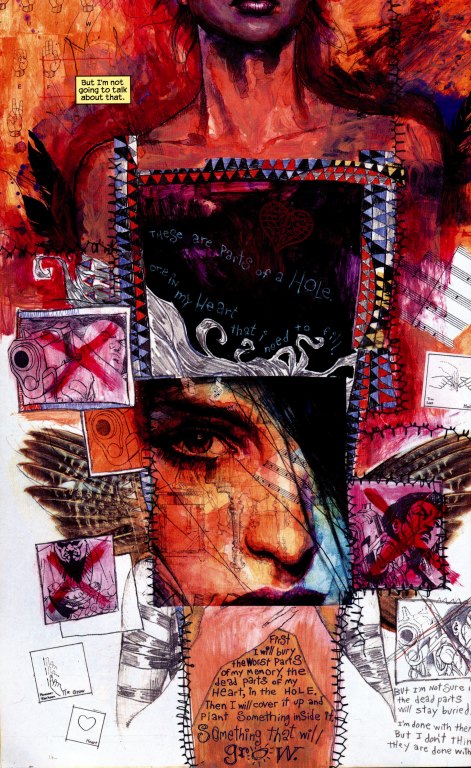
DDecho10partsofahole.jpg

Mack's page combines multiple modality -- multiple ways of depicting the world -- with highly iconic and abstract images existing alongside hyper-realistic images of the same characters. This radical mixing of style is a hallmark of Mack's work, constantly forcing us to think about how things are being represented rather than simply what is being represented. Consider this abstract rendering of the key events -- Fisk is reduced to his big feet and legs, much as he might be seen as a child, while the breakup become Matt and Maya is rendered by the figure of the child ripping a picture of the two of them in half.
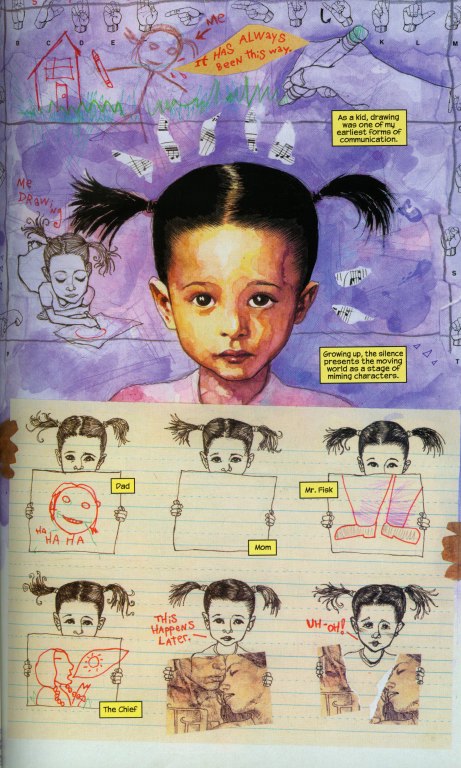
DDecho4kidsdrawing.jpg

We are operating here within the theater of Maya's mind, yet she is also presenting these events to us with an open acknowledgment that as readers we need to have her explain what is taking place.
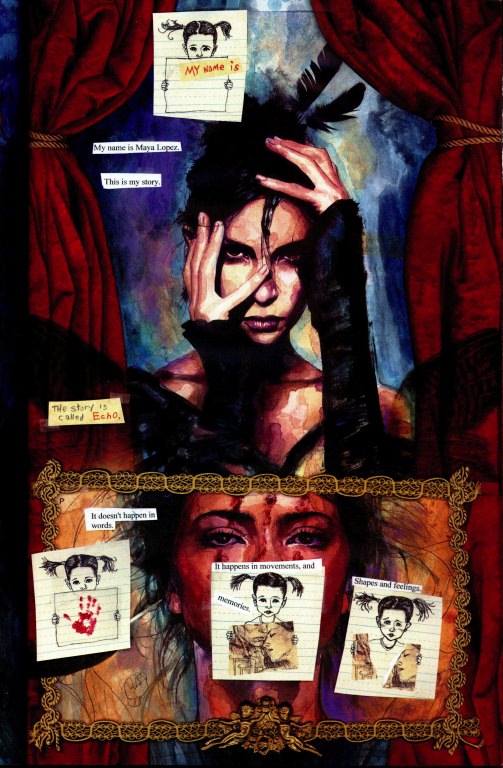
DDecho35mynameisMaya.jpg

Once the book has established these rich icons, they can be recycled and remixed for emotional impact. This image builds on the first in several ways. Mack juxtaposes a more mature version of Maya with her child self here and the childlike drawings are repeated to again represent key emotional moments in her life. While Mack repeats the purple of the earlier image, the dominant color that we associate with Maya on this page is red, a color which captures her passion and rage. She has moved from a vulnerable child victim into someone who has the capacity to strike back at those who have caused her pain.

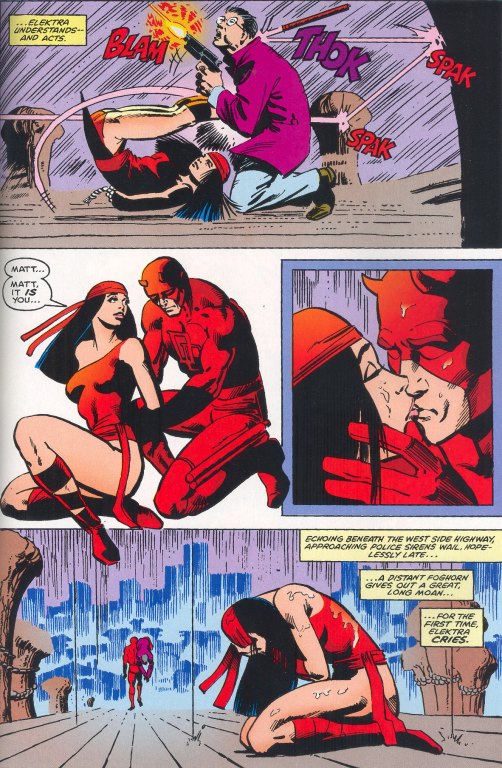
Let's pull back for a moment and try to establish some baselines for thinking about what may constitute "zero-degree style" in the superhero tradition. While his work was considered bold and experimental at the time, Frank Miller's run on Daredevil has helped to establish the stylistic expectations for this particular franchise. Miller's style was hyperbolic -- though nowhere near as much so as in his later works, including The Dark Knight Returns, 300, and Sin City. Yet, he also allows us to see some of the ways that superhero style orientates the reader to the action. The goal is to intensify our feelings by strengthening our identification with the superhero and with other key supporting characters. For this to happen, the pages need to be instantly legible. We need to know who the characters are and what's going on at all times, even if you can use minor breaks in conventional style in order to amplify our emotional responses to the action.
DDMillerp237.jpg

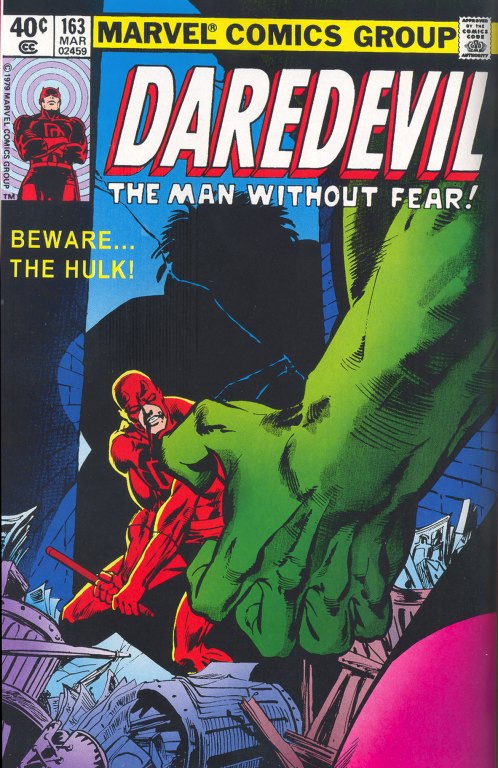
One of the most basic ways that superhero comics do this is through the color coding of key characters, especially the hero and villain, who are depicted in colors that will pop off the page and be distinctive from each other. Electra was designed to in many ways compliment and extend Daredevil so it is no surprise that she is depicted here with the same shade of red.
DDMillerp116.jpg

On the other hand, the highly codified colors of the Marvel universe allow us to instantly recognize the Hulk on this cover simply through the image of his arm and the contrasting red and green prepares us for the power struggle which will unfold in this issue.

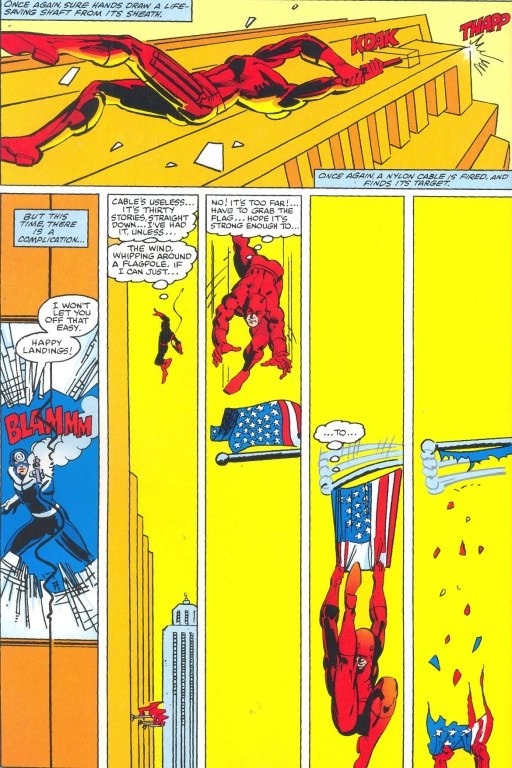
A second set of conventions center on the depiction of action and the construction of space through framing. Miller was especially strong in creating highly kinetic compositions which intensify the movement of the characters.

DDMillerp279.jpg

In this first page, we see Daredevil falling away from us into the city scape below, while in the second Miller uses extremely narrow, vertical panels set against a strong horizontal panel to show the superhero's movements through space.
DDMillerp280.jpg

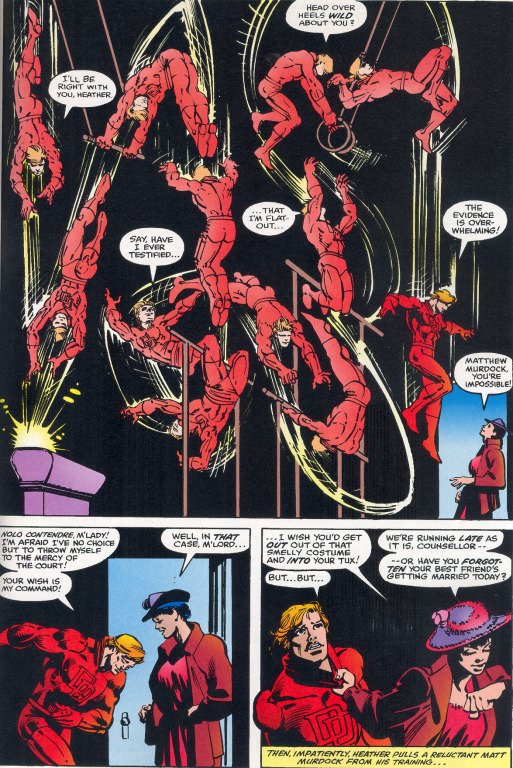
Both of these pages break with the classic grid which is the baseline in these comics, but their exaggerated framing works towards clearly defined narrative goals. This next page breaks with our expectations that each panel captures a single moment in time by showing multiple images of the Daredevil in a way intended to convey a complex series of actions.
DDMillerp175.jpg

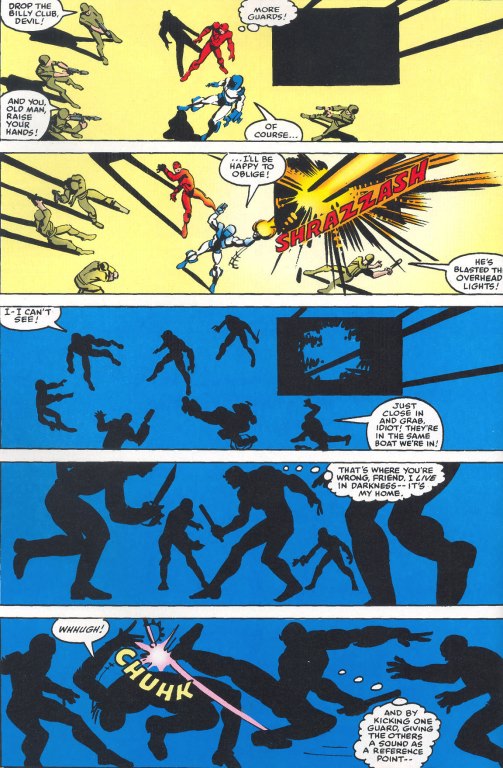
while here we seem to be looking straight down on the action in the top panel and subsequent panels are conveyed in silhouette, though again, there is such a strong emphasis on character motivation and action that we never feel confused about what is actually happening here.
DDMillerp206.jpg

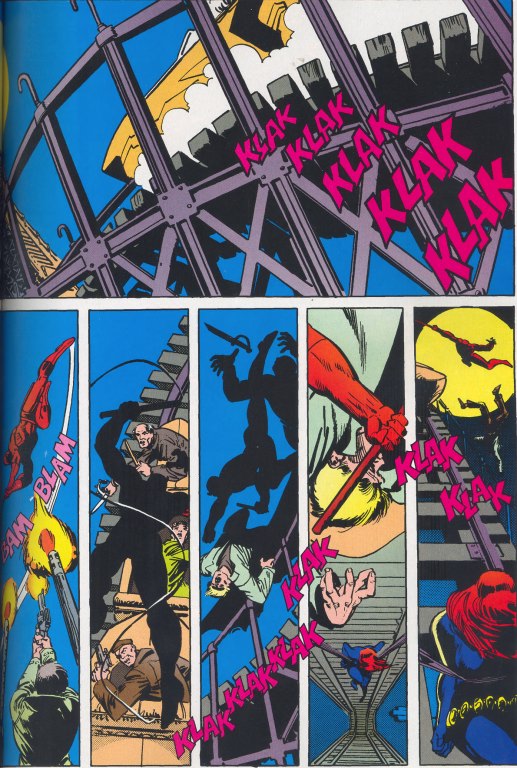
This next image shows other kinds of formal experiments which still fall squarely within the mainstream of the superhero genre -- notice how the text becomes an active element in the composition and notice how the falling character seems to break out of the frame, both ways of underlying the intensity of the action.
DDMillerp105.jpg

Now, let's contrast the layering of text here with the ways that Mack deploys text in Vision-Quest.
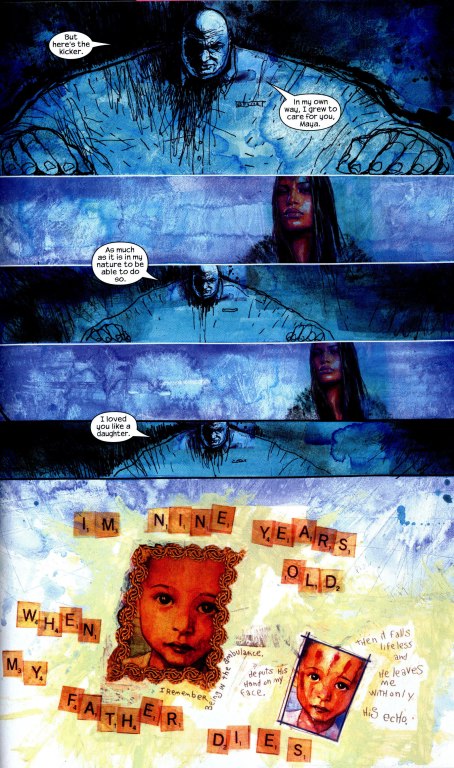
DDecho19thekicker.jpg

Notice for example the ways Mack deploys several different kinds of texts -- printed fonts, handwritten, and the Scrabble tiles each convey some aspects of the meaning of the scene. We have to work to figure out the relationship between these different kinds of texts, which suggest different layers of subjectivity that are competing for our attention. When I first read this book, I was especially moved by the ways that the hand print on Echo's face -- which elsewhere in the book is simply another marker of her supervillain identity -- here becomes a metaphor for the last time her father touched her, moments before his death, and the sense memory it left on her, an especially potent metaphor when we consider the ways that the character is alligned with hypersensitivity and a powerful "body memory" which allows her to replicate physically anything she has ever felt or seen. While the sounds and dialogue emerge from the action in the case of Frank Miller's pages, they are layered onto the depicted events in Mack's design, part of what gives the page the quality of a scrapbook, recounting something that has already happened, rather than thrusting us into the center of the action.
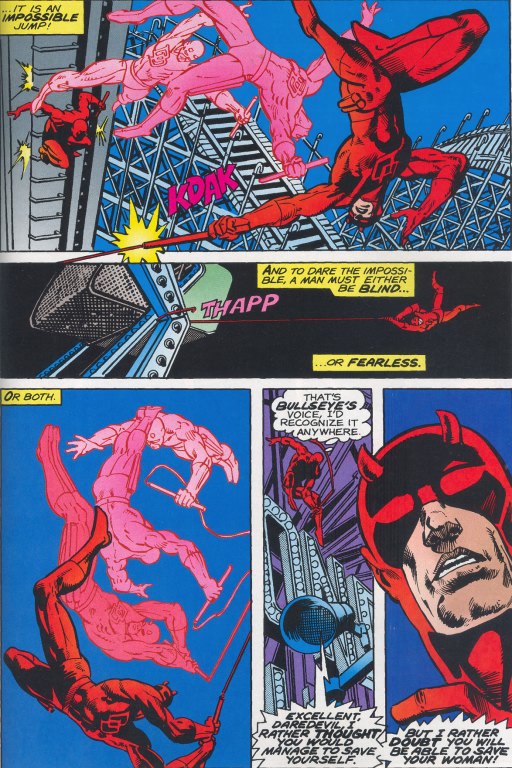
DDMillerp103.jpg

The key elements of Miller's style come through here -- the use of color to separate out the characters, dynamic compositions which emphasize character action, repeated images of the character within the same frame, flamboyant use of text, and the bursting through of the frame, all combine to make this a particularly intense page.

Where most superhero artists seek to covey this sense of intense action in almost every frame, Mack seeks to empty the frame of suggestions of action, seeming to suspend time. Consider this depiction of Daredevil battling Echo from Quesada's work for Pieces of a Hole.

DDhole12conflict.jpg

The splash page traditionally either indicates a particularly significant action or a highly detailed image, both moments of heightened spectacle. Mack, on the other hand, often empties this splash pages so we are focusing on the character's emotional state rather than on any physical action.

DDwake9elektra.jpg

Having established these conventions of representation, the mainstream comic may tolerate a range of different visual styles as different artists try their hand on the character, often working, more or less, within the same continuity. So, we can see here how Tim Sale plays with color to convey the character's identity even through fragmented images which focus on one or another detail of Daredevil's body.

DDYellow1gloves.jpg

Or here we see how Alex Maleev creates a much more muted palette and a scratchy/grainy image which marks his own muted version of the hyperbolic representations of the character in earlier Daredevil titles.
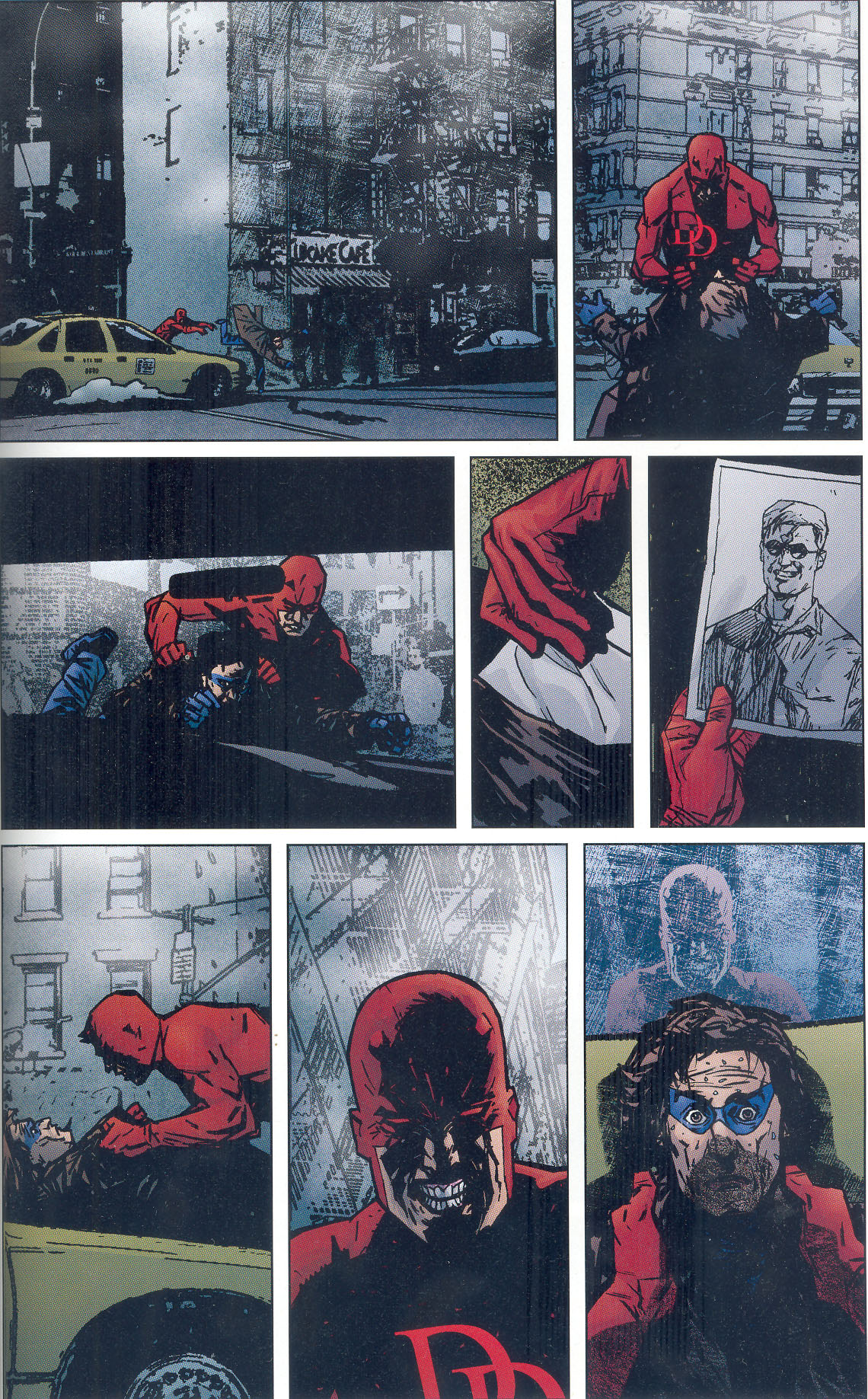
DDBendisunderboss1taxi.jpg

The mainstream comics allow some room for bolder formal experiments but most often these come through the cover designs rather in the panel by panel unfolding of the action.


DDBendisunderboss2cover31.jpg

DDBendisout1cover34.jpg

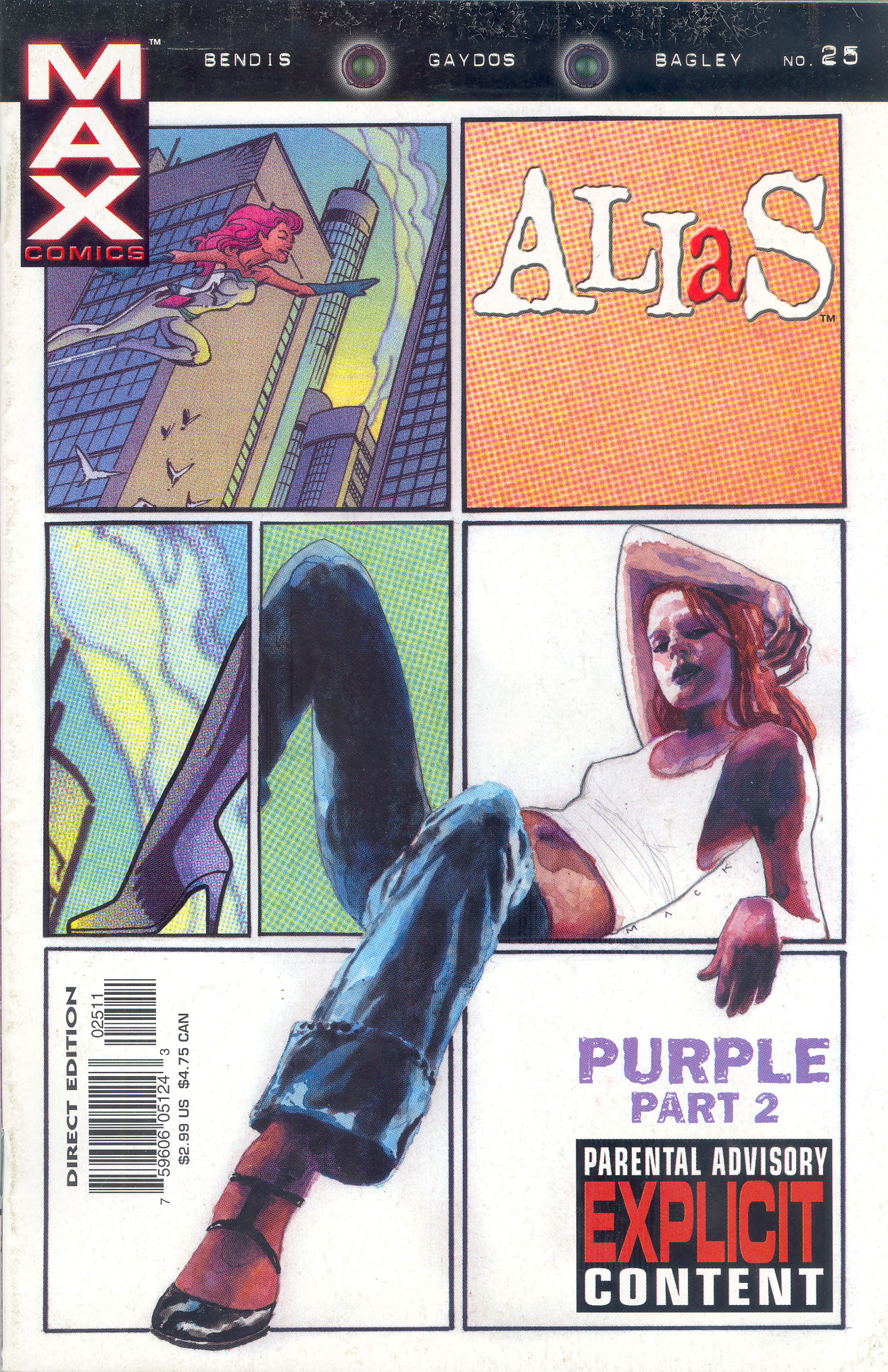
Mack's artwork functions this way in relation to Bendis's Alias, where he was asked to design covers that did not look like conventional superhero covers and that might be seen as more female-friendly, reflecting the genre bursting nature of the series content which operates on the very fringes of Marvel's superhero universe.
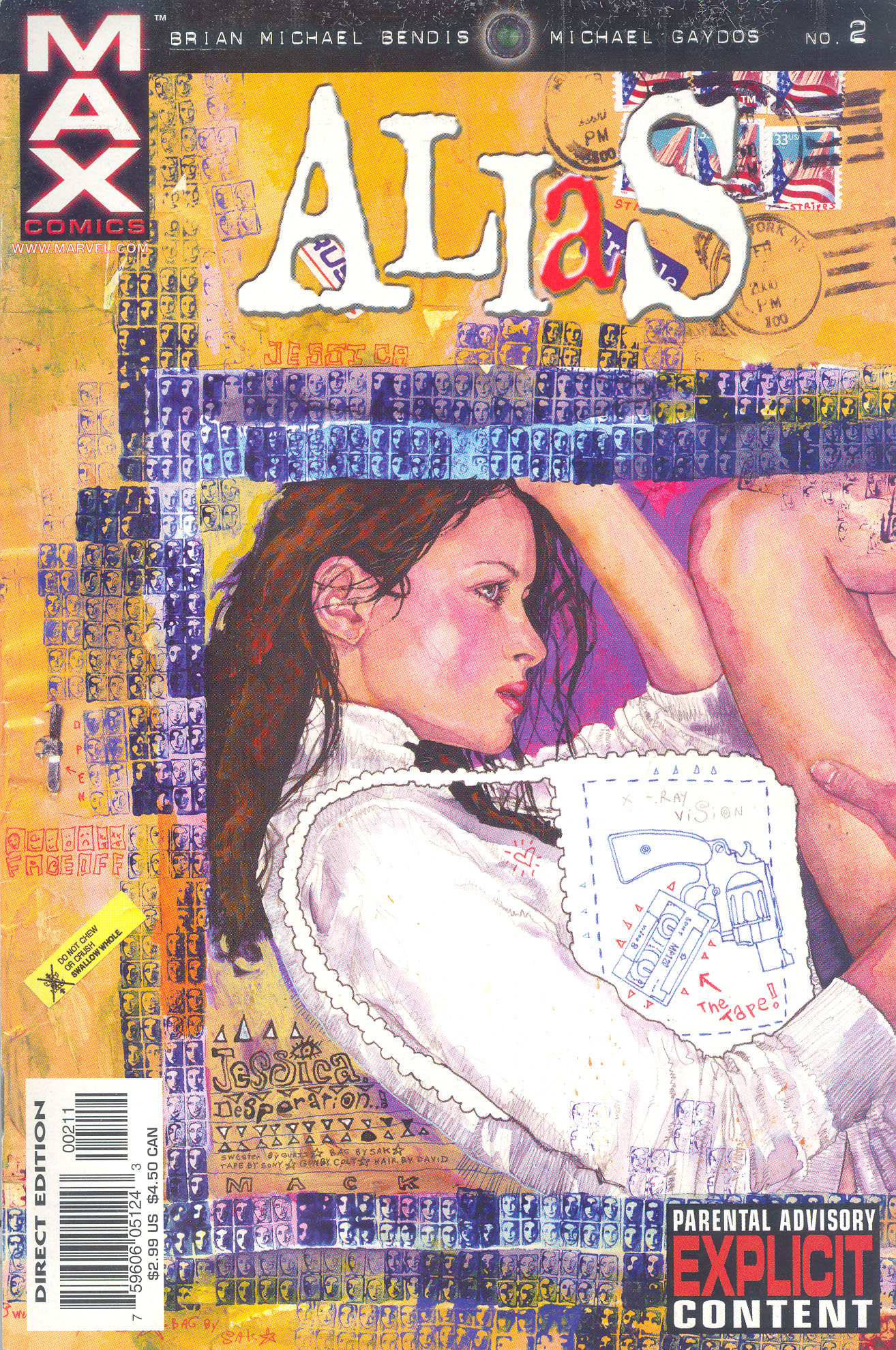
AliasIss2cover.jpg

AliasIss25cover.jpg

The tension between genres is especially visible on this later cover from the series which shows how its protagonist is and is not what we expect from women in a superhero comic.

Man Without Fear: David Mack, Daredevil, and the Bounds of Difference (Part One)

Last fall, I delivered one of the keynote talks at the Understanding Superheroes conference hosted at the University of Oregon in Eugene. The conference was a fascinating snapshot of the current state of comics studies in North America. It was organized by Ben Sanders to accompany a remarkable exhibit of comic art hosted at the Jordan Schnitzer Museum of Art -- "Faster than a Speeding Bullet: The Art of a Superhero," . The exhibit consisted of original panels scanned the entire history of the superhero genre - from its roots in the adventure comics strips through the Golden and Silver age to much more contemporary work. The conference attracted a mix of old time fan boys whose interests were in capturing the history of the medium and younger scholars who applied a range of post-modern and post-structuralist theory to understanding comics as a medium. In between were several generations of superhero comic writers and artists who brought an industry perspective to the mix. Charles Hatfield delivered a remarkable keynote address talking about the technical sublime in the work of Jack Kirby and my keynote centered on the fusion of mainstream and experimental comics techniques in the work which David Mack did for Daredevil.

The presentation was really more of a talk than a paper so it's taken me some time to get around to writing this up, but I had promised some of my readers (not to mention Mack) that I would try to share some of the key ideas from the talk through my blog. A number of readers have asked about this piece so I appreciate their patience and encouragement. In honor of Comic-Con, where I am, as you read this, I am finally sharing with you my thoughts about David Mack's Daredevil comics.

Images from Mack's work here are reproduced by permission of the artist. Other images are reproduced under Fair Use and I am willing to remove them upon request from the artists involved.

This paper is part of an ongoing project which seeks to understand what a closer look at superhero comics might contribute to our understanding of genre theory. Several other installments of this project have appeared in this blog including my discussion of superheroes after 9/11 and my discussion of the concept of multiplicity within superhero comics.

At the heart of this research is a simple idea: What if we stopped protesting that comics as a medium go well beyond "men in capes" and include works of many different genres? No one believes us anyway. And on a certain level, it is more or less the case that the primary publishers of comics publish very little that does not fall into the Superhero genre and almost all of the top selling comics, at least as sold through specialty shops, now fall into the superhero genre. It was not always the case but it has been the case long enough now that we might well accept it as the state of the American comics industry. So, what if we used this to ask some interesting questions about the relationship between a medium and its dominant genre? What happens when a single genre more or less takes over a medium and defines the way that medium is perceived by its public - at least in the American context?

One thing that happens, I've argued, is that the superhero comic starts to absorb a broad range of other genres - from comedy to romance, from mystery to science fiction - which play out within the constraints of the superhero narrative. We can study how Jack Kirby's interests in science fiction inflects The Fantastic Four and other Marvel superhero comics in certain directions. We can ask why it matters that Batman emerged in Detective Comics, Superman in Action Comics, and Spider-Man in Astounding Stories.

But second, we can explore how the Superhero comic becomes a site of aesthetic experimentation, absorbing energies which in another medium might be associated with independent or even avant garde practices. And that's where my interest in David Mack comes from, since he is an artist who works both in independent comics (where he is associated with some pretty radical formal experiments in his Kabuki series) and in mainstream comics (where he has made a range of different kinds of contributions to the Daredevil franchise for Marvel.)

Certainly, most comic books fans understand a distinction between underground/independent comics and mainstream comics but there is surprisingly fluid boundaries between the two. In many ways, independent or underground comics were often defined as "not superhero" comics and therefore still defined by the genre even if in the negative. Throughout this essay, I am going to circle around a range of experiments which seek to merge aspects of independent comics with the superhero genre.

My primary goal here is to map what David Bordwell, Janet Staiger and Kristen Thompson describe in Classical Hollywood Cinema as "the bounds of difference." Bordwell, Staiger and Thompson draw on concepts from Russian formalism to talk about the norms which shape artistic practice and the ways they get encoded into modes of production. By norms, we mean general ways of structuring artistic works, not rigid rules or codes. Norms grow through experimentation and innovation. There is no great penalty for violating norms. Indeed, the best art seeks to defamiliarize conventions - to break the rules in creative and meaningful ways and in the process teach us new ways of seeing.

Genres are thus a complex balance between the encrusted conventions, understood by artists and consumers alike, built up through time, and the localized innovations which make any given work fresh and original. The norms thus are elastic - they can encompass a range of different practices - but they also have a breaking point beyond which they can not bend. This breaking point is what Bordwell and Thompson describe as "the bounds of difference." They have generally been interested in the conservative force of these norms, showing how even works which at first look like they fall outside the norms are often still under their influence. They have shown how the classical system has dominated Hollywood practice since the 1910s and continues to shape most commercial films made today.

In my work, I have been more interested in exploring the edge cases, especially looking at the transition that occurs when an alien aesthetic gets absorbed into the classical system. This was a primary focus of my first book, What Made Pistachio Nuts?: Early Sound Comedy and the Vaudeville Aesthetics and it's a topic to which I have returned at various points throughout my career. In this talk, I want to use David Mack's work for Marvel to help us to map "the bounds of difference" as they impact mainstream superhero comics.

We can get a better sense of why Mack's work represents such an interesting limit case by sampling some of the reviews for Daredevil: Echo - Vision Quest from Amazon contributors, each of whom has to do a complex job of situating this work in relation to our expectations about what a mainstream superhero book looks like:

If you'd like to see Daredevil swinging through New York City beating up bad guys, this is not the comic for you. Although this is technically Volume 8 of the recent Daredevil run, it isn't exactly part of the regular continuity. The five issues that make up this volume were going to be a separate miniseries, but when Bendis and Maleev needed a break from Daredevil (after the Issue 50 battle with the Kingpin), the Echo mini was published under the Daredevil title instead.

This has led to an unfairly bad reputation for this beautifully painted, dream-like exploration of identity and willingness to fight for a cause. Daredevil subscribers expected more of the plot and action that had filled the series to that point, and this meditative break was frustrating, particularly considering the point that Bendis had halted the main plot.

If you are a fan of Alias (the comic) or Kabuki, this is for you. If you would like to gaze in awe at the poetic writing, beautiful painting and stunning mixed-media art of one of the most creative men in comics, buy this comic. You won't regret it.

******************************************************************************************

I think if this had come out as a graphic novel, or as a seperate mini, I may have enjoyed it more. But imagine being engrossed in an intelligent, gritty fast-paced work and then being forcefed an elaborate, artsy character study on a relatively minor character. ... This should have been a seperate mini or graphic novel. Instead we get the equivalent of a documentary on Van Gogh between Kill Bill Volume 1 and 2.

************************************************************************************

This book is a sadistic deviation from thier storyline and is writen and draw by David Mack. This is a (...) crap fest about a very minor character and her hippie like journey to discover her past. ...He then further expresses his impotency in the field by using chicken scratch drawings and paintings to move the story along with hardly ANY dialog. THis book is an artsy load of crap that should not be affiliated with Daredevil or Marvel.

Each of these responses struggles with an aesthetic paradox: Mack's approach to the story does not align with their expectations about what a superhero comic looks like or how it is most likely structured - yet, and this is key, the book in question appears in the main continuity of a Marvel flagship character. There is much greater tolerance as several of the readers note for works which appears on the fringes of the continuity - works which is present as in some senses an alternative, "what if?" or "elseworlds" story, works which more strongly flag themselves as site of auteurist experimentation.

There is even space there for the moral inversion involved in telling the story from the point of view of the villain rather than the superhero: witness the popularity of Brian Azzarello's graphic novels about Lex Luther and The Joker. But Mack applies his more experimental approach at the very heart of the Marvel superhero franchise and as a consequence, the book was met with considerable backlash from hardcore fans who are often among the most conservative at policing "the bounds of difference." Vision Quest is not Mack's only venture into the Daredevil universe: David Mack wrote Parts of a Hole which was illustrated by veteran Marvel artist Joe Quesada; David Mack then contributed art to Wake Up, written by Brian Michael Bendis, perhaps the most popular superhero script-writer of recent memory. In both cases, then, Mack's experimental aesthetic was coupled with someone who fit much more in the mainstream of contemporary superhero comics. The result was a style which fit much more comfortably within audience expectations about the genre and franchise.

DDhole7jigsaw.jpg

DDwake10iknowthat.jpg

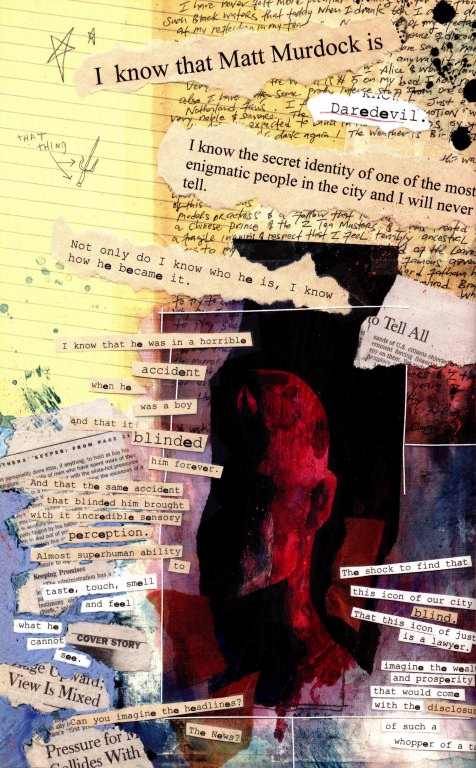
We can see the difference in these two images, the first drawn by Quesada for a Mack Script, the second as drawn by Mack based on his own conception. Both combine multiple levels of texts to convey the fragmented perspective of Echo, the protagonist, as she confronts her sometimes lover, sometimes foe Daredevil. The use of bold primary color and the style of drawing in Quesada's version pulls him that much closer to mainstream expectations, while the deployment of pastels and of a collage-like aesthetic falls outside our sense of what a superhero comic looks like. The subject matter is more or less the same; the mode of representation radically different and in comics, these stylistic differences help to establish our expectations as readers.

The Night Of a Thousand Wizards

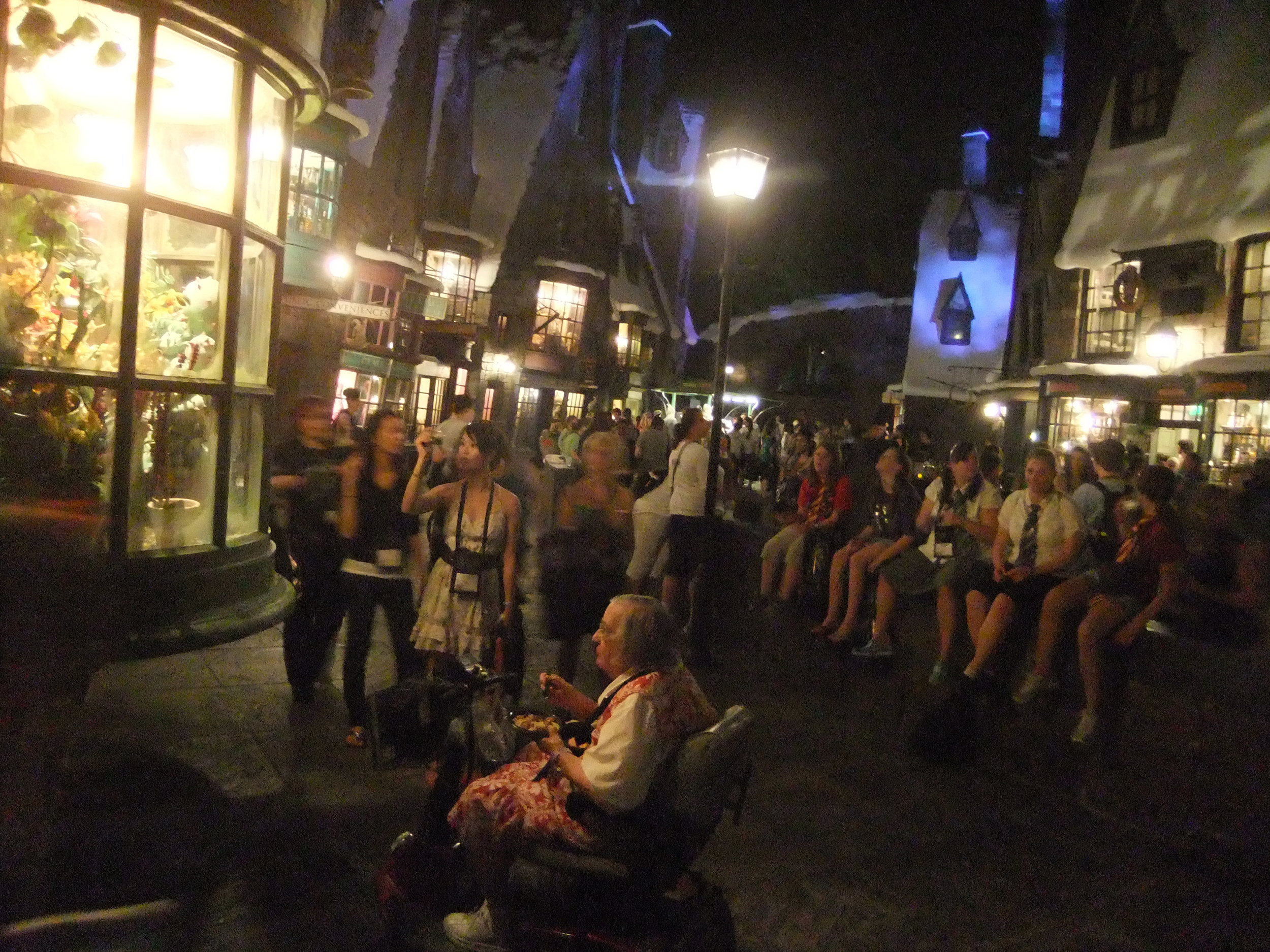
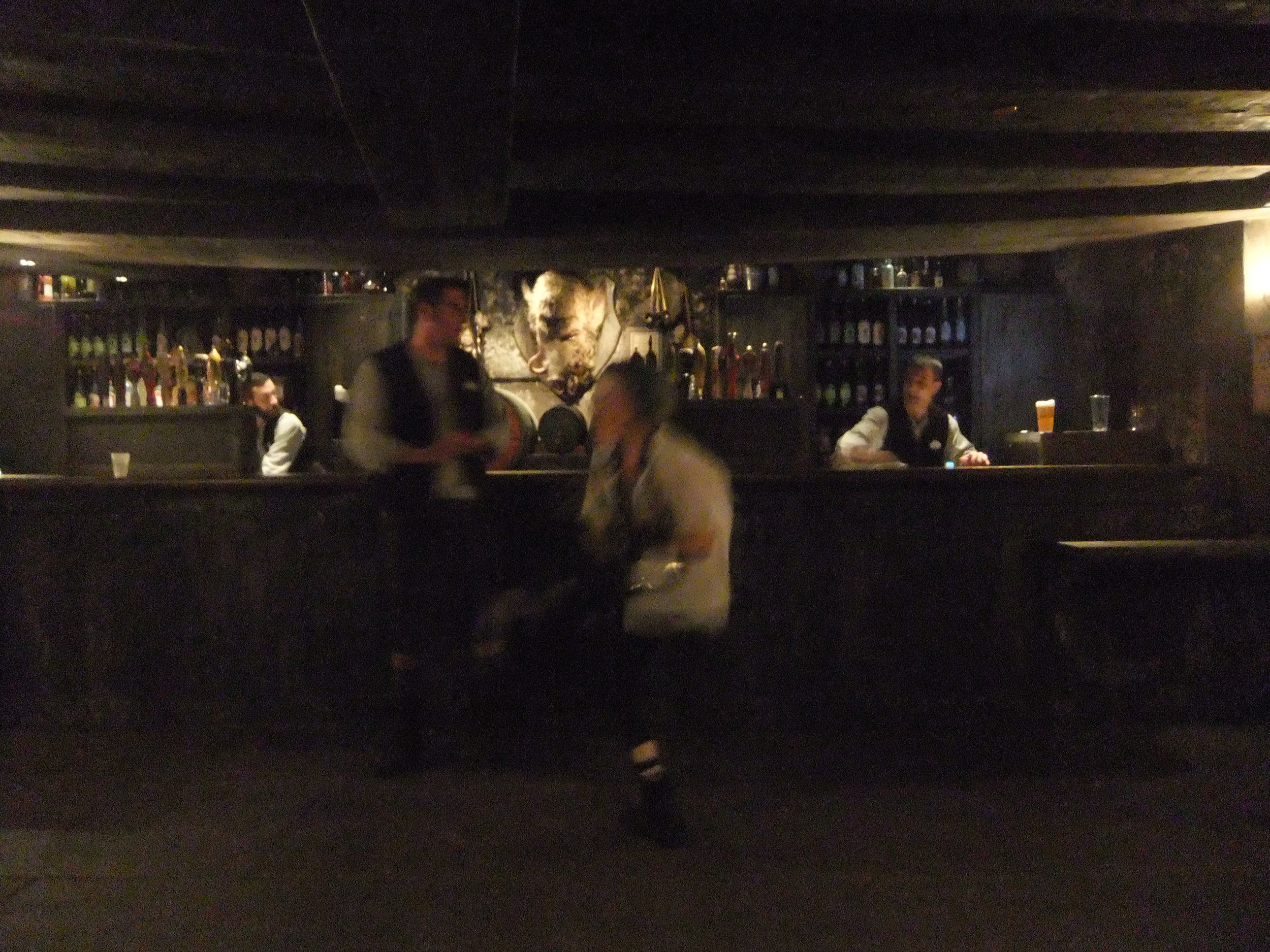
hogsmeade 2.jpg It's 1:15 AM and the natives are getting restless. Young lasses dressed as British school girls are bumping and grinding to "Let's Do the Time Warp Again!" in front of the Three Broomsticks pub. Us older folks have taken to the benches outside the Owl Post, watching the festivities with wistful eyes. Harry and Voldermort have locked arms together and are skipping through the streets of Hogsmeade. And the Buttertbeer is flowing freely tonight!

This is the Night of a Thousand Wizards -- well, in the end, when they got some more guest passes, it ended up being something like 1.7K wizards, but who is counting. Altogether, more than two thousand hard core Harry Potter fans have come to Orlando to attend Infinitus 2010, which the organizers described to me as the largest gathering of enthusiasts of J.K. Rowling's franchise ever.

And as a result of arrangements made before they even started construction on The Wizarding World of Harry Potter, they've been invited into the park after hours (from 11-1:30 or thereabouts) to see for themselves what Universal's Islands of Adventure had constructed. My wife, Cynthia (my photographer) and I are embedded journalists amongst the fans --and I put it that way because while I consider myself a serious enthusiast of the Harry Potter world, I do not know a fraction of what most of the people around me know about the series. For the past three summers, I've come to speak and spend time with these fans and each year I come away with a deeper respect for their knowledge, their commitment, their creativity, and their passion.

There have been discussions at the past few conferences about whether the fandom will survive the completion of the current film series, which wraps up with the two part version of Deathly Hollows all too soon, and how they are going to make the transition to a world where there will be no new Rowling-sanctioned Harry Potter content. Anyone who questions the strength and commitments of these fans must not have heard that the Harry Potter Alliance, an activist/charity group which has used Rowling's world as a platform for their own civic activities, had just won $250,000, beating out more than 200 other organizations, in an online competition to show support, sponsored by the Chase Manhattan Bank.

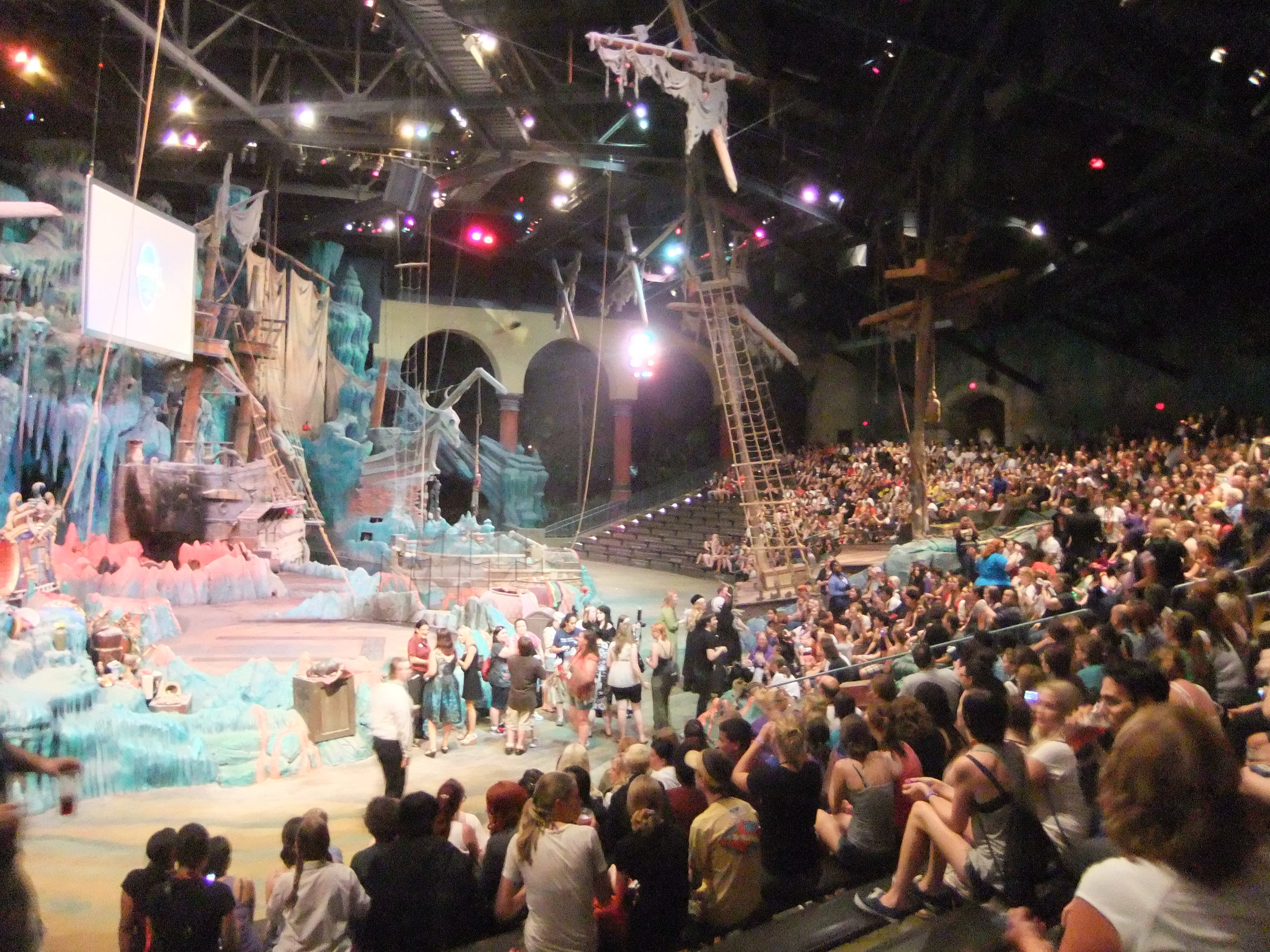
For tonight, at least, as people are singing Wizard Rock songs on the boats transporting them from the hotel to the theme park, as they are parading through Seuss Landing, across the Lost Continent, and into the Eight Voyages of Sinbad auditorium, there's no question in anyone's mind that Harry Potter fandom is here, loud and strong. As I look around the auditorium waiting for the program to begin, I see Snape dancing in the aisles and I see Harry and Voldermort, not yet the BFF they will become before the nights over, staging their own duels in front of the crowd. They don't need anyone from the park to entertain them.

But I see something more -- I see the fans who have spent more than a decade editing websites, writing fan fiction, organizing conferences, producing podcasts, performing and recording their own Wizard Rock songs, and creating activists organizations, all gathered together in one place and one time to celebrate what they had built together from the resources that Rowling, Scholastic Press, and Warner Brothers has provided them. There will be no Muggles in Hogsmeade tonight! We are indeed all Wizards here!

If there was a mainstream journalist in the house, they would no doubt have had trouble seeing past the costumes: that seems to be where the line between the fan and the mundane world comes. Not every fan wears a costume but the wearing of costumes seems to be where the nonfans start to draw the line, start to look at us as strange, so for the moment, look past the costumes and think about what the people in this room have created around a book they cared about and the costume just becomes another extension of the creative spirit.

The conference organizers had to negotiate hard for the fans to be allowed to wear the costumes into the park that night. Universal didn't want there to be any confusion between who the "guests" were and who the "cast members" were -- largely for liability purposes. They wanted to demarcate who worked there and who played there. The fans were to wear their membership bags at all time, but in the end, the fan organizers were allowed to bend the rules for this one night and the fans were invited to come dressed as they wished, a hodge-podge mixture of characters, some named, some generic, from the world Rowling created.

Before the fans even arrived in the park, they had an emotionally intense experience. Lena Gabrielle had written and Mallory Vance had directed an original musical depicting the final battle from Deathly Hollows, which was performed by a large cast of amateur and semi-professional performers, many of whom had surprisingly strong voices and acting skills, and the rest made up in spirit for what they lacked in polished. The play should not have been anywhere near as good as it was. A Soul number performed by the Death Eaters after the presumed death of Harry Potter was a highlight here. And tears were flowing (mine among them) as certain key moments of loss and transformation were restaged for an audience that knew the original book inside and out. There were more than thirty named characters in the production and this crowd knew each of their stories well. Watching this, I had a clearer sense of the challenge the filmmakers are going to face in turning Deathly Hollows into a feature, given the sheer density and intensity of its final chapters.

Sinbad.jpg

Now, inside the Sinbad auditorium, there's a little bit of friction. The Park's PR people and designers have plopped themselves in front of the room clearly wanting to hear the fan's praise for the years of work which went into the design, development, and construction of this attraction. And they get plenty of appreciation from the crowd. But they also get a bit more than they expected, given that your best fans are also often your sharpest critics.

They've basically brought us to a holding area while they finish sweeping the regular guests out of the park and making the Hogsmeade area pristine and clean. Cluster by clusters, the fans are walking down the aisle and pushing out the doors again -- they don't want to wait, they want to get inside as soon as possible. Sure, they want to hear about the design process which included substantial contributions by the production designers and art directors, not to mention the cast, of the Warner Brothers films. But most of them have already seen the promotional videos that have been circulating on the web and on television for months. They already know this stuff. What they want to do is come and spend as much time as they can in the Wizarding World area which these guys have built for our entertainment. (And I am hoping as I watch this that the designers know what a compliment this really is). Enough words, time to play.

Others, however, have some questions to raise. For one thing, because this is Universal, where most of the attractions are thrill rides, the rides have weight and size limits, and some of the folks gathered here are not going to be able to ride them. There's a humiliating process outside several of the rides where people get stuffed into a cart to see if they can lower the protective rails over their bodies. Fandom is a place where people of all shapes and sizes are accepted, while the Wizarding World has more exacting and discriminating standards which leave some of the participants feeling crushed (literally and figuratively). Keep in mind also that height requirements will leave many of the books' youngest fans waiting outside, though there are not very many of them in the house tonight.

Others are expressing the usual fan concerns about continuity issues -- how is it that Ollivanders, the wand shop, which the books and films tell us is in Diagon Alley, gets included in Hogsmeade, while the Novelty Shop there is Zonko's Joke Shop, the Hogsmeade establishment rather than the more fan friendly shop owned by Fred and George Weasley. And all the park can say is that this is the way Rowling wanted it and that she authorized Ollivanders to have a branch office closer to the school, which just never got mentioned in the books.

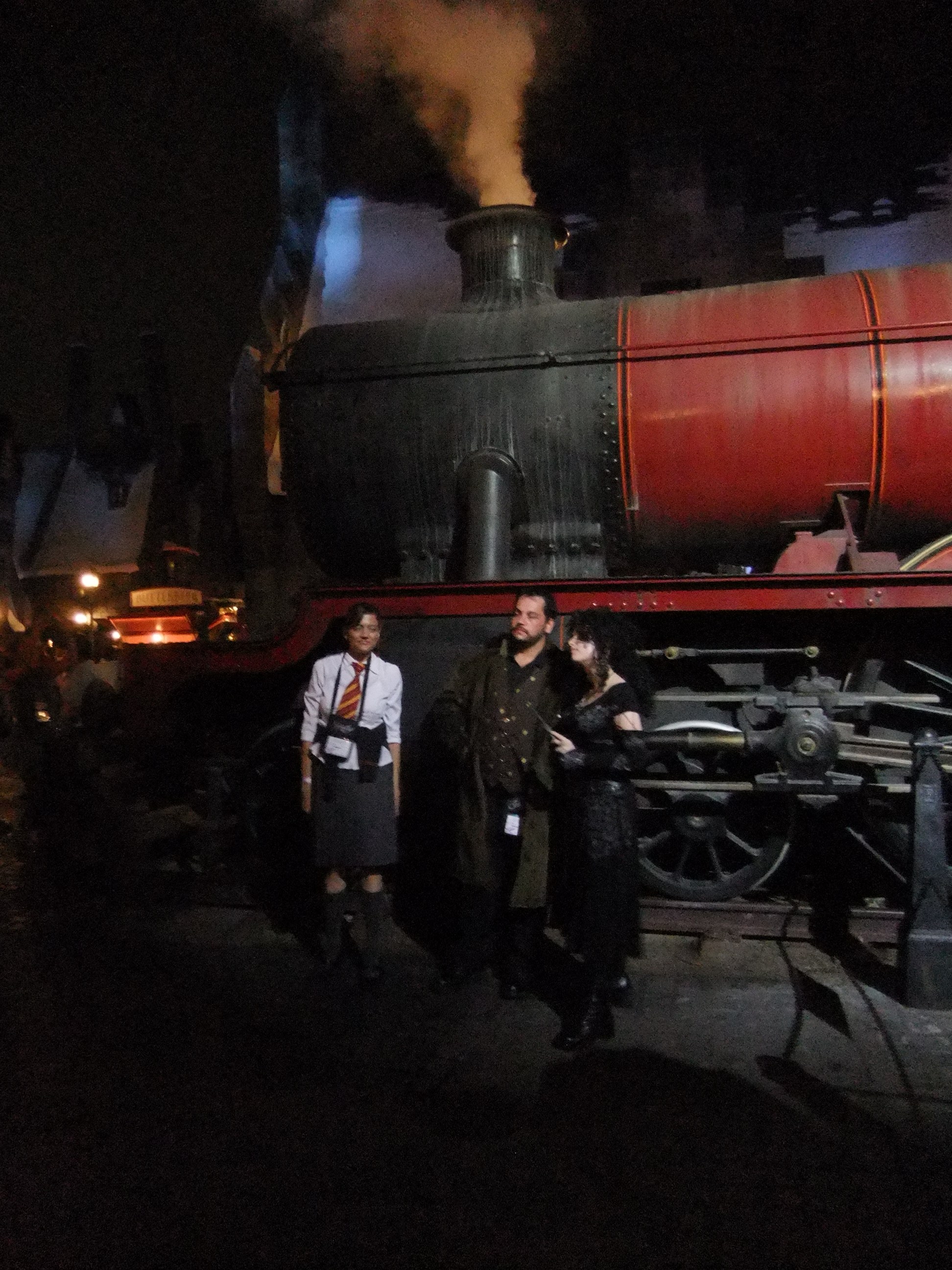
Others are expressing their concern that so many of the dishes created for the park -- from Pumpkin Juice and Butter Beer to Chocolate Frogs, Candied Humbugs, and Gummy Skulls -- are confections which should be off limits to people with diabetes and other diet-based concerns, while the park designer explains, not fully convincingly, that there is less sugar in Butterbeer than in some of the things served at Starbucks and tells the fan who had expressed the health concerns about the high sugar content that she should simply indulge herself for the evening. (As a Diabetic myself, I wasn't very pleased with the suggestion that we can just opt out of our conditions.) Just when it starts to look like this could get ugly, the program ends and people start to move through the gates and past the Hogwarts Express train and into the streets of that enchanted village.

train.jpg

Make no mistake about it. This is a magical place. Some of the fans spoke of weeping the first time they entered this space. Others described it as a kind of homecoming as they were at last able to enter a world they had previously known only through their imagination. Suddenly, it became clearer that The Wizarding World is not about rides and attractions: it's about an environment which conveys through sights, sounds, taste, smell and touch, which makes tangible what had felt so vivid in our minds before, and as the fans said again and again all night, they really cared about the details. You can sip the Butterbeer (a concoction which mixes Root Beer and Butterscotch); you can smell the steam coming out of the train; you can feel the speed of a Quidditch match; you can see the wonders of the magical school; and everything is accompanied with the movie's soundtrack.

Please do not quote me Baudrillard's comment that Disneyland is fake so it can trick us into believing the rest of America is real. Don't pull out Umberto Eco's discussion of "Hyperreality" and the ways that the "absolute fake" is realer than the real. These are, to put it bluntly, pseudo-insights.

Everyone here knows that Hogwarts isn't real. What would it even mean to create a "real" Hogwarts. At best, they can judge this environment for its fidelity to the details of the film -- and that's a set of criteria which comes up frequently here. Even there, the analogy is not right. As we are told, the film producers never made a large scale version of Hogwarts -- what we see is a combination of models and digital effects and some isolated sets. There never was a full reconstruction of Hogsmeade -- we don't get to wander its streets and see from one end to the other in the films.

But just as often the fans are talking about how it "feels right," how it achieves a kind of emotional integrity, which fits their impressions of the world where one of their favorite stories is set. This is where the postmodernists get it wrong. They start with a basic contempt for the content of the stories represented in the theme park and so they do not invest themselves deeply enough in the experience. For them, it is about surfaces and empty signifiers. There's nothing empty here -- all of the details matter here and are meaningful in relation to the books and the fantasies they inspire.

For the people here, the park is a play set, and I mean this in two senses. First it is a site of play -- a invitation to flesh out this world through their own creative and imaginative acts of performance. The Wizarding World is something like the action figures I discussed in my essay on He-Man a few months ago. And second, it is a set -- a place where they perform, where community rituals can be staged.

I don't like to draw analogies between fandom and religion, since the comparison is always misleading, especially given the historic association of the word, fan, with false worship. But let's think of this as a ritual space. When tribal communities dance wearing clay masks and straw costumes, they re acting "as if" they were the animal spirits. The performance is a recognition of shared beliefs and mutual emotional experiences. They've all worked to construct the costumes so they know that they are not "real" but it does not diminish the emotional intensity of the experience.

Cornel Sandvoss has proposed we use the concept of "Heimat", "homeland," to describe the kinds of emotional experiences when fans are allowed to visit spaces associated with the production of their favorite programs. For Sandvoss, we experience this Heimat when we visit these places through texts or physical places. That seems a very good concept for talking about what these fans, myself among them, were experiencing -- a sense of coming home. I like this analogy because it pulls the intensity of experience out of the realm of the spiritual and plants it much more appropriately in the realm of the cultural.

Hogworts is a special place in the utopian imagination of the fan community. For many who grew up reading the books, it represented a vivid alternative to their own school experiences, a space where their gifts were recognized and valued, where learning served a higher purpose, where they were part of a community that grew to feel a deep commitment to each of its members, and where their acts of resistance to unreasonable authority had a larger significance. As they grew deeper into the fandom, they set their stories here and fleshed it out with their own imaginations: it is a space they created through their own ink, blood, and tears. And it was also a shared space which became associated with close and lasting friendships and a larger sense of collective identity. And this space, however over-commercialized, represents the closest the community is going to come to an actual homeland.

One of the great things about the design of the park is that once you are inside the Harry Potter area, you don't see outside it -- you can't see the other attractions and areas; nothing jars you from the immersiveness of the experience. Well, very little. It is a typically hot and muggy night in Orlando. During the day, the sun can broil your flesh through your SunScreen and at night, you are going to be soaked with sweat no matter what you do, so there was something pretty amusing about the piles of snow on the roofs of the Hogsmeade buildings or the Snow Wizard and Snow Owl (pun no doubt included) which decorates one of the spaces. The snow looks real but unless they pumped substantial air conditioning into the open air attraction, it isn't ever going to feel quite real.

candy shop 2.jpg

owl post.jpg

But you can wander past the various shops mentioned in the books, looking through the windows to see the wands, the Quidditch equipment, a display showcasing Prof. Lockhart's books, the Owl Post Office, the Boars Head on the wall of the pub, and a display for Puking Pestles which features a green-faced victim spewing an endless flow of purple vomit. Go inside the Hogwarts castle and you will pass through Prof. Sprout's greenhouse, Dumbledore's study, the halls full of talking paintings, and the dorm space where the Gryffindor Students live. And then you enter an intense, multimedia experience, which combines digital effects, cinematic projections, and physical models, to send you flying through the Chamber of Secrets, past the Whomping Willow, into the Forbidden Forest, and across a Quidditch match in progress. Here, you are lead on by Daniel Radcliffe's Harry Potter, in new footage shot specifically for the attraction. It is intense and jolting, but oh so very immersive.

harry potter orlando july 2010 043.jpg

I can't tell you about the other two rides, both of which are roller coasters, since I am a notorious roller coaster wimp, and I spent much of my time wandering the streets, watching people, and yes, buying stuff. I was personally disappointed that most of the merchandise targets fans of the two Houses most often discussed in the books -- Gryffindor (Harry, Hermione, and Ron) and Slytherin (Draco), but under-represents the two other houses (Hufflepuff and Ravenclaw.) I have been sorted several times -- an important ritual inside the fandom -- and have always ended up Ravenclaw (Luna Lovegood's House) so I have to dig around to find a Ravenclaw banner to take back for my office. This is certainly an area where the park's priorities could better allign with those of the fans.

pub.jpg

The park has made a conscious decision not to feature impersonators of the major characters here. Since they involve the film's actors in the rides and presentations, they did not want to try to recast them with street performers in the park. So one of my favorite moments came when I saw a row of Beauxbatons, who were hired to pose for photographs with guests, taking great pleasure in being photographed next to fans dressed as Snape, McGonigle, Sprout, and some of the other Hogwarts teachers. This is the moment that the Park management had feared where the lines between staff and guests were starting to break down. Indeed, everywhere I looked, the working staff was getting into the spirit of the evening, asking the fans questions, trying to learn the lyrics to Wizard Rock songs, showing off their own knowledge of the mythology, and otherwise, paying respect to how much the fans knew and loved these stories. In practice, the staff were themselves fans -- even if they hadn't been before they got these jobs -- as they had come to spend so much time inside this park.

harry potter orlando july 2010 034.jpg

If the park is empty, except within the rides, of the characters from the series, the shops evoke moments from the novels -- for the most part, happy parts when they went on holiday down to the nearby village, where they congregated over food and drink, where they stuffed themselves with candy, and where they played pranks on each other. In many ways, Hogsmeades functions for the characters much as it functions for us as tourists -- as a place to escape your fears and worries. Rowling does a good job establishing this space and then gradually as the series continues, introduces threats and dangers here, showing how the evil that can not be named has penetrated even the safe spaces in the students' lives, leaving them no escape to do battle. But the Hogsmeades here is not a dark place -- indeed, it has been removed from a narrative context. The park is structured around places and not events. We see no signs that the Dark Lord may be returning. And that frees us to construct our own stories here, much as fans construct their own stories on the blank screen and share them through cyberspace. There is such a strong contrast between the emphasis on character and incident in the play we saw earlier this evening and the emphasis on place and activity here, yet we need to realize how much the fans bring the characters, the stories, the events, with them where-ever they travel.

When it came time to leave, there was some experience of trauma. Some of the fans grumbled it was like being thrown out of their home. But many of them were already making plans to come back.

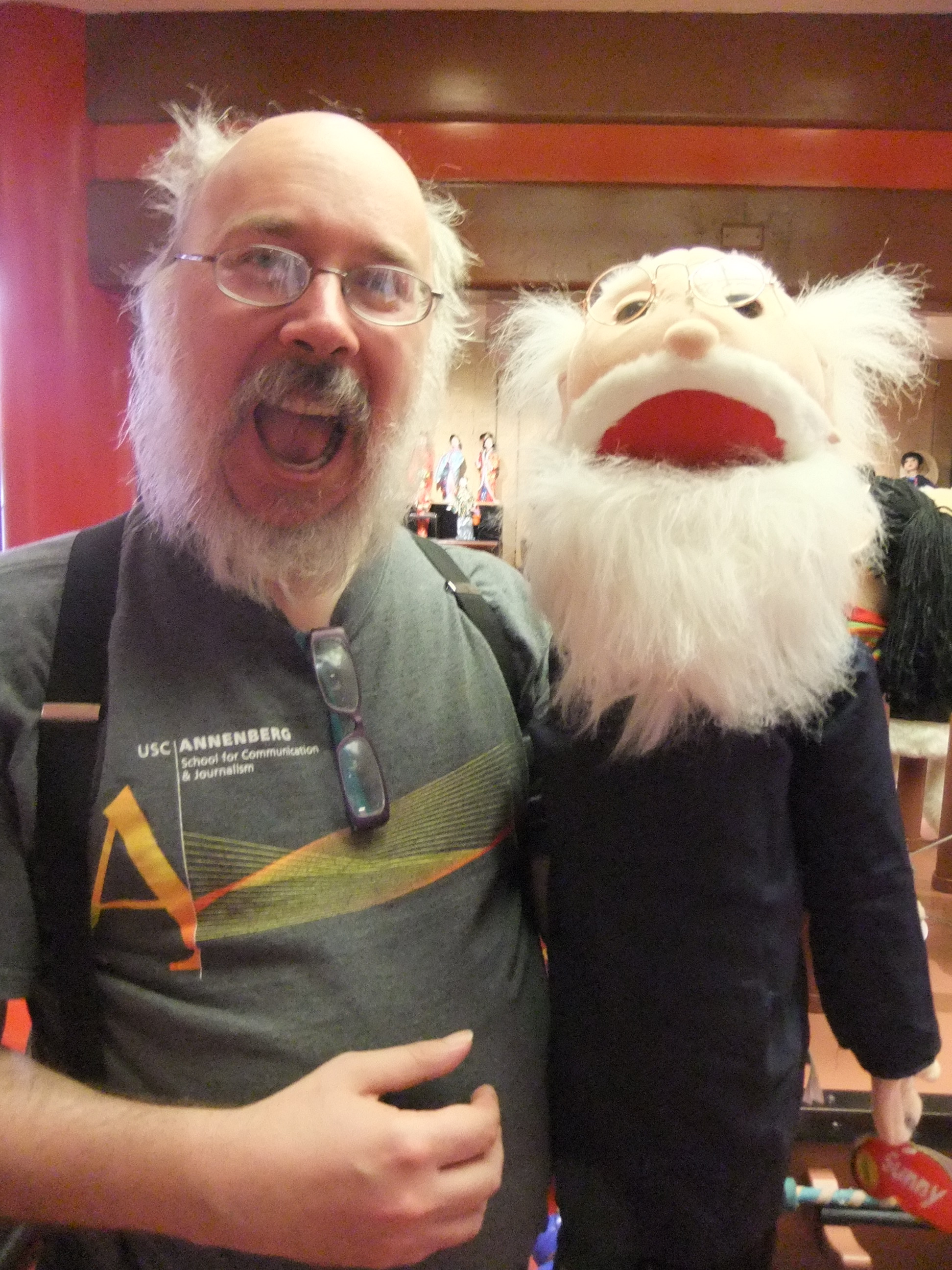
Here's a final treat -- a photograph shot at the China Pavilion at EPCOT. One of the men depicted in this image is the author of the above blog post. The other is a subtle impersonator. I leave it to the reader to decide which is which.

me and minime.JPG

Reinventing Cinema: An Interview with Chuck Tryon (Part Two)

Below is the second installment of my interview with Chuck Tryon, author of em> Reinventing Cinema: Movies in the Age of Media Convergence
Your chapter on digital distribution has much to say about Robert Greenwald and Brave New Films, especially about their model of organizing house parties around viewing of their progressive documentaries. What does digital distribution offer such filmmakers? Greenwald is increasingly moving from the distribution of full length documentaries to the much more rapid dispersal of short videos via YouTube and Facebook. How might this shift reflect changes in the way independent and documentary filmmakers are relating to digital distribution?

Robert Greenwald has been a brilliant innovator when it comes to skillfully using social media for political purposes, and I find his work fascinating because he has typically managed to navigate between detailed, but accessible, policy analyses and using available social media tools, from email lists to blogs and web video, to build an audience for his work (and for Brave New Films in general).

To some extent, I think his initial success grew out of the alienation and anger felt by many on the left at the beginning of the Iraq War and, later, after George W. Bush was reelected in 2004, so he was able to build an impressive infrastructure using the "house party" model, but at some point, I think it became difficult to sustain the sense that these new documentaries were unique events, so I've been impressed with his attempts to craft shorter and more timely responses to ongoing events, such as the war in Afghanistan and more recently, the oil spill in the Gulf. These videos can circulate quickly and can often have a more immediate impact through tools such as Twitter and Facebook, and because new videos are available on a daily basis, it can encourage the people who watch and share his videos to see political participation as an ongoing, daily process, rather than an occasional activity.

Although I think these rapid responses are incredibly powerful, other independent and documentary filmmakers still focus on creating special events, using tools such as OpenIndie and similar tools to invite audiences to request that a film play at a local theater. One of the most successful films to use the OpenIndie model was Franny Armstrong's environmental documentary, The Age of Stupid, which used the service to build demand for simultaneous screenings in over 500 theaters in at least 45 countries. Thus, in addition to building and sustaining an audience online through short videos, many filmmakers are seeking to turn their screenings into unique experiences where audiences will feel more like participants than viewers

.

In the book, you describe a splintering of independent films with South by Southwest becoming the key festival for filmmakers who do not wish or are not able to compete at Sundance. What can you tell us about the current status of these "mumblecore" filmmakers?

The mumblecore label was always somewhat amorphous, but it illustrated the power of collaboration in an era democratized media production. This sense of collaboration, or incestuousness, depending on your perspective, is illustrated in a series of charts designed by mumblecore filmmaker Aaron Hillis, showing the degree to which these filmmakers have cooperated with--and learned from--each other.

Some of my favorite filmmakers from the movement, including Andrew Bujalski, continue to produce engaging work outside of the Hollywood system, while others, such as the Duplass brothers, have had films, including Baghead and Cyrus, distributed by studio specialty divisions such as Picturehouse and Sony Pictures Classics. Arin Crumley, one of the filmmakers behind Four Eyed Monsters, has joined forces with Lance Weiler to participate in the creation of tools that will help independent filmmakers promote and exhibit their films. But one of the more significant compliments to mumblecore's influence came from New York Times film critic, A.O. Scott, who argued that mumblecore actress, Greta Geriwg, might be one of the most significant actresses of this generation in his assessment of her "naturalistic" performance in the Ben Stiller film, Greenberg. So, even though the mumblecore label is less widely used, many of the filmmakers in the movement have been able to develop successful careers either within Hollywood or as independent filmmakers.

Much has been written about the fact that there is no longer a Pauline Kael among film critics. Instead, our most well known critic today is Roger Ebert, who has moved from television to the blogs and Twitter as platforms for sharing his views on film. Behind Ebert, there is an army of film bloggers who are sharing their thoughts about cinema. Is the result a stronger or weaker film culture? What do you see as the strengths and limitations of these two configurations of film criticism?

To some extent, I think it's easy to romanticize the past and the contributions of critics such as Pauline Kael, Andrew Sarris, and Susan Sontag, especially when so many newspapers and magazines are either firing their film critics or relying upon freelance writers for their reviews. But this nostalgia for an earlier form of film criticism obscures some of the ways in which film blogs are helping to reinvent film culture.

Because of my own experiences as a film blogger, I'm probably biased on this point, but I think that film blogs have strengthened film culture immensely, in part because those critics are now held accountable by the bloggers who read and respond to their reviews in highly public ways. But although there may be thousands of dedicated film bloggers, I think the blogosphere is structured in such a way that a small number of critics still wield a huge influence, such as Roger Ebert, A.O. Scott, and Harry Knowles. Similarly, many film bloggers, such as Karina Longworth and Matt Zoller Seitz, are often incorporated into more mainstream venues. At the same time, bloggers such as David Hudson aggregate the most significant film news on the web, directing the attention of readers to the most significant film news of the day, ensuring that most film critics and cinephiles will continue to have access to significant ideas about film as they are unfolding.

Ebert's remarkable transformation through social media is fascinating. Ebert has always been engaged with his audience, though his "Answer Man" column, but blogging and Twitter have deepened that engagement. One recent example of this engagement is Ebert's recent column (http://blogs.suntimes.com/ebert/2010/07/okay_kids_play_on_my_lawn.html) in which he rethought an earlier column where he claimed that video games, by definition, cannot be art. His original column provoked thousands of comments, many of them offering sophisticated arguments about the definition of art or about video game aesthetics, challenging Ebert to at least acknowledge some of the limitations of his original argument

.

As you note, many of those producing short films for YouTube see them as "calling cards," which they hope will open doors for them inside the film industry. Five years into its history, how well has YouTube functioned as a pipeline for promoting and developing new filmmaking talent?

I'm probably not as attentive to these "calling card" stories as I ought to be, but I've been able to trace a small number of filmmakers who have been able to use YouTube as a means of opening doors inside the film industry. One of the more famous examples is a Uruguayan visual effects specialist, Fede Alvarez, who created a short, Panic Attack, that has generated nearly 5 million views and, along with it, an agreement from Mandate Pictures to back a $30 million film.

Other success stories would certainly include Paranormal Activity, where a group of do-it-yourself filmmakers succeeded in developing grassroots enthusiasm for their movie online before seeing the film get picked up by Paramount, initially with the purpose of remaking it, before realizing that the filmmakers had already succeeded in creating enormous demand for their film.

Some of the more successful YouTube "calling cards" rely on humor, including parody of more familiar texts, in order to build an audience familiar with the original. One of the best examples here is High School Sucks The Musical, which was picked up for distribution by Lakeshore Entertainment after the filmmakers were able to generate interest in the film through their YouTube channel.

A number of other filmmakers, many of them living outside the US, have managed to raise some funding for their films online, operating outside of the Hollywood industry with the hope of securing some combination of theatrical, DVD, and television distribution. The Finnish filmmakers behind the satirical Star Wreck web series have used their web popularity to raise funding for their Iron Sky film, while the Madrid-based Riot Cinema Collective is working on The Cosmonaut. Many of these filmmakers invite viewers to support in a film project by buying a CD of songs "inspired by" the film or a t-shirt featuring the film's logo, encouraging those audiences not only to become "invested" in the film's success but also to become participants in a word-of-mouth campaign to get others to watch it.

There are certainly other cases that I'm forgetting, but these are a few that have crossed my radar. These cases seem to show that YouTube (or any other video sharing site) can be used to develop and promote a wide range of new talent.

Cineastes worry about young people who are watching films on their iPod, iPhone, and we presume now, their iPad. To what degree is this a red herring? What do we know about the consumption of films on such mobile devices?

From what I can tell, the alarmism over youthful audiences consuming movies on mobile devices is considerably exaggerated. Certainly people, including many adults, will sometimes watch movies on mobile devices during times of enforced waiting, such as a long plane trip (note the presence of Redbox kiosks in airport terminals), but I'm pretty skeptical of arguments such as those by older critics, who depict today's youth as enthralled by watching movies on their iPods. In fact, according to a recent study by the Kaiser Foundation, TV consumption on an iPod represents only a small slice of overall media consumption. Further, teens and young adults remain avid moviegoers, as a quick visit to a local multiplex will confirm, and there is some evidence, including a recent study by the Nielsen Company, that teen media consumption may be more traditional than we typically assume. Many of these assumptions about teen media practices seem related to a combination of fears about youth and about new technologies.

The Pew Internet and American Life studies also do an excellent job of tracking practices of online video viewing habits, but at this point, the perception that people are dropping cable TV for online video seems overstated, part of what NewTeeVee refers to as the "cord-cutting myth". While this may change thanks to Hulu Plus and other online TV subscription services, it seems clear that people will continue to consume media on multiple platforms.

What new platforms or practices do you see as having the most likelyhood of "reinventing cinema" in the next few years?

I typically shy away from predicting future trends, and in some ways, I think we will continue to see some forms of stability within the film industry: people will still go to blockbuster films at local multiplexes or watch movies on whatever home screens are available. And fans will still blog about and remix those movies in order to participate in a wider cultural conversation. I have been fascinated by the degree to which Redbox initially placed the industry in turmoil through its dollar-per-day rentals, but it appears that the industry response to Redbox is now relatively settled, but I do think that Redbox is symptomatic of a declining emphasis on collecting or owning DVDs, especially among casual movie fans who are seeking a night's entertainment. Redbox also illustrates the fact that residual technologies such as the DVD may have a longer future than we might have initially predicted.

I'm also interested in the streaming video service, Mubi, which initially marketed itself toward a globalized cinephile culture by distributing a number of American indie and international art house movies online in high-quality streaming versions. They have recently contracted with Playstation to stream movies through their PS3 game console and seem to be positioning themselves as a go-to site for socially-networked cinephiles. Both of these phenomena point to the ways in which non-theatrical audiences are consuming movies in new ways. Rather than collecting DVDs that may only be viewed a couple of times, if at all, Redbox and Mubi illustrate an ongoing trend towards temporary access to a movie.

I am optimistic that DIY and independent filmmakers will continue to build a more effective distribution network through the technologies and tools available to them, whether through crowdfunding sites such as Kickstarter or sites such as OpenIndie that allow filmmakers to map the location of their audience in order to schedule theatrical screenings. The best filmmakers will find creative ways to use transmedia storytelling techniques to build an engaged audience. Film bloggers will continue to serve a curatorial function, identifying movies that their readers will find interesting or entertaining. Rather than a single dramatic change, the medium of film will continue to evolve as filmmakers, scholars, critics, and fans continue to engage with social and technological change.

Chuck Tryon is an assistant professor in the Department of English and Foreign Languages at Fayetteville State University, where his teaching and research has focused on various aspects of film, television, and convergent media, including digital cinema, documentary studies, political video, and on using technology in the language arts classroom. He is the author of Reinventing Cinema: Movies in the Age of Media Convergence (Rutgers UP, 2009). He has also written several essays on the role of YouTube in the 2008 election, including "Political Video Mashups as Allegories of Citizen Empowerment (http://firstmonday.org/htbin/cgiwrap/bin/ojs/index.php/fm/article/view/2617/2305)" (with Richard L. Edwards) for First Monday, and "Pop Politics: Online Parody Videos, Intertextuality, and Political Participation" for Popular Communication.

He has also written about Twitter for AlterNet and published an early essay on using blogs in the first-year composition classroom for the journal Pedagogy . He frequently writes about film and media at The Chutry Experiment where he has been blogging since 2003.

Reinventing Cinema: An Interview with Chuck Tryon (Part One)

I first discovered the gifted film and digital media scholar, Chuck Tryon, through his blog, The Chutry Experiment. Tyron was an early adapter of blogs as a vehicle for academics to comment on contemporary developments in media and has made the relationship of digital technologies and film production a particular area of emphasis in his work. As I am writing this header, his blog is engaging actively with the debates about the artistic merits of computer games, sparked by the latest set of comments by Roger Ebert, while other recent posts have dealt with transmedia entertainment (in response to Jonathan Gray) and Do It Yourself Filmmaking (in conversation with filmmaker Chris Hansen). His book, Reinventing Cinema: Movies in the Age of Media Convergence, is ground-breaking in its attention to the many different forms of "digital cinema," from the use of digital technologies for production, distribution and exhibition to the ways DVD commentary tracks are reshaping the public's appreciation of cinema and the ways that film-related blogs are reconfiguring the nature of film criticism. He has so much to say there that is of interest to the readers of this blog that it was inevitable that I would do an interview with him for this site. If you are not reading his blog or his book yet, you need to do something about that right away. Throughout the book, you address a range of "crisis scenarios," predictions that in one way or another digital media is going to bring about the "death" of cinema as we know it. Why are such scenarios so persistent? What do they tell us about the ways that the film community is responding to technological change?

I'm fascinated by the crisis narratives about the "death" of cinema, in part because they are so deeply interlinked with debates about the nature of the film industry and about the definition of film as a medium. I think these narratives are so persistent, in part, because these definitional questions are important for both scholars and filmmakers alike. They also speak to debates about the role of technological change in everyday life. These questions have become even more acute with the introduction of digital media. After all, what is film when you no longer use digital technologies to record, produce, and project movies? And what happens when these tools become democratized so that "anyone" has access to tools that allow them to make professional-quality films?

Within the broader film industry, I think the response has been a perpetual cycle of adjustment and innovation. Studios have succeeded by promoting new films in terms of spectacle and visual novelty, as we saw with the success of James Cameron's Avatar and Tim Burton's Alice in Wonderland, while also seeking to exploit all of the new platforms where films can be viewed. These moments of crisis have been treated in a variety of ways and have been the subject of intense debate within the independent film community. Most famously, at the 2008 Los Angeles Film Festival, Mark Gill, a former president of Miramax, worried that digital cinema was leading to a glut of "flat-out awful" films competing for limited screen space, while adding that social media tools have the potential to sabotage a studio's marketing efforts, arguing that in an age of texting, "good buzz spreads quickly, bad buzz even faster." Others, however, including indie film producer Ted Hope, have celebrated the democratizing potential of digital tools by defining cinema as an experience. Some studios and entertainment journalists have expressed concern about the power of social media in spreading "bad buzz" about a film. In particular, there was a brief discussion of a "Twitter effect" that was helping to amplify negative word-of-mouth about some poorly-performing films. But for the most part, there seems to be widespread acceptance of the role of social media in shaping how audiences consume films.

Your book title talks of "Reinventing Cinema." In what ways is cinema reinventing itself to take advantage of the affordances of digital media? How will cinema be different a decade from now than it was ten years ago?

When I first coined the book's title, I'd hoped to inflect it with a grain of skepticism. In many ways, I think there are a number of continuities between past and present. After all, movie theaters still play a vital cultural role, with teens and young adults continuing to see movies in significant numbers. The excitement over the Twilight films, to focus on the most recent example, shows that audiences still crave the opportunity to share in a significant experience with a wider moviegoing public.

But there is a clear sense that some things are changing. Although I am reluctant to predict all of the changes, I think a few of the following are likely: we will continue to see the window of time between the theatrical debut and the DVD (or streaming video) release of a movie, with the dual hope of curtailing piracy and of increasing DVD sales. Within a few years, Hollywood films may even follow the logic of many independent filmmakers in releasing their films available theatrically and online simultaneously. DVD sales will likely continue to decline as consumers become more selective about the movies they buy, in part due to the cheap availability of streaming video. And we will continue to see cases of filmmakers and studios experimenting with versions of transmedia storytelling. We will see occasional cases of crowdsourced or crowdfunded films break through into theatrical distribution, even if those instances are relatively rare. And this is probably obvious, but I think we will continue to see an incredibly vibrant fan culture expressed via blogs, YouTube, and other social media tools.

You speak of DVDs as producing "new regimes of cinematic knowledge." What do you mean? Can you give us some examples?

To some extent, I was building upon an observation by former New York Times film critic, Elvis Mitchell, who provided an early and astute assessment of the ways in which DVDs were being promoted and marketed as offering behind-the-scenes access to how films are produced, a phenomenon he described (favorably) as "the rise of the film geek." Although DVDs could easily be promoted in terms of superior image quality, audiences also embraced the "extras," such as commentary tracks and making-of documentaries that offered behind-the-scenes descriptions of how movies were made or what might have motivated a specific decision by a director.

Of course, there is a long history of fans having access to additional knowledge about the films they consume. Criterion pioneered many of the "extras" in the laser disc format in the 1980s and '90s, but the novelty of the DVD is that this cinematic knowledge is now being mass-marketed, creating the emergence of the "film geek" that Mitchell described.

Certainly the DVDs for the Lord of the Rings films are a tremendous example of the encyclopedic knowledge that fans can gain from watching these supplemental features, as Kristin Thompson details in her book, The Frodo Franchise. But you could also look at the use of commentary tracks by film critics and scholars, including Roger Ebert's glowing commentary track for Alex Proyas's tech-noir film, Dark City, which helped turn the film from a box-office disappointment into a critically-appreciated film. Criterion has helped to cultivate a wider culture of film appreciation through its detailed extras, including contributions from film scholars, such as Dana Polan's commentary track for The Third Man.

There is a persistent anxiety that special effects may blur our perceptions, confusing us about what is real and what isn't. Yet, as you note, special effects are also always on display, inviting our awareness of the manipulations being performed and our appreciation of how the effects are achieved. Will there be a point when these contemporary digital effects are so "naturalized" and "normalized" that they will start to become an invisible aspect of film production?

I think we will likely continue to be fascinated by how special effects are produced, even while many of those effects are relatively seamlessly integrated into the film. Although some shots use digital effects seamlessly, many films are marketed on the strength of innovative special effects, a contradiction that played out in the promotional materials for James Cameron's Avatar, a film that itself was billed as "reinventing cinema." Promotional articles emphasized Cameron's attempts to create a fully immersive environment not only through digital effects but also through his use of linguists to create the Na'vi language and botanists to help imagine the plant life of Pandora, knowledge that might make us conscious of the sheer amount of labor required to create such a believable "illusion." Because novelty is one of the strongest marketing hooks a film can have, I think there will continue to be some form of tension between producing seamless effects and promoting those effects in order to cultivate our appreciation of them.

As you note in your book, digital projection has been closely tied to the rise of 3D. This may be the one area where change has been most dramatic since your book was published. What would you want to add about the recent push for 3D if you were revising the chapter now?

I feel like I could write another chapter on 3D based just on what has happened in the last year. When I was writing the book, 3D was really just on the horizon. Robert Zemeckis's Beowulf adaptation had made a minor splash, and it seemed clear that 3D films would play a major role in enticing movie theaters to switch from using film projectors to using digital projection, even though Beowulf itself was a relatively awful film with murky images and cheesy effects, so I've been fascinated to follow some of the recent changes in 3D projection and I'm hoping to write about them in a future project. With DVD sales declining, studios seemed to be embracing 3D as a means of attracting audiences back into the theater, and a number of high-profile directors, including James Cameron, saw 3D as potentially offering deeper immersion into cinematic narrative.

Certainly the huge financial success of Avatar initially inspired increased curiosity about digital 3D, with many viewers reportedly seeing the film multiple times so that they could "upgrade" their viewing experience from 2D to 3D or even IMAX 3D, and the initial novelty regarding 3D also likely helped Tim Burton's Alice in Wonderland, which was converted to 3D in post-production, to find a wider-than-expected audience.

More recently, however, there appears to a critical and audience backlash developing against 3D, especially for "fake 3D" movies such as Clash of the Titans and The Last Airbender that were converted to 3D in post-production, a backlash that was exacerbated when a number of theaters significantly increased ticket prices for 3D films, making it more expensive for a family of four to go out for a night at the movies.

Chuck Tryon is an assistant professor in the Department of English and Foreign Languages at Fayetteville State University, where his teaching and research has focused on various aspects of film, television, and convergent media, including digital cinema, documentary studies, political video, and on using technology in the language arts classroom. He is the author of Reinventing Cinema: Movies in the Age of Media Convergence (Rutgers UP, 2009). He has also written several essays on the role of YouTube in the 2008 election, including "Political Video Mashups as Allegories of Citizen Empowerment (http://firstmonday.org/htbin/cgiwrap/bin/ojs/index.php/fm/article/view/2617/2305)" (with Richard L. Edwards) for First Monday, and "Pop Politics: Online Parody Videos, Intertextuality, and Political Participation" for Popular Communication.

He has also written about Twitter for AlterNet and published an early essay on using blogs in the first-year composition classroom for the journal Pedagogy . He frequently writes about film and media at The Chutry Experiment where he has been blogging since 2003.

Girls, Gaming, and Gender: An Interview with Game Designer and Researcher Jennifer Jenson (Part Two)

Below is the second installment of my interview with York University's Jennifer Jenson, a designer who has been doing significant research on gender and children's play with video games. You can find more about the 3G summit she is participating in here and here, including information about sponsorship. You suggest that much research on gender and games seeks to identify static "preferences" while gender is being "performed" in specific contexts. Yet the search for preferences seems calculated to identify design principles which seek to mediate inequalities in production and access to games. How might the more performance or actor-centered approach you are advocating lead to design principles that might address these concerns?

The inequalities in production and access to games are much more complex than a pink-colored bandaid can hope to cover, so by understanding first and foremost that preferences are a moving target that games companies and others can't hope to tackle, then certain other structural inequities become illuminated.

First, that it is very common for girls and women to have access to games through their male partners and relations -- sisters play on their brothers' and fathers' xboxes, but rarely have primary access. So this means that they aren't necessarily making decisions about what to purchase, and when to purchase. I think here, Nintendo has been incredibly successful in reaching some of this audience in their Wii advertising, and in the games that have been developed, simply because they have directly addressed a family audience in their marketing and advertising. This of course is still not directly addressing girls -- and maybe that is just fine, but women don't always equate to family. When it is the case that everywhere one turns, the subject of address is a male gamer it makes sense to me at least on some level that women do not feel like they are part of the gamer audience, and to get a sense of how this still works, you need only open a game magazine. The first point would then be: in order to cultivate a gamer audience that is female, it would make sense to begin to actually address them---which isn't the same thing as addressing them as mothers or as the pink people, something that should go without saying, but still doesn't.

Second, while it has been pointed out a number of times over the years that the repertoire of available avatar choices if a player wants to play as something that is marked as a female character is not only far less, but also tends to be hyper-feminized, it remains the case that design choices are consistently being made to reinforce this. One easy 'fix' here seems to me: design games with choice, and choices driven by players' active production and play--ironic, satirical, smart and 'savvy' -- with character avatars.

And finally, it has been the case for nearly 30 years now that women have not chosen to enter computer science and engineering fields, that they have stayed away from programming courses and careers in computer-based industries, and the fact that so few women are a part of the games industry means that the above two issues persist. This inequity falls on the shoulders, I think, of educators and educational institutions who have (with a few exceptions) not been able to turn the tide of so few women participating in the kinds of secondary and higher education that might lead them to career paths as game designers, and here I don't mean by assuming that that inequality will be made up through the 'art production' side of things. We in education need to examine how it is we teach those subjects and who we encourage and at times actively discourage from those related areas, as well as actively promote programs of the kind that we are participating in like the 3G Summit, as at the very least, for a short period of time, it puts girls roles chances are they might not have experience before.

Should we be focused on redesigning the contexts where play takes place rather than redesigning the games themselves?

I like this question -- I think that redesigning the context of play certainly helps. In our work, we have talked about it as "unfettered, hands-on access" to, in this case, playing games. Once we do that, we find that girls play, much like the boys.

Is it possible to use game design in ways which encourages players to perform gender differently? What assumptions are we making about the relationship here between the impact of game design and the impact of social norms?

I think the main assumption in terms of social norms is that the only two available genders are male and female -- by not allowing for a range of 'other' choices, we are automatically black boxing gender -- reducing it to binary sex-based characteristics that in some very real sense do not allow for a lot of 'play'.

The question of how to design games differently to encourage players to perform gender differently is to open up choice, giving players more freedom of movement -- whether or not they choose that would be an interesting question, but allowing for greater choice will at the very least mean that there is more opportunity for that kind of play to happen.

Can you tell us more about your own work as a game designer? In what ways has the theoretical and ethnographic work you've done on gender and games informed the games you are making and vice-versa?

Luckily, the work I have done as a game designer has been, first and foremost, playfully engaging with a fabulous colleague and a team of amazing student programmers, artists, researchers, and play testers, and most of that has been focused on how best to design games that have some educational value, use and impact.

Over the years we have figured a lot out about what that means, and I won't go into that so much here, but I will say that one thing we have figured out is that designing games for education is not about trying to make games that "teach" them something, instead it is about making games that provide opportunities for play and engagement in ways that aren't possible through textbooks or even making a film.

For example, last year we completed a game whose (unlikely!) content is Baroque music, and when we have watched students at all age levels play with that game, we have seen active engagement with a form of music that none of them have ever listened to before or ever experienced. On leaving the game, what is so interesting is that we often find students humming the tunes that they had been playing with -- and that means what we were able to create is a rich experience of Baroque music that they probably never would have had, and just might be interested in finding out more.

How the work on gender and gameplay is inflected in this work is very much in attempting to design for player choice and agency but to interrupt the usual kinds of choices that might be available, for example, in an early game we designed on contagious disease, players customized their avatars with colour choices that did not include skin tones, and we worked very long and hard with artists to draw different kinds of avatars that were not hyper-masculinized or feminized.

You have argued that some progress might be made in these debates if we split apart concepts of sex and gender. Can you describe a bit more what this distinction might contribute to research in this area?

As you probably realize, this is a rather dodgy question, and rather than delve into that certainly perilous territory, from a PR perspective anyway, I'd just refer to people like Donna Haraway's still cutting edge analysis of the distinctions at stake here, and how and why they matter. If only people would read that work, they could surely figure out the rest of themselves. Instead, it seems that bad ideology continues to trump good analysis and the question keeps getting obscured.

As you note, male experience and preferences have been taken for granted in much of this research. What would we gain if more time was spent exploring the construction of/performance of masculinity in relation to games?

What we do not have to date is a careful exploration of masculinities at/in play in games, and I think what such a perspective might offer is nuance and identities that are masked by the blanket presumption that all men play games and they play them a certain way. This of course is not the case, but the fact is we do not have many accounts of boys and men's play, and it would be worth knowing something about the group of men who have played console games together since they were 10, and continue that play into adulthood, or about those who play xbox live sports games at certain times every weekend, or even about the young man labeled "addicted" to videogames -- what about their stories? And then again, what about the men who play bejewelled and not much more and love it?

Studying men/boys might also reveal the complexities of identities and play, and might also reflect something back on the subject positions of women and girls in those relations. One way of being able to cling to stereotypes about women is to not pay attention to men either, so the presumptions don't get challenged from the hegemonic side of things, and obviously won't get challenged from the subordinate one either.

Dr. Jennifer Jenson is Associate Professor of Pedagogy and Technology in the Faculty of Education, York University, Toronto, Canada. She has published on gender, technology and digital games and games and education, among other topics. She also, with a team of folks, including Suzanne de Castell, designs games for education -- recent titles include: Contagion, Tafelmusik: The Quest for Arundo Donax, and Epidemic: Self Care for Crisis. In addition to a strong penchant for Victorian fiction, her favorite game at the moment is Wario Ware DIY.

Girls, Gaming, and Gender: An Interview with Game Designer and Researcher Jennifer Jenson (Part One)

A few weeks ago, I received an email from Mindy Faber, the co-organizer of The 3G Summit: The Future of Girls, Gaming and Gender which she described to me as "a visionary 4-day initiative that brings 50 urban teenage girls together with five leading women game designers and scholars for intensive dialogue, inquiry, game-play, and mentorship. It is organized by Open Youth Networks, Interactive Arts and Media and The Institute for Study of Women and Gender in Arts and Media at Columbia College." The designers involved with the event look like a who's who of women who have been doing cutting edge thinking about gender and games and who have also been demonstrating the potentials for developing alternative models of game and play (including two associated with the University of Southern California):

  • Mary Flanagan (artist and scholar, author of Critical Play)
  • Tracy Fullerton (game designer, educator and writer; Cloud; "flOW; "The Night Journey"
  • Jennifer Jenson (scholar of gender and technology, York University)
  • Susana Ruiz (independent game designer Darfur is Dying and Finding Zoe)
  • Erin Robinson, Indie Game Designer PuzzleBots and Nanobots
  • As Faber explained:

    Because the five women use such different approaches to game design, there is no uniform curriculum or pedagogy. Each of the five teams, consisting of ten girls, one near peer and another woman game facilitator will undoubtedly produce some surprising and intriguing game concepts that are likely to challenge many assumptions we have about what girls like to play. Important to the process is that we do not impose on the girls what types of games they should make or on what platform. Rather we want to remove obstacles that say "you can't do this "or "only this is a real game" and release their imaginations.

    I am proud to have made an early contribution to the research in this area through From Barbie to Mortal Kombat: Gender and Computer Games, which I co-edited with Justine Cassell, now at Northwestern University. More recently, the MIT Press has published a follow up book, Beyond Barbie and Mortal Kombat: New Perspectives on Gender and Gaming. I interviewed the editors of that book, Yasmin B. Kafai, Carrie Heeter, and Jill Denner here on the blog when it was first published. The shift from "games" in the original collection to "gaming" in the follow up volume says a lot about the shift from a focus on games as programs to the focus on the process and contexts through which play takes place in and around games.

    It was exciting for me to see this project, not only exploring these questions, but applying our emerging understanding of gender and games to help make a difference for a group of young women. There is still such a burning need for women in the games industry and in computer science more generally.

    I had a chance to interview York University's Jennifer Jenson, one of the designers participating in the 3G Summit, both about the event and her perspective on gender and games. Both on her own and through her collaborations with Suzanne de Castell, Jenson has been doing some of the most theoretically sophisticated and conceptually advanced research in this space -- especially through introducing perspectives from performance theory to challenge some of the first generation of researchers' and the industry's assumptions about how gender impacted children's play with computer and video games. The interview will appear in this post and a follow-up piece later this week.

    Tell us about this forthcoming workshop which you and other female/feminist designers are conducting. What do you hope to achieve? What kinds of researchers do you hope to work with?

    One of the primary goals of the workshop is to put the tools for game design development and production in the hands of girls, with near peer and other structured support in an effort to encourage them to see themselves potentially in those roles in future. It continues to be the case that the numbers of women in the games industry compared to men is shockingly low (somewhere around 10%) with most of those positions being in human resources. Not only are women under-represented in the games industry, but they are also underrepresented, and have been for nearly 25 years in fields like computer science and engineering. So a workshop like 3G Summit is an invaluable opportunity for girls at this age to begin to imagine that they might want to do something like this in the future.

    Is the goal of this boot camp to impact games research, game design, or both?

    My understanding of the boot camp is that it is meant to both impact game design and game research. And as an educator and someone who has worked with girls and women to support their enjoying the pleasures as well as the uses of new technologies since my PhD work, which is now getting on to be nearly 2 decades, and it has also meant, I hope, to impact on the girls themselves. In fact, for me, that would be the number one goal! On the first point, it is a high concentration of girls working with 5 mentors and other near peer mentors to construct games that are meaningful to them, and that can't help but make ripples in terms of game design. I am thinking of it in terms of having a mini-incubator of concentrated talent and raw enthusiasm that can't help but produce very interesting results. In terms of a research agenda, I think this will contribute to growing body of work that examines young people's production of digital games, which has been around for quite a while now -- many have been working for example, for sometime now with kids and game production, work that started to emerge in the late 1980s and early 1990's, which saw very early on the positive critical thinking and learning skills that could be developed when young people see their roles as producers, not just consumers of games. In this changed landscape of production, of as you have written, a 'participatory culture' in which individual consumers can take up productive roles in the creation of media, including games, it is critical that girls see themselves in these roles, and especially in relation and in this case, girls seeing themselves as producers of games. And as people who can make a real difference in the kinds of games being made -- which really do need some new inputs, new value bases, and new ideas to get beyond the persistently profit-driven design choices that commercial game companies (no surprise, of course) have made and continue to make. Games can do a LOT more, and do it a lot better than what we have so far seen, not just for girls, but for everyone.

    As you've noted, researchers have been examining gender and games since at least the early 1980s. What has shifted over this time in terms of actual women's relationship to games and how have these shifts been reflected in the research being produced?

    With this question I'd like to start with the fact that most often when people write, think, and do research on "gender and games" what they are really talking about is girls/women and games -- what we don't have so much to date is a notion of how things might have shifted for boys/men. Recently, Lawrence Katz, a labor economist, speculated that one reason the crime rate in the U.S. might have so significantly dropped, despite the economic recession was that video games had been keeping "the young and idle" busy, and I think that is a provocative starting point for a current study of players in this case, primarily male, as women commit violent crimes at rates much lower than men. The reason why I began here is that much of 'gender and gameplay' research has indeed focused on women and girls and gameplay, and we know a bit more about their play and how things have changed over the last 30 years. We know, for example, that at least in terms of self-reporting more women and girls are playing games than they once did in the past -- the Entertainment Software Review Board, for example. Of course we also know that the kinds of games being played by women, how frequently and how long they play for matters enormously, yet the ESRB and other studies seem disinclined to pay much attention to this -- what we call "raising gender only in order to dismiss it as a problem".

    In your writing, you suggest that much current work on gender and games falls into a series of "gender traps," which replicate hegemonic assumptions about gender rather than critique them. What are some of these "gender traps" and what advice would you offer to researchers who want to think around them?

    Hmmm..., I'd say again these two things: Trap #1 Gender = Sex further means just women/girls and Trap #2 raising the 'issue' of gender simply in order to dismiss it as any kind of serious challenge or problem.

    You have challenged the common claim that girls do not like competition and prefer cooperation within their game play. On what grounds?

    On the BASIS of 6 years of grounded, video-based ethnographic fieldwork with games in which we have observed girls and boys and their gameplay over at least a year, and sometimes two or three years on a weekly basis. In that work, we have seen girls perform and enact what can only be called "competition" -- and this ranges from friendly barbs like "you're going to die" to much more aggressive enactments, including bumping of controllers to throw another gamer off course, active 'trash talking', intense pleasure demonstrated when someone wins, and so on. When we compare these kinds of play to the play of boys from the same community and the same place, we see the same kinds of competition. The important thing here to note is that all too often in studies of girls playing games, past research has not systematically looked at the difference between novice and expert play. This has resulted in mistaking "facts about how girls play" with facts about how novices play. In our work (I work quite closely with Suzanne de Castell at Simon Fraser University) we have been able to show that once we 'level up' the girls and they become more expert their play looks very much like the boys: engaged, competitive, and mainly just having fun.

    Dr. Jennifer Jenson is Associate Professor of Pedagogy and Technology in the Faculty of Education, York University, Toronto, Canada. She has published on gender, technology and digital games and games and education, among other topics. She also, with a team of folks, including Suzanne de Castell, designs games for education -- recent titles include: Contagion, Tafelmusik: The Quest for Arundo Donax, and Epidemic: Self Care for Crisis. In addition to a strong penchant for Victorian fiction, her favorite game at the moment is Wario Ware DIY.

ARG 2.0 (Part Two)

V. New Directions

[Studio] execs are mired in next-quarter earnings, and ARGs and other transmedia extensions require time to take root and build active, invested communities. It is decidedly a long-term investment, the fruits of which [may] not be fully realized until a significant period of time post-launch. As such, most studios aren't willing to make the investment needed to bake those components in from the beginning or allocate the funds/resource necessary to ensure their ongoing success (Gennefer Snowfield, Transmedia LA 2010).

Perhaps if ARGs weren't so demanding on marketing budgets, studio executives would be more willing to "bake them in from the beginning" and hang onto them for the long term. One way around this problem is to develop replayable, ongoing ARGs that engage fans in practices rather than the mere consumption of additional layers of a property via interactions with puzzles and in-game characters. Unlike the labor-intensive PM-centric traditional ARG model, such solutions have the capacity to produce the bulk of their content and interactivity through the emergent effects of a ruleset. These kinds of ARGs might not be the future of storytelling; but perhaps they are the future of story facilitating.

Over the past few years, several major ARG projects have attempted to engage fans in the co-creation of narrative content by using a ruleset to structure and guide participation. One of the most well-known of these projects is World Without Oil (Ken Eklund et al, 2007), a collaborative production game that invited players to speculate about what their lives would be like in the event of a sudden oil shock. While this game retained many of the characteristics of the traditional ARG, including an event-driven and time-sensitive structure, it shifted the emphasis away from the collective solving of puzzles and toward the production of content.

In this manner, it effectively turned the tables on the players - instead of in-game events alerting participants to the existence of new PM-created content to decode and analyze, the fictional events that structured the overarching narrative of World Without Oil signaled the players to imaginatively engage with the story world and create - and share - their own content. Unlike previous efforts at "user-submitted content," which often merely offered players a chance to upload their own media artifacts as a kind of bonus activity, in World Without Oil, the players had no other option - collaborative production was the game, full stop.

Further, the content the players submitted would feed back into the game system and in turn was incorporated into the evolving narrative, minimally as an entry on the individual player's profile page, and maximally as a curated or "featured" item on the game's home page. A simple and flexible set of rules governed the players' participation: they could create one of several types of media artifacts; they could work within the bounds of the fictional world or strike out on their own; they could choose to build on the work of other players or make reference only to their own imaginings; and so on. In short, the players were given enough structure such that they knew generally what they were supposed to do, but enough freedom to approach things in a manner that best suited their own interests and competencies.

In his seminal essay on Linux, The Cathedral and the Bazaar (2000), Eric Raymond noted that "[it] may well turn out that one of the most important effects of open source's success will be to teach us that play is the most economically efficient mode of creative work." But by providing players with a sandbox within which they can meaningfully engage with the world of a media franchise or institutional cause, game designers do more than just streamline the production process. They also win hearts and minds. As veteran ARG writer and player Andrea Phillips told me in a recent interview, "once you've given your audience official permission to collaborate with you in any meaningful sense, they're yours forever, hook, line, and sinker" (Watson 2010).

World Without Oil and other early collaborative production ARGs such as the Playtime Anti-Boredom Society's SFZero (2005) were among the first of a wave of games to articulate simple rulesets via social networking platforms in order to structure participation. Games like Top Secret Dance Off (2008), Superstruct (2008), and Evoke (2010), all designed by World Without Oil collaborator Jane McGonigal; Must Love Robots (2008), designed by Jim Babb and Tanner Ringerud; and, Austin Hill and Alex Eberts' Akoha (2010), further iterate the design of online collaborative production games, adding in new elements such as achievement badges, unlocks, leaderboards, and other player profiling and progress-tracking systems. In some cases, these games, such as SFZero, Top Secret Dance Off, and Akoha, limit or eliminate their structural dependence on time-sensitive events, resulting in ongoing game activities that further lower the bar to entry by doing away with the need for "Story so Far"-style summaries.

These kinds of games draw heavily from casual game design, and reflect an awareness of the powerful affordances of social networking platforms to construct asynchronous and persistent play activities. Further, since the challenges in these games are individual rather than collective, players can effectively customize how and when they participate according to their own desires, available time, and range of skills - an impossibility in traditional ARGs designed to be played by a "hive mind." And since the experience is also inherently social - the point of these games, after all, is to share content and co-create narratives - powerful collective intelligence effects emerge nonetheless, as metadata-rich knowledge archives are produced from the aggregate of the players' contributions and interactions (Institute for the Future 2009; Shirky 2008).

Many similar games and activities have appeared over the past few years that do not operate under the aegis of ARGs or pervasive games, but are nonetheless good illustrations of this kind of participation design. Kongregate, for example, is a website for independent video game designers that is itself a game, awarding players points, badges, and collectible Magic-like game cards in exchange for playing other players' games, having their own games played or rated, and accumulating friends on the network. By adding these layers of game play to what otherwise would be yet another banal social networking hub for Flash programmers, Kongregate not only motivates additional acts of collaboration and production, but creates valuable brand identity and allegiance that extends across the entire range of player-produced games hosted on its servers. This kind of productive social metagaming promises to explode over the next couple of years as Facebook's Open Graph and other (perhaps more legitimately "open") social media standards take hold (Messina 2009; Schell 2010).

Of course, studios and other large media companies aren't always well-received when they attempt to enter domains of independent or fannish production. In such gift economies, to paraphrase Lessig, the studios' money is poison. And while "corporately endorsed produsage or the commercial harboring of produsage communities may enable a wider variety of remixing and mashup activities to take place" (Bruns 2008, 324) within a studio-friendly intellectual property framework, one doesn't have to look too hard to find examples of industry-sanctioned fan production sites that have failed.

Fortunately, then, collaborative production is not the only way of getting around the accessibility, replayability, and scalability problems inherent in traditional ARG design. Experience designers like Jeff Hull build ambient location-based narratives that retain much of alternate reality gaming's tried-and-true transmedia storytelling componentry, but drop its dependence on time-sensitive events and collective problem-solving. Hull's The Jejune Institute (2009) is literally embedded into the fabric of the Bay Area, narrating the evolution of a strange New Age self-help cult through diverse physical and virtual artifacts, including websites, guerilla poster art, a low-powered radio broadcast station, and a physical "headquarters" space on an upper floor of a downtown office tower. The goal, Hull writes, "[is] to present . . . interactions everywhere across the civic realm, so that trap doors and side hatches exist all around you, all the time, [fused] into the urban landscape" (Watson 2010). Players who tumble into The Jejune Institute's trap doors discover a world waiting there for them to explore - a kind of off-kilter transmedia theme park that is meant to be visited and experienced rather than analyzed or "solved."

Finally, it's important to note that, for some use cases, there is good reason to make ARGs less accessible, less replayable, and less scalable. Massive player populations are not always a good thing. As we have seen, such mega-games are not only expensive to run and maintain, but often have to make critical creative compromises in order to broaden their appeal. In cases where the aim is to create or mobilize an elite core of players who can then go on to evangelize for a brand or cause, difficult-to-access once-in-a-lifetime events that cater to small crowds of self-identified "lead users" can actually have much more impact than campaigns designed to attract hundreds of thousands of participants. As Dena (2008b) notes, in many cases "[designers] could improve the 'accessibility' of ARGs but to do so would remove important triggers to hard-core player production and enjoyment." The trick, of course, is to continue to find ways to appeal to a hard-core population that is extremely savvy about storytelling and game design. In this respect, the elite or hard-core ARG must by necessity remain an elusive and dynamic form.

VI. Conclusions

By moving away from the time-sensitive and event-driven structure of traditional ARGs, designers can create more open-ended games that work better as engines for asynchronous participation and community building. Doing so ultimately means replacing a text-centric storytelling mentality with a systems-centric story facilitating approach. This kind of approach is not an abdication of authorship or aesthetic responsibility; rather, it is a shift from the domain of literal content creation to that of procedural content creation. Such a shift has the potential to break the designerly logjams that have afflicted ARGs since the early 2000s, moving mass-audience iterations of the form toward more accessible, replayable, and scalable designs.

VII. Works Cited

Aarseth, Espen J., Cybertext: Perspectives on Ergodic Literature (The Johns Hopkins University Press, 1997).

Bogost, Ian, Persuasive Games: The Expressive Power of Videogames (The MIT Press, 2007).

DARPA, DARPA Network Challenge Project Report, 16 February 2010.

Dena, Christy, 'ARG Stats', 2008 [accessed 9 May 2010].

---, 'Discover Manoa!: Second Life RPG & the problem with ARGs', 2007 [accessed 8 May 2010].

---, 'Emerging Participatory Culture Practices: Player-Created Tiers in Alternate Reality Games', Convergence Journal: International Journal of Research into New Media Technologies, 14 (2008), 41-57.

Down, Kerry Ann, 'Alternate reality games for orientation, socialisation & induction', 2008 [accessed 9 February 2010].

Gee, James Paul, What Video Games Have to Teach Us About Learning and Literacy. Second Edition: Revised and Updated Edition, 2nd edn (Palgrave Macmillan, 2007).

Gibson, William, Pattern Recognition (Berkley, 2005).

Goodlander, Georgina, 'Fictional Press Releases and Fake Artifacts: How the Smithsonian American Art Museum is Letting Game Players Redefine the Rules' [accessed 19 January 2010].

IGDA ARG SIG, 'Alternate Reality Games SIG/Whitepaper - IGDAwiki', 2006 [accessed 21 February 2010].

Institute for the Future, Superstruct, 2009 [accessed 10 May 2010].

Jenkins, Henry, 'Chasing Bees, Without the Hive Mind', Technology Review [accessed 8 May 2010].

---, Convergence Culture: Where Old and New Media Collide, Revised (NYU Press, 2008).

Levy, Pierre, Collective Intelligence, 1st edn (Basic Books, 1997).

McGonigal, Jane, ''This is Not a Game': Immersive Aesthetics and Collective Play', in MelbourneDAC (presented at the Melbourne DAC, Melbourne, 2003).

---, 'Why I Love Bees: A Case Study in Collective Intelligence Gaming', The John D. and Catherine T. MacArthur Foundation Series on Digital Media and Learning, - (2007), 199-227 .

---, 'This Might Be a Game: Ubiquitous Play and Performance at the Turn of the Twenty-First Century', 2006 [accessed 21 April 2010].

Messina, Chris, and Jyri Engstrom, 'The Web at a New Crossroads', FactoryCity, 2009 [accessed 24 April 2010].

Montola, Markus, Jaakko Stenros, and Annika Waern, Pervasive Games: Theory and Design (Morgan Kaufmann, 2009).

Morris, Chris, Sean Stewart, Elan Lee, and Jim Stewartson, 'Events, not ARGs: Interview with the founders of 4th Wall', 2009 [accessed 21 February 2010].

Nieuwenhuys, Constant, 'A Different City for a Different Life', Internationale situationniste, 3 (1959), 37-40.

Phillips, Andrea, 'ARGs and Women: Moving Beyond the Hot Brunette' (SXSWi, 2010) [accessed 10 May 2010].

Raymond, Eric Steven, 'The Cathedral and the Bazaar' [accessed 8 May 2010].

Schell, Jesse, DICE 2010: Design Outside the Box, 2010 [accessed 22 April 2010].

Shirky, Clay, Here Comes Everybody: The Power of Organizing Without Organizations (Penguin Press HC, The, 2008).

Stewart, Sean, 'Alternate Reality Games', 2004 [accessed 21 February 2010].

Szulborski, Dave, This Is Not A Game: A Guide to Alternate Reality Gaming (Lulu.com, 2005).

Terdiman, Daniel, ''Last Call Poker' celebrates cemeteries', 2005 [accessed 9 May 2010].

The Cloudmakers, 'Puppetmaster FAQ' [accessed 8 May 2010].

The Dot Eaters, 'Coin-op Video Game History', 2007 [accessed 10 May 2010].

Various, 'Transmedia LA Google Group', 2010 [accessed 10 May 2010].

Vinge, Vernor, Rainbows End (Tor Books, 2007).

Walker, Jill, 'Distributed Narrative: Telling Stories Across Networks', in (presented at the AoIR 5.0, Brighton, UK, 2004).

---, 'How I was played by Online Caroline', 2002 [accessed 9 May 2010].

Watson, Jeff. 'Interviews', 2010.

Jeff Watson is an interdisciplinary media practitioner with a background in screenwriting, filmmaking, and game design. His doctoral research in Media arts and Practice at the University of Southern California's School of Cinematic Arts focuses on investigating how ubiquitous computing and social media can enable new forms of storytelling and civic engagement.For more insights from Jeff Watson, you can check out his website or follow his Twitter flow.

ARG 2.0 (Part One)

The Alternate Reality Game (ARG) remains a topic of great interest to me and to my students at MIT and USC. Through the years, we've discovered that the ARG falls at the intersection between our recurring interests in participatory culture, collective intelligence, new media literacies, transmedia entertainment, and civic engagement. In my Fandom, Participatory Culture, and Web 2.0 graduate seminar last spring, Jeff Watson wrote a provocative essay which reviewed and challenged the current state of ARG theory and design, proposing some of the limits of this still emerging genres, as well as identifying some experiments that stretch the ARG in new directions. I immediately knew that I wanted to share this essay with my readers, who have a range of different investments in this space, in hopes that it might serve as a catalyst for enlarging the conversation around ARGS and might give him useful feedback as he hopes to prepare this essay for publication. Watson comes at this topic as a student in the USC's Cinema School's innovative iMAP program, which is designed to bring together students who are interested in both media design and theory. I am going to be teaching a seminar through the program this fall on Medium Specificity, and will be sharing the syllabus here shortly. Each of the students I have met through this program have impressed me with their creative insights and their willingness to test their ideas through experimental practice. The Cinema School as a whole is exploring how to break down the silos between theory and production and between the different craft specializations within production, because the media maker of the future will need to think and create across media platforms. This is yet another of the many reasons I am excited about being at USC right now.

ARG 2.0

by Jeff Watson

I. Abstract

As marketing instruments, alternate reality games (ARGs) are powerful tools for generating buzz and fostering audience engagement. Their capacity to initiate and maintain playful and creative dialogue between producers and fans signals the immanence of interactive and participatory transmedia entertainment. However, the established structure of the ARG as a time-sensitive and event-driven experience managed by the behind-the-scenes machinations of "puppet masters" (PMs) forecloses a number of important design possibilities. Consequently, ARGs often lack the qualities of accessibility, replayability, and scalability that are so crucial to the adoption and impact of other kinds of socially-articulated interactive systems. In instances where the objective is to create or engage an elite class of "in the know" participants, such a lack may in fact be a strength; but for other use cases, accessibility, replayability, and scalability are critical. This paper outlines the significance of the absence of these characteristics from many "first generation" ARGs, and points toward an emerging "2.0" iteration of the form through reference to recent projects and practices in both industrial and institutional contexts.

II. Terminology

In contrast to more capacious terms such as "pervasive game" or "big game," the term, "alternate reality game," refers to a very specific and well-defined form of interactive transmedia storytelling that "[takes] the substance of everyday life and [weaves] it into narratives that layer additional meaning, depth, and interaction upon the real world" (IGDA ARG SIG 2006). In an ARG, players discover the game through an encounter with one or more access points embedded in real world contexts. These access points, known in the parlance of ARGs as "rabbit holes," lead players into a dynamic matrix of story components distributed across various kinds of digital and physical media.

By exploring these components, players discover puzzles and challenges that serve both as impetus to connect with other players, and as time- and context-sensitive content bottlenecks. In order to advance the narrative, players typically work together, first assembling into affinity groups via both official (i.e., game-sanctioned) and unofficial (i.e., player-created) social media structures; then tackling puzzles and challenges collectively, leveraging the range of competencies, geographies, and biographies inherent in a large and distributed player base. As puzzles are solved, the game's content producers, or "puppet masters," release successive cycles of story and interactivity, tweaking their approach along the way based on the observed behavior and emerging collective intelligence capabilities of the players.

This process repeats itself until the narrative concludes, typically with the launch of a product or service. At this point, official support for the player community is usually terminated, primary online game assets are deleted or otherwise rendered inactive, and the game ends.

III. Introduction

Early participants and producers of ARGs compared their emergence to watershed moments in pop music (Phillips 2010) and cinema, with some going so far as to suggest that the ARG is effectively the defining narrative mode of our present communications epoch (Stewart 2004). Indeed, especially in the context of the early 2000s, ARGs represented a uniquely transmedial mode of interactive storytelling, and as such were seen as being natural and inevitable outgrowths of the burgeoning network culture. When playing an ARG, fans consume story in a variety of modes, via a range of devices, channels, settings, and practices. This platform-independent nonlinearity and fragmentary or distributed consumption-participation pattern was seen as a logical outcome of millennial shifts in media habits, and was referenced by various futurists as a model for how stories and games could be designed in the coming era of ubiquitous computing and social media (Gibson 2005; Vinge 2006).

Other observers, invested in visions of participatory and collaborative storytelling, noted that, unlike typical consumers of cinema, television and other few-to-many media forms, the players of ARGs are always already necessary and constitutive elements of the work. That is, in an ARG, audience participation is not a byproduct, but rather an essential and formative component of the text. To practitioners and theorists with a stake in participatory culture, the notion of an interactive storytelling form conceived from the ground up as a means of facilitating the collaborative production of media artifacts provided a "perfect illustration of all of the principles . . . shaping the media landscape at the present time" (Jenkins 2006).

Further, ARGs were viewed as fitting into a long tradition of spatially- and temporally-distributed narrative forms, and for some, their emergence indicated the arrival into the mainstream of practices that had hitherto been relegated to fan subcultures and marginal art movements. Like the critical interventions of Situationism, which sought to reconfigure public space as a "new arena for creation" wherein "unforeseen games will become possible through the inventive use of material conditions" (Nieuwenhuys, 1959), the ambiguously-bounded play of ARGs has the ability to produce dramatic shifts in subjectivity that "[sensitize] participants to affordances, real or imagined," "[make] all data seem connected, or at least plausibly connected," and "make surfaces less convincing" (McGonigal 2003, 43-44). Similarly, ARGs promised to do to mainstream storytelling what "distributed narratives"- experimental narratives spread out across "time, space, and the network" (Walker 2004, 1) - had done to avant garde and electronic literature:

Distributed narratives break down the aesthetics of unity we have followed for millennia. They take this disunity a step further than the bricolage of postmodernism, by collapsing the unity of form as well as that of content and concept. Yet perhaps they also point to a new kind of unity: a unity where the time and space of the narrative are in sync with the time and space of the reader. (Walker 2004, 11)

Finally, by bringing together once disparate practices such as game design, performance art, and cinematic narrative, ARGs were seen as being on the cutting edge of interdisciplinary new media thinking. Great things were forecasted, including the use of ARGs in establishing and leveraging collective intelligences in order to solve real-world problems (McGonigal 2003; Jenkins 2004).

IV. ARGs in Practice: 2001-2010

While ARGs have proven that they have the potential to mobilize elite groups of "lead users" who can co-create content and evangelize for a brand or cause (McGonigal 2003; Szulborski 2005; IGDA ARG SIG 2006; Dena 2008a) - and that they can quickly generate alarmingly efficient collective intelligences (McGonigal 2007; see also DARPA 2010) - they have, perhaps understandably, failed to live up to some of the high expectations set at the turn of the century. ARGs have not seen the kinds of growth in popularity that other forms of gaming and storytelling have seen over the past decade (Schell 2010; compare with Dena 2008a); they have not proven to be a particularly effective way of building lasting communities or collaborative practices, especially when compared to more systems-oriented approaches to organizing and maintaining collective action (see Shirky 2008); and they have failed to maintain the same kind of relevance to contemporary media habits and technologies that they arguably held in the early 2000s, ceding this territory to other kinds of pervasive interactivity such as mobile and social media games, casual games, and collaborative production games (see Montola, et al 2009).

The specific reasons for these shortfalls vary from context to context. In the media industry, for example, ARGs have largely been considered marketing tools, and as such have often not been sufficiently integrated into the development and production processes of the properties they promote, leading to disconnects between fans of the source material, ARG player communities, PMs, and producers. As writer Rich Silverman of the Transmedia LA message board (2010) puts it, "[it's] been my experience that an ARG component of a film or TV property comes to the game too late to be really effective . . . we need to start seeing these things baked into the development process of any show or film they're supporting." In educational and institutional contexts, ARGs are similarly marginalized, typically employed as orientation tools (Down 2008) or experimental promotions (Goodlander 2009), but rarely meshed with the core operations or mandates of their hosts.

It is unclear whether the persistent design problems that constrain or preclude the accessibility, replayability, and scalability of ARGs are the cause or the result of this marginalization. Nevertheless, making such a determination is probably less important than identifying what those core design problems are, and suggesting ways in which the form can evolve or adapt in order to correct them. In general, these problems center on three overlapping and relatively unchallenged aspects of traditional ARG design, namely: 1) that, despite the decidedly playful and improvisatory character of the relationship between puppet masters and players, ARGs are ultimately not game systems but rather vehicles for delivering story; 2) that ARGs treat their core audiences as monadic "collective detectives" rather than groups of living, breathing individuals; and, 3) that ARGs are linear, event-driven experiences.

Indeed, many of the problems associated with ARGs can be traced back to their status as temporally-bounded and sequentially-unfolding experiences. As Jim Stewartson of Fourth Wall Studios puts it, "[ARGs have historically been] essentially rock concerts. Very large, real-time, elaborate experiences that were really cool and really fun for the people who were involved with them" (Morris, et al 2009). This event-like design clearly eliminates any potential for replayability, and it exacts almost equally dire consequences on accessibility and scalability. In a typical ARG, players who don't have the time at the right time to dive into the game can find their experience spoiled by those who do. Even players with high levels of interest in the material and a strong desire to participate in the game's challenges can be reduced to lurking on message boards or merely following along with puppet master- or player-created story summaries if they don't have the time required to keep up with the more hard-core players. Consequently, the vast majority of the players of traditional ARGs aren't "players" at all, but are rather more like spectators, albeit very multi-modal ones:

Of the millions of people who 'experience' an ARG only tens of thousands actually play them, the rest read the texts created by players. Now, as I have stated many times before, this is a very interesting model of audience tiering and shows a preference for player-created narratives above producer-created ones (indeed, the desire for a linear narrative above a fragmented one)...but the large numbers often claimed . . . are not indicative of the people who actually play these forms. They are hardcore games that only a (relatively) small amount of players can actually play directly (due to skill, time and access obstacles). I don't see how a form with such accessibility issues is the ultimate form. (Dena 2007)

Dena (2008b), Montola (2009), and others have pointed out that this "pyramid of participation" enables transmedial designs wherein "different play modes contribute to each other and support an experience that is larger than its parts" (Montola, et al 2009, 121). In such an arrangement, spectators co-exist with variously-engaged players, with the hard-core participants effectively acting as "stars" of the game's narrative ; puppet masters and serious players document the actions of the hard core in real- or near-real-time; and the rest of the player base consumes this documentation serially. This kind of structure has been experimented with to varying degrees of success.

However, since this and other kinds of "tiering" (Dena 2008b) demand the production and management of numerous additional layers of game assets, they also represent some of the most expensive and labor-intensive solutions to the accessibility problem.

Another aspect of the accessibility problem emerges from of the manner in which ARG designers traditionally address their players. As Sean Stewart notes in an interview with members of The Cloudmakers (2001), "[the] premise from Day One was that the entire Internet should be considered as a single player; that we could put an ad in a newspaper in Osaka in the morning and have some kid in Iowa using that information by supper time."

That is, while individual players in an ARG are free to privately interact with characters or artifacts from the game, the puzzles and challenges are designed with such complexity that any information gathered from these interactions needs to be shared with and processed by a collective in order to be properly contextualized and rendered sensible in a timely fashion. While this design encourages the formation of collective intelligences, in the context of a time-based, event-driven, closed information system such as an ARG, it also somewhat counter-intuitively results in an increasing diminishment of the degree to which new players can easily access and enter into the activity.

That is, once a functioning "collective detective" (Cloudmakers 2001) has been established, it will tackle the challenges presented by the puppet masters with a self-refining efficiency that will largely discount the need for new members. Knowledge production structures populated by elite players with available time, an appropriate range of competencies, and relevant social capital will gather, process, and analyze data faster and more thoroughly than a non-integrated outsider ever could. Further, as the game progresses, prospective members without adequate reputation within the player community and in-depth knowledge of "the story so far" (see Dena 2008b, 41) will naturally find it increasingly difficult to find a role within the collective.

To illustrate this problem, consider the recent DARPA Network Challenge crowdsourcing experiment (2009). In this experiment, ten red weather balloons were placed in visible locations around the United States, and the public was challenged to find the balloons using any legal means whatsoever. Nine hours after the event commenced, all ten balloons had been found by a team from MIT (http://balloon.mit.edu/). In this instance, the team, which had conscripted around 5,400 balloon spotters via social media and various public entreaties (DARPA 2010), served its purpose and was quickly dissolved; but what if the DARPA Network Challenge had been only the first of many challenges in a long-term game - that is, if it was merely the opening puzzle of a three month long ARG. How would this emerging collective intelligence have evolved? Would it have become more broad-based like Wikipedia, exploring the diverse interests and passions of its user base, or would it have gravitated toward greater efficiencies, tighter working groups, task-oriented committees, and editorial sub-teams?

According to fieldwork conducted by McGonigal (2007), the latter is more likely: rather than becoming more inclusive or expansive, the group might in fact become increasingly specialized along particular "threads of investigation" tied to the core problems with which it was presented. After all, the puzzles in ARGs are ultimately very specific: unlike Wikipedia, which is almost completely open-ended, the knowledge production demanded by an ARG is focused on a particular story world and an associated set of puzzles with clearly-defined solutions - much like the narrow-but-complex balloon-finding task of the DARPA experiment. Further, since the puzzles in ARGs are often cumulative and informed by the solutions to earlier puzzles, those who were on board for the first discoveries - in this case, those who understood the methodology by which the original 5,400 balloon spotters were coordinated and the information they provided was processed - would arguably be more valuable and acceptable assets to the team than newcomers unaware of those practices and procedures. Somewhat ironically, then, this kind of collective intelligence design, when applied to closed information systems such as ARGs, has steeply diminishing returns when it comes to inclusivity and accessibility.

What all of these problems have in common is an origin in the "non-gameness" of ARGs. ARGs, despite their name, are not, in fact, games; rather, they are ergodic (Aarseth 1997) transmedia texts that, structurally speaking, are much more akin to scavenger hunts or group puzzle-solving activities like the annual MIT Mystery Hunt. Rarely in ARG design do we see the generativity, rulesets, and procedural rhetoric (Bogost 2007) that characterize games.

This is fine; not everything has to be a game. But for an activity which so often aspires to take place on a massive scale, both in terms of content and participation, to not use game mechanics as a means of generating and managing interactivity is arguably a recipe for disaster. Indeed, much of ARG design is reminiscent of early experiments in electronic literature and interactive filmmaking which sought to create vast narratives via branching story trees: very quickly, artists who took this approach discovered that to do so meant writing or shooting orders of magnitude more material than the reader or viewer would ever see.

An interactive movie-game like Dragon's Lair (1983), for example, needed a total of 27 minutes of animation stored on custom-made laserdiscs to provide an interactive experience that lasted for a maximum of 6 minutes (The Dot Eaters 2007) - and even then, the gameplay consisted of little more than making a handful of left-or-right decisions about which direction the protagonist should move. Compare this outcome to an even older video game, Rogue (1980), a procedurally-generated dungeon-crawler that remains popular to this day. In Rogue, the virtual world is generated on the fly at runtime via an algorithm. Instead of devoting limited computational resources to storing and displaying pre-rendered content (as in Dragon's Lair), Rogue's programmers used a compact ruleset to create their gameworld, producing an expansive and endlessly replayable realm of fantasy adventure and tabletop RPG-style interactivity that would have been technically impossible to produce using pre-made dungeon scenarios given the limited storage resources of early 1980s home computers. Despite being made for free by hobbyist programmers, Rogue's parsimonious use of algorithms rather than branching content trees resulted in much more interactivity and depth than was presented three years later by Dragon's Lair's spectacular but simplistic left-or-right decision making interface. This is the real power of games: to create dynamic interactive experiences through rules rather than archives of pre-made content. As we shall see below, approaching ARG design from this perspective opens a range of new possibilities for producers.

Finally, because ARGs are so expensive and labor-intensive to maintain, media companies and institutions overwhelmingly abandon the communities they create once the putative purpose for their creation has been satisfied (McGonigal 2003; IGDA ARG SIG 2006). While this instrumental view of community may have short-term benefits to brands and creatives, and while many media companies are likely comfortable with the risk of "blowback" from disaffected ARG fans (especially since said fans will have long since served their purpose by the time their complaints come to the fore), in the long term, such a view effectively undermines one of alternate reality gaming's most important potentials for generating value: the creation and maintenance of strong, persistent communities.

Jeff Watson is an interdisciplinary media practitioner with a background in screenwriting, filmmaking, and game design. His doctoral research in Media arts and Practice at the University of Southern California's School of Cinematic Arts focuses on investigating how ubiquitous computing and social media can enable new forms of storytelling and civic engagement. For more insights from Jeff Watson, you can check out his website or follow his Twitter flow.

Civic Media: A Syllabus

Over the past few terms, I've been sharing here the syllabi of the new courses I am developing at the University of Southern California, courses which build upon my own research interests and are intended to open up space for students to pursue their own projects. In the fall, I am going to be teaching two classes, both graduate seminars -- Civic Media for the Journalism School and Medium Specificity for the Cinema School. I am sharing my Civic Media syllabus here and will share the Medium Specificity syllabus later this summer. I am sharing these in part in hopes they prove useful to other researchers and teachers and in part because I am hoping to help spread the word to USC students who might be interested in learning more on these topics. The Civic Media class is intended, as the syllabus suggests, as a nexus between Communications and Journalism students, but I also assume it may appeal to students in Political Science, History, Education, perhaps even some in Engineering or Computer Science who want to build tools for supporting civic engagement or activism. If you know of someone at USC who might be interested in this class, please pass the word. SCHOOL OF JOURNALISM

USC ANNENBERG SCHOOL FOR COMMUNICATION & JOURNALISM

JOUR 599 Special Topics: Civic Media

Fall 2010

3 units

Schedule/Syllabus

Section: 21679D

Day/Time: Tuesday, 2-4:40 p.m.

Classroom: TBD

Professor: Henry Jenkins

Email: hjenkins@usc.edu

Office: ASC 101C

Office hours: By appointment.

Please contact Amanda Ford at: amanda.ford@usc.edu

Course Description and Outcomes:

"Society doesn't need newspapers. What we need is journalism...When we shift our attention from 'save newspapers' to 'save society,' the imperative changes from 'preserve the current institutions' to 'do whatever works.' And what works today isn't the same as what used to work."-- Clay Shirky

Civic Media: any use of any technology for the purposes of increasing civic engagement and public participation, enabling the exchange of meaningful information, fostering social connectivity, constructing critical perspectives, insuring transparency and accountability, or strengthening citizen agency.

This class on "civic media" is designed to provide a meeting ground between those involved in the cultural study of communications and those invested in the study of journalism as we address a common concern with the current moment of media in transition. We will start our semester by considering a series of recent reports exploring the current state and predicting future directions for journalism, public media, and the information needs of communities. What we hope to develop along the way is a functional understanding of the roles journalism has performed in American society over the past 100 or so years. We see professional journalism as both communicating core data vital for informed citizenship and performing central rituals needed to sustain a democratic culture.

Often, we think about democracy as grounded in a rationalist discourse and shaped by structures of information, but democracy also has strong cultural roots and is shaped by what Raymond Williams would call "a structure of feeling." We may ask in the first instance what citizens need to know in order to make wise decisions and, in the second, what it feels like to be an empowered citizen capable of making a difference and sharing common interests with others. Across the trajectory of the course, we will explore a range of other institutions and practices that have similarly contributed to the public awareness, civic engagement, and social connectivity required for a functioning democracy.

Before we can decide where we are going, though, we need to know where we have been -- we will consider everything from broadsides and ballads to wax museums, "living newspapers," underground comics, photo-shopped collages, circus parades, town pageants, scrapbooks, and toy printing presses, in search of historical models of civic media. Just as newspapers are one form of journalism, journalism is one set of practices that help us to perform these functions.

Our expedition will be historical (looking at how these functions were performed in other times and places), theoretical (focusing on how different writers have conceived of civic engagement, public participation, and social capital), technological (understanding how the affordances and uses of different kinds of media enabled them to achieve one or another of these goals), and applied (seeking future models for how citizens, policy makers, and journalists might collaborate to better meet the informational and cultural needs of our times). We will also consider how new media practices may be altering our conception of democracy, government, citizenship, and community, seeking to better grasp what remains the same and what changes as we interact with each other via virtual worlds and social networks rather than in physical coffee houses and bowling allies.

By the end of the course, students will be able to:

  • Define key concepts, such as "public sphere," "counterpublic," "imagined communities," and "citizen journalism," which have run through debates about the civic functions of media
  • Discuss how professional journalism fits within a larger realm of public and civic communications
  • Identify key positions in current debates about the future of news
  • Describe a range of different mechanisms through which civic functions have been performed across history
  • Recognize alternative conceptions of the role of citizens and their relationship to civic information
  • Analyze major shifts in American and global civic life manifesting through the rise of social networks, virtual worlds, and Web 2.0 practices

Grading and Assignments:

1. Students will contribute questions and comments to the class forum. (20 percent)

2. Students will elect one of the white papers we will have read for Week 2 of the class and write a short five-page response, focusing on the following two questions: What do you see as the strengths and the limits of their approach? What recommendations do you see as realistic and achievable? What obstacles would need to be overcome? (20 percent)

3. Students will develop a five-page report on a civic or activist organization they feel is making innovative use of civic media. (20 percent)

4. Students will develop a final project that applies the broad ideas of the course. This project might be a conventional academic essay, an experiment in new journalistic practice, or the prototype for a new civic media tool. Students should discuss their project with the instructor early in the semester so we can set an appropriate scale for this project. Students will be ready to give a 10-15 minute presentation on their project by the final weeks of the class. (40 percent)

Required Books:

Danielle S. Allen, Talking to Strangers: Anxieties of Citizenship since Brown V. Board of Education (Chicago: University of Chicago Press, 2006)

Peter Levine, The Future of Democracy: Developing the Next Generation of American Citizens. Tufts (2007).

Beth Noveck, Wiki Government: How Technology Can Make Government Better,

Democracy Stronger and Citizens More Powerful, Brookings Institution Press

(2009).

Vanessa R. Schwartz, Spectacular Realities: Early Mass Culture in Fin-De-Siecle Paris, University of California Press (1999).

Peter Ludlow and Mark Wallace, The Second Life Herald: The Virtual Tabloid That

Witnessed the Dawn of the Metaverse, MIT Press (2007)

Rahaf Harfoush, Yes We Did: How Social Networks Built the Obama Brand, New Riders Press (2009).

Stephen Duncombe, Dream: Re-Imagining Progressive Politics in an Age of Fantasy, New Press (2007)

All other readings will be available through the class blackboard site.

Week 1: Introduction to Civic Media (Tuesday, August 24th)

James W. Carey, "A Cultural Approach to Communication" and "Reconceiving 'Mass'

and 'Media,'" Communication as Culture: Essays on Media and Society (New York: Routledge, 1992)

Benedict Anderson, "Introduction," "Cultural Roots," and "Census, Map, Museum,"

Imagined Communities: Reflections on the Origins and Spread of Nationalism (London: Verso, 2006)

Robert Putnam, "Introduction: Thinking about Social Change in America," Bowling

Alone: The Collapse and Revival of American Civic Life (New York: Simon and Schuster, 2001)

Handout with quotations from John Milton, John Stuart Mills, Alexis DeTocqville, John

Dewey, Raymond Williams, Benjamin Barber.

Week 2: Does News Have a Future? (Tuesday, August 31st)

Paul Duguid, "Material Matters: The Past and Futurology of the Book" in Geoffrey Nunberg, The Future of the Book (Berkeley: University of California Press, 1996)

Jessica Clark, "Public Media 2.0: Dynamic, Engaged Publics" Center for Social Media

Tony Deifell, "The Big Thaw: Charting A New Course for Journalism" The Media

Consortium

Knight Commission on the Information Needs of Communities, "Informing

Communities: Sustaining Democracy in the Digital Age,"

Clay Shirky, "Newspapers and Thinking the Unthinkable," March 13 2009

Week 3: Where Publics Gather (Tuesday, September 7th)

Nancy Frazier, "Rethinking the Public Sphere: A Contribution to the Critique of Actually

Existing Democracy," Social Text, 25-26, 1990

Tom Standage, "Coffee," A History of the World in 6 Glasses (New York: Walker, 2006)

Richard Butsch, "The Politics of Audiences in America," The Citizen Audience: Crowds, Publics and Individuals (New York: Routledge, 2007)

Mary L. Gray, "From Walmart to Websites: Out in Public," Out in the Country: Youth, Media and Queer Visibility in Rural America (New York: New York University Press, 2009)

Paul Starr, "The Opening of the Public Sphere, 1600-1860,"The Creation of Media: Political Origins of Modern Communications (New York: Basic, 2005)

Handout with key passages from Jurgen Habermas, The Structural Transformation of the Public Sphere (Cambridge: MIT Press, 1991).

Week 4: Why Media Matters (Tuesday, September 14th)

John Fiske, "Introduction" and "Technostruggles," Media Matters: Everyday Culture and Political Change (Minneapolis: University of Minnesota Press, 1996)

Hans Magnus Enzensberger, "Constituents of a Theory of the Media" New Left Review 64, 1970, 13-36.

John Hartley, "The Frequencies of Public Writing: Tomb, Tome, and Time as

Technologies of the Public," in Henry Jenkins and David Thorburn (eds.)

Democracy and New Media (Cambridge: MIT Press, 2003).

Kirsten Drotner, "Media on the Move: Personalized Media and the Transformation of

Publicness," in Sonia Livingstone (ed.) Audiences and Publics: When Cultural

Engagement Matters for the Public (Bristol: Intellect, 2005).

Paula Petrik. "The Youngest Fourth Estate: The Novelty Toy Printing Press and

Adolescence, 1870-1886," in Elliot West and Paula Petrik (eds.) Small Worlds:

Children and Adolescents in America, 1850-1950. (Kansas City: U of Kansas P, 1992)

Week 5: Rethinking the Informed Citizen (Tuesday, September 21st)

Danielle S. Allen, Talking to Strangers: Anxieties of Citizenship since Brown V. Board of Education (Chicago: University of Chicago Press, 2006)

Steve Classen, "Introduction", "Conclusion," Watching Jim Crow: The Struggle Over Mississippi TV, 1955-1969, Durham: Duke University Press.

Michael Schudson, "Click Here for Democracy: A History and Critique of an

Information-Based Model of Citizenship," in Henry Jenkins and David Thorburn

(eds.) Democracy and New Media (Cambridge: MIT Press, 2003).

Cynthia Gibson, "Citizens at the Center: A New Approach to Civic Engagement" The

Case Foundation

Week 6: The Future of Democracy (Tuesday, September 28th)

Peter Levine, The Future of Democracy: Developing the Next Generation of American Citizens (Boston: Tufts, 2007)

Sonia Livingstone, "On the Relationship Between Audiences and Publics," and Daniel

Dayan, "Mothers, Midwives and Abortionists: Genealogy, Obstetrics, Audiences and Publics," in Sonia Livingstone (ed.) Audiences and Publics: When Cultural Engagement Matters for the Public Sphere (London: Intellect, 2005)

Meira Levinson, "The Civic Empowerment Gap" Defining the Problem and Locating

Solutions," in Lonnie Sherrod, Constance Flanagan, and Judith Torney-Purta (eds.) Handbook of Research on Civic Engagement in Youth (Boston: John Wiley and Sons 2009)

Henry Jenkins, "A Person's A Person, No Matter How Small: The Democratic

Imagination of Doctor Seuss," in Henry Jenkins, Tara McPherson and Jane Shattuc (eds.) Hop on Pop: The Politics and Pleasures of Popular Culture (Durham: Duke University Press, 2003).

Week 7: A Digital Revolution? (Tuesday, October 5th)

Anna Everett, "Digital Women: The Case of the Million Woman March Online and On

Television," Digital Diaspora: A Race for Cyberspace (New York: State University of New York Press, 2009)

Roger Hurwitz, "Who Needs Politics? Who Needs People?: The Ironies of Democracy in

Cyberspace," in Henry Jenkins and David Thorburn (eds.) Democracy and New

Media (Cambridge: MIT Press, 2003).

Cass Sunstein, "The Daily We: Is The Internet Really a Blessing for Democracy," and

Responses, The Boston Review, Summer 2001

Richard A. Ryerson, "Committees of Correspondence," The Revolution is Now Begun: the Radical Committees of Philadelphia, 1765-1776. (Philadelphia: University of Pennsylvania Press, 1978)

Week 8: Collective Action (Tuesday, October 12th)

Beth Noveck, Wiki Government: How Technology Can Make Government Better,

Democracy Stronger and Citizens More Powerful (Brookings Institute Press, 2009)

Yochai Benkler, "The Emergence of a Networked Public Sphere," The Wealth of

Networks: How Social Production Transforms Markets and Freedom (New

Haven: Yale University Press, 2007)

Warren Sack, "What Does a Very Large Scale Conversation Look Like?," Electronic Book Review, March 7 2005.

Jane McGonigel, "This Is Not A Game': Immersive Aesthetics and Collective Play,"

Avant-Game,

Week 9: Civic Rituals (Tuesday, October 19th)

Victor Turner, "Liminal to Liminoid, in Play, Flow, and Ritual: An Essay in Comparative

Symbology," Rice University Studies 60(3), 53-92

Janet M. Davis, "Instruct the Minds of All Classes," The Circus Age: Culture and Society Under the American Big Top (Chapel Hill: University of North Carolina Press, 2002)

Marie Ryan, "The American Parade: Representations of 19th Century Social Order,"

in Lynn Hunt (ed.) The New Cultural History (Berkeley: University of California Press, 1989)

Paul Nadler, "Liberty Censored: Black Living Newspapers of the Federal Theatre

Project," African American Review 29 (1995): 615-622

Lynn Hunt, "Pornography and the French Revolution," The Invention of Pornography, 1500-1800: Obscenity and The Origins of Modernity (Cambridge: Zone, 1996)

Week 10: Spectacular Reality (Then and Now) (Tuesday, October 26th)

Vanessa R. Schwartz, "Setting the Stage: The Boulevard, the Press and the Framing of

Everyday Life," "Public Visits to the Morgue: Flanerie in the Service of the

State," "The Musee Grevin: Museum and Newspaper in One," Spectacular

Realities: Early Mass Culture in Fin-De-Siecle Paris (Berkeley: University of

California Press, 1999)

John Hartley, "Reality and the Plebisite," Television Truths: Forms of Knowledge in

Popular Culture (London: Wiley-Blackwell, 2007)

Aswin Punathambekar, "Television, Participatory Culture, and Politics: the Case of

Indian Idol," Flow 10(5)

Pamela Wilson, "Jamming Big Brother USA: Webcasting, Audience Intervention and

Narrative Activism," in Ernest Mathis, Janet Jones (eds.) Big Brother International: Formats, Critics and Publics (London: Wallflower, 2004)

Marwan M. Kraidy, "A Battle of Nations: Superstar and the Lebanon-Syria Media War,"

Reality Television and Arab Politics: Contention in Public Life (Cambridge: Cambridge University Press, 2010).

Week 11: Democracy in Virtual Worlds (Tuesday, November 2nd)

Peter Ludlow and Mark Wallace, The Second Life Herald: The Virtual Tabloid That

Witnessed the Dawn of the Metaverse (Cambridge: MIT Press, 2009)

Ian Bogost, "Digital Democracy," Persuasive Games: The Expressive Power of

Videogames (Cambridge: MIT Press, 2007)

Joe Kahne, Ellen Middaugh and Chris Evans, The Civic Potential of Video Games (MacArthur Foundation, 2009)

Week 12: Surviving Disasters (Tuesday, November 9th)

Eric Klinenberg, "In the Public Interest," Fighting for Air: The Battle to Control

America's Media (New York: Holt, 2008)

George Lipsitz, "Learning from New Orleans: The Social Warrant of Hostile Privatism

and Competitive Consumer Citizenship," Cultural Anthropology 21(3), August 2006

Elaine Scarry, "Who Defended The Country?," in Daniel J. Sherman and Terry Nardin

(eds.) Terror, Culture, Politics: Rethinking 9/11 (Bloomington: Indiana University Press, 2005)

Henry Jenkins, "Captain America Shed His Mighty Tears", in Daniel J. Sherman and

Terry Nardin (eds.) Terror, Culture, Politics: Rethinking 9/11 (Bloomington: Indiana University Press, 2005)

Huma Yusuf, "Old and New Media: Converging During the Pakistan Emergency (March

2007-February 2008)," Center for Future Civic Media

Week 13: Social Networks and Participatory Culture (Tuesday, November 16th)

Andrew Kohut, "Social Networking and Online Videos Take Off: Internet's Broader

Role in Campaign 2008," Pew Internet and American Life Project

Rahaf Harfoush, Yes We Did: How Social Networks Built the Obama Brand (San Francisco: New Riders Press, 2009)

Ellen Gruber Garvey, "Scissoring and Scrapbooks: 19th Century Reading, Remaking and Recirculating" in Lisa Gitelman (ed.) New Media, 1740-1915 (Cambridge: MIT Press, 2004)

Week 14: Politics, Fantasy and Parody (Tuesday, November 23rd)

Stephen Duncombe, Dream: Re-Imagining Progressive Politics in an Age of Fantasy (New York: New Press, 2007)

Henry Jenkins, "Photoshop for Democracy" and "Why Mitt Romney Won't Debate a

Snowman," Convergence Culture: Where Old and New Media Collide (New

York: New York University Press, 2006)

Henry Jenkins, "How Dumbledore's Army Is Changing the Real World: An Interview

with Andrew Slack," Confessions of an Aca-Fan, July 23 2009,

Week 15: Final Presentations (Tuesday, November 30th)

LAST DAY OF CLASS

The Image of the Journalist in Popular Culture: An Interview with Joe Saltzman (Part Three)

Science fiction media offers us a chance to envision the future of news. What images have surfaced there most frequently?

Journalists of the future apparently have the same problems as journalists in the past. In a TV Sci-Fi series called Dark Angel, created by Jim Cameron in 2000, a journalist, crippled by the enemy, broadcasts news and revolutionary information by hacking into government television. He is a traditional hero in the future. So are Max Headroom and the TV staff around him. They are working in a corrupt system trying to do the best job they can at informing the public. Almost every journalist in science fiction faces the same problems journalists have faced throughout history. The technology is different. The villains can even be aliens. But the problems are the same and the way the journalist faces the problems hasn't changed in 2,000 years. Often, these sci-fi journalists will risk their lives and may even get killed to make sure the public is informed.

In the 1950s, journalists were used in countless sci-fi films (many real-life journalists performing in the movies just as they performed in real life on radio or TV) to give the films more credibility. In the early 1950s, the House Un-American Activities Committee and Senator Joseph McCarthy played on the postwar fear of communism to stage a witch hunt in Hollywood that destroyed many careers and left a legacy of fear that would last for more than a decade.

It diminished the motion picture industry's enthusiasm for making movies about corrupt

politicians and powerful businessmen. And it created an unquestioning, passive reporter who shows up in one science fiction film after another. These reporters always work with the authorities, and worry less about scoops and informing the public. These reporters are more interested in working with the military and the government to extinguish the man-made or outer space threat, than in the people's right to know. These reporters are good Americans first, journalists second and they never question the government's ultimate authority to do the right thing.

You recently put together a case study of representations of "gay journalists." What did you find?

It turns out that gay journalists are pretty much the same as other journalists except for their sexual preferences, which take up a good deal of screen time. In analyzing more than 125 films and TV programs, we discovered that the gay journalist is often ridiculed and used as a comic figure whose stereotypical gay characteristics are a source of either derision or buffoonery. The majority of serious gay journalists in most of the 20th century are usually bitchy columnists or bitter critics whose devastating one-liners can reduce anyone to tears or anger. They have great power, but usually by the last reel are defeated or even murdered. The same is true with reporters overly concerned about doing their job well and less about the perception around them that they are gay.

By the late 1980s, being gay was often acknowledged in one way or another. Many plots involved the growing AIDS epidemic or the problem of being outed as a gay or the problems of being gay in any society. Interestingly enough, most of the sensitive portrayals of gays in the cinema involve films made outside the United States. With the exception of India, whose stereotypes of gay characters seem to be a staple of Bollywood, films made in France, Italy, Poland, Hungary, Egypt, Germany, Japan, Hong Kong, Canada, and the United Kingdom are extremely sensitive and moving portrayals of both male and female gay characters.

As the 20th century came to a close and continuing in the 21st century, gay journalists are accepted as being gay and often their gayness figures prominently in the plot. For some reason, 1997 turned out to be a seminal year previewing the next century's portrayal of gays. Rupert Everett's gay British editor in My Best Friend's Wedding and Tom Selleck's tabloid reporter in In & Out were characters the audiences accepted with affection. But even as film after film featured fully realized gay characters, the ridicule of stereotypical gay characteristics continued in films as recently as He's Just Not That Into You in 2009.

Surprisingly, television programs featuring gay journalists provided far more sensitive portrayals of gay characters. Individual episodes of Night Court, Murphy Brown, Queer as Folk, Dirt, Veronica Mars and The Nanny, and continuing characters in such shows as Ugly Betty, Frasier, Da Ali G and The L Word showed gay journalists who were not afraid or embarrassed to be gay. And the gay journalist in The L Word even gets her own series in 2010.

The gay journalist turns up in all forms of film genres, including horror films, action films, sci-fi and supernatural films, detective films, cartoons and comedies. There's a Ph.D. thesis to be written on the image of the journalist in soft and hard-core adult films and the image of the gay journalist is no exception. All of the stereotypes associated with gays and journalists can be found in soft-core or hard-core pornography featuring gay journalists.

It can also be concluded that lesbians are generally treated more favorably in films and TV than gay men. With the exception of the female who displays male characteristics and is constantly ridiculed and assaulted in films, lesbians with feminine characteristics are among the most favorable images of gay journalists in films and TV.

Some of the more serious films dealing with gays show the influence of parental approval or disapproval on the gay journalist. It is easier for the female to win approval of her lifestyle than the male. Often the male gay journalist is an outcast not only to his family, but also to his fellow workers.

Public relations practitioners display all the characteristics of the image of the public relations practitioners as well as the image of the gay journalist in popular culture. They exhibit all of the stereotypical gay characteristics, they can be ruthless in their pursuit of power, and they often are accepted as being gay and frequently their gayness figures in the plot.

The image of the gay journalist in films and TV is a varied collection of males and females whose sexuality is a primary factor in the plot and character development. They often have close friends of the opposite gender, they exhibit bright minds and devastating one-liners, they seem to be always looking for that significant other and seldom finding him or her, and many seem to have an enormous reservoir of understanding for people who don't get the concept of being gay. More often than not, they appear in comedies. When they appear in dramas, it is usually heavy going involving prejudice, illness and sometimes violence. Gay journalists seem to fare better than other gay characters, possibly because of their sense of humor, their wit and ability to lose themselves in the stories they are working on.

Citizen Kane, the film many consider to be the greatest American movie, deals with a journalist. Is its depiction of the press part of what has made it such an enduring and influential film?

I don't think the fact that Kane was a publisher and surrounded himself with journalists, especially in the early part of the film (which has delightful newspaper sequences), had much to do with making it an enduring and influential film.

The newspaper part came mostly out of Herman Mankiewicz's mind. He was a newspaperman who had written other newspaper films, hated William Randolph Hearst, knew much of the gossip around him because of his friendship with Marian Davies and put practically all of it into the film. It was that part of the film that almost destroyed it.

But Citizen Kane is considered one of the greatest American movies primarily because of its brilliant use of sound, deep focus camera work, and brilliant acting and writing. Nothing like it was ever seen before it appeared on the screen. It was original and daring in its use of audio and video. That is the real secret of its greatness, not its rather coarse story of a publisher who in strategic parts of the film resembled Hearst (the inside joke concerning "Rosebud" will live in infamy).

Is the newspaper film a genre or should we be focusing on the diverse roles journalists play across a range of genres?

Journalists show up in every kind of film ever made. But there is a definite news media film genre. Richard Ness' monumental filmography demonstrates this conclusively. Although the IJPC Database chronicles any journalist in any part of popular culture - even when the journalist shows up for a page or two in a novel, or a scene or two in a movie or TV or radio program - the journalist is a key protagonist enough of the time to warrant its own genre.

The word journalist dates back to 1693 and is defined as someone who makes a living by editing or writing for a public journal or journals. In modern times, the journalist has grown to mean much more than someone simply involved in the production of printed journals. It has become a synonym for reporting in any news media. The IJPC defines journalist as anyone in any century who performs the function of the journalist - to gather and disseminate news and information, to report, to observe, to investigate, to criticize, to inform. The body of film and novels that include this kind of journalist is huge.

Do you see significant differences in the ways journalists are portrayed in films coming from countries which do not have the same tradition of a free press as the United States?

The IJPC Database has more than 2,600 films from other countries that have a journalist in them. Most of the images resemble those of American films. The journalist in any country seems to be depicted in much the same way - either as a hero righting a wrong or the last one standing up for freedom of speech and press, or a villain in cohorts with the government in power.

Many of the problems American journalists face in popular culture are the same as those journalists in foreign films and novels. The concept of a free press and the importance of a free press is a popular theme in most foreign films, even those in which a free press is more of an ideal than a reality. And one Italian film gave us the concept of paparazzi (La Dolce Vita).

About 30 percent of the IJPC Associates are outside the United States. There is great interest in the image of the journalist in American films and TV programs outside of this country. And many of these films and TV programs have had a tremendous influence on the image of the journalist in various non-English speaking films.

In less serious films, the journalist is depicted as an object of humor, and the tabloid press worldwide is the subject of ridicule and sharp satire. Especially in the films labeled Bollywood, many feature a journalist as comic.

Your data base includes many comics. Why do you think the journalist became so centrally linked to the superhero genre?

A reporter is an obvious disguise for a superhero because it puts the superhero right in the thick of the news and gives him or her an opportunity to know what is going on in the city, the country and the world. Also, journalists are always where the news happens so it is also a good cover for a superhero to be where the action is. It is no surprise that the most enduring image of the journalist is the Daily Planet family - Clark Kent (Superman), Lois Lane, Perry White and Jimmy Olsen.

Since they appeared in comic books in 1939-1940, they have not changed at all throughout the last 70 years. They may have been modernized (at one point in the comic books Kent becomes a TV reporter, and in current comic book issues, the Daily Planet is suffering cutbacks and the Internet revolution), but at the heart of it all Kent is still the hard-working reporter who believes in accuracy and fairness, Lois Lane is still the 1940s sob sister more interested in getting the story first than anything else, Perry White is still the gruff editor out of any 1930-1940 film, and Jimmy Olsen, the aspiring cub reporter and later photojournalist is still out to make a name for himself and always following in Kent-Lane's footsteps.

It doesn't matter whether it is the original comic books, the radio show, the early cartoons based on the radio show, the movie serials, the four Superman films, the Lois & Clark TV series, the many TV cartoon versions throughout the years or the brilliant reimagining of the Superman-Clark Kent myth on Smallville, the Daily Planet staff always remains the same - probably the most enduring positive images of the journalist in modern history.

It's no coincidence that the most enduring superheroes - Superman, Spider-man, The Question (TV Reporter Vic Sage), Tabloid Vampire Reporter Becky Burdock, Vulcan (Reporter Johnny Mann), The Megaton Man (Reporter Trent Phloog), The Creeper (Tabloid Columnist-Investigative Reporter Jack Ryder) - are journalists or have journalists around them, superhero partners or rivals - Reporter Lois Lane, Photojournalist Jimmy Olsen, Editor-Reporter Joseph "Robbie" Robertson, Reporter Ben Ulrich, TV Reporter Sweet Polly Purebred, TV Reporter April O'Neil, Magazine Reporter Natsuko Shouno, Reporter Pamela Jointly, Tabloid Reporter Anne-Marie Brogan, Reporter Tully Reed.

The journalist is a good partner, someone who, like a Dr. Watson, is a friend to the superhero and recounts many of the hero's adventures. Also, the audience easily identifies with a journalist, expects that journalist to ask questions and demand answers and is at ease when the journalist narrates the story. For that reason alone, the journalist is often thrown into films and novels simply to be a natural way to give exposition, continuity and reality to a fictional story.

What does the future hold for IJPC? What are your goals for IJPC?

The future, I think, is very bright. Last year, we published the first edition of our peer-reviewed The IJPC Journal giving the field its own academic publication. We hope to have the second volume out by fall, 2010. Now the IJPC Database is updated daily and is available to scholars, students, researches, professionals and anyone else interested in the subject on a daily basis and this should encourage interest in the field.

Our goals are to increase academic scholarship in the field and to publish in areas never before explored. Most of the publication in this field involves movies and some novels. We hope to expand the scholarship to every facet of popular culture.

The IJPC also produces invaluable video compilations filled with images that have never been seen in one place. We have produced seven volumes to date:

  • Hollywood Looks at the News: 1925-2007, a one-hour-and-49-minute compilation with 165 movie and TV clips
  • Sob Sisters: The Image of the Female Journalist, 1929-2007, a two-hour-and-41 minute video with more than 136 movie and TV clips
  • The Image of the Broadcast Journalist in Movies and Television, 1931-2006, a two-hour-and-48-minute compilation with 200 movies and TV clips
  • Real-Life Journalists in Movies and Television, 1939-2006, a two-hour-and-13 minute compilation with 79 movie and TV clips
  • The Image of the War Correspondent in Movies and Television, 1931 to 2007, a two-disc, 225-minute compilation with 166 movies and TV clips
  • The Image of the Gay Journalist in Movies and Television, 1929 to 2009, a three-disc, four-hour and-42 minute compilation with 123 movie and TV clips
  • Journalism Ethics Goes to the Movies, a 110-minute compilation.

Anyone wanting a copy simply has to join the IJPC Associates (information at the IJPC Website).

Today, more than two dozen universities offer courses in the subject and many use IJPC materials and video compilations in those classes or in other classes on journalism and the news media. I think the IJPC Database going online will expand the use of the IJPC in classrooms around the world.

We also hope to do two national surveys - one exploring how the images of the journalist in films, television and fiction influence the public, and another exploring how the images of the journalist in film, television and fiction have affected and influenced those who work in the media. Most of what we know about the influence of the images of the journalist on popular culture is anecdotal. We need a scientific survey to give us solid evidence that what we have surmised is true.

I know I became a journalist because of Clark Kent and Hildy Johnson (of The Front Page). Most every journalist I know was influenced by similar images - Lois Lane and Brenda Starr were inspirations for many female journalists throughout the latter part of the 20th century. And whenever I talk to someone who hates the media, they usually reference a movie or TV program that lives up to their worst expectations. There is no question in my mind that the image of the journalist in popular culture has a tremendous influence on the public's perception of its news media. And that's why I have spent so much time documenting the IJPC and try to encourage other academics to write on this extraordinary subject. And there's another reason to explore the IJPC. As one of my colleagues put it, "It's just a lot of fun to do."

Joe Saltzman, the director of the Image of the Journalist in Popular Culture (IJPC) and the author of Frank Capra and the Image of the Journalist in American Film, is an award-winning journalist and professor of journalism at the Annenberg School for Communication & Journalism at the University of Southern California.

He received his B.A. in journalism from the University of Southern California and his M.S. from the Columbia University Graduate School of Journalism. After working for several years as a newspaper reporter and editor, Saltzman joined CBS television in Los Angeles in 1964 and for the next ten years produced documentaries, news magazine shows, and daily news shows, winning more than fifty awards, including the Columbia University-duPont broadcast journalism award (the broadcasting equivalent of the Pulitzer Prize), four Emmys, four Golden Mikes, two Edward R. Murrow Awards, a Silver Gavel, and one of the first NAACP Image Awards.

The Image of the Journalist in Popular Culture: An Interview with Joe Saltzman (Part Two)


What do you see as some of the recurring themes in the popular representation of journalism? How much do these myths change over time and how much do they remain constant?

The surprising thing is that the image of the journalist hasn't changed much throughout the centuries. In Antigone, Sophocles summed up the popular opinion more than 400 years before Christ was born: "None love the messenger who brings bad news." About the same time, another popular play told the story of a herald bringing shocking news to the mad hero who is believed to be involved in a murder plot. The hero picks up the herald and dashes his brains upon a stone. No doubt the audience cheered. And so, the image began.

One of the most vicious portrayals of the journalist, for example, is Five Star Final made in 1931. The final shot in the film is the newspaper in the gutter being splattered by mud or something worse.

The basic image of the journalist from the silent days of the movies to the media-drenched days of the early 21st century is that of the flawed hero fighting everyone and anything to get the facts out to the public. The reporter or editor could get away with anything as long as the end result was in the public interest. The journalist could lie, cheat, distort, bribe, betray, or violate any ethical code as long as the journalist exposed corruption, solved a murder, caught a thief or saved an innocent. Most films about journalism end with the reporter or editor winning the battle, if not the war.

At the same time, the most indelible image may be that of the journalist as scoundrel, as evil, as the worst of villains because these journalists use the precious commodity of public confidence in the press for their own selfish ends. If the journalist uses the power of the media for his or her own personal, political, or financial gain, if the end result is not in the public interest, then no matter what the journalist does, no matter how much he or she struggles with his or her conscience or tries to do the right thing, evil has won out.

Betraying the public trust is one of the great sins in a democracy and whether it is a journalist or a politician who does the dirty deed, it is despicable. The corrupt media tycoon's goals and tactics are familiar to everyone, and real-life parallels in modern media abound. That may be the reason so many people are skeptical of the motives of such media billionaires as Rupert Murdoch.

Perhaps the most dominant and damaging image of the journalist in popular culture is that of anonymous reporters chasing after stories. In countless movies, television programs and novels, they travel in packs, usually armed with television cameras and microphones. They cover fast-breaking news by crowding, yelling, shouting, bullying and forcing their way into breaking news events. There were always such packs of aggressive print journalists chasing after heroes in movies, and they made a negative impact through the years, but their zeal was usually taken in good spirits. Nowadays, they appear far more menacing and out of control because their lights, cameras, microphones and tape recorders are jabbed into faces of real people on television news and favorite actors in movies and entertainment television programs.

In the 1930s and 1940s, practically every popular actor eventually portrayed a journalist. By the 1980s, anonymous reporters were chasing popular actors. The audience, as always, identifies with the popular actor. For the most part, audiences now root against reporters who are chasing familiar and friendly faces. It isn't Clark Gable or Barbara Stanwyck chasing after a story. It is now overzealous media newshounds chasing Bruce Willis or Julia Roberts.

This image of a harassing press with no valid reason undermines the public's trust in the news media, conflicting with the movie and television image of the reporter as hero. One result is that the public has turned against reporters, concluding that journalists are obnoxious, interested only in their own egos, not the public interest, and that laws should be passed to stop reporters from harassing innocent people - innocent people often translated in the public mind to be a favorite movie or television star.

These conflicting images of the journalist contribute to the love-hate relationship between the public and its news media that is at the center of the public's confusion about the media today.

The anger and lack of confidence most Americans have in the news media today is partly based on real-life examples they have seen and heard. But much of the image of the journalist as a money-grubbing, selfish, arrogant scoundrel is based on images from movies and television. And it is those images burned in the public memory that have turned the phrases, "the people's right to know" and "First Amendment freedoms" into sick jokes rather than honored phrases. These images directly affect the public's opinion and consequently its support of the freedom of the news media.

What are some of the early texts which helped to define the stories popular cinema tells about journalists and where did they get their ideas about the profession from? How important was the crossover that occurred as trained journalists sought jobs as script writers in Hollywood?

The early cinema stole from everywhere and everyone, from plays, novels, Shakespeare, mythology, the bible, you-name-it. Much of what the popular cinema knew about journalism came from novels and plays written by former journalists about their profession. There were many silent films made about journalism taken from popular 19th-century novels.

Two of the most popular talkies featuring journalists in the early 1930s were The Front Page and Five Star Final, both Broadway plays written by newspapermen. When sound came in, Hollywood raided Broadway to find writers who could write the words their new stars would say. Since newspapermen of the period were glib and hungry, an exodus of newspapermen and women left New York for Hollywood and wrote a good many of the scripts. Because they knew the world of newspaper journalism, many of the scripts featured reporters and editors in starring roles or in secondary roles. These journalists certainly knew what they were writing about and often took real-life anecdotes about editors and reporters and stuffed them into their scripts.

While the kernel of the idea was true, these writers were forced to exaggerate and expand the truth for dramatic effectiveness. For example, they would take 10 years of anecdotes and jam them into one film. Since many of the newspapermen and women were former reporters who hated their editors, they loved getting even with their former editors by revealing every drunken and angry anecdote they could remember.

So while these early newspaper films had a veneer of truth, they were exaggerated to the point where real-life newspaper reviewers condemned their efforts as unrealistic and ridiculous. But what did come through was a kind of affection for these newshawks that only a professional journalist could bring to the craft of screenwriting. That affection - even when the journalist behaved badly, even when the journalist had no ethics at all and would do anything to get a scoop - came through loud and clear and pretty much disappeared in the 1950s when the films about journalists became harder, rougher and less sympathetic. What used to be funny in the 1930s and 1940s - alcoholism among journalists, for example - became serious social problems in the 1950s through the rest of the 20th century. Films about journalists became less fun, and the newspaper world became a more serious place to do business.

You've written a book which specifically examines Capra's Journalists. Why were journalists so central to Capra's work? In what ways does his view of journalists reflect his own contradictory concerns between an embrace of collective action and a fear of mob rule, for example, or between individualism and community?

Capra loved the newspaper world and not only delivered newspapers as a boy but also wanted to be a reporter. He also worked with Robert Riskin, a playwright who while on Broadway spent a lot of time with reporters, especially drunken reporters, who used to spin tales about their lives and hates for hours on end. He soaked in all of this and put much of it into his screenplays for Capra.

The director also never missed a chance to put a journalist into his films - the original story for It Happened One Night didn't have a journalist as its principal character (the Clark Gable role in the short story is a college-educated chemist). It's impossible to imagine that film without a journalist as its major character. He also used reporters as commentators on a society and, while flawed, they usually were guys and gals with good hearts who ended up doing the right thing. Capra and Riskin saved their angry indignation for the publisher.

In Capra's world, the hardworking male or female journalist might do anything for a story, but by the end of the film he or she usually does the right thing even if it means giving up his or her job. By contrast, Capra saved his venom for the owner of the newspaper, the publisher, the media tycoon. They are among the most vicious media villains in all of film history. They are the ones who create the moral chaos in which reporters and editors struggle to survive. Capra was far ahead of his time in seeing that the person who controlled the media was dangerous to any free society. Capra with Riskin's great help was one of the first popular filmmakers to recognize the possibility of great evil on the part of those who own the media. He issued the first popular alarm against the media tycoon who could control the world by controlling information.

In Meet John Doe, for example, a ruthless publisher (whose personal security force resembles the Nazi military) who owns much of the nation's media, plans to use it to create a dictatorship in America. He puts together a cartel of rich businessmen to do just that using the populistic John Doe movement to get elected into office. Only a Capra-contorted conclusion stops the publisher - for now. The ending, one of many filmed, seems to indicate that the media mogul has been stopped for now but will live to fight another day.

The scenes of decent, hard-working Americans turning into a mob when they are told John Doe deceived them is one of the most powerful in American film history showing the fear of mob rule. And while we are watching it, real-life radio commentators pulled off the airwaves and into Capra's film are shown in silhouette, their familiar voices giving the vicious mob scene even more credibility and realism. The scene where John Doe tries to talk to the audience and speaks into a microphone that has been purposely disabled is one of the most terrifying images in the film - the hopelessness of the individual against the ones who control the media and the mob itself.

American journalism has undergone some profound shifts in recent years. How is this reflected in media representations of journalists?

Ironically enough, while the technology changes, the image pretty much stays the same. The reporter is either a hero exposing a crime or catching a crook, revealing some diabolical scheme to wrest power away from the people. Or he/she is a villain going against everything a journalist should be doing - helping people, exposing hypocrisy, fighting for the little guy. Instead, that journalist villain is using the media for his or her own economic or political gain. This is true whether they work for a newspaper, a magazine, a radio station, a television station or, now, the Internet. Bloggers seem to have the same image as their newspaper antecedents. It seems the Internet Journalist Hero is still working in the grand tradition of journalist heroes by exposing a conspiracy or solving a crime. The Internet Journalist Villain uses the new technology to gain economic or political power.

Joe Saltzman, the director of the Image of the Journalist in Popular Culture (IJPC) and the author of Frank Capra and the Image of the Journalist in American Film, is an award-winning journalist and professor of journalism at the Annenberg School for Communication & Journalism at the University of Southern California.

He received his B.A. in journalism from the University of Southern California and his M.S. from the Columbia University Graduate School of Journalism. After working for several years as a newspaper reporter and editor, Saltzman joined CBS television in Los Angeles in 1964 and for the next ten years produced documentaries, news magazine shows, and daily news shows, winning more than fifty awards, including the Columbia University-duPont broadcast journalism award (the broadcasting equivalent of the Pulitzer Prize), four Emmys, four Golden Mikes, two Edward R. Murrow Awards, a Silver Gavel, and one of the first NAACP Image Awards.

The Image of the Journalist in Popular Culture: An Interview with Joe Saltzman (Part One)

If USC's Nonny de La Pena is exploring new tools and platforms that will shape the future of journalism, another of my new Annenberg colleagues, Joe Saltzman, is using new media tools to make it easier for us to research journalism's history. Specifically, Saltzman has launched a data base which indexes a vast array of films, television series, comic books, and other media texts which include popular representations of journalists. Saltzman has long been at the center of a growing academic research field focused on the study of the image of the journalist in popular culture. As Saltzman explains in the interview here, much of our understanding of who journalists are comes from such popular representations. It is there we can see both heroic representations of the power of the press to bring down seemingly insurmountable institutions and more critical representations of how this power gets abused for commercial gains or cynical motives. These media encapsulate our dreams and our fears about the Fourth Estate.

I've become good friends with Saltzman since coming to USC -- we have great conversations which range from why the Greek historians might have better been understood as prototypical journalists to the pleasures of watching old movies. He brings a veteran journalist's salty skepticism to a lifetime of serious study of the history of his profession.

This interview will orient you to the new database and how you can use it in your research, but it will also span across some key representations of the press in popular culture, allowing Saltzman to share his unique perspective on some of my favorite movies and movie-makers.

Tell us about your new database. What kinds of information does it contain and what research purposes was it intended to address?

The mission of the Image of the Journalist in Popular Culture, a project of the Norman Lear Center at USC Annenberg, is to investigate and analyze the conflicting images of journalists in film, television, radio, fiction, commercials, cartoons, comic books, music, art, video games and other aspects of popular culture. Through research and publication, we are able to examine their impact on the public's perception of newsgatherers.

When I started researching the image of the journalist in popular culture almost 20 years ago, no one was much interested in the subject. Seven years ago when I started the IJPC, it wasn't considered an academic discipline and few universities offered courses in the subject. Today, the IJPC Web site (ijpc.org) and the IJPC Database are considered the definitive worldwide sources for this subject and are used on a daily basis by scholars, students and professionals who want to do more research in this area. By having the IJPC Database now online, it means anyone can access it and this means there are no limits to how far the field can grow.

Before the IJPC Database went online only 250 IJPC Associates had access to it. Now anyone can use the database. That means all 75,000 entries on journalists, public relations practitioners and media are now available to everyone, anywhere in the world, to use for research, scholarship, study or just for fun.

The IJPC Database includes:

  • Print journalists (from large urban newspapers to small country weeklies and the Internet, including editors, reporters, photojournalists, correspondents, columnists, publishers, newsboys, bloggers)
  • Broadcast journalists (from networks to local stations including reporters, anchors, correspondents, producers, writers, technical personnel, news directors, station owners, network executives and management).
  • Public relations practitioners (from press agents to publicists)
  • News media (anonymous reporters who show up in countless films and television movies ranging from press conferences to packs of reporters shouting questions or chasing after the main character to individual reporters asking questions).

The IJPC Database can be referenced by year, title, type, occupation, country and author as well as key words in the comments section. It's been said that there are thousands of scholarly papers to be written out of the database. As one professor put it, "I don't see how anyone can write anything in this field without referring to the database. There is nothing like it and it is an indispensable reference."

The entries include:

  • Television (27,000 items)
  • Films (19,500 movies, movies made for TV and miniseries)
  • Fiction (12,300 novels, 1,550 short stories, 500 plays and 200 poems)
  • Cartoons, Comic Books & Comic Strips (5,900 items)
  • Non-Fiction (Documentaries-News-Sports) (3,150 items)
  • Radio (2,900 items)
  • Humor (710 items)
  • Commercials (350 items)
  • Games (140 items)
  • Early References (120 items)
  • Music (Songs-Compositions) (95 items)
  • Internet-Websites (90 items)
  • Art (40 items)

We also redesigned the ijpc.org website making it easier for users to read the thousands of articles and materials we offer on the site. The "Resources" section includes an invaluable collection of hard-to-find articles and books on this subject. The IJPC Student Research Papers include IJPC subjects never before researched. The sections on "The Image of the Gay Journalist in Popular Culture," and "Sob Sisters: The Image of the Female Journalist in Popular Culture" are unique areas of study. The seven video compilations, available only to IJPC Associates, are used in classrooms all over the world. (You can join the IJPC Associates by going to the ijpc.org website and filling out the online form.)

The concept of the IJPC Database was to collect every image imaginable of the journalist in popular culture so scholars, researchers, students, professional journalists and anyone interested in the subject could take this information and use it as the basis for articles, books, blogs and other multimedia publications.

You can have great fun searching the database. I enjoy looking up real-life local reporters (in the Comments section) and seeing all the movies they made as themselves or as generic types (i.e. Newscaster #1). Other things to do with the database queries:

  • If you want to see the full database, simply click Submit and all 75,000 items come up. You can then order the database by year, title, author, or occupation (in the Comments section).
  • Looking up a favorite actor to see how many times they played a journalist (Clark Gable played more leads as a journalist than any other actor, and an actor named Lester Dorr played more reporters in movies than anyone else I can find).
  • Try typing in "Deadline" in the Title category and see how many entries show up.
  • Type in your favorite author (last name followed by a comma and then first name) and see how many journalists were included in their body of work (Anthony Trollope is a good one to check).
  • Type in "Advice Columnist" in the Comments category.
  • Type in a specific country such as Spain in the Reference/Country category.
  • Highlight a Type such as Cartoons or Comic Books or Commercials to see everything in that category.
  • Check out every episode of Mary Tyler Moore, Murphy Brown, Smallville, Ugly Betty or How I Met Your Mother, just write in any of those titles in the Title category and all will pop up within seconds.
  • Type in a certain type of journalist - a columnist or investigative reporter or war correspondent - in that occupation in Comments category and see what pops up.

You can literally spend all day looking up things and still not even touch the surface of what's included in the IJPC Database.

The categories that cause me the most difficulty are soap operas and romance novels because journalists are poorly chronicled in soap operas and it seems as if a romance novel is published every three seconds and then disappears in months. I'm looking for experts in both areas to help me out. I'm also looking for correspondents from every country to send me lists of films, novels, comic books and so on featuring journalists, especially someone in India to send me a complete list of journalists and the news media in Bollywood films.

Can you share some of the process of pulling together this data base?

Like many things, the IJPC started in tragedy. When my youngest son David developed Hodgkin's disease as a senior at Yale in 1998 and died a year-and-a-half later. 11 days before his 23rd birthday, I needed a research project to get my mind off the tragedy. I started spending hours in the library studying the subject. Five years later, I came out of my depression realizing that I had more than 10,000 pages in my computer on the subject covering the image of the journalist from the 21st century to ancient times. And so the IJPC was born.

There were a few early writings on the subject, but they focused mostly on films featuring journalists and some novels. The many books by Howard Good, a professor of journalism at SUNY and Richard Ness, Associate Professor of Journalism at Western Illinois University's seminal filmography on the subject (From Headline Hunter to Superman) along with a book by Alex Barris called Stop the Presses! The Newspaperman in American Films in 1976 were the pioneers in the field although often we were writing on the subject simultaneously without any of us knowing about the other. Both Good and Ness are now involved in the IJPC, as is another early writer on the subject, Matthew Ehrlich, Professor of Journalism at the University of Illinois at Urbana-Champaign (Journalism in the Movies.)

I obviously went through their books as well as thousands of others on film genres, surveys of novels, short stories, plays and poems in various centuries and any other reference book that simply listed films or novels and characters. But without the Internet, the work would be much harder. I am constantly using the Internet to discover new databases on comic books, cartoons, romance novels, soap operas, commercials, music and every other aspect of popular culture.

I also go through various established Internet databases - the Internet Movie and TV Database, tv.com, Amazon, Barnes & Noble, TV Guide, etc. And every day I do various Google searches (I have a search vocabulary of 57 words that can turn up references to journalists appearing in various aspects of popular culture) looking for entries not in the database. I spend about five hours a day searching for new entries for the database, adding about 5,000 entries per year.

In addition I record more than 80 hours a week on four DVRs chronicling journalists on television, in commercials and in movies made for television.

You'd be surprised at how many journalists are featured in TV programs and are never mentioned in the summary of the show itself. Besides the obvious programs such as Ugly Betty, How I Met Your Mother, The Daily Show, there is, for example, the Law & Order franchise that often features journalists. There are also many TV shows and movies that show anonymous journalists chasing after the major characters and I want to document all of those. I add all of these programs to the database on a daily basis.

I also make DVD copies for IJPC Associates and we now have more than 12,000 DVDs and tapes, more than 5,000 hours of audiotapes and MP3 files, more than 8,500 novels, short stories, plays and poems (the largest collection of novels and short stories featuring journalists ever assembled), scripts, research materials, articles, art works and other artifacts

You've been the leader of a new field of research centering on the academic study of popular representations of journalists. What do you see as the value of this approach for the students of journalism? What do you think it contributes to the study of cinema more generally?

The IJPC goes far beyond cinema in evaluating the image of the journalist in popular culture. One of the things that amazed me was that most of the writing about the IJPC involved film and the 20th century. But the images of the journalist were really being solidified in the 18th and 19th centuries. Most of the images in early cinema, for example, come from 19th century novels on journalism.

The first question I'm asked when I tell people that I'm director of the Image of the Journalist in Popular Culture (IJPC) is who cares about the image of the journalist and why do you waste your time studying it?. And the simple answer is this: Because the images of the journalist you see in films, watch on television and read in novels influence the public's opinion about the news media and the effectiveness of that media. And the ramifications of how the public perceives and judges the media can have a profound effect on the success or failure of our American democracy.

Think about that. When your favorite aunt asks you why would anyone go into journalism, a profession filled with arrogant, impolite reporters who invade people's privacy, make up stories and sensationalize the news, where is she getting her information? She probably doesn't know any journalists, has never visited a newsroom, and has no idea how reporters work. Yet she has very specific ideas about who journalists are and how they behave. And she learned this by watching journalists in the movies and on television and reading about them in novels.

Surveys continue to show that most Americans want a free press that is always there to protect them from authority, from Big Business and Big Government, and give them a free flow of diverse information. But those same surveys also show that most Americans harbor a deep suspicion about the media, worrying about their perceived power, their meanness and negativism, their attacks on institutions and people, their intrusiveness and callousness, their arrogance and bias. And many of the reasons for this dichotomy can be found by studying the image of the journalist in all aspects of popular culture.

By looking at the image of the journalist in popular culture, we can better understand why the public feels the way it does about journalism and the people who practice it.

Joe Saltzman, the director of the Image of the Journalist in Popular Culture (IJPC) and the author of Frank Capra and the Image of the Journalist in American Film, is an award-winning journalist and professor of journalism at the Annenberg School for Communication & Journalism at the University of Southern California.

He received his B.A. in journalism from the University of Southern California and his M.S. from the Columbia University Graduate School of Journalism. After working for several years as a newspaper reporter and editor, Saltzman joined CBS television in Los Angeles in 1964 and for the next ten years produced documentaries, news magazine shows, and daily news shows, winning more than fifty awards, including the Columbia University-duPont broadcast journalism award (the broadcasting equivalent of the Pulitzer Prize), four Emmys, four Golden Mikes, two Edward R. Murrow Awards, a Silver Gavel, and one of the first NAACP Image Awards.

Designing the Futures of Journalism: An Interview with USC's Nonny de la Pena (Part Two)

You are especially interested in issues of bodily presence and affective immediacy that arise in response to immersive environments, qualities which make our experiences in such worlds expecially intense and memorable. Yet there's a long tradition of science fiction writing which worries about the use of such devices for propaganda and social control, suggesting that we may find it hard to separate virtual and real experiences. What do you see as the benefits or dangers of this level of immersive experience when applied to political debates and social policies?

If only I could use this technology to brainwash my kids into cleaning up their room! Joking aside, propaganda can be an extremely effective and manipulative tool and print, radio, television have all been used throughout history for this purpose. I do hope, however, that this technology will be adopted by reputable news organizations and well-trained journalists who can help establish best practices for telling news stories. This will also enable them to have the skills to undercover when mistruths are being fed to the public.

That said, the intensity of immersive environments lends itself to creating exciting news stories. In much the way cameras in Vietnam helped shape what we saw and felt about the war, virtual worlds can potentially create powerful connections to stories. Imagine if we had built a virtual Iraq at the start of the war - audiences would have been able to experience events like marketplace bombings in much more visceral way in that they could "visit" the scene. Of course issues about the legitimacy of recreation now arise - should the audience "feel" the force of the blast?

Clearly there are practical challenges surrounding immersive journalism, given the time and money required to create such robust simulations. Does this mean that "immersive journalism" is most apt to be used for certain kinds of stories -- those which have prolonged significance for the culture?

We are at a very nascent stage in immersive journalism and we may find that certain stories work better than others. My own work tends to focus on human rights and empathy and so I tend to build pieces around those issues. For example, I am currently gathering the necessary physical world audio for a piece that will focus on hunger in California. However, the future remains wide open. In explaining my work, Ernest Wilson, dean of the Annenberg School of Communications and Journalism described one possibility: Imagine when you get your home and garden section in the morning and you could just walk around the gardens. I like the beauty of that vision.

How do you respond to critics who suggest that such simulations must necessarily be partial, giving a simplified version of the way the real world works, given the limits of the program's ability to deal with the complexity of human experience?

Nothing will ever replace the experience of being face to face with another human or actually being in a physical location where an event unfolds. Moreover, before the advent of virtual reality, distortion of factual scenarios in text accounts, photographs or video has a long history. It is true that the rise of digital tools has made faking it much easier and even trusted news sources have been caught using technology for questionable alterations. For example, in 2006 a Reuters' photo editor digitally manipulated photographs from the Israeli-Lebanon conflict and released them as real. In fact, we often accept photos that are "image corrected" or "image enhanced."

What really seems to bother critics about virtual worlds is the cartoon-like animation. But as these spaces become increasingly photorealistic, with more details drawn from data obtained in the physical world through various techniques such as 3D reconstruction, image-based rendering, and motion capture, immersive journalism can become a much more accurate representation of physical world stories. Of course, immersive journalism will then be subject to the same potential manipulation as video and photographs, but it will be certainly not any less 'real' than video.

By allowing for more immersive experiences, if generated according to the principles advocated here and using ethical, best journalistic practices, immersive journalism has the potential to constitute a much more faithful duplication of real events. Being in the middle of a scene can be much realistic and powerful than watching it from the audience or sitting, completely removed from the action, in your living room.

With Stroome, you are turning your attention to what remix culture might have to contribute to journalism. What can you tell us about this project?

Remix is an old culture in newsweekly journalism. For example, as a correspondent for Newsweek, I would join other Newsweek correspondents around the world in contributing material for a single story. We would all send in our individual reports to headquarters in New York where a "writer" would edit our material into the piece that would appear in the magazine. Stroome is based on the same principles. Multiple people can contribute to one story by uploading their video onto Stroome and it can be remixed right in the browser into a finished piece that can be quickly shared across the web. Stroome pushes the newsweekly idea even further, creating a social networking site that celebrates what's possible on the web today. Multiple people can remix any story and that means any contributor can choose to have a voice on how the story should be told. Stroome also tries to be sensitive on how people feel about their content - users can designate that their content only be shared by a small group or kept private until they feel ready to push their work across the web. Finally, Stroome users can quickly search for video they can use to make their remix complete. For example, when reporting on a story, one minor element might be missing such as a sunset shot. Stroome provides a clip pool to access those missing elements.

While Stroome has recently launched, you are already seeing global impact. Can you share with us some of the early reports you've gotten on how journalists around the planet are using this tool?

We launched the site first at USC's Annenberg School of Communication and Journalism and bloggers across the web quickly picked up on the launch. Suddenly, we had users joining from Uruguay to Tunisia, Brazil to Ireland. Just last week the Tiziano Project, which provides community members in conflict, post-conflict, and underreported regions with the equipment and training necessary to report local stories and improve their lives, announced they'll use Stroome to create a series of video vignettes bridging war and geography. The first piece--a look at the lives of those living in the streets of Mogadishu and Los Angeles' skid row--will go into production next week.

Neon Tommy and USC Annenberg have started to use Stroome on a regular basis. Do you have any reports yet on the impact it has had on how they are covering stories?

We are still at the initial stages of the launch, but already these USC student reporters have begun to use the site by working from different locations and uploading and editing from wherever they are - home or newsroom. For example, if you go to Madeline Scinto's piece, you can see she reported both from home and in the Neon Tommy newsroom and had fun doing it. Annenberg TV News (ATVN) had one reporter filming at the airport during the volcano-induced chaos and another pulling AP photos while back at USC and posting them to the piece so they could achieve a quick turnaround. These were test cases, but they proved how readily news could be produced on Stroome.

What do you see as the primary implications of Stroome for citizen journalists?

Not only does Stroome makes it much for journalists of all stripes to quickly get their stories across the web, but it also provides a place where collaborations can spawn more robust pieces. For example, during a protest rally, Stroome can be the "meeting point" on the web, where anyone shooting video at the rally can post their material. Now everyone can use different clips from the rally to remix the story as they see fit and push it out across the web. In fact, the same stories can take different shapes, with diversified viewpoints sharing the same space. We also hope to make it possible to stream video straight to the site from cellphones - which means no one can ever confiscate a camera and censor footage before its reached the public. I

Ultimately, we hope Stroome can contribute to a more robust democracy by creating new avenues for information access and delivery. Also, I hope it can help break down the fears that often accompany lack of understanding about those who might be different than you are. Now people from across the planet can tell stories, side by side. Perhaps that sounds idealistic - but Stroome provides the tools to make that possible.

Nonny de la Peña is a Senior Research Fellow exploring Immersive Journalism, a novel way to utilize gaming platforms and virtual environments to convey news, documentary and non-fiction stories. Her recent projects include, "Gone Gitmo," a virtual Guantanamo Bay Prison in Second Life, which was prototyped with funding from the MacArthur Foundation and employs first person experience and spatial narrative. Another project, "IPSRESS", is a collaboration with the Event Lab in London and Barcelona which investigates the use of head mounted display technology to evoke feelings of presence in reportage. A former correspondent for Newsweek Magazine, de la Peña has written for The New York Times, Los Angeles Times Magazine, Time Magazine, Hispanic and others. She has also directed and produced a number of feature documentary films that have been screened on national television and at theaters, festivals, and special events in more than 50 cities around the globe.

Designing the Future of Journalism: An Interview with USC's Nonny de la Pena (Part One)

My Journalism colleagues at USC's Annenberg School of Communications and Journalism are on the cutting edge of national and international conversations about the Future of Journalism. Our school is a site of experimentation and deliberation, sketching and testing new models, which see the emerging media environment not simply as a challenge to traditional forms of news but also as an opportunity to expand resources available to reporters. The School has the right mix of vision and pragmatism -- trying to imagine new possibilities, trying to test them against current realities. Or as Annenberg's dean Ernest Wilson likes to put it, the school is a place where "cool stuff happens." (Well, sometimes he puts it in a bit more colorful language.)

This past week, one of my Annenberg colleagues, Nonny De La Pena, received a Knight News Challenge grant to support the work she is doing around Stroome, a web platform which provides tools and communities to support the collaborative production and remixing of news content.

I had known De La Pena for some yearss and was delighted to find her here when I moved to the west coast. She's constantly probing, trying to imagine new affordances for presenting information to publics in compelling ways, and she's got the hacker instinct to prototype and test her ideas as soon into the process as possible. She has long sought to promote and map the space of immersive journalism. Don't know what that is? You will soon.

The following interview was conducted about a month ago, when Stroome had first launched, and it lays out some of her key research initiatives -- from Gone Gitmo, which uses Second Life to explore human rights issues, to Stroome, which provides citizen journalists new tools for collaboration.

What do you mean by "immersive journalism"? What are some examples of work which falls under this description?

Immersive journalism is a novel way to utilize gaming platforms and virtual environments to convey news, documentary and non-fiction stories. These stories can be set in online virtual worlds such as Second Life or produced using a head-tracked head-mounted display system that puts the individual into a virtual body or with a body-tracking Cave. Capitalizing on the sense of presence that comes with well-made virtual reality scenarios, these platforms provide an immersive experience that can offer unprecedented access to the sights and sounds, and possibly feelings and emotions that accompany the news.

Participants move through the story as a digital representation of themselves or as one of the subjects about which the story is being told. Visual and audio primary source material from the physical world reinforce the concept that participants are experiencing a nonfiction story, with the video, sounds or photographs acting on the narrative. For example, video that triggers at key points in the virtual landscape remind a participant that the computer generated environment is grounded in the physical world. Scripted events that create a first person interaction with the reportage can also help create a feeling of "being there." Also, participants can query or interact with the elements around them to learn more about the details or context of the news story.

In collaboration with digital media artist Peggy Weil, we have built several prototypes. Gone Gitmo, a virtual Guantanamo Bay prison built in Second Life, allows participants to explore a place that is inaccessible to the average American citizen and press. (In fact, the Pentagon just kicked out four reporters who have been covering the prison for years.) Gone Gitmo includes an experience on what it might be like to be detained, hooded and then imprisoned in Camp X-Ray. It also examines the ramifications of losing habeas corpus rights. Another prototype using Second Life, Cap & Trade, is a news report on the carbon market that sends people on a journey to follow the money in order to try to better understand the complexities and human consequences of trading carbon credits.

A third prototype is based on the interrogation logs of Detainee 063, Mohammed Al Qahtani, who had been declared tortured by the Bush. Built at the Event Lab in Barcelona with Mel Slater and his team, we used head mounted display (HMD) technology to put participants into the virtual body of a detainee who is held in what is referred to as a "stress position." When the participants look around, they see a virtual mirror and the figure in that mirror, a digital avatar who looks like a detainee, moves in unison with the participant. Participants also wear a breathing strap that programs their avatars to breathe at the same time, further enhancing the sense of virtual body ownership. Throughout, the sounds of the Al Qahtani interrogation plays as if it is coming from the next room. While research data was not collected on this particular prototype, every participant anecdotally reported that their body was hunched over in a stress position when in fact they were sitting upright.

What relationship exists if any between "immersive journalism" and "news gaming"?

News games embrace gaming protocols. The player undertakes a task or pursues a goal, voluntarily constrained by agreed upon rules, and must take action to advance position. Progress is often measured by indicators such as levels or points. In contrast, a participant in immersive journalism isn't playing a game but is put into an experience where she is participating and affected by events but may or may not have agency to change a situation. Immersive journalism also parallels a news narrative playing out in the physical world much like a piece in a newspaper or segment on television and while one might experience the story from different starting points, the story itself should not shift. Of course, that makes immersive journalism less available for irony or political commentary that news games like Gonzalo Frasco's September 12 achieve so successfully. In that game, you try to shoot terrorists on a crowded street, which means bystanders are always at risk. Moreover, whenever you launch a missle, the game spawns multiple replacements until the screen is overrun with terrorists.

How do we overcome the association which often exists between virtual worlds and play/fantasy? Given these associations, will people seek out virtual experiences which are potentially unpleasant or emotionally disturbing? Will they enter into these experiences with the "wrong" mental attitude?

It is exactly because of these issues that we recognized we would have to deal sensitively with questionable interrogation practices in Gone Gitmo -- we do not torture your avatar. We knew that there were many ways torture could become trivialized. However, as these environments become as ubiquitous as the 2D internet is today, I believe these spaces will become a natural environment for experiencing both fiction and non-fiction. Already children are growing up using avatars in populated virtual worlds like Club Penguin and Pixie Hollow. Our web, which uses Google or other 2D spaces as a point of entry, is quite lonely for them -- nobody is there.

Nonny de la Peña is a Senior Research Fellow exploring Immersive Journalism, a novel way to utilize gaming platforms and virtual environments to convey news, documentary and non-fiction stories. Her recent projects include, "Gone Gitmo," a virtual Guantanamo Bay Prison in Second Life, which was prototyped with funding from the MacArthur Foundation and employs first person experience and spatial narrative. Another project, "IPSRESS", is a collaboration with the Event Lab in London and Barcelona which investigates the use of head mounted display technology to evoke feelings of presence in reportage. A former correspondent for Newsweek Magazine, de la Peña has written for The New York Times, Los Angeles Times Magazine, Time Magazine, Hispanic and others. She has also directed and produced a number of feature documentary films that have been screened on national television and at theaters, festivals, and special events in more than 50 cities around the globe.

Transmedia Education: the 7 Principles Revisited

Last week, I participated in one of the ongoing series of webinars for teachers which is being conducted by our Project New Media Literacies team. The series emerges from an Early Adopters Network we are developing with educators in New Hampshire to drill down on the skills we identified in our white paper for the MacArthur Foundation and to think through how teachers in all school subjects and at all levels can draw on them to change how they support the learning of their students. Vanessa Vartabedian is the coordinator who has been running this series. Each month, they focus on a different skill. This month's focus was on Transmedia Navigation. The webinars are open to any and all participants and are drawing educators from all over the world. The webinars are also available after the fact via podcast. The Transmedia Navigation discussion involved not only some remarks by me but also a conversation with Clement Chau from Tufts University and Mark Warshaw from the Alchemists who has developed transmedia content for Smallville, Heroes, and Melrose Place, among other properties. "Our Ning site is where our community of educators are exchanging ideas and trying out resources. You simply need to sign-up and fill out a short profile to access the schedule of upcoming webinars, as well as links to the archived recordings for previous webinars."

The focus of transmedia navigation offered me a chance to think a bit more deeply about what it might mean for us to produce transmedia education and I thought I would share some of those insights with you.

Let's start with some first principles:

Transmedia needs to be understood as a shift in how culture gets produced and consumed, a different way of organizing the dispersal of media content across media platforms. We might understand this in terms of a distinction I make between multimedia and transmedia. Multimedia refers to the integration of multiple modes of expression within a single application. So, for example, an educational cd-rom a decade or so ago might combine text, photographs, sound files, and video files which are accessed through the same interface. Transmedia refers to the dispersal of those same elements across multiple media platforms. So, for example, the use of the web to extend or annotate television content is transmedia, while the iPad is fostering a return to interest in multimedia.

Multimedia and Transmedia assume very different roles for spectators/consumers/readers. In a multimedia application, all the readers needs to do is click a mouse and the content comes to them. In a transmedia presentation, students need to actively seek out content through a hunting and gathering process which leads them across multiple media platforms. Students have to decide whether what they find belongs to the same story and world as other elements. They have to weigh the reliability of information that emerges in different contexts. No two people will find the same content and so they end up needing to compare notes and pool knowledge with others. That's why our skill is transmedia navigation - the capacity to seek out, evaluate, and integrate information conveyed across multiple media.

The push for transmedia is bound up with the economic logic of media consolidation. Yet, there is a push to transform this economic imperative into an aesthetic opportunity. If entertainment experiences are going to play out across multiple platforms, why not use this principle to expand and enrich the experience which consumers have of stories? Why not see transmedia as an expanded platform through which storytellers can deploy their craft? As we think about transmedia in the classroom, there are several key justifications/motivations for integrating it into our learning and teaching practices.

First, as modes of human expression expand and diversify, then the language arts curriculum has to broaden to train students for these new forms of reading and writing. If many stories are going to become transmedia, then we need to talk with our students about what it means to read a transmedia story and as importantly what it means to conceive and write a transmedia story. This is closely related to what Gunther Kress talks about in terms of multimodality and multiliteracy. Kress argues that we need to teach students the affordances of different media through which we can communicate information and help them to foster the rhetorical skills they need to effectively convey what they want to say across those different platforms.

I've had good luck at getting students to think in these terms through assignments which ask them to propose ways of translating an established story into a new medium - for example, translating a novel or film into a computer game. This practice requires them to develop critical skills at identifying the distinctive features of specific stories and worlds and it requires them to think about the affordances and expectations surrounding other media. Check out my earlier blog post on this practice.

As educators, we need to model the effective use of different media platforms in the classroom, a practice which would support what Howard Gardner has told us about multi-intelligences. In this case, I am referring to the idea that different students learn better through different modes of communications and thus the lesson is most effective when conveyed through more than one mode of expression. We can reinforce through visuals or activities what we communicate through spoken words or written texts. Doing so effectively pushes us to think about how multiple platforms of communication might re-enforce what we do through our classrooms.

Some will object that this skill takes a mode of commercial production as a model for what takes place in the classroom. Didn't I note here just a few weeks ago the dangers of talking about "learning 2.0" because it confuses a business plan for a pedagogical approach. I think we need to be careful in this regard and if it were only Pokemon or Lost that operated according to transmedia principles, I might be much slower to advocate integrating these same principles into our teaching.

But here's the thing: Obi-Wan Kenobi is a transmedia character, so is Barrack Obama. In both cases, readers put together information about who this character is and what he stands for by assembling data that comes at us from a range of media platforms. In such a world, each student in our class will have had exposure to different bits of information because they will have consumed different media texts. As a result, one child's mental model of Obama may include the idea that he was not born in the United States, that he is a Moslem, that he is a socialist, or what have you, and we need some way of communicating across those mental models, we need a way of understanding where they came from, and we need to help students expand the range of media sources through which they search out and assess information about what's happening in the world around them. To some degree, teachers emphasis similar skills when they tell students to seek out multiple sources when they write a paper, yet often, they mean only multiple print sources and not sources from across an array of different media. All of this suggests to me that we need to make the process of transmedia navigation much more central to the ways we teach research methods through schools.

Vanessa asked me to share with the group the Seven Principles of Transmedia Entertianment which I presented through this blog last fall and suggest how they might relate to learning. I wanted to express some cautions about this exercise. Transmedia Storytelling is one of a range of transmedia logics, which might also include transmedia branding, transmedia performance, and transmedia learning. There is sure to be some overlap between these different transmedia logics, but also differences. I don't doubt that some principles carry over but we need to keep in mind that there may also be some core principles for transmedia teaching/learning which will not be explored if we simply try to adopt what we know about transmedia entertainment for this space. I hope that this blog can start a conversation which helps us to identify other principles which are specific to the learning domain.

7 principles.jpg

Here goes.

Spreadability vs. Drillability Daniel Thomas Hickey wrote a series of posts (Part One, Part Two) which explore how the circulation of educational media might be described and improved by our model of spreadability. They are worth checking out.

But for the moment, let's think of this in a somewhat broader way. Spreadability refers to a process of dispersal - to scanning across the media landscape in search of meaningful bits of data. Drillability refers to the ability to dig deeper into something which interests us. A good educational practice, then, encompasses both, allowing students to search out information related to their interests across the broadest possible terrain, while also allowing students to drill deep into something which matters to them. This requires us as educators to think more about motivation - what motivates students to drill deeper - as well as class room management - how can we facilitate their capacity to dig into something that matters to them.

Continuity vs. Multiplicity The media industry often talks about continuity in terms of canons - that is, information which has been authorized, accepted as part of the definitive version of a particular story. Education has often dealt in the range of canon - not only the canon of western literature which deems some books as more worth reading than others but also the structures of disciplines and standards which determine what is worth knowing and how we should know it.

Multiplicity, by contrast, encourages us to think about multiple version - possible alternatives to the established canon. So, for example, Kurt Squire in his work on adapting Civilization III for the classroom talks about the value of asking students to think through "what if" scenarios about history - what if the Native Americans or Africans had resisted colonization, for example - that can be played out in the simulation game and which can help us to understand the contingencies of history. Asking what if questions both force us to think about the impact of historical events as well as the different factors which weighed in to make some possibilities more likely than others. As Squire notes, playing Civilization III encourages students to master the logic of history rather than simply what happened. The same thing happens when we explore how the same story has been told in different national contexts. It helps us to see the different values and norms of these cultures as we look at the way the story has been reworked for local audiences.

p>Immersion vs. Extraction In terms of immersion, we might think about the potential educational value of virtual worlds. I don't mean simply having classes in Second Life which look like virtual versions of the classes we would have in First Life except with far less human expressivity. I mean the idea of moving through a virtual environment which replicates key aspects of a historical or geographical environment. I am thinking about Sasha Barab's Quest Atlantis< or Chris Dede's River City as examples of fully elaborated virtual learning environment which rely on notions of immersion. I am also thinking about activities where students build their own virtual worlds - deciding what details need to be included, mapping their relationship to each other, guiding visitors through their worlds and explaining the significance of what they contain.

Extractability captures another principle which has long been part of education - the idea of meaningful props and artifacts in the classroom. In a sense, every time we have show and tell, everytime a student brings an element from their home culture into the classroom, every time a teacher brings back a mask or a tool from their visit to another country and displays it as part of their geography lesson.

World Building World Building comes out of thinking of the space of a story as a fictional geography. I've mentioned here before that L. Frank Baum described himself as the Royal Geographer of Oz. In this case, we do not simply mean physical geography though this is part of it. Books with a strong focus on worlds often include maps - whether it is the large scale map of Middle Earth in J.R.R. Tolkien or the much more local map of the rigigng of the ship found in many of Patrick O'Brian's books. Part of the pleasure of reading those books is mastering that fictional geography. But world building also depends on cultural geography - our sense of the peoples, their norms and rituals, their dress and speech, their everyday experiences, which is also often the pleasure of reading a fantasy or science fiction narrative. But it is also part of the pleasure of reading historical fiction and a teacher can use the activity of mapping and interpreting a fictional world as a way of opening up a historical period to their students. This moves us away from a history of generals and presidents towards social history as the key way through which schools help us to understand the past. And many traditional school activities encourage students to cook and eat meals, to make and wear costumes, to engage in various rituals, associated with other historical periods. If we develop ways of mapping these worlds as integrated systems, we can push beyond these local insights towards a fuller, richer understanding of past societies.

Seriality The media industry often discusses seriality in terms of the "mythology," which offers one way of understanding how we might connect this principle to traditional school content. At its heart, seriality has to do with the meaningful chunking and dispersal of story-related information. It is about breaking things down into chapters which are satisfying on their own terms but which motivate us to keep coming back for more. What constitutes the equivalent of the cliffhanger in the classroom? What represents the story arc which stitches a range of television episodes together? Or by contrast, what has to be present for a story or lesson to have a satisfying and meaningful shape even if it is part of a larger flow?

Subjectivity At heart, subjectivity refers to looking at the same events from multiple points of view. When we were going through my late mother's papers, we found a school assignment from the 1930s when she wrote the story of Little Red Riding Hood from the perspective of the wolf. When I mentioned this at the webinar, others mentioned Wicked which tells the Wizard of Oz from the vantage point of the Wicked Witch of the West. Matt Madden's book 99 Ways to Tell a Story: Excercises in Style is a great way to bring these issues into the art or language arts classroom: he tells the same simple story 99 times, each time tweaking different storytelling variables, including those around tense and perspective. In the history classroom, there's a value of flipping perspectives - how were the same events understood by the Greeks and the Persians, the RedCoats and the Yankees, the North and the South, and so forth, as a way of breaking out of historical biases and understanding what lay at the heart of these conflicts.

Performance In speaking about entertainment, I discuss performance in terms of a structure of cultural attractors and activators. The attractors draw the audience, the activators give them something to do. In the case of the classroom, there are a range of institutional factors which insure that you have a group of students sitting in front of you. But you still face the issue of motivation. When we were doing work on thinking about games to teach, we often had to ask the content experts to tell us what the information they saw as valuable allowed students to do. To turn the curriculum into a game, we had to move from information on the page to activities which put that information to use.

This is at the heart of any process-driven approach to learning. What are you asking your students to do with what you teach them? How are they able to adapt it in a timely and meaningful fashion from knowledge to skill? And tied to this is the idea of adaptation and improvisation, since in the entertainment world, different fans show their different understandings and interest in the entertainment content through very different kinds of performances. So, how do we create a space where every student can perform the content of the class in ways which are meaningful to them? In short, how might teachers learn to think about cultural activators in designing their lessons?

When Dora the Explorer Met INS: Playing with Popular Icons

As part of my lecture at the Fiske Matters conference, I shared many images of contemporary activist groups which drew upon images and icons from popular culture as "resources" which help them to capture the imagination and motivate the engagement of broader publics. As Fiske wrote,

"These popular forces transform the cultural commodity into a cultural resource, pluralize the meanings and pleasures it offers, evade or resist its disciplinary efforts, fracture its homogenity or coherence, raid or poach upon its terrain."

Fiske saw such struggles over the meaning of cultural texts and commodities as part of the larger process of political transformation. If the power of the status qou was often exercised through the construction of political fictions and the regulation of our access to particular narratives, meanings, and identities, then the ability of grassroots communities to highjack such images and processes towards their own ends was part of the struggle for social change. The mechanisms of the culture industry work to spread them across different subcultures and across national borders. That recognition makes them effective for expressing alternative conceptions in ways which carry an affective force and are immediately accessible to diverse publics.

For example, we've seen Dora the Explorer get mobilized in multiple ways on both sides of the debate about the Arizona immigration bill. Dora is one of the best known Latina characters in contemporary American popular culture so it is no surprise that people would use this sympathetic figure to represent what might happen under the new law. In these images, she is abused for no other reason than her color - and here, the innocence of her original context speaks to the sense of outrage many feel about the potential consequences of a law which allows police to stop any person thought to be an illegal alien and demanding her papers, a practice which is apt to rely heavily on racial profiling.

Dora.jpg

These are another powerful set of images which have emerged around the debate about immigration. Dulce Pinzon has taken photographs which depict superheroes doing jobs which are often assigned to illegal immigrants in our society to suggest the hard work, the strength, the endurance, the speed and agility, that immigrants have to possess in order to do work that often nobody else wants to do. These images work in part because so many of the superheroes are themselves visitors from other worlds, outsiders who have had to adopt secret identities in order to function within contemporary American society. The superhero story is often an immigrant story in the United States. There's also a connection to be drawn between these images and the ways that masked wrestlers in the Lucha Libre tradition function as champions of the oppressed in Mexico. Here, also, the supernatural or spectacular aspects of popular culture get deployed as vehicles for making sense of structures of inequality and for inspiring struggles for social justice.

hulk.jpg

One of the examples which I explored in depth in the lecture was the phenomenon of Avatar activism. Here's a remarkable video of Palestinian protestors who both enact the plight of the Na'vi and remix footage from James Cameron's film as a way of getting into the global media flow. I wrote a much longer piece on this example for Le Monde diplomatique which will appear later this summer and I will share an English translation at that time. For the moment, I want to suggest two key points: first, the ways that this protest fits within a longer tradition of conducting protests through adopting the identity of racial others (the Moors and Amazons in Early Modern Europe, the Native Americans at the Boston Tea Party, etc.) and second, the ways that re-enacting Avatar created content which could spread more immediately across national and cultural borders, offering a set of metaphors which might make sense to people who knew and cared little about the specifics of the occupied territories.

Finally, we might see some examples of how popular culture can become a semiotic resource for political struggle when we look at some of the images which have been created around the BP Oil Spill off our Gulf Coast. These images combine dark humor with witty appropriations from Mario Brothers, from superhero comics, and a range of other sources, to help us think about the environmental devastation caused by the environmental disaster. There have been concerted efforts to make it harder to circulate images of the actual damage of the leaks on wildlife, so these highjacked and transformed images stand in for the images we are not seeing. This rhetorical process is effective because these popular culture figures have personal, cultural, even mythological significance for so many of us.

bp mario.jpg

bp aquaman.jpg

bp sponge.jpg

Fiske's work had described a world where struggles over cultural meanings could pave the way for political struggles. These illustrations are among countless examples of how politics, on the right and the left, is now being conducted in and through the language of popular culture. We can connect this to earlier examples I've already discussed on this blog, such as the Obama/Joker trope which has been taken up by the Tea Party movement, the Harry Potter Alliance's effort to use J.K. Rowling's characters to model human rights activism, and the ways that concern over the construction of race in the film version of The Last Avatar has lead to new political consciousness. I still believe that Fiske's work offers us the best language to describe what's going on at such moments.