My Big Brazillian Adventure

globo 3.jpg Of the foreign language editions of Convergence Culture, probably the best selling one was the version published in Portuguese and distributed primarily in Brazil. Thanks to the support of Mauricio Mota and the Alchemists, a transmedia company which works in Rio and Los Angeles, my book has stimulated enormous interest in that country, with companies such as Globo and Petrobras buying hundreds of copies to give to their employees and clients as Brazil seeks to better understand the digital age at a moment of deep cultural and technological transition.

Why Brazil? Two primary reasons: First, Brazil is at the center of the so-called BRIC nations (Brazil, Russia, India, and China), countries which economists believe are going to be dominant economic (and I suspect, cultural) powers in the 21st century. These are countries on the rise, countries which have embraced new media and are surfing it to gain greater influence over the planet. Much as China has gained greater visibility in recent years through the Olympics and the current Shanghai Expo, Brazil is positioned to gain wider attention by hosting the Olympics and the World Cup in the next few years. It is a country with a strong digital infrastructure and thriving creative industries.

Second, unlike the United States, Brazil has held onto strong folk and participatory traditions, despite the rise of modern mass media. Seymour Papert famously used the Samba Schools as his illustration of how informal and community based learning works and that example has stuck in my head from my early days at MIT:

If you dropped in at a Samba School on a typical Saturday night you would take it for a dance hall. The dominant activity is dancing, with the expected accompaniment of drinking, talking and observing the scene. From time to time the dancing stops and someone sings a lyric or makes a short speech over a very loud P.A. system. You would soon begin to realize that there is more continuity, social cohesion and long term common purpose than amongst transient or even regular dancers in a typical American dance hall. The point is that the Samba School has another purpose then the fun of the particular evening. This purpose is related to the famous Carnival which will dominate Rio at Mardi Gras and at which each Samba School will take on a segment of the more than twenty-four hour long procession of street dancing. This segment will be an elaborately prepared, decorated and choreographed presentation of a story, typically a folk tale rewritten with lyrics, music and dance newly composed during the previous year. So we see the complex functions of the Samba School. While people have come to dance, they are simultaneously participating in the choice, and elaboration of the theme of the next carnival; the lyrics sung between the dances are proposals for inclusion; the dancing is also the audition, at once competitive and supportive, for the leading roles, the rehearsal and the training school for dancers at all levels of ability.

From this point of view a very remarkable aspect of the Samba School is the presence in one place of people engaged in a common activity - dancing - at all levels of competence from beginning children who seem scarcely yet able to talk, to superstars who would not be put to shame by the soloists of dance companies anywhere in the world. The fact of being together would in itself be "educational" for the beginners; but what is more deeply so is the degree of interaction between dancers of different levels of competence. From time to time a dancer will gather a group of others to work together on some technical aspect; the life of the group might be ten minutes or half an hour, its average age five or twenty five, its mode of operation might be highly didactic or more simply a chance to interact with a more advanced dancer. The details are not important: what counts is the weaving of education into the larger, richer cultural-social experience of the Samba School.

My Student Ana Domb Krauskopf recently wrote a fascinating white paper for the Convergence Culture Consortium on Techno Brega, a form of popular music in regional Brazil, which operates under a radically different model of production and distribution which is being studied by many in the Free Culture movement.

If you accept my premise that digital participatory culture is what happens when we apply folk culture logic to the content of mass culture in an era where we have expanded capacities for circulation, then it makes sense that digital culture is going to take a very different shape in Brazil than in the United States. Given this history, my work seems especially resonant with Brazilian readers and I am feeling a strong tug to spend more time in that country.

I spent the last week and a half of May in Brazil, speaking with several key players there in the efforts to make the country a key digital player, including Petrobras, the leading oil company, and Globo, a key media producer and distributor. While I was there, I was interviewed by half a dozen or so of the leading print and television journalists.

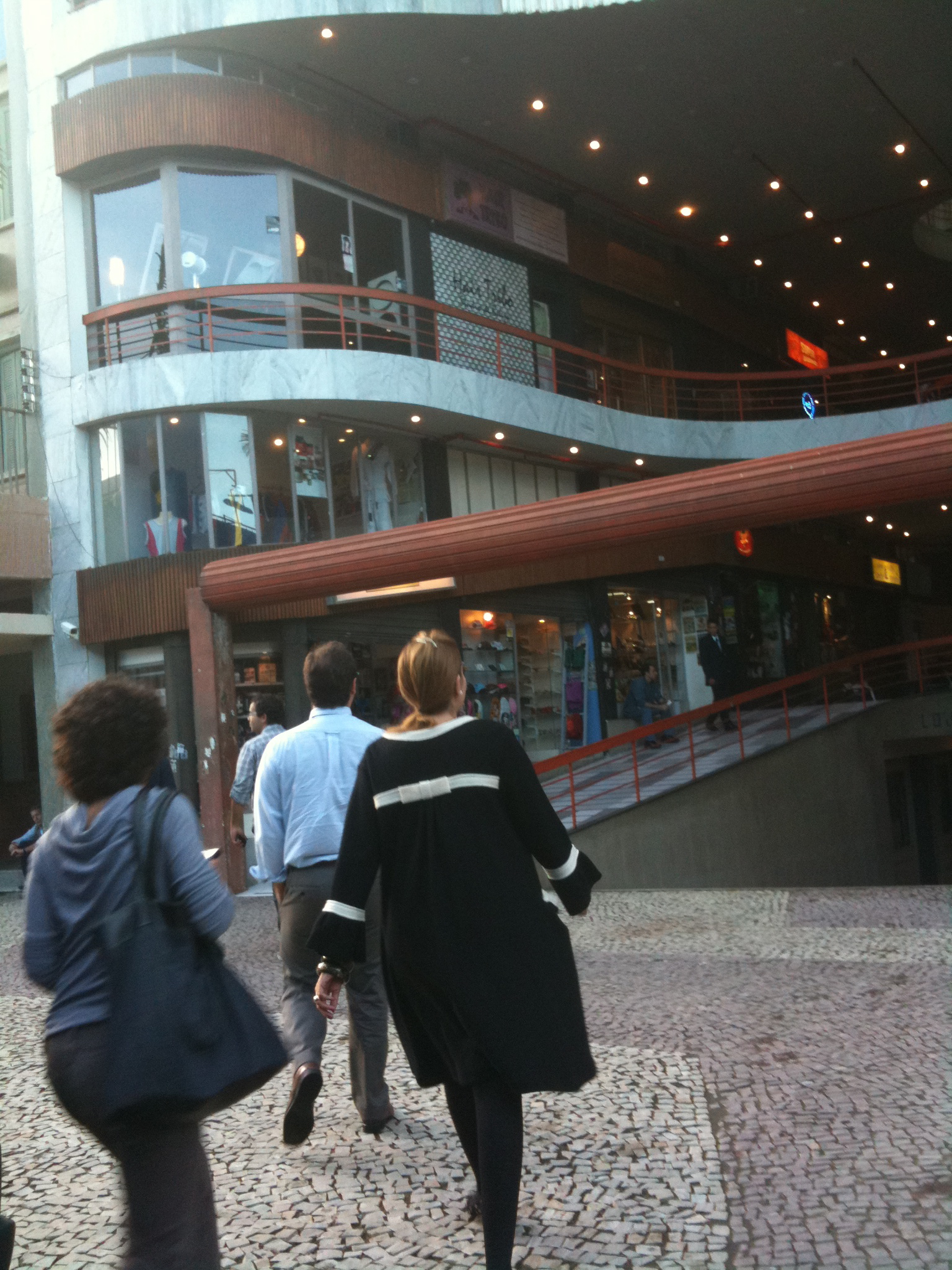
The key event during my stay in Rio was a talk to creative workers inside Globo's Project, their primary production facility on the outskirts of the city, at the foot of a truly spectacular cluster of mountains and on the edge of the rain forest. I was consistently impressed in Rio by the ways that the natural world was fully integrated into the life of the city.

sugarloaf 1.JPG

I was able to go to the top of Sugarloaf Mountain and look down on the city. Scattered throughout Rio are massive outcroppings of exposed rock -- to call them mountains, though they are mountain sized, does not really capture the oddness of these protrusions. They are much closer to Stone Mountain in my native Atlanta (of course without the carvings of Confederate generals!) than anything else I had ever seen. The city is wrapped in and around these mountains. In some cases, the Favela run up the sides of mountains. The more desirable land is at their foot. They are contained by the beaches and oceans that surround much of the city. And threaded through these pockets of development remain large forests. The effect is close to the technological utopian conception of the city as an integrated environment where nature and technology can co-exist. It is hard to go far in Rio without confronting the natural world and the companies where I spoke were very overt about their commitments to Green policies.

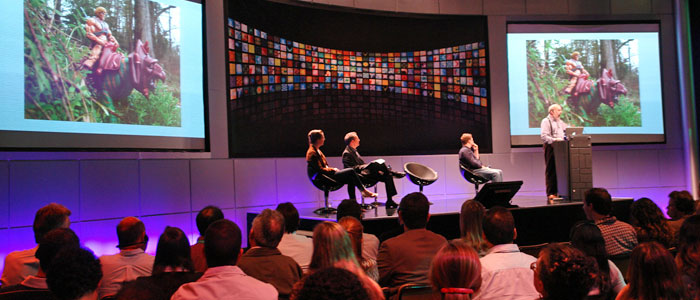
The event at Globo was simply spectacular. The production people had turned a soundstage into what can only be described as a set. Not only had they taken a key motif from the cover of my book and blown it up to the size of a wall, adding in massive television screens on either side, but they had taken other elements from the book's design and decorated the entire hall. It was packed with hundreds of people who wanted to learn more about convergence and transmedia. And the event was being webcast and live-blogged so the words were being transmitted to many who could not be physically present. I presented an opening talk on transmedia which drew upon my recent He-Man essay and my 7 Principles of Transmedia Storytelling paper, both of which have already been shared on my blog, and ended with some thoughts about future challenges confronting transmedia producers which I hope to share with my readers soon.

globo 2.jpg

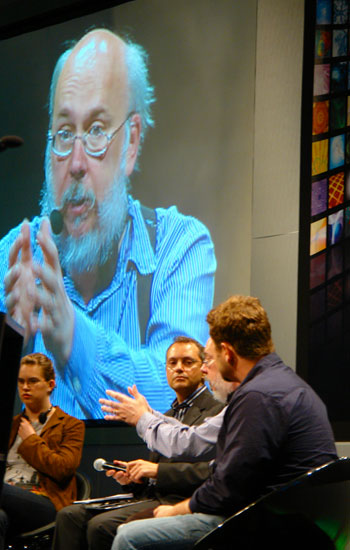
Afterwords, I was joined on stage by Mark Warshaw, who had developed transmedia for Heroes and Smallville and now is a key partner in The Alchemists, and Florish Klink, a recently minted graduate of MIT's Comparative Media Studies Program who is becoming the group's Chief Participation Officer (their expert on fan relations). And we were hit with all kinds of thoughtful questions from the audience, questions which showed just how carefully they had listened and absorbed the insights from my work and how much they were thinking through the future of media in their country. In some ways, they are a step behind developments in North America -- for example, the DVR has not yet come to Rio -- but they are learning the lessons of the early adapter countries and will be ready as they reinvent their media system for the 21st century.

Afterwards, we went on a tour of the production facilities. In many ways, they resemble the classic film studios of the Golden Era of Hollywood, except that they are managed by digital dasebases. So, there are large backlots and vast sound stages. We were shown, for example, a scale reconstruction of a Sao Paolo shopping mall which was used as the setting for a youth-oriented telanovela.

globo 7.jpg

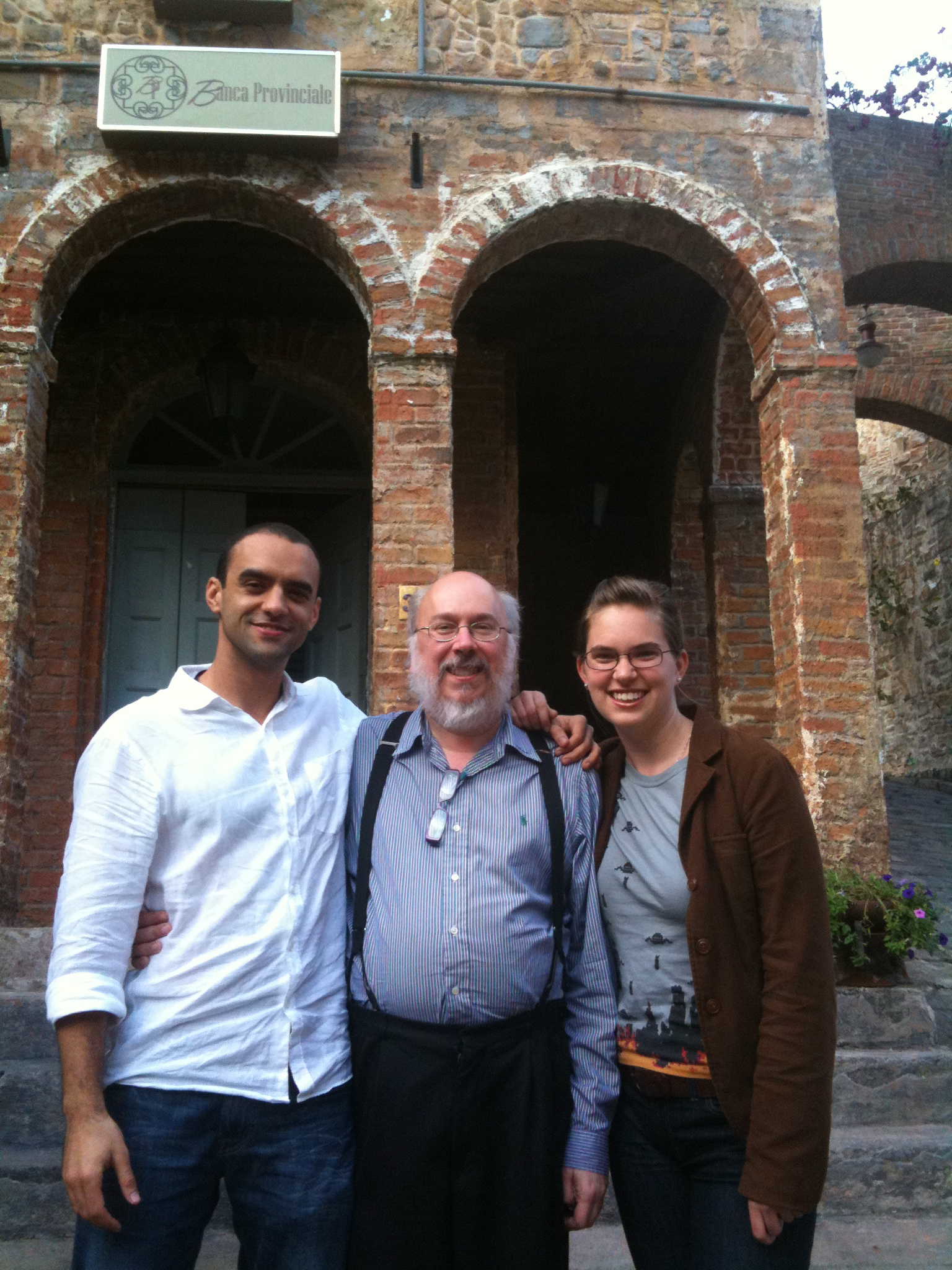
And we were driven through a lovingly recreated neighborhood from the south of Italy which is the setting of another of their popular series. I am posing here with Mauricio Mota and Flourish Klink from The Alchemists.

globo 4.jpg

We toured a vast warehouse holding props which were in storage from previous productions and could be called up from the database when needed for new series and another warehouse where costumes were stored, organized by the decade where the stories were set. Alongside the storehouses, there was a factory of workers sewing new costumes to be used, often in just a few hours, on one or another of the projects they were filming and there were construction crews that could build and breakdown sets on a daily basis.

globo 5.JPG

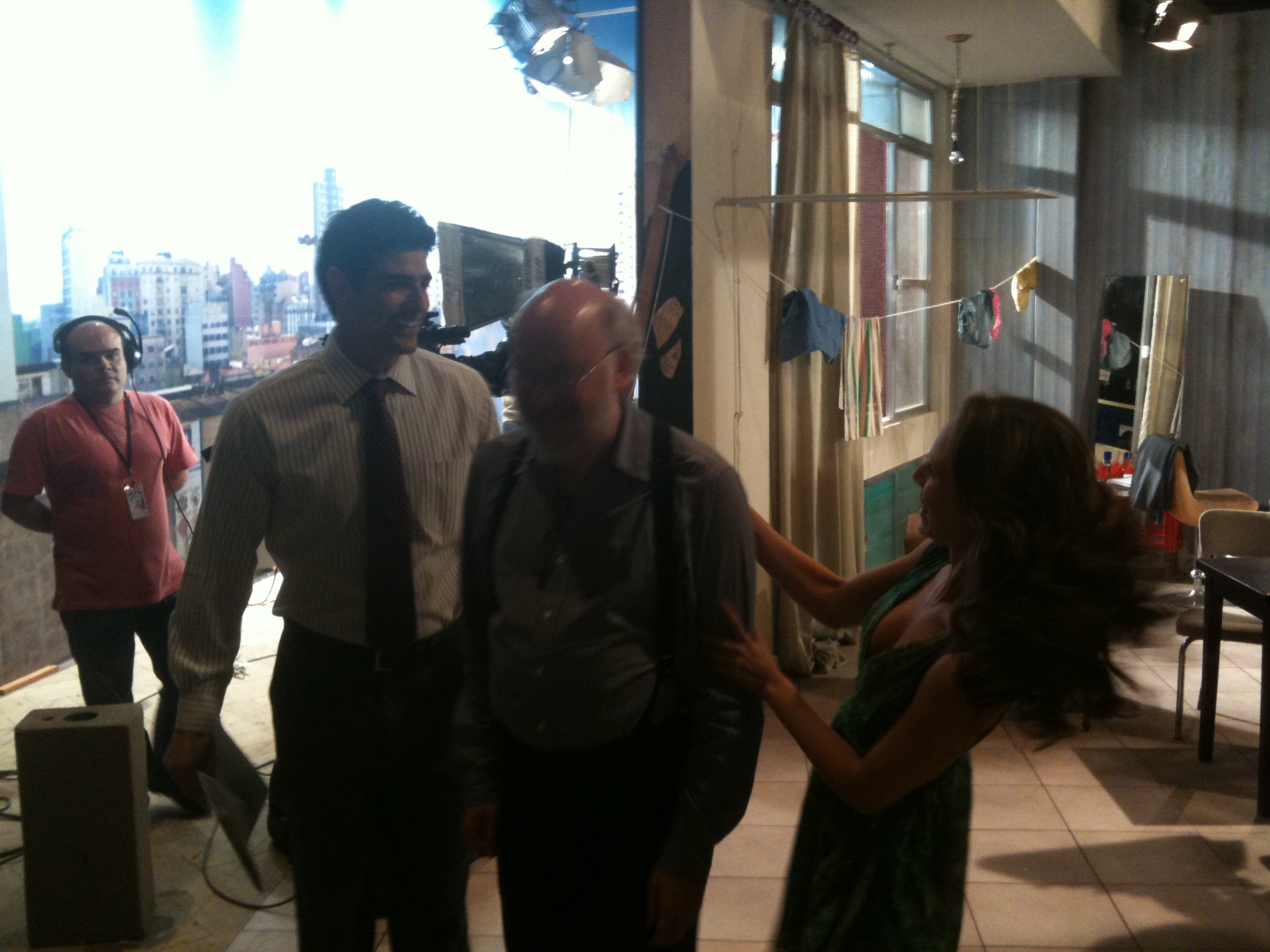
We walked through the soundstages and saw Passione, a telanovela, being shot. We met briefly the young and very attractive stars Mariana Ximenes and Reynaldo Gianechinni, who have been called the Jennifer Aniston and Brad Pitt of Brazil. And we were able to watch them shoot a scene from an upcoming episode, standing in the booth with the director as they swapped between five cameras which were filming the scene. It was one of fifteen scenes for the series that were scheduled to be shot that day amongst ten or so settings in the studio devoted to Passione's production. The scenes were shot out of sequence 4 or 5 episodes at a time to allow them to complete their needs of a setting, break it down, and make way for the next setting, all in the course of a 1-2 day period of time. The folks with us who worked in Hollywood were astonished at both the attention to detail in the production design but also the efficiency of the operation over all.

(Next Time: Down Argentina Way)

Reblog this post [with Zemanta]

Call for Papers: Transformative Works and Fan Activism

My team at USC is partnering with the fine folks at Transformative Works and Culture to put together a special issue dealing with our current research focus -- how we can forge a bridge between participatory culture and civic engagement. Here are the particulars. I am hoping some of you out there are either doing work on this topic or have graduate students who are and might be looking for a common space to publish your work. I am going to be speaking more around these topics at the Fiske Matters Conference and the Games Learning and Society conference this coming week, both in Madison, Wisconsin. Looking forward to seeing some of you there. If you read the blog, be sure to introduce yourself to me. I like meeting people who read -- especially at academic conferences. :-) Transformative Works and Fan Activism

March 2012

Edited by Henry Jenkins and Sangita Shresthova, University of Southern California

How might research on fandom and participatory culture inform our understanding of citizenship and activism? Cultural theorists have long speculated about how our fantasy lives and cultural engagements might inspire broader forms of public participation. In his book Understanding Popular Culture, for example, John Fiske describes one potential route which might lead a young woman from fannish interest in Madonna towards the resources, skills, and identities she needs to contribute to social change. Fan studies have long located localized resistances within the cultural productions and practices associated with fandom, looking at how fan fiction, say, might lead to new understandings of gender, sexuality, and race. Yet there has been less work that examines how these imaginative practices, at times facilitated by digital media, might lead to an enhanced sense of agency or a new vision of social change, or how the skills developed through fandom might be mobilized for getting people out to vote, protesting public policies, or encouraging contributions and volunteerism around emergency situations.

In Convergence Culture, Henry Jenkins describes how popular culture, and more broadly participatory culture, can function as a civic playground, where lower stakes allow for a greater diversity of opinions than tolerated in political arenas. Jenkins argues, "One way that popular culture can enable a more engaged citizenry is by allowing people to play with power on a microlevel...Popular culture may be preparing the way for a more meaningful public culture." Building on these observations, we begin with the premise that participatory culture, like popular culture, encourages active participation, lively discussion, and even mobilization around particular topics and issues, leading to civic engagement. Clearly, a fan group online is apt to be far more diverse in its perspectives than a group defined around, say, a political candidate or a social issue. This is not to suggest that fan communities do not form firm consensus perspectives that block some other ideas from being heard, but they form them around different axes, such as desired sets of romantic partnerships between characters, which may or may not reflect ideological schisms. Our understanding of these synergies between participatory culture and civic participation creates many possible intersections with grassroots activism.

We seek contributions premised on a dynamic understanding of citizenship that will help us understand how participatory culture interactions encourage people to create, discuss, and organize as a way of engaging with specific civic issues and events, and whether (or how) these interactions may lead to new forms of social organizing and action. Researchers have long noted that people who participate in after-school programs or who contribute to the arts are more likely to become involved in other civic activities; we are just starting to understand whether or not interest-driven activities, such as fandom, which typically occur outside of formal educational settings, may have a similar impact on individual trajectories toward public participation. A growing number of groups, such as the Harry Potter Alliance, and specific campaigns, such as Racebending, are seeking to mobilize fans as potential political agents. In the process, these groups may support the development of long-term civic identities as well as the applied skills of fan activism, such as letter-writing campaigns to keep programs on the air. Both are likely to be useful for future civic and movement mobilization.

This special issue emerges from work being done by the Participatory Culture and Civic Engagement Project at the University of Southern California (Henry Jenkins, Principal Investigator).

We seek articles and other work that explores the continuities between online participatory culture and civic engagement, including, but not limited to:

  • Case studies of U.S.-based and international fan communities who have moved toward civic engagement (including efforts to protect or promote the fandom, charity efforts, and direct forms of political activism).
  • Examples of how practices from fandom and participatory culture are informing more traditional activist organizations and political debates.
  • Examinations of how fan discussions flow into more overtly political conversations, with constructive or destructive consequences.
  • Interdisciplinary explorations of ways in which participatory cultures may encourage some forms of civic engagement, as well as the possible limitations of such engagement.
  • Considerations of how work in fan studies might contribute to ongoing discussions in cultural studies about the relationship between audiences and publics, consumers, and citizens.
  • Theoretical discussion relevant to the trajectories that exist between participatory culture and civic engagement.
  • Reflections on how a focus on "cultural citizenship" might challenge more traditional definitions of civic engagement.
  • Analyses of digital media participatory practices in the context of civic engagement.
  • Methodological discussions of how we might study the shifting relationship between participatory culture and public engagement.
  • Investigations of how participatory modes of civic engagement intersect with questions of race, ethnicity, gender, sexuality, and class.
  • Mappings of the dynamics of the local and mediated in communities that form around participatory culture in the context of new media technologies.
  • Discussions of how fiction and fantasy can captivate us on an emotional level, providing a narrative structure that can motivate us to seek change in the real world.

Writing from fans, independent researchers, community leaders, and practitioners is actively encouraged. We are especially interested in case studies that deal with these fan practices outside of the United States.

Submission guidelines

TWC accommodates academic articles of varying scope as well as other forms that embrace the technical possibilities of the Web and test the limits of the genre of academic writing. Contributors are encouraged to include embedded links, images, and videos in their articles or to propose submissions in alternative formats that might comprise interviews, collaborations, or video/multimedia works. We are also seeking reviews of relevant books, events, courses, platforms, or projects.

Theory: Often interdisciplinary essays with a conceptual focus and a theoretical frame that offer expansive interventions in the field. Peer review. Length: 5,000-8,000 words plus a 100-250-word abstract.

Praxis: Analyses of particular cases that may apply a specific theory or framework to an artifact; explicate fan practice or formations; or perform a detailed reading of a text. Peer review. Length: 4,000-7,000 words plus a 100-250-word abstract.

Symposium: Short pieces that provide insight into current developments and debates. Editorial review. Length: 1,500-2,500 words.

Submissions are accepted online only. Please visit TWC's Web site for complete submission guidelines, or e-mail the TWC Editor (editor AT transformativeworks.org).

Contact

You are encouraged to contact the guest editors with advance inquiries or proposals:

Henry Jenkins, hjenkins AT usc.edu

Sangita Shresthova, sangita.shresthova AT usc.edu

Due dates

Contributions for blind peer review (Theory and Praxis essays) are due by April 1, 2011. Contributions that undergo editorial review (Symposium, Interview, Review) are due by May 1, 2011.

Reblog this post [with Zemanta]

The Hollywood Geek Elite Debates the Future of Television

Editor's note: It looks like we were sent two copies of the same segment. We are tracking down the missing piece of this and will get it up as soon as possible.

Earlier this spring, Denise Mann from the University of California-Los Angeles and I organized a panel of showrunners and other transmedia experts to speak at the Society for Cinema and Media Studies conference which was being hosted in our city. The industry participants were Carlton Cuse and Damon Lindelof from Lost, Tim Kring from Heroes, Javier Grillo-Marxuach from The Middleman and Day One, Kim Moses from Ghost Whisperer, and Mark Warshaw (The Alchemists) who developed online content for Smallville, Heroes, and Melrose Place.

We wanted to bring the smartest people we knew from the entertainment world face to face with leading film, television, and media researchers for a conversation about the future of entertainment. In some ways, this was a mini version of what we do with the Futures of Entertainment conference on the East Coast and the new Transmedia Hollywood conference on the West Coast.

Today, I am able to share with you the web-version of that program. Part of what is fascinating about this exchange is how much these producers of cult television shows are thinking and rethinking their relations with their audiences, trying to understand how to court and hold active and engaged consumers in an era of competing media options and multiple delivery platforms. The value of fan participation runs through this conversation.

SCMS presents: Transmedia Storytelling in the Digital Age from UCLA Film & TV on Vimeo.

SCMS presents: Transmedia Storytelling in the Digital Age Part 2 from UCLA Film & TV on Vimeo.

Below, I've included some transcribed highlights from the event. But so much is conveyed by the emotional tone and stylistic self-presentation of the various participations, which include the two head guys from Lost who had flown in just the day before from shooting the final episode in Hawaii. We didn't get any real spoilers but we did get to understand their thinking and sense the glow they had after finishing this key phase of their work.

Ironically, their shows have all ended. Heroes and Ghost Whisperer were canceled in the latest wave of network decisions and Day One never reached the air. Without knowing it, we captured a moment of transition in American television.

In a recent Variety article, you were quoted as saying that all of Lost's loose ends will not be wrapped up or answered in the series finale. Other sources are reporting that ABC is interested in keeping the Lost franchise alive after the finale. Are those two bits of news related? That is, does leaving loose ends have to do with sustaining a franchise beyond the series' completion?

CARLTON: Most of these things are very narrative driven for us and it's a hard thing to try to articulate specifically when we want the audience to understand that every small little niggling question will be impossible to answer watching the show. Our goals as storyteller were to tackle the big questions and try to bring the story to a satisfactory resolution. But if you're wondering who's the guy is, etc, you're not gonna get that answer in the series. The story we were telling in Lost, we planned to end on May 23rd, we have no plan to do any kind of sequel or spin off, anything. We set out to tell the story of the most significant thing that happened. Telling the story was our ability to negotiate with ABC in the 3rd season of the show. Now we're bringing the story that we plan to tell to a conclusion. Now that said, we've also acknowledged that we're not the owners of Lost. It is owned by the Walt Disney company and it is an incredibly valuable franchise. Worth billions as opposed to millions of dollars. And we completely understand that the Disney company will choose to continue to make money under the Lost franchise at some future point...

There's no way when you tell a story that you can tie up all the loose ends, there are many creative minds who'll come stories to ABC and propose to take Lost, using franchise label in the future, and that's great. The story we wanted to tell was that tv series and that ends in May.

The previous transmedia series you worked on--Smallville and Heroes--both had strong ties to the comic book realm--one directly from comic books, and the other owing a lot to the comic book tradition. Melrose Place is on the other side of the spectrum. Has the difference in genre affected where the online stories come from? Or do you find that teen soap lends itself as much to a transmedia story as the sci-fi fantasy genre?

MARK: It's definitely different. You have people who want to get immediately after online and play games. But that's part of why I jumped out of the Melrose Place thing, and we're doing other things kind of that side of the spectrum. If you look at the spectrum, all, at the core, it's about extending a narrative and dipping into the fandom. On a soap opera, there's tons of different worlds and relationships to dive deeper into. That's a really rich photogram for telling transmedia stories. So it was really fun to dive in there, instead of feeding people with the ways to get your light saver. This is fun to go into the most stylish person on Melrose Place's cast and go into her closet, and learn about stuff she had in her closet. Or the diaries, you can just dive deeper. These are just fertile places to make buckets to tell stories. It was a very fun challenge and I think that anything with a story has a good place to go in the transmedia world.

CBS is primarily known for an older demographic which, stereotypically, is not known for frequenting the web. Yet Ghost Whisperer has thrived beautifully both on the network and online. What did you do to make the series and its online components accessible and appealing to an audience that is normally not attracted to this type of content?

KIM: I think that first of all CBS demographics has changed in the last 5 years that we've been on the air. At first when we started with Friday night and Ghost Whisper, we made the announcement for CBS, my partner and I knew we had a math problem, which was 82% of all the shows that had been launched on a Friday night since the X Files which was 10 years prior had not gone to its second year. And before that we had run a show Profiler which was on a Saturday night, so we knew what the challenges were. And we had been working for about 4 years before Ghost Whisperer got ordered, and we were working at the intersection of the Internet had some amazing discoveries when we were doing Profiler, that we were able to continue on and then fold onto our experience with Ghost Whisperer. So what we did was that we created this thing called the "Total Engagement Experience", which is a model that Professor Jenkins and I have talked a while about....CBS had never done this before. We also felt that moving into the 21st century, that our obligation is just developing, pitching and selling tv shows and delivering the film was not the end of our obligation as executive producers and showrunners. Our commitment to any network and studios that we've worked for is...to deliver the audience as well. And I believe that going into the future of tv and feature films, everybody is gonna need to get on board with that, and figure out how to deliver an experience, as opposed to just something that you watch, because we are in the experience era. So when we had layered that out for CBS, and our approach, unlike the CBS at the time, was to go out and find our audience, and court them, and create a playground for them so that they could experience the Ghost Whisperer world rather than just watch. And then, bring them back to the tv show in a very gentle way, that became very successful. Because what we built was a very, very loyal audience, not just a substantial audience on a Friday night, but a loyal audience, which has... this whole thing has served as a model for us to moving forward in the business. And be in the 21st century. It's an important time to do it.

Many academics are describing a push in popular television towards more "complex narratives" (longer story arcs, greater seriality, larger ensemble casts, and so forth) and you represent some of the series which are most often held up as illustrating this turn. What factors do you see leading towards these developments? What obstacles have made it harder to shift television in this direction?


JAVIER: I think that part of the reason why shows are becoming more complicated and novelistic and all that is also the fragmentation of media. It's crucial in that. All of a sudden you have a venue like AMC which can put on a show like Mad Men. And you know, Mad Men is beloved, it's critically loaded, it's a fantastic show, but it only needs to hold onto an audience of about 2 to 3M people in order to make it or not, and then sell a bunch of DVDs and all that. So when you've got networks that are able to hold shows at lower margins, I think there's more room for experimentation. It's a fragment of the audience that watches Law & Order, but they're loyal and they'll watch the show, and that model keeps repeating itself. You'll get Battlestar Galactica, Breaking Bad... which are deeply serialized. And I think that the network follows suit on that. The network looks at those shows and says: "why don't we have a show like that" and they try to put those shows on the air as well. And then, you got a show like Lost that succeeds for having that kind of longitudinal storytelling and I think that there're a kind of chicken and the egg thing going on, but at the same time, the climate for that wouldn't exist if you didn't have a vastly fragmented media where more experimental shows are able to survive for longer periods of time.

TIM: The whole idea of the serialized show, I mean it hasn't caught on, in a way, Lost and Heroes and things like that seem to be paving the way for these... it's not really caught on cause there's this season so many procedurals are back in favor. And the whole model, one of the dirty little secrets of serialized tv is there's usually a attrition right. You've got a lot of people who come at the beginning and as it goes on, it gets harder and harder to watch, and harder and harder to stay fans of. The upside though is that you get a tremendous ability to have and hit big, you also have the ability to sell DVDs. It used to be that the rerun and the syndication would pay for most of the back ends, for 95% of the show, and this is now being sort of changed, almost exactly percentage wise to foreign sale and DVD sales. And that's where shows like Lost and Heroes do really well. Now that we're in a year round programming, we're reruns are no longer part of the normal network programming. These shows that run at 16 episodes become actually a viable way to program a season.

DAMON: I think that the key thing that a serialized show had going forward is... there's a "what's gonna happen next factor", that doesn't exist on Law & Order, CIS, or this idea that basically you watch Heroes on a Monday night or Lost on a Tuesday night, and it ends, and that's a serialized: what's gonna happen next? What do I do right now on Tuesday night, the show's over? I wanna go somewhere and I wanna find out water coolers that used to exist in my office and now that water cooler is your computer. You go to it, and you can find whatever community you want to, and you not only disassemble the episode that you just saw, what does it mean and the grand skim of the overall story that they're telling, and the overall world that I'm in, but now I'm gonna try to project, and in the case of Lost it's "let's figure out, let's come up with theories." In the case of Heroes, it's a little bit more of a cliff hanger scenario: what's gonna happen next? That idea was such taboo. Tim and I were working on a show called Crossing Jordan and from 2001 to 2004, and I come up with Carlton and both procedural shows / but the word serialized was such a dirty word, because re runs were disaster. And Alias was successful, so we asked ourselves what does Alias has that we don't have, and the answer is: a fandom, and a serialized storyline. You get activated. This idea that a serialized storyline invites the audience in. It basically says: "what do you think?" it's something that non serialized shows do not do. Law & Order doesn't care what you think. They don't! but the fact that Lost and Heroes seem to care, go and basically solicit the opinion of fans saying "what do you think", that can only happen I think on a show with a sort of serialized spine to it.

TIM: The serialized genre sort of lends itself to this social currency is your knowledge of the show. So that becomes what you trade on. If you're able to know one more thing than the guy next to you, you're slightly cooler than the guy next to you. So if you give the audience a chance to dive in deeply, there are always these people who will dive as deeply as you invite them in.

JAVIER: When I was a network executive in the mid 90s, one of the heads of research for NBC came and talk to us, and one of the things that he used to say is that "why is Stay By The Bell so successful?" when it is so hooky and so corny? And he said look: the audience is fragmented, into two very big pots: either there's 20% of your audience is A audience. This is the taste making audience, the audience that goes online, the audience that buys new clothing, the audience that does all of these stuffs. And there's your B audience, that is your audience who's content to go and watch a self contained show, have a laugh and then leave. And the funny thing was that some networks wanted to have A audience cause it would get that magazine cover, some people wanted the A audience, and NBC was going for the B audience at that time. And I think that there's a sweet spot which is sort of where Man Men is right now, with challenging serialized show, but they can have that audience and that's all they need. They don't have the pressure, which Lost had for its first 3 years. They're trying to get to that more mainstream audience without trying to alienate the one audience and I think that the success of Lost and Heroes is in a way, countered to that social wisdom.

The media industry talks often about the value of "audience engagement." And your series are often cited as having produced particularly engaged audiences. Can you describe the relationship you've created with your consumers and what value you place in their active participation around the franchise?

CARLTON: We very consciously try not to write the show outwardly but write the show inwardly. I mean we started basically this Lost just sitting around in my office every morning, we'd have breakfast and just talked about story [...] We stuck with that same methodology all the way through. We were working in the office until 11pm yesterday for the finale of the series, and we've kind of kept that same protocol. Now the advent of the Internet has provoked profound differences of what you can do as a storyteller. I mean for us, we were actually kind of building Lost and at the beginning, one of the things that we found ourselves doing was that breaking a lot of fundamental rules of television, which was: we had a large cast, a sprawling complex narrative, and we infused that narrative a lot of intentional ambiguity. I think we were influenced in a certain way by European filmmaking; this idea that we'd give a chance to make up their mind about certain narrative aspects of the show and it get the audience talking about the show really evoked a sense of discussion and the Internet became a place where people gathered. I remember actually when Javier and I went to this fan event at the Hollywood renaissance hotel the first year, and there were these people who'd flown from all over the world, who were kind of happy to see us, but they were more happy to see each other. They had created an online community. Lost was the catalyst for that community, but the community transcended the show very quickly and there were people who got married, there were relationships that were formed, it was a way of sort of finding a shared interest, but that shared interest ultimately was transcended by the relationships between all these people, and there was all the people from the Fuselage who were basically all meeting each other for the first time. That was really an interesting experience to see that, and I think that over time, we have used the Internet as a way to gage what the responses to the show. Usually we're so far ahead, it doesn't influence the storytelling. Now of course we're done pretty much with the writing of the show, so any surprising responses now, the ship has sort of sailed... The other sort of example we cite al the time is Nicky and Paula. The fans were clambering and saying: what about those other people, there's always those other people on the beach. We see them, they never talk, who are they? So we were actually influenced by the audience to make a narrative decision that actually backfired. So we actually said, "well okay, " [ laughs ]. We started to write those two characters and it felt wrong, but people wanted it, and then, we realized it was kind of a disaster. And then we decided to burry them alive. And the audience was in that same cycle, but they were behind us. We came to that realization week by week, and then the audience was sort of reacting because they were seeing episodes, it was like looking at life from a distance star, when the event had already occurred. But it was something we did because of the fans and then they hated these characters and then they were happy when we killed them, and they thought it was their doing.

TIM: It's an amazing process when you're in this loop with the fandom. As the writer's room, you often emulate, or you basically mirror the fan base. When you start to feel you've gone too far with the story line or not gone far enough, and the characters are working for you, sure enough, it sort of mirrors the same reaction that the fans have except we're still three or more months ahead when... so, you often want to say to people "wait, and see: we're getting exactly to the place where you are" and this whole idea of how to communicate with the fans... it's very interesting. When Damon and I did Crossing Jordan, there was this "one way street" that you had. You pushed the narrative out in the world and two or three months later people saw it, and if people liked it they sort of voted with their Nielsen box.

CARLTON:You got a Nielsen number, that was the entirety of your feedback.

TIM: Yeah, that was it. So the feedback loop was really a one way street. Then the Internet created this two way street where you immediately had an obligation to the fans who were connected to the show. And all of the transmedia components of the show become that part of the show that allows them to have a more immediate feedback.

JAVIER: yeah but the thing is that no matter how mediated you are, and how much of a two way street of communication you have, you're inviolate right as a storyteller, is the right to hold on to your ability to give the audience what it needs rather than what it wants and to be the judge of that, right or wrong! And I think that especially in the early days of the internet, it became very porous, because there was an oversize reaction to Internet reaction to shows. And then you realize: wait a minute, this is still an audience of 10,000 people who read Television Without Pity, and maybe 20 who post on the board. So I think that we're kind of cycling back to a place where storytellers were less likely to be swayed cause we have a better understanding of what that audience is and what our rights as storytellers need to be.

DAMON: There's this incredible Catch 22 that exists, exactly on the point that everybody is talking. And I'm sure you experienced it too, which is: the question that Carlton and I get asked by far, above any other mythological question on the show is: are you making it up as you go along? People ask us that question, they want the answer to be "absolutely not". We have a big binder, we open it up, we go "hop", we're completely functioning by our plans. However, then they also say to us: "do you guys ever go on the boards and listen to what the fans have to say?" and they want the answer to that question to be "yes, absolutely". Now these two things are in direct opposition to each other. Because, unless the fans are saying exactly what's in the binder, which of course, they wouldn't be, so they want us to be making it up as we go along, they just don't want us to admit to it. And they want us to listen to their feedback, ... we're all in the gladiator arena: they're there, and they're giving us the thumb up or down. They want the gladiator to look to them to decide who lives and who dies. And when we kill characters which are popular, they get angry at us, and when we kill characters which are unpopular, they cheer us. And that's the game.

KIM: Last year season 4, we killed Millie's husband and there was a huge push back from the audience. The thing that's valuable for us on the Internet is we're all subjected to testing. Even if you're in your 4th or 5th year, they're still testing the show, and the network and studios are giving you numbers and responses. The testing group is not that big. On the Internet, it's a very, very democratic voice. And that's really exciting. It can be dangerous at time, but I mean (we got death threats, ...) but it's also exhilarating where you're taking your show. And so, I would say, had we done this 10 years ago, when the Internet wasn't what it is today, I don't know what would have happened to our show. But because we did it, we knew that there was gonna be push back, but we also had a plan for it. We were able to go on the Internet and court the audience, and explain to them that there was more coming and that he was going to be a ghost... and it was a great experience. And CBS called us at one point and said "what are you guys doing over there, you're affecting all of our websites, it's because your fans have taking everything over". As you guys know, that happens. And that was very exciting for us. But it is very valuable. Even if you don't act on what you're getting, it's valuable to take the pulse yourself rather than have it filtered through different kinds of agendas.

The television industry is struggling with the reality that consumers are pursuing the content they want through means other than broadcast television - both legally through iTunes, Hulu, and other such sites, and illegally through Bittorrents. How does this reality impact the way you approach your series? One recent study, for example, found that many television series, including several represented on this panel, were watched by more people illegally than legally.

CARLTON: The Internet has kind of changed the world of distribution internationally. So now Lost has moved closed to a day and day model that's basically what's happened to the theatrical film business, to avoid piracy and to capitalize on sorts of marketing campaigns that aren't just now national but international.... TV used to be sort of a gentlemany business where you'd open the show here, and then a foreign buyer would come over and they'd look and they'd watch, and they'd see how it'd do. And then months, sometimes years later, the show would actually run there. Now, because of how the world has shrunk because of the Internet things have gone much more day and day. So we've actually changed.... So this year... each episode of the show has to be done 5 days earlier in order for it to be sent all around the world....One of things that's come up in China too is that there was a race amongst pirates in China to dub the latest issue of Lost. And they were telling me that within 48 hours of the broadcast on NBC, there would be fully dubbed versions of that episode of Lost on Chinese websites. And I was like: these guys are doing it for free! You guys are professional dubbers, why is it taking you 3 months to dub a show? And it was hard to argue with that. So they've actually really shrunk the window of time, and we're on a couple of days later on the English speaking territories, and really the window in terms of dub territory is going down. The studios are doing this for two reasons: one is primarily policy, but secondly, the ability to sort of capitalize on global marketing initiatives which reconnected these ARGs. All the ARGs that we've done have been done in constant with international broadcast partners. Around the world it contributed money and resources to these Internet things. And actually the Internet component of Lost has significantly impacted the actual way in which the show itself ended up being distributed.

TIM: The interesting thing is that the networks, are in a sense, they shoot themselves in the foot a little bit by driving these audience towards these alternate platforms. Heroes, we show commercials where we promote coming to the website, to NBC.com, coming there to be able to watch the show online with extra content and commentary etc. so we're actually incentivizing the audience to go to these different platforms and the fact that you can watch the show on your DVR where you want it and when you want it, without commercials, or watch online with commentary or content, we are incentivizing this audience to go and find another places. Heroes was the number 1 downloaded show last year, Lost right there with it. And the general attitude of the networks towards this massive audience that's out there has been to stand on the sideline and heckle these people when, in fact, these are people who actively sought these shows out. They went some place and actively pirated the show. These are fans that should be embraced, and, somehow, figured out how to monetize. An interesting thing would be product placement as a way to sort of create favor with the network. The interesting thing about that is that when we do a Nissan product placement in the show, those 55 million people who download our show illegally are all getting a Nissan commercial. So in some way that may be the solution there.

JAVIER: Activity creates fertility--especially when you're dealing with a niche show like The Middleman. If people are downloading it illegally in China...my God, please do! Because, ultimately, what I find is that, the more people talk about the show, the more other people will end up buying the DVD. Eventually, anybody who looks at a pirated copy will tell somebody to buy the T-shirt or the DVD or the keychain, and the money will come back to us. I mean that's something...I'd rather have the show I work on be seen, and, frankly, given the way that the studios have dealt with the royalty compensation for writers on alternative platforms...I'm so sorry about your pirating problem, really!

Enhanced by Zemanta

What Can Teachers Learn from DIY Cultures: An Interview with Colin Lankshear and Michele Knobel (Part Three)


What do you say to an educator or parent who feels that making music remix videos, say, has nothing to do with literacy? In what senses are you describing such forms of expression as literacy practices?

The common sense view of literacy is that it refers to reading and writing alphabetic print and that to be literate is simply a matter of knowing how to encode and decode printed text; that is, to recognise the letters and convert them into words and sequences of words as a reader or a writer. According to this view, literacy is the same thing for everyone. It is the same tool, or the same skill using that tool. Some people might be faster at it and others slower; some may spell better than others, and some may be better at applying text comprehension strategies than others; but at the end of the day, the common sense view is that literacy one single thing, and it is the same for everyone.

This view is flawed, however, and on a number of levels. It's a bit like saying that computing is the same for everyone, just that some are more fluent with it or more skilled. But in the hands of different people who have different purposes and different understandings of what can be done with computers, and so on, computing takes on many different forms. There are many different practices of computing, such that you could give two people what look like the same tool, but what you see going on subsequently might be so very different that you can't really even begin to see them as doing "the same thing" or using the same tool. The example may be even better made by reference to "telephoning." To say that a person calling the dentist on their landline to make an appointment is doing the same thing, using the same tool, employing the same skill - telephoning - as a person in 2010 who uses their mobile phone to video an eyewitness account of what goes on to become a major news event, then uses the phone to upload the video to a social news discussion site along with an explanatory written commentary, and to check back regularly to see what comments have been left by others as well as to track how news of the event itself is playing out across the internet and broadcast media, is to miss the point. What looks like "the same kind of machine" is taken up in very different ways by different people, and has very different meanings for different people. It is to all intents and purposes a "very different thing" in the hands of different people; not the same thing at all.

So it is with literacy, and that is why we think it is best to talk about literacies in the plural rather than literacy in the singular. The singular form focuses our attention on the wrong thing - on thinking that the all-important thing is managing alphabetic text. This is important, but it's only a part of it.

There are two key points to make here. The first is to recognize what is most important about literacy as a social phenomenon, which is that it enables people to do what cannot be done by orality alone. Literacy enables human beings to communicate and share meanings in ways that go beyond the use of voice within face-to-face settings (which is orality). Literacy checks in when the conditions of everyday life are such that people need more than the use of voice alone to get the meaning-making work done that needs to get done for life to go on. The bottom line for literacy is that it enables meaning-making to occur or "travel" across space and time, mediated by systems of signs in the form of encoded texts of one kind or another. Encoded texts "freeze" or "capture" thought and language in ways that free them from their immediate context of production so that they are "transportable." Unencoded texts like speech and hand signs "expire" at the point of production other than to the extent that they can live on - fallibly - in the memories of whoever was there at the time. Encoded texts give (semi) permanence and transcendence to thought and language in the sense that they can "travel" without requiring particular people to transport them. Literacies can involve any kind of codification that "captures" language and thought in this sense. Literacy includes letteracy (the alphabet bits), but goes far beyond that. Speech recorded on tape or digitally is frozen and counts as encoded language and thought. The same applies to still and moving images. It is not that memory and speech alone cannot sustain considerable meaning making across distance and contexts. It is just that this is exponentially enabled and facilitated by literacy as encodification, which permits all kinds of procedures and institutions and practices that would be impossible, or impossibly cumbersome, without encoded thought and language.

During the centuries of mass print, following the invention of the printing press, the dominance of print as the paradigm of encoded texts has made it "natural" to associate literacy with alphabetic text. But this is really just an historical contingency. Many centuries prior to that humans used pictorial inscriptions of one kind or another (as well as other markings) to encode language and thought independently of voice. As new ways of encoding come and go, encoding system paradigms change. And right now we are at a point where the dominance - previously, almost the monopoly - of the print paradigm is being challenged by the ease of digital encoding that can combine multiple modes and mixes of multiple modes. Where it is more effective to use alternative sign systems from alphabetic text to mediate meaning-making within mainstream everyday interactions, the alternatives will be used. And people's ideas about literacy will change accordingly.

The second key point is that literacies vary with contexts. What we mean by context has to do with who the people are within a particular setting, what they are aiming to do, how they are trying to do it, what they are trying to do it with, and who they are or are trying to be within that context. So, if we think about something as obvious as reading a particular text, it is clear that different people, coming from different cultural spaces and possessing different cultural knowledge may read the same text in very different ways and make different meanings from it. For example, during the 1980s, many liberation theology priests who worked with Latin American peasants in ways they hoped would encourage them to mobilise to demand a better share of social wealth interpreted key biblical passages very differently to how conservative urban priests who identified with the existing social order interpreted them. Moreover, both groups worked with biblical texts in different ways and in different settings; liberationists would pore over the texts with peasants within settings where evidence of poverty was immediate, and would encourage the group to think about the meaning in relation to a change agenda. By contrast, other priests would read at large anonymous assemblies, making the interpretation amidst ornate decorative milieux that often dripped gold and spoke to divine rather than popular power. Same text, different people, different purposes, different procedures, different knowledge informing the meaning making and, indeed, a different technology. A bible being read by one person set apart from the listeners is utterly different from a bible being pored over, passed from person to person, and being used to stimulate thought intended to guide political action. Within Latin American settings both of these "ways" of "reading bibles" have been common - along with many other variations we can think of.

Now the point is that these kinds of differences in "ways with encoded texts" can be multiplied many times over. In a famous example, Shirley Brice Heath showed how different social groups within a region of the United States "did bedtime reading" in very different ways. Experts on the philosophy of Kant read and discuss Kant's works in very different ways from first year philosophy students, and (can) make very different meanings from them. That is why philosophers try to induct philosophy students into sophisticated reading practices, of which following letters and words across a page is only a tiny (albeit very important) part. The expert philosophers are trying to recruit the students to a new social practice, and this involves having to teach them how to read and write philosophically (which involves a lot more than just eyes and texts). Jim Gee uses the word Discourse (with a capital "D") to signify the idea that there are all different kinds of combinations of types of people and kinds of purposes and goals, and ways of setting about them, and ways of using language within them, and ways of dressing (liberationists in outdoor garb and metropolitan priests in ornate robes) and so on. We can say that different Discourses tend to involve different literacies, and will often involve different (forms of) technologies or tools, and different ways of using them, and so on. And participants in these different Discourses will make different meanings from what look like the same resources, and they will use what look like the same resources (think: computer, phone, bible) in very different ways.

So if we put all of these ideas together (along with others there is not space to mention here) it suddenly becomes very obvious why we would think of making remix music videos as having everything to do with literacy, rather than having nothing to do with literacy. It is one of a very large number of literacies that exist (not to mention new ones that are emerging all the time). That is, when we think of literacies in terms of "so many socially recognized ways in which people who are participating in particular Discourses generate, communicate and negotiate meanings through the medium of encoded texts," it's perfectly natural to think of people who are producing and sharing and interacting with remix music videos as engaging in (a) literacy. They are decoding and encoding sophisticated multimedia texts, with a view to communicating and sharing and negotiating meanings with others of their ilk (other members of their Discourse). They set about this in ways that others recognize as appropriate to doing this literacy well. They are freezing thought and "language" so that it can travel and be experienced and negotiated within practices of giving and taking meaning.

When we look at things from this perspective it is the people who cannot see remix music video in terms of literacy that have the problem; not those for whom it is self-evidently a legitimate, pleasurable, widely-practised, and potentially incredibly powerful literacy.

In my Afterword, I raise the question about the value of learning these skills as an isolated set of practices rather than as part of a more diverse affinity space. In other words, is there a difference between learning to make a remix video and learning to be an Otaku (who happens to display his or her skills and knowledge through contributing remix videos to a larger fan culture)?

Yes, there certainly is a difference, although learning to make something like a remix video can - and often does - lead to becoming a fan of something one previously was not a fan of, and to becoming more the kind of fan who happens to display their skills and knowledge through contributing artifacts to a larger fan culture and through other characteristically Otaku practices. Indeed, this is precisely the route that Matt, the co-author of our chapter on AMV remix in the book, took. We came across Matt's anime music video remixes via YouTube, where his "Konoha Memory Book" video at the time had over half a million views (take-down notices unfortunately mean the video is no longer on YouTube). Half a million views is a significant marker of popularity online, and so we interviewed him about his anime music video production process, and his involvement in remixing AMVs. He was 17 years old at the time, and he explained that he'd started creating AMVs two years earlier. It turns out that prior to that, he hadn't been a fan of anime or manga or anything like that at all. What happened was that a mate showed him "Narutrix" (an AMV faux movie trailer parodying the Matrix movies) which got Matt interested in watching the Naruto anime series in particular, and then anime in general. It didn't take him long to start tinkering around with creating his own AMVs, even before he became what could be described a full participant in anime culture. He's subsequently gone on to become such an avid anime fan that not only does he create AMVs which he posts to AMV.org and YouTube, submit AMVs to convention contests (and for which he regularly wins awards), draw his own original manga figures and comics which he posts online at DeviantArt.org, maintain a blog about his anime interests, contribute to anime dicussion boards, write generous reviews of and comments' on others' AMVs, but he spends his weekends cosplaying a rich range of anime characters, and organizes cosplay chess games for different anime conventions as well. He's now--thanks to his initial interest in AMVs as an expressive form in their own right--most definitely an Otaku!

Other ideas arise here, however, which are relevant to questions about the relationships between identity and practices and to ideas and ideals of learning. For example, it may not be that a person learns DIY media practices as an isolated set of skills but, rather, as skills and knowledges and values and mastery of systems and the like as part of becoming a kind of person that just happens not to be a fan. Hence, a person who identifies as the kind of person who practises the ideal of being as self-sufficient as possible might learn a particular skill and knowledge set under this kind of motivation (e.g., knowing how to sew clothes; knowing how to preserve or can home-grown fruit; knowing how to make solar-powered things). Moreover, we often find a paradox associated with self-sufficiency: people who identify with being self-sufficient often are closely linked with like minded people and inter-relate with them, sharing points of view, solidarity, and resources and so on. But they do this under a much more diffuse kind of identity than members of specific affinity groups. When people who are into "self-sufficiency" interact with one another their specific interests and things they create may have little or no overlap whatsoever, other than as expressions of participating in a general ideal of being as self-sufficient as possible.

Alternatively, the kind of audience we have for this book is of people who might want to get some experience of DIY creativity and production as part of how they see themselves becoming a more effective teacher or, perhaps, a more in touch parent. Here again, the skills and knowledge being learned would not be "isolated". They might be a long way, at least initially, from Otaku culture or other avid fan cultures, but, equally, they may not at all be isolated but connected to something that is very important to them. In fact, isolation would actually be very difficult to sustain in the context of learning some digital DIY media. The very process tends to put people very quickly into the realm of affinity spaces and, as Matt's case indicates, from there anything can happen - including the development of full-fledged fan affinities and approximations to Otaku ways of doing and being.

At the same time, there are some important differences and distinctions at stake. One is the difference between a more instrumental orientation to practice and a more intrinsic orientation. There is all the difference in the world between dropping in on a Linux forum to get some help with a problem, leaving feedback, making the information available to others and maybe making a Paypal contribution to an open source software fund, on one hand, and being a full-on contributor who helps code open source software and build the open source movement, on the other. In the first case the relationship is instrumental: minimal participation as a means to an end. In the second, it is intrinsic; one is a devotee of open source ideals and practices and, in effect, becomes a steward of those ideals and practices. Lawrence Eng's classic statement about fanship and stewardship is a supreme expression of the intrinsic orientation that defines many Otaku identities. Explaining why he proactively sought out other fans of Sasami from the Tenchi Muyo anime and developed the Sasami Appreciation Society as an affinity space, Eng said "it's our devotion to Sasami ... we're dedicated to bringing her the fanship that she deserves" (as cited by Mimi Ito). This is activity as an end in itself rather than to some further end. It is done for its own sake, as an expression of devotion, rather than as a means to producing an artifact, getting a reputation, or reaping other personal benefits. These may occur, of course, but they are not the point and purpose of the engagement within an intrinsic orientation. Of course, one can learn an incredible amount along the way, but even this is not the motivation to participate.

There is much that is important and valuable about this kind of orientation and way of being. In many ways it constitutes an ideal of active citizenship - of being committed to building something because one believes in it, and of putting that first, and of dedicating one's activity to contributing to its fullest realisation. At its best, this is what communities of academic practice become, and if we need any reminders of how valuable this ideal can be we need only think of negative examples that are always available of academics who are largely or mainly there for "career prospects", and of the ugliness that can so quickly surface in the form of academic jealousies, back-biting practices, resentment, clique formation and turf battles and so on. Apart from the quality of learning that can occur within bona fide affinity practices, the fact is that there is much of human beauty to be found there: selflessness, promotion of the greater good, humility, stewardship, generosity, reciprocity and so on. Anyone who doesn't think we need as much as we can get of such values has not looked outside in a while.

This said, however, it is worth making a couple of cautionary observations about the "structure" of participation and learning within affinity spaces. While we have identified the qualities of stewardship, humility, commitment to a greater (assumed) good, and the priority of intrinsic worth to fan practices, it may be helpful to remind ourselves that humans can be(come) fans of anything, and for these qualities to remain intact and yet, potentially, have regrettable consequences. While becoming a fan of many popular culture practices and icons, as with becoming a fan of environmental science, or mathematics, or democracy might typically be expected to have more or less benign and positive outcomes, the same might not apply to becoming a fan of the Third Reich or Pol Pot or any number of contemporary examples that could be named, where people do in fact become fans (although "bad" fans are often called, fanatics), and do pursue intrinsic goods (as they see them), practice stewardship, collaborate, share, put other people and ideals before themselves and so on. To be a fan has no limits so far as objects of affinity are concerned, and while we may limit the word "Otaku" to some specific range of fanships it may be more difficult to so limit the general concept and its deep grammar. Hence, the "good" of displaying skills and knowledge through contributing to a larger (fan) culture will always be to some extent contingent.

A related point here concerns the structure of learning within practice affinities or, as they are often called, communities of practice. The New Work Order (1996) argues that communities of practice seed values without these values needing some apparent central controlling agency to insist upon them or maintain them: "Immersion into a community of practice [an affinity] can allow individuals or units to internalize values and goals - often without a great deal of negotiation or conscious reflection and without the exercise of very much top-down authority" (p. 65). Participants collaborate, participate, share, reciprocate, "scaffold" and support, for all they are worth, and the net effect of this is building the practice and the community. But it does not necessarily transcend what Kevin Harris (1979), many years ago, referred to as "supportive rhetoric". It can, and usually does, support critical scrutiny that is internal to the practice/community, but at the same time this critique insulates participants against possibilities of external critique. The more a person invests in an affinity the less space there is for countenancing alternatives. The learning is, to be sure, often "deep," and deeply social. But "learning works best - it is most enculturating, but (alas) also most indoctrinating - when it is done inside the social practices of a Discourse" such as a fan affinity practice (New Work Order p. 15). It is not for nothing that many "fast capitalist" enterprises have encouraged the development of fandoms around their products, seeding the core values and leaving it to fan collaboration, participation and celebration to build the community (and the profits).

For us, the important thing is trying to keep the baby with the bathwater, in the sense of encouraging multiple fandoms - memberships of multiple affinities - and multiple orders of affinities, such that we strive for Otaku-like membership of practices that embrace intrinsic ends linked to distribution of material social goods as well as to pleasures. Becoming fans of understanding how social practices work for better and for worse so far as contributing materially to promoting long-term human good is concerned seems to us to be of the utmost importance.

Michele Knobel is Professor of Education at Montclair State University, New Jersey. Her research examines new literacy practices across a broad range of contexts. She is joint editor, with Colin Lankshear, of DIY Media: Creating, Sharing and Learning with New Technologies. They have also jointly edited A New Literacies Sampler and Digital Literacies: Concepts, Policies and Practices.

Colin Lankshear is an Adjunct Professor of Education at McGill University in Montreal, and James Cook University, in Cairns, Australia. His research interest is in sociocultural studies of literacy practices and new technologies. He is joint author, with Michele Knobel, of The Handbook for Teacher Research and New Literacies: Everyday Practices and Classroom Learning.

Reblog this post [with Zemanta]

What Can Teachers Learn from DIY Cultures: An Interview with Colin Lankshear and Michele Knobel (Part Two)

A central goal of the book is to help teachers to understand how DIY practices might inform their engagement with their students. This DIY media production has historically been something young people do on their own, outside of school, so what do you see as the value of bringing it into the classroom?

The first point to make here is that becoming a bit familiar with DIY media practices can help inform teachers' teaching and learning interactions with students without the practices necessarily having to come into the classrooms. There are two aspects we would like to touch on here before looking at what the value might be of bringing such activity into classrooms.

Many years ago--in the mid-1990s--we were doing research in a Grade 7 classroom in which there were migrant students who were having to learn English while trying to navigate the content of the curriculum. The teacher remarked how difficult it was having English language learners mainstreamed into "regular" classrooms where there was no accompanying specialist support. She referred to one student, Tony, who had produced during the class' regularly scheduled independent writing time what appeared to be a 20-page manuscript. He'd been working on it for about a month before showing it to his teacher for feedback. His teacher dropped the tome onto the desk with an exasperated sigh and declared that she "didn't know what to do with it" because none of it made any sense, and she simply didn't have time to help him fix his sentences. The length of Tony's narrative and his dedication to writing it piqued our interest, so we took a copy home. The teacher was right in that the text had a fair number of grammatical and spelling glitches, but we'd actually seen worse in the writing of some of his English-only peers. What seemed to be the biggest problem for the teacher, then, was the narrative itself. At first glance, it was very dialogue driven and set in some medieval-like set of kingdoms, with events and characters suddenly appearing and then disappearing, wars suddenly erupting and being just as quickly resolved, and so on. What we soon realized as we began to read Tony's story was that he'd actually produced a really rich and complex narrative that drew on a wide range of popular culture storylines. These included characters, settings and events from video games such as Doom, Mortal Kombat, Dungeon Keeper II, and The Ultimate Evil, and a range of novels from the Fighting Fantasy Gamebook series (e.g., The Warlock of Firetop Mountain, Caverns of the Snow Witch). He'd produced, in other words, a really engaging and epic fanfic. It included all the things teachers want in students' creative writing: a strong plot line, interesting narrative structure, dialogue, characters with depth, descriptive language, and the like. But none of it "made sense" to or was valued by his teacher because she was unfamiliar with the practice of fan fiction writing, and most likely unfamiliar with the original popular culture resources on which he'd drawn to craft his story. If she'd been able to recognize the text for what it was, her construction of Tony as a student and as an English-language user would've been entirely revised.

The second point has to do with what we think of as cultures of learning. When students enter formal education they enter a new and very strange "model" of learning, compared to what they have experienced in their pre-institutional learning lives. For a start, they move from a learning world in which what they come to know and master is acquired in concrete contexts - is grounded in authentic relationships, purposes and situations - to a learning world in which what they are supposed to come to know and master is to be got from largely abstract and decontextualised "learning opportunities". There is a discrepancy for all young people - this is a dimension of the distinctions James Paul Gee makes between people's primary and secondary discourses, and between acquisition and learning - but the discrepancies are much greater for learners coming from some social groupings than it is for those who come from other social groupings (so, for example, students who are familiar with question-response-evaluation patterns of interaction between an adult and child--where the adult already knows the child knows the answer before posing the question--will find this same pattern at school very familiar and understandable). Often, the discrepancies are so great that young people just can't get onto the school learning wavelength at all: they just don't get it; which means that they can't "get" the curriculum as well as those students for whom the gap is less extreme. One of the things educational researchers who draw on sociocultural lines of theory often say is that the more teachers can understand and make connections to learners' pre-school ways of getting to know things, and the things they get to know about, the better the chances are that teachers can help get learners "onto the school learning wavelength".

What we are now finding is that learners who have already been at school for some time are getting a double dose of discrepancy. This is coming from their experiences of learning within what you and others, Henry, call participatory culture: involving "affinity spaces", low barriers to joining in, peer-to-peer interactions of sharing expertise, and where participants do not think in terms of failure (among many other features). So, they spend large amounts of time outside of formal education learning very effectively, with much passion, with a sense of personal purpose, where there is usually effective guidance close to hand, and so on. Then they turn up to class the next day and are thrown into something completely different. Even those who can handle "classroom ways" increasingly experience considerable disaffection.

In our work within teacher education we constantly are amazed by the extent to which the teachers and teacher education students we encounter have little or no familiarity with the kinds of learning cultures young people with DIY or DIO media learning experiences encounter on a regular (daily, hourly) basis. As we'll go on to mention a little later, we are speaking here of young people who are learning how to do media work through peer-based interactions with others, whether these are fan-based practices or more like hobbies and interests that are not necessarily built upon specific fanships. The thing is that young people nowadays have built up a "modus operandi" for learning that is different both from what they get before school and with what they typically get in school. It is, for very many aficionados of DIY/DIO media practices, a way of learning that they find very effective and pleasurable. Moreover, it is a way of learning that can easily be drawn upon to augment the limited forms of peer-teaching/learning buddies arrangements used in classrooms. The thing is to be aware of this way of learning and to get familiar with it and, hopefully, comfortable with it, as a teacher involved in learning and doing outside the classroom. The more familiar and comfortable it becomes, the easier it will be to find productive and seamless ways to integrate it into classroom routines in ways that are effective, and not just some kind of add on. To be able to make this kind of connection means getting to know the modus operandi in the first instance.

In many ways, for us, this is what the book is mostly about, rather than bringing the actual DIY/DIO media practices themselves into classrooms. It is about taking the time to experience the kinds of learning interactions and "ways" that have become second nature to so many young (and older) people, because by such means we can begin to generate all sorts of creative means for counteracting the "double dose of discrepancy" so that we can actually augment curriculum learning.

Having said all that, like you, we do also see a lot of potential value to be had from integrating DIY/DIO media practices into formal educational activity. To talk about this we have to take a bit of a detour into some work we have done with various colleagues over the past 15 years or so. This involves questions to do with what formal education is about and what it is (or should be) for: some kind of philosophy of education.

At a time when so much of formal education seems to be dominated by standardised testing of standardised curriculum content there seems to be little space for seriously raising and addressing questions about what kind and quality of learning formal education should be concerned with - especially when jobs get scarce and qualifications seem to count more than ever. But these questions are crucial and we get lazy about them at our peril and, especially, at the peril of those who have to endure 10 and more years of compulsory schooling. Working with Jim Gee and Glynda Hull in the mid '90s on the theme of the new work order, we got a new angle on the importance of education being connected to the larger enterprise of living well within the contexts of our times and worlds. We focused on the idea that education is not about children learning in schools but, rather, that education should respond to the needs of human beings who are living lives that can best be seen as trajectories. Every person is born into some milieu in which they will live and, by means of a more or less diverse range of social practices, within a range of social institutions. Education should be about enabling people to do that, and yet we all know that much of what we learn in school simply does not connect well to our lives beyond and after school. Instead, students get inducted into "school versions" of knowledge and social practices. Instead of learning to think and interpret like, say, an historian does, learners get to memorise dates and names and to write essays that weld these dates and names into standardised kinds of five-paragraph essays, and rarely get anywhere near to the kind of "raw data" that historians deal with. We learn history as bits and pieces of content, and as "essay writing". We don't get an introduction to "being, or becoming, an historian", or to "thinking historically". The same holds for pretty much every subject slot on the curriculum or timetable in most schools.

By contrast, as argued in The New Work Order, if we want formal educational learning to be "efficacious" we should be trying to ensure as educators that what someone - whether a child or an adult - does right now in their learning is connected in meaningful and motivating ways with "mature" or "insider" versions of the larger social practices in the world beyond school to which the current learning is supposedly related. In other words, if you're going to learn something in science right now, it should be conceptualised and approached in such a way that the present learning task is a step - to be followed by further steps rather than random bits and pieces of content or ideas - on the way to becoming the kind of person who addresses the world scientifically. Otherwise, what's the point? Today, decades after learning the periodic table, we both can recite by rote the first 10 elements in that table, but haven't got a clue what to do with them. They are inert baggage; wasted synapses. Their only potential use - which is statistically close to impossible - would be if we were on a game show staring at a million dollars and were asked what the 8th element in the period table is (but it would be game over for us if they asked us about the 11th or 12th element!).

Now, from this perspective, one of the major virtues of DIY/DIO media practices is that they exemplify the possibilities for efficacious learning. Participants in these practices are wanting to emulate good practitioners. They are wanting to become like the cultural producers they look up to. When they post a work in progress to get some feedback, or go online to get some "just in time" assistance, or closely examine someone else's work to see how they did what they did, they are taking an active step on a trajectory. When someone takes the time to feed back to others, or to give assistance or to make a suggestion, or to make a resource available, they are making a move in the enactment of being an insider to their social practice. They are learning how to do it, or are refining their learning, or are becoming more of an accomplished participant within a media cultural domain. They are learning to become more of a particular kind of identifiable person in the process of living a good, interesting human life. If education should be about anything, it should surely be about that. Educators, then, can learn much of value for effective pedagogy by experiencing ways of learning with which their students are often much more familiar than they are.

This is not to say, however, that if we integrate DIY media practices into classroom work it should just be for the sake of learning how to make a music video, say, or creating a space for young people to "do fan stuff". Clearly, there is already abundant space outside of school for that to go on. Rather, we think there are larger and deeper educational goals that can be realized by leveraging DIY media interests and proficiencies within school settings. One way of approaching this is via the concept of Knowledge Producing Schools, which we encountered in the course of working with Leonie Rowan and Chris Bigum prior to leaving Australia in the late 1990s.

This is the idea that schools can harness the relationship potential of digital technologies to move away from being based mainly on consuming knowledge and information within subject-based learning, and move in part to becoming involved in producing knowledge that is useful for their communities, and that will be used, valued, and acted on as appropriate by the community because it is good quality knowledge. Under this model learners have to learn how to produce expert-like knowledge, since if it is not good quality and expert-like it will not be valued by the wider community and the relationship will break down. The knowledge production must be efficacious and, therefore, the learning involved in that knowledge production will likewise be efficacious. Typical examples include students learning mathematical operations by tracking and then analysing vehicle speeds through a school zone using professional equipment in the company of transport officials and recommending changes to the speed limits to enhance students' safety, producing a public service video on bullying and how to best respond to bullies, and producing a research-based documentary on the history of a beef sales yard to help the city council promote the town's annual Beef Expo (the latter had actually gone out for public tender, and the students won the bid over other applicants).

The scope for media work within such an approach is enormous, and could project students' informal media production and expertise into the knowledge mastery role of schools in such ways as presenting knowledge via podcasting, videos, games-based movie making, image archiving and curating, audio archiving, and so on. Depending on the kind of knowledge being produced, DIY media proficiencies can enter the process at different points: such as for archiving data, interpreting and representing findings within the process of producing the knowledge, and/or in the process of disseminating or reporting knowledge outcomes.

Of course, ideas like building at least some curriculum work around ideals of efficacious learning and knowledge production will remain pie in the sky if teachers and teacher educators and caregivers and community leaders and other constituents don't put up some effective resistance to the dominance of standardised curriculum and testing. We believe, however, that it will be easier for educators to find spaces for productive take up of media production and sharing within bona fide knowledge work if they become "culturally fluent" with some DIY/DIO media activity.

Michele Knobel is Professor of Education at Montclair State University, New Jersey. Her research examines new literacy practices across a broad range of contexts. She is joint editor, with Colin Lankshear, of DIY Media: Creating, Sharing and Learning with New Technologies. They have also jointly edited A New Literacies Sampler and Digital Literacies: Concepts, Policies and Practices.

Colin Lankshear is an Adjunct Professor of Education at McGill University in Montreal, and James Cook University, in Cairns, Australia. His research interest is in sociocultural studies of literacy practices and new technologies. He is joint author, with Michele Knobel, of The Handbook for Teacher Research and New Literacies: Everyday Practices and Classroom Learning.

Reblog this post [with Zemanta]

What Can Teachers Learn from DIY Cultures: An Interview with Colin Lankshear and Michele Knobel (Part One)

Last time, I shared a chunk from my afterword for DIY Media: Creating, Sharing and Learning with New Technologies. There's plenty more where that came from, including a report on some of the core insights from our "Reading in a Participatory Culture" initiative. Over the next few installments, I am sharing an extensive and substantive interview with Colin Landkshear and Michele Knobel, the two editors of that book, which digs deep into the implications of DIY culture for contemporary education. Lankshear and Knobel are legends in the space of new media literacies, having authored or edited a series of first rate books, which explore how education is and should be responding to shifts in public access to the means of cultural production. I draw heavily on their collections and on their personal writings when I teach my New Media Literacies class at USC. One reason I feel such kinship with this dynamic duo is that they often ground their considerations of the nature of literacy and the purpose of learning through reference to field work they have done on Anime fans and their video production practices.

Like their other books, DIY Media brings together young and established writers looking at a range of digital media practices; this book is especially targeted at educators who want to roll up their sleeves and get their hands dirty mucking about with media. In some ways, this is a "How to" book explaining how to make podcasts or edit vids; in some ways it is a "why to" book explaining why these alternative media practices will change our understanding of what it means to be literate. The essays move from pragmatic advice to theoretical ruminations without ever missing a beat and will be incredibly useful to educators struggling to find their footing in these unfamiliar spaces.

In this opening installment, Lankshear and Knobel will explain some of the core premises which shaped the project. As you will see, we do not always agree, but we arrive at what I see as complimentary positions. One reason why I reproduced a chunk from my essay yesterday was to allow you to better understand the points of debate which emerge in the passages that follow.

What is the DIY Media book about?

It's an edited collection, and is an eclectic sampling of do-it-yourself media practices under current conditions of digital technologies and people's ideas about how these technologies can be used within everyday life, and how experience with engaging in such practices might help contribute to enhancing formal education. The authors address music remix, podcasting, photoshopping and photosharing, machinima movie making, stop-motion and flash animation, and anime music video practices. Each chapter begins by talking a little about cultural aspects of the practice it's addressing, and then provides a brief "tutorial" on how to get started technically and socially in that practice, before discussing some educational connections and implications.

The book is "eclectic" partly in the sense that it covers quite a spread of media practices. But it's also eclectic in terms of how "DIY media" is understood. In your Afterword for the book, Henry, you suggest a distinction between DIY/Do-It-Yourself and DIO/Do-It-Ourselves (or DIT/Do-It-Together) to reflect varying degrees of engagement in participatory culture, as you and colleagues so usefully have conceived it. So, at one pole, the concept of DIY media might involve an individual using the generous affordances of the internet (as well as drawing on face-to-face and offline resources) to learn how to create a music video or a stop-motion animation artifact, and to then get on with creating it. This might involve quite minimal participation in affinity spaces - let's say, acknowledging support given by others and reciprocating by making one's own knowledge available to others and, perhaps, posting the animation online. At the other pole, a full-blown DIO/DIT media practice as a full expression of participatory culture involves aficionados of a particular interest working together and in deeply collaborative ways to build a rich and deep affinity space - a kind of cultural community - in which the act of creating a particular artifact is not the end in itself but much more a part (and maybe a relatively insignificant part) of contributing to building the affinity. In this sense of DIO media practices, as we see them, a person's commitment to the space can take a number of active forms. They may participate directly in collaborative artifact production and promotion (such as can be found within the machinima community, for example). Just as importantly, a person can devote much of their energies to regularly visiting a site central to the shared affinity or interest, say, Animemusicvideos.org, and viewing recently uploaded videos, and commenting on them; following up favourite videos on YouTube and commenting there, too; following particular anime music video remixers' work across the internet; voting in viewers' choice awards hosted by AMV.org or other online entities; recommending favourite AMVs to friends; physically attending anime music video screenings at comic conventions; watching a wide range of anime in order to better appreciate anime music video remixers' work, and so on. They actually may be relatively little engaged in creating - albeit with input and support of others - their "own" media artifacts, but still be very much participating within this shared, collaborative affinity space.

The contributing authors in DIY Media cover most of this spectrum themselves as DIY media creators, and as editors we think that having a wide spectrum is important, since the main audience for this book is intended to be formal educators (teachers, teacher educators, teacher education students) and, hopefully, some parents/caregivers. For some serious fans it may be too goal-directed and "instrumental," although we hope that fans will read and interact with it because that interchange is essential for getting a sense of how to bridge the gap between the worlds of formal and less formal learning. Indeed, that role is already really nicely begun by your Afterword to the collection

Our own perspective on DIY generally, and DIY media specifically, in terms of our work as educators may be worth spelling out a little here: starting with the "D." All DIY work involves doing: some degree of producing and not merely consuming. There is still plenty of room for consumption, but when we focus on the "D" we are focusing on being producers. We believe this emphasis has particular importance for formal education, precisely because it is so powerfully and deeply immersed in consuming. In his wonderful and important attack on the disempowering effect of disabling professions, Ivan Illich referred to school as the "reproductive organ of the consumer society," and argued that once our imaginations have been "all schooled up" to accept "full time attendance at an obligatory curriculum" as the learning paradigm, people are ready prey for all the other manipulative institutions that dominate our social system and force us to use their services because they are the only ones sanctioned or authorized to "deliver" them. School learning becomes, in effect, consumption of subject knowledge organised into various pre-determined sequences, and with little or no opportunity to learn how to produce that knowledge in the ways that experts do. Instead, the production within schooled learning is pretty much limited to recycling consumed information within standardized essay writing formats or school projects. There is little opportunity for Doing in the sense involved in doing for oneself at any point on the DIY-DIO spectrum, which is based on creating use values for oneself and for others, in accordance with personal goals, interests and purposes.

The operating conditions of schooling increasingly are becoming as consumer-dominated for teachers as they are for learners. Competency benchmarks, standardized assessment protocols and tests, textbooks and resources, curriculum frameworks and reporting mechanisms are presented to teachers, along with batteries of "professional development opportunities" to consume information about how to enact the requirements imposed from above. Many teacher education students quickly catch onto this and are soon asking to be shown how to do this or that step-by-painful-step. In addition, many teachers are not at home with new technologies and are often reluctant to use them, or become anxious when confronted with getting up to speed - which is often "delivered" as a one-off professional development session that accompanies the arrival of some new technology in the school (Smartboards are a classic case of this kind of thing).

So, for us, the "D" in DIY, as we thought about it for the book, is about trying to challenge at least some of this massive emphasis on consumption/being a consumer within the teaching and learning roles found in formal education through the process of encouraging readers to get started in some digital media practices. In the process, readers who are new to these practices can introduce themselves to some of the opportunities for learning and engaging within the kinds of affinity spaces that have evolved around DIY-DIO media practices and that exemplify participatory culture.

As your book notes, the current moment of digital culture reflects a much older tradition of DIY media production. Can you share with us your sense of that history and what specifically digital media has brought to the kinds of DIY media communities being discussed.

Our take on the DIY tradition is quite literal and pragmatic. We note that as a term in popular use, "DIY" really only dates to the 1950s although, of course, the idea of communities of enthusiasts and others with a will to bypass what is produced for them and to produce their own versions for constituencies they identify with is, as you note in your Afterword, very much older. In some of our earliest published work, for instance, we looked at the determined efforts of working class people in early 19th century Britain to establish a press that would help further their pursuit of better economic and social conditions, through organizing en masse to win voting rights, the right to organize their labour in syndicates or unions, and to generate their own material for reading pleasure and edification. Such doing-it-for-themselves media, however, was scarcely an intrinsic pursuit. It was much closer to a matter of necessity, although it was certainly a major exercise in building affinities and affinity spaces.

In this book we are talking about DIY media in terms of digital entertainment and expressive media--animation, live action video, music video, music, spoken voice tracks, other artistic works--produced by everyday people to meet their own goals and personal satisfactions. Often, these goals and satisfactions are associated with fanship in some larger phenomenon and close affiliation with some social group. At the same time it often emerges out of opportunities to tinker with and explore the means for producing a media artifact of one kind or another. DIY media in this sense is very much characterised by people being able to produce their "own" media--whether it be radio-like podcasts, "original" remixed music, animated video shorts, music videos, etc.--by making use of software, hardware and "insider" skills, techniques and knowledge that were previously the domain of highly-trained experts who had access to specialised and typically very expensive media production know-how, resources and spaces.

Our view of DIY runs multiple strands together. One is the idea of a DIY ethic in the sense of being able to do things oneself that are otherwise the preserve of experts or professionals - a kind of self reliance that lends a measure of independence. Another is the idea that, when it needs to be, this "self reliant production" is nonetheless of good quality and standing. Sometimes a "folksy" look and feel is fine and apropos. But at other times a professional feel and finish is sought, and the proficient DIY creator can achieve that (e.g., furniture construction, intricate quilts). A third strand is the idea that for some DIYers a key purpose is to resist corporate, commercial, and consumerist values per se. We note the way in which the punk subculture that emerged in the '70s not only encouraged personal styles of self-presentation, self- expression, and identity work within self publishing, music creation, clothing oneself and making oneself up; it also - through fanzine, and later general zine publication - impacted the ways fans interacted with musicians, and touched bases with other DIY/DIO traditions by providing gateways to access for novices via zines that offered tutorials on a wide range of creative pursuits.

By comparison with your own position on DIO media, Henry, our view takes a shorter historical sweep, and tends to emphasize the use of tools/technologies, techniques and know how, and generating artifacts. We talk quite a bit about getting up to speed on production aspects and quality aspects, via interactions with others who share the same interest. But we do not emphasize the Otaku-like dimensions of the practices to any extent. We recognize them, but do not emphasize or prioritize them here.

What this means is that our sense of what digital technologies have brought to the kinds of media practices and communities being discussed in DIY Media is less "communitarian" and more "functional", "quality-oriented", and "informational" than a full on "participatory culture" approach involves. For example, we talk about the way these new technologies make it possible in principle for everyday people to produce artifacts that have the kind of sophistication that could previously only be obtained via very high cost infrastructure. We talk about the way networked technologies open up rich opportunities for on-demand or just-in-time learning: the idea that "google is your friend" when you need to know something. This includes cultural knowledge about "cool" and "quality" as well as technical knowhow. We talk about DIY media creators often having a good sense of relevant professional standards, although they will not always prioritize these. Sometimes, basic explorations of a new tool or technique are satisfying and sufficient. At other times, posting a video recording online of a friend riding a bike off a pier and into deep water has much more to do with maintaining social relationships within a friendship network than producing an acclaimed artifact. But we highlight the satisfactions and use values that can be gained from tapping the affordances of contemporary tools and (especially online) learning resources to produce professional-like artifacts and resources. Sophisticated tools are augmented by online how-to guides, dedicated open discussion forums where experts and novices alike can participate, help boards and blogs, user-created media content review and comment spaces, and ready access to what are regarded as exemplary models of the media artifact being created. Such resources make many elements of "professional standards" explicit and accessible to the everyday person (e.g., amateur anime music video makers committed to professional standards know that good quality AMVs don't include clips that are subtitled or have different image resolutions from one another, that they avoid clichéd transitions between clips, and so on).

TO BE CONTINUED

Michele Knobel is Professor of Education at Montclair State University, New Jersey. Her research examines new literacy practices across a broad range of contexts. She is joint editor, with Colin Lankshear, of DIY Media: Creating, Sharing and Learning with New Technologies. They have also jointly edited A New Literacies Sampler and Digital Literacies: Concepts, Policies and Practices.

Colin Lankshear is an Adjunct Professor of Education at McGill University in Montreal, and James Cook University, in Cairns, Australia. His research interest is in sociocultural studies of literacy practices and new technologies. He is joint author, with Michele Knobel, of The Handbook for Teacher Research and New Literacies: Everyday Practices and Classroom Learning.

Reblog this post [with Zemanta]

Why Participatory Culture Is Not Web 2.0: Some Basic Distinctions

The following is excerpted from the Afterword I wrote for the recently published book, Colin Lankshear and Michele Knobel's DIY Media: Creating, Sharing and Learning with New Technologies. Next time, I will begin an extended interview with the book's editors about their views about DIY Media, Informal Learning, New Media Literacies, and Otaku Culture. Do It Yourself rarely means Do It Alone. For example, much of what youth learn through game playing emerges from "meta-gaming," the conversations about the game play. Trading advice often forces participants to spell out their core assumptions as more experienced players pass along what they've learned to newcomers. This "meta-gaming" has many of the dimensions of peer-to-peer teaching or "Social Learning." As John Seeley Brown and Richard P. Adler (2008) explain, "social learning is based on the premise that our understanding of content is socially constructed through conversations about that content and through grounded interactions, especially with others, around problems or actions."To call this "learning by doing" is too simple, since we will not learn as much if we separate what we are doing -- making a podcast, modding a game, mastering a level -- from the social context in which we are doing it.

I have always felt uncomfortable with the phrase, "Do It Yourself," to label the practices described in this book. "Do It Yourself" is too easy to assimilate back into some vague and comfortable notion of "personal expression" or "individual voice" that Americans can assimilate into long-standing beliefs in "rugged individualism" and "self-reliance." Yet, what may be radical about the DIY ethos is that learning relies on these mutual support networks, creativity is understood as a trait of communities, and expression occurs through collaboration. Given these circumstances, phrases like "Do It Ourselves" or "Do It Together" better capture collective enterprises within networked publics. This is why I am drawn towards concepts such as "participatory culture," (Jenkins et a, 2009l) "Affinity Spaces," (Gee, 2007) "Genres of Participation," (Ito et al, 2009) "networked publics," (Varnelis, 2008) "Collective Intelligence," (Levy, 1999) or "Communities of Practice," (Lave and Wenger, 1991).

While each reflects somewhat different pedalogical models, each captures the sense of a shared space or collective enterprise which shapes the experience of individual participants/learners. Each offers us a model of peer-to-peer education: we learn from each other in the process of working together to achieve shared goals. Many of these models emphasize the diverse roles played by various participants in this process. It is not that all participants know the same things (as has been the expectation in school); success rests on multiple forms of expertise the group can deploy "just in time" responding to shifting circumstances and emerging problems. It is not that all participants do the same things; rather, these practices depend on the ad hoc coordination of diverse skills and actions towards shared interests.

We need to understand the specific practices discussed here as informed by norms and values that emerge from their community of participants. We see different things if we focus on the practices or on the communities that deploy them, and in my remarks here, I hope to shift the lens onto the communities. Focusing on practices first, the editors write in this book's introduction, "Podcasting, for example, involves using particular kinds of tools, techniques and technologies to achieve the goals and purposes that podcasters aim to achieve, and to use them in the ways that people known as podcasters recognize as appropriate to their endeavor in terms of their goals and values." While saying something important about the nature of these practices, this description assumes that the operative identity here is that of the podcaster and that podcasters enjoy a shared identity as parts of a community of practice regardless of the content and functions of their podcasts. And this may be true for some, especially at the moment they are first learning how to podcast or are passing those skills and practices along to others, but for many, podcasting is a means to an end.

OTAKU, FANS, HIP HOPPERS AND GAMERS

On the ground, these practices get embedded in a range of different interest-driven networks and what motivates these activities may be less a desire to make a podcast than an urge to create a shared space where, for example, fans can discuss their mutual interests in Severius Snape or where church members can hold prayer circles or where comic book buffs can interview writers and artists or... The Digital Youth Project (Ito et al) drew a useful distinction between "messing around," tinkering with new tools and techniques to see what they can do, and "geeking out," going deep into a particular interest that may in turn lead you to engage with a range of social networks and production practices. There is some risk that as educators organize class projects around the production of podcasts, they risk divorcing these practices from the larger cultural contexts in which they operate.

We might think about different interest-driven networks as mobilizing somewhat different clusters of interlocking and mutually reinforcing practices. Consider, for example, Mimi Ito's (2005) description of the literacy skills within Otaku culture, the fan community around anime and manga:

"Anime otaku are media connoisseurs, activist prosumers who seek out esoteric content from a far away land and organize their social lives around viewing, interpreting, and remixing these media works. Otaku translate and subtitle all major anime works, they create web sites with hundreds and thousands of members, stay in touch 24/7 on hundreds of IRC channels, and create fan fiction, fan art, and anime music videos that rework the original works into sometimes brilliantly creative and often subversive alternative frames of reference.... To support their media obsessions otaku acquire challenging language skills and media production crafts of scripting, editing, animating, drawing, and writing. And they mobilize socially to create their own communities of interest and working groups to engage in collaborative media production and distribution. Otaku use visual media as their source material for crafting their own identities, and as the coin of the realm for their social networks. Engaging with and reinterpreting professionally produced media is one stepping stone towards critical media analysis and alternative media production."

Certainly, within Otaku culture, one can gain an identity as a fan-subber, a vidder, a fan fiction author, a community organizer, or an illustrator, but these practice-based identities do not supersede one's larger identity as an Otaku.

What Ito observes about Otaku culture is consistent with what researchers have observed in a range of other subcultures. Consider this description from my field work on female-centered science fiction fandom in the early 1990s (Jenkins, 1992):

"Four Quantum Leap fans gather every few weeks in a Madison, Wisconsin apartment to write. The women spread out across the living room, each with their own typewriter or laptop, each working diligently on their own stories about Al and Sam. Two sit at the dining room table, a third sprawls on the floor, a fourth balances her computer on the coffee table. The clatter of the keyboards and the sounds of a filktape are interrupted periodically by conversation. Linda wants to insure that nothing in the program contradicts her speculations about Sam's past. Mary has introduced a southern character and consults Georgia-born Signe for advice about her background. Kate reviews her notes on Riptide, having spent the week rewatching favorite scenes so she can create a 'crossover' story which speculates that Sam may have known Murray during his years at MIT. Mary scrutinizes her collection of 'telepics' (photographs shot from the television image), trying to find the right words to capture the suggestion of a smile that flits across his face....Kate passes around a letter she has received commenting on her recently published fanzine....Each of the group members offers supportive comments on a scene Linda has just finished, all independently expressing glee over a particularly telling line. As the day wears on, writing gives way to conversation, dinner, and the viewing of fan videos (including the one that Mary made a few weeks before)....For the fan observer, there would be nothing particularly remarkable about this encounter. I have spent similar afternoons with other groups of fans, collating and binding zines, telling stories, and debating the backgrounds of favorite characters....For the 'mundane' observer, what is perhaps most striking about this scene is the ease and fluidity with which these fans move from watching a television program to engaging in alternative forms of cultural production: the women are all writing their own stories; Kate edits and publishes her own zines she prints on a photocopy machine she keeps in a spare bedroom and the group helps to assemble them for distribution. Linda and Kate are also fan artists who exhibit and sell their work at conventions; Mary is venturing into fan video making and gives other fans tips on how to shoot better telepics. Almost as striking is how writing becomes a social activity for these fans, functioning simultaneously as a form of personal expression and as a source of collective identity (part of what it means to be a fan). Each of them has something potentially interesting to contribute; the group encourages them to develop their talents fully, taking pride in their accomplishments, be they long-time fan writers and editors like Kate or relative novices like Signe."

At the time, I was interested in what this scene told us about how fans read television and how they deployed its contents as raw materials for their own expressive activities. Rereading the passage today, I am struck by how fully the description captures the strengths of a DIY culture as a site for informal learning. Sometimes the women are working on individual, self-defined projects and sometimes they are working together on mutual projects but always they are drawing moral support from their membership in an interest-driven network. Each plays multiple roles: sometimes the author, sometimes the reader; sometimes the teacher, sometimes the student; sometimes the editor, sometimes the researcher, sometimes the illustrator. They move fluidly from role to role as needed, interupting their own creative activity to lend skills and knowledge to someone else. Their creative interests straddle multiple media practices: they write stories, they take telepics, they edit videos, they publish zines, each of which constitutes a complex cultural practice combining technical skills and cultural expertise. Leadership, as Gee tells us, is "porous": the space is Signe's apartment; Kate is editing the zine to which they are each contributing; and Mary has the expertise in fan video production which she shares with her circle in hopes of getting more of them vidding. And we see here a conception of culture as a series of "processes" rather than a set of "products." Fan work is always open to revision, expansion, and elaboration, rather than locked down and closed off from other's contributions. As a more recent account of fan cultural practices (Busse and Helleckson, 2006) explains:

"Work in progress is a term used in the fan fiction world to describe a piece of fiction still in the process of being written but not yet completed....The appeal of works in progress lies in part in the ways... it invites responses, permits shared authorship, and enjoins a sense of community.....In most cases, the resulting story is part collaboration and part response to not only the source text, but also the cultural context within and outside the fannish community in which it is produced...When the story is finally complete and published, likely online but perhaps in print, the work in progress among the creators shifts to the work in progress among the readers."

Similarly, Kevin Driscoll (2009) has discussed how Hip Hop's diverse practices around music, dance, the graphic arts, video production, and entrepreneurship associated with Hip Hop encourage participants to master a range of cultural and technological skills. He describes, for example, the different participatory practices that got mobilized around the circulation of a single song:

"

As the figurehead of 2007's "Crank Dat" phenomenon, Atlanta teenager Soulja Boy exploited social-networking and media-sharing websites to encourage a widespread dance craze that afforded him a level of visibility typically only available to artists working within the pop industry. "Crank Dat" ... began as a single commodity but grew into a multi-faceted cultural phenomenon.... Within just a few months of the first "Crank Dat" music video, fans had posted countless custom revisions of "Crank Dat" to media-sharing sites like YouTube, SoundClick, imeem, and MySpace. In each case, the participants altered the original video in a different manner. They changed the dance steps, altered the lyrics, created new instrumental beats, wore costumes, and performed in groups. Some created remix videos that borrowed footage from popular TV programs and movies...."Crank Dat" welcomed diverse modes of participation but every production required considerable technical expertise. Even a cursory exploration of the various "Crank Dat" iterations available on YouTube provides evidence of many different media production tools and techniques. The most basic homemade dance videos required operation of a video camera, post-production preparation of compressed digital video, and a successful upload to YouTube. For some of the participants in "Crank Dat", the dance craze provided an impetus for their first media projects. This lively media culture is representative of a spirit of innovation that traverses hip-hop history."

As a former classroom teacher who worked with inner city and minority youth, Driscoll directs attention towards the technical proficency of these Hip Hop fans, to challenge assumptions that often position African-American males on the wrong side of the digital divide, assuming that they have limited capacity and interest for entering STEM subjects. Rather, he argues that educators need to better understand the ways that their cultural attachments to Hip Hop often motivate them to embrace new technologies and adopt new cultural practices, many of which could provide gateways into technical expertise.

Or consider what James Paul Gee (2007) tells us about the "affinity spaces" around on-line gaming:

" A portal like AoM [Age of Mythologies] Heaven, and the AoM space as a whole, allows people to achieve status, if they want it (and they may not), in many different ways. Different people can be good at different things or gain repute in a number of different ways. Of course, playing the game well can gain one status, but so can organizing forum parties, putting out guides, working to stop hackers from cheating in the multi-player game, posting to any of a number of different forums, or a great many other things."

Indeed, for Gee, the idea of multiple forms of participation and status are part of what makes these affinity spaces such rich environments for informal learning. Unlike schools, where everyone is expected to do (and be good at) the same things, these participatory cultures allow each person to set their own goals, learn at their own pace, come and go as they please, and yet they are also motivated by the responses of others, often spending more time engaged with the activities because of a sense of responsibility to their guild or fandom. They enable a ballance between self-expression and collaborative learning which may be the sweet spot for DIY learning.

These examples represent four very different communities, each with their own governing assumptions about what it means to participate and about what kinds of cultural practices and identities are meaningful. Yet, all of them embody the pedagogical principles I have identified within participatory culture:

"A participatory culture is a culture with relatively low barriers to artistic expression and civic engagement, strong support for creating and sharing one's creations, and some type of informal mentorship whereby what is known by the most experienced is passed along to novices. A participatory culture is also one in which members believe their contributions matter, and feel some degree of social connection with one another." (Jenkins et al, 2006)

CHALLENGING THE "LEARNING 2.0" FORMULATION

There has been a growing tendency to describe the application of these participatory culture principles to the classroom as "education 2.0" and as we do so, to take the highly visible corporate "web 2.0" portals not simply as our ideal model, but also as the source for these new participatory practices. Look at the way Brown and Adler's (2008) influential formulation of "Learning 2.0" ascribes agency to corporate platforms and technologies rather than to communities of participants:

"The latest evolution of the Internet, the so-called Web 2.0, has blurred the line between producers and consumers of content and has shifted attention from access to information toward access to other people. New kinds of online resources-- such as social networking sites, blogs, wikis, and virtual communities-- have allowed people with common interests to meet, share ideas, and collaborate in innovative ways. Indeed, the Web 2.0 is creating a new kind of participatory medium that is ideal for supporting multple modes of learning."

The DIY ethos, which emerged as a critique of consumer culture and a celebration of making things ourselves, is being transformed into a new form of consumer culture, a product or service that is sold to us by media companies rather than something that emerged from grassroots practices.

For this reason, I want to hold onto a distinction between participatory cultures, which may or may not engaged with commercial portals, and Web 2.0, which refers specifically to a set of commercial practices that seek to capture and harness the creative energies and collective intelligences of their users. "Web 2.0" is not a theory of pedagogy; it's a business model. Unlike projects like Wikipedia that have emerged from nonprofit organizations, the Open Courseware movement from educational institutions, and the Free Software movement from voluntary and unpaid affiliations, the Web 2.0 companies follow a commercial imperative, however much they may also wish to facilitate the needs and interests of their consumer base. The more time we spend interacting with Facebook, YouTube, or Live Journal, the clearer it becomes that there are real gaps between the interests of management and consumers. Academic theorists (Terranova,2004; Green and Jenkins, 2009) have offered cogent critiques of what they describe as the "free labor" provided by those who chose to contribute their time and effort to creating content which can be shared through such sites, while consumers and fans have offered their own blistering responses to shifts in the terms of service which devalue their contributions or claim ownership over the content they produced. Many Web 2.0 sites provide far less scaffolding and mentorship than offered by more grassroots forms of participatory culture. Despite a rhetoric of collaboration and community, they often still conceive of their users as autonomous individuals whose primary relationship is to the company that provides them services and not to each other. There is a real danger in mapping the Web 2.0 business model onto educational practices, thus seeing students as "consumers" rather than "participants" within the educational process.

He-Man and the Masters of Transmedia

The other day I flew back to Cambridge at the request of Scot Osterweill, the research director for The Education Arcade, in order to participate in the Sandbox Summit, a fascinating gathering of game designers, toy makers, television producers, children's book authors, and educators drawn together through their shared interests in "how media is changing our play and how play is changing our media." I had been asked to give a keynote address which would share some of my thoughts about transmedia entertainment in a way that might be relevant to people who were shaping children's culture. As I was pulling my thoughts together for the talk, I stumbled onto an article in I09, one of my favorite blogs about geek culture, which listed the "ten most unfortunate Masters of the Universe Toys." I shared the blog post with my son, now 29, who had grown up as part of the "He-Man" generation and we both took great pleasure in realizing that he had at one time had almost all of their examples in his collection and that we both remembered all of these toys. There was, for example, Moss-Man, an action figure covered in green fuzz; Stinkor, an action figure that smelled and looked like a skunk; and Mosquitor, an action figure which contained a red blood-like fluid.

And I began to ponder why these toys had been such a memorable part of his childhood and what it meant that the generation of young men and women who were, in many cases, controlling the production of transmedia entertainment had come of age playing with this particular media franchise. In some ways, contemporary transmedia is being produced by kids who grew up playing with He-Man to be consumed by kids who grew up playing Pokemon.

Peggy Charren, who formed Action for Children's Television and lobbied the Federal Communication Commission to regulate childrens programming, would have had an explanation. At the time, she argued that Heman and similar programs were simply "half hour commercials" which had no redeeming value, because they "blur the distinction between program content and commercial speech. Children are attracted to the concepts of the shows and don't fully understand the selling intent behind them... [This has become] a gold mine to station managers and toy manufacturers, but a commercial nightmare to most parents." She and her allies argued that the stories and characters, she feared, were being sacrificed in order to turn the cartoons into advertisements for tie-in toys and as a consequence, these toys were going to stifle youngsters' imaginations. Charren's critique of these toys has taken deep roots among the professional classes, as was reflected by the many different ways these concerns got evoked by speakers at the Sandbox Summit. I do not mean to make light of these concerns, though I have also always found myself resistant to the language used to critique these toys, which often assumes that the play around these fictional narratives necessarily reproduces the terms of the original stories without creating a space for the child's own imaginative contributions.

There is no denying that Mattel had a clear commercial interest in producing the program and extending our experience of watching the show into a line of associated toys. And the same can be said of contemporary transmedia entertainment content which is often funded by the branding and promotional budget for the media property. Minimally, transmedia extensions are selling the "mother ship." Often, they are creating alternative sources of income - they are products in their own right just as the He-Man dolls are.

Yet, I don't think we can reduce the experience which young people had playing to He-Man to simply the selling and buying of commercial commodities, however distasteful such toys seem to many academic parents. After all, all of us have bought many commodities in our lifetime, most of which we forgot as soon as we had consumed them, yet these particular toys have become part of the shared memories of my son's generation in part because they were tokens of stories and entertainment experiences which were deeply meaningful to them. More than that, though, these toys became resources for their own imaginations, tokens which they used to claim a space for themselves within the stories.

Whether they fully recognized it or not, when media producers sold these toys to our children, they also told them things about the nature of the story - the story you saw on the screen was not complete and self contained; these characters had a life beyond the stories we've been sold and told, and what happens next is literally and figuratively in the hands of the consumer. These toys were in effect an authoring system which encouraged young people to make up their own stories about these characters much as the folk in other time periods might make up stories about Robin Hood or Pecos Bill.

Children have long played with the core narratives of their culture, as might be suggested by the fact that Tom Sawyer played Robin Hood, Anne of Green Gables King Arthur, and Meg of Little Women Pilgrim's Progress, each central stories of their own time. In the 20th century, mass media displaced many traditional stories, but it does not follow from this that children's play with narrative was none the less meaningful to them as a way of trying on adult roles and asserting their own ability to build on and revise core stories that matter to them.

As a father during that period, I have vivid memory of the intense pain of stepping barefoot on some molded piece of plastic when I was called into my son's bedroom at night to comfort him about a bad dream. I'd pick up the plastic shield, sword, or pick ax, and grumble, "grrrmble snarl Teela" and my son, a stickler for details, would correct me, "No, Dad, that belongs to Sorceress." These details mattered. I often reflected at such moments (or at least I did when the pain of my punctured flesh subsided!) on the ways that this attachment to distinctive shields, say, mirrored the detailed descriptions of the shields and weapons of the different Greek heroes found in Homer, suggesting that heraldry in some forms remains an active element in stories across history.

The accessories were extensions of the characters, reflections of their personalities, artifacts of their stories, and signs of their capacities for action. Each character was connected to every other character through complex sets of antagonisms and alliances and each character bore their own mythology which could become the point of entry for a new as yet unrealized story. He-Man was teaching his generation to think not just about individual stories but about the process of world-building and part of the pleasure of collecting these toys was to demonstrate their mastery over the lore of these worlds.

In some cases, the characters would be deeply embedded in the aired episodes and in other cases, they would exist only in the background or only in one episode and often these were the characters most vividly remembered because they became the child's own possession, their backstory fleshed out from their own imagination, their personality constructed from their own playful performances. Each of the characters had different personalities (and thus demanded different voices) and over time, you would learn their verbal ticks, the quirks of their personality, and the sound of their voice, even though no two children would necessarily perform these characters in the same way. We might think of these characters as in effect avatars, an extension of the child into a virtual or imagined world, and see these constant shifts between personalities as a predecessor of what we would describe as identity play in adolescence.

Of course, the performance doesn't end there. The child themselves might become He-Man or some of the other characters through Halloween dress-ups and the web is full of yellowing family photographs of children of my son's generation physically embodying the heroes of their programs. Their mothers (or in my son's case, their grandmothers) might be coaxed into decorating birthday cakes with images copied from He-Man coloring books. And those lacking coloring books (or possessing artistic temperaments) would draw their own pictures of these characters which gave another tangible form to their fantasy lives. My son wrote countless stories which he dictated to his mother and I about He-Man and in the process, he moved from playing with physical objects to playing with words and with the basic building blocks of narratives.

In many ways, Masters of the Universe was already a transmedia story, at least as much as the technology of the day would allow. He-Man not only appeared in the Filmnation-produced cartoons but his story was extended into the mini comic books which came with each action figures, on the collector cards and sticker books and coloring books and kids books, each of which gave us a chance to learn a little something more about Eternia, Castle Grayskull, and the other places where these stories took place.

And of course, He-Man was only one of the many media franchises which were producing action figures. My son collected figures from Pee-Wee's Playhouse and the World Wrestling Federation, not to mention a smathering of Transformers, Thundercats, Silverhawks, and many other toy lines. Once they were removed from their packages, these toys could be mixed and matched to create new kinds of stories, which might involve meet-ups and cross-overs unlikely to occur in commercial media (though there was at least one DC comic where Superman and He-Man combined forces) but almost inevitable once kids got their hands on the toys.

Sometimes an action figure would stand in for another character not yet acquired much as an actor plays a fictional role and in other cases the pleasure was in experimenting with the boundaries between texts and genres, with the mixing of characters forcing them to rethink the scripts. The cross-over points to the generative dimensions of this action figure play - the ways that kids would move from re-performing favorite stories or ritualizing conventional elements from the series to breaking with conventions and creating their own narratives.

I never understood the parents who feared such toys would stifle my son's imagination because what I observed was very much the opposite - a child learning to appropriate and remix the materials of his culture. The fact that these stories were shared through mass media with other kids and that they were some vividly embodied in the action figures meant that it was easy for children to have intersubjective fantasies, to share their play stories with each other, and to pool knowledge about the particulars of this fictional realm.

So, is it any surprise that as this generation has grown older, they have continued to use these stories, characters, even the toys themselves as resources for their own creative expression? The web is full of amazing fan art in which artists lovingly recreate the assemblage of action figures and accessories they enjoyed as a child, much as earlier generations of artists sketched or wrote stories about the stuffed toys of their childhood imagination. (Think Winnie the Pooh or Raggedy Ann and Andy for earlier kinds of toy focused stories.)

There is a whole genre on YouTube of action figure movies, movies which may lovingly recreate the specific images the filmmakers remembered from the source material but may also playfully evoking the mixing and matching of characters that were part of toyroom play.

This same aesthetic of action-figure cinema gave rise to Adult Swim's successful Robot Chicken series, which also mixes and matches characters or recasts them to achieve desired effects. Here's one of their spoofs of the He-Man characters.

And I am particular fan of the web-based Skeltor Show, which remixes and remasters footage from the original He-Man cartoons for irreverent comedy.

All of this suggests that these toys left a lasting imprint on the imaginations of the generation that grew up playing with them.

When I speak to the 20 and 30 somethings who are leading the charge for transmedia storytelling, many of them have stories of childhood spent immersed in Dungeons and Dragons or Star Wars, playing with action figures or other franchise related toys, and my own suspicion has always been that such experiences shaped how they thought about stories.

From the beginning, they understood stories less in terms of plots than in terms of clusters of characters and in terms of world building. From the beginning they thought of stories as extending from the screen across platforms and into the physical realm. From the beginning they thought of stories as resources out of which they could create their own fantasies, as something which shifted into the hands of the audience once they had been produced and in turn as something which was expanded and remixed on the grassroots level.

In that sense, the action figure is very much the harbinger of the transmedia movement.

Reblog this post [with Zemanta]

Star Trek, Darkover, Thunderbirds and Fan Fiction: An Interview With Joan Marie Verba (Part Two)


You are now writing professional novels surrounding Thunderbirds. Many Americans may not know this franchise. What can you tell them about the series which might prompt their interest?

I was watching the Gerry and Sylvia Anderson productions (starting with Supercar) before Star Trek came on the air. The premise of Thunderbirds is that Jeff Tracy and his five adult sons and associates have a secret base on a South Pacific island. They call their organization International Rescue, and they're dedicated to helping people in danger who are otherwise unable to be reached by traditional first responders. They have aircraft and equipment which is years ahead of their contemporaries: Thunderbird 1, a rocket-reconnaissance vessel; Thunderbird 2, a heavy-rescue aircraft; Thunderbird 3, a rocket used for space rescues; Thunderbird 4, a submarine for underwater rescues; and Thunderbird 5, their communications satellite.

Each of my Thunderbirds novels is written so that readers don't have to know anything about International Rescue in order to follow it. I have had many readers coming to these novels with no knowledge of the TV series who have enjoyed them immensely.

Thunderbirds dates back to the mid-1960s, roughly the same time period as Star Trek. What similarities and differences do you see between the two? Has Thunderbirds maintained a continuing presence in British culture over the years between?

Thunderbirds is similar to Roddenberry's Star Trek in that it has an optimistic vision of the future. Thunderbirds is set in the 2060s, and the speed of light has not been exceeded, so they're limited in missions on Earth and within the solar system. As with Star Trek, Thunderbirds features a lot of futuristic technology and innovation, and the consequences of such developments (that is, new technology sometimes works great, and other times, new technology causes new problems that the characters have to deal with). In both series, the characters often wrestle with the ethics and consequences of what they're doing, debate as to what the correct approach to the situation is, and regularly have to make more than one attempt before achieving their objectives. Both series have elements of drama and humor, and in both series, each character seems to have a unique following among the fans. So there's a similar subtext as well as a similar futuristic outlook.

In Great Britain, Thunderbirds has been on the air constantly since the 1960s (much as Star Trek has been in the U.S.). Its characters are featured in commercials all the time. (I viewed 2 of them last year on YouTube.) As with Star Trek in the U.S., there are ongoing cultural references, as well. (I have seen a "Photoshopped" photo of Prime Minister Gordon Brown dressed in an International Rescue uniform, for instance, and have been told that former Prime Minister Tony Blair had the Thunderbirds theme played when he took office.)

Thunderbirds is popular in many places around the world, as well. For instance, when she was on the International Space Station, NASA played the Thunderbirds introduction as a "wake-up call" for Canadian Astronaut Julie Payette, who is a Thunderbirds fan.

I've read that Gerry Anderson is planning a new Thunderbirds series, substituting computer animation for the original puppetry. What factors suggest there may be a new potential audience out there for this franchise?

Gerry Anderson definitely wants to produce a new Thunderbirds series with CGI, similar to what he did with New Captain Scarlet, which was based on his 1960s series with marionettes. I think that CGI is the way to go, since the most common dismissal one hears of Thunderbirds is that it's "just a puppet show." For some, it seems that the marionettes distract attention from the characters and the stories.

I found, when I bought the DVD set back in 2003, and was able to study Thunderbirds at length and in depth, is that the scripts were more sophisticated than a lot of people give them credit for. The Thunderbirds TV series was written both for children and adults (which is what I also try to do with my novels). While the series can be enjoyed on a superficial level, there's an undercurrent of substance that adults can relate to as well. In seeing and reacting to "just puppets," I think a lot of people miss that subtext.

My opinion is that in order to re-create a series in any form (movie, television, novels, etc.), it's essential to have a grasp of the original text, as well as the original subtext. Yes, any re-creation of the original will be controversial among fans, because fans have so many different approaches to the original it's impossible to please them all, but a superficial approach to the original will result in pleasing no one, because it will seem "fake," even to those who have no knowledge of the original concept. In contrast, when a series seems "genuine," it appears to attract a more favorable response, even among those who aren't aware of the original series. That's the reason I think the franchise can draw a new audience.

Sheenagh Pugh has argued that fan fiction is written from a desire for "more of" and "more from" the original text. The same is often true of professional extensions. Which is the urge which led you to write these novels and how do they satisfy your fannish interest in the property?

I agree that the desire for "more" is a strong motivation. The original Thunderbirds lasted only one and a half seasons. I felt there were a lot more stories to tell, and a lot of potential that had been left untapped.

Writing officially licensed Thunderbirds novels is very satisfying for me as a fan, because I can spend time with the characters that I love and the alternate universe that is Thunderbirds, which I find very attractive. As is the case with Star Trek, Thunderbirds shows a future that I would be happy to live in.

Joan Marie Verba earned a bachelor of physics degree from the University of Minnesota Institute of Technology and attended the graduate school of astronomy at Indiana University, where she was an associate instructor of astronomy for one year. She has worked as a computer programmer, editor, publisher, and health/weight loss coach. An experienced writer, she is the author of the nonfiction books Voyager: Exploring the Outer Planets, Boldly Writing, and Weight Loss Success, as well as the novels Countdown to Action, Action Alert, and Deadly Danger, plus numerous short stories and articles. She is a member of the Science Fiction and Fantasy Writers of America, and the Society of Children's Book Writers and Illustrators. She has served on the board of directors of both the Minnesota Science Fiction Society and the Mythopoeic Society.

Reblog this post [with Zemanta]

Star Trek, Darkover, Thunderbirds, and Fan Fiction: An Interview With Joan Marie Verba (Part One)

When Joan Marie Verba's book, Boldly Writting: A Trekker Fan and Zine History, 1967-1987, first appeared, I wrote the following blurb:

This book pulls together an incredible amount of information about the history of fandom and does a major service for anyone who either wants to relive those exciting years or to better understand how Star Trek emerged as such a national and international phenomenon. I'll give you a clue. If Star Trek lives, it is because of what early fans like Verba made of it. I strongly recommend this book to anyone interested in fandom (which increasingly means anyone interested in popular culture).

Verba is one of the foremothers of modern media fandom, helping to model a new identity -- the fans as archivist and chronicler. We've seen other such fan projects emerge in more recent years, especially on the web, but because Star Trek was in some ways the ur-fandom, the template from which other fandoms have been modeled, this book continues to hold a special place on my bookshelf -- and indeed, I see it on the shelves of many aca-fen around the world.

Like many fans before her, Verba has found ways to transform her passions into her profession, increasingly publishing as a science writer and now, as the author of a series of professional novels focused around Gerry Anderson's Thunderbirds. Today, I am offering an interview with Verba. In today's installment, she discusses her early involvement in Star Trek and Darkover fandom. Next time, we will get into her more recent work helping to sustain fan interest in Thunderbirds, another series of the 1960s that refuses to die.

Your book, Boldly Writing, has become an irreplaceable chronicle of the early history of Star Trek fan fiction writing. Can you give us some sense of your own involvement with fandom in those early years?

I have watched Star Trek since it premiered in 1966. I learned about Star Trek fandom when I was a junior in high school, at a district-wide speech competition. During one of the breaks, one of the other participants, Anthony Tollin, was talking about the World Science Fiction Convention, which got my attention. He also spoke about Star Trek, and told me that a local fan, Ruth Berman, published a Star Trek fanzine. He gave me her phone number, and I called for information. That's how I got started. Her fanzine had notices about other fanzines. I ordered them, and they had notices for still more fanzines. I ordered them. And so on.

In 1972, when I was in college, I went to my first convention, the Detroit Triple Fan Fair. Gene Roddenberry and Majel Barrett were there. (I encountered them alone in an elevator and got their autographs.) In 1973, I joined the Minnesota Science Fiction Society, and Helen Young invited me to join the Star Trek Welcommittee. (I remained in STW until it disbanded in the mid-1990s.) I went to my first World Science Fiction Convention in 1975, and joined the Mythopoeic Society in that year, as well.

My primary activities in fandom were centered around fanzines and fan publications. In the age before the Internet, those were our primary means of communication. I was a frequent letter-writer to fan newsletters and letterzines, as well as a regular contributor to Minneapa. I read and commented on fan fiction on a regular basis.

My first fanzine short story (it was a science fiction story, not a Star Trek story) was published in Masiform D. It was a while before my first Star Trek fan fiction story was published, not because I wasn't writing any, but because I sent them to fanzines whose editors had professional-level writing and editing skills (as opposed to fanzines that would publish anything). Because, looking back, my stories then weren't very good, my first fan fiction stories were rejected, but with comments that allowed me to slowly improve until my stories were accepted. Eventually, I published my own fanzines and newsletters, but not until the 1980s, when I felt I knew enough about fanzine writing and production to issue a quality publication.

What relationship existed between the rise of Star Trek fanzines and the longer history of zine publishing in science fiction fandom?

With one or two exceptions, the vast majority of early Star Trek fanzines were published by science fiction fans who had read and/or published science fiction fanzines. (Though by the time Star Trek came along, very few science fiction fanzines published fiction, since there were sufficient professional science fiction magazines for short story writers to submit to. For Star Trek fiction writers, there was little or no opportunity for publication except for fanzines for the large supply of and demand for stories.)

Once Star Trek fanzines had been established, readers with no knowledge of science fiction fanzines read Star Trek fanzines and got the idea to publish their own Star Trek fanzines as well.

What connections can we draw between the publishing of fanzines and the fan letter writing campaign intended to keep the series on the air?

I know of only a handful of Star Trek fanzines and newsletters that had been published at the time John and Bjo Trimble were rallying fans to write letters to Paramount to demand a third season of Star Trek (or to protest the cancellation at the end of the third season). Those that were in existence, did, of course, encourage fans to contribute to those letter-writing campaigns.

Star Trek fanzines and newsletters, however, were essential to the letter-writing campaigns to bring back Star Trek, first as an animated series, and then as a movie. The short-lived but influential Star Trek Association for Revival put a lot of effort into a letter-writing campaign. The Star Trek Welcommittee was always promoting revival, until the movies came and became self-perpetuating. In addition, many fanzines and fan newsletters published before Star Trek: The Motion Picture encouraged their readers to write Paramount.

You were involved with Darkover fan fiction as well as Star Trek. What comparison would you draw between the relations of fans and official producers in both cases?

Gene Roddenberry was supportive of fanzines and fan newsletters, and the support went both ways. He and his assistants would give out information to fanzine editors and publishers and directly to fans at conventions (he had an annual call-in to the August Party convention for several years). In particular, the development of Star Trek: The Next Generation was thoroughly documented in fan newsletters through information from Gene Roddenberry and his assistants. (Fans did influence that development. For instance, initially there were no Klingons in ST:TNG; after fans wrote him about it, he added Worf.) After becoming connected with Star Trek II: The Wrath of Khan, Harve Bennett regularly communicated with fans, through fan newsletters such as Interstat as well as through convention appearances. He did listen and respond to fan feedback on his productions, and he seemed to keep in mind fan preferences in making the Star Trek movies he produced, though for every movie, there were fans who were satisfied and dissatisfied with the results.

Marion Zimmer Bradley actively communicated with Darkover fans. She had an official newsletter that she and her assistants produced and published, as well as an official fanzine. She edited and published Darkover stories contributed by fans, including my stories. When DAW Books published their official Darkover anthologies, Marion asked me and other contributors to her official fanzine to contribute to those anthologies as well. My Darkover stories appeared in every anthology except one.

GR and HB both knew about fan fiction and occasionally read it. (Interestingly, I discovered two Star Trek fan fiction stories written by MZB in Star Trek fanzines.) MZB actively read Darkover fan fiction sent to her, and published it. (She graciously published my Lady Bruna story, saying she found it interesting even though she said upfront that it was different from her own official Lady Bruna story. I enjoyed her Lady Bruna story; she enjoyed mine.) There was a lot of mutual admiration; when MZB's health began to deteriorate, she enlisted Darkover fans and anthology writers to continue the Darkover series of novels professionally.

Has the influence of fan fiction been largely felt within fandom -- as in some ways the prototype for many subsequent fandoms -- or has it also been felt on the commercial production and popular production of Star Trek?

As I mentioned earlier, the production crew of Star Trek has generally been aware of fan fiction and fan opinion, and there definitely has been influence.

A story was told to me that in Deep Space Nine, the reason that Bashir had such a brief romance with Leeta, and the reason Bashir didn't get Dax until the very last episode, was that the production staff was aware that there were a lot of ladies in love with the Bashir character, and they didn't want to get Bashir permanently attached during the series because of that. As the editor and publisher of the official newsletter of the Bashir fan club at the time, I know that the production crew of DS9, even if they didn't read fan fiction, were well aware of fan opinion of the various characters (nearly every character in DS9 had an official fan club), and occasionally that opinion did influence what showed up on the screen. I know that some of the actors read DS9 fan fiction, however, and wouldn't be surprised if some of the production crew knew about it, as well.

You end your account in the late 1980s just before the internet started to have an impact on fan fiction publishing. What do you see as the biggest changes in fan fiction -- Star Trek or otherwise -- since the end of your account?

As it happens, I have only rarely read fan fiction since the 1990s. I have been concentrating on my own professional writing and publishing, and haven't had the extra time to follow the current Internet fan fiction culture. (When I was heavily involved with fan fiction, I often thought that the time I spent on it was equivalent to a full-time job.)

From what little I do know, the Internet has changed the process significantly. When fan fiction was on the page, writers sent stories to the editor of a fanzine, and maybe had a couple of friends read it in addition, before publication. Once it was published, a fan fiction writer sometimes received feedback, and sometimes didn't. A lot of fan writers before the Internet complained about a lack of response. Of course, the readership base was a lot smaller---limited to the number of fanzines published, which often was in the hundreds at the most. Now a story on the Internet is instantly available for feedback, doesn't usually go through an editor (though I understand there's a "beta reader" system), and is potentially available to thousands, if not millions, of readers at a time and extensive commentary is not only possible, but common.

Joan Marie Verba earned a bachelor of physics degree from the University of Minnesota Institute of Technology and attended the graduate school of astronomy at Indiana University, where she was an associate instructor of astronomy for one year. She has worked as a computer programmer, editor, publisher, and health/weight loss coach. An experienced writer, she is the author of the nonfiction books Voyager: Exploring the Outer Planets, Boldly Writing, and Weight Loss Success, as well as the novels Countdown to Action, Action Alert, and Deadly Danger, plus numerous short stories and articles. She is a member of the Science Fiction and Fantasy Writers of America, and the Society of Children's Book Writers and Illustrators. She has served on the board of directors of both the Minnesota Science Fiction Society and the Mythopoeic Society.

Reblog this post [with Zemanta]

What Reality Television Tells Us About the Arab World: An Interview with Marwan Kraidy (Part Two))


Star Academy 4, 2007. Two contestants perform a Valentine's Day Tableau (celebrations of this holiday are controversial in parts of the Middle East, especially Saudi Arabia)

You are careful to frame critical responses to these programs as a debate within the Islamic world. Can you map some of the tensions or disagreements within that debate?

Specifying terms of engagement with Western modernity is a paramount issue that shapes a variety of debates. This has many facets. Politically, there is a debate about whether the best course of action towards the West, mainly the US, is to be an ally, like "moderate" Arab regimes, or to resist US policies and actions in the Arab world. Another debate revolved (remember that the reality television polemics occurred mostly during the G.W. Bush years) around the democratization agenda, the motives behind it, mechanisms of implementation, and its actual effects. Socially and culturally, Western influence on culture and identity remains a hot issue. There are those who argue from religious or nationalist points of view, that Western cultural encroachment must be resisted, for corrupting moral values or fomenting consumerism. Others argue that such an influence is desirable. And then there is a group that says, "well, this is inevitable, so let us figure out how to cope with it instead of attacking it." This gets tangled up in socio-economic concerns about globalization, economic dependency, and poverty.

Gender seems to be at the heart of many of the controversies you describe in the book -- whether the issue of men and women sharing the same space in Big Brother or what kinds of public voice women should have in the case of some of the talent competitions. How is reality television helping the Arab world think about the changing status of women in their society? And what does it suggest about the limits of tolerance for these changes?

One of the most rewarding aspect of researching and writing the book was my growing realization of the central role of gender in social and political life, in the Arab world and elsewhere. Reality television animated the discussion of gender by featuring unmarried young men and women dancing, singing, eating, and (in some shows) living together under one roof. Conservative attacks against these things compelled a riposte from liberals and feminists. These debates are long-standing in Arab literary and cultural fora, but this time the audience for these "culture wars" was as large as the audience for reality television--massive. So the new scale of these controversies is a signal contribution of the Arab reality television wars. In specific instances, like Kuwait, arguments about gender roles triggered by reality television were embroiled in the struggle for women's political rights, each amplifying the other. More recently, Western audiences saw that a Saudi woman can be a talented poet with an acute political sensibility. What the controversies suggest about the limits of change is that for positive social change to be sustainable, it has to be contested and negotiated internally, which is a good thing. Change can simply not be imposed from the outside.

So gender was a pivot that articulated a variety of political, religious, economic, social and cultural issues. It was not merely an issue of the representation of women. It was rather, as Joan Scott put it so eloquently in her article on gender as a category for historical analysis, a field of power. In the pan-Arab reality television polemics, rival political actors invested that field with contentious energy, even when the debate was not focused on gender issues per se.

While some of these shows seek to construct a Pan-Arab identity, they also become sites for struggles over national reputation, struggles which can become quite intense and can involve interference by governments. In what sense are these reality programs becoming a staging ground for the status of the nation state?

Arab politics has historically involved tensions between the pan-Arab realm and individual nation-states. As I was doing my fieldwork, I was amazed to hear, over and over again, rumors about heads of state getting involved in mobilizing their armed forces, politicans, or population to vote for this or that candidate.

A big part of this is the pan-Arab character of these shows. Think of the Eurovision Song Contest: Are participants perceived primarily as artists and performers, or as cultural and political ambassadors for their nation-states? Most participants in Star Academy and Superstar were defined, or defined themselves, as representatives of larger, mostly national groups. In Star Academy, many contestants had huge national flags hanging on the wall above their heads. When weekly nominees were announced, an icon of their national flag appeared next to their names and the number to call or send a text to. Program hosts also always emphasized the contestants' nationality. This was one of the ways in which producers created dramatic tension.

There were other fault-lines that came to the surface in varying degrees. One was between Gulf citizens and other Arabs. The latter perceive the former to be spoiled and arrogant because of their oil wealth, and the former often act in ways that encourage this stereotype. There is another dimension to this, in that many male participants came from socially conservative Gulf countries like Saudi Arabia, Kuwait, Bahrain, etc, while most women came from the more socially liberal countries of the Levant (Lebanon and Syria), North Africa (mostly Morocco and Tunisia) and Egypt. Finally, there was a small vs big country dynamic that emerged early on, with alliances emerging between, for example Lebanese and Kuwaiti fans of a Kuwaiti contestant facing an Egyptian participant (Egypt's population is 30 times larger than Kuwait's). Again, what interested me was the discourses that emerged among fans of the show, echoing larger questions about big countries imposing themselves on smaller ones.

So reality shows provided a stage for national identities to be performed, and for nations to be re-created and re-affirmed. In the book I argue that the polemics under stuffy illustrate the performative, episodic and contingent nature of nationalism.

Despite strong protests from some government and religious leaders, these shows have enjoyed great popularity with Arab publics. What can you tell us about the fandom around reality television in the Arab world? How do these programs take on ritual dimensions for some of their viewers and why has fandom itself become the target of concern for some religious and political leaders?

In chapter 4, I analyze a radical Saudi preacher's sermon, titled "Satan Academy," which illustrates concerns about fan activities and rituals competing with rituals of religious and political power. This applies most clearly to Saudi Arabia, but it is relevant to other Arab countries as well. The sermon, the transcript of which reads like a passionate and sophisticated essay in media criticism, focuses on interactivity, participation and liveness as sources of danger for the prevailing social system. When viewers become involved in intricate details of a program, and when they eagerly await things to go off-script at any moment, a new affective bond is created, and ritually maintained, one based on a notion of authenticity as spontaneous, non-scripted personal behavior, as opposed to authenticity as adherence to prevailing social and religious values. This, as I explain at length in chapter 4, poses a threat to the cleric-religious system in Saudi Arabia, in which subjects constantly reenact their submission via prayer rituals, re-aired ad infinitum on television. Reality television basically creates a competing set of rituals, therefore a rival potential set of allegiances.

American reality contestants are often accused of exhibitionism, seeing their participation in terms of a personal desire for fame. Your account suggests that contestants in the Arab world are more likely to be understood in terms of struggles over representation -- as standing in for larger groups, including some which have historically been denied public visibility and recognition. Can you describe what claims get made there about their motives for participation and how they may take on larger symbolic weight?

Though a few critics made similar charges against Arab reality television participants, and though contestants expressed a personal desire for fame and producers and promoters of reality shows relentlessly stoked that desire, social and political aspects took over very quickly. In essence, candidates were hijacked by discourses swirling around these shows, as representatives of nations. Many of them played that game aggressively and courted these identifications. Shadha Hassoun, the Iraqi woman who won Star Academy 4, did everything she could to be perceived as a representative of Iraq, its tragedy and its hopes, and she succeeded spectacularly, managing to win the show. But playing with national identity is a dangerous game, especially for women, who have historically been symbolic boundary markers between groups, tribes and nations--in the Arab world and elsewhere.

Superstar 2, 2006

Syrian Contestant Shahd Barmada wrapped by Syrian flag while performing on stage

So when Shahd Barmada, a young Syrian contestant in Superstar, attempted to distance herself from Syria by asking viewers-voters to consider her "as an artist-performer, not as a Syrian," in order to stand a chance to win in an environment of political tension between Lebanon, where the show was based, and Syria, she emerged as a truly tragic figure, and lost.

Reality programs world-wide have been used to encourage the embrace of new media platforms. What does the rise of reality television in the Arab world teach us

There is no doubt that reality television in the Arab world was the crucible for a new business model premised on interactivity and various value-added gizmos, ringtones, etc, for Arab television. The Lebanese Broadcasting Corporation was a leader in that regard. The popularity of reality television made masses of people aware of what they could do with a mobile phone, and at the same time whetted their desire to acquire more sophisticated mobile devices. However, socio-economic standing is a big factor here, which is why Saudi Arabia and other Gulf countries have been primary markets for both reality shows and vendors of mobile devices. In other, less well-off countries like Egypt, you do meet people who have a nice looking cell phone but whose calling card has expired. This is why some Arab governments and businesses offered free calls or texting to compatriots for them to vote for their national "representative" on reality shows. In this regard, I am skeptical of a lot of the hype about the impact of the Internet on Arab societies, and I think the mobile telephone is as important, even if the scale of its use is restricted by class divides.

Marwan M. Kraidy is Associate Professor of Global Communication at the Annenberg School for Communication at the University of Pennsylvania. Recent books include Reality Television and Arab Politics: Contention in Public Life (Cambridge University Press, 2009) and Arab Television Industries (British Film Institute/Palgrave Macmillan, 2009). Previously he published Global Media Studies: Ethnographic Perspectives (Routledge, 2003, co-edited with Patrik Murphy) and Hybridity, or, The Cultural Logic of Globalization (Temple University Press, 2005, single-authored). The Politics of Reality Television: Global Perspectives (Routledge, 2010, co-edited with Katherine Sender) is in press. His current book projects are Global Media Studies (co-authored with Toby Miller, under contract with Polity), and Music Videos and Arab Public Life.

Reblog this post [with Zemanta]

What Reality Television Tells Us About the Arab World: An Interview with Marwan Kraidy (Part One)

Reality television is often depicted as the trivialization or tabloidization of American culture. I can't tell you how many people I know have told me with a sneer that more Americans voted in the most recent American Idol than voted in the last presidential election. It turns out to be a myth -- since people can vote as many times as they want for American Idol, there's no way to translate the number of votes cast into the number of people participating, and my bet is that if we could have voted for the candidate of our choice on speed dial in the last election, the numbers there would have looked much more impressive. Yet, the comment suggests the ways that reality television is often depicted as a distraction for democratic citizenship. This is one of many reasons I was so interested in Marwan Kraidy's new book, Reality Television and Reality Politics, published earlier this year, which argues that reality television has been a key vehicle through which the Arab world has been negotiating a range of social, cultural, political, economic, and technological changes and has become a springboard for significant debates about nationalism and the future of citizenship. The books offers vivid case studies over how the international formats of reality television -- especially those around Big Brother and Pop Idol -- have become the vehicles through which the Arab public has worked through contradictions surrounding modernity. Kraidy sees these formats not simply as another symptom of western cultural imperialism, but through the localization process, as ways that the Arab world takes measure of its own cultural practices and political traditions. These formats, and localized responses to them, force certain issues into the forefront of the popular imagination, but they also suggest a much more diverse set of worldviews at place in Middle Eastern culture than typically emerge in western representations of this region.

In this interview, Kraidy talks through some of the insights one gains into Arab cultural politics by looking at how the reality television genre is being absorbed into their broadcast practices and by looking at both the content and responses to these programs. What follows will challenge your preconceptions about both reality television and the Arab world.

Your book opens with a quotation from Fatima Mernissi: "Reality and the representation of reality are always far apart. But the gap between the two reaches a breaking point when a society experiences a deep crisis in which individuals don't have enough time to formulate discourses to explain to themselves what they are doing." What does this passage suggest about the place of reality television in the contemporary Arab world?

Reality television crystallized a festering Arab malaise exacerbated by the Iraq War, Abu Ghrayb, the Danish Cartoons, the plight of the Palestinians, and an existential crisis whose scope is truly all-encompassing--ideological, social, political, economic, religious, etc. Clearly, reality television did not trigger all the above on its own, but the intense controversy it created, because it was public, transnational, and involved many sectors of society, gave many Arabs a language and a platform to voice their anger, fears and aspirations. Reality television's claim to represent the real fomented the polemic by compelling many social groups to advance multiple Arab realities. Some said: "This (young men and women living together for four months and competing for viewers' text-messaged votes) is not our reality. It is a reality imposed by the West." This prompted other Arabs to say: "In fact, some aspects of our reality are much more similar to the social interactions we see on reality shows than the reality that you--conservatives speaking in the name of religion--are in fact trying to impose on all of us."

Reality television has been deeply political in many parts of the world. HBO recently ran a documentary about Afghan Star. Aswin Punathambekar has been writing lately about the politics around Pop Idol in India. John Hartley has described how a star search program in China became immersed in democracy movements there. Yet most American critics see reality as a distraction from "real politics." Do you have any thoughts about why the U.S. response has been relatively apolitical when compared with the kinds of examples you discuss in your book?

Part of the answer may be that the ethos of reality television--cutthroat individualism, conspicuous self-improvement, ostentatious meritocracy-- reflect, in exaggerated form, what are broadly perceived to be elements of the U.S. ethos. Many writers about reality television in the US-UK nexus argued that these ideolects underpin the growth of self-governing citizens under neoliberalism. This is true to a large extent in the US and the UK where the state has ceded many aspects of social life to the private sector. But this issue is not as salient in many parts of the world, where some of the most heated debates are about what we could call basic liberal values--individual autonomy, equal gender relations, representative government, etc. This difference became manifest in a symposium about the global politics of reality television that I-along with Katherine Sender--organized at Penn last year. Aswin Punathambekar made a comment then that summarizes my thoughts on this: "neoliberalism is not distributed equally around the world."

As to the belief that entertainment and popular culture is apolitical, it seems to me it is a faith-based argument, whose proponents cling to in the face of overwhelming evidence presented by researchers in the humanities and social sciences. This is true globally, even if local manifestations of it are dissimilar. So John Stewart is political in the US context in different ways than Star Academy is in Saudi Arabia.

We can look at this from another venture, which is the contested project of modernity. Clearly, what it means to be modern is vigorously contested in the Arab world, a fraught debate animated by memories of colonialism, contemporary geopolitics, and internal social transformations alike. So when something as popular and polemical as reality television enters the scene, it provides a concrete pivot where old ideological battles are waged one more time about Arab-Western relations, gender issues, cultural authenticity, religion in public life, etc. This does not mean that modernity is not contested in the US, as the Tea Party movement (and other peculiarities of American society and politics) suggests. However, it seems to me that these debates are more heated in the Arab world because of the relatively limited avenues of participation and contestation in public life.

You suggest that the discourse around reality programs in the Arab world informed "street politics" and "chamber politics." Can you share some examples of each and reflect a bit on what connections exist between them in the Arab context?

The 2005 street demonstrations in central Beirut featured vivid reminders of the implications of reality television for street politics. Fan activities metamorphosed into political activism: like reality television fans, young demonstrators used mobile phones to mobilize and offer real time tactical information that they exploited ruthlessly. Hence the story of a group of demonstrators locating one of the army checkpoint--surrounding downtown Beirut to prevent popular rallies from coalescing there--whose commanding officer was sympathetic to the demonstrators' cause. A mobile phone blast informed hundreds of activists who converged at that checkpoint and were able to gather in the city center.

In the book I also show a picture of a demonstrator carrying a hand-made sign proclaiming "Lahoud, Nominee, Vote 1559." The young man brandishing the sign nominated Emile Lahoud, the Lebanese president allied with Syria and reviled by the demonstrators, to be voted off the show/island/politics. 1559 refers to United Nations Security Council Resolution 1559, which called for, among other things, the withdrawal of Syrian troops from Lebanon. Reality television was clearly involved in Arab "street politics."

In Kuwait, a small country known for a robust press and feisty legislative debates that regularly force politicians in the executive branch to resign, reality television animated "chamber politics" for several years. Contemporary Kuwaiti politics pit a powerful Salafi-Islamist parliamentary block against liberal groups including merchant families, professionals, and women's groups. When Lebanese reality shows grabbed ratings and headlines in the country, and when a concert promoter--a woman--wanted to bring Superstar finalists to Kuwait for a concert, Islamists "grilled" the sitting Minister of Information in parliament--who when not in the government teaches mass communication at Kuwait University--forcing him to resign. But they could not control the debate, and several prominent Kuwaiti feminists and liberals attacked the Islamists in op-eds and letters to the editor, as a poll in the liberal daily al-Qabas demonstrated reality television's vast popularity in the country.

Reality television has been at the center of the exchange of formats around the world. As you note, many of these reality show formats come from the west but get localized in the Arab context. Can you describe this localization process? To what degree is their western origins central to their political impact?

The localization process underpins the book's main argument that the Arab reality television controversies are best understood as a social laboratory where various versions of modernity are tested. The formats' western origins were never directly important. In the early years of Arab reality television, 2003 and 2004, critics leveled the charge that the reality television wave was another episode in a western cultural conquest trying to impose an alien reality on Arabs and Muslims.

Localization occurred in several ways.

One was a gradual take over by conservative forces. Consider the case of Algeria, where state television initially aired the Lebanese Star Academy. After opposition from Islamists, the Algerian president himself is said to have ordered it off the air, replacing it with a locally-made, ostensibly more conservative version. One season later, and the same slot was filled by a Qoranic recitation show, reality style--nominees, fan mobilization, viewer voting.

Hissa Helal, Saudi Poet who challenged harshly conservative clerics in her country on a poetry-themed reality show on Abu Dhabi TV, 2010

Two poetry reality shows epitomize another, and to me far more interesting, process of localization. Poetry enjoys a status in Arab culture that it is to my knowledge not accorded anywhere else in the world. Since pre-Islamic times, poetry is at once art form, political platform and entertainment. Numerous Arab television channels today have talk-shows dedicated to poetry, and poets show up on all kinds of talk-shows for women, youth, etc. A well-known poet in the Arab world is treated like a rock star. So here comes Abu Dhabi Television, supported by state financing, with the brilliant idea of launching poetry competitions, reality television style. The two shows, one dedicated to Arab poetry at large, the other focused on Gulf poetry, were major hits. Followers of your blog may have read recently the story of Hissa Helal, the Saudi woman who reached the finale of one of these shows, with a poem (in the semi-final) that attacked the reactionary clerics in her country, a gutsy move that was made partly possible by the venue--a public, popular poetry competition.

Marwan M. Kraidy is Associate Professor of Global Communication at the Annenberg School for Communication at the University of Pennsylvania. Recent books include Reality Television and Arab Politics: Contention in Public Life (Cambridge University Press, 2009) and Arab Television Industries (British Film Institute/Palgrave Macmillan, 2009). Previously he published Global Media Studies: Ethnographic Perspectives (Routledge, 2003, co-edited with Patrik Murphy) and Hybridity, or, The Cultural Logic of Globalization (Temple University Press, 2005, single-authored). The Politics of Reality Television: Global Perspectives (Routledge, 2010, co-edited with Katherine Sender) is in press. His current book projects are Global Media Studies (co-authored with Toby Miller, under contract with Polity), and Music Videos and Arab Public Life.

Helping Teachers Learn About New Media Practices (Part Two)

Often, the teaching of the new media literacies is understood as either the domain of a specific digital specialist or as the work of language arts or arts instructors. Yet you offer many examples of how and why this approach should impact other disciplinary domains. Why should these skills and knowledge be integrated across the curriculum?

Erin:

If you look at these three words, New + Media + Literacies ...there are different ways to interpret them. You could read it as "New Media" Literacies or "New" Media Literacies. Either way, there is no wrong answer.

"New" Media Literacies does build upon the media literacy movement where we move from being empowered by media to critically analyze the media we consume through asking important reflective questions to now being producers of media ourselves. And in this new role as producer, there are new questions to ask and new ways to think and act on how to be an integral part of shaping and contributing my perception of the world.

But also, "New Media" Literacies is a new form of literacy and helps teachers understand that our students are reading and writing in new ways. Reading and writing was once relegated to reading books and writing papers, but now we write into meaning through new media such as video, audio or even construction of physical objects.

A possible hypothesis is that the educational system has not caught up with the shifting landscape of participatory culture where there are new ways to read, write, and compute numbers.

PAST PRESENT

Reading a Book Reading a Transmedia Story

Writing Alone Networked Writing

Memorizing Formulas Gaming as Problem Solving

This shift changes the focus of literacy from individual expression to community involvement where creativity and active participation are the hallmark. And it makes it increasingly important to understand and be competent in the skills of citizenship, art, and expression of social connectivity. These are the skills identified in our white paper as the New Media Literacies and ones we need to foster as we think about education.

We are in a paradigm shift in the classroom where educators need to work in the gap between life and school. You only have to observe your students outside of the classroom for a few hours to see that they are immersed in this digital culture. This is not a "special treat if they're good" sort of immersion but a complete shift. It's their way of life. Incorporating participatory practices into the classroom -- such as remixing, Wikipedia, SNS, or even mobile -- allows for a blurring of boundaries between informal and formal learning and harnesses the power of digital technologies for students to reflect on the participatory culture that they live in.

This provides teachers an opportunity to offer learning objectives in their classrooms in a new way, while at the same time offering students opportunities to read and write their cultural practices that are central to their own everyday experience.

You point to a kind of generation gap around Wikipedia where students love it and teachers are wary. What do you see as meaningful steps forward in addressing these different perceptions of the value of Wikipedia? Are there examples of teachers who are effectively integrating Wikipedia into their teaching?

Jessica:

A first step is for our educational community to view Wikipedia as a collaborative learning environment. At first glance Wikipedia is perceived as simply an online encyclopedia--it's a product. Our community should look beyond the surface and focus on Wikipedia as a venue for contributing, editing and the sharing of one's expertise. For me, educators can learn a lot by creating low-risk environments in which making mistakes and struggling to come to an answer are the norm. Although someone can delete my additions to a Wikipedia entry, I can engage in a conversation around why this happened. I am part of a larger discussion around the creation and sharing of knowledge rather than being told I am incorrect and here is the right answer. Engaging a student can depend on whether or not she believes her input matters. Yet an engaged student must also be open to negotiation, revision, and change as these are inherent to the learning process. I learn from my mistakes just as I learn from my accomplishments.

I also think that Wikipedia should not be banned in schools (although there are issues of determining the appropriateness of content). I think it is an excellent starting point for research--as long as both teachers and students understand its strengths and weaknesses. And this means that all teachers need to teach what it means to research something in their disciplines. The act of researching is an act of accessing, analyzing, evaluating, and assessing information as well as its source. These skills are vital to our digital media age and get at the heart of bias, perspective, objectivity/subjectivity.

Erin:

The first meaningful step to recommend is for school administrators and teachers to better understand Wikipedia's practice and the importance of the new media literacies that are gained in its practice.

Wikipedia was a predominant activity we encouraged in NML's pilot studies last year. However, this activity had numerous road-blocks. We had one teacher comment, "When I've looked at pages in Wikipedia, I've found that some are not very accurate or complete. I'll use it in my classroom, when they go in and fix it." This shows that we need to help teachers understand that "they" is the community of users and that community could include the teacher and her students. We also found that Wikipedia was often blocked at the schools we piloted our resources in, and had to go to measures to get it unblocked in order to use it for the class period.

One of the most valuable segments of Wikipedia's use was observing Global Kids' Media Masters program create the Prospect Heights Campus Wikipedia Project, which spanned five weeks. The Wikipedia page about the Prospect Heights Campus was a place for students to document information about the campus, its schools, history, and whatever else the students decided was important to include in an entry - and a place for them to do so publicly and neutrally. There are many examples of a structured learning environment of wikis or wiki pages being created; however, Global Kids chose to use Wikipedia and not develop a pbwiki or something similar for just their group of students to view.

Trying to replicate Wikipedia through pbwiki, or some other wiki software, certainly has its benefits. It is what might be termed a "walled garden" approach, allowing students to tinker with wiki software and yet not be exposed to the potentially disruptive larger Internet. However, choosing a walled garden approach also has many costs. Students who already use the internet know very well what is actually "out there," and the walled garden runs the risk of losing their interest - because, after all, a walled garden isn't the "real world." Even if students are unfamiliar with the Internet, using a walled garden approach precludes the possibility of emergent learning.

If a teacher develops a project in a walled garden, that is where it stays. It cannot become part of the information ecology of the web, and students cannot thereby learn about community participation. Nor can they be convinced that their work has any greater significance than "something I had to do to get a grade." They know very well that their work will never receive any attention from people who are not in their class.

In Global Kids' Media Masters class, however, the students were energized by the knowledge that 1) they were filling a real need on Wikipedia, and 2) their work was going to become part of the great online knowledge base. The students prepared their page, but when it came time to copy and paste it into Wikipedia, they were nervous, excited, and thrilled. The act of pushing the "submit" button - that is, the act of submitting their classwork to their teacher - was suddenly pregnant with significance. They weren't just turning in homework. They were putting themselves out there and helping shape the way the public would see their high school - would see them.

You make a strong case for the value of remix practices for learning, yet many teachers are stuck back at square one, expressing concerns about plagerism and wondering whether remix really does foster creativity. How can you speak to this long-standing concern of educators? Are they wrong to worry about issues of ownership and authorship in the new digital age or are there important differences between remix and plagerism?

Erin:

Right now, technology, new social norms and economics are all going through radical change and history has shown that at this point of convergence, moral structures break down and need to be re-built (E. P. Thompson).

It's a known fact that probably every teacher reading this has seen in the classroom a form of plagiarism facilitated by digital media. Existing laws on copyright may not match social norms and this crossroads is predicated even more with the rise of remix culture and the ability to meaningfully sample content and create new pieces of work. Shephard Fairey's Hope poster of Barack Obama is a perfect example of one of the most powerful images ever created that captured the moment of political change being foreground now with the legal battle of messiness where people are taking sides as to where they stand on Fair Use. Even artists are at a crossroads.

Through all of this though - teens are still remixing. You only have to go to YouTube to see the latest remix posted. Should we leave our students alone to wade through this muckiness themselves or is it our responsibility to mentor them in their process?

Encouraging remix in the classroom provides new venues of learning and interacting with our students. Teachers can guide youth to better reflect on these new forms of creation and know the difference between plagiarism and appropriation -- the ability to meaningfully sample and remix media content. We can help students to support their argument for their creative expression and identify other works that inspired them during their process. We can provide opportunities to explore how we author new creations with regards to point of view, character, themes, etc. and give practice to understanding copyright protection and a broader sense of authorial responsibility.

So yes, there is concern for this but the question to ask yourself is, "Are you going to blame new media as the problem or are you going to look to it as a possible solution?" Perhaps this moment in history gives us pause to rethink what are the projects we ask of our students to do? Is an essay the only way your learning objective can be met? Are their other creative practices that provide new forms of reflection and learning?

Your book's contributors involve both academic researchers and practicing educators. What do you see as the most important points or contact or divergence between the ways these two contributors approached the concerns the book raises?

Jessica:

Classroom teachers are often voicing their concerns about a lack of opportunity to sit down with their colleagues and discuss important issues; time is not allocated for them to be part of a learning community. I have had similar experiences as a professor in academia. In both realms, there is a tendency to work extremely hard in isolation. My hope is that this book can serve as a conduit for academic researchers and practicing educators to talk about their findings, their experiences, and their hopes for new and different teaching and learning environments. We must remember that there is always something to learn about our disciplines by looking outside of them.

What I find wonderful about the contributors to the book is that researchers like danah boyd would welcome an opportunity to sit down with classroom teachers and talk about the ethics of social networks and what it means to be part of a network, just as English teacher Amy Crawford would jump at a chance to talk to researchers about her students as textual borrowers--as remixers and media makers in her classroom. There are many points of interest here and, to be frank, we must be open to these kinds of trans-academic connections and discussions because we need each other as allies to move forward in rethinking learning, literacy, and technology integration.

Much of the book tries to help teachers overcome their anxieties about working with new media technologies and practices. So, let me ask, which concerns do you think are valid? Where should teachers and schools go slowly in embracing these new media?

Maryanne:

With regard to embracing technology, I think that teachers need think through the consequences of implementing any innovation. For example if a teacher hosts a blog where students post satiric pieces about the school, the administration might feel that some of the postings conflict with the image of the school they wish to project to the community. In any social network there are going to be "in-house" jokes that might puzzle or even offend outsiders. Teachers need to take a clear look at new media practices and consider how they will change when they are employed in school settings. With the ability to broadcast thoughts, ideas and products, also comes the responsibility for considering who the audience will be and how they might respond.

Any time a teacher is asking students to perform activities in a virtual environment, be it posting on a website, or interacting in an immersive setting, she must consider her duties to guide, protect and mentor her students. Teacher need to think the way they do when they take students on field trips and make clear guidelines regarding their expectations. It is not foolish to be cautious; it would only be foolish to miss out on incredible opportunities for learning simply because teachers were not willing to plan and prepare for the excursion.

Jessica:

Technology can be a scary proposition for some teachers. For both novice and veteran technology users, integrating this element into their curriculum and feeling the need to be knowledgeable can be intimidating and anxiety inducing. Additionally, teachers rarely have time to pursue their own professional development (e.g. PD that isn't mandated by the school/district), which would allow them to bring something new to their curriculum. The anxiety comes from feeling like there is too much technology to learn, too little time to learn it, and not enough of the right support from employers to really grapple with it. One option is to utilize the knowledge of the classroom: no one knows everything about technology so who knows how to do what? Is there an opportunity for students, parents, or community members to step up in a technological role? Even though this shift in thinking may challenge our notions of authority and expertise within a classroom, it opens up the possibility to create a community of learners made up of both teachers and students working toward a common goal.

Since we know that time and anxiety are key issues for teachers, then let's change the culture of professional development: let's view PD not as a one-day affair with an "expert" but as an ongoing project with a group of educators dedicated to learning, creating, discussing, experimenting, and reflecting on their philosophy of technology and its integration.

You have created this book to spark conversations with teachers. What steps have you taken to continue this dialogue once the book is published?

Jessica:

It seemed illogical to invite classroom teachers to join a discussion without offering an online space to help promote and nurture such a discussion. I created this social network (http://teachingtechsavvykids.com) in the hopes that both researchers and practicing educators could connect and discuss issues important to them as well as the issues the book addresses. I view the site as a way to collaborate, share stories of hope, frustration, and change, and tackle some of the tough questions of this profound moment. Ann Lauriks, a middle school counselor who contributed to the book, has already promised to write another piece to share with the new online community. In addition, some of the researchers who contributed to the book along with other colleagues have expressed interest in sharing their ideas and personal experiences within this space. I am excited to see the enthusiasm and ongoing commitment to continue this discussion and collaboration and I hope all educators will feel inclined to participate.

Maryanne Berry enjoys a high school teaching career that has spanned a

quarter of a century. The longer she teaches, the more fascinated she

becomes with the ways young people learn. She is currently a doctoral

candidate in the Graduate School of Education at U.C. Berkeley

Phil Halpern is the lead teacher of Communication Arts and Sciences, a

small school within Berkeley High School, where he teaches a variety of

English and communications classes. He traces his interest in media

education to the weekly television news program he helped produce while in

high school back in the earliest days of videotape.

Erin B. Reilly is the research director for Project New Media Literacies

first at MIT and now at USC. She is a recognized expert in the design and

development of thought-provoking and engaging educational content powered

by virtual learning and new media applications, known best for her work

with women and girls in Zoey's Room.

Jessica K. Parker is currently an assistant professor at Sonoma State

University, and she studies how secondary schools integrate multimedia

literacy into academic literacy learning. She has taught middle school,

high school, and college students for over a decade and has also created

and taught professional development courses for teachers.

Helping Teachers Learn About New Media Practices (Part One)

Jessica K. Parker's new book, Teaching Tech-Savvy Kids: Bringing Digital Media into the Classroom, Grades 5-12 manages to be visionary and pragmatic in equal measures. Drawing heavily on the work done by researchers affiliated with the MacArthur Foundation's Digital Media and Learning Initiatives, especially the Digital Youth Project, the book offers educators, especially classroom teachers, new ways of understanding young people's online lives and how the resources of new media and participatory culture can be effectively integrated into their pedagogical practices. The book brings together smart people -- researchers, classroom teachers alike -- to talk through the implications of our present moment of media changes on the kinds of learning which are taking place in school. The authors move deftly from considering the big picture to explaining specific activities which might be deployed in the classroom. I was proud to see some discussion of the work we've been doing through Project New Media Literacies sprinkled throughout the book and not simply because our Research Director, Erin Reilly, has contributed an essay on learning through remixing. I am using the release of the book this week as an excuse to bring together several key contributors to the volume, including Reilly and the book's editor Parker, for a conversation about the ways that this new research is challenging some of the assumptions that govern how teachers and administrators often respond to the potentials of new media and learning. And while you are at it, check out this rich website developed to provide teachers with resources around the book.

Can you give me a sense of your goals for this book? In some ways, it is translating or popularizing insights from the Macarthur Digital Media and Learning research for an audience of teachers. What do you see as the value of this research for impacting the decisions which teachers make everyday in the classroom, given, as you note, the primary focus of this research was on informal learning outside the classroom?

Jessica:

With this book, I wanted to invite educators, specifically classroom teachers, into this larger discussion of digital media and learning (DML). I felt that if I wrote a book for teachers my invitation needed to connote, "I trust you. Here is something that I want to share with you. I value your opinion and your insights." In the DML community, there is a sense that this current moment is a defining one. It is a profound moment. And I don't think my collective academic community has reached out enough to classroom teachers to say, "Join us in this moment." Join us--even though we may exist as researchers, educators, and mentors in different learning environments--join us as we analyze these important educational concepts and discuss how learning, literacy and knowledge creation and sharing are changing. Changing the culture of learning within schools starts with teachers.

I wanted to share this research with classroom teachers and listen to their responses. And yet, I realize that the book that I created with 28 collaborators will force educators to shift their perspective of learning by going beyond a normative understanding of formal education. I don't think this discussion will be an easy one: in fact, this book might take readers out of their comfort zones. And that is why it was important for me to "invite" teachers into this discussion. We desperately need this kind of philosophical discussion. In order to do this, I followed in the footsteps of the MacArthur Foundation and wrote a book that focuses on "learning" rather than "education" or "schooling." We must take a different angle on learning in order to see beyond the constraints of our own educational system.

I also wanted to avoid framing the book as a teacher's guide with a focus on one single subject with cut-and-paste activities for the classroom. This kind of thinking seems to promote an educational system devoid of curricular connections and deep participatory learning, and lacks application to everyday life. I framed the book as a philosophical discussion regarding learning in the 21st century in the hopes that we could take a step back from the everyday realities of the classroom and reflect on what it means to be an educator in these changing times. I know too well the teacher-mode of the treadmill, where from August to June I would run from unit to unit and chapter to chapter and miss making connections between topics, across disciplines or even daily lessons. We need to stop running on our treadmills and start asking serious questions about what it means to learn, to be literate, and to know something in a mediated culture.

In terms of the value of the research from the MacArthur Digital Media and Learning Initiative, it is an excellent opportunity for teachers to explore pioneering research in this emerging field. Additionally, I don't buy into the notion that informal learning and formal learning are completely separate entities that have no bearing on another. I realize that they usually exist in separate settings and have different properties, but as a teacher and a learner, I have always viewed them as fluid. I don't want to draw a line in the sand and promote one over the other or frame our discussions as an either/or issue; in fact, I advocate that we should learn, reflect on, and analyze both settings. This can only make us better teachers and--most importantly--better learners.

You frame the book around issues of what learning, literacy, and knowledge mean in the 21st century. While it is clear you want educators to continue to ponder these issues, you also clearly have some thoughts that guide this book towards certain answers. What do you know about these concepts at the end of the process of writing this book that you did not know before?

Jessica:

In my current work with pre-service and in-service teachers in Northern California, when I introduce the topic of reassessing learning, literacy and knowledge, it takes more than just reading research to unpack these issues. It takes more than just having a class discussion; it takes more than just testing out an idea in their own classroom. Analyzing and re-visioning these core educational concepts takes a lot of effort and it is really a combination of factors that allow teachers to really grapple with these topics: reading, discussing, experimenting and testing out ideas in their classrooms, and then coming back to our graduate class and reflecting and getting feedback from peers. This is a process that needs to be woven into the daily life of teachers--and it's hard to create time and space to accomplish this. We have to know ourselves as teachers and be willing to analyze our own philosophies of education. It's not an easy road to take but it is required if we are to rethink school-based learning.

Many teachers fear that new media practices -- such as texting - leave students less literate. Yet, your book challenges this presumption. How do you see new media practices changing the range of expressive opportunities available to students?

Maryanne:

With regard to new media practices making youth less literate, it's a version of an old argument that surfaces every time there's a new wave of practice. Each new wave of media practices encounters resistance. Literary scholar, Nina Baym (2006), chronicles magazine and journal articles from the early 1800's in which editors asserted the need for reviewers to exercise surveillance and provide direction to the newly literate masses who had taken up the habit of reading fiction. Novels were dangerous! There was a similar kind of backlash in response to comic books. If anyone had taken that criticism seriously we would never have the incredible array of graphic novels we enjoy today.

As Henry Jenkins has pointed out, the critical change in the latest of the new literacies is that of convergence. The problem with "either/or" thinking with regard to traditional and digital literacy is that it fails to capture the experiences of youth. The child who is reading a novel from a traditional text, or listening to it on her ipod, downloading it onto her e-book, and visiting a website where she can play a game as a character from the book, participate in a forum discussion, and answer challenge questions, is transforming the practices of reading and writing. The sad fact is that she is not allowed to bring her e-book to school, even though some of her classmates wear outfits that cost more than her Kindle. She only sees a computer when her teacher beats out the thirty other teachers attempting to sign-up for the school's only computer lab on Wednesday, after lunch. Though at home she rarely writes with a pen, during the school day it is the only tool she is allowed to use in most of her classes. Even her cell phone must be kept in her locker or it will be confiscated.

Phil:

Students express themselves through a variety of media. Kids are writing independently more now than they have since I started teaching in1992. What is new is the range of digital communication modalities that kids are adopting with zeal and creativity. That they are doing so using communication tools that are new to all of us and somewhat foreign to many teachers is immaterial. They are practicing the skills we teachers value on a daily basis. When teachers build on students' passion, they are capitalizing on an opportunity to help kids deepen both their use of communication tools and their understanding of (hopefully) relevant course content.

You note that teachers often want to be told how they can use specific technologies in their classes. But you argue that this is not an adequate approach to the potentials and challenges of new media. Explain.

Erin:

When technology was first being used in the classroom, everyone involved in the process (from the developers to the school administrators, to the teachers working with the students) tried to replicate one to one what was already happening in the classroom. But we learned that this is the wrong approach. Integrating technology into the classroom provides new practices and scenarios that don't exist when technology is not there.

On top of that, technology moves at such a rapid pace that to introduce teachers to specific technologies to use in the classroom would be doing them an injustice in better understanding how to incorporate new practices in the classroom. If teachers only learned how to use specific types of tools, they would not be prepared to adapt and negotiate new spaces and new innovations that continuously happen in this rich media landscape.

No one technology is the savior for the classroom. It's not about asking ourselves what technology should I be using but instead we should be asking ourselves, "What practices enable my learning objectives?" This shift in question will encourage teachers to not be betrothed to a tool but instead encourage acquiring the new ways of thinking and doing through participating in new forms of practices.

New Media Literacies (NML) is working with the state of New Hampshire on a project called the Early Adopters' Network. This is a group of teachers from schools across New Hampshire who we collaborate with through NML's Community to better understand our pedagogical approach and try new methods and tools to increase collaboration among educators. One of the participating New Hampshire educators recently wrote us a reflection on her experience, "No longer am I looking to transfer some tech skill for use of an application but facilitating thoughts and skills through them. It's funny, because I always thought I did this, but the reality was my model basically encouraged to seek support from a classmate. The activities and lessons themselves were not thought-provoking or designed to encourage collaboration."

Though I don't endorse teaching teachers specific technologies, I think its important to provide ample time during each week to play. Play is one of the new media literacies, and we define it as the capacity to experiment with one's surroundings as a form of problem-solving. What about setting up a digital tool playground for your school as part of your teachers' professional development and as a way for students to share their expertise with the adults in their lives? This would provide a new space for teachers and students to come together wearing different hats than what we see in the classroom. In an unstructured format, this digital playground would allow teachers and students to collaborate in new ways and make visible the value of the different expertise available right in their own school.

This is messiness at its best where teachers and students struggle together to better understand the social and cultural competencies and in a place where one isn't judged on outcome but on participation, teachers and students would have time to practice and reflect on what it means to be part of this networked world.

Jessica:

To reinforce what Erin said it isn't as easy as insert technology, out comes student learning. The excitement, sleekness, and allure of contemporary technology should not suggest that educators only have to incorporate laptops and webcams into their classrooms for students to magically acquire technical skills and understand academic concepts. We need an educational mindset that views technology as more than a mere tool--using technology in a classroom is in fact an application of a philosophy of learning. It is possible to incorporate digital media in a way that simply reproduces a particular kind of knowledge, a static notion of student identity, and a rigid understanding of teacher-student relationships. Viewing technology as both a philosophical issue and pedagogical practice offers teachers a way to avoid an overly deterministic approach to integrating technology.

Maryanne:

As a classroom teacher myself, I do not think that teachers want "canned" products that they can only employ in a particular way. Rather, they want tools and environments that can be used to extend and support the worlds they are creating in their classrooms. Excellent teaching involves a degree of risk and sadly today there are many constraints on teachers that keep them from trying anything new. Being too cautious can cause a teacher to miss the wave of enthusiasm that can generate real engagement in learning. I think that teachers need to look at how students use particular tools, how they participate in particular practices, how they act in particular virtual environments and then ask themselves, 'how can I use this to forward the subject I teach?'

I saw how much my students enjoyed instant messaging when it first became available to them and so I devised a project through which students used IM to discuss literature. The point is to try and play with the forms, bend the rules to serve learning in school. I made strict guidelines about IM-ing. I didn't want the conversations to be superficial. Students had to support their ideas with quotes from the text. There is a way of balancing the excitement of a new practice with the rigor demanded by a particular discipline.

With regard to specific uses of technology in classrooms we should be wary of practices that standardize student investigation and expression of knowledge. What the five-paragraph essay has done for writing, the powerpoint has done for presentations. Standardization of practices kills innovation as well as what we used to call "voice" in writing. While we want to introduce practices that help students organize their thinking, we also want to ensure that students will have opportunities to exercise agency in their own educations. I worry about this with regard to virtual worlds. Quests and adventures could be very exciting narratives through which students might learn all kinds of subjects, but there also needs to be studios and stages, places where young people can determine how to use the environments.

After an initial surge of interest, many schools have started to dismiss virtual worlds such as Second Life as potential distractions from the learning process. What was missed in this first wave of experimentation with virtual worlds for education? How valuable are such immersive experiences for learning? Which educational groups have been most effective at deploying virtual worlds?

Maryanne:

Of the reading I've done, the most interesting work has been in the field of medicine, not only with technical training but through experiments with virtual patients. Studies indicate that pre-service health care professionals respond to virtual patients as they would to actual ones--they have physical responses of anxiety and empathy when interacting with virtual patients.

With regard to virtual worlds, I think we will learn important lessons from Second Life. Before the recession there were 50+ virtual worlds emerging. I'm hopeful that we'll see lots of innovation in the development of immersive environments. What I envision happening is that schools and perhaps individual teachers will have access to virtual environments that they will be able to customize for their own uses. In the meantime, teachers should investigate virtual environments of all kinds, but especially immersive ones in order to experience how their literacy practices change when one dons an avatar. In Second Life, a teacher could join the very large and active education group and participate in virtual conferences and programs, in order to familiarize themselves with the possibilities. Teachers can visit http://simteach.com to get started.

Maryanne Berry enjoys a high school teaching career that has spanned a

quarter of a century. The longer she teaches, the more fascinated she

becomes with the ways young people learn. She is currently a doctoral

candidate in the Graduate School of Education at U.C. Berkeley

Phil Halpern is the lead teacher of Communication Arts and Sciences, a

small school within Berkeley High School, where he teaches a variety of

English and communications classes. He traces his interest in media

education to the weekly television news program he helped produce while in

high school back in the earliest days of videotape.

Erin B. Reilly is the research director for Project New Media Literacies

first at MIT and now at USC. She is a recognized expert in the design and

development of thought-provoking and engaging educational content powered

by virtual learning and new media applications, known best for her work

with women and girls in Zoey's Room.

Jessica K. Parker is currently an assistant professor at Sonoma State

University, and she studies how secondary schools integrate multimedia

literacy into academic literacy learning. She has taught middle school,

high school, and college students for over a decade and has also created

and taught professional development courses for teachers.

Reblog this post [with Zemanta]

When Fans Become Advertisers: Smallville Becomes Legendary

When we hear that fans are rallying support behind a favorite television series, we might imagine the letter writing campaign in the late 1960s which kept Star Trek on the air; we might imagine fans of Jericho sending crates of peanuts to network executives; we might even picture fans of Chuck organizing a large scale "buycot," getting people to purchase foot long sandwiches at Subways to show their enthusiasm for the series. What we probably do not picture is fans raising the money to support and air their own commercial paying tribute to the star of their favorite series. So, I was impressed when I received this press release the other week:

Smallville fans have funded a professionally-filmed tribute commercial for the CW leading lady Allison Mack and her tv character, Chloe Sullivan, to air this Spring in Los Angeles before this season concludes. Starring on Smallville since 2001, Ms. Mack has gained a large and devoted fan base as one of the CW's most beloved stars. For the completion of her 9th year on the series, Smallville fans decided to celebrate Allison Mack and her tv character, Chloe Sullivan, with a commercial project entitled Legendary. Scripted and funded entirely by fans, this first of its kind tribute ad was filmed in Los Angeles in late February. In the capable hands of the director, Jon Michael Kondrath, cast and crew created a tribute ad focusing on who Chloe Sullivan is and what she means to Smallville fans. The ad highlights milestones in Chloe Sullivan's journey from her introduction as a high school student in Smallville to being hired at the Daily Planet as well as becoming Clark Kent's confidante

.

I wanted to know more of the story behind this project and reached out to Maggie Bridger, who is one of the organizers, to learn more about how fans have been able to mount such an ambitious undertaking and to explore with her what it's implications might be for future forms of fan activism.

Your project represents a unique example of fan-supported and generated advertising in support of a commercial television program. What are you trying to accomplish here?

We are hoping to celebrate our adoration for a character whom we feel serves as a positive representation of a heroine in popular culture and in fandom. Part of it is about gratitude for DC Comics, Warner Brothers, the CW, Smallville Productions and Allison Mack for bringing us Chloe. The other part of it is about showing that we love Chloe and want to see her as the series goes forward.

Why Chloe Sullivan? What does this character mean to you?

Chloe Sullivan represents the meeting of two worlds---the fantastic and the ordinary. We watch her and see the journey of a driven career woman who, from her first days at her high school paper through her career at The Daily Planet and beyond, has served as a role model for many of us. A lot in our group started watching the show and Chloe Sullivan when we were still in high school and college. We have doctors and lawyers and grad students among us. Chloe didn't make us into those, of course, but she was a girl out there in the media who was going through our same journey. She gave us hope and confidence. If she could accomplish her goals, then we could. That common drive was how Legendary was conceived in the first place.

When we watch Chloe Sullivan, we also see a woman who has been asked to play above her head. She's smart; she's capable. However, she's still a normal human who is dealing with a world of superheroes and aliens. She stands shoulder to shoulder with the future Superman and with the Green Arrow and the rest of the Justice League and she does it with her wits and will. It's inspiring.

Can you describe the process you've gone through to produce the advertisement?

Sleeplessness?

In all seriousness, it's been a long process. We started with planning back in January. The executive producer, Liz De Razzo, called me about this idea she had. We all clearly love Chloe and had felt some disappointment over her reduced screen time this season. This commercial came to Liz as a way to draw some attention onto fans' love for Chloe Sullivan and the actress who plays her, Allison Mack.

We worked in a whirlwind---getting funds raised, auditioning actresses, recruiting the crew, and getting details assembled. We got legal finalized about 24 hours before shooting time.

It was a marathon!

Then we went into post-production. We did extra fund raising to obstain money for sound mixing. Again, it's been a two pronged process. I've been working a lot with the fandom as a whole while Liz, our contact in Los Angeles, has done the amazing on-the-ground work. She's been the one leading this through editing by the very talented Avi Quijada.

Where are you at in terms of meeting your goal for this project?

Currently, we are finishing our sound mixing and score for the completed edit. We will be sending it off via our air agency to KTLA this coming week. We had a lot of goals going through this process. One was to get the commercial shot and finished and we're almost there with post-production. The next was to get funds and purchase air time on KTLA, the Los Angeles CW affiliate. Again, we're finalizing a deal with them.

However, while these initial goals are finishing up, we have a bigger goal---taking the Legendary commercial to other markets. We're eying WPIX, the New York affiliate, and would love to air there as well. It all depends on funds!

How many people have contributed - time, ideas, money -- to make this all work?

I have honestly lost count.

It's not just the online Chloe fans who have contributed. It's also the production company, Rekon, and the crew. There's the director Jon Michael Kondrath and the actresses. Then there's been other producers added to the project and all those involved in post production and securing air time. It's really grown into an amalgamation of fans and professionals in Los Angeles dedicated to make Legendary come to life. Without Liz, we never would have been able to do all this. She blended her fandom love and her real life connections in the industry and made this happen.

What has been the biggest challenge in terms of pulling this together?

Murphy's law. I have to be honest and admit that something unexpected always comes up. If you budget out X amount for a project like this, I think it'll probably double or triple by the end. I know it has for us. The other huge problem is distance. That's a unique aspect of online fandom. While many Chloe fans are from the United States, we also have a large international community. Our script writer lives outside of Tokyo; one of the copy editors for our press releases and our website is in Australia; I live in the Deep South on central time and Liz, of course, is in Los Angeles. It's been hard coordinating virtual teaming meetings for a time we could all make it. Basically, it took me and Megan Butler, our script writer, being insomniacs to pull it off.

I definitely received my share of 1 A.M. phone calls from L.A.!

Do you think this is a model other fan groups can or should follow -- not only in terms of paying tribute to characters but also as a way of increasing the visibility of favorite programs?

Well, I'm not sure yet. As far as increasing visibility for favorite characters and for favorite programs, I hope this is an exciting new direction. I know we've all seen fans send in favorite items like peanuts for Jericho or the Tabasco bottles for Roswell as well as putting out Variety ads. I think fan ads, even if it's specific like for an actor/actress or a character, can change how marketing is done. It can help form a partnership in a new way between shows and their fanbases.

But I do have to preface that with "not sure yet." We've had some luck so far with Legendary. In a month, the vimeo preview vid has had over 3,000 hits. We've had supportive blog coverage and twitter notice. I'm not sure what the larger print or television media will think of it when it hits airwaves. I hope they love it as we do. Similarly, I don't know what the network's reaction will be yet. Again, I hope it's all positive. This project is our baby and we are extremely proud of it. I guess, then, that you'd have to ask me again in about six months, if I think this is a model that should be emulated.

I do have to say one thing. I don't think this will catch on completely as a "save our show" type of campaign. I know that Jericho, Farscape, and I believe Star Trek: Voyager fandoms have done fan sponsored commercials for their favorite shows. I'd say it's an iffy proposition, not just because it might fall flat but because it takes a long time. The fundraising, the coordination of efforts, getting a crew and such...it all takes more time than I think the average canceled/on-the-bubble show has before its final death throes.

However, if you're asking me if I'd love to see commercials for Dr. Temperance Brennan or for Cara from Legend of the Seeker, then why not? Bring on the love for favorite characters. Bring on another Jericho-style commercial. It might not make complete waves in the industry but it shows fan love and devotion matters and that's extraordinary to me.

Maggie Bridger is an aspiring graduate student in developmental psychology at a university in the Deep South of the United States. Always interested in fandom studies, she's been published in Slayage, the online journal of Buffy studies. She is currently working toward her masters doing research hippotherapy and autism. One day, she hopes to also be able to write a scholarly piece on fandom campaigns, citing Legendary as a prime example.

Reblog this post [with Zemanta]

Ludic Narrans:Drew Davidson Talks Crossmedia Communication (Part Two)

This is the second installment of my interview with Drew Davidson, Director of the Entertainment Technology Center Pittsburgh at Carnegie Mellon University, about his recently published Crossmedia Communications textbook. In this section, we talk about dvds, games, toys, amusement park, fan culture, electronic publishing, and much much more.
I am often asked whether people really want to engage actively with entertainment properties or prefer to sit back and let the entertainment come to them. How do you address this question through your book? What insights do you offer about what might motivate a consumer used to more passive forms of entertainment to jump into these more interactive formats?

On the one hand, it's like Jesse Schell put in his recent talk at DICE

that the future is already all around us, so it's going to be hard to avoid. While Schell is not directly talking about crossmedia, I still think his point applies. More and more crossmedia experiences are already being created, so it's going to be hard to not engage just because they're around so much.

On the other hand, I think it's a matter of degree of interactivity, and some formats can serve as a gateway to more interactive ones. For instance, the DVD. The DVD lets you sit down and just watch a movie from start to finish, but there are also lots of extras you can watch that show you "making of" stories, deleted scenes, different endings, extended versions, etc. And also, some DVDs let you click a button during the movie that will play more information about the particular scene your watching. In fact, some stories have been created that can only be watched on DVD, where you're able to unravel scenes from a variety of perspectives (and that's not even addressing the types of interactive DVDs the porn industry has created).

But what's interesting about DVDs as an example is that they enable people to both passively watch and also to take a little more control of how they experience the story. Granted, it's not necessarily a robust form of interactivity, but it's one that my parents take advantage of all the time. So, it can serve as a way to introduce and entice them into more interactive formats.

Similarly, I hope that the textbook can introduce people into the phenomenon of cross-media communications and entice them to explore it more deeply. And what I like about the example of DVDs is that illustrates how this doesn't have to be an either/or situation, it can be a both/and one. People can enjoy both more passive formats, as well as more interactive ones.

When designing a crossmedia property, are we trying to design a unified experience which will be shared by most consumers or an experience which may have multiple points of entry to support a range of diverse and dispersed sets of consumers?

I think it's more toward the latter from a design perspective (and from how it's currently playing out with consumers) although I could see how the major media conglomerates would like it to become more mainstream so that more fans are participating across more media.

One of the more successful design strategies that has evolved is to have a tentpole experience around which you can create a crossmedia property. A tentpole is a major media experience that supports a lot of other smaller related media experiences. This can enable a scaffolded narrative experience with various layers, each requiring a little more effort then the tentpole. So more casual fans can enjoy the tentpole, and that could be the extent of their experience. While more dedicated fans can dig deeper and find the various related media that guide them more fully into the fictional universe. And hardcore fans can find and explore it all.

Your book talks about a range of forms of crossmedia experiences which are rarely talked about. For example, you spend part of a chapter on theme parks. So, in what ways can theme park experiences be used to extend our experience of a fictional world? What theme park attractions do the best job of expanding our experience of a property rather than simply adapting the property from one medium to another?

Theme parks can provide the opportunity to have an embodied experience within a fictional universe. In general, I think most of them are really just adaptations of a story from another medium (or stand on their own). But even so, having an embodied interaction can enhance and expand your experience with a story. Being able to feel like you're actually there in the narrative universe is something theme parks can do.

Some attractions make the most of this. The Spider-Man ride at Universal tries to give you a feeling of what it's like to be Spider-Man. And even more so, the Pirates of Caribbean ride gives us a sense of a being a pirate, and it inspired the movies (which fleshed out the narrative). And in the Battle for Buccaneer Gold ride, you got even more actively involved as you took on the role of a pirate.

Jesse Schell, who designed the ride, commented that as the design team watched people experience the ride, they noticed that everyone is really just seconds away from acting like a pirate. By inviting people to participate, the ride gave people permission to act like pirates, which enabled them to act, and feel, like a part of the fictional universe

.

You discuss toys as another kind of media extension. When are toys part of the story and when are they simply a commodification of the story?

Like theme parks, I think toys are generally just a commodification of a story. As such, they don't really add to a narrative. But in the same vein as theme parks, they can also enhance our experience of a story by enabling us to bring a part of the fictional universe into our space.

At the very least, they are little collectibles on our desks that remind us of an experience we enjoy. And some toys are more directly a part of the story. Webkinz is a good example of toys that help take you into a world. Pokemon takes this a step further with collectible cards that are part of a game, and a television show that shares tips and tricks on how to play.

Either way, a toy can serve as a representation of a narrative universe.They can extend the story into our world, helping make it feel like a part of our daily lives.

You talk about media producers "listening" to their audience. To what degree is crossmedia entertainment shaped by audience expectations and emergent forms of participation? To what degree is it shaped top-down by the commercial and creative imperatives of professional storytellers?

I think the answers to these questions are being discovered as we speak. Designers, producers and fans are figuring it out as we go. Lost is a great example of a television show with a dedicated (and vocal) group of fans, and writers that have stated publicly about how much they pay attention to their fans, and producers who have supported the show's development within this environment.

Designers and producers can use the internet to check the pulse of fan commentary as well as communicate directly with the fans. They often host their own sites with active blogs and inside scoop on how the story is progressing.

The internet also enables audiences to organize and coordinate so that they can better make themselves heard. There are influential entertainment blogs and community sites that help provide a gathering point people as well as a diversity of websites for, and by, fans that focus on specific crossmedia experiences.

Granted, they can only have so much influence, but it's not insignificant. Fans of the quickly cancelled Firefly television show rallied to try and save the show. While they weren't able to keep the show alive, they were able to rally enough support to help the movie Serenity get made.

And then there's the great example of Lost Zombies which started as a zombie documentary being generated by the community, and has evolved to incorporate

a bunch of different media. People are able to get directly involved in the Lost Zombies experience from A to Z.

And so, I think the ad-hoc back and forth is evolving into a more coordinated dance between all the parties involved, and the experiences of fictional universes are evolving with them.

Near the end of the book, you raise the issue of "too much content." Is it possible for crossmedia producers to generate so much content that it smothers fan participation?

There's a finite variable involved, which is the time that we can commit to all of these experiences. Particularly if you consider crossmedia experiences that have serialized television shows as the tentpole for everything else. But even without that, these experiences can demand a lot of time commitment from the fans, so it would be tricky to get fully involved with a bunch of crossmedia narratives all at once.

This gets back to the idea of how crossmedia experiences can be designed around tentpoles. I think it's fair to say that most people, have time to engage with several tentpole experiences. And the rest of the crossmedia opportunities can be found by more passionate fans who want to spend more time with a particular fictional universe. So, it seems that across a fan's mediascape there would be some tentpoles as well as various layers of crossmedia engagement for select fictional universes they really enjoy.

This also gets back to the idea of how content producers should listen to their audiences. If there is a good synergy amongst all the participants, there should be enough content for fans who want it. If not, there can be too much (or too little even). An example of too much can be found with the Flash Forward television show. The producers tried to jump start fan participation by having short interstitial "ads" telling viewers that certain weird moments in the show were important. So instead of allowing

fans to develop and explore more freely, it felt like they were trying to force feed a deeper interest level from the start.

For as much planning at it takes to create crossmedia narratives, the audience will become fans on their own terms and in their own time. So, I think turning a firehouse of content onto an audience can smother deeper participation. By doling content out more discreetly, you can entice fans to take the time to dig deeper into the fictional universe.

You built a dvd that accompanies the book. What does it contribute to our understanding of crossmedia? To what degree does it put the book's ideas

into action?

The purpose of the DVD-ROM is to enable students to put the ideas in the book into action. This happens in a couple of ways. First of all, there are a lot of media examples on the DVD-ROM (images, short videos and music). The media was created by students and interns at the Entertainment Technology Center at Carnegie Mellon.

Then, I collaborated with Alice Robison who helped go through the textbook and create objectives and questions for each chapter as well as a semester-long student project that connects the ideas in the book with the media on the DVD-ROM, so that students can actively practice how to design and develop a crossmedia experience and explore all the issues and concepts involved.

Also, crossmedia is put into play in the book itself. Two gifted artists, Angela Love and Eun Jung Lee, created images to relate to the content in each chapter. Angela did interpretative illustrations and Eun Jung created information graphics. In both cases, the imagery is another way into the topics covered in the text. This gives students the opportunity to see and discuss how images can relate to, and enhance, words.

Building on this, each chapter has perspectives shared from different professionals in the field. Over thirty experts shared their thoughts and ideas about crossmedia. This helps to expose students to various points of view on the topics found throughout the book.

Considering all of the above, this crossmedia textbook project was truly realized through the expertise and efforts of a talented interdisciplinary group of people. I think it all came together well and helps make the textbook and accompanying DVD-ROM a solid overview of crossmedia communications.

Tell us a bit more about ETC. press and what you are trying to achieve with this publishing venture?

Well for those who don't know, ETC Press is a small experimental academic publishing imprint that I helped start at CMU in 2008. We're interested in exploring and expanding the notion of publishing. Authors retain ownership of their intellectual property and all of our titles are released under Creative Commons licenses. You can see more about our mission and our titles

at: http://etc.cmu.edu/etcpress/

I think one of our main goals is to enable the sharing of ideas and to help influence discussion around topics related to entertainment technologies. So we work hard to make our texts as available as possible. We have our titles priced as inexpensively as possible, while also offering free digital downloads, along with versions on our website as well as through various formats and web archive sites to help share them as far and wide as possible.

We're also really interested in playing around and across multiple media and having multiple versions of texts. We're interested in crossmedia communications and encourage and support projects that are willing to experiment with the participatory nature of content creation and academic discourse. So, we invite people to play with us.

Drew Davidson is a professor, producer and player of interactive media. His background spans academic, industry and professional worlds and he is interested in stories across texts, comics, games and other media. He is the Director of the Entertainment Technology Center Pittsburgh at Carnegie Mellon University and the Editor of ETC Press. He completed his Ph.D. in Communication Studies at the University of Texas at Austin. Prior to that, he received a B.A. and M.A. in Communications Studies at the University of North Carolina at Chapel Hill. He chaired Game Art & Design and Interactive Media Design at the Art Institute of Pittsburgh and the Art Institute Online and has taught and researched at several universities. He consults for a variety of companies, institutions and organizations and was a Senior Project Manager in the New Media Division of Holt, Rinehart and Winston. He was also a Project Manager in Learning Services at Sapient, and before that he produced interactive media at HumanCode. He helped create the Sandbox Symposium, an ACM SIGGRAPH conference on video games and served on the IGDA Education SIG. He works with SIGGRAPH on games and interactive media and serves on the ACTlab Steering Committee, and many review boards and jury panels. He founded the Applied Media & Simulation Games Center at Indiana University of Pennsylvania. He is the lead on several MacArthur Digital Media and Learning Initiative grants and has written and edited books, journals, articles and essays on narratives across media, serious games, analyzing gameplay, and cross-media communication.

Reblog this post [with Zemanta]

Ludic Narrans:Drew Davidson Talks Cross-Media Communication (Part One)

One of my first classes at USC was in transmedia entertainment and storytelling and I plan to be teaching a large lecture hall class on transmedia in the Cinema School starting in the 2011-2012 academic year. My growing interest in transmedia is one of many reasons I have ended up here. I want to be closer to the entertainment industry to be able to watch some of the changes that are unfolding as this emerging conception of popular entertainment really takes root and I want to be in a position to influence the entertainment workers in training. Think about how the generation of "movie brats," such as Spielberg and Lucas, influenced the American media. For generations, directors emerged from one or another of the guilds, bringing with them specialized skill sets. Robert Wise was an editor; William Cameron Menzies was an art director; most of them knew how to work with actors, but few of them had an integrated perspective on all of the technical skills required to produce a movie. With the rise of film schools, we got directors who knew the full vocabulary of their medium, who knew how to speak to workers with more specialized skills (who often trained alongside them and spoke a shared language) and who knew the history and genres that constituted their tradition. As Hollywood begins to embrace transmedia, a common concern is that there are few people who fully understand how to tell stories or create entertainment experiences in more than one medium: comic book people don't know how to think about games, say, or television people have limited grasp of the web. My own hope is that the Film Schools will once again be the space where future media makers get exposed to a broader range of different kinds of media and also develop the social relations and vocabulary to meaningfully collaborate with others who have specialized in different modes of expression.

For this to happen, transmedia entertainment needs to emerge as a subject not simply at USC but at film schools all over the country. And, indeed, I am hearing more and more from other faculty who are starting to teach such classes at their own institutions. That's why it is such good news that Drew Davidson, Director of the Entertainment Technology Center Pittsburgh at Carnegie Mellon University, has produced a new textbook designed to introduce undergraduate critical studies and production students alike to the world of what he calls "crossmedia entertainment." (Full disclosure: the book includes a short piece by me which offers my definition of transmedia.) I have long admired Drew Davidson's contributions to the space of games studies, especially through the Well Played books, which offer smart, engaging criticisms of specific games by some of the top games scholars in the world, and his earlier book, Stories in Between is a hidden gem which already poses important questions about new and emerging forms of storytelling.

This new book, Cross-Media Communications: an Introduction to the Art of Creating Integrated Media Experiences will play a central role in shaping how concepts of "cross-media" or "transmedia" expression get taught, encouraging educators around the world to explore some of these intriguing concepts in their classrooms. Over the next two installments, I will be sharing this interview with Davidson about the book and about his thoughts on all things crossmedia.

What are your goals for this book? Are we far enough along in identifying and explaining these new techniques that there is a space for an undergraduate textbook on crossmedia? Is the book focused on developing critical understanding, practical skills or both?

My primary goal was to try and create an introductory textbook to this topic, so I was aiming for a freshman-level book. An inspiration was the various textbooks currently out that focus on mass communications. I thought it would be interesting to do something similar, but with a specific focus on how media communications are tending more than ever to be threaded together.

Thinking about where we are in our understanding of cross-media techniques and how media experiences can be threaded together, we could go back to Plato's concept of ekphrasis (roughly, using one medium to relate another). So it's been around for some time, particularly if you think of advertising campaigns since the advent of mass media. There are some sophisticated ad campaigns that link together various media (e.g. print, radio, tv and collectibles) in ways that are primarily meant to get us to consume. And

more recently, there is the increasing ability for us to also join in the creation of these experiences. Plus, as you've pointed out so well, the current generation of students are accustomed and acclimated to being this (inter)active with their media experiences. So, I think it's a good time to try and engage this topic in a textbook.

That said, I worked to create a textbook that is more broad than deep. It is meant to provide a good overview of the critical concepts involved as well as some practical application experience in a design and development context. It's a starting point and foundation for more in-depth study and practice of cross-media communications. The exercises, illustrations and information graphics in the book and DVD-ROM are meant to introduce students to the design process, and the professional perspectives throughout the book help give students a sense of the range of ideas involved. From here, students could work on their design skills specifically while also digging more deeply into concepts covered by people like yourself, Christy Dena, Kurt Kurt Lancaster, Monique de Hass, Jonathan Gray/a>, Max Giovagnoli, and Geoffrey Long (just to name a few). This textbook can be a way to show the various opportunities for them to consider.

.

What do you see as the role of academic programs in preparing the next generation of crossmedia designers and/or in educating an audience to become better consumers of existing transmedia properties?

To borrow a term from alternate reality games, I think academic programs can serve as a rabbit hole for both the preparation of crossmedia designers and the education of audience members. By helping introduce both groups to crossmedia, academic programs can then guide them deeper into what it has to offer.

For designers, courses of study could be developed to help teach students both the practical skills as well as the conceptual rigor they would need to create crossmedia experiences that took full advantage of the interplay of all the media involved together.

From a perspective of audience members, a crossmedia 101 course could introduce students to exemplars of crossmedia experiences and illustrate their fundamental characteristics. Subsequent courses could help students develop a deeper critical literacy that would help enable in-depth analysis of crossmedia.

In both cases, academic programs can help shape the understanding and direction of the field as it continues to develop. Going down the rabbit hole would just be the start of the adventure.

There has been a jumble of terminology around this topic. I prefer to use "transmedia." Frank Rose talks about "deep media." and you went with "cross-media." Do you see "transmedia" and "crossmedia" as two words to describe the same thing or as capturing different aspects of this new aesthetic?

To be honest, I think they're all fairly synonymous, and I think they could be interchanged for the most part. That said, here's how i see some of the distinctions and specific emphases between the three terms.

I like how you use transmedia to describe narrative universes that we can experience through multiple entry points which are accessed through various media. For me, this terms serves as a foundation for the other two.

Deep media is similarly about exploring experiences that take place across media. But it seems to have more of a focus on how the internet is performing as the glue that helps hold the narrative together and enables a deeper experience of the story.

And crossmedia focuses more specifically on how the audience needs to become interactively engaged in order to experience narratives that occur across, between and through various media. So the focus is more on how interactive you get.

But even just trying to point out these distinctions shows that they are quite subtle. Personally, I feel comfortable with all three terms and how they define this aesthetic.

Your discussion of "crossmedia" places a particular emphasis on interactivity. So, can you share with us what you mean by interactivity? Does this imply that other kinds of narratives are consumed passively? In a networked culture, are there any kinds of narrative which do not spark some form of participation and interactivity?

I think all communication is inherently interactive in nature, narratives included of course. But different media can enable different levels and types of interactivity. I like Espen Aarseth's distinction on how digital media can enable us to interact more directly within an narrative experience and help shape it through our interactions; whereas with other media (like books and film) we also interact, but with less agency within the

experience.

Building on this, I've noodled around with the notion of ludic narrans, or playful stories. Looking at Johan Huizinga's idea of homo ludens, and how humans begin life in a playful pre-linguistic consciousness as babies where we're solely homo ludens as we literally learn everything through play as we interact with the world. And then we learn language, and a new phase of consciousness begins, one that dominates, shapes, and constrains our worldview for the rest of our lives. We are now homo narrans, as we

discursively talk about what we play, what we learn, what we feel, believe, think, etc. But I don't think being homo narrans erases our foundational homo ludens nature; we are always already homo ludens, it¹s just now we talk about it.

Looking at how interactivity can be found in crossmedia, I believe Aarseth's notion of interactivity evokes a type of narrative experience that has definite para-linguistic activities involved; meaning is conveyed across media through gesture, space, color, sound, activity and agency. I think one of the reasons these experiences are so compelling is that they enable us to tap more directly into our pre-linguistic homo ludens consciousness as we can playfully engage with them. Of course, we then step back and talk about it, which engages our discursive homo narrans consciousness. So we have

ludic narrans, playful stories.

Drew Davidson is a professor, producer and player of interactive media. His background spans academic, industry and professional worlds and he is interested in stories across texts, comics, games and other media. He is the Director of the Entertainment Technology Center Pittsburgh at Carnegie Mellon University and the Editor of ETC Press. He completed his Ph.D. in Communication Studies at the University of Texas at Austin. Prior to that, he received a B.A. and M.A. in Communications Studies at the University of North Carolina at Chapel Hill. He chaired Game Art & Design and Interactive Media Design at the Art Institute of Pittsburgh and the Art Institute Online and has taught and researched at several universities. He consults for a variety of companies, institutions and organizations and was a Senior Project Manager in the New Media Division of Holt, Rinehart and Winston. He was also a Project Manager in Learning Services at Sapient, and before that he produced interactive media at HumanCode. He helped create the Sandbox Symposium, an ACM SIGGRAPH conference on video games and served on the IGDA Education SIG. He works with SIGGRAPH on games and interactive media and serves on the ACTlab Steering Committee, and many review boards and jury panels. He founded the Applied Media & Simulation Games Center at Indiana University of Pennsylvania. He is the lead on several MacArthur Digital Media and Learning Initiative grants and has written and edited books, journals, articles and essays on narratives across media, serious games, analyzing gameplay, and cross-media communication.

Reblog this post [with Zemanta]

Hollywood Goes "Transmedia"

"At the heart of the entertainment industry, there are young and emerging leaders (such as Danny Bilson and Neil Young at Electronic Arts or Chris Pike at Sony Interactive) who are trying to push their companies to explore this new model for entertainment franchises. Some of them are still regrouping from their first bleeding-edge experiments in this space (Dawson's Desktop, 1998) -- some of which had modest success (The Blair Witch Project, 1999), some of which they now saw as spectacular failures (Majestic, 2001). Some of them are already having closed doors meetings to try to figure out the best way to ensure more productive collaborations across media sectors. Some are working on hot new ideas mased by nondisclosure agreements. All of them were watching closely in 2003, which Newsweek had called 'The Year of The Matrix,' to see how audiences were going to respond to the Wachowski brothers' ambitious plans." -- Henry Jenkins, Convergence Culture: Where Old and New Media Collide (2006).

I've been so busy dealing with end of term matters that I have not yet had a chance to publicly acknowledge here the extraordinary news that the Producers Guild of America has officially recognized the title of "Transmedia Producer." Here's how the official prose defines the concept:

A Transmedia Narrative project or franchise must consist of three (or more) narrative storylines existing within the same fictional universe on any of the following platforms: Film, Television, Short Film, Broadband, Publishing, Comics, Animation, Mobile, Special Venues, DVD/Blu-ray/CD-ROM, Narrative Commercial and Marketing rollouts, and other technologies that may or may not currently exist. These narrative extensions are NOT the same as repurposing material from one platform to be cut or repurposed to different platforms.

A Transmedia Producer credit is given to the person(s) responsible for a significant portion of a project's long-term planning, development, production, and/or maintenance of narrative continuity across multiple platforms, and creation of original storylines for new platforms. Transmedia producers also create and implement interactive endeavors to unite the audience of the property with the canonical narrative and this element should be considered as valid qualification for credit as long as they are related directly to the narrative presentation of a project.

Transmedia Producers may originate with a project or be brought in at any time during the long-term rollout of a project in order to analyze, create or facilitate the life of that project and may be responsible for all or only part of the content of the project. Transmedia Producers may also be hired by or partner with companies or entities, which develop software and other technologies and who wish to showcase these inventions with compelling, immersive, multi-platform content.

To qualify for this credit, a Transmedia Producer may or may not be publicly credited as part of a larger institution or company, but a titled employee of said institution must be able to confirm that the individual was an integral part of the production team for the project.

By all accounts, Starlite Runner's Jeff Gomez, a long time friend and a key thinker/creator in the transmedia space, has been a key player behind the scenes lobbying the Guild to accept this new classification. The specifics of the definition of transmedia is still being debated widely, including this interesting piece on the responses of people who would be eligible for the new title and this one from long time crossmedia advocate Christy Dena. The Guild is already saying that video games were excluded from the list of potential media by oversight and that it will be amended soon to include games. Dena has raised two important criticisms of the definition -- the idea that work must straddle at least three media (disallowing projects which integrate in deep and meaningful ways only two platforms) and the emphasis on storylines as opposed to other potential kinds of transmedia experiences.

The reality is that our definition of what constitutes transmedia is still very much evolving, as can be witnessed from the various discussions of the concept at the Transmedia Hollywood: S/Telling the Story conference, which was organized in March by Denise Mann of the UCLA Producers Program and myself. As we brought together people from across the media industry to discuss these emerging trends, we found some included all forms of franchise entertainment as transmedia and others had much narrower definitions which insisted that the different media platforms be integrated to tell a single story. There was disagreement about the value of various proposed terms, including not only transmedia, cross-media, and "deep media." There were recurring disagreements about transmedia as a mode of content as opposed to a mode of marketing. And finally, transmedia's aesthetics was still being defined and with it, the issue of whether this is something really new or an expansion of long-standing practices. Around the edges, you could hear hints that transmedia should be extended from a focus on storytelling to a more expansive understanding which includes notions of performance, play, and spectacle that can not be contained within a more narrative-centric definition.

From the beginning, transmedia has been a site of experimentation, innovation, and exploration at the heart of the mainstream media. Many of us have seen the signs of transmedia practices emerging from some time -- mostly taking shape around forms of marketing because that's how such projects could get funded, mostly reflecting the logic of a more integrated media industry with strong economic imperatives for creating entertainment experiences across platforms. Yet, the phrase "transmedia" (and its various counterparts) have created a space where aesthetic and cultural concerns can re-enter the discussion. If media artists are going to be pushed to extend their offerings across platforms, shouldn't they be thinking about how these practices can be exploited to create richer aesthetic experiences, to support the creativity and engagement of fans, to deepen the meaningfulness of the stories and performances they are staging?

As such, the transmedia discussion has always moved across registers and as a consequence, needed to be expansive, to include anyone who wants to engage with these topics and who is willing to put these ideas into practice. While the Transmedia Hollywood conference drew criticism from some quarters for having too elastic or "vague" a definition of its core concept, this very expansiveness is what allows us to bring many different voices to the table, to map diverse kinds of experiments, and to promote new innovations and explorations. From my perspective, there is a use within the academic world for clearer, more precise definitions, but there is also a value more generally for a more slippery conception, at least while we are still undergoing such rapid evolution. My hope is that the definition and borders of the concept will be debate everytime two or more transmedia advocates have gathered.

I respect the value of a Guild having a clear definition of what transmedia is, and from where I sit, the PGA definition is as good a one as we are going to get right now, but I also hope that we all do what Dena did in her blog post and push back on any attempt to too quickly formalize the limits or boundaries of this practice.

For those who missed the Transmedia Hollywood events, I am happy today to share with you the webcasts of the panels. We hope that these programs provide a useful resource for people in and around the media industry who are stilling trying to make sense of "all this talk about transmedia entertainment."

9:45--10:00 am

Welcome and Opening Remarks

Denise Mann, Associate Professor, Producers Program, UCLA School of Theater, Film and Television

Henry Jenkins, Provost's Professor of Communication, Journalism and Cinematic Arts, Annenberg School of Communication, USC

10:00--11:50 AM

Panel 1: "Reconfiguring Entertainment"

Moderator: Henry Jenkins

Panelists: Mimi Ito, Associate Researcher, University of California Humanities Research Institute (Engineering Play: A Cultural History of Children's Software; Hanging Out, Messing Around, and Geeking Out: Kids Living and Learning With New Media; Personal, Portable, Pedestrian: Mobile Phones in Japanese Life)

Diane Nelson, President, DC Entertainment

Richard Lemarchand, Lead Designer, Naughty Dog Software (Uncharted: Drake's Fortune; Uncharted 2: Among Thieves)

Nils Peyron, Executive Vice President and Managing Partner, Blind Winks Productions

Jonathan Taplin, Professor, Annenberg School for Communication and Journalism, University of Southern California; CEO, Intertainer.

John Underkoffler, Oblong, G-Speak (Technical Advisor for Iron Man, Aeon Flux, Hulk, Taken, and Minority Report)

12:00--1:50 PM

Panel 2: "ARG: This is Not a Game.... But is it Always a Promotion?"

Moderator: Denise Mann, Associate Professor, Producers Program, UCLA School of Theater, Film and Television

Panelists: Ivan Askwith, Senior Content Strategist, Big Spaceship (clients include NBC, A&E, HBO, EPIX, Second Life, and Wrigley)

Susan Bonds, President/CEO and Alex Lieu, Chief Creative Officer, 42 Entertainment (I Love Bees, Dead Man's Tale, Why So Serious?, Year Zero)

Will Brooker, Associate Professor, Kingston University, UK (Star Wars; Alice's Adventures: Lewis Carroll in Popular Culture; The Bladerunner Experience; Using the Force; Batman Unmasked)

Steve Peters and Maureen McHugh, Founding Partners, No Mimes Media (Watchmen, The Dark Knight, Nine Inch Nails, Pirates of the Caribbean II)

Jordan Weisman, Founder, Smith & Tinker (The Beast, I Love Bees, Year Zero)

3:00--4:50 PM

Panel 3: "Designing Transmedia Worlds"

Moderator: Henry Jenkins

Panelists: David Brisbin, Art Director/Production Designer (Twilight, New Moon, The Day the Earth Stood Still, Drug Store Cowboy)

Danny Bilson, THQ (The Rocketeer, Medal of Honor, The Flash, The Sentinel)

Derek Johnson, Assistant Professor, University of North Texas

R. Eric Lieb, Partner, Blacklight Transmedia. Former Editor-in-Chief, Fox Atomic Comics; & Director of Development, Fox Atomic (28 Weeks Later; Jennifer's Body; I Love You Beth Cooper)

Louisa Stein, Head of TV/Film Critical Studies Program, San Diego State University (Limits: New Media, Genre and Fan Texts; Watching Teen TV: Text and Culture)

5:00--6:50 PM

Panel 4: "Who Let the Fans In?: 'Next-Gen Digi-Marketing'"

Moderator: Denise Mann

Panelists: J.D. Black, Vice-President, Marketing, Sony Imageworks Interactive (digital campaigns for Surf's Up, Cloudy With A Chance of Meatballs, 2012, District 9, The Boondocks)

John Caldwell, Professor, UCLA Department of Film, TV, Digital Media (Production Studies: Cultural Studies of Film/Television Work Worlds; Production Culture: Industrial Reflexivity and Critical Practice in Film/Television; New Media: Theories and Practices of Digitextuality; Televisuality: Style, Crisis, and Authority in American Television)

Alan Friel, Partner, Wildman, Harrold, Allen & Dixon LLP

John Hegeman, Chief Marketing Office, New Regency Productions (marketing campaigns for Saw 1 & 2, Crash at Lionsgate; The Blair Witch Project at Artisan)

Roberta Pearson, Professor, University of Nottingham (Reading Lost; Cult Television; The Many Lives of Batman: Critical Approaches)

Steve Wax, Co-founder and Managing Partner, Campfire (HBO's TrueBlood, Audi's The Art of the Heist; Discovery Channel's Shark Week marketing adventure, Frenzied Waters).

Reblog this post [with Zemanta]

Hip Hop Goes Transmedia (Part Two)

Hip Hop Goes Transmedia by Marguerite de Bourgoing


4. Collaborate

While hip hop is notoriously an individualistic expression, the collaborations give depth to what is otherwise an individualistic expression, and independent rappers are no exception. They need to support each other to attain their common goal. Collaborations often have the strategy of reaching out to each other's followers. Beefs (verbal fights) are equally standard and entertaining in hip hop but fans also like to see artists united and collaborating. This goes back to the idea of movement. The idea of collaboration is exemplified in the rapport producers have with artists (who make the beats and often the arrangements for the songs). The DJ is also often the third element to the association, Producers in hip hop are mainly their own persons, and while many producers have a special relationship with one or several artists, it is by no means exclusive. All hip hop albums with hardly any exception, feature other artists.

El Prez in one of the interviews he gave us, was comparing the scene to superheroes in comic books, aware that the fans like to see the artists get together. Indeed to push the comparison there are different factions of superheroes that also interact with each other more or less loosely. For a fan spotting the cameos in the music videos is part of the construction of this mythology. Watching the video of an up and coming rapper artist like Fashawn (who chose his name because he wanted it to sound like a superhero), it is fun to spot how many artists briefly appear, showing the wide backing he has amongst the hip hop community.

5. It ain't hard to tell

Rappers are great storytellers, therefore they already have the gift of word, inherited from a great oral tradition of storytelling. It's how you build that story that makes it effective on a transmedia level. Stevie Crooks (named after the brand Crooks and Castle) wears a ski mass during some of his performances and affects a kind of robin hood persona "in the eyes of crooks the industry has fell in this category fueling him to steal hiphop back and bring the Essense, love ,passion, and pure soul that we once knew". The infamous Speak is very vocal about his Jewish Mexican origins and has a provocative flow "I like to play shows and amaze the crowd with fantastic raps and pelvic thrusting. I enjoy balloons, confetti, dancing, bubbles, chaos and hood rat girls with English accents and pro nails." U-N-I (you and I ) emphasis their relationship with their fans, by posting or retwweting the pics they send them of them with their merchandise. El Prez dropped his latest mixtape of President's day. Enigmatic rapper Blu who's first album was a critical success names himself on twitter @herfavcolor and tweets that way: "Only5%OfTheTwittsInMyBrain MakeItToThePage", "AnyBodyRememberWhenkubrickTookItToJupiter, OhBoyIsInThatCrazyRoom, Boom,InsertLadyGagaVidsRightThere, Climactik!", "LatePass..IActuallyWantedToMeetKanyeTilIJustDiscoveredAmberRose,Wow,HeHasNoReasonToSayAWordtoAnyOneElse,BravoBravoBravo!"

6. It's a man's world but it would be nothing without a woman

One of the problems today in hip hop is the lack of good female rappers. Regularly I read tweets asking where Lauryn Hill is. Murs famously said "women can't rap". The hip hop audience has a higher level of male and it is an overall male dominated world. However, don't underestimate the power of women. At LA Stereo we featured a few female emcees like Sirah.

Some of the female fans are the most vocal, and while some artists have specifically a more male audience, for an artist to succeed he needs to appeal cross genre. With a few exceptions for a story to be truly transmedia it should to be embraced by men and women. Despite the numerous mention of "ho's", there is an overall strong percentage of strong and intelligent women acting on the LA hip hop scene. Yeah you know if you've made it if you feature on the 2DopeBoyz ( a blog run by two guys who are very vocal about their tastes and distates) but in LA you still haven't quite made it if you haven't been endorsed by Devi Dev. A radio personality, she's like a friend with a motherly approach to the artists. As a proper journalist she masters the art of the tweet evolving effortlessly between compte-rendu of concerts, anodyne facts and conversations with the artists. She's able to tell off up and coming Nipssey Hussle about throwing gansta signs on stage. She's the voice of reason commenting on why there are too many rappers, why it's not recommended to date a rapper, and she has a wide public appeal without ever falling into demagogy.(On that chapter lets not to forget that LA Stereo was started by two women Kristin Guillory and myself).

7. We were scholars before colleges

Hip hop is an art form that exists in a society with a strong written tradition yet it is an art form that travels mainly orally (many of the artists we interview tell us they don't write their rhymes down). This explains how it embraces easily a visual aesthetic and some of the other aspects described above, as it isn't assigned to a rigid structure. It's a reminder how oral cultures manifest themselves in ways that aren't just verbal. Hip hop is an art form that has developed its own mythology, world, and prophets within contemporary society. It is an art form that constantly references itself as well as the previous eras as expressed with the practice of sampling. Most of what enables it to exist and survive within society is its own rebellious attitude, contradictions that it has to deal with, overall characterized by a "... don't give a f*** attitude". Therefore it is fluid form that references itself and follows its own evolution, inhabited by its own doubts, certitudes and celebrations. In a very Nietschean way, Nas a more introspective rapper announced that hip hop was dead, while jay-z epitomizes the Renaissance man in hip hop who has everything (you can check his impressive resume here). All the rappers in the world are emulating both attitudes. Hip hop has a backbone yet is fluid in its manifestations. However, to exist in hip hop you ultimately have to be embraced by the community of rappers, made of the pioneers, the golden era, etc. It's actually remarkable how that older community is still active. On Twitter one can follower rev from Run DMC who gives spiritual words of advice or legend rapper and producer QTip.

To conclude hip hop is still a vital genre that is making the most of the digital revolution we are going through as it shows its constant capacity of adaptation, innovation and creativity.

To fin out more about LA Stereo you can find us on Twitter @LAStereotv, become a fan on Facebook, subscribe to our Youtube channel and join the community http://www.lastereo.tv.

Marguerite graduated from Oxford University and the Sorbonne Paris IV, with an M.A. in Art History and in Philosophy. She then worked for two years at the Cinémathèque française in Paris where she developed a passion for cinema. During this time she assisted Marc Riboud, a photographer from Magnum, with whom she explored the language of documentary. She moved to London where she lived for six years, working as a Production Coordinator on factual programs, before joining Discovery UK in the programming department. Recently Marguerite moved to L.A and completed the Annenberg Online Communitites Program MA at USC to define and develop new audiences online, particularly for documentaries. She's currently developing her own franchise LA Stereo.tv with the help of her team: documenting the rise of the independant hip hop scene, and urbansalt.com with former classmates: curating the LA street style.

Reblog this post [with Zemanta]

Hip Hop Goes Transmedia (Part One)

Transmedia Entertainment keeps getting more and more buzz these days -- and so over the next handful of installments, I am going to be sharing with you a range of different perspectives on the concept. Today, I am running the first of two installments showcasing the work of Marguerite de Bourgoing, one of the USC students who took my transmedia entertainment class last fall. de Bourgoing has been developing a grassroots media franchise, LAstereo.tv, which deploys YouTube and social network sites to showcase the Los Angeles hip hop scene. de Bourgoing represents the Trojan spirit at its best -- a social and cultural entrepreneur who is taking what she's learned as a media maker and deploying it to serve her larger community. de Bourgoing shared some of this work with us during the class and I've wanted her to talk about it for my blog since. In this account which follows, she both shares some of the videos she's been producing and also talks about the way LA Hip Hop artists are using new media to expand the community around their live performances. It's a perspective on transmedia we don't hear very often here and further helps us think about the impact of media convergence on our culture.

Hip Hop Goes Transmedia: Seven Laws

by Marguerite de Bourgoing


Hip hop by essence is a fertile terrain for transmedia; born from the practice of sampling (borrowing a beat and reusing it in a different context), it also incorporates dancing and graffiti. As those aspects evolved they have become more independent, but contemporary hip hop trends like jerkin (from L.A) remind us how intricate style, music and dance still are.

With LA Stereo we document the current LA scene characterized by a strong rise of independent artists. Up and coming artists are using digital means to communicate directly with their fans, taking in hand their own marketing, using that power to leverage distribution deals or cut out the middle man. In parallel the independent practice of the arts is flourishing around that movement leading to what some are calling an "L.A renaissance". New digital means of expression enable the genre to multiply itself and evolve across different platforms. LA Stereo is a translation of that broader movement broadcasting everything hip hop in L.A. The team is made of a DJ (Val the Vandle), the tastemaker, a photographer (Kasey Stokes), the eye, a rapper (Belvi), the lyricist and thinking head, a journalist (Rebecca Haithcoat), and a filmmaker (myself) also the producer.

Here are the seven practices of transmedia inspired by my observation of this movement in the past year or so.

1. Spread your brand: Open Mic

Hip hop today feeds from both an active online and offline presence that contaminate each other. A good performance generates new fans who in return will follow you online to know what you are up to. Similarly a well-presented project with a good backing from blogs and other artists will generate a strong online buzz that in turn should translate in a greater attendance. In any case both online and offline are crucial to get the word of mouth going. In hip hop every artist is its own brand (for lack of a better word) with an active online presence that started with MySpace a few years ago and today culminates with Twitter. Twitter more than Facebook is a fertile terrain for transactions of all sorts: business, artists to artists, fans to artists, artists retweeting other fans. It's used for promotion, casual conversations, to express opinions, and indicate what the artists are up to. Independent artists control that aspect of their communication. Many artist are avid experimenters using gimmicks such as bubble tweet, twitpic, but also tumblr, blog and other devices. That online presence extends itself to file sharing. The music is now available online, often for free, as artists generate mixtapes or leak tracks as part of their process of reaching to fans. The bigger music labels have recuperated this practice as they also "leak" songs of established artists before the albums drop. Music videos have been re-apropriated by the independent artists as a strong visual support for the music. Many are made independently and often demonstrate more creativity than the mainstream ones. (Here's a making of Basicali's "Nobody Cares" music video that was shot in a Mac store and edited in 24 hours).

2. Keeping it real: be authentic yet marketable

Classically, hip hop feeds from an aesthetic of authenticity and yet isn't adverse to being commercialized, even for underground hip hop. Hip hop artists are pioneers in the way they have marketed themselves to brands and have used that to be successful. Run DMC years ago sported the Adidas look and Adidas ending up creating a special pair of sneaker for them. Today the LA independent rappers sport clothing brands such as Diamonds, and Crooks and Castle. The owners recognize their artistic potential and influence within the community and the artists are proud of that association. Style plays a big role in hip hop therefore it's natural that clothing brands are amongst the first to sponsor hip hop artists. Young rapper Skeme for instance is developing his own hat with Nicky Diamond. This association often stems from the artist's originality as they express their own individuality. Taking it all the way, some artists develop their own merchandise, like group U-N-I who despite being courted by record labels have so far decided to go independent, and created a line of hats, that they promote in turn by wearing them on the cover of their album.

3. Be the change you want to see

After the Obama election: the biggest transmedia movement to date, arguably any successful transmedia franchise is a movement. For an artist/group to be successful it is important to strike your audience's imagination with something bigger than yourself. The idea of unity has always been a strong theme in hip hop. Today a movement is emerging in California dubbed the "New West" or the "LA Renaissance". Many of the current artists or groups endorse that idea of movement whether it is consciously or not. This translates in the names choices from Pac Dic (Pacific Division), to U-N-I ( you and I), or even El Prez (short for el president). They promote a new kind of cool as revealed by "Mayor" the new LA anthem "Just another day out in sunny LA there's dealers in the streets and the coppers don't play, got my 501 jeans, my crew neck sweater saggin in my pants cuz i don't know better (....) feelin so good i think i might run for mayor".(Pac Div) It's in response to what the LA hip hop - west coast- was known for: inventing the very successful gansgta rap franchise. Well today the new generation, who was mostly under ten during the LA riots, has swapped this image for a more chilled and hedonistic approach. Instead the LA rappers are some of the biggest spokespersons for the "Cali lifestyle". It's part of what the LAX Paper Boys recently called the "just be cool" (JBC) attitude and that they were able to show when they organized in a very short amount of time, a benefit concert for Haiti with all the actors on the LA hip hop scene.

4. Collaborate

While hip hop is notoriously an individualistic expression, the collaborations give depth to what is otherwise an individualistic expression, and independent rappers are no exception. They need to support each other to attain their common goal. Collaborations often have the strategy of reaching out to each other's followers. Beefs (verbal fights) are equally standard and entertaining in hip hop but fans also like to see artists united and collaborating. This goes back to the idea of movement. The idea of collaboration is exemplified in the rapport producers have with artists (who make the beats and often the arrangements for the songs). The DJ is also often the third element to the association, Producers in hip hop are mainly their own persons, and while many producers have a special relationship with one or several artists, it is by no means exclusive. All hip hop albums with hardly any exception, feature other artists.

El Prez in one of the interviews he gave us, was comparing the scene to superheroes in comic books, aware that the fans like to see the artists get together. Indeed to push the comparison there are different factions of superheroes that also interact with each other more or less loosely. For a fan spotting the cameos in the music videos is part of the construction of this mythology. Watching the video of an up and coming rapper artist like Fashawn (who chose his name because he wanted it to sound like a superhero), it is fun to spot how many artists briefly appear, showing the wide backing he has amongst the hip hop community.

To fin out more about LA Stereo you can find us on Twitter @LAStereotv, become a fan on Facebook, subscribe to our Youtube channel and join the community http://www.lastereo.tv.

Marguerite graduated from Oxford University and the Sorbonne Paris IV, with an M.A. in Art History and in Philosophy. She then worked for two years at the Cinémathèque française in Paris where she developed a passion for cinema. During this time she assisted Marc Riboud, a photographer from Magnum, with whom she explored the language of documentary. She moved to London where she lived for six years, working as a Production Coordinator on factual programs, before joining Discovery UK in the programming department. Recently Marguerite moved to L.A and completed the Annenberg Online Communitites Program MA at USC to define and develop new audiences online, particularly for documentaries. She's currently developing her own franchise LA Stereo.tv with the help of her team: documenting the rise of the independant hip hop scene, and urbansalt.com with former classmates: curating the LA street style.

Reblog this post [with Zemanta]