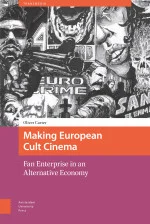
There is much to admire about the book’s later chapters, especially when Carter turns to his case studies, but in the conclusion, he raises hackles again by repeating his insistence that ‘fan studies needs to further consider the economic processes that are involved in fan activity, moving away from the celebratory, fancademic studies’ (198). Again, I’m not quite sure why Carter set out his stall so aggressively, especially when lacking solid epistemological foundations. If nothing else, Making European Cult Cinema: Fan Enterprise in an Alternative Economy will no doubt spark further debate about the claims made within as it pertains to fan studies and cult media studies, but I would also encourage interested readers from those disciplines, and perhaps other fields, to consider the valuable insights brought out by Carter’s investigation into fan enterprises. There are many fruitful aspects that will no doubt support and enhance scholarly thinking on the topic, and that should not be denied either.
References
Allmer Patricia, Brick, Emily, & Huxley, David. 2012. European Nightmares: Horror Cinema in Europe Since 1945. London/ New York: Wallflower Press.
Bakioğlu, Burcu S. 2016. ‘Exposing convergence: YouTube, fan labour, and anxiety of cultural production in Lonelygirl15,’ Convergence: The Journal of Research into New Media Technologies; Apr2018, 24(2), p184-204.
Ball, Kevin D. 2017. ‘Fan labor, speculative fiction, and video game lore in the "Bloodborne" community,’ Transformative Works and Cultures, Volume 25.
Barefoot, Guy. 2017. Trash Cinema: The Lure of the Low. New York: Wallflower Press.
Baschiera, Stefano & Hunter, Russ. 2016. Eds. Italian Horror Cinema. Edinburgh: Edinburgh University Press.
Baschiera, Stefano. 2017. “Streaming Italian Horror in the United Kingdom: Love Film Instant,” The Journal of Italian Cinema and Media Studies 5(2): 245-260.
Blodgett, Bridget & Salter, Anastacia. 2017. Toxic Geek Masculinity in Media: Sexism, Trolling, and Identity Policing. London/ New York: Palgrave Macmillan.
Bondanella, Peter & Pacchioni, Federico. 2017. A History of Italian Cinema (second edition). London/ New York: Bloomsbury Academic.
Brooker, Will. 2001. Batman Unmasked: Analysing a Cultural Icon. London: Continuum.
Brooker, Will. 2014. ‘Going Pro: Gendered Responses to the Incorporation of Fan Labour as User-Generated Content’. In Wired TV: Laboring Over an Interactive Future edited by Denise Mann, pp. 72-97. New Brunswick, NJ: Rutgers University Press.
Busse, Kristin. 2009. “Fandom and Feminism: Gender and the Politics of Fan Production,” Cinema Journal 48(4).
Busse, Kristin. 2013. ‘Geek hierarchies, boundary policing and the gendering of the ‘good’ fan,’ Participations: Journal of Audience and Reception Studies,’ 10(1). http://www.participations.org/Volume%2010/Issue%201/6%20Busse%2010.1.pdf
Busse, Kristin. 2015. ‘Fan Labor and Feminism: Capitalizing on the Fannish Love of Labor,’ Cinema Journal 54(3).
Cherry, Brigid. 2011. "Knit One, Bite One: Vampire Fandom, Fan Production and Feminine Handicrafts." In Fanpires: Audience Consumption of the Modern Vampire, edited by Gareth Schott and Kirstine Moffat, 137–55. Washington, DC: New Academia Publishing.
Cherry, Brigid. 2016. Cult Media, Fandom and Textiles: Handicrafting as Fan Art. London: Bloomsbury.
Chin, Bertha. 2013. "The Fan–Media Producer Collaboration: How Fan Relationships Are Managed in a Post-series X-Files Fandom." Journal of Science Fiction Film and Television 6 (1): 87–99.
Chin, Bertha. 2014. ‘Sherlockology and Galactica.tv: Fan sites as gifts or exploited labor?’, Transformative Works and Cultures, Volume 15. https://journal.transformativeworks.org/index.php/twc/article/view/513
Chudoliński, Michał. 2014. ‘Interview with Henry Jenkins, George Ritzer, and Mark Deuze about Popular Culture Prosumption’, Prosumption in the Pop Industry: An Analysis of Polish Entertainment Industries. Available at: http://wiedzalokalna.pl/wpcontent/uploads/2014/01/FWL_Prosumption_Report_English.pdf.
Click, Melissa. 2009. ‘“Rabid,” “Obsessed,” and “Frenzied”: Understanding Twilight Fangirls and the Gendered Politics of Fandom,’ Flow, December (https://www.flowjournal.org/2009/12/rabid-obsessed-and-frenzied-understanding-twilight-fangirls-and-the-gendered-politics-of-fandom-melissa-click-university-of-missouri/)
Coppa, Francesca, & Russo, Julie Levin. 2012. “Fan Remix/ Video,” Transformative Works and Cultures, Volume 9. https://journal.transformativeworks.org/index.php/twc/issue/view/10
Fisher, Austin. 2011. Radical Frontiers in the Spaghetti Western: Politics, Violence and Popular Italian Cinema. London: I.B Taurus.
Fisher, Austin & Walker, Johnny. 2017. Eds. “Italian Horror Cinema,” The Journal of Italian Cinema and Media Studies 5(2): 153-157.
Gabilliet, Jean-Paul. 2010. Of Comics and Men: A Cultural History of Comic Books. Translated by Bart Beatty and Nick Nguyen. Jackson: University of Press Mississippi.
Godwin, Victoria M. 2016. ‘Fan pleasure and profit: Use-value, exchange-value, and one-sixth scale action figure customization,’ Journal of Fandom Studies 4(1).
Gramsci, Antonio. 1978. Selections from Prison Notebooks. London: Lawrence and Wishart.
Gray, Jonathan. 2003. “New Audiences, New Textualities: Anti-Fans and Non-Fans,” International Journal of Cultural Studies 6(1): 64-81.
Gray, Jonathan, Sandvoss, Cornel, & Harrington, Lee. C. 2007. Eds. Fandom: Identities and Communities in a Mediated World (First Edition). New York: New York University Press.
Gray, Jonathan, Sandvoss, Cornel, & Harrington, Lee. C. 2017. Eds. Fandom: Identities and Communities in a Mediated World (Second Edition). New York: New York University Press.
Hassler-Forest, Dan. 2016. Science Fiction, Fantasy, and Politics: Transmedia World-Building Beyond Capitalism. New York: Rowman Littlefield.
Hawkins, Joan. 2000. Cutting -Edge: Art-Horror and the Horrific Avant-Garde. Minneapolis: University of Minnesota.
Hebdidge, Dick. 1979. Subcultures: The Meaning of Style. New York/ London: Routledge.
Helleckson, Katherine. 2009. ‘A Fannish Field of Value: Online Fan Gift Culture,’ Cinema Journal 48(4).
Helleckson, Katherine. 2015. ‘Making Use of: The Gift, Commerce and Fans,’ Cinema Journal 54(3).
Hills, Matt. 2002. Fan Cultures. London: Routledge.
Hills, Matt. 2005. “Negative Fan Stereotypes (‘Get a Life!’) and Positive Fan Injunctions (‘Everyone’s Got to be a Fan of Something!’): Returning to Hegemony in Media Studies,’ Spectator 25(1), pp. 35-47.
Hunter, Russ. 2016. “Horrically local? European horror and regional funding initiatives,” Film Studies 15(1), pp.66-80.
Hunter, Russ. 2017. “‘I have a picture of the Monster! Il mostro di Frankenstin and the search for Italian horror cinema,” Journal of Italian Cinema and Media Studies, 5(2), pp. 159-172.
Jenkins, Henry. 2006. Convergence Culture. New York: New York University Press.
Jenkins, Henry. 2014. “Rethinking Rethinking Convergence Culture,” Cultural Studies 28(2): 267-297.
Jenkins, Henry, Ford, Sam and Green, Joshua. 2013. Spreadable Media: Creating Value and Meaning in a Networked World. New York: New York University Press.
Jenkins, Henry, Shresthova, Sanghita, Gamber-Thompson, Liana, Klinger-Vilenchik, Neta and Zimmerman, Arely, M. 2016. By Any Media Necessary: The New Youth Activism. New York: New York University Press.
Johnson, Derek. 2013. Media Franchising: Creative License and Collaboration in the Culture Industries. London: New York University Press.
Jones, Bethan. 2014. ‘Fifty shades of exploitation: Fan labor and Fifty Shades of Grey,’ Transformative Works and Cultures, Volume 15. https://journal.transformativeworks.org/index.php/twc/article/view/501
Jones, Bethan. 2015. ‘My Little Pony, Tolerance is Magic: Gender Policing and Brony Anti-Fandom,’ The Journal of Popular Television 3(1): 119-25.
Kannas, Alexia. 2017. “All the colours of the dark: film genre and the Italian giallo,” The Journal of Italian Cinema and Media Studies 5(2): 173-190
Kozinets, Robert. 2014. “Fan Creep?: Why Brands Need Fans.” In Wired TV: Laboring Over an Interactive Future edited by Denise Mann, pp. 161-175. New Brunswick, NJ: Rutgers University Press.
Lothian, Alexis. 2009. ‘Living in a Den of Thieves: Fan Video and Digital Challenges to Ownership,’ Cinema Journal 48(4).
Lothian, Alexis. 2015. ‘A Different Kind of Love Song: Vidding Fandom’s Undercommons,’ Cinema Journal 54(3).
Olds, Kirstin. 2015. ‘Fannies and fanzines: Mail art and fan clubs in the 1970s,’ Journal of Fandom Studies 3(2).
McRobbie, Angela. 1994. Postmodernism and Popular Culture. London: Routledge.
McKenna, Mark. 2017. “Whose Canon is it Anyway?: Subcultural Capital, Cultural Distinction and Value in High Art and Low Culture Film Distribution.” In Cult Media: Re-Packaged, Re-Released, Re-Stored, edited by Jonathan Wroot and Andy Willis, pp. 31-49. London: Palgrave.
Milner, R. M. 2009. "Working for the Text: Fan Labor and the New Organization." International Journal of Cultural Studies 12 (5): 491–508.
Morley, David. 1992. ‘Populism, Revisionism and the “New” Audience Research’, Poetics, 21(4), pp. 339 – 344.
Platts, Todd. K. 2017. “A comparative analysis of the factors driving film cycles: Italian and American zombie film production, 1978–82,” The Journal of Italian Cinema and Media Studies 5(2): 191-210.
Proctor, William & Kies, Bridget. 2018. Eds. ‘Toxic Fan Practices,’ special section in Participations: The Journal of Audience and Reception Studies, 15(1), May .
Regin, Nancy. 2012. Ed. ‘Fan Works and Fan Communities in the Age of Mechanical Reproduction,’ Transformative Works and Cultures, Volume 6.
Rehak, Bob. 2014. ‘Materiality and Object-Oriented Fandom,’ Transformative Works and Cultures. Volume 16.
Robert-Smith, Iain. 2011. “Bootleg Archives: Notes on BitTorrent Communities and Issues of Access,” Flow TV.
Sandvoss, Cornel. 2005. Fans: A Mirror of Consumption. London: Polity Press.
Sandvoss, Cornel. 2011. "Fans Online: Affective Media Consumption and Production in the Age of Convergence." In Online Territories: Globalization, Mediated Practice, and Social Space, edited by Miyase Christensen, André Jansson, and Christian Christensen, 5–54. New York: Peter Lang.
Sarkhosh, Keyvan & Mennighaus, Winfried. 2016. “Enjoying Trash Films: Underlying features, viewing stances, and experiential response dimenions,” Poetics Volume 57. https://www.sciencedirect.com/science/article/abs/pii/S0304422X16300821
Scott, Suzanne. 2009. “Repackaging fan culture: the regifting economy of ancillary content material,’ Transformative Works and Cultures, Volume 3.
Scott, Suzanne. 2015. ‘“Cosplay is Serious Business: Gendering Material Fan Labor on Heroes of Cosplay,’ Cinema Journal 54(3).
Stanfill, Mel. 2015. ‘Spinning Yarn with Borrowed Cotton: Lessons for Fandom from Sampling,’ Cinema Journal 54(3).
Stanfill, Mel and Condis, Megan. 2014. Eds. ‘Fandom and/as Labor,’ Transformative Works and Cultures, Volume 15. https://journal.transformativeworks.org/index.php/twc/issue/view/16
Stenger, Josh. 2006. ‘The Clothes Make the Fan: Fashion and Online Fandom When "Buffy the Vampire Slayer" Goes to eBay,’ Cinema Journal 45(4).
Totaro, Donato. 2011. “A Genealogy of Italian Popular Cinema: the Filoni,” Offscreen 15(11). https://offscreen.com/view/genealogy_filone
Lázaro-Reboll, Antonio. 2016. ‘Making Zines: Re-Reading European Trash Cinema,’ Film Studies 15(1), pp.30-53.
Wagstaff, Christopher. 1992. “A Forkful of Western: Industry, Audience and the Italian Western”. In Popular European Cinema, edited by Richard Dyer and Genette Vincendeau, pp.245-263. London: Routledge.
Wagstaff, Christopher. 1998. “Italian Genre Films in the World Market.” In Hollywood & Europe: Economics, Culture, National Identity 1945-95, edited by Geoffrey Nowell-Smith, and Stephen Ricci, pp74-86. BFI: London.
Endnotes
[1] http://www.trash.hr/?page_id=32
[2] https://www.thespec.com/whatson-story/6227862-welcome-to-trash-palace-a-connoisseur-s-collection-of-bad-movies/
[3] http://cfmu.ca/posts/126-so-bad-it-s-amazing-learn-about-hamilton-s-trash-cinema
[4] https://www.imdb.com/list/ls000042235/
______________________________________
William Proctor is Senior Lecturer in Transmedia at Bournemouth University. He has published widely on matters pertaining to popular culture, franchising and fandom, including comic books, film and TV. William is the co-editor of Global Convergence Cultures: Transmedia Earth (with Matthew Freeman for Routledge), Disney’s Star Wars: Forces of Production, Promotion and Reception (with Richard McCulloch for University of Iowa Press), and the forthcoming edited collection Horror Franchise Cinema (with Mark McKenna for Routledge). At present, William is completing his debut single-authored monograph Reboot Culture: Comics, Film, Transmedia for publication in 2019/20 (for Palgrave).