Wandering Through the Labyrinth: An Interview with USC's Marsha Kinder (Part Four)

Since the conference, you and your co-editor Tara McPherson have gotten deeper into work around the digital humanities. I'd love to hear you talk about the visions underlying these projects and the somewhat different agendas for digital humanities they each embody. One of the goals shared by Labyrinth, Scaler and Vectors, is to make the digital humanities embrace visual and audio culture as equally important to the word. We all are involved in making multisensory works that are as intellectually rich, rigorous, and subtle as any traditional essay or book.

Another shared goal is to encourage and validate collaboration both among humanities scholars and with artists, scholars and scientists from other fields. Although we have different models for the scope and range of such collaborations (partly based on issues of scale, funding and who is involved), we all recognize its importance and realize that it’s always a touchy subject. While most academics and administrators are usually willing to support collaboration verbally, the problem arises when it’s time to make decisions on promotion and tenure. Suddenly issues of credit (who’s doing what) become insurmountable problems.

Labyrinth’s collaborations usually involve a small team of theorists, scholars, artists, programmers and designers who (with the help of student assistants from Cinema) make a specific database narrative that provides a new model of digital scholarship. Each work requires a different collaborative team and individual funding. Sometimes we include interns from other nations and cultures, or volunteers from other departments or schools. The team is tailored to the specific project. These goals are narrower than those of Vectors and Scaler, which, through the development of unique user-friendly software, enable humanities scholars from across the nation to produce their own individual digital projects.

In developing different signature genres (e.g., digital city symphonies, interactive memoirs, archival cultural histories, health-science education), Labyrinth engages in an on-going process of reframing. For example, although its first science education project, Three Winters in the Sun: Einstein in California, was an installation in the Skirball Cultural Center’s major exhibition on the famous scientist, it combined an interactive memoir (Einstein’s complex relations with six different communities) with a digital city symphony (Los Angeles in the early 1930s).

Einstein in California

Though it told us more about the contradictions in his life than about his scientific discoveries (which were covered by other installations in the Skirball exhibition), it led the way to Labyrinth’s next signature genre—the health-science-education project.

Produced in collaboration with molecular scientist Dr. Jean Chen Shih from USC’s School of Pharmacy, A Tale of Two MAO Genes: Exploring the Biology and Culture of Aggression and Anxiety, was another translational work in science, but this time designed for use in the classroom. The project used live action video and 3-D animation to cover basic molecular biology and to explain Dr. Shih’s pioneering research on MAO A and B. The project’s strongest elements were 3-D animations (by USC animation student Debra Isaac) of protein folding and other biological processes, visualizations that were both extremely beautiful and rigorously accurate.

To fulfill its secondary goal of encouraging youngsters to become scientists, it includes a brief biography of Dr. Shih and interviews with several scientists explaining how they entered the field. The project was translated into Mandarin and is being used as a model both in China and Taiwan.

Both of these earlier science-education projects laid the groundwork for a video-based website called “Interacting with Autism,” a collaboration with documentary filmmaker Mark Jonathan Harris that drew on an impressive list of scientific consultants who are specialists in this expanding field.

Interacting with Autism

Funded by grants from AHRQ (the Agency for Healthcare Research and Quality), it was launched on-line in September 2013. This bilingual website (in English and Spanish) is now being translated into Mandarin so that it can be used more productively in China. It is also being tested by an evaluative group at the Rand Corporation, who seek to use it as a model for comparable websites on other health disorders. We’ve had particularly good response to the brief animated film that shows what sensory overload feels like to some individuals on the spectrum.

While working on this website, I became very interested in neurodiversity, a key issue in the cultural debates between autism activists on the spectrum and those who see it autism simply as a disorder to be cured. We were determined to include the points of view from those on the spectrum—on both sides of the camera.

While working on these science translation projects, I realized it was possible to reframe many of the issues I had dealt with in previous works within a new conceptual framework. That’s the book I’m working on now, which is titled Narrative in the Age of Neuroscience: The Discreet Charms of Serial Autobiography.

Kinder New Book

Marsha Kinder began her career in the 1960s as a scholar of eighteenth century English Literature before moving to the study of transmedial relations among narrative forms. In 1980 she joined USC’s School of Cinematic Arts where she continued to be an academic nomad, with narrative as her through-line. Having published over one hundred essays and ten books (both monographs and anthologies), she is best known for her work on Spanish film, specifically Blood Cinema (1993); children’s media, especially Playing with Power in Movies, Television and Video Games (1991); and digital culture (including her new anthology Transmedia Frictions: The Digital, The Arts and the Humanities (2014), co-edited with Tara McPherson. She was founding editor of innovative journals, such as Dreamworks (1980-87), winner of a Pushcart Award, USC’s Spectator (1982-present) and since 1977 served on the editorial board of Film Quarterly. In 1995 she received the USC Associates Award for Creativity in Scholarship, and in 2001 was named a University Professor for her innovative transdisciplinary research.

In 1997 she founded The Labyrinth Project, a USC research initiative on database narrative, producing award-winning database documentaries and new models of digital scholarship. In collaboration with media artists Rosemary Comella, Kristy Kang and Scott Mahoy, and with filmmakers, scientists and cultural institutions, Labyrinth produced 12 multimedia projects (DVD-ROMs, websites, installations and on-line courseware) that were featured at museums, film and new media festivals, and conferences worldwide. Kinder’s latest work, Interacting with Autism, is a video-based website produced in collaboration with Oscar-winning documentary filmmaker Mark Jonathan Harris and Scott Mahoy. Since retiring from teaching in Summer 2013, Kinder is now writing a new book titled Narrative in the Era of Neuroscience: The Discreet Charms of Serial Autobiography.

Wandering Through the Labyrinth: An Interview with USC's Marsha Kinder (Part Three)

I was struck in 1999 by your effort to also create a space where artists working in the museum and gallery space were engaging with game designers working in more commercial contexts. This dimension seems to have dropped out of the Transmedia Frictions book altogether. What does this suggest about the continued roles of cultural hierarchies in the realms of digital art and theory? When we planned the Interactive Frictions conference, we wanted to be as broad and inclusive as possible, which meant including games. I had hoped someday to finish the Runaways game as a Labyrinth project, once we had sufficient grant support and more sophisticated programmers. It was not that we looked down on games as unworthy of critical and cultural attention, but rather that we simply didn’t have the resources to do a first rate job.

We made a stab at it in our on-line courseware project, Russian Modernism and Its International Dimensions, an archival cultural history which unfortunately we never finished—even though we had the assistance of Jenova Chen, the most successful student to emerge from USC’s Interactive Media Division; a grant from NEH; and first-rate Slavic Studies scholars (Yuri Tsivian on film, from University of Chicago; Olga Matich on literature, from UC Berkeley; and John Bowlt on visual culture, from USC). Set at the 1896 Russian Expo in Nizhni Novgorod (where cinema was first screened for the Russian public and where the Tsar and his court were in attendance), this project provided students with three ways of engaging with these historical materials.

Screen Shot 2015-01-20 at 4.02.22 PM

They could explore a virtual 3-D model of the Expo and its pavilions, where they could play a game called Montage: A Russian History Game of the Masses.

Screen Shot 2015-01-20 at 3.47.20 PM

The game enabled them to engage with experimental art, subversive politics, or new technology—the three forces that made modernism so distinctive in the Russian context.

Or, they could visit GUM, (Glavnyi Universalnji Magazin), the “main universal store” in Moscow’s red square from the 1920s, whose innovative glass-roof design was also featured at the 1898 Expo. Like consumerist flaneurs strolling through a modernist arcade, here students could stop at several shops, each presenting an illustrated interactive lecture on a range of topics (e.g., nothingness, velocity, the bomb, the expo, St. Petersburg: the novel and the city, etc.) by leading scholars both from the U.S. and Russia.

Or, they could visit the archive in GUM’s basement, an extensive database of artworks that students could use in their own projects. Since the courseware was not finished, students were invited to help build the rest of it, as if they were constructionists, learning by doing. The project was designed to show how aesthetic concepts from Russian modernism (such as, dialectic montage, constructionism, and synaesthesia) are still useful in developing our own era of digital multimedia. The basic conception is still sound and challenging, but we don’t have the resources to produce it.

By the time we published Transmedia Frictions, the academic world of game studies had already developed its own trajectories. Of course, there were exceptions like Bill Viola (who attended the original Interactive Frictions conference and had an installation in our IF exhibition). Later, in collaboration with specialists in our Interactive Media Division, he developed a game about a journey of Buddhist enlightenment. Although he originally proposed a collaboration with Labyrinth, we didn’t have the resources to develop it at the time. We were moving in the opposite direction toward museum installations, particularly because we had had such a difficult experience with the Montage game at the heart of Russian Modernism.

There's a recurring interest throughout the essays, in both parts of the book, in issues of cultural memory, the archival, and the documentary. What new models have emerged over the past decade for thinking about the relationship between the digital and our collective understandings of history?

One of the new models that has emerged over the past decade is the genealogical search for family and cultural roots. We can find it in the growing popularity of a website like ancestry.com and in the television shows hosted by Henry Louis Gates, Jr., African American Lives (2006) and Finding Your Roots (2012), where he helps celebrities discover the truth about their roots. We can also see it in the current fascination with Selfies and with the impulse to upload your own home movie fragments on YouTube. And one can also find it in new works on home movies—in a marvelloous book like Patricia Zimmerman’s Mining the Home Movie, and in the extraordinary films of Hungarian media artist Péter Forgács.

In 2000, Labyrinth embarked on a collaboration with Forgacs to turn his sixty-minute, single-channel film, The Danube Exodus, into a large scale, multiscreen, immersive installation, which opened at the Getty Center in 2002 and continued to travel worldwide until 2012. It was one of our three projects in the “Future Cinema” show, and is discussed by Stephen Mamber in the anthology. Largely as a result of this exhibition, Forgács received the prestigious Erasmus Award, for an artist in any medium who has made an exceptional contribution to culture in Europe and beyond.

Having been aired on European television in 1997, Forgács’s film provided intriguing narrative material: a network of compelling stories, a mysterious river captain whose movies remain unknown, a Central European setting full of rich historical associations, and a hypnotic musical score that created a mesmerizing tone. Now that we had 40 hours of footage to draw on, there was an intense struggle for narrative space: between the European Jews who were fleeing the Third Reich in 1939, attempting to get a ship in the Black Sea to take them to Palestine; and the German farmers who were returning home to Germany in 1940 after the Soviets had confiscated their lands in Bessarabia; and the Hungarian river captain who ferried both groups into history by documenting their journies on film.

As in Forgács’s other films, the home movies enriched or contradicted what we thought we already knew about history. Sometimes the home movie footage was juxtaposed with excerpts from official newsreels, but it always introduced an alternative vision. To see the fragile home movie footage displayed on television is one thing, but to see it projected in a museum on five large screens (each 6ft x 8 ft) is something else. This is the way superheroes or villains (like Napoleon or Hitler) are usually displayed, not domestic home movies with their humble characters and banal events.

This collaboration was the first time Labyrinth had actually designed an installation from the get-go—as opposed to making a DVD-ROM that was later included in a museum exhibition. Of course, there were several DVD-ROMs included in the show, plus a related website (produced by a group in Europe), and a related exhibition of maps and artifacts from the Getty Collection. We began to think of this work as a “transmedia network,” one that linked several spaces and many collaborators together.

Intrigued by the use of vintage home movies and the richness of what could be gleaned from their visuals and physical gestures, we were inspired to do another transmedia network for our next project. Titled “Jewish Homegrown History: Immigration, Identity and Intermarriage,” it consisted of a museum installation which premiered at USC in October 2011 as a Vision and Voices event

JHGH:USC

and then ran for several months in 2012 at the Skirball Cultural Center in Los Angeles. The exhibition featured three large screens, even larger than those we used in The Danube Exodus, on which we projected home movies of Jews living in Los Angeles.

There was also a bank of computers with the website, which enabled users to upload their own family stories and photos and to hear histories of others. The home movies displayed on the large screens and the website all addressed the subthemes of immigration, identity, and intermarriage, which were also emphasized in quotations that were posted on the walls. Mainly derived from 8mm and Super 8 footage, the home movies were collected in a series of “home movie collection days,” which enabled us to form productive collaborative relations with those contributing the footage.

After interviewing members of the family, we edited the footage and added sound. In the exhibition space we also screened a series of short documentaries about Jews in Los Angeles, a display that evoked a comparison between these two forms of non-fiction.

Both of these installations made me think of Patricia Zimmerman’s inspiring statement, which was prominently displayed on the walls of the exhibition: “Amateur films urge us all—scholars, filmmakers, archivists, curators—to re-imagine the archive and film historiography. They suggest the impossibility of separating the visual from the historical and the amateur from the professional.... We need to imagine the archive as an engine of difference and plurality, always expanding, always open.”


Marsha Kinder began her career in the 1960s as a scholar of eighteenth century English Literature before moving to the study of transmedial relations among narrative forms. In 1980 she joined USC’s School of Cinematic Arts where she continued to be an academic nomad, with narrative as her through-line. Having published over one hundred essays and ten books (both monographs and anthologies), she is best known for her work on Spanish film, specifically Blood Cinema (1993); children’s media, especially Playing with Power in Movies, Television and Video Games (1991); and digital culture (including her new anthology Transmedia Frictions: The Digital, The Arts and the Humanities (2014), co-edited with Tara McPherson. She was founding editor of innovative journals, such as Dreamworks (1980-87), winner of a Pushcart Award, USC’s Spectator (1982-present) and since 1977 served on the editorial board of Film Quarterly. In 1995 she received the USC Associates Award for Creativity in Scholarship, and in 2001 was named a University Professor for her innovative transdisciplinary research.

In 1997 she founded The Labyrinth Project, a USC research initiative on database narrative, producing award-winning database documentaries and new models of digital scholarship. In collaboration with media artists Rosemary Comella, Kristy Kang and Scott Mahoy, and with filmmakers, scientists and cultural institutions, Labyrinth produced 12 multimedia projects (DVD-ROMs, websites, installations and on-line courseware) that were featured at museums, film and new media festivals, and conferences worldwide. Kinder’s latest work, Interacting with Autism, is a video-based website produced in collaboration with Oscar-winning documentary filmmaker Mark Jonathan Harris and Scott Mahoy. Since retiring from teaching in Summer 2013, Kinder is now writing a new book titled Narrative in the Era of Neuroscience: The Discreet Charms of Serial Autobiography.

Wandering Through the Labyrinth: An Interview with USC's Marsha Kinder (Part Two)

Marsha, you coined the term "transmedia" in your 1991 book, Playing with Power, where you used it to describe an emerging entertainment supersystem. Your phrase has been widely picked up and applied to everything from transmedia storytelling to transmedia learning to transmedia branding to transmedia mobilization. You have chosen to use it as part of the title of this book. To what degree is this an effort to reclaim and redefine the term? Why did you find this an appropriate framework for thinking about the debates in this collection? Yes, in choosing to use “Transmedia” in the title of our anthology, I was reclaiming the term I had coined in 1991 in Playing with Power. But, in no way do I object to the way the meanings of transmedia have expanded—that’s the way language functions. In fact, Tara and I were also redefining the term "transmedia," for it creates an opening for those new media that our anthology didn’t cover in depth—including smart phones—and those that haven’t yet been invented.

We were also using it as a substitute for the term “interactive,” whose definition and connotations are no longer hotly contested. Transmedia, on the other hand, evokes the issue of medium specificity (still very much in contention), without supporting one side or the other. Yet, as some of the essays in our anthology suggest, it also evokes the historic transformation we are now experiencing, in which all movies, videos, TV programs, and music are being redefined as software or data, a conversion with seismic financial and cultural consequences.

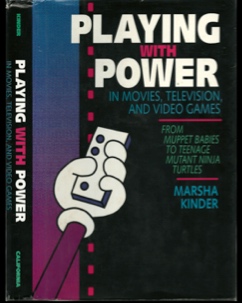
Playing with Power

In Playing with Power, instead of using the popular buzz-word convergence, I coined the term transmedia because I saw it as a deliberate, dynamic move across media. This definition partly arose from my own transmedia experience—of having completed a doctoral degree in 18th century English literature in 1967 and then publishing my first article two months later, not on Henry Fielding but on Antonioni’s Blow-up. This move from literature to film led one of my literary colleagues to accuse me of having “betrayed the 18th century.” Though flattered by the charge, I realized this move was not always freely chosen.

In Playing with Power, I linked this term "transmedia" to a new kind of postmodernist subjectivity that could be historicized. Priding itself on mobility rather than stability, this new protean subjectivity was embodied in those popular transformer toys and in the myth of Teenage Mutant Ninja Turtles,

Playing TMNT

where all four words in their name emphasize this kind of movement—whether it was natural growth from childhood to adulthood; or a de-novo mutation caused by urban pollution; or a fluid transnational identity linked to Japanese ninjas, California surfers, and Italian Renaissance artists; or an evolutionary move by amphibians from sea to land. Given this hyper-plasticity, the only fixed aspect of their identity was their masculine gender that depended on having the right toys and gear, which meant kids could buy into the system.

The turtles acquired their own cultural capital by becoming (what I called) a “transmedia supersystem,” whose fluid movement across many different media (from comic books, to games, to television, to movies, and to a slew of licensed products, all with substantial financial rewards) made them even more worthy of imitation. In fact, you could find this transformative subjectivity not only in children but also in transnational CEOs of the time—like Akio Morita, the founding chairman of Sony, who said shortly after his company’s 1989 purchase of Columbia Pictures:

Playing Sony

Interestingly, Morita’s statement identified transmedia movement not only with transnational moves but also with play, which led me to explore its connection with a particular kind of developmental psychology. Specifically, I relied on L.S. Vygotsky’s “zone of proximal development,” an area of accelerated learning created through play where a child always behaves beyond his average age and beyond Piaget ‘s fixed developmental model. According to Vygotsky, when play is guided by an adult or more capable peers, the interaction could function as an accelerant. I argued that interaction with popular media (like television, films and computer games) could also fulfill this function, which is a basic premise of Sesame Street. Thus instead of echoing the dire warnings of many psychologists about the harmful effects on youngsters of watching television, I claimed TV could serve as a developmental accelerant that taught youngsters a form of transmedia literacy, which enabled them to bridge the gap between domestic and public space. For, ever since television became pervasive in the American home [a position now challenged by computers, ipads, smart phones and other digital devices], this medium had accelerated children’s acquisition of a fluid postmodernist subjectivity marked by constant change—a subjectivity that helped explain the popularity of transformer toys and transmedia heroes like Teenage Mutant Ninja Turtles.

Another key aspect of the original conference and to some degree this book was to broker a kind of conversation between experimental artists working with digital media and academic theorists seeking to imagine digital presents and futures. What do you see as the value of such interactions between artists and academics?

I have always been convinced that there’s an important interplay between artistic experimentation and theoretical breakthroughs. This is true in older art forms—such as literature, as much as in film and digital media. For example, in the 18th century although Dr. Samuel Johnson realized that Shakespeare’s mixture of comedy and tragedy violated Aristotle’s rules, he concluded there must be something wrong with the rules, and he attributed his own theoretical insight to Shakespeare’s artistic experimentation. We can find this same kind of interplay in those artists (such as, Joyce, Beckett, Borges, Duras, Marker, and Akerman) whose experimentation is so radical that it transforms any theory applied to it or inspires the creation of a new one—the way Marcel Proust’s A la recherché du temps perdu inspired Gerard Genette’s Narrative Discourse: An Essay in Method, or Dziga Vertov’s Man with a Movie Camera and Peter Greenaway’s avant-garde films helped shape Lev Manovich’s The Language of New Media. And we find a similar interplay in those figures who combine theory and artistic practice in their own work—such as, Eisenstein, Vertov, Pasolini, Deren, and Godard.

In the early days of The Labyrinth Project, I purposely sought out collaborators who were already experimenting with non-linear, open-ended narrative and associative structures—artists who (I thought) could bring a new level of sophistication to this new medium. Since we had no track record, I had to begin with artists I already knew and with whom there was mutual trust. Thus I chose my friend John Rechy, the gay, Chicano novelist whose City of Night mapped the gay cruising zones of the nation, whose Numbers focused on compulsive repetition in Griffith Park, and whose Sexual Outlaw was an edgy, non-linear fictional documentary.

I also chose independent filmmaker Pat O’Neill, whose brilliant multi-layered films I had been writing about since the 1970s.

Our first signature genre was the digital city symphony, an update of the modernist city symphony with its avant-garde associations. Focusing on contested urban space through layers of time, it deliberately eroded the line between documentary and fiction. In Tracing the Decay of Fiction: Encounters with a Film by Pat O’Neill, the exploratory space was the Ambassador Hotel on the Miracle Mile in midtown Los Angeles, where the downtown power-brokers and Hollywood moguls first mingled. It was also the site where Robert Kennedy was assassinated in 1968 and where other historical traumas, both personal and cultural, took place.

In Bleeding Through Layers of Los Angeles, 1920-1986, an adaptation of Norman Klein’s cultural history, The History of Forgetting: The Cultural Erasure of Los Angeles, documentary and fiction vied for control over this multi-tiered narrative. The contested space was a three mile radius in downtown Los Angeles, a neighborhood known for both its real-life ethnic diversity and fictional on-screen violence.

Bleeding Through: Layers of Los Angeles, 1920-1986 (2002) from Rosemary Comella on Vimeo.

Another of our early signature genres was the interactive memoir, which preserves the unique web of memories and associations that an individual builds over a lifetime and that inevitably unravels with old age and death. These works encouraged users to interweave this personal material into a broader tapestry of historical narrative. Thus we chose vintage subjects who had complex relations with several different communities. As we’ve seen, Mysteries and Desires: Searching the Worlds of John Rechy features a gay Chicano novelist whose works purposely blur the line between autobiography and fiction.

The Dawn at My Back: Memoir of a Black Texas Upbringing was the interactive version of a print memoir by Carroll Parrott Blue, an African American photographer from an independent black community in Houston.

And we also did one on Albert Einstein, called Three Winters in the Sun: Einstein in California...

Presented as DVD-ROMs, websites, and installations, these database narratives from Labyrinth were featured at museums, film and new media festivals, and conferences worldwide. Three of our early works were included in Future Cinema: The Cinematic Imaginary after Film, a major exhibition co-curated by Jeffrey Show and Peter Weibel, which ran from 16 November 2002 – 30 March 2003 at ZKM in Karlsruhe, Germany, and subsequently travelled to Helsinki and Tokyo.

Despite many exhibitions (both on-line and in museums) of such works and those by others over the past twenty years, there are still very few critics, historians, or theorists who are writing about them—partly because the production process is opaque. I remember when Kevin Thomas, who was then Film Critic for the Los Angeles Times, came to our Labyrinth studio and was interested in writing about Mysteries and Desires. He said he was surprised that John Rechy could draw so well and was so good as a visual artist. When I started explaining who did what, he lost interest in writing about the project. Another time we were delighted to find that Bleeding Through Layers of Los Angeles was positively reviewed by David Ulm in the L.A. Times Weekly Book Review Section. Yet we were horrified that he wrongly assumed Klein’s brief fictional pamphlet that accompanied the DVD-ROM was the primary source of our interactive project, which was merely a visual adaptation. Though several of the essays in our anthology address such experimental works, the history of projects like these still needs to be written. The pace of technological innovation and obsolescence is so rapid that it’s difficult for academics and cultural historians to keep up—both with the specific works being produced and the digital futures they project. But we included some attempts in Transmedia Frictions.


Marsha Kinder began her career in the 1960s as a scholar of eighteenth century English Literature before moving to the study of transmedial relations among narrative forms. In 1980 she joined USC’s School of Cinematic Arts where she continued to be an academic nomad, with narrative as her through-line. Having published over one hundred essays and ten books (both monographs and anthologies), she is best known for her work on Spanish film, specifically Blood Cinema (1993); children’s media, especially Playing with Power in Movies, Television and Video Games (1991); and digital culture (including her new anthology Transmedia Frictions: The Digital, The Arts and the Humanities (2014), co-edited with Tara McPherson. She was founding editor of innovative journals, such as Dreamworks (1980-87), winner of a Pushcart Award, USC’s Spectator (1982-present) and since 1977 served on the editorial board of Film Quarterly. In 1995 she received the USC Associates Award for Creativity in Scholarship, and in 2001 was named a University Professor for her innovative transdisciplinary research.

In 1997 she founded The Labyrinth Project, a USC research initiative on database narrative, producing award-winning database documentaries and new models of digital scholarship. In collaboration with media artists Rosemary Comella, Kristy Kang and Scott Mahoy, and with filmmakers, scientists and cultural institutions, Labyrinth produced 12 multimedia projects (DVD-ROMs, websites, installations and on-line courseware) that were featured at museums, film and new media festivals, and conferences worldwide. Kinder’s latest work, Interacting with Autism, is a video-based website produced in collaboration with Oscar-winning documentary filmmaker Mark Jonathan Harris and Scott Mahoy. Since retiring from teaching in Summer 2013, Kinder is now writing a new book titled Narrative in the Era of Neuroscience: The Discreet Charms of Serial Autobiography.

Wandering through the Labyrinth: An Interview with USC's Marsha Kinder (Part One)

In 1999, the University of Southern California hosted the Interactive Frictions conference, organized by Steve Anderson, Marsha Kinder and Tara McPherson, with participants including some of the leading digital theorists, artists,  and game designers of the period. Among those featured were: Edward Branigan, Justine Cassell, Anne-Marie Duguet,Katherine Hayles, Vilsoni Hereniko, Henry Jenkins (that's me!), Isaac Julien, Norman Klein, George Landow, Brenda Laurel, Erik Loyer, Peter Lunenfeld, Lev Manovich, Patricia Mellencamp, Pedro Meyer, Margaret Morse, Erika Muhammad, Janet Murray, Michael Nash, Marcos Novak, Randall Packer, Mark Pesce, Vivian Sobchack, Sandy Stone,  Yuri Tsivian and many others. I speak at many conferences each year, but this remains in my memory a defining event in terms of my own thinking about digital media and a conference where I met a whole bunch of folks who I have ended up working with over the past decade and a half.  For me, the conference brings back memories of the launch of the MIT Comparative Media Studies Program, which I was able to discuss in my remarks at the event, and also represents the first of a series of interactions with the USC faculty that led ultimately to my decision to move here almost six years ago. Last year, Kinder and McPherson revisited this conference with a new book, Transmedia Frictions: The Digital, The Arts, and the Humanities, which brought together many of the original participants, who shared essays that built upon, but also artfully revisited, their original contributions at the event. The result is a great opportunity to reflect on the evolution of the digital arts and humanities across the intervening years,  allowing us to test our original impressions and to reformulate them in response to so much that has happened since.

A key signal about what has changed is reflected in the title of the book -- a movement from a focus on interactivity to an emphasis on transmedial relations. Here, Marsha Kinder is reclaiming a term she introduced in her 1993 book, Playing with Power in Movies, Television and Video Games: From Muppet Babies to Teenage Mutant Ninja Turtles. Asked to write a blurb for this collection, here's what I had to say: “As someone who attended and participated in the 1999 Interactive Fictions conference, which in many ways consolidated more than a decade of theorizing about and experimenting with digital media, I was uncertain what to expect from Transmedia Frictions. What I found was a rich collection that looks both backward to reconstruct the paths not taken in digital theory and forward to imagine alternative ways of framing issues of medium specificity, digital identities, embodiment, and space/place. This collection is sure to transform how we theorize—and teach—the next phases of our profound and prolonged moment of media transition.”

Few scholars are better situated to reflect on those shifts than Marsha Kinder, who was among the first in cinema studies to embrace digital tools for presenting her scholarship and who has overseen some remarkable collaborations with leading creative artists over the past decade through the Labyrinth project.  She has been a friend and mentor across these years, someone who was always leading the charge and inspiring younger scholars to think about new ways of doing and presenting scholarship, and someone who has bridged between theory and practice in bold new ways.  Our work has been complexly entangled through the years, given our shared interests in children's culture, transmedia, games, and digital humanities.  What began as an interview about her new book has turned into an amazing retrospective on her body of work in the digital humanities, which, true to her vision, is presented here in a multimedia fashion.

I will be following up this interview with Marsha with a second interview with her co-editor Tara McPherson, who has also been a friend and collaborator of mine over the past two decades.

Tell us about the 1999 Interactive Fictions conference. What were  its aims? What do you see now, looking backwards, as its historical  importance in the development of digital art and theory? How did it inform your own subsequent works in this area?

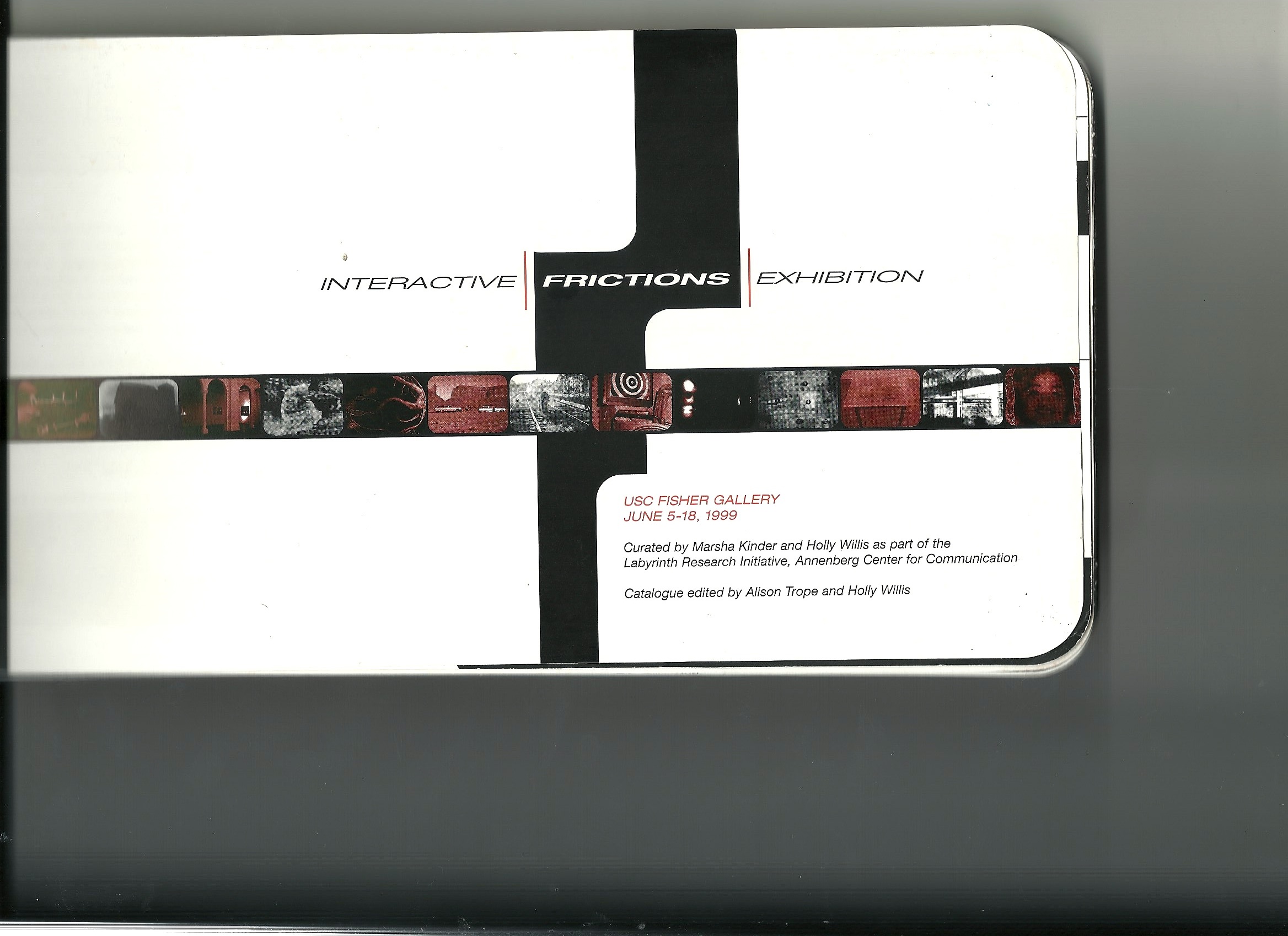
InteractiveFrictions:CatalogCover 

In 1997, I was asked by USC’s Annenberg Center to direct a research initiative that would explore the potentially productive relationship (rather than rivalry) between cinema and the then-emerging digital multimedia. I saw this transmedia focus as an opportunity to combine the immersive and emotive power of cinema with the interactive potential and database structure of new digital forms.

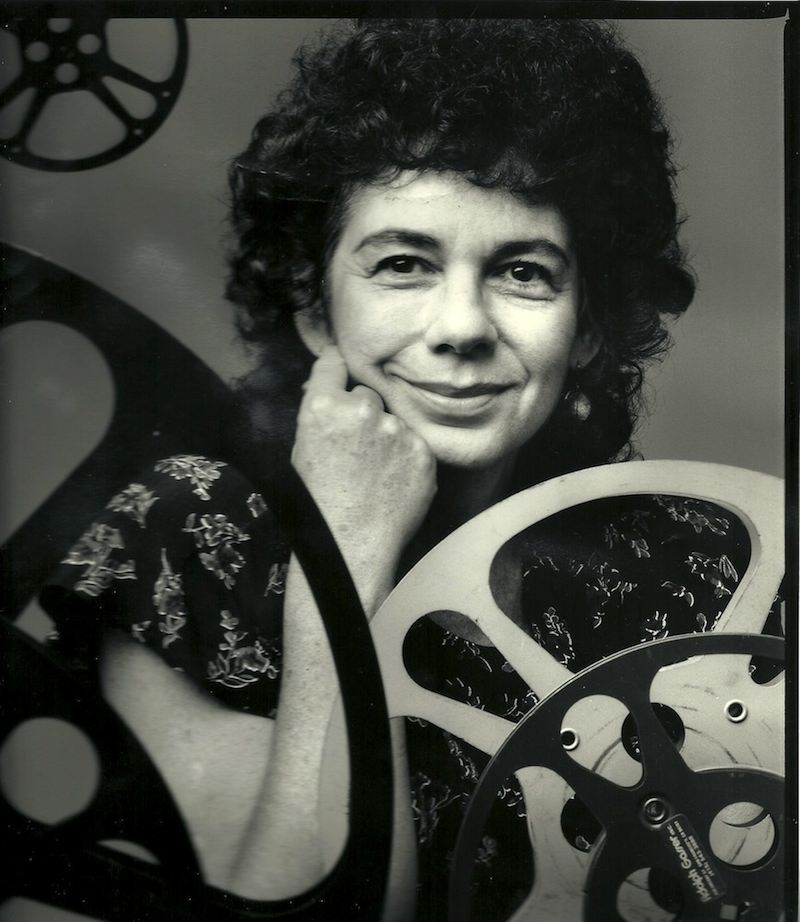
KinderFilmReels

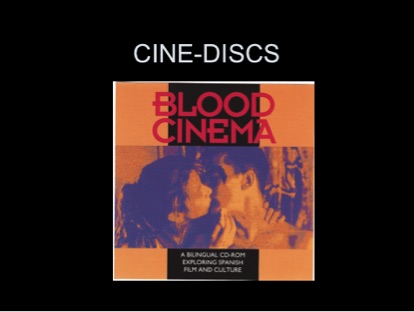
Although I had already developed my concept of database narrative, I was just beginning to engage in production myself, making companion works for my two most recent books. For Blood Cinema, my book on Spanish cinema, I collaborated with my doctoral student Charles Tashiro on making the first scholarly interactive CD-ROM in English language film studies, which led to a bilingual series called Cine-Discs.

BloodCinemaDisc

And, for Playing with Power in Movies, Television, and Video Games, I collaborated with another grad student (Walter Morton) on a video documentary showing kids interacting with Teenage Mutant Ninja Turtles.

When I asked one of the kids in the arcade why they couldn’t play as April O’Neil, he said, “That’s the way the game is made!” Of course, he was right. And that made me want to make my own feminist game on gender.

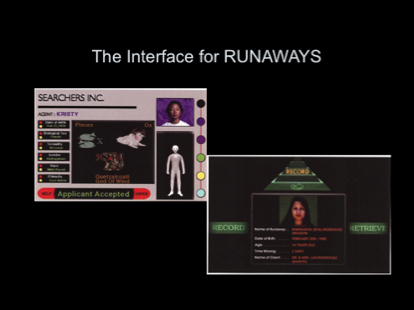
The next step was making a prototype for an experimental electronic game called Runaways...

Runaways Cover

Runaways Interface

which I co-wrote, co-produced and co-directed with documentary filmmaker Mark Jonathan Harris and which you, Henry, kindly featured at your conference on Gender and Computer Games at MIT and in your anthology, From Barbie to Mortal Kombat.

content

Those projects enabled me to become the founding director of The Labyrinth Project, and to decide it would function both as a research initiative generating new theory and as an art collective making works that would advance the creative potential of the new digital media.

Labrinth Project

But to do this, I needed to quickly assess what had already been done and what was still emerging both in theory and practice. I also needed to find the most productive collaborators, and to discover which issues were driving the cultural debate and generating the most “friction.”

InteractiveFrictions:CatalogCover

Being an academic, I decided the best way to perform that quick assessment was to host an international conference. Calling it “Interactive Frictions,” I knew it had to be very inclusive—with filmmakers, photographers, installation artists, animators, game designers, programmers, theorists, critics, cultural historians, curators, media scholars, and entrepreneurs. And because its scope was to be so expansive, I definitely needed innovative collaborators to help run the events. So I asked my colleague Tara McPherson and our graduate student Alison Trope to be my co-hosts at the conference, Holly Willis to co-curate the exhibition, and Steve Anderson to write the program. To emphasize the creative energy emerging from these new combinations as well as from their historical precursors, the conference was intentionally structured like a three-ring circus, featuring not only keynote speeches, live performances, and scads of panels but also a group exhibition in the Fisher Gallery including work from a wide range of artists—some well-known like Bill Viola, George Legrady, Vibeke Sorensen, and Norman Yonemoto, and others--including some of our students—just getting into the game. Amidst this array, we also showed three works-in-progress from The Labyrinth Project—collaborations with gay chicano novelist John Rechy (aka The Sexual Outlaw) and independent filmmakers Nina Menkes and Pat O’Neill. Here’s how I described the exhibition in the opening paragraph of our catalogue:

 “Sparks. Heat. Conflict. This is what friction generates. Using friction as a catalyst, our exhibit features work produced at the pressure point between theory and practice. It brings together artists from different realms, at different stages of their careers, working both individually, and in collaboration in an array of different media: installations and assemblage art, independent film and video; traditional and computer animation; photography and graphic design; literature and music; computer science and interface design; websites, CD-ROMs, and other hybrid forms of multimedia. Coming from different domains, the pieces challenge and contradict each other. What unites them is the focus on interactive narrative.”

IF Exhibition

We received fabulous feedback on the conference, claiming it had energized all those who attended and broadened their conception of what digital multimedia could be. Despite this success, I decided not to make this conference a recurring event. Instead, I wanted to start producing experimental works in collaboration with others—works that could realize some of the possibilities that were discussed at the conference. So I put together a creative team of three media artists—Rosemary Comella, Kristy Kang, and Scott Mahoy-- and that’s what we’ve been doing for the past seventeen years.

Labrinth Team

But, now that so much time has passed, that conference represents a valuable snapshot of what the discourse was like in the 90s. For, some of the essays in our anthology are even more revealing now than they were then—especially those that were foundational for the field (like Katherine Hayles’s “Print is Flat, Code Is Deep: The Importance of Media-Specific Analysis”) and those that presented historical precursors (like the pieces by narrative theorist Edward Branigan and early cinema scholar Yuri Tsivian). And it’s important that, not just the artists and editors, but most of the contributors to our volume went on to produce multimedia projects. We hope our “Interactive Frictions” helped make them do it.

Marsha Kinder began her career in the 1960s as a scholar of eighteenth century English Literature before moving to the study of transmedial relations among narrative forms. In 1980 she joined USC’s School of Cinematic Arts where she continued to be an academic nomad, with narrative as her through-line. Having published over one hundred essays and ten books (both monographs and anthologies), she is best known for her work on Spanish film, specifically Blood Cinema (1993); children’s media, especially Playing with Power in Movies, Television and Video Games (1991); and digital culture (including her new anthology Transmedia Frictions: The Digital, The Arts and the Humanities (2014), co-edited with Tara McPherson. She was founding editor of innovative journals, such as Dreamworks (1980-87), winner of a Pushcart Award, USC’s Spectator (1982-present) and since 1977 served on the editorial board of Film Quarterly. In 1995 she received the USC Associates Award for Creativity in Scholarship, and in 2001 was named a University Professor for her innovative transdisciplinary research.

In 1997 she founded The Labyrinth Project, a USC research initiative on database narrative, producing award-winning database documentaries and new models of digital scholarship. In collaboration with media artists Rosemary Comella, Kristy Kang and Scott Mahoy, and with filmmakers, scientists and cultural institutions, Labyrinth produced 12 multimedia projects (DVD-ROMs, websites, installations and on-line courseware) that were featured at museums, film and new media festivals, and conferences worldwide. Kinder’s latest work, Interacting with Autism, is a video-based website produced in collaboration with Oscar-winning documentary filmmaker Mark Jonathan Harris and Scott Mahoy. Since retiring from teaching in Summer 2013, Kinder is now writing a new book titled Narrative in the Era of Neuroscience: The Discreet Charms of Serial Autobiography.

Announcing Transforming Hollywood 6: Alternative Realities, World Building and Immersive Entertainment

UCLA School of Theater, Film and Televisionand USC Annenberg School of Communication & USC School of Cinematic Arts

present

TRANSFORMING HOLLYWOOD 6: Alternative Realities, World Building and Immersive Entertainment

Presented by The Andrew J. Kuehn, Jr. Foundation

May 8th, 2015, James Bridges Theater, UCLA

Here's where you can go to register for the event.

New digital technologies come and go, but the public’s desire to engage with immersive storytelling worlds is here to stay. In 2014, Facebook and Google each entered the alternative realities game with a vengeance. Facebook spent $2 billion to acquire the latest virtual reality (VR) hardware company, Oculus Rift, invented by Palmer Luckey. Google countered by investing in augmented reality (AR) start-up Magic Leap, a firm that hyped its wares with a twenty-three second video clip of a lifelike elephant held aloft in a human hand. Soon after, Microsoft jumped on board with its own AR offering, HoloLens. Samsung used VR to stimulate sales of its latest Samsung Galaxy Note 4 by making its Gear VR Innovator Edition incompatible with all other smart phones and devices. Not to be outdone, Sony announced Project Morpheus, a VR system to enhance game play on its Playstation 4.

Each of these internet technology (IT) giants claims to have high-minded goals for their new platforms—as a means to enhance human capabilities in the worlds of education, science, medicine, and the fine arts. Most likely, each of these Silicon Valley industries is looking to Hollywood and Madison Avenue partners as part of a long-term monetization scheme. After all, both the content industries and the consumer brand industries are eager to whet millennial audiences’ appetites for the latest form of tech-fueled fun. At present, there’s a glut of VR and AR gadgets and not enough content. Therefore, cutting edge artists are stepping into the void, offering to experiment with these new immersive world-building tools, even if it means they must create an occasional Budweiser Margarita girl that morphs into a 4D hologram in order to pay the bills.

While dial-up modems created a generation that was addicted to email and search in the early days of the internet, once broadband internet infiltrated our homes, a generation of digital natives became addicted to making, streaming, and sharing content in the Web 2.0 era. What else does the future hold? Futurists, who spoke at the Mobile Media Summit in Barcelona in 2014, wondered out loud whether the “gigabit internet” will create a generation hooked on augmented reality, holograms, virtual reality headsets, and other “wearables” by 2025. Indeed, as pundits observed at the 2015 Consumer Electronics Show, brand marketers are placing bets not only on VR and AR, but also on our fascination with the “internet of things” – smart devices (including sensory-driven thermostats, data-driven sleep monitors, and self-driving cars) that communicate with us by means of our mobile phone. But what if “the internet of things” isn’t just another way to seed consumer desire for superfluous gadgets and services?

Some see these new technologies and new experiential worlds moving us closer to that highly anticipated, if dreaded, moment when artificial intelligence outpaces human intelligence. Imagine, if you will, what would happen if iPhone’s Siri or Microsoft’s Cortana, like Spike Jone’s Samantha in Her, outgrow their humans? In 1992, Neal Stephenson’s seminal cyberpunk novel Snow Crash imagined a future-world in which all of us are part of a virtual shared space. Those who chose to stay connected to this Metaverse via portable goggles and other equipment were called “gargoyles” for their outlandish appearance. It looks as if Stephenson's vision is more prescient than we originally thought. Gargoyles, get ready to step out of the CAVE, strap on your Oculus Rift, HoloLens, Samsung gear, or Morpheus goggles, for the future is now.

The tendency to discuss immersive entertainment in a breathlessly futuristic language, through metaphors of science fiction, masks the larger history of these techniques and practices across the 20th and even 19th century. Thus, a key strand of this year’s event involves bringing together the perspectives of technologists with those of historians who work on earlier moments of media change, a vantage point which can help us to qualify sweeping claims about the impacts of these still emerging (and often precarious) technologies by looking at how earlier generations sought to expand sensory perceptions, to map and explore complex worlds, to immerse themselves into multimedia presentations, or to create intense collective experiences that remove us from the constraints of the everyday. We are not the first generation of entertainers who wanted to create a sense of awe in spectators, of journalists who wanted to convey a more vivid sense of the world, of museums who wanted to bring their visitors into a more immediate relationship to remote corners of human knowledge, or artists who have sought to teach us new ways to see, touch, smell, taste, or hear the world around us.

Schedule 

9:00-9:10 a.m. — Welcome and Opening Remarks: Denise Mann and Henry Jenkins


9:10-11:00 a.m. — PANEL ONE
Prototype the Planet: How and Why Expansive and Immersive Worlds Are Taking Over Our Collective Imagination  
Moderated by Henry Jenkins, USCFrom roots in aesthetic philosophy (Nelson Goodman) and science fiction/fantasy writing (J.R.R. Tolkien), the concept of world-building has become a core concept across many design fields in the 21st century an aesthetic response to the complexities of a multidisciplinary and networked society, a means of creating content that serves the demands of transmedia entertainment. Both the brainstorming process of world-building and the worlds that emerge from that process have become sources of entertainment and education in their own right. In this opening panel, we are bringing together some key thinkers who will share with us their thoughts about:

  • Why world-building has gained such interest at the current moment?
  • What are some of the ways that world-building is being deployed for entertainment and education purposes at the moment?
  • What processes best support the design and development of multimedia worlds?
  • What they see as some of the most powerful examples of media worlds today?
  • What’s new about today’s fascination with world-building and how it relates to older models of speculative fiction?
  • And what connections do they see between world-building and the emergence of immersive and expansive media environments?
  • Michael Saler, author of As If: Modern Enchantment and the Literary Prehistory of Virtual Reality, professor at UC-Davis
  • Brenda Romero,  UC Santa Cruz MS Games & Playable Media, Program Director
  • Ann Pendleton-Jullian, architect, professor, Ohio State University/Georgetown University
  • Brian David Johnson, chief futurist, Intel
  • Alex Rivera, director, Sleep Dealers


11:10 a.m.-1:00 p.m. — PANEL TWO
Brand New Vistas: VR & AR Create New Frontiers in Art and Promotion
Moderated by Denise Mann, UCLAImagine stepping into a rickety elevator, feeling a bracing, cold wind against your neck as you are whisked 700 feet straight up a steep incline. You walk along the edge, glancing down at the abyss below, only to realize that flaming arrows are whizzing past your face. Welcome to Game of Thrones’ “Ascend the Wall” Oculus Rift experience, created by Relevant, Framestore, and the HBO marketers. A new generation of cutting edge digital artists—Felix & Paul Studios, Kite & Lightning—and innovative marketing firms—Havas and Relevant—are eager to use VR and AR to immerse participants in vivid, arresting, and sometimes nausea-inducing experiential universes. But who is going to pay for these experiments? Notably, advertisers are stepping up in record numbers, eager to give consumers an exciting new way to engage with their often mundane consumer products or services. High-end automobile manufacturers, such as Mercedes Benz, Jaguar, and BMW, invite consumers to test-drive the latest in luxury design using VR gear from the comfort of their home or office. Not sure if you want to go to Melbourne? Why not use social media to order up a virtual tourist guide and enjoy the sights and sounds of Queen Victoria Market, the Art Centre, or a sunny beach? As one pundit writes, “The promise of virtual reality has always been enormous. Put on these goggles, go nowhere, and be transported anywhere. It’s the same escapism peddled by drugs, alcohol, sex, and art — throw off the shackles of the mundane through a metaphysical transportation to an altered state.” But what if the tech, content, and brand industries see these smart technologies, sophisticated algorithms, and immersive fun as yet another means to track consumer preferences from the cradle to the grave?

  • Ian Cleary, VP Ideation & Innovation, Relevent
  • Ikrima Elhassan, Co-founder, Kite & Lightning
  • Jez Jowett, Global Head of Creative Technology, Havas Media
  • Kamal Sinclair, Co-Director, New Frontier (Lab Programs) at Sundance Institute


1:00-2:00 p.m. — LUNCH BREAK: Lunch options available on campus


2:00-3:50 p.m. — PANEL THREE
Hip Deep in Knowledge: Virtual Museums, Immersive Journalism, and Scientific Vistas
Moderated by Robert Hernandez, USCOur capacity to imagine — and create — alternative worlds, often in highly immersive detail, is now being harnessed as a means of storytelling and conveying knowledge across a range of different institutions and practices. Journalists can create experiences for their readers that they could not — or perhaps would not want to — experience directly. Museums have been testing new media tools and platforms as they seek to share curated experiences with their patrons. Scientists are using wide-screen projection, among other tech, to take students into the outer limits of space, educators are using simulations to help students think about real world systems, and activists are using augmented reality approaches to get people to see their communities from different perspectives. Panelists will share cutting edge research and experimentation in immersive journalism and virtual learning, inviting us to imagine new potential uses of these technologies to expand how we understand the world around us.

  • Nonny De La Pena, Immersive Journalist
  • Scott Fisher, Associate Dean of research, Professor &Founding Chair, Interactive Media Division, Director Mobile and Environmental Media Lab, USC Cinema School
  • Alison Griffiths, Professor, Baruch College, author of Shivers Down your Spine: Cinema, Museums, and the Immersive View  
  • Kate McCullum, Vice President of Creative Projects, Vortex Immersive Media
  • BC “Heavy” Biermann, re+public labs


4:00-6:15 p.m. — PANEL FOURThere’s Art all Around Us: The Aesthetics of Immersive Experiences 
Moderated by Jeff Burke, UCLAExploring immersion via the new technologies of an era has long been a part of the avant-garde in theater, film, architecture, and other art forms. The panelists will share their ideas about what contemporary innovations by artists and technologists operating at the boundaries of commercial entertainment may herald for the future of immersive storytelling.Key questions for the participants include:

  • What are new ways to create (fictional) overlays on everyday life (e.g., Project Tango, Hololens).
  • What do these changes mean for world-building based storytelling?
  • What will be the ongoing evolution of the film and television screen as each moves towards a mobile, context-sensitive, and personalized media surface?
  • What will these new screens, contexts, and surfaces mean for storytellers?
  • What are the implications of having the authorship of story and code increasingly paired in the creation of immersive experiences?
  • And, finally, what next directions for immersion are suggested by direct interfaces between technology and the human body?

  • Ana Serrano, Chief Digital Officer of the Canadian Film Centre.
  • Sara Thacher, Creative Lead , Walt Disney Imagineering Research and Development; previously experience designer for The Jejune Institute
  • Barry Threw, Head of Software Development, Obscura Digital
  • Fred Turner, Associate Professor, Communication, Stanford University; author of several books, including The Democratic Surround: Multimedia and American Liberalism from World War II to the Psychodelic Sixties


More pending speakers will be announced soon.

Here's where you can go to register for the event.

WARNING! Graphic Content: An Interview with Political Cartoonist Mr. Fish (Part Three)

I was struck by your phrase, “the democratizing power of scatology.” In what sense is scatology democratizing? Are there times when scatology gets used in more authoritarian or fascistic ways? By referencing the “democratizing power of scatology” I’m partly echoing the preeminent manifesto that has done more to unify the planet with its nonpartisan secular worldview than any other book perused by human eyes – of course I’m talking about Taro Gomi’s seminal work, Everybody Poops – and I’m partly acknowledging how an interest in obscene matters, which is universal, reflects our sameness in defiance of those whose airs and megalomania insist that the opposite is true.

I’m not 100% sure what you mean about scatology being used in an authoritarian or fascistic way, unless you’re referring to circumstances when those in power assume that the use of scatology by the proletariat and lower classes is proof that they are unsophisticated vulgarians worthy of ridicule and/or marginalization and/or abuse. If it is, then, yes, you’re right, but I’d argue that that is less a description of the effect of scatology and more an example of how thuggish and delusional imperiousness often is.

You cite Boss Tweed’s discussion of cartoons as gaining their power because they spoke to people who could not read the printed articles in the paper. This idea of comics as a medium for illiterates runs across its history and there remains a sense that comics speak to people who would not understand or be interested in more “legitimate” or “legitimized” forms of expression. And this moves beyond comics to other forms of satire -- for example, the contempt I hear among some intellectuals about young people who get much of their news from memes or from the Daily Show. How do you respond to this claim that cartoons may be “dummying down” political discourse?

There are certainly examples of cartoonists who dumb down political discourse, just as there are examples of writers who commit the same violation, just as there are examples of other kinds of artists and public intellectuals who dumb down the entirety of our cultural acumen with the ideas that they advocate. Rather than look to the whole profession of any of those examples, it would be more instructive to look to the individual artist or thinker and the circumstances that produced the commentary being offered to access whether participation in a dialogue is additive or subtractive.

That said, it should not be overlooked that a great deal – some might argue all – of political discourse is the very deliberate “dumbing down” of humanitarian discourse. (Recognizing the need to reverse our negative impact on the environment, for example, is made perverse by the political notion that nothing can be done to save the ecosystem until a solution can be devised that doesn’t impact the business sector.)

And while I might agree that the majority of cartoonists could legitimately be accused of simplifying political conversation, I’d argue that they are not doing it for the purpose of dumbing down discourse, but rather for the purpose of introducing clarity, common sense and sympathy into the national political dialogue.

A cartoonist, when he or she succeeds, makes politics accessible and understandable and, quite frankly, usable to a large portion of the public who, because of race, education level, income inequality, or any number of schlock justifications for marginalization from elite society, would have no easy way to decode and decipher how and why the world functions and dysfunctions as it does.

As we think about the political effects of cartoons, you show us many examples where cartoonists have ridiculed those in power, but also many where those without power, those on the margins, have been depicted in stereotypical and demeaning ways. Do these two functions get achieved through the same kinds of artistic mechanisms? Is there a way to meaningfully distinguish between these two different kinds of political use of comics as a medium?

Indeed, the use of stereotyping in cartooning will always seek to ignore the humanity of both those in power and those dismissed or abused by power for the sake of either making a joke or exaggerating a virtue or a prejudice in service of expressing an opinion of criticism or contempt.

Is the artistic mechanism of ridicule the same for slandering a king as it is for slandering a peasant? Sure it is, particularly when we recognize art as a language, and one that is made up of an alphabet that is just as indifferent to the ideas that it conveys as a pen would be to the words it is writing.

Thus, there can be no consistent or meaningful way to distinguish between good or bad stereotypes any more than there is a consistent or meaningful way to distinguish between good or bad willful misrepresentations of an intrinsic fact that is open to an infinite number of interpretations. Put simply, it is the intention of the cartoonist that must be judged, not the megaphone – the medium! – through which he or she broadcasts his or her message.

I generally share your celebration of the uncensored imagination, but this raises some questions at the same time. Are there images that are so problematic, so hurtful, that they should not be reproduced and circulated? Does a refusal of censorship necessarily imply a lack of criticism? What should be the society’s response be to images that can be very difficult to embrace?

One of my favorite quotes from Lenny Bruce is, “Knowledge of syphilis is not instruction to get it.” So, no, I don’t believe there are images that are so problematic and so hurtful that they should be censored, for the same reasons why I don’t believe in the censoring of the written word.

In fact, I have never found the parameters drawn by the dominant culture to indicate acceptable behavior or appropriate rules of artistic conduct reliable measures of anything but our most finicky and unimaginative natures.

Still, if the images that we’re talking about are truly toxic and corrupting of our better judgment, better to have them scrutinized in the light than allow them to metastasize in the dark. Knowledge of atrocious and pernicious ideas, whether expressed through text or image, tests the integrity of one’s moral center by providing something contrary with which to compare, resist and rail against.

Exposure to idiocy also serves to unmask the deranged logic of those who advertise the questionable ideas as sound so that the mathematics of the argument can be tested in an open forum and fact can be meted out from conjecture.

Additionally, when straight society misinterprets an unfamiliar wisdom and labels it as deranged logic, it is important to have mandates for free expression in place so that the positive effects of innovative thinking can flourish and not be suppressed by priggish bureaucrats blind to pioneering intellectual advancement.

Can you speak a bit about your own priorities as a political cartoonist? How do you decide which images are worth drawing? What causes require your skills?

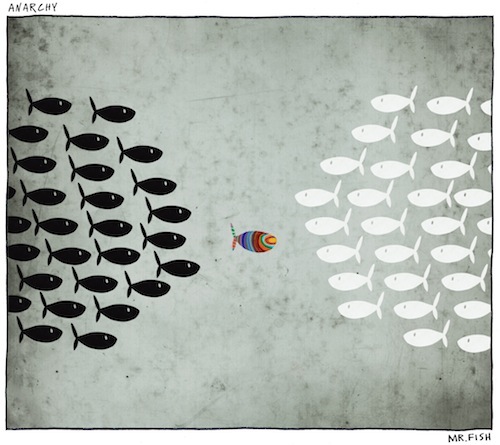
Anarchy


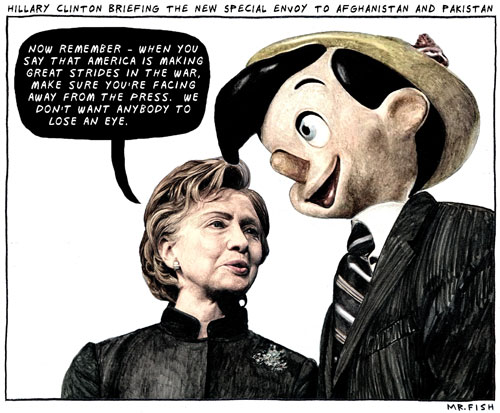
3e965b29aa81029fb7849b42762d9596

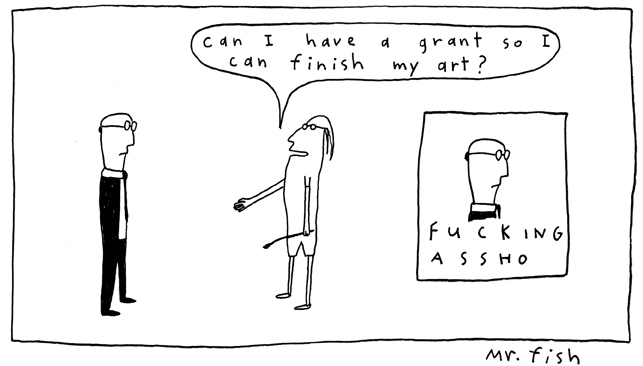
20141013133725-GrantCartoon

Dwayne Booth has been a freelance writer and cartoonist for twenty-five years, publishing under both his real name and the pen name of Mr. Fish with many of the nation's most reputable and prestigious magazines, journals and newspapers. His work has appeared in Harper’s Magazine, the Los Angeles Times, the Village Voice, the LA Weekly, the Atlantic, The Nation, Vanity Fair, Mother Jones, the Advocate, Z Magazine, Slate.com, MSNBC.com and on Truthdig.com. In May 2008 he was presented with a first place award by the Los Angeles Press Club for editorial cartooning. In 2010 and 2011 he was awarded the Sigma Delta Chi Award for Editorial Cartooning from the Society of Professional Journalists. In 2012 he was awarded the Grambs Aronson Award for Cartooning with a Conscience. His most recent books are Go Fish: How to Win Contempt and Influence People, Akashic Books 2011, and WARNING! Graphic Content, Annenberg Press 2014. He is currently teaching at the Annenberg School for Communication at the University of Pennsylvania.

WARNING! Graphic Content: An Interview with Cartoonist Mr. Fish (Part Two)

I was intrigued by your discussion of the classic definition of cartoons as “preparatory renderings.” This is often seen as an archaic or secondary meaning of the concept of the cartoon, but you seem to see it as more closely linked to the kinds of political and culture work cartoons perform. Explain. Yes, like I said in the book, the purpose of a cartoon, both as a preparatory drawing and as a finished piece of commentary published by a newspaper or a magazine, is never to embody perfection but rather to use imperfection to communicate possibility.

Specifically, a cartoon (both iterations of the word) is the beginning of a conversation on any given subject, not the final word, because it more reflects the deliberation over an emotion or an idea than it signifies a proselytizing conviction. To understand precisely what I’m describing, simply compare a propaganda poster that is designed to vilify an enemy or oversimplify a threat to humanity with a cartoon or a piece of fine art that is designed to challenge over-simplification and add complication to an issue so that it more accurately reflects the messiness and multiplicity of real life.


editorial-cartoons-100

While your book’s title suggests an exploration of “political cartoons” and “comix”, there is much work here which would not fit a narrow definition of these terms, including photographs, sculptures, performance art, live action and animated video, and traditional paintings. What accounts for such a surprisingly expansive selection of materials?

True, the book was initially conceived as a scholarly examination of the past, present and future of editorial cartooning but very early in the process, when I was forced to define what an editorial cartoon was prior to making any assertions about its history or purpose, I realized that the definition of the word “editorial” was the exposition of a personal opinion and that “cartooning” was merely the rendering of that opinion in a pictorial form, or at least in a form that wasn’t entirely lingual or literary, a definition that encapsulated other forms of artistic expression such as photography, sculpture, performance art, etc.

Can you say a bit about your process in creating this book, especially what you think you gained by creating such a nonlinear and multimedia text, as compared to doing a printed book? What models did you draw upon in imagining what kind of work you wanted to create? There are places here where I found myself thinking about works as diverse as McLuhan's collaboration with Bucky Fuller, Peter Berger's Ways of Seeing, or Scott McCloud's Understanding Comics. But none of these have the affordances of digital media you drew upon.

It was always my intention to create a book that celebrated and examined art, not as a collection of precious historical artifacts or unique objects that require the context of chronology to have meaning or value, but as an actual living language that I would argue is the most precise and authentic form of communication yet devised by human beings.

Similarly, it was important for me to be able to present the material in such a way that reflected the diversity and expansiveness of art’s voluminous vocabulary, which meant that I needed it to move beyond the fixed confines of being just text and still images. (Reading sheet music is quite a different thing from listening to the sound of instruments being played.)

I also wanted the narrative of the book to reflect the unrestrained and scattered trajectory of every conversation I’ve ever had or overheard on the subject of both art and the meaning of life. To enter into a debate about Bauhaus design, for example, one should also be ready to talk about fascism, the Industrial Revolution, the Labor Movement, Expressionism, Haiku, the 1913 Armory Show, Phenomenology, Existentialism, Minimalism, IKEA, Marx, Upper Paleolithic stone carvings, 2001: A Space Odyssey and the very real difference between factualism and truth.

Both Marshall McLuhan and Berger’s Ways of Seeing were most definitely on my mind while writing this book, as was Wolfe’s The Painted Word, Mailer’s later collection, The Spooky Art and Donald Hall’s Life Work – so, too, was the work of Nietzsche, Fromm, Stephen Davies, Danto and others. In fact, I probably drew more on social philosophers and cultural critics than cartoonists and visual artists when trying to determine the function and significance of art.


fish9

Your book’s title, which warns about its graphic content, seems at first to be ironic but the deeper you get into this work, the clearer it is that you have set out to publish many of the most controversial images ever published -- in part as a celebration of the “uncensored artistic mind.” Were there images here which gave you pause or that presented challenges for your editors? How hard was it to produce a work that was as “uncensored” as this one seems to be?

None of the images contained in the book gave me pause, no. In fact, I just finished a unit on offensive art for a course that I’m teaching at the University of Pennsylvania where I assigned a paper that was designed to prove how the concept of obscenity is a socialized construct rather than an innate reaction to an external phenomenon. For the assignment I asked the students to search for a piece of art that was personally offensive to them and then they needed to defend its right to exist.

After the papers were turned in I asked them to tell me about the experience of searching for offensive art and they told me that the task was nearly impossible when they searched alone because nothing was truly offensive to them. Only when they looked for images with other people around did they feel shock or shame. The exercise was analogous to reading or writing or saying a dirty word while alone versus engaging with so-called obscene language while in a public space; the former inspiring no reaction whatsoever and the latter causing real and genuine discomfort, proving that obscenity, like patriotism, typically requires a herd mentality in order to be conjured.

I also explain to my students that it is in that private space, in that state of aloneness, wherein most artists conceive of their work, which is why some artwork can appear vulgar in its honesty or obscene beyond its intention when viewed in public. Bluntly put, you are more likely to pick your nose or scratch your ass without pause if you are alone than if you are in public and it is within that clarity of purpose and egoless satiation of a dilemma wherein an artist enunciates his or her undiluted utility most succinctly. (And that is why art as a language has greater potential to enlighten, because it operates with fewer restrictions and fearlessly accesses deeper troughs of knowledge with the blade of honesty than publically sanctioned methods.)

The only image from the book that presented any challenge to my editors was the photograph by Hans Bellmer of female genitalia titled I Am God. In fact, it was in danger of being removed unless I could somehow contextualize it within the narrative of my chapter about art that is difficult to look at. The solution, of course, was to add an author’s note that draw the parallel with Gustave Courbet’s famous 1866 painting of the same subject, which was titled The Origin of the World, thusly making the Bellmer piece legitimate by association.

Dwayne Booth has been a freelance writer and cartoonist for twenty-five years, publishing under both his real name and the pen name of Mr. Fish with many of the nation's most reputable and prestigious magazines, journals and newspapers. His work has appeared in Harper’s Magazine, the Los Angeles Times, the Village Voice, the LA Weekly, the Atlantic, The Nation, Vanity Fair, Mother Jones, the Advocate, Z Magazine, Slate.com, MSNBC.com and on Truthdig.com. In May 2008 he was presented with a first place award by the Los Angeles Press Club for editorial cartooning. In 2010 and 2011 he was awarded the Sigma Delta Chi Award for Editorial Cartooning from the Society of Professional Journalists. In 2012 he was awarded the Grambs Aronson Award for Cartooning with a Conscience. His most recent books are Go Fish: How to Win Contempt and Influence People, Akashic Books 2011, and WARNING! Graphic Content, Annenberg Press 2014. He is currently teaching at the Annenberg School for Communication at the University of Pennsylvania.

WARNING! Graphic Content: An Interview with Political Cartoonist Mr. Fish (Part One)

Amongst the many cartoons produced in response to the attacks on the Charlie Hebdo offices in Paris, the one which has stuck most powerfully in my memory is one produced by Joe Sacco, the comics journalist whose book, Palestine, sought to tell another side of the story of the occupied territory, one less often heard in the United States. Sacco saw himself as having certain responsibilities in this incident to challenge the dominant frame, and the result was a searing mediation on the power of images.  Like others, he defended the right of cartoonists to use whatever images they wanted, but he also wanted people to reflect on the impact such images had, depicting "a black man falling out of  a tree with a banana in his hand," "a Jew counting his money," and images inspired by Abu Girab, among other controversial icons.  Sacco writes, "When we draw a line, we are often crossing one too. Because lines on paper are a weapon and satire is meant to cut to the bone. But whose bone? What exactly is the target? And why?" As I encountered Sacco's cartoon, I was reminded of Warning! Graphic Content, a rich and provocative e-book, published by USC's Annenberg Press last fall. The author, Dwayne Booth, the cartoonist who publishes his work under the name, Mr. Fish, at such publications as Harper’s Magazine, the Los Angeles Times, the Village Voice, the LA Weekly, the Atlantic, The Nation, Vanity Fair, Mother Jones, the Advocate, Z Magazine, Slate.com, MSNBC.com and on Truthdig.com.

wanted_500-mr-fish


Fish reflects on the art and craft of political image-making via a long, sprawling, image-rich, multimedia essay.  This book is impossible to describe ... or to forget. Every page includes images that are designed to cut to the quick, images that have been some of the most controversial ever produced, images that force us to think about what they have to say, yes, but also about their power (and a right) to say it. There is something here that is sure to disturb you, but what that is, where we draw the line, is going to differ from reader to reader, and that's the core of the book's argument.

Mr. Fish is a cartoonist who doesn't know his place, quickly abandoning a focus on editorial and political cartoons, and taking us through the full range of artistic expression, as he seeks to encourage us to think more deeply about how art can serve as a provocation or challenge to conventional ways of thinking, about how art can disrupt (or reinforce) the power of the status quo. So, here you will find ideas about propaganda, stereotypes, and a range of phobias, but also ideas about transgression and liberation.


Freddie and Jesus - MarriageMadeInHeaven-500

If you want to download a copy of this multimedia experience, you can do so here.

The moment I saw this book, I reached out to Mr. Fish to see if we could do an interview for my blog.  So, in what follows, you will be able to learn more about his thinking and his work.


You begin the book with a note describing the dramatic decline of the number of editorial cartoonists working in American Journalism today, compared to the way this function thrived at the start of the 20th century. What factors do you think have contributed to this decline and what do you see as its consequences, especially given the many examples you offer across the book who distributed their art through channels other than established publication?

Broadly speaking, I think there are two major factors that have contributed to the demise of the editorial cartoonist as a viable and sought after contributor to the national debate regarding news, politics and culture over the last hundred years. The first and most obvious is the concentration of media ownership and the elimination of independent voices by the formation of publishing and broadcast oligopolies whose power and influence derive from their disdain for creative competition and dissent. Through corporate mergers and outright acquisition of media outlets by companies motivated by the procurement of profit above all else, the very mission of the free press to inform, enlighten, agitate and educate has, over time, become less about serving the public good and more about catering to the demands and expectations of multinational corporations who have an active contempt for a diversity of viewpoints, in particular those that undermine the revenue-centric values of advertisers, shareholders and, by proxy, the consumers who revere and respect the absolute power of the marketplace. As a result, the propagation of any idea deemed inappropriate by the business and political elite for which the publishing industry serves and advocates for is prohibited, hence, the power and purpose of the editorial cartoonist as an agitator and outspoken critic of partisanship and complacency is recognized as a liability rather than an asset when it comes to servicing the ways and means of the revised version of the Fourth Estate.

The second reason why cartoonists can no longer earn a living wage is, of course, due to the total collapse of the print media industry and the inability of online publishers to pay contributors for content, having not yet figured out a financial model that is self-sustaining. And while the aforementioned consequences to the profession of editorial cartooning are certainly devastating, they have no effect whatsoever on the drive and instinct of the visual artist for whom graphic radicalism and pictorial civil disobedience are his or her best weapon against systemic injustice and institutionalized dogmatism made harmless by the status quo.

As it’s always been, the best and most insightful visual art has never appeared in newspapers, nor has it been produced by cartoonists for mainstream publication if only because the very definition of the mainstream insists on pulled punches and language that has been compromised for taste and easy digestion.


Suckers


Some have seen web comics as an important new space where young artists are expressing their visions without needing to go through traditional gatekeepers. Do you see the web as offering opportunities for the kinds of subversive visions you are seeking across the book?

I tend to see the internet as being roughly equivalent to the old party lines offered by the telephone company through the middle of the last century, where multiple parties had equal access to the same phone line and could speak communally or eavesdrop on conversations without reveling themselves. Of course, where there were merely dozens of voices involved with telephone party lines, there are billions involved with the Internet, although I’d argue that there is likely an identical breakdown of meaningful vs. meaningless conversation associated with both.

That said, I do believe that while there are no more subversive visionaries eager to share their genius with the online world than there were deep thinkers to blow the minds of party line listeners, I do believe that the illusion of privacy inherent with online interactions might be inspiring more contemplative listeners and viewers, which is significant.

Previous to the invention of the Internet, radical art drew very few spectators as it was necessary for the viewer to either travel to the location of the actual painting or drawing, or to be seen purchasing a facsimile of it from a store or checking it out from a library, all of which was as a very public proclamation of interest in the controversial subject matter with which the work was associated, something that was ferociously discouraged by the dominant culture and decent society.

Does having access to a larger audience than ever before allow an artist to influence either members of a society or the architects of power any more than previous artists who were known to fewer people in the past? I’ve seen no real evidence of that. If anything, in fact, I’d say that the Internet has neutered political protest and dissent by isolating and individualizing the experience of ‘revolution’ and making the likeminded community of fist-raising comrades virtual and not publically demonstrated.

The same is true for television: there are likely more well-informed critics of the federal government nowadays than there was 20 years ago, given the work of Jon Stewart and Stephen Colbert, yet the likelihood of genuine political revolt or organized protest is no greater than it ever was because the experience of outrage aimed at buffoonish and corrupt leaders is isolated and practiced in private as mere entertainment consumption.

Dwayne Booth has been a freelance writer and cartoonist for twenty-five years, publishing under both his real name and the pen name of Mr. Fish with many of the nation's most reputable and prestigious magazines, journals and newspapers. His work has appeared in Harper’s Magazine, the Los Angeles Times, the Village Voice, the LA Weekly, the Atlantic, The Nation, Vanity Fair, Mother Jones, the Advocate, Z Magazine, Slate.com, MSNBC.com and on Truthdig.com. In May 2008 he was presented with a first place award by the Los Angeles Press Club for editorial cartooning. In 2010 and 2011 he was awarded the Sigma Delta Chi Award for Editorial Cartooning from the Society of Professional Journalists. In 2012 he was awarded the Grambs Aronson Award for Cartooning with a Conscience. His most recent books are Go Fish: How to Win Contempt and Influence People, Akashic Books 2011, and WARNING! Graphic Content, Annenberg Press 2014. He is currently teaching at the Annenberg School for Communication at the University of Pennsylvania.

Peru's Digital Futures: An Interview with Anita Say Chan (Part Two)

  Can you talk a bit about the role which gossip and rumor plays in your book? How might we think about the social networks that get expressed through gossip in relation to the more technologically-based networks that we often think about in discussing new media?

Gossip and rumor here were local means of contesting the dominant narratives around information age reform being pushed from the state and empowered development institutions. I draw here from postcolonial theory and framings of gossip and rumor as means of being able to contend with colonial narratives by subaltern actors. Part of my leveraging of postcolonial theory to frame the workings of rumor and gossip in this particular context of information age production was to offer a distinct framings of gossip and rumor than the version which typically gets focused upon when they are taken up as topics in digital studies.

These conventional framings in digital studies take for granted gossip’s circulation within a Western, advanced consumer society context, where rumor and gossip are typically framed as false news, or commodities manufactured for consumption, or tools to drive online consumer traffic. That rumor and gossip might have other functions, including operating as imagined foils rather than aids to market flows, or that they might function as attempts to add “noise” to the over-amplified narrative and signal of the state, is easily overlooked. There’s clearly plenty to gain, though, from bringing the insights of postcolonial theory into interface with information studies and digital ethnography.

In many ways, your book deals with the comparisons in how two internationalizing discourses collide with the local in Peru -- the first has to do with neoiberalism and global markets, the second has to do with Open Software and the development of a kind of global hacker culture. Can you discuss the similarities and differences in these developments and especially in terms of the intersections between global and local concerns?

Part of what I intrigued me about the state’s approach to information society-based initiatives in Peru, was the means by which both urban free software geeks and hackers and rural artisan communities could be targeted as ideal subjects for reform, as well as ideal partners for the Peruvian state in extending and extolling the gains of its new ICT-based plans. In other words, communities that in many ways might look radically distinct from and even opposite to one another – one party representing the height of dynamic information age expertise and future development, and the other representing slow tradition and indigenous craft from the rural provinces – could be simultaneously summoned and targeted as key partners in economic development for the information age Peruvian state.

The key here seemed to turn on the means by which knowledge work and knowledge production could be framed. And while there is a large and significant literature on technology policy in the global south that emphasizes the north as the template from which technology policy and practice get copied, here we see something somewhat more nuanced unfolding within the state logic. Definitions of knowledge work and knowledge production were rather craftily and savvily understood by Peruvian government actors to encompass “traditional and indigenous” knowledge” production as well as high-tech coding and engineering work.

And while this might sound like a rather progressive advancement, I unpack in the book how such heightened investment and targeting by the state brings about rather complicated and not always promising outcomes for traditional artisan communities or networked geek and free software advocacy communities alike.

As you note, out of 40 countries who invested in the One Laptop Per Child initiative, Peru was the only one which came close to meeting the 1 million units that the foundation had demanded as the minimum commitment when the project launched in 2005. This makes Peru an important test site not only for the One Laptop Per Child project but also some of the underlying assumptions about technological change that informed it. Based on your research, what would you tell the folks at MIT who advocated for this project about what did and did not work in Peru?

To take more seriously the experience and wealth of expertise of their local partners, and not to make the conventional and all too oft-repeated mistake of presuming that the knowledge of the world’s most elite engineers is sufficient to conquer any and every global problem or situation. The global spaces where new technological deployments aim to travel today are obviously complex terrains – geographically, culturally, historically and politically – where the knowledge and experience of local partners are not only complementary, but are deeply necessary to successfully sustain any new technological deployment.

These are sites too, where the presumptions of cosmopolitan designers and engineers, no matter how well trained and globally literate, just can’t always be taken for granted. I was surprised to see how lightly deployment engineers and technicians frequently took such considerations, and how little was often invested into gaining an understanding of the layered local histories and cultural complexities of distinct deployment sites.

It was rather common to find OLPC designers, including ones who considered themselves to be invested in deployment sites in Peru, who knew very little of the knowledge and cultural practices of indigenous communities where deployments could be situated; or who knew little of recent political conflicts and uprisings in opposition to contemporary policies of the state that impacted other local deployment zones.

As a simple example of how large such local knowledge gaps were, there were situations in observing the deployment of the One Laptop Per Child Project in Peru, for instance, where highly respected lead engineers on projects entered rural communities expecting to pay for purchases with a credit card, and this was literally several years after OLPC deployments in Peru had already begun.

Gaining mutual understandings around differences in technological uses and literacies, is key and requires hard work. And as important is the work necessary to gain mutual understandings and literacies in the deeply layered cultural, political, and historical contexts that deployments are bringing designers into intimate contact with.

Your analysis of the open software movement in Peru comes to hinge on the transformative potential of play. What are some of the ways that play was conceptualized in Peru and how did playing with technologies open up space for imagining change at an institutional level?

It’s no secret that there’s been quite a lot of hype around the means by which the Internet economy fosters creative work and spaces that accommodate individual freedom, play, and flexibility. The fantastic narratives that surround Google campuses as play spaces – as well as their hyper mediation in the popular press -- epitomize such framings, that arguably build towards a kind of “end of labor” narrative. And even while studies show that leading Internet companies like Google and Amazon – actually have among the highest rates of worker turnover and employment instability among all Fortune 500 companies, the notion that the digital economy somehow fosters the most ideal work conditions that can bring about an end to the problems of discontent and exploited labor, persists.

Against these popular framings, there is a growing and much needed scholarly literature on the expansion of playbour and the blurring lines between play and labor in the digital economy. This scholarship critiques, rather than celebrates, the undoing of the binary between the two supposedly polarized poles of play and labor, and has emphasized how play logics can actually operate to enable a more efficient extraction of labor from knowledge workers.

My research on play in Peruvian geek and free software networks revealed some distinct developments around “play” instead – which lead me to draw less from political economic framings of labor, and to instead draw from psychoanalytic, critical theory and anthropological framings of play. These framings emphasize play as a kind of liminal space and condition – one that enables “the real” and the “given” to be tested by actors, to imagine the “world as otherwise” -- and that thus understands a certain degree of interpretive work being done, as well as potential for social transformation, that are contained within conditions of play.

You could see the free software community members in Peru grappling with these dynamics of play in some of my chapters. Another clear contemporary example of the means by which digital publics in Peru also engage these dynamics of play are in the massive social movements and street protests that literally overwhelmed the public spaces in Peru in protest of Ley Pulpin (the formerly passed labor law I mentioned earlier).

Just as spectacular as the wave upon wave of massive street protests, were the massive waves of online traffic, social media exchanges, and multiplying hashtags that the law’ critics used to denounce the law – and here, it was primarily online satire, satirical memes, absurd jokes and political humor – that blend the popular aesthetics with the popular accessibility of digital networks to express political critique. See for example.

This was a tactic adopted by AnonOps Peru hackers and average citizens alike. And indeed, after nearly two months of massive unrest that filled the streets (and social media networks) with amplified protesting voices, the new labor law was finally overturned. The same networks are still engaged in political organizing in response to a range of other pressing national issues, ranging from labor rights to media content and censorship. It’s yet another sign, among the others the book highlights, of other technological futures being struggled for by a range of diverse publics at the so-called “periphery” and beyond.


Anita Say Chan is an Assistant Research Professor of Communications and an Assistant Professor of Media Studies in the Department of Media and Cinema Studies at the University of Illinois, Urbana-Champaign. Her research and teaching interests include globalization and digital cultures, innovation networks and the “periphery”, science and technology studies in Latin America, and hybrid pedagogies and collaborative research for the digital humanities. Her manuscript on the competing imaginaries of global connection and information technologies in network-age Peru, Networking Peripheries: Technological Futures and the Myth of Digital Universalism was published with MIT Press in 2014. Her research has been awarded support from the Center for the Study of Law & Culture at Columbia University’s School of Law and the National Science Foundation, and she has held postdoctoral fellowships at The CUNY Graduate Center’s Committee on Globalization & Social Change, and at Stanford University’s Introduction to Humanities Program.

Peru's Digital Futures: An Interview with Anita Say Chan (Part One)

The language we use to talk about the World Wide Web is often universalizing: the web is seen as exhibit one in the argument that the world is flat, thanks to the ability of messages to travel from any point to any other point. For others, the Web is an Americanizing force, one which has made English an even more pervasive language among the world's youth than ever before, one which is transforming governments and altering cultures without regard to the desires of local residents. Anita Say Chan's Networking Peripheries: Technological Futures and the Myth of Digital Universalism adopts a position somewhere in between in part by starting with a straight forward but surprisingly rare move -- she shifts the attention away from the digital cultures of North America and Europe, focusing instead on what the coming of the web has meant in the context of the global south and in particular, in the context of Peru. Her focus shifts chapter by chapter, from the stories of indigenous artisans struggling over what the future of their craft is going to look like to the saga how the One Laptop per Child initiative got taken up in rural classrooms. Her approach is skeptical, but not cynical, about claims of digital advocates that all of these changes are for the best, being attentive to shifts in local autonomy and the impact on who has power within the culture.  She writes about the impact of new media on traditional and emerging forms of intellectual property with an ethnographic perspective, one which is attentive to both universalizing and localizing forces on how people live their everyday lives.  Chan shows us the power that comes from de-centering the study of new media, from understanding media change from the peripheries.

Chan was a classmate of Candis Callison, whose book on climate change I featured on my blog last week. Chan and Callison were contemporaries entering our Comparative Media Studies Masters Program at MIT -- the second cohort admitted to the program. I was lucky enough to watch them grow as media scholars and then to be able to turn them over to the faculty at MIT's PhD Program in History, Anthropology, and Science, Technology, and Society. Both of them have published their first books in recent months, and it's a great pleasure to be sharing some of Chan's thoughts via this interview.


You begin the book’s preface with this core question: “Why study digital culture and information technology (IT) in Peru?” And you take much of the book to fully address it. Can you provide us a brief overview of your response here?

Briefly, I underscore how that very question originates from a perspective on IT and the digital – one that’s changing, but still dominant – that presumes that there is a single digital future in the making that naturally extends from given centers of innovation and engineering, like Silicon Valley, MIT or Stanford. And according to this perspective, it’s this single digital future in the making that somehow, inevitably awaits the rest of the world.

This kind of imaginary, and the taken-for-grantedness of spaces like Silicon Valley as the center of the digital universe and its universalizing future, operates so powerfully that it’s easy to forget that even with Silicon Valley based companies like Twitter and Facebook, most of their user bases (and thus increasingly, revenue futures) lie well outside of the US; that the number 1 tweeting city in 2012 was nowhere near Silicon Valley, but was in fact Jakarta, Indonesia , and that statistics show that native English speakers online will soon be (and likely already are) outnumbered by Chinese native speakers. Yet despite such clear developments, there still remains a powerful presumption that sites like Silicon Valley are behind the digital future that naturally awaits us all.

In the book, I argue that the kind of thinking expresses a kind of Digital Universalism that disguises the means which elite designers and entrepreneurs of the IT world’s leading corporations work to promote and circulate it – whether in the pages of Wired magazine or across any number of TED conference stages. It also disguises the diverse imaginaries and investments around the digital that are cropping up all over the world, including in Peru, from diverse civil society actors - but that are easy to overlook when we focus our attention only on those coming out of just a handful of innovation centers.

Peru, for instance, was the among the first countries to propose national legislation for the use of free and open source software in public office in 2001. It was the first nation chosen by the United Nations to host its conference on the use of free and open source software in Latin America and the Caribbean in 2003. It became the largest national partner for the MIT-launched One Laptop Per Child educational laptop initiative in the late 2000s, when it pledged to deploy nearly 1 million XOs to classrooms across the rural provinces and cities alike. And AnonOps Peru, the Peruvian branch of the networked collective Anonymous, has been especially active helping to mobilize the massive waves of protests that just managed to overturn a new labor law, Ley Nº30288, known popularly as Ley Pulpin (that targeted youth workers, and that many interpreted to be an erosion of labor rights overall) -- after city streets all over the country were filled with protestors in week after week of sustained demonstrations.

Your book’s title includes the evocative phrase, “the myth of digital universalism.” What do you mean by this? Where does this myth come from? And in what ways does your book debunk this myth?

Simply put, there are many digital futures, constantly in the making by a diverse range of actors, including those at the “periphery” of innovation centers, but who are far from simply passive recipients of a digital destiny supposedly being made for them from elsewhere. Digital Universalism distorts our perception of how diverse (and still undetermined) those investments around the digital really are by insisting that we keep our attention focused only and exclusively on future visions being spun out from centers of digital innovation. We shouldn’t forget how powerfully such a message operates when it’s directly promoted and reinforced by some of the tech world’s most powerful and seductive corporate leaders and entrepreneurs, who today, have not only become household names worldwide – but who often take on the roles of global ambassadors or sorts, arranging one on one meetings with government leaders that seemingly overnight, can turn their own visions of the technological future into nationally deployed policy.

My own work has been to disrupt such limited but repeatedly amplified visions of a technological future, by turning a spotlight on the many diverse imaginaries and investments around the digital that we find cropping up at the so-called “periphery,” and from diverse civil society actors. In Peru, this includes some of the parties I highlight in the book: rural artisans recruited as partners for new intellectual property for development programs; urban geeks and hackers working around free software advocacy networks; and collaborations around digital education projects in the Andes that bring the expertise of indigenous language activists, rural teachers, and free software coders into novel interfacings.

You use the example of what happens to ceramics craftspeople in Chulucanas to explore the ways that the neoliberal agendas of nation-states in regard to IP and IT can have unintended consequences on the grounds for the lives of rural and indigenous populations. What can we learn from looking at this particular example? In what sense was the outcome “not brave but brutal”?

The chapter highlights the ways that radical, neoliberal policy reforms and the demands of information age economic transformation can be narrated by their promoters as indeed, heroic, brave, and necessary. What’s striking is how such policy promoters can acknowledge that the kinds of reforms they advance might be deeply disruptive (or even largely destructive) of other social resources, established traditions or institutions, but how they can at once insist that the scale of market optimizations projected – ones that are almost always narrated as promising not only reform, but economic salvation – will ultimately be worth the price of destruction.

In Chulucanas, what we actually saw were family and kinship networks -- the kinds of social support networks that artisans traditionally relied upon for ceramics production -- devastated, following the state’s initiative to push intellectual property titlings as a means to reform traditional craft production for export in the village. Distrust and pitched competition between artisans grew palpably, and traditional production practices that had been maintained as a regional knowledge practice and tradition since the literally thousand of years when the pre-Colombian Vicus and Tallan civilization settled northern Peru’s coasts, eroded in the interest of newly optimized, export-scaled production. It that sense, such contemporary reform policies were quite literally brutal.


Anita Say Chan is an Assistant Research Professor of Communications and an Assistant Professor of Media Studies in the Department of Media and Cinema Studies at the University of Illinois, Urbana-Champaign. Her research and teaching interests include globalization and digital cultures, innovation networks and the “periphery”, science and technology studies in Latin America, and hybrid pedagogies and collaborative research for the digital humanities. Her manuscript on the competing imaginaries of global connection and information technologies in network-age Peru, Networking Peripheries: Technological Futures and the Myth of Digital Universalism was published with MIT Press in 2014. Her research has been awarded support from the Center for the Study of Law & Culture at Columbia University’s School of Law and the National Science Foundation, and she has held postdoctoral fellowships at The CUNY Graduate Center’s Committee on Globalization & Social Change, and at Stanford University’s Introduction to Humanities Program.

How Diverse Publics Understand Climate Change: An Interview with Candis Callison (Part Three)

As you note, there has been a struggle throughout much of the 20th century between fundamentalist Christianity and science, particularly around the topic of evolution, but also around issues of sexuality and reproductive rights. How have some evangelical leaders been able to reconcile a concern for climate change with skepticism about what their members often see as the “ideological” nature of modern science? One of the groups I interviewed were the leaders behind Creation Care, which was a kind of sub-movement at the time of my research in the mid to late 2000s. These were the same people who had worked on “What would Jesus drive?” a highly successful campaign to turn transportation into “a moral issue” for Christian communities.

What one of these leaders told me explicitly is that who is speaking matters to a great extent in terms of establishing the credibility of climate change as a concern within evangelical communities. He called it “blessing the facts,” and told me that the right “messengers” were required in order for evangelicals to take climate change seriously as an issue of concern that required their involvement and action. Climate change for many evangelicals is caught up in politics, science, and environmentalism, and he argued that such messengers are required in order to steer through all of that and make it about “stewardship” and part of the moral and spiritual obligation of Christians.

In some cases, this means mobilizing evangelical leaders, but in other cases, it means bringing in scientists who are also Christians. For example, the head of Working Group 1 for the 2001 Intergovernmental Panel on Climate Change reports is an active and vocal evangelical and a leading scientist. The history of evangelicals with evolution debates and court cases in the U.S. still matter to many, but it isn’t a central issue in need of resolving for those working on climate change. Rather, those I spoke with sought to rearticulate concern for the environment from and within Biblical frameworks hence the term, Creation Care as an alternative to environmentalism.

This goes back to the earlier point I raised about vernaculars. Those who ‘bless the facts’ aren’t rubber-stamping the science; it’s a much different and more nuanced process based on the moral and ethical contours of climate change. The credibility of messengers, as adjudicators of truth and of what’s meaningful within a Christian context, enable them to articulate climate change as a real and science-based issue that needs to be taken seriously because of what the Bible says about taking care of the poor, caring for Creation, etc. So the scientific facts do matter, but they also come with historical and political baggage, and facts by themselves are not an exclusive route to establishing why climate change should be taken seriously.

Many discussions of the climate change debate posit corporate America primarily as villains, who promote skepticism about climate change claims as a means of protecting their own economic interests or defending their current practices. Yet you also point towards a number of corporate efforts to combat climate change. How effective have these efforts been? When and how do they move beyond what some have called “greenwashing”? How are they able to reconcile support for environmental reform with the profit motives which drive Wall Street?

In the book, I look closely at the work undertaken by Ceres, a Boston based corporate social responsibility organization. They aren’t the only group working on climate change and CSR, but they are one of the leading voices, having focused on this issue since the early 2000s.

Ceres was fascinating for me because it took me out of the world of religion, human and indigenous rights, journalism, science, and democratic obligations and into a radically different set of societal institutions where profit, risk, and investment are the key terms. What Ceres has worked to achieve is a transformation of concerns about climate change into investor concerns that may affect future profits and the stability of corporations. Climate change presents a risk to investors that must be accounted for and managed, and Ceres uses a range of mechanisms to help companies articulate these risks related to climate change as well as the actions they are taking to mitigate these risks.

This discursive shift from climate change to climate risk has produced a powerful response within financial frameworks. It’s not without some critique from those who think Ceres could require more from the range of companies they deal with – particularly those whose bottom line is predicated on contributing to carbon emissions. However, mobilizing a business vernacular in order to reframe climate change as a problem that companies must address is an innovative way of moving towards what Ceres hopes will be increasingly progressive corporate action.

There is a tendency to discuss science in terms of rationality and facts, yet throughout your book, you point to the importance of faith, ethics, morality, and other “softer” human values in shaping how and why people embrace or reject such arguments. How might we develop arguments that better bridge between science and faith, rationality and emotion, pragmatism and morality when thinking about these issues?

In considering climate change as only (or primarily) a science-based or science-laden issue, deeper ethical and moral discussions about our relationships to the natural world and to each other often get lost. This doesn’t mean that scientific findings aren’t vital to understanding climate change, but rather: for broad and diverse publics to come to care about the issue and care enough to take actions about it, climate change needs to become much more than a scientific concern.

In the book, I refer to this as the persistent "double bind" related to climate change – where in order for a rationale to act on the issue to emerge, we must maintain fidelity to scientific findings and move beyond them at the same time in order to explore moral and ethical contours related to the issue.

Recognizing the power of social affiliations and networks and accompanying moral and ethical concerns alongside evidence-based analyses and predictions does take us towards a potentially robust and even more rambunctious public discourse. We have yet to develop the kinds of digital and/or other mechanisms that would actively facilitate this discourse. We’re barely past the gate in terms of thinking beyond a broadcast model of news and information, and in terms of contending with differing epistemologies.

I do think there are glimmers of hope here and there as social movements like Occupy and Idle No More (a Canadian indigenous-led movement) demonstrate in various ways both in terms of their use of media and in bringing together varied groups. My hope is that this book contributes to broader thinking about the social and communal life of facts, and to contending with what it means to have shared goals without shared assumptions about how evidence has come to matter.


Candis Callison is an Assistant Professor at the University of British Columbia in the Graduate School of Journalism. She holds a Ph.D. in History, Anthropology, and Science, Technology and Society and a Master of Science in Comparative Media Studies -- both from MIT. Her research and teaching are currently focused on changes to media practices and platforms, journalism ethics, the role of social movements in public discourse, and understanding how issues related to science and technology become meaningful for diverse publics. Her new book, How Climate Change Comes to Matter: The Communal Life of Facts (Duke University Press, 2014) uses ethnographic methods and a comparative lens to bring together the work of professional and social groups working to engage diverse publics in an American context. Building in part on this research, Candis has recently begun new research looking at Arctic-based journalism in an era of environmental change, digital media, and global audiences. She is also midway through two research projects that investigate how social networking technologies like Facebook and Twitter are being used both by indigenous communities and by the indigenous-led social movement, Idle No More in Canada. Prior to her academic life, Candis worked as a journalist in Canada and the U.S. for television, radio, and early incarnations of the Internet (think dialup and early broadband). She is a member of the Tahltan Nation located in Northwestern British Columbia.

How Diverse Publics Understand Climate Change: An Interview with Candis Callison (Part Two)

You argue that part of the problems is that scientists and journalists have conflicting professional ideologies, which prohibit both groups from being strong advocates for the importance of climate change and the values of any particular plan of action. Explain. What initially got me interested in thinking about climate change were the debates I had encountered between scientists and journalists about whose fault it was that the public didn’t care (enough) about climate change. Yet, when I began researching this problem, I encountered a lot more common ground between scientists and journalists than might be obvious at first glance, particularly in regards to observing and negotiating with professional expectations of objectivity, distance, and independence.

Encountering the findings of climate change – whether as a scientific researcher or journalists, produces a variety of responses for many that I talked to for this book. For some, there is an absolute obligation as a citizen or as an expert to do something about the predictions related to climate change. For others, there is an obligation to speak about the findings only. Some scientists reach out directly to the public or work through social groups, or even more simply, just endeavor to return the call of reporters.

I came up with the term “near-advocacy” as a way of discussing and acknowledging the wide spectrum of responses that emerge as a result of knowing the facts related to climate change (and often as well, knowing what isn’t known and the long tale of unlikely probabilities that create some of the gravest concerns). Advocacy is a still “a third-rail” for many high level professionals who work in science and journalism. Most don’t want to be associated with or slotted into left or right politics such that their credibility as science experts or journalists is compromised. And yet, these same professionals are often the ones most able to speak about the state of climate change findings and predictions. Navigating what has become a very tricky political and politicized terrain is definitely not for those who lack conviction about the role of science in society.

You note that journalists often struggle with the need to distinguish their role in informing the public with other potential functions such as educating the public about science or advocating for particular policy changes. Why have these functions proven so challenging to work through in relation to climate change? How does the climate change debate bring into sharper profile questions about how journalism functions in the contemporary media landscape?

One of the funniest metaphors I encountered that captures the challenges journalists face was from a journalist who described reporting on climate change as akin to “parking your car under a bunch of starlings.” Whenever I quote this in a talk, I always show a car covered in bird shit and get a good laugh.

It’s poignant on a bunch of different levels because it demonstrates the ways in which journalists enter into rambunctious, concerned, and diverse debates when they report on this issue. I argue that this not only speaks to the kind of issue climate change is, but also to the changing structures, norms, and practices facing journalists as a result of the rise of digital media.

Journalists are now not only expected to report on issues and put information out on a 24/7 basis, but they are increasingly expected to be verifiers and chief discussants. Journalistic methods and approaches as well as the facts they relay have never been more open to public scrutiny. In this sense, climate change is an exemplary issue with much at stake in terms of public engagement, policy, and the circulation of information.

Much of the concern about how climate change is reported on stems from the persistence of climate change denial and mis-information -- despite the widespread scientific consensus that climate change is a very real problem with a range of predictions and probabilities. For journalists, the spectre of denial is something they have to contend with constantly whether in response to stories or in the choice of experts. This past year at least one major science publication closed off its comment sections after stories, citing the response to climate change stories in particular.

Recent research has shown that this kind of debate does seem to affect public perception of whether there is scientific consensus, but I also think it’s vital to develop much better digital tools for dealing with these kinds of problems related to public debate and engagement. Shutting off comment sections doesn’t solve the issue, nor does it reflect the robust commitment to democratic discourse that many, including me, argue is required particularly on contentious and far-reaching issues like climate change.

You start your discussion with a consideration of the roles which indigenous peoples, especially those who live in the Arctic region, are playing in informing the climate change debate. What value do you think these forms of indigenous knowledge contribute ? In what ways have their voices been hi-jacked by other players and through what means have they learned to be more effective at speaking for their own interests?

When the Arctic Climate Impact Assessment (ACIA) was released in the early 2000s, it received a lot of attention because of the kinds of predictions it made about how climate change would affect polar regions. It also represented one of the first major and comprehensive attempts to combine indigenous knowledge with scientific knowledge. Indigenous knowledge about the natural world comes out of a different system, tradition, and methodology so this kind of work – bringing scientific and indigenous knowledge together is not an insignificant challenge. In the book, I look at this challenge from varied perspectives, recognizing the diverse ways in which traditional knowledge offers important insights both historically and currently.

What initially got me interested in the Arctic was the human rights claim that was brought by Inuit leaders and elders before the Inter-American Human Rights Commission. The claim was intended not only to put indigenous experiences with climate change in the Arctic before a wide public, but also to confront U.S. policymakers regarding their inaction on the very real and ongoing effects related to climate change. As the ACIA had shown and as much of the testimony offered by Inuit hunters and leaders articulated very powerfully in the claim, their ways of life, their means to support their communities, and their culture were being drastically affected by changes to sea ice, permafrost, and other environmental changes.

I come from an indigenous family, and my father is a longtime hunter and outfitter in my First Nation in northern B.C. so these kinds of stories captured my attention immediately. But, when I began to speak to Inuit leaders, I also began to see that climate change, while being a huge issue, was also the latest in a long line of challenges that have required their communities to deal with scientific researchers, media, geopolitics, resource development, and multiple national interests. The book provides a glimpse into how Inuit leaders were navigating both the needs and conversations going on at the level of villages and regions as well as transnational networks and discourses in order to influence Arctic policies and decision-making.

Candis Callison is an Assistant Professor at the University of British Columbia in the Graduate School of Journalism. She holds a Ph.D. in History, Anthropology, and Science, Technology and Society and a Master of Science in Comparative Media Studies -- both from MIT. Her research and teaching are currently focused on changes to media practices and platforms, journalism ethics, the role of social movements in public discourse, and understanding how issues related to science and technology become meaningful for diverse publics. Her new book, How Climate Change Comes to Matter: The Communal Life of Facts (Duke University Press, 2014) uses ethnographic methods and a comparative lens to bring together the work of professional and social groups working to engage diverse publics in an American context. Building in part on this research, Candis has recently begun new research looking at Arctic-based journalism in an era of environmental change, digital media, and global audiences. She is also midway through two research projects that investigate how social networking technologies like Facebook and Twitter are being used both by indigenous communities and by the indigenous-led social movement, Idle No More in Canada. Prior to her academic life, Candis worked as a journalist in Canada and the U.S. for television, radio, and early incarnations of the Internet (think dialup and early broadband). She is a member of the Tahltan Nation located in Northwestern British Columbia.


How Diverse Publics Understand Climate Change: An Interview with Candis Callison (Part One)

The debate about climate change can often seem perplexing for those of us who take the foundations of modern science seriously.  We can become deeply cynical about why certain players refuse to accept "established truths" and become frustrated by the inability of governments to act decisively to curtail behaviors that are helping to create long-term "risks" for the future of humanity and the planet. Yet, we are never going to make progress in such debates, Candis Callison argues, unless we understand what she calls "the communal life of facts," unless we develop a deeper understanding of the different epistemological commitments held by diverse players in this argument. Candis Callison's recently released book, How Climate Change Comes to Matter: The Communal Life of Facts, is a spectacular example of how ethnographic work, especially work informed by the science, technology, and society perspective, might inform our ongoing debates around the environment.Here's what I said in a blurb for the book:

"A gifted storyteller who brings enormous empathy and nuance to each group she documents, Candis Callison depicts the current discursive struggles over climate change, as such diverse players as corporate responsibility advocates, evangelical Christians, and Inuit tribal leaders, not to mention scientists and journalists, seek to reconcile the need for dramatic change with their existing sets of professional norms and cultural values. This is essential reading for anyone who wants to better understand how science gets refracted across an increasingly diverse media landscape and for anyone who wants to understand how they might be more effective at changing entrenched beliefs and practices."

Callison's work ultimately raises core questions around the public communication of science, sharing insights around how advocates and activists might transform this debate. Before she gets there, she seeks first to understand in subtle and complicated ways why these various players believe what they take to be true about our relationships with the natural world. As she does so, she develops a robust account of different  "vernacular" models of climate change that have to be aligned before we can make progress in dealing with these concerns. We are speaking past each other because we see the world in such fundamentally different ways and we will never convince each other unless we understand the diverse languages through which this debate is being conducted. This books makes an important intervention into what remains one of the central controversies of our time.

I read this book with much personal satisfaction. I had been lucky enough to work with Candis Callison, when she was a masters student in the MIT Comparative Media Studies Program more than a decade ago, having come to us with an already established professional career as an award-winning journalist. She went on to complete her PhD in Science, Technology, and Society, also at MIT. She is now  an Assistant Professor at the University of British Columbia in the Graduate School of Journalism and How Climate Change Comes to Matter is her first book, based in part on her dissertation research. Callison was already an intellectual leader in her graduate cohort  in part because of the enormous respect the faculty and other students had for her deep ethical and political commitments, including her desire to use her scholarship in the service of the indigenous community where she grew up in Canada.  I am so proud of the kind of scholar she has become.

Your introduction suggests that you are seeking to better understand a range of vernacular accounts of climate change. How are you defining vernaculars and what do you see as the relationship between scientific expertise and these more popular modes of describing environmental issues?

First of all, thanks for reading my book and for the kind words you say about it. I’m deeply grateful I got to start my graduate life at MIT in Comparative Media Studies. CMS and your Media Theory class are what started me on a path to thinking more broadly about the many and diverse roles media play in, with, and around public engagement.

I started contemplating using the term, vernacular, because of what I experienced when I talked with people who were actively working to mobilize their concerns about climate change. The ways they were talking about climate change drew to a great extent on how they experienced the world, what mattered to them, and how they conceived of a future they wanted for themselves, their social group – and often, for society as well.

The way I’m using the term vernacular borrows from linguistics, philosophy, and anthropology in order to describe these processes I saw unfolding during my fieldwork. How climate change comes to be meaningful outside of a scientific context depends on how it gets talked about and reframed/reformatted/recontextualized within what people are already concerned about. So, for example, Inuit leaders who were at the forefront of global negotiations around climate change talked about it outside of their communities as a human rights issue in order to account for the fundamental changes that have already begun in the Arctic that will affect their ways of life, their cultural and social practices, and the location of their communities.

What was really interesting to think about is how very different concerns related to climate change sound in other contexts. For corporate social responsibility advocates working with Wall Street investors and corporate leaders, climate change concerns were rearticulated as “climate risk” in order to situate the issue within existing financial frameworks that require attention to fiduciary obligations and responsibilities and an accounting for risks that would harm an investment.

In a church setting, evangelicals talked about climate change as being part of Bible-based concerns and dictates to care for the poor and to be responsible stewards of creation.

You describe this debate as much in terms of questions about why the public should care about climate change as  about who or what they should believe. What are some examples of the reasons the groups you study offer for why their members should care about climate change?

Who and what is considered expert is related to a great extent to credibility, and yet how/where are our ideals of credibility formed? In our daily lives, many will trust the word of a New York Times reporter or a MIT-trained scientist – and we’re likely to assume everyone else does too. Our ideals about who and what is credible are inherently social and cultural, based on collective and historical experiences with institutions and a trust in the methods used to arrive at conclusions, analyses, and predictions. That’s the logic behind much of the work done by many environmental activists – they appeal to wide publics to act, based on evidence most will agree is credible.

Amongst those I interviewed and researched for this book, I encountered this straightforward route, but also, a range of alternative means of establishing credibility and expertise. So, my research became about trying to understand the many ways and means by which scientific evidence comes to matter, what kind of an issue climate change is in specific contexts, and how it is articulated as an issue of concern.

I often half-joke now that I would like epistemology to become a household or ‘headline’ word because how we know what we know -- and how facts get established -- are becoming increasingly open to scrutiny. Just look at the comments after an online story and you see this play out in various ways. But, and this is equally crucial then, the facts that we come to care about and why/how we decide to care about them -- the routes by which concern becomes established -- are equally important.

Candis Callison is an Assistant Professor at the University of British Columbia in the Graduate School of Journalism. She holds a Ph.D. in History, Anthropology, and Science, Technology and Society and a Master of Science in Comparative Media Studies -- both from MIT. Her research and teaching are currently focused on changes to media practices and platforms, journalism ethics, the role of social movements in public discourse, and understanding how issues related to science and technology become meaningful for diverse publics. Her new book, How Climate Change Comes to Matter: The Communal Life of Facts (Duke University Press, 2014) uses ethnographic methods and a comparative lens to bring together the work of professional and social groups working to engage diverse publics in an American context. Building in part on this research, Candis has recently begun new research looking at Arctic-based journalism in an era of environmental change, digital media, and global audiences. She is also midway through two research projects that investigate how social networking technologies like Facebook and Twitter are being used both by indigenous communities and by the indigenous-led social movement, Idle No More in Canada. Prior to her academic life, Candis worked as a journalist in Canada and the U.S. for television, radio, and early incarnations of the Internet (think dialup and early broadband). She is a member of the Tahltan Nation located in Northwestern British Columbia.

In Defense of Moe: An Interview with Patrick W. Galbraith (Part Six)

Many of us have a strong sense that gender differences are enforced in Japanese culture. I had the experience of crossing to the wrong section of a manga shop in Akihabara and seeming to create some consternation amongst the other patrons. Yet, in many ways, moe itself involves various kinds of transgressions of gender barriers – men consuming texts created initially for a market of young girls. Can you share with us a bit more about the ways gender is reinforced or transgressed in the moe culture you are describing? What does moe masculinity look like? First of all, I don’t want to give the impression that moe is somehow limited to male fans of media featuring or originally targeting young girls. For one of my first major research projects in Japan, I spent a year with female fans of manga and anime, who referred to themselves as fujoshi, which means “rotten girls.” Why rotten? Well, because they enjoyed watching manga and anime featuring charismatic male characters, who they then would imagine sexual relationships between. They drew fanzines about these imagined romantic and sexual relationships, which they called “couplings,” and then sold these fanzines at conventions or published them online.

Their activities are not really that different from the writers of slash fiction that you wrote about in Textual Poachers, except that they typically were interested in characters from manga, anime and games rather than live-action TV shows and film. This is simply a reflection of the prevalence of manga and anime in Japan, which provides charismatic male characters. Also in line with the prevalence of manga and anime in Japan, these fujoshi tended to draw their fanzines instead of writing textual stories. But aside from growing up in manga and anime culture, fujoshi are not so different from slashers. Indeed, male-male romantic fan-fiction, which is called yaoi in Japan, got started in the late 1970s, which is around the same time that it did in North America and Europe.

The presence of these female fans in Japan in the 1970s is also interesting because they were there in the early days of “otaku culture,” when manga and anime were beginning to attract mature and intense fans. Too often we ignore the presence of these female fans, despite the fact that some of the earliest records of anime fan clubs date back to Umi no Toriton (Triton of the Sea), which was dominated by female fans, including Kotani Mari. The critic Sasakibara Gō goes so far as to say that it is women, not men, who first recognized, celebrated and shared their love of fictional characters. That is, and Sasakibara is quite clear on this, female fans responding to fictional male characters like Triton are the origin of moe culture.

It is perhaps not a surprise that women dominated early attendance of the Comic Market, a central gathering for fanzine buyers and sellers since its founding in 1975, or that women led the charge in drawing sexual parodies of manga and anime characters.

Men were always behind, late to party and responding to what women were already doing. Indeed, just as women consumed across gender/genre lines to find charismatic male characters to slash in their fan works, men then did the same, but in the other direction. The bishōjo or cute girl character, which is now so prevalent in manga and anime, is actually a hybrid of Tezuka Osamu’s manga and shōjo manga, and was developed as a result of women producing manga for boys and men and men producing their own manga in a style inspired by shōjo manga. This is why, in the late 1970s, even as women were pioneering sexual parody fanzines, adult men began to read Ribon, a manga magazine originally intended for young girls.

This gender/genre crossing goes both ways – male to female and female to male. Indeed, Weekly Shōnen Jump, a magazine ostensibly for boys, is not only read by adult men but also a significant number of women. Eventually, the lines blur to the extent that it’s hard to locate the gender/genre boundary. Take for example Sailor Moon, originally a manga for young girls written by a female artist and serialized in the magazine Nakayoshi. It is hard not to notice that Sailor Moon draws on cultural touchpoints that might be categorized as “boys’ culture,” for example a team of young people who transform into color-coded rangers to fight evil. Sailor Moon simply has young women transform into color-coded sailor soldiers to fight evil. It adds a strong dose of melodrama, but its not really so different. Once transformed, the young women wear modified school uniforms with shortened skirts. Is it any wonder that Sailor Moon attracted male fans when it was adapted into a TV anime in the 1990s?The crossing seems calculated at this point.

So, there is certainly a strong tendency to carve the manga and anime market up into target gender and age groups, but there is also a great deal of movement across the boundaries. This typically doesn’t bother anyone, expect perhaps the when adult men come into close proximity with young girls around a shared object of affection, which is to say bishōjo or cute girl characters. The presence of adult men at events surrounding the Sailor Moon anime, which is at least ostensibly for young girls, caused some commotion in the 1990s. Legend has it that when one child began to cry at such an event, one of the women who voices a character in the show defused the situation by referring to the adult males in the room as “big friends” (ōkii otomodachi). It’s a cute story, but my suspicion is that this scene probably makes many people uncomfortable.

Indeed, Mizuko Ito notes a similar discomfort when adults and children came together in the unsupervised environments that sprung up around the Yu-Gi-Oh! card game. There seems to be a general anxiety about adult men being near children, especially adult men interested in fictional girl characters. Even in Japan, when there is a violent crime involving a child, admittedly rare, it is not uncommon for commentators to point out that the perpetrator was a manga or anime fan. As if that explains anything. I have seen politicians in Japan do this, even pointing to cases where the police have not yet revealed if the media that the suspect consumed was in fact manga and anime or not. That is, these politicians have said to me, without a trace of irony, that they can assume the connection to manga and anime because the criminal in question was an adult male who harmed a girl child.

By this point, it’s a foredrawn conclusion – except that it’s tenuous at best and asinine in any case. These men, we are told, spend too much time with manga and anime and are socially isolated and sexually immature. They become warped and cannot tell the difference between fiction and reality. Their desire is suspect, as at any moment their benign perversion might transform into predatory sexuality. That is, by virtue of their interest in cute girl characters in manga and anime, these men become suspected sex criminals.

We are starting to see this all over the world, with arrests and prosecutions for the possession of pornographic (and sometimes not) manga and anime as “child abuse material” in Canada, Australia, the United States and beyond. Men with no record of ever consuming actual or even “pseudo” child pornography, let alone abusing a child, are arrested, convicted and jailed for possessing drawings of purely fictional characters. As these stories circulate in the news, Japan is set up as the perverse sexual “other” of the West, with manga and anime on the whole characterized as child abuse material and anyone who touches it suspected of harboring the darkest of desires.

With all of this negative press, conservative forces in Japan are emboldened to attack manga and anime and argue for stricter regulation. Sometimes the conservative agenda is obvious, as when a library was raked across the coals for making boys’ love manga, which is commercially published and widely available, accessible. The criticism was that young people would be sexually “confused” by this material, though this has not happened since such manga first appeared in Japan in the 1970s. The same logic seems to be at work in saying that manga and anime more generally will lead to “cognitive distortions” about children, though this has not happened in Japan, where manga and anime are widely available.

The conservative and criminalizing discourse about manga and anime is exactly why it’s important to remember the basic definition of moe as a positive response to fictional characters and representations of them. To return to the Sailor Moon scene that might have made us uncomfortable, the adult male fans in the room are not there for the children, but rather for the characters of Sailor Moon. Surrounded by children, they are there to see the drawings, hear the voices and get the merchandise. To conflate desire for the fictional characters with actual children is a gross misunderstanding of Sailor Moon fandom, which potentially makes innocent people suspected criminals. It also ignores that moe is a response in relation to fictional characters, which are kept intentionally separate from reality. Such a critique completely misses the point of the word moe.

What do you hope to achieve with this book?

I hope that the interviews will introduce people unfamiliar with manga and anime to the faces of the men and women, both real and fictional, who are so often talked about rather than talked to. This talking over and around Japan, Japanese fans and criticism in Japanese has led to a seriously biased view of otaku, especially Japanese men who are attracted to fictional girls.

There is a lot of room for more nuance. For example, Kotani Mari talks about “otaku” as those who feel alienated by hegemonic masculinity, as “strange men” who struggle for alternatives. We can certainly see that in people like Itō Kimio, though this male reader of shōjo manga is not among those identified or identifying as an “otaku.” But when it’s Honda Tōru talking about his love for fictional girls, for cute characters, this guru of moe seems like a walking otaku stereotype. We tend to point and laugh rather than listen to what he’s saying, which reveals his own deep discomfort with hegemonic masculinity. Until we actually begin to see the faces and hear the voices, it is difficult to even entertain Honda Tōru’s ideas about “moe men.”

At its worst, its most poisonous, the bias against male otaku in Japan makes it seem as if merely hearing them out and letting them speak is apologia for “perversion” and “pornography” that endangers real children. It’s a gothic narrative, and this iteration of otaku are the bad guys. If you don’t stand against the bad guys, then you stand against the good guys and are one of the bad guys.

There is no way to raise questions about moe in such an environment. It is in this impossible environment that I decided to focus my interviews on male otaku in Japan. It was a purely strategic decision meant as a response to and intervention into the most reactionary discourses that demonize and criminalize manga and anime fans.

In the future, I hope to do another book focusing on female fans, male characters and moe. Or, better yet, an expanded edition that is not segregated based on the sex/gender of fans and characters. As we can see from the fact that Itō Noizi, a female artist, is one of the most popular illustrators of these characters, bishōjo should not be reduced to “male fetishes” of “sex objects.” I tend to agree with Momoi Halko, who is incidentally also a female artist, when she describes interactions with manga and anime characters as potentially taking us beyond a bodily, binary understanding of male/female into imaginative dimensions of sex/gender.

Patrick W. Galbraith received a Ph.D. in Information Studies from the University of Tokyo, and is currently pursuing a second Ph.D. in Cultural Anthropology at Duke University. He is the author of The Otaku Encyclopedia: An Insider’s Guide to the Subculture of Cool Japan (Kodansha International, 2009), Tokyo Realtime: Akihabara(White Rabbit Press, 2010), Otaku Spaces (Chin Music Press, 2012) and The Moe Manifesto: An Insider’s Look at the Worlds of Manga, Anime and Gaming (Tuttle, 2014), and the co-editor of Idols and Celebrity in Japanese Media Culture (Palgrave, 2012) and Debating Otaku in Contemporary Japan: Historical Perspectives and New Horizons (Bloomsbury, 2015).


There's Ain't No Moe!

In Defense of Moe: An Interview with Patrick W. Galbraith (Part Five)

You also give us a glimpse into the emergence of a generation of Japanese academics who regularly write about moe and otaku culture more generally. Most of this work remains in Japanese, though small samples are starting to get translated into English and have become part of conversations about the global dimensions of fandom. Who do you see as some of the most important thinkers to emerge from this strand of research and what arguments there do you think are pertinent to western researchers trying to address questions of fandom and media consumption more generally? There are many really fascinating thinkers who in some way or another intersect with otaku culture! Ōtsuka Eiji is one that immediately comes to mind. Parts of Ōtsuka’s work on media mix have been translated by Marc Steinberg, and his arguments about the origins of manga and anime under fascism have been translated by Thomas LaMarre. As both Steinberg and LaMarre point out, Ōtsuka changes our perspective on old questions. For example, his world-and-variation thesis, which was originally published in 1989, brings up the idea of the active and productive fan, which resonates with work coming out of cultural studies, but Ōtsuka is coming at this from the perspective of the corporation. He worked at Kadokawa and Dentsu, a publisher and ad agency, respectively.

This is a broader point that I probably shouldn’t get into here, but I like the way that there is not such an insistence on resistance to, or a critique of, capitalism in Japanese discussions of manga and anime “subculture,” which means something very different in Japan. In Fan Cultures, Matt Hills talks about the need to get beyond the binary approach to fans that can be crudely divided into Frankfurt and non-Frankfurt, production side and consumer side, passive and active, bad and good. I remember reading that and thinking, “Japanese critics are already inhabiting that contradiction!”

Among the results of this, at least in Ōtsuka’s work, is, on the one hand, a discussion of fans gaining access to the mode of production and producing culture by and for themselves. On the other hand, because of his position as a content provider for fans, Ōtsuka also argues that fan activities and productions can be integrated into a system of corporate ownership and profit, which is very interesting. The “world” that is owed by the corporation and provided to fans is expanded and invigorated by the variation that fans produce within it.

To me, this sounds like an immanent critique of immaterial labor. Fans are active and productive, sure, but for whom does their productive activity generate value? That is not a simple question. As Ōtsuka points out, fan labor – and let’s call it that, because many fans work hard at what they love – is very meaningful for fans, even transformative, but it also contributes to corporate profits. How do we work through these entanglements? I don’t know, but it is unlikely to be a heroic refusal of the corporation or capitalism. Dick Hebidge said a long time ago that “subcultures” depend on commodities, and this is even clearer for fan cultures, but I think that he might have overstated the resistance of these cultures, which he thought would eventually lose their edge and be naturalized and trivialized through their own commoditization as styles.

In contrast to Hebdige, Tiziana Terranova has long said that “free labor” is fundamental to capitalism, and it is not the case that someone is outside the system and then gets reintegrated into it. The same is true for subcultures that generate “styles” or fan cultures that generate “content.” This is not to say that there is no meaning to what fans do, because there is, but Ōtsuka seems to be encouraging us to consider how people work and live within consumer capitalist society, how they use media and commodities and how these activities are valued and valorized.

There are many other thinkers in Japan doing similarly interesting work. Okada Toshio, for example, has a lot to say about the differences between “subculture,” “counter culture” and “otaku culture.” He also provocatively suggests that for Japan, and perhaps many other nations, there is not such a clear distinction between “child” and “adult,” which complicates narratives of resistance to the “parent culture.” For me, Okada also raises questions about how we define “child” and “adult,” and what the “youth” in “youth culture” refers to.

While Okada can seem a little narrow and at times even sexist, he is not the only one writing about “subculture” in Japan. Indeed, Kotani Mari’s Tekuno goshikku (Techno Gothic) is a great example of some of the work being done on “feminine subculture,” and it addresses some of the blindspots on sex and gender in Okada and others.

Getting back to what’s exciting about Okada, though! From the position of a content producer, Okada seems to be arguing for education and literacy with the aim of people better understanding and more effectively engaging media. Okada’s discussion of how fans themselves can evaluate media and commodities sounds a lot like Stuart Hall’s “popular discrimination,” but I think a more generous read would be the suggestion of intervening into the contested terrain of culture and taking a position, which is a form of politics that resonates with the later Hall. Perhaps you might call this “culture jamming?”

On the topic of culture jamming, I think it would be helpful to translate Ōtsuka’s book on otaku, ‘Otaku’ no seishinshi (The Intellectual History of ‘Otaku’), and Okada’s Otakugaku nyūmon (Introduction to Otakuology), simply because they are so different in their approach from the ways that I typically see “otaku” talked about in English-language publications. I think that the introduction of these texts into English would really help to shake things up! Two chapters by Okada are included in Debating Otaku in Contemporary Japan, a volume I co-edited that will be out next year, but that is only the beginning.

Another way to push things forward would be to translate the very first book on “otaku,” aptly titled Otaku no hon (The Book of Otaku), which is a collection of short articles on “otaku” by the likes of Nakamori Akio, who created the label “otaku,” Yonezawa Yoshihiro, one of the founders of the Comic Market, Ueno Chizuko, a well-known feminist scholar, and more. The collection was published the same year as Ōtsuka’s world-and-variation thesis, 1989, and is just untimely enough to raise some interesting questions about what is meant by “otaku” and how a discussion of “otaku” might lead to insights for scholars beyond Japan.

A little outside of studies of “otaku,” I personally find Hamano Satoshi and Uno Tsunehiro to be exciting new thinkers, especially their work on digital media, networks and politics. To my mind, Hamano and Uno could very easily be brought into dialogue with thinkers from elsewhere in the world, for example on issues of nationalism and sexism online. One area that I think Japan really excels at is the study of manga, because comics are such a prevalent media form in Japan. Fujimoto Yukari and Ueno Chizuko’s work on shōjo manga offers some fascinating insights into girls reading comics and pornography. The specific genre of “boys’ love” manga has attracted much critical attention outside of Japan, and I think this scholarly discourse could benefit from translating the work of young scholars such as Kaneda Junko, Nagakubo Yōko and Azuma Sonoko. There is much to be said about the sexual politics of this kind of manga and what people do with it.

On that point, I personally have found Nagayama Kaoru’s Ero manga sutadīzu (Erotic Manga Studies) to be extremely helpful in laying out some of the most salient issues in an almost entirely self-regulated and relatively free creative market, which I think could break through some of the stumbling blocks to progress in discussions so far, for example the idea that pornography is made by and for men, harms or endangers women and children and has a generally negative impact on producers, consumers and society. Calling manga characters “male fetish objects” or assuming that otaku are socially and sexually immature men is based on an extremely shortsighted and biased view of manga, anime and games, which I think Nagayama, though concrete examples, challenges quite effectively.

The potential benefits of translation go the other way, too. Manga studies can be a little insular, for example not even building bridging with comic studies elsewhere in the world, let alone impacting disciplinary discussions on consumption, media and fans. We could say the same thing about otaku studies and fan studies, though there has been progress. In addition to translating more Japanese thinkers, we might want to try to get a dialogue going whereby critical traditions that are widely accepted in the North American and European academy might invigorate scholarly work in Japan.


Patrick W. Galbraith received a Ph.D. in Information Studies from the University of Tokyo, and is currently pursuing a second Ph.D. in Cultural Anthropology at Duke University. He is the author of The Otaku Encyclopedia: An Insider’s Guide to the Subculture of Cool Japan (Kodansha International, 2009), Tokyo Realtime: Akihabara(White Rabbit Press, 2010), Otaku Spaces (Chin Music Press, 2012) and The Moe Manifesto: An Insider’s Look at the Worlds of Manga, Anime and Gaming (Tuttle, 2014), and the co-editor of Idols and Celebrity in Japanese Media Culture (Palgrave, 2012) and Debating Otaku in Contemporary Japan: Historical Perspectives and New Horizons (Bloomsbury, 2015).
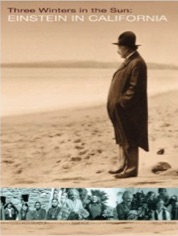
In Defense of Moe: An Interview with Patrick W. Galbraith (Part Four)

Your interviewees suggest that initially, at least, manga and anime producers had little awareness of the adult consumers of their property and that when they discovered moe enthusiasts, they still sought to ignore them for the most part to focus on their targets – children. Is there a point at which this changes? Is there now content produced specifically for this niche, or does it remain a kind of “surplus” audience? It’s a bit complicated, but manga “grew up” in the 1960s, when gekiga striving for realism and social commentary drew in adolescent and then young adult audiences. Tatsumi Yoshihiro’s works read like a critique of capitalism and the “economic miracle” in Japan that left marginalized people behind in the gutter. Shirato Sanpei’s stories about ninja who fight for the people against corrupt officials electrified a generation of young radicals, even as Tsuge Yoshiharu’s psychological explorations of dreams earned him artistic credibility. By the time Chiba Tetsuya’s Tomorrow’s Joe came out in Weekly Shōnen Magazine (from 1968-1973), it was possible for members of the student movement to say things like, “In our left hand we have Weekly Shōnen Magazine,” and for members of the Red Army, a far-left terrorist group, to claim, “We are Tomorrow’s Joe.”

Given that gekiga was incorporated into the mainstream, and even Tezuka Osamu had adapted to its challenge, it wasn’t really a surprise that adults were reading manga. In the 1970s, shōjo manga underwent a renaissance, the Comic Market was founded in 1975 male fans of shōjo manga and, by the end of the decade, there were news stories about students at the University of Tokyo, Japan’s most prestigious institution of higher learning, reading manga magazines intended for little girls.

The gap between the audience and the content might have been a surprise, but by this point it was clear that manga was not something just for children. In the case of anime, in the 1960s, it was still really for kids, and it wasn’t until the 1970s that it “grew up.” Some point to Umi no Toriton (Triton of the Sea, 1972) as a benchmark, in that it in the end undermines the hero’s righteous fight against “evil,” attracted adolescent viewers and inspired the formation of fan clubs. It is likely that Space Battleship Yamato (1974-1975) attracted more mature viewers, but it wasn’t until the TV show was reedited into a film in 1977 that the full extent of the fandom was understood. In June 1977, Gekkan Out ran a special issue on Space Battleship Yamato, which quickly sold out, thus demonstrating the existence of the mature or fan audience. This in turn led to the founding of numerous specialty magazines for manga and anime fans.

By the time Tomino Yoshiyuki, who directed Umi no Toriton, released his Mobile Suit Gundam (1979-1980), it was clear that anime fans were here to stay. Famously, the series was far too dark and complex for children, who were alienated from the show and did not buy the toys released by its sponsor, which then pulled the plug on the series. However, the realistic depictions of politics, war and psychological suffering earned Gundam devoted adult fans, who turned out in droves to buy scaled model kits of the robots featured in the story.

This fan activity revived the franchise, which was then released theatrically as three films. At the release of one of these films in February 1981, Tomino gave a speech to 15,000 fans about the “new age of anime.” There is no question that there was wide awareness of adult fans of anime at this time, and indeed groups of anime fans began to produce anime for other anime fans, for example Gainax’ Daicon films (1981 and 1983) and Studio Nue’s Super Dimensional Fortress Macross (1982-1983).

This “otaku market” has steadily grown in Japan, even as the number of children has decreased. With piracy and illegal digital distribution eating into DVD sales overseas, many say that anime is becoming more and more insular, as otaku produce for otaku, who will buy DVDs, merchandise, attend events and so on. So, adult fans are no longer really a surplus market.

What is clear in the history of moe, however, is that male fans responding to cute girl characters in anime was not an entirely expected or welcome development. Miyazaki Hayao’s debut film as an anime director, Lupin III: The Castle of Cagliostro (1979), was not really a commercial success, but it earned him a lot of adult fans. It seems that Miyazaki was a bit taken aback, and perhaps even angry, when these fans began to produce fanzines about Clarisse, the princess who is saved by Lupin, the master thief. Indeed, when this character, and by extension Miyazaki, was linked to what was being called a “Lolita complex boom” (lolicon būmu) in the early 1980s, Miyazaki responded that, while he, too, had once fallen in love with a fictional character, he nevertheless “hates” (kirai) those who dare to utter the word “Lolita complex.” This actually sounds a lot like contemporary critiques of moe!

Over the years, Miyazaki has distanced himself more and more from otaku, which Saitō Tamaki claims is a reflection of a struggle with his own legacy and contribution to moe culture. Unlike Miyazaki, others, for example the female artist Takahashi Rumiko, were obviously aiming at the market of adolescent men with works like Urusei Yatsura, a smash-hit manga (1978-1987) adapted into an anime (1981-1986), which features Lum, an alien bombshell in a tigerskin bikini who is impossibly in love with a young male loser.

But fans were also attracted to series that were not intended for them, for example Magical Princess Minky Momo (1982-1983), which was supposed to be an extended TV commercial for toys sold to young girls. The producer of that show, Satō Toshihiko, admitted to me that he was shocked, even a little weirded out, by adult men who approached him to form a fan club. In contrast to this, Nunokawa Yūji, who worked at Pierrot, the company the animated Urusei Yatsura, was surprised, but not as upset, by the presence of adult male fans at events for Creamy Mami, the Magic Angel (1983-1984). Given that Minky Momo and Creamy Mami are similar series with similar target demographics, this shift in perception seems significant. After all, as Nunokawa states, more people supporting the show means greater sales, which is certainly a welcome development.

A decade later, in the early 1990s, it seemed like the crossover viewership of young girls and adult men in Sailor Moon (1992-1997) was entirely intentional. These days, shows ostensibly for young girls such as Pretty Cure (2004-present) and Aikatsu! (2012-present) predictably attract an adult male audience with their charismatic female characters, and magical girl shows like Magical Girl Lyrical Nanoha (2004-2005, 2007) and Puella Magi Madoka Magica (2011) are produced by and for men! This again has to do with shifting demographics and market concerns in Japan, but what’s striking is that the magical girl, originally intended for young girls, is now a moe character for male otaku.

The magical girl is almost a piece of nostalgia, idiosyncratically kept alive, animated, by the investments of male fans. Itō Noizi, a female artist with a fascinating perspective on male fans of magical girls, pointed this out to me in an interview. Anyway, while some would say that the prevalence of the magical girl is a sign of the closed or insular otaku market dedicated to the reproduction of moe, which they say is killing new ideas and alienating newcomers, I would simply point out that Madoka is to magical girls what Neon Genesis Evangelion (1995-1996) is to giant robots – an extremely creative commentary on the genre that took us to a place that animation had not gone before. It would be a shame to miss such innovative anime by dismissing it for being a “magical girl” series focusing on “cute girl characters.”

What impact has “moe” had on the genres of production and consumption that operate in the contemporary manga and anime industries? What relationship might we posit between moe consumption practices and the emergence of media mix strategies?

Many people are talking about the role of the character in media mix strategies. Ian Condry, for example, suggests that affection for characters, the response called moe, is crucial for the spread of media. That is, for Condry, it is the human social interactions with anime that give it its “soul.” You have said that if media does not spread, then it is dead, and it seems to me that Condry is suggesting that media spreads and is alive because of human social interactions with it. I think that it’s fair to say that interaction begins with a response to media.

A response to what? Well, for many, to fictional characters, which takes us into the realm of moe. Azuma Hiroki and others have pointed out that characters are constructed and placed into stories with the express purpose of triggering an affective response, or moe. This leads to the construction of moe characters, which have been collectively articulated from affective elements as an assemblage that is likely to get a response from viewers.

While I think that Azuma at times drifts into a sort of naïve behavioralism to posit a trained response, I think that he is pointing to something very important in fictional characters that are meant to attract, hold attention and affect. To put it somewhat simply, earlier I discussed the manga/anime aesthetic as “cute,” and the Chinese characters making up the word for cute in Japanese, kawaii, care “potential” (ka) and “love” (ai). Characters that are cute can be loved – they are constructed to be loved. This is the secret of moe characters.

In our interview, Honda Tōru said that nowhere in the world are their cuter characters in greater numbers than in Japan, which he attributes to growing collective interest in manga and anime in the postwar period. Growing up in such an environment, as Saitō Tamaki points out, it is not only possible, but in fact likely that you will fall in love with fictional characters.

This point is very much related to the media mix. If you will indulge me, following Honda Tōru, I will mention Tezuka Osamu once again. Now, as I’ve said, Tezuka did much to establish the manga/anime style in the postwar period. He also, incidentally, produced the first weekly serialized anime series, Astro Boy (from 1963-1966). Famously, Tezuka drastically undersold the series to a TV station in order to get it on the air, essentially ensuring that he would be losing money by producing the anime series. However, Tezuka was not only thinking about the anime, but also how this would invigorate sales of his already popular Astro Boy manga, which provided the characters and world for the anime. Further, there would be Astro Boy toys and merchandise to profit from, and Tezuka actively pursued overseas distribution.

As Marc Steinberg points out, what Tezuka established with Astro Boy was nothing if not a media mix strategy. He was forging cross-media alliances to spread the media, enlist fans and invigorate the franchise. Fans were making connections across media forms, which resonated with one another to intensify consumption. Steinberg insightfully points out how Tezuka tied the anime to a sponsor, Meiji Seika, which then gave away Astro Boy stickers with proof of purchase of Marble Chocolates. Millions of requests came in for these stickers. As Steinberg sees it, children were sticking these stickers on their school supplies and so on to create “merchandise,” which grounded and expanded their points of access into the Astro Boy world. In all of these ways, Astro Boy became ubiquitous – the manga was already popular, 30 percent of households watched the weekly broadcast, children stickered everyday objects, toys and merchandise appeared – and children interacted with media, commodities and one another in an Astro Boy environment. The character of Astro Boy is what crossed over into different media forms, and it is Astro Boy that attracted, held attention and affected. The Astro Boy media mix depended, at least in part, on an affective relationship with the character that encouraged connections to be made across media forms. In this way, as Steinberg notes, it was not just that the Astro Boy media mix spread to externally “colonize” space, but it also spread internally to capture the hearts and minds of children. Children were made productive by cultivating them to do the cognitive labor necessary to follow and make connections across media. What holds the media mix together is the same thing that attracts, holds and affects the child – the character.

Even as the media mix strategy spread beyond manga/anime and children to include games/novels and fans, it was still based on the idea of capturing hearts and minds and making people productive through the character, which Steinberg provocatively calls a “regulatory mechanism.” We could further apply Steinberg’s insights to Condry, who points out that the existing fan base of manga is a sort of “surplus” that can be capitalized on by anime adaptations. To me, it sounds like existing fan attachments and interest are part of the social energy or “soul” of anime, and, to borrow a turn of phrase from Bifo Berardi, that soul is put to work!

This all sounds very dystopian, but it is not necessarily so. As Condry points out, anime fans are often the one’s who evaluate their own activities and contributions, which are not always productive for corporations. The response to the character, moe, cannot fully be captured, and the ongoing personal and collective benefits of interacting with characters should not be reduced to a simple narrative of exploitation. The media mix multiplies the points of entry into the world and media and material forms of interaction with the fictional character, which is what fans want. Likewise, creators such as Maeda Jun see their job as not only providing characters and stories that encourage people to fall in love with them, but also as supporting life, which is a collective project.


Patrick W. Galbraith received a Ph.D. in Information Studies from the University of Tokyo, and is currently pursuing a second Ph.D. in Cultural Anthropology at Duke University. He is the author of The Otaku Encyclopedia: An Insider’s Guide to the Subculture of Cool Japan (Kodansha International, 2009), Tokyo Realtime: Akihabara(White Rabbit Press, 2010), Otaku Spaces (Chin Music Press, 2012) and The Moe Manifesto: An Insider’s Look at the Worlds of Manga, Anime and Gaming (Tuttle, 2014), and the co-editor of Idols and Celebrity in Japanese Media Culture (Palgrave, 2012) and Debating Otaku in Contemporary Japan: Historical Perspectives and New Horizons (Bloomsbury, 2015).

In Defense of Moe: An Interview With Patrick W. Galbraith (Part Three)

To what degree is moe a collective as opposed to a personal experience? That’s a great question! Responding to fictional characters seems like a very personal thing. Insofar as one is describing what he or she responds to as moe, everyone has his or her own definition. However, I would say that it is more collective than we might at first appreciate.

Characters come from somewhere, right? Someone has to first imagine the character, which might be in textual or visual form. So, for example, a storywriter comes up with a character, or an artist sketches a design. Then, if it’s animation, someone voices the character. A voice actress described her job to me as “imaging” (imēji suru) the character and “matching” (macchingu suru) the image of others involved in the project, which is quite telling. I think that this imaging and matching is actually quite common throughout the creative industries of manga, anime and games, as well as figurines, merchandise and so on.

Ian Condry’s book, The Soul of Anime, describes something like this. People are collaboratively creating the character, which both moves and is moved by those interacting with it. It’s a kind of shared imaginary, maybe. We could take this further and consider how people draw on existing characters when imagining a new character. It is not a coincidence that many manga and anime characters look alike, because they are assemblages of affective elements – I’m thinking of Azuma Hiroki, who is interviewed in the book – which both precede and exceed the work in question. What creators respond to, and design others to respond to, that is, “moe characters,” are not really contained in any one form or possessed by any one person.

The response is similarly collective. Writing about otaku, Thomas LaMarre refers to a “collective force of desire,” which could be taken to mean the shared movements around moe characters, which are then “otaku” (movement). What LaMarre refers to as otaku movement resonates with moe, or that which moves, collectively. More simply, it is said that affect is contagious, so the movement of one quickly becomes the movement of many. I’d say that even fan activities that appear to be the most personal, for example writing fanzines about a favorite character or costuming as him or her, are also about sharing the character’s movements.

What is cosplay if not imaging the character and matching that image to those of others? In this way, cosplay resonates with what the voice actress I mentioned earlier says that she does. In a similar way, fanzine authors work with characters and worlds provided by manga and anime, which, as Ian Condry points out, is not so different from what professionals do when creating anime episodes using characters in a world developed by others. It maters that the characters used in fanzines are known to others, because they are then shared objects of affection, making personal imaging of them part of a collective articulation.

The question is does the image match or not, which means that another image must already exist in the minds of those responding to the fanzine. As Condry points out, there is a “dark energy” or “intensely inward-focused energy” of anime, which fuels its spread, because fans wish to share their moe with others and have it recognized. The shared production of moe characters contributes to shared expressions of affection for them.

Along the way, you give us some glimpses into the role which moe plays in shaping the Japanese creative industries. We’ve seen in recent years an emphasis by the national government and others on the concept of “Cool Japan” as a source of “soft power.” How comfortable are these government groups to some of the more intense forms of “moe” culture you describe in the book?

This is something that I’m looking into as part of a new research project in Akihabara, but what I can say now is that some people in the government are very concerned about certain forms of manga, anime and games circulating abroad and coloring perceptions of Japan. They are fine with celebrating Tezuka Osamu as the father of contemporary manga and anime, or the critically acclaimed and almost universally loved films of Miyazaki Hayao, but they are less excited about the prospect of being associated with fanzines centering on sexual parodies of Tezuka or Miyazaki characters or computer games that simulate relationships and even sex with cute girl characters.

I have heard this expressed in many ways, but one of the most memorable was when members of the Ministry of Economy, Trade and Industry (METI) organized a symposium in Akihabara in March 2012. A local business owner, who I probably shouldn’t name, asked representatives of METI straight out what their intensions were in using Akihabara to promote Cool Japan. To this middle-aged gentleman, who runs an electronics store with a storied history, Akihabara needed to be cleaned up or tourists flocking to the area would leave not with fond memoires of Cool Japan, but rather stories about “Porno Japan.” Those are his words, not mine! Very provocative stuff, but I think it touches on serious tension.

The dynamic is as follows: The increasing visibility of otaku brings to light things that are generally considered to be niche. Axiomatically: The normalization of otaku proceeds with the discovery of new abnormality. We all know a story or two – or fifty – about “weird Japan,” or that story that makes us stake our heads and say, “Only in Japan!” In fact, the recurring story about the male Japanese otaku who marries his fictional girlfriend, is in a committed relationship with a body pillow, is building a sex robot or doll in the likeness of an anime characters – all of these could be lumped together into sensationalist reporting that contributes to an image of Japan, male otaku and moe as perverse. This one man’s charge to METI that the government is promoting “Porno Japan” reminds us that not all forms of manga, anime and games are considered “cool” in Japan, and not all of them necessarily reflect “Japan,” and certainly not in the ways that some people wish.

Even one does not have a problem with hoards of men and women, young and old, reading One Piece or watching Ghibli films – such an interest is normal, after all – there are always things that will shock and challenge. For better or worse, many of these things are on display in stores in Akihabara. So when the government comes into this neighborhood and starts talking about manga, anime and even otaku as components of a branded national culture, as representative of “Japan,” that is when the subcultural and countercultural elements are going to generate some friction.

It was really interesting for me to see in summer 2014, right around the time when The Moe Manifesto was published, how Akihabara figured into international news reports that Japan was not cracking down on manga, anime and games as “child abuse materials.” CNN, for example, went to a shop in Akihabara specializing in fanzines and filed a video charging that this material is “fueling the darkest desires of criminals.” Hyperbole and questionable claims aside, this report does not just accuse Japan and otaku of being weird or perverted, which can still lead to some laughs, but rather Japan as a empire of child porn and the people in Akihabara, the “Mecca of Otaku” (otaku no seichi), as straight out sex criminals.

What is the evidence for this claim? Drawings. The reporter takes a manga book in his hand and condemns those who draw and are drawn to it as “criminals” harboring the “darkest [of] desires.” This then feeds back into reactionary and conservative discourses in Japan, where there are calls to regulate manga and anime more strictly to avoid “unhealthy” thoughts and desires. One such Diet member, a proper bureaucrat, appeared on an episode of TV Takkuru in September 2014, where he was told that Japan is being treated like an “empire of child porn.” When asked, “Should violence and underage sex in manga and anime be regulated,” his answer was, predictably, “Yes.” The show then sent a reporter to follow a group of otaku around Akihabara. While the tone of this “reporting” is significantly lighter than CNN, it shares the impulse to look at otaku in Akihabara and their relationships with fictional characters and ask whether or not regulation is necessary. This tension within the discourse between “Cool Japan” and “weird Japan,” between “good” and “bad” manga, anime and otaku, will not be resolved anytime soon. Rather, as we approach the Tokyo Olympics in 2020, it seems likely that the debate will heat up around Akihabara, moe and global norms versus community standards.


Patrick W. Galbraith received a Ph.D. in Information Studies from the University of Tokyo, and is currently pursuing a second Ph.D. in Cultural Anthropology at Duke University. He is the author of The Otaku Encyclopedia: An Insider’s Guide to the Subculture of Cool Japan (Kodansha International, 2009), Tokyo Realtime: Akihabara(White Rabbit Press, 2010), Otaku Spaces (Chin Music Press, 2012) and The Moe Manifesto: An Insider’s Look at the Worlds of Manga, Anime and Gaming (Tuttle, 2014), and the co-editor of Idols and Celebrity in Japanese Media Culture (Palgrave, 2012) and Debating Otaku in Contemporary Japan: Historical Perspectives and New Horizons (Bloomsbury, 2015).

In Defense of Moe: An Interview with Patrick W. Galbraith (Part Two)

The youthfulness of the manga and anime characters is something that struck me in the images you included in the book. Is that a cause for concern? If you take a character like Usagi, she’s a girl, which is a difference from Wonder Woman, but I don’t think that we need to be concerned about it. In his work, which is foundational to manga and anime, Tezuka did not insist on his characters being adults. Tezuka was writing for children, and often had children play major roles in his work. And even though he was writing for children, Tezuka was introducing ideas from film, theater and literature into his manga. So, he didn’t speak down to children as an audience, but rather respected them enough to believe that they do not need to be sheltered from life, from stories about a range of human experiences.

This approach contributed to the formation of manga and anime as forms of entertainment where the age of characters depicted and the age of the target audience does not limit the type of story that can be told. This not only contributes to children getting more deeply involved with stories that challenge them and expose them to new ideas, but also what Matt Hills calls “double-coding,” where the same work can be enjoyed by both children and adults, and which sustains long-term engagement with works that change as audiences mature into new understandings. This is one of the keys to the formation of fan cultures, right?

There is no question that Tezuka’s works piqued the interest of a generation of young people, who then went on to produce their own manga and anime, which took things even further down the path that Tezuka had charted. While there have been rashes of panic about manga and anime in Japan, up to and including deeming Tezuka’s works to be “harmful” to children, there wasn’t really a response to manga in Japan that led to anything like the Comics Code in the United States, which in the 1950s effectively killed forms of comics containing “unwholesome” expressions, which were thought to contribute to juvenile delinquency. There was a movement against “harmful manga” in Japan in the 1990s, but people did not widely support it.

The industry imposed limits on itself, but they were nowhere near as reactionary as the United States in the 1950s. For example, rather than agreeing to not allow certain types of content, publishers marked some manga as “adult” and placed them into “adult” sections of stores. In Japan, in theory, you can draw and publish whatever you want, so long as the material is not obscene and access to it is controlled.

Of course, anime is televised, requires a larger budget and has sponsors, which is more constricting, but consider that Neon Genesis Evangelion – a story about “angels” attacking earth, giant robots engaging them in brutal hand-to-hand combat and the psychological damage caused to the children forced to pilot these robots – aired at 6:30pm on Wednesday nights. We aren’t talking about cable here, but rather basic television that everyone can access, and 6:30pm is a time when general audiences, including children, might be watching. Cowboy Bebop – a story about bounty hunters that encounter terrorism, crime, cults, suicide, murder, human experimentation, drug use and more – was aired at 6:00pm, a timeslot previously occupied by an anime based on a story serialized in a shōjo manga magazine.

As these examples show, there is not as much of a compartmentalization of content in Japan, or a notion that children should not see or be involved in stories about the adult world, or that any exposure to depictions of violence or sexuality will irreparably scar them. The truly “adult” content is labeled and zoned properly. While not “adult” in the sense of pornographic, many of the TV shows associated with the moe boom in the late 1990s and early 2000s were shown late at night, when children would not be watching. This hands-off approach to regulation has contributed to manga and anime becoming some of the most interesting media in the world.

In turn, it makes sense that people growing up with manga and anime never “grow out of it,” because it isn’t something just for kids or somehow below real literature, film or TV. If you grow up surrounded by and relating to the fictional characters of manga and anime, it makes sense that you might be attracted to them. They are part of life, or growing up and everyday routines.

To my eyes, moe can be very meaningful to and good for people. In fact, over the course of researching and compiling this book, many people told me that manga and anime had saved their lives by giving them something to hold onto in difficult times. Take a look at the interviews with Honda Tōru, Maeda Jun and Sōda Mitsuru. Unless the response to fictional characters is harming others living creatures, unless the response is violence, I do not think that we should be at all concerned with moe, beyond curiosity about other human beings, their interests and ways of life.

Worse still would be to say that “moe media,” whatever that means, should be regulated. To ask Japan to more strictly regulate manga and anime, when there is no one harmed in the production of such media and no evidence of a statistical link to crime of any kind, is to say that there need be no demonstrable harm, because your thoughts and feelings in relation to fictional characters are “perverse” and therefore should not be allowed. If moe means a positive response to fictional characters or representations of them, then the reaction against it is a negative response to the response to those fictional characters. “It’s gross, I don’t like it.” So what? What that person responds to as moe may not be your thing, but regulating based on taste is as absurd as it is untenable.

You write in your introduction about a march involving the Revolutionary Moe Alliance in 2007. Why is such an alliance necessary and in what sense, real or playful, can we see moe as a revolutionary force in contemporary culture?

There were many groups like the Revolutionary Moe Alliance marching in Tokyo in the mid-to-late 2000s. Most were inspired by or shared the thesis of Honda Tōru, who argues that there is a system of “love capitalism” (ren’ai shihonshugi) that engenders unreasonable expectations for men.

Depending on the group, they come at the perceived problem from a variety of directions. For example, some argue that the stereotypical middleclass family ideal posits a gainfully employed company man, who supports and is supported by a stay-at-home wife, who will also raise their children. Given the dissolution of fulltime, longterm employment at large companies since the 1990s, the model of (re)productive maturity, the so-called “salaryman,” is increasingly unachievable for men, who appear immature or as failures. The man without “regular” employment, the “irregular” man, is thought to have less of a chance of attracting women. Such men are among those called himote, which means unpopular with the opposite sex. There are certainly other reasons to be in that category, including physical appearance, communication skills, hobbies and so on. The himote is a man who fails in the marketplace of love, and thus protests “love capitalism.” For himote, there is an unbridgeable “love gap” (ren’ai kakusa) between “winners” (kachigumi) and “losers” (makegumi), they are on the wrong side and their numbers are swelling.

In some particularly pedantic and indeed sexist veins, women’s motives for dating and marriage are reduced to economic ones, and one’s lack of appeal to others is blamed on an unfair system, a line of argumentation that makes those indulging in it seem like altogether unappealing human beings. The rhetoric is somewhat familiar from men’s rights movements in the United States, but the barely concealed violence of the American counterpart seems absent from himote in Japan.

Most of their marches are comprised of a small number of men enjoying one another’s company and making a spectacle of themselves. They almost seem to relish being “failures,” but not quite, because they still seem to maintain goals for success, namely getting paid and laid, that are recognizable to hegemonic masculinity. These men want things on their terms, which can come off as somewhat entitled.

A distinct break from this comes in the form of otaku, who also march against expectations of men, but celebrate being dropouts of love capitalism. For these men, and Honda Tōru states it most clearly, a system of commoditized romance that forces people onto expensive dates to fashionable places is not only out of reach for most men, but also entirely unappealing. This love capitalism, or love on the terms of a capitalist imaginary, does not seem “real” to them, but more like a fantasy sold through trendy TV dramas, which combine romance and consumption. Men like Honda Tōru argue that otaku dropped out of love capitalism and instead pursue their interests and hobbies. So, these men are interested in manga and anime instead of going on dates and “getting the girl,” but this is not a failure so much as an alternative, though which they, too, can live happily ever after.

This refusal of love capitalism makes otaku appear to be socially and sexually immature, but in this they have found alternatives ways of living and loving in the world. I was personally quite touched reading Honda Tōru’s response to a young man who, feeling like a failure without friends or romantic prospects, decided to murder seven people on the streets of Akihabara. It was a horrific event, but Honda’s message was one of empathy. Honda Tōru acknowledged that they were both very similar in terms of personal history, but he had something to hold onto that this young man did not: anime. To Honda Tōru’s eyes, this was a young man who felt pressured to become a “regular” man, with all the attendant responsibilities, rights and respect that come with achieving that middleclass ideal, but he could not do so, felt like a failure and lashed out at the world. Honda writes that he wished he could have told this young man to take it easy, hold on a little longer and wait for things to improve. Honda, who struggled with depression and suicidal thoughts as a young man, suggests that anyone who is considering doing violence to themselves or others instead withdraw from society and its pressures for a time. He advocates not seeking revenge for perceived wrongs, or ending life through violence, but rather seeking something to hold onto, for example hobbies and people to share them with, and living life with a different set of values that don’t make you feel like a loser or failure.

This otaku position is a politics of survival for those who have somehow failed or have been made to feel like failures, which is a shared condition. In addition to himote and otaku, the last group that was marching in Akihabara is associated with moe. These are people who actively seek alternatives to expectations of men, which is to say assigned sex/gender roles, in relationships with fictional characters. This can take the form of “marriage” to a fictional character, belonging to a community of shared interest around a character, and so on. Manga, anime and games do not necessarily get us out of hegemonic sex/gender roles, as we have seen from Gamer Gate, but some certainly see that potential. Again, there is Honda Tōru, who argues for a “moe masculinity” that embraces both the masculine and feminine sides of one’s self, which can be nurtured and accessed in interactions with fictional characters outside of the expectations of society.

Moe men can at least imagine sex/gender differently, which then might impact the ways that they understand themselves and interact with others. This is very much the message that Momoi Halko, a female idol, voice actress and producer gave in her interview for the book, where she describes moe as contributing to a space of a “third gender/sex” (daisan no sei). Statements like this one are surprisingly common, and actually have been made even by feminist thinkers such as Ueno Chizuko as early as 1989. It is interesting that many female critics and creators note this of moe, which seems to suggest that they see something different in “moe men,” who actually are not so recognizable as “men” anymore.

This potential for change in sex/gender roles through thought experiments involving fictional characters and in interactions with fictional characters is some of the most exciting revolutionary potential in contemporary Japan, and while it is very much playful and parodic, that does not mean that it is not real.

A word of caution in all of this: Potential for change in sex/gender does not mean that moe is not without its sexism. In all three broad and overlapping groupings – himote, otaku and moe men – there is a shared danger of not only reproducing and reinforcing sex/gender stereotypes – Honda Tōru, a man, is married to a fictional girl character, which sounds all too familiar – but also rejecting women to create a space of autonomous sexuality. To take an easy example, Honda Tōru’s book is titled Moe Man (Moeru otoko), which has “man” right in the title. To the extent that one must reject women to reform one’s self as a man, this is a sexist position.

In response to the success of Densha otoko, a live-action film and TV drama about an otaku who falls in love with a real woman and reforms himself to earn her love, which Honda Tōru has rightly criticized as a didactic message, I remember seeing signs in Akihabara reading, “Real otaku are not aroused by three-dimensional women.” The real or three-dimensional woman has to be rejected by the “real” otaku, who is implicitly male.

Falling into this reactionary stance is certainly a danger, but what really struck me about the march that the Revolutionary Moe Alliance participated in was that it was not only “men.” The march, which was titled Akihabara Liberation Demonstration (Akihabara kaihō demo), took place in Akihabara in June 2007, and there were men, women, women costuming as male characters, men costuming as female characters – all these people together on the street.

Akihabara is an area usually associated with male otaku, which colored perceptions of the moe boom centered on media reports about Akihabara, but what I saw on the street was not exclusively or even necessarily “male.” Rather, the liberation of Akihabara, where affection for fictional characters is shown without shame, was more about flexible, shifting and relational sex/gender roles, which could be disrupted or shifted by interacting with fictional characters and costuming as them, by performing sex/gender differently. That is why the image of the Akihabara march remains so vivid in my mind. It seemed to me that Akihabara and moe were offering a platform for the articulation and expression of sex/gender politics beginning not with autonomy from women, but rather from the “regular” or “normal.” Indeed, the direct impetus for the march was a sort of creeping conservatism in policing otaku performances on the streets of Akihabara, as well as plans to clean up the “public sex culture” – with respect to Michael Warner and Lauren Berlant – there.

In the 2000s, Akihabara was being reimagined as a showcase for what the government was calling “Cool Japan,” which focuses on promoting wholesome manga and anime, which was somewhat at odds with the openly sexual content – erotic simulation games, pornographic fanzines, sexually posed figurines of cute girl characters, maid cafés – on open display in the area. The demonstration to liberate Akihabara seemed, to me at least, to be about keeping the space open and unsanitized so that people could freely explore and share relationships, even sexual ones, which fictional characters.

Patrick W. Galbraith received a Ph.D. in Information Studies from the University of Tokyo, and is currently pursuing a second Ph.D. in Cultural Anthropology at Duke University. He is the author of The Otaku Encyclopedia: An Insider’s Guide to the Subculture of Cool Japan (Kodansha International, 2009), Tokyo Realtime: Akihabara(White Rabbit Press, 2010), Otaku Spaces (Chin Music Press, 2012) and The Moe Manifesto: An Insider’s Look at the Worlds of Manga, Anime and Gaming (Tuttle, 2014), and the co-editor of Idols and Celebrity in Japanese Media Culture (Palgrave, 2012) and Debating Otaku in Contemporary Japan: Historical Perspectives and New Horizons (Bloomsbury, 2015).
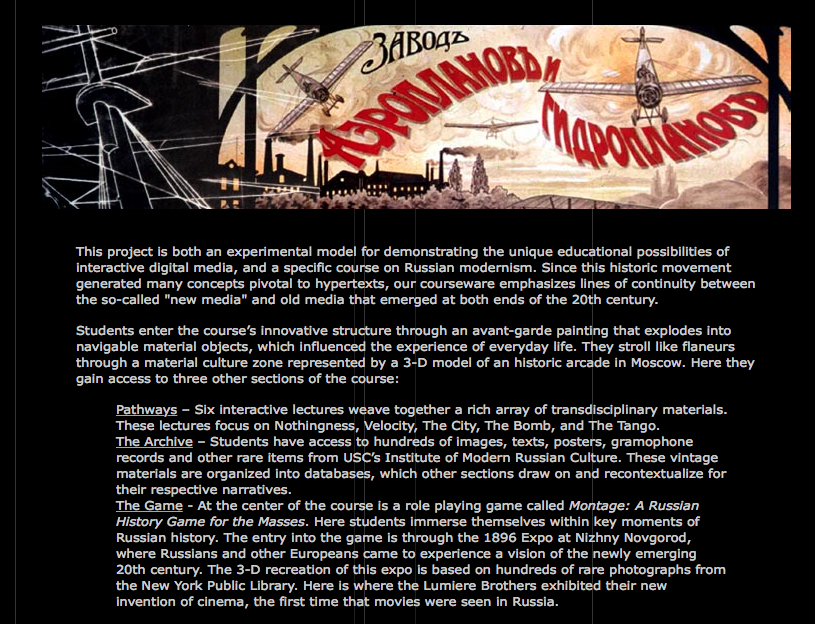
 

In Defense of Moe: An Interview with Patrick W. Galbraith (Part One)

Japan has one of the most vibrant and generative popular culture in the world with Japanese media being one of that country's major national exports and with the forms of fan culture that emerge in the streets of Tokyo exerting an influence on participatory culture world-wide. There is also not surprisingly a growing number of scholars in Japan who are producing insightful research on these phenomena, only a small selection of which has been translated and made available to readers in the west. We are seeing some important work emerge that seeks to bridge between Japanese and American researchers working on topics such as "media mix"/transmedia or "Otaku"/fandom, including books showcased here in the past by Mimi Ito, Ian Condry, and Marc Steinberg, as well as the recently launched summer workshop program on "media mix" which Sternberg and Condry run along with Otsuka Eiji and other colleagues there. When I encountered Patrick W. Galbraith's The Moe Manifesto: An Insider's Look at the Worlds of Manga, Anime, and Gaming, I immediately recognized its value in providing a similar glimpse into both Japanese popular culture and the scholarship that has grown up around it. Using the concept of Moe (a particular kind of relationship between fans and fictional characters) as his point of entry, Galbraith interviews creative artists, fans, and scholars, offering an accessible but theoretically provocative glimpse into contemporary developments, with a strong focus on notions of spectatorship and fandom. The book is intended for a general reader -- heavy on brightly colored illustrations of both commercial and fan art -- yet as a consequence, it offers perhaps the most readable and teachable introduction to these themes and concepts. As someone who is certainly not a specialist on Japanese popular media but who maintains active interest in this space, I read it with enormous interest.

And I am very happy to be presenting an extended six-part interview with the book's editor, Galbraith, who was very generous and patient in explaining some of the underlying ideas that animated this project. Across this exchange, Galbraith offers insights into the gender and sexual politics of contemporary Otaku culture, including detailed accounts of what draws both male and female fans to these works; he speaks in depth about the ways that Moe fans have challenged conventional notions of masculinity and he discusses some of the backlash against these materials and the fan activities being discussed, especially as Japan wants to lay claim to a "cool Japan" framing of its cultural productions, while avoiding alternative labels that might stress the oddity or perversity of some Japanese media. He also shares with us some of the critical debates in Japan, which he feels sheds light on key concerns in western scholarship, including those surrounding subcultural identities and fan labor. Even if you are not especially interested in anime or manga, there's much here which can help shake up some of the core debates in our field.


A central theme of the book is to push us beyond any surface level understanding of the concept, but we still need a starting point for this discussion, so can you share with me how you would define the concept of moe and what do you see as its relationship to the concept of otaku, which may perhaps be somewhat better known in American culture?


To get us started, moe is the noun form of a verb, moeru, which means “to burst into bud” or “to sprout.” This is the actual definition, but, in contemporary Japan, moe is slang and has little to do with bursting into bud or sprouting. The meaning is closer to a homonymous verb, moeru, which means “to burn.” The story goes that among manga, anime and game fans, sometimes called otaku, in online discussions of fictional characters, people were accidentally typing “to burst into bud” when they meant “to burn,” or when they were saying, “I’m so into this or that character,” “I’m fired up.” In this way, moe became slang for what gets the motor running, tugs at the heartstrings or enflames the passions.

At a very basic level, there are three important things to keep in mind. First, moe is a verb, something that occurs, not something that is. Second, what occurs is a response, which is located in a human being. Third, the response is to fictional characters or representations of them. This last part is crucial, because it indicates what makes the word moe distinct and hints at why it’s worth talking about at all. The term moe comes out of growing awareness in Japan of human affection for and attachment to fictional characters.

Why Japan? Simply because manga and anime are such a huge part of growing up; the quality, quantity and diversity of content is such that one does not have to graduate out of these interests; and some, building on basic exposure to and widely available media and material, take interests further, exploring and expanding the worlds of otaku. Because manga and anime are such a massive part of popular culture in Japan – and there is a notable manga/anime aesthetic in certain types of games and novels, too – there is a general appreciation of the fictional character as an object of affection.

Moe gives a name to this, and the people using it are very much aware of their own affection for fictional characters, which trigger a response in them. Such fans are almost the stereotypical otaku, who loves manga and anime, specifically fictional characters, more than is “normal,” even in Japan. Otaku activities – for example the massive Comic Market, an event that attracts 500,000 people, many of whom come to buy and sell fanzines featuring their favorite manga and anime characters – draw attention. Manga and anime fans can hardly be ignored in Japan, which has led to a cottage industry of writing about otaku, as well as the emergence of otaku critics, theories of otaku (otaku ron) and even a pseudo-academic discipline of otaku-ology (otakugaku).

In this robust body of literature, at least since the turn of the new millennium, moe appears as a concept to be discussed and debated in various ways. What attracted me to the concept of moe was not only the recognition of the human response to fictional characters, but also how this then led to questions about society, the economy and politics. So, for example, some fans advocate “marrying” fictional characters, a sort of performance of affection and gambit for social recognition of a relationship that is very real; others take that as a starting point for social critiques of sex/gender, and propose alternatives ways of being in the world in relation to fictional characters and others. Such statements about moe are as provocative as they are political, and I wanted to try to understand where they were coming from.

I’m a fan of manga and anime myself, and have been getting tattoos of my favorite characters since middle school, so moe didn’t seem like such a strange concept to me, but I had not considered it in any serious way. In Japan, among otaku, I was presented with an opportunity for sustained thinking about human relationships with fictional characters, which, let me be clear, are a very real part of life for many people, and not just in Japan.

However, all too often it seems that people are content to point and laugh at the “moe phenomenon,” which is taken to be one of those “only in Japan” or “weird Japan” things. Closing down the dialogue in this way is a real shame, and I wanted to stage an intervention, frankly. By reading and translating Japanese texts, conducting fieldwork and, most importantly, identifying and introducing Japanese thinkers in English, I thought it possible to begin to bridge the gap between the discourse on moe inside and outside Japan. Focusing on interviews allowed me to present a diverse range of un-synthesized perspectives, while also focusing on the face and voice of a given Japanese thinker, who, thus personalized, is harder to brush off. So, definition! Moe is a positive response to fictional characters or representations of them.


A key element of moe seems to have to do with notions of “cuteness” or “innocence” and yet there is also a widespread perception that moe constitutes a form of perversity. Why do you think moe generates such strong reactions? Are there forms of moe which should be cause for concern? 


A small caveat, first. Moe is a response located in a human being interacting with a fictional character. What a person responds to and in what way differs based on the person, so any general claim that this type of character is “moe” – which is a description of an object, not a human response – often serves to obscure more than it reveals. That said, moe is coming out of discussions of manga and anime characters, as well as game and novel characters drawn in the manga/anime style, so there can appear to be something of a shared aesthetic.

For the sake of brevity, I’ll focus on female characters, because they are the ones that most often get people up in arms about moe. One rarely hears that it’s “perverse” for girls and women to be fans of male characters, or that the designs of those male characters are somehow “perverse.” At the heart of the concern about moe is male fans and female characters, and the relationship between them, so let’s consider the manga/anime style in response to that concern.

The manga/anime style, as popularized by Tezuka Osamu, the “God of Manga,” after WWII, is notable for being “cute.” You see a lot of round shapes and simplified features. In shōjo (for girls) manga, you also see soft lines and large eyes. The styles seen in manga originally intended for children and girls became much more popular in the 1970s and 1980s, when even adult men were consuming these works and developing bishōjo (cute girl) manga and anime in dialogue with female artists.

To give a specific example, Usagi, the main character of Sailor Moon, is a bishōjo character, originally drawn by a female artist for a manga targeting young girls, who became popular with a diverse audience, including adult men, when adapted into anime. Now, compare Sailor Moon to Wonder Woman. The “cute” or manga/anime aesthetic is clear.

What is the significance of this distinction? Historically, it’s seems to be a break with “realism.” After Tezuka’s initial manga revolution in the late 1940s and early 1950s, a style emerged in contradistinction to his work. Called gekiga, these works were something like graphic novels, and focused on a “realistic” style of drawing to capture realistic people and settings and comment on real social issues. Gekiga typically featured more “mature” characters and stories and was intended for a more “mature” audience. These works became extremely popular as part of the counterculture movement in the 1960s, when students and protesters rallied around stories of outcasts and working-class folk rising up against the system. However, after losing steam with the failure of the student movement and the incorporation of artists into the mainstream industry, the gekiga movement died down. After a period of relative obscurity, Tezuka roared back onto the scene, telling mature stories for mature readers, but using his manga/anime style of cute characters.

Further, shōjo manga was undergoing a major renaissance in terms of quality content, which attracted even adult male readers. This is the creative ferment from which the bishōjo emerged in the mid-to-late 1970s and into the 1980s.

Bringing mature content and readers to styles originally intended for children and girls, the result is the manga/anime style we know today. It lasted because both men and women were producing this hybrid style, which appealed to children and adults, men and women. While it may appear strange or, dare I say it, “perverse” to some outside of Japan to express mature themes and stories, which include sex and violence, using cute characters, few in Japan would think of the majority of manga and anime that way. Even pornographic variants, produced by both men and women working in genres for men and women, are not necessarily “perverse.” They are cute, drawn in a familiar style.

We might consider perversity at the level of content, or what characters are depicted as doing to and with one another, but there is such a wide range of content in manga and anime. Perhaps someone thinks it perverse, but for others it’s totally normal. Consider that during the renaissance of shōjo manga in the 1970s, stories of male-male romance, which included sex scenes, where quite popular. As Fujimoto Yukari points out, such “boys’ love” manga, produced primarily by and for women, is by now a taken-for-granted part of the landscape of shōjo manga. The thought of tweens and adolescent girls reading comics about male homosexuality might seem totally perverse in the United States, but it has become a norm in Japan. Indeed, some see in Japanese manga and anime culture an incredible tolerance for diverse content and fantasies, which should be celebrated.

Fiction makes possible and allowable all sorts of diverse characters, interactions and interactions with characters. Indeed, the instance on fiction seems very important to understanding moe. If the gekiga aesthetic was known for realism, then the return to the manga/anime aesthetic implies an embrace of “unrealism,” or the patently fictional, as we can see in the bishōjo character, whose face does not resemble a human one, but takes on its own internal realism within manga/anime. Moe is the recognition and response to the fictional real.

Saitō Tamaki, who is interviewed in the book, goes as far as to talk about an orientation of desire toward fiction. This doesn’t have to go as far as a sexual orientation, though for some it does, but realizing that interactions with fictional characters do not necessarily reflect desired interactions with other human beings is one of the greatest insights of manga/anime culture in Japan. Moe is a word that refers precisely to the response to fictional characters, which is why it is valuable.

Once we begin to say that this fictional character, fictional interaction or interaction with a fictional character is perverse and therefore should not be allowed, we quickly devolve into thought policing, which manga and anime creators, critics and fans actively fight against in Japan. So, for example, I can totally understand why someone might find it perverse that an adult male says Usagi from Sailor Moon is moe. In the story, she begins as a 14-year-old girl, very cute and innocent, though intersecting past and future lives mean that she is also a princess and queen, a wife and mother, and an ass-kicking superhero.

So, if we are calling this perverse, what exactly do we mean? In many cases, I think that we just assume that this adult male somehow harbors sexual desires for middle-school girls, which is a conflation of Usagi as a fictional character with actual girls, a reduction of this fictional character to a simplified category – why is her age more important than her being a transforming superhero? – and a completely unfair snap judgment about ulterior motives for responding to this fictional character, which not only pathologizes a human being, but also sets the justification for criminal treatment, for treating someone as a criminal.

We really have no idea what the qualitative response of this person is to Usagi, and we should not be speculating about it. I could just as easily speculate that he wants to be Usagi, right? We cannot prove what someone is thinking when he or she responds to a fictional character or utters the word moe, and we really ought not be concerned with it. It is enough to know that our theoretical man is responding to Usagi, a fictional character, which hurts no one and brings joy to his life.


Patrick W. Galbraith received a Ph.D. in Information Studies from the University of Tokyo, and is currently pursuing a second Ph.D. in Cultural Anthropology at Duke University. He is the author of The Otaku Encyclopedia: An Insider’s Guide to the Subculture of Cool Japan (Kodansha International, 2009), Tokyo Realtime: Akihabara(White Rabbit Press, 2010), Otaku Spaces (Chin Music Press, 2012) and The Moe Manifesto: An Insider’s Look at the Worlds of Manga, Anime and Gaming (Tuttle, 2014), and the co-editor of Idols and Celebrity in Japanese Media Culture (Palgrave, 2012) and Debating Otaku in Contemporary Japan: Historical Perspectives and New Horizons (Bloomsbury, 2015).


Affective Publics and Social Media: An Interview with Zizi Papacharissi (Part Three)

YfTZJjwYcIoliTRzaSezremnGHL1FcQrb4DdGeG6ifY,gkl4cgr1kTnaAW4izF2BgyZJliOODJOWrQSsBgcQ1tI,xRBhE3zEqO5OnfUztHWSr1tzMJ-wLLqrmoMGunxMivU,ppnxXlQpYpDDHr-3UgIl_VfrQNAssDrwkFbR0YtItqs,3N3sQpXV4Mby0X3Fr369Fzs06Fb-06xN6TarewE2kxA image by Daydream V.2 by Nonotak Studio


The classic writings about media events focused on events as they took shape through broadcast media. How does this phenomenon of media events look different once we incorporate social media into the process?

Lippmann had famously used the term pseudoenvironment to describe the ability of mass media, and newspapers in particular, to construct environments for events that we are not able to experience directly on our own. Lang and Lang, in their seminal study of the MacArthur day parade, contrasted the chaotic and impersonal experience reported by parade spectators with the personal, immediate and warm experience felt by viewers experiencing the event via their TV sets.

With social media, storytelling becomes even more pluralized, and events become polymorphic – occurring in many shapes or forms, so much so, that we often presume causal links between the many shapes an event will take on. For instance, with #egypt, so much of our attention was consumed by whether this was a Facebook or Twitter revolution, that is whether the event as unfolding via social media led the event taking place on the streets. Besides the fact that this is an absurd claim to make, it takes us down this banal path of deterministic assertions regarding the impact of technologies.

I think the effect that we get when we experience an event in such a polymorphous way is best understood as hyper-empirical. Combined, the stories told about events by different media allow us to not only watch and observe what we cannot directly experience, but also to tune in to the feeling of this experience, and potentially contribute to it by becoming participants in the hyper-empirical realities we are feeling our way into.

You use the provocative phrase, “crowdsourced elites,” to describe the kinds of people who participated in the social media activity around these uprisings. Can you explain what this concept means to you?

It refers to the fact that elites have been determined via the wisdom of the crowd. The so-called problem of determining elites has thus been crowdsourced to networked publics and resolved through public involvement. There is a paradox, or more appropriately, an antithesis embedded in the term on purpose that I am very fond of. The term crowdsourcing suggests a dispersed and distributed process; the term elites suggests a concentration in leadership that emerges out of this pluralized premise. It captures the democratic paradox nicely, I find.

Democracies cannot function without elites; elites are useless without democracies. We see democracies as a way out of elites, yet elect elites to manage representative democracies. Crowdsourcing emerges out of a direct democracy premise, yet produces elites that are representative and thus compromise this premise.

Some have characterized retweets as perhaps the most minimal form of political participation, yet you argue that retweets play essential roles in fostering political movements. Explain.

For underrepresented or for marginalized viewpoints, retweets offer visibility that can be very useful toward helping a movement reach out to diverse publics. Moreover, in the context of escalating political events, retweets afford an intensity to the online pace of a movement.

Affect theory suggests that refrains, among other conversational signifiers, can be employed to convey a sense of movement toward a certain, albeit_not_yet_determined_because_it_is _in_the_making, direction. So you want to think of retweets as a variation of refrains, and in the book, I explained how retweeting in #egypt gave the resulting news stream about the movement a rhythmicality that sustained an always on, ambient online presence for the movement. And during escalating events, retweeting that employed the refrain of revolution or affirmed the revolutionary theme of the movement further amplified intensity and harmonized affective energies in a manner that reflexively and discursively claimed the revolutionary outcome, well before regime reversal had occurred.

Some have criticized social media for fostering circulation for circulation’s sake, an endless act of forwarding on messages, which becomes increasingly divorced from real world political action. What have you discovered here about the difference between voice and influence?

I draw a distinction between different modes of impact or influence, and, as I explained in response to an earlier question, I find that the impact of these activities tends to be symbolic, agency is of a semantic nature, and power, if accessed, is of a liminal, or transient nature. And the thing to keep in mind is that “real world political action,” whatever that may refer to, of course, is frequently not immediately impactful or impactful at all.

But I would like to say something about this idea of “circulation for circulation’s sake,” or “the endless forwarding on of messages,” because there is an effect that sustains, and it is the effect of ongoing movement, of some form constant drive without a particular direction in mind, of the sense that our energies are always on and on alert mode.

There is a word for that, but it does not exist in English – it Greek, we refer to this feeling as a sense of διεγείρεσθαι: a general feeling of movement subjectively experienced, an overall sensation of something that is in the making, an energizing drive that emerges out of sharing with others. It may produce emotions, or rationalizations, or new structures, or not much at all. The emergent energies summoned by affect and affect theory come the closest to this idea.

So, yes, there is something about the context of social media that urges us to share, and in sharing, we get the feeling that something is happening, that we are somehow contributing to a greater evolving narrative. Elsewhere, I have written about this as shareability – an affordance of networked publics, which refers to how the architectural construction, the design aesthetic of many of these platforms not only invite us to share, but become more meaningful the more we share (or at the very least, promise to become more meaningful). Sometimes, unless we are aware of what we are sharing and why, there is a real danger to get caught in a self-sustaining feedback loop that keeps us at standstill, rather than moving us forward.

So, when I talk about digital orality (in response to the next question), and the digital literacy that should come with it, I am referring to the ability to know when to share and when not to, when it is meaningful to express an opinion, and when it might be a better idea to step away and not voice strong opinions about issues we really do not know enough about, and finally, using these media to share, but also to learn to listen more effectively.

Some have worried about the displacement of professional news-gathering and analysis by “citizen journalism,” yet one potential implication of your analysis would be that these two groups play very different functions in fostering political dialogue. Would you agree?

Yes. Reporters have always understood their work as a first draft of history, so we perhaps we can read content generated collaboratively through social media as a first draft of journalism. Certainly the thing to do is to not antagonize readers but to work with them to make the (news) stories better.

But really, journalism is a form of storytelling, and so what we are in the middle of observing is, I think, a reorganization of how we tell stories as a society. Walter Ong (1982) had distinguished between the interpersonal conventions of oral forms of storytelling that dominated the pre-print era and which he described as a primary orality, and a secondary orality, driven by the storytelling conventions of the printed word, mass media and broadcasting practices, and the need for verifiability, since the printed form affords a different kind of permanence, as opposed to the fluidity of the aural and oral variations of storytelling.

The storytelling practices that we encounter on social media blend the drama of interpersonal conversation with the storytelling conventions of mass media in ways that invite us to think that perhaps we are looking at the production of new, digital orality. So the way that we are telling stories about ourselves and our worlds is evolving, and part of the confusion stems from not having the handle of this quite yet, not having the necessary literacy level to take it all in. You see, the listening publics exposed to oral forms of storytelling knew that the story changed and evolved as it was told from one person to the next, and that is how they internalized what they heard, to a certain extent of course, because they were still susceptible to the propaganda of rumors. And the printed word introduced a form of storytelling that made knowledge more broadly accessible but also frequently presented the printed story as dogma, which of course necessitated its own literacies in order to be able to read the text but also see beyond it and into the context within which it was produced and presented.

So in a way, in the digital orality context, we are seeking to reconcile some of the inadequacies of a primary and a secondary orality, into something that maintains the immediacy, the authenticity, and plurality of the subjective but also attains the gravitas of objectivity. Impossible? Nothing is, if you know how to read it.

Zizi Papacharissi is professor and head of the Communication Department at the University of Illinois-Chicago. Her work focuses on the social and political consequences of online media. Her books include A Private Sphere: Democracy in a Digital Age (Polity Press, 2010), A Networked Self: Identity, Community, and Culture on Social Network Sites (Routledge, 2010), and Journalism and Citizenship: New Agendas (Taylor & Francis, 2009). She has also authored over 40 journal articles, book chapters or reviews, and serves on the editorial board of eleven journals, including the Journal of Communication, Human Communication Research, and New Media and Society. Zizi is the editor of the Journal of Broadcasting and Electronic Media, and the new open access and available for free Sage journal Social Media and Society. Her fourth book, titled Affective Publics: Sentiment, Technology and Politics is out in November 2014 by Oxford University Press.