On behalf of the conference organizers, I am proud to be able to share with you today the videos of our April 12 Transmedia Hollywood 4 conference. As many regular readers know, this event is run jointly by myself, representing USC's Cinema School, and Denise Mann, representing our counterparts at UCLA and it is funded by a grant from the Andrew J. Kuehn Jr. Foundation. This year's focus was on models of social change, and we were excited to see a conversation emerge across the four panels, starting with panel 1's focus on the community outreach efforts of major brands and studios, panel 2's focus on smaller scale transmedia projects and entertainment education, panel 3's attention to grassroots activist efforts, and panel 4's consideration of young entrepreneurs and philanthropists. Each of the panels is interesting in its own right, but those who attended the event agreed that there was something magical about how the parts came together as a whole this year. I want to specially think David McKenna who worked around the clock to get these videos up and out to the world in record time. Enjoy.
Panel 1 Revolutionary Advertising: Cultivating Cultural Movements
In the web 2.0 era, as more and more millennials acquire the tools of participatory culture and new media literacy, some of this cohort are redirecting their one-time leisure-based activities into acts of community-based, grassroots social activism. Recognizing the power of the crowd to create a tipping point in brand affiliation, big media marketers, Silicon Valley start-ups, and members of the Madison Avenue advertising community, are jumping on board these crowdsourcing activities to support their respective industries. In other words, many of the social goals of grassroots revolutionaries are being realigned to serve the commercial goals of brand marketers. In the best-case scenarios, the interests of the community and the interests of the market economy align in some mercurial fashion to serve both constituencies. However, in the worst case scenario, the community-based activism fueling social movements is being redirected to support potato chips, tennis shoes, or sugary-soda drinks. Brand marketers are intrigued with the power and sway of social media, inaugurating any number of trailblazing forms of interactive advertising and branded entertainment to replace stodgy, lifeless, 30 second ads. These cutting edge madmen are learning how to reinvent entertainment for the participatory generation by marrying brands to pre-existing social movements to create often impressive, well-funded brand movements like Nike Livestrong, or Pepsi Refresh. Are big media marketers subsuming the radical intent of certain community-based organizations who are challenging the status quo by redirecting them into unintentional alliance with big business or are they infusing these cash-strapped organizations with much needed funds and marketing outreach? Today’s panel of experts will debate these and other issues associated with the future of participatory play as a form of social activism.Todd CunninghamFormerly, Senior Vice-President of Strategic Insights and Research at MTV Networks.
Denise Mann (Moderator)
Co-Director, Transmedia, Hollywood / Associate Professor, Head of Producers Program, UCLA School of Theater, Film and Television
Rob Schuham
CEO, Action Marketing
Michael Serazio
Author, Your Ad Here: The Cool Sell of Guerrilla Marketing
Alden E. Stoner
VP, Social Action Film Campaigns, Participant Media
Rachel Tipograph
Director, Global Digital and Social Media at Gap Inc.
Hollywood’s version of transmedia has been preoccupied with inspiring fan engagement, often linked to the promotional strategies for the release of big budget media. But, as transmedia has spread to parts of the world which have been dominated by public service media, there has been an increased amount of experimentation in ways that transmedia tactics can be deployed to encourage civic engagement and social awareness. These transmedia projects can be understood as part of a larger move to shift from understanding public media as serving publics towards a more active mission in gathering and mobilizing publics. These projects may also be understood as an extension of the entertainment education paradigm into the transmedia realm, where the goal shifts from informing to public towards getting people participating in efforts to make change in their own communities. In some cases, these producers are creating transmedia as part of larger documentary projects, but in others, transmedia is making links between fictional content and its real world implications.
Panelists
Henry Jenkins (Moderator)
Co-Director, Transmedia, Hollywood / Provost Professor of Communication, Journalism, and Cinematic Arts, USC Annenberg School for Communication
Katerina Cizek
Filmmaker-in-Residence, National Film Board, Canada
Katie Elmore Mota
Producer, CEO of PRAJNA Productions
Panel 3: Through Any Media Necessary: Activism in a DIY Culture
A recent survey released by the MacArthur Foundation found that a growing number of young people are embracing practices the researchers identified as “participatory politics”: “interactive, peer-based acts through which individuals and groups seek to exert both voice and influence on issues of public concern.” These forms of politics emerge from an increasingly DIY media culture, linked in important ways to the practices of Makers, Hackers, Remix Artists and Fan Activists. This panel will bring together some key “change agents,” people who are helping to shape the production and flow of political media, or who are seeking to better understand the nature of political participation in an era of networked publics. Increasingly, these new forms of activism are both transmedia (in that they construct messages through any and all available media) and spreadable (in that they encourage participation on the level of circulation even if they do not always invite the public to help create media content).
Panelists:
Megan M. Boler
Professor and Associate Chair, Department of Humanities, Social Sciences, and Social Justice Education OISE/University of Toronto
Marya Bangee
Community Organizing Residency (COR) Fellow, OneLA, Industrial Areas Foundation (IAF)
Erick Huerta
Immigrant’s rights activist
Jonathan MacIntosh
Pop Culture Hacker and Transformative Storyteller
Sangita Shreshtova (Moderator)
Research Director of Media Activism & Participatory Politics (MAPP) project, USC Annenberg School of Communications and Journalism
Elisabeth Soep
Research Director and Senior Producer at Youth Radio-Youth Media International
Panel 4 The e-Entrepreneur as the New Philanthropist
Nonprofit organizations are increasingly thinking like entrepreneurial start-ups and vice-versa, as young people are starting organizations which embrace the notion of the “consumer-citizen,” modeling ways that social-change efforts can be embedded within the everyday lifestyles of their supporters. While the boomers treated the cultural movements of the late sixties as a cause, today’s e-citizens are treating their social activism as a brand. They are selling social responsibility as if it were a commodity or product, using the same strategies that traditional business men and women used to sell products.
Sarah Banet-Weiser
Professor, USC Annenberg School of Communication and Journalism and Department of American Studies and Ethnicity
Sean D. Carasso
Founder, Falling Whistles
Yael Cohen
Founder/CEO, Fuck Cancer
Ann Pendleton-Jullian (Moderator)
Professor, Knowlton School of Architecture, The Ohio State University, and Distinguished Visting Professor, Georgetown University
The best wrestling performers know how to work with the audience, pumping them up or reacting on the fly to their moods. When we visited the Fan Axxcess event the day before, we saw some of the wrestlers from the WWE’s NXT school training. You could see that they were all working to learn how to communicate emotions through broad gestures and facial expressions that could be read by fans on the other side of the auditorium; they were working to develop a recognizable personality through which they could deliver those stock gestures and devices. And we saw people at various stages of development, including a few who had appeared prematurely on the WWE’s main stage and then been sent back down for retooling because they couldn’t deliver what was expected of them. For the most part, they were performing in character, but not really reaching across the fourth wall and engaging with the audience.
A great wrestler knows how to pull that off. I was impressed, again, with the melodramatic elements of the Jack Swagger vs. Alberto Del Rio match. Here, we saw a kind of classic “agit-prop.”
When I got pulled into WWE years ago, it was by waking up on a Saturday morning to hear the show-down between Hulk Hogan and Sgt. Slaughter. Slaughter was an American soldier who had been brainwashed by the Iraqis; Hulk was seeking to protect the American spirit and inspire the young “Hulkamaniacs,” especially those whose parents were fighting overseas. This was in the midst of the first Gulf War, and the storyline seemed well designed to play upon the emotions of the spectators.
The Swagger fight was equally of-the-moment: Swagger and his manager, Zeb Colter, represent the Tea Party. Their patter emphasizes the nativist side of the Tea Party. They wrap themselves in the American Flag and chant “We the People,” yet they are militantly anti-immigrant. So, in New Jersey, they rode out in a military vehicle and Zeb began to denounce people who speak Spanish, Italian, Greek, and finally, Yiddish, with the crowd booing louder and louder with each new prejudice. Then, Del Rio was introduced as a Mexican-American success story, reading aloud the inscription on the Statue of Liberty, and talking about how much he loves his new country. The effect on the crowd around us was visceral. For the most part, the crowd was playing their parts, booing the Tea Party and cheering the Mexicans. Add to this mix Del Rio’s announcer, Ricardo Rodriguez, who wobbled out on crutches, having been mercilessly attacked by Swagger on Raw a few weeks before, and you had a classic melodrama.
I was struck by two specific fans in the crowd. Behind us, there was a massive black guy who was standing up on his seat and chanting “white power” in response to Swagger. It was clearly a self-consciously ironic performance. But, then, across the aisle from us, there was this knot-head who keep chanting “USA, USA, USA”, and it was not clear to me where he was coming from. We were holding up a sign which jokingly read, “If Swagger wins I’ll move to Canada”. He was enraged that we were holding up a Canadian sign. I definitely thought from the way he harassed us that he might well be celebrating Swagger without any sense that he was the heel in this particular match. But here, the line between reality and performance was blurred beyond recognition.
I thought Cena’s performance on Raw after Wrestlemania was striking. It’s clear he knows that many of the hardcore fans don’t like him, and he was playing into this, giving people reasons to boo and reasons to cheer in more or less equal measures. Above all, he was seeking to bring on the heat and provoke as loud of a reaction as he could.
It’s the most dignified thing he can do. Most of those fans aren’t going to cheer for him. If he begs for their approval then he’ll look pathetic. By re-framing the boos as a sign of his success or proof of the fans’ passion for him he saves some face.
I’ve found the Del Rio-Swagger feud to be very polarizing among fans. Trust me: I wish the audience was eating it up. I like it. But here’s what I see instead: Everyone has a different opinion. Some fans like us think it’s a cool story and admire the way all of the performers are playing their parts. Other fans think the whole story is in poor taste. They say they watch escapist TV to get away from the ugliness, racism and political deadlock of the evening news. Some fans feel offended by Del Rio’s Mexican character because they view him as a stereotypical immigrant. Others – perhaps like the bald dickhead who was yelling at you for waving a Canada sign - more or less agree with Jack Swagger’s frustration with immigrants, or refuse to boo the USA and cheer Mexico. From an artistic standpoint I think it’s great that this story is challenging the audience. The WWE should be telling this story. But the result has been that crowds been restless, and their vocal reaction has been kind of muddled. You’re hearing weak boos for Swagger intermingling with weak “USA! USA!” chants. None of that reads well on TV.
As for the minor league wrestlers from NXT I agree with everything you said. It’s very cool to see these guys so early in their careers. All of today’s top superstars, including John Cena, The Rock and CM Punk, trained somewhere. There is an audience of fans out there who is even more interested in watching unknown athletes in the small independent wrestling promotions than in watching the established stars, and for much the same reasons that there’s an audience might prefer home town indy rockers to famous pop stars. They can watch the action really close up, even catch a few words with them in between performances. Pose for a picture, sign an autograph. Scout the talent. There’s a romance and simplicity to the trainees. They’re sacrificing a lot for their dream.
I don’t personally focus on indy wrestling. I only have so many hours to devote to wrestling, and I prefer the grand spectacle of the WWE. But I get why so many fans prefer the indies.
Yes, like any other fandom, the WWE fans incorporate a range of interests and different forms of subcultural knowledge. In many fandoms, the result is fragmentation and individualization. Yet, this may be one of the reasons I am so interested in the collective dimensions of fan response – the shouts and chants at the match require a high degree of cooperation. There are certainly moments where two fractions play against each other in a kind of call-response fashion. So, “Let’s Go Cena” is followed by “Cena Sucks” or “Undertaker” is followed by “CM Punk”, with two sides working together to create a rhythmic dialogue. There are other times these factions are set against each other with boos and cheers trying to drown each other out.
Yet, often, everyone joins in a shared response – or at least a large segment of the crowd does. That response may represent a consensus which has been hammered out online and then expressed spontaneously at ringside. So, “boring” may be an aesthetic reaction to the performance, but it seems grounded in shared criteria, or “same old shit” seems like a spontaneous response to the scripting and the plot, but it often reflects the fans’ disappoint that the more imaginative speculations discussed online haven’t panned out. Some of the chants represent the shared lore of the wrestling fans, so they may chant the name of the referees or the announcers, rather than the wrestlers in the ring, and that seems to require a deeper, inside knowledge than most casual fans would possess.
There seem to be certain basic chants which may persist even when the wrestlers they are associated with are no longer performing. It seems the crowd will use any excuse to go into Ric Flair’s characteristic hooting sound. At the same time, we can see processes which support innovation. So, someone may try out a new chant or gesture. If it seems to express something the crowd cares about at that moment, it may start to spread really rapidly. Some of the best contributions become part of the collective repertoire and may resurface at other events around the country (especially if the chant is clearly audible on the television broadcast). As we’ve suggested, sometimes, this is about playing along with the official storyline and sometimes, it may be about resisting or playing against the dominant narrative.
All of this brings us to the now legendary crowd responses on the RAW after Wrestlemania. You and I, alas, had to fly back to LA for our respective jobs, though you caught some of that broadcast via the airplane’s media system (thank you, Virgin Atlantic) and I caught up with much of it on Tivo later. Can you share some of your impressions of what was going on there?
Let me answer that in a round-about way. Every year there are literally dozens of wrestling shows and conventions booked to coincide with Wrestlemania weekend. Virtually every regional/independent group in the country travels to the host city to perform at some small boxing gym or other dive. Past stars like Hulk Hogan and Bret Hart sell tickets for intimate Q&A sessions (to fund their retirement years.) WrestleCon is a whole fan convention which brings in past legends. A lot of these individual performances only draw 100 people. Then everyone comes together for Wrestlemania.
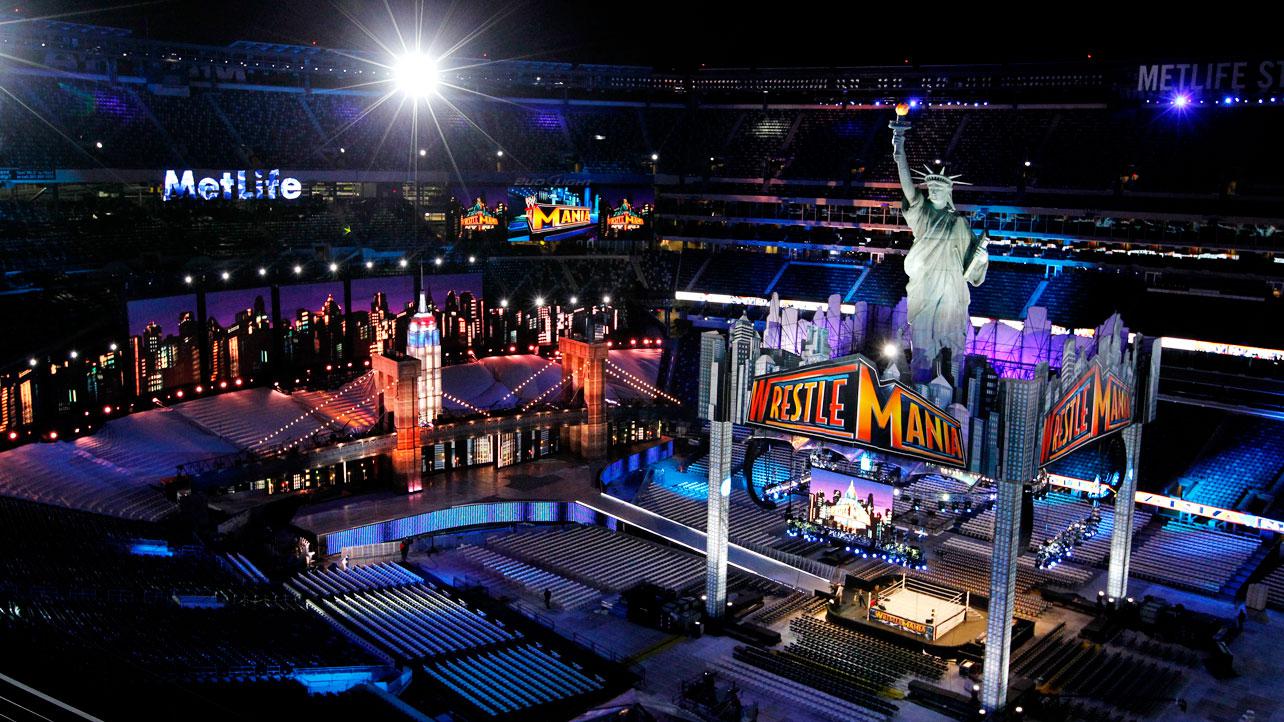
You’d think that the crowd response for the big event would be through the roof, but that’s usually not the case. Part of it’s the acoustics of the space. When you’re in an open-air venue like MetLife Stadium the crowd noise travels upward into the sky instead of echoing around an enclosed arena. Part of it’s that the core fanbase is already worn out from the past few days, and just wants to settle in and watch the show. It’s also harder to get 80,000 fans on the same page at the same time than it is to get 16,000 fans. So even when everyone’s saying the same thing, the left 40,000 people will be shouting it two seconds after the right 40,000 people, and the result is a wordless din.
There’s also a different audience who’s joining the “core” Internet fans there – families from the local area who don’t get very rowdy, or people from the area who don’t know much about wrestling and just come to see what all the fuss is about. They dilute the concentration of the raucous crowd, and to some degree shame the loudest fans into behaving themselves. Every time I’ve ever heard fans start chanting something profane at Wrestlemania someone sitting next to them has told them to watch their mouth.
The next night when the WWE tapes their weekly television show, RAW, everything is different. The curiosity seekers stay home. So do the families. They’ve spent all they’re going to spend. What’s left are 16,000 Internet fans (and 5 horrified “other people”) wedged into an enclosed basketball arena, with acoustics designed to echo. They see that as their chance to air their agenda in front of WWE management and a worldwide television audience: to show how united they are in support of some wrestlers, and how unanimously they detest others.
One of the most dramatic moments this year was when the crowd got fed up with a match between Sheamus and Randy Orton. Instead of cheering or booing either performer in the ring, they decided to show just how little they cared by chanting the referee’s name. “Mike Chioda! Mike Chioda!” Then they chanted for each of the television broadcasters, one at a time. Then they called for RVD, a wrestler who’s in TNA!, the WWE’s rival promotion. They even threw in a Mexican soccer chant used by indy wrestler El Generico. When a villain, The Big Show, prematurely ended the match by ambushing Sheamus and Randy Orton with a steel chair the crowd chanted “Thank you, Big Show! Thank you, Big Show!”
Later, the crowd decided to show their appreciation for Fandango, a young performer they wanted to elevate, by humming his orchestral theme song. Listening to the broadcast, you can hear the humming begin as a faint murmur. Then more and more people start doing it, until almost the entire 16,000 person audience is shouting full blast and dancing in their seats. When Fandango’s match ended after just a minute or so and the WWE tried to move on the crowd kept singing. They kept it up for almost the last half hour of the show, right through John Cena’s match. Every time it would die down someone would start it back up again. Even though the event was in New Jersey, a video came out a couple of days later of the Houston Texans NFL cheerleaders doing the Fandango song-and-dance in practice. PETA employees in animal costumes did it too. Even a weather man danced on the news. Now fans around the country are apt to follow suit. Someone mixed Fandango and the Peanuts gang. That’s spreadable media.
The crowd basically held the broadcast hostage. They did not let the WWE tell the story that management directed. They started telling a new story about how bored they were with the “same old shit” the WWE was trying to sell. I’m sad that we weren’t there for it. As rude and bossy as the Internet fans can be, I’m proud of them.
But here’s the truly sad part. Just a week later the WWE has already made Fandangoing the least cool thing there is. On RAW they brought out all of the marketing statistics and glossy PR videos about how many people are Fndangoing. Then they had Fandango try for 10 minutes to get the crowd to do the Fandango dance on cue. He looked more and more desperate as he screamed hoarsely over and over for people to get out of their seats. Instead of just letting Fandangoing be a fun thing the fans came up with they turned it into a corny marketing gimmick.
Even worse, rumor has it that the WWE is considering holding next year’s RAW after Wrestlemania in the Louisiana Superdome “to make it an even bigger event.” But as I’ve already explained, the acoustics of such a giant stadium, the difficulty of getting 80,000 to harmonize at once, and the presence of so many families is all apt to discourage next year’s crowd from acting so disobedient. If the rumor is true, then the WWE is either out of touch (possible), or machiavelian (very possible).
The WWE constantly pushes fans to social media on their shows, and pops up updates on the screen every time they trend on Twitter. They write in press releases that every live audience is a focus group, and that they have their finger on the pulse of their fanbase like no other producers in Hollywood. But it often doesn’t seem like they actually give a damn what fans are saying. They just care that the fans are marketing them free of charge on social media, and giving them impressive statistics that their PR people can distribute. If the fans don’t embarrass the WWE by making a mockery of their broadcasts I don’t think management is going to take them seriously. I’ll probably remain a fan for many years to come, and I’ll be at Wrestlemania next year. But I won’t be there to dance and sing when the corporate fat cats tell me to. I’ll go to experience natural emotions and shout my genuine opinions. That’s what pro wrestling is about.
Postscript: WWE referee Jimmy Korderas said in a podcast interview:
"I appreciate the fact that the fans who paid their hard-earned money come and enjoy themselves and they cheer and boo and chant for whomever they want. They only issue I had with the post-WrestleMania Monday night crowd was it got a little bit crazy and overboard where they did it to amuse themselves as opposed to being entertained with what was going on inside the ring. So, it was almost like ‘We don’t care what’s going on in the ring, it has nothing to do with what’s going on in the ring; we’re going to start chanting and almost kind of hijacking the show to some extent... To me, it didn’t feel like it fit with the actual presentation of the show... I just thought, like you said, it was more to entertain themselves than to be entertained by the festivities."
And this week's edition of Dave Meltzer's Wrestling Observer reports:
"Multiple WWE employees were upset with the crowd's unwelcoming reaction to Maria Menounos, particularly since they love affiliations with celebrities and with her subsequent letter acknowledging the negative response, it got out that a strong portion of their fanbase lack proper manners, refinement and decency."
Both of these items seem to show that wrestling employees expect their audience to "be entertained", "care about what's happening in the ring", and not be "unwelcoming." But fans expect the show to be entertaining and welcoming, and for the WWE to care about what's happening in the audience. I guess it could show a lack of 'manners, refinement and decency' if Rockne S. O'Bannon showed up at Paley Fest and the audience booed and chanted "Same old shit!" But it would seem even more ridiculous for Rockne to criticize his audience for not being entertained by his show. WWE Fans boo almost every time a celebrity comes on the show, and have for years. I can see how this puts Vince McMahon in an uncomfortable position with some of his business associates. But he's got a problem, because they're booing how corporate wrestling has become, and I think they'd like to sabotage those business relationships. That's definitely unfriendly. I just think the producers and their audience have irreconcilable differences in what they want.
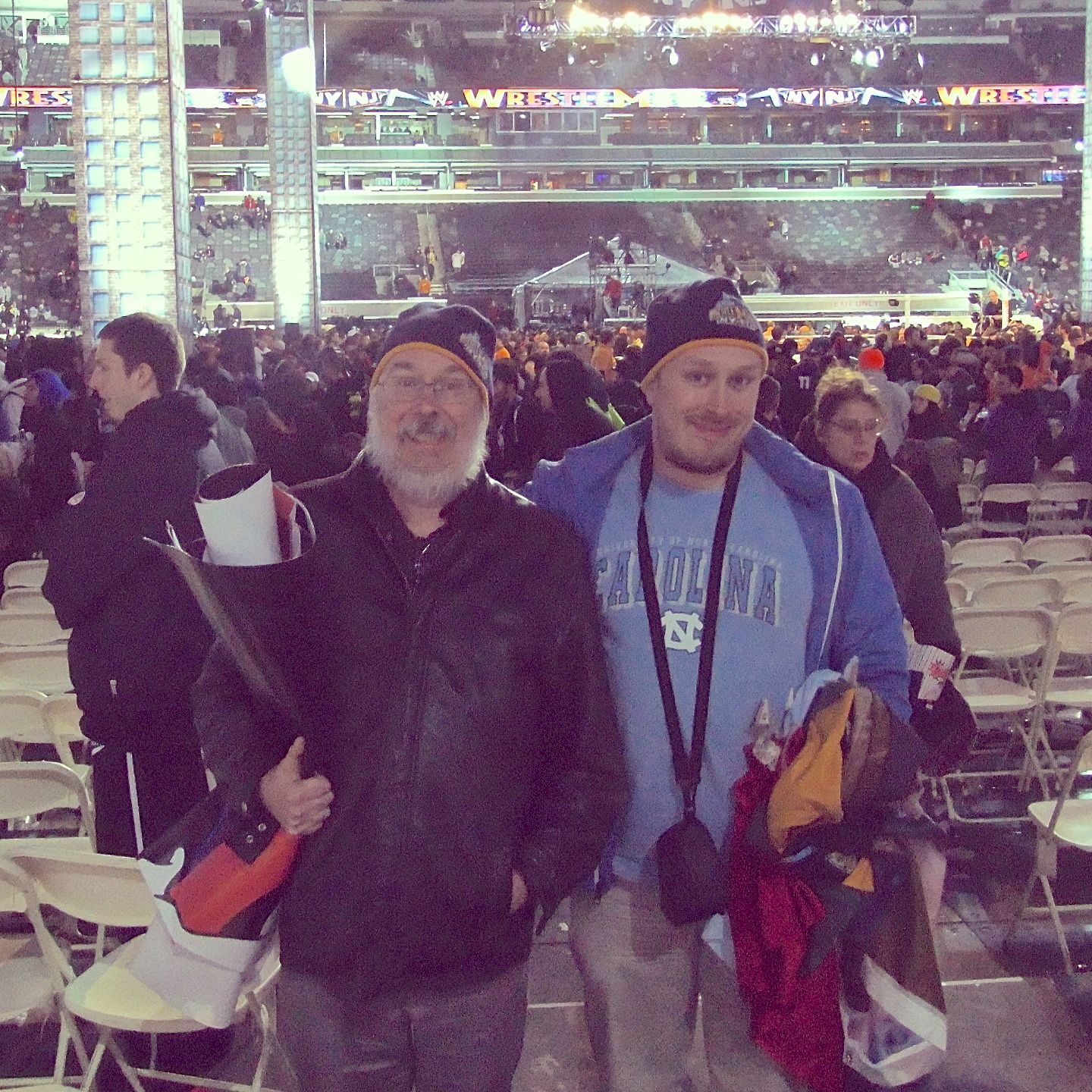
Two weeks ago, my son and I flew to Newark, New Jersey to attend Wrestlemania 29. My son first became interested in professional wrestling when he was nine, and I ended up accompanying him to a range of local and national events. Together, we saw some of the great performers of the 1980s – from Hulk Hogan to Andre the Giant, from Jake the Snake Roberts to Hacksaw Jim Duggan and Rowdy Roddy Piper; we also saw early matches by then-emerging performers, such as The Undertaker, Shawn Michaels, Bret “The Hitman” Hart, and Triple H; and as he grew older, we even made it to a live ECW event (a rival league that has since taken on a mythic reputation). I wrote an essay about the ways that professional wrestling constituted a site of masculine melodrama, “Never Trust a Snake,” and my son published his own account of his experiences as a young wrestling fan for Nick Sammond’s Steel Chair to the Head: The Pleasures and Pain of Professional Wrestling. My son has remained actively interested in wrestling through the years; my interests have shifted elsewhere, but when my son asked if I would travel with him to Wrestlemania, I jumped at the opportunity.
My son brought me up to speed for several weeks before we left, even preparing a PowerPoint to help me keep the various characters and their storylines straight. We bought into the whole package – the Hall of Fame induction ceremony at Madison Square Gardens, the fan Axxess event at the Izod Center, and floor seats for Wrestlemania 29 itself at Met Life Stadium. What follows is an exchange which the two of us wrote reflecting on what we saw and what we feel are some of the defining traits of the contemporary wrestling world. Here, we hope to share some insights the WWE’s often-feisty relationship with its hardcore fans.
Since many of my readers may know you best from the wrestling article we co-wrote ten years ago, would you like to update them on your life since then?
I graduated from The University of Arizona and immediately interviewed to become an assistant staff writer with the WWE. I got to submit a short script, which Stephanie McMahon and the writing team read out loud and discussed. I wrote a scene in which “The Rated R Superstar” Edge, who was known for his reckless lifestyle, found out he had a teenage daughter and had to reevaluate his life choices.
I didn’t get the job, so I moved to the one-stoplight town of Alamance, North Carolina and became an apprentice promoter for an independent wrestling federation. It was my crazy way of showing I had the gumption to go for my dreams. I got to hear a lot of wrestling’s trade secrets from the athletes themselves and I got to know the real people behind the gimmicks. Mostly I spent a lot of time lugging brutally heavy steel poles and wooden planks around in order to build the wrestling ring at each venue. But I had a really bad time overall, for reasons it wouldn’t be polite to go into here, and I ended up deciding that I didn’t want to work in wrestling.
I became a transmedia writer and content producer instead. I now work for The Alchemists, a Hollywood transmedia production company. Most recently I was the primary author of an elaborate second screen experience for the CW television series Cult. Despite going in a different direction professionally I’ve stayed a fan.
One of the great things about growing up is that you get to make your own dreams come true. Specifically, I’ve made attending Wrestlemania and Comic-Con my two annual traditions. I’ve now followed the WWE around to seven Manias (in Boston, Orlando, Houston, Phoenix, Atlanta, Miami and North Jersey.) I always spend weeks making signs, which almost never actually end up being very visible on TV. I’ve gone with friends, girlfriends and a professor. But I’ve never forgotten how much it meant to me to go to the shows at The Garden with you when I was a kid. I really wanted to go to one more show with you.
Why don’t you set the scene for us? You’ve written about the periodic shifts in the core vision of the WWE and especially its ongoing attempts to balance its hardcore fans with the family trade. What do you see as the current state of the WWE and how did this help to shape what was in the program in New Jersey?
Fans describe the current moment in wrestling as the PG Era. The McMahon family, who runs the WWE, has become consumed by the desire to become a respectable corporate brand. ‘Rasslin has always resided in the cultural ghetto, just a little more respectable than monster truck racing but not as respectable as NASCAR. The WWE achieved its highest ratings in the late 90s and early 2000s when they fully embraced their wild image. The major pro wrestling series were rated PG-14. Characters cursed like sailors. Women’s wrestlers dressed like cheerleaders, Catholic school girls or French maids. They swatted each other on the butt with paddles. Male and female wrestlers alike performed death-defying stunts. The soap opera storylines took a dark turn. Triple H infamously raped his opponent Kane’s dead girlfriend’s corpse in her coffin. Wrestling became mainstream among 20-somethings precisely because it irresponsible and excessive. It provided a carnal thrill you couldn’t find anywhere else on television.
The company reigned in their crude content because they wanted to have their cake and eat it too. They wanted to be ultra-cool, but they didn’t want to be seedy. Vince McMahon saw the WWE as a publicly-traded entertainment studio on the level of Marvel or LucasArts. He produced theatrical films starring their performers; he opened a restaurant in Times Square; he founded a pro football league to compete with the NFL; he even cut rap albums.
All of that went off the rails in 2007 when one of the stars, Chris Benoit, murdered his family and hung himself. The most common theory is that his insanity was brain damage he suffered headbutting opponents during his career. Other past and current stars, such as Eddie Guerrero, Mister Perfect, Miss Elizabeth, Sensational Sherri, Bam Bam Bigelow, The British Bulldog, Pitbull #2, Road Warrior Hawk, Demolition Crush, Crash Holly, Test and Umaga – all died of overdoses and drug-induced heart attacks over a seven year span. Big corporate sponsors dropped their support. Local athletic commissions refused to grant the WWE the licenses necessary to perform in certain markets unless they adopted tougher drug testing. Ratings dropped. I was one of the many long time viewers who stopped watching. It was getting downright difficult to give these people my money. I felt like I was supporting something evil.
The WWE has been obsessed with cleaning up its image ever since. All of their shows are now rated PG. The company does a substantial amount of charity work. This weekend’s Wrestlemania broadcast alone included tributes to Hurricane Sandy relief, the Be A Star anti-bullying campaign, the Special Olympics, Make-a-Wish kids and saluting America’s troops – all campaigns the WWE consistently promotes throughout the year. As a result, top sponsors have returned, and a host of respected figures ranging from Barack Obama and Hillary Clinton to Arnold Schwarzenegger, Hugh Jackman, Sean “Puffy” Combs and The Muppets have appeared on WWE television.
Fans who started watching because they loved wrestling’s rebellious excesses have become alienated. Many continue to watch because they love what wrestling was, or what they believe it could be again, but they hate what wrestling is today, and they understandably feel like they didn’t change. Wrestling did. They don’t want to be preached to. They find the anti-bullying PSAs hollow coming from a company that allows wrestlers to make homophobic comments. They want the best athletes and biggest personalities to be successful, not the performers who present the cleanest corporate image.
I basically agree with those fans, even if I feel like they can sometimes paint things as more black and white than they are. As I wrote in Steel Chair to the Head wrestling tried so hard to be shocking in those days that it just got gross. But the energy was much rawer then. I liked how wrestling let its hair down. I will still maintain that both from a creative standpoint and a business standpoint the blood, sex and sock puppets weren’t the problem. The rash of drug related deaths were caused by the relentless 320 day a year work schedule and the lack of company health care, which prevented people from recovering naturally from injuries without abusing pain killers. Management has also always had an expectation that wrestlers achieve unrealistic body shapes, which led the stars to abuse steroids. None of that has really changed. Going PG did help the WWE attract more sponsors and celebrity involvement, which was good for their bottom line. But it also made them a lot less cool, and their ratings are now half of what they used to be. Sanitized wrestling is a buzz kill.
Today’s viewers feel that they are the custodians of wrestling. They still remember what wrestling used to be about – what made them fall in love with it – and they intend to keep booing the good guys, chanting “boring” and sitting in stony silence at live events until they force the WWE to change. But the WWE is seemingly willing to lose those fans if it means they can stay respectable. The gulf that separates the viewers and the corporate executives was never more obvious than at Wrestlemania this weekend.
I’ll say! We observed some real tensions all weekend.
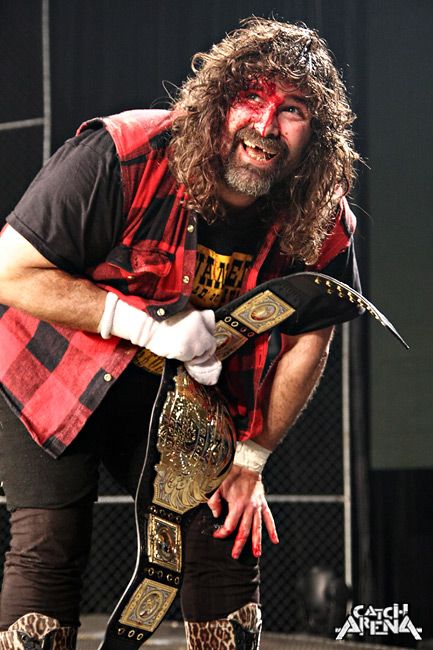
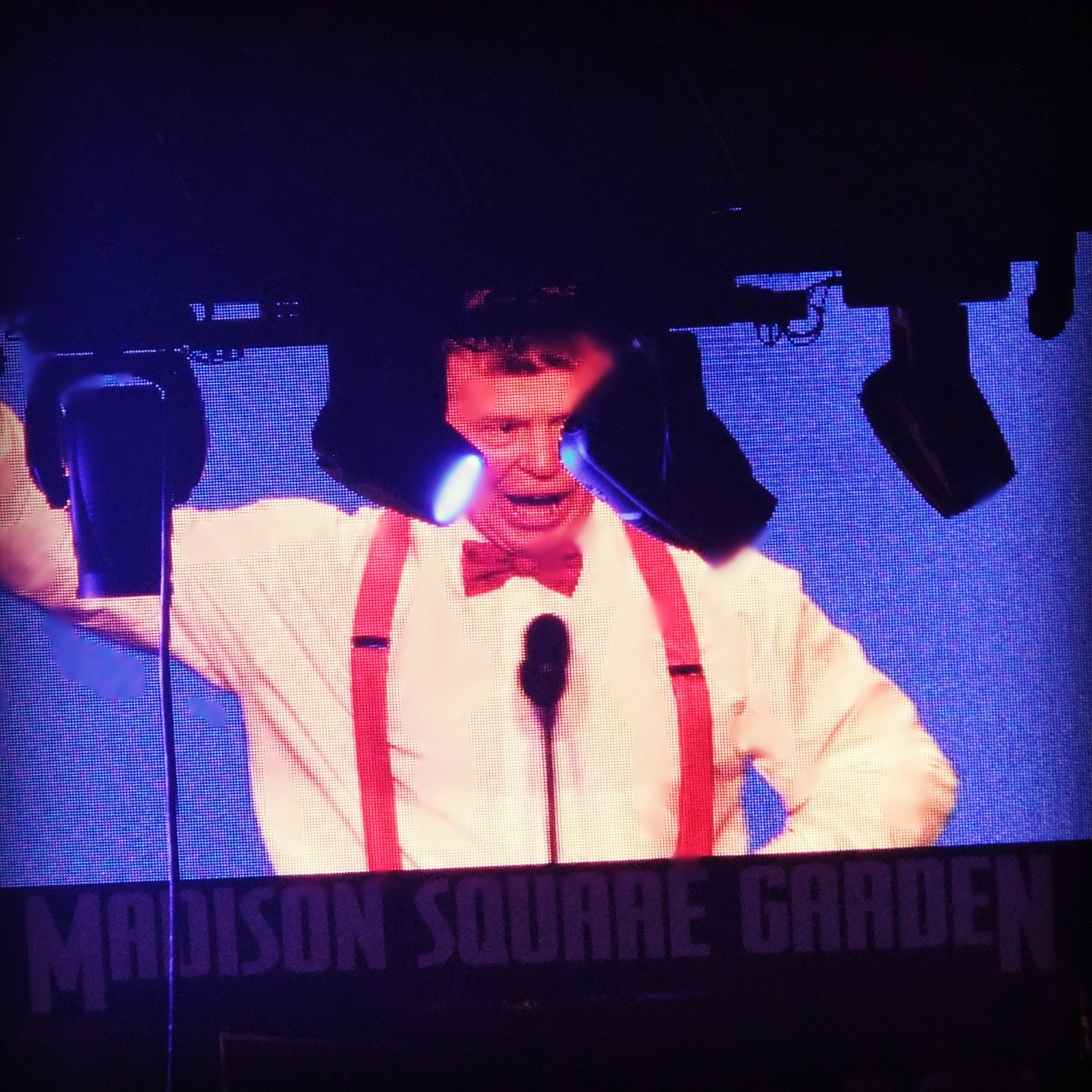
Take the Hall of Fame ceremony. Before the event even started, the WWE announced that late 90s star Mick Foley’s Hall of Fame speech would not air on their trimmed-down television broadcast. He would be cut for time. Instead viewers would see Vince McMahon honor Donald Trump, who owned the buildings that several past Wrestlemanias had taken place in. It was a recognition that most of the web fans saw as politically and commercially motivated. After some behind-the-scenes discussion, the WWE extended the broadcast to allow Foley’s lifetime achievement award to be broadcast.
When Foley went onto the stage, the auditorium went wild and Mick seemed genuinely touched by the fan response. His remarks were playful and funny, telling stories of his blood and glory days in the ring, He emphasized the match where he lost a sizable chunk of his ear, and he ended by staging a few moments of rough-housing with Chris Jericho, who he had always wanted to beat in the ring, heinous villain CM Punk broke character in order to referee the fight.
When The Donald entered, he was resoundingly booed and the relentless jeers continued throughout his remarks. The Donald got booed again when the Hall of Famers were reintroduced at Wrestlemania.
The fans also jeered, booed, and hissed when former Today show host Maria Menounos went into an overly-long and overly-flattering introduction of Bob Backlund, another featured part of the program that went terribly wrong. Backlund came out and seemed to be shouting at the fans. Then the fans shouted back. After a while, it seemed like Backlund was trying to perform as the heel character he adopted upon his return to the WWE late in his career (a senile man in a bathrobe who believed he was running for president), but by that point, no one was quite clear what was going on, as the speaker was raspy and red in the face, and telling people to shut up.
We were both struck when they showed a segment from the Hall of Fame ceremony during the Wrestlemania broadcast which had been carefully edited to suggest a much saner, more sentimental Backlund, and it looked like it was redubbed to strip out the audience response. Then, Backlund got on the stage and went bat shit crazy all over again, making it even less clear than before if he was trying to perform in character or simply outraged over the fan response. Maria Menounos also chastised the fans in a blog post about the event.
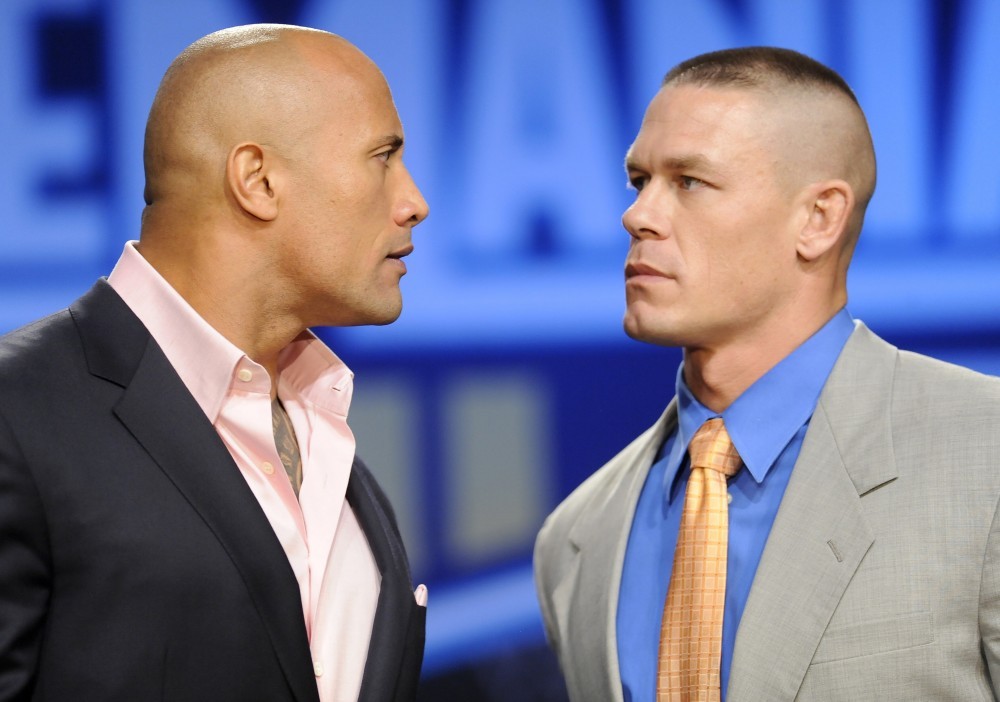
By contrast, the fans seemed to sit on their hands during the heavily billed matched between the Rock and Cena….
The Rock and John Cena epitomize corporatized wrestling. I have been watching since January of 1991 and I can’t remember ever seeing this kind of across-the-board nerd rage towards a Wrestlemania main event. The Rock left wrestling in the prime of his career years ago to focus on his movie career. He claimed that his return to wrestling three years ago was motivated by an enduring love for his fans, but it just happened to be timed to coincide with the marketing push for the movie Fast 5.
Since then he has left several more times, only returning on occasions when he has another movie to promote. Yet the WWE has now pushed aside all of the wrestlers who work for them day in and day out in order to let The Rock main event the biggest show of the year the past three years in a row. Fans see it as a soullessly calculated bit of corporate back scratching arranged by Hollywood agents and executives who aren’t overwhelmingly concerned with what the core audience would most like to see.
John Cena has won 13 world championships since the PG era began, which makes him the face of the moment. He’s constantly seen shaking hands with politicians or ringing the bell at the New York Stock Exchange. But those aren’t credentials fans care about. They’re liabilities, because they make him look like a square, a corporate puppet. Apologists say that Cena is the most popular wrestler on the planet with casual fans, families, women and children, who simply aren’t as rowdy as the adult men in the audience. But he gets booed out of almost every stadium he performs in. Fans verbally rip him to shreds with chants like “You’re a loser” and “Fuck, you, Cena!” They’re not playing around. They hate him.
Last year’s Wrestlemania main event was The Rock vs. John Cena, and the marketing tagline was “Once in a Lifetime.” But the writers knew the whole time that it was false advertising. They were setting the stage for a rematch, which fans dubbed “Twice in a Lifetime.” They’ve been chanting “Same old shit” every time it’s promoted.
I thought the match itself was thoroughly mediocre. I purposefully didn’t make any noise for it, because I think the WWE management even perceives booing as a passionate response. I didn’t even pay that close attention. I just didn’t care. But from what I observed, The Rock is out of shape. No sooner had they started than he got exhausted and needed to rest. That’s been the case with every time he’s wrestled since he came back. It’s hard to keep up with the younger wrestlers when you only get in the ring once or twice a year.
The outcome of this year’s Mania main event was utterly predictable to most fans, with Cena winning and The Rock raising his hand. I rolled my eyes. The WWE hopes that if The Rock tells the audience to respect Cena we’ll all do as he says. I do respect Cena, but not because The Rock shilled for him.
In many ways, getting a glimpse into WWE fan culture through your eyes was the most interesting aspect of the trip for me. As I see it, we are watching a collision between fans and corporations that is unfolding across multiple media. The WWE has fully and obsessively embraced social media, with constant prods throughout their broadcasts to follow along on Twitter, and even recommended hash tags. The fans have also long used a diverse range of blogs, podcasts, and other online forums to coalesce their own opinions, to share insider knowledge, to formulate their opinions – often in ways, as we are seeing here, which run contrary to the dominant narrative the WWE wants to construct.
At the same time, the WWE seeks to stage a spectacular broadcast, that reaches viewers all over the planet. As a scripted program (i.e. “sports entertainment”), they have enormous control over what happens in the ring, yet they have far less control over what the fans do at ringside. Some of the first generation of scholars writing about the WWE stressed the nature of this fan performance – the ways fans perform for each other and for the cameras in ways that help everyone to suspend disbelief and lend credibility to the staged spectacle. When wrestling fans resist, they do so in a highly public manner: they chant, they shout, they hold up signs, they often become so loud that they get heard on the broadcast even if the management doesn’t like what they have to say.
Yes, the announcers have some ability to re-narrate the fan pushback, to re-inscribe it into the narrative. As you say, above all, the WWE wants to generate “heat.” They want to provoke strong emotions, and so, they can always describe the fans as “rowdy” or “raucous” or “out of control” or “going crazy”, even when the response does not seem to support the preferred storyline. Wrestlemania and Raw are going out via a live feed so they can only do so much to control the fan reaction. We saw with the Hall of Fame ceremony, which was taped for later broadcast, that they were almost Orwellian in re-sculpting the experience, cutting out awkward moments, reducing the sound of the crowd so you can’t quite understand what they are shouting, editing it so that it looks like one happy family. Bob Backlund comes across as sentimental in the edit for television, but he came across as crazed and angry for those of us at the live event.
And, of course, the fan’s engagement with the events can shift pretty dramatically from match to match. My nostalgia draws me back to the generation of wrestlers who were performing when you were little, the ones I wrote about in my original “Never Trust a Snake” essay. So, I was perhaps most engaged by the Undertaker/C.M. Punk match. We saw the Undertaker fight some of his early matches and now, he has a 21-0 lifetime record at Wrestlemania. He is an aging lion, who only rarely fights, and who has been rumored for several years to be on the verge of retirement. Yet, the guy knows how to sell the melodramatic dimensions of the storyline. Leading into this match, they did everything they could to make Punk a despicable figure. Paul Bearer, the Undertaker’s long-time friend and supporter, had passed away, in real life. The Undertaker was paying tribute to him on Raw when Punk snuck into the ring and stole the urn which, for storyline purposes, held Bearer’s ashes. We saw broadcasts where he was casually tossing the urn around and then, on the eve of Wrestlemania, he dumped the ashes in the Undertaker’s face and bathed in them himself.
What they delivered at Wrestlemania was an old fashioned "slobberknocker," full of melodramatic twists in fortune, two counts and kick outs.
My sense is that the fans were eating it up. Sure, there were plenty of people rooting for Punk, who has a strong cult following, but they were also being earnest when they chanted “this is awesome” at several points during the match. And it was fun to me to see that the WWE still knows how to play upon those classic elements in their performances.
It was awesome. Most of the blogs I follow gave the match 4 ½ to 5 stars, and I agree. It was the highlight of the night. In that instance, yes, at least ½ the fans were rooting for the bad guy, CM Punk, but the point wasn’t to disrupt the broadcast. It was to show their love for a great performer. Chanting Punk’s name is very different from chanting “same old shit” towards John Cena and The Rock.
In baseball they would call Punk a five-tool player. He’s a charismatic speaker. He can emote very nuanced reactions for the TV close-ups. He can gesture broadly to get a response from the live audience in the balcony. He’s graceful in the ring, and he knows a broad variety of tactics to make each match feel unique. He can play an identifiable good guy or a despicable bad guy more or less equally well. He’s just got the total package.
Two other wrestlers, Dolph Ziggler and Daniel Bryan, lose more often than they win, but the decibel level for their brief appearances can often exceed those for the better promoted stars. Fans create elaborate signs on poster board and fabric to waive in tribute to them. I think in all fairness they’re probably not quite as charismatic as guys like The Rock or Cena, but they’re better natural athletes and great performers just the same. The fact that they so often draw the short straw when it comes to wins and losses just makes fans respect them more for paying their dues.
Your chapter on YouTube has been the focus of some very productive debates between the two of us, often having to do with the relationship between collective engagement and “self-branding.” In the published chapter, you acknowledge that various forms of collective action are possible through social media (citing, for example, the Arab Spring movement), but for you, “narcissism is part of the very structure of online technologies,” (p.88). I could argue the opposite is also true -- that networked communication is by its very definition networked, which involves some kind of set of social relations between individual participants. So, how do we as theorists reconcile the individualistic and collectivistic dimensions of digital culture?
It’s a very good question, and at the risk of being repetitive, I think our responsibility as theorists is to engage how these dimensions of digital culture—the individualistic and the collectivist—operate simultaneously and often in contradiction with each other. In terms of narcissism, I am responding to Jean Twenge, who has argued in her book on youth and media that narcissism is a problem for the younger generation. My critique of this argument is that rather than understand youth and media as discrete, separate realms, we need to think about the deep interrelations between and within youth culture and media spaces. That is, I said here that online technologies enable a kind of narcissism, and this (at least to me) is surely true, in the context of self-branding, personal profiles, the genre of “selfies” for young people, the isolation that can happen in digital spaces. The fact that this context exists doesn’t mean that networked communication is not enabled by digital culture, but it does mean that we have to think about what the categories of “individual” and “networked” are in relation to each other, rather than as each other’s opposite. To say that digital spaces are often individualistic, and that we should be more critical of this as these spaces are often touted as democratic, doesn’t mean that no other politics exist online.
I also think that we need to think of this digital dichotomy as something that also finds purchase in off-line spaces. So, there is some similarity between the notion that, say young women in digital spaces often self-present according to familiar gendered scripts, and the fact that these same scripts are reinforced in celebrity culture, everyday practices, policy and legislation. And, networked communication online might energize and organize a kind of democratic participation that then takes place off-line. What I hope to do in my work is not give the impression that I don’t think democratic participation is possible, but rather that in order for us to understand what something like democracy looks like in the current moment means that we need to engage cultural spaces in their relation to each other, rather than as discrete realms.
You end the book with a really provocative section which at once critiques the possibilities of a politics grounded in critical utopianism (you talk about “utopic normativity”) and yet also holds open what you describe as “the generative potential of ambivalence.” What would you see as some real world examples where groups or individuals have built in meaningful ways on the “generative potential of ambivalence” and how might we distinguish them from the kind of utopian thinking which simply reinscribes existing norms and values?
Well, I think perhaps the most obvious recent example is the various Occupy movements around the globe. Surely, brand culture is part of the context for Occupy—even as it is also part of the movement’s critique. So while Occupy might be called a “branded” movement—through design, logos, the use of social media, the Guy Fawkes mask you mentioned, etc—it is also about challenging existing norms and values.
Another example of how ambivalence is generative can be found in the branding of Wikileaks. A marketing company was hired to brand Wikileaks, as a way to raise funds for Assange’s legal fees. Did branding Wikileaks mean that the politics behind it are rendered obsolete, or does it make Assange a “sell-out”? The WikiLeaks website challenges the history of “official” information and the public’s right to access this information; the leaked documents have already disrupted routines of national security around the globe. Regardless of its ultimate impact, WikiLeaks is subversive. Because WikiLeaks is an affective sentiment in the sense that it inspires affect and emotion from individuals, the branding of it invokes ambivalence. The traversing of boundaries involved in branding WikiLeaks is not about whether Assange is “selling out,” but is an articulation of a politics of ambivalence.
The branding of feminism (as opposed to the branding of post-feminism) might be yet another example. For instance, last year’s “Binders of Women” could be understood as embodying part of brand culture in the way it was circulated, distributed, and engaged by consumers. Yet it also brought critical attention to the patriarchal discourse of politics, and worked to remind women of the importance of voting, etc.
Importantly, to traverse boundaries of different economies, market and non-market, profit-oriented or reciprocal, means not to jump from one “side” of a neoliberal divide to the other, one a space of authenticity, the other one of complicity as the discourse of “selling out” implies. And this is the ambivalence that I think is generative, that challenges a utopic normativity.
Sarah Banet-Weiser is a Professor in the School of Communication at USC Annenberg and the department of American Studies and Ethnicity. She had two books published in 2012, most recently Authentic™: The Politics of Ambivalence in a Brand Culture (New York University Press), which examines brand culture, youth, and political possibility through an investigation of self-branding, creativity, politics, and religion. Also published in 2012 was Commodity Activism: Cultural Resistance in Neoliberal Times (New York University Press), co-edited with Roopali Muhkerjee. Her first book, The Most Beautiful Girl in the World: Beauty Pageants and National Identity (University of California Press, 1999), explores a popular cultural ritual, the beauty pageant, as a space in which national identities, desires, and anxieties about race and gender are played out. She has also authored a book on consumer citizenship and the children's cable network: Kids Rule! Nickelodeon and Consumer Citizenship (Duke University Press, 2007), in addition to her co-edited book, Cable Visions: Television Beyond Broadcasting, co-edited with Cynthia Chris and Anthony Freitas (New York University Press, 2007). She co-edits, with Kent Ono, a book series with New York University Press, "Critical Cultural Communication," and is the editor of American Quarterly.
Your central premise is that the logics of branding are now complexly interwoven with all aspects of our everyday lives, that we adopt its principles in shaping our social relationships with each other and defining our identities in the world, and that notions of “authenticity” are less and less meaningful for describing our culture at a time when politics, religion, self-esteem, personal expression, are all bound up with the logics of branding. So, how are you defining branding?
In the book, I’m actually more concerned with what I call “brand culture” than practices of branding (i.e. the design and implementation of specific brand campaigns). For me, brand culture refers to the relationships between consumers and the commercial world, and the way in which these types of relationships have increasingly become cultural contexts for everyday living, individual identity, and affective relationships. Of course, there are different brand cultures, that at times overlap and compete with each other, so in the book I talk about the brand culture of street art in urban spaces, religious brand cultures, the culture of green branding with its focus on the environment, and so on. The practice of branding is typically understood as a complex economic tool, a method of attaching social or cultural meaning to a commodity as a means to make the commodity more personally resonant with an individual consumer. But I’m arguing that, in the contemporary era, brands are about culture as much as they are about economics.
So I try to show this transition in the book, and I argue that we need to think about differences between commodification and branding in order to understand some of the cultural dynamics occurring right now. That is, because a brand’s value extends beyond a tangible product, the process of branding—if successful—is different from commodification: it is a cultural phenomenon more than an economic strategy. Commodification implies the literal transformation of things into commodities; branding is a much more deeply interrelated and diffused set of dynamics. To commodify something means to turn it into, or treat it as, a commodity; it means to make commercial something that wasn’t previously thought of as a product, such as music or racial identity. Commodification is a marketing strategy, a monetization of different spheres of life, a transformation of social and cultural life into something that can be bought and sold. In contrast, the process of branding impacts the way we understand who we are, how we organize ourselves in the world, what stories we tell ourselves about ourselves.
So, I’m trying to make an intervention in the conversations about commodification, branding and identity. Again, I’m not making the argument that we just apply a business model onto the ways we construct our personal identities—it is not the case that business strategies merely get plucked from the realm of economics and mapped onto the realm of culture.
But I’m also not using “economy” or “market” as mere metaphors. In the book, I think about a more nuanced adoption of the logics and moralities of both economics and culture as a way to understand how we are constructing identities within brand culture, and to think about what is at stake in this kind of construction. What’s at stake for individuals and for culture in adopting brand logics and moralities?
In both Authentic and your new anthology, you talk about “commodity activism.” Explain this concept. To what degree does commodity activism still represent a meaningful form of activism? How has our notion of commodity needed to change to incorporate activism into the branding process? I’ve struggled a bit to think about the similarities and differences between what you are calling “commodity activism”, what I am calling in my current work “fan activism,” and what our mutual friend Stephen Duncombe would discuss as “ethical spectacle.” For me, there are some core differences between “purchasing Starbucks coffee to support Fair Trade,” tapping into the collective identity of Harry Potter fans in order to push Warner Brothers to move their chocolate contracts to Fair Trade Countries, and using the Guy Fawkes mask for Occupy Wall Street, yet from a certain frame of reference, all might be described as using “branding” to promote their political agendas. So, can we make meaningful distinctions in terms of how activists deploy brands in their efforts to promote change?
Roopali Mukherjee and I, in our co-edited volume, Commodity Activism: Cultural Resistance in Neoliberal Times, define commodity activism as the process by which social action is increasingly understood through the ways it is mapped onto merchandising practices, market incentives, and corporate profits. We look at different forms of commodity activism—the Dove RealBeauty campaign, the branding of green activists, the work of celebrities for progressive causes such as development and the diamond trade, and so on— and think through what social action and cultural resistance mean in a context that is increasingly defined by ideas about self-branding, entrepreneurial individualism, and economic responsibility.
I think that commodity activism can be an important form of social activism, if the goals of such activism are not primarily organized around the accumulation of profit or building a corporate brand (so, for example, consumers may act politically by buying, say, green products, but we need to also attend to the ways in which consumer behavior builds brands by buying products, etc.). In lots of forms of commodity activism, the goal is the identity of the consumer or brand of the corporation, not the activism itself or what it might yield. So much commodity activism, rather than challenge existing structures in the social, economic and cultural realms, those structures that create and sustain inequalities, is dedicated to furthering the recognition of the corporation, its self-brand. This then often becomes the end goal of the activism, and it is this that I think we should challenge as “activism.”
So, to answer your question: yes, we can make meaningful distinctions in terms of how activists deploy brands. We can also make meaningful distinctions in terms of different kinds of activism. So, for example, activism about girls’ self-esteem is hot right now—a whole industry has been built around it. That doesn’t mean that it isn’t an important context for activism, but it does mean that we need to carefully attend to what sort of politics aren’t so easily branded, and thus made visible.
Your first extended example is Dove’s “Real Women” campaign, which Unilever very much wanted us to experience as a break with the ways women had been marketed “beauty products” in the past. To what degree did this embody the new branding logic you are describing? Yet, you are also arguing that it needs to be understood as part of a larger history of Dove’s alternative marketing to women. What might we learn by placing this ad into this expanded historical context?
Well, I think that all cultural forms of activism need to be understood historically, as dynamics of power that shift and become something new, but also because we need to attend to the ways in which historical forms of power continue to be crucial in how we structure our lives and our politics. This is important because history matters—in my work I try, in every chapter, to historicize the specific brand culture I’m examining, so that we can see how there are cultural dynamics that seem quite new and different share similarities with historical processes and patterns. At the same time, there is something shifted at this moment, for some of the reasons I’ve detailed here: the rise of commodity activism, the difference between commodification and branding, the way consumers interact on multiple media platforms, etc. So with the Dove case, the RealBeauty campaign, it is the case that the company encouraged a sort of “co-production” with consumers, and did call attention to the exclusionary (and often racist and classist) norms of beauty culture.
It also has a history of helping to create that very same beauty culture. One doesn’t cancel the other out, nor is this a simple case of hypocrisy. Rather, this kind of contradiction defines brand culture, and also defines how consumer culture can be the site for a kind of activism. The power of capitalism, as we know, has been in its capacity to not just protect existing markets but to be expansive, to create new markets. This happens, though, in the context of a relationship to activism and resistance, and it is this hard-to-define terrain, where we think about what counts as activism, that comprises brand culture.
Sarah Banet-Weiser is a Professor in the School of Communication at USC Annenberg and the department of American Studies and Ethnicity. She had two books published in 2012, most recently Authentic™: The Politics of Ambivalence in a Brand Culture (New York University Press), which examines brand culture, youth, and political possibility through an investigation of self-branding, creativity, politics, and religion. Also published in 2012 was Commodity Activism: Cultural Resistance in Neoliberal Times (New York University Press), co-edited with Roopali Muhkerjee. Her first book, The Most Beautiful Girl in the World: Beauty Pageants and National Identity (University of California Press, 1999), explores a popular cultural ritual, the beauty pageant, as a space in which national identities, desires, and anxieties about race and gender are played out. She has also authored a book on consumer citizenship and the children's cable network: Kids Rule! Nickelodeon and Consumer Citizenship (Duke University Press, 2007), in addition to her co-edited book, Cable Visions: Television Beyond Broadcasting, co-edited with Cynthia Chris and Anthony Freitas (New York University Press, 2007). She co-edits, with Kent Ono, a book series with New York University Press, "Critical Cultural Communication," and is the editor of American Quarterly.
Transmedia Hollywood 4: Spreading Change is coming up on Friday of this week, and in anticipation of that event, which is scheduled to have some substantive discussion about the intersection between brand cultures and political activism, I wanted to share this interview with my USC Annenberg School colleague Sarah Banet-Weiser. Banet-Weiser will be speaking at the event, drawing on her two recent books, the single-authored Authentic(TM): The Politics of Ambivalence in a Brand Culture and her anthology, co-edited with Roopali Mukherjee, Commodity Activism: Cultural Resistance in Neo-Liberal Times. I anticipate Banet-Weiser bringing a very needed critical perspective to our discussions, one which is skeptical of the claims of some of our corporate participants, but one which is also open-minded and curious about their visions of political change.
I have come to develop enormous respect for Banet-Weiser during my time at USC. She is beloved here as a teacher and mentor who is incredibly dedicated to her students. We often find ourselves closely aligned on departmental policy concerns and she has in some ways been a mentor for me as I have adjusted to a new institutional setting. Our work seems to have paralleled each other -- starting with her early work on children's culture and media, which emerged at about the same time I was publishing The Children's Culture Reader. More recently, her Authentic (TM) book was released just a few months before Spreadable Media. Both represent attempts to come to grips with the contradictions and challenges of our current moment of media change. And I have found her collection on Commodity Activism very important as we are thinking through my current research on youth, new media, and participatory politics.
I think it is safe to say that most of the world, reading our work in isolation from our institutional context, would see us as representing very different theoretical and ideological perspectives on some of these same issues. It is difficult in the current climate to describe these differences in language that is not already over-determined by culture wars and conflicts, rifts in our field that go back at least to the 1980s, if not earlier. Banet-Weiser's work is grounded in a very strong critique of neoliberalism and a strong emphasis on structural constraints on our capacities for individual and collective action; my work has been strongly grounded in an advocacy for participatory culture as a central tool for bringing about greater diversity and democracy and has tended to place a strong importance on the concept of collective agency within a networked culture. Often, our respective intellectual allies do not play nicely with each other, and we've both been concerned by the sharp language through which these issues have often been contested in recent years.
Yet, I have enormous respect and affection for Banet-Weiser and have always learned a tremendous deal from her work, and as friends and colleagues, we have become important thinking partners for each other. We read and responded extensively to each other's book manuscripts. Such exchanges were especially valuable at moments where we were in the sharpest disagreement, where our world views clashed in ways that prove generative for both of us. Some of these core disagreements surface in the following interview. My hope is that these disagreements prove generative for my readers also.
As I have written often of late, there's an urgent need for these perspectives to be speaking with each other. I see more and more scholars talking about the need for a frank critique of what's happened with digital culture and especially with Web 2.0. Many are calling for us to move beyond utopian or dystopian perspectives and deal realistically with what has and has not been achieved in terms of a vision for meaningful social and political change. One side has perhaps articulated most fully the promises and potentials of that change,the other has developed the strongest critique of the structural constraints on reforming or transforming the current system and the mechanisms by which participation has been manipulated and exploited by corporate interests towards its own ends. One side has pushed an agenda of media reform focused around corporate concentration, while the other has stressed the importance of insuring the broadest possible access to the skills and tools required for meaningful participation. These two sides too often speak past each other, distrust each other. We lose sight of our shared goals. I am determined to seek common ground between these perspectives, and I hope that this exchange will represent one step forward in that process.
Banet-Weiser writes with enormous clarity in her new book about a theoretical and political stance grounded in "ambivalence," a term I also think might describe what I am seeking right now in my own work. Too often, we've ended up with a divide between those of us who see the world as a glass half full and those who see the world as a glass half empty, without noticing that both of us agree that it's only half a glass. Our points of disagreement may make us stronger if they force us to examine our core assumptions and sharpen our analysis, but they should not come at the expense of our recognition of our shared commitments and our collective stakes in insuring a more just society.
You write, “Terranova’s idea of compromise, between creativity and capitalism, between affect and profit, requires that we understand what exactly is being compromised, and what consumers gain as well as lose through such transactions.” On this point, we totally agree though there’s much more work to be done before we can fully address this question. My own sense is that critical theory has been better, by far, at describing what consumers “lose” and less effective at describing what consumers “gain.” So, from your point of view, what do consumers “gain” under the neo-liberal terms you are describing in your book? And what do they “lose”?
Well, as you say, it is somewhat easier to describe what consumers “lose” within brand culture, so I’ll address that first. I describe in the book how, in the current moment, brands, and branding strategies, have expanded beyond selling actual products or companies, and are an integral part of culture. We are witnessing the expansion of brand language and logic to our personal selves, where individuals often feel obliged to not only construct, but to understand themselves as brands. This is a problem, I think, because branding is, at the end of the day, about selling and marketing things. So, for instance, when we create a self-brand, we embark on a process that packages, designs, and markets us—human beings—just like other products and commodities. To think of ourselves as things or commodities devalues the self.
Another thing I think consumers “lose” when we are not critical of, or do not challenge the normalization of self-branding, and brand culture more generally, relates to the economies of visibility that support and validate branding. Branding, and self-branding in particular, is about making the self visible (through a variety of media platforms), and I think we need to be critical of not only cultural imperatives to be visible, but also the structural inequalities that organize visibility in the first place: who can be visible? Who is seen as “worthy” of visibility? How does visibility work in different ways depending on gender, race, class? Within this context, brand culture, as both an economic and cultural formation and dynamic of power authorizes some things as “brandable,” while others are unbrandable, or are in excess of the brand, or remain in search of “brandability” if they want to be visible.
Now, what do consumers potentially “gain” within the neoliberal context? While I’m critical of many brand cultures in the book, the cultures and practices I examine are only a small element of broader brand culture. There are historical ways in which, for example, making the self visible through consumer and brand culture has been linked to a politics of freedom and emanicipation, and I think we need to pay attention to those histories. This is a contradictory formation: brand culture provides the context for struggles over visibility and recognition. Yet it simultaneously provides the context for the commodification of people as visual objects. The contradictory spaces of brand culture provide opportunities for acting on these contradictions, and thus potentially locating political possibility and critique within brand culture.
But brand culture, or any kind of culture for that matter, is not an either/or context, where it is either liberatory or oppressive, because the production of meaning is always collective and contingent. Certainly the kinds of access and disruptions of power we witness in, say, social media contexts, can lead to a more democratic idea of resistance and identity, and dynamics of power can be re-contextualized in ways that offer space for shifting norms.
What I trace in the book, and this is particularly true when we are talking about gender norms and practices, is that these media platforms may be disrupting conventions of power in some ways while also relying on familiar scripts and narratives that have proven successful in capitalism.
These questions are intended to get to the heart of what your book is describing as “ambivalence.” It is a word which does a great deal of work in your argument. In what sense do you think our relations to contemporary consumer culture are “ambivalent”? What is the role of the critic in dealing with this kind of ambivalence?
I think that a great deal of scholarship approaches consumer and popular culture within the framework of a familiar binary: it is either authentic or commercial, it is about real politics or corporate appropriation. For me, brand culture is neither a historical inevitability, nor is it uncontested. Rather, brand cultures emerge from the deeply interrelated discourses and practices of capitalism, history, culture, technology, and individual identity formation. Because brands form culture, they are—like culture itself—often unstable and precarious. The argument I’m making in the book is that consumer capitalism is a nuanced, multi-layered context for identity formation—as such, it is an explicitly cultural space. And, because I’m writing about culture, I think we need to carefully attend to the ways in which the production and consumption of culture within the logic of branding involves not only those practices that are easily branded, but also those who are left out of brand culture because they are not easily branded. So, we need to think about why certain politics or lifestyles are incorporated into brand culture, as well as why others not immediately amenable to branding are left out.
This is where ambivalence comes in, in those spaces of culture that are not easily determined by either commercial culture or individual resistance. But, connecting ambivalence to actual praxis is a difficult thing, and has no guarantees. For one thing, most elements of culture are not seen as ambivalent. Ambivalence, its lack of certainty, its inconsistency, the way it both harbors and is defined by doubt, is generally understood as a problem, something to avoid. Yet, I’m arguing that it is important to take seriously the cultural value of emotion and affect and the potential of ambivalence, its generative power, for it is within these spaces that hope and anxiety, pleasure and desire, fear and insecurity are nurtured and maintained. Brand marketers realize the potential of ambivalence, and capitalize on it. But their strategies do not in turn mean that affect, or ambivalence, are simply, or only, spaces of corporate manipulation. Rather, affect and ambivalence can be utilized in different ways.
The ambivalence of brand cultures, then, is about incongruity—all brand cultures do not mean the same thing, either culturally or individually. If consumer capitalism demands that we live our lives within brand spaces and subjectivities, we need to think carefully about what this kind of life looks like, and conversely, what potential spaces and actions threaten to disrupt the expected flow of consumption.
To theorize ambivalence as a structuring element of brand cultures means that not all cultural practices are spaces of possibility, but rather that some carry more potential than others, that some cultural practices are easier to brand than others. Those practices that can be integrated within brand relationships, such as girls’ self-esteem, or environmental politics, or street art, are not empty of political possibility, but that possibility itself takes shape within a branded space and under branding rubrics. When a brand, a genre, or a product circulates in culture, its meaning is ambivalent. In other words, the fact that a brand circulates in culture is not a guarantee of its meaning; rather, the circulating brand is constantly under the threat of breakdown and destabilization. Within brand culture, this threat forms a crucial contradiction: brands are designed for stability, and their logic is based on regularity and singularity. Yet they are ultimately precarious, and are subject to cultural misunderstanding. For me, to theorize brand cultures as subject to misunderstanding and misrecognition is to deliberately hold on to the generative potential of brand cultures.
Sarah Banet-Weiser is a Professor in the School of Communication at USC Annenberg and the department of American Studies and Ethnicity. She had two books published in 2012, most recently Authentic™: The Politics of Ambivalence in a Brand Culture (New York University Press), which examines brand culture, youth, and political possibility through an investigation of self-branding, creativity, politics, and religion. Also published in 2012 was Commodity Activism: Cultural Resistance in Neoliberal Times (New York University Press), co-edited with Roopali Muhkerjee. Her first book, The Most Beautiful Girl in the World: Beauty Pageants and National Identity (University of California Press, 1999), explores a popular cultural ritual, the beauty pageant, as a space in which national identities, desires, and anxieties about race and gender are played out. She has also authored a book on consumer citizenship and the children's cable network: Kids Rule! Nickelodeon and Consumer Citizenship (Duke University Press, 2007), in addition to her co-edited book, Cable Visions: Television Beyond Broadcasting, co-edited with Cynthia Chris and Anthony Freitas (New York University Press, 2007).
She co-edits, with Kent Ono, a book series with New York University Press, "Critical Cultural Communication," and is the editor of American Quarterly.
Much of your writing has focused on parallels between daytime serialized drama and the rise of "quality" shows, primetime dramas which marry serialized storytelling with higher budgets, deeper production values, and much shorter, season-based dramas which pack intense meaning into typically between 10 and 20 episodes in a season, as opposed to 260 episodes per year. What do you feel is the nature of the connection between today's critically acclaimed dramas on FX, AMC, HBO, Showtime, and elsewhere and the daytime serial drama?
The success of early primetime serials like Dallas (1978) and Dynasty (1981) redefined the public perception of soap opera. Larger-than-life, over-the-top characters like J.R. Ewing and Alexis Carrington, who more resembled stock characters from the commedia dell'arte, than ATWT's Hughes family, were enormously entertaining to watch, but not because viewers found "meaning and resonance through a deeper connection." And while Larry Hagman's (J.R) called Dallas as a cartoon rather than a soap opera, to the media and public these guilty pleasures were soaps simply by virtue of their seriality. The popularity of these primetime soaps coincided with Gloria Monty's transformation of General Hospital,, and had at least as profound an impact on daytime soaps. The spirit of Dallas and Dynasty continues in current primetime soaps Revenge and Scandal, and for the teenage demo, Gossip Girl and Pretty Little Liars.
The true heirs of ATWT comprise a long list of often critically-acclaimed, always ratings challenged, and ultimately short-lived serial dramas. While thirtysomething may not have looked anything like ATWT, the the day-to-day lives of two baby boomer families, the Stedmans and Westons, mirrored those of the Hughes and Lowells 30 years earlier. Thirtysomething ran from 1987-91 and never rose above 40th in the ratings. Its very ordinariness (tensions between career and family, visiting parents, finding a babysitter) made it, and similar shows that followed (My So-Called Life, Joan of Arcadia, Jack and Bobby, Friday Night Lights, Men of a Certain Age, to name but a few), a challenge to promote effectively.
How networks schedule these quiet, slow-paced shows creates another obstacle. Broadcast network programmers, under pressure to win time slots, often shuffle their lineup, making it difficult for viewers to find these shows, which, unlike episodic television, need to be watched in order. Sometimes networks cancel them after a handful of episodes, creating a self-fulling prophecy when fans hear about a promising new serial drama, but fearing yet another heartbreak (not being hyperbolic here:), decide not to watch.
Since cable networks rarely pull a serial drama before the first order of episodes has aired, and are able to place the show in a fixed time slot followed by multiple repeats (sometimes even daylong marathons), viewers have ample opportunity to connect with these quiet, slow-paced shows. But there are still issues beyond the obvious disadvantages shorter seasons create for serial dramas: less time to fully develop characters and their relationships means less time to fully engage viewers. When networks pick up serials dramas, the creators face uncertainty about the number of episodes that can undermine the pace of the storytelling. After a 13-episode first season, Parenthood was picked up for 22 episodes, then renewed for a 18-episode third season and 15 for the fourth. Since the season often ends before the network has announced that the show has been renewed (or not), the season finale could well be the series finale.
Sometimes, scheduling uncertainty can cause a show's demise. When the first season of TNT's Men of a Certain Age ended in February 2010, the show was averaging 2.6 million viewers per episode, enough for the network to order an additional 12 episodes. After the episodes were completed, TNT decided to air them in two batches. The first set of six episodes ended in January 2011, and the show was holding its own, averaging 2.4 million viewers. But TNT held the second set until June, when average viewership dropped to 1.5 million and the show was cancelled, a fate that might well have been avoided had all 12 episodes aired as the writers intended when they laid out the second season.
The real challenge is how to describe these quiet, slow-paced shows, which,by their very nature, defy brevity, and struggle even on premium cable, where In Treatment lasted three seasons on HBO and Enlightened is currently fighting to be heard over the noisier Girls and Showtime's Homeland. When Ray Romano pitched Men of a Certain Age to FX, he was told it "wasn't loud enough." The show wound up on TNT, where it never really fit in with the network' s other original programming, procedurals like The Closer, and the light-hearted Franklin and Bash. When Men... was cancelled, critic Alan Sepinwall admitted , "I don't always do the best job of articulating the greatness of this series, but it's there in those moments I described above, and so many more. It is a series about small details, and those details add up into big things: big laughs and big emotion; big pain and big joy."
Edie Falco (Carmela Soprano) has said that she always saw The Sopranos as a family drama. She's right; but take away the mob and what are the odds that The Sopranos would have been picked up, much less become a cultural phenomenon? Peter Horton (thirtysomethings's Gary) perfectly articulated the situation, describing how networks, cable and otherwise, are driven to create shows where something stands out: "'I'm a mother who sells pot,' (Weeds); 'I'm father, but I'm a meth dealer,' (Breaking Bad); 'I'm a gangster, but I have therapy,' (The Sopranos). There's always a but, whereas thirtysomething is about people," which is exactly how Irna Phillips described As the World Turns.
"Quiet" shows with no "buts" are the 21st-century manifestation of the "your mother's soap opera" dilemma that ultimately doomed ATWT. The challenge facing today's vertical storytellers and programmers is to develop a brand evoking the appeal of "quiet" and the missing "but," that will stand out in an ever more crowded media landscape without compromising the integrity of the vertical storytelling axis. Developing that brand demands a more precise description and definition of vertical storytelling. That means first breaking down the characteristics of these shows at the elemental, even molecular level, a task hampered by the ambiguity of language that so flummoxed Alan Sepinwall. Virginia Heffernan's insightfull 2008 observation that Friday Night Lights "ferociously guards its borders, refines its aesthetic, defines a particular reality and insists on authenticity," which limits "platforms for supplemental advertising" also applies to these shows, and adds to the challenge, and urgency, of developing a brand for them.
What are the most interesting experiments with soap opera storytelling that you feel are capturing the unique nature and potential of the "U.S. soap opera format" of storytelling?
And therein lies the fundamental (and vexing) question: what exactly is the unique nature of the "U. S. soap opera format?" There's a vast difference between the public perception of soap opera as a melodramatic guilty pleasure populated with campy, over-the-top, plot-driven characters motivated by agendas rather than emotions, and mine. I would argue that soaps' unique nature lies in a narrative structure that emphasizes storytelling's vertical axis, revealing characters' interiority, their emotional and psychological back stories, and providing time for viewers to fully absorb that information. All of which creates the opportunity for viewers find meaning and resonance through a deeper connection to characters.
A conversation to be continued. But first, the economic realities and the toll they've taken on soap opera's unique nature.
From the time soaps moved from radio to television, the genre expanded: first adding the visual element, then growing from 15 minutes to a half hour, and in the late 1970s, to an hour . At the time, soaps were still a profit center for networks, and their budgets, while paltry compared to primetime shows, were sufficient to hire large casts with which writers wove rich, densely interconnected stories. After O.J., ratings took a hit from which they never recovered. Networks reduced the licensing fees they paid to the production companies, who cut the shows' budgets. There are a number of ways for producers to reduce the cost of on-screen talent (shifting highly-paid veterans to recurring status and reducing the guarantees for contract players), so smaller budgets didn't necessarily translate into fewer characters. What did happen was that there with fewer actors populating each episode, characters interacted less frequently, which limited opportunities for viewers to experience the full pleasure of the vertical axis. So, what had been a rich storytelling tapestry frayed and eventually shredded into the fragmented storytelling discussed above.
In July 2011, Prospect Park announced that they had acquired the online rights to two cancelled ABC soaps, All My Children and One Life to Live, and planned to launch the shows in early 2012. Grateful fans cheered and the mainstream media took note. But, PP's announcement was premature: they had not yet negotiated contracts with the unions, and their business plan, which retained the shows' hour format, failed to attract sufficient financing. When PP said they were suspending their efforts a few months later, most observers believed the deal was dead.
Fast-forward to last December: PP announced that they had negotiated collective bargain agreements with the guilds and secured sufficient financing to begin production in February. PP had lost a credibility with many fans when they suspended their initial effort, and not surprisingly, the reboot's reboot was met with skepticism (and barely a mention in the mainstream media). Initially, PP took a lot of heat on the boards, but as their plans solidified, veteran actors signed on and distribution deals were struck with Hulu and iTunes, fans began to believe (the mainstream media silence continues). Production began on February 25th.
What PP's done over the the past 18 months is what the networks and Procter & Gamble Productions ought to have been doing before soaps' economic model, so successful for so long, was no longer viable. It took PP to recognize that for soaps to survive into the 21st-century, the Web would have to be more than just an additional platform for showing and promoting shows, then come back from an initial failure to make it happen. Perhaps the most important aspect of this resurrection is that the online reboot streamlines the format: 30, rather than 60 minutes; four episodes a week, rather than five. No doubt scaling back helped to convince investors, but will PP recognize the opportunity it has to exploit the shorter format and recapture the unique nature of soaps that has been lost over the years? I'm encouraged by the relatively small, multi-generational (of the 14 contract players, eight are over 40; of the eight, two are over 50, four past 60) cast that's been assembled for One Life to Live. All of the characters are deeply-connected, with long histories between and among them, so the elements are in place for PP to turn economic necessity into the mother of reinvention. The rebooted AMC and OLTL are slated to premiere some time in April.
When Irna Phillips blazed the trail for serial drama in the 1950s, the television landscape was minuscule, three networks, and relatively expensive to enter -- the $10,000 cost of the ATWT pilot was twice the median household income at the time. Today, as the price of technology continues to drop, anyone can make and upload video to a media landscape incalculably larger than 60 years ago. Since the mid-1990s, the Web has been flooded with mostly free content of varying quality, including an ever-increasing number of online serials designed to appeal to soap fans. Like their primetime counterparts, these Web-series are most often considered soap operas only by virtue of their seriality. Despite barebones budgets and minimal monetization, many of these series, juggle large casts of characters squeezed into short (7-12 minute) episodes, limiting possibilities for deep viewers engagement. Only a handful have fully engaged my inner soap fan. My favorite, the critically acclaimed Anyone But Me, premiered in 2008 and ran for 26 episodes over three years before the series finale in January 2012.
Last May, while Prospect Park was off the grid getting its ducks in a row, there was a small news item on the We Love Soaps site announcing a new YouTube channel, WIGS: Where It Gets Interesting. The channel promised "high-end, original, scripted series, short films, and documentaries, all starring female leads." WIGS co-creator, Rodrigo Garcia, had long plumbed the vertical storytelling axis in films like Things You Tell Just By Looking At Her, Ten Tiny Love Stories and Nine Lives, along with HBO's In Treatment. He brought the same sensibility to the work he created for WIGS.
WIGS co-creator, filmmaker Jon Avnet, shares his partner's storytelling sensibility, but even more important is how the two men went about creating the channel. With first-round seed money from Google, WIGS became an official YouTube channel, making the project attractive to media partner, News Corp, and advertisers, AMEX and Unilever. As the pieces fell into place, including collective bargaining agreements with the entertainment unions, Avnet and Garcia invited more than a dozen writers and directors to create projects built around a female lead. Established actors, aware that their industry is in flux, were eager to participate even if it meant working for scale.
Before WIGS went live on May 14, Avnet and Garcia had produced enough content to run three episodes a week for almost seven months. Enough time to build an audience: more than 25 million views and 110,000 subscribers. The first season of WIGS included a few documentaries and short films, but the channel's foundation was13 scripted serial dramas made up of 2-15 episodes running 7-10 minutes with small casts -- sometimes as few as two characters.
Last month, FOX Broadcasting signed a multi-year deal with WIGS "to expand the breadth of offerings through the WIGS channel, and test and nurture dramatic concepts and talent in the digital realm..with an eye toward building content that can be programmed on FOX and/or other channels." On March 15th, WIGS returns with a second season of Blue, followed later in the spring by the next installments of Lauren, and a new series Paloma.
Avnet and Garcia created WIGS specifically with women as the target audience. So, what to make of one commenter's question, "what does it say that I, a 35-year old man, find myself addicted to WIGS?" What to make of the substantial number of women who were (and are) deeply engaged fans of Friday Night Lights and Men of a Certain Age, both shows ostensibly for and about men? The appeal of vertical storytelling clearly transcends gender; what about other demographic markers? What are the characteristics of viewers drawn to the vertical storytelling axis?
These questions, and others yet to be articulated, need to be explored before vertical storytellers can identify and maximize their potential audience. The data generated by the 110,000+ WIGS subscribers contain essential information for brand development, which, properly analyzed, can also inform the qualitative insights necessary to fully identify viewership.
Where has this project led you? Now that you've put together a personal reflection on your relationship to As the World Turns, what's the next step in your ongoing research about the soap opera's place in our cultural history and in our contemporary culture?
Probably the most frustrating part of writing about soap opera has been the lack of a framework within which to consider soap opera's place in our contemporary culture. Identifying the underlying factors has been challenging because there's no hierarchical relationship among them. Over the past several years, I've posted over 100 short articles on my blog. This piece represents my first effort to begin crafting those pieces into a larger context; I've barely scratched the surface.
I first began writing about soaps as a fan. And it's as a fan, saddened and angered with the premature demise of show after show carrying on (consciously or not) the legacy that Irna Phillips began when she created As the World Turns, that I began exploring what it would take to carve out a place for this kind of storytelling in today's rapidly-shifting media landscape. Personal as my efforts have been, this work can only continue with the collaboration of media scholars and professionals along with institutional support.
On related fronts, I'm currently completing the syllabus for a class, "The Influence and Evolution of the American Soap Opera, I'll be pitching to Boston area schools, and considering the possibility of a book to follow. Also in progress: a proposal for an Irna Phillips biography.
Lynn Liccardo is a longtime soap opera journalist and blogger. Her critical observations on soaps – their content, the industry that produces them, and the culture that both loves them and loves to ridicule them – connect soap opera’s past and present with its future and begin to form a larger framework within which to more fully examine the genre. She released an ebook of essays detailing the final years of As the World Turns, entitled as the world stopped turning... Among her other publications are "Who Really Watches the Daytime Soaps" (1996, Soap Opera Weekly); "Irna Phillips: Brief life of soap opera's single mother 1901-1973" (2012, Harvard Magazine). Her essay, “The Ironic and Convoluted Relationship between Daytime and Primetime Soap Opera,” was published in The Survival of Soap Opera: Transformations for a New Media Era (co-edited by Futures of Entertainment Fellows Sam Ford, Abigail De Kosnik and C. Lee Harrington).
Sam Ford is co-editor (with Abigail De Kosnik and C. Lee Harrington) of The Survival of Soap Opera: Transformations for a New Media Era (2011, University Press of Mississippi) and co-author (with Henry Jenkins and Joshua Green) of Spreadable Media: Creating Value and Meaning in a Networked Culture(2013, NYU Press). He is also Director of Digital Strategy with Peppercomm, an affiliate with both MIT Comparative Media Studies and Western Kentucky University's Popular Culture Studies Program, and a frequent Fast Company contributor. Sam serves on WOMMA's Membership Ethics Advisory Panel and was named 2011 Social Media Innovator of the Year by Bulldog Reporter. He is a Kentucky Press Association award-winning journalist and has written for Harvard Business Review, Wall Street Journal,BusinessWeek, The Huffington Post, Portfolio, Chief Marketer, The Public Relations Strategist, PR News,Bulldog Reporter, The Christian Science Monitor, and CommPRO.biz.Sam lives in Bowling Green, KY, with wife, Amanda, and daughters, Emma and Harper.
You provide a very personal account of your own gradual disconnect from enjoying and having an emotional engagement with As the World Turns. How would you describe your relationship to the show, both as a fan and as a critic, and how did that relationship evolve over time?
It's ironic, and no small testament to the power of its storytelling, that I became so deeply involved with ATWT: Since it aired on the East Coast at 1:30, while I was at school, I was far more familiar with, and have far more vivid memories of, Search for Tomorrow and Guiding Light, which were on when my sister and I came home for lunch in grammar school, and Another World, which I could see if I came straight home from junior high school.
I only got to watch ATWT on holidays, vacations and sick days, a pattern that continued after I moved to Boston in 1973, found a full time job and worked on my undergraduate degree at night. In those pre-VCR days, what I remember more than specific stories is the familiarity of the characters, who were always there when I was able to watch. That was until I took a year off (1982-3) to complete my degree. While I had been peripherally aware of the General Hospital phenomenon, I had no idea that GH's success was why the ATWT on my screen was so different from what I remembered. But, I actually enjoyed what I saw and never considered abandoning the show. At the time, I was in advertisers' target demo, so from that perspective, the change in direction was a success.
But, while I was enjoying the ATWT's new direction, my mother was not. She missed the show she had loved for 25 years and eventually stopped watching. She wasn't the only one; the show lost more viewers than it gained and a couple of years later (1984-5) the Calhoun-Marland team righted the ship and the show rose in the ratings. But, without my mother, although she continued to watch GL.
After college, the combination of a flexible job and a VCR allowed me to become a serious fan. I was writing about nursing (like soaps, strongly associated with women and thereby marginalized. Also, like soaps' "not your mother's soap opera," nursing had internalized the belief that to be valued they had to become something else: "professional" nurses who didn't want to be seen as "that kind of nurse," dealing with bodily fluids at the bedside.") While writing an article for Soap Opera Weekly on how nurses were portrayed on soaps I interviewed Doug Marland. A few months later, what was supposed to be a short news piece about CBS ending its head writer training program morphed into a longer article about the paths of three head writers (including Marland), which got me thinking seriously about soaps.
In 1995, I began pitching a piece to coincide with ATWT's 40th anniversary in 1996 to Smithsonian Magazine; it took over a year to convince the editor. By the time I arrived on the set in mid-March when the anniversary episode was taped, there was a new production team in place (see above) and the mantra of the executive producer, head writers and publicist was "we're not 40 years old, we're 40 years young." I could see that things were falling apart, and while I could identify bits and pieces of what was wrong, I couldn't figure out how those pieces fit together (even if I could, I'm not sure Smithsonian would have been the right place), so I was forced to abandon the piece. I wrote one more article analyzing the demographics of soap opera audience, then turned my attention to writing a screenplay (isn't everyone:) and short plays.
It wasn't until Sam Ford asked me to be on his thesis committee in 2006 that I was able to begin identifying the "bits and pieces" that had undermined the Smithsonian piece. The task now is to integrate those elements into a cohesive framework within which to consider the full impact of soaps -- a task made all the more challenging since there is no obvious hierarchical relationship among the elements.
The book begins with a deep look at Irna Phillips and how the details of her own life so intensely shaped many aspects of As the World Turns. You also recently published a piece about Irna for Harvard Magazine. What do you believe Phillips' place is in the history of the soap opera in particular, and in the greater landscape of U.S. television?
Irna Phillips was a risk taker who, rather than fear failure, learned from it. In 1948, she wrote to P&G's William Ramsey that she had doubts about televising soaps, suggesting that it would be some time before a televised serial could succeed. (She doesn't explain why, but at the time there were roughly 100,00 television sets in the country, most concentrated in the New York area, up from 44,000 the previous year. As the post-war economy expanded, the number of sets increased exponentially; by 1953, over half of US household had a television.) Yet, just a few months later, in January 1949, Irna approached NBC about creating what many consider the first television soap, These are My Children. Accounts vary (some say the network pulled it after five weeks; Irna says she pulled it after 13 weeks when the network shifted its time slot), but by any measure, the television's first soap opera was a failure. Whether the show failed because it was bad (according to Television World) or because the low viewership was a function of too few households with televisions is impossible to determine.
The success of two early television soaps on CBS (Search for Tomorrow and Love of Life), convinced Irna that the time was right to move Guiding Light from radio, where it began in 1937, to television. But GL's owner, P&G believed that only serials created specifically for television would succeed. Undaunted, Irna revised two GL "highly dramatic" radio scripts (it's not clear if she secured P&G's permission), then spent more than $5000 of her own money (in 1952, the median household income was $3900) to tape the episodes and the show premiered on CBS in June, while remaining on radio until 1956 (when 71% of households had at least one television).
When Irna first floated the idea of a half-hour soap the suits were again skeptical. One executive told her, "we don't believe in investing in a possible failure." But, as with GL, Irna persevered, this time collaborating with longtime colleagues, Agnes Nixon and Ted Corday, to write and finance ($10,000) a pilot for ATWT. According to Irna, the nine cast members were so impressed, "they agreed to hold themselves available for six months" until the pilot was picked up.
In the early 1960s, Irna became a consultant for what would become the first successful primetime soap opera, ABC's Peyton Place (1964-1969). She then created a primetime ATWT spinoff, Our Private World, which ran for 19 weeks (38 episodes) from May 5 - September 10, 1965. CBS's decision to air the show over the summer, rather than launching it as part of the new fall season, likely contributed to its short run, and may also have reflected a lack of confidence in Irna. Since her unfinished memoir, All My Worlds, ends in late 1963 with her creation of Another World, if Irna had any thoughts about All My Worlds and the two shows she later created, Love is a Many Splendored Thing and A World Apart, they would be in her papers at the Wisconsin Historical Society archives.
Much of your book focuses on the ways in which management practices and corporate structure in the last 15 years of As the World Turns' 54-year run damaged both the quality of the story and the relationship the show maintained with its fans. In the course of your research and writing, in what ways were soap opera fans drawing these connections between industry news and what played out on their screens on an everyday basis? And what can media scholars and those who work in or study other media industries learn from studying the ongoing relationship between longterm viewers and a media property like ATWT?
When fan magazines covering soaps first appeared in the late-1960s, soaps had been on television for almost 20 years. Those early publications consisted mainly of interviews with actors and features that took fans behind-the-scenes of the shows. It wasn't until Soap Opera Weekly came on the scene in November 1989 that fans had timely access to industry news and serious criticism. In addition to episode recaps, Weekly published spoilers that let fans know what would happen when. According to founding editor, Mimi Torchin, fans welcomed information that allowed them to prioritize. Of course, in a extreme example of unintended consequences, spoilers have become a vexing challenge for all serialized storytelling in the digital age.
Both Weekly and its sister publication, Soap Opera Digest, included "Comings and Goings" and "The Revolving Door," features that alerted fans when actors left roles, or were cast as new characters. This information became a form of spoiler that allowed fans to speculate outside of what they saw on the screen. Producers and writers exacerbated this phenomenon by sharing information about who the new (or recast) character would be paired with, and the direction the story would take. With the final years of ATWT characterized by a seemingly endless array of new characters, few of whom were connected to the core Hughes family, when fans heard the news online, many were not inclined to give the show the benefit of the doubt and wait to see how stories played out before passing (usually negative) judgment.
Another factor to consider: the unintended consequences of rebranding, which requires a willingness to to alienate, and even lose, existing customers to attract desired customers. This worked brilliantly for AMC when the network shifted its focus from showing old movies to become the HBO of basic cable. But movie buffs had plenty of options; not so with soaps. Whether it was articulated or not, when ATWT shifted the show's focus in the early-1980s to capture younger viewers, the show seemed willing to lose its existing viewers, like my mother, who left and never returned, even when the show corrected course a few years later. But, with all soaps trying to recreate General Hospital's success, there was no place for disaffected fans to turn. So many stayed, and with the remote controls that came with their new VCRs in hand, fast forwarded through many of the new characters that populated the ATWT canvas, contributing to the show's increasingly fragmented storytelling. One consequence of fragmented storytelling is a fragmented audience, with each segment expressing its own spin on the genre's aesthetic. The result: divergent and often conflicting comments that made it difficult to interpret and apply fan feedback.
In 1996 P&G set up a toll-free number to provide viewers with inside information about the ATWT. At the end callers were asked who they wanted to see the troubled Emily Stewart paired with: "press 1 for Diego, 2 for Jeff." Since "other," "none of the above" or,"in the case of this particular character, "a good therapist," were not among the choices, the results were meaningless. And the way in which the question was posed (the only option to bypass the question was hanging up) made clear that this was not a serious effort on the part of PGP to engage viewers, but rather a ham-handed token.
Another example of the show's tin ear was someone's (probably not the executive producer or head writer, both of whom had worked in soaps long enough to understand the subtle intricacies of how time unfolds on soaps; depending on the circumstances, sometimes compressed, sometimes extended.) literal interpretation of a frequent complaint about soaps: "the stories move too slowly." In 2008, ATWT abandoned soap opera's traditional narrative structure and began a series of short-term story arcs, some of which wrapped up in a single episode. The combination of self-contained episodes and spoilers made at least one fan happy: "Not sure how or why TPTB have come up with this new concept, but is sure is working well. I think I've watched a total of one or two episodes in the last two weeks." An unintended consequence that inflicted considerable damage in ATWT's final years.
Without an understanding of not just what's being said, but what it means, soliciting feedback is at best, futile, at worst, damaging. When it came to soap opera, however, there was no guarantee that those who were conducting the research had ever watched soaps. According to one former network executive I talked with, it was the rare researcher who even took the time to familiarized themselves with the show for which they were collecting feedback. So, while their empirical observations may have been accurate, without a shared experiential frame of reference with their subjects, researchers often lacked to tools to infer, then accurately interpret and apply how fans experience soaps.
When it comes to suspending disbelief, the very nature of daytime soaps demands more of viewers than other dramatic media. But as the genre's scope expanded over the years, traditional elements -- intimate relationships between family, friends and lovers -- began to share space with time travel, the supernatural, omnipotent villains and characters whose repeated returns from the dead often defied both logic and the laws of physics. When ATWT's James Stenbeck first reappeared in 1986 after being presume dead, he provided a simple explanation: "I had a parachute." But as explanations for his subsequent resurrections became more and more preposterous, some fans were angry, feeling that the writers were taking advantage of their willingness to suspend disbelief -- even insulting their intelligence. Others chalked it up to a "it's a soap opera. No one gives a shit if it makes sense" mentality on the part of writers and producers. By 2009, when Stenbeck returned from the dead for the fourth and final time, the writers didn't bother to even go through the motions. And rather than get angry, those fans still watching responded with detached bemusement.
The number of serialized dramas has exploded in the past 15 years, so dominating television programming that a recent piece in TVGuide suggests that serial dramas may be reaching the saturation point. The challenges facing these shows -- maintaining the integrity of the storytelling in the face of network interference and the shuffling of show runners, spoilers, time-shifting, and more recent additions to the lexicon, binge watching and, perhaps most important, hate-watching -- all have their antecedents in soaps. Current and future storytellers facing the challenge of attracting viewers in a media landscape drowning in serial drama have much to learn by understanding how soaps and their fans have dealt with these issues.
.
Lynn Liccardo is a longtime soap opera journalist and blogger. Her critical observations on soaps – their content, the industry that produces them, and the culture that both loves them and loves to ridicule them – connect soap opera’s past and present with its future and begin to form a larger framework within which to more fully examine the genre. She released an ebook of essays detailing the final years of As the World Turns, entitled as the world stopped turning... Among her other publications are "Who Really Watches the Daytime Soaps" (1996, Soap Opera Weekly); "Irna Phillips: Brief life of soap opera's single mother 1901-1973" (2012, Harvard Magazine). Her essay, “The Ironic and Convoluted Relationship between Daytime and Primetime Soap Opera,” was published in The Survival of Soap Opera: Transformations for a New Media Era (co-edited by Futures of Entertainment Fellows Sam Ford, Abigail De Kosnik and C. Lee Harrington).
Sam Ford is co-editor (with Abigail De Kosnik and C. Lee Harrington) of The Survival of Soap Opera: Transformations for a New Media Era (2011, University Press of Mississippi) and co-author (with Henry Jenkins and Joshua Green) of Spreadable Media: Creating Value and Meaning in a Networked Culture(2013, NYU Press). He is also Director of Digital Strategy with Peppercomm, an affiliate with both MIT Comparative Media Studies and Western Kentucky University's Popular Culture Studies Program, and a frequent Fast Company contributor. Sam serves on WOMMA's Membership Ethics Advisory Panel and was named 2011 Social Media Innovator of the Year by Bulldog Reporter. He is a Kentucky Press Association award-winning journalist and has written for Harvard Business Review, Wall Street Journal,BusinessWeek, The Huffington Post, Portfolio, Chief Marketer, The Public Relations Strategist, PR News,Bulldog Reporter, The Christian Science Monitor, and CommPRO.biz.Sam lives in Bowling Green, KY, with wife, Amanda, and daughters, Emma and Harper.
I have often acknowledged that fans are the true experts on popular culture: their passionate relationship with a favorite series or franchise often motivates them to research it more deeply, read it more closely, and interpret it more richly than an academic would be able to do. Not all fans know how to articulate their findings in ways that move beyond the particular details and speak to the larger context and implications of their objects of study, but those who do have much to teach us about their particular corners of the popular culture universe.
Lynn Liccardo is an extraordinary soap opera fan, who over the course of her life has moved from a passion for As the World Turns and its creator Irma Phillips, towards more and more active engagement with the soap opera industry (such as it has become) and who has written professionally about soaps for a number of years. I was lucky to meet Liccardo when she served on the thesis committee for one of my MIT graduate students Sam Ford, now co-author of Spreadable Media: Creating Value and Meaning in a Network Culture; she has been coming to our Futures of Entertainment conferences ever since; she contributed to Sam's book on the future of soap operas; and now, she has an e-book of her own, As the World Stopped Turning, which shares some of what she knows about the history, aesthetics, production, and reception of soap operas.
I am the first to admit that soaps are a blind spot for me as a fan and as an academic, though I also would acknowledge that those of us who care about transmedia storytelling and contemporary primetime drama have much to learn from the soap opera tradition about expansive storyworlds and long-form serials in particular. So, I asked Sam Ford if he would interview her for the blog. Below aresome of Liccardo's thoughts connecting As the World Turns to some of the industry trends and developments over the past six decades that have impacted serialized television storytelling.
As the World Stopped Turning is a full ebook of your essays dedicated to the soap opera As the World Turns. Why is this particular daytime serial drama so important to study, in your opinion? What is As the World Turns' particular place in our cultural history?
As The World Turns was the first 30-minute serial, doubling the standard 15-minute episode. But it was more than its length that contributed to the show's impact on the genre and cultural history. When creator, Irna Phillips, conceived the show, she wanted the additional time not to tell more story, but to develop "better story and characterization." Before ATWT debuted in 1956, serials concentrated on a single family; in her new creation, Irna contrasted the stories of two families, one united and solidly middle-class, the Hughes, the other, wealthy and divided, the Lowells, "because by the 1950s divorce and separation were becoming a more pronounced element in our social structure." Irna also believed (more than 30 years before GH's Luke and Laura), that including teenagers as a major part of the story, "added the valuable asset of longevity to the serial."
But what set ATWT apart from earlier soaps was Irna's skillful juxtaposition of vertical and horizontal storytelling axes, with her emphasis on the former (character), which slowed the latter (plot), sometimes to a seeming standstill. In fact, the first year of the show there was virtually no plot, just these rather ordinary characters going about everyday lives that resembled those of many viewers. The intimacy of the connection between viewer and character was reinforced as the camera moved slowly over actors' faces, laying the groundwork for future audiences to recognize what a character in Ron Howard's film, Frost/Nixon, called "the reductive power of the close-up."
Irna gave voice to her deeply-held belief that "nobody is all good or all bad and each human being can exhibit all of these elements, often at the same time," through stories that gave equal weight to the conflicting emotions within each character, forcing viewers, in the words of critic Robert LaGuardia, "to grieve over the heartbreak of the human condition rather than to hang on to a fixed value judgement." In her outline, Irna was emphatic that ATWT "not a melodrama," but rather "a show about people." That ambiguity deeply permeated the cultural ground water and became the foundation of what's now called quality television and complex storytelling, although, as I discuss below, for viewers who only know daytime soaps after Luke and Laura, the connection is not at all clear.
The episode below aired about a year into the show's 54-year run. While it contains none of ATWT's trademark closeups, it is an elegant example (one of the few still available) of how soap opera historically used character to move plot: a narrative structure that ties current stories to back stories and uses history and memory to contextualize current plot and character development. The power of this episode lies in its four deceptively simple scenes, each a conversation between two of the episode's four characters. While almost nothing happens in the episode, when it's over viewers understand the relationships, not just among the characters in the episode, Chris, his father, Pa, and sister,, Edie, who was involved with his law partner, Jim, but between every character on the show: Chris's wife Nancy, his daughter, Penny, who became estranged from her aunt Edie when Penny's best friend, Ellen, revealed that her father, Jim, was involved with another woman, Edie. Even a character who never appeared on the show, Chris and Edie's brother, John, was fully contextualized.
What do you believe were the biggest factors in the demise of As the World Turns?
The demise of ATWT actually began in 1978, when Gloria Monty's was hired to fix a show on the verge of cancellation, ABC's General Hospital. At the time, most soap operas followed the model Irna Phillips had created on ATWT: intergenerational families made up of rather ordinary characters living rather ordinary lives that resembled those of most viewers.
Monty altered that model by speeding up the pace of the storytelling by shifting the focus from the day-to-day lives of the doctors and nurses of General Hospital to the young, Laura, and the hip, Luke, who, in the process of saving the world from being frozen by the Ice Princess, also saved General Hospital, thereby forever altering the public's perception of soaps. As college lounges filled with students following the adventures of Luke and Laura, for the first time it was cool for kids to watch soaps.
But GH wasn't their mother's soap opera; ATWT was. How CBS and Procter & Gamble responded to the end of ATWT's 20-year reign at the top of the ratings is a lesson in what not to do. Rather than take a deep breath and think about ways to exploit the perception of ATWT as "their mothers' soap opera" to the show's advantage, the new executive producer, Mary-Ellis Bumin, approached her task from what, in light of GH's explosive success, seemed like a logical assumption, but ultimately proved deeply flawed: the only way to attract the younger viewers advertisers coveted was by excluding older characters. So, what had been the ATWT's greatest assets -- its 20+-year history and the multi-generational Hughes family -- was seen as its greatest weaknesses. Soon after Bunim took over familiar characters were pushed to the sidelines and viewers found themselves watching Tom and Margo (Oakdale's Luke and Laura) chase a dwarf named Mr. Big -- ATWT's version of the Ice Princess.
But what had worked so brilliantly for GH never caught on with ATWT's core audience. When Laurence Caso took over CBS's New York daytime operation in 1983, he realized that ATWT would never succeed by continuing to copy what the ABC soaps were doing. He pushed Procter & Gamble to replace Mary-Ellis Bunim with Robert Calhoun, then hired head writer Douglas Marland, who rebuilt the show around Hughes. ATWT thrived until Marland suddenly died in 1993. A year later, the show was still in the process of rebuilding as the country obsessed over the O.J. Simpson murder trial.
ATWT's missteps of the early 1980s have to be understood in the context of GH's unprecedented success, which threw all soaps into uncharted waters. But CBS and P&G had clearly failed learn from history when, in 1995, a new regime once again distanced the show from its history and the Hughes family. As the show floundered until its cancellation in 2010, no one even tried to right the ship by reestablishing the centrality of the Hughes. Even if they had, it might well have been too late. P&G's other two shows, Guiding Light and Another World, were in even worse shape than ATWT. In 2005, P&G eliminated the position of executive in charge of production and subsequently transferred the shows' day-to-day operations to a subsidiary, TeleNext Media. Then, in 2008, the TeleNext logo replaced P&G's in the show credits, sending a clear message that P&G was content to let the clock run out on their soaps.
Lynn Liccardo is a longtime soap opera journalist and blogger. Her critical observations on soaps – their content, the industry that produces them, and the culture that both loves them and loves to ridicule them – connect soap opera’s past and present with its future and begin to form a larger framework within which to more fully examine the genre. She released an ebook of essays detailing the final years of As the World Turns, entitled as the world stopped turning... Among her other publications are "Who Really Watches the Daytime Soaps" (1996, Soap Opera Weekly); "Irna Phillips: Brief life of soap opera's single mother 1901-1973" (2012, Harvard Magazine). Her essay, “The Ironic and Convoluted Relationship between Daytime and Primetime Soap Opera,” was published in The Survival of Soap Opera: Transformations for a New Media Era (co-edited by Futures of Entertainment Fellows Sam Ford, Abigail De Kosnik and C. Lee Harrington).
Sam Ford is co-editor (with Abigail De Kosnik and C. Lee Harrington) of The Survival of Soap Opera: Transformations for a New Media Era (2011, University Press of Mississippi) and co-author (with Henry Jenkins and Joshua Green) of Spreadable Media: Creating Value and Meaning in a Networked Culture(2013, NYU Press). He is also Director of Digital Strategy with Peppercomm, an affiliate with both MIT Comparative Media Studies and Western Kentucky University's Popular Culture Studies Program, and a frequent Fast Company contributor. Sam serves on WOMMA's Membership Ethics Advisory Panel and was named 2011 Social Media Innovator of the Year by Bulldog Reporter. He is a Kentucky Press Association award-winning journalist and has written for Harvard Business Review, Wall Street Journal,BusinessWeek, The Huffington Post, Portfolio, Chief Marketer, The Public Relations Strategist, PR News,Bulldog Reporter, The Christian Science Monitor, and CommPRO.biz.Sam lives in Bowling Green, KY, with wife, Amanda, and daughters, Emma and Harper.
This past week's debate in the Supreme Court over marriage equality inspired users of social networking sites to engage in a kind of symbolic politics -- swapping out their profile pictures for some variant on the theme, Red Equals Equality. Some of these could be as basic as turning their own pictures pink or using a red equals sign, but this "meme" became attached to a wide array of pop culture icons, such as Charlie Brown, Yoda, the Super Mario Brothers, the Bronies, George Takai, and of course, Burt and Ernie. In return, this phenomenon quickly developed a familiar backlash -- the dismissal that such activity can have any meaningful political effect at all.
Over at the blog for MIT's Center for Civic Media, this issue inspired a really provocative discussion between Molly Sauter, Matt Stempeck,and others, which took up some key concepts from Ethan Zuckerman's much acclaimed opening remarks at the MacArthur Foundation's Digital Media and Learning Conference:
Matt: Going pink may actually be tied to a theory of change, in that it changes norms and clearly establishes which side you are on in a cultural debate. Many of these oft-criticized ‘voice’ efforts are directed not at those with the power to change things directly, but at those who follow us on social networks and thereby know us. No one taking these actions is expecting a direct response from the Supreme Court.
Yet this action, taken by many, can matter. We know that support for gay marriage is linked with how likely it is we know someone who is openly gay. And we know that people care deeply about societal norms. Ever-increasing support for gay equality, generated at the interpersonal level, is only strengthened by a mass outpouring of support on social networks. People may be smarter than slackademic critiques allow.
Matt & Nathan: In the case of gay equality, the focus of change is also social itself. By going pink, people are standing up as allies and creating the perception of a safe space within their own friendship communities online-- spaces where gay people may face stigmas and bullying. That's another reason going pink may be meaningful: it was, for many people, a more difficult social decision than going green. Going green may have produced some indirect changes, in terms of raising awareness, or signaling a broader US audience for news from Iran than was previously assumed, or establishing affinity for the Iranian people at greater levels than we previously broadcast to our friends. But going pink was still, in many individuals' social networks, an act requiring some degree of bravery, because it's a more controversial topic, closer to home, and likely to alienate at least one social contact.
For those who missed Ethan's talk, check out the embed below.
One of the more thoughtful responses I read to the Red Equals Equality campaign came from Elisabeth Shabi -- an undergraduate student at Georgia's Reinhardt College. Shabi is a student of my old friend, Pam Wilson, who has been teaching Spreadable Media: Creating Meaning and Value in a Networked Culture. Wilson shared the post via Facebook, appropriately enough, and I was impressed enough by what she had to say that I asked her if I could repost her comments here. At a time when more and more young people are getting their news, not from traditional journalism, but from items passed them by their friends on social media, this is a beautiful account of how "seeing red" might inspire young people to seek out additional information about issues. Thanks Pam and Elisabeth!
Spreadable Media...At It's Best
by Elisabeth Shabi, Reinhardt College
Fifty years ago, 20 years ago even, our grandparents and parents woke up and read the paper or turned on the television for a morning news show to get a glimpse on the current state of social affairs. Mygeneration wakes up and checks Facebook. And as social media and spreadable media would have it, Facebook has become a decent glimpse of the most updated happenings in the social/political sphere.
This morning as my newsfeed loaded, I began to see red. Profile pictures, cover photos, likes, links, posts, etc. all gone red for marriage equality. I never once turned on the news or read a paper, but I knew exactly why this day was so important by reading the dozens of posts on my newsfeed. Today, March 26, 2013, Proposition 8 went to the Supreme Court for debate.
As of about 10:30pm, 21 of the first 100 posts on my Facebook feed had to do with the marriage equality events of the day. I counted profile picture changes, likes, links and blatant status references to the marriage equality debate.
For statistics purposes, it should be noted:
One post of the 21 was a joke post merely playing off the concept of the changed profile photos.
One post of the 21 was irrelevant but showed a comment from another person (not my “friend”) that had changed his/her profile pictured to the red equal sign.
If a person changed their profile picture and then later posted material irrelevant to the debate, this was not counted as part of my 21 posts.
In addition to this support on my newsfeed, 10 out of my 262 friends had the red equal sign as their profile picture and 16 out of 50 posts on the instant newsfeed pertained to the marriage equality debate.
“Human Rights Campaign, a group that supports equality for gay, lesbian and transgender rights began a recent Facebook and Twitter campaign. The campaign’s page changed the colors of their traditional blue and yellow equal sign logo and began telling people to wear red to gain supporters online as the Supreme Court begins hearings for the next two days about gay marriage rights.”
An interesting side conversation of the above mentioned article brings up the topic of newsfeed content. One student interviewed for the article mentioned that he didn’t know what the red/pink equal sign being used for profile pictures meant until he researched it. I also saw a post appear on my personal newsfeed with a legitimate inquiry as to the meaning of the equal sign – and that was a 11 o’clock the night of the first day of debates.
This immediately made me think about how people personalize their Facebook newsfeed. I asked myself how I knew what the equal sign meant. My answer? The first post I read this morning – and one of the first I saw with the equal sign – was a news article posted by a friend discussing the Supreme Court’s upcoming challenge. Several posts later, a blog link appeared from my favorite magazine discussing a local author’s view on the topic. Granted several of the profile picture changes did not provide an explanation, but several others were accompanied by a supportive or explanatory status. These posts, coupled with several news articles, images, memes, and pages that were posted and shared just on my morning newsfeed gave me no doubt as to the day’s significance.
What does this mean for these people who had no idea of the campaign’s significance? Of the day’s historical events? Of course it could simply be that they are less frequent users of Facebook; however, I am more inclined to question the contents of their newsfeed. If one chooses not to be associated with people who are more inclined to share and post on these important social and political topics, or if you – for whatever reason – don’t tend to “like” the Facebook pages of agencies or news providers that will generally post or comment on these events, then your newsfeed may just contain friend-to-friend activity.
I hesitate to critique this “state of newsfeed” because after all the platform is social media and at its most basic Facebook is intended for “friend” and social interaction. For people such as myself however, since I am completely and disturbingly aware of my lack of daily news intake, I make it a point to diversify my Facebook newsfeed to the point where I can get at least a glimpse of important social and political events – especially when they are as popular as the marriage equality debate.
Returning to Henry Jenkins’s concept of Spreadable Media, it is worthy to note that we live in a culture where one of our main platforms of communication – the Internet – is a willing and receptive host for the spread of news and information. Social media, including Facebook, Twitter, etc. make it easy to share, link and connect content. Within 24 hours of a significant event, memes are created and news reports are published.
What effect does this spreadability have on campaigns, movements, and social change? For this current issue, it seems to have quite a weighty affect. The exposure alone is significant for the campaign and its supporters as relevant and influential content is reworked, manipulated, shared, linked and absorbed by social media audiences and co-creators. This goes beyond the platform of social media, in fact, as news sites and shows begin mentioning it simply for the wave created on the internet.
This MSNBC article as well as this article from the Wall Street Journal give details of the campaign’s effect on Twitter and Facebook. The WSJ article notes that “Two posts on the organization’s main Facebook page encouraging people to change their avatar were shared over 70,000 times.” Even President Obama tweeted his stance on marriage equality:
Another wonderful aspect of our spreadable media culture is the ease of access to direct information. The Human Rights Campaign blog provides an accessible link to the PDF transcript of the Court’s proceedings as well as a link for access to audio recordings. People have taken direct quotes from the Judges and created images, memes, etc. with the information. This article on Upworthy.com is a perfect example as it provides the following image as well as the actual audio clip of the exchange.
Not only is this content appealing to the eager eye and news absorber, but it provides truth and promotes an atmosphere of digital democracy. The internet is simply swarming with coverage. DigitalTrends.com calls the emergence of the symbolic red and pink equal sign the “Birth of the Marriage Equality Meme.” Articles such as this one from ThinkProgress.org show signs from the protestors and supports outside the Supreme Court.
The internet is alive with the exchange of news articles, photographs, blogs, images, etc. that hold opinions, commentary, facts, beliefs, updates, reports – everything you could ever desire. One thing is for sure: we have not seen the last of the now-famous, “viral,” and highly spreadable marriage equality meme.
Suzanne Scott:
Thanks, AJ, for doing the heavy lifting by synthesizing the tensions emerging out of this conversation, and for tackling the industrial context. You’re absolutely right, fans and producers both know the score, and I think it’s vital to acknowledge fan agency in this discussion, despite my qualms about how the campaign frames fan participation and labor. That said, I’d add a couple of corollaries to the core tensions you’ve identified above, drawing on the framing of fans across the past few exchanges.
First, I want to revisit Maurício’s point about the ultimate “winner” of the shifting power dynamics between media audiences, producers, and distributors being the story itself. Both Maurício and Henry make a strong case for the how this emerging model might be most beneficial for liminal producers and properties, those that don’t fall neatly into the categories of “mainstream” or “independent” production. But there’s a catch with fan-funded stories, and it’s already visible in the discourses around the Veronica Mars Kickstarter. It’s baked into the FAQ’s nod to shipping and fan expectations (see image), and it’s directly addressed in this remark from Thomas after the success of the campaign:
“I had some desire, as a filmmaker, to take Veronica in a slightly new direction and do something adventurous with her. Or, there's the ‘give the people what they want’ version. And I think partly because it's crowd-sourced, I'm going with the ‘give the people what they want’ version. It's going to be Veronica being Veronica, and the characters you know and love. Certainly, I think I can make a fun, great movie out of that, and I'm excited about that, but it was a creative debate I had with myself, and I finally made the decision that I'm happy with it, to go with, ‘Let's not piss people off who all donated. Let's give them the stuff that I think that they want in the movie.’”
It’s the “give them the stuff that I think they want” that troubles the notion that story emerges the clear “winner” in this particular case. Whether Thomas is justifiably hedging his bets in response to the intense scrutiny that has accompanied the campaign’s success (“If the movie ultimately sucks, don’t blame me, my vision was hindered by fan service…after all, they paid for it…”) is beside the point. To return to the first tension AJ identified, fan “satisfaction” is clearly the central concern here, but it’s ultimately framed as a potential detriment to Thomas’ creative control. There is something empowering about the fact that, in Maurício’s terms, we can now frame fans as studios. But what I think might be getting lost here is the fact that fans are independent creators too, and it’s often their dissatisfaction with a story, or the industrial structures and strictures that limit it, that drives their textual production. Henry’s right that fans will always be read, first and foremost, through an economic lens. But, fans aren’t just storybuyers, they’re storytellers. They make their own satisfaction.
On a second and related point, you all make a compelling case for how distribution on Netflix, or similar platforms, might help reshape industrial investments in media properties, encourage experimentation with transmedia or non-linear textualities, and cater to pre-existing fannish consumption patterns such as binge watching. Our conceptual understanding of what “television” is (who produces and distributes it, and where, when and how we consume it) continues to be radically reimagined in the post-network era. Within the Netflix television model, the television temporalities of seriality and seasonality are effectively eradicated. This isn’t a bad thing, necessarily, but I do wonder how these new “telelvision” models might fundamentally alter our conception of television fandom.
If fans produce their richest work in the gaps and margins of a television text, they’ve also historically used the temporal gaps and margins between episodes and seasons to their advantage. I return, time and again, to Matt Hills’ Fan Cultures and his useful notion of “just-in-time” fandom to describe how fan practices have “become increasingly enmeshed within the rhythms and temporalities of broadcasting” (178). Moreover, Hills cautioned (back in 2002, no less), that eradicating time lags function “ever more insistently to discipline and regulate the opportunities for temporally-licensed ‘feedback,’ and the very horizons of the fan experience” (179). So, what happens when we begin to reconceptualize the afterlife for cult television series strictly as films, or in one large seasonal installment with no lag time between episodes? The pleasures of television fandom are deeply tied to its form, and the impact of these shifts deserves further consideration.
My concern here isn’t just the horizons of the fan experience, but the horizons of the industrial and cultural framing of fans and fan participation. Whether we’re talking about fan-funded film extension of a cult television series, or an entire new season of a cult show dropping on Netflix, these temporal horizons are potentially less generative for fans, which in turn might make it increasingly difficult to discursively shift our understanding of them as producers of anything but capital. If I’m being totally honest, as a Veronica Marsfan, what I really want is another season of Veronica Mars. And as an Arrested Development fan, I will absolutely binge watch the new season (and, let’s be real, I’ll binge watch the prior three seasons as an amuse bouche the day before the launch).
Understandably, we all want to focus on what we’re gaining. I’m admittedly more interested in what’s potentially being lost or overlooked, but I don’t want that emphasis to be mistaken for a lack of enthusiasm about these developments. I do think they have game-changing potential, particularly as the beginnings of a creators’ rights movement. I just worry that fans’ legacy as creators in their own right will once again be obscured in favor of celebrating industrially sanctioned modes of fan engagement.
Mauricio Mota:
From all of our contributions so far, the ones that mostly intrigued me were the ones related to roles (fans, producers, distributors) and business models.
And both rely on a discussion that, if not well explored, can become a "chicken or the egg" equation.
Some questions to provoke that discussion:
Would Veronica Mars raise all that money on Kickstarter if it was an independent movie from a new director with an unknown actress about an unknown character?
Do we really need algorithms to figure out that BBC Format + David Fincher + Kevin Spacey + Washington politics is a success formula for House of Cards?
Is 60 thousand people as a Box Office number for a movie a sufficient number for a studio to green light to produce it?
When fans "invest" or donate for IP development and or production they are looking for some sort of creative control or ownership or just wanting the story to come to life?
We are entering - with or without the help from the Studios - an era of what we like to name as "Grassroots Blockbusting": where IPs are nurtured to the ground up and more independent of the "normal" way of becoming a success. All Studios have what we name "Dormant IPs" - stories that have already a whole world built, good story arches and some sort of audience built through generations. But very few of these IPs (and even less Studios) are being developed in a way that allows them to become something profitable and successful.
Unfortunately it is still naive to come to a studio or any big show runner in town and tell them to "hand over IP". This is not only a conversation about studios focusing on blockbusters and mainstream stories because of shareholders. They are also investing on their libraries and keeping as much control of that IP as possible. Their framework is built around owning as much % of the IPs as possible since the same framework is built around giving more power and control for the part that invests more to make a story happen. And although roles are blurring, very few creators can say they can make their own shows without a major investment from a studio.
In Brazil, the Government is making an immense effort to grow our TV industries by creating a new law that makes every cable channel to invest massively on original content produced by Brazilian companies (like mine). It is a huge achievement but it has also been very tricky and challenging for the producers to convince studios and networks ( still the most important distribution channels) to give up on a big percentage of an IP they would air because of that new law. Simply because it forces them to not own majority of brazilian original content. So, better said than done.
However, there are independent funds - in the US, Latin America and Asia - that are starting to invest into new green IPs or buying turnaround scripts from studios/production companies to re-start them from the ground using transmedia and the digital tools to start them small and sustainable. Like I said before, lines are blurred, roles are confused and money and knowledge about what works is more democratized.
The existing cases we have been discussing are actually good starters for a possible different model where fans and creators are closer by sharing a common dream and making it happen. And by doing so more and more the Studio system will then have new competitors among the same people they see as consumers. Which is a good thing since humans and companies tend to pay more attention to things and people that threat them than to people that they take for granted. And to AJ's points looks like creators and fans are paying more attention to what is happening around them.
Aymar Jean “AJ” Christian is an assistant professor of communication in the Media, Technology and Society program at Northwestern University. His manuscript, tentatively titled Off the Line, Independent Television and the Transformation of Creative Economy, explores the politics and value of the web series market. He edits a personal blog, Televisual, has been published in the academic journals Continuum, Transformative Works and Cultures, First Monday and Cinema Journal, and in the popular press in Slate, Indiewire, The Wall Street Journal and The Root, among others. For more information, visit his site.
Suzanne Scott is a Mellon Digital Scholarship Postdoctoral Fellow in the Center for Digital Learning + Research at Occidental College. Her work on fandom within convergence culture, transmedia storytelling, and fanboy auteurism has been published in the anthologies Cylons in America, The Participatory Cultures Handbook, and A Companion to Media Authorship, and the journal Transformative Works and Cultures. She blogs at Revenge of the Fans and tweets @iheartfatapollo.
Mauricio Mota is one the founders of The Alchemists, Entertainment Group responsible for building original transmedia narratives and content for studios, publishing companies, fans and brands. Some of their clients include Coca-Cola, Petrobras, TV Globo, CW, Elle Magazine, NFL, Nextel and the Brazilian Ministry of Education. He was responsible for bringing the concept of transmedia storytelling to Brazil and implemented the Transmedia Communication Department for Globo Television (4th largest network in the world).
Henry Jenkins:
Suzanne, I share some of your concerns about the ways that fan power is being evaluated here primarily in terms of economic capital. Interestingly, the Veronica Mars campaign was preceded by another effort -- David Fincher's effort to raise funds to produce an animated film based on Eric Powell's cult comic book series, The Goon. This project had set a goal of raising $400,000 in order to fund a story reel as proof of concept for a proposed feature film, and instead, they raised 441,900 from 7,576 backers, which was, as of November, a record-breaker for the micro-funding company, now dramatically surpassed by the Veronica Mars juggernaut. At the time, there was considerable pushback from fans who felt that these funds should be raised by the studio through traditional means rather than tapping the fan network for investments that would be repaid through merchandise but not through either revenue or creative control. As Cartoon Brew's Amid Amidi wrote at the time:
"Should the film be made by a corporate film studio, that company just saved themselves half a million dollars on the backs of dedicated animation fans who believe they’re funding an indie project, when in reality they’re funding a mainstream Hollywood feature....while I’m sure Fincher and Blur Studios are well intentioned in their desire to make an animated feature, their approach of mixing their fans’ money with those of media corporations, the latter of whom will receive all the profit from a Goon feature, leads to an uncomfortable situation that is contrary to the entire spirit of Kickstarter. Artists should use the generosity of backers in crowdfunding campaigns to fulfill a creative vision, not to help corporations make money, as The Goon Kickstarter is currently set up to do."
These are, to my eyes, legitimate concerns in both of these case but these projects also potentially represent a transitional point in the degree of creative control which cult producers may yield in this still emerging system. Neither The Goon or Veronica Mars were likely to be produced in the absence of a strong show of audience support; both fall into an awkward category of production that is neither fully mainstream nor fully independent. They are both genre series that gain strong support from a substantial niche that is too small to move the levers to greenlight a project under traditional industry logics. Yet, this is why the recent developments seem to me to be game-changers, both in terms of the ways they strengthen the hands of creative producers and of the ways they allow fans to exert a greater influence on production decisions.
I see this as especially true when coupled with the new systems for content production and distribution we are seeing emerging in recent months via the web. We have talked so far about Netflix funding both original programming (House of Cards) and rescuing orphaned cult series (Arrested Development). Hulu has also announced similar plans and is already importing imaginative content from Canada, Australia, and the United Kingdom as exclusives for their subscribers. YouTube has recently developed a system for funding content production. And Amazon has announced that they will be presenting fans with a range of pilots later this year, both comedy and children's series, and asking consumers to weigh in on which ones should be put into full production.
These alternative arrangements offer much to program producers, starting with the fact that with the exception of Amazon where they are introducing content to consumers at an earlier point in the negotiation process, they seem to be making upfront commitments for entire seasons of programs, allowing them to exert creative integrity over entire story arcs, rather than subjecting them to the uncertainties of the ratings, where they might well get cut off after the first few episodes, never resolving any of the enigmas they have set into play. One can be successful in these platforms with a much lower viewership than network television, creating a space for programs that can command a strong niche of intense support, as opposed to the diffused viewership that gets rewarded on the major networks. These programs can have a more unique perspective because they are never designed to appeal to everyone. Some producers may be much better served in this context: this may no longer be right for Joss Whedon who is turning down Star Wars to keep working with Marvel, but it would certainly be true for someone like Bryan Fuller, who is already revisiting Pushing Daisies and Wonderfalls in the wake of the Veronica Mars news.
The example of The Goon above is an interesting one in this context, since The Goon is a creator-owned comic book series, that has been successfully sustained since 2002. In comics, a creator's rights movement in the 1990s helped pave the way for more sustainable models of content creation: creators now have multiple options for publishing their own work, with or without the challenges of self-distribution. We are seeing some top talents move project by project between the mainstream publishers to self-publishing models and now, through Kickstarter, crowdsourcing models. Kickstarter now ranks just below DC and Marvel as the number three source of comics funding in the United States. And even artists who work with the majors have somewhat greater creative control than before and have been able to cut better deals as a result of the option of going independent.
The space of indie comics, as opposed to underground and alternative comics, has long been smart and original genre content -- pushing comics beyond the superhero genre that dominates DC and Marvel, but also having broader appeal than the more experimental space represented by alternative comics. This seems like the niche that is apt to be filled in this new world of crowd-funding and web distribution that is taking shape week by week before our eyes right now. In such a world, there might not be a need for Rob Thomas to depend upon Warner Brothers to distribute his content, or perhaps, there might be a chance for him to retain more of the IP rights going into his negotiations so that there are more options for series which gain a hardcore audience that is too small to sustain broadcast. Netflix's decision to release all of the episodes at once, allowing for binge viewing, also seems to point towards this kind of program production -- i.e., allowing for more intricately woven stories, which reward this kind of intense viewer commitment.
Such arrangements would help get us out of the paradoxes of these current cases, where producers are appealing for fan support, but ultimately have to work within a system which gives most of the rewards to the same studios who have always controlled production decisions. Clearly, what we need is a creator rights movement for television, which learns as much as it can from the creator rights movement in comics, which is still struggling to fully achieve its goals.
Of course, the costs of television production dwarf those of comics production, meaning that it is unlikely to see fan-support television be fully realized in the short term. Veronica Mars may work as an early example because it is going to be a lot less expensive to produce than some of the cult science fiction or fantasy series that have been mentioned alongside it this week. But, part of what's interesting to me is that Veronica Mars has a fandom that I would describe as mid-level intensity: there are shows out there with much more dedicated and active fan bases. And so, if they can raise the funds, there is apt to be many other series which could, in theory, command this same level of support.
The reality is that in a capitalist-mode of production, fans are always going to be read first and foremost through an economic lens. The old model saw us primarily as a commodity -- eyeballs -- that could be sold to advertisers. More recently, Web 2.0 has treated us primary as a source of creative labor -- for which we are never directly compensated. And now, this model treats us as investors, who may gain some greater creative control as a consequence of advancing gifted producers money they need to get their dream projects into production. For me, the key thing is that the relationship here needs to be transparent: fans need to understand what is being offered and what role they can or will play in the process. In most cases, fans are not seeking to take creative control away from the producers whose work they admire, but they do hope to prevent series from being "retooled" in order to broaden their support, often at the expense of cutting out elements that drew fans to the program in the first place.
Aymar Jean “AJ” Christian
Whew, this is enthralling!
It sounds like we’ve zeroed in on a couple key tensions. One pits creative control for producers and satisfaction for fans against the profit-focused motives of the conglomerates. Another pits their impulse to mainstream against the increasing popularity of indie and digital production, from television to comics.
We can’t resolve these tensions here, but I'll give it a go! To start, some context. And the most important context is the financial health of the studios and distributors. As Mauricio said, it is hard to be a studio, and media executives have always worked in tense environments permeated with fear.
But the truth is the studios are richer now than they’ve been in a decade (after the heyday of the 1990s). Movies are still popular. People watch almost as television as they ever have, albeit across more devices and technologies. Media stocks have joined the broader market rally after lows in late 2008 and early 2009. From that low, Viacom, Comcastand Lions Gate stocks have quadrupled. News. Corp has quintupled. Time Warner and Disney’s have tripled. There are lot of reasons for this, but the underlying factor is there is much more power in distribution these days. Since there are so many niche markets, distributors with resources can grab our attention. Everyone knows when the next Star Wars is due.
Studios seek market share to keep stocks afloat, and that's why they’ve been spending hundreds of millions marketing new film franchises. And now web networks are taking a cue, hence Netflix outspending legacy TV with House of Cards. These investments in franchises pay off. They are rich, even as they underfund niche markets (Viacom cable channels Logo and BET, for just one example, are criminally under-resourced, with some shows actually written by freelancers!).
Which brings us to our conundrum, and the tensions above: clearly fans and producers know what’s going on. They know, instinctually, studio money is being funneled to bigger and bigger “mainstream” products, as companies reach for market share amidst the tidal wave of digital production.
As Derek Johnson argues in his new book, we have to view bottom-up dynamics in the context of the growth of franchising, the studio’s (logical) way of responding to complex market dynamics. As Suzanne rightly noted, crowdsourced projects really are a message to distributors from fans and producers to studios that they’ve gone too far, channeling investments in IP higher and higher. Why, even with the lowered production costs of digital, have mid-range projects dried up? As Rob Thomas has noted, the $2-$20 million film is struggling, but there’s no reason it should be. Veronica Mars is an important reminder, if an ambivalent one, since Thomas also noted they need Warner Bros. to work out gifts.
In this environment, mainstream distributors are both essential and inadequate. Focusing on the breadth and depth of bottom-up efforts at value creation points the way to reform: producers and fans are already leading, but they can only go so far on their own. Their efforts, niche-driven, are largely unseen, because they are sporadic. Individual scholars and journalists are aware of the robust growth in indie production in gaming, comics, film, music, television (web series), radio (podcasting) and publishing (blogging to e-books). These are all markets dominated by conglomerates, in various ways, and yet we rarely talk about them in conversation (Henry's work a significant exception).
Which is why it’s good we’re having this conversation! Can we imagine a different system than what we have now? I think we can. And it starts with independents.
Why, for instance, don’t studios have internal mechanisms for nurturing franchises from the ground up? Studying web series has shown me how we can think of TV development differently: certain niches can nurture small but passionate fan bases for budgets well under the cost of marketing Avatar or ambitious series that flop like Terra Nova or Smash. And it’s not just in low-fi comedy; special effects heavy series like Video Game High School indicate there’s a lot of value yet to be mined. The indie comics Henry mentioned are an excellent source.
All of this activity can be streamlined and aggregated. The studios could market one less blockbuster a year and incubate dozens upon dozens of projects, with enough to support union (read: trained, skilled) labor from the oversupply of art/film-school graduates. They don’t do this because they have to report quarterly to shareholders, so they think short-term. It takes years to grow such projects, but the pay-off could be huge. Projects that prove successful at a smaller scale could argue for more resources and broaden narratives with fans in conversation. “Bombing” rates could go down.
Conglomerates do support small-scale projects, but not consistently. Veronica Mars is only a higher-profile example;The Goon is another. Of the web series I’ve tracked that have been picked up for television – like super-grassroots YouTube series Fred and The Annoying Orange, which spent years cultivating millions of fans – most are successful enough to go beyond one season. Now cable networks are looking to artier showrunners like Abbi Jacobson and Ilana Glazer, creators of the brilliant sketch series Broad City that Comedy Central just picked up to series (with a little help from Amy Poehler, no stranger to YouTube). I'm running a series of essays on "Indie TV Innovation" on my blog next month, with contributions from Jane Espenson (Husbands), Glazer and a dozen others, to show how there's a lot of value being generated in these spaces at very low-cost.
The problem is these examples are scattered and dispersed. The effect of studio neglect is we get a small number of outrageous case studies like Veronica Mars that present ethical conundrums because there aren’t structures in place. Under-investment also means, even if projects can generate fans, they often do so at lesser quality, which perpetuates the myth that indie projects are artistically impoverished.
We are indeed in a capitalist mode of production that privileges conglomerates and publicly-traded companies, and the culture in Washington suggests that won’t change anytime soon, which is fine. But the takeaway from Veronica Mars et al. should be a call for distributors to: invest in the growing segment of smaller and mid-range projects, hand over intellectual property and creative control (something web series creators like Felicia Day have been fiercely advocating for years) and nurture more fan-driven projects before producers face the crowds. They have the money. It’s better for business, for workers and the culture at large.
Aymar Jean “AJ” Christian is an assistant professor of communication in the Media, Technology and Society program at Northwestern University. His manuscript, tentatively titled Off the Line, Independent Television and the Transformation of Creative Economy, explores the politics and value of the web series market. He edits a personal blog, Televisual, has been published in the academic journals Continuum, Transformative Works and Cultures, First Monday and Cinema Journal, and in the popular press in Slate, Indiewire, The Wall Street Journal and The Root, among others. For more information, visit his site.
Suzanne Scott is a Mellon Digital Scholarship Postdoctoral Fellow in the Center for Digital Learning + Research at Occidental College. Her work on fandom within convergence culture, transmedia storytelling, and fanboy auteurism has been published in the anthologies Cylons in America, The Participatory Cultures Handbook, and A Companion to Media Authorship, and the journal Transformative Works and Cultures. She blogs at Revenge of the Fans and tweets @iheartfatapollo.
Mauricio Mota is one the founders of The Alchemists, Entertainment Group responsible for building original transmedia narratives and content for studios, publishing companies, fans and brands. Some of their clients include Coca-Cola, Petrobras, TV Globo, CW, Elle Magazine, NFL, Nextel and the Brazilian Ministry of Education. He was responsible for bringing the concept of transmedia storytelling to Brazil and implemented the Transmedia Communication Department for Globo Television (4th largest network in the world).
Hi everyone, I’m looking forward to this conversation. I’ve been attempting to work through my ambivalent response to the Veronica Mars kickstarter for the past few days, particularly where it bumps up against my unadulterated fannish glee that Netflix Saved Our Bluths. Two of my favorite cult TV series are being revived. It should feel like a win-win, but I can’t shake this sense that the Veronica Mars Kickstarter (or fan-ancing generally) sets a problematic precedent for what constitutes fan “participation.” Or, to AJ’s point, my concern doesn’t stem from the kinds of value producers and fans generate from television, or even the value that fans are generating from this kickstarter campaign, but how producers are increasingly and strategically generating value from fans.
My work broadly engages with industry-fan relationships within convergence culture, and how those relationships are gendered. In particular, I’m interested in which types of fans and modes of fannish engagement are valued, normalized, or incorporated, and which remain marginalized or are subject to containment. I’ve written in the past about how industrial efforts to engage fan culture often function as re-gifting economies, or planned communities that strive to “repackage fan culture, masking something old as something new, something unwanted (or unwieldy) as something desirable (or controllable, or profitable).” I’ve also blogged about the problematic legitimization discourses that surround industrial efforts to co-opt fan practices and retain ownership over fan texts. Many, myself included, are inclined to view the Veronica Mars Kickstarter as a prime example of fan empowerment (or, in Henry’s terms, as a techno-realization of a longstanding fannish frustration with audience measurement metrics, and a desire to revive media properties that were cut down in their prime). But, I still worry about what it means to discursively celebrate fans’ power in purely economic terms.
I’m a frequent donor to Kickstarter campaigns, especially those like Womanthology or Tropes Vs. Women in Video Games that are attempting to make a transformative intervention into media industries and fannish subcultures that can be unwelcoming to women. I’m also all for using Kickstarter to launch creator-owned projects. For example, I get why Batgirl writer Gail Simone, who was recently fired and rehired by DC Comics after a massive pushback from fans, would want to kickstart a graphic novel where she’ll have full control over the creative direction and, more importantly, the intellectual property rights. I’ll probably pull the trigger and donate to the Veronica Mars movie before the days tick down to zero…or, let’s be realistic, probably before the end of this conversation. But it’s not because I want a t-shirt, or a digital download of the finished product from Flixter, Warner Bros.’ proprietary video platform. What I want is information, however filtered through Warner Bros. publicity brass that it might be, about how this grand experiment is playing out, and to see if fans are addressed primarily as partners, or promotional agents.
As AJ rightly notes above, crowdfunding may not be the great equalizer, but it is a vital emergent tool that allows minority voices and audiences that are too often underrepresented by media industries to carve out a space to be heard. The figures that you’re tracking on your blog are vitally important. They aren’t just dollars, they’re pointed messages sent to media industries by media audiences. Can we view the massive success of the Veronica Mars Kickstarter as a call to television executives that there’s a market to be tapped for programs with compelling, complex young female protagonists? Hopefully. Would I feel better if Rob Thomas had Kickstarted an original web series, where the profits would be funneled into developing the next Veronica Mars, rather than into Warner Bros.’ coffers? Absolutely. It's the slippage between crowdsourcing and outsourcing financial risk here that I find troubling.
Mauricio Mota:
Ok, here comes the black sheep-capitalist storyteller from Brazil ;-)
I was born - literally - at the intersection between Academia, Commerce, Storytelling and Marxism. While my parents were academics and Marxists during the 70-80's, my mom was a fiction writer trying to figure out how to keep working, teaching, studying, paying bills and finally get picked by a publisher to bring her words to the world. The funny thing of that intersection is that till I was 8 I thought one of my grandfathers was Karl Marx - because of a picture my parents had in the home office. But actually my grandfather was considered the Latin-American Shakespeare.
That mix of backgrounds, struggles and opportunities trained my eyes and perceptions (with some scars and learnings) to always pay deep attention to the relationship between Creators (Storytellers), Distributors (Storysellers) and Readers (Story…buyers?) and to keep on the pace around one of the most fascinating dynamics ever. In the past, the roles were so clear, the imposed status quo was so comfortable/a given and people in general were just having fun with their stories that the Veronica Mars/House of Cards models were impossible to imagine.
Kickstarter didn't invent crowdfunding for storytelling. Neither did Felicia Day or Joss Whedon. The most efficient systems of crowdfunding for storytelling that I ever seen in my life are the Catholic and the Evangelical Churches. People have been funding saints, bibles, sagas, music concerts, souvenirs or tokens for more than 2000 years. In Brazil, the evangelicals own one of the top three tv channels (where they air religious programs, produced telenovelas and bought series from the US like Veronica Mars). So the whole conversation about "exploring" fandom or using fans to fund a movie owned by a big studio is a little bit strange for me because generally people want to watch and share an experience around a story: be it that story about a guy who could regenerate fast (no, I'm not talking about Wolverine, I'm talking about Jesus), Veronica Mars or about an elite group that uses people's trust to do whatever they want (I'm talking about House of Cards).
The line between owning something and owing was completely blurred when the Veronica Mars kickstarter campaign started. Many fans donated something because they feel such an emotional connection to that cannon that gave them so many good times that they feel the owe something to it and they want more of the pleasure that story gives -- with or without having something material back (a shirt or equity). It is the difference between Profit Sharing and Sharing Collective Value.
The roles are also blurred, thanks G'd -- both on Veronica Mars and House of Cards. And today I'm able to fund the stories my company creates from different sources: fans, non-profits, global advertisers, studios, networks or a toy company.
Because the Veronica Mars campaign is like advance money given by fans to the creator that implicitly says: "Hey, here is the money I would already buy for this and that, so now go make that extension so I can have the storytelling experience that no money nor a shirt can give me. Oh, I can also make it with my Mastercard and don't need to wait for someone to decide to fund it?". Instead of investing money on the IP after it airs, fans are doing it before.
Everyone, on the House of Cards case, was mesmerized by two things: launching 13 episodes at once on Netflix and the fact that some of the decisions to produce were based on algorithms. In the end of the day, the "series marathon" culture is something that is part of the fabric of pop culture consumption; Kevin Spacey is a great actor and amazing villain; politics brings eyeballs, fans add value whenever they watch something and the British version was already really good. If we build it, they will come. And with David Fincher behind, maybe (just maybe), the execution will be good. ;-)
By the way, The funders behind House of Cards are also "outside" the regular model as the Kickstarter examples: Goldman Sachs, WPP Group (one of the largest advertising groups in the world) and AT&T.
Netflix move to offer exclusive content at once was brave and risk taking strategy in a town where networks kill shows on episode 3. VOD changes the importance of focus groups and research to a level that makes me love where all this is going. Because so many amazing pilots or shows would have survived if Netflix, Amazong, Hulu and Kickstarter existed and gave that opportunity to fans, creators and last but not least, studios to make a decision.
Yes, studios.
Because everybody loves to blame the Studios for Hollywood's lack of innovation. Being a Studio is HARD. Crowdfunding is also hard. But what happens next is the point I'm trying to make.
The Veronica Mars case will show how sending the gifts and tokens for all the 50k+ backers (including movie sessions into remote cities) is really, really, really hard to accomplish but a Studio knows how to make something like this happen. And before the tomatoes come, the discussion is not if the studios do it well or not, but they make it and they have a system. If fans, indies, academics and writers believe there are improvements to be made, fight for it or kickstart a project and start your own Studio. It is about re-allocation of power and responsibilities and not resetting a whole organism that has brought to the world amazing stories - including Veronica Mars.
The Studios used to have the formula of success. Using Henry's recent book as a reference, the formula was "If doesn't get picked by studio it is dead". Now it probably would be "If doesn't get picked, lets talk to the fans and other distribution channels" (not so charming as "If it doesn't spread, it's dead" but really fascinating).
Now nobody has is total control, decision-making power is more shared. But Studios/Networks still have the most efficient marketing and logistics machine in the world and they deserve their share. Fans and storytellers that know how to build their own micro-networks also deserve a share.
Fans are now Studios. Advertisers are Studios. Amazon is a studio. Netflix too.
So, the roles are not only changing, they are blurred and the winner is the story. Because generally we don't know what we want until a story is in front of us and we say: I want more of that. And I will pay with my time, my emotions, my network of friends and my money.
Aymar Jean “AJ” Christian is an assistant professor of communication in the Media, Technology and Society program at Northwestern University. His manuscript, tentatively titled Off the Line, Independent Television and the Transformation of Creative Economy, explores the politics and value of the web series market. He edits a personal blog, Televisual, has been published in the academic journals Continuum, Transformative Works and Cultures, First Monday and Cinema Journal, and in the popular press in Slate, Indiewire, The Wall Street Journal and The Root, among others. For more information, visit his site.
Suzanne Scott is a Mellon Digital Scholarship Postdoctoral Fellow in the Center for Digital Learning + Research at Occidental College. Her work on fandom within convergence culture, transmedia storytelling, and fanboy auteurism has been published in the anthologies Cylons in America, The Participatory Cultures Handbook, and A Companion to Media Authorship, and the journal Transformative Works and Cultures. She blogs at Revenge of the Fans and tweets @iheartfatapollo.
Mauricio Mota is one the founders of The Alchemists, Entertainment Group responsible for building original transmedia narratives and content for studios, publishing companies, fans and brands. Some of their clients include Coca-Cola, Petrobras, TV Globo, CW, Elle Magazine, NFL, Nextel and the Brazilian Ministry of Education. He was responsible for bringing the concept of transmedia storytelling to Brazil and implemented the Transmedia Communication Department for Globo Television (4th largest network in the world).
Henry Jenkins:
When I was writing Textual Poachers in the late 1980s, I stumbled across a fascinating scheme being floated by fans of George R.R. Martin's fantasy series, Beauty and the Beast, a series with a very committed audience, but one that was small enough that the program was always in danger of being canceled. The fans were suggesting a plan where fans would pay into a fund that would cover the cost of the series production and then would received VHS tapes of episodes once they had been made. The fans rightly recognized that the Nielsen Ratings measured the scope of viewership but not its intensity, and that the scale of success demanded to stay on network television was considerably lower than what would be required to cover the costs of production. At the time, such plans were unlikely to succeed, given the nature of the media environment: they really did not have a robust method for collecting funds from dedicated fans, the producers would not have had a viable business model for proceeding under this unstable system, and the distribution of episodes via VHS was going to be clunky at best.
We flash forward two decades and recent events suggests we have moved dramatically closer to making such a scenario possible. First, we have seen Netflix become a producer and distributor of original television content -- programs that look and feel like network television (actually like HBO or AMC programming) but which are distributed digitally without ever being broadcast. Netflix's first venture in this direction was House of Cards, which seems to have attracted a very solid audience, and their second will be the relaunch of Arrested Development, a fan favorite series that Netflix has brought back after several years in limbo. We are seeing similar moves by Hulu and YouTube, both of which would like to get into the business of producing and distributing web-based television content.
And, then, we have seen Kickstarter emerge as a platform that, with the example of Veronica Mars, has demonstrated the possibilities of fan support pushing a once canceled program back into production -- in this case for the big screen. And for the Veronica Mars scheme to work, we have to assume there were behind the scenes discussions between Rob Thomas and Warner Brothers (which still owns the rights to Veronica Mars) that would allow them some basis of proceeding. We now are hearing that a range of other producers and show-runners are starting to explore whether they might deploy similar tactics to gain a second chance for their passion projects.
This week, I have gathered together three friends, who bring different kinds of expertise to thinking about the short term and long term implications of these developments.
Aymar Jean “AJ” Christian:
Hello!
It’s been fascinating to see relationships between producers, fans and distributors reconfigured in digital marketplaces!
About a year before Kickstarter launched, I was drawn into the world of crowdfunding through Felicia Day. Day was a working actress with credits on shows like Buffy the Vampire Slayer when she decided she wasn’t ever going to get a leading role and showrunner status unless she did it herself. Intermittently unemployed as so many workers in Hollywood are, she wrote a pilot for The Guild, about a group of gamers, based on her experience playing World of Warcraft in between gigs. She and a skeleton crew produced most of the first season on a dime and then came to place a lot of indie producers find themselves: without funds to continue. But those few episodes had built a fan base, and, through a Paypal link on the show’s active website, she raised thousands to kick-start the rest. That early fan interest shocked the industry, distributors came calling, and The Guild found distribution through Microsoft, who was/is trying to build an entertainment platform outside of television. Day is now a huge source of inspiration within and outside the web television industry and a key brand ambassador for MSN.
In my years researching the “web series” or independent television market I’ve seen crowdfunding take a central place in show development (so much so I’ve tried to track it on my site). Series that built communities of fans early and quickly inevitably turned to crowdfunding. Soon shows targeting all sorts of groups dissatisfied with legacy television used sites like Kickstarter and Indiegogo to keep indie brands alive. Lesbian web series Anyone But Butraised over $30,000 for its third and final season; The Misadventures of Awkward Black Girl ($56,000, nearly twice the ask) for its second; The Outs (over $20,000, many times the ask), a gay-led show, did it in two rounds; last year brought Black & Sexy’s The Couple ($32,000) and Latino-focused show East WillyB ($51,000), not to mention the prodigious work of Freddie Wong, whose canny, Asian-American-led Video Game High School has crowdfunded over $1 million to date (season 1, season 2).
Raising money not only gave them funds to survive, and extra opportunities for press and marketing, they also let creators build a database of their strongest fans and supporters, who would then proselytize the show on social networks. This sometimes led to distribution and development deals with both online and on-air networks.
In short, crowdfunding causes us to rethink relationships in media industries, and think very specifically about the kinds of value producers and fans generate from television, as a number of scholars are exploring, from Jason Mittell, to Michael Newman, to your work in Spreadable Media. For independent producers, crowdfunding rewards creators with a clear pitch to specific communities, who are in turn rewarded with a show conglomerates might be reluctant to green light. Of course, this kind of value is hard to sustain in our media landscape, and the fact that Veronica Marsraised several times more than most projects before it in 24 hours speaks to the kinds of value conglomerates are able to generate when they have already invested in marketing properties.
Aymar Jean “AJ” Christian is an assistant professor of communication in the Media, Technology and Society program at Northwestern University. His manuscript, tentatively titled Off the Line, Independent Television and the Transformation of Creative Economy, explores the politics and value of the web series market. He edits a personal blog, Televisual, has been published in the academic journals Continuum, Transformative Works and Cultures, First Monday and Cinema Journal, and in the popular press in Slate, Indiewire, The Wall Street Journal and The Root, among others. For more information, visit his site.
Suzanne Scott is a Mellon Digital Scholarship Postdoctoral Fellow in the Center for Digital Learning + Research at Occidental College. Her work on fandom within convergence culture, transmedia storytelling, and fanboy auteurism has been published in the anthologies Cylons in America, The Participatory Cultures Handbook, and A Companion to Media Authorship, and the journal Transformative Works and Cultures. She blogs at Revenge of the Fans and tweets @iheartfatapollo.
Mauricio Mota is one the founders of The Alchemists, Entertainment Group responsible for building original transmedia narratives and content for studios, publishing companies, fans and brands. Some of their clients include Coca-Cola, Petrobras, TV Globo, CW, Elle Magazine, NFL, Nextel and the Brazilian Ministry of Education. He was responsible for bringing the concept of transmedia storytelling to Brazil and implemented the Transmedia Communication Department for Globo Television (4th largest network in the world).
He began his career as an entrepreneur at the age of 15, when he developed a story-creation platform with writer Sonia Rodrigues. Used in over 4000 schools, it was licensed 8 times and used as a tool to facilitate innovation and creativity for many top 500 companies and the UN.
A while back, I announced that alternative comics creator C. Tyler was coming to USC to give a talk about her life and work. Tyler was part of the group of women who contributed to the important Twisted Sisters anthology series; she worked closely with Aline Kominsky-Crumb (not to mention Aline's husband, Robert) and has been married to Justin Green (another key figure in the underground comics movement) for several decades. She has always produced bracingly honest, beautifully crafted, autobiographical stories, often centering around her experiences of low-paying jobs and the challenges of motherhood, but deeply embedded in a sense of family and gender politics. Tyler has justly gotten new acclaim and interest as a result of You'll Never Know, a three volume series of graphic novels focused on her father and mother, who were World War II veterans, and what they passed down to subsequent generations.
People who attended her talk at USC found it a remarkable experience: she was so fresh and authentic and down to earth about herself and her art; she shared enormous insights into her tools, her raw materials, and her process, and she was so generous in engaging with our students, many of whom were young women who want to make their own creative contributions to the world. The program flew by with never a dull moment. So, I am very proud to finally be able to share the video of this event with my readers.
***********
On other fronts, I've wanted for a while to do a shout-out to the wonderful work being done on a new web comic series, My So-Called Secret Identity.
Here's some of the background about the project they provide online:
My So-Called Secret Identity is what happened when internationally-acclaimed Batman scholar and popular culture expert, Dr Will Brooker, decided to stop criticising mainstream comics for their representation of women, and show how it could be done differently; how it could be done better. Working with professional illustrator Susan Shore and PhD in superhero art, Dr Sarah Zaidan, Brooker assembled a team to build a new universe, close enough to the familiar capes-and-cowls mythos to offer critical comment, but distinct enough to strike out in a whole new direction and offer a story unlike any other superhero title. The costume designs and character sketches for My So-Called Secret Identity were created by established names and fan favourites, from Lea Hernandez to Hanie Mohd. These very different artists offered very different takes on the characters and their styles, but they had one thing in common. In a deliberate reversal of mainstream industry conventions, almost all the creative team behind MSCSI are female.
And here's a bit about the series' main character:
All her life, Cat's been taught to be little, learned to keep herself small, tried to avoid attention. Don't be too full of yourself. Don't show off. And most of all, don't let people know how smart you are, because they don't like it. But Cat really is someone special. Cat is the smartest person in Gloria City. She remembers everything she reads; she knows how everything connects. And she's getting tired of pretending, of hiding, of acting dumb to save other people's feelings.
My So-Called Secret Identity is, to put it in technical terms, wonderful. You can tell from the first page how much thought has gone into this story, the development of its protagonist, the visual treatment of the material, and the way to share this tale with readers. Brooker brings to this project a life-time of thinking deeply about the genre conventions of the superhero comic, but he also brings with it a sensitivity to the many different ways where the world strips young women of their self-esteem and teaches them that they should not be so "confident" in the ways they speak about themselves and their work.
Cat, she of many names and many identities, she of great power and intelligence, is struggling to figure out who she is and where she belongs. She is working to piece together her mission and to come to grips with her power.
Susan Shore and Sarah Zaidan's visual style is warm and soft, standing in contrast with the garish look we associate with superhero comics, and there is a strong sense of place here as Cat shares with us some of her favorite nooks and crannies in Gloria City. This is one of the strongest first books in a new comics series I have read in a while and I can't wait to see more. The creators are raising funds as they go,so if you like what you see, make a contribution.
************************
I also wanted to give a shout-out to a new blog, started by William Proctor, a comics scholar at the Center for Research in Media and Cultural Studies at the University of Sunderland, who was nice enough to play host to me this summer when I was visiting his city. His blog, Infinite Earths, intends to bring together a community of academics, fans, and artists, who want to talk seriously about comics, especially British comics, and so far, it has lived up to any expectations. So far, he has published an autobiographical essay by the above-mentioned Will Brooker discussing his childhood fascination with some of the ground-breaking Vertico titles and the first part of an extended rumination by Bryan Talbot, one of my favorite British comics creators, about the thinking that went into his now classic A Tale of One Bad Rat, as well as Proctor's own notes about a recent Talbot lecture on the history of anthropomorphic animals in comics. I have already promised Procotor an interview about my own current comics research, but regardless, I plan to keep close eye on this blog in the months ahead.
Like many of my readers this week, I am enormously excited about the ground-breaking success of the Kickstarter campaign to get Veronica Mars into production as a feature film and what this means about the future relations between fans and producers of cult media. Next week, I am planning to run a extended conversation with some key thinking partners placing the Veronica Mars campaign (and Netflix's venture into original television content) into some perspective.
But I don't want us to forget that Kickstarter has been as powerful if not more so in helping to provide seed funds for independent artists of all kinds and as such, it has become a key vehicle for increasing the diversity of cultural production. My co-authors Sam Ford, Joshua Green, and I discuss Kickstarter in our book, Spreadable Media: Creating Meaning and Value in a Networked Culture, alongside a range of other developments which are creating stronger bonds between independent artists and their supporters -- from pre-production through release.
Today, I want to put my weight behind an independent media property -- Spider Stories -- which was brought to my attention by a USC undergraduate, Charles Agbaje. The Agbaje Brothers (Charles and John) have been publishing independent comics under the Central City Tower label for several years now, and they are seeking funds to take their efforts to the next level -- developing a cartoon series which has its roots in traditional African folktales and myths, but which speaks to the genre expectations of our current pop cosmopolitan generation.
Here's how they describe the basic premise:
Spider Stories follows the tale of Princess Zahara who is thrown into hiding after the royal family is overthrown by a corrupt neighboring kingdom. While traveling with a misfit caravan of merchants she meets a wandering drummer griot who introduces her to the spirit world. Armed with a mystical staff, the fearless princess embarks on quest to reconnect with the spirits, reunite her homeland, and reclaim the throne.
We are developing an 11 minute animated pilot for a fantasy adventure series called Spider Stories. Your pledges will go towards funding a team of animators to get it done at a professional level of quality.
They argue that fans of superhero comics have grown up on Norse myths (Thor) and Greek myths (Hercules); we are starting to see Japanese and Chinese folktales making their way into anime and manga, but that comics and animation have so far done little to tap into the rich cultural traditions of Africa (with the possible exception of the recent revamp of The Black Panther at Marvel). The Agbaje Brothers have expressed concern with the fact that African-American youth are often cut off from their own cultural traditions and all of us receive a single-dimensional understanding of Africa (which many westerners see as a country rather than a continent with many diverse national traditions). However, they are also concerned that so often stories by and for African-Americans get cut off from the cultural mainstream and thus do not reach the largest possible audience. So they very much want to create something that speaks across racial and cultural divides.
If the art work and proof of concept videos they share on their Kickstarter page are any indication, this has the potential to be a spectacular project, and it is precisely the kind of production that Kickstarter was designed to support -- one which is unlikely to get very far with mainstream animation or comics producers unless they can demonstrate a broad range of support and can show the world what they can do. Let's see if we can give them their chance.
In some of their promotional materials, the brothers talk about how their experiences growing up together had shaped the kinds of stories they want to share through their work. I asked Charles to tell me more about these formative influences on their work:
The stories we made growing up span all kinds of sci-fi, fantasy, and superhero tales. We were first inspired by the original Teenage Mutant Ninja Turtles cartoon, and you can see early on we invented several mutant animals of our own. Later we were influenced by the wide variety of anime that hit in the late 90s, particularly shows that made their way onto Toonami. Dragonball Z, Gundam Wing, Tenchi and more were among our favorites. As video games became more sophisticated RPGs and Adventure game story-lines such as The Legend of Zelda also influenced our style. Throughout, the complexity and action in the DCAU such as Batman: The Animated Series, Batman Beyond, and Justice League also contributed to our sensibilities.
We have our fair share of costumed superheroes such as the Storm Surfers, mutant animals like The Frogs, and classic swords and sorcery in Crimson Knight. Even though a lot of these characters started off fairly simple, some we've had in our minds literally since we were 5 years old, and the stories have since grown and matured.
Starting with Project 0 in 2010, we moved away from our old ideas and began to synthesize them into new properties that couldn't be so easily labeled. This also helped us as story tellers. In creating new stories we were able to critique them objectively without the nostalgia lens that would only really make sense to us. Project 0 is a mix of fantasy, sci-fi and adventure taking cues from a lot of our previous original properties, to as diverse sources of inspiration as Digimon and The Matrix.
Though we still plan to revist several of our age old stories, we are now moving forward with another new series called Spider Stories.
Spider too takes cues from a lot of our old ideas, and then more modern fantasies such as Avatar The Last Airbender or Nintendo's Fire Emblem. It takes the same grand scale epic appraoch to world building and story telling that fans around the world love to see. But it does it in an African inspired backdrop which, while there are a few out there, have never really been acknowledged by mainstream audiences. We're doing a lot of homework on African mythology and history. And we are always sure to consult our cultural experts, our parents, to make sure it stays authentic.
So often the depiction of blacks and Africans in the media is one of poverty, corruption, or ignorance. At its most positive, black characters are often sidekicks or best friends to the lead, and black culture is typically framed through an other-ed lens. Even when it isn't, such shows and movies are often relegated to niche markets and targeted so narrowly as 'black entertainment' that it may be alienating to non-black audiences.
We want Spider to really be a universal story. While it takes on African aesthetics and sensibilities, it is written to be accessible to all audiences regardless of ethnicity. It's pure fantasy, not historical fiction or an adaptation of an existing myth. We hope audiences will be able to relate to the characters as people first. The nods to culture and history should spark interest in fans to seek out and learn more about Africa on their own. Art is often a launching point for cultural exposure, and the more it's seen, the more normalized it becomes.
Today, the Annenberg Innovation Lab at USC and the Joan Ganz Cooney Center announced the release of "T is for Transmedia: Learning Through Transmedia Play." The report is written by Becky Herr-Stephenson and Meryl Alper, under the supervision of Erin Reilly. This paper provides a much-needed guidebook to transmedia in the lives of children age 5-11 and its applications to storytelling, play, and learning. Building off of a review of the existing popular and scholarly literature about transmedia and children, this report identifies key links between transmedia and learning, highlights key characteristics of transmedia play, and presents core principles for and extended case studies of meaningful transmedia play experiences.
"We really have two goals for the report," says co-author Becky Herr-Stephenson. "Our first is to get educators thinking about how they might incorporate transmedia play into activities, lesson plans, or projects. Our second goal is to put the design recommendations before media makers in the hopes that the principles will reinforce the good work people are already doing as well as encourage others to bring play and learning to the forefront of their transmedia projects.”
“T is for Transmedia” is embedded below and is also available for download here.
I know that this report is going to generate a lot of interest from the transmedia enthusiasts and new media literacy educators who constitute this blog's most loyal readers, so to give you a taste of what to expect, I am sharing with you the introduction I contributed to this project.
There's a Monster at the End of This Report
There is a monster at the end of this report (well, maybe there is, but you won’t know for sure until you turn all of the pages and read what we have to say).
But, it is telling that most of you probably recognize this phrase as a reference to a classic children’s book, written by Jon Stone, illustrated by Michael Smollen, released in 1971 just a few years after Sesame Street debutted on PBS, and “starring lovable, furry old Grover.” Much has been made of the ways that Sesame Street reinvented children’s television, embracing rather than running away from the properties of its medium, incorporating tricks from advertising, parodies of popular culture, songs and skits, into something which encouraged the active engagement of its young viewers. Yet, far less has been made of the fact that Sesame Street from the very start encouraged its young fans to follow it across media platforms - from television to records, books, stuffed toys, public performances, feature films, and much more. Certainly, the then-Children’s Television Workshop’s steps in that direction were cautious, given the anxieties many parents have about the commercialization of children’s culture. But, over time, much of the American public came to embrace those experiments in transmedia storytelling as part of what made Sesame Street such a powerful learning system. In a 2007 online poll, the American Education Association voted The Monster At the End of This Book onto a list of “Teachers’ Top 100 Books for Children,” and a few years later, the School Library Journal gave it a prominent spot on its list of the Top 100 picture books.
Part of what makes The Monster so compelling is that it is as reflexive about the nature of the printed book as a medium as Sesame Street was about our experiences of watching and learning from television. Reading this book becomes a kind of play as children scream with a mixture of fear and delight as we turn each page, wondering when the scary monster is going to appear, only to discover that it is “lovable furry old Grover” who is the monster we warmly welcome at the end of the book. Grover tries to do everything he can to block us from turning the pages, from tying knots to constructing brick walls, from begging to harranging us, yet the desire to read overcomes all of the walls he might try to erect. The children’s book has long been a site for domestic performance, as parents and children alike try out different voices, make sound effects, respond with mock emotions, to the pictures on the page.
This book had effects which go beyond the printed page: Grover emerges as an early fan favorite on Sesame Street as his personality took shape across platforms. When young people pick up The Monster, they already know who Grover is, they know his back story, they understand his motivations, they identify with what he is feeling, and as a result, there is an immediacy about our experience of this book.
Predictably enough, Monster has in recent years evolved into a digital book, an interactive experience children on their iPad. We certainly do not want to exclude adults from the fun - reading books together across generation is perhaps the most powerful way to foster a deeper appreciation of the pleasures of reading. But, Sesame Street has always understood that children do not enjoy equal opportunities to learn. Some children are left on their own while their parents work long hours. Some parents do not have good models for active reading with their children and look for prompts that might allow them to learn how to play and perform and speculate around the printed page. The experience of an e-book version of Monster will ideally supplement and scaffold the experience of reading the traditional picture book, not replace it, but it also adds a new layer to the ever expanding “supersystem” which constitutes the world of Sesame Street. So does The Putamayo Kids Presents Sesame Street Playground, a CD/DVD set which shares with children songs from the many versions of the program which have been localized to languages and cultures around the world, and video clips featuring the original casts in India, Mexico, Russia, or South Africa. And Sesame Street, the longest street in the world, just keeps growing.
Today, we might describe Sesame Street as a transmedia experience - that concept did not exist in 1971 when Monster was first published. Transmedia is an idea that has come into sharper focus over the past decade, having emerged from active conversations between academic researchers, creative artists, policy makers, fan communities, anyone and everyone interested in the future of entertainment and storytelling. Transmedia, by itself, means “across media” and it describes any number of possible relationships which might exist between the various texts that constitute a contemporary entertainment franchise. Marsha Kinder (1991), a media scholar who has written extensively about children’s media, coined the term, “transmedia,” to refer to the “entertainment supersystem” which had emerged around characters such as the Teenage Mutant Ninja Turtles, The Muppet Babies, or the Super Mario Brothers, as personalities and characters that move across media platforms, encouraging their fans to follow them where-ever they appeared. In my own work (Jenkins, 2006), I extended her concept to talk about transmedia storytelling, which refers to the systematic unfolding of elements of a story world across multiple media platforms, with each platform making a unique and original contribution to the experience as a whole.
Monster at the End of the Book builds off what we know of Grover on television but it creates a new kind of experience that takes advantage of the distinctive affordances of the printed book, which is designed to be read aloud in the child’s bedroom or playroom. Follow that Bird expands upon the time we get to spend with Big Bird while watching the television series in order to flesh out his backstory, situate him within a quest narrative, and suggest how much he means to the larger Sesame Street community. Neither example builds on extensive narrative information that must be remembered across different texts -- that would not necessarily be appropriate for younger viewers -- but it does reward fans who apply what they learned in one context to each new appearance of the characters.
Each of these texts, thus, contributes something to our knowledge of this fictional realm, and each takes advantage of those things their respective medium does best. We want the depiction of Oscar or Cookie Monster or the Count in a Sesame Street game to be consistent with what we see on television, but we also want the game to provide us with an interactive experience that is only possible in digital media. By combining media with different affordances, we create a more layered entertainment experience. Or at least, that’s the theory. A good transmedia narrative uses these various cross-platform extensions to flesh out the world, to extend the time line, to deepen our familiarity with the characters, and to increase our engagement.
With an educational property like Sesame Street, transmedia does something else - it reinforces the learning both by encouraging us to reread and re-experience a particularly pleasurable narrative (something, as we all know, kids are often inclined to do with little or no adult encouragement) and because they are invited to connect together pieces of information across multiple installments. In his book, The Tipping Point, Malcolm Gladwell (2000) describes the original Sesame Street as “sticky,” suggesting that young people become so drawn to its vivid characters that they keep coming back for more and in the process, these repeated encounters reinforce what they learn from its curricular design.
Transmedia encourages additive comprehension. We learn something new as we follow the story across media. This distinguishes it from cross-media, which refers to the use of these other media platforms as simple delivery mechanisms for the same old content. So, if we watch Sesame Street online or on a DVD and change nothing else about the content, that’s cross-media. We might also distinguish transmedia from multimedia. Multimedia might use multiple kinds of media - words, pictures, sounds, videos - which are brought together in a single package: so, in the old days, there might be a CD-ROM developed around Sesame Street, where clicking a button opens us up to a range of different kinds of media. In transmedia, there’s something powerful about how the reader is incited to search out dispersed content and reassemble it into a meaningful mental model.
In a hunting society, children learn by playing with bows and arrows. In an information society, they learn to play with information. That’s part of why we think transmedia learning is such a potentially transformative concept. A science fiction writer has to construct a world which can extend across media platforms, but there already exist many rich worlds - the world under the sea, the universe beyond the Earth, the ancient world, the people who live on the other side of the planet -- which are central to our desired curriculum. Perhaps, the best way to learn about them is to explore their stories, their environments, across media platforms, much as we acquire a deeper affection for Grover through repeated encounters.
Like any other kind of storytelling, transmedia is something which can be done well or badly. You can be attentive to the possibilities of expanding a story in new directions or you can simply slap a logo on something and pretend like it’s part of the same franchise. Transmedia can be enriching or exploitative, can be motivated by the crudest of economic motives or shaped by the most cutting edge learning science. But, when transmedia is done well, it creates a deeply engaging, immersive experience, which multiplies the number of learning opportunities.
Young people do not simply consume transmedia narratives; rather, transmedia encourages playful participation. In my book, Convergence Culture (2006), I talk about attractors (things that draw together an audience) and activators (elements which give the audience something to do, especially in a network society, ways to interact with each other around the shared content). Narrative-inflected play is hardly new. Go back and reread the great children’s books of the 19th century. There’s Meg in Little Women developing a backyard game based on Pilgrim’s Progress. There’s Tom Sawyer in Mark Twain’s novel pretending to be a pirate or Robin Hood. There’s Anne, she of the Green Gables, who re-enacts the story of the Lady in the Lake. Each of these books remind us that children before the era of mass media actively engaged with stories told to them by adults and transformed them into resources for their own creative play.
In the 20th century, mass media displaced many traditional forms of storytelling, but children’s play with narrative remained meaningful as a way of trying on adult roles and expanding core stories that matter to them. And this is what this report means by transmedia play. Certainly, adults have some legitimate worries about commercial media “colonizing” their children’s imaginations, but keep in mind that the human imagination feeds upon the culture around it and children show enormous capacity to re-imagine the stories that enter their lives.
Transmedia encourages this kind of creative reworking. The scattered fragments of a transmedia story are like pieces of a puzzle; they encourage curiosity, exploration, experimentation, and problem solving. Transmedia’s process of dispersal creates gaps which require our active speculation: some call this negative capability. Transmedia processes show us that there are more than one way to tell story, that there is always more we can learn about the characters and their world, and that represents a provocation to imagine aspects of these characters that have not yet made it to the screen. Young people make these stories their own through their active imaginations. The stuffed toy becomes their avatar: they use it to work through their problems; they use it as a vehicle for their emotions; they project their own personality onto the plush or for that matter, they use it a a stand in for some other powerful figure in their life. For a short moment, as they are reading about or manipulating Grover, they become the monster, and again, that’s a valuable experience. The child psychologist Bruno Betellheim (1976) tells us that young people need to read stories which acknowledge the darker sides of life, because children know that they are not always good and they need resources for thinking through how they should respond to the things that frighten them in the real world.
So, there you have the core concepts of this report - transmedia stories, transmedia play, transmedia learning. Put them all together and something magical happens.
Transmedia is not the monster at the end of the book; it’s not something you need to be afraid of encountering. So far, we know more about transmedia in entertainment and branding contexts than in relation to learning. That’s not a reason to take off running down the street. That’s a reason for people who care deeply about insuring the most diverse learning opportunities for our children to take transmedia seriously, to try to understand how to link multiple media together to create new pedagogical experiences, to be ready to explore how we might play together around the materials of a transmedia franchise, to invite children to explore what it means to read a story across the borders and boundaries between different texts and different media. This report offers some rich exemplars of groups who are doing well by children through their creation of powerful and transformative transmedia experiences, and it offers some design principles so that educators and producers might generate more meaningful, even mind blowing, transmedia experiences for the coming generation.
What does it mean to play a game?
At first glance, the question is simple, straightforward, and rather mundane. But, in this piece of experimental game criticism, USC iMAP student Adam Liszkiewicz pushes us to think deeper about the range of different encounters and experiences we have with games in contemporary culture. Liszkiewicz was a student in my "Medium Specificity" seminar last fall, and he wrote this essay as part of working through his responses to Ludwig Wittgenstein's writings about defining games in Philosophical Investigations. I found this response provocative and wanted to share it with my regular readers. It's taken me a few months to pry it from Adam's fingers, but here it is. I'd love to know what you think.
For me, the essay marks the logical next step in what has been called "the new games criticism," a mode of analysis which owes much to the "new journalism" movement of the 1960s, especially in its reliance on first person perspectives and evocative rather than descriptive prose. From the start, game critics have struggled with their object of study. Some wrote about games as texts, yet it was clear that each player had somewhat different experiences with the game depending on the choices they made. We got into hot water when we tried to describe games in terms of narrative or game play mechanics. We've tried to talk about the affordances of platforms. For the New Games critics, the key concept is experience. Each player has a different experience with the game, and so we might best start by offering as detailed and as informed an account of what happens when we play a game. This route led for example towards Drew Davidson's outstanding series of Well Played anthologies, which has smart players describe their process of working through key games. But, the key idea in this essay is that the same player might have multiple experiences of the same game and that the process of discovery and experimentation is ongoing, even when we think the game is played out.
When Did You First Play The Binding of Isaac? by Adam Liszkiewicz
*
A picture held us captive. And we could not get outside it, for it lay in our language and language seemed to repeat it to us inexorably. [Ludwig Wittgenstein, Philisophical Investigations, 115]
*
I first played the game The Binding of Isaac sometime during the winter months of 2011. This is to say that I watched one of its trailers, a short cinematic animation which explained the videogame’s backstory. Which is to say I watched the introductory cinematic cut-scene of The Binding of Isaac and mistook it as an advertisement. I have no memory of this viewing; it is merely implied by other memories, and other images. Perhaps these images are inaccurate?
*
No, that is not what it means. And I should not accept any picture as exact, in this sense. [PI 70]
*
I first played the game The Binding of Isaac in late January or early February 2012. My two best friends were visiting from Buffalo, NY, and both had become enamored with the game. I remember glancing at their computer screens from time to time, while they sat playing on my couch, each on their own laptop. The game looked interesting, by which I mean I largely ignored it and focused on schoolwork. (My spring semester had already started.) Then my friends showed me the opening cut-scene again. I remember feeling stunned: someone had remixed Chapter 22 of Genesis as a videogame about child abuse, evangelical Christianity, and schizophrenia. The game looked fantastic. I knew I had seen the opening cut scene before, but had no memory of its content. But how could this be true? How could I have seen the trailer but been entirely unaffected by it?
*
In the sense in which there are processes (including mental processes) which are characteristic of understanding, understanding is not a mental process. (A pain's growing more and less; the hearing of a tune or a sentence: these are mental processes.) [PI 154]
*
I first played the game Binding of Isaac on Friday, May 18th, 2012 at 9:55 PM PST. My wife and I went with some friends to a theater in North Hollywood, and caught the premiere showing of Indie Game: The Movie. The film follows Edmund McMillen, the designer and artist behind The Binding of Isaac, as he and his friend prepare to release their game Super Meat Boy to the XBox platform. I cannot remember if the film mentions or depicts The Binding of Isaac at all. But as I watched the film, I thought, “Oh yeah, The Binding of Isaac!” I believe I bought the game soon thereafter. Thanks to my email, I am certain of the date and time of the film.
*
What is common to them all? Don't say: "There must be something common, or they would not be called 'games'", but look and see whether there is anything common to all. For if you lookat them you will not see something that is common to all, but similarities, relationships, and a whole series of them at that. To repeat: don't think, but look! [PI 66]
*
I first played the game The Binding of Isaac on Tuesday, September 25th, 2012 sometime between 1 and 5 PM PST. I was attending a session of “CNTV 600: Medium Specificity,” a graduate-level course taught by Prof. Henry Jenkins in the School of Cinematic Arts at the University of Southern California. The theme for that class session was “Medium Specificity in Game Studies,” and as a student who studies and designs videogames I was asked to introduce a few notable contemporary games to the class. I began by screening the opening cinematic from The Binding of Isaac. When the clip was finished, someone asked me a question about what the game was like. I remember thinking: “How the hell should I know?”
*
But have you a model for this? No. It is just that this expression suggests itself to us. As the result of the crossing of different pictures. [PI 191]
*
I first played The Binding of Isaac on two separate occasions between early October and mid-November 2012. During that period of time, I was preparing three new videogames for a gallery show at USC; I worked long hours most days. I hadn’t played a new videogame in months, and I needed to try something new so I could write a short paper for CNTV 600: Medium Specificity. Twice, I tried to take a break from design work, and I launched The Binding of Isaac. I don’t recall what happened the first time, but the second time I fell asleep on my keyboard during its opening cinematic.
*
The fundamental fact here is that we lay down rules, a technique, for a game, and that then when we follow the rules, things do not turn out as we had assumed. That we are therefore as it were entangled in our own rules. This entanglement in our rules is what we want to understand (i.e. get a clear view of). [PI 125]
*
I first played The Binding of Isaac in late November 2012. My gallery show had just ended, and it was time to take a short break from work. I remember sitting down at my desk--it must have been Sunday, November 18th--and playing Team Fortress 2 for about ten or twenty minutes. I have played over 800 hours of Team Fortress 2 over the course of the past four years; it is a kind of habitual action, a comfortable pattern of thinking, like shooting baskets alone at a park. This is why my wife told me to stop, when she came into the room. She said it was time for something new. So I launched The Binding of Isaac.
*
What is your aim in philosophy?—To shew the fly the way out of the fly-bottle. [PI 309]
*
I first played The Binding of Isaac on Sunday, November 18th, 2012. I was hooked almost immediately.
*
What I do is not, of course, to identify my sensation by criteria: but to repeat an expression. But this is not the end of the language-game: it is the beginning. [PI 290]
*
I first played The Binding of Isaac on Monday, November 19th, 2012. I’d played the game for hours the day before, but somehow it felt like I was playing a new game again. In part, this is because of the freshness and volume of the game’s content, much of which cannot be accessed until it is unlocked through successful gameplay. Different content appears in different playthroughs, so you never know what you’ll encounter in a given level. Moreover, the game’s levels are procedurally-generated; they are created algorithmically, via a set of instructions, rather than being pre-designed and static. This means that each playthrough of The Binding of Isaac happens in a substantially new space, with unpredictable configurations of content. This also means that there is no one version of the game world. Instead, the game reveals itself as a kind of mindset one brings to bear on arbitrary content in an unstable architectural configuration.
*
As is frequently the case with work in architecture, work on philosophy is actually closer to working on oneself. On one’s own understanding. On the way one sees things. (And on what one demands of them.) [BT, 300e]
*
I first played The Binding of Isaac throughout late November 2012. The game remained surprisingly fresh, despite hours and hours of gameplay. Each time I played, I saw new configurations of space and content. Too, I saw that space and content offer new configurations of the game’s central character. The Binding of Isaac is a “roguelike,” a colloquial term for a videogame featuring randomization in levels and content, as well as permanent character death. This means that roguelikes usually afford opportunities for character progression through a random distribution of power-ups and magical items. These items traditionally increase (or decrease) the underlying statistics that govern your avatar’s attributes, and thus its relationship to the surrounding level environments. The Binding of Isaac takes this an unconventional step further: the items Isaac picks up also change his physical appearance. Isaac is routinely changed by objects in strange and often profound ways. His body grows, shrinks, and changes color and shape; his costumes change him from Cain to Judas and back to Isaac again; sometimes he cross-dresses and becomes Magdalene or Eve; other times he is deformed by reactions to pills; he sprouts wings, becomes a cyclops, or grows a tumor on his head. In these and other ways, The Binding of Isaac becomes an ever-changing game defined in part through an unstable character, and it follows that the meaning of the game becomes equally unstable.
*
Let us say that the meaning of a piece is its role in the game. [PI 563]
*
I first played The Binding of Isaac in late November 2012. I can’t remember the exact date, but it occurred when--for no apparent reason--I felt like watching the opening cinematic again. To this point, I had always interpreted this introductory cut-scene quite literally: Isaac’s mother was an evangelical Christian who one day started to hear God’s voice; this voice instructed her to discipline Isaac for his sinful behaviors; eventually, the voice commanded her to kill Isaac, as a demonstration of her faith, and in true Abrahamic fashion she picked up a kitchen knife; Isaac fled to his room, and then to the basement through a trap door hidden beneath his bedroom’s carpet. This had long been my reading of the opening cut-scene. But the longer I played the game, the more troublesome my interpretation felt. When I watched the cut-scene, I noticed something new: Isaac’s thumb in the bottom-left corner of the frame. And then I saw the shadow of Isaac’s head, looming over his thumb. Suddenly, a cartoon fly buzzed through the frame. I was dumbfounded: how had I never noticed these things before?
*
It can be seen that there is a misunderstanding here from the mere fact that in the course of our argument we give one interpretation after another; as if each one contented us at least for a moment, until we thought of yet another standing behind it. [PI 201]
*
I first played The Binding of Isaac in late November 2012. I still can’t remember the date, but it was the day I realized that the game’s introductory cinematic was drawn by Isaac himself. The opening cut-scene was the same story it had always been, but the author and narrator had changed. And as I watched the introduction all the way through--perhaps for the first time ever--I saw Isaac hang his drawing on the fourth wall, as an invisible barrier separating him from me. It was then that I realized The Binding of Isaac is not a remix of Chapter 22 of Genesis; neither is it about child abuse, evangelical Christians, nor schizophrenia. In fact, it is not “about” anything. It is an habitual action, a commonplace pattern of thinking. The Binding of Isaac is drawing.
*
But when one draws a boundary it may be for various kinds of reason. If I surround an area with a fence or a line or otherwise, the purpose may be to prevent someone from getting in or out; but it may also be part of a game and the players be supposed, say, to jump over the boundary; or it may shew where the property of one man ends and that of another begins; and so on. So if I draw a boundary line that is not yet to say what I am drawing it for. [PI 499]
*
I first played The Binding of Isaac in early December 2012. Already, I had logged more than forty hours of gameplay. I had watched and listened to interviews with Edmund McMillen; I had read reviews and interpretations of the game; I had talked extensively with the two friends who had introduced me to Isaac. I had even played (and beaten) McMillen’s other big game, Super Meat Boy. In short, I had been a diligent graduate student, preparing to write a short seminar paper. My view remained that the game was best understood as a habit of drawing, and when I situated that habit in relation to the game’s imagery and cut-scenes (of which there are currently 14), that habit could be interpreted as a troubled child’s means of escaping reality. It was an interesting reading of the game, and I’d even found a blog post expressing a similar view, which McMillen himself described as “by far the most mind blowingly accurate breakdown of the over-arching meaning behind the Binding of Isaac’s ending”. Everything seemed to fit together. Unfortunately, I hadn’t yet purchased and installed the game’s expansion, The Wrath of the Lamb, which adds 80% more content to the original game. McMillen has recently described the expansion as a continuation of Isaac’s adventure, including “dream ideas” that didn’t appear in the original game. I had turned into a serious fan of both Isaac and Isaac; how could I not complete the adventure?
*
The problems are solved, not by giving new information, but by arranging what we have always known. [PI 109]
*
I first played The Binding of Isaac throughout early to mid-December 2012. I installed The Wrath of the Lamb expansion pack, consumed as much new content as possible, and diligently worked toward some fuller understanding of the game. I found spare moments, in breaks between work projects; I slept a little less. I played for twenty more hours, bringing my total above sixty hours played. And after all that, I still wasn’t anywhere close to unlocking the true, final ending of the game. I was exhausted and running low on time, so one afternoon I decided to end the game right where it began. I gave up trying to win the game myself, and instead I simply watched the game’s final ending on YouTube. My intent was to finish playing The Binding of Isaac and start writing an interpretive essay about the game. Instead, the game’s final cinematic cut-scene revealed an entirely different game, and I had no idea how to play it.
*
A philosophical problem has the form: "I don't know my way about". [PI 123]
*
I first played The Binding of Isaac on an afternoon in mid-December 2012. I had just watched the game’s final ending on YouTube, and in a flash it had changed my understanding of the entire game. I tried to regain perspective, and replayed the game in my mind. The Binding of Isaac begins in Isaac’s bedroom, where the young boy is drawing pictures and telling himself stories about his impending death at the hands of his crazed mother. Isaac is constructing an adventure through his drawing practice, and that practice takes Isaac and you down through his home’s basement, down through caves and into depths where he must fight and defeat his mother. When she is defeated, the player unlocks a cut-scene (drawn by Isaac) showing Isaac’s victory over his mother. But this victory is short-lived, and Isaac must then continue “down” into his mother’s womb, where he must defeat his mother’s heart. Once he has beaten both his mother and her heart ten times--while inhabiting a number of biblical characters, each receiving their own unique “ending” cinematic scenes--his mother’s heart is replaced by a giant fetus. Concurrently, Isaac must travel down again into Sheol to fight the Devil, and then down (or up?) to a cathedral where he fights himself, and after these battles even more “ending” cut-scenes are unlocked. These scenes depict Isaac standing over his open toy chest, the chest in which Isaac has found rewards in previous “endings”, but this time Isaac is rewarded with perspective: he sees that he has been playing all of the characters in a fantasy world, and in reality he has been in his bedroom the entire time. Reeling and conflicted, Isaac steps into his toy chest and closes it. This chest constitutes the final level of the game, and once you beat the final level of The Binding of Isaac for the seventh time (at minimum), you are rewarded with the game’s final “ending”. And this ending completely changed my perspective on the game, as well as on my own perspective.
*
Thus I might supply the picture with the fancy that the smiler was smiling down on a child at play, or again on the suffering of an enemy. This is in no way altered by the fact that I can also take the at first sight gracious situation and interpret it differently by putting it into a wider context. [PI 539]
*
I first played The Binding of Isaac on an afternoon in mid-December 2012, while watching the game’s final ending. In a game dominated by grotesque cartoon imagery, this cinematic is startling in its simplicity and plainness: it is a sequence of polaroids, found by Isaac in the chest in this room. This sequence of snapshots depicts a loose retelling of important moments in Isaac’s life. The player is shown Isaac standing between his mother and his now-absent father; this constitutes his father’s first appearance in the game, and the entire trio is smiling in an outdoor setting. The next image shows Isaac’s mother with what looks like a young girl, in the same outdoor scene, again introducing a new character (a sister?) or a new perspective on old characters (mother and cross-dressing Isaac?) who are, again, smiling. Next, a few particularly open-ended images: Isaac photographing himself, unhappy, with a shadowy figure behind him; Isaac’s parents, looking happy together outdoors; Isaac alone outdoors, looking sad; Isaac leaning back against his chest, head hung down, hands covering his face. And then, the sequence ends with two stark, powerful, and totally ambiguous images. Next to last, an action shot of Isaac’s mother brandishing a knife, with absolutely no context in the image. Finally, a view from behind Isaac and his mother, as they watch what can only be the father walking down a road, and off into the distance. The plainness of these images contrasts powerfully with the game’s dark and disturbing comic-book aesthetic, lending an unprecedented feel of resolution to the game. That said, the ambiguity of the final images completely upends that resolution: At whom was the Mother brandishing a knife? Was she the monster we’ve seen depicted throughout the game? Or could she be a misunderstood, exaggerated fabrication of her son’s troubled mind? We are left with one strong clue: in the center of the final frame, Isaac’s arm is extended toward his mother, and his hand rests on her back. This opens up the game to an entirely different perspective, of a mother and son in a single-parent household, where Isaac has been struggling to understand what has happened between his parents, and who he and his mother have become as a result. Moreover, it presents the possibility that The Binding of Isaac was a powerful re-imagining of the original Genesis text all along: the Mother as heroic, knife-wielding defender of her son, who expels Abraham from their home. Here at the end, I felt another beginning, another game waiting to be played.
*
No; my description only made sense if it was to be understood symbolically.—I should have said: This is how it strikes me. [PI 219]
*
I first played The Binding of Isaac while I was writing this essay. The act of writing about the game has, in retrospect, presented itself to me as a kind of unwriting, an unraveling of the bindings of a videogame text. And I see my unwritten text as a parallel to Issac’s drawings: both are practices of composition oriented toward a kind of therapy. For Isaac, drawing was a therapeutic practice of assuaging pain; for me, composing this essay was means to break free from the hold of the game’s opening cinematic. For both of us, our therapeutic practices helped us to expose fallacies in our thinking, and to better understand our worlds and our places in them. Of course, Isaac is a conceptual container, a drawing that draws. For whom was he doing therapy?
*
But don't you feel grief now? ("But aren't you playing chess?") [PI, Part 2, i]
*
I first played The Binding of Isaac at 9:18 AM on Thursday, December 20th, 2012. That was the moment I wrote this question: if videogames can promote a love of knowledge, are videogames philosophy?
*
The real discovery is the one that makes me capable of stopping doing philosophy when I want to.—The one that gives philosophy peace, so that it is no longer tormented by questions which bring itself in question. [PI 133]
Adam (A. J. Patrick) Liszkiewicz is a media artist and activist who designs experimental and socially conscious games. He is a co-founder of the award-winning game design collective RUST LTD., and a Provost's Fellow in the interdivisional Media Arts and Practice PhD program at the University of Southern California. He is also the author of AFEELD, a collection of playful intermedia compositions that exist in the space between poetry and videogames. Beginning in Fall 2013, he will be the Game-Designer-In-Residence at Strategic Actions for a Just Economy, and a Social Justice Research Fellow at USC's Program for Environmental and Regional Equity. You can reach him through twitter (@afeeld) or e-mail (liszkiew AT usc DOT edu).
Today, I wanted to share with you some videos from recent events where I have participated as a speaker or moderator.
A few weeks ago, I took the stage at the Tim O'Reilly Tools for Change conference in New York City with two amazing thinkers and good friends -- Cory Doctorow, science fiction and Young Adult writer and digital advocate and Brian David Johnson, the man behind the recent book, Vintage Tomorrows: A Historian and a Futurist Travel Through Steampunk into the Future of Technology (for which I wrote an introduction). Inspired by the Three Tenors, we jokingly billed ourselvesas the Three Geeks. In the conference context, the exchange -- which spanned across everything from digital publishing to science fiction -- was frustratingly short. We were just getting started, really, when the timer went off. We are hopeful we can bring a much longer conversation to some other venue before much longer. But, in the meantime, we hope you will enjoy this video of the exchange.
Also, this past month, I was moderator for a Google Hangout discussion of Interacting with Transmedia, part of the InterActs series sponsored by . The featured panelists were:
Marc Smolowitz, Director, Producer, Executive Producer, Documentary Filmmaker
Luisa Dantas, Director/Producer/Editor, Land of Opportunity
Jo Ellen Kaiser, Executive Director, The Media Consortium
Ingrid Kopp, Director of Digital Initiatives at Tribeca Film Institute
Danielle Riendeau, Blogger for KillScreen, Instructor of Interactive Storytelling at Northeastern University, Communications Officer for ACLU-NorCal
InterActs is a conversation series created in partnership between NAMAC and the Daily Dot. Over the next several months, these two teams will host a series of online conversations on creative expression in digital environments. Unlike many programs on transmedia that focus on Hollywood producers and franchises, this event was centered on what people have called the East Coast School of Transmedia, where there is often a strong emphasis on independent and public media production, and here, on transmedia for social change. If you enjoy this video, we hope you will consider joining us for this year's Transmedia Hollywood event, coming up on April 12 at UCLA, where the focus will be on different models for promoting social change in a world of spreadablity and transmedia production.
This past weekend, Sam Ford, Joshua Green, and I took our Spreadable Media book to South by Southwest, where we gave a talk to a packed auditorium, but also did a range of interviews. Here are a few of the ones that have already appeared on line. We note in the introduction that Spreadable Media tries to address a range of different audiences, and these interviews give some suggestion of how these various groups are taking up our ideas.
Here, you can see the three authors, seated rather uncomfortably on a coach, talking to a reporter from Gen/Connect about the role of the audience in creating value in a networked culture
Here are Sam and I sitting on another coach, this time in a house set up for librarians to gather and talk about the future of media. This time, the focus is on the implications of our work for education with a strong focus on media literacy, old and new.
Here, Sam and I participated in a podcast interview, speaking about the book's implications for journalists and activists.
And here is me on a random street corner speaking to the folks from Leo Burnett: this time with a primary focus on what Spreadable Media means for brands and advertising.
We are on the road a lot these days, in various combinations, talking about the book and its implications for various audiences. I expect to share more videos before much longer.
As the Scarecrow says in The Wizard of Oz, That's me ... all over!
I am just back from the Society for Cinema and Media Studies conference, held this year in Chicago, where for the first time, we were able to display on the New York University Press table the books which we are publishing as part of the Postmillenial Pop book series, which I co-edit with my USC colleague Karen Tongson. Here's how we describe the series on its website:
This series strives to publish work that reimagines scholarship on popular culture in the age of transnationalism, convergence and globalization. How does “spreadable” content, as well as media innovations and practices still in formation, reanimate critical approaches to a vast array of popular forms like music, television, video games, comics and movies, as well as emergent forms of popular discourse like blogs, micro-blogs and social networking sites? Conversely, how does the analog (in form and concept) persist, resurface and reinvent itself despite the fascination for “the new” or the “not yet”?
While the series focuses on contemporary popular cultures, the designation “postmillennial” is not meant to be a historical proscription. Instead, Postmillenial Pop encourages approaches that considers contemporary forms and popular practices within a broader matrix of political, cultural and affective histories of race, sexuality, gender and class. Furthermore, the series seeks to publish work that engages the ephemeral and interstitial archives of previous forms of global “re-structuring” and domination, including work that contextualizes the effects of empire, immigration, diaspora and labor movements on popular cultures.
For us, Post-millenial refers to a specific moment in time (and the cultural materials that come out from that moment) but it also describes an intellectual stance -- one which is conscious of the multiple identities that we occupy as critics at this particular cultural moment, one which is committed, for example, to bridging across media and across disciplines, one which sees the importance of engaging in conversations that extend beyond the academy, and one which is aware of the importance of linking together different cultural communities in a conversation that looks towards future possibilities.
As the series has taken shape, it has come at the intersection between the different networks through which Karen and I travel, and as such, it is marked by what we hope are provocative and unexpected juxtapositions of different critical and theoretical traditions. We have, as of now, four books published in the series with more coming out in the current year. I hope to feature interviews through the blog with the series contributors as their books start to appear. Today, we are featuring an interview that Karen did with Lucy Mae San Pablo Burns, the author of the series's first book, Puro Arte: Filipinos on the Stage of Empire.
The other books in the series so far are:
Henry Jenkins, Sam Ford, and Joshua Green, Spreadable Media: Creating Meaning and Value in a Networked Culture.
Michael Serazio, Your Ad Here: The Cool Seel of Guerilla Marketing
Derek Johnson, Media Franchising: Creative Licensing and Collaboration in the Culture Industries
And forthcoming books include:
Aswin Punathambekar, From Bombay to Bollywood: The Making of a Global Media Industry
Mark Anthony Neal, Looking for Leroy: Illegible Black Masculinities
And there are more in the pipeline.
Puro Arte explores the emergence of Filipino American theater and performance from the early 20th century to the present. It stresses the Filipino performing body's location as it conjoins colonial histories of the Philippines with U.S. race relations and discourses of globalization.
KT: First and foremost, we're thrilled to have published Puro Arte: Filipinos on the Stages of Empire as our debut title in the Postmillennial Pop series at NYU Press. I think the book does tremendous work in reconfiguring how we define "performance" in a contemporary, purportedly "post-imperial" age, at the same time that it taps into archives that may be more broadly understood in Filipino Studies, American Studies and Filipino American Studies, but not as widely considered when it comes to discussions of representation and embodiment in other popular and national contexts--though they are most certainly relevant to other transnational notions of "theatrics," as you call them. I'm wondering if you could begin our conversation by sharing more about the origins and different implications of the book's organizing phrase "puro arte" (literally, "pure art," but in Tagalog, used as a way to describe "putting on a show" in many senses of the expression)?
LB: Thank you for having the vision to include this book as part of the new book series. I didn’t realize this book is the first in your series. I feel honored.
The book’s organizing concept, “puro arte,” finds its inspiration in several sources: through vernacular usage, through creative interpretations of Filipino languages by Filipino artists, and last but not least, through the tireless work of Filipino American artists struggling to create a community for themselves. I draw also on a poem by joel b. tan that plays with a series of Spanish words, including “puro arte” and “seguro,” whose meanings shift as they became part of spoken Filipino. From Spanish puro arte’s pure art moves to Filipino’s pure theatrics; from Spanish “seguro’s” surely shifts to Filipino’s “maybe.” I was really inspired by this creative “flippin” (to reference a collection of Filipino creative writing anthology Flippin, specifically as it foregrounds the play of the vernacular even as it embodies colonial histories.
I also owe much to my co-organizers of Puro Arte, a gathering of artists, community organizers, and academics in San Francisco focusing on the relationship between artists and community-based organizations. Alleluia Panis of Kul Arts, Inc, Professor Christine Balance (UCI, Asian American Studies), joel b tan (community liason, Yerba Buena Center for the Arts), and Olivia Malabuyo (Gerbode Foundation), were my kulaborators back in 2003 and have since then continued to help me explore these linkages.
Most importantly, I am particularly drawn to the worlds of potentiality within forms of puro arte, as places of radical transformation and creativity, despite or because of colonial/postcolonial histories of violence..
KT: You do some wonderful work with photographs of Filipinos taken for, and made available on display at, the 1904 World's Fair and other "exhibition" contexts. I've always been very moved by the work you've done with Filipino Taxi Dancers in central California and beyond, most noticeably as a means of crafting a historical genealogy for why Filipinos are regarded as "splendid dancers" specifically, and as consummate entertainers in a more general sense. Of interest to various media scholars who read this blog will be how you, as a scholar, transpose these images that proliferated globally in various mediated and colonial forms into an account of the "Filipino performing body's" status as a moving archive of colonial relations, influence and discipline. Could you tell us more about your own process in choosing theseimages, and reconsidering them through the trope of "puro arte?"
LB: You’re right that the US colonial archive is replete with such provocative images. Equally invested in archiving these materials are Filipino/American communities. The images I discuss in the book are in some ways hegemonic images. The spectacularized photographs of Filipino performing bodies, of Filipino men dancing with white women in the chapter you’re referring to, have been made to represent this kind of social contact as one that transcends colonial violence and racism. I was definitely interested in choosing iconic images because part of what I work through in the book are the ways in which Filipino Studies/Filipino American Studies grapple with the rich afterlife of U.S. empire. Specifically, the images of white women and Filipino men at the 1904 World’s Fair are reproduced (in function and performance) in the photograph of a Filipino taxi dancehall patron and a white taxi dancer. By staging these two sets of representations side by side, I was attempting to gesture to the connections between the project of Filipino masculinity and the struggle for suffrage and emancipation of white women and migrant women.
KT: Martial Law was such a defining event for the production of Filipino art and performance; paradoxically, as you argue, the regimes of discipline and control that emerged in that dictatorial moment of Marcos' extended reign became an incredibly generative, oppositional one, for numerous artists in literature, performance, and digital art. In this chapter, you also tackle the stage adaptation of Jessica Hagedorn's celebrated novel, Dogeaters. Could you tell us a little more about how you decided to re-frame previous discussions of Martial Law and art through an adaptation like Dogeaters? What were your own encounters with the different productions of Dogeaters like? And to what extent did you, as a dramaturge as well as a scholar, become involved in that process or other productions related to this topic?
LB: Where to begin with Martial Law? It’s probably one of those moments I’ll keep returning to since I’m one of those Martial Law babies—I was born just as Marcos was conceiving Martial Law and I left the Philippines just as the Marcos regime was desperately crumbling, and the martial regime was lifted.
Here, I wanted to put in conversation theatrical projects that engage robustly and even belligerently with the violence of Martial Law. The chapter first looks at the social protest plays staged by a U.S.-based radical Filipino American political organization, the Katipunan ng mga Demokratikong Pilipino (KDP/Union of Democratic Filipinos). Through plays performed in various community settings, KDP grappled with its anti-Marcos political agenda and its anti-racist politics in solidarity with other people of color in the U.S. By juxtaposing the work of Sining Bayan with Dogeaters, I wanted to highlight histories of anti-Martial Law activism by Filipino Americans through cultural work, especially because culture was such a battleground during the Martial Law.
Salamats to Jessica Hagedorn’s generosity and friendship, I had the opportunity to sit in on the first (and only thus far) production of Dogeaters in the Philippines, in Manila, in 2007. Because I was able to sit in during the creative process through the opening performances, I had the privilege of talking with the cast and the rest of the creative production team. I asked them directly what they thought of the play, what they think it brings to stories about the Martial Law. Some of them have created their own Martial Law performances, including a performer who is an Imelda impersonator. Of course all of them lived through the Martial Law. In many ways, it was these difficult and yet energizing conversations as well as the experience of going back to the Philippines through the writing of this book that compelled me to ask questions that push from a different set of concerns than ones that have previously framed Dogeaters productions in the U.S.
As I mentioned earlier, this is a period in Philippine history I will keep returning to, for personal reasons. Just this past summer I co-curated two nights of performance for Kul Arts, Inc. entitled “Make Your Own Revolution.” This event featured staging fiction and performance works engaging with state violence. I had the opportunity to translate a Martial Law classic protest performance, Ilokula II,, a Filipino street play written by UP Peryante (anti-Martial Law theater group in the Philippines).
KT: Finally, I think one of the signature "crossover" chapters of your book is the final section on the musical smash, Miss Saigon, especially with all of they hype and hullabaloo surrounding the cinematic adaptation of the same French songwriting duo, Boubil and Schoenberg's best known musical, Les Miserables. Audiences will be keen to learn more about how something like a stage musical fostered an entirely new set of economies, as well as performance practices in the Philippine provinces[lb1]. Could you share more with this audience about the "Saigonistas" and "Saigonista" training programs in the Philippines, and perhaps even speculate, at the end of your comments about how we might contextualize what happened with and through Miss Saigon in the Philippines, as a potential transmedia phenomenon now?
LB: Like any colonial undertaking, the search for Kim is well-documented, and ironically by the (colonial!) enterprise itself. The search for the lead Kim brought out many Filipino musical performer hopefuls not just in the Philippines, but also in cities in Canada and the U.S. The training programs, in varying formal and informal capacities, were set up to prepare Filipinos for the performance demands of a eight to nine shows per week, including two shows on some days. Though the Philippines has a long history of theater-making, it does not have the same economy that can support 8-9 performances per week, in a run that could last for ten years.
Miss Saigon produced a community of performers, who refer to themselves as Saigonistas, those who have been part of Miss Saigon productions world-wide. They attribute their skills that cross over to the global entertainment complex to their training as Saigonistas. In puro arte fashion, I consider this phenomenon as a site where dreams of the Filipino nation and dreams of the Filipino people converge and diverge.
Charice Pempengco, Arnel Pineda, and others may be more recent “discoveries,” but like any other “discovery” narratives, once you look into them, it’s not quite as original and isolated as claims make them out to be. I imagine such kinds of phenomenon will continue as various technologies of social media provide more opportunities to come into being, to seek out intimacy, and to express one’s dreams. Our friend Christine Balance’s forthcoming manuscript (Tropical Renditions) is really the source to go to for the kind of speculation of transmedia phenomenon you are looking for.
What is most interesting to me about these artists are the choices they make after having been a part of the global entertainment complex. I think about someone like Monique Wilson, one of the first Saigonistas, who has been head of an acting training program in England, who started New Voices, a feminist theater company in Manila, and is a vocal advocate of Filipina women’s rights. She comes to mind because even though she is not visible in the mainstream entertainment industry as some of her peers and even those who came after her, the choices she continues to make as an artist I find refreshing and inspiring.
Lucy Mae San Pablo Burns is the author of Puro Arte: Filipinos on the Stages of Empire. She is an associate professor in the Asian American Studies Department at UCLA. She is also a dramaturg.
Karen Tongson is a cultural critic, writer and associate professor of English and Gender Studies at USC. She is the author of Relocations: Queer Suburban Imaginaries (NYU Press, August 2011), co-editor of the book series, Postmillennial Pop (with Henry Jenkins), and co-editor-in-chief of The Journal of Popular Music Studies (with Gustavus Stadler). She is also the events editor for the journal, American Quarterly. Tongson's latest book project, Empty Orchestra: Karaoke. Critical. Apparatus. offers a critique of prevailing paradigms of originality and imitation in aesthetics and critical theory, while exploring karaoke cultures, technologies, techniques and desires.