The Affordances of Technology for Media History Research (Part Two)

The Media History Digital Library seeks to bring together communities of scholars and fans. How do you see the relationship between scholarly research and fandom in your own work?  

Eric Hoyt


The title of Henry’s blog where we are having this discussion—“Confessions of an Aca-Fan”—speaks to the way that personal passion and scholarly inquiry shape one another.

I am certainly an aca-fan of both historic and contemporary Hollywood. I tend to pursue research questions related to law, culture, and industry, rather than film style or aesthetics. But the whole reason I focus on the film and media industries—rather than, say, the corrugated box industry—comes from a deep love and fascination with films and television programs.

As a Film & Media Studies academic, I also feel grateful to study an area of culture that holds such broad popular interest. I think it’s a shame if we don’t connect with that broader public. We miss an opportunity to share our research. We also miss out on a chance to learn.

Something that many scholars already know but bears repeating is that many of the materials on the MHDL only exist because of fans. From the 1910s forward, fans purchased magazines, such as Motion Picture Story and Photoplay, to extend and deepen the movie-going experience. Most libraries in the early-20th century considered these magazines to be mere ephemera and did not keep them. So many of these magazines only exist today because fans bothered to keep them. I am grateful to fans and collectors for keeping these documents of film history and supporting the MHDL in its endeavor to make them freely available online.


Andy Myers:

As Eric mentioned, many of these publications are, in multiple ways, inextricable from the context of fan culture. Fans have not only collected and preserved these publications — their interest and investment in film culture actually provided the necessary market demand for these magazines to exist in the first place. Fan magazines like Photoplay were in constant dialogue with their audience and thus can provide scholars key texts in the history of fan discourse. For me, the eclectic fan letters reprinted in these magazines are one of their most fascinating and entertaining features because they offer so many surprising insights into the breadth of film fan culture.

Kathy Fuller-Seeley:

Various aspects of fandom have always been central to my own work, as the questions that sparked my dissertation research were how did Americans in small towns and rural hinterlands come into contact with motion pictures in everyday life, and how did the growing movie fan culture engage them. I second Eric’s gratitude to fans back in the day who saved fan magazines and ephemera and who compiled scrapbooks and kept diaries. Libraries long turned up their noses at saving such disposable popular culture. We are fortunate that archives like the Smithsonian’s National Museum of American History and Northeast Historic Film have amassed robust collections.  Today, individual collectors still hold the most fascinating moviegoing ephemera – real photo postcards of nickelodeon theaters, posters, illustrated song slides, pressbooks, trade journals, theater accounting ledgers, etc. I’m very appreciative of the generosity of many who have shared their archival treasures with me.


Now I am wondering how we can collaborate with collectors to make more of these materials available to the public for research purposes, and I am investigating ways of digitizing my own collections online. (you can see my collection of images from the “world premiere” of the 1937 United Artists film Blockade in, of all places, Elkhart, Indiana at http://www2.gsu.edu/~jougms/blocimg.htm   along with a terrific essay by my colleague Greg Smith).

Where do we go from here?


Kathy Fuller-Seeley:


My Digitized Dream Wishlist includes

  • A full run of Motion Picture Herald
  • A full run of Moving Picture World (which the MHDL is rapidly accruing, hooray!!!)
  • Exhibitors Trade Review
  • Hollywood Reporter
  • Variety (in a more user-friendly data-searching software! It is difficult to read an issue page by page).
  • New York Clipper and New York Dramatic Mirror    (these two are available in part through the Fulton County website, but the database is clunky and its somewhat difficult to search)
  • orphaned New York City newspapers like the Herald and World and Telegraph; I still have no source for John Crosby’s radio and television criticism or Alton Cook’s radio columns. I wish Proquest would make subscriptions to multiple historic newspapers available and reasonably priced for individual researchers! One year, a membership in the Society for American Baseball Research provided access, and that was terrific.

Even better is free to the public, and I am so grateful for the work of the MHDL to make all these fascinating documents available for everyone!


Eric Hoyt:

We’ve now digitized over 500,000 pages of media periodicals. By the end of this year, we may surpass one million pages. A question that I’ve been asking myself is—once you’ve aggregated all of that data, what do you do with it? One thing you clearly need to be able to do is swiftly search through the data. I have been collaborating with a great team—which includes Carl Hagenmaier, Wendy Hagenmaier, Joseph Pomp, Andy Myers, Pete Sengstock, Jason Quist, and new collaborators at the University of Wisconsin-Madison—on building Lantern, a search engine for the MHDL. Search will be an important tool for researchers and historians. It will also provide a much easier entry point into our collection for users who are passionate about classic movies and television but don’t know where to start looking.


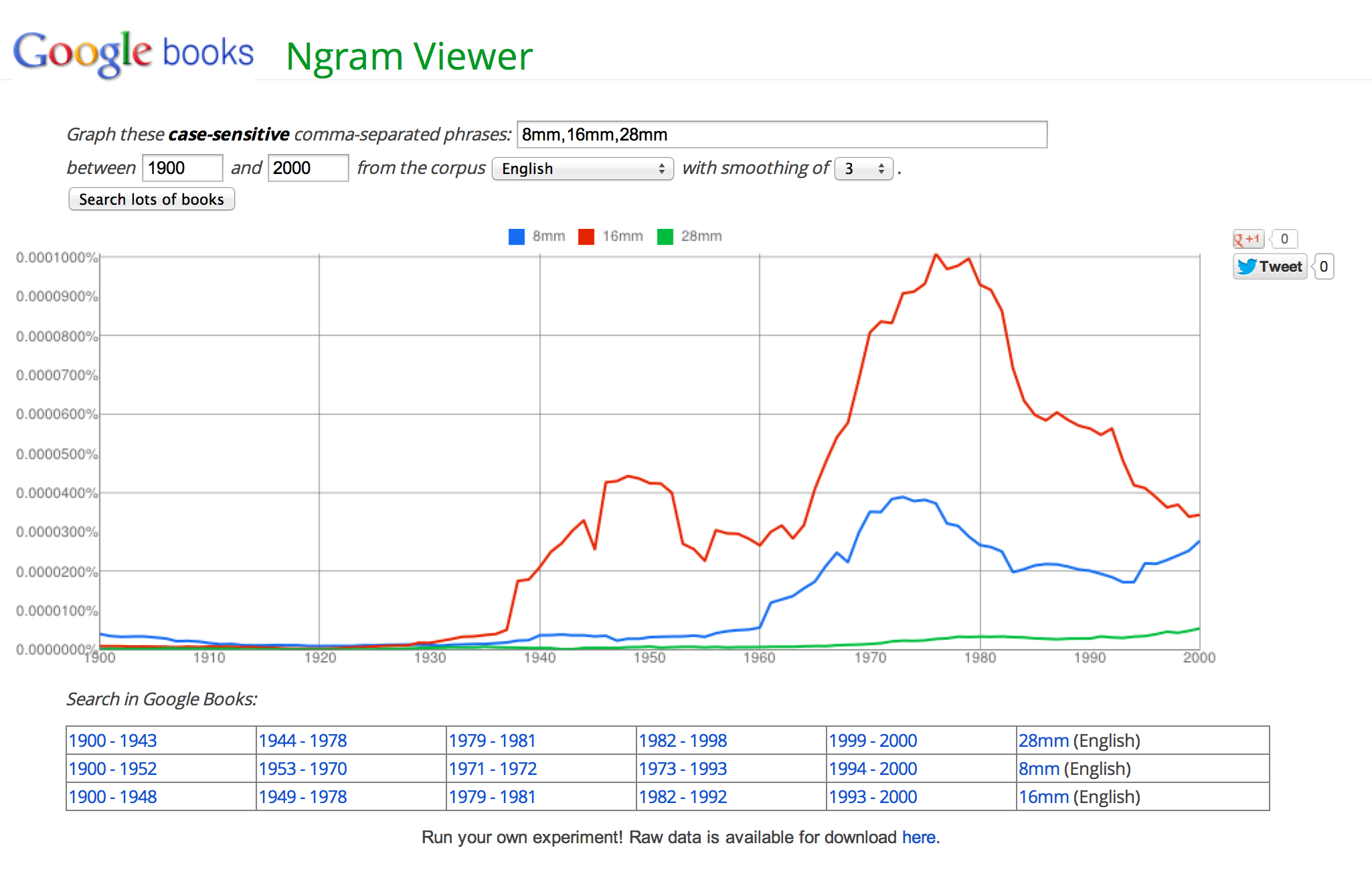
In addition to search, though, what else can you do with all that aggregated data? It would take me years to read through every page of text in the MHDL. A computer, on the other hand, reads the data in seconds. This is the basis for full-text search, but it also opens up new possibilities that Humanities scholars interested in quantitative methods and “big data” are only beginning to explore. Google Ngram Viewer, for example, allows you to graph the frequency of words and phrases across a corpus of five million books. Here is a graph I quickly compiled of the terms 16mm, 8mm, and 28mm. This graph immediately suggests a story about the cultural, industrial, and technological importance of these “sub-standard” film stocks across a hundred year span. Now, it would tell you a better story if you could refine the searchable corpus—using the collections of the MHDL, rather than GoogleBooks. And it would tell you the richest story of all if you combined the insights of the graph with specific articles and books about non-theatrical film from the MHDL’s collections.
I see this as the direction where the Humanities and MHDL eventually need to head—combining the familiar practice of “close reading” with strategies of “distant reading” (to use the term coined by Franco Moretti). It’s not about abandoning the established critical tools. But we do need to learn from the data-intensive research that is happening in the sciences. I recently attended a “Humanities Hackathon” workshop hosted by UW-Madison’s Center for the Humanities and the Wisconsin Institute for Discovery. I was encouraged by the enthusiasm about using computational methods in Humanities research and legitimate concerns that we perform such analyses in a thoughtful way. I am excited to pursue these new techniques in my own scholarship, as well as to help build the infrastructure and tools that will enable other scholars to join the experiment.


 Andy Myers:


In the short term, as Eric mentions, our obvious goals are to add much more material, and to make system and interface improvements — such as full text search— which make it easier for users to find relevant material.

As far as long-term goals go, we want to make as much material as possible available to as many people as possible through as many avenues as possible, and we’ve been building lots of momentum. We’re not exactly declaring war on aggregators of public domain material like ProQuest — after all, we recognize that they do add value for many institutions and that these aggregators license more recent, copyrighted content too. However, with our boom in content and the upcoming launch of Lantern, we think that we are reaching a point where we can offer institutions a viable alternative to commercial providers and their high access fees. We firmly believe that our open-access model can provide better-quality material, freely available to everyone, with superior usability, at a fraction of the cost. So I really feel that in terms of growth, to paraphrase Walter White, we’re now in the empire business.

We’d also like to develop good cross-integration with other databases and resources across the web. Our digital assets are starting to be listed in the catalogs of academic libraries as electronic resources, which is a huge step to aiding discovery by researchers. I hope professors and graduate students reading this blog post right now will tell their librarians about the MHDL, and ask them to input MHDL resources into their library catalogs.  Additionally, we hope to eventually add features that will facilitate discovery of material made available by other great projects around the web. Wouldn’t it be great if a full text search on MHDL would not only search our collections, but also pointed users toward results in sites like AmericanRadioHistory.com (which hosts decades of digitized broadcasting periodicals) or the Margaret Herrick Library’s digital collections? We have yet to explore the technical details of such an implementation, but I think that kind of integration is on our distant horizon.


Bios


Eric Hoyt is Assistant Professor of Communication Arts at the University of Wisconsin-Madison. He co-directs the Media History Digital Library in collaboration with the project’s founder, David Pierce. He is also leading the development of the MHDL’s new search platform, Lantern, which is a co-production with the University of Wisconsin-Madison Department of Communication Arts. His articles on media, law, and culture have appeared in Cinema Journal, Film History, Jump Cut, World Policy Journal, and The International Journal of Learning and Media.


Kathy Fuller-Seeley is Professor in the Department of Communication at Georgia State University. She specializes in the history of film, radio, TV and media audiences. Kathy's books include Hollywood in the Neighborhood: Historical Case Studies of Local Moviegoing (California, 2008, edited), At the Picture Show: Small Town Audiences and the Creation of Movie Fan Culture (Smithsonian 1997), and Children and the Movies: Media Influence and the Payne Fund Controversy (Cambridge 1996, with G. Jowett and I. Jarvie).  She has a book forthcoming on the history of nickelodeons and is writing a book project about Jack Benny’s radio program and American culture.


Andrew Myers is a doctoral student in Critical Studies at the University of Southern California's School of Cinematic Arts. He serves as the post-processing editor for the Media History Digital Library, which generally entails writing scripts to process images, text, and metadata. He recently received his M.A. in Cinema and Media Studies from UCLA and is also the outgoing co-editor-in-chief of Mediascape, UCLA's Journal of Film, Television, and Digital Media. His diverse research interests include media industries and production culture, archival film and television history, new media (especially video games), and documentary.



The Affordances of Digital Technology for Media History Research (Part One)

The Media History Digital Library (MHDL) digitizes out-of-copyright periodicals relating to the histories of film, broadcasting, and recorded sound and makes them widely available for public use. The project promotes media history scholarship, provides educational tools for classroom use, and advocates for greater engagement with the public domain. A non-profit initiative, the MHDL is supported by owners of materials who loan them for scanning, and donors who contribute funds to cover the cost of scanning.

In this discussion, MHDL co-director Eric Hoyt talks with project’s post-processing editor Andy Myers and film historian Kathy Fuller-Seeley, who digitized reels of microfilm in the course of her own research that she donated to the MHDL. Eric, Kathy, and Andy talk about the value of digitizing the historical sources, the challenges involved in the process, and bringing together the communities of fans and scholars.


What is the value of digitizing historic trade papers and fan magazines?


Kathy Fuller-Seeley: I’m an enthusiastic fan of digitized trade journals, fan magazines and newspapers. Their availability has had a transformative impact on my research, allowing me to dig more deeply into published coverage of all my topics, and also creating new research projects.  I live far from the libraries and archives that hold the original publications, and my relatively young state university can’t/won’t invest in an extensive microfilm library. Far beyond the convenience of not having to squint at scratched microfilm and having rare journals available day or night, I’m enthralled that digitization reveals much more complex views of my research topics.  I’m not just cherry picking one or two articles that I might have stumbled across in print or in someone’s scrapbook, I am encountering masses of coverage that I can analyze and weigh as a whole.

Quick examples from current research projects – digitized Photoplay enabled me to uncover how the mainstream Hollywood publicity machinery constructed star personae for unusual performers such as Shirley Temple, Rin Tin Tin and Marie Dressler, and marketed them to working-and middle-class female fans.  Searchable Variety uncovered for me the innovative ways in which Jack Benny and his agents intertwined his performances and star image across radio, film, live appearances and consumer product advertising to achieve incredible career synergy. Newspaper databases like the Library of Congress’s allowed me to trace the diffusion of the earliest “picture personalities” (Florence Turner the Vitagraph Girl and Florence Lawrence the “Imp Girl”) fame far beyond the original promotional material published in national trade journals and the New York papers to the creation of local fan cultures in rural New England, Utah, Arizona and the Yukon.

In researching film history, digitized trade journals and newspapers enable us to learn more about exhibition practices and circulation of fan culture outside major metropolitan areas (and scholar’s over-reliance on the New York Times). Access to the fan magazines enables close readings of how Hollywood structured knowledge about stars and films for their target audiences. Having access to searchable trade papers can not only shows us what they covered, but also topics they purposely avoided (such as competing non-film promotions like Dish Night giveaways during the Depression). They make new research topics possible, such as the recent work of historians Paul Moore and Richard Abel on intersections of newspaper discourse and moviegoing culture. The NEH is currently sponsoring a series of grants for “digging into the data” to expand our thinking about these research possibilities.

Andy Myers:

Our role in digitizing these publications, as I see it, is about ensuring three things: accessibility, discoverability, and browse-ability.

Enabling access is the first and most obvious benefit of digitizing these resources. For example, two years ago as a student at UCLA I was working on a project on the American anti-Bolshevik films from 1919 and 1920. The secondary sources I was using kept referencing articles in The Moving Picture World (MPW), and I had dozens of such references to track down. Even our fantastic library at UCLA didn’t have anything from MPW from those years, but after some searching I eventually located a microfilm copy at the Margaret Herrick Library in Los Angeles and made a special trip. Now, I’m lucky enough to live and study in Los Angeles, where the archival resources for media history are unparalleled, so I only had to drive a few miles and spend an afternoon. But scholars in other parts of the world would have a much more difficult trial in accessing MPW or other publications, many of which are not even available on microfilm.  Now that the MHDL is making long runs of classic publications like The Moving Picture World available digitally, the kinds of barriers to access scholars have faced even in the recent past are now evaporating.

Simply providing access to information is useless, however, if nobody can find it – that new information has to be easily discoverable. Online catalogs and databases are very good at directing the user to an appropriate resource when the user already knows with some specificity what he or she is looking for. For example, I can read an article that mentions the film The World Aflame (1919), see a footnote to a May 1919 issue of Moving Picture World, and then very easily and quickly navigate to the online resource.

But how do I find that article without a secondary reference, if I only have the film title and the year? Full text search is, of course, essential to ensuring discoverability — and our upcoming Lantern search tool should facilitate that. In addition to search, there are also a couple other considerations for making resources discoverable. One priority is that we curate a user experience that empowers users to intuitively cut through the database, narrowing their research net according to criteria such as year, format (e.g. book or periodical), the type of publication (e.g. trade journal or fan magazine), or specific publication title.

Academics are, of course, well accustomed to advanced catalog and database searches, but most of these repositories are so immense and diverse that browsing is impractical or impossible. So we aim to supplement that random-access database searching paradigm with a sort of microfilm paradigm.

Mediahistoryproject.org’s curated collections on various topics are manageable in size and allow users to easily browse the resources we have available for their research without being overwhelmed with irrelevant matches. And once users open a publication, in addition to being able to use standard search tools, they can also flip through the entire book page-by-page incredibly quickly, the same way that microfilm researchers can.

As I suspect nearly every veteran microfilm researcher would attest, skimming through entire months and years of a publication — rather than simply cherry-picking search hits — will yield incredibly valuable insights into the historical and social contexts of the topic that the researcher is studying, as well as uncover unexpected but closely related contemporary issues. The browse-ability features of the MHDL allow researchers to immerse themselves into the historical moment and buttress their argument with a full array of related evidence. OCR is often imperfect, particularly in cases of creatively typeset headlines and advertisements, so it’s often the case that relevant material can only be discovered through good, old-fashioned skimming. By offering this hybridization of research paradigms, we hope users will be able to pursue whatever approach of searching and/or browsing works best for them and their project.


Eric Hoyt:

In their responses to this question, Kathy and Andy both nicely highlight some of the ways that digitization improves the research process for film historians. What I want to emphasize here is that I’m proud not simply about the fact that the MHDL has been digitizing important trade journals and magazines but about how we’ve gone about doing this. First, through coordinating with the Internet Archive, we’re primarily scanning original print editions rather than microfilm. This means color, better images, better OCR data, better everything.

I’ve come to appreciate, though, that scanning microfilm also has its place and benefits. For some oversized and particularly brittle newspapers, microfilm scanning is the only option. We were fortunate that Kathy and Q. David Bowers supplied us with over a dozen DVD-Rs worth of microfilm scans for some of these newspapers, including The Clipper and two years worth of Variety. Andy handled post-processing work on the microfilm scans, and now anyone with an open Internet port around the world can see them.

It’s this collaborative and open access model that I think defines the project. The collections of the MHDL only exist because of collaboration. I’ve collaborated closely with the project’s founder and director David Pierce, digital archivist Wendy Hagenmaier, and others in coordinating the scanning and improving our website. However, collaboration also underlies the entire acquisition and funding structure. The MHDL is supported by collectors and institutions who loan materials for scanning, and donors who cover the costs of digitization. We’ve also begun collaborating with academic groups that want to see more publications pertaining to a certain area go online. Domitor, the International Society for the Study of Early Cinema, raised over $6,000 among its member-base to contribute to the digitization of Moving Picture World and other early cinema publications.

The MHDL is also built upon open access. Most people in the world with an Internet connection have the ability to go to our site and freely read or download as many publications as they want. For users who want access to the underlying source, you can click through to a volume’s Internet Archive page (IA page) and access the uncompressed JPEGs, OCR text, and XML metadata.

We work with materials that belong in the public domain, and this provides the legal foundation for open access. But keeping things open is also a decision on our part. Subscription services, such as ProQuest and the Variety Archives, are walled gardens. Although they offer access to licensed copyrighted material, they also store countless pages worth of digitized public domain periodicals. As I have argued in the International Journal Learning and Media, I think we need to encourage public access and engagement with the public domain and call attention to this shared resource. Through digital technology and collaborative loaning and funding structures, we have the opportunity to offer broad access to public domain texts and enable their reuse across a variety of forms. To extend the earlier metaphor, we can build public parks, rather than walled gardens.


Bios


Eric Hoyt is Assistant Professor of Communication Arts at the University of Wisconsin-Madison. He co-directs the Media History Digital Library in collaboration with the project’s founder, David Pierce. He is also leading the development of the MHDL’s new search platform, Lantern, which is a co-production with the University of Wisconsin-Madison Department of Communication Arts. His articles on media, law, and culture have appeared in Cinema Journal, Film History, Jump Cut, World Policy Journal, and The International Journal of Learning and Media.


Kathy Fuller-Seeley is Professor in the Department of Communication at Georgia State University. She specializes in the history of film, radio, TV and media audiences. Kathy's books include Hollywood in the Neighborhood: Historical Case Studies of Local Moviegoing (California, 2008, edited), At the Picture Show: Small Town Audiences and the Creation of Movie Fan Culture (Smithsonian 1997), and Children and the Movies: Media Influence and the Payne Fund Controversy (Cambridge 1996, with G. Jowett and I. Jarvie).  She has a book forthcoming on the history of nickelodeons and is writing a book project about Jack Benny’s radio program and American culture.


Andrew Myers is a doctoral student in Critical Studies at the University of Southern California's School of Cinematic Arts. He serves as the post-processing editor for the Media History Digital Library, which generally entails writing scripts to process images, text, and metadata. He recently received his M.A. in Cinema and Media Studies from UCLA and is also the outgoing co-editor-in-chief of Mediascape, UCLA's Journal of Film, Television, and Digital Media. His diverse research interests include media industries and production culture, archival film and television history, new media (especially video games), and documentary.


Spread That!: Further Essays from the Spreadable Media Project

  Spreadable Media: Creating Meaning and Value in a Networked Culture, my new book with Sam Ford and Joshua Green, is launching at the end of January. Each week, we are releasing new essays written by friends and affiliates of the Futures of Entertainment Consortium which expand upon core ideas in the book. You will see that these essays are an integral part of the book, even though they are being distributed digitally. We also see these essays as a means of sparking key conversations in anticipation of the book's release. So, in the spirit of this project, "if it doesn't spread, it's dead," so we are asking readers to help circulate these essays far and wide to as many different networks and communities as they seem relevant to the ongoing conversation.

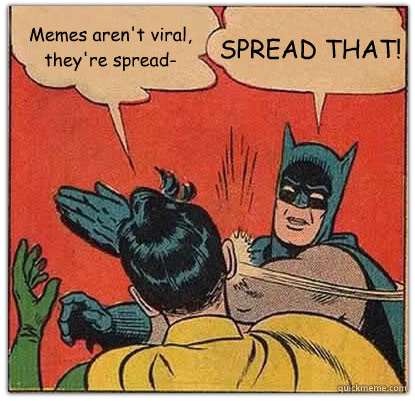
Readers are already responding, including through the creation of "memes." Over the weekend, we received this "Slap Robin" announcement via Twitter from @amclay09.

Share with us your own creations and I will showcase this here as I am posting upcoming essays.

This week, we are releasing essays which are tied to the Introduction and first Chapter of the book. Before I do so, let me share some of the early responses to the book (i.e. the solicited blurbs):

“Something new is emerging from the collision of traditionIal entertainment media, Internet-empowered fan cultures, and the norms of sharing that are encouraged and amplified by social media. Spreadable Media is a compelling guide, both entertaining and rigorous, to the new norms, cultures, enterprises, and social phenomena that networked culture is making possible. Read it to understand what your kids are doing, where Hollywood is going, and how online social networks spread cultural productions as a new form of sociality.”—Howard Rheingold, author of Net Smart

“By critically interrogating the ways in which media artifacts circulate, Spreadable Media challenges the popular notion that digital content magically goes ‘viral.’ This book brilliantly describes the dynamics that underpin people’s engagement with social media in ways that are both theoretically rich and publicly meaningful.”—danah boyd, Microsoft Research

“The best analysis to date of the radically new nature of digital social media as a communication channel. Its insights, based on a deep knowledge of the technology and culture embedded in the digital networks of communication, will reshape our understanding of cultural change for years to come.”

—Manuel Castells, Wallis Annenberg Chair of Communication Technology and Society, University of Southern California

“Finally, a way of framing modern media creation and consumption that actually reflects reality and allows us to talk about it in a way that makes sense. It’s a spreadable world and we are ALL part of it. Useful for anyone who makes media, analyzes it, consumes it, markets it or breathes.”—Jane Espenson, writer-producer of Battlestar Galactica, Once Upon a Time, and Husbands

“It’s about time a group of thinkers put the marketing evangelists of the day out to pasture with a thorough look at what makes content move from consumer to consumer, marketer to consumer and consumer to marketer. Instead of latching on to the notion that you can create viral content, Jenkins, Ford, and Green question the assumptions, test theories and call us all to task. Spreadable Media pushes our thinking. As a result, we’ll become smarter marketers. Why wouldn’t you read this book?”—Jason Falls, CEO of Social Media Explorer and co-author of No Bullshit Social Media

This week's selections include discussions of historical predecessors,  Memes and 4Chan, the debates about free labor, co-creation in the games culture, and the power of consumer recommendations. Read the sample. Follow the links (....) back to the main site. Read.  Enjoy. Spread. Repeat next week.

The History of Spreadable Media

Media have been evolving and spreading for as long as our species has been around to develop and transport them. If we understand media broadly enough to include the platforms and protocols—to use Lisa Gitelman’s (2006) terms—that carry our stories, bear our messages, and give tangible expression to our feelings, they seem intrinsic to the human experience. Some people might even argue that the developments of vocal communication systems (language) and visualization strategies (paintings and carvings) represent defining moments in human evolution, demonstrations of man’s social nature. Human mastery of media was every bit as important as the mastery of tools. Stories of the spread and appropriation of media run across our history, each shaped by the logics of social organization and production characteristic of any given era.

Early traces of the spread and reach of media abound, even if some historical forms of media fall outside our familiar categories. For example, our contemporary understanding of the reach and influence exercised by ancient empires owes much to discoveries of coins—a medium of abstract exchange if we follow Karl Marx’s argument in Capital ([1867] 1999) and elsewhere but also a system of representation and meaning (from the value of the gold or silver to the inscribed monetary value, to the messages or portraits etched on its surface) with precise culturally defined borders. The coin, as a medium, spread with the state’s citizens, enabling their interactions with one another and at the same time attesting to the state’s reign. Ceramic dishes and tiles offer an example of a medium that was seized on for reasons of cultural exchange. The rich intermingling of styles and techniques characteristic of early-seventeenth-century Dutch, Chinese, and Ottoman ceramics speaks to the period’s trade routes and export markets and the creative appropriations of these various cultural models by its artisans. But these ceramics were also platforms, complete with highly nuanced systems of signification, hierarchies of value, and attendant associations of taste. They were carried, traded, collected, and displayed by a surprisingly large cross-section of the northern European population. As the ceramics circulated within different social groups as the vogue for ceramics rose and fell and were handed down to our present as family heirloom or antique shop curio, the journeys they undertook, and the meanings accorded them as media, attest to the energies and interests of those who helped to spread them....


In Defense of Memes

Although I agree that the terms “viral” and “meme” often connote passive transmission by mindless consumers, I take issue with the claim that “meme” always precludes active engagement—or that the term has a universal, static meaning. As understood by trolls, memes are not passive and do not follow the model of biological infection. Instead, trolls see (though perhaps “experience” is more accurate) memes as microcosmic nests of evolving content. Contrary to the assumption that memes hop arbitrarily from self-contained monad to self-contained monad, memes as they operate within trolldom exist in synecdochical relationship to the culture in which they inhere. In other words, memes spread—that is, they are actively engaged and/or remixed into existence—because something about a given image or phrase or video or whatever lines up with an already-established set of linguistic and cultural norms. In recognizing this connection, a troll is able to assert his or her cultural literacy and to bolster the scaffolding on which trolling as a whole is based, framing every act of reception as an act of cultural production. Consider the following example.

Founded in the early nineties by rappers Violent J and Shaggy 2 Dope, the Insane Clown Posse (ICP) is a Detroit-based hip-hop group infamous for its violent lyrics, rabid followers, and, as it was recently revealed, secret evangelical Christianity. ICP, which performs in full-face clown makeup, has always been a target for trolling humor. The 2010 release of the group’s single “Miracles,” however, opened the floodgates—in the video, Violent J and Shaggy earnestly extol the virtues of giraffes, rainbows, cats, and dogs, not to mention music (“you can’t even hold it!”) and the miracles of childbirth and the cosmos. The song itself, which is regarded as the group’s evangelical “outing,” is peppered with expletives and features the line “Fuckin’ magnets—how do they work?” a question which inspired immediate and seemingly endless repurposing.

Within a few days of the video’s release, dozens of remixed images and .gifs were posted to 4chan’s infamous /b/ board, many of which merged with existing memetic content. A well-known image of a cross-eyed, bespectacled man captioned with the phrase “are you a wizard,” for example, inspired a series of related macros, including one featuring a close-up shot of Violent J in full makeup. “are you a magnet,” the caption reads, referring not just to the cluster of memes related to the “Miracles” video but also to all the permutations of the “are you a wizard” family of macros.

In short, trolls pounced on the phrase “fuckin’ magnets” not just because it was memorable and amusing on its own (although that played a large part in its popularity, as did the thrill of a gratuitous f-bomb) but because it was easily integrated into an existing meme set. Once the protomeme had been integrated, its resulting permutations—“are you a magnet” being a prime example—became memes unto themselves, establishing further scaffolding onto which new content could be overlaid. By choosing to repost “are you a magnet” on 4chan or off-site, the contributing troll was able to assert his own cultural fluency and, in the process, ensure the proverbial (and, in some ways, the literal) survival of his species. In this sense, the creation and transmission of memes can be likened to the process of human reproduction—specifically the decision to have a child in order to protect one’s legacy. The sexual act is decidedly active, but the resulting zygote is a passive (that is to say, unwitting) vessel for genetic information....

Interrogating “Free” Fan Labor

Over the past two decades, large swaths of the U.S. population have been engaged in copyright wars. On one side, copyright holders struggle to defend their property against what they perceive to be unlawful appropriation by millions of would-be consumers via digital technologies. On the other, millions of Internet users fear or fight expensive lawsuits, filed by entities far wealthier and more powerful than they, that seek to punish them for sharing media online. In this combative climate, fans who produce their own versions of mass-media texts—fan films and videos, fan fiction, fan art and icons, music remixes and mash-ups, and game mods, for example—take comfort and refuge in one rule of thumb: as long as they do not sell their works, they will be safe from legal persecution. Conventional wisdom holds that companies and individuals that own the copyrights to mass-media texts will not sue fan producers, as long as the fans do not make money from their works (for instance, Scalzi 2007 and Taylor 2007).

“Free” fan labor (fan works distributed for no payment) means “free” fan labor (fans may revise, rework, remake, and otherwise remix mass-culture texts without dreading legal action or other interference from copyright holders). Many, perhaps even most, fans who engage in this type of production look upon this deal very favorably. After all, movie studios, game makers, and record labels do not have to turn a blind eye to fan works; U.S. law is (as of this writing) undecided on the matter of whether appropriative art constitutes fair use or copyright infringement, so companies could sue or otherwise harass fan appropriators if they chose. But, even if both sides of the copyright wars consider the issue of fan labor settled, one aspect of the issue has not been sufficiently explored: can, or should, fan labor be paid labor?....


Co-creative Expertise in Gaming Cultures

Gamers increasingly participate in the process of making and circulating game content. Games such as Maxis’s The Sims franchise, for example, are routinely cited as exemplary sites of user-created content. Games scholar T. L. Taylor comments that players are co-creative “productive agents” and asserts that we need “more progressive models” for understanding and integrating players’ creative contribution to the making of these game products and cultures (2006b, 159–160; see also 2006a). Significant economic and cultural value is generated through these spreadable media activities. The usual phrases such as “user-created content” and “user-led innovation” can overlook the professional work of designers, programmers, and graphic artists as they make the tools, platforms, and interfaces that gamers use for creating and sharing content. Attention should also be paid to the work of producers, marketing managers, and community relations managers as they grapple with how best to manage and coordinate these co-creative relations.

The Maxis-developed and Electronic Arts–published Spore thrives on user-created content. Players use 3-D editors to design creatures and other in-game content, to guide their creatures through stages of evolution, and then to share their creations with other players. Since Spore’s release in September 2008, more than 155 million player-created creatures have been uploaded to the online Sporepedia repository. Players can also upload directly from within their game videos of their creatures to the Spore YouTube channel. Spreading content is a core feature of Spore; the game is perhaps best understood as a social network generated from player creativity. This spreadability is not just about content, as the players are also sharing ideas, skills, and media literacies....

The Value of Customer Recommendations

With new channels of communication and old, marketers can deliver a dizzying number of advertising messages to consumers—by many accounts, the average American sees between 3,000 and 5,000 ads a day. Yet, perhaps in response to this fusillade, consumers have learned to better armor themselves against the marketing messages they encounter. The Persuasion Knowledge Model (PKM) describes the extent to which consumers develop a radarlike ability to discern content whose aim is to persuade and, further, how they develop a set of skills to deal with such messages (Friestad and Wright 1994). Some of my own recent research (with colleagues Adam Craig, Yuliya Komarova, and Jennifer Vendemia) uses fMRI technology to explore brain activity as consumers are exposed to potentially deceptive product claims. Our findings show that consumers’ deception-detection processes involve surprisingly rapid attention allocation. Potential advertising lies seem to jump out of the marketing environment and rivet our attention like a snake on a woodland trail.

Advertisements are often informative as well as persuasive; consumers know this and don’t dismiss ads out of hand. But they do assess the extent to which they trust or are willing to use such information. First, and most critically, consumers seek to evaluate the credibility of a marketing message’s source. Source credibility is the bedrock of trust that precedes persuasion. People judge a source to be credible if the source shows evidence of being authentic, reliable, and believable. In the old days of marketing, firms sought to increase the source credibility of their ads by featuring the endorsements of doctors, scientists, and other authoritative experts. Once consumers became more aware that these experts were being paid handsomely for their testimony, the practice became less effective. Celebrity endorsers, who often were not product experts, provided warm affective responses but little in the way of believable, persuasive arguments.

Consumers themselves are particularly important endorsers via word-of-mouth (WOM) messages. Our past understanding of WOM (when one consumer recommends a product to another) was that consumers perceive other consumers as highly authentic but of dubious reliability. As when one’s Uncle Joe touts the superior performance of the Brand X computer, the recommender is clearly a real person but may or may not be knowledgeable enough about the product category to make credible claims. Now, with WOM increasingly occurring through spreadable media, it is more difficult for a consumer to assess both the authenticity and reliability of unknown recommenders. The practice of rating consumers’ online opinions and recommendations (e.g., Yahoo! Answers) is a direct attempt to resolve the audience’s uncertainty about who really knows something worth knowing....


HOT.SPOT: The Dark Side(s) of DIY

From time to time, I have written here about the work of the Civic Paths research team in the Annenberg School of Communications and Journalism at the University of Southern California. I helped to start this research group when I arrived in Los Angeles three and a half years ago; it has been the seedbed for our Media Activism and Participatory Politics project which has generated a series of case studies of innovative activist groups (and will be the basis of an upcoming book). But, the group has become something more than that -- a space where students and faculty gather to discuss the participatory turn in contemporary culture and politics. Such discussions thrive on our internal discussion list, and we've been experimenting with various ways to get these ideas out to the world both formally through op ed pieces and informally through blogging. The team recently launched a new project -- HOT.SPOT to encourage as many of the members as possible to write short blog posts around a related theme -- think of it as a mini-anthology. Lead by my journalism colleague Kjerstin Thorson and our post-doc Liana Thompson, the first of our "HOT.SPOT" blogs deals with the "Dark Side(s) of DIY."  Our work has been so focused on the values and practices of participatory politics, it seems inevitable that reservations and concerns would rise to the surface. If only Nixon could go to China, perhaps our group has an obligation to also call out the abuses, misuses, and failures of DIY culture and politics.

So, let me pass the microphone over to Kjerstin Thorson who will set up this special issue, and you can follow the links out to the individual posts.


Hotspot Philosophy

Welcome to the first of what we hope will be a series of Civic Paths “hotspots.” These collections of mini-blog posts are organized around themes that cut across the diverse interests of participants in our research group. They’re about the things we love to talk about. And, like our in-person conversations, they play with ideas at the intersection of participatory culture, civic engagement, and new media. Our rules for the hotspot are these: No one gets to spend a million hours wordsmithing -- these are idea starters, not finishers -- and posts shouldn’t be a whole lot longer than five hundred words.

Kicking it off: The Dark Side(s) of DIY

Don’t get me wrong: I love DIY. I muddled through the acquisition of basic sewing skills (thanks, Internet) to make a much-loved, crooked crib skirt for my daughter. My now-husband and I navigated the complexities of his immigration to the U.S. without hiring a lawyer, relying entirely on a discussion board about fiancée visas. Last year, we even put a fountain in our backyard (it was crooked, too).

In fact, I venture to say we all love DIY—and are genuinely excited about the role of new media technologies for amplifying the possibilities to make stuff, share stuff, spread stuff and generally participate in public life in a million different ways. But we also believe that DIY (or at least the mythology of DIY) has some dark sides.

Liana [1] and Sam [2] remind us that just because you do it yourself doesn’t mean that what you make will find an audience, or even that what you make will be any good. Kevin [3] considers the often-fraught relationship some DIY practitioners have to potentially dubious funding streams, and Lana [4] points out that the business of DIY can often be the selling of awful. Andrew [5] looks at what happens when crowdfunding goes awry and DIY communities try to mete out justice online. Rhea [6] also examines online communities taking matters into their own hands, highlighting the misunderstandings and mishaps that get created in the process.

Neta [7] and I [8] share an interest in the ways that beliefs about DIY political knowledge—everyone should be a fact checker! Figure out everything for yourself!—may shut down possibilities for political engagement. Mike [9] takes on the contradictions behind the idea of DIY news, and Raffi [10] wonders whether the race to make and spread the pithiest, funniest political nuggets is taking away from other forms of online political talk.

With these posts, we hope to collectively shed light on some of the difficulties that arise from an otherwise celebrated mode of creation and engagement. And while we all love DIY and its range of possibilities for civic life, we think pulling back the curtain to show when it goes wrong is an important step in figuring out how DIY can take us even further in the future.

-- Kjerstin Thorson (Assistant Professor of Journalism)

[1] On Finding an Audience, or Why I'm Not a Rock Star, by Liana Gamber Thompson

[2] Producing Poop, by Sam Close

[3] Makerspaces and the Long, Weird History of DIY Hobbyists & Military Funding, by Kevin Driscoll

[4] Blogging and Boycotting in the "Schadenfreude Economy", by Lana Swartz

[5] Gatekeepers of DIY?, by Andrew Schrock

[6] The Role of Japanese & English-language Online Communities in the Mitsuhiro Ichiki Incident, by Rhea Vichot

[7] DIY Citizenship & Kony 2012 Memes, by Neta Kligler-Vilenchik

[8] Figure It Out for Yourself, by Kjerstin Thorson

[9] Why “DIY News” Could Be a Contradiction in Terms, by Mike Ananny

[10] Memed, Tumbled, & Tweeted, by Raffi Sarkissian

Futures of Entertainment 6 Videos (Part Two)

Saturday, Nov. 10 Opening Remarks from FoE Fellows Xiaochang Li and Mike Monello

Curing the Shiny New Object Syndrome: Strategy Vs. Hype When Using New Technologies With the constant barrage of new technologies, platforms, and services vying for attention, media producers and marketers are frequently lost among the potential places–and ways–of engaging with their audiences. Before they have ever truly figured out one technology, they’ve already moved to another, because of an intense desire to be “first.” As such, companies and media properties have launched–and then abandoned–their virtual world presence, their mobile app, their social game, and their QR code and are now exploring “social TV,” “Twitter parties,” Pinterest pages, augmented reality, and location-based initiatives. This leaves the web littered with old blogs, microsites, and profiles and companies blaming technologies when, too often, it’s been the lack of strategy that led to no traction. How do storytellers and communicators build a framework to more intelligently choose technologies based on how a platform aids their story and their audience, rather than a “gee whiz…get me one of those” approach? How does–or should–listening to the audience factor into this process? And what role, or responsibility, do technology creators have to help with this integration process? Drawing on examples contemporary and historical, this panel looks at how and when to take risks with new platforms, the difference between “innovative failure” and “failure to innovate,” and the deeper patterns of engagement that help us make sense of how new platforms and behaviors connect to longstanding means of engagement. Panelists: Todd Cunningham, Futures of Entertainment fellow and television audience research leader Jason Falls, CEO, Social Media Explorer Eden Medina, Associate Professor of Informatics and Computing, Indiana University David Polinchock, Director, AT&T AdWorks Lab Mansi Poddar, co-founder, Brown Paper Bag Moderator: Ben Malbon, Managing Director, Google Creative Lab

Rethinking Copyright: A discussion with musician, songwriter, and producer T Bone Burnett; Henry Jenkins, Provost’s Professor of Communication, Journalism, Cinematic Arts, and Education at the University of Southern California; and Jonathan Taplin, Director of the Annenberg Innovation Lab at the University of Southern California. As the recent legislative battles have demonstrated, it’s becoming painfully clear that our conception of copyright is ill-prepared for regulating and making sense of a world where media content is fluidly circulated by most of a society. However, in an effort make content free to spread in the ways audiences find them relevant, what is the appropriate balance to ensure that the rights of content creators are preserved and that the incentive to develop intellectual property remains? Rather than continue a debate in which audiences and critics attack copyright while media companies cling to them, how might we cut through current tensions to collaboratively imagine what a new sense of copyright, appropriate for an era of “spreadable media,” might look like?

The Futures of Video Gaming Many innovations in the creative industries owe their roots and inspiration to the gaming world, from audience engagement and storytelling techniques to distribution methods and cross-platform integration. This session examines some of the critical questions facing those working in the gaming industry as large companies and indie developers grapple with the challenging evolution of the market brought on by new networked technologies, audience practices, and business models. How are game developers embracing or rejecting the unauthorized play of games online, and how has piracy evolved as a discourse in the gaming sector? How do creators strategize around the widespread circulation of games through automated propagation (using friend invitations for social and “free to play” games) — or grassroots spreading (for unexpectedly popular titles like Minecraft) — of information through social network sites? How badly are new architectures (Steam, Xbox Live Arcade, PSN Network) clashing with old traditions (game stores, $60 game discs)? And how are business models in the gaming industry shifting as we see massive success simultaneously from high-budget technology like Kinect and low-budget distribution like the Humble Bundle? Panelists: T.L. Taylor, Associate Professor of Comparative Media Studies, MIT Christopher Weaver, founder of Bethesda Softworks and industry liaison, MITGameLab Ed Fries, architect of Microsoft’s video game business and co-founder of the Xbox project Walter Somol, head of tech community outreach, Microsoft New England Research and Development Center Moderator: Futures of Entertainment Fellow and games producer Alec Austin

The Futures of Storytelling and Sports Throughout the history of mass media, sports programming has been an innovator. In today’s era of online circulation, transmedia storytelling, and 24/7 access to engaging with sports stars, teams, and fellow fans, sports franchises could be argued as the most immersive of storyworlds–with drama playing out in real-time, and the “narrative world” being our own. What is driving innovation in how sports tell their stories, and get their fans more engaged than ever, through multiple media platforms? How does operating as a media franchise in our everyday world set sports apart from entertainment properties? How are sports empowered by being “real,” and what constraints does that place on what they can do as well? How are talent engaged to be part of the storytelling? And what innovations are seen as sports are extended wholly into the fictional realm, whether through licensed extensions or various forms of “sports entertainment”? Panelists: Abe Stein, researcher at Singapore-MIT GAMBIT Game Lab; graduate student, Comparative Media Studies, MIT; columnist, Kill Screen Peter Stringer, Senior Director of Interactive Media, Boston Celtics Jena Janovy, Enterprise Editor, ESPN.com Jamie Scheu, associate content director, Hill Holliday Moderator: Alex Chisholm, transmedia producer and Co-Founder and Executive Director, Learning Games Network

Closing Remarks from FoE Fellow Sheila Seles and Dr. Heather Hendershot, Comparative Media Studies, MIT

Futures of Entertainment 6 Videos (Part One)

Over the next few installments, we are going to be sharing videos of the panels from this year's Futures of Entertainment conference, now in its sixth year, and developing a really strong community of followers who come back again and again to participate in our ongoing conversations. For those who do not know, FoE is a conference designed to spark critical conversations between people in the creative industries, academics, and the general public, over issues of media change. The Futures of Entertainment consortium works hard to identify cutting edge topics and to bring together some of the smartest, most thoughtful people who are dealing with those issues. It is characterized by extended conversation among the panelists in a format designed to minimize "spin," "pitch" and "pontification," and in a context where everything they say will be questioned and challenged through Backchan.nl, Twitter, and (this year) Etherpad conversations. As someone noted this year, one of the biggest contributions of the conference has been close interrogation of the language the industry uses to describe its relationship with its publics/audiences, and this year was no exception, with recurring concepts such as "curation" getting the full FoE treatment. And we came as close as we've ever come to a Twitter riot breaking out around the "Rethinking Copyright," session on which I participated.

The conference, traditionally, opens on Thursday with a Communications Forum event. This year, the focus was on New Media in West Africa, part of our ongoing exploration of the global dimensions of entertainment. There was much discussion of what we could learn from Nollywood (even hints of the coming era of Zollywood) and a spontaneous live performance by Derrick “DNA” Ashong.

New Media in West Africa Despite many infrastructural and economic hurdles, entertainment media industries are burgeoning in West Africa. Today, the Nigerian cinema market–”Nollywood”–is the second largest in the world in terms of the annual volume of films distributed, behind only the Indian film industry. And an era of digital distribution has empowered content created in Lagos, or Accra, to spread across geographic and cultural boundaries. New commercial models for distribution as well as international diasporic networks have driven the circulation of this material. But so has rampant piracy and the unofficial online circulation of this content. What innovations are emerging from West Africa? How has Nigerian cinema in particular influenced local television and film markets in other countries across West Africa, and across the continent? What does the increasing visibility of West African popular culture mean for this region–especially as content crosses various cultural contexts, within and outside the region? And what challenges does West Africa face in continuing to develop its entertainment industries?

Panelists: Fadzi Makanda, Business Development Manager, iROKO Partners Derrick “DNA” Ashong, leader, Soulflége Colin Maclay, Managing Director, Berkman Center for Internet & Society, Harvard University Moderator: Ralph Simon, head of the Mobilium Advisory Group and a founder of the mobile entertainment industry

Opening Remarks from FoE Fellows Laurie Baird and Ana Domb

Listening and Empathy: Making Companies More Human Media properties have long measured audiences with Nielsen ratings, circulation numbers, website traffic and a range of other methods that transform the people who engage with content into that aggregate mass: the audience. Meanwhile, marketing logic has long been governed by survey research, focus groups, and audience segmentation. And, today, executives are being urged to do all they can to make sense of the “big data” at their fingertips. However, all these methods of understanding audiences–while they can be helpful–too often distance companies from the actual human beings they are trying to understand. How do organizations make the best use of the myriad ways they now have to listen to, understand, and serve their audiences–beyond frameworks that aim to “monitor, “surveil,” and “quantify” those audiences as statistics rather than people? What new understandings are unearthed when companies listen to their audiences, and the culture around them, beyond just what people are saying about the organization itself? What advantages do companies find in embracing ethnographic research, in thinking about an organization’s content and communications from the audience’s perspective, and in thinking of “social media” not just as a new way to market content but a new and particularly useful channel for communicating, collaborating and conducting business?

Panelists: Lara Lee, Chief Innovation and Operating Officer, Continuum Grant McCracken, author, Culturematic, Chief Culture Officer Carol Sanford, author, The Responsible Business Emily Yellin, author, Your Call Is (Not That) Important to Us Moderator: Sam Ford, Director of Digital Strategy, Peppercomm

The Ethics and Politics of Curation in a Spreadable Media World–A One-on-One Conversation with Brain Pickings’ Maria Popova and Undercurrent’s Joshua Green We live in an environment where the power of circulation is no longer solely–arguably, even primarily–in the hands of media companies. However, if that means we all now play a role as curator and circulator of content, what responsibilities does that bring with it? How is curation becoming an important aspect of the online profile of professional curators? And, for all of us who participate in social networking sites or who forward content to family and friends via email, what are our obligations to both the creators of that content and to the audiences with whom we share it? If we possess the great power to spread content, what are the great responsibilities that come along with it?

The Futures of Public Media Public media creators and distributors often face a wide variety of strains on resources which impact their ability to innovate how they tell their stories. Yet, in an era where existing corporate logics often restrain how many media companies and brands can interact with their audiences–or how audiences can participate in the circulation of media content–public media-makers are, at least in theory, freed from many of the constraints their commercial counterparts face. How have the various innovations in producing and circulating content that have been discussed at Futures of Entertainment impacting public media-makers? How do the freedoms and constraints of public media shape creators’ work in unique ways? How have innovations happening in independent media, civic media, and the commercial sector impacting those creators? And what can we all learn from their innovation and experiences?

Panelists: Rekha Murthy, Director of Projects and Partnerships, Public Radio Exchange, Annika Nyberg Frankenhaeuser, Media Director, European Broadcasting Union, Andrew Golis, Director of Digital Media and Senior Editor, FRONTLINE Nolan Bowie, Senior Fellow and Adjunct Lecturer in Public Policy, Kennedy School of Government, Harvard University

Moderator: Jessica Clark, media strategist, Association of Independents in Radio

From Participatory Culture to Political Participation Around the world, activists, educators, and nonprofit organizations are discovering new power through their capacity to appropriate, remix, and recirculate elements of popular culture. In some cases, these groups are forging formal partnerships with media producers. In other cases, they are deploying what some have called “cultural acupuncture,” making unauthorized extensions which tap into the public’s interest in entertainment properties to direct their attention to other social problems. Some of these transmedia campaigns — Occupy, for example — are criticized for not having a unified message, yet it is their capacity to take many forms and to connect together diverse communities which have made these efforts so effective at provoking conversation and inspiring participation. And, as content spreads across cultural borders, these activists and producers are confronting new kinds of critiques —such as the heated debates surrounding the rapid spread of the KONY 2012 video. Are new means of creating and circulating content empowering citizens, creating new forms of engagement, or do they trivialize the political process, resulting in so-called “slactivism”? What are these producers and circulators learning from media companies and marketers, and vice versa? What new kinds of organizations and networks are deploying this tactics to gain the attention of young consumer-citizens? And, for all of us, what do we need to consider as we receive, engage with, and consider sharing content created by these individuals and groups? Panelists: Sasha Costanza-Chock, Assistant Professor of Civic Media, MIT Dorian Electra, performing artist (“I'm in Love with Friedrich Hayek”; “Roll with the Flow”) Lauren Bird, Creative Media Coordinator, Harry Potter Alliance Bassam Tariq, co-creator, 30 Mosques in 30 Days Moderator: Sangita Shresthova, Research Director of CivicPaths, University of Southern California

Closing Remarks from FoE Fellows Maurício Mota and Louisa Stein

And for your added entertainment pleasure, check out Dorian Electra's new music video, "FA$T CA$H: Easy Credit & The Economic Crash" which premiered at this year's conference.

http://www.youtube.com/watch?v=l4L_-4LbWRk

Spreadable Media IS Coming...Spreadable Media IS Coming...


Spreadable Media: Creating Meaning and Value in a Networked Culture, which I co-authored with Sam Ford and Joshua Green,  is scheduled to come out at the end of January 2013. The book represents the culmination of a strand of research which we started when all three of the authors were working together on the Convergence Culture Consortium at MIT and it was the extension of a white paper which I co-authored with two of the Comparative Media Studies masters students, Xiaochang Li and Ana Domb.

We will be sharing more about the book as we get closer to its release, but as part of the plan for the book, we commissioned more than 30 essays from people who have at one time or another been linked to the consortium -- ranging from former graduate students who have since entered academia or the media industry and a range of faculty who have been fellows in the consortium, along with some others whose work has been central to our understanding of this topic.

Over the next few months leading up to the book's publication date, we are going to be releasing a few of these essays each week with mechanisms which make it easy to spread to the larger community. We want to put the book's core message, "If it doesn't spread, it's dead" to the test and encourage people to send links, to repost these through blogs, and otherwise, help to spark a larger conversation around issues of grassroots media circulation.

The time is certainly right for such a discussion following a year when Kony 2012 became the most widely spread and fastest spreading video in the history of YouTube and when "Binders of Women" emerged within minutes as part of the public's response to the presidential debates. Our argument, though, is that describing these processes as "going viral" does not deal adequately with the complex social processes and cultural stakes in expanding the role of the public -- as individuals and members of networks -- in shaping the circulation of media content.

Today, we are releasing the first of the essays, which foreground people who participated at this year's Futures of Entertainment conference. They are a good sample of the range of material which will be coming out through the Spreadable Media website (and I will be showcasing many more of these blog posts here, alongside the regular flow of interviews, announcements, and other materials, so stay tuned, and more than that, help us spread this content to people who might find it interesting.)


What follows are some highlights from the initial essays. To read the full entries, follow the links back to the Spreadable Media homepage.


Tecnobrega’s Productive Audiences

Ronaldo Lemos (2008) has coined the phrase “globoperipheral music” to describe the emergence of music scenes that put central focus on the peripheries. Wayne Marshall (2009) has alternatively dubbed the trend “Global Ghettotech,” a more sardonic reference to the somewhat romantic international interest in the music from the slums of former colonies. Whatever you want to call it, a few years back, this emerging and tightly networked global music circuit was buzzing particularly about the infectious beats of Tecnobrega, Brazil’s “Tacky Techno.” In Belém, the capital of the Amazon, a whole industry had emerged around this music, and apparently it was very happily reinventing the music business’s status quo. A team of Brazilian researchers led by Ronaldo Lemos and Oona Castro (2008) encountered a vibrant grassroots economic system, one where musicians had decided to bypass traditional music labels and were instead making successful partnerships with the local “pirates” who loyally feature Tecnobrega artists in the midst of their very own bootlegged bounty.

With this research in hand, I headed to Belém myself to study the audiences’ role in this booming music scene. With 1.5 million inhabitants, Belém was reported to have 140 Tecnobrega bands and 700 aparelhagems (literally, “apparatuses”), the Tecnobrega sound systems that, in their most ambitious instances, are formed by gigantic retrofuturistic machines that elevate the godlike DJs through hydraulics at the end of the shows. This infrastructure supports more than 4,000 Tecnobrega parties a month in Belém. What I found not only involved audiences but empowered participants who valued their role as industry agents (Domb 2009). When the Tecnobrega musicians decided to forgo copyright and deem all uses and circulation of their music as not only legitimate but positive, local audiences thrived....


Transnational Audiences and East Asian Television

Consider a clip from the Japanese variety show Arashi no Shukudai-kun that recently made its way onto YouTube in early 2009: a small group of Japanese pop singers are challenged to eat a “surprisingly large” hamburger named after a city in the Ibaraki prefecture and are joking about how “Super American” the situation is. They suggest that the burger inspires them to don overalls and grow “amazing” chest hair, while Bruce Springsteen’s “Born in the U.S.A.” blares in the background. The clip was then subtitled in English by two fans based in Australia and circulated based on its appeal to English-speaking audiences of the “J-pop” performers in the video as an embodied spectacle of Japanese popular culture. Various versions of the clip were distributed online through fan communities on LiveJournal, a Russian-owned social blogging platform with offices headquartered in San Francisco, and other forums, and fans shared the links through their blogs, Facebook, Twitter, Delicious, and other social media channels. In the process, the Arashi no Shukudai-kun clip was recontextualized, reformatted, resubtitled, and diverted to new (and sometimes unexpected) audiences at every step along the way. Far from exceptional, there are countless clips like this one on YouTube: in the global spreadable media environment, its crisscrossing path back and forth across multiple national, linguistic, and cultural boundaries is becoming perfectly common.

Not only is the transnational movement of media becoming increasingly pervasive; it has also become significantly more—and more visibly—multinodal. Thus, we must go beyond the use of Bruce Springsteen in the background of a Japanese variety show as part of a parody and indigenization of Western cultural materials to consider its subsequent movement as it is taken up, translated, and circulated by grassroots intermediaries, passing through divergent and overlapping circuits, often outside the purview of established media industries and markets. In short, we must look beyond sites of production and consumption to consider the practices of transmission and the routes of circulation—the means and manner by which people spread media to one another—which are increasingly shaping the flow of transnational content....


The Implicit Contract

Everyone wants something from their entertainment. Whatever this desire is, audiences’ satisfaction with a product is dependent on whether their expectations are fulfilled or exceeded. As such, viewing the relationship between the provider and the audience of an entertainment property as a contract helps explain why audiences enjoy and accept some content choices yet reject and are angered by others.

Creators and critics of fiction and film have been aware for quite some time of the need to entertain audiences without boring or distracting them. One quote that is regularly cited in online writing communities comes from science fiction author Larry Niven, who described the reader as “entitled to be entertained, instructed, amused; maybe all three. If he quits in the middle, or puts the book down feeling that his time has been wasted, you’re in violation [of the implicit contract]” (quoted, for instance, in Salway 2006).

While Niven describes the implicit contract in terms of engaging and entertaining the audience, film theorists have taken the metaphor further. Thomas Schatz (1977) and Henry Jenkins (1992) use the lens of a contract to discuss relationships between media producers and audiences. Schatz describes a film genre as a tacit contract which governs a reciprocal studio-audience relationship, while Jenkins argues that Schatz undermines the reciprocal dimension of the contract by assuming that what Hollywood delivers is what the audience wants (1992, 123)......

YouTube and Archives in Educational Environments

Ted Hovet

Students in a film studies class settle back and watch a clip of the iconic scene from the ending of Casablanca when Rick and Ilsa part at the airport. The clip that follows shows Rick sitting in his darkened bar, bitterly reminiscing about his past . . . when a balloon suddenly floats into the frame. Rick appears to knock it away as he pounds his fist on the table. A third clip begins with the animated Warner Brothers logo, followed by the eight-minute cartoon “Carrotblanca,” which, as the student presenting these clips points out, provides an ending to the film (Rick/Bugs and Ilsa/Kitty uniting rather than parting) that many viewers would prefer.

The sort of modified “mash-up” of Casablanca created by this student is hardly something new to fan communities and others who take images from one context and reshape or repackage them in an entirely new way. But the media studies classroom creates a context that encourages both students and educators to productively analyze the nature of the vast (though limited) archives of media images and the active recirculation of them for particular purposes. The classroom setting provides a laboratory that allows us to isolate and study the means by which media is spread. In the classroom, trends will be not only identified or predicted but actively shaped as students/fans (as well as the aca/fans who mentor them) grapple with the practical, ethical, and intellectual parameters of taking media into their own hands and reshaping its content.....


“Consumers” or “Multipliers”?

The term “consumer” is a fixture of the marketing, media, and cultural worlds. It is hard to imagine certain conversations without it. Lucky little term. “Consumer” is coin of the realm.

On the other hand, as Marshall Sahlins says, every theory is a bargain with reality (1976, 45). It helps us think some things. It discourages us from thinking others.

On the whole, “consumer” was a better term than the alternatives, “customer” or “buyer.” It evoked the distinction between producer and consumer, reminding the corporation that capitalism is not about the art of the possible but the art of the desirable. It doesn’t matter what the corporation does. It will sell only what the consumer wants.

Charles Coolidge Parlin made this paradigmatic shift official when, in 1912, he offered the slogan “the consumer is king.” A. G. Lafley, the CEO of Procter & Gamble from 2000 to 2010, renewed the term’s centrality when he reminded his staff, as he often did, “the consumer is boss.” (See, for instance, Markels 2006.) The term “consumer” has helped capitalism take the larger view.

On the other hand, not everyone likes the term “consumer.” Some think it’s antiecological. “Consumers” sound like ravening beasts who must destroy what they buy instead of renting it from the recycler.....


Chuck vs. Leno

In April 2009, a sandwich saved a television show. The sandwich was fairly large—12 inches, to be exact—but the feat was extraordinary nonetheless. Here’s what happened. Fans heard that the NBC comedy Chuck might be canceled at the end of the 2008–2009 television season, and they took the usual action fans take in these situations: they wrote letters to the studio and television network responsible for producing Chuck and putting it on the air. Then, they did something different—Chuck fans pled their case directly to Subway, one of the show’s prominent sponsors. On April 27, 2009, the day of Chuck’s season finale, fans went to Subway and bought foot-long sandwiches—a lot of foot-long sandwiches. They filled out comment cards, telling Subway managers that they bought the sandwiches to support Chuck. It worked. On May 19, 2009, NBC released a statement saying that Chuck had been renewed “due to an innovative advertising partnership with Subway.”

The campaign to save Chuck from cancellation, appropriately called the “Finale and Footlong” campaign, relied almost entirely on organization from the Chuck Internet community. The popular press eventually picked up on these fan efforts, but word spread primarily on Twitter and Chuck fan sites. The campaign was launched by fan Wendy Farrington (2009) through her LiveJournal page centralized on the fan website zachary-levi.com, which is named for (but not run by) the actor who plays Chuck. A description of the campaign on zachary-levi.com explains why the fans decided to buy sandwiches: “Lots of people want to help Chuck, but may not have the time or inclination to write letters, but the network will listen closer if we’re talking dollars. [. . .] The intent is to let the network and their sponsor know that we’ve received their message. This is something a Nielson [sic] box can’t do . . . this is a translation of fan loyalty into real dollars that NBC & Subway can measure” (Michelle 2009).....


Learning to Be a Responsible Circulator

In Gilbert and Sullivan’s classic operetta The Gondoliers, the song “There Lived a King” tells the story of a royal who desired equality and thought to promote everyone to high office within his kingdom in order to achieve a single class of well-to-do, content subjects (Gilbert 1889). But the inherent nature of an entropic universe resulted in unforeseen consequences that provided for a very different reality than intended. For, after the process of elevation in rank, “Lord Chancellors were cheap as sprats, and Bishops in their shovel hats were plentiful as tabby cats—in point of fact, too many.” The last line of the song highlights the ultimate realization of such a world: “When everyone is somebody, then no one’s anybody.

A spreadable media environment by its very nature fosters a more participatory society. Yet, in a culture where a majority of the audience has access to a ubiquitous communication environment, each person should hold a greater level of personal responsibility for establishing credibility of both content and sources.

In a “broadcast world,” credibility was easier to establish. If we trust “name” news brands such as the Washington Post, the New York Times, or National Public Radio, we tend to treat those who work for the “brand” as trustworthy by association. As the number of published voices grows exponentially, however, it may become exceedingly difficult to make an informed judgment about how trustworthy sources are when they do not have a recognized brand behind them.....


Twitter Revolutions?

In summer 2009, public discontent around the outcome of the Iranian elections sparked a worldwide response, largely because of the visibility these protests gained through social networking sites. What happened in Tehran retrospectively can be seen as an early sign of larger unrest in the region, which gave rise to the so-called Arab Spring which started in late 2010 and reached its fullest scope in 2011. Journalists, bloggers, and other cyber-enthusiasts have celebrated the use of sites such as Twitter, Facebook, and YouTube by protesters in each of these countries and by their supporters from the West as a decisive sign that grassroots communicators might be able to route around government censors and that citizen journalists might be able to force international concerns onto the agenda of the professional news media. And this perceived value of social media platforms as potential tools for political change were further fueled in the U.S. by early 2011 protests against the Wisconsin governor, who was pushing to end collective bargaining for government employees in in the state, and by the emergence of the Occupy movement in fall 2011.

In each case, the capacity of everyday people to circulate information and opinion online—rather than going through professional journalists—was key in shaping and mobilizing public opinion. A full account of these efforts would require a book of its own. However, here, I want to explore some key lessons from the Iranian example and to point to some of the larger questions it raises about the value of social media for political activism....


Joss Whedon, the Browncoats, and Dr. Horrible

Experimentation among independent media creators is inspiring some mainstream media producers to create alternative systems of production and distribution. Few media producers have been as adept at courting and maintaining the engagement of dedicated fans as Joss Whedon—the showrunner responsible for such cult television series as Buffy the Vampire Slayer (1997–2003), Angel (1999–2004), Firefly (2002), and Dollhouse (2009–2010). Whedon has one of the most dedicated and concentrated cult audiences, yet he has often had difficulty building up a sufficient mass audience (as measured by Nielsen) to sustain a television series on broadcast or first-tier cable channels.

Whedon’s earliest series (Buffy, Angel) survived primarily because of deflated expectations about ratings numbers as new television networks were fragmenting the marketplace and as the television industry was adjusting to the erosion of younger viewers. His fan loyalty resulted in early successes in terms of DVD/video sales and rentals and, later, in terms of various legal download services.

Whedon’s more recent series have been short-lived, building desired and desiring audiences but getting canceled before the end of their first season (in the case of Firefly) or second season (in the case of Dollhouse). The Browncoats, Firefly’s most passionate fans, lobbied hard for a feature film, Serenity (2005), which would resolve some of the character and plot issues left open by Firefly’s cancellation. The Browncoats were out in force nationwide, drawing local interest in Serenity’s opening, camping out in front of theaters, developing online campaigns, and speaking to other science fiction fans who they hoped might embrace the series. By the end of their campaign, which was encouraged by the studio as “viral marketing,” the active Browncoats numbered more than 75,000 members, with more than 85 percent of them actively recruited by other fans. While the film had only modest box office revenue, its impressive DVD sales were attributed to the buzz created by the Browncoats (Affinitive 2006).

However, when the dust settled, the studio—Universal Pictures—sent cease-and-desist letters to some of the more enterprising amateur publicists, demanding retroactive licensing fees for the reproduction of series images on T-shirts and posters (11th Hour 2006). The fans regrouped, counting all of the time and labor (not to mention their own money) put into supporting the film’s release. They eventually sent Universal an “invoice” for more than $2 million as represented by their 28,000 “billable hours,” an attempt to translate their fan activities into the industry’s language (DMCA Wiki 2006). These Browncoats had understood their engagement in terms of their emotional connection with the property—measured within a nonmarket logic. However, if the studio wanted to read everything through a commercial lens, they pointed out that they had added much more value than they had taken....


Watch for more essays to be released each week through this blog and through the Spreadable Media website.

Textual Poachers Turns Twenty!

This past week, I received in the mail my author's copy of my book, Textual Poachers: Television Fans and Participatory Culture. This book, my first, is now twenty years old (meaning that it is old enough to drink and vote) and that means that I am old enough to... (well, never mind that part!) When I wrote this book as a first year assistant professor, I would never have anticipated the impact it would have and I certainly would not have imagined that Routledge would be willing to reissue it to mark the twentieth anniversary of its publication. One of the challenges of producing this edition was the struggle to come up with the right approach to the cover design. To be honest, it was very hard for me to let go of the original cover, which was constructed around a wonderful piece of Star Trek fan art by Jean Kluge, which my wife, Cynthia, had bought for me as a gift at MediaWest and which had been close at hand throughout the process of drafting the book.


But, in the end, we were able to produce a cover I am really very proud of -- in collaboration with a contemporary fan artist who has chosen to go here by the name of GLM:

Here's part of the explanation for the cover design I wrote for the book:

My hopes for the new cover were that it should represent, as the original did, the work of a fan artist and it should employ an aesthetic that grows out of the fan community's own modes of cultural production; that it should represent a transformative use of existing source material; and that it should suggest the dynamic nature of fandom, which has absorbed new content and embraced new forms of production since the original book was published....

This cover embodies the new aesthetic of photo-manipulation, which remains controversial among some fans but which has also represented a clear demonstration of the way that fans turn borrowed materials into resource for their own collective expression. While the original cover was based on a pre-existing fan work, this new cover was commissioned from and developed in conceptual collaboration with the artist. As with the original, we wanted to suggest the play with alternative universes, which is a staple of fan fiction. We chose four characters -- Spock, Darth Vader, Buffy and Xena -- who represented four key fantoms that span the past two decades, and we positioned them in an alternative reality fantasy that allowed us the chance to imagine interactions between them. Keep in mind that Jean Kluge's original was an alternative universe version of Star Trek: The Next Generation read through the lens of Arthurian romance. These characters are meant to stand in for the hundreds of fictional figures who have inspired fan devotion and creativity since Textual Poachers first appeared.

The selection of these figures was a challenge: we needed characters that were likely to be recognized by non-fan readers but which also had a rich role in the history of fan culture, and the press was a little nervous about certain rights holders who had a reputation for being a bit litigious in going after infringers (so no Disney, no Harry Potter...). So this is what we came up with.

It has occurred to me that there is probably more than one fan story to be written to explain the configuration of characters and settings presented here. So, let me throw out my own fan challenge: I will happily send along one autographed copy of the new edition of Textual Poachers to any fan author who wants to write the story to accompany this picture (especially if you will let us publish the story through my blog.) Send it to me at hjenkins@usc.edu.

The book also includes a detailed artist's statement in which GLM explains the process of photographic manipulation through which she generated the core image. The finish image, she tells us, involved 200 layers and 242MB of data.

For the reissue of the book, Suzanne Scott, a rising young fan scholar, did an extensive interview with me, in which she posed challenging questions about what has happened to fandom and fan studies over the past twenty years. Here's a small excerpt from that exchange:

Like many first wave fan studies, Textual Poachers spoke back to dominant representations of fans as “brainless consumers”(10).  Fans have moved from the margins to the mainstream within convergence culture, and echoing this shift we’ve seen a proliferation of fan and geek characters within popular culture.  Many of these representations still trade in stereotypes, suggesting that fans “get a life” (e.g. The 40 Year Old Virgin, The Big Bang Theory), and the etymological ties between “fandom” and “fanaticism” continue to be reinforced by the popular press (e.g. coverage of Twilight fangirls), but there are notable exceptions.  Do you think the trend towards recasting fanboys as superheroes (Heroes, Kick-Ass) or action heroes (Chuck, Ready Player One) has dulled the dominant representation of fans as feminized through their ties to mass culture?  Has hegemonic masculinity shifted to tentatively incorporate the fanboy, as a character archetype as well as a consumer identity?


Suzanne, you’ve spent more time looking at this question than I have, but I was struck rereading Chapter One by how much these contemporary representations continue to play around with the same themes as earlier fan stereotypes rather than offering us an alternative conception of what it might mean to be a fan. So, in 40 Year Old Virgin, a key step into heterosexual normality comes when the protagonist sells his action figure collection; we can see Virgin as a prototype for a whole cycle of comedies which celebrate “arrested development” as a masculine virtue/priviledge, but the more manly the characters are, the more likely their interests are in sports or rock, rather than in science fiction and comics. Fan boys have been, by and large, better served by literary representations by authors such as Nick Hornby (1996), Michael Chabon (2000), Jonathem Letham (2004), or Junot Diaz (2008), than in media depictions.

The Big Bang Theory is a much more complex text than the “Get a Life” sketch for a number of reasons, but it starts with the same core cliches: Leonard has been given a love life, but despite a sort of romantic entanglement with Amy Farrah Fowler, Sheldon is still depicted as asexual; Howard still lives in his mother’s basement, even as he is engaged to be married; there are running jokes which queer the relations between Howard and Rajesh (not that there’s anything wrong with it); we have had episodes which hinged on the value of Leonard Nimoy’s autograph and the boy’s collecting impulses are sometimes depicted as bordering on the irrational. At the same time, though, we are encouraged to see the world from the fan characters’ perspectives, we value their friendship and intellectual mastery, and over multiple seasons, they have become more complex than the stereotypes upon which they were based. Most significantly, the show insures that it gets its geek references right, anticipated that the show is being watched by people who will know what “frak” and “grok” mean, who have opinions about the comics or video games the characters are buying, who might actually play “Rock, Paper, Scissors, Lizard, Spock,” and who will appreciate cameo appearances by Wil Wheaton, Brent Spiner, Katee Sackoff, and Summer Glau.

What’s striking, though, is that even though Big Bang has added female characters in recent seasons, the women remain largely outside the fannish circle: it’s almost a crisis anytime women venture into the comic shop; Bernadette and Amy are both female scientists, but they do not show much interest in science fiction. Big Bang shows some sympathy to fan boys, but doesn’t share the love with fan girls.

I have spent less time looking at Chuck, so I can’t really comment there,  but it seems to me that Kick-Ass and Super, among the new action films, still pathologize their fan characters (seeing them as acting out unfulfilled fantasies or turning personal frustrations into violent rage), even if they have become the protagonists rather than the antagonists (as in, say, King of Comedy or Unbreakable). I tend to like these newer representations better because they often address us as “fans” but we still lack alternative forms of fan identities in popular culture that might reflect several decades of academic research on fans and fandom.

The exception may be in nonfiction. More and more journalists are themselves fans and thus openly display fan expertise and engagement. Commercial blogs, such as io9, Blastr, and the Los Angeles Time’s Hero Complex, take fans seriously as a demographic, and San Diego Comic-Con gets cover stories in Entertainment Weekly, which often assume a fan rather than “mundane” reader. Documentaries like The People vs. George Lucas have taken the side of the fan over the producer (though here, again, with a strong gender bias; the history of female fan complaints about Star Wars get little to no attention). And, as you’ve suggested, more and more show runners and filmmakers have used their blogs, podcasts, and director’s commentary, to construct a “fan boy auteur” identity, to help authenticate their relationship with a more participatory audience (an option which has so far not been open to female showrunners) (Scott, 2012). This is where the mainstreaming of fan culture has taken place (and in turn, this process may make some of the more sympathetic elements in Big Bang, say, more accessible to a general audience.)

Big Bang Theory’s dual address seems to perfectly encapsulate the industry’s conflicted desire to acknowledge fans’ growing cultural influence, while still containing them through sitcom conventions.  I agree that the recent influx of fanboy characters reinforce old stereotypes more frequently than they challenge or complicate them, but as you note above the comparative scarcity of fangirl representations - Liz Lemon on 30 Rock aside - suggests that while the industry is beginning to take fanboys seriously as a demographic, fangirls (or women, generally) are still considered a surplus audience.  While I’m an avid reader of  the Los Angeles Time’s Hero Complex, it’s difficult not to notice the gendered language of their tagline, “for your inner fanboy.”


Some of this, I think, has to do with the particular role of San Diego Comic-Con as the primary point of intersection between Hollywood and the fan community (Jenkins, 2012a). Coming out of comics and science fiction fandom, rather than out of media fandom, Comic-Con has very much been shaped by male-centric fan traditions, norms, and assumptions, and until very recently, the attendees were overwhelmingly male. So, when Hollywood went to talk to the fans, or when the news media did its annual fandom story, they mostly encountered men, and this served a particular push right now within the media industry to try to hold onto the young male demographic, which is the “lost audience segment,” because they have been abandoning television for games and other digital media. So, even as fan studies has suggested the centrality of women to fan culture, the media industry clings to somewhat outmoded understandings of what kind of people are fans. Over the past few years, we’ve seen an increase of women coming to Comic-Con (partially in response to Twilight and True Blood, but really, across the board), so there may be some hope that the industry might develop a more diverse understanding of the fan audience.  Witness a largely sympathetic account of female “shippers” in Entertainment Weekly (Jensen, 2012) which included acknowledgement by industry insiders of their increasing significance in shaping the reception of especially procedural programs like Castle and Bones. Because of its location in San Diego, Comic-Con is more racially and ethnically diverse than most other fan gatherings. As a consequence, it is becoming a key site for minority fans to organize and call out the industry for its often stereotyped representations of people of color.

Another factor that may change this pattern has to do with the growing number of cult television shows produced by women -- in many cases, they are produced by husband and wife teams, but there are also a number of female show runners who inherit series from male mentors (such as the relationship between Joss Whedon/Ron Moore and Jane Espensen). It says something positive about the so-called “fan boy auteurs” that so many of them have invested in helping women break into the industry. You can argue that the industry’s address to male fans reflect the male producer’s intuitive understanding of what fans want to see and thus diversifying who produces media can help diversify the kinds of media produced. Of course, it remains to be seen if these women will have the same freedom to proclaim their fan investments their male counterparts now take for granted or whether they are still under a lot of pressure to demonstrate their professionalism and are not “simply fan girls.”

And the book closes with a study guide by Louisa Ellen Stein, exploring what Textual Poachers might contribute in the contemporary classroom, providing questions for discussion, readings for further consideration, and other resources which might help educators in using this work more effectively with their students.

If I was delighted to be working with a next generation fan artist for the cover, I was also very proud to be working with two next generation Aca-fen to help me reflect on the book's legacy. We all hope that the book's re-release encourages you to revisit Textual Poachers or perhaps read it for the first time.

The whole process has left me nostalgic about the experience of creating Textual Poachers. At the time, I sent out copies of the manuscript to everyone quoted, and I still have a bulging file of letters I received in response from countless fan women. I know some of you are still reading this blog twenty years later, and I'd love to encourage you to post comments here, sharing your own reflections about what has happened to fandom over the past two decades since this book first appeared. I think our blog response software is working much better than it has sometimes done in the past, but if you have any problems posting your comments, send them to me at hjenkins@usc.edu

Rethinking the Industrial Mindset: An Interview with No Straight Lines' Alan Moore (Part Three)

You describe mobile communications as both a disruptive and transformative technology. Why? What do you see as the long term impact of the growth of mobile communications in our lives?

I describe mobile as our remote control for life. If we think that the fixed internet has been a disruptive force, mobile devices of which there are more on this planet now than people will have an impact of a higher order of magnitude. From east side LA to the Masai in Africa and onwards to the rain forests of Peru, we are all connected up to and across each other, enabling flows of data / information that can be described in the same way as when Eleanor Roosevelt first saw Iguassu Falls where the Amazon meets Paraguay, Argentina and Brazil and exclaim “poor Niagara”.

Mobile is transformative we see this in Africa, a continent that is vast that could never benefit from the fixed internet in the same way the US or Europe has for example. By the constraint of design mobile communications has become the platform by which Africa is dealing with banking, education, healthcare, and trade. MPesa a mobile banking system allows people to pay for goods and services, to have salaries paid, and is used as a payment system for people working via their mobile devices (translations / fact checking) so that they have the potential to increase their income from $2 per day by making $2 for every hour worked. Four years after introducing mobile banking and mobile payment into Kenya, 25% of the total Kenyan economy is transmitted through mobile phones and 70% of the population uses MPesa. There are 74 mobile phones for every 100 Kenyans, well above the African average of 65. And nearly 99% of internet subscriptions in Kenya are on mobile phones. And, Kenya’s biggest bank, Equity Bank is opening an innovation centre in Nairobi focusing on mobile technology.

M-Farm is a service that gives farmers access to market prices for the cost of a text message and allows them to group together to buy and sell products. Something similar is happening in India.

Worldreader.org is providing African children with mobile enabled kindles giving them the first time the opportunity to access information, books, knowledge and learning at a price they can afford.

The crisis management platform Ushahidi could never have worked without mobile technology and its unique characteristics; the ability to harness time critical information using GPS and time stamped location data. Ushahidi is now used in many ways to help gather data - mapping information into a cartography around human crisis issues from natural disasters (Japan and Haiti) to the harassment of women in Egypt by predatory men, to citizen journalism and civic engagement.

In Japan data from vehicles' windscreen wipers and embedded GPS receivers track the movement of weather systems through towns and cities with a precision never before possible. It’s the evolution of what we would call a smart city.

The rainforest tribe the Achuar are using mobile GPS devices to map their land using that data by transferring it onto mining maps augmenting them so that companies buying land from the Peruvian government for mineral extraction can now see for the first time that their activities have a devastating effect on people that wish to live a way of life that has been continuous for many thousands of years.

Museums can become platforms and start to provide services that create additional assets and additional revenue streams. Their audience is global from day one.

These are but a few glimpses of the transformative power of mobile, Africa upgrading itself in part through mobile connectivity to itself and the rest of the world. It can now plug into the world economy.

So mobile is the Iguassu rather than the Niagra – an enabler of all aspects of our lives – an empowering us, providing us with greater autonomy, freedom, efficiency and effectiveness. Even more beautiful with the arrival of smart phone technology that enables us to interface with the world around us with ever decreasing interference in new and exciting ways, contributing to the step change in humanities progress.

You write about the relationship between “data” and “democracy.” I would want to draw a distinction between “data” which can be collected and aggregated without the knowledge of participants (as is increasingly the case in Web 2.0 services) and “discourse” which emerges from the active and conscious deliberation of communities who are working towards a shared goal. Are these two models equally democratic?

Democracy as data the black gold of the 21st Century

I made this observation in 2004, and like all resources of great value, conflict is never far behind.

And I completely agree with your observation and distinction. Data is integral to what comes next, thinking from a perspective of openness and aesthetics of design in that only ugly thoughts bring to bear ugly realities. It may not at first seem a clear connection between data, individual sovereignty and democracy. However once we understand that at high level the commercial world seeks to influence and in some cases coerce political institutions then we have to see them as linked. Or indeed that political ideology seeks to direct the course of political outcomes as is the case in Pennsylvania at the moment and elsewhere where Republicans seeks to make it much harder for various sections of the African-American community to vote in the hope they weaken Obama’s chances of re-election.

In Britain there are attempts by the Government of the day to legislate so that they can access and extract comprehensive, fine-grained covert surveillance of entire populations. All our digital activity: voice, text, Google searches, a level of surveillance that is unprecedented and as John Naughton describes as pernicious.

The recent phone hacking debacle in the UK in which it was found The News of the World hacked into the voice mail of thousands of people including murdered school girl Milly Dowler to sell tabloid newspapers demonstrating a rubicon has been crossed.

Data whichever way you look at it is about power and everyone is at it.

These examples are not democratic, they are harvesting data for personal or state gain. Which is why so many organizations work so hard to fight for the democratic rights of individual sovereignty around the world. It is a battle we must all be part of as 1984 just might be here already.

The opportunity of the open society

Whereas if we see shared data as a life enhancing resource that amplifies cooperative capability built upon mutuality rather than extraction of information for individual gain – then there are reasons to be optimistic.

The Ordnance Survey, the owner of all the topographical data of the UK, has opened up its data-base under a creative commons license to enable other to build upon the work of others, Ushahidi, the crisis management platform, could not work without data. Open source platforms allow diversity to flourish a default setting of nature, and they are extremely resilient and adaptive.

Like all things it is about asking the right question – is what we create for the collective good – where mutualism and trusted networks of relationships can flourish? The increase in the use of Creative Commons and open innovation demonstrates this can work in commercial and non-commercial contexts – there must rules of engagement but these rules are built upon what I describe as the economics of sharing.

We could go one further with the idea of the open commons region. What data could be released into the public domain to aid local communities be better communities to become, as the Shareable Magazine in San Francisco describes as, ‘shareable cities’. Where a multitude of neighbourhood resources can be shared; car rides, urban farming, skills, culture, civic innovation. Like an initiative called Brickstarter, this open approach enables citizens to submit ideas which then get registered on a website. Then based on ideas submitted to the platform, the service then connects visitors, and invites them into project groups. Project groups have their own project page with more information, upcoming events, feedback, etc. Projects can also form connections to existing city resources and community organizations. In July 2011 the City of New York invited volunteer-led community groups to apply for a Change by Us NYC grant to fund ongoing projects.

These initiatives are citizen led, grassroots, networked and flat in hierarchy. As C. Otto Scharmer, author of Theory U describes, “as an evolved geometry that devolves power from hierarchies to evolving trusted networks of relationships”. The aesthetics of such design processes lead to exemplary outcomes.

You introduced me to Richard Sennett’s The Craftsman and Sennett’s arguments play a key role in this book in defining what you see as the ideal form of labor for the future. What do you see as the core insights we might take from Sennett’s book, which deals with much earlier moments in the history of work, to think about how people might relate to their “jobs” in a networked culture?

Insights to Craftsmanship

Richard Sennett in The Craftsman reminds us of a number of things to reflect upon. First the craftsman represents the special human condition of being ‘engaged’.

Secondly, Hephaestus was the Greek god presiding over the craftsman, the bringer of peace and the maker of civilization. ‘More than a technician, the civilizing craftsman has used his tools for a collective good’, he writes. And it was through the spirit of the Enlightenment that the craftsman brought forward a huge surge of social and creative innovation that made the lot of ordinary humans better. So the craftsman questions why he makes things; he must evaluate the energy, effort and time that will consume him in his craft and the final act of creation – is he doing good, is he solving a real problem and offering up something better, is he using all his skills as a civilizing force? These questions must weigh constantly in his mind.

The craftsman is always in beta

His mind must be open to new ideas, techniques, tools and processes; to close his mind to the new, or new ways of doing things, is the greatest risk he will take. The ability to bring two unlikes together in close adjacency and recognise a pattern or a new possibility is the true act of creation; Lennon and McCartney or the fusion of medical knowledge and computing are but two real life examples of what I mean. The craftsman must combine technique and expression so that he is also able to act intuitively.

This can only happen when he possesses deep or what is called implicit knowledge. Rather than acting only upon empirical information, the craftsman’s ultimate act is one of unique expression which can only be delivered through the mastery of these skills.

The engaged craftsman is a committed craftsman, ergo the engaged organization is a committed organization and will work far more effectively.

Does this description describe work for the majority in the early 21st Century? I was asked by a senior leader of a large organization, when I was running a Transformation LAB, whether craftsmanship as a culture could truly be inculcated into a large organization – my answer was yes but it does require a change of culture. The ability to create a dynamic where space is created for a constant process of creating, critiquing, collaborating and communicating.

We are all designed to be risk averse, yet there are ways to mitigate risk, and that is through pattern recognition. Where people see no connection, no pattern, no new pathways, only chaos, the craftsman see patterns, which he can then deconstruct into steps that will lead him successfully to achieving his goal. ‘What do you see?’ and ‘What do I see?’ are questions we need to ask as we seek. For example, if I use Creative Commons legal frameworks in the design and manufacture of cars, what might that mean to accelerate innovation? If I use a highly motivated community open source software connected up to Google APIs and mobile GPS technology, what might that mean? If I use revenue sharing, how will that make my business more attractive yet more disruptive at the same time? Pattern recognition comes from insight – it doesn’t come from an inflexible linear process.

This is also a form of systems thinking – the craftsman thinks about the whole system.

The craftsman also knows how to deliver quality without it necessarily costing the earth.

This then leads on to the idea of whether creativity is a resource or a competence. Organizations from a linear world are designed to function at 100% efficiency, which largely means there is no way in which they can also be creative organizations, as this requires room for reflection, deliberation, conversation, trying stuff out; that’s the practical stuff, but also industrial organisations ideologically fear creativity – anything deemed ‘creative’ is outsourced – but for the craftsman, and the crafted organization, creativity, to be creative, to think and act creatively is something that is a fundamental part of what makes them who they are.

This is the pathway I argue to how we make work more meaningful and life-enhancing which is also a part of our new Human Operating System.

Many are arguing that our current notions of intellectual property emerged and reflected a world where a limited number of people had access to the capacities of cultural production and circulation, and they are reaching a crisis point as we expand the number of participants in the communication systems. How central is copy-right reform to the emergence of the kind of alternative social and culture structures you propose? What would a better model look like?

This is an extremely important question, as law is the hidden framework that underpins and shapes all our lives – in so many ways. The framing by large media conglomerates that all file sharing, and modding of content is ‘piracy on the high seas’, demonstrates an unwillingness by those that believe only they have the right to manufacture culture to adapt to the shape of a more participatory world.

Copy-right reform is central to creating a more diverse and rich cultural and economic landscape. A better model is created out of a commons approach that provides different types of permissions for usage as expressed through the creative commons licenses.

I also think that this parallel universe to law should be taught at law and business schools so our next generation leaders and practitioners of law can learn to assess the granular benefits of an economy built upon sharing and open frameworks as separate to an ideology of strict one-way controls.

Lets face it if copy-right had existed when Dvorak was writing some of his great works based on folk tunes, folk myths and folk culture we would not have that work, nor the great work of many others. They built upon the work of others.

It is of course a difficult area to negotiate; if I had invested $160m in making a movie I might feel very unhappy if I saw no return on that investment based upon piracy. However one could build a model where elements of the movie could be made available for modding, reinterpretation and for sharing and this engaged fan fiction approach could be of great value to creators of expensive content – through marketing, development of innovative ideas and even new content.

And of course we see and extraordinary surge in innovation through the open source movement – the ability to innovate at a much lower cost at greater speed.

So this redistribution of wealth and value, wealth of knowledge, the value of creating better, the ability to build multiple services shows that openness encourages diversity the default setting for life to flourish. As Weber writes in the Success of Open Source the conventional wisdom that innovation is driven by the promise of individual and corporate wealth, ensuring the free distribution of code among computer programmers can empower a more effective process for building intellectual products. But it does challenges the dominant logic of an industrial society.

For myself I published No Straight Lines in an open access epub format which is globally accessible to anyone with a browser and I ask people to tweet to pay, which I think is fair compensation for seven years hard work – but the work also exists in paperback and kindle formats and we ask payment for these. Some people are happy to pay, some people are happy to pay with a tweet, some people are happy to make a donation.

The point is I seek more than short-term monetary value by giving permission for my story to flow and to be part of a global consciousness which would not have been possible otherwise. To emphasize I have used combinations of legal frameworks as an author I am seeking various values and not all are financial. Standing on the shoulders of giants

If we look back to the 60’s it was the Grateful Dead that perfected the idea of sharing as an economic and cultural means to spread their music, hence more people came to the concerts, more people bought the T-shirts and a tribe of Deadheads were born.

So this new model is adaptive, flexible in allowing value to be created in a variety of ways. The economy and aesthetics of sharing creates cultural value, intellectual value and a richer and more diverse pool from which our wider humanity can profit from in a multiplicity of ways. It is a model created from the ethos of mutualism rather than cultural and economic monoculture and strangulation.

You end the book with a series of core principles, one of which is adaptiveness. Why do you see this trait as central to your “nonlinear” culture? What roles can education play in preparing future citizens to be more “adaptive” to a changing environment?

I see this as a core principle because if Humanity is demanding an upgrade from all our industrial institutions which are now proven to be inappropriate for our time – seeking to unleash the full creative potential of every human being and in so doing enhances their wellbeing and that of the wider society – from healthcare to education to the workplace, allowing humanity to surge forward united by a common purpose. We have to ask what do organizations look like in a human-centric world – and how do traditional organizations innovate to upgrade themselves to be able to belong to the extraordinary story of human evolution that now points towards a more participatory, cooperative, and regenerative model of our society?

So learning to be adaptive is central to the story. From an education perspective – we need to prepare our citizens and our organizations to be able to upgrade themselves constantly. Many of the skills I learnt as a typographer whilst at college were obsolete within three years of leaving. And so for me it is an important and key lesson – that we need to teach people to be curious about the world they live in, to want to play in it, and that life long learning – the requirement to be in constant beta (a skill the craftsman possesses) is a necessary condition of thriving in a non-linear world. Adaptiveness is upgrading personal capability, organizational capability, our economies and by default the means by which we do business.

More specifically the ability to individually and collectively: create, critique, collaborate and communicate are the necessary conditions to learning to be adaptive. Your work for the MacArthur Foundation also inspired me to think about adaptiveness as a core principle. You cite the need for play, to appropriate, to simulate – by which you express the need to be able to be a good builder of patterns that can bring new insight – and I would also suggest a new language to describe new and novel ways to create, to ‘scan one's environment and shift focus as needed to salient details’. There is an emphasis on collective intelligence which for me connects to participatory leadership – which ascribes to the view that a best possible future lies in the minds of the many. Teaching our children the power of participatory leadership would bring great value to our general society and therefore great rewards to individuals.

I worry these skills are not being taught, and I worry that there is a growing disconnect between the world we are creating and how education prepares the next cohort to inhabit that world meaningfully. We have to teach our children to be creative actors, and creators in our non-linear world – not to be passive consumers. As Proust observed “the real voyage of discovery is not to seek new landscapes but to look upon the world with fresh eyes”, and in that way we too can learn to adapt well to a changing world.


Alan  Moore sits on the “board of inspiration” at the Dutch Think Tank Freedom Lab. He acts as “Head of Vision” for the Grow Venture Community, is a board director of the crisis management NGO Ushahidi and is as a special advisor to a number of innovative companies and organizations including publishing, mobile, the theatre and finance.

Rethinking the Industrial Mindset: An Interview with No Straight Lines' Alan Moore (Part Two)

In your chapter, “Me We,” you confront a core debate about the relationship of the individual and the community. This question is certainly invited by the notion of “participation” which runs across the book. This term, as some critics of my own work note, begs the question, Participation in what? If you are moving from an industrial model of conformity to mass expectations, you are not embracing a notion of total individualism. So, how do we resolve the relationship of the individual to the community? What models of community life are you embracing?

I agree a most challenging question and the answer(s) are multi-layered. I think it also requires a compassion and understanding human nature. The great Mohammad Ali was once asked what what his shortest poem was, without hesitation he said, ‘Me We’. Of course ‘Me We’ relates to Carl Jung’s insight that, “I” needs “we” to truly be “I” which points to how we construct meaningful identities – through meaningful networked relations to the world around us. It additionally leads us to the insight humanities greatest asset is its ability to work in aggregates – cooperatively. Which has multiple benefits for we and me.

Lets take one example. A systems level organizational change of the healthcare system is currently underway in Nova Scotia, through a process described as ‘Participatory Leadership’, whereby it is the participation of the people that are the true actors (nurses, clinicians, patients, etc.) within that healthcare system that are co-designing, and co-creating how they are going to find the answers to their difficult and challenging issues. This process allows all participants to contribute and in that they embrace systems change – or in other words, people embrace what they create.

As the Director Janet Braunstein Moody told me, ‘we are doing things today not possible without participatory leadership becoming the core operating process of the organization’. She points out that in her experience after working in healthcare for many years that you can do almost anything with a shared vision – when there is awareness and comprehension of that shared vision and so the needs of the whole outweigh the needs of the individual. This translates for example into the Nova Scotia healthcare system co-budgeting together, deciding as a group how to spend the budget, something that could never have been achieved before.

It has created the ability to move with great speed and flexibility and that leadership is now recognized as stewardship of an eco-system that must be nurtured not fought over like a battlefield.

People’s deep motivation is not monetary but more importantly it is based upon meaningful connection – how we make context and meaning, through the webs of relationships and how we derive value from those relationships and connections are central to human beings. This is an inversion of traditional top down coercive management culture, media culture (thinking about your work on fan fiction) or how we think about learning, or how we deliver healthcare services, or budget the finances of a village, town or region.

Further examples are the extraordinary work achieved by Michel Bauwens at the p2p foundation charting the multifaceted rise of the p2p society, new manufacturing capability such as wikispeed, 100k garages, the city of San Francisco working on the idea of shareable cities, which one could argue is built upon the amazing work of Mayor Jamie Lerner in the Brazillian city Curitiba in the 1960’s, the rise of crowdfunding and the changing of legislation to accommodate its potential in the US, regions like Mondragon in Spain that have run on participatory principles for many years, the entire open software movement, the work of Creative Commons that is built on how creative and intellectual content is shared rather than restricted, and Ushahidi the crisis management platform a prototype NGO of the future; flat, networked open source, adaptive that was built entirely by a volunteer workforce. We see participatory cultures in innovation, such as innocentive, your encore or topcoder. Or social movements such as SOCAP.

Participatory culture is about human identity, and about a different type of capital – human capital, social capital, cultural capital, intellectual and knowledge capital, as well as financial capital. Each of which is able to create value and release value. Each of these capitals relate to why the above examples work. But we have to understand humanity only gives it creative best, its highest sacrifice not for 50 pieces of silver but something else. The thing that enriches us, the thing that says we are more than just ourselves.

My views on this are also inspired by the work of Lewis Hyde, who writes about the gift economy and how and why the gifts we give to each other are deep cultural bonding agents between individuals, groups and communities. The universal nature of humanity is why in Japan it is seen as extremely rude to pour your own sake, your guest pours for you and so gives you the gift and the bond is co-created, a ritual also observed in the South of France at the beginning of a collective meal. To dig deeper we see this is the foundations of any regenerative society, the principle of reciprocity, re and pro – back and forth.

Academic Jay Rosen describes the mass media / industrial world where we were atomized into individuals and only connected up to each other across mass media. Today he says that power has eroded. It has eroded because in part a greater power has spoken a desire for a substantial change in the human condition. Having deconstructed humanity almost to the point of deconstruction, participatory cultures, part of the Human-OS say we are all rich and can be richer by how we cooperate and participate together.

There is no one size fits all, it requires us to evolve and develop a literacy that enables us to speak authoritatively, to discuss and design in great detail how participatory cultures could work in a multitude of situations.

A question you try to address in the book is “what happens when the right information gets to the right people at the right time” and you provide some examples of the transformative consequences of our shifting access to information here. What do these examples teach us? How do you address your own question? What factors prevent this productive allocation of information much of the time?

They teach us that sharing information is power, is powerful and enriching.

I address my own question by believing that openness is resilience, which allows greater diversity, and that if we do not have access to the right information at the right time we cannot be meaningful actors and authors of our own lives and destinies. It also is a redistributive model, which enables to deal with a more complex world but also changes and challenges power relationships in commercial and civic society.

So if we take the story of Patients Know Best, a healthcare service for people with chronic healthcare conditions, the ability for patients and clinicians to share and participate together in the diagnosis and treatment of common problems in unique circumstances, we see a dramatic improvement in the right clinical decisions being taken which means the reduction in wrong diagnosis, over prescription of drugs and the clogging up of waiting rooms in hospitals to see specialists. So sharing information improves safety, reduces costs, and saves time.

Ushahidi – the crisis management platform (Kenya – post election crisis, Haiti, Japan earthquake) and NGO, enables people and organizations to work more effectively in chaotic conditions, with limited resources to respond at internet speeds. Or enables the ability to create a cartography of information that enables more meaningful actions to be taken.

These also point to the idea of the learning organization that is able to iteratively learn and so evolve, adapt and develop naturally.

A story about power

What stops these things happening? A dominant theory that says control of knowledge and information is power – Wikipedia vs. Encyclopedia Britannica, Wikispeed vs. Ford, Threadless vs. Gap. If you have been taught to see and act in the world in a particular way – linear and the organization as a hierarchical box, conceptualizing a new geometric organizational shape that is seemingly chaotic, complex and flat is very hard to do – it is a paradigm shift something that Thomas Kuhn identified.

These shifts however challenge cultural worldviews and they represent a fundamental reordering of the set of arrangements in how we work to get things done. As this shift becomes ever more present in the older paradigm organizations in incumbent positions of power increasingly resist as although this shift brings better things into the world it also signifies a change in values and power relationships – no one has ever given up all their power willingly and until they exhaust themselves morally and financially.

You seem to hold open the idea that the right commercial practices could work to enable and support the creative capacities of the general population. Yet, this sounds very much the promise made by early advocates of “web 2.0.” What lessons have we learned from the successes or more often, the failures of Web 2.0 companies to live up to these ideals?

There is no doubt that web 2.0 was seen as a utopian new beginning, and perhaps that was the problem – it was too utopian, the idea that everything was happening ‘online’ was a false one.

But you have to start somewhere and there is no doubt that if one studies the development of our online world many people over a considerable number of years worked extremely hard to create the foundational capabilities of a networked world.

What we are seeing is a greater sophistication in the design of organizations, and the blending of a variety of processes and capabilities for that to happen. For example, taking the keywords that describe Local Motors for example.

This represents the prototype of the networked organization, the company as a platform that runs lean, uses Creative Commons as a legal frameworks that uses co-creation as a core capability within the company whilst also using flex manufacturing techniques such as 3D printing. One can see the DNA of 2.0 here in this chart and for that we can be grateful. We can also see a greater sophistication; a blending of tools and process that takes us beyond 2.0 thinking and doing as the previous example of Patients Know Best demonstrates.

Was 2.0 a failure? I would argue that it was a journey we needed to go on – from all that work and effort a better way of organizing has evolved.


Alan  Moore sits on the “board of inspiration” at the Dutch Think Tank Freedom Lab. He acts as “Head of Vision” for the Grow Venture Community, is a board director of the crisis management NGO Ushahidi and is as a special advisor to a number of innovative companies and organizations including publishing, mobile, the theatre and finance.

Rethinking the Industrial Mindset: An Interview with No Straight Lines' Alan Moore (Part One)

In early 2007, I featured an interview on my blog with Alan Moore, then the CEO of SMLXL, the Cambridge based “engagement marketing” firm, and the co-author ofCommunities Dominate Brands: Business and Marketing Challenges for the 21st Century. At the time he explained, "Engagement marketing is a very broad term, and purposefully so. At its heart, is the insight that human beings are highly social animals, and have an innate need to communicate and interact. Therefore, any engagement marketing initiative must allow for two-way flows of information and communication. We believe, people embrace what they create." Through the years, we have remained in touch. Moore remains one of the most thoughtful people I have met in the contemporary marketing world -- someone who reads broadly, who asks challenging questions, who is willing to explore alternative perspectives, and who is trying to construct his own theoretical model for the changes that are impacting our contemporary society.

http://www.youtube.com/watch?v=5Y0a30z-v20&feature=player_embedded

All of that probing and reading comes together in his new book, No Straight Lines: Making Sense of Our Nonlinear World. No Straight Lines offers a fascinating perspective who roams far and wide across the worlds of business, media and entertainment, politics, education, even healthcare, suggesting a new framework for understanding the way the world is changing in the 21st century. And Moore has been putting his money where his mouth is experimenting with new kinds of relationship with his readers. The above video tells you how you can access a copy of the book at the price of a tweet, and below, he describes some of the ways that readers can participate within what he calls a "read/write" version of the book.

http://www.youtube.com/watch?v=8j9SXNUQWXA&feature=relmfu In the conversation which follows, Moore explores a few of the many dimensions of the book, talking about how he can function as both a cultural critic and an industry leader, his critiques of Web 2.0, and his thoughts on core concepts such as participation, information, networks, and democracy.

You begin No Straight Lines with a provocative statement, “the purpose of this book is to highlight the corrosive effect that an industrial mindset and free market economy has ultimately inflicted upon humanity. My hypothesis is that we have got to the point where our industrial economy, projected onto society, can no longer support humanity.” These are strong and somewhat unexpected words coming from someone who has worked as the CEO of an branding company. How do you reconcile your positions as a cultural critic and as an industry leader? Does advertising have a constructive role to play in dismantling the industrial mindset which you claim has robbed us of aspects of our basic humanity? Or is advertising a key force promoting the old industrial model?

Craft

My early career originates in design, and design thinking. Deep is the connection between designers and their work as socially relevant to the world, so there is DNA in there.

I have often speculated that this is umbilically connected to craft – the craftsman works for the collective good. The creative marks yielded by my tools must have some form of satisfaction. Good work, good craft – yes, but also good for who else other than myself?

The shoemaker, the baker, the master craftsman used their skills and expertise to give something to society. And even the early industrial revolution through wrenching was geared towards giving light, heat mobility, communication, education etc., to a wider humanity.

Journey

My journey has been profound – I have worked for some of the biggest businesses in the world, but in my professional experience, and in the work I have undertaken initially for Communities Dominate Brands and now No Straight Lines I could see there was a systems problem.

I witnessed many organizations had lost their role and purpose for the wider society that a world defined purely by a commercial material culture had no value. Either through the products and services they were trying to sell, and or indeed the internal culture of these organizations.

The role of commerce in a networked world

These organizations were not asking – is what we create for the collective good?

I could see marketing had become harvesting cash flow for the quarterly numbers and shareholder returns. In many ways your book Convergence Culture demonstrated, to me anyway, humanities extraordinary need to create meaningful connection, to create culture and identity. Whereas you point to the cultural industries resisting any notion the idea that consumers had any right to participate in cultural production. Their job was to be good consumers.

So I asked myself do I need to help these organizations sell more or can I try to find a better use of my intent, my craft, creativity and skills? And that question led me to write No Straight Lines. Today my work is about helping large organizations see and create a better future.

Is advertising bad?

To your specific point advertising per se is not inherently bad – but its context on the whole is geared towards “I” and not “we”. With these jeans “I” will look cooler, more attractive, with this car “I” will feel more free, more important, with this black credit card it says “I” am important. Advertising represents the sharp end of the commercial intent of the organizations that define our world, its dominant logic is consumer culture is our salvation and I am afraid I have to disagree.

To demonstrate that lets briefly survey our commercial landscape – the bank HSBC has been laundering billions of drug cartel money in effect supporting murder, rape and torture; Barclays bank with others was fixing the interbank lending rate and undertaking massive tax fraud as we went into financial meltdown;  the subprime mortgage scandal in the US unleashed the global banking crisis which is still having significant implications for sovereign states today. Whilst they all advertise a better life through consumerism and debt.

Or in the UK the newspaper The News of the World that thought it was OK to hack into the voicemail of murdered school girls to sell tabloid newspapers and generate revenue through advertising. I would argue in pursuit of financial gain we have crossed a moral rubicon.

I was very happy to be in service of an industry which I believed to be inherently good – where commerce and society lived in mutual co-existence – but this is sadly no longer the case.

Part of your critique of the industrial era is that it forced humans to think and act in a very linear fashion, where-as you advocate a world where there are few if any “straight lines.” What do you see as some of the defining characteristics of the world you are advocating? What signs do you see that a post-industrial society is already moving us in that direction?

Firstly the defining characteristics I see are encapsulated in what I term the Human-OS (operating system).

This OS wants greater opportunity, greater freedom, greater empowerment, a revitalized sense of justice, a world where mutualism and participatory cultures are the default setting, where openness is seen as resilience and diversity is understood as a good thing, where we have greater autonomy and that seeks a greater aesthetic in everything we do: beautiful buildings, civic spaces, organizational design, it is as easy to make something beautiful as it is to make it ugly. So why choose the latter over the former? That question has always baffled me other than knowing ugly thoughts realize ugly realities.

This OS is the key driver to the systems change we are witnessing. I see this Human-OS in the transformational change of all the examples cited in No Straight Lines: from agriculture, hospital design, and healthcare service design, educational programmes, the response to complex civic challenges, manufacturing, NGO’s, the nature of finance, innovation and commerce itself. This OS is the story of why our networked world with its new Human OS is directing the shape of our post industrial future, which is why on the floors of our factories, in the waiting rooms of our hospitals, the classrooms of our schools, people are asking not what if – but how. How can we create a world designed around the wider needs of humanity, and that serves that humanity in ways in which our industrial society no longer can. As others have observed, when you get institutional failure you lose the right to lead and people learn to get what they need from each other – that is essentially what is happening.

There is also the well-documented insight that technology only succeeds when it meets fundamental human needs – if we are currently wrapping an interactive socially orientated communications membrane around the world we have to understand this is what the Human OS wants.

It demands we rethink a few things; how we educate our young, how we teach business, our sense of ourselves in relation to our communities and civic spaces the nature of the organisation and political institutions, legal frameworks, the nature of work, happiness and play.

And in fact there is not a single industry on this planet where people are not investigating ways in which these things can be achieved. And of course the old industrial order politically, socially, organizationally is resisting.

Alan  Moore sits on the “board of inspiration” at the Dutch Think Tank Freedom Lab. He acts as “Head of Vision” for the Grow Venture Community, is a board director of the crisis management NGO Ushahidi and is as a special advisor to a number of innovative companies and organizations including publishing, mobile, the theatre and finance.

"We Do Not Have a Hollywood on the Outskirts of Warsaw:" What Poland Can Teach Us About Copyright and Circulation (Part Two)

I was able to share some core insights from this research as part of an very engaged panel at this past week's Futures of Entertainment conference (with musician T-Bone Burnett and Annenberg Innovation Lab head Jon Taplin.) Expect to see the video of this panel (and others from the conference) on my blog before much longer. For those of you who live in Los Angeles, you might be interested in attending a one-on-one conversation I am having with T Bone Burnett this Weds. Nov. 14, 7:30, Hammer Museum. Check here for more information. Now back to your regularly scheduled interview...


You situate your study in a much larger tradition of media and cultural scholars in Poland writing about “circuits” or circulation. Can you share with us some of the core insights from that tradition? 


ALEK TARKOWSKI: Polish sociologists in the Communist era were very focused on the issues surrounding the so-called “second circulation”, grassroots political and cultural activism as protest against the hypocrisy of the system and a sort of safety valve that enabled the society to externalize its frustrations. But in Polish history, informal circulations also included diverse economic activities and a vigorous youth culture movement. For us, that tradition served only as background – we haven’t used the tools that Polish sociologists developed to study alternative circulations. Yet we took them into account, since as concepts they have the power to disrupt the current logic and point out existing mechanisms that can be eerily similar to the ones observed in the Communist period. For example, there were social exchange networks used by our parents to distribute independent media and barely available products of Western popular culture. The irony of the situation lies in the fact that people who were active users of informal circulations in the Communist era are mostly quick to condemn informal usage of such circulations among their kids and grandkids.

Of course it’s difficult to make a direct comparison between both situations, but it turns out that as far as moral economy, or what people consider right and wrong, is concerned, there are a lot of similarities between the two. A qualitative study that Mirek is currently conducting involves a closer look at these similarities.


How might we situate the study of grassroots circulation of media in relation to the larger examination of what I call participatory culture or what Yochai Benkler discusses as “peer production”? 


JUSTYNA HOFMOKL: Research shows that in Poland the creative output uploaded by people to the Internet is still marginal and the percentage of active creators does not grow. Of course, I do not mean all the marks we leave on the Web, like Facebook comments – just more substantial forms of creativity. There are some differences in the results depending on the indicator we chose, but no more than few percent of Internet users engage in regular cultural production. That’s why we decided to look for a Poland-specific point of reference for your and Benkler’s ideas, which would enable us to expand cultural participation categories to include more elements than just “production.” We considered things beyond “peer production,” like peer reproduction, redistribution, and recommendation, as we decided that even though they’re more controversial than grassroots production, they have just as strong an influence on the media and culture, which are known for wielding distribution control as a powerful weapon.

We were also very inspired by Mirko Tobias Schafer’s “extended culture industry” concept, which dissolves the top-down/bottom-up distinctions. Even in the discourse of exploitation identical situations can be interpreted in completely different ways: Internet users redistribute content to which they have no rights, but simultaneously they are doing the dirty work for the corporations as they promote their work. In a way, both content authors and consumers are participating in culture – maybe both groups don’t share the same rights, but they surely share similar possibilities for action. The role of software in all this is also really significant – it’s often the case that participation based on redistribution requires very little activity. Many users of file-sharing networks exchange content almost incidentally, the software does it for them. The significance of technological architecture behind cultural participation is an avenue well worth exploring.

We still want to broaden our knowledge of the grey area between authorship and consumption because we feel that a lot of interesting things happen there. We just commenced a qualitative study of people who still aren’t authors but are something more than just consumers – the category includes people who function as grassroots content archivists, who prepare and release Polish subtitles for TV series and movies. In informal circulations these people are institutions, and preliminary interviews show that they often feel that their actions “serve a higher purpose.” At the same time, they’re still using content to which they have no rights.


As you note in your report, much of the work in “informal economies” has centered on the developing world. What new insights do we get if we apply this model to talk about how media travels through more developed countries? How, for example, might that operate in relationship to post-Communist Eastern Europe? 


ALEK TARKOWSKI: The claim that informal economies and circulations function worldwide should be a truism. This is well demonstrated by Robert Neuwirth, for example. We find it very interesting that the informal economy category, at first devised to describe the economies of developing countries now applies so well to modern creative economies. We also like Ravi Sundaram’s idea of “pirate modernity”, which claims that modernity is neither regulated nor sterile, but haphazard, informal or even illegal.

And Poland, today a developed country, has been very different only twenty years ago. Although we moved from a shortage economy to a surplus economy, some mechanisms are still working just fine. And digital technologies only invigorate the informal circulations. Many Poles still remember the times when public radio played entire music albums on the air, while people at home mass-recorded them on tapes. Nobody really knows whether it was legal, but we all suspect that we might have had pirate public media back then. In the 1990s, we had legally operating stores that copied for customers albums from CDs to tapes. But simultaneously we assumed that this informality was typical of the Communist era when it functioned as the prohibited, glorified second circulation, as well as the crazy transition period of the early 1990s. We’re trying to demonstrate that the informal processes are still heavily influencing our culture.

The application of concepts developed for third world countries in Poland might hurt the national pride of many people. Yet we believe that Poland should draw on the experiences of for example the BRIC countries instead of comparing its culture industries with the United States. Look at the official copyright policy one feels as if Poland’s strategy was to copy the American intellectual property model directly. Yet we do not have Hollywood on the outskirts of Warsaw. While IP policy is imposed by international trade agreements, there is still room for taking into account local specificity and the national interest. This is rightly emphasized by Joe Karaginis in his commentary on our report. Joe writes that in the 19th century, the United States tolerated copyright infringement when it benefited American citizens. Meanwhile the policymakers in Poland, as well as we as a society, are not collectively asking whether another model might suit the Polish national interest better than the one currently implemented.

What are the primary motives for seeking content through informal circulation? 


JUSTYNA HOFMOKL: Asking about motivations that drive people towards using informal circulations is very important, but it would be wise to remember that for the user, the delineation between a formal and informal circulation is blurry at best. The average user doesn’t have sufficient knowledge to easily discern whether a given online source represents the formal or informal circulation. Even payment doesn’t help to distinguish between the two, as the grey area in Poland includes websites that charge the users not for content, as they claim, but for data transfer. But for users, that distinction is often unclear. For the purposes of our project, we classified online sources such as streaming as part of the informal circulation. But to answer your question, it appears that price is the key factor when it comes to picking the informal circulation; about two-thirds of the respondents point to this motivation. Availability of content and ease of acquisition turn out to be equally important. This criterion is especially important for people living in smaller cities. Many respondents also pointed out that it’s important to them how up-to-date the content offer on the Web is. With no comparable offer from the official distribution channels, the Internet becomes a much more attractive source of content. In Poland, the offer of video-on-demand services, online music stores and paid streaming websites is still very limited and aimed at a mainstream audience.

In our study, we also analyzed attitudes towards downloading. The results basically paint Poles as pragmatists: for many people downloading is simply easier than visiting a store.


Near the end of the report, you describe what you are calling “Next Generation Internet Users.” Who are these people and what distinguishes them from the general population in your country? Are they more or less likely to buy content online? 


JUSTYNA HOFMOKL: Faced with rising Internet penetration rates, we decided to make the “Internet user” category a little more nuanced. That’s why we applied the concept of “Next Generation Internet Users,” a term proposed by the World Internet Project’s William Dutton. The term describes heavy Internet users, also accessing the Web through various mobile devices, people who are constantly online, more or less. They’re also distinguished by their relatively high creative output – they take photographs, create digital content, build their own websites. They are heavily involved in content sharing but frequently purchase content as well. In Great Britain, these users make up over 40% of all Internet users. The people we polled in our study, however, demonstrated higher than average Internet usage: they spend multiple hours on the Internet, often accessing it via different devices. They turned out to be a very cultured group: e.g. 89% of them declared that they read at least one book in the past year. Using informal circulations is common in the group. About 88% of them use the informal circulation of music, 73% use the informal circulation of books; 78% use the informal circulation of movies. A high percentage of the people we studied declare buying cultural content online – a little over a third of the respondents (37%) claim to have paid for access to content online in the past year.

Our study has demonstrated that the division of the Polish population into Internet users and people who don’t use the Internet is consistent with the division into people who actively consume cultural content and those who don’t engage with any type of content circulation (except broadcast media – TV and radio – which weren’t the subject of the study). At the same time, the people displaying heaviest Internet usage and cultural consumption are also the most active users of informal circulations.


What do you think are the biggest mistakes made by policy and industry folks when they look at the relationship between formal and informal circulation of content? 


MIREK FILICIAK: Policy and industry folks have to stop perceiving informal circulations as excommunicated havens of the illegal and the anti-cultural. They need to treat these circulations as an alternative or as competition – it might be amoral and dishonest, but it is a part of the general circulation of culture. If a different approach is the desired result, changing the language might be a good place to start.

Policymakers make the mistake of considering only the legal implications of using informal circulations – we need to place a few positive aspects of these circulations on the other scale, like increased access to content and increased cultural activity. On the other hand, the industry in Poland offers few legal alternative to downloading – there’s not enough content, it’s expensive, and there’s no easy way to access it. We believe that people who engage with informal circulations might switch to legal purchasing of content online if given an honest alternative offer.

Presenting our findings to a group of industry representatives was an interesting experience. Many of the people from the creative industries, who publicly decried our report claiming that it legitimizes stealing, changed their tone and agreed with us in private conversations. They were aware of the fact that they will need to adapt to the users, and that the status quo is untenable and cannot be artificially supported by making the laws more severe. It was obvious especially to people working in the Internet industry. When asked about the main obstacles that hinder business development they didn’t mention piracy, they spoke about lack of flexibility on the part of collective rights management organizations and copyright holders, especially in the film industry.

We hope that the public debate currently underway in Poland, in which our report voiced a few very important issues, will head in the right direction. That we’ll witness the foundation of new services based on new business models and that the authorities, after learning from the experiences surrounding the ACTA fiasco, will introduce balanced regulations that will care for the interests of authors and producers as well as the society in general.

Mirek Filiciak is a cultural studies scholar, works at the Warsaw School of Social Sciences and Humanities. He is interested in the influence of digital media on cultural participation practices and research methodologies. Co-editor of Polish cultural studies quarterly Kultura popular (Popular Culture), co-author of book Youth and Media.

Justyna Hofmokl is a sociologist and vice-director of Centrum Cyfrowe - think-and-do-thank building digital society in Poland. She is the author of Internet as a New Commons and published in International Journal of Commons.
Alek Tarkowski is a sociologist and works as director of Centrum Cyfrowe. He is Public Lead of Creative Commons Poland and former member of the Board of Strategic Advisors to the Prime Minister of Poland. His research interests focus around the intersection of intellectual property, society and digital technologies, with a special interest in open models of collaboration and sharing.

"We Do Not Have Hollywood on the Outskirts of Warsaw": What Poland Can Teach Us About Circulation (Part One)

The Centrum Cyfrowe Projekt: Polska recently posted an English language translation of their report, The Circulations of Culture, which deals with the informal, sometimes illegal exchange of media content which is occurring in contemporary Poland. This report is a model of the kinds of thoughtful research which should be done in other countries around the world, including the United States, on this highly contentious topic. They start with a recognition that the pervasive language of "piracy" closes off issues which we need to be exploring. As they write:

"Wanting to become familar with and understand new practices one may not assess them in advance, let alone condemn them as illegal or wrong. Only knowing their scale, character and consequences may we assess the influence of new circulations of content on the sphere of culture. The domain remaining out of control of the state and the market is very varied. We lend and borrow books and records. We watch films uploaded to YouTube, but also we download them from websites and p2p networks. Usually we do not think whether we do it legally or not. And the facts of the case may be varied – there is content made available on the web illegally, but we may also use many materials in accordance with the law. Only 13% of Poles buy books, music or films. As many as 33% get hold of them in digital form, in a non-formal manner and for free. This number increases to 39% if we include also the „physical” forms of exchange into informal circulations, such as lending CDs. That is three times more than the market circulation, based on purchases of content."

So far, the report's findings might seem to support those who feel that informal circulation undercuts the development of a commercial market. Yet, the picture they develop turns out to be more complicated. They found that the rate of cultural consumption in contemporary Poland remains very low -- only 44% of Poles had contact with a book over the past twelve months and only 20.80% of Poles went to the cinema over the past year. Among those who are most active online, though, the numbers are significantly higher. 89% of "Internauts" or "heavy Internet users" have read at least one book over the past year, and 82 percent have gone to a movie in the past 12 months. So, while less than 5 percent of Poles have bought a book and less than .1% have bought cps in the past year, those numbers are much higher for those who are most active online -- 68% bought a book, 29 percent bought music.

Most of the heavy internet users acknowledged downloading some form of media content without paying for it -- the number can be as high as 95 percent depending on how we define our terms, but they also represent the core of the existing media market. As the report concludes, illegal downloads do not preclude legal purchases. So much for the argument that it is going to be impossible to get people to pay for content they can download for free. Instead, we need to enter into a much more complex exploration of when and why people who could and do download content illegally choose to pay for media content. So, when the media industry declares war on pirates, it may also be declaring war on its best customers, and this may explain why their tactics so far have been so unsuccessful at slowing the rate of "media piracy," because they are directed at the wrong people, because they do not understand the root causes of the issue, because they are not addressing the key motives for why people choose to pay for media.


Mirek Filiciak,  Justyna Hofmokl, and Alek Tarkowskithe primary authors of the report, were kind enough to participate in the following interview, which helps situate their findings within the context of a broader range of research in Poland and other parts of Eastern Europe concerning "sharing cultures" and "informal media economies." In what follows, they share further insights from their research which might guide policy-makers in other parts of the world as they seek to develop a more nuanced understanding of the ways such unauthorized circulations may impact the creative industries and the culture more generally.

For a creative presentation of the report's core findings, visit this site.


Can you provide some context abort the current state of the debates around intellectual property and file sparing in Poland? What motivated your study? 


MIREK FILICIAK: The subject has been moving from the fringes towards the mainstream of the debate on culture for several years now. The shift has motivated the Polish government to work at increasing access to the public domain and to create initiatives such as the Digital School project, which directed a significant amount of funding towards the creation of open educational resources. The protests of Polish youth against ratification of the ACTA treaty in January and February of 2012 were a breakthrough moment for public discussion surrounding the subject. Incidentally, that’s when we unveiled our report, the end result of more than a year’s work.

For our team, taking on the subject was a continuation of our previous initiatives and research projects. Take, for example, the series of “Culture 2.0” conferences we co-organized, one of which featured you as a keynote speaker. Justyna and Alek founded the Polish chapter of Creative Commons and now they’re heading Centrum Cyfrowe (Digital Center), which is a leading Polish organization working towards greater cultural and civic engagement through digital technologies. IP issues are one of the Center’s main areas of interest and thus the organization hosted our research project. I myself have extensive research experience in this field and my previous research projects concerned for example fans of American TV series in Poland, or the “Youth and Media” project (the full report will soon be available in English) which was an ethnographic study of the use of media by Polish youth. We demonstrated in that study that thanks to networked digital media content often flows outside of official markets and without the involvement of institutional intermediaries. Our previous work and experiences with research, policy and activism suggested that the available indicators of cultural participation, often focused on official distribution channels, illustrate only a subset of the cultural practices of Poles.

That’s why we decided to provide empirical data that can be useful both for researchers and for policymakers. In Poland, previously data was limited and skewed: based on outdated research schemes of official statistics or biased studies set to prove that piracy is wrong and harmful for culture. There are some commercial studies, but usually the methodology is kept secret, which makes it hard to debate the results. From the very start, our project was designed to be a scientific study as well as an additional voice in the public debate. We also wanted to propose a set of standards for transparency of methodologies and data presentation (not only did we make the report and raw data sets available to the public, we also prepared a very approachable mashup).


You make a clear point in the opening paragraphs of the report that you are not studying “pirates,” but rather you are researching “informal content sharing practices.” Can you explain the distinction you want to make between the two and why it is such an important one for framing your findings? 


JUSTYNA HOFMOKL: Above all, we wanted to draw public attention to somewhat deeper aspects of cultural activities of Internet users. And to retire the “pirate” label, as it basically leaves no space for debate and substantial arguments. In Poland, content sharing via the Internet has been presented for the last few years strictly as a struggle between “thieves” and “pirates” on one side and “evil corporations” on the other, without making any attempts at trying to understand the phenomenon.

The “piracy” tag draws attention solely to the financial consequences suffered by authors and intermediaries, while omitting issues that are absolutely fundamental for the state’s cultural policy, such as building social and cultural capital through accessing and sharing content. Only by framing the issue in a neutral way can we look for regulatory solutions that will balance the interests of the authors and intermediaries with societal benefits.

That’s why we were determined to take a closer look at the circulation of content outside of the market and reinvigorate the public debate, which doesn’t seem to have developed in Poland in any sensible way in the years that passed since the fall of Napster. Instead of talking about “piracy,” we’d rather discuss the flow of cultural content in the society. It often slips outside of the control and regulation of both governments and markets – and forms informal circulation.

We didn’t want to evaluate the legality of the behaviors we studied – and by the way, that’s not an easy task. In Poland, even the lawyers themselves can’t agree on what classifies as “fair use.” We assume the point of view of the users themselves and take a closer look at the way they access and use cultural content. We want the debate on regulating certain cultural practices on the Internet to be based on facts and reliable data.


Many have argued that the informal sharing of media content online comes at the expense of purchasing media. We hear the argument that people are unlikely to pay for media when they can get so much of it for free. What did you discover around this question through your research? 


ALEK TARKOWSKI: Our results demonstrate that the people who access informal circulations can be roughly divided into two groups. About a quarter of them are people who at the same time download informally and purchase content. Surprisingly enough, they are among the culture industries’ best customers. They make up the largest group among said customers and their expenditures are similar to the expenditures of consumers who don’t engage in illegal downloading. Formal and informal distribution channels are not competing in their case. However, 75% of people who participate in the informal circulation – this amounts to about 25% of all adults in Poland – don’t purchase any media from the formal circulation. They use radio, the TV, and the Internet. The question is whether they’re people that have “quit” the market or ones that never participated in it to begin with. We think (although that’s strictly a hypothesis) that they’re potential future customers or people that don’t participate in formal distribution due to economic reasons. Informal circulations increase the cultural activity of people who, until now, were only passive consumers of mass media.

In our next research projects we are trying to better understand the exact relationship between the two types of circulations, studied through the practices of individual persons. We don’t know for example whether an Internet user that engages with both circulations does it with equal frequency or how downloading influences purchasing behavior over time. We are also pressuring the government to organize a research consortium that would explain the economics of the two circulations.


Mirek Filiciak is a cultural studies scholar, works at the Warsaw School of Social Sciences and Humanities. He is interested in the influence of digital media on cultural participation practices and research methodologies. Co-editor of Polish cultural studies quarterly Kultura popular (Popular Culture), co-author of book Youth and Media.

Justyna Hofmokl is a sociologist and vice-director of Centrum Cyfrowe - think-and-do-thank building digital society in Poland. She is the author of Internet as a New Commons and published in International Journal of Commons.
Alek Tarkowski is a sociologist and works as director of Centrum Cyfrowe. He is Public Lead of Creative Commons Poland and former member of the Board of Strategic Advisors to the Prime Minister of Poland. His research interests focus around the intersection of intellectual property, society and digital technologies, with a special interest in open models of collaboration and sharing.

Creating Transmedia: An Interview with Andrea Phillips (Part Three)

Game designers have long debated how they might create a game that makes people cry or indeed, whether people cry about games all the time (and not just from frustration.) I am often asked a similar question about transmedia.  Is our experience of transmedia a necessarily cold and analytic one -- putting together pieces of a puzzle, searching for clues which provide insights -- or does it produce its own range of emotional impacts on the audience? 

The idea that weeping is the sole arbiter of emotional response is absurd. The fact is that not only can games and interactive narrative produce a range of emotions -- the same tears and laughter and boredom you can get from flat media -- but also a whole new palette of emotions that require the audience to have agency. Frustration, as you say, but also fiero. Guilt over one's actions. Pride over an accomplishment. Relief at escaping from danger.

Many transmedia narratives share that element of interaction, and hence can open up that broader range of human emotions to provoke. Indeed, this is one of the things I find the most exciting, as a writer -- if the goal if a story is to provide an emotional experience, then surely the forms that allow you to access a wider scope of emotions is the clear winner.

The idea that a transmedia experience must be cold and analytic is equally misdirected. It's mistaking form and structure for content. The emotional payload is carried by the context and meaning each piece has, not by how you consume it. You wouldn't call a business letter anything but a cold and emotionless format, but the memo that hires you or fires you is going to have tremendous emotional weight because of the meaning you bring to it as a reader.

It also bears noting that insight based on fragmented evidence is our natural experience of life. Not to go down that "the whole world is a transmedia experience" path, but there is definitely a seed of truth there -- attaching meaning and therefore emotional weight to what amount to breadcrumbs is a very common and very human activity, whether the stories we're engaging with are authored fiction or not.

Writers have often described film and theater in terms of the willful suspension of disbelief, yet it can be hard to sustain disbelief across a story which is dispersed across so many different media. Indeed, transmedia often calls attention to the processes of its own production and circulation in ways which can impact its emotional reality. This may be why early ARGS claimed “this is not a game” and thus incorporated the reality of the web into the story. I’ve suggested we might think about the active production of belief as part of the expectation the transmedia storyteller places on their audience. What insights do you have about the problem of maintaining the credibility of a transmedia story?

This is an issue I've wrestled with quite a lot, because there are tremendous ethical and legal questions around pervasive fiction. How do you account for bystanders misinterpreting your content -- and maybe reporting you to the authorities? And yet how do you create an immersive experience if you're lamp shading the fact that your story isn't really real?

The solution, I think, is to separate the idea of realism and verisimilitude from the idea of emotional and narrative authenticity. It's easy to mistake the two, because they're both interpretations of truth. This isn't a new problem, either. In the 18th century, many novels claimed to be papers found in an attic, journals arrived in a mysterious parcel, and the like. They, too, were striving for realism in an effort to stake out credibility and authenticity, as the novel was considered a low form at the time. But now we've grown comfortable with the idea that a novel is outright fabricated by a writer, and that novels have cultural value, too.

Transmedia narrative will get there as well, and I suspect a lot faster, because audiences now have much more sophisticated media habits than audiences three hundred years ago. The audience will happily forgive you for gaps in realism. The hero rarely has to take a bathroom break, after all, and the bad guys are nearly always terrible marksmen. But if you have a character react to a situation in a way that doesn't feel true to the audience, you'll simply lose them.

Once you recognize this key distinction, it liberates you from striving to make things all look perfectly and completely realistic. The audience wants to buy into your story, so using intro and outro bumpers on video clips and corporate footers on websites don't damage the heart of the experience.

Classic Hollywood developed principles of redundancy so that every detail that mattered was repeated multiple times -- they sometimes talked about the Law of Threes. Does redundancy become more or less important in a transmedia text? What are some strategies that are effective for building redundancy into the text without boring your most dedicated fans? Are there other principles which should be used to insure the accessibility of a transmedia story?

As with many parts of transmedia creation, there's no one right answer. It depends on what works best for the project you're trying to make. Outright repetition could be necessary in some works and not others.

The one hard rule I'd put is this: if you're providing multiple entry points to your story, then you need to provide enough context for the audience to understand what's going on at exactly that point. If that means you have to repeat important details, then so be it, but a more elegant solution might be to provide easy access to that information in an out-of-story reference source. It might also be possible to include certain key information in entry pieces of content and then never repeat them. If you're making a sprawling Star Wars-style venture, you probably don't need to explain what a Jedi is in every new book or film; you can assume a certain amount of canon knowledge in your audience.

There is one more consideration, though, and that's the effect of fandom on a work. In an emergent and adaptive narrative, you may not even know what details will be important ahead of time. You simply choose the things your audience has focused on and reward that focus to the best of your ability.

Some communities thrive on explaining the story to one another, as well. Homestuck comes to mind -- it's recently been described as the Ulysses of the internet by the Idea Channel. It's nominally a web comic, but there are strong game influences and even outright games, music, and heavy audience influence over the events of the story. At this point, there are dozens of characters and an incredibly convoluted universe that operates under some very specific rules. The story can be nearly inscrutable in places if you aren't active in the fan community one way or another.

But if the creator, Andrew Hussie, were to repeat important details in the way that Hollywood might suggest, it would disrupt the flow of the story, limit its scope to what could be planned ahead of time, and it would remove the need for a sort of social grooming that happens in the fan community, of sharing common knowledge about the story and world. I don't think that fandom would be as robust if Homestuck itself wasn't as opaque.


Some argue that elements built into a transmedia story in order to intensify fan engagement can seem overwhelming to a more casual consumer who wants to just sit back and be entertained. Is this tension inevitable around a transmedia work or can we, as Christy Dena has argued, created different forms and levels of participation for different segments of a transmedia audience?

We can design for different levels of participation, and in fact for the most part we do. But there is a point of diminishing returns. If only ten people in the world will ever see a piece of content, perhaps you're better spending your budget on something else. You do in general have to choose between providing a very rich and deep experience for very few people, or providing a somewhat shallower experience to a much broader audience.

The fashionable solution right now is to make each platform a self-encapsulated narrative, completely accessible to casual audiences. Star Wars works just as one movie. Lizzie Bennett Diaries works just as a web series. Lance Weiler's Pandemic works just as a short film, and so on and so forth. But there are varying degrees of immersion available if you're motivated for all three of these. For Star Wars, you get entire other stories. For Lizzie Bennett, you get just a little characterization and depth.

And again, the issue of fandom rears its head. In a classic alternate reality game, most people will never actually solve a serious puzzle or pick up documents in a secret meeting at midnight. But the players who do jump through those hoops actually become a part of the entertainment for more passive audience members. The experience becomes something akin to a spectator sport.

Andrea Phillips is an award-winning transmedia writer, game designer and author. Her book A Creator's Guide to Transmedia Storytelling is published by McGraw-Hill. Her work includes educational and commercial projects such as The Maester's Path for HBO's Game of Thrones with Campfire Media, America 2049 with human rights nonprofit Breakthrough, Routes for Channel 4 Education, the independent commercial ARG Perplex City, and The 2012 Experience for Sony Pictures. These projects have variously won the Prix Jeunesse Interactivity Prize, a Broadband Digital award, a BIMA, an IVCA Grand Prix award, the Origins Vanguard Innovation Award, and others.

Creating Transmedia: An Interview with Andrea Phillips (Part Two)

By now, we have enough experiments to start to develop some core insights about what kinds of stories work best in a transmedia context. How would you define the goals and properties of a good transmedia story?


The core goal should always be to create a compelling story. Every facet of the work would reflect that, in a perfect world. But it's interesting to think about what elements of a story will actually sustain it, and what won't.

A lot of great transmedia works share certain surface characteristics: intricate mythologies or story worlds, a thread of the mysterious unknown, and some form of group identity the audience can relate to and imagine being a part of. Science fiction and fantasy are of course the main stock of transmedia so far, both because those genres easily fit those criteria, and because their fans tend to both interrogate their fiction relentlessly and sit early on the tech adoption curve. But we also see a lot of thrillers and mysteries, because those provoke seeking and solving behaviors; the audience actively wants more angles to the story and is motivated to seek them out.

There are a few genres that haven't yet been explored very well, though, and so I think we've found only a few things that work. How I Met Your Mother is pioneering the extended transmedia punch line. We'll definitely see more and more of that. And MTV's Valemont and now Lizzie Bennett Diaries tap into a potentially rich vein of complex social drama, for example. I think there's potentially a thriving market for soap-style transmedia relationship drama, but there haven't been as many efforts in that direction so far.

There's a related question: Is there anything in transmedia guaranteed not to work? I think very internal, literary stories might struggle to carry an expanded treatment without transforming into something entirely different. The Old Man and the Sea, for example, is a moving piece of writing, a work of classic literature, absolutely worth your time. But not really a great candidate to create a transmedia property. If you were to fracture it into pieces or expand the core of the story, you'd inevitably lose the power of the work as it stands. That's a huge part of being a transmedia creator, too; knowing when to leave well enough alone, because applying your tools will make the story worse, not better.


You describe yourself as a “big fan of physical artifacts” which help expand the world of the story. So often, transmedia is associated with digital media in popular discourse. What are some rich examples of projects which brought tangible and tactile media experiences into the mix? What do you see as the value of doing so?


Tangibility is a profoundly powerful thing. It's why we bring back souvenirs from trips, and why we cherish old concert t-shirts, why we buy replicas of rings and swords from movies we love. It's almost like locking all of the feelings and memories about a certain time and place into that object for safekeeping. I couldn't begin to explain the neuroscience, but I know the tool is that compelling. As an artist, of course I want to use that tool for the benefit of my story! And as a businesswoman, if people are willing to pay for that depth of experience, then I should definitely make it available.

Of course the HBO Game of Thrones campaign The Maester's Path is a great example of physical artifacts in transmedia marketing. The scent chests and food trucks dreamed up by Campfire were beautifully executed and well received (and I say this as someone who was on the team but definitely not the genius who dreamed up the strategy). Alternate reality games as a whole have an enormous history or providing tangible goods, to such an extent that the annual conference ARGfest sets up a museum every year so people can see and touch that history for themselves.

I'm working on an indie project right now called Balance of Powers, and just a few weeks ago, Kickstarter backers were sent an eight-page newspaper from the story world. It had display ads, classified ads, horoscopes, political news, a crossword puzzle -- just like a real newspaper, but all slightly altered to give information about the alternate-history universe where the story is taking place. The audience loves it, we have a way to make a little more revenue, and the story world expands in breadth and depth. It's a winning proposition all around. I am determined at this point to make a tangible element for every project I make, if I can manage it -- it's that powerful.

But as with many of the tools we place under the transmedia umbrella now, it's not even a very new practice! Video games used to use tangibility all the time. I loved Infocom text adventures, back in the day. The games themselves had no sound or graphics, but the boxes they came in were works of art. I remember letters and postcards, a swizzle stick shaped like a palm tree, a plastic evidence envelope with "cyanide" pills inside, maps and journals. Ultima games did it, too: coins and tarot cards and cloth maps. These objects both helped to evoke the game world right off the bat, and became cherished objects long after you'd finished the game. Games still do some of this, but they've switched to the revenue model, as well. You only get Master Chief's helmet if you shell out for the premium edition of Halo III.

I am a naysayer and don't consider all licensed objects to have that power, though. For me, there has to be an element of touching the story world. A toy light saber? Absolutely yes. Action figures and bed sheets? Maybe not so much. Those may be important sentimental objects, but they don't feel like objects from a fictional world that have materialized in our universe the way a replica of The One Ring might.

One common misunderstanding in transmedia is that because the information is dispersed across media, it can be consumed in any sequence and thus the story is essentially nonlinear. What roles do you see sequencing of information playing in shaping the transmedia franchise and what are some strategies people are using to influence to order in which we engage with the different segments they have produced?

This is one of the big structural challenges we deal with again and again. You can make entirely nonlinear experiences, but they're the exception, not the rule. That said, it is common for a minor component of a project to become a vector for introducing people to the greater work -- one wonder how many new people gave How I Met Your Mother a chance after the Robin Sparkles "Let's Go To The Mall" video. So you can certainly make discrete pieces that don't have much bearing on the chronology of the overarching storyline.

There are several possible solutions to the problem, though. One is to make it very obvious what your intended sequence of consumption is.  Reading or viewing guides, for example, for finished works. It's also good design to account for that in your structure; to make entry points obvious and numerous. Everybody knows where to get started with Star Wars -- you watch the movies.

For an experience that plays out in real time, finding a way to catch up new audience members is an enormous challenge, but an important one if you want to keep your audience growing. One of the things I'm most impressed with from The Lizzie Bennett Diaries is their recap model. Of course viewing order for the web series is obvious from looking at the YouTube channel. But there's also a handy reference page where important Tumblr posts and Storified social media exchanges are archived.

And then there's the Fourth Wall Studios approach with Dirty Work -- there's a main linear narrative with a distinct and obvious path through it. Other elements add to that, but it's not strictly necessary to consume them at all -- and they're all anchored in the main video so that it's literally not possible to access them from the wrong spot.

I think, though, that all of this is still a little clumsy. This is one of those elements of transmedia narrative where I feel like we haven't yet established the right conventions and vocabulary. In film, you know how to interpret a montage or a scene with calendar pages dropping to the floor. One day, we'll have simple and agreed method for showing an audience the best and intended way to navigate a transmedia experience, even if we're not quite there yet.

You use the example of “Chekhov’s Gun” to describe a particular kind of storytelling, where everything introduced must have a clear function within the narrative. Once you introduce a gun into the story, at some point you have to have a character fire it or otherwise what's the point. Yet, transmedia expands the potential range of functions which a device or detail might serve. For example, it might simply tell us something about the world which goes beyond the demands of a particular story, or it might be a rabbit hole which opens up places for the audience to explore beyond what’s explicitly on the screen. How, then, do transmedia producers know when to stop adding details? How do you answer the core question which many game designers learn to address early in their creative process -- what’s not in the game?

That's a particularly pertinent question in light of the reaction to Prometheus. The film centered around explaining a mystery from the first Alien film -- at least in part; there were a few points of conflict between the two accounts. But many viewers of both films were very unhappy with how that mystery was answered. They felt that by spelling out the origin of that first alien, the original work lost some of its impact.

When you're writing a complex work of fiction, it's often the case that you'll have a lot of information about backstory that you aren't going to pass on to your audience. It might seem like a waste to generate that knowledge and then not use it as content. But sometimes it's crucial to get your story straight about events and motivations you never want to spell out -- you're creating a negative space, and that space has to remain consistent. In order to preserve consistency, though, you have to be completely clear about what occupies that space.

I think, though, that part of this is simply the art of storytelling. The act of telling a story is implicitly the act of choosing a frame. There will always be things that happen before your story begins, and after it's over; there will always be things that occur during the story that you choose not to include. The art of narrative is to curate what you include in order to create the most satisfying possible story. Unfortunately, that's one of the hardest skills for a writer to learn.

The best (but still imperfect) advice I'd have is to understand what parts of your story are absolutely immutable, and which you can change. If you can cut something out of the story and still have a comprehensible story, then that element has to go through a harder vetting process. What is it adding? If you can't put your finger on a rock-solid reason to keep it in, maybe that's your signal that you shouldn't include it at all.


Andrea Phillips is an award-winning transmedia writer, game designer and author. Her book A Creator's Guide to Transmedia Storytelling is published by McGraw-Hill. Her work includes educational and commercial projects such as The Maester's Path for HBO's Game of Thrones with Campfire Media, America 2049 with human rights nonprofit Breakthrough, Routes for Channel 4 Education, the independent commercial ARG Perplex City, and The 2012 Experience for Sony Pictures. These projects have variously won the Prix Jeunesse Interactivity Prize, a Broadband Digital award, a BIMA, an IVCA Grand Prix award, the Origins Vanguard Innovation Award, and others.


Creating Transmedia: An Interview with Andrea Phillips (Part One)

Over the past few years, there has been a minor publishing industry emerging around books which seek to explain the aesthetics and economics of transmedia or crossmedia entertainment production. Among them: Drew Davidson (from Carnegie Melon University’s Entertainment Technology Program) contributed Cross-Media Communication (2010); Wired Magazine’s Frank Rose (2010) published The Art of Immersion; Nuno Bernardo (2011), a Portugal-based transmedia producer who has done work in Canada, Europe, and the United States, published A Producer’s Guide to Transmedia; the similarly titled A Creator’s Guide to Transmedia Storytelling: How to Captivate and Engage Audiences Across Multiple Platforms  is the work of Andrea Phillips (2012), whose clients have included HBO, Sony Pictures, and Channel 4, and Max Gionavagnoli (2011), an Italian based transmedia producer and teacher who has organized the Ted X Transmedia events, recently published a more theoretical work, Transmedia Storytelling: Imagery, Shapes, and Techniques. It is not simply that these books come from both industry and academic sources or that they come from both the United States and Europe, but the individual authors also often straddle borders, as creative producers who work sometimes in academic settings, or as producers who work in multiple national contexts. These books engage in what might be described as speculative aesthetics, theorizing future directions in transmedia, alongside pragmatic advice for would be producers.  

As someone who teaches courses in this space (and regularly hears from other faculty who are developing such classes), it is great to have such a rich array of texts to use to instruct and inspire our students. I am committed to using this blog to run interviews showcasing this projects: so far, I have run interviews with Davidson and with Rose, and now, I am happy to share this exchange with Andrea Phillips.

Phillips is one of the most thoughtful writers working in this space today: she manages to hit the right balance between pragmatism and vision, between describing the conditions under which transmedia producers work today and spelling out the long term potentials of this still emerging form. She has the weight of hard experience behind her, but she is also deft at exploring theoretical and aesthetic dimensions of her project. I learned a ton from reading her book, and I learned more from her response to some potentially challenging questions I threw her way. I hope you enjoy this interview which I will run across the next few installments. I am very much looking forward to meeting her in person at the Futures of Entertainment conference at MIT next week. (And, shameless plug, it's not too late for you to register to join us there.)


I was delighted to see such a strong emphasis on the audience in the title of your book. Many people want to see transmedia as centrally about textual practices or about technological affordances. What model of audience underlies the approach you take in your book?

I come to the creation of transmedia narrative as an audience member myself, first and foremost. As a result, I'm absolutely militant about making sure that the story has value to my intended audience, even across a spectrum of consumption styles. This approach arguably has as much in common with software design as with other kinds of storytelling: use cases and user flows become just as important as emotional texture and pacing.

There's an interesting piece of mental gymnastics required when you're thinking explicitly about your audience. On the one hand, the audience is made of multiple individuals who will each have different experiences of the narrative, depending on factors like mood and context you have no control over. And for many people, that individual experience is all they'll have.

On the other hand, your audience is made up of individuals who talk to one another -- on forums or other digital communities, on social media, in person. Just as your work is hopefully greater than the sum of its parts, so too is the audience. It's smarter than the single smartest person. It's a living organism that makes decisions about how to engage with your story on behalf of a huge share of your audience.

You have to be able to hold both of these ideas in your head, and plan both for the individual and for the hive mind simultaneously. That can be a tricky maneuver. It's easier to design simple for a single-player experience or assume every audience member will be experiencing your story through the lens of a collective. But it's much better practice to take both angles into account.


Your first sentence tells us, “there’s never been a more exciting time to be a storyteller.” Why? 


We're in the middle of an epochal shift in how human beings communicate with each other. There have been other disruptions in the past, of course. The printing press and television were both incredible disrupting technologies that totally altered our communications landscape. But the internet and the mass availability of the tools of production have for the first time put the power of one-to-many and many-to-one communications in the hands of just about everyone. (Gibson's unevenly distributed future notwithstanding.)

The result is a revolution in how we view and consume news, in how we engage politically, how we promote and fund businesses, how we spend our leisure time. And more to the point, it's completely altered the landscape of the possible for art and for artists. We have new tools and new ways to reach audiences -- and that's amazing.

But the part that gets me incredibly excited is that we're experimenting with new forms, too, or changing old ones into something breathtakingly novel. We're making new kinds of art that can exist only in the intersections between media, not just taking old media to new places. It's not every generation that gets to feel like you're shaping a whole new art form.


You write in the book about the East Coast and West Coast Schools of transmedia design philosophy. How important do you think these geographic distinctions have been in the ways transmedia has evolved over recent years? And what happens when we open transmedia to a more global perspective? Surely, East and West Coast mean something different if we are talking about Europe, Latin America, or Australia, each of which has made innovative transmedia properties.

In a way, I regret codifying that West Coast vs. East Coast ideology in the book, because the distinction I was addressing has much more to do with philosophy than with geography -- it's meant to underline a cultural difference created by different underlying industries and mechanisms of productions. Of course Los Angeles transmedia is heavily influenced by Hollywood and the TV industry that exists out there -- many of the people coming into transmedia in that region happen to come in already having that skill set, and it's wise to use the skills you have.

Meanwhile, New York has a very strong live theater community, and a strong network supporting independent film. So it makes perfect sense that works in that region would be influenced by proximity to those artists.

I find it extremely frustrating that a perception exists that big franchise-style intertextual works and very personalized independent works can't both be transmedia at the same time. It doesn't need to be a value judgment. Removing either one cheapens the whole of transmedia and what's possible under that umbrella.

Of course there are tremendous transmedia works coming out of Canada, Australia, the UK, Scandinavia -- and it's not easy to slot those into East Coast vs. West Coast. They all have their own distinct style and flavor, because of varying local factors. Canada, for example, has a world-class presence for transmedia documentary and nonfiction, as a side effect of how its funding bodies operate.

As we open our eyes to even more work being done globally, we'll find more interesting variations in approach than even that. In fact, I'd put down money that distinctions in that work already exist, but they haven't yet been thoroughly documented in English. What's the state of transmedia in Bollywood? What strides are occurring in the Korean MMO community?

It would be remarkably arrogant to just assume there are none -- it's a better bet to imagine there are marvelous works being created that the English-speaking transmedia community simply hasn't encountered yet. This is doubly true when you consider how many creators in English have independently stumbled into transmedia by making it before they ever heard the term.

From the start, transmedia has been caught in the competing pulls of marketing and storytelling. But, is this really different from any other form of commercial or popular entertainment form, which have historically been described in terms of the tension between Art and Commerce? What’s at stake in seeing transmedia as a form of storytelling as opposed to a form of marketing?

It's not a brand new thing, or unique to transmedia, not at all. This is the same old song and dance that early film went through, in particular. We have to navigate a tangled web of issues ranging from the credibility of art and artists, the need to make a living, public perceptions of the form, and the filters that audiences use to view any given work. The net result, though, is that being viewed solely as a potential marketing vehicle is very definitely a huge risk to the development of transmedia storytelling as an independent industry.

These risks are threefold. First, it means transmedia is on the hook to produce successful marketing outcomes in order for ongoing production of new projects to continue. This is problematic because transmedia isn't inherently a particularly good or efficient marketing vehicle. Transmedia marketing campaigns projects have created some amazing press buzz, to be sure, but the efficacy of a transmedia marketing campaign varies tremendously. And even in the areas where transmedia marketing excels (creating depth of engagement, for example) it's notoriously hard to measure how A few high-profile, expensive failures could chill any client's appetite for transmedia work. It would be a tragedy for something like that to smother the industry in the cradle.

And it means that audiences approaching a transmedia work will always be trying to ferret out the hidden brand message. Worse, it means that the creators are beholden to stay on message, limiting the scope of possible work enormously. A marketing client may place limits ranging anywhere from a mild "no swearing" to something as confining as "no responding to Tweets or comments." These limitations can hinder the viability of individual projects. But they're invisible to the public -- all they'll see is a transmedia marketing campaign that just doesn't quite work, and before you know it, transmedia itself is written off as an unviable mode of creation.

But equating transmedia with marketing, not storytelling, also means that independent artists have a more difficult time with winning grants, for example, or even generating press coverage. This does rise from that tension between art and commerce you mention; there is a myth that real artists don't sully their hands with concerns about mere money, the romanticizing of the starving artist in a garret producing purer work. Meanwhile, some of the finest art of our time is created as design work for advertisements. But it's not considered "art" in the purest sense because it was commissioned for a commercial purpose.

Ultimately, the credibility of transmedia as an art form is on the line, and therefore the willingness for programs to permit it as a course of study, for funding bodies to award money, or for investors to contribute will all suffer.

Andrea Phillips is an award-winning transmedia writer, game designer and author. Her book A Creator's Guide to Transmedia Storytelling is published by McGraw-Hill. Her work includes educational and commercial projects such as The Maester's Path for HBO's Game of Thrones with Campfire Media, America 2049 with human rights nonprofit Breakthrough, Routes for Channel 4 Education, the independent commercial ARG Perplex City, and The 2012 Experience for Sony Pictures. These projects have variously won the Prix Jeunesse Interactivity Prize, a Broadband Digital award, a BIMA, an IVCA Grand Prix award, the Origins Vanguard Innovation Award, and others.


Can a Game Help Low-Income Youth Get into College?: An Interview with Colleagology Games (Part Two)

Mission: Admission represents an attempt to translate your earlier game into Facebook. What differs between the two versions? What has social media allowed you to do which you couldn’t do before?


TF: Mission: Admission is a Facebook adaptation of Application Crunch. Like the card game, it is about the application process. In the game, you take on a character that is applying to college. That character has a family financial background and an aspiration about what they want to be in life. The game takes place over a real world week, driven by a set of deadlines that are similar to those in the card game: applications for colleges, scholarships, FAFSA, etc.

Because it is a digital game, we can bring the game to life a bit more in this format. So, the game takes place in a school where activities that you can engage with are found in the various areas: the library, the counseling office, the fine arts studio, the gym, the tech lab, the writing lab, etc.

When you start out, your school only has a few activities available, so your character doesn’t have as much opportunity as you might like. We meant this to be representative of how many low income students might experience their schools.

As you help your character earn scholarships, get accepted to schools, and more, you earn “pride” for your school, which you can spend upgrading the various areas to include more options for your character. At the end of each week, your character goes off to school, if you were successful in getting them accepted and finding ways to pay for the college of your choice.

You get a new character to help, and your former characters will write you letters home telling you how they are doing in school. Overall, it is a much deeper system in many ways, than the card game, but I think they both have their strengths.


Some may wonder about your decisions regarding the duration of game play on Mission: Admission. Can you explain your rationale for having such a prolonged play experience?

TF: It’s an interesting question—especially when you think of how long people play games like Farmville. In truth, I think the real difference is that we have made a game with a fixed time cycle, rather than the kind of open-endedness that most Facebook games employee. This was dictated somewhat by our subject matter: the college application process has a fixed duration and then you go or you don’t go to college.

We could have chosen to make a shorter game, of course, like a casual game that took, like 10-20 minutes to play through the application process. If we had done this, however, we would have lost what we thought of as a key learning: that you need to keep these deadlines in mind while you’re going on with the rest of life.

When you play the Facebook game, you can only make so many moves per session before you use all your energy. Then, you need to wait and remember to come back to finish your applications.

You also need to plan ahead. For example, many applications require letters of recommendation. These take time so you need to request them at least 12 hours before an application is due—time in the game is abstracted, as is money. You might have everything you need to apply to a full ride scholarship that will let you go to the college of your dreams, but if you don’t get that last letter of recommendation in on time, all your plans will dissipate. That is a pretty important lesson to learn!

ZBC: It’s one thing to teach students information about college, it’s another thing to teach them strategies. The weeklong play session exposes first generation students to valuable “life” lessons.

Chances are that college-educated parents who are familiar with the complexity of college applications will nudge their child to ask for letters of recommendation early, participate in an extracurricular or volunteer activity, or make sure to stay on top of deadlines. Many low-income students do not have that kind of targeted support at home or in their schools. Mission: Admission’s weeklong play time cultivates in college-related cultural capital.

What can you tell us about the balance between competition and collaboration in terms of the ways high school students engage with your games?


TF: The games are really about competing with the system and not directly with each other. Of course, there is competition—sometimes fierce—to be accepted at the more selective colleges, or for scholarships, but we find there is a lot of collaboration between players as well.

Both Application Crunch and Mission: Admission have an “ask a question” feature which rewards both the person who asks the question and the person who answers it best. These questions tend to create an atmosphere of safe discussion around college topics, where students can share what they know, or what they’ve learned from playing.

Also, as I’ve already noted, students like to share their strategies for play. We see that those who’ve played before like to teach new players the ropes. This confidence in their own understanding of the process is a real win for us, and seeing them share this understanding with fellow students in a kind of peer mentoring is really exciting.


What aspects of the game do they seem to bring with them back to their real world educational experiences?


TF: The things we see them bringing to their second plays are vocabulary (FAFSA, letters of recommendation, etc.) and strategy (safety schools, time management, meeting deadlines, etc.). Also, they bring a heightened sense of efficacy back, as found by our research team.

The project is too early on to see how strongly this transfers to their real world application processes, but we would love to be able to follow our current test group to see how that plays out.


ZBC: Many times we meet with students who are invested in going to college but don’t know what questions to ask adults who could serve in an advisory capacity. The games often act as a catalyst for generating conversation among students and adults. While students are playing, they frequently ask questions with real-life applications to the teacher or advisor in the room.


You are now turning your attention to developing a game for middle school students. What different kinds of goals and expectations are informing this project? What do elementary school students need to know about college?


TF: The middle school game is a very different kind of game. First, it is not directly about college or the application process. Instead, it focuses on the “adventure” of middle school, a place filled with monsters created by fears and doubts. In this game, it is the development of your interests into passions and skills that give you the power to defeat those monsters and make your way through middle school.

As with the high school games, we worked with a “junior design team” of local middle school students to create the game. The designers spent a lot of time teasing out what kinds of understanding—or misunderstandings—the students had about college and careers. As it turned out, they had almost no idea about what college is, how you get there, and what it might have to do with your future career.

We didn’t want to make a game explaining all of that, but we did want kids to feel like the choices they make now, in middle school, will affect the opportunities they have as they move into high school, college and career. The best weapons they can have in their journey are their own passions and skills. So, we created a game where those passions and skills turn into powers that help them fight through the demons of middle school.

Along the way, they are scaffolded in other ways: making friends who have high ambitions, starting and participating in clubs about their interests, seeking out mentors and other “soft skills” that may help them along the way. In the end, it is really a game about exploring and keeping your options open.


What did you gain by developing these games in the context of a major research university as opposed to through a commercial game or ed-tech company?


TF: The partnership between the Game Innovation Lab and The Pullias Center for Higher Education is a critical part of how these games are being developed. The fact that we’ve had access to our target players from day one is invaluable, as is the insight into the concerns of teachers and counselors.

The research we’re doing to evaluate these games is something that would never have happened if we had developed them in a commercial setting. I also believe that the opportunity to develop the kind of deep systemic mapping between the real world “mechanics” of the application process and the game mechanics would not have happened in another setting.

These games are built to allow players to develop the kind of strategies they can transfer to the real world. A player who walks away thinking: “I really should take pre-algebra in middle school,” or “I should remember to turn in my FAFSA,” are taking away something real from playing these games.


ZBC: Besides working with students as an integral part of the design and playtesting process, we also work closely with teachers, counselors and practitioners to learn from them how to best implement the games and to gather and verify ideas for content.


As a researcher with the Pullias Center for Higher Education, Dr. Zoe Corwin has conducted research on college preparation programs and access to financial aid for underserved students, college pathways for foster youth, and the role of social media and games on postsecondary access and completion.  She is co-editor of Preparing for College: Nine elements of effective outreach with SUNY Press and in addition to academic articles, has published several monographs designed for practitioners outlining effective college preparation strategies.  Dr. Corwin is currently involved with the Collegeology Games project, collaborating with game designers to capitalize on game-based strategies and social media to engage students in college preparation, college application and financial aid processes.

Tracy Fullerton, M.F.A., is an experimental game designer, professor and director of the Game Innovation Lab at the USC School of Cinematic Arts where she holds the Electronic Arts Endowed Chair in Interactive Entertainment.  The USC Game Innovation Lab is a design research center that has produced several of the most influential projects to be released in the emerging field of independent games, including games like Cloud, flOw, Darfur is Dying, The Misadventures of P.B. Winterbottom, and The Night Journey -- a collaboration with media artist Bill Viola.  Tracy is also the author of “Game Design Workshop: A Playcentric Approach to Creating Innovative Games,” a design textbook in use at game programs worldwide.  Prior to entering academia, she was a professional game designer and entrepreneur making games for companies including Microsoft, Sony, MTV, among many others.


Can a Game Help Low-Income Youth Get into College?: An Interview with Colleagology Games (Part One)

Today, the Collegeology Games project, a collaboration of the USC Rossier School of Education's Pullias Center for Higher Education and the USC School of Cinematic Arts' Game Innovation Lab, launched Mission: Admission, a Facebook game designed to help underserved students, often the first in their families to aspire to college, navigate the complicated process of applying for college and financial aid. (Full Disclosure: I am proud to be on the advisory board for the Colleageology Games Project.)  The game's release comes as the application season opens for many American colleges and universities, including the University of Southern California.As described in the project's press release: "The game allows students to virtually experience the demands of the college application process and empowers them with the skills and knowledge they need to apply, get into and pay for college. Students guide their avatars through the process of meeting with college advisors, choosing the types of schools to apply to (including four-year, community and technical colleges), scheduling community service and sports activities, applying for scholarships and financial aid and requesting recommendation letters." The game is seen as a crisis intervention: cutbacks in budgets for education mean fewer and fewer high school students have access to college counselors -- the average ratio nation-wide stands at 459 students per conselor, and California's ration is 800 to 1. This shortage most dramatically effects low-income students who are more likely to be the first in their family to attend an institution of higher learning and thus lack the social capital in their immediate surroundings to help them make up for lack of help through their schools. By contrast, middle and upper-class parents are spending more and more money, helping their sons and daughters through SAT prep classes or getting special coaching to increase their chances of getting into the school of their choice.

Colleageology Games knows that games, in and of themselves, can not make up for these gross inequalities of access to information and mentorship, but the group does believe that spending time with the game can expose young players to core vocabulary and processes, help them think through issues of time management, and otherwise, get some of the foundations of the application process. They have found that those students who play the game more than once get a chance to improve on their performance and further rehearse these skills.


In honor of the game's launch, I asked Tracy Fullerton from USC's Game Innovation Lab and Zoe Corwin from the Pullias Center for Higher Education to talk about some of the research which went into this project.


Can you tell us something about the problems confronting low-income Americans as they think about preparing to apply for college? Have those issues grown better or worse in recent years? Why?


ZBC: Apart from an uneven playing field in the caliber of academic instruction afforded to students across schools, perhaps the most glaring problem in public high school education is access to high quality college guidance and support. The private college counseling industry – where parents pay top dollar for professionals to guide their children through the college application process – is a multi-million dollar industry. Students who can afford private college counseling services often attend schools with dedicated college counseling services and teachers who promote college readiness. Students from low-income communities are much more likely to attend schools with exorbitant guidance counselor ratios and limited college counseling resources.

This year, many of the low-income schools we work with in Los Angeles have had to cut college counseling positions due to budget cuts. As a consequence, low-income students with college aspirations are slipping through the cracks because they do not have anyone to assist them in filling out college and financial aid applications.

Bottom line: they don’t apply or they do apply but fail to fill out financial aid documents and housing applications and don’t enroll. College counselors serve as critical on-site champions for encouraging college aspirations and providing college-related support to students AND teacher advocates.


Why do you believe that games might provide an effect channel to help young people develop a deeper understand of the processes surrounding college application and financing?


TF: Games provide a safe space for exploring difficult to navigate systems – and the college application process is certainly a difficult to navigate system, especially the first time around, and given the importance of decisions made during this process it seems clear that giving students a way to gain experience with this system without having the weight of real world consequences on them can help them develop confidence and understanding of the strategies they’ll need to employ when they go through the process for real.


Tell us something about the process you use in developing these games. How have you sought feedback from the young people who will ultimately be most impacted by your project? What did you learn through this process about their understanding of college readiness? Do low income youth see college as a game they have any realistic chance of winning?


TF: In developing all of our games we reach out to players in our target group to help develop the game concepts and make sure they are addressing not only the needs of that group but also the sensibilities. For Application Crunch and Mission: Admission, this group consisted of high school students.

For both games, we created “junior design teams” – groups of about 15 students drawn from local high schools, who fit our target demographic. The students came to the Game Innovation Lab after school to learn about game design, and we learned about their hopes and concerns surrounding the college going process. We asked them to design games about the college application process and from those games, took away the kinds things that they want and need to understand about the process.

Some of the key things we learned from them is that they are concerned about time management – knowing where best to put their efforts in school. Also, they have fears about being able to afford college and a very limited understanding of their financial options.

Just making kids understand how important it is to fill out the FAFSA (Free Application for Federal Student Aid) is a key victory. It is one of the opportunities that is in both games, and we find that after playing once, the kids remind each other when they play again: “don’t forget to turn in your FAFSA!”


Your first game, Application Crunch, was a card game. Can you tell us something about the game’s mechanics and what it teaches its players?


TF: The first game was originally intended as a prototype for the digital game. We found that it played very well on its own, and that it served as an excellent intervention in places where computer access might be an issue. So, we developed the card game as a stand-alone product that is now available on Amazon and though our website.

The game is for 3-4 players who each take on the role of a college applicant. These roles are drawn randomly and range from the “Super Jock” to the “Misunderstood Artist.” Each character also has a family financial background that will affect their ability to pay for college.

The game centers on a set of deadlines that advance each round; these deadlines are for various colleges, scholarships and other opportunities. Players need to manage their time (in the form of actions) wisely to make sure their characters have “leveled up” in academics, extracurricular activities, and service to stand out when they apply to these deadlines.

The cards all have a kind of snarky tone to them that we picked up from the student design team. They know that this is serious information, but that doesn’t mean you can’t have fun with it.

One of the best features of this version of the game is the social play. Students tend to help each other with their strategies as they play, and even though there is a “winner” in the end, everyone who gets into school and can pay for it feels like they succeeded in the game. That kind of open discussion about how best to focus your time, to develop your character, it is a thinly veiled discussion about real world issues that the players are facing as they look to apply to college themselves.


You’ve found that students learn more when they play the game a second time. Why?


TF: If you think about your own experience in life, you probably look back and wish you’d done things a bit differently when you applied to college. Well, playing Application Crunch a second time is a lot like that. You take your learning from the first play through and apply it to the second.

In a sense, this is the entire point of developing a game like this: so that “playing” the admissions game the first time around in real life isn’t your first experience with it.

We find that the players come to their second game with confidence, a sense of what to expect in the deadlines they will face, the knowledge that things like FAFSA are out there, along with scholarships and other forms of financial aid. They know that they can set high aspirations for their characters—as long as they have safety schools. They understand the value of focusing deeply on one or two activities in school rather than spreading themselves thin, etc. In short, they feel a sense of ownership in their strategies about the application process. That knowledge and confidence raises their sense of efficacy around the real world process as well.


ZBC: When observing students play, I’ve been struck by their concentration when learning the rules the first time they play.  They tend to collaborate throughout the whole play session and remain engaged for the duration of game play.

The second time they play I’ve noticed a trend. Usually they haven’t seen the game for a few weeks and when they enter the room, they voice enthusiasm about getting to play again. Then they start with upbeat banter: “I’m going to get into a Liberal Arts college this time!” Almost immediately they deal the cards and set up the game table.

Second time play is faster, more animated and a bit more competitive. After playing, students can articulate how their strategy changed from the first time and what they plan to do differently the next time they play.


As a researcher with the Pullias Center for Higher Education, Dr. Zoe Corwin has conducted research on college preparation programs and access to financial aid for underserved students, college pathways for foster youth, and the role of social media and games on postsecondary access and completion.  She is co-editor of Preparing for College: Nine elements of effective outreach with SUNY Press and in addition to academic articles, has published several monographs designed for practitioners outlining effective college preparation strategies.  Dr. Corwin is currently involved with the Collegeology Games project, collaborating with game designers to capitalize on game-based strategies and social media to engage students in college preparation, college application and financial aid processes.

Tracy Fullerton, M.F.A., is an experimental game designer, professor and director of the Game Innovation Lab at the USC School of Cinematic Arts where she holds the Electronic Arts Endowed Chair in Interactive Entertainment.  The USC Game Innovation Lab is a design research center that has produced several of the most influential projects to be released in the emerging field of independent games, including games like Cloud, flOw, Darfur is Dying, The Misadventures of P.B. Winterbottom, and The Night Journey -- a collaboration with media artist Bill Viola.  Tracy is also the author of “Game Design Workshop: A Playcentric Approach to Creating Innovative Games,” a design textbook in use at game programs worldwide.  Prior to entering academia, she was a professional game designer and entrepreneur making games for companies including Microsoft, Sony, MTV, among many others.

Derrais Carter and Nicholas Yanes Talk About "Iconic Obama" (Part Two)

Today, we continue our exploration of "Iconic Obama" and the current president's unique relationship to popular culture. Inspired by this interview, I thought I would share a few more recent representations of Obama and the political process which have recently crossed my desk.The first represents an effective pastiche of a number from the successful Broadway musical, Les Miserables, to convey the participant's perceptions of the stakes in the current election. (It was shared with me by Virginia Nightingale from New South Wales).

http://www.youtube.com/watch?v=0WHw32bv9BQ The second, just released today by the Obama campaign, features Girls creator Lena Dunham and is specifically targeted at getting young women to vote (ideally for their candidate).

http://www.youtube.com/watch?feature=player_embedded&v=o6G3nwhPuR4

And the third is a really witty critique of the "town hall" debate created by Ze Frank, himself an icon of the video blog world.

http://www.youtube.com/watch?v=MKRz6640B04

Now, back to the regularly scheduled interview.


The 2012 campaign has been much more centered around traditional news coverage and political advertising than on references in popular culture or imaginative use of new media platforms. What factors do you think have contributed to this much more conservative approach to selling Obama during this election cycle?


            Yanes:  I think one reason why this news cycle is centered around traditional news coverage is that both President Obama and Gov. Romney have executive records.  In 2008, both presidential-nominees Obama and McCain were Senators with legislative records, but no real political leadership roles for media outlets to form a narrative about their leadership qualities.

For the 2012 Election, however, President Obama has over three years in the White House and presidential-nominee Romney not only has governing in his background, he also has his time with Bain Capital.  To me, this means that news outlets have actual leadership histories on both men that they can draw from to craft narratives about the current state of politics.

More importantly, I think a main reason why this campaign has been so anchored to traditional news coverage is that neither candidate is particularly interesting.  The excitement surrounding President Obama because of his “newness” has largely faded.  And when compared to the headline grabbing individuals that ran for the Republican presidential nomination, Romney not only seems like the one with the best chance of winning, he came off as rather unexciting.  In other words, neither Obama nor Romney in 2012 made for the compelling pop culture fodder that was generated in the 2008 election.


As your contributors note, Obama proved to be a particularly popular figure in contemporary comic books. Why do you think Obama was so persistently incorporated into comics and what impact, if any, did these comics play in helping to define our understanding of Obama?


Yanes:  I observed this about Obama when he was a presidential nominee.  When I asked comic book creator, Larry Hama, about this, he stated “It’s probably about who the majority of current comics creators are.  Rich old conservative white males don’t generally want to make comic books.  I’m not any of those things, except old—but I guess I still think of myself in my head as a kid....At the time of his election, Obama was generating the kind of excitement I had only ever witnessed before in regards to JFK.” (The Iconic Obama, 128 - 129)

Additionally, I also felt that he had three other characteristics that made it easy to insert him into a comic book. One, he was in shape.  Comic books typically feature heroic men with a low body fat percentage, and President Obama easily fits into narratives filled with action heroes.

Two, Obama is also a geek.  It was known that he collected Spider-Man and Conan the Barbarian comic books as a child, and given his love technology, he’d probably have been an avid gamer if he was raised in the 90s.  So it makes sense that fellow geeks (or nerds depending on which term you prefer) who create comic books, would think its cool to include him in their narratives.

Third, given that longtime comic book fans still feel as though they have been largely marginalized by what they consider to be “the mainstream” (i.e., anyone who doesn’t read comic books), having a popular political figure who was a fan of comic books was simply too good of an opportunity to make money for comic book publishers to pass up.  So while President Obama himself may have enjoyed reading some of these comics, and many comic book fans did enjoy seeing a candidate they supported in their favorite medium, the reality that publishers made a lot of money by simply including Obama in their books as a marketing stunt can’t be forgotten.  (Robert G Weiner and Shelley E. Barba Obama specifically engage in an aspect of this topic in their essay “Spider-Man: A Meta-Data Media Analysis of an Unlikely Pairing” which is also in this book collection.)


It might be interesting to think about two highly iconic representations of Obama: on the one hand, the Shepard Fairey Hope poster, and on the other, the Joker/Obama iconography associated with the Tea Party. What do these two examples tell us about the opportunities and risks that arise when a candidate or their agenda gets translated into popular iconography?


Yanes: The one thing I find interesting about the Joker-Obama image is that it wasn’t created out of malice.  The origin narrative that I have always known about this image was that college student named, Firas Alkhateeb, created this image to try out a technique he learned in a class and...out of boredom.  Alkhateeb then posted this image onto Flickr which was then downloaded and had the word “Socialism” added to it.  From then, its popularity skyrocketed in conservative circles.  (The National did an excellent article on the subject that can be found here.)

Overall, these images still highlight the power pictures can have when communicating political messages.  Both Fairey’s and Alkhateeb’s pictures are fairly simplistic.  They both contain about four colors and feature one word at the bottom.  And it’s because of their simplicity that they are so effective.

Reductionist imagery allows creators to communicate a message that is so effective because in the end, it is the audience that projects their meaning onto the image.  The Joker/Obama & the Fairey “Hope” image allows those who support or are against Obama to project their convoluted and simplistic definitions of “Socialism” and “Hope” onto the candidate.


The involvement of pop culture figures, such asWill.i.am or for that matter, the "Obama Girl" were closely linked to Obama's success in motivating young voters to participate in the political process for the first time. What links do you and your contributors draw between the two?


            Yanes: I think one reason why pop culture figures drew the attention of young voters to Obama is because they understood how young people interact with new media.  In my opinion, the main difference in behavior between those who rely on traditional media and those who rely on new media is that new media is constantly being thrown at consumers and is always available to be observed.


http://www.youtube.com/watch?v=wKsoXHYICqU

For example, if the “Obama Girl” video were to have been played on MTV at first, it would have never generated the attention it received.  That would have required people to sit still long enough to watch MTV and then waiting for the video to show.  Instead, people were able to see their friends post the video on their facebook page, and after seeing more and more friends discuss the video, they were then able to click on a link and watch the video for themselves.  Regardless of what time it was or where they were at, new media allowed these pro-Obama ads to be available to consumers.  This availability is something standard television networks can’t replicate yet.


http://www.youtube.com/watch?v=1yq0tMYPDJQ

Additionally, I believe “Obama Girl” and Will.I.Am’s efforts also came off as divorced from explicitly trying to generate money for a private company.  Though “ObamaGirl” clearly generated money for YouTube, and several other companies and people profited from taking advantage of Obama’s popularity, buying these products or watching these videos never seemed like a regular economic transaction.  Instead, buying these products felt like one was trying to build a political movement.  And I should note that I feel that this is true regardless of if someone was buying pro or anti-Obama material.


How might a focus on the study of popular iconography help us to understand the differences in the ways that the dominant media have framed Obama and Romney as candidates in this current election cycle? Why, for example, did the Clint Eastwood strategy fail, while Obama still seems to gain some aura from his ties to hip hop performers?


http://www.youtube.com/watch?v=yoqKdWY692k

Carter: Popular iconography is excellent for unpacking the narratives that govern society and inform our political alignments. For this reason, it is hard to say if the Eastwood strategy failed. His Hollywood western, gun-brandishing, type of masculinity (see the background during his speech entrance) clearly represents America through the rose-colored lens of anti-intellectual and oddly nativist nostalgia. His exchange with a fictional Obama also imagines the POTUS as an angry black man. During his interrogation of the invisible Obama, Eastwood implies that Obama wants his to “Shut Up.” Eastwood also remarks “I can’t tell [Romney] to do that. He can’t do that to himself. You’re crazy.” His intimation that Obama wants Romney to “go f**k himself” is highly uncharacteristic of Obama or any president in recent memory for that matter. Eastwood, though is not invested in this reality. Instead relies on dated xenophobic tropes and a good-old-boy rhetoric to align the masses. If we are to say that Eastwood “failed” it is for these reasons. His so-called verbal joust with the POTUS says more about the a sense of entitlement associated with the Republican Party than it does about American social and political progress.

Whereas Eastwood fits within a narrative rooted in the grand old past, when racial and gender exclusion was the order of the day. Obama, conversely, relies on the narratives of progress and prosperity that characterize the youthful zest of his first campaign. One of our contributors, Travis Gosa, notes this in his essay “The Audacity of Dope: Rap Music, Race, and the Obama Presidency.” In many ways, Obama’s campaign plays on the idea that youth, technology, and post-racial narratives are the driving forces of contemporary American progress.This is part why we like to see Jay-Z and Beyonce host a fundraiser for Obama. They are two of the most talented performers of this generation (Jay-Z is linked to the past two generations). Additionally, their business savvy has made them international superstars. That they also make time to be politically involved with the Obama campaign suggests that Obama is worth their time and ours. These narratives  associated with Obama promise a better tomorrow and encourage political engagement facility this change. The reality, though, is that there are no guarantees.


As the closing contributions suggest, the American president exerts an influence on a global scale. How has Obama's image been taken up outside of the American media sphere?


Yanes:  We were lucky to include three excellent pieces on Obama’s global popularity - Yuya Kiuchi’s essay “Obama for Obama: Barack Obama in Japanese Popular Culture,” Zafer Parlak’s and Tanfer Emin Tunc’s essay “Obama-Mania in Turkey: Popular Culture and the Forty-Fourth President of the United States in a Secular Muslim Nation,” and an interview with French journalist Sébastian Compagnon on France’s news media coverage of the 2008 election.

One of the things I learned from working on with these individuals was just how much other countries are invested in US policies and popular entertainment.  American media like movies, television shows, and music is often hugely popular in other countries.  So given the impact Obama had on US popular culture, it is unsurprising to me that popular entertainment of other nations’ media would become fixated on the multitude of interpretations that could be drawn from the President’s popularity.  What did surprise me were the number of examples I came across in which people used Obama’s election as a means to comment on what they saw as political problems in their own countries.

Though a significant portion of President Obama’s popularity was simply because he was not President George W. Bush, he represented, for lack of a better word, a ‘new-ness’ to American politics.  How much of this ‘new-ness’ was based on Obama’s actual policies and how much of it was based on what people across the globe projected on to him is unknown, but what is significant is that Obama did come off as a global citizen.

An essay for the collection that I co-wrote with Etse Sikanku (who is from Dzita, a village in the Volta region of Ghana), “The Modern E Pluribus Unum Man: How Obama Constructed His American Identity from His Global Background,” discusses how Obama’s international experiences growing up shaped him.  I bring this up because one significant reason why I believe people from across the globe wanted Obama to become the US President was because he came off as more than just an American who was only concerned about the American people, but as a person that could emotionally and intellectually understand how interconnected the world is in the 21st century.


For those interested in buying a copy of The Iconic Obama, they can purchase it from Amazon here or directly from the publisher here.

 Bios:

Derrais Carter is an American Studies doctoral candidate at the University of Iowa. His dissertation examines representations of the New Negro in Washington, D.C. His research interests include gender studies, performance studies, and black popular culture.


Nicholas Yanes is currently an American Studies PhD candidate (ABD) and Dean’s Graduate Research Fellow at the University of Iowa.  His professional and academic interests are Early US History, Contemporary Popular Culture, and the Industries of Popular Entertainment - specifically, comic books, movies & video games.  He freelance writes for Scifipulse.net, and the Casual Gaming Association’s gaming magazine, Casual Connect, and its industry resource, GameSauce.  He is the co-editor of and contributed to his first book project, The Iconic Obama.  His dissertation will analyze the corporate evolution of EC Comics & MAD Magazine, and he is set to defend it in March 2013.


If this interview has sparked your interest in the relationship between politics and popular culture, let me direct your attention to this panel at the upcoming Futures of Entertainment conference.


4:15 p.m.-6:15 p.m.: From Participatory Culture to Political Participation

Around the world, activists, educators, and nonprofit organizations are discovering new power through their capacity to appropriate, remix, and recirculate elements of popular culture. In some cases, these groups are forging formal partnerships with media producers. In other cases, they are deploying what some have called “cultural acupuncture,” making unauthorized extensions which tap into the public’s interest in entertainment properties to direct their attention  to other social problems. Some of these transmedia campaigns — Occupy, for example — are criticized for not having a unified message, yet it is their capacity to take many forms and to connect together diverse communities which have made these efforts so effective at provoking conversation and inspiring participation. And, as content spreads across cultural borders, these activists and producers are confronting new kinds of critiques —such as the heated debates surrounding the rapid spread of the KONY 2012 video. Are new means of creating and circulating content empowering citizens, creating new forms of engagement, or do they trivialize the political process, resulting in so-called “slactivism”? What are these producers and circulators learning from media companies and marketers, and vice versa? What new kinds of organizations and networks are deploying this tactics to gain the attention of young consumer-citizens? And, for all of us, what do we need to consider as we receive, engage with, and consider sharing content created by these individuals and groups?

Panelists:

Sasha Costanza-Chock, Assistant Professor of Civic Media, MIT

Dorian Electra, performing artist (“I’m in Love with Friedrich Hayek”; “Roll with the Flow”)

Lauren Bird, Creative Media Coordinator, Harry Potter Alliance

Aman Ali, co-creator, 30 Mosques in 30 Days

Bassam Tariq, co-creator, 30 Mosques in 30 Days

Moderator: Sangita Shresthova, Research Director of CivicPaths, University of Southern California

For more information, visit the Futures of Entertainment website.

Derrais Carter and Nicholas Yanes Talk About "Iconic Obama"

The U.S. Presidential Election is now less than two weeks away and counting. All of the major media events that pundits pay attention to -- from the conventions through the debates -- have already taken place. Ad buys have reached record numbers, thanks to the contributions of a few wealthy Americans. The producers of memes are working overtime to try to keep up with "Mansplaining Ryan," "Binders of Women," "Bayonets and Horses," and "Romneysia" related Tumblr sites. And the race is still so close that few feel safe predicting the outcomes, with the oh so precise polling data spreading "all over the map." So what's left to say? I recently was sent a new book, The Iconic Obama, 2007-2009, which invites us to consider our first impressions of this remarkable candidate, as he made his way from First Time Senator through to becoming the first black president of the United States. From the start, he was closely linked to developments in popular culture and someone whose campaign was aggressively testing the waters in terms of the innovative use of new and emerging technologies. It's sometimes hard to recall how exciting that Obama campaign has been compared to the largely negative, largely joyless, and largely top-down model which the Obama campaign has adopted this time around. The book explores both how Obama drew on popular culture and new media to frame his campaign and the ways that popular media responded to the energy which surrounded Obama in 2008, especially as it relates to constructions of race in contemporary America.

So, I contacted the two editors of Iconic Obama -- Derrais Carter and Nicholas Yanes -- to reflect a bit on how the Obama legend was created and how it is being deployed/managed/shelved throughout the current campaign. Along the way, I am sharing some emblematic examples of Obama-related media, which may help inform our discussion. For example, we might compare the "snarky" tone of this 2012 campaign ad attacking Romney with the even more sarcastic advertisement which the McCain campaign released in 2008 attacking Obama:

http://www.youtube.com/watch?v=mopkn0lPzM8

Or perhaps we might discuss what's being said about Obama and his constituencies through these two GOP spots, the first released in 2010, the second part of the current campaign:

http://www.youtube.com/watch?feature=player_embedded&v=SWV5-1LXvwg

http://www.youtube.com/watch?feature=player_embedded&v=zoekOZTuTvU


Your book is called "The Iconic Obama." How are you defining Iconic? Aren't all presidents iconic? It's hard to be more iconic than having your face carved on the side of a mountain or printed on a postage stamp. What makes Obama a particularly or distinctively iconic figure in our culture?


Derrais Carter: Yes. Presidents are iconic in that they represent the United States of America. This is evidence in monuments, postage stamps, libraries, etc. What captured us the most about Obama was the proliferation of representations stretching across mediums and communities throughout the globe.

For me, race was a contributing factor in defining Obama’s iconic status. Foregoing a rehearsal of debates about dominant representations of black people in American media, I will say that we should take seriously what it means to attach and/or detach race from our readings of the American presidency. In the context of the U.S. popular culture, we have seen this in the New Yorker cartoon of Barack and Michelle Obama adorned in “terrorist” garb. Similarly, the infamous “beer summit” following the arrest of Harvard University Professor Henry Louis Gates challenges the way that we think about race and the American presidency by situating us between discourses of race and political leadership.


Nicholas Yanes: While many presidents may have been popular enough to be voted into office, I wouldn’t state that every US president galvanized the public’s imagination in a manner that Obama has.  After all, not every president appears on Mount Rushmore or on US currency.  Yes, Obama and recent presidents did have electronic mass media to broadcast their faces and campaign logos across the country, something that presidents like Taylor, Fillmore, and Pierce didn’t have access to, but there seems to be timelessness quality already forming around Obama’s legacy.  While several of his policies build upon many of Bush’s policies, there is a desire by both his opponents and supporters to frame President Obama as though he has set the United States on a course completely counter to what has been done before.

In addition to being the nation’s first African American President, he also inspired a base in a manner few presidents have done before hand.  While many of his supporters may not be as enthusiastic in the 2012 election as they were in 2008, there is still a large swath of the population that not only supports his policies, but support a presidency that they passionately project on to him.

In many ways, one of the key things that defines Obama as uniquely “Iconic” is not just that he is fairly popular, but that he has created a brand about himself that allows people to see what they want in his work.  It’s a stroke of genius that allowed him to build the campaign juggernaut in 2008 that got him into the White House.


As some of your contributors note, there has been a long history of portrayals in both comedy and drama of what the first black president might look like. How have these popular representations helped to frame our understanding of Obama? To what degree has he had to struggle with popular representations of blackness?


Yanes:  I think the primary representation of blackness that Obama has had to struggle with is not that of portrayals of black presidents, but that of “The Angry Black Man.”  Still present in much of popular media, I’ve always felt that one reason why Obama’s opposition was so dedicated to ridiculing him, even going so far as for one person to call him a liar while he was giving a State of the Union Address, was because many knew that Obama showing anger in public would come back to haunt him.  With movies, television shows and other media frequently depicting black men as unreasonably and physically threatening, and this stereotype clearly cemented into popular imagination, I feel that Obama has been kept from passionately defending his record for fear that he would be seen as “too aggressive.”

In regards to the specific nature of your question, I’d like to turn to Dr. Justin S. Vaughn’s contribution to this collection, “Character-in Chief: Barack Obama and His Pop Culture Predecessors.”  In this essay, Vaughn writes, “Upon consideration of the actual substance of the few portrayals of black presidents in American film and television history, it becomes quite evident that the journalistic trope about how the David Palmers and Tom Becks of Hollywood paved the way for America’s first African American president are not only poorly supported; they are flawed and false.”  Vaughn goes on to conclude by writing “Indeed, a far more plausible statement to make is that Barack Obama became the nation’s forty-fourth president not because of Dennis Haysbert’s portrayal of his fictional predecessor, not to mention those by Chris Rock and Deebo (Tommy Lister), but rather in spite of it. Stated otherwise, the 2008 election was less an example of life imitating art than of it defying the expectations of popular entertainment.” (The Iconic Obama, pg. 60)

Overall, while it is understandably desirable to find evidence of popular culture setting the groundwork for President Obama’s election, there is just little evidence to support that fictional black presidents did much to accomplish this goal.


I would argue that the campaign spot which Samuel R. Jackson recently released in support of Obama might represent one of the most compelling spot to emerge so far from the 2012 campaign. How does this spot play with the "post-racial" framing of Obama in the 2008 election? What aspects of popular culture and blackness does Jackson bring to Obama's Iconic status?


http://www.youtube.com/watch?v=og35U0d6WKY

Yanes:  One thing that I have felt is missing from most discussions of the “Wake the F&*K Up” ad is that was created by the Jewish Council for Education and Research.  This is the same organization that produced the pro-Obama video, “The Great Schlep” featuring Sarah Silverman for the 2008 election; yet the “Wake the F&*K Up” ad is devoid of any specific references to issues specific to the Jewish-American community, and has no explicit references to any religious issues or imagery.  I bring this up because I believe that any discussion of a popular campaign ad should acknowledge those behind its creation.


http://www.youtube.com/watch?v=AgHHX9R4Qtk

As to Samuel L. Jackson and the issue of blackness, it’s important to note that since his role in Pulp Fiction, Jackson has crafted a persona of being a tough, direct, no nonsense man that always has an aura of authority.  While these characteristics are clearly in line with the black male protagonists of blaxploitation films, Jackson has not only made these elements his own, he has made them acceptable to mainstream American audiences.

With that said, “How does this spot play with the ‘post-racial’ framing of Obama in the 2008 election?”  I don’t know.  I feel that the notion of the United States being ‘post-racial’ overlooks clear disparities between peoples of different ethnic backgrounds and is often deployed as a means to argue that issues of race and racial prejudices are no longer relevant.  Though I’m light skinned, I am an Hispanic American and I don’t see evidence that the nation has truly moved past issues surrounding race.

As for the ads relationship to popular culture, it does seem more reminiscent of the popular entertainment materials produced in 2008.  Overall, I feel that one of this ad’s main goals is to inspire not just the support President Obama had in 2008, but the fandom his campaign created.


Carter: The ad sadly reinforces the idea that a post-racial America literally resides in a white suburban household and a quick examination of cultural texts referenced in the ads suggest as much. I find Jackson’s role particularly intriguing.


When Adam Mansbach’s book Go the F**k to Sleep came out last year, it became an instant hit. The book’s reputation picked up when Jackson recorded an humorous audio version of it. Nick is right to link Jackson’s success to the “no nonsense” demeanor, but I find it remarkably odd that during the presidential election, there’s an ad that features a black man “magically” appearing in a suburban white home and scaring three generations to get out and vote. The widespread post-racial lore leftover from the 2008 campaign is certainly the driving force.


http://www.youtube.com/watch?v=wCL3OtOzYuQ

Also, I get that the message to “Wake the F*ck Up!” is provocative and funny especially coming from Samuel L. Jackson and a child actor, but this isn’t the first time Jackson has told us to “wake up.” Does anybody remember Spike Lee’s film Do the Right Thing (1989)? In it, Jackson plays a radio dj who tells us to “wake up” . Though  This gesture is a recurring practice in Lee’s films.We also see in School Daze (1988).


http://www.youtube.com/watch?v=Lg8Oq_Sd3Bw

Lee wants his audience to awaken from the racial slumber that has so greatly affected the nation and communities of color in particular. The ad is intended to wake voters up and propel them to the polls. This can’t be done if there’s too much “race talk.” Even after 4 years of critical commentary on race during the Obama administration, there’s still a need to reach back to 2008 galvanize the same supporters with the same strategies. It’s definitely a step back.


Bios


Derrais Carter is an American Studies doctoral candidate at the University of Iowa. His dissertation examines representations of the New Negro in Washington, D.C. His research interests include gender studies, performance studies, and black popular culture.


Nicholas Yanes is currently an American Studies PhD candidate (ABD) and Dean’s Graduate Research Fellow at the University of Iowa.  His professional and academic interests are Early US History, Contemporary Popular Culture, and the Industries of Popular Entertainment - specifically, comic books, movies & video games.  He freelance writes for Scifipulse.net, and the Casual Gaming Association’s gaming magazine, Casual Connect, and its industry resource, GameSauce.  He is the co-editor of and contributed to his first book project, The Iconic Obama.  His dissertation will analyze the corporate evolution of EC Comics & MAD Magazine, and he is set to defend it in March 2013.