Funny Pictures?: An Interview on Hollywood Animation with Daniel Goldmark and Charlie Keil (Part Two)

Both cartoons and comedy shorts have a relationship to the Hollywood studio system which is different from the feature films which have dominated film studies. What do we learn about the logic of the studio system by recentering our focus on this level?

CK & DG: To a certain degree, these shorts operated on the margins of the studio system. The units set up to produce them even occupied a separate space within the studios, physically reinforcing their marginality. In many ways, like the B-film, shorts were the poor step-child of the studio family, less highly regarded than the A-level feature, but a indispensable part of the distribution mix.

Even if the studios didn't value the work of the animators to the degree that they might have, the studios did provide an outlet for these animators to ply their craft and the sheer volume of cartoons produced during this period is quite impressive.

Looking more closely at these marginal products of the studio system reminds us that it wasn't only about stars and valued literary properties; the studios were responsible for turning out a varied array of products for mass consumption and both diversity and reliability had equal weight in the industry's calculations. If we consider the role of

works such as cartoons within the broad aims of the studio system, it allows us to see that system as the complicated, hierarchical, sometimes ungainly method of operating that it was. It also helps to reveal some of the ways in which the studios did resemble factories, because turning out animated works relied on so much repetitive labour. Scott Curtis's consideration of boredom in the work of Tex Avery is an incisive look at how that repetitious labour finds itself replicated on a formal level.

The essays here certainly cover the canon of American animation, including the Fleischer Brothers, Walt Disney, Warner Brothers, Tex Avery, and Frank Tashlin. What new insights do we gain about these familiar figures as a result of the comparative approach this book adopts?

CK & DG: The most obvious insight is amplified context. Focusing on the studio period means that we don't isolate particular figures as aberrational geniuses. But when exceptional work was produced, we can still understand its relationship to the traditions and tendencies evident throughout the period. Directors like Tashlin and Avery were distinctive, but as various of the contributors point out, they were beholden to broader tendencies enshrined within the system and influenced by comic conventions passed down from other comic forms. By focussing on the basic common element of animated humour, one can begin to see th continuities linking these figures to a larger representational system, to widely-held cultural values, and to a pre-existing industrial context.

At the same time, your contributors also bring new discoveries into the mix. What films and filmmakers should we be paying more attention to as a result of this new scholarship?

CK & DG: Well, we hope that readers will take their cue from Rob King's eye-opening chapter on Charley Bowers and pay more attention to this largely forgotten hybrid figure. More generally, the volume's tacit message is that much of animated work from this period remains underexplored. Again, there are so many films being made during this time that to watch even a fraction of the output requires a lot of time. Representative works of interest are highlighted in the volume, by authors such as Richard Neupert and Donald Crafton, just to take two examples of contributors who focus on largely unheralded cartoons from the 1930s.

But the same could be said of almost any decade within this period: there is a lot to see and a lot to discover. And the work on sound, primarily represented (in very different ways) by Philip Brophy and by Daniel, reminds us that we shouldn't ignore the sonic dimension of these funny pictures.

All that said, this anthology can only scratch at the surface; our main aim was to come at the vast amount of material from a key perspective that had largely been overlooked--that all of these films were made with an aim to get audiences laughing.

The formal structure of the gag is a shared concern of scholars working on comedy and animation. What can we learn by exploring this issue across these two domains?

CK & DG: One of the more interesting aspects of the gag from an analytical perspective is the constructed nature of it. And yet, as familiar as the gag may seem to a viewer, it must still be produced with an eye to conveying a spirit of spontaneity, else the responsive laughter will be diminished.

For both live-action and animated films, a lot of preparatory labour goes into the mounting and execution of the gag. In live-action, practice makes perfect, whereas in animation, it's all achieved in the process of drawing. Yet the result is so similar. The gags often play to the spatio-temporal strengths of the cinematic universes created by film comedy, the seeming defiance of gravity, the manipulation of objects, the emphatic, almost parodic violence of the pratfall.

Because the intent--to elicit laughter--runs across both live-action and animated comedy, gags are surprisingly similar in both forms, even if the means differ substantially. As might be predicted, animated gags don't have to go to the lengths of live-action to impress us, as it's all ultimately on the page and almost anything is possible.

As many of your contributors suggest, comedy and animation both draw on earlier forms of popular amusement, such as vaudeville and the comic strip. How does this book contribute to our understanding of this larger history of popular culture?

CK & DG: By stressing the comic conventions that underlie so much of what comes out of Hollywood, live entertainment and the print media, our anthology tries to draw through lines that suggest productive intermedial cross-fertilization. Popular culture is always a product of diverse and not always completely compatible factors. This was true early on, as evidenced by Mark Langer's demonstration of the debt that the Fleischer Brothers owed to vaudeville and the comic strip. Similarly, J.B. Kaufman shows how silent live-action comedy exercised an influence on early sound-era animation. And both Paul Wells' article and your own remind us not to forget that popular comic forms also intersect with modernist tendencies in intriguing ways.

Dealing with these genres, your authors necessarily have to confront the history of stereotyping, especially racial and ethnic stereotypes, in American humor. What new insights do we gain?

CK & DG: Nic Sammond's work on racial masquerade and early American animation is a game-changer, in our opinion. He asks the hard question: how do we reconcile our ready laughter with the fact that many of these cartoons are irredeemably racist? Rather than simply condemning these works, he tries to understand the roots of their racist humour and why they still strike us as funny. There are no simple answers available, but the questions demand asking. And as we say in our Introduction, this is equally true of much of the uncomfortable laughter that these cartoons often engender as they trade in stereotypes, demean women or adopt ideologically reprehensible positions. But by so insistently focussing their energies on being funny, they draw our attention to why we laugh in the first place.

What has been the lasting legacy of the early cartoon shorts on contemporary forms of animation?

CK: The studio-era cartoons have become a part of our shared cultural heritage and especially in this 'age of allusion,' their importance to present-day animators cannot be ignored, because it is constantly on display. The technology of animation may be changing at a head-spinning rate, but its basic impulse--to keep audiences laughing--remains pretty much the same. So these earlier works will never cease to be a source of inspiration for animators nor of delight for viewers. Our anthology is a reminder that the pleasures of studio-era animation, as palpable as they are, demand careful consideration, as surely as do our often visceral reactions to those pleasures. We designed Funny Pictures to supply that consideration while never denying the satisfaction of the belly laugh. We didn't want to lose sight of the indelible fact that cartoons are funny--while still providing room for reflection.

Daniel Goldmark is Associate Professor of Music at Case Western Reserve University and the author of Tunes for 'Toons: Music and the Hollywood Cartoon. Charlie Keil is Associate Professor of Cinema Studies at the University of Toronto and the author of Early American Cinema in Transition: Story, Style, and Filmmaking 1907-1913 and American Cinema's Transitional Era: Audiences, Institutions, and Practices.

Funny Pictures?: An Interview on Hollywood Animation with Daniel Goldmark and Charlie Keil (Part One)

A few years ago, I featured here the draft of my essay, 'I Like to Sock Myself in the Face': Reconsidering "Vulgar Modernism,"which updated some concepts first introduced by J. Hoberman about American comedy in the 1950s and sought to make a case that artists such as Tex Avery, Spike Jones, Basil Wolverton, and Olsen and Johnson, among others, were part of an informal "school" or "movement" which straddled media platforms. Now, the book for which this essay was written -- Daniel Goldmark and Charlie Keil's Funny Pictures: Animation and Comedy in Studio-Era Hollywood -- has been published and I am featuring this week an interview with the two editors about the collection. For those of you who are interested in either the history of American cartoons or in live action comedy, this collection will be a rare treat, one which brings together many of the key people working in this space today, including Mark Langer, Donald Crafton, Richard Neupert, Susan Ohmer, Paul Wells, Nicholas Sammond, Philip Brophy, Rob King, Scott Curtis, and Linda Simensky. The contributions extend from considerations of the silent films of the Fleischer Brothers to the echoes of the studio era cartoons in contemporary animation practice, from discussions of racial stereotyping to the role of the musical score. Collectively, the essays both map the familiar and the less well known and contribute enormously to our understanding of how comic texts do or do not fit the logic of the classical Hollywood film as articulated by recent film scholarship. At its core, the book is making an argument that the history of live action comedy and animation are intertwined in ways more complex and more decisive than anyone had previously suggested.

In the interview which follows, the book's two editors, Daniel Goldmark and Charlie Keil, chose to speak in a collective voice, offering their insights onto their goals for the project and what they've discovered along the way.

Let's start with the question you use to frame your book. Is Hollywood animation a subset of the broader field of comedy or is the cartoon a particular (and distractingly popular) strand of animation practice?

CK & DG: One of the points we wanted to make in putting together this anthology involved acknowledging the hybrid status of the Hollywood cartoon: it is both an example of studio-era comedy and of animation practice. Insofar as American animation developed primarily within versions of the studio system, it became indebted to principles and practices of that system pretty much from the outset. In fact, the routinized labour involved in producing animation would seem to exemplify Fordist principles of manufacture sometimes associated with the studio system. So animation could be seen as the consummate studio product.

But the Hollywood cartoon, with a few notable exceptions, also aligned itself with comic traditions, derived from comic strips, vaudeville, and other pre-existing forms of humorous representation. In that regard, it has strong ties to other forms of comedy coming out of Hollywood at this time.

As we say at the beginning of the book's introduction, Hollywood made efforts to define itself as a purveyor of entertainment, and nothing epitomized that moreso than the relentlessly comic cartoon. And yet there is the proviso: Hollywood cartoons often resist the pull of verisimilitude that we associate with classical period norms, and the cartoon's indebtedness to comedy often manifests itself in an admittedly bounded tendency toward anarchy.

As someone who works in comics studies, I am well aware that both comics and animation are constrained by a tendency to imagine them as a genre rather than as medium and from an assumption that they are, as your title suggests, just "funny pictures." What steps can or should be taken to break out of that ghetto?

CK & DG: One is to rethink the concept of genre, a move that has been undertaken productively by many different scholars in the field, Rick Altman being just one notable example. That would help us imagine the generic category of comedy more expansively, so as to see logical connections between the work of live-action comic directors and those working in animation. There are numerous points of overlap even if there are relevant medium-specific distinctions.

Another is to stop thinking about animation as a genre, period. That makes little sense, as animation is a broad type, in categorical terms, akin to documentary or experimental cinema. What links Hollywood cartoons to other animated work is the fact of animation, not any generic affiliations.

But what binds cartoons to their humorous live-action counterparts is the common aim of trying to evoke laughter from an audience: whether that makes all such films part of the same broad genre or mode is a separate matter. But at a certain level, Rabbit of Seville has more in common with A Night at the Opera than it does with Begone Dull Care, so the fact that these are FUNNY Pictures should not be undervalued

.

Does focusing a book on the comic aspects of animation run the risk of reinscribing the stereotypes or does it allow us a way to think past them?

CK & DG: Admitting to the inherently humorous nature of these films addresses an historical reality borne out of production decisions made at the time. Studios could have made serious animated films had they wanted to, and Disney certainly infused its features with a high degree of dramatic material (though rarely the shorts). But the cartoon as comic short remained the studio norm for decades, and even now, as Linda Simensky shows when writing about television animation in the 1990s and its indebtedness to the studio era, the vast majority of American animated film and television material is still designed to make audiences laugh.

Rather than seeing this as a stereotype, our volume seeks to understand how and why this happened. Many of the contributors take very seriously the cartoon's impetus to make us laugh and that proves to be a valuable analytical endeavour. From Susan Ohmer's examination of how Disney engaged in forms of audience response research in the 1940s to ensure that their cartoons maximized the production of humour through animation to Ethan de Seife's attentiveness to Frank Tashlin's mise-en-scene-based comedy, the essays in our volume demonstrate in quite varied ways how paying closer attention to the comedic aspects of American studio-based animation reveals a new dimension of a seemingly familiar period of classical filmmaking.


Tish Tash: The Animated World of Frank Tashlin

Daniel Goldmark is Associate Professor of Music at Case Western Reserve University and the author of Tunes for 'Toons: Music and the Hollywood Cartoon. Charlie Keil is Associate Professor of Cinema Studies at the University of Toronto and the author of Early American Cinema in Transition: Story, Style, and Filmmaking 1907-1913 and American Cinema's Transitional Era: Audiences, Institutions, and Practices.

Internet Blackout: SOPA, Reddit, and Networked (Political) Publics

This wednesday, Wikipedia, Reddit, and a range of other high profile on-line sites will go black in protest of SOPA and PIPA, legislation currently being considered by the U.S. Congress, which will impose regulations on net practices in the name of exerting greater control over "piracy." For those of us who have been involved in the digital world for a long time, this protest recalls another key moment in the history of the web when key sites went black in 1996 in protest of the Communications Decency Act, which would have similarly regulated the content and practices of the online world, in this case in the name of "protecting children" from obscenity. We should be cautious about the deployment of morally fraught terms like "piracy" and "decency" in framing public policies, since the stakes in these regulatory struggles are always more complex than such black and white language might indicate. Both are often deployed in ways that place the participatory ethos and free expression of the web at risk. One can argue that the broadcast media has already largely "gone black" over SOPA -- since they have shown a remarkable unwillingness to discuss this important media policy issue on the air, or at least had refused to do so prior to the statement the Obama administration issued this past week coming out in opposition to SOPA but defining alternative ways that they might confront the war on "piracy." (I recall having a CNN executive some years ago tell my class that they did not cover the Federal Communications Act because they did not think the public would be interested, a unique definition of the "public interest" if ever I heard one. Thankfully, my students were not buying this explanation, which is more than the public got in terms of the willingness of news media to cover issues where their own corporate interests are at stake.)

Under such circumstances, those us in the blogosphere have a special obligation to help educate the public about matters that commercial media thinks is "over our heads" (or more accurately, "behind our backs.") So, I was delighted when Alex Leavitt, a PHD candidate in Communications at USC, offered to share his reflections on SOPA and especially on the online communities efforts to rally in opposition to it. Leavitt worked with the Convergence Culture Consortium at MIT and now is part of the Civic Paths Research Group I run here at USC.

Internet Blackout: SOPA, Reddit, and Networked (Political) Publics

by Alex Leavitt

If you don't have time to read this article in full, the easiest way to skim information about this topic is to visit http://americancensorship.org/.

In the past year, we've dealt with various novel political moments around the world that have been enabled or augmented with networked technology, from Anonymous' global "hacktivist" incidents to the numerous protests in the Middle East, topped off of course with the vibrant grassroots protests of the Occupy movement. Over the last few months, we've also seen another interesting case study taking place in American politics: rampant opposition to the Stop Online Piracy Act, dubbed as "the most important bill in Congress you may have never heard of" by Chris Hayes of MSNBC.com.

Watch Chris Hayes' interview for a good introduction to the debate around SOPA.

SOPA, a bill currently making its way through the House of Representatives (along with its sibling PIPA, the Protect IP Act, currently in the Senate) has faced weeks of protest from Internet companies and users alike. Why? Well, on Google Plus, Sergey Brin -- cofounder of Google -- likened the potential effects of SOPA to the Internet censorship practiced in China, Iran, Libya, and Tunisia. Basically, to protect against international copyright infringement, SOPA allows the US to combat websites (such as file lockers or foreign link aggregators) that illegally distribute or even link to American-made media by blocking access to them. Theoretically, the bill has dangerous implications for websites that rely on user-generated content, from YouTube to 4chan. Many have already written about the worries that SOPA and PIPA cause, such as Alex Howard's excellent, in-depth piece over at O'Reilly Radar. For more information on the bills, visit OpenCongress's webpages, where you can see summaries of the legislation, which companies support and oppose them, and round-ups of by mainstream and blogged news: SOPA + PIPA. The bills are one more step in a long line of anti-piracy legislation, such as 2010's Combatting online Infringement and Counterfeits Act (COICA).

Within the first few weeks since SOPA was introduced, http://fightforthefuture.org/ introduced the hyperbolic http://freebieber.org/ to illustrate the fears ordinary Internet users should have in relation to the legislation. In essence, SOPA would radically undermine many of the fan practices that Henry and others have analyzed on this blog. Fight for the Future also released the following video (which was my first media exposure to SOPA):

PROTECT IP / SOPA Breaks The Internet from Fight for the Future on Vimeo.

However, for the most part, criticism -- or even basic coverage -- of SOPA remained an online phenomenon. While there have been a few online articles written on CNN and a couple other networks, the mainstream news coverage of the bills remain fairly nonexistent, reports MediaMatters, likely due to the fact that the television networks largely support the bill. The Colbert Report featured a pair of short segments on SOPA in early December.

The Internet, though, largely worked around that problem.

In his book, Two Bits: The Cultural Significance of Free Software, UCLA anthropologist Chris Kelty describes free software programmer-activists as a recursive public. Drawing from Michael Warner's concept of "publics and counterpublics" from Habermas's "public sphere," Kelty illustrates these programmers as a group that is addressed by copyright and code, and who work to make, maintain, and modify their technological networks and code as well as the discourse with which they engage as a public. This "circularity is essential to the phenomenon."

Especially over the past two months, we've seen an exceptional effort on the part of online companies to engage users with the political process to oppose SOPA. For instance, on 16 November 2011, Tumblr blacked out every image, video, and word on each user's dashboard, linking at the top of the page to http://www.tumblr.com/protect-the-net, where users could call their local representative.

The effort set of thousands of shared posts and hundreds of hours of calls.

While other companies attempted similar experiments (like Scribd on 21 December), Internet leaders joined together to spread word and inform Congress (such as with this letter from Facebook, Google, and Twitter on 15 November, and later this letter by many others on 14 December) and even political opponents of SOPA reached out on social media, like when Senator Ron Wyden asked people to sign their names at so he could read the list at a filibuster. Other experts eventually spoke up too.

But perhaps the most intriguing political effort occurred within one specific online community: Reddit.com.

Reddit, founded in 2005, is a social news and discussion website where users submit and vote on content. According to Alexa.com, Reddit is currently the 53rd most-visited site in the United States. Due to its increasing popularity, Reddit's slogan is "the front page of the internet" -- pertinent, because when a link hits the front page of Reddit, it can lend hundreds of thousands of page views. Though members at times highlight the site's immaturity and incivility, its vibrant community -- combined with the hypervisibility of the front page, has particularly thrived over the past couple of years, especially in terms of political participation and charity. Co-founded Alexis Ohanian gave a TEDtalk about Reddit's dedication to strange things online and when that translates into a sort of political participation:

Humorously, every activist-related post on the official Reddit blog is tagged with "do it for splashy.

In terms of more prominent political activism, Reddit's community -- particularly it's subreddit, /r/politics, and the emergent subreddit /r/SOPA -- has unified around opposing SOPA, in line with the free-speech, utopian personality that pervades the site. For instance, a couple posts on /r/politics and r/technology that reached the front page [1, 2] helped bring rapid visibility to Senator Wyden's filibuster initiative.

A more effective protest occurred in the form of a website boycott. GoDaddy, the domain register, was discovered to be a supporter of SOPA. After some discussion on Reddit, one r/politics thread reached the front page: GoDaddy supports SOPA, I'm transferring 51 domains & suggesting a move your domain day. Visibility of SOPA-related content was aided by a new subreddit, r/sopa, to which a global sidebar linked from the Reddit homepage. Less than 24 hours after the boycott started (even though, by numbers, it was deemed hardly successful), and with two more /r/politics threads that reached the front page [1, 2], GoDaddy reversed their stance and dropped support for SOPA.

SOPA debate continued to be fueled by various posts, including one by cofounder Alexis Ohanian: If SOPA existed, Steve & I never could've started reddit. Please help us win.. At the end of December, r/politics joined together to place pressure on SOPA-supporting Representative Paul Ryan; eventually, he reversed his position and denounced the bill.

Most notably, Alexis Ohanian recently announced on the Reddit blog that the entire site would voluntarily shut down on Wednesday 18 January 2012 for twelve hours, from 8am-8pm EST. Replacing the front page will be "a simple message about how the PIPA/SOPA legislation would shut down sites like reddit, link to resources to learn more, and suggest ways to take action." This blacking out of Reddit coincides with a series of cybersecurity experts' testimonies in Congress, at which Ohanian will be representing and speaking.

In reaction to SOPA (and PIPA, to which the opposition is now growing, since the SOPA vote has now been shelved), a vigorous public emerged across the web and united around discourse about the bills, particularly on Reddit.com. But to return to Kelty: is this a recursive public? Do the political users of Reddit have enough power and agency to maintain and modify their public?

I believe this question gets at a deeper question of ontology: what does political participation mean in a 1) networked, and 2) editable age? For instance, some users are able to promote their skills for discourse -- eg., My friend and I wrote an application to boycott SOPA. Scan product barcodes and see if they're made by a SOPA supporter. Enjoy. -- but in certain cases, participation in technological systems becomes participation in a recursive public because that participation helps modify the system. In the case of Reddit, participation can become political when content reaches extreme visibility. And this is particularly important when we reconsider that the mass media has barely covered SOPA as a topic: due to this conflict, participation on a network platform like Reddit becomes an inherently political action.

And out of these seemingly-innocuous actions emerge more political moves. In reaction to the black out, other websites have agreed to join the effort, such as BoingBoing.net. Perhaps the decision with the most impact came on Monday, when Jimmy Wales announced that Wikipedia -- which receives up to 25 million visitors per day at the English-language portal -- would also shut down, but this time for a full 24 hours, after a lengthy discussion on Wales' personal Wikipedia page. Wales responded to the announcement on Twitter by saying, "I hope Wikipedia will melt phone systems in Washington on Wednesday."

In a recent New York Times article, Reddit's political actions were noted. "'It's encouraging that we got this far against the odds, but it's far from over,' said Erik Martin, the general manager of Reddit.com, a social news site that has generated some of the loudest criticism of the bills. 'We're all still pretty scared that this might pass in one form or another. It's not a battle between Hollywood and tech, its people who get the Internet and those who don't." Of course, Reddit isn't the only platform that is part of this important recursive public, just as Twitter wasn't the saving grace of the Arab Spring or the Iranian Revolution. The efforts of hundreds of activists around the country have contributed immensely to the anti-SOPA effort. But keep in mind that Reddit has reached a pinnacle of political participation in the last few months, and I have a feeling that -- like YouTube in the 2008 presidential elections -- Reddit may be the site to watch in 2012.

Alex Leavitt is a PhD student at USC Annenberg, where he studies digital culture and networked technology. Recently, his work has focused on creative participation in immense online networks, examining global participatory phenomenon like Hatsune Miku and Minecraft. You can reach him on Twitter @alexleavitt or via email at aleavitt@usc.edu; to read more about his research, visit alexleavitt.com.

My Favorite Things: Raymond Scott

This is the first in an occasional series devoted to things in popular culture which have inspired my passion or captured my imagination. Let me be clear: this is not a series of "guilty pleasures," a term I hate since I don't think we should feel guilty for taking pleasure in the culture around us. These posts will feature things that I've discovered and have an urge to pass along to my readers, figuring that while they may not be to everyone's taste, there will certainly be people out there who might not encounter these artists and works otherwise. The other night, my wife and I watched the dvd of a documentary about the composer-performer-inventor-visionary Raymond Scott, Deconstructing Dad, which had been made by his son. Below is the trailer for the documentary, which will give you some sense of who Scott was and why he might rank fairly high on my list of favorite things. While the film is perhaps a bit more invested than I am in dealing with Scott's multiple marriages and whether or not he was a decent father, the documentary nevertheless is crammed with his remarkable performances and helped me to place Scott's work in a much broader context.

In the 1930s and 1940s, Scott and his band recorded a series of highly infectous and playful swing songs with titles such as "New Year's Eve in a Haunted House," "Dinner Music for a Pack of Hungry Cannibals," "Reckless Night on Board an Ocean Liner," "Bumpy Weather Over Newark," or "The Girl at the Typewriter." These whimsical titles barely hint at the playful quality of his music, which managed to be experimental in its style yet accessible in its approach. Here, for example, is Scott and his band performing "Twilight in Turkey" for the Eddie Cantor vehicle, Ali Baba Goes to Town (1938).

And here's another vintage musical performance of one of my favorites, "War Dance for Wooden Indians."

If you recognize some of these songs, it is most likely because Carl Stalling was a huge Scott fan and used his music in more than 120 classic Warner Brothers cartoons. I found an interesting fan made video which shows how one of Scott's best known compositions, "Powerhouse," surfaced across a surprisingly broad range of cartoons. Scott never wrote music directly for cartoons, but his songs worked so well in this context that they were rediscovered by a whole new generation of animators, starting in the 1990s, who used them for, among other shows, The Simpsons, Duckman, Animaniacs, and most consistently, Ren and Stimpy.

Scott went on to become the bandleader on the classic 1950s era television program, Our Hit Parade, and to become a key experimenter in the early development of electronic music. Deconstructing Dad offers the curious insight that in the 1930s and 1940s, he sought to develop a style of jazz which was highly rehearsed and carefully scored, allowing limited room for improvization, where-as in the 1950s and 1960s, he ceded far more control of his compositions over to his digital tools, foreshadowing John Cage and others in his fascination with chance in composition. Nevertheless, I would argue that you can still hear Scott's puckish personality at play in at least some of his digital music, especially if you listen to the electronic and jazz stuff side by side.

If you'd like to discover the pleasures of Raymond Scott's jazz, I'd recommend Reckless Nights and Turkish Twilights as a cd which features many of his best-known songs. This was what set the Jenkins family down the path to actively pursuing as much of his work as we can get our hands on.

Dreaming Out Loud! Youth Activists Spoke About Their Fight for Education, Immigrant Rights and Justice Through Media and Art (Part Four)

This is the final installment in a four part series, written by Arely Zimmerman and Sangita Shreshtova from the USC Civic Paths Project, concerning the young activists who are supporting the Dream Act. This research was funded by the MacArthur Foundation and is part of the work of the Youth and Participatory Politics Network.


  New Media and Movements


Dreamer youth have

also used new media to grow their movement on a national scale.  Between 2009-2010,

youth organized many protest, including sit-ins at Congressional offices,

hunger strikes, marches, and symbolic graduations. They used new media to

exponentially amplify their voices through sophisticated and strategic use of live

streams, blogs, user generated video portals and social media like Facebook and

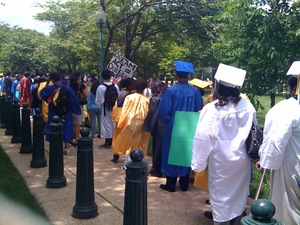
Twitter. For example, in June 2009, the founders of Dreamactivist.org, and United We Dream,

organized 500 youth to participate in the National

DREAM Act Graduation in Washington DC. This protest combined

a symbolic ceremony with legislative lobbying (Behary 2009).

Thumbnail image for dreamactphoto1.jpg

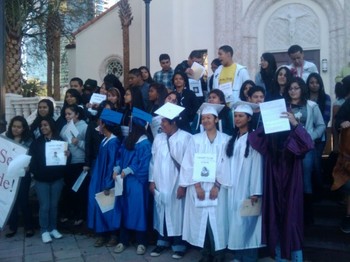
On the same day, solidarity graduations took

place in Arizona, California, Florida, Illinois, Indiana, Kentucky,

Massachusetts, Montana, New Jersey, New York, North Carolina, and Texas (Dream Activist 2009).


Thumbnail image for 12012010-DREAMERS-IMG_20101201_155737-575x431.jpg

source:

http://blogs.orlandosentinel.com/news_hispanicaffairs/tag/dream-act


In another widely publicized campaign, on

January 1, 2010, four undocumented youth from Miami Dade College began a

4-month, 1500-mile-trek to Washington, DC to advocate for the DREAM Act. In

what they aptly called the "Trail

of DREAMs," the youth documented and mobilized support

for their their walk through blogging, Facebook, YouTube, and twitter. Along

their journey, they gathered 30,000 signatures to bring to President Obama.


Watch the trail of dreams video here: 


Despite all these efforts, the DREAM Act has yet

to pass, and undocumented youth continue to be deported. In the face of this

continuing crisis, the youth have used a combination of direct action and media

activism to highlight (and render visible) detentions and deportations, which

have generally received little public attention (Kohli 2011). They have staged rallies and sit-ins at detention centers, ICE offices, and

have even targeted banks that invest in private prisons to directly confront

the institutions invested in the immigrant detention and deportation system (Foley 2011). Grass roots new media messaging campaigns have been crucial to these action as

youth use Facebook, Twitter, and microblogging to share the stories of, and

garner support for, those detained and fighting deportation.


The story of Matias Ramos,

, an undocumented youth and co-founder of United We Dream, is a powerful

example of such mobilization. On the morning that an electronic monitoring

device was placed on his ankle, Matias Ramos posted a photo of himself on

Twitter and announced that he had been given two weeks to leave the country (Berenstein 2011).


Thumbnail image for matias ramos 2.jpg

source: http://americasvoiceonline.org/blog/entry/dream_activist_matias_ramos_scheduled_for_deportation/


Ramos and his supporters were able to gain high

visibility for his case, to the point where it was even called a "high

profile challenge to the White House's new deportation guidelines."

Stories like these are transmitted through many overlapping social media

networks connecting campus organizations, community groups, sympathetic media

and allies, providing links to petitions and online donations.


Nancy Meza is a key

media strategist for the END our Pain campaign. At DREAMing Out Loud!

 she discussed the importance of

combining both new media and traditional media strategies to shape the movement

messaging.  To Nancy, social

media is a space where "we can 'freely' express ourselves, push our messaging

forward... in terms of Twitter and Facebook."  At the same time, Nancy stressed the need to complement new

and more traditional media as she continued: "Our organization doesn't even own

a camera...With whatever resources we have...I have a blackberry on a month to

month plan...So I think for us, it's really been about how we use traditional

media and how we mix it in".  New

media has allowed for youth to shape their message in a more democratic and

participatory fashion. They are, however, increasingly conscious of the need to

be strategic about its use. For example, Nancy explained that a lot of effort

goes into coming up with a Twitter hashtag for an event.  Is it accurate? Is it catchy? Will it

travel? Often, Twitter is a good way to catch the attention of more traditional

media, she explained. To her, the key is arriving at the happy medium between

locally constructed messaging and coordinating a coherent frame that can

translate to major media outlets. 


Concluding

Thoughts:

At the heart of the event were the stories that

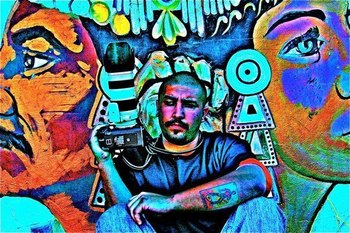
the panelists shared and accounts of how stories inspired activism.  Pocho

1, a internationally recognized photographer, recalled how

photography shaped his activism and his reformation from a gang member to a

social activist: "I started telling stories...I wanted to tell their story...I

started hanging out with artists...I picked up a camera...I went crazy with

it...shoot it everyday... tell people's stories". Now Pocho 1 documents the Dream

movement, using his camera and social media as a form of social commentary and

social activism. 


Thumbnail image for p1.jpg

source: http://www.pocho1.com/#!


DREAMing

Out Loud! provided many insights into how young people

use new media to participate and mobilize in their communities. In many ways, the

event highlighted the great democratizing potential that new media has,

especially when it can be used to provide a platform to amplify the voices of

youth who are marginalized from the mainstream political process. 

References

Behary, Samya. "Students

storm Capitol Hill for National Dream Act Graduation Day," Immigration Impact, June 25, 2009.

Berestein, Leslie Rojas. "A High-Profile Challenge to the White House New Deportation Guidelines," MultiAmerican, September 21, 2011, multiamerican.scpr.org/2011/09/a-high-profile-challenge-to-the-white-houses-new-deportation-policy.

DREAM Activist, "DREAM for

America: National DREAM Act Graduation Day - June 23, 2009," press release, June 21, 2009

dreamactivist.org/blog/2009/06/21/nationalgraduation/.

Foley, Elise. "Immigrants to Wells Fargo: Stop investing in For-Profit Detention," The Huffington Post, October 17, 2011.

Kohli, Aarti Peter l. Markowitz, and Lisa Chavez, "Secure Communities by the Numbers:

An Analysis of Demographics and Due process," Chief Justice Earl Warren Institute

on Law and Social Policy Research Report, October, 2011.

Sangita Shresthova is currently the Research Director of the Media Activism and Participatory Politics  (MAPP)  Project at USC. She is a Czech/Nepali international development specialist, filmmaker, media scholar, and dancer with extensive interdisciplinary qualitative research experience. She holds a Ph.D. from UCLA's Department of World Arts and Cultures, and a MSc. degree from MIT's Comparative Media Studies program where she focused on popular culture, new media and globalization. She also earned a MSc. in Development Studies from the London School of Economics and Political Science (LSE). While at LSE, her work focused on the educational communication components of international development interventions. Her scholarly writing has been published in several journals, and her work on global participatory aspects of Bollywood dance was recently released as a book by SAGE Publications.


Arely Zimmerman, a Melon Post-Doctorate Fellow at the USC Program for Environmental and Regional Equity,  holds a doctorate in political science from UCLA. Her scholarship engages overlapping research areas of U.S. Latino/a studies, race and ethnicity, social movements, transnational, media, and feminist studies. Before joining PERE, she held a postdoctoral appointment at USC's Annenberg School for Communication and Journalism, where she examined how new forms of social and digital media are reshaping modes of civic engagement amongst Latino, immigrant, and undocumented youth. As part of her ongoing concerns with issues of identity and citizenship in transnational contexts, Arely's manuscript in progress, "Contesting Citizenship across Borders: Central Americans in the United States" details Central American migrant communities' struggles for citizenship and inclusion across multiple nation-states through transnational social movement and community activism.


Dreaming Out Loud! Youth Activists Spoke About Their Fight for Education, Immigrant Rights and Justice Through Media and Art (Part Three)

The following is the third installment in a four part series on young activists who are using new media to rally behind the Dream Act. It was written by Arely Zimmerman and Sangita Shreshtova from the USC Civic Paths Project. This work was funded by the MacArthur Foundation. 


Coming Out/Pop Culture

The need to be active, to be connected to other

undocumented youth, and to strive collectively to make positive changes are key

motivators for all of the youth panelists. They are all extremely active online.

They create original media content. They blog. They share their stories and art

through Facebook and Twitter.  They

participate in public online conferences and symposia.  Yet, online visibility comes with its

own challenges and risks. As Nancy recounted, she was personally targeted in a

public campaign after a local conservative radio program called for her

deportation.  Because of her role

as the communications director of Dream Team Los Angeles and IDEAS at UCLA, she was an easily identifiable target.  The campaign got so vicious that she

eventually had to disconnect her phone. 

But, the risks of visibility have to be counter balanced with the

benefits, she concluded.  "Yes, it

is dangerous, there are risks that we face in being so publicly active, but it

is even more risky if they don't know we exist". 


Listen to Nancy

Meza speak on this topic here:


Driven by their urgent need to draw attention

to their plight, undocumented youth put themselves at risk of deportation and

arrest not only by participating in public civil disobedience but by also

publicly 'coming out' via social media platforms.  The coming out process, as Erick notes, is a deeply personal

one, shaped by each individual's own journey towards self-awareness and

identification.  But, this process

also has significant consequences on the movement because it is a first step in

embracing one's undocumented legal status and becoming politically

involved.  One of the common themes

in the 'coming out' stories of undocumented youth is asserting their belonging,

their 'Americannes', despite their undocumented legal status. Most Dream activism

youth were brought to the United States as young children, and the United

States is the only country they've ever known. It is their home. Fluent in

English, educated in the American school system, these youth defy the already

clearly inaccurate stereotypes of the 'illegal immigrant'. Mohammad of Dreamactivist.org, an online undocumented

youth advocacy network, shared one often cited "coming out" narrative.


Watch Mohammad's "I

am Mohammad and I am undocumented" video here:


The 'coming out'

narratives of Dreamer youth often draw on shared cultural references.  Erick, for instance, shared how he

formulated his identity from "Anime, heavy metal, and comic books"

which he says, " framed my outlook on life".  When he came out as undocumented for the first time, he says

he was inspired by a story arc in the popular comic Spiderman.  "When I mentioned my first name for the

first time- I compared it to a story arc of Spiderman- when Spiderman shares

his identity, I am also sharing my identity". Erick, and others, have also

drawn connections to Superman as being undocumented.


Thumbnail image for superman comic strip.jpg

source: yfrog.com/h314mmz

(@laloalcaraz)


Sangita Shresthova is currently the Research Director of the Media Activism and Participatory Politics  (MAPP)  Project at USC. She is a Czech/Nepali international development specialist, filmmaker, media scholar, and dancer with extensive interdisciplinary qualitative research experience. She holds a Ph.D. from UCLA's Department of World Arts and Cultures, and a MSc. degree from MIT's Comparative Media Studies program where she focused on popular culture, new media and globalization. She also earned a MSc. in Development Studies from the London School of Economics and Political Science (LSE). While at LSE, her work focused on the educational communication components of international development interventions. Her scholarly writing has been published in several journals, and her work on global participatory aspects of Bollywood dance was recently released as a book by SAGE Publications.


Arely Zimmerman, a Melon Post-Doctorate Fellow at the USC Program for Environmental and Regional Equity,  holds a doctorate in political science from UCLA. Her scholarship engages overlapping research areas of U.S. Latino/a studies, race and ethnicity, social movements, transnational, media, and feminist studies. Before joining PERE, she held a postdoctoral appointment at USC's Annenberg School for Communication and Journalism, where she examined how new forms of social and digital media are reshaping modes of civic engagement amongst Latino, immigrant, and undocumented youth. As part of her ongoing concerns with issues of identity and citizenship in transnational contexts, Arely's manuscript in progress, "Contesting Citizenship across Borders: Central Americans in the United States" details Central American migrant communities' struggles for citizenship and inclusion across multiple nation-states through transnational social movement and community activism.

Dreaming Out Loud! Youth Activists Spoke About Their Fight for Education, Immigrant Rights and Justice Through Media and Art (Part Two)

Dreaming Out Loud! 

by Arely Zimmerman and Sangita Shreshtova

Civic Paths Project


Theme 1: Barriers and Supports

The DREAMing Out Loud! symposium provided the

panelists an opportunity to reflect on how

they have grown their movement through harnessing new media's technological

and communication affordances. Clearly, immigrant, low-income, undocumented

youth face many barriers to both online participation and civic engagement,

none more important than the lack of financial resources.  


Yet, these barriers

do not foreclose their ability to mobilize online communities around their

cause. Studies conducted by William Perez and more recently by USC sociologist Veronica Terriquez show staggering rates of civic engagement

amongst undocumented immigrant youth, challenging dominant presumptions about how

youth become active and which youth are able to tap social networks behind

their causes. Arely Zimmerman's research on Dream Activism similarly finds that

youth - including those who are undocumented and low income -  are active in organizations supporting

the Dream act also acquired high levels of new media skills. Not only were they

active on social media; they also created new media content and shared it

through platforms such as Flickr and YouTube.  Given this context, the Dreaming

Out Loud! panelists spoke openly about how they overcame financial and

other barriers to their political participation.


Thumbnail image for Thumbnail image for Erick-Huerta.jpg

(source of image:

http://blogs.laforward.org/2010/12/06/news/another-dreamer-tells-his-story/)


Erick, for example,

is working towards his journalism degree but has had to take time off because

of financial hardships.  Since

2007, Erick has been blogging about his experiences as undocumented youth.  Without full-time access to a personal

computer, Erick uses various resources to develop an online presence.  With his mother making ends meet as a

street vendor, and his father picking up odd jobs, Erick used a scholarship to

buy an Iphone.  Although it doesn't

have Internet access, Erick uses his Iphone to take pictures, take notes, write

blog entries. He then uploads the content to Facebook and Twitter via SMS text

messaging.  Erick notes that, "As

technology progresses it's becoming easier and easier and easier to be 'out

there'."


Listen to Erick speak about this here:


The lack of access to technology does not keep

these youth from participating online.


Julio Salgado is a co-founder of Dreamers Adrift,

a collective of digital media artists. 

After graduating with a degree in journalism from Cal State Long Beach,

he could not put his degree to use. 

Working odd jobs primarily in the service industry, he was frustrated by

the lack of opportunities.  He

became more active in the Dream movement and used his artistic talents at the

service of the cause. He has developed a personal style that is immediately

recognizable, and his images have been used to represent national conferences,

t-shirts, and other movement iconography. 

He recalls how he has used whatever we could to 'make ends meet', going

to college parties and gatherings and drawing caricatures of friends to raise

money to pay for books and tuition. 

Using his artistic talent, he began posting his drawings of 'dreamers'

on Facebook using a scanner and photo-booth on his Apple laptop. Soon

thereafter, his pictures garnered national attention.  

Thumbnail image for Thumbnail image for LIBERTY78.11.jpg

(image source:

http://dreamersadrift.com/wp-content/uploads/2011/04/LIBERTY78.11.jpg)

Reflecting on the barriers he has faced, Julio

says, "that never stops you, you're so passionate...I need to draw this stuff".  


See Julio's video "Wall of Dreams" here: 


Sangita Shresthova is currently the Research Director of the Media Activism and Participatory Politics  (MAPP)  Project at USC. She is a Czech/Nepali international development specialist, filmmaker, media scholar, and dancer with extensive interdisciplinary qualitative research experience. She holds a Ph.D. from UCLA's Department of World Arts and Cultures, and a MSc. degree from MIT's Comparative Media Studies program where she focused on popular culture, new media and globalization. She also earned a MSc. in Development Studies from the London School of Economics and Political Science (LSE). While at LSE, her work focused on the educational communication components of international development interventions. Her scholarly writing has been published in several journals, and her work on global participatory aspects of Bollywood dance was recently released as a book by SAGE Publications.


Arely Zimmerman, a Melon Post-Doctorate Fellow at the USC Program for Environmental and Regional Equity,  holds a doctorate in political science from UCLA. Her scholarship engages overlapping research areas of U.S. Latino/a studies, race and ethnicity, social movements, transnational, media, and feminist studies. Before joining PERE, she held a postdoctoral appointment at USC's Annenberg School for Communication and Journalism, where she examined how new forms of social and digital media are reshaping modes of civic engagement amongst Latino, immigrant, and undocumented youth. As part of her ongoing concerns with issues of identity and citizenship in transnational contexts, Arely's manuscript in progress, "Contesting Citizenship across Borders: Central Americans in the United States" details Central American migrant communities' struggles for citizenship and inclusion across multiple nation-states through transnational social movement and community activism.

DREAMing Out Loud! Youth Activists Spoke About Their Fight for Education, Immigrant Rights and Justice Through Media and Art

DREAMing-withtext-1-small.jpg


From time to time, I have show-cased here the work of my Civic Paths Research Team. This is a group of more than a dozen USC graduate students, faculty, staff, and post-docs, who meet each week to research the intersection between participatory culture and political participation. You can check out our blog here. The team is associated with a larger network on Youth and Participatory Politics which has been supported by the John D. and Catherine T. MacArthur Foundation and headed by Joe Kahne from Mills College. We are in the process of doing interviews, media audits, and field work focused on innovative movements and networks which have been effective at using new media and participatory practices to get young people involved in the political process. Over the next few installments, I am going to be showcasing one of those case studies, focused around the efforts of undocumented youth and their allies to rally support around various versions of the Dream Act, which would extend education and citizenship rights. This report was written by Arely Zimmerman, the post-doc who has been primarily responsible for overseeing this case, and Sangita Shresthova, the research director for the Civic Paths Project. 

Dreaming Out Loud! Youth Activists Spoke About Their Fight For Education, Immigrant Rights, and Justice Through Media and Art

by Arely Zimmerman and Sangita Shresthova


In a dimly lit room, a young man peers into the camera and adjusts the viewfinder to check his image. He then looks directly into the camera and states "My name is _____, and I am undocumented." His migration story resonates with hundreds of others who then upload their own stories to YouTube. Elsewhere, Livestream carries the feed of a youth-led civil disobedience to thousands across the country. Statements of support for the protest soon appear on blogs, Twitter, and other social media....


On

November 2, 2011 the Media Activism and Participatory Politics (MAPP) project hosted a

symposium, DREAMing Out Loud! at USC's Annenberg School for

Communication and Journalism. The extremely well attended event emerged out

of a case study on DREAM activism carried out by Postdoctoral Fellow Arely

Zimmerman and brought immigrant youth activists together to share their

perspectives on the intersection of new media, art, and social activism.

These 'dreamers' (as

they are commonly referred to) are members of a national youth-led movement

centered around the Dream

Act, federal legislation

(proposed with bipartisan support) that would provide an opportunity for

undocumented students with "good moral character," who have lived in the U.S.

for a certain period, to obtain legal status.  Jacky A., Julio

Salgado, Erick

Huerta, Nancy Meza,

and Pocho 1

represented different local, regional and national youth organizations as well

as different experiences using new media.


IMG_0012.JPG

(photo: Civic

Paths)


The forum followed two

significant events impacting current debates around the Dream movement.  In September 2011,

representing at least a small victory, the state passed a bill known as the California Dream Act -- undocumented youth in the state could obtain some financial aid to

attend college.  However, without

any change on the federal level, undocumented youth still cannot work legally

upon graduation. Thus, while the legislation extends state financial aid to undocumented

students, immigrant youth continue to be deported at alarming rates.

Nationally, more undocumented immigrants have been deported under the Obama

administration than under any previous administrations. 

Less than a month after the California Dream

Act was passed, on October 12, 2011,  five undocumented youth, wearing graduation caps, staged a

sit-in at the Immigration

and Customs Enforcement (ICE) offices in downtown Los

Angeles to urge

the Obama administration to stop deporting undocumented youth (Rojas 2011). The sit-in was launched by the

national Education Not Deportation (END) Our Pain campaign, which is comprised of a network of immigrant youth organizations and

allies demanding an immediate moratorium on deportations of youth eligible for the Dream

Act.

Watch the Ustream of that protest here:  


Armed with camera phones, the Dream activists

broadcast their action on Ustream, which was followed by 4,000 people.  Nancy Meza, one of the panelists, was

one of the protestors arrested at the sit-in.  She notes that new media was crucial to the activists'

ability to raise awareness around this event. Confirming the effectiveness of

this new media strategy, the activists were soon invited to a conference call

with key officials of the Obama administration.


The use of new media has played a key role in mobilizing undocumented

youth across the country, connecting local and regional youth organizations,

scaling local movements to the national level, and contesting elite-driven

messaging on immigration policy.


Sangita Shresthova is currently the Research Director of the Media Activism and Participatory Politics  (MAPP)  Project at USC. She is a Czech/Nepali international development specialist, filmmaker, media scholar, and dancer with extensive interdisciplinary qualitative research experience. She holds a Ph.D. from UCLA's Department of World Arts and Cultures, and a MSc. degree from MIT's Comparative Media Studies program where she focused on popular culture, new media and globalization. She also earned a MSc. in Development Studies from the London School of Economics and Political Science (LSE). While at LSE, her work focused on the educational communication components of international development interventions. Her scholarly writing has been published in several journals, and her work on global participatory aspects of Bollywood dance was recently released as a book by SAGE Publications.


Arely Zimmerman, a Melon Post-Doctorate Fellow at the USC Program for Environmental and Regional Equity,  holds a doctorate in political science from UCLA. Her scholarship engages overlapping research areas of U.S. Latino/a studies, race and ethnicity, social movements, transnational, media, and feminist studies. Before joining PERE, she held a postdoctoral appointment at USC's Annenberg School for Communication and Journalism, where she examined how new forms of social and digital media are reshaping modes of civic engagement amongst Latino, immigrant, and undocumented youth. As part of her ongoing concerns with issues of identity and citizenship in transnational contexts, Arely's manuscript in progress, "Contesting Citizenship across Borders: Central Americans in the United States" details Central American migrant communities' struggles for citizenship and inclusion across multiple nation-states through transnational social movement and community activism.

Help Time Lord Rocker Beat Justin Bieber on British Pop Charts

I know I signed off the blog for the year, but my imagination has been captured by a fascinating struggle which is taking place this weekend around the UK Pop Singles Chart. Specifically, I am excited by 22 year old Alex Day, who is gaining ground and British bookies give him a 1 in 16 chance of winning the competition, despite the fact that he has no record deals and has built his following entirely through his deft use of YouTube, Twitter, and other social media.

His catchy pop song, "Forever Yours," was released December 3 and his video, which playfully pairs a love song with images from superhero comics and zombie movies, has already been seen more than a million times. To win, he will need to best Justien Beber and Mariah Carey (not to mention the recent winner of the British X-Factor).

But, Day's certainly bringing on the grassroots support. Here's what he shared with me via a recent email: "'Forever Yours' is on sale as from today, became the second-highest trending topic on Twitter worldwide within eight minutes, and is so far sitting at number 96 on the UK iTunes Chart and rising about twenty places every time I refresh." This seems like a classic example of spreadability in action!

Apart from trying to turn the British pop world on its head, Day has been a key figure behind the growth of "Time Lord Rock," music inspired by Doctor Who, which has emerged as a grassroots movement in the spirit of the Wizard Rock associated with Harry Potter fandom. As a Time Lord Rocker, Day runs a website, Chameleon Circuit, which features such songs as "Blink" and "Exterminate Regenerate."

Check it out and if you feel so inclined, do what you can to help him beat Justin Bieber. Whatever happens, this is a fascinating example of how grassroots media and participatory culture is starting to impact the operations of the commercial mainstream.

This story came to me from Andrew Slack from the Harry Potter Alliance.

A Few Final Reflections at Year's End...

Having made it, more or less, through the grading frenzy, I am now really and truly spent, and looking forward to some much needed rest and relaxation over the holidays. So, this is going to be the last blog post for 2011. We will be back by the Second Week of January with an exciting line-up of interviews, essays, and other resources, but for the time being, I am going to take a few weeks off to read, write, and other things that keep Henry healthy and wise, if not particularly wealthy. Before I do, I wanted to share a few loose ends which have come across my desk in the past few weeks.

The first is the webcast created by the fine folks at the New School of Social Research depicting the public conversation I had with Liz Losh at the Mobility Shifts conference earlier this fall. Many of you will have seen photographs of Liz and I wearing the Team Critical Theory and Team Cultural Studies racing jackets which Liz's husband designed and produced for the event. They were our joking way of calling out some of the unproductive tensions which have existed between those two camps over the past few years and the desire to work beyond them in order to contribute to far more important public debates, such as those concerning the future of public education, and to contribute towards shared visions, such as those concerning the democratization of access to digital media.

Here's how the program was billed:

At Mobility Shifts: An International Future of Learning Summit Henry Jenkins (Team Cultural Studies) and Elizabeth Losh (Team Critical Theory) offer a progress report on whether and in what ways the public schools and universities are going to be able to absorb or meaningfully deploy what Jenkins calls "participatory culture." Rather than an abstract discussion of a theoretical construct drawn from their supposedly opposite positions studying fan culture and institutional rhetoric respectively, the two will discuss concrete experiences of young people acting appropriately or not, inside or outside the classroom. What might a participatory learning culture look like? What policies make it hard for even supportive teachers to achieve in their classrooms? What stakeholders would need to be engaged in order to change the current cultures of our school? How might participatory learning take place beyond the schoolhouse gates? What is everyone afraid of?

The Mobility Shifts conference did a great job of combining multiple groups of people, from around the world, who care passionately about the future of education, many of whom are doing local projects designed to have a material real world impact that exist alongside and in relationship with their theory and scholarship.

As you will see, the differences that might exist between Losh and I on paper start to break down when we deal pragmatically with the concerns that animate our work. We've sometimes disagreed through our blogs, but the more we worked on pulling together this event, the clearer it became that our shared values and commitments were far more significant than tactical disagreements. In the course of this conversation, we make strong arguments for why, tempting though it may be, we can not just blow up the public schools and walk away, we talk about some specific insights we've gained through our educational interventions, and we discuss the strengths and limits of the concept of participatory culture as a way of framing current struggles over access to the means of cultural production and circulation. If you want to learn more about Liz's work, see her blog here.

Nikki Usher, a recently minted PhD from the Annenberg School of Communications and Journalism, has been using excerpts from Spreadable Media: Creating Value and Meaning in a Networked Society (which I co-authored with Sam Ford and Joshua Green and which will be released by NYU Press next fall) with her students at George Washington University. Nikki shared with us a video produced as part of a class project by her student, Sandi Moynihan, which applies our concepts of "spreadability" to describe the Occupy movement. The video is part of a larger set of resources around the movement you can find at her website, many of them dealing with Occupy's use of social media. I was so excited by her wonderful video that I asked if I could share it with you here.

Last week, I was down in Rio. In Copacabana, there are the most remarkable sand sculptures, including several which reconstruct the city's landmarks. Somehow, this sculpture depicting Santa and friends caused me great amusement. It speaks to the incongruous way that Euro-American Christmas iconography and traditions work in the context of South America, where, after all, December is one of the hottest summer months, but we are hearing "Frosty the Snow Man" and "White Christmas" playing everywhere we go. I decided this particular version of Father Christmas might better be called "Sandy Claws." (By the way, while it does not show up very well in this particular image, the woman in the picture is actually wearing one of those "itsy bitsy polka dot bikinis" that one sees on the beaches here, though admittedly, the sculpture left very little to the imagination in this rendering, itself a marker of cultural difference, given how unlikely it is to see anything so "family unfriendly" in public spaces in the United States.)

IMG_0995.jpg

Global Cities and the Future of Entertainment

This year's Futures of Entertainment 5 conference launched with a special event, hosted by the MIT Communications Forum, which specifically highlighted the international dimensions of our work, and it closed with a Technobrega performance at one of Cambridge's hotter night clubs. Both reflect our ongoing engagement with the cultures of Brazil and specifically with the City of Rio. Early in the Creative Cities event, my good friend, Mauricio Mota, Chief Storytelling Officer for The Alchemists, a transmedia company based in Rio and Los Angeles, took to the stage to share a personal message to the attendees from the Mayor of Rio. During my trip to Brazil last summer, Mauricio and I sat down with the Mayor to discuss his vision for the future of the city, which will be playing host to the Olympics and the World Cup over the next few years, and which has been undergoing dramatic changes in terms of the development of its economic and media infrastructure. Over the course of this trip, we hatched a plan together to develop a Center for the Futures of Entertainment in Rio, which would bring the best of what we've been doing at MIT and USC to Latin America. The Mayor quickly got the vision of what we wanted to accomplish and jumped at the chance to provide seed funds to get this venture underway.

The Center will be a collaboration between the Futures of Entertainment Consortium (which evolved from the Convergence Culture Consortium and is now under the leadership of Sam Ford), the Annenberg Innovation Lab (which is under the leadership of Jonathan Taplin), The Alchemists, The City of Rio, and a range of corporate and academic partners, which include Petrobras, RioCriativo (State Government Culture Department) ESPM (Academic Partner), Western Kentucky University, and RioFilme (City of Rio film distribution company). Brazillian partners have long contributed support to the Consortium and they have been early backers of the Innovation Lab, so we welcome the opportunity to work more closely with them in the years ahead. (On a personal level, this country has been incredibly welcoming to me and my work. After the United States, the highest percentage of the readers of my blog and my Twitter flows come from Brazil, and the Portuguese edition of Convergence Culture has been the international version which has had the widest readership.)

Apart from the connection to our new Brazil project, I also want to speak with enormous pride about the contribution here from Parmesh Shahani, a graduate of the Comparative Media Studies Program, and someone who has emerged as a major cultural thought leader in India, and with deep appreciation for my Dean, Ernest Wilson, who was willing to come to MIT and share his rich vision.

Global Creative Cities and the Future of Entertainment.

Today, new entertainment production cultures are arising around key cities like Mumbai and Rio de Janeiro. What do these changes mean for the international flow of media content? And how does the nature of these cities help shape the entertainment industries they are fostering? At the same time, new means of media production and circulation allow people to produce content from suburban or rural areas. How do these trends co-exist? And what does it mean for the futures of entertainment?

Moderator: Maurício Mota (The Alchemists)

Panelists: Parmesh Shahani (Godrej Industries, India), Ernie Wilson (University of Southern California) and Sérgio Sá Leitão (Rio Filmes)

MIT Tech TV

The Futures of Entertainment 5: The Videos (Day Two)

Introduction (8:30-9:00 a.m.) Grant McCracken (author of Chief Culture Officer; Culturematic)

MIT Tech TV

The Futures of Serialized Storytelling (9:00-11:00 a.m.)

New means of digital circulation, audience engagement and fan activism have brought with it a variety of experiments with serialized video storytelling. What can we learn from some of the most compelling emerging ways to tell ongoing stories through online video, cross-platform features and applications and real world engagement? What models for content creation are emerging, and what are the stakes for content creators and audiences alike?

Moderator: Laurie Baird (Georgia Tech)

Panelists: Matt Locke (Storythings, UK), Steve Coulson (Campfire), Lynn Liccardo (soap opera critic), and Denise Mann (University of California-Los Angeles)

MIT Tech TV

The Futures of Children's Media (11:30 a.m.-1:00 p.m.).

Children's media has long been an innovator in creating new ways of storytelling. In a digital era, what emerging practices are changing the ways in which stories are being told to children, and what are the challenges unique to children's properties in an online communication environment?

Moderator: Sarah Banet-Weiser (University of Southern California)

Panelists: Melissa Anelli (The Leaky Cauldron), Gary Goldberger (FableVision) and John Bartlett (Houghton Mifflin Harcourt)

MIT Tech TV

The Futures of Nonfiction Storytelling (2:15-4:15 p.m.).

Digital communication has arguably impacted the lives of journalists more than any other media practitioner. But new platforms and ways of circulating content are providing vast new opportunities for journalists and documentarians. How have-and might-nonfiction storytellers incorporate many of the emerging strategies of transmedia storytelling and audience participation from marketing and entertainment, and what experiments are currently underway that are showing the potential paths forward?

Moderator: Johnathan Taplin (University of Southern California)

Panelists: Molly Bingham (photojournalist; founder of ORB); Chris O'Brien (San Jose Mercury News), Patricia Zimmermann (Ithaca College) and Lenny Altschuler (Televisa)

MIT Tech TV

The Futures of Music. (4:45-6:45 p.m.)

The music industry is often cited as the horror story that all other entertainment genres might learn from: how the digital era has laid waste to a traditional business model. But what new models for musicians and for the music industry exist in the wake of this paradigm shift, and what can other media industries learn from emerging models of content creation and circulation?

Moderator: Nancy Baym (Kansas University)

Panelists: Mike King (Berklee College of Music), João Brasil (Brazilian artist), Chuck Fromm (Worship Leader Media), Erin McKeown (musical artist and fellow with the Berkman Center for Internet and Society at Harvard University) and Brian Whitman (The Echo Nest)

MIT Tech TV

Futures of Entertainment 5: The Videos (Day One)

A few weeks ago, I made the trip back to Cambridge, MA to participate in the fifth iteration of the Futures of Entertainment conference. This conference emerged from the work we did at MIT through the Convergence Culture Consortium. The goal of the conference is to provide a meeting ground for forward thinking people in the creative industries and academia to talk with each other about the trends that are impacting how entertainment is produced, circulated, and engaged with. Through the years, the conference has developed its own community, which includes alums of the Comparative Media Studies Program who see the conference as a kind of homecoming, other academics who have found it a unique space to engage with contemporary practices and issues, and industry leaders, many of them former speakers, who return because it offers them a chance to think beyond the established wisdom within their own companies. Our goal is to create a space where academics do not read papers and industry folks don't present prospectus-laden powerpoints or talk about "take-aways" and "deliverables," but people engage honestly, critically, openly about topics of shared interest.

Read by these criteria, this year's event was arguably our most successful venture ever, ripe with sometimes heated debates about the nature of the "crowd" (and of the relations between artists and consumers within crowd sourcing models), about the struggles over privacy, piracy, and self identity which shape everything from our relations with location-based entertainment to children's media, about the ways that global perspectives complicate some of the assumptions shaping American media practices, and about the ways that grassroots control over circulation complicate established business models.

On a personal level, I was deeply proud to see so many of the CMS alums in their new professional identities, showing that they have continued to grow in intellectual stature and cultural authority after leaving MIT, including Sam Ford who has taking over as the primary person in charge of the event and of our newly renamed Futures of Entertainment Consortium. I was delighted to see so many of my new friends from the west coast fly to Cambridge to join us for this year's event, including Ernest Wilson, the Dean of the Annenberg School of Communications and Journalism. Formally, Futures of Entertainment is the sister conference to Transmedia Hollywood, which we host here in Los Angeles, swapping years between USC and UCLA. But this was the year where the two families mingled with each other and the bridges between the two conferences were strengthened. By the way, I've gotten lots of questions about the next Transmedia Hollywood conference: there's not a lot of information to share yet, but it will be held on April 6 2012 at the USC Cinema School, if you want to save the date. Watch this blog for further announcements.

Finally, I was deeply proud of the diversity we achieved in our programing this year, making further progress in a long struggle to get greater gender balance on our panels, and making a huge step forward in terms of bringing transnational perspectives into the mix. We welcome recommendations for speakers at our future events in general, but we especially welcome recommendations for female, minority, and international speakers.

I am also proud that we continue to maintain a tradition of making webcasts of the conference available free to all. I am posting the videos of the Friday events today and next time, of the Saturday events. We will end the week with a focus on a special event on Global Creative Cities, and with some further reflections of our announcement of a new partnership with the City of Rio.

Check out this very thoughtful response by Jonathan Gray to the conference's focus on "crowdsourcing" and collaborative production.

While I was at MIT, I dropped by my old stomping grounds at the Comparative Media Studies Program and had brunch on Sunday with the newly arrived crop of Masters Students and some of the Program's Alums. What a smart group! After several years of regrouping, CMS has come back strong as ever, has maintained strong standards in terms of the quality and diversity of the community. I wish them all the best.

Introduction (8:30-9:00 a.m.)

William Uricchio (Massachusetts Institute of Technology) and Ilya Vedrashko (Hill Holliday)

MIT Tech TV

Spreadable Media: Creating Value and Meaning in a Networked Society. (9:00-10:00 a.m.)

How are the shifting relations between media producers and their audiences transforming the concept of meaningful participation? And how do alternative systems for the circulation of media texts pave the way for new production modes, alternative genres of content, and new relationships between producers and audiences? Henry Jenkins, Sam Ford, and Joshua Green-co-authors of the forthcoming book Spreadable Media-share recent experiments from independent filmmakers, video game designers, comic book creators, and artists and discuss the promises and challenges of models for deeper audience participation with the media industries, setting the stage for the issues covered by the conference.

Speakers: Henry Jenkins (University of Southern California), Sam Ford (Peppercom Strategic Communications) and Joshua Green (Undercurrent)

MIT Tech TV

Collaboration? Emerging Models for Audiences to Participate in Entertainment Decision-Making. (10:15 a.m.-11:45 p.m.)

In an era where fans are lobbying advertisers to keep their favorite shows from being cancelled, advertisers are shunning networks to protest on the fans' behalf and content creators are launching web ventures in conversation with their audiences, there appears to be more opportunity than ever for closer collaboration between content creators and their most ardent fans. What models are being attempted as a way forward, and what can we learn from them? And what challenges exist in pursuing that participation for fans and for creators alike?

Moderator: Sheila Seles (Advertising Research Foundation)

Panelists: C. Lee Harrington (Miami University), Seung Bak (Dramafever) and Jamin Warren (Kill Screen)

MIT Tech TV

Creating with the Crowd: Crowdsourcing for Funding, Producing and Circulating Media Content. (12:45-2:45 p.m.)

Beyond the buzzword and gimmicks using the concept, crowdsourcing is emerging as a new way in which creators are funding media production, inviting audiences into the creation process and exploring new and innovative means of circulating media content. What are some of the innovative projects forging new paths forward, and what can be learned from them? How are attempts at crowdsourcing creating richer media content and greater ownership for fans? And what are the barriers and risks ahead for making these models more prevalent?

Moderator: Ana Domb (Almabrands, Chile)

Panelists: Mirko Schäfer (Utrecht University, The Netherlands), Bruno Natal (Queremos, Brazil), Timo Vuorensola (Wreckamovie, Finland) and Caitlin Boyle (Film Sprout)

MIT Tech TV

Here We Are Now (Entertain Us): Location, Mobile, and How Data Tells Stories (3:15-4:45 p.m.)

Location-based services and context-aware technologies are altering the way we encounter our environments and producing enormous volumes of data about where we go, what we do, and how we live and interact. How are these changes transforming the ways we engage with our physical world, and with each other? What kind of stories does the data produce, and what do they tell us about our culture and social behaviors? What opportunities and perils does this information have for businesses and individuals? What are the implications for brands, audiences, content producers, and media companies?

Moderator: Xiaochang Li (New York University)

Panelists: Germaine Halegoua (University of Kansas), Dan Street (Loku) and Andy Ellwood (Gowalla)

MIT Tech TV

At What Cost?: The Privacy Issues that Must Be Considered in a Digital World. (5:00-6:00 p.m.)

The vast range of new experiments to facilitated greater audience participation and more personalized media content bring are often accomplished through much deeper uses of audience data and platforms whose business models are built on the collection and use of data. What privacy issues must be considered beneath the enthusiasm for these new innovations? What are the fault lines beneath the surface of digital entertainment and marketing, and what is the appropriate balance between new modes of communication and communication privacy?

Participants: Jonathan Zittrain (Harvard University) and Helen Nissenbaum (New York University)

MIT Tech TV

Comics and Graphic Storytelling: A Sample Syllabus

Last week, I featured an interview with the editors and contributors to a new anthology, Critical Approaches to Comics, suggesting that it signaled the solidification of Comics Studies as a field of academic research. As it happens, I am putting the final touches to a syllabus I have been developing for a Comic Studies course which I will be teaching in the Spring here at the University of Southern California, one which makes extensive use of that collection. Today, I thought I would share with you the basic blue print of this class, which is designed to expose students to a range of different methods for studying the medium and to as broad a sample of (primarily) American comics and graphic storytelling as I could cram into one subject. I've found in the past that undergraduates often know a pretty limited sample of comics -- sometimes the mainstream super heroes, sometimes independent titles -- but they lack a depth of historical perspectives and a mental model of a full range of what comics can and are doing. As a consequence, the most valuable thing we can do as teachers is to expose them to as many comics as it is humanly possible to read in a semester and to diverse ways of reading and discussing what they are reading. At the moment, I have probably pushed this past the breaking point and I am most likely stripping down some of what is currently listed, but having pulled together such a rich list of materials, I figured why not share them with my readers.

JOUR 499 Special Topics: Comics and Graphic Storytelling

Henry Jenkins

"Comics are just words and images. You can do anything with words and images" - Harvey Pekar

In this class, we will take apart Pekar's core claim about the nature of his medium. Our approach is emphatically exploratory. While we will deal with many of the dominant figures of historical and contemporary comics, we will not necessarily observe proper boundaries (between high and popular art, between independent and mainstream comics, between historical and contemporary comics, between American and international comics). We want to explore the full range of different uses which have been made of this medium.

Our central focus will be on comics (including comic strips but primarily comic books and graphic novels) as a medium rather than as a genre - that is, we believe that the formal practices of comics can be deployed to tell a broad range of different kinds of stories and speak to diverse kinds of audiences. We want to put this proposition to the test by developing a core vocabulary for thinking about comics as a medium and then looking at how artists have drawn on that vocabulary in a range of different contexts.

To do this, we will need to read lots and lots of comics - don't complain. I am assuming you are taking this class because you like, no, love, comics. Some of them will take you outside your comfort zone. Some of them will deal with controversial material. Some of them will look ugly or strange when you first encounter them. Some of them may frustrate or confuse you. But most of them, when everything is said and done, will entertain you. Few of you will read as broad a range of comics as you will encounter here, so use this reading to map the territory and expand your tastes. While I hope you like the comics I've chosen, I care more that you come to understand and appreciate them for what they tell us about the comics tradition.

Objectives

By the end of the class, the student will:

  • Be able to deploy a range of different methods for analyzing comics (including formal technique, genre, authorship, and intertextual analysis)
  • Grasp how comics tell stories through words and images
  • Be able to describe the basic vocabulary of graphic storytelling
  • Be familiar with the core figures who shaped the history of comics as a medium
  • Discuss the continuing relevance of the superhero genre as an window into understanding American life.
  • Be aware of the differences between American comics and the graphic traditions of other leading comics-producing countries, including Japan and France
  • Understand the differences between mainstream, independent, and underground comics traditions
  • Understand the relationship between the comic strip and comic book traditions
  • Developed a model for thinking about the ways comics have been a vehicle for journalism, history, autobiography, and social commentary
  • Explain how contemporary comics artists have built upon materials borrowed from the larger tradition, using past themes and icons to shed light on contemporary culture
  • Be able to discuss how women and minority authors have carved out a space for themselves within the comics tradition

Assignments and Grading

Page Analysis - Each week, the student should select one page from one of the comics we read and develop a one page analysis, which applies some of the concepts or methods we have been studying that week. Please turn in a copy of the page in question with your analysis to aid with the grading. The writing is intended to be exploratory and will be graded (Check, Check Plus, Check Minus) based on the student's abilities to look closely at what's on the page and to explain why the choices made matter in our understanding of the work as a whole. Please keep in mind that this will be the primary means by which I can appraise whether or not you have done the readings each week and whether or not you have understood them fully. Push yourself to apply a range of different methods of analysis over the course of the semester. (30 Percent) DUE DATE (Due every Friday)

Formal analysis paper - The student will select one of the comics we've read this term (or another of their own selection, with the approval of the instructor), and write a concise five page paper applying one of the methods of formal analysis we have examined in the first part of the class (McCloud, Eisner, Smith and Duncan) with the goal of helping us to better understand the techniques the graphic storyteller is deploying and how they contribute to the overall meaning and expressiveness of the book. Where possible, ground your analysis in the readings, though do not simply replicate what the critics we are reading have already done. Please provide concrete examples to support your claims. (20 Percent) DUE DATE (Feb. 22)

Author Analysis - Select a favorite comic book author, preferably one we have not read in the class, and develop an concise five page analysis of their specific qualities as an author, informed by the Randy Duncan essay we've read on Alan Moore. Draw examples from multiple texts from their body of work to show repeated patterns or themes. Discuss their relationship to their genres and to the comic book traditions which have informed their approach. Again, the paper will be evaluated based on the quality of the argument and your ability to support your claims with concrete examples. (30 Percent) DUE DATE (April 2)

Character analysis paper - Select a character from comic strips or comic books who has been especially meaningful to you. Write a concise five-page paper which explores some of the following questions: What do you see as the primary qualities of this character and how have they emerged over time as we have watched the character interact in a range of different situations and stories? What has changed and remained the same about the character over time? How have shifts in authorship impacted the character? Again, ground your analysis with concrete examples which support your claims. The paper will be evaluated based on the quality of the analysis and of the supporting evidence. (20 Percent) DUE DATE (Exam Week)

Books

(A Word to the Wise: Comics are expensive, and we are going to be reading lots of them in this class, so my recommendation is that you form a buddy or club system, much as you did when you read comics when you were younger. Go in together with 2-3 people and swap off the comics, so you each carry a more reasonable part of the price.)

Scott McCloud, Understanding Comics: The Invisible Art (New York: Harper, 1990, 224 pp.)

Matthew J. Smith and Randy Duncan (eds.) Critical Approaches to Comics (London: Routledge, 2011, 328 pp.)

Chris Ware, Acme Novelty Library, Number 16 (self-published). (64 pp.)

Kazuo Koike and Goseki Kojima, Lone Wolf and Cub Vol. 1: The Assassin's Road (Portland, OR: Dark Horse, 2000, 296 pp.).

Peter Kuper, The System (New York: DC Comics, 1997, 192 pp.)

Gabriel Ba and Fabio Moon, DayTripper (New York: Vertigo, 2011, 256 pp.)

David Mazzuchelli, Asterios Polyp (New York: Pantheon, 2009, 344 pp.)

Craig Thompson, Blankets (Marietta, GA: Top Shelf, 2011, 592 pp.)

David B., Epileptic (New York: Pantheon, 2006, 368 pp.)

Al Capp, The Short Life and Happy Times of the Shmoo (Woodstock, NY: Overlook Press, 2002, 144 pp.)

James Sturm and Guy Davis, Fantastic Four Legends: Unstable Molecules (New York: Marvels, 2003, 128 pp.).

Keith Chow and Jerry Ma (eds.) Secret Identities: The Asian American Superhero Anthology (New York: New Press, 2009, 200 pp.)

Alan Moore, Batman: The Killing Joke (New York: DC, 2008, 64 pp.)

Mike Carey and Peter Gross, The Unwritten: Tommy Taylor and the Bogus Identity (New York: Vertigo, 2010, 144 pp.)

Joyce Farmer, Special Exits (Seattle: Fantagraphics, 2010, 208 pp.)

Marjane Satrapi, Persepolis: The Story of a Childhood (New York: Pantheon, 2004. 160 pp.).

The rest of the Readings will be on Blackboard.

Schedule

Week 1

Monday, January 9 - Getting Started

  • Scott McCloud, "Setting the Record Straight," Understanding Comics: The Invisible Art, pp. 2-24

.

Wednesday, January 11 - Caricature and Illustration

  • Scott McCloud, "The Vocabulary of Comics," Understanding Comics: The Invisible Art, pp. 24-59.
  • Joseph Witek, "Comic Modes: Caricature and Illustration in the Crumb Family's Dirty Laundry", in Matthew J. Smith and Randy Duncan (eds.) Critical Approaches to Comics (London: Routledge, 2011), pp. 27-42.
  • R. Crumb and Aline Kominsky-Crumb, Excerpts from The Complete Dirty Laundry Comics (San Francisco: Last Gasp Comics, 1993), pp. 6-41.
  • R. Crumb, excerpts from The Book of Genesis Illustrated (New York: W.W. Norton, 2009), Chapter 1-9 (28 pages)

Week 2

Monday, January 16 - Martin Luther King's Birthday - No class.

Wednesday, January 18 - The Gutter and The Frame

  • Scott McCloud, "Blood in the Gutter," Understanding Comics: The Invisible Art, pp. 60-93.
  • Chris Ware, Acme Novelty Library, Number 16.

Week 3

Monday, January 23 - The Shape of the Page

  • Will Eisner, "The Frame," Comics and Sequential Art (New York: W.W. Norton, 2008), pp. 39-102.
  • "Will Eisner, The Spirit," in Michael Barrier and Martin Williams (eds.) A Smithsonian Book of Comic-Book Comics (Washington DC: Smithsonian Institute Press, 1981), pp. 269-294.
  • Will Eisner, "A Contract With God" and "Izzy the Cockroach and the Meaning of Life," The Contract With God Trilogy: Life on Dropsie Avenue (New York: W.W. Norton, 2006), pp. 3-62, 187-204.

  • Wednesday, January 25 - Visual Storytelling in the Japanese Tradition
  • Pascal LeFevre, "Mise En Scene and Framing: Visual Storytelling in Lone Wolf and Cub" in Matthew J. Smith and Randy Duncan (eds.) Critical Approaches to Comics (London: Routledge, 2011), pp. 71-83.
  • Kazuo Koike and Goseki Kojima, Lone Wolf and Cub Vol. 1: The Assassin's Road (Portland, OR: Dark Horse, 2000).

Week 4

Monday, January 30 - Wordless Comics

  • David A. Berona, "Wordless Comics: The Imaginative Appeal of Peter Kiper's The System," in Matthew J. Smith and Randy Duncan (eds.) Critical Approaches to Comics (London: Routledge, 2011), pp. 17-26.
  • Peter Kuper, The System (New York: DC Comics, 1997).

Wednesday, February 1 - Temporality and Seriality

  • Scott McCloud, "Time Frames" Understanding Comics: The Invisible Art, pp. 94-117.
  • Richard McGuire, "Here," Raw Vol. 2, No. 1, pp. 69-74.
  • Gabriel Ba and Fabio Moon, DayTripper (New York: Vertigo, 2011).

Week 5

Monday, February 6 - Line and Color

  • Scott McCloud, "Living in the Line" and "A Word About Color" Understanding Comics: The Invisible Art, pp. 118-137, 185-193.
  • Randy Duncan, "Image Functions: Shape and Color as Hermeneutic Images in Asterios Polyp," in Matthew J. Smith and Randy Duncan (eds.) Critical Approaches to Comics (London: Routledge, 2011), pp. 43-54.
  • David Mazzuchelli, Asterios Polyp (New York: Pantheon, 2009).

Wednesday, February 8 - Abstraction and Realism

  • Andrei Molotiu, "Abstract Form: Sequential Dynamism and Iconostasis in Abstract Comics and in Steve Ditko's Amazing Spider-Man," in Matthew J. Smith and Randy Duncan (eds.) Critical Approaches to Comics (London: Routledge, 2011), pp. 84-100.
  • Stan Lee and Steve Ditko, "The Final Chapter" in Bob Callahan (ed.) The Smithsonian Book of Comic-Book Stories: From Crumb to Clowes (Washington DC: Smithsonian Institute, 2004) pp. 122-141.
  • Stan Lee and Jim Steranko, "The Strange Death of Captain America" in Bob Callahan (ed.) The Smithsonian Book of Comic-Book Stories: From Crumb to Clowes (Washington DC: Smithsonian Institute, 2004), pp. 64-84.
  • David Mack, "Chapter One," Daredevil/Echo: Vision Quest (New York: Marvel, 2010), pp. 1-23.

Week 6

Monday, February 13 - An Art of Tensions

  • Charles Hatfield, "An Art of Tensions: The Otherness of Comics Reading", Alternative Comics: An Emerging Literature (Jackson, MS: University of Mississippi Press, 2005), pp. 32-67.
  • Craig Thompson, Blankets (Marietta, GA: Top Shelf, 2011).

Wednesday, February 15 - Text and Image

  • Douglas Wolk, "David B: The Battle Against the Real World," Reading Comics: How Graphic Novels Work and What They Mean (New York: Da Capo, 2007), pp. 139-146.
  • Herge, "TinTin: The Secret of the Unicorn, " Herge's TinTin Adventures, vol. 3 (London: Methuen, 1990).
  • David B., Epileptic (New York: Pantheon, 2006).

Week 7

Monday, February 20 - Presidents' Day - No class.

Wednesday, February 22 - Comic Characters

  • Walt Kelly, The Ever-Loving Blue-Eyed Years With Pogo (New York: Simon and Schuster, 1959), pp. 27-69.
  • Al Capp, The Short Life and Happy Times of the Shmoo (Woodstock, NY: Overlook Press, 2002).
  • Carl Barks, "The Second Richest Duck," Uncle Scrooge Vs. Flintheart Glomgord (Prescott, AZ: Gladstone), pp. 1-20.
  • Jeff Smith, "The Great Cow Race," Bone: Book Two (Columbus, OH: Cartoon Books, 2004), pp. 153-258.

Formal Analysis Paper Due

Week 8

Monday, February 27 - The Origins of a Genre: The Superhero 1

  • Peter Coogan, "Genre: Reconstructing the Superhero in All-Star Superman" in Matthew J. Smith and Randy Duncan (eds.) Critical Approaches to Comics (London: Routledge, 2011), pp. 203-220.
  • Grant Morrison, "The SunGod and the Dark Knight," Supergods (New York: Spigel and Grau, 2011), pp. 3-26.
  • Jerome Siegel and Joe Schuster, "Superman," in E. Nelson Bridwell, Superman From the Thirties to the Eighties (New York: Crown, 1983), pp. 23-127.
  • Grant Morrison, Excerpts from All-Star Superman (New York: DC Comics, 2008), TBD.

Wednesday, February 29 - The Legacy of a Genre: The Superhero 2

  • Scott Bukattman, "X-Bodies: The Torment of The Mutant Superhero," Matters of Gravity: Special Effects and Supermen in the 20th Century (Durham, NC: Duke University Press, 2003), pp. 48-80.
  • Gary Conway, Gil Kane and John Romita Sr., "The Night Gwen Stacey Died," Amazing Spiderman 121-122, 1973, pp.1-25.
  • Stan Lee and Jack Kirby, "The Incredible Hulk #1," The 100 Greatest Marvels of All Time (New York: Marvel, 2001), pp.1-25
  • Kurt Busiek and Alex Ross, "Monsters Among Us," Marvels (New York: Marvel, 2010).
  • Brian Michael Bendis, "Side-Tracked," Ultimate Spider-Man Vol. 5 (New York: Marvel, 2003), pp. 1-22.

Week 9

Monday, March 5 - Genre And Multiplicity: The Superhero 3

  • Paul Chadwick, "A Stone Among Stones," The Complete Concrete (Portland, OR: Dark Horse, 1994), pp. 11-38.
  • Stan Lee and Jack Kirby, "Fantastic Four #1," The 100 Greatest Marvels of All Time (New York: Marvel, 2001), pp.1-25.
  • James Sturm and Guy Davis, Fantastic Four Legends: Unstable Molecules (New York: Marvels, 2003).

Wednesday, March 7 - Genre and Ideology: The Superhero 4

  • Keith Chow and Jerry Ma (eds.) Secret Identities: The Asian American Superhero Anthology (New York: New Press, 2009).
  • Stanford Carpenter, "Truth Be Told: Authorship and the Creation of the Black Captain America," in Jim McLaughlin (ed.) Comics as Philosophy (Jackson, MS: University of Mississippi Press, 2005), pp. 46-62.

March 12-17 - Spring Recess - No class.

Week 10

Monday, March 19 - Authorship (The Writer)

  • Matthew J. Smith, "Auteur Criticism: The Re-Visionary Works of Alan Moore" in Matthew J. Smith and Randy Duncan (eds.) Critical Approaches to Comics (London: Routledge, 2011), pp. 178-189.
  • Alan Moore and Rick Veitch, "How Things Work Out," Tomorrow Stories 2, not numbered (10 pages)
  • Alan Moore, "Secret Origins," Supreme: The Story of the Year (New York: Checker, 2002), pp. not numbered (23 Pages)
  • Alan Moore, "The Radiant Heavenly City", Promethea Vol.1 (New York: America's Best, 1999), pp. 1-36.
  • Alan Moore, Batman: The Killing Joke (New York: DC, 2008).

Wednesday, March 21 - Authorship (The Publisher)

  • Julia Round, "Is This a Book?': DC Vertigo and The Redefinition of Comics in the 1990s," in Paul Williams and James Lyons (ed.) The Rise of the American Comics Artist: Creators and Contexts (Jackson, MS: University of Mississippi Press, 2010), pp. 14-30.
  • Jean-Paul Gabilliet, "Production," Of Comics and Men: A Cultural History of American Comic Books (Jackson, MS: University of Mississippi Press, 2005), pp. 111-132.
  • Neil Gaiman with Charles Vest and Malcolm Jones III, "A Midsummer Night's Dream," in The Absolute Sandman Volume One (New York: Vertigo, 2006), pp.495-519.
  • Bill Willingham and Lan Medina, "Old Tales Revisited," Fables, 1, no pages (aprox. 32 pages)
  • Mike Carey and Peter Gross, The Unwritten: Tommy Taylor and the Bogus Identity (New York: Vertigo, 2010).

Week 11

Monday, March 26 - Crossing Borders

  • Douglas Wolk, "Gilbert Hernandez: Spiraling into the System" and "Jaimie Hernandez: Mad Love," in Reading Comics: How Graphic Novels Work and What They Mean (New York: Da Capo, 2007), pp. 181-202.
  • Jaimie Hernandez, "100 Rooms," Locas: The Maggie and Hopie Stories (Seattle: Fantagraphics, 2004), pp. 60-90.
  • Gilbert Hernandez, "Heartbreak Soup," Palomar: The Heartbreak Soup Stories (Seattle: Fantagraphics, 2004), pp. 13-57.

Wednesday, March 28 - Comics and Reality 1: Comics Journalism

  • Amy Kiste Nyberg, "Comics Journalism: Drawing on Words to Picture the Past in Safe Area Gorazde" in Matthew J. Smith and Randy Duncan (eds.) Critical Approaches to Comics (London: Routledge, 2011), pp. .
  • Joe Sacco, excerpt from Palestine (Seattle: Fantagraphics, 2002), pp. 81-141
  • Joe Sacco, excerpt from Safe Area Gorazde (Seattle: Fantagraphics, 2002), pp. 1-56.

Week 12

Monday, April 2 - Comics and Reality 2: Comics and Everyday Life

  • Joseph Witek, "'You Can Do Anything With Words and Pictures: Harvey Pekar's American Splendor," Comic Books as History (Jackson, MS: University of Mississippi Press, 1989), pp. 121-156.
  • Brian Wood and Ryan Kelly, excerpts from Local (Oni, 2008), no pages (aprox. 60 pages)
  • Harvey Pekar, excerpts from American Splendor (New York: Ballatine, 1987), pp. no pages (aprox. 30 pages).

Author Analysis Paper Due

Wednesday, April 4 - Comics and Reality 3: Autobiography

  • Joyce Farmer, Special Exits (Seattle: Fantagraphics, 2010).
  • C. Tyler, "Gone," Late Bloomer (Seattle: Fantagraphics, 2005), pp. 96-102.

Week 13

Monday, April 9 - Comics and History 1

  • Hillary L. Chute, "Graphic Narrative as Witness: Marjane Satrapi," Graphic Women: Life Narrative and Contemporary Comics (New York: Columbia University Press, 1983), pp. 135-174.
  • Marjane Satrapi, Persepolis: The Story of a Childhood (New York: Pantheon, 2004).

Wednesday, April 11 - Comics and History 2

  • Joseph Witek, "Comic Books as History: The First Shots at Fort Sumter," Comic Books as History (Jackson, MS: University of Mississippi Press, 1989), pp. 13-47.
  • Ho Che Anderson, excerpt from King: A Comic's Biography (Seattle: Fantagraphics, 2010), pp. 94-153.
  • Howard Cruise, excerpt from Stuck Rubber Baby (New York: Vertigo, 2011), pp.41-85.

Week 14

Monday, April 16 - High/Low

  • Henry Jenkins, "Comics as Debris: Art Spiegelman's In The Shadow of No Towers" (work in Progress).
  • Art Spigelman, excerpts from Breakdowns: Portraits of the Artist as a Young %@*! (New York: Pantheon, 2008), pp. . No Pages (13 Pages)
  • Basil Wolverton, "Powerhouse Pepper: A Nightmare Scare," Raw Vol. 2, No. 1, pp. 175-180.
  • Jack Cole, "Plastic Man: Plague of the Plastic People," in Art Spigelman, Jack Cole and Plastic Man: Forms Stretched to Their Limits (New York: DC, 2001), pp. . No pages (13 pages)
  • Will Elder and Harvey Kurtzman, "Superdooperman," Michael Barrier and Martin Williams (eds.) A Smithsonian Book of Comic Book Comics (Washington DC: Smithsonian Institute, 1981, pp. 311-318.

Wednesday, April 18 - Haunted By the Past

  • Harvey Kurtzman, "Corpse on the Imjin!," Michael Barrier and Martin Williams (eds.) A Smithsonian Book of Comic Book Comics (Washington DC: Smithsonian Institute, 1981), pp. 305-311.
  • Bill Gaines, Al Feldstein, and Jack Davis, "Foul Play," Grant Geissman (ed.) Foul Play! (New York: Harper, 2005) pp. 83-89.
  • Bill Gaines, Al Feldstein, and Joe Orlando, "Judgement Day," Grant Geissman (ed.) Foul Play! (New York: Harper, 2005) pp. 147-153.
  • Bill Gaines, Al Feldstein, and Reed Crandall, "The High Cost of Dying," Grant Geissman (ed.) Foul Play! (New York: Harper, 2005) pp. 217-223.
  • Bernie Kriegstein, "Murder Dream," B. Krigstein Comics (Seattle: Fantagraphics, 2004), pp. 179-184.
  • Charles Burns, "Teen Plague," Raw Vol. 2, No.1, pp. 5-25.

Week 15

Monday, April 23 - Comparative Perspectives

  • Henry Jenkins, "Should We Discipline the Reading of Comics?" in Matthew J. Smith and Randy Duncan (eds.) Critical Approaches to Comics (London: Routledge, 2011), pp. 1-14.
  • Kim Deitch, "Karla in Komieland," Raw Vol. 2, No. 1, pp. 59-68.
  • Kim Deitch, "The Cult of the Clown," Beyond the Pale! (Seattle: Fantagraphics, 1989), pp. 43-52.
  • Kim Deitch, "The Stuff of Dreams," Alias the Cat! (New York: Pantheon, 2007), pp. no pages (23 pages)

Wednesday, April 25 - The Future of Comics?

  • Scott McCloud, "The Infinite Canvas", Reinventing Comics (New York: Harper, 2000), pp. 222-228.
  • Scott McCloud, "Planet Earth," "The Conversation," Zot! 1987-1991 (New York: Harper, 2008), pp. 17-64, 517-534.
  • Scott McCloud, "Hearts and Minds," Zot! Online, http://www.scottmccloud.com/1-webcomics/zot/index.html
  • Scott McCloud, "The Right Number," http://www.scottmccloud.com/1-webcomics/trn-intro/index.html
  • Scott McCloud, "My Obsession With Chess," http://www.scottmccloud.com/1-webcomics/chess/index.html

Week 16 - Date TBD (May 2-9)

Character Analysis Paper Due

Whither Comic Studies?: A Conversation with the Editors and Contributors of Critical Approaches to Comics (Part Two)

Many American fans know little to nothing about comics beyond the United States, Japan, and maybe France. What steps can we take to insure a more global conception of Comics Studies, one which engages more fully with the development of the medium in a range of different national contexts?

Leonard Rifas: Many (most?) of the American and other students who sign up for my class arrive claiming to know little to nothing about comics in the United States, Japan or France! To emphasize a more global conception of comics in the lesson on defining comics, I have passed out examples of cartooning in various formats from around the world (China, Nigeria, South Africa, Italy, Mexico, etc.) and asked them decide which of these specimens are "comic books" or "graphic novels" and for what reasons. I assign as a final project that they do presentations based on research questions of their own choosing, and some of those projects have focused on comics from Korea, Chile, and other nations. I introduce my lessons with news items about comics, and in the first three weeks of this quarter, these items have included news pertaining to comics or cartoonists in Syria, India, Brazil, Japan, and other places (but especially the many comics-related events here in our own city, Seattle.)

David A. Beronä: Associations like the International Comic Arts Forum and journals like the International Journal of Comic Art have been important avenues in opening up our understanding of global comics and cartoonists. Incorporating comics from other countries into our libraries and classrooms would support this effort. As a scholar of the wordless comic, I also believe this specific genre is the best ambassador for cultural understanding between countries and provides a context for commonality.

What relationship can/should exist between comic scholars, comic fans, and comics creators?

David A. Beronä: I believe the role of the comic scholar is essential in raising an understanding of the comic creator's work that is enjoyed or sometimes overlooked by fans. I see this relationship in the shape of a triangle, with each role important to the other two. The creator must have fans but also scholars to open up interpretations and insight that heighten not only the experience for the fans but also for the creators--providing them with a serious interpretation of their work beyond the entertainment value.

A recurring fear among students is that the academic study of popular medium, such as comics, will destroy our pleasure. This seems especially strong with comics given the history of dealing with comics as "subliterate" or "transgressive," often defined in opposition to school culture. How might we address those concerns?

Randy Duncan: Some creators, such as Dave Sim and Frank Miller, have an antipathy toward comics scholarship because they worry that studying comics in college will make them too respectable and analyzing comics will suck all of the fun out reading them. However, I find that for the vast majority of my students understanding more about the evolution of the art form, understanding how words and images work together, and knowing how to look for intertextuality and subtext makes reading a comic book or graphic novel a richer, more satisfying experience.

Leonard Rifas: I have built my class around the history of how comics earned their low reputation and how they went on to gain legitimacy. Attendance at the lecture which deals with the most disturbing images is optional, and every quarter some students chose an alternate assignment because they prefer not to have to see those images.

What models exist for thinking about comics authorship? In what ways is authorship complicated by the collaboration of authors and artists? By the history of corporate ownership over certain characters?

Randy Duncan: Will Eisner used to stress that comic book writing is not simply the words. To Eisner the act of writing a comic involved choosing both words and images and weaving them together as one unified art form. He felt the best work was done by a cartoonist, a writer/artist, and that the art form was compromised when the act of writing was artificially divided between a scripter and a penciller. It is true that much of the collaborative work produced in the industrial process of mainstream comics is not very unified; the individual contributions are often stitched together like some sort of Frankenstein's monster. Yet some collaborations (e.g. Alan Moore and Eddie Campbell, Frank Miller and David Mazzucchelli, Brian Azzarello and Eduardo Risso) seem to produce comic book writing as tightly woven as that done by a cartoonist. In these instances it makes no sense to consider the scripter the author of the work; they are clearly co-authors.

Why has Comics Studies been so slow to develop when compared to say game or internet studies?

Matthew J. Smith: I think that the larger social stigma attached to comics has been historically more pervasive in academia than anywhere else, but I don't think academics are entirely to blame for holding a poor perception of the medium. When the gaming and internet have come under attack, those industries have not overcorrected in response to criticism the way that comics publishers did in the 1950s, inaugurating decades of self-censorship through the Comics Code. When the bulk of your material is ghettoized as comics was, it's difficult for a wider audience of academics to consider the medium's potential. Thankfully, several of our intellectual forebearers were not so narrow-minded as to dismiss comics outright, and we'd like to think that the arrival of this book takes the field one step closer to wider acknowledgment as the legitimate field of study it is.

Granted, the field has some work yet to do, and Randy and I have talked about the lessons we could learn from early Film Studies in particular in a post on the Comics Forum.

What relationship should Comics Studies posit between comics as a medium and other forms of visual expression and graphic storytelling--ranging from the Artist Book to the illustrated children's book?

David A. Beronä: American culture has always been more accepting of both artists' books and picture books than comics, though it has been comics, under the guise of graphic novels, that has gained a growing acceptance by readers. There is a cross over that is being address in each of these forms and ultimately display not a comparison of forms but simply our insatiable appetite for visual storytelling. The stuffy didactic generations who were "told" a story has evolved into a generation that wants to be "shown" a story, which allows a greater personal interpretation of content and hopefully for change in our lives.

Scott McCloud's Understanding Comics (as well as the Will Eisner books which informed it) have helped to define the critical studies of comics around formal issues. To what degree does this tradition still define what we say about comics? What other models does the book offer which might break from this focus on understanding the visual building blocks of the comics medium?

Randy Duncan: One of the reasons we wanted distinct sections (i.e., Form, Content, Production, Context, and Reception) was to be sure the book offered a significant number of models that went beyond formal analysis.

Matthew J. Smith: Indeed, my contribution is an adaptation of film studies auteur theory (which itself has been previously adapted to television studies). Thus, the text not only covers formalist approaches, but moves beyond them to address ethnography, historical approaches, political economy, etc. By selecting a broader range of contributions, we wanted to demonstrate the vitality of the field where multiple approaches to the generation of knowledge are welcomed.

Is there a canon of Comics Studies--a set of basic creators or works that are essential for understanding the medium? How has such a canon emerged--through popular or academic discourse? Are canons an inevitable/valuable aspect of constructing an academic field around the study of comics? Why or why not?

Randy Duncan: In this postmodern age canons are considered elitist and exclusionary. Yet, many scholars who feel that way cannot resist the urge to makes lists. A number of the Critical Approaches contributors took part in the Best Comics Poll at the Hooded Utilitarian site, and then we had great fun debating those lists on the Comix-Scholars List. And, of course, canons are inadvertently established by what scholars choose to study. For this project Matt and I didn't want to be the canon makers so we let each contributor chose the work they wanted to analyze. We had recruited a diverse group of contributors so we were confident the works chosen would be suitably diverse.

Leonard Rifas: No particular work is essential for understanding comics, but some works have deservedly become common reference points for comics scholars, and I introduce my students to many of those works, beginning in week one with McCloud, Eisner, Harvey, Cohn, Groensteen, and Horrocks, and later including Wertham, Dorfman & Mattelart, Schodt, Hatfield, and others. The canonical creators I introduce include Töpffer, Kirby, Crumb, Hergé, Tezuka, Barks, Spiegelman, and more. The value of a canon includes recognizing the particularly successful examples of work in this medium.

Contributors

David A. Beronä is a woodcut novel and wordless comics historian, author of Wordless Books: The Original Graphic Novels (2008) and a 2009 Harvey Awards nominee. He is the Dean of the Library and Academic Support Services at Plymouth State University, New Hampshire, and a member of the visiting faculty at the Center for Cartoon Studies.

Randy Duncan is a professor of communication at Henderson State University. He is co-author of The Power of Comics: History, Form and Culture (Continuum, 2009) and co-founder of the Comics Arts Conference. Duncan serves on the boards of the International Journal of Comic Art and the Institute for Comics Studies.

Henry Jenkins is the Provost's Professor of Communication, Journalism and Cinematic Art at the University of Southern California and the former Co-Director of the Comparative Media Studies Program at MIT. His 14 published books include Convergence Culture: Where Old and New Media Collide, Fans, Bloggers, and Gamers: Exploring Participatory Culture, and the forthcoming Spreadable Media: Tracing Value in a Networked Culture.

Leonard Rifas teaches about comics at Seattle Central Community College and the University of Washington, Bothell. He founded EduComics, an educational comic book company, in 1976.

Marc Singer is Assistant Professor of English at Howard University in Washington, D.C. He is the co-editor, with Nels Pearson, of Detective Fiction in a Postcolonial and Transnational World (Ashgate, 2009) and the author of a monograph on Grant Morrison, forthcoming from the University Press of Mississippi.

Matthew J. Smith is a professor of communication at Wittenberg University. He is co-author of The Power of Comics: History, Form and Culture (Continuum, 2009) and former president of the Ohio Communication Association. In 2009, Wittenberg's Alumni Association recognized him with its Distinguished Teaching Award.

Whither Comic Studies?: A Conversation with the Editors and Contributors of Critical Approaches to Comics (Part One)

Even as a child, I knew that reading comics demonstrated a thorough lack of discipline -- it was something I did in the summer or at home, sick in bed. In a world before comics shops and subscriptions, my generation would grab whatever was available to us on the spin-racks at the local drug store -- there was not yet a canon (fan or academic) to tell us what we were supposed to read. We read for no purpose other than pleasure -- there was no method to tell us how we were supposed to read. Indeed, many adults were there to remind us what a monumental waste of time all of this was -- there was nothing like Publish or Perish pushing us to read more comics. We read in secret -- under the covers by flashlight, hidden in a textbook in class -- with the knowledge that there was something vaguely oppositional about our practices. You didn't stand up in front of a classroom and do a book report on what you'd read, let alone frame a scholarly lecture or essay. Or at least this is the myth of what it meant to read comics as it has been constructed nostalgically by several generations of fans turned critics and intellectuals. Of course, like all of the other aging "boy wonders" constructing that mythical golden age, I should know because I was there.

Given this collective history, why should we discipline the reading of comics?

This is the opening from my essay, "Should We Discipline the Study of Comics?," which serves as the introduction of an exciting new anthology, Critical Approaches to Comics, edited by Matthew J. Smith and Randy Duncan.

The appearance of such a collection marks a significant turning point in the emergence of comic studies as a field for academic investigation, bringing together more than twenty respected comics critics and analysts to describe their methodological and theoretical assumptions and apply them to specific works. The result is intended as a textbook for use in the expanding number of courses in comics and graphic storytelling, being offered in universities and colleges. Indeed, I plan to use the book as a key secondary texts running through my own comic studies class, which I am teaching this spring at USC.

The book's essays are organized into units structured around Style, Content, Production, Context, and Reception. These categories reflect the diversity of disciplinary perspectives which have been brought to bear on comics. I have gotten to know many of the contributors through our participation in the comic studies track at the San Diego ComicCon, but it says something that we are more likely to run into each other at a fan-run event than at any academic conference.

Critical Approaches to Comics is going to be an important book in terms of defining and organizing this field, which has been surprisingly late to coalesce, given the centrality of comics as a medium to any discussion of popular culture in the 20th and 21st century. As such, my introduction was intended as a reflection on what lessons comics studies might take from other closely related fields such as film, television, and game studies, and an outline of other potential moments when some form of comic studies might have emerged. Specifically, I suggest what the study of comics would have looked like if this collection had been pulled together in response to the writings of Gilbert Seldes in the early 20th century, Frederic Wertham at mid-century, or more recently, Scott McCloud and Art Spigelman, each of whom would have different thoughts about what texts should be studied and why, about who should be included in the conversation and what languages we should be using, and about the core issues which comic studies would most urgently address.

I've used the event of this book's release to collect thoughts from the editors and some of the contributors on some core issues surrounding the current state and future directions of the academic study of comics.

The publication of a methods case book represents a key step in the institutionalization of Comics Studies as an academic field. As I suggest in my introduction, I experience this process with some ambivalence having gone through the establishment of other academic fields studying popular culture, including television or game studies. How do you characterize the current state of comics studies? Should it remain a multidisciplinary field of investigation or should it take on the properties of a discipline?

Matthew J. Smith: Given the increasing numbers of books, academic conferences, and college-level courses focused on the study of comics, I think Comics Studies is already coalescing. However, I do not think our aim is to build another silo on our college campuses but to preserve the open commons we seem to be interacting with one another in. Right now the field's greatest strength--and the one we celebrate in Critical Approaches--is its multi-disciplinarity. Moving forward from this point in history should involve how to capitalize on that and still forge a more coherent identity that universities can acknowledge and appreciate.

Marc Singer: We don't have to equate institutionalization with the formation of a single discipline. Comics studies should be and probably always will be multidisciplinary because comics themselves fall across the intersections of multiple disciplines--art, literature, mass communications, economics, and so on. But building an academic field doesn't have to mean codifying a single critical approach. Institutionalization supports research and teaching by exposing new scholars to earlier work, preserving their work for future generations, and modeling standards of academic scholarship. The challenge for Comics Studies is to build the professional practices and institutional support of a mature academic field without narrowing the range of disciplines, methods, and approaches available to scholars.

David A. Beronä: Just as graphic novels are being taught more in college and universities, a new generation of readers is enthusiastically reading comics without any preconceptions from older generations. This growing readerships is evidenced in school libraries where graphic novels account for a large percentage of the circulation. There is also a cross over of graphic novels with picture books, which encourages a wider readership of young readers growing into adulthood who will look for more adult themes in comics to reflect their growing interests.

Art Spiegelman has been a major champion of the idea that graphic novels constitute a distinctive literary and artistic genre. What links do you see between what is happening around comics in the universities and this larger project to legitimize comics as an expressive medium? Will we ever reach a point where we do not need to, as the title of another book puts it, defend comics?

Randy Duncan: I think we are already at that point. Graphic novels are being read in book clubs and selected for university Common Book programs. Certainly comics scholars are tired of having to make the legitimacy argument and many of them are simply refusing to do so in their work. Of course, the argument will still have to be made within the institution when we have to convince a chair or dean to add a comics course or consider comics scholarship in tenure and promotion decisions.

At most comic shops I know, there is a physical separating out of independent/alternative and mainstream comics. How have you dealt with this cultural divide in the book and to what degree does it shape the field of Comics Studies?

Randy Duncan: We chose to ignore the divide. A lot of the scholars we admire are quite comfortable slipping back and forth across that divide as if did not exist - writing a book about alternative comics, presenting a paper about Kirby's Devil Dinosaur, posting about an early 20th century comic strip, teaching a course on superheroes, and so on.

David A. Beronä: A comic is a comic is a comic is a comic! From the serious tone of the woodcut novels by Frans Masereel and Lynd Ward to the edginess of the Vertigo line of comics; from manga to mini comics, this media provides a visual story which may be thought provoking or not but is forever entertaining.

Contributors

David A. Beronä is a woodcut novel and wordless comics historian, author of Wordless Books: The Original Graphic Novels (2008) and a 2009 Harvey Awards nominee. He is the Dean of the Library and Academic Support Services at Plymouth State University, New Hampshire, and a member of the visiting faculty at the Center for Cartoon Studies.

Randy Duncan is a professor of communication at Henderson State University. He is co-author of The Power of Comics: History, Form and Culture (Continuum, 2009) and co-founder of the Comics Arts Conference. Duncan serves on the boards of the International Journal of Comic Art and the Institute for Comics Studies.

Henry Jenkins is the Provost's Professor of Communication, Journalism and Cinematic Art at the University of Southern California and the former Co-Director of the Comparative Media Studies Program at MIT. His 14 published books include Convergence Culture: Where Old and New Media Collide, Fans, Bloggers, and Gamers: Exploring Participatory Culture, and the forthcoming Spreadable Media: Tracing Value in a Networked Culture.

Leonard Rifas teaches about comics at Seattle Central Community College and the University of Washington, Bothell. He founded EduComics, an educational comic book company, in 1976.

Marc Singer is Assistant Professor of English at Howard University in Washington, D.C. He is the co-editor, with Nels Pearson, of Detective Fiction in a Postcolonial and Transnational World (Ashgate, 2009) and the author of a monograph on Grant Morrison, forthcoming from the University Press of Mississippi.

Matthew J. Smith is a professor of communication at Wittenberg University. He is co-author of The Power of Comics: History, Form and Culture (Continuum, 2009) and former president of the Ohio Communication Association. In 2009, Wittenberg's Alumni Association recognized him with its Distinguished Teaching Award.

What Samba Schools Can Teach Us About Participatory Culture

If you dropped in at a Samba School on a typical Saturday night you would take it for a dance hall. The dominant activity is dancing, with the expected accompaniment of drinking, talking and observing the scene. From time to time the dancing stops and someone sings a lyric or makes a short speech over a very loud P.A. system. You would soon begin to realize that there is more continuity, social cohesion and long term common purpose than amongst transient or even regular dancers in a typical American dance hall. The point is that the Samba School has another purpose then the fun of the particular evening. This purpose is related to the famous Carnival which will dominate Rio at Mardi Gras and at which each Samba School will take on a segment of the more than twenty-four hour long procession of street dancing. This segment will be an elaborately prepared, decorated and choreographed presentation of a story, typically a folk tale rewritten with lyrics, music and dance newly composed during the previous year. So we see the complex functions of the Samba School. While people have come to dance, they are simultaneously participating in the choice, and elaboration of the theme of the next carnival; the lyrics sung between the dances are proposals for inclusion; the dancing is also the audition, at once competitive and supportive, for the leading roles, the rehearsal and the training school for dancers at all levels of ability. From this point of view a very remarkable aspect of the Samba School is the presence in one place of people engaged in a common activity - dancing - at all levels of competence from beginning children who seem scarcely yet able to talk, to superstars who would not be put to shame by the soloists of dance companies anywhere in the world. The fact of being together would in itself be "educational" for the beginners; but what is more deeply so is the degree of interaction between dancers of different levels of competence. From time to time a dancer will gather a group of others to work together on some technical aspect; the life of the group might be ten minutes or half an hour, its average age five or twenty five, its mode of operation might be highly didactic or more simply a chance to interact with a more advanced dancer. The details are not important: what counts is the weaving of education into the larger, richer cultural-social experience of the Samba School.

So we have as our problem: to transfer the positive features of the Samba School into the context of learning traditional "school material" -- let's say mathematics or grammar. Can we solve it? -- Seymour Papert, "Some Poetic and Social Critera for Education Design" (1975)

I was lucky enough to have spent some small bits of time with Seymour Papert when I first arrived at MIT in the late 1980s and to have spent even more time in the company of his students, such as Amy Bruckman, Idit Harel Caperton, Edith Ackerman, Ricki Goldman, Mitchell Resnick, David Cavallo, and others. His ideas about redesigning educational practices to reflect the value of the Samba Schools was very much in the air at the time and I recall this passage being discussed several times at the meetings of the Narrative Intelligence Reading Group, an incredible bunch of graduate students, faculty members, and folks from the Cambridge community, who met regularly to discuss the intersection between new media and theory. In retrospect, I've begun to wonder how much the concept of the Samba School informed my own ideas about "participatory culture," without me being fully conscious of it at the time. It is only in recent years that I have started to draw connections between the two, but we are always shaped by things in our immediate environment in ways we can not fully articulate at the time. So, choose your contexts wisely.

This past summer, during a trip to Rio, my wife and I were finally able to visit a Samba School, and I came away from the experience with a deeper appreciation of the many different mechanisms through which the community's participation is solicited and maintained over the course of one of those weekend afternoons Papert is describing. And I have found myself reflecting upon this experience many times since my return. Here, I mostly want to share some of the beautiful photographs my wife, Cynthia Jenkins, took, but also to share a few of these still relatively unprocessed impressions. Thanks to my good friend, Mauricio Mota, for organizing our outing at the Samba School. I am still learning about this culture, so please excuse anything I get wrong in this discussion. I would love to have some of my Brazillian readers add their own background and context to what I am sharing here.

The Samba Schools are embedded within particular communities -- most often in the Favelas, which is where the poorest of the poor live in Rio. Upon entering these communities, as an outsider, one is impressed both by the density of the population and by the vibrancy of community life. Everywhere you look, people are gathered together, engaged in conversations, and around the edges, you can see a range of expressive activities.

Samba 4


For me, the creativity fostered by the Samba Schools is also visible in the grafitti and street art which adorns walls all over the city. And the playfulness can be seen in the boys and girls who are trying to conduct kite battles just outside the city center.

The Samba Schools are part of a larger folk logic which survives in Brazil as a living aspect of the culture (even as so much of the folk practices have been crushed in the United States over the past hundred plus years of mass media). We don't need to romanticize these creative impulses, but we also should not deny their existence.

Entering the Samba School has historically been a risky proposition for the middle class and the outsider, as is suggested by the incredibly narrow windows through which transactions occur around the purchase of admission.


Samba 2

But once inside the hall, things are incredibly open and designed to insure sociability through every means possible. The space and practices are designed to encourage participation and to embrace many different kinds of participation. So, the first thing you do upon entering -- or at least the first thing we do upon entering -- is to grab a big heaping plate of food.

Samba 3

As someone born and raised in the south, not so many generations removed from dirt farmers, I recognize the core ingredients here -- there's not much on my plate which I would not have seen at a BBQ place in the deep south or at a family reunion or church picnic. The preparation differs, of course, but the core building blocks are the same. And eating the food gives us time to sit and watch, to get our bearings and to develop a mental map of the space.


Samba 1

The design of the space creates a great deal of fluidity between watching and dancing.


Samba 8

There are many different vantage points for observing what's taking place, but there are no fixed walls separating performance space for spaces where spectators are gathered.


And the longer you are there, the more you find yourself edging closer and closer to where the action is. There is no decisive moment when participants step from watching to dancing. The music pulls at you -- you start to sway your hips or nod along without even fully realizing it.

Samba 6

Mothers and fathers are taking their children with them, and they bounce to the music, even before they really know what's taking place.


Samba 5

There are certainly stars to be seen here: my host points out some of the well known figures in the Samba world who are strutting their stuff and others are gathering around to watch them, but there is nothing stopping anyone from stepping into the same ring on the flat floor and dancing alongside them.


Samba 9

There is a raised area where the bands perform and there are local personalities who moderate the festivities, giving out periodic encouragements for people to join the dance. The announcers, though, are only one of a number of different practices designed to actively invite our participation.


Samba 7

These young men and women function like cupids: they bring love messages from one participant to another, often encouraging them to kiss and dance together, and thus breaking down some of the isolation that might remain in a large public space. You may note that they wear straw hats and have freckles, both intended to indicate they are playing the role of "country bumpkins," a shared figure of bemusement for these urban poor, many of whom only recently left the countryside themselves.

Periodically, a group dressed in police uniforms step march through the hall, blowing whistles, and rounding up captives. They are seeking out people who do not seem to be participating and they take them away for short lectures on the traditions of the community.


Samba 10

As someone who lives in fear of confrontations with people in uniforms, I ask my host what I can do to signal my participation, and it turns out that participation is a flexible category and that wearing the festive shirt which was handed me along with my ticket will be enough to signal that I have become part of the community, rather than a mere spectator.


Samba 11

The "participation police," as I have come to describe them, are one of the most provocative aspects of the experience for me. They speak to the challenges which any participatory culture faces around nonparticipation. I have come to appreciate the concept of legitimate peripheral participation -- the idea that witnessing and learning are themselves forms of participation, or at least, meaningful part of the process of preparing to participate. We should be concerned if some groups are structurally prohibited from participating; we should pay attention to the educational needs of those who are not yet ready to participate; we should build in active mechanisms which repeatedly encourage and solicit participation, as I observed in the Samba Schools, but we should not force participation before any given community member is ready to join the festivities.

So, it is striking that the Samba Schools have a range of different mechanisms for encouraging participation, some more forceful than others, but that it also recognizes and values that sometimes wearing a t-shirt or some other marker of affiliation may be as far as any one person is ready to go in their process of absorbing the norms and values of the community and crossing the invisible threshold into full participation. As we follow Papert's lead, and think about what it would mean to design educational institutions and practices which mirror those of participatory culture, we need to be attentive to the varied and multiple ways that spaces like the Samba School enable meaningful participation for all of their community members.

Brian Clark on Transmedia Business Models (Part Five)

This is the final installment in an ongoing series of posts by transmedia designer and entrepreneur Brian Clark on transmedia business models. We've been delighted by all of te interest this series has generated out there. Here's hoping it inspires further reflection and innovation on these issues.

ENGINES OF BUSINESS INNOVATION

by Brian Clark

At the very beginning of this series, I advanced the argument that the next wave of innovation in transmedia would be driven by business innovation as we move beyond the traditional patronage model that dominates the existing body of work. The ten examples of alternative business model solves from other independent movements shows us the building blocks, but transmedia properties (versus mono-modal products) are uniquely suited for business model mash-ups: like companies, they are actually better defined by the combination of business model solves they use.

Dissecting the business models of my friends and peer practitioners is a delicate position to find myself in as a writer, but the value of discussing this topic as a community is an important part of incubating broader innovation and sustainability. It is part what we talk about as practitioners when we find ourselves together over cocktails in small groups at conference and events, like the recent gatherings at DIY Days or StoryWorld. For the purpose of illustrating why we're going to see this wave of innovation, we don't even have to dive beyond what some of those firms are already saying publicly.

Traditional Models

The best place to start is with the elephant in the room: we're in middle of a dramatic period of growth in the more traditional transmedia business models. Entertainment and brand marketing transmedia projects have gone from startlingly rare to relatively expected and are starting to move from the realm of marketing into the realm of product design (even in the views of very large companies). Meanwhile, significant new granting initiatives for transmedia storytellers have appeared in the issue advancement space and more traditional financing methods from film and broadcasting expanding to include more diverse expressions.

Transmedia entrepreneurs in companies like Campfire, Blacklight, Firelight and 42 Entertainment have business models that are primarily focused on scaling against that blossoming of demand and opportunity: they continue to polish the tactical usefulness of transmedia methods against familiar needs and mechanisms that already exist in the marketplace. One of the unspoken advantages of a "pure play" such as these is that you don't have to stay a pure play forever ... you have both some scale and the entrepreneurial nimbleness to adapt to changes in the marketplace.

Marketplaces of demand for these kinds of media skills tend to grow most robustly from the bottom up: as the market matures, the value for these kinds of services constantly decreases towards commodity. The democratization of creation works against the long-term value of any particular reproducible tactic. Already, you see traditional advertising agencies and broadcast networks setting up experience design or transmedia labs in order to service that same demand: requests for proposals tend to become job openings as optional elements become required forms.

Patchwork Models

That entrepreneurial flexibility of transmedia tactics has led others in the space to pursue more hybridized business models at a variety of different scales. Individual careers begin to look like hybrid business models, such as Lance Weiler who mixes "story R&D" and infrastructure plays with both public and private financing models across the scope of multiple pieces of work in the marketplace at the same time. At some point, those careers start to look more and more like serial entrepreneurship, like Jordan Weisman who has been incubating one innovative venture after another for decades. My own firm, GMD Studios, is an example of this kind of patchwork approach from a company level: our model for 16 years has focused on using the R&D and financial yields of commercial work along the traditional service models to fuel our own angel capitalization of a series of ventures that have ranged from infrastructure and software plays to publishing venture incubation to transmedia entertainment properties.

Hybridized business models drive you towards thinking more and more like a venture capitalist: you look for markets that can be disrupted or are under-served while favoring models that are often indistinguishable from the "lean startup" and "fail fast" concepts in the venture community. You become more and more a specialist in being a perpetual start-up, which isn't necessarily the lowest risk way to spend your time (or money).

New Models

As the variety and frequency of transmedia work has blossomed, it is starting to produce more daring business model experiments at both the grassroots and venture capital ends of the spectrum. With the impact of the low-capital and fan-capital models, creators like Jim Babb and Andrea Philips are funding new work that venture capitalists or granting organizations just might not always get. In some cities, you see the beginnings of a transmedia theater movement that relies upon direct ticket sales that involve production groups regularly releasing new work, such as Red Cloud Rising or Sleep No More in New York City. At the other end of the spectrum, Fourth Wall Studios is fueled by one of the largest venture capital investments in transmediaís history and is betting on a model rooted heavily in an infrastructure play for immersive mobile storytelling.

This kind of entrepreneurial innovation isnít contained to just upstart mad scientists, either. At last week's StoryWorld conference in San Francisco, it was just as evident among bigger traditional media companies as grassroots developers. The corollary to "if it ain't broke, don't fix it" in business is "only brands in pain innovate," and the massive changes in media distribution and consumption are driving product developers in big companies ask similar questions about business models and profitability. These two factors -- grassroots entrepreneurial risk taking and well financed companies looking to take more limited risks with bigger piles of money -- will inevitably influence and reinforce each other (in the same way that indie film and Hollywood do). Like in film, there are also amazing potentials for international co-productions to help drive some of these new models, particularly where the more entrepreneurially funded U.S. system and the more heavily cultural funded European, Canadian and Australian models find synergies. In many ways, transmedia productions are uniquely suited to adopt their platform choices to the unique tax incentives and granting opportunities in particular territories that can provide 20% to 40% rebates on production budgets.

Successes will emerge from these cauldrons of international opportunity over the next handful of years that will help define the working business models for our entire creative lifetimes. Some of those successes will be modest but prove critical concepts of business sustainability that influence a generation of producers. Some, though, will be amazing successes both creatively and financially and become much-dissected case studies for decades. Right now, though, it is a completely open playing field, which is a rare gift to any generation of artists and reason enough for us to think of business model as one of the mediums in which we work.

Brian Clark is the founder and CEO of GMD Studios, a 16-year-old experience design lab based in Winter Park, Florida. He lives in New York City and occasionally tweets as @gmdclark

Brian Clark on Transmedia Business Models (Part Four)

This is part four of a five part series on transmedia business models by Brian Clark: Founder/CEO, GMD Studios. The segments are based on a talk Clark gave earlier this semester as a guest speaker to my USC class on Transmedia Entertainment. A HANDFUL OF VENTURE MODELS

by Brian Clark

In the prior installment, we looked at handful of business models that try to work for even small budget projects. This time, we're going to look at models that rely (almost) intrinsically on raising capital. These models all share at least two common features, and the key one is that the source of funding is some kind of venture capital (which means the return that investors expect is their money back and hopefully some profit for taking the risk.) If that ís a little bit of capital, these might be angel investors that resemble patrons, but if that ís a lot of capital you'íll be dealing with professional investors. The change that comes with that is the mechanism of promotion. If you've only got a little bit of capital, you'll be relying upon media you create (owned) and earn (press and social sharing), but if you've got more capital you might start buying advertising from other places.

Ticketed Events

An entire set of business models that come from performance instead of media are frequently neglected by transmedia creators: an audience paying for a ticket to attend a live communal experience, whether that ís a theater performance, a concert, a conference or a stranger experience like "Red Cloud Rising" or "Sleep No More". This is the core business model of theatrical distribution (in film), pay-per-view (in broadcast), and touring theater and bands (in music).

  1. FUNDING: Angel capitalizers, investors and venue partners.

  2. RETURN: Financial returns.
  3. SUSTAINABILITY: It's all about the margins.
  4. AUDIENCE: My growing fan base.
  5. PROMOTION: Paid, owned and earned marketing support.

Independent music and theater artists will tell you about the entrepreneurial challenges of squeaking a margin from festivals and tours (and then remind you to buy a t-shirt on your way out), but sustainable careers can be built on these models (and the way they can work with fan incubation as a business goal between ticketed events.) Having funding is usually essential, as the expenses to put on the event get incurred before you collect the revenue back from the sales and you have to buy gas for the tour bus to the next town.

Marginable Arbitrage

In market dynamics, arbitrage is nothing more than buying low in one market to sell high in another, often by creating new value from it that others arenít optimizing. Informercial space on television networks is a good example of this (the broadcast time is cheaper for an hour than for a thirty-second ad during primetime, which is why you see hour long commercials for $19.95 products), but most of the Internet is driven by arbitrage thinking. Many online publishers, for example, get a huge chunk of their traffic from Google because of their knowledge of search engine optimization of content, but then make money off of ads served up by Google that were actually the same as the ads on the search engine page they came from: the publisher made the ads more relevant to the audience, and got paid more because of it. Will some transmedia innovator find a similar system that uses infomercial broadcast space the way online publishers use Google? An arbitrage business model might look something like:

  1. FUNDING: Angel capitalizers, investors and venue partners.

  2. RETURN: Financial returns from margin.
  3. SUSTAINABILITY: Buying cheap, adding value, selling higher.
  4. AUDIENCE: Those consuming it cheap and new fans interested in what weíve turned it into.
  5. PROMOTION: Paid, owned and earned marketing support.

It isnít as easy as it sounds to find value in the cheap: you get two Snuggies for $24.95 plus shipping and handling because they've tested that more sales happen if they price it like that. The more neglected value you find and extract, the more you attract others to do the same (making that cheap resource less cheap) and, like the ticket sales model, as soon as you stop creating arbitrage you stop creating revenue. Conversely, I know people who do nothing but write for the Web from home and get six-digit checks every month because of their understanding of content arbitrage.

Audience Developed Products

In the same way that "fan funded" treats the renewable fan base as a replacement for investors, you could instead treat them as co-creators (and thus invested in the sustainability and promotion of the work.) Online interactive art, especially community games, are an obvious example of this (such as Top Secret Dance Off, Socks Inc. or Ze Frankís Star.me), but there are also filmmakers experimenting with crowdsourcing the shooting of features and online documentarians working to preserve history through cellphone photos or family pictures. These kinds of projects often produce business models such as:

  1. FUNDING: Angel capitalizers, investors and the sweat equity of the audience.

  2. RETURN: Financial returns from margin and seeing myself in the final work.
  3. SUSTAINABILITY: New margins created by not having to raise as much funds for production.
  4. AUDIENCE: Those most attracted to my story, and especially those co-creating it with me.
  5. PROMOTION: Emphasize the earned and owned with fans to minimize the paid from funds.

The strength of this model (crowdsourcing of development) is also its Achilles' heel -- you need a vibrant enough community for that crowdsourcing magic to kick in, and that takes feeding and care. Where it seems to have the most predictable value is in creating longer tails of value, for example in videogames where making level editors available for Halo produced totally new fan-developed games like Portal that became products in their own right.

Infrastructure Play

If research & development models focus on creating new skillsets and proofs of concept, sometimes they are far more than that -- they become infrastructure plays. The impact of THX on audio standards in movie theaters was an infrastructure play contained inside the Star Wars business model, just as Condition One are documentarians creating licensable interactive technology to increase audience immersion. These types of business models typically look more like:

  1. FUNDING: Angel capitalizers, investors and development partners.

  2. RETURN: Financial returns from licensing the underlying technology developed.
  3. SUSTAINABILITY: Revenue from the creative work is supplemented by technology licensing.
  4. AUDIENCE: Those most attracted to my story, but also the industry that might license the tech.
  5. PROMOTION: Owned, earned and paid for the primary creative work; business development for the licensing.

Infrastructure plays often require even deeper capital reserves than other types of models, because the core value of the sustainability argument requires scale (so, for the Facebooks and Twitters of the world, growth is more important in the short term than revenue generation.) These business models often also require "a business within the business" that focuses just on the licensing or enablement revenue streams (since those needs are often different than the actual creative implementation that generates that infrastructure).

Venture Capital

Every vibrant art form also has some kind of venture capital model, from financers of films and Broadway shows to venture capitalists in publishing and technology. Some of those communities are sophisticated enough to have created formal marketplaces for capital raising (for example, documentary film) while others have adopted venture capital models into new forms (for example, the artist granting organization Creative Capital). Venture capitalized business models often look something like:

  1. FUNDING: Professional, sophisticated investors and investment companies.

  2. RETURN: Financial returns from the project you are proposing.
  3. SUSTAINABILITY: A salary or stipend and a healthy share of the profit (it is happens).
  4. AUDIENCE: Carefully researched and justified to funders who might not be the audience.
  5. PROMOTION: Owned, earned and paid media.

The challenge with venture capital models are primarily in the courting of capital: people can spend years trying to put together a full slate of investors to trigger the actual creative work. Many give up before succeeding, and if they do succeed, then the pressure is on to deliver not just a completed creative work but a successful creative revenue stream. This is an even harder sell with innovation (unless you can show how youíll drink someone else's milkshake) because it makes everything seem more risky and risk raises the cost of capital.

Three paragraphs per business plan is obviously skimming the surface of complex media business issues, but I'd like to extend that even further in the next installment and look at how multiple business models come together among the companies in the space (and thus potentially illuminate the kinds of innovations that will drive the next revolutions in transmedia.)

Brian Clark is the founder and CEO of GMD Studios, a 16-year-old experience design lab based in Winter Park, Florida. He lives in New York City and occasionally tweets as @gmdclark

Brian Clark on Transmedia Business Models (Part Three)

This is part three of a five part series by transmedia designer and theorist Brian Clark.

A HANDFUL OF BOTTOM UP MODELS

by Brian Clark

In the prior two installments, we looked at what might drive the next wave of innovation in storytelling and dissected the patronage business model that dominates the transmedia space today. In this installment and the next, I want to dive deeper into ten different alternative business models that we know work from other media movements in the hopes that they provide some inspiration to other entrepreneurial storytellers. The first handful treats funding and sustainability as the primary challenges: if you don't have access to millions of dollars, just how much capital do you really need? Do you need any at all?

No Budget

Some artists and art movements solve the business model problem by assaulting the very need for capital funding. They might treat funding as unnecessary (such as Theater of the Oppressed in the 1950s, the Dogma 95 film movement of the late 1990s or the subsequent Mumblecore movement of the early 2000s that embrace no budget as a choice) or might literally treat capital as the enemy (such as the dÈtournement of the Situationist International movement of the 1950s or modern Anonymousí physical and digital hacktivism). In the context of business models, their solutions look something like:

  1. FUNDING: Is a distraction from making art.

  2. RETURN: With no funders, there is no distraction of returning investment.
  3. SUSTAINABILITY: My project is not about having a sustainable career as a creator.
  4. AUDIENCE: A community to awaken or empower.
  5. PROMOTION: Through provocation, controversy and guerilla tactics.

No budget movements are a healthy part of any artistic form: things get made all the time without having business plan justifications. The Internet and digital creative trends amplifies these kinds of models disproportionately because of the constant increase in tools that decrease the costs of production towards free. Sadly, it isn't decreasing the cost of your food, rent and healthcare towards free and no budget artists typically have more traditional jobs that pay those bills -- which might be, in part, why Lars von Trier doesn't still make films under the Dogma 95 model.

Grassroots

Sometimes, not having funding isn't an active choice but is definitely a current reality. This is familiar territory to independent artists and publishers, from pulp fiction zines of the 1930s through the punk D.I.Y. ethic of the 1970s to the Internet tradition of "grassroots alternate reality games" of this century -- you embrace your limitation as a virtue and make the most of it. For this "D.I.Y. ethic" style of grassroots, the business model solve might look like:

  1. FUNDING: Beg, borrow, and elbow grease.

  2. RETURN: The expectation of paying them back isnít very high on either side.
  3. SUSTAINABILITY: Iíll at least live to fight another day.
  4. AUDIENCE: People who are looking for something different than the mainstream.
  5. PROMOTION: Through provocation, controversy and guerilla tactics.

Rather than being entrepreneurial, the funding in grassroots efforts is ad hoc, doesn't really set revenue goals for sustainability and leaves little funding for promotion. Sometimes, for the artists, the connection and affirmation of an audience is still enough reward to make them want to do it again.

Research & Development

Hopefully, creating always involves learning new things, but sometimes the point of making it in the first place is to learn. The R&D arms of giant companies share this business model with entrepreneurial garage tinkers and both work in prototypes and proofs-of-concept. Some creators, most notably Lance Weiler, have started talking about "story R&D" as the explicit value to their experiments -- learning how to tell stories across all these new platforms and opportunities in relatively low capital risk environments. An R&D business model solve might look like:

  1. FUNDING: Angel capital (including my own).

  2. RETURN: Something new that will require a new business model solve.
  3. SUSTAINABILITY: Iím increasing my capabilities and chances for future success.
  4. AUDIENCE: I wonít necessarily need a large one.
  5. PROMOTION: Through provocation, controversy, partnerships and guerilla tactics.

The most inherent challenge in R&D models is that you're entrepreneurially deciding to push the return on your investment and sustainability to some future date. It requires some confidence (at least on the artist's part) that those kinds of R&D results are a predictable yield and tends (by necessity) to push the work into more experimental territory (because there is very little R&D yield in doing things you already know how to do).

Fan Incubation

Most artists will tell you that a fan is more valuable than a customer -- a fan base is a renewable resource for a sustainable career. Fans buy the next album, they subscribe to the series, they evangelize their passion bring in new fans, and they camp out in lines overnight before the opening. In the past, fan development was slow (for example, the way fan correspondence saved H.P. Lovecraftís works from disappearing) or physical (like the "make record and tour college towns" model of independent musicians like John Vanderslice). The age of the Internet has revolutionized the ability for creators and fans to have rich, meaningful interactions that have led to successes like The Blair Witch Project and innovations like the distribution strategy for Four-Eyed Monsters. Whether a small indie or a big company, fan incubation business model solves look something like:

  1. FUNDING: Angel capital and sweat equity.
  2. RETURN: A motivated audience for a forthcoming work.
  3. SUSTAINABILITY: I'm increasing my chances for success (and return) on some other product.
  4. AUDIENCE: My growing fan base.
  5. PROMOTION: The efforts of the fans themselves, supplemented by owned (maybe even paid) media

This is essentially the same model I critiqued in the prior installment, but with a key difference: you've become your own patron, you've become your own client, and you're leveraging the tactical usefulness to your own potential benefit. Like the research and development model, that means you've pushed off revenue and sustainability to some future product those fans want that has its own business model as an investment in a renewable resource.

Fan Funding

Speaking of the power of fan bases, if you already have even a residual fan base, there are ways to replace funding with those fans. In the classic models, you'd call this pre-sales -- collecting money for a product you haven't made yet to fund the creation itself (often incentivized by some exclusive value add), a model quite common now in the videogame industry but also the classic underpinning of why magazines and newspapers offer annual subscriptions. The Internet's capabilities for crowdsourcing have made this an even more attractive model for independents, whether you're harnessing fans as angel capitalizers with a system like Kickstarter or selling a product that was manufactured "just in time" via a platform like Lulu. The business model might look something like:

  1. FUNDING: From your fan base as pre-sales or angel capitalizers.
  2. RETURN: A special copy of the work, a credit in the finished piece, etc.
  3. SUSTAINABILITY: My fans will support me because theyíd like to see more work.
  4. AUDIENCE: My growing fan base.
  5. PROMOTION: The efforts of the fans themselves, supplemented by owned (maybe even paid) media.
  6. The scale of this model is directed tied to the size of the fan base: George Lucas will always pre-sell more than you do, but a smaller group of fans could dramatically change the way a grassroots project might operate. Many creative properties (large and small) leverage this business model in serial with fan incubation -- when you're not pre-selling something, grow the overall size of the fan base as an investment in your next cycle of fan funding.

    In the next installment, we'll look at another handful of models that solve from the opposite direction: maximizing revenue instead of minimizing investment.

    Brian Clark is the founder and CEO of GMD Studios, a 16-year-old experience design lab based in Winter Park, Florida. He lives in New York City and occasionally tweets as @gmdclark