Raising the Digital Generation: What Parents Need to Know About Digital Media and Learning

A few weeks ago, I was asked to represent the School of Communications by giving a talk for Trojans Parent Weekend at USC. (For those who do not follow American universities and their team mascots, the Trojans is the name for the USC sports team and thus, the name that is attached to anyone affiliated with the university.) Below, you can find the webcast version of my remarks, which sought to congratulate parents on their obvious success in raising a child smart enough to become part of our student body and to challenge some of their preconceptions about the forms of informal learning their offspring may have encountered in the course of their interactions with new media platforms and practices.

I felt that this talk might be of interest to my readers, many of whom are educators and/or parents, and who have displayed in the past great interest in my posts on new media and learning. Parents receive so little advice about how to confront the real challenges of navigating the digital environment which is unfamiliar to them and often to their children. Most often, they are told just say no. The more you restrict media use, the better parent you are. And for God's sake, keep the computer out of the kid's bedroom. But none of that feels adequate for a world where there is real learning taking place on line, where learning to navigate the new media environment is going to be key for your offspring's future success. Our schools are already blocking access to many of these core technologies and often refusing to advise youth about how to use them ethically, safely, and creatively. If parents start shutting off computers in the home, they really do close down potentials for their children's growth and development. And if they start snooping through their young person's internet accounts, they run the risk of damaging trust that is going to be vital for their long term relationship. My core advice to parents: Kids need someone to watch their back and not snoop over their shoulders. They need adults who are as engaged in their online lives as they are with their off-line lives -- not less and not more.

Some of what you hear here will be familiar, reflecting other talks and essays I've published on the work of Project New Media Literacies. Some will be newer, having to do with my ongoing projects in the area of youth, new media, and civic engagement.

I mentioned there in passing that we are in the process of creating the Participatory Culture and Learning Lab in the Annenberg School. Participatory Culture has long been the over-arching theme of my work, whether applied to think about creative industries and consumer/fan culture, new media literacies and education, or civic engagement. Over the past year, I have been transitioning out of many of the research roles I played through the MIT Comparative Media Studies Program and consolidating my research efforts here at USC. I have been lucky to draw several key members of my research staff on the East coast to join me here in sunny California -- including Erin Reilly who has long been the research director of the New Media Literacies team (and now is building affiliations with the Annenberg Innovation Lab) -- and I have reunited with Sangita Shreshtova, a CMS alum, who is now Research Director for the work we are doing on civic engagement with the MacArthur and Spencer Foundations. PCL (which people are already calling Pickle) represents an umbrella organization which will sustain these efforts while opening up a space for new research initiatives down the line.

How I Became Part of Adrian Grenier's Entourage ... For a Night

Several years ago, I was interviewed for the HBO documentary, Teenage Paparazzo, playing this month. The following is my story of that strange evening and my reflections on what it taught me about the nature of celebrity culture. Let's be clear: I have been an enthusiastic viewer (if not a hardcore fan) of the HBO comedy series, Entourage, since it launched, so you can imagine my excitement and disbelief when I received an email from someone associated with lead performer Adrian Grenier asking if I'd be willing to on camera with the star for an HBO documentary. Even with short notice, I was able to rearrange my schedule to meet Grenier at Boston's Fenway Park. (This was back when I was still based at MIT, mind you.) Grenier originally planned to conduct a conversation with Noam Chomsky and me in the "Green Monster," the elite seats, during a Red Sox vs. Yankee's home game. Talk about one of the strangest trios you are likely to ever encounter. Despite twenty years at MIT, I only met Chomsky twice and both were intensely unpleasant experiences for everyone involved. Chomsky turns out to have been characteristically less accommodating (with the result that while his name appears on the credits of the completed film, he ended up on the cutting room floor.)

As I was walking from the Subway station to Fenway, I wondered how I was going to find Grenier and his production crew. I shouldn't have worried. As I arrived, there was a massive sea of fans engulfing a small cluster of people. Elbowing my way through a rough and tumble Boston mob, I soon found Genier at the throng's center. It turned out to be more difficult to separate myself out from all the others shouting for his attention than it was to find the charismatic actor at an already crowded location.

And that's how it ran for the rest of the night. Everywhere we went, the crowds pushed and shoved to get close to us -- well, him, really, but a boy can fantasize. He posed for pictures, signed autographs, hugged people, and remained surprisingly good-natured about the constant intrusions and interruptions. Of course, if he wanted privacy he would not be shooting at such a public location.

Filming a documentary during a Red Sox game worked about as well as you might expect. Every time I started to say something interesting, one of the teams would score a point, the crowd would go wild and it would drown out what I was saying. By the time they got to the part they included in the documentary, my voice was hoarse from trying to be heard over the cheering fans.

Even if there was not a baseball game going on, it would be hard to maintain my usual focus sitting just a few feet away from Vinnie Chase, I mean, Adrian Grenier, and sinking into the gravitational pull of his intense blue eyes. There's an aura about meeting someone you've seen on the screen face to face -- I don't care who you are. It's a heady, intoxicating experience, one which can scramble your sense of the borders between fantasy and reality, between fiction and everyday life. And it didn't help things that Grenier is in person so much like the character he plays on the screen -- puppy-dog likable, somewhat impulsive, deeply earnest, yet not necessarily inhabiting the same reality as the rest of us. It's not hard to picture Vinnie being so touched by meeting a teenage paparazzo that he decides to make a movie about him or that he later feels a need to try to make an impression on the young man and change his life or that he wants to become friends with him outside the shooting of a movie which is necessarily going to change their relationships with each other, or for that matter, that he would try to interview an MIT professor in Fenway Park during a game.

As I watched Grenier interact with his old time buddies and his camera crew, it became clear just how autobiographical Entourage is. I watched him exchange text-messages with a certain female pop star who plays a key role in the documentary and who was put out by someone from Granier's camp who may have said some not nice things about her. Off and on, for the rest of the night, he was grilling people, even phoning his mom, to see who may have made the unattributed comments that hurt his relations with said pop star. At another point, I watched a standoff between Grenier and a certain horror writer who also was in the Green Monster that night to see which was going to leave their box seats to interact with the other. Once the interview was completed, the star decided he wanted to go get Sushi and removed his team from the park, even though the Sox were still battling it out with the Yankees in a highly competitive game. Whatever else was going on, we were not there to watch the ballgame.

In fact, it turns out that we were there to be interrupted. I was there to interpret those interruptions, to bear witness to what it was like to live in a fishbowl. I was there to explain Grenier's life to him. Whereas normally my job in conducting an interview is to abstract from the person asking the questions and help them disappear from the viewer, the opposite was true here. I ended up addressing my comments directly to Adrian, telling him about why his celebrity status matters to his fans.

It doesn't matter to anyone, except maybe me, that while my son has been a season-pass holder for the Red Sox Nation (and has always wanted to sit in the Green Monster), I have little to no interest in baseball. This is not a place where I would be found if it wasn't for the film shoot. For that reason, I was perplexed when I got texts and emails from friends who claimed to have seen me on the sportscast sitting in the stands with Grenier. I mean, given my well-known lack of interests in the game, how likely was that? Of course, when I saw the shot in question in the documentary, I had a better understanding of how a shaggy bearded academic in suspenders, waving his hands around like a crazy man, might be recognizably me even in a blurry and long-distanced shot on ESPN. So, you have to decide which was less likely -- that I would be having an intense (and seemingly one-sided) conversation with the Entourage star at a ballgame or that someone who looked, dressed, and moved like me would be doing so.

My segment in Teenage Paparazzo shows a particularly insistent fan interrupting the interview, demanding a cell phone photograph of himself with Grenier, and praising him for the performance which Mark Ruffalo gave in The Devil Wears Prada. It is admittedly a very funny sequence -- one which The New York Times and many other reviewers have singled out. In fact, such disruptions occurred all night long. Fans seemed not in the slightest deterred by the presence of a camera and production crew. They had no hesitation about stepping into the shot, though I would note that the crew could have been more effective at blocking off the traffic if they had wanted. The fans feel like they already know Grenier or at least his on-screen counterpart and they feel entitled to a moment of attention given the amount of attention they've given him over the years. This is, as the film tells us, an attention-based economy.

The part of the interview which made it into the film centered around the social and cultural functions gossip about celebrities performs in our culture. I argued that the focus of gossip shifted as we moved from a face-to-face culture where we talked about people we know directly -- the town drunk, the village idiot, the school slut -- to a networked and broadcast culture where we gossiped about people we knew through media -- the drunken, crazed, and slutty celebrity. Indeed, the more we communicate with each other through networked computers, the more we need to discuss people who are known over a broader geographic scale. We use celebrities as "resources" which allow us to talk about our concerns, interest, and values. Here, I am drawing on John Fiske's discussion of the O.J. Simpson case in Media Matters where he outlined the range of different ways the case got framed in conversations about class, race, gender, and justice across diverse communities. And I was also building on feminist writers -- from Patricia Specks to Mary Ellen Brown -- who have stressed that the value of gossip rests not on what it said about the object of the exchange but what kinds of communications it facilitated between the gossiping parties. We use gossip as a way of talking through our values by applying them to specific situations which are abstracted from our immediate circumstances. The film picked up on these themes and showed a range of young fans who used celebrities as an excuse for social interactions, for sharing values, and for talking about their own lives.

What got cut from the analysis though was another key point I made -- celebrities need to learn how to mobilize this attention towards their own ends, not just to advance their screen careers but also to help shape the values of the society. I have always been disappointed by the ending of The Truman Show where having discovered that the attention of the world is focused upon him, Truman seeks to escape its gaze rather than direct it towards things that matter to him. (Of course, Truman is such a product of television culture that there may not be much that really matters to him beyond television itself, and the same may be true of some of the celebrities in question.) Around the world, some celebrities have stood for something (or stood up for something) bigger than themselves -- whether it was Bob Hope visiting the troops in Vietnam in the midst of an unpopular war or the Dixie Chicks questioning Bush's policies during their concerts, whether it is Bollywood stars running for political office or American celebrities promoting disaster relief. One can argue that Grenier is doing something like this in making a documentary about the pressing issue of celebrities who are made uncomfortable by being stalked by teenage photographers. Yet, the person who comes through in the film (and despite meeting him in person and even sharing Sushi with the guy, I don't know him much better than I did after the two hour broadcast) is deeply ambivalent about the attention he is receiving: there's a side of him who understands it as part of his obligation to his audience, a side that enjoys it as his rewards for his hard work, and a side that wants to deflect the cameras and hold onto as much privacy as he can. I understand all of those sides, even if the film risks portraying him as a tad self-indulgent in focusing more on his needs as a celebrity than on the larger social context within which celebrity culture operates.

Shooting the film gave me a chance to see close up what it is like to be a celebrity -- it was frankly overwhelming. I don't see how anyone can withstand the intense attention they receive, even though, experiencing it for a night, was pretty damn fun.

Perhaps a revolution is not what we need

A few weeks ago, Malcolm Gladwell, he of the Tipping Point, set off a fire storm in the blogosphere and twitterverse in response to a pointed critique of the political value of Twitter, Facebook, and other social media. Gladwell's comments drew a sharp comparison between the kinds of activism which fueled the civil rights movement of the 1950s and 1960s and the kinds of activism which emerge through the new digital platforms. From where I sit, Gladwell is comparing apples to oranges or in this case, movements and platforms. The Civil Rights Movement certainly tapped into networks of all kinds -- from the congregations of churches to the sisterhood of sororities, and deployed a broad range of communications technologies available at the time. Twitter is however simply one of many communications platforms through which we forge politics in the 21st century. There's a tendency to look at it and try to read its features as totally embodying a new kind of public, but that is profoundly misleading. We do not live on a platform; we live across platforms. We choose the right tools for the right jobs. We need to look at the full range of tools a movement deploys at any given moment -- including some old fashion ones like door to door canvasing, public oratory, and street corner petitions, to understand the work which goes into campaigns for social change. In any case, I think critiques like Gladwell's does important work -- it stirs the pot; it forces us to articulate what we really mean; the debates which follow clears away old stereotypes and cliches. That's why I am as interested in what people are saying in response to Gladwell as I am interest in Gladwell's original comments. So, for example, my former student, Ramesh Srinivasan, now a faculty member at UCLA and someone who spends lots of time getting new media technologies and practices into the hands of marginalized and disenfranchised groups around the world, has written an excellent post over at his blog. Here's a little of what he had to say:

It's hard for me to think about revolutions without remembering the incredible Battle of Algiers film, which apparently the CIA studied when the government was deciding to take the curious step of invading Afghanistan. The success of the resistance network in Algiers was its horizontal structure. There was no point of centrality that could be attacked to then take down the overall network. Classic studies of effective movements of this sort have been conducted by the Rand Corporation, for example, in their research on Information Wars and Networks. Examples as these show that even if Gladwell is correct in that networks largely lack organization, they certainly are difficult to stifle, as we see throughout history around examples of guerilla, distributed wars.

What is notable in the Algerian example is that this effective movement was not hierarchical, but a coordinated network! And that these networks are actually extremely well organized. Organization and decentralization thus need not be mutually exclusive, though of course in some cases they may be (as did indeed seem to be the case in the iran example as well). Thus, perhaps Gladwell is making the mistake of comparing apples and oranges by contrasting most uses of social media (which are passive, require little commitment and are indeed weak ties) with the committment and organization needed within successful revolutions.

Instead, I would suggest that some elements of social media *can be utilized* to generate and cement ties and coordination between those committed to the revolutionary cause. Moreover, by spreading awareness via weak ties, other social roles can be defined and filled, perhaps by some individuals less strongly committed the cause but important in terms of their positions within the network (hit the 'donate here' button!). This is exactly what my colleague Adam Fish and I uncovered in our analysis of oppositional political bloggers in Kyrgyzstan (Internet Authorship in Kyrgyzstan: Social and Political Implications). We found that while it was not the medium itself that 'tweeted revolution', it did serve a purpose of refining a message and philosophy, and most importantly connecting a small but influential group of activists. It was the strong, not weak ties, associated with social media, that made the difference.

There's more great insights on his blog.

Speaking of blogs, we recently launched a blog to support the ongoing research my team at Annnenberg School of Communications and Journalism have been doing around youth, activism, and participatory politics. Here, too, we've been closely dissecting Gladwell's arguments. Kevin Driscoll, an alum of MIT's Comparative Media Studies Program and now an Annenberg PHD Candidate, offers his perspectives below, including links to a wide array of other reactions and critiques of the original New Yorker piece.

Perhaps a revolution is not what we need

by Kevin Driscoll

Malcolm Gladwell joins a rising chorus of skeptics in his latest piece for the New Yorker, Small change: Why the revolution will not be tweeted. Responding to what he calls an "outsized enthusiasm" for social media technologies as activist tools, he argues that the weak ties enabled by services like Twitter cannot inspire the kind of commitment and bravery required of "high-risk activism" like the civil rights movement.

It's a compelling argument and, to his credit, Gladwell works hard to name the sources of this "enthusiasm". Among his slacktivist hall of shame: oversold "Twitter Revolutions" in Moldova and Iran, massive awareness campaigns on Facebook, and the Legend of the Stolen Cellphone (as told by Clay Shirky).

Despite careful attention to some very real weaknesses of network activism, Gladwell's argument suffers from a lack of detail in two important areas: technology and history.

What is "Twitter"?

Three different Twitter clients

Twitter is the representative social media technology throughout most of Gladwell's article. But as an admitted non-user, Gladwell overlooks features and user scenarios that would add a critical complexity to his argument. Like email or the telephone, Twitter is a non-prescriptive communication platform. Each user experiences "Twitter" differently depending on the time of day and frequency she checks her feed, the other people she follows, and the interface(s) she uses to access the network. Because of this flexibility, norms emerge, mutate, collide, and fade away among Twitter users with a fluidity that may not be easily apprehendable to a non-user like Gladwell.

Twitter may feel like a new phenomenon but listen closely and you will find echoes of older technological paradigms at its borders. A Twitter feed is expressed using the same protocols that syndicate blog content and its famous 140-character limit ensures compatibility with a text messaging standard from 1985. These design decisions afford Twitter data a powerful mobility. You can subscribe to a Twitter feed with an blog reader and send a tweet from any old mobile phone. Technically speaking, there is little "new" about it.

Although Andrew Sullivan and others initially reported that the 2009 protests in Iran were coordinated by Twitter, it turns out that most of the Twitter activity was taking place in Europe and the U.S.. This narrative meets the needs of Gladwell's argument - Twitter use did not contribute to direct action on the streets of Tehran - but misses an opportunity to investigate an odd parallel: thousands of people with internet access spent days fixated on a geographically-remote street protest.

Who was that fixated population? Amin Vafa suggests that young diasporic Iranians like himself ("lucky enough to move to the US back in the late 1980s") may have played a critical role in the flurry of English-language activity on Twitter. He recalls obsessively seeking information to retweet, "I knew at the time it wasn’t much, but it was something." Messages sent among family and friends within and without Iran provided countless small bridges between the primarily SMS-based communication paradigm in Iran and the tweet-based ecology of the US/EU.

Such connections among far-flung members of Iranian families represent strong ties of a type similar to those that Gladwell admires in the civil-rights movement. And Vafa's experience suggests that the specific technological affordances of Twitter enabled people to exercise those ties on a transnational scale. This is not to recommend either Twitter or SMS as effective tools for organizing an uprising (when things get hectic, cell phone service is the first to go) but instead to highlight the critical importance of including technical detail in any discussion of social media activism.

What is "the civil-rights movement"?

Leaves blowing away

Gladwell presents the civil-rights movement as a touchstone for "traditional" activism. In vivid narrative passages, he recounts moments of breathtaking heroism among black activists in the face of hate, discrimination, and brutality. This bravery, he argues, was inspired by strong local ties and enabled by support from hierarchically-structured organizations like the N.A.A.C.P. The movement, as he finds it, was "disciplined", "precise", and "strategic"; systematically mobilizing thousands of participants in the execution of long-term plans toward well-defined goals. "If you're taking on a powerful and organized establishment," he concludes, "you have to be a hierarchy."

Absent from this discussion, however, is consideration for the role of history in our present-day understanding of the civil-rights movement. During a visit to our research group last week, Steven Classen reminded us that our cultural memory of the civil-rights era is built on an incomplete record. Civil-rights activism was, in Gladwell's terms, "high-risk" activism and carried the threat of injury or death. For this reason, activist communication was covert and empheral; the kind that does not leave traces to be collected and preserved in an archive.

Before the civil-rights movement can provide data to support an analysis of hierarchical activist organizations, consideration must be made for the thousands of "silent heroes" whose whose risks and labor were not recorded in any official history. Classen's interviews and archival research revealed an enlarged history of the civil-rights movement in which the highly-visible actions of centralized organizations were accompanied by small acts of resistance among seemingly autonomous groups in rural communities throughout Mississippi. How should researchers account for these gaps and discrepancies? In spite of the sheer quantity of data produced by today's social media use, there will always be aspects of social movements that are lost, forgotten, obscured, and excluded.

The same risk of injury that once obscured many human stories from the dominant history of the civil-rights movement is fundamental to Gladwell's categorization of different types of activism. On one hand, he is right to distinguish "high-risk" activism like the civil-rights movement from comparatively safe acts like joining a Facebook Cause but when he writes that, "activism that challenges the status quo [...] is not for the faint of heart", he seems to imply that violence is a necessary condition for effecting social change. In response, Linda Raftree recalls the nerve-wracking experience of carrying a politically-themed t-shirt through the streets of El Salvador in the early 1990s. The very same act that seems innocuous to a U.S. citizen can be extremely risky within a different political regime. As social media networks and their users increasingly cross national boundaries, the line between "high" and "low" risks will blur. Depending on one's geographic, cultural, and religious position, participation in social media activism may involve considerable risks: social ostracization, joblessness, displacement, or spiritual alienation.

What works?

Screenshot from an It Gets Better video

The most hierarchical organizations in the civil-rights movement focused on (and succeeded in changing) the most hierarchical problems they faced: discriminatory laws and policies. But racism is not a highly-structured problem. In fact, racism is a dispersed, slippery evil that circulates, mutates, and evolves as it moves through groups of people across time and space. The hierarchical civil-rights movement defeated Jim Crow, an instantiation of racism, but could not eradicate racism itself.

Perhaps network problems like racism require non-hierarchical, network solutions. Stetson Kennedy's "Frown Power" campaign of the 1940s and 1950s was an effort to address racism in a network fashion. To combat everyday racism, Kennedy encouraged anti-racist whites to respond to racist remarks simply by frowning. Dan Savage's It Gets Better project is a similar present-day example. Angered and saddened by the persistence of homophobic bullying among high school students, Savage asks queer adults to speak directly to victimized teens using web video. Both campaigns are activism for the "faint of heart". They effect a slow, quiet change rather than large-scale revolution.

And maybe a focus on outcomes is what this conversation needs. Creating a hard distinction between "traditional" activism and "social media" activism is a dead end. Whether the medium is Twitter, pirate radio, a drum, or lanterns hung in a Boston church tower, "real world" activism depends on the tactical selection of social media technologies. Rather than fret about "slacktivism" or dismiss popular new tools because of their hype, we should be looking critically at history for examples of network campaigns like Frown Power that take advantage of their culture and technological circumstances to effect new kinds of social change.

Sites of Convergence: An Interview for Brazillian Academics (Part Three)

Conducted by Vinicius Navarro for Contracampo, a journal from Universidade Federal Fluminense (Brazil).

You have talked about the way media convergence upsets existing hierarchies between producers and consumers of popular culture. Historically, these hierarchies find parallels in the divide between countries that export culture and those that import it, or countries that export knowledge and those that import it. Can we apply some of your insights to the way culture and knowledge circulate across borders? How does the promise of participation manifest itself at a global level?

I am not someone who is going to argue that the world is flat. The economic dominance of Western countries, especially the United States, over the global imaginary continues to be a strong force, one that is difficult to resist. Yet we are also seeing increased fluidity as culture produced in other parts of the world is circulating more freely across national borders.

That circulation is being shaped, first and foremost, through processes of immigration, in which people use the web to maintain contact to mother countries they have left behind, and immigrants introduce new forms of cultural expression wherever they go. Yet this only partially explains the current moment of cultural circulation. I would also argue that young people around the world are increasingly cosmopolitan in their engagement with popular culture. They are seeking out greater diversity than they can find in their own often parochial local communities. We see this in young people in Iran who grew up trying to smuggle Michael Jackson posters, tapes, and videos past government censors and are now reaching out to a global public through Twitter. We see it in American young people who are seeking out compelling content from Asia (Manga now outsells American comics four to one in the U.S. market; Anime is now one of Japan's leading exports to the world; and there are signs that Korean and Chinese dramas are starting to have a similar impact as people are seeking them out online), from Latin America (a huge rise in interest in telenovelas), and so forth. As they do so, they are connecting with the fans of those media in their country of origin and this has the potential to expand global consciousness.

The public's interest in this international media content often far outstrips the ability or willingness of dominant media to provide it, but the grassroots channels are picking up some of the slack. So, it takes less than 24 hours for an episode of Prison Break to air in America and be translated via amateur subtitlers into a range of Asian languages, and then appear on torrents across the Pacific Rim. And it takes no more time for an animated series to appear on Japanese television and find its way into the home of American teens.

We recently saw a video of the winner of Ukraine's Got Talent get posted on YouTube and get seen more than 2 million times. As people discover interesting content, they pass it along to their friends and family. Most Americans had never seen Ukrainian television before, I dare to say, yet they were willing to give it a chance because it was freely available and widely circulating.

Now, that raises the larger challenge - are we concerned with cultural access (with the flow of ideas and expressions across national borders) or economic viability (the ability of other media producing countries to reap a profit from access to once closed American markets)? Both are likely changing right now, but there's no question that there's much greater fluidity on the level of culture than on the level of commerce. Artists everywhere in the world are losing control over the circulation of their content and, as they do so, they may also be losing the economic base that supports their production. Yet one can argue that, in many cases, this content is circulating into markets that would have been closed to them anyway. And they are more likely to find paying customers once the public has been exposed to and educated about their genres of cultural production.

Last year, you and David Bordwell engaged in a discussion on transmedia storytelling, which was posted on your blog. Narratives that start on a movie screen, for instance, can continue in a videogame and then make their way back to the film medium. The idea of transmedia storytelling, however, makes it hard for us to apply formal criteria to the analysis of a particular cultural experience, which is why Bordwell seems to favor more traditional forms of narrative. What are some of the aesthetic criteria that you use to analyze an experience that involves different media platforms?

I teach a course on transmedia entertainment at USC and the experience of closely examining texts and listening to media producers share their creative processes and their conception of the transmedia audiences has really sharpened my focus on these issues. I now believe that it is possible to map out some cornerstones of the aesthetics of transmedia. The first would be a shift from a focus on individual characters and their stories towards ever more complex forms of world building.

The second would be the expansion of traditional forms of seriality that disperse story information across multiple chunks of entertainment content. Traditional serial unfolded across a single medium, providing a means for orientating and engaging viewers, even as they provided gaps that motivated us to continue to engage with their unfolding story. The new serials will unfold across multiple media platforms, allowing us to connect multiple chunks, with a less linear flow of information, and creating a space where we can share what we've found with others who are equally invested in this shared entertainment experience.

Third, there is a focus on layered or multiple forms of subjectivity where, much as in a soap opera, we engage with the story through the perspective of multiple characters, who often reflect different values or social situations.

Think about what transmedia extensions do. They provide us with more information and a chance to more fully explore the fictional world; they allow us to engage with backstory or play out the long-term impact of story events; or they refocalize the story around the perspective of secondary or peripheral characters and thus return to the "mother ship" with a new frame of reference.

Right now, we are still simply mapping the territory, identifying formal devices and modes of storytelling that work in a transmedia environment, occasionally stumbling onto examples that pack real emotional power or cognitive complexity. Yet there are people out there monitoring the experiments, refining their craft - some of them are the artists who will push transmedia to the next level and some of them are the consumers who will be able to keep pace with those artists and help them to achieve their full potential.

When I read your discussion with David Bordwell, I thought about the repercussions of media convergence to traditional academic disciplines. In a sense, Bordwell's response to the notion of transmedia narrative suggests a concern with the status and autonomy of a particular discipline - film studies. It reveals a desire to look at cinema qua cinema. How do you see the role of traditional academic disciplines in the world of media convergence? What fate might they have apart from responding to the "demands" of new media?

Well, that description is more than a little unfair to David Bordwell, who really does seem engaged with the intellectual issues raised by transmedia stories and, if anything, was arguing that the Hollywood industry was too conservative in using the practices in relatively trivial ways having more to do with marketing than storytelling. He certainly would object to the push to turn all films into "mother ships" for transmedia franchise. So would I.

I think we need to study very closely to know when it is going to be aesthetically rewarding and when it is going to be a dead-end. I don't think we were that far apart in that exchange, and I really enjoyed the chance of sparring with someone at the top of his game. Behind that exchange was an enormous degree of mutual respect. Otherwise, why bother.

That said, your larger question about the impact on the disciplines is a very real one. I don't know that the particular configurations of knowledge that emerged in the late industrial age - our current set of disciplines - can or will necessarily last that long into the information age. We are already seeing a significant reconfiguration of fields of knowledge, we are seeing students coming to universities with intellectual pursuits that simply cannot be contained within individual disciplines, which require them to move across majors in the course of their educations, much as they will move across professions in the course of their working lives.

Our university curriculum tries desperately to "discipline" these learners, forcing them into categories, but I'd argue that it does so to the detriment of both the individuals involved and the society at large. We need to be exploring the interconnectedness of our fields of knowledge if we are going to exploit the full potentials of the new media landscape or combat the challenges of life in the 21st century. We need to free our minds, to absorb as many different methods of inquiry and bodies of knowledge as possible, so we can reconfigure knowledge as we learn to collaborate across professional and disciplinary borders. In short, we need to embrace a converged educational system so that we can navigate through a converged information environment.

Vinicius Navarro is assistant professor of film studies at the Georgia Institute of Technology. He is the co-author (with Louise Spence) of Crafting Truth: Documentary Form and Meaning (Rutgers University Press, 2011). He is currently working on a book on performance, documentary, and new media.

Sites of Convergence: An Interview for Brazillian Academics (Part Two)

Participation in a culture of convergence requires the development of certain cognitive capacities. Multitasking, for example, is a skill that young people, the digital "natives," seem more comfortable with than those of older generations, who lived in less complex media environments and were expected to think linearly. In the current media environment, what do we lose and what do we gain in terms of cognitive skills? And can new ways of learning co-exist with old forms of knowledge?

I am often reminded of Plato, who reacted with horror at the thought that writing would displace oral language at the center of Ancient Greek culture; he feared that we would lose the capacity to remember the core values and traditions of our society as we became overly reliant on the technology of writing. He was right in some ways. We do not command the kind of oral-based memory that dominates in pre-literate societies, but it is hard to argue that we would have been better off as a society in the absence of writing - or later, of print.

Every new technology opens up rich possibilities for human communication and expands in significant ways our cognitive capacities. Yet, at the same time, there is always a loss of some skills, which have been valuable to us in the past. We are in such a moment of transition. It's hard to see with any certainty all of the trade-offs we are going to be asked to make, but it is also clear that what is coming will dramatically expand our capacity to create, to learn, and to organize.

The question is how to balance the new skills with the old, how to embrace the capacity of the young to process multiple channels of information with the values of contemplation and meditation, which were the virtues of older forms of learning. We need students who can learn from computers and from books, rather than forcing a false choice between the two. We need young people who can embrace and deploy a range of different cognitive strategies to confront a range of different sources of information and to express themselves across a range of different discursive contexts.

For me, this is never about displacing traditional literacy with new media literacies, but rather expanding the ways young people learn to encompass what is most valuable about the new and retain what was most effective about the old.

How can humanist traditions of critical thinking survive the overflow of information that comes with new media?

To be honest, I don't know. But we will need critical thinking now more than ever if individually and collectively we will navigate through a much more complex information-scape and be able to make quick, effective decisions about the reliability and value of the sea of documents and videos that pass over our eyeballs in the course of our day. One way forward is to embrace what Pierre Levy calls collective intelligence. Levy argues that, in a networked society, nobody knows everything - get rid of the idea of the Renaissance man and rid education of the concept that every student should learn the same things. Everybody knows something - foster a culture of diverse expertise and multiple ways of knowing. And what any given member knows is available to the group as needed - enhance mechanisms for allowing us to compare notes, to deliberate together, and learn from each other. Individually, we are no match against the tsunami of data that crests over us every day of our lives, but collectively, we have the mental capacity to tackle complex problems that would be far beyond our personal competencies.

For us to achieve that potential we have to embrace collaborative learning at every stage of our educational process and we have to allow individuals to develop their own distinctive expertise rather than push our schools towards greater standardization.

From this perspective, the use of new media can in fact help build communities. The opposite, however, also seems to be true. Some media scholars have insisted, for example, that YouTube undermines this promise of community building and collective action precisely because of the huge amount and wide range of information published by its users. Making information publicly available is not the same thing as organizing community or mobilizing action. How would you respond to those who argue that fragmentation and dispersal, rather than purposeful collective action, are the likely outcomes of information overflow? Does access really translate into agency?

I would argue that YouTube represents the opposite of fragmentation. It is a site where media producers of diverse backgrounds and goals pool their resources and share with each other what they have produced. We are more aware of the diversity of our culture when we look at YouTube in large part because it has brought us into contact with forms of cultural production that were once hidden from our view, drowned out by the amplified voice of mass media, and isolated from us by all the various structures of exclusion that shape our everyday cultural experience. This is the heart of what Yochai Benkler argues in The Wealth of Networks - that many of these new sites represent a meeting ground for diversely motivated groups and individuals.

There is, at least potentially, much greater flow of information across groups at the grassroots level now than ever before. Groups that were once invisible are now gaining greater public impact through bringing their cultural productions into these new common spaces. These materials move much more fluidly through the population because they do not have to rely on traditional gatekeepers.

I don't want to overstate this point. Much recent research on social networks suggests that they reflect other kinds of segregation in our culture: people tend to gather online with people they know in their everyday lives rather than exploit the full capacity of a networked culture; they tend to seek out people like themselves rather than use the technology to build "bridging" relationships. And this tends to blunt the potential of a participatory culture to diversify our experiences and knowledge.

I would agree that access does not necessarily translate into agency: it certainly doesn't in the absence of knowledge and skills to deploy the affordances of these new social networks effectively; it doesn't in the absence of a mindset that places a real value on diversity or respects the dignity of all participants; it doesn't in the absence of new forms of social organization that help us to leverage the potentials of digital media to confront the challenges and problems of the 21st century.

The concepts of authorship and intellectual property are key to current debates on new media. On the one hand, digital culture encourages appropriation and popular uses of mass cultural texts, offering increased public exposure to fan creativity. On the other, the surge in what you call "grassroots creativity" has met with growing efforts on the part of the media industry to control the use and circulation of information. Is the notion of intellectual property on the wrong side of history? And what role - if any - can it play in the world of media convergence?

Intellectual property is the battleground that will determine how participatory our culture becomes. In some ways, the mass media industries are opening up greater space for participation, are accepting more appropriation than I ever anticipated. But they are not likely to give up the fight to own the core stories, images, and sounds of our culture without some pretty serious pushback from the public.

If we look at the history of culture, we can see some broad movements, which argue against the long-term viability of our current models of intellectual property. First, there was a folk culture, which supported broad participation, which drew few lines between amateur and professional creators, which stressed the social rather than the economic value of our creative acts, and which relied on peer-to-peer teaching of skills and practices. Second, there was a mass media culture, where the production of culture was privatized and professionalized, where most of us consumed and a few produced, and where none of us could lay claim to the cultural traditions that had sustained us or to the stories that had captured our imagination.

Now, the rise of participatory culture represents the reassertion of the practices and logics of folk culture in the face of a hundred years of mass culture. We now have greater capacity to create again and we are forming communities around the practices of cultural production and circulation. We now have the ability to share what we create with a much larger public than was possible under folk culture, and yet our templates for what culture looks like are still largely formed around the contents and practices of mass culture. This is why fan culture thrives in this new environment. Participatory culture cannot grow without the capacity to archive, appropriate, and recirculate media content; it cannot sustain itself long term without an expanded notion of fair use and a reduction on the capacity of corporate media to exert a monopoly control over our culture.

Everyone sees that the future will be more participatory, but we are fighting over the terms of our participation. New business models seek to liberalize the terms, opening up more space to consumer control, much as autocratic regimes are often forced over time to allow some kinds of democratic practices and institutions as they struggle to stay in power. But my bet is that the public demand is going to be greater than their capacity to let go of their control over the mechanisms of cultural production and circulation. They are not going to be capable of moving far enough fast enough. More and more of us will become "pirates" as we seek to pursue our own interests in a media environment that supports greater participation and a legal environment that seeks to channel that participation in ways that serve the interest of major media conglomerates.

Vinicius Navarro is assistant professor of film studies at the Georgia Institute of Technology. He is the co-author (with Louise Spence) of Crafting Truth: Documentary Form and Meaning (Rutgers University Press, 2011). He is currently working on a book on performance, documentary, and new media.

Sites of Convergence: An Interview for Brazillian Academics

Vinicius Navarro has published an extensive interview with me in the current issue of Contracampo, a journal from Universidade Federal Fluminense (Brazil). Navarro and his editors have graciously allowed me to reprint an English version of the interview here on my blog. Done more than a year ago, Navarro covered a broad territory including ideas about convergence, collective intelligence, new media literacies, globalization, copyright, and transmedia storytelling. Sites of Convergence: An Interview with Henry Jenkins

by Vinicius Navarro

Media convergence is not just a technological process; it is primarily a cultural phenomenon that involves new forms of exchange between producers and users of media content. This is one of the underlying arguments in Henry Jenkins's Convergence Culture: Where Old and New Media Collide, a provocative study of how information travels through different media platforms and how we make sense of media content. Convergence, according to Jenkins, takes place "within the brains" of the consumers and "through their social interactions with others." Just as information flows through different media channels, so do our lives, work, fantasies, relationships, and so on. In Convergence Culture, Jenkins explores these ideas in discussions that include the TV shows Survivor and American Idol, The Matrix franchise, fans of Harry Potter and Star Wars, as well as the 2004 American presidential campaign.

Henry Jenkins is one of the most influential contemporary media scholars. In addition to his book on media convergence, he is known for his work on Hollywood comedy, computer games, and fan communities. More broadly, Jenkins is an enthusiast of what he calls participatory culture. Contemporary media users, he argues, challenge the notion that we are passive consumers of media content or mere recipients of messages generated by the communications industry. Instead, these consumers are creative agents who help define how media content is used and, in some cases, help shape the content itself. Media convergence has expanded the possibility of participation because it allows greater access to the production and circulation of culture.

In this interview, Jenkins speaks generously about the promises and challenges of the current media environment and discusses the ways convergence is changing our lives. As usual, he celebrates the potential for consumer participation, but he also notes that our access to technology is uneven. And he calls for a more inclusive and diverse use of new media. One of the places in which these discrepancies are apparent is the classroom. Jenkins believes that we need new educational models that involve "a much more collaborative atmosphere" between teachers and students. He also argues that we must change our academic curricula to fit the interdisciplinary needs of our convergence culture.

These are some of the questions we must confront in the new media environment of the twenty-first century, an environment in which consumer creativity clashes with intellectual property laws, Ukrainian TV shows find their way into American homes via YouTube, and transmedia narratives reshape the way we think about filmmaking.

In Convergence Culture: Where Old and New Media Collide, you oppose "the digital revolution paradigm" - the idea that new media are "going to change everything" - to the notion of media convergence. You also say that "convergence is an old concept taking on new meanings." What exactly is new about the current convergence paradigm? And what changes may we expect from the convergence (or collision) of old and new media?

The idea of the digital revolution was that new media would displace and, in some ways, replace mass media. There were predictions of the withering away of broadcasting, just as earlier generations of revolutionaries liked to imagine the withering away of the state. That's not what has happened. We are seeing greater and greater interactions between old and new media. In certain cases, this has made new media more powerful rather than less. The power of the broadcast networks now co-exists with the power of the social networks. In some ways, this has pushed broadcasters to go where the consumers are, trying to satisfy a widespread demand for the media we want, when we want it, where we want it, demand for the ability to actively participate in shaping the production and circulation of media content. This is the heart of what I mean by convergence culture. The old notion of convergence was primarily technological - having to do with which black box the media would flow through. The new conception is cultural - having to do with the coordination of media content across a range of different media platforms.

We certainly are moving towards technological convergence - and the iPhone can be seen as an example of how far we've come since I wrote the book - but we are already living in an era of cultural convergence. This convergence potentially has an impact on aesthetics (through grassroots expression and transmedia storytelling), knowledge and education (through collective intelligence and new media literacy), politics (through new forms of public participation), and economics (through the web 2.0 business model).

What's new? On the one hand, the flow of media content across media platforms and, on the other, the capacity of the public to deploy social networks to connect to each other in new ways, to actively shape the circulation of media content, to publicly challenge the interests of mass media producers. Convergence culture is both consolidating the power of media producers and consolidating the power of media consumers. But what is really interesting is how they come together - the ways consumers are developing skills at both filtering through and engaging more fully with that dispersed media content and the ways that the media producers are having to bow before the increased autonomy and collective knowledge of their consumers.

The concept of "convergence" brings to mind the related notions of co-existence, connection and, in some ways, community. In this culture of convergence, however, we continue to see a divide - social as well as generational - between those who participate in it and those who don't. What can we do to narrow this gap and expand the promise of participation?

This is a serious problem that is being felt in countries around the world. Our access to the technology is uneven - this is what we mean by the digital divide. But there is also uneven access to the skills and knowledge required to meaningfully participate in this emerging culture - this is what we mean by the participation gap. As more and more functions of our lives move into the online world or get conducted through mobile communications, those who lack access to the technologies and to the social and cultural capital needed to use them meaningfully are being excluded from full participation.

What excites me about what I am calling participatory culture is that it has the potential to diversify the content of our culture and democratize access to the channels of communication. We are certainly seeing examples of oppositional groups in countries around the world start to route around governmental censorship; we are seeing a rise of independent media producers - from indie game designers to web comics producers - who are finding a public for their work and thus expanding the creative potential of our society.

What worries me the most about participatory culture is that we are seeing such uneven opportunities to participate, that some spaces - the comments section on YouTube for example - are incredibly hostile to real diversity, that our educational institutions are locking out the channels of participatory media rather than integrating them fully into their practices, and that companies are often using intellectual property law to shut down the public's desire to more fully engage with the contents of our culture.

One place where the divide manifests itself very clearly is the classroom. In an interview for a recent documentary called Digital Nation (PBS), you said: "Right now, the teachers have one set of skills; the students have a different set of skills. And what they have to do is learn from each other how to develop strategies for processing information, constructing knowledge, sharing insights with each other." What specific strategies do you have in mind? What educational model are you thinking about?

Last year, I had the students in my New Media Literacies class at USC do interviews with young people about their experiences with digital media. Because my students are global, this gave us some interesting snapshots of "normal" teens from many parts of the world - from India to Bulgaria to Lapland. In almost all cases, the young people enjoyed a much richer life online than they did at school; most found schools deadening and many of the brightest students were considering dropping out because they saw the teachers as hopelessly out of touch with the world they were living in.

Yet, on the other side of the coin, there are young people who lack any exposure to the core practices of the digital age, who depend upon schools to give them exposure to the core skills they need to be fully engaged with the new media landscape. And our schools, in countries all over the world, betray them, often by blocking access to social networks, blogging tools, YouTube, Wikipedia, and so many other key spaces where the new participatory culture is forming.

Over the past few years, I've been involved in a large-scale initiative launched by the MacArthur Foundation to explore digital media and learning. I wrote a white paper for the MacArthur Foundation, which identifies core social skills and cultural competencies required for participatory culture and then launched Project New Media Literacies to help translate those insights into resources for educators. The work we are doing through Project New Media Literacies (which was originally launched at MIT but which has traveled with me to USC) is trying to experiment with the ways we can integrate participatory modes of learning, common outside of school, with the core content which we see valuable within our educational institutions.

For us, teaching the new media literacies involves more than simply teaching kids how to use or even to program digital technologies. The new media landscape has as much to do with new social structures and cultural practices as it has to do with new tools and technologies. And as a consequence, we can teach new mindsets, new dispositions, even in the absence of rich technological environments. It is about helping young people to acquire the habits of mind required to fully engage within a networked public, to collaborate in a complex and diverse knowledge community, and to express themselves in a much more participatory culture. This new mode of learning requires teachers to embrace a much more collaborative atmosphere in their classrooms, allowing students to develop and assert distinctive expertise as they pool their knowledge to work through complex problems together.

Vinicius Navarro is assistant professor of film studies at the Georgia Institute of Technology. He is the co-author (with Louise Spence) of Crafting Truth: Documentary Form and Meaning (Rutgers University Press, 2011). He is currently working on a book on performance, documentary, and new media.

Games By Day, Ska by Night: An Interview with Generoso Fierro (Part Two)

Apart from your work at GAMBIT, you have been gaining visibility as a documentary filmmaker who has specialized in exploring the history of Jamaican music. Where does your interest in this topic come from?

I became interested in Jamaican music in the early 1980s during a reggae concert that a friend's older brother took me to in Philadelphia. The show was held in all of all places, a horse racing track that would sometime have the occasional concert back in the day. Setting excluded, I felt instantly connected to the music and shortly thereafter began to obsessively collect original recordings from the era of Jamaican music I adored the most.. Mento releases in the mid 1950s, through ska and rocksteady in the 1960s to the earliest sounds from reggae in the early 1970s.

In the mid-1990s I began to produce/DJ a show at WMBR 88.1FM in Cambridge called Generoso's Bovine Ska and Rocksteady, the title taken from an animal that would best exemplify the physical union of the black and white motif commonly associated with ska from the 1970s. Over the last 14 years I have focused in on the aforementioned era of Jamaican music by not only programming the songs but providing background for all of the tracks provided.

In the early part of the last decade I began producing music for some of the local reggae bands which led to collaboration with Eli Kessler, a musician from New England Conservatory. Eli and I had a great admiration for Trinidadian born reggae guitarist Nearlin "Lynn" Taitt, who besides playing on thousands of essential recordings from 1962-1968 was also responsible for the creation of rocksteady, the precursor to reggae in 1966. Eli with a few other musicians from the area who also respected Taitt wrote and performed pieces with Lynn for what would be my first documentary, Lynn Taitt: Rocksteady. Appearing in the documentary is legendary musician Ran Blake, a senior faculty member of NEC, who donated a piece that he had written which he performs with Taitt in the film. Sadly, Lynn passed away in January of 2010.

Clip from Lynn Taitt: Rocksteady

Part of what emerges from your films is an attention to Jamaica as a crossroads for many different cultural traditions. For example, your current project centers on the historical exchange between Jamaica and China, which is an unexpected cross-current. What have you discovered so far about the cultural interplay between these two traditions?

The Chinese came to Jamaica in the mid 1800s as indentured servants to work mostly in the fields. After their contracts were up many of these workers began to fulfill a desperately needed role on the island, that of shopkeeper. In the late 1940s a hardware shop owner, named Tom Wong (later to be known Tom "The Great" Sebastian) had a sound system built for him by a former RAF engineer named Headly Jones. Tom used his new sound system to attract people to his store but soon the sound's popularity grew till eventually this led his spinning records at clubs and thus the sound system culture was born. Soon after, Ivan Chin, a shopkeeper who owned a radio repair service began recording local artists and releasing mento (known as Jamaican calypso) records which were very popular on the island. Leslie Kong, who operated an ice cream shop was the first to record a young Bob Marley, Desmond Dekker and Jimmy Cliff. Kong was one of the most creative and successful producers in the 1960s.

It was this merging of the musical traditions of African Jamaican and the shopkeeper tradition which the Chinese brought from their homeland that helped propel Jamaican music to the international stage. Though they were only a small percentage of the island's total population, they had a huge impact.

Going into the project I was aware of their role in Jamaican music history but many people have also erroneously perceived their motive for participating in the music industry as entirely commercial based on the history as mercantilists. Through the many interviews I conducted along with my Associate Producer, Christina Xu and Editor, Garrett Beazley, we see that the Chinese Jamaicans possess a genuine love for the music they helped create and promote throughout the world. This assertion is quantified but not only the Chinese Jamaicans themselves but also through interviews with many of the prominent African Jamaican artists who have worked with them. The documentary is entitled Always Together and we hope to be submitting it to festivals in early October.

You've worked on portraits of two other leading Jamaica-based performers -- Lynn Taitt and Derrick Morgan. Why did you choose these particular artists and what does each teach us about how music is produced and consumed in Jamaica?

As in the early work with the GAMBIT lab, I am forever interested in the creative process. The final product is fine to watch but its the moments observing the formation of that final product that made me want to make documentaries. In both of the Jamaican documentaries I have previously produced, we do see the final product but most of the time you are given a rare access into the process, the arguments and the successes.

With Lynn Taitt, it was a combination of his sound, which as one of the interviews in the doc states best, " When you hear Lynn, you automatically know it's him and that is one of the best things you can say about a musician you love". The tone of Lynn playing is so absolutely beautiful and I wanted to know what went into his method and instrumentation. Also it was the sheer volume of tracks he arranged and played on which from 1962-1968 was roughly 2,000 songs. Some are of course average cuts but many are amongst the most beloved and repeated rhythms in Jamaican music.

Derrick Morgan was dubbed "The King of Ska" early in his career as he was the first superstar in Jamaica. On one occasion in the early 1960s Derrick occupied the top seven spots on the Jamaican top ten, a feat that has not been repeated since. I have always admired his voice, a voice that is both powerful and at times sentimental. He wrote, sang and produced an epic number of hits through ska, rocksteady and reggae. Always impeccably dressed and possessing a stage persona of that is so rare these days.

After bringing him to Boston for a concert in 2002, I had for years wanted to do a documentary on him and in 2008 I brought him back to Boston to film, Derrick Morgan: I Am The Ruler, the title coming from a track Morgan penned during the rocksteady era. During the island's heyday in the 1960s it is said that between 200-300 singles were produced per month, which is incredible for a country that is roughly the size of Indiana. Though the purchase of music on the island has decreased over the last ten years as it has worldwide, the production of that music remains a constant from that era. As one of the major exports of Jamaica, reggae is an essential part of the island's cultural identity and for many the only chance of rising above the crippling poverty that exists there.

These films are deeply respectful of the integrity of the musical performances, yet it would be wrong to describe them as concert films. They attempt to put the music into a cultural context. Can you tell us something of how you see your work relating to previous attempts to capture musical performances on film?

Thank you Henry. The environment that an artist creates in is crucial in understanding their process. The lyrics are usually reflective of their surroundings and without some cultural context added into the mix you are left with a partial idea of their work. Director Julien Temple did quite a sensational job with the Sex Pistols documentary The Filth and The Fury as far as putting you in that time period by using archival footage of the political climate during the formation and career of the band. That footage combined with the past and present interviews and a significant amount of live music helped the audience fully understand how something like punk would've manifested and why The Sex Pistols were the band the media latched onto at that time.

Amazingly, Temple's next film about Clash frontman, Joe Strummer The Future Is Unwritten failed miserably as Temple chose to showcase meaningless celebrity testimonials (Johnny Depp, John Cusack?) , a meager amount of Strummer's music and the stylistic choice of not titling any of Strummer's acquaintances over adding any content that would've created an accurate picture of that artist. Strummer had passed before the film had been produced but there is a large amount of existing interview and live footage of him that could've been used.

As there isn't much in the way of musical footage from 1960s Jamaica I was left with the situation of having to bring the artists to perform and record so that we can see their unique style when they create. During the course of these interviews I draw heavily from articles from Jamaican publications from the day and rely on the artist themselves to comment on well known events from their lives. In the case of the Derrick Morgan documentary I produced, I relied almost entirely on Morgan to create the narrative of the film and I insisted on having no other talking heads in the film to tell his story, except for one, that of Prince Buster, a rival musician whom Morgan feuded with in the early 1960s. I felt that it would've been unethical to not hear his side of the story. Morgan's interview, coupled with Pathe newsreel footage and Jamaican Gleaner articles and the music, were arranged in the film in chronological order. Understanding the changing face of the island's politics, especially during a key rise in violence after Jamaica's independence in 1962, was key in how Morgan's music changed over time, not just in the rhythm but in lyrical content.

Clip from Derrick Morgan: I Am The Rule

The GAMBIT films are created to be consumed on the web, while your own documentaries are created to be watched on larger screens. What have you learned about the differences in producing work for these two different viewing contexts?

Oddly what I feel is the main difference is in sound. Though a web video needs to be of good audio quality, films for the screen need sound that captivates an audience. On the Morgan and Taitt docs I spent almost as much time and effort on post production sound editing as with the editing of the film as a whole. For that reason I have yet to put those documentaries on the web as most of the dynamics of the sound would be lost due to the rate of compression on the predominance of video hosting sites. The videos I create for GAMBIT are specifically edited for an m4v file that is easily downloadable to smart phones but are actually quite good in keeping color and sound at a high enough level that the information comes through in an entertaining manner.

Generoso Fierro is the Outreach Coordinator for the Singapore-MIT GAMBIT Game Lab, where he organizes press initatives, creates video content for the website such as the recently produced ten part series,Making a GAMBIT Game which chronicles the step by step construction of the GAMBIT 2010 summer game elude. Currently, Generoso is at WMBR radio, 88.1FM in Cambridge, where he is the longtime DJ of a program Generoso's Bovine Ska and Rocksteady. The show concentrates on the music of Jamaica prior to reggae (mento, ska and rocksteady) and has been on the air since 1997. A film maker and avid film fan, "Gene" has directed and produced two feature documentaries, Lynn Taitt: Rocksteady about the Trinidadian born guitarist who invented the rocksteady rhythm and Derrick Morgan: I Am The Rule, featuring the titled legendary "King of Ska" from Jamaica.

Games By Day, Ska By Night: An Interview with Generoso Fierro (Part One)

During a visit back to MIT in August, I had a chance to pay a visit to my old friends at the Singapore-MIT GAMBIT Game Lab and get a sense of the progress of this summer's workshop. Each summer, the group brings about 50 Singaporean students to MIT to work with Cambridge-based students in an intensive process to develop, test, and post games which are designed to stretch the limits of our current understanding of that medium. The Lab has enjoyed remarkable success both as a training program for future game designers, with many of its alums helping to fuel the growth of the Singapore games industry, and as an incubator for new game titles, many of which are becoming competitive in independent games competitions around the world, and some of which have been springboards for professional game development. The project has assembled a great group of highly dedicated researchers who embrace the interesting challenges of training the students, doing core games research, and inspiring creative development. You can sample this summer's games on the GAMBIT website. This was the first summer I had not been able to participate in the design process -- at least on the level of helping critique the student work -- and I was very pleased to see the growing sophistication of the games in terms of the visual design (which looks and feels unlike anything you are apt to see from current commercial games), the sound design (which is always expressive and innovative in its own right), and the play patterns and game mechanics (which often embrace alternative interfaces or explore functions of the medium which fall outside the mandates of most game companies.)

One of the things that pleased me the most was the way the Lab was opening up its design process by sharing webcasts of key research presentations -- part of the larger mandate the Comparative Media Studies Program had accepted to help expand access to its core research and public outreach activities. I learned that Generoso Fierro, a key member of the GAMBIT team, had launched an ambitious project to document the design process behind one of this year's more provocative titles, elude, which is intended to be a game which explores issues of clinical depression and hoped to be a resource for patients and their families. The series is now running in installments through the GAMBIT website and is worth checking out, especially for those who are involved or would like to be involved in the game design process.

If Fierro spends 9-5 focusing on how to document and publicize the work of the GAMBIT lab (not to mention helping to stage key events that emerge from the lab's process), he has on his own time been an important Cambridge-area DJ and documentary producer (who is gaining growing visibility on the film festival circuit) for his fascinating work on the Jamacian music scene. Fierro's films manage to capture the process by which these musicians work, mixing together rehearsals and behind the scenes moments with the finished works in concerts, but they also have deep insights to offer into the cultural and historical contexts within which these artists work.

Fierro is, as this interview suggests, deeply protective of the integrity of his finished films -- especially of their soundtracks -- so it is a real privilege to be able to share some short clips from these productions here on this blog. In the first segment of this interview, I am focusing on his games-related work (his day job) and in the second part, his music-related documentaries (his night work).

The MIT-Singapore GAMBIT games lab has been producing a steady stream of interesting podcasts and webvideos. What has been the driving goal behind these projects?

Whenever it's brought up that I work for the game research lab at MIT, people usually follow that up with "So, does that mean you play games all day?" And although their assumption isn't totally incorrect, it lead me to believe that the general public and even some of those who are involved in the games industry are still a bit unclear as to the nature of game research.

In the fall of 2009, the bulk of GAMBIT's outreach initiatives were in the form of blog posts and events that mostly highlighted the final research, achievements and games of the lab but I felt that there needed to be more focus on the day to day creation of these efforts. In December of 2009 I began filming the weekly research meeting which is organized by our post-doctoral researcher, Clara Fernandez-Vara. These weekly meetings are a chance for the staff of GAMBIT to get feedback on current papers and research initiatives. Individual meetings were condensed on video resulting in the monthly GAMBIT Research Video Podcast Series. So far the subjects have ranged from a discussion of a paper by our Audio Director, Abe Stein (Episode 3) based on the flawed adaption of the game Dante's Inferno (Episode 3) to the original research initiative that became the summer 2010 GAMBIT game, elude (Episode 5). The creation of that game, from its initial research, through the day to day creation of the final prototype over nine weeks during this past summer's program became the ten part weekly series I produced entitled "Making A GAMBIT Game" .

Clip from GAMBIT Research Video Podcast Episode Five

Your most recent series focuses on the development of elude, a game about depression. What drew you to focus on this particular game? What did you discover about the game design process through following this title from conception through completion?

GAMBIT has handled some challenging research ideas over the last four years but the thought of a game which would aid the families and friends of people who suffer from depression was too intriguing for me not to document. My earliest thoughts centered around the team itself who are charged with making the final prototype and the myriad of issues they would encounter along the way. Our games are created every summer by teams made up of Singaporean interns, US interns from Berklee College of Music and Rhode Island School of Design and interns from M.I.T. Every GAMBIT team usually has to overcome the brevity of their time together, the usual cultural and subtle language issues and working within the particular game development system here.

With the elude project I immediately wondered how the team would deal with the challenge of making a game that had some fairly rigid goals for it to be successful. Specifically, a game that had to maintain a level of gameplay that would be interesting for a ten year old who plays games regularly to an adult who may have never played a game but are hoping to gain deeper insight into a loved ones depression. I was first stunned at the turnaround time of the team and their strong grasp of the task before them by their output of three early prototypes after only 8 days in the lab (two of them fairly involved digital prototypes, one paper). Early on I was impressed with the ease of the interns communication with the product owner Doris Rusch, the game's director, Rik Eberhardt and the research consultant for the project, T. Atilla Ceranoglu, M.D from Mass General Hospital, who were on site to assist and comment on the game's progression. The interns took direction extremely well but were not shy about offering their own opinions on the project. In fact the level of interpretation that the students had on the final prototype was more than I would've ever imagined.

"Making a GAMBIT Game" Episode Five Clip

This is a bit of a cliche as a question, but I am interested in this particular case. How do you think the presence of the camera impacted the design and training process these films depict?

To start off, I must say that the interns were extremely welcoming whenever I came into the lab and the game director and product owner were also key in letting me know when a meeting or milestone was about to happen that was outside of my normal shooting schedule. I found that early on I may have stifled some discussion within the team's meetings where the product owner/game director were not in attendance as they did tense up a bit when I was in the room. For the record, I would always assure them that A) If something was said that you did not want to be included in the final video, I would not include it and B) These videos were to be released long after the team had disbanded so they wouldn't have the episodes airing as a distraction from the creative process.

That said, I was never asked to remove something that was said by the interns during the entire shoot which leads us to episode five (week four of the US lab experience) A very frank discussion where the interns begin to have some serious issues with the progress of the games development. During that particular discussion I wholeheartedly felt as though my presence was not felt in the room and the freedom of what was said completely candid. There was at times a small amount of direct talking to the camera but mostly I felt outside of the games development process.

There are relatively few films to date which document the process of making a game. What do you think game design students might learn from following this series?

Most of the interns had never worked on a game start to finish prior to coming to GAMBIT. I think the series really benefits those who are considering an education in games. Unlike the game industry there is a unique challenge at GAMBIT where the client is also your supervisor and the concerns that arise from that situation. The elude project is a success, but still there are many moments in which the team had issues not understanding certain facets of the game and the supervisors failed in communicating the resolutions back to them in a way team could understand. This is not uncommon in this type of setting and seeing this might help a student who feels the same level of frustration while in a team like this at their game program.

Generoso Fierro is the Outreach Coordinator for the Singapore-MIT GAMBIT Game Lab, where he organizes press initatives, creates video content for the website such as the recently produced ten part series,Making a GAMBIT Game which chronicles the step by step construction of the GAMBIT 2010 summer game elude. Currently, Generoso is at WMBR radio, 88.1FM in Cambridge, where he is the longtime DJ of a program Generoso's Bovine Ska and Rocksteady. The show concentrates on the music of Jamaica prior to reggae (mento, ska and rocksteady) and has been on the air since 1997. A film maker and avid film fan, "Gene" has directed and produced two feature documentaries, Lynn Taitt: Rocksteady about the Trinidadian born guitarist who invented the rocksteady rhythm and Derrick Morgan: I Am The Rule, featuring the titled legendary "King of Ska" from Jamaica.

Avatar Activism and Beyond

A few weeks ago, I published an op-ed piece in Le Monde Diplomatique about what I am calling "Avatar Activism." The ideas in this piece emerged from the conversations I've been having at the University of Southern California with an amazing team of PhD candidates, drawn from both the Annenberg School of Communications and Journalism and the Cinema School and managed by our research director, Sangita Shreshtova (an alum of the MIT Comparative Media Studies Program). Every week, this volunteer army gets together and explores the blurring line between participatory culture (especially as manisfested through fandom) and participatory politics (with a strong focus on youth engagement). Collectively, we've begun to generate conference presentations and publications, including jointly editing a forthcoming issue of Transformative Works and Culture, which is going to deal with fan activism. We've now received funding from the MacArthur and Spencer Foundations to do field work looking at political organizations which are engaging youth with the political process often through unconventional means. Our current focus is on Invisible Children and The Harry Potter Alliance, though other members of our group have been looking at a range of other examples. You can see some of our earliest accounts of this process on the web here.

Those of you who follow my Twitter account will already have seen the Avatar Activism piece in its published form, but I thought I would share here the extended version, including the bits that ended up on the cutting room floor. And after the article, I want to talk about an interesting response to the piece which was recently posted.

Avatar Activism

By Henry Jenkins

In February, five Palestinian, Israeli and International Activists painted themselves blue to resemble the Nav'I from James Cameron's science fiction blockbuster, Avatar, and marched through the occupied village of Bil'n. The Israeli military assaulted the Azure-skinned protestors, whose garb combined traditional Keffiyeh and Hijab scarfs with tails and pointy ears, with tear gas and sound bombs. The camcorder footage of the incident was juxtaposed with borrowed shots from the Hollywood film and circulated on YouTube. We hear the movie characters proclaim, "We will show the Sky People that they can not take whatever they want! This, this is our land!"

By now, most of us have read more than we ever wanted to read about Avatar so rest assured that this essay is not about the film, its use of 3D cinematography and digital effects, or its box office. Rather, my focus is citizens around the world are mobilizing icons and myths from popular culture as resources for political speech. Call it Avatar Activism.

Even relatively apolitical critics for local newspapers recognized that Avatar spoke to contemporary political concerns. Conservative publications, such as The National Review or the Weekly Standard, denounced Avatar as anti-American, Anti-military, and Anti-capitalist. A Vatican film critic argued that it promoted "nature worship," while some environmentalists embraced Avatar as "the most epic piece of environmental advocacy ever captured on celluloid." Many on the left ridiculed the film's contradictory critique of colonialism and embrace of white liberal guilt fantasies, calling it "Dances with Smurfs." One of the most nuanced critiques of the film came from Daniel Heath Justice, an activist from the Cherokee nation, who felt that Avatar was directing attention on the rights of indigeneous people even as Cameron over-simplified the evils of colonialism, creating embodiments of the military-industrial complex which are easy to hate and hard to understand.

Such ideological critiques encourage a healthy skepticism towards the production of popular mythologies and are a step above critics who see popular culture as essentially trivial and meaningless, as offering only distractions from our real world problems. The meaning of a popular film like Avatar lies at the intersection between what the author wants to say and how the audience deploys his creation for their own communicative purposes.

The Bel'in protestors recognized potential parallels between the Nav'I's struggles to defend their Eden against the Sky People and their own attempts to regain lands they feel were unjustly taken from them. (The YouTube video makes clear the contrast between the lush jungles of Pandora and the arid, dusty landscape of the occupied territories.) The film's larger-than-life imagery offered them an empowered image of their own struggles. Thanks to Hollywood's publicity machine, Images from Avatar would be recognized world-wide. The site of a blue-skinned alien writhing in the dust, choking on tear gas, shocked many into paying attention to messages we too often turn off and tune out, much as Iranian protestors used Twitter to grab the interest of the digitally aware outside their country.

As they appropriate Avatar, the actvists rendered some of the most familiar ideological critiques beside the point. Conservative critics worried that Avatar might foster Anti-Americanism, but as the image of the Nav'I has been taken up by protest groups in many parts of the world, the myth has been rewritten to focus on local embodiments of the military-industrial complex: in Bel'in, the focus was on the Israeli army; in China, it was on the struggles of indigeneous people against the Chinese government; In Brazil, it was the Amazon Indians against logging companies. Without painting themselves blue, intellectuals such as Arundhati Roy and Slavoj Zizek have used discussions around Avatar to call attention to the plight of the Dongria Kondh peoples of India, who are struggling with their government over access to traditional territories which are rich in Bauxite. It turns out that America isn't the only "evil empire" left on Planet Earth. Leftist critics worry that the focus on white human protagonists gives an easy point of identification, yet protestors consistently seek to occupy the blue skins of the Nav'I,.

The Avatar activists are tapping into a very old language of popular protest. Cultural historian Natalie Zemon Davis reminds us in her now classic essay "Woman on Top" that protestors in early Modern Europe often masked their identity through various forms of role play, often dressing as peoples, both real (the Moor) and imagined (The Amazons), who were a perceived threat to the civilized order. The good citizens of Boston continued this tradition in the New World when they dressed as native Americans to dump tea in the harbor. And African-Americans in New Orleans formed their own Mardi Gras Indian tribes, taking imagery from Buffalo Bill's Wild West Show, to signify their own struggles for respect and dignity (a cultural practice being reconsidered in HBO's Treme).

In his book, Dream: Reimagining Progressive Politics in the Age of Fantasy, media theorist Stephen Duncombe argues that the American Left has adopted a rationalist language which can seem cold and exclusionary, speaking to the head and not the heart. Duncombe argues that the contemporary cultural context, with its focus on appropriation and remixing, may offer a new model for activism which is spectacular and participatory, rejects the wonkish vocabulary of most policy discourse, and draws emotional power from its engagement with stories that already matter to a mass public. Duncombe cites, for example, a group called Billionaires for Bush, which posed as mega-tycoons straight out of a Monopoly game, in order to call attention to the corporate interests shaping Republican positions. Yet, he might have been writing about protestors painting themselves blue or Twitter users turning their icons green in solidarity with the Iranian opposition party.

Working with a team of researchers at the University of Southern California's Annenberg School of Communications and Journalism, we have been mapping many recent examples of groups repurposing pop culture towards social justice. Our focus is on what we call participatory culture: in contrast to mass media's spectator culture, digital media has allowed many more consumers to take media in their own hands, highjacking culture for their own purposes. Shared narratives provide the foundation for strong social networks, generating spaces where ideas get discussed, knowledge gets produced, and culture gets created. In this process, fans are acquiring skills and building a grassroots infrastructure for sharing their perspectives on the world. Much as young people growing up in a hunting society may play with bows and arrows, young people coming of age in an information society play with information.

The Harry Potter Alliance's Andrew Slack calls this process "cultural acupuncture," suggesting that his organization has identified a vital "pressure point" in the popular imagination and sought to link it to larger social concerns. The Harry Potter Alliance has mobilized more than 100,000 young people world wide to participate in campaigns against genocide in Africa, in support of workers rights and gay marriage, to raise money for disaster relief in Haiti, to call attention to media concentration, and many other causes. Young Harry Potter, Slack argues, realized that the government and the media were lying to the public in order to mask evil in their midst and he organized his classmates to form Dumbledore's Army and went out to change the world. Slack asks his followers what evils Dumbledore's Army would be battling in our world. In Maine, for example, the Alliance organized a competition between fans affiliated with Griffindor, Ravenclaw, and the other Hogwarts houses, to see who could get the most voters to the polls in a referendum on equal marriage rights. The group's playful posture may mobilize young people who have traditionally felt excluded or marginalized from the political process.

Sack acknowledges that journalists are apt to pay much more attention to what's happening at Hogwarts (or at least the opening of the new Harry Potter theme park) than what's happening in Darfer. Such efforts may sound either cynical (giving up on the power of reason to convert the masses) or naïve (believing in myths rather than realities). Actually, these new style activists show a sophisticated understanding of how utopian fantasy often motivates our desires to change the world. In traditional activism, there has been less and less room to imagine what we are fighting for rather than becoming overwhelmed by what we are fighting against. In such movements, there is always a moment when participants push aside the comforting fantasy to deal with the complexities of what's happening on the ground.

This new style of activism doesn't necessarily require us to paint ourselves blue; it does ask that we think in creative ways about the iconography which comes to us through every available media channel. Consider, for example, the ways that Dora the Explorer, the Latina girl at the center of a popular American public television series, has been deployed by both the right and the left to dramatize the likely consequences of Arizona's new "Immigration Reform" law or for that matter, how the American "Tea Parties" have embraced a mash-up of Obama and the Joker from Dark Knight Returns as a recurring image in their battle against health care reform.

Such analogies no more capture the complexities of these policy debates than we can reduce the distinctions between American political parties to, say, the differences between elephants and donkeys (icons from an earlier decade's political cartoonists). Such tactics work only if we read these images as metaphors, standing in for something bigger than they can fully express. Avatar can't do justice to the century old struggle over the occupied territory and the YouTube video the protestors produced is no substitute for informed discourse about what's at stake there. Yet their spectacular and participatory performance does provide the emotional energy they need to keep on fighting and it may direct attention to other resources.

A growing number of people know how to Photoshop images, sample and remix sound, and deploy digital editing tools to mash up footage from their favorite film or television shows. This public is developing a new kind of media literacy, learning to read such deployments of popular icons for what they express about ourselves and our times. And where Photoshop fails us, protestors are turning to blue body paint in their effort to get the attention of potential supporters on Facebook and YouTube.

So, that's where I left it in the original draft of the essay, but the great thing about the blogosphere is that others add to your ideas in unexpected ways and they do so with much more rapid turnaround than would be possible in the sluggish realm of traditional academic publishing. Over the weekend, a response to my essay appeared on line, written by an expert about the tactics and rhetoric shaping politics in the Occupied Territories, and placing the Avatar video from Bilen into the larger context of the ongoing tactics of the group of protestors who created it. The entire post is must-read for anyone who cares about either the politics of the region or the general theme I am exploring here, how activists can use participatory media practices in order to direct greater attention onto their struggles and engage with new supporters. But I thought I would share a few chunks here in the hopes of enticing more of you to check out what Simon's Teaching Blog has to say.

Thus viewers of a video of the Bil'in demonstration on YouTube, or photographs of the same demonstration on Flickr might turn to text-based forms of communication as a means of informing themselves about why these images were produced. Robert Hariman and John Louis Lucaites have suggested that the Abu Ghraib photographs disseminated internationally in 2004 encouraged people to read documents that were already in the public realm, but which had not gained as much attention as they should. Thus they state: 'Strong images can activate strong reading.' (Robert Harimen and John Louis Lucaites, No Caption Needed: Iconic Photographs, Public Culture, and Liberal Democracy, Chicago, 2007)

The organisers of the Avatar demonstration in Bil'in aimed to produce strong images that would have an impact upon those who saw them and would attract the attention of a much wider audience. The video of this demonstration posted on YouTube by Bil'in based video maker Haitam Al Katib has received 245,440 views, at the time of writing, as opposed to the video of Naomi Klein's visit to Bil'in in August 2009 which has received 9,498 views. Taking the motif of blue aliens from a science fiction film and relocating it within the political reality of the West Bank could not be anything but a strong image, generating an uncanny effect and one hopes encouraging reflection and 'strong reading' that might help explain what was being seen. But the potential effects of strong images are not restricted to media audiences. The strength of these images can also shape how these audiences encounter them in the media. Thus Kevin Michael DeLuca and Jennifer Peeples have argued that the strong images created by acts of symbolic violence performed by anarchists during the protests against the World Trade Organisation conference in Seattle in 1999 focussed the media spotlight on the concerns of the demonstrators, allowing their ideas to be aired and given a greater degree of serious attention (Kevin Michael DeLua and Jennifer Peeples, 'From Public Sphere to Public Screen: Democracy, Activism, and the "Violence" of Seattle', Critical Studies in Media Communication, Volume 19, Number 2, June 2002). With these considerations in mind, it can be suggested that whatever loss of conceptual understanding occurs through the immediate impact of the images of 'Avatar activism' can be made up for in how these images relate to the written word.

Considering Jenkin's fleeting discussion of Bil'in it should be added that the Avatar demonstration was just one instance in which demonstrators in the village appropriated motifs from other contexts, most of which were not related to popular culture. More usual has been imagery related to the broad historical frame of the Israeli-Palestinian conflict and current events related to the occupation. Thus the Bil'in Popular Committee have set up demonstrations themed to reference, for example, the iconography of the Holocaust and the storming of the Free Gaza flotilla. This affirms that the image repertoire of the Bil'in demonstrators is much broader and more historically and politically aware than the appropriation of imagery from a Hollywood blockbuster might suggest.

The key point here is that the people of Bil'in have repeatedly appropriated imagery for their demonstrations that is in some way relevant to their cause and that enables them to not only keep going, but also to break out of their isolation. To do this they have had to constantly innovate themes for their demonstrations and develop new props that can become the focal point for demonstrators and the media alike. What this suggests is that although the imagery used in the demonstrations is often simple and involves the reinforcement of crude binaries between oppression and freedom defined in terms of a contrast between the Israeli state and the Palestinian struggle, this mobilisation of simple imagery is the result of a sophisticated understanding of what resources politically weak agents can mobilise in a long term struggle against the power of a sovereign state. The people of Bil'in have committed themselves to non-violence and consequently have had to turn to other media oriented means of resistance to the classic 'weapons of the weak' utilised in the armed struggles of guerrilla and national liberation movements.

It was fantastic to see someone place the Avatar protest in this larger context of other interventions and tactics deployed by this same group of protesters. As someone who lacks expertise on the Middle East, I didn't know anything more about this situation than I had read in existing news reports, though it spoke to the global context where these appropriations are occuring. When we launched our paper call for the Transformative Works and Culture special issue on "Fan Activism," we were surprised that the overwhelming number of submissions on this issue came from researchers working outside of the United States and recounting very powerful examples of such tactics being deployed all over the world. I look forward to sharing more about these issues in future blog posts.

From Fear to Facebook: An Interview with Matt Levinson (Part Two)

This is the second part of an interview conducted by Erin Reilly, Research Director, Project New Media Literacies.
Now that you've established a one-to-one laptop initiative at Nueva, do you see a need to think ahead on integrating mobile devices into the system as well, especially with the lure of the iPad being promoted for schools?

There's always the need to think ahead, and of course with technology, it can be a challenge to keep pace. The iPad is cheaper and lighter than a laptop, it has a great screen, it's fun to use, and the number of apps is growing.  There is no video creation capability, it's hard to type on it (unless you have purchased the keyboard), you can't take photos with it, though you can view and manage your photos.  Will it gain traction as a stand alone device for schools?  I'd like to think so, but it may take some time.

Will students really use the iPad exclusively and primarily for the "academic enhancement" of the courses?  Probably not.  The iPad will double as a learning and social/entertainment tool. Schools need to go into these endeavors with both eyes open to the possibility that students will take the devices in directions not anticipated or even imagined, and that's what is exciting.

The iPad is a fantastic, alluring consumption device, and transforms navigation, reading, and viewing.  The key question is how to turn it into a content creation tool.  That will be the challenge for schools to face as they move to adoption of the iPad.

Can you share more about how the iLab at Nueva School works?  ...From how you established a relationship with Stanford University, to how you work with them on going, to how the iLab is used in students' learning.

The iLab opened its doors in 2007, the same year we launched the laptop program.  We have a superb iLab director who partners with teachers to create curriculum that embeds design thinking and incorporates engineering principles.  Our iLab director is an engineer, and she is working to develop a K-12 design thinking curriculum.  The exciting part about the iLab is the way teachers bring an interdisciplinary lens into their planning and approaches, and design thinking asks kids to step out of their comfort zones to go deeper into idea development.  The premise of the iLab is to be explicit about teaching creativity.  Beyond class projects, kids also have the opportunity to explore in the iLab during lunch recess with robotic arms, for example.  Each summer, we send teams of teachers to Stanford's Design Thinking Workshop, and that has helped with teacher development and curricular implementation. 

How do you encourage your teachers to push the boundaries?  Can you provide an example of an exemplary teacher? 

Nueva is about pushing boundaries for kids and for teachers.  We love it when teachers come up with new ways of looking at curriculum or have a new idea about how to implement technology.  One teacher in particular, a science teacher, has been a self-starter and leader with technology from the start of the laptop program.  This past year, she was a Google fellow.  She is always thinking about technology, and bubbles with ideas and implementation.  She is eager to figure out how to make iPads work in the classroom.  Her whole class is digital - lectures, labs, assignments - and she takes pride in the "green" aspect.  Her enthusiasm has spilled over to others and there is an organic approach to teacher development with technology.  Also, there is nothing better than to see a teacher beaming with being able to imagine possibility with kids and technology.  

In talking with other schools and teachers, we've heard that bringing in experts or other adult role models into the classroom are one of the hardest things to do.  Do you find this the case at Nueva?  And if not, can you share some insight to others on how to facilitate these connections?

One big lesson we've learned at Nueva is that you can't go it alone.  Reach out to experts in the field.  Don't be afraid to ask for help.  We try to foster an environment at Nueva where we are all learners.  We have speakers come and speak to parents, teachers, and kids and we hear similar messages. It sends a signal to kids that we are all trying to learn.  During the first year, we reached out to Common Sense Media, and to cyber safety experts like Steve DeWarns.  In the second year, we brought Alan November to work with our teachers, and to inspire our students.  The big takeaway is that we are comfortable knowing what we don't know and then we try to learn more.  Technology is endlessly fascinating, and there are always new iterations.  We want to keep learning along with the kids. 

I completely agree that "finding the balance between appropriate oversight and student's rights and needs for privacy is anything but easy".  In your chapter on Privacy and Little Brother, you talk about how Nueva School uses ARD (Apple Remote Desktop) technology to monitor what the student is doing on his / her laptop. How do you respond to those who might argue that this is a violation of student privacy? Another concern that could arise with use of ARD in schools is the removal of teachers having to discuss with students what they are doing on their laptops during class time.  How would you address this concern?

The key thing about ARD is that it cannot serve as a stand alone to manage student behavior in the classroom.  It's so critical to invest time in the classroom with kids to create the culture and build the relationship.  It's also so important to be transparent with kids about why ARD is being utilized by the school.  The ultimate goal is for kids to gain the ability to regulate their behaviors.  At times, it can be a challenge for kids, particularly in their first year of the laptop program, to control their use, and to keep the focus on using the laptop as a tool to enhance teaching and learning.  A big challenge for schools, and we've seen this with Lower Merion in Pennsylvania, is the issue of transparency and communication.  We have ARD as one tool to use, but the most effective tool is the relationship among student, teachers, and parents.

A graduate of Teachers' College, Columbia University, Matt Levinson is the assistant director and head of the middle school at the Nueva School in Hillsborough, California. Prior to moving into school administration, he taught middle and upper school history for fourteen years at Princeton Day School in Princeton, New Jersey. Matt Levinson is the author of From Fear to Facebook: One School's Journey, published by ISTE in August 2010. He writes and thinks about technology, parenting, and schools.

From Fear to Facebook: An Interview with Matt Levinson (Part One)

Today, I am cross posting an interview which Erin Reilly, the research director for the New Media Literacies Project, did for our blog.

From Fear to Facebook

by Erin Reilly

Matt Levinson recently released his book, From Fear to Facebook: One School's Journey.  I had a chance to interview Matt on his journey of moving from New Jersey to California in 2007 to start a 1-to-1 laptop program at the Nueva School. 

This book is a must-read for any school grappling with the questions of what it means to meaningfully support teaching and learning with technology.  Matt shares the promises and perils that he and the Nueva Community faced as they integrated a laptop program. It is an interesting, holistic road map that takes into account each stakeholders position whether it was the teachers to the parents to the students.

Let's begin with expectations... When you started the 1-to-1 laptop program at the Nueva School, what were your goals for the initiative and how did they play out?

I had just moved to Northern California from New Jersey in 2007 at the start of the laptop program, and approached the rollout with confidence that the community, which is made up of tech-savvy teachers and parents in Silicon Valley, would handle the transition smoothly.  Even though most families had home computers and were technologically sophisticated, and the teachers had lived with laptop carts for several years, none of us were prepared for the culture clash that occurred between kids and adults.  Parents and teachers felt overwhelmed by the laptops initially, and we all struggled to figure out how to map out acceptable boundaries, set limits, and also seize on opportunities to enhance teaching and learning with technology.  

From Fear to Facebook shares many of the challenges the Nueva Community overcame when implementing the one-to-one laptop program, but now that it is underway, what are new promises and challenges with the program?

We are now entering year 4 of the laptop program and progressing in our use of technology.  Teachers are more confident now and create curriculum with technology at the forefront of their thinking. The school culture has also been established with buy in from all stakeholders.  We are still taking steps to build a more powerful participatory culture with the use of blogs and wikis, discussion forums, and digital portfolios.  We are running programming and podcasting classes, and further integrating curriculum across multiple disciplines.  The challenge is how to leverage new opportunities with new tools - flip video cameras, iPads (a few teachers have the now and are beginning to think of ways to implement curriculum with iPads).  

Can you share with us an example of one of the most difficult obstacles Nueva has faced in this journey, how you overcame it and the unexpected positive outcomes that resulted?  How did you foster a participatory culture whereby dialogue between all stakeholders in the Nueva Community happened and all voices were heard?

The first two years of the program, we approached the laptop program from the outside looking in.  In year two, we learned the valuable lesson that we had to include the kids in our discussion and planning and develop a model from the inside out.  The kids resisted the boundaries of the acceptable use policy, but at the root of the issue was their feeling that rules were being imposed without their consideration and voice.  We had many community discussions with kids at lunch, with parents at parent coffees, and we held parent education evenings with our very talented Social and Emotional Learning teachers facilitating discussion with parents about how to create agreements in the home.  This turned the tide.  

Parents often break into two sides of connecting children to the world outside of the school walls. One side would like to have less restriction and provide students the freedom to explore while the other side would rather have more restrictions put in place.  In what ways do you and others at Nueva School navigate the school / home relationship and balance between parents of differing viewpoints?

This is a constant, ever evolving challenge and opportunity.  We try to give parents the ability to customize their homes with laptop restrictions, but we do not implement a one size fits all program.  Our Social and Emotional Learning Team is critical to this part of the laptop program.  They serve as a vital resource for parents, and incorporate digital citizenship into their curriculum.  They communicate constantly with parents about what they are doing in the classroom and how parents can follow up at home.  We tell parents that we want to know about their frustrations and challenges with laptops and we want to be a helpful resource for them.  The key thing is for parents to feel that the school is partnering with them on the perils and possibilities of parenting in the digital age.  There will always be different parenting styles, and we learn as much from parents as they learn from us, and it's critical to listen to parents on opposite sides of this type of issue.  It helps us to frame our approaches.   

There is a tension between participatory learning and how schools currently provide a "one size fits all" approach to instruction that can be standardized, measured and assessed.  There also is a certain notion of what the role of both teacher and student looks like which is very prominent in the United States Public Education System.  Knowing Nueva is a private progressive school, do you think the current public education school system can radically change?  What are some characteristics they could adopt from progressive schools to have schools like Nueva can become the norm rather than the exception?

I think there are so many exciting possibilities out there right now.  We can begin to break down the walls of schools with technology, deepen and personalize learning for students, differentiate instruction, and meet the needs of students of all abilities.  One of the virtues of a progressive school environment is that student-centered learning is valued and honored.  Laptop learning is perfect for this environment because it allows and fosters the role of student as engineer, designer, and architect of their own learning with guidance from a teacher.  We need to move to the idea of learning playlists and digital itineraries for students.  With tools like Google Apps for Education, schools can create a participatory culture within their school walls, and depending on comfort with security issues, can open up the school to communities around the worlds.  Also, with tools like Skype, learning world languages can look different and individualized learning can happen more and more.  We need to shift to one size fits each as the operating premise for schools, and that can be applied in every community.    

A graduate of Teachers' College, Columbia University, Matt Levinson is the assistant director and head of the middle school at the Nueva School in Hillsborough, California. Prior to moving into school administration, he taught middle and upper school history for fourteen years at Princeton Day School in Princeton, New Jersey. Matt Levinson is the author of From Fear to Facebook: One School's Journey, published by ISTE in August 2010.  He writes and thinks about technology, parenting, and schools. 

Doing Drag in Wal-Mart and Other Stories of Rural Queer Youth: An Interview with Mary L. Gray (Part Three)

You argue that queer identities are "achieved, not discovered." What do you see as the process by which youth outside the metropolitan areas "achieve" a sexual orientation?

I think that what makes queer youth identities organized outside metropolitan areas so different is that they must be negotiated in communities where everyone assumes a deep familiarity with each other. If anonymity, access to critical masses of queer folks, and unfettered exploration of queer-controlled counterpublics define urban queer identity formation (and I think they do for white, middle class queers in major cities), familiarity, an absence of visible queer presence, and circumscribed sharing of boundary publics shape the achievement of rural sexual orientations and gender identities. So, crafting and articulating a sense of queer self where one has, as a talk about in the book, never met a stranger is a vastly different project than what young people able to access a city's LGBT Center or youth program can do.

Rural youth and young adults definitely travel beyond their small towns to larger cities to recreate the sense of being in the majority (and just to find dates!) but their day-to-day lives gives them fewer tools on hand to build an identity that approximates what they see in popular media. And, at the end of the day, many of the youth I met were trying to achieve queer identities that looked like what they saw on television or in film.

The hard part was that rural places, if depicted at all, are not part of that queer achievement. Small towns and rural communities play out like evil characters (think Deliverance or Boys Don't Cry or Brokeback Mountain). So young people in Rural America have to enact their identities in ways that don't disparage their small towns so much so that they become inhospitable. In that regard, popular media has left them little they can use.

You challenge many preconceptions about how small town gay youth use the web to find a world beyond the paroachialism of their own communities in favor of a much more complex picture. What roles does digital media play in the kinds of struggles you account in your book?

I did start out my research assuming that youth simply used digital media to escape their dreariness of their lives. Isn't that what most of us assume?

What I found was that rural youth used digital media to interject their own voices and experiences into the mix. So I follow the case of one young trans-identifying person who used a website to chronicle his gender work. He shared this website with family and friends--both local and living elsewhere. Digital media were at once his tools for articulating his experience and for finding resources and support that weren't available to him locally. In short, they use digital media not to find a queer world elsewhere but to augment the world they queer through their presence and actions.

How does rural youth's "complicated, and often, compromised, access to computers and internet connections...hamper" their capacities to engage with online spaces that are meaningful to them?

I think what worried me most is that queer organizers will believe that the internet is the window through which we will see the lives of rural queer youth. In fact, the majority of youth I worked with did not have access to a personal computer in their home. Several communities still did not have household broadband service available in their area. Schools were the only institutions that had reliable net access but all them, without exception, had both monitoring software and filtering software installed so that students could not search for information with the word "gay" in it without receiving some sort of sanction. Most of the public libraries in these communities have recently started blocking the most common social networking sites.

All of these social barriers to access deepen what DiMaggio and Hargattai describe as digital inequality. It's no longer about whether the hardware is present or not (even though, in several cases, that digital divide still persists); if our social understandings of youth culture increasing involve young people's capacity to build out social spaces for themselves through networked connections, these rural young people will be left even further marginalized by the mainstream. To make my point concrete: the more queer-specific content, whether commercial or non-profit, tracks to an imagined consumer who's cruising with the speed of broadband and looking for hook ups through geo location applications that only exist for the city connoisseur, the further distanced rural queer youth will be from taking part in creating what "queer culture" means.

As you worked on the book, you were often pulled into these local controversies as an outside resource or consultant for local queer activists. How did this dual role complicate and/or enrich your research process? Has the book's publication changed your status as a public intellectual working on these issues?

This book came out of my desire to see what the internet did and could mean to rural queer youth. It's a very personal project in that I was an aged-out former queer youth activist from the sticks of the Central Valley and I wanted to know what would make life better for someone like me if I hadn't left my hometown.

Carrying my commitments to queer organizing into my fieldwork meant that there were some people who would not want to talk with me and would not let me in. So, for example, I did not spend anytime in schools or with many teachers uninvolved in LGBT organizing so I lost a sense of how they fully fit into the lives of the youth I did work with. But I know I gained quick access and found the number of teens I did because I had a backstory that looked something like their lives.

My commitment to seeing what my work could bring to their lives also gave me a focus beyond an academic conversation. It's allowed me to feel like this work can and will have a life of its own as it makes its way to queer rural organizing projects and media activists trying to think through how to reach those with socially compromised access to information. It has been so surreal to see other scholars pick up what I've learned from these rural queer youth and their communities. It's really a dream come true for me to be able to make a living bringing legitimacy to these questions and model the kind of scholarship that inspired me to go into this wacky line of work we call "the academy."

Mary L. Gray is an Associate Professor in the Department of Communication and Culture at Indiana University, Bloomington. Her research looks at how everyday uses of media shape people's understandings and expressions of their social identities. She is the author of In Your Face: Stories from the Lives of Queer Youth (1999). Her most recent book, Out in the Country: Youth, Media, and Queer Visibility in Rural America (NYU Press) examines how young people in rural parts of the United States fashion queer senses of gender and sexual identity and the role that media--particularly the internet--play in their lives and political work.

Doing Drag in Wal-Mart and Other Stories of Rural Queer Youth: An Interview with Mary L. Gray (Part Two)

You pose some critiques of the way national gay rights organizations are structured based on an assumption of large urban bases of supporters. How has this limited their ability to serve the needs of the kind of communities you discuss in your book?

The limits of current national organizing models really hit home for me as I watched rural LGBT Kentuckians attempt to battle an anti-gay marriage constitutional amendment campaign. It was 2004 and the elections were heating up. Like so many other states that year, Kentucky not only had the Presidential candidates on the ballot, it also had this amendment to contend with. Every effort spent on fighting this amendment looked like the best of legislative politics--voter drives, campaign fundraisers, door-to-door campaigns to not only get out the vote but also educate voters about the incendiary amendment likely to hurt unmarried opposite-sex couples as much as it would ban same-sex couples from marrying.

But these strategies so central to how most non-profit organizations "do" social justice organizing don't have legs in rural communities. Voter drives in communities where the same wealthy, landowning families have controlled elected seats for generations; fundraisers in communities where unemployment rates hover around 40%; and door-to-door campaigns in communities where publicly debating or disagreeing with a neighbor threatens the "getting along" venire necessary to daily life are all strategies that work against queer organizing in rural communities.

What national gay rights organizations need to do is identify what needs and values they share with rural communities. And this cannot happen until national gay rights organizations identify the ways they have privileged building movements on not only an urban base of supporters but also an upper middle class to wealthy, overwhelmingly white base that prioritizes issues from that vantage point. Arguing for marriage equality because it will give partners equal access to their inheritance and healthcare benefits falls flat in communities where the median income is below the poverty line and communities do not have access to medical care let alone health insurance. Most urban-based gay rights organizations imagine that their key constituencies live in Chicago, Miami, or New York City. That limits how much they pay attention and therefore how much they can effectively address the needs of the youth living in the communities I discuss in the book.

You write, "Historically, an unspoken agreement operated in rural communities: queer difference was allowed to quietly exist, if not flourish, as long as it did not interfere with one's commitments to family and community." How has that "unspoken agreement" impacted the kinds of arguments which must be made as queers struggle to find acceptance and tolerance in small town communities?

I think this ethos of "live and let live, quietly" has, until now, defined what acceptance and tolerance look like for queers living in small towns because to do otherwise threatened the reliance on familiarity that I talk about in the book. But it might also define how any queer person, who lacks unconditional, uncompromised social privilege, has to live as well.

I would argue that we haven't examined the utility of this ethos in rural communities or communities at the margins of social privilege. There are few people who can afford to live unconditionally, without compromise and have the social power to set the terms of how they are to be treated. The ethos of letting queerness exist quietly serves a critical role in maintaining community solidarity while still creating room to queerly roam in places that often cannot count on the nation-state for any kind of social safety net but demand everyone's allegiance to each other, first and foremost.

To know someone, for decades, is to feel you can rely and call on them for help. But as our broader cultural expectations of what made for a "good gay life" began to incorporate the notion of being visibly out and acknowledged as a queer person--when we began to define queerness as an intrinsic part of our identities rather than something we can or should have the right to do--that created a fundamental tension between rural communities and queer communities and allies based in cities. Demanding respect for a queer-identifying person, noting, again, that this, in part, came out of academic trends in psychology and sociology, became fundamental to much of the social change and acceptance we see today.

I wouldn't argue that we should return to requiring that queer difference remain unspoken. However, that means that queers struggling for acceptance in small towns or in any communities that demand allegiance to other social identities (being part of a community of color, for example) must fight to maintain their status as locals while also making a case that the kind of difference they bring to their communities is an asset rather than a harbinger of all the bad that "outsiders/citydwellers" have wrought on their communities.

As I note in the book, rural-based organizers have the best outcomes when they use the salient notion of "family" to remind local communities that these queer kids in their midst are still valued local sons and daughters. Organizing fails whenever it smacks of outsiders from cities providing education and outreach to rural folks assumed to be just plain ignorant and hateful. It's much more complicated than blind hate. We've done very little, academically or politically, to see rural queerness in more complicated terms.

You argue that in small town America, the issue is rarely about visibility but often about familarity. Can you explain the difference? How does a small town politics based on familiarity allow us to form a critique of an urban politics based on visibility?

This is a tough one to answer. I think a small town politics based on familiarity allows us to critique single issue urban politics invested in solely queer visibility. If the only right I fight for is my right to be queerly me, I can't work in solidarity with anyone beyond the class of individuals who also consider the right to queer identity their primary goal.

Small town politics require coalitions and translation. For example, a small town high school might have 2-3 students interested in environmental justice; 2-3 students interested in racism and social justice; another 2-3 students interested in LGBT rights. Together, these students can form a working coalition that has to constantly explain to each other and potential members what these different movements share in common and why they should help each other. There will never be enough "critical mass" for any of these single issues to gain the attention and sway the hearts and minds of the majority of students at any one school but as a bloc, students invested in these issues as a set of concerns that speak to something bigger can not only survive but thrive and maintain the presence.

Gay and lesbian organizers might look at the queer students in that social club and say "but where's your gay-straight alliance?" Small town politics that use the familiar of longstanding friendships and relationships to build their strength have something to teach us about the place and value of visibility vs. the place and value of transforming what seems like someone else's concern into something akin to my own issues.

I am fascinated by your concept of "boundary publics." In what ways does this push us not only beyond Habermas but also beyond the critiques of Habermas posed by Frazier and Warner?

Thank you! The notion of "boundary publics" is meant to do two things: it forces us to consider how critiques of Habermas' Public Sphere, Fraser and Warner's notion of counterpublics in particular, implicitly reinforce a reliance on material wealth to imagine public dialogue. The other goal I had in mind was to draw on the analytic power of "boundary objects"--a concept developed by Susan Leigh Star, a sociologist and extraordinary thinker--to get at how enmeshed "online" and "offline" experiences are for the youth I worked with.

On the first point: if Habermas hoped to theorize the ideal possibilities of deliberative democracy and Fraser and Warner attempted to account for who was left out of those deliberations and how they responded to those exclusions, I wanted to offer a conceptual rubric for examining the metrocentric underpinnings of how we have imagined the Public Sphere and responses to it and consider what people with little access to public space and place do to stand their ground and eek out social recognition.

My hunch was that media, a range of media not just the emergent kind, are a part of the contemporary construction of our sense of social space. Rural areas and small towns have such limited access to capital--privately organized or publically mobilized--that they underscore the kinds of resources necessary to set public discourse in motion. In fact, rural areas and small towns are arguably left out of national debates (or spoken about rather than spoken with) because they have such a tentative hold on anything that resembles a robust Public Sphere or counterpublic as imagined by the theorists you note above.

The sociological tradition of symbolic interactionism has traditionally paid keen attention to how people navigate their social worlds. The late Susan Leigh Star was one of the first to consider how different groups might approach a specific set of tools and lay claim to them in ways that made those tools or objects brokers or translators among social worlds.

Media, for me, are the perfect example of this process. The youth I worked with used media to translate and therefore transform the different social worlds they inhabited. They did not have the option to create a stand-alone counterpublic of their own as they had neither the capital to start them nor, as minors, the social standing to legally maintain them. But youth could experience media as a space that stretched the boundaries of their local queer scene. As I discuss in the book, they could do drag in the aisles of Wal-Mart and post the photos of their experiences online to sew together their different social worlds. So, my hope is that the model of "boundary publics" helps media scholars attend to the ways individuals' ideas about media, their everyday experiences of media, and the broader social structures and institutions that both extend and constrain media's possibilities intersect.

You describe the ways that a group of queer high school students engaged with Wal-Mart to illustrate the fragility and instability of these boundary publics. Can you walk us through that case study and what you learned from it?

In the course of my research (2 years with 14-24-year olds in rural parts of Kentucky, TN, West Virginia, Indiana, and Illinois) I came across a group of young people who regularly went to a Super Wal-Mart in their region and catwalked up and down the aisles of the store either in drag or putting on clothes and make-up at the store to build a drag persona on the fly. I was utterly shocked that they did this yet they found it so mundane and were surprised that I was surprised. After all, where else could they go after 9pm to hang out together and have fun with friends from different counties?

They were also friends with young people who worked at the store so it increased their sense of belonging and safe access. And, as they told me, this was "their Wal-Mart" their backyard, really, so they felt it was a place they knew and were known locally.

At the same time, they did not and could not completely control this space. It was a "borderland," as queer theorist Gloria Anzaldúa might say, in that the Wal-Mart was a place beyond binaries--most everyone in the area circulated through that store as it was one of the only resources for basic commodities in a 50-mile radius. Their access to the store and any tolerance of their queer presence was tentative at best, certainly impermanent.

But it was this fragility and instability--they could be asked to leave or chased out by antagonists any moment--that, paradoxically, set the terms for them to occupy the Wal-Mart in the first place. As long as they tacitly agreed to share the space rather than own it as queer-only turf and as long as they agreed to have their fun but, ultimately, leave the space when their antics pushed others to the limits of their patience, these rural queer youth could hold regularly court. If they had tried to make this space exclusively and permanently theirs, they would have certainly been barred from the store altogether.

These kinds of compromises and brokering of resources define their rural lives. Unlike their urban or suburban peers, they cannot muster the means to create a stand-alone space of their own but through their willingness to accept the delicate and ephemeral nature of their time in Wal-Mart they can be queens for a day and come back to do it again when the timing is right.

Mary L. Gray is an Associate Professor in the Department of Communication and Culture at Indiana University, Bloomington. Her research looks at how everyday uses of media shape people's understandings and expressions of their social identities. She is the author of In Your Face: Stories from the Lives of Queer Youth (1999). Her most recent book, Out in the Country: Youth, Media, and Queer Visibility in Rural America (NYU Press) examines how young people in rural parts of the United States fashion queer senses of gender and sexual identity and the role that media--particularly the internet--play in their lives and political work.

Doing Drag in Wal-Mart and Other Stories of Rural Queer Youth: An Interview with Mary L. Gray (Part One)

Mary L. Gray's Out in The Country: Youth, Media, and Queer Visibility in Rural America is an extraordinary book -- accessible, engaging and engaged, combining vivid storytelling and sophisticated theory-building. Gray captures the powerful stories of young people of varied sexuality as they construct and defend their identities in parts of the country which have been overlooked by most previous scholars focusing on queer culture and politics. They took Gray into their lives and she in turn shares with us what their world looks and feels like in ways which will challenge many of our preconceptions about what it means to be gay-les-bi-trans in America. You will learn here about the fragile publics that get constructed by these youth when they gather in Christian bookstores, church basements, even the aisles of Wal-Mart and seek to find common cause with each other. As she does so, she avoids the temptation which ensnares so many academics to score cheap yucks at the expense of the Red States and "flyover country." Instead, Gray tries to help us to understand what is happening in rural America, why this region has become culturally enbattled as it becomes economically and demographically at risk, and why some of these queer youth will continue to live there even given the contradictions shaping their own experiences. This is what good cultural analysis should look like. This book should be read by anyone who is shaping the lives of American young people because it tells the stories we don't hear about the people we often don't see or think about. Gray makes the case that many of our current theories about sexual politics have a deep urban bias, which in turn impacts the policies and tactics we use to address these concerns. What does it mean to push for visibility in a world where, as one young man explains, everyone in his community already knew he was gay well before he had a language to describe what that meant to him?

Gray has much to say in the book about media -- about the ways these young people form their sense of what it means to be queer through media constructions, about how they struggle to find narratives which they can use to reconcile their loyalties to and their differences from their local communities. She pushes us beyond the cliche of rural queer youth seeking escape or refuge on line to examine what they are doing with digital media that allows them to survive where they are.

What follows is a three part interview with Gray which will challenge many of your preconceptions. As they say in The Matrix, what happens next is up to you.

Your opening chapter can be seen as a critique of what you call "metronormativity" within queer studies discourse. Why do you think queer scholars and activists have been so preoccupied with the urban experience? What do you help to learn by digging deeper into the experience of queers living in small towns and rural areas?

I would argue that queer scholars' and activists' preoccupation with urban scenes is two parts serendipity and one part willful ignorance.

First the serendipity: Around the late 1980s, queer scholarship gained traction and visibility in universities through its historical and literary studies of urban-based gay and lesbian networks. This scholarship, inspired by feminist scholars seeking a similar recognition for the depth and richness of women's lives, highlighted the lives of queerly-identifying people in cities. In part the focus on urban lives was because the scholars doing this work were queer-identifying people living in cities! Describing the historical urban migrations of gay and lesbian-identifying people post World War II or discovering/recovering the queer subtext that shaped the Harlem Renaissance put queer studies on the map as a viable body of knowledge contributing to broader disciplinary conversations worth attention. No one really noticed that history, literary studies, and other humanities-based scholarship seemed fixated on urban subjects. Queer scholars probably didn't notice that they were following suit.

At the same time, disciplines like Anthropology and Sociology, and particularly Psychology, played key roles in recognizing and validating the social justice and civil rights efforts of gays and lesbians fighting for the decriminalization of homosexuality and, later, protections for gay and lesbian-identifying people. When the American Psychiatric Association removed homosexuality from the 1973 Diagnostic and Statistical Manual of Mental Disorders (DSM) list of mental disorders, it literally redefined homosexuality. Emboldened by politically progressive civil rights movements of that era and the previous decade, psychology and psychiatry no longer sought cures for homosexuality. Instead, those disciplines looked for fundamental differences that could explain the origins of homosexuality. That led to a spate (what social psychologist Ritch Savin-Williams has called a "cottage industry") of stage theories to map the coming out process.

Here's where the willful ignorance comes in. Most of the studies we have of queer life reinforce the belief that individuals start out different and find others who share their sense of difference and move on to create a queer life together out of the "family we choose." To be sure, pioneering scholarship in queer studies had good reason to examine urban centers, particularly as gay and lesbian liberation movements gathered momentum and political clout as early as the mid 60s to form vibrant communities and chosen families to replace the biological families they left behind to come out as queer.

These movements gained steam by drawing on the resources and alliances available to them in cities. For example, Harvey Milk, a San Francisco City Supervisor and one of the first widely known, gay-identifying men to enter politics, relied on his connections to local unions, businesses, and other burgeoning civil rights campaigns, to win his seat on the Board of Supervisors and take a leading role in coordinating a countermovement to the now infamous Proposition 6 (or Briggs Initiative), a measure that proposed banning gay and lesbian people and their advocates from working in California's public schools. Local and statewide legislative action on behalf of gay and lesbian-identifying people has, historically, come out of the confluence of the material, political, and physical presence of gay and lesbian people that can only amass in a city.

What queer scholars and activists did not do and are only now beginning to do is reexamined what life might have been like or could be like for someone who doesn't live in a place that fosters or values standing out as queerly different. We have never considered how our origin stories about queer life implicitly privilege the visibility of cities and the visibility of queer individuals in those landscapes. Until now. I think the main reason we now ask the question "What is life like for those living beyond the city limits?" is because it is now imaginable that someone can (and many do) live a queer life in non-metro areas.

By digging more substantively into the lives of queers living in small towns and rural areas, I hope to accomplish two things: 1) I hope that my work allows us to examine how lives without the material and cultural benefits that many city dwellers and upwardly mobile folks take for granted can still be rewarding, beautiful, and models of a "good queer life" and 2) I hope that my work helps queer activists in particular see the limits of assuming we need (only) the specific resources of cities to expand queer rights. Until we understand why our political strategies work well in NYC but not in rural Maine, for example, we will be unable to advance the causes or needs of anyone living outside a metropole.

What do you think are some of the biggest misconceptions we have about the experience of growing up queer in Rural America?

Our biggest misconception is that growing up queer in Rural America is, by definition, awful. Our second biggest misconception is that it must be uniformly better for queer youth living in cities. And the third misconception: that the Internet must make it better for all these kids.

I would argue that growing up queer anywhere in the United States presents challenges. Nothing is more punishing and potentially soul crushing to queer youth than the experience of navigating the institutionalized heteronormativity that defines the primary and secondary education experience. Simply put, our nation's schools are in the business of producing young men and young women. We are still (and likely will be for some time) brought up to believe that what defines men and women are 1) the differences that distinguish them and 2) the sexual attractions that bring them magnetically together. Any young person that troubles the clarity of these core beliefs--suggests that masculinity and femininity aren't so easily or naturally separated or that sexual attractions might not be so clear cut--threatens an entire social system built around these 2 suppositions.

Now, the assumption is that Rural America is more invested in these gender and sexual norms than its city cousins and that is what makes them more hostile to queer difference. While I think there are different investments in these norms in rural communities, I wouldn't argue that their investments in norms are more heartfelt. The issue for rural areas and small towns is that they have been ravished over the past century as sources of raw materials and expendable extraction. They rely on each other and their deep familiarity with locals to keep their communities alive and afloat.

When rural young people identify themselves as queer, they not only mark themselves as different, they link themselves with identities that are unequivocally associated with city life. They also upend and potentially undo the most important identity they have in their communities: a familiar son or daughter, a local from that town. When Rural America seems to reject queer folks, whether with its voting record or in sound bites from its townspeople, we are witnessing a much deeper tussle over who rural community members feel they can trust and who they feel they can turn to in times of trouble (which, in this economic crisis, they feel everyday).

And this is why the Internet, and emerging media more broadly, can make a difference to rural queer young folks but it cannot change their overall experience of oppression. For the youth I worked with, the Internet did 3 things: 1) it helped rural queer young people tell their own stories so that there was something other than bleakness to be said about rural queer life; 2) it allowed young people to feel connected to broader communities of LGBT-identifying people that could not physically, demographically be present in these young people's daily lives; and 3) it allowed young people to plant a queer flag locally that said "I'm here" and strengthen existing networks of queer-identifying youth in the region. What the Internet could not do is address the underlying poverty that made even Internet access hard to come by and it could not make advocacy around difference more palatable to communities defined by and organized around (and deeply invested in) sameness and familiarity.

Mary L. Gray is an Associate Professor in the Department of Communication and Culture at Indiana University, Bloomington. Her research looks at how everyday uses of media shape people's understandings and expressions of their social identities. She is the author of In Your Face: Stories from the Lives of Queer Youth (1999). Her most recent book, Out in the Country: Youth, Media, and Queer Visibility in Rural America (NYU Press) examines how young people in rural parts of the United States fashion queer senses of gender and sexual identity and the role that media--particularly the internet--play in their lives and political work.

The Reconfigurable Culture of Contemporary Music: An Interview with Aram Sinnreich (Part Two)

Throughout, you suggest that the DJ is a particularly contested figure in contemporary music culture. Why? How does the DJ's performance straddle some of the categories by which we've historically organized discussions of music-making?

I chose to interview DJs for this book because they were among the first people to cope with the destabilizing influence of configurability on our understanding of culture and society. They can't help but break the rules, and they do it with such style!

Our understanding of music within the modern framework is characterized by stark black-and-white dichotomies, none of which existed recognizeably before a few centuries ago. Artist and audience are treated as separate classes of individual, architecturally divided by stage, pit, proscenium, and so forth. Performance and composition are understood to be entirely different roles in music production, with the intellectual, "white collar" labor of composition preceding and trumping the more physical, "blue collar" labor of performance. The difference between original and copy is key to our judgment of artistic merit, market viability and property rights. From a formalistic standpoint, figure and ground are fundamental to both musical meaning and copyright enforcement--the melody is generally far more highly prized than the mere "arrangement" that supports it. And the distinction between materials and tools is fundamental to our understanding of music as a commercial, industrial process--like any other product, music is understood to be mined, refined, packaged and sold.

Clearly, DJ music--in its many forms--challenges each of these dichotomies. The DJ is located firmly in the grey area between artist and audience. The acts of sampling, cutting, scratching and remixing can't be easily categorized as performance or composition, at least not by the old definitions. While technically every sample is a copy of the work it was taken from, the resulting work couldn't exist without original creative input from the DJ. The foreground of a sampled song may become the background of the remix, and vice-versa. And if we inspect a DJ's laptop, it's very difficult, if not impossible, to say on the face of it which sound files and applications are materials, which are tools, and which are finished products.

The interesting thing is that, unlike the rest of configurable culture, DJs have already dealt with most of these inconsistencies, and developed ethical and aesthetic systems that take them into account. They haven't thrown out the modern framework entirely, but neither have they given up on doing stuff that violates its basic principles. Their solutions to these problems, which range from elegant to kludgey to paradoxical, give us an interesting glimpse into how our society at large might solve the larger metaphorical and definitional problems it faces from configurability.

The DJ is also an interesting figure because it's used, both linguistically and taxonomically, as kind of a negative category. Over and over, my interviewees would tell me: "oh, that's not composition, it's just DJing," "that isn't performance, it's DJing," "he's more than a fan, he's a DJ," and "he's not a musician, he's a DJ." And yet these same interviewees would often self-apply the term, using a nom-du-laptop like DJ Drama, DJ Food, DJ Axel, and so forth. In other words, they were self-identifying as "other than."

Similarly, my interviewees often used a strawman they referred to as "some kid in his bedroom" (or a variation on that theme) to discuss a hypothetical music maker that didn't rise to a requisite level of musicianship, artistry, or any given stratum of legitimacy. This was especially true of the music industry execs I spoke to, but also quite common among DJs themselves. It's almost as though they needed the strawman to acknowledge that their methodologies are inherently suspect, thereby validating themselves in contrast to the proverbial "kid." And yet, these same interviewees would often extol the virtues of "bedroom producing." I challenge you to find a published interview with Danger Mouse (of Grey Album and Gnarls Barkley fame) in which he doesn't use the word "bedroom" at least once.

To me, this strange admixture of pride and deprecation, otherness and selfness, is astoundingly reminiscent of the "double-consciousness" that W.E.B. DuBois described as the cornerstone of the African American experience--and, in fact, I've borrowed and mashed the term up in my book. To me, configurable culture is marked by "DJ consciousness," a state in which we are all now required to see (and hear) ourselves simultaneously from within and without, as both subject and object. This has its benefits and drawbacks; gone is the privilege of pure subjectivity that once characterized the American (white) middle class experience. But what we are gaining in exchange is a broader set of communicative tools, a more modular creative economy, and, ultimately, a way out of the confining, atomistic vision of the individual that characterized modernity.

You note that the remix practices associated with music and technology are heavily coded as male. What would we learn if we examined them alongside characteristically female forms of remix, such as fanvids?

That's a very interesting question. In our society, both musical production and computer hacking are traditionally coded as male, so configurable music comes to the table with a double-helping of sexist privilege. And, though I tried to develop a balanced methodology, nearly all of the DJs I was able to interview were men (although Mysterious D, one of the two women I spoke to, pulled far more than her weight in terms of pithy insight!).

In my book, I take this enduring disjunction as a sign that, although configurable culture may be changing our social expectations and parameters, it doesn't wipe the slate clean. We will lurch into our collective future with many of our old biases and stereotypes intact, and maybe even pick up some others along the way (for instance, we have an ugly new stereotype in the form of the "booth bitch," the woman who tags along and interferes with her DJ boyfriend at the club).

Yet, as you point out, many newer forms of digital fan culture and participatory culture are either coded female (e.g. slash, fanfic, fanvids) or are more balanced (e.g. AMVs, fansubbing, wikis). So there's nothing inherently male-coded or sexist about configurability. If anything, I think that the challenges configurable culture poses to our traditional understanding of what's known as the "modern individual" will undermine the male/female gender identity dichotomy much as it has opened grey areas between artist and audience, production and consumption, and so forth. If the mechanism by which we construct and perform our identity is becoming more multifaceted, plastic and permutable than it was in the past, it seems likely that our identities themselves will soon follow suit.

As Mysterious D told me, this blending of identity is, for her, one of the most important facets of mash-up culture. She sees her global mash-up dance club, Bootie, as one of the few places where people "that would never hang out together" can "have something in common." And this covers the entire spectrum of party people: "gay, straight, alternative, mainstream, you know, the whole everything."

I'm currently fielding a follow-up to the 2006 survey on configurable culture that provided some of the data in my book. When the results are in, my coauthors and I will definitely publish some findings surrounding gender, identity and emerging technologies. Among other things, we'll test Mysterious D's "whole everything" proposition against actual data trends. In the meantime, researchers like Mimi Ito, Nancy Baym, Eszter Hargittai and Steven Shafer have done some of the best existing work in this area, and I encourage any interested readers to seek them out.

Aram Sinnreich is a writer, speaker and analyst covering the media and entertainment industries, with a special focus on music. He is currently an Assistant Professor at Rutger's School of Communications and Information. Named an "Innovator and Influencer" by InformationWeek, Sinnreich as written about music and the media industry for publications including The New York Times, Billboard, and Wired News, as well as academic journal American Quarterly. Sinnreich is the co-founder, with Marissa Gluck, of Radar Research LLC, a Los Angeles-based consultancy firm aimed at the nexus of media, technology and culture. As a Senior Analyst at Jupiter Research in New York for over five years (1997-2002), he produced research reports covering the online music and media industries and provided hands-on strategic consulting to companies ranging from Time Warner to Microsoft to Heineken. Sinnreich also writes and performs music, as bassist for groups including seminal ska-punk band Agent 99 (Shanachie Records) and dancehall reggae queen Ari Up (former lead singer of The Slits), and as a co-founder of NYC soul group Brave New Girl, jazz band MK4, and LA dub-and-bass band Dubistry. Sinnreich earned his B.A. in English at Wesleyan University, an M.S. in Journalism at Columbia University, and an M.A.and Ph.D in Communication from the Annenberg School for Communication in Los Angeles.

The Reconfigurable Culture of Contemporary Music: An Interview with Aram Sinnreich (Part One)

This week marks the release of a new book, Aram Sinnreich's Mashed Up: Music, Technology, and the Rise of Configurable Culture, which should be of interest to many of my regular blog readers. Mashed Up is the result of many extensive interviews with high profile DJs, attorneys, and music industry executives about the issues surrounding sampling, file sharing, and the emergence of new forms of musical production. The book deftly deals with the contradictory ways we think about the legal and aesthetic status of music which builds on borrowed materials, the ways that musicians are making sense of their indeptedness to earlier works, and the ways that audiences are making sense of the emerging practices of music production and distribution in a digital era.

The book's core insights will not only be interested in those who study popular music but also those interested more generally with contemporary forms of cultural production. I learned a lot here, for example, which may be of use in making sense of fan cultural production practices, especially those around Vidding, and my final question here is intended to open up a space of dialogue between fan studies and the kinds of work which Sinnreich does in this book.

Let's start with the book's title. What do you mean by "Configurable Culture"? How does this concept link your discussion of music and technology to larger considerations of cultural change?

Like many cultural scholars, I believe that our societies are constituted largely through the act of collective imagination - and therefore, that the metaphors we employ to understand our relationship to one another have an influence on the kinds of societies we build. These metaphors, in turn, are shaped by the limits and the capacities of the communication technologies at our disposal. In other words, what we make of our culture is largely influenced by how we make our culture.

This has been true for a long time. In oral cultures, for example, the universe was often believed to be created by the voice of God. This is central to Judaic, Egyptian and Hindu origin stories. Literacy brought the metaphor of God-as-author, and with it the codification of laws by state rulers, beginning with Hammurabi. The mechanical age was characterized by the metaphor of universe-as-machine, and by complex, class-based societies, in which each member was assigned a specialized role. These are sweeping generalizations, of course, but even a more nuanced review would demonstrate that each epoch in communication technology corresponds to a complementary set of foundational principles, social metaphors and institutional structures.

Today, our dominant metaphors are all based on industrialized modes of production and mass media, much as they have been for roughly two centuries. In the book, I discuss the many ways in which this "modern framework" both reinforces and is reinforced by our reigning social institutions, from our economic system to our legal system to our educational system. This interdependency between the way we think and the way we organize makes it very difficult for change to happen on a macro-structural level. Yet every once in a while such a change does happen, often in the wake of a seismic shift in the technological or political landscape that renders the old metaphors untenable.

The premise of "configurable culture" is that we are currently in the midst of just such a seismic shift. The collection of new technologies that we generally refer to as "digital" or "new media" have given us an unprecedented power to capture, archive, share, and above all, edit and re-edit many of the elements of human expression. Just as material science was reborn once we could create molecules from their constituent atoms, and much as genetic science is now allowing us to sequence and construct genomes from scratch, cultural expression has flowered in a million unforeseeable ways in the short time since these tools became broadly available.

Because the distinguishing feature of this new communications landscape is our ability to combine and sequence these atoms of expression at our will, I call this "configurability" or "configurable culture." The central question of the book is: Can the old set of metaphors and institutions survive this shift in cultural production, or will we require a new set of operating assumptions? And if the latter is the case, what might these new social structures look like?

(I will address music's role in the next question.)

You start the book by quoting Plato as saying that "The musical modes are never changed without change in the most important of the city's laws." And you end with a concession that Andrew Keen (The Cult of the Amateur) is at least partially right to be worried that "democratizing" cultural production may "undermine cultural institutions." What does your book have to tell us about the disruptive nature of cultural change and its relationship to changes in the legal, economic and political structure?

As a musician, Plato's claim in The Republic about the power of music to change the shape of society (which I first encountered as a teen via a Fugs song) has always struck me as both tantalizing and frustrating. Tantalizing, because music's power over my own mind and body was so consuming, and the promise of channeling that power into social change had such allure. Frustrating, because it always seemed to me that music's power was simultaneously monopolized and denigrated by big business, squandered in the interest of making a quick buck.

While I was writing the book, I was interested in seeing how seriously governments and other social institutions had taken Plato's threat over the years, what role their regulations and prohibitions have had in shaping musical culture, and whether the resistance to these regulations has played a role as well. I was also interested in finding out whether there's any substance to Plato's claims--anything actually worth fighting over--and, if so, what mechanism would allow a few mathematically related vibrations in air to ripple throughout the material and institutional structures that bind society together.

I discovered that music has essentially been treated as a controlled substance in a broad variety of societies throughout history, from pre-Hellenic Egypt to dynastic China to America's antebellum south. Although political states, churches, industries and other social institutions have consistently regulated musical aesthetics, practices and technologies, there has always been resistance from the citizens, worshippers and consumers being regulated. Sometimes this simply takes the form of flouting the rules; at other times, the music is cleverly morphed or assimilated so as to evade the eyes and ears of the regulators. Ironically, this cat-and-mouse process has been responsible for a great deal of musical innovation over the years.

As to the veracity of Plato's claims, there is a growing body of research demonstrating the unique role that music plays in a broad range of cognitive, psychological and social processes, from memory to identity to collective self-organization. Historically, philosophers of art have puzzled over the fact that, unlike most other creative media, music lacks a representative function: you can paint, sculpt or write about a tree, but you can't play one on a saxophone. I argue that music is, in fact, representative. But its subject isn't the external world; rather, it serves as a sonic map of our minds and perceptual apparatuses themselves. To put it another way, music is like a schematic or operating system for consciousness--we perceive the tree differently depending on who is playing the saxophone, and on which scales, rhythms and timbres they happen to use.

If we think of society as a network of nervous systems, themselves networks of cognitive and psychological subsystems with different evolutionary origins and functions, we can understand music as a patterned set of instructions that organizes thought, emotion and action at any scale, from the subconscious to the macro-social. This helps to explain why social institutions so often attempt to control the shape and flow of musical expression: it is simply a case of one regulatory mechanism absorbing and exploiting another.

Given this perspective, and my earlier comments about the role of technology and metaphor in bounding cultural and social processes, the fears of Andrew Keen and his ilk have a certain degree of legitimacy. There is little question in my mind that configurable culture, especially new musical aesthetics and practices, betoken a new consciousness and a new set of social operating instructions. Our reigning institutions are built on the once-firm ground of an atomistic, hierarchical society that seemed natural and inevitable to many or most of its members. But, based on my extensive interviews with DJs and surveys of Americans at large, it seems as though a more modular and collective ethic inheres to the new communications framework, and that the metaphorical ground beneath our government, economy, and schools has eroded considerably in just a few short years.

Where Keen errs is in believing that this process is, in his words, "undermining truth" and "souring civic discourse." What's actually being undermined is a system that reserves the power to determine what is true and false for a privileged few. And it is difficult for me to believe that the discourse we witness on Fox News or CNN could be made any more sour or less civic by the inclusion of a few million new voices to the conversation.

You come to this project with a background as both a musician and an industry consultant. How did those experiences impact the stance you've taken in this book?

I'm not sure why, but from earliest childhood, I've always been simultaneously enthralled by music itself, and utterly awed by its power over me. I'm one of those people who has trouble screening music out of my field of attention, and I have the annoying habit of commenting on and analyzing whatever tune is ostensibly playing in background of the elevator, restaurant, or public space where I happen to be. I know I'm not alone, because I married someone exactly like me in this respect. In fact, you could say that this tendency or obsession has shaped nearly all of my major life decisions, from marriage to career choices to the use of my discretionary time and income to naming and raising my children.

As a result of these decisions, I've had the opportunity to experience, produce, discuss and research music in a broad variety of contexts. I can geek out on modal variations with the jazz-heads, swap industry data and gossip with record execs, compare the finer points of MP3 vs. OGG with digital music aficionados, and argue about the merits of Lady Gaga's postmodern self-critique with my fellow academics.

I think this intimacy with music has given me a little bit of critical distance. I've gotten past the giddy romance of it, and am able to listen to it without rose-colored earphones. And understanding how it can mean so many different things to different people in different contexts has given me respect for its beguiling complexity. Music is, and is not, a commercial product, a religious ritual, a language, a psychobiological phenomenon, a performative act, a communications medium, a piece of property. The fact that it can serve each of these functions and more testifies not only to its infinite plasticity but also to its central role in the human experience.

One of my goals in this book was to attempt to reconcile the many faces of music, and to tell a story about it that would ring equally true for each of these musical communities in which I claim membership. Equally important was the desire to dispel some of the enduring myths about music that I believe keep it behind bars and undermine its emancipatory, transcendent, revolutionary potential. If we persist in saying that music is A and not B, then it's neither. How can we possibly understand peer-to-peer file sharing if we only focus on its purported economic costs to record sellers? How can we understand the implications of hip-hop and mashups--and the essential differences between these forms--if we only focus on the question of whether sampling is "theft" or not? What are the social implications of music market dominance by the likes of Apple, Clear Channel, Sony and Viacom, beyond questions of industrial concentration and economic monopolization? I can hardly claim to have laid these questions to rest, but hopefully my book will add some entertaining and illuminating new elements to the conversation.

Aram Sinnreich is a writer, speaker and analyst covering the media and entertainment industries, with a special focus on music. He is currently an Assistant Professor at Rutger's School of Communications and Information. Named an "Innovator and Influencer" by InformationWeek, Sinnreich as written about music and the media industry for publications including The New York Times, Billboard, and Wired News, as well as academic journal American Quarterly. Sinnreich is the co-founder, with Marissa Gluck, of Radar Research LLC, a Los Angeles-based consultancy firm aimed at the nexus of media, technology and culture. As a Senior Analyst at Jupiter Research in New York for over five years (1997-2002), he produced research reports covering the online music and media industries and provided hands-on strategic consulting to companies ranging from Time Warner to Microsoft to Heineken. Sinnreich also writes and performs music, as bassist for groups including seminal ska-punk band Agent 99 (Shanachie Records) and dancehall reggae queen Ari Up (former lead singer of The Slits), and as a co-founder of NYC soul group Brave New Girl, jazz band MK4, and LA dub-and-bass band Dubistry. Sinnreich earned his B.A. in English at Wesleyan University, an M.S. in Journalism at Columbia University, and an M.A.and Ph.D in Communication from the Annenberg School for Communication in Los Angeles.

High Tech? Low Tech? No Tech?

Through the work of the New Media Literacies Project, we make a core distinction between the digital divide (which has to do with access to technologies -- especially networked computers and mobile telephones) and the participation gap (which has to do with access to skills and competencies required to meaningfully engage with networked culture). While there is clearly a relationship between the two, we've seen great value in decoupling them -- recognizing that one can have access to the technology without having the support structure around it which would enable you to meaningfully participate in the online world and suggesting that even schools which have little or no access to the technology might still help to foster core literacies which would allow their students some leg-up when and if they were able to gain access to networked computing. We've taken as a challenge the design of activities for low-tech and even no-tech contexts, trying to reassure teachers that ultimately it is about new conceptual models and cultural relations as much or more than it is about new technologies. That's why I am so excited to share the following story with you. It was written by Laurel Felt, a student in USC's Annenberg School, who took my New Media Literacies class last year and has since joined our core research team. I will let her tell her own story in her own way and won't step on her punchlines here, but I hope that all of those schools and teachers who use lack of access to state of the art technology as an excuse for not changing how they teach and what students learn will read this story and perhaps think about their own situation in different terms.

Along the way, Felt builds on her research in my class to explore potential intersections between the frameworks which have emerged from the Emotional Literacy movement and those we've identified through MacArthur's Digital Media and Learning initiatives.

Take it away, Laurel.

Dakar street.jpg

High Tech? Low Tech? No Tech?

by Laurel Felt

We'd lost electricity... AGAIN.

Power outages ("coupures" en francais) are hardly a novelty in Dakar, Senegal, during the early summer. Despite the fact that Dakar is Senegal's capital city, and despite the fact that Senegal is known as one of the most advanced sub-Saharan countries in terms of access to and use of Information and Communication Technologies (ICTs), the regular but unpredictably-timed blackouts bring digital manipulation to a standstill. Lack of electricity stymies desktop computing and shuts down router-dependent Internet networks.

Those offices/apartment buildings/restaurants/hotels with the means independently purchase backup generators to see them through these periods of electrical deprivation. My workplace, the African Health Education Network (Reseau African d'Education pour la Sante (RAES)), had a backup generator.

It was broken.

After a week or two of persistent outages and incalculable loss of productivity, RAES Director Alexandre Rideau was finally able to wrangle a stop-by from the hotly-in-demand(1) generator repairman. He charged us $400, a small fortune by our non-profit organization's cash-strapped standards, and fixed yet again our mediocre, overtaxed generator. Three days later, due to negligence, the generator was blown. So it was back to the drawing board... only not quite. This time, the generator's shoddy circuitry just couldn't be salvaged. And rather than draw 10,000 non-existent dollars from RAES's red budget to buy a new generator (which was sure to be exhausted in another couple of years, or carelessly destroyed at any moment), Alex ruled that we simply had to manage this season -- powerless.

Oh, did I mention the reason I was in Senegal? To teach teens, among other things, how to harness the New Media Literacies (NMLs).

I can almost hear my fellow educators protesting that teaching NMLs in such a context is impossible. But I can testify, to my colleagues' and my relief and delight, that NMLS are precisely what are needed to survive this challenge. Since NMLs cultivate critical thinking, problem-solving, and collaboration skills, and since we, as a teaching team, had benefited from NML training before unrolling the teen workshop, we were able to construct a series of ingenious solutions. While we were powerless in a technical sense - Electrical flow? That'd be a "No" -, we were quite the opposite of "powerless" in a productive sense. Our NML training had made us powerful.

How?

Well, let me explain a bit about NMLs, and Henry Jenkins's course on New Media Literacies and discussed with Project New Media Literacies Research Director Erin Reilly, NMLs don't require technology -- they're not about technology. They're about enriching learners with useful, versatile capacities that help them think sharper, work better, and appreciate fuller the ethical ramifications of their actions.
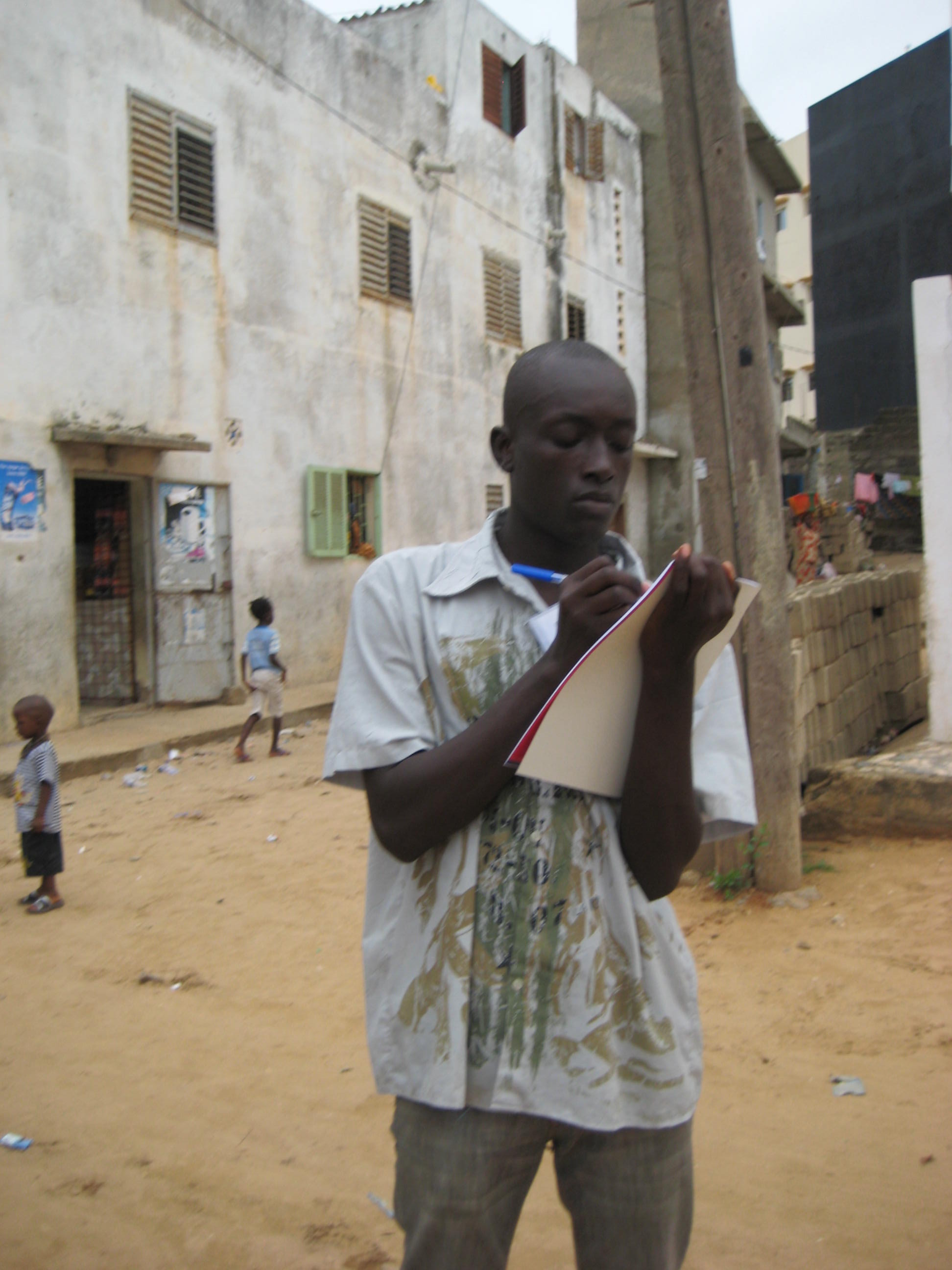
Samba reporting.JPG

Who can quibble with that? Who's against supporting kids' intellectual, social, and moral development? Seems like a bipartisan, big tent, "everybody on board" kind of issue to me. But a lot of people doubt the necessity of NML instruction... maybe because they misunderstand it? Maybe it's a name thing, maybe people hear the word "new," and they hear the word "media,"(2) and they think,

"Forget about it! Enough with the bells, enough with the whistles! Enough with time-sucking TECHNOLOGY! Get back to teaching little Johnny and Susie(3) good ol' fundamentals, like reading, writing, and 'rithmetic. How about teaching them how to spell, for goodness sakes?! They don't know how to write anymore!"

Noted. And I basically agree with you. But did I ever mention "technology"? No. NMLs build cultural competencies and social skills -- no technology required.

But fine, let's address technology. I mean, YOU brought it up. It's not like I'm looking to dodge the topic. ;-) Look. You can't deny that technology has entered our lives in a significant way. Personally and professionally, we're accessing digital tools and sifting cybersourced information constantly. In this new context of digital ubiquity, we especially need the critical thinking, problem-solving, and collaboration skills that we've always found handy.
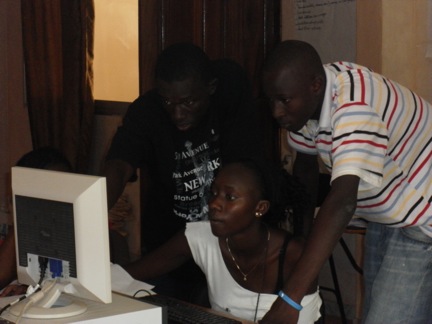
3 kids on computer.jpg

Am I making sense? Here's an example: We've always needed to know how to experiment in order to figure things out. How else could we have mastered free throw shooting, can opener using, or parallel parking? But now we especially need to know how to experiment. Why? Because we're confronted with complex cell phones, tricked-out digital cameras, and bewildering new versions of Microsoft Office. Let's face it, unless you're my dad, you're just *not* gonna read the manual. If we're not comfortable pushing buttons, navigating menus, and noticing what happens, we're gonna find ourselves in a jam and/or seriously undertapping potential.

Here's another example: We've always needed to know how to respect diverse perspectives and flourish in unfamiliar environments. How else could we have moved to new towns, traveled overseas, or made friends on our first day of school? But now we especially need to know how to negotiate. Why? Because we're viewing YouTube clips from abroad, joining global communities such as Second Life and World of Warcraft, and harnessing online tools like Wikis, GoogleDocs, Salesforce and BaseCamp to manage group projects. If we're not proficient in reading and respecting people's ways of functioning, again, we'll be stuck between a rock and a hard place or flagrantly wasting opportunity. And who wants that? I'll tell you who wants that: NOBODY.

But back to Senegal.

I was working for the summer as a consultant to RAES's program Sunukaddu, which means "our voice" in Senegal's indigenous Wolof language.

Sunukaddu logo.JPG

Funded over the past two years by the Soros Foundation of West Africa (OSIWA), Sunukaddu had already proven itself an innovative and effective force for social change. Its model was participatory and hands-on, connecting local media experts with motivated teens for training in multimedia health message development. Participants learned reporting and writing techniques, as well as manipulated digital cameras, camcorders, audio recording equipment, editing software, and web interfaces. Their products are online and educate all who come and click on youths' perspectives vis-à-vis HIV/AIDS. Notably, this past February, Sunukaddu ran the first public awareness media campaign by youth for youth in West Africa. Thousands of young people submitted their songs, poems, narrative films, documentaries, audio reports, articles, commentaries, and posters.. and soon this authentic content will be disseminated nationally.
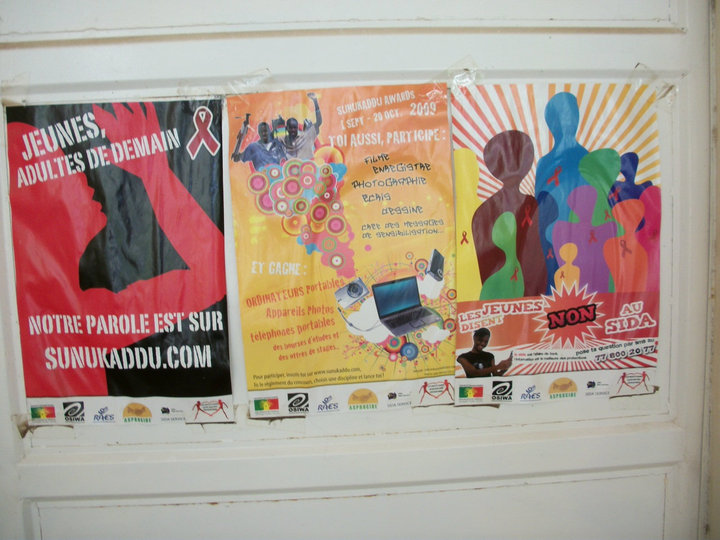
Kids' campaign.jpg

Despite this demonstrable success, visionary RAES wanted to push the envelope. RAES dreamed of scaling up Sunukaddu and distributing its curriculum across West Africa. Doing so would require the construction of an explicit pedagogical method, and perhaps a re-invention of some of the ways that Sunukaddu did business...

That's when I met Alex. In our first meeting last October, Alex explained his desire for Sunukaddu to more intensively focus on storytelling, message development and diffusion. He spoke of harnessing additional, diverse media. What about pottery? What about textiles? What about dance and jewelry and cell phones? Finally, he sought to explore the human dimension of HIV/AIDS, emphasizing the relationships between and among this scourge and stigma, discrimination, community support, and human rights.

And so I began by working backwards. These new lessons and tools were Step Three. Figuring out a way to offer them so that the learning stuck was Step Two. And theorizing what was essential for any learning and growing to occur in the first place, that was Step One. So, drawing on my studies of communication, child development, and social policy, I developed a model that, at its most parsimonious, looks something like this:

New Media Literacies Improved Functioning

+

Social and Emotional Learning →

+

Asset Appreciation

Social and Emotional Learning (SEL) pairs perfectly with NMLs. In the words of Forrest Gump, they're like peas and carrots. As with the 12 NML skills, SEL's five core competencies --- self-awareness, self-management, social awareness, relationship skills, and responsible decision-making -- set the stage for meaningful education. In my view, SEL forms the individual, NMLs form the learner.

Back to the cries of skeptics and censurers:

"Our public school system is bankrupt and our students are falling behind. Fourth-graders in Kazkhakstan out-perform our kids in math! Most US students think Beethoven is a dog! So should we really be spending taxpayers' precious dollars on touchy-feely lessons like 'making friends' when kids can (and probably are!) learning these things themselves on the playground?"

Yes, I hear you. And yes, we absolutely should.

What are the prerequisites for learning? And what is the point of school? The first federal Bullying Prevention Summit was convened in Washington, D.C., last week. Director of Healthy School Communities (part of the Whole Child Initiative at educational leadership organization ASCD) Sean Slade summed up associate professor of child development Philip Rodkin's argument:

"Children are there [at school] to learn not only how to read, write, add, and subtract, but also how to work together as a group, a team, a community" (2010, paragraph 4).

Couldn't have said it better myself. This is proponents' rationale for teaching SEL. Sounds awfully similar to our rationale for teaching NMLs, doesn't it? And that is why SEL and NML are like peas and carrots, folks. And why life is like a box of chocolates...

Back to Senegal.

The whole Sunukaddu team agreed, Our workshops should optimize participants' engagement, appropriation, and application of the material. We should also operate as non-hierarchical partners in the learning process, and so create a context in which ideas and knowledge can flow freely in both directions.

Kids' campaign.jpg

So we developed a method that enabled learning via hands-on exploration, game play, improvisation, creation, discussion, and self-reflection. We configured these pedagogical activities such that they cultivated NMLs, SEL, and asset appreciation (a construct that I created that draws on principles from asset-based community development, appreciative inquiry, positive deviance, intrinsic motivation, and resilience). The explicit curriculum was a 12-session workshop supporting teens' efforts to access their voices, make connections, manipulate multiple communication forms and tools, and share their messages with their peers and communities.

Our original curricular outline:

DAY 1: Introduction + Basic Computer Literacy (NML skill of the day: Distributed Cognition)

DAY 2: Basic Computer Literacy + Message Development (NML skill of the day: Multitasking)

DAY 3: Message Development (Classic media literacy; NML skill of the day: Collective Intelligence)

DAY 4: Message Diffusion (Diffusion of Innovation + Stages of Change; NML skill of the day: Networking)

DAY 5: Audio (Hip hop; NML skill of the day: Appropriation)

DAY 6: Non-fiction (Journalism + Positive Deviance; NML skill of the day: Negotiation)

DAY 7: Conflict (NML skill of the day: Performance)

DAY 8: Fiction (Script-writing +Entertainment-education; NML skill of the day: Transmedia Navigation)

DAY 9: Fixed images (Photography + Peer support; NML skill of the day: Play)

DAY 10: Moving images (Cinematography + Human rights; NML skill of the day: Visualization)

DAY 11: Basic Internet Literacy (NML skill of the day: Judgment)

DAY 12: Conclusion (NML skill of the day: Simulation)

Then the power went out.

Oh yeah, remember that? ;-)

The power left the building early in the intervention, Days 1-4.(4) How do you teach basic computer literacy without computers? How do you teach distributed cognition (defined by Jenkins, Purushotma, Clinton, Weigel, and Robinson (2006) as "the ability to interact meaningfully with tools that expand mental capacities" (p. 4)) without the digital tools we'd intended?

Is it too jingoistic to holler, "New Media Literacies to the rescue!"? Probably.

Here's the answer: You harness distributed cognition and tap other tools -- we broke out the battery-powered smartphones.
Smartphones.JPG

You multi-task -- while the participants were filling out their asset inventories, we powwowed and rejiggered the day's schedule. You play -- along with the participants, we tested our way through this challenge, discovering what happened when we did X, Y, and Z, noting successes and setbacks, evaluating, replicating, discarding, and innovating. Like I said, the NMLs returned power to our powerless situation.

And a few days later, when Sunukaddu instructor Idrissa Mbaye hatched the idea of a Competence Clothesline, the NMLs provided an effective solution to our lack of electric fanning. Because our perceptive participants had pulled down competence cards from the line, they had in their hands... handy hand-fans. How about THAT? ;-)
Goree clotheslines.JPG

Competence clothesline.jpg

So what I'm saying is, Who needs electricity when you've got skillz? And these skills don't need digital technology. What they do need are understanding, and they need sharing, with students, colleagues, parents, partners, anyone, everyone.

Now.

(1) literally - no power means no air-conditioning (not that most establishments could afford to buy or run air conditioners) and no standing fans. And this is serious in July, when average daily temperature is 81 degrees Fahrenheit and average relative humidity is 70%.

(2) and the word "literacies" - fuhgeddaboutit. Who even knows what "literacies" means? Seriously - can you define it?

(3) (nowadays, it's more like Aidan and Madison, or Muhammad and Elena)

(4) By Day 5, Alex greenlit the daily rental of a tiny generator.

Laurel Felt is a third-year doctoral student at USC's Annenberg School for Communication & Journalism who only wants to change the world... To do so, she seeks to support youths' development of new media literacies, social and emotional learning, and asset appreciation. Her research also looks at gender, obesity, bullying, and reproductive health.

Games, New Media and Learning in Argentina: An Interview with Ines Dussel (Part Three)

You've drawn heavily on the work of the MacArthur Digital Media and Learning initiatve. What do you see as the most significant continuities and differences between their approach and what you are finding in Argentina?

I've been reading all the work done by the initiative, and for me it stands out as the most encompassing and organized effort to understand what is going on. I think I provided some of our keys for reading this work already, but let me try and summarize them.

One is the idea of a public culture. That there is something such as a common public sphere that has to be reconceptualized beyond Habermas' notion of the argumentative skills and rhetorical plays but that still includes some notion that there is something to be done together and for everybody, is an uncommon approach in most studies of new technologies. I think we share an engagement with an idea of public culture that remains open and subject to debate, and does not get captured by the state, the market, or the isolated individual.

The second has to do with the kind of learning that young people are doing with and in new media, trying to approach in an honest, more open way these new practices. We liked very much the notion of "genres of participation," as they help organize what we are seeing in our research. And what I liked particularly is that schools are not left out of the map, but are considered as part of this media ecology. I support the idea that schools can be helpful in organizing interesting and relevant experiences for young children which are not immediately accesible to everyone, and which bear other issues in mind than merely the audiences' tastes. Of course, this means changing the ways in which schools are working with new media, which, as said before, have been focused around issues of safety and potentials threats to children's integrity, when they have not been totally derogatory on the value, ethics, or productivity of young people's activities in and with new media.

We also agree with the general search for a balance between the celebration of new, creative, and democratic forces that are mobilizing the digital culture, and the skepticism about some trends that we do not see as democratic and that tend to extend and reshape current social divisions and inequalities. [When I use "democratic," I am pointing to some discussions in contemporary political philosophy that show how evanescent this term might be, but that still hold to an impulse towards more justice and equality (for me, Jacques Rancière or Bill Connolly are good referents of this kind of view).]

Finally, it is difficult for me to point to a difference, but I would say that we bring to our study different concerns that have to do with different "localities" and cultures, as I was saying in the last question. Lately, with the team at Flacso we've been reading more about changes in authorship, in the balance between the emotional and the rational in terms of learning, in our notions of a common culture, archive or memory (and memory is a cherished thing in Argentina, where it immediately refers to the last dictatorship and to a quest for human rights and justice), and also the need to maintain the differences between simulation and "real life" (I've been reading with great pleasure Sherry Turkle's discussions on this). I would say they are more politically- and ethically-oriented issues. These topics are not directly addressed by the MacArthur papers, but there are none the less many links to their approaches.

As you do so, you seem to be very aware of the existing visual culture of schools. For example, you told me about research which suggests students are sometimes overwhelmed by films they see in the classroom and do not always remember what they were supposed to teach. How can designers of educational games sidestep those problems?

In the research we are doing on the visual culture of schools, many students referred to their memories of remarkable activities organized by teachers using fiction films or documentaries, or asking them to bring pictures about social issues. Students liked them a lot, and valued them as great learning experiences. But when we asked about what they thought they had learned with those activities, they could not refer to any specific content. For example, a student said that her Biology teacher showed the class an image of the cell and that it caught her attention, and that she learned like in a fingers' snap, but she could not name any concept nor "title" for that image. The same happened in social studies or history lessons: students had vague memories about the activities, but all remembered the intensity of the feelings provoked by the viewing.

This is something that interests me a lot, and that I put along a series of readings I've been doing on visual studies, attention and learning. Historically, pedagogy has thought that there is an equivalence, a direct relationship, between seeing and knowing, but psychology and our own historical experience shows that that is not the case. We need to "know" something to be able to "see" it (I am aware that these are complex terms and there are deep philosophical debates around each one but let's keep it simple for the sake of the argument). What are children learning when they "see" something in the classroom? Are they learning what we want them to learn, or something completely different?

The examples mentioned above relate, for me, to something that you've referred to in previous works: the "wow" effect, the emotional impact of media on people. When using images in classrooms, we might get that "wow" feeling, as when the first student says, "wow, the teacher caught my attention," but from that we cannot deduce that she learnt the structure of the cell or anything in that neighborhood.

How to sidestep this problem is a difficult question. The first thing I would say is not to take learning for granted. We have to be aware that the intensity of stimuli and the excitement of the game might provoke them to learn something altogether different from what we wanted them to learn with these activities.

And the second thing I would say is that this doesn't imply that we have to become more explicit of our message or the "content" we want to convey. On the contrary, my reading of these examples is that form and content are divorced in some pedagogical activities, and that "forms" are compelling and complex while "content" is straightforward and unidimensional, and so young people's attention is caught by the more complex and interesting stimuli and do not attend to the content. So, I would say we should struggle to produce better materials that are more consistent in their forms and contents.

You also told me about research you have been doing about the image banks which teachers draw upon in thinking about the world and how these may differ from those which their students bring into their classes. Can you share some of this research with my readers?

Yes, of course. I wrote an essay on teachers' visual culture, based on the findings of an activity I've done in online courses with teachers. I ask them to post a powerful image of our culture. The idea of "powerful image" draws on visual studies and refers to images that impact us for any reason, that have a lasting effect not only personally but also socially.

In this activity, it struck me that most of the teachers chose shocking images that come from photojournalism: the Biafra child, Kevin Carter's Pullitzer picture of a little girl in a Sudanese village, anonymous pictures of children in famine, in war refuges, or hurt or killed by political violence. They endorse a "hyperrealism" that, while it aligns itself with a progressive rhetoric, might have troubling effects as a visual discourse on the social. Most pictures were of children, and children were almost always depicted among ruins. No "happy," meaning no optimistic, narrative was to be found in most pictures (and when it appeared, it was in the line of the Benetton-multiculturalism: black child with white child taking hands and smiling to each other). Also, it was surprising that the Argentinean teachers spoke a "Global visual Esperanto," as Nick Mirzoeff calls it: the images were from Albania, Africa, Palestina, New York, Central America, Brazil, and not many depicted Argentina's landscapes or events. The pictures are all serious, and engage in the performance of denunciation. There is almost no ironic image, nor images that refer to advertising or cultural industries. My guess is that, if the same question was posed to young people, the number of advertising images, and of images of their own production, would be much more significant than in the teachers' selections.

My interest in this essay is with global visual imaginaries, and the visual culture of teachers. There is much more I could say on this, but let's refer the reader to the essay that has been published in a book edited by the National Society for the Study of Education, whose title is Globalization and the Study of Education, and edited by Fazal Rizvi and Tom Popkewitz.

You have been involved in a number of games and learning initiatives. Can you describe some of the work you are doing and explain what kinds of pedagogical and design principles are informing this work?

With my research team at Flacso, we started doing educational documentaries in 2002. We produced eight 30-minutes videos that developed a program to address issues of discrimination and inclusiveness in middle and secondary schools. We tried to build complex and subtle plots, to present the stories always in a dignified way, and never construct people as passive victims. We were always thinking of how and when the teacher would be using these materials, so time constraints and also pedagogical problems of what to show and how to show it were present from the beginning (and we made pilot tests with teachers to make room for that).

But seen from today, I think that at the beginning we were more aware of the conceptual and political dimensions of our work than about the aesthetic aspects of it. And it was a great experience, because we learned a lot about the tensions between content and form. As soon as we started to work with teachers and students, we realized that there were many unexpected things in their reactions to our videos, and that they had to do with the context in which they were seen, with their prior experiences with these type of videos, and with our own pedagogy. And most of all we had to learn to work through and with the emotions elicited by the documentaries.

This drove us to media studies and also to visual studies, and this intersection is still very interesting to me. The question of which type of knowledge is produced by an image, as posed by the French historian Georges Didi-Huberman, remains a potent, even a burning issue, as he says. Sometimes images touch us at a sensitive level, without being able to put it into words, and yet they do produce important effects on us. Could these effects be called a learning or be considered as knowledge?

I am not interested in measuring it, but on understanding what is it that they do to us. Will it last? Will it be attached in our memory to some meanings? Will we, as the students I found in our recent research, just remember the intense emotion we felt without being able to conceptualize or rationalize anything about it? Maybe this is not a bad thing, but we should be aware of which kind of learning or effects some images produce on us.

We then moved to do an animation piece on global warming which was also very exciting, and since 2007 I've been engaged in a team run by Analía Segal, a colleague and friend of mine, that produces videogames. Analía had extensive experience on simulations and games in social studies, and some years ago she decided to experiment with new media, and I joined her. We wanted to explore the potentialities of videogames for learning: they can offer complex narratives, they use a visual language that is closer to young people's visual culture than the schools', they promote learning through immersion in a given situation and mobilize intuitive, bodily language that is scarcely mobilized by traditional schooling, among many other possibilities. The team includes people from different disciplines in the social sciences and young game designers who are key to the project. We know that educational materials are not magical solutions to anything, but believe that they can contribute to make classroom more interesting and more challenging. This might be a poor goal for an educational reformer but it is good enough for us as development team.

One of our principles was to produce materials that were not offered by the cultural industries, neither by their topics nor by their aesthetics. We did research on alternative groups that are working on serious games, and decided to focus on sustainable development and produced three or four games on this subject. The first one is called "Urgent, Message" and is about a messenger in the near future who has to deliver different things to different places, always considering time, cost, and environmental impact.

The second one is called "Villa Girondo" and is a multi-player game. We wanted to explore a different game structure. This one deals with the relocation of a village due to the planned construction of a water dam. Players are asked to assume different roles in the community and decide whether the village will be relocated or not. The tension between progress and sustainability is explored, as well as the centrality and complexity of citizens' involvement in environmental issues.

In the development of the videogames, we included a working group with teachers with whom we discuss and test the games at different stages. And we are doing research on the first developed prototypes to understand how they interact with the real dynamic of classrooms. The questions that interest us are both related to the design of the game and to the pedagogical skills needed to use it in classrooms. Which kind of interactions are promoted by the rules of the game? How important and effective are teachers' interventions? What kind of strategies do young people use when playing the game? Are there constraints by playing the game at school? Which reflections are opened up by the game? Which ones are picked up by the teachers and which ones are left aside, and why? These are some of the questions we are investigating in schools these days.

I was impressed by the distinctive look and feel of the games you shared with me. To what degree is the goal to create games which reflect the national culture of Argentina as opposed to following the "neutral" or "odorless" design practices that shape many commercial video games? Why might it be important for students in your country to see games which look and feel like the culture around them?

Well, I like your comment and take it as a compliment. As I said before there is a relation between form and content. We believe that it is important to provide students with different aesthetics, less standardized and more related to their daily life. But it doesn't mean that one has to close down aesthetic diversity. So while we don't want to follow mainstream games in their options, we do not support any kind of localism that tends to isolate cultural productions. On the other hand, this would be impossible as we are all visual subjects in a global culture.

We hope our games can be played by any child or young person who is interested in these topics. For example, the relocation of villages has been a common problem in Latin America. We include some excerpts from documentaries that give more information and context about real life situations. We believe it is important that schools pick up these debates and provide interesting and challenging opportunities to unfold the complexities involved. In that respect, videogames can be really helpful.

Inés Dussel graduated from the University of Buenos Aires in Educational Sciences and got her Ph.D. at the Dept of Curriculum and Instruction, University of Wisconsin-Madison. She is a Principal Researcher at Flacso/Argentina, a centre for research and graduate teaching in the social sciences, and Educational Director of Sangari Argentina. She's currently interested in the intersections between schooling, new media, and visual culture, and is doing research and producing materials for classroom teaching.

Games, New Media and Learning in Argentina: An Interview with Ines Dussel (Part Two)

Can you tell us something about the context of this debate in your country? For example, how much access to students have to new media technology outside of school? How much exposure do teachers as a class have to new media in the course of their everyday life?

I would say that most students have access to technology, although the frequency and intensity is heavily dependent on socio-economic backgrounds. The main divide is between urban and rural/semi-rural populations, because even in low-income groups in big cities there is a push towards having multi-functional cell phones that allow most of the operations one can do on the internet. Of course, the problem is the soaring costs of the broadband or the phone service, which are still terribly high in the region. In Portugal, and in some Brazilian cities, there are state policies being effected that subsidize broadband connections to low-income populations (5 euros per month or less). This might be a really democratic move in the near future in most of Latin American countries, but we are not there yet. Anyway, I was surprised to read some recent educational research that shows that almost 50% of the children from low-income families report to have Internet connections at home. This means it is spreading quickly.

But the divide, as many people are arguing, is moving from access to use. In a research we are currently doing at FLACSO on schools and visual culture, we find a clear distinction between the type of uses young people from middle and upper classes are doing, and the ones done by young people who come from low-income families, and especially those in semi-rural areas. The first ones are making sophisticated videos, have large collections of images and music, and produce multimedia reports for schools, while the latter make basic powerpoints and have smaller collections of pictures and music, generally with less reflection on what it is, and what for, they are collecting. As always, there are exceptions, but this seems to be the trend. That is why I believe schools could be very important in providing a wide range of experiences that enrich young people's engagement with the media.

Teachers, on the other hand, do not have a special relationship to new media as a class, that is, because they are teachers. Quite the contrary: pre-service training has started to include it as a curricular content only in the last two years, and it is still a marginal trend, though increasingly important in some groups (who can be considered as "early adaptors," as in the work you are doing in the New Media Literacy project). But most of the times, one can see young teachers in low-income schools who do not have an email account or don't even know about the possibilities that new media offer. I ask myself how it is that nobody in their training, which did not happen in the 1980s but only three or five years ago, told them that having an email account and navigating the internet is important not only for them as professionals who are concerned with knowledge or as citizens of this world, but also for them as teachers in their relationship and their cultural offer to their students.

I think that this has to do with some prejudice on the part of the teacher training institutions that assume that new media is kind of a "sumptuous consumption" for low-income populations who are not getting the basics (decent employment, food, electricity or water) and so that it should not be included as a basic content. What they are overlooking is that today access and use of new media is part of the "basics," of being a member of the local or global community, of getting to be informed and participate in a public culture, even of getting a job.

And children and young people know this better than the training institutions, which are falling behind. In our research, we found multiple examples of young people from low-income families whose relatively-poor use of IT is still pivotal for themselves and their parents in doing budgets for contract works, making a website for home repairs or other informal jobs, or connecting to family in other provinces or neighbouring countries. These uses might not be as sophisticated as others, but are none the less very effective and important in helping them get better material and emotional conditions.

Most teachers do not use new media in these ways, nor do they recognize that their students are doing these kind of things with the computers. The kind of activity they privilege in classrooms, when they do anything, is that of seeking information (all they see in the internet is a gigantic library), and sometimes asking their students to write a report, preferably text-only, or produce a powerpoint with some images, but generally without further reflection on the combination of text, sound, special effects or rhythm that is implied in multimodal texts, as Gunther Kress and many others have emphasized.

So, as research notes in other countries, in Argentina the uses promoted by schools are poor when compared to the actual things young people are doing at homes or with their friends in cybercafés. It is slightly different in middle- and upper-classes, but overall I would say there is still a small proportion of schools that are promoting richer, innovative uses of new media.

How has new media been perceived by the Argentinian public? Is it still read mostly as a threat or is there an awareness of the opportunities it represents?

Well, part of the answer refers to what I said before. For some people, those in the middle classes, new media are a luxury that comes after some basic issues have been guaranteed for the society as a whole. And while this argument is sensible (you cannot think about the internet if you're not eating or have no electricity), it is not true that one thing can be solved without the other. As the examples mentioned above show, low income families use the internet to improve their work opportunities and to enrich their support networks in multiple respects. It is part of having a wider horizon and range of possibilities.

On the other hand, the public debate is still organized around moral terms which are dichotomic, and I would say that they tend to go for the pessimistic side of the dichotomy. Talks of threat, safety, danger, not only for the children but also for the Spanish language (fear of Anglo-influence) or for "the world as we know it," are visible in most of the media coverage on new media. Teachers tend to endorse this view, and complain about the supposed empoverishment of writing and oral skills that new media are causing in young people (with the support of traditional agencies like the National Academy of Letters, who has produced a report on this, with doubtful empirical evidence but with lots of media coverage).

But there are some perspectives that are trying to build a more balanced approach, which value the opportunities while they point to the challenges the new media are posing to us. My own concern has been to produce something in that line. I believe that a deeper discussion is needed that addresses the profound changes brought about by new media, part of which I signaled when talking about the 1-to-1 strategy. I particularly like Bernard Stiegler's discussion in The YouTube Reader on the breakdown of the synchronized access to a flux of programmed texts such as the ones provided by broadcast TV, and the emergence of a cardinal access that can be produced and controlled by the user. I think that there are many issues to be debated around the possibility of a common, public culture that goes beyond what each ones of us chooses to look at, consume, produce in our individual screens and in our own time or pace; and that is why I also do not want to give up on the presence of a common screen in the classroom, be it the blackboard, the smart board, or any other common point of attention. In that respect, I also align myself with the comments done by you, Mimi Ito, and many others, on the reports done through the MacArthur Foundation initiative, that posit the discussion of new media in the light of the production of a public culture.

I got a sense from some of the questions I was asked that new media is understood through some of the same paradigms that were applied to broadcast media -- concerns that it exposes Latin Americans to cultural imperialism from Hollywood and elsewhere. How big a concern do you think this is for parents and educators?

I believe that anti-Americanism is more prevalent among progressive intellectuals (including educators) than among the general public, but I do not know of any serious study on this so I will speculate in the next paragraphs. There might be a reemergence of a certain nationalism or LatinAmericanism in the last decade, after the 2001 crisis which put the region in the verge of a collapse, and also backed by the center-left governments in the region that have stressed a rhetoric of autonomy and self-determination for Latin Americans. And of course Bush's government has done lots to increase the anti-imperialist rhetoric. I know that the rates of disapproval of Bush in Argentina were among the highest in Latin America, and that people welcomed Obama's election as a hope of a new external policy in the US.

But these are the only data I recall to make a statement about the public's relation to the US, and I don't think this translates into a relationship to broadcast media or anti-Hollywood: blockbusters are the same ones than in the US, with the exception of some Argentinean films. But even speaking of "Argentinean films" is ambivalent: the best Argentinean filmmaker today is Juan José Campanella, whose movie El secreto de sus ojos(The Secret in Their Eyes) won the Oscar for foreign films in 2010. Campanella works in LA and has directed some episodes of House, M.D. and other major TV series in the US. So whether his narrative style and aesthetics is anti-Hollywood remains quite debatable... I don't think he even considers that a problem or a question that deserves attention.

Anyway, in some respects, your perception is right in terms that anti-imperialism is a significant force in terms of how educators react to new media (I'm less sure about parents). Many teachers feel that they have to defend the nation and the Spanish language against any kind of imperialism, and that they have to do it in the schools, through their teaching. I would say that, as a general rule, teachers in Latin America are more politicized than in the US, and think of themselves as constructors of the nation, as producers of a new type of citizen.

I did my Ph.D. in the US, at UW-Madison, and I was surprised when teachers said that their primary task was to develop the full potential of the individual child and spoke almost exclusively in psychological terms. You don't see that kind of talk in Argentina or in most Latin American countries. Even the less politicized teachers make reference to the nation, to the society, to social functions and ideals. They might do it in a conservative way, but they still feel part of a social mission, of a political project.

But the question you raised takes me in another direction, that is how the global and the local are negotiating in and through new media. Being an otaku in New York or in a small village of Salta, Argentina, is similar and different, in ways that we need to analyze much more carefully than simply celebrating cosmopolitanism and global culture, or rejecting it by refuging ourselves in an anti-Hollywood or anti-US culture position. Watching a TV series like 24 in the US might reaffirm a certain power narrative about geopolitics and the imperial domination, but when seen in Latin America it might say quite the opposite.

I like very much the work done by Carlos Monsiváis, a wonderful Mexican cultural critic who just passed away, on the dispositions and sensitivities of the audience in our region -which is extremely diverse, of course. He said that, contrary to Hollywood's happy ending movies where the cowboy saves the girl, it is very likely that in Latin American melodramas the girl dies right before her hero comes to her rescue. For him, melodrama was a "structure of understanding," a "unifying device for experience" that was built into politics, religion, and social bonds. This structure (which he thought of as something loose, not rigid) comes from the verbal blocks of 19th century novels, the filmic melodrama, or TV's telenovelas.

So, following his lead, I would say that for most Latin American viewers there is not an epic of triumph when seeing these TV series, but we put them along or inside a narrative that is sadder, more nostalgic, definitely not victorious (may be it derives in identifications with the bad guys, which is extremely dangerous). Images and audiovisual texts might be the same, but the locality of the viewing makes a great difference in understanding the narratives in which they are inscribed, and the meaning which we produce. So yes, going back to your question, I would say that locality plays a role in new media, and the structures of understanding still seem more local than global.

Inés Dussel graduated from the University of Buenos Aires in Educational Sciences and got her Ph.D. at the Dept of Curriculum and Instruction, University of Wisconsin-Madison. She is a Principal Researcher at Flacso/Argentina, a centre for research and graduate teaching in the social sciences, and Educational Director of Sangari Argentina. She's currently interested in the intersections between schooling, new media, and visual culture, and is doing research and producing materials for classroom teaching.

Games, New Media and Learning in Argentina: An Interview with Inés Dussel

Earlier this summer, I shared with you some of my experiences in Buenos Aires where I was a speaker at the VI For Latinoamericano de Educacion, hosted by the Fundacion Santilla, an event attended by education ministers and educational researchers/policy makers from many of the Latin American countries. My host for the event was educator and public intellectual Inés Dussel who is one of the co-authors with Luis Alberto Quevedo of a new white paper exploring the impact of new media on education in Latin America, Educacion y nuevas technologias: los desafios pedagogicos ante el mundo digital. I was deeply impressed by Dussel and her colleagues: she is highly engaged with the work we've been doing through the MacArthur Digital Media and Learning initiative, as well as the debates taking place in South America around these same topics. I wanted to be able to share more of her perspectives with English-language researchers and educators in hopes of brokering more conversations between educators in the North and the South who are confronting the ways that rapid media change is reshaping the lives and interests of their students.

While I was in Argentina, you released a significant report which sought to explore the impact of new media on educational practices in Latin America. What were your major goals for this project?

The report was commissioned by the Organization of IberoAmerican States (OEI) and the Foundation Santillana, which is affiliated to a major publishing house in the Spanish-speaking world. They organize annual conferences that bring together Ministers of Education from throughout the Southern Cone, educators, and media people. It is an important venue for public policy and debate in education.

The 2010 Forum, on which you were the guest speaker, was devoted to the pedagogical challenges of IT technologies in the region. Luis Alberto Quevedo and myself were asked to write the discussion paper, which actually turned into a 60+-pages report. Both Luis Alberto and myself have been working on these issues for a number of years, and run together an online course on education, visual culture and media designed primarily for educators. Above all, we share an active engagement with public debate in and around media, both in public and commercial media, although Luis Alberto has a more sociological take on this and I bring a pedagogical concern with what people learn from their experiences with the media.

Our goal with the report was to provide a broad frame that helps organize a discussion around the different alternatives that are being explored either by public policies or by the schools themselves in the introduction of IT. We talk about four major strategies: a) organizing computer labs in schools, b) getting one laptop to every child (1-to-1) either by joining the OLPC initiative or through major commercial firms, c) having portable carriages with laptops for planned, alternate usage in classrooms, and d) introducing electronic boards in each classroom. Each strategy has different assumptions about the extent to which IT should permeate the daily life of schools and of course imply different costs and mobilization of resources.

In the report, we were also interested in taking a look at the production of content, especially the work done by teachers with the use of blogs or video production for educational purposes, and by the Argentinean Ministry of Education, which has done an interesting TV series for rural schools called Horizontes (Horizons) whose impact on school practices we want to investigate. These schools usually have only one teacher with multi-grade classrooms, so IT technologies can be a great help in supporting teachers who usually exhaust themselves in their daily work.

We could only get a glimpse at content issues and DIY media production in the report but it seems promising, and we are currently doing research to get a better understanding of what is going on. And finally, we made a review on the changes on teacher training, looking in particular at changes in curricular contents, and discussing whether there are new teaching figures appearing in the landscape of schools (IT specialists or audiovidual assistants, among others). So, as you can see, the scope was broad and it calls for more research and more writing, which is the step in which we are currently engaged.

Which models have gotten the greatest traction in Latin America and why?

So far, the most extended strategy in the region is to equip computer labs, but research shows that, while it was helpful in the 1990s to get at least some teachers interested in IT, today it tends to confine the novelty to a marginal place in the curriculum and does not contribute to a deeper discussion on the big changes brought about by digital culture in the production and circulation of knowledge in our societies. Also, it has been noted that computer labs usually get trapped in the micro-politics of schools, with power games around who's got the key or privileged access to the lab (the same can be said about any innovation in schools, of course, but the concentration of computers in one space contributes to a more centralized struggle around access and control).

There is also a particular Argentinean context that has to do with the scarcity of resources: the first reaction of school principals and teachers when they get computers or even books is to lock them off so that they are not lost or ruined by usage. This sounds absurd, but it has to do with an entrenched learning that in schools you don't get good things too many often, so you better preserve them, even though this might mean not using them at all...

So, as we all know but tend to forget, innovations and new technologies in schools have to negotiate with multiple levels of adaptation and with different school dynamics that produce unexpected effects. Sometimes they are able to mobilize creative, wonderful energies and forces in the schools, and sometimes these effects are undesirable. When involved in the innovations, we tend to forget about the latter.

The second alternative, which is actually becoming the most common nowadays, is the 1-to-1 strategy of equipping every child with a netbook. In Uruguay the Plan Ceibal, effective since 2007 and based on OLPC, has been very successful in doing that with all elementary school children in public schools (around 320,000 students, ages 6 to 11). Uruguay is a relatively small country, with a flat land, and is one of the most socially egalitarian in the region, so in many respects it has not gone through the challenges of connectivity that other countries are undergoing right now, especially when there are high mountains with blind spots for telecommunication, lots of isolated villages, or heavily marginalized groups with a predictable feeling of resentment towards State policies (which might derive in high levels of theft or destruction of equipment), challenges that countries such as Argentina, Chile, or Perú are facing. Argentina's government has recently started a program called ConectarIgualdad (ConnectEquality) that will provide 3,000,000 secondary school students in public schools with netbooks, manufactured by commercial firms. It is probably the largest single investment in the region, and we are all eager to see how it will work.

The third and fourth alternatives (portable carriages with laptops and smart boards) are being implemented in small scale, and more research is needed to understand their effects. Both seem interesting ways of making a smoother transition into the digital culture than the 1-to-1 strategy, because they are closer to the way in which classrooms are organized today. But apparently the 1-to-1 option is the route that the educational systems are taking in our region. It might be interesting, though, to keep these other possibilities in mind, as we don't know yet how effectively the 1-to-1 strategy is going to work, and also because we don't think this should be an "either/or" option: school systems are large conglommerates of people and institutions and they should be able to incorporate new media through many different strategies that might be useful for different purposes.

What are the goals of Latin American governments in seeking to expand access to new media?

Our reading of initiatives like the 1-to-1 option is that they are great strategies for digital inclusion, and the main effects are not only to be seen on children's lives but on their families'. In Uruguay and Argentina, the fact that the netbooks are going to public school children means that they are helping to bridge the digital gap in terms of access (middle and upper classes have fled to private schools some decades ago).

There's an ad from the Plan Ceibal in Uruguay that is rich in images about the social progress that rural children will make with their laptops. The song is performed by Jorge Drexler (Oscar winner with the film The Motorcycle Diaries, about Che Guevara's youthful journey across South America) and says something like this: "I want to be a sailor/ on the Austral sky/ without getting away from my haven/ under the shadow of my ceibal" (which is a common tree in the pampas). The symbolic aspect of having an opportunity for growth and development without being forced to migrate to a big city or to a foreign country is something that is really strong in the Latin American context, and points to a transformation in the economy and the politics of our societies. I want to stress the complexity of the symbolism that is being mobilized: it is conceived as part of the rights of every citizen; it also has overtones of deep quests for social justice in Latin America and it implies an affirmation of local development not in a nostalgic mood but with hope for the future. This is a major change, and, from my point of view, quite an interesting and promising one.

Surrounding these initiatives there is, however, a significant lack of discussion about what it will mean for schools and classrooms to have children connected to individual screens, presumably moving at their own pace in a rich environment with multiple alternatives and pathways to be followed. This sounds fantastic on one level, but it is also terrifying for most teachers who have no clue about how to handle these new situations.

A person who is doing research in Uruguay told me some days ago (two or more years after they started) about the kind of problems teachers get when some students are not able to connect, which sometimes can happen to almost 50% of the class. The netbooks might have software or hardware problems, and at any rate teachers are not prepared to deal with them and do not have a technical aid at hand. Thus, the classroom sequence they prepared most likely starts to sink. When you encounter this kind of problems, you cannot simply tell the students with failing equipment to shut up and let other children work (in fact you can, but this won't make things any better!). There are things to be done in these situations, but what I mean is that teachers should have a repertoire of alternatives that they don't have yet.

The training they are receiving is on software and, as far as I know, there is no organized training or discussion about the pedagogical situations they are facing. This is something that could be dealt with if there were more concerns about pedagogical issues and about the skills and practices that are needed to implement these changes.

There is also not much reflection on the demand for new content and sequences for teaching that this change will place on teachers and school administrators, and unfortunately there has been no significant investment so far to put up to this challenge. In educational journals and in mainstream media there are lots of apologetic talks on the "School 2.0," most of the times in de-politicized terms, that propose an ideal of a direct (un-mediated) access to information and knowledge and that assume the model of the business websites for participation. In this view, with the Internet 2.0 children will (finally!) be free from the domination of the teacher and the institution of schooling, and the rhetoric promises that, instead of having ill-trained teachers, young people will be able to access any site and get all the expert advice that they want from top scientists and thinkers.

The mainstream rhetoric is no different, at least from what I've read, from what you hear in the U.S. or in Europe. I have many problems with these arguments, among them, the derogatory view they have of actual schools and teachers and the uncritical privileging of expert knowledge, but probably the largest difference lies in the assumption that there is an access to knowledge that is un-mediated by existing social knowledge or institutions.

Let me give just one example of this difference, referred to the type of production children and young people do with digital media. As Sonia Livingstone, Mimi Ito and Julian Sefton-Green have shown in their work, tyoung people's uses of digital technologies are not necessarily creative, but tend to be shaped by their own culturally-mediated practices with existing media. For instance, some years ago the Ministry of Education developed an interesting program on short-film making with digital media (camcorders, simple editing programs, a notebook) in low-income schools in the northern provinces of Argentina -the ones with the highest levels of exclusion and poverty, and lower performance rates in schools. The program was led by a great team that included popular educators and young filmmakers (interestingly, Argentinean film industry is booming and the film schools are producing many graduates who have trouble finding a job, so teaching is actually an option for many of them, and while this is bad for the young graduates, this is a great opportunity for schools to involve people from the creative industries).

During its first year, the program was very open about the kind of topics and styles that students could use, and the short films that young people produced were all in the line of TV reality shows, with topics such as drug addiction, juvenile crime, teenage pregnancy, etc. The aesthetics was mimicking that of the TV shows such as Cops or alike. Most of these young people lived in small villages with different problems than the ones narrated by these sensationalist shows, but the students, when left on their own, had a hard time imagining other narratives or alternative aesthetics than the ones they learned from the TV shows (Julian Sefton-Green and David Buckingham's work in the UK show the same thing). So, after discussing this development, the second year of the program the organizers decided to ask the students to produce short films based on their dreams and with a surrealistic approach. The range of genres and of topics was much more interesting this second time, when actually the framing was more clearly defined in a top-down manner.

For me, this example speaks about the inescapable connections between the kind of productions and uses that young people do with new media and the cultural industries. When I say this, I do not intend to demonize cultural industries; but being naïve about the kind of constraints that are at play is no good either. I like very much Mimi Ito's Engineering Play, because it shows all the nuances of media production in the case of videogames, the different genres, but also all the range of practices in media use or consumption by young people. What I want to stress is that the most likely outcome of this "non-mediated" (which in fact means non-mediated by schools or teachers) access will be in fact mediated by young people's experience with the media outside schools, which is far from being pure or uncontaminated by social class, cultural habitus, etc..

Inés Dussel graduated from the University of Buenos Aires in Educational Sciences and got her Ph.D. at the Dept of Curriculum and Instruction, University of Wisconsin-Madison. She is a Principal Researcher at Flacso/Argentina, a centre for research and graduate teaching in the social sciences, and Educational Director of Sangari Argentina. She's currently interested in the intersections between schooling, new media, and visual culture, and is doing research and producing materials for classroom teaching.