Helping Teachers Learn About New Media Practices (Part Two)

Often, the teaching of the new media literacies is understood as either the domain of a specific digital specialist or as the work of language arts or arts instructors. Yet you offer many examples of how and why this approach should impact other disciplinary domains. Why should these skills and knowledge be integrated across the curriculum?

Erin:

If you look at these three words, New + Media + Literacies ...there are different ways to interpret them. You could read it as "New Media" Literacies or "New" Media Literacies. Either way, there is no wrong answer.

"New" Media Literacies does build upon the media literacy movement where we move from being empowered by media to critically analyze the media we consume through asking important reflective questions to now being producers of media ourselves. And in this new role as producer, there are new questions to ask and new ways to think and act on how to be an integral part of shaping and contributing my perception of the world.

But also, "New Media" Literacies is a new form of literacy and helps teachers understand that our students are reading and writing in new ways. Reading and writing was once relegated to reading books and writing papers, but now we write into meaning through new media such as video, audio or even construction of physical objects.

A possible hypothesis is that the educational system has not caught up with the shifting landscape of participatory culture where there are new ways to read, write, and compute numbers.

PAST PRESENT

Reading a Book Reading a Transmedia Story

Writing Alone Networked Writing

Memorizing Formulas Gaming as Problem Solving

This shift changes the focus of literacy from individual expression to community involvement where creativity and active participation are the hallmark. And it makes it increasingly important to understand and be competent in the skills of citizenship, art, and expression of social connectivity. These are the skills identified in our white paper as the New Media Literacies and ones we need to foster as we think about education.

We are in a paradigm shift in the classroom where educators need to work in the gap between life and school. You only have to observe your students outside of the classroom for a few hours to see that they are immersed in this digital culture. This is not a "special treat if they're good" sort of immersion but a complete shift. It's their way of life. Incorporating participatory practices into the classroom -- such as remixing, Wikipedia, SNS, or even mobile -- allows for a blurring of boundaries between informal and formal learning and harnesses the power of digital technologies for students to reflect on the participatory culture that they live in.

This provides teachers an opportunity to offer learning objectives in their classrooms in a new way, while at the same time offering students opportunities to read and write their cultural practices that are central to their own everyday experience.

You point to a kind of generation gap around Wikipedia where students love it and teachers are wary. What do you see as meaningful steps forward in addressing these different perceptions of the value of Wikipedia? Are there examples of teachers who are effectively integrating Wikipedia into their teaching?

Jessica:

A first step is for our educational community to view Wikipedia as a collaborative learning environment. At first glance Wikipedia is perceived as simply an online encyclopedia--it's a product. Our community should look beyond the surface and focus on Wikipedia as a venue for contributing, editing and the sharing of one's expertise. For me, educators can learn a lot by creating low-risk environments in which making mistakes and struggling to come to an answer are the norm. Although someone can delete my additions to a Wikipedia entry, I can engage in a conversation around why this happened. I am part of a larger discussion around the creation and sharing of knowledge rather than being told I am incorrect and here is the right answer. Engaging a student can depend on whether or not she believes her input matters. Yet an engaged student must also be open to negotiation, revision, and change as these are inherent to the learning process. I learn from my mistakes just as I learn from my accomplishments.

I also think that Wikipedia should not be banned in schools (although there are issues of determining the appropriateness of content). I think it is an excellent starting point for research--as long as both teachers and students understand its strengths and weaknesses. And this means that all teachers need to teach what it means to research something in their disciplines. The act of researching is an act of accessing, analyzing, evaluating, and assessing information as well as its source. These skills are vital to our digital media age and get at the heart of bias, perspective, objectivity/subjectivity.

Erin:

The first meaningful step to recommend is for school administrators and teachers to better understand Wikipedia's practice and the importance of the new media literacies that are gained in its practice.

Wikipedia was a predominant activity we encouraged in NML's pilot studies last year. However, this activity had numerous road-blocks. We had one teacher comment, "When I've looked at pages in Wikipedia, I've found that some are not very accurate or complete. I'll use it in my classroom, when they go in and fix it." This shows that we need to help teachers understand that "they" is the community of users and that community could include the teacher and her students. We also found that Wikipedia was often blocked at the schools we piloted our resources in, and had to go to measures to get it unblocked in order to use it for the class period.

One of the most valuable segments of Wikipedia's use was observing Global Kids' Media Masters program create the Prospect Heights Campus Wikipedia Project, which spanned five weeks. The Wikipedia page about the Prospect Heights Campus was a place for students to document information about the campus, its schools, history, and whatever else the students decided was important to include in an entry - and a place for them to do so publicly and neutrally. There are many examples of a structured learning environment of wikis or wiki pages being created; however, Global Kids chose to use Wikipedia and not develop a pbwiki or something similar for just their group of students to view.

Trying to replicate Wikipedia through pbwiki, or some other wiki software, certainly has its benefits. It is what might be termed a "walled garden" approach, allowing students to tinker with wiki software and yet not be exposed to the potentially disruptive larger Internet. However, choosing a walled garden approach also has many costs. Students who already use the internet know very well what is actually "out there," and the walled garden runs the risk of losing their interest - because, after all, a walled garden isn't the "real world." Even if students are unfamiliar with the Internet, using a walled garden approach precludes the possibility of emergent learning.

If a teacher develops a project in a walled garden, that is where it stays. It cannot become part of the information ecology of the web, and students cannot thereby learn about community participation. Nor can they be convinced that their work has any greater significance than "something I had to do to get a grade." They know very well that their work will never receive any attention from people who are not in their class.

In Global Kids' Media Masters class, however, the students were energized by the knowledge that 1) they were filling a real need on Wikipedia, and 2) their work was going to become part of the great online knowledge base. The students prepared their page, but when it came time to copy and paste it into Wikipedia, they were nervous, excited, and thrilled. The act of pushing the "submit" button - that is, the act of submitting their classwork to their teacher - was suddenly pregnant with significance. They weren't just turning in homework. They were putting themselves out there and helping shape the way the public would see their high school - would see them.

You make a strong case for the value of remix practices for learning, yet many teachers are stuck back at square one, expressing concerns about plagerism and wondering whether remix really does foster creativity. How can you speak to this long-standing concern of educators? Are they wrong to worry about issues of ownership and authorship in the new digital age or are there important differences between remix and plagerism?

Erin:

Right now, technology, new social norms and economics are all going through radical change and history has shown that at this point of convergence, moral structures break down and need to be re-built (E. P. Thompson).

It's a known fact that probably every teacher reading this has seen in the classroom a form of plagiarism facilitated by digital media. Existing laws on copyright may not match social norms and this crossroads is predicated even more with the rise of remix culture and the ability to meaningfully sample content and create new pieces of work. Shephard Fairey's Hope poster of Barack Obama is a perfect example of one of the most powerful images ever created that captured the moment of political change being foreground now with the legal battle of messiness where people are taking sides as to where they stand on Fair Use. Even artists are at a crossroads.

Through all of this though - teens are still remixing. You only have to go to YouTube to see the latest remix posted. Should we leave our students alone to wade through this muckiness themselves or is it our responsibility to mentor them in their process?

Encouraging remix in the classroom provides new venues of learning and interacting with our students. Teachers can guide youth to better reflect on these new forms of creation and know the difference between plagiarism and appropriation -- the ability to meaningfully sample and remix media content. We can help students to support their argument for their creative expression and identify other works that inspired them during their process. We can provide opportunities to explore how we author new creations with regards to point of view, character, themes, etc. and give practice to understanding copyright protection and a broader sense of authorial responsibility.

So yes, there is concern for this but the question to ask yourself is, "Are you going to blame new media as the problem or are you going to look to it as a possible solution?" Perhaps this moment in history gives us pause to rethink what are the projects we ask of our students to do? Is an essay the only way your learning objective can be met? Are their other creative practices that provide new forms of reflection and learning?

Your book's contributors involve both academic researchers and practicing educators. What do you see as the most important points or contact or divergence between the ways these two contributors approached the concerns the book raises?

Jessica:

Classroom teachers are often voicing their concerns about a lack of opportunity to sit down with their colleagues and discuss important issues; time is not allocated for them to be part of a learning community. I have had similar experiences as a professor in academia. In both realms, there is a tendency to work extremely hard in isolation. My hope is that this book can serve as a conduit for academic researchers and practicing educators to talk about their findings, their experiences, and their hopes for new and different teaching and learning environments. We must remember that there is always something to learn about our disciplines by looking outside of them.

What I find wonderful about the contributors to the book is that researchers like danah boyd would welcome an opportunity to sit down with classroom teachers and talk about the ethics of social networks and what it means to be part of a network, just as English teacher Amy Crawford would jump at a chance to talk to researchers about her students as textual borrowers--as remixers and media makers in her classroom. There are many points of interest here and, to be frank, we must be open to these kinds of trans-academic connections and discussions because we need each other as allies to move forward in rethinking learning, literacy, and technology integration.

Much of the book tries to help teachers overcome their anxieties about working with new media technologies and practices. So, let me ask, which concerns do you think are valid? Where should teachers and schools go slowly in embracing these new media?

Maryanne:

With regard to embracing technology, I think that teachers need think through the consequences of implementing any innovation. For example if a teacher hosts a blog where students post satiric pieces about the school, the administration might feel that some of the postings conflict with the image of the school they wish to project to the community. In any social network there are going to be "in-house" jokes that might puzzle or even offend outsiders. Teachers need to take a clear look at new media practices and consider how they will change when they are employed in school settings. With the ability to broadcast thoughts, ideas and products, also comes the responsibility for considering who the audience will be and how they might respond.

Any time a teacher is asking students to perform activities in a virtual environment, be it posting on a website, or interacting in an immersive setting, she must consider her duties to guide, protect and mentor her students. Teacher need to think the way they do when they take students on field trips and make clear guidelines regarding their expectations. It is not foolish to be cautious; it would only be foolish to miss out on incredible opportunities for learning simply because teachers were not willing to plan and prepare for the excursion.

Jessica:

Technology can be a scary proposition for some teachers. For both novice and veteran technology users, integrating this element into their curriculum and feeling the need to be knowledgeable can be intimidating and anxiety inducing. Additionally, teachers rarely have time to pursue their own professional development (e.g. PD that isn't mandated by the school/district), which would allow them to bring something new to their curriculum. The anxiety comes from feeling like there is too much technology to learn, too little time to learn it, and not enough of the right support from employers to really grapple with it. One option is to utilize the knowledge of the classroom: no one knows everything about technology so who knows how to do what? Is there an opportunity for students, parents, or community members to step up in a technological role? Even though this shift in thinking may challenge our notions of authority and expertise within a classroom, it opens up the possibility to create a community of learners made up of both teachers and students working toward a common goal.

Since we know that time and anxiety are key issues for teachers, then let's change the culture of professional development: let's view PD not as a one-day affair with an "expert" but as an ongoing project with a group of educators dedicated to learning, creating, discussing, experimenting, and reflecting on their philosophy of technology and its integration.

You have created this book to spark conversations with teachers. What steps have you taken to continue this dialogue once the book is published?

Jessica:

It seemed illogical to invite classroom teachers to join a discussion without offering an online space to help promote and nurture such a discussion. I created this social network (http://teachingtechsavvykids.com) in the hopes that both researchers and practicing educators could connect and discuss issues important to them as well as the issues the book addresses. I view the site as a way to collaborate, share stories of hope, frustration, and change, and tackle some of the tough questions of this profound moment. Ann Lauriks, a middle school counselor who contributed to the book, has already promised to write another piece to share with the new online community. In addition, some of the researchers who contributed to the book along with other colleagues have expressed interest in sharing their ideas and personal experiences within this space. I am excited to see the enthusiasm and ongoing commitment to continue this discussion and collaboration and I hope all educators will feel inclined to participate.

Maryanne Berry enjoys a high school teaching career that has spanned a

quarter of a century. The longer she teaches, the more fascinated she

becomes with the ways young people learn. She is currently a doctoral

candidate in the Graduate School of Education at U.C. Berkeley

Phil Halpern is the lead teacher of Communication Arts and Sciences, a

small school within Berkeley High School, where he teaches a variety of

English and communications classes. He traces his interest in media

education to the weekly television news program he helped produce while in

high school back in the earliest days of videotape.

Erin B. Reilly is the research director for Project New Media Literacies

first at MIT and now at USC. She is a recognized expert in the design and

development of thought-provoking and engaging educational content powered

by virtual learning and new media applications, known best for her work

with women and girls in Zoey's Room.

Jessica K. Parker is currently an assistant professor at Sonoma State

University, and she studies how secondary schools integrate multimedia

literacy into academic literacy learning. She has taught middle school,

high school, and college students for over a decade and has also created

and taught professional development courses for teachers.

Helping Teachers Learn About New Media Practices (Part One)

Jessica K. Parker's new book, Teaching Tech-Savvy Kids: Bringing Digital Media into the Classroom, Grades 5-12 manages to be visionary and pragmatic in equal measures. Drawing heavily on the work done by researchers affiliated with the MacArthur Foundation's Digital Media and Learning Initiatives, especially the Digital Youth Project, the book offers educators, especially classroom teachers, new ways of understanding young people's online lives and how the resources of new media and participatory culture can be effectively integrated into their pedagogical practices. The book brings together smart people -- researchers, classroom teachers alike -- to talk through the implications of our present moment of media changes on the kinds of learning which are taking place in school. The authors move deftly from considering the big picture to explaining specific activities which might be deployed in the classroom. I was proud to see some discussion of the work we've been doing through Project New Media Literacies sprinkled throughout the book and not simply because our Research Director, Erin Reilly, has contributed an essay on learning through remixing. I am using the release of the book this week as an excuse to bring together several key contributors to the volume, including Reilly and the book's editor Parker, for a conversation about the ways that this new research is challenging some of the assumptions that govern how teachers and administrators often respond to the potentials of new media and learning. And while you are at it, check out this rich website developed to provide teachers with resources around the book.

Can you give me a sense of your goals for this book? In some ways, it is translating or popularizing insights from the Macarthur Digital Media and Learning research for an audience of teachers. What do you see as the value of this research for impacting the decisions which teachers make everyday in the classroom, given, as you note, the primary focus of this research was on informal learning outside the classroom?

Jessica:

With this book, I wanted to invite educators, specifically classroom teachers, into this larger discussion of digital media and learning (DML). I felt that if I wrote a book for teachers my invitation needed to connote, "I trust you. Here is something that I want to share with you. I value your opinion and your insights." In the DML community, there is a sense that this current moment is a defining one. It is a profound moment. And I don't think my collective academic community has reached out enough to classroom teachers to say, "Join us in this moment." Join us--even though we may exist as researchers, educators, and mentors in different learning environments--join us as we analyze these important educational concepts and discuss how learning, literacy and knowledge creation and sharing are changing. Changing the culture of learning within schools starts with teachers.

I wanted to share this research with classroom teachers and listen to their responses. And yet, I realize that the book that I created with 28 collaborators will force educators to shift their perspective of learning by going beyond a normative understanding of formal education. I don't think this discussion will be an easy one: in fact, this book might take readers out of their comfort zones. And that is why it was important for me to "invite" teachers into this discussion. We desperately need this kind of philosophical discussion. In order to do this, I followed in the footsteps of the MacArthur Foundation and wrote a book that focuses on "learning" rather than "education" or "schooling." We must take a different angle on learning in order to see beyond the constraints of our own educational system.

I also wanted to avoid framing the book as a teacher's guide with a focus on one single subject with cut-and-paste activities for the classroom. This kind of thinking seems to promote an educational system devoid of curricular connections and deep participatory learning, and lacks application to everyday life. I framed the book as a philosophical discussion regarding learning in the 21st century in the hopes that we could take a step back from the everyday realities of the classroom and reflect on what it means to be an educator in these changing times. I know too well the teacher-mode of the treadmill, where from August to June I would run from unit to unit and chapter to chapter and miss making connections between topics, across disciplines or even daily lessons. We need to stop running on our treadmills and start asking serious questions about what it means to learn, to be literate, and to know something in a mediated culture.

In terms of the value of the research from the MacArthur Digital Media and Learning Initiative, it is an excellent opportunity for teachers to explore pioneering research in this emerging field. Additionally, I don't buy into the notion that informal learning and formal learning are completely separate entities that have no bearing on another. I realize that they usually exist in separate settings and have different properties, but as a teacher and a learner, I have always viewed them as fluid. I don't want to draw a line in the sand and promote one over the other or frame our discussions as an either/or issue; in fact, I advocate that we should learn, reflect on, and analyze both settings. This can only make us better teachers and--most importantly--better learners.

You frame the book around issues of what learning, literacy, and knowledge mean in the 21st century. While it is clear you want educators to continue to ponder these issues, you also clearly have some thoughts that guide this book towards certain answers. What do you know about these concepts at the end of the process of writing this book that you did not know before?

Jessica:

In my current work with pre-service and in-service teachers in Northern California, when I introduce the topic of reassessing learning, literacy and knowledge, it takes more than just reading research to unpack these issues. It takes more than just having a class discussion; it takes more than just testing out an idea in their own classroom. Analyzing and re-visioning these core educational concepts takes a lot of effort and it is really a combination of factors that allow teachers to really grapple with these topics: reading, discussing, experimenting and testing out ideas in their classrooms, and then coming back to our graduate class and reflecting and getting feedback from peers. This is a process that needs to be woven into the daily life of teachers--and it's hard to create time and space to accomplish this. We have to know ourselves as teachers and be willing to analyze our own philosophies of education. It's not an easy road to take but it is required if we are to rethink school-based learning.

Many teachers fear that new media practices -- such as texting - leave students less literate. Yet, your book challenges this presumption. How do you see new media practices changing the range of expressive opportunities available to students?

Maryanne:

With regard to new media practices making youth less literate, it's a version of an old argument that surfaces every time there's a new wave of practice. Each new wave of media practices encounters resistance. Literary scholar, Nina Baym (2006), chronicles magazine and journal articles from the early 1800's in which editors asserted the need for reviewers to exercise surveillance and provide direction to the newly literate masses who had taken up the habit of reading fiction. Novels were dangerous! There was a similar kind of backlash in response to comic books. If anyone had taken that criticism seriously we would never have the incredible array of graphic novels we enjoy today.

As Henry Jenkins has pointed out, the critical change in the latest of the new literacies is that of convergence. The problem with "either/or" thinking with regard to traditional and digital literacy is that it fails to capture the experiences of youth. The child who is reading a novel from a traditional text, or listening to it on her ipod, downloading it onto her e-book, and visiting a website where she can play a game as a character from the book, participate in a forum discussion, and answer challenge questions, is transforming the practices of reading and writing. The sad fact is that she is not allowed to bring her e-book to school, even though some of her classmates wear outfits that cost more than her Kindle. She only sees a computer when her teacher beats out the thirty other teachers attempting to sign-up for the school's only computer lab on Wednesday, after lunch. Though at home she rarely writes with a pen, during the school day it is the only tool she is allowed to use in most of her classes. Even her cell phone must be kept in her locker or it will be confiscated.

Phil:

Students express themselves through a variety of media. Kids are writing independently more now than they have since I started teaching in1992. What is new is the range of digital communication modalities that kids are adopting with zeal and creativity. That they are doing so using communication tools that are new to all of us and somewhat foreign to many teachers is immaterial. They are practicing the skills we teachers value on a daily basis. When teachers build on students' passion, they are capitalizing on an opportunity to help kids deepen both their use of communication tools and their understanding of (hopefully) relevant course content.

You note that teachers often want to be told how they can use specific technologies in their classes. But you argue that this is not an adequate approach to the potentials and challenges of new media. Explain.

Erin:

When technology was first being used in the classroom, everyone involved in the process (from the developers to the school administrators, to the teachers working with the students) tried to replicate one to one what was already happening in the classroom. But we learned that this is the wrong approach. Integrating technology into the classroom provides new practices and scenarios that don't exist when technology is not there.

On top of that, technology moves at such a rapid pace that to introduce teachers to specific technologies to use in the classroom would be doing them an injustice in better understanding how to incorporate new practices in the classroom. If teachers only learned how to use specific types of tools, they would not be prepared to adapt and negotiate new spaces and new innovations that continuously happen in this rich media landscape.

No one technology is the savior for the classroom. It's not about asking ourselves what technology should I be using but instead we should be asking ourselves, "What practices enable my learning objectives?" This shift in question will encourage teachers to not be betrothed to a tool but instead encourage acquiring the new ways of thinking and doing through participating in new forms of practices.

New Media Literacies (NML) is working with the state of New Hampshire on a project called the Early Adopters' Network. This is a group of teachers from schools across New Hampshire who we collaborate with through NML's Community to better understand our pedagogical approach and try new methods and tools to increase collaboration among educators. One of the participating New Hampshire educators recently wrote us a reflection on her experience, "No longer am I looking to transfer some tech skill for use of an application but facilitating thoughts and skills through them. It's funny, because I always thought I did this, but the reality was my model basically encouraged to seek support from a classmate. The activities and lessons themselves were not thought-provoking or designed to encourage collaboration."

Though I don't endorse teaching teachers specific technologies, I think its important to provide ample time during each week to play. Play is one of the new media literacies, and we define it as the capacity to experiment with one's surroundings as a form of problem-solving. What about setting up a digital tool playground for your school as part of your teachers' professional development and as a way for students to share their expertise with the adults in their lives? This would provide a new space for teachers and students to come together wearing different hats than what we see in the classroom. In an unstructured format, this digital playground would allow teachers and students to collaborate in new ways and make visible the value of the different expertise available right in their own school.

This is messiness at its best where teachers and students struggle together to better understand the social and cultural competencies and in a place where one isn't judged on outcome but on participation, teachers and students would have time to practice and reflect on what it means to be part of this networked world.

Jessica:

To reinforce what Erin said it isn't as easy as insert technology, out comes student learning. The excitement, sleekness, and allure of contemporary technology should not suggest that educators only have to incorporate laptops and webcams into their classrooms for students to magically acquire technical skills and understand academic concepts. We need an educational mindset that views technology as more than a mere tool--using technology in a classroom is in fact an application of a philosophy of learning. It is possible to incorporate digital media in a way that simply reproduces a particular kind of knowledge, a static notion of student identity, and a rigid understanding of teacher-student relationships. Viewing technology as both a philosophical issue and pedagogical practice offers teachers a way to avoid an overly deterministic approach to integrating technology.

Maryanne:

As a classroom teacher myself, I do not think that teachers want "canned" products that they can only employ in a particular way. Rather, they want tools and environments that can be used to extend and support the worlds they are creating in their classrooms. Excellent teaching involves a degree of risk and sadly today there are many constraints on teachers that keep them from trying anything new. Being too cautious can cause a teacher to miss the wave of enthusiasm that can generate real engagement in learning. I think that teachers need to look at how students use particular tools, how they participate in particular practices, how they act in particular virtual environments and then ask themselves, 'how can I use this to forward the subject I teach?'

I saw how much my students enjoyed instant messaging when it first became available to them and so I devised a project through which students used IM to discuss literature. The point is to try and play with the forms, bend the rules to serve learning in school. I made strict guidelines about IM-ing. I didn't want the conversations to be superficial. Students had to support their ideas with quotes from the text. There is a way of balancing the excitement of a new practice with the rigor demanded by a particular discipline.

With regard to specific uses of technology in classrooms we should be wary of practices that standardize student investigation and expression of knowledge. What the five-paragraph essay has done for writing, the powerpoint has done for presentations. Standardization of practices kills innovation as well as what we used to call "voice" in writing. While we want to introduce practices that help students organize their thinking, we also want to ensure that students will have opportunities to exercise agency in their own educations. I worry about this with regard to virtual worlds. Quests and adventures could be very exciting narratives through which students might learn all kinds of subjects, but there also needs to be studios and stages, places where young people can determine how to use the environments.

After an initial surge of interest, many schools have started to dismiss virtual worlds such as Second Life as potential distractions from the learning process. What was missed in this first wave of experimentation with virtual worlds for education? How valuable are such immersive experiences for learning? Which educational groups have been most effective at deploying virtual worlds?

Maryanne:

Of the reading I've done, the most interesting work has been in the field of medicine, not only with technical training but through experiments with virtual patients. Studies indicate that pre-service health care professionals respond to virtual patients as they would to actual ones--they have physical responses of anxiety and empathy when interacting with virtual patients.

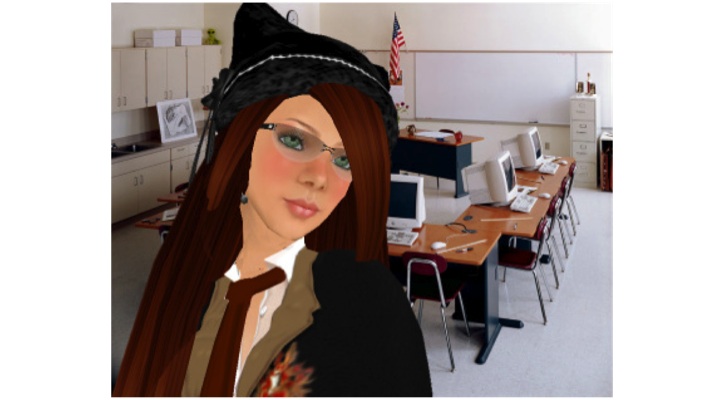
With regard to virtual worlds, I think we will learn important lessons from Second Life. Before the recession there were 50+ virtual worlds emerging. I'm hopeful that we'll see lots of innovation in the development of immersive environments. What I envision happening is that schools and perhaps individual teachers will have access to virtual environments that they will be able to customize for their own uses. In the meantime, teachers should investigate virtual environments of all kinds, but especially immersive ones in order to experience how their literacy practices change when one dons an avatar. In Second Life, a teacher could join the very large and active education group and participate in virtual conferences and programs, in order to familiarize themselves with the possibilities. Teachers can visit http://simteach.com to get started.

Maryanne Berry enjoys a high school teaching career that has spanned a

quarter of a century. The longer she teaches, the more fascinated she

becomes with the ways young people learn. She is currently a doctoral

candidate in the Graduate School of Education at U.C. Berkeley

Phil Halpern is the lead teacher of Communication Arts and Sciences, a

small school within Berkeley High School, where he teaches a variety of

English and communications classes. He traces his interest in media

education to the weekly television news program he helped produce while in

high school back in the earliest days of videotape.

Erin B. Reilly is the research director for Project New Media Literacies

first at MIT and now at USC. She is a recognized expert in the design and

development of thought-provoking and engaging educational content powered

by virtual learning and new media applications, known best for her work

with women and girls in Zoey's Room.

Jessica K. Parker is currently an assistant professor at Sonoma State

University, and she studies how secondary schools integrate multimedia

literacy into academic literacy learning. She has taught middle school,

high school, and college students for over a decade and has also created

and taught professional development courses for teachers.

Reblog this post [with Zemanta]

When Fans Become Advertisers: Smallville Becomes Legendary

When we hear that fans are rallying support behind a favorite television series, we might imagine the letter writing campaign in the late 1960s which kept Star Trek on the air; we might imagine fans of Jericho sending crates of peanuts to network executives; we might even picture fans of Chuck organizing a large scale "buycot," getting people to purchase foot long sandwiches at Subways to show their enthusiasm for the series. What we probably do not picture is fans raising the money to support and air their own commercial paying tribute to the star of their favorite series. So, I was impressed when I received this press release the other week:

Smallville fans have funded a professionally-filmed tribute commercial for the CW leading lady Allison Mack and her tv character, Chloe Sullivan, to air this Spring in Los Angeles before this season concludes. Starring on Smallville since 2001, Ms. Mack has gained a large and devoted fan base as one of the CW's most beloved stars. For the completion of her 9th year on the series, Smallville fans decided to celebrate Allison Mack and her tv character, Chloe Sullivan, with a commercial project entitled Legendary. Scripted and funded entirely by fans, this first of its kind tribute ad was filmed in Los Angeles in late February. In the capable hands of the director, Jon Michael Kondrath, cast and crew created a tribute ad focusing on who Chloe Sullivan is and what she means to Smallville fans. The ad highlights milestones in Chloe Sullivan's journey from her introduction as a high school student in Smallville to being hired at the Daily Planet as well as becoming Clark Kent's confidante

.

I wanted to know more of the story behind this project and reached out to Maggie Bridger, who is one of the organizers, to learn more about how fans have been able to mount such an ambitious undertaking and to explore with her what it's implications might be for future forms of fan activism.

Your project represents a unique example of fan-supported and generated advertising in support of a commercial television program. What are you trying to accomplish here?

We are hoping to celebrate our adoration for a character whom we feel serves as a positive representation of a heroine in popular culture and in fandom. Part of it is about gratitude for DC Comics, Warner Brothers, the CW, Smallville Productions and Allison Mack for bringing us Chloe. The other part of it is about showing that we love Chloe and want to see her as the series goes forward.

Why Chloe Sullivan? What does this character mean to you?

Chloe Sullivan represents the meeting of two worlds---the fantastic and the ordinary. We watch her and see the journey of a driven career woman who, from her first days at her high school paper through her career at The Daily Planet and beyond, has served as a role model for many of us. A lot in our group started watching the show and Chloe Sullivan when we were still in high school and college. We have doctors and lawyers and grad students among us. Chloe didn't make us into those, of course, but she was a girl out there in the media who was going through our same journey. She gave us hope and confidence. If she could accomplish her goals, then we could. That common drive was how Legendary was conceived in the first place.

When we watch Chloe Sullivan, we also see a woman who has been asked to play above her head. She's smart; she's capable. However, she's still a normal human who is dealing with a world of superheroes and aliens. She stands shoulder to shoulder with the future Superman and with the Green Arrow and the rest of the Justice League and she does it with her wits and will. It's inspiring.

Can you describe the process you've gone through to produce the advertisement?

Sleeplessness?

In all seriousness, it's been a long process. We started with planning back in January. The executive producer, Liz De Razzo, called me about this idea she had. We all clearly love Chloe and had felt some disappointment over her reduced screen time this season. This commercial came to Liz as a way to draw some attention onto fans' love for Chloe Sullivan and the actress who plays her, Allison Mack.

We worked in a whirlwind---getting funds raised, auditioning actresses, recruiting the crew, and getting details assembled. We got legal finalized about 24 hours before shooting time.

It was a marathon!

Then we went into post-production. We did extra fund raising to obstain money for sound mixing. Again, it's been a two pronged process. I've been working a lot with the fandom as a whole while Liz, our contact in Los Angeles, has done the amazing on-the-ground work. She's been the one leading this through editing by the very talented Avi Quijada.

Where are you at in terms of meeting your goal for this project?

Currently, we are finishing our sound mixing and score for the completed edit. We will be sending it off via our air agency to KTLA this coming week. We had a lot of goals going through this process. One was to get the commercial shot and finished and we're almost there with post-production. The next was to get funds and purchase air time on KTLA, the Los Angeles CW affiliate. Again, we're finalizing a deal with them.

However, while these initial goals are finishing up, we have a bigger goal---taking the Legendary commercial to other markets. We're eying WPIX, the New York affiliate, and would love to air there as well. It all depends on funds!

How many people have contributed - time, ideas, money -- to make this all work?

I have honestly lost count.

It's not just the online Chloe fans who have contributed. It's also the production company, Rekon, and the crew. There's the director Jon Michael Kondrath and the actresses. Then there's been other producers added to the project and all those involved in post production and securing air time. It's really grown into an amalgamation of fans and professionals in Los Angeles dedicated to make Legendary come to life. Without Liz, we never would have been able to do all this. She blended her fandom love and her real life connections in the industry and made this happen.

What has been the biggest challenge in terms of pulling this together?

Murphy's law. I have to be honest and admit that something unexpected always comes up. If you budget out X amount for a project like this, I think it'll probably double or triple by the end. I know it has for us. The other huge problem is distance. That's a unique aspect of online fandom. While many Chloe fans are from the United States, we also have a large international community. Our script writer lives outside of Tokyo; one of the copy editors for our press releases and our website is in Australia; I live in the Deep South on central time and Liz, of course, is in Los Angeles. It's been hard coordinating virtual teaming meetings for a time we could all make it. Basically, it took me and Megan Butler, our script writer, being insomniacs to pull it off.

I definitely received my share of 1 A.M. phone calls from L.A.!

Do you think this is a model other fan groups can or should follow -- not only in terms of paying tribute to characters but also as a way of increasing the visibility of favorite programs?

Well, I'm not sure yet. As far as increasing visibility for favorite characters and for favorite programs, I hope this is an exciting new direction. I know we've all seen fans send in favorite items like peanuts for Jericho or the Tabasco bottles for Roswell as well as putting out Variety ads. I think fan ads, even if it's specific like for an actor/actress or a character, can change how marketing is done. It can help form a partnership in a new way between shows and their fanbases.

But I do have to preface that with "not sure yet." We've had some luck so far with Legendary. In a month, the vimeo preview vid has had over 3,000 hits. We've had supportive blog coverage and twitter notice. I'm not sure what the larger print or television media will think of it when it hits airwaves. I hope they love it as we do. Similarly, I don't know what the network's reaction will be yet. Again, I hope it's all positive. This project is our baby and we are extremely proud of it. I guess, then, that you'd have to ask me again in about six months, if I think this is a model that should be emulated.

I do have to say one thing. I don't think this will catch on completely as a "save our show" type of campaign. I know that Jericho, Farscape, and I believe Star Trek: Voyager fandoms have done fan sponsored commercials for their favorite shows. I'd say it's an iffy proposition, not just because it might fall flat but because it takes a long time. The fundraising, the coordination of efforts, getting a crew and such...it all takes more time than I think the average canceled/on-the-bubble show has before its final death throes.

However, if you're asking me if I'd love to see commercials for Dr. Temperance Brennan or for Cara from Legend of the Seeker, then why not? Bring on the love for favorite characters. Bring on another Jericho-style commercial. It might not make complete waves in the industry but it shows fan love and devotion matters and that's extraordinary to me.

Maggie Bridger is an aspiring graduate student in developmental psychology at a university in the Deep South of the United States. Always interested in fandom studies, she's been published in Slayage, the online journal of Buffy studies. She is currently working toward her masters doing research hippotherapy and autism. One day, she hopes to also be able to write a scholarly piece on fandom campaigns, citing Legendary as a prime example.

Reblog this post [with Zemanta]

Ludic Narrans:Drew Davidson Talks Crossmedia Communication (Part Two)

This is the second installment of my interview with Drew Davidson, Director of the Entertainment Technology Center Pittsburgh at Carnegie Mellon University, about his recently published Crossmedia Communications textbook. In this section, we talk about dvds, games, toys, amusement park, fan culture, electronic publishing, and much much more.
I am often asked whether people really want to engage actively with entertainment properties or prefer to sit back and let the entertainment come to them. How do you address this question through your book? What insights do you offer about what might motivate a consumer used to more passive forms of entertainment to jump into these more interactive formats?

On the one hand, it's like Jesse Schell put in his recent talk at DICE

that the future is already all around us, so it's going to be hard to avoid. While Schell is not directly talking about crossmedia, I still think his point applies. More and more crossmedia experiences are already being created, so it's going to be hard to not engage just because they're around so much.

On the other hand, I think it's a matter of degree of interactivity, and some formats can serve as a gateway to more interactive ones. For instance, the DVD. The DVD lets you sit down and just watch a movie from start to finish, but there are also lots of extras you can watch that show you "making of" stories, deleted scenes, different endings, extended versions, etc. And also, some DVDs let you click a button during the movie that will play more information about the particular scene your watching. In fact, some stories have been created that can only be watched on DVD, where you're able to unravel scenes from a variety of perspectives (and that's not even addressing the types of interactive DVDs the porn industry has created).

But what's interesting about DVDs as an example is that they enable people to both passively watch and also to take a little more control of how they experience the story. Granted, it's not necessarily a robust form of interactivity, but it's one that my parents take advantage of all the time. So, it can serve as a way to introduce and entice them into more interactive formats.

Similarly, I hope that the textbook can introduce people into the phenomenon of cross-media communications and entice them to explore it more deeply. And what I like about the example of DVDs is that illustrates how this doesn't have to be an either/or situation, it can be a both/and one. People can enjoy both more passive formats, as well as more interactive ones.

When designing a crossmedia property, are we trying to design a unified experience which will be shared by most consumers or an experience which may have multiple points of entry to support a range of diverse and dispersed sets of consumers?

I think it's more toward the latter from a design perspective (and from how it's currently playing out with consumers) although I could see how the major media conglomerates would like it to become more mainstream so that more fans are participating across more media.

One of the more successful design strategies that has evolved is to have a tentpole experience around which you can create a crossmedia property. A tentpole is a major media experience that supports a lot of other smaller related media experiences. This can enable a scaffolded narrative experience with various layers, each requiring a little more effort then the tentpole. So more casual fans can enjoy the tentpole, and that could be the extent of their experience. While more dedicated fans can dig deeper and find the various related media that guide them more fully into the fictional universe. And hardcore fans can find and explore it all.

Your book talks about a range of forms of crossmedia experiences which are rarely talked about. For example, you spend part of a chapter on theme parks. So, in what ways can theme park experiences be used to extend our experience of a fictional world? What theme park attractions do the best job of expanding our experience of a property rather than simply adapting the property from one medium to another?

Theme parks can provide the opportunity to have an embodied experience within a fictional universe. In general, I think most of them are really just adaptations of a story from another medium (or stand on their own). But even so, having an embodied interaction can enhance and expand your experience with a story. Being able to feel like you're actually there in the narrative universe is something theme parks can do.

Some attractions make the most of this. The Spider-Man ride at Universal tries to give you a feeling of what it's like to be Spider-Man. And even more so, the Pirates of Caribbean ride gives us a sense of a being a pirate, and it inspired the movies (which fleshed out the narrative). And in the Battle for Buccaneer Gold ride, you got even more actively involved as you took on the role of a pirate.

Jesse Schell, who designed the ride, commented that as the design team watched people experience the ride, they noticed that everyone is really just seconds away from acting like a pirate. By inviting people to participate, the ride gave people permission to act like pirates, which enabled them to act, and feel, like a part of the fictional universe

.

You discuss toys as another kind of media extension. When are toys part of the story and when are they simply a commodification of the story?

Like theme parks, I think toys are generally just a commodification of a story. As such, they don't really add to a narrative. But in the same vein as theme parks, they can also enhance our experience of a story by enabling us to bring a part of the fictional universe into our space.

At the very least, they are little collectibles on our desks that remind us of an experience we enjoy. And some toys are more directly a part of the story. Webkinz is a good example of toys that help take you into a world. Pokemon takes this a step further with collectible cards that are part of a game, and a television show that shares tips and tricks on how to play.

Either way, a toy can serve as a representation of a narrative universe.They can extend the story into our world, helping make it feel like a part of our daily lives.

You talk about media producers "listening" to their audience. To what degree is crossmedia entertainment shaped by audience expectations and emergent forms of participation? To what degree is it shaped top-down by the commercial and creative imperatives of professional storytellers?

I think the answers to these questions are being discovered as we speak. Designers, producers and fans are figuring it out as we go. Lost is a great example of a television show with a dedicated (and vocal) group of fans, and writers that have stated publicly about how much they pay attention to their fans, and producers who have supported the show's development within this environment.

Designers and producers can use the internet to check the pulse of fan commentary as well as communicate directly with the fans. They often host their own sites with active blogs and inside scoop on how the story is progressing.

The internet also enables audiences to organize and coordinate so that they can better make themselves heard. There are influential entertainment blogs and community sites that help provide a gathering point people as well as a diversity of websites for, and by, fans that focus on specific crossmedia experiences.

Granted, they can only have so much influence, but it's not insignificant. Fans of the quickly cancelled Firefly television show rallied to try and save the show. While they weren't able to keep the show alive, they were able to rally enough support to help the movie Serenity get made.

And then there's the great example of Lost Zombies which started as a zombie documentary being generated by the community, and has evolved to incorporate

a bunch of different media. People are able to get directly involved in the Lost Zombies experience from A to Z.

And so, I think the ad-hoc back and forth is evolving into a more coordinated dance between all the parties involved, and the experiences of fictional universes are evolving with them.

Near the end of the book, you raise the issue of "too much content." Is it possible for crossmedia producers to generate so much content that it smothers fan participation?

There's a finite variable involved, which is the time that we can commit to all of these experiences. Particularly if you consider crossmedia experiences that have serialized television shows as the tentpole for everything else. But even without that, these experiences can demand a lot of time commitment from the fans, so it would be tricky to get fully involved with a bunch of crossmedia narratives all at once.

This gets back to the idea of how crossmedia experiences can be designed around tentpoles. I think it's fair to say that most people, have time to engage with several tentpole experiences. And the rest of the crossmedia opportunities can be found by more passionate fans who want to spend more time with a particular fictional universe. So, it seems that across a fan's mediascape there would be some tentpoles as well as various layers of crossmedia engagement for select fictional universes they really enjoy.

This also gets back to the idea of how content producers should listen to their audiences. If there is a good synergy amongst all the participants, there should be enough content for fans who want it. If not, there can be too much (or too little even). An example of too much can be found with the Flash Forward television show. The producers tried to jump start fan participation by having short interstitial "ads" telling viewers that certain weird moments in the show were important. So instead of allowing

fans to develop and explore more freely, it felt like they were trying to force feed a deeper interest level from the start.

For as much planning at it takes to create crossmedia narratives, the audience will become fans on their own terms and in their own time. So, I think turning a firehouse of content onto an audience can smother deeper participation. By doling content out more discreetly, you can entice fans to take the time to dig deeper into the fictional universe.

You built a dvd that accompanies the book. What does it contribute to our understanding of crossmedia? To what degree does it put the book's ideas

into action?

The purpose of the DVD-ROM is to enable students to put the ideas in the book into action. This happens in a couple of ways. First of all, there are a lot of media examples on the DVD-ROM (images, short videos and music). The media was created by students and interns at the Entertainment Technology Center at Carnegie Mellon.

Then, I collaborated with Alice Robison who helped go through the textbook and create objectives and questions for each chapter as well as a semester-long student project that connects the ideas in the book with the media on the DVD-ROM, so that students can actively practice how to design and develop a crossmedia experience and explore all the issues and concepts involved.

Also, crossmedia is put into play in the book itself. Two gifted artists, Angela Love and Eun Jung Lee, created images to relate to the content in each chapter. Angela did interpretative illustrations and Eun Jung created information graphics. In both cases, the imagery is another way into the topics covered in the text. This gives students the opportunity to see and discuss how images can relate to, and enhance, words.

Building on this, each chapter has perspectives shared from different professionals in the field. Over thirty experts shared their thoughts and ideas about crossmedia. This helps to expose students to various points of view on the topics found throughout the book.

Considering all of the above, this crossmedia textbook project was truly realized through the expertise and efforts of a talented interdisciplinary group of people. I think it all came together well and helps make the textbook and accompanying DVD-ROM a solid overview of crossmedia communications.

Tell us a bit more about ETC. press and what you are trying to achieve with this publishing venture?

Well for those who don't know, ETC Press is a small experimental academic publishing imprint that I helped start at CMU in 2008. We're interested in exploring and expanding the notion of publishing. Authors retain ownership of their intellectual property and all of our titles are released under Creative Commons licenses. You can see more about our mission and our titles

at: http://etc.cmu.edu/etcpress/

I think one of our main goals is to enable the sharing of ideas and to help influence discussion around topics related to entertainment technologies. So we work hard to make our texts as available as possible. We have our titles priced as inexpensively as possible, while also offering free digital downloads, along with versions on our website as well as through various formats and web archive sites to help share them as far and wide as possible.

We're also really interested in playing around and across multiple media and having multiple versions of texts. We're interested in crossmedia communications and encourage and support projects that are willing to experiment with the participatory nature of content creation and academic discourse. So, we invite people to play with us.

Drew Davidson is a professor, producer and player of interactive media. His background spans academic, industry and professional worlds and he is interested in stories across texts, comics, games and other media. He is the Director of the Entertainment Technology Center Pittsburgh at Carnegie Mellon University and the Editor of ETC Press. He completed his Ph.D. in Communication Studies at the University of Texas at Austin. Prior to that, he received a B.A. and M.A. in Communications Studies at the University of North Carolina at Chapel Hill. He chaired Game Art & Design and Interactive Media Design at the Art Institute of Pittsburgh and the Art Institute Online and has taught and researched at several universities. He consults for a variety of companies, institutions and organizations and was a Senior Project Manager in the New Media Division of Holt, Rinehart and Winston. He was also a Project Manager in Learning Services at Sapient, and before that he produced interactive media at HumanCode. He helped create the Sandbox Symposium, an ACM SIGGRAPH conference on video games and served on the IGDA Education SIG. He works with SIGGRAPH on games and interactive media and serves on the ACTlab Steering Committee, and many review boards and jury panels. He founded the Applied Media & Simulation Games Center at Indiana University of Pennsylvania. He is the lead on several MacArthur Digital Media and Learning Initiative grants and has written and edited books, journals, articles and essays on narratives across media, serious games, analyzing gameplay, and cross-media communication.

Reblog this post [with Zemanta]

Ludic Narrans:Drew Davidson Talks Cross-Media Communication (Part One)

One of my first classes at USC was in transmedia entertainment and storytelling and I plan to be teaching a large lecture hall class on transmedia in the Cinema School starting in the 2011-2012 academic year. My growing interest in transmedia is one of many reasons I have ended up here. I want to be closer to the entertainment industry to be able to watch some of the changes that are unfolding as this emerging conception of popular entertainment really takes root and I want to be in a position to influence the entertainment workers in training. Think about how the generation of "movie brats," such as Spielberg and Lucas, influenced the American media. For generations, directors emerged from one or another of the guilds, bringing with them specialized skill sets. Robert Wise was an editor; William Cameron Menzies was an art director; most of them knew how to work with actors, but few of them had an integrated perspective on all of the technical skills required to produce a movie. With the rise of film schools, we got directors who knew the full vocabulary of their medium, who knew how to speak to workers with more specialized skills (who often trained alongside them and spoke a shared language) and who knew the history and genres that constituted their tradition. As Hollywood begins to embrace transmedia, a common concern is that there are few people who fully understand how to tell stories or create entertainment experiences in more than one medium: comic book people don't know how to think about games, say, or television people have limited grasp of the web. My own hope is that the Film Schools will once again be the space where future media makers get exposed to a broader range of different kinds of media and also develop the social relations and vocabulary to meaningfully collaborate with others who have specialized in different modes of expression.

For this to happen, transmedia entertainment needs to emerge as a subject not simply at USC but at film schools all over the country. And, indeed, I am hearing more and more from other faculty who are starting to teach such classes at their own institutions. That's why it is such good news that Drew Davidson, Director of the Entertainment Technology Center Pittsburgh at Carnegie Mellon University, has produced a new textbook designed to introduce undergraduate critical studies and production students alike to the world of what he calls "crossmedia entertainment." (Full disclosure: the book includes a short piece by me which offers my definition of transmedia.) I have long admired Drew Davidson's contributions to the space of games studies, especially through the Well Played books, which offer smart, engaging criticisms of specific games by some of the top games scholars in the world, and his earlier book, Stories in Between is a hidden gem which already poses important questions about new and emerging forms of storytelling.

This new book, Cross-Media Communications: an Introduction to the Art of Creating Integrated Media Experiences will play a central role in shaping how concepts of "cross-media" or "transmedia" expression get taught, encouraging educators around the world to explore some of these intriguing concepts in their classrooms. Over the next two installments, I will be sharing this interview with Davidson about the book and about his thoughts on all things crossmedia.

What are your goals for this book? Are we far enough along in identifying and explaining these new techniques that there is a space for an undergraduate textbook on crossmedia? Is the book focused on developing critical understanding, practical skills or both?

My primary goal was to try and create an introductory textbook to this topic, so I was aiming for a freshman-level book. An inspiration was the various textbooks currently out that focus on mass communications. I thought it would be interesting to do something similar, but with a specific focus on how media communications are tending more than ever to be threaded together.

Thinking about where we are in our understanding of cross-media techniques and how media experiences can be threaded together, we could go back to Plato's concept of ekphrasis (roughly, using one medium to relate another). So it's been around for some time, particularly if you think of advertising campaigns since the advent of mass media. There are some sophisticated ad campaigns that link together various media (e.g. print, radio, tv and collectibles) in ways that are primarily meant to get us to consume. And

more recently, there is the increasing ability for us to also join in the creation of these experiences. Plus, as you've pointed out so well, the current generation of students are accustomed and acclimated to being this (inter)active with their media experiences. So, I think it's a good time to try and engage this topic in a textbook.

That said, I worked to create a textbook that is more broad than deep. It is meant to provide a good overview of the critical concepts involved as well as some practical application experience in a design and development context. It's a starting point and foundation for more in-depth study and practice of cross-media communications. The exercises, illustrations and information graphics in the book and DVD-ROM are meant to introduce students to the design process, and the professional perspectives throughout the book help give students a sense of the range of ideas involved. From here, students could work on their design skills specifically while also digging more deeply into concepts covered by people like yourself, Christy Dena, Kurt Kurt Lancaster, Monique de Hass, Jonathan Gray/a>, Max Giovagnoli, and Geoffrey Long (just to name a few). This textbook can be a way to show the various opportunities for them to consider.

.

What do you see as the role of academic programs in preparing the next generation of crossmedia designers and/or in educating an audience to become better consumers of existing transmedia properties?

To borrow a term from alternate reality games, I think academic programs can serve as a rabbit hole for both the preparation of crossmedia designers and the education of audience members. By helping introduce both groups to crossmedia, academic programs can then guide them deeper into what it has to offer.

For designers, courses of study could be developed to help teach students both the practical skills as well as the conceptual rigor they would need to create crossmedia experiences that took full advantage of the interplay of all the media involved together.

From a perspective of audience members, a crossmedia 101 course could introduce students to exemplars of crossmedia experiences and illustrate their fundamental characteristics. Subsequent courses could help students develop a deeper critical literacy that would help enable in-depth analysis of crossmedia.

In both cases, academic programs can help shape the understanding and direction of the field as it continues to develop. Going down the rabbit hole would just be the start of the adventure.

There has been a jumble of terminology around this topic. I prefer to use "transmedia." Frank Rose talks about "deep media." and you went with "cross-media." Do you see "transmedia" and "crossmedia" as two words to describe the same thing or as capturing different aspects of this new aesthetic?

To be honest, I think they're all fairly synonymous, and I think they could be interchanged for the most part. That said, here's how i see some of the distinctions and specific emphases between the three terms.

I like how you use transmedia to describe narrative universes that we can experience through multiple entry points which are accessed through various media. For me, this terms serves as a foundation for the other two.

Deep media is similarly about exploring experiences that take place across media. But it seems to have more of a focus on how the internet is performing as the glue that helps hold the narrative together and enables a deeper experience of the story.

And crossmedia focuses more specifically on how the audience needs to become interactively engaged in order to experience narratives that occur across, between and through various media. So the focus is more on how interactive you get.

But even just trying to point out these distinctions shows that they are quite subtle. Personally, I feel comfortable with all three terms and how they define this aesthetic.

Your discussion of "crossmedia" places a particular emphasis on interactivity. So, can you share with us what you mean by interactivity? Does this imply that other kinds of narratives are consumed passively? In a networked culture, are there any kinds of narrative which do not spark some form of participation and interactivity?

I think all communication is inherently interactive in nature, narratives included of course. But different media can enable different levels and types of interactivity. I like Espen Aarseth's distinction on how digital media can enable us to interact more directly within an narrative experience and help shape it through our interactions; whereas with other media (like books and film) we also interact, but with less agency within the

experience.

Building on this, I've noodled around with the notion of ludic narrans, or playful stories. Looking at Johan Huizinga's idea of homo ludens, and how humans begin life in a playful pre-linguistic consciousness as babies where we're solely homo ludens as we literally learn everything through play as we interact with the world. And then we learn language, and a new phase of consciousness begins, one that dominates, shapes, and constrains our worldview for the rest of our lives. We are now homo narrans, as we

discursively talk about what we play, what we learn, what we feel, believe, think, etc. But I don't think being homo narrans erases our foundational homo ludens nature; we are always already homo ludens, itÂąs just now we talk about it.

Looking at how interactivity can be found in crossmedia, I believe Aarseth's notion of interactivity evokes a type of narrative experience that has definite para-linguistic activities involved; meaning is conveyed across media through gesture, space, color, sound, activity and agency. I think one of the reasons these experiences are so compelling is that they enable us to tap more directly into our pre-linguistic homo ludens consciousness as we can playfully engage with them. Of course, we then step back and talk about it, which engages our discursive homo narrans consciousness. So we have

ludic narrans, playful stories.

Drew Davidson is a professor, producer and player of interactive media. His background spans academic, industry and professional worlds and he is interested in stories across texts, comics, games and other media. He is the Director of the Entertainment Technology Center Pittsburgh at Carnegie Mellon University and the Editor of ETC Press. He completed his Ph.D. in Communication Studies at the University of Texas at Austin. Prior to that, he received a B.A. and M.A. in Communications Studies at the University of North Carolina at Chapel Hill. He chaired Game Art & Design and Interactive Media Design at the Art Institute of Pittsburgh and the Art Institute Online and has taught and researched at several universities. He consults for a variety of companies, institutions and organizations and was a Senior Project Manager in the New Media Division of Holt, Rinehart and Winston. He was also a Project Manager in Learning Services at Sapient, and before that he produced interactive media at HumanCode. He helped create the Sandbox Symposium, an ACM SIGGRAPH conference on video games and served on the IGDA Education SIG. He works with SIGGRAPH on games and interactive media and serves on the ACTlab Steering Committee, and many review boards and jury panels. He founded the Applied Media & Simulation Games Center at Indiana University of Pennsylvania. He is the lead on several MacArthur Digital Media and Learning Initiative grants and has written and edited books, journals, articles and essays on narratives across media, serious games, analyzing gameplay, and cross-media communication.

Reblog this post [with Zemanta]

Hollywood Goes "Transmedia"

"At the heart of the entertainment industry, there are young and emerging leaders (such as Danny Bilson and Neil Young at Electronic Arts or Chris Pike at Sony Interactive) who are trying to push their companies to explore this new model for entertainment franchises. Some of them are still regrouping from their first bleeding-edge experiments in this space (Dawson's Desktop, 1998) -- some of which had modest success (The Blair Witch Project, 1999), some of which they now saw as spectacular failures (Majestic, 2001). Some of them are already having closed doors meetings to try to figure out the best way to ensure more productive collaborations across media sectors. Some are working on hot new ideas mased by nondisclosure agreements. All of them were watching closely in 2003, which Newsweek had called 'The Year of The Matrix,' to see how audiences were going to respond to the Wachowski brothers' ambitious plans." -- Henry Jenkins, Convergence Culture: Where Old and New Media Collide (2006).

I've been so busy dealing with end of term matters that I have not yet had a chance to publicly acknowledge here the extraordinary news that the Producers Guild of America has officially recognized the title of "Transmedia Producer." Here's how the official prose defines the concept:

A Transmedia Narrative project or franchise must consist of three (or more) narrative storylines existing within the same fictional universe on any of the following platforms: Film, Television, Short Film, Broadband, Publishing, Comics, Animation, Mobile, Special Venues, DVD/Blu-ray/CD-ROM, Narrative Commercial and Marketing rollouts, and other technologies that may or may not currently exist. These narrative extensions are NOT the same as repurposing material from one platform to be cut or repurposed to different platforms.

A Transmedia Producer credit is given to the person(s) responsible for a significant portion of a project's long-term planning, development, production, and/or maintenance of narrative continuity across multiple platforms, and creation of original storylines for new platforms. Transmedia producers also create and implement interactive endeavors to unite the audience of the property with the canonical narrative and this element should be considered as valid qualification for credit as long as they are related directly to the narrative presentation of a project.

Transmedia Producers may originate with a project or be brought in at any time during the long-term rollout of a project in order to analyze, create or facilitate the life of that project and may be responsible for all or only part of the content of the project. Transmedia Producers may also be hired by or partner with companies or entities, which develop software and other technologies and who wish to showcase these inventions with compelling, immersive, multi-platform content.

To qualify for this credit, a Transmedia Producer may or may not be publicly credited as part of a larger institution or company, but a titled employee of said institution must be able to confirm that the individual was an integral part of the production team for the project.

By all accounts, Starlite Runner's Jeff Gomez, a long time friend and a key thinker/creator in the transmedia space, has been a key player behind the scenes lobbying the Guild to accept this new classification. The specifics of the definition of transmedia is still being debated widely, including this interesting piece on the responses of people who would be eligible for the new title and this one from long time crossmedia advocate Christy Dena. The Guild is already saying that video games were excluded from the list of potential media by oversight and that it will be amended soon to include games. Dena has raised two important criticisms of the definition -- the idea that work must straddle at least three media (disallowing projects which integrate in deep and meaningful ways only two platforms) and the emphasis on storylines as opposed to other potential kinds of transmedia experiences.

The reality is that our definition of what constitutes transmedia is still very much evolving, as can be witnessed from the various discussions of the concept at the Transmedia Hollywood: S/Telling the Story conference, which was organized in March by Denise Mann of the UCLA Producers Program and myself. As we brought together people from across the media industry to discuss these emerging trends, we found some included all forms of franchise entertainment as transmedia and others had much narrower definitions which insisted that the different media platforms be integrated to tell a single story. There was disagreement about the value of various proposed terms, including not only transmedia, cross-media, and "deep media." There were recurring disagreements about transmedia as a mode of content as opposed to a mode of marketing. And finally, transmedia's aesthetics was still being defined and with it, the issue of whether this is something really new or an expansion of long-standing practices. Around the edges, you could hear hints that transmedia should be extended from a focus on storytelling to a more expansive understanding which includes notions of performance, play, and spectacle that can not be contained within a more narrative-centric definition.

From the beginning, transmedia has been a site of experimentation, innovation, and exploration at the heart of the mainstream media. Many of us have seen the signs of transmedia practices emerging from some time -- mostly taking shape around forms of marketing because that's how such projects could get funded, mostly reflecting the logic of a more integrated media industry with strong economic imperatives for creating entertainment experiences across platforms. Yet, the phrase "transmedia" (and its various counterparts) have created a space where aesthetic and cultural concerns can re-enter the discussion. If media artists are going to be pushed to extend their offerings across platforms, shouldn't they be thinking about how these practices can be exploited to create richer aesthetic experiences, to support the creativity and engagement of fans, to deepen the meaningfulness of the stories and performances they are staging?

As such, the transmedia discussion has always moved across registers and as a consequence, needed to be expansive, to include anyone who wants to engage with these topics and who is willing to put these ideas into practice. While the Transmedia Hollywood conference drew criticism from some quarters for having too elastic or "vague" a definition of its core concept, this very expansiveness is what allows us to bring many different voices to the table, to map diverse kinds of experiments, and to promote new innovations and explorations. From my perspective, there is a use within the academic world for clearer, more precise definitions, but there is also a value more generally for a more slippery conception, at least while we are still undergoing such rapid evolution. My hope is that the definition and borders of the concept will be debate everytime two or more transmedia advocates have gathered.

I respect the value of a Guild having a clear definition of what transmedia is, and from where I sit, the PGA definition is as good a one as we are going to get right now, but I also hope that we all do what Dena did in her blog post and push back on any attempt to too quickly formalize the limits or boundaries of this practice.

For those who missed the Transmedia Hollywood events, I am happy today to share with you the webcasts of the panels. We hope that these programs provide a useful resource for people in and around the media industry who are stilling trying to make sense of "all this talk about transmedia entertainment."

9:45--10:00 am

Welcome and Opening Remarks

Denise Mann, Associate Professor, Producers Program, UCLA School of Theater, Film and Television

Henry Jenkins, Provost's Professor of Communication, Journalism and Cinematic Arts, Annenberg School of Communication, USC

10:00--11:50 AM

Panel 1: "Reconfiguring Entertainment"

Moderator: Henry Jenkins

Panelists: Mimi Ito, Associate Researcher, University of California Humanities Research Institute (Engineering Play: A Cultural History of Children's Software; Hanging Out, Messing Around, and Geeking Out: Kids Living and Learning With New Media; Personal, Portable, Pedestrian: Mobile Phones in Japanese Life)

Diane Nelson, President, DC Entertainment

Richard Lemarchand, Lead Designer, Naughty Dog Software (Uncharted: Drake's Fortune; Uncharted 2: Among Thieves)

Nils Peyron, Executive Vice President and Managing Partner, Blind Winks Productions

Jonathan Taplin, Professor, Annenberg School for Communication and Journalism, University of Southern California; CEO, Intertainer.

John Underkoffler, Oblong, G-Speak (Technical Advisor for Iron Man, Aeon Flux, Hulk, Taken, and Minority Report)

12:00--1:50 PM

Panel 2: "ARG: This is Not a Game.... But is it Always a Promotion?"

Moderator: Denise Mann, Associate Professor, Producers Program, UCLA School of Theater, Film and Television

Panelists: Ivan Askwith, Senior Content Strategist, Big Spaceship (clients include NBC, A&E, HBO, EPIX, Second Life, and Wrigley)

Susan Bonds, President/CEO and Alex Lieu, Chief Creative Officer, 42 Entertainment (I Love Bees, Dead Man's Tale, Why So Serious?, Year Zero)

Will Brooker, Associate Professor, Kingston University, UK (Star Wars; Alice's Adventures: Lewis Carroll in Popular Culture; The Bladerunner Experience; Using the Force; Batman Unmasked)

Steve Peters and Maureen McHugh, Founding Partners, No Mimes Media (Watchmen, The Dark Knight, Nine Inch Nails, Pirates of the Caribbean II)

Jordan Weisman, Founder, Smith & Tinker (The Beast, I Love Bees, Year Zero)

3:00--4:50 PM

Panel 3: "Designing Transmedia Worlds"

Moderator: Henry Jenkins

Panelists: David Brisbin, Art Director/Production Designer (Twilight, New Moon, The Day the Earth Stood Still, Drug Store Cowboy)

Danny Bilson, THQ (The Rocketeer, Medal of Honor, The Flash, The Sentinel)

Derek Johnson, Assistant Professor, University of North Texas

R. Eric Lieb, Partner, Blacklight Transmedia. Former Editor-in-Chief, Fox Atomic Comics; & Director of Development, Fox Atomic (28 Weeks Later; Jennifer's Body; I Love You Beth Cooper)

Louisa Stein, Head of TV/Film Critical Studies Program, San Diego State University (Limits: New Media, Genre and Fan Texts; Watching Teen TV: Text and Culture)

5:00--6:50 PM

Panel 4: "Who Let the Fans In?: 'Next-Gen Digi-Marketing'"

Moderator: Denise Mann

Panelists: J.D. Black, Vice-President, Marketing, Sony Imageworks Interactive (digital campaigns for Surf's Up, Cloudy With A Chance of Meatballs, 2012, District 9, The Boondocks)

John Caldwell, Professor, UCLA Department of Film, TV, Digital Media (Production Studies: Cultural Studies of Film/Television Work Worlds; Production Culture: Industrial Reflexivity and Critical Practice in Film/Television; New Media: Theories and Practices of Digitextuality; Televisuality: Style, Crisis, and Authority in American Television)

Alan Friel, Partner, Wildman, Harrold, Allen & Dixon LLP

John Hegeman, Chief Marketing Office, New Regency Productions (marketing campaigns for Saw 1 & 2, Crash at Lionsgate; The Blair Witch Project at Artisan)

Roberta Pearson, Professor, University of Nottingham (Reading Lost; Cult Television; The Many Lives of Batman: Critical Approaches)

Steve Wax, Co-founder and Managing Partner, Campfire (HBO's TrueBlood, Audi's The Art of the Heist; Discovery Channel's Shark Week marketing adventure, Frenzied Waters).

Reblog this post [with Zemanta]

Hip Hop Goes Transmedia (Part Two)

Hip Hop Goes Transmedia by Marguerite de Bourgoing


4. Collaborate

While hip hop is notoriously an individualistic expression, the collaborations give depth to what is otherwise an individualistic expression, and independent rappers are no exception. They need to support each other to attain their common goal. Collaborations often have the strategy of reaching out to each other's followers. Beefs (verbal fights) are equally standard and entertaining in hip hop but fans also like to see artists united and collaborating. This goes back to the idea of movement. The idea of collaboration is exemplified in the rapport producers have with artists (who make the beats and often the arrangements for the songs). The DJ is also often the third element to the association, Producers in hip hop are mainly their own persons, and while many producers have a special relationship with one or several artists, it is by no means exclusive. All hip hop albums with hardly any exception, feature other artists.

El Prez in one of the interviews he gave us, was comparing the scene to superheroes in comic books, aware that the fans like to see the artists get together. Indeed to push the comparison there are different factions of superheroes that also interact with each other more or less loosely. For a fan spotting the cameos in the music videos is part of the construction of this mythology. Watching the video of an up and coming rapper artist like Fashawn (who chose his name because he wanted it to sound like a superhero), it is fun to spot how many artists briefly appear, showing the wide backing he has amongst the hip hop community.

5. It ain't hard to tell

Rappers are great storytellers, therefore they already have the gift of word, inherited from a great oral tradition of storytelling. It's how you build that story that makes it effective on a transmedia level. Stevie Crooks (named after the brand Crooks and Castle) wears a ski mass during some of his performances and affects a kind of robin hood persona "in the eyes of crooks the industry has fell in this category fueling him to steal hiphop back and bring the Essense, love ,passion, and pure soul that we once knew". The infamous Speak is very vocal about his Jewish Mexican origins and has a provocative flow "I like to play shows and amaze the crowd with fantastic raps and pelvic thrusting. I enjoy balloons, confetti, dancing, bubbles, chaos and hood rat girls with English accents and pro nails." U-N-I (you and I ) emphasis their relationship with their fans, by posting or retwweting the pics they send them of them with their merchandise. El Prez dropped his latest mixtape of President's day. Enigmatic rapper Blu who's first album was a critical success names himself on twitter @herfavcolor and tweets that way: "Only5%OfTheTwittsInMyBrain MakeItToThePage", "AnyBodyRememberWhenkubrickTookItToJupiter, OhBoyIsInThatCrazyRoom, Boom,InsertLadyGagaVidsRightThere, Climactik!", "LatePass..IActuallyWantedToMeetKanyeTilIJustDiscoveredAmberRose,Wow,HeHasNoReasonToSayAWordtoAnyOneElse,BravoBravoBravo!"

6. It's a man's world but it would be nothing without a woman

One of the problems today in hip hop is the lack of good female rappers. Regularly I read tweets asking where Lauryn Hill is. Murs famously said "women can't rap". The hip hop audience has a higher level of male and it is an overall male dominated world. However, don't underestimate the power of women. At LA Stereo we featured a few female emcees like Sirah.

Some of the female fans are the most vocal, and while some artists have specifically a more male audience, for an artist to succeed he needs to appeal cross genre. With a few exceptions for a story to be truly transmedia it should to be embraced by men and women. Despite the numerous mention of "ho's", there is an overall strong percentage of strong and intelligent women acting on the LA hip hop scene. Yeah you know if you've made it if you feature on the 2DopeBoyz ( a blog run by two guys who are very vocal about their tastes and distates) but in LA you still haven't quite made it if you haven't been endorsed by Devi Dev. A radio personality, she's like a friend with a motherly approach to the artists. As a proper journalist she masters the art of the tweet evolving effortlessly between compte-rendu of concerts, anodyne facts and conversations with the artists. She's able to tell off up and coming Nipssey Hussle about throwing gansta signs on stage. She's the voice of reason commenting on why there are too many rappers, why it's not recommended to date a rapper, and she has a wide public appeal without ever falling into demagogy.(On that chapter lets not to forget that LA Stereo was started by two women Kristin Guillory and myself).

7. We were scholars before colleges

Hip hop is an art form that exists in a society with a strong written tradition yet it is an art form that travels mainly orally (many of the artists we interview tell us they don't write their rhymes down). This explains how it embraces easily a visual aesthetic and some of the other aspects described above, as it isn't assigned to a rigid structure. It's a reminder how oral cultures manifest themselves in ways that aren't just verbal. Hip hop is an art form that has developed its own mythology, world, and prophets within contemporary society. It is an art form that constantly references itself as well as the previous eras as expressed with the practice of sampling. Most of what enables it to exist and survive within society is its own rebellious attitude, contradictions that it has to deal with, overall characterized by a "... don't give a f*** attitude". Therefore it is fluid form that references itself and follows its own evolution, inhabited by its own doubts, certitudes and celebrations. In a very Nietschean way, Nas a more introspective rapper announced that hip hop was dead, while jay-z epitomizes the Renaissance man in hip hop who has everything (you can check his impressive resume here). All the rappers in the world are emulating both attitudes. Hip hop has a backbone yet is fluid in its manifestations. However, to exist in hip hop you ultimately have to be embraced by the community of rappers, made of the pioneers, the golden era, etc. It's actually remarkable how that older community is still active. On Twitter one can follower rev from Run DMC who gives spiritual words of advice or legend rapper and producer QTip.

To conclude hip hop is still a vital genre that is making the most of the digital revolution we are going through as it shows its constant capacity of adaptation, innovation and creativity.

To fin out more about LA Stereo you can find us on Twitter @LAStereotv, become a fan on Facebook, subscribe to our Youtube channel and join the community http://www.lastereo.tv.

Marguerite graduated from Oxford University and the Sorbonne Paris IV, with an M.A. in Art History and in Philosophy. She then worked for two years at the Cinémathèque française in Paris where she developed a passion for cinema. During this time she assisted Marc Riboud, a photographer from Magnum, with whom she explored the language of documentary. She moved to London where she lived for six years, working as a Production Coordinator on factual programs, before joining Discovery UK in the programming department. Recently Marguerite moved to L.A and completed the Annenberg Online Communitites Program MA at USC to define and develop new audiences online, particularly for documentaries. She's currently developing her own franchise LA Stereo.tv with the help of her team: documenting the rise of the independant hip hop scene, and urbansalt.com with former classmates: curating the LA street style.

Reblog this post [with Zemanta]

Hip Hop Goes Transmedia (Part One)

Transmedia Entertainment keeps getting more and more buzz these days -- and so over the next handful of installments, I am going to be sharing with you a range of different perspectives on the concept. Today, I am running the first of two installments showcasing the work of Marguerite de Bourgoing, one of the USC students who took my transmedia entertainment class last fall. de Bourgoing has been developing a grassroots media franchise, LAstereo.tv, which deploys YouTube and social network sites to showcase the Los Angeles hip hop scene. de Bourgoing represents the Trojan spirit at its best -- a social and cultural entrepreneur who is taking what she's learned as a media maker and deploying it to serve her larger community. de Bourgoing shared some of this work with us during the class and I've wanted her to talk about it for my blog since. In this account which follows, she both shares some of the videos she's been producing and also talks about the way LA Hip Hop artists are using new media to expand the community around their live performances. It's a perspective on transmedia we don't hear very often here and further helps us think about the impact of media convergence on our culture.

Hip Hop Goes Transmedia: Seven Laws

by Marguerite de Bourgoing


Hip hop by essence is a fertile terrain for transmedia; born from the practice of sampling (borrowing a beat and reusing it in a different context), it also incorporates dancing and graffiti. As those aspects evolved they have become more independent, but contemporary hip hop trends like jerkin (from L.A) remind us how intricate style, music and dance still are.

With LA Stereo we document the current LA scene characterized by a strong rise of independent artists. Up and coming artists are using digital means to communicate directly with their fans, taking in hand their own marketing, using that power to leverage distribution deals or cut out the middle man. In parallel the independent practice of the arts is flourishing around that movement leading to what some are calling an "L.A renaissance". New digital means of expression enable the genre to multiply itself and evolve across different platforms. LA Stereo is a translation of that broader movement broadcasting everything hip hop in L.A. The team is made of a DJ (Val the Vandle), the tastemaker, a photographer (Kasey Stokes), the eye, a rapper (Belvi), the lyricist and thinking head, a journalist (Rebecca Haithcoat), and a filmmaker (myself) also the producer.

Here are the seven practices of transmedia inspired by my observation of this movement in the past year or so.

1. Spread your brand: Open Mic

Hip hop today feeds from both an active online and offline presence that contaminate each other. A good performance generates new fans who in return will follow you online to know what you are up to. Similarly a well-presented project with a good backing from blogs and other artists will generate a strong online buzz that in turn should translate in a greater attendance. In any case both online and offline are crucial to get the word of mouth going. In hip hop every artist is its own brand (for lack of a better word) with an active online presence that started with MySpace a few years ago and today culminates with Twitter. Twitter more than Facebook is a fertile terrain for transactions of all sorts: business, artists to artists, fans to artists, artists retweeting other fans. It's used for promotion, casual conversations, to express opinions, and indicate what the artists are up to. Independent artists control that aspect of their communication. Many artist are avid experimenters using gimmicks such as bubble tweet, twitpic, but also tumblr, blog and other devices. That online presence extends itself to file sharing. The music is now available online, often for free, as artists generate mixtapes or leak tracks as part of their process of reaching to fans. The bigger music labels have recuperated this practice as they also "leak" songs of established artists before the albums drop. Music videos have been re-apropriated by the independent artists as a strong visual support for the music. Many are made independently and often demonstrate more creativity than the mainstream ones. (Here's a making of Basicali's "Nobody Cares" music video that was shot in a Mac store and edited in 24 hours).

2. Keeping it real: be authentic yet marketable

Classically, hip hop feeds from an aesthetic of authenticity and yet isn't adverse to being commercialized, even for underground hip hop. Hip hop artists are pioneers in the way they have marketed themselves to brands and have used that to be successful. Run DMC years ago sported the Adidas look and Adidas ending up creating a special pair of sneaker for them. Today the LA independent rappers sport clothing brands such as Diamonds, and Crooks and Castle. The owners recognize their artistic potential and influence within the community and the artists are proud of that association. Style plays a big role in hip hop therefore it's natural that clothing brands are amongst the first to sponsor hip hop artists. Young rapper Skeme for instance is developing his own hat with Nicky Diamond. This association often stems from the artist's originality as they express their own individuality. Taking it all the way, some artists develop their own merchandise, like group U-N-I who despite being courted by record labels have so far decided to go independent, and created a line of hats, that they promote in turn by wearing them on the cover of their album.

3. Be the change you want to see

After the Obama election: the biggest transmedia movement to date, arguably any successful transmedia franchise is a movement. For an artist/group to be successful it is important to strike your audience's imagination with something bigger than yourself. The idea of unity has always been a strong theme in hip hop. Today a movement is emerging in California dubbed the "New West" or the "LA Renaissance". Many of the current artists or groups endorse that idea of movement whether it is consciously or not. This translates in the names choices from Pac Dic (Pacific Division), to U-N-I ( you and I), or even El Prez (short for el president). They promote a new kind of cool as revealed by "Mayor" the new LA anthem "Just another day out in sunny LA there's dealers in the streets and the coppers don't play, got my 501 jeans, my crew neck sweater saggin in my pants cuz i don't know better (....) feelin so good i think i might run for mayor".(Pac Div) It's in response to what the LA hip hop - west coast- was known for: inventing the very successful gansgta rap franchise. Well today the new generation, who was mostly under ten during the LA riots, has swapped this image for a more chilled and hedonistic approach. Instead the LA rappers are some of the biggest spokespersons for the "Cali lifestyle". It's part of what the LAX Paper Boys recently called the "just be cool" (JBC) attitude and that they were able to show when they organized in a very short amount of time, a benefit concert for Haiti with all the actors on the LA hip hop scene.

4. Collaborate

While hip hop is notoriously an individualistic expression, the collaborations give depth to what is otherwise an individualistic expression, and independent rappers are no exception. They need to support each other to attain their common goal. Collaborations often have the strategy of reaching out to each other's followers. Beefs (verbal fights) are equally standard and entertaining in hip hop but fans also like to see artists united and collaborating. This goes back to the idea of movement. The idea of collaboration is exemplified in the rapport producers have with artists (who make the beats and often the arrangements for the songs). The DJ is also often the third element to the association, Producers in hip hop are mainly their own persons, and while many producers have a special relationship with one or several artists, it is by no means exclusive. All hip hop albums with hardly any exception, feature other artists.

El Prez in one of the interviews he gave us, was comparing the scene to superheroes in comic books, aware that the fans like to see the artists get together. Indeed to push the comparison there are different factions of superheroes that also interact with each other more or less loosely. For a fan spotting the cameos in the music videos is part of the construction of this mythology. Watching the video of an up and coming rapper artist like Fashawn (who chose his name because he wanted it to sound like a superhero), it is fun to spot how many artists briefly appear, showing the wide backing he has amongst the hip hop community.

To fin out more about LA Stereo you can find us on Twitter @LAStereotv, become a fan on Facebook, subscribe to our Youtube channel and join the community http://www.lastereo.tv.

Marguerite graduated from Oxford University and the Sorbonne Paris IV, with an M.A. in Art History and in Philosophy. She then worked for two years at the Cinémathèque française in Paris where she developed a passion for cinema. During this time she assisted Marc Riboud, a photographer from Magnum, with whom she explored the language of documentary. She moved to London where she lived for six years, working as a Production Coordinator on factual programs, before joining Discovery UK in the programming department. Recently Marguerite moved to L.A and completed the Annenberg Online Communitites Program MA at USC to define and develop new audiences online, particularly for documentaries. She's currently developing her own franchise LA Stereo.tv with the help of her team: documenting the rise of the independant hip hop scene, and urbansalt.com with former classmates: curating the LA street style.

Reblog this post [with Zemanta]

Thinkers Welcome: New Resources on Participatory Culture and Learning

Today, I want to flag for you some exciting online resources which emerged from two conferences on new media and education which I attended and participated in earlier this semester. The first is the TEDxNYED conference, which brought together some of the top thinkers about new technology, learning, and civic media, for an intensive one day session. Speakers included Amy Bruckman, Andy Carvin, Jeff Jarvis, Neeru Khosla, Lawrence Lessig, Jay Rosen, George Siemens, Mike Wesch, David Wiley, and others. There was something about speaking as part of an "A-Team" of speakers -- you bring your best work to the game -- and so each talk was surprising, engaging, informative, and mind-blowing. The TED podcasts are all gems and you can see this set of talks here. They just went up over the weekend. Since this is my blog, I am claiming the right to post my own video here. This talk emerged from some of the work I've launched since coming to USC on participatory culture and the public sphere. I've assembled a team of wickedly smart PhD candidates from Annenberg and the Cinema School who meet with me every week to try to identify and interprete case studies where our involvements as fans and gamers spill over into forms of public advocacy and activism. I've already showcased some of this work on the blog in the past and you will be seeing more in the months ahead.

As for the other podcasts, I wanted to flag two in particular which were of special interest to me because they represent the voices of classroom teachers who are trying to translate the abstract insights about new media and learning into day to day interactions with students on the ground. Chris Lehmann is the founding principal of the Science Leadership Academy in Philadelphia and Dan Meyer teaches high school math outside of Santa Cruz, California. Whenever academics gather to talk about education, there's some tendency to knock teachers. Or at least teachers become "collateral damage" in our critiques of educational institutions and practices, as if they were simply agents of the structures in which they serve. Yet, in fact, there are many greater teachers, librarians, and other educators out there who "get it," who have a grasp of the significance of the cultural and technological changes we are describing, and why they matter to young people. It was great to see their voices represented at the TEDx conference and I am happy to share those talks here.

I was honored to be asked to be the Conference Chair for the first MacArthur Digital Media and Learning Conference and to be able to propose "Diversifying Participation" as the main theme for the event. Diversifying Participation brought together several hundred educators, scholars, activists, community leaders, and journalists to share their perspectives on the challenges and opportunities participatory culture represents in the lives of young people. Our goal was in part to push the entire DML community to grapple more directly with the importance of enabling and promoting diversity within participatory culture. The plenary sessions of the conference have also recently been posted on line and may give you some sense of the event if you were unable to attend.


Digital Media and Learning Conference 2010 Introduction and Opening Keynote from Shane Depner on Vimeo.

Introduction: David Theo Goldberg, Connie Yowell and Henry Jenkins (Conference Chair)

Opening Keynote: "Living on the Digital Margins: How Black and Latino Youth are Remaking the Participation Gap" S. Craig Watkins

Digital Media and Learning Conference 2010 Plenary Panel from Shane Depner on Vimeo.

Digital Media and Learning: The State of the Field

Session Chair: Heather A Horst

Presenters: Amanda Lenhart, Brigid Barron, Eszter Hargittai, Joe Kahne, Kevin Leander and Lynn Schofield Clark

Discussion Moderator: Mimi Ito

Digital Media and Learning Conference 2010 Closing Keynote and Closing Remarks from Shane Depner on Vimeo.

Closing Keynote: "Youthful Participation - what have we learned, what shall we ask next?" Sonia Livingstone

Closing Remarks: Henry Jenkins

By the way, I've gotten some questions about my discussion of 19th century zine publishing. My key source is: Paula Petrik. "The Youngest Fourth Estate: The Novelty Toy Printing Press and Adolescence, 1870-1886," in Elliot West and Paula Petrik (eds.) Small Worlds: Children and Adolescents in America, 1850-1950. (Kansas City: U of Kansas P, 1992)

Finally, for those of you who heard about the great webinar which Project New Media Literacies ran last week on Collective Intelligence and Education, you can listen to a recording here. We will be running monthly events through the summer centered on the different skills identified in my MacArthur white paper. You should join us for some of the future sessions. It's a great way for us to engage with educators -- both classroom teachers and teachers in training -- who want to integrate the new media literacies into their pedagogical practice.

Reblog this post [with Zemanta]

Choose Your Fictions Well

By now, hopefully, you have read Peter Ludlow's account of recent events in Second Life and perhaps have also followed along with the comments and disputes that have surrounded this post. By now, hopefully, you've started to form your own opinion about what happened, why it happened, what it all means, and perhaps, what constitutes the borders between griefing and anti-griefing in this context. The following set of comments were crafted between Ludlow and myself as we reflected on these events and what they may tell us about the interplay between fantasy and politics in virtual worlds. We hope it will provide a springboard for further discussion both on this blog and elsewhere. Choose your fictions well.

by Henry Jenkins and Peter Ludlow

In 2004, the two of us spent a lot of time reflecting on the Alphaville elections in The Sims Online. Those elections culminated in a contest between the self-declared incumbent Mr-President and Ashley Richardson, an avatar guided by a 14 year old girl from Palm Beach Florida. Initially, both of us marveled over the intensity of political activity surrounding the campaign, including a debate on national radio, and then, the aftermath of those elections, when it was discovered that the voting system had been rigged on Mr-President's behalf by notorious Alphaville mafioso, JC Soprano.

Coming so shortly after the 2000 elections, there was a sense that even in play, American democracy was broken. That was our first thought. But as we looked more closely, we discovered that the two candidates were playing very different games, understanding their investments in this online game world in very different terms -- one earnestly seeking to represent the interests of her constituency as if this were a student government election being played out on a much larger scale, the other playing a game where his transgressive fantasies of being a corrupt politico in a world controlled by organized crime could be more fully explored.

The problem was that the open-ended structure of The Sims Online, which both was and was not a game, and which supports, like James Paul Gee suggests, multiple sets of goals and multiple paths to success, did not force players to actively negotiate between competing perceptions of what was going on. Both could play their own games, explore their own fantasies, and it became an issue because their actions impinged on each other's experience and impacted a much larger community of players. In other words, at least two different games collided in that moment.

As we flash forward to this new set of entanglements involving the Justice League in Second Life, we are struggling to figure out if we've made any real progress - in terms of making more explicit the competing frames of play which shape our experiences of online worlds, in having conceptual models which help us to figure out how seriously to take player's actions within virtual worlds, or even in terms of making real any hopes we have that virtual worlds can allow us to experiment with alternative models of what democracy looks like. Clearly, Second Life is if anything even more open ended than Sims Online in terms of its capacity to support participants with very different orientations and interests. It is perhaps the best embodiment of what Yochai Benkler talks about in The Wealth of Networks -- a place where differentially motivated groups and individuals co-exist within a mixed media ecology or a shared virtual world. Clearly, both the Alphaville elections and the recent JLU incident in Second Life reflect this feature of virtual worlds --different goals and narratives can coexist -- but apparently they cannot coexist peacefully indefinitely. Eventually the diverse goals and narratives collide.

Colliding narratives are a matter of routine in large virtual sandboxes like Second Life. Furries collide with Goreans, and both collide with military roleplay groups. In one famous case reported in the Alphaville Herald, a group of refugees from World War II Online colonized Second Life and soon came into conflict with a virtual gangster known as One Song and his plans to build a megamall next to their WWII roleplay sim (a conflict which led to One Song torching their headquarters -- a scale model of the Reichschtag -- which in turn led the WWII Onliners to dress as jihaddists and attack One Song's cybersex brothel, eventually taking it offline for a while). Even the military roleplay groups can come into conflict, as when one roleplay army attacked a space age Second Life army using only muskets.

Of course whether the goals and narratives are in collision, it is fair to say that not all of them are created equal. Some are praiseworthy and some demand reflection and critique.

Consider the praiseworthy first. We are interested in the ways that participatory culture can pave the way for greater civic participation and political engagement. The point of interest is the trajectory which takes a young person from being engaged creatively and expressively with a popular culture phenomenon to being courted as a potential activist whose actions matter in the "real world." For example, consider how the members of the Harry Potter Alliance have sought to make real the fantasy identities constructed around "Dumbledore's Army" in the J.K. Rowling books -- seeking to model their real world efforts at social change on the representations of activist identities constructed across the Harry Potter franchise, including organizing public interventions in the guise of "House competitions."

Or we might point to the ways that indigenous groups and environmental activists in many parts of the world (China, Brazil, the Middle East) have adopted the identity of the Na'Vi from James Cameron's Avatar as a mask through which to engage in real world interventions. Doing so gives them an empowering fantasy which can shape their own behavior and doing so can deploy a shared vocabulary of images which may generate much greater media attention. There is of course a long history of adopting the mask of the "other," or even fictional identities, in the name of social change. Isn't there a similarity to be drawn between painting yourself blue as a Na'Vi and painting yourself red for the original Boston Tea Party? Utilizing the trappings of fictional narratives can empower us to do things in the real world that perhaps we otherwise could not.

It is easy to see that the JLU incident in Second Life began with a similar sort of motives; clearly being a superhero in Second Life was an empowering fantasy for the participants. It allowed them a model of what meaningful intervention might look like and they were able to map that model onto the politics of Second Life in ways that made them feel heroic and larger than life, which empowered them to take action on behalf of their communities. Yet, at the same time, what we see is that it matters what fantasy provides your starting point.

As a long time comics fans, we can't help but note that the Justice League offers a problematic set of fantasy identities -- certainly a different set of utopian visions of political transformation, than say the characters within the Marvel Universe. The problem is that there is a kind of moral certainty which runs through the DC universe -- a sense that good guys can do no wrong, a troubling alignment of their interests with those of the state ("truth, justice, and the American way"), and a representation of pure evil in the form of the bad guys, all of which attract people with a certain way of seeing the world.

Reflecting on the consolidation of data in the JLU wiki and the violations of expectations about privacy, we cannot help but think of the ways the recent Dark Knight movie dealt with precisely the same issues: Batman can solve crimes more quickly if he can deploy surveillance equipment to spy on the citizens of Gotham City yet he faces an ethical debate about whether it is the right thing to do. The film ends up allowing him to spy on the public this one time, not to mention to take such actions as kidnapping business leaders, yet he pays a price in terms of moving back into the shadows, falling out of the good graces of the public.

It is worth pondering whether such fantasies entered into the mind of Kalel Venkman, as he pushed his campaign against griefers further and further. And we wonder what would have happened if the popular culture which inspired his particular kind of role play had adopted a different set of ethical and political values. We might ask "Who Watches the Watchmen?" though we are also reminded of Spider-man's "With Great Power Comes Great Responsibility." Both Watchmen and Spider-Man offer more complex representations of what motivates superheroes to act and what factors can or should offer a check on their relentless war against the bad guys? The problem with Superman, oddly enough, was diagnosed by Lex Luthor himself (in the recent movie), in a passage that Haruhi Thespian quoted when he informed the JLU that he was working for their enemies at Woodbury University: "Gods are selfish beings who fly around in little red capes and don't share their power with mankind. No, I don't want to be a god. I just want to bring fire to the people. And... I want my cut."

Many of the revisionist superhero fantasies which came out of the 1980s -- including those by Frank Miller and Alan Moore -- raised the question of whether superheroes helped to create the villains they battled or at least attracted them to particular geographic locations. Think about the Batman/Joker relationship: "You created me and I created you," Tim Burton told us. Would there be costumed bad guys if there were no costumed good guys?

The Superhero's battle against evil becomes meaningless if there is no more evil to be battled. And so this revisionist argument goes, the Superhero starts to manufacture villains for his or her rogues gallery to fight, or perhaps, in the more fascistic versions of the superhero genre, starts to project evil onto innocent bystanders. Would the Woodbury campus on Second Life even exist without Kalel Venkman as an enemy? Woodbury leader Tizzers Foxchase has confided that he uses Kalel to keep the Woodbury kids engaged and to prevent their virtual campus from turning into the ghost town that most virtual campuses have become.

So, again, we can see what happened here as an outgrowth of a particular kind of fantasy being played out in the virtual world. Maybe Kalel Venkman even took a certain pleasure in "crossing lines," moving from the pure virtue of the classic DC superheroes towards a darker vision of the dark knight working from the shadows, doing what constitutionally regulated authorities could not do, in order to redeem a world which is otherwise beyond hope.

That said, we can only speculate on what sort of civic fantasies are at play here -- for example, what fantasies motivate the various griefer groups (the W-Hats, the channers etc) as they seek to get their LOLs by engaging in what they surely know is anti-social behavior? There is often a sense that virtual worlds allow us to enact transgressive fantasies freed of their real world consequences and if anyone objects, they are just taking things too seriously. This takes us all the way back to Julian Dibbel's "A Rape in Cyberspace" and the debate about Mr. Bungle the Clown and whether his actions are simply a form of nasty-minded play or whether they can be understood as "rape" by those most invested in their characters and the integrity of their virtual community.

On the other hand, perhaps the greifer memes about "serious business" do offer an important counterpoint to the corporate take-over of the internet. Maybe someone should take issue with the corporatist narrative about the purpose of the world wide web by offering that it ought also to be a place for play and silliness. Whether or not such lines of defense are exculpatory, they are certainly taken on by griefers, as interview after interview with griefers in the Herald has shown.

For that matter, what kinds of civic fantasies have governed the Woodbury group, with their sense of rightous indignation at being falsely accused, with their efforts to plant spies in Kalel's headquarters and thus flirt with risk? Or for that matter, what about the Alphaville Herald's conception of itself as a muckraking publication trying to rip the masks off the members of the Justice League? Are they all playing different games here or does each contribute something to the game which the others need in order to work through their fantasies, a warped version of Richard Bartle's ecology of player types?

Our point is not that these competing narratives are wrong or disingenuous, it is rather that they need to be investigated and critiqued, for these are the narratives and strategies for play that are weaving the foundations not just for virtual worlds but for our future online lives. And of course, as cases like the Harry Potter Alliance show, they also motivate our "real life" actions and attitudes.

No doubt by this point some readers are thinking that all of these people have too much time on their hands, that they are taking events in virtual worlds too seriously. This criticism actually packs two criticisms within it. First, there is the assumption that the virtual world itself is of little interest. Second there is the assumption that only the confused would use fictional narratives and trappings guide their real lives. On this latter point, no one who is using Harry Potter or the Na'vi to inspire their real life actions is confused into thinking they are wizzards or very tall blue extraterrestrial beings. Similarly, Kaleel Venkman presumably does not believe he has superman powers. These features of fictional characters do not transfer into the real world. Clearly. But what does transfer are the norms, attitudes, virtues and vices of these characters. We cannot jump over tall buildings with a single bound, but we can adopt Superman's ideas of what is right and his sense of self-certainty. The question, of course, is whether we *ought* to adopt such norms and attitudes.

As for the first question -- whether what transpires in virtual worlds matters -- this is a question that could have been intelligibly raised several years ago, but not today. Virtual worlds are rapidly becoming important platforms for work, socializing, education, and play, and given the amount of time that our children will spend in such worlds it is important to reflect on the norms that are being uploaded into those worlds today.

Clearly for virtual worlds to work they have to be open to play and experimentation, which requires suspending some of the rules that govern real world civic life. Yet, at the same time, some forms of political play fray the social contract which holds the world together, disrupting the experience of others, and destroying the infrastructure they all need in order to have meaningful experiences there. The story of the JLU invites us to ask the question -- at what point did the campaign against griefers become itself a kind of griefing, which did more to damage than to defend the integrity of other participant's virtual lives? Or to put it another way, the sandbox can allow many forms of roleplay and many competing narratives, but when the game becomes too big it impinges on the play and narratives of others. Playing well together is something we were supposed to have learned in kindergarten, but as this story shows, doing so is not as easy as it seems.

Watching the Watchers: Power and Politics in Second Life (Part Two)

This is the second part of an account of recent events in Second Life written by Peter Ludlow, a long-time observer of virtual worlds, a professor in the Philosophy Department at Northwestern University, and the co-author, with Mark Wallace, of The Second Life Herald: The Virtual Tabloid Which Witnessed the Dawn of the Metaverse, published by the MIT Press. As with any other representation of complicated and controversial events, different people will have different perspectives on what happened and different assessments of the motives and actions of the people involved. The essay is presented here in the hopes of sparking discussions about the blurring of politics and fantasy in virtual worlds, a topic to which we will return in the next installment. Watching the Watchers

by Peter Ludlow

In 2008, a member of the Justice League quit and gave an interview to the Herald, detailing the operations of the Justice League, claiming that they were keeping massive intel on Second Life users, were abuse reporting people capriciously, sometimes successfully getting them banned without cause, and that members of Linden Lab were complicit in these operations. These charges were dismissed by the League. Tizzers Foxchase and the Woodbury kids needed the smoking gun if their charges were going to stick, and so they began to plot an infiltration operation.

Infiltrating the Justice League would not be easy. Clearly any friend links to Woodbury would raise red flags. Nor would it work to just create a new avatar and ask if it could join Woodbury. New avatars are dangerous for obvious reasons. What one needed was a clean avatar with a reasonable age on it. Kalel certainly knew that it would be a nightmare if details of his operations ever made it into the wrong hands. So whoever took ran the avatar would have to be special - someone who had a reasonable rez date on their avatar, no friendship links to Woodbury, and who could disarm the seemingly paranoid Kalel and pass as an anti-griefing do-gooder. In 2009, the Woodbury kids found just such a player.

Haruhi Thespian was an avatar without an agenda, and a certain kind of élan. As it turns out, she was a thespian in real life and an award winning improv actor. Perhaps she had just the right stuff to infiltrate the Justice League. One day she was chatting with the Woodbury kids and they asked if she would be willing to undertake the operation. Harui decided that it sounded like fun and Operation Wrong Hands was born.

Watchmen 12.jpg

Kalel shows Haruhi the JLU "command center"

Haruhi was quickly admitted into the Justice League, but there were lingering suspicions. One day it seemed to Harui that her cover had been blown:

13:57] Kalel Venkman: I have to admit I'm having trouble figuring you out.

[13:57] Kalel Venkman: You just seem like the perfect applicant, and that's just uncommon.

[13:58] Haruhi Thespian: hehe, is that a compliment?

[13:58] Kalel Venkman: Every now and then we get a really good one that hits all the marks.

[13:59] Kalel Venkman: Anyway, it's just so rare, it takes me by surprise when it happens.

[13:59] Haruhi Thespian: I dont know what to say hehe

[13:59] Haruhi Thespian: >.<

[14:00] Haruhi Thespian: I'm so good its Criminal? (quote from the anime Melancholy of Haruhi Suzumiya)

[14:01] Kalel Venkman: Sort of.

[14:01] Kalel Venkman: We've got a pile of people from Woodbury trying to sneak their way into the JLU, and on the whole they're not very clever.

[14:01] Kalel Venkman: If somebody did get in, it would have to be somebody who looked like as good an applicant as you do.

[14:02] Haruhi Thespian: it seems I've applied at a bad time >.<

[14:02] Haruhi Thespian: thats unfortunate

[14:02] Kalel Venkman: And at the same time, we've just gone through an episode with JB Hancroft.

[14:03] Kalel Venkman: Now he was a problem, because nobody trusted him, and everybody was afraid to say so.

[14:03] Kalel Venkman: And I had nagging doubts too, but I suppressed them, thinking it was just me.

[14:03] Haruhi Thespian: Its understandable I guess

[14:03] Kalel Venkman: Always listen to your gut feelings, Haruhi. They'll never steer you wrong.

[14:04] Haruhi Thespian: I'll take that advice to heart

While in chat with Kalel, Haruhi was also in skype with Tizzers Foxchase and other Woodbury students. Haruhi told them she thought her cover was blown. Tizzers suggested that Haruhi talk to Kalel about boy troubles. The misdirection worked.

[14:04] Haruhi Thespian: So... this is kinda awkward? hehe, I'm sorry

[14:06] Haruhi Thespian: Hey Kalel, can I ask you for some advice?

[14:06] Haruhi Thespian: its about RL boy troubles

[14:07] Kalel Venkman: Sure.

Days later, Haruhi downloaded the JLU wiki and posted it to the Woodbury IRC channel, and from there it was reposted to numerous locations on the Internet. Within days it had been reproduced all over the internet.

Watchmen 13.jpg

Haruhi gets access to the JLU database

In an interview given to the Herald after the fact, Haruhi described Kalel as a kind and loving man who thought he was doing good. How Haruhi was able to maintain the disconnect is far from clear. In comments to the interview a disgusted reader summed up his feelings about the act of betrayal: "this makes for really unappetizing reading. Ick.". Another reader offered that this is simply the price one has to pay for being a spy:

It's the nature of spying that those who find themselves in that role have to go to unpleasant places and do things that in normal circumstances they would balk at. ... Personally I take my hat off to Haruhi for being willing to carry out this role and to then show a sense of morality and decency in her subsequent actions.

Watchmen 14.jpg

Haruhi informs the JLU of her actions

Whatever the moral standing of Haruhi's actions, one thing is clear: Haruhi had opened a Pandora's Box.

The Justice League did not merely have a data base on Second Life users. It had a massive data base on Second Life users. It contained 1,700 pages of information and misinformation on users, ranging from chat logs, to presumed real life identities of avatars (including real life information), to a history of the abuse reports that they had filed -- and many many abuse reports had been filed.

Predictably, the content of the Justice League data base was posted on various web sites. Kalel, understandably furious, responded in a scattershot fashion by filing Digital Millennium Copyright Act take-down notices, bizarrely arguing that the chat logs etc were his intellectual property. When some Internet service providers complied, the materials were moved to safer havens in Canada and ultimately Montenegro. Woodbury sympathizers organized the material into a searchable database.

Watchmen 15.jpg

Meanwhile Herald editor Pixeleen Mistral began combing through the database and found example after example of disturbing revelations. Not only was she surprised to learn that she had been declared a griefer, but the claims of Linden complicity appeared to be supported. One particularly telling Wiki entry seemed to suggest that Linden employee Plexus Linden was revealing the real life identity of avatars.

Watchmen 16.jpg

Pixeleen published a series of stories to the Herald, including passages like the above. Then the other shoe dropped. Kalel filed a DMCA take-down notice against the Herald! Six Apart, which owns the Typepad blog hosting service used by the Herald, removed the material, apparently without giving any thought at all as to whether the charges were frivolous. Pixeleen would have to counterfile.

This was going to be no simple matter. Counterfiling would require Pixeleen to reveal her real life information, and she had guarded her privacy for years. Understandably so. Crossing people in Second Life can lead to real life stalking. As previous Herald editor Peter Ludlow had learned, angering someone with an article could lead to real life confrontations that ranged from angry phone calls from the United Arab Emirates to orchestrated campaigns by users to call his university and try to get him fired (not unlike what had happened to a Woodbury University instructor).

Pixeleen Mistral was a petite 20 something female avatar with a sharp fashion sense and a bit ditzy on technical matters. Her typist, turned out to be Duke University computer scientist Mark McCahill, who in addition to being male, 6'5'' tall, and having no apparent fashion sense at all, had been team leader in the development of the Gopher search program, team leader in the development of POPmail, and had worked with Tim Berners-Lee on the protocols for the World Wide Web. He was one of the gods of the Internet. He was also going to have to out himself.

Watchmen 17.jpg

Tizzers' alt and Pixeleen Chat (Intlibber Brautigan stands behind Tizzers)

Legally, if you file a DMCA counter notice, the service provider is required by law to restore the missing material in 14 working days. Several weeks after filing the counter claim McCahill contacted Typepad and asked them why they hadn't restored the material. They responded that they had lost it and couldn't restore it. McCahill of course had backed up the material, but disgusted, he moved the Herald from Typepad to another service.

As of today, this is where matters stand. Second Lifers continue to pour over the leaked materials, Kalel continues to file bogus DMCA actions, and feeble service providers like Typepad continue to enforce them.

It's a sad state of affairs on many levels, not least because of what it says about our future in both the real and virtual worlds. How does this keep happening to us? Even in play are we condemned to be "defended" by institutions that overreact to evil and effectively become a greater danger than what they are trying to defend us from?

One cannot help but think of George W. Bush when reading Haruhi's account of Kalel Venkman. A good hearted guy who "trusted his gut", and decided he needed to protect us from some distant and obscure and poorly defined axis of evil, constructed out of a kind of guilt by association. A guy who would turn the place he cares about and wants to protect into a massive surveillance state. A guy who would recklessly apply laws in ways for which they were not intended, and a guy who just did not no how to back off or change his mind when it was clear that the only sane thing to do was to stop digging. And must it always be the case that the institutions that we rely on for communication and other infrastructure needs will roll over at the drop of a hat, forever opting to side with the censor whatever the legal position of the censor?

And then too one has to wonder how much more dangerous our world is because of people like Kalel and George W. Bush. Tizzers once confided to Pixeleen that the only way he kept the Woodbury crew together and engaged was by giving them an enemy to fight against: Kalel. Is it not at least equally plausible that what enemies we have are held together and galvanized by enemies like George W. Bush? - people with no sense of proportion and who fight blindly, not caring about the effectiveness of their methods or the innocents that are harmed along the way.

In the end, this isn't a story about the virtual world imitating the real world, nor is it a story about how the real world imitates the virtual world. The problem is that neither the real world nor the virtual worlds are prior. They both seem to bubble up from some deep dark corner of the human mind. These events aren't really about games or virtual spaces. The events are really about us and who we are.

Reblog this post [with Zemanta]

Watching the Watchers: Power and Politics in Second Life (Part One)

In early 2007, I ran an interview on this blog with Peter Ludlow, who teaches in the Philosophy Department at Northwestern University, and who has emerged as a key observer of how people are interacting within virtual worlds, such as The Sims Online and Second Life. Ludlow, along with his coauthor, Mark Wallace, wrote a book for MIT Press, The Second Life Herald: The Virtual Tabloid Which Witnessed the Dawn of the Metaverse, which I am planning to teach as part of a course I am developing this fall for the USC Journalism school on civic media. Ludlow emailed me recently with news of some fascinating new developments in Second Life. It was a story which raised such fascinating issues about fantasy and play, about the shifting borders between pro-social and anti-social behavior, about rights and responsibilities, and about the governance of virtual worlds that I felt like I had to share it now. Over the next two installments, I will be sharing Ludlow's account of what's been happening in Second Life, an account which places it in the context of the larger history of virtual worlds. Afterwords, I will share a joint statement which emerged from our conversations together about what this all means.

Watching the Watchers

By Peter Ludlow

Dept. of Philosophy

Northwestern University

People who have spent time inside virtual worlds are familiar with griefers - game players (stereoptypically adolescent males) who engage in transgressive online gameplay to disrupt the online experience for others. The transgressive behavior might range from profanity, scatological behavior and racism to the writing of programs (scripts) that tax the servers of the virtual world to the point where it goes offline.

If you are familiar with griefers, then you are probably also familiar with user created virtual security operations that have emerged to counter griefers. For example, Ludlow and Wallace (2008) describe a case inside of (the now defunct) virtual world The Sims Online. Fed up with the behavior of a handful of griefers, a group of players formed a virtual paramilitary organization called "The Sim Shadow Government" (SSG). Organized into an executive branch, an intel branch, and a "war department", the SSG monitored the movement of griefers inside of The Sims Online, followed them in the game, warned other users about them by using negative reputational tags, and often filed "abuse reports" with the game company (for example, reporting players for violations of the terms of service of the game company).

Watchmen 1.jpg

SSG Intelligence Branch, organizational chart.

Some players inside of The Sims Online felt that the SSG went too far in their operations. Members of the SSG were quite capable of hounding people out of the game without benefit of fair hearing or trial, and they were also very close to the game monitors of the game company, yielding charges of favoritism. Protest organizations with names like "Freedom Gameplay" and "The Lightsavers" (dedicated to casting out the shadows) emerged and pushed back with anti-SSG propaganda and with griefing attacks against the SSG itself.

Watchmen 2.jpg

Freedom Gameplay organizes against the SSG

This might seem like an odd and fleeting phenomenon, but in fact it is replicated many times over in virtual worlds. Trouble makers enter the world, and antibodies form to fight the trouble makers, apparently as a completely emergent phenomenon. The only difference is that as virtual worlds become more important and visually rich the intensity of the battles has risen dramatically. A recent episode from Second Life illustrates just how dramatically.

Second Life, of course, is a virtual world in which the developers provide users with robust tools to build and "script" objects, ranging from clothing and homes to vehicles and weapons. The result is that there is much user created content - some of it very edifying, some of it junk, and some of it obscene. For example, a Second Life griefer group known as the W-Hats had a property featuring giant penises, swastikas, and a "build" with a Death Star blasting the World Trade Center.

Watchmen 3.jpg

The W-Hat "build"

Another griefer group, called the Patriotic Nigras (PN) routinely engaged in racist and transgressive behavior, targeting clubs inside of Second Life and took credit for griefing the Second Life political campaign headquarters for John Edwards (The W-Hats also took credit. The Edwards campaign blamed Second Life Republicans).

Watchmen 4.jpg

John Edwards' virtual campaign headquarters griefed. PN take credit.

The PN in turn had been spawned by an infamous internet web site known as 4chan - an online site famous for its adolescent hijinxs that included spamming their enemies with famous scatological internet content like "Tub Girl" and "Goatsee". More specifically, the PN had been organized on /b/, a section of the 4chan site dedicated to transgressive behavior.

The PN actually came into existence in 2005, when members of 4chan ("channers") decided to raid Habbo Hotel, a virtual world aimed at younger children. The channers created black presenting avatars with afros, and surrounded Habbo's virtual swimming pool warning the children that "the pool is closed because of aids." Thus were born the PN, and their slogan (still used) "Pool's Closed". A griefer organization like that with a permanent presence inside of Second Life was bound to be the virus from which a virtual vigilante group emerged.

Watchmen 5.jpg

Pool is closed: 4chan invades Habbo Hotel, 2005

Watchmen 6.jpg

Channers get transgressive.

Watchmen 7.jpg

The PN comes to SL and attacks the Gay Yiffing Club (GYC) with self-replicating Marios

In 2006, a Second Life avatar by the name of Kalel Venkman decided to create a vigilante group to fight the likes of the PN, and he decided it would be fun to do it in the guise of comic book superheroes. He donned a Superman skin, and he named his group the "Justice League Unlimited." Other familiar superheroes soon followed, including The Green Lantern, Batman, Wonder Woman, and others.

Watchmen 8.jpg

A New Sheriff in town: the JLU

Watchmen 9.jpg

JLU Members in happier times.

In real life, Kaleel was a late middle aged technical writer living in Simi California. He apparently had flex time, and he also appeared to have sufficient charm and gravitas to attract members to the Justice League and to keep them well organized and on mission. Their Justice League headquarters had a marvelous NASA quality control room, with monitors that displayed constant updates coming in from sensors all over the Second Life grid. The updates also informed the League members what representatives from the game company were online. As with the SSG, the Justice League had close contacts with employees of the game company (Linden Lab), and utilized those relationships in filing abuse reports against other players.

What perhaps began as a fun exercise in roleplay soon began to go awry. Overzealous Justice League members began abuse reporting heavily, and also began picking fights with unlikely groups within Second Life. For example, the Justice League was banned from Furnation (an area inside Second Life dedicated to players that like to don anthropomorphized animal costumes), because of their excessive vigilantism.

The JLU of course clashed with the PN, but the problem became determining who was really a member of the PN and who was simply in the orbit of the PN. Matters took on fractal complexity when some students of Woodbury University (a real life University with a virtual campus inside Second Life) became associated with 4chan and the PN. In what seemed like a bizarre case of guilt by association, the members of the Justice League took on the students of Woodbury University, at one point successfully getting Linden Lab to shut down Woodbury Island (the virtual campus). Naturally matters quickly escalated.

Watchmen 10.jpg

Someone (presumably from the Justice League) contacted the administration at Woodbury University to complain about the faculty supervisor of Woodbury and to argue (in effect) that he was corrupting innocent youth and inspiring them to griefer ways. In turn, the students, led by the avatar Tizzers Foxchase (Jordan Belino in real life) turned up the heat on Kalel, to the point where a number of Woodbury students went trick or treating at Kalel's house on Halloween. Kalel wasn't home, so the students told his wife to tell him that Woodbury had been there. Kalel naturally flipped out.

Watchmen 11.jpg

Tizzers Foxchase

Tizzers herself was not a member of the PN; she seemed to have not much more of an agenda than to fight the Justice League and defend Woodbury. For Kalel, however, the Woodbury claims of innocence were nothing more than Eddie Haskelling ("lovely hair Mrs. Cleaver"). Tizzers was a griefer in spite of her nice young lady rap, and that was that. The problem was that more and more people were starting to look like griefers to Kalel, including people who were his competition in the virtual world security business - or at least this was the claim of Intlibber Brautigan, a Second Life real estate mogul, famous for posting libertarian manifestos on the forums. If Intlibber was to be believed, the harassment from the Justice League had been financially motivated and astoundingly heavy handed.

"How about the meanness of the JLU in getting countless innocents permabanned from SL for the mere act of being a black avatar, or saying an internet meme in chat, or being falsely abuse reported with impossible charges (like "copybotting a megaprim owned by Michael Linden"), or participating in public protests.

Yes, these people deserve a lot more than "a little meanness". Lets get it straight, they are snitches, rats, stool pigeons, LIARS, defamers, collaborators, trespassers, and instigators. Siobahn McCallen, who resided in my sims with her girlfriends yet worked with JLU in defaming me and encouraging my residents to leave. These sort of people don't deserve niceness."

Intlibber also complained that the tactics of the JLU worked to get innocent gamers banned:

"Anybody who teleports into a monitored sim within 5 minutes before a sim crashes gets logged to their db as a suspect, and given a score. The number of times this happens jacks up your score. Your score is further handicapped by how young your avatar is and what your payment status is (helps to catch throwaway alts quickly)."

Any account that scores too highly on this system gets automatically abuse reported by a bot to Linden Lab, no further investigation done by human hands.

The JLU contended that IntLibber had hired the PN to grief his enemies in the virtual real estate business, but no evidence was brought forward.

It wasn't just their competitors that were marked as griefers; the Alphaville Herald, which had been reporting on griefers in virtual worlds since 2003, was a griefer media organ in Kalels eyes. The Herald's editor, an avatar Pixeleen Mistral was therefore also a griefer. Kalel came to falsely believe that Pixeleen was identical with me, and so I must be a griefer too. There were griefers everywhere, it seemed.

(More to Come. Same Bat Time, Same Bat Channel)

Reblog this post [with Zemanta]

The Struggle Over What Gets Taught in Texas: An Interview with Rebecca Bell-Meterau

Like many of you, I have been reading with some horror about the culture war which has been taking place down in Texas over the revision of their social science standards, especially because Texas remains a key influence on national curriculum and textbook development. A group of highly reactionary candidates have gotten elected to the school board there, in some cases in races where they ran without opposition and where voters had limited access to information about their views, with the result that they are striping aside anything from the standards that may run afoul of their narrow ideological perspective. Even readers who have expressed concerns in the past about "political correctness" in American education probably are not happy at the thought that Thomas Jefferson no longer has a place in Texas schools. Enter Rebecca Bell-Meterau, a media scholar from Texas State University, who has decided to run for the Texas School Board in order to provide a corrective to these reactionary trends. In the interview which follows, she shares her own story of how and why she got into this race. You have to admire her courage, intelligence, and civic responsibility, since I know very few academics in our field who have ever sought elective office, let alone who would be willing to engage under such trying circumstances. It's sad to think how novel the concept of an educator running for the school board has become! She can use our support -- moral or otherwise -- as she gets ready for this tough race.

You are a university professor who is running for the Texas Board of Education. Can you share some of your academic interests?

I began my academic career looking at gender in film, but when I got to Texas, I quickly developed an interest in how race and cultural identity influence the production of film and other art forms. I participated in seminars on the study of the Southwest and learned a great deal about the history of Texas, Mexico, and surrounding states. I conducted numerous workshops for public school teachers on ways to incorporate media into their classes in English, history, and other subjects, including AP classes.

I also developed a service-learning curriculum, finding ways to connect the college classroom with the larger community, so that university students participate in service projects and group problem-solving activities and then "publish" their work for fellow students. I was asked by Texas State University President Jerry Supple to serve on president's cabinet for two years to improve our retention of freshman students. We began at 68%, below average for an institution of our size, and we now have a 79% freshman retention rate, which is above average for a university of about 30,000 students. My experience is relevant in light of the soaring high school dropout rates in Texas.

How did you come to run for this office?

A number of colleagues had suggested that I run for the board, and then I began attending meetings, thinking that I would support anyone who emerged as the strongest candidate. After speaking before the group about what I would do as a board member (hypothetically), I received an email from a political consultant who told me I was clearly the best person to run. Our younger daughter saw this email and then convinced me to run by pointing out that I could actually improve the state of education in Texas, saving students from the boredom and frustration she experienced in public school. At that point, I decided that if I really cared about education, I needed to step up and do something to rescue Texas from disaster.

Many readers may not know that the Texas Board of Education has been involved in a series of heated "culture wars" over the state-wide curriculum in Social Studies. Can you share with us some of the context of these struggles?

Over the last ten years, extreme right-wing candidates have quietly taken over local and state school boards. In District 5, my opponent, Ken Mercer, ran unopposed by any Democrat in 2006. Their actions went under the radar of most people until recently. With the last round of curriculum decisions, the board has angered a number of Democrats, independents, and reasonable Republicans across Texas and the nation. Extremists on the board have voted to make outrageous revisions to a curriculum suggested by their own review committees--people they, themselves, selected. I will list a few of the more egregious examples, with my own responses:

In one of the most outrageous revisions, they removed "Enlightenment ideas" from the standard. They require instead that students learn about the "writings" of various thinkers. They removed Thomas Jefferson from a world history standard about the influence of Enlightenment thinkers on political revolutions from the 1700s to today, and the board placed Thomas Aquinas, John Calvin and William Blackstone in the standard instead. Even conservative Republicans find elimination of founding father, Thomas Jefferson, one of the most important Enlightenment thinkers, and replacing him with Aquinas and Calvin to be absurd.

Democratic member Mavis Knight suggested this amendment: "Examine the reasons the Founding Fathers protected religious freedom in America by barring government from promoting or disfavoring any particular religion over all others." Cynthia Dunbar and her fellow extremists maintained that the Founders did not intend to have separation of church and state.

They removed the concepts of "justice" and "responsibility for the common good" from a list of characteristics of good citizenship for Grades 1-3. I can't imagine why they would find the concepts of justice and responsibility for the common good to be objectionable.

They removed a reference to propaganda as a factor in the United States entry into World War I. Most historians would acknowledge that every nation uses propaganda, and historians try to sort out what is an accurate portrayal of the facts of history. The board should reexamine the definition of propaganda.

They changed the word "imperialism" to "expansionism" in a U.S. history course standard about the United States' acquisition of overseas territories in the late 1800s and early 1900s. The board should keep the term "imperialism" in order to avoid confusing students, especially when they go on to higher education, where the term is used to describe forceful acquisition of territories, particularly during this period.

Former Chair, Mr. McElroy, once called critical thinking "gobbledygook," and the board's systematic censorship of common terms supports this view. The board voted to delete any references to the term "democracy," substituting the term "representative republic." They also deleted the word "capitalism" and substituted the words "free enterprise" throughout the curriculum. They removed discussion of distinctions between sex and gender, fearing this would lead students to think about transvestites and transsexuals.

These battles matter well beyond Texas because Texas is one of the largest buyers of textbooks in the country and thus these standards have the potential to impact what's included in the books taught in schools across America. Can you share some of the history of how Texas has impacted textbook publishing?

At one time, texts chosen by Texas were sold all over the country with no changes. Now, with the advent of desktop publishing, Texas still influences the content of textbooks, because publishers and authors do not want to create numerous small revisions. This is a nightmare for publishers and textbook authors, who do not want to produce inadequate, inaccurate texts, but they are essentially blackmailed into censoring information or altering content, for fear of not being selected by this huge market.

In addition to the textbook issue, Texas also serves as a model for the takeover of local and state school boards by extreme right-wing groups. These groups generally believe that the earth is 6,000 years old, that the United States is a Christian nation, that global warming is a myth, and that creationism should be taught alongside evolution in the biology classroom as an alternative scientific theory.

While some may argue that most students don't pay that much attention to textbooks anyway, those few students who do study their books tend to be the most conscientious and likely to succeed. Thus, the far right may be able to create a whole generation of extreme right-wing leaders who will take their place running the local, state, and national government of the future.

Is there an over-arching vision behind the changes the Texas Board of Education seeks to impose on textbooks?

The vision they have is a return to a worldview that was prevalent in earlier decades and earlier centuries. They do not respect modern science, teachers, reason, or critical thinking. Their notion of history is "American exceptionalism," which maintains the idea that we are a special nation, chosen by God to fulfill a manifest destiny and spread Christianity throughout the world. Any criticism of the United States' actions is viewed as treasonous, and any attempt to include more minorities or women in history is disparaged as liberal "political correctness." They do not want to depict conflict or nuances in history; rather, they want to present the benefits of free enterprise and a unified portrait of the United States as superior to other nations and cultures in every way imaginable.

What do you think concerned citizens around the country can do about these issues?

Concerned citizens can comment in newspapers and on blogs, contribute to reasonable candidates for State Board of Education, spread the word among their social networks, and take concerted action to defeat this movement to return to the dark ages. They can request that The Daily Show and The Colbert Report provide a venue for good candidates to tell their side of the story. The current board makes for good comedy, but we also need to push the idea that there is hope, that the majority of Texans oppose the ridiculous changes these extremists propose to the curriculum and textbooks.

What changes would you try to implement if you were elected to the Texas Board of Education?

I would return to a reasonable process that respects the work of the review committees and scholars in the various subject areas. I would also recommend that we develop strict criteria for selection of the experts who comment on review committee recommendations. To whatever extent it is possible, I would explore how to repair the damage done by the current lame duck board. Actual textbook development and selection will be the responsibility of the next board. The board needs to take a leadership role in coordinating efforts to improve the state's abysmal dropout rates. It needs to step back from partisan battles and stop micromanaging teachers and forcing publishers and schools to adhere to the outdated personal views of an extreme minority faction.

How many seats would have to change before the revisions in the curriculum could be reversed?

Seven seats of the fifteen-member board are up for election in November 2010. Theoretically, it would only take one new reasonable person on the board to shift the balance from extreme right to a moderate middle. The calculus is somewhat complicated by the fact that some Republicans who are unopposed promise to be more reasonable members of the board. Moderate Republican Tom Ratliff has beat extremist Don McElroy in District 9, and moderate George Clayton came out of the blue to defeat long-time Republican board member Geraldine "Tincy" Miller in District 12 (Dallas).

Democrat and Trinity University professor Mike Soto will probably replace Democrat Rick Agosto, who is not running in District 3 (San Antonio). Agosto often voted with the Republicans on social issues.

To assure a solid majority, the key disputed districts that must be won are 5 and 10, which have been gerrymandered to insure that no Democrat represent Austin. My opponent, incumbent Ken Mercer in District 5, has a strong extreme-right network, with which he defeated a moderate Republican opponent in the primaries. In District 10, Democrat Judy Jennings will run against whichever Republican wins the April run-off.

The board meets in the third week of May, and their proposed changes will be posted on the Texas Education Association website for thirty days prior to that for public comment. The meeting to finalize their proposed curriculum changes should bring protests from Texas and around the country. The final election will be on November 2, 2010.

Reblog this post [with Zemanta]

"A Kind of Vast Game": An Interview with Ethan Gilsdorf (Fantasy Freaks and Gaming Geeks) (Part Two)


Throughout the book, you hint at a mainstreaming of geek culture, which is also evoked in the quotation above. How close are we to seeing this happen? What is gained or lost for the communities you studied if geek goes mainstream?

I think the mainstreaming has happened already. Once you see the term "geek" being co-opted and used by other subcultures --- wine geek, film geek, fixed gear bicycle geek --- you know the word, at least in its pejorative sense, has passed. And films like Lord of the Rings, Star Wars, Harry Potter, Twilight, Spider-Man and Batman have made the previously cloistered worlds of comic books, superheroes, horror, fantasy, science fiction and fandom a palatable experience, at least in a superficial way. There's an entire generation of kids --- millions --- who have now grown up either reading Harry Potter or having it read to them. Jocks and dweebs equally play Xbox and Playstation games. That guarantees (I think) that these kids aren't going to be ostracized for having geekly hobbies.

To be "cool" is to like things because everyone else does. To be a "geek" is the opposite: to have a passion, to care about the details of a thing, to care about getting it right, to go deep into a subject matter --- and not care what people think. Geeks are the keepers of that secret flame for something long before it's cool, or long after the fad has passed, whether or not the thing they loved was ever in fashion or not. The downside of the mainstreaming of geek culture is that a lot of geeks have forged their identities as being counter to the mainstream --- i.e. we are weird and therefore special, and you all are boring and mainstream. Now that traditional geek areas have gone mainstream, I suspect that those who want to remain "geeks" will need to find new areas to colonize. The fringe will have to move further to the edge.

In many ways, your book can be seen as an argument for the value -- no, values -- of escapism. How would you define escapism and to what degree is it a positive force in the lives of the people you interviewed?

I struggled with using the terms "escapism" and "escapist" because of the negative associations with them (both mine and the culture's) and also because I wanted to discover how fantasy and gaming had real meaning, not just as mindless distraction. But aside from the "healthy" aspects of gaming and fantasy that I mention above (that these activities provide community, rites of passage, ethics and values, personality development through role-playing, etc), I do think that "escapism" --- defined as a release, as mental downtime --- is essential. In that regard, it doesn't really matter what you escape into, as long as it isn't taken to the extreme. America's obsession with watching TV is a perfect, and totally acceptable way to escape. No one really thinks it's weird to watch 4 hours of TV reality programming or basketball playoffs each day. But if you play 4 hours of WoW, then many think you're anti-social.

Of course, anything can be taken too far. Sex, drugs, gambling, pornography, eating, shopping, the Internet --- all of these activities, when taken to the extreme, can be dangerous. They can be used to blot out the self. No one, in their right mind, should use any one experience, like a movie or game or book, to find meaning and attribute so much meaning to it that it looms large to the exclusion of other influences, or is a substitute for intimate human relationships. We all need balanced lives.

What bothers me with the "escapist" label for fantasy in particular is that many who don't get it accuse Tolkien, for example, of being frivolous. But Lord of the Rings is full of fully-realized characters who grapple with tough moral choices, endure great hardship, and make mistakes. Gollum is a great example of this: psychologically complex, twisted, haunted, damaged. Nothing "escapist" about that!

You end with this call: "so, my fellow freaks and geeks, if we must escape, let us escape for a reason." What kinds of reasons did you discover amongst the people you spoke with?

Fantasy escapism can be a way to retreat from the world --- not to avoid the world, but to take pause, and recharge our psychic batteries. In my book I went to New Zealand to play out my own obsessive Lord of the Rings movie location quest. When I was in Wellington, I interviewed Erica Challis, a blogger for the Tolkien movie fan site TheOneRing.net , which she co-founded as a way to report on news about the Rings movies shoot. She told me something about fantasy and escapism I had never considered: for people in oppressive societies who read Tolkien, the books gave them hope in hopeless times. "Fantasy is a genre people can read and retreat [to] and gather strength to face the real world," she said. Likewise, I think we need downtime to escape, but also to work out problems and issues and roles. Imaginary worlds offer solutions to problems --- they're a testing ground for ideas, a place to imagine other possibilities, other futures, other ways to live, to govern, to be. Then, with our D&D manuals put away and our Xbox consoles turned off, we can return to real life, rejuvenated to kick ass.

As you note, the stereotype of fantasy fans and gamers is that they are socially isolated. How central are the social dimensions of the play experiences you describe? How strong were the communities and relationships you observed in your travels?

The social aspects of gaming can't be underestimated. For many, like me, who never found their community in high school or college, gaming is huge. Same for the disabled, who can find a world of liberation in gaming that's free from judgment. Specifically with online games, where one's identity is masked, no one knows if you're in a wheelchair; you're judged based on how you play the game, not what you look like. Similarly, the social dynamics of gaming guilds can reinforce values; guilds are often founded on ethical codes and ideals the players share (even religious values - there are Christian groups who go on raids together in WoW!). Many gaming and live-action role-playing groups like the Society for Creative Anachronism are involved in public service and charity work. Conventions like DragonCon and Gen Con organize blood drives and donate to food banks. In a fantasy setting, the games end up creating shared values, which is something we all crave, and a re-entry point to connect with the real world.

The need to hang out and do things together, to participate in shared interests, I think is hardwired into our DNA. But we can't all be on the football team. For me, a misfit boy, I needed things to do with my peers. I craved the camaraderie and fellowship that team sports denied me, minus the perils of a testosterone-charged locker room. Dungeons & Dragons was that collaborative refuge, outlet, and playing field. This desire is the same for many others. And I think the various geek communities we encounter in Fantasy Freaks and Gaming Geeks are among the most welcoming of all subcultures. They are accepting, kind, generous, because they know what it's like to sit alone at the cafeteria table, to not have friends. And I think we geeks carry that memory of loneliness through our lives, and reach out to those who need a safe haven of their own.

There's a wonderful organization called The Game Loft in Belfast, Maine that I found out about (alas!) after I wrote my book. The Game Loft is run similar to a traditional youth development-oriented organization like the Boy or Girl Scouts, except that it uses role-playing and table-top strategy games to teach kids (in a sort of underground, indirect way) how to be social, make friendships, take risks, form bonds with mentors, become assertive, become leaders and become involved in their communities. They have a safe and supervised space for kids to interact and test out these "roles" so they can be functioning adults in society. It's a wonderful example of turning the "gaming is anti-social" stereotype on its head.

One of the closing images of the book is of you burying your Lord of the Ring collectibles in the soil of New Zealand and walking away. Are you really ready to walk away from the fantasy and play you describe in the book? What aspects of this culture will you carry with you?

Spoiler alert! Just kidding. I think that moment in the book was impulsive, but also a kind of rite of passage for me. But rather than see that as leaving those plastic figurines behind, and fantasy behind, I see that moment as leaving a part of ME behind in New Zealand. I wanted to be part of that movie experience, but couldn't. Leaving part of me there was the next best thing. It was my homage to my fandom. I still have all my old D&D gear, and I still have other trophies from my quest. I'm not willing to walk away. My quest put me in touch with so many people who felt no shame about their geekly passions. They embraced their inner geek. And they gave me courage to "out" myself as a geek. I'm back.

Reblog this post [with Zemanta]

"A Kind of Vast Game": An Interview with Ethan Gilsdorf (Fantasy Freaks and Gaming Geeks)

My book, Textual Poachers: Television Fans and Participatory Culture begins with a critique of the stereotypical construction of the fan as someone who suffers from arrested development, has limited social life, is driven by consumption, and is incapable of separating fantasy from reality. This stereotype has had an unbearably long shelf life. It would have been recognizable to Cervantes when he wrote about Don Q., the man who confuses windmills for giants, and it still persists to the present day, despite two plus decades of fan studies research, significant shifts in the social visibility and economic centrality of fans, and of course, the emergence of what some have called "geek chic." So, what are we going to do about these stereotypes? The question comes to mind as I sit down this week with Ethan Gilsdorf, the author of a fascinating book, Fantasy Freaks and Gaming Geeks, which tackles some of popular assumptions about fans and gamers head on. Some have been troubled with the ways that the book reproduces common stereotypes and anxieties about those of us who engage with the materials of popular fantasy even as it also seeks to challenge them. The author is the first to note that he went into this project with a fair amount of emotional baggage and he tries to describe the process of working through those squicks through the book. The book itself does depict fans and gamers in a sympathetic light, exploring the complex cultural practices they have developed, explaining the ways that their fantasy lives become interconnected with their social lives and personal identity, and ultimately constructing a positive account of the value of "escapism" and popular entertainment. Glisdorf is an engaging and thoughtful writer.

That said, there were passages in the book which made me wince. So, I decided in this interview to confront him about some of those passages and draw him out further about what he now believes about the communities he studied. He responded with frankness and generosity. I am sharing this interview with an understanding that there are going to be differences of opinion among aca-fen about whether or not he dealt appropriately with these issues in the book and am hoping that this interview can start rather than close a dialogue around these issues of popular representations of fans and gamers.

It's safe to say that you had a conflicted relationship with your subject matter. While you draw on your own youthful experiences with D&D and your ongoing interest in Tolkien, you also seemed to carry with you many preconceptions and stereotypes about what adult "fantasy" and gamer fans would be like. How did these stereotypes color what you experienced while researching the book?

Conflicted indeed! Twenty-five years had passed since I last read Tolkien and played Dungeons & Dragons (D&D) in high school, since I had been conversant in all things geek. As I discuss in my book, I was that shy, introverted, social awkward, bookish kid --- and an obsessed D&Der clinging to an "alternative" identity and fantasy life. D&D also coincided with a tough personal time for me as a teenager: my mother had become severely disabled when I was 12, and gaming helped me escape and not "deal" with the real world. Instead, I focused on adventures and quests in imaginary worlds where I had some control and mastery. Because of my adolescence, fantasy had negative connotations for me. When I reached adulthood, I tried to leave that version of myself behind. I wanted to remake myself as cool and popular, not geeky and invisible.

Yet I also knew, even before embarking on my quest in Fantasy Freaks and Gaming Geeks, that fantasy fandom and gaming had changed. It had become mainstream and largely more acceptable: Harry Potter, console gaming, World of Warcraft and other MMOs, Lord of the Rings, etc. I figured that old image of the horned-rimmed glasses and slide-rule in the breast pocket nerd was no longer relevant. At the same time, I knew the crude stereotypes that we all think about when we imagine a typical "gamer," "computer science nerd," or "science fiction reader" probably still existed in some primordially form, and had not entirely disappeared.

I also suspected that geeks themselves had become more savvy, more self-aware, more able to poke fun at themselves. I had picked up on this from messages that filtered down from pop culture: Think the Comic Book Guy in The Simpsons or the Steve Carrell character in The 40 Year Old Virgin. The geek community has largely embraced these negative stereotypes --- the image of guys who are introverted and without girlfriends, obese, snooty, fast-talking, unaware of social cues, super-smart but a bit "off," wear Tshirts with slogans, work in dead end jobs, and not particularly concerned with their physical appearance, etc. --- as a way to reclaim the terms of their own persecution, just like other marginalized subcultures and groups have done.

All of these stereotypes colored what I experienced while researching the book. They gave me a worst-case scenario as a baseline. When I hit the road for my quest, I hoped that my clunky and psychologically-convenient stereotypes would be smashed to smithereens. At the same time, in the back of my mind, I still worried that modern gamers, geeks or fanboys/girls I'd encounter in my 21st century travels might still adhere to that image of myself in high school.

Ultimately, the stereotypes made me more aware of the tough job I was facing. They kept me on my guard, and helped me question my assumptions, but also I felt compelled to be more sympathetic, more generous. I wanted to be fair, but being a once-and-future geek, I didn't want to make fun of anyone. I wanted to tell positive stories ---not the negative ones about gamers and geeks. Most of the folks I encountered understood their oddballness, and celebrated it. The men and women I interviewed who represented the various subcultures that I explore in Fantasy Freaks and Gaming Geeks didn't apologize or hide their geekly hobbies. That was liberating for me.

I now see, in retrospect, that over those intervening years, that those not terribly positive images of gamers and fantasy fans I carried around in my head were superficial and unfair. These ideas and stereotypes were somewhat extreme, antiquated and largely (and ironically) imaginary. But I think, the negative stereotyping was understandable --- they functioned as a distancing device, as a way to keep me away from what I knew, in my heart, I loved --- fantasy and gaming. My desire to turn away from fantasy and gaming gave birth to those harsher stereotypes in my mind. But it took me 25 years to figure that out, to come back into the fold.

Besides, "revenge of the nerds" type scenarios always play well.

You note that J.R.R. Tolkien, himself, had some conflicted feelings about the place of fantasy in contemporary culture. To what degree did his ambivalence help you to understand the sources of your own misgivings?

I think the ambivalence he expressed about his fantasy novels and the world he created, Middle-earth, helped me enormously. For him to admit that his novels were some "vast game" that in had gotten out of control --- the full quote, which I cite early in the book, is "I am not now at all sure that the tendency to treat the whole thing as a kind of vast game is really good, cert. not for me, who find that kind of thing only too fatally attractive" --- was a relief for me to read. Here was a guy, a well-respected "serious" scholar and philologist and Anglo-Saxon expert ribbed by his colleagues at Oxford; "How is your hobbit?" they'd tease him. Here was a high-brow academic "wasting his time" writing children's literature, fairy stories. Here was a man saw the dangers of falling down the his own self-made rabbit hole. He even had misgivings about the info-craving, geeky fandom he had unwittingly created, what he regrettably once called "my deplorable cultus." To see that a man like Tolkien had endured ridicule and himself questioned that he'd spent most of his life in a fantasy world was invaluable in me understanding and accepting my own misgivings.

I think all this put him on the defense --- and the offense. In a way, his essay "On Fairy-Stories" was his retort, his argument for the need for fantasy and fairy and heroic myth in the modern world. And in a way, Tolkien was the original obsessive fantasy geek, spending decades building his world, inventing languages, drawing maps, devising "rules" for his imaginary realm. And he did it all way, way before any of this was remotely cool. I think once his books really took off in the 1960s, people (and publishing, Hollywood, etc) began to see the genre as a lucrative one with a potential for a huge fan base. Tolkien truly helped legitimize and revitalize entire genre. Of course, Tolkien did not invent fantasy and swords and sorcery. But, in reviving its rules, he tapped into a hidden need in the culture. No one could have predicted how well his heroic, romantic, high fantasy would catch on.

Many of the people who read my blogs are fans and gamers of the kind you discuss throughout the book. What will they learn about themselves and their practices by looking at this world through your eyes?

I hope that they will come to reflect on the reasons that they are drawn to fantasy and games. During my dozens of interviews, I'd ask folks, "So why do you love Harry Potter?" or "Why do you spend so much time playing World of Warcraft?" The immediate answer was often "Because it's fun" or "because I like doing things with my friends." But I would probe deeper. And the answers were surprising: some told me that role-playing games and fantasy let them try out other selves, as a way to explore others suppressed sides of themselves. Others said that gaming let them behave bravely and boldly, and later import that into their real lives. Still others enjoyed play-acting a dastardly and malicious character, but in a safe setting, to work out negative and unresolved feelings. Some craved the combat, the competition and the physicality of it, as if a test, a rite of passage. Others found in gaming a way to defeat crushing isolation, to find fellowship, belonging, and their tribe. For those who role-played or wrote fanfic, they were drawn to fantasy because it gave permission to tell stories, to participate in a world where they are the heroes (rather than passively absorbing a narrative about someone else, as in the experience of reading a book or watching a movie). Moreover, fantasy inspired them. In those worlds, heroes do things we can't do in real life. They fight the good fight, and slay the evil orcs and evil dragons. They remind us again, as the cliché goes, "what is worth fighting for." Perhaps in reading my book, your readers might think, "Hey, that guy is a lot like me." I hope they'll recognize familiar stories and see themselves in my book. Or see new selves.

Your book concludes, "It seems as a culture, we have two options: We can be terrified of fantasy games, books, and movies and continue to marginalize them and their players. Or we can understand them, and see that fantasy in all its stripes has a proper place alongside other amusements." Where does the "terror" come from? What do people find threatening about the kinds of cultural identities and experiences you describe in your book?

I think the terror is this sense that a game world (WoW) or novel (Harry Potter) or movie (Avatar) is going to have a greater cultural influence on us than traditional institutions like parenting, school, religion, government. What if some other force is able to shape public opinion or show the public some potentially radical and mind-altering way of life? That threatens to usurp the power of traditional institutions which have the job of making meaning and creating structure in our society. Not surprisingly, when Avatar became such a big hit, and drew repeat viewers to theaters to its immersive 3D world, media stories popped up about "Avatar addicts" --- the fear being that a single experience like a movie can warp a mind into thinking "real life" is hardly worth our effort.

These fears naturally are coinciding at a time when traditional institutions are failing and losing their cultural relevance. These institutions feel threatened, and rightly so. But haven't we seen this fear expressed every generation? Think of how the establishment thought comic books, rock and roll, rap music, heavy metal music, etc (you name it) were the end of civilization as we know it. Concerns in the 1980s that D&D was going to corrupt the minds of teenagers or turn them into Satan worshippers (remember Jack Chick and Dark Dungeons? ... Mazes and Monsters</em>? --- it all now seem quaint today. But tomorrow, it's going to be the next thing. There's always the demon of the new.

Ethan Gilsdorf is the author of the travel memoir-pop culture investigation Fantasy Freaks and Gaming Geeks: An Epic Quest for Reality Among Role Players, Online Gamers, and Other Dwellers of Imaginary Realms.

After playing Dungeons & Dragons religiously in the 1970s and 1980s, Ethan Gilsdorf went on to become a poet, teacher, and journalist. In the U.S. and in Paris, he's worked as a freelance correspondent, guidebook writer, and film, book and restaurant reviewer. Now based in Somerville, Massachusetts, he publishes travel, arts, and pop culture stories regularly in the New York Times, Boston Globe, and Christian Science Monitor, and has been published in other magazines and newspapers including National Geographic Traveler, Psychology Today, and the Washington Post. His blog "Geek Pride" is seen regularly on PsychologyToday.com, and he also blogs for Boston.com's Globetrotting, Tor.com and TheOneRing.net. Gilsdorf has also been a guest as a fantasy and escapism expert on radio programs such as Air America's Inside Story and NPR's "Around And About." Follow Ethan's adventures.

Reblog this post [with Zemanta]

Transmedia Generation

Participatory culture is a global phenomenon. Young people all over the world are embracing the expressive and distribution resources of the computer to create and share their own cultural materials with each other. In countries all over the planet, they are mixing together local traditions of folk culture with the now globally accessible forms of digital expression in ways which could not have been imagined by previous generations. And as they do so, educators and parents are starting to recognize these creative communities as sites of informal learning which are transforming the ways these teens see themselves and the world. In every country, it is different. In every country, it is the same. I was delighted to hear recently from a young scholar, Felipe G. Gil, from Sevilla, Spain, who shared with me some of his thoughts about new media literacy and education. In particular, he wanted me to read this account of his young cousin, whose filmmaking activities he had come to understand in relation to some of my writings. I am delighted to reproduce this blog post, originally written in Spanish, here for my readers in hopes that it may spark other international reactions around these important topics. Gil is justly proud of the range of different kinds of media productions this young man engages with in the course of his everyday life, and has sought ways to place them in a larger context.

Transmedia Generation

by Felipe G. Gil

It's Christmas. A family is gathered around a large table set for sixteen. At one end sits the grandfather. At the other, one of his grandkids, Pep. While his parents, cousins and aunts and uncles start clearing up, Pep continues immersed in dissecting a piece of fruit with a surgeon's precision. Suddenly, one of his cousins goes up to him and asks «What are you doing, Pep?» and he answers easily: «peeling a mandarin». What he has done is slice the peel in such a way that it forms a kind of orange underpants. What he is doing without realizing it is reinventing everyday life.

Transmedia storytelling represents a process where integral elements of a fiction get dispersed systematically across multiple delivery channels for the purpose of creating a unified and coordinated entertainment experience.

Pep is 13 years old, he lives in Tarragona, Catalonia, and is in his second year of secondary school. In the afternoons, he goes to his theatre group. He loves dinosaurs, videogames and watching videos on You Tube. He doesn't have an Internet connection at home, but there is one in his dad's furniture store. He doesn't have a computer of his own either: he shares a laptop with his parents and his younger sister. Since he was little, he has been fascinated by any audiovisual gadget that has come his way, using all of them to do what his generation is best at: play.

Play is one of the ways we learn, and during a period of reskilling and reorientation, such play may be much more important than it seems at first glance.

In the current educational system in Spain, only a few Language and Literature teaching units analyze the media. The Media Studies subjects that used to be in the secondary and upper secondary school syllabus are no longer taught. There is increasing talk of Education 2.0 and ICT (Information and Communication Technologies) but the politicians in charge of Education have paradoxically failed to notice that digital and audiovisual literacy is, to paraphrase author and academic Gutierrez-Martín, more than just a mouse and a keyboard. Fortunately, an expanded form of education is starting to emerge. As "We TV" claims, perhaps we are fulfilling the utopia of the caméra-stylo and people are transforming video cameras (and similar devices) into the writing implements of the future. So why shouldn't a You Tube video be seen as a syntagm to be analysed in Language and Literature classes?

The "Angry German Kid" remix

Audiences, empowered by these new technologies, occupying a space at the intersection between old and new media, are demanding the right to participate within the culture.

Pep has a You Tube channel. One of the first videos he uploaded is «a remix of the popular "Angry German Kid" video».

The curious thing about this video is that most people thought it was made by the boy's father, who wanted to capture his son's rage as he played computer games... but it turned out to be a satire by a kid who was probably much more intelligent than the millions of viewers who laughed at his supposed antics (for an analysis in Spanish, see Soitu.es "El niño loco alemán: la verdad tras el mito".)

More and more literacy experts are recognizing that enacting, reciting, and appropriating elements from preexisting stories is a valuable and organic part of the process by which children develop cultural literacy.

This phenomenon is paradigmatic of the age of convergence: one day, somebody uploaded a video with certain characteristics that led others to forward it, discuss it and, above all, remix it. Thousands of users downloaded the original video and created their own versions of it. One of these is Pep's. His remix shows his synchronization and scripting skills, but, in addition, he has taken it into familiar territory (the videogame Super Mario Bros) and added two nuances: the sound of the game, and of a supposed porn film that suddenly crops up at one point. The voice in the video is Pep's own imitation of heavy breathing. Pep thus takes three media sources and converges them into a new one: the "Angry German Kid" video, Super Mario Bros and a porn film.

Convergence occurs within the brains of individual consumers and through their social interactions with others. Each one of us constructs our own personal mythology from bits and fragments of information extracted from the media flow and transformed into resources through which we make sense of our everyday life.

As Pep himself explains in the interview, he had to work out how to hack the You Tube video (which currently doesn't have a download option), how to load it into a video editing program (he uses Windows Movie Maker), how to synchronize the subtitles, how to export the video, how to create his own You Tube account, and how to upload his video. Given this whole process, there is an inevitable question: what drives Pep to do it? The Internet has boosted social intelligence, with its main premise being to generate specific-interest communities. Pep had seen dozens of different remixes of the "Angry German Kid" video before he began to consider adding one of his own. Before he felt the urge to become part of what he was seeing.

Our traditional assumptions about expertise are breaking down or at least being transformed by the more open-ended processes of communication in cyberspace. The expert paradigm requires a bounded body of knowledge, which an individual can master. The types of questions that thrive in a collective intelligence, however, are open ended and profoundly interdisciplinary; they slip and slide across borders and draw on the combined knowledge of a more diverse community.

Jurassic Park, Lego version

Animation is another of Pep's hobbies. Somebody once explained the concept of persistence of vision to him. He soon grasped that moving images are actually the illusion of movement created when there is a rapid succession of still images. Since then, some of his small creations are linked to this.

Pep has made several animated videos using scenes or excerpts from Jurassic Park. This video is his own trailer for the third film in the series, and in the video he discusses in the interview he recreates one of his favourite scenes from the film.

New-media theorist Janet Murray has written of the "encyclopaedic capacity" of digital media, which she thinks will lead to new narrative forms as audiences seek information beyond the limits of the individual story.

Pep is part of the transmedia generation: he imitates a kind of popular form of creation (try doing a search for "Lego" on You Tube) in order to tell his own story in a video that mixes the original sound from a scene in Jurassic Park III with an animation he creates using his Lego pieces and other toys. Unfortunately, the mammoth audiovisual industry sees this as illegal divergence rather than cultural convergence. When will it be set down that a film's users can remix it to their heart's content?

Along with this industry aspect, this situation poses many questions: why do people have such a strong urge to tell their stories at this particular moment in history? can we develop a public dynamic for audiovisual culture that makes it legal to do what Pep has done, and encourages it? how can education open up in order to integrate children's need to be audiovisual "prosumers" (producer+consumer)?

The power of participation comes not from destroying commercial culture but from writing over it, modding it, amending it, expanding it, adding greater diversity of perspective, and then recirculating it, feeding it back into the mainstream media.

Video-playing

One day, Pep discovered Spore, a game created by Will Wright, who is also behind the popular games The Sims and Sim City. Spore «allows the player to develop a species from a microscopic organism to its evolution into a complex animal, its emergence as a social, intelligent being, to its mastery of the planet and then finally to its ascension into space» (source: Wikipedia). In Spore, you have the choice of progressing in one of two ways: by cooperating with, or attacking, other civilisations. It is not only the specialist press that considers videogames to be the future-present of audiovisual narrative, given their capacity to integrate different stories in different media. Spore, for example, can be played online and allows users to show the community how their creatures have turned out, interact with other species, etc. And Spore has something in common with The Sims and Sim City: it is an alternative reality game.

ARG's (alternative reality games) are generating "players who feel more capable, more confident, more expressive, more engaged and more connected in their everyday lives". (...) "A good immersive game will show you game patterns in non-game places".

The hyperlink is in us

Pep is currently editing a documentary he made at the beach during the summer holidays, in which he asked people what holidays meant to them. He has also discovered Game Maker, a simple program that allows him to design his own videogames. And who knows what other discoveries he will make in the coming months and years. The difference between our time and other moments in history is that Pep is not alone. You probably know somebody like him. And this is why it's important to realize that we have to keep learning, together, to read and write audiovisually instead of taking it for granted that the millions of Euros the Spanish government is spending on putting computers in classrooms is automatically going to fix the problem. This is why we have to talk about the stories that we are passionate about, not business models. And this is why we should not think of art as something exclusive to artists, but as a game that we can all take part in. This is why we have to defend the remix as a cultural ecosystem.

In a hunting society, children play with bows and arrows. In an information society, children play with information.

There is a Pep inside each one of us, we just have to wake him up. We are the Transmedia generation.

This is an English translation of the article "GeneraciĂłn transmedia". All the quotes interwoven into this text are from Convergence Culture(2006), the book in which Henry Jenkins coins the term "transmedia storytelling" and insightfully describes the changes that are taking place in the way we communicate, think, read, etc.

Felipe G. Gil, 28, lives in Sevilla (Spain) and is a member of the ZEMOS98 team, a cultural initiative which does research into expanded education, digital communication and audiovisual culture. He writes for EMBED.at, a publication about embedded audiovisual supported by Festivalito, Movil Film Fest, Yerblues.net and ZEMOS98. He is also a Star Wars fan, a proam tennis player and a fanatic of the Libanese salad.

Reblog this post [with Zemanta]

More Talk of TRONSmedia

A week or so ago, I shared the first installment of a series of videos, produced by Mike Bonifer, based on a conversation which I had with Tron creator Steve Lisberger. I've jokingly compared the exchange to My Dinner with Andre, except we were both so busy geeking out that we forgot to order any food! You never know what people will pick up on once your brain children move out and get their own apartments. Over the weekend, Ain't It Cool News picked up on the series, focusing on a brief exchange early in the conversation where I referenced the Scott Brothers returning to Bladerunner as a parallel to Lisberger's return to Tron. From there, fan speculation has grown that somehow I have inside information about the state of the Bladerunner sequel or that we were both confused and really meant to be refering to the Aliens sequel in production.

I can't speak for what Steve was thinking about or might know, but for my part, I was drawing on a panel we did about Purefold at the Futures of Entertainment conference at MIT last November. Here's the panel in question which went into some detail about their plans for this project. Unfortunately, the project has apparently been dropped, or so I learned by reading some of the fan blogs which were responding to this speculation. In this case, like so many others, fans were much more immersed in what was going on than the academics are and thus were closer to the truth than they realized.

I was bemused by the idea that I somehow had access to the inner workings of Hollywood. This blog is not focused on scoops, folks; my focus is on analysis and insights into long-term developments. I am having more and more conversations with Hollywood types since moving to LA, but they rarely tell me anythng that isn't already public knowledge. Those exchanges look more like this conversation -- the trading of insights about media change and larger entertainment trends rather than the sharing of secrets. I am not the guy to go to if you are looking for spoilers, sorry. In any case, it would have been clear that we were talking about Purefold if people had watched the full conversation, since there was a segment devoted to it later in the series.

We finally start to dig into issues of transmedia in this segment, which uses District 9 and its park benches as a taking off point. In what sense are those benches part of the exposition for the movie and how do they help to shape our experiences before we enter the theater?

Here, we talk more generally about the basic functions which transmedia extension plays, including some consideration of what it might add to Tron and also why Avatar is less successful at deploying transmedia than District 9.

What does it mean to "geek out" on culture? And what do we learn by looking at cultural experimentation as both a fan and an academic?

We talk about what it means to make transmedia as James Cameron and what it means to make transmedia as Lance Weiler, i.e. as the producer of Hollywood blockbusters and as the creator of low budget independent genre films.

This next section deals with what we can learn about world building by looking at Martin Scorsese and the Three Stooges (I kid you not!).

Here, Steve and I talk about what it would mean to establish the basis of a story on the web rather than via a major film release.

Steve worries about the "democratization" of the arts and what it does to the creative process, while I talk about continuity and multiplicity as competing tugs on transmedia properties.

We finally get back to Bladerunner and discuss Purefold as a model for collaboration between fans and professional storytellers.

Steve talks about the way Hollywood calibrates around the Zietgeist and I connect this to the conception of genre.

Here, Steve builds out on the differences between science fiction focused around the alien and outer space and science fiction based within cyberspace.

And this leads us to a larger consideration of the politics of fantasy and fan engagement, using the Harry Potter Alliance as a point of entry.

And finally, we return to Tron with Steve explaining what sets his film apart from other science fiction works in terms of its exploration of inner space and our moral responsibilities as humans over what we create.

All told, this was a fascinating meeting of two minds, both obviously immersed in the worlds being created by science fiction cinema, each excited about expanding the expressive capacities of amateur and professional storytellers. I hope you enjoy watching some of these segments half as much as Steve and I enjoyed talking through these issues.

Thanks once again to Mike Bonifer for all the work he put into bringing this material to the public. This whole exchange was Bonifer's brain child: he wanted to bring the two of us into the room to see what would happen; he made all of the arrangements and did all of the production work. And we all have him to thank for all of the creative labor which made these videos possible.

The author of GameChangers-Improvisation for Business in the Networked World, and the co-founder of GameChangers‚ LLC, Mike Bonifer has consistently been in the forefront of emerging trends in media and communication. Beginning with his role as the publicist for the gamechanging movie, Tron, through his work as a writer, director and creative executive, his work has explored new technologies and business processes, and has always been informed by storytelling. He has studied and performed improvisation at I.O. West Theater in Los Angeles. Mike is a really cool guy who has been very involved in the launch of a Transmedia LA meet up group and has been a big supporter of the work I am doing here at USC.

Is New Media Incompatible with Schooling?: An Interview with Rich Halverson (Part Two)

In this second installment of my interview with Rich Halverson, we explore some of the trends impacting contemporary schooling, including the significance of home schooling, his vision for transforming schools, his research on fantasy baseball leagues as a literacy practice, and his thoughts on how and why schools should foster failure. As always, Halverson remains a provocative and yet substantive thinker about technology and learning.
Your book writes extensively about home schooling as an alternative to the current educational system. What advantages do home schoolers have in dealing with technological change? What are the limits of home schooling?

Home schooling is an interesting phenomena on several levels. First, it represents an effort to sever the traditional ties of institutional schooling and learning, individualizing instruction while keeping many of the curricular goals and sequences in place. Second, it cuts across cultural boundaries - many families on the left home-school for academic reasons, while families on the right home often homeschool for predominately cultural and religious reasons. Finally, the integration of technology with homeschooling may well signal a new path toward individualizing instruction in traditional schools. The predominant instructional model in the K-12 world aims toward moving students toward common learning goals, playing down individual difference in the interests of standardized outcomes. Home schooling has clear limitations - it is clearly too expensive (in terms of time, materials and money) to be conducted at scale, and the virtual curriculum used by many homeschoolers is typically based on very conventional page-turning pedagogies. But homeschool communities use technological resources to provide instructional coherence while maintaining individualized attention in ways that is would be smart for traditional school designers to watch.

You describe in the book some aspects of what an emerging educational system might look like. Can you share some of that vision with my readers?

The current state of education looks like an unlikely federation of uneasy partners - some for profit, others non-profit; some non-denominational, others ideological - who provide services to students without apparent coordination. NCLB legislation alone has sparked a vast expansion of third-party tutoring, assessment and coaching services that threaten schools and can be seen as competitors for future school funding. Digital media production, social networking, mobile computing, gaming and blogging operate entirely outside the control or influence of schooling. This motley collection of education services appears more like a consumer-driven market that could not cohere into a an educational system.

However, there are several key steps that might be taken to link these services together into an emergent system. We'd like to highlight two possible steps: 1) when administrative information technologies come to integrate user-driven networking practices, and 2) when some classroom subject-matter areas move to embrace digital learning tools. Schools are developing sophisticated tools for tracking student learning and teacher quality - but these systems are largely constructed about, but not for or by students and teachers. Social networks would provide a personalized complement to such systems that could link technologies designed to measure learning with tools to facilitate the activities of learners. It is not hard to imagine profile software that students and teachers could use to link educational activities, calendars, support services, interest groups, etc. The emergence of these personalized information tools may help usher in an integration of where schools are to where they might be.

In the classroom, one key indicator may be the degree to which non-tested subjects in schools embrace new approaches. Most K12 systems are experimenting with new kinds of media-based extracurricular activities and clubs. A threshold will be crossed when core instructional efforts in vocational education, arts, physical education and language programs follow the extra-curricular example toward greater integration of learning technologies. These subject areas are currently on the fence between embracing the standards-and-accountability practices of literacy and math or moving in another direction. Significant changes in these vital disciplines could serve as an example for how digital media technologies may transform teaching and learning.

In your historical account of the evolution of American education, one key difference between the apprentice and public school systems was how they dealt with the possibilities of failure. You suggest that in the apprentice system, it was taken as given that most students would learn, eventually, what they needed to know, while the public school system starts from the premise that only a small portion of the population can fully master its expectations. Many argue that we learn through failure -- through making mistakes and correcting them -- but that for this to work, we have to lower the costs of failure. How can we do this?

The idea that the apprenticeship model was successful for individual learning is by and large true. Because the master could work closely with the learner in apprenticeship, most learning failures could be mitigated or averted. In contrast, the American public school system provided little guidance for individuals to learn from local learning errors. Public schools were expected to provide opportunities for interested students to learn, and students who took advantage of these opportunities were able to progress. Public schools structures have typically lacked scaffolded support for individual learners to learn from mistakes - particularly across grades and classes. At the system level, comprehensive public high schools, community colleges and undergraduate programs addressed the learning failure issue in part by providing abundant course and program options for learners who failed in their initial efforts. But the long-term individualized attention to learning-from-failure that came with apprenticeship learning was not a part of traditional public schooling.

The issue of learning from failure in public schooling became more complicated by the civil rights movement. In the early years of public schooling, students (and families) bore the responsibility of taking advantage of educational opportunities. However, beginning in the 1950s, public education priorities in the US began to shift. The 1954 Brown decision demonstrated that providing access to educational opportunities was no longer sufficient. The War on Poverty of the 1960s and the IDEA act and reauthorizations of the 1970s-90s shifted the national discourse from the opportunities to the outcomes of learning. It was no longer appropriate for states to provide schools where students could choose to learn (or not); instead states increasingly saw their role as creating schools that guaranteed learning outcomes. The 2001 NCLB Act make these new expectations into law by holding public schools accountable for improving the learning of all students. Thus the premise of the early public school model was turned on its head - instead of a system that created opportunities for all students to succeed now expected schools reach all students successfully. Public schools as institutions were expected to take responsibility for educational outcomes, while at the same time absolving students and families from responsibility for learning.

We can either learn from failure, or try to avoid it. Connecting high stakes consequences to institutional failure has led many public schools to pursue a risk-avoidance approach to instruction. This intolerance for failure at the system level has been translated into a similar intolerance to experiment at the classroom level. Contemporary public school policies insist that all students show learning progress, which has led to dominant models of instruction that emphasize efficiency, smooth learning trajectories and predictable outcomes. Schools are often reluctant to experiment with high-yield, high-risk, instructional practices. Innovation is risky - most innovations fail, and even the ones that succeed are usually fundamentally transformed before achieving wide dissemination. The federal educational research policies that emphasize "what works" seem to take for granted that we already know what we need to know to improve learning for all students, and that what is mainly needed is thorough vetting and rigorous implementation of tried-and-true instructional practices. Still, high school dropout rates have held steady, the achievement gap has not closed significantly, and the love of learning continues to drain out of schools that emphasize "what works" over genuine inquiry. To paraphrase Thomas Jefferson, the tree of learning must be refreshed from time to time by the failures of policy makers, teachers and students. The wild market swings in digital media - in hardware, software and virtual worlds - continue to demonstrate the power of failure to spark new innovation. It seems that schools feel that walling themselves off from the digital media/learning circus will insulate a path toward eventual elimination of learning problems. A more likely scenario is that by cutting off opportunities for interesting failure, schools will continue to apply the same time-tested practices that resulted in contemporary institutional inequalities in the first-place.

Richard, apart from this project, you've been looking at fantasy baseball leagues as a site for learning and participatory culture, seeing them as a fusion of fan and gaming culture. What insights do you think educators can gain by looking at these kinds of alternative knowledge communities?

Participatory cultures, such as fantasy sports, highlight three critically important aspects of learning missing from many school learning activities: motivation, production and legitimate audience. Fantasy sports team owners are motivated to play because they are fans, and this (typically) far-reaching set of beliefs, passions and knowledge spark owner interest in competition. The development and maintenance of a team requires owners to produce a competitive roster and to iteratively adjust their production in terms of competitive feedback within the league. Other team owners present a legitimate audience for game play - owners are praised, ridiculed, emulated or resented based on moves against other players. Because typical fantasy leagues persist for months, owners get reputations for game play within the league. Owners acquire status as players, particularly in anonymous leagues, because of their demonstrated abilities within the game.

Many school settings have features of participatory cultures as well, but the participatory culture of schooling is often unrelated to the topics learned. Students are often motivated (or not) to succeed in academic contexts for non-academic reasons; production is typically valued (if at all) as a means toward other forms of reward (grades, etc.), and academic prowess often fares miserably as a path toward peer culture acceptance. Fantasy sports communities provide existence proofs of how learning activities can intrinsically connect motivation, production and audience in assessment rich contexts. It is not a trivial task to select the kinds of tasks around which school-based fantasy leagues can be organized, although activities such as stock-market games or Model UN can bring some common structures to bear in traditional schools. The question is not really how to make a direct translation of fantasy leagues to school settings, but for this and the next generation of educators to understand how the underlying principles of these kinds of learning environments work, then to think about how to design local environments around similar principles.

Allan Collins is Professor Emeritus of education and social policy at Northwestern University and formerly co-director of the U.S. Department of Education's Center for Technology in Education.

Richard Halverson is an associate professor of educational leadership and policy analysis at the University of Wisconsin-Madison, where he is co-founder of the Games, Learning and Society group.

Reblog this post [with Zemanta]

Is New Media Incompatable with Schooling?: An Interview with Rich Halverson (Part One)

This week, I want to use my blog to call attention to a provocative recent book, Rethinking Education in the Age of Technology: The Digital Revolution and Schooling in America. The authors of the book are Allen Collins, formerly co-director of the U.S. Department of Education's Center for Technology in Education, and Rich Halverson, an associate professor of educational leadership and policy analysis at the University of Wisconsin-Madison, where he is co-founder of the Games, Learning and Society group. I have gotten to know Halverson through the Games, Learning, and Society conference, where I will be speaking this summer, so I was curious to look at this book when it came out. Given its authors, it's no surprise that the book is well informed about contemporary debates surrounding new media and education, and like the best books that have come out in the past year or so (including those by Sonia Livingstone and S. Craig Watkins, which I have profiled here), it strives to balance between the inflated hopes of early digital advocates and the inflated fears of those who would lock technology out of the classroom.

The authors offer sage new proposals for how we might deal with the apparent tensions and incompatabilities between education as it has been conducted in this country and the new media landscape as it is lived beyond the schoolhouse gates. But the real surprise and strength of the book is the ways they are able to situate the contemporary moment of media transition in relation to the several hundred year history of American education. In doing so, we avoid the breathless sense of the "unprecidented" or "Inevitable" consequences of new media and we also avoid the sense that things have always been this way and are thus not subject to change. They show how American education's processes, policies, and structures shifted over time in response to, for example, the industrial revolution and thus give us a context for imagining the gradual yet decisive transformation of schooling which will grow out of our current moment.

I was lucky enough to get Richard Halverson to agree to an interview about the book, which I will be running over the next two installments. Much of the interview focuses on the historical insights and how they contribute to putting the present into a greater perspective.

My father used to have the expression, "never let schooling get in the way of your education." You make a similar distinction across the book. In what ways is schooling getting in the way of more informal kinds of learning today and why?

Your dad's expression was really the state of the art once upon a time! The rise of institutional schooling in the 20th century- from preK to lifelong learning - can be seen as an effort to permanently weld schooling to learning. Beginning in the early 1900s, schools rooted in formal learning environments expanded to incorporate most areas informal learning as well (consider widely available classes on knitting, oenophilia and game design). On the other side, if you didn't go to a class from a recognized institution, if you didn't have some sort of certificate/credit statement of completing, then by the mid 20th century people came to question the legitimacy of your learning. This double-movement of expansion and legitimation came to define learning in terms of schooling.

The digital media era began to call this definition into question. The inertia of maturing institutions meant that early design decisions got locked in place, and it became more difficult for schools to change core assumptions. Digital media provides a path to personalizing and customizing learning that is often at odds with the batch processing model of, especially, K-12 schooling. This has meant that digitally literate young people have come to understand that there are at least two living channels for learning - 1) an institutional channel, and 2) a peer-driven, interest-driven, and unregulated digital media channel. The bifurcation of learning experiences for young people is bound to call the institutional identification of schooling and learning into question in the coming years. We don't yet know the consequences of how this shift will play out, but unless schools figure out how to adapt to digital media our children may end up hearing their fathers say "remember when we went to school for an education?"

You open the book with the provocative statement, "There are deep incompatibilities between technology and schooling." Explain. Are these incompatibilities insurmountable? If so, what is going to change -- schooling or technology?

Our statement about the incompatibilities of schooling and technology was stated with a historical perspective in mind. There was a time, in the early 20th century, when schools were developed in concert with the most innovative technological advances. Schools grew up around the mass publication and dissemination of texts and the widespread availability of writing tools. More importantly, schools took full advantage of cutting-edge bureaucratic technologies. Although we now look back in horror at the eagerness with which early schools adopted industrial production and efficiency models, these then-innovative ideas provided important organizational techniques for delivering services at the scale required for the successful implementation of public schooling. It is difficult for us to remember just how daunting the task of mass schooling was for early school designers, who grew up with personalized pedagogies, one-room schoolhouses and agricultural-based school calendars. Early public schools took full advantage of cutting-edge technologies to gain quick and sure foothold in the American psyche.

Schools that emerged at the advent of the 21st century were, in a sense, victims of the success of the prior generation's technology, and found it very difficult to adapt to new models of information production and exchange sparked by the Internet. Technological developments later in the century, such as computing and digital media, provided a level of individualization that ran directly counter to the mass-production technologies from earlier in the century. The new information technologies that have been easiest to adapt to prior industrial models, such as standardized testing, have made the most headway into established school practices. The technologies that called on schools to alter the basic classroom relationships between teaching, learning and curriculum have met with the most difficulty. The conclusion we want to draw is that schooling and technology are not necessarily opposed, but instead are necessarily related. When considered over time, we can see the effects of institutional resistance are a consequence of the embrace of prior technologies, rather than a simple opposition of stodgy old schools to hot new technologies.

Our current educational system emerged gradually overtime in response to the pressures of the industrial revolution. What parallels can we draw between the ways the current structure took shape and the prospects of transforming education to reflect the information/knowledge revolution your book describes?

We propose that the "seeds of a new system" are already emerging as pieces of an alternative approach to education. Home schooling, for example, provides a technologically-driven alternative to institutional schooling. Distance education and your idea of participatory cultures organized around a transmedia complex provide powerful alternative visions for education. The main difference between the eras is that the 1800s system seeds such as kindergarten, common schools, textbooks and land-grant universities, converged in an era without a monolithic institution already in place. It is a much different problem to define than to redefine an institution.

We feel that digital media will continue to spark alternative forms of learning environments and to push for change in traditional learning institutions. We must not underestimate the tenacity of our collective belief in the transformative power of education. Without a civil religion, common belief in education is as close as Americans come to a common creed. If we come to feel that digital media need to be a core aspect of the learning experience of our youth, then we will re-make our institutions accordingly. As a culture, though, we seem to carry ambiguous feelings about the value of digital media for learning. For every advocate who extols the potential of media production, programming, game design or social networking, concerned citizens highlight the dangers of porn, digital bullying, appropriate use policies, child predation and, of course, GTA. This split in the perception of the value of digital media and culture may, in the mean time, create a new kind of digital divide along cultural, rather than demographic, lines. Further, locating these alternative, digital-based approaches to learning outside of public education means that families with the interest and wherewithal will access new forms of learning will, and those who won't or can't will not.

Allan Collins is Professor Emeritus of education and social policy at

Northwestern University and formerly co-director of the U.S. Department

of Education's Center for Technology in Education.

Richard Halverson is an associate professor of educational leadership

and policy analysis at the University of Wisconsin-Madison, where he is

co-founder of the Games, Learning and Society group.

Talking TronsMedia with Steven Lisberger

A few weeks ago, I sat down for a conversation with Steven Lisberger, director of the original Tron, to discuss our shared passions for science fiction cinema and transmedia entertainment. Mike Bonifer organized the meeting, filmed the exchange, and edited the footage. He has gradually been rolling it out in short three to four minute chunks via YouTube ever since. I have to say that it was thrilling to me to meet Lisberger -- having long admired how far forward the thinking behind Tron had been about the directions games and digital culture might take. In the first few installments of this conversation, Lisberger shares with me some of his experiences in making Tron and also considers the current project to re-engage with these characters, their world, and their stories for the next generation. In case you've missed the news, a new Tron movie is going to hit the theaters later this year, and we are already seeing a fair amount of buzz build around it.

Tron took advantage of cutting edge digital graphics to imagine forms of computer gaming which were not yet technically possible at the time. Many of us struggled to even understand what was happening in the movie because it was so far out beyond our previous experiences with things digital. In many ways, subsequent generations of game designers and digital effects artists have helped to design and fully realize many aspects of that vision. So it is interesting to imagine what Tron would mean for today's generation.

This second section discusses Tron's light cycles and the challenges of communicating how they worked and what they could do to people who had yet to have an immersive digital experience. Along the way, he gives us a taste of what it was like to work with futurist designer Syd Mead.

In this next installment, he describes his meeting with one of the "old men" on the Disney animation team and what a break Tron felt with what Disney had done before.

And in this installment, he gets into the ways that the new Tron movie engages with the franchise, including the decision to make the new film in 3D.

By the fifth and sixth installments, we begin to broaden the discussion outward from Tron to the larger context of contemporary digital culture. In part five, I hold forth about the concept of participatory culture and how it is changing the way media gets produced and circulated.

And in part six, we discuss Avatar's impact on the culture, including beginning to talk about the coming wave of 3D films emerging from Hollywood in its wake. I should note here that I discuss Alice in Wonderland as a film conceived in 3D but I have since learned it was shot in 2D and thus does not fully exploit the potentials of 3D cinematography.

Part Seven includes some discussion of political activism that has originated around James Cameron's Avatar and the way popular culture can become a catalyst for social change movements and Steve talks about how Cameron brought together radically different aesthetics from previous science fiction and fantasy films.

In the next installment, we get into the construction of the alien in contemporary science fiction and how this may reflect some shifts that are occuring in American society around race and culture.

By Part Nine, we are back onto transmedia, discussing the ways advanced publicity may help frame and shape audience expectations and how different audiences bring different kinds of knowledge with them into the theater when they engage with the new Tron movie.

This is not exactly My Dinner with Andre, but I think you will find it interesting. I will run a second installment when the rest of the material is up, but you can follow them as they are posted, one a day, on Mike Bonifer's Game Changers YouTube Channel.

Reblog this post [with Zemanta]