The Struggle Over Local Media: An Interview With Eric Klinenberg (Part Two)

Early enthusiasts of digital culture celebrated an escape from the local, connecting the local with parochialism and governmental constraint. Despite such claims that we have escaped the local, we are in fact still deeply rooted in the communities where we live, work, and vote. What do you see as the continued value of the local in an increasingly global information system?

Fundamentally, its value is that it's where we are. All of us need to escape, of course, and you're right that digital culture makes getting away easy, entertaining, and often enriching, too. But most of us live profoundly local lives. Our schools, hospitals, parks, and roads play a big role in determining our quality of life, as do our cultural institutions (sorry, but it's not much fun to watch live theater or music on the Net), and the local agencies who set standards for things like air and water pollution.

This year, we're getting a crash course in how much local government matters. California is issuing IOUs to its creditors because it's out of money. New York is jacking up the price for public transportation just when its citizens can least afford it. School systems are terminating their summer programs and cutting back on teaching training. Social services for the elderly and the poor are being slashed. You might not be affected by any of this, but it's likely that someone you love is. And if you want to do something about it, isn't your local community the best place to begin?

According to a recent poll from the Pew Internet Center, fewer than half of Americans (43%) say that losing their local newspaper would hurt civic life in their community "a lot." Even fewer (33%) say they would personally miss reading the local newspaper a lot if it were no longer available. Less than a quarter of those younger than 40 (23%) say they would miss the local newspaper they read most often a lot if it were to go out of business or shut down. That compares with 33% of those ages 40 to 64 and 55% of those 65 and older. What are

the implications of this finding for those concerned about the viability of local information media?

Clearly newspapers have had a hard time proving their value to younger consumers. But I think the responses to these questions would be different if Pew had asked them differently. For instance, young people may not miss reading the local newspaper, but they would be very concerned if they could no longer get reliable local journalism online because the paper had fired so many reporters or even closed. They would notice if their favorite bloggers suddenly had less material to comment on or extend, or if their local TV news got even dumber because there was so little reporting to repackage.

If the media is an eco-system, newspaper reporting remains its sun, even in a digital age. When it diminishes, so does everything else.

Often, discussions of local media center around issues of news and information, yet your book also persistently raises questions about the impact of these trends on local and regional cultures. How might a de-emphasis on local media impact the diversity of American popular entertainment?

We've already seen the damage that media consolidation did to local music scenes. Or, rather, we've heard it, because for a decade now it has been next to impossible to find local music on the radio. Broadcasters no longer give DJs much discretion to play new sounds that aren't already established as commercially viable. For music fans, that means we can no longer use radio to expand our tastes, or to learn about innovative performers who are playing nearby. There are some new technologies that are trying to meet the constant demand for new sounds. I'm a big fan of Pandora, for instance, but it essentially gives me variations on what I already know I like. And it doesn't help me find a scene of other people who share my tastes, or let me know if a band I love has a gig where I live.

That said, I think the Net will ultimately facilitate a renaissance of local and hyper-local cultural reporting. There are already countless sites that help users find local theater, art, and music that would otherwise be difficult to identify. This kind of content is relatively inexpensive to produce, and demand for it will grow as the newspaper crisis cuts down the size of Alt Weeklies like the Chicago Reader¸ the San Francisco Bay Guardian, and the Village Voice.

One reason that I wrote Fighting for Air is that I think we can learn from our disastrous experiment with consolidation. Once we see what happens when a Clear Channel dominates radio or Gannett monopolizes newspaper markets, we can make sure that we don't make the same mistakes again. Of course, the new battle for control of media ownership has to do with telecommunications infrastructure, and issues like Net Neutrality, broadband access, and exclusivity arrangements for "smart phones" like the iPhone.

In discussions of local media, there is a tendency to act as if serving the local would necessarily serve the needs of all of the citizens. Yet, historically, local newspapers have neglected many segments of their communities and there are dispersed populations who are under-represented in any given local community who have gained greater clout by being able to connect together online. As we think about responding to the crisis in local media, how do we create institutions and practices which are more responsive to these populations?

You're right to point out the historic failings of local media organizations. They have often acted as boosters for big business and cheerleaders for local developers. Many (maybe even most) of the most celebrated outlets have long record of ignoring the poor and people of color - unless they are being presented as the source of some social problem. This is why so many entrepreneurs started "ethnic newspapers" in cities across the country. And it's why some enthusiasts for new media don't mind seeing newspapers disappear.

Most media companies do a better job diversifying their coverage than they did twenty-five years ago, at least, especially when it comes to gender, race, and ethnicity. They could still do a lot better, and they are hopeless on serving the poor because they don't see the market in it.

You ask how "we" create new institutions and practices that are more responsive, and I guess my answer hinges on who that "we" is. At the Knight conference, I argued that foundations could play a greater role in supporting grassroots initiatives by communities that are not well-served by mainstream media organizations. They do some of this already, but there are some extraordinary organizations doing innovative new media projects for their communities, and they could use a boost. For teachers, the challenge is to teach media criticism and media production skills to people, young and old, in communities that don't otherwise have resources for arts education.

At the Knight conference, you advocated governmental funding as part of the solution for supporting American journalism. Can you explain your proposal? How would you respond to critics who fear that any governmental funding of news production would lead to greater restrictions on free and independent journalism?

For the past few months I've been calling for a MediaCorps program, modeled on and perhaps integrated with the popular AmericaCorps program. The motivation is simple: During the past few years we have lost hundreds of reporters who covered Statehouses and City Halls, and you'd be hard pressed to find bloggers or citizen journalists who have moved into their bureaus. The Fourth Estate is being eviscerated, at the very moment when we need it to be robust. My proposal is that we invest some public money to replenish the supply of local political reporters. After all, how expensive would be to put two reporters in every Statehouse and two more in every major metropolitan area? Not nearly as expensive as it will be to not have them, I would argue, since the disappearance of local watchdogs gives corrupt local officials the opportunity of a lifetime.

I'm open to different ideas about how to staff the positions. MediaCorps could partner with community organizations, universities, or media companies, to provide digital media training for a new generation of political reporters. It could work as a jobs program for professional reporters who recently lost their positions, or for recent graduates of journalism schools who are looking for work.

I know that some Americans are uncomfortable with public journalism. But I think MediaCorps could easily be designed so that the reporters are independent and professional, as are the journalists who work for the Public Broadcasting Service. Given the popularity of National Public Radio, and the reporters who work for its many local affiliates, I'd think that, if it's done well, MediaCorps could have wide appeal.

And, let's face it, today we have a real market failure for local political journalism. We have a strong public interest in aggressive local journalism, but the models that historically sustained local media businesses no longer work. Using public funds to subsidize journalism may not be in line with the tradition of American media. But neither is using public funds to subsidize auto manufacturers and banks.

The fight for net neutrality has been in many ways a turning point for media reform in this country. What tactics have emerged to deal with this policy debate? How do they mark the impact of a new generation of media reformers?

The fight for Net Neutrality is a turning point because it expands the battle field of media politics. Now it's not just about content providers like News Corporation or Viacom. It's also about infrastructure and delivery systems, so Comcast, AT&T, and Verizon (among others) are key players.

It's also a turning point because it has brought new constituencies into the media policy field: Internet enthusiasts, techies, and legal scholars (such as Larry Lessig, Tim Wu, and Jonathan Zittrain). These groups have brought terrific creative energy to what was already a dynamic social movement. They have technical expertise in law and engineering, but they also have a sense of humor, and you can see that in the Net Neutrality campaigns.

I should add that these folks are now at the center of the media reform movement. Tim Wu, who coined the term Net Neutrality, recently replaced Robert McChesney as Chairman of the Board at Free Press, and Larry Lessig keynoted the last national media reform conference, where he delivered one of his multimedia masterpiece performances. Even before these folks came on board, Free Press helped engineer the SavetheInternet campaign, a collaborative effort that involved the clever use of Web videos, political humor, a petition, and some old fashioned policy advocacy on the Hill. It was an incredible effort, and it actually changed the outcome of the telecommunications industry's first major push to win the right to discriminate against consumers and competitors. The fight is hardly over, of course, but it's remarkable how well it started.

The media reform movement has sometimes aligned itself with cultural conservatives who raise concerns about "decency" in media, concerns which are often directed at increased government regulation of media content. What do you see as the implications of that alignment? Is it possible to reconcile the goal of a diverse and independent media with the push towards government regulation of media content?

You chose the right word here. The relationship between media activists on the left and the right is usually hostile, but when they agree - as they did on issues of local control and on the critique of consolidation - they tend to form alignments and not deep bonds. They don't strategize together, or at least not often. They don't participate in each other's conferences. They don't try to reconcile their philosophical differences. And that's probably good, because they would be impossible to work out. But they do forge temporary coalitions, and these coalitions can be powerful during specific battles.

In the campaign to fight against more media consolidation, for instance, the religious right got attention for complaining about content: Janet Jackson's nipple, Howard Stern's tongue, etc. But they were also motivated by the declining independence of local broadcasters, who lost their ability to preempt network programming for local shows (often religious or athletic events) after the networks got the upper hand in negotiations; and by the anti-choice policies of cable operators who forced consumers to purchase large bundles of channels, which inevitably include several that no one wants, rather than individual stations on an a la carte basis.

The left had its own concerns about content. At the FCC's cross-national localism hearings, citizens from big cities and small towns alike spoke out against radio DJs who made lewd comments or laughed about violence against women or ethnic minorities, warned against the dangers of excessive commercialism in entertainment culture, and demanded that Big Media companies give more air time to progressive voices. They, too, linked these complaints to a critique of media ownership patterns. But in their case, the villains were Clear Channel, the News Corporation, General Electric, and the Sinclair Broadcast Group, not the so-called "cultural elites" in New York City and Hollywood.

In my view, media reformers acted responsibly in the coalition. They agreed to work with the NRA and the Parents Television Council, but only in the debate about ownership. I don't know of any media reformers who supported the FCC's policy of arbitrarily fining broadcasters for indecency. In fact, I don't know any savvy media reformers who support reinstituting the Fairness Doctrine. Content regulation just isn't a viable response to the 21st century media system. But I don't have a problem with forging provisional coalitions with those who think it is.

In some recent writings, I've been exploring whether those of us who come from cultural studies and have been interested in issues of agency and participatory culture might find ways to align with the interests of those who come from political economy or media policy and stress the structural constraints around media ownership. Both seem to agree that we are at a key turning point in the media ecology. Do you see points of contact between the two perspectives and agendas?

By all means! And since the media ecology clearly is at a key turning point, there's never been a better time for these groups to come together. Truth is, they're already fighting on the same side. Consider the remarkable fact that Robert McChesney (the leading scholar of media political economy) created an organization that has been wildly successful at promoting participation and enabling agency in all kinds of media debates. Or that innovative cultural producers, from the zany pirate broadcasters at the Prometheus Radio Project to the leaders of the Future of Music Coalition, have forged tight working relationships with wonky policy advocates like the Media Access Project.

One of my goals in Fighting for Air was to illustrate how creative, spirited, fun, and even funny the media policy movement has become, while also showing how smart, politically savvy, and intellectually serious communities of cultural producers have been in battles of all kinds. If the people involved in making media and media policy have been able to recognize their shared interests (and fate), shouldn't those of us who study them, too?


The Struggle Over Local Media: An Interview With Eric Klinenberg (Part One)

Earlier this summer, I moderated a panel on "News, Nerds and Nabes': How Will Future Generations of Americans Learn About the Local" as part of a conference which the MIT Center for Future Civic Media hosted for the Knight Foundation. My panelists were Alberto Ibargüen, president and CEO of the John S. and James L. Knight Foundation and Eric Klinenberg, professor of sociology at New York University and author of Fighting for Air:The Battle to Control America's Media. Our topic of discussion was the crisis in American local media -- particularly the decline in local newspapers. In this exchange, I tried to take panelists through core assumptions about the value of local media, the current threats it confronts, and possible scenarios through which citizens could play a more active role in reshaping the flow of information in their communities.

Following from conversations we had at the conference, Klinenberg agreed to be interviewed for this blog. His book, Fighting for Air, emerged prior to the increased public visibility which has surrounded these issues and so it may not be fully on the radar of many invested in rethinking the infrastructure for civic media. I'd gotten to know Eric through our mutual participation in a series of conversations hosted by the Aspen Institute on media policy and was delighted to have the chance to share his perspective with the readers of this blog. In the conversation that follows, we not only discuss issues surrounding local media but also talk a little bit about the cultural politics of media reform.

You published Fighting For Air almost two years ago. How would you evaluate the state of local media now as opposed to then?

Let's start counter-intuitively, with some good news: There's actually strong demand for local news and information. We all know that paying subscribers of print newspapers are an endangered species, that fewer of us watch local news on TV, and that, except for a few public stations, local news and music on the radio died in the 1990s. But local content is flourishing online. For instance, no matter where you're reading this, odds are that the overall readership for your local paper is higher than it has been in years. The problem is that fewer of us are willing to pay for journalism, and now, as a consequence, stories that you may want or need to know are beginning to disappear.

Some have faith that the supply of local reporters who do primary journalism will be replenished by new players in the emerging media eco-system. Today they can point to any number of innovative local news websites, from Crosscut to Voice of San Diego, which offer a glimpse of the world after newspapers. Others go further, arguing that the next generation of news outlets will be better than the one that is now dying off. After all, how many of us were satisfied with our local news options before the current media crisis?

I'm not persuaded. At the very least, it would be hard to argue that bloggers and citizen journalists have already replaced the beat reporters who, not long ago, were the best watchdogs we had at the Statehouse, City Hall, the school system, the local business scene, and the like. And what a time to lose them! The federal government is spending trillions of dollars on an economic bailout and stimulus package, and much of this money will go directly to states, municipalities, or the private sector. Does anyone trust them to police themselves, especially now that so few reporters are covering them?

I agree with David Simon (creator of The Wire), who recently told Congress that there's never been a better time to be a corrupt politician.

Right now, the focus is on the closing or threatened closing of a number of local newspapers around the country. Yet, Fighting for Air situates this decline in local newspapers in a larger context where the consolidation of media ownership has also impacted local radio and television. To what extent is the current concern about newspapers linked to that larger set of trends?

Directly. First of all, key elements of the journalism crisis pre-date the broader economic crisis. Take the loss of reporters. The layoffs started when big chains - Gannett is the classic example - began buying up papers throughout the country, driving out their smaller competitors (sometimes by violating antitrust law, as Fighting for Air reports), and then slashing their own editorial staffs to raise revenue. As monopolies, newspapers were fantastically lucrative, earning annual profit margins of 20, 30, or 40 percent, while the typical Fortune 500 company was getting a margin of 5 or 6 percent. The most entrepreneurial companies - Gannett, Tribune, and Knight Ridder, to name a few - went on feeding frenzies. They borrowed heavily to finance acquisitions of new papers, television stations, and all kinds of entertainment enterprises. They wanted to become giants, but to do so they had to load up with enormous debts.

As we now know, many of the properties they acquired turned out to be losers. Today newspapers have plenty of competitors for revenue. They've lost most of their classifieds. Their advertisers are cutting back, or posting ads online at a fraction of the price they used to pay to be in print. Their audience is refusing to subscribe if they can get content for free. The local TV stations they purchased are also in trouble. And the industry's technological fantasy, that they could merge print, TV, and Internet reporters into efficient and more profitable multimedia operations, just hasn't panned out.

The challenges of transforming newspaper companies for the digital age are formidable. The current economic climate is brutal, especially because the most reliable sources of newspaper ad dollars - car dealers, real estate developers, and department stores, to name a few - are all on life support. But what's driving newspaper companies over the edge is that they cannot just deal with these crises. They also have to service their crippling debts, and some just can't pull it off.

Look at what's happened to the great newspaper chains: Knight Ridder is out of business. Tribune is bankrupt. Gannett may well follow. Even the New York Times is teetering. When we autopsy these great corporations, the rise of the Internet or the recession may well look like the primary causes of death. Less visible, but equally lethal, is the self-inflicted damage done by their own executives. They weren't satisfied to run newspapers. They wanted to run conglomerates. And now we are all paying the price.

Throughout your book, you keep returning to the question of how local communities respond to disasters -- from storms to chemical leaks. Can you use that problem as an example to walk through some scenarios for how local communities may receive information in the future?

Disasters have always shaped U.S. media policy. Miscommunication on the airwaves after the Titanic went down helped to inspire the nation's first broadcast regulations, and (as the opening of Fighting for Air reports a dramatic failure of communication after a toxic spill in Minot, North Dakota triggered the most important development in recent media policy history: the emergence of millions of media activists, who collectively helped block a radical de-regulatory push from President Bush's appointees on the FCC.

Since the Cold War, the core public service responsibility of American broadcasters has involved issuing alerts during emergencies (who doesn't remember those radio announcements saying, "This is a test of the Emergency Broadcasting System. It is only a test"?), and then reporting on the aftermath. But that system has broken down, in part because of technological failures, and in part because digital voice tracking systems have replaced so many of the live human beings who once worked as radio reporters and DJs. Given our tempestuous climate, today all of us should know where we would turn for information if disaster strikes. But if the power goes out and your Internet service shuts down, what are you going to do?

In theory, mobile communications technologies are ideal for circulating emergency alerts (with, say, a reverse 911 program) and urgent news items. In practice, however, they haven't worked because our communications infrastructure is so shoddy. If you were in New Orleans during Katrina or New York City on 9/11, you were much better served by a battery operated radio than by a cell phone. There are many lessons from these events, and one of them is that "securing the homeland" (as our federal officials like to say) is going to require a far greater investment in building an information infrastructure than we are currently making.

Eric Klinenberg is Professor of Sociology at New York University. His first book, Heat Wave: A Social Autopsy of Disaster in Chicago, won six scholarly and literary prizes (as well as a Favorite Book section from the Chicago Tribune). A theatrical adaptation of Heat Wave premiered in Chicago in 2008, and a feature documentary based on the book is currently in production.

Klinenberg's second book, Fighting for Air: The Battle to Control America's Media, was called "politically passionate and intellectually serious," (Columbia Journalism Review). Since its publication, he has testified before the Federal Communications Commission and briefed the U.S. Congress on his findings.

Klinenberg is currently working on two new projects. One, a study of the problem of urban security, examines the rise of disaster expertise, the range of policy responses to emerging concerns about urban risk and vulnerability, and the challenge of cultivating a culture of preparedness. The other project is a multi-year study of the extraordinary rise in living alone. He reported on parts of this research in a recent story for NPR's This American Life, and is now working on a book, Alone in America, which will be published by The Penguin Press.

In addition to his books and scholarly articles, Klinenberg runs the NYU Urban Studies seminar, and writes for popular publications such as The New York Times Magazine, Rolling Stone, The London Review of Books, The Nation, The Washington Post, Mother Jones, The Guardian, Le Monde Diplomatique, and Slate.

And to Think That I Saw It At Comic-Con

Last time, I shared some textual impressions of this year's San Diego Comic-Con. My son, Henry Jenkins IV, took his camera and has agreed to allow me to share with you some of the images he captured of the festivities. The first two try to capture the experience of the dealer's room at the convention -- the congestion of the floor and the spectacle of the displays (in this case, Mattel was showcasing the continued cultural value of He-Man, Masters of the Universe with this Castle Greyskull replica).

comiccon 9.jpg

comiccon 10.jpg

Much of the pleasure of wandering the floor is the chance encounter with costumed fans dressed up as characters from across the full spectrum of popular culture -- in this case, we see the rabbit from Donnie Darko and the Riddler.

comiccon 8.jpg

comiccon 6.jpg

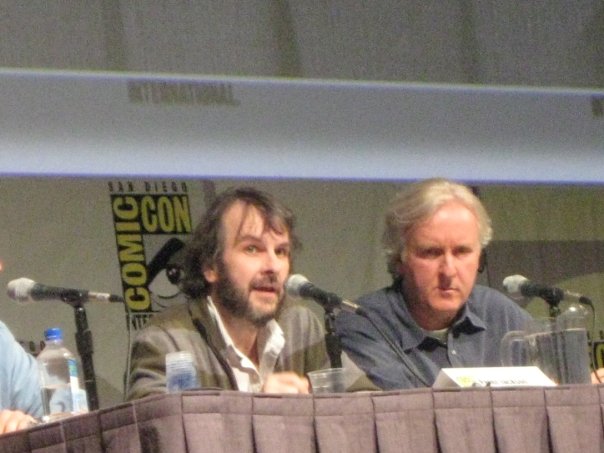
If you ever want a precise illustration of the differences between geeks and fan boys, you might want to listen to this exchange between Peter Jackson (fan boy supreme) and James Cameron (the geek's geek) as they talk about their approaches to the filmmaking process. Jackson's fascination is with the rich details of fictional worlds, many of them remembered from childhood viewings and readings, while Cameron is someone who wants to always push to the outer limits of existing cinematographic technologies. When we look at them on stage, we recognize parts of ourselves reflected back. (Alas, I missed a chance to see Tim Burton, another filmmaker, whose work I consistently admire.)

comiccon 1.jpg

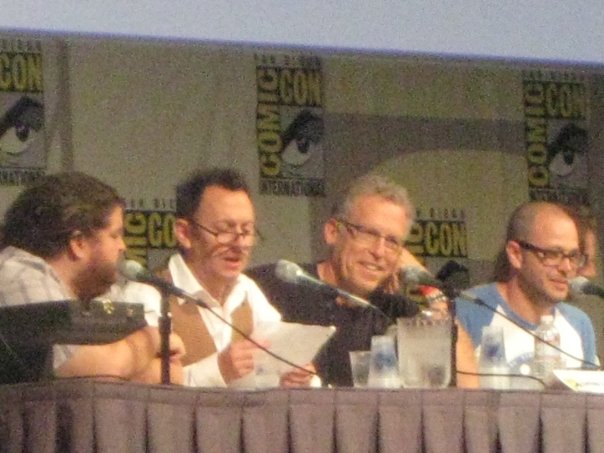
I didn't go to many Hall H style panels but I did wait in a long line to get a chance to see the Lost cast and producers talk about the final season of the series. They made it worth our while with a very lively presentation, including cast members emerging from the audience, and the sharing of year's worth of fan-produced content.

comiccon 2.jpg

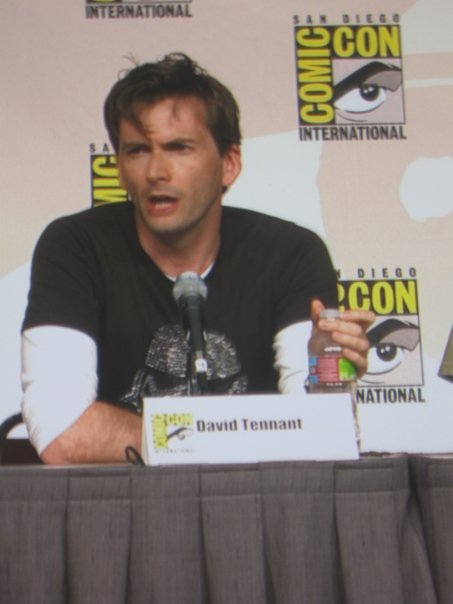
The other time I waited hours in line was to see David Tennant and Russell T. Davies talk about Doctor Who. It's hard to get a non-blurry photograph of Tennant who is full of gawkish energy. But this was as good as my son's camera could get, stretched to the limits of its focal lengths.

comiccon 11.jpg

My Wild and Wonderful Comic-Con Experiences

The first thing about San Diego Comic-Con which hits you (sometimes literally) is the throng of attendees. A decade ago, the con attracted 45,000 people. This year, it attracted something like 125,000 fans. Most of the growth has been since the dawn of the 21st century, with the population expanding at something like 20,000 new guests each year. It's hard to think what other kind of event attracts such a large number of people and holds them together over a four day period. At any given moment, about a third of them is probably in the dealer's room and another quarter is spread across the two main halls -- Hall H and Hall 20 -- which is where the most star studded events occur. For those who want to attend Hall H events, it is not unusual for people to start lining up in the wee hours of the morning. We got there at 6:30 am for a 10 A.M. session on Doctor Who, for example. And the lines will wrap for several city blocks. In the midst of this chaos, though, the crowds are surprisingly well behaved. Every few feet there will be someone in a costume striking poses and photographers taking pictures and the crowd simply swerves around them so as not to disrupt the picture taking. A friend joked though that if you pause too long in this madness, a line will start to form behind you with people not quite sure what they are waiting for. The costumes by the way lead to some interesting rumors: Peter Jackson was rumored to have dressed up in a storm trooper costume so that he can navigate the floor of the dealer's room without being mobbed. My wife suggested that if Johnny Depp wanted to do the same, his best strategy would be to dress as Jack Sparrow, given the large number of great Jack Sparrow imitators wandering through the masses. At the end of the day, you will feel overwhelmed from the sheer intensity of trying to navigate around all of those people all day long. There are basically two strategies for dealing with the crowds at Comic-Con:

a)camp out all morning, get into Hall H or 20, and stay there as long as you can. Most of the high profile events are in those rooms and people will camp out through panels they have no interest in to be able to stitch together those events which are most important to them. This can be an advantage to smaller productions which get sandwiched between the core events. A film like Kick Ass or District 8 may gain much greater visibility because it grabs the interest of people who otherwise would not be motivated to attend. It can create enormous frustration, though, as when the Twilight fans arrived early in the day, took over the auditorium, and blocked others from attending panels they wanted to see (especially the sessions with Tim Burton and, as it turned out, Johnny Depp), when their session wasn't until much later in the day. Twilight fans, in particular, have a reputation for very focused interests, as opposed to the broad generic interests which might draw science fiction or comic fans to the event. (Of course, the conflict with the Twilight fans has as much to do with generational and to some degree, gender differences as anything else). My son and I ended up sitting through a really tedious session on the current state of the Star Wars franchise in order to be able to see James Cameron and Peter Jackson. It says something about how much Star Wars has fallen from grace that even so, that panel was only about a third full. It also says something about the limited knowledge of many reporters sent to Comic-Con that a USA Today reporter tried to make the disputes between old school and newer Star Wars fans a major story coming out of the event.

b) Attend smaller scale panels and avoid the main events as much as possible. Ironically, you can almost always get good seats on the comics-related panels at Comic-Con, given what a high percentage of the newer attendees come because of the media circus Comic-Con has become. Last year, I spent most of my time in Hall H or 20 and left disappointed that I had missed a chance to see some of my favorite genre writers and comics creators. This year, I tended to reverse the strategy, though I did manage to see, among other things, Sigourney Weaver and other "Wonder Women," The Cameron-Jackson exchange, and the Doctor Who, The Prisoner and Lost sessions. Because of my choices this year, I have a chance to share with you some of the stories the mainstream media didn't cover, assuming that you've read a lot already about the 20 minutes of footage from Avatar that Cameron showed. I wasn't able to get into that session, so I don't know anything you haven't already read.

Sneak Peaks

Warner Brothers offered sneak previews of three of its new television series: Human Target, V, and The Vampire Diaries. We arrived a few minutes into Human Target and missed the set up. All three of them suffer from some of the classic problems of pilots and have not yet achieved their full potentials. I will give Human Target and V second looks. Vampire Diaries, not a chance!

Human Target, based on long-running DC comics series, deals with a body guard who puts himself in harm's way to protect his clients and the support network he's built around him. The lead, Mark Valley, is engaging and good looking but a little flat, especially when compared to much more colorful performances by Chi McBride playing more or less the same cranky private eye character he did so well on Pushing Daisies and Jackie Earle Haley as a character with a dubious past who knows how to get the information needed just in time by hook or by crook. The pilot dealt with a murder attempt on board a high speed train connecting LA and San Francisco. It delivered the goods with some really spectacular action sequences. Personally, I still prefer Leverage which hits many of the same genre buttons. I fear that I may not have enough room on my Tivo for both.

V is of course the remake of the 1980s alien invassion series. Even a quick glance suggests that the producers have framed it as a neoconservative critique of the Obama era: with the Visitors making hopeful promises starting with a reform of the health care system, offering charismatic spokespeople who seem to be able to play upon the idealism of the young and the ambitions of the mainstream media. Elizabeth Mitchell (Juliet on Lost) plays a single mom, a federal investigator, who by the close of the first episode, is finding himself immersed in an underground resistance movement which promises to uncover and publicize the hidden truths of the alien conspiracy. This one was the strongest of the three and will certainly demand a second look, though I wasn't totally hooked after the first episode.

The Vampire Diaries sucked -- and not just in the ways you expect or want a vampire series to suck. Producer Kevin Williamson has been telling the press that Vampire Diaries is not Twilight the television series and after watching the pilot episode, which deals with a high school girl who seems on the path to falling in love with the new kid in the neighborhood who happens to be a vampire, I understand why. True enough, Twilight is the most successful of a broader range of "my boyfriend is a vampire" stories. You can love or hate Twilight but it does speak with its own voice. Vampire Diaries is what happens when you put Twilight, Gossip Girl, TruBlood, and Dawson's Creek into a blender. On a first viewing, I had trouble finding anything there that had not been done before and much better.

A personal highlight of the con for me was the session of The Middleman, which I wrote enthusiastically about here after hearing the pilot episode last summer, and remained totally hooked into till the bitter end. The Middleman came and went on ABC Family without getting any real attention from the mainstream media so odds are you've never heard of it. Picture something with the playful campy tone of the old Batman series, coupled with the chemistry of the old Avengers series, and the imaginative plots of the Men in Black movies. For me, all of the pieces worked; the cast was great and the dialogue was some of the best I've seen on television in the past few years with the possible exception of Pushing Daisies. If you haven't seen it, you must get the DVD boxed set which came out this month. Like many short lived series, The Middleman left many unresolved plot points in its wake, so it was wonderful news that the cast of the series would be reuniting at Comic-Con for a live table read of the script of a never produced final episode which promised to answer all of the remaining mysteries. (The same script has also been adopted into a graphic novel). I can't tell you how much fun it was to see the entire cast, in person, performing the script. Each cast member got wild applause on first entrance. Given the tongue-twister style dialogue, there were bursts of applause when an actor managed to pull off a particular convoluted section of the script. It meant so much that the producers, writers, and cast were willing to go this far in creating a sense of closure on the series -- as disappointed as we all were to see it come and go so quickly.

In terms of advanced footage, the best stuff I saw were some segments from the remake of The Prisoner, scheduled to run later this fall on American Movie Classics. I've long loved the original British series; the new producers are putting their own distinctive spin of that series's themes and concepts. A highlight will be the recurring role of 2 which will be played by Ian McLelland who chews scenery here with the same enthusiasm as he has done in the Lord of the Rings and X-Men movies. The new series is set in the middle of the African dessert rather than in a Welsh resort town but there are still giant white balls that chase down people who try to escape. This one will be high on my viewing schedule come fall.

Yes, They Still Talk About Comics

I was able to attend sessions focusing on three of my very favorite comics creators, Mike Allred, Seth, and Bryan Talbot.

Allred, often working in collaboration with his wife, Laura Allred, has produced some really wild romps through popular culture over the past several decades. He is best known for his work on MadMan, though I have also very much enjoyed his contributions to X-Force and X-Static (where Marvel's X-Man franchise parodies itself) and The Atomics. Allred's current run on Madman has been especially open to formal experimentation with one issue drawn in a range of styles as a series of visual shout outs to key influences on his work, constituting a mini-history of the comic arts, and another was designed so that the entire issue can be read as one continuous panel. The closest comparisons to the tone of his work might be Zot! or Concrete, that is, superhero comics with a strong sense of characterization and with an eye towards critiquing aspects of the culture around them.

Seth, by contrast, is drawn towards an entirely different set of cultural influences -- more inspired by old New Yorker comics than by the superhero tradition. He's a Canadian based indie comics creator, whose works speak to our shared obsession with residual media. It's A Good Life if You Never Weaken is a semi-autobiographical piece about his search for a long-forgotten cartoonist. Wimbledon Green is a larger than life story about the world's greatest comic collector (think Richie Rich if Richie Rich collected comics rather than cash). Clyde's Fans, still a work in progress, and his most recent graphic novel, George Sprott, are character studies of old men reflecting back on the past -- in the first case, the protagonist, among other things, collects postcards, while in the second Sprott was an adventurer, filmmaker, lecturer, and television host. There's so much to love about Seth's work -- a very humane and caring tone, a great attention to detail (especially the artifacts of our cultural past), solid characters, and a visual style which is at once retro and surprisingly fresh. Seth's public persona captures so much of what I love about his work: he is a very quirky guy who dresses in a timeless though vaguely retro style and speaks in a low key voice that fits his work perfectly. He read a series of short autobiographical bits which spoke to key influences on his work, how he thinks about stories and images, and what he did and did not learn in art school, all of which honestly helped me to understand his work more fully.

Bryan Talbot is a British cartoonist who has been credited with producing some of the first Steampunk comics in the English language, The Adventures of Luther Arkwright. Many of his works draw inspiration for late 19th and early 20th century British children's literature. The Tale of One Bad Rat includes long ruminations on Peter Rabbit and other Beautrix Potter characters. His more recent Alice in Sunderland is a long, rambling look at the creation of Alice in Wonderland which manages to convey large chunks of British regional history; the visual look of Alice is complex, scrapbook like, created through the juxtaposition of drawings and photographs, and is a powerful illustration of how graphic storytelling can be used for the purposes of cultural criticism and literary history. Here, he was speaking on the anthropromorphic tradition in British comics -- basically funny animal strips in the newspaper and magazines -- and how they have inspired his latest creation, Grandville, which is scheduled for release later this fall.

I also attended a lively session on contemporary art direction hosted by John Muto (Home Alone, Terminator 2 3D), who I have gotten to know through our mutual involvement with the 5D conference, and another session focusing on the life and work of Harvey Kurtzman, best known for his contributions to Mad, his war comics for E.C., and his Little Annie Fanny series for Playboy.

Henry Takes the Stage

This was the first year that I was speaking at Comic-Con. I was invited to join two panels, the first centering around the launch of the Institute for Comic Studies, and the second focusing on the current state of Harry Potter fandom. The Institute for Comic Studies is headed by Peter Coogan, who is the author of Superhero: Secret Origin of a Genre. I have agreed to be on the board of advisors for the organization which is designed to provide a central clearing house for initiatives supporting the teaching and research of comics, primarily on the college level. As someone who is doing more and more writing at comics myself, it is a thrill to see Comics Studies really start to take off as an academic field, albeit one which straddles a range of different disciplines and interests. Panels which the Institute organized at Comic-Con ranged from discussion of the forgotten erotic comics of Superman's co-creater Jerry Schuster to discussions of the mental health of the Joker to considerations of whether it would be possible for any mortal human to acquire the skills and tools that Batman displays in the comics. Some of the work is still very much in the range of fan boy speculation, though good fan boy speculation, while others is informed by historical, anthropological, art history, or cultural studies perspectives.

I told the group that we should learn from other fields which have sought to tackle materials beloved at Comic-Con: the teaching of film studies at the university level has broadened the public's background and tastes, especially around independent films, foreign films, and documentaries and thus expanded the market for kinds of films which don't play at the local multiplex; Game Studies has helped to rally a defense of the medium against censorship, with scholars being able to add credibility to industry participants concerned about freedom of expression issues. Both of these represent directions that Comic Studies could take. On the other hand, I fear that science fiction has been badly served by being folded into Literature programs with many college courses emphasizing only those works which are already in the canon but which can claim some association with SF, rather than dealing with the popular and pulp roots of the genre and the ways they influenced a much broader range of cultural materials. I worry that comics scholarship may emphasize indie and alternative comics at the expense of the popular roots of the medium, taking a "no capes, no flight" philosophy which again only accepts those works which can be most easily embraced by the literary and art worlds.

The panel on Harry Potter fandom was organized by Eric Bowling and included many of the key players in the fandom: Leslie Combemale from ArtInsights Gallery; Melissa Anetelli, webmistress for the Leaky Cauldron and author of the best-selling Harry: A History, Gwendolyn Grace of the HP Educational Fanon, Time Magazine critic Lev Grossman, and Heidi Tandy, a founder of the Fiction Alley website. I had gotten to know many of these great people through my participation the previous week at Azkatraz, a Harry Potter fan gathering in San Francisco. Here, there was lots of concern raised about Warner Brother's lack of Harry Potter promotion at Comic-Con and whether the fans still exert any meaningful influence over what happens next with this franchise. It was astonishing to me to see the number of people waiting in line for this session, which was standing room only and turned many away. A few came no doubt expecting to see cast-members, but most came to "represent" for their fandom.

There's so much more to tell but I am hoping this will give you some taste of the pleasures of this year's Comic-Con.

How "Dumbledore's Army" Is Transforming Our World: An Interview with the HP Alliance's Andrew Slack (Part Two)

So you're using a language of play, of fantasy, of humor to talk about political change? Much of the time, political leaders deploy a much more serious minded, policy-wonky language. What do you think are the implications of changing the myths and metaphors we use to talk about political change?

I think it's so freaking important to break things down for people in a way that they can understand. We get into this wonky-talk. There are so many organizations doing amazing things, and they mobilize their membership really well - but it doesn't connect to young people. Young people, by and large, care about issues like genocide. They care about issues like poverty, discrimination, environment. They want to be engaged in these things, but the people who are going to be inviting them to engage, have to be thinking about "how do I authentically talk from my heart to this young person in a way that's authentic to their experience and to our shared experience?" One of the reasons why I was successful in beginning the Harry Potter Alliance is because I'm such a hardcore Harry Potter fan. Had I not been such a passionate Harry Potter fan, had I not been caring about this myth so much myself, I wouldn't have been able to translate the message as well.

And so it's important, I think, when talking with people to find out what you have in common, what you're both passionate about, and then to translate that into the real world in a way that makes sense. Activism should be fun. Activism is fun, but of course, the issues can get so heavy. We can get paralyzed by a sense of guilt of not wanting to even look at the problems because they seem so big. And if I look at them, we often ask, "how can I go on with my life?" This is similar in Harry Potter to people saying, ' I can't say Voldemort's name. I'm too scared to even say his name, so I say, you-know-who.' In our world we think, "I can't say AIDS. I can't say poverty. I can't say genocide because if I open my eyes, I'll never be able to look away, and it will ruin my life." And that's not a helpful attitude for anybody. We have to learn how to say the name Voldemort in stride, and how to say these words - genocide, etc. - in stride, and not get caught in this idea that we have to fix it all. We can be part of a larger community playing our part. And that experience can be empowering and fun.

We had a meeting a couple days ago - a conference call. It was for something called Stand Fast. We're working with this amazing organization called STAND, which refers to itself as the student arm of the anti-genocide movement, and they are building a constituency across the world of students who are standing up against genocide in Darfur and now against ethnic cleansing in Eastern Burma. They are funding a civilian protection program in Darfur, where $3.00 protects one woman from being raped for a whole week, and $5.00 protects a whole family in Eastern Burma by providing them with radios. And this is such an empowering concept because you can say to a young person, 'instead of going to a Starbucks and getting a latte, instead of going to a movie, on this particular date, we're going together not go to a movie or give up some sort of luxury item, and $10.00 will fund the protection of one woman in Darfur for a week and a whole family in Eastern Burma - just $10.' A young person can understand that, can grasp that, and can also understand that this is not just about charity - it's not just about your money. It's a political statement when 15 year olds are protecting the lives of people in Darfur and Eastern Burma because their governments have been unable to do it regardless of how many resources they have. That is a political statement, and so we talk about that. But here's how we did it - we got the leaders of the Harry Potter fan community, the biggest names in the Harry Potter fan community of the Websites that - the Leaky Cauldron, Mugglenet, the biggest wizard rock bands - we got them all together to make an announcement that we are going to have a live conference call where you can all come. We had over 200 people come on the conference call under short notice to talk about this one day where we'd all be donating, December 3rd, it just happened. And people can still do this at theHPAlliance.org/civilianprotection. But, and here's where part of the fantasy comes in: we didn't just call it a conference call. We called it a meeting of Dumbledore's Army. We're going to have a Dumbledore's Army meeting - that we're going into a Room of Requirement, where you're given a code to get in. You press pound, and you're in the room of requirement. We talk about, we're in the Room of Requirement now, and just like Harry got up and taught people how to do this, we're going to talk to you about the issues. And everybody was briefed, all the speakers on what to say, and how to talk about this issue - but they did it from their own place and what they're passionate about. And it was just incredible. The response we've had from the people on the call was unbelievable. People giving up smoking. People giving up coffee. People saying, "I'm taking half the money I would have spent on Christmas, and giving it to this. And I'm going to tell all my family that the reason I'm not giving them as much this year is because I gave it to people who need it in Darfur and Burma, and I'm sure they'll be proud of me. And I feel so proud of myself right now."

It was an amazing experience, but it was done through fantasy. We didn't just say we're like Harry. We actually pretended that we are in a Room of Requirement. We are Dumbledore's Army, and we're doing it. And it was really empowering last year when J. K. Rowling said that this is truly an organization that is fighting for the same kinds of values that Dumbledore's Army fought for in the books, and to everyone involved in this organization, the world needs more people like you. And it was a real boost for our morale, and it was an incredible thing to get a message like that from one of our favorite authors.

You've already started down this path - so why don't you say a little more about how the fan community provides part of the infrastructure for something like the HP Alliance?

Yeah, it couldn't happen without the fan community. When we started, I was blogging about these ideas - about the parallels between discrimination in Harry Potter and discrimination based on race or sexuality in our world. Or about political prisoners in Harry Potter and political prisoners in our world. About ignoring Voldemort's return, and ignoring the genocide in Darfur in our world. So I was blogging about this, but no one was reading my blog. You know that wasn't really taking off too fast. Then I met Paul and Joe deGeorge of the wizard rock band Harry and the Potters. These are two guys that started a band where they sang from the perspective of Harry Potter. They still do. They loved the idea of a Dumbledore's Army for the real world, and soon enough we began brainstorming ideas - and I took my blogs, where I provided action alerts for how people can be like Harry and the members of Dumbledore's Army, and they reposted it on their Myspace page. Their Myspace at the time was going out to about 40 or 50,000 profiles. Now it's going out to about 90,000 Myspace profiles. Soon other musicians began to form bands that were wizard rock - bands based off of other characters in the book. Draco and the Malfoys were the bad guy band. The Whomping Willows based off of a tree at Hogwart's . The Moaning Myrtles - there's so many of these bands, and they all began to repost together, collectively, the messages that I was writing. Soon, through these wizard rock bands, we were communicating with over 100,000 Myspace profiles, and then the biggest Harry Potter fan sites wanted to be a part of it as well because this is a community that is just so incredibly enthusiastic, idealistic - believes in the values that are in Harry Potter about love and social change and the values in Amnesty, and they began to post what we were doing.

And they put up our first podcast right before Deathly Hallows, the last book, came out. Thanks to their putting it on their podcast feed at the time, at the peak of Harry Potter's popularity - that podcast was downloaded over 110,000 times, and STAND, one of our partner organizations, saw a huge spike in involvement that month thanks to our efforts. They saw a 40% increase in high school chapter sign ups compared to a normal two week period in July, and over a 50% increase in calls to their hotline - 1-800-GENOCIDE in a two week period compared to a regular two week period in July. This year the wizard rock bands and Mugglenet posted this special project that we were doing with a group in the UK, called Aegis Trust. Aegis Trust works on all sorts of genocide remembrance issues around the Holocaust, around Rwanda, but they had a special project where they were sending letters to the United Nations, asking the Security Council to do something about war criminals that were being given protection, impunity in Sudan, and they ended up sending 10,000 letters to the UN Security Council. Of those 10,000 letters, over three-quarters of them came from the Harry Potter Alliance. We weren't members of government. They were getting a lot of members of governments to write. We got young people. We brought Dumbledore's Army. The Harry Potter Alliance - we have about 3500 people on our e-mail list. We have about 50 chapters. We have about 12,000 Myspace members - about 1500 Facebook members, but we could not have done that without this larger network of wizard rock bands sending it out and of fan sites posting - here's what Dumbledore's Army is doing now. Here's what Harry Potter Alliance are doing now. We're all part of this alliance. Let's all step up to the plate, and even though we reach sometimes about 100,000 people, getting about 8,000 signatures, that's almost 1 in 10 of who we're reaching, and that's a lot as far as action goes because different people are engaged in different ways through our organization.

So that's just one example. In the last year, we've raised well over $15,000 from small donations to fund the protection of thousands of women in Darfur and villagers in Eastern Burma.

In the process we educate young people through podcast interviews with survivors of the Rwandan genocide in 1994, with policy experts, as well as with partnerships with groups like the Genocide Intervention Network and it's student arm STAND, the ENOUGH Project, Amnesty International, Aegis Trust and several other human rights organizations.

And now we are building these chapters and we want them to exist in schools and after school programs. And we want to help shape curriculum on how Social Studies and English are taught, if schools would be open to it.

At the same time, you've been able to build an alliance with some very traditional political organizations and governmental leaders. Could you say a little bit of how they've responded to the Harry Potter Alliance approach?

When I first started calling traditional organizations letting them know that I wanted to help them, I was very afraid that they were going to hang up when I told them the name of the organization is the Harry Potter Alliance. And if I said, HP Alliance, they would think it was The Hewlett Packard Alliance. In fact, one of our board members has been getting mail to the Hewlett Packard Alliance. We've never referred to ourselves as the Hewlett Packard Alliance, but people see HP, and they think Hewlett Packard. (laughter) And that's an alliance I don't want to be part of. So (laughter) when I tell the organizations at first who we are, there's this initial insecurity that I have on how they're going to react, and at first that insecurity proved to be warranted because they didn't know what to do with a group that is named after a fictitious book for young adults and plus, we had no track record. Though despite some challenges here and there, I must say that I was actually impressed with how open minded some people were. I think the best example of this is the Co-Founder of the ENOUGH Project John Prendergast. John is a policy expert on issues of international crisis and truly is a celebrated activist. But John actively looks for outside of the box ideas. When I met him in 2005 and told him about our new organization, my heart was pounding with nerves and he looked at me very intensely and basically said, "Dude. Comic books turned me into an activist. The least I can do is mention this in the book I'm writing with Cheadle." And that's Don Cheadle who starred in Hotel Rwanda. And this was crazy to me. And we are in that book, which was a New York Times best seller. It's called Not On Our Watch: the Mission To End Genocide in Darfur and Beyond and it's an excellent book.

But now when I call up organizations to form coalitions and partnerships I can tell them that we can get you thousands of people to see what they're doing. This strategy is very important to us: connecting Harry Potter fans to NGO's that are doing impressive work. We see they need more people, and we provide them with the people. We tell them, 'look, you know Harry Potter, and you know there's a lot of enthusiasm here. We can channel some of that enthusiasm to this noble work that you're doing by just using examples from the books and this incredible community of people, and we've been in Time magazine - and we've been in The Los Angeles Times.' So you know that sort of helps them take us more seriously now. Now, they want the Harry Potter Alliance to be involved, and then sometimes I'm thinking, I have to kind of pinch myself that now they're coming to us - and there's been a couple examples of them paying us as consultants to help them with recruiting young people to become part of their movement. The best example of that has been with our efforts to get young people educated on the issue of media reform.

We've worked with an organization called Free Press which can be found at freepress.net - Free Press leads a group called the Stop Big Media coalition. And we have a whole campaign where we compare things in Harry Potter that involve media consolidation to media consolidation in our world. Most people don't know much about media consolidation, but when you begin looking at how minorities are not represented fairly in the media, ethnic and racial minorities make up about a third of the US population, and they own I believe less than 3% of commercial TV. Women and minorities make up about 66% of this country, and yet are on television news about 12% of the time. What we see on TV, what we are shown visually, what is defined as "normal" in our culture are white men. The problem here is that the Federal Communications Commission has stacked the deck in the favor a handful of conglomerates to own most media in any given city. And this wipes out independent local media. And we want the FCC to change that, because it affect our outlook on race, it affects our outlook on our own communities, it even affects how foreign news like the genocide in Darfur is covered. The big conglomerates have cut foreign news by around 80% since the 1980's and replaced that with celebrity gossip -which would explain why Brittney Spears is covered more than a genocide that would be stopped if the political will was there.

This issue has gotten our membership really fired up, and we say what media reform activists always say: "whatever your number one issue is, media reform should be your number two issue because your issue can't be communicated if the media is not free." It's been really exciting - but yeah, so these traditional organizations, whether it's the Save Darfur coalition and the ENOUGH Project, STAND and the Genocide Intervention Network and Aegis Trust, all issues - all organizations that work on genocide related things - or Free Press or the No on Proposition 8 campaign, which we worked on. We recently did something called Wizard Rock the Vote, where we registered close to 900 people. I think they were almost all new voters at wizard rock concerts across the country and online, and that was in partnership with the organization Rock the Vote. They loved us, and it's a lot of fun. It's a lot of fun for them, too, because these organizations have staff members that are Harry Potter fans. And I personally have put out a couple of videos satirizing Wal-Mart, and because of this fan base, we were able to get two of the videos over 2 million views on YouTube. It just sped out of control, and I mean it's incredible. I call it cultural acupuncture, when you can take something where there's a lot of energy, and then translate it to something else. A lot psychic energy you - psychological energy being placed on something, and you move to make it healthier. It's a remarkable thing to see what we can do, and for teachers and youth workers, I think it's really important to think about what are your students interested in?

I think one of the biggest problems with our education system - I mean I can't stand No Child Left Behind, not just because it hasn't gotten proper funding, but because I wasn't very good at standardized tests in school - and I think they are generally about regurgitating information. I call it, Leave No Imagination Recognized. When engaging young people to become civically minded, find out what they care about. If you're working at an after-school program with inner-city youth, find something that's going to speak to inner-city youth. Are they interested in a specific kind of music? A lot of the kids that I've worked with from inner-city environments have been interested in hip-hop, so can you find yourself a teacher who knows about hip-hop, and gets the people to be part of a contest that's hip-hop oriented - but that involves research to say that the greatest hip-hop music out there, not the kind you hear in clubs per se, but the greatest hip-hop artists have reflected what's been going on in their communities and how things can change. That's the real hip-hop, and to you really work on that - and do some sort of hip-hop activism through organizations like the League of Young Voters, who often times refer to themselves as the League of Pissed Off Voters - that gets young people engaged. Show them episodes of The Wire, the HBO series, and then talk about the issues of crime, poverty, and drugs that are depicted in that series. And then right after that discussion, begin working on a project together. My idea for The Wire is show one episode that's an hour, then the next hour, discuss the issues that are in that episode, and how that reflects your own personal life - and in a third hour, start a project that addresses those issues.

So it should start with a piece of art that provokes the discussion, then have the discussion, and then after the discussion, don't leave it there, turn it into action. And that's one way to engage a specific population of young people, but that same method can be replicated for any group of young people, especially if you have access to video equipment. If you had access to video equipment, if the kids know how to write, you can show them how they can produce videos that will be seen by a lot of people, and how there's more to their world than just where they are - that they really now more than ever - we don't need to be paying lip service to young people that they can change the world. They can do it today, they can do it right now. If they care about something, they can do it, and they will be better at coming up with a video than the teachers. Find writing teachers. Find acting teachers to help them refine their jokes - make their videos funny or emotionally powerful. Have them interview people in their communities on what they care about. Get that stuff up on YouTube - where ever a young person's voice can be heard by the world. Tom Friedman has a great quote that the only competition that now exists is the one between us and our own imaginations. And now it's purely a matter of getting young people the access to these resources to do it, and then getting them to learn how to most effectively make those ideas and things viral. All you got to do is get them to care about something, and then they'll take care of it from there.

We've talked about a number of new media platforms in all of this-- blogs, podcasts, social network sites, YouTube. How important is that infrastructure of new media to enabling the kind of work that you guys are doing?

Without new media, I don't know what we would be doing. I don't think we would exist. We would be like students at Hogwarts without wands. We would be a club at one or two high schools, which would be fine. It's great to be a club at a high school. But we probably would have a hard time being an organization that has 50 clubs that are really active, which we have right now as far as chapters go, and a message that gets out to 100,000 young people in Japan and in places...just all over. We've got kids in Japan that are working on media reform issues in the United States. New media has provided us with an opportunity where you know we always say to young people that they have a voice, that their voice matters. The Harry Potter Alliance communicates with over 100,000 young people across the world. We've gotten to old media, Time magazine, front cover of The Chicago Tribune "Business" section - The Los Angeles Times, etc. None of this could've happened without new media platforms.

Andrew Slack is the founder and executive director of the Harry Potter Alliance where he works on innovative ways to mobilize tens of thousands of Harry Potter fans through a vibrant online community. Andrew has also co-written, acted in, and produced online videos that have been viewed more than 7 million times. He has taught theater workshops and served as a youth worker for children and adolescents throughout the US and Northern Ireland. A Phi Beta Kappa graduate of Brandeis University, Andrew is dedicated to learning and extrapolating how modern myth and new media can transform our lives both personally and collectively.

I am looking for other compelling stories of how fans are becoming activists. If your fandom is doing something to make the world a better place, drop me a note. I will try to feature other projects through my blog in the future.

How "Dumbledore's Army" Is Transforming Our World: An Interview with the HP Alliance's Andrew Slack (Part One)

Last weekend, Cynthia and I drove up to San Francisco where I spoke about "Learning From and About Fandom" at Azkatraz, a Harry Potter fan convention. The key note speaker at this year's event was Andrew Slack of the HP Alliance. Slack is a thoughtful young activist whose work is exploring the intersection between politics and popular culture. He's really helped to inspired some of the research I am going to be doing in the coming year about "fan activism" and how we can build a bridge between participatory culture and democratic participation. I interviewed Slack for Journal of Media Literacy earlier this year and I thought this would be a good opportunity to share that interview with my blog readers. Slack's work is gaining greater visibility at the moment because of the release of the new film, including a recent profile in Newsweek magazine (warning -- the piece is typically patronizing and ill-informed about things fannish but that it exists at all speaks to the impact this group is starting to have in terms of rallying young people to support political change). At the con, Slack spoke about his "What Would Dumbledore Do" campaign, an effort to help map what the "Dumbledore Doctrine" might mean for our contemporary society. You can read more about it here.

The HP Alliance has adopted an unconventional approach to civic engagement -- mobilizing J.K. Rowling's best-selling Harry Potter fantasy novels as a platform for political transformation, linking together traditional activist groups with new style social networks and with fan communities. Its youthful founder, Andrew Slack, wants to create a "Dumbledore's Army" for the real world, adopting fantastical and playful metaphors rather than the language of insider politics, to capture the imagination and change the minds of young Americans. In the process, he is creating a new kind of media literacy education -- one which teaches us to reread and rewrite the contents of popular culture to reverse engineer our society. One can't argue with the success of this group which has deployed podcasts and Facebook to capture the attention of more than 100,000 people, mobilizing them to contribute to the struggles against genocide in Darfur or the battles for worker's rights at Wall-Mart or the campaign against Proposition 8 in California.

The Harry Potter novels taught a generation to read and to write (through fan fiction); Harry Potter now may be teaching that same generation how to change their society. The Harry Potter novels depicted its youth protagonists questioning adult authority, fighting evil, and standing up for their rights. It offers inspirational messages about empowerment and transformation which can fuel meaningful civic action in our own world. For example, in July 2007, the group worked with the Leaky Cauldron, one of the most popular Harry Potter news sites, to organize house parties around the country focused on increasing awareness of the Sudanese genocide. Participants listened to and discussed a podcast which featured real-world political experts -- such as Joe Wilson, former U.S. ambassador; John Prendergast, senior advisor to the International Crisis Group; and Dot Maver, executive director of the Peace Alliance -- alongside performances by Wizard Rock groups such as Harry and the Potters, The Whomping Willows, Draco and the Malfoys, and the Parselmouths. The HP Alliance has created a new form of civic engagement which allows participants to reconcile their activist identities with the pleasurable fantasies that brought the fan community together in the first place.

In this interview, Slack spells out what he calls the "Dumbledore Doctrine," explores how J.K. Rowling infused the fantasy novels with what she had learned as an activist for Amnesty International, and describes how the books have become the springboard for his own campaign for social change. Along the way, he offers insights which may be helpful to other groups who want to build a bridge from participatory culture to participatory culture.

Why don't we begin with the big picture? Can you just describe what the HP Alliance is, and what it's core goals are?

The Harry Potter Alliance, or the HP Alliance is an organization that uses online organizing to educate and mobilize Harry Potter fans toward being engaged in issues around self empowerment as well as social justice by using parallels from the books. With the help of a whole network of fan sites and Harry Potter themed bands, we reach about 100,000 people across the world.

The main parallel we draw on comes from Harry Potter and the Order of the Phoenix where Harry starts an underground activist group called "Dumbledore's Army" to wake the Ministry of Magic up to the fact that Voldemort has returned. The HP Alliance strives to be a Dumbledore's Army for the real world that is trying to wake the world up to ending the genocide in Darfur.

Recently we have expanded our scope, discussing human rights atrocities in Eastern Burma, and we're going to be incorporating Congo into our vision soon. I'll talk more on exactly what we have done regarding these issues in a moment, but the parallels don't stop with this notion of Dumbledore's Army waking the world up to injustice. The Harry Potter books hit on issues of racism toward people who are not so called "pure blooded" Wizards just as our world continues to not treat people equally based on race. House elves are exploited the way that many employers treat their workers in both sweat shops in developing nations and even in superstores like Wal-Mart. Indigenous groups like the Centaurs are not treated equally just as Indigenous groups in our world are not treated equally. And just as many in our world feel the need to hide in the closet due to their sexual orientation, a character like Remus Lupin hides in the closet because of his identity as a werewolf, Rubeus Hagrid hides in the closet because of his identity as a half-giant, and Harry Potter is literally forced to live inside a closet because of his identity as a Wizard. With each of these parallels, we talk to young people about ways that we can all be like Harry, Hermione, Ron and the other members of Dumbledore's Army and work for justice, equality, and for environments where love and understanding are revered.

The average person we reach is somewhere between the ages of thirteen and twenty-five, very passionate, enthusiastic, and idealistic - but often have very few activist outlets that speak to them. And this is no coincidence. Unfortunately, so much of our culture directed at young people is about asking them to consume. It's looking at them as dollar signs, as targets for advertising. But Harry Potter is a great example of a book that hasn't done that. Of course there's merchandising and all that kind of thing, but fundamentally the message of the book is so empowering for young people.

Young people are depicted in the books as often smarter, more aware of what's happening in the world, than their elders, though there are also some great examples where very wise adults have mentored and supported young people as they have taken action in the world. These books represent a very empowering tool for young people, and young people have taken it into their hands - and created Websites and fan fiction, and a whole genre of music called "wizard rock" around Harry Potter. And it's been extraordinary. So we are utilizing all of that energy and momentum to make a difference in the world for social activism. We are essentially asking young people the same question that Harry poses to his fellow members of Dumbledore's Army in the fifth movie, "Every great Wizard in history has started off as nothing more than we are now. If they can do it, why not us?" This is a question that we not only pose to our members, we show them how right now they can start working to be those "great Wizards" that can make a real difference in this world. Whose imprint can have a value that is loving, meaningful, and nothing short of heroic. And the enthusiasm we've seen from young people is just astounding.

By translating some of the world's most pressing issues into the framework of Harry Potter, it makes activism something easier to grasp and less intimidating. Often we show them fun and accessible ways that they can take action and express their passion to make the world better by working with one of our partner NGO's. Not to mention, our chapter members and participants on our forum section come up with their own ideas which they collaborate on together - so while we often make decisions from the top-down, we also are building a way for each member to direct the destiny of what they and the larger organization are working on.

J.K. Rowling used to work with Amnesty International. How do you think that background impacted the books?

Well there's definite parallels between Amnesty's themes and the themes in Harry Potter. One of the main human rights issues that Amnesty works on is for the release of political prisoners.

Harry's godfather, Sirius Black, was a political prisoner. His best friend James Potter and James' wife Lily were murdered and his godson Harry was orphaned. But on top of that trauma, he was accused of committing the murders. Now if he had had a trial, he could have made a case for why he was innocent and how the real killer was still on the loose. But that couldn't happen because the Ministry of Magic had suspended habeas corpus. This all happened at a time of great terror and in times of great terror, governments often lock people away without a fair trial. We need not look very far for that. It's happening right now in our own country. And not only are these prisoners, many of them innocent like Sirius, not only are they locked up without trial, they are subsequently tortured--another issue which Amnesty works hard to stop.

In Harry Potter, the Wizarding prison known as Azkaban is guarded by Dementors. Dementors suck all the happiness from you, and live you in a state of tortured non-stop panic attack/depression. They literally feed off of the unhappiness in your soul until they suck your soul dry. This is the essence of torture and this is what's been getting done to people in Guantanomo Bay and Abu Ghraib and Eastern European prisons that the CIA helped build. People are locked away without a fair trial and then tortured. This is all done under the rationalization that in times of terror, justice must be suspended in the name of freedom. But then the very freedom we profess to stand for gets suspended as well in the name of preying on people's greatest fears rather than praying for our better angels. And this hurts the cause. A society that becomes a tyranny in order to fight for its freedom has destroyed the very purpose for which it is fighting. And in doing so, such a society gives strength to it's opponent. We need not go very far in our research to understand that the torture that our country has committed in Abu Ghraib and Guantaomo Bay has not only been immoral, it has been dreadful on a public relations front. Images of tortured Muslims has become one of al Qaeda's most effective recruiting methods.

And this aspect of a government shooting itself in the foot while selling out it's ideals happens in Harry Potter too. After Dumbledore's Army forces the Ministry of Magic to acknowledge Voldemort's return, the Ministry returns to the days when people are no longer given trials. And in order to look like they are making some headway, they arrest someone innocent named Stan Shunpike. They know the guy is innocent. They arrest him anyway, and he ends up being released by the Death Eaters, and put under the Imperius Curse, thereby becoming one of the Death Eaters.

So these Amnesty themes of political prisoners getting the right to a fair trial and the end of torture are consistent with the Harry Potter books and the values of Amnesty International.

But JK Rowling in her personal work outside of the books, takes that a step further. This can be seen in her charitable work and advocacy on many fronts, including helping children who are caged in Eastern Europe. Besides this incredible work, there's the words that she speaks outside of the confines of the books and these words help articulate the messages of Harry Potter.

Her commencement speech at Harvard in the spring of 2008 was unbelievable. One of the main themes of the speech was around the power of imagination and how we must "imagine better." She said, this doesn't necessarily mean imagining a magical world like she has done, but about building the capacity to imagine oneself in other person's shoes, and in that speech she talks about her experience at Amnesty International as being formative for her imagination. She got to work with people that were so passionate about imagining themselves in other peoples' shoes. And she became one of those people - imagining herself in the shoes of political prisoners, in the shoes of people that have fought for democracy under tyranny. There's a horrific story she tells where she is helping somebody who had been in prison, and as she was guiding this person to the airport, she heard a blood curdling scream. She said she had never heard a scream like this in her life, and it was from a political refugee that had just been informed that because of his dissident activities in his own country, his mother had just been killed. She said it was a scream that will always stay with her. And in talking to the students at Harvard, she was really very, very adamant that those in the United States, which is for now the only world super power, those of us who have the privilege of education also have both an opportunity and a responsibility to to imagine better, and imagine ourselves in other people's shoes. Let me read her quote directly. She says, "If you choose to use your status and influence to raise your voice on behalf of those who have no voice; if you choose to identify not only with the powerful, but with the powerless; if you retain the ability to imagine yourself into the lives of those who do not have your advantages, then it will not only be your proud families who celebrate your existence, but thousands and millions of people whose reality you have helped transform for the better. We do not need magic to change the world, we carry all the power we need inside ourselves already: we have the power to imagine better."

What can you tell us about your own relationship to these books? How was the idea of the HP Alliance born?

I already had a very strong interest in the power of a story to grab people and to get them more engaged in living a healthier life and in contributing more in a way that is civically engaged and civic minded. As a college student at Brandeis University I got to explore my feelings around this while at a center for peace and reconciliation in Northern Ireland, while interviewing Civil Rights activists in person throughout the US, and while studying at an acting conservatory in London. It was when I graduated from college, however, that I found Harry Potter. I had heard of the books but had little interest in them.

Upon graduating, I was teaching at a creative theater camp, and I was amazed at the way these children discussed and debated Harry Potter - with so much passion. It was insane. I was intimidated to start reading the books; there was just so many of them. There were four released at the time. The teachers were enthralled by them, and urged me to read them.

I was still resistant. And then I started working in the Boys & Girls Club in Cambridge, and I was working with a completely different socio-economic group of kids - racially and ethnically diverse - yet they, too, were lovers of Harry Potter. One of my colleagues at the Boys & Girls Club of a different race and ethnic and socio-economic background from me was obsessed with the books. She would read them constantly and I couldn't understand how it could be so great - and finally I asked her to hand me the first book, and she did - and I read that first chapter, and I just started laughing so hard.

The first sentence - " Mr. and Mrs. Dursley, of number four, Privet Drive were proud to say that they were perfectly normal, thank you very much. " I was surprised. This is a subversive book that right away begins to indict what I eventually started to call a Muggle Minded attitude -- being obsessed with "normalcy," not being interested in imagination, not being able to see outside of one's self. So I was swept away, right away, and by the end of that first chapter, I turned to this young woman who handed me the book and I said, 'I think this book just changed my life.' I raced through those first four books. Read them again and again, and I began making personal connections with them for myself. I think when you read a book about a hero, often times you become the hero, and for me, I would see myself as Harry in specific situations - and issues that I have dealt with in my life around anxiety - fighting Dementors became similar to that. There's a lot of loved ones I have that suffer from addiction, and their struggle with addiction seemed to mirror some characters' struggle to get out of the hold that Voldemort has on them when they follow him as Death Eaters. There's a very addictive quality, and watching what happened to one of the characters and his family around being a Death Eater is interesting because you see the tragedy of what happens to anyone who has a family member that is an addict, as so many young people do. In the case of Voldemort's followers, it's a cult, but it's still got this very addictive element to it, and I'm sure if you go into areas where there's terrorism in the world, a lot of families - like the ones I met and worked with in North Ireland -- experienced that addictive quality. It might not be drug addiction, but having a family member who is in a paramilitary group is a very, very difficult thing to cope with. Even families that sided with them intellectually couldn't deal with the idea of them being imprisoned and all of the horrible things they were doing.

So these books were speaking to such a broad range of very human experiences - including the wish to live a normal life despite adversity. The wish to, in Harry's case, play Quidditch and Exploding Snap and to have a crush on a girl like Cho Chang or Ginny Weasley. And all the while having to contend with darker forces in the world that he is internally connected to. Well I was just swept away by all of this. And the feeling of the story: Harry Potter brought me to this child-like state where everything was fun. I mean the books are so fun. What's different about these books than a lot of other fantasy books is how hilarious they are. They're just full of jokes that go into the day to day existence of characters, and then all of a sudden we're back into that fantasy realm of suspense that you see in books like the wonderful series His Dark Materials, more commonly known as The Golden Compass books. Harry Potter has all of that but it has humor to it, and so it really--I spent years as a comedian and I really connected to her sense of humor. I really connected to her sense of fantasy and imagination - how utterly playful the books are. So I was connecting to them from the point of view of how well written they were, how fun they were, and how much they spoke to me on a personal level in my own life, but then at the end of the fourth book, I was just amazed at what Dumbledore says to Cornelius Fudge, the Minister of Magic at the time. He says, in the wake of Voldemort's return, we've got to get rid of dementors, form alliances with those in foreign lands, and end our attitudes of racism. He then gets up in front of the whole school and says that we must be able to say what we're scared of, which I think is essential for young people to do, and to vocalize their fears and to name their fears. And we must understand that Voldemort's greatest gift is spreading discord and enmity, and that's what we see in our world.

With terrorism, it's not just about killing and the number of people they kill. It's also about the fear that they inflict in those who survive. And that's the same as Voldemort, and Dumbledore says, we can only combat this discord and enmity with an equally strong bond of friendship and trust. And this is what I call this Dumbledore Doctrine - that as the band "Harry and the Potters" say, "the greatest weapon we have is love." That this can actually translate into policy that is really important. And I began thinking, wow, the world needs Dumbledore. The world needs a Dumbledore, and then when I read that fifth book, where Harry starts an activist group named after Dumbledore - Dumbledore's Army - I thought, the world needs a Dumbledore's Army, and I began imagining myself going into the Room of Requirement and meeting with young people as if we were part of Dumbledore's Army - and each of us could be like Harry Potter - could see ourselves in the hero role, not where we're the chosen one to bring down all evil or anything like that, but where each of us plays a valuable part in changing this world, where we are the shapers rather than the spectators of history. I think it's amazing how we in this country with all of our resources have an opportunity to connect with people in our communities as well as people all over the world. And to do so in our relationships but also through volunteering in our communities and service as well as through civic engagement in the political process. That doesn't mean to engage in a partisan fashion, although people can feel free to do that, but the Harry Potter Alliance doesn't advocate for anything in a partisan way. However, we do want people to both volunteer with people at a local AIDS clinic as well as advocate for better treatment of AIDS victims in Africa. We want our young people tutoring underprivileged kids and helping them read, getting them engaged in the Internet and learning those things, but then also challenging the rules of the game that are making it possible for kids to go without food. And to challenge our politicians on both sides of the aisle that need to do something about that.

I think a key part of Harry Potter's popularity is that it is an example of a myth that the world is so hungry for, not just that they are funny books or that they're entertainment or that they're suspenseful or that they help us escape. They do all those things, but these books open our minds and our hearts to benefiting humanity in a way that I think secretly we all know unconsciously needs to happen. And that there's something truly profound about the love that Dumbledore speaks about and the love that Harry has for his friends that ends up being the thing that defeats Voldemort. And we need that love now. Not in any flaky sense of the word, but in a way that comes from deep within us and that we can share from our hearts.

Changing Coasts

henry 1.jpg Hiya, gang. I'm back!

The past few months have been intense -- emotionally and physically -- as I've pulled up roots after spending 20 years at MIT, 14 of it in the Senior House dormitory, and moved to a loft in downtown Los Angeles to start my new job this fall at the University of Southern California. I have had less time than I would have liked to focus on the blog and as a result, have grown frustrated by my inability to respond adequately to a range of developments in areas which I try to follow closely. I am hoping to change that in the weeks ahead, though for now, while I am going to try to get back on a regular schedule of posting, you may expect some disruptions in my typical three day a week schedule.

Today, I wanted to share with you some images and thoughts about my final days at MIT and my first impressions of lives in Los Angeles. This blog really tries to focus on my intellectual life more than my personal life but I've gotten so many questions from readers and the two are pretty closely intertwined.

This first photograph (above) was taken by a longtime visiting scholar in the Comparative Media Studies Program,Jaroslav Svelch, who has been doing work through the GAMBIT games lab. It was taken right after I had participated in my last graduation as an MIT faculty member. I had gone through this process many times before but as I sat there, watching the most recent class of CMS graduate and undergraduate students parade by, I realized that in a very real sense that this was my graduation too. I found myself engaged in the bitter-sweet process of reflecting backwards over good times and bad at MIT and forward to the new life which awaited me on the opposite side of the country. Tears welled up as we rose to sing the school anthem and as I found myself walking down the aisle. The band was playing the theme song from the Simpsons as the faculty recessed -- an apt choice under the circumstances. A few minutes later, my wife wanted to take some pictures of me in my robe and I ended up mimicing a classic graduation pose -- trying to capture that sense of liberation one feels when it is all over. And at that moment, I looked up to see J. across the way taking my photograph also capturing this moment of frivolity.

I was honored with several farewell parties in my final days at MIT. The first of these events was a gathering of the staff, students, and faculty whom I had worked with so closely over the past decade. It was an evening of laughs and nostalgic tears as people rose to tell stories about the ways my work had impacted their lives. At times, it felt like I was Huck Finn who got to sneak in the back of the church and listen to what people said at his final rites. There were moments I wanted to shout out "Not dead yet!" in my best Monty Python voice. But at the same time, I was deeply touched to hear such words of tribute from people who had also transformed my life in such powerful ways. These photographs from the event were snapped by Ilya Vedrashko, an alum from our masters program, who is now a "thought leader" or "guru" at Hill, Hollday Advertising across the River in Boston. This first one shows my wife and I sitting and listening to the wonderful comments from my CMS community.

IMG_0713.JPG

This next one is a reunion of sorts of most of the folks who have been active researchers through our Convergence Culture Consortium over the past few years. As you can see, many of our student alums had returned for the event. We are planning a major reunion of all ten classes that graduated from the Comparative Media Studies Program under my watch next spring.

IMG_0822.JPG

Many of you who have contacted me in recent years have had a chance to interact with my assistant, Amanda Ford. Amanda now lives in New York City with her husband, Sam Ford, who was also a graduate student in our program, but both of them came down for the going away party. I wanted to share this image as a way of saying thanks to Amanda for all that she has done to support my work over the past few years. Amanda is also going to continue to be facilitating my research and scheduling at USC though she will continue to live and work in New York City. Amanda's a new mother and we've discovered that we work well in a distributed manner. Even when we were working on the opposite sides of my office door, we ended up corresponding via e-mail or speaking on the phone most often given my crazy travel schedule.

IMG_0725.JPG

I also very much appreciated a gathering in my honor hosted by folks working in the games industry around Boston. Long time friends and collaborators Alex Chisholm, Scot Osterweill, and Philip Tan stood up and "roasted" me. Given how central games have been to my time at MIT, this was a fitting exchange between academia and industry.

Steer Roast is an event held each May by the students and alumni of Senior House, the oldest dorm on the MIT Campus. For the past fourteen years, my wife, Cynthia, and I have been housemasters, living in the dorm and interacting with its other residents. A housemaster in the MIT system is something like a community organizer, or at least that's the way I see the job. Every housemaster establishes a different relationship to their dorm population. But for me, the job is one of community building. We tried to help the community define their own goals and figure out the best way to achieve them. We were there in the middle of the night when a student in distress knocks on our dorm. We were there helping the student prepare for disciplinary hearings or work through academic issues. We were there to hold house elections and to advise student leaders. We were there trying to offer ways that students can work with an MIT administration which doesn't always understand who they are or where they are coming from. And most of all, we tried to make the dorm feel like a home, sometimes for young people who say they have no other home to come back to.

Steer Roast is the community's celebration of its traditions, its social ties, its creativity, and its diversity. It is said to be one of the largest alumni events which MIT hosts each year: many of our students come back year after year, bringing their families, connecting with decades-old friends, and offering their support to the people currently living in the dorm. It's a massive task to organize for Roast -- not the least because of all of the bureaucratic organizations we need to navigate through. Roast is a come as you are (or perhaps come as you imagine yourself to be) party so students dress up, dress down, and dress all around, the more outlandish the better. You will get a taste of the atmosphere of Roast from these photographs taken by Harvard Student Dharmista Rood. She has posted them as creative commons, attribution, non-commercial, share alike

This first image gives you a taste of the pit-lighting ceremony. As you can see, it's a come as you are party. Well, actually, it's come as you want to be party which reflects the range of identities and lifestyles that co-exist in a dorm where being called strange is a compliment.

DSC_0052.jpg

Every year for the past decade Cynthia and I have launched the mud wrestling at Roast. Students had joked for years about trying to get the housemasters into the mud. One year an administrator expressed concern about the event -- some concerns about student safety, some, I think, about morality, though it's often hard to separate the two once admins start fretting. We responded by saying that it was perfectly safe -- just clean fun -- indeed, we did it ourselves. So that year, we were obligated to put on a show for the admins and for the students. And the students showed such delighted, we continued the tradition year after year. One year, we scripted and choreographed a WWF style performance, complete with faked injuries, ring-side coaches, and a dastardly ambush. Most years, we played it more or less straight. We hammed it up but we left it to fate. And almost every year, my wife beat me. I'd be slow to get knocked off my feet but once I did, it was pretty much all over. I have excuses -- I can't see without my glasses. But the reality is that she's just more competitive than I am and in better shape all around. We found that once we've done our bout, the students respected us if we needed to get them to cut out some activity that wasn't by the book, and it made us much more part of the community we were there to support.

DSC_0094.jpg

For several decades, the dorm has proclaimed its identity through a banner which depicts a red white and blue skull, an image taken from the cover of one of Hunter S. Thompson's Fear and Loathing books, and the motto, "Sport Death." In the skull's teeth are the words, "Only Life Can Kill You." For the students, the image and slogan embodies an ethos of creative risk-taking. Without risks, there is no life. And from risks comes innovation and imagination. The image frightens some parents and more administrators (and that pleases many of the students very much) but at the end of the day, the "Sport Death" spirit is one which is very much in tone with the claims that MIT itself makes as the place where creative people are working together on the outer limits of their fields of research. We have a closet full of "Sport Death" shirts from various Roasts -- "Spork Death," "Spore Death," "Sport Robot," and so forth. But I was delighted this year to discover that the dorm had selected a design which was their tribute to our time as housemasters. The "Sport Jenkins" shirt was designed by a CMS undergraduate alum Jaimie Jones. In its mouth are the words, "Only Admins can kill you." It's either a sentiment you get or you don't and doesn't require much comment here. During the feast this year, we were greeted by a prolonged standing ovation from a courtyard full of students, many of whom were wearing Sport Jenkins shirts. It really took my breath away.

DSC_0139.jpg

On July 1, we got on a plane and flew to California, leaving much of this behind. For those of you who haven't been following the plot, I am accepting a post as the Provost's Professor of Communications, Journalism, and Cinematic Arts at the University of Southern California. I am thrilled to have a chance to work with many here who have been long time friends and colleagues and many more who I am meeting for the first time. There's something really extraordinary happening at USC right now -- starting with the fact that the Provost created a series of positions which are designed to straddle between schools and support multidisciplinary research. Having never been terribly disciplined even on good days, it is amazing to have a job title which tries to capture the full range of my interests. I know great things are going to happen to me here.

July 4 turned out to be an essential "new to LA" experience. When we were living in the dorm, we essentially had the country's most famous fireworks display going off in our front lawn. The dorm was position in front of the Charles River, across from the Boston Esplanade, and just a little ways down from the barge from which the fireworks were fired. We just had to sit in lawn chairs and watch the spectacle unfold. This year, we had no clue where you go in LA to see fireworks, and of course, in our minds was the same idea of a centralized civic ritual. So, we ended up staying in our hotel. Around 8:30 or so, we started hearing fireworks going off and so we went to the window figuring we'd learn the answer to our newcomer's questions. And we saw localized fireworks displays going off from neighborhoods as far as the eye could see. Being on the 10th floor we could sit Los Angeles unfold all around us and everywhere we looked there were bright lights exploding in the air. At the peak, we saw maybe 20 different displays occuring simultaneously in different neighborhoods, making it as clear as I've even seen the truth of the claim that LA is not a city but a cluster of different neighborhoods.

We moved into an amazing Art Deco building, the Eastern Columbia building, which is in the heart of the newly revitalized downtown area. The Eastern Columbia building was built as a department store in 1930 and it has been a local landmark ever since. I'm told that our loft was where the freight elevator used to be. I had been hoping we were moving to the lingerie department, but oh well. The building was the center of a running joke on the old Jack Benny radio show and has been featured in many Hollywood productions, including the pilot episode of Moonlighting and the final sequence of the first Transformers movie. Our most famous current resident is Johnny Depp, though, before anyone asks, I haven't seen the guy yet. I'm told this is simply one of his residents and he isn't here much. (after seeing the pictures of him as The Mad Hatter, I keep having fantasies about asking him down for a tea party.)

The building itself looks like what would happen if the giant clock from Safety Last was redesigned by the best architects from the Land of Oz. Indeed, it so defines the Art Deco movement in Los Angeles that it is one of the illustrations of the Wikipedia entry on Art Deco. We live on Broadway which is an old theater district. Across the street from us is the Orpheum theater, one of a bunch of old movie palaces on our street. The Orpheum was the setting for the tryouts from So You Think You Can Dance, one of my favorite summer series.

So, all told this is the perfect place for us to live. After living in Boston for 20 years without a car, we did buy ourselves a Prius -- a pretty red one! -- but we are still determined to walk as much as possible. There's public transportation from our neighborhood to the USC campus so this is well within the range of possibility.

Our move was delayed by a day because the moving company was paniced over what might happen on the morning of the Michael Jackson funeral. We are just a few blocks from the Staple Center. As it happens, things were really quiet. Indeed, the neighborhood was a ghost town as many people didn't come into work trying to avoid the mob. I wandered down to get some groceries, saw one guy trying to hawk t-shirts, a few kids wearing only one glove, and a family wearing Michael Jackson shirts, and that was it. It is amazing so many people could gather in Los Angeles to pay tribute to the King of Pop and have so little disruption in the surrounding area.

So, we have arrived in Los Angeles. We are still trying to unpack our books and media. But the loft is already starting to feel like home. We are heading off in a day or so for San Diego for Comic-Con.

Leaving on a Jet Plane...

...Never Coming Back Again. Well, not quite. Right now, I am in the midst of my big move from Boston to Los Angeles. As you are reading this, my house is being over-run by movers who are packing up all of my best loved things -- my comics collection, my big screen tv, my books, my DVD library, and all of the other things which make for a well lived life -- and are loading them onto a truck. On July 1, my wife and I will get on an airplane and fly out to the west coast to begin our new life there. We've found a cool new loft in downtown Los Angeles in a classic art deco building and are ready for a total change in orientation and life style. Everyone who used to be far away will now be close.

By September, I will be fully immersed in my new position as Provost's Professor of Communications, Journalism, and Cinematic Art. I will be teaching two classes, a graduate course on New Media Literacies and an undergraduate class on Transmedia Storytelling and Entertainment. I will be flying back and forth for the next year to make sure my current students at MIT are able to complete their thesis and to finish off some of the research projects we have been running through the Comparative Media Studies Program.

I've done my best to keep the blog entries flowing through this past year of dramatic transitions. I am going to take a few weeks now to focus on the move but expect to be back before July is over. I've got lots of interesting interviews, a backlog of ideas to spell out, and some other big plans for the blog in the months ahead. So don't go away. I just need some time to make my big move.

MIT 1989-2009 IHTFP

Documenting the Digital Generation

The George Lucas Educational Foundation recently launched an exciting new website -- Digital Generation -- which offers a wealth of videos which will be relevant to anyone who wants to better understand the new media literacies, participatory culture, and young people's online lives, themes which recur here with great frequency. I have been looking the site over closely as I am getting ready to teach a graduate seminar on new media literacy at USC this fall. I certainly will be using the materials on this site as a resource for sparking classroom discussions and giving my students a more immediate experience of some of the writers we will be reading. First, the site brings together substantive conversations with what they are calling "Big Thinkers." These include some key participants from the MacArthur Foundation's Digital Media and Learning initiatives, including Katie Salen talking about learning with and through games, Howard Gardner talking about ethics and education, Sasha Barab talking about virtual worlds and participatory culture, John Palfrey talking about "Born Digital" youth, James Paul Gee on assessment and games, and yours truly speaking to parents and educators about our changing media landscape. Here's Mimi Ito from the Digital Youth Project talking about what her ethnographic research has shown about the ecology of informal learning.

Second, the website offers some vivid and engaging portraits of typical American teens and their relationship to new media technologies and practices. There's so much that I find commendable about these videos -- starting from the fact that they define new media in terms of its opportunities rather than starting from the conflict and controversy approach which defined for example PBS's Growing Up Online documentary last year. Key to this is the centrality of the young participant's own voice in describing what these new tools and communities mean to them, coupled with supportive comments from teachers, parents, and other adults who remain part of their lives. The picture that emerges acknowledges that there are sometimes generational conflicts around the deployment of these media but also models strategies for working through those disagreements in ways that allow everyone to tap into the opportunities and route around the risks posed by the online world. Young people's lives are shown to be conducted across and through a range of different media platforms, rather than, say, identifying one kid as a gamer or another as a social networker. The technologies are shown as supporting a range of different social roles and relationships rather than necessarily directing young people to develop in predetermined directions. There are great examples here of gifted teachers who embrace the informal learning which is taking place in and around participatory culture and linking it in meaningful ways to the school curriculum. These stories allow us to see new media practices as an expansion of rather than distraction from traditional forms of learning. These are the kinds of stories I wish we could see more of in mainstream media rather than sensationalized newsreports which are designed to provoke moral panic over the topic of the week. Right now, that topic seems to be sexting.

This video about Sam is one of my personal favorites. Sam is a young drama queen -- in all of the best senses of the word -- and it's clear that she is deploying a range of new media tools to produce, critique, edit, and restage her own persona (as well as to direct her friends in their own identity play activities).

And this portrait of Luis shows a young man as he uses new media tools to juggle a range of social responsabilities. Part of what I love here is the ways that his mastery over these technologies allows him to be a dutiful son, a caring brother, an active citizen, and a mentor to other youth.

And surrounding each of the youth portraits are samples of their own media productions and links to sites which are meaningfully part of their own lives. These young people are allowed to share their own insights and experiences through the site, alongside the credentialized experts (and "Big Thinkers") and this is clearly as it should be, given how much each of them has to say about digital culture.

Finally, the site offers videos which provide portraits of significant youth-focused organizations and the work they are doing to promote the new media literacies. These groups include several with whom Project NML has been collaborating, including New York City's Global Kids and Chicago's Digital Youth Network. This video, for example, shows a workshop on digital storytelling and talks about the Remix World project. I've had the chance to get to know Nichole Pinkard and Akili Lee, visit their school, and see their students in action. What they are doing is, in the words of one of the young people featured here, "totally sick."

These samples only scratch the surface. You should allow yourself the time to explore this rich new resource for media literacy education.

Boy and Girl Wonders: An Interview with Mary Borsellino (Part Two)

You describe a number of recent texts which have drawn implicitly and explicitly on the figure of Robin. I wanted to get you to comment on a few of these. I was surprised for example to see that Dexter had made such significant references to Robin. What do you think is going on there?

Heaven knows! The references to Robin in the Dexter books and TV series are one of the most interesting recent uses of the Robin figure, simply because they're so removed from our ordinary understanding of Robin as a pop figure. Out of all the fantasy figures a serial killer could potentially imagine himself as, why does he return again and again to Robin imagery? It may partly be because Dexter's vigilante training by his adoptive father is such a crucial element in who he is: without that education, he wouldn't be able to thrive in the world, just as Robin is defined by Batman's influence.

It may also relate to the fact that Dexter's origin story is a dark mirror to Robin's: both are orphaned as children and taken in by a crime fighter. Comics to this day experiment with 'what if' scenarios: what if baby Kal-El's capsule had crashed in Russia, things like that. The Dexter novels are almost a what-if of what could happen if Robin's childhood trauma created a sociopath rather than a child hell-bent on stopping bad guys.

What aspects of Robin did Eminem evoke in his "Without Me" music video?

Primarily the daredevil-trickster-troublemaker aspects; he's made a career out of being the village fool who's not scared of saying that the emperor has no clothes. Eminem most obviously borrows Robin's costume and some of the 60s TV show's set pieces -- walking up walls and things like that -- but on a deeper level, Eminem borrows Robin's eternal boyhood, and the freedom that youth brings with it. I think it's really interesting that three of the current musicians whom I cite as drawing most heavily on what Robin represents and offers -- Eminem, Pete Wentz, and Gerard Way -- are all in their thirties, and yet all three are still seen very much of being the voice of a generation that's only just over half that age. Eminem's got a teenage daughter and yet he's not yet percieved as a 'grown up' himself. How does he manage that? I think the answer lies partially in the way he employs tropes like Robin in his persona. He's a boy who never grows up.

Given your analysis of the character, which writer do you think has offered us the richest, most nuanced depiction of Robin and why?

This is a tough one to answer, because the nuances of Robin come about because of the opportunity later writers have to build on what earlier writers laid down as foundations. So I could rattle off an answer and say Devin Grayson's Nightwing/Huntress series was an excellent depiction of the way Robin's sexuality might develop when he reaches adulthood, and what

qualities he ends up attracted to in a partner or Andersen Gabrych's grasp of what qualities Batman is drawn to in Robins, and why those are exactly the worst qualities for a Gotham vigilante to have, is the stuff of epic gothic tragedy -- but Grayson and Gabrych's especial genius in their work isn't simply telling great stories; it's taking the disparate pieces of such a disjointed history and melding them into a coherent, nuanced whole.

There have been, of course, many attempts to depict Robin outside his/her relationship to Batman -- as a member of the Teen Titans or as an adult figure on his own right. What impact have these efforts had on the public perception of this figure?

I'm not sure that Robin's able to remain Robin all that well once the relationship with Batman is pushed to the back. I love the whole Teen Titans concept, but it and 'Robin' as a role seem to inevitably become mutually exclusive: it was in Teen Titans that Dick Grayson quit being Robin and instead became Nightwing. The Robin of the Teen Titans cartoon became Nightwing, as well, in a storyline set in the future, and there's a strong narrative thread throughout the cartoon of Slade acting almost as a surrogate Batman for Robin to clash with.

Robin with Batman is the protege, the squire, the ward: the student, essentially. Robin with the Teen Titans is no older than Robin with Batman, but with the Teen Titans he's the leader, rather than the student. There's too much cognitive dissonance between the two roles, and so time and time again it breaks down: either Robin quits the Teen Titans, or quits being Robin. Both outcomes have happened numerous times in the comics.

Mary Borsellino is a freelance writer in Melbourne, Australia. She has published essays about subjects such as the shifting portrayals of Batman's childhood family, a feminist critique of the TV show Supernatural, and gender in Neil Gaiman's Sandman comics. She is currently working on a series of YA novels which will begin release later this year and which have been described as 'Twilight for punks'. Mary is the Assistant Editor of the journal Australian Philanthropy.

You can download her book, Boy and Girl Wonders: Robin in Cultural Context here.

Boy and Girl Wonders: An Interview with Mary Borsellino (Part One)

Robin didn't start with Robin. Robin won't end when Robin ends. In fact, it's arguable that Robin's already begun to move on from Robin. In less smartypants language, what I mean is that the ingredients which were brought together to create the character of "Robin," Batman's red-and-green-and-gold-wearing sidekick, were ingredients which already shared numerous common elements. And once Robin could no longer embody these elements, other pop culture arose to take over the character's place.

Or so goes the opening paragraphs of Mary Borsellino's fascinating new work, Girl and Boy Wonders: Robin in Cultural Context. The self-published text, which can be downloaded here, explodes with new insights and information about Batman's oft-neglected and marginalized sidekick, the kinds of information that could only come from a dedicated aca-fan. I will be honest that despite being a life-long Batman fan, I had never given that much consideration to Robin's cultural origins, his contributions to the series, or his influence on our culture. Works like William Uricchio and Roberta Pearson's The Many Lives of the Batman or Will Brooker's Batman Unmasked have made significant contributions to our understanding of the mythology around the dark knight, but most of them given short shrift to his "old chum." Borsellino argues that Robin's marginalization, sometimes in response to homophobia, sometimes in response to a desire for a "more mature" caped crusader, is part of his message. The character has special appeal, she argues, for "those readers and viewers who are themselves marginalized."

I checked in with Borsellino recently, asking her to share some of her insights with my readers.

This project emerged in part from your own very active involvement in Project Girl Wonder, which responded to what you saw as DC's neglect of Stephanie Brown. Can you give us some background on this controversy? What were the issues involved? Why was this character so important to you? What was the outcome of the campaign?

Actually, Project Girl Wonder came about out of the project. I was so immersed in the potential meanings of all the stuff going on with Robin in comics, and so tuned in to the rapid decline of relevance with DC's mandated interpretation of Robin. The idea of Stephanie Brown as Robin was so fresh and strange as a direction, but was handled so clumsily and with such obvious institutionalised sexism that it was pretty vile to witness, both as a cultural observer and as a fan who's also a feminist.

Essentially, for those not familiar with the character or with Robin's larger back story: when the second Robin, a boy named Jason, died, Batman created a memorial out of his costume in the Batcave. Stephanie was the fourth Robin, and her costume was different to the three boys who'd had it before her in that she sewed a red skirt for herself. Just a few months after her first issue as Robin was released, Stephanie was tortured to death with a power drill by a villain, and then died with Batman at her bedside.

The sexualised violence alone was pretty vomitous, but what made it so, so much worse for me was that Batman promptly forgot her. DC's Editor in Chief had the gall to respond to questions of how her death would affect future stories by saying that her loss would continue to impact the stories of the heroes -- how sick is that? Not only is the statement clearly untrue, since the comics were chugging along their merry way with no mention of her or her death, but it was also an example of the ingrained sexism of so much of our culture. Stephanie herself was a hero, and had been a hero for more than a decade's worth of comics, but the Editor's statement made it clear that he only thought of male characters as heroes, and the females as catalysts for those stories. It was a very clear example of the Women in Refrigerators trope, which has been a problem with superhero comics for far, far too long.

Long story short, I got together with a few like-minded comics fans and set out to petition DC Comics into giving Stephanie a memorial like Jason's -- to acknowledge that she was just as much a hero, and just as much Robin, as any of the boys. It made such a clear and striking image: a costume in a memorial case, just like Jason's now-iconic one, but this time with a little

red skirt on it as well. We couldn't have asked for a better logo for our cause.

We were lucky enough to have some invaluable help, both outside comics and inside. Shannon Cochran wrote a wonderful, in-depth article about the situation for Bitch magazine; we were a Yahoo site of the day; the webcomic Shortpacked ran a sharply funny strip about it all; and several comics writers working for DC -- Geoff Johns and Grant Morrison, in particular -- dropped references to the absence/potential presence of a memorial case for Stephanie into comics.

In the end, DC glossed it all over by having a storyline where Stephanie shows up, miraculously alive this whole time, and having the current Robin say to Batman "oh! you always knew she was alive! no wonder you never made her a memorial case!". Despite the fact that stories in the interim had featured Stephanie's death, autopsy, burial, and appearances as a spirit in the afterlife. Nope, Batman knew she was alive the whole time! Good job with the damage control there, DC.

Still, a live heroine's better than a dead one any day, so I count the whole thing as a victory in the end.

Critics have written a fair amount about how Batman's persona was inspired by earlier popular heroes, including Sherlock Holmes and the Douglas Fairbank's version of Zorro. What popular figures helped to inform the initial conception of Robin?

Within comics, the most direct inspiration was Junior, who was Dick Tracy's young offsider. Robin was the first time that boy helper figure was put into a superhero costume, but Junior was playing the detective's assistant role years before, and screwing up in all the same ways Robin so often does, ending up as a hostage and things like that. More widely, you've gone halfway to answering your own question -- Sherlock Holmes had Watson there, to listen to his theories and help solve the mysteries. The sidekick role has been around a long time, and provided the template for Robin's role.

Culturally, the figure of the daredevil boy hero is an ancient one, dating back through epic literature of the middle ages to the statuary and myths of Greece and Rome. Robin just gave the archetype a new costume.

You suggest that the marginalization of Robin as a character has helped to make the sidekick a particularly potent point of reference for other groups who also feel marginalized. Explain.

The two examples I use in my book are queer fans and women, though I also know readers who've used this same framework for class and race. As a queer person, or a woman, or someone of a marginalised socio-economic background, or a non-Caucasian person, it's often necessary to perform a negotiated reading on a text before there's any way to identify with any character within it. Rather than being able to identify an obvious and overt avatar within the text, a viewer in such a position has to use cues and clues to find an equivalent through metaphor a lot of the time.

A recent example of this is Spock and Uhura in the new Star Trek movie. Uhura has always been vitally important as a role model to women of colour -- even Martin Luther King Jr thought so. And she still fulfils that role in the new movie. The narrative themes of racial discrimination and of the conflicts which dual cultural heritage can bring with it are in the movie as well, but they're not the story of Uhura, because Gene Roddenberry was committed to the idea of a future where the crew of a starship could be mixed-race without remark. The character who offers these is Spock: he's the one with all the 'outsider' cues in his makeup, which I think goes part of the way to understanding why the recent Star Trek movie has seen a massive re-emergence of Kirk/Spock slash on the fannish landscape: female fans and those seeking a queer reading are drawn to that sense of marginalisation, of the ongoing fight to be recognised as present and worthy.

I got off-topic a bit there, sorry -- my reason for bringing up Spock and Uhura was to demonstrate that 'otherness' as part of a character's construction isn't necessarily bound directly to traits such as race or gender. It can stand for them, but does so obliquely. And Robin, by being put down and rejected by wave after wave of commentators and creators, has

come to embody anything that's been sidelined or disregarded, anything that's rejected in the relentless quest to make Batman as heteronormatively masculine and dour as possible. Just as those who fight against personal discrimination can find an avatar in Spock, those who struggle to re-establish their voice in dialogues where they've been silenced can find an avatar in the way Robin is pushed out of the way by official texts.

Many know of the ways that DC has struggled with the homophobia surrounding the relationship between Batman and Robin. How has this concern shaped the deployment of Robin over time? Are there any signs that in an era of legalized gay marriage, our culture may be less anxious about these issues?

We also live in an age of Prop 8, alas. I live in Australia, and both Australia and America recently switched from a longstanding conservative leadership to a potentially more progressive government -- but both Prime Minister Rudd and President Obama have gone on-record as saying that they believe marriage should be between a man and a woman. Progress hasn't yet progressed as far as I'd like to see it go, frankly.

And I think DC Comics is an absolute trainwreck mess at this point, to be even more frank. You only have to look at All Star Batman and Robin, by Frank Miller and Jim Lee, to see what a disaster the company's current concept of a flagship book is. The writing's incredibly sloppy, sexist, homophobic, and unengaging. "That is so queer" is used by Robin as a slur.

Batman calls Robin "retarded" and declares himself "the goddamn Batman". It would be hilarious if it wasn't so awful.

It hasn't always been that bad, of course, but right now it appears to me that DC is more anxious than ever about potential gay readings. And then there's Christian Bale, who has stated outright that he'll go on strike if anybody tries to incorporate Robin into the movie franchise. His Batman is so joyless that it's no wonder everybody went starry-eyed for the Joker -- the guy may be a psychopath, but at least he seems to know that running around Gotham City in a stupid outfit is meant to be fun.

You argue that Robin is in many ways a "transgender figure." Explain.

Robin crosses all sorts of imposed gender boundaries, both literal and figurative. Carrie Kelley, for example, the young girl who becomes Robin in Frank Miller's The Dark Knight Returns, is referred to by a news broadcaster as 'the Boy Wonder'; she looks completely androgynous in-costume, and so is assumed to be a boy. Dick Grayson and Tim Drake both assume female identities to go undercover in numerous stories -- Dick even played Bruce's wife on one occasion back in the forties -- and Stephanie Brown's superhero identity before she became a Robin, the Spoiler, is thought to be a boy even by her own father.

Those are just the literal examples of gender transgression. There're also a lot of background cultural cues coming into play, in the way the Robin costume looks, the way different backstories for the Robins are structured, and how sidekicks function in adventure narratives -- all these elements work against the notion of pinning Robin down as definitively male or female as a character; the only classification which really fits is that of being constantly in-motion between options and unclassifiable.

Mary Borsellino is a freelance writer in Melbourne, Australia. She has published essays about subjects such as the shifting portrayals of Batman's childhood family, a feminist critique of the TV show Supernatural, and gender in Neil Gaiman's Sandman comics. She is currently working on a series of YA novels which will begin release later this year and which have been described as 'Twilight for punks'. Mary is the Assistant Editor of the journal Australian Philanthropy.

Calling Young Gamers. Share your AHa! Moment!

My friends, Alex Chisholm and Andrew Blanco from the Learning Games Network asked me if I could use this blog to help them spread the word of some exciting new activities designed to engage young gamers/media makers and to encourage reflection on the value of games for education. Both are causes close to my own heart, as regular readers will know. Here's what Blanco has to say about the initiative: Lights. Camera. Action! Tell us what you think a learning game looks like. Share a story about a connection you made between something you did in a game and something you had to learn in school.

From the Learning Games Network (LGN) comes an interesting inspiration for user-generated content. A recently established 501(c) (3) non-profit organization, established by former MIT CMS Director of Special Projects Alex Chisholm, the MIT Education Arcade's Eric Klopfer and Scot Osterweil, and the University of Wisconsin-Madison's Kurt Squire, LGN was formed to spark innovation in the design and use of video games for learning. In addition to bringing together an integrated network of educators, designers, media producers, and academic researchers who all have a hand in creating and distributing games for learning, they're also bringing forth opportunities for youth to contribute to conversations, research, and development. It's a no brainer for today's students to share their perspectives in a more participatory role as the future of education is shaped.

The first of two efforts is a video contest, notable in its invitation to students to help inform educators and designers with their own thoughts on video games as tools for learning. Requiring entrants to create their own two-to-three minute YouTube videos, the contest offers two themes from which students can choose.

(1) The first challenge asks them to describe an "aha moment" they've personally encountered: "If you've experienced that spark of realization, that moment of epiphany between an idea from a game and something you learned -- at school, at home, or anywhere else -- tell us about it in your video."

(2) The second puts students in the role of teacher or coach, asking them to describe an

idea for a learning game they would employ to help others learn: "What kind of game would it be? What would it help players learn? Why would your video game be a better way to learn something? In your video, tell us what challenges players would face and how they would learn from them."

Contest rules can be found at http://www.aha-moment.org. Students must be 13 years old and above to enter; there are separate categories for middle school, high school, and post-secondary students. Thanks to sponsorship by AMD, the first place prize for each category is a 16-inch HP Pavilion dv6 series notebook, powered by an AMD Turionâ„¢ X2 Ultra Dual-Core Mobile Processor. Deadline for submissions is midnight on July 31, 2009.

A second, longer term initiative is LGN's Design Squad. With game design and production requiring many rounds of iteration during which details are play-tested,tuned, and enhanced, Design Squad members will learn about the development process and the integration of gaming into both formal and informal learning settings, as well as serve as a pool of rapid-reaction testers and reviewers during the creation of learning games by LGN and other organizations that are part of its network. This is a great opportunity for students to play an important role in creating innovative new learning games, enabling them to contribute to design discussions, play testing, production reviews, and early marketing concepts. LGN aims to amplify the voices of today's students among the companies, writers, and designers that are trying to better understand how games are both a powerful media for education and a challenge to develop if one doesn't understand what makes an engaging and rewarding experience.

LGN is looking for highly motivated, creative, and articulate middle school, high school, and undergraduate students to (a) participate in exclusive workshops and online sessions with leading learning game designers, producers, marketers, and researchers;(b) regularly review and test learning games that are in development; and, (c) work both locally and virtually with LGN member organizations across the U.S. Design Squad members in the Boston area will work with the LGN team in its newly established Cambridge studio, a stone's throw from the MIT campus. Interested students between the ages of 13 and 20 can send a note to designsquad at learninggamesnetwork dot org. Or, if you're a teacher or parent who would like to nominate a student, please contact LGN.

LGN plans to review inquiries and send applications to interested or nominated students

through the end of July before announcing the LGN DS 2009-2010 team in time for back-to-school.

Questions about the Learning Games Network can be directed to Andy Blanco, Director of Program and Business Development, andy.blanco at learninggamesnetwork dot org.

Risks, Rights, and Responsibilities in the Digital Age: An Interview with Sonia Livingstone (Part Two)

A real strength of your new book, Children and the Internet: Great Expectations and Challenging Realities, is that it combines ethnographic and statistical, qualitative and quantitative approaches. What does each add to our understanding of the issues? Why are they so seldom brought together in the same analysis?

I'm glad you think this is a strength, as it's demanding to do, which may be why many don't do it. The simple answer is that I am committed to the view that qualitative work helps us understand a phenomenon from the perspective of those engaged in it, while quantitative work helps us understand how common, rare or distributed a phenomenon is.

Personally, I was fortunate to have been trained in both approaches, starting out with a rigorous quantitative training before launching into a mixed methods PhD as a contribution to a highly qualitative field of audience research and cultural studies. While I don't argue that all researchers must do everything, I do hope that the insights of both qualitative and quantitative research can be recognised by all; as a field, it seems to me vital to bring these approaches together, even if across rather than within projects.

You begin the book by noting the very different models of childhood which have emerged from psychological and sociological research. How can we reconcile these two paradigms to develop a better perspective on the relationship of youth to their surrounding society?

I hope that the book takes us further in integrating psychological and sociological approaches, for I try to show how they can be complementary. Particularly, I rebut the somewhat stereotyped view that psychologists only consider individuals, and only consider children in terms of 'ages and stages', by pointing to a growing trend to follow Vygotsky's social and materialist psychology rather than the Piagetian approach, for this has much in common with today's thinking about the social nature of technology.

However, this is something I'll continue to think about. It seems important to me, for instance, that few who study children and the internet really understand processes of age and development, tending still to treat all 'children' as equivalent, more comfortable in distinguishing ways that society approaches children of different ages than in distinguishing different approaches, understandings or abilities among children themselves.

One tension which seems to be emerging in the field of youth and digital learning is between a focus on spectacular case studies which show the potentials of online learning and more mundane examples which show typical patterns of use. Where do you fall?

Like many, I have been inspired and excited by the spectacular case studies. Yet when I interview children, or in my survey, I was far more struck by how many use the internet in a far more mundane manner, underusing its potential hugely, and often unexcited by what it could do. It was this that led me to urge that we see children's literacy in the context of technological affordances and legibilities. But it also shows to me the value of combining and contrasting insights from qualitative and quantitative work. The spectacular cases, of course, point out what could be the future for many children. The mundane realities, however, force the question - whose fault is it that many children don't use the internet in ways that we, or they, consider very exciting or demanding? It also forces the question, what can be done, something I attend to throughout the book, as I'm keen that we don't fall back into a disappointment that blames children themselves.

As you note, there are "competing models" for thinking about what privacy means

in this new information environment. How are young people sorting through these

different models and making choices about their own disclosures of information?

There's been a fair amount of adult dismay at how young people disclose personal, even intimate information online. In the book, I suggest there are several reasons for this. First, adolescence is a time of experimentation with identity and relationships, and not only is the internet admirably well suited to this but the offline environment is increasingly restrictive, with supervising teachers and worried parents constantly looking over their shoulders.

Second, some of this disclosure is inadvertent - despite their pleasure in social networking, for instance, I found teenagers to struggle with the intricacies of privacy settings, partly because they are fearful of getting it wrong and partly because they are clumsily designed and ill-explained, with categories (e.g. top friends, everyone) that don't match the subtlety of youthful friendship categories.

Third, adults are dismayed because they don't share the same sensibilities as young people. I haven't interviewed anyone who doesn't care who knows what about them, but I've interviewed many who think no-one will be interested and so they worry less about what they post, or who take care over what parents or friends can see but are not interested in the responses of perfect strangers.

In other words, young people are operating with some slightly different conceptions of privacy, but certainly they want control over who knows what about them; it's just that they don't wish to hide everything, they can't always figure out how to reveal what to whom, and anyway they wish to experiment and take a few risks.

You reviewed the literature on youth and civic engagement. What did you find? What do you see as the major factors blocking young people from getting more involved in the adult world of politics?

I suggest here that some initiatives are motivated by the challenge of stimulating the alienated, while others assume young people to be already articulate and motivated but lacking structured opportunities to participate. Some aim to enable youth to realise their present rights while others focus instead on preparing them for their future responsibilities.

These diverse motives may result in some confusion in mode of address, target group and, especially, form of participation being encouraged. Children I interview often misinterpret the invitation to engage being held out to them (online and offline) - they can be suspicious of who is inviting them to engage, quickly disappointed that if they do engage, there's often little response or recognition, and they can be concerned that to engage politically may change their image among their peers, for politics is often seen as 'boring' not 'cool'.

In my survey, I found lots of instances where children and young people take the first step - visiting a civic website, signing a petition, showing an interest - but often these lead nowhere, and that seems to be because of the response from adult society. Hence, contrary to the popular discourses that blame young people for their apathy, lack of motivation or interest, I suggest that young people learn early that they are not listened to. Hoping that the internet can enable young people to 'have their say' thus misses the point, for they are not themselves listened to. This is a failure both of effective communication between young people and those who aim to engage them, and a failure of civic or political structures - of the social structures that sustain relations between established power and the polity.

Sonia Livingstone is Professor in the Department of Media and Communications at the London School of Economics and Political Science. She is author or editor of fourteen books and many academic articles and chapters on media audiences, children and the internet, domestic contexts of media use and media literacy. Recent books include Audiences and Publics (2005), The Handbook of New Media (edited, with Leah Lievrouw, Sage, 2006), Media Consumption and Public Engagement (with Nick Couldry and Tim Markham, Palgrave, 2007) and The International Handbook of Children, Media and Culture (edited, with Kirsten Drotner, Sage, 2008). She was President of the International Communication Association 2007-8.

If you've enjoyed this interview, you can hear Sonia Livingstone live and in person this summer at the 2009 Conference of the National Association for Media Literacy Education

(NAMLE)to be held August 1-4 in Detroit, MI. Her keynote address for this biennial conference -- the nation's largest, oldest and most prestigious gathering of media literacy educators -- is scheduled for Monday, August 3 at 4:00 pm in the Book Cadillac Hotel in downtown Detroit.

The conference - four days of non-stop professional development on topics such as teaching critical thinking, gaming, media production, literacy, social networking and more! -- will feature more than sixty events, including keynotes, workshops, screenings, special interest caucuses and roundtable discussions. Among the special events are the launch of the new online Journal of Media Literacy Education, the Modern Media Makers (M3) production camp for high school students, and a celebration of the 50th

anniversary of Detroit's famous "Motown Sound."

The conference theme, "Bridging Literacies: Critical Connections in a Digital World" speaks to the educational challenges facing teachers, schools and administrators in helping young people prepare for living all their lives in a 21st century culture. Complete details and online registration are available here.

Risks, Rights, and Responsibilities in the Digital Age: An Interview with Sonia Livingstone (Part One)

The first time I saw Sonia Livingstone speak about her research on the online lives of British teens, we were both part of the program of a conference organized by David Buckingham at the University of London. I was impressed enough by her sober, balanced, no-nonsense approach that I immediately wrote a column for Technology Review about her initiative. Here's part of what I had to say:

A highlight of the conference was London School of Economics professor Sonia Livingstone's announcement of the preliminary findings of a major research initiative called UK Children Go Online. This project involved both quantitative and qualitative studies on the place of new media in the lives of some 1,500 British children (ages 9 to 19) and their parents. The study's goal was to provide data that policymakers and parents could draw on to make decisions about the benefits and risks of expanding youth access to new media. Remember that phrase -- benefits and risks.

According to the study, children were neither as powerful nor as powerless as the two competing myths might suggest. As the Myth of the Digital Generation suggests, children and youth were using the Internet effectively as a resource for doing homework, connecting with friends, and seeking out news and entertainment. At the same time, as the Myth of the Columbine Generation might imply, the adults in these kids' lives tended to underestimate the problems their children encountered online, including the percentage who had unwanted access to pornography, had received harassing messages, or had given out personal information....

As the Livingstone report notes in its conclusion: "Some may read this report and consider the glass half full, finding more education and participation and less pornographic or chat room risk than they had feared. Others may read this report and consider the glass half empty, finding fewer benefits and greater incidence of dangers than they would have hoped for." Unfortunately, many more people will encounter media coverage of the research than will read it directly, and its nuanced findings are almost certainly going to be warped beyond recognition.

The last sentence referred to the ways that the British media had reduced her complicated findings to a few data points about how young people might be accessing pornography online behind their parents' backs.

This week, Sonia Livingstone's latest book, Children and the Internet: Great Expectations and Challenging Realities, is being released by Polity. As with the earlier study, it combines quantitative and qualitative perspectives to give us a compelling picture of how the internet is impacting childhood and family life in the United Kingdom. It will be of immediate relevence for all of us doing work on new media literacies and digital learning and beyond, for all of you who are trying to make sense of the challenges and contradictions of parenting in the digital age. As always, what I admire most about Livingstone is her deft balance: she does find a way to speak to both half-full and half-empty types and help them to more fully appreciate the other's perspective.

Given the ways I observed her ideas getting warped by the British media (read the rest of the Technology Review column for the full story), I wanted to do what I could to make sure her ideas reached a broader public in a more direct fashion. (Not that she needs my help, given her own skills as a public intellectual.) She was kind to grant me this interview during which she talks through some of the core ideas from the book.

In the broadest sense, your book urges parents/educators/adult authorities to

help young people to maximize the potentials and avoid the risks involved in moving into the online world. What do you see as the primary benefits and risks here?

My book argues that young people's internet literacy does not yet match the headline image of the intrepid pioneer, but this is not because young people lack imagination or initiative but rather because the institutions that manage their internet access and use are constraining or unsupportive - anxious parents, uncertain teachers, busy politicians, profit-oriented content providers. I've sought to show how young people's enthusiasm, energies and interests are a great starting point for them to maximize the potential the internet could afford them, but they can't do it on their own, for the internet is a resource largely of our - adult - making. And it's full of false promises: it invites learning but is still more skill-and-drill than self-paced or alternative in its approach; it invites civic participation, but political groups still communicate one-way more than two-way, treating the internet more as a broadcast than an interactive medium; and adults celebrate young people's engagement with online information and communication at the same time as seeking to restrict them, worrying about addiction, distraction, and loss of concentration, not to mention the many fears about pornography, race hate and inappropriate sexual contact.

Indeed, in recent years, popular online activities have one by one become fraught with difficulties for young people - chat rooms and social networking sites are closed down because of the risk of paedophiles, music downloading has resulted in legal actions for copyright infringement, educational institutions are increasingly instituting plagiarism procedures, and so forth. So, the internet is not quite as welcoming a place for young people as rhetoric would have one believe. Maybe this can yet be changed!

Risk seems to be a particularly important word for you. How would you define it

and what role does the discussion of risk play in contemporary social theory?

I've been intrigued by the argument from Ulrick Beck, Anthony Giddens and others that late modernity can be characterised as 'the risk society' - meaning that we in wealthy western democracies no longer live dominated by natural hazards, or not only by those. But we also live with risks of our own making, risks that we knowingly create and of which we are reflexively aware. Many of the anxieties held about children online exactly fit this concept.

My book tries to show how society has created an internet that knowingly creates new risks for children, both by exacerbating familiar problems because of its speed, connectivity and anonymity (e.g. bullying) and generating new ones (e.g. rendering peer sharing of music illegal). These are precisely risks that reflect our contemporary social anxieties about children's growing independence (in terms of identity, sexuality, consumption) in contemporary society.

As you note, some want to avoid discussion of "risk" because it may help fuel the climate of "moral panic" that surrounds the adoption of new media into homes and schools. Why do you think it is important for those of us who are more sympathetic to youth's online lives to address risks?

I have worried about this a lot, for it is evident to me that, to avoid moral panics (a valid enterprise), many researchers stay right away from any discussion or research on how the internet is associated not only with interesting opportunities but also with a range of risks, from more explicit or violent pornography than was readily available before, to hostile communication on a wider scale than before, and to intimate exchanges that can go wrong or exploit naïve youth within private spaces invisible to parents. I think it's vital that research seeks a balanced picture, examining both the opportunities and the risks, therefore, and I argue that to do this, it's important to understand children's perspectives, to see the risks in their terms and according to their priorities.

Even more difficult, and perhaps unfashionable, I also think that we should question some of children's judgments - they may laugh off exposure to images that may harm them long-term, for example, or they may not realise how the competition to gain numerous online friends makes others feel excluded or hurt.

Last, and I do like to be led in part by the evidence, I have been very struck by the finding that experiences of opportunities and risks are positively associated. Initially, I had thought that when children got engaged in learning or creativity or networking online, they would be more skilled and so know how to avoid the various risks online. But my research made clear that quite the opposite occurs - the more you gain in digital literacy, the more you benefit and the more difficult situations you may come up against.

As I observed before, partly this is about the design of the online environment - to join Facebook, you must disclose personal information, and once you've done that you may receive hostile as well as valuable contacts; to seek out useful health advice, you must search for key words that may result in misleading or manipulative information. And so on. This is why I'm trying to call attention to how young people's literacy must be understood in the context of what I'm calling the legibility of the interface.

You argue that we should be more attentive to the affordances of new media than

its impacts. How are you distinguishing between these two approaches?

Many of us have argued for some time now that the concept of 'impacts' seems to treat the internet (or any technology) as if it came from outer space, uninfluenced by human (or social and political) understandings. Of course it doesn't. So, the concept of affordances usefully recognises that the online environment has been conceived, designed and marketed with certain uses and users in mind, and with certain benefits (influence, profits, whatever) going to the producer.

Affordances also recognises that interfaces or technologies don't determine consequences 100%, though they may be influential, strongly guiding or framing or preferring one use or one interpretation over another. That's not to say that I'd rule out all questions of consequences, more that we need to find more subtle ways of asking the questions here. Problematically too, there is still very little research that looks long-term at changes associated with the widespread use of the internet, making it surprisingly hard to say whether, for example, my children's childhood is really so different from mine was, and why.

Sonia Livingstone is Professor in the Department of Media and Communications at the London School of Economics and Political Science. She is author or editor of fourteen books and many academic articles and chapters on media audiences, children and the internet, domestic contexts of media use and media literacy. Recent books include Audiences and Publics (2005), The Handbook of New Media (edited, with Leah Lievrouw, Sage, 2006), Media Consumption and Public Engagement (with Nick Couldry and Tim Markham, Palgrave, 2007) and The International Handbook of Children, Media and Culture (edited, with Kirsten Drotner, Sage, 2008). She was President of the International Communication Association 2007-8.

Communal Growing Pains: Fandom and the Evolution of Street Fighter

This is another in a series of essays by my CMS graduate students exploring what personal narrative might contribute to the development of media theory. In this case, Begy blurs the line between games research and fan studies to talk about how he reads the Street Fighter games. Communal Growing Pains: Fandom and the Evolution of Street Fighter

By Jason Begy

Invasion

In mid October 2007, Japanese game developer Capcom announced what many fans, myself included, thought they never would: the fourth series in the long-running Street Fighter franchise. It had been some eight years since the release of the last official installment, Street Fighter III: Third Strike, and the declining popularity of 2D fighting games made another entry seem unlikely. The announcement of the new game generated enormous buzz within the community: for years whenever Capcom mentioned "unannounced projects" our collective heart skipped a beat, only to be disappointed. This time our wishes were granted, but we were ill-prepared for the full ramifications.

The online focal point of the Street Fighter community is the forum at Shoryuken.com. Here fans gather to discuss strategy (for Street Fighter and countless other fighting games), organize local meet-ups and online matches, share fan fiction and fan art, buy and sell all manner of goods, and generally hang out. The forums are known to be somewhat rough: new members are expected to quickly figure things out on their own. This is partially because many of the members are expert players and they come to interact with each other, not guide beginners through the basics. The community is at once tightly-knit and tightly-wound, which makes gaining acceptance extremely difficult yet extremely rewarding.

When Street Fighter IV was released on February 17, 2009 in the United States, all of the gaming press pointed to Shoryuken.com as the place to go for information, strategies, and tips, and the forums were literally and figuratively crippled. Literally because the servers could not handle the traffic, causing the site to continuously crash for several weeks; figuratively because many of the new members created severe social disruption. The best way to illustrate this is probably an analogy: imagine a thousand people spontaneously showing up at Gary Kasparov's house demanding to know how the pawn moves and you are not far off. The publicity also drew in countless trolls simply looking to cause trouble. This influx lead to the phrase "09er," which is derogatory slang for members who joined in 2009. It generally means someone who is disruptive, ignorant, and a fair-weather fan. This is not to say that all new members exhibited such behavior, but a great many did.

External tensions aside, the new members have created conflicting emotions in myself and other older fans. On the one hand, our genre of choice has been declining for nearly fifteen years, so a major new release and public approval is a nice affirmation of our tastes. Furthermore, fighting games are fundamentally social. Playing against other people is the only way to experience these games to their fullest, so a large group of new, eager players is certainly a welcome sight. On the other hand, these new members are quick to say that they have "always" been fans, which usually means they played Street Fighter II (the most popular game in the series) and not the eleven or so games between then and now, which begs the question of whether they will jump ship again when they get bored.

While it sounds strange, I find such statements deeply troubling: to leap from one entry to another while maintaining that you have "always" been a fan is to completely disregard what makes Street Fighter special. But even worse they cast a shadow of doubt over my own status as a "fan."

Origin

The source of these feelings is rooted in my own long history with the Street Fighter franchise. I first encountered Street Fighter II sometime in early elementary school and was immediately mesmerized. It was like nothing I had experienced before: two characters face off in one-on-one martial arts combat, first to win two rounds wins the match. The game could be played against a computer-controlled opponent or against another person. To control their character each player had an eight-way joystick and six attack buttons, corresponding to three punches and three kicks of different speed and strength.

In addition to their basic punches and kicks, each of the eight characters had a variety of "special moves" that were activated via special sequences of directional inputs and button presses. The inputs for these special moves were not given to the players, who were left to discover them for themselves. Each character also had a variety of "combos." A combo is a sequence of normal and special moves that is uninterruptible and usually requires a higher degree of skill to execute. These too were different for each character and left to the players to discover.

I am not sure what it was exactly that I found so compelling. I certainly found the game fun, but there was something else. The Street Fighter characters themselves were unique: each was full of personality, hailing from different countries and having different fighting styles. Each character's punches, kicks, combos and special moves were different, often drastically so. (Well mostly different anyway, back then Ken and Ryu were practically identical, but I will return to their divergent evolution later.) This meant that the experience of playing the game was dependent on the character used, leading to a great deal of variability.

As time wore on, my interest in the game waned; I became focused on other games and activities, and the series carried on without me. While I was peripherally aware of the new games and spin-offs, I was not particularly interested. Then during my sophomore year of college some friends introduced me to Street Fighter Alpha 3. This was the first Street Fighter game I had played in at least five years. In many ways Alpha 3 is far beyond Street Fighter II: the graphics and sound are far superior, there are many more characters, and the combat system is much deeper. My introduction to this game brought two significant realizations. The first was that I still loved playing Street Fighter, and the second was that I had missed out on a lot.

While I was ignoring Street Fighter, Capcom had been quite prolific in the genre. In total five Street Fighter II games were released, followed by four Street Fighter Alpha games, and three Street Fighter III games. There were also two spinoff series: Marvel vs Capcom and Capcom vs SNK. The former series saw four releases, and pitted characters from Street Fighter and other Capcom franchises against characters from the Marvel universe. These games were preceded by two Marvel-only fighting games. The latter series saw two releases, and included characters from Street Fighter and various SNK-developed fighting games (SNK is another Japanese game developer famous for their 2D fighting games). The games were not released in the order I have listed them here, rather multiple series were simultaneously "current." For example, Street Fighter Alpha 3 was released after the first Street Fighter III game. Needless to say this was an enormous amount of content, and since my initial exposure to Alpha 3 I have invested a lot of time, money and effort locating, acquiring and playing all of these games.

Reflection

I recognize that the story of my own "return" to Street Fighter is not unlike those I labeled "invaders" into the community. To be fair, to dedicate oneself to a single genre for fifteen years is to severely limit one's gaming experiences, and one can hardly be blamed for wanting to play other games. For me personally, as I aspire to be a scholar of the medium, devoting large amounts of time to a single genre becomes counter-productive. So am I not in some ways also a fair-weather fan, devoting time and attention when I can, or is convenient? I have not played seriously for almost two years now, and have never played in a tournament setting. These are troubling questions: who am I to say who is or is not a fan when I myself ignored Street Fighter for so many years? When I no longer have the time to dedicate to the game? Do I have a right to call myself a fan, and if so, to distinguish between established fans and newcomers? Something of an answer, I hope, lies in what I have learned by exploring the series' development.

In playing all of the old games, I discovered that just as the series as a whole has a history, so do the game's characters, some of whom have been included in every entry. In each game every character has his or her own story, which changes from game to game. Ryu's story in Street Fighter II is not the same as in Street Fighter III; it is not even consistent between the various entries in each series. A character's story in a game is presented at the end of the single-player mode, after the player has defeated his or her final opponent. As such a given game will contain many contradictory stories, resulting in the continual question of what is or is not canon. However, these ongoing narratives are far less significant than the formal history of the characters.

In a long-running, multi-branched series like Street Fighter there is a constant tension between providing new content and maintaining the brand. For 2D fighters in particular there is also the question of character balance: in an ideal world all characters are equally powerful and viable, yet provide unique play experiences. This is of course impossible, and the games are constantly being adjusted to improve game balance. Characters are added and removed with each release; those that stick around never play exactly the same way twice. Moves and combos are added, removed, and altered. Each character thus has two stories: the traditional story shown when the game is beaten, and the history of their mechanics. The fun of finding and learning long-forgotten Street Fighter games is tracing this history of form, which tells the story of the characters' development in a much more direct and immediate way than a traditional narrative. By looking at these games in sequence one can literally watch a character grow and evolve, learning new techniques, altering the old, removing the ineffective.

Sometimes this mode of storytelling is more intentional than others. The characters Ken and Ryu are perfect examples. In Street Fighter I these two are the only selectable characters; in terms of mechanics they are identical. In Street Fighter II there were eight selectable characters, but Ken and Ryu were still identical: they had the same attacks and special moves, and were distinguishable only by minor differences in appearance. As the Street Fighter II series progressed, Ken and Ryu slowly drifted apart. Ken became weaker and faster, while Ryu became slower and stronger. While these changes were originally intended to create greater variability in the gameplay, they began to become incorporated in the backstory as well. Ken became the hot-headed American, Ryu the stoic Japanese warrior.

While this evolution is interesting, it creates an inherent contradiction. As discussed above, Ken and Ryu were mechanically identical in the first two Street Fighter games. Later on the Street Fighter Alpha series was released, and Ken and Ryu's differences are fully realized. Yet, according to the diegetic narrative, the Alpha series occurs between Street Fighter I and Street Fighter II. Furthermore, games in the spinoff Marvel vs Capcom and Capcom vs SNK series were released alongside the main Street Fighter games, but are not part of the official chronology. So while characters were evolving throughout those games as well, their stories in them do not count in the larger narrative. As a result, the characters exist in two separate timelines: the formal timeline, which tracks the evolution of fighting game design, and the narrative timeline, which is the character's diegetic history. Consequently, players unfamiliar with the formal history miss the enormous amount of meaning being transmitted through the game's mechanics. There is much more meaning and information here than in the diegetic history because most of the latter is deemed non-canon.

This dualistic history then gives rise to the possibility of different "interpretive strategies," to borrow a phrase from Stanley Fish (168). Fish was interested in how readers make sense of texts, so in an application to video games it is worth noting that players make sense of both the fiction and mechanics of the game. In the case of Street Fighter, a player "interprets" both who the character is and how he or she functions in the game. For example, consider an experienced player sitting down to a new Street Fighter game. This player's interpretive strategy will likely be to apply franchise knowledge to this new game. The player may recognize the character Ken and interpret him as the "same" Ken from other games. When playing as Ken he or she will naturally look for special moves and combos that exist in other games and have carried over into the new game. The experienced player thus sees the characters are dynamic and evolving, an impression that becomes stronger as more games in the series are played.

A player new to the series, however, is more likely to see the characters as static, or will at least be unaware of any change. In the games themselves references to formal changes are very rare, almost nonexistent, hence new players can only interpret the character within the context of the one game. This is a conscious design choice: if Capcom required players to be familiar with prior games many potential new players would be alienated. As such in any given game the characters must seem complete enough to provide a satisfying experience and not confuse the player.

In Fish's terms one could say these two types of players belong to different "interpretive communities:"

Interpretive communities are made up of those who share interpretive strategies not for reading (in the conventional sense) but for writing texts, for constituting their properties and assigning their intentions. In other words, these strategies exist prior to the act of reading and therefore determine the shape of what is read rather than, as is usually assumed, the other way around

(Fish 171).

The two interpretive communities to which fans of Street Fighter belong can generally be described as those who base their understanding of a game on other Street Fighter games, and those who do not; or to put it a different way, those who see the characters as dynamic and those who see them as static.

As with readers of a text, players of a game will likely assign intentions to the author (the developer), in this case Capcom, and here we can see the difference between the two communities. The characters-are-dynamic community will assign intentionality based on formal changes from game to game. For example, if a combo is made harder to execute from one game to the next, this community assumes Capcom thought it was too powerful before, while the removal of a character indicates Capcom thought they were unpopular. As Fish says, such strategies exist prior to reading, or playing, because the player is already aware that some aspects of the game will be different (even if that assumption is based solely on the title it will almost certainly be correct). On the other hand, those who see the characters as static will likely assign intentionality differently because for them there is no prior context. As such each community "writes" their own version of a new Street Fighter game.

However, unlike the processes of interpreting literature that Fish was writing about, within the overall Street Fighter fan community there is a fairly consistent flow from one community to the other. Currently there are many people playing Street Fighter IV who are not familiar with any other game in the franchise, but as soon as they play a second Street Fighter game they will look for familiar characters and try similar strategies, thus beginning movement to the other community. In this instance Fish's model breaks down because the characters-as-constant interpretation can be definitively disproven, whereas Fish was interested in how people can effectively maintain and defend drastically different interpretations of the same text. Even if there is disagreement within the Street Fighter community over the reasons for the change, the fact that the characters do change is fairly apparent. One could argue that Ken in Street Fighter II is not the same character as Ken in Street Fighter III, and hence there are two separate, constant characters named Ken, but this debate seems unlikely to arise amongst the fan community. Regardless it is clear that Capcom wants us to regard them as the same.

Conclusions

While I find these ideas fascinating, the question remains: am I a fan? Can one distinguish between a fan and someone who is merely interested? I may have just demonstrated a relatively large body of esoteric knowledge, but it is entirely possible to come to the same conclusions while despising these games. I think that, at the very least, I can say that the effort expended here qualifies me as fan of Street Fighter, even if not in the traditional sense. (This is sort of a Cartesian approach: I write obsessively, therefore I am.) This idea shows how fandom is a spectrum where the rewards gained are proportional to the investments made. By investing in the series as a whole one gains access to the multiple layers of meaning present in each game and acquires new interpretive strategies. However, different people will invest differently and should not be criticized for making different choices.

In the Street Fighter community new players are essential. They bring new challenges, new opportunities, and give Capcom more reason to keep Street Fighter alive. Right now there is a great fear that new and returning fans will eventually get bored and stop playing, just like they did after Street Fighter II. If they do it will prove to Capcom that there is no market for 2D fighting games anymore, and then there might never be another Street Fighter game. To prevent that the best thing is to be patient with newcomers and make them feel welcome, regardless of where they fall on the spectrum. Hopefully with time their investment in the series will grow and they will decide to stick around.

References

Fish, Stanley. Is There A Text In This Class? Cambridge: Harvard University Press, 1980.

Jason Begy graduated from Canisius College in Buffalo where he earned a BA in English (2004) and spent much of his time working for Canisius' Department of Information Technology Services. Begy's undergraduate thesis argued that the rules and mechanics of chess and go were a reflection of the religious traditions of Catholicism and Buddhism, respectively. In 2008, Begy completed an MS in Technical Communication at Northeastern University in Boston, where his coursework focused on information design for the Web and information architecture for internal corporate and university networks. When it comes to game studies, Begy would describe himself as a ludologist and as such believes that the best way to study games is through their rules and mechanics. Begy is part of the research team supporting the Singapore-MIT GAMBIT games lab.

The Radical Idea that Children are People

This post is another in a series of essays written by the graduate students in my Media Theory and Methods proseminar last term. They were asked to try their hands at integrating autobiographical perspectives into theorizing contemporary media practices. As noted previously, the result was a strong emphasis on the informal learning which takes place around participatory culture.

The Radical Idea that Children are People

by Flourish Klink

The original iMac is instantly recognizable. Its cute curvy body and its Bondi blue back are iconic; one might go so far as to say that it is the most iconic personal computer that has ever been released. For me, the Bondi blue iMac represents more than just a turning point in the fortunes of Apple Inc., or even a turning point in Americans' computing habits. It represents a key, unlocking the door of the adult world.

In 1999, I was twelve years old. All my friends were having their Bar and Bat Mitzvahs, and I was feeling more than a little left out. Since my family wasn't Jewish, and my mother wasn't quite enough of a hippie to hold a "moon party" to celebrate my menses, my parents decided to buy me an iMac for my twelfth birthday. Even though it was advertised as "affordable," I knew at age twelve that this was an exorbitantly costly present: a thousand three hundred dollars! It was too large a number for me to put it into any kind of context. (Now that I am older I can say: a thousand three hundred dollars is three months' rent on a crummy graduate student apartment, and it was probably more than that in 1999. Scheiße!)

The iMac itself, however, wasn't the important thing. I'd been around computers forever, and I knew what they could do: they could help me draw things, write things, calculate things, program things, blah, blah, blah. All that was exciting, but it got old fast. What was important was the cords that attached to the iMac. You see, I was about to become the only one of my friends to have an internet connection of her very own. No more arguing over whether I should hog the family computer long after my homework was finished. No more begging my father to hurry up so I could get online. Just me and the information superhighway, me and the vast world of online communities, me and all the knowledge I could possibly cram into my malleable young brain.

According to the Pew Internet and American Life project, a third of all teens share their media creations online with others. At twelve, I was ready to be part of that demographic. In fact, I was thrilled. Most of my friends didn't share my single-minded passion for fiction writing and textual exegesis. Actually, "textual exegesis" makes it sound like I was interested in Hemingway or Joyce or something equally high-minded. The fact is, my friends just weren't interested in chronicling the rules of spell casting in the Harry Potter world (you might say "Crucio!" to cast the Cruciatus Curse, but you never Crucio someone; rather, you Cruciate them). I didn't know it, because I didn't know anyone who was involved in the world of media fandom yet, but I was a budding fangirl.

As soon as that iMac came into my life, I began connecting with people online, exploring Harry Potter fan sites, joining mailing lists, posting fanfiction, making friends. The stories I wrote weren't very good - I was twelve years old, and I wanted to explore emotions that I had only the most inchoate and vague experience with. But my writing skills were good enough that I attracted the attention of not just other preteens but also adults, good enough that I was able to take my place in the online community as a valuable participant. In Situated Language and Learning: A Critique of Traditional Schooling, Jim Gee calls spaces like the Harry Potter fan community "affinity spaces," and cites their value as locations for learning.

My experiences support his claim. I couldn't tell you about almost anything I did in high school; a few fantastic teachers are easy to recall, but even the details of what I learned in their classes is fuzzy and dim. Yet I can remember the experience of getting feedback on my fanfiction as if it were yesterday; I can remember how much I struggled to write my first fanfiction novel, and I can remember reading Strunk and White's The Elements of Style because I translated it into Harry Potter terms ("Headmaster Dumbledore is a man of principle, and his principal goal is to keep Lord Voldemort from rising again," et cetera). I was driven to write, to read, to found a non-profit company, for heaven's sakes, all before I reached the age of sixteen. In comparison, my time in high school seems empty, void, a place-holder that let me get that precious diploma and hightail it to college as fast as possible.

I believe that my internet connection, as symbolized and enabled by that beautiful Bondi blue iMac, inspired me to pursue my goals - but I also believe that it helped me fill an enormous lack in my life. Trapped as I was in the suburbs, too young to drive and be mobile, I could not find a community where my own particular expertise was respected and valued. I felt trapped in my twelve-year-old body, frustrated that everyone around me saw me as a kid. (Actually, I wonder if I wouldn't have felt just as trapped even if I lived in an urban area, even if I was able to seek out other people like me in the physical world: "on the internet, nobody knows your a dog," but in person, everybody knows that you're only twelve.) My internet connection gave me the opportunity to try on a new role: the role of an fan author and editor. That role wasn't one that was tied to my "kid" status. Anyone could be a fan author, anyone could be a fan editor, and if I could do those things as well as anyone, I could earn the right to be just as important and respected as an adult.

Now, looking back through the mists of time, I spend a lot of time thinking about how I could help other kids have similar experiences to mine. If I could find some way to introduce teens to affinity spaces that would provide them room to learn and grow the way that Harry Potter fandom did for me, I'd do it in an instant. Unfortunately, you can't force anyone to discover an affinity space. As young, idealistic English teachers learn every day, just because you love a book doesn't mean you can make everyone else love it (sorry, Ms Christiansen; I still think that Harry Potter was more formative for me than The Catcher in the Rye). If I had discovered the online fan community through a class, I might still have liked it - but then, I might have rejected it, slotting it firmly into the category of "work" rather than "play."

Then, too, there's the problem of the digital divide. I felt awfully overlooked, sometimes even dehumanized and objectified, as a pretty little twelve-year-old, but I wasn't nearly as overlooked as a kid whose parents couldn't afford to buy her a shiny new iMac - and I wasn't anywhere near as overlooked as a kid who'd never gotten to interact with a computer at all, or a kid whose literacy skills were so poor that they couldn't participate effectively in online discussion. For privileged young me, the internet was a saving grace, but I was starting with so many advantages that it seems short-sighted to take me as a case study.

So what can I learn from my childhood experiences? What can I give youth that's as valuable to them as Bondi blue idol was to me? I think that the first answer has to be "don't give them anything." That power relationship has got to go. That's what the computer really did for me: it gave me access to a space where no adult could tell me what to do. In the Harry Potter books, Harry was taking on adult roles, taking on challenges that would be difficult for grown-ups even though he was only a kid; online, I was doing the same thing. Since then, though, I've - well - I've aged. I've become less and less likely to think of preteens as individuals with hopes, dreams, expertise, knowledge and more and more likely to think of them as kids. When I was 12, I never believed this day would come, but at 22, it's easy to forget how I felt ten years ago.

I can't give every preteen I meet a shiny new iMac, and I can't teach them how to use it, and I can't instill confidence in them, and I can't lead them by the hand into affinity spaces and make them like it. I can try to make it so that they don't need the same measure of escape that I did. I can try to make sure that I don't just slot them into the category of "child" and forget about them, and I can try to make sure that they know I respect, trust, and believe in them. I can do that much.

Flourish Klink co-founded one of the largest Harry Potter fan fiction sites, FictionAlley.org, a project which was nominated for a Webby in 2004 and a Prix Ars Electronica award in 2005. She was one of the young fan fiction writers interviewed for Convergence Culture, already identified as a key writer and editor while still in high school. Her undergraduate career focused on the classics and religion, interests that she learned to combine with her growing fascination with digital media and fan culture. She earned a BA in religion from Reed College in 2008, where her undergraduate thesis explored the question: Can one have a Catholic religious experience in virtual reality? The project ultimately centered on religious communities within Second Life. At MIT, Klink has become a valuable member of the Project NML team. Her personal website is at madelineklink.com.

Multiculturalism, Appropriation, and the New Media Literacies

Liz Losh, a friend of Project NML, attended our recent conference which showcased, among other things, a Teacher's Strategy Guide we've been developing around "Reading in a Participatory Culture." I've written about the project here before. Though the activities are designed to be adaptable to a much wider range of books, the guide uses as its starting point Herman Melville's Moby-Dick and its appropriation by Ricardo Pitts-Wiley, an African-American playwrite and director, who has staged a contemporary, multiracial version of the classic novel. At the conference, we were able to bring together some of the teachers who have been field testing the guide this year through school and after-school programs, share some of the war stories, and lay out some of the premises guiding this research. Losh wrote a thoughtful piece in her blog about her perceptions of the opening presentations at the conference, which included some reservations she had about how our approach would play out in a multicultural classroom. Jenna McWilliams, who was a key collaborator in developing the Teacher's Strategy Guide, has responded to many of Losh's core concerns. In the spirit of healthy debate, I wanted to focus on what Losh says about our deployment of the concept of appropriation and in the process, share with you some of the ways that our work does factor in issues of multiculturalism.

First here are the two key issues Losh raises:

I find myself overcoming my hesitation to ask if certain kinds of remixing, recontextualizing, and mash-up might be problematic for multicultural classrooms, based on what I heard from the group's introductory overview for the day. For example, quoting Henry Jenkins' line that "by being conservative in content, we can be radical in approach" could be read as a defense of the conservative canon that has excluded many from literary recognition and their place in the historical record. This impression might be further supported by the group's assertion that they were emphasizing "multidisciplinarity" rather than "muliculturalism."

My comment about "conservative in content" is taken a bit literally here: what I meant was that given our belief that the new media literacies represent a paradigm shift in how we teach the entire curriculum rather than an added on subject, we were going to start by modeling new ways to approach subject matter already in the curriculum. If we teach these traditional subjects differently in a participatory culture, then it will help people to understand the changes which are taking place in our media environment. Approaching these topics also makes it easier for these materials to get into schools and provides some cover for teachers who are fighting the good fights in the trenches, trying to change schools from within.

As Jenna notes, this last statement is a misinterpretation of a single sentence on one of McWilliam's slides during the opening presentation. In fact, while I think we need to reframe what we mean by "multiculturalism," I see multiculturalism as an absolutely central concept to the work we are doing around "Reading in a Participatory Culture," though as you will see, I see it not as a static concept but rather one which is also undergoing some significant changes at the present moment.

Furthermore, although appropriation may be celebrated in remix culture, there may be some forms of appropriation that represent and potentially reify the exploitation of people of color and the repression of their calls for social justice. After all, even the most racist minstrel shows claimed to be appropriating aspects of black culture that white performers had observed. When Elvis and other white singers popularized material from the "colored" entertainment spectrum, the lack of compensation to the original creators of that music stung many black musicians badly.

In fact, both of these issues were ones that concerned us deeply as we developed this project. While I understand why Liz read Jenna's comments the way that she did, the selection of Moby-Dick was not simply a product of my belief that we could push further methodologically if we started with materials which are already part of the traditional curriculum. Indeed, if that were the case, we probably would not have started with Moby-Dick, which because of its length and complexity, has been systematically pushed out of the high school classroom.

Rather, the decision was inspired by the growing body of scholarship which looks at Moby-Dick as a representation of the whaling ship as a multicultural society where sea men of many different ethnic, racial, and national backgrounds came together and worked towards a common goal. As Wyn Kelly, my collaborator, points out in our guide, Melville does not depict a world without conflict but he is honest to the multiracial composition of 19th century American culture.

The focus was also inspired by the imaginative and transformative interpretation of the book constructed by our creative collaborator, Ricardo Pitts-Wiley, and his passionate belief that Moby-Dick and some of the other classics taught through schools have something to say to current generations of readers and offer resources through which minority students can make sense of their current experience. Certainly there is an ongoing debate about which novels should be taught in schools, but the result of that debate should not simply be the replacement of Melville by Morrison. Ideally, both would be taught in dialogue with each other so that we have a richer understanding of how debates about race run through the American literary tradition and ideally, multiculturalism doesn't just shape which books we teach but also how we teach them. Someone like Pitts-Wiley can teach us to read Moby-Dick through new eyes and in doing so, help us to better understand what it means to live in a multicultural society.

While Losh picks up on our use of M.C. Lars's "Ahab" video in one of our activities, she seemingly misses the fact that the central example of appropriation in this guide is Pitts-Wiley's own remixing and rethinking of Moby-Dick. Early in the guide, we share with educators some of Pitts-Wiley's own concerns about the history of white appropriation of minority culture and his sage advice to educators about the politics and ethics of remixing. What he has to say is worth sharing at length here:

When I came in contact with the new media literacies, many of the concepts were new to me, like the fascinating concept of remixing and appropriation. That's an incredible choice of words to use in this new field: appropriation. I have spent much of my creative life trying not to appropriate things.

I write a lot about African-ness -- African culture and black people and this country's relationship to Africa. I've never been to Africa, but I have a sense of its culture and its people from things I've read and seen. I believe in spiritual villages, villages of connection. If you write a poem it's a key to the village of poets. It'll let you in. Once you're in, all the poets are there. It doesn't mean that you are going to be heralded and recognized as great or anything like that. All it means is you have a key to the village. I've always felt I've had a key to the village of African culture. But I was very determined to never, for instance, write a play in which I said, "I am a product of the Mandinka people," or, "the Zulu people," or I'm going to use their language as if I truly understand it. No, I don't. But I had a sense of the humanity and the cultural connection, and I had to go to the village of the elders and say, "I have this word and I think it means this. What do you think?" Sometimes in that spiritual place the elders would say, "It's a good word, you may use it." Sometimes they would say, "It's not a good word, it has no value."

So when I came across the word "appropriation" in the new media literacies I thought to myself, I'm a product of a black culture where so much of what we've created has been appropriated and not necessarily for our benefit. The great jazz artists were not necessarily making money off of jazz. The record companies were making money. Our dance forms, our music, our lingo, all of those things have been appropriated many, many times and not necessarily in a way in which we profited. So when I saw the term used I had a lot of concern about it. I still have a lot of concern about it, because does that mean that everything is fair game whether or not you understand its value? Can you just use whatever you want because it's out there? Before you take something and use it, understand it. What does it mean to the people? Where was it born? It doesn't mean that it's not there to be used. It's like music in the air: it's there for everyone to hear it. But don't just assume because you have a computer and I can download a Polynesian rhythm and an African rhythm and a Norwegian rhythm that I don't have a responsibility to understand from whence they came; if I'm going to use gospel music I have a responsibility to understand that it's born of a people and a condition that must be acknowledged.

Of course, in writing my adaptation of Moby-Dick it became very important that I didn't appropriate anything that wasn't in the novel from the beginning. People ask me, "Why Moby-Dick?" Because everybody was there, so I didn't have to invent any people. It would have been different if I had to invent a whole race of people where I would make a decision that I'm going to set it in South Africa in 1700. I don't necessarily understand South African culture so I wouldn't have done that. On the other hand, I had a real concern about appropriating hip-hop culture and putting it into what we were doing because I'm not a product of the hip-hop generation. I'm very much an admirer of it. There I really had to go the source and ask the young people, "This is what I'm thinking. Is it appropriate? Is it real? Is it based in any kind of truth, in any kind of reality? What are your thoughts on this?"

If I could make any contribution to the new media literacies, it would have been to say to the appropriators, "Find the truth. Find the people. Go ask. Go talk to somebody. Do not count on a non-human experience in order to make a complete creation of anything." So in remixing I was concerned also with who had access to appropriate things. If you're media savvy, if you're on the whichever side, left or right side, of the digital divide, you have access to unlimited knowledge. But does that mean that you know how to use that knowledge and you are respectful of its source?...

The first step in remixing novels is to stay honest to the original text. Put a value on that, understand it, appreciate it, and then start the remixing process. Edit down to the big questions. Why? What? Why is it important now? And then take the reins off, take the leash off, take the bit out of the mouth and let imaginations run wild, and be careful not to censor too harshly. I think censorship for respect, not necessarily of the original text, but censorship for respect of the reader so you don't write in a vacuum. You write for things to be read, and I read things, "Well you didn't care about anybody but yourself." That's not the purpose. This novel that we are working from was written to be read by others.

Somehow you have to create, not for yourself, but for others, and allow the students to find their own honesty. Encourage them to always go back to the original text, keep going back to the original text. That's where the message is, that's where there's a certain amount of the truth. Otherwise all you've done is written your own story. You haven't studied; you haven't learned necessarily; you've just written your own text, and there's a place for that, too. That's important, to keep going back to the original text. There's great stuff in the original text. In Frankenstein, Moby-Dick, Invisible Man, you keep going back and you'll find that those people really had an idea about what they wanted to write about. Don't copy them.

This video is one of a number we've produced which explore Ricardo's own creative repurposing of Melville's original novel. Here, the emphasis is both on the need to respect the integrity of the original work as well as on the creative and expressive use of language which Ricardo discovers through his interactions with his young multiracial castmembers.

At every step along the way, we were shaped by Ricardo's ethical concerns, using Moby-Dick as a way of asking about how what we mean by multi-culturalism has changed over time, seeking to create a context where teachers can discuss remix culture with their students with a sensitivity to the historical contexts from which the appropriated materials emerged and with an awareness of the obligations that we owe to creative artists who came before us. Our activities call attention not simply to Melville's representations of race, but also to the gender politics of the book: Ricardo's stage production featured an Asian-American woman as Ahab's contemporary counterpart.

That's why I was troubled by what I see as Liz Losh's misperceptions of our project, which rest on too easy assumptions that Moby-Dick can be dismissed as a dead text by a "dead white male" or that remix necessarily involves the exploitation of minority culture by white artists. My hope is that just as we are rethinking how and why we teach Moby-Dick, we may also rethink what multicultural education means in contemporary culture, rather than simply inheriting our categories from older identity politics movements. Here's part of what I wrote about multiculturalism in the "Expert Voices" section of the guide:

The concept of "multiculuralism" emerges from an era of identity politics: In the 1960s and 1970s, each ethnic and racial group within a multi-racial nation began to recognize and insist upon the value of its own cultural traditions, began to push aside decades of racism and assert the dignity which came from being a member of a particular cultural community. As a result of these shifts in racial politics, schools increasingly broadened the range of literary texts being taught so that each member of the class would have a chance to encounter something which reflected her own heritage and background, could read about "someone like themselves," and could see herself as someone who might make a valuable cultural contribution. This notion of multiculturalism, however, often starts from essentialism, assuming each of us belongs to one and only one group and that this historic identity should predetermine how we position ourselves in contemporary society.

Yet, a growing percentage of Americans come from mixed race, mixed religion, and/or bilingual families; they grow up within multiple cultural traditions, sometimes moving back and forth between them, sometimes creating their own mixed sets of cultural practices to reflect their "hybrid" identities. Recent cultural and political figures, from Tiger Woods to Barack Obama, have put a new face on race in America. Such figures invite us to move from a conception of multiculturalism within society towards multiculturalism as part of each individual's construction of identity; rather than negotiating between groups, we are increasingly negotiating amongst competing, sometimes conflicting identities within ourselves.

As Frank H. Wu notes in his book, Yellow: Race in America Beyond Black and White, race is increasingly situational: "Race is meaningless in the abstract; it acquires its meanings as it operates on its surroundings....The same words can take on different meanings depending on the speaker, the audience, the tone, the intention, and the usage." Sometimes, racial differences matter greatly; sometimes they matter very little, depending on the context. Sometimes, Wu notes, he is perceived as Chinese-American, sometimes Asian-American, sometimes simply Non-White. And the same will be true for many students in the class. In that sense, race is continually being negotiated moment by moment through interactions with other people.

As Ricardo Pitts-Wiley explains, part of what drew him to Moby-Dick was the fact that "everybody was already on the boat." As Wyn Kelley comments, Melville depicts the Pequod Crew in particular and the whaling community more generally as multi-cultural on a social level. Each of the harpooners represents a different racial and cultural background: Queequeg, the South Seas islander; Daggoo, the African; Tashtego, the native American; and Fedallah, the Asian. Certain moments in the novel -- especially the opening scenes where Ishmael finds himself in bed with Queequeg -- heighten our awareness of racial difference, even as Moby-Dick suggests the ways that inter-racial taboos may be overcome through the bonding between men at sea.

There is a lot we can see about the history of race in America by studying how different illustrators have depicted these characters: sometimes exaggerating their differences, falling into crude stereotypes, and accenting the shock of an encounter between the "primitives" and the westerners. Sometimes they have been depicted with greater dignity or with an anthropological attention to the markings of their cultural backgrounds. An interesting exercise would be to bring in multiple editions of the book from the school library and to look at the ways these figures are depicted in the illustrations. You can encourage your students to ask questions about how the illustrators dealt with cultural and racial differences in the book and how they depicted the attitudes of the white characters towards their minority crewmates. You want to look for those moments where race matters most in the images and where, if ever, race seems to recede. Given that our dominant understandings of race are based on what people look like (that is, on recognizable visual differences), illustration is a place where it is difficult to escape from a consciousness about racial difference. A novelist can accent our awareness of racial difference or make us forget it for a period of time, much as one's race may matter or not in the digital world depending on the consciousness of the people participating in a particular exchange.

On stage, race is also always visible, yet choices in casting may make race more or less central to our understanding of a particular character. So, for example, we might imagine a minority performer confronting a particular set of racial stereotypes. The actor might challenge those stereotypes either by working against them, portraying a character very different from our prevailing assumptions, or may create tension and discomfort by playing into the stereotype, exaggerating the cliches so that we become more aware of their implications, or the actor may accept the stereotype as the basis for the character and try to give it as much dignity as possible.

One could argue that race functions differently in the two stories being told in Moby-Dick: Then and Now: the adult version accents racial differences. The performance marks off each minority character as embodying a distinctive cultural tradition through the costuming, music, and other aspects of the characterization. The youth version defines its characters more through their relationship to each other than through their racial and cultural differences. In both cases, the crews are racially diverse, yet there is a different level of consciousness about racial difference in the two stories. Queequeg is defined by his race in ways that Que is not. This is not something that emerges from the script of the play, but it is very much what we experience in watching this particular performance...

All of this points towards the importance of negotiation as a social skill and cultural competency young people need to acquire if they are going to successfully operate in this modern context: they need to be increasingly aware of the nuances of their interactions within and across a range of different groups; they need to become more reflective about the identities that they embody and perform in their daily lives and about the social dynamics that emerge as they interact across cultural differences.

This is only a small part of what our materials have to say about multiculturalism and the racial politics of appropriation. It is not a question we ignore in working with these materials. We are trying to bring these issues front and center in the language arts classroom, just as we are trying to get teachers to engage with new forms of creative expression -- including remix in hip hop and techno -- that build upon materials borrowed, snatched, stolen from the culture and put to new uses. We see these ethical concerns as central to our definition of appropriation which stresses "meaningful remixing" of existing cultural materials, just as we are also introducing issues around fair use, copyright, and creative commons. I am proud of the work our team has done in this area. It's certainly not above friendly fire and constructive criticism. And if our presentations of these materials don't do justice to the nuance and care with which we treated these issues, then we have some more work to do.

Editor's note: for some further reflections and responses to this question, see http://tinyurl.com/nf6eoa and http://tinyurl.com/mcjtxa.

Sweet Valley Twins: Reading to Understand Contemporary Social Networks

This is the second in a series of essays produced for my graduate prosem on Media Theory and Methods last term. The essays are intended to fuse autobiographical and theoretical writing to address an issue of central interest to the student. Sweet Valley Twins:

Reading to understand contemporary social networks

by Dharmishta Rood

I spent most of my youth surrounded by the pages of books. I read a lot of things, Babysitters Club, Anastasia, books about children and teens that loved animals. I tried to get caught up in the boxcar children, but I found it too old fashioned--I couldn't identify with anything that was going on. I tried reading Tolkien, but became bored, not because I didn't understand the text, but because of my boredom with an archetypal male power struggle through the singularity of objects and power derived from them, though I wouldn't have articulated it that way then. After dabbling in other genres I returned to a world that was so wholly my own, yet so alien--the social life of young girls. I grew up reading Sweet Valley Twins books.

These books encompassed much of my life and youth. I would read while walking (much like Belle in Beauty And The Beast, but with awful glasses and braces). I would sneak pages in math class when the teacher would turn around to write on the board. I still to this day can imagine when I laughed aloud in math class at a hilarious passage confusing woks and walks. I still get a smile on my face thinking of the incident (though my math teacher was less than pleased).

I began reading these books at a time in my life where I was hungry to understand social interaction, yet at the same time seeking to hide from it. I was confused and unsure, wanting to learn by watching others yet shield myself from any hurt by covering my face from the world with a book and wrapping myself in the safety of pre-resolved existing plots, the way one finds comfort in familiar foods.

I actually have almost no recollection of doing homework (although I did well in school) but remember very vividly how I would come home and finish reading a book on the stairs directly inside the front door. Social life played a large role in my childhood, as a source of stress, but also as a main interest of mine.

The central draw of the popular clique at my elementary school, of which I was never a part, was their central sense of presence--by standing in a room and saying nothing, they could announce themselves as interesting. Perhaps this was my glorified understanding of their social presence but regardless, whatever they were doing was definitely working. Their popularity was self-affirming and generative.

I hungered for these interactions and the sense of presence that came with them and my need to understand these interactions was satisfied by these books, which had conclusive endings and allowed me as the reader to see into the social interactions, take them apart and live them, without having to actively create interactions myself. Had I been able read on social networks instead of Sweet Valley Twins books would I have been petrified or liberated? Would Elizabeth, the sweet shy romantic have been torn apart by them or Jessica the social butterfly have thrived in the midst of all the action? Whose narrative would I have chosen?

For Turkle, media have become a way for creating inquiries of the self, as both a mirror in as much as a window out (1984, 1995). "The computer creates new occasions for thinking through the fundamental questions to which childhood must give a response, among them the questions 'What is life?'"(ibid, 1984, 16) Media can then be seen as objects that help us think about ourselves, and reflect what it is to be a thinking human being. Sweet Valley Twins books, like anything that signals meaning, have contained within them their own set of meanings and social structures and like anything mediated, they can be something to hide behind, something with which to escape from the "real."

I read about a book each day during the school year, and read them all in order (minus, of course, the numbers missing from the public library), I read in free minutes, by the hour, filling weeks, then days and months with stacks of 20 books at a time, the limit from the library. It never occurred to me that I could have purchased the books with my allowance or put them on a birthday wish list. They were too disposable to me; by the time I would have gotten one it would have been one day old almost immediately. Perhaps this set the stage for me to create consumable media to be disposed when it becomes a day old, with my current identity as a blogger and journalist.

I remember how the books smelled and the way they felt; the way I could lie down on the couch and read one, and after a while the words melted away and there were only pictures. I was both identifying as the twins yet also watching them, finally at peace with social interactions I couldn't seem to figure out at school, while negotiating the confusion between the side of me that could talk all day to strangers and the side that can barley leave the house.

The twins in the series came to be a representation of myself, although

I wouldn't have articulated it that way then. Elizabeth was introverted, shy, romantic and thoughtful. Jessica was outgoing, social and bold. I often struggle to meld these two aspects of my personality into one person that can interact with the world. How can one be simultaneously sensitive yet bold? Shy and outgoing? The twins in the book seem to balance each other out, causing equilibrium of blonde purpose articulated through action and control.

People use virtual worlds to do these same things--social networks become many faceted representations of ourselves. danah boyd articulates this as a linearity from concepts of self and identity--one's internal identity and one's social identity. Within this social identity, identity management and impression management surface at the forefront of these social issues, in portraying many facets of one's identity one must be careful not to expose too much of oneself (boyd, 21-30, 2002).

Users even use social networks to hold deceptive identities--posing as those that they are not, for reasons from benign to harmful. (boyd, Donath 2004) In a lot of my own personal social network research I've come across people that will say "this is a very not me experience." When they are browsing photographs or profiles they are constructing a space, a universe external to themselves. One could describe this as traversing from fictional universes, such as the twins, to "networked publics." In reading I got to experiment with fictional identities without an audience. Though online networks have "invisible audiences" (boyd, 2002), that allow for social network users to feel anonymity and perhaps even privacy, they are not truly alone. Social networks have identity performance, and identity performance was everything I was trying to understand, and everything I was trying to avoid.

boyd stresses the importance of impression management, something that is socially learned, signaling intentions, desires and actions (2004).

It never occurred to me to seek out other readers of these books and interact with them: these books were my own personal refuge and it would have been counterintuitive to share this private world with anyone. It was an escape more than a community. I was learning from the young girls in the book. When I was reading, I was no longer myself, I was Elizabeth or Jessica, interchangeably.

I used the books to discover and explore what creates the fabric of a social relationship, binding us next to each other and allowing us to return again to the same place in a relationship. I learned this page by page and was allowed to again return to what I had built in this (novel's) community and the(se character's) friendships I had formed.

Social organization and also interaction can be part of this self-regulating behavior. The books functioned in the same way that gossip does--as an extension of observational learning for learning rules and both teaching and affirming social norms behaviors. "On the surface, gossip consists of stories and anecdotes about particular other people, perhaps especially ones that reflect negatively on the target. We readily concede that some of the appeal of gossip is simply learning about other people. However, we think that a second, less obvious function of gossip is to convey information about social norms and other guidelines for behavior" (Baumeister and Zhang, 2004, 13).

Though the books differ from social networks in that there is no two-way interaction, the same social paradigms still exist and social norms are (re- and de-) constructed through the text. My fascination with social networks is similar to reading these books. The social interactions are visible and can be learned from, without having to say anything back. My social network use perhaps mirrors the way that I was able to stick with the series, meeting their lives at the intersection of my own. In online social networks, instead of furthering my relationship with Jessica or Elizabeth, and thus their social connections, I'm able to analyze my own and indulge in social learning without any of the anxiety that comes with it in real space.

In education, situated cognition is the "theory that learning is influenced by context. Cognition exists in the relations among people. Learning and knowing do not exist independently but are structured by interpersonal interactions and attempts to solve real-life problems in everyday settings" (Collins and O'Brien, 2003, 324). What I was experiencing through these books was learning about social interaction. They functioned as a safe reality to understand sociability. I was learning from these girls both to augment and also to replace relationships in my life.

At the end of the day I'm left with a few questions: how can social network "reading" be framed by my understanding of myself from reading Sweet Valley Twins books? What differences and similarities exist between the networked reading that are allowed in social network spaces

My current interest in social networks could be seen as directly related to my reading of these books. I'm interested less in the possibility of participation online and more in the fact that these are real people with real-life relationships. , Their networked relations within these social networks do not require interaction as a prerequisite for the consumption of social information.

Social networks differ from my Sweet Valley Twins books because they allow the possibility for feedback. Social networks are thus a more active space for social learning, yet still not completely social in the way that having a one-on-one conversation or going to a crowded social gathering shapes a social understanding in terms of social feedback mechanisms for situated cognition. They both sit in between realities and fiction, as a safe space to learn sociability without needing to know exactly how yet to interact. Before social networks, the Sweet Valley Twins series was a similar type of safety net, and the relations that were formed and explored throughout the series were, for better or for worse, my training ground for social interactions to this day.

References

Baumeister, R. F., Zhang, L., & Vohs, K. D. (2004). Gossip as Cultural Learning. Review of General Psychology, 8(2), 111-121.

boyd, danah. (2008)."Why Youth Social Network Sites: The Role of Networked Publics in Teenage Social Life." Youth, Identity, and Digital Media. David Buckingham. (Ed.). The John D. and Catherine T. MacArthur Foundation Series on Digital Media and Learning. Cambridge, MA: The MIT Press, 119-142.

Donath, J., & Boyd, D. (2004). Public Displays of Connection. BT Technology Journal, 22(4), 71-82.

Collins, J. W., & O'Brien, N. P. (Eds.). (2003). The Greenwood dictionary of education (p. 431). Westport, Conn.: Greenwood Press.

Gunawardena, C. N., Hermans, M. B., Sanchez, D., Richmond, C., Bohley, M., & Tuttle, R. (2009). A theoretical framework for building online communities of practice with social networking tools. Educational Media International, 46(1), 3.

Turkle, Shery. (1995). Life on the Screen: Identity in the Age of the Internet. New York: Simon & Schuster.

Turkle, Sheery. (1984). The Second Self: Computers and the Human Spirit. New York: Simon & Schuster.

Dharmishta Rood is receiving her Masters from the Graduate School of Education at Harvard this June, where she has been examining the cultural impact of networked environments and investigating how this affects learning and how the new technologies have changed the way people use and process information. Continuing her focus and

exploration related to online cooperation facilitates the generation of user-generated content, Dharmishta is a research assistant for Yochai Benkler at the Berkman Center for Internet and Society. She is co-founder of Populous, a Knight Foundation funded open source software project that allows newspapers to publish online, integrating social features and existing networks into news reading. She is also a Fellow at the Center for Future Civic Media. Currently she is particularly interested in the way that the option of participation in an online space changes readers' interpretations of information, and

she is currently defining the notion of "networked reading" around this concept. Dharmishta holds a B.A. in Design | Media Arts from UCLA, and previously worked as Photo Editor at UCLA's Daily Bruin and blogs at http://dharmishta.com.

Bouncing Off the Walls: Playing with Teen Identity

Off and on, over the next few weeks, I am going to be showcasing work produced last term for my Media Theory and Methods graduate prosem at MIT. In the class, we spend a good deal of time exploring how various theorists and critics situate themselves in relation to the cultural objects and processes they study. This issue surfaces especially in relation to ethnographic research but also matters when dealing with a range of critical practices, especially those which emerge from feminist or minority perspectives. I ask students to write one paper which forces them to tap into their own autobiographical experiences as they seek to theorize some larger aspect of contemporary culture. The results never cease to amaze me: this is the most personally engaged writing these students generate all year and each brings something fresh to my own understanding of popular media. This year, there was a strong emphasis on educational issues -- a biproduct of the work we have been doing through the New Media Literacies Project and the Education Arcade. Many of the students returned to moments in their life when they were learning how to become cultural participants, media makers, curators, or critics of popular media.

Bouncing Off the Walls: Playing with Teen Identity

by Hillary Kolos

If you've ever had the chance to observe a teenager use the web, it's likely one of their browser windows was open to their Myspace or Facebook profile. Teens are constantly updating and customizing their profiles online, adding photos and songs, and posting to each other's virtual "walls." While this could be interpreted as just playing around, these activities can also be a means for teens to construct and experiment with their identity. In particular, it can be a space for exploring one's gender identification and sexuality.

Gerry Bloustein proposed this view in her work on teen girls use of video to create personal representations. She notes:

"On the surface such attempts at representation...seemed like 'just play' but under closer scrutiny we can see specific strategies--'the human seriousness of play'-- providing insights into the way gendered subjectivity is performed." (Bloustein, 165)

Serious play for teens is not necessarily something new to the digital age. Adolescence is often considered a time when rules are relaxed and young people can experiment with who they are or want to be. As new technology emerges though, some chose to blame it for distracting youth from what they see as the more important things in life, like education, physical fitness, or family relations. But teens' playful activities, while fun, can often have the deeper purpose of identity construction, which may not be apparent to those who view play always as meaningless.

As a teen, my arena for play was primarily my bedroom. I remember once ripping out a black and white Calvin Klein ad from the latest issue of Vogue. In it, a young woman-not an All-American beauty, but striking in appearance-sat on the ground with her legs tucked under her. Her head was shaved and her face pierced. She wore just a black bra, a jean skirt and black tights. Most would not have read too much into this picture at all, but to me it represented a way of being, both in its content and form, that I wanted to emulate-down to earth, edgy, and beautiful.

At the time, I was a 14-year-old wannabe skater chick, living with my mom, dad, and brother in suburban Northern Virginia. Earlier, when I was 10, I had asked my parents to please take down the 1970's nursery-themed wallpaper on my walls and paint them pink. While my parents are very loving people, they aren't the quickest at finishing projects. So four years later (just enough time for me to outgrow my wall color preferences) I finally had a fully-painted pink room-and I totally hated it.

Tastes change, especially when you're a teen trying on new identities, but there was no way I could ask my parents to change the color of my walls again. Instead, I began a playful experiment: I decided to hang the Calvin Klein ad on my wall. From a young age I loved fashion. As a teen, I had several subscriptions to fashion magazines, including Vogue, Elle, Bazaar, Allure, and W. What if I used their pages to cover up the pink that was just so not me anymore? I'd start in the uppermost-left corner and work my way around the room. Sure there'd be some pink poking through, but eventually I'd be free from that oppressive color. I was over my pre-teen days of loving unicorns and Top 40. I wanted to make myself into a new kind of girl - pretty and cool, but different.

I began my experiment right before the Internet boom in the mid-90's. Email and AOL chat rooms were all the rage, but there was nothing like the social networking sites and new media tools that teenagers have today to express themselves. Using websites as their "walls," teenagers today construct identities using collages of photos, music, and text online. Sites like Flickr, blip.fm, and YouTube make it simple to gather media of all kinds under profiles which stand for who you want to be on the web. My teen years were similarly saturated with media. In my case it was cable TV, pop radio, and glossy magazine, but my options for organizing and presenting the bits of media I wanted to represent who I was were limited. I made my outlet my bedroom walls.

Selection

Teenagers' bedrooms are usually the only physical space they have all to themselves. I wanted anyone who walked into my room to know immediately the style I liked, the bands I thought were cool, and the boys I thought were hot. Not the deepest stuff, I know, but it was important to me then. My room was my identity lab. On my walls, I could play with how I wanted to be perceived by others, combining images to create something bigger than any single picture could depict.

My curatorial process didn't have any strict guidelines. In general, the pictures were of women. (Though a cute, male model made it in every once in a while.) I was picky about what I added and it took me about a year to fill up just one wall. While the clothes in each image were an important aspect, there was often something else about the photo that made it special enough to hang-an interesting use of color, a unique composition, or a model whose appearance broke with convention.

My selection pool was limited to the mainstream magazines my mother would buy for me. Though I wanted to portray myself as on the edge of the mainstream, I had very little access to alternative media. I lived about an hour from Washington, DC where a sizable independent movement was occurring in the local music scene. While I heard about this from friends at high school, my parents' strict curfew and exaggerated view of crime in the city prevented me from being a part of it. Instead, I spent time in my room creating my vision of the world I wanted to occupy. Using images from mass media, I created a collection of the most creative and attractive images I found and presented them on my walls.

Audience

But who exactly was I presenting this collection to? Who was my audience? I grew up in a neighborhood with few girls my age. My brother spent his time running a muck with a band of boys who lived down the street, while I busied myself inside with crafts, reading, and TV. Later in my adolescence, I attended a magnet high school that was 35 miles from my house, a distance great enough to prevent most friends from visiting me. The only people then who saw my room were my parents and the one local friend I had named Wendy. (She too had her walls covered in magazine pictures, but had more of a metal theme going.)

My mother was the person who saw my room the most. While I didn't realize it at the time, she was most likely my primary audience. She hated it when I started to hang pictures on the wall. She prided herself on having a neat house and thought the pictures made my room look cluttered and trashy. Starting around the age of 12 on, I, like most teen girls, had an antagonistic relationship with my mother. Nothing too drastic, just a constant misalignment of taste. At the time, I felt like the biggest problem was that she didn't understand me. I begged her to watch the TV show, My So-Called Life, with me because I strongly identified with the teenage main character, Angela, and her experiences. I thought maybe by watching the show my mother would understand me.

My mom never watched the show with me, and we rarely talked about things like fashion, music, or boys. She did however come into my room constantly to talk to me about other things or to clean. Since my mom and I didn't talk much about my interests, I had to force them on her visually. What better way to show your mother what you're into than to Scotch tape it to the walls of her house?

I was also my own audience. I stopped attending Catholic school around eighth grade, which is about the same time I started watching MTV. My worldview basically exploded wide open at that point. For the first time in my life, I saw that I could construct an identity with the clothes I wore and the music I listened to. Also my identity didn't have to be static, I could play with the possibilities. I was initially intrigued by grunge music... then indie rock... then techno... then punk and ska... then hardcore. For me, high school was a playground for trying on different alternative identities.

The fashion ads I put on my wall became an amalgam of styles, but, in reality, I could never afford the clothes in the ads. Instead, I began to shop in thrift stores and create my own mix of styles influenced by the ads. I had limited resources, both in terms of money and selection at the thrift stores, which forced me to be more creative with my outfits. My high school peers were very tolerant of different looks and I took the opportunity to experiment with my style.

Performance

Many are concerned with the images that fashion ads portray and their impact on young women, especially in terms of body image. The mid-nineties could possibly have been the height of this fear, as "heroin chic" ruled and a super-thin Kate Moss was on every other page of fashion magazines. I was lucky to be naturally tall and thin and thankfully escaped the desire to radically transform my body to match the fashion world's runway standards.

Instead, what I tried to emulate was the femininity in the photos. As edgy as some of the ads I hung on my wall were, they always possessed a sense of femininity and sexuality. Whether it was showing some skin or a wearing a flowing pant suit the women in the ads rarely represented traditionally masculine qualities. As I ventured into my teens years, I became less interested in being one of the boys and more interested in what it meant to be a woman.

I wanted a safe way to explore femininity so I tested the waters by dressing up and taking pictures. I did this solely in my room with my friend, Wendy, and it quickly became one of our favorite activities, better than our other options of wandering around Wal-mart or hanging out at Denny's. We'd pull together some of the more extraordinary thrift store items, put on a ridiculous amount of make-up, and do our hair in a way we'd never be seen with in public. As I looked back at pictures we took, I saw a variety of styles that we explored. Sometimes we went for goth with dark lips and black clothes. Other times we obviously had the Spice Girls in mind with uber-glam makeup and fancy dresses. No matter what the genre though, the clothes we chose were always tighter and more sparkly than the torn jeans and baggy t-shirts we wore to school.

These photo shoots were our way to perform and practice what it meant to us to be a woman. The images on my walls and those that we had seen on MTV served as a starting point. We then translated elements from them into our photos of ourselves working with what we had available to us in my room. One picture we took stood out to me. In it, I have made myself up to look like one of the pictures on my wall-one where the model is dressed in a kimono-like dress with her lips painted like a geisha. In our picture, I sit in a wicker chair with the ad hanging just over my shoulder, which, as I remember, was unintentional. My lips are painted similarly and I am sitting like the model (my dress and hair are way off). While I knew next to nothing about what a geisha was historically, I had a strong desire to perform the look of the ad. I wanted to see myself with those same lips, in the same position. I wanted to see if I could look like that kind of woman.

As a teen, I used many resources to play with new identities. Fashion ads served as inspiration. My walls were a place to exhibit them. I did also, on occasion, leave my room where I had other experiences that helped shape the woman I am today. But having a space of my own to play and then reflect was very important to my process of identity formation. What seemed like goofing off at the time was actually a process of exploring who I thought I was at the time, as well as who I thought I should be.

My experience in my room is one of countless examples of how teens use their available resources to explore potential identities through play. This kind of play can happen in private, but often young people use media to capture their experiments and share them with others. In this way, they can gauge reactions and refine their performances. I used my walls to reach a limited audience, but today teens can easily reach millions of people online and receive feedback instantly on how they represent themselves. It will be interesting to see the new possibilities, as well as the new concerns, that emerge as teens use new resources to play with their identities online.

Bloustien, Gerry. "'Ceci N'est Pas Une Jeune Fille': Videocams, Representation, and Othering in the Worlds of Teenage Girls." Hop on pop: the politics and pleasures of popular culture. Ed. Henry Jenkins, Tara McPherson, and Jane Shattuc. Durham: Duke University Press, 2002. 162-185.

Hillary Kolos completed a BFA at Tisch School of the Arts, NYU and worked in after-school programs, including one at the School of the Future, where she co-taught a high school filmmaking class. After graduating from college in 2002, she worked at a not-for-profit production company that produces documentaries on current issues in education for PBS. Seeking more experience in the classroom, she then worked as a media educator in New York City schools. She currently works as a media mentor for Adobe, advising teachers on how to incorporate media into their curricula. She was inspired to return to graduate school after reading the white paper produced by Project NML for the MacArthur Foundation. She has been working with NML this year around the classroom testing and refinement of our Teacher's Strategy Guide, "Reading in a Participatory Culture." She is currently developing a thesis centering on the gaming cultures of MIT, the notion of "geek mastery," and the gender dynamics of technical expertise. In the future, she hopes to work as a consultant to help teachers incorporate new media literacy skills into their classrooms.

Authoring and Exploring Vast Narratives: An Interview with Pat Harrigan and Noah Wardrip-Fruin (Part Three)

Are the "vast narratives" created under commercial conditions different from some of the avant garde experiments or eccentric art projects (Henry Darger) also discussed in the book? In other words, do artists think about such world building differently removed from the marketplace?

Artistic considerations can be opaque at the best of times, and that's especially true with someone like Darger. But it's probably safe to say that commercial considerations played no part in his mind. His work was obviously a very private, very internal process. As far as we know, no one but he even knew it existed until after he died. But it's impossible not to speculate, isn't it?--why someone would spend their life creating something like In the Realms of the Unreal. He's almost like a Borges character.

But getting back to the commercial considerations: Walter Jon Williams addresses this directly in his Third Person chapter, and goes into some detail about the commercial considerations of shared-world novels and novel franchises, and how they inform his artistic choices in different ways than his single-author series.

Monte Cook and Robin Laws also discuss this in regards to the tabletop RPG industry, and here we get into very interesting areas of artistic choice. Because what a tabletop RPG writer is doing is creating a kind of machine that other people can use to create stories. Speculatively, someone could write an entire RPG system from scratch, for their individual use, but they'd still be playing the system with other people. The primary consideration in any RPG design is: Does it work? In other words, does it create the kind of stories I want it to, in the way I want it to? And because the tabletop RPG hobby is an inherently social one, this question is very, very close to: Will other people want to play it?

Laws' essay touches pretty directly on the commercial considerations that go into publishers' decisions to go with one property or another, or create their own. And Cook's essay focuses on the sequence of choices a gamemaster has to make in order to enact a particular rules system for the players. What we still don't have much of, outside some of the other 2P and 3P essays (Hite, Hindmarch, Glancy, Stafford) are really nitty-gritty analyses of why designers have created particular rules systems. Why does Call of Cthulhu have a "Sanity" mechanism? Well, that's an easy one, but why, for instance, does Dogs in the Vineyard have a dice pool system, with which players "bet," "raise" and "call" against the gamemaster? Why does The Mountain Witch have a "Trust" mechanism? For every example like that, some designer or team of designers balanced genre appropriateness, individual preference, commercial potential, player familiarity, ease, elegance, playability, and on and on.

For comics, as much as we love them, there are serious narrative handicaps to anyone working within one of the established commercial universes. In particular, it's rare that anything ever truly ends in any real sense. Storylines wrap up, series get cancelled, characters die--but the universe spins on. It happens in this way because DC and Marvel can still make money from it. It takes a huge apparatus of creators, editors, printers, distributors, retailers, consumers, etc., to keep these universes functioning.

You see something analogous in MMOs, although in that case it's weighted much more heavily on the creative and consumer ends, with fewer middle steps. But in both MMOs and comics, there's an unslakeable thirst for new content. You can't just stop producing, or the whole thing dries up and blows away. The advantages MMOs have over comics in this regard are: 1) They are much, much more profitable, and 2) Consumers create a large part of the new content themselves, in the form of their characters, inter-character interactions, and user-created emergent storylines. Anyway, all of this exists in the marketplace, not the ivory tower; the final judgment is the commercial one.

Of course, the art world is also a marketplace--and even the competition for faculty positions (which support many of the more interdisciplinary and experimentally-oriented digital media artists) exerts what might be seen as a market-like pressure. But the pressures aren't the same as those for commercially-oriented vast narratives.

Comics and science fiction fans have long stressed continuity as a central organizing principle in vast story worlds. Yet, you close your introduction with the suggestion that continuity is only one of a range of factors structuring our experience of such stories. Can you describe some others?

"Continuity" is a byproduct of telling a bunch of stories within the same setting. If someone writes a stand-alone novel, she doesn't have to worry about it, except in the simplest sense of making sure that a character who dies on page 50 isn't alive again on page 200. It's only when an author writes a series of novels, or comics, or something else, or other people start writing in that world, or it otherwise grows longer and more complex, that continuity becomes an issue. On the most basic level, it's a sort of contract between author and reader, showing that you care enough to keep the details straight (and aren't engaged in a metafictional exercise or parallel-worlds plot). Too much sloppiness in this area breaks the trust and announces the story's fictionality too directly.

That said, in certain genres, like big comics universes, maintaining continuity is hilariously difficult, bordering on impossible. Grant Morrison is probably right when he says that continuity is mostly a distraction in big comics universes, and will be as long as characters are not allowed to age and die away. No one is going to kill off Batman permanently, no matter what happened in Final Crisis 6, just as Barry Allen, Hal Jordan, Oliver Queen, Superman and the others all came back from the dead.

This speaks to a wider problem in comics continuity--without any real endings, and with no meaningful change that can't be revised or done away with at any time, the DC and Marvel universes lack consequences. Any individual storyline might be good or bad, but because they all exist within this ceaseless flow of stories, any narrative power is slowly worn away. One of Pat's favorite DC storylines is Paul Levitz and Keith Giffen's 1984 "Legion of Supervillains" storyline, in which Karate Kid is killed. Now we see that Karate Kid is back in Countdown to Infinite Crisis. What does this do to our appreciation of the original story? Nothing has changed about the text, but now it's been robbed of permanent consequence, and Pat's pleasure in it is diminished. Maybe that's a shallow way of appreciating narrative, but few comics readers will deny that it's a significant part of their enjoyment. And not just comics: the same thing happens in all forms of storytelling. We don't know of any literary critic who appreciates the narrative twist with Mr. Boffin near the end of Our Mutual Friend. You feel cheated; it's arbitrary and it undermines everything that's gone before, and robs the story of what James Wood calls "final seriousness."

This is what made The Dark Knight Returns so powerful, when it was first published. By providing an ending to Batman's story, it cast its shadow both forward and backward over Batman's entire publication history. Suddenly it became possible to read a Batman story in light of where the character was ultimately going. Alan Moore tried to do the same sort of thing--provide a possible ending--for the entire DC universe in his unproduced Twilight of the Superheroes miniseries, a missed opportunity if there ever was one.

Even Agatha Christie recognized this, though her series novels are almost completely continuity-free, with Hercule Poirot and Miss Marple staying essentially static thoughout her uncountable novels. But she still wrote Curtain (and kept it in a bank vault for over 30 years, until a few months before her death) to provide an end to Poirot.

Maybe the best approach to comics is to view them, as Grant Morrison seems to, as existing in a sort of permanent mythological or legendary space, in which the importance lies in the relationships between the characters and the ritual reenactment of certain actions, and not in the movement of these characters through time. We're okay with Homer, Aeschylus, and Euripedes all giving us versions of the story of the House of Atreus, and we appreciate them on their own merits, as literary instantiations of the same story. We don't spend much time trying to reconcile the discontinuities.

Greg Stafford's 3P chapter discusses the process of distilling multiple sources of the Arthurian stories into a coherent, playable RPG campaign. This was a heroic undertaking, but it was possible because 1) Stafford had final authority to accept, reject, or reconcile discontinuous story elements, and 2) he was not working with a constantly-expanding data set, such as the DC Universe. The question is not so much "Could you coherently reconcile all of DC's continuity?" as, "Why would you bother?" Without meaningful consequence, it's better to view the whole universe as existing in a sort of timeless fugue state, with only transitory consequences.

Incidentally, Doctor Who exhibits a different strange mixture of semi-continuity, with irreconcilable story elements (e.g., the multiple histories of the Daleks) combined with actual, permanent consequences (e.g., the Doctor's regenerations). A lot could be said about this, and what it means for narrative reception, and there's certainly a lot of that discussion in Third Person, but we've gone on a bit long here already.

The issue of the "ending" is a recurring issue in the book with several essays promising us "my story never ends" or "world without end," while others point to the challenges of sustaining creative integrity given the unpredictible duration of television narratives. Does the idea of a "vast narrative" automatically raise questions about endings and other textual borders?

Perhaps not automatically, given that we're treating as "vast" projects that are both ambitious in scope and yet planned for a particular, bounded shape from early on. But it's a very common move for vast narrative projects to make, and it's probably an inherent part of those that are conceived as productive systems. Why turn the system off? Similarly, those that are connected closely to events in the world beyond their control, or which have important audience contributions, have something in their dynamics that resists not only the hard border (those are intentionally designed away) but also the ending. That's why we've seen audiences attempt to continue projects that the authors bring to an end. But, of course, that's just a current twist on an old phenomenon, one you've also seen in your work on fan cultures.

That said, and though it may betray a little stuffiness, Pat does prefer narratives that seem to have a traditional shape to them, with meaningful endings that pay off everything that's gone before. And Noah thinks this is essential to a certain kind of project, even if some of his favorite fictions (from Mrs. Dalloway to Psychonauts) succeed on different terms. Commonly, comics and television structures work heavily against traditional narrative closure, but for commercial reasons, not even interesting modernist, postmodern, or currently-experimental ones. Which is why it's so exciting to come across something like The Wire, which is a coherent literary work realized in the televisual medium, which until recently Pat at least didn't think possible.

What demands do "vast narratives" place on the people who read them? Is a significant portion of the reading public ready to confront those challenges?

At this point, the question might actually be whether the expanding end of the reading public is willing to take on something that isn't as vast as, say, the Harry Potter or Twilight books. Perhaps it's just our skewed viewpoint, but it seems like large fictional projects, which either start with novels or have them as part of a cross-media environment, are a key way the reading public is growing. This reminds Noah of how his experience of being in the university is changing, now that even graduate students often can't remember a time before the Web very clearly and most students think that games are "obviously" as important a media form as, say, television. Vast possibilities and large interaction spaces now seem a kind of media norm.

That said, the pleasures of our youths--e.g., reading Marvel and DC comics and playing Call of Cthulhu and Champions (not the forthcoming online version)--were pleasures that grew with extended engagement, with developing understanding and elaboration of fictional universes and their characters. Those could be thought of as "demands," but we didn't feel that way about them, and we don't have the sense that people today reading a long series of novels or playing a computer RPG for 50+ hours (without even being completionist) feel that way either.

T-t-t-that's all, folks!