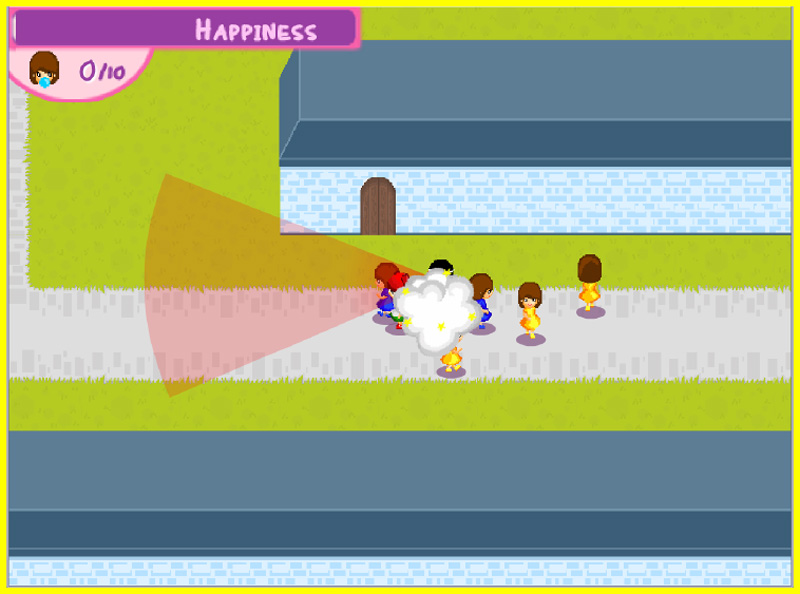
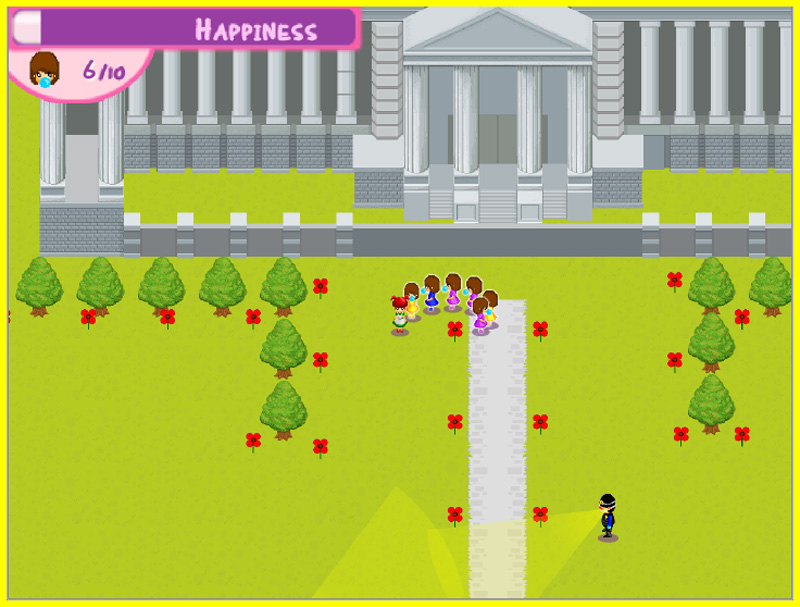
Playing Columbine: An Interview with Game Designer and Filmmaker Danny Ledonne (Part Three)

In making the film, you are choosing to tell your own story, yet you are also interviewing some of your harshest critics. Watching the film, I kept wondering about the dynamics of some of those interviews. What was it like to interview the organizers of Slamdance or Jack Thompson or the Columbine survivors about their reactions to your work?

I decided early on that making a film about this topic was not merely a matter of editorializing my own perspective. When I told people I was making a documentary, many imagined a bombastic, Michael Moore approach of framing the story with my narration, maintaining a strong on-camera presence as the "main character," or generally centering the film on me. Frankly, I found the debates this subject matter engages to be far more interesting than my own opinions on it; I filmed many of the presentations I gave during this time and cut out almost all the material as more exciting, articulate ideas arose during other interviews.

Many of the interviews with my harshest critics were not conducted by me at all. I knew that in order to conduct a more impartial interview, I would be better served by having other filmmakers sit down with Parents Television Council president Tim Winter, Denver resident Roger Kovaks (who initially ousted my anonymity after being outraged by SCMRPG) or anti-videogame activist Jack Thompson. Often times I prepared the questions myself and watched the footage with great interest as their points of view were very insightful as I began to reflect on my own. If given the chance, I recommend everyone take the opportunity to interview their most outspoken critics!

My interview with Slamdance Film Festival director Peter Baxter was very challenging because he seemed rather disinterested the entire time. It seemed to me that every question I asked was met with the phrase, "well like I just told you..." as though I was simply not listening. When Brian Crecente of Kotaku interviewed Peter, he reported much the same experience: "I spent forty-five minutes on the phone trying to get him to answer the question of 'why.'"

During this interview, while Peter would shower videogames as a "powerful" art form with praise, he seemed generally disengaged from his own decision to pull SCMRPG and questioned the effectiveness of other game developers protesting his decision by boycotting the festival. He more or less deferred to legal advice he'd received and a court of law that he imagined would ruin his festival (never mind that no legal threat--specific or vague--was made of Slamdance in connection to SCMRPG).

The film draws some parallel between your game and others about current events, ranging from what sounds like a pretty exploitative game about the Virginia Tech Shooting as well as games about Waco and Darfur. Are all of these games equally valid? What criteria should we use to determine whether they represent appropriate or meaningful responses to the events they depict?

In my eyes, all games are equally valid insomuch as they offer us opportunities to evaluate their game rhetoric. That means that I can think critically about Tetris as well as Manhunt. As protected speech in this country, both games should enjoy the same open discourse in a pluralistic society. How much time I choose to spend playing either of these games is up to me as a media consumer--hopefully a well-informed one. I think the best way to illustrate how I would answer this question is to give you a specific example.

Recently there was a game released by a young Australian man called Muslim Massacre. The title had obvious reference to mine so I wanted to play the game and evaluate it using my own admittedly biased criteria. I did not find the game itself overtly offensive as I read the game as satire--much in keeping with a film like Team America: World Police which I enjoyed immensely. I projected my own political views onto the game when I determined it was an effective videogame caricature of US foreign policy and the US media's representation of Muslims.

As one might predict, the game came under immediate scrutiny by the Western and Arab cultures. I emailed the game's creator after reading a letter of apology he posted in response. However, the game's creator replied to my email indicating that the apology was fake and designed to offend and dupe more people. This, to me, eroded the credibility of the game developer; he was less interested in socially-engaging discourse from his work and more interested in executing a juvenile stunt with a videogame as its central function. While that many invalidate the game developer, I still see the same initial value I held in the game itself; Muslim Massacre remains valid to me because I can identify with the cultural criticism it represents to me--whether the game's creator meant it or not.

This is why my film raises the point of authorial intent. In some ways, it is irrelevant whether I made SCMRPG to create a dialogue, make money, encourage school shooters, gain attention for myself, or to save the whales. The game stands on its own as a valid expression--free for interpretation and conjecture. I believe that my decision to stand behind the game, author an artist's statement, and argue for its value in the press has helped my credibility as a multimedia artist. The game stands alone, however--as all cultural artifacts ultimately do when we engage them.

In the film, Jack Thompson talks about the backlash against him in the games blogosphere as a threat to his own free expression rights. What similarities and differences do you see between the responses to Thompson and the responses your game has received from some of his allies?

John Bruce Thompson, disbarred attorney at law, is an interesting fellow. I find his self-fueled conviction fascinating--so much so that I made a music video about his crusade entitled When Jack Thompson Talks to God that can be found on YouTube. Jack was so enamored with this video that he called my phone at 5am on a Sunday morning demanding that I call him back (so he could threaten me and tell me that I'm "messing with the wrong guy.") What a charming voicemail, indeed.

What Jack and I share is the experience of being a controversial public figure--one that includes receiving hate mail, death threats, and assaults on our characters by people who will never know us. Some of his criticism in the film is directed at the immature antics against him--people who oppose Jack's point of view and see fit to mail sex aid products to his wife. He has also carved himself a unique cornerstone as the arch-nemesis of game culture (or at least its bumbling court jester).

Generally Thompson and I are not attacked by the same people; often I can imagine that those would have sympathy for Jack's position are the ones emailing me with clear information as to how quickly I am going to Hell. Similarly, I have won support from those who imagine that I have created a headache for people like Jack Thompson. To put this in general demographic terms, Jack Thompson is attacked by gamers and I am attacked by their parents.

Unlike Thompson, I do not feel entitled to press and don't use it to establish my professional credentials (Jack Thompson predictably introduces himself as the man who predicted Columbine on the Today Show and appeared on 60 Minutes twice). Also unlike Thompson, I do not believe I am on a personal mission from God to accomplish my goals.

What advice would you have for other game designers who find themselves in

similar controversies in the future? What do you wish you had known going into

this struggle that might have changed how you approached things?

At the end of my documentary, I try to provide just such advice. Let me summarize it here:

1. Do not be afraid of controversy. It can be a useful tool to spread your message. Just make sure you have a message. You will gain respect from people for standing behind what you believe in.

2. Stand behind your creative decisions. While some people will always call you "pretentious" or "vapid," articulate your intentions and design choices. It may not change everyone's mind, but it will challenge them to think more carefully about their suppositions.

3. Welcome allies and actively form new ones. I slowly discovered that for every email I received from an angry person, there were ten more that silently supported my efforts even if they could never take up such an effort themselves.

4. Take creative risks. There are boundaries on all fronts to push with regard to the creation of media. If you don't push them, someone else will. If you are a creative person and really love what you do, ask yourself what impact you want to leave on the world.

I read that "well-behaved women rarely make history." That is not just true for women.

Playing Columbine: An Interview with Game Designer and Filmmaker Danny Ledonne (Part Two)

The film suggests that generating controversy is a tribute to the artistic accomplishments of the game. Is this to suggest a bad or banal game couldn't generate controversy? To what degree is the controversy about the subject matter of the game rather than its execution, given the fact that the film also tells us that many of the critics have never played Super Columbine?

Controversy generated for its own sake is a pointless exercise that is soon forgotten and rarely culturally impactful. While some charge SCMRPG with being just that, the inclusion of a discussion forum--augmented by an artist's statement and my commitment to defending the project--is a testament to the ongoing discourse I sought to create. What makes SCMRPG an important cultural discussion point is that it is, by your own admission, a "perfect storm" for discussing matters of videogame violence, representation of real events in digital culture, and the future of videogames as an expressive medium.

I do think that the polarizing effect the game has on people (those who play it and those who do not) indicates its overall cultural value. Very little of social impact has been received with universal praise. The polemical presentation of the game certain denotes controversy as an aesthetic choice. Ours is a culture where so often the only way to be heard outside the established information channels is by being provocative and challenging social taboos. In some ways, the act of being offended is really one of being intellectually challenged--by encountering an unfamiliar or difficult idea. Some people handle this challenges better than others; we see those that are easily offended as the very same who rally to censor media and regulate creative expression. I have no problem with the allegation that SCMRPG is a "bad game" since it works outside the expectations of what a "good game" is supposed to be. But I would hardly call SCMRPG "banal," Henry.

The controversy around SCMRPG is largely one of the subject matter and not its execution. Only when I give talks at game design schools am I taken to task for my design choices. For example, the Associated Press, Christian Science Monitor, or Parents Television Council were not complaining with:

"Why did you hide a book in the upstairs classroom that you need to complete the last part of the game? I had to start over!"

"The hallway is really hard to sneak through. I couldn't even tell those were security cameras until my friend showed me!"

"The graphics suck, noob."

Instead, the mainstream press attacked the very notion that a game like SCMRPG could exist! Heavens, we can have a film or book or magazine article about Columbine but a VIDEO GAME? This was the tone of much of the initial reporting. Eventually, however, a few credible journalists for Wired and other publications began to take the proposition of a game about Columbine seriously--and their articles reflected that. Consequently, their readership reported a greater understanding of the game and larger social phenomenon of digital media for change.

You position the game in relation to the serious games movement. What does the concept of "serious games" mean for you and how does it relate to forms of nonfiction in other medium, including documentary films like Playing Columbine? What do games add to the mix in terms of shaping our understanding of real world events and processes? Would Playing Columbine have worked as a game?

As I have come to understand it, the traditional definition of "serious games" has virtually nothing to do with kinds of social issue-driven games like SCMRPG. Let me try and analogize.

The serious game has been akin to a training manual--such as the airline safety card or a "how to use your new vacuum" tutorial booklet. The military, medical, and corporate sectors use these serious games as pedagogy; these games do not make rhetorical claims. The kinds of games that Playing Columbine showcases are different. They are more like editorials in the New York Times or a polemical book on bookshelves or downloadable on the web. These are games that make arguments; these are "games with an agenda" as Persuasive Games' Ian Bogost says.

Let's pull this down to first principles. Why do you think games are an art form? What kind of art are they? What criteria should be used to evaluate games as art?

Throughout my travels in interviewing game developers, their critics, and those affected by videogames in relation to school shootings, no one claimed outright that videogames are not an art form. Most recognized that there are some games perhaps more artistic than others, that some art is appropriate for youth whereas other art is not, and that videogames are a relatively new art form with much potential and boundaries yet to be defined. Some people think the Grand Theft Auto series represents the future of immersive, state-of-the-art gaming. Others revile at the notion that one would call such a game "art" at all. These are inevitably conversations of subjectivity rather than concrete empirical claims.

For myself, I think games are a synergy of existing media traditions of visual arts, graphic design, musical composition, the written word, and the cinema. Of crucial distinction to, but certainly not exclusion from other art forms is the interactive nature of games--the elements of role-playing and narrative authorship being chosen in whole or in part by the audience ("the player"). Interactive media therefore combines many of the art forms we are familiar with but adds to them a significant degree of audience participation. Not audience control, however; aspects of the game physics, narrative, world design, etc. are not generally defined by the player as these are simply the pre-ordained "rules of the game."

I am not sure we ever got around to calling board games, card games, or table top role playing games as an art form or a "medium." Which is too bad; these earlier societal distinctions would have paved the way for a less misunderstood reception of game design. Videogames have as much in common with chess as they do with Starship Troopers.

In terms of how games as art are evaluated, clearly the existing systems are ill-equipped; games are currently evaluated as products. A typical evaluation of a videogame in a popular magazine or online publication might read:

Graphics: 9

Sound: 8.5

Play Control: 9.5

Challenge: 8

Replay value: 7

As one might imagine, games like SCMRPG would fail rather miserably by these traditional standards and indeed in 2006 PC World declared it the 2nd Worst Game of All Time (just behind E.T for the Atari). When reviewed by Jason Rohrer for Arthouse Games, SCMRPG was praised for its bold use of the form to critique a contemporary social event. Perhaps then the question of "games as art" asks more of the player than the ability to score points and navigate pristinely-rendered 3D environments; perhaps games as art are those which challenge the player emotionally or intellectually rather than strategically or tactilely.

The larger question for each of us to answer when we ask ourselves how to evaluate art--whether in games or cinema or literature--is what we expect it to accomplish. A great number of people will not tolerate a subtitled, foreign language film or a videogame that offends their assumption that games are escapist entertainment. Indeed, the concept that films could affect social change was hotly contested by filmmakers, distributors, and critics for decades. As the boundaries of what a game can be expand, the evaluation for games as art becomes more charitable.

I Have Seen the Futures of Entertainment ...And It Works!

foe_poster.jpg For the past two years, the Convergence Culture Consortium at MIT has been happy to offer its Futures of Entertainment conference, bringing together key thinkers from academia and the media industry in substantive conversations about trends which may change popular culture as we know it. You can sample discussions at the 2007 conference of such topics as Fan Labor, Cult Media, Advertising and Convergence Culture, Metrics and Measurements, Academic-Industry Relations, and Heroes: From 'Appointment TV' to "Engagement TV.' This year's event will be held at MIT on Nov. 20-21 and we are opening registration for the event as of today.

Here's what you can expect this year:

Convergence culture has moved swiftly from buzzword to industry logic. The creation of transmedia storyworlds, understanding how to appeal to migratory audiences, and the production of digital extensions for traditional materials are becoming the bread and butter of working in the media. Futures of Entertainment 3 once again brings together key industry leaders who are shaping these new directions in our culture and academic scholars immersed in the investigation the social, cultural, political, economic, and technological implications of these changes in our media landscape.

This year's conference will work to bring together the themes from last year - media spreadability, audiences and value, social media, distribution - with the consortium's new projects in moving towards an increasingly global view of media convergence and flow. Topics for this year's panels include global distribution systems and the challenges of moving content across borders, transmedia and world building, comics and commerce, social media and spreadability, and renewed discussion on how and why to measure audience value.

Confirmed speakers for this year's conference include: Kim Moses - Executive Producer, The Ghost Whisperer, Javier Grillo-Marxuach - The Middleman, Lost, Medium, John Caldwell - UCLA, Production Culture (Duke University Press), Henry Jenkins - MIT, Convergence Culture: Where Old and New Media Collide (NYU Press), Alex McDowell - Production Designer, The Watchmen, Kevin Slavin - Area/Code, Grant McCracken - Transformations: Identity Construction in Contemporary Culture (Indiana University Press), Donald K Ranvaud - Buena Onda Films, Amanda Lotz - University of Michigan, The Television Will be Revolutionized (NYU Press), Gail De Kosknik - UC Berkeley, How to Save Soap Opera: Histories and Futures of an Iconic Genre, Joe Marchese - socialvibe.com, Amber Case - Cyborg Anthropologist and Social Media Consultant, Hazelnut Consulting, Mauricio Mota - New Content (Brazil), Alisa Perren - Georgia State University, The Media Industry Studies Book (Blackwell Publishing), Sharon Ross - Columbia College Chicago, Beyond the Box: Television and the Internet (WileyBlackwell), Nancy Baym - University of Kansas, Personal Connections in a Digital Age (Polity Press), Alice Marwick - New York University, Vu Nguyen - VP of Business Development, crunchyroll.com, Lance Weiler - Director Head Trauma and The Last Broadcast, Gregg Hale - Producer Seventh Moon and The Blair Witch Project with more to come.

Friday, November 21

Consumption and Value

Where does value come from in the media evolving media landscape? In a medium rooted in the popularity of content, who or what is the source of media value? Does it lie in the properties themselves, or in what people do with these properties? Do creative companies create value or does value creation also occur on the consumption side, as audiences discover hidden potential in existing properties, make their own emotional and creative contributions to the mix, and spread the brand to new and previously unsolicited markets? Might we also see value as originating from those who simply sit and watch? "Attention" can be thought of as a core product produced by media companies - under advertiser-supported models, media properties attract audiences whose attention is sold to advertisers seeking to reach groups of people. While this is not always the case, the increasing significance of product placement suggests even goods sold directly to audiences are subsidized by the sale of their attention. Especially with the rapid emergence of user-created content, can we consider audiences participants in the creation of the value media properties hold? How do we account for the non-monetary value of media properties? How should gains from media value be distributed through the networks of creatives who collaborate in its production?

Panelists to be announced.

Making Audiences Matter

Audiences seem to present a constantly moving target. Migratory, skilled at avoiding advertising, and increasingly looking like producers, working out who the audience is and what they are doing is an evolving challenge. How do we create better relationships with audiences who look less like "consumers"? In a media landscape that looks to increasingly value broad distribution over concentrating attention, how do we uncover audiences and connect them with content? What does an "engaged" audience look like, and how do you know when you've got one? What do you do once you've found one?

Panelists include: Kim Moses, Executive Producer, The Ghost Whisperer; Gail De Kosknik, How to Save Soap Opera: Histories and Futures of an Iconic Genre (with Sam Ford and C. Lee Harrington), UC Berkeley; Kevin Slavin, Area/Code; Vu Nguyen, VP of Business Development, crunchyroll.com

Social Media

Moving lives online, creating conversations across geography, connecting with consumers - how is social media defining the current entertainment landscape? As people not only put more content online, but conduct more of their daily lives in networked spaces and via social networking sites, how are social media influencing how we think of audiences? Video-sharing platforms have changed how we think of production and distribution, and Facebook gifts point to the value of virtual properties, how are these sites enabling other processes of production or distribution practices. Spaces where commercial and community purposes intertwine, what are the implications for privacy, content management, and identity construction of social media? How have they impacted notions of civic engagement?

Panelists include: Alice Marwick, NYU; Joe Marchese, socialvibe.com; Amber Case, Hazelnut Consulting.

Cutting Global Deals

The Internet has altered transnational media flows, making it easier to move content across national and geographic boundaries, but complicating the economic structures that support these flows. How do we manage global distribution in the current context? What is the impact of the Internet on the interactions between local audiences and globalised content? What is the role of international audiences as taste-makers, and what can that tell us about making content relevant to multiple local audiences? How do we balance international distribution windows with audiences who move content themselves?

Panelists include: Donald K Ranvaud, Buena Onda Film; Nancy Baym, Personal Connections in a Digital Age (Polity Press), University of Kansas; Mauricio Mota, New Content (Brazil).

Saturday, November 22

When Comics Converge

The last few years have seen a steady expansion of comic book creators, characters and audiences into a range of different mediums. Television programming to successful Hollywood franchises seem respectful (mostly) of the source material. The graphic novel and the short run series have burgeoned and been mainstreamed. Comic-con has expanded to a key event for the entertainment industry. Many established producers in other media are looking towards comics as a platform for creative expression or for extending their narratives (see Buffy the Vampire Slayer, Battlestar Galactica, Heroes, and Supernatural, for instance.) What contributions do comics make to convergence culture? What makes comics such a rich recruiting ground for new content or creative talent? Why are other media producers so aggressively courting comics fans?

Panelists include: Javier Grillo-Marxuach (The Middleman); Alex McDowell, Production Designer, The Watchmen; Alisa Perren, (Co-editor with Jennifer Holt) The Media Industry Studies Book (Blackwell Publishing), Georgia State University.

Franchising, Extensions and Worldbuilding

Media convergence has made the complex intertwining of multi-platform media properties more and more common-place, yet the creation of storyworlds that extend beyond a single text is not a recent development. With a history that includes sequels, spin-offs, and licensed products, what is the future for the media franchise? Is there a material difference between creating media franchises or transmedia properties? What is the role of television programs or films in anchoring wider narrative franchises, especially when they extend beyond media and into the "real world"? What is the significance of the creative individuals who contribute to franchises, including creatives, professionals, and fans?

Panelists to be announced

At the Intersection of the Academy and the Industry

What are the challenges of bringing the academy and the industry together? How do we negotiate working across these two worlds?

Panelists include: Amanda Lotz, The Television Will be Revolutionized (NYU Press), University of Michigan; John Caldwell, Production Culture (Duke University Press), UCLA; Grant McCracken, Transformations: Identity Construction in Contemporary Culture (Indiana University Press).

More speakers will be announced in the coming weeks, but surely our line-up is already strong enough that you will not want to miss this event.

Coming Soon: The Second Part of a Three Part Interview With Danny Ledonne

Playing Columbine: An Interview with Game Designer and Filmmaker Danny Ledonne (Part One)

Danny Ledonne's Super Columbine Massacre RPG! has been the center of controversy since it was released in 2005, on the sixth anniversary of the shooting at a Colorado high school which sparked international controversy surrounding the links between video games and real world violence. Some have embraced the game as a powerful demonstration of how games can force us to re-examine controversial issues from new vantage points. Others have condemned the game in the harshest terms possible, suggesting that it exploits a deep human tragedy. In 2006, PC World declared the game #2 on its list of "The 10 Worst Games of All Time." Every time the controversy started to die down, some new development shoved the game back into the news, whether it was attempts by the news media to link it to a Canadian shooting or the decision by the directors of Slamdance's games festival to withdraw the film, a decision that led to strong support from many invested in the idea of games as art or simply the value of free expression. Ledonne's game has been a model for other serious games projects and has been a focal point for discussion about whether there are some topics which can not or should not be explored through this medium. For an overview of the controversy, check out this Wikipedia entry. You can see the game yourself and make up your own mind about its merits.

Now, Danny Ledonne has produced Playing Columbine, a compelling documentary which allows him to tell his own story. This film will be extraordinarily valuable as a classroom resource for those who want to spark discussions about games as a medium. It will also be a useful film to share with skeptics who doubt that games can deal with serious topics.

Danny was kind enough to agree to an extensive interview for this blog, one which takes us through the various controversies as well as examines the process of producing this documentary. You will see that I adopt a devil's advocate posture here, pushing Ledonne to pull down to first principles and explain his own thought process concerning the Super Columbine game and Playing Columbine. I hope this three part interview will spark further reflection on these very important topics.

Ledonne is a graduate of Emerson College's film program. He has worked as director of photography on KiskaDEE, as editor for An Awakening Journey, and shot and edited Kenya Jidaya. He is a native of Colorado and currently lives in Washington DC where he owns Emberwilde Productions.

What were motives for making the Super Columbine Massacre RPG? It sounds like you had not done much work in games before this. Why did you think games were the right medium to say what you wanted to say about Columbine?

I have answered the question of "why did you make this" many times--probably so many that I have begun to wonder why I am asked so often what my motives were. I suppose releasing a highly controversial game on the Internet, free of charge, and setting up a discussion forum does make one wonder. I guess if I had charged five dollars per download it would be evident that I was trying to make money and then the question would shift from "why" to "how could you?"

SCMRPG is my first game and perhaps my last. What most outsiders to the creation of games do not understand about game design is how specialized a field it is--involving a multitude of skills from computer science and programming to graphic design and (hopefully) a flare for storytelling. Games generally cannot be made without a set of highly acute skills and usually a great deal of training. My efforts were amateur and my game certainly reflects that--but even then the results were only possible because I had a game creation program (RPG Maker) to act as middleware between an untrained user and a finished game concept.

Columbine had been a subject of considerable importance in my own life. I was a sophomore in high school at the time of the shooting in another Colorado high school. I listened to the same music, played the same videogames, and at times even had similar feelings of anger or depression as Harris and Klebold (the shooters). Amidst all this was a media frenzy and subsequent political fervor over a "culture of violence" replete with condemnation toward Hollywood, the music industry and videogames (in short, the best ways to decompress after another day of high school). As a politically powerless teenager, I had no real way to challenge the official assumptions as to why the shooting occurred. Among my friends, though, the consensus was that the real causes of Columbine could not be answered by pointing to Doom, Natural Born Killers, or Marilyn Manson.

Years later in the fall of 2004, I came across RPG Maker and it occurred to me that the RPG form could yield a deep and complex story-driven environment for a game. As a fan of such games as Chrono Trigger and Final Fantasy VI, I had always taken an interest in this game genre. Because I was 22 and not 12, my interest in games was not one of childish fantasy but of contemporary reflection and examination. In some ways, Columbine had been a latent thread in my life and the opportunity to explore it in interactive form seemed especially promising since the event itself was inextricably linked to videogames. While authors, politicians, moral pundits, musicians and filmmakers had contributed their thoughts to understanding Columbine, no game developer had (probably for reasons of sensibility and an interest in preserving company relations). As an outsider to the game developer world, I could afford to take those risks--though the ramifications to follow were quite surprising nonetheless.

The film suggests you grossly underestimated the interest and backlash your game generated. Why do you think the game spread as far and as fast as it did? What aspect of the reaction surprised you the most?

It is worth mentioning that for a long time the game received the kind of underground, subdued exposure that I expected it to get. I posted the game online around April 20th, 2005 to coincide with the sixth anniversary (not the best word to use here, I know) of the shooting. For over a year, it remained an Internet anomaly--receiving about 10,000 downloads. I more or less went back to my life of working as a youth mentor, honing my filmmaking craft, teaching Tae Kwon Do, and volunteering as a community radio station DJ.

I posted the game anonymously for many reasons, some practical and some ideological: 1) I was aware that the approach of using a videogame to represent a school shooting would generate outrage from those unwilling to acknowledge games as a socially-conscious medium. 2) I was interested in fostering discussion not about myself and my motives for creating the game but rather the shooting at Columbine itself. 3) I had no interest in furthering a career in game design so putting my name to the work in some attempt to be "discovered" or "recruited" was unimportant. 4) The larger experiment was one of digital culture; I wished to combine musical, photographic, and textual elements gleaned from the web, assemble them in a piece of software, and finally release this reassembled contextualization onto the Web for further discourse. I did not know why, per se, but that the possibility to do so did not exist a decade earlier and this experimentation seemed interesting to me as a multimedia artist. It was as though the Internet itself assembled this game--as though it were a living information machine giving birth to a new creation.

It was a full year later around April 20th of 2006 that the game began to get the attention of gaming blogs like Kotaku and Watercooler Games. Not long after this, the game crossed over into the mainstream press. By the time the Washington Post article ran in late May of 2006, the game was getting 8,000 downloads per day and despite several PayPal donations to keep the game online, my server crashed. It was also at this point that my identity became sought after and I chose to publicly defend my game amidst harassing emails and death threats. Before long, the game was back online at several download mirrors. Little did I know the controversy was just beginning. To date the game has received nearly 700,000 downloads on the main mirror location--although the real number will never be known since it is being shared in so many decentralized ways.

What were the biggest misunderstandings people had about the game?

Misunderstandings can be miniscule or they can be gigantic. Among the smallest misunderstandings was that I was a former Columbine High School student who made the game as an act of catharsis to personally grieve or process the tragedy. Among the largest were that I made the game for money, I made the game to get on television, or that I made the game to encourage school shootings.

On some level, I welcome one form of misunderstanding because I enjoy eliciting a broad range of responses from my work. Many elements of the game have personal interpretations to me but others view them differently. The water fountain, for example, gives the exact particle content as described by Denver's municipal water authority when Eric or Dylan drink from it. Some have taken this to be meaningless, others a joke, while some have observed that this is commentary on the notion that whatever caused the shooting, it wasn't what was in the water.

The larger opportunity here is not misunderstanding but rather self-understanding. A game like SCMRPG can take players to an ethical situation they have never been to before. It can challenge them with a role not of mindless power but of tormented anguish, revenge, or anger. In doing so, players often reflect on their own feelings of childhood depression or angst while at the same time interacting with a pivotal event in US history. I do not have a specific expectation for what that understanding is supposed to yield. That is the beauty and perhaps the danger of art.

Which criticisms of the game hit you the hardest? Were there moments when you questioned your own creative choices?

At first I was hesitant to keep the game online. However real or imagined the charges are, the legal implications of producing controversial media can be intimidating. And that is precisely what I have faced from time to time. As one can imagine, various groups and individuals have sought to take SCMRPG off the Internet--using a variety of tactics from baseless claims of personal injury to draconian interpretations of copyright law (the game features the same media posted all over the Net and in news reports and documentaries which employed Fair Use in Copyright).

The major point of introspection occurred at the time of the Dawson College shooting in Montreal in the fall of 2006. Here I had successfully defended the game's right to exists for the entire summer and I thought I was in the clear for future projects and a kinder, gentler Inbox. However, on September 14th, my phone began ringing at 8am and did not stop quite literally for days. I cannot tell you how many emails I received threatening me with violence, legal action, or both. I replied to as many as I could, patiently diffusing allegations the mainstream media had whipped up about a game they had never played and did not understand. In the weeks to follow I formed new alliances including one survivor of the shooting, Joel Kornek. Having initially written me in anger after leaving the hospital and learning of my game on the news, we soon leveled with one another and set about to collaborate. The results of that collaboration are my documentary and his suicide prevention website, killthinking.com.

I began to realize that making meaningful media sometimes has a personal cost--and perhaps it always should. My creative choices have always been questioned. Sometimes my answers strike people with more satisfaction than others. I think such questioning (of ourselves and of others) is very healthy, though--not just for creative efforts but in general; I'm writing you in a time of national leadership that bombs first and asks questions later. We would be living in a better world if we were just a little less certain of our own hubristic convictions.

All of these debates came to a head around the Slamdance Guerilla Games

competition. What are your thoughts about those events, looking back on them

several years later? Do you have any clearer sense of why the festival made the

decision to pull the game?

If the Dawson College shooting was the low point in the discourse of SCMRPG, Slamdance pulling it from the Guerrilla Gamemaker Competition would have to be the high point. For the first time, I was not defending my game in solitude but with some solidarity--often from game developers far more talented and established than I. If it weren't for this competition and the controversy that pulling out the game created, the dialogue about games with a social agenda would be slightly further behind. Finally game writers and cultural critics began to take notice of the double standard our culture has imposed on games in comparison to other popular media. Finally the game wasn't the central scrutiny of every article it was mentioned it. Finally the wagons were being circled and the case was being made in the larger culture for Super Columbine Massacre RPG!

In terms of why the game was pulled, I think the most likely answer is the most disappointing: Peter Baxter was unwilling to assume the same legal risks of showing a controversial game as showing a controversial film. In the service of obscuring this double standard, circular logic abounds: music clearance issues which had previously been vetted were reintroduced, "moral obligations" which had been previously weighed, and the imagined loss of sponsorship when in fact a sponsor only left upon the game's removal rather than its inclusion.

As I write this, the Slamdance Guerrilla Gamemaker Competition has completely fizzled; entrants into the last iteration of the program have been refunded their entry fees. While film festivals such as Slamdance want to celebrate independent game making, the task must be taken with utmost respect and courage for the medium. In the meantime, several substantial game industry events are held annually to celebrate independent games and game developers are deeply appreciative of them.

Why Universities Shouldn't Create "Something like YouTube" (Part Two)

Universite de Montreal is developing a new web strategy, they intend to integrate web 2.0 features. They are thinking about letting students become

publishers, but they fear a teacher backlash. Is this fear reasonable? What

would be the worst case scenario?

When we create more open platforms, we destroy old monopolies of information. That can be a brutal blow for those who gain their self worth from their role as the dispersers of that information. So, yes, when you open it up to students to submit materials, teachers feel threatened. There are some legitimate concerns here, having to do with the credentializing of information and the liabilities of the university. For most of us, credibility on the web is situational: we are not so much assessing content as we are assessing the reputations of the sources of that content. We tend to put our greatest trusts in the institutions we would trust for information in the physical world. So, many people who sought information from Universite de Montreal or MIT will make a general judgment about the reputation of the institution and then apply it to all content which gets circulated.

For me, a lot of this has to do with how we frame the materials -- as a reference work (which meets certain criteria of reliability, which many faculty members would be hard pressed to meet) or as a space for investigation, deliberation, and discussion (where there are ongoing conversations about the value of different content being circulated). Most academic web resources represent the former; Wikipedia and YouTube would be better understood as the latter. The need is to be clear about who is contributing the content and then you need to create a context where the community has the literacy practices and collective intelligence processes to take ownership over critically engaging with the materials being shared.

Everyone in the university would need to have a stake in insuring the integrity of the process and that means being highly critical and skeptical of anything that gets submitted, whether by a student or a teacher.

Can a platform upstage the learning process ? By that I mean that students

would get lost in a pile of information and would no longer be able to know

what to use ?

A platform certainly can upstage the learning process if by a platform you mean a technology. It is not at all unusual for faculty members to become enchanted

with one or another kind of hardware and not think through its pedagogical implications. We can see some of the ways universities have embraced Second Life as an example of this process. Second Life has some remarkable affordances which can support powerful new kinds of learning, but it's also a challenging technology to learn how to use. There's no point in using it for things that can be done just as easily through more traditional learning platforms and there's no point in using it if it takes much longer to learn how to use the program than it is going to be possible to use the program for instruction. In

other words, we have to do a cost/benefit analysis and know why we are using this platform, why it is better than traditional means, what it allows us to do that we couldn't do otherwise, what challenges it poses to learners, and so forth.

On the other hand, I would argue that a process or a community is less likely to upstage learning because for the most part, it comes with its own pedagogical logic and if you work within that logic, everything you do will ultimately contribute to learning. Again, the choice of the community needs to be aligned to the pedagogical goals, because the community will impose its own goals which will often be more deeply motivating.

Is there more value in sharing ( as with OpenCourseWare) or in mashing and

allowing expression ?

For me, they are two parts of the same process. When I hand you a printed book, which couldn't be more fixed in its content and couldn't be harder to reconfigure, you are still going to pay attention to only those parts that are of interest to you; I can't determine whether you read the whole thing; I can't determine what parts you cite in other works you write; and indeed, the book only becomes valuable when you can take out your yellow pen, mark up the passages that are meaningful to you, compare them with other books on your shelf, and use them as resources for your own explorations and ruminations.

So, why should we imagine that digital resources are any different? Once you share them, they are going to be sampled and remixed, if they are of any value to the person who receives them. That's at the heart of the learning and research processes. So, the question isn't whether to allow remixing; you can't stop it and you really wouldn't want to if you could. The question is whether to facilitate it or for that matter, whether to increase the visibility of what readers do with the content you provide. In the end, that boils down to the question of whether you want to be part of a conversation or whether you simply

want to publish.

In our participatory culture, though, keep in mind that publishing as an end unto itself is having diminishing return and people are much more likely to be drawn towards spaces which enable and support meaningful dialog. You can try to block it, if you wish, but you are also cutting yourself out from the marketplace of ideas, so what's the point?

Should all this self-expression be recognized ? Where can we draw the line between « artistic self-expression » and bad work ?

The point is that I don't draw the line; the community draws the line. A society where there is lots of bad work out there is ultimately more generative than one

which supports only excellent work. It provides points of entry for more people who are encouraged to try things, be bad, get feedback, and do better. A society which circulates only excellent work creates too strong a barrier to access and thus discourages most people from producing anything. The result is that we lack the diversity we need for collective decision making or shared cultural experiences.

So, the goal should never be to get rid of bad work; the goal should be to develop mechanisms which helps us to identify what we see as valuable or meaningful work according to our own criteria. There are a number of different mechanisms which allow us to do so: we can have gatekeepers who curate the materials and use their personal reputation to bestow recognition on work they consider valuable; we can have some kind of system of aggregation, such as Digg, where many people vote on what's valuable and the "best" stuff rises to the top; we can have some system of collective deliberation in which we have ongoing debates about what constitutes good work and what works are

good. All of those mechanisms can be found at work in one or another site online.

We still don't fully understand how these mechanisms work and what kinds of areas each works best. And universities would have a lot to contribute into research in these areas if they would free themselves from the burden of feeling like they can only support excellence.

A lot of bad work could tarnish the reputation of a university. How can it reconcile openness and the promotion of itself as a supplier of good knowledge?

It depends on what the university is trying to sanctify: is it seeking to guarantee the integrity of the product (in which case, every bit of content needs to be vetted) or the integrity of the process (in which case, the university is creating a space where people learn through vetting each other's content.) Is the reputation of a university based on the fact that they gather together lots of people who know things or is it based on the fact that they create a context where the ongoing questioning of information takes place?

What is the role of universities in this new « knowledge society » ?

Universities have gathered together many forms of expertise into one institution and they have provided the time and space for those expertise to be exercised

around compelling questions. They have developed processes by which questions can be asked and answers can be debated, where information can be produced, exchanged, and evaluated, and where expertise can be exchanged between many different minds. So, how do universities expand those functions and processes beyond their brick and mortar campuses? How do they open up these conversations to include a larger public who wish to continue learning beyond their undergraduate years or who wish to learn things that are not available to them at their local level? Universities can potentially play an enormous role here but it requires them to rethink their interface with their public and indeed, requires them to expand their understanding of what constitutes the constituency for higher learning.

Note: In response to the first installment of this interview, reader Chris Lott asks why the Creative Commons license for MIT's Open Courseware initiative constitutes a "conservative" approach to Fair Use. I am not, in this case, concerned about reader's making Fair Use of my materials. They are welcome to use them with attribution as far as I am concerned. But my problem is that as a media scholar, I need to be able to provide excerpts from other people's media -- especially corporate media -- if my teaching materials and approaches are going to be accessible to people around the world who may not have ready access to American media. MIT's position is that we have to clear rights for every piece of material that we include in our course materials, rather than asserting a broader understanding of Fair Use which would define such materials as being circulated for the purpose of critical commentary. I apply such a broader notion in my own blog but so far, the Open Courseware people will not accept this perspective and as a result, I've been locked out of contributing to this program. People often ask why not use materials under Creative Commons license and the problem is that the kinds of materials currently circulating under Creative Commons tends to be indie media, which is great, but in teaching media studies, I also have to deal with material by mainstream media and universities feel themselves vulnerable to the exagerated assertions of copy right by many corporate rights holders. I hope this further clarifies my position.

Why Universities Shouldn't Create "Something like YouTube" (Part One)

I was recently interviewed by a Canadian journalist, Alexandre Cayla-Irigoyen Chef de pupitre - Societe Monde, about OpenCourseWare, Collective Intelligence, and the modern university. Somehow, the interview questions sparked me to dig deep on some ideas that I hadn't really formulated before and I figured the answers might prove interesting to blog readers. So I asked the reporter if I could run the transcript here, once he had gotten what he needed from it for his story.

I read your book (Convergence Culture) and also a couple of other of your publications. You argue that, right now, the school system is failing its children because they are learning more experimenting outside class than in it. Do you think that Internet and the tools that are being developed will help change this situation ?

The internet is improving opportunities for learning for at least some portion

of our youth, but most of what is most valuable about it is locked outside of

schools. For example, many American schools block all access to YouTube, to

social network sites, even to blogging tools, all of which are key sites for

learning. Schools are discouraging young people from using Wikipedia rather

than engaging with it as an opportunity to learn about the research process and

to engage with critical discussions around issues of credibility. The schools are

often frightened of anything that looks like a game to the point that they lock

out many powerful tools which simulate real world processes, encourage a 'what

if' engagement with history, or otherwise foster critical understanding of the

world.

As long as they react to these developments as risks rather than resources, then those kids who have access to this online world are going to be de-skilled as they enter the schoolhouse gates and those kids who don't have access are going to be left further behind because they have been abandoned by the institutions which are otherwise best situated to address the digital divide in terms of technical access and the participation gap in terms of access to skills and experiences. So, yes, informal learning is taking place outside of school for those who are able to access it but the refusal of schools to engage with it further amplifies the inequalities between information haves and have nots.

Can such changes be implemented in university classes? Flexibility seems to be the key aspect of this new approach whereas the university classroom is typically governed by a rigid student-teacher relation (at the undergrad level at least).

Whatever their limitations in terms of bureaucratic structure, most university

instructors have much greater flexibility to respond to these challenges than the average public high school. Unfortunately, by the time we get to college, these gaps in experiences, skills, and resources will have already had a near lethal impact on those kids who are being left behind. It isn't just that we will need to have a head start program to get them the technical skills they need to deploy these technologies. It is going to be much harder to give them the sense of empowerment and entitlement needed to allow them to feel fully part of the online world. They are going to be much less likely to play and experiment with the new technologies because they will be afraid of failing and looking dumb in front of classmates who will have been using these tools for more than a decade.

That said, we certainly do want to integrate these skills into college classes, because they are key to higher order thinking an research in most of our disciplines, because doing so is the best way of reaching a generation that expects to be able to participate in social networks and manipulate data through simulations. But we shouldn't delude ourselves into thinking we can fix a decade's worth of neglect through the public schooling system.

How can an institution recreate the type of communities you spoke about in your book ?

The kinds of communities I discussed in the book are what Cory Doctorow calls "ad-hoc-cracies." They emerge quickly in response to shared interests and concerns. They last as long as people need the community to work through a common problems or query. They vanish when they are no longer useful to their members. They are radically interdisciplinary or I'd prefer, "undisciplined," in that they draw together people with many different expertises and they deploy social networks which observe few of the barriers to interaction we experience in the physical world to bring people together who should be working together. They develop informal yet very powerful systems for vetting information and for carrying out deliberation.

Almost none of this holds with the average college class which has a fixed duration, a prearranged sequence of materials and problems, a disciplined border, a geographically narrowed location, etc. So, if we want to integrate these into our classes, they require

much greater flexibility in imagining what constitutes an educational context. They certainly involve developing projects which span disciplines, which link several classes together and requires students to build on each other's work, and which may straddle multiple universities dispersed in space. All of this is easier said than done, of course, but we should be experimenting with how to achieve this goals since at this point it is even hard to point to many real world examples of what this would look like.

MIT has the OpenCourseWare program that seems to follow a more open logic. Does MIT have other programs that would help it achieve (or create) a more open, flexible and creative environment ?

The Open Courseware Initiative has very worthy goals -- indeed, the vision

behind it is deeply inspiring to me. Universities like MIT should be opening up their resources to the planet. We should being supporting independent learners and providing materials to support education in parts of the world which do not have what major research institutions have to offer. The scale on which Open Courseware is operating now is astonishing and a real tribute to the people who developed it.

That said, I do not myself participate in Open Courseware. I freely give away my own content through our various blogs, podcasts, and online materials. But MIT has failed to assert a strong Fair Use defense which allows instructors to meaningfully quote from and repurpose existing materials as part of their instructional process. As a media scholar, my teaching centers on helping students understand other people's media content and if I can't quote from and share that content with the users of the Open Courseware, I can not meaningfully reproduce my instructional practices online. MIT had an opportunity to be a leader in the arguments about Fair Use, especially given the good will they have gotten through Open Courseware, yet they have chosen to take a very timid and conservative legal approach to these matters and as a consequence, I feel like it severely compromises the goals and ideals of the Open Courseware initiative.

I am thus a conscientious objector in my relation to this project. I am going into this here not to slam the Open Courseware people but to suggest that the ideals of free distribution of content by educational institutions are compromised by the current intellectual property regime and that we are not going to be able to meaningfully achieve the full ambitions of such a project until we develop stronger defenses around Fair Use.

At the present time, MIT is thinking about its next step in its Internet strategy (after the OpenCourseWare project), what are the options ? What should a university try to implement ?

Many universities are trying to figure out how they can build "something like YouTube" to support their educational activities. Most of them end up building things that are very little like YouTube in that they tend to lock down the content and make it hard to move into other spaces and mobilize in other conversations. In a sense, these university based sites are about disciplining the flow of knowledge rather than facilitating it. As I think about what makes YouTube YouTube, I see a number of factors:

  • Anyone can submit content at anytime and thus doesn't have to operate from a base of academic and institutional authority. It respects multiple kinds of expertise, understands people are differently motivated, and appreciates that information can be posted for many different reasons.
  • YouTube content can be embedded on any website, blog, or social network page. It is spreadable and it gets value as it gets inserted into these various contexts, because they represent different social communities which are having ongoing conversations. YouTube sees information as something that can be used, not something that is simply stored.
  • YouTube provokes responses. Indeed, the most valuable content on YouTube is content which inspires other users to talk back, reframing and repurposing materials, coming at them from many different angles.
  • The content on YouTube can be reconfigured many different ways. It is not part of a structured curriculum; rather, it is modular, nonliner, unstructured. And as such, we are encouraged to play with it rather than being disciplined to approach it in set ways.

    So, I don't know for sure what the next stage of an academic content system looks like but my own sense is that it should look MORE like YouTube and less like what university lawyers and department heads think will be "something like YouTube".

Inviting Our Participation: An Interview with Sharon Marie Ross (Part Two)

Today, I continue my interview with Sharon Marie Ross, author of the new book, Beyond the Box. I'm pleased to announce that Ross will be one of the featured speakers at our Futures of Entertainment 3 conference which will be held on Nov. 20-21. We will be releasing details and opening registration for this event next week. Whether you've attended our earlier events or simply heard about them, you are going to want to hold the date. Last year, we sold out in only two weeks time. In the discussion which follows, Ross talks about the ways the media industry thinks about and represents its fans, the role of seriality in supporting transmedia experiences, the implications of the recent Hollywood Writer's Strike, and the recent move of Fringe to cut back on story arcs in favor of more episodic stories.

Many of your examples of innovative practices come from smaller networks, such as Sci-Fi, The N, CW, Cartoon Network, and E! Why have these networks been so eager to experiment with alternative uses of the web? Why have the traditional networks adopted a more conservative "wait and see" response? Is this changing?

While the more traditional networks have been slower to adopt the practices of the smaller ones you mention, they are "changing their tune" to a degree. NBC and CBS especially are trying, with CBS doing quite well with blogs attached to shows (How I Met Your Mother) and of course with sports; NBC has very interesting things going on with Heroes, also. ABC is trying with Lost, but I think the show is the factor there more than anything.

The smaller networks have been more eager to adopt web strategies for a number of reasons. One is that they have built in niche markets who are already prone to go online and play with new media. Another reason is they have more to prove and as has been historically the case, when networks are struggling or trying to prove their viability, they are more willing to take risks--not just with strategies such as online applications, but with who they hire (younger execs) and with the shows they produce (more hands on producers who have embraced the internet). As the "big four" find themselves needing to compete for key markets they are likely to begin adopting more of what they see at smaller networks--especially with individual programs that lend themselves to the web (sci-fi, reality, and sports).

Throughout, you argue that programs which incorporate "seriality" and the "aesthetics of multiplicity" are most apt to also solicit audience engagement and participation. Explain. What are the implications of this argument for understanding the place of procedurals and episodic programs in the current programming mix?

I've been chatting with Belinda Acosta of The Austin Chronicle about episodic and procedural programs...It is true that the lack of seriality at work in such programs means there is less to do with them online, definitely. When a story ends within one viewing, viewers have little impetus to expand the text in a significant way--it doesn't garner them much in terms of their next viewing is perhaps the easiest way to think of it.

A serialized show, however, taps into an aesthetics of multiplicity. By this I mean that a show has layers of storytelling at work, embedded deeply into the text--seriality being the key element that breeds these layers. The possibility of differing outcomes prompts speculation and prediction--what might happen? WHY might it happen (or not)? Can I play an active role? Will producers be listening? The more layers at work, the more possibilites exist for the viewer to get in on the action--and when you can return in a week (or even a season) to see if you were right, you're more likely to take the time to weave your own psyche into the mix. People enjoy attaining a sense of mastery over the unknown, and open endings and/or multiple strands (dueling plotlines, large casts of players) provide ample opportunity. I think there will always be procedurals--no one wants to work hard all the time, after all--but I also think we will see more multiplicity built into such series (such as Bones' and the CSIs' relationships among characters and occasional lengthy story arcs) and when we see this, internet applications will likely arise for these programs. Especially as younger viewers savvy online age into mature markets, we're likely to see this. But I myself like the occasional break a procedural or closed sitcom offers...there are only so many hours in the day! This need for some "simplicity" is also why the most convoluted shows (such as Lost) work best also when they can be viewed without needing to go online to fully enjoy the story.

You provide a number of different perspectives from media producers about the value of fan input and "buzz" in making creative and programing decisions. What do you see as the current fault lines in the industry's understanding of fan consumers?

The current fault lines are many...The industry overall is paying attention to what fans can offer them, both the positive and negative. Fans' ability to mobilize via the internet has become key, as one example. When a show adored is canceled without fair warning, fans can smear a network in ways approaching a good old fashioned political campaign and networks hate bad publicity--and LOVE looking like they're heeding "the little people." But playing with fans is fraught with peril--if you don't have people in the industry who embrace fandom, you can misstep all too easily. I am curious for example to see what happens with ComicCon as more industry folk use this venue to promote and launch shows. Will fans begin to feel like they're being pandered to? Or that the industry is taking over their turf? I believe real change will occur when the industry begins hiring the right people (those with fandom in their background) and when they start according more power and respect to writers who truly care about their stories and their readers. So far this is occurring at ComicCon--but I worry the industry may overstep their boundaries (and knowledge) and begin pushing shows that are low quality simply because they have some of the "right" components (seriality, e.g.) or make promises they can't keep ("we'll have forums! and comic books! but shh! only as long as it's profitable...") Fans are the smartest viewers out there--the industry needs to really know this in their bones and act accordingly.

You cite several examples of misfires where the networks tried to personify their audience on air -- the Aerie girls around Gilmore Girls and Veronica Mars, the ATT campaign around American Idol. Why have networks had such trouble constructing images of participatory audiences and what might such failures suggest about their (mis)understanding of their consumers?

This taps into some of what I discussed above...Often the industry (especially at the network level) thinks of their viewers in simple, market-research oriented terms. Executives often forget that viewers are complex human beings who come to any given program with a plethora of expectations that can defy what a survey reveals or what a PR professional assumes about a given audience for a show. Networks are so very much driven still by numbers and trends--the business elements demand this--and people more often fall outside the norm than within it.

NOTHING is more irritating as a person than having someone make assumptions about you--we don't like it in everyday social circumstances, so why would we like it in storytelling? This is why the industry has to work harder (with writers and producers especially) to communicate with their viewers--"you can mess up, if you fess up" is how I see it. Admit when something misfires, be willing to take risks but explain why.

The producers of Farscape understood this well--listen, explain, but learn to not abandon your own role as a storyteller. If networks would accord more power to creatives (or think more creatively themselves), we would see not only better success--but also better stories overall. This means, of course, the ability to take financial risks--and fans have to understand this as well--especially in a market-driven TV industry like we have in the U.S.

The recent writer's strike center in part on the question of whether web extensions of television show should be understood as promotional materials or as part of the creative content of the program. Your analysis suggests that the same content may serve both functions. Any thoughts on how the industry will resolve its uncertainties about the status and value of such materials?

I am wary of what the industry learned from the strike. The best online materials have had storytelling at their heart--driven more by that than by the need to promote. But I fear that the strike may result in industry attempts to cut back on such applications if they have to pay for the work involved. (Unless the show is a smashing success.) The issue lies in vision: the industry needs to understand the value of building long term viewer relationships--which means the payoff might come later. They used to get the "later" with syndication. But with less syndie occurring, the payoffs are in the areas of (monetarily) DVDs and online advertising.

The real value comes in brand loyalty, I think. When viewers think a network will go to bat for their creatives and their viewers, they are more likely to commit to a new project the network offers. The N has managed this wonderfully--but they can do so because they are a small network within an umbrella of larger corporate structures that can absorb any financial losses. One route to embrace would be more co-productions globally to offset financial risk.

As J.J. Abrams has launched Fringe this year, he keeps stressing that the program will be accessible to people who only want to watch a single episode. He clearly wants to escape criticisms that have surrounded the seriality of Lost and Alias, yet in doing so, he may undercut the forms of viewer loyalty and participation that are generated through seriality. In the book, you offer an extensive case study around Lost. How might this case study help us to better understand the stance Abrams is taking around his new series?

Fringe will be fascinating to study! Abrams, like Joss Whedon, really gets it all--he understands fan loyalty but he also understands how the business side of things work. Lost hit at the right time and under the right circumstances--a struggling network was fundamental to this show succeeding. But Lost has lost (ha ha) fans along the way and also held off viewers who do not have the time or inclination to follow every strand. Yet, those surrounding the series have been quick to amend mistakes that have occurred with plotting and with online applications--they very wisely have ensured you don't have to go online to love the show. This is what is being applied to Fringe. And the thing is, fans of Lost (or any other highly serialized and mythology driven series) are not the stereotype many imagine: the most loyal of the fans are the ones who first and foremost appreciate good storytelling. By which I mean, these fans do not have to have every show they watch be as "messy" as Lost. Good storytelling CAN occur with one-shot storytelling if the the characters are developing. I think character growth is key. Look at Mary Tyler Moore or All in the Family or Scrubs today. The storytelling occurs with the growth of the people involved in the story world...slow, intimate, and enhanced by regular viewing--without demanding constant attention. And in the end, in my humble opinion, the pleasures of Lost lie with the characters and how they grow.

As a final string of thought, I think what we're seeing with TV and the Internet is an extension (versus a brand new "something") of what the best of TV has always given us: the opportunity for viewers to sink their teeth into stories that make us feel more connected to the world around us, the opportunity for writers to tell stories that matter to them, and in the best case scenario the opportunity for the industry to find new ways to make people find TV relevant and worth attending to! Please include my thanks to the many writers, marketers, industry execs, critics and fans who helped me with my book--I found people all over who fundamentally loved a good story and were eager to share their thoughts and genuine feelings with me. The best scholarly work, I believe, emerges from such communication...I am only "reporting" what many people took the time and passion to share with me.

Sharon Ross is an assistant professor in the Television Department at Columbia College Chicago. She teaches courses in the areas of TV history and critical theory and her research focuses on issues of television reception; this semester she is excited to be teaching a 5 week intensive seminar on a single script from Buffy the Vampire Slayer. She is the associate editor of the journal for the International Digital Media Arts Association and co-editor with Dr. Louisa Stein of the anthology Teen Television: Essays on Programming and Fandom. She has too many "must see" TV shows to mention but highly recommends Mad Men and How I Met Your Mother this season.

Inviting Our Participation: An Interview with Sharon Marie Ross (Part One)

Increasingly, television invites our participation. Some shows, like American Idol, do so through explicit calls to share our thoughts and reactions. Some shows, such as Lost, do so through their deployment of serial structures which demand a particular kind of attention that we associate with cult media. In Convergence Culture, I talk about building entertainment properties to be cultural attractors (drawing like minded people together) and cultural activators (giving these networked audiences something to do). In the recent book, Beyond the Box: Television and the Internet, media scholar Sharon Marie Ross identifies as range of "invitational strategies" in contemporary television which encourage our participation as fans. Beyond the Box is an important contribution to our understanding of convergence culture, an exciting example of what happens when scholars effectively blend research methods including political economy, fan studies, and close textual analysis, which have historically been set in opposition to each other. Ross is able to understand not only what draws fans to such programs but also to explain what fans mean economically to television producers at the current moment of media in transition. I read this book with great gusto, delighted to find a kindred spirit, and pleased to see this further elaboration of the affective economy surrounding contemporary broadcasting.

I am pleased to be able to share with you this interview with an up and coming media scholar. Here, she not only lays out some of the book's core ideas but she also applies them to some very contemporary developments in Broadcasting, such as the Writer's Strike, the Gossip Girl phenomenon, and the release of Joss Whedon's Dr. Horrible.

Throughout the book, you write about what you call "invitational strategies" surrounding cult television series. Explain what you mean by this term.

The term "invitational strategies" actually emerged from a conversation among me, Janet Staiger, Amanda Lotz, and Matt Hills. I had started with "interpellation" but that didn't quite work for what I was trying to capture in terms of what I see emerging in TV and the Internet. What I've seen, across several genres, is a mode of address (sometimes explicit and sometimes less obvious) where producers/writers, and marketers also at times, create stories (which can encompass the show plot itself, and also how a show is marketed and how a show works with Internet addendums) that reach out to viewers/readers and "prod" them to become a part of the storytelling process. The goal is to have the reader become actively engaged and also to elicit among readers a feeling (and I mean "feeling" emotionally) that the story belongs to them in a significant way. This can run from overt invitations (asking viewers to vote or chat online or buy something) to organic (where a viewer is already likely to be engaged and the invitation is embedded more deeply in the plots) to obscured (where the invitation seems "hidden" and those outside the experience might not see any behind-the-scenes constructing of an invitation at work). I think organic is becoming dominant. The key element is that the reader feels as if those creating the story want their input and involvement in some way--and the reader has the power to refuse the invitation, accept it, bring along a guest, drop by or stay and really party (etc.) A definite two-way event (though as we know, the host ultimately decides what is available for consumption and what the hours of the party might be...I find myself slipping into more metaphors, but hope this explains it!:)

As a fan, I kept asking myself whether we really needed any kind of an invitation or whether fan culture might emerge around any program. You seem to suggest that

some texts are more "inviting" than others and more open to exploring alternative forms of audience participation. How important is that solicitation, whether implicit or explicit, to sparking such responses?

I do think invitations aren't necessary for people we think of as fans ( a category that is murky in and of itself). Those who become a fan on their own are ready to jump in and especially use the Internet to create their own forms of involvement. However, I do think fans respond to invitations when offered in the right way--not too confining, being key. This is especially true of more cult like shows like Lost or Dr. Who or even soaps. An invitation is appreciated as it shows deference to fans--but that invite better not preclude already established ways on interacting. For those for whom "fan" still connotes "horrors" of geekdom and over-investment, an invitation might provide the legitimacy needed to allow them to overcome the stigma of fandom and become involved in similar ways with a show. So many people still think of TV and the Internet as "guilty pleasures" that can slip into unhealthy involvement, and an invitation suggests that any involvement they then engage in is distanced from those societal fears of falling in too deeply...

Throughout the book, you draw heavily on research on soap operas to try to explain the kinds of responses surrounding reality television and cult dramas. What do you think television critics miss by trying to discuss the complexity of contemporary television without dealing with soaps?

Oh--sooo very much! As far as I'm concerned, soap operas (with their roots in also comics and Dickens' serials of yore) are the fundamental form of storytelling. Think about it: a story that keeps going--that will always be there for you no matter what stage of life you're in or what kind of mood--and even persists if you leave; a story that responds to the times and milieu of its viewers; a story that reacts to viewers' desires to some degree...and that requires careful attention without holding you too much to account. When critics dismiss this genre (often via its lower production values and its association with women) they overlook its core pleasures, which aren't about missing out on excitement in one's own life, or having little to do with one's day. The pleasures are about storytelling in its most basic sense: someone tells you a little bit about this person and their life, and you consider it in relation to your own; then you can consider further in relation to those around you--especially those who have also been told the story. And then you can spin the story outwards--what might happen next and why. I believe that humans inherently need stories to empathize with others, plan their futures (individually and as cultures), dream dreams, etc. Soaps tap into this need--and I think it's a healthy need. Contemporary TV that doesn't seem like a soap can often replicate this appeal using soap-like strategies of narration (interruption, open-endedness, current events and mores at work, sprawling plots to follow sprawling casts). If we as critics try to explain the appeal of modern shows without acknowledging their roots in this form and its seriality, we not only do a disservice to history (of the medium), we also are ignoring an understanding of what stories offer human beings. And at an academic level, how can we teach why a show has appeal or how a show needs to be written to have appeal without understanding a genre that has existed since pre-TV? I think scholars have often ignored the soap connection because academia shies away from things emotional in favor of the rational and formulaic...yet stories are all about emotion and psychology because humans are all about emotion and psychology. There are things in life and the world we don't always understand; seeking the answers is what makes us human. Stories (when done well) tap into this--and soaps especially have gloried in basic human questioning. (Why do people stop loving us? why do relatives die? what am I here for?)

You describe your own experiences in viewer activism around Buffy as paving the way for some of your intellectual interest around this topic. What did you learn through your fan involvement and how did it inform your work on this book?

Oh, very very much is indebted to Buffy!! I became a fan "on my own" and this show spoke to me as a woman, a scholar, a feminist, a lover of TV...It tapped into so many of those human questions mentioned above...I had loved TV before, but this was my first real experience as a fan beyond soap operas proper. I found myself fascinated BY myself (ha ha--narcissism reigns always among scholars!). How could a TV show--especially one so initially disparaged--allow me to grow as a person and as a teacher and scholar? How could such a show appeal to so many different kinds of people (as I eventually discovered)? After focusing on this and Xena initially, I began to see other shows that did the same for other groups of viewers--from wrestling to sports to reality TV. Was there something connecting such disparate groups and such disparate styles of TV programs? And given the role of the Internet with Buffy fandom and the role of Joss Whedon in becoming involved with fans online (and off), was there something about this new medium that was bringing together these areas of culturally "disconnected" forms of storytelling? As I started working on this book, Buffy always served as a barometer of sorts. How was Buffy fandom different and how the same from say American Idol or The O.C.? How did the structure of the show differ and not from other shows? How the content/themes? How the role of the producers and critics? I began to see the storytelling connection as fundamental to linking different things that seemed so very different...In the end, does a show call out to people in such a way that they feel a personal connection AND ultimately a social connection to other people? Last, via my involvement with Buffy fandom both personally and as a scholar, I began to see at work the real role and impact of cultural biases against genres and fandoms and to become fascinated by what can get in the way--and also aid and abet--people's willingness to embrace a story as having true value and meaning in life--to embrace "entertainment" as something that serves a purpose.

One of the most talked about examples of "viral media content" this summer was the online distribution of Dr. Horrible. How might we see this experiment as an outgrowth of Joss Whedon's long-term engagement with his hardcore fans?

Definitely an outgrowth! (Loved it, by the way...) Dr. Horrible is a fascinating example of so many themes in my book coming together (after publication, of course! That's always the way...) People who had come to respect Joss Whedon as an auteur came to this text; along with those who loved Buffy or Firefly; and those who love Neil Patrick Harris and How I Met Your Mother; those who follow viral videos...and of course it was a by-product of the writers' strike that was immersed in the Internet's relationship with TV. Some heard of it through friends, some online, some via Entertainment Weekly and TV Guide...So on the one hand, while its success was rooted in Joss Whedon's awareness that his fans are out there and always looking for new work from him and that they will seek work in untraditional forums, on the other hand the success was also a product of the Internet becoming a more acceptable venue for storytelling in the ways in which I have been discussing it and the ability of the Internet to draw together "unheard of" combinations of fans. In short, when someone reaches out with a personal story (and it was pretty personal to pull this off when a strike was going on), people will respond in kind with personal attention.

You discuss teen television as one genre that reflects contemporary youth's expectations of participation. What have current teen shows, such as Gossip Girl, learned from the earlier experiments in "teleparticipation" you discuss in the book?

This is funny--I was watching Gossip Girl all summer while pregnant and began loving it as a junior Dynasty. Having interviewed Josh Schwartz and Stephanie Savage about The OC and hearing about their travails with the show and Internet fans and FOX, I definitely was looking for signs of the old (good use of soap strategies, attention to the role of new media communication) and signs of the new (how to attend to fans without cowtowing to them, how to not spill all of a story too soon). And there I am, watching a week ago, and I see a brief funny bit in which pre-teen girls accost Serena and Dan (the main couple) in the park, offering their totally contradictory two cents about whether or not the couple should stay together, etc. And Serena and Dan became Josh and Stephanie: we hear you, we admire your interest and your new media involvement (hearing about the couple's troubles via the Gossip Girl blog)--but back off! The story is still unraveling and if we listen to all of you, it'll all spiral into meaninglessness as a story. This reminded me so much of my interview with them, in which they discussed the many different groups of fans they were dealing with, and how trying to keep up with all of their demands ultimately robbed them of their power to deliver a story they were connected with. You can't please everyone--but you should listen at the very least.

Teen shows make it tricky--there are so many different social audiences invested, with differing needs and desires. But the teen demo is so very new media savvy, you need to be able to keep up with their interests--and their skills as readers. I see Gossip Girl skillfully negotiating this demo with its older demo (18-34) by weaving in new media more deftly to the plots, by heeding online talk--but ultimately by the producers laying claim to their role as storytellers. (vs. story-givers--where you totally hand the story off and abandon ship.) It will be interesting to see if 90210 follows suit and if Smallville can survive its core Lex/Clark fan base now that Lex is gone (too early to tell). But I think the teen demo is so key to success with many shows that producers are definitely working harder to listen to them, and reach out to them online and via script. The key thing is can they do this without sacrificing their own creativity and their own needs as storytellers? (I think we often forget that writers, even in L.A., are humans too--driven to tell stories for very personal reasons and not solely driven by profit. It's a mean business and no one sticks with it without really loving it.)

Sharon Ross is an assistant professor in the Television Department at Columbia College Chicago. She teaches courses in the areas of TV history and critical theory and her research focuses on issues of television reception; this semester she is excited to be teaching a 5 week intensive seminar on a single script from Buffy the Vampire Slayer. She is the associate editor of the journal for the International Digital Media Arts Association and co-editor with Dr. Louisa Stein of the anthology Teen Television: Essays on Programming and Fandom. She has too many "must see" TV shows to mention but highly recommends Mad Men and How I Met Your Mother this season.

Some of My Best Friends Are Pirates

In mid-September, I went to Singapore to meet with some of our collaborators on the MIT-Singapore GAMBIT games lab and to speak to the Games Convention Asia about "Games as Transmedia Entertainment." In the course of the weekend, I gave an interview to a very thoughtful young reporter from the Philippines Daily Inquirer in which I was asked about the implications of the concept of convergence culture for the developing world. To be honest, I didn't think much more about the interview until some of my comments about "piracy" began to surface in western blogs within the gamer realm. The story spread through news portals focused on Asia to the gamer world, which is often keeping a close eye on developments in the Asian games sector and often gains prestige by being early importers of Asian-produced games before they are legally on offer here in the west. One American blogger even "pirated" one of my portraits, which was doctored to depict me as a pirate. I figured that "pirating" it back is only fair game.

henry pirate.jpg

Indeed, the time lag between the interview appearing in a Manila-based newspaper and its surfacing on western blogs could be counted in a matter of hours, rather than days. At no other time in human history would such a flow of information have been imaginable. In the past, an American academic giving an interview in Singapore would in all likelihood have been locked down in a very localized context. And so in many ways, the circulation of this story demonstrates in pretty powerful ways what I saw as the central thrust of my comments -- that media companies can no longer realistically lock down their content into predictable zones and roll it out on their own time table. The moment content emerges anywhere in the world, it creates a hunger around the planet among potential consumers which will be met illegally if it is not met legally.

When I was in Shanghai last January, I learned a good deal about how fans of popular western programs such as Prison Break operate: within a day of an episode appearing on American television, it has been digitized, translated into various Chinese languages by an army of dedicated fans, and begins circulating throughout the Chinese hinterland and across the Chinese diaspora. In many cases, this is content which would never have been commercially available in China as a result of nationalistic and protectionist policies limiting the amount of American media that can be marketed to their country. And if this content was made available commercially, then few Chinese locals outside of the most wealthy and cosmopolitan cities would be able to afford it. So, in what sense can Hollywood be said to have lost markets that it could not have reached and could not have sold to in the first place?

Yet, it is clear that exposure to American media in the developing world often awakens desires and fantasies that can only be satisfied by more such content; it is part of the process of westernization and modernization which is impacting many sectors in Asia at the present time. A growing number of researchers are finding that these same tendencies are operating in reverse across America and Europe, exposing western consumers to Asian-produced media (Bollywood films, Anime, K-Drama, and the like), and gradually creating viable commercial markets where they didn't exist before. In many cases, those fans who have taken these materials without permission, done the hard work of translating them into English from their original language, taken on responsibility for educating consumers about the contexts from which they came and the conventions under which they operate, have gone a long way to open up markets which would previously have been closed to Asian media producers. Here, "piracy" becomes "promotion."

Does it make sense to refer to such practices as "piracy"? It's a debatable proposition but for the moment, many in the media industries are inclined to think of such consumer practices through a language of copyright theft and piracy. If we adopt that framework, then yes, I think there's a solid case to be made that "pirates" actually expand markets, over time, even if they cause short term "losses" for the initial rights holders. That said: I recognize that not all "piracy" follows such a pattern. There are a significant number of people out there who are exploiting the intellectual properties of others for their own financial gain and there are some who buy these materials because they don't want to pay the price being asked for this content. Nothing we say is going to change this basic dynamic, but the media industries could reduce some forms of "piracy" by better understanding what motivates it and reading it as symptomatic of the marketplace reasserting demand in the face of failures in supply.

For example, should we be surprised that protectionist policies surrounding media imports no longer work effectively in a global networked culture? Whatever gets stopped by customs the border will spread easily online and reach geographically dispersed consumers. Should we be surprised that consumers no longer want to wait to view content that they know is already available in other markets and is being actively discussed by others in their online communities?

For example, relatively few hardcore American fans of Doctor Who or Torchwood are willing to wait the six to nine months it is taking these episodes to cross the Atlantic and get aired on the Sci-Fi Channel. Many of them are seeking online channels, mostly illegal, to gain access to this material in something close to the same time frame as British fans are consuming it. This has not necessarily reduced sales of the DVDS or viewership of the cable airings of this content here, but it has pushed many hardcore fans to step outside of the law in order to access content they would most likely willingly pay to access if it was made available to them in a timely, accessible, and legal manner.

In my heart of hearts, I think most people would prefer to work within legal structures if they are available to them and I'd suggest that the relative success of iTunes in the face of readily available "free" sources for much of this content points to a deep desire to behave "honestly" when media companies do not create strong incentives to behave otherwise.

We can also understand this piracy as part of a breakdown of the moral economy between producers and consumers. Here's what I mean by a moral economy: Underlying all economic transactions are certain social understandings between buyers and sellers that reflect their sense that exchanges are just and fair to both sides. We can call this a moral economy.

When the rules of exchange shift, they are accompanied by certain social disruptions as both sides seek to legitimate their new practices and thus secure a higher ground in the emerging moral economy. We can see the deployment of terms like "piracy" or "sharing" as different bids to legitimate these evolving practices. It's a kind of rhetorical war for moral legitimation, which reflects the fact that both sides want to see themselves as behaving fairly. When there is a perception of unfairness, then there is a much higher likelihood that parties will step outside of established mechanisms and adopt practices which the other side sees as illegitimate. And clearly over the past few years, technological and cultural shifts, not to mention the legal battles that have emerged around them, have gone a long way to undermine the existing moral economy and thus create a crisis of trust between producers and consumers. Until media companies find a way to restore the balance, they are going to find themselves increasingly subject to behaviors which undercut their perceived economic interests and such behaviors are likely to be increasingly labeled as "piracy."

Such "piracy" is a global phenomenon, but it occurs in particularly overt ways in much of the developed world, which has historically been used as a final dumping ground for media goods that have played out in the rest of the world. As more and more young people in the developing world go online, have access to information about such content, and desire stronger connections with their counterparts elsewhere, these inequalities of access to media content becomes more and more frustrating. And "piracy" is emerging as the "great equalizer" to insure they have a chance to participate more fully in our emerging media landscape. Such young people, long term, represent the most likely market for western produced media, and this early, often illegal exposure is part of what will make them a desiring market for such materials over time. Framed in these terms, the debate about "piracy" becomes about short term losses versus long term gains for the media industries.

"Piracy" enters the developing world in another way as well: the production of local knock-offs of western media properties. Consider, for example, almost twenty years of the production and circulation of "Black Bart" T-shirts in intercity and impoverished neighborhoods around the world. These appropriations of The Simpsons have been a source of revenue for the small scale entrepreneurs who produce and sell them and they have been another way of connecting to the larger media franchise. Throughout much of the developing world, the images of western media are being translated into local folk art practices and then sold back to visiting tourists from the West. When I visited Shanghai, for example, I came back with hand-woven Chinese New Year decorations which deployed Mickey Mouse to signify the "year of the rat." Such goods were clearly not authorized or licensed by the Disney corporation. Yet, they represent another way that those in the developing world were attaching themselves to Western media franchises and do represent a form of grassroots convergence.

I am not making a moral argument here. I certainly understand why many media companies would feel that all of this represents a serious threat to their livelihood and that it constitutes another example of how they are "losing control" over their content in a networked culture. All I am arguing is that current inequalities of access to media content and the fraying of the moral economy between producers and consumers work together to create a context where more and more consumers, not only in the developing world but here in the west, are stepping outside of legal mechanisms to acquire access to content. We can call this "piracy" or not. But it will continue to be a reality until the media companies develop a more sophisticated understanding of what factors motivate such behavior and the ways that such practices reflect breakdowns in the market mechanisms surrounding the creative economy.

So, in conclusion, I just want to say "Aargh!"

Video Games Myths Revisited: New Pew Study Tells Us About Games and Youth

Some years ago, I published an essay, "Eight Myths About Video Games Debunked" in conjuncton with the PBS Documentary, The Video Game Revolution. At least once a month, I see the article has been discovered by another blogger who is bringing it to the attention of his or her community, so I know that there continues to be interest and uncertainty about many of the issues that it sought to address. A recent report released by the Pew Internet & American Life Project offers some valuable new data about the place video games play in the lives of American young people. T

At the most basic level, game playing has become more or less universal. Fully 97% of teens ages 12-17 play computer, web, portable, or console games. 50% of teens played games "yesterday." I'm thinking about all of the moral reformers who note, whenever there is a school shooting, that they knew the suspects would turn out to be a gamer. I'd say the current statistics suggest that the odds are very much in favor of them being right but the claim is now meaningless. Indeed, many are suggesting that in such a context, the term, "gamer," may be obsolete -- at least as a description seperating those who play games from those who don't. It may, however, still work much like the term, "reader," to distinguish those who gain some kind of social identity through their relations with games from those for whom game playing is simply one activity among many.

The Pew research may also force us to rethink once again the assumption that there is a gender gap in terms of who plays games: "99% of boys and 94% of girls report playing video games. Younger teen boys are the most likely to play games, followed by younger girls and older boys. Older girls are the least "enthusiastic" players of video games, though more than half of them play. Some 65% of daily gamers are male; 35% are female. Girls play an average of 6 different game genres; boys average 8 different types."

A decade ago, when Justine Cassell and I edited From Barbie to Mortal Kombat: Gender and Computer Games the picture was dramatically different: many were worrying that girls were being left out of this particular version of the digital revolution and that there would be social and educational consequences of this "gender gap." The new statistics show that this gap has significantly closed and that even other patterns people have observed (that boys play games more often, that boys play more different kinds of games, and that boys play games over a longer period of their lives) are starting to shift, though we can still see traces of these earlier patterns in their data. If you are interested in the gender-specific nature of game playing, you should check out Beyond Barbie® and Mortal Kombat: New Perspectives on Gender and Gaming (Edited by Yasmin B. Kafai, Carrie Heeter, Jill Denner and Jennifer Y. Sun) and due out from MIT Press any day now. This book updates our earlier collection with cutting edge perspectives from a new generation of games scholars who grew up with this medium. Justine and I wrote a new piece for the book reflecting back on the context of gender and games in the mid-1990s and looking forward to new challenges confronting the industry today.

The Pew Data complicates easy generalizations about the place of violent entertainment in the lives of American teens. For example, the five most popular among young Americans are Guitar Hero, Halo 3, Madden NFL, Solitaire, and Dance Dance Revolution. Of these, only Halo 3 would qualify as a violent game. Over all, non-violent genres were the most popular. But, 50% of boys name a game with an M or A/O rating as one of their current top three favorites, compared with 14% of girls. (0ne of those places where gender really does make a difference in how people relate to games.) 32% of gaming teens report that at least one of their three favorite games is rated Mature or Adults Only. 12- to 14-year-olds are equally as likely to play M- or AO-rated games as their 15- to 17-year-old counterparts.

The Pew Data further challenges the idea that game playing is a socially isolating activity. The researchers found "65% of game-playing teens play with other people who are in the room with them. 27% play games with people who they connect with through the internet. 82% play games alone, although 71% of this group also plays with others. And nearly 3 in 5 teens (59%) play games in multiple ways -- with others in the same room, with others online, or alone." As someone who has watched games over the past two decades, I would argue that game play has always been more social than many non-gamers expect. I recall my son and his friends going to each other's houses as a kind of victory house when they beat a level in a challenging game, showing the others how to do it and helping them over the hump. Indeed, playing a game alone is often seen as a rehearsal mode, getting ready for more social forms of play, much like a kid bouncing a ball against a house and catching it, because there aren't people around to play ball with. The Pew data suggests that for many kids, games is sometimes social, sometimes solitary, but most have a healthy range of different ways of engaging with the games medium.

The Pew Research does indicate some areas where parents should be concerned about the gaming lives of their sons and daughters. Nearly two-thirds (63%) of teens who play games report seeing or hearing "people being mean and overly aggressive while playing," and 49% report seeing or hearing "people being hateful, racist, or sexist" while playing. However, among these teens, nearly three-quarters report that another player responded by asking the aggressor to stop at least some of the time. Furthermore, 85% of teens who report seeing these behaviors also report seeing other players being generous or helpful while playing. Many of us believe that cyberbullying is a much more real concern than the worry that playing violent games might somehow make young people more aggressive in the real world. A decade ago, the digital world felt like a safe space for many young geeks, especially when compared with school hallways or gyms, but now that everyone is playing games and going on line, the bullies are showing up there too and young people are having to confront in cyberspace those problems which haven't been resolved in the real world. It isn't that games make kids more aggressive; it may be that real world aggression and conflict is spilling over into games.

The Pew Research also challenges the prevailing myth that most parents are worried or alarmed about their young people's relations to games. 62% of parents of gamers say video games have no effect on their child one way or the other. 19% of parents of gamers say video games have a positive influence on their child. 13% of parents of gamers say video games have a negative influence on their child. 5% of parents of gamers say gaming has some negative influence/some positive influence, but it depends on the game. I see this data less as an indication of the "actual effects" of game play on children but rather as an indication that most parents have come to accept games as a normal part of American childhood and that more of them now see positive benefits than negative harms. After all, a significant number of contemporary American parents were part of that first Nintendo generation, grew up playing Super Mario Bros. and Sonic the Hedgehog, and are thus less likely to be panicked by an unfamiliar technology in their living rooms. Many discussions about games and parenting fail to reflect this generational shift in who these parents are and how they think about this medium.

There's lots more to chew on in the Pew report, including some interesting suggestions about the civic impact of games and whether online play has the same social value as face to face play. I am hoping that this new data will further sharpen the conversations around games.

For more interesting insights on these questions, check out the podcast of a recent CMS colloquium, "The Myths and Politics of Video Games Violence Research," featuring Lawrence Kutner and Cheryl Olson, authors of the recent book, Grand Theft Childhood: The Surprising Truth About Violent Video Games and What Parents Can Do. If you don't know this book, you should since like the Pew research, it challenges many common assumptions about this issue, daring to ask and find answers to basic questions about the place of violent games in young people's lives.

Marching to a Different "GumBeat"

gumbeat_200x283.jpgThis summer, 45 Singaporean students, drawn from many of the island nation's universities, colleges, polytechs, and art schools, came to MIT to work with students from Comparative Media Studies and Computer Science through the MIT-Singapore GAMBIT games lab. The lab, funded by the National Research Foundation and the Media Development Authority, functions both as a training program fostering new talent and as a incubator for new approaches to game design, both of which will help recharge games as a creative industry in Singapore and, we hope, inform discussions of games as a medium around the world. It does so by putting Singapore and MIT students on teams which work together all summer to develop playable games which we hope will stretch our understanding of the medium. Having attended the roll out of this summer's games and having recently seen the Singapore students demoing what they created at a Pan-Asian games industry gathering in their home country, I have to say I am tremendously excited at what the GAMBIT teams have been able to achieve. You can see the games for yourself – they are available for download online. Some of them are already generating healthy discussions.
A case in point is GumBeat. Here's how the game was described by the Singapore Straits Times:

USE THE cheery pink power of bubblegum to convince your fellow citizens to join a popular revolt against a repressive government.

While doing so, you stop policemen by popping bubbles in their faces.

This is the premise of GumBeat, a new video game developed as part of an annual joint collaboration between the Massachusetts Institute of Technology (MIT) and Singapore's digital media students.

How does it work?

Well, the heroine chews on candy and blows them into big pink bubbles beside unhappy citizens in the unnamed country in which the candy is banned.

This cheers them up enough to entice them to join the protagonist in a revolution, mustering enough angry citizenry to overthrow the oppressive government.

This is the aim of the game, said National University of Singapore undergraduate Sharon Chu, who presented her team's game to reporters earlier on Tuesday.

Throughout the revolution, you and your followers must evade or stun policemen trying to prevent your march on city hall by popping the bubbles in their faces.

The game was made to show that games with serious-themes like say, 'political oppression', can be fun, said Ms Chu.

Asked if the unnamed country in question was Singapore, she would only say that 'it is up to the player's interpretation'.

Given that one of the first things many Americans learn about Singapore is that it has officially banned the public chewing of gum, the Singapore media can be forgiven for jumping to the conclusion that the game was made about local politics. *shrug* I couldn't say.

gumbeat_02.jpg

I know that the idea for the game originated in part in a blog post by Matthew Weise, a CMS Masters alum who is now the Lead Game Designer at GAMBIT. In the original post from the GAMBIT blog which I crossposted here, Weise talked about his experience of watching the film Persepolis and his desire to see a game which really put us inside the mechanics of what it was like to survive and perhaps resist in a repressive society. Here's part of what he wrote at the time:

The goal of a game like this, from the player's perspective, would involve two distinct

aspects:

Firstly, the player would have to learn the behavioral rules of the repressive society.This would be necessary so that the player could be invisible within the society in order to be able to subvert it. This layer would be somewhat like a stealth or spy game, in which players must learn to dress, act, and talk a certain way in order to avoid suspicion. Only instead of some military espionage scenario, the environment would just be everyday life.

Secondly, the player would have to perform acts that would affect the happiness levels of the society at large. This could manifest concretely as a list of civil liberties which the citizens don't have. Restoring each one of these liberties would be a goal of the game, like a series of non-linear missions. Once all the liberties were restored, the society would be transformed.

I was part of the early conversations with the GAMBIT team where they struggled with what it would mean to represent such political processes in a game and how one could still produce a game which was "fun" but dealt with these themes. I went away on vacation and came back to discover that they had come up with this distinctive approach, reflecting their own experiences growing up.

gumbeat_03.jpg

Joshua Diaz, a CMS Masters Student who was a "product owner" on the team and thus helped to shape the development of the game, has recently posted his reflections on the production process at the GAMBIT blog:

During the prototyping stage, they narrowed in on some basic concepts and hooks that would persist throughout the entire project: gum, police, impressing crowds, popping bubbles, and tagging NPCs with gum. Once they'd established the basic context, Nick Ristuccia designed several different mockups. Perhaps the most impressive was the live-action version of GumBeat that they ran; students sneaking through the lab, lifting sodas and smuggling them back to their lab. The use of a physical, tangible, active test session gave them access to a lot of mechanics that survived the development process and persist in the game you can download today. This was followed by numerous board and paper versions of the game, allowing them to experiment with different mechanics and verbs....

One of the successes of the game was the establishment of several different goals for players. The narrative has a a single driving goal and a short epilogue, but the way multiple gameplay systems combine enables a few open-ended challenges. Feel free to collect not just 10 but 20 or even all 30 citizens; try to max out the city's happiness (no, I don't know exactly what that means, philosophically, but roll with it), or trick the police officers into assaulting each other as supposed chiclet activists. As The Only Haven You Can Trust notes, these kinds of varied goal structures can be a powerful hook in a game's design, and I believe this sort of gameplay is definitely a result of the kind of player-focused testing strategy that PanopXis maintained as a core principle of development.

gumbeat_04.jpg

We are hoping that the game will help spark more reflections about what it means to create a "serious game" and how "serious" serious games need to be. We hope it will get people thinking about game mechanics as embodying social systems through their procedural logic, to channel Ian Bogost for a moment. And we hope that such conversations may lead you to check out the other games to come out of GAMBIT this summer. I'm sure I'm going to be talking about some of the others here before much longer.

Framing the Candidates (Part Three): The Daily Show Parodies

Over the past two posts, I've suggested ways educators could use the campaign bio videos produced for the two national conventions as a way of encouraging civic literacy. I've suggested that they are powerful examples of the different ways that the parties "frame" their candidates and platforms. The focus on personal biography brings to the surface what linguist George Lakoff calls the GOP's "Strict Father" and the Democrat's "Nurturing Parent" models, both of which see the family as a microcosm for the way a president will relate to the nation. I've also suggested that the videos surrounding the Vice-Presidential candidates help to broaden the appeal by bringing in aspects of the other party's "frame" so as to speak to swing voters. Today, I want to turn my attention to the parodies of these videos produced for The Daily Show. I've long argued that one of the program's greatest functions is to educate us to reflect critically on the discourse of news and politics, especially to focus attention on how issues get "framed" by commentators, how stories get handled by networks, and in this case, how the campaigns construct representations of candidates. As we laugh at its comedy, we learn to look at the "serious news" from a different angle.

In this case, we might see the parody videos as representing the "return of the repressed." That is, these videos include the elements the parties themselves could never feature, because they reintroduce gaps or contradictions in the candidate's personas or elements which would play badly in the heartland of the country. At the same time, the parodies are deft at capturing some of the conventions ( in terms of narrative structure, rhetorical framing, and audiovisual style) of the campaign bio as a genre. And, as with the Photoshop parodies of Palin I focused on the other week, these parody videos also use a language drawn from popular culture to help us make sense of a political process that is often insular in its use of specialized language.

Obama and Mother Africa

In subtle and not so subtle ways, the official Obama video engulfed the candidate in America, excluding anything exotic in his background, stressing his mother's side of the family to the exclusion of his father's, stressing Kansas and not Kenya. Here, Africa speaks back, asserting itself again and again as the central frame for understanding Obama, "the earthly son of a goat herder from darkest Africa and an anthropologist from whitest Wichita." The video uses images and music from The Lion King to continually return us to "Mother Africa" -- and in the process, to make fun of the often mythic language the Obama campaign uses to describe his candidate. A key moment in his biography here is his trip to Kenya during which he has a "vision" of a Goat who guides him to run for the state senate. Obama's African background has been a large part of his international appeal with some suggesting that he may be uniquely situated to restore America's image in the developing world because he is seen as "one of them." Yet it is an idea that can not be spoken in an American context where Republicans often ridicule Democratic concern with international reputation, one of several meanings of their theme of "putting the country first."

We also see a parody of the idea of "predestination," which as we've seen is played more seriously in the McCain campaign biography's suggestion that he escaped death because God had bigger plans for him. Here, this idea is pushed to its logical extremes with the birth of Obama seen as a cosmic event that will set right the rift between the continents created during the Earth's formation 180 Million Years Ago. We are told, "a child is born, destined to heal that rift." Or as the title of the video suggests, in a reference to Jerry McGuire, "He Completes Us." The Obama campaign often deploys his mixed race background to bring together contradictory views of America. Obama, according to this logic, can embody the "American Promise" because he contains within his family background so many different parts of a multicultural nation. As the narrator tells us, "he was black and white, Christian and Muslim, land mammal and sea creature." The idea that an early childhood experience might foreshadow later political philosophies is ridiculed here with the suggestion that in working at Baskin-Robbins, he "united an astonishing 31 flavors of ice cream." And there are later images of blacks and whites, Arabs and Jews, even cats and dogs, embracing, as he delivers his keynote address at the 2004 Democratic National Convention.

And of course, running throughout the video, there's a spoof of the excesses surrounding praise for Obama's rhetorical prowese. "Every time Barrack Obama speaks, an angel has an orgasm," we are told, alongside promises that he will "unite the world" and that "change is coming." The narrator is unable to contain his excitement about Obama's speeches, lapsing into profanity which can't make it onto the air, in his enthusiasm.

John McCain: "Reformed Maverick"

The Daily Show's spoof of the McCain video works amplifies certain tendencies within the Republican framing, especially the desire to depict McCain's youth as one of rebellion against authorities (here transformed into the ongoing motif of Marlon Brando which runs through the video) and acknowledges elements that might be repressed in the official videos (such as his involvement in the Keating scandal or his shifts on many major issues.) The video reminds us that the candidate many Democrats knew and admired in the 2000 election is a very different person than the candidate who is being presented this time around, suggested by the way the video divides his life into "The Wild Years, 1936-2006" and "Abandoning Everything He's Always Stood For, 2006-Present." As the video explains, "if John McCain was going to be president, something would have to give."

The closing moments of the video illustrate something The Daily Show does very well -- raiding the news archive for footage that sheds light on recent statements by political leaders, often catching them in overt contradictions. It's a pity more mainstream news programs don't do the same because such juxtapositions can be deeply illuminating about what's going on in American politics.

There is a fair amount going on here designed to parody the hypermasculine imagery surrounding the candidate's official self-representation. His military career is framed in terms of recurring images of failure (which sometimes gets reframed as rebellion). So, we are told, "Everyone assumed this son and grandson of admirals would be a star at the Naval Academy. He showed 'em." The slow pan down the list of his graduating class, showing McCain at 894, makes fun at the way old documents and family photographs are used to authenticate ideological assertions. McCain is depicted as fighting back "against The Man" by crashing five Navy airplanes, while his fellow servicemen are described as "pussies" for keeping them in the air.

The video treads lightly around his POW experiences, certainly hard targets for humor, but then, it makes fun of the fact that these experiences insulate him from criticism, seeing this "inoculation against all future political attacks" as one of the many awards he was given in recognition of his service, alongside the Purple Heart and a "hotter, richer wife." The video also suggests his wife's wealth has also "insulated" him from the harsh realities of everyday lives. Here, the POW is seen as "decorating and redecorating the rooms of ten different imaginary houses," a reference to a recent moment when he was unable to answer a reporter's question about how many homes he owned.

Media Literacy advocates have long argued that as we study a piece of media content, we should ask our students to reflect on what it doesn't show or say, what's missing from this picture. The Daily Show parodies give us a great resource for doing just this, asking students why the official campaigns would not use such framings to represent their candidates and looking at what gets left out of the official videos.

I hope I've inspired some of you to take these materials into your classrooms. I'd love to find out what happens when and if you do so. Drop us a line and share your experiences.

Want to Learn More About CMS?

The Comparative Media Studies Masters Program In-House information sessions are held twice during the Fall semester. They offer an opportunity to ask CMS faculty, research staff, and students any questions that you may have about the masters program and to attend one or more classes or the weekly colloquium. Please RSVP to Generoso Fierro (generoso AT mit DOT edu) if interested in attending.

Information sessions are held on-campus and online from October through early December.

On-Campus

Thursday, October 2, 2008 9am-7pm

Thursday, November 13, 2008 9am-7pm

Online

Thursday, October 16, 2008 8-10am Eastern Standard Time (Asia)

Thursday, October 30, 2008 2-4pm Eastern Standard Time (Europe)

Previous Information Session Transcripts

Framing the Candidates (Part Two): The Vice Presidential Videos

Last time, I introduced George Lakoff's argument that the two major American political parties adopt different frames, based on images of parenthood and the family, for understanding the political process: the Strict Father paradigm associated with Republicans and the Nurturing Parent paradigm associated with the Democrats. I applied these two frames to looking more closely at the videos shown at the two party conventions to introduce Obama and McCain to the voters. If anything, the models fit too easily onto those videos, reflecting the degree to which Lakoff has not simply described the rhetoric of the two parties, but perhaps helped to shape them. Both groups knew what they were doing in constructing videos which would appeal more solidly to their bases. And my hunch is that both sides read Lakoff as they sat down to produce the videos. Yet, Lakoff also makes the point that independent voters may be torn between conflicting understandings of the family and that all of us have within us some elements of the other model which also shapes our emotions and actions. So, we should be looking for the elements which contradict these dominant frames as offering ways that the campaigns might broaden their appeal. Last time, I discussed, for example, how the McCain video uses images of his mother, even the phrase "mother's boy," to soften his tough, military-based persona, and how he was able to use images of personal suffering to express both vulnerability and toughness. We see many more such contradictions -- or appeals across party -- when we look at the videos for the Vice Presidential candidates. Traditional logic is that the VP choice is for charging up your base while the Presidential candidates have to work across party lines. It's easy to see how this works in the two convention speeches. But I would argue that more bridge building takes place in the videos for the VP candidates than for Obama and McCain themselves.

Keep in mind as you watch that these videos are shorter than those for the top of their tickets and that they were produced under many more constraints. In both cases, the VP choices were announced just a few days before the conventions which means the teams would have had to scramble to pull these together, while the candidate's own videos were crafted over weeks and probably in planning from the moment they launched their campaigns.

One thing to look out for in these two videos is the role of the music in shaping how we respond to the still images and spoken words. In the case of the Obama video, the music borrowed heavily from Aaron Copeland to give the video a sense of national grandeur and yet to make it a "fanfare for the common man." The McCain video is much more martial in its tone, helping to establish his toughness and military background. Here, the music tracks are in effect reversed. The Biden soundtrack captures a more forceful tone, while the Palin soundtrack is softer, more wistful. Palin's music is being used to soften much tougher images and language, allowing her "feminine" side to emerge, even as we are trying to reconstruct the "strict father" model to include the prospect of a "hockey mom" who is like a "pitbull" in lipstick.

Biden and the Nuturing Parent Model

The opening story in this video is used to establish Biden's toughness: "My Dad used the expression, 'You don't measure success on whether or not you get knocked down. It's how quickly you get back up.' Because everybody gets knocked down. The measure is in getting back up. That's the measure of this country. It never failed to get back up." It's all here -- the appeal to the father who is represented as tough-minded and who demands toughness in his son yet there's also here the extension of that image to represent the country as a whole. In doing so, there is just a hint of Democratic "nurturing" in the suggestion that "everybody gets knocked down" and the question of what can be done to insure that everyone gets back up. Is this a test of individual character as the story begins or is it a test of the nation's commitment to its most vulnerable members, as the ending hints?

The most compelling family images here center around Biden as a father: the story of him returning to his son's bedside following the car crash that killed his wife and daughter and "he never left it." Here, we see both a suggestion of protection against a harsh world but also the image of nurturing a child who has suffered an emotional loss. There is a strong emphasis throughout the video on the dedication that Biden feels as a father to his children -- taking the train back home from Washington every night, always taking their call -- as expressed through the testimony of his now adult son. And underlying this is the suggestion that Biden will be a dedicated father to the country. These scenes depend on a post-Feminist conception of the father not as a stern patriarch but as a mutual caregiver. And there's that warm, fuzzy shot of Biden craddling his young grandchild in his arms, which gives us a vivid picture of his gentle side.

For me, one of the most interesting rhetorical moment here is Biden's statement: "When you see the abuse of power, you've got to speak whether it is a parent slapping around a child or a president taking the nation to war that costs lives that wasn't a necessary war. That's an abuse of power." The move from domestic violence to war, from family to nation, is breathtaking here. We can read the comment as a critique of the stern father model -- suggesting that the stern father may also be an abusive father, may not adequately care for his children, may abuse his authority in demanding respect he has not earned. This passage appeals to Democratic anxieties about the patriarchal logic of the Stern Father model. But it also contains the explicit image of another kind of father who cares enough about those who are suffering to stand up to such bullies and defend the weak. Again, there's just that hint of toughness here which adds some backbone to the images of the nurturing parent. We can also see this as connected with the other image of bullying in the video -- the reference to the ways Biden's classmates tormented him because of his stutter. In this formulation, Biden is someone who has endured pain and humiliation but learned how to stand up to bullies to defend others who might become victims.

Palin and the Strict Father Model

While the "nurturing parent" paradigm is gender neutral, reflecting the reconfiguration of responsibilities within the family and the kinder, gentler conception of the patriarch that it embodies, the "strict father" model gets defined along specifically masculine lines. Lakoff takes his inspiration from James Dobson and Focus on the Family, which sees men and women as playing different and complimentary roles within the family and sees the father as the head of the household. So, the construction of Sarah Palin within the terms of this discourse is a fascinating process. Much has been made among the GOP faithful about how she has retained her "femininity" even as she has broken into the "good Ol' Boys network," and the video must somehow suggest this without undercutting the core values the Party wants to attach to their candidates.

This contrast between the models has another implication. While Biden and Obama may stress their partnership, much as husbands and wives are life partners within the nurturing parent model, the Republicans clearly want to subordinate Palin to McCain without undercutting their need to build her up as having the authority and experience to take over from him as president should he die in office. Throughout, she is depicted as a junior version of McCain, as if she was taken from his rib. The opening language of the video, which lists various roles she plays, explicitly mirrors the opening list in the McCain video. McCain, "the original maverick," (gee, I thought that was James Garner, the star of the 1950s western series, Maverick.), made an "astute choice" when he asked her to join him in Washington as his helpmate. And in the end, she's described as "Alaska's maverick" in contrast with McCain who is "America's maverick."

But, as others have noted, Palin is probably the most "rugged" Republican to be on a national ticket since Teddy Roosevelt, who also happens to be McCain's own role model, and so the video wants to wrap her up with the "frontier" myth and thus link Alaska to a broader understanding of the American west. Much of this is carried by the persistent images of the great outdoors, which also serve to reinforce the hints here that she's an environmentalist, although the kind that likes to shoot and skin moose as opposed to the "tree huggers" and "nature lovers" that Democrats are most often accused of being. Again, we see a form of environmentalism consistent with tough love rather than nurturing. Alaska, here, gains credit for being "the far corner of America," where-as if we talked about Obama's Hawaii in such terms, it would be seen as signs that he was "outside" the American "mainstream" and lacked "touch" with "heartland" values. The frontier myth is particularly strong when the video describes her family's decision to move to Alaska: "attracted to Alaska by its unlimited promise and an environment suited to outdoor adventure."

And of course, we can't overlook all of the images here of Palin interacting with service men and women, including the Alaska National Guard, given the emphasis on military backgrounds running through the McCain video. This is another way that Palin gets associated with "strength" even as we are trying to emphasis her status as an average Mom who goes to PTA meetings. But then it's worth stressing that military images appear far more often in the Biden video than in the Obama video, suggesting the ways that the Vice President is being used to increase the "toughness" of the Democratic ticket.

Reason's Jesse Walker has written a very cogent critique of Lakoff's model, one which reflects upon how difficult it is to understand groups like Libertarians within the framework that it offers.

Framing the Candidates (Part One): A Closer Look at Campaign Biography Videos

George Lakoff's book, Don't Think About an Elephant, has been one of the most influential arguments about the nature of American politics to emerge in recent years. Lakoff, a linguist, turned his attention to the "framing" of political discourse. If you want to look more closely at his argument, "A Man of His Words" is an online excerpt which pulls out most of the ideas that are going to interest us here. Lakoff argues that the Democrats lose elections even though they often have the facts on their side because the Republicans typically frame the debate. Consider for example the ways McCain has transformed the current energy crisis from one which might deal with the environment or economics or alternative energy to one which rises and falls on the question of off-shore drilling. Or consider the ways that the Republicans have deployed terms like "maverick" and "reformer" to distance themselves from the Bush administration. To turn this around, the Democrats need to reinvent themselves -- not by shifting their positions but by altering the frame.

As Lakoff explains, "Reframing is social change.... Reframing is changing the way the public sees the world. It is changing what counts as common sense." Much of the early excitement around Obama was that he seemed to offer the most compelling new way to "reframe" progressive politics and thus offered a way out of failed rhetoric of the past. For some, this is about style over substance or a matter of "just words," but Lakoff argues that framing is about a structure of ideas that gets evoked through particular words and phrases but has its own deep logic that shapes how and what we think.

In a simple yet suggestive analysis, Lakoff characterizes progressive and reactionary politics in terms of what he calls the Nurturing Parent and the Strict Father frames. According to the Strict Father model, Lakoff writes, "the world is a dangerous place, and it always will be, because there is evil out there in the world. ...Children are born bad, in the sense that they just want to do what feels good, not what is right." The strict father "dares to discipline" his family and supports a president who will discipline the nation and ultimately, the world. According to the progressive "nurturing parent" scenario, "Both parents are equally responsible for raising the children. ...The parents' job is to nurture their children and to raise their children to be nurturers of others."

Swing voters share aspects of both world views. The goal of politics, Lakoff suggests, is to "activate your model in the people in the middle" without pushing them into the other camp.

We can see this as almost a reverse of old-style Christian doctrine in which the relation of a husband to his wife or a father to his child is supposed to mirror the relations of God to man. In this case, the family becomes a microcosm through which we can understand the relationship of the president to the nation and the world.

This is consistent with an argument that I put forth in the introduction to The Children's Culture Reader that the Republicans and the Democrats both use the figure of the child as a rhetorical device in talking about their visions for the future of the country, but they understand the family in very different terms. In an analysis of the 1996 GOP and Democratic national conventions, I contrasted Hillary Clinton's deployment of the phrase "It takes a village to raise a child" with oft-cited Republican images of the family as a "fort" defending its members against a hostile world.

As a teacher, I've found that one of the best ways to introduce this important argument to my classes has been to engage in a critical comparison between the official campaign biography videos, shown at the national conventions, and intended to link the candidate's personal narrative with the larger themes of the campaign. Here, we can see very explicit connections between the ways that the two parties understand the family and the nation. These videos are easy to access on the web and bring into your classrooms.

Over my next three posts, I will look more closely at first the videos for the two Presidential candidates, then the bios for the two Vice Presidential candidates, and finally parodies of these videos produced for The Daily Show. I am hoping that this will provide inspiration for educators who might want a way to talk about the campaigns, the differences between the parties, and the role of media in the process.

First, a few general points. Students often react to these videos when they first see them as if they were documentaries, straight forward presentations of the facts of the candidates' lives. If Obama and McCain tell very different stories, it is because they led very different lives. And this is of course partially true. The videos mobilize elements from the candidate's biographies to construct narratives about them which are designed to introduce them to the American people. For many votes, these videos and the acceptance speeches are the first time they are paying attention to these candidates.

Yet, keep in mind the role selectivity plays here -- we can't tell everything about their lives in a short video, so get students to think about what they decide to include and what they leave out of these videos. There's also the question of framing -- what gets said by the candidate, by the people in his or her family, by others, and by the narrator -- which helps us to understand this person in specific ways. And then there's the matter of technique -- what kinds of images do we see, what role does the music play in setting the tone for these stories.

I've found that these videos work best in a classroom setting where I show them side by side so that the students compare the differences in their approach. On one level, there's a well established genre here -- a general framing, followed by childhood experiences, early career, courtship and marriage, education, national service, early political life, fatherhood and family, and launch of the campaign. These similarities make it easy to see the differences in framing at work. If you are pushed for time, as I was in class the other day, you are better off showing the first 2-3 minutes of each, and then getting the discussion started, than showing one through all the way. It is through the comparison that we really understand how these videos deploy melodramatic devices and images of the family to shift how we think about the candidate's relationship to the nation.

Obama and the Nurturing Parent Frame

From start to finish, the Obama video is focused on constructing the ideal image of the nurturing parent who will insure the well being of all Americans. The very opening lines of the video already evoke the image of childhood: "It is a promise we make to our children that each of us can make what we want from our lives" and the climax of the video comes when we return to that opening statement and build upon it: "It was a promise his mother made to him and that he intended to keep." Think about the difference between talking about the "American promise" and the "American dream," and you know a great deal about the ideological differences between the two parties.

The idea of "empathy" is a central cornerstone of the family as depicted in this video. It emerges most powerfully in the story about Obama's mother urging him to "imagine standing in that person's shoes. How would that make you feel." and again, by the end of the video, this concept of empathy becomes a cornerstone of Obama's relationship to the nation, as he describes how he remembers his mother as he travels "from town to town." Empathy runs through the list of values Obama tells us that he and Michelle want to pass down to their children: "hard work, honesty, self-reliance, respect for other people, a sense of empathy, kindness, faith." And we can see this respect for nurturing and empathy when he talks about the death of his mother, who was "the beating heart" of their family. Indeed, moments when candidates talk about personal losses of family members and loved ones are often potent appeals to the viewer's own empathy, since many of us feel our common humanity most powerfully through our shared experience of mortality.

And this logic of empathy emerges through the suggestion that Obama knows first hand the suffering and anxieties felt by average Americans: "I know what it's like not to have a father in the house, to have a mother who's trying to raise kids, work, and get her college education at the same time. I know what it's like to watch grandparent's age, worrying about whether their fixed income is going to be able to cover the bills."

We can see this last comment as part of a larger strategy in the video to depict Obama's personal narrative as the "story" of America and his "search for self" as a quest to better understand the nation that gave him birth. As the narrator explains, "By discovering his own story, he would come to know what is remarkable about his country." And this is an outgrowth of the first thing we are told about his mother, that she knew her son was an American "and he needs to understand what that means."

This video works hard to combat images of Obama's background as exotic, as outside the mainstream. There is no reference here to Hawaii and only an implicit nod to the fact that he spent part of his life overseas, even though this last detail has been central to the candidate's appeal internationally. The focus is on the most "heartland" aspects of his family background -- a strong focus on his grandparents who come from Kansas, and their experience of the Depression and World War II. Obama got into trouble for suggesting that some people in rural Pennsylvania were "bitter," so the video is careful to say that his grandparents were not "complainers." When it comes time to capture his sense of pride in his country, he tells a story about sitting on his grandfather's shoulders and waiving a flag at the return of the astronauts.

The representation here of his marriage might be summed up with the old feminist slogan, "the personal is the political." Michelle describes the moment she fell in love with Barrack: watching him deliver a speech in the basement of a community center in which he spells out "the world as it is" and "the world as it should be." This story collapses Obama's hopes for his family and his hopes for his country in a sublime moment of utopian possibilities. Michelle emerges as the ideal arbiter of his political integrity because she can testify that he lives these values through his personal lives.

And the final statement of the "nurturing parent" model comes when Obama tells us, "One person's struggle is all of our struggles." The government becomes a mutual support system that looks after its weakest members in a world which is often unjust. The president's job is to insure that all of his children gets what they need and deserve and that the "American promise" gets fulfilled and transfered to the next generation.

McCain and the Strict Father Model

If the Obama video sets up issues of nurtering and empathy from its first images, suggested by the long panning shots across American faces and a voiceover about the "American Promise," the McCain video opens with us staring directly into the face of the candidate as a young naval officer, trying to read his character and understand the relationship of this national service to the "mission" ahead. The opening narration starts with descriptions of him as "a warrior, a soldier, a naval aviator, a Pow," before pulling us down to the family -- "a father, a son, a husband", then into his political career. And then we get that surprising moment when he is called "a mother's boy," one suggestion of softness amid a series of hypermasculine sounds, images, and terms. My students suggested that the reference to the mother helps him deal with issues of age and mortality, yet it also seems part of a strategy to manage the negative associations which many independents and Democrats may feel towards the repeated references to his toughness throughout the video.

Strength of character and conviction, coupled with physical toughness as proven through war, are the central virtues ascribed to McCain by the video and they are introduced here once again through the narrative of his family. As suggested by the gender specificity of the "Strict father" construction, the family here, except for the references to the mother, is represented almost entirely through patriarchal bloodlines -- again a contrast to the absent father and strong mother image in the Obama video. We learn about his grandfather who died the day he returned from World War II; we learn about his father who ordered the carpet bombing of a country where his son was held captive, even as he waited at the border hoping for his return. When we see him with his son in the opening series of shots, he is standing alone with his offspring on the side of a mountain. Fatherhood is an extension of manhood and it gets expressed through discipline and competition more than through images of cuddling and craddling.

The critical moments here, of course, deal with his Vietnam war experience which require a recognition of vulnerability and weakness even as the larger narrative centers around his toughness and will power. Consider this key description: "Critically injured, his wounds never properly addressed, for the next five and a half years, John was tortured and dragged from one filthy prison to another, violently ill, often in solitary confinement, he survived through the faith he learned from his father and grandfather, the faith that there was more to life than self."

So, again, we see the passing down of civic virtue through male bloodlines as a central motif in this video. There's no question that the video constructs these experiences as a form of martyrdom out of which a national leader emerged: "The constant torture and isolation could have produced a bitter, broken man. Instead he came back to America with a smile -- with joy and optimism. He chose to spend his life serving the country he loved." or consider the phrase, "he chose to spend four more years in Hell." Or the ways the video depicts his role in the normalization of relations with Vietnam -- "Five and a half years in their hell and he chose to go back because it was healing for America. That's country first." Note this is one of the few places where metaphors of "caring" or "healing" surface in the video and it is specifically in relation to the pain of wartime. A more complex metaphor emerges as Fred Thompson reads aloud a passage from McCain's autobiography about "living in a box" and ends with "when you've lived in a box, your life is about keeping others from having to endure that box."

This toughness and individualism carries over into the discussions of national policy. McCain doesn't believe that the country should care for each of its members but rather he has "a faith in the American people's ability to chart their own course." He is "committed to protect the American people but a ferocious opponent of pork barrel spending and would do most anything to keep taxes low and keep our money in our pockets." What is implied by that contrast between "protecting" the public and "pork barrel spending" and "higher taxes"? There is a clear sense that as a stern father he will give us what we really need but protect us from our own baser urges and desires.

While the Obama video distributed its points across a range of different voices, including a large number of women, the McCain video tends to rely on a voice of God narrator who speaks the unquestioned truth about this man and on comments from McCain himself. All of this creates a more authoritarian/authoritative structure where truth comes from above, rather than emerging from listening to diverse voices, and reflects this notion of stern responsibility rather than nurturing.

This centralized discourse is consistent with the videos focus on experience and its tendency to read McCain as "superior" to others -- "no one cherishes the American dream more," for example, but also no candidate has had his experiences in public service. There is an underlying suggestion here of predestination -- "McCain's life was somehow sparred -- perhaps he had more to do." In this case, the hint is that he is fulfilling God's plan for him and for the country. This issue of predestination resurfaces near the end when the video repurposes some of the core themes of the Obama campaign, including some that McCain has criticized and turns them around, "What a life, what a faith, what a family! What good fortune that America will chose this leader at precisely this time. The stars are aligned. Change will come. But change must be safety, prosperity, optimism, and peace. The change will come from strength -- from a man who found his strength in a tiny dank cell thousands of miles from home."

There's so much more that we could say about both of these videos and that's the point. They are great resources for teaching young people to reflect critically on the ways the campaigns are being "framed." Next time, I will look more closely at the Vice Presidential videos.

Teaching "Ahab": An Interview with MC Lars

Not terribly long ago, I made a blog post discussing the nerdcore performer MC Lars and his music video, "Ahab," as appropriations from Herman Melville's Moby-Dick.

We have been using Lars's video as a resource for our Teacher's Strategy Guide for "Reading in a Participatory Culture." I ended the post with a plea to help me get in touch with MC Lars and it's a tribute to the network which has emerged around this blog that a little later, I did hear from the performer (and ex-Lit major) who was excited to learn that we were deploying his performance in schools. Since then, MC Lars agreed to respond to a set of questions submitted to him by Rebecca Rupert's students from Aurora Alternative High School in Bloomington IN. It serves students who have not experienced success in traditional settings. Rupert's English Language Arts classes are part of the pilot program for our project. I added a few more questions in the mix myself designed to place the students' questions in a fuller context.

How would you define nerdcore?

To me, nerdcore hip-hop is a genre of music that has lyrical content of things "nerds" would typically be interested in: computers, Star Wars, Final Fantasy, Magic the Gathering, Lord of the Rings, etc. Culturally, nerdcore "trades on" the implied notion that "authentic" hip-hop artists from urban areas spend less time reading comic books and more time "doing drive-by shootings", hence the instanty novelty appeal of the genre to any one familiar with pop culture. One can also ascertain the implication that nerdcore is "4th generation hip- hop created by 3rd generation hip-hop's target audience", as a new generation of thousands of rappers who make beats on their computers can attest. Nerdcore can be viewed as hip-hop created by a generation of artists whose parents may have grown up listening to artists of the genre's golden age, such as Chuck D, KRS-One, and Eric B & Rakim (much like the punk generation grew up listening to the three chord progressions of the early Beatles and distilled it into a more distilled presentation). If one wants to be cynical and explore how hip-hop has transcended racial and class boundaries, there is an implication that nerdcore is "white hip-hop", in lack of acknowledgement of its African American cultural roots.

How did you get involved in the movement?

I started out playing guitar in punk bands as a teenager growing up on the Monterey Peninsula. When I started by undergraduate work at Stanford, I was drawn to KZSU, a station that proudly boasts having "the oldest hip-hop show on the West Coast". One of my projects was to alphabetize the vinyl library of thousands and thousands of records... and this gave me a quick education on every important performer in the first 30 years of hip-hop. I continued writing and performing my rap songs, and when I went to study in Oxford, I made friends with local indie rock bands who asked me to open for them. This led to me getting signed to a British label and everything else that followed. When "nerdcore" became an "authentic" genre in 2003/2004, I looked it up on Wikipedia and saw that I was officially part of the movement. Reading more about it I was happy to have the label as a description of part of what I do.

How do you see "Ahab" as part of the larger nerdcore movement?

There isn't an MC in the scene who raps about 19th century American literature. I

thought it was time to make waves, so to speak. Nerdcore is an important cultural

phenomenon because it gives voice to people who write songs about things they love, and nerdcore gives license to people to rap about very "un-hip-hop" topics. I enjoyed my literature studies in college and wanted to write a song about one of my favorite books, and because only people with a certain education and understanding will understand what I'm doing, that makes "Ahab" part of the larger nerdcore movement. My hope is to inspire kids to read more Melville and turn off their televisions (after watching my video, of course).

One of the students got very passionate in arguing that mc Chris was better at rapping than you. This raises the question: How do we evaluate appropriations and remixing of materials within nerdcore?

Great question. Chris Ward is a talented rapper with a strong flow whose success can be directly attributed to his voice work for Cartoon Network and his comedic blurring of the line between "real hip-hop culture" and "nerd culture". He trades on the notion, as mentioned in my response in your first question, that nerdcore is unique in its lacking of songs about "bitches, blunts, and 40's". But Chris surprises people with album titles like "Life's a Bitch and I'm Her Pimp" and songs about recreational drugs, to show that nerds can relate to comedic elements of gangsta rap culture in their own ways. One might argue that he is a better rapper than me because of this, but I would argue that his act plays on elements of mocking African-American culture and verges on being a minstrel show. His voice and grammatical choices emulate African American culture in a way that would make the typical person laugh, this being its primary selling point. We evaluate mc chris's appropriation of culture by his closeness to "authentic hip-hop" and his use of comedy in the blurring of lines between "gangsta" and "nerd" culture. Other elements for evaluation of appropriation and remixing include musical craftmanship in constructing "beats", vocabulary, and originality in subject matter in writing lyrics.

Can you share some of your own experiences as a reader of Moby- Dick? When did you first read the novel? Do you consider yourself a fan of Moby-Dick?

I first read Moby-Dick as a Junior in college. My professor Jay Fliegelman taught a class on Melville, and we read Moby-Dick and some of Melville's shorter stories. I remember being frustrated at first with the slow pacing of the novel, but found myself being drawn into it one chapter at a time. I love the metaphor of the Pequod as a cross section of 19th century American life, with all of the racial and class diversity of American society at the time, and the depth of the characters who reflected different elements of American life during that time. The layers of metaphor and allegorical references are dense, and the footnotes to the Norton Critical Edition were very helpful in discerning the meaning. I am definitely a fan of Moby-Dick, especially because of the overarching theme of mankind's hubris in the face of Mother Nature's sublime indifference.

You've sung about the so-called "iGeneration" in ways that are very similar to our concept of new media literacies. What do you think this generation is bringing to the culture and what do you see as the relationship of these new ways of thinking to the things we've traditionally taught through school?

The iGeneration is the generation that grew up with an innate familiarity with the

internet. Kids can instantly access music by any band, old or new, and can find

information and background info on any film or book ever written through any medium they want. We are used to hyper-stimulation, chatting on AOL instant messenger while

emailing friends while watching a movie while download torrents while updating our

websites. We are used to creating our own niches within the subcultures through which

define ourselves, through Myspace pages of our local bands, or YouTube videos of our

local comedy troupes. But technology has shortened our attention spans as well, to the

point where if we can't "Wiki" something and understand it instantly, we move on.

Students can now comprehend the world a lot faster than the previous generation, because we are used to old technologies and are adept at using new technologies more quickly. We are used to processing many streams of information at once and are more discerning about the sources and intentions of those preventing the information (.com, .org, .gov etc.). Basically the "iGeneration" is the "information / internet" generation who is bringing new technologies and creative ways of implementing them and has the

responsibility of using their powers to leave the world a better place when we go. With

all of the technology at their disposal, the iGeneration could come together and find

cures for AIDS and for global warming, if we put down the Wii controller and log off of

Myspace for an afternoon. It's an exciting time to be alive and affecting culture.

What follows are the student's questions and his responses, including Lars's advice to teachers who want to engage the "iGeneration" with excitement about traditional literature.

Why did you want to make this video?

To retell Moby-Dick in an engaging and exciting way and to promote my 2006 release The Graduate. With our media-saturated culture, videos are an important way to promote albums and "Ahab" was a fun single from the last record.

How long did it take you to make this video?

I was on tour in Australia for most of June of 2006 when preparation for "Ahab" began, but the set designers and artists spent three weeks creating the sets, ship, and fish costumes. When I got back, we rented a warehouse in Brooklyn and filmed for two hot summer days, from 6 am to midnight. The post-production lasted another two weeks, compositing such scenes as the boat floating in the sea, the transition between the sailors on-deck and below the ship, and and exiting of the whale's stomach to reveal a cast of students taking bows. The entire project took 6 weeks of very hard work.

Why was it so cheap?

We had a finite video budget of $3,000, which is why the aesthetic differs from a Kanye West video. That's why it looks "cheap", or quite conveniently, like a school play.

Why did you put people in fishy costumes?

I made the video to show students how books can help us explore worlds we've never been to before. I wanted to bring the world of Herman Melville's dark tale to light, as done through the eyes of a 4th grade production. Our aesthetic for costume design was that of the feel of 80's-era PBS learning programs, such as Sesame Street and Reading Rainbow, where the fantasy world of imagination and the real world were brought together with color costumes and low budgets. The entire video was shot in just a few conjoined takes, to give the feel of a live performance. Having kids reenact every aspect of the novel was a pivotal part of the framing device of the presentation is a children's play for adults, which is why the choreographed dancing in the fish costumes was a key part in the design and presentation. The charm of a grade-school production is meant to help emulsify Melville's weighty prose.

Why is the whale limpy?

I'd like to have an erudite, complex answer for you, but the truth is that we had a

relatively small service elevator we had to use to get the Moby Dick model up to the

third floor of the warehouse where we shot. Moby was carried by three very patient PA's on the set, who walked around with walkie talkies and listened as the director Sean

Donnelly shouted directions to them. The tail was originally designed to move up and

down by the people in the costume, but it was snapped in half when we crammed the

costume into the elevator. Hence its unintentional "limpy-ness" - giving it a relaxed,

limp appearance, and perhaps more charm.

What point were you trying to make--were you trying to make fun of Moby-Dick or what was the point behind it?

As a writer, Jonathan Swift and Alexander Pope are big influences on my work. Swift

reveals mankind's shortcomings through his portrayal of the human condition and Pope was a master of the satirical verse and social commentary. Both of these writers were

influences on me as I worked to retell Moby-Dick for a younger audience to remind us that hubris can be deadly, and until we learn that the sublime power of nature is nothing to be tempted, we will be doomed to repeat Ahab's fate. When I wrote the song in 2005, the Iraq War was in its relatively early stages and many people in the media were comparing Bush to Ahab, a crazed leader in search of the white whale of terrorism, seeking justice in a confused and self-destructive way. It made me think about how relevant the story still was, so I decided to retell the book for a new audience,

updating it with modern references (Steve Wozniak, Supergrass, etc.) and compressed it into a Wiki-Wiki version, the cliff notes version of the cliff notes. It serves as a

warning for future politicians who may become crazed with power, presented in a fun,

catchy way.

How would you teach Moby-Dick to make it fun for students?

Young people have been brought up in a postmodern cut-and-past culture, replete with pop culture references and media saturations. A steady beat and cadence draws listeners in, as they are used to hyper- stimulation. Hip-hop is a very, very effective way to pique students' interest, in any topic, since it is the platonic manifestation of postmodern culture. I am intrigued by the lineage between Chaucer and KRS-One, a tradition of verse that reflects our struggles and victories as human beings.

As a lesson plan, I would encourage students to read Moby-Dick and find characters with which they identify. I would encourage students to keep an eye open for some of the less famous characters, such as Daggoo or Tashtego. I would then ask them to each write an 8 to 16 line verse that interprets their characters' experiences in the novel, and ask them to explore how these characters could be translated to a modern context.... either through their similarities to modern celebrities or how they reflect struggles of notably personalities in current events. For instance, Fedallah's stowaway experiences could shine light on immigration policies, while Pip could shine light on child labor laws or the class struggle.

I would then have students get into groups of three to four people each, bringing their verses together and create a song. I'd ask them to find similar themes between themselves to find a "hook" for the chorus song. They could then think of a lyrical chorus that reflects these similarities between character, and perform the "rap" for the class. Some instrumental beats that could convey the cadences and rhythms of such a translation are as follow:

Hip Hop by Dead Prez

Shook Ones Part II by Mobb Deep

MC's Act Like They Don't Know by KRS-One

This would show students how the plights of the characters in Moby-Dick relate to current events, and through an updated presentation of the form, this exercise would also inspire them to find more similarities between works 19th century literature and postmodern life in the 21st century.

Speaking of Geeks

A little while ago, I mentioned that the CMS grad students had been reading The Brief, Wondrous Life of Oscar Wao, in anticipation of a conversation with its author, Junot Diaz. Given the interest this generated for some readers, I wanted to add a pointer to the podcast version of that exchange. Diaz offers a masterful account for why he thinks comics, science fiction, and horror may speak truths that are excluded from official histories or from "serious literature" and explains how his novel was structured in part around borrowings from The Fantastic Four and Dune. Enjoy.

Aca-Fen Raise Their Banners High: Transformative Works and Culture

This week, the first issue of a new online, open source journal, Transformative Works and Culture, emerged, offering what promises to be an exciting new space for the work of my fellow aca-fen. The journal hopes to be a site for important new discussions around fan studies and cult media from a range of different disciplinary perspectives and represents the next logical step in the evolution of fan studies as a legitimate academic field. Kristina Busse and Karen Hellekson serve as the journal's primary editors. The first issue includes essays, provocations, interviews, and reviews, featuring some of the smartest young writers working in this terrain, with topics ranging from politics (the relationship between the Obama and Clinton campaigns understood in terms of fan politics), horror, soap operas, digital media, fan labor, intellectual property law, and of course, lots about fan fiction, blogging, and vidding practices.

Think you know what academics have to say about fandom -- well, there's probably at least one essay here certain to provoke surprise, shock, even outrage, and that's part of the fun. And while they want to provide an academically respectable place for young scholars to publish their work, they also see the site as a point of contact between academic and non-academic fans, anyone who wants to go "meta" about their favorite shows and their followings.

I was honored to be

interviewed in the first issue. Here's part of what I had to say reflecting back on the "Gender and Fan Culture" conversation we ran on this blog:

What the gender and fan culture debate forced me to think about was that there might be a connection between my new emphasis on the relations between producers and consumers and the more male-heavy, less feminist-focused nature of my new work. I need to be concerned that one group of fans may be gaining visibility and influence while other groups are still being excluded and marginalized. My friend Tara McPherson has noted that in general, gender and race have dropped out of academic discussions of digital media, and we need to find ways to reintegrate them into this work. And so, rising to her challenge, I am working much harder now to try to reengage with issues of gender and sexuality through my work. As I note above, my most recent work is about the exclusions within participatory culture and about the unequal relations between corporations and different kinds of fan communities. I am struggling to reconnect my work on participatory culture with the latest rounds of work in feminist scholarship. Fan scholars should try to acknowledge and address these questions of inequality and exclusion in their work. It's one reason why I speak so much right now about the participation gap and make the point again and again that a participatory culture is not necessarily a diverse or inclusive culture.

Fandom is certainly not exempt from these concerns. For a long time, as a Star Trek fan, I was concerned that we spoke about "Infinite Diversity in Infinite Combinations," yet those attending conventions are overwhelming white. I now worry a lot about the generational segregation of fan communities. When my wife goes to Escapade, she hears lots of talk about the graying of fandom and sees far fewer fans who are not middle-aged; when I speak at a Harry Potter con, I am shocked by how young most of the fans are. What does this suggest about the social structures of fandom?

Might something similar be going on with race, where we define what shows count as "fannish" according to a set of criteria that may marginalize or exclude minority participants at a time when the shows watched by most white Americans are rather different from those watched by most minority Americans? Interestingly, reality television has been the point of overlap racially, so it would be interesting to know more about how race operates in the fandoms around reality television. But in most cases, reality fandom is cut off from the fiction-focused fandoms.

Incidentally, gender seems to operate differently within some of these fandoms: younger men and women are interacting more together through Harry Potter or anime fandom than was the case with the highly female-centered fan cultures I observed a decade ago.

We need to be asking hard questions within the fan community about how we define our own borders and how different groups of fans interact. They are also questions we need to ask as academics about how we bridge between different scholarly communities that are studying related topics through different language and that may be breaking down along the lines of gender or race. I hope that OTW and TWC can extend the conversation we started on my blog and build connections to other such discussions taking place in and around fandom. But we are only going to achieve that goal if we embrace the broadest possible understanding of what constitutes fan culture and what models might motivate fan studies research.

Many of those featured here -- including Louisa Ellen Stein, Anne Kustritz, Francesca Coppa, Catherine Tosenberger, Sam Ford, and Bob Rehak -- were participants in my extended series of dialogues on fan studies last year, but there are many new voices which I had not encountered before as well. Those who read this blog will be pleased to see an interview with

Wu Ming 1 as well as to discover the interesting and provocative collaborative, the Audre Lorde of the Rings.

Here are a few other excerpts from the journal that spoke to some of the topics we've been discussing here in recent months:

Francesca Coppa on how Star Trek influenced the origins of fan vidding:

"All of these vids work to heal wounds created by the marginalization, displacement, and fragmentation of female characters like Star Trek's Number One, restoring female subjectivity and community by editing together what was put asunder. To be a vidder is to work to reunite the disembodied voice and the desiring body, and to embark on this project is to be part of a distinctive and important tradition of female art."

Catherine Tosenberger on Supernatural's cult status:

"Supernatural's pedigree gives some clues to its popularity among slash fans. The format of the show links it to classic male-male buddy series such as Starsky and Hutch and The Professionals, both of which have venerable slash fandoms. Moreover, Supernatural shares not only a thematic resemblance but an actor (Jensen Ackles) with its lead-in show, Smallville....In addition, Supernatural is a direct descendant of The X-Files: in addition to similar themes, structures, moods, and styles, the two shows share many writing and production personnel. Supernatural's most striking inheritance from The X-Files is its focus upon the intense relationship between its two main characters: as critic Whitney Cox (2006) remarks, Supernatural "is fueled past its failings almost entirely by the chemistry between the two principals, the boys who, like Mulder and Scully, generate enough sexual tension to power a small city". The fact that Sam and Dean are brothers in no way detracts from the slashy vibe. In fact, as brothers, they are given a pass for displays of emotion that masculinity in our culture usually forbids, which intensifies the potential for queer readings. Executive story editor Sera Gamble described her conception of the show as "the epic love story of Sam and Dean" (Borsellino 2006); while she quickly avowed that her comment was made in jest to tease creator Eric Kripke, many fan writers consider her statement to be a perfectly accurate description of the show, and they use their own narratives to explore all the implications of the "epic love story." These fan-fictional narratives are known as Wincest."

Rebecca Lucy Busker on how LiveJournal is changing fandom:

LiveJournal ... is made up of many interconnected spaces, most of which are focused on individual people. On any given fan's LiveJournal, she herself is the topic, choosing what to discuss or not discuss. Even LiveJournal communities sometimes serve only as link repositories, taking a reader back to a poster's individual journal. The impact of this shift has been profound, and in many ways it has served to take the focus off the source and put it on the fan, and in turn, on fandom.

One such impact has been an increasing awareness of multiple fandoms. When LiveJournal was just beginning to overtake mailing lists as a dominant medium, one of the purported benefits was customization of the fannish experience. Simply put, each fan could choose which LiveJournals she did or did not read, and thus which other fans she did or did not read. However, this customization extends only to people, not to topics. Although LiveJournal does allow the creation of custom filters, a given journal can only be on the filter or not. No mechanism for filtering posts on a given topic exists. In concrete terms, a person who reads my journal for my posts about Batman must also see my posts about Supernatural (2005-present), at least for however long it takes her to scroll past them. And that assumes I keep my fandoms in discrete posts. Pressure not to spam one's friends list with multiple posts (not to mention just our own pressures on time and attention) encourages the posting of several topics in one post. Thus, if I watch Doctor Who (2005-present) and The Middleman (2008) in one night (something more and more likely the age of TiVo and torrents), I might very well comment on both in one post. The fan who wants to see my reaction to the new Who episode will thus at least run her eyes over names like Wendy Watson and Ida.

As a result, fans have an increased peripheral, and sometimes even very specific, knowledge of other fandoms. Indeed, a popular meme that recurs every so often involves posting "what I know about fandoms I am not in." The results are sometimes humorous, but are also often fairly accurate. There was a time I could perhaps identify one song by *NSync if I heard it on the radio. And yet I knew the names of all the members, I could identify them by sight, and I even knew a few personal details.

If any of this grabs your interest, there's plenty more where this came from. So, check out Transformative Works and Culture.

The Informal Pedagogy of Anime Fandom: An Interview with Rebecca Black (Part Two)

To what degree are the pedagogical advances you saw simply a product of being motivated to spend more time writing? to what degree can they be traced back to Beta-Reading and Reader Responses providing greater feedback to the writer?

Well, I believe that one of the best ways to learn a new language and to improve your literacy skills is to practice using the language in meaningful, communicative tasks. So, I think that a good amount of the progress that the English language learners from my study made can be attributed to their motivation to write and read fan fiction and related texts. I also think that their success within the fan community allowed them to develop confidence and begin seeing themselves as people who write and use English effectively. For Nanako and Cherry-Chan, this was very different than how they were viewed in school--basically, in school they were seen as students who struggled with all literacy-based (as opposed to Math or Science-based) tasks. So, if you're constructed as "bad" at something for long enough, after a while you start to believe it. Fortunately, for Nanako at least, her success in the fan community helped her achieve success and popularity as an online author--which in turn provided her with motivation to continue writing and improving her English. Cherry-Chan, on the other hand, used her participation in the fan community to improve her social connections. Still, she used her language and literacy skills to make her own LiveJournal pages, forums, and web sites, and to post reviews of other people's fictions and to leave comments on other people's web pages.

In terms of the effect that beta-reading and peer-feedback might have had on their language abilities--it's important to note that they were both in English classes at school, so I can't really make any causal statements; however, over the 3 years that I followed her participation, Nanako's readers very clearly pointed out grammatical errors that she consistently made in her texts. And, she would acknowledge their feedback and then go back and correct her errors. In terms of second language acquisition, this is an important aspect of learning-- actually noticing errors and then figuring out how to correct them. For Nanako, sometimes her readers would tell her how to correct the errors, but other times they would simply point out the phrases, sentences, or paragraphs with errors and leave her to figure out how to correct them. In my opinion, I think these activities helped her to improve her English composition skills. Most of the fan fiction authors that I've talked with say that their reviewers and beta-readers were definitely responsible for helping them learn to be better writers.

Some argue that the fan fiction world supports literacy skills precisely because it doesn't operate under the structures and constraints of formal education. These critics would argue that we would destroy what's valuable here if we tried to integrate it back into formal schooling. Do you agree or disagree with this claim? What, if anything, can traditional educators learn from this affinity space?

I tend to agree that assigning fan fiction in classrooms would probably ruin its appeal for many students. However, other students might really appreciate having fan fiction texts or gaming-related texts available as options for their in-school composing. For example, many adolescents might feel more comfortable mastering the compare and contrast genre if they were able to write about subject matter that they have some expertise in, such as comparing and contrasting the merits of certain video game character classes or using Inuyasha or Harry Potter to discuss character development. Educators can create lesson plans that include or even encourage different options for students to incorporate their extracurricular literacy activities and/or interests in popular media texts into their classroom activities. Educators can also help students make the connections between their in and out-of-school practices. However, I think it ultimately should be up to students to decide to what extent their out-of-school activities will inform or work in concert with school-based tasks.

What do you see as the value of studying the process of fan fiction writing as opposed to studying fan fiction as a series of texts?

Well, one of the primary values that I see in studying fan fiction writing as a process is that it provides a mechanism for understanding the role of audience participation in the creation of texts. All of my focal participants' received a great deal of feedback from readers--for example, Grace has received around 9400 reviews, Nanako 7600, and Cherry-chan around 650. I don't know about you, but I've never had that many people respond to anything that I've written, especially not when I was a teenager. Hmmm... on second thought, you probably *have* had that many people respond to things that you've written. Anyway, the fan fiction audience often plays a significant role in determining the direction that a text will go in. As you pointed out in Textual Poachers, the audience has a vested interest in the media series, and they have strong opinions about what should and should not happen with the characters. So, they are happy to provide suggestions for how things should go and complaints about how things should not go in a story. Nanako in particular was very responsive to readers' suggestions about her texts. Sometimes she would incorporate their ideas into the narrative, other times she would go back and revise her chapters based on reader feedback. She would also use her Author's Notes to explicitly request guidance on certain parts of her texts, and the audience would respond to these requests. So, simply studying her fan fictions as a body of texts would be missing a great deal of the reciprocal interaction taking place as she goes through the process of writing, negotiating with readers, revising, and finalizing her texts.

Traditional notions of literacy have tended to see it in fairly individual and personalized terms. Yet, one could read your book as making a case for social and collaborative notions of literacy. Would you agree?

Absolutely. I think we have this whole focus in classrooms that's based around "keep your eyes on your own paper," and testing for what each individual learner knows, and it really stifles a lot of the potential for collaborative learning. Using language to effectively communicate ideas, negotiate perspectives, and even collaboratively complete projects is important for all students, but it's especially important for English language learners to have these kinds of interactive learning experiences. Through collaborative interaction, they're able to build on and extend the knowledge that each participant brings to the space. And, they're able to further develop their own skills and knowledge by using language for authentic purposes in meaningful contexts.

Appadurai suggests that the contemporary imagination is collaborative in nature--that people are growing accustomed to creating and thinking through things in collaborative contexts. We can see examples of this in how many people will post their projects or ideas on a blog or publish their creative texts online and await feedback. It seems to me that this sort of approach to creation and even thought might be a very effective way to come up with robust representations, perspectives, and solutions to difficult problems. So, it may not just be a matter of social and collaborative forms of literacy, but rather a turn towards all sorts of collaborative activities that are facilitated by new media and technologies.

Tell us about the cover of the book. You mentioned to me that it was designed by a fan artist. How did that come about and how did the press respond to working with a fan artist?

Well, after one of my talks, a professor from the audience told me that his daughter was actively involved in the anime fan community, creating fan art and scanlations (which are fan-created translations of Japanese manga) and suggested that I contact her. We stayed in contact a bit over the years, and when I started the book, she seemed like the perfect person to create the cover. I told her about the main themes of the book, and she came up with this fantastic cover with an original anime character actually drawing herself onto the page with a pencil. I thought this had a nice parallel with one of the points I was making in the book--that many of the focal participants were writing different aspects of their identities into their fictions. They weren't really writing Mary Sue's, but they did integrate different aspects of themselves and their lives into their fan fiction texts. The series editors, Colin Lankshear and Michele Knobel, and the press, Peter Lang, were all very supportive of using this artwork for the cover. I think it speaks to a strong ethos of valuing the communities and the practices that are represented in the text.

Rebecca W. Black is an assistant professor in the Department of Education at the University of California, Irvine. Her research centers on the forms of literacy and social engagement that are emerging in online environments. In particular, Black has focused on the ways that popular culture-inspired environments, such as fan communities, provide adolescent English language learners with opportunities to develop their language skills, establish social connections with global networks of youth, and construct powerful identities as successful authors and knowledgeable fans. Her work has been published in journals such as Reading Research Quarterly, TeacherÂ’s College Record, and the Journal of Adolescent and Adult Literacy. In addition, Prof. Black 's book titled Adolescents and Online Fan Fiction was recently published in the Peter Lang series on Digital Epistemologies.

The Informal Pedagogy of Anime Fandom: An Interview with Rebecca Black (Part One)

One of the central animating idea behind the New Media Literacies movement has been the observation that young people often learn better outside of schools -- through their involvement in informal communities, such as those formed around fandom or gaming -- than they do inside the classrooms. Researchers have sought to better understand these sites of informal learning and the often unconsciously developed pedagogical practices by which they communicate skills and information to newbies. James Paul Gee has used the term, "affinity space," to describe such sites of grassroots creativity and learning. Kurt Squire and Constance Steinkuehler deploy the "affinity space" concept to talk about communities of gamers. I've used the same concept in my discussion of young fan fiction writers. Rebecca W. Black, one of Gee's former students, has recently released an outstanding new book, Adolescents and Online Fan Fiction, which uses the study of anime fan fiction as the focus for a consideration of informal learning. Her central focus are on how fandom helps students for whom English is a second language refine their linguistic abilities and sharpen their expressiveness. She argues fandom has allowed many young people -- especially those from Asia -- to find their voice and gain greater social acceptance because the community is so eager to learn what they know about the cultures where anime is produced and circulated. This book reflects some of the best thinking in the current field of educational research on the value of participating in popular culture and will be of interest to parents, educators, policy makers, and fans.

I had a chance to meet Black some years ago when she was at the beginning of her research; my early conversations with her and with Gee helped to inform my own writing about "Why Heather Can Write" in Technology Review and Convergence Culture. I am proud to share her insights through the following interview.

The central claim of your book is that the practices and processes around the writing and sharing of anime-related fan fiction show many of the signs of a very robust and effective learning community. What aspects of fandom do you think support this kind of learning?

Well, for one I think that the openness and scope of the fan community really fosters learning. And, I should clarify that I don't just mean traditional school-based forms of learning but rather learning in a broad sense. For instance, in terms of openness, you don't have to pass any kind of a test, and there aren't any requirements for gaining access to all the sections of Fanfiction.net. Therefore, youth at all different skill levels have the opportunity to tackle any sort of communication or writing task that they choose. However, in schools the activities that students participate in are often determined by ability level. And while I think it's important to make sure that curricular materials are accessible, I also think that lessons are often oversimplified for certain groups of students, such as English language learners (ELLs) and struggling writers and readers, to the extent that these students aren't offered many opportunities to use language in rich and creative ways or to participate in challenging literacy activities. In contrast, ELL youth participating in the fan community often take on challenging tasks, such as writing stories with multiple chapters or creating their own fan-based websites. In addition, they're able to draw on an array of resources in the community for support. Other fans are available and happy to peer-review their fictions, they visit other websites to receive tips on how to compose their texts or to build their websites, to name just a few examples. Interestingly enough, schools often seem to discourage activities with these distributed forms of knowledge and resources, instead focusing on testing for what students have "inside their heads". However, I think it's just as important to recognize, evaluate, and help develop students' strategies for learning, collaborating, and accessing knowledge that they don't already possess, as this seems to be much more aligned with what we do as adults. I mean, I don't know all sorts of things, but I have pretty good strategies in place for finding them out.

You deploy James Paul Gee's concept of an "affinity space" to talk about FanFiction.net. Can you explain this concept and share some of your thinking about FanFiction.net?

Well, this is related to the previous question. For Gee, there are several defining features of affinity spaces that make them particularly effective sites for informal learning, and many of these features can be seen in fan fiction writing communities. For example, one defining feature is that experts and novices participate in the same areas and activities in affinity spaces. So, as I mentioned previously, novices aren't prevented from engaging in creative activities that they find interesting, even if these activities are challenging for them. And, through working in the same space as experts, novices are able to benefit from this exposure, by asking questions, collaborating, and by observing how experts go about certain tasks.

Another defining feature of affinity spaces is that they are organized around a common interest or goal rather than around age, socio-economic status, ethnicity, gender, or ability. One of the ways that this is really salient in anime fan fiction communities is in how they provide points of contact for individuals from diverse backgrounds. For example, the participants in my study had people from over 20 different countries reading and leaving feedback on their stories. I used to write fan fiction when I was younger, and the only people who read my stories were my closest friends who lived in the same town, went to the same school, and had similar backgrounds. And even they only saw the stories that I wasn't too shy to show them. Publishing on the web wasn't really an option back then. But now, the internet really provides unprecedented options for either anonymously (or somewhat anonymously) sharing content, and for exchanging information and ideas with people from all over the world. As one example, if a fan fiction writer wants to write a story that's based on high school students in Japan, s/he can post questions to a fan fiction forum asking for specifics about what everyday school and home life is like in Japan, and s/he can be pretty sure of getting some accurate responses from audience members who currently are living or have lived in Japan. And, the diverse and networked nature of affinity spaces also opens up a space for youth to discuss different culturally grounded practices and perspectives. For instance, one of my focal participants wrote a story that involved an arranged marriage between cousins. Now, this arranged marriage wasn't even a big part of the story, but it was something that several of the readers reacted pretty strongly to. Her response to this was to write a couple of fan fiction stories that focused on anime characters and their arranged marriages as part of a cultural practice that is grounded in familial duty. This was her way of pushing some of these readers to move beyond their limited scope of knowledge and learn more about a practice that is very common in many parts of the world.

These points of cultural connection also are providing many youth with the incentive to learn different languages and to find out about different cultures. I think this is related to the "pop cosmopolitanism" that you discuss in your book Convergence Culture. Many anime-based fan fiction texts are linguistically hybrid, in that they contain more than one language, and, as I mentioned previously, they're often set in Asian countries. But, it's important to note that this isn't limited to anime communities and Asian elements. Fan fiction authors use many different languages and cultural elements to enhance their stories. Sirpa Leppanen has some interesting insights into these hybrid language practices in the article "Youth language in media contexts: Insights into the functions of English in Finland". I think that reading and trying to write these hybrid texts creates a cosmopolitan sensibility and a culture of interest in learning about new things. For example, online anime translation dictionaries have become very popular; there are forums specifically for fan fiction authors trying to do historical and cultural research to make their narratives more accurate; there are discussions about the historical, cultural, and linguistic accuracy of fan fiction narratives taking place between authors and reviewers on fanfiction.net. And these are just a few examples that come immediately to mind. On a related note, Eva Lam has pointed out that these points of contact in online communities don't necessarily or automatically bring about empathy and acceptance, and the previous example about arrange marriages clearly supports this. Still, I think that the shared interest of the affinity space provides unprecedented exposure to other linguistic and cultural traditions that just wasn't available before, and exposure is the starting point for moving toward understanding.

What led you to an interest in fan fiction as a space for understanding informal learning?

Well, I was actually a fan fiction writer as a child. It started when I read Tolkien's trilogy for the first time. I was pretty upset that Arwen Evenstar had to give up her immortality to be with Aragorn. So, I came up with my own version of how this part of the story might go. I'd rather not go into detail about that particular fic, but I'll at least say that it involved a magic immortality potion and a bird carrying letters back and forth between Middle Earth characters. Unfortunately, I didn't really have any friends who were interested in this sort of writing; they were more interested in television and MTV, so I gradually abandoned these writing activities for others. Almost 20 years later I went to UW Madison to work on my doctorate with Jim Gee, and I started looking at the literacy practices of fans in gaming communities. This led me to online fan fiction, and to be honest, I was pretty excited to find that there were so many people like me, writing their own versions of popular texts. Also, my background is in linguistics and teaching English as a second language, so I became particularly interested in the communities where non-native English speakers were composing and interacting in English. At the time, there was very little discussion of fan fiction in relation to literacy--in fact, I think that only Kelly Chandler-Olcott & Donna Mahar and you had even remotely touched on the literacy aspect. So, I decided that a dissertation based on English language learners and online fan fiction might help us to understand how this literacy phenomenon might be impacting immigrant youth's literacy development and language socialization and providing a significant venue for informal learning.

You offer detailed accounts of how and what several young fans learn through their participation in the world of fan fiction. How was the world of fan fiction able to facilitate and support their different goals and styles as learners?

My focal participants were all in very different situations as English language learners, and they had very different goals for and outcomes from their participation in the site. For example, Grace lived in the Philippines, and she learned English as a third language there. Most of her experience with English had been in writing academic texts in her classrooms. In an interview, she explained that participation in fan sites helped her learn how to "speak American" and that made her feel more comfortable developing the texts for her own websites and interacting with people online. So, for Grace, the value of writing these texts in English was that it provided her with feedback and input on how to "Americanize" her existing English skills. Nanako, on the other hand, didn't learn English until she moved from China to Canada with her family when she was about 11. She used to start many of her fictions with an Author's Note explaining that she was just learning English and really wanted to improve her language and writing skills. And, the audience was pretty receptive to this. They would comment on her grammar and spelling errors, but in supportive or constructive ways. Some readers would give her very specific feedback on grammatical errors that were common in her writing, and she would take note of this and actually go back and correct these errors in her writing. The audience also would give her a lot of positive feedback about her plotlines which helped bolster her confidence enough to continue writing in spite of her early struggles with grammar and spelling. As a very different example, another focal participant, Cherry-chan, found it taxing to write the sort of long, narrative texts that Grace and Nanako would write (for example, Grace has one fan fiction that's 30 chapters long, and Nanako has one that's 14 chapters long). So, she got into Role Play (RP) Writing, which is a type of fan fiction that takes place on a synchronous medium such as instant messenger. RP writers will take on the personas of different characters and then take turns constructing the narrative from each character's point of view. Cherry-chan liked the social aspect of this collaborative kind of writing. RP writing also gave her immediate feedback on how her co-author was responding to her text, and it more or less forced her to continue writing.

Angela Thomas has done some interesting work interrogating adolescents' identity construction in RP writing that helped me think about how this form of composition was a way for Cherry-chan to extend her social relationships and use the anime characters to "ventriloquate" some of her own identity issues and perspectives. I think this is a common element of both RP and traditional fan fiction-- in that the authors use the characters to represent issues that they are struggling with in their own lives. As one example (that might be a little bit off topic), while I was conducting my study, I came across a "suicide fic" in which the teenage author depicted the anime protagonist committing suicide. The author concluded this fiction with an Author's Note stating that this would be his final story. Basically, he was implying that he was considering suicide himself. What was so powerful about this event was the outpouring of support he received from the audience of readers. There were youth and young adults alike offering up supportive advice, encouraging him not to give up, and providing their instant messenger addresses so that he could contact them at any time when he felt like giving up. Now, I've had some people ask me if it was actually harmful to have all these untrained people offering this young man encouragement and wouldn't it be better for him to reach out to a suicide hotline or a counselor where someone trained in such matters could help? This is where I think the affinity space aspect of fan communities comes into play again. Specifically, I think a lot of youth who are in crisis might have a difficult time approaching total strangers with whom they have nothing in common. However, in the anime fan community, they feel at least some point of affiliation and contact with the people that they've been sharing stories and feedback with. This might make it easier for them to reach out within the affinity space where they feel comfortable, when they might otherwise not reach out at all.

Rebecca W. Black is an assistant professor in the Department of Education at the University of California, Irvine. Her research centers on the forms of literacy and social engagement that are emerging in online environments. In particular, Black has focused on the ways that popular culture-inspired environments, such as fan communities, provide adolescent English language learners with opportunities to develop their language skills, establish social connections with global networks of youth, and construct powerful identities as successful authors and knowledgeable fans. Her work has been published in journals such as Reading Research Quarterly, TeacherÂ’s College Record, and the Journal of Adolescent and Adult Literacy. In addition, Prof. Black 's book titled Adolescents and Online Fan Fiction was recently published in the Peter Lang series on Digital Epistemologies.

DJ Le Clown Rocks the Total Recut Contest

A while back, I posted an interview with Total Recut's Owen Gallagher to publicize their video competition around the theme, "What is Remix Culture?" I had been asked to join a panel of judges ranging from intellectual property expert Lawrence Lessig to fan vidder Luminosity in assessing the finalists in the competition. This weekend, Total Recut announced the winners of the contest and I wanted to give a shout out to the finalists here. The First Place prize went to DJ Le Clown for his haunting and hypnotic Xmas in New York City. In his artist's statement, the DJ writes:

I'm a perfect product of the TV generation. I was raised with TV; through it I discovered cinema and music. I think cinema is now old enough to become an international langage - maybe the strongest one, along with music and painting.

Hazards of life led me to be a musician, and each song or piece of music I created brought images into my mind. Then came the computers time, that gave anybody - through the screen again - the opportunity to create whatever they could imagine.

3 years ago I started to work on "Mashups" ; it consists of melting songs from differents horizons together. I must confess that I first considered "Mashups" or "Bootlegs" as the most vulgar form of music possible, before I realized - trying it myself - that it was another way of giving songs a kind of second chance...A second life.

Songs (especially since they're recorded) are like Movies - somewhere a kind of lifes trap, and the good one always survive their creators...so as I decided to make videos for each of my tracks to play them live, it was natural for me to use any image sources I wanted - movies, the artist's images, of course, but also TV series, shows, commercials - well all bits of what I consider like our common cultural backup, and that you can now find easily on the web!

I really think that all of these belong to us - from Popeye the Sailor Man to David Vincent and Dracula or Dr Mabuse; it's now part of our culture ; like a bank of symbols anyone can use to express his own ideas.

His video starts with fairly comforting images of Bing Crosby and Frank Sinatra sharing egg nog and talking about the Yuletime season. Before the video is over, Sinatra's "Santa Clause is Coming" begins to feel more like a warning than a promise. The soundtrack samples and remixes Sinatra with AC/DC, The Rolling Stones, Benzio and the Pogues while the visual track creates complex layers and juxtapositions drawn from music videos, old Christmas specials, and disaster films. There is an unnerving suggestion of dystopian or appocalyptic futures awaiting us as Santa descends on New York City, such that the snowflakes normally associated with Christmas carry hints of nuclear fallout or cataclysmic climate change, depending on what your generation is and what you've been taught to fear. As one of the judges notes, the video may go on a tad too long but it never the less creates its own aesthetic through both sound and images which suggests how we may plow through the image banks and sound files of the past to give them new life through remix culture.

The Second place winner, Jata Haan's Composition, is perhaps even more original and provocative in its approach, but it is not as self contained and depends more heavily on its written statement to achieve its full effect. As she explains:

For my first experiment in remix video I wanted to create a short work entirely from creative commons licensed media, with an aim to simply illustrate the vast amount of this content that is available online, and the potential for using it in creative ways. I was also very interested in demonstrating the opportunities that remix culture combined with the Internet present for collaborative work, which for me reflects exciting new ways of communicating and interacting globally. I chose the Sydney Opera House as the subject of my piece not only for it's connection with my homeland, but also for it's iconic appearance and the amount of material available online. This short video was made possible through the use of creative commons content (with an attribution or attribution share-alike license) from more than 100 individuals, which when remixed together brings to life this beautiful building in a unique composition.

This is a fascinating experiment in collaborative authorship: the filmmaker is able to integrate snap shots produced by a range of photographers to create a continuous flow of images of the Sydney Opera House seen from many different angles. The use of retro sounds of slide and super 8 projectors adds to the effect of a home movie, although in this case, the film is actually a composite of snap shots taken by a range of amateur photographers. It suggests the way remix allows us to bridge between personal and collective memory.

Many of the other videos in the competition are worth visiting as well. Each of the finalists has something to recommend them and taken as a whole, the videos give us a snap shot of the current state of remix culture. When I agreed to judge the competition, I had expected to see documentaries which explicitly addressed the politics and poetics of remix culture -- and some of the finalists do that more or less -- but in the end what impressed me about the top place videos was how they embodied the expressive potential of remix and suggested rather than stated the opportunities for collaborative production embodied in these practices.