Teaching "Ahab": An Interview with MC Lars

Not terribly long ago, I made a blog post discussing the nerdcore performer MC Lars and his music video, "Ahab," as appropriations from Herman Melville's Moby-Dick.

We have been using Lars's video as a resource for our Teacher's Strategy Guide for "Reading in a Participatory Culture." I ended the post with a plea to help me get in touch with MC Lars and it's a tribute to the network which has emerged around this blog that a little later, I did hear from the performer (and ex-Lit major) who was excited to learn that we were deploying his performance in schools. Since then, MC Lars agreed to respond to a set of questions submitted to him by Rebecca Rupert's students from Aurora Alternative High School in Bloomington IN. It serves students who have not experienced success in traditional settings. Rupert's English Language Arts classes are part of the pilot program for our project. I added a few more questions in the mix myself designed to place the students' questions in a fuller context.

How would you define nerdcore?

To me, nerdcore hip-hop is a genre of music that has lyrical content of things "nerds" would typically be interested in: computers, Star Wars, Final Fantasy, Magic the Gathering, Lord of the Rings, etc. Culturally, nerdcore "trades on" the implied notion that "authentic" hip-hop artists from urban areas spend less time reading comic books and more time "doing drive-by shootings", hence the instanty novelty appeal of the genre to any one familiar with pop culture. One can also ascertain the implication that nerdcore is "4th generation hip- hop created by 3rd generation hip-hop's target audience", as a new generation of thousands of rappers who make beats on their computers can attest. Nerdcore can be viewed as hip-hop created by a generation of artists whose parents may have grown up listening to artists of the genre's golden age, such as Chuck D, KRS-One, and Eric B & Rakim (much like the punk generation grew up listening to the three chord progressions of the early Beatles and distilled it into a more distilled presentation). If one wants to be cynical and explore how hip-hop has transcended racial and class boundaries, there is an implication that nerdcore is "white hip-hop", in lack of acknowledgement of its African American cultural roots.

How did you get involved in the movement?

I started out playing guitar in punk bands as a teenager growing up on the Monterey Peninsula. When I started by undergraduate work at Stanford, I was drawn to KZSU, a station that proudly boasts having "the oldest hip-hop show on the West Coast". One of my projects was to alphabetize the vinyl library of thousands and thousands of records... and this gave me a quick education on every important performer in the first 30 years of hip-hop. I continued writing and performing my rap songs, and when I went to study in Oxford, I made friends with local indie rock bands who asked me to open for them. This led to me getting signed to a British label and everything else that followed. When "nerdcore" became an "authentic" genre in 2003/2004, I looked it up on Wikipedia and saw that I was officially part of the movement. Reading more about it I was happy to have the label as a description of part of what I do.

How do you see "Ahab" as part of the larger nerdcore movement?

There isn't an MC in the scene who raps about 19th century American literature. I

thought it was time to make waves, so to speak. Nerdcore is an important cultural

phenomenon because it gives voice to people who write songs about things they love, and nerdcore gives license to people to rap about very "un-hip-hop" topics. I enjoyed my literature studies in college and wanted to write a song about one of my favorite books, and because only people with a certain education and understanding will understand what I'm doing, that makes "Ahab" part of the larger nerdcore movement. My hope is to inspire kids to read more Melville and turn off their televisions (after watching my video, of course).

One of the students got very passionate in arguing that mc Chris was better at rapping than you. This raises the question: How do we evaluate appropriations and remixing of materials within nerdcore?

Great question. Chris Ward is a talented rapper with a strong flow whose success can be directly attributed to his voice work for Cartoon Network and his comedic blurring of the line between "real hip-hop culture" and "nerd culture". He trades on the notion, as mentioned in my response in your first question, that nerdcore is unique in its lacking of songs about "bitches, blunts, and 40's". But Chris surprises people with album titles like "Life's a Bitch and I'm Her Pimp" and songs about recreational drugs, to show that nerds can relate to comedic elements of gangsta rap culture in their own ways. One might argue that he is a better rapper than me because of this, but I would argue that his act plays on elements of mocking African-American culture and verges on being a minstrel show. His voice and grammatical choices emulate African American culture in a way that would make the typical person laugh, this being its primary selling point. We evaluate mc chris's appropriation of culture by his closeness to "authentic hip-hop" and his use of comedy in the blurring of lines between "gangsta" and "nerd" culture. Other elements for evaluation of appropriation and remixing include musical craftmanship in constructing "beats", vocabulary, and originality in subject matter in writing lyrics.

Can you share some of your own experiences as a reader of Moby- Dick? When did you first read the novel? Do you consider yourself a fan of Moby-Dick?

I first read Moby-Dick as a Junior in college. My professor Jay Fliegelman taught a class on Melville, and we read Moby-Dick and some of Melville's shorter stories. I remember being frustrated at first with the slow pacing of the novel, but found myself being drawn into it one chapter at a time. I love the metaphor of the Pequod as a cross section of 19th century American life, with all of the racial and class diversity of American society at the time, and the depth of the characters who reflected different elements of American life during that time. The layers of metaphor and allegorical references are dense, and the footnotes to the Norton Critical Edition were very helpful in discerning the meaning. I am definitely a fan of Moby-Dick, especially because of the overarching theme of mankind's hubris in the face of Mother Nature's sublime indifference.

You've sung about the so-called "iGeneration" in ways that are very similar to our concept of new media literacies. What do you think this generation is bringing to the culture and what do you see as the relationship of these new ways of thinking to the things we've traditionally taught through school?

The iGeneration is the generation that grew up with an innate familiarity with the

internet. Kids can instantly access music by any band, old or new, and can find

information and background info on any film or book ever written through any medium they want. We are used to hyper-stimulation, chatting on AOL instant messenger while

emailing friends while watching a movie while download torrents while updating our

websites. We are used to creating our own niches within the subcultures through which

define ourselves, through Myspace pages of our local bands, or YouTube videos of our

local comedy troupes. But technology has shortened our attention spans as well, to the

point where if we can't "Wiki" something and understand it instantly, we move on.

Students can now comprehend the world a lot faster than the previous generation, because we are used to old technologies and are adept at using new technologies more quickly. We are used to processing many streams of information at once and are more discerning about the sources and intentions of those preventing the information (.com, .org, .gov etc.). Basically the "iGeneration" is the "information / internet" generation who is bringing new technologies and creative ways of implementing them and has the

responsibility of using their powers to leave the world a better place when we go. With

all of the technology at their disposal, the iGeneration could come together and find

cures for AIDS and for global warming, if we put down the Wii controller and log off of

Myspace for an afternoon. It's an exciting time to be alive and affecting culture.

What follows are the student's questions and his responses, including Lars's advice to teachers who want to engage the "iGeneration" with excitement about traditional literature.

Why did you want to make this video?

To retell Moby-Dick in an engaging and exciting way and to promote my 2006 release The Graduate. With our media-saturated culture, videos are an important way to promote albums and "Ahab" was a fun single from the last record.

How long did it take you to make this video?

I was on tour in Australia for most of June of 2006 when preparation for "Ahab" began, but the set designers and artists spent three weeks creating the sets, ship, and fish costumes. When I got back, we rented a warehouse in Brooklyn and filmed for two hot summer days, from 6 am to midnight. The post-production lasted another two weeks, compositing such scenes as the boat floating in the sea, the transition between the sailors on-deck and below the ship, and and exiting of the whale's stomach to reveal a cast of students taking bows. The entire project took 6 weeks of very hard work.

Why was it so cheap?

We had a finite video budget of $3,000, which is why the aesthetic differs from a Kanye West video. That's why it looks "cheap", or quite conveniently, like a school play.

Why did you put people in fishy costumes?

I made the video to show students how books can help us explore worlds we've never been to before. I wanted to bring the world of Herman Melville's dark tale to light, as done through the eyes of a 4th grade production. Our aesthetic for costume design was that of the feel of 80's-era PBS learning programs, such as Sesame Street and Reading Rainbow, where the fantasy world of imagination and the real world were brought together with color costumes and low budgets. The entire video was shot in just a few conjoined takes, to give the feel of a live performance. Having kids reenact every aspect of the novel was a pivotal part of the framing device of the presentation is a children's play for adults, which is why the choreographed dancing in the fish costumes was a key part in the design and presentation. The charm of a grade-school production is meant to help emulsify Melville's weighty prose.

Why is the whale limpy?

I'd like to have an erudite, complex answer for you, but the truth is that we had a

relatively small service elevator we had to use to get the Moby Dick model up to the

third floor of the warehouse where we shot. Moby was carried by three very patient PA's on the set, who walked around with walkie talkies and listened as the director Sean

Donnelly shouted directions to them. The tail was originally designed to move up and

down by the people in the costume, but it was snapped in half when we crammed the

costume into the elevator. Hence its unintentional "limpy-ness" - giving it a relaxed,

limp appearance, and perhaps more charm.

What point were you trying to make--were you trying to make fun of Moby-Dick or what was the point behind it?

As a writer, Jonathan Swift and Alexander Pope are big influences on my work. Swift

reveals mankind's shortcomings through his portrayal of the human condition and Pope was a master of the satirical verse and social commentary. Both of these writers were

influences on me as I worked to retell Moby-Dick for a younger audience to remind us that hubris can be deadly, and until we learn that the sublime power of nature is nothing to be tempted, we will be doomed to repeat Ahab's fate. When I wrote the song in 2005, the Iraq War was in its relatively early stages and many people in the media were comparing Bush to Ahab, a crazed leader in search of the white whale of terrorism, seeking justice in a confused and self-destructive way. It made me think about how relevant the story still was, so I decided to retell the book for a new audience,

updating it with modern references (Steve Wozniak, Supergrass, etc.) and compressed it into a Wiki-Wiki version, the cliff notes version of the cliff notes. It serves as a

warning for future politicians who may become crazed with power, presented in a fun,

catchy way.

How would you teach Moby-Dick to make it fun for students?

Young people have been brought up in a postmodern cut-and-past culture, replete with pop culture references and media saturations. A steady beat and cadence draws listeners in, as they are used to hyper- stimulation. Hip-hop is a very, very effective way to pique students' interest, in any topic, since it is the platonic manifestation of postmodern culture. I am intrigued by the lineage between Chaucer and KRS-One, a tradition of verse that reflects our struggles and victories as human beings.

As a lesson plan, I would encourage students to read Moby-Dick and find characters with which they identify. I would encourage students to keep an eye open for some of the less famous characters, such as Daggoo or Tashtego. I would then ask them to each write an 8 to 16 line verse that interprets their characters' experiences in the novel, and ask them to explore how these characters could be translated to a modern context.... either through their similarities to modern celebrities or how they reflect struggles of notably personalities in current events. For instance, Fedallah's stowaway experiences could shine light on immigration policies, while Pip could shine light on child labor laws or the class struggle.

I would then have students get into groups of three to four people each, bringing their verses together and create a song. I'd ask them to find similar themes between themselves to find a "hook" for the chorus song. They could then think of a lyrical chorus that reflects these similarities between character, and perform the "rap" for the class. Some instrumental beats that could convey the cadences and rhythms of such a translation are as follow:

Hip Hop by Dead Prez

Shook Ones Part II by Mobb Deep

MC's Act Like They Don't Know by KRS-One

This would show students how the plights of the characters in Moby-Dick relate to current events, and through an updated presentation of the form, this exercise would also inspire them to find more similarities between works 19th century literature and postmodern life in the 21st century.

Speaking of Geeks

A little while ago, I mentioned that the CMS grad students had been reading The Brief, Wondrous Life of Oscar Wao, in anticipation of a conversation with its author, Junot Diaz. Given the interest this generated for some readers, I wanted to add a pointer to the podcast version of that exchange. Diaz offers a masterful account for why he thinks comics, science fiction, and horror may speak truths that are excluded from official histories or from "serious literature" and explains how his novel was structured in part around borrowings from The Fantastic Four and Dune. Enjoy.
Aca-Fen Raise Their Banners High: Transformative Works and Culture

This week, the first issue of a new online, open source journal, Transformative Works and Culture, emerged, offering what promises to be an exciting new space for the work of my fellow aca-fen. The journal hopes to be a site for important new discussions around fan studies and cult media from a range of different disciplinary perspectives and represents the next logical step in the evolution of fan studies as a legitimate academic field. Kristina Busse and Karen Hellekson serve as the journal's primary editors. The first issue includes essays, provocations, interviews, and reviews, featuring some of the smartest young writers working in this terrain, with topics ranging from politics (the relationship between the Obama and Clinton campaigns understood in terms of fan politics), horror, soap operas, digital media, fan labor, intellectual property law, and of course, lots about fan fiction, blogging, and vidding practices.

Think you know what academics have to say about fandom -- well, there's probably at least one essay here certain to provoke surprise, shock, even outrage, and that's part of the fun. And while they want to provide an academically respectable place for young scholars to publish their work, they also see the site as a point of contact between academic and non-academic fans, anyone who wants to go "meta" about their favorite shows and their followings.

I was honored to be

interviewed in the first issue. Here's part of what I had to say reflecting back on the "Gender and Fan Culture" conversation we ran on this blog:

What the gender and fan culture debate forced me to think about was that there might be a connection between my new emphasis on the relations between producers and consumers and the more male-heavy, less feminist-focused nature of my new work. I need to be concerned that one group of fans may be gaining visibility and influence while other groups are still being excluded and marginalized. My friend Tara McPherson has noted that in general, gender and race have dropped out of academic discussions of digital media, and we need to find ways to reintegrate them into this work. And so, rising to her challenge, I am working much harder now to try to reengage with issues of gender and sexuality through my work. As I note above, my most recent work is about the exclusions within participatory culture and about the unequal relations between corporations and different kinds of fan communities. I am struggling to reconnect my work on participatory culture with the latest rounds of work in feminist scholarship. Fan scholars should try to acknowledge and address these questions of inequality and exclusion in their work. It's one reason why I speak so much right now about the participation gap and make the point again and again that a participatory culture is not necessarily a diverse or inclusive culture.

Fandom is certainly not exempt from these concerns. For a long time, as a Star Trek fan, I was concerned that we spoke about "Infinite Diversity in Infinite Combinations," yet those attending conventions are overwhelming white. I now worry a lot about the generational segregation of fan communities. When my wife goes to Escapade, she hears lots of talk about the graying of fandom and sees far fewer fans who are not middle-aged; when I speak at a Harry Potter con, I am shocked by how young most of the fans are. What does this suggest about the social structures of fandom?

Might something similar be going on with race, where we define what shows count as "fannish" according to a set of criteria that may marginalize or exclude minority participants at a time when the shows watched by most white Americans are rather different from those watched by most minority Americans? Interestingly, reality television has been the point of overlap racially, so it would be interesting to know more about how race operates in the fandoms around reality television. But in most cases, reality fandom is cut off from the fiction-focused fandoms.

Incidentally, gender seems to operate differently within some of these fandoms: younger men and women are interacting more together through Harry Potter or anime fandom than was the case with the highly female-centered fan cultures I observed a decade ago.

We need to be asking hard questions within the fan community about how we define our own borders and how different groups of fans interact. They are also questions we need to ask as academics about how we bridge between different scholarly communities that are studying related topics through different language and that may be breaking down along the lines of gender or race. I hope that OTW and TWC can extend the conversation we started on my blog and build connections to other such discussions taking place in and around fandom. But we are only going to achieve that goal if we embrace the broadest possible understanding of what constitutes fan culture and what models might motivate fan studies research.

Many of those featured here -- including Louisa Ellen Stein, Anne Kustritz, Francesca Coppa, Catherine Tosenberger, Sam Ford, and Bob Rehak -- were participants in my extended series of dialogues on fan studies last year, but there are many new voices which I had not encountered before as well. Those who read this blog will be pleased to see an interview with

Wu Ming 1 as well as to discover the interesting and provocative collaborative, the Audre Lorde of the Rings.

Here are a few other excerpts from the journal that spoke to some of the topics we've been discussing here in recent months:

Francesca Coppa on how Star Trek influenced the origins of fan vidding:

"All of these vids work to heal wounds created by the marginalization, displacement, and fragmentation of female characters like Star Trek's Number One, restoring female subjectivity and community by editing together what was put asunder. To be a vidder is to work to reunite the disembodied voice and the desiring body, and to embark on this project is to be part of a distinctive and important tradition of female art."

Catherine Tosenberger on Supernatural's cult status:

"Supernatural's pedigree gives some clues to its popularity among slash fans. The format of the show links it to classic male-male buddy series such as Starsky and Hutch and The Professionals, both of which have venerable slash fandoms. Moreover, Supernatural shares not only a thematic resemblance but an actor (Jensen Ackles) with its lead-in show, Smallville....In addition, Supernatural is a direct descendant of The X-Files: in addition to similar themes, structures, moods, and styles, the two shows share many writing and production personnel. Supernatural's most striking inheritance from The X-Files is its focus upon the intense relationship between its two main characters: as critic Whitney Cox (2006) remarks, Supernatural "is fueled past its failings almost entirely by the chemistry between the two principals, the boys who, like Mulder and Scully, generate enough sexual tension to power a small city". The fact that Sam and Dean are brothers in no way detracts from the slashy vibe. In fact, as brothers, they are given a pass for displays of emotion that masculinity in our culture usually forbids, which intensifies the potential for queer readings. Executive story editor Sera Gamble described her conception of the show as "the epic love story of Sam and Dean" (Borsellino 2006); while she quickly avowed that her comment was made in jest to tease creator Eric Kripke, many fan writers consider her statement to be a perfectly accurate description of the show, and they use their own narratives to explore all the implications of the "epic love story." These fan-fictional narratives are known as Wincest."

Rebecca Lucy Busker on how LiveJournal is changing fandom:

LiveJournal ... is made up of many interconnected spaces, most of which are focused on individual people. On any given fan's LiveJournal, she herself is the topic, choosing what to discuss or not discuss. Even LiveJournal communities sometimes serve only as link repositories, taking a reader back to a poster's individual journal. The impact of this shift has been profound, and in many ways it has served to take the focus off the source and put it on the fan, and in turn, on fandom.

One such impact has been an increasing awareness of multiple fandoms. When LiveJournal was just beginning to overtake mailing lists as a dominant medium, one of the purported benefits was customization of the fannish experience. Simply put, each fan could choose which LiveJournals she did or did not read, and thus which other fans she did or did not read. However, this customization extends only to people, not to topics. Although LiveJournal does allow the creation of custom filters, a given journal can only be on the filter or not. No mechanism for filtering posts on a given topic exists. In concrete terms, a person who reads my journal for my posts about Batman must also see my posts about Supernatural (2005-present), at least for however long it takes her to scroll past them. And that assumes I keep my fandoms in discrete posts. Pressure not to spam one's friends list with multiple posts (not to mention just our own pressures on time and attention) encourages the posting of several topics in one post. Thus, if I watch Doctor Who (2005-present) and The Middleman (2008) in one night (something more and more likely the age of TiVo and torrents), I might very well comment on both in one post. The fan who wants to see my reaction to the new Who episode will thus at least run her eyes over names like Wendy Watson and Ida.

As a result, fans have an increased peripheral, and sometimes even very specific, knowledge of other fandoms. Indeed, a popular meme that recurs every so often involves posting "what I know about fandoms I am not in." The results are sometimes humorous, but are also often fairly accurate. There was a time I could perhaps identify one song by *NSync if I heard it on the radio. And yet I knew the names of all the members, I could identify them by sight, and I even knew a few personal details.

If any of this grabs your interest, there's plenty more where this came from. So, check out Transformative Works and Culture.

The Informal Pedagogy of Anime Fandom: An Interview with Rebecca Black (Part Two)

To what degree are the pedagogical advances you saw simply a product of being motivated to spend more time writing? to what degree can they be traced back to Beta-Reading and Reader Responses providing greater feedback to the writer?

Well, I believe that one of the best ways to learn a new language and to improve your literacy skills is to practice using the language in meaningful, communicative tasks. So, I think that a good amount of the progress that the English language learners from my study made can be attributed to their motivation to write and read fan fiction and related texts. I also think that their success within the fan community allowed them to develop confidence and begin seeing themselves as people who write and use English effectively. For Nanako and Cherry-Chan, this was very different than how they were viewed in school--basically, in school they were seen as students who struggled with all literacy-based (as opposed to Math or Science-based) tasks. So, if you're constructed as "bad" at something for long enough, after a while you start to believe it. Fortunately, for Nanako at least, her success in the fan community helped her achieve success and popularity as an online author--which in turn provided her with motivation to continue writing and improving her English. Cherry-Chan, on the other hand, used her participation in the fan community to improve her social connections. Still, she used her language and literacy skills to make her own LiveJournal pages, forums, and web sites, and to post reviews of other people's fictions and to leave comments on other people's web pages.

In terms of the effect that beta-reading and peer-feedback might have had on their language abilities--it's important to note that they were both in English classes at school, so I can't really make any causal statements; however, over the 3 years that I followed her participation, Nanako's readers very clearly pointed out grammatical errors that she consistently made in her texts. And, she would acknowledge their feedback and then go back and correct her errors. In terms of second language acquisition, this is an important aspect of learning-- actually noticing errors and then figuring out how to correct them. For Nanako, sometimes her readers would tell her how to correct the errors, but other times they would simply point out the phrases, sentences, or paragraphs with errors and leave her to figure out how to correct them. In my opinion, I think these activities helped her to improve her English composition skills. Most of the fan fiction authors that I've talked with say that their reviewers and beta-readers were definitely responsible for helping them learn to be better writers.

Some argue that the fan fiction world supports literacy skills precisely because it doesn't operate under the structures and constraints of formal education. These critics would argue that we would destroy what's valuable here if we tried to integrate it back into formal schooling. Do you agree or disagree with this claim? What, if anything, can traditional educators learn from this affinity space?

I tend to agree that assigning fan fiction in classrooms would probably ruin its appeal for many students. However, other students might really appreciate having fan fiction texts or gaming-related texts available as options for their in-school composing. For example, many adolescents might feel more comfortable mastering the compare and contrast genre if they were able to write about subject matter that they have some expertise in, such as comparing and contrasting the merits of certain video game character classes or using Inuyasha or Harry Potter to discuss character development. Educators can create lesson plans that include or even encourage different options for students to incorporate their extracurricular literacy activities and/or interests in popular media texts into their classroom activities. Educators can also help students make the connections between their in and out-of-school practices. However, I think it ultimately should be up to students to decide to what extent their out-of-school activities will inform or work in concert with school-based tasks.

What do you see as the value of studying the process of fan fiction writing as opposed to studying fan fiction as a series of texts?

Well, one of the primary values that I see in studying fan fiction writing as a process is that it provides a mechanism for understanding the role of audience participation in the creation of texts. All of my focal participants' received a great deal of feedback from readers--for example, Grace has received around 9400 reviews, Nanako 7600, and Cherry-chan around 650. I don't know about you, but I've never had that many people respond to anything that I've written, especially not when I was a teenager. Hmmm... on second thought, you probably *have* had that many people respond to things that you've written. Anyway, the fan fiction audience often plays a significant role in determining the direction that a text will go in. As you pointed out in Textual Poachers, the audience has a vested interest in the media series, and they have strong opinions about what should and should not happen with the characters. So, they are happy to provide suggestions for how things should go and complaints about how things should not go in a story. Nanako in particular was very responsive to readers' suggestions about her texts. Sometimes she would incorporate their ideas into the narrative, other times she would go back and revise her chapters based on reader feedback. She would also use her Author's Notes to explicitly request guidance on certain parts of her texts, and the audience would respond to these requests. So, simply studying her fan fictions as a body of texts would be missing a great deal of the reciprocal interaction taking place as she goes through the process of writing, negotiating with readers, revising, and finalizing her texts.

Traditional notions of literacy have tended to see it in fairly individual and personalized terms. Yet, one could read your book as making a case for social and collaborative notions of literacy. Would you agree?

Absolutely. I think we have this whole focus in classrooms that's based around "keep your eyes on your own paper," and testing for what each individual learner knows, and it really stifles a lot of the potential for collaborative learning. Using language to effectively communicate ideas, negotiate perspectives, and even collaboratively complete projects is important for all students, but it's especially important for English language learners to have these kinds of interactive learning experiences. Through collaborative interaction, they're able to build on and extend the knowledge that each participant brings to the space. And, they're able to further develop their own skills and knowledge by using language for authentic purposes in meaningful contexts.

Appadurai suggests that the contemporary imagination is collaborative in nature--that people are growing accustomed to creating and thinking through things in collaborative contexts. We can see examples of this in how many people will post their projects or ideas on a blog or publish their creative texts online and await feedback. It seems to me that this sort of approach to creation and even thought might be a very effective way to come up with robust representations, perspectives, and solutions to difficult problems. So, it may not just be a matter of social and collaborative forms of literacy, but rather a turn towards all sorts of collaborative activities that are facilitated by new media and technologies.

Tell us about the cover of the book. You mentioned to me that it was designed by a fan artist. How did that come about and how did the press respond to working with a fan artist?

Well, after one of my talks, a professor from the audience told me that his daughter was actively involved in the anime fan community, creating fan art and scanlations (which are fan-created translations of Japanese manga) and suggested that I contact her. We stayed in contact a bit over the years, and when I started the book, she seemed like the perfect person to create the cover. I told her about the main themes of the book, and she came up with this fantastic cover with an original anime character actually drawing herself onto the page with a pencil. I thought this had a nice parallel with one of the points I was making in the book--that many of the focal participants were writing different aspects of their identities into their fictions. They weren't really writing Mary Sue's, but they did integrate different aspects of themselves and their lives into their fan fiction texts. The series editors, Colin Lankshear and Michele Knobel, and the press, Peter Lang, were all very supportive of using this artwork for the cover. I think it speaks to a strong ethos of valuing the communities and the practices that are represented in the text.

Rebecca W. Black is an assistant professor in the Department of Education at the University of California, Irvine. Her research centers on the forms of literacy and social engagement that are emerging in online environments. In particular, Black has focused on the ways that popular culture-inspired environments, such as fan communities, provide adolescent English language learners with opportunities to develop their language skills, establish social connections with global networks of youth, and construct powerful identities as successful authors and knowledgeable fans. Her work has been published in journals such as Reading Research Quarterly, TeacherÂ’s College Record, and the Journal of Adolescent and Adult Literacy. In addition, Prof. Black 's book titled Adolescents and Online Fan Fiction was recently published in the Peter Lang series on Digital Epistemologies.

The Informal Pedagogy of Anime Fandom: An Interview with Rebecca Black (Part One)

One of the central animating idea behind the New Media Literacies movement has been the observation that young people often learn better outside of schools -- through their involvement in informal communities, such as those formed around fandom or gaming -- than they do inside the classrooms. Researchers have sought to better understand these sites of informal learning and the often unconsciously developed pedagogical practices by which they communicate skills and information to newbies. James Paul Gee has used the term, "affinity space," to describe such sites of grassroots creativity and learning. Kurt Squire and Constance Steinkuehler deploy the "affinity space" concept to talk about communities of gamers. I've used the same concept in my discussion of young fan fiction writers. Rebecca W. Black, one of Gee's former students, has recently released an outstanding new book, Adolescents and Online Fan Fiction, which uses the study of anime fan fiction as the focus for a consideration of informal learning. Her central focus are on how fandom helps students for whom English is a second language refine their linguistic abilities and sharpen their expressiveness. She argues fandom has allowed many young people -- especially those from Asia -- to find their voice and gain greater social acceptance because the community is so eager to learn what they know about the cultures where anime is produced and circulated. This book reflects some of the best thinking in the current field of educational research on the value of participating in popular culture and will be of interest to parents, educators, policy makers, and fans.

I had a chance to meet Black some years ago when she was at the beginning of her research; my early conversations with her and with Gee helped to inform my own writing about "Why Heather Can Write" in Technology Review and Convergence Culture. I am proud to share her insights through the following interview.

The central claim of your book is that the practices and processes around the writing and sharing of anime-related fan fiction show many of the signs of a very robust and effective learning community. What aspects of fandom do you think support this kind of learning?

Well, for one I think that the openness and scope of the fan community really fosters learning. And, I should clarify that I don't just mean traditional school-based forms of learning but rather learning in a broad sense. For instance, in terms of openness, you don't have to pass any kind of a test, and there aren't any requirements for gaining access to all the sections of Fanfiction.net. Therefore, youth at all different skill levels have the opportunity to tackle any sort of communication or writing task that they choose. However, in schools the activities that students participate in are often determined by ability level. And while I think it's important to make sure that curricular materials are accessible, I also think that lessons are often oversimplified for certain groups of students, such as English language learners (ELLs) and struggling writers and readers, to the extent that these students aren't offered many opportunities to use language in rich and creative ways or to participate in challenging literacy activities. In contrast, ELL youth participating in the fan community often take on challenging tasks, such as writing stories with multiple chapters or creating their own fan-based websites. In addition, they're able to draw on an array of resources in the community for support. Other fans are available and happy to peer-review their fictions, they visit other websites to receive tips on how to compose their texts or to build their websites, to name just a few examples. Interestingly enough, schools often seem to discourage activities with these distributed forms of knowledge and resources, instead focusing on testing for what students have "inside their heads". However, I think it's just as important to recognize, evaluate, and help develop students' strategies for learning, collaborating, and accessing knowledge that they don't already possess, as this seems to be much more aligned with what we do as adults. I mean, I don't know all sorts of things, but I have pretty good strategies in place for finding them out.

You deploy James Paul Gee's concept of an "affinity space" to talk about FanFiction.net. Can you explain this concept and share some of your thinking about FanFiction.net?

Well, this is related to the previous question. For Gee, there are several defining features of affinity spaces that make them particularly effective sites for informal learning, and many of these features can be seen in fan fiction writing communities. For example, one defining feature is that experts and novices participate in the same areas and activities in affinity spaces. So, as I mentioned previously, novices aren't prevented from engaging in creative activities that they find interesting, even if these activities are challenging for them. And, through working in the same space as experts, novices are able to benefit from this exposure, by asking questions, collaborating, and by observing how experts go about certain tasks.

Another defining feature of affinity spaces is that they are organized around a common interest or goal rather than around age, socio-economic status, ethnicity, gender, or ability. One of the ways that this is really salient in anime fan fiction communities is in how they provide points of contact for individuals from diverse backgrounds. For example, the participants in my study had people from over 20 different countries reading and leaving feedback on their stories. I used to write fan fiction when I was younger, and the only people who read my stories were my closest friends who lived in the same town, went to the same school, and had similar backgrounds. And even they only saw the stories that I wasn't too shy to show them. Publishing on the web wasn't really an option back then. But now, the internet really provides unprecedented options for either anonymously (or somewhat anonymously) sharing content, and for exchanging information and ideas with people from all over the world. As one example, if a fan fiction writer wants to write a story that's based on high school students in Japan, s/he can post questions to a fan fiction forum asking for specifics about what everyday school and home life is like in Japan, and s/he can be pretty sure of getting some accurate responses from audience members who currently are living or have lived in Japan. And, the diverse and networked nature of affinity spaces also opens up a space for youth to discuss different culturally grounded practices and perspectives. For instance, one of my focal participants wrote a story that involved an arranged marriage between cousins. Now, this arranged marriage wasn't even a big part of the story, but it was something that several of the readers reacted pretty strongly to. Her response to this was to write a couple of fan fiction stories that focused on anime characters and their arranged marriages as part of a cultural practice that is grounded in familial duty. This was her way of pushing some of these readers to move beyond their limited scope of knowledge and learn more about a practice that is very common in many parts of the world.

These points of cultural connection also are providing many youth with the incentive to learn different languages and to find out about different cultures. I think this is related to the "pop cosmopolitanism" that you discuss in your book Convergence Culture. Many anime-based fan fiction texts are linguistically hybrid, in that they contain more than one language, and, as I mentioned previously, they're often set in Asian countries. But, it's important to note that this isn't limited to anime communities and Asian elements. Fan fiction authors use many different languages and cultural elements to enhance their stories. Sirpa Leppanen has some interesting insights into these hybrid language practices in the article "Youth language in media contexts: Insights into the functions of English in Finland". I think that reading and trying to write these hybrid texts creates a cosmopolitan sensibility and a culture of interest in learning about new things. For example, online anime translation dictionaries have become very popular; there are forums specifically for fan fiction authors trying to do historical and cultural research to make their narratives more accurate; there are discussions about the historical, cultural, and linguistic accuracy of fan fiction narratives taking place between authors and reviewers on fanfiction.net. And these are just a few examples that come immediately to mind. On a related note, Eva Lam has pointed out that these points of contact in online communities don't necessarily or automatically bring about empathy and acceptance, and the previous example about arrange marriages clearly supports this. Still, I think that the shared interest of the affinity space provides unprecedented exposure to other linguistic and cultural traditions that just wasn't available before, and exposure is the starting point for moving toward understanding.

What led you to an interest in fan fiction as a space for understanding informal learning?

Well, I was actually a fan fiction writer as a child. It started when I read Tolkien's trilogy for the first time. I was pretty upset that Arwen Evenstar had to give up her immortality to be with Aragorn. So, I came up with my own version of how this part of the story might go. I'd rather not go into detail about that particular fic, but I'll at least say that it involved a magic immortality potion and a bird carrying letters back and forth between Middle Earth characters. Unfortunately, I didn't really have any friends who were interested in this sort of writing; they were more interested in television and MTV, so I gradually abandoned these writing activities for others. Almost 20 years later I went to UW Madison to work on my doctorate with Jim Gee, and I started looking at the literacy practices of fans in gaming communities. This led me to online fan fiction, and to be honest, I was pretty excited to find that there were so many people like me, writing their own versions of popular texts. Also, my background is in linguistics and teaching English as a second language, so I became particularly interested in the communities where non-native English speakers were composing and interacting in English. At the time, there was very little discussion of fan fiction in relation to literacy--in fact, I think that only Kelly Chandler-Olcott & Donna Mahar and you had even remotely touched on the literacy aspect. So, I decided that a dissertation based on English language learners and online fan fiction might help us to understand how this literacy phenomenon might be impacting immigrant youth's literacy development and language socialization and providing a significant venue for informal learning.

You offer detailed accounts of how and what several young fans learn through their participation in the world of fan fiction. How was the world of fan fiction able to facilitate and support their different goals and styles as learners?

My focal participants were all in very different situations as English language learners, and they had very different goals for and outcomes from their participation in the site. For example, Grace lived in the Philippines, and she learned English as a third language there. Most of her experience with English had been in writing academic texts in her classrooms. In an interview, she explained that participation in fan sites helped her learn how to "speak American" and that made her feel more comfortable developing the texts for her own websites and interacting with people online. So, for Grace, the value of writing these texts in English was that it provided her with feedback and input on how to "Americanize" her existing English skills. Nanako, on the other hand, didn't learn English until she moved from China to Canada with her family when she was about 11. She used to start many of her fictions with an Author's Note explaining that she was just learning English and really wanted to improve her language and writing skills. And, the audience was pretty receptive to this. They would comment on her grammar and spelling errors, but in supportive or constructive ways. Some readers would give her very specific feedback on grammatical errors that were common in her writing, and she would take note of this and actually go back and correct these errors in her writing. The audience also would give her a lot of positive feedback about her plotlines which helped bolster her confidence enough to continue writing in spite of her early struggles with grammar and spelling. As a very different example, another focal participant, Cherry-chan, found it taxing to write the sort of long, narrative texts that Grace and Nanako would write (for example, Grace has one fan fiction that's 30 chapters long, and Nanako has one that's 14 chapters long). So, she got into Role Play (RP) Writing, which is a type of fan fiction that takes place on a synchronous medium such as instant messenger. RP writers will take on the personas of different characters and then take turns constructing the narrative from each character's point of view. Cherry-chan liked the social aspect of this collaborative kind of writing. RP writing also gave her immediate feedback on how her co-author was responding to her text, and it more or less forced her to continue writing.

Angela Thomas has done some interesting work interrogating adolescents' identity construction in RP writing that helped me think about how this form of composition was a way for Cherry-chan to extend her social relationships and use the anime characters to "ventriloquate" some of her own identity issues and perspectives. I think this is a common element of both RP and traditional fan fiction-- in that the authors use the characters to represent issues that they are struggling with in their own lives. As one example (that might be a little bit off topic), while I was conducting my study, I came across a "suicide fic" in which the teenage author depicted the anime protagonist committing suicide. The author concluded this fiction with an Author's Note stating that this would be his final story. Basically, he was implying that he was considering suicide himself. What was so powerful about this event was the outpouring of support he received from the audience of readers. There were youth and young adults alike offering up supportive advice, encouraging him not to give up, and providing their instant messenger addresses so that he could contact them at any time when he felt like giving up. Now, I've had some people ask me if it was actually harmful to have all these untrained people offering this young man encouragement and wouldn't it be better for him to reach out to a suicide hotline or a counselor where someone trained in such matters could help? This is where I think the affinity space aspect of fan communities comes into play again. Specifically, I think a lot of youth who are in crisis might have a difficult time approaching total strangers with whom they have nothing in common. However, in the anime fan community, they feel at least some point of affiliation and contact with the people that they've been sharing stories and feedback with. This might make it easier for them to reach out within the affinity space where they feel comfortable, when they might otherwise not reach out at all.

Rebecca W. Black is an assistant professor in the Department of Education at the University of California, Irvine. Her research centers on the forms of literacy and social engagement that are emerging in online environments. In particular, Black has focused on the ways that popular culture-inspired environments, such as fan communities, provide adolescent English language learners with opportunities to develop their language skills, establish social connections with global networks of youth, and construct powerful identities as successful authors and knowledgeable fans. Her work has been published in journals such as Reading Research Quarterly, TeacherÂ’s College Record, and the Journal of Adolescent and Adult Literacy. In addition, Prof. Black 's book titled Adolescents and Online Fan Fiction was recently published in the Peter Lang series on Digital Epistemologies.

DJ Le Clown Rocks the Total Recut Contest

A while back, I posted an interview with Total Recut's Owen Gallagher to publicize their video competition around the theme, "What is Remix Culture?" I had been asked to join a panel of judges ranging from intellectual property expert Lawrence Lessig to fan vidder Luminosity in assessing the finalists in the competition. This weekend, Total Recut announced the winners of the contest and I wanted to give a shout out to the finalists here. The First Place prize went to DJ Le Clown for his haunting and hypnotic Xmas in New York City. In his artist's statement, the DJ writes:

I'm a perfect product of the TV generation. I was raised with TV; through it I discovered cinema and music. I think cinema is now old enough to become an international langage - maybe the strongest one, along with music and painting.

Hazards of life led me to be a musician, and each song or piece of music I created brought images into my mind. Then came the computers time, that gave anybody - through the screen again - the opportunity to create whatever they could imagine.

3 years ago I started to work on "Mashups" ; it consists of melting songs from differents horizons together. I must confess that I first considered "Mashups" or "Bootlegs" as the most vulgar form of music possible, before I realized - trying it myself - that it was another way of giving songs a kind of second chance...A second life.

Songs (especially since they're recorded) are like Movies - somewhere a kind of lifes trap, and the good one always survive their creators...so as I decided to make videos for each of my tracks to play them live, it was natural for me to use any image sources I wanted - movies, the artist's images, of course, but also TV series, shows, commercials - well all bits of what I consider like our common cultural backup, and that you can now find easily on the web!

I really think that all of these belong to us - from Popeye the Sailor Man to David Vincent and Dracula or Dr Mabuse; it's now part of our culture ; like a bank of symbols anyone can use to express his own ideas.

His video starts with fairly comforting images of Bing Crosby and Frank Sinatra sharing egg nog and talking about the Yuletime season. Before the video is over, Sinatra's "Santa Clause is Coming" begins to feel more like a warning than a promise. The soundtrack samples and remixes Sinatra with AC/DC, The Rolling Stones, Benzio and the Pogues while the visual track creates complex layers and juxtapositions drawn from music videos, old Christmas specials, and disaster films. There is an unnerving suggestion of dystopian or appocalyptic futures awaiting us as Santa descends on New York City, such that the snowflakes normally associated with Christmas carry hints of nuclear fallout or cataclysmic climate change, depending on what your generation is and what you've been taught to fear. As one of the judges notes, the video may go on a tad too long but it never the less creates its own aesthetic through both sound and images which suggests how we may plow through the image banks and sound files of the past to give them new life through remix culture.

The Second place winner, Jata Haan's Composition, is perhaps even more original and provocative in its approach, but it is not as self contained and depends more heavily on its written statement to achieve its full effect. As she explains:

For my first experiment in remix video I wanted to create a short work entirely from creative commons licensed media, with an aim to simply illustrate the vast amount of this content that is available online, and the potential for using it in creative ways. I was also very interested in demonstrating the opportunities that remix culture combined with the Internet present for collaborative work, which for me reflects exciting new ways of communicating and interacting globally. I chose the Sydney Opera House as the subject of my piece not only for it's connection with my homeland, but also for it's iconic appearance and the amount of material available online. This short video was made possible through the use of creative commons content (with an attribution or attribution share-alike license) from more than 100 individuals, which when remixed together brings to life this beautiful building in a unique composition.

This is a fascinating experiment in collaborative authorship: the filmmaker is able to integrate snap shots produced by a range of photographers to create a continuous flow of images of the Sydney Opera House seen from many different angles. The use of retro sounds of slide and super 8 projectors adds to the effect of a home movie, although in this case, the film is actually a composite of snap shots taken by a range of amateur photographers. It suggests the way remix allows us to bridge between personal and collective memory.

Many of the other videos in the competition are worth visiting as well. Each of the finalists has something to recommend them and taken as a whole, the videos give us a snap shot of the current state of remix culture. When I agreed to judge the competition, I had expected to see documentaries which explicitly addressed the politics and poetics of remix culture -- and some of the finalists do that more or less -- but in the end what impressed me about the top place videos was how they embodied the expressive potential of remix and suggested rather than stated the opportunities for collaborative production embodied in these practices.

Youth, New Media Literacies, and Civic Engagement

Editor's note: I wrote this post originally for the Knight Foundation's Idea Lab blog where it appeared earlier this week. It has generated enough interest there that I figure it would also be relevant to my regular readers here. This fall, I am going to be teaching a course on New Media Literacies and Civic Engagement, which is designed to help facilitate conversations across two of the projects we run through the Comparative Media Studies program: the Center for Future Civic Media, funded by the Knight Foundation as a collaboration with the MIT Media Lab, and Project NML (New Media Literacies), which is funded by the MacArthur Foundation. My goal in the class is to systematically explore a rapidly expanding body of literature which deals with the ways that new forms of "participatory culture" are impacting how young people think about themselves as citizens and community members. Most of this material is available online and so I wanted to share with you some pointers in hopes that it may help spark larger conversations around these issues.

I plan to open the course with reflections on the current presidential campaign season, the role of both old and new media, and signs of increased voter registration and activity by young Americans. To set the stage, I am having my students read from several recent news stories on the campaign, including:

David von Drehle, "The Year of the Youth Vote," Time , Jan. 31 2008.

David Talbot, "How Obama Really Did It," Technology Review, September/October 2008,

Marc Ambinder, "HisSpace," The Atlantic, June 2008

In the first class session, we will be looking at the images constructed around the two candidates through their advertising, websites, and official biography videos. The best online resource for these materials is realclearpolitics, a site which aggregates recent media coverage of the campaigns, including collecting current political advertising. I plan to discuss the roles which YouTube played early in the campaign season, a topic which I discuss in a new "afterward" to the recently released paperback edition of Convergence Culture: Where Old and New Media Collide. And I plan to explore the ways that the McCain campaign is taking aim at Obama's blurring of the lines between popular culture and politics, a topic I addressed in a recent post on my blog. We also will be placing these materials in a larger historical context by looking at earlier forms of political advertising. You can find such materials through the Living Room Candidate, an archive created by the Museum of the Moving Image in Astoria, NY, and through Project Look Sharp's curricular materials on studying presidential campaigns.

From here, the course will progress across a range of related topics including:

  • New Media Literacies
  • Civic Engagement
  • Youth as Cybercitizens
  • Digital Ethics
  • Is There a Digital Generation?
  • Children's Fiction and the Fiction of Childhood
  • Expression and Participation
  • Games and Virtual Worlds
  • Collective Intelligence and Social Networks
  • Identity and Community
  • The Digital Divide and the Participation Gap

The only full book we are reading is Cory Doctorow's recent young adult novel, Little Brother, which deals with the politics of cyberactivism and homeland security. Check out my blog post on this important novel.

We will also be reading extensively from the recently published Born Digital: Understanding the First Generation of Digital Natives, written by John Palfrey and Urs Gasser from Harvard's Berkman Center.

We will also be drawing extensively from the new books, recently released by the MIT Press and the MacArthur Foundation, as part of their Digital Media and Learning Series -- Civic Life Online;Digital Media, Youth and Credability; Digital Youth, Innovation, and the Unexpected; The Ecology of Games; Learning Race and Ethnicity; Youth, Identity and Digital Media. All of these books are available online for free access and they include work by many of the most important contemporary thinkers on youth and media literacy.

I also anticipate working with the report out from an extensive ethnographic study of young people's online lives being conducted by Mimi Ito, Barrie Thorne, Michael Carter, and an army of graduate students from USC and Berkley; this document will be released later this term, but you can read about the research.

For a counter perspective on many of these issues, my students will also be reading from Mark Bauerlein's The Dumbest Generation: How the Digital Age Stupefies Young Americans and Jeopardizes Our Future (Or, Don't Trust Anyone Under 30).

And I will be having students look at parts of Ben Rigby's Mobilizing Generation 2.0. I recently interviewed Rigby for my blog.

Throughout the course, we will be looking at a range of recent white papers which offer cutting edge perspectives on these issues, including:

And we will be eagerly awaiting the report soon to be issued by the Pew Center on the Internet & American Life which deals with the ways young people's experiences as gamers might impact their lives as citizens.

Along the way, we will be exploring two significant PBS documentaries, both of which can now be accessed online -- Growing Up Online and By the People: Citizenship in the 21st Century

The Center will also be hosting two public events through the MIT Communications Forum this fall focused around the Presidential Campaign and the role of media. You can find out more information about these events and hear podcast versions of previous Forum events here.

I hope to offer some more reports on the class and how it is informing our work at the Center for Future Civic Media in the weeks ahead. But I'm hoping the above may introduce you to some materials you might not know about otherwise.

Photoshop for Democracy Revisited: The Sarah Palin File

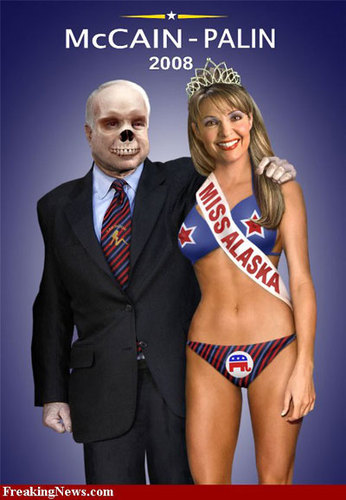
During the 2004 presidential election season, I ran a column in Technology Review Online which described the way that average citizens were exploiting their expanded capacity to manipulate and circulate images to create the grassroots equivalent of editorial cartoons. These images often got passed along via e-mail or posted on blogs as a way of enlivening political debates. Like classic editorial cartoons, they paint in broad strokes, trying to forge powerful images or complex sets of associations that encapsulate more complex ideas. In many cases, they aim lower than what we would expect from an established publication and so they are a much blunter measure of how popular consciousness is working through shifts in the political landscape. Many of them explore the borderlands between popular culture and American politics. I called this "Photoshop for Democracy" and the ideas got expanded in the final chapters of Convergence Culture. I thought back on my arguments there this past week as I've begun to search out some of the images being generated in response to John McCain's choice of Sarah Palin as his running mate. Given the intense flood of news coverage around this decision, the ways that it has shaken up the terms of the campaign, and the ways that it challenges gender assumptions surrounding the Republican leadership, it is no surprise that it has provoked a range of response. And I thought it might be interesting to dissect some of these images here.

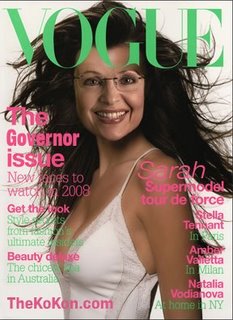
Some of the first images that circulated around the Palin appointment were, in effect, frauds. They sought to tap into the media feeding frenzy and the blogosphere's search for any incriminating evidence. Some of these images were probably already in circulation in Alaska before the announcement, while others may have emerged quickly as the nation started to learn who this woman is. Here are two examples. Both suggest the ways that Palin doesn't fit our expectations about what a female politician looks like. For the first time, we have a vice presidential candidate who is young, feminine, and well as she is one of the first to acknowledge, "hot." She was after all a runner up for the Miss Alaska competition and this couldn't be further removed from our current Vice President or for that matter, the tough matronly style adopted by America's most successful female politicians. Camile Paglia celebrates Palin in a recent Salon article: "In terms of redefining the persona for female authority and leadership, Palin has made the biggest step forward in feminism since Madonna channeled the dominatrix persona of high-glam Marlene Dietrich and rammed pro-sex, pro-beauty feminism down the throats of the prissy, victim-mongering, philistine feminist establishment." Needless to say, Palin's appearance and persona provokes strong reactions, ones which struggle to separate anxieties that she may be a Stepford Wife or a Barbie from a more generalized dismissal of attractive women. This first image plays on the fact that Palin did pose for photographs for Vogue by constructing a mock cover of the magazine.

sarah-palin-vogue2.jpg

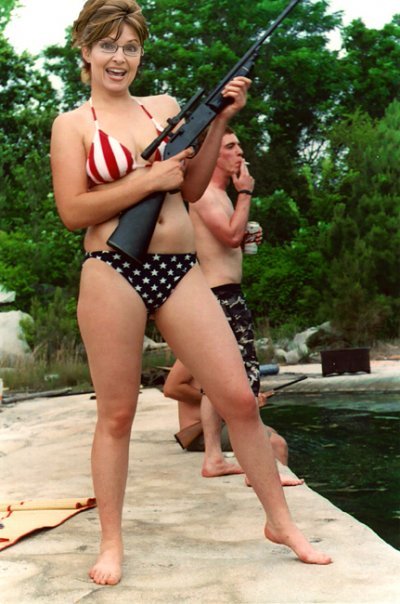
This second plays with the contradiction between the sexy mom] and the rough and tumble Alaskan. She's a "babe," in this case, a Bikini-clad "Babe," who also knows how to shoot and skin her own meat. This image was deemed sufficiently plausible that it needed to be discredited at the Urban Legends site.

palin_rifle_bikini.jpg

Those of you who watched the televised convention no doubt caught the disconcerting images of 70 something male delegates bearing buttons bragging about how "hot" Governor Palin is. Given the actual buttons circulated at the convention, this mock button is not as far fetched as it might seem, though now we are moving into the space of political humor rather than anything that was meant to deceive the viewer.

mcsame-milf.jpg

This next one juxtaposes erotic images of Palin with the very real anxieties about mortality raised by McCain's age. One of the most powerful arguments against the Palin appointment has been the concerns about what would happen if McCain were to die in office. And before he announced her pick, pundits had said that he needed to choose someone who would reassure voters that the VP would be prepared to move into the top office and stabilize the country.

mac-picks-palin.jpg

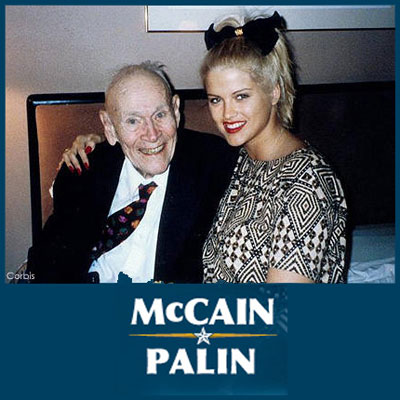
This Photoshop collage also calls attention to the vast age difference between the 70-something McCain and his 30-something running mate -- in this case, by reading the pairing in relation to the Anna Nicole Smith case. This is a classic example of how grassroots political humor maps politics onto popular culture, thus allowing us to mobilize our expertise as fans or simply readers of People magazine to make sense of the complexities of American politics.

mccain-palin-anna-nicole.jpg

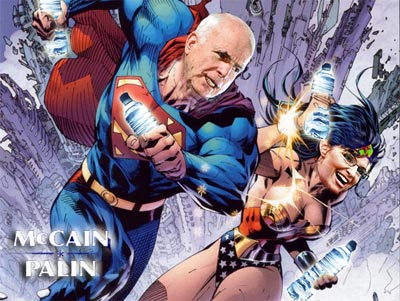
Several images in circulation read Palin as a superhero. Indeed, I was struck when I first saw her that she had adopted many of the stylistic choices of female superheroes in their alterego disguises -- her hair up in a bun, big librarian glasses. These "serious" trappings no more mask the beauty queen underneath than Clark Kent's glasses hide Superman and in the real world, they can come across as inauthentic. You add that with the stories of her braving the elements and slaughtering Alaskian wildlife and you can imagine the Amazon underneath the librarian disguise. I have been imagining that moment which would be inevitable if this were a movie where she takes off her glasses, lets out her hair, and gives a sultry look to the American voters.

mccain-palin-bottledwater.jpg

This next image pushes the conception of Palin as superhero in an entirely different direction -- this time, she's Batgirl. Here, she fits into an ongoing series of popular images which depict McCain as Bush's "sidekick," one of the ways that the idea that McCain represents a continuation of the Bush administration, a constant refrain at the Democratic convention, is entering the popular imagination. So, she's now the "sidekick" of a "sidekick," who will likewise continue the Bush Administration's policies for "four more years."

mccain-w-sidekick.jpg

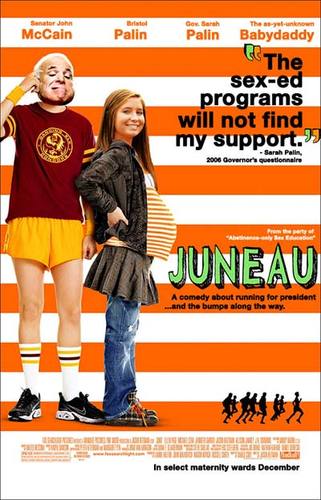
Given the ways that Palin's announcement has been intertwined with debates about teen pregnancy, it is no surprise that the poster for Juno has become a basic resource for people wanting to comment on these issues. Many feminists have already critiqued the film for making teen pregnancy and adoption seem like the only viable option for its protagonists. And of course, it doesn't hurt that Juneau is one of the larger cities in Palin's home state.

palin-juneau-sex-ed.jpg

palin-juneau.jpg

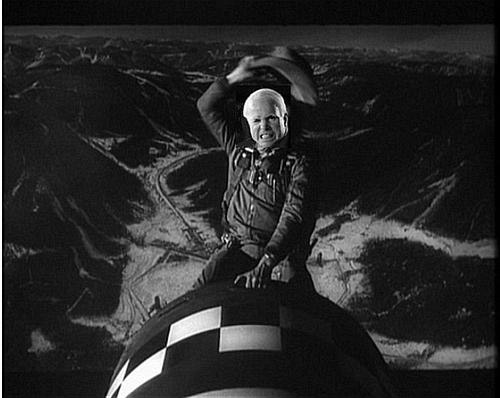
I couldn't resist throwing in two additional examples surrounding the McCain campaign. This first links McCain himself to Doctor Strangelove as a way of conveying the fear that the candidate may be a war-mongerer.

mccain-strangelove.jpg

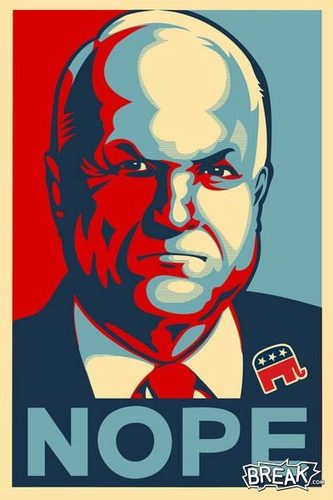
The second playfully reworks an Obama poster, one of the most vivid visual icons of the campaign to date, and in the process, sets up the contrast between Obama's politics of "Hope" and McCain's politics of "Nope."

john-mccain-nope.jpg

We can expect to see many more such images produced and circulated as the campaigns intensify even more over the coming two months.

Most of these examples are taken from the Political Humor site which regular collects such Photoshop images. You can find many more examples here.

Gay Bombay: An Interview with Parmesh Shahani (Part Two)

A central focus of the research concerns an online discussion list for Gay Bombay. What significance did this site play in the lives of your research subjects? What relationship exists between their online and off-line lives?

My research subjects were physically located in and out of Bombay city, and in some cases, out of India. Some of them accessed the Gay Bombay website and newsgroup exclusively online (either because they were apprehensive, married, lived out of Bombay or simply did not have the time to attend any of its offline manifestations) and for these individuals, the website and newsgroup engendered what Maria Bakardjieva has called "immobile socialization"- enabling them to feel connected to the Gay Bombay community at large. Those that lived in Bombay and were comfortable attending the local events equated their participation in Gay Bombay primarily with attending the city based events, and not with the list or website. Even here, there was a split between those who thought of it as primarily a party space and those who thought of it as a space for other kinds of community events.

For the newsgroup subscribers, the reasons for signing up were varied. For some it was just curiosity, for others, a way to know more about the emerging gay world in India. For activists, the possibility of advocacy and working for the issue of LBGT rights was the lure. But often, it was simply a search for empathic gay friends.

I found the Gay Bombay newsgroup to be an excellent site to observe the performative aspects of my respondents' identities. They used the Gay Bombay newsgroup along all aspects of Annette Markham's continuum of "tool", "place" and finally "a way of being".

The choice of their online nicknames typically resonated with their own sense of self or certain affiliations they wanted to highlight. For some, their nicknames were a combination of their religious and Indian identities. One respondent chose his nickname as a tribute to an iconic lesbian filmmaker, another's was the title of his favourite Bruce Springsteen song, and there were many nods in the direction of famous poets, fashion designers, and characters from literature and cinema. Others shifted between using multiple nicknames while posting to the group. Some respondents stated that their identities were the same online and offline. But the majority reported consciously activating a change in their online persona and performing it with pleasure. A few used their online selves to be more bitchy and flirtatious, something that they could not imagine doing offline because of shyness or being in the closet. Another said that he was very "violent and oppressive" in his writing, something that he was certainly not in his offline life. Significantly, for several respondents, the real issue was about identity in gay versus straight settings rather than online versus offline identities. Several of my interviews spoke about having distinct gay identities that they revealed or 'performed' in settings in which they were comfortable.

Given what you tell us in the book about the mainstream India media's often hostile treatment of gay-related stories, what has been the response to the book in India?

Well, I would call the media's treatment mixed. It is sometimes hostile, but at other times, the mainstream English media has been extraordinarily supportive to gay-related stories. Just last week, for example, the Times of India ran a front page opinion about why they felt section 377 of the Indian Penal Code needs to be abolished.

I am happy to report that the response to my book has been largely positive. It has been reviewed across the board - in mainstream newspapers and magazines, in the business press, and in the lifestyle media. In addition, it has also managed to get some decent international press, as it is available worldwide, including online on Amazon. I am especially happy that reviewers are looking at the book as not just a book about contemporary Indian sexuality, but about contemporary Indianness at large. You can check out some of these reviews:

Businessworld Magazine.

Financial Express.

Mint.

I suspect the autobiographical passages will be some of the most controversial aspects of this book. What do you think those chunks us to see about being gay in Bombay that we would not get through more traditional academic means?

I knew that the autobiographical pieces would be controversial. They were not easy to write, and I'm still queasy when I see them in print. But at the same time, I felt that if I had to do justice to the book, I needed to implicate myself in it, and this felt like the most personal way of doing so. For me, the process of research wasn't just a process of going through media archives, and of conducting and transcribing interviews with others; it also involved trying to understand myself, and where I fit into all of this. I felt that by going through my autobiographical passages, readers might have a closer to the ground view of everything else that I was describing. I call this autobiographical layer my memoryscape, which constitutes my thoughts, memories and lived experiences, both material and symbolic. It s the self-activation of my own imagination at work - my personal narrative of being gay in Bombay. I wrote the narrative exactly the way it appears in the book - in a weaving pattern, between and around the other parts of the book.

I think that all the approaches I use in the book combine to provide readers a fractal view about what it means to be gay in Bombay at this particular point in time. So, the media and cultural background provided segues into the interview comments, which in turn segue into the memoryscape. Also, specific themes raised within the book, such as the importance of family, coming out, class differences, etc. constantly repeat themselves - within the interviewee responses as well as within my own memoryscape.

You end the book with some very optimistic suggestions about the potential for change in your country. What gives you such great hope?

As I write in the concluding chapter, there are two Indian traits - fortitude and adaptability, which provide me with hope as I look towards the future of Gay Bombay and the Indian queer scene at large. Also, if Indianness is something that can be imagined and reimagined, then there's no reason why gay people shouldn't be a part of this imagination. I see daily instances of this imagination taking place all around me. I attended Bombay's first queer pride march some days ago where over a thousand people rallied, marched, sang and danced through the streets of Bombay. I cannot describe in words the spirit of that afternoon. This year, several such pride marches were held across cities in India. Recently, at at the world AIDS summit in Mexico, India's health minister came out strongly for section 377 being abolished. For someone in the government to be making a statement like this is unexpected. But the imagination isn't just confined to the law. There are gay marriages, commitment ceremonies and anniversary celebrations that keep on taking place in India, despite the laws being what they are, and several incidents, big and small, of society accommodating LBGT people, so at the pride march it wasn't just queer people who marched, there were so many families and friends, grandmothers, babies, everyone. It is moments like these that make me feel really positive, in the face of the negative news, and terrible incidents that also take place.

What did your time at MIT contribute to this particular project?

I could only have done this project at MIT. The idea for the thesis came about in 2003, during my first semester at CMS. As CMS students reading this might know (prospective CMS students, kindly note) we are strongly encouraged to think of our thesis from the moment we get into the program. :-) I knew right from the start that I wanted my thesis

to focus on contemporary India, and also work with many different media. There were a couple of factors that led me to fix on Gay Bombay as my final choice.

Firstly, I had just learnt about the existence of the Gay Bombay online-offline community before my arrival in Boston, and I felt kind of silly that I hadn't known about while I was in India. Secondly, I spent my first CMS semester in planning for a film festival and conference that would be held in the following semester called Between the Lines that dealt with South Asian LBGT identity. While working on this event, I discovered that MIT is one of the best places in the world to do queer-related research. The resources are top notch - professors, libraries, institutional support in terms of funding and facilities, LBGT student and faculty groups, and so on. Everyone from Katherine Wilmore then the Vice-President, to the Office of the Arts, to the Graduate Students Council, and of course, CMS, chipped in, and made a difference to the quality of the event. This was also a chance to read up about and see loads of queer South Asian films, which I enjoyed. Thirdly, the sudden death of one of my close friends, Riyad Wadia, the avant garde documentary filmmaker from India, towards the end of 2003. Finally, the encouragement of MIT faculty and staff members like William, Henry, Edward, Tuli, and Chris Pomiecko, who I first bounced the idea off.

Besides the excellent academic and institutional support, my time at MIT was also special in terms of my personal life. I met my (now ex) partner Junri at MIT, to who the book is dedicated, and in a sense the book and the relationship wrote themselves while we were living together. The relationship is a key part of the book; it dictates its optimistic tone and its hetero-normative politics. Incidentally, the break-up also happened at MIT, on the day that I received the first advance copy of the book in my hands, so I suppose, it was like completing a full circle.

Parmesh Shahani is based in Bombay, India, where he works on new media, venture capital and innovation for Mahindra & Mahindra and also serves as the Editorial Director of Verve magazine. He is also a research affiliate with the MIT Convergence Culture Consortium. His prior work experiences have included founding India's first youth website, business development for Sony's Indian television channel operations, writing and editing copy for Elle magazine and the Times of India group, helping make a low-budget feature film and teaching as a visiting faculty member at a Bombay college. Parmesh holds undergraduate degrees in commerce and education from the University of Bombay, and a graduate degree in Comparative Media Studies, from MIT. His first book - Gay Bombay: Globalization, Love and (Be)Longing in Contemporary India (New Delhi, London, Los Angeles, Singapore: Sage Publications) was released in April 2008.

Gay Bombay: An Interview with Parmesh Shahani (Part One)

Parmesh Shahani, a recent alum of the Comparative Media Studies Masters Program, now consulting for some of the leading magazines and media companies in India, has published an exciting new book, Gay Bombay: Globalization, Love and (Be)Longing in Contemporary India. The book, which was adopted from his thesis, is a tour de force which manages to apply multiple modes of analysis -- ethnographic, historical, institutional, and autobiographical -- to explore a moment of change as his home country adjusts to what is at once an economic, a sexual, and a media revolution. As one of his thesis advisors, I had a chance to watch this manuscript take shape as he learned how to balance the competing conceptual frames needed to understand and explicate this complex set of transitions. Some of the most compelling aspects of the book are the most confessional: Shahani draws on his own sexual experiences to offer insights into how people are living these changes through their bodies. It is a daring approach, especially given the recent history of homophobic backlash in India, but it also sheds insights that no more distanced writing could offer. In my classes, we read the manifesto introduction to Hop on Pop: The Politics and Pleasures of Popular Culture which talks about the importance of writing about "culture that sticks to your skin" and the value of first person perspectives for describing our experiences with popular culture. I recall his enthusiasm as we discussed this material and was happy to see him push this idea to the limits as he was writing his thesis.

So, I hope I can be forgiven a teacher's pride in seeing one of my students make good as I share with you this interview with Shahani about his book, about the place of gay culture in India, and about the methods behind his research.

You write, "Gay does not mean what it does in America, or in the west at large. They have creatively played with it, modified it, made it their own." So what does gay mean in an Indian context?

Homosexuality isn't an alien concept in India. A brief flashback. Ancient Indian texts from the Vedic period and the Kama Sutra all indicate that ancient Hinduism had place for a 'third sex'. Even pre- colonial India was generally tolerant, but things changed under British rule, and in 1861, the British legal system was imposed on to India as the Indian Penal Code. Section 377 of this code was an offshoot of the British 1860 anti sodomy law, and thus male same sex acts were criminalized. The British also collected, translated, rearranged and sometimes rewrote Indian history as part of their 'Orientalist' agenda during the two centuries of their rule and part of their rearrangement included eliminating or marginalizing all traces of positive same-sex references.

Flash forward to today. In contemporary urban India (My research was based solely within this context), while there is no guilt-based taboo against homosexuality, being gay has its own unique set of connotations and experiences because of the cultural and social structures, and family pressures that insist on conformity to traditional patriarchal, heteronormative values.

Family, social and community connections are the primary ties, and gay people do not want to let go of these at all. People hardly come out, and even if they do, they want to accommodate their gay identity within the established framework. In the west, if families are un- accepting, then gay men often move away and form separate communities but almost all the people I interviewed for the book who were living in India were adamant that they were very connected to their families and did not want to move away from them at all.

The second aspect is the institution of heterosexual marriage. It is almost like a compulsory stage of life, and for many gay people, this is the biggest challenge that they have to negotiate. Sometimes they manage to avoid it, but many times, they don't, which creates a whole new set of problems. The pressure to conform is even more intense when the gay person is effeminate and thus visibly marked different. Rebellion against this pressure can sometimes mean banishment but in most cases, the gay person is not thrown out, but pressured to change his ways in order to maintain the family honour.

The third aspect is the law. The Indian penal code continues to criminalize same sex behaviour, and this is really problematic in several ways - in terms of the limitations to health and safe sex outreach, in terms of the restrictions to same sex partnerships in terms of cohabitation and planning a life together, etc. At the same time, there are also so many global influences, whether it is the coverage of gay marriage in the US that gets reported on regularly in India, or films like Brokeback Mountain, or gay dance parties and so on.

When urban Indian gay men construct an idea of their gayness, they draw upon all of these different components and create an imagination with global influences but rooted very much in the local realities. I think that to be gay in Gay Bombay signifies being 'glocal'; and gayness here stands for Indianized gayness. So, one might dance in a Western style disco anywhere else in the world, but one can only munch on a post-dance jalebi sweet in India. The online-offline group Gay Bombay, around which my book is based, is certainly inspired by Western notions of what it means to be gay - its dance parties, PFLAG style meets, website, etc, have all drawn from Western experiences; but they have been customized, glocalized, and made uniquely Indian. For example, several support group meets take place around uniquely Indian festivals such as Holi (festival of colours) and Raksha Bandhan (which celebrates brother-sister love), and the festivals are appropriated to meet the needs of the group.

How are debates about how we label sexual identities tied up with concerns about

westernization and globalization?

Oh, they are very tied up. In fact, this is the main line of attack used whenever the discourse around homosexuality becomes too public, or too threatening. It seems that being gay is something that needs to be prevented from happening to the impressionable young men and women of the country! Right wing Hindu fundamentalist groups like the Vishwa Hindu Parishad (World Hindu Council) and Rashtriya Swayamsevak Sangh (National Brotherhood of Volunteers) are only too happy to jump on the "anti-Indian culture" bandwagon at any given time. I write in the book about how the current Indian prime minister, Manmohan Singh was clearly flustered by a question about same sex marriages by a Canadian journalist and emphasized that these kinds of things were not appreciated in India. The lesbian themed movie Fire (1998) was deemed as an attack by "ultra westernized elite" on "the traditional set up" through "explicit lesbianism and other perversities" by the right-wing newspaper The Organizer.

Concerns about the negative impact of globalization are also expressed by certain

members of the gay community. The English speaking upper middle classes have largely been the beneficiaries of globalization (jobs, travel, media consumption, internet usage, etc.), but for the non-gay identified homosexuals from the working classes, life might have become harder.

Globalization is also viewed as a positive prism to promote the decriminalization of

homosexuality. This point of view wonders if it is right for a country that aspires to

be part of global scene to victimize its minorities. As the journalist Karan Thapar

writes in a recent Hindustan Times article, "by continuing to do so we make a mockery of our commitment to human rights leave aside all the Geneva conventions we have signed up to. So, for the sake of our democracy, this must be repealed."

On a lighter note, some of my interviewees, especially the older ones, were very

uncomfortable with what they felt were the Westernized aesthetics of the younger

generation. One of them was particularly dismayed at the younger lot's disdain for body hair and mustaches, something that he described as inherently Indian.

How are shifts in the status of gay people in India being represented in Indian popular culture, especially in Bollywood films?

I'm not at all satisfied with the way gay people are currently being represented in

Bollywood films. Given the number of gay people within the film industry itself, I'd

have liked that the representation be more nuanced! However there have certainly been

some shifts over the years and these give me hope there will be progress in future.

We should remember that Bollywood has a long tradition of having comic sequences or songs featuring cross-dressing male stars. For instance, Amitabh Bachchan in a sari in

1981's Laawaris (The Orphan), Rishi Kapoor in a dress in 1975's Rafoo Chakkar (The Runaways), Aamir Khan in a gown in 1995's Baazi (Game), and there are so many more

examples. Post the economic reforms of the 1990s, we begin to see the gay sidekick as a regular comic character in many Bollywood films, like Hum Hain Rahi Pyaar Ke (Companions on the Road of Love, 1993), Raja Hindustani (Indian King, 1996) and Taal (Rhythm, 1999). These markedly effeminate, comic gay characters are ridiculed but also indulgently patronized by the protagonists, and effectively neutralized. Thus, the camp phenomenon Bobby Darling (who often plays himself in his on screen appearances) is teased and mocked in whatever film he is a part of, but his place in the youth gang is never in doubt. It is of course understood that he will never behave transgressively with the hero, coo over him or insinuate desire for him. He is accepted, despite being different, because his loyalty as a friend and overall integration into the master narrative overrule his effeminate behavior and implied homosexuality.

In recent years, the camp comic has been replaced in films like Page 3 (2004) and Let's Enjoy (2004) with the debauched, decadent gay designer, hitting on straight men with impunity for his own sexual gratification. I suppose all of this mirrors Hollywood and its initial portrayals of gay men as comic characters or villains. It is still very rare to find somewhat complex gay characters, as in films like Bombay Boys (1998) and Split Wide Open (1999). I want to point to three films that make me hopeful about change, and one trend that I believe is going to accelerate the process. These three films are 2003's Kal Ho Na Ho (If Tomorrow Does Not Come), 2005's My Brother Nikhil and 2007's Honeymoon Travels Pvt. Ltd.

In Kal Ho Na Ho, there is a funny 'gay' subplot between the two lead actors, played by stars Shah Rukh Khan and Saif Ali Khan, who form the two corners of the love triangle in the film, with actress Preity Zinta as the third. Shah Rukh and Saif's characters pretend to be gay throughout the film, much to the disapproval of Kantaben, the housekeeper. They constantly caress each other and spout double- entendre dialogue to shock old Kantaben, and they take us on the ride with them. It is not us, the viewers, but Kantaben who is old fashioned. Shah Rukh and Saif also camped it up with each other as emcees of the annual Filmfare Awards in 2004 (India's Oscar equivalent) - a show that was broadcast to millions of viewers over television. I find the casual breeziness with both these stars treat gayness, both on film as well as on stage, energizing. What's the big deal, they seem to suggest. Get over it. (The film, incidentally also featured a gay kiss between two white New Yorkers in one song sequence, and an overtly camp Indian wedding planner!)

I was very impressed with My Brother Nikhil in 2005, a Bollywood film that dealt with the trials and tribulations of a gay champion swimmer who is found to be HIV positive (based on the real life story of Dominic D'Souza). Its debutant director Onir had managed to portray homosexuality with decency, sensitivity, romance, and something that was completely incidental to the story, which I thought was amazing.

The 2007 film Honeymoon Travels Pvt. Ltd. had two gay sub-plots. The story was about six couples on a honeymoon package tour vacation in Goa. During the course of the vacation, two of the respective husbands on the trip get attracted to each other. One comes out to his wife, who is furious about the deception, but they land up becoming friends. The other one gets back in the closet and says nothing to his newly married wife. The film won the Best Film award at the inaugural Indian Queer Media Awards in 2007, that honor sensitive media representations of LBGT characters.

The trends that I think will accelerate a more vibrant, complex portrayal of gay

characters are that of multiplex cinemas and a corporate-managed portfolio-style

approach towards film making. Over the past five years, both these trends have enabled a wide spectrum of Bollywood films being made, right from the low-budget indie like Bheja Fry (Brain Fry) to the giant mega-expensive Singh is Kinng type of extravaganza. At the lower end of the spectrum, there is enough of a chance for creativity and diversity; studios are now bankrolling different type of efforts and small-sized theatres and the ancillary satellite/DVD markets are ensuring that the shelf life of these low budget films gets extended.

Parmesh Shahani is based in Bombay, India, where he works on new media, venture capital and innovation for Mahindra & Mahindra and also serves as the Editorial Director of Verve magazine. He is also a research affiliate with the MIT Convergence Culture Consortium. His prior work experiences have included founding India's first youth website, business development for Sony's Indian television channel operations, writing and editing copy for Elle magazine and the Times of India group, helping make a low-budget feature film and teaching as a visiting faculty member at a Bombay college. Parmesh holds undergraduate degrees in commerce and education from the University of Bombay, and a graduate degree in Comparative Media Studies, from MIT. His first book - Gay Bombay: Globalization, Love and (Be)Longing in Contemporary India (New Delhi, London, Los Angeles, Singapore: Sage Publications) was released in April 2008.

How Big a Geek Are You?

A few weeks ago, MIT launched a new video through its home page which was intended to prove to the world that MIT folks are not all geeks. (By the way, sorry not to be able to embed the video here but in the name of Youtube, the MIT geeks have decided they need to lock down their content rather than allowing it to spread!) It's an effective video which calls attention to many of the things I love about MIT but it left me frustrated. For one thing, most of the folks they depict still come across looking like geeks, not that there's anything wrong with that! And I thought the video would have been more effective if it broadened our definition of geek to include all of the rest of us at MIT who don't participate in the robotics competition or spend most of our time talking to our shoes. I'm proud to be a geek -- and to be geekish about culture and art. To my mind, saying that MIT isn't all geekish because it teaches the humanities is another way of saying that the humanities are cut off from the things that made MIT famous and I don't accept that core premise.

geeks2.jpg

So, rather than teaching our incoming students to feel proud because they aren't geeks, we hit them with a geek entrance exam, inspired by our colleague Junot Diaz's The Brief, Wondrous Life of Oscar Wao, which won the Pulitzer Prize for Literature. Diaz's writing is full of in joke references to games, comics, animated series, and pop music, all of which form the raw material for the various characters to construct their own personal mythologies.

Make no mistake -- Junot Diaz is a geek; he's also a hep cat. Both sides of his personality were on display during his appearance on The Colbert Report earlier this summer. In writing this book, it is clear that Diaz was struggling to make sense of his own geekish impulses and perhaps, this award winning book is his way of reflecting on how and why he belongs at MIT. It's an amazing book which I recommend to anyone reading this blog.

Every year we select a book to send to our graduate students to read over the summer. The books are carefully chosen to help set the tone and establish some key themes for the coming year. This year, we chose Oscar Wao and our graduate students are lucky enough to be able to sit down for a conversation with the author later this week. To get in the spirit, I put together a little quiz which includes many, though not all, of the geek references in the novel. We used it to break the ice as the graduate students got to show off their geek expertise. I thought you might also enjoy working their way through the quiz. I didn't bother to put together the answers. That's what Wikipedia is for, silly!

To show how geeky my students are, they ended up using ChaCha, the new text-message based research service, to track down answers to some of the hard to identify terms.

How Big a Geek Are You?

The following are geek culture references from Junot Diaz's The Brief Wondrous

Life of Oscar Wao.

How many of them can you identify?

How many other CMS students do you need to talk with to figure out what they all

are?

What digital resources would you use to track down this information?

Muhammad Ali

Akira

Lloyd Alexander

Appleseed

Isaac Asimov

Atari

Jeans Pierre Aumont

Balrogs

Billy Batson

Battle of the Planets

"Beam Me Up"

Big Blue Marble

Biggie Smalls

Blake's 7

Ben Bova

Bon Jovi

Brotherhood of Evil Mutants

Edgar Rice Burroughs

Captain America

Captain Horlock

Chaka

Chakobsa

Champions

Clay's Ark

Daniel Clowes

Dark Knight Returns

DC

D&D

Samuel Delaney

Deathstroke

DM

Doctor Who

Dr. Manhattan

Dr. Zaius

Dorsai

Dune

Eightball

Elvish

Encyclopedia Brown

The Exorcist

The Eyes of Mingus

Fantasy Games Unlimited

Final Fantasy

George Foreman

The Fountainhead

Galactus

Galadriel

Gamma World

Gen. Urko

Ghost

Gondolin

Good People of Sur

Gorilla Grod

Gary Gygax

Green Lantern

Hardware

Hector Lavoe

Robert Heinlein

Frank Herbert

Herculoids

Hernandez Brothers

Tracy Hickman

Harry Houdini

Robert E. Howard

Ill Will

Incredible Journey

Intellivision

Jabba the Hutt

Jack Kirby

Jedi

The Jeffersons

Kaneda

The Great Kazoo

Stephen King

Land of the Lost

Stan Lee

Ursula Le Guin

Lensman

Lothlorien

H.P. Lovecraft

Luba

Magic

Manhunter

Man Without a Face

Marvel

Mary Jane

Master Killer

John Merrick

Frank Miller

Minas Tirith

Miracle Man

Maria Montez

Alan Moore

Mordor

Morlock

My Side of the Mountain

"Nanoo-Nanoo"

Neo Tokyo

New Order

Andre Norton

"Oh Mighty Isis"

Palomar

Phantom of the Opera

Phantom Zone

Planet of the Apes

Roman Polaski

Project A

Rat Pack

Lou Reed

Return of the King

Robotech Macross

Rorshach

The Sandman

Sauron

Doc Savage

Shazam

Sindarin

Slan

"Doc" Smith

Robert Smith

Solomon Grundy

Sound of Music

Space Ghost

Squadron Supreme

Olaf Stapledon

Star Blazers

Star Trek

Street Fighter

Tom Swift

Sycorax

Take Back the Night

Teen Titans

Tetsuo

The Terminator 2

This Island Earth

Three's Company

J.R.R. Tolkien

Tomoko

Tribe

Tripods

Twilight Zone

U2

Ultraman

Adrian Veidt

Veritech Fighter

Virus

The Watcher

Watchman

Watership Down

Margaret Weis

H.G. Wells

What If

What's Happening

Wonder Woman

X-Men

Zardoz

Mobilizing Generation 2.0: An Interview with Ben Rigby

This fall, I will be teaching a course on New Media Literacies and Civic Engagement. The class is designed to provide a bridge between the research we are doing for the Center for Future Civic Media and Project New Media Literacies. It also hopes to explore in depth a range of current research about how the new media landscape is impacting how young people learn to think of themselves as citizens. Here's the course description:

New Media Literacies and Civic Engagement

What does it mean to be 'literate' and how has this changed as a consequence of the introduction of new communication technologies? What social skills and cultural competencies do young people need to acquire if they are going to be able to fully participate in the digital future? What are the ethical choices young people face as participants in online communities and as producers of media? What can Wikipedia and Facebook teach us about the future of democratic citizenship? How effective is Youtube at promoting cultural diversity? What relationship exists between participatory culture and participatory democracy? How is learning from a video game different from learning from a book? What do we know about the work habits and learning skills of the generation that has grown up playing video games? What impact are young voters having on the 2008 elections and why? What lessons can we take from the study of virtual communities which might help us enhance civic engagement at the local level? Who is being left behind in the digital era and what can we do about it? This class is designed to introduce students to a new wave of research which is bringing together scholars from many different disciplines to ask new questions, pose new models, and try new experiments to better imagine the future of American education and of democracy itself.

Much of the reading in the course will be drawn from a series of books recently produced by the MIT Press and the MacArthur Foundation. These books reflect a national push by the MacArthur Foundation to explore how young people are learning informally through the affordances of new media and what implications this has for the future of schools, libraries, public institutions, the workplace, and the American family. Researchers and guests from The MIT Center for Future Civic Media and Project New Media Literacies will play an active role in the course, sharing projects and curricular materials under development, grounding our more theoretical considerations with real world perspectives. Students will have an opportunity to explore these ideas through research papers but they will also be asked to get involved in the development of projects which are designed to have an impact on real world communities.

If you happen to be a student at MIT, Harvard, or Wellesley, I hope you will consider taking the class this fall. The class meets Mondays, 11-2 pm, and Weds, 3:30-5 pm. I am hoping to write here from time to time about some of the ideas that emerge from the class. We will also be hosting several discussions through the MIT Communications Forum this term focusing on the roles which new media played in the 2008 Presidential Campaigns.

To whet your appetite on this topic, I wanted to share here an interview with Ben Rigby, the author of a recent book, Mobilizing Generation 2.0, which offers case studies and insights for activists and campaigns as they think about how to reach and court young voters. The book includes discussions of blogs, social networks, mobile technologies, wikis, and virtual worlds, among other web 2.0 practices, and features contributions from a range of key thinkers including danah boyd, Seth Godin, Mitch Kapor, and Beth Kanter. Rigby, who has developed web and mobile strategies for a range of nonprofit and Fortune 1000 companies, founded MobileVoter.org, an organization dedicated to using new media to politically empower young people.

You organize your book around new technologies and platforms. Yet at every civic media event I've been at lately, the core debate has been whether the change is

being brought about by new technologies or by new social and cultural practices

which help to foster a greater sense of civic engagement. Is this a false

debate? Where do you fall in terms of the relative importance of technologies

vs. social and cultural practices?

It's absolutely a false debate. Technology is a social and cultural practice. It means nothing outside of the context of the people who use it. This question led me to re-read the paper that inspired me to pursue a thesis program in Science, Technology, and Society back in college. It's called "Steel Axes for Stone-Age Australians" by Lauriston Sharp.

To summarize Sharp's brief ethnography: The Yir Yoront is a Western Australian aboriginal group that, by the early 1900s, had very little exposure to any social group outside of their limited radius (and virtually no contact with non-aboriginal peoples). The stone axe played a central role in their lives as a productivity tool, but most important, as a lynch-pin of social relations. Being difficult to manufacture, these axes were in short supply. While any Yir Yaront was permitted to use one, their use was controlled by adult men. Women and children who wanted to use an axe were required to get one from a man (usually a direct relation) and needed to return it promptly and in good condition. A man referred to his axe as "my axe," but women and children never did. The axe also figured prominently in trading relations with nearby groups. The Yir Yaront traded sting-ray-barb tipped spears for raw stone with their neighbors to the south (where quarries were located). Again, adult males figured prominently in these relations as they were the primary producers of spears and lead negotiators.

When an Anglican mission arrived in 1915, the missionaries set up a plan for "raising native living standards." In return for undertaking certain tasks or behaviors, the missionaries distributed incentive goods to the Yir Yaront. The missionaries quickly discovered that their steel axes were valued more than any other trading item. Thus, they'd give out these axes as incentives for participation in their programs and as gifts during holidays. They'd give them to men, women, and children indiscriminately.

Sharp describes the events that follow the introduction of the steel axe as "the collapse and destruction of all Yir Yoront culture." Wives and children no longer needed to defer to their superordinate male. Men, in turn, became insecure as they questioned their roles and masculinity. The hierarchy of 'ownership' melted, which resulted in the rise in stealing and trespassing. Trading links weakened as stone was no longer highly valued. Associated trade ceremonies took on less significance and became poorly attended.

Frustratingly, Sharp's ethnography leaves off there. It appears that he left the field just as these monumental transitions were taking place. I haven't been able to find any followup reporting. It's the ultimate cliff hanger (if any readers have additional information on this group, please send!). He reports, somewhat melodramatically, that the Yir Yaront's southern trading partners passed through a similar set of cultural transformations which resulted in an "appallingly sodden and complete cultural disintegration, and a demoralization of the individual such as has seldom been recorded elsewhere."

Even without the melodrama or the end of the story, it's clear that a technical innovation (or introduction of such) sparked the transformation of a society. However, because the technology in question is a simple axe, it's easy to disambiguate the tool from the social and cultural practice that surrounds it. Here, the tool gets moderately more effective at its ostensible task (chopping), but it's how the Yir Yaront wove it into their life that's critical. If it were any garden variety tool, that'd be one thing. But the axe was central to the Yir Yaront hierarchy and belief system. It's impossible to understand the axe without understanding its cultural context - it doesn't make sense.

Similarly, email, social networking, and YouTube don't mean anything by themselves. They are what we make of them - and how we believe in them. Peer production of media is significant because of the way that we value media. Technology is inherently social.

In fact, this question ties into my motivations for writing Mobilizing Generation 2.0. In order to make social change, you have to understand -a- what the axe does (chopping) and -b- how people value it (cultural context). Of course, there's a chasm in complexity between the axe and today's technologies such that even understanding -a- is something of a challenge. However, it's -b- that's really important. And you can't get to -b- without first getting to -a-.

So the book is organized around our most significant axes: blogs, social networking, mobile phones, wikis, video and photo sharing, online mapping, and virtual worlds. It intends to give readers a crash course in understanding -a-. Then, once that territory is covered, the book goes into -b-: how young people are using their technologies and how organizations are, in turn, using these same technologies to connect with youth.

We have a curious relationship with the word "technology." In common speech, we use it to define a subset of our tools which are unfamiliar to some, but not all, members our social group. Thus, tools such as tshirts, shoes, and axes are just "things"... things familiar to everyone. But microchips, cell phones, and Web sites are "technologies." Of course, they all belong to a kind of tool continuum - and it's helpful to understand "technology" in this context.

There's a moment when a tool stops being referred to as a "technology" and becomes just a thing. A light bulb, for example, has moved from being a technology to just a thing. However, a cell phone is still a technology. It will eventually move into the category of "thing" as it becomes more familiar to more people and as newer and less familiar tools take its place. The dividing line on this continuum differs among age groups - it sits forward for younger people. This rough diagram illustrates this idea.

tech.PNG

Of course the continuum varies from person to person. But for an older person running a nonprofit or political campaign (as most director level people tend to be), it's helpful to imagine that most of their "technologies" are just "things" in the minds of young people - nearly as natural and thoughtless as putting on shoes in the morning (which is not to say, however, that they're insignificant).

All along this continuum (and back to your question), each of these tools is embedded in our cultural context. I can't imagine it being any other way until the point at which our tools take on an agency that's quite outside of our collective control. To my thinking, this point happens when we start having earnest discussions about civic rights for intelligent computer systems - which means that these systems will have evolved into something entirely different from what they've been. I think that this moment will eventually arrive, but that it's many years away.

Over the past few years, organizations of all kinds have begun to explore the

value of virtual worlds. Yet, virtual worlds still arguably reach only a culture of early adapters. What is the current value of virtual worlds as a political platform? Are we experimenting with something that will have a long term impact but may offer only limited short term rewards? If so, how can you justify putting energy there in what may turn out to be a tight political contest?

I don't know much about the inception of Second Life, but I imagine it went something like this:

[Scene: friends sitting around a poker table drinking beer]

Philip Rosedale: Have you guys read Snowcrash?

Friend #1: Yea, it rocked.

Philip Rosedale: Wouldn't it be cool if we built that thing?

Friend #2: What thing?

Philip Rosedale: The thing! The actual virtual world that Stevenson describes. I know some tech guys.

Friend #1: Phil, you should do it. That would rock.

Philip Rosedale: Yea, maybe I will.

Then Rosedale takes the book, hires some coders, and transliterates the book into pixels. And so, we've got Second Life, which is Snowcrash come to life - irony and all. Second Life was such an early sensation that it has, thus far, defined what is meant by "virtual world." In fact, it's gone further by defining the common understanding of character-driven 3D space (which is distinct from a "virtual world").

Second Life's early success and recent woes have, in fact, put a damper on innovation in the 3D space. Second Life and its imitators (of which there are now dozens, including Google's recent project called Lively) continue to replicate Snowcrash. They recreate fantasy versions of something that approximates real-life. And social change efforts in these worlds are doomed. They are shoddy replications of experiences that are better in real life: walkathons, tschotchke giveaways, museum exhibits.

But these efforts are only the first forays into what will eventually be the next world changing technical movement. Snowcrash is not where we'll end up. The potential of immersive 3D space is much greater than imitating and fantasizing about our existing reality. Remember in 1995 when businesses would scan their paper brochures and use the resulting JPG as their Web site? That's where we are today with the use of 3D space.

So, for anyone concerned about the 2008 Election, there's very little of interest. I wouldn't spend any time at all in today's virtual spaces. From the candidate perspective, it's not worth the effort. My advice for social changemakers is to keep a close eye on the space and to wait for it.

You end the book with a suggestion that "web 2.0" constitutes a "tectonic shift" in the political landscape. Explain. What's the nature of that shift? How quickly is its impact being felt? What changes will traditional political organizations need to make in order to take advantage of this new model for reaching voters? And what do you think will be the biggest points of resistance in moving in this direction?

Yochai Benkler describes this shift wonderfully in the Wealth of Networks. We (I) owe him a debt of gratitude for the book. Benkler describes the shift as nothing short of a massive redistribution of the means of production. That's tectonic. It's a dozen steel axes put into the hands of everyone. And it's a power grab right now between:

a) Those who are trying to prevent the redistribution (ie: RIAA)

b) Those who don't recognize that massive shifts are underway (ie: most large nonprofits and traditional political organizations)

c) Those who love their newfound axes (ie: most young people and Web2.0 business owners)

So -a- will fight it; -b- will lose (most of the time); and -c- will fight to make -b- join them instead of joining -a- so that -a- doesn't win, which is not at all a certainty at this point in time.

All signs are that a record number of young people have been participating in the current presidential elections and that voter registration for those under 30 have increased dramatically in recent years. What factors do you see as contributing to this increase in youth participation? Will these trends continue to rise as we look towards the fall?

I don't have anything substantively new to say on this topic, other than to echo what you and other smart observers have been saying for the past couple of years. Young people's media has become participatory - and they're reacting positively to a candidate (Obama) who has shaped his campaign in a similar fashion. Moreover, he's using language and speaking about issues in ways that give him the air of authenticity. For the sake of increasing youth political involvement, it's a good thing he won the nomination.

You begin the book by discussing your experiences running a nonprofit, Mobile

Voter, which you suggest failed to meet its goals for registering and

mobilizing young voters. Why did Mobile Voter fail and what did you learn from

this failure?

There's such a finality implied by the word "failure." I don't believe in it. It's too black and white.

To take a recent example - this spring, we entered our newest initiative, Volunteer Now!, into the NetSquared Mashup Challenge. The Challenge involved two rounds. To make it into the first, we needed to generate votes on Net2's web site. I emailed my list asking for votes and we made it in. The second round involved two days at a conference center in San Jose. At the conference we met dozens of enthusiastic social change activists and several potential funders. We also demonstrated the product dozens of times. In sum, we met a ton of people, honed our pitch, and got great feedback for the project.

We didn't place in the top three. Did we fail? Of course not. There's so much value in this experience. I'm unsure what historical events brought us to consider our efforts in Manichaean terms (win/lose, evil/good, fail/succeed), but I think it's a big problem. We're afraid of nuance.

So, instead of slinking away from not winning the Net2 challenge, I sent out an email to my list again with the subject line "We didn't win!!" And funny enough, that email generated a response that was 10x higher than the initial email asking for votes. There was a lot of value in looking at the "loss" as an opportunity for engagement.

So, that's a long entree to your question about Mobile Voter's 2006 "TxtVoter" campaign. In 2006, we raised funds from the Pew Charitable Trusts to register 55,000 young voters. By Nov 5th, we'd registered about 35,000 - of which only about 2,000 came through our text messaging system. The rest came via our GoVote.org Web site which we built and operated in conjunction with Working Assets (now Credo, who put the lionshare of the effort into generating traffic to that site).

It would be disingenuous to say that we weren't disappointed by the numbers - especially since we started the season with a Dean-like yell and aspirations to register many more than 55K. However, there's a rich context to this "failure." In addition to TxtVoter's registration component, we helped to implement a get out the vote (GOTV) campaign that was studied (and party organized) by researchers from Michigan (Dale/Strauss) which has since become the seminal study on the effectiveness of text messaging for GOTV. We also developed a list of best-practices which is now being used to replicate the most successful instances of the TxtVoter campaign (there were some events in which response rates surged to 46% versus the 1% overall average). To boot, the experiences of the '06 campaign led directly to the writing of Mobilizing Generation 2.0, which intends to address some of the pain points that I saw across hundreds of nonprofits and political campaigns during the TxtVoter initiative.

In sum, the learning is: there is no failure and we need to better embrace nuance.

My Inner Fan Boy Escapes, or Memoirs of a Comic-Con Newbie

Last time, I shared some reflections on my first time experience of San Diego Comic-con last month. I wanted to add a few more thoughts today. The biggest shift in the media coverage of the convention this year has come from growing attention to the women who attended to conference. As we've noted here in the past, San Diego is often depicted as the seat of power in the fan boy universe and over the past few years, we've seen a steady stream of articles stressing the renewed influence of male fans on the decisions made by the film and television industries. Yet, this time, primarily as a result of the phenomenal turnout for the Twilight panel, the press has finally started to notice that there are ladies in the house. As I noted in my exchange earlier this week with Kristin Thompson, there were certainly still more male than female attendees. I don't have access to any statistics but at a glance women represented between a quarter to a third of those attending the event. Yet, they made their presences felt and heard at pretty much every event I attended and to nobody's surprise, they were interested in different things than some of the guys in the room.

At the risk of stereotyping things, the archtypical fan boy at San Diego seemed preoccupied with getting spoilers. Almost every panel started with someone explaining that they were not going to be able to tell the audience much about the coming season. And the fan boys would see this as a competition, asking spoiler questions again and again, until someone let something slip and you knew it would be all over the blogs in a heart beat. The industry has helped to create this phenomenon by using the convention as a space to roll out preview reels, clips, or even whole episodes worth of forthcoming material, seeing the gathering both as a way to gauge response and as a publicity mechanism to get buzz going around their projects. The audience has gotten so spoiled that there's almost total indifference if the panel simply shows something that's already been released on the web -- even a few days before. The focus is relentlessly on the future -- everybody wants to know something before the general population -- and that's become half the reason why you wait in the long lines and sit in the back of a packed auditorium, hoping to see a few scenes of your favorite series before it reaches the air. And be forewarned, the notes that follow probably represent the rumblings of my inner fan boy.

Female fans are certainly interested in spoilers, but my experience was that they were much more likely to ask questions designed to get greater insights into the ongoing relationships on the series -- either those between characters or on the set. Rather than always racing ahead, they seemed to have a deeper interest in understanding what the series was all about and how the production staff thought about some of the issues which had sparked conversation on Live Journal or have started to inspire fan fiction. As a rule, these questions were more apt to get substantive responses from the panelists, rather than get shot down because they weren't going to share any spoilers. The male questions are all or nothing and most of the time they yielded nothing, where-as the fan girl questions are more apt to spark a bit of fun interplay between cast members or even, heaven forbid, shed some light on the programs and films of which we are fans.

While we are on the subjects of female fan culture, I wanted to do a shout out to Francesca Coppa who was interviewed in a recent issue of Reason Magazine about the history and practices of fan vidding. It's a very smart interview which contributes to the ongoing struggle of fan vidders to gain a bit more recognition for their historical contributions to remix culture. My bet is that anyone who's read this far into the post will find it a rewarding read.

My big bad confession is that while I came to San Diego for the comics, I didn't really attend any of the comics-related sessions. I was as star struck as anyone else by the sheer number of my favorite actors and creative artists in attendance and tended to camp out in the larger venues to learn more about film and television shows I liked. And to make matters worse, the one comics panel I attended -- a session featuring Stan Lee and Grant Morrison -- made it onto my schedule because it was right before the Doctor Who and Torchwood sessions and I was afraid I wouldn't get a seat. I convinced myself I was morally superior to the others camping out all around me because at least I know who Lee and Morrison were, and I could even rationalize being there because the topic was supposed to be about Virgin Comics and I have a grad student doing a thesis on Virgin. But to be honest, I've seen Stan the Man before and once you've heard him do his "I'm so egotistical..." jokes once, you've probably heard them enough to last a lifetime. And I also have to confess that I've never really liked Morrison's comics as much as I am supposed to -- you might apply this to any comic which is described as "cosmic." I don't do "cosmic." I like my comics to have richly drawn characters and witty dialog alongside the action scenes -- and not go trapsing off into other dimensions (spirital or otherwise). If I wanted mysticism, I'd buy a pack of Tarot Cards -- which some of Morrison or Moore's worst stuff seems to resemble.

The Doctor Who panel, on the other hand, was a real treat -- even if Russel T. Davies did not make his announced appearance. We still had an hour to bask in the wit and intelligence of Stephen Moffat who has not only written some of my favorite episodes of Who but also is the man behind Jekyll, a really stunning mini-series about a contemporary descendant of Doctor Jekyll. And things really came alive when John Barrowman (Captain Jack Harkness on Doctor Who and Torchwood came on stage). Barrowman is even more out-going in person than he is as a character and he brought the other castmembers and creators out of their shell. As with everything else, the audience had more fun when it looked like the actors were having fun and Barrowman was having a total blast.

But fan loyalties call me elsewhere and I had to sneak out of the room half way through the Torchwood panel in order to make sure I'd get a seat at the Middleman session. I sang this series praises after seeing only the first episode earlier this summer and I have to say it has gotten stronger and stronger with each episode, as we've gotten to know the characters and learned more Middleman backstory and as the writers and actors have found their voice. If you missed any episodes, get thee to iTunes. You missed what I think was the strongest television of the summer -- So You Want to Dance being the other series which helped me get through the hot and sweaty months. Alas, no Natalie Morales at the Middleman panel, continuing a panel of disappointing no-shows. But I did get a chance to hear Javier Grillo-Marxuach, the series creator and executive producer, and Matt Kesslar who plays the Middleman. This was a much cozier affair -- in a room that seated only a few hundred rather than several thousand -- but there was a sense that all of us in the room had made a discovery together of this little known cult series which needed our support.

And we ended an exhausting day with the panel focused on HBO's True Blood, a forthcoming vampire series created by Alan Ball (Six Feet Under), and starring, among others, Anna Paquin, both of whom were in attendance, along with pretty much the rest of the cast. Like Twilight, this is a "my boyfriend's a vampire" story, this time with lots of local color stemming from the New Orleans location. It seemed good enough to motivated me checking it out in September, but there was little here to distinguish it from any other recent vampire series on television, other than the fact that Ball has a pretty good track record and they have a very imaginative ad campaign involving mock billboards that we had seen all over Los Angeles earlier in the trip. The big problem is that most of the folks on the panel didn't seem to recognize that they were speaking in genre cliches and acted as if they were inventing most of these elements from scratch. If you want to read a good comic with a similar plot line, see Jessica Abel's Life Sucks.

Friday, like everyone else at the convention, the goal was to get a seat for the Watchmen session. And we made it -- barely. Zach Snyder, the Director from 300 who finally managed to get one of my all time favorite graphic novels on the screen, was there was pretty much the entire top tier cast of the movie. I had been nervous about what Watchmen was going to look like on screen, especially after the really tacky pictures which were in Entertainment Weekly, but once they got through showing the extended preview a few times and I picked my jaws off the ground, it was clear that I was going to love this movie. As someone who has taught the book more than once, I recognized pretty much every shot in the preview as coming from a specific panel in the graphic novel. And it was clear that they captured not just the look but also the tone of the story here. Snyder himself was mumbling and inarticulate. I suppose I now know why his movies are rich in images and sparse in spoken language.

We stuck through an hour's worth of screening of film previews (which disappointed primarily because most of them were already in the theaters and because so few of them really fell into the genres that drew me to the con in the first place) and then a short session showcasing the forthcoming remake of The Wolfman. Benicio Del Toro, who plays the Lawrence Talbot role made famous by Lon Chaney Jr. in the original Universal film, and Emily Blunt, who plays his love interest, were there in person as was veteran special effects artist Rick Baker. Baker totally sold me on the film -- as recapturing the spirit of the old Universal and Hammer horror films that I loved so much in elementary school, while giving them an adult spin. To be honest, I have been anticipating the release of this film since I saw the first stills of Del Toro in his monster make-up because it was so clear that the creature was crafted with enormous respect for the old style monster movies.

And then it was The Spirit session, including Frank Miller and Samuel R. Jackson, not to mention several of the actresses who played Femme Fatales in the film. This one made me a great deal more uneasy. Jackson was Jackson and that was worth all of the effort of coming to San Diego. And it looks like it should be a beautiful movie to watch, other than the fact that it looks just like Sin City. Miller was giving speeches about his long time relationship with Will Eisner and his respect for the original and so forth, but in reality, I came away seeing much more of Frank Miller on the screen than of Eisner. That's too bad because I love when Darwyn Cooke has been doing with The Spirit in recent comics and I admire the Eisner original, and this felt so radically different from either. I could go with it if I felt it was taking us some place fresh and different but so far, it just looks like they just kept on shooting when they finished the second Sin City movie and they just wanted more of the same. Maybe I will be proven wrong, but this was probably my biggest disappointment at the Con.

On Saturday, I felt even more victorious having waited in a line which seemed to have no end that I made it into the Heroes panel. And this was the Comic-Con experience I'd been waiting for. They brought out the entire cast of the series, as well as most of the creative talent behind the series, and they seemed as excited to see us as we were to see them. And as I wrote in my earlier post, it was nothing short of heart-stopping to be able to watch a new episode of the series in a room of more than 6000 hardcore fans. In many ways, Comic-Con had been the place where the cult following of Heroes began and the first season showed that more people than anyone had expected would rally around this well-made ensemble drama. I've suggested before that Heroes feels more like an alternative comics take on the superhero genre, less like Marvel and DC, and for that reason, it's exciting to see some many people get excited about its approach. I liked the second season better than most of my friends did but I still wasn't prepared for just how good the third season opener is. It's found its pace; it's rediscovered its characters; it's gone back to the plot elements that intrigue us; it's playing around with back story and flash forwards in a compelling way. (I think last season's Lost has probably paved the way for a discovery of how valuable flashforwards can be in serial drama but Heroes was also doing this in Season one.) If the rest of Season Three is anywhere near this good, it's going to be a hell of a year.

And, then we saw Joss Whedon and Eliza Dushku talk about their new series, Dollhouse. They were nothing short of delightful to see on stage together. It's clear that they really are very close friends and that the series is a labor of love which emerged from Whedon's interest to give Dushku something to show off her range as an actress. Dushku plays an escort, who gets stripped of her memory over and over again and then reprogrammed to do what the client wants. This allows them to put Dushku into a range of different genres and to play an array of diverse kinds of characters, all within a series which nevertheless has some serial elements, as her character is starting to remember things from one transformation to the next and a detective is doggedly trying to figure out what's going on. This one looks fun, though there was little here that showed the wit and humor that I value so much from Whedon's earlier series.

And, then came Battlestar Galactica, with Ron Moore and most of the lead cast members, minus Edward James Olmos and Mary McDonnell. They had just finished shooting the final episode of the series a few weeks before and this was the closest thing to a public goodbye party you could possibly ask for. I could have done without Kevin Smith as a moderator. Smith felt compelled to perform the part of Kevin Smith and he was anything but Silent Bob. In this context, I would have much preferred a moderator who got the cast members talking and then got out of the way. In any other circumstances, I would have really enjoyed seeing Smith. I've been hooked on his movies going back to the first release of Clerks but this was a bit like pouring really good chocolate on raw oysters. Either by itself will tickle my tastebuds but not all great tastes belong together.

And then my final Comic-Con experience was seeing J.J. Abrams and cast talk about Fringe. Abrams was as smart and thoughtful in person as I could have hoped for. He didn't fully sell me on the series premise but I was going to check it out before I went to the panel and nothing convinced me otherwise.

So, this was a classic Comic-Con experience -- in the course of three packed days, I got to hear Stephen Moffat, Alan Ball, Joss Whedon, Ron Moore, Javier Grillo-Marxuach, and J.J. Abrams, not to mention the casts of many of my current favorite series. I spent way too much time and money in the dealer's room. And I reassured myself that this was still a fan convention, despite its lofty trappings, by seeing bad paintings of cats, wolves, dragons, and scantly clad women in the art show. (Somethings in fandom never change!) I will certainly come back next year, though I doubt I will spend quite so much time camping out in Hall H, because I missed out on so many of my favorite comics writers and artists and on some of the smaller shows that are also programmed onto my Tivo. The absurdity of Comic-Con hit home when I found myself trying to figure out whether to stay for the Lost panel and run the risk of not getting in to see Joss Whedon who was going to be speaking right afterwards in another room. And we weren't there on Sunday to see the Harry Potter and Supernatural panels. You can't do even all of the E Ticket things at Comic-Con and you just have to control your hyper-fan-boy instincts.

One of the good things that came out of the con for me was discovering two blogs which offer extensive coverage of all the things that fans like -- Hero Complex, run by the Los Angeles Times, did the best coverage of the convention and I'm finding myself reading it a lot since I've been back, and io9, which is run by an old friend, Annalee Newitz, and again covers the world of genre entertainment very well. I'm sure I'm the last fan in the universe to discover these blogs, but in case, you are also totally off in Tralfamadore, check them out.

My inner fan boy has left my body and I will now go back to more high minded topics for the next few posts, in any case.

Impressions from Two Comic-Con Newbies

By now, some of you will have seen the spot NBC has been running during the Olympics celebrating the enormous audience response to the screening of the first episode of Heroes' third season at Comic-Con. I was lucky enough to be there in Hall H and if anything, the advertisements underplays the excitement of watching an episode of one of my favorite series with some 6000 other fans. There were so many crowd pleasing moments in the episode and so much evidence that they had gone back to the drawing board and responded to fan reactions to the lackluster second season. It was as if the episode had been designed and produced simply to be shown at Comic-Con!

And indeed, this may be the case, given the growing centrality of this convention to the way cult media operates in America today and given the particular history of Heroes at this convention.

I went to Comic Con for the first time this year. As it happens, a long time friend, Kristin Thompson, was also attending for the first time. Thompson, a noted film scholar, is the co-author of the Observations on film art and Film Art blog. I featured her here last year in an interview ( Part One, Part Two, Part Three) focused on her recent book, The Frodo Franchise, which studies the production of Lord of the Rings and its related media offshoots. She was speaking on a panel focused on the forthcoming Hobbit movie, while I was at San Diego purely in vacation mode with my wife and son along. We got together Sunday night after all of the events were over to record our initial impressions of the event. This transcript is being cross-posted on both of our blogs.

Next time, I am going to share some impressions of the specific previews and panels I attended.

On Different Tracks

We started off by talking about what we had each concentrated on.

HJ: It's very clear that it's like six or seven different conventions I could have gone to in the course of the weekend, and it would be a totally different experience depending on which one you went to.

KT: Yeah, I had that impression that there were probably people here mainly to buy stuff, some people here mainly to see celebrities and get autographs and so on.

HJ: And even on that there was a split between the film and the TV people. And there's a whole comics track. Under other circumstances I would have just been spending my entire time at comics panels, because they're the strongest comics sessions anywhere in the country.

Coming Alone vs. Having Something Specific To Do

KT: I was happy that I had something to anchor myself, though. I don't think I'd like to come here, at least for the first time, alone and not having anything specific to do.

HJ: Luckily Henry and Cynthia were along, but it was overwhelming a bit, trying to negotiate and keep up with three people in a space that congested. So that was its own kind of challenge. Sometimes I was thinking it would be great just to be a single person navigating through the space and not have to have large-scale logistics! The scale of it just blows you away. I've been on the floor at E3, which is supposed to be one of the largest entertainment trade shows. I've done South by Southwest. But neither of them are anywhere near the scale of Comic-Con.

The Scale of the Event

KT: They always say 125,000, because that's the number of tickets they sell, but then you've got all the exhibitors and the people who are presenting on panels. It must be another few tens of thousands packed into that building.

HJ: Yeah, at least.

KT: I was kind of amazed that it worked as well as it did.

HJ: Yeah, they did a remarkable job in just managing crowd control. Getting people in and out of things with some degree of order. Some more bullying guards than others, but it was probably necessary to keep the peace.

KT: Yeah, there were a LOT of guards and guides and so on, but people seemed really to be polite, on the whole. I was taking the shuttle bus from a hotel down the street [from my hotel] every day and then coming back by shuttle bus. This morning the bus was quite late compared to other days. It was supposed to come every ten minutes, and we were there maybe twenty. And people who were arriving made this very neat horse-shoe shaped line on the sidewalk. It was very orderly.

HJ: Almost no signs of anyone breaking in line, despite the intensity of some people's desire to get into things. Someone commented behind me about 'honor among geeks,' and that's probably a good description. There's a strong honor code.

KT: The venue seems to be up to having that many people in it. I hardly had to wait for rest rooms at all.

HJ: No, the facilities are good.

We ended up doing a fair amount of what they call here 'camping,' which is sitting in several panels in a row because there was something we really wanted to see. But you end up trapped in a space with no access to food. Hall H at least has rest-room facilities in the space.

KT: I didn't try camping myself. But I was going to this action-figure panel because it involved Toy Biz, which did the action figures for Lord of the Rings. I heard from people in line that a lot of them were there for the next panel, which was on Sanctuary, which I know nothing about, but they were very devoted and were saying, "They shouldn't have put this in such a small room."

HJ: There is a sense that you vote with your body at Comic-Con. One of my newest fandoms is Middleman, which is a new ABC family show, and it was in a small room, but we packed it. There was a sense of accomplishment. The producer looked out and said, 'This may be the whole audience for the show,' because it hasn't gotten much publicity yet. There was a sense that just being there was show of support for things.

KT: I wonder how many of the companies have people at those panels--in the audience. I hadn't realized it, but there was somebody from New Line--who's probably not from New Line anymore--and then some Warner Bros. people, supposedly, sitting out in the audience for the Hobbit one. That kind of surprised me. Why bother?

HJ: At the larger sessions it seemed they had blocked off four or five rows of space just for the studio people. Rarely were they occupied to anywhere near that extent, so it was maybe overkill. But there were a few sessions where there were a significant number of people. The Battlestar Gallactica, for example. There was a large studio contingent there for that. Suits and friends and family and other writers, because that was a kind of last hurrah for that production. They just wrapped shooting the last episode two weeks ago, so this would have been a major last gathering of a lot of those people. They said they really hadn't had a chance to have a wrap party yet, so in a sense it probably was.

The Hall H Experience

KT: Did you have the Hall H experience at all?

HJ: We went to see Heroes one morning, which was the first time, they said, a TV show had made it into Hall H. We managed to be there for Watchmen and a few of the other movies that followed it.

KT: I avoided it for a while because I kept hearing that there would be incredibly long lines, and I pictured just sitting there for hours and hours and hours reading and possibly not getting into what I wanted to see anyway. So I avoided it until yesterday [Saturday], and I went to the Terminator Salvation one. I wanted really to go to the Pixar one, so I went to get in line very early, and ended up getting in on time for Terminator Salvation.

HJ: Well, for Heroes we waited for about an hour outside and then got in. Then there was a fairly long wait to get started, but then we knew that there were several things after that that we wanted to see as well.

KT: And was it full?

HJ: It was packed. But Heroes has been a kind of success story of Comic-Con. They showed the pilot there before it debuted, and Heroes is pretty desperate at this point to rekindle fan enthusiasm. Last season is largely seen as a bust. Hence their decision not to come back from the strike. They did a partial season and put it off to the fall, because the ratings were plummeting and they were getting bad buzz from fans. So they wanted to come back this year with a killer. They showed the entire opening episode, which was definitely a fan-pleaser. They had figured out what had gone wrong the first season and had put together something that was going to please. So there was lots of extended applause at key moments. It's kind of fascinating to watch an episode of a TV show with 6500 other people.

The Exhibition Hall

KT: I only discovered the comics section today, as I was about ready to leave, because I hadn't really been aware of which sections were devoted to it. I sort of thought it was all random, but obviously they do devote one big section to all the people who are selling old comic books. I suppose you could just stay in one part of the hall and never see the rest of it.

HJ: I felt I barely made a dent in the hall. The first day I didn't quite realize how big it was, so I was just going up every aisle, and the second and third day I was going on targeted missions. But it still was just so immense that there's no way you could see it all.

KT: And it's so congested.

HJ: Especially if you get to the studio side of things.

Autographs and Planning

KT: I could not figure out what was going on at the Warner Bros. exhibit, but they were constantly surrounded by lines and lines and lines of people who were obstructing the aisles around them. I guess they had people from their TV shows signing.

HJ: They seemed to. I kept stumbling into people. You wander around one corner and there's Peter Mayhew of Chewbacca fame sitting there, and Will Frakes suddenly would pop up at another table. Neither was particularly advertised. Then there were all the advertised autographed stuff. There were a lot of people there that you would know in another context.

KT: I don't know how you would find out about all of those things in advance. I don't think Lynda Barry was listed in the program as doing autographs, but she was at the Drawn and Quarterly booth at certain times. I missed her entirely. I got her autograph because I was sitting in the audience before her presentation and she sat down beside me.

HJ: They seemed to have a certain number of people who were there to do autographs, but then there were all these other people randomly. I guess you had to follow a particular company and maybe they posted on the Web.

KT: Yes, I was doing autographs at certain times for my book, and it was just on TheOneRing.net and The Frodo Franchise. You have to really investigate, go in with a plan.

HJ: It seems to be the case: The more you plan, the more you can get out of the experience.

KT: We were selling copies of my book at this very small booth, and I was there for an hour at different times of day on three days. I think almost everyone, if not everyone, who bought a copy came to the booth specifically to buy it. There were no impulse purchases. I don't think people buy books at Comic-Con.

HJ: I looked at comics while I was there, but I would buy them from my dealer back in Boston or online at Amazon or Mile High Comics. Why I would weigh my suitcase down with comics in the age when it's so easy to buy stuff digitally?

KT: Not new ones.

HJ: Not new ones. Collectibles, sure.

KT: Unless you have them signed.

Fan Culture hangs on at Comic-Con

HJ: Usually the cons I go to are small-scale, very intimate, you know a high number of the people who are coming. It's fan-driven and fan-focused. This was like Creation Con on steroids!

KT: Though technically speaking, it is run by fans; there's a committee.

HJ: There were still places and niches and corners where the fan stuff still ruled. You wouldn't see fanzines there, but then you wouldn't see them at most fan-run cons these days, since everything's moved to the Web.

KT: Well, there's Artists' Alley, which is way over in the corner. That seems to be fans who are aspiring to be pros but haven't really made it yet.

HJ: Well, it was a mix. I mean, you'd see Paul Chadwick there [author of Concrete series, published by Dark Horse Comics] or Kim Deitch [author of graphic novels such as The Boulevard of Broken Dreams and Shadowland], who were independent and weren't necessarily going to be there with a company, but yeah, it's definitely a lot of wannabes in some of that space.

And then fans show themselves through costumes. For all the jokes about women in Princess Leia costumes--and I saw maybe a dozen Princess Leia slave-girl outfits--it was still a way in which fans asserted their presence. There were some quite remarkable pieces of fan performance going on there. There was someone doing Cocteau's Beauty and the Beast, which had quite a spectacular Beast costume--a little more arty than one expects at a fan con.

Genre

KT mentioned having seen Focus Features' Hamlet 2 preview.

HJ: The role of comedy here interests me a lot. I'm always intrigued: What're the borders of what a fan text is and what isn't a fan text? Here comedy seems to creep into fandom in a more definitive way than I've seen elsewhere. So there was the focus on Hamlet 2, there was Harold and Kumar, The Big Bang Theory [TV series, 2007-08], but then just a bunch of panels on writing for sit-coms. So it's probably just the industry's priorities, but it's interesting that it doesn't extend to drama. You can imagine a lot of people there being into The Wire or The Shield or some equivalent, and it didn't cross over in that direction.

KT: I suppose it's what the studios think the fans want. It's true there was a lot of comedies, and martial arts, and war material.

HJ: I think martial arts probably has crept into fandom pretty definitively over time. But it's interesting to see where the boundaries are. We stumbled across one booth that had just a porn star signing her pictures, and it sort of outraged my son. Pornography isn't fandom in his world view, but he thought nothing of going up to get wrestlers to sign autographs. Probably in any other fan con, the strong presence of wrestling performers would be out of keeping with fandom.

The Economics of It

KT: I was struck by how cheap it is, basically. How much was it for a single day pass?

HJ: Twenty-five dollars for a single day pass. It's not bad at all for the scale of what you get. [Four-day passes are $75.]

KT: Some of the smaller tables rented for something like $380 for the full period, which I thought was kind of cheap. But obviously they need both sides of it. They need the exhibitors to attract the people and they need the people to attract the exhibitors, so keeping the cost down makes perfect sense.

HJ: The scale at which companies brought in people was also truly remarkable. I certainly have been to cons where they might have two or three performers from a show, but they brought the entire regulars of Heroes down, as well as the entire writing team. And Heroes is a large, large cast. They scarcely had time for anyone to say anything, but all lined up there on a panel, it was a pretty spectacular display. And Watchmen did pretty much the same thing. All the main characters in Watchmen were there with the director.

KT: That reminds me of the coverage that the film events and I suppose the television events, too, get in the trade press. I'm sure you read some of these articles about how, 'Oh, it's all becoming so much Hollywood. The big media companies are coming in and taking over,' and so on. It struck me that Hall H is really kind of a world unto itself.

HJ: It is.

KT: It's separate. You have to go out of the building and get in this line, and then you have to go out of the building when you exit. It's quite a hike to get there if you're around D or C in the exhibition hall. I think probably they don't see much of the rest of the con.

HJ: It does seem largely cut off. That's the sort of classic place where people camp. And so there's almost an interesting tactical advantage in being one of the filler programs between the main events, if you can really maneuver into that. It's like being right after a hit TV show or between two hit TV shows. You're going to get exposure to people who wouldn't otherwise. Yesterday Chuck was between Battlestar Gallactica and the Fringe panel. I've never seen Chuck, but I wanted to see Battlestar and I wanted to see J. J. Abrams [executive producer of Lost and one episode of Fringe], so we stuck through it. And we'll probably give Chuck a shot come fall as a result of being exposed to it in that way. There's lots of things that get sandwiched in that probably get a boost off of this. Or they could hurt themselves.

KT: Bring the wrong scenes or whatever.

HJ: Wrong scenes or just the people are inarticulate. There's certainly a range of comfort level up there.

In terms of the press coverage, the fact that Entertainment Weekly put Watchmen on its cover this week a year before the film comes out, purely on the basis of it playing at Comic-Con, says something about the publicity value of this thing.

KT: Yes, for the films there's no doubt about its publicity value. I just think that if the big entertainment journalists plant themselves in Hall H and don't pay a lot of attention, then you get coverage that makes it sound as though the movies are just taking over everything.

<

strong>HJ: It's odd. It's certainly every bit as spectacular a place to do TV as it is to do film. And comics. I couldn't believe the betrayal I was committing in not seeing the full writers of Mad magazine in the 1960s or seeing Forrest J. Ackerman and his staff--things that were really significant to me as a kid. But they were competing with other things that I valued even more. So there are things that you would have killed to get to in any other context that you pass up because there's so much going on at once. You can't get to it all.

The Gender Composition of the Attendees and the Industry

HJ: One of the things that struck me was the gender composition here was much--well, certainly there were more guys than girls, but compared to, say, E3 or many other cons I've gone to, the gender balance was surprisingly solid. There were an awful lot of women there.

KT: Yeah, they remarked on that on the Harry Potter panel this morning, saying that, unlike those cons, there were probably more women than men in that particular room.

HJ: That makes sense.

KT: When I went to the One Ring Celebration, it was maybe 95% women. I suspect it's partly a factor of whether a con has gaming facilities. Gamers will come, and they're mostly going to be guys, although probably not as much as it used to be.

HJ: Historically, if you go to Creation cons, which are more star-centered, men turn out much more, whereas if you go to a fan-driven con, which is fanzine oriented, women turn out much more. But because this combines everything, you've got just such a spread of people.

I've seen people argue that Comic-Con is becoming powerful and it's exaggerating the power of fan men at the expense of fan women, that the fan-boy mafia is taking over the entertainment industry. Certainly you see it on the producers' side, that an awful lot of the guys onstage would have been in the audience a decade before--and they're mostly guys. But what's interesting is to see the audiences that they're trying to respond to and engage with has a large female component, and that's got to have an impact over time on what plays here and what doesn't.

KT: One of the people on the 'Masters of the Web' panel on Thursday morning was making the point that now the younger studio executives are either people who had their own Websites a few years ago or they were in college when the big Websites were being formed. Now they've grown up into adulthood reading that stuff, and they're now in position of power and will continue to be in the industry.

HJ: It was fascinating just to watch the producers, writers, stars, to see which ones were really comfortable in the space and which ones weren't. Someone like Joss Whedon just grew up in that space. That's his world. He was totally in his element, and he would understand what questions were being asked and how to respond to them and could use in-joke references to the culture, whereas someone like Alan Ball (executive producer), who no doubt in another context would be totally articulate and interesting, seemed to feel uncomfortable. Moving from Six Feet Under to True Blood, he doesn't yet know how to "speak fan." On the other hand, Zack Snyder [director of 300] has got to be the most totally inarticulate person I've seen on a stage in a long time. Watchmen is going to be his second movie, and he totally works with images, but the ability to use words did not seem to be his strong suit. Some of them who have done multiple fan shows seem really comfortable, and others just looked in shellshock up there.

McCain to Obama Supporters: "Get a Life!"

One of the most powerful tools in the Karl Rove arsenal was a form of political Judo: take your opponent's strengths and turn them into vulnerabilities. For example, coming into the 2004 convention, Democrats had seen war hero John Kerry as pretty much unassailable on issues of patriotism and they made it a central theme of their event. Within a week or two, the Swift Boat Campaign made Kerry's service record an uncomfortable topic to discuss, flipping Kerry's advantage (that he had served in Vietnam and neither George W. Bush nor Dick Cheney had done so) on its head. This added the phrase, "Swiftboating," to the language of American politics. Coming into the Primary season, several things stood out about Barack Obama: First, he had developed a reputation as the Democrat who was most comfortable talking about his faith in the public arena; many Democrats felt that he gave them a shot at attracting some more independent-minded evangelical Christians, especially given the emergence of more progressive voices that linked Christianity to serving the poor, combating AIDS, and protecting the environment. (Indeed, we saw signs of that pitch during Obama's appearance at the Saddleback Church Forum last week, when he clearly knew and deployed evangelical language better than McCain). Yet, the circulation of the Rev. Wright videos -- not to mention the whisper campaigns charging that he is secretly Islamic -- blunted his ability to use faith as a primary part of his pitch to voters. Similarly, the Obama campaign showed an early comfort with talking about American traditions in lofty and inspirational values, so he has been confronted with attacks from reactionary talk radio questioning his patriotism.

Over the past three weeks, we've seen the McCain campaign take aim at a third of Obama's strengths -- the so-called "enthusiasm gap." Basically, pundits have been talking a good deal about the lack of enthusiasm for the Republican nominee among his rank and file in comparison with the extraordinary passion Obama has generated, especially among young and minority voters. To confront this "enthusiasm gap," the McCain campaign has clearly decided that it needs to pathologize enthusiasm itself, suggesting that emotional investments in candidates are dangerous, and thus positioning himself as the only "rational" choice. In doing so, he has tapped deeply rooted anxieties about popular culture and its fans.

This is not the old culture war rhetoric where candidates accused each other of being soft on "popular culture," a tactic which Joseph Lieberman has turned into an art form. No, this time, the attack is on politics as popular culture. Both tactics strike me as profoundly anti-democratic. After all, how do you found a democratic society on the assumption that the public is stupid and has bad judgment?

In my concluding chapters of Convergence Culture, I argue that there is an increased blurring of the lines between popular culture and civic discourse and that our experiences within participatory culture may be raising higher expectations for participatory democracy. In a new chapter I wrote for the paperback edition of the book, which is due out in late September, "Why Mitt Romney Wouldn't Debate a Snowman," I extend this argument to examine the Youtube/CNN debates last year to illustrate the many roles which popular culture -- parody video in particular -- played in establishing public perception of Obama and the other candidates.

In some cases, parody was deployed within the campaigns itself -- such as the Clinton campaign's spoof of the final moments of The Sopranos -- and in other cases, parody was deployed by outside groups who were not directly affiliated with the candidate -- as in the Obama Girl spots or the 1984 spoof. Such parodies speak to voters who are turned off by the policy wonk language of conventional politics, offering a new way of connecting with the candidate, and mobilizing their knowledge as consumers to make sense of the political process.

The recent round of McCain commercials, by contrast, uses a language of parody not simply to spoof the candidate but to discourage democratic participation, telling the many first time voters who have been excited by the Obama campaign to "get a life." Consider, for example, this spot, "Obama Fan Club."

In Textual Poachers, I examined some of the core elements of the anti-fan stereotype, one which surfaces in news articles and comedy sketches depicting science fiction conventions. It's striking how many of these same tropes surface in this particular commercial. The Obama supporters might as well be wearing Star Fleet uniforms and rubber Spock ears! Stereotypical fans:

  • Are brainless consumers who will buy anything associated with the program or its cast.
  • Devote their lives to the cultivation of worthless knowledge,
  • Place inappropriate importance on devalued cultural materials.
  • Are social misfits who have become so obsessed with the show that it forecloses other types of social experiences.
  • Are feminized and/or desexualized through their intimate engagement with mass culture.
  • Are infantile, emotionally and intellectually immature.
  • Are unable to separate fantasy from reality.

Such anti-fan depictions are often drawn towards nerdy guys and over-weight women as standing in for fandom as a whole. And metaphors of religion run through this anti-fan discourse. "Fan" is an abbreviated form of the word, "fanatic," which has its roots in the Latin word, "fanaticus." In its most literal sense, "fanaticus" simply meant "of our belonging to the temple, a temple servant, a devotee" but it quickly assumed more negative connotations, "of persons inspired by orgiastic rites and enthusiastic frenzy" (Oxford Latin Dictionary). As it evolved, the term "fanatic" moved from a reference to certain excessive forms of religious belief and worship to any "excessive and mistaken enthusiasm," often evoked in criticism to opposing political beliefs, and then, more generally, to madness "such as might result from possession by a deity or demon" (Oxford English Dictionary). Its abbreviated form, "fan," first appeared in the late 19th century in journalistic accounts depicting followers of professional sports teams (especially in baseball) at a time when the sport moved from a predominantly participant activity to a spectator event, but soon was expanded to incorporate any faithful "devotee" of sports or commercial entertainment. One of its earliest uses was in reference to women theater-goers, "Matinee Girls" who male critics claimed had come to admire the actors rather than the plays. If the term "fan" was originally evoked in somewhat playful fashion, and was often used sympathetically by sports writers, it never fully escaped its earlier connotations of religious and political zealotry, false beliefs, orgiastic excess, possession and madness, connotations that seem to be at the heart of many of the representations of fans in contemporary discourse.

In short, the word, "fan," when deployed negatively, seems to be a rhetorical tool designed to exclude some groups from participation -- in this case, from participation in the political process -- or to describe some works as unworthy of recognition -- in this case, to depict Obama as unprepared for public office.

For the most part, mainstream journalism over the past decade or so has moved away from the most extreme deployment of these anti-fan stereotypes as more and more people are entering fan communities on line and as a growing number of journalists have had first hand experience of fan culture. Yet, given how deep these stereotypes run through our culture, we should not be surprised to see that they can still be effectively deployed to express discomfort with the excitement and enthusiasm which has surrounded the Obama campaign in some sectors.

This connection between fans and "false worship" is especially potent in this spot. Speaking on the Sunday morning news shows, Joseph Leiberman, who was once a Democratic Senator and Vice Presidential candidate, defended these spots as "funny" and "playful," suggesting that you can scarcely call comparing someone to Moses an attack ad. Explicitly the spot targets Obama, who is struggling to overcome the "elitist" charge which Hillary Clinton leveled against him in the spring, and implicitly the ad targets his associations with Oprah, who coined the term, "The One." But just beneath the surface is a barely suppressed contempt for the public that has embraced this candidate with such passion as if such enthusiasm was dangerous and out of control.

The news media was quick to pick up on the analogy between Obama and Paris Hilton in the original "Celebrity" ad, which they have read as part of a longer history of racist discourse which links white women and black men. It might be more accurate to suggest that the ad reflects the reality that for much of the 20th century, African-Americans could enter the public eye primarily by becoming athletes or show business personalities and thus we are more comfortable seeing them as celebrities than as political leaders.

The Obama campaign has sought to reverse the charge, using the metaphor of "celebrity" to suggest that McCain is a Washington Insider and that like many celebrities, he re-invents himself periodically in order to remain in the public spotlight. There's also an undercurrent here suggesting that McCain may simply lack the charisma to become a true celebrity and that this may be why his campaign wants to take aim at Obama's popularity. And we might read this spot as also deploying a bit of that Rove Judo -- transforming McCain's claims to be the more "experienced" candidate into evidence that he is too entangled with the Washington establishment, not to mention linking him with the current president whose negative ratings the GOP candidate hopes to escape.

But so far, the best response has come from Paris Hilton, who seems bemused at being pulled into the political campaign, and has fun with audience expectations that she is an air head who knows nothing of public policy. In fact, this spoof suggests, all of us have a responsibility to become more politically aware, all of us should participate in the political process, and we should be open to a range of different languages through which to speak to our fellow voters.

We can see all of this anti-fan rhetoric as part of the McCain effort to deflate media coverage of Obama's trip to Europe and to anticipate the excitement which will surround his speech next week to the Democratic National Convention. Keep in mind that Obama's speech will fall on the 40th anniversary of Martin Luther King's "I Have a Dream" speech and that Obama had opted to build on his public support by moving the acceptance speech from the convention center to a sports arena so that he could open the event to the general public. Now, for at least some viewers, the huge showing of popular support represented by that event will be tainted by anxieties about this "celebrity" and his "fan club."

MacArthur's Participatory Learning Initiative Goes International

I've been showcasing this week some of the work we've been doing with the MacArthur Foundation on new media literacies. If you are feeling inspired, you might consider submitting something to the second round of the foundation's Digital Media and Learning Competition. Here are the details which were just released this week: MACARTHUR'S $2 MILLION DIGITAL MEDIA AND LEARNING COMPETITION FOCUSES ON PARTICIPATORY LEARNING, GOES INTERNATIONAL

Chicago, IL (August 18, 2008) - The John D. and Catherine T. MacArthur Foundation, in collaboration with the University of California, Irvine, Duke University and the virtual network HASTAC, announced today a second annual open-call competition that will provide $2 million in awards to innovators shaping the field of digital media and learning. The Digital Media and Learning Competition, supported through a grant to the University of California, Irvine and administered by HASTAC, has been expanded to pilot international submissions and introduce a new category focusing on young innovators aged 18-25.

"Digital media are helping to make the world smaller, spread ideas, and encourage collaboration across borders and among people who otherwise might not have an opportunity to work together," said MacArthur President Jonathan Fanton. "To ensure support for the freshest thinking and most innovative applications of digital media to learning, we have expanded this year's competition to include international submissions and ideas from young people, who are often the pioneers of the digital space."

Awards will be given in two categories:

* Innovation in Participatory Learning Awards will support projects that demonstrate new modes of participatory learning, in which people take part in virtual communities, share ideas, comment on one another's projects, and advance goals together. Successful projects will promote participatory learning in a variety of environments: through the creation of new digital tools, modification of existing ones, or use of digital media in some other novel way. Submissions will be accepted from applicants in Canada, People's Republic of China, India, Japan, Mexico, the Netherlands, Nigeria, Russia, Singapore, South Africa, the United Kingdom, and the United States, countries in which HASTAC or MacArthur have significant experience. Winners will receive between $30,000 and $250,000.

* Young Innovator Awards are designed to encourage young people aged 18-25 to think boldly about "what comes next" in participatory learning and to contribute to making it happen. Winners will receive funding to do an internship with a sponsor organization to help bring their most visionary ideas from the "garage" stage to implementation. For this competition cycle, submissions will only be accepted from applicants in the United States. Winners will receive between $5,000 and $30,000.

This year's competition will include an online forum where applicants can post their ideas, solicit feedback, offer their services, and connect with other applicants and potential collaborators. All material posted to this "Digital Media and Learning Scratchpad" is publicly accessible. Participation is voluntary and not required for application.

"Participatory learning allows people to work together online toward some collective purpose, sharing knowledge, insights, and expertise, and most important, learning together," said Cathy N. Davidson, John Hope Franklin Humanities Institute Professor at Duke University and HASTAC co-founder.

The open competition will be administered by the Humanities, Arts, Science and Technology Advanced Collaboratory (HASTAC), which was founded and is primarily operated at two university centers, the University of California Humanities Research Institute at the University of California, Irvine and the John Hope Franklin Center at Duke University. Applications will be judged by an expert panel of scholars, educators, entrepreneurs, journalists, and other digital media specialists.

"With the digital media and learning initiative, the MacArthur Foundation is playing a leading role in reshaping both institutional and informal learning practices," said David Theo Goldberg, HASTAC co-founder and director of the University of California's Humanities Research Institute. "Traditional learning practices are being supplemented and supplanted by new digital media, which both enable and extend their reach through virtual institutions like HASTAC. This is a natural partnership."

Competition winners will join an existing community of 17 awardees from last year, including a mobile musical laboratory, a digital humanitarian assistance game derived from existing military simulation technology, and a mobile phone project hat connects young African social entepreneurs with young North American professionals. Winners also will be invited to showcase their work at a conference that will include venture capitalists, entrepreneurs, educators and new media experts seeking the best ideas about digital participatory learning.

Applications are due Oct. 15, 2008 and winners will be publicly announced in April 2009. Detailed information on the competition is available online at www.dmlcompetition.net.

How Fan Fiction Can Teach Us a New Way to Read Moby-Dick (Part Two)

Last time, I shared with you part of our teacher's strategy guide on "Reading in a Participatory Culture." Today, I am running the second part of our discussion of fan fiction. This time, we apply concepts from the study of fan reading and writing practices to talk about the teaching of Melville's Moby-Dick. I've received several questions off-line about the context of this material in the guide itself. We've heard two conflicting pieces of advice, which I think reflects two different kinds of teachers. On the one hand, we hear that teachers want lesson plans they can rip and read which are carefully calibrated to the standards and indeed, the first part of the guide provides precisely that. Because we are focusing on local schools for our testing phase, we've focused on our own state standards, though we are also attentive to national trends in this area. We've already started a small scale teacher training program for the folks field testing our guide this year. Teachers at our workshop were able to take some of our lessons, go straight to work, and produce good results without reading the rest of the guide.

We also hear, though, that certain teachers want to learn a new approach to teaching and want to understand more fully the philosophy behind the approach. While we are offering a wealth of resources specific to Moby-Dick, we also very much want the exercises and philosophy to be flexible enough that they can be applied to the full range of books that get taught in high school English and language arts classes. We've produced a seperate "expert voices" section that provides more detailed background. The material I am running on the blog right now is from that section. We have heard from some teachers so far that they do find this material very helpful but my bet, from interacting with them, is that other teachers won't ever look at it because the pace of their work life won't allow it. We've tried to design things so teachers can dig as deep as they want or work only on the top level.

One of the goals of the guide is to draw on several decades of ethnographic work on how and why people read in order to encourage teachers to be open to a much broader range of interpretations through their classes. One of the ways we do so is being very self reflective about the reading practices that shaped the guide itself. We have foregrounded four different readers who were involved in producing the guide -- Wyn Kelly as a literary scholar; Rudy Cabrera as a performer; Ricardo Pitts-Wiley as a creative artist; and myself as a media scholar and fan. I thought you might enjoy this video, created by Deb Lui, for the Guide, which introduces these four readers and the ways they approach Moby Dick.

Now, enjoy Part Two of the section on fan fiction and literature. And again, I would appreciate any feedback you may have about the approach we have taken to this section of the guide. Here, I introduce a new conceptual framework for thinking about what aspects of texts provide the most fertile openings for fan interventions.

Reading Moby-Dick As a Fan

Fans are searching for unrealized potentials in the story that might provide a springboard for their own creative activities. We might identify at least five basic elements in a text that can inspire fan interventions. Learning to read as a fan often involves learning to find such openings for speculation and creative extension. [1]

  • Kernels -- pieces of information introduced into a narrative to hint at a larger world but not fully developed within the story itself. Kernels typically pull us away from the core plot line and introduce other possible stories to explore. For example, consider the meeting between the captains of the Pequod and the Rachel which occurs near the end of Melville's novel (Chapter cxxviii). Captain Gardiner of the Rachel is searching for a missing boat, lost the night before, which has his own son aboard. He solicits Ahab's help in the search. In doing so, he tells Ahab, "For you too have a boy, Captain Ahab - though but a child, and nestling safely at home now - a child of your old age too." The detail is added here to show how much Ahab is turning his back on all that is human in himself. Yet, this one phrase contains the seeds of an entire story of how and why Ahab had a son at such a late age, what kind of father Ahab might have been, and so forth. We may also wonder how Gardiner knows about Ahab's son, since the book describes him as a "stranger." The John Huston film version goes so far as to suggest that Gardiner was also from New Bedford, which opens up the possibility that the two men knew each other in the past. What might their previous relationship have looked like? Were they boyhood friends or bitter rivals? Were their wives sisters or friends? Did the two sons know each other? Might Ahab's wife have baby-sat for Gardiner's son? Soon, we have the seeds of a new story about the relationship between these two men.
  • Holes -- plot elements readers perceive as missing from the narrative but central to their understanding of its characters. Holes typically impact the primary plot. In some cases, "holes" simply reflect the different priorities for writers and readers who may have different motives and interests. For example, consider the story of how Ahab lost his leg. In many ways, this story is central to the trajectory of the novel but we receive only fragmentary bits of information about what actually happened and why this event has had such a transformative impact on Ahab, while other seamen we meet have adjusted more fully to the losses of life and limb that are to be expected in pursuing such a dangerous profession. What assumptions do you make as a reader about who Ahab was -- already a captain, a young crewmember on board some one else's ship -- or where he was when this incident occurred? In fandom, one could imagine a large number of different stories emerging to explain what happened, and each version might reflect a different interpretation of Ahab's character and motives.
  • Contradictions -- Two or more elements in the narrative which, intentionally or unintentionally, suggest alternative possibilities for the characters. Are the characters in Moby-Dick doomed from the start, as might be suggested by the prophecies of Elijah and Gabriel? Does this suggest some model of fate or divine retribution, as might be implied by Father Mapple's sermon about Jonah? Or might we see the characters as exerting a greater control over what happens to them, having the chance to make a choice which might alter the course of events, as is implied by some of the exchanges between Ahab and Starbuck? Different writers could construct different stories from the plot of Moby-Dick depending on how they responded to this core philosophical question about the nature of free will. And we can imagine several stories emerging around the mysterious figure of Elijah. Is Elijah someone gifted with extraordinary visions? Is he a mad man? Does he have a history with Ahab that might allow him insights into the Captain's character and thus allow Elijah to anticipate what choices Ahab is likely to make?
  • Silences -- Elements that were systematically excluded from the narrative with ideological consequences. As Wyn Kelley notes in "Where Are the Women?," many writers have complained about the absence of female characters in Moby-Dick, suggesting that we can not fully understand the world of men without also understanding the experience of women. Some works -- such as the John Huston version -- call attention to the place of women in whaling culture, if only incidentally. Melville hints at this culture only through a few scattered references to the families that Ahab and Starbuck left behind. These references can provide the starting point for a different story, as occurs in Sena Jeter Naslund's novel, Ahab's Wife; we might imagine another version of the story where Ahab was female, as occurs in Moby-Dick: Then and Now, or we might use the plot of Moby-Dick as the starting point for creating a totally different story set in another kind of world where women can play the same kind of roles as the men play in Melville's novel, as occurs in the Battlestar Galactica episode, "Scar."
  • Potentials -- Projections about what might have happened to the characters that extend beyond the borders of the narrative. Many readers finish a novel and find themselves wanting to speculate about "what happens next." As Pugh writes, "Whenever a canon closes, someone somewhere will mourn it enough to reopen it....Even though we may feel that the canonical ending is 'right' artistically, if we liked the story we may still not be ready for it to end, for the characters and milieu that have become real to us to be folded up and put back in the puppeteer's box." For example, we might well wonder what kind of person Ishmael becomes after being rescued. Melville offers us some hints -- even if only because Ishmael chooses to tell this story in the first place. Yet, in our world, someone like Ishmael might be wracked with "survivor guilt," feeling responsibility for the deaths of his friends, or wondering why he alone made it through alive. How might Ishmael have dealt with these powerful emotions? How might these events have changed him from the character we see at the start of the novel? Might we imagine some future romance helping to "comfort" and "nurse" him through his "hurts"?

The examples above suggest several additional aspects of reading a narrative as a fan. First, fans generally focus on characters and their relationships as their point of entry. Clearly, Melville's novel, with its digressions and fragmentation, raises many more character issues than it resolves -- for example, the richly drawn but only occasionally explored friendship between Ishmael and Queequeg or the comradeship between Queequeg, Daggoo, and Tashtego, or the relationship between Ahab and Fedallah or... Second, fans look for worlds that are richer, have greater potentials, than can be used up within a single story. They are particularly interested in back story -- the untold narratives that explain how the characters became the people we encounter within a particular story. Many contemporary television series reward this fan interest by parceling out bits and fragments of back story over time. Here, again, part of the pleasure of reading Moby-Dick is absorbing all of the incidental details about the ship, its crew, the other ships, and life in New Bedford, and through chapters such as "The Town-Ho's Story," Melville tells us again and again that this world is full of stories beyond the ones the novel tells.

For the most part, fan reading practices are directed at popular television series or films, but there's no reason why they can't be applied to works from the literary canon. Teachers might find that students respond well to being asked to look at Moby-Dick and other literary texts through this lens. Here's a process you might follow:

  • Encourage students to find examples of Kernels, Holes, Contradictions, Silences, and Potentials.
  • Ask them to consider what purposes these elements play within the original novel.
  • Invite them to speculate on how these elements might provide the basis for additional stories.
  • Tell them to find other passages that shed insight into the core character relationships here.
  • Discuss what elements would need to be in place for a new story to feel like it belongs in this fictional world.
  • Have students write stories reflecting their insights.
  • Share stories between students, especially those working with the same elements, so that they have a sense of the very different ways writers might build upon these same starting points.

Ricardo Pitts-Wiley took a very similar approach with the students in the Rhode Island correctional program, asking them to select a character and explore the novel from their point of view. Students were encouraged to develop a character sketch which described what kind of person the character would be if he or she were alive today. These character sketches were then combined to construct a plot in which these characters met at the Spouter Inn and set out on a quest together. Such an approach might tap the techniques of fantasy role play games to sketch out the events of the story, and then the student writers might contribute to a shared narrative of the experience. Such techniques led to the writing of the Wild Cards series of fantasy novels, for example. [2]

The "Transformative Work" of Fan Culture

Fan stories are not simply "extensions" or "continuations" of the original series. They are constructing arguments through new stories rather than critical essays. Just as a literary essay uses text to respond to text, fan fiction uses fiction to respond to fiction. You will find all kinds of argumentation about interpretation woven through most fan-produced stories. A good fan story references key events or bits of dialogue as evidence to support its particular interpretation of the characters' motives and actions. Secondary details are deployed to suggest the story might have plausibly occurred in the fictional world depicted in the original. There are certainly bad stories that don't dig deeply into the characters or which fall back on fairly banal interpretations, but good fan fiction emerges from a deep respect for the original work and reflects a desire to explore some aspect of it that has sparked the fan writer's imagination or curiosity.

Fan fiction is speculative but it is also interpretative. And more than this, it is creative. The fan writer wants to create a new story that is entertaining in its own right and offer it to perhaps the most demanding audience you could imagine -- other readers who are deeply invested experts about the original work. The new story may operate within any number of genres that have emerged from the realm of fan fiction and which represent shared ways of reading and rewriting favorite works.

Novelist Michael Chabon is a fan of the creative works of fans and has written an essay discussing the value of fan fiction in relation to Sherlock Holmes. He argues:

All enduring popular literature has this open-ended quality, and extends this invitation to the reader to continue, on his or her own, with the adventure....It creates a sense of an infinite horizon of play, an endless game board; it spawns, without trying, a thousand sequels, diagrams, and web sites....Through parody and pastiche, allusion and homage, retelling and reimagining the stories that were told before us and that we have come of age loving -- amateurs -- we proceed, seeking out the blank places in the map that our favorite writers, in their greatness and negligence, have left for us, hoping to pass on to our own readers -- should we be lucky enough to find any -- some of the pleasure that we ourselves have taken in the stuff we love: to get in on the game. All novels are sequels; influence is bliss.

[3]

Not all writers would agree that writing fan fiction is a logical or legitimate extension of critical interpretation. Fantasy writer Robin Hobb has raised sharp concerns about how fan fiction impacts her own creative process:

Every fan fiction I've read to date, based on my world or any other writer's world, has focused on changing the writer's careful work to suit the foible of the fan writer. Romances are invented, gender identities changed, fetishes indulged and endings are altered. It's not flattery. To me, it is the fan fiction writer saying, 'Look, the original author really screwed up the story, so I'm going to fix it. Here is how it should have gone.'...The tragic ending is re-written, or a dead character is brought back to life, for example. The intent of the author is ignored. A writer puts a great deal of thought into what goes into the story and what doesn't. If a particular scene doesn't happen 'on stage' before the reader's eyes, there is probably a reason for it. If something is left nebulous, it is because the author intends for it to be nebulous. To use an analogy, we look at the Mona Lisa and wonder. Each of us draws his own conclusions about her elusive smile. We don't draw eyebrows on her to make her look surprised, or put a balloon caption over her head. Yet much fan fiction does just that. Fan fiction closes up the space that I have engineered into the story, and the reader is told what he must think rather than being allowed to observe the characters and draw his own conclusions.

[4]

By contrast, consider this statement from the introduction to an important anthology of scholarly essays about fan fiction:

Work in progress is a term used in the fan fiction world to describe a piece of fiction still in the process of being written but not yet completed....The appeal of works in progress lies in part in the ways fans engage with an open text; it invites responses, permits shared authorship, and enjoins a sense of community....Every fan story is in this sense a work in progress, even when the story has been completed....In most cases, the resulting story is part collaboration and part response to not only the source text, but also the cultural context within and outside the fannish community in which it is produced....When the story is finally complete and published, likely online but perhaps in print, the work in progress among the creators shifts to the work in progress among the readers....The source text in many cases are serial, in progress, and constantly changing, as are the fan stories set in these universes.

[5]

These writers see both the fan text and the source text as open-ended, subject to revision and expansion, providing raw material for further speculation and creative elaboration. This idea of the text as open and collaborative contrasts sharply with Hobb's notion that writers should have the last word on what happens to their characters and that any addition by fans is to be understood as signaling a flaw or error in the original work. Fans would find Hobb's suggestion that their stories tell the reader "what he must think rather than being allowed to observe the characters and draw his own conclusions" particularly baffling: since no fan story is regarded as in any way definitive or as precluding other acts of authorship. To the contrary, fans take great pleasure in reading and writing a broad range of different interpretations of the shared characters, and fan authors often may construct a number of mutually contradictory conceptions of the characters or situations even within their own body of work.

Some fans have adopted the legal term, Transformative Works, to defend their creative practices against such challenges. A transformative use is one that, in the words of the U.S. Supreme Court, "adds something new, with a further purpose or different character, altering the [source] with new expression, meaning, or message." Moby-Dick: Then And Now is a transformative work in so far as it revises and updates Melville's novel. Moby-Dick is a transformative work in so far as it takes sources, such as the story of "Jonah", as raw materials for its own storytelling. And fan fiction is transformative in so far as it transforms the critical insights we are discussing here into the starting point for new stories, developing new conceptualizations of the characters or expanding the narrative in new directions.

The Organization of Transformative Works (http://transformativeworks.org/) has emerged within fandom as an advocacy group defending the rights of readers to remix and rewrite the contents of their culture for the purposes of sharing their own interpretations and speculations. Here's part of the mission statement of the Organization for Transformative Works:

  1. We value transformative fanworks and the innovative communities from which they have arisen, including media, real person fiction, anime, comics, music and vidding.
  2. We value our identity as a predominantly female community with a rich history of creativity and commentary.
  3. We value our volunteer-based infrastructure and the fannish gift economy that recognizes and celebrates worth in myriad and diverse activities.
  4. We value making fannish activities as accessible as possible to all those who wish to participate.
  5. We value infinite diversity in infinite combinations. We value all fans engaged in transformative work: fans of any race, gender, culture, sexual identity, or ability. We value the unhindered cross-pollination and exchange of fannish ideas and cultures while seeking to avoid the homogenization or centralization of fandom.

The Organization for Transformative Works has been developing a series of short documentaries in partnership with Project NML that are designed to introduce students to the basics of another fan remix practice -- vidding. Vids are music videos which combine footage from the source text with music -- sometimes original, more often also appropriated -- for the purposes of critical commentary or artistic expression. The tradition of vids goes back to the early 1970s when fan artist Kandy Fong first began to set slides of scenes from Star Trek to music. [6] Through the years, this production practice has spread across many fan communities and in the process, fans have refined their craft and embraced new technologies that support their production and distribution. In these videos, vidders talk about this kind of transformative work in their own words, explaining what motivates them to re-edit the footage, discussing what they see as good or bad practices, and sharing some examples of their work. The videos excerpted in these documentary segments reflect some current popular fandoms, including Harry Potter, Doctor Who, Battlestar Galactica, Buffy the Vampire Slayer, and Will and Grace.

As with fan fiction, these vids start with a recognition of an unrealized potential in the original source material. While the fan fiction writer can create new situations for the characters, the vidder works with found footage, trying to use the images to illustrate a particular interpretation of the original text. The footage may be removed from context or shift perspectives to suggest alternative ways of understanding the characters. Some vids are playful and parodic, encouraging us to laugh with and sometimes at the original (see the Will and Grace video sampled here which has fun with the relationship between the music and the character's gestures); many others strive for a more serious and sometimes melodramatic tone.

The Organization for Transformative Works is seeking to document the history of this amateur media production practice and to provide a shared portal through which fan video makers can share their work. These videos are an extension of their effort to educate the public about their fan practices. The Organization for Transformative Works is mounting a legal and political defense of fan culture, one which acknowledges fan culture as a site of creative expression, as an alternative way of thinking about how stories get produced and circulated, and as a space which supports diversity and experimentation.

There has also emerged a strong set of arguments about the educational benefits of the fan community as a space of informal learning, especially for younger fans. [7] James Paul Gee has described the fan community, alongside other sites of informal learning, as "affinity spaces," asking why people learn more, participate more actively, engage more deeply with popular culture than they do with the content of their textbooks [8]. Affinity spaces offer powerful opportunities for learning, Gee argues, because they are sustained by common endeavors that bridge across differences in age, class, race, gender, and educational level, because people can participate in various ways according to their skills and motives, because they depend on peer-to-peer teaching with each participant constantly motivated to acquire new knowledge or refine his or her existing skills, and because they allow each participant to feel like an expert while tapping the expertise of others.

More and more literacy experts are recognizing that enacting, reciting, and appropriating elements from preexisting stories is a valuable and organic part of the process by which children develop cultural literacy. Educators like to talk about 'scaffolding,' the ways that a good pedagogical process works in a step-by-step fashion, encouraging kids to try out new skills that build on those they have already mastered, providing support for these new steps until the learner feels sufficient confidence to take them on her own. In the classroom, scaffolding is provided by the teacher. In a participatory culture, the entire community takes on some responsibility for helping newbies find their way. Many young writers began composing stories on their own as a spontaneous response to popular culture. For these young writers, the next step was the discovery of fan fiction on the internet, which provided alternative models for what it meant to be an author. At first, they might only read stories, but the fan community provides many incitements for readers to cross that last threshold into composing and submitting their stories. And once a fan submits, the feedback he or she receives inspires further and improved writing.

Many fan fiction website provide a process of mentoring, known as "beta-reading," through which more experienced writers critique and support emerging contributors. Fans learn both from the feedback they receive and from the process of sharing feedback with others. As a consequence, fans become better readers and writers. As educational researcher Rebecca Black argues, the fan community can often be more tolerant of linguistic errors than traditional classroom teachers and more helpful in enabling learners to identify what they are actually trying to say because reader and writer operate within the same frame of reference, sharing a deep emotional investment in the content being explored. [9] The fan community promotes a broader range of different literary forms -- not simply fan fiction but various modes of commentary -- than the exemplars available to students in the classroom, and often they showcase realistic next steps for the learner's development rather than showing only professional writing that is far removed from anything most students will be able to produce.

Much of what works here works because fan fiction exists outside of school and the people who participate do so out of deep personal and social motivations, rather than because they are assigned to write a story for a grade. Yet, this does not mean that educators can not learn a good deal from fan fiction, and this Teachers' Strategy Guide has been informed by our own research on fan cultures as sites for reading and creating stories. We believe strongly that there is a value in learning to engage with works of fiction creatively as well as critically, that the process of creating a transformative work often motivates much closer reading of the original text, that it is empowering for young people to think of themselves as authors and thus to find their own expressive voices, especially in the context of today's participatory culture. Pitts-Wiley's work with the incarcerated youth shows a similar understanding of how we might motivate reading by encouraging young people to look at established literary texts as the springboard for their own creative expression.

Sources

[1] Camille Bacon-Smith, Enterprising Women: Television Fandom and the Creation of Popular Myth (Philadelphia: University of Pennsyvania Press, 1992).

[2] George R.R. Martin, "On the Wild Cards Series," in Pat Harrington and Noah Wardrip-Fruin (eds.) Second Person: Role Play and Story in Games and Playable Media (Cambridge: MIT Press, 2007).

[3] Michael Chabon, "Fan Fictions: On Sherlock Holmes," in Maps and Legends: Reading and Writing Along the Borderlands (San Francisco: McSweeneys, 2008)

[4] Robin Hobb, as quoted in Justin, "In Defense of Fan Fiction," Swifty, Writing, November 9 2005 (link).

[5]Kristina Busse and Karen Hellekson, "Work in Progress," in Karen Hellekson and Kristina Busse (eds.) Fan Fiction and Fan Communities in the Age of the Internet (Jefferson, NC: McFarland and Company, 2006).

[6] Francesca Coppa, "Celebrating Kandy Fong: Founder of Fan Music Video," In Media Res, November 19 2007 (link)

[7] Henry Jenkins, Convergence Culture: Where Old and New Media Collide (New York: New York University Press, 2006).

[8] James Paul Gee, Situated Language and Learning: A Critique of Traditional Schooling (New York: Routledge, 2004)

[9] Rebecca Black, Adolescents and Online Fan Fiction (New York: Peter Lang, 2008).

Announcing Media in Transition 6: Stone and Papyrus, Storage and Transmission

Media in Transition 6: stone and papyrus, storage and transmission

International Conference

April 24-26, 2009

Massachusetts Institute of Technology

CALL FOR PAPERS

In his seminal essay "The Bias of Communication" Harold Innis distinguishes between time-based and space-based media. Time-based media such as stone or clay, Innis agues, can be seen as durable, while space-based media such as paper or papyrus can be understood as portable, more fragile than stone but more powerful because capable of transmission, diffusion, connections across space. Speculating on this distinction, Innis develops an account of civilization grounded in the ways in which media forms shape trade, religion, government, economic and social structures, and the arts.

Our current era of prolonged and profound transition is surely as media-driven as the historical cultures Innis describes. His division between the durable and the portable is perhaps problematic in the age of the computer, but similar tensions define our contemporary situation. Digital communications have increased exponentially the speed with which information circulates. Moore's Law continues to hold, and with it a doubling of memory capacity every two years; we are poised to reach transmission speeds of 100 terabits per second, or something akin to transmitting the entire printed contents of the Library of Congress in under five seconds.

Such developments are simultaneously exhilarating and terrifying. They profoundly challenge efforts to maintain access to the vast printed and audio-visual inheritance of analog culture as well as efforts to understand and preserve the immense, enlarging universe of text, image and sound available in cyberspace.

What are the implications of these trends for historians who seek to understand the place of media in our own culture?

What challenges confront librarians and archivists who must supervise the migration of print culture to digital formats and who must also find ways to preserve and catalogue the vast and increasing range of words and images generated by new technologies?

How are shifts in distribution and circulation affecting the stories we tell, the art we produce, the social structures and policies we construct?

What are the implications of this tension between storage and transmission for education, for individual and national identities, for notions of what is public and what is private?

We invite papers from scholars, journalists, media creators, teachers, writers and visual artists on these broad themes. Potential topics might include:

  • The digital archive
  • The future of libraries and museums
  • The past and future of the book
  • Mobile media
  • Historical systems of communication
  • Media in the developing world
  • Social networks
  • Mapping media flows
  • Approaches to media history
  • Education and the changing media environment
  • New forms of storytelling and expression
  • Location-based entertainment
  • Hyperlocal media and civic engagement
  • New modes of circulation and distribution
  • The transformation of television -- from broadcast to download
  • Backlashes against media change
  • Virtual worlds and digital tourism
  • The continuity principle: what endures or resists digital transformation?
  • The fate of reading

Submissions

Abstracts of no more than 500 words or full papers should be sent to Brad Seawell at seawell@mit.edu no later than Friday, Jan. 9, 2009. We will evaluate abstracts and full papers on a rolling basis and early submission is highly encouraged. All submissions should be sent as attachments in a Word format. Submitted material will be subject to editing by conference organizers.

Email is preferred, but submissions can be mailed to:

Brad Seawell

MIT 14N-430

77 Massachusetts Avenue

Cambridge, MA 02139

Please include a biographical statement of no more than 100 words. If your paper is accepted, this statement will be used on the conference Web site.

Please monitor the conference Web site at http://web.mit.edu/comm-forum/mit6for registration information, travel information and conference updates.

Abstracts will be accepted on a rolling basis until Jan. 9, 2009.

The full text of your paper must be submitted no later than Friday, April 17. Conference papers will be posted to the conference Web site and made available to all conferees.

How Fan Fiction Can Teach Us a New Way to Read Moby-Dick (Part One)

I'm back after an extended time on the road -- most of it I was able to spend off line, recollecting my thoughts. This is the longest time I've spent off line in almost a decade and I consider it a major moral victory. Don't get me wrong -- digital technologies have dramatically expanded my productivity, the computer has become an extension of my mind, but it also means that I sometimes can't hear myself think or separate out my own priorities from those that others, more insistent than I am, want to impose upon me. For that reason, I have come to really appreciate time when I am not online, time when I am out in the natural world and engaged with my closest friends and family all the more. I have lots to report on both my thoughts and experiences during this downtime and it's going to take me several weeks to fully catch up.

The weeks before the trip were a mad frenzy. I have spent a good portion of my summer focused on developing a Teacher's Strategy Guide on "Reading in a Participatory Culture," which will be deployed by six schools in the coming year and will eventually roll out to a much larger public. My partners in crime on this particular project include Wyn Kelly, a Melville scholar and colleague in the MIT Literature department; Jenna McWilliams, Project NML's Curriculum Specialist, and Deb Lui, a recently graduated CMS Masters student who is our primary documentary producer on this project. The initiative is funded by the MacArthur Foundation. The Project nml team is headed by Erin Reilly.

I've mentioned the guide here before. It is inspired by the remarkable pedagogical and artistic approach taken by Ricardo Pitts-Wiley, the Artistic Director of the Mixed Magic Theater. Ricardo worked to get incarcerated youth to read Moby-Dick by having them rewrite and update Melville's novel for the 21st century. Here's a section from an interview with him which I did for the guide:

I had an opportunity--and this was probably the best part of the experience for me--as a teacher to release their imaginations. Boy oh boy, no matter how much I write I'll never be able to fully capture the degree to which their imaginations were released and they released me, too, to say you don't have to play by the ABC game. You don't have to go by the numbers. You can rethink these characters and it's okay, and you can honor them and rethink them at the same time. When we started the writing process, I started by saying, "Pick a character and write a story about the character." They all chose their favorite character in the novel and wrote a story about just their character.

One of the young men who chose Ahab--it was a great story, too! Ahab was at home. He had just come back from a very successful voyage of drug dealing for WhiteThing, his boss. It was so successful that he worried that he was now a threat to the great omnipotent WhiteThing. He was making some decisions that it was time for him to either challenge the boss for control or to get out of the business. He's home, he's got this young wife, she's pregnant, and the drug lord sends agents looking for him. In looking for him, they kill his wife and unborn child. They don't get him. His revenge is based on what they did to him.

Another one chose Elijah, the prophet, and the awful dilemma of being able to see the future and no one believing or understanding what you're trying to tell them. "I'm going to warn you about this, but if don't heed my warning this is what's going to happen," and the awful dilemma that you face. His story was about 9/11. "I'm trying to tell you this is going to happen," and then nobody listened, and how awful he felt that he knew and couldn't stop it.

Another one chose Stubb, who is kind of cantankerous. He started his story, "I'm Stubb, linebacker, middle linebacker." That just was so right. I mean, you take a character and you sum it up just like that. He's playing a football game. His girlfriend, a cheerleader, gunned down on the sideline, drive-by.

Another one chose Queequeg and he made him a pimp. Wow, why a pimp? He says, "Well, when we meet Queequeg he's selling human heads, shrunken heads," so he's a peddler in human flesh. He's exotic. He's tall. He's good looking, and fiercely loyal and dangerous. That's a pimp.

Another kid chose Ishmael. He started off by saying, "Ishmael was a Navy Seal who was so high strung they kicked him out of the Navy." If you know anything about Navy Seals, I don't know how it's possible to be too high strung, but he was. Then you go back and you see he read that first chapter where Ishmael is saying, "I feel like I'm following behind funeral processions. I feel like I need to get into a fight with somebody. I better get out of here and go handle my own anxiety before I either commit suicide or lay a whole community of people to waste because I'm mad. Time to get out. Time to go to sea. I'll get away." It's a brilliant description: he was a Navy Seal who was too high strung so they kicked him out. That's exactly what Ishmael is. If you go back to Ishmael in the Bible, the discarded son, the one who got nothing, it makes a lot of sense.

Those are just examples. They were extreme, but at the same time the more extreme they got, the closer they got back to the root of the characters. And they met at the Spouter's Inn. Ultimately all these characters met at the Spouter's Inn and they rallied around Ahab who had been wronged and they knew it. In his story Pip was a soul singer, an entertainer, and they all came. He was there, but everybody thought Pip was crazy, but they took him on the voyage because they needed levity and entertainment even though they recognized that there was a message in his music, so to speak.

He later used these character sketches as loose inspiration for the creation of his own stage production, Moby-Dick: Then and Now, which remixed passages from the original novel with a more contemporary retelling set in the world of the drug trade. We are using the Mixed Magic Theater production as a point of entry into understanding the creative process and the relationship between readers and writers in new ways. When I first met Ricardo, I was taken by how much his approach had in common with what fan fiction writers do with more contemporary works. He was inviting his young students to become better readers by getting inside Melville's novel and reworking it on their own terms. What emerged might, in fan terms, be described as an alternative universe story, one where we understand the characters and their relationships better by inserting them into a new context. As the Strategy Guide has evolved, fan practices have come to play a larger and larger role in our pedagogical approach. We have, for example, been working with Laura Shaprio and Francesca Coppa (as a collaboration with the Organization for Transformative Works) to develop a series of short videos about fan vidding as part of the mix of materials we make available to teachers.

Today, I wanted to share with you a section from the guide which is intended to explain to teachers what fan fiction is and how it might inform their classroom practices. I am not so much advocating that they take existing fan fiction into the schoolroom. I suspect what is valuable to young fan fiction writers is precisely what would get lost if we imposed teacherly standards on their production. Rather, I am interested in drawing on the reading and interpretation practices that inform fan fiction to open up new ways for students and teachers to talk about fictional works. My hope is that we can teach students not only to read critically but also creatively and free them to make the books they read for school into resources for their own imaginative speculations.

I want to know what fans think of this material and so I am posting it here in hopes of soliciting your comments. There are so many teachers and librarians in fandom that I suspect you have a special stake in making sure we get this material right and a special insight into how we might bridge between these two worlds. We are in a process of iterative design with this material; we will be collaborating closely with the teachers and students involved in our study to refine and revise this material over the coming year. So, let me know what you think. Pass along your thoughts and suggestions -- through the blog comments or through personal e-mail at henry3@mit.edu.

Reading Critically and Reading Creatively

If there is a shared agenda within the diversity and fragmentation that has often characterizes the American media literacy movement, it has come through a focus on five core questions students and teachers have been taught to apply to a range of texts:

  • 1. Who created this message?
  • 2. What creative techniques are used to attract my attention?
  • 3. How might different people understand this message differently from me?
  • 4. What lifestyles, values, and points of view are represented in, or omitted from, this message?
  • 5. Why is this message being sent?

Throughout the Teachers' Strategy Guide, we address each of these core questions, although not always in the same language. When we talk about context in our discussion of remix, we are really trying to consider who created the message and why; we also encourage students to identify the techniques deployed within the remix. Our discussion of Motives for Reading helps to explain how and why "different people understand this message differently from me," and that recognition of differences in interpretation and experience are central to our understanding of how to negotiate a multicultural space. Throughout, we have reinforced the value of close reading. Through various case studies, we've applied these skills and inquiries to a range of different kinds of media texts including music videos ("Ahab"), films (several versions of Moby-Dick, Pirates 3, Star Trek: The Wrath of Khan), musical recordings (Oceana), and television shows (Battlestar Galactica) as well as our central texts -- a novel (Moby-Dick) and a stage production (Moby-Dick: Then and Now). Within various media, we have focused on different critical approaches, including considerations of narrative (Star Trek: The Wrath of Khan), acting (Patrick Stewart in Moby-Dick), art direction (Pirates 3), and camera work/editing (John Huston's Moby-Dick). We have embraced the core goals of the media literacy tradition, but we are also expanding its vocabulary and introducing some new perspectives. We are trying to reflect through our pedagogy some significant shifts in the media environment at a time when more and more young people are entering the participatory culture.

In this section, we want to turn our attention to question 4 -- "What lifestyles, values, and points of view are... omitted from this message?" Here, pay attention to the word, "omitted." What's not in the text is seen here as consciously or unconsciously excluded; often there's a hint that certain ideas or perspectives are being silenced, marginalized, or repressed. This formulation sets the reader in ideological opposition to the text while maintaining a clear separation between producers and consumers. This understanding reflects a moment when the power of mass media was extensive and the average consumer had no real way to respond to the media's agenda except through critical analysis. In a participatory culture, however, any given work represents a provocation for further creative responses. When we read a blog or a post on a forum, when we watch a video on YouTube, the possibility exists for us to respond -- either critically or creatively. We can write a fierce rebuttal of an argument with which we disagree or we can create a new work which better reflects our point of view.

Schools have historically taught students how to read with the goal of producing a critical response; we want to encourage you to also consider how to teach students how to engage creatively with texts. Under this model, we should still be concerned with what's not in the text; the difference is in what we do about it. Yochai Benkler argues that we look at the world differently in a participatory culture; we look at it through the eyes of someone who can participate. [2] Just as we saw in the Motives for Reading unit, we read for different things depending on our goals, we also watch for different things if we want to use the experience of reading as the starting point for writing criticism or as a springboard for creative expression At its worst, reading critically teaches us to write off texts with which we disagree. At its best, reading creatively empowers us to rewrite texts that don't fully satisfy our interests. Keep in mind that we may rewrite a text out of fascination or out of frustration, though many writers are motivated by a complex merger of the two.

Reading Fan Fiction

Fan fiction represents a vivid example of reading creatively and critically. Fan fiction refers to original stories and novels which are set in the fictional universes of favorite television series, films, comics, games or other media properties. Some of the earliest fan fiction was inspired by Star Trek in the 1960s. Today, fans write thousands of stories each year devoted to hundreds of different media texts. The writers are often amateur; the stories are labors of love. Many of these stories are distributed online. Historically, women wrote the majority of fan stories, though men have become more actively involved as fan fiction has moved onto the Web. Some stories are written by teens; many more are written by adults. Harry Potter and various anime/manga fandoms have become central sites for youth expression.

Some of the stories are appropriate for high school students; some are more sexually explicit. Fans typically include some kinds of rating at the start of the story indicating its graphicness, often using the same G, PG, R, and X ratings used for motion pictures. There is no consistent relationship between the ratings of the "source text" (the original work which inspired the story) and the ratings of the fan text -- so one can imagine a Sex and the City story that only deals with shopping and a Harry Potter story depicting carnal relations between the characters.

Fan authors and critics have developed their own vocabulary for talking about these works with many of the terms reflecting fan-oriented genres or describing the complex set of negotiations between the fan text and the source text. Some of the terms reflect the desire of fans to be as respectful as possible to the original work, such as the distinction between stories that are "in" or "out of character"; others, such as "alternate universe," signal works which break more dramatically with the original material. Fans generally scorn "Mary Sue or Barry Sue" stories where authors insert idealized conceptions of themselves into the fictional world often at the expense of the more established characters. Fans often use Author's Notes (AN) to explain the relationship of their stories to the source text. Even the concept of the original work as a "source" tells us a great deal about the ways fans think about the creative process.

In her book, The Democratic Art, poet Sheenagh Pugh discusses what motivates large numbers of women to write fan fiction. [3] She suggests that some fans want "more from" the original source material because they felt something was missing and some write because they want "more of" the original source material, because the story raises expectations that are not fulfilled. Pugh discusses stories as addressing two related questions -- "what if" and "what else." Pugh's discussion moves between fans writing about science fiction or cop shows and fans writing about literary classics (for example, Jane Austen's novels). She focuses mostly on the work of amateur writers yet she also acknowledges that a growing number of professional writers are turning their lenses on canonical literature and extending it in new directions. She opens her book, for example, with a discussion of John Reed's Snowball's Chance (2001) which rewrites George Orwell's Animal Farm. Other examples might include Isabelle Allende's Zorro (based on a pulp magazine character), Gregory Maguire's Wicked (The Wizard of Oz), Jean Rhys's Wide Sargasso Sea (Jane Eyre), Tom Stoppard's Rosencrantz and Guildenstern Are Dead (Hamlet), J.M. Coetzee's Foe (Robinson Crusoe), Linda Berdoll's Mr. Darcy Takes a Wife (Pride and Prejudice), Nicholas Meyer's Seven Percent Solution (Sherlock Holmes), Alice Randall's The Wind Done Gone (Gone With the Wind), and Sena Jeter Naslund's Ahab's Wife (Moby-Dick).

While such works are sometimes described as post-modern, such practices run throughout the history of literature and as Abigail Derecho notes, this mode of creative reworking of canonical literature has been a way some female authors have asserted their perspectives onto their culture. [4] If anything, modern conceptions of copyright have slowed down a long-standing tendency of people to retell existing stories. Fan fiction revitalizes that creative impulse, operating in a world where many different people might retell the same story and in the process, expand the range of potential interpretations of the source material. Here, for example, a veteran fan fiction writer speaks about what motivates her to read and write such stories:

What I love about fandom is the freedom we have allowed ourselves to create and recreate our characters over and over again. Fanfic rarely sits still. It's like a living, evolving thing, taking on its own life, one story building on another, each writer's reality bouncing off another's and maybe even melding together to form a whole new creation. A lot of people would argue that we're not creative because we build on someone else's universe rather than coming up with our own. However, I find that fandom can be extremely creative because we have the ability to keep changing our characters and giving them new life over and over. We can kill and resurrect them as often as we like. We can change their personalities and how they react to situations. We can take a character and make him charming and sweet or coldblooded and cruel. We can give them an infinite, always-changing life rather than the single life of their original creation. We have given ourselves license to do whatever we want and it's very liberating.... If a story moves or amuses us, we share it; if it bothers us, we write a sequel; if it disturbs us, we may even re-write it! We also continually recreate the characters to fit our images of them or to explore a new idea. We have the power and that's a very strong siren. If we want to explore an issue or see a particular scenario, all we have to do is sit down and write it.

[5]

This statement beautifully captures our participatory model of reading: the text as written is the starting point; readers may be motivated to respond to the work by creating new works. Literary works do not simply enlighten us; they also inspire us or perhaps more accurately, they provoke us.

To understand this provocation, we might consider two closely related concepts -- negative capability and the encyclopedic impulse. The term, "negative capability," emerges from the writings of the poet John Keats, who first coined the term by explaining: "I mean Negative Capability, that is when man is capable of being in uncertainties, Mysteries, doubts without any irritable reaching after fact & reason." We use the term to refer to any meaningful gap or detail in a text which allows readers to draw on their own imaginations. [6] Consider, for example, a horror film where the monster remains in the shadows and thus becomes more terrifying as we flesh it out in our minds. The less the filmmaker shows us, the more we are able to imagine something that terrifies us. The minute the monster comes into the light, we are stuck with whatever the filmmaker thought we would find fearsome.

As we have seen above, all art works are incomplete and depend on the "beholder's share" to put together the pieces, to read across the gutter, to fill in the gaps, choose your own metaphor. Some artists purposefully create nooks and corners for their more creative readers to play in, while other authors want to close things down as much as possible. We might read J.K. Rowling (Harry Potter) as an author who is torn between these impulses -- sometimes wanting to encourage fan readers and writers to take the story in their own directions, increasingly attempting to close off speculations that differ with her own interpretations through verbal response or continued annotation of her fiction, even through legal action.

Closely related to this artistic practice of negative capability is an encyclopedic impulse on the part of readers who want to know all of the details of a favorite story. For a work to become a cult movie, Umberto Eco suggests, it must come to us as a "completely furnished world so that its fans can quote characters and episodes as if they were aspects of the private sectarian world." [7] The work must contain a rich array of information that can be drilled, practiced, and mastered by devoted fans. Yet, the text will ultimately fall short of the fan's hunger to know everything, and so part of what motivates fans to write their own stories is this desire to get "more from" and "more of" a work that has given them pleasure. Negative capability describes this phenomenon from the point of view of the producer, who wants to create opportunities for audience engagement and participation; the encyclopedic impulse describes it from the point of view of the consumer who demands coherence and continuity and who is motivated towards further speculation and expression.

Many literary critics would describe a great book as one where everything is there for a reason and nothing is missing that wouldn't detract from our experience as a whole. Director's cuts and DVD extras suggest otherwise. At least in the worlds of film and television, many things remain on the cutting room floor -- some of what gets left out improves the work by its absence, some of it might have made a meaningful contribution, and some may radically transform our understanding of the whole. DVDs often label these segments "deleted scenes," inviting us to take pleasure in seeing behind the scenes in the production process and second guessing the creative decisions of the producers. For example, the DVD for Aliens includes a scene where Ripley reacts to the news that her daughter has grown up and died during the time she has been in suspended animation in space; the scene can provide a different understanding of what motivates her intense efforts to protect and rescue the young girl Newt. A scene added for the Director's Cut of Bladerunner, linking Deckard's dream of a unicorn (in the original cut) with a shot of an origami unicorn left outside his dorm (in the director's cut) implies that he may be a replicant, because people from the Corporation know the contents of his dreams.

We might contrast this focus on deleted scenes with a genre of fan fiction called "missing scenes." Here, fans add to the fiction, offering their own versions of what might have happened during scenes absent from the original source. These scenes may be as simple as showing how other characters reacted to the news of the events shown in a particular episode; they might show us what happened before or after a key turning point, allowing us a deeper understandings of the character's motivations or the impact of their actions. So, the term, "deleted scenes," holds onto the idea that authors get to determine what belongs in their story, while the term, "missing scenes," allows fans to decide for themselves what parts of the story they want to see. Both can represent creative contributions to our understanding of the work but they have different kinds of status because our culture tends to value the original author over their readers. Many fans will distinguish between canon (elements contributed by the author) and fanon (speculations proposed by fans), with the first providing an agreed upon baseline in their conversation while the second is taken as apocrypha.

[1] Center for Media Literacy, "Five Key Questions Form Foundation for Media Literacy," http://www.medialit.org/reading_room/article677.html

[2] Yochai Benkler, The Wealth of Networks: How Social Production Transforms Markets and Freedom (New Haven: Yale University Press, 2007).

[3]Sheenagh Pugh, The Democratic Genre: Fan Fiction in a Literary Context (London: Seren, 2006) . See also Henry Jenkins, Textual Poachers: Television Fans and Participatory Culture (New York: Routledge, 1992).

[4]Abigail Derecho, "Archontic Literature: A Definition, a History, and Several Theories of Fan Fiction," in Karen Hellekson and Kristina Busse (eds.) Fan Fiction and Fan Communities in the Age of the Internet (Jefferson, NC: McFarland and Company, 2006).

[5] Henry Jenkins, "'Normal Female Interest In Men Bonking': Selections from the Terra Nostre Underground and Strange Bedfellows," in Fans, Bloggers, and Gamers: Exploring Participatory Culture (New York: New York University Press, 2006).

[6] Geoffrey Long, Transmedia Storytelling: Business, Aesthetics, and Production in the Jim Henson Company, Master's Thesis, Comparative Media Studies Program, MIT, http://cmsw.mit.edu/transmedia-storytelling-jim-henson-company/

[7] Umberto Eco, "Casablanca: Cult Movies and Intertextual Collage," in Travels in Hyperreality (New York: Harcourt Brace, 1986).

Reforming a Mean World: Hero Reports

"In times of terror, when everyone is something of a conspirator, everybody will be in

the position of having to play detective" --Walter Benjamin 1938

In the research on media effects, one of the most fully developed findings is what is known as the "mean world syndrome." Research finds that the average citizen grossly over-estimates how dangerous her neighborhood is because she reads the newspaper and assumes that the crime reports are actually a sample of the whole and thus amplifies them accordingly. In practice, a higher portion of violent crimes get reported than most people assume, although there are statistical biases as a result of the under-representation of crimes based on the race and class of the victims.

A larger problem is created by the over-representation of crime and the under-represented of everyday acts of kindness and generosity. The news often shows us people acting at their very worst without allowing us to see those moments where people help each other out. How might this under-reporting of good deeds also contribute to the mean world syndrome?

This is a question which is guiding a new research initiative being launched by Alyssa Wright, an MIT Media Lab student who is affiliated with the Center for Future Civic Media. The center is a collaboration between the Media Lab and the Comparative Media Studies Program and has been funded by the Knight Foundation. As one of the co-Directors of the Center, I've listened to lots and lots of proposals for projects that might enhance civic engagement and community consciousness, some good, some bad.

Alysa's project, Hero Reports, is among one of the very best I've heard. It's practical enough that she's already begun to implement it in New York City. It's provocative enough that it's already begun to attract media interest. It was featured several weeks ago on WNYC The Takeaway. And it is suggestive enough that it has generated great conversations with everyone I've mentioned it to.

Wright says the project was inspired by New York's "See Something, Say Something" Campaign in the wake of 9/11. The campaign sought to solicit everyday citizens in New York City to be on the look out for suspicious activity. They became, in effect, agents in the war on terror. Maybe playing this role left them feeling more in control over their situation. Or perhaps, the act of performing this role left them in a permenant state of alert and anxiety, depending on your perspective. Given how broad the mandate is, it is no surprise that the city received many many reports. One recent advertisement boasted that the government had received 1944 such reports. The New York Times found, however, that very few of these reports resulted in arrests and that the bulk of the reports were directed at brown people whose suspicious activity mostly consisted of being brown in public.

Often, we see what we are looking for and our cultural biases literally color what we see. A campaign that invites us to look for suspicious behavior forces us to scrutinize our neighbors for signs and symptoms of terroristic activity. So, Wright wants us to reverse our lens and look for people who are doing things that are socially constructive. She wants us to find evidence of the good conduct that surrounds us all the time and bring it to greater public attention - the person who goes out of their way to help someone else, the people who intervene to stop a domestic dispute or a violent act, the people who give up their seats on the subway to accommodate a passenger with special needs, the person who cares enough to contribute to the homeless or give directions to someone who seems lost.

She is collecting these reports via her website and she's investigating news reports of everyday heroicism that she reads in the newspaper trying to flesh out a portrait of the ways that her fellow New Yorkers are making life better within their communities. She is also deploying state of the art mapping tools to construct accounts of "everyday heroicism" in different neighborhoods, hoping that they can be read alongside maps which show crime rates and other negative factors, to give us a fuller sense of the places where we live. Ideally, such maps can become a source of local pride as people work to improve the perceptions of their communities by doing good deeds.

What follows are some of Wright's reflections about the project:

Hero Reports was inspired by the "See Something, Say Something" Campaign in NYC. What disturbed you about that campaign and how do you see Hero Reports as responding to that concern?

I was in New York on 9/11, and I was very scared. In its wake, I saw myself start to evaluate safety with different checklists. And it's still "different" than it was before. Just today, I was on a subway car and there were all these men with luggage. The trigger goes up. "Why are there so many attended packages on the train?" but then I pieced together another, probably more likely, story. It's the end of a 4th of July weekend and a lot of people travel at the end of a 4th of July weekend. and ohh right. i'm on the subway that goes to the airport. It's all about context but after 9/11 and after the anthrax scare in particular, the only context I absorbed was fear.

What got me thinking about a project, were 3 rather contemporaneous events:

1) how people responded to cherry blossoms. when i walked around with cherry blossoms, I was under the radar. i was a girl, white, wearing makeup. and yet i was walking around with a backpack that looked like a weapon. people didn't "see something" let alone "say something."

2) i went to Madrid and learned about March 11 bombings. and i rode their metro. and

guess what. they still had cans to throw away garbage (the MTA got rid of most garbage

cans, the few remaining are supposedly "bomb proof") AND they weren't surrounded by

instructions to say something. i'm not sure when it happened, but i left that trip CONVINCED that because of its history, Spain can recognize the encroaching signs of

facism.

but then there's 3) --> the followup in the See Something series. "Last Year, 1,944 New

Yorkers Saw Something and Said Something." I can't recall the first time I saw the

initial 'See Something, Say Something' campaign, but I do recall the first 1,944. It was

a bus. and as i watched it go by, I turned and said something to the effect of: "what

the fuck is that? what the hell does that number mean?"

And that's when things became a bit comical. Like the farce was over. I mean, are we

supposed to be impressed by that number?

These three combined with another lesson from Cherry Blossoms, the power of the Iraq Body Count (IBC) database. I am forever in debt to Hamit Dardagan who started keeping count of _news reports_. Now that was a number I wanted to see. And that was a number that gave context. They took what already existed and aggregated. Together these left-to-the-archives reports found new "life." A life whose range included my exploding backpack and a Bush speech citing IBC as his body count reference.

I see Hero Reports akin to IBC. Essentially Hero Reports starts with collecting what

already exists--the stories of everyday heroes. That aggregation holds the possibility

of for social change, and the seeds for many other projects. Artistic, academic,

political, economic. ..

But back to my thoughts about See Something: The campaign makes me feel caught in the role of civilian detective. In its most dramatic version, they tell me I can be a hero

no different than the army solider, engaging with the monster on the ground. But even as I reject that version, my vision and behavior is effected. I'm caught in a dichotomy.

Having grown up in the 80s, all of this feels soooooooo much like the war on drugs.

I believe that the MTA had best intentions. If there was ever a time when New Yorkers needed to know that they had agency in the city's security--that they weren't helpless--it was after 9/11. Whether intentional or not, the campaign has nonetheless been proven ineffective and most activism done in response has been critical in nature. Its important to have critical work, it has a strong place in the dialog. but because this is a formula that we have been doing for much longer than the war on terror, we also need to build another formula. So Hero Reports offers an alternative approach.

You've used the suggestive phrase, "Everyday Acts of Courage," to describe what you hope to find through your project. Give us a sense of what you mean by this concept?

Everyone can be a hero -- cape and all. At its beginning, I was very much inspired by the battles of Terrifca and Fantistico, dueling real life superhero and villain, that roam the streets of New York. They were not waiting around in silence or stirring in anger. They were taking matters into their own hands, and bringing the extravagance of camp into a dialog with the civilian detectives.

In my opinion, the term "hero" has been co-opted by institutions like Hollywood and the government. The firefighter is the hero. Iron Man is the hero. Because these her stories are so enrolling, the everyday person does not need to be heroic. Our myths

set it up so that its a loss and not a gain, to get involved. Our misinterpretations of

equity (e.g., should I help the old lady across the street, or will she be offended), our

laws (e.g., the Seinfeld Good Samaritan Law) and our technologies (e.g., the iPod) create an attention span where we select not to see others. And if we do see, we decide it is someone else's responsibility to help in an accident, someone else job to put out the

fire; someone else's good nature to return the wallet.

We are constantly trained not to get involved, and this is gendered and classed in

particular ways. And we continue to build systems that support this lack of involvement.

It helps explain, why I find myself pissed off at people---and at myself---all the time.

Why the hell does this man need to spread his knees three feet wide while we're all

packed in like sardines? Why the hell does this woman on crutches have to stand against a pole? And why doesn't anyone say anything? Why don't I say? And why when I saw an accident on 14th street, why was my instinct not to help?

Hero Reports proposes to value the opposite.

What is a Hero Map? What do you see as the value of mapping where "everyday acts of courage" occurs?

In its present iteration, a Hero Map is the positioning of a Hero Report to a GPS location, and correspondingly a neighborhood. This mapping gives the heroic moment a collective memory, which in turns gives the Hero Report political and economic weight.

Typically an heroic moment, particularly an everyday heroism, has a very narrow frame.

These moments are not connected to each other, but appear as disconnected blips on the radar. When they do appear, the attention is on the self and the individual. What did

it take for said person to take that risk? Would I do the same? It does not reflect other

cultural factors like race, gender, and class. This focus on the individual stops any

possibility of these moments gaining a larger perspective, and cultural impact. By

aggregating them, and mapping them, we give the heroic moment weight. This weight can be placed back onto a community, a cultural bias, and a neighborhood.

For instance, consider the power of the Hero Map in how we evaluate real estate. In the

search for a home (aka apartment) one might look at crime rates, school systems,

transportation access AND hero statistics. How would this inclusion change our

priorities? And our economy? The perspective fits into a more general trend of

aggregating neighborhood specific, qualitative data. Rottenneighbors' search for local

dirt is directly relates to potential power of Hero Reports. But also sites like

Outside.In and Everyblock illustrate this trend of filtering importance through

geography. It's as if ranking systems are no longer as useful.

You are hoping to present 1944 reports of civic heroism to the transit authority. What's the significant of that number and how far along are you towards meeting that goal?

The significance of this number is still being investigated by conspiracy theorists. The MTA claims that 1,944 New Yorkers Saw Something, and Said Something. It's an objectless number that can easily translate into racialized forms of perception. But this objectless number, also makes it useless. And comical. What does 1,944 number mean? In a city of 8 million?

I'm fascinated by the number's lack of context, its classified nature, its broadcasting

with pride and perhaps most circuitously its connections to D-Day. (read here the letter

Eisenhower wrote to the troops.

Because of this fascination, one goal of Hero Reports is to collect the same number of

reports into a book and present it to the mayor. How such a book will be curated/edited

is still unclear, but at its heart, it would be a transparent narrative of security.

We are 300 into this goal number, but much more are needed, before we being to edit.

(And editing here being akin to what the MTA did. About 4000 New Yorkers actually said

something.)

What is the most interesting story you've received so far? What kinds of incidents are

you hearing about the most?

Actually, I find what I'm hearing the most to be the most interesting. A LOT of things happen with taxi drivers. This is significant because the majority of taxi drivers are the skin color (brown) most targeted by this campaign. That means, that while only brown people were arrested in this See Something campaign, brown people are the city's most consistent heroes. This reinterpretation of a community bias I extremely powerful.

Another recurring theme is "proof" that a personal hero story wasn't as impossible as it

seemed. From my personal archives, there are two examples of this.

The first is a story about the stones of my engagement ring falling out and the women

who dropped on their knees to help find it. For me, this incredible moment is re-enacted with a story from taxi driver and his finding of a passenger's ring.

The second is when on a cold winter night transfer, an out of service train gave myself and a friend a subway ride home. This illegal moment of courage was verified when a transit worker told me of the time when he was out of uniform, and a train picked him up. (not written up yet). He concludes with: "See! We're not so mean. We're people too."

Besides the patterns, there are some amazing stories. A number of the more dramatic are covered in the press, and I've taken the content from such news articles. The latest in this category is someone giving birth on a subway platform. Here, the media did cover

how strangers came together to make it happen. (Though I suppose something would have happened regardless) Most times, however, the media coverage of these dramatic stories neglect the heroes. For instance, the other week there was a pitbull attack. When I interviewed him, the man had a story about police incompetence and expressed amazement towards a neighborhood. When this man screamed "Help!" it wasn't a Kitty Genovese moment. People came pouring out of their home to help. "And Louis was amazing." Now there's no mention of Louis in the news coverage. Louis doesn't sell. Part of Hero Reports is to spin Louis's story so that he sells. Turning the ordinary into the extraordinary. That's what Hollywood does, when Hollywood does it well. It is at the heart of novels, theater and comedy.

Its about the framing. Tackling how this sort of everyday heroism can sell is the

challenge of Hero Reports. ("Sell" here not being synonymous with "make money", but

rather sell meaning, create cultural weight and urgency.) Hero Reports is more likely to

fail than succeed. But personally I think technologists (especially at the lab) should

be taking on such challenges and such risk. We're so afraid it's not going to work, that

we don't play with failure. And when it comes down to it, not only do most things not

work, but by not tackling these questions we contribute to this society of suspicion and

isolation.

Down Time...

Hi, gang. My wife and my staff had conspired to make sure that I actually take a vacation this year. They have threatened the physically separate me from my keyboard. So, it seems likely that blogging activitie will be erratic if not non-existent for the next few weeks. I do have some interviews out there which I am hoping will come back soon and if they do, I will toss them up. I may also have an irresistible impulse. Otherwise, expect to see my return in early August.