What Happened Before YouTube?

G'day Mates. The following op-ed piece, which I co-authored with John Hartley, appeared yesterday morning in the Sydney Morning Herald. The text is a mash up of two pieces -- one by me, one by Hartley -- which will appear in a forthcoming book on Youtube being written by Jean Burgess and Joshua Green and due out by the end of this year. I am here in Brisbane, Australia this week participating in a conference being hosted by Queensland University of Technology's Center of Excellence for Creative Industries and Innovation. The conference's theme is "Creating Value: Between Commerce and Commons." And this editorial is a pretty good representation of the core themes of my talk. I want to place YouTube in a larger historical context and in the process, to call attention to the conscious decisions being made by a variety of groups to Youtube or not to Youtube, rather than treating YouTube as the origin point for participatory culture and as the inevitable hub around which all amateur media making orbits. The plentitude of YouTube can leave us with the sense that everything and everyone is there, not inviting us to ask questions about which groups have opted out or been excluded and why, or to question whether YouTube represents the best possible model for supporting participatory culture. The longer version of this piece contains an extended discussion of some of the choices being made in the fan vidding community around these issues and describes some of the concerns that the history of women's role in remix video may be written out of the history of YouTube. All of this was informed by conversations I've had in and around USC's DIY conference earlier in the year.

I have long regarded the Creative Industries program here as a sibling of what we are doing in Comparative Media Studies. I have featured a number of QUT folks in the past through my blog -- Alan McKee, Axel Bruns, and Jean Burgess. They are doing extraordinary work in the areas of civic media, new media literacy, participatory culture, intellectual property law, globalization, and creative industries, that is, on many of the themes which also animate our own work at MIT. It's been great to be here so far, getting to know more of the researchers at the Center and what they are doing, and cementing relations with long time friends and colleagues.

YouTube: home port for lip-syncers, karaoke singers, trainspotters, birdwatchers, skateboarders, hip hoppers, small time wrestling federations, educators, third wave feminists, churches, proud parents, poetry slammers, gamers, human rights activists, hobbyists. It gets 10 hours of new content every minute.Where did all that come from?

There is much that is new about YouTube, but there is also much that is old. The emergence of `Do-It-Yourself' cultures of all kinds over the past several decades paved the way for the early embrace, quick adoption, and diverse use of new media. YouTube has gone from nowhere to cultural ubiquity in a couple of years because we already know what to do with it.

Among its precursors were the zines of the political and cultural avant garde of the 1970s and 80s, closely tied to the growth of punk rock and the emergence of `Riot Grrl' feminism. They were also part of a much larger history of amateur publishing. In the case of the science fiction fan community, this could be traced back to the 1920s.

And these DIY or DIWO: `do it with others' impulses spilled over from print zines to include the production of mix tapes and home videos.

Modern cyberculture can trace its roots back to the 1960s, with `people's radio,' early video activism, underground newspapers and comics; all efforts to deploy low cost media tools and practices towards alternative ends.

Many early netizens explicitly embraced the value of participatory culture. These utopian pioneers would greet YouTube's amateurs not as mindless kids but as the fulfilment of their own hopes and a validation of their predictions.

The rhetoric of the `digital revolution' has assumed that new media displace the old. But YouTube exemplifies what Henry Jenkins calls a `convergence culture,' with its complex interactions and collaborations between corporate and grassroots media.

YouTube does not so much change the conditions of production as it alters the contexts of circulation and reception. Amateur, activist and avant garde works now reach a larger public. Yet, many of those earlier advocates remain skeptical that a commercial firm like YouTube can truly enable alternative politics. If we want to see a more democratic culture, they argue, we need anti-corporate outlets, greater diversity among participants, more debate about whose work gets seen and how it is valued.

But as Geekcorps founder Ethan Zuckerman says, any medium sufficiently powerful to enable the distribution of cute cat pictures can also, under the right circumstances, be deployed to bring down a government.

Right now, people are learning how to produce, upload and circulate content. What happens next is up to us all. With YouTube, there is almost infinite scope for creative content and new ideas to be produced by just anyone, without the need for avant

garde leadership, expert filtering or institutional control. The so-called `long tail' of self-made content is accessible to anyone near a computer terminal.

While most people can read, very few publish in print. Hence active contribution to science, journalism and even fictional storytelling has been restricted to expert elites, while most of the general population makes do with ready-made entertainment.

But the internet does not distinguish between literacy and publication. So now we are entering a new kind of digital literacy, where everyone is a publisher and whole populations have the chance to contribute as well as consume.

We can certainly use the internet for daydreaming, mischief and time-wasting, but it is equally possible to move on to other levels of functionality, and other purposes, including science, journalism and works of the imagination. You can already find all this on YouTube.

If we see YouTube as operating without a history, we erase the politics behind those struggles to prepare the way, and we may end up accepting far less than what we bargained for, or what might be possible if we participate.

By reclaiming what happened before, we will have a basis for judging how well YouTube really is serving the cause of participatory culture and the growth of knowledge among all sections of society. We may also find openings for `a critique, a goal, a community, and a context' of the kind that motivated earlier DIY media-makers.

As they say in The Matrix: `I don't know the future. I didn't come here to tell you how this is going to end. I came here to tell you how it's going to begin.'

Professor Henry Jenkins co-directs the comparative media studies program at the Massachusetts Institute of Technology. Tomorrow he will speak at the Australian Research Council Centre for Creative Innovation at the Queensland University of Technology, where Professor John Hartley is the research director.

Designing Accessible Games

Last Week, I spent some time going around the GAMBIT lab with game designer Warren Spector (System Shock, Thief, Deus Ex, now working for Disney) to talk with the teams who will be developing this summer's games. You may recall that every summer some 60 Singaporean students and faculty from ten different institutions come to MIT to work with our students to develop playable games. Each team of eight students has about eight weeks from conceptualization to user testing to develop a game which we hope will be, in some sense, innovative. Some are trying new game mechanics or testing new genres; others are designed to be technically innovative. I can't tell you anything about this year's games: it's a lab policy not to talk publicly about games still under development. But I can tell you that Warren and I were both very excited about we saw and I can't wait to introduce some of these games to my readers in the fall. You can check out some of the lab's work last summer here. In the meantime, I wanted to share with you some thoughts from Eitan Glinert, who has contributed to this blog several times in the past. Eitan is a friendly neighborhood computer science major who has become very much a part of the Comparative Media Studies Program in his two years at MIT. Last summer, he was part of the team that developed AudiOdyssey, a sound based game designed for the visually impaired. The game provided the basis for his master's thesis which explores issues of accessibility and game design. I know this topic will be of interest to many of my regular readers who work in and around the games industry, so I asked him to offer a preview of the thesis.

Hi everyone, it's Eitan Glinert. In the past I've guest blogged here covering video gaming conferences and talking about important developments in the gaming industry. Well, I just finished MIT and Henry has agreed to let me write one last post about my thesis concerning accessibility in video games. Today's post will be a bit more technical than usual as my thesis is intended to serve as a tool for game developers to use to make better games, however I think it is an interesting read as it provides insight into how one designs and creates a game interface.

For those of you interested you can read the entire thing here.

Accessibility refers to who can play a game, and is generally used to describe opening games up to disabled users. In contrast, usability refers to how well a user interface can be used by the target audience(s). While most developers agree that usability is important, many also feel that making accessible games is an altruistic mission, and that the benefits of accessibility do not outweigh the added costs. This is not the case! Aside from humanitarian reasons here are many important justifications for making games accessible:

    - Any added cost is certainly offset by an increased potential market, as an accessible game is one which impaired individuals can purchase. Furthermore, accessibility design themes tend to make games more usable for everyone, resulting in a game which will be easier to use for a broad section of the

population.
    - While making a game accessible may incur extra costs it is likely not as high as one might expect, especially if accessibility is considered from the outset. This post outlines several design principles which, if kept in mind from the beginning of development, can have big payoff for little

investment.

    - Even those who are not disabled now

might be someday. The sad fact is that impairments tend to be acquired as people grow older, and as the age of the gamer increases, so does the likelihood that he or she has accessibility concerns.

Of course, it is not possible to make every game user interface accessible to everyone, nor is it advisable to attempt to do so in all cases. What is usable for some may be unusable for others, even within the same disability group! Consider visual impairments - some people have trouble viewing high contrast elements, while others are unable to view low contrast details. Rather than implying that accessibility is some sort of magical solution to usability woes, the goal of this post is to impart two key ideas onto the reader:

Key Idea # 1) When developing a game one should think about which user groups could play an accessible version, and which interface changes could help achieve that end without changing the core game aesthetic or incurring huge added costs.

Key Idea # 2) Even if it is not clear how to make a game accessible, there are certain design principles which can be followed that tend to increase usability across the board. This increase in usability may in turn lead to accessibility.

Here are some of the basic design principles which can be followed to increase usability and accessibility:

Probably the easiest rule to remember is the importance of simplicity. Keeping the game output simple is helpful as it reduces confusion and makes it easier for the user to pick out critical information. For many impaired individuals the interface bottleneck

lies in discovering what the system is saying - legally blind people tend to slowly scan the screen for information, the completely blind use screen readers to read text, and mentally impaired individuals might need longer to parse given options. A simplified output helps reduce the time spent in this phase.

On the input side simplicity is still important, but even better are configurable or alternate control schemes. Configurable control schemes are especially important for motor impaired individuals as frequently they are unable to use all of the elements of an interface controller. Some motor impaired individuals have specialized controllers which are easy to remap with configurable controls. Impaired individuals are also generally willing to spend more time configuring controls. Many computer games offer such functionality, but consoles titles seldom do. Alternate controls tend to make the largest difference when the control schemes are highly varied.

Even better for some people than configurable controls are partial artificial intelligence (AI) controls. While rare now, there are several such schemes on the horizon, perhaps most notably EA's family play controls. Passing sections of control over to the AI not only helps impaired users but also novices who haven't had a chance to

learn how to play the game. A great example of this is Gordon's Trigger

Finger, a Half Life 2 modification that has AI auto-movement and aiming, while the user just worries about shooting. The result is a first person shooter which motor impaired users can play with only one switch.

All modern games have two main forms of output, audio and video. Two of the broad disabled groups are visual and hearing impairments. Therefore any system that outputs information in only one format will always be inaccessible to one of these groups. Redundant audio for all visual effects, and vice versa, is the ideal way to overcome this

problem. Closed captioning for all audio can make most games accessible to the hard of hearing, while sound effects and speech output can make a large number of games usable by the blind. An added benefit of redundant audio and visual output is that the game feels more natural to all users, as humans are used to hearing a noise when an action takes place; think how odd it sounds watching fireworks to see the explosions, but only hear them a split second later.

There are several common game elements and mechanics that tend to hurt accessibility. Mandatory timers that cannot be disabled greatly reduce usability as they require the user to quickly uptake and process information, and punish those who cannot do so rapidly. Complicated controls with large numbers of commands are highly

problematic, but can be mitigated through menu browsing as the user won't need to mentally recall all the options and fewer buttons are required for action selection.

Two disabilities that affect large portions of the population and are relatively easy to accommodate are hearing impairments and colorblindness. Closed captioning of both speech and sound effects removes reliance on audio, and has many benefits for groups beyond the hard of hearing. As for colorblindness, games should avoid relying on

color alone to convey information, and instead should also use secondary cues such as position, shape, and texture for differentiation purposes. Red and green with the same saturation should especially be avoided, as these colors are generally the hardest to tell apart.

Finally, user centric design and development, or having people who are actually in the targeted user group involved in the development process, is critically important and cannot be overstressed. When designing accessible UIs it is crucial for the developers to remember that they are not the users, and to actually get impaired users involved from the beginning. Design advice from these users is generally valuable, and can save time and money by pointing out accessibility issues before they are even implemented. Once the UI actually exists, it is just as important to conduct broad testing across all potential user groups who might want to play the game. Testing always brings the worst usability bugs to light, and once identified the developers can make appropriate decisions about the value of implementing changes.

While these general rules are useful for developing highly usable games which tend be accessible to many groups, they certainly do not cover every nuance of game design for all user groups. For more on universally accessible game design I highly recommends reading Unified

Design of Universally Accessible Games or playing Game Over! which teaches

several of these design points.

Recap of design themes:

    - Simplicity

    - Alternate and configurable

control schemes

    - Redundant audio/visual output

    - Partial AI control where possible

    - Browse and select for actions

    - No mandatory timers

    - Closed Captioning

    - Never rely on color alone, especially

red/green

    - User centric design

    - Broad user testing

    - Think about usability and the UI

from the beginning

For more information check out my

website or send me e-mail at eitan -at- eitanglinert [dot] com.

"Fighting Evil -- So You Don't Have To"

So, this post is mostly me going all fan boy on you, so if you have a low threshold for the freaky and geeky aspects of this blog, you may want to move along. But if you are looking for something fun to check out this summer, then let me recommend a new series, The MiddleMan, which has shown up on ABC Family, of all places.

The Middleman is based on a cult comic book series for Viper Comics, created by written by Javier "Javi" Grillo-Marxuach with art by Les McClaine. "Javi" was a producer and writer for the first two seasons of Lost, was the Co-Executive Producer for Medium, and contributed to Charmed and Law and Order: Special Victims Unit. According to Wikipedia, that font of all knowledge, "Javi" had originally conceived of The Middleman as a television pilot before deciding that he would transform it into the comic book medium because it would cost to produce a "tentacled ass monster" for television.

There's three graphic novels worth of The Middleman comics out there, which I grabbed from my local shop after watching the premier episode of the series last week. I basically inhaled the three books on the first leg of a trip to Australia, still wrapped up in the afterglow of what turned out to be a really good first episode of what I hope is going to be a very fan-worthy television series.

Don't worry if you missed the first episode because it is available online from ABC Family for free (if you call being forced to watch almost a dozen commercials for the American Girl movie in a row "free") or from iTunes for a modest fee. You might also simply read the first graphic novel, given that the opening episode is an incredible faithful, more or less line by line recreation of the story from the comics.

How do I explain what this series is about? The Middleman is an all-American hero, a former Navy SEAL, who works for what the comics calls O2STK, The Organization Too Secret To Know. His job: "fighting evil -- so you don't have to." As he explains to the series female lead, Wendy, "Ever read comic books?....You know how there's all kinds of mad scientists and aliens and androids and monsters and all of them want to either destroy or take over the world. It's all true." Wendy is a snarky young art student temping at a scientific research center who finds herself staring eyeball to tentacle with a massive bug-eyed monster and she doesn't blink: she grabs a letter opener and fights back. Her plucky and matter of fact response to the stuff that makes most people turn inside out wins her the respect of the Middleman, who offers her a job as his assistant when it is clear that she's been blackballed from all other temp companies in the aftermath of the firey explosion that blows up her previous place of employment.

From there, things get a little weird -- although nothing that a regular reader of indie comics can't handle. In the opening episode, she confronts a hyperintelligent monkey who has based his whole world view on contemporary gangster movies like Scarface and Goodfellas and wants to rule the mob realm. After all, everyone knows that us comic fan boys go ape over super-intelligent apes. In the graphic novels, each book parodies a different genre, with the second volume devoted to a spoof of Mexican wrestling culture and the third book taking down every cliche from the James Bond franchise and a few from giant robot anime.

The scripts for the series, not to mention the comics, are full of one laugh out loud one-liner after another, most of them playing on precise and pithy references to popular culture: I haven't seen a script this dense with injokes since early Joss Whedon. The opening episode draws a strong parallel between the central protagonists and The Avengers (Emma Peale, not Marvel), and it's a hoot watching the ape tell us to "say hello to my little friend." The tone manages to be campy without being too campy: it doesn't take itself seriously but it also manages to make you care about the lead characters, which include not only the Middleman, who "Javi" aptly describes as "Dirk Squarejaw", and Wendy, but also Wendy's "not gay -- just a film student" boyfriend, her sex kitten and performance artist roommate, her seriously weird next door neighbor who speaks in lyrics from Johnny Cash songs, and Ida, the android who has gotten permanently stuck in the persona of a little old librarian with an attitude. (If the television version is half as good as what they do with Ida in the comics, we are in for a big treat.)

The performances consistently live up to the quality of the script: everyone gets a few memorable lines and moments in the spotlight in the opening episode and I can't wait to see where the characters go from here. While the opening episode is straight from the comics, it sounds like the second episode, which airs Monday night, will be original, best I can tell from the spoilers out on the web. I might have guessed this anyway because I don't think ABC Family is going to allow them the budget to do the spectacular battle royale featuring a legion of Mexican wrestlers from book 2 or depict the slug-fest between giant robots or the genetically engineered shark man from book 3 of the comics series. I wish I had something really profound to tell you about this series, but it's hard to reach profundity after only one episode (not to mention while sitting jetlaged in a hotel in Brisbane.)

But I did want to share my current fan boy excitement with those of you who regularly read this blog and may be looking for something fresh and a little different. When The Middleman asks Wendy if she reads comics, she rattles off "Astro City, Box Office Poison, Demo, Hellboy, Dead@17..." Those aren't bad as a set of cultural coordinates. I'd say that if you read and enjoy any of these books, then you should probably give this series a shot. And if you don't read comics, think Ghostbusters or Men in Black with a bit more hardcore indie edge than either of those Hollywood blockbusters.

You can get a taste of the performers and the show's sense of humor from these mock PSAs promoting the series.

Here's Wendy:

And here's The Middleman:

Searching for America in the Era of Web 2.0

Hitting the open road "in search of America" is a grand American tradition. Think On the Road! Think Easy Rider! Think National Lampoon's Summer Vacation! This summer, Alex, David, and Danbee, three MIT students are traveling across America, trying to get a sense of what the country is thinking, on the eve of a historic election, and they are reporting on what they see and hear using videoblogging, Twitter, and Flickr, among other digital tools. They even have a way that online readers can chip in towards gas money. You can follow their adventures over at This American Summer.

Here's how they describe their project:

Q: What do you hope to accomplish?

A: Collect stories, walk through a field of corn, see mountains, eat raw oysters, tour breweries, and talk to people. We want to see what this country has to offer. Gain a deeper understanding for the way people live their lives and interact with their neighbors.

Q: That sounds cool. Can I come?

A: Unfortunately our van is at maximum capacity, but thanks the power of the Internet you can still join us. With the help of wireless broadband, we will be online and hoping to hear from you. We have a forum where you can discuss issues you want us to address or just chew the fat. Our route is posted and flexible so if you know a fun or interesting place, drop us a line and we might take a look. We will be posting video, pictures, journals, GPS data, music playlists, and even our budget information.

Q: I thought the Internet was just for funny pictures of my cat. How can you do all that?

A: Let me break it down for you. We have a Canon Rebel XT digital camera for photos and Canon Vixia HF100 digital camcorder for video. Our editing is done in Final Cut Express HD 3.5. The online services we are using include...

* Wordpress: The blogging software we're using to run the whole show

* BBPress Forums: A place where you can post questions for us and all our audience members to see

* Blip.tv: The web service that is hosting our webisodes

* Flickr: Where we will have our online photo collection

* Google Maps: With a GPS tracker, we can show you exactly where we've been

* Twitter: For the most up to date information on what we are doing

* Last.fm: A playlist of every song we listen to in the van

* Facebook: A way for fans to keep in touch

The students involved are from East Campus, a dorm which is across the street from Senior House, where I am housemaster. I met them recently when I gave a talk at East Campus on the role of new media in the current presidential campaigns and I was very impressed by their ambition and persistence. I certainly plan to check in on their travels from time to time this summer and hope that some of my readers will find this project of interest.

Of course, they are not the only ones trying to get a sample of what America is thinking and doing this summer. Here are a few other projects that might interest you:

Think MTV -- MTV has brought on a team of 51 young citizen journalists to help them cover the presidential campaign. Here's some background:

Using short-form videos, blogs, animation, photos and podcasts, the reports will be distributed through MTV Mobile, Think.MTV.com, more than 1,800 sites in The Associated Press' Online Video Network and a soon-to-launch Wireless Application Protocol site. The Street Team '08 reporters were carefully selected after an extensive nationwide search, and they represent every aspect of today's youth audience -- from seasoned student-newspaper journalists to documentary filmmakers, the children of once-illegal immigrants and community organizers.

They are conservative and liberal, from big cities and small towns, but all are tied together through a passion for politics and a yearning to make the youth voice heard during this pivotal election. The correspondents will begin reporting early next month after an intensive MTV News orientation in New York, during which they'll be armed with laptops, video cameras and cell phones and challenged to uncover the untold political stories that matter most to young people in their respective states.

"Recent MTV research shows young people believe their generation will be a major force in determining who is elected in the upcoming local and national elections," said Ian Rowe, MTV's vice president of public affairs and strategic partnership, "and Street Team '08 will be a key way for our audience to connect with peers, as well as get informed and engaged on the local and political issues that matter to them most."

Patchwork Nation -- The Christian Science Monitor wants to move beyond the "Red State/Blue State" cliches and follow the campaign from the perspective of Eleven different kinds of communities. They explain:

We've identified 11 places across the US that represent distinct types of voter communities. They are Monied 'Burbs, Minority Central, Evangelical Epicenters, Tractor Country, Campus and Careers, Immigration Nation, Industrial Metropolis, Boom Towns, Service Worker Centers, Emptying Nests, and Military Bastions. For example, Sioux Center, Iowa, typifies Tractor Country.

As the 2008 campaign progresses, the Monitor will write about what issues matter in each of these communities, how the issues affect residents' votes, and how the candidates tailor their messages to a particular audience.

This site is based on evidence that people's voting patterns are at least partly informed by where they live. People of the same race and age and family situation may vote differently depending on whom they connect with and what they see on their streets and in their local news. In some areas, people live for NASCAR; in others, residents like opera. Some towns open for business early and some stay up late. Some cities see Sunday mornings as church time, others see it as $30 brunch time or more work time. And Starbucks and Wal-Marts aren't everywhere ... yet.

Off the Bus -- In an effort to break out of the themes and ideas most often covered by the professional media, the Huffington Post is offering what it calls "ground level coverage" of the presidential campaign. News is filed by bloggers across the country and periodically they are tapping the collective intelligence of their readers. Here's a description of a recent project they launched in concert with newstrust.net:

Think of this 'news hunt' as a scavenger hunt for good journalism on John McCain. All week, from Monday, June 2nd, through Sunday, June 8th, we will collectively review hundreds of news articles and opinions about the candidate, using the NewsTrust review tools. Together, we will rate the news based on quality, not just popularity -- by evaluating each article's fairness, sourcing, context and other core principles of good journalism. This focus on quality information and news literacy can help us all make more informed decisions as citizens, as well as re-build the trust that has been lost between the news media and the public.

So, want to 'find" America this summer? You can do so using the web! And given current gas prices, that's not a bad idea!

What Does Popular Culture Have to Do With Civic Media?

The following post originally appeared on the Media Shift Idea Lab blog, which is run by the Knight Foundation as part of their ongoing focus on civic media and citizen journalism. If you don't know this blog, you should. Regular contributors include such key thinkers in this area as Dan Gilmor, Jay Rosen, Gail Robinson, Ian Rowe, J.D. Lasica, Leslie Rule, Mark Glaser, Lisa Williams, and many others. It is a great space to go and learn about how new technologies and cultural processes are being deployed to enhance civic engagement. I had the chance to hang out with many of these folks last week at a conference we hosted at MIT. The Center for Future Civic Media is collaborating with the MIT Communications Forum to host an ongoing series of conversations about media and civic engagement. This past term, we hosted two such exchanges --- "Our World Digitized: The Good, the Bad and the Ugly," an exchange between University of Chicago law professor Cass Sunstein (Infotopia: How Many Minds Produce Knowledge) and Harvard University law professor Yochai Benkler (The Wealth of Networks) and "Youth and Civic Engagement" with University of Washington political science professor Lance Bennett, actvist Alan Khazei (Be the Change), and our own Ingeborg Endter (formerly with the Computer Clubhouse project, now a key player at the Center for Future Civic Media.) These events are now available on audiocast: you can find "Our World Digitized" here and "Youth and Civic Engagement" here. What follows are some personal reflections on a theme touched upon in the first exchange and explored more deeply in the second -- the relationship of popular culture to civic engagement.

Despite its title, the goal of the Benkler/Sunstein exchange was not to sort through which of us was "the good, the bad, or the ugly" or even to present a debate between an Internet critic and an advocate. My own sense is that both Sunstein and Benkler have more complex, more multivalent perspectives on contemporary digital culture than is generally acknowledged. I know that both writers are ones I regularly teach in my classes and both raise questions which we need to address if we are to develop a sophisticated understanding of how and why civic engagement operates in the digital era. Our discussion was far reaching and defies easy description or summary here. You will have to listen to it yourself.

Near the end of the session, one of my graduate students, Lana Swartz (bless her soul!), asked a question about how popular media and participatory culture fit into their ongoing discussion about the state of American democracy. Neither speaker was fully prepared to address this question, though Sunstein showed in the process a previously unsuspected enthusiasm for Lost. As a moderator, I had not felt it was my place to introduce my own perspectives on this question so I wanted to take advantage of this space to spell out a bit more about why I think Sunstein should pay more attention to the way popular culture gets discussed on the web.

A core premise running through Sunstein's two most recent books, Republic.com and Infotopia is this concern that despite or perhaps even because of the dramatic expansion of the information environment brought about by the introduction of the web, most of us are accessing a much narrower range of opinion than previous generations in part because of our tendency to filter out news that is not personally interesting to us, in part because many of the forums we frequent do not have strong mechanisms for insuring diversity of perspective, and in part because such groups tend to develop very firm yet polarizing consensus over time which further narrows what gets said. I first read Sunstein's argument when I was asked to be a respondent to his article, "The Daily We," for Boston Review.

At the time, I wrote:

Sunstein assumes that we join virtual communities primarily on the basis of ideological identifications. Yet, many, if not most, Net discussion groups are not defined along party affiliations but rather around other kinds of shared interests--hobbies or fandoms, for example--which frequently cut across political lines. The fact that you and I both watch Buffy the Vampire Slayer may or may not mean that we share the same views on gun control. Many ideological questions may surface in such contexts: aviation buffs debate the naming of an airport after Ronald Reagan, the fans of a particular soap opera debate the moral choices made by a character. Sometimes these exchanges produce flame wars, sometimes mutual understanding. Still, they bring together people who would have had little or no prior contact and thus constitute contexts where more diverse opinions can be heard. We should not underestimate such exchanges by maintaining a crisp separation of political dialogue from other kinds of social interaction.

Then as now, I find Sunstein's argument most convincing when he is speaking about those communities which are defined explicitly around political communication, i.e. the kinds of communities that law professors are most likely to spend time studying. Yet, they seem to break down as we move towards other kinds of communities, such as the fan communities which I most often explore.

While ideological perspectives certainly play a role in defining our interests as fans and media consumers, they are only one factor among others. So, we may watch a program which we find entertaining but sometimes ideologically challenging to us: I know conservatives who watched The West Wing and laugh at The Daily Show; I know liberals who enjoy 24 even if they might disagree about the viability of torture as a response to global terrorism. Television content provides a "common culture" which often bridges between other partisan divides within the culture, even in the context of culture war discourses which use taste in popular media as a wedge issue to drive us apart.

So, a fan group online is apt to be far more diverse in its perspectives than a group defined around, say, a political candidate or a social issue. This is not to suggest that fan communities do not form firm consensus perspectives which block some other ideas from being heard, but they form them around different axis -- such as desired sets of romantic partnerships between characters -- which may or may not reflect ideological schisms. There may be rich discussions, then, about the philosophy of education which should rule at Hogwarts, just not on which character constitutes the most appropriate life partner for Harry Potter.

At the same time, the nature of popular culture means that it continually raises social, political, and ethical issues; popular media projects something of our hopes and fears and as such, it provides us a context for talking through our values. Research for example shows that fans of reality television shows spend more time talking about ethical issues than trying to predict the outcomes. Indeed, on a fan discussion group, there is an active desire for diversity of background and perspective to sustain the conversation and allow all participants to get new insights which refreshes their relationship with the series. In some cases, the community is engaged in a collective activity of problem solving, as in the case of the Survivor spoilers I discussed in Convergence Culture or for that matter, the various groups online trying to figure out the mysteries of Lost.

In many cases, these groups are seeking to make predictions which have, in the end, right or wrong answers: someone's going to win Survivor; someday, we hope, we will know what's really going on on that island. As such, they split around competing theories, often adopting perspectives which are adversarial in the same sense that a court of law is adversarial: competing sides contest each claim made in the hopes of getting closer to the truth. Such communities, thus, have mechanisms built into them that insure that competing truth claims get heard and that the relationship between them get played out at a fairly deep level. Many of these mechanisms look very much like the solutions which Sunstein proposed for insularity and polarity in Infotopia, but they are being applied to less "serious matters."

Again, though, we can't assume that no important civic discussions take place here. Consider, for example, the representation of an American political campaign depicted in the final season of The West Wing, which was depicted as a contest between Alan Alda as a thoughtful maverick Republican (closely model on John McCain) and Jimmy Smitts as a minority candidate who refuses to play old style race politics (modeled on Barack Obama). In the course of the season, both fictional candidates rehearsed themes, issues, and rhetorical styles which were designed to play to a "purple America" and were intended to be a utopian alternative to the 2004 campaign cycle. More and more, it looks like this fictional campaign was in fact a rehearsal for our current presidential season and that the program, in effect, market tested a range of new ways of framing the relationship between the two parties. Surely, we have to see such a process as deeply bound up with our contemporary understanding of civic engagement. The program both educated us about core civic concerns and gave us a new framework for thinking about what a good candidate might look like. And because the program was watched by people from all ideological stripes, it offered a context for a bi-partisan or "post-partisan" exchange at the same time we were incapable of talking to our neighbors about politics in the real world.

In Convergence Culture, I argue that we are learning through play skills which we are increasingly deploying towards more serious purposes: in this case, a generation of young people may have found their voice in online debates and discussions around their favorite television programs. In this space, they felt empowered to express and argue for their points of view, precisely because talking about popular culture lowered the stakes for everyone involved. And it was through these conversations that they developed a strong sense of social ideals and values which they carry with them as they venture into real world political debates. I am unshamed to say that much of what I now believe about diversity and social justice I learned growing up watching Star Trek in the 1960s, watching a multiracial crew operate as friends and team members on the bridge, seeing how they responded to the challenges posed by alien societies radically different from their own.

And this brings us to the second of the MIT Communication Forum events on youth and civic engagement. For me, one of the most exciting development of the past year has been watching the dramatic increase in youth participation in the Democratic and Republican primaries, seeing so many young people vote for the first time. Our speaker, W. Lance Bennett, edited an important new collection of essays for the MacArthur Foundation's Digital Learning and Youth series at the MIT Press, which is essentially reading for anyone who wants to understand what current research tells us about young people's civic lives online. You can read the book for free online.

In his introduction to that book, Bennett outlines conflicting claims about young people's relations to civic life: one which sees them as apathetic, ill-informed, and disinterested because they tend to shy away from traditional civic organizations, tend to get news from nontraditional sources, and tend to be skeptical if not cynical about the claims made by political leaders. The other sees strong signs that their experience as media producers and participants in online communities, are giving them a much greater sense of empowerment, creating a stronger sense of shared social responsibilities, and are leading them to feel more comfortable speaking out about what they believe in. Bennett argues that those who want to get young people more involved in the political process, including the designers of future civic media or the developers of school curriculum about politics, need to spend more time studying the kinds of civic lives young people do find engaging and examining the language which speaks to this generation.

Bennett notes that most campaigns spend little time addressing young people's concerns because they are seen as a hard to reach demographic which rarely makes a difference in elections. We will see whether these patterns hold, given the amount of attention now being paid for the centrality of the youth vote to the Obama campaign. As we look back through the aftermath of the current campaign season, we will certainly want to think long and hard about what impact YouTube parodies, Saturday Night Live, The Daily Show, and Stephen Colbert had on young people's engagement and participation in this election and will want to pay attention to how each of the major candidates have tapped into references to these shows as a way of reaching young voters.

So, what does popular culture have to do with civic media? More than many law professors might assume...

Is Obama a Secret Vulcan?

The following is adapted from my opening remarks at the Future of Civic Media conference we hosted at MIT last week. A few weeks ago, I was interviewed by National Public Radio about Star Trek's Mr. Spock for their "In Character" series. Midway through the interview, the reporter asked me a question which in retrospect was an obvious one but which I had never really given much thought before: What contemporary figure has the same qualities as Mr. Spock?

The fan boy in me immediately went searching through contemporary science fiction television. I considered and then discarded Gaius Baltar from Battlestar Galactica as probably too obscure to make sense to an NPR audience. I thought about Syler from Heroes as another prospect, no doubt influenced by the casting of Zachary Quinto to play Spock for the forthcoming Star Trek prequel movie. In both cases, you had characters who are defined through their otherworldly intelligence. Syler, like Spock, is someone who can bitch slap you with his brain. And in both cases, there is a deep distrust of that intelligence and their rationality is seen not as impartial but as self-absorbed and antisocial.

But, then, my mind went in a very different direction and before I quite knew what I was saying, I found myself talking about Barack Obama. Now, I grant you, I've got Obama on the mind these days but hear me out.

At the time, my main point was that Spock was an explicitly mixed race character on American television at a time when most programs hadn't come to grips with identity politics. Star Trek's Spock was born of a human mother and a Vulcan father. Throughout the course of the series and especially in the feature films, he struggles to make his peace with the conflicting pulls on his identity. And because he is a man literally of two worlds, he is seen as being capable of translating between Terrans and many of the other races they encounter as they "boldly go where no man [one] has gone before."

A similar construction of multiracial identity has taken shape around Obama who has sought to construct himself as not only post-partisan but also post-racial. It's striking what a high percentage of media coverage of Obama describes him as African-American, despite the fact that he has a white mother. Early on, there was a lot of press about whether he would be "black enough" to gain the support of African-American voters, just as the press was quick to remind us that Toni Morrison had once described Bill Clinton as the first Black President (a phrase now totally removed from its context). Now, the press is trying hard to get us worried about whether white voters are ready to support an African-American candidate for president. But, if you look at how Obama has constructed himself, it is as someone at home with both blacks and whites, someone whose mixed racial background has forced him to become a cultural translator, and thus he is someone who can help America work through some of its racial divides. This was very much a subtext in his speech about race in the wake of the Rev. Wright controversy and it is precisely this sense of Obama as a man of two worlds which was called into crisis by those videos.

Listen to the speech which Amanda, Spock's mother, delivers in the NPR broadcast about being beaten up as a child because the others don't think he's Vulcan enough and you will hear echoes there of some of the stories we've heard about Obama's struggle to figure out who he was growing up.

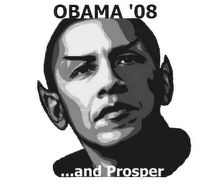
I've been surprised by how quickly the blogosphere picked up on the Spock/Obama comparison. Almost immediately, I started to see people construct graphics around the Spock/Obama theme, which clearly resonated with people other than myself.

Obamawhite1.png

This image predates the interview and was submitted to a contest to depict what would happen if Trekkers ruled the world, so I am certainly not the only one to see a connection.

obama spock 2.jpg

I have to say I would have chosen a picture where Obama wasn't smiling. A smiling Vulcan is just plain creepy!

Take a look at these two photographs and see if you don't start to think that Spock and Obama were separated at birth.

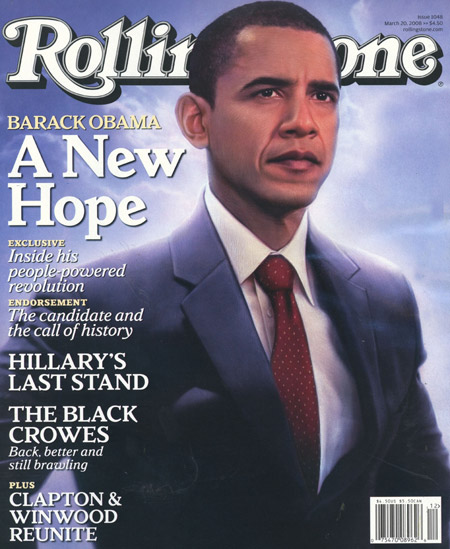
rolling_stone_obama.jpg

spock2.GIF

After all, editorial cartoonists are already starting to play up Obama's over-sized ears as the feature they can get away with caricaturing, because it wasn't part of the minstrel show stereotypes through which racists have historically constructed images of African-Americans. Add to this the long and angular shape of his face and the way he turns his face slightly upward as he speaks and you have someone who looks like he could have been born a Vulcan and had an "ear job."

But from there, we can see more complex analogies: for example, might we see his search for his spiritual identity in an Afro-centric church as a parallel to Spock's return to Vulcan to participate in the purifying ritual of Kolinahr as a way of reclaiming his roots in his father's culture? Is there any question that McCoy sees Spock as an "elitist," because he is frightened by his intelligence and because he is uncomfortable making small talk? And surely we can see Obama as the living embodiment of the Vulcan philosophy of IDIC ("Infinite Diversity in Infinite Combination"?)

Gene Roddenberry, the producer behind the classic Star Trek series, consciously modeled James T. Kirk (JTK) after the qualities that he admired in John F. Kennedy (JFK) and that he saw the series as a way of keeping the ideal of "Camelot" alive during the more cynical LBJ era. Kirk is the youngest captain in the history of Star Trek, much as Kennedy first burst of the national consciousness as a charismatic, courageous, P.T. Boat captain and was at the time the youngest person elected as president. The original Star Fleet was modeled in part on the Peace Corps and was also clearly intended to build on growing public interest in NASA's plans for putting a man on the moon, both aspects of the JFK agenda. And there's some possibility that the "Final Frontier" was a self conscious reworking of JFK's "New Frontier." Much as Kennedy's foreign policy sought to win over unaligned developing nations through "weapons of peace" in a cold war context, Classic Trek sees Star Fleet as doing ideological battle with the Romulan-Klingon Alliance and trying to hold onto the loyalty of unaligned and developing planets. So, in so far as people are reading Obama in relation to our shared myths about the Kennedy era, then it also makes sense to think of his campaign through the lens of Star Trek.

For me, the connection makes sense on a somewhat deeper and more personal level. I am a first generation Star Trek fan and I've long argued that many of my deepest political convictions - especially those surrounding equality and diversity - emerged from my experience of watching the program as a young man growing up in Atlanta during the Civil Rights era. In many ways, my commitments to social justice was shaped in reality by Martin Luther King and in fantasy by Star Trek. Star Trek did this not through the explicit and heavy handed social commentary in episodes like "Let This Be Your Last Battlefield" which featured aliens who were half white and half black (in the most literal sense) but because of the idealized image of a multiracial community depicted on the series. Later generations have looked upon the figure of Uhura as tokenism, pointing out rightly that she never got to do anything more than tell the captain that "hailing frequencies" were open. Yet, Nichols has long told the story of talking with Martin Luther King during a civil rights march and being told that her mere presence on the Bridge was a visual reminder that his dream might come true in the future. Star Trek featured the first inter-racial kiss on American television. My colleague, Shigeru Miyagawa, tells the story of growing up in Alabama and having Sulu be the only Asian-American character he saw on American television. And then there's Chekov, a Russian character on American television, in the midst of the Cold War - a friendly acknowledgement of the Soviet contributions to space exploration.

So, we should read Spock in this context - as one more example of the ability of the Enterprise crew to embrace diversity. The program often fell short of its ideals, then and in subsequent decades, and it is easy to find points to criticize Star Trek's racial politics. For a good discussion of these issues, check out Daniel Bernardi's Star Trek and History: Race-Ing Toward a White Future. But for me and many others of my generation, it held up a set of ideals; it encouraged us to imagine a more utopian society which escaped the limitations which I saw all around me growing up in a South which was actively struggling with the legacy of segregation. And I have found through that years that this idealized image of a multiracial and multicultural, hell, multiplanetary community, was part of what Star Trek meant to a large number of first generation fans of the series. For more discussion of this theme, check out my essay on the Gaylaxians movement, originally in Science Fiction Audiences, later reprinted in Fans, Bloggers, and Gamers.

In its own small way, Star Trek and Spock may have helped to prepare the way for Obama's victory in the Democratic primaries, helping us to imagine a different set of relationships between the races. Nowhere was this social utopian vision more fully expressed than the "great friendship" between Kirk and Spock and so we can see some legacy of this theme of acceptance across racial boundaries emerging through the slash fan fiction which became one of the major legacies of early Star Trek fan culture. The other "non-white" characters may have been more suggestions than fully developed figures - at least on the original series - but Spock was someone we got to know and care about because, not despite, his differences. This is one reason why so many fans of my generation were upset when Kirk praises Spock for being "the most human" person he has ever known during his funeral eulogy in Star Trek: The Wrath of Khan. Can you imagine the uproar if someone praised Obana's "whiteness"?

Of course, Roddenberry's embrace of science fiction as a vehicle for the utopian imagination was itself informed by more than a century of science fiction being deployed as a political tool - going back to the novels of H.G. Wells and Edward Bellamy, taking shape around 1950s novels like Space Merchants and City, and extending into the feminist science fiction of the 1960s, all of which shaped Star Trek in one way or another. Given this tradition, it was scarcely a surprise when I stumbled onto a whole line of SF-themed shirts supporting Obama, including not only one linking him with Spock, but also those connecting him with Buffy the Vampire Slayer, Battlestar Galactica, and The Matrix. And surely, we can see the political uses of science fiction when we see how the Anonymous movement is deploying Guy Fawlkes masks clearly inspired by V for Vendetta. Or, for that matter, is it any accident that Rolling Stone describes Obama as "A New Hope," evoking the title of the original Star Wars film.

I wish I could say all of this flashed in my mind when I started babbling about Spock and Obama. In reality, I was improvising, but the more I've thought about it, the more helpful the analogy has become as a way of thinking about why Obama's candidacy has so sparked my imagination.

And, by the way, check out this video on Youtube from one of Leonard Nimoy's appearances at a science fiction convention in which he describes an encounter with none other than Barack Obama. So, Obama is not a "secret moslem," he's not a "secret vulcan," but he may be a secret Trekker! :-)

YouTomb: Monitoring the Limits of Participatory Culture

While we have been focusing lately on issues of remix culture, it seems an opportune moment to give a shout out to a very worthy project of the MIT Free Culture organization. Known as YouTomb, the project seeks to monitor which videos get taken down from YouTube and why. As the FAQ for the site explains:

When a user-submitted video is suspected to infringe copyright, the rights holder is contacted and given the option to take down the video in question. In addition, rights holders can submit DMCA takedown notifications at any time that cause YouTube to immediately remove alleged infringing content.

MIT Free Culture became especially interested in the issue after YouTube announced that it would begin using filtering technology to scan users' video and audio for near-matches with copyrighted material. While automating the takedown process may make enforcement easier, it also means that content falling under fair-use exceptions and even totally innocuous videos may receive some of the collateral damage.

As YouTube is not very transparent with the details surrounding this process and the software used, YouTomb was conceived to shed light on YouTube's practices, to educate the general public on the relevant copyright issues, and to provide helpful resources to users who have had their videos wrongfully taken down.

The data being collected by this team of student researchers should prove extremely useful in future legal battles over whether currently filtering technologies violate fair use provisions and thus constitute a form of unjustifiable censorship of participatory culture.

Keep up the good fight!

MC Lars, "Ahab," and Nerdcore

My major focus this month is on developing a teachers strategy guide for Project nml on "Reading in a Participatory Culture," which uses as its major case studies: Herman Melville's Moby Dick and Ricardo Pitts-Wiley's Moby Dick: Then and Now. I've written about this project here before in essays on "The Whiteness of the Whale" and "Was Herman Melville a Proto-Fan?" A central theme in the project has to do with how we bring contemporary cultural concepts of remix culture into conversation with the study of more traditional literary texts. We want to get teachers to think a bit more about writers as existing in conversation with their cultures rather than as original creators. Teachers have long asked students to write about Biblical Allusions in Moby Dick, say, without fully working through what it means that Melville draws upon, reworks, and ascribes new meaning to the story of Jonah, who surfaces directly through sermons or discussions of whaling lore and implicitly through the fate of Ahab's crew.

As I was speaking on this project recently, a member of the audience shared with me via his iPod a recording of MC Lars's song, "Ahab," which has now become an integral part of my work on the project. I thought I would share with you today some work in progress which looks at MC Lars and the Nerdcore movement as a way into thinking about contemporary remix culture. Hope you Enjoy.

MC Lars, along with Sir Frontalot, mc chris, Optimus Rhyme and Baddd Spellah, is widely considered to be a founder of the so-called "nerdcore" movement. Nerdcore refers to a subgenre of hip hop music whose themes and images are drawn from subject matter generally considered of interest to geeks: games, science and science fiction, computers and digital culture, and cult media in particular. Like other nerdcore performers, MC Lars often incorporates allusions to films, television shows, comics, and novels into his work.

For example, consider his video for "Space Game" which not only celebrates the virtues of early arcade games but also makes references to characters from Star Wars (Darth Maul, Boba Fett, Sith girls, etc.), Lost in Space (Dr. Smith), Classic Star Trek (Captain Kirk, Scotty, Spock) Star Trek: The Next Generation (Q, The Borg) , 2001:A Space Odyssey (Hal), The Matrix (Neo and Morpheus), X-Men (Magnito), Superman (Zod), even Doctor Seuss ("The Obleck"). In the later verses, the song lays claim to being "postmodernist" (under the banner of Robert Ventura and Andy Warhol) and lays smack down on modernists such as T.S. Elliot, Ezra Pound, Virginia Wolfe, Joseph Conrad, Franz Kafka, e.e. cummings, Wallace Stephens, and Frank Lloyd Wright. Watching this video with your students might be a good way to help them understand what an allusion is and how it creates a juncture between old and new stories and in this case, between high art and popular culture.

Several of MC Lars songs, including "iGeneration" and "Download this Song,"constitute manifestos for those who have grown up in a world where music is easy to access and where remix is part of what it means to consume popular culture. As one critic explained, "MC Lars is a member of what he dubs the "iGeneration," a group born and raised in the time of the Ninja Turtles, cassette tapes and new wave music, who now live in the age of Desperate Housewives, Sidekicks and screamo bands. These are the kids who have grown up using the Internet as a part of their every day life. They can conveniently carry 5,000 songs in their pocket, but are faced with the glooming fact that the world's oil supply and Social Security will both run out in their lifetime. MC Lars is the hero of this new generation, addressing their thoughts and every day struggles in his music."

The "iGeneration" has in return deployed all of the resources of participatory culture to do their own mash-ups to MC Lars songs, such as this version of "iGeneration" which combines characters from the Japanese Anime, Naruto, with a visual style associated with iPod advertising, and another fan video which deploys images from advertising, news, The Matrix, and Battleship Potemkin. So, how do the two different image tracks deployed here change the meaning or bring to the surface different aspects of the original song?

"Ahab" should be understood in this larger context, one of several songs which MC Lars, has composed based on cannonical literary works which he reads with the same playful irreverence with which he approaches icons of science fiction culture. "RapBeth" represents his hip hop ode to William Shakespeare, while "Mr. Raven" signals his respect for Edgar Allen Poe.

MC Lars has a degree in English Literature from Oxford University and has said that he would have pursued a career as an English teacher if he hadn't found success as a hip hop performer.

He jokingly told one interviewer, "I read Moby Dick, and I thought it was a great book but it was really long, so I tried to put it into three minutes." "Ahab" does manage to include a high number of reference points in the novel, some of which are expressed through the lyrics (such as the reference to the gold doubloon which Ahab nails to the mast or the shoutouts to Queequeg), some through the visual iconography of the video (for example, the scar on Mc Lars's face or his peg leg). For example, the line, " Hey Ishmael... can I call you annoying?," plays upon "Call Me Ishmael," which is probably the single most famous phrase in Melville's novel. The repeated chorus, " Peg leg, sperm whale, jaw bone, what!," not only refers to some of the recurring icons of the narrative but also hints at the novel's linkage of Ahab's leg with the Ivory of the whale. The conflict between Ahab and Starbuck is hinted at by "You're Never going to find him! He's a big sperm whale. The ocean is enormous!" while other lines hint at Ahab's self absorption and solitude, "excuse me while I go be melancholy in my room!" Another lyric neatly captures a key subplot in the novel: "Pip went insane when he almost drowned, So profound when he shrieks like a little sailor clown." The visual logic of the video, which takes us under water and then into the mouth and through the belly of the whale, may hint at the story of Jonah, who is swallowed by a great fish, which Melville reads as a whale, while the hectoring figure in the turban here may suggest Elijah's warning.

What other references to the novel do you and your students identify here?

Would the song even make sense if the listener did not have at least a broad exposure to the major themes and plot twists of this classic American novel? That's the essence of an allusion: MC Lars is able to shorthand Moby Dick because so many of his listeners will already know the story through other media representations if not through a direct experience of the book. MC Lars simply has to point us in the right direction and our mind fills in all the rest with much of the humor here stemming from the brevity with which he is able to sum up elements of such a vast and intimidating work.

Yet, the song also suggests some of the interpretations of the song which arise in high school literature classes. Ahab described himself as a "monomaniac," draws parallels to Oedipus, talks about "hubris" as his "tragic flaw," defines the book's conflict as "man vs. beast," and sums up the book's message as "revenge is never sweat." All of this is the stuff of Spark Notes and bad high school essays, suggesting a work which isn't simply familiar to us the first time we read it, but also may come predigested, neatly broken down into familiar modes of literary analysis.

The sense that "Ahab" is responding to the rituals of the English classroom is further hinted at through the visuals here, which depict a group of students re-enacting Moby Dick, and ends with a shot from the wings as the performance concludes and the audience applauds. The Nerdcore movement, in general, tends to embrace low tech and amateur looking graphics in many of its videos, hinting at the Do-It-Yourself culture which inspires them and their audiences. Ironically, here, the stagecraft is more elaborate than would be likely to be seen in any school play, making, perhaps, a reference to the spectacular and equally unlikely high school productions of films like Apocalypse Now depicted in the cult classic, Rushmore. Either way, though, the visuals reinforce lyrics which connect Moby Dick back to the classroom, suggesting that the video may be in some sense a thumbing of the nose at the practices of secondary education, even as it is also an affectionate tribute to the novel itself.

Like many examples or remix, the song combines its primary source -- Moby Dick -- with a range of other allusions. "Ahab" evokes a range of contemporary reference points which would have been anachronistic in Melville's novels, such as Steve Wozniak, the Mariana Trench, Titanic, and Finding Nemo (suggested by the clown fish at the end of the video) Is the suggestion here that the novel remains relevant to contemporary concerns or that it is hopelessly out of date?

A tossed off reference to "a Supergrass beat" acknowledges another group whose music MC Lars has sampled for this song. Remix often gets described as "plagiarism," yet in fact, it can be seen as the opposite of plagiarism: plagiarists usually seek to cover their tracks, masking the sources of their material, and taking claim for them. Remix, on the other hand, depends on our recognition of that the material is being borrowed and often depends on our understanding of the specific contexts it is borrowed from. This song would be meaningless if we did not recognize its references to Herman Melville. And it says something about the ethics within this community that the songwriter wanted to acknowledge the beats that he sampled, even if the reference makes little sense within the context of its re-purposing of Moby Dick.

So, the above discussion suggests some questions which you and your students might want to ask about any remix:

What was the context within which the remix was produced?

In this case, we read "Ahab" in relation to Nerdcore as a specific subgenre of hip hop, one which makes extensive use of allusions to forms of culture which are valued by its "nerd" audience, including video games, science fiction, and cult media. In this case, we also saw it as part of a larger strand in MC Lars's work which appropriates themes from works commonly taught in high school and college literature classes, acknowledging his own educational background and professional experiences.

What content is being repurposed here?

In this case, the primary source material is Moby Dick and to beats taken from a song by Supergrass. The song also makes a series of topical references.

What relationship is being posited between the remix and the original work?

"Ahab" is a good natured parody, one which deflates the elevated reputation of the original novel, even as it pays respect to its potential continued relevence to the present day. The song may be harsher towards some of the ways novels get taught through schools. Like several of MC Lars' other songs, "Ahab" blurs between high art and popular culture, suggesting an ongoing criticism of cultural hierarchies.

Are the works of the same or different genre?

Moby Dick is a literary epic with tragic overtones; "Ahab" is a music video with comic overtones.

Are the works of the same or different media?

Moby Dick was a printed novel; "Ahab" was a music video distributed primarily through YouTube.

How does the remix tap or transform the original meaning?

Some of both. The song remains surprisingly faithful to the themes and narrative of the original novel, even as it shifts the tone by which we understand these elements.

What techniques are deployed in reworking the original?

There's a lot going on here. First, the song compresses the complex and lengthy novel into a series of evocative phrases which summarize key themes and plot elements. Second, the song relies on anachronisms to hint at the relationship between past and present. Third, the song incorporates key phrases from literary analysis to suggest a particular set of interpretations of the novel. Fourth, the staging of the music video is intended to evoke a school pageant, again hinting at the relationship of this text and higher education. Fifth, the song's bouncy beat transforms the tone and spirit of the original book, inviting us to have fun with the story rather than taking it totally seriously.

I welcome any feedback from serious nerdcore fans: "Ahab" was really my introduction to the genre and I want to get this right. I'd also love to be in touch with MC Lars, if he's out there reading this.

"What Is Remix Culture?": An Interview with Total Recut's Owen Gallagher (Part Two)

What criteria should we use to evaluate good and bad remixes?

I think that, as with any work of art, the criteria for judging whether a remix is 'good' or 'bad' is largely subjective and what some people passionately love, others will think is a complete waste of time. I believe there is no artistic work in existence that everyone on planet earth would unanimously agree is 'good.'

Having said that, for the purposes of the Total Recut Video Remix Challenge, I have set some general criteria for the public and for the judges to use as guidelines when rating the videos. These are overall impact, which will account for 50% of the marks, creativity for 25% and communication for the remaining 25%. If you were to analyse a video remix that is generally accepted as being 'good', for example Titanic 2: the Surface by Robert Blankenheim, we can see that the video is exceptionally well produced, so much so that you could easily believe that is a genuine trailer for a new Titanic movie! The basic idea behind the piece is very clever and well executed on every level. Personally, I think that believability is a recurring theme in many of the most popular and well received video remixes. For these types of remixes, it is a huge challenge to convince the viewers that what they are watching is real. There is a long history of people messing with media channels to communicate a message effectively, e.g. Orson Welles War of the Worlds broadcast and I feel that speaking to an audience in a language that they are intimately familiar with, e.g. movie trailers, is an excellent way to communicate a message. The Adbusters movement have been 'culture-jamming' for decades, mostly in the medium of print, but I expect a lot of video remixed work to emerge in this niche in the future.

But what about 'bad' remixes? Well, it is fantastic to see that so many amateur video makers are trying their hand at producing video remixes, however, as with every art form, the ratio is usually about 10% quality, 90% garbage. The ratio holds true in the case of video remixes. Here is an example of a particularly poor effort, but hopefully the creator will stick at it and improve as they produce more work. Having said that, production skills are not necessarily the be all and end all. Sometimes, the idea is strong enough to bring the video popularity even if the production values are not 100%.

An interesting debate has sprung up around so-called 'YouTube Poop' videos. To some people, these types of videos seem to make no sense, are offensive and are even difficult to watch. People said similar things about punk. Personally, I think that YouTube Poop videos are some of the most potent examples of remixed videos out there, and although they may not be attempting to communicate a particular underlying message, bearing more resemblance to stream-of-consciousness poetry, they have their own artistic merit. But I am certain that many people would consider them to be 'bad' remixes.

The statement above implies that you think the current influx of remixes and recuts is a product of shifts in the technological environment. Yet, we could point to a much older history of cut-ups, collages, montages, scratch video, fan video, running back across much of the 20th century. Remix was part of 20th century life well before digital tools and platforms arrived. What factors do you think have given rise to our current remix culture?

I agree with you that remix itself is by no means a new phenomenon. In fact, it dates back as far as we can trace human history. The earliest example I am aware of is the anagram, which is essentially taking the building blocks of a word, i.e. the letters, remixing them into a new order that creates a new word and a secondary meaning and association by connecting the first word to the newly formed second word. There have been examples of remix in every creative art since time immemorial. For example, in art, the obvious one is collage. In music, folk music was spread by word of mouth, and so when one person would learn a new song from someone else, they would often apply their own variations to it, essentially remixing it to suit their own style.

In more recent times, in the history of recorded music, music remixes date back at least to the 1950's, when Bill Buchanan and Dickie Goodman remixed Orson Welle's War of the Worlds with various musical snippets. In the world of film and video, recuts and remixes have been in existence since the art of editing was invented. Some of the most well known filmmakers that experimented in the field of remix and montage as far back as the 1920s include the Russians, Sergei Eisenstein and his mentor Lev Kuleshov. Joseph Cornell and Hans Richter also experimented in the genre in the early part of the 20th Century.

The distinct difference between the work that was produced by these masters and the video remixes that we see today on Total Recut and YouTube, are that now the tools of production have been democratized. What was once an art form confined to professionals who could afford expensive film-making equipment and distribution companies with established networks and connections, is now affordable to the majority of creators in the western world. Anyone with a computer and an internet connection today can produce and distribute their work for costs close to zero. Every new computer comes shipped with editing software, video content is widely available on video sharing networks like YouTube and the Internet Archive, and it is easy to reach a potentially large audience by uploading your video to one of these sites.

The net result is that the medium is evolving. Video remix includes everything from movie trailer recuts, political parodies, music mash-ups, subvertisements, fan made vids, machinima, overdubs and many others. There is no doubt in my mind that many other sub-genres will evolve as more and more people begin to experiment in this area.

In your thesis, you suggest that video recuts are "stifled by overzealous copyright owners who are over-protective of their work." What can you tell us about current legal responses to the remix community? Are there any signs that the studios are becoming more accepting of remix culture as remixes become more widespread on sites like YouTube and are finding their way back into commercial media channels?

Of recent times there has been a serious crackdown on video sites like YouTube where copyright owners have made claims of copyright infringement and the videos have been taken down, in compliance with the DMCA. Unfortunately, many remixed videos that legitimately make fair use of copyrighted content are being caught in the crossfire of outright piracy. I feel it is very important to highlight the distinction here as this is possibly the number one reason why the remix community gets targeted and bullied by 'overzealous' copyright owners. If somebody rips an episode of Lost from DVD, for example, and uploads five ten minute segments of the episode to YouTube unchanged and without permission, this is piracy and should definitely not be condoned. ABC Studios would be completely within their rights to request that YouTube remove these infringing videos from their site. However, if someone were to sample small clips from various episodes of Lost, recut them, add effects and overlay a soundtrack from the classic 80's TV show The A-Team, this would clearly be a fair use of the copyrighted material.

Unfortunately, the filtering technology that has been developed to track copyrighted material cannot distinguish between these different types of videos, and fair use video remixes are being wrongfully taken down from YouTube every day. One of the problems here is that the creators of these ingenious videos are unaware that they are within their rights to file counter notifications against copyright infringement claims that they believe to be false. In my own case, I had three of my remix videos removed by the BBC, Paramount Pictures and 20th Century Fox, which led to my YouTube account being disabled. Three strikes and you're out. Each of the videos were less than three minutes long, and the use of copyrighted material in them was clearly fair use. I filed counter notification claims with each of the allegators through YouTube, which is a relatively straightforward process. The BBC conceded that my video was a fair use and the other two companies did not respond within the DMCA time limit and so my three videos were put back up and my account was reinstated.

I am certain that there are many other people out there who have had similar experiences but did not realise they could do anything to get their videos put back up. I would encourage anyone who feels that their work is fair use to file counter notifications and to make sure that their videos are put back online. Alternatively, they can upload them to Total Recut!

On a more positive note, I have noticed a trend among some of the larger media corporations that suggests that they are becoming more accepting of user generated remix videos that sample from their copyrighted material. Some, including Sony Pictures, Lionsgate and Warner Bros have even dabbled with remix contests of their own to coincide with the release of their movies including School of Rock, A Scanner Darkly and Rambo. We have also recorded a significant exponential increase in the number of video recuts being uploaded to the web every day and less being taken down, which suggests that more people are getting interested in the area and that copyright owners are beginning to realise the potential benefits of allowing, and possibly even encouraging their fans to play with the content they produce.

In my opinion, video remixes are a free form of advertising for copyright owners and also create more devoted fans of the original work. In a few years, we will all look back and it will be mind boggling to think that big media companies tried to stop fans of their content from creating remixed videos that actually served to promote the original work, as well as being entertaining pieces in themselves.

Your site features a space for political remixes. Do you see remix as an important form of political speech?

I personally feel that remix is one of the best ways for people to voice their opinions and increase their chances of being heard. What better way is there of communicating how you would like George Bush to act than to literally change the words that come out of his mouth? With the current build up to the presidential elections in the United States, we are seeing and hearing a lot of media surrounding the actions and words of Barack Obama, Hillary Clinton and John McCain. A plethora of remixed videos have sprung up with Obama , Clinton and McCain as the subjects. I think that having the tools to be able to create videos like these and express personal opinions to a wide audience is extremely empowering for individual users in the digital age. Members of Obama's campaign realise the potential power of grass roots creativity and a video contest has been hosted this month by the folks at moveon.org with a view to creating a 30 second spot for the presidential candidate that will air on national television. No doubt, many of these will be video remixes and we look forward to seeing the finished pieces.

Many people use political parodies as a way to highlight the issues that particular politicians are facing and suggesting courses of action. When Tony Blair was considering his resignation as Prime Minister, a fantastic remix appeared illustrating Blair's internal debate. Another classic video that has done the rounds is the Blair Bush Endless Love remix. This video is interesting in that it pokes fun at the perceived notion of the apparently odd relationship between a submissive Tony Blair and a dominant George Bush.

I have tried my own hand at one or two political remixes in the past. Being from Ireland, I decided to poke a little fun at the two candidates for the Irish General elections last year, Bertie Ahern and Enda Kenny, the two candidates for Taoiseach (Prime Minister) of the country at the time. One video showed Enda Kenny as if he was auditioning for American Idol and coming up against a decidedly unimpressed Simon Cowell. The other clip showed Bertie Ahern as if he were pitching a business idea in the Dragons Den I think it is very important that citizens of a country can air their views about their political leaders, and I feel that video remix is one of the most powerful ways to do this.

What are your hopes for the future of remix culture? How do remixes relate to the larger Free Culture movement?

I see remix gradually becoming more mainstream and more widely accepted as a creative form in its own right. Ever more examples of commercialised remix are appearing on our TV and computer screens every day. Many people involved in remix culture detest the idea of the commercialisation of this type of work as they see it as a grass roots, perhaps even rebellious movement, and one that gives a voice to the individual. I don't see this going away. Even if a lot more commercial remix work is created, the tools that enable individuals to transform and recreate the media and culture around them and the new channels of free distribution that enable their work to reach huge audiences are here to stay. My hopes for the future of remix culture would be for this type of work to seep into all walks of life. I would love to see even more educational institutions adopting it as a technique of learning, for example, asking students to create a remixed video about George Washington rather than handing in a written report. In the professional arena, I would love to see more video remix artists being headhunted by studios based on the remix work they showcase online or being commissioned to create new work.

Before this can happen, however, remix artists need to stop being afraid of frivolous legal threats. A large number of remix artists are very careful about revealing their true identities online and use anonymous alter-egos for fear of being sued. I would hope that remix artists will eventually feel as though they don't need to do this anymore, as it could be stifling potential opportunities for them. The copyright issues surrounding remix work are a headache for everyone interested in freely expressing themselves using digital media. Of course, fair use enables the use of small samples of copyrighted material for non-commercial purposes, but I envisage new business models emerging around copyright cleared remix work in the not too distant future.

In terms of the larger Free Culture movement, there are many people and organisations doing fantastic work to help combat the ongoing problem of corporate greed that has seen the copyright term extended to a ridiculous degree in the latter half of the 20th century. Organisations such as Creative Commons, the Electronic Frontier Foundation, the Center for Social Media, the Convergence Culture Consortium and FreeCulture.org are all doing incredible work to prevent the scales from tipping too far in the wrong direction and of course individuals, such as our judging panel for the Total Recut Video Remix Challenge, provide invaluable insights through their written and spoken words that help to raise much needed awareness of the issues surrounding remix culture.

We are hosting the Total Recut Remix Challenge primarily to the same end, and we invite anyone with an interest in this area to enter the contest and help us to raise awareness of the changes that need to take place so that we can build a society where copyright owners are fairly rewarded for their artistic labours and artists can freely express themselves by drawing inspiration from the culture around them. Every voice counts.

"What is Remix Culture?": An Interview with Total Recut's Owen Gallagher (Part One)

Several weeks ago, I announced here that I was serving as part of a panel of other "remix experts" as judges for a video competition being hosted by the website, toralrecut.com. Participants are being asked to submit videos which address the question, "What is Remix Culture?" The contest is intended to help educate the public about the debates surrounding remix, copyright, and fair use. As someone currently developing a teacher's strategy guide for teaching remix in the context of high school literature classes, I am very interested to see what kinds of materials emerge from this competition. The submissions will become visible on the site soon and the public is being encouraged to help rank the submissions. In the spirit of sparking further conversation around the issues the contest is exploring, I asked Owen Gallagher, the mastermind behind TotalRecut, if he would respond to some questions about the contest and about remix culture more generally. Alas, his responses got lost in my dreaded spam filter and are just now seeing the light of day. In this two part conversation, he explains why he created the site and sponsored the contest, identifies some of his favorite videos, and offers some insights into the politics and aesthetics of remix video.

Here's a brief bio Owen shared with us:

Owen Gallagher (28) is a graphic, web and digital media designer, an accomplished musician and a graduate of the University of Ulster, Northern Ireland with a first class honours Masters degree in Design Communications. Originally from Dublin, Ireland, he has been travelling around the United Kingdom and the United States for the past 12 months as part of the NCGE / Kauffman Foundation Global Scholars Entrepreneurship Program. Gallagher is the founder of TotalRecut.com, an online social networking community for fans and creators of video remixes, recuts, and mash-ups that facilitates online collaboration between video artists. Total Recut has been shortlisted for a number of prestigious awards including the Golden Spiders Awards, the NICENT 25k Awards and the BBC Innovation Labs.

Gallagher is the CEO and Creative Director of GDG Interactive, a web design and development business based in Ireland. In his spare time, he dabbles in video art and has created a number of political video remixes that received significant media attention in his home country. He is an avid piano and guitar player and has composed and recorded over 100 songs as well as performing in various bands since he was 16. He is a qualified music teacher and has taught piano and guitar to a number of students. He has also acted as a part time Assistant Lecturer of Design at the University of Ulster, Northern Ireland teaching web design, flash animation and digital video production.

Gallagher is passionately involved in remix culture and has a particular interest in Intellectual Property law as it applies to creative content. His Masters thesis, entitled 'Video Recuts and the Remix Revolution: Whose Rights Are Being Infringed?' explores some of the issues surrounding the appropriation of previously published content, focusing on the delicate balance between copyright and freedom of expression.

What can you tell us about your new contest? What are its goals? What kinds of videos are acceptable?

The Total Recut Video Remix Challenge is a contest that we are hosting to try to encourage people to think about the issues around remix culture and creating remixed media. We want people to create a short video remix that uses footage from any source to communicate the message: 'What is Remix Culture?' The video can be anything from 30 seconds to 3 minutes long. The idea of the contest is to produce a series of videos that raise awareness and help people to more clearly understand what is going on in the world of digital content creation, remix and intellectual property. Ideally, the videos will be educational and will communicate a clear message but we essentially want our entrants to be creative and portray what remix culture means to them. The prizes include a laptop computer loaded with all of the software needed to create high quality remixes, a digital camcorder, a digital media player and lots of Total Recut goodies.

The contest began taking entries in May and judging will begin in June. We have an exceptional judging panel of some of the elite thought-leading personalities involved in remix culture today including yourself, Larry Lessig, Pat Aufderheide, Kembrew McLeod, JD Lasica and Mark Hosler. The contest is open to everyone so I would encourage anyone who is even slightly interested in video remix to put a video together and enter the contest in May to be in with a chance of winning.

The Video Remix Challenge was an idea that developed out of my Masters project at the University of Ulster, Northern Ireland, which was very much focused on Remix Culture and intellectual property issues as applied to the digital creative arts, in particular, online video production. As part of the project, I developed a basic version of the Total Recut website and set up a small scale video remix contest where the idea was to create a 60 second PSA commercial using found footage to portray a particular theme e.g. Environmental Issues, Safe Sex or Drug Abuse. At the time, I was also working as a part time lecturer, teaching an interactive design class to undergraduate students at the University of Ulster, so I decided to use the students as guinea pigs and get them to produce a remixed video for their project, which had to be entered into my contest, as a requirement of their design brief. It worked like a charm and the end result was over thirty highly creative remixed videos on a diverse range of socially conscious issues which the students themselves rated and commented on, before a small judging panel decided on the final winners. Following the success of this contest and the ongoing development of Total Recut as a whole, I decided that I wanted to try and host a larger scale contest. My original idea was to try to open it up to other Universities in the U.K. and Ireland and build from there, but it has now scaled to the point where it is open to anyone who wants to enter. The basic premise of the Video Remix Challenge is to create a short form video remix that portrays what 'Remix Culture' means to you, using found footage from any source.

The reason this is such an interesting theme to pursue is because of the ongoing debate about copyright and freedom of expression in the developing landscape of user generated digital content. This is a debate that a lot of people feel very strongly about. There are extremists on both sides, some advocating the complete freedom of all content and others fighting tooth and nail to extend copyright terms and protect their assets. Then there are those who are trying to seek a middle ground - a balance between these two opposing views. This is where Total Recut and this contest reside.

The current landscape places too much emphasis on the copyright owner's control over how their content is used and leaves little room for new artists to exercise their rights to freedom of expression. However, a free-for-all where all content is free would result in no compensation for copyright owners, which would mean less incentives for people to produce new creative works. The balanced approach enables copyright owners to make money from their work, but also enables other artists to freely use samples from the entire pool of creative works to express themselves. This contest encourages people to draw inspiration from the culture around them, from the culture they grew up with and to use these images and sounds to produce something innovative with a brand new meaning.

The goals of the contest are to generate a number of creative video pieces that will help to raise awareness of these issues and perhaps help to educate people about the true nature of copyright, which is to promote the production of new creative works for society at large, by providing creators with a degree of protection over their work for a limited time. This message has been twisted and distorted almost beyond recognition by the likes of Disney and some of the larger corporations that own the copyrights to most of the content out there. Instead of creative works existing to benefit society, some of the corporations feel that creative works exist to make more money for them, for as long as possible. That is why they lobby for copyright term extensions and unfortunately, they have historically been successful in these attempts.

Ironically, many of Disney's most successful works are based on Public Domain stories, which they would not have been able to create in the first place, had the original copyright owners tried to exercise the kind of control that Disney now displays over their works. There is an excellent educational remix video created by Eric Faden of Bucknell University, that uses short samples from Disney movies to communicate messages about copyright and fair use. Here's the link.

In terms of the types of videos that are acceptable in our Video Remix Challenge, we are encouraging our entrants to be aware of, and exercise their fair use rights. The Center for Social Media at the American University of Washington have some excellent resources and guidelines. We are also encouraging people to use Public Domain and Creative Commons licensed material in their work, many of which can be found at the Internet Archive and Creative Commons respectively.

The videos will first be rated by the public and whittled down to the ten best videos, which will then be given to the judges to decide on three winners. We are very excited to see what kind of work will be produced. Going by my previous contest, there will be quite a mix of quality in terms of production skill, but sometimes the best ideas simply shine through.

Tell us more about Total Recut. How did this site come about? What are your overarching goals? What kinds of resources does it offer the remix community?

I remember very distinctly when I came up with the idea for Total Recut. I was lying out in the sun in Portugal, contemplating what I might consider putting forward as a proposal for my then upcoming Masters Degree, and the idea came to me. I wanted to create a collaborative environment for artists to be able to take existing media, remix it in some way and produce something completely new.

My interest in remix stemmed from an early age - I have always been into collage and mixed media and studied Fine Art in Dublin, Ireland before undertaking my Design degree in Donegal, but even before that, I always remember playing with toys as a young boy. My brother and I were the proud owners of many Star Wars figures and vehicles, Transformers, Thundercats, MASK, He-Man, G.I. Joe, Action Man and a whole host of other toys from various movies and TV shows. Our games always consisted of us combining these different realities and storylines, mixing them up and making up our own new narratives. It was not unusual to have Optimus Prime fighting side by side with Luke Skywalker against Mumm-Ra and Skeletor. So, from a very early age it seemed completely normal for me to combine the things I loved in new ways that seemed entertaining to me. I think that my generation and those younger than me have grown up expecting this sort of interaction with their media, on their own terms.

The idea that some corporation can tell you that you are not allowed to play with media seems ridiculous and wrong. Unfortunately, there are many who seem to believe that their control over how content is used should be absolute and unquestioned. I created Total Recut as a way to gather people together who believe that we, as a society, should be able to freely build on the works of the past. If this is successfully prevented by corporations, the practical result is that people will stop making new things out of old things for fear of being sued. Innovation will chill and the overall quality and quantity of new work being produced will be lower. Luckily, there are millions of people who refuse to accept the corporate line and they are continuing to produce new work, despite the veiled shallow threats by overzealous copyright owners.

So, when I was considering how to practically put a community of this nature together, my initial idea was to create a site for digital artists - I had the idea of taking public domain paintings and posting the images on the site, cutting them up into squares and then asking participants to choose a square each and reinterpret it in their own style. The remixed square would be uploaded to the site again and the end result would be a very interesting collaborative collage of styles inspired by the work of an artistic master.

Through my Masters research, I realised that one of the hottest technologies at the time was online video and so I decided to refocus the project to centre on remixed video work. I discovered a thriving underground community of video producers who were creating work as diverse as movie trailer recuts and machinima to remixed political parody and mashed-up music videos. One of the first remixed videos I saw was a movie trailer recut, created by Robert Ryang, of the Stanley Kubrick movie, 'The Shining', which casts the classic horror in a completely new light. Another amazing video remix that I came across early on was a political piece created by Chris Morris where segments of George Bush's State of the Union speech were recut to create a new narrative. Some of the most technically accomplished and entertaining remixes I have seen were created by a Parisian remix artist called Antonio da Silva, known online as AMDS Films. He created a number of remixes, one of the best of which is Neo vs Robocop.

So, I set about creating a site 'for fans and creators of video remixes, recuts and mash-ups that provides resources and collaborative opportunities for video remix artists in a social networking environment.' The end result was Total Recut, but the site is constantly developing. Each week, something new is added or changed based on the feedback from our members and advisors. The main focus at the moment is the Video Remix Challenge but we have a plethora of new ideas and potential directions of where we are going to steer the site in the future.

The site works on a number of different levels. Primarily it is a place where people can find and watch entertaining or thought-provoking remixed videos. Our current categories are Movie Trailer Recuts, Political, Machinima, Advertising, Educational, Music Videos and Others. This category list is by no means exhaustive and we are looking at adding to it in the near future.

Secondly, the site acts as a showcase for video remix artists, to enable them to put their work in front of the eyes of a receptive audience. We also provide a growing library of Public Domain and Creative Commons licensed video work for people to download and remix in their own projects. We are working on developing our Tutorials section, which will eventually become a 'Remix Academy' with courses and grades for people to learn everything they need to know to produce a video remix. Information and links to literature and websites about remix culture, intellectual property issues and key players in the scene are included in the Remix Culture section. We also provide remix tools where users can gain access to video editing software, conversion tools and video downloading software. The community section includes a blog, forums, user profiles and job opportunities. Virtually every aspect of the site is set up to be similar to a wiki environment, which essentially means that all registered members have the ability to add things to the site or update information about any of the content.

With regard to long term goals for Total Recut, we would love to build up the community to the point where we are considered the primary online location for people to find the very best in video remix work and talent. We intend to host more regular contests and provide links between our remix artist members and potential employers. As the site scales up, we intend to take it global and offer a multilingual version of the site to accommodate the Asian and European markets and eventually become a truly global community website for remix culture.

You write, "Video recuts...are a new art-form enabled by the convergence of emerging technologies." How do you respond to those who ask whether remixes and recuts are not creative because they build on the works of others rather than working with original material?

This is an area in which I have a huge amount of interest and have considered pursuing as a research area for my PhD - the origin of originality. It is of particular interest to me because I am what I consider to be an 'original content creator.' I write songs and lyrics using nothing but my mind, a pen and paper and a guitar. Are my songs original? If I use a combination of different chords and a variety of words to create sentences that rhyme, am I not using elements that have been used by other people in the past? What makes my songs original, in my opinion, is the unique way in which I composite the words, chords and melody. In this way, every song is created using the basic building blocks of language and music, but combined in a slightly different way.

Coming from a Graphic Design background, I often come across other designers who are adamant that their work is completely original. The nature of a Graphic Designer's work is to combine elements from different sources in creative ways to produce new pieces of work. Similar to a collage artist who takes pieces of different photos, images etc and brings them together to create new meanings. Is the finished piece not original because it is made up of building blocks from a variety of sources? In the same way, when a video remix artist combines pieces of video from different sources in new ways to create new meanings, is this not original and innovative?

Yes, remix artists build on the works of others. But do so-called creators of 'original material' not build on the works of others also? Would you consider Shakespeare's Romeo and Juliet to be an original piece of work? Even though the idea was based on a story by William Painter, which was based on a poem by Arthur Brooke? No matter how far back you go in the origin of a piece of work, you will find that the idea was built on or inspired by the work of someone else before it. I consider remixed videos to be original works. The finished piece is more than the sum of its parts.

More Transmedia News

I've been meaning to do another post on this topic for a while. First, I was inspired by a story in Fast Company, sent to me by Jesse Alexander, which described a gathering of Hollywood's fan boy elite to talk about the futures of cross-platform storytelling:

Tim Kring, the lanky, goateed guy at the head of the table, created Heroes, NBC's hit television show about superpowered people. To his right, in a black hoodie and narrow black-framed glasses is Damon Lindelof, cocreator of Lost, ABC's island-fantasy juggernaut, as well as producer of next year's eagerly anticipated Star Trek movie, directed by J.J. Abrams. Across the way is Lindelof's buddy Jesse Alexander, co-executive producer of Heroes (formerly of Lost and the pioneering she-geek hit Alias). Nearby is Rob Letterman, the self-described nerdy director of DreamWorks' next mega-franchise movie, Monsters vs. Aliens. He's chatting up video-game creator Matt Wolf, who's developing a project with Alexander....The long-haired bearded guy pouring straight bourbon is Ron Moore, creator of the new Battlestar Galactica, the SciFi Channel's acclaimed reimagining of the classic series. The guy eating pizza on the couch is Javier Grillo-Marxauch, a veteran producer of Lost and NBC's paranormal series Medium, who's now having his own fantasy graphic novel, Middleman, turned into a series on ABC Family.

so, how come I never get invited to parties like this?

The article goes on to introduce the concept of transmedia entertainment and to suggest that it is one of the hotest topics in the entertainment world today:

"In five years," Kring is saying, "the idea of broadcast will be gone."

"Right," says Lindelof. "Instead of watching Heroes on NBC, you'll go to nbc.com and download the show to your device, and the show will be deleted as soon as you finish watching it -- unless you pay $1.99; then you get audio commentary. You enhance it. It's like building your Transformer and putting little rocket ships on the side." ...

In the analog era, such efforts might have fallen under the soulless rubric of "cross-promotion," but today they have evolved and mashed up into a new buzzword: "transmedia." The difference is that cross-promotion has nothing to do with developing or expanding an established narrative. A Happy Days lunch box, in other words, does nothing to advance the story of Fonzie's personal journey.

While such merchandising campaigns still exist, transmedia offers one big plot twist: X-ray vision. Today's audience, steeped in media and marketing, sees through crass ploys to cash in. So the Geek Elite are taking a different approach. Rather than just shill their products in various media, they are building on new and emerging platforms to expand their mythological worlds. Viewers watch an episode of Heroes, then follow one character's adventure in a graphic novel. They tune in to Lost, then explore the island's twisted history in an online game. It is this "transmedia storytelling," as Alexander puts it, that ultimately lures the audience into buying more stuff -- today, DVDs; tomorrow, who knows what.

The article offers a pretty good snapshot of where the industry's thinking is at in terms of transmedia properties and certainly offers an up date on my discussion of The Matrix in Convergence Culture.

This week, the New York Times reported on the plans to release a suplamentary dvd to more or less coincide with the release of the Watchmen movie next year:

The second film, tentatively called Tales of the Black Freighter, follows a side Watchmen storyline about a shipwreck and will arrive in stores five days after the main movie rolls out in theaters. The DVD will also include a documentary-style film called Under the Hood that will delve into the characters' backstories.

Those of you who have read Alan Moore's original graphic novel will recognize both of those titles as materials which are complexly woven into the narrative, offering us a glimpse into the way popular culture might have evolved -- towards pirate comics -- in a world where superheroes are real (Black Freighter) and a sense of the ways superheroes might be covered as cultural celebrities (Under the Hood). As the producers have striped down Watchmen for the screen, they have pushed these elements to the margins. In another era, they would have been left on the cutting room floor, but instead, they are becoming the backbone of Warner Brother's transmedia strategy for the film.

The article also noted:

In addition, the studio plans a dozen 22- to 26-minute Webisodes to help make the complex story easier for the uninitiated to digest. Called "The Watchmen Motion Comic," it will be a panel-by-panel slide show of the graphic novel narrated by an actor.

Keep in mind that Warner Brothers was the studio which sponsored the Wachowski Brothers's transmedia development around the Matrix franchise.

All of this suggests how central transmedia entertainment has become to the thinking inside Hollywood today. So it is great to have a chance to share with my readers some insights from a real master of this practice.

Talking Transmedia: An Interview with Starlight Runner's Jeff Gomez (Part Two)

How important do you think hardcore fans are to the success of genre entertainment? How do such fans create value around your properties?

As exemplified by the efforts of many recent genre producers, the cultivation, validation and celebration of fandom are vital to the success of any genre rollout. It's interesting to note that two major genre releases in 2007, The Seeker: The Dark is Rising and The Golden Compass were both released with either limited or no transmedia components designed to immerse a potential fan base into the fantastical worlds of the films--no one was indoctrinated into the fiction--and both failed spectacularly.

Genre fans are passionate. Passion is the least expensive and most powerful driver behind any endeavor. Passion can punch holes through the wall of noise that is media culture, it generates curiosity and leadership, and the passion of a base of fans can help to keep producers and creatives "honest"--forcing them to remain true to the core messages, themes, mythology and characterizations of the story world. Passion generates value, because it draws attention and is often quite infectious.

What do you see as the downsides of generating such passionate consumers?

On the other hand, passion can be blind and judgmental. Fan zeal can threaten to "box in" a property, potentially stunting its growth. It can generate negative "buzz" around a project, which can leak into media coverage and plant seeds of doubt in the general audience base. Despite the attachment of a well known director in George Miller for Warner Bros. upcoming Justice League super hero production, for example, many fans have expressed doubt around casting and story issues that have leaked to the fan media. These have raised concerns in the studio strong enough to postpone the start of production until after the Writers Guild of America strike ended. The delay allowed for the production to take a lower profile and for script and casting choices to be amended. Whether or not this will help the production remains to be seen.

As some of these genres have become more commercially viable, the San Diego Comic Con has emerged as an important media marketplace. Can you speak to the role this gathering plays in the marketing of your properties?

Comic Con International in San Diego plays a more and more pivotal role in heralding, marketing and launching new genre efforts. In the midst of negotiating with executives at The Walt Disney Company for a job working with one of their largest franchises, Starlight Runner took them on a tour of the Comic Con exhibition floor. Many of the "worlds" we helped to develop were on spectacular display: Mattel's Hot Wheels universe, the fantasy realms of Magic: The Gathering, high priced back issues of Valiant Comics, and the announcements for new video games and comic books based on Turok and our own "Team GoRizer" at Disney's own booth! Suffice to say, a deal was quickly sealed!

Each year, Comic Con attracts well over 100,000 "gatekeepers," fans of niche, cult or genre entertainment who make it their business to spread the word about the newest and coolest content to their friends and acquaintances both in their home communities and on the Internet. It used to be that one of these gatekeepers would have a circle of five to ten contacts back home to whom he or she would convey what was best about the convention. Now in the age of social networking and pop culture web portals, that number has multiplied exponentially. Add to this the mass media coverage given to Comic Con and content producers can reach untold millions through it.

The Christian community might be read as another kind of niche public for media properties -- often alienated from mainstream content, deeply interested in providing alternative forms of entertainment for their families. What are the challenges of reaching these consumers, and can their tastes be reconciled by the demands of the mass audience?

Like any niche audience, the Christian community wants to enjoy entertainment that reflects their values and sensibilities. Interestingly, the classic Hollywood ethos reflects Judeo-Christian values: good usually wins out over evil, the hero triumphs after embracing the just and moral path. The problem is actually rooted in how the studios choose to communicate with them.

When Disney and Walden Media reached out to the Christian community to promote The Chronicles of Narnia, what was interesting was that this was a property filled with supernatural beings, witches, magic and violence. However, the studio played up the film's allegory as evocative of the stories and themes of the New Testament.

Quite the opposite happened with The Golden Compass, another children's film that also portrayed supernatural beings, witches, magic and violence. Instead of bravely strategizing a plan and communicating to the Christian community that the film could be used as a tool to discuss vital issues such as faith, false prophets and the abuse of religious power, New Line Cinema chose to downplay those elements of the film and avoid contact with religious leaders. The result was suspicion and distaste for the film among smaller Christian organizations that leaked into the mass media, creating unease with the film among the general population. The film failed in North America.

In short, the entertainment industry is still grappling with how to properly market broad content to the Christian community niche, let alone content specifically designed to appeal to their personal experience.

To extend the religious metaphor of "cult media," do you see cult fans as playing a particularly important role in proselytizing for the content, "evangelizing" the brand?

Fan "apostles" often play an instrumental role in spreading the word and drawing attention to niche content. Many studios and publishers of genre entertainment are currently developing programs to secure relationships with the fan community (or various subsections thereof). While this is not easy to do and often brings on headaches large companies would rather avoid, it is becoming inevitable. After all, without evangelists, how can new religions (or tentpole franchises) spread?

Some have suggested that media producers with strong niche followings might be able to develop alternative distribution models for their entertainment content, marketing their properties directly to the public through subscriptions or downloads, rather than negotiating with networks or film studios. How realistic do you think this scenario is within the current marketplace? What do you think are the obstacles of establishing such a direct relationship between producers and their fans?

There has never been a better time to explore and establish alternative distribution models for niche entertainment content, but these opportunities are still not easy to exploit and may not last forever. It takes a cocktail of money, talent, timing and pure luck to build a major head with direct digital distribution of entertainment content, particularly if your resources are limited compared with those of a Hollywood studio or entertainment firm.

Of course, we've seen recording artists (Coldplay), independent filmmakers (The Blair Witch Project) and amateur content producers (Ask a Ninja) do just that, but it's still a long shot and remarkable resourcefulness is necessary to cut through the noise enough to generate global distribution that generates a reasonable return.

Starlight Runner views alternative distribution models as a means to launch a new property, particularly one with "cult" qualities, in an effort to build buzz, develop a fan base and establish proof of concept. This is a killer combination that can help producers leverage more equity and creative control over their properties after larger partners such as movie studios or media conglomerates move in.

The Nickelodeon smash TV series The Naked Brothers Band, for example, started out as a low-budget indie film making the rounds at small film festivals, before the producers established a web site that offered the film's songs as downloads and sparked a modest but intensely loyal fan following. Nickelodeon took note and granted the production a sweet deal in return for the rights.

Even now, tools and models are being devised that will more readily enable niche content producers to connect directly with their potential audience. Fans want to participate and express themselves, and producers must accommodate them with structures that will allow for guided user-generated content, story material that dovetails with the current storylines set in-canon, and perhaps one day, the opportunity to touch and interact with the canon itself.

Talking Transmedia: An Interview With Starlight Runner's Jeff Gomez (part one)

Jeff Gomez, the chief executive officer of Starlight Runner entertainment, spoke at Futures of Entertainment last fall as part of a panel discussion on Cult Media, which also included transmedia creator Danny Bilson, Heroes executive producer Jesse Alexander, and Gordon Tichell from Walden Media, the company which produces the Narnia films. Not surprisingly, given I was moderator, the session quickly became a geek out festival mostly centered around issues of transmedia entertainment. You can enjoy the podcast of the event here. As we were preparing for the session, we distributed a set of questions to the speakers, some of which were covered during the panel, some of which were not. Gomez recently wrote to send me his further reflections on many of those questions in the hopes to continue public conversation around recent developments in transmedia entertainment.

Here's a bio on Gomez:

As the Chief Executive Officer of Starlight Runner Entertainment, Jeff Gomez

is a leading creator of highly successful fictional worlds. He is an expert

at cross-platform intellectual property development and transmedia

storytelling, as well as at extending niche properties such as toys,

animation or video game titles into the global mass market.

After establishing himself in the tabletop adventure game industry, Jeff

helped to develop the super hero universe of Valiant Comics, adapting its

characters and storylines into videogames for Acclaim Entertainment. Jeff¹s

first transmedia effort was for the Wizards of the Coast trading card game

Magic: The Gathering, where he dramatized the mythology of the cards in an

elaborate storyline across a series of comic book titles, web sites and

videogames.

Jeff conceived and co-produced one of the most successful transmedia

storylines of the decade with Mattel's Hot Wheels: World Race and Hot Wheels

Acceleracers comic books, video games, web content and animated series for

television. He has gone on to work with such blockbuster properties as

Pirates of the Caribbean and Fairies for The Walt Disney Company, James

Cameron¹s Avatar for 20th Century Fox, and Happiness Factory for The

Coca-Cola Company.

Jeff has also spoken at M.I.T.'s Futures of Entertainment conference and

given his seminar, Creating Blockbuster Worlds: Developing Highly Successful

Transmedia Franchises, to the Game Developers Conference, New York State Bar

Association, International Game Developers Association and the Producers

Guild of America, as well as to such corporations as Disney, Fox, Microsoft,

Coca-Cola, Scholastic, Wieden+Kennedy, and Hasbro.

Jeff Gomez can best be reached at jeff@starlightrunner.com.

Let's start by examining the concept of "cult media." What does this phrase mean to you, and do you think it accurately describes the kinds of projects you've worked on? Why or why not?

To me "cult media" is exemplified by the slow crumbling of traditional media content aimed at huge swathes of the population, down to the more contemporary approach of designing content to engage subsections of that population or even smaller "niches."

My company Starlight Runner works on "cult media" in that we work on projects that already have mass appeal or have the potential to reach mass appeal, but what those projects always have to begin with is a specific genre appeal that almost guarantees an extremely loyal core "niche" audience.

Starlight Runner also consults with movie studios, comic book and fiction publishers, and videogame developers to take their niche or "cult" content and prepare it for extension across multiple media platforms. In this case, we are acting as transmedia storytellers, developing and producing "cult" properties for exposure to a much larger audience.

The idea of cult media historically referred to films that appealed to a fairly small niche of consumers. But many genres, which once were regarded as cult -- fantasy, science fiction, superheroes -- have emerged as increasingly mainstream. What's changing? What accounts for the mainstreaming of niche media?

There are five factors that seem to be contributing to the "coming out" of cult media:

  1. Baby boomers and gen-X'ers weaned on the explosion of pop culture spurred by the proliferation of television and movies in the aftermath of World War II have come of age and taken control of the entertainment industry. Naturally, they have a strong desire to recreate what they loved and share it with others who've had similar cultural experiences.
  2. Genre product such as science fiction serials and horror films, which had been relegated to Saturday matinees and second or third billing in movie theaters, could now be given A-list treatment. The new moguls and visionaries could now apply top grade production value to this content, and hire marquee talent for it, secure in the knowledge that genre fare is more than likely to turn a profit. In the international market, a growing hunger for action and genre content could boost domestic failures into profitability.
  3. Attention to quality extended to storytelling. Filmmakers, comic book writers, genre novelists and their ilk were better educated and more interested in stories that conveyed better character development and stronger verisimilitude. Star Wars was fueled by the work of Joseph Campbell.
  4. Genre content became more reflective of the mood and politics of the time, and therefore resonated more powerfully with mass audiences. Note the nuclear spawned monsters of the 1950s, the "acid trip" sci-fi of the '60s, the terrifying "evil children" of the early '70s, the "gee whiz" hope ofStar Wars and Close Encounters later that decade, the political morass and moral ambiguity of Battlestar Galactica currently.
  5. Like no other time in history, devotees of this type of content have complete access to one another via the Internet. Fans whose imaginations are fired by these stories make a deep and lasting connection with them. They become "specialists," intensely knowledgeable of the property, the way that sports fanatics memorize the accomplishments and statistics of their favorite teams. These fans become "apostles" for the property, devoting time, effort and creativity in celebrating the story and characters, collecting ephemera and licensed extensions of the brand, celebrating it with others of their ilk. They form the property's core fan base, which in turn fuels the continued success of the brand.

What do you see as the challenges of generating content that appeals to both niche and mass publics at the same time?

Like any good story, content designed for genre-lovers or niche markets should contain strong characters, evocative issues and clear, accessible throughlines. Story arcs must be designed from the outset to feel complete and deliver on their promise.

Also importantly, the audience needs to be able to appreciate and enjoy the content as it is presented solely on the driving platform of the trans-media production. With Heroes, for example, the driving platform is the television series. Much of the success of the franchise hinges on the audience finding the show exciting, intelligible and complete.

What the producers of Heroes are doing quite well is in providing fans of the show with a far more expansive experience of the fictional universe of the show on the complementary or orbiting platforms of the trans-media production. This additional content is presented in the form of web sites, graphic novels, prose fiction, etc., and this material all takes place within the canon of the Heroes chronology. So fans are provided with the level of depth, verisimilitude, sophistication and complexity that they crave, but casual viewers are not required to seek it out to enjoy the show.

When the two approaches cross over, we have seen the potential for pop culture phenomena. The media's coverage of "The Lost Experience" for example, conveyed the fact that there was a greater architecture to the fictional universe of the Lost TV series than was originally suspected. The excitement generated by the trans-media components of the show helped to boost broad interest in it. The same can be said of similar approaches for both the Batman: The Darknight and Cloverfield feature films.

Also powerful on the home front, as families gather to watch Heroes, a teen fan of the show might recognize a peripheral character making her first appearance on a given night's episode as one he originally read about in the online comic. So our fan takes on the role of gatekeeper for the show, filling in family and friends on the backstory of the character, and giving them a greater appreciation of the show with his "exclusive" knowledge, and making the whole experience more entertaining.

In short, depth and complexity are built around the show, rather than weighing it down by presenting it front and center.

What kinds of trade-offs have to occur in order to broaden the appeal of media properties?

Studios and entertainment companies are now learning that fewer and fewer trade-offs are necessary to broaden the appeal of niche or "cult media" properties. Contemporary audiences are now primed for high quality genre entertainment across all media platforms. So long as marketing efforts place focus on a driving platform, the launch platform and complementary content can be used to build anticipation, educate audience "gatekeepers" about the property, and enrich the overall experience.

There may be trade-offs, however, when it comes to the level of depth and complexity of the core property and how interdependent the driving platform content is with complementary content. The Wachowski Brothers ran into difficulty with the mass audience reception of the second and third Matrix films, because the films were hard to understand without a working familiarity with the characters and storylines of the orbiting platforms (graphic novels, video games, direct-to-video animation). Hence, at this point in the evolution of transmedia storytelling, it is still vital to present a full and complete entertainment experience within each component of the rollout.

It should be noted that niche productions such as alternate reality games don't tend to bother with these distinctions, trusting the sophistication and intense loyalty of their audience to follow plotlines and story nodes back and forth across multiple media platforms almost indiscriminately. I believe that some day soon, web-based alternate reality games and experiences will evolve into much more accessible and dynamic productions, playing a vital role in transmedia storytelling.

What are the risks involved in alienating the base of your audience?

Franchises are built on the energy and loyalty of their hardcore fan bases. While these bases are often a fraction of the size of the total audience, they are indispensable, because they are vocal, passionate and active. A tiny fraction of the genre television series Jericho sent tons of jars of peanuts to the network that had just cancelled the program--moving them to reinstate the series. A small group of fans that gathered at conventions and shared amateur publications centered on the original Star Trek series managed to bridge the period between that series' cancellation and the Star Wars-inspired relaunch of the franchise in the late 1970s.

When the producers of the television series Enterprise publicly stated that the show was being designed for a much wider audience than previous incarnations of Star Trek, and exhibited this intention by altering the shows music cues, pandering to sexual titillation and (perhaps most egregiously) ignoring at will the established continuity and thematic tone of the fictional universe, the result was a gradual erosion of the franchise's core fan base. Without the approval and loyalty of "Trekkers" there would be no reason for the greater audience to stick around.

The original Crow graphic novel and feature film generated an extremely loyal fan base. But with the second feature, producers chose to ignore the fictional rules and tenets set down by the original work, and so the franchise experienced the first of what would become many fractures. Dubbing the property an "anthology franchise" that could be wildly altered based on the vision of individual artists and storytellers, the producers continued to build and deconstruct The Crow into smaller and smaller pieces, each with its own dwindling following. They chose to place the needs of their artists above the integrity of the mythology of the universe--a mythology that the fan base deeply cared about. The property now languishes in limbo.

"I Like to Sock Myself in the Face": Reconsidering "Vulgar Modernism" (Part Four)

Forms Stretched to Their Limits In this intensified comic atmosphere, it should be no surprise that bodies - whether that of live comic performers or cartoon characters - were reduced to, in a phrase associated with Jack Coles, "forms stretched to their limits." Vaudeville's performer centered mode of production and its emphasis on constant novelty and heterogeniety pushed its stars to develop a range of performance skills and to exploit as many of them in any given performance as possible. This push towards intensification resulting in such specialties as the protean or quick change artist who might transform his identity dozens of times in the course of a performance, trying to play all of the parts in the enactment of a Shakespearean drama or an adaptation of War and Peace. It also resulted in the tradition of the eccentric dancer, whose performance would include back-flipping acrobatics and rubber legged dance moves, which often defy our normal assumptions about human anatomy. One can see remarkable examples of this tradition in the preserved segments from Spike Jone's TV work.

In "I Like to Sock Myself in the Face," Peter James, a regular member of Jone's stock company, sings a rapid patter song which proclaims the masochistic pleasures of self-directed violence. The clown, dressed in an over-sized checkered suit which defies every advice ever given about what to wear on early black and white television, races onto the stage, hurls himself up the curtains, bobs up and down in rhythm to the music, before proceeding to slap and kick himself in the face, run circles around the bandleader, winding up his legs and kicking in all directions, and turning back flips. He flings himself on all fours, bouncing up and down on the floor. All of the above is performed live by the breathlessly enthusiastic entertainer and unveiled for us in a series of long takes which make it clear that there is no trickery involved.

Such a performance might well be called "cartoonish" and that's precisely the point - it offers us the illusion that a live performer's body may be as elastic and protean as that of a cartoon or comic book character. There is little separating Peter James's proclaimed joy in socking himself in the face and the prolonged sequences of Wolfie's equally intense gyrations and contortions in response to Red Hot Riding Hood in Avery's cartoons. Wolfy gets shown going stiff as a board, stretching his arm across the auditorium to pull his beloved off the stage, banging himself in the face with hammers, whistling and pounding on the table, popping his eyes out of his head, and shooting himself in his desperate and uncontrollable expressions of erotic desire. These hyberbolic reactions became the primary source of comedy for extended sequences in the film and such displays are often what people remember most vividly about Avery's cartoons.

Art Spiegelman finds a similar fascination with hyperbolic extensions of the human body in Jack Cole and his most famous creation, Plastic Man:

"Plastic Man had all the crackling intensity of the life force transferred to paper....Plas literally embodied the comic book form: its exuberant energy, its flexibility, its boyishness, and its only partially sublimated sexuality."

The pleasure of reading a Cole comic was watching his protagonist stretch and pull in all directions, changing shape and identity at will, often anchored only by our recognition of the red, black, and yellow coloring of his costume. In yet another analogy to modernist art, Spiegelman argues that the character "personified George Bataille's notion of the body on the brink of dissolving its borders," suggesting a sexual charge to images of Plas's bulbous head at the end of his extending, flaccid or erect neck, or at the suggestion that any body part might take any shape at a moment's notice.

The same might be said of the characters depicted by Basil Wolverton, whom art critic Doug Harvey has linked to a much larger tradition of grotesque caricature, again drawing on references to surrealism, expressionism, and dada:

"Wolverton's obsessively detailed images of impossibly distended organs, alarming proliferations of extra limbs, seething oceans of twisted, sagging,and diseased integument, and traumatic and impractical fusions of man and machine in which man inevitably got the painful end of the stick.... His work has a singularity of focus and vertiginous sense of exhilaration that verges on nausea, and it has continued to be vital and grown increasingly relevant, from the days of vaudeville through to the post-McLuhan mediascape. And if it makes your sister puke, it's done its job."

Spigelman has emphasized the kinetic qualities of Cole's artwork, tracing the ways that Plas moves from left to right, top to bottom, from panel to panel, forcing the reader to scan his eyes rapidly from place to place within the frame: "

Plastic Man's S-curved body ...loops around one pedestrian in the distance and extends between two lovers about to kiss - lipstick traces are on his elongated neck as he passes them - to swoop up between an old man's legs like an enormous penis wearing sunglasses and stare into his startled face."

Wolverton achieves a similarly kinetic quality within single images as mouths, eyelids, hair, wrinkles, all seem on the verge of drooping and sagging, like so much meat ready to fall off the bone or where a man might tied his neck into a knot to avoid the temptations of drink or another might attach a fan to his nose to disperse the stinch of his buddy's garlicky breath. One character may be all mouth, another all nose, another might have four or five chins, each so butt ugly that we stare at the page like rubber neckers at a car accident, unable to take our eyes away even as we feel mounting disgust.

This gagging sensation is suggested by the moment at the end of the above quote where Harvey breaks from the sanctifying language of the art critic to acknowledge a much more adolescent and masculine pleasure in watching his sister's retching. For the most part, the 'vulgar modernists' were misbehaving schoolboys, running amuck, seeking to shock their teachers, mothers, and sisters with their willingness to transgress norms of taste and decorum.

There was an inherent tension between all of this frantic activity and any sense of spatial orientation. Jack Cole's Plas zigzags across the page. Wolverton's Powerhouse Pepper makes expressive use of speed lines which seem to swoop upon us from all sides. Peter James races, leaps and tumbles around every corner of the stage. Olsen and Johnson walk through a series of movie sets with each match on action revealing them wearing a different period costume. A chase scene in Tex Avery's Who Killed Who shows multiple versions of the same characters racing around different parts of the space at the same instant. Another gag shows the detective falling down a trap door in the bottom of the frame and then falling into the same shot from above. Don't expect spatial relations to make sense, don't expect the world to cohere, just sit back and watch as they rip the screen apart and put it back together again.

We can celebrate their formal inventiveness , the giddy excitement created by such unfettered movements, their expressive graphics, yet we also have to acknowledge how much of this humor was directed at women -- literally in the case of Avery's representations of the wolf's pyrotechnic desire or figuratively, in the ways that the works associate all of that ballet, opera, and classical piano music we've described with a feminized realm of high culture. In a world where men display phallic energy through their ability to extend their bodies in all directions, women are often depicted as fixed and static - witness the use of rotoscoping to give Red a much more realistic appearance than Wolfy in the Avery cartoons. There are exceptions, such as Martha Raye's character in Hellzapoppin who shows an ability to freeze frame and reverse the action at one in one particular musical number. Yet, for the most part, male characters enjoy much greater freedom of movement and fluidity of identity. One could argue that such male-centered pleasures are consistent with the analogies to modernism, given how often, say, critics have pointed to the masculine assumptions which shaped artists as diverse as Pablo Picasso and Jackson Pollack.

Indeed, high and popular artists may be complicit in reinforcing this particular set of gendered relations. Consider the case of Lena the Heyena, Wolverton's most famous work. The drawing was produced in response to a contest hosted by Al Capp's Little Abner and judged by a panel that included Frank Sinatra, Boris Karloff, and Salvador Dali. The image won out over those produced by such comic book rivals as Jack Cole and Carl Banks, first appearing in Abner and later recycled for a famous early cover for Mad Magazine. Here, high meets low on equal terms, with Dali recognizing and rewarding the "surrealistic" elements in Wolverton's decisively more lowbrow work.

From Mad to 'Sick'

We should not be surprised, then, that alongside Dali or Hoberman, the most famous patron of the "vulgar modernists" was Hugh Heffner who sought to recruit many of those discussed here, including Jack Cole, Harvey Kurtzman, and Will Elder, to work for Playboy. While the temptation is to talk about the "no holds barred" nature of their postwar work, we can see the kinds on invisible constraints that shaped their work if we look at the much more sexually explicit but formally similar work Elder and Kurtzman did on "Little Annie Fannie" for Playboy a decade or so later. Biographers describe the cartoonists' discomfort with the more explicit imagery and subject matter Hef expected them to produce for his men's magazine, even as he provided them more creative freedom to fill panels with "chicken fat" gags, to introduce intertextual elements, or to shatter the frame borders. (The recent reprinting of Little Annie Fannie includes an extensive set of annotations in the back trying to explain the numerous topical references that ran through the series. ) In the end, we don't know whether the sexuality was sublimated in their postwar works or whether the sexual explicitness of their later work was forced in their efforts to remain relevant to the sensibilities of a different generation.

Basil Wolverton's grotesques informed later underground comicbook artists like R. Crumb. A famous portrait of Crumb, his legs twisted and tangled, bears unmistakable similarities to a Wolverton drawing showing a similar contorted male figure. Crumb would give the grotesque elements of Wolverton's work a political charge: Crumb used images of contorted human figures to push back against what he and others in the counterculture saw as the state's repressive control over their bodies, offering up much more aggressive representations of racial difference as a challenge to a sexist and racist society (in effect, taking the 'innocent' ethnic types found in the earlier work and shoving it back into the shocked faces of a generation which had been too complacent about racial inequalities). Reading the "vulgar modernists" alongside Crumb, one seems just how good natured and complacent they were, how much they observed limits and respected norms, even as they sought to enact their disruption and transgression.

While the comedy rests on our acceptance that they hold nothing sacred, there is, in fact, much that remains sacred and protected within the humor of the 1940s and 1950s. While Kurtzman and Gaines faced rebuke before the Kefauver committee for their role in creating E.C. horror comics, Mad was seen as a safer alternative to which they retreated in the aftermath. If it was not exactly exhaulted, it never faced government scrutiny. None of these clowns or comic artists were blacklisted during the McCarthy era; their formal transgressiveness and sublimated eroticism would have felt much more comfortable in the context of their times while overt ideological critique would have been much less acceptable.

Hoberman was drawn to these artist at a time when politically engaged filmmakers and cultural critics saw reflexivity as a way out of the illusionism of classical Hollywood cinema, seeing shattering textual codes and conventions as the beginning of a different kind of relationship to spectators. When they looked at the films of Tex Avery, say, they could find many examples of this kind of formal transgression. Avery's films sent characters flying outside the frame or showed them straddling a line separating black and white and technocolor. One character in Batty Baseball (1944) stops the picture and demands that they go back and show the lion roar and provide opening credits, while the dog begs for the picture to end after being beaten mercilessly by Screwball Squirrel.

The character at the start of Who Killed Who is reading a book "based on the cartoon of the same title," turns to the audience, and explains that if the cartoon is anything like the book, he's about to be murdered. Screwball Squirrel lifts up the bottom of the frame and takes a peak into the next scene to see what he's supposed to do next. And we could go on and on.

As Dana Polan notes in an essay principally focused on another "vulgar modernist" text, Chuck Jones' Duck Amuck (1953), there is a difference between reflexivity as a formal practice designed to defamiliarize various textual codes and conventions and reflexivity as a political practice designed to critique real world institutions and practices. One takes pleasure in pulling the rug out from Hollywood conventions, while the other teaches us a new way to see the world or offers us new perspectives on the realm beyond the movie house.

Reading Mad magazine taught the coming generation to be skeptical of political authorities or the influence of Madison Avenue, but they would have to push its humor up several notches before they could find a mode of comedy well suited to the politics of the counterculture. These artists paved the way for everything that came yet they might have been the last generation of American humorists who could transgress wildly and yet still hold a place within the consensus culture. They were, in short, marginal but not outside the frame of mainstream culture.

From a critical perspective, then, the question is whether we should allow ideological criteria to always trump aesthetic ones. Modernism, in the high art sense, was certainly divided between artists, or even works within the body of the same artist's careers, which were more focused on formal innovation and ideological critique, and we have found a way to accommodate both strands in the cannon of western art. Cannons often get defined in terms of the lasting impressions and continued influence of an artist's body of work and by that criteria, these artists continue to exert a strong influence on our culture down to the present day. As Doug Harvey writes in regard to Wolverton,

"generations of comic creators, from Will Elder, Gahan Wilson, R. Crumb and Gary Panter to Peter Bagge, Drew Friedman, and Charles Burns, have been influences by his meticulous technique and pictorial audacity. Artists from the world of 'fine' or 'high' art, such as Mike Kelley, Jim Shaw, Kenny Scharf, Peter Saul, Jim Nutt, and many others turned Wolverton's pop-culture monstrosities into museum-worthy artifacts."

Similarly, Tex Avery's influence is explicitly acknowledge through Jim Carrey's performance in The Mask, through the opening sequences of Who Frame Roger Rabbit?, or throughout Tiny Tunes, Ren and Stimpy, and Animaniacs while it is hard to conceive of the world depicted in The Simpsons or South Park in the absence of Will Elder and Harvey Kurtzman. Hoberman's essay ends with the suggestion that "what was once oppositional in vulgar modernism has largely been co-opted by the culture industry" (pointing to the then contemporary examples of Mary Hartman, Mary Hartman or Saturday Night Live.) I have argued the opposite here-- that their containment within commercial culture worked to mute any overt political statements they might have made and that subsequent generations, following their example, have often pushed their transgressiveness much further. Perhaps these later works are consistent with Hoberman's closing call for a "vulgar postmodernism" though I will leave to someone else the always thankless task of policing the borders between modernism and postmodernism. That these works are a living presence in our culture makes the project of revisiting Hoberman's essay and reassessing this body of work that much more urgent.

We have been able to only start the project of a comparative or cross-media analysis of "vulgar modernism" and its place in American culture. Hoberman's intuitive grouping of these artists proves rewarding whether we address the question in terms of biographical details or close textual analysis. These artists were fellow travelers in an artistic project none of them sought to articulate but all of them sought to demonstrate. It was a project whose roots could be traced back to vaudeville but which has been read in relation to a range of modern art movements, caught eternally in a struggle between competing claims of low-brow audacity and high art respectability. Calling them vulgar may oversell their transgressiveness, calling them modernist may overstate their avant garde impulses, yet the reality lies somewhere in the tension between the two. Whatever we want to say about them, they were artists who experimented with the basic building blocks of their respective media and taught a generation a new way to look at the world around them. When Powerhouse Pepper nonchalantly tells us in the final panel of a rather freakish comic story that certain specified pages were a dream sequence, when Startchie explains to a friend that the hearts flying around his paramour's head might mean simply platonic friendship in "cartoon language," they depict a world whose characters (and through extension, their readers) understand themselves as being constructed through recognized artistic conventions. When, in Symphony in Slang, Avery constructs a whole film around literalized metaphors, then we can see him inviting us to reflect on the role of language in shaping how we see the world.

And, yes, they could make your sister puke, your mother blush, and your teacher sputter. Not bad for a day's work.

"I Like to Sock Myself in the Face": Reconsidering "Vulgar Modernism" (Part Three)

Chicken Fat If Avery used the opera singer and the magician as comic stand-ins for the text's struggle between norms and their disruptions, the aesthetics of early Mad Magazine can be read through a more literal conflict, or at least competition, between writer Harvery Kurtzman and artist Will Elder for the attention of the reader. Elder liked to cram his panels with what he called "chicken fat," extraneous gags and signs which pulled our attention from story actions in the foreground to seemingly irrelevant background details. As Elder explained, "chicken fat is the part of the soup that is bad for you, yet gives the soup its delicious pleasure." For the most part, these background gags were Elder's own additions, not dictated by Kurtzman's script, though some have suggested Kurtzman increasingly created opportunities for such elements. At other times, the writer expressed frustration when these gags overwhelmed the basic building blocks of his narrative or upstaged his verbal humor. Readers would linger on a single panel, scanning for more comic elements, rather than following the forward momentum of the plot.

One frequent form of "chicken fat" were advertising signs or graphiiti, texts which often annotated the action or offered conflicting ideological perspectives on the events. Throughout Elder's "Startchy," (Mad, 12) background details hint at a much harsher social milieu than depicted in the Archie Andrews comic books. Yet, Elder can not resist putting a Burma Shave rhyme on the butts of a series of background figures in one panel. A scene from "Shadow!" (Mad, 4), showing a young woman falling down a flight of stairs, places a different advertising slogan on each step, while the natives in "Ping Pong" (Mad, 6) defend themselves with the Blue Shield and Knights of Pythias icons, playing cards, board games, roulette wheel, and surf boards . Such images need not be consistent from frame to frame, as in "Sooperdooperman" (Mad, 4) where a different icon appears on the chest of battling caped crusaders, in each panel, further undermining any conception of a coherent or consistent fictional world.

Elder's contemporary, Basil Wolverton, is similarly known for his use of background details and signs which distract us from the main action. Consider the range of different signs depicted on the cover of a single issue of Powerhouse Pepper: "Fighters: Don't Mope on the Rope," "Seconds don't count. The Referee does!," "Don't Pile in this aisle!," "Tonight: Powerhouse Pepper vs. Doug Slugmug," "Next Week: Rush Crushmush vs. Bopper Sloppermopper," "If you must smoke, light up with genuine boxing matches." A heckler from the crowd asks via a word balloon, "How's to sell you life insurance?" while the protagonist is distracted from punching down his over-sized opponent by a shapely woman walking down the aisle. A semiotician would have a blast interpreting the various functions of such signs (promotional, regulatory, informative) within the fictional world as well as the ways that their language, especially the rhyming slang which was Wolverton's trademark, become a source of pleasure well beyond any meaningful function they might serve within the depicted space.

Wolverton similarly deploys sound effects graphics as a source of pleasure in and of themselves, often using them to distract from rather than reinforce the main action. One illustrated essay. "Acoustics in the Comics," captures the cartoonist's fascinations with sound effects. Wolverton begins the essay describing his uncertainty as he tries to figure out the best way to graphically convey the sound of a horse stepping on someone's head. Responding to critics of his often wild and crazy images, Wolverton embodies such criticisms through the figure of an editor who insists on "realistic" sound effects. Across a series of misadventures, he depicts the cartoonist as trying to identify the precise sounds required to represent a range of unlikely experiences, so that flup represents the sound of "dropping your uppers on a gob of putty," Jworch as the sound of a safe falling on a man, Koyp as the noise a skin pore makes with it snaps shut upon contact with cold air, and soop as the sound of "a octopus tentacle slapping a bald bean" assuming the head is round (though it makes a "spoip" sound If the head is flat. These acoustic gags play upon the ways that Wolverton's art refused to abide by realist or classical expectations, preferring to draw his readers in more zany and improbable directions.

Wolverton was interested in how wacky or improbably sounds might disrupt the norms of a classically constructed text; many of his best graphics engulf his frazzled protagonists with textual representations of their disruptive and distracting sonic surroundings. One representation of artists at work included the sounds of pens scratching on the sketchpad, of someone pulling on his hair, and the astonished response of critics and readers asked to make sense of what the artist is depicting. Another shows an anxious man trying to watch a movie surrounded by other patrons chomping popcorn, popping gum, and rocking in their chairs.

Corny Gag, Isn't It?

Tex Avery's cartoons similarly exploit our fascination with background details, though the linear nature of cinema makes it much harder for us to linger and savor such elements. (One probably has to watch Screwball Squirrel multiple times before you spot the painting of a fire hydrant hanging on the wall of the dog's quarters.) Rather, they unfold in front of the camera, one gag at a time. Consider, a few examples, from his first MGM film, Blitz Wolf (1942).

A Good Humor truck appears alongside a tank brigade. A sign pops out of the top of a flame thrower promising "I don't want to set the world on fire." The Hitler-like Big Bad Wolf steps out of a truck which bears the label, "Der Fewer (Der Better)," and holds up a sign to the camera, "Go on and Hiss! Who cares!" (which gets pelted with tomatos by the picture house audience.) When the Wolf's Der Mechanized Huffer Und Puffer blow the little pigs's house down, it reveals a sign reading "Gone with the Wind" before the camera pans to show a second sign, "Corny Gag, isn't it?" An endless pan up the barrel of an alied weapon pauses long enough to let us read the words on yet another sign, "Long darn thing, isn't it?" and when the weapon fires, it whips out a graphic representing Japan and yet another sign drops down from off-screen space informing us that "Doolittle Dood it!" Again and again, such signs destabilize our relations to the represented actions, sometimes suggesting that the characters are themselves aware that they are appearing within a cartoon which we are currently watching (as in the wolf's direct address to the audience) and to which we may respond (as in hurled fruit) and other times speaking on behalf of an unseen narrator, who feels compelled to comment on the depicted actions (including labeling gags as "corny").

Avery also often based gags on the disjunction between sound and images. Consider three examples from Screwball Squirrel. In the first, Screwball closes the door to a phone booth before letting loose with a prolonged raspberry, a sequence designed to call attention to the act of censorship which represses some of his more bodily humor. (This particular rude noise is specifically prohibited in the Production Code). In the second, the camera pulls back from the canine antagonist rolling down the hill in a barrel to show what we might have first read as non-diegetic musical accompaniment as having a source in the fiction: Screwball is making appropriate sounds using drums, timpani, and bird whistles. At another point, as the dog relentlessly chases the squirrel, we begin to hear repeated noises on the soundtrack and the image gets caught into a loop, which suggests the recycling of stills that go on routinely in animated shorts. The image freezes, the Squirrel steps away, hits the needle of a phonograph, gets the music on track, and then, steps back into his place in the chase. In all three cases, Avery refuses to allow us to take the relations between sound and images for granted. Like Jones and Wolverton, Avery sees noise as the source of comic disruptions of the well constructed texts, finding pleasure in the breakdown of normal codes and conventions.

Jokes On Jokes On Jokes

Terry Gilliam has described what he values most about Will Elder's work: "the way he filled every inch of the thing with, just stuff....jokes on jokes on jokes." Such visual clutter and comic density is especially visible in the expanded panels which open many of Elder's Mad parodies. One such panel for "Is This Your Life?" (Mad, 24) tries to engulf all of 1950s American culture, into a single crammed and cramped image, including fictional characters (the Lone Ranger, Donald Duck), news casters (Edward R. Murrow) and political personalities (Nikita Khrushev, Richard Nixon), television and film stars (Groucho Marx, Bing Crosby, Marilyn Monroe), and brand icons (Aunt Jemima, The Smith Brothers, the Quaker Oats man, Snap, Crackle, and Pop), on and on. The opening of "Starchie," shows Blondie and Little Orphan Annie as another two students attending Riverdale High, while Annie carries a textbook, "Freud is a Fraud by Freed" which pulls us into another discursive field altogether.

Such plays with intertextual references are also common to the work of Tex Avery (see Who Killed Who, 1943, where Santa Clause pops out of a closet and pulverizes the protagonist for failing to respect a sign warning him not to open the door before Xmas) or in Hellzapoppin (where Johnson bumps into a sled marked Rosebud and mumbles that he thought they had burned that thing or where the Frankenstein monster pops out of the audience and hurls Martha Raye back on stage during the disrupted ballet sequence described earlier.) All of this suggests that what Hoberman described as the "encyclopedic" nature of Frank Tashlin's comedy, "an elaborately cross-referenced Bartlett's of mass media quotations"[p.34] or the "collage-like" qualities of Will Elder's comics [p.37] might be extended to describe the tradition as a whole. These artists borrowed freely across media, genres, modalities, and cultural hierarchies.

Moreover, these artists saw visual density as a source of pleasure in and of itself. Often, the specific details are less funny than the sense of their accumulation, of so many unlikely things occurring in the same space at the same time. Consider Hoberman's description of the opening image of "Ping Pong,"(Mad, 6) Elder's parody of King Kong:

"a giant slobbering ape towering above the mass of screaming humanity that flees before it on vehicles ranging from flying carpets to pogo sticks. Although the overall effect is monumentally static, the image yields a dozen miniature emblems of exaggerated panic: one man is running with a bathtub clutched around his middle, another's eyes have just popped from his sockets, someone else appears to have plunged his hand through the back of the head in front of him so that it emerges, flailing, through its mouth. Meanwhile, Ping - brushing off the scaffolding that has suspended itself from his underarm in an attempt to plaster a 'Post No Bills' sign across his torso - is being attacked by a cannon firing puffed rice, a parachutist with a peashooter, a machine-gunner suspended in a diaper that is carried by a stork, and an army helicopter whose rear propeller has unobtrusively pulverized a portion of the frame line."

(p.37) This dense image seems appropriate for a post-war era where critics were commenting on the struggle of Madison Avenue executives to grab our attention in an increasing noisy and distracting visual landscape. We can't take it all in. No two readers see the same thing. And indeed part of the pleasure is the promise of comic effects beyond comprehension.

The Hell sequence at the start of Hellzapoppin is as visually dense as anything Elder ever created with acrobats leaping and flying in every direction, with people walking in between jugglers hurling flying sticks back and forth, with elements thrust into the frame from every possible off-screen space, and with gag elements appearing and then vanishing again with no real explanation. The introduction of Olsen and Johnson gets heralded by a menagerie of chickens, ducks, sheep, goats, and dogs, in a scene which includes everything but the kitchen sink (which, have no fear, gets brought in for comic effect in one of the film's later scenes.) At the risk of a bad pun, this "devil may care" attitude reflects a sense of old vaudeville, burlesque, and joke book gags, being pulled out of moth balls, for one last play, with everyone involved recognizing how tired or hokey these devices may be individually but hoping that if they throw enough things at the screen at once something will produce a laugh or a sense of wonderment. And when the word play gets too bad, one can just step outside of the joke altogether: "corny, isn't it?" These comic artists flag their jokes the way Babe Ruth point out his homeruns: we know where they are going to go but it's still amazing to watch them get there.

"I Like to Sock Myself in the Face": Reconsidering "Vulgar Modernism" (Part Two)

A Comparative Perspective

Hoberman's most important contribution is the way that his essay takes artists who are often discussed as idiosyncratic within their own medium and reads them collectively and comparatively as part of a larger artistic project that took shape across and between media in the post-war period. There is still a lot we do not know about these artists and how they might be related to each other, but it is increasingly clear that Hoberman's intuitive sense of their fit with each other reflects some behind the scenes collaborations. Let's take for example the musician Spike Jones. Jordan R. Young's biography of Jones, The Man Who Murdered Music, traces his migrations across different media (stage, radio, live action and animated cinema, comics, television, and records) as well as his collaborations with a range of other artists often associated with 'vulgar modernism': Jones sought advice from Tex Avery and Frank Tashlin on gags for his various film and television performances, contributed material to Ernie Kovacs' television series, and published pieces in early Mad magazine. All signs are that these artists knew each other socially and professionally, were informed by each other's work, drew on the same aesthetic roots, and in every other sense, constituted what we might describe as a circle. They did not adopt a shared label or issue manifestos to describe their motivations. Basil Wolverton, for example, did speak, tongue in check, of himself as belonging to the "spaghetti and meatball" school of art, a term which reflected his own low-brow aspirations and to the particular way in which he drew flesh and hair, but this term never extended to the others in this circle.

Over the past decade or so, each of the artists associated with "vulgar modernism" have undergone a rediscovery with new books published on Will Elder and Jack Cole, a recent coffee table book reprinting sketches and published works by Basil Wolverton, and the reissue of some long-lost television and radio performances of Spike Jones on dvd. This essay draws heavily on this new material to reconsider the Vulgar Modernists, attempting to offer a more systematic mapping of their shared aesthetic vision. I will define what they had in common and why it is productive to draw comparisons between works produced across such a broad array of different media. For the moment, I am accepting Hoberman's 'vulgar modernism' as an inherited and problematic term, which reflects the ways a generation of critics has talked about these works I write this essay in the hopes of sparking further evaluation rather than making a definitive statement. My focus is going to be on Tex Avery, Spike Jones, Olsen and Johnson, Will Elder, Jack Coles, and Basil Wolverton, but for space considerations, I am not taking on Bob and Ray, Ernie Kovacs, Frank Tashlin, and many others who would also belong in a more thorough discussion of vulgar modernism. My focus here is primarily formal, though there are important ideological questions, having to do with their representations of race, gender, sexuality, wartime propaganda and postwar advertising, censorship and regulation and so forth, which will need to be confronted in any larger discussion. In short, this essay opens a can of worms, hoping more people will pay attention to these artists and their contributions to American culture. But then, comedy is always messy business.

Cartoonus Interruptus

Enough throat-clearing. Let's begin with a consideration of one of the emblematic moments from Tex Avery's oeuvre, the opening sequence from Screwball Squirrel. The streetwise protagonist highjacks "the picture" from his cloying counterpart, Sammy. Sammy's big eyes, fluttering eyelashes, baby talk, coy gestures, and sentimentalized music stands in sharp contrast to Screwball's aggressive manners, broad gestures, nasally voice, slangy language, elastic body, and slapstick gags. Sammy and all of his "cute little furry friends in the forest" are no match for Screwball who takes the more effeminate squirell behind a tree and knocks the crap out of him, turning to the camera to explain "you wouldn't have liked that picture anyway" and promising "funny stuff" as soon as the phone rings.

Animation scholars have correctly identified this moment as a critical confrontation between two schools of American animation, though most of them have incorrectly aligned Sammy with Walt Disney, where-as read in the context of Tex Avery's recent move from Warner Brothers to MGM to take over the animation division, it is more likely that the immediate reference point was to Harmon-Isling his predecessors. We can read the gesture as acknowledging the changing of the guards at Metro, much as Avery began his first MGM cartoon, Blitz Wolf, by offering a syncopated version of the MGM Lion's opening roar. Both moments mark a repudiation of the past and signal that nothing was going to be taken seriously in the Avery era. There were, of course, other works by the Vulgar Modernists which more explicitly took on Disney, such as Will Elder's "Mickey Rodent", which opens with a panel depicting, among other thinks, the Fox walking a naked Pinocchio on a leash and Horace Horszneck being taken away by goons from Walt Dizzy because he went outside without his white gloves. Basil Wolvertoon created two sketches for his own amusement showing Mickey, Minnie, and Pluto confronting the kind of grotesque creatures which were his own stock and trade.

Perhaps more broadly, we can see these artists as taking on what Mark Langer has called the West Coast school of American animation with its middle class ideology, middlebrow taste, and classical aesthetic, in favor of a style which took nothing sacred, including the norms of classical cinema, and which saw itself as more "adult" at a time when American cinema in general was re-inventing itself to reflect the sensibilities of a post-war audience. Langer, himself, contrasts the West Coast school with the New York School, which he associates with the Fleischer Brothers. Many of the defining traits of the New York School carry over to this post-war generation of artists, including a focus on transgression of social norms, an emphasis on the artificiality of the characters and their drawn nature," the use of "exaggerated effects" which call attention to the "artificial" and "manufactured" nature of cartoons, and a "polyphonic and heterogeneous" mixture of elements.

Many of the 'vulgar modernists", however, come from the middle parts of the country, not from the coastal cities, and fell outside both urban sophistication and middle class propriety. Yet, like the Fleischer Brothers, their work was informed through borrowings from the vaudeville tradition where so many of them got their start. Indeed, there is a long tradition of confusing the kinds of transgressions found in vaudeville with devices associated with modernist distanciation, but it's worth remembering that the devices are deployed here to very different effect: to intensify rather than diminish our emotional experience.

We might understand the opening of Screwball Squirrel in relation to a widespread vaudeville trope, the interrupted act. In another essay, which traces this motif across Buster Keaton's film career, I describe the functions this device played in variety entertainment: "

The interrupted performance was a common act structure within the vaudeville tradition, seeming to hold open the prospect of onstage action as spontaneous, unrehearsed, improvisational. Vaudeville sought to maintain the illusion - and it was only partially an illusion - that the audience's response shaped the performance. In a theatrical tradition described by one Chicago critic as 'the field of the expert,' there was a certain pleasure in watching a performance go awry, witnessing events disrupt and threaten the performer's mastery over stagecraft, only to see order restored once again."

Such moments enact the tensions between narrative and spectacle or between normality and transgressions which are central to this school of comedy. We take pleasure in the disruptions and interruptions even as we hope for order to be restored.

In their stage show, Hellzappopin, Olsen and Johnson took this principle of the interrupted performance to the absolute limits, resulting in a show which was able to sustain the longest run of any Broadway production up until that point on the promise of the unexpected and the spontaneous: "

During Hellzapoppin, the audience had bananas, beans, 'pottie-seats,' eggs, and live chickens hurled at them; loud shots exploded; planted hecklers raised a rumpus; a ticket scalper cavorted up and down the aisles with tickets for a rival show; a clown tried to extricate himself from a straightjacket for the show's duration; an elderly woman, outraged that her dress had been lifted by a trick gust of air from under the stage, attacked the entire cast with her umbrella...A woman persisted in bellowing 'Oscar, Oscar'; the audience was bombarded with rubber snakes and spiders; and a whirling madness of cacophonous pandemonium and blatant boorishness engulfed the theater."

Universal brought the production to the screen as one of the last gasps of the 1930s anarchistic comedy tradition, resulting in what Hoberman described as "an alternative universe as might have been scripted by Victor Shklovsky under the influence of mescaline." The opening sequence literally pulls the floor out from under a high class musical number, sending a chorus line dressed in fine evening clothes and singing about heaven, falling gracelessly towards the pits of hell. The film concludes with Olsen and Johnson's elaborate attempts to disrupt the performance of a play within a play, destroying a ballet sequence, for example, through the tactical deployment of sneezing powder, sticky paper, men in bear suits, and thumb tacks, among other things.

While some of the running gags carry over from the stage, Hellzapoppin also finds cinematic equivalents for the play's disruptions of the theatrical experience, introducing, for example, an ongoing battle between the characters in the film and a projectionist (played by Shemp Howard), who grumbles about being forced to become an onscreen actor, mixes up the reels, jolts the projector sending shockwaves through the fictional world and in a gag which confuses the role of cameraman and projectionist, refuses to pan to follow the action but prefers to remain focused on a bathing beauty extra. In discussing the Comedian Comedy tradition, Steve Seidman and Frank Krutnik have argued that both social and formal transgressions get articulated around the figure of the central comedian whose normalization and social integration by the final reel shuts down the possibilities for reflexivity. In Hellzapoppin, this formal transgression can get dispersed across a range of different performers (here, including not just Olsen and Johnson but also Shemp Howard, Martha Raye, Hugh Herbert, and others). A woman crying out for "Oscar" interrupts Olsen and Johnson so many times that they demand someone do something about her, a request accompanied by off-screen sounds of gunshot and then silence. A title asking Stinky Miller to go home is projected over the action of a musical number, which ultimately has to stop dead until the silhouette of an audience member passes out of the theater. Hugh Herbert bombards Olsen, Johnson, and Raye with arrows during one particularly exposition-heavy conversation, with characters nonchalantly dodging or plucking away the projectiles whizzing all around them.

Just as disruption of the stage performance of Hellzapoppin could come from any direction and could exploit any aspect of stagecraft, the film version promises us a world where "anything can happen and probably will." Hellzappopin embodies this tension between the textual and the extratextual in the recurring gag of the distracted and increasingly antagonistic projectionist. In one sequence, a fight in the projection booth jolts the projector, causing the characters to bounce uneasily on the screen; their attempts to restore balance by adjusting the frame line throws the image further off kilter bringing the film itself out of alignment; one character's head gets repeated slammed against the frame bar as they try desperately to right themselves; and then, the characters get thrown into another film altogether, a western spliced in the middle of their reel, where they must battle Indians, before finally arriving back in their proper place in the film. After all, an opening title warns us that Hellzapoppin will bear no resemblance to any actual motion picture.

This interrupted performance structure was the stock and trade of another 'vulgar modernist,' Spike Jones. Literary modernist Thomas Pynchon emphasizes these elements in an essay written in tribute to the man known for his contributions to "music depreciation,"

"Spike's preferred structure was first to state the theme in as respectably mainstream a manner as possible, then subversively descend into restatement by way of sound effects, crude remarks, and hot jazz, the very idiom Spikes Jones and his Five Tacks had begun with back in high school, to the great displeasure of their parents."

Jones and His Cityslickers produced a range of fractured recordings of classical music but could also directed these auditory challenges at middle brow lounge music, as might be suggested by his best-known work, "Cocktails for Two." One widely circulated recording of the song opens with a few bars on the piano and a humming chorus, gradually complimented by strings and a male vocalist who valiantly tries to maintain his decorum as the band adds gunshots, clinking glasses, slide whistles, kettle drums, fire bells, gasps, coughs, hiccups, and belches. It is a classic showdown between music, which defines the high, and noise, which defines the low. Many modern listeners know the audio recording of "Cocktails for Two" which was a favorite on the Doctor Demento radio show but the stage performances relied as much on sight gags as on comic sounds, including the use of drunken midgets, two headed men, acrobats, and a range of other activities which upstage and engulf the soloist (as can be seen on recently reissued kinoscopes of his television series). Members of the Spike Jones troope always emphasize the highly structured nature of these comic disruptions - describing how they had to be taught to burp with the beat, if not in tune with the music. As Dick Webster explains, "The things that seemed so crazy on stage were intensely worked out. It looked like bedlam but it was organized bedlam." The dvds give us access to multiple versions of "Cocktails for Two," each sharing common elements, but each also including novel additions, suggesting a structured but still open space for improvisation within each performance.

From "Cocktails for Two," it is not hard to find our way back to Tex Avery's The Magical Maestro, which depicts the showdown that occurs when a carny magician , knocks out an orchestra conductor and takes his place, waging war on an opera singer who is offering a fairly straight rendition of a classical aria. The maestro does everything he can to distract his high class rival, including magical transformations of his identity, turning him into, among many others, a ballet dancer, a football player, an Indian chief, a convict, a black-faced minstrel, a South Seas Islander, and a Chinaman. These disruptions include both visual gags (proliferating Rabbits) and sound-based gags, including abrupt shifts in musical genre (including Hillbilly, Hawaiian and Minstrel performances). While the film offers a narrative frame for the interrupted act, disruptions, as in Hellzapoppin, also occur from outside the narrative space, such as hair which seems to get caught up in the film's projector and lingers until the opera singer plucks it away. Once again, the interrupted performance structure allows us to pit high culture against low, music against noise, and professional polish against liberating improvisation.

(To Be Continued)

"I Like to Sock Myself in the Face": Reconsidering "Vulgar Modernism" (Part One)

The following essay is a work in progress, produced for an anthology of essays on animation and its relations to live action comedy. I see it as a chance to explore cartoons, long a passion of mine, but so far, not a topic I've written about. It also gave me a chance to return to the field of comedy studies, where I began my career. For more of my work on this topic, see What Made Pistachio Nuts?: Early Sound Comedy and the Vaudeville Asesthetic, Classical Hollywood Comedy, and the essay on Lupe Velez in The Wow Climax. It also extends the exploration of the relations between high and popular art which runs as a theme through the essays in The Wow Climax, but especially those dealing with Matthew Barney and with what Gilbert Seldes might have taught us about the aesthetics of video games. This essay is a bit on the academic side compared to much of what I post on this blog but my hope is that readers will bear with it for the insights it offers into postwar animation, comics, and comedy. Published in Artforum in 1982, J. Hoberman's "Vulgar Modernism" represents an important benchmark in critical discussions of "popular art." Hoberman constructs the case for the formal innovation and artistic importance of a range of popular artists who were seemingly locked out of the cannon on the basis of their low cultural status, even as their work continued to influence a broad range of modern and postmodern artists. Hoberman describes 'vulgar modernism' as "the vulgar equivalent of modernism itself. By this I mean a popular, ironic, somewhat dehumanized mode reflexively concerned with specific properties of its medium or the conditions of its making." [p.33] He goes on to suggest that this "sensibility....developed between 1940 and 1960 in such peripheral corners of the 'culture industry' as animated cartoons, comic books, early morning TV, and certain Dean Martin/Jerry Lewis comedies." [p.33] Hoberman devotes the core of his essay to individualized discussions of animator Tex Avery, director Frank Tashlin, cartoonist Will Elder, and television performer Ernie Kovacs, yet his introduction makes clear that the concept extends more broadly, speaking to a particular relationship between popular culture and high art during this post-war period.

Read today, the essay feels more timid than it did a few decades ago - an attempt to negotiate with the sensibilities of a high art readership (and thus preserve entrenched cultural hierarchies) even as it rescues certain key popular artists from the margins of critical consideration. We see this exceptionalism in the speed with which he labels such works "para-art" (by the start of the second paragraph) or the ways in which he sets up his beloved creators through analogies to already acclaimed modern artists, describing Tex Avery, for example, as "the Manet of Vulgar modernism." [p.33] In short, some artists rise above the "muck" that surrounds them, to reference another analogy in Hoberman's essay. To this day, his almost oxymoronic coupling of "vulgar" and "modernism" sparks controversy from those celebrating popular art and those defending high culture alike; we still have a long way to go before we resolve the vague discomfort which comes from applying formalist criticism to what we call popular culture more often than we speak of popular art.

Modernism?

Hoberman's concept of 'vulgar modernism' exists primarily as a frame for his close readings of particular texts and artists, so the passage quoted above is as close as he comes to an wholistic explanation of the concept. Modernism operates in his argument as a very broad and loose signifier of 20th century high art (and has become even more elastic as developed by subsequent generations of critics informed by his interpretations.) What links these popular artists to "modernism" for Hoberman is their interest in foregrounding the materiality of their medium and the conditions of its production and reception, their embrace of reflexivity and intertextuality. See, for example, his description of what Will Elder brought to early Mad Magazine: "His best pieces are collagelike arrangements of advertising trademarks, media icons, banal slogans, visual puns, and assorted non-sequiters....As Mad's leading formalist, Elder allows internal objects to tamper with the boundaries of a panel, breaks continuous vistas into consecutive frames, offers visually identical panels with wildly fluctuating details, and otherwise emphasizes the essential serial nature of his medium."[p.37] In short, Hoberman is interested in these popular artist's refusal to produce a coherent, consistent, or classically constructed world, openly displaying their own interventions as authors into the represented events. Hoberman, in that sense, was inspired by Screen's attempt to generate a Brechtian mode of film theory in the 1970s and by the French rediscovery of Frank Tashlin and Jerry Lewis, both of which rested on arguments that self-reflexivity and intertextuality shattered the codes and conventions of classical cinema.

Hoberman's project has been most vigorously taken up by cartoonist and cultural impresario Art Spiegelman, who has used these artists as a missing link between the gutter art of the Tijuana Bibles of the 1930s and the underground comics of the 1960s and art comics of subsequent decades. Spiegelman has, in the process, broadened the cannon of the vulgar modernists by, for example, reprinting works by Basil Wolverton in his influential Raw anthologies, writing a book focused on the modernist sensibilities of comic book artist Jack Cole (Plastic Man) or for that matter, designing an album cover for a reissue of Spike Jone's music, bringing this once cornball music to the attention of new hipsters.

Let's be clear about the terms of this discussion. Hoberman's vision of "vulgar modernism" is very different from the concept of "cartoon modernism" being promoted in a recent book by Amid Amidi. Amidi is interested in the design aesthetic introduced into American animation in the 1950s by cartoonists such as Ward Kimball, John Hubley, Maurice Noble, and Ernie Pintoff, among others, which was explicitly informed by trends in contemporary art. Here the focus is on simplification, stylization, abstraction, the flattening of depth perception, and the expressive and non-naturalistic use of color, among other properties. If Hoberman is linking the vulgar modernists to Brecht's concepts of distanciation, Amidi defines his cartoon modernists in relation to Picaso, Matisse, Miro, Klee and bebop. Tex Avery would be an interesting figure for closer consideration because he is the one cross-over between these two very different conceptions of the relationship between American animation and modern art, having embraced aspects of this design aesthetic in his final few years of work (see, for example, Symphony in Slang).

Vulgar?

The term, "vulgar," receives even less attention in the original essay with a lot resting on what Hoberman might have meant when he described these works as "the vulgar equivalent of modernism itself." On one level, vulgar might imply untutored or ignorant, suggesting that we might approach such works much as the art world deals with outsider and folk artists. Yet, this argument is less than persuasive when we consider how many of these artists received formal training (and thus were exposed to 20th century art movements), experimented on the side with producing works which more fully met high art criteria, and often directly and explicitly parodied various modern artists and movements throughout their work (witness the recurring theme of "smashing the classics"). Art Spigelman has drawn a compelling representation of Jack Cole's Plastic Man in a modern art museum, looking at the paintings with a mixture of revulsion, confusion, and recognition. These guys studied side by side in art school with people who would go onto careers within the art world; they had the technical skills to do work which would have met the art world's criteria of evaluation, but they opted to pursue their careers in other spaces, creating different kinds of works for different kinds of audiences. They enjoyed their own marginality and often made fun of the pretensions and obscurtism of more exalted forms of artistic expression.

We might use the term, "vulgar," in a descriptive sense to describe the relatively low cultural status granted their work at the time it was being produced; we might deploy the term, "vulgar," to refer to certain intentionally distasteful aspects of their representation of the body and sexuality, their deployment of everyday materials including advertising as the inspiration for their own artistic production, though in that sense, they prefigure where art has gone in the postmodern period. Can we rescue "vulgar" by redefinining it in terms of transgressions committed both against the institutional practices of mainstream media and the world of high art or are the class politics of "vulgar" so deeply entrenched that it resists re-appropriation on this level?

We might also see them as "vulgar" in much the same way that Marian Hansen has spoken of "vernacular modernism" (here, drawing heavily on slapstick comedy as a primary reference point) and its relationship to classical cinema: "the term vernacular combines the dimension of the quotidian, of everyday usage, with the connotations of discourse, idiom and dialect, with circulation, promiscuity and translatability." Like Hoberman, Hansen welcomes the productive tension between popular art and high culture. I am holding onto Hoberman's term, "vulgar modernism," for much the same reasons: it generates discussion precisely of the relations between the two terms which needs to occur if we are not to simply naturalize old assumptions about the relations between high and low.

I want to move us away from Hoberman's use of the concept of "para-art" and the implication that these works are not quite art, worthy of aesthetic consideration but not perhaps the ultimate recognition given to "true artists." I start from the assumption that popular art needs to be evaluated on its own terms, that it needs to be understood in relation to its own aesthetic goals and circumstances, and that no apology need be made for popular artist simply because they work in institutional settings other than the art world.

(To Be Continued)

Dumbledore for a Day: The Things You Can Do in Second Life

dumbledore 1.jpg A while back, I shared with my blog readers my experiences in Teen Second Life, thanks to an organization called Global Kids. I've gotten a chance to work more closely with Barry Joseph, Rafi Santos, and others from the Global Kids organization over the past year or so and each encounter has left me even more impressed with their respect for their young participants and their imaginative use of virtual worlds to focus young people on issues impacting the real world.

Some of you may have seen the virtual documentary they produced on the Ugandan child soldiers, for example, or may be aware of their excellent advice on the educational use of Second Life.

Well, they invited me back for a return engagement -- what they billed as the Hogwarts Dance Party of Good and Evil -- this time focused around Harry Potter fandom and what it may tell us about the new media literacies. There's an extensive discussion of Harry Potter in Convergence Culture and ever since, I've found myself speaking to Harry Potter fan conventions -- including the Witching Hour in Salem, Phoenix Rising in New Orleans, and the upcoming Portus in Dallas. I am also featured in the documentary, We Are Wizards, which is currently making its way on the festival circuit.

dumbledore 2.jpg

For this event, a teen designer, Sylver Bu, developed a perfect melding of my own iconic persona and that of Dumbledore, the Wizard. As wizards go, I was not particularly skilled -- in part because I use Second Life so infrequently and because I am clumsy in my off-line persona too, so I muffed my dramatic entrance, but I got much more comfortable as the event went along. Barry Joseph, who conducted the interview, dressed up in a dragon avatar for the festivities.

The interview segment was enhanced by periodic trips to the dance floor -- this time to boogey to Wizard Rock recordings, most of which had some broad social message. The selections were chosen for Global Kids by USC's own Suzanne Scott, who is completing a dissertation which deals in part with Harry Potter fan music production and distribution. Our discussion ranged from the basics of fan culture to the particular ways that groups like the HP Alliance have used J.K. Rowling's world as a starting point for social and political activism, the ways Wizard Rock exploits social network technology,the current legal battles around the Harry Potter Lexicon, and the global nature of contemporary fan culture. For Rafi's account of the event, see this blog post.

Global Kids has posted a full recording of the event for anyone who wants to relive the experience:

And this is an edited highlights video which mostly focuses on the Wizard Rock dance:

More News for Aca-Fen

I wanted to send out two belated announcements: this past term has run away from me and I never seemed to have gotten around to posting these announcements, both of which are relevant of those of you who are fans but especially for those of you, across a range of different disciplines, who are involved in studying fan culture. The first comes from the Organization for Transformative Works and centers around the launch of a new online journal.

Transformative Works and Cultures (TWC) is an open access, international, peer-reviewed journal published by the Organization for Transformative Works edited by Kristina Busse and Karen Hellekson

TWC publishes articles about popular media, fan communities, and transformative works, broadly conceived. We invite papers on all related topics, including but not limited to fan fiction, fan vids, mashups, machinima, film, TV, anime, comic books, video games, and any and all aspects of the communities of practice that surround them. TWC's aim is twofold: to provide a publishing outlet that welcomes fan-related topics, and to promote dialogue between the academic community and the fan community.

We encourage innovative works that situate these topics within contemporary culture via a variety of critical approaches, including but not limited to feminism, queer theory, critical race studies, political economy, ethnography, reception theory, literary criticism, film studies, and media studies. We also encourage authors to consider writing personal essays integrated with scholarship, hypertext articles, or other forms that embrace the technical possibilities of the Web and test the limits of the genre of academic writing.

Theory accepts blind peer-reviewed essays that are often interdisciplinary, with a conceptual focus and a theoretical frame that offers expansive interventions in the field of fan studies (5,000-8,000 words).

Praxis analyzes the particular, in contrast to Theory's broader vantage. Essays are blind peer reviewed and may apply a specific theory to a formation or artifact; explicate fan practice; perform a detailed reading of a specific text; or otherwise relate transformative phenomena to social, literary, technological, and/or historical frameworks (4,000-7,000 words).

Symposium is a section of editorially reviewed concise, thematically contained short essays that provide insight into current developments and debates surrounding any topic related to fandom or transformative media and cultures (1,500-2,500 words).

Reviews offer critical summaries of items of interest in the fields of fan and media studies, including books, new journals, and Web sites. Reviews incorporate a description of the item's content, an assessment of its likely audience, and an evaluation of its importance in a larger context (1,500-2,500 words). Review submissions undergo editorial review; submit inquiries first to review@transformativeworks.org.

TWC has rolling submissions. Contributors should submit online through the Web site. Inquiries may be sent to the editors (editor@transformativeworks.org).

The editorial board for the journal reads like the roster from our Gender and Fan Cultures conversation here last summer:

Nancy Baym, U of Kansas - Will Brooker, Kingston U - Wendy Chun, Brown U - Melissa Click, U of Missouri - Abigail Derecho, Columbia C Chicago - Catherine Driscoll, U of Sydney - Kathleen Fitzpatrick, Pomona C - Sam Ford, Convergence Culture Consortium - Jonathan Gray, Fordham U - Judith Halberstam, USC - C. Lee Harrington, Miami U - Heather Hendershot, City U of New York - Matt Hills, Cardiff U - Henry Jenkins, MIT - Derek Johnson, U of Wisconsin - Roz Kaveney, Independent - Derek Kompare, Southern Methodist U - Anne Kustritz, U of Michigan - Elana Levine, U of Wisconsin, Milwaukee - Farah Mendlesohn, Middlesex U - Helen Merrick, Curtin U of Technology - Jason Mittell, Middlebury C - Lori Morimoto, Indiana U - Roberta Pearson, U of Nottingham - Sheenagh Pugh, U of Glamorgan - Aswin Punathambekar, U of Michigan - Bob Rehak, Swarthmore C - Robin Anne Reid, Texas A&M-Commerce - Sharon Ross, Columbia C Chicago - Cornel Sandvoss, U of Surrey - Avi Santo, Old Dominion - Louisa Stein, San Diego State U - Catherine Tosenberger, U of Florida

On other fronts, from Robin Anne Reid, a participant in this same Gender and Fan Culture conversation, comes news of the launch of a new scholarly organization focused on the study of fan cultures.

THE INTERNATIONAL ASSOCIATION OF AUDIENCE AND FAN STUDIES

Audience and Fan Studies are fields of scholarship that have developed in a number of traditional academic areas, including but not limited to anthropology, communication, composition/rhetoric, computer science, film studies, folklore studies, information technology studies, law, library science, literary studies, media studies, performance studies, psychology, sociology, television, studies, etc.

This new organization will promote cross-disciplinary communication, activities, and scholarship through traditional academic venues, including:

  • Creation and management of a web page with forums for announcements and discussions for scholars in a range of fields;
  • Creation and management of an e-mail listserv to serve the interests of scholars in the field;
  • Publication of an online newsletter;
  • Creation and management of interdisciplinary activities such as study days, mini-conferences, and, eventually, an online conference in Second Life;
  • Creation and management of on-line academic journal;
  • Other academic projects dictated by the interests of the membership.

Scholarship in any of the following areas can be considered to fall under the association's area of interest (although this list is selective not comprehensive):

  • Audience Research
  • Conventions
  • Convergence Culture
  • Cosplay/Costuming
  • Fan Art, Culture, Fiction, Film, Vids
  • Filking
  • Folklore/myth/urban legend
  • Hypertexts
  • Memorabilia and Collecting
  • Music
  • Role-playing Communities
  • Trading Cards
  • Video gaming (online, console, PC)
  • Virtual and face-to-face communities and cultures
  • Viral Marketing

As new media technologies and the World Wide Web offer more venues for creativity, more new topics for scholarship will develop.

If interested contact: iaafsorg@gmail.com

Yahoo Announcement List

LiveJournal Community

Both of these projects suggest signs of growth in the number of people doing work on fans and participatory culture.

Still More Toy Stories...

In what can only be perfect timing, I got e-mail this weekend from Damon Wellner of Probot Productions. Probot was one of the groups of Star Wars DIY filmmakers I discussed in Convergence Culture and continues to be a leader in the space of action figure cinema. Wellner shared their most recent production, Raiders of the Toy Box, which is being released just in time for the new Indiana Jones movie, and it's a great example of what Probot does. This amateur or semi-professional action figure filmmaking anticipated the emergence of commercial series such as Robot Chicken, as I suggested a while back here in the blog. Even more interesting to me was a press release describing some recent developments for the Probot producers:

Probot Productions was founded in 1998 by former Emerson College film students, Damon Wellner and Sebastian O'Brien, as an experimental attempt to create a universe of "living" toys, and to lampoon Hollywood with its own merchandise. Probot's world of Toy-Cinema was hatched out of the elaborate action-figure battles staged by Damon, Sebastian, and their toy collecting friends. Their first project, ALIEN 5, was made with no editing facilities, so the entire movie had to be shot in sequence, and edited in-camera, a painstaking process which took 6 months to complete. The resulting 22 minute video was finished for under $150....

Probot's epic Star Wars parody, PREQUEL, caught the attention of Hasbro, Inc. makers of the Star Wars toy line. Impressed, Hasbro commissioned Probot to produce recreations of scenes from the Star Wars Saga for their website. Probot met the challenge of reproducing the cinematography and effects shot-for-shot, using 4" action-figures. To help achieve this, the in-camera effects were enhanced in post-production with CGI elements, resulting in a unique blend of old and new-school styles. The video has had a resurgence as a hit viral-video on YouTube, and as a featured video on MySpaceTV, with over 420,000 views so far.

Since relocating to Hollywood in 2000, the team's production values have soared. Damon has learned more about the professional techniques of visual effects, miniature photography, and pyrotechnics, while working freelance for visual effects companies. Damon assisted the model-makers and pyrotechnics crews for big budget Hollywood features including Hellboy, Resident Evil 2, and The Punisher. Probot's 2004 release, ALIEN 5², a 30 minute sequel to ALIEN 5, was the culmination of all they had learned about storytelling and effects. Until now.

While the company continues to release a steady stream of new Toy-Cinema viral-videos each year, Probot's latest project, a feature film titled, The Gibbon, promises to take the company to the next level. It is a co-production of Cinefile Video, and after 18 months of pre-production, the film is in production now. The screenplay is an entirely original concept and story by Sebastian O'Brien, and is being shot and directed by Damon Wellner. The budget, just under $30,000, while microscopic by Hollywood standards, will be enormous in the microcinematic world of Probot Productions.

The entire cast consists of custom-designed, 7" scale action-figures, sculpted by a corral of talented sculptors and action-figure customizers. The original story combines elements of super-hero comics and classic monster movies. Probot's effects team will be pushing the envelope of Toy-Cinema with a newly developed technique by the director to digitally animate the character's faces. The result will be a truly unique film that will be hard to categorize, but easy to enjoy!

Thanks to my young nephew, Jacob Benson, I wanted to share another delightful example of how childhood play is giving rise to new forms of participatory culture -- in this case, through the use of hand puppets rather than through the animation of action figures.

"The Mysterious Ticking Noise" is my favorite of a series of episodes of an amateur produced Potter Puppet Pals series. It's hard to explain why this one brings a smile to my face but it just does.