Field Notes from Shanghai: Whatever Happened to Shanghai Swing?

Shanghai had been a thriving center for jazz and swing music during the 1930s and 1940s. These night clubs are vividly recreated in the opening segments of Indiana Jones and the Temple of Doom . I got deeper into this world when I had a chance to see some 1930s and 1940s era Chinese musicals when I attended the Hong Kong film festival a decade or so ago. Unlike Hollywood's representation, Shanghai swing was not simply derivative, appropriating western tunes and translating them into a new language. Rather, Shanghai Swing offered a fusion of western syncopation with classical Chinese instruments and sounds. It was, in effect, an early predecessor of today's world music movement. I was able to find a few rare recordings of the 1930s Shanghai Swing, mostly taken from film soundtracks, during a trip to Beijing five years ago and it has a cherished place on my ipod. So, I was determined to learn more about the contemporary swing scene during this trip.

A little research suggests that there are at least some new groups seeking to revive this popular music tradition, much as neo-swing music has enjoyed at least niche success off and on across the western world over the past few decades. I was able to find this website which offers some background on "Yellow Music," as Shanghai Swing was known among some of its followers. They explain:

In the colourful cabarets and sepia-lit dance halls of Old Shanghai, Jazz music set the background score to a fleshy world of mobsters, adventurers, and sing-song girls. Old Shanghai was the uncontested Jazz capital of Asia, where musicians from the World over tested their musical mettle nightly to the delight of enthusiastic audiences. In 1935, Du Yu Sheng, the notorious overlord of Shanghai's ominous "Green Gang" ordered into creation the first all-Chinese jazz group, called "The Clear Wind Dance Band", to perform at the Yangtze River Hotel Dance Hall. Critics called this music 'pornographic,' but the band played on just the same. The wheels of time brought Shanghai's heady heyday to an end as the once-bustling nightclubs were boarded up or converted into Communist factory buildings, and Jazz music was outlawed as an 'indecent' form of entertainment...Until Now.

shjazzcover.jpg

This site publicizes the efforts of the Yellow Music Ensemble to revive his rich cultural tradition, through a series of albums which promise us "musical seductions from China’s Age of Decedence," a phrase which turns decades of anti-jazz criticisms among Chinese cultural and political leaders on its head, even as it continues to exploit western orientalist fantasies about musical exotica from the East. In explaining their name, the site suggests,

The term 'yellow music' was used as early as 1926 by May 4th musical reformers condemning the works of composer Li Jun Hui, labeling them as 'fleshy', 'pornographic' and 'decadent'. Fusing Chinese folk melodies with western jazz and the styles of such composers as George Gershwin seems innocent enough, but having them performed by rows of teenage girls 'clad in costumes that left their arms and legs unencumbered' , drew its' critics . This yellowness to which the authorities objected was not so much the exposed skin color or even the urban pentatonic quality of the music, but its' Chinese-ness, and perhaps its' blackness as well. During the 1920s jazz was racialized and assigned to the lowest rungs of the musical evolutionary ladder, the Shanghai Conservatory considered jazz to be 'a bad form of Western music' much the same manner as were Chinese folk tunes; 'primitive music composed with a pentatonic scale'. This is obviously not the case in the 21st century. We have revived this concept in describing the modern instrumental fusion of Chinese and Western musical styles.

The group has produced three albums so far, which don't seem to be for sale on the site. I have friends in China trying to track down copies for me. The site does offer some mp3 samples as well as an interesting video showing Shanghai Swing then and now. The design of the album covers evoke the aesthetics of old Chinese calendar art, a popular collectible among western visitors to this country, though I suspect few of them connect these amber images of beautiful women in traditional garb back to the thriving entertainment industry in Shanghai during the pre-war years

Field Notes from Shanghai: My Newest Avatar

Last time, I offered some perspectives on the current state of serious games in China, based on a conference I recently intended in Shanghai. Today, I want to share some other impressions of the place of popular culture and digital media in contemporary Shanghai based on other experiences and encounters I had in the country. MY NEWEST AVATAR

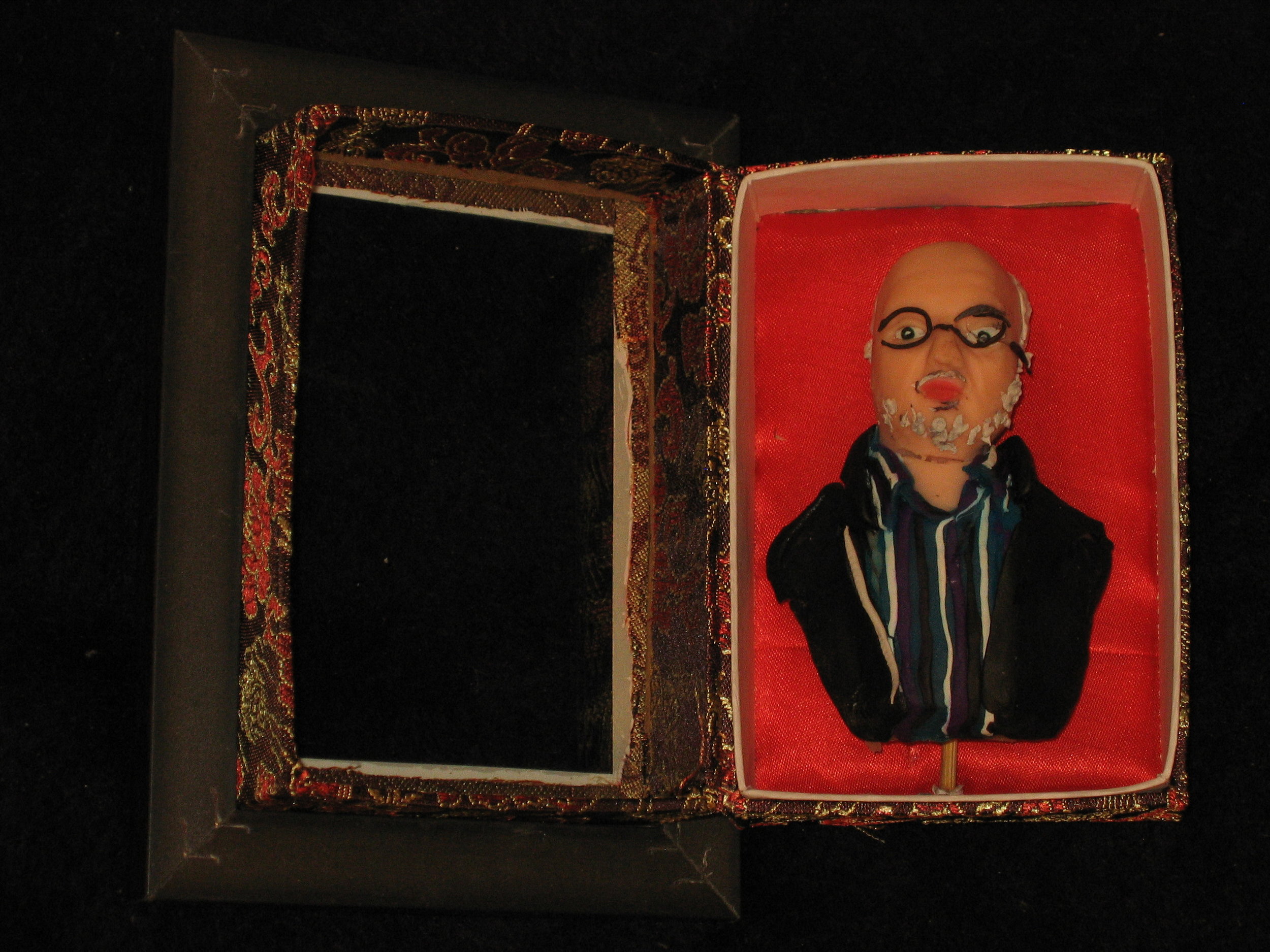
shanghai figure.jpg

While visiting the Yu Gardens, I stumbled onto a series of craftspeople from the region, including a sculpture who was producing likenesses of visitors by carving colored dough. Being obsessed with multiple personas, I could not resist the temptation to have him sculpt a "mini-me," my term, not his. The process took about twenty minutes from start to finish. Sitting for the clay portrait gave me a chance to watch him apply his skills as a craftsman involved in an activity which I am told goes back centuries. I have reproduced the likeness here (though the piece was damaged slightly during my trip back to the United States and seems to be falling apart day by day as the clay dries.) It was interesting to see what someone from another culture would emphasize in representing me. I'd just had a hair cut and beard trim before the trip so you don't get the full 'shaggy man' Henry look, but he does capture my salt and pepper beard. He spent a great deal of time trying to replicate the precise pattern and coloring of my blue and purple striped shirt. I was wearing my black leather jacket so you don't get to see my trademark suspenders.

The practice involves rolling very thin strips of clay which may be cut and shaped using tiny implements. He also mixes his colors from a more limited palette, a skill which especially came into play as he tried to match the coloring of my beard.

Games and Social Responsibility -- Perspectives from Shanghai

Shortly after the start of 2008, I traveled to Shanghai to attend the International Games and Learning Forum, an event organized by the MIT Education Arcade team in collaboration with Peking University and funded by the Hewlett Foundation. The gathering brought together some leading American thinkers (including Sasha Barab, Eric Klopfer, and Scot Osterweill) about the pedagogical potentials of games with their Chinese counterparts in education, government and industry. Special thanks to Alex Chisholm who organized the event. This fascinating series of conversations started broadly with a consideration of the current context of digital games in China and ended with a concentration on the value of games as a resource for teaching foreign languages. Here I want to share with you some impressions about the current state of games in China which emerged from these exchanges.

The concept of the 'social responsibility' of games companies was a much more central concept to these conversations than in an American context. The western discussion of 'serious games' is framed by the assumption that pedagogy is an unrealized potential of the medium but without any expectations that games companies have an obligation to create games which might transform societies. Perhaps because of the ways that media industries in China seek to walk a line between some emerging capitalist impulses/opportunities and an overarching state economy, the industry representatives at this event sought to continually reassure participants that they were fully aware of their ethical and social responsibilities. These responsibilities operate at multiple levels -- not simply a repressive notion of ethical responsibility (focused on what they exclude from games in order to protect impressionable young people) but also a generative notion (what they included in games in order to promote national culture or ethical self-consciousness). And it is this affirmative or generative notion of social responsibility which holds open the greatest promise in terms of promoting a serious games movement in China.

One attendee went so far as to link this focus on serious games to the United Nation's statement on children's rights which identified a 'right to play' as a fundamental expectation. (It's hard to imagine such a U.N. resolution playing a central role in any American discussion of games given our national disdain at the moment for such international agreements, but one can imagine such a fit carrying greater weight in China at a time the country is courting global respectability through hosting the Olympic games.)

Game Addiction

Let me break this down a bit more. First, I was struck by how little of the conversation about the negative social impact of games centered around issues of media violence or even sex. I had noted a similar disinterest in games violence when I had visited China five years ago in the wake of a tragic fire in a cybercafe started by a high school student frustrated that he was not being allowed to access the internet or play games. My essay on this incident for Technology Review is reprinted in Fans, Bloggers, and Gamers. Basically, I argue that the Chinese had little interest in the argument that games violence causing real world violence. Rather, the incident was read in terms of concerns about the breakdown of traditional community life and the loss of the moral influence of the extended family in Chinese culture, both of which were seen as a consequence of rapid cultural, technological, and economic changes. The incident was also read partially in relation to a focus on 'games and internet addiction.'

We need to be careful about taking this 'addiction' rhetoric at face value even though there are some highly publicized incidents where Asian youth played games to the point of physical collapse. For one thing, Chinese youth used cybercafes as their point of access to both games and the internet. To some degree, the Chinese government is using a rhetoric of addiction to rationalize their periodic crackdowns on young people's digital access, knowing that concern about media effects is more likely to be accepted by western governments. In that sense, addiction rhetoric does some of the same work that the Firewall does in terms of restricting youth participation in the online world.

The addiction rhetoric, though, carries force within China where it is connected to a number of concerns which the Chinese have about their children's culture. First, at a time when aspects of capitalism are reshaping Chinese society (especially in Shanghai), addiction rhetoric gives the Chinese a way to talk about the impact of leisure culture and consumer capitalism on their lives. Playing games is problematic precisely because it is unproductive (or seen as such). This focus on unproductive play rather than productive labor takes on particular significance when you recognize that time spent playing games was time “stolen” from exam preparation in a culture where one's future (and that of your family) often rested on how well you perform on standardized testing. It is the high pressure nature of Chinese education which helps to account for the attractiveness of games as a cultural outlet.

Of course, this focus on play is not unique to Chinese youth, even if the forms that play takes breaks along generational lines. On most residential streets, you can see people squatting around a card game, Chess, or Mah Jong, the game providing a context for face to face interactions within the adults of the community. Many of the public parks we visited on this trip included plastic playground equiptment, not aimed at small children but rather targeted at senior citizens, who used them to exercise. Seniors are being encouraged to play but that play is organized around keeping young and improving their physical health (that is, play is redefined as enabling self improvement). Chinese youth, by contrast, are more likely to be interacting online (or within the closed space of the cybercafes) and often to be playing games with people they do not meet face to face.

This brings us to a second aspect of gaming from a Chinese perspective: government policies have promoted birth control and the single child family. Several folks in the Chinese games industry stressed the ways that online gaming reflected the loneliness and isolation of single children who were forced to reach out beyond their own families or even local communities in search of playmates. Whether understood literally or metaphorically, this link between the one child family and the debates about games addiction helps to explain the intensity of this concern.

Finally, the games addiction debate takes on a historically and geographically specific reference point. Several of the speakers talked about the addiction to western games as the modern equivalent of the opium wars, with games suspected as vehicles for inculcating western values or simply as distractions which insured that Chinese youth would under-perform in other aspects of their lives. Here, we can read the introduction of games consoles alongside ongoing debates in China about the appropriateness of recognizing Christmas, an alien holiday which never the less fit well with the gift giving focus of traditional Chinese culture (and in effect, extended the shopping season around Chinese new year.) Walking around Shanghai one saw strange overlaps between the decorations that still lingered from Christmas sales campaigns and the decorations which had already appeared in anticipation of New Years celebrations. I was amused by a sign I spotted in the Shanghai airport wishing visitors a "Merry Chris". The rest of the world talks about putting the Christ back in Xmas, but here, it is the Mass which has dropped off altogether as Kris Kringle and not the Christ child becomes the icon for this merchant's festival. Games, not surprisingly, are popular gift purchases during these holiday seasons but like Christmas, they were often understood in terms of unwelcomed western influences upon Chinese cultural traditions.

So, on one level, the social responsibilities of games companies were framed in terms of managing games addiction with the companies falling all over themselves to talk about devices and programs they have developed to limit the amount of time Chinese youth spent playing games. There are parential controls which allow adults to set and enforce fixed limits on how long their children can play. And games produced by Chinese companies are designed to provide stop points appropriate for the anticipated limits set on game play. One speaker at the conference even suggested a plan which linked access to game worlds and assets to performance on exams. Good test scores might translate into tokens which could be redeemed in games, thus providing gamers with a stronger incentive to spend time studying.

There was also a great deal of discussion about the need to develop games which encourage families to play together, insuring that gaming helps to reinforce strong family ties rather than representing one more factor of modernity which separated youth from the influence of their parents. (This is a society where a group sitting down to lunch is still given a single menu with the expectation that the patriarch will order for the entire group.) One Chinese games industry speaker described the ways that games focused on national culture might bridge generation gaps: young people could use games to help older players to master new technologies while adults could use game play to transmit traditional cultural values and practices.

Serious Games

On the other hand, many of the speakers defined the social obligations of games companies in a more generative sense -- in terms of the introduction of elements into the game play which are seen in more positive terms by the adult society. Games in China, then, are seen as part of a national cultural policy aimed at restoring pride in Chinese history and cultural traditions, traditions which were severely disrupted by the Cultural Revolution and just now beginning to gain some traction in the society once again. Parents worry that their offspring are being drawn to alien cultural experiences --not only games but also anime and comics from other parts of the world -- rather than embracing aspects of their own cultural tradition which adults want to see transmitted to the next generation. The computer here is seen as an important educational resource, one which prepares Chinese youth for a greater engagement with the world beyond their borders.

At the conference, several Chinese game designers proudly displayed games which included historically accurate and precisely realized recreations of historical villages and cities from pre-20th century China. They have filled these historical recreations with artifacts replicated from cultural museums or used them as settings to re-enact cultural rituals, such as wedding ceremonies. Many of the games were based on classical Chinese literature, especially Three Kingdoms.(For more on the relation of games to Chinese cultural policy, check out this earlier blog post.)

One participant noted that western games did much better in the cities but Chinese games rooted in traditional cultures were expected by more rural consumers. Such a distinction makes sense if we see games as part of the process of modernization, westernization, liberalization, and capitalization of China. Those young people who will have the most contact with western travelers or business men were being educated through their play to understand the world beyond while those who would have the least contact were more invested in protecting their national culture from outside influences.

Social responsibility was also being expressed in terms of promoting games which encouraged ethical reflection and thus transmitted the country's philosophical traditions and in terms of the potential educational uses of games. Games companies had a much stronger commitment to the development of serious games, even though most of them were no closer towards developing a business model to support edutainment titles than their counterparts in the west.

One unfortunate downside of this emphasis on games as a means of transmitting national culture was a tendency to link the idea of educational games to a particular kind of content -- to this idea of historical reconstructions -- rather than to a pedagogical process. Several of us in the group of westerners attending the conference were struck by how little our Chinese counterparts spoke about game play as a learning process, saying very little about what you did in the games and much more about the worlds that players could observe. At a western conference on serious games, there is much more likely to be a schism between educators who have a curricular focus and game designers who insist that good game play is necessary for games to be able to motivate or facilitate learning. As a result of this conceptual gap, the two delegations spent a lot of time talking past each other rather than sharing insights about the challenges of designing educational games.

The western participants were more likely to embrace games in terms of a conception of enrichment activities -- things we might learn which went beyond national standards and exams. The Chinese were, as a whole, much more likely to embrace drill and practice models of educational gaming with all education understood in relation to school policies and testing practices.

Piracy and the Chinese Games Industry

This discussion was also shaped by the particular character of the Chinese games industry which is being profoundly shaped by the culture of media piracy. All we had to do was to walk outside of our hotel and we could see a thriving business in the sell of illegal copies of western media content -- games, software, films, television series, and music. I spotted several Hollywood films on dvd which had not reached the screens in the states at the time I had left for the trip. Walk anywhere in the city and you will get accousted by row after row of merchants asking you to "Lookie, Lookie" at their "Watches, DVDS, ipods, suitcases, pocket books, shoes", all knock offs or copies of western produced goods.

I spoke with one college aged young woman here who offered a range of explanations: western copyrighted materials were priced too high for most people to afford; the government set limits on how many western media properties could be imported legally and there was aggressive censorship of anime and manga (with almost no Japanese content available legally here). The black market was the only place they could go to access such cultural goods, allowing them to work around both political and economic obstacles to access.

Yet, the presence of the black market also made it difficult to make a profit off the distribution of their games in this country and caused equal difficulties for local games producers. The game company folks explained that there was almost no legal market in China for platform or pc based single player titles since there was no way to stop the rapid distribution of such materials at low prices through the black market. The only kinds of games which could make money were multiplayer games, where companies could create incentives for buying legal copies. These games were funded on subscription models or on the basis of the sale of assets and services. This focus on multiplayer experiences, then, forced the Chinese companies to compete within a space where production costs and labor demands are highest and this made it very hard for commercial companies to embrace a serious games model, even in the face of the other strong policy incentives for them to do so.

Another factor pushing against the wide spread embrace of instructional games in China has to do with the technical infrastructure of their schools. A government official from the Education ministry described a 10 billion dollar national program to insure that every school in the country had at least one computer. While Urban Chinese youth enjoyed increased access to digital technologies at home, at school, and through the cybercafes (more on this next time), the rural youth still had little or no direct access to computers. So, a school which has only one computer would not be equipt to integrate computer games into its normal instructional practices as anything beyond the focus for teacher demonstrations. No wonder there is so little focus in their thinking about game play experiences: games may be seen much more as a simulation technology performed in front of the classroom than as anything that young people get to actually play themselves.

Wu Ming on Convergence Culture

I was very flattered to have the Wu Ming Foundation write the introduction to the Italian language edition of Convergence Culture, which came out late last year. I have been corresponding with Wu Ming 1 off and on over the past year. You may recall the interview I did with Wu Ming 1 and 2 in the blog late in 2006. I've been dying to read what they have to say about the book and Wu Ming 1 just shared with me an English translation of their text. Their introduction does a first rate job of linking the arguments of the book to the current work I am doing on new media literacies, mostly by relying on content originally published on this blog. They open with some interesting comments about what my book might contribute to European discussions of popular culture and cyberculture, which I thought would be of interest to my readers here:

In the best of possible Italies, the publication of this book would be a telluric event, one that would shake the debate on the Internet and the new technologies of communication. If nothing happens, not even a twitch, it will mean that there's no actual debate, no semblance of life, only a deserted house with loose shutters in the wind. In comparison, poltergeist activity in a graveyard will sound like Rio de Janeiro's carnival.

Convergence Culture is a revolutionary work in many ways. It remains a fascinating and comprehensible reading all the way through, and it's crammed with examples and evidence. The works of European theorists are often cited, explained in a vivid language, and used to analyze concrete behaviors and practices, with none of the original intricacies. It works like magic: in the pages of this book any obscure convolution turns to crystal-clear, no-nonsense talk. Professor Jenkins plunges into the culture of our time and gives an accurate picture of how the new technologies are changing it, then he re-emerges and gives us a report not so much on the media, but on the people who are using them to communicate. The picture shows us, all of us.

A propos of this, it is necessary to make a distinction clear.

In Italian, by "cultura popolare" we usually mean folk culture, a pre-industrial heritage whose manifestations have managed to survive until today. Sardinian cantores and tarantella dances are cultura popolare. Those who use the phrase in other contexts do it with reference to the English homologue "popular culture", which is more commonly translated as "cultura di massa". Although the latter expression also exists in English ("mass culture"), it may cause equivocation and - as Jenkins observes - there are different shades of meaning between "popular culture" and "mass culture".

Equivocation: la cultura di massa is transmitted through the [mass] media (cinema, tv, print etc.), but it isn't necessarily aimed at the big masses. It may also include music addressed to a niche of listeners, or cinematic sub-genres appealing to specific subcultures. In fact, the majority of today's cultural products are not di massa. We live in a world of countless niches and subgenres. The mainstream, what we call "il nazional-popolare", is far less important than it once used to be, and it keeps getting smaller.

Shades of meaning: the expression "mass culture" stresses the way this culture is transmitted, i.e. through the media. On the contrary, "popular culture" emphasizes the role of the people who receive it and then reappropriate it. Usually, when we talk about what a song or a film means in someone's life ("Listen, it's our song!"), or how a crime novel or a comic book influenced its era, we call it "popular culture".

The problem is that, ninety times out of a hundred, the Italian debate on pop culture focuses on junk TV, as if that were the only way to be "popular", as though there were no quality distinctions and historical evolutions, as though Sandokan, Star Trek, Lost, TG4 and Beauty and the Geek were all of the same mould. It's like saying that there are no differences between Bruce Springsteen, REM, Frank Zappa and Shakira, and no possible distinctions between Stephen King books and Totti-joke collections, since both categories of books hit the top charts.

There are two armies fighting each other, and we should stay away from both of them. On one side are those who shield behind the "popular" to produce and peddle crap. On the other side, those who despise anything not aimed at an elite audience or readership.

These positions are perfectly symmetrical, they feed each other and share common views. One is that pop culture only addresses mute audiences probed by people meters, masses that express themselves only as percentages in opinion polls or figures at the box office.

And here's another merit Convergence Culture has: it gets to the roots of equivocation and puts them out. The focus shifts from an inextricable tangle of banalities to a new perspective, a way of tackling all issues by redrawing known boundaries and barricade lines.

Next Time: Thoughts on the Serious Games Movement in China

Resources for Science Fiction Fans

For science fiction fans, let me suggest two potentially interesting links. Flow TV recently ran a special issue last month focused entirely around Battlestar Galactica, including an interview with Mary McDonnell (Laura Roslin on the show), reflections by Bob Rehak on the role of remakes and reboots in contemporary television, Sarah Toton's thoughts on the Battlestar Wiki, Anne Kustritz's reflections on the interplay between the series producers and their fans, and a piece from Julie Levin Russo which gets billed as 'A transmedia love story''. (My wife and I have spent the past four months madly trying to catch up on the series through a combination of dvds and downloads. We've now caught up and are waiting for the return of the series later this year.) Fun, Fun, Fun! The second comes curtesy of Reason Magazine's Jesse Walker, a regular reader and sometimes commentor on this blog. Jesse sent me a lead to io9, a blog which describes itself as "strung out on science fiction." I certainly know where you are coming from, dude, and feel your pain. There Annalee Newitz has put together a chart which shows the ideological shifts that occur in Doctor Who over time with The Doctor sometimes seen as preserving the status quo and other times fermenting revolt among the underclasses. Newitz shows how these shifts in ethical and ideological frameworks correspond with shifts in political leadership in the United Kingdom, though readers write in to suggest a range of other factors explaining some of the philosophical inconsistencies of the show.

American Idol and the Variety Show Tradition

I also recently had a chance to contribute a guest blog for the PBS Remotely Connected Site. I was asked to write about a current PBS series, Pioneers of Television, which is a first rate exploration of tv history featuring interviews with more than a hundred key players in the early history of the medium. My post dealt primarily with an episode centered on variety programming. Near the end of the post I made an argument that in many ways American Idol has taken on some of the functions which variety programming used to serve. I wrote:

Vestigial elements of variety survive. If the episode had paid more attention to amateur variety competitions, an important sub-genre which goes back to Major Bowles on radio and Godfrey on television, we would see the clear links to contemporary series, such as So You Want to Dance, Dancing with The Stars, Americas Got Talent, and of course, American Idol. Such talent competition series fuse aspects of the game show and the variety traditions, even if they are now lumped into the larger category of reality programming. Consider some of the similarities:

  • These shows are often performed live, much like the earlier variety shows.
  • These shows are much more likely to be watched as they are aired than other contemporary programming, helping to create that sense of a national audience.
  • These shows are more likely to be watched in a social context, whether among family members or roommates.
  • The performances provide music, while the judge offer recurring comic characters.
  • Such programs combine classic old songs with emerging performers, much like the repertoire of Tin Pan Alley standards which were the stock and trade of variety show musical numbers.
  • Such programs offer constant shifts in style which move up and down the taste hierarchy -- ballroom dancing one week, hip hop moves the next.
  • Hosts like American Idol's Ryan Seacrest play much the same functions that Ed Sullivan performed on his program, introducing the performers and warming up the audience between acts.

The Writers Strike and Transmedia Entertainment

I was going to run a series of short items today. I am experimenting with breaking these down into a series of smaller posts, instead. I have not had a chance to write extensively here about the Writers' Strike. By this point, there are some very good discussions of the strike out there by other media researchers which more or less say what I would have said on the topic. For example, check out Jason Mittell's Post. I did participate in a discussion on the future of online content early this year organized by newteevee.com. Here's what I said there about the likely impact of the strike:

The writers' strike is a struggle over transmedia content and as a consumer, I certainly hope that the writers gain significant ground in their current efforts. As long as the media companies see online content purely in terms of promotion, they will not fully integrate it into the storytelling system. As long as creatives see generating 'extensions' as extra unpaid work, they will not put their best effort into this content.

The other interesting thing about the writers' strike as it intersects online video is the fact that the writers have been so much more effective than the producers at using YouTube and other online platforms to get their messages out to the public. Most mainstream media coverage of the strike has focused on how it inconveniences consumers -- after all, it is being produced by the same companies the writers are striking against. But the writers have been inventive at generating compelling online video which does get spread by their consumer base and helps to explain the underlying issues of the conflict. If nothing else, this shows how much better they understand the new media ecology than the people they are working for.

My Own Personal Writer's Strike...

Hi gang! I'm back after a somewhat longer hiatus from blogging than I had initially anticipated. I haven't posted new content on the blog in almost a month. I've been joking to people that I declared my own personal writer's strike. In reality, my absence has been caused by several factors: for one thing, we've been transferring the blog to a new server and setting up some new systems which should allow us to post comments more promptly and should result in less frustration all around. But secondly, I have needed to focus my energy on catching up on some other writing projects including some significant revisions of Convergence Culture as NYU Press gets ready to issue the paperback edition of the book. And finally, I've spent the last week or so in Shanghai attending a conference on games and education. You will be seeing a burst of posts about my China experiences over the next week or so.

Now for the sad news: I've struggled for some time trying to figure out how I maintain the pace of this blog, given increased demands on my time on other fronts. The past few years have been transformative in my career, with each week opening up new opportunities. I have a bad habbit of saying yes when confronted with an interesting invitation or when given a chance to do something I've never done before. I am on the road someplace almost every week and I am trying to manage an expanding portfolio of research projects back at MIT.

When I first started the blog, the advice I got was that the only way to sustain such an activity was to take deadlines seriously. You should figure out how many times a week you want to post, set a schedule for yourself, and stick with it. Naively, I figured I could put out content five days a week and I promised myself that I would do my best to hold to that schedule for the first full year. I succeeded. In that first year, I didn't miss a single day and I think the richness and diversity of my output speaks for itself. By last summer, I was finding it harder and harder to sustain that pace, but the Gender and Fan Culture series helped to reign in my panic because it meant that I needed to produce content for only three days a week. By the end of last term, I was having trouble doing that and so I missed some days there near the end of the year, which made me unhappy with life.

My new year's resolution, thus, is to lower the pressure on myself a bit more by stating outright that I am going to be producing content three days a week. Some weeks I may be able to do better than that, but let me lower expectations a bit. I doubt that there are very many readers out there who fully read everything I post now.

Cutting back will have some impact on the diversity of what I can cover clearly and as it was, there were topics that I wanted to write about – J.K. Rowling's outing of Dumbledore, the Writers' Strike being two examples – which I just couldn’t find time to catch up on. So, this will still be a source of tension for me, but I think life will be better if I scale back just a little bit.

I have no desire to stop blogging, altogether. Have no fear. Doing this blogging has been an enormously rewarding experience for me. Almost everywhere I go these days, I meet people who are reading the blog and I love the chance to talk with them and get their perspectives about what I've written. I confess to being totally addicted to the various blog search engines especially with seeing what other bloggers have to add to the discussions we’ve started here. When I first graduated from college, my goal had been to become a professional journalist but I wasn't able to find full time employment. In some ways, blogging has allowed me to merge the career I thought I wanted (as a journalist) with the career I have pursued (as a college professor). Writing in the blog has forced me to find ways to be even clearer and more accessible in my prose as I have been able to build up a readership here which is overwhelmingly composed of people who are not academics.

Through the interviews and guest blog posts, I have been able to expand public awareness of the work of many other media scholars and in the process, have helped to mentor them about what is involving in expanding the readership for their work. I have been able to use this blog to host important conversations in our field, such as the marathon series of exchanges on gender and fan culture we ran starting in the summer. I hope to hold other such conversations in the future. Hosting the blog has allowed me to share some of the outstanding work of my students and colleagues to a larger public and has given me a chance to collaborate with some alums of our program as they share their interests with this community.

The blog has had a huge impact on the admissions for our graduate program. More and more of the students applying understand what is unique about our program. As a result, we are getting students who are more motivated to take advantage of the opportunities we offer. They become regular readers of the blog once they are accepted and thus come to campus already feeling a part of the CMS community.

The blog has also helped our alums to feel more attachment to the program and maintain greater awareness of what we are trying to accomplish. The blog has helped to bridge between a range of different conversations about media change including those involving fans and gamers, within the brand and entertainment industries, among media literacy advocates, and among academic media researchers.

Having a regular channel through which to share my insights to the world has increased my professional visibility, calling my work to the attention of researchers in a range of different fields and dramatically increased speaking invitations. It has also allowed me to help set the agenda for how media gets covered in the press with a growing number of reporters using the topics we discuss here as a spring board for stories.

Convergence Culture has probably sold more copies than my other eleven books combined and I am certain a large portion of those sales can be traced back to the ways that this blog has increased public awareness of my work. In this case, as in many others, giving away a daily sample of my content for free has increased public interest and resulted in more book sales, not fewer. So, for these and countless other reasons. I am finding the time I pt into this blog as intensely rewarding. But I do need to cut back just a little on the time I put into this project if I am going to do justice to all of the other things people want me to do.

I've said it before and I will say it again. I see this blog as an experiment in how academics might use emerging technologies to expand their role as public intellectuals. For too long, academics were dependent on old media channels to get their ideas out to a larger public. One of my early blog posts centered on my concern that academic publishing had become a kind of ghetto which was cut off from the larger conversations which impacted our culture. I had hoped that blogging might provide an alternative means of circulating ideas and engaging in conversations.

In doing so, though, I did not want to give up on those things I value about academic writing -- the ability to connect local or topical issues to much larger, more abstract concerns; the ability to dig into substantive issues in a deeper way than would be possible through a mass media channel; the ability to provide a historical context for contemporary developments or to deal comparatively with developments in different national contexts or within different media sectors. All of this requires depth and doesn't result in the short posts which have typically characterized other forms of blogging.

The length of my posts remain one of the most controversial aspects of this blog. Some people bust me for writing too much, saying that what I do isn’t really blogging. For me, what makes blogging exciting is that when we step outside of commercial contexts, space limits become relatively arbitrary and people are free to do their own things using the new media platforms. In general, I find that my longer posts get more discussion, not less, despite those who insist that if I wrote shorter, I would have greater impact. I am finding blog posts are getting cited in academic papers because they gain some element of scholarly respectability even as they are being used as springboard for casual conversations among my regular readers because they maintain timeliness. I am going to try this year for some posts that are shorter but I don't think I can or want to move away from the longer posts which have been an aspect of this site from the start. If you want shorter posts, there are many other very good blogs out there to read. And in any case, I try to write even my longer posts in modular units which make it easy for people to duck in, read as much as they want, skim through the rest.

We are still working on finalize the new comments mechanism for the site. Be patient a little longer and we hope to improve a situation which has long frustrated me and many of you.

Futures of Entertainment Podcasts

This will be my last post of 2007, barring unforeseen circumstances. The blog is going to go down for a little bit to allow us to switch servers and hopefully provide better service in the future. The blog is also going down because I am exhausted from the term, want to spend time with my family, and need to catch up on other writing and regroup my thoughts so that I have interesting things to share with you all when I return next year. Before I sign off though, I wanted to let you know that the podcasts of the Futures of Entertainment 2 conference are slowly but surely being posted on the CMS homepage. So far, the following podcasts have appeared:

Opening Remarks by Joshua Green and myself, laying out what we see as some of the most important media trends of the past year.

Metrics and Measurement

Panelists: Bruce Leichtman, Leichtman Research Group; Stacey Lynn Schulman, Turner Broadcasting; Maury Giles, GSD&M Idea City

As media companies have come to recognize the value of participatory audiences, they have searched for matrixes by which to measure engagement with their properties. A model based on impressions is giving way to new models which seek to account for the range of different ways consumers engage with entertainment content. But nobody is quite clear how you can "count" engaged consumers or how you can account for various forms and qualities of engagement. Over the past several years, a range of different companies have proposed alternative systems for measuring engagement. What are the strengths and limits of these competing models? What aspects of audience activity do they account for? What value do they place on different forms of engagement?

Fan Labor

Panelists: Mark Deuze, Indiana University; Catherine Tosenberger, University of Florida; Jordan Greenhall, DivX; Elizabeth Osder, Buzznet; Raph Koster, Areae

There is growing anxiety about the way labor is compensated in Web 2.0. The accepted model -- trading content in exchange for connectivity or experience -- is starting to strain, particularly as the commodity culture of user-generated content confronts the gift economy which has long characterized the participatory fan cultures of the web. The incentives which work to encourage participation in some spaces are alienating other groups and many are wondering what kinds of revenue sharing should or could exist when companies turn a profit based on the unpaid labor of their consumers. What do we know now about the "architecture of participation" (to borrow Kevin O'Reilly's formulation) that we didn't know a year ago? What have been the classic mistakes which Web 2.0 companies have made in their interactions with their customers? What do we gain by applying a theory of labor to think about the invisible work performed by fans and other consumers within the new media economy?

And don't miss the webcast of the MIT Communications Forum event, Forum: NBC's Heroes: "Appointment TV" to "Engagement TV"?

The fragmenting audiences and proliferating channels of contemporary television are changing how programs are made and how they appeal to viewers and advertisers. Some media and advertising spokesman are arguing that smaller, more engaged audiences are more valuable than the passive viewers of the Broadcast Era. They focus on the number of viewers who engage with the program and its extensions -- web sites, podcasts, digital comics, games, and so forth. What steps are networks taking to prolong and enlarge the viewer's experience of a weekly series? How are networks and production companies adapting to and deploying digital technologies and the Internet? And what challenges are involved in creating a series in which individual episodes are only part of an imagined world that can be accessed on a range of devices and that appeals to gamesters, fans of comics, lovers of message boards or threaded discussions, digital surfers of all sorts? In this Forum, producers from the NBC series Heroes will discuss their hit show as well as the nature of network programming, the ways in which audiences are measured, the extension of television content across multiple media channels, and the value producers play on the most active segments of their audiences.

Keep an eye on the Comparative Media Studies Program Home page and the Futures of Entertainment 2 Conference website for the roll out of the other conference podcasts.

Live Action Anime? Only at MIT!

anime5.jpg
When I heard several months ago that some of my MIT colleagues and students were helping to stage a performance of Live Action Anime, I knew I had to be there. I anticipated the experience with a kind of "only at MIT" amusement -- not sure what to expect but knowing that the results would be dazzling.

The performance, Madness at Mokuba, opened with a spectacular battle between two giant robots (see the image above) staged against the backdrop of projected anime images and accompanied by an awe-inspiring soundtrack of metallic clanks and engine sounds which instantly reminded me of my first experience watching RoboTech and Star Blazers several decades ago. I didn't know what live action would look like but as the performance continued, I was more and more impressed with the craft and research which went into this performance.

The show was staged by SLIPPAGE: Performance, Culture, and Technology, a collective of artists and researchers established in 2003, which seeks to explore "connections between acts of performance, formations of culture, and interventions of technology toward an end of

original theatrical storytelling."

Madness was scripted by Ian Condry, an associate professor of Japanese cultural studies in the MIT Foreign Language Program. Condry is the author of the recently published Hip Hop Japan: Rap and the Paths of Cultural Globalization. Some readers will recall an interview with Condry I ran some months ago about his research into Japanese popular culture. Condry is now working on a new book, tentatively titled Global Anime: The Making of Japan's Transnational Popular Culture, which emerges from field work spent in Tokyo animation studies. (I was lucky enough to tag along with Condry during one his trips to Japan, getting to visit Studio Ghibli, and getting some behind the scenes perspectives from the producer of Pokemon. I've described some of my impressions of seeing cosplayers in Yoyogi Park in a previous blog post.)

Condry runs the Cool Japan program, a joint efforts between Harvard and MIT, which regularly brings to Cambridge leading researchers, producers, writers, and others involved in the production and distribution of Japanese popular culture. In an e-mail interview, Condry shared some of the thinking which went into this production:

One of the things that interested me about the live action anime project is that it got me thinking about the many ways that anime crosses over from the "virtual" to the

"real." The most obvious example is cosplay and the many forms of licensed merchandise,

such as toys and models, that in effect bring anime through the screen and into

people's hands. When fans take anime and manga characters, and use them to create their

own fanzine manga (dôjinshi), a similar kind of translation effect is underway, that

is, taking imagined characters, re-imagining through our own minds, and the creating

something new in the world.

It shows how inaccurate in some ways the distinction between virtual and real is, and I

think that partly explains why debates about the division between the two worlds has

slackened in recent years.

During fieldwork research in Tokyo, I have also been struck by how often the term "real"

(riaru, in Japanese) comes up when anime creators talk about what makes particular works

distinctive. Anime creators always struggle with challenge of bringing the "real" into

the "virtual" space of animation.

The original Mobile Suits Gundam series, which began airing in 1979, is looked back on now as the moment when "super robot" anime, with its happy heroes, child audiences, and 30-minute resolutions, gave way to "real robot" anime, in which war was represented in a

more realistic manner. Real had other connotations in this context as well. In real

robot anime, so-called heroes are often despised for their violence and wanton

destruction, audiences were older, and the stories seldom had clean-cut endings, but

rather meandered through the gray zones of war's ambiguities, hypocrisies, and senseless

violence. Gundam turned robots from heroes into mere weapons of war.

In the end, the notion of live action anime may be paradoxical, but it also reflects

some of the most fascinating aspects of anime as a medium.

Anime fans have long debated whether Anime is best understood as a genre (or perhaps a set of related genres), as an aesthetic style, as a mode of production, or as a transmedia phenomenon. Informed by Condry's theories and research, the MIT show managed to cover all of these bases and then some.

The show's characters (see below) each embody archtypes from the anime tradition, collectively taking us on a tour of its core genre elements and linking them to larger trends in Japanese society and culture, including "giant robots, a Japanese schoolgirl, a lovelorn otaku, a masterless samurai, a gamer woman, evil media magnates, and a vengeful deathgod who all battle for truth, justice, and the anime way."

anime%201.jpg

As the story opens, the protagonists, including Schoolgirl and her sidekick, Sam Rye, and their arch rivals, Flux and Ota Ku, are preparing their robots for the Makuba Institute of Technology's annual giant robot battle. Yet, something strange is going on. Their classmates are falling prey to VIRTIGO, a strange mental illness which involves altered states of consciousness. We learn that the illness has been manufactured by an evil media conglomerate (The Infinite Channel Network) in order to produce a state of constant consumption, transmitted through the use of flash rhythms similar to those that alarmists claimed caused epileptic seizures when Pokemon was first released. Falling prey to what is described as a "Neo-Postmodern Trans-subjectivity syndrome," victims "fall from one reality into another." As the corporate scientists spell out their plans to use anime to achieve global dominance, they become the vehicles for Condry and the show's cast to explore the historical evolution of the anime movement. As scenes from Astro Boy, Gundrum, Neon Genesis: Evangelion, and Pokemon, among other defining texts in the anime tradition, are projected on the wall, the cast stages a gender-bending re-enactment of key moments, such as the creation of Astro-Boy. There's a very funny re-enactment of Pong with actors moving a giant cardboard ball between two massive paddles. Cyberpunk has long been a vehicle for authors and animators to reflect upon the influence of media on contemporary culture and this high tech plot provides an ideal vehicle for Condry to express his own insights into the cultural and economic factors which have enable anime to straddle genres, to reach across multiple media platforms, and to shape youth culture world-wide.

The performance loving captured the anime aesthetic. While the performers are live, the voices are dubbed, capturing the slight mismatch between lips moving and spoken language which is part of most westerner's experience of watching anime. (During the question and answer period, one anime saavy spectator asked when they might see the subtitled edition of this performance and offered to help launch a fan sub project!) The soundtrack wittily samples effects from classic games and anime which sparked some audience members to shout out the references -- and trust me, at MIT, a high percentage of those attending the show were deeply immersed in games, anime, and other aspects of geek culture.

The acting style was designed to convey some of the limited animation techniques most closely associated with anime -- even including repeated gestures which hint at the longstanding practice of recycling footage at certain generic moments -- transformation scenes for example -- in some series.

The show's director, Thomas F. DeFrantz, who is a Professor of Theater Arts and the current head of the MIT Program in Women's and Gender Studies, shared with me some reflections about the stage design and choreography for Madness:

To construct movement for the piece, I often had my dancers think of themselves as if 'in camera.' I asked, "if you were the animator, how would you draw this moment?" The piece is based on stillness, rather than on motion. In many anime, you don't see every bit of a gesture, just the edges. This took a technique of 'clenching' the body, strangely enough, to reveal the edges of each silhouette that stood for a character emotion. More than anything, we had to work against the casualness of everyday gesture, in which there might be many silhouettes of little interest to an animator or someone watching anime. For this work, we had to focus on the silhouettes that could reveal character, attitude, and opinion all at once. The performers developed their 'signature poses' and we worked from those to generate a language of motion. In the end, it was much harder than I thought it might be, to go through the entire piece in this sort of 'physical karaoke' but without ever speaking a word. It helped us reconsider the importance of breath and sound as components of human expression, because in the live action anime, working with the pre-recorded soundtracks, the performers never got to make a sound.

The costume and make-up were equally iconic, designed to transform the student performers into cartoon characters. Here, for example, is a portrait drawn by castmember Ashley Micks of Ota Ku, one of the young people who helps overcome old school rivalries and work together to defeat the evil corporations.

anime%20Ota.jpg

Milo Martinez, an undergraduate major in the Comparative Media Studies Program, describes the challenges he faced bringing this larger-than-life character to the stage:

I can honestly say that Live Action Anime was an experience worth having. As a Dancer, Cosplayer, and Anime-fan, I saw it as a perfect fit for me. The entire piece is gesture based, and a lot of focus was placed on creating phrases with our bodies. "How can our body say this sentence for us?" was a common question we asked ourselves while constructing the choreography. Since our voices were "dubbed over" we had to make sure that our movement could speak for us.

We were very particular in everything we did, each character had a walk, pose, attitude, and each needed to agree with the others. As an Anime fan, it was important to me to try and make my movements big and crazy, if it looks like it hurt, then it probably did. How fast can I run from this side of the stage to the other? How high can I jump? A lot of this show I pushed my body to its limits to try and create a character that had indeed walked out of a screen.

As his comments suggest, Milo came to the show with extensive experience in cosplay, a form of costuming and performance which thrives within the anime fan community. Indeed, Milo was interviewed on camera as part of a series of short documentaries on cosplay we have been producing for Project nml (New Media Literacies). Here's a segment from this documentary, which is still in production, which features Milo talking about his cosplay experience and suggests the ways that these fans are, as Condry has suggested, already involved in finding ways to translate the look and feel of anime into physical reality.

From Zoey's Room to Project NML: An Interview with Erin Reilly

Yesterday, I introduced you to Matthew Weise, a producer from our GAMBIT lab, and a key figure behind our games research efforts. Today, I wanted to introduce you to another researcher who recently joined the CMS community -- Erin Reilly, Research Director of Project nml. The New Media Literacies (NML) project, funded by the MacArthur Foundation, is developing a theoretical framework and curriculum for K-12 learners that integrate new media tools into broader educational, expressive and ethical contexts. NML is partnering with classrooms and after school programs around the country to test curriculum prototypes created by CMS students and program affiliates.

Before coming to MIT, Reilly was co-creator of Platform Shoes Forum's model program Zoey's Room, a national online community for 10-14 year-old girls, encouraging their creativity through science, technology, engineering and math (STEM). Zoey's Room has proven results in advancing STEM and Media Literacy skills. In 2007, Erin received a national educational Leaders in Learning Award from Cable in the Classroom for her innovative approach to learning through Zoey's Room. A recognized expert in the design and development of thought-provoking and engaging educational content powered by virtual learning and new media applications, Erin has been a featured speaker, panelist and keynoter at several industry events. Erin serves on the Working Committee of Pop!Tech (http://www.poptech.org), an internationally acclaimed technology event that can be seen on PBS and the Technology Committee of the Maine Arts Commission.

Knowing how many of my readers have a strong interest in the use of new media for education, I asked Reilly to share some of her insights from working on Zoey's Room and to give us a preview of what you can expect to see from Project nml in the coming year.

Tell us about Zoey's Room. What were the goals of this project and how do you measure it success?

Zoey's Room is a safe, online educational community developed by Platform Shoes Forum to creatively engage 9- to 14-year-old girls in science, technology, engineering and math (STEM).

The goals of Zoey's Room are to encourage middle school girls to:

• Learn science, technology, engineering and math skills in a fun, collaborative online environment by completing online activities and offline challenges on their own or in a group.

• Behave responsibly and ethically online and to be Internet Safe

• Participate and share in an informal learning environment, and

• Be better prepared for the technological demands of a future workforce.

Fewer than a dozen Science, Technology, Math, Engineering (STEM) websites are currently available online for middle school girls right now. Of them all, Zoey's Room is the only STEM website that features a multicultural character "Zoey" who appeals to both rural and urban girls. Zoey hosts her own chat room for girls every day after school. She encourages girls to explore STEM topics through fun challenges called Tec-Treks, that expand their knowledge on a range of 21st century skills. Additionally, each month, Zoey leads informative chats with "Fab Female", women role models who have STEM professions. This unique interpersonal connection, along with the collaborative nature of the Tec-Treks, encourages girls to become more interested in STEM careers.

We measure the success of Zoey's Room not on the number of its members but on the girls' safety, progress in academic fields, and retention in the program. The extensive research behind Zoey's Room allowed us to develop a practical application, which includes an on-going assessment of each member's participation and learning. Evaluative tools include a benchmark survey taken when a girl first joins the program, annual assessment polls, and one-on-one feedback from online members and adult facilitators.

Specifically, a sample of 100 girls participated in the Zoey's Room 2006-2007 benchmark and final survey. When asked the answers to very specific STEM questions we put to them in the survey, the majority of girls got 12 out of 13 of the answers right--which proves to us that they actually learned terms and concepts and principals of certain STEM topics by doing the various Tec-Treks. But beyond statistical measures, what girls are saying about Zoey's Room matters the most.

"Math is my favorite subject - I'm (now) interested in numbers and problem solving"

"We need more ideas like Zoey's Room; being a girl is hard and we need all the support we can find since it's hard to discover that at home, with our friends, or our schools."

"I think that Zoey's Room is the best idea in the whole entire world. On Zoey's Room, a safe environment is provided where questions can be answered and girls actually have a voice."

What factors have historically limited young girl's comfort with Science, Technology, Engineering, and Math? How has Zoey's Room overcome these problems?

Reports like "Shortchange Girls, Shortchange America" (1991) and "Gender Gaps" (1998) by the American Association of University Women (AAUW) were the catalyst for starting a program like Zoey's Room. Through aggregated research and internal studies, these reports uncovered the need for schools to provide equitable education for girls in the areas of STEM. AAUW found that to instill math, tech and science skills in girls; we need to educate girls to be designers, not just passive users of technology- and Zoey's Room encourages that. Given the social and collaborative nature of girls, a girls-only self-paced learning environment seemed a natural platform. The next step was to make this environment engaging and attractive to girls by including community tools.

Though girls today are more apt to be interested in technology, they are still not pursuing further as advanced courses or career aspirations. According to a more recent report," What We Know about Girls, STEM, and After-school Programs" (Cheri Fancsali, Ph.D. for Educational Equity Concepts) girls are much less likely to major in science-related fields in college; less likely to complete undergraduate and graduate with STEM degrees. Beyond that, women comprise a disproportionately low percentage of the STEM workforce, earn less, and are less likely to hold high-level positions in STEM careers. What does that mean for our society? Today, eight of the 10 fastest growing jobs in the U.S. are computer related. By 2010, jobs in the technical and mathematical fields are expected to increase by 67%. If this trend continues, not only does it seriously cripple young women's potential financial earning power, but as more jobs in the future demand technological proficiency, this trend can be a detriment to the nation's intellectual resource pool.

In the last five years, numerous studies have documented concrete methods to get girls re-engaged into learning "hard skills." Programs for girls combining hands-on activities, role models, mentoring, internships, and career exploration have improved girls' self-confidence and interest in STEM courses and careers and helped reduce sexist attitudes about STEM (Campbell and Steinbrueck, 1996; Ferreira, 2001).

The AAUW Commission also stressed the need for adult female role models to engage younger females in the areas of science, technology, engineering and math for girls to begin reshaping their own perceptions about these fields as career choices. A recent Girl Scout Research Institute (GSRI) study showed that girls tend to make career choices based on their role models rather than their academic interests.

Joseph Bernt, an Ohio University professor of journalism, and one of the authors of a nationwide study funded by the National Science Foundation about the media's influence upon middle school children found "this age group spends more time interacting with media than in school or with family, or even with their peers. This means that media has to start providing better role models for girls. Zoey's Room is our example of creating a fun, creative, positive use of media. By harnessing the media for education, we hope to inspire girls with other role models.

In a recent column, I argued that the term, "digital natives," masked lots of differences in young people's access to and participation within digital media. What kinds of differences in skills and access have you observed through your work on Zoey's Room?

I think we've grown up in a culture that we have to label everything, but by doing this we limit the truth of who people really are. Using labels like digital natives and digital immigrants is just another way of stereotyping people. Anyone who's participated in community online knows that it's these places where stereotypes are broken down. The anonymity of the web allows for the girl you'd never hang out with in school to become one of your closest allies online. It's a congregation of girls interested in a particular subject rather than hanging out on a particular social norm that sets precedence in the school cafeteria.

Children have to learn technology skills just like we adults. The only way they are going to learn the skills are by trying it out or asking for help. This metaphor makes it sound that every kid is a native to the digital environment. It doesn't take into account that kids and adults all have different experiences with digital technology. And it also doesn't take into account the guidance and supervision that happens in communities and the positive results occurring when an informal mentorship happens between an adult and a child online. It really depends on how much access they have to the technology in order to be comfortable. These skills are unevenly distributed across our population and can easily be seen in the Zoey's Room membership. We have many home-schooled girls using Zoey's Room who are much more savvy online than girls who doesn't have a computer at home and only get to use the computer when she meets with her after-school Zoey's Room club.

The chat and message boards on Zoey's Room are filled with peer-to-peer sharing of how to do something online. (See the below image for example of girls sharing how to change fonts within chats).

zoeysroom-thumb.png

The message board tech tips wouldn't be filled with this information if girls came into the program knowing how to do everything digital.

I also argued that adults might have more to contribute in helping young people adjust to new technologies than the phrase "digital immigrants" implied. How did you harness adult expertise through Zoey's Room?

We harnessed adult expertise in Zoey's Room by creating a mentoring pipeline through our Friends of Zoey and Fab Female components. High school girls can apply to be "Friends of Zoey", which are junior staff members who interact online with girls and encourage them in Tec-Treksâ„¢. The FOZ began as an internship program for girls who have aged-out of Zoey's Room but still wanted to stay involved and developed into these girls being the community hosts of Zoey's Room as well as keeping content evergreen.

As I mentioned earlier, Fab Females are female role models who have professions in STEM. Past Zoey's Room "Fab Females" have included a NASA Food Technologist, Microsoft IT manager, a marine biologist, a paleontologist, and digital artist, designers and film makers. Fab Females have asked to stay involved beyond the chat session. With an increase in membership this year, we're opening up a space in the community for on-going interaction between Fab Females and the members.

Not only are our Friends of Zoey the glue to the online community, but also these girls build leadership skills by recruiting and interviewing our Fab Females to conduct online chat sessions. They also work with these Fab Females for additional Tec-Trek activities.

Online safety was a central concern of your work on Zoey's Room. Many adult fears about young people's experiences online are misguided, but some are not. What do you see as the most realistic concerns and what steps did you take to address them?

Since we work with children under the age of 13, the biggest concern is following the guidelines of COPPA, and we worked closely with the FTC to ensure our registration was COPPA compliant. However, this doesn't guarantee that a person signing up is who they say they are and we all know how easy it is to change your birth date to make you whatever age you want to be. So, how do we protect girls from encountering just anybody on our site?

We've partnered with a 3rd party verifier to ensure all adults who register a girl for an account are subject to identity verification. Before confirming a girl's membership to Zoey's Room, our process verifies the data collection of adult registrants to ensure they are who they say they are. This is a reactive approach and does not provide the answer to safety but we hope this extra step will deter folks who are joining the community for reasons other than its intended purpose.

Past the access point, Zoey's Room creates a proactive approach to safety and ethics by training Friends of Zoey how to help moderate and monitor the chat room and message boards every day for ongoing protection of its members. We also create an environment where members watch out for each other and know the guidelines they need to follow to participate in the community... and I think this is the best approach to take. I conduct adult workshops and stress to attendees how important it is to have open conversations with your kids and help educate them of proper conduct online.

Lately, we find the biggest concern is not safety but ethics. We've found that when confronted with someone prying too much, they usually quit out of the program and shut down. Their natural instincts kick in. However, it is mob mentality and bullying that causes the most damage. Zoey and Friends of Zoey provide peer-to-peer guidance in how to handle the situations and have been known on more than one occasion to be the bridge to acceptance of each other.

What did you learn from the work on Zoey's Room that will help us expand the community around Project NML?

The first thing we started with this year was defining our audience. If it's for teens, make it for teens. Don't worry about the adult. If teens like it, the adults will join in. If teens don't like it, you and the adults will always feel like its work.

"Today's American teens live in a world enveloped by communications technologies," states a 2005 Pew Internet and Life Report titled "Teens and Technology.

Whether adults are comfortable with this technological revolution or not--it's happening. According to the Pew Report more than 87% of teens and tweens between 12-17 are using the Internet and their preferred method of communication is online in the form of Instant Messaging, Chat Rooms, and Social Networking sites with older girls taking the lead nationally as the "power users" of the Internet.

In Zoey's Room, we foresaw this trend in 2002 when we created a moderated chat room for girls only with the sole purpose of appealing to girls' natural collaborative and communicative natures as a platform to introduce "stealth" education in the form of Tec-Treks and role models.

We also saw the success of having a place for members to showcase their work and get feedback. Each of the Tec-Treks is project-based and not yes or no or multiple choice answers. Tec-Trek projects are loaded for not only Zoey and her friends to give feedback but also the other mentors.

I've seen first-hand that community is the glue to learning online. If you lose community, then you might as well be reading a book on your own without ever joining the book club for discussion.

I hope to take the Zoey's Room "pipeline" community to Project NML. This approach encompasses the traits recognized in participatory culture, including:

• Low barriers for artistic expression & civic engagement

• Strong support for creating and sharing what you create with others

• Some type of formal mentorship (pass it along to newbies)

• Members contribution matters - reinforce your contribution is important

• Some degree of social connection matters

And first and foremost, I bring the knowledge of lessons learned in the field. Of having taken theories and created a successful digital learning application. Having processed what works and doesn't work will help Project NML be successful and hopefully push the digital learning community further.

What have you learned through working on Project NML so far that helps you think differently about Zoey's Room?

In your graduate proseminar on Media Theory and Methods, you ask your students to interview a media maker and to try to get a sense of the theoretical assumptions underlying their work. Zoey's Room has been a practical application but the research that we looked at to develop Zoey's Room was girls and STEM. We were media makers so we didn't look at the media theories to develop... we just did it.

Since becoming Research Manager for Project NML, I realize that we intuitively created a participatory culture for members of Zoey's Room. Even though the program was about encouraging girls in STEM, it is an example of a shift in media literacy from thinking about what media does to helping change our mindset to what choices we make as users / producers of media. This is an active way of participating in media instead of the passive way to what media we consume.

We cannot have media literacy be a separate class / add-on at the end as we've seen in the past decade. Instead it needs to be infused cross-curricular.

Reviewing the skills against Zoey's Room Tec-Treks, I see these skills come into play both in and out of the digital realm. There are connections of how kids are connecting in the digital realm to what they should be doing in the classroom. This skill set is not just about high-tech activities. This is an opportunity to help kids acquire skills on how they process knowledge so that they can participate in a new way.

We've been rethinking the goals of Project NML since you've come on board, but the impact of that rethinking has not yet been made visible to the public. What can you tell us about the Project's future plans?

This semester, we've created new approaches to working on this project that really has allowed everyone on the team to understand the goals we want to deliver.

We are currently immersed in production with a goal to re-launch Project NML's interactive website Fall 2008. The new website will allows users to create their own pathways through our exemplar library and have users create and add their own material to the exemplar library.

The exemplar library is a sampling of the participatory culture framework centered around the 4 C's ...how do we Create, Connect, Communicate and Collaborate. It is an interactive learning library that creatively encompasses a best practice video with an online activity and offline group challenge. The library is built on an extensive backend database where each piece is tagged on multiple traits including; the 11 new media literacy skills, media tools, traditional subjects, and the 5 ethical categories created by Harvard's Good Play project.

The exemplar library will also have some online activities that highlight our collaboration with Harvard's Good Play project. These activities will provide a springboard for discussion on a dilemma centered on one of the five ethical categories: identity, ownership / authorship, privacy, participation and credibility.

As community is the glue to learning online and Project NML will provide a venue for all users to answer the question, "How do YOU create, connect, communicate and collaborate?" This type of user-generated content will allow for the library to expand by the community and for new best practices to emerge, be shared and discussed.

Whereas Project NML's exemplar library is informal learning directed to the teen, the Teacher's Strategy Guide: Education in a Participatory Culture provides structure for a teacher to integrate the new media literacies into the traditional classroom. The framework includes a lesson plan, with extension link of ways to extend the 1-2 class period lesson plan into a semester or year-long project with options to tie to other class subjects as well as a side bar that provides entry points to engage the student through the Project NML exemplar library.

We currently are in development of our first guide called Moby Dick: Remixed and are currently seeking 10 high school English / Literature teachers to test our Teacher's Strategy Guide: Education in a Participatory Culture in Fall 2008. Moby Dick: Remixed help students to better understand the appropriation and transformation of pre-existing cultural materials which shaped some of the most cherished works in the western cannon. The guide provides a set of lesson plans that juxtapose Herman Melville's Moby Dick and Ricardo Pitts-Wiley's theater performance Moby-Dick: Then and Now and is a clear example of the new media literacy skill: appropriation.

Our next steps are to develop material for history / geography teachers. The next guide will be called Weaving the Threads - Social Mapping to Global Citizenship. This project will couple children's interest in cultural diversity with our own interest in the New Media Literacy skills required to process new forms of simulation and representation, producing a project which challenges participants to think about their relationship to their space in fresh new ways. Such a curriculum should enhance traditional social science education, while allowing students to become active participants in their learning rather than passive recipients, because it is in this approach that we help our children become global citizens.

Mentorship will continue with expansion into a media franchise. One of the motivating factors of the community is to develop a character based on the 4 C's. This character will be customizable per user and provide rewards for motivation within the community. This character has the potential to be the lead character in an e-zine style program targeting Tweens. With the collaborative learning community online, the strategy guides deployed to the classroom and the television series, Project NML will be a transmedia experience that helps foster the new media literacies.

If you'd like to become a test school for Project nml, please contact our outreach coordinator Jenna McWilliams at .

Want to know more about new media literacies? If you live in the Boston area, you might want to check out a forum being held at the Brattle Theater at Harvard Square on Dec. 12, 5:30 pm:

MIT Press And The MacArthur Foundation Present

Totally Wired: How Technology Is Changing Kids And Learning

Are digital media changing how young people learn and play? A public forum featuring Howard Gardner (Harvard Graduate School of Education), Henry Jenkins (MIT), and Katie Salen (Parsons School of Design), hosted by the John D. and Catherine T. MacArthur Foundation, as part of its $50 million digital media and learning initiative. The panel will be introduced by Jonathan Fanton, MacArthur President, and moderated by Connie Yowell, MacArthur's Director of Education. Free and open to the public.

Free and open to the public

The event is designed to celebrate the launch of a new series of books being released by MacArthur and the MIT Press which share state of the art research on how kids learn and what they encounter in the new media landscape. The first six books in the series are being released this month and will be available online as of December 12.

The Future of Sandbox Games

Last summer, we launched our new GAMBIT lab, which brings together students and researchers from around the world, to work together to develop projects which stretch our understanding of the medium. Thanks to a grant from the National Research Foundation and the Media Development Authority of Singapore, more than fifty faculty and students from nine different universities and polytechnics in Singapore come to MIT to work with our students, faculty, and staff, in a rapid design and development process. Students working on this project are able to go from conceptualization to user-testing, developing a finished, playable game in a little over eight weeks. Matthew Weise is one of the people we've brought to MIT to help supervise the production process. Weise is equal parts gamer and cinephile, having attended film school before segueing into game studies and then game development. Matt is a producer for GAMBIT and a full-time gamer, which means he not only plays games on a variety of systems but he also completes (most of) them. Matthew did his undergrad at the University of Wisconsin in Milwaukee, where he studied film production before going rogue to design his own degree. He graduated in 2001 with a degree in Digital Arts, which included videogames (this was before Game Studies was a field). He continued his research at MIT's Comparative Media Studies program, where he worked on Revolution with The Education Arcade. After leaving MIT in 2004 Matt worked in mobile game development for a few years, occassionally doing some consultancy work, before returning to work at GAMBIT.

Matt, along with Clara Fernandez and Philip Tan, two other alums of the CMS graduate program who have returned to MIT to oversee the launch of the GAMBIT lab, have been the primary writers of a recently launched blog, affiliated with the lab, which showcases games research at MIT, offers reviews of innovative games, and shares commentary on trends, ranging for public policy to product placements, which are impacting the current games sector. Check it out!

If you'd like to know more about how GAMBIT contributes to undergraduate education in games at MIT, check out this recent story written by Game Tap's Jonathan Miller. Weiss is spearheading the development of a new game, GunPlay, which is featured in the story:

Consider GunPlay, one of GAMBIT's four undergrad research projects this semester. Using the Source engine made famous by Half Life 2, the students are creating a first-person shooter that doesn't feature any weapons or ammunition. Instead, GunPlay is based on the childhood game of guns in which kids used their hands as makeshift pistols and yelled out "bang!" in order to shoot.

While the early prototype is still running in the Half-Life 2 universe, the final coat of graphics will feature children scampering about a playground. The team has already replaced the Half-Life weapons with children's hands. Instead of bullets firing from a pistol, a voice yells out "bang!" You can also switch to a shotgun ("ch, ch, bang!") or a machine gun (bangbangbangbangbang). It's, quite simply, hilarious.

The point of GunPlay is somewhat more profound. First-person shooters are often denounced by politicians and parenting groups for their ultra-violent gameplay. But what if you remove the bullets and the blood and make the exact same shooter with smiley-faced grade schoolers? Is a child shooting another child with his imagination, using the exact same gameplay mechanics as Doom or Halo, still violent?

And then consider what reactions would have been if the team had chosen to take a completely opposite direction that bordered on obscene. GAMBIT faculty member Matt Weise points to Raph Koster, who examined how context affects gameplay. Imagine if, for example, that instead of placing colored blocks in Tetris that you were organizing corpses in a Nazi death camp puzzle game. It's graphic and profane and not a game you would ever want to see. But it is nonetheless an important way to examine violence in games.

It's this kind of dialogue that Weise hopes will get game designers and critics thinking. Is it the act of pulling the trigger that can be considered violent, or does it depend on context, be it the playground, Auschwitz, or the fictional City 17? Answering these questions through research is at the very core of GAMBIT's mission. "Whatever you can do to get people talking and increase discussion on designing games is a good thing," Weise says.

Still, the team behind GunPlay is focused on making the game fun to actually play. Some challenges ahead include creating an argument system for when one Child 1 shoots Child 2 but Child 2 says that Child 1 missed. While this argument was common on the playground when we were kids, how do you incorporate it in a videogame? Use a voting system? A bully meter? Such are the dilemmas for a game designer.

I asked Matt to share with my readers what he's thinking about these days. What follows are his thoughts on Assassin's Creed and Sandbox Gaming.

The Future of Sandbox Gaming

by Matthew Weise

Chris Kohler over at Wired has written a brutal review of Assassin's Creed.

[T]he open-world concept does absolutely nothing for Assassin's Creed's gameplay. I simply can't see any reason why they decided to go this route other than the fact that sandbox games are the hip new thing that all the kids are doing these days. Yes, it's initially very impressive to look upon and roam about this vast, detailed world. But a progressive, linear series of deliberate challenges would have suited the concept so much better.

Sandbox is a term often used but rarely defined. There is a general awareness that the term refers to open-ended game design, but there are many types of open-endedness. In the loosest sense almost any game that does not funnel player navigation into some obvious path could be considered sandbox. The most commonly cited example of this is Grand Theft Auto, with its giant world freely navigatable by car. Recent titles identified as sandbox games often take GTA as a model, as in the case of Spider-Man 2, Mercenaries, or Saint's Row. All these games feature massive worlds, rapid navigation systems for travel, and amusement park-like mission design.

Although Kohler never defines exactly what he means by sandbox it feels like he's using the popular definition, citing the incompatibility of stealth with a GTA-style massive world. "How do you make an open-world Metal Gear Solid? Apparently you don't," he concludes.

Ironically, I've long considered Metal Gear Solid--and many stealth games in general--sandbox games. I've used the term sandbox to refer to any game world--regardless of size and scope--that offers free-roaming, open-ended gameplay. For example, I've always felt Mario64 is the greatest sandbox game ever made because of its ingenious non-linear level design. Levels in Mario64 do not rely on multiple paths but instead allow for improvisational play based on a simple, elegant rule set. In my view this is what all good stealth games do as well. Games like Thief, Tenchu, and Hitman are based largely on open-ended spaces designed for improvisational play. And even once-linear series like Splinter Cell and Sly Cooper seem determined to adopt more open-ended design with each new installment. I'd say stealth has the market cornered on sandbox design in a way no other single genre has... which is why Creed's inability to create a deep sandbox experience is so interesting.

Assassin's Creed's problem is that it's too much GTA and not enough Mario64. The cities are massive and the player can run, jump, and climb effortlessly over every building. This lies in stark contrast to stealth games like Hitman, which also have fairly large environments yet limit the player's actions in ways that create tension and strategy. It's not the complexity of the world in Assassin's Creed that's the problem. The problem is that the player's super-human abilities negate most of that complexity. One can easily imagine a version of Assassin's Creed in which Altair is far more mortal, enemies far more deadly, and climbable structures far more limited. It's also easy to imagine a world where targets are available at all times. Then it would be entirely up to the player to decide how and when to perform a hit--sort of like deciding how and when you get a star in Mario64. In the current game, though, it's as if the designers feared Creed would be too short if players were simply allowed to use the freedom they were given, hence the GTA-style mission design in which the people you are supposed to assassinate only "appear" after you complete task A, B, and C.

When I think of open-ended world design I tend to think of worlds that don't involve such limitations. Call it the result of a childhood playing Ultima. I think of worlds in which, if you need to kill the dragon in the cave and you happen to have a drill, there's no reason you can't just drill straight down, bypassing all his little traps, and kill the bastard. That's open-ended to me. That's sandbox. The pleasure of such incredible agency is much more satisfying than any forced narrative structure.

It's true that Assassin's Creed offers some interesting dynamics. Kohler mentions how absurd it is that your targets--which are really just bosses--will follow you to the ends of the earth in an effort to kill you should you botch a hit. This is sort of stupid, but that doesn't mean it can't result in an interesting experience. Once I was being pursued by a target who had spotted me. He began following me up a ladder to a rooftop, brandishing his sword. Instead of engaging him in a swordfight I waited until his head peaked over the roof's edge, quickly grabbed him by the face, and threw him to his death. I have to admit I found this both hilarious and satisfying. It gets hard after a while, though, to see such character behavior as anything but predictable A.I. since all bosses seem to display this suicidal quirk. And even if there were deeper dynamics to be explored in each boss encounter, you cannot actually go back and explore them without restarting the chapter and sitting through endless unskippable cut-scenes. So while there may be some depth to Creed's dynamics, you'll likely never see them since you've got basically one chance at each boss.

Part of me wonders if a good chunk of Creed's problems might gave been solved by a manual save system. In most stealth games I find myself wanting to perform tasks perfectly, which means I like to replay certain moments over and over in an effort to perform them in exactly the way I find the most dramatically satisfying. Creed actively prevents this: you have to live with your mistakes. While I respect that philosophy in the abstract, I think it undercuts Assassin's Creed. Altair is a badass; the player is not. Therefore the player has to make mistakes in order to assume the role of their avatar. By the time I've replayed a Hitman level six times in order to achieve the Silent Assassin rating, I feel like I've become an assassin. The ability to engage in such trial and error in Creed might have totally altered the experience.

It will be interesting to see how sandbox gaming evolves in the future. Are we going to get bigger worlds with shallower dynamics or smaller worlds with deeper dynamics? Or maybe there doesn't have to be a trade off. I still don't believe sandbox games, stealth or otherwise, have to sacrifice depth for size. Hopefully a game will come along that will prove this someday. Maybe it will be Assassin's Creed II.

Ellen Hume Joins the CMS Team

MIT's new Center for Future Civic Media (C4FCM) has announced that Ellen Hume will join the center as research director, effective Jan. 28. A joint effort between the MIT's Media Lab and Comparative Media Studies Program, C4FCM, founded earlier this year with a $5 million grant from the Knight Foundation, develops new techniques and technologies to promote and enhance civic engagement in local communities, providing people with new means to share, prioritize, organize and act on information relevant to their communities.

As research director, Hume will collaborate closely with C4FCM principal investigators Chris Csikszentmihályi, associate professor of media arts and sciences; Henry Jenkins, Peter de Florez Professor of Humanities and co-director of the MIT Comparative Media Studies Program; and Mitchel Resnick, LEGO Papert Professor of Learning Research and head of the Program in Media Arts and Sciences, to define the priorities and plans for the new center.

Hume is currently founding director of the Center on Media and Society at the University of Massachusetts Boston, where she created the New England Ethnic Newswire. Previously, she served as executive director and senior fellow at Harvard University's Shorenstein Center on the Press, Politics and Public Policy, and as executive director of PBS's Democracy Project, where she developed special news programs that encouraged citizen involvement in public affairs.

Hume was a White House and political correspondent for the Wall Street Journal, national reporter with the Los Angeles Times and regular commentator on PBS's Washington Week in Review and CNN's Reliable Sources program. Hume wrote "Media Missionaries" (2004), a report for the Knight Foundation about American journalism training abroad, and the award-winning "Tabloids, Talk Shows and the Future of News" (1995) for the Annenberg Washington Program. She holds a B.A. in American History and Literature from Harvard University and honorary doctorates from Kenyon College and Daniel Webster College.

As part of its four-year grant from the Knight Foundation, C4FCM will study and identify best practices in existing uses of civic media; develop new tools and techniques based on best practices; partner with local groups to test these tools in real community settings; and monitor the results to inform the next phase of development.

Whereas many other research efforts support and study interactions in distributed, virtual communities, C4FCM focuses explicitly on geographically local communities. The Center uses the term "civic media" to refer to any form of communication that strengthens the social bonds within a community or creates a strong sense of civic engagement among its residents.

"This Ain't Your Gramma's Embroidery!": An Interview with Jenny Hart

Every year, I ask the students in my graduate proseminar on Media Theory and Methods to interview a media maker and to try to get a sense of the theoretical assumptions underlying their work. In part, this exercise is designed to give students some experience in conducting and interpreting interviews. In part, it is intended to get them out of the classroom and testing how the ideas we've been exploring in academic terms throughout the course relate to what's happening on the ground. Every year, I am astounded by what students come up with -- especially the diversity of media represented in an average cohort in our program. And so, off and on, I am going to be sharing with you a few of the essays I received which I felt would be of particular interest to regular readers of this blog. This first deals with the relationship between art, craft, and popular culture, a recurring theme in this class, brought home by Whitney Trettien's interview with Jenny Hart, an artist who works in embroidery. Enjoy.

"This Ain't Your Gramma's Embroidery!": An Interview with Jenny Hart

by Whitney Trettien

Jenny Hart is, first and foremost, an artist. Her work has been shown in New York City, Los Angeles, Chicago, London; she has been featured in the magazines Spin, Rolling Stone and Bust, to name a few. Many of her pieces are in the private collections of celebrities, including Carrie Fisher, Ben Harper, Tracey Ullman, Debbie Reynolds and Elizabeth Taylor.

Yet most would dismiss her medium as mere hobby-craft, a distraction for middle-aged housewives. Hart paints with embroidery thread on cloth canvasses.

"I work with embroidery in multiple ways," Hart told me; "as fine art, as illustration, as a hobby-craft." Although she dropped out of art school to study French, Hart now shows her work in galleries and frequently collaborates with contemporary artists, such as Kevin Scalzo and Jon Langford.

hart%20one.jpg

"Aw Nutts" by Jenny Hart and Kevin Scalzo. 2002. Hand-embroidery on satin and felt.

One of her recent pieces, "Oh Unicorn," invites the viewer to break down the arts/crafts dichotomy through its tender treatment of its subject and its "non-traditional media" - deerskin embroidered with her own hair, a process she has described as "embroidering with air".

hart%20two.jpg

. "Oh Unicorn." 2005. Hair embroidered on leather.

When the swatch of deerskin makes up the back of a jacket or purse, the needlework is mere embellishment; when pinned to a gallery wall, though, the delicacy of the lines illuminates the artistry in hobby-craft, and the craftwork required to make art. Says Hart, "I introduce themes in patterns that typically are not used but have an obvious (at least to me) relationship to needlearts," both underscoring and obscuring her relationship to contemporary embroidery aesthetics.

It's clear in Hart's work that her artistic predecessors are not the darlings of the modern art world, but comic artists and illustrators like Moebius and George Herriman. "I grew up reading my older brothers' stash of independent comics," Hart admits. "Zap, Weirdo, Neat Stuff, Heavy Metal, Love and Rockets, Ranzerox - I love illustration and great comics. They also are a great inspiration to me for embroidery." One of her most recent works, "Girl with Japanese Clouds," uses the iconography of manga to express quiet grief, while much of her portraiture draws upon the conventions of classic illustration.

hart%20three.jpg

"Girl with Japanese Clouds." 2006. Hand embroidery on denim

"I'm working on an embroidered comic series this upcoming year," Hart says, adding that she has collaborated with comic artists in the past.

Hart, though, is quick to note that unlike comics, her work is not narrative. "I see my work as having a memorializing quality," she says. "This has to do with the medium - embroidery, often used on quilts and for heirlooms - and the format, portraiture." Despite needlework's long history in both art and storytelling - the Bayeux Tapestry is a typical example - today, embroidery is seen as a decorative craft, a means of ornamenting a useful object. Hart's portraits, however, allow embroidery to stand on its own, freeing her work to play with the concept of ornamentation. She often does so by ironically "decorating" not an object, but her subject. In "Jim Goad," for instance, the notorious author's head floats above the phrase "Nolite me culpare," while flames, a dying snake and revolvers adorn the edges of the fabric.

hart%20four.jpg

Jim Goad." 2002. Hand-embroidery and sequins on cotton

In a more flattering portrait, Hart embroiders "Ars longa, vita brevis est" under the ruggedly handsome head of Bill Hicks. Hart admits, "I tend to idealize people in my portraits."

hart%20five.jpg

Bill Hicks." 2003. Hand-embroidery and sequins on cotton and satin.

Hart also shies away from describing her work as "feminist." "Well, I'm quick to explain that my work was never intended as a feminist statement, or a comment on domestic handcrafts," she tells me. "But, once I began the work I came to respect that connection, I became aware of it - the time, the care and skill that goes into embroidering is overlooked and undervalued as 'women's work.'" Although none of her work is overtly feminist, iconic and bold women, such as Dolly Parton and the burlesque dancer Irma the Body, play prominently in her portraiture.

hart%20six.jpg

Blue Dolly." 2003. Hand-embroidery and sequins on cotton.

If Hart has not been shy to challenge the boundary between art and craft or high art and popular art, it should come as no surprise that she has used her artistic success to venture into business. Through Sublime Stitching, Hart sells embroidery patterns which center on a single theme that is often retro or camp, such as "Roller Derby" or wrestling ("¡Lucha Libre!"). "I saw no new 'mix' happening with embroidery," Hart says. "It was either flowers, or teddy bears or traditional themes worked over and over again with no new themes being introduced." The patterns may include a phrase or font, some icons related to the theme and a few more complex designs which the buyer can then mix and remix to create her own work.

hart%20%20seven.jpg

Embroidered figures from Sublime Stitching's "Roller Derby" kit

Recently, Hart has used her business as a platform to disseminate the work of artists within the d.i.y. crafts world. She says, "I have started engaging the work of well-known illustrators (Kurt Halsey, Mitch O'Connell, Julie West) to design embroidery sheets for my company, that are sold to hobbyists." Illustrator Kurt Halsey's kit, for example, features needlework-friendly iterations of his twee pop illustrations, while tattoo and comics artist Mitch O'Connell's kit includes his trademark busty "bad gals." Hart has also collaborated with artists in other media, including indie pop bands The Decemberists and The Flaming Lips. These collaborations serve to collapse the distinction not only between artist and hobbyist, but between untouchable gallery work and reproduced, commodified craft. "Never before were the works of artists or illustrators sold as the craft platform for hobbyists," Hart explains, "unless they were doing so anonymously as a commercial and financial necessity. I'm deliberately combining the two to bring their fine art to craft, and the attention of crafters to their art."

By now, it should be clear that Hart's work draws from models typically thought of in relation to "new media": transmedia storytelling, media remix and mash-ups, internet entrepreneurship, participatory culture, social networking. Yet when asked to apply these concepts to her own work, Hart hesitates. "I guess I was working in 'new media' without realizing it," she tells me. "I'm definitely aware of working with an old medium and moving forward an old handcraft with emerging technology. The internet made it possible for me to launch my company." In many ways, Hart's work invites us to see digital technology not only in the context of the new, but in the context of the old, the nostalgic, or the residual - to explore, as Will Straw puts it, "the internet's relationship to a cultural past that it reinvigorates and invests with value."

Whitney Anne Trettien is a first year Master's Student in the Comparative Media Studies Program at MIT. She holds a B.A. in both English and Philosophy from Hood College (2007), spent her time as an undergraduate studying early English literature, continental and post-modern philosophy, as well as Latin, Old English, and Ancient Greek. Outside the classroom, she wrote extensively for online indie rock publications, edited webzines, and designed clothing for her internet company Moonslush. Unexpected commonalities between her academic research and the online communities she was involved with sparked her ongoing interest in the relationship between early oral narratives and the so-called "secondary orality" produced in digital culture.

Trettien is also a Truman Scholar and a political activist, having worked with the Green Party, Amnesty International, Women in Black, ACORN, and the Pro-Literacy Council, among other groups. She recently edited an anthology of stories, poems, photography, and artwork from the American peace movement entitled Cost of Freedom, which was published by Howling Dog Press in 2007.

Reconsidering Digital Immigrants...

Editor's note: The blog will run at a reduced schedule this week and next. I plan one more post this week and three posts at the start of next week. Then, the blog is going to be shut down for a while as we move to a different server and deal with some of the aftermath of the cyber-attack we received earlier this term. This may mean that I don't get back into the full swing of things before the start of the new year. Sorry for the inconvience. Hopefully this will allow us to resolve some of the issues we've been having with the comments section of this blog. I have written here in the past about my growing discomfort with the phrase, "digital natives" -- which like all metaphors helps us to see some aspects of the world clearly while masking others.

Like many of you, I first encountered these metaphors in the work of Marc Prensky and saw them as a powerful new way of thinking about generational differences that were creating an impass in debates about media literacy education. Prensky laid out these metaphors in a 2001 essay for On the Horizon which has been widely read and cited.

Here's some of what he claimed:

Today's students have not just changed incrementally from those of the past, nor simply changed their slang, clothes, body adornments, or styles, as has happened between generations previously. A really big discontinuity has taken place. One might even call it a "singularity" - an event which changes things so fundamentally that there is absolutely no going back. This so-called "singularity" is the arrival and rapid dissemination of digital technology in the last decades of the 20th century....

It is now clear that as a result of this ubiquitous environment and the sheer volume of their interaction with it, today's students think and process information fundamentally differently from their predecessors. These differences go far further and deeper than most educators suspect or realize....

What should we call these "new" students of today? Some refer to them as the N-[for Net]-gen or D-[for digital]-gen. But the most useful designation I have found for them is Digital Natives. Our students today are all "native speakers" of the digital language of computers, video games and the Internet.

So what does that make the rest of us? Those of us who were not born into the digital world but have, at some later point in our lives, become fascinated by and adopted many or most aspects of the new technology are, and always will be compared to them, Digital Immigrants.

Prensky's deployment of the concept, as he himself has acknowledged, tapped a much larger history of use of these metaphors in talking about cyberculture. danah boyd and I have been corresponding lately, trying to track down some of the roots of this phrase. She finds, for example, that the same metaphor surfaces in John Perry Barlow's "Decleration of Independence for Cyberspace," one of the landmark documents of the first phase of the so-called "digital revolution":

You are terrified of your own children, since they are natives in a world where you will always be immigrants. Because you fear them, you entrust your bureaucracies with the parental responsibilities you are too cowardly to confront yourselves. In our world, all the sentiments and expressions of humanity, from the debasing to the angelic, are parts of a seamless whole, the global conversation of bits. We cannot separate the air that chokes from the air upon which wings beat.

Prinsky has also pointed towards a passage in Nicola Griffith's science fiction novel, Slow River (1995):

Those born before 1960 had the hardest time adjusting to change. They were the ones who would suddenly stop in the middle of the street as if they had vertigo when som shop window flared or called out, or get that haunted, bewildered look when the PIDA readers changed again, or the newstanks swapped to a different format.

It was a very specific expression: hollow-cheeked, eyes darting, looking for somewhere to hide. I had seen that same look on the faces of war refugees, or the foreign-speaking parents of native-speaking children. Older people were immigrants in their own country. They had not been born to the idea of rapid change - not like us.

And Prensky's use of the term in Digital Games-Based Learning references Douglas Rushkoff's Playing the Future: How Kids' Culture Can Teach Us to Thrive in an Age of Chaos who wrote, "kids are natives in a place that most adults are immigrants"

Talk of "digital natives" helps us to recognize and respect the new kinds of learning and cultural expression which have emerged from a generation that has come of age alongside the personal and networked computer. Yet, talk of "digital natives" may also mask the different degrees access to and comfort with emerging technologies experienced by different youth. Talk of digital natives may make it harder for us to pay attention to the digital divide in terms of who has access to different technical platforms and the participation gap in terms of who has access to certain skills and competencies or for that matter, certain cultural experiences and social identities. Talking about youth as digital natives implies that there is a world which these young people all share and a body of knowledge they have all mastered, rather than seeing the online world as unfamiliar and uncertain for all of us.

The best writing about digital natives acknowledges these issues, though it has not yet abandoned the word, in part because none of us have come up with anything better to capture the truths that struck many of us when we first heard this metaphor. Here, for example, is how Harvard's Digital Natives Project justifies its continued use of the term:

Are all youth digital natives? Simply put, no. Though we frame digital natives as a generation "born digital," not all youth are digital natives. Digital natives share a common global culture that is defined not by age, strictly, but by certain attributes and experiences related to how they interact with information technologies, information itself, one another, and other people and institutions. Those who were not "born digital" can be just as connected, if not more so, than their younger counterparts. And not everyone born since, say, 1982, happens to be a digital native. Part of the challenge of this research is to understand the dynamics of who exactly is, and who is not, a digital native, and what that means.

Talking about digital natives also tends to make these changes all about digital media rather than encouraging us to think about the full range of media platforms which shape the world around us or for that matter, the complex set of relationships between old and new media that characterize convergence culture. The digital may be what feels new to us who are of older generations but it isn't as if these young people were exclusively interacting through digital platforms.

Talking about digital natives and digital immigrants tends to exagerate the gaps between adults, seen as fumbling and hopelessly out of touch, and youth, seen as masterful. It invites us to see contemporary youth as feral, cut off from all adult influences, inhabiting a world where adults sound like the parents in the old Peanuts cartoons -- whah, whah, whah, whah -- rather than having anything meaningful to say to their offspring. In the process, it disempowers adults, encouraging them to feel helpless, and thus justifying their decision not to know and not to care what happens to young people as they move into the on-line world.

In reality, whether we are talking about games or fan culture or any of the other forms of expression which most often get associated with digital natives, we are talking about forms of cultural expression that involve at least as many adults as youth. Fan culture can trace its history back to the early part of the 20th century; the average gamer is in their twenties and thirties. These are spaces where adults and young people interact with each other in ways that are radically different from the fixed generational hierarchies affiliated with school, church, or the family. They are spaces where adults and young people can at least sometimes approach each other as equals, can learn from each other, can interact together in new terms, even if there's a growing tendency to pathologize any contact on line between adults and youth outside of those familiar structures.

As long as we divide the world into digital natives and immigrants, we won't be able to talk meaningfully about the kinds of sharing that occurs between adults and children and we won't be able to imagine other ways that adults can interact with youth outside of these cultural divides. What once seemed to be a powerful tool for rethinking old assumptions about what kinds of educational experiences or skills were valuable, which was what excited me about Prensky's original formulation, now becomes a rhetorical device that short circuits thinking about meaningful collaboration across the generations.

More and more, I am also concerned about some of the implications of the "immigrant" metaphor. Let's go back and reread what Prensky said about "immigrants":

The importance of the distinction is this: As Digital Immigrants learn - like all immigrants, some better than others - to adapt to their environment, they always retain, to some degree, their "accent," that is, their foot in the past. The "digital immigrant accent" can be seen in such things as turning to the Internet for information second rather than first, or in reading the manual for a program rather than assuming that the program itself will teach us to use it. Today's older folk were "socialized" differently from their kids, and are now in the process of learning a new language. And a language learned later in life, scientists tell us, goes into a different part of the brain.

There are hundreds of examples of the digital immigrant accent. They include printing out your email (or having your secretary print it out for you - an even "thicker" accent); needing to print out a document written on the computer in order to edit it (rather than just editing on the screen); and bringing people physically into your office to see an interesting web site (rather than just sending them the URL). I'm sure you can think of one or two examples of your own without much effort. My own favorite example is the "Did you get my email?" phone call. Those of us who are Digital Immigrants can, and should, laugh at ourselves and our "accent."

But this is not just a joke. It's very serious, because the single biggest problem facing education today is that our Digital Immigrant instructors, who speak an outdated language (that of the pre-digital age), are struggling.

Digital immigrants compute with an accent: they talk funny.

Digital immigrants are being defined by what they lack with cultural difference seen as an obstacle they must overcome if they are going to fully assimilate into the modern age.

Digital immigrants are seen as imposing old world standards on the inhabitants of a new world and of getting in the way of their sons and daughter's opportunities to achieve.

These are some pretty out of date assumptions about immigrants -- ideas as old as Ellis Island -- and there are certain dangers in re-enforcing these stereotypes in the midst of a national debate about immigration. Surely, we should recognize what digital immigrants bring with them from the old world which is still valuable in the new, rather than simply focus on their lacks and inadequacies.

Keep in mind what a high portion of the folks working in Silicon Valley today are immigrants -- information workers from around the world whose expertise and mastery over these new technologies are allowing American companies to succeed. So, real digital immigrants can probably outcompute most of the so-called digital natives.

Sure, some of the problems of current education are caused by teachers and parents refusing to take seriously new kinds of identities, new forms of knowledge being produced through young people's informal learning in the online world. That's at the heart of what we have been trying to achieve through our New Media Literacies Project -- offering new ways for educators to think about what it means to learn within a participatory culture. But reading adults as fundamentally incapable of making that adjustment or as unable to offer meaningful advice to their offspring will not improve things.

Many young people are trying to confront unfamiliar problems on their own, without anyone around them who fully understands what they are dealing with or who can give them meaningful advice about the problems they are encountering. Young people don't need grown-ups snooping over their shoulders but they do need adults to help watch their backs as they venture into realms which are often as unfamiliar to them as they are to their parents.

At one time, the digital immigrant metaphor might have been helpful if it forced at least some adults to acknowledge their uncertainties, step out of their comfort zone, and adjust their thinking to respond to a generation growing up in a very different context than the realm of their own childhood. As Prensky concludes, "if Digital Immigrant educators really want to reach Digital Natives - i.e. all their students - they will have to change." Yet, I worry that the metaphor may be having the opposite effect now -- implying that young people are better off without us and thus justifying decisions not to adjust educational practices to create a space where young and old might be able to learn from each other.

So, what would digital multi-culturalism look like? Can we come up with a different set of metaphors to talk about these issues?

Want to know about the debates surrounding youth and digital learning. If you live in the Boston area, you might want to check out a forum being held at the Brattle Theater at Harvard Square on Dec. 12, 5:30 pm:

MIT Press And The MacArthur Foundation Present

Totally Wired: How Technology Is Changing Kids And Learning

Are digital media changing how young people learn and play? A public forum featuring Howard Gardner (Harvard Graduate School of Education), Henry Jenkins (MIT), and Katie Salen (Parsons School of Design), hosted by the John D. and Catherine T. MacArthur Foundation, as part of its $50 million digital media and learning initiative. The panel will be introduced by Jonathan Fanton, MacArthur President, and moderated by Connie Yowell, MacArthur's Director of Education. Free and open to the public.

Free and open to the public

The event is designed to celebrate the launch of a new series of books being released by MacArthur and the MIT Press which share state of the art research on how kids learn and what they encounter in the new media landscape. The first six books in the series are being released this month and will be available online as of December 12. I will be talking more about the series in future posts.

"We Had So Many Stories to Tell": The Heroes Comics as Transmedia Storytelling

"We had so many stories to tell and there was only so much room in the TV show -- so we decided that we could tell these alternative stories in the comics. The stories could be deeper, broader and reveal more secrets about our characters. It was also a way to tell stories that would be otherwise unproduceable on our show." -- Aron Eli Coleite and Joe Pokaski on the Heroes comics.

From time to time, I have used this blog to point towards key steps in the evolution of what I have been calling transmedia storytelling. For a good overview of the concept, check out my Transmedia Storytelling 101 post. Here's part of my definition:

Transmedia storytelling represents a process where integral elements of a fiction get dispersed systematically across multiple delivery channels for the purpose of creating a unified and coordinated entertainment experience. Ideally, each medium makes it own unique contribution to the unfolding of the story. So, for example, in The Matrix franchise, key bits of information are conveyed through three live action films, a series of animated shorts, two collections of comic book stories, and several video games. There is no one single source or ur-text where one can turn to gain all of the information needed to comprehend the Matrix universe.

This concept has been more fully developed through a series of recent CMS thesis, which you can access on line: Ivan Askwith discusses Lost as an example of how media extensions can be used to enhance audience engagement; Geoffrey Long discusses the aesthetics of transmedia entertainment with a focus on the Jim Henson corporation; Sam Ford explores how transmedia storytelling might expand the reach of contemporary soap operas; and Alec Austin develops an approach to genre conventions which helps to explain the interplay of different elements in a transmedia system.

My thoughts have returned to transmedia entertainment having recently read the graphic novel edition of the first season's comics for Heroes, which comes with a wonderful Alex Ross cover, and which includes an interesting conversation between Executive Producer Jeph Loeb and series writers Aron Eli Coleite and Joe Pkaski about the impulses which led them to use comics to build out the world of Heroes on the web. This post is also inspired by the conversation which I had with Heroes producers Jesse Alexander and Mark Warshaw at the MIT Communications Forum a few weeks ago. The webcast version of that exchange can not be found on the web and includes rich discussions of how Heroes fits within larger industry trends that stress "engagement" rather than "appointment" television.

Comics have emerged as a key vehicle for constructing transmedia narratives -- in part because they cost less to produce and are thus lower risk than developing games or filming additional material. (See my discussion of the contributions of comics to the Matrix franchise in Convergence Culture.) So, in the past year alone, we've seen Joss Whedon turn to comics to create a "8th season" of Buffy the Vampire Slayer, we've seen Supernatural generate comics designed to flesh out some of the backstory of the Winchester brothers, and we've seen Battlestar Galactica use comics to fill in the gaps between seasons in the series. Of these, however, Heroes was the only series to be releasing comics on a weekly basis via the web to coincide with the rolling out of the series episodes, resulting in comics that are much more fully integrated into the flow of the series narrative. Indeed, I felt a bit at a disadvantage reading these stories in a book form without reviewing the series episodes on DVD at the same time.

Many of us feel that the Matrix franchise took the concept of transmedia storytelling too far, too fast, to achieve reasonable embrace from a mass viewership. There were gaping holes in The Matrix films which could only be filled if you had spent time with the comics, the game, and the anime. And the production company had not done an adequate job in educating the public about the integral role of these other media channels to the experience as a whole. I hear this again and again from people who read Convergence Culture: they liked the first Matrix film but were turned off by the sequels because they didn't seem to add up to anything and they had no idea that most of these others series related materials existed.

In the interview about the comics, Coleite and Pokaski took a very different tactic:

Our first rule going in was that you didn't have to read the comic to enjoy the show, but it created an enhanced experience if you did. On the other side, we wanted people who did watch the show and read the comic to feel rewarded -- that they were taking part of something larger and give them real emotional and important stories -- not just fluff or filler.

And of course, the presence of the comics are signaled within the television series itself. By the start of the second episode, we've seen Hiro reading 9th Wonders comics, which, within the fiction, is produced by Isaac Mendez, and learn that the comics may hold a key for understanding what's happening. Hiro repeatedly consults the comics to discover what he needs to do next and to make sense of his mission, much as other characters are studying Issac's paintings to foretell and hopefully escape their fates.

And of course, there's such a clear fit between comics and the content of Heroes that it would be a crying shame if they had not sought to integrate comics into the series in some way. Yet, if Heroes draws upon the superhero medium, it does not fit within the mainstream of that genre, at least as it is currently constituted within the comics marketplace. Heroes pushes into a darker, more psychologically nuanced, more "realistic" and less fantastical version of the genre which is much more likely to be published by Image or Dark Horse or Vertigo or Wildstorm than by DC and Marvel's main flagship series.Jeph Loeb (the series producer) and Tim Sale (the comics artist who creates Issac's paintings) ,u>have worked for both DC and Marvel, but in that work, they have combined their distinctive look and themes with mainstream characters like Batman, Superman, or Spider-Man. It's amusing that DC published the Heroes graphic novel when they would almost certainly have turned down Heroes as a comics series if there hadn't been a successful television series (not to mention some high powered artists and writers attached.)

While there are certainly some segments in the anthology of Heroes stories which do not rise above "fluff or filler," most of the stories do achieve some degree of emotional impact -- at least for those of us who are already invested in the characters -- and in that sense, the stories function very much like very good fan fiction -- fleshing out secondary characters, filling in back story, and providing "missing scenes" which round out the action depicted on the screen. The stories are told in what the authors call a "Haiku style" -- that is to say, "short and purposeful, every panel meaning something", offering complex stories in five page installments. Essentially, the writers broke down the pages of a monthly comic into a series of shorter chunks and rolled a chunk out every week as opposed to delivering the whole each month. In some cases, the story is completed in five pages, like the back of the book segments in a classic superhero comic, and in other cases, the stories get serialized over multiple installments. As you read through this first volume, you can see the authors experiment with the benefits of longer or shorter chunks of narrative and the center of gravity moves towards greater serialization as this volume continues.

Early on, they clearly saw the stories as providing a bit more character development given the sheer number of new characters they were introducing at the launch of an ensemble cast serial drama. For example, the first story, "Monsters," fleshes out the relationship between Mohinder and his father: disturbed by folktales about Kali, Mohinder seeks explaination from his father, who tells him "the world is an amazing place, Mohinder, but there's no such thing as monsters." And the boy comes to trust his father's scientific perspective. The man develops greater doubts as his confronts the aftermath of his father's death in the course of a story which would have offered fans their first hint of "Sylar." The artwork offers a vivid representation of the competing world views of science and religion which would be hard to convey through most other media, offering competing and yet simultaneously visible representations of the same event. The second story, "The Crane," takes us back to Japan, where we learn about Hiro's relationship to his grandfather, who had survived Hiroshima, providing a vivid link between his culture's past and the explosion which he must work all season to prevent. And the third, "Trial by Fire," shows Nathan Petrelli deploying his powers to rescue a woman from a burning building, hinting at a heroic side of a character who is consistently depicted as self-centered on the series.

There are some key scenes which overlap between the comics and the television series, enough that we can see how the parts fit together, but for the most part, the comics stories take us different places and tell us different things. Yet, the stories reflect back on what takes place in the series at a much deeper level than say, the Star Trek comics I read as a boy, which shared characters but no real plot points with the aired episodes. In the old model, the comics stories weren't allowed to change anything meaningful about the relationships in the series and thus, the stories remained relatively shallow in terms of their implications for the characters. Here, because the writing of the comics is closely coordinated with the writing of the series, the comics are much more interwoven into the unfolding of character information on the aired episodes. In some cases, they hint at things that television viewers may not discover until later in the run of the series, offering a degree of foreshadowing. In other cases, they provided deeper insights into character's motivations in key scenes, much like a flashback might function in a traditional screen narrative. In effect, the author's off-load certain aspects of narrative construction into this alternative medium, offering a richer experience to those who venture there.

Several of the stories, in true superhero comic fashion, show us how characters, such as Parkman and Isaac, discover their powers. "Hell's Angel" shows us the moment when H.R.G. first adopted Claire, rescuing her from the rubble of a burning building, constituting a classic example of the kind of "missing scene" which is so often left for fans to create on their own. It was clear from my time with Alexander and Warshaw a few weeks ago that they were both fans, who shared our communities love for back story and character development and fascination with an ever-expanding and richly-detailed fictional world.

As the series unfolds, the comics provided additional backstory, suggesting things about the older generation's pasts which have still not been fully revealed on the air, despite a growing focus on the inter-generational drama in Season 2. So, for example, Mark Warshaw's multipart "War Buddies" series shows us the first meeting between the Petrelli patriarch and Linderman during the Vietnam War. The story contributes a great deal to our understanding of these two key characters who had until that point remained largely in the shadows.

The biggest revelation to those who have only watched the series is how central the figure of Hanna Gitelman ("Wireless") is to the comics. I scarcely remember the character from the aired episodes, to be honest, but she emerges here as perhaps the most compelling character, with a good third of the comics devoted to fleshing out who she is, where she comes from, what her powers are, and how she relates to H.R.G. Gitelman's ability to access and navigate across media makes her an ideal personification for the series's own transmedia impulses and she becomes a role model for consumers who are being asked to connect together meaningful bits of information across multiple sources in order to construct a fuller picture of what's going on here. In the interview, the authors stress that they can show things in comics -- "Fire. Space. Polar Ice Caps. Jungles of Africa. Battles with Indian gods and confrontations with Australian rock formations" which would be hard to film, if not prohibitively expensive for a television series. As they exclaim, "there is no limit in this format" and so clearly they wanted a character they could totally own and do with what they wanted. Her presence on the television series might be read as a reward for the comic's readers who go into such scenes with added expertise, though the character remains marginal enough to the series that it doesn't really matter to most viewers if they don't know that her grandmother was a resistance fighter in Germany during World War II, that her mother was a fighter pilot in the Israeli military, or that Hanna was raised in an orphanage in Tel Aviv.

Within the industry discourse, such experiments in transmedia extension are still primarily understood through a language of "promotion." Indeed, this issue of what constitutes new content and what is purely promotional is at the heart of the current Writer's Strike in Hollywood. These comics make a real creative contribution to our experience of Heroes, enhancing our intitial encounters with these characters, providing core aspects of backstory throughout, and even developing characters who live more on the comics page than they do on the screen. We are still groping to find an aesthetic language to describe and evaluate these kinds of stories; this needs to be understood by all involved as an artistic experiment, an attempt to understand how storytellers can more fully exploit the potentials of convergence culture.

For more background, Gamasutra offers a good summary of the transmedia panel at Futures of Entertainment 2, which featured not only Jesse Alexander from Heroes but also Danny Bilson, producer of games, comics, films, television series, and starlets, Jeff Gomez from Starlight Runner, and Gordon Titchell from Walden Media, producer of the Narnia films.

Jason Mittell's reflections on Heroes in the aftermath of the MIT Communications Forum and Futures of Entertainment events sparked some interesting comments from Heroes creator Tim Kring.

Why You Should See Spencer Halpin's Moral Kombat (Part Two)

Yesterday, I ran the first of a two part commentary on the recently completed documentary, Spencer Halpin's Moral Kombat, which explores the debates about video game violence. The film has been controversial with both gamers and game critics before its release; I've argued here that it is an important work which deals fairly with all participants and which offers a more indepth and nuanced account of the issues than any I've seen elsewhere in the media. I pick up on that point in the second part of this series. Mainstream media coverage of the debate about video games keeps getting framed as if everyone who was concerned about media violence believed playing games would instantly turn a normal child into a psychokiller or as if everyone who argues against the censorship of this emerging medium was insisting that they had no potential influence on the people who consume them. That's not the case here. Each speaker is allowed to develop their ideas sufficiently that we start to see the nuances in their positions.

The film accurately captures my own struggle to articulate the ways in which games do and do not influence the people who play them:

Everything I know about media as a media scholar who studied media for 20 years says, media is most influential when it reaffirms our existing structure or belief, and least influential when it changes our behavior. Which suggests that if a kid is already aggressive, they already live in a culture of violence, that videogames could conceivably reinforce the level of aggression that they already experience in their environment. But nothing there suggests that a kid who is normal, who's emotionally healthy, who lives in a happy home environment, who has had no prior exposure to violence, is likely to become aggressive simply because they played a violent videogame.

Even those who defend the games industry against government regulation do not feel that it's products should be free from social scrutiny or cultural criticism. They simply are asking that games be treated like any other medium -- recognizing both what they have accomplished and where they fall short of the mark. Here, for example, is Doug Lowenstein, who recently stepped down as the primary spokesperson for the game companies in Washington:

Certainly there are games out there that I don't particularly care for based on my morality and my values, just as there are movies I don't care for based on my morality, and television shows that I don't care for. That is the nature of a pluralistic multicultural society.... I'm not defending specific creative choices that people make. No, that's very different. I am defending their right to make those creative choices.

The problem with the media effects argument, aside from the methodological issues which I have raised elsewhere, is that it seeks to trump any real conversation about values and meanings. For games to grow as a medium, we need to be able to express our distastes with certain products without these expressions being taken as evidence that the works should be banned. We need to be able to talk about what disturbs or discomforts us about some titles without reducing those arguments to "risk factors." Complex cultural questions can't be decided by turning to brain scans and this film makes an important first step towards a more thoughtful conversation of these issues by making sure that all of the key players get a chance to be heard.

moral%204.jpg

In many ways, San Jose Mercury reporter Dean Takahashi functions as the film's moral barometer: sharing a story of personal loss and real world violence and then describing the ways that he worked through his own conflicting feelings about violence in video games. The film mirrors his own intensely personal and yet deeply thoughtful reactions to the issue of media violence and through his eyes, offers us a way to -- if not resolve the conflict than at least -- respect more than one perspective on the core issues. Takehashi has also posted some interesting reflections on the experience of appearing in the documentary. Like others who have seen it, Takehashi sees Moral Kombat as an important work which could push the debate about media violence to another level.

So far, in focusing so closely what gets said in this film, I have not done justice to its own aesthetic accomplishment. The frame enlargements I have been reproducing throughout this series hint at but don't do justice to its complex visual style. In speaking with Halpin, he described his own experiences spending a lot of time in a sick bed watching certain films again and again on video. He shared his desire to create a film which can be watched many times and still give up new nuances. Using state of the art techniques, including an 80 track sound system, Halpin transforms the words of his interviewees into the starting point for a sometimes surreal audio-visual exploration of the mindscape of video games culture. As we speak, images swirl around us, sometimes giving form to our words, sometimes offering up conflicting images which challenge and complicate what we are saying. Sometimes, the filmmakers playfully transform the images of the speakers in ways that add new layers to the argument.

moral%205.jpg

Watching the film twice, I still struggle to make sense of the relationship between spoken words and images. I am certainly aware that the constant images of video game violence may spark a visceral response very different from what the explicit argument of the film seems to be. If one is concerned about the impact of images of game violence, then should one be concerned about the impact of seeing so many violent acts? Certainly the film doesn't represent the full range of video game images which are out there and in some cases, the film removes scenes from their larger narrative context.

Yet, the film also captures the extraordinary beauty and sensuousness of much contemporary game imagery and in that way, forces the skeptical to reconsider the argument about whether games can be regarded as an art form. The visual style of this film will be dissected by classes and classes of film students -- the effect is unlike any other documentary film I've seen before.

Adding even more texture to the work is a soundtrack which, like Peter and the Wolf, asigns a different musical motif to each speaker and uses music to work through the relationships between alternative perspectives. It turns out that I was assigned the clarinet -- someone who knows more about film scores should tell me what to make of that choice of instrument. The music never seems to condemn or vilify speakers, always creating some degree of sympathy for what they have to say.

I am proud to have been included in this important work. I hope my readers will be open-minded enough to check their assumptions at the door, give the film a chance, and think through the implications of what it has to say with fresh eyes.

Why You Should See Spencer Halpin's Moral Kombat (Part One)

moral%201.jpg Let me start with a simple and straight forward statement: Spencer Halpin's Moral Kombat is perhaps the most important film ever made about video games and you should see it if you get a chance. The film will force people on all sides of the debate about games and violence to re-examine their own positions and ask harder questions.

Spencer Halpin had no idea what he was getting himself into when he decided to produce a documentary about the debates surrounding video games violence. First, because his brother is Entertainment Consumers Association founder Hal Halpin, many reformers assumed that he was producing a blatant propaganda piece for the video games industry and he began to receive death threats from opponents of media violence (Kinda ironic, huh?). Then, he released a trailer for his film, Spencer Halpin's Moral Kombat, which was widely perceived as taking a strongly anti-video game stance and was on the receiving end of angry correspondence from game defenders, many of whom wanted to censor his work because of what they perceived as its pro-censorship bias (also kinda ironic when you think about it). Now, the film is beginning to be previewed around the country and we are at last given a chance to judge the work for ourselves. Halpin is understandably skittish, not sure whose going to come railing against him next.

I will admit to having had a crisis of faith when I first saw the trailer. It felt sensationalistic and one-sided. Indeed, the backlash against the trailer put me in a rather awkward situation since I was one of only two voices heard in the segment who adopts a stance remotely sympathetic to the games medium. And some gamers were demanding to know why I'd appear in "such a film." I've agreed to appear in a broad array of different documentaries through the years, most of them have come out fairly well, but sometimes I've been burnt rather badly. A number of self-declared "gamers" used Youtube and other media platforms to lash out against this film. The fact that longtime video game critic and trial lawyer Jack Thompson appeared to be a central focus poured kerosene on the flames.

When I spoke with Spencer Halpin a few weeks ago, he defended the preview but conceded it was not aimed at getting gamers into the theater. As he put it, he wanted to reach "42 year old women", who were concerned about the impact of violent video games on their children but who had only a limited understanding of the underlying issues. I told him that many more people would see the preview than would see the film and that presenting such an unbalanced perspective on the issues did a disservice to what he accomplishes in Mortal Kombat and runs the risks of perpetuating the moral panic his film will help to address.

So, don't judge a book by its cover and don't judge this film by its preview. Yes, Jack Thompson, David Grossman, Joseph Lieberman, David Walsh, and other longtime critics of the video game industry are featured prominently in this documentary -- as they should be if the film is going to accurately reflect the debate about video games violence. But the film also gives ample screen time to others -- myself among them -- who question the evidence connecting media violence to real world aggression and who have argued for the importance of protecting this emerging medium from threats to creative expression. Indeed, I literally get the last word here:

I think if you look at the games over the last 3 or 4 years, it's starting to catch on what its potential is. It's starting to realize that it can be more than it has been up to now. And people are starting to engage with it critically. Here at MIT, when I started teaching here 15 years ago, most of my students wanted to be filmmakers. Now they want to be Will Wright and Warren Spector. They want to be game designers. And I think the smartest brains in America are being drawn toward this industry and they're gonna do incredible stuff. And if it's allowed enough freedom to explore its potential...the sky's the limit.

Now I've gone and spoiled the ending. :-) But getting there is half the fun.

Frankly, I have been deeply troubled by those in the gaming community who would seek to silence this film, even if its perspective were fundamentally opposed to our own. Surely, we can't defend the free speech rights of game designers and players by seeking to silence those who disagree with us. It makes sense to critically engage with works which we feel distort the debate or misrepresent our positions, and I've been among the first to cry fowl when I think the media has taken cheap shots or has engaged in fear mongering. But we make ourselves look ridiculous when we rally prematurely against works we have not seen. How does that make us any better than what we are fighting against?

When I start to describe the film, most people want to know "which side" it takes. I see this as both a reflection of how polarized the debate often becomes and also how accustomed we have become in thinking about documentaries as a form of public advocacy. Danny Ledonne, filmmaker and creator of Super Columbine Massacre RPG!, has celebrated this film, saying that Spencer Halpin's Moral Kombat is "a summarily decisive blow to the anti-game critics of the world...Through it all, you may realize that perhaps the videogame violence debate has already been won; society is simply not aware of it yet. To my mind, this is certainly the case." Yet some noted games critics have also embraced the film's representation of their position.

From where I sit, Halpin has produced a fair minded film which takes seriously a range of different perspectives on the issues, allows key players to present their arguments in their own words in fairly lengthy segments, and provides the visual evidence all parties require to support their claims. In our conversation, Halpin made it clear that he learned things in every interview he conducted, that each speaker made him think about the issues in new ways. That curiosity and respect for his subjects comes through in the final film.

Halpin doesn't see video game violence as a simple black and white matter. Indeed, the film may be most powerful when speakers qualify more extreme claims or critique their own arguments. I've comment before that I can sit down and have dinner with a media effects researcher, if not with some of the moral crusaders, and end up agreeing on about 80-90 percent of what we discuss, yet the differences between us get stretched to the breaking point whenever we enter a hearing room or the cameras start turning. For once, everyone seems to have lowered their guard a little and shared some of the complexities of this topic with a thoughtful public.

moral%206.jpg

Halpin has been able to get a number of leading video games industry insiders, including some leading game designers, to speak on camera about the issue of media violence. What emerges is a diverse and complex picture of how the games industry sees itself, its medium, its consumers, and its critics. The legal and political climate around games means that these people often do not feel free to express disagreement or doubt (or for that matter, much else given the ways company lawyers gag many of these people from speaking to the press on this topic.) The absence of game designers in public discussions of game violence allows stereotypes about who they are and what they think to gain traction. Some of them come across well here, some don't. Some seem reasonable and responsible, some sound indifferent to critics' concerns, but we are all served by getting a taste of the complexity with which these matters get discussed behind closed doors within the gaming world.

Lorne Lanning: Violence is a mechanism that draws attention. And everyone who wants to draw attention, shows violence: The news, movies, novels, the newspaper. We're attracted to it. Look at what happens on a freeway accident. The accident happened on the right lane but traffic's backed up for 5 miles on the left lane. We just need to watch. We need to see what happened. It's in our human nature. But how can we use that so that we can send positive messages even if people are attracting to it initially for possibly just the violent aspects.

American McGee: You know, when we were working on Alice I actually fought to get a mature rating because I felt that I didn't want an Alice product to hit the shelves at Christmas and confuse parents into thinking it was for their kids. Looking back on that, I wish that I had not fought for the M rating because I think that the violence in the game never really warranted it. I think that, as long as an industry is self-regulating, and I think as long as individuals take responsibility, the government shouldn't have to step in to regulate entertainment.

moral%202.jpg

The film takes seriously the proposition that video games might be regarded as an emerging form of artistic and social expression, not simply a product like cigarettes, but for that reason, the film asks us to think more deeply about whether it has achieved its full potential:

Jason Della Rocca: We have creative vision, we have things we want to express, ideas we want to explore, and we keep hitting roadblocks. We keep hitting negativity. We keep hitting government that wants to censor us. We keep hitting parents that don't understand what games are and they're fearful so they're trying to boycott or ban. And as a community who understands the games and who creates them, sometimes it's baffling to us why we hit those barriers.

Doug Lowenstein: We will have our Citizen Kane's. We will have our great games. We already have great games. We already have- It's remarkable, if you look back at the creative history of this industry, how many extraordinarily great, entertaining games we've had. And we're gonna keep making 'em. And we're also gonna keep making games that are lousy. Because we're a creative industry and, inevitably, there's going to be plenty of product out there that sucks.

As an artform, games deserve constitutional protection, but as artists, game designers have a responsibility to take seriously what they are saying through their work and how that message is being received by their audience.

Greg Ballard: I don't think it's possible to allow publishers to completely escape their responsibility in this mix. I remember during Columbine that when the fingers got pointed at the videogame business we became very defensive and claimed that we had certain First Amendment rights as publishers to put anything on a console that we wanted to. And in fact I was one of those who adamantly defended the right of videogame makers to make whatever game they want to. But there's a difference between your right to make something, and your moral or ethical right to make something. The government may not be able to tell you not to do something, but as a publisher you still have editorial responsibilities. The New York Times can print whatever they want to print, but at the end of the day the editor has to make a decision about whether what he is writing, or she is writing, is correct or ethically correct. And the same thing is true of publishers of videogames.

Next Time: A focus on the innovative visual style of the film

Gender and Fan Culture (Wrapping Up, Part Four)

Cynthia Walker: This conversation series has been very enjoyable and interesting and even, at times, fascinating, and I would like to thank everyone who participated and Henry Jenkins for hosting it.

It felt very much like a virtual conference and, as with most academic conferences I attend, I came away feeling both exhilarated but also overwhelmed. Indeed, I've been spending the last few days reviewing each of the conversations and making notes so I can remember the participants and their areas of expertise for future reference.

Although the conversations were organized around the question of gender, they ranged across a wide variety of subjects including fan fiction, fan vidding, machinima, gaming, horror, graphic novels and more. Still, there were common themes running through the discussions, particularly the relationships between individual fans and fan communities, between and among academics, and between audiences and producers.

What has become clear to me is that what we're seeing in fan studies is an emerging interdisciplinary field and as such, we should be moving toward establishing our own conferences, our own forums (such as this one) and our own journals. Unlike the folks in other fields who sometimes seem to be talking just to each other, we have the opposite problem: we have to comb academic conferences just to find one another. I know I often search the programs of conferences I attend in Communication, popular culture, media literacy and media ecology, just to find panels on fan-related topics. Sometimes, there's just one. Sometimes, there are none at all. This needs to change.

Another point that struck me in reading these conversations was how much we depend upon impressions, anecdotes, and personal conversations and experiences in discussing fan identity and fan practice. Perhaps because, originally, I came into academia through Communication and media studies rather than cultural and literary studies, I think I would like to see more quantitative and qualitative research, more surveys and focus groups, exploring just how fans see themselves, what they do, how they do it, and why. In this, I have felt encouraged to pursue my own research in that direction because I would really like to get a sense of the lay of the land of fandom -- a map as it were. What exactly is this phenomenon called Fandom (with a capital F)? Does it have boundaries, and if so, what are they?

Since the relationship of media producers and fan audiences is also a subject that keeps cropping up, I would like to see more research in this area, research that is not conducted only by mainstream Communication and media studies scholars, but by those of us who also have some knowledge and acquaintance with fan communities. This is especially important because more and more of those working as media professionals either come from, or self-identify, as fans, and, particularly on the Internet, commercial and fan spaces are encroaching upon one another.

Finally, because gender apparently does influence, at least to some extent, fan identity, community, practices, interests, and interpretation, I hope these conversations will inform our work in this new field of fan studies so that certain topics, practices and approaches are not privileged over others. We have more in common than not, and as fan studies scholars, I believe it's in our collective interest to find those areas where our identities and interests overlap and pursue them.

Will Brooker:

If this was a superhero summer crossover event, I guess I was Animal Man, or the Blue Beetle, or Booster Gold& one of those third-string DC characters (barely even superheroes, more a normal guy with a bit of a gimmick) who appears for a few issues then vanishes between the frames, leaving only his most die-hard fans to wonder where he went.

My little narrative involved a team-up with Kristine Busse and Ksenia Prassolova, across a series of messy personal emails that we then group-edited down into a neater conversation. I enjoyed those emails; I felt we found some common ground, disagreed respectfully and had a few laughs. It was a positive experience for me, especially given that the last time I'd seen Kristine in real life, in the bizarre setting of the Dog and Duck English pub, Austin Texas, we had the kind of mildly-drunken debate about gender privilege that may have prompted this whole event.

My feelings about that mini-narrative entering the bigger debate of Henry's blog and the LiveJournal mirror are closely tied into my feelings about internet forums in general. I was deeply involved in maybe half a dozen discussion groups between 2001 and 2006, and while that's late in the day by some people's standards, about a third of my life seemed to be lived online during that period. So I'm familiar with the sniping, the cross-board politics, the elaborate insults, the wounded egos - the dynamics that occur when normal people meet online as larger-than-life textual persona, often with a few different codenames, a hardcore group of followers and an established reputation - maybe the closest we get in academia to a clash of superheroes. I know a handful of the participants in real life, and I often didn't recognise the way they were being constructed and responded to; sometimes it did seem as though the debate demanded a few villains to knock up against and tear down.

So I bowed out of participating in the spin-off discussions because I've had enough of internet arguments for the time being, and it looked to be going a way I've seen before. I think the anonymous, text-based nature of an online forum encourages people to see each other as cartoonish, stylised opponents, encourages the sense of a grand battle complete with allies and cheerleaders, and encourages individuals to carefully craft poisonous barbs and rhetorical missiles, and fling them at each other trying to cause maximum damage. When really, if they sat down face to face, they'd just be normal men and women with a bit of a gimmick. But I've probably been reading too many comics.

Francesca Coppa:

What's been striking to me over the course of this debate is the extent to which the gender issues reflect general problems of convergence culture--that is, the mainstreaming of fannish practice as well as the as growing respectability of "fandom studies". Fandom is a subculture well on its way to becoming culture, and while that has many benefits, it also raises the risk of re-marginalizing the groups that the subculture once represented. The Enterprising Women of 1992 are now only a small, not terribly profitable, subdivision of Fandom, Inc. The line between "fans" and "consumers," once fairly distinct, is blurring as we talk of Apple fans, Dr. Pepper fans, Hummer fans, etc.

I worry about women becoming, yet again, a minority voice in a mixed gender fannish culture in which the makers of Chad Vader get a movie deal and the makers of the K/S vid Closer flee the internet when their vids go viral. The media--especially the genre media which has been the center of so much fannish activity--has typically courted a male demographic, despite (or perhaps because of) their female-dominated audiences. And female fans have typically made lemonade from these lemons; it's no accident that so much "remix" culture happens in the context of minority communities: women, blacks, and the disabled. But in the end, my lovingly crafted fanwork is not your marketing team's "user-generated content."

I think this is why there was such a strong reaction to the gender composition of the panel audiences at MiT5: it reflected our larger cultural fears about the way media is marketed and which consumers matter. In a world where fanboys get development deals, many female fannish interests--and the scholarly works about them--can look comparatively non-mainstream; with their longstanding (and culturally determined) commitment to the local, the handmade, the non-profit, female fans can seem small time, of limited interest, insufficiently "universal." In fandom studies female-created artifacts were a priority because media fandom was so heavily female. Now, as this summer's debate proved, the field has expanded to include all sorts of new arts, practices, and communities.

This is a good thing; I think fandom studies is exciting right now because of its diversity of subject, and also because it has a lot more than its share of "public intellectuals": we're not simply nattering to ourselves, locked in our own esoteric disciplines. We're talking to media producers, legislators, teachers, public advocacy organizations, and we're making connections across fannish communities. But it's important that we keep talking to each other, too, because there's a danger that minority communities (and somehow women in a mixed-gender groups end up as "minority communities," no matter how many of us there are in the room) might be marginalized in the transition from subculture to culture.

Robin Anne Reid

Now I must admit up front that there are gaps. During the first rounds, I was in summer mode, with more time to read and comments. Later on, as we started a new term in a department with major new program and curriculum initiatives taking place, I fell back on skimming, without being able to take the time to read carefully enough to respond. I hope to spend some more time reading over the winter break (and of course I'll respond in the LJ community then!), but take what is below as based on a partial reading (and if you want to point me at great rounds I missed, feel free to do so).

I learned :

That while there are still some important issues regarding gender in the area of fan studies, one of the more serious gaps that needs to be addressed are disciplinary differences. I have a much stronger sense than before of all the current academic disciplines that fan studies is developing in, and a sense that we need to talk more. That being said, I was disappointed to

see so little representation by people trained in the social sciences [remember, point me to stuff I might have missed].

I was glad to see so much work being done along such a wide spectrum of fan productions and communities, and in fandoms such as sports, soap opera, etc. I learned a lot from reading postings by people active in those areas.

I was glad to see some sense of the international nature of fan studies, although I look forward to seeing more work in future by academics working with fan communities and cultures in other national languages.

However, I also learned:

My initial skepticism about the tendency of the majority of male academics to show little to no interest in any serious discussion about gender disparity in scholarship, status, texts, professional places, etc., was confirmed. Perhaps the existence of some women academics saying they had not faced discrimination indicates that in some academic environments things

are changing, or in some disciplines, but the lack of acknowledgment of other women's experiences was problematic.

I am concerned at the extent to which, even in discussions where feminism was identified as an important part of a field or discourse, many of the participants seemed to insist on locating sexism as individual intentional acts as opposed to acknowledging the systemic and institutionalized nature of organized and restrictive hierarchies. Being marginalized in one academic discipline because you study X subject being consistently equated with being

marginalized in the whole academic culture because of gender and field or study and perhaps sexual identity reduces the whole debate to accusations of some individuals lack of character

I learned that if it was this hard, after thirty some years of feminist discussions in mainstream culture and academia, to discuss gender disparity, that serious discussion of class and race are probably not going to happen any time soon among the aca-fen (despite happening more in fandom). I saw only one round where a participant seriously discussed race and class.

I learned that it is very rare for male academics even in this more informal forum to talk at all about how children might affect their careers in any way whatsoever. Whether there is little or no effect, or whether men are simply trained never to talk about their children in professional

spaces, or some combination of both, I am not sure. From research done about women's marginalization in the academy, I suspect that the gaps showing up between childfree women and women who choose to have children will consider to be a problem for some time.

I learned that identification of male privilege, a common concept for decades among feminists, is still perceived as an attack on individuals by some.

I learned that there are always male allies who are appreciated.

I have been glad to meet those men who I will consider from now on as part of the (numerically mostly) female networks where I prefer to spend most of my networking energies.

On the whole, however, I do not think that new and evolving disciplines are necessarily move egalitarian than existing/traditional ones, and that without careful and on-going self-evaluation, a new discipline can easily ossify into old patterns, even if there are a few more white, middle-class women active in it.

Jonathan Gray

One of my original responses to Kristina when she and I discussed fandom, fan studies, and academia's gender divides in Austin was that a lot of the divisions were "just" because of friendship groups. I've since come around to seeing many structuring divides that determine those friendship groups in the first place. And since knowing each other's work and ideas are the best "in" towards establishing better social networks, which will in turn determine more balanced panel constituency, audience constituency, collaborations, etc. in the future, I'm cautiously optimistic that the discussions that have taken place here have formed something of a community (The Fan Détente Summer Camp?) that wasn't there before, and that is now considerably more gender diverse. I know many more people's work, and I feel I know the field much better now.

That said, I don't want to make it sound like the work's done, since I think this Détente has pointed out how much work is required to try and fight the subtler forms of gendered privilege. In particular, clearly more effort is required of us guys to be feminist fan studies (or fan studies-ish) scholars than just smugly knowing we're not the overtly sexist bastards we see elsewhere, and than reading, teaching, and writing with feminist theory.

In moving forward, part of what interests me is how representative or not this group is. For instance, there've been numerous "fandom-lite" males at the Détente, but few fandom-lite females. I know they exist en masse, though, because I meet many of them at conferences, in dept corridors, etc. I'd like to hear how streamlined the experiences of the "fangirls" are with those of the "non-fangirls," as this might tell us what's unique and what's not to fan studies' gender divides. I worry somewhat that at times in this discussion the small group of scholars here, along with their fandoms and fan practices, have been asked to stand in for female or male fandom and female or male consumption more generally. So I'm keen to continue these discussions, both with the Summer Camp and with other fan and non-fan studies men and women.

All along, though, I wish we could've had this whole thing take place in a pub. With Henry buying. Nevertheless, thanks go out to Henry and Kristina for getting the ball rolling on this, and here's to some pub trips in the future.

Karen Helleckson:

Although these fan debates have been valuable, for me, they were less valuable as an explication of gender disparity than as an examination of current scholarship in a huge variety of arenas. I liked the biography parts the best: I found myself looking for others like me, like Deborah Kaplan (#16) and Kristina Busse (#7)--those of us who are unaffiliated. I read everybody's bio with interest. This situating of the self helped me construct their theoretical framework for reading their texts. These constructions of self credential, but they also illuminate. With "my published books include" laid next to "my primary fandom is," it's clear that the academic and the fan must coexist, else how to entwine the interests?

The explications of the entwining that followed ranged from practice (eg, #21, Lucas and Santo) to theory (eg, #18, Russo and Postigo). I found myself enjoying the latter just a little bit more: I have my own practice, my own ways of engagement, which seems unlikely to change anytime soon, but my mind grabs onto these theoretical elements and then begins free-associating. I read about affect and gender (#14, Coppa and Kozinets) and was seized with a desire to revisit the poetics of pleasure; or I read about Japanese cinema fandom (#19 Morimoto and Surman) and it struck me that I have not seen much Japanese cinema, and certainly that must be rectified immediately. The sheer range of interests makes me dizzy, and everywhere I look, I see potential for good, fruitful, interesting work--work that I would like to do, and in that regard, the fan debates have inspired me to begin writing again, after a long time away.

I wrote my dialogue with Jason Mittel using Google Documents, where each could go in and edit the work of the other--a collaboration I very much enjoyed and have used since then with others. I began writing down my own thoughts at my WordPress blog, a process I enjoy despite the lack of dialogue inherent in the fan debates. So the fan debates have certainly helped make me engage better, and they've drawn my attention to the work of many people I didn't know anything about--as well as taught me things about people I do know.

Instead of he said/she said, the fan debates have become we said. The dialogues, taken together, have created a kind of metadialogue. True, it doesn't come to any kind of grand conclusion. The gender-based feelings of exclusion that inspired the project are still in evidence (I witnessed much the same thing at the recent 21st annual SLSA meeting). The same notions of power and authority still apply, even as we discuss them. But the connections made, interlocutor to interlocutor, pairing to pairing, strike me as worthy things in and of themselves. I would consider e-mailing someone I don't really know to ask for advice or an opinion, rather than staying close to my own network. I spend too much time in a small group, and it's time to widen my circle of acquaintances.

Thanks for that opportunity.

Anne Kustritz:

In reviewing these past few months of blog posts, I find I'm left with tentative optimism and a few areas of future concern. I've appreciated the opportunity to speak publicly in this company, and particularly to raise the visibility of gender as an axis of oppression and a lens for analysis within fan studies. When time permitted, I greatly enjoyed reading the contributions posted here for the glimpse that they provide into such a wide range of approaches to fan studies. However, I must also recall moments of shock and dismay as the discussion repeatedly revealed the enormous amount of work yet to be done on gender issues within our field, and in the academy more generally.

Overall, I remain unconvinced that a discussion series between individual scholars adequately responds to the institutional problems which prompted this debate. The issues of sex/gender related disparities in graduate student admissions, hiring, tenure decisions, wage levels, publishing, and conference organization require broad, institutional interventions far beyond the scale of our conversations here, and I hope that the détente will inspire those larger acts of intervention.

In addition, this series of exchanges magnified some of the difficulties which always plague interdisciplinary work and communication within an interdisciplinary field. Crossing disciplinary boundaries is incredibly exciting and necessary to the study of fan activities. Yet, such hybrid methodologies also involve increased risk. As fan studies adopts the tools of many disciplines, I think that we must take a very serious look at how those tools developed, and what kind of theoretical, socio-cultural, and historical baggage they carry with them. Further, if we are committed to being able to talk with each other, the task of translation across disciplines also deserves attention as the language of fan studies moves to embrace the jargon of an ever expanding number of fields. This détente included scholars from a promising array of disciplines, theoretical backgrounds, and methodological hybridities, but that very richness demands that in the future fan studies scholars work together to understand each other's theoretical languages, and work to fully engage with the literatures associated with our interdisciplinary methodological choices.

Barbara Lucas:

While I cannot say that I have faced the same level of institutional sexism that has been discussed in (and was, in part, the impetus for) our debates, mostly because my full-time job is in management at a Fortune 100 company, I am a woman working in a male-dominated industry. My company has women managers in accounting and call center operations, human resources, and client relations, but I am the only female manager in field operations. I believe it is easier for me to compete in my corner of the corporate world than it would be in academia. In my corporate position, I can measure success in terms of goals met and results achieved. Those are the things I am judged on, and they are things that can be documented and verified. However, in academia, I am judged on my ideas, my interpretations and perceptions, and the judgments people make based on such things are definitely more subjective, more likely to be colored with their own biases.

In these debates, we have touched on what it means to be a part of an environment where judgments are made in such a fashion. We've also taken care to distance ourselves as individuals from the sort of behavior. I would have liked to have seen this issue discussed in greater detail. It seems critical when we consider that we are called on to specialize and hone a particular area of expertise, only to find that the texts or approaches that speak most strongly to us are the marginalized ones. This makes it all too easy to marginalize the scholars who work with them and the work those scholars produce.

One of the things that our shared field of study encourages and demands is a flexible, interdisciplinary approach to texts. While our critical approaches may reach across disciplines, at times, our focus and application of them can become decidedly myopic. These debates have afforded me the opportunity to see how other scholars approach their own work, and it is this unearthing of the rich veins of possibility that I might not have stumbled across on my own that I found this the most valuable part of our exchanges. I hope that we can continue the dialogues we stared in this forum.

Eden Lee Lackner:

While I think the discussion has been useful in allowing for some limited cross-discipline discussion and for bringing gender, racial and cultural issues to the fore, I do believe that it has also underlined the insidiousness of institutionalized sexism. This may be a function of individualized debates in which participants are far more focussed on person-to-person discourse than larger frameworks, as much of the gendered considerations seemed to whittle down to individual experiences that discard the context in which they take place. That is fairly disheartening as it is a block that requires work from all sides to dissolve, and I do not get the sense that that willingness is in place as of yet.

Additionally, in preparation for these debates I was once again reminded that sexism is not only intergender, but is also -- perhaps more insidiously -- intragender. Issues around providing childcare are largely ignored by many academics on either side of the gender divide, as are essential caregiver roles for those of us with elderly or ailing parents; while these may be major barriers to traditional notions of "proper" academic compliance, no quarter is given for those of us who have loved ones depending on our support. By and large, it is women who fill the caregiver role, and most often suffer the consequences of it: lack of opportunities to move up the academic ladder/participate in projects, lack of tenure, lack of recognition, lack of support. Although I saw this spectre of intragender sexism raise its head, I did not see it discussed in a frank manner within the scope of the series.

I think the reliance on binaries -- fan/academic, female/male, fangirl/fanboy, pink/blue -- is damaging, as it polarizes research and researchers, and frankly, most observations and interactions tend to fall somewhere in between regardless. By forcing our work and ourselves into neat categories, we fail to consider a multiplicity of viewpoints and the palimpsests that make up so much of active fanworks.

Regardless, I was pleased to see a number of different facets considered, from sexism to racism to ethnocentrism, and I do hope to see these discussions spin out in other arenas. And of course, while we touched on these things, we have by no means plumbed the depths of any of them. There is much work still to be done in these areas, which will prove fruitful for those who pursue them. I think we missed an all important complicator, however, in terms of class and who has access to the media we study.

In short, I think these debates were a good start. The interdisciplinary nature of them was eye-opening and fascinating, and the various approaches therein provide Fan/Media Studies with a scope that other disciplines lack. It'd be in all our best interests to continue discussing and interacting with one another, and I would hope in doing so we not only strengthen the discipline but also become more open to issues of privilege.

Robert Jones:

When I was first asked by Henry to participate in the Fangirl/Fanboy discussion, I was both honored and unsure of how I would fit in the conversation. Having published a chapter in Nina and Karen's book on fan cultures, I figured that was what had earned my invitation into the discussion. But as with that volume, I tend to find myself odd man (and I use that intentionally) out among the aca-fan crowd because my fandom extends strictly from gaming. I will always be a lover of the Star Wars sage, but would hardly count myself a fan of the ranks of so many of the other participants in this discussion. And I say this not to alienate gaming fandom from TV/Film fandom because there are certainly crossover elements that many have explored; Bob Rehak and Christian McCrea in particular have illustrated that during this process. However, so many of the aca-fans who primarily come from literary backgrounds and deal mostly with fan fiction seem to share a lack of interest in gaming as a narrative form. Add to that the fact that gaming already carries with it a huge amount of cultural baggage as an area that has so far to come in terms of gender divides, and the fit seems even more difficult. I certainly found the process rewarding and felt I have learned quite a bit about the many tensions at play within the fandom literature.

I would say that the defensive nature in which people were so quick to guard their sacred cows was somewhat surprising. Looking back at my own contribution, I even surprised myself in falling into that same trap. I hardly intended to fetishize gaming technology in regards to the fandom of machinima, but it certainly reads that way in retrospect. My intent was to instead introduce that gender divide that gaming brings with it as it pertains to the technology. Far from essentializing gender as a prescriptive way for understanding why we find so many more men participating in gaming fan culture (i.e. machinima, mods, tournaments), I wanted to suggest cultural discourses and expectations become the motivating factors that make gaming spaces more welcoming to young men. So access becomes the key issue to address here, which is why I really liked it when Robin Reid suggested we expand this to a larger discussion of race/class. Because when we talk about fanboys, we are most often talking about white males with access to these texts and free time to consume them. Unfortunately, the discussion I wound up having tried to situate gaming technology on a different plane than fan-fic and fan-vids. In retrospect, not my best move.

In regards to the split of the discussion that ultimately migrated to Live Journal, I wonder if that is just indicative of this tension/conflict (I hate even using such combative language) that this whole project aimed to overcome. As many had pointed out, the gender divide seemed to carryover into that forum as well, with the women commenting on LJ while the men commented here. Again as an outsider to traditional fan cultures, I found myself only lurking there without the courage to respond to what was certainly a more "spirited" debate than the tamer comments on Henry's site. So while this experience has been rewarding in many ways, particularly being directed to the work of Hector Postigo, I'm not sure that we get to say that "we did it." Not that there were ever any hard and fast goals set out to what this was to achieve, but I would be curious how this will ultimately impact practice. Perhaps a good question to ask everyone would be: What do you plan to do differently within your own work now that you have been a part of this ongoing dialog? To be honest, I'm not even sure how I would answer that question. I'd have to give it some more thought.

Gender and Fan Culture (Wrapping Up, Part Three)

Editor's Note: We continued to be struggling to repair the damage done by the hackers. I remain interested in your comments. I have posted those received so far at the end of this entry and will post anything I receive from readers via my e-mail account. In the meantime, if you want to participate in a discussion, check out http://community.livejournal.com/fandebate Abigail Derecho:

First of all, many many thanks to Kristina Busse for inspiring this wonderful series of

conversations, and to Henry Jenkins for organizing the exchanges and hosting them on his

blog.

Although I had read the existing literature on gender and fan studies, and had gotten to

know some of the emerging scholars in the field, this exchange made me understand just

how much more there is to be done, and also gave me hope that so many excellent scholars

are interested in this field and willing to do new and urgently important work.

Through these conversations, I have found a terrific intellectual partner in Sam Ford,

and we are now in the process of co- editing a new volume on soap operas. We hope to

bring "soap studies" into the digital age, and aim to address the role of gender, and

the role that fans play, in the production, circulation, and distribution of daytime

soaps and soap-related texts. Two great university presses have already expressed

interest in this project. We think our volume will be a strong contribution to the

fields of media (especially new media and television) studies and fan studies, and it

would never have come into being without the conversations that took place this summer

and fall on this blog. (And at least a couple of the authors whose essays we will

include also participated in the Gender and Fan Culture exchanges!)

Sam isn't the only great connection I've made through these conversations. I've been

fortunate enough to develop significant professional relationships with other

participants, and have become a fan of many other people's work just by reading about

their ideas in this forum. Now that this exchange has ended, I am a thousand percent

more committed to using my position as an emerging academic (as a scholar, teacher, and

member of a college community) to expand on some of the terrific thinking around gender

and fandom that was discussed here. In the short term, this means giving conference

papers and writing essays that turn the spotlight on these issues. In the longer term,

I envision myself organizing symposia and conferences, and essay collections, that bring

gender and fandom more and more into "mainstream" media studies, and even into

mainstream media production. The conversations on this blog have empowered me to

become a leader with regards to publicizing these matters, for which I'm incredibly

grateful.

Matt Hills:

I found participating in this discussion most useful, perhaps oddly, not directly in relation to issues of gender per se, but instead in relation to where theories of fandom are to be found, and

what can or should be counted as a 'proper' scholarly reference.

When I was thinking about interesting work on fandom that I'd read recently, the dialogue brought home to me the fact that I had very much been thinking of traditionally published academic work, and not online fan discussion, or 'meta', or even blog content for that matter! And this despite the fact that I've written on scholar-fans/fan-scholars, and the possibility that fandom theorises itself (as per arguments on 'vernacular theory').

This blindspot is certainly to do with my professional identity as a paid academic, but it may also be partly and unwittingly correlated with issues of gender, given the possibility that the fan

communities I'm not often reading or citing may be predominantly spaces occupied by female fan intellectuals and thinkers who are perhaps not paid academics.

And there is also a professional time pressure linked to this; I have to make time to seek to keep up with 'traditional' published academic work in my area, and so I quite possibly prioritise this over and above participating in online discussion groups/blogs and so on. I feel that my

professional identity requires that I keep up with certain forms of published work, and this leads

to a lack of time and attention for what may be perceived to be less securely 'consecrated' forms of fan debate and dialogue.

Right now, I don't even have the time that I'd like to give to discovering new fan objects, passions, and interests, for instance my recent engagement with the reimagined Battlestar Galactica -- I've now seen everything up to the end of series 3 -- was frequently deferred and delayed due to work projects, despite the fact that many, many people told me that I "had" to see it. They were right, of course. But by the time I managed to catch up with BSG, I was far behind committed fans' debates and speculations.

So, what the fandom and gender debate really brought home to me, time and again, was the painful extent to which I was up against the clock, very much having to dip in and out, and having to schedule periods of work on my own contributions with my partner in crime.

These may not seem to be quite 'proper' matters for discussion, but what my PhD supervisor Professor Roger Silverstone once called, after Bourdieu, "temporal capital" is, I think, the most significant delimitation and restriction on what I am currently able to consume (as a fan) and engage with (as a scholar-fan) and integrate into my cultural repertoires (as fan, scholar, and any hybridised version and multiplication of those identities).

What I need -- and what would enable me to participate adequately and properly in online discussion spaces as well as venues of academic publication -- is quite simply a TARDIS. (Failing that, extensive research leave, or a 'fan retreat').

But when I encountered a few discussions as to how male participants were less frequently to be found in specific online spaces (LJ), I thought to myself "but I want to be here, I want to have

time to do this, I want to speak to these people". And I wanted to participate in blog discussions.

But I was time-poor, lacking in temporal capital.

And that problem isn't, I think, necessarily a matter of gender (though it is certainly open to

gendered analysis: am I too intent on academia as a 'career', for instance, with that being

articulated to a reactionary masculinist focus on career-as-identity. Perhaps).

A lack of time is, however, very much a matter of the contemporary University-as-industry, and the duties that are expected of academics in the UK HE sector, and the pressures to publish (in 'approved' cultural spaces -- quite literally, no marks for blogging!) that, with the RAE, are as

forceful now in the UK as I suspect they are for those seeking tenure in the US. In short, I suspect that some of my own blindspots and pressures here (reading trad, published "academic" work more than blogs and LJs) can be partly traced back to forms of academic governmentality operating in my national context. Even publishing in online journals is devalued here; the whole system of governmental evaluation is geared towards valorized print culture (books/journals with consecrated sources such as University Presses and well-established publishers) rather than, say, blog interactions. Whilst the US system may be far more techno-embracing, I feel that my national work context strongly favours 'slow' cultures of academia

Melissa A. Click:

I was excited to participate in this discussion because it aspired to address two issues in which I've been interested: the meaning of the term "fan" and the gender divide in our field. The last few months have been eye-opening, mind-blowing, frustrating, and productive. The experience has exposed me to the positions and viewpoints of a range of thoughtful and talented scholars--for me, that is the best possible outcome of the project. I do still think we have work to do, though, and I'm looking forward to it.

Perhaps because I am not an avid blogger, I wonder if the web is the best place to continue this discussion--it feels like there are too many folks talking in too many different places to feel as though we're all on the same page in the conversation. I think we need to take advantage of occasions when we can continue these conversations face-to-face. More formal conversations in conference sessions are great for provocative discussion, but what about also making time after hours, where we can add to our theoretical work with social work--building on what we've begun here by developing our connections to each other. Drinks at ICA, anyone?

Derek R. Johnson:

Without a doubt, this conversation has been a valuable one. Scholars with diverse interests in and concerns about fandom as an intellectual enterprise have collaborated to provide a snapshot of the field. Evidenced over and over for me was the sense that to understand the multiplicity of fandom, we cannot rely on the methodologies or research questions of any one scholarly approach. We cannot understand fandom without thinking about gender, for example, but we cannot reduce fandom to gender issues either. We need an integrated approach. The future fruits of our labor here, I'd wager, will come from the way this conversation has brought our multiple approaches into direct dialogue.

Significantly, this conversation gave voice to the claim that some perspectives on fandom operate from the margins because of inequalities based in gender--both the gendered practices of fans and gendered researchers themselves. For enabling this expression of gender strife alone, this conversation succeeded. And yet, after months of discussion, I'm ultimately not sure how productive the boys vs. girls format was. Even though our goal was to find "commonalities and differences" in our approaches, and discussion quickly moved beyond these initial grievances, the presentation of each entry as a "round" still conveyed a sense of pugilistic combat to me. This is meant as no sleight to Henry--not only was this format a logical way to organize content for an exciting blog series, but it directly responded to the boys vs. girls antagonism felt by some and communicated to him earlier this year. Indeed, Henry's intervention should be credited with valuably bringing our multiple approaches to fandom together. But to me, the awkwardness of the gender-divided format calls into question what boys vs. girls issues were actually in play. More often than not, men and women seemed to dialectically find common ground, and when it came down to it, no one could really make a convincing argument (to me, at least) that men study fans and navigate the field in one specific way, and women in another, etc. I saw very little in our diverse approaches to fandom that could be even imperfectly mapped on to the binary of gender that organized the conversation. In that sense, while I certainly acknowledge institutionalized gender inequality in the academy, I remain skeptical about some of the perceptions of gender-based methodological and relational schisms that inspired our discussion. But I find it simultaneously reassuring that when positioned for gender opposition, we could thwart it, rising above trying to take down "the other side" and reaching mutual understanding, cooperation, and collaboration. If there's anywhere for us to go from here, it's there.

Julie Levin Russo:

I'd like to thank everyone who participated in our rich, extensive, and provocative

dialogue. This project, like all aca/fan activities, was contoured from the start by an

uneven topography of power (from Henry's position as the patriarch of our field to the

divergent interfaces of the personal blog and the LiveJournal community), and my hope

is that, at the very least, it brought this landscape into clearer focus. As a reader, I

became ever more convinced of the importance of modeling fandom in terms of multiple

axes of engagement rather than a monolithic binary. These axes are all gendered to

varying degrees, ideologically and/or empirically, and are also raced, classed,

nationalized, etc. Mobilizing the term "fanboy" or "fangirl" activates some

overdetermined soup of meanings, often mostly from the left or right column of such

oppositions as casual/ watercooler vs. avid, individual vs. community, "as is" vs.

"creative," closure vs. openness, knowledge vs. relationships, transformative vs.

derivative, public vs. private, straight vs. queer, mainstream vs. fringe, and consuming

vs. producing (or vice versa) -- but not with equal emphasis and certainly not with

precision. I trust that this set of conversations has pushed others as well as myself to

attend to the particulars and complexities of gender and other inequalities on whichever

of these planes we're working, and also in the institutional context of this work.

Overall, I found the series especially fruitful in materializing and cultivating a

network of scholars, and I look forward to continuing our discussion in the blogosphere

and IRL (at Console-ing Passions, for one).

Catherine Tosenberger:

I found the entire process extremely rewarding, and not simply the exposure to others' interesting work - though that was definitely my favorite part. I think the entire series reinforced that this discussion of gender and fandom studies needed to happen, and needs to keep happening. In several cases, including my own segment, we wound up reproducing the stereotypical gendered discourses that this series was intended to call out and examine. It was both frustrating and enlightening, and I hope that we can use this as fodder for further discussions of the issue, as an impetus to continue critical examination of our own field and its assumptions.

As for practical and structural issues, while I understand and appreciate the grounding in the blog community, I'm wondering if perhaps, if this were to take place again, a move to a more "message-board" format might be fun to try, just to mix it up a bit; it might be more conducive to free-flowing discussion, and not just because the much-maligned wait period for posting comments might be avoided. A message-board format might encourage more people to comment, since it's the very nature of a blog to function as someone's personal forum, and the sense of... "invading" isn't the right word, but it's the only one springing to mind, someone else's personal space. This is not a commentary on Henry as host, as he was completely gracious and hands-off; I was thinking more in terms of the perceptions of Jane Random Fan, who might feel more comfortable - especially if disagreeing with the OP -- posting on a message board that doesn't appear to "belong" to anyone than in a named someone's blog. (Not that this stops blog-conversant fans, but not all fannishness takes place in the blogosphere.) We got some overlap, with the cross-posting on LJ, but I'm wondering if an entire space set aside specifically for all comers to the debate would bring in a wider base; neutral ground and all that.

Sam Ford:

Thanks again to everyone for what has been 22 rounds of fascinating discussion that have

raised a wealth of issues. I am sure we all share the feeling of being overwhelmed by

the content that this discussion has generated and all have secret guilt about certain

weeks we weren't able to internalize all of the discussion we would have liked, but I

think what we should be most excited about is the textual archive of this discussion and

that it can continue providing richness for all our discussions as an ongoing discourse.

This discussion showed both the positives and negatives of discussing these issues in

the blogosphere and in a style of writing that can be quite different from traditional

academic prose. This led to a type of direct address that is only possible on the

blogosphere, which is why I am quite the proponent of using the blog as a tool of

discourse that throws off the power structure and closed walls of traditional academic

conversation. That raw honesty empowered this discussion, but the insertion of emotion

and personal address into this discourse also led to some occasionally heated exchanges

that weren't always productive and ultimately served to obfuscate some of the most

important issues. I know we all felt frustration at one point or another with how

certain rounds went, and with the direction conversations turned.

Ultimately, looking at this conversation through the construct of a continuous

trajectory doesn't serve us well. The fact that a different pair picked up the

discussion each week and that each conversation is somewhat disjointed from the last

means that we should not necessarily expect the last round of this series to

necessarily be more "enlightened" than the first. And of course we raised many more

problems than we solved, but I feel that was the purpose of this conversation to begin

with, to bring tensions more to the surface and to get us all thinking more overtly

about the issues both of gender in fan communities and gender in fan studies.

I am most indebted to this discussion for the awareness it has provided me for the

community that exists around fan studies and the wide variety of interesting voices who

surround these discussions. For me, I was aware of some of the C3-related folks who

have been involved in this project--Joshua Green, Geoffrey Long, Aswin Punathambekar,

Rob Kozinets, etc., some of the folks heavily involved in these discussions on

LiveJournal that I had the pleasure of meeting through the Media in Transition 5

conference here at MIT, and the soaps-related researchers whose work I was familiar with

and who greatly shaped my thesis writing, in particular Lee Harrington and Nancy Baym.

In the process, I've launched a preliminary project comparing daytime and primetime

dramas with Jason Mittell that I hope will further the discourse started here and that

spilled over into Jason's blog, Just TV. I have been invited to participate in a

workshop at Consol-ing Passions with all sorts of fascinating people who I got to know

over the past year, directly stemming from the conversation that began here--Bob Rehak,

Suzanne Scott, Louisa Stein, and Julie Levin Russo. And I met Abigail Derecho and,

through our realization of a common interest in contemporary soap opera fandom, we have

started the task of co-editing our first anthology together, on the current state of the

soap opera industry and its future.

Ultimately, I think this series was most valuable in this community- forming function.

Since my "other self" is a small-town journalist, I see this scholarly community as not

that unlike the small towns I covered. Everyone here is bound by common goals and

issues, but it doesn't mean we always agree. Nor, perhaps, should we. But I am

thankful for the time everyone put into making this conversation happen, and I hope we

all stay committed to pursuing the issues raised here further in our own work and

conversations.

A final thank you to all those who were not part of the debates but who joined the

conversation throughout the summer. Henry and others write often about "aca/fans," but

I am interested in doing what we can to include "criti/fans" in this debate as well. As

the people surrounding this conversation has shown, there are a lot of very intelligent

and articulate people outside academia who are interested in these conversations. How

can we adapt our practices to make them more a part of this conversation, while also

opening up our resources to help "criti/fans" who don't live within the haven of a

university system obtain the resources to become involved with the scholarly side of

these discussions?

Now for comments from readers:

Thank you, Henry! Thank you for listening to me and writing to me when anyone's first reaction would have been to be defensive and protective of those I summarily attacked; thank you for spending your--clearly overbooked and precious--time to organizing this and making it possible; thank you for worrying enough about younger scholars and our concerns to want to hear what we have to say; and thank you for trying ceaselessly to be a voice and spokesperson for fandom when you need to be and trying to pass over the reins when you can.

Like most of us, I've experienced moments of frustration at various points this summer, but more importantly, I've also felt that we've begun to build something. There's an intellectual excitement for me and many I talk to for which the summer gender debate is not solely responsible, but is in large parts.

As "partner in crime" I probably have seen more than most how much effort and energy and thought you've put into this, so: THANKS!

-- Kristina Busse

.

Thank you for hosting the discussion. I think it was really important.

BTW, most of the female scholars I'm familiar with have a blog as well as an LJ.... Why do the men of your acquaintance say they are not comfortable in LJ? This honestly puzzles me because it's not an exclusively female space.... there are plenty of men there, and a man invented it. Fanfic, yes -- tons more women than men. LJ, no.

Again -- thanks for the thinky.

Dana Sterling

I want to address just one issue which I think is important.

The internet in its current formation is for linking. Yet you say:

Female scholars are more likely to start a Live Journal page than to

start a blog. Live Journal seems a much more personal and private space so

sending large numbers of readers of this blog trampling through some one's

Live Journal seems inappropriate. Or for that matter, it doesn't always feel

right to take something which is being discussed in LJland and bring it into

the blogosphere.

I cannot speak for everyone, of course, but I can note a few of the

following points

One of the reasons this whole debate started (in terms of the people I know

talking about problems) was the on-going perception that the male scholars

in blogland in effect dismissed scholarship in LJ, dismissed women scholars

in LJ. If that attitude is reified, then there's a real problem. It's

sloppy stereotypical thinking. Nobody says that LJ is the only place for

acafen, but to dismiss it as unintellectual/girly space, or as a female

space that has to be protected from males is just too Victorian for words.

(LJ actually does allow a lot more protection than some of the other

internet spaces, but that is not only about gender, I assume.)

There are differences in communication practices between blogs and LJ, but

there are differences bewteen blogs and blogs (I read a lot of the feminist

blogs), and between different LJ users.

People ignoring everybody else won't solve the problem of lack of

communication between differentn disciplines or different genders. I, and

others I know, read some blogs (not always commenting because it's such a

pain over here), but the blog writers apparently often don't bother to read

LJ..

We now know the name and online personas and spaces of a bunch of new

acafan. I've seen several of the women set up blogs and participate in

discussion over here. I've seen several of the men set up LJs and

participate in discussion over there. That is to the good, I think.

But after reading this post, one aspiring academic has already asked me if

she should get a blog, fearing that the LJ will not be enough if she

continues her academic work. I find her response incredibly disturbing,

hinting at yet more ways in which "male" spaces (which aren't male because

many females are there, but somehow ignored) are privileged over "female"

spaces (which haved males in them, but they are somehow ignored).

Not all the female scholars in the aca-fan debates are in LJ (nor should

they be!).

There are men in LJ online fandoms.

I think LJ is the most exciting fandom space right now, but that's my

evaluation, my choice, and my focus for scholarship. There are other

areas--and fan studies will be stronger for being more inclusive and aware

of multiple spaces (to avoid that pesky "all fans are X" problem). I don't

assume that just because I'm not interested in a fan space or topic that it

is inherently uninteresting or unimportant. I try to read as widely as I can

about areas of fandom I'm not interestd in writing about, just as I try to

read scholarship in different areas. Nobody can read everything, but marking

off a whole space as if "there be dragons over there," is frustrating

(speaking as one of the dragons).

I am not going to get a blog--and given all the complaints I hear about spam

over here, I am wondering why anybody bothers. LJ doesn't have spam

problems (now, ads, well that's another issue, but that's all over the

internet as well). The comparison between the level of discussion on the

acafan posts here and the ones in fandebate shows, I think, that more

discussion is possible in the LJ format, and certainly more community

building.

The point (if I have one) is not that LJ is better or blogs are better--but

that good scholarship will come from being aware of what's out there so

one's own focus/argument can be stronger rather than assuming that one's

ignorance of large areas of fandom isn't a problem.

Deciding that it's just too rude or invasive to link to LJ (as if all LJ

users are the same) is, to my eyes, a retreat of sorts. As far as I'm

concerned, feel totally free to link to anything I post in either of my LJs:

robin_anne_reid or ithiliana (most of the public posts in my fan journal are

fanfiction, so not of interest in terms of academic discussions, but I do

meta once in a while).

I recently posted about the ethics of analyzing fandom, and human subjects

protection, in my fan journal (I find that there's a lot of overlap between

the two journals!). The post garnered over 130 responses (some of those were

my replies to people): it was a great discussion, and an incredible part of

my process/writing. I tend to post ideas in process, as I present on newer

ideas, to get feedback and try out my ideas. I learned a lot. The disussion

is here:

http://ithiliana.livejournal.com/789235.html

It was linked in metafandom, and probably in some friends' journals as well.

I have my comment settings set to screen anonymous comments (but that's no

different than this blog!), but I don't at all mind people trampling over to

read and comment. That's sort of the point as far as I'm concerned.

In my professional journal, I'm currently posting on online teaching, new

media literacies in terms of my own work and a new program starting up in my

department, and racism imbroglios in fandom. I'm posting about two

presentations that I'll be giving this spring, because the whole time the

acafan debate was going on, with very little mention of race, there were

conflicts in multiple fandoms over racism in source texts, racism in fan

fiction, use of racist language, and the responses of fandom as a whole to

concerns raised by fans of color.

You linked to some fan posts over the fanlib issue: I thought that was

excellent. Failing to link to them while writing about fanlib or allowing

Chris Williams the space to talk about his project would have been

incredibly problematic: that is, you would be denying fans their voice and

agency. You've never done that as a scholar--that's only one reason, I

think, why so many (fans and acafan) admire your work..

Why would you deny the same courtesy to acafen in LJ?

I can see a material problem: the sheer number of LJs. I can RSS feed blogs

and read without having to bookmark each one. I doubt any blog could "feed"

LJ in the same way (but I don't know--I know that people can track LJs

outside LJ--I just don't know if you could do it). When Kristina started her

blog, I went over the pointed out she could "link" in the blogroll section

to LJs, and why not do it. I know some people in LJ feel awkward or silly

about dropping links to their own posts in a blog response (but I don't

understand why--when one blogger links back and and comments on a blog post,

that's considered a good thing.

I'd suggest the best place to feed or bookmark is

which links to a range of interesting discussions in LJ (and if people don't

want to be linked, they're not).

http://community.livejournal.com/metafandom/profile

People who have to maintain a certain amount of anonymity will have their

journals locked, or some posts will be locked. Others, however, do not lock

and welcome discussion from others. Many in LJ do see/feel it as a private

protected space, but they learn pretty fast that if you want privacy, you

friends lock. Some in LJ do want it as a protected space for fandoms, but

it's not likely to be that way--anything in public on the internet can be

seen by anyone. If you're worried about linking, it only takes a few

moments to ask (it's considered polite to notify people if you're linking to

them, in a comment).

And if it comes to that: I've seen a lot of rhetoric on various blog

debates about how a blog is the owner's private space, and people commenting

have to be polite, and they all have anti-trolling policies, etc. Sounds to

me a lot like the discussions in LJ over commenting, IP logging, etc.

In LJ (and around fandoms), we link all over the place--there are

newsletters like meta-fandom devoted to linking. There are conventions

about communicating, just as there are everywhere, but given that a LJ post

is likely to get anywhere from 50-150 comments very quickly (if it interests

people--it can get 0 as well), when I've rarely seen that sort of response

here, I'm baffled by the idea that somehow we don't want comments.

Sure, most of those comments are from LJ users--but we don't all agree,

we're not all female, we're not all academics, and all of those

disagreements and debates go on all the time.

-- Robin Reid

Henry,

I didn't comment when you first asked for responses, but the other scholars's responses you posted are so interesting I feel like I want to add my $0.02, albeit late.

My experience in reading and writing during this debate has been so mixed. On the one hand, I think the most progress on the gender debate per se was made in those conversations which got most hairy and uncomfortable (either directly in your blog, or in the ensuing livejournal/blogosphere conversations). Real underlying thorny issues were revealed, real disagreements came for us, and people got a chance to learn from each other.

But on the other hand, those uncomfortable conversations were, well, uncomfortable. Women feeling like the contributions of female academics or fans are marginalized; men feeling like they were attacked as sexist -- these left some pretty raw wounds. Whereas my conversation with Alan was pleasurable throughout.

There were places I didn't poke in my exchange with Alan. Not that I thought it would have turned into an uncomfortable, hairy situation. No part of that conversation was anything other than pleasant, enjoyable, and educational. But I'm an independent scholar -- and a woman, socialized to avoid public disagreement -- and I was having a very public conversation with a male credentialed associate professor in my field. I was far too wary to prod at any statements I disagreed with. Not that I think Alan would have responded negatively. On the contrary, I think

further questioning on my part would have only enriched our conversation and added to our pleasure in the exchange. I went through drafts of e-mails I didn't send to Alan in which I did

raise questions about assertions he made. But I rejected those drafts out of nervous suspicions that I was out of line.

This isn't the fault of Alan or Henry or any of the participants in the conversation giving me this irrational sense of risk. I think it comes back to the professional/amateur divide which Kristina reiterated, and which is part of a larger question: why does the balance of faculty to independent scholar in our field (and academia in general) appear tied to gender, and what can we do about it? (Whether what we do about it is address that gender balance, or instead address the lack of support for independent scholarship is yet another question.)

That being said, I had so much fun in my conversations with Alan -- they were interesting, compelling, and entertaining. And I'm pretty sure I wouldn't accuse him of being a patriarchal

oppressor, no matter what he claims!

Thank you so much for setting this up. I had a fabulous time.

-Deborah Kaplan