Everybody Loves Harry?

The following comments are reflections upon a really intense and delightful weekend spent at Phoenix Rising, a Harry Potter Conference held in New Orleans. Thanks to my hosts and to all of the other fans I met at the conference. I am sure that I will be having further reflections on what I learned this weekend in future posts.

Harry Potter in the Mainstream

Shortly after I arrived in New Orleans, I was interviewed on camera by a producer for Dateline. Among the many questions he asked me was whether we would ever see something like the Harry Potter phenomenon again in our lifetime. The question was relatively banal but for some reason, it caught me off guard, as I realized that according to many theories, we shouldn't be seeing anything like the Harry Potter phenomenon now. Harry Potter is a massive mass market success at a time when all of our conversations are focusing on the fragmentation of the media marketplace and the nichification of media production. There has been so much talk about the loss of common culture, about the ways that we are all moving towards specialized media, about the end of event based consumption, and so forth. Yet very little of it has reflected on the ways that Harry Potter has bucked all of these trends.

I got into my taxi from the airport and had the usual conversation you have with a taxi driver in a convention city. He asked where I came from and why I was in town -- as if following a script -- and then asked me what kind of conference I was attending. But when I told him I was going to a Harry Potter conference, his eyes brightened up, his voice grew more intense, and he told me how very very much he was waiting for the final novel to come out this summer. I checked into the hotel and went across the street for some late lunch and played out more or less the same conversation with the waitress. When she saw I had a conference program, she brought several of her friends around -- including some from the kitchen -- who wanted to flip through the program, who wanted to sneak across the street and attend a session or two, who wondered aloud who I thought might be killed in the final installment and whether or not Snape was an evil person. Some of them had stories of the lengths they had gone to celebrate their affection for and affiliation with these books. These folks weren't simply the readers of a best-selling book series; they had all of the passion and at least some of the expertise one associates with the most hardcore fans of any other media property, only they had no direct affiliation with any kind of fan culture or community.

I tried explaining this to the television producer, worried that the final documentary, when it airs later this summer, will fall prey to the usual stereotypes of crazed and obsessive fans, totally outside of the cultural mainstream. But statistically speaking, the people who are not fans of Harry Potter are outside of the mainstream. According to Wikipedia, the six books have so far sold 377 Million copies and been translated into more than 63 different languages. Harry Potter will be widely recognized by people all over the world, including many who have not read the books but watched the movies or simply read a newspaper over the past decade.

A fair number of those Muggles are very aware that the new novel is coming out in a matter of weeks and many of them will race out to the stores or put in an advanced order so that they will be sure to get a copy the moment it becomes available. More than 500,000 pre-orders had been placed at last count and those numbers are continuing to grow everyday. One can't help recall the stories of the mobs that swamped the docks awaiting the latest shipment of Dickens serials from London. And a fair number of them also know that the new film is coming out this summer and plan to wait in long lines to see it on opening day. Each of the films claims a place on the list of the top 20 money-earners of all time. All of this is part of the Harry Potter phenomenon which suggests the mainstream nature of its success. The conference brought together some of the people responsible for that mass market success including Electronic Arts' Danny Bilson who has helped to supervise the Harry Potter games.

Harry Potter as Niche Media

But in many other ways, the success of Harry Potter demonstrates the power of niche media. Start from the fact that this is a children's book, after all, and a fantasy, two genres which historically have attracted only niche readerships. Scholastic surely wouldn't have predicted this level of popular interest when it chose to publish the original novel. By traditional industry talk, much of Harry Potter's success came from so-called "surplus consumers" -- that is, consumers who fall outside of its target demographic. Traditionally, much of fan culture involves these kinds of surplus consumers -- female fans of male-targeted action adventure series, adult consumers of children's media, western consumers of Japanese popular culture, and so forth. Indeed, it is this attraction to works that are in some ways mismatched to our needs that encourages fans to rework and rewrite them.

At the same time, passion for the Harry Potter books has emerged as a generational marker, with many of those who attending the conference first becoming active within fan culture in their early teens. Some older fans have criticized my discussion of Harry Potter fandom in Convergence Culture for not giving them their due. I certainly would never imply that Harry Potter only attracts young fans -- indeed, much of the early coverage of the fan culture was fascinated by the fact that so many adults were becoming a fan of a children's franchise -- but I also think that the young age of so many of the participants in this global fan culture is a striking feature. I am used to going to fan cons where my wife and I are well within the average age bracket and here, the participants were much closer to my son's age.

Fan culture historically prides itself as being outside the mainstream. Catherine Tosenberger, a newly minted academic who specializes in the study of children's literature and whose dissertation dealt with erotic writing set in the Harry Potter realm, deployed the term, "unpublishable" in her discussion of fan fiction this weekend. She wanted to argue that much of fan fiction was "unpublishable" not in the negative sense that it is not worthy of being published but in the affirmative sense that it breaks the rules that set limits on what kinds of stories can be told within a commercially produced text: it experiments with new themes, it pushes the relationships in new directions, it adopts new forms, it embraces its own aesthetic, and it addresses audiences not considered commercially viable. In that sense, fan fiction represents the ultimate niche product -- one which emerges from a subculture, even if that subculture is now producing and circulating fan fiction on a scale which would have been unimaginable to those of us who first starting writing academic work on fan fiction almost two decades ago. The internet has increased the scale and expanded the distribution of fan produced content. Reading and writing fan fiction may not yet be a "mainstream" activity but it is starting to push the limits of our conception of what constitutes niche success. (By the way, one hallmark of this and other Harry Potter conventions is the healthy mixture of academic and fan experts, often on the same panel, and the eagerness with which fans soak up academic analysis of their culture and of the books.)

Wizard Rock?

Suzanne Scott, a Ph.D. candidate from the Critical Studies program at USC's School of Cinematic Arts, shared her analysis of a decisively more niche practice -- "wizard rock" -- which she read in relation to earlier Do-It-Yourself music movements and to subcultural theories more generally. Wizard Rock is a form of music which takes its themes and inspiration from J.K. Rowling's novels; it may take many different forms, musically, including hard rock, new wave and punk, folk, and Emo. Much of it has a satirical edge but one born of a deep affection for the material.

As Scott notes, we might see wizard rock as a fandom specific outgrowth of the much older practice of filk music within the science fiction and media fan world. Filk is a word that emerged from a typo in a fan convention program that turned "folk music" into "filk music," but it caught the fancy of many fans and took on a life of its own. Filk defined itself initially as folk music about the future (as compared to traditional folk which is often about the past) and later as folk music about mass culture content more generally.

When I wrote about Filk in Textual Poachers, I was describing a form of music which was most often performed live and was largely shaped by communal sing-alongs. In the 1980s, though, we were starting to see the emergence of some filk performers and composers who were developing a kind of celebrity within fan culture: there were small scale companies that produced and distributed their taps, primarily in con dealer's rooms or via the mails. Not surprisingly, these companies made the transition from tape to cd, once it became possible to produce and distribute such recordings at relatively low costs. I was pleased to see some of these filk songs show up on Napster and the other torrents and more recently, some of the classic filk songs started to appear at the Apple iMusic store so that fans of filk could download them onto their iPods. Wizard rock artists have been quick to realize the values of MySpace as a distribution channels, deploying social networks to spread their reputations to more and more of the Harry Potter fans worldwide. Some in the audience suggested that there were now more than 300 Wizard Rock groups with their own MySpace pages.

A number of the leading Wizard Rock bands -- Draco and the Malfoys, The Parselmouths, The Remus Lupins, and the Whomping Willows -- performed at a special Friday night concert in a classic Storyville nightclub along Bourbon Street. Not all of them were "good" by traditional industry standards -- they might approach the level of "unrecordable" to build on Tosenberger's apt concept -- but a sizable segment of the audience had memorized their song lyrics and were singing along and they were doing a healthy trade in t-shirts and cds.

By almost any definition, wizard rock is a niche media form, though as Scott suggested, it is not clear whether we want to read it as a resistant subculture in any traditional sense of the word. Their tendency to personify the "evil" characters from the books and to tell the story from their perspectives suggests a play with moral inversion which has long been part of fan culture and songs with titles like "Voldemort Can't Stop the Rock" build on the ways rock music has long cast itself as an oppositional practice. Many of the groups do adopt an anti-censorship stance which grows out of the long struggles to defend the books themselves whose place in the classroom and in libraries have consistently been challenged by cultural conservatives, as I document in Convergence Culture.

Ships that Pass in the Night

In another sense, Harry Potter fandom is composed of a series of niche audiences, each interpreting the books on their own terms. We see this for example in the intense battles which have sometimes surrounded the various "ships" (relationships) in the novels. Fans may often draw sharp battle lines between those who believe Harry should end up with Ginny or with Hermione, not to mention those who would root for Draco or Snape or ... Fan fiction websites may be divided according to the preferred relationships, though there are some general sites such as FictionAlley which runs fic of all denominations. J.K. Rowling herself stepped into the fray around the release of the last book when she suggested in an interview with The Leaky Cauldron, a leading Harry Potter news-site, that Harry and Ginny had been the "obvious" pairing from the start and many hurt fans of Harry/Hermione fiction wrote her angry letters. Fans talk about the OTP (One True Pairing), though many fans remain open to a good story told about any possible relationship in the books. There are subgenres of fan fiction, especially those which surround Harry Potter erotica, which may also sharply divide the fandom into smaller and smaller niche publics. (The less said about some of those feuds here, the better.)

In the past, it would not be hard to imagine each of these fan cultures taking shape and continuing to operate with little or no awareness of each other's existence -- a series of localized reading practices or small interpretive communities. But the world of the internet has pushed them into contact with each other and the organizers of conferences like this one have to think carefully about how to create a harmonious balance between fans with very different aesthetic and moral sensibilities. One of the most heavily attended events of the weekend was a debate about the moral character of Snape which pit fans with fundamentally different theological commitments against each other. As I spoke to some fans afterwards, they had converted to the other side based on what they saw as sound and unassailable arguments.

On the other hand, we could also argue that it was the web that made some of the smaller niches within Harry Potter fandom possible in the first place -- fans of less likely pairings or more obscure subgenres of fan fiction would not have found each other without access to the kinds of social networking tools available today and would not have sustained their work without access to LiveJournal and discussion forums. During my comments on the plenary panel, I reminded the audience of the state of fan culture in the 1980s when discussions of television shows took place at cons or through letterzines (zines which assembled letters of comments and distributed them every three or four months). We were once excited to read what a few other people thought of that television show we watched months before. Now, the web allows instant response and prolonged interactions with fans scattered around the world. Ideas emerge, get elaborated upon, get debated, even become widely accepted in a matter of days. And the rhythm of the Harry Potter books' publication allows new orthodoxies to set in and be overturned many times while everyone is waiting for the next book in the series to appear.

Harry Potter and the Media Revolution

Harry Potter fans have been early adopters and adapters of new media technology in their efforts to connect with each other. It was announced at the conference that one of the long standing Harry Potter fan groups was launching its own island on Second Life where fans could gather to discuss or enact aspects of the books. Several different groups were producing podcasts at this event. I was, for example, asked to perform the part of Dumbledore in Spellcast's radio theater production of The Three Trials of Severus Snape which was being recorded at the convention. These podcasters have close relations with Warner Brothers and Scholastic and some of them are sponsored by Borders, the book chain which has made a major investment in Harry Potter fan culture. Borders also sponsored the field Quidditch competition, another suggestion that Harry Potter straddles between mass and niche media. Indeed, fans cite Rowling's implicit and sometimes explicit support for her fan culture as one of the factors that has paved the way for the enormous explosion of grassroots creativity the series has inspired. This is a case of the perfect storm where an engaging and immersive text and a welcoming author has met a new generation of fans eager to exploit the emerging new media platforms that have become so much a part of their lives.

And there were signs to be seen that these fans are starting to recognize their potential power as political force. On my plenary panel, we spent some time discussing the Defense Against Dark Arts movement, a fan effort to stand up to Warner Brothers when they sent Cease and Desist orders to Harry Potter fan websites worldwide. As I explain in Convergence Culture, this may have been the first successful movement of fans to challenge the rather blanket copyright assertions of the major media producers and they were successful at getting the studio to stop and reassess its response to fan culture.

Indeed, when I speak to media executives today, they cite two examples of franchises which helped to alter their understanding of fan culture -- Harry Potter and Lord of the Rings. (It is striking, of course, that mainstream journalists tend to stress the Lord of the Rings story, which keeps alive the myth of the powerful Fan Boy, and not the Harry Potter story, which would require them to pay much more attention to Fan Girls as a cultural and political force.)

Around the edges of this con, there were signs that at least some fans wanted to move beyond this victory to embrace a larger target. I sat on a panel which helped to explain to fans the stakes in the current debates around net neutrality and the Protecting Children in the 21st Century Act; I also attended several panels where fan/lawyers were proposing reforms to current copyright legislation which would provide greater protection for grassroots creative expression. A team of fan vidders were taking to the streets of New Orleans to do interviews and produce a documentary designed to raise awareness of what still needs to be done to help the city recover from Katrina. Everywhere you turned there were debates about sexual politics, with fans that had been reading and writing slash (homoerotic fan fiction) finding themselves more and more involved in debates affecting the rights of sexual minorities.

Many fans just wanted to have a good time this weekend but others were arguing that they should exploit their skills as media producers and distributors and take advantage of their massive numbers to make a difference in society. One could argue that this vision of fandom as a political movement might reflect the ideological construction of the books themselves, which encourage us to stand up for what we believe in, to question authority, and to take strength in our own communities. It would be interesting, indeed, if the Harry Potter books turned out to have shaped the political beliefs of the next generation, much as they have shaped their cultural imaginations. I told the reporter that it was no accident that the success of the Harry Potter books has occurred primarily in a Post-9/11 world and that it has paralleled the success of Rick Warren's The Purpose-Driven Life. Both books encourage us to see our lives in a larger context, to seek out and pursue a larger purpose than our own self interests.

So, can all of this happen again? Yes, but then it depends upon what level of the phenomenon we are talking about: the Harry Potter, which represents perhaps one of the last gasps of the old mass culture, or the Harry Potter, which represents the emergence of new forms of niche culture.

When Fan Boys and Fan Girls Meet...

There's an old joke that by the time a phenomenon gets the attention of one of the major national news magazines, it is probably already over. A few weeks ago, Time ran a story on the rising influence of "fan boy culture" and then this week, Entertainment Weekly used this same angle to talk about the success of the new Spider-Man movie. I've been so busy trying to wrap up the term that I haven't had a chance to comment before now. Time's article, in particular, was explicit about the gender-dimensions of its claims, titling the article, "Boys Who Like Toys," and opening with the following description:

He's one of the most powerful taste-makers in Hollywood, the guy behind the record-breaking success of 300, the hit status of NBC's Heroes and the reign of the Xbox 360 gaming console. He enjoys invitations to the Skywalker Ranch and hangs out with guys like Nicolas Cage and Quentin Tarantino at conventions. He's zealously loyal, notoriously finicky and often aggressive with those who dare to disagree with him.

Oh, and occasionally he likes to dress up as Spider-Man.

He is the fanboy, the typically geeky 16-to-34-year-old male (though there are some fangirls) whose slavish devotion to a pop-culture subject, like a comic-book character or a video game, drives him to blog, podcast, chat, share YouTube videos, go to comic-book conventions and, once in a while, see a movie on the subject of his obsession. And he's having his way with Hollywood.

Nope, there's no accident that all of the pronouns here are masculine. In part, this is because the article is focused on the San Diego Comic-Con, superhero comics, and their media spinoffs, not to mention a number of high profile fanboys -- Tarantino, Sam Raimi, Kevin Smith, and the like -- who are exerting power and influence within the Hollywood establishment. The article can't avoid the usually cliches -- coming back in the end to the idea that "fanboys" are "outsiders" who may not adequately predict box office revenues except in the case of those films which are already targeted at niche or cult audiences. The other governing myth here is that fans are fickle and unpredictable; that one can go crazy trying to understand their tastes or listening to their criticism.

Entertainment Weekly hits that second point especially hard. (Sorry but that article is only accessible to subscribers to the magazine and I bought my copy on the newstand, so no links.) EW writes about Spider-Man III:

The opening also proves the studio can successfully premiere a movie that was scrutinized and dissected on the Internet throughout its entire production, probably more so than any other film in history. Such is the new reality for filmmakers behind high-profile comic-book adaptations and blockbuster sequels, who increasing depend on the Net as a vital marketing tool -- but must also contend with fans who rabidly pick apart, analyze, and leak early peeks at upcoming projects online. "I'm at a loss to know how to deal with that," says Spider-Man 3 director Sam Raimi, "But it's the world we live in. I just have to adapt."

The article describes how studios have made their peace with the spoiling community, actively courting influential fans as grassroots intermediaries the way they once courted powerful gossip columnists in the Golden Age of Hollywood -- because they can help you if they like you and destroy you if they don't. EW calls it "befriending the enemy," a phrase which preserves the separation between consumers and producers, even as it describes the process by which that distinction is starting to break down.

It's interesting, though, that EW describes fan culture entirely in terms of the consumption and circulation of information about commercially produced works and has nothing to say about the things that fans themselves create through their appropriation of the raw materials that commercial culture provides them. At least Time wrote about fans who "blog, podcast, chat, share YouTube videos."

This media attention on "fan boy" culture comes at a moment of increasing debate within the aca-fan community about the gender dimensions of fan research. I wrote briefly about this topic a while back in response to some comments which got made at the Flow conference about the segregation of fan boy and fan girl scholars who are writing on similar topics but through different language, around different topics, and more often than not, on different panels. And I followed up a few days later with a second post on this topic. The discussion of topics such as the complexity of cult media narratives, transmedia storytelling, engagement, and convergence are being discussed seperately from long-standing work around fan fiction and fan culture more generally. There is some risk of taking up the industry's own atomistic conception of the fan rather than embracing the more collective vision represented by the concept of fandom. More generally, as I have written here before, phrases like "the architecture of participation" that surround web 2.0 suggest the degree to which network culture is really fan culture without the stigma.

At the same time, some of these shifts may reflect growing pains in the ways fan culture gets studied as more men begin to write about their own experiences and interests as fans. We certainly do not want to lose the important insights which feminist scholarship contributed to our early understanding of fan culture -- and indeed, the consciousness-raising tradition of feminist scholarship made it possible for us to write about our own experiences as fans. Yet, if fan studies is going to remain a viable area of research, we necessarily need to broaden the range of theoretical and methodological perspectives which get brought to bear upon it. We need to expand the range of fan cultures we study and the kinds of fan productivity we talk about.

It is also worth noting that this work is being produced in a larger context, one where at least some aspects of fan culture are gaining real visibility and influence, while others remain largely hidden from view. This is in part why I opened this post with a nod to Time and Entertainment Weekly, both of whom seem to understand the rise of fan influence in Hollywood along gender specific lines. Fan scholars may simply be reproducing, unconsciously in many cases, the dividing lines which structure the general culture's response to fan culture.

A heated and yet highly productive discussion of these issues has been raging over at Kristina Busse's blog, where her somewhat angry response to the discussions of these issues at the Media in Transition conference has so far generated 83 responses from a range of leading fan girl and fan boy academics. I can't begin to do justice to this multi-layered discussion here. If you haven't been following it yourself, you should check it out.

But I am concerned about the prospect that male and female scholars may be talking past each other rather than engaging with each other's work. The past few years have seen a range of new books on fan culture, including several important anthologies, that reflect the work of a new generation of fan scholars.

So, earlier this week, I wrote to nearly 30 of the key researchers in this field and ask them if they would be willing to participate in what I am jokingly calling "Fan Boy/Fan Girl Detante." Throughout the summer, this blog will be hosting a series of conversations among male and female researchers doing work on fan productivity, participatory culture, cult media, transmedia narratives, and so forth, designed to try to better understand the common ground and gender differences in the ways they are approaching their topic. Kristina and I have been working together to select researchers from a range of disciplines and national contexts, whose research spans not simply science fiction and fantasy, but also soap operas, Bollywood, popular music, games, and a range of other forms of media.

The entertainment industry loves big summer events: well, consider this to be a big summer event for those of us who are studying popular culture. While I will be spotlighting two scholars each week, many of the scholars have agreed to jump in both through the comments section here and through their own blogs to expand the conversation. I certainly hope that other fan researchers who have not been contacted about this first phase of the project will get in touch and let us know about the work they may be doing on these topics.

Earlier this week, Sibauchi, a media studies graduate student from South Korea, wrote to ask us about the value of fan studies. I am hoping that this series of exchanges will provide many valuable answers for Sibauchi and anyone else who wants to enter into this thriving area of research.

I am still hearing back from the scholars I contacted (so some of your favorite scholars may not be included here), but so far, the following folks who agreed to participate.

For the Red Team:

Nancy Baym, Associate Professor, Department of Communication Studies, University of

Kansas

Rhiannon Bury, Assistant Professor, Women's Studies, University of Waterloo

Kristina Busse (PhD) Independent Scholar

Melissa Click, Assistant Professor, Communications, University of Missouri-Columbia

Francesca Coppa, Associate Professor, English, Muhlenberg College

Abigail Derecho, Ph.D. Candidate, Comparative Literary Studies and Radio/Television/Film,

Northwestern University

Catherine Driscoll, Chair, Department of Gender and Cultural Studies

Karen Hellekson, (Ph.D.) Independent Scholar

Lee Harrington, Assistant Professor of Sociology, Miami University in Ohio.

Deborah Kaplan, (M.A.) Independent Scholar

Anne Kustritz Ph.D. Candidate, American Culture, University of Michigan

Lisa Morimoto, Ph.D. Candidate, Indiana University

Roberta Pearson Chair, Institute of Film and Television Studies, University of Nottingham

Ksenia Prassolova Ph.D. Candidate, University of Kaliningrad

Julie Levin Russo Ph.D. Candidate, Brown

Robin Anne Reid, Professor, Department of Literature and Languages, Texas A&M

University-Commerce

Louisa Stein, Assistant Professor, San Diego

Rebecca Tushnet, Assistant Professor, Georgetown University Law Center

Alicia "Kestrell" Verlager disability and media technology blogger

Cynthia W. Walker Assistant Professor, Department of Communication, St. Peter's College

Editor's Note: I originally identified this as the Pink team but have changed it by popular demand.

For the Blue Team:

Will Brooker, Senior Lecturer, Film Studies, Kingston University

Sam Ford M.A. CMS, MIT

Jonathan Gray, Assistant Professor, Communication and Media Studies, Fordham University

Sean Griffin, Assistant Professor, Cinema-Television Studies, Southern Methodist University

Matt Hills Senior Lecturer in Media and Cultural Studies Cardiff University

Mark Jancovich, Professor, Film and Television Studies, University of East Anglia

Derek Johnson, Ph.D. Candidate, University of Wisconsin, Madison

Robert Jones, Ph.D. NYU

Dereck Kompare, Assistant Professor, Cinema-Television, Southern Methodist University

Robert Kozinets, Associate Professor, Marketing, York University

Christian McCrea, Lecturer in Games and Interactivity, Swinburne University

Jason Mittell, Assistant Professor, American Studies and Film & Media Culture, Middlebury

College

Martyn Pedler, Independent Scholar

Aswin Punathambekar, Assistant Professor, University of Michigan

Bob Rehak, Assistant Professor, Film and Media Studies, Swarthmore College

All joking about Pink/Red and Blue teams, aside, my hope is that we will discover that there's more common ground and shared interest here than might first seem apparent to those reading this work in isolation. I hope we all learn things that will inform our work and pushes us in new directions. By pairing scholars on the basis of gender, we insure two things that are often missing from this discussion: we insure that gender remains central to the discussion throughout and we insure absolute equal numbers of male and female participants. I am personally hoping that one of the things which will come out of the discussion, however, is some challenge to the essentialism which can run through discussions of this kind. I don't think all of the work here is going to break down clearly into Red and Blue Teams at all.

I welcome further suggestions about people who should participate actively in this discussion. I note, for example, that while this list is very inclusive in terms of gender, it does not yet feel very inclusive in terms of race and ethnicity. I'd love to find some more scholars of color who would like to join this conversation and am very open to suggestions.

We will start the conversations here in a few weeks. I will post more details once they are known.

By the way, I am posting this tonight from my hotel room in New Orleans where I am attending Phoenix Rising, a major conference of fans and academics who love Harry Potter. I hope to write more about the conference in my post later in the day tomorrow. If you happen to be here at the conference, say hey! I'd love to meet you.

The Whiteness of the Whale (Revisited)

"I'm talking morning, day, night, afternoon, dick, dick, dick, dick, dick, dick, dick, dick, dick." -- Mr. Brown (Quentin Tarantino) explaining his unique interpretation of Madonna's "Like a Virgin" music video in Reservoir Dogs (1992) "Am I boring you?" -- Pip, lecturing his sister on Cytology, in Ricardo Pitz-Wiley's Moby Dick: Now and Then (2007)

Like many Americans of my generation, I read Moby Dick in high school. Well, it would be more accurate to say that I was supposed to read Moby Dick in high school. I was assigned the book for Mrs. Hopkins' Biblical Allusions class. We never actually discussed the book in class, as I recall, but rather, we were supposed to read the "Great American Epic" (as it says on the cover of my copy) by the end of the term and then spell out the ways that it built upon religious themes. I remember starting out the novel with high hopes. I had read the Classics Illustrated comic book and had a picture book which stressed the boy's own adventure elements of the story -- from Ishamel's first encounter with QueeQueg to the final destruction of the ship and the death of Captain Ahab. I knew this book was going to be full of blood and thunder.

What I hadn't anticipated was the "Whiteness of the Whale," the notorious Chapter 42, which is where my efforts to make it through the book ran aground. The book is full of the 19th century equivalent of a data dump, where Herman Melville tells us everything he knows about whales, whaling ships, whaling rigs, the melting of blubber, and in this case, the color of the beast. Today, we might describe this as a richly detailed world. When I was 16, it was just boring.

Somehow, I never got past that chapter.

I tried to bluff my way through the paper and Mrs. Hopkins, who was a Sunday School teacher at our church, called my bluff, leaving me with a big red C and with a note expressing her disappointment in my performance. The fact that I never got past the "Whiteness of the Whale" remains a black mark on my intellectual record down to the present day.

Well, I have taken a vow to read Moby Dick this summer and this time, I plan to eat the "Whiteness of the Whale" for breakfast. My decision to return to the scene of the crime and overcome my childhood trauma is the result of my recent encounters with a truly remarkable man -- Ricardo Pitts-Wiley, the artistic director of The Mixed Magic Theater based in Pawtucket, Rhode Island. Last weekend, my wife and I drove out to Pawtucket to see a truly remarkable theatrical production -- Moby Dick: Then and Now -- which has awakened in me a tremendous hunger to dig deeper into the world of Melville's novel.

I first met Ricardo in the fall through the agency of Wyn Kelley, a colleague in the MIT Literature Section who is a leading expert on all things Melville. (Check out Wyn's essay about Moby Dick and digital media.) Ricardo had launched a remarkable project to get a group of incarcerated and at risk kids to read and rewrite Moby Dick for a contemporary audience. As Ricardo explained, he chose this novel because "everyone was already there," because the book included a multiracial cast of characters and thus offered an alternative vision of what America looked like in the 19th century. He claims that Moby Dick speaks to contemporary concerns even as it encouraged us to look back to the past and understand how we got to where we are today. He knew the book was going to be a challenge to these young men -- a kind of literary rite of passage -- but he also knew that he could inspire them to work through this material and something amazing would come out the other side.

The first time I met Ricardo, he was still fresh from the process of working through the novels with this first group of kids. He stood in my office, reciting lines from their script, in his deep resonant voice, and he spoke with absolute conviction that he was going to be able to translate their script into a theatrical experience. Ricardo wants to get thousands of people to read Moby Dick so that they can participate in conversations with young people about their experience of the novel. Those of you who attended the Media in Transition conference heard Ricardo speak about his vision for the play as part of our plenary session on Learning Through Remixing. If you weren't there, you should check out the podcast here.

For the past few months, CMS graduate student Debora Lui and Project nml staff members Anna Van Someren and Margaret Weigel have been documenting the process by which the Mixed Magic Theater brought this script to the stage, interviewing the cast and crew, and recording their creative process. When it is finished, this documentary will be a centerpiece to a curricular package we are constructing around Melville and remixing, in collaboration with Kelley. Basically, our curricular guide will start from the premise that Moby Dick might be understood as a kind of "mashup" of the Bible, Homer, and 19th Century American culture more generally.

Thinking about the "Great American Epic" as a mash-up helps to make sense of the ways that it mixes multiple genres of writing, suddenly stopping the adventure story for sermons, newspaper headlines, or lectures on cytology. Understanding Melville's work not through a lens of original creation but as part of a larger process of sampling and remixing stories and themes already in broader cultural circulation gives us a way to think about the poetics and politics of contemporary grassroots creativity. This idea about appropriation as a core literacy skill was a central concept in the white paper our team wrote for the MacArthur Foundation last fall.

The stage production, Moby Dick: Then and Now interweaves two versions of the story: an adult cast re-enacts the saga more or less as Melville wrote it while a youth cast stages a contemporary version which unfolds in parallel. In the contemporary version, Alba, the Asian-American female leader of a multiracial street gang which calls itself The One, seeks revenge for the death of her brother, Pip, and ventures, with her posse (Que, Stu, Daj, and Tasha), into the heart of the city in search of the "Great White." Where-as Melville's work dealt with the 19th century whaling trade, this new version deals with the consequences of our modern day drug wars. The juxtaposition -- old and new -- is aptly suggested by the Scarface t-shirt worn by one member of Alba's crue -- Ricardo has told me that in some ways, the themes of revenge and self destruction in the Al Pacino film spoke to his young students in much the same way that Moby Dick spoke to him. (Somehow, I pictured Mrs. Hopkins pursing her lips when he said it.)

There's a really amazing moment early in the production when Ishamel in the 19th century and Stu in the 20th century are both reading a newspaper report: "Grand contested election for the Presidency of the United States.... Bloody Battle in Afghanistan." The passage comes from the end of Chapter One in the original novel but as the program notes suggest, it could have come from the front page of a contemporary newspaper.

The adult version of the story contains its own insights into the book. While Ahab in many media versions can seem a one-dimensional character (a mad man relentlessly pursuing his vengeance and his own destruction to the ends of the earth, unapproachable and immovable in his goals), he is portrayed here as someone who struggles with self doubts, who hears the protests of his crew and feels the pleadings of the Rachel's captain, but can't turn back from the path he sees as his destiny. Around the edges, I saw the glimmers of a political allegory with emphasis placed on Ahab as a man who is lead by his guts and not by his intellect and Starbuck seen as a man whose sage caution gives way to timidity, speaking out against dangerous actions but unable to exert the will to stop them.

The visceral quality of the play was suggested from its opening moments -- when a feverish Ahab stabs blindly into the heart of a whale (which may be a creature of his own imagination) and Alba weeps over the body of her dead brother. From here, the company throws in everything from sea shanties to step dances, from hip hop to African drumming, as it tries to give us a sense of the interweaving of cultural traditions and multiracial identities that Pitz-Wiley sees as central to the story. Here, we are less interested in the "whiteness" of the whale than in the multiple hues of the crew, though in the contemporary saga, the play uses the "whiteness" to both address the cocaine trade and to suggest the complex of forces -- economic, legal, political, and cultural -- which link the war on drugs with violence and destruction in the inner city.

So, what has all of this to do with new media literacies? This is a question that Ricardo and I discuss each time we meet and each time, I think both of us come away with a deeper understanding of how we each think about the value of literacy. Ricardo reminds us that we can not divorce the new media literacies from very traditional notions of literacy. Ricardo wants to empower these young people to read challenging books and to become the authors of their own narratives. He doesn't want to see high culture as untouchable but rather wants to see it as something that can be sampled and remixed to more effectively address our own times. As we have watched him work with these young people, he again and again pushes them to dig deeper into the meaning of the words on the page and they have told our team how this project has transformed how they read. He has done so in part by taking seriously their own culture, listening to the power of their words, understanding how they use popular culture references to address some of the same key concerns as Melville and his readers confronted in their own time and through their own media. We hope to find a similar balance between respecting the past and embracing the contemporary as we frame our curricular guide about Moby Dick.

Ricardo knows something else -- he doesn't want to see these kids left behind as other students acquire new skills, access new knowledge, and learn to operate within a networked culture. He knows that his students are smart enough to confront these emerging literacies head on and he wants to make sure they get a chance to do so. Ricardo doesn't call it this but he's talking about what I have described as the Participation Gap. The Participation Gap pushes beyond a framing of the digital divide around issues of technical access and instead understands the challenge we confront in terms of access to cultural experiences and to the social skills which young people are acquiring through their informal participation in the online world. Ricardo has emerged as a strong advocate for the idea that these social skills and cultural competencies need to be accessible to every kid, no matter what their background.

As I listen to Ricardo, I know two things: first, that I owe Mrs. Hopkins -- and I owe myself -- a second shot at Moby Dick and second, that we owe Ricardo and his young people a renewed commitment to do our part to break down the participation gap. I hope some of my readers will join me in both pursuits.

Anatomy of A Game Secret (Part Two): Animal Crossing

Yesterday, I ran the first part of a selection taken from Kristina Drzaic's thesis on game secrets, during which she confessed to having invented a secret which has become part of the mythology surrounding the Zelda games. Today, she continues with a discussion and comparison to the way secrets operate in and around Animal Crossing. This passage is interesting in part because of the way she brings together an analysis of game mechanics with a discussion of the grassroots fan culture surrounding the game. In case you are wondering, I am finally starting to dig my way out from the term and hope to start making at least some of my own posts again soon.

You will recall in the beginning of this paper that I related my experience with a secret glitch and was toast. I noted at the time that it was simply a fun thing to do in the gamespace. Now that we have the necessary background information on what secrets are and what they do we can finally examine what was fun and meaningful in that interaction. Namely that glitches break the rules of a game allowing the player to remap the space in creative ways.

My experience with glitches in Ocarina is not solitary. A search on youtube.com for "Zelda Ocarina Glitch" yields well over one thousand hits. What is interesting is often users will use the language of design in describing their glitches.

One user 'btermini' writes of their video:

I came upe with this idea after doing my test of super mario 64 cartridge tilting glitch i remebed The Legend of zelda ocarina of time is built of the same engin as in super mario 64. so i did some tests....see for your self

What this user is saying is that he came up with this glitch from experiences with glitches in other games, he tested it out and it worked. Finally he invites players to try out the glitch and enjoy his design. What btermini did then is plan, design, and display his glitch. Other users often talk of authorship in terms of their glitches. User 'Banana555">Banana555' writes:

"**I Found this Glitch by Myself so I dunno if its been found, even though every glitch known to man has been found for OoT lol**

Interestingly many other users chastise him for attempting to claim ownership. User 'rkonbon' replies back:

"yeah, you didnt find this out, this is one of the oldest tricks in the book for OoT anyways."

What this shows is that these users see glitches as something designed by them and not gaming companies. These glitches are described as creative endeavors! For one final example the user 'Nam8Macs' posts "his" glitch the "Zelda Ocarina of Time Super Bounce Glitch" along with credits for editing, camera work, and gameplay. His glitch is not simply a secret game moment but also a production! He writes of his work:

"These Rooms are 100% real and have never before been found! i find it a privalage to be able to show you the secrets of Ocarina of Time =D"

What we can distill from this then is that players, in their engagement of glitches feel a sense of authorship and design control over the way they interact with and subvert the rules of the game. The intention of these gamers is to strive to redesign or warp the gamespace and then claim credit. They are the designers of the glitch. These players make their own secrets.

From Zelda: Ocarina of Time we have seen why players look for secrets and how glitches specifically subvert a space by breaking game rules. We have seen why players can be toast and are a-ok with not winning. What would a game look like that allows and accommodates players to remake a game as they see fit? We have seen that secrets are ways for players to personalize a videogame space and feel a sense of authorship. What happens when playing for secrets and being toast become the focus of play? To explore that let us look at Animal Crossing (2002) a game of secrets.

The premise of Animal Crossing is that the player moves to a village populated by animals with only the clothes on his or her back. A conniving raccoon named Tom Nook swindles the player into buying a house on a loan. The player is told to pay off one's mortgage (eventually) and to do so the player will have to devise ways to make money. Thus Animal Crossing draws on a secret-based form of gameplay in that the player is never told directly what to do in the space or how to make money, rather the game is open for exploration, design of game goals etc. Once a player pays off the house the game keeps going and in fact never ends. As such the player must devise their own game goals and find secrets in order to expand the playability of the game. Animal Crossing offers a variety of gameplay options that serve to significantly change the focus of the game.

Animal Crossing allows one to fundamentally change the space and mood of one's animal village through textual manipulation. For example, as a rule there is a keyword or two added to the end of each animal villager's orations. The cat 'Tangy' might say at one point "I love toast in the morning meow" However, when the player is given the option to change the characters speech a simple substitution of words can completely change the connotations of the previous phrase. For instance Tangy's previous phrase could become "I love toast in the morning idiot" effectively transforming Tangy from a simple cat to an aggressive character. By changing the meaning of a character with the game, the player is allowed to participate in a perceived subversion of game rules. Indeed this textual manipulation is not limited to character speech. Players can post signs, send letters, name the town and engage in other atmospheric manipulations. These mechanics, when used in this manner function like a game glitch. The player can inject nuances of character into the villagers that were not designed in the original game. This is a perfect example of how a game designer can design a secret and a player can take it and subvert it into a new type of game design.

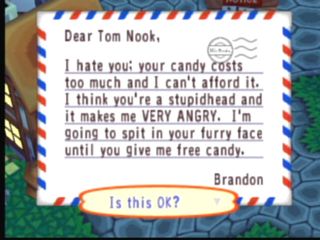
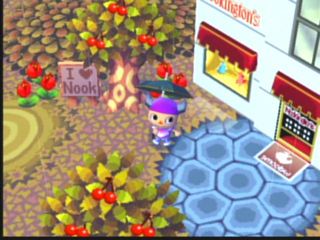
This mode of secret interaction is carried over into the game function that controls the ability to design and modify the walls, floors, clothing and umbrellas of the villagers. This option gives the player the power to decide how the village looks and how the villagers portray themselves, which in turn allows a huge amount of individualization within a game. No Animal Crossing village looks like any other. For instance, gamers Filip and Zvonimir Sola transformed their village into an ethnically Croatian one. They made their animals wear Croatian colors, designed a Croatian flag, and made their animals speak Croatian phases, (certainly a modification the programmers never imagined.) In contrast, gamers Will, Neil, Nic and Dan Secor, in their village "E" caused all the animal villagers to wear naked human clothing. This modification effectively transformed the village into a nudist colony, another unsanctioned alteration within the game. The game itself does not suggest modifications to the game image, rather, it allows the characters the liberty to customize their own villages for their own pleasure. Further, Animal Crossing lacks clear game goals and spurs the player to develop their own. For example, here is a game goal design created by a user of the game:

1st: Player goes to the store to buy candy.

nookingtons

2nd: Player lacks the funds to buy candy.

candy

3rd: Player writes a letter to the store expressing anger

letter

4th: With the threats unacknowledged the player organizes a town riot against high candy prices.

board

While Nook cannot actually be hurt within the gamespace the creation of this gamestory shows that players can manipulate the game and its goals in order to engage in imaginative play. The player uses the ability to send letters to characters as well as the ability to post messages to the Animal Crossing community as a way in which to create their own game within the game. This player subverted the game structure and made their own secret!

Fundamentally, the creation of player made secrets sustains Animal Crossing as a game. In effect, the rule modifications function as self-created attractions. Game play is maintained through the attraction of secrets and the display inherent in perceived subversion. The game has no narrative and no end, instead the player jumps randomly from self-made attraction to attraction. In essence, Animal Crossing is an endless jolt of surprise or (if you will) a video game of player-generated secret attractions.

The franchise of Animal Crossing has since expanded. In 2005 a sequel, Animal Crossing: Wide World was released. While much of the gameplay remained the same in that players can still manipulate the game in a similar way as Wide World allows players across the world to connect and visit each other's villages via a wireless Internet connection. Now instead of the game being limited to four players as it was in the original Animal Crossing, players can play with an endless parade of visitors. One can imagine, however, given the subversive nature of play in Animal Crossing that this results in interesting behavior. Dean Tate admits to booby trapping his village. He remembers "I placed holes all around the village entrance and anyone who came in was caught!...Then I would laugh" There have also been cases of characters inflicting player designed graffiti on each other, chopping down each others trees and plants or in a positive case, engaging players engage in a wide-scale remodeling of a player's village. This behavior is simply the play of the game impressed onto others but what is significant about it is that players are thinking more specifically of their village design in how is interacts with visitors.

Behavior like this is explored by game writer Nadia Oxford in the article "Secret Lives: Beneath the Surface of Animal Crossing." In this article she chronicles her adventures in visiting the animal villages of a friends and documents the way they interacted with her. Of her first visit Oxford writes:

As soon as I entered the town, Friend No. 1 made his presence known by running tight circles around me while wearing a ninja mask...so I was wary until No. 1 calmed down and gave me a master sword, claiming it to be an idol from the original Church of Hyrule. We headed back to his house. He handed me plenty of other presents on the way, possibly to distract me from the state of his property, which might've been regarded by some as a call for help. Weeds and smashed fruit dotted the grass, and unfilled trenches blocked bridges.... It was time to leave. No. 1 urged me to stay a little longer and pray for prosperity and fertility at his master sword idol, but I declined.

Oxford writes of another friend:

Taking advantage of Animal Crossing's boundless opportunity for freedom of expression, No. 2 dressed as a male and spent a good part of my visit hitting on me. A sprite's orientation is their own business, but when a male who's actually a female makes a pass at you, you can't help but feel confused.

And finally:

Things were off to a great start when No. 3 met me at the town gate and began watering me. Apparently, I "needed nutrients." She then bestowed an owl clock on me, though whether through generosity or as a part of my newly prescribed diet, I'm still not sure.

What all these interactions between Oxford and her friends show is that if we look at the behavior of each friend (the friend who ran circles and urged her to pray, the friend who hit on her, and the friend who watered her) each player put on a show for their visitor assuming distinctive behavior and exchanging text which effectively shaped the way their town was viewed. In Wide World players build off the secrets they design and create a gameplay experience for another player.

As a game of secrets, Animal Crossing allows for the kind of play behavior that players strive for in their play with secrets and cheats. Warren Robinette wrote that his videogame secret in Adventure allows for players to reach the game's real conclusion: his name, his easter egg. Secrets today are about players reaching their own conclusion by designing and implementing their own secrets in a gamespace. Players have gained the ability to have some say into the nature of a given game design. Secrets then, while originally a place for designers to play with their designs has now become a place where players can create their own game within a larger gamespace. With the advent of online gaming across all technological platforms the manipulation of secrets has turned into a way for players to design for other players. Secrets have become player-generated game moments shared with other players the world over.

Anatomy of A Game Secret (Part One): Zelda's Sky Temple

I am continuing to salute the graduating Comparative Media Studies cohort of 2007. Kristina Drzaic tackled a really interesting critical challenge -- how does one write meaningfully about an element which, by her definition, is not a necessary or even self-evident aspect of the game's style, themes, narrative, or game play. She recognizes that the pursuit and discovery of secrets may be deeply pleasurable to those who play games: indeed, there is a robust economy in the trade of information -- both sold by companies and freely shared on the web -- which might help players to find secrets. As this passage from her thesis suggests, there is even enough interest that some people even go so far as to "fake" secrets simply for the bragging rights for discovering them. To try to understand secrets, she found herself looking at phenomenon in other media -- what has been written about, say, gags in slapstick comedy, attractions in early cinema, and excess in art cinema, but none offers a precise parallel to the place which secrets play in games. Throughout all of this, Kristina was clear on one thing -- secrets were central to the pleasure she took in playing games and thus should be open to analysis. In the end, those of us on her committee felt she nailed it, making an original contribution to our understanding of game aesthetics. We hope you will agree.

As she has worked on understanding secrets, she has been designing her own secrets for the game, Labrynth, which is being developed through the Education Arcade for Maryland Public Television. Kristina did much of the art direction on the game, doing character sketches and storyboards. The resulting game, when it is released, will be much shaped by her own particular sense of whimsy.

The following passage describes her own childhood experience at inventing a secret in Zelda which has become legendary in the game world and why she thinks people were so ready to accept her fabrication.

Anatomy of a Game Secret

by Kristina Dryziac

The year was 1998 and the game in which I became the toast was Zelda: Ocarina of Time. It was at this moment in my life that I invented my own videogame secret. I was not a designer. Nor was I in the videogame business. I was sixteen years old, a single player and a fan. New to videogames at the time, I often frequented Zelda message boards and chat rooms for help with the game. Over the course of a few months I learned the space of the videogame, found all the recorded secrets, mastered Zelda and then I got bored.

The message boards I frequented were full of less experienced players than I, players looking for unknown content, players who were gullible. One of the most often discussed topics in the message board was where one might find and collect a part of a Zelda game, 'The Triforce.' Rumor had it that there was a space on a certain screen that implied that this Triforce could be collected. In a moment of juvenile and rather silly behavior I decided to tell people I had found this 'Triforce' and they could find it too. I announced that if one went into the most confusing dungeon in the game and leapt through the air to hit a particular wall in just the right way they would be able to find a hidden chest that contained, of all things, wings for your horse 'Epona.' The wings would attach to the horse and she would and fly up into the air and take you into a hidden sky temple. There you would find the Triforce in all its glory.

Photoshopped%20OoT%201.jpg

Photoshopped%20OoT%202.jpg

This was not true. Honestly I did not even think it was all that believable. However when I went to research this paper I found endless accounts of people still discussing the Triforce and the sky temple I invented. I even found fan-sites dedicated to the journey players made there, photo-shopped images of the Triforce as it was supposedly found within the game and message boards fighting over the validity of the temple's existence.

I was shocked.

What was it about my invented secret that caused such discussion that a small internet event in a fan community would still maintain vestiges of the discussion on the internet after eight years? What made this sky temple secret so believable as something that might be found within the game content? While all the factors involved here could potentially be overwhelming ranging from Mia Consalvo's gaming capital to the fan community makeup and more, I believe there are certain elements within the Zelda: Ocarina of Timetext itself that especially enable belief in this secret. I contend that examining what made my secret successful provides a window into the interaction between players and secrets and will allow us to look at the meaning of this interaction itself. I pose then that the credibility of my secret boils down to two factors within Zelda Ocarina of Time: narrative plot-holes and unresolved gameplay. Building on this I will demonstrate that the "Oh No I'm Toast" glitch moments within the game illustrate what players hope to achieve in their interactions with the secret.

To understand what this means we must look at the game itself. Zelda: Ocarina of Time debuted on the Nintendo 64 console in 1998. Widely regarded as one of the best games on the platform, Ocarina is a game that translates the Zelda franchise from its past history as a pixilated two-dimensional adventure game and re-imagines the Zelda world as a lively and realistic space. The world had forests to explore, lakes to dive in, ponies to ride and a variety of towns, cities and villages to explore. It was a whole new notion of what the Zelda franchise was about. To illustrate the change, Zelda went from looking like this:

Zelda: Links Awakening, 1993

Gameboy%20Link%20finds%20sword.png

To looking like this:

Zelda: Ocarina of Time, 1998

Zelda%20OoT%20Cucco.jpg

What this means for the Zelda franchise is that the player had gained greater freedom of movement. No longer confined to the tightly and cohesively two-dimensional maps of previous Zelda games, the new Zelda felt like a real world. As game reviewer Matt Casamassina gushed at the time:

Its a game that enables players to go anywhere and do just about anything in an immense 3D world. A world so vast that it takes literally minutes to walk across a tiny portion of it. It's huge...whether it be the title's endless secrets or enormous selection of characters, weapons, items, spells, and the like... there's always something new.

What we can take from this breathless statement are two important facts about the Ocarina gamespace, first, the game is chock full of content, both hidden and not and secondly, the game functions in such a way that the reviewer felt like he could do anything. These two elements tell us something important about the gamespace: namely that Zelda is a game of meaningful play.

In the book Rules of Play: Game Design Fundamentals we may recall that theorists Katie Salen and Eric Zimmerman pose that the relationship between action/reaction is a foundational part of good game design and meaningful play. What this means is that, when players act in the world, the world should act back in an expected manner. This type of interaction is what fosters good game/player communication and allows the player to build meaning from the game. Players expect certain things about of the gamespace and the game itself has many rules that keep play cohesive. When there is a place in Zelda where a narrative is left unresolved or where a space in a game does not seem to have a point, rather than thinking the game is broken, players look for an expected reaction simply because they are expecting meaningful play. In my typology I noted that some secrets have the capacity to expand gameplay or expand narrative. Therefore when narrative or gameplay are left seemingly unresolved in Ocarina, players attempt to fill in the blanks by finding secrets. Let us look at some rules that guide the secrets of Ocarina:

Example 1: As a rule, every door in Zelda opens to reveal a room. Doors are never for decoration. Therefore, when a certain door in Kakariko village appears impossible to reach players look for a way to get around obstacles and enter the door and find the surprise (a secret potion shop)

Example 2: Players are told that butterflies often lead to fun surprises, If one runs around an area with a butterfly, often one falls down through the ground and into a grotto full of treasure.

Example 3: The fish guru tells players that there is a legendary Hylian Loach in the fishing hole but it is probably impossible to catch (being legendary and all.) Persistent and very lucky players will catch the loach even though it was said to be impossible.

What these examples show is that when players are told about something in the gamespace they expect there is a solution to finding it. This tells us why my false secret worked on players. If the game sets up expectations for a secret, then when one presents a method by which to obtain this secret that conforms to the ideas of meaningful play the secret becomes believable. Therefore the fact that Ocarina briefly refers to a sky temple and that there was a Triforce-shaped entry on a screen opens up the possibility of a hidden journey on a winged horse. In that sense, parts of my secret map to expectations the game sets up and, as such, seem probable. Players are led to believe, by the otherwise meaningful play the game engages in, that there must be a secret way to resolve the unfinished plot points or pieces of gameplay.

What we can draw from this however is a pattern of player experience. Players I have interviewed about their experience with this game cited that they wanted to find everything in the world and master the space. When places were found, the world changed, so effectively players, in their search for secrets, were trying to remap the world. Gamer Steven Busey reminisces "everything in Zelda changes when you find a secret so you want to find them all and then find all the changes...it makes the world grow." It is significant that Busey connects the growth of the gameworld to the flux in gamespace. He acknowledges that secrets are connected to the over all rules of the game world. Thus in playing with secrets one is modifying the rules of the game. These Rule modifications are taken a step further with the engagement of glitches in Zelda.

Kristina Drzaic

University of Notre Dame, BA Film, Television and Theater, 2005

As an undergraduate Drzaic pursued a major in film because she found the combination of narrative and image a compelling way to transmit ideas. She is interested in how media presents an image, how it sustains an audience, and what makes it memorable. During her undergraduate years Drzaic produced an award-winning film and numerous video shorts. Additionally her interests led her to write and publish an undergraduate thesis exploring how the un-winnable electronic game might sustain game play through the framework of early cinema history.

While at CMS Drzaic has continued her research on un-winnable games, game secrets and game-breaking. Drzaic led the winning team in the 2006 Sony IAP Workshop with a game focusing on the experience of being a National Geographic photographer. Currently she is engaged in designing mobile math games for the Education Arcade.

Playing with Stereotypes in Wresling and Animation: An Interview with Nick Sammond (Part Two)

Yesterday I ran the first part of an interview with media scholar Nicholas Sammond about the cultural politics of professional wrestling. In today's installment, we extend our discussion to deal with his new project -- a book in progress dealing with the connections between black-faced ministrels and the American animation tradition. For those interested in what he has to say below about Disney, you might want to check out his first book, Babes in Tomorrowland: Walt Disney and the Making of the American Child, 1930-1960 (Duke University Press, 2005). Tell us a bit more about your new project which deals with animation and race. How can we understand cartoons as bound up with the history of racial stereotypes in American culture?

The new project is one that looks at the beginnings of American animation in the early 20th century, and how those beginnings are bound up with another American performance tradition that some would like to forget--blackface minstrelsy. Blackface minstrelsy was a tradition that stretched back to at least the early 19th century, in which white men covered their faces and hands with black makeup, put on curly-headed wigs, and acted as if they were African Americans. This was not complimentary: the African Americans they portrayed were stupid and lazy, the usual stereotypes of the poor, stupid Southern Negro, the watermelon-eating, chicken stealing, singing and dancing plantation stereotype. Spike Lee made a whole movie--Bamboozled--about this stereotype.

Now, if you look at some of our most famous cartoon characters--such as Bugs Bunny and Mickey Mouse--you'll see that they have characteristics that the minstrel had: white gloves, wide eyes and a huge painted-on mouth, and a complete lack of respect for authority. (This was truer of early Mickey of the late 1920s and early 1930s than it was of later Mickey.)

What I am interested in is why those qualities of the minstrel were first used in creating trademark characters, and why, even after some of those explicit racial stereotypes became unacceptable to us, those markers of minstrelsy continued. It's important to make a distinction here, though. In the 1930s and 1940s in particular, there were some really racist stereotypes used in animation,particularly in relation to jazz music, which was called "jungle music" by some folks.

coal-black-lobby-card-1942.jpg

So, there were a whole range of associations of blackness with the jungle, with the plantation, with being primitive and close to nature, that had operated in blackface minstrelsy, but also showed up in other racist stereotypes. What interests me is that while those racist stereotypes eventually became widely unacceptable, and even though blackface minstrelsy became an unacceptable performance form, the idea of the minstrel continued in cartoon characters. And you can see it continuing long after in cartoons such as Animaniacs and the feature Space Jams, to name a couple.

But even though I see what I call "vestigial minstrels" like Bugs or Mickey as different from racist caricatures such as those I mentioned above, there is a connection. The minstrel character has always been part of a system of what Eric Lott has called "love and theft," or what Stuart Hall has called the "ambivalence of stereotype." Even though the act of a white man imitating a black man is both offensive and oppressive, and always was, there is an element of desire and envy built into it that we have to look at squarely.

What I am looking at, trying to understand as an historical phenomenon, is how the figure behind the minstrel--basically a slave or ex-slave--could be something that a white man, either a minstrel or an animator, could envy. And the very short answer to that is, I think, that they didn't envy the incredible oppression of the African Americans, but the modes of resistance to that oppression that they represented. And, references to the jungle and the plantation were about a fantasy of African Americans as being closer to nature than white people (just like "white men can't jump/dance..."), closer to the jungle or the cotton field.

Minstrelsy as a performance form became widespread and popular as the United States industrialized, and workers who were white or becoming white were moving from agricultural and craft labor to brutal, routinized industrial labor. The minstrel, who was performed as lazy, shiftless, and slyly resistant to work of any kind, was a fantasy of escape from the rigors of that new economy. Something similar is true for animation, which in the first couple of decades of the 20th century shifted from a artisanal and craft model to an industrial model of production (Donald Crafton has described this history beautifully). So, the minstrel figure--itself a dehumanizing stereotype--represents resistance to dehumanizing regimes of labor.

Now, that's obscene and wrong, but if we don't examine it closely, then it's a part of our history that we refuse to examine fully. An example of that might be Ted Turner's decision, a long time ago, to remove those racist Warner Brothers and MGM cartoons from circulation, to spare us the pain of looking at what our culture has produced. He made that decision when the mode of distribution was VHS. But now, with DVDs that contain commentaries and other interactive features, I think it might be possible to re-release them in a critical edition, to begin to confront that piece of our history in a constructive fashion.

Is this legacy something that still haunts contemporary animation? Is it possible to represent race in cartoons, which after all depend on high levels of stylization and simplification, without falling back on this vocabulary of racial stereotypes?

First off, I think this legacy still haunts many parts of our culture. Look at the recent Don Imus event. What was it that made McGuirk and him go after successful young black women, to refer to them as "nappy-headed hos"? Here were some women who were actually fulfilling the American dream: through hard work, determination, and talent, they were making a mark. I think it's reasonable to ask whether the attack on them was because that dream is still primarily conceived of as white property.

But more than that: we have to look at the reaction, too. Imus had been saying grossly inappropriate things for years, and a lot of quite famous people had played along with him. Suddenly, he's a sacrificial lamb for a set of social ills of which he is a symptom, not a cause. (The critic Gary Yonge said something very much like this in The Nation recently.) But if we treat him as a cause and not a symptom, then we don't have to look at endemic strains of racism built into the institutions of American society. What those guys did was offensive and wrong, and I have no problem with them being punished for it. But it's free speech that CBS and MSNBC had been making a lot of money off of for years, and if you don't look at that--at the profitability of racial (and gender and sexual) hostility and the willingness of large corporations to cash in on it--then you're really missing the larger picture.

So, to get back to animation. I think it's possible to produce animation that minimizes or avoids stereotypes. But that's not the same thing as producing those seven-minute stories (or Disney features) we call cartoons. There, I think you do get stereotyping because, as you point out, there is a visual economy that the stereotype provides. But this then raises a couple of issues.

First, what is the story story in which those images are deployed? We should ask whether it is possible to deploy stereotypes in stories that simultaneously challenge them. I think that might be possible, but it's very tricky. Consider, for instance, Ralph Bakshi's Coonskin. He believed that he was really trying to produce a hip, culturally progressive redeployment of stereotypes, in this case the Brer Rabbit stories (with Barry White starring, and apparently Bakshi has talked with Wu Tang Clan about a sequel). But the film met with controversy when it was released, and there was no consensus as to whether it was racist, or whether it challenged racial stereotypes through its story.

This brings us to the second point: what the stereotypes accomplish very much depends on what sort of skills we as viewers bring to seeing those stories, and what sort of space is available for discussing them after we've seen them. When Coonskin was shown at the Museum of Modern Art, a fierce debate apparently broke out. That's good. And the Committee on Racial Equality condemned it, while the NAACP very cautiously endorsed it as a satire. That's good: it leads to more discussion about the meaning and potential of stereotypes. So, for me, the question is not so much whether we can make cartoons without resorting to stereotypes, but whether we can use stereotypes in a productive fashion.

But this also brings me to an interesting issue of race and the production of animation. Many of us know that The Simpsons, for instance, has been produced in South Korea for years. A lot of TV animation, which has a very tight turnaround schedule, has been produced in South Korea. What I didn't realize till recently, though, is that a lot of production is moving to North Korea, Malaysia, and China, where labor is even cheaper. So, there is an issue of race and animation that has to do with the politics of its production as well as its politics of reception.

Animation as a profession is very much caught up in struggles over the exportation of labor that other industries in the U.S. are engaged in. I'm not making a nativist argument about American labor here. But I am saying that issues of race and labor in animation aren't limited to its images. When we consider the choices and direction the industry is taking--for instance, if we engage in a debate about drawn versus computer-generated animation--part of what we have to bear in mind is that, besides being issues of aesthetics, these are issues of industrial labor, too. And, as I've suggested, in some cases there is a relationship between the two.

What did you think of the news that Disney would be producing an African-American "Princess" in a future feature film set in New Orleans? As someone who has written about the history of Disney's construction of American childhood, what can you tell us about how such a project might fit within Disney's long term vision of American society? What challenges does Disney face if it wants to create a credible representation of African-American identity that doesn't fall back on the Minstrel stereotypes that shaped its previous minority characters?

You know, there's something funny here. I was reading around about this movie, The Frog Princess, and one of the articles on it, in a Baltimore newspaper, quoted the director of an all-girls school as saying that maybe the movie would allow young girls to ask, "Can I be like this Disney character?" That is, a princess. Which would suit Disney just fine, because the company has a huge line of princess-related goods and services to sell. Now, I imagine that what the director of the school meant was something like, "Wouldn't it be great if African American girls could dream of being princesses, too?" Or, "Wouldn't it be great if white girls imagined themselves as African American princesses?" Underneath that is a desire for girls to see themselves as powerful and capable, and to live in a color-blind society.

But woven into those ideas is Disney's skill at tapping into powerful social expectations and anxieties to sell its products. That is Disney's long-term vision of American society: as a market for its products. And one of the greatest anxieties that many people share in a highly competitive capitalist society is whether they and their children (if they have children) will be able to secure a good living for themselves--that they will have economic and social security.

You can read those concerns being circulated and laid at Disney's feet in the comments of the school director. Somehow, regardless of other economic, social, and institutional circumstances, seeing this film could be empowering for a little girl. Why? How?

Will the film feed into minstrel traditions? Given that it is set in New Orleans in the 1920s, and is supposed to be about jazz, I wouldn't be surprised if it did. Minstrelsy was built on the idea of white "researchers" going to the south to witness real black behavior on the plantation. Cartoon shorts like Tin Pan Alley Cats or Coal Black and de Sebben Dwarfs played on stereotypes of the 1930s and 40s that referred to jazz as "jungle music." According to the most current info, the film's villain is a voodoo priest (named "Dr. Duvalier"...as in Papa or Baby Doc?) and another character is a jazz singing alligator (straight out of the swamp?) named Louis, so the minstrel possibilities seem rich.

I don't think that means that Disney has racist intent. I think the company is playing on the contradictory desires of its viewing public. The American middle class--regardless of race--wants to believe that we live in a color-blind society in which anyone can get ahead if they try hard enough. If stereotypes are used in perpetuating this fantasy, this sort of thinking goes, the positive message of self-realization will outweigh any misconceptions...and after all they're only animated characters.

This would be a good example of the point that Spike Lee was trying to make in Bamboozled: in a society that thinks in racist terms without realizing it is doing so, it is impossible not to make popular art that perpetuates stereotypes.

Bringing this full circle, how would you compare the role which stereotypes (racial or otherwise) play in animation and in professional wrestling?

There were two ideas (among others) in your book on vaudeville, What Made Pistachio Nuts?, that I really liked: affective immediacy and an economy of signs. Affective immediacy is the idea that to be successful, bits in vaudeville had to hit you in the gut: they had to make you laugh, cry, gasp...right away. An economy of signs is simply the concept that in a format where you only have a couple of minutes to do your thing, you have to have ideas, signs, that read really clearly, quickly.

The cartoon short is about 7 minutes. A wrestling match is over fairly quickly, too. Both depend on stereotypes to have that punch, and to be legible. If one of those stereotypes causes pain, we ought to have a forum in which we can address that in a meaningful fashion. The problem is, we have forums for addressing stereotypes--online spaces and places, editorial pages--but not necessarily in a meaningful fashion. What we don't have is a political space in which we can call out the hurt behind the stereotype--the economic and social injuries that make stereotypes sting--and obtain real redress.

What animation and wrestling both permit is a chance to really feel stereotypes. What they also share is a space that is like the real world, that exists parallel to it, but is not the same as the real world. Potentially, and at their best, they become spaces in which ideas duke it out, and we have fun participating in the process.

Playing with Stereotypes in Wresling and Animation: An Interview with Nicholas Samond (Part One)

The topic of stereotypes have long been central to work in media literacy. School children are often taught that stereotypes are unambiguously bad and that we should strive for more "realistic" or "authentic" representations. Yet, there are many problems with this formulation, as Richard Dyer pointed out to us years and years ago, starting with the fact that it doesn't address the reasons why popular art so often relies on stereotypes, it doesn't really acknowledge the degree to which our pursuit of more respectible images may itself result simply in the construction of new and improved stereotypes, and it doesn't acknowledge the many ways that artists -- high and popular -- play with stereotypes to heighten the public's awareness of their constructed nature. Today and tomorrow, I will be talking with media historian Nicholas Sammond about the place of stereotypes in popular culture, primarily read through the lens of two of his favorite topics -- professional wrestling and American animation. I reached out to Sammond in part because of the interest here in wrestling in the wake of visits from Jim Ross and Mick Foley this term but also because of work that Project nml is doing on animation for its exemplar library. I am also trying to convince Nick that he should take up blogging as an outlet for his itch to do more as a public intellectual.

Here's a little background on Nick:

Nicholas Sammond is Assistant Professor in Cinema Studies at the University of Toronto. His book, Babes in Tomorrowland: Walt Disney and the Making of the American Child, 1930-1960 (Duke University Press, 2005), received the 2006 Katherine Singer Kovacs award from SCMS. He is also the editor of Steel Chair to the Head: the Pleasure and Pain of Professional Wrestling (Duke University Press, 2005) and articles in such journals as Continuum, Television Quarterly, and Camera Obscura. Babes in Tomorrowland is a history of 20th century American childhood and its relation to popular media about and for children. Sammond's current work, tentatively titled "Biting the Invisible Hand," examines the place of blackface minstrelsy in the origins of American commercial animation.

One of the guest speakers who came to Sam Ford's class, Lee Benaka, said that he faced great skepticism in the publishing world as to whether any market at all would exist for a book looking seriously at pro wrestling, since it was presumed that wrestling fans and academic audiences were incompatible. Did you face any of this skepticism at any point during the process of putting this book together?

Yes and no. My publisher, Duke University Press, was very supportive of the book, even though they knew it would be tough to create a book that is both academically rigorous and accessible to a general audience. Wrestling fans are looking for smart work done on the topic, but I think they rightly mistrust material that seems pedantic or unnecessarily complicated. At the same time, academic power structures expect material that is complicated and pedantic (in the sense of teaching its readers about a topic).

So, it's hard to meet both goals. As the editor, I tried to address this by having some articles that would appeal to academics who wanted a more theoretical or analytical approach, and others for academics and fans who wanted a smart read on wrestling without the theoretical lingo. Reading the reviews of the book, it seems that some readers were satisfied with this approach and some weren't.

Interestingly, though, reviewers on wrestling web pages who critiqued the book for being too jargony were still sympathetic and supportive of it as a whole project, even if they felt there were parts of it that they felt alienated by. I think it points out an interesting problem in talking about pro wrestling. It has a very smart and engaged community of fans who also value the ethic of straightforward speech and action that are hallmarks of wrestling.

But they (we?) also appreciate the category of the smart mark, the person who doesn't care whether what they see is "real" as much as they do that it is genuine. The difference is, I think, that a genuine performance is sincere in its appreciation of the audience, even if it is playing with the boundary of what's performed and what's actually happening.

I hope that my book, even when it gets academic, is genuine in that sense of the word. Every essay, regardless of who it was addressing, was meant to treat pro wrestling seriously as a complex cultural form, and not to treat it as a symptom of social disorder or as unimportant. Everyone who wrote for the book did so because we appreciate wrestling.

Professional wrestling, as a populist phenomenon, is not easy to pin down in terms of its politics. The WWE in particular seems to rail against socially conservative censors as it also pokes fun at activist liberal detractors as well. At the same time, wrestling plays both with and against cultural stereotypes. How does wrestling's complicated politics explain its place in American culture?

First off, I have to say something about terms. The terms "liberal" and "conservative" are complicated. A few hundred years ago, they meant pretty much the opposite of what they do today. Liberals believed in free markets and a minimum of government interference (as much as there was a government in many places), while conservatives felt that the government had a vested interest in regulating civic and economic life. Now, those terms have become inverted. But more than that, at their worst, they've become meaningless shells, epithets that people use to insult each other without necessarily really thinking through what they are saying.

Populism has the potential to be a very progressive movement for the empowerment of working people to find a common ground on which to build a better society--as in the progressive politics of Fighting Bob LaFollette and the Grange Party--or it can be mixed with what seems more like potentially fascist demagoguery, as in the populism of the Kingfish, Huey Long. But what is good about populism is a belief in economic equality and fairness, and a recognition that working people are just fine as they are, as opposed to being inferiors who will only have social value if they become rich.

This sort of positive populism has been pushed to the margins in favor of a celebration of the privileges of the wealthy and the super-wealthy by the two ruling parties in American politics. George Bush, himself an heir to a tradition of wealth, power and corruption that dates back several generations, has feigned a populist attitude by learning to mispronounce a few words, wear cowboy boots, and swagger. He and the people he works for produce a sham populism that pretends that any of us can become rich and powerful if "the liberals" would only get out of the way and let us--while making sure that the rich don't actually have to compete on a level playing field with the rest of us, or perhaps more appropriately, while making sure that we feel more inclined to compete with each other over the scraps they leave than to work together for our mutual benefit.

But it's not just the Republicans who are engaged in this type of behavior. In the last election, the Democrats regained control of congress because of the popularity of people like Jim Webb, who talks the same sort of populism. John Edwards also plays that game: he's one of a number of multi-millionaires in politics (and some of the richest are actually Democrats) who claim to care about working people, but whose policies, when you look at them, don't do that much more than those of the Republicans. So, we get to choose between one empty performance and another.

I guess what I'm saying is that there is actually a vital populist tradition in the United States, one that is deeply invested in issues of equity and of respect for difference, that has gotten watered down in our current political climate. I think that the WWE, and the WCW before it, and many of the territorial operations back in the day, played with that sense of populism. If it sometimes trades in noxious stereotypes, and I think it does from time to time, that may be because the terms of populism that are available to us today have been so watered down.

Or, maybe the way to understand it is to say that because so many of us are being deprived of real politcal and economic partipation today--with more and more wealth and power going to fewer and fewer people--that the sting of what is politically incorrect in WWE performances is greater and more real. If we all have a stake in each other's well-being, and a respect for our differences, then jokes about those differences are not as damaging as they are when race, gender, class, and sexual identity are used as a means of keeping us apart from and hostile to each other.

What makes the WWE so interesting and important in this regard, I think, is that it is one of the few venues on television where people mention class and economic inequality in significant ways. You have workers rising up and getting in the face of their bosses, expressing not only their hostility to being oppressed, but also a certain solidarity that transcends differences (primarily of race, not so much of gender or sexuality), and I find that really refreshing. It's certainly not perfect.

At the end of the day, Vince is still on top, and in the offscreen world he's a billionaire (or almost one), and I honestly don't know why anyone needs that kind of money in a world where people are starving. (Even in a world where people aren't starving, I can't understand why someone would need that kind of money....) The most recent Wrestlemania is a good example of the potentials and problems of the populism of the WWE. Between the Donald raining cash on the audience in the leadup to it, and Battle of the Billionaires being waged by minions (but the resulting shaving being suffered by McMahon), you have a performance of struggles between the powerful, and a literalization of how workers are used by their bosses, which still manages to reinforce a social order with a few at the top and many below. But at least--at least--it allows us to witness the performance of conflicts that remain absolutely taboo in most other forms of popular entertainment in the U.S.

Now, some critics would describe this as nothing more than "bread and circuses," a distraction in the style of the Roman emperors in which the masses are mollified with spectacles put on by the elites, which keeps those masses from rising up against the powers that be. Paying to see the shaving of Vince's head (or going into it hoping to see the Donald's head shaved) takes the place of rising up and laying claim to his fortune (something which has been performed on WWE programming over the years). In this critique, witnessing the seeming debasement of the powerful keeps us from actually seizing their power.

While I think there's some truth in that critique, I also think it misses a larger point. Wrestlemania, if not the whole WWE franchise, is a facet of that larger debased populism I mentioned. It's of the same fabric as George Bush's aw-shucks act, or the Democratic Party's belief that if they can find a few more Jim Webbs they can lose their elite image. To me, the solution isn't to ask that the WWE clean up its act, but that we all work toward a more meaningful and useful political populism in our daily lives, and let entertainment be entertainment (while always demanding more of it).

That means pointing out that much of what our government does today is itself entertainment, not politics. If pro wrestling is "sports entertainment," then the struggles we witness in Washington are "politics entertainment." The struggles between the Republicans and Democrats for control of the government are a form of entertainment. The efforts of the "liberal media" to expose the petty indiscretions of individual politicians without really critiquing the larger political system are a form of entertainment. What we need, I think, is to create a populism that allows us to see past that cheap entertainment to what our real interests are.

As WWE increases its international business, and as its international popularity rivals or even surpasses its domestic popularity, how does that change the way the company looks at cultural stereotypes and "ethnic" characters?

I don't see that big a difference. What international audiences are buying is the "American" version. Just as hardcore fans in the U.S. have appreciated what is great about the Japanese scene, for instance, or fans of high flying have appreciated about lucha libre. The WWE management is smart enough to know that. They know that they have a clearly recognizable brand, one that works well, and they're sticking to it. What you see is what we've always seen with professional wrestling, even before Vince eliminated the competition: stereotypes become a way of condensing the passions that surround national and international events, of reducing those events to emotional emblems. What interests me about this is to see what shape the international fan community takes as we head into a truly global market.

We both share an interest in the roots of wrestling in 19th and early 20th century forms of popular performance.(See "Never Trust a Snake" in The Wow Climax for my take on this topic.) What aspects of this performance tradition do you see shaping contemporary wrestling?

Is it that they shaped contemporary wrestling, or are coming out of a common background? What I mean by that is, we all--and I include myself in this--try to see ourselves as modern by imagining history as quaint and outdated. One of the things that is really interesting about wrestling, to me, is that it represents a living performance tradition that has survived for over a hundred years (depending on what you include in the category "wrestling"). Of course, the technology that wrestling promoters use has changed drastically, and as Larry DeGaris points out in my book, the end of the territory system and the rise of the WWE monopoly have changed some of the fundamental work/performance practices of wrestling.

But there's also a lot of continuity with the past. Professional wrestling continues a tradition of what scholars and pundits have called "lowbrow" and illegitimate performance. It finds its tensions in inappropriate topics like race, ethnicity, class, sexuality, and expresses them without the tidy resolution of the social order that you get on broadcast TV, or in most Hollywood movies. There is a lot that still offends me in WWE products. There are racial, gender, and sexual stereotypes that make me cringe, and I'd feel really sad if there are people out there in the fan community who take those representations to be real or ideal--representing the way the world is or should be.

But honestly, I think it is better than the alternative, which is the tidy middle-class, liberal (and here I mean "liberal" in the social sense, which includes a lot of so-called conservatives who fear ideas that embody conflict, and an idea of social life that suppresses difference) scenario in which you suppress the raw anger and desire that fuels those stereotypes, basically telling people not to think and feel what they think and feel rather than creating a space in which people can express their most fundamental understandings and misunderstandings about the way the world is without fear of being labeled as wholly corrupt.

It's the difference between being told that your thoughts are wrong and being told that you are wrong for having those thoughts. The first allows you to admit to having made a mistake; the second describes you as a mistake, which leaves you nowhere to go.

To me wrestling is part of a history in which people get to have that space to be messy and wrong, and to perhaps be convinced that their ideas (not their selves) are wrong, but in a spirit of laughter and play that brings us together rather than pulls us apart.

And the great and interesting thing is, a lot of those supposedly past forms aren't completely gone. There are neo-vaudevillians and neo-burlesque performers. There's a roller-derby revival. There are neo-circuses with freak and geek shows that find ways to empower their workers. And there are some great local pro wrestling venues that happen in lodge halls and flea market parking lots that are rowdy and messy and all over the place in their politics and their ideas.

The WWE may set the tone for the industry, but it's not the only game in town.

And what is interesting about this, I think, is that it is both contemporary and historical at the same time. The stereotypes of race, and gender, and sexual difference that marked the end of the 19th century aren't the ones we have now. We have new stereotypes to deal with.

What I think we need to develop is new ways of thinking about what those stereotypes mean. I think most people assume that stereotypes are bad, and false, and need to be eliminated--that we need to live in a world without stereotypes, where we all see each other exactly as we are. I don't know about you, but I don't know exactly what/who I am.

What makes stereotypes harmful is how they are used in systems of social power to oppress people. What is great about the stuff that you and I study is that we get to see instances in history in which people took the same stereotypes that people in power used to harm them and wove them into performances that celebrated difference and expressions of cultural uniqueness, both as what was great and also as what was sometimes quite silly. That's the history I think we need to see ourselves as still living in.

Want to Get Involved with the Singapore Games Lab?

Philip Tan, the newly appointed executive director of GAMBIT, our new games lab, which is being funded through the Singapore Media Development Authority, has asked me to post the following information, seeking potential post-docs and games researchers for the project. Postdoctoral and Game Development Staff Positions

The Singapore-MIT GAMBIT Game Lab is hiring postdocs and game development staff. Postdocs will be required to fulfill a combination of teaching, management, research and publishing roles, working with faculty, graduate and undergraduate students. Postdocs are expected to have a dossier of published articles indicating a clear trajectory, interest, and deep familiarity with some aspect of game research. Examples include cultural and media studies, anthropology, visual and aesthetic history, digital and non-digital game design and genres, risk and team management, government policy, industry history, market observation, computer science, real-time rendering and animation, software and audio engineering, music composition.

Applicants for staff positions should have at least three years of industry experience as a lead programmer, artist, or designer.

Applications for positions beginning in September should be submitted by June 15 to:

Singapore-MIT GAMBIT Game Lab

Program in Comparative Media Studies

14N-207 Massachusetts Institute of Technology

77 Massachusetts Avenue

Cambridge, MA 02139, USA

Applications should include the following:

* Statement of objectives and contact information

* 3 recommendation letters

* Curriculum vitae or resume

* Academic dossier or portfolio

Summer Internship Program

Students from MIT and Singapore will collaborate for 9 weeks at MIT in digital game development teams with 6 or 7 student members from different disciplines. Each team will conceive, design, and develop a small game to demonstrate a concept from current and previous GAMBIT research with a short (5-30 minute), polished gameplay experience. The production values and scope of the game should approach commercial alpha builds (tested and feature complete) for casual games intended for online distribution. The student teams are entirely responsible for the design and implementation of the gameplay, assets, and deployment of the game. The top priority for every team is to create an engaging user experience with simplicity and clarity.

Teams are managed using Scrum methodology. Students will be required to become familiar and to adhere to the management principles in Scrum. Each team will work with a faculty or graduate student involved with the core research, who will participate in the Scrum process as a "product owner." Members of each team are expected to use the summer to become quickly familiar with the research concepts involved in each project in order to better demonstrate the ideas through design, gameplay, and implementation.

The intellectual property for the code, design, and assets of each game and the rights to create and distribute the game and any sequels or derivative works will remain the property of the Singapore-MIT GAMBIT Game Lab initiative. Students will be credited appropriately for their role in the development team and will be licensed to include and demonstrate their game in their portfolios after the summer.

There's more information at the project blog specifically addressing Singapore or MIT students who might want to be involved in the initiative. Check it out here

Soaps CMS-Style.

One relatively unique aspect of the CMS program is our openness to outside participation on thesis committees. Since we are trying to train students not simply for academic careers but also for future roles in a variety of industry contexts, we often will invite expert practitioners to join our committees and share their expertise with our students. Through the years, we have had Bollywood choreographers, game designers, journalists, advertising industry people, educators, journalists, policy-makers, and so forth serving on thesis committees, encouraging our students to produce work which will have a broader real world impact. Recently, longtime soap opera writer Kay Alden was on campus to participate in Sam Ford's thesis defense. Alden worked for more than 30 years on The Young and the Restless, the top-rated daytime drama that she served as head writer for from 1998 to 2006. Recently, she took on a consulting position with ABC Daytime and continues working with the genre during what is seen as a period of substantial change for the daytime television industry. While she was on campus, she spoke at the CMS colloquium series, sharing with our students her perspectives on the evolution and current state of daytime soap opera on American television. We have just launched the podcast of that event for those of you out there who count soaps among your fannish or academic interests.

.

The Politics of Map Making; Katrina and Google Earth

How are new tools for representing physical geography altering the way we think about ourselves and our place in the world? What differences are sites like Google Earth making in the ways we cognitively map the environments around us? What new issues do they raise as ways of representing the world and how do they relate to older traditions of cartography? These are the questions which CMS Masters Student Amanda Finkelberg took up in her thesis project. Finkelberg came to CMS having worked extensively in the special effects industry. She had spent the last few years of her work erasing wires, rigs, and other elements from shots, not exactly the most compelling work in the industry, and wanted to find ways to make the work of media more visible to the people who consumed it. She worked as part of the Project nml teams, producing a segment for our exemplar library dealing with special effects and advertising; she's been doing some early planning work on an educational games project which is still under wraps and she has been working as a research and teaching assistant for a new course which explores the relationship between theater and science in the early modern period, being taught by Diana Henderson and Janet Sonenberg in collaboration with the Royal Shakespeare Company. Like many of our graduate students, she has taken advantage of an exchange program between Harvard and MIT to take courses down the river, much of which has informed her current interests in maps and systems of spatial representation.

From my own point of view, her work on cartography comes at just the right time since one of our projects for the New Media Literacies team next year centers on thinking through how these new digital mapping technologies can be integrated into the social science classroom. As we pursue that project, I know that I will be re-reading her thesis for new insights. This selection from her thesis centers on a recent controversy surrounding how Google Earth represents the area around New Orleans, how this figures into post-Katrina politics, and what this tells us about the "neutrality" of maps. Enjoy!

Google Earth and Katrina Images

By Amanda Finkelberg

A tradition of accuracy is strongly reflected in issues surrounding contemporary spatial representations. As cartographic technology improves, generating more convincing depictions of space from above, the debate over accuracy becomes marginalized in favor of an acquiescence in a sort of "truthiness" or sense that the data is true enough. This phenomenon is illuminated by the continuing problem of how Google Earth has chosen to represent the Katrina devastated Gulf Coast in its satellite image database.

Immediately following the 2005 hurricane, Google Earth became a valuable tool for evacuees hoping to estimate damage to their property. By using amateur fly over photographs as "overlays" in Google Earth, networks of people banded together to determine which areas had been hit by flooding and posted the information to bulletin boards. Photographs taken from a Cessna Citation jet were available within 24 hours after the storm. Although not entirely clear, the images, when matched to GPS coordinates in Google Earth, gave a good sense of the condition of a home, street, or neighborhood. The novelty of the software encouraged many new users to lend a hand to the effort, according to a September 5th, 2005 New York Times article . This example provokes interesting questions about temporality and global imaging. The fly-over images were clearly being taken as valid real-time information about the state of the disaster area, lent additional credibility from their alignment with GPS coordinates in Google Earth's global framework. While this is an extreme circumstance, it does clearly indicate a new type of amateur cartographic behavior. A plane flew over, photographed and posted aerial images to the internet. The images were obtained by neo-geographers at home who responded to queries from displaced Gulf residents and generated mostly-accurate maps of the real-time flooding in their communities. These maps were either reposted to the internet or described in email .

Google Earth's representation of Katrina's damage did not stop there and has, in fact, recently become the center of a heated debate within GIS communities, raising serious questions of accuracy, politics and digital cartography. Last week (March 25, 2007) Google came under heavy criticism from user, Geographic, and journalistic communities for its unexplained swapping the post-Katrina images with the pre-disaster ones seen here. In a letter to Google, D-N.C., chairman of the House Committee on Science and Technology's Subcommittee on Investigations and Oversight, Brad Miller demanded an explanation for the imagery switch. "To use older, pre-Katrina imagery when more recent images are available without some explanation as to why appears to be fundamentally dishonest ," the letter states. It goes on to directly inquire if the Federal Emergency Management Assistance (FEMA) agency had contacted Google requesting the images be changed. This suspicion reflects not only a deep distrust of the agency's attempt to cover up mismanagement of the crisis but also impugns Google as a potential collaborator in revisionist history.

Google's quick and thorough response earlier this week came in the form of replacing the previous images accompanied by a blog posting by Maps/Local/Earth director, John Hanke. Hanke writes:

In 2005, shortly after Hurricane Katrina hit New Orleans and the Gulf Coast, a very motivated group of volunteers at Google worked with NOAA, NASA, and others to post updated imagery of the affected areas in Google Maps and Google Earth as quickly as possible. This data served as a useful reference for many people... Several months later, in September 2006, the storm imagery was replaced with pre-Katrina aerial photography of much higher resolution as part of a regular series of global data enhancements. We continued to make available the Katrina imagery, and associated overlays such as damage assessments and Red Cross shelters, on a dedicated site (earth.google.com/katrina.html). Our goal throughout has been to produce a global earth database of the best quality -- accounting for timeliness, resolution, cloud cover, light conditions, and color balancing .

The suggestions that Google operated out of malfeasance by replacing the images of devastation were connected to a range of conspiracy theories, from the FEMA implication made by Rep. Miller to the suggestion that the maps had been changed to indicate successful recovery in hopes of revitalizing tourism to the area. These accusations were quickly dismissed by Google's blog statement and reinstitution of the lower quality images of flooding. The reasonable explanation may explain the overlay switches but the theoretical problem indicated by this event is not so easily dismissed.

The problem is perhaps best illustrated by the final paragraph of Representative Miller's letter to Google:

Digital technology has any number of benefits, as Google's healthy balance sheet demonstrates. However, experience has also shown that such technologies pose a particular threat to photography as a representation of reality. While we can understand that Google would prefer the most recent imagery of the New Orleans region for its Web site, to use older, pre-Katrina imagery when more recent images are available without some explanation as to why appears to be fundamentally dishonest. The entire country knows that New Orleans is a great American city struggling to recover from an unprecedented disaster. Google's use of old imagery appears to be doing the victims of Hurricane Katrina a great injustice by airbrushing history .

Several key points stand out from this succinct accusatory paragraph. First, Miller indicates Google's "healthy balance sheet," a barb not missed by the blogosphere which immediately picked up on the implications of a misuse of power in postings like "Is Google Finally Evil? ". The relationship between power and wealth and cartography is not a new one by any stretch of the imagination, and this accusation squares with a historic reading of maps and spatial control. There is, however, a much bigger accusation being directed by this paragraph; one that impugns the digital nature of the digital map, making the same very equation that I make within this essay: the homogenization of digital data that enables a cross-media discussion. Miller asserts that digital maps are not only akin to photography, but can also be "airbrushed " to correct imperfections in the same way a model is corrected on a magazine cover. This is an equivalence that illuminates the ease and completeness with which digital maps can be altered as well as the lens of scrutiny and skepticism through which they should be evaluated.

There is still another issue raised by this little story, indicated by John Hanke's list of priorities for the Google satellite photos. Hanke mentions "timeliness" as a key factor in determining an image's quality for inclusion in the database. What on earth could he have meant by this? Most likely it is a response to the problem at hand and refers to images that are the best representation of "what is" but this explanation is deeply problematic when explored even slightly superficially. The use of time as an evaluative characteristic, particularly when coupled by issues of cloud cover or resolution, imply that there is a time that is more neutral than another. Presumably this is a time that is sunlit, cloudless, and well photographed. These may be the best conditions for viewing the surface of Earth from above but they should by no accounts be mistaken for neutral conditions.

This event highlights cartographic non-neutrality with regards to the representation of time in the hurricane torn Gulf region. Pre-hurricane images of the Gulf area may better meet the qualities of ideal viewing conditions while disregarding cartography's mission of accuracy with regards to representing land as it is. This new problem is created by the type of semi-instantaneousness of satellite images which on one hand provide a sense of being real-time (as the overlays were used immediately following the storm to locate damaged property) but on the other provide an uncanny representation of ambiguous yesterdays: an indeterminable time that was, of course, cloudless and sunny. The crucial decision about which time to represent is unique to satellite imagery, a departure from the abstracted, time-independent, spatial representations of the paper map.

A fruitful example of embedded subjectivity, this story about Google's difficulty in representing the current state of Gulf region clearly indicates an emergent difficulty facing the challenge of cartographic objectivity. Because satellite images are essentially photographs they are now faced with the inherent complexities of photography, a discourse ranging from problematic apparatus to manipulated artifacts. Moreover, the satellite image can never be entirely neutral or objective, regardless of Google's hopes for ideal viewing conditions. There will never be a way to clear off the planet for a few minutes while Google takes a neutral picture for its database. We are all, therefore, permanently embedded in some way, within the pixels of Google Maps/Earth. This is abundantly clear to these Dutch sunbathers (52° 4′43.38″N, 4°19′58.02″E ), imprinted forever or for the time being, within the satellite overlay currently used in the default Google Earth.

While these people could, of course, be removed digitally, "airbrushed" as it were, there is no end to the ouroboros initiated by even thinking about that process: however would the airbrush artist determine how a neutral planet should look?

We see that even at the level of objective data the human is back on the map, so to speak. On a paper map, areas of pastel shading demark territory. This type of abstraction provides a clear symbolic separation between the actual land and what is represented by the map and, I offer, a buffer between the image and the illusion of reality. The satellite image, however, exchanges that abstraction in favor of a far less noticeable one, digitization. Rather than Texas symbolized by a large pink area in the shape of Texas, it is now represented by an overhead photograph laid upon a three dimensional terrain wireframe. Reliance on satellite images as realistic or accurate representations of space is inherently problematic because of this digital nature which gives the appearance of real but is in actuality, a mere slice of space and time. This problem may be temporary as technology improves to allow access to real time streaming satellite images of the planet. This likely possibility opens the door to a host of mind boggling privacy issues only suggested by the current capabilities of Google's spatial representation tools.

Amanda Finkelberg

Pomona College, BA Media Arts/Political Science, 1996

Prior to CMS, Finkelberg worked as a Visual Effects artist for such films as Spiderman 2 and Star Wars Episode 2. In 2004, she started a 2D effects boutique, Rig-Out, which specialized in erasing wires, rigs, and other background details. She has a strong interest in social media and has facilitated media education projects in a parole recovery center in downtown Los Angeles.

Finkelberg;s thesis "Space, Place, Database: Digital Cartography in the Network Age" addresses issues of reality and representation with regards to data. Other interests include sustainability, perception, and information/interface design. She intends to graduate this spring and return to California.

Ghetto Libretto: The Sexy Comics of Mexico

Today, I thought I would share one more example of the autobiographical essays on popular culture produced by the students in my Media Theory and Methods class. In this case, the focus is on Mexican comic books, a topic which I thought would be of particular interest to the sequential tarts and the other comics fans who read this blog. preview1.jpg

Most of this covers are painted by cover star artist Bazaldua, and the rest by his imitators. The stylized stereotype of the female is always the central element, usually depicted in a pornographic fashion. Another important element in the compositions is the text, usually reinforcing the images with ingeniuos word games that could be understood in several ways, usually all dirty. It is evident by looking at this covers how the Librettos have incoporated all the other comicbook genres that were present in the mexican news stands before. Humor, Melodrama, Adventure and Science Fiction, Action thrillers, Police and Detective stories, Political Satire and Costumbrist Realism have all been embedded into the Librettos.

The Sexy Comics of Mexico

Luis E. Blackaller

Maria comes from a small village in the Lacandona jungle in south east Mexico. Like many more in the Mexican countryside, she decided to migrate north looking for better opportunities. She is pretty and naive, and has no problem finding a job after crossing the border, as a maid in a secret pentagon facility. The US military enjoys having her around, and the flirtatious officials try to get under her skirt all the time, but she always manages to avoid them in a quite innocent way. She is very proud of her new job, and gets paid top money that she sends to her village every Friday.

What she doesn't know is that, as any other secret pentagon facility, the place she works for hosts an ultra secret science project, and she is about to find out. Socrates is a genius gorilla developed by the military science as a genetic experiment. He is kept in secret for studies in the basement, where they treat him like a Harvard scholar. He has an extensive library, a record collection, a pool table, cigars, fine wines and cognac. All but his freedom, or a single ray of sunlight. He is more intelligent than every human being has ever been, but he doesn't suspect he has been held captive, because all he knows is what's around him since he was born. A story about a nuclear war has been fabricated to him so there is an excuse to live underground and still talk about the outside world.

One night, Maria gets lost in the corridors of the facilities, looking for a new bottle of Mister Clean, and she somehow manages to enter Socrates' quarters. Of course they fall in love immediately. After making out for a while, they hear a noise and he hides her in the closet. Just from talking to Maria for a few minutes, Socrates has been able to figure out everything.

During the following weeks, they devise an escape plan together, and using his intelligence and her charms, they get away with confusing the whole US military, the border patrol, and even some Mexicans. After a week of adventures they make it back to the Lacandona jungle, and settle down there, not having to worry about getting found ever again, because all 26 of Maria's cousins look just exactly like Socrates.

MONJE10.JPG

Yesenia is making out with her boyfriend under a tree by a small road in the outskirts of Mexico City. They live in a nearby slum, and visit their corner under the tree every afternoon to enjoy privacy time. They must be seventeen years old. It is getting late, and her boyfriend insistently tries to have sex with her, but she wants to wait for a better moment.

Suddenly, they get interrupted by a car crashing on a curve not faraway from them. They try to help the victims, but all the people in the car, a rich family it seems, are dead. Yesenia tells her boyfriend to call an ambulance or the police, but he stops her as he has a better idea. He starts looking for valuable stuff in the car and on the corpses. After collecting all the goods, he doesn't think they should call anyone anymore, because they would immediately be linked with robbing the victims from all their goods, and they are already all death, so what would be the difference anyway?

Yesenia still thinks he is wrong, but agrees with him, and they go back to her home, where her father, a big, nasty drunken man, is waiting for her because it is late. Yesenia's father threatens to beat both her and her boyfriend, but his eye spots their pockets full of stuff, and he changes his mind. He makes them give him everything, and makes them take him to the site of the accident. He's had an idea.

Yesenia's father runs a taco stand by the side of the road, and business has not been good lately because dogs and cats are too skinny and sick to make good tacos out of them lately. With the help of Yesenia and her boyfriend, he takes the corpses to the taco stand, chops them off, and puts them in the fridge. "Tomorrow is gonna be good business", he thinks. Indeed, so good it is that he gets greedy, and, after threatening Yesenia and her boyfriend with making tacos out of them himself, he forces them to devise a way of causing more accidents on the road, to provide him with more fresh corpses every week.

People are loving the tacos. Excellent recipe, excellent meat. But Yesenia, and even her boyfriend, are so disgusted with the whole situation, that they violently murder her father after a confrontation where they refuse to kill more people, and turn him into tacos as well. People didn't like the tacos that week. Yesenia and her boyfriend get together, and keep on running the business themselves, but they change the menu to seafood.

61274.jpg

In Mexico, comicbooks and visual storytelling have had a life of their own. They have degenerated since the times of Posada, el Chango Garcia Cabral and many others to what they are now, a particular mixture of Mexican soap opera melodrama with softcore porn and pulp fiction. I want to explain how that happened through my experience as one that read his first comicbook when he could not still read words.

18670.jpg

The two stories I have just summarized are from a couple of books from what in the US is called Ghetto Librettos. They were written by Juan Jose Hernandez Sotelo (1953-2002). Ghetto Librettos are only read by the Mexican servant class. They are called "sensacionales" in Mexico, but I chose to use the Ghetto Libretto term because it is more descriptive of what they are about. Ghetto Librettos are distributed weekly through the Mexican news stands as a small format, cheap form of entertainment for the male Mexican working class. Some of them are meant for the female reader, but those rely more in the melodrama than in depictions of sex. And today, the only comicbooks available in Mexico for children are imported from the north. It didn't use to be like that.

news_stand_4.jpg

Ghetto Librettos can be purchased in a secondhand magazine stand by five a dollar. The second story I told was first mentioned in a book Daniel Raeburn wrote on the subject. It is relevant to mention Dan's work which called the attention of the US public to Ghetto Librettos; they are largely ignored by almost everyone in Mexico, even the people that read them.

Mexico is run by a somewhat subtle, but quite obvious caste system. Brown people use the subway, white people have cars, and you will never, ever find a white four year old child begging for money on the streets, it is that simple. This "master servant" relation was established during the conquest and colonization of "the New Spain", which is what Mexico was called back then. The "Indians" were placed in the bottom layer of society, treated like slaves without officially being labeled as such. Close to them were the few black people, concentrated mostly in the Caribbean and along the Gulf. Above them were all the possible mixtures of black-indian, indian-spanish and spanish-black. They were called mestizos and would run the indigenous population for the Europeans. The white people were separated too, in such a way that the ones with a pure European lineage, but born in America (called criollos) would manage the whole colony for their Spanish masters. These white Mexicans were the ones that eventually led to the independence wars, supposedly abolishing the caste system. One hundred years later they became the middle class that led the poor to another revolution, this time against the presidence-dictatorship of Porfirio Diaz, which was, interestingly enough, of indigenous lineage.

Up to this day, the master-servant relation persists in the media, and is probably there, and in religion, where the different classes in Mexico share their cultures. Depictions of class separation are strong even in some of the most internationally renowned Mexican directed films -- Babel, 21 Grams and Amores Perros -- all derive their dramatic fuel from the collision of separate class worlds. They all borrow from The Rich Can Cry Too, a famous Mexican soap opera from the 70s, that epitomizes the structure of Mexican television melodramas. This is not a surprise, because the director of the three films started his career by working for Televisa, the studio that runs Mexico's soap opera global empire, for more than a decade. In the three films, the rich are suffering, and the cause of their suffering originates from the violent encounters with those wild and reckless poor, which curiously enough, will get out of control after interacting with an expensive commodity that was given to them by chance, in the form of a first class fighting dog, an expensive truck, or a cutting edge hunting gun.

Soap operas take a different path in their depiction of class separation by eternally repeating the story of impossible love between a rich man and a poor, usually beautiful, and most of the times white, woman. The rich brat and his maid fall in love and have sex. She gets pregnant. He means to marry her but his evil rich family has other plans. When a child is born they make her believe the child is dead, and they make him think she is dead. They also make her believe he hates her. After a few television seasons, they overcome all odds and get together again. It seems all the pain she is gone through somehow makes deserve a place in the new, upper class world.

One main difference Ghetto Librettos have with other expressions of Mexican popular culture is that Ghetto Librettos experience segregation. This might start from the fact that comicbooks in general are already a segregated medium in Mexico. They are not something people should be proud of reading.

When I was 5 years old, I would often spend my time in my parent's library browsing through art books. I was very attracted to depictions of naked people and got specially fond of the work by French romantic painter Euguene Delacroix. I couldn't help establish a connection between female beauty and male expressions of violence. One day back then, waiting with my mother in the grocery store to pay, I started browsing through the magazines they always have there, and found something that interested me: a Mexican comicbook, that happened to be quite a graphic interpretation of Jack the Ripper. It took a while for my mother to notice what I was looking at, and she quickly instructed me not to look at that filth ever again. It didn't took me long to realize that she would buy me superhero books (only when there was no other choice), but never the equivalent Mexican hero stories like Santo, Super Sabios, Chanoc, Kaliman, Aguila Solitaria, or even the very intellectual Fantomas. I would go back to my parent's library, where it was OK to look at pictures of knives puncturing naked bodies, and fantasize about my own incarnation of Jack the Ripper's story, illustrated by Delacroix and Caravaggio.

A few years later, when I started going to a private school, I realized nobody had contact with those comics at all, but I found a couple of good sources somewhere else: my father's driver started taking us to school instead of my mother, and the friendship we started with him opened a few doors to the lower class culture. At the same time, we started spending the evenings at a public sports club that, because of it being public, was mostly populated by working class people.

This way I started enjoying two totally separate lifestyles. During the mornings I would be the upper middle class intellectual kid, and during the evenings I would be the only blond in the working class gang. I was a target for bullies in both scenarios, but I was strong and I enjoyed fighting, so that was not really much of a problem.

And I got introduced to a world I found more colorful, more emotional and more lively than the one I was coming from. Little I would know that all those comicbooks and humor magazines I would read sitting on a sidewalk by the highway were about to disappear, in less than 15 years.

news_stand_3.jpg

The only Mexican comicbook genre that survived the eighties was the so called Ghetto Libretto, absorbing all the other ones. I started buying a couple of them every once in a while around 1989, and it didn't take me long to identify the most talented writers and artists. Some years later, I got closer to the industry, when I decided to make one. I never could, because, not surprisingly, the editors didn't appreciate my drawing, even though I tried as hard as I could to adapt my style to their standards. But I made a few very good friends, and I learned a lot in the process.

There are two families controlling the comicbook business in Mexico. One of them quit producing content during the 80s, and is content with reprinting their classics and licensing comics from D.C., Marvel and even from Dark Horse, like Hellboy. The other one controls the realm of the Ghetto Librettos, which is probably the bigger business; there are zillions of different titles that run on prints of two hundred thousand every week. The average pay per page for an artist is 1 dollar, and each one has 96 pages, so you can aspire to a good minimum wage Mexico style, if you spit out one Libretto every couple of weeks. I don't know about the deal for writers, because I was not interested in writing stories for them back then.

It's hard to say where my interest in illustrating a Ghetto Libretto came from. In general, it was not until a little late in life that I decided to make comicbooks. I was looking for an opportunity to publish and there were no other options available, but there is a little more to it than that. I think I needed to reclaim the lower culture as my own. Most of the people working on Ghetto Librettos have no other choice than that. They just happen to be very good at it and for them it is just another way to make a living. They don't think of themselves as authors with an opinion, a message or a role as communicators. They don't think about why do they portray women or themselves the way they do, or if things could be at all different. They don't even think their work is worth more than a dollar a page, even if some of them are good enough illustrators to cast a shadow over the likes of Frazetta. The writers dream with writing for television, where they would get a better wage and the satisfaction of having television stars play their characters. In the old days a popular serialized comicbook would be adapted as a television soap opera, but there is no chance of that happening now, first, because there are no serialized stories in the market anymore, and second, because Ghetto Librettos are consolidated as the only way to make a comic that will get news stand distribution. Even the traditional wrestling stories have been molded into the Ghetto Libretto format, where exuberant women run the show instead.

Ghetto Librettos embody almost every social issue you can think of, but in a very superficial way, offering no suggestion to the possibility of actually dealing with them. Institutional corruption, domestic violence, social segregation, and exploitation of women are all exposed as mere plot devices that justify the erratic behaviors of their characters. Perhaps the reason why Ghetto Librettos are rejected by the rest of the Mexican society can be explained because their heroes are the people nobody wants to be: street kids, prostitutes, peasants, servants, taxi drivers, policemen, and working class people.

35867.jpg

Starman, the libertarian, 1978.

Usually absent from his covers, Starman would leave that space alone to feature his damsel in distress. "They will torture me in front if everybody", thinks the asian princess Lyn Min, more concerned about public opinion than the torture itself. Very influenced by Star Wars, Starman will feature a lot of Darth Vader like robot creatures, with a catholic inquisitor twist.

28160.jpg

19486.jpg

Orion, the Atlantean, 1975.

Another science fiction hero with damsels in distress, Orion is made to fit the stereotype of the prehispanic warrior, with which must of his readers would identify.

10403.jpg

16315.jpg

Fantomas, the Elegant Menace, 1976.

Inspired by the french character, Fantomas is a world class vigilante that would orchestrate conspiracies with the top thinkers of his time, keeping the world safe from the greedy military powers and corrupt corporations that run the first world's interests. Octavio Paz, Michael Fucault and Gabriel Garcia Marquez are just three of the many personalities that assisted him in his adventures.

45083.jpg

Kendor, the Man from Tibet, 1975.

Kendor came out as a reaction to the more popular Kaliman. The hero doesn't make it to be the main feature of his own covers. An endangered well featured female body will sell more.

44116.jpg

doom_vs_kaliman.jpg

Kaliman, the Incredible Man, 1979.

After almost 30 years of uninterrupted weekly running, Kaliman faces his biggest foe, suddenly overwhelmed by a pantheon of villians from another culture. The editors might have just been trying to rip off elements from the Marvel super hero books, but they delivered an interesting postmodern metaphor of what happened during the eighties, when Mexico opened its market to the US pop culture, allowing it to wipe many traditions out of the market.

kabulman.jpg

16055.jpg

Alma Grande, 1974.

Alma Grande, a countryside hero, facing natural disasters and other real problems, was probably, along with Chanoc, the last of its kind, finding it hard to compete with the growing popularity of science fiction fantasies.

16049.jpg

Luis Blackaller is an artist from Mexico City with an interest in culture, technology and media. He studied mathematics at the National University of Mexico and has been working for the mexican film industry until 2006, when he took a break to join the MIT Media Lab to explore new paths under the mentorship of John Maeda. He has a special love for comic books and drawings. More information about his work can be found at the following sites:

luisblackaller dot com

luis blackaller at IMDB

blacklog

blacklab

tiny icon factory

picture XS

Genre Theory And Implicit Contracts

Today, I am continuing to run excerpts from the thesis submitted this week by CMS graduate students. Alec Austin's thesis centers around the different kinds of expectations framed by different kinds of media and among other things, he includes discussions of House M.D., Veronica Mars, Magic: The Gathering, DC's 52 and Marvel's Civil Wars series. In each case, he manages to make original contributions to genre theory as well as shed light on the texts in questions. Austin's focus on expectations and implicit contracts has emerged in part from the work he has done for the past two years as a researcher for our Convergence Culture Consortium for which he wrote white papers on product placement, digital rights management, and most recently, on Second Life and other virtual worlds. He is leaving us to go work in the games industry and to write science fiction on the side. The following selection comes from the introduction of the thesis which lays out his ideas about the expectations that readers bring to the work, which he characterizes in terms of an implicit contract. The idea of a genre contract is one that runs through genre theory but he is able to develop it further than I had seen before.

Implicit Contracts

Alec Austin

Everyone wants something from their entertainment. Whether they're looking for overblown special effects or nuanced characterization, a climactic conclusion or an coherent ongoing narrative, an audience's satisfaction with an entertainment product is dependent on how well their expectations were fulfilled. Understanding the relationship between the purveyor of an entertainment property and that property's audience as a contractual one does a great deal to explain why audiences enjoy and accept certain creative choices and reject and are angered by others.

The idea of an implicit contract being formed between the creator or purveyor of a work of entertainment and its audience is not a new one. Creators and critics of fiction and film have been aware of the need to entertain audiences without boring or distracting them for quite some time. The science fiction author Larry Niven described the contract between author and reader in the following terms:

The reader has certain rights... He's entitled to be entertained, instructed, amused; maybe all three. If he quits in the middle, or puts the book down feeling that his time has been wasted, you're in violation.

Damon Knight used similar language to describe the contract between author and reader:

There is an implied contract between the author and the reader that goes something like this: Give me your time and pay your money, and I'll let you experience what it's like to be

∑ A trapper in the North Woods

∑ An explorer in the Martian Desert

∑ A young woman in love with an older man

∑ A dying cancer patient...

You must look hard at the offer you are making: Would you accept it, if you were the reader?

While Knight and Niven describe the implicit contract largely in terms of engaging and entertaining the audience through explicit authorial choices, some film theorists have taken the metaphor further. Both Thomas Schatz and Henry Jenkins have used the metaphor of a contract to discuss the relationship between media producers and audiences. Schatz described film genres as a tacit contract between audiences and media producers, which creates a "reciprocal studio-audience relationship" , but Jenkins argues that Schatz goes on to undermine the reciprocal dimension of the contract by privileging "the generic knowledge of the filmmaker over the activity of the spectator... [he] gives us little sense of the audience's expectations and how they originate... What Hollywood delivers is presumed to be what the audience wanted" . Jenkins' implication is that the relationship between audiences and media producers is more fraught with complications than Schatz acknowledges, though he does not explicitly propose an alternative model of the audience/producer contract.

I believe, as Jenkins does, that the exchange which audiences and the purveyors of entertainment are engaged in is more complicated than it is represented as by Knight, Niven, or Schatz. In my previous work on the implicit contract, I described the functioning of the implicit contract in the following terms:

Whenever someone picks up a magazine, turns on the TV, or goes to a movie, they have certain expectations of the experience they'll receive in exchange for their time, attention, and money. What those expectations are depends on both their knowledge of the media form and the specific content they're pursuing. (For example, anyone turning on a commercial TV channel expects that the show they're watching will be interrupted by ad breaks, and that the ads will not intrude into the show.)

The typical exchange involved in entertainment media might be modeled thusly:

The Audience offers the Provider

∑ Their time

∑ Their attention

∑ And sometimes (e.g. movies, cable TV) their money.

The Provider offers the Audience

∑ Entertainment

∑ And the delivery structure they expect.

Whenever an entertainment provider violates the implicit contract created by the audience's expectations (through intrusive advertising or clumsy product placement, for example), they risk alienating their audience.

This description of the implicit contract between audiences and media providers complicates and refines Niven, Knight, and Schatz's visions of the implicit contract by addressing questions of presentation and non-narrative structure (which can have a significant impact on an audience member's satisfaction with an entertainment product), but it still does not tell us very much about the actual contract between audience members and media providers and why it works the way it does. If we are to understand the nature of that contract more clearly, and by extension, how the expectations of audiences serve to structure their reactions to entertainment products, we must turn to legal theory and a clearer understanding of how contracts in general function.

What is a Contract?

On a definitional level, a contract is an agreement (explicit or implied) between two parties in which each takes on the obligation to provide the other with some form of consideration. An arrangement where one party provides the other with something for nothing can't be a contract, as there is no exchange--it is either a gift (if it was given freely) or theft/extortion (if it was taken without consent or given as a result of coercion).

If we pause to deconstruct this, the following points become evident:

∑ A contract is based on the mutual exchange of goods and/or services.

∑ A contract (whether explicit or implied) creates an obligation on the part of both parties to fulfill its terms.

∑ The purpose of a contract is to ensure that an exchange does not become one-sided (where one party benefits while the other receives no consideration).

With the preceding points in mind, it becomes clear why the contract model is applicable to the relationship between media audiences and media providers, as the exchange involved in entertainment media has already been described.

Contracts Implied in Fact

Legal studies recognizes two types of contract which are willingly agreed on: Express contracts and contracts implied in fact. An express contract is "a written or oral agreement whose terms explicitly state the basis for consideration" , and even for entertainment products with End-User License Agreements (and even those are problematic, as EULAs are non-negotiable and oft-ignored), the understanding between audience members and purveyors of entertainment is rarely so formal and explicit. The contract implied in fact, in which "the parties have entered into no formal agreement but comport themselves in relation to one another in was that could only be explained by the existence of the requisite contractual intentions" is a much better model for understanding the relationship: Audience members would not waste their time or attention on an entertainment product unless it had been presented in a way that suggested it would entertain them. While such contracts have no legal force, the perception that their terms have been violated will typically cause both social and economic consequences. (To wit, audience members who feel they have been cheated are likely to be vocal about their unhappiness, and will stop giving their money to content providers which they feel have treated them unfairly.)

The Contract as Discourse

The alert reader will have noticed that the previous paragraph dealt with the perception that the purveyor/audience contract had been violated. This is because with an implicit contract, each audience member's subjective experience of the entertainment will determine whether they feel the contract's terms have been fulfilled or not.

This may seem uncomfortably subjective to those accustomed to thinking of contracts and the law as fixed and formal structures, in which discourse plays no part, but as Stanley Fish argues in "The Law Wishes to Have a Formal Existence", the formalism of law itself is a discursive construct based on the fiction that contextual knowledge is not required to interpret the "unambiguous" terms of a contract:

[A]n instrument that seems clear and unambiguous on its face seems so because "extrinsic evidence"--information about the conditions of its production including the situation and state of mind of the contracting parties, etc.--is already in place an assumed as a background; that which the parol evidence rule [a rule by which extrinsic evidence is cannot be used to interpret, vary or add to the terms of a contract] is designed to exclude is already , and necessarily, invoked the moment writing become intelligible... the law is continually creating and recreating itself.

By using examples of cases in which the idea of "trade usage" was invoked to interpret the period of "June-Aug" to exclude the month of August, and in which the delivery of steel measuring 37 inches in length was ruled to fulfill the terms of a contract that stipulated steel measuring 36 inches in length to make the point that, Fish makes it clear that contract law, for all its desire to be formal and internally consistent, regularly has its course determined by the rhetorical prowess of litigants.

The Terms of Discourse in Entertainment

Of course, the discourse between audiences and purveyors of entertainment does not function in the same way as that between the parties to a legal contract. While the parties to a legal contract may debate what the terms of their agreement mean before bringing their dispute before an arbitrator or a judge for a binding decision, the purveyors of entertainment have no such option. There are no legal authorities they can turn to that determine which interpretation of the contract is correct, and in media that aren't iterative or serial in form, the most significant contribution to the discourse which creators and purveyors of entertainment can make is their work itself. In such cases, if audience members are dissatisfied with an entertainment product, the purveyors of that product have no reliable means of responding to that dissatisfaction.

When working in iterative media, such as TV or comics, which regularly release new content, the terms of discourse are slightly different. While creators working in such a medium can respond to audience dissatisfaction by changing the content of later work, there is inevitably some sort of time delay involved such a "response", given the lead time necessary to produce content for serial release. As such, even creators that work in iterative or serial media are likely to feel powerless or frustrated when audiences interpret or react to their work in a way the work's purveyors see as misguided or unsympathetic.

Consequences of Contract Violation

The idea that the creators of a work of entertainment are powerless cuts both ways, of course. While the purveyors of an entertainment property may lack control over how their work is interpreted, the audience for that property has no control over its creation. Furthermore, without an enforcement mechanism for perceived violations of the implicit contract, audience members must take on the enforcement role themselves.

In practice, audiences have three means by which they can attempt to redress perceived contract violations. The first is dissatisfaction, which manifests itself both in lessened engagement with an entertainment property and complaints made to other fans and the property's creators. The second is withdrawal, which manifests itself in the loss of the audience member as a viewer or customer. And the final means is boycotting, which manifests itself in an audience member actively trying to dissuade others from supporting or engaging with a property.

Audience members typically become dissatisfied with an entertainment property due to perceived contract violations that are relatively minor (repeated continuity gaffes, an unearned happy ending, etc.). Such minor violations erode the audience's engagement with the property, but the damage can be repaired over time by supplying content that delivers the kind of entertainment which the audience desires. At the same time, the cumulative effect of repeated contract violations can lead audiences to withdraw from a property, as can a single contract violation of sufficient magnitude.

Some might challenge the idea that minor erosions of an audience's engagement with a property actually matter (at least until they result in the loss of a customer). To counter this notion, I will draw on my own work developing E.P. Thompson and Henry Jenkins' idea of the moral economy:

If a purchase supports an individual or company that has treated an audience member well, that purchase has added value for the audience member. Conversely, a creator or company that has treated an audience member poorly will encounter resistance when trying to make a sale. Audience consensus on the legitimacy and sincerity of a rights holder's behavior has a significant impact on the quality of the word of mouth they receive.

In addition to its obvious economic impact, the moral economy has an emotional dimension as audience members develop relationships with creators or rights-holders. Over the long term, "legitimate" behavior and sincere engagement can cause audience members to become personally invested in your success. Consistently behaving in ways the audience deems illegitimate can create resentment and an environment where audience members will become equally invested in your failure.

When viewed as part of the moral economy, minor violations of the implicit contract have a clear effect, as they create audience resistance to a creator or company's products and may well lead to boycotts, where audience members who have been "burned" (typically those who were once highly engaged with a property before one or more contract violations transformed their engagement into outrage and a sense of betrayal) decide that withdrawal from a property is an insufficient response to the violation of the implicit contract, and choose to actively undermine the property's success.

Creators and producers who are concerned about the risk of triggering such an audience backlash over a perceived violation of the implicit contract should be aware that marketing and creative choices can do a great deal to shape both a property's audience and the terms on which it will be received. As such, the purveyors of entertainment possess significantly more power to influence how their work is interpreted than a naïve observer might imagine (though not as much as theorists like Schatz believe). This point becomes particularly clear in light of the structuring functions of familiarity and genre conventions.

Immersive Story Worlds (Part Two)

Yesterday, I ran the first part of a two-part excerpt from Sam Ford's thesis, focused around the concept of Immersive Story Worlds. The thrust of his thesis deals with issues of fan relations, brand integration, audience building, and transmedia storytelling in the realm of contemporary soap opera. But this passage compares soaps systematically with two other forms of expansive entertainment -- superhero comics and professional wrestling. Immersive Story Worlds

by Sam Ford

Multiple Creators

All three examples of immersive story worlds provided here are too large for any one creator to accomplish. Each of these worlds have passed through many creative hands over the years, with no one creator necessarily being THE defining vision of what this world means. In each case, there is a sense of the narrative world having a life of its own and being bigger than any particular creative regime. The fact that all three of these narrative worlds have stood the test of time is evidenced in the way they have weathered passing off from one creative hand to the other. Although Stan Lee is often credited with being a defining force in the initial creation of the modern Marvel Universe, along with Steve Ditko and Jack Kirby and others, many writers, artists, and editors have helped shape the trajectory of these characters through the following decades. Not only have various creative regimes had control of an individual series over the years, there are creative teams working on each title within the Marvel Universe at any one time, meaning that--although Marvel as a content producer has centralized control over the official narrative universe of its characters, there is still a decentralized process of creating the Marvel Universe and fleshing out all its corners, developed through the many creative forces who have passed through the company over what is now almost 50 years.

Soap operas may have a defining creator, such as Irna Phillips and Bill Bell and Agnes Nixon, and the creative vision of each of these people have often helped define the long-term feel for many of these shows. However, the number of writers that work on a show at any one time, from the creative influence of the executive producer to the overall stories of the head writer(s) to the way that is broken down into scenes and dialogue, demonstrates the hundreds of creators who have had an influence on soaps stories through the years. Consider how much impact the thousands of actors who have appeared on these shows have had as well, in addition to directors and other creative forces, and there is certainly no clear "author" of any of these soap opera texts. Even if fans have particular writing teams that they have preferred over others or certain periods of a show that they consider "golden eras," there is no single writer that can be seen as the single defining source of a show, especially once it has been on the air for decades.

As for pro wrestling, the fact that wrestling narratives often spilled over from territory to territory and that wrestlers who retain the copyright to their own characters would jump from one show to the other ensures that, in addition to the constant shifting of creative forces within the bookers of any particular wrestling organization, there was also a meta text that fans would follow which branched across every wrestling show in the country. In the regional days of wrestling, fans would follow characters as they moved across the country, being written by a variety of creative forces along the way. Now that the WWE is the major show left in wrestling, there are three WWE divisions, each with their own head writer; and there are still alternative wrestling promotions that often take characters who leave the WWE, like TNA wrestling on Spike TV. In addition, the wrestlers themselves are traditionally known for developing many of their own attributes, and the performance of the audience affects every show as well (and audiences often stray from the intent of the people who scripted the reactions they are "supposed" to have on live shows). It's hard to identify who "creates" the final product of any particular wrestling show, much less the ongoing narratives of the various characters.

Long-Term Continuity

Although fans in all three genres would likely sometimes debate that creators care enough about this category of immersive story worlds, there is at least some semblance of long-term continuity in developing these worlds. This is what sets the long-term development of iconic characters apart from these continued story worlds, in that these story worlds are only created if there is some idea of prior stories being relevant to the next one rather than a series of adventures that seem completely removed from the next. Continuity is the way writers are often graded in all three genres. Generally, creators in each genre both praise the creative potential gained by such extensive back stories and also complain about the restraints that history places on their creative abilities when fans are watching their current content closely with how it measures up to the history of characters and stories. For fans, though, since they know these story worlds were around long before the current creative team came along and believe that they will continue to be around long after they are gone, continuity is often considered the most important aspect of the product, and they see it as their job to uphold it through amassing their collective intelligence.

Soap operas--because they are the most blatantly serial of the three-- is where continuity often matters most. Certain aspects of the genre have been accepted as defying continuity. For instance, when the actor portraying a central character leaves the show, recasts are sometimes accepted as necessary evils. Also, fans accept what has been called the Soap Opera Rapid Aging Syndrome (SORAS). Often, younger characters are SORASed when there is an actor switch, advancing their age by a couple of years. When a character leaves town to go to college, they sometimes return a few years older than they should be non-soap opera aging standards. For instance, Tom Hughes may have been born in 1961, but he somehow ended up in Vietnam before the end of the war. Various viewers combined their collective intelligence to construct both when characters first appeared or were born on the show and also their apparent current age, comparing this to the age of the actor playing the role, and particularly how the various numbers often do not add up.

Aside from these deviations, however, soap fans expect writers to research the histories of these characters and to write current storylines according to that history. Writers are most often graded with their ability to write characters consistently, both within their own duration with the show and consistent with the long-term history of the show. If characters appear in a scene who have had a long history with each other that the current writers seem ignorant of or if a long-time family member no longer on the show seems to be forgotten by the current writing team, veteran fans are vocal about what they feel is poorly researched writing. Conversely, if writers make subtle references to important stories in a character's past--as long as those comments are relevant to the current story and do not get in the way of contemporary fans' enjoyment of the story--writers are generally praised for having shown some degree of mastery of the text.

Soaps writers are often haunted by this legacy and the fact that the fans collectively have much stronger knowledge of the product than they do. In a Winter 2006 interview with Soaps In Depth, As the World Turns head writer Jean Passanante complained about the impossible learning curve involved with trying to write characters. Not surprisingly, bashed her for having been with the show for years and still not seeming to be able to dedicate the time to learn the history as well as she should. Since these fans are amassing their collective intelligence to understand the continuity of the show for free based solely on their own interest in the narrative, they hold the people who are paid to be the gatekeepers for the story world to higher standards.

Pro wrestling has been most notoriously lax in its use of continuity, especially with turning characters from good to bad and often having rivals one year be partners the next. However, fans still have long- term memories and try to make sense of the narrative, even when writers drop the ball. The WWE writers do sometimes make veryeffective use of history, however, especially in creating iconic moments at events that are then drawn upon again and again. The art of slowly building a feud, beginning with subtle hints and then arguments and then a major clash, with several plot twists along the way, is the way legendary characters and matches are created in wrestling, and they are most often successful when the writers have the strongest grasp on maintaining continuity with the characters and the feud.

Comic books have to maintain a somewhat slippery use of continuity. Because the characters cannot age with real time and must somehow be contemporary while also maintaining a degree of timelessness, there have been plenty of contradictions along the way. Particularly because comics are not tied to actors like the pro wrestling and soap opera worlds, there is more opportunities to create alternate universes and several versions of the Marvel Universe being produced simultaneously, for instance, so that there are multiple continuities from the Marvel creative team.

Fans are often known for trying to police continuity, and Marvel's interactive section of their comics was often known for rewarding readers when they catch continuity slips from the creative team and attempted to come up with their own explanations of how that seemingly discordant event somehow makes sense in the larger Marvel Universe narrative. Marvel writers sometimes tried to emphasize continuity by making random references to old issues, but the best use of continuity comes when writers demonstrate a mastery of the history of the universe and make reference to prior events when they are germane to the current story. Prolific contemporary Marvel creator Brian Michael Bendis considers maintaining the continuity of the universe both a blessing and a curse, giving him headaches but providing a wealth of inspiration from the past of each character.

Character Backlog

All three story worlds have many more characters in their histories than can be featured at any one time, yet fan activities often surround understanding and cataloguing the wealth of characters in the universe. Each character backlog is indexed and managed in much different ways and for divergent purposes, however. The soap opera universe is full of character histories, the majority of which are not currently featured on the shows. As shows have been on the air for decades, some characters drop completely out of relevance for the contemporary product, although fans interested in the history of a particular show might be interested in finding out the importance of that character in years past. However, many of the soaps characters not currently on a show are directly relevant to storylines that are still ongoing. Often, brothers and sisters, children, aunts and uncles, cousins, grandparents, ex-husbands and wives, of current characters are no longer on the shows but must be acknowledged in current storylines. For fans, this means that the current official product they are watching on television is only a small part of the whole story world, and there is always the potential for characters who have not been killed (and sometimes even those who have) to return to the show or at least to be mentioned from time-to-time. In other words, the fictional world of Oakdale or Springfield or Genoa City or Salem or Llanview is much bigger than the town itself and its current inhabitants, and fans have that broader view in mind when they question what these various characters would think about storylines or if they will return to the show for the wedding of a relative.

Wrestling's character backlog is more complicated in its relevance, as competitors only have so many years in which they can perform at their physical prime. Legends in wrestling are often still used, either for nostalgia's sake or else as supporting players in the characters of the modern product (whether as commentators or managers or officials who play a part in the current drama, or as returning recurring characters from time-to-time). In wrestling, former competitors are built up as legends and often drawn upon for comparisons with modern stars or to evoke the history of the narrative. The nostalgia for this backlog of characters helps fuel publications, DVD releases, and the WWE 24/7 On Demand product, for instance, which airs "classic" matches featuring these various legends who may now be members of the WWE Hall of Fame.

The Marvel and DC universes likely have the most expansive character lists of all, and returning characters in these worlds are much more fluid, since these characters are not tied to portrayers. Any super hero or villain from the vast reserve of the history of each universe can be drawn upon at any time, and some of the best work of contemporary creators have been in restoring the validity of lesser- known characters from the past through current storylines, such as with Bendis' Alias or the Marvel Black Panther series, or DC's 52, in which a several relatively minor DC characters become the featured cast. As Henry Jenkins writes in Beautiful Things in Popular Culture, this modern revisiting of neglected characters from a comic universe's history in an alternate or contemporary text can reconceptualize characters "to up their 'coolness' factor," while still playing off the knowledge fans have of those characters in the long-standing narrative.

Contemporary Ties to a Deep History

As I have alluded to several times in the previous sections, the art of an immersive story world often lies in tying events from the rich pasts of these narrative universes into the contemporary product. Bringing up relevant back story and tying it into the current plights of featured characters highlight what many fans consider the art of creation within immersive story worlds. Particularly in the soap opera world, fans both simultaneously praise good use of history on the writers' part and, perhaps more often, use their communal knowledge of history to drive their collective creativity. The fans watch the story unfold each day and then go online to create an historical perspective on a character's action that day, both to rate the writers' use of continuity and also to help flesh out and unpack meanings they see hidden in the text based on knowledge of the characters' past, or else point out the contradictions in characters' current actions or statements based on their histories.

For instance, when the characters of Mike and Katie Kasnoff broke up on As the World Turns in November 2006, Mike was indignant that Katie had slept with her ex-husband. Many fans sided with Mike in the fight, pointing out the many times Katie had acted this way in past relationships. Conversely, other fans pointed out Mike's hypocrisy, based on the fact that he reunited with Katie while still married to Jennifer, thus making his moralistic tirade about fidelity somewhat ironic, since the most recent version of his and Katie's relationship began with an infidelity. In December 2006, when ATWT's Craig Montgomery had been shot in the chest and was lying in a hospital bed, telling everyone around him how Dusty Donovan was a terrible human being because he had shot Craig in cold blood and how Craig would never do something so vicious, veteran fans could alert more recent viewers to the fact that Craig had actually shot a man a few years ago in a crime that he was never punished for nor even suspected by the majority of people in town. While the show never gave any blatant evidence of the hypocrisy of either man's claim, the viewers were able to fill in the pieces for each other based on the seemingly endless wealth of material.

What sets immersive story worlds apart, what makes them immersive indeed, is that the well of backstory is so deep that no one person can masterfully plumb its depths. Veteran fans may serve as memories, but no one of them can fill in all the pieces of the puzzle. Web sites that provide back stories, or books that attempt to summarize major plot developments over the years, would be impossible for one person to internalize and--even if one could-- still only provides a summary and not the rich details of each character and plot. These three worlds are set apart because there can be no expert who can quote almost every comic book or episode or pay-per-view. Not even a Rainman-style memory could recite every villain Spider-Man has faced in order, much less all of the developments of the Marvel universe, nor could they rattle off the results of every episode of Monday Night RAW for the past decade.

In the wrestling world, fans are equally as obsessed with filling in backstory, not necessarily always to be directly relevant to the current feuds but to draw comparisons between a feud or match of contemporary competitors with their predecessors. Wrestling fans have major web projects such as Kayfabe Memories, newsletters like" Wrestling as We Liked It, and a wealth of books from wrestling historians, wrestling journalists, and a growing number of memoirs from wrestling legends, all of whom provide a small piece of the puzzle of the history of the meta pro wrestling text, even if many are unreliable narrators. This act of preservation and navigating wrestling's deep history has been important to fans both because promoters for so long did very little of it and also because many of the major matches in wrestling history are no longer available for viewing, since arena shows were not often taped and the weekly television shows in most territories were not considered valuable at the time and often taped over with the next week's show.

In comic books, the huge archives drive much more than professional collectors and sales of graphic novels. The backstory fleshes out the histories of characters and their nuances, as well as relationships with supporting characters. There is a feeling that the subtle secrets to a character's history may be hidden in the pages of the archives and that understanding the present requires a reader's own willingness to dig into the past. In newer projects like the Ultimates universe or other Marvel or DC Universes that provide alternatives to the main universe, there is also a need to read the narratives from the main universe in order to compare the parallel stories. For instance, Bendis' recreation of many of the important Spider-Man plots over the years is a much richer experience for those who have already read and are intimately familiar with the original, thus meaning that Marvel and DC have an even deeper wealth of content if fans want to be able to understand alternative universes within the Marvel and DC worlds to their fullest extent. Of course, even if a fan were to collect every extant issue available in digital or tangible form, there would be no way to internalize that amount of material, even for the most ardent fan.

Permanence

Some of the categories listed above may also apply to some novel series, primetime television shows, online worlds, or other narrative universes. However, what these three share that perhaps no other particular media product does is a feeling of permanence. With the amount of time these narrative universes have lasted so far, there is a feeling of fans that these media properties will long outlive the current creative forces in charge of their gatekeeping, that the product will continue to have an audience long after the current fan base is gone, even. This sets these three worlds apart from any other narrative universe I can think of, where a decade is often considered an amazingly long run for a television show and four or five movies is considered a feat for a movie franchise. Since these worlds have been around for decades, it is important to emphasize--as P. David Marshall does in The New Media Book when writing about a related phenomenon of "the intertextual commodity"--that this concept has been around for some time and is perhaps just more overt in today's convergence culture.

Some worlds--like Star Trek, Star Wars, and Harry Potter--will likely live on in varying degrees either through descendant series that bear little resemblance to their past with hiatuses in between or else through fan fiction and fan videos, but soap operas, pro wrestling, and the Marvel and DC universes are the only immersive story worlds which have been running for decades now, without any hiatus, and with the continuous output being solely at the hands of the official rights holders to the narrative world.

Many comic book characters have produced thousands of issues by now, with some characters having three or four dedicated titles to their individual story within the Marvel and DC universe, not counting the alternate universes like the ultimate title runs a character may be involved in as well. While fans know that there may be switches in creative forces or major changes in the stories of characters or even certain characters who wax and wane in prominence, there is a semblance that the current narrative world will continue and that the fans' lifetime investment in reading the comics will continue to be rewarded with no risk of sunk cost in a story world that eventually comes to an end. While some have speculated that the Ultimate story world may eventually replace the old Marvel narrative universe, the two worlds are running side-by-side at this point, and fans will only become fully invested in the Ultimates universe if and when they feel that the wealth of material in that world so far surpasses the confusing original Marvel world that they are willing to make a switch. At this point, though, both worlds are continuing to gain a deeper reserve every month, as fans immerse themselves in both.

The entire conception of pro wrestling seems odd, a con game that fans know is a ruse yet watch both for its narrative potential and its athletic exhibition. The fact that this version of professional wrestling is at least a century old now, though, gives fans the feeling that, even if a current promoter goes under, pro wrestling will live on. Since pro wrestling's history is tied to actual athletes and careers, there is no one company that can control wrestling history, and fans feel that pro wrestling as a performance art will remain a staple of American and international culture for centuries to come. That feeling of permanence drives much of the obsession with archiving and preserving "wrestling history."

Soap operas are often called "worlds without end." Now that some shows have been on television every day for more than 50 years, fans often feel that there is or at least should be a permanent niche for these shows. In recent years, with slowly declining ratings, some fans realize that may not be the case. They blame what they see as incompetent marketers and lazy creative regimes as ruining many shows, and they worry about rumors for cancellation for various shows. Still, even amidst a looming concern that the network could pull the plug, fans consume the daily text as if there is no chance for this to happening, talking often about the future as well as the past and seeing these narrative worlds of One Life to Live or The Young and the Restless as a permanent part of their lives.

Of course, there is no guarantee that the Marvel or DC universe would still be alive and well a century from now. There is an increasing fear that Procter and Gamble Productions or Corday or Bell or a variety of others will decide to pull the plugs within a few years, much less decades. And what's to keep wrestling from going the way of roller derby or various public carnival events that--once a staple of popular culture--is either no longer a part of our culture at all or else an historicized form of popular art? Nevertheless, the fans, performers, and producers of these shows have participated in these worlds for so long that a looming end does not haunt them in the same way that the producers of a primetime television series must be thinking about a semi-distant ending shortly after they have begun.

Master's candidate Sam Ford is originally from a small town named McHenry, Ky, located in the suburbs of the twin cities, Beaver Dam and Hartford, in the Home of Bluegrass Music, Ohio County. A weekly columnist for The Ohio County Times-News, Ford writes a column entitled "From Beaver Dam to Boston." His undergraduate work at Western Kentucky University led to four majors in English (writing), news/editorial journalism, mass communications, and communication studies, as well as a minor in film studies. His research interests include American television, rural journalism, professional wrestling, and soap opera.

Ford has published research on pro wrestling and is conducting his Master's thesis on transmedia storytelling and producer/fan interaction surrounding the soap opera As the World Turns. In addition, he is a licensed professional wrestling manager and performs for Universal Championship Wrestling in Kentucky. He is a member of the Convergence Culture Consortium at MIT and is co-teaching a course on pro wrestling in Spring 2007. He lives in Boston, MA, with his wife Amanda and his two Pekingese, Brando and Sissy.

Immersive Story Worlds (Part One)

It's thesis time at the Comparative Media Studies Program -- always a period of great pride and intense stress for me, since I end up serving on an overwhelming number of committees and have the joy of watching my students complete projects which drew them to MIT two years ago. Over the next few weeks, for both reasons, I am going to be sharing with you some of the highlights of the work produced by these students. Doing so allows me to showcase some really exceptional students and it also allows me to shift a little of my focus away from maintaining the blog and onto my day job reviewing student work. Today and tomorrow, I am running an extended excerpt from Sam Ford's thesis, "As the World Turns in a Convergence Culture." Some selections of this thesis have already appeared in my blog when Sam took over as guest host while I was traveling to Poland last fall. Ford has been the key person who maintains the Convergence Culture Consortium blog over the past two years, helping him to establish his own reputation as an important commentator on industry trends. He also taught our course this term on professional wrestling which we discussed in the blog a week or so back. Here, he draws on three of his interests -- soaps, wrestling, and superhero comics -- to extend on the concept of an immersive story world. You will see here as well some of the legacy of my assignment getting students to think about ways to draw more deeply on their own personal experiences as a source for their theoretical projects.

Immersive Story Worlds

by Sam Ford

My History with Immersive Story Worlds

Growing up an only child with a stay-at-home mom, I spent my childhood days engrossed in what I have come to call immersive story worlds. In truth, I began my relationship with popular culture with no more than an antenna connection and a collection of toys. For me, it was G.I. Joe. I have never fancied being a military man and really do not remember too many playground days spent pretending to be a soldier, but the world of G.I. Joe fascinated me nonetheless. The dozens of characters I found for $2.97 apiece at Wal-Mart drove my interest in the alternate military reality these characters inhabited. Every toy included a biography of that character on the back, which I clipped and kept--in alphabetical order no less. I ended up with a group of friends who also collected and kept up with the world of G.I. Joe.

My love for G.I. Joe soon spilled over into the Marvel G.I. Joe comic books, where these characters came to life. I read those comics until the covers fell off, hoping to learn everything I could about each character and apply that knowledge to the games I played as well. I soon became engaged with the whole Marvel comic book universe, and I spent most of my $10 weekly allowance following the weekly or monthly adventures of Spider-Man, the X-Men, Hulk, and a slew of other colorful characters. Yet again, I found contemporaries at school who shared my interest in comic books. They wanted to be comic book artists, and I wanted to be a comics writer, so we set about to create a comic book universe of our own.

At the same time, I was becoming familiar with another immersive story world, that of the superstars of the World Wrestling Federation, now known as WWE. My cousins had long told me the legends of Hulk Hogan and "Macho Man" Randy Savage and The Ultimate Warrior, but I didn't know where to tune in to glimpse into this universe from a syndication window. However, my parents' decision to get a VCR opened me up to a slew of videotapes my cousins mailed to me and the growing collection of wrestling shows available at the local rental shops and convenience stores. Finally, I even convinced my neighbors to let me come over and start watching the Monday night wrestling shows since they had cable television. The Marvel superhero universe and the World Wrestling Federation were my media fascinations, and they both fit into this category I now write about as immersive story worlds, a concept I will flesh out in the next couple of posts.

Enter As the World Turns

There was another immersive story world that I had been involved with as well, one that I was not completely cognizant of being a fan of at first. It was what my grandmother always referred to as "the story" and probably the narrative in which I first came to know a slew of familiar faces, an immersive story world that predated my interest in G.I. Joes, super heroes, or professional wrestling. That narrative was Procter & Gamble Productions' As the World Turns (ATWT), a daily daytime serial drama that has been on the air since 1956. For as long as I can remember, ATWT was a part of my weekday afternoon, and the familiar faces of the Hughes family, joined by the evil James Stenbeck, the scheming Dr. John Dixon, the incomparable Lucinda Walsh, the down-to-earth Snyders, the lively Lisa Grimaldi, and a host of other characters were regular parts of my childhood.

I may not have realized that I was immersed in the fictional world of Oakdale, Illinois, until I started wondering what was happening to those characters when the school year began and I was no longer home in the afternoons. By the mid-1990s, I convinced my mom to record the show so I could watch it when I came home from elementary school every day. In fact, I was a somewhat closeted soap opera viewer all the way through most of high school. By my junior year, though, I had started a night job after school and lost contact with the residents of Oakdale.

By the end of my senior year of high school, I was married. My distance from ATWT didn't last, though, and my wife and I were dedicated viewers of the soap opera again a couple of years into college. With so many familiar faces and back stories to remember, it was hard not to get pulled back into the narrative and eventually join fan communities to find out what had happened in the world of ATWT while I had been away. My continued interest in this show is closely connected to the social relationships I built around it. The conversations I would join with my mother and grandmother about "the story" have continued over dinner every night with my wife. In the process, I have come to understand soap viewing as a social activity, which helped tremendously in understanding and becoming a part of the fan community built around ATWT.

Perhaps just as importantly, I have come to understand soap operas as primarily powered by character-driven storytelling. The strength of this genre lies in relationships, including the relationships characters have with one another, the relationships between these characters and the fans, and the relationships fans build around these texts. Soap operas are hindered by plot-driven storytelling because the permanent nature of the soap opera, with no off-season and 250 original hours of programming each year, emphasizes slow storytelling that examines the emotion and nuances of events rather than just "what happens." Comic books and pro wrestling are personality and character-driven genres as well, and good storytelling is consistently determined by the fan base of each genre as those in which the relationships among characters (and the performances of the actors or artists depicting those characters) are logical, well-written, and fleshed out.

These three narrative types--the daytime serial drama, the pro wrestling world, and the DC and Marvel universes--share a set of similarities I have grouped under this category of immersive story worlds. By this term, I mean that these properties have a serial storytelling structure, multiple creative forces which author various parts of the story, a sense of long-term continuity, a deep character backlog, contemporary ties to the media property's complex history, and a sense of permanence. I will examine each of these aspects over the next few pages.

This thesis concentrates particularly on the immersive story world of As the World Turns and its current status in a shifting media landscape. My interest in this soap opera text is heavily tied to my fascination with this type of immersive story world in general, in which one can never truly "master" the material. Immersive story worlds provide a space particularly rich for interaction between a text and a vibrant fan community that critiques, energizes, maintains, and fills in the gaps of that official canon. Further, as Henry Jenkins writes in Convergence Culture, the "extension, synergy, and franchising (that) are pushing media industries to embrace convergence" have long been a part of these narrative worlds in one fashion or another, so that these marginalized texts have a lot to offer for informing other media producers. These worlds are unusually ripe for transmedia content, user-generated content, and a wealth of online fan forums. However, they also generate a distinct niche fan environment that is both energized by and suffers from being considered somewhat fringe, even as each has long been a massive cultural phenomenon. In order to understand exactly what is meant by immersive story worlds, however, it is important to examine each characteristic of this categorization.

Seriality

All three types of worlds within this category share a strong sense of seriality. While soap operas have best taken advantage of seriality and have made that never-ending unfolding of drama part of their very definition, they are often tied together with telenovelas and other forms of melodrama which do not have the same type of long- term seriality that soaps have. Soap operas can master storylines that unfold over weeks, months, or even years in a way few other texts can. For instance, there is a

long-running feud on As the World Turns between characters Kim Hughes and Susan Stewart that began after Dr. Stewart slept with Kim's husband Bob--back in 1990. That plot point often creeps up in current storylines and will not be forgotten in the show's history. Similarly, in 2006, the explosively popular Luke and Laura supercouple from General Hospital in the 1970s were reunited for a short time in storylines, drawing on 25 years of history for the couple, still portrayed by the same actors.

Over time, seriality has become a conscious part of creating immersive story worlds, and strong utilization of quality serial storytelling was not a requirement of any of these media forms in their infancy but rather the way in which creators constructed these worlds over time. For instance, according to Bradford W. Wright in Comic Book Nation, Marvel deserves much credit for creating a loosely cohesive narrative universe. Many comic book stories before that time were each standalone tales, with the characters returned to a static point at the end of each issue, from which the next story would drive from as well. Even after the creation of the Marvel Universe, creators often failed to capitalized on the potential for seriality, and most monthly installments were isolated stories. However, t Marvel titles featured an increasing number of crossovers and ongoing storylines, not just in the battle between good and evil but in the personal lives of the characters as well--work relationships, romantic entanglements, and supporting family members whose personal dramas were as compelling at times as the main narrative.

One can see how important seriality is particularly in the Ultimates Marvel universe that has become popular in recent years. At the beginning of the decade, Marvel decided to relaunch the stories of several of its characters in contemporary times, telling familiar stories of the origins of Marvel staples like Spider-Man while being able to map out a more coherent continuity. Now that the Ultimate Spider-Man title has passed its centennial issue, the new universe is building its own continuity and makes particularly good use of seriality, with the personal lives of the characters of each title run often much more important in the long-term than the hero's battle with super-villains or else interwoven so completely between the various parallel plots that the continuity from issue to issue is much more developed than the comic book series in previous decades.

The rise of the graphic novel relates closely to these changes. The strength of the Marvel universe is that it has created a more viable archiving system than that of pro wrestling or soap operas, which are still struggling with ways to make previous content readily available for viewers. The popularity of the graphic novel has given fans an easy way to collect and archive their favorite comic book runs, and the format of the graphic novel--grouping together multiple issues from a comic book run--encourages writers to work even harder at developing serial storytelling from issue-to-issue.

Pro wrestling has long used seriality in booking various wrestling feuds. Television shows were used to create storylines to make people want to go to the arenas and pay for a ticket to see the matches that were set up from television interviews and angles. Often, a contested ending between two wrestlers at one show made fans want to return to the arena next month to see the rematch and the drama continue between two competitors. For instance, at Madison Square Garden in 1981, then WWE Champion Bob Backlund was defending his title against a grappler named Greg "The Hammer" Valentine. During the melee, the referee was accidentally hit and knocked to the mat, groggy. The referee saw that Backlund had his challenger pinned and counted the three. Because he still had not recovered from his own fall, the referee did not distinguish which wrestler had the other pinned (both men were wearing the same color tights), so when Valentine started celebrating as if he had been the one who had scored the pin instead of being the one who was down for the count, the referee handed him the championship belt. Backlund, of course, contested the finish, and the decision was made to have a rematch for the held up title when the WWE returned to Madison Square Garden the next month. In this case, there was both a standalone storyline on that particular card and also an ongoing story that fans would return to see from one month to the next.

However, the WWE and other wrestling organizations have developed the serial format of wrestling over the years much further, especially as the television product became more important in itself rather than just driving fans to watch the wrestlers perform in person. The writers discovered that they way to get fans to tune in from one week to the next and purchase the culminating pay-per-view events was to build ongoing feuds in serial fashion, with the each episode always pointing toward the next and each pay-per-view not only producing the climax for some feuds but creating ongoing chapters in others or creating new storylines that would play out in the coming months.

Collieshangie

Collieshangie is a Scottish word which literally refers to a tangle of collie pups but often carries with it the connotation of a brawl, a fight, or simply a chaotic jumble. In this case, I am using it to refer to a range of relatively unrelated topics which I am bringing together under a single header. I have always thought Collieshangie was a beautiful word which is grossly under-used in the English language and have wanted to find ways to expand its functions. So, today, I am bringing together a range of topics that are attracting interest in the CMS community this week -- videogames for the visually impaired, the passing of Jack Valenti, Maori tourist performance, and minimalist music.

Games for the Visually Impaired

MIT graduate student Eitan Glinert has been doing some preliminary work for the GAMBIT games lab focused on the design of video games for the visually impaired. He is looking for some help from Boston area people who might be able to test some of his design work. He sent me the following message:

My name is Eitan Glinert, and I'm a student with the MIT GAMBIT games lab. I'm looking for 4 - 6 Boston area blind and low vision volunteers to help test out an early prototype

audio based user interface that will eventually be used as part of an accessible video

game. The testing will take place from Monday, May 7th to Fri, May 11th, and each session

will take about 45 minutes or so. Within those days the timing is flexible, and I will be

able to work around what's best for you. Volunteers should come to either the Mass Ave

bus stop or the Kendall/MIT T station, where I will meet you and bring you to the lab.

If you think you might be interested, or have any questions, feel free to e-mail me at

glinert-at-mit-dot-edu. Thanks!

You Didn't Know Jack!

The recent news of the passing of Jack Valenti, the former president of the Motion Picture Association of America (MPAA), brought back to mind his 2004 appearance at MIT hosted by the MIT Communications Forum -- which turned out to be one of the last public speeches he gave before retiring from his position. For years, Valenti was a symbol of the moving picture industry, helping to establish the current rating system and having taken on the role of defending Hollywood against moral critics, "pirates," and technological progress. Valenti requested a chance to address an MIT audience, coming to campus with the idea of lecturing us about the immorality of illegal downloads and the ways that it threatens the future of the American entertainment industry. He was meet by a feisty audience, which included protestors dressed in pirate costumes, and some intense questioning from tech and policy-savvy members of our community. He gave very little ground in the discussion but often seemed befuddled and unable/unwilling to understand counter-perspectives on the issues. I had a tangle with him around the needs to create a better framework of fair use to protect media education in this country -- an issue which did not concern him in the slightest. The webcast of the event, though, is worth listening to, especially since it may give students studying these issues a rare glimpse into the thinking within the motion picture industry around a set of issues which are increasingly central to our everyday lives.

And, if you listen to nothing else, you need to listen to the final exchange. Moderator Thomas Doherty asks Valenti to describe his own experiences -- as an aid to Lyndon Johnson -- of the aftermath of the Kennedy assassination. In vivid detail, he describes what happened in the hours after the shooting, including some private conversations at the White House as the impact finally hit LBJ, newly sworn in as president. (The site has created a separate file just for this segment because it is of such historical interest).

On Maoris and Minimalists

Two new podcasts of CMS colloquium events have gone up in the web in recent days:

Sharon Mazer, head of the Department of Theatre and Film Studies at the University of Canterbury (Christchurch, New Zealand) and author of Professional Wrestling: Sport and Spectacle shared with our students her reflections on "liveness" and the ways that live events get transformed by the introduction of large screen monitors that are designed to allow spectators to "better" view what is happening on stage. She spoke briefly about the impact of these technologies on the performance of professional wrestling before turning most of her attention to a festival of Maori dance which she recently attended.

Michael Cuthbert, visiting assistant professor of music at MIT, shared his thoughts with our students about "ambiguity, process, and information content in minimalist music." Cuthbert has worked extensively on fourteenth-century music and on music of the past 40 years. A recipient of the Rome Prize of the American Academy, Cuthbert earned his Ph.D. from Harvard in 2006.

These two events illustrate the expansive understanding of media which shapes our approach in the Comparative Media Studies program. For us, the word, "Comparative" describes an approach which regularly straddles national borders, crosses the boundaries between disciplines, reflects on traditional as well as emerging storytelling and expressive practices, and examines but also often disregards the line between high and low culture. We hope you will enjoy these podcasts. There is alas only one remaining colloquium event this term -- a discussion with veteran soap opera writer Kay Alden on May 2.

Reflections on Media in Transition 5

This entry is a stub. My goal here is to create a space where people who attended the Media in Transition conference this weekend can share their perspectives about what worked or didn't work during the event but also give us suggestions about what they might like to see at Media in Transition 6 which will be two years from now. This year's focus on collaboration, creativity, and appropriation emerged from discussions among conference participants at Media in Transition 4. We were especially urged to try to develop themes which would allow more participation from artists, educators, lawyers, activists, and policy people and I am happy with the ways that this year's conference did attract more non-academics into the mix. So far, at the closing session, there has been a greater emphasis placed on historical perspectives, which have long been a hallmark of the Media in Transition events but which were under-represented this year. There was also a desire for more critical or skeptical perspectives on media change and as always, more challenge to insure the diversity of the mix of speakers at the event. And finally we were urged to reach out to librarians and archivist who had special roles to play in preserving the past even as they are involved in insuring the circulation of culture. These were all great insights but I am sure that there are other ideas out there we should collect while the conference is still fresh on everyone's mind. So, fire away. But keep in mind that to some degree our ability to draw in these other groups will depend on your outreach in your local community. So, talk up the conference and help us identify people you know who should be in the mix next time. The plenary events are already available in podcasts.

Folk Cultures and Digital Cultures

Collaboration and Collective Intelligence

Copyright, Fair Use and The Cultural Commons

Learning Through Remixing

Reproduction, Mimicry, Critique and Distribution Systems in Visual Art

Summary Perspectives

We will be posting a directory of participants to our conference website as well as providing access to many of the presented papers. Indeed, there are lots of interesting papers already here

And for those of you who would like to read some live blogger accounts of some of the events, here's some we've found already:

Axel Bruns

Walter Holland

Grand Text Auto

Tarleton Gillespie

So, thanks for all of you who came. If you weren't here for the conference, check us out. And either way do let us know what you think...

Liwen's Digital Journey Into the Computer World

Last week, I shared Debora Lui's essay about her relationship with the Netflix Queue as an example of the work I've received on an assignment I set my students in the graduate prosem I teach on media theory and methods. They were asked to write an essay which drew on personal experiences as the basis for theoretical observations about media and popular culture. Today, I wanted to share another example of the work generated in response to this assignment. This one comes from Liwen Jin, a CMS first year master's student, who comes to us from the People's Republic of China. So much has been written in the west about China's embrace of digital technology that I thought you might appreciate reading her perspective on the changes new media has wrought in her country and about the process by which she became digitally literate. Liwen's Digital Journey into the Computer World

Liwen Jin

My first time to touch a computer was in May 1995, when I was about to graduate from a primary school. My parents sent me to a professional institute to let me get some basic training in wielding the computer. However, when I arrived at that summer school, I was totally surprised and even scared by the fact that all of the students there were twenty or thirty something except me, only a 12 year old girl in that big class. During that time, very few Chinese people knew how to operate a computer. Computer education was limited to MS-DOS and keyboarding. In that class, though I was the smallest one, I got the highest grade in the final test, which made me pretty confident in utilizing the latest technologies, and it fascinated me with that small magic"box" at that young age.

After that, I had no more experience with the computer until entering high school in 1998. Every high school student in China was supposed to get some elementary computer education. However, the fact was far from the requirements set by the country's National Education Ministry. High school students usually sat in the computer room, busy doing their own homework. Driven by the intense pressure of College Entrance Examinations, high school students usually devoted all of their time to their studies. They did not have weekends, nor extra time to watch TV or play the computer. They were usually regarded as one of the most "miserable" social groups in China. Besides, the Internet was not popular at all at that time. Getting access to the Internet was very expensive and the speed was quite slow. Without the Internet, a computer is just a dead body without its soul. To me, the computer at that time was an alternative to the typewriter, which had no connections to my daily life or studies at all.

The late 20th and early 21th century was a period when China was fervently riding the wave of the "information economy". The bubble of the dot-com economy in the West brought this fever to China too. The business of computers and dot-com rose to prosperity overnight.

In late 2001, my parents bought me a $2,000 personal computer because I was admitted to one of the most famous universities in China. However, it was still rare for college students to carry a personal computer around on campus in that year. I became the first one in my department who owned a personal computer. Fully enjoying the "luxurious" convenience of the computer and the richness of information, I nonetheless slipped into one extreme. I became really immersed in the virtual world. I spent less and less time communicating with my classmates, but more and more time chatting with strangers on the Internet. In different chatting rooms, I disguised myself by different "identities": college student, female artist, singer etc. I enjoyed discussing art, Chinese literature, films, and entertainment news with different people using different identities. Just as Sherry Turkle says in her book Life on the Screen: Identity in the Age of the Internet, the existence of the Internet has become a place where people are able to forge "cyber-identities" and even get more comfortable being who they are. The Internet possesses the magic to "decentralize" the social identities of users in the virtual world--it strips users of their identities, wealth, social status and social relations in the real world, which makes it possible for online individuals to freely express their opinions and communicate with each other. It "shatters" the "bodies" of people, making their online identities so fragmented and multiple that it becomes really difficult to unify them. Besides, I felt that the separation of online identities from offline identities also resulted in the irresponsibility of netizens to their online speeches.

Indeed, my immersion in cyber space gradually separated me from "true" communication with my friends in real life for a while. Some of my friends even thought I got the symptoms of autism. In fact, during that time, except going to school, I usually confined myself to my room and surfed on the Internet.

But gradually, many of my friends got the same symptoms as mine. From 2003 to 2004, most of my classmates got their own computers and began to replicate my experience with their own. Generally speaking, girls liked to indulge in chatting on the Internet, while boys preferred to play computer games. It became a common phenomenon that dorm-mates chatted on OICQ or MSN instant message instead of talking face to face even though they were living next door to each other. Furthermore, it became very true that some students who behave timidly in real life may speak arrogantly in cyberspace. I actually was also along with them. My friend once told me, "you look very gentle and quiet in real life, but so funny and naughty on MSN. It's really hard to unify those two of 'you'!" That's what I defined as "cyber schizophrenia." People could have two or even more personalities with the infiltration of "virtual life" into real life. I still remember that one boy who looked extremely shy in real life unexpectedly sent me a series of love letters via email or MSN instant messages at that time. But after I turned him down, he looked so natural and unembarrassed when encountering me on campus. It seemed that the guy on the Internet was not "him" at all. Indeed, the Internet, in this sense, greatly challenged the Chinese tradition of Confucianism which urged people to abide by the principle of moderation and to avoid verbal aggressiveness in any case.

One of the most interesting cyber events during that period was cyber love. It became a fashion especially among college students, since young students had more time surfing on the Internet and they could usually pick up new technologies much more quickly than other social groups. Besides, people do tend to be more frank and audacious in cyberspace. There was a popular love story entitled "First Intimate Touch" written by a Taiwanese writer on the Internet during that period. It described a tragic cyber love story which got widely spread among college students. In fact, the "First Intimate Touch" also ushered in the prosperity of cyber literature in China. The Internet opened a new door to aspiring writers and connected them closely with the audience. In the past, writing had long been considered as a lonely profession, but when prose and poems got put on the Internet, the instant feedback made writing not so lonely any more. That phenomenon could be regarded as the early stage of the convergence of media producers and consumers.

In 2003, another kind of online community began to fascinate me. That was the online Bulletin Board System (BBS). My university's BBS was one of the most popular college BBSes. It was usually deemed the virtual home to all NJU (Nanjing University) students, just like Mecca to the Islamic. Even though I have been graduated for nearly two years, I still cannot get rid of the habit of logging into NJU BBS every day to see the latest news and join students' discussions of hot social issues. I thought BBS could be a virtual form of the Habermasian public sphere for the cause of China's democratization. However, I gradually found that online communities like BBS only validated the theory about the principles of the popular mind of large gatherings of people on the Internet. This theory was first proposed by French social theorist Gustave Le Bon in his book The Crowd: A Study of the Popular Mind:

The masses live by, and are ruled by, subconscious and emotional thought process. The crowd has never thirsted for the truth. It turns aside from evidence that is not to its taste, preferring to glorify and to follow error, if the way of error appears attractive enough, and seduces them. Whoever can supply the crowd with attractive emotional illusions may easily become their master; and whoever attempts to destroy such firmly entrenched illusions of the crowd is almost sure to be rejected.

On Chinese BBSes, there was one recurrent issue that never failed to attract the attention of "the crowd", that is, the anti-Japan nationalism. Last year, MIT's Visualizing Culture issue was just a case of this point. MIT's Visualizing Culture course, which used a 19th century wood-print image of Japanese soldiers beheading Chinese prisoners, was spotlighted on MIT's home page. Unexpectedly, these images swiftly sparked complaints from the MIT Chinese community. Some Chinese students re-posted the images to several famous college BBSes in China, which stimulated a vehement fever of anti-Japan hatred on China's BBSes. Those "angry young people"began to throw "bricks" on the Internet. Someone even exposed the email address of Professor Shigeru Miyagawa, and instigated people to condemn him via email. Vociferous comments flew around the BBS sphere. Most of them were rude, while truly rational and objective voices were only submerged under the abuse. Obviously, the masses in the blogosphere could easily lose their rationality and follow the "emotional thought process."

In 2004, the term "blog" became a key word of that year in China. I also joined the crowd to chase that trend. I established my first blog on the Internet and kept writing essays and poems on it. It was really a wonderful place for me to write my meditation on various social, political or cultural issues, and then share with my friends. Compared to BBS, the advantage of the blogosphere lies in its greater rationality than the BBS sphere. On BBS, with their true identities veiled and agitated by mass netizens, people tend to express extreme ideas and they are free of any responsibility for the consequences of their speaking and contents. In the blogosphere, one blog is a separate and independent unit, which is immune to the chaos of the crowd. Besides, after the advent of blogs I saw a trend of the unification of online identities with offline identities in China. Some bloggers have begun to view their blogs as a virtual spiritual home and uncover their real identities on blogs. In this way, netizens will be more responsible for their online speeches. Thus, blogs were supposed to become a powerful driver to accelerate the democratization process in China. However, it dismayed me again. The swift development of celebrity blogs in 2005 finally brought a rigid hierarchy in China's blogosphere. The popularity of a blog became positively related to the fame of the blogger in real life. Celebrity blogs greatly overshadowed common people's voices, the result of which discouraged ordinary people from participating in the democratization in China. Besides, the features of the"eyeball economy" dictated that rationality and abstractness were usually far from the foci of our society. The people in cyber space were rarely willing to bother themselves to explore the profundity behind the text. The entry which gets the most clicks on my blog is actually the one to which I post my own photos.

Today, I have been used to the life with the computer and Internet, though my mom still thinks that is addiction. But MIT is always a place full of computer/Internet "addicts." I cannot even imagine a day without computers and Internet! However, I have to admit that working on the computer is quite inefficient. With the Internet open, the computer becomes a kaleidoscopic world which seduces you to do everything else except your work. The affluence of information on the Internet is thus a virtue as well vice to us. To me, I will continue my journey in this colorful digital world. And I will continue exploiting every chance brought about by new media to promote the democratization in China. I believe that should be regarded as one of the most important missions for overseas Chinese students, to develop and advance our own country along the way of democracy.

Jin Liwen hails from China, where she received her undergraduate degree in media and communications from Nanjing University followed up by studies in American politics and history and international relations at the Johns Hopkins University-Nanjing University Center for Chinese and American Studies. She interned in the news commentary division at China's largest media organization, China Central Television (CCTV), and worked as a journalist at News Probe, an investigative documentary series that addressed the problems of marginal populations such as homosexuals and AIDS patients. This experience encouraged Liwen to turn her academic work towards a critical investigation of the relationship between various media forms (traditional media, blogs and online bulletin board systems) and the development of a democratic culture and public sphere. At CMS, she is eager to continue her research into the role of media in facilitating political democratization and international cultural understanding.

Media in Transition 5: Creativity, Ownership and Collaboration in the Digital Age

This weekend, the Comparative Media Studies Program will play host to several hundred researchers, activists, and artists from around the world who will be attending the fifth of our Media in Transition conferences. The core theme of the conference centers around issues of Creativity, Ownership and Collaboration in the Digital Age, though our goal is to discuss the present moment in relation to the larger history of media change. I haven't publicized the event here because the number of participants has reached such a level that there are very few seats left for people who simply want to attend. For those of you who are in the Boston area, it may make sense to drop by for one or another event since there is no fee to attend and since we often have some seats left.

For those of you who are not in the Boston area, have no fear. You will have two opportunities to take advantage of the event programing. First, we will be streaming the plenary events via Second Life. And Second, we will, as with all of our events, be offering webcasts which will be announced here once they are available.

How to Access MIT5 on Second Life

To view from New Media Consortium Campus:

You must first join the NMC to view from here. It's free and simple. Go to the following address: http://sl.nmc.org/join/ and give them your SL Avatar name, your real name, a valid email address, and for affiliation, mark as 'MIT'.

The SLURL for the NMC Campus is here:

http://tinyurl.com/nraap

We'll be at the Gonick Amphitheatre which can be seen the campus map here:

http://sl.nmc.org/wiki/Campus_Map and within the Welcome area in SL.

For more info about the NMC Campus in Second Life, go here:

http://sl.nmc.org/wiki

About the Event

The following descriptions will give you some sense of the plenaries we are hosting. Keep in mind that there are more than 70 panels and several hundred papers being presented. For more details, check out the Media in Transition 5 conference website.

Folk Cultures and Digital Cultures

Digital visionaries such as Yochai Benkler have described the emergence of a new networked culture in which participants with differing intentions and professional credentials co-exist and cooperate in a complex media ecology. Are we witnessing the appearance of a new or revitalized folk culture? Are there older traditions and practices from print culture or oral societies that resemble these emerging digital practices? What sort of amateur or grassroots creativity have been studied or documented by literary scholars, anthropologists, and students of folklore? How were creativity and collaboration understood in earlier cultures? Are there lessons or cautions for digital culture in the near or distant past?

Speakers

Lewis Hyde is the Thomas Professor of Creative Writing at Kenyon College and a fellow of the Berkman Center on Internet and Society at the Harvard Law School. He is a poet and essayist whose current book project is a defense of cultural commons. His book Trickster Makes This World (1999) is a portrait of the kind of disruptive imagination needed to keep any culture flexible and lively.

Thomas Pettitt is an associate professor at the Institute of Literature, Media and Cultural Studies, University of Southern Denmark, where he lectures on late-medieval and early-modern literature and theatre, and on folk traditions.

S. Craig Watkins writes about race, youth, media, and technology. His most recent book is Hip Hop Matters: Politics, Pop Culture and the Struggle for the Soul of a Movement. He is currently working on a book examining the social consequences and implications of young people's changing media behaviors. He teaches at the University of Texas at Austin.

Moderator:

David Thorburn is professor of literature and director of the Communications Forum at MIT. He is the author of Conrad's Romanticism, and, most recently, co-editor of Rethinking Media Change: The Aesthetics of Transition.

Friday, April 27

12:30-2:00

E25-111

Plenary Conversation 2

Collaboration and Collective Intelligence

"Collective Intelligence" and "the wisdom of crowds" have become central buzz phrases in recent discussions of networked culture. But what do they really mean? What do we know about the new forms of collaboration that is emerging as people work together across geographic distances online? Are we working, learning, socializing, creating, consuming, and playing in new ways as a result of the emergence of our participation in online communities? What have we learned over the past decade that may help us to design more powerful communities in the real world? What lessons can we carry from our Second Lives into our First?

Speakers

Mizuko (Mimi) Ito is a cultural anthropologist of technology use focusing on children and youth's changing relationships to media and communications. She has been conducting ongoing research on kids' technoculture in Japan and the US, and is co-editor of Personal, Portable, Pedestrian: Mobile Phones in Japanese Life. She is a research scientist at the USC Annenberg Center for Communication and a visiting associate professor at Keio University in Japan.

Cory Ondrejka is the chief technology officer at Linden Lab where he leads the team developing Second Life. He also spearheaded the decision to allow users to retain the IP rights to their creations and helped craft Linden's virtual real estate policy. While an officer in the United States Navy, he worked at the National Security Agency and graduated from the Navy Nuclear Power School.

Trebor Scholz is assistant professor and researcher in the Department of Media Study at the State University of New York at Buffalo and research fellow at the Hochschule fuer Kunst und Gestaltung, Zurich. He is founder of the Institute for Distributed Creativity and has contributed essays to several books, journals, and periodicals and co-edited The Art of Free Cooperation forthcoming with Autonomedia (NYC).

Moderator:

Thomas W. Malone is the Patrick J. McGovern Professor of Management at the MIT Sloan School of Management. He is also the founder and director of the MIT Center for Collective Intelligence and author of the book The Future of Work. Malone has published over 75 articles, research papers, and book chapters and is an inventor with 11 patents.

Friday, April 27

5:45-7:15

Bartos Theater

Media Lab (E15)

Plenary Conversation 3

Copyright, Fair Use and the Cultural Commons

How has the American tradition of intellectual property law understood the relationship between originality and tradition? What rights do artists and educators have to draw inspiration from or comment on existing works in existing media? What habits, beliefs, legal and policy decisions threaten the emergence of a more participatory culture? What have people done, and what can we do to protect the Fair Use rights of artists, educators, and amateurs so that explore the opportunities created by new media and a networked society?

Speakers

Hal Abelson is professor of electrical engineering and computer science at MIT. He is engaged in the interaction of law, policy, and technology as they relate to the growth of the Internet, and is active in projects at MIT and elsewhere to help bolster our intellectual commons. Abelson is a founding director of the Free Software Foundation, Creative Commons, and Public Knowledge and serves as consultant to Hewlett-Packard Laboratories.

Patricia Aufderheide is a professor in the School of Communication at American University where she also directs the Center for Social Media . She is the author of several books including Documentary: A Very Short Introduction (2007), The Daily Planet (2000), and of Communications Policy in the Public Interest (1999). She has been a Fulbright and John Simon Guggenheim fellow and has served as a juror at the Sundance Film Festival. She received a career achievement award in 2006 from the International Documentary Association.

Wendy Gordon is a professor of law and Paul J. Liacos Scholar in Law at Boston University. In many well-known articles, she has argued for an expansion of fair use utilizing economic, Lockean, and ethical perspectives.

Gordon Quinn is president and founding member of Kartemquin Films where for over 40 years he has been making cinema verite films that investigate and critique society by documenting the unfolding lives of real people (i.e., Hoop Dreams, 1994). Quinn is working on Milking The Rhino, a film examining community based conservation in Africa and At The Death House Door, a film on a wrongful execution in Texas.

Moderator:

William Uricchio is co-director of Comparative Media Studies at MIT and professor of comparative media history at the University of Utrecht in the Netherlands. His most recent book is Media Cultures, on responses to media in post-9/11 Germany and the U.S.

Saturday, April 28

3:15-4:45

Bartos Theater

Media Lab (E15)

Plenary Conversation 4

Learning through Remixing

Historically, engineers learned by taking machines apart and putting them back together again. Can young people also learn how culture works by sampling and remixing the materials of their culture? Might this ability to appropriate and transform valued cultural materials be recognized as an important new kind of cultural competency, what some people are calling the new media literacies? How might we meaningfully incorporate this fascination with mash-ups into our pedagogical practices and what values should we place on the kinds of new content which young people produce by working on and working over existing cultural materials? In this program, we will showcase a range of contemporary projects that embrace a hands-on approach to contemporary and classical media materials as a means of getting young people to think critically about their own roles as future media producers and consumers.

Speakers

Erik Blankinship is a co-founder of Media Modifications, a new start-up whose mission is to expose and enhance the structure of media to make its full learning and creative potential accessible to all. He has many years of experience working with children as an inventor of educational technologies and activities and as a researcher studying the potential of digital media for teaching and learning literature, history, mathematics, and game design. While an undergrad at the University of Maryland, College Park he was a recipient of the Jim Henson Award for Projects Related to Puppetry.

Juan Devis is a new media producer at KCET/PBS Los Angeles in charge of all original web content including Web Stories, KCETs multimedia webzine. He is currently working with the USC School of Cinematic Arts and the Institute for Multimedia Literacy to develop a serious game based on Mark Twain's Huckleberry Finn. Devis was recently awarded a writer's fellowship at ABC/Disney for his original screenplay Welcome to Tijuana which is scheduled for production early in 2008. Devis is president of the board of Freewaves, a non-profit media arts organization.

Renee Hobbs is associate professor of communication and education at Temple University where she directs the Media Education Lab. She has worked extensively with state departments of education in Maryland and Texas, and her new book Reading the Media: Media Literacy in High School English (2007) provides empirical evidence to document how media literacy improves adolescents' reading comprehension skills.

Ricardo Pitts-Wiley has been the artistic director of Mixed Magic Theatre for over 20 years. I that role, he has written/ produced/ directed a number of productions including From the Bard to the Bounce: A Hip-Hop Shakespeare Experience, Kwanzaa Song, The Great Battle for the Air, About Me and the Adventure (with Community Prep and the Rhode Island School for the Deaf) and four Annual Black History Month Celebrations at Portsmouth Abbey. Pitts-Wiley was resident artist at Brown University Summer High School in 2001.

Alice J. Robison is a postdoctoral fellow in the Comparative Media Studies program at MIT where she is a consultant for several new media initiatives including New Media Literacies and advises several student-run organizations devoted to the study of videogames and interactive media including the Harvard Interactive Media Group and the MIT Videogame Theorists.

Moderator:

Henry Jenkins is co-director of Comparative Media Studies and the Peter de Florez Professor of Humanities at MIT. He is the author and/or editor of several books on various aspects of media and popular culture including Convergence Culture: Where Old and New Media Collide and is the author of the blog Confessions of an ACA/Fan.

Saturday, April 28

7:30-9:30

Bartos Theater

Media Lab (E15)

Plenary Conversation 5

Reproduction, Mimicry, Critique and Distribution Systems in Visual Art

Today, artists working in new media, including video, web projects and music confront contested and conceptually confusing terrain in which reproduction can be as perfect as the artist desires and endless copies theoretically possible. Yet many find the lack of clarity stimulating and a compelling space in which to break new ground. Why are so many artists today mimicking new forms of visual culture and their distribution systems -- even at the risk of confusion with their popular sources? How are artists debating the value of tightly controlling distribution of media art versus allowing its wider reproduction? What are the tradeoffs artists make between creating artificial scarcity to increase a work's unique value and increasing its visibility through broader reproduction? How are the needs of those who teach and write on video going to be met in the face of hyper-commodification?

Speakers

Tony Cokes, who teaches art at Brown University, uses videotapes and installations to explore personal, cultural and historical constructions. Cokes's works have been exhibited at the Museum of Modern Art, the Whitney Museum of American Art, the Guggenheim Museum Soho, the Institute of Contemporary Art, Boston, and other venues.

Andres Laracuente approaches art making as adventure, and frequently focuses on the idea of existence in mediation. With past exhibits in Chicago, New York, Berlin, and Paris, he is currently developing a documentary of art making in collaboration with artists across the U.S.

Michael Mittelman is founder and editor of ASPECT: The Chronicle of New Media Art, a biannual DVD periodical. He is also an active artist with exhibitions at the List Visual Arts Center, DeCordova Museum and Sculpture Park, and ArtSpace, New Haven.

Moderator:

Bill Arning is curator at MIT's List Visual Arts Center. Since joining the List Visual Arts Center in 2000 he has organized such acclaimed exhibitions as America Starts Here - Ericson and Ziegler ( 2006), which was awarded first prize for best monographic show in a Boston museum by the International Association of Art Critics; Thoughts Unsaid, Then Forgotten (2005); Son et Lumire (2004); and Influence, Anxiety and Gratitude.

Sunday, April 29

10:45 am-12:15 pm

Bartos Theater

Media Lab (E15)

Plenary Conversation 6

Summary Perspectives

What have we learned? What have we accomplished? Where do we go from here?

Speakers

Suzanne de Castell is a professor in the Faculty of Education in Curriculum and Instruction at Simon Fraser University where he specializes in literacy, new media and educational technology studies. She has published widely across these fields, and was senior editor for the books Literacy, Society and Schooling; Language, Authority and Criticism; and Radical Interventions.

Fred Turner is an assistant professor in Stanford's Department of Communication. A journalist turned cultural historian and media scholar, he is the author of From Counterculture to Cyberculture: Stewart Brand, the Whole Earth Network, and the Rise of Digital Utopianism (2006) and Echoes of Combat: The Vietnam War in American Memory (2001).

Siva Vaidhyanathan is associate professor of culture and communication at New York University and a fellow at the New York Institute for the Humanities. He is the author of The Anarchist in the Library: How the Clash between Freedom and Control is Hacking the Real World and Crashing the System (2004) and Copyrights and Copywrongs: The Rise of Intellectual Property and How it Threatens Creativity (2001). Vaidhyanathan's writings have appeared in many publication including the Chronicle of Higher Education, the New York Times Magazine, Salon and The Nation.

Jose van Dijck is professor of media and culture in the Department of Media Studies at the University of Amsterdam.

Moderator:

Nick Montfort is a doctoral candidate at the University of Pennsylvania, author of Twisty Little Passages: An Approach to Interactive Fiction (2003), and co-editor of The New Media Reader (2003). Montfort's digital media collaborations include the Grand Text Auto and The Ed Report.

Sunday, April 29

12:30-2

Bartos Theater

Media Lab (E15)

A Few Thoughts on Media Violence...

The news of last week's tragic shooting at Virginia Tech has brought the usual range of media reformers and culture warriors (never camera shy) scurrying back into the public eye to make their case that "media violence" must be contained, if not censored, if we are to prevent such bloodshed from occurring again. Almost immediately, longtime video game opponents Jack Thompson and Dr. Phil McGraw started appearing on television talk shows, predicting that the shooter would turn out to be a hardcore video game player. (The odds are certainly with them since a study released several years ago of frosh at 20 American colleges and universities found that a hundred percent of them had played games before going off to college and that on average college students spend more time each week playing games that reading recreationally, watching television, or going to the movies.) In fact, when the police searched the killer's dorm room, they found not a single game nor any signs of a game system. The focus then quickly shifted with the news arguing first that the shooter was a heavy viewer of television "including television wrestling" and then linking some of the photographs he sent to NBC with images from Asian cult cinema -- most notably with the Korean film, Old Boy. An op-ed piece in the Washington Post asserted that Old Boy "must feature prominently in the discussion" of Mr. Cho's possible motivations, "even if no one has yet confirmed that Cho saw it" and then later, claims that Cho "was shooting a John Woo movie in his head" as he entered the engineering building.

And then, of course, there was that damning evidence that he had construct violent and aggressive fantasies during his creative writing classes. Time magazine even pathologizes the fact that he was a college student who didn't have a Facebook page! Talk about damned if you do and damned if you don't!

None of this should surprise us given the cycle of media coverage that has surrounded previous instances of school shootings. An initial period of shock is quickly followed by an effort to round up the usual suspects and hold them accountable -- this is part of the classic psychology of a moral panic. In an era of 24 hour news, the networks already have experts on media violence in their speed dial, ready for them to arrive on the scene and make the same old arguments. As a media scholar, I find these comments predictable but disappointing: disappointing because they block us from having a deeper conversation about the place of violence in American culture.

I want to outline here another set of perspectives on the issue of media violence, ones that are grounded not in the literature of media effects but rather in the literature of cultural studies. I have plenty of criticisms of the media effects approach, which I outlined in my recent book, Fans, Bloggers, and Gamers: Exploring Participatory Culture, but for the most part, my focus here is more on what cultural studies might tell us about media violence than it is in critiquing that body of "research."

So, let me start with an intentionally provocative statement. There is no such thing as media violence -- at least not in the ways that we are used to talking about it -- as something which can be easily identified, counted, and studied in the laboratory. Media violence is not something that exists outside of a specific cultural and social context. It is not one thing which we can simply eliminate from art and popular culture. It's not a problem we can make go away. Our culture tells lots of different stories about violence for lots of different reasons for lots of different audiences in lots of different contexts. We need to stop talking about media violence in the abstract and start talking about it in much more particularized terms.

Otherwise, we end up looking pretty silly. So, for example, a study endorsed by the American Academy of Pediatrics reported that 100 percent of feature length cartoons released in America between 1937 and 1999 contained images of violence. Here, we see the tendency to quantify media violence taken to its logical extreme. For this statement to be true, violence has to be defined here so broadly that it would include everything from the poison apple in Snow White to the hunter who shoots Bambi's mother, from Captain Hook's hook to the cobra that threatens to crush Mowgali in The Jungle Book and that's just to stick with the Disney canon. The definition must include not only physical violence but threats of violence, implied violence, and psychological/emotional violence. Indeed, if we start from a definition that broad, we would need to eliminate conflict from our drama altogether in order to shut down the flow of media violence into our culture. Perhaps this is reason enough not to put pediatricians in charge of our national cultural policy anytime soon. Certainly few of us would imagined our culture improved if these films were stripped of their "violent" content or barred from exhibition.

Almost no one operates on a definition of violence that broad. Most of us make value judgments about the kinds of violence that worries us, judgments based on the meanings attached to the violence in specific representations, so church groups don't think twice about sending young kids to watch Jesus get beaten in The Passion of the Christ, and games reformers go after first person shooters but not World War II simulation games (which coat their violence in patriotism and historical authenticity) even though this genre is now consistently outselling more anti-social titles in the video game marketplace.

Why is violence so persistent in our popular culture? Because violence has been persistent as a theme across storytelling media of all kinds. A thorough account of violence in media would include: fairy tales such as Hansel and Gretel, oral epics such as Homer's The Iliad, the staged violence of Shakespeare's plays, fine art paintings of the Rape of the Sabine Women, and stain glass window representations of Saints being crucified or pumped full of arrows, or for that matter, talk show conversations about the causes of school shootings. If we were to start going after media violence, then, we would need to throw out much of the literary cannon and close down all of our art museums. Violence is fundamental to these various media because aggression and conflict is a core aspect of human experience. We need our art to help us make sense of the senselessness of violence in the real world, to provide some moral order, to help us sort through our feelings, to provoke us to move beyond easy answers and ask hard questions.

Again, nobody really means that we should get rid of all media violence, even if that's what they say often enough: we are all drawing lines and making distinctions, but all of those distinctions fly out the window when we read statistics that count the number of incidents of violence in an hour of television or when we read research that tells us how subjecting human lab rats to media violence may make them more or less aggressive.

In practice, it is hard to sustain the case that our culture is becoming more violent -- not when we read it within the broader sweep of human history. Take a look at Robert Darnton's The Great Cat Massacre which describes how workers in early modern Europe got their kicks by setting cats on fire and running them through the streets. Consider the role of public hangings in 19th century America. Or think about the popularity of cock fights and bear baiting in Shakespeare's London. We have, for the most part, moved from an era where humans sought entertainment through actual violence and into a period when we are amused through symbolic violence. Indeed, where people confront real violence on a regular basis, parents are often heartened to see their children playing violent videogames -- if for no other reason than they keep them off the streets and out of harm's way. (This is borne out by studies done in American ghettos or along the West Bank.)

Nor can we argue that America is unique in its fascination with violent entertainment. I recently took a trip to Singapore and visited Haw Paw Villa, a cherished institution, where tourists can go into the mouth of hell and see grisly images of doomed souls being ground up, decapitated and dismembered, and impaled, drenched with buckets of red paint. For generations, Singaporeans have taken their children to this attraction for moral instruction, showing their young and impressionable ones what befalls those who lie to their parents or cheat on their examinations.

Our current framing of media violence assumes that it most often attracts us, that it inspires imitation, where-as throughout much of human history, representations of violence were seen as morally instructive, as making it less likely we are going to transgress various social prohibitions. When we read the lives of Saints, for example, we are invited to identify with the one suffering the violence and not the one committing it.

Media violence is not a uniquely American trend, though school shootings, by and large, are. Media violence is a global phenomenon. Indeed, the process of globalization is arguably increasing the vividness with which violence is represented not only in American media but in every major media producing country. The physicality of violent representations is easily conveyed visually, allowing it to be understood and appreciated by people who might miss the nuances of spoken dialogue, who might not understand the language in which the film was produced or be able to read the subtitles. For that reason, action stars are often the most popular performers in the global market. As the United States, Japan, China, India, Korea, and a host of other film-producing countries compete for dominance in the global market place, we are seeing an escalation in the intensity of representations of violence. And American media often seems mild when compared with the kinds of things that can be found on screens in Asia or Latin America.

Part of the problem with the initial response to the news of the Virginia Tech shootings was the assumption that the young man involved would turn out to be a fan of American media violence. In fact, the evidence so far suggests that he was much more interested in Asian cinema, which should hardly be a surprise given that he came to the United States from Korea. Indeed, the news media has more recently noted similarities between his two handed shooting techniques and the style made famous by Hong Kong action director John Woo; they have also identified one of the images -- where he waves a hammer -- with a publicity still for the Korea film, Old Boy.

A news story in the New York Times describes Old Boy as an obscure cult film which appeals primarily to those who are interested in excessive violence. In fact, Old Boy has emerged as one of the most important films in the recent Korean film revival, one which has won awards from film festivals and has been playing in art houses across the country. While the film includes some of the most disturbing violence I've seen on screen in some time, that's precisely the point: the violence is meant to be disturbing. We watch the main character's slow descent into his own personal hell and then as he seeks to right wrongs that have been committed against him, we see him pushed into more and more violence himself. The filmmaker doesn't glorify the violence: he's horrified by it; he's using it to push past our own reserves and to get us to engage in issues of oppression and social aggression from a fresh perspective. I have always been struck by the fact that moral reformers rarely take aim at mundane and banal representations of violence though formulaic violence is pervasive in our culture. Almost always, they go after works that are acclaimed elsewhere as art -- the works of Martin Scorsese or Quintin Tarantino, say -- precisely because these works manage to get under their skin. For some of us, this provocation gets us thinking more deeply about the moral consequences of violence where-as others condemn the works themselves, unable to process the idea that a work might provoke us to reflect about the violence that it represents.

There's a kind of deadening literal mindedness about such criticisms: to represent something is to advocate it and to advocate it is to cause it. To watch this film and decide to imitate the protagonist is a misreading on the order of reading Frankenstein and deciding to construct a creature from the parts of dead bodies or watching A Clockwork Orange and deciding it is fun to rape and terrorize senior citizens. It is certainly possible for someone who already is mentally disturbed to read these images out of context and ascribe to them meanings which are not part of the original but then again, that's part of the point.

If we take most of the existing research on media effects at face value, almost nothing would suggest that consuming media violence would turn an otherwise normal kid into a psychokiller. In practice, the research implies that consuming media violence can be one risk factor among many, that most incidents of real world violence can not be traced back to a single cause, and that real world experiences (mental illness, drug abuse, histories of domestic violence, exposure to gangs, etc.) represents a much more immediate cause of most violent crime. Some research has shown that people in jail for violent crimes, in fact, consume less media violence than the general population, in part because they have not been able to afford consistent access to media technologies.

Understanding media violence as a risk factor -- rather than as the cause of real world violence -- is consistent with some of the other things we know or think we know about media's influence. At the risk of reducing this to a simple formula, media is most powerful when it reaffirms our existing beliefs and behaviors, least powerful when it seeks to change them. We tend to read media representations against our perceptions of the real world and discard them if they deviate too dramatically from what we believe to be true.

In fact, children at a pretty young age -- certainly by the time they reach elementary school -- are capable of making at least crude distinctions between more or less realistic representations of violence. They can be fooled by media which offers ambiguous cues but they generally read media that seems realistic very differently than media that seems cartoonish or larger than life. For that reason, they are often much more emotionally disturbed by documentaries that depict predators and prey, war, or crime, than they are by the kinds of hyperbolic representations we most often are talking about when we refer to media violence.

None of this is to suggest that the media we consume has no effect. Clearly, those kids who already live in a culture of violence are often draw most insistently to violent entertainment. They may seek to use it to release their pent up anger and frustration; they may use its images to try to make sense of what they see as aggression and injustice around them; they may draw on its iconography to give some shape to their own inchoate feelings, and that's part of the way I would understand those disturbing photographs of Cho Seung-Hui striking poses from Asian action movies. We can't argue that these films had nothing to do with the horrors he committed on teachers and students at Virginia Tech. I think it does matter that he had access to some images of violence and not others and that he read those representations of violence through a set of emotional and psychological filters which distorted and amplified their messages.

Where does this leave us? It is meaningless as I have suggested to talk about regulating "media violence," as if all representations of violence were harmful. We need to get beyond rhetoric that treats media violence as a carcinogen, a poison or a pollutant. Rather, we should be asking ourselves what kinds of stories our culture tells about violence and how we are making sense of those representations in the context of our everyday lives. The problem is not media violence per se. If there is a problem, it is that so many of our contemporary works banalize violence through reliance on simple minded formulas. What we need is more meaningful violence -- representations of violence which incite and provoke us to think more deeply about the nature of aggression, trauma, and loss, representations which get under our skin and make it hard for us to simply sit back and relax in front of the screen. And we need to be having intelligent conversations about these media constructions of violence rather than trying to push such works away from us.

Slash Me, Mash Me, Spread Me...

A while back, I mentioned that Jonathon Lethem, author of The Fortress of Solitude, Motherless Brooklyn, and Men and Cartoons, had poached a passage from Textual Poachers in an article he wrote for Harpers about copyright and creativity. Since Lethem, along with Michael Chabon ( The Amazing Adventures of Kavalier & Clay), has emerged as one of the poet laureates of fanboy lit, I was delighted to discover that my work on fan culture had made it onto his radar screen. But it just keeps getting better. Annalee Newitz was interviewing Lethem for Wired and asked him directly about his relationship to Textual Poachers, as she reports in her blog:

Lethem, always a fan of art that exists in a copyright gray area, is eager to encourage fanfic writers of all stripes. He admires Henry Jenkins' seminal book about fanfic, Textual Poachers, and champions the creative appropriation of pop culture icons. "Fanfic is a beautiful allegory of appropriation," he said. "But that doesn't mean the exact gesture is the most aesthetically promising one." Translation: Fanfic rules because it tweaks copyright law, but it's not always good art. Maybe Lethem just hasn't read some of the fantastic Harry Potter fanfic that's out there?

Moreover, Lethem has laid down a challenge to the fan writing community, which I am happy to help publicize here:

The award-winning nerd novelist revealed that he'd love to be in a slash fiction story. Whom would he want to be paired with? "I want to be surprised! I want to see ones I wouldn't think of!" he enthused, eyes wide with anticipation -- or possibly fear. Lethem believes he's been "slashed" only once, paired with fellow geek novelist Michael Chabon in a "sublimated homoerotic comic by Patricia Storms that was just an inch away from being Kirk and Spock."

Lethem may well be the first celebrity in my memory who has publicly campaigned to be the subject of a slash story. I can certainly think of plenty of examples where stars and writers not to be subjected to the slash treatment. (Personally, I am rooting to see Lethem climb into bed with The Goatman, the aptly-named character from one of his short stories, but then what do I know...)

I became aware of the Lethem effort to encourage people to slash him about the same time that I learned about the latest efforts of Steven Colbert to encourage his own brand of grassroots creativity. As his website at Comedy Central explains:

For Your Editing Pleasure

It all started when House Democratic Caucus Chairman Rahm Emanuel told freshmen Democratic congressmen not to appear on the Colbert Report. The complaint? That Stephen gets final cut on interviews. So in the interest of playing fair, Stephen has decided to put it all out there for you. And by "it," we mean footage of an interview with Stephen that you can edit any way you like.

Download the footage at www.colbertnation.com. The knife is in your hands, Americans. Wield it wisely.

So, at a time when other producers are sending out cease and desist notices to shut down mashups of their content, Colbert is encouraging you to re-edit and recontextualize incriminating statements from his show (and believe me, what made the sketch so funny when it first aired was the whole series of potential meanings behind seemingly innocent statements once he planted the idea in your head.) Of course, none of this has stopped Viacom from trying to get Colbert Show segments removed from YouTube in what is surely a classic example of a media company speaking out of both sides of its mouth at once.

And all of this recalls the contest launched awhile back by A Ok Go, the pop group which has risen to fame primarily on the basis of some pretty compelling videos distributed on YouTube. The group used YouTube to launch a contest to have their fans do their own version of their "A Million Ways" video, again encouraging their fans to have their way with them.

Of course, not everyone gets a clue. For several months now, I've been hearing about a short-lived Veronica Mars preview competition launched by the production company: fans were to make their own shorts promoting the series but one small catch, for copyright reasons, they weren't allowed to use any actual footage from the show. Supposedly, the competition died a quick death when very few people submitted videos, feeling justly frustrated by the mixed messages involved in that particular set of rules.

So, we now have celebrities from literature, television, and pop music who want us to slash them, mash them, but above all, spread them. Indeed, we can see each of the above as reflecting the sensibilities of a generation of popular artists who have grown up in an era of cult media and participatory culture. They know what fan creativity can accomplish and they want to be part of the game rather than sitting on the sidelines.

At the same time, we can see this as reflecting the growing appreciation within the media industry of what often gets called "viral marketing": that is, they recognize the buzz that comes when grassroots intermediaries embrace a property and pass it along to their friends. C3 research associate Joshua Green and I have begun exploring what we call "spreadable media." Our core argument is that we are moving from an era when stickiness was the highest virtue because the goal of pull media was to attract consumers to your site and hold them there as long as possible, not unlike, say, a roach hotel. Instead, we argue that in the era of convergence culture, what media producers need to develop spreadable media. Spreadable content is designed to be circulated by grassroots intermediaries who pass it along to their friends or circulate it through larger communities (whether a fandom or a brand tribe). It is through this process of spreading that the content gains greater resonance in the culture, taking on new meanings, finding new audiences, attracting new markets, and generating new values. In a world of spreadable media, we are going to see more and more media producers openly embrace fan practices, encouraging us to take media in our own hands, and do our part to insure the long term viability of media we like.

Indeed, our new mantra is that if it doesn't spread, it's dead.

The Wrestler in My Living Room...

My students sometimes nail me for a tendency to overuse the metaphor, "wrestling" to talk about the work we do in making sense of a particular theory or cultural phenomenon in my class. But this term, rather than wrestling with a theory, we had a chance to study theory with a wrestler. A few weeks ago, WWE superstar Mick Foley, better known to his fans as Mankind, came to MIT to interact with our students. The primary occasion for Foley's visit was a class which we have been offering this term on American Professional Wrestling. The class was added to our curricular line up to take advantage of the expertise, experience, and connections of one of our graduate students, Sam Ford, a lifelong wrestling fan, who has performed as a manager as part of a minor wrestling circuit back home in Kentucky. In his fictional role, Sam plays the part of an arrogant young man who has left home to go off to the evil city and study at MIT. Sometimes, he wears his CMS t-shirt into the ring and confounds his rivals with a mixture of fancy theory speak and just play bad-mouthing. Sam did his undergraduate thesis at Western Kentucky University on professional wrestling but as a master's student at CMS, he has been devoting his attention to the ways soap operas have responded (or more precisely, should be responding to) shifts in the media landscape. But we didn't want to let him off that easily and so we have put him to work helping his fellow graduate and undergraduate students make sense of the controversial and complex world of professional wrestling, which he describes as an immersive story world, a term he also uses to explain the appeal of soap operas and comic books. Sam has tapped his network of contacts and has gotten the cooperation of World Wrestling Entertainment, which has sponsored talks at MIT by long-time announcer Jim Ross and Mick Foley.

The class has also attracted a fair amount of media coverage, including an article that recently ran in The Boston Globe: reporters have expressed astonishment that MIT now offers a class in professional wrestling (confounding expectations both about who MIT students are and who is interested in watching televised wrestling) but also more or less comprehending the reasons why anyone studying contemporary media culture needs to give at least a passing glance to the squared ring.

For me, the reasons why we should care about wrestling are the following:

1. As Sam suggests, Wrestling has been an early experimenter in transmedia storytelling. From the get go, moving its entertainment between televised buildup and arena shows, and gradually absorbing print magazines and comics, action figures and other toys, radio shows and podcasts, pay-per-view events, and so forth into its media empire. So, in that sense, wrestling gives us a glimpse into the future of the American entertainment industry, embodying most of the trends I discuss in Convergence Culture.

2. Wrestling also carries with it the rich legacy of late 19th and early 20th century entertainment forms, such as circus, vaudeville, and popular melodrama. When Jim Ross was on campus, he entertained us with stories of life on the road, which could have come as easily from the mouth of a traveling showman a century earlier. As I have written in my essay, "Never Trust a Snake," (reproduced in The Wow Climax), professional wrestling borrows much of its core vocabulary from melodrama and much of its politics from American Populist traditions.

3. Wrestling gives us a glimpse into the culture of working class masculinity. I think elite Eastern institutions should be studying it for the same reasons I suggested a week or so back that we should be studying Evangelical media -- because it can give us insights into other parts of American culture at a time of polarized political rhetoric and culture war discourse. Wrestling can be pure agit-prop, translating contemporary politics through the lens of its performance traditions, and as it does so, it helps us to identify the complexities and contradictions in American political thought.

Mick Foley was nice enough to speak not only with Sam's students but to my graduate and undergraduate classes. I had long appreciated his frank, common sensical, and witty critiques of media effects research and the moral reformers in his book, Foley is Good. I have used it in other classes in the past to help get students to think about some of the challenges of quantifying concepts like media violence and some of the hidden agendas behind the attempts to reform and regulate media content.

Foley could easily find a second calling as a teacher if his presentation to my students was any indication: he was really attentive to each student's interests, could think and speak on his feet, and brought a lifetime of experiences to bear on his discussions of media violence or the way the media portrays women in sports. (And of course, I doubt he would face very many discipline problems -- just a hunch!) He could tell off color stories, bragging about how he became the first person to use the word, testicles, on American primetime television; he could share trade secrets about how professional wrestling gets scripted and staged; but he could also share stories about his conversations with Paul Wolfowitz about international relations or his work with the Make a Wish Foundation.

Mick's visit culminated with his remarks at the CMS colloquium -- a public event which packed the house not just with awe-struck MIT students but from a range of wrestling fans, some of whom had driven some distance to attend. Ford remarked to me that other day that in effect, the event had turned MIT in a cultural laboratory, where our students, some of whom had childhood memories of the WWE, some of whom were encountering it for the first time, could see not only the performer but his fan culture in action. (The students taking his class had already encountered the WWE fan base when their class blog took on a life of its own, attracting readers and commenter from around the country, interested in a serious discussion of sports entertainment.) Afterwards, Foley came back to Senior House, our dormitory, where he hung out with the CMS students in my living room. I was reminded of a series of advertisements from the 1980s which imagined having WWE wrestlers smashing through walls, crushing your couch, and watching the show with the happy little Hulkamaniacs. At last, I had a wrestling superstar in my house!

The rest of you will have to settle for checking out the webcast of the CMS event. We've run into some technical difficulties with the recording of Jim Ross's talk at MIT but we hope to have it up soon.