Kickstarting Veronica Mars: A Conversation About The Future of Television (Final Installment)

Suzanne Scott: Thanks, AJ, for doing the heavy lifting by synthesizing the tensions emerging out of this conversation, and for tackling the industrial context. You’re absolutely right, fans and producers both know the score, and I think it’s vital to acknowledge fan agency in this discussion, despite my qualms about how the campaign frames fan participation and labor.  That said, I’d add a couple of corollaries to the core tensions you’ve identified above, drawing on the framing of fans across the past few exchanges.

First, I want to revisit Maurício’s point about the ultimate “winner” of the shifting power dynamics between media audiences, producers, and distributors being the story itself.  Both Maurício and Henry make a strong case for the how this emerging model might be most beneficial for liminal producers and properties, those that don’t fall neatly into the categories of “mainstream” or “independent” production.  But there’s a catch with fan-funded stories, and it’s already visible in the discourses around the Veronica Mars Kickstarter.  It’s baked into the FAQ’s nod to shipping and fan expectations (see image), and it’s directly addressed in this remark from Thomas after the success of the campaign:

“I had some desire, as a filmmaker, to take Veronica in a slightly new direction and do something adventurous with her. Or, there's the ‘give the people what they want’ version. And I think partly because it's crowd-sourced, I'm going with the ‘give the people what they want’ version. It's going to be Veronica being Veronica, and the characters you know and love. Certainly, I think I can make a fun, great movie out of that, and I'm excited about that, but it was a creative debate I had with myself, and I finally made the decision that I'm happy with it, to go with, ‘Let's not piss people off who all donated. Let's give them the stuff that I think that they want in the movie.’”


It’s the “give them the stuff that I think they want” that troubles the notion that story emerges the clear “winner” in this particular case.  Whether Thomas is justifiably hedging his bets in response to the intense scrutiny that has accompanied the campaign’s success (“If the movie ultimately sucks, don’t blame me, my vision was hindered by fan service…after all, they paid for it…”) is beside the point.  To return to the first tension AJ identified, fan “satisfaction” is clearly the central concern here, but it’s ultimately framed as a potential detriment to Thomas’ creative control.  There is something empowering about the fact that, in Maurício’s terms, we can now frame fans as studios.  But what I think might be getting lost here is the fact that fans are independent creators too, and it’s often their dissatisfaction with a story, or the industrial structures and strictures that limit it, that drives their textual production.  Henry’s right that fans will always be read, first and foremost, through an economic lens.  But, fans aren’t just storybuyers, they’re storytellers.  They make their own satisfaction.


On a second and related point, you all make a compelling case for how distribution on Netflix, or similar platforms, might help reshape industrial investments in media properties, encourage experimentation with transmedia or non-linear textualities, and cater to pre-existing fannish consumption patterns such as binge watching. Our conceptual understanding of what “television” is (who produces and distributes it, and where, when and how we consume it) continues to be radically reimagined in the post-network era.  Within the Netflix television model, the television temporalities of seriality and seasonality are effectively eradicated. This isn’t a bad thing, necessarily, but I do wonder how these new “telelvision” models might fundamentally alter our conception of television fandom.


If fans produce their richest work in the gaps and margins of a television text, they’ve also historically used the temporal gaps and margins between episodes and seasons to their advantage.  I return, time and again, to Matt Hills’ Fan Cultures and his useful notion of “just-in-time” fandom to describe how fan practices have “become increasingly enmeshed within the rhythms and temporalities of broadcasting” (178).  Moreover, Hills cautioned (back in 2002, no less), that eradicating time lags function “ever more insistently to discipline and regulate the opportunities for temporally-licensed ‘feedback,’ and the very horizons of the fan experience” (179).  So, what happens when we begin to reconceptualize the afterlife for cult television series strictly as films, or in one large seasonal installment with no lag time between episodes?  The pleasures of television fandom are deeply tied to its form, and the impact of these shifts deserves further consideration.


My concern here isn’t just the horizons of the fan experience, but the horizons of the industrial and cultural framing of fans and fan participation. Whether we’re talking about fan-funded film extension of a cult television series, or an entire new season of a cult show dropping on Netflix, these temporal horizons are potentially less generative for fans, which in turn might make it increasingly difficult to discursively shift our understanding of them as producers of anything but capital.  If I’m being totally honest, as a Veronica Marsfan, what I really want is another season of Veronica Mars.  And as an Arrested Development fan, I will absolutely binge watch the new season (and, let’s be real, I’ll binge watch the prior three seasons as an amuse bouche the day before the launch).


Understandably, we all want to focus on what we’re gaining.  I’m admittedly more interested in what’s potentially being lost or overlooked, but I don’t want that emphasis to be mistaken for a lack of enthusiasm about these developments.  I do think they have game-changing potential, particularly as the beginnings of a creators’ rights movement.  I just worry that fans’ legacy as creators in their own right will once again be obscured in favor of celebrating industrially sanctioned modes of fan engagement.

Mauricio Mota:

From all of our contributions so far, the ones that mostly intrigued me were the ones related to roles (fans, producers, distributors) and business models.

And both rely on a discussion that, if not well explored, can become a "chicken or the egg" equation.

Some questions to provoke that discussion:

Would Veronica Mars raise all that money on Kickstarter if it was an independent movie from a new director with an unknown actress about an unknown character?

Do we really need algorithms to figure out that BBC Format + David Fincher + Kevin Spacey + Washington politics is a success formula for House of Cards?

Is 60 thousand people as a Box Office number for a movie a sufficient number for a studio to green light to produce it?

When fans "invest" or donate for IP development and or production they are looking for some sort of creative control or ownership or just wanting the story to come to life?

We are entering - with or without the help from the Studios - an era of what we like to name as  "Grassroots Blockbusting": where IPs are nurtured to the ground up and more independent of the "normal" way of becoming a success. All Studios have what we name "Dormant IPs" - stories that have already a whole world built, good story arches and some sort of audience built through generations. But very few of these IPs (and even less Studios) are being developed in a way that allows them to become something profitable and successful.

Unfortunately it is still naive to come to a studio or any big show runner in town and tell them to "hand over IP". This is not only a conversation about studios focusing on blockbusters and mainstream stories because of shareholders. They are also investing on their libraries and keeping as much control of that IP as possible. Their framework is built around owning as much % of the IPs as possible since the same framework is built around giving more power and control for the part that invests more to make a story happen. And although roles are blurring,  very few creators can say they can make their own shows without a major investment from a studio.

In Brazil, the Government is making an immense effort to grow our TV industries by creating a new law that makes every cable channel to invest massively on original content produced by Brazilian companies (like mine). It is a huge achievement but it has also been very tricky and challenging for the producers to convince studios and networks ( still the most important distribution channels) to give up on a big percentage of an IP they would air because of that new law. Simply because it forces them to not own majority of brazilian original content. So, better said than done.

However, there are independent funds - in the US, Latin America and Asia - that are starting to invest into new green IPs or buying turnaround scripts from studios/production companies to re-start them from the ground using transmedia and the digital tools to start them small and sustainable. Like I said before, lines are blurred, roles are confused and money and knowledge about what works is more democratized.

The existing cases we have been discussing are actually good starters for a possible different model where fans and creators are closer by sharing a common dream and making it happen. And by doing so more and more the Studio system will then have new competitors among the same people they see as consumers. Which is a good thing since humans and companies tend to pay more attention to things and people that threat them than to people that they take for granted. And to AJ's points looks like creators and fans are paying more attention to what is happening around them.


Aymar Jean “AJ” Christian is an assistant professor of communication in the Media, Technology and Society program at Northwestern University. His manuscript, tentatively titled Off the Line, Independent Television and the Transformation of Creative Economy, explores the politics and value of the web series market. He edits a personal blog, Televisual, has been published in the academic journals Continuum, Transformative Works and Cultures, First Monday and Cinema Journal, and in the popular press in Slate, Indiewire, The Wall Street Journal and The Root, among others. For more information, visit his site.
Suzanne Scott is a Mellon Digital Scholarship Postdoctoral Fellow in the Center for Digital Learning + Research at Occidental College.  Her work on fandom within convergence culture, transmedia storytelling, and fanboy auteurism has been published in the anthologies Cylons in AmericaThe Participatory Cultures Handbook, and A Companion to Media Authorship, and the journal Transformative Works and Cultures.  She blogs at Revenge of the Fans and tweets @iheartfatapollo.
Mauricio Mota is one the founders of The Alchemists, Entertainment Group responsible for building original transmedia narratives and content for studios, publishing companies, fans and brands. Some of their clients include Coca-Cola, Petrobras, TV Globo, CW, Elle Magazine, NFL, Nextel and the Brazilian Ministry of Education. He was responsible for bringing the concept of transmedia storytelling to Brazil and implemented the Transmedia Communication Department for Globo Television (4th largest network in the world).


Kickstarting Veronica Mars: A Conversation on the Future of Television (Part Two)


Suzanne Scott:

Hi everyone, I’m looking forward to this conversation.  I’ve been attempting to work through my ambivalent response to the Veronica Mars kickstarter for the past few days, particularly where it bumps up against my unadulterated fannish glee that Netflix Saved Our Bluths.  Two of my favorite cult TV series are being revived.  It should feel like a win-win, but I can’t shake this sense that the Veronica Mars Kickstarter (or fan-ancing generally) sets a problematic precedent for what constitutes fan “participation.”  Or, to AJ’s point, my concern doesn’t stem from the kinds of value producers and fans generate from television, or even the value that fans are generating from this kickstarter campaign, but how producers are increasingly and strategically generating value from fans.


My work broadly engages with industry-fan relationships within convergence culture, and how those relationships are gendered.  In particular, I’m interested in which types of fans and modes of fannish engagement are valued, normalized, or incorporated, and which remain marginalized or are subject to containment.  I’ve written in the past about how industrial efforts to engage fan culture often function as re-gifting economies, or planned communities that strive to “repackage fan culture, masking something old as something new, something unwanted (or unwieldy) as something desirable (or controllable, or profitable).”  I’ve also blogged about the problematic legitimization discourses that surround industrial efforts to co-opt fan practices and retain ownership over fan texts.  Many, myself included, are inclined to view the Veronica Mars Kickstarter as a prime example of fan empowerment (or, in Henry’s terms, as a techno-realization of a longstanding fannish frustration with audience measurement metrics, and a desire to revive media properties that were cut down in their prime).  But, I still worry about what it means to discursively celebrate fans’ power in purely economic terms.


I’m a frequent donor to Kickstarter campaigns, especially those like Womanthology or Tropes Vs. Women in Video Games that are attempting to make a transformative intervention into media industries and fannish subcultures that can be unwelcoming to women.  I’m also all for using Kickstarter to launch creator-owned projects.  For example, I get why Batgirl writer Gail Simone, who was recently fired and rehired by DC Comics after a massive pushback from fans, would want to kickstart a graphic novel where she’ll have full control over the creative direction and, more importantly, the intellectual property rights. I’ll probably pull the trigger and donate to the Veronica Mars movie before the days tick down to zero…or, let’s be realistic, probably before the end of this conversation.  But it’s not because I want a t-shirt, or a digital download of the finished product from Flixter, Warner Bros.’ proprietary video platform.  What I want is information, however filtered through Warner Bros. publicity brass that it might be, about how this grand experiment is playing out, and to see if fans are addressed primarily as partners, or promotional agents.

As AJ rightly notes above, crowdfunding may not be the great equalizer, but it is a vital emergent tool that allows minority voices and audiences that are too often underrepresented by media industries to carve out a space to be heard.  The figures that you’re tracking on your blog are vitally important.  They aren’t just dollars, they’re pointed messages sent to media industries by media audiences.  Can we view the massive success of the Veronica Mars Kickstarter as a call to television executives that there’s a market to be tapped for programs with compelling, complex young female protagonists?  Hopefully.  Would I feel better if Rob Thomas had Kickstarted an original web series, where the profits would be funneled into developing the next Veronica Mars, rather than into Warner Bros.’ coffers?  Absolutely. It's the slippage between crowdsourcing and outsourcing financial risk here that I find troubling.

Mauricio Mota:

Ok, here comes the black sheep-capitalist storyteller from Brazil ;-)

I was born - literally - at the intersection between Academia, Commerce, Storytelling and Marxism. While my parents were academics and Marxists during the 70-80's, my mom was a fiction writer trying to figure out how to keep working, teaching, studying, paying bills and finally get picked by a publisher to bring her words to the world. The funny thing of that intersection is that till I was 8 I thought one of my grandfathers was Karl Marx - because of a picture my parents had in the home office. But actually my grandfather was considered the Latin-American Shakespeare.

That mix of backgrounds, struggles and opportunities trained my eyes and perceptions (with some scars and learnings) to always pay deep attention to the relationship between Creators (Storytellers), Distributors (Storysellers) and Readers (Story…buyers?) and to keep on the pace around one of the most fascinating dynamics ever. In the past, the roles were so clear, the imposed status quo was so comfortable/a given and people in general were just having fun with their stories that the Veronica Mars/House of Cards models were impossible to imagine.

Kickstarter didn't invent crowdfunding for storytelling. Neither did Felicia Day or Joss Whedon. The most efficient systems of crowdfunding for storytelling that I ever seen in my life are the Catholic and the Evangelical Churches. People have been funding saints, bibles, sagas, music concerts, souvenirs or tokens for more than 2000 years. In Brazil, the evangelicals own one of the top three tv channels (where they air religious programs, produced telenovelas and bought series from the US like Veronica Mars). So the whole conversation about "exploring" fandom or using fans to fund a movie owned by a big studio is a little bit strange for me because generally people want to watch and share an experience around a story: be it that story about a guy who could regenerate fast (no, I'm not talking about Wolverine, I'm talking about Jesus), Veronica Mars or about an elite group that uses people's trust to do whatever they want (I'm talking about House of Cards).

The line between owning something and owing was completely blurred when the Veronica Mars kickstarter campaign started. Many fans donated something because they feel such an emotional connection to that cannon that gave them so many good times that they feel the owe something to it and they want more of the pleasure that story gives -- with or without having something material back (a shirt or equity). It is the difference between Profit Sharing and Sharing Collective Value.

The roles are also blurred, thanks G'd -- both on Veronica Mars and House of Cards. And today I'm able to fund the stories my company creates from different sources: fans, non-profits, global advertisers, studios, networks or a toy company.

Because the Veronica Mars campaign is like advance money given by fans to the creator that implicitly says: "Hey, here is the money I would already buy for this and that, so now go make that extension so I can have the storytelling experience that no money nor a shirt can give me. Oh, I can also make it with my Mastercard and don't need to wait for someone to decide to fund it?". Instead of investing money on the IP after it airs, fans are doing it before.

Everyone, on the House of Cards case, was mesmerized by two things: launching 13 episodes at once on Netflix and the fact that some of the decisions to produce were based on algorithms. In the end of the day, the "series marathon" culture is something that is part of the fabric of pop culture consumption; Kevin Spacey is a great actor and amazing villain; politics brings eyeballs, fans add value whenever they watch something and the British version was already really good. If we build it, they will come. And with David Fincher behind, maybe (just maybe), the execution will be good. ;-)

By the way, The funders behind House of Cards are also "outside" the regular model as the Kickstarter examples: Goldman Sachs, WPP Group (one of the largest advertising groups in the world) and AT&T.

Netflix move to offer exclusive content at once was brave and risk taking strategy in a town where networks kill shows on episode 3. VOD changes the importance of focus groups and research to a level that makes me love where all this is going. Because so many amazing pilots or shows would have survived if Netflix, Amazong, Hulu and Kickstarter existed and gave that opportunity to fans, creators and last but not least, studios to make a decision.

Yes, studios.

Because everybody loves to blame the Studios for Hollywood's lack of innovation. Being a Studio is HARD. Crowdfunding is also hard. But what happens next is the point I'm trying to make.

The Veronica Mars case will show how sending the gifts and tokens for all the 50k+ backers (including movie sessions into remote cities) is really, really, really hard to accomplish but a Studio knows how to make something like this happen. And before the tomatoes come, the discussion is not if the studios do it well or not, but they make it and they have a system. If fans, indies, academics and writers believe there are improvements to be made, fight for it or kickstart a project and start your own Studio. It is about re-allocation of power and responsibilities and not resetting a whole organism that has brought to the world amazing stories - including Veronica Mars.

The Studios used to have the formula of success. Using Henry's recent book as a reference, the formula was "If doesn't get picked by studio it is dead". Now it probably would be "If doesn't get picked, lets talk to the fans and other distribution channels" (not so charming as "If it doesn't spread, it's dead" but really fascinating).

Now nobody has is total control, decision-making power is more shared. But Studios/Networks still have the most efficient marketing and logistics machine in the world and they deserve their share. Fans and storytellers that know how to build their own micro-networks also deserve a share.

Fans are now Studios. Advertisers are Studios. Amazon is a studio. Netflix too.

So, the roles are not only changing, they are blurred and the winner is the story. Because generally we don't know what we want until a story is in front of us and we say: I want more of that. And I will pay with my time, my emotions, my network of friends and my money.

Aymar Jean “AJ” Christian is an assistant professor of communication in the Media, Technology and Society program at Northwestern University. His manuscript, tentatively titled Off the Line, Independent Television and the Transformation of Creative Economy, explores the politics and value of the web series market. He edits a personal blog, Televisual, has been published in the academic journals Continuum, Transformative Works and Cultures, First Monday and Cinema Journal, and in the popular press in Slate, Indiewire, The Wall Street Journal and The Root, among others. For more information, visit his site.
Suzanne Scott is a Mellon Digital Scholarship Postdoctoral Fellow in the Center for Digital Learning + Research at Occidental College.  Her work on fandom within convergence culture, transmedia storytelling, and fanboy auteurism has been published in the anthologies Cylons in AmericaThe Participatory Cultures Handbook, and A Companion to Media Authorship, and the journal Transformative Works and Cultures.  She blogs at Revenge of the Fans and tweets @iheartfatapollo.
Mauricio Mota is one the founders of The Alchemists, Entertainment Group responsible for building original transmedia narratives and content for studios, publishing companies, fans and brands. Some of their clients include Coca-Cola, Petrobras, TV Globo, CW, Elle Magazine, NFL, Nextel and the Brazilian Ministry of Education. He was responsible for bringing the concept of transmedia storytelling to Brazil and implemented the Transmedia Communication Department for Globo Television (4th largest network in the world).


Kickstarting Veronica Mars: A Conversation About the Future of Television (Part One)

Henry Jenkins: When I was writing Textual Poachers in the late 1980s, I stumbled across a fascinating scheme being floated by fans of George R.R. Martin's fantasy series, Beauty and the Beast, a series with a very committed audience, but one that was small enough that the program was always in danger of being canceled. The fans were suggesting a plan where fans would pay into a fund that would cover the cost of the series production and then would received VHS tapes of episodes once they had been made. The fans rightly recognized that the Nielsen Ratings measured the scope of viewership but not its intensity, and that the scale of success demanded to stay on network television was considerably lower than what would be required to cover the costs of production. At the time, such plans were unlikely to succeed, given the nature of the media environment: they really did not have a robust method for collecting funds from dedicated fans, the producers would not have had a viable business model for proceeding under this unstable system, and the distribution of episodes via VHS was going to be clunky at best.

We flash forward two decades and recent events suggests we have moved dramatically closer to making such a scenario possible. First, we have seen Netflix become a producer and distributor of original television content -- programs that look and feel like network television (actually like HBO or AMC programming) but which are distributed digitally without ever being broadcast. Netflix's first venture in this direction was House of Cards, which seems to have attracted a very solid audience, and their second will be the relaunch of Arrested Development, a fan favorite series that Netflix has brought back after several years in limbo. We are seeing similar moves by Hulu and YouTube, both of which would like to get into the business of producing and distributing web-based television content.

And, then, we have seen Kickstarter emerge as a platform that, with the example of Veronica Mars, has demonstrated the possibilities of fan support pushing a once canceled program back into production -- in this case for the big screen. And for the Veronica Mars scheme to work, we have to assume there were behind the scenes discussions between Rob Thomas and Warner Brothers (which still owns the rights to Veronica Mars) that would allow them some basis of proceeding. We now are hearing that a range of other producers and show-runners are starting to explore whether they might deploy similar tactics to gain a second chance for their passion projects.

This week, I have gathered together three friends, who bring different kinds of expertise to thinking about the short term and long term implications of these developments.

Aymar  Jean “AJ” Christian:

Hello!

It’s been fascinating to see relationships between producers, fans and distributors reconfigured in digital marketplaces!

About a year before Kickstarter launched, I was drawn into the world of crowdfunding through Felicia Day. Day was a working actress with credits on shows like Buffy the Vampire Slayer when she decided she wasn’t ever going to get a leading role and showrunner status unless she did it herself. Intermittently unemployed as so many workers in Hollywood are, she wrote a pilot for The Guild, about a group of gamers, based on her experience playing World of Warcraft in between gigs. She and a skeleton crew produced most of the first season on a dime and then came to place a lot of indie producers find themselves: without funds to continue. But those few episodes had built a fan base, and, through a Paypal link on the show’s active website, she raised thousands to kick-start the rest. That early fan interest shocked the industry, distributors came calling, and The Guild found distribution through Microsoft, who was/is trying to build an entertainment platform outside of television. Day is now a huge source of inspiration within and outside the web television industry and a key brand ambassador for MSN.

In my years researching the “web series” or independent television market I’ve seen crowdfunding take a central place in show development (so much so I’ve tried to track it on my site). Series that built communities of fans early and quickly inevitably turned to crowdfunding. Soon shows targeting all sorts of groups dissatisfied with legacy television used sites like Kickstarter and Indiegogo to keep indie brands alive. Lesbian web series Anyone But Butraised over $30,000 for its third and final season; The Misadventures of Awkward Black Girl ($56,000, nearly twice the ask) for its second; The Outs (over $20,000, many times the ask), a gay-led show, did it in two rounds; last year brought Black & Sexy’s The Couple ($32,000) and Latino-focused show East WillyB ($51,000), not to mention the prodigious work of Freddie Wong, whose canny, Asian-American-led Video Game High School has crowdfunded over $1 million to date (season 1season 2).

Raising money not only gave them funds to survive, and extra opportunities for press and marketing, they also let creators build a database of their strongest fans and supporters, who would then proselytize the show on social networks. This sometimes led to distribution and development deals with both online and on-air networks.

In short, crowdfunding causes us to rethink relationships in media industries, and think very specifically about the kinds of value producers and fans generate from television, as a number of scholars are exploring, from Jason Mittellto Michael Newman, to your work in Spreadable Media. For independent producers, crowdfunding rewards creators with a clear pitch to specific communities, who are in turn rewarded with a show conglomerates might be reluctant to green light. Of course, this kind of value is hard to sustain in our media landscape, and the fact that Veronica Marsraised several times more than most projects before it in 24 hours speaks to the kinds of value conglomerates are able to generate when they have already invested in marketing properties.


Aymar Jean “AJ” Christian is an assistant professor of communication in the Media, Technology and Society program at Northwestern University. His manuscript, tentatively titled Off the Line, Independent Television and the Transformation of Creative Economy, explores the politics and value of the web series market. He edits a personal blog, Televisual, has been published in the academic journals Continuum, Transformative Works and Cultures, First Monday and Cinema Journal, and in the popular press in Slate, Indiewire, The Wall Street Journal and The Root, among others. For more information, visit his site.
Suzanne Scott is a Mellon Digital Scholarship Postdoctoral Fellow in the Center for Digital Learning + Research at Occidental College.  Her work on fandom within convergence culture, transmedia storytelling, and fanboy auteurism has been published in the anthologies Cylons in AmericaThe Participatory Cultures Handbook, and A Companion to Media Authorship, and the journal Transformative Works and Cultures.  She blogs at Revenge of the Fans and tweets @iheartfatapollo.
Mauricio Mota is one the founders of The Alchemists, Entertainment Group responsible for building original transmedia narratives and content for studios, publishing companies, fans and brands. Some of their clients include Coca-Cola, Petrobras, TV Globo, CW, Elle Magazine, NFL, Nextel and the Brazilian Ministry of Education. He was responsible for bringing the concept of transmedia storytelling to Brazil and implemented the Transmedia Communication Department for Globo Television (4th largest network in the world).

He began his career as an entrepreneur at the age of 15, when he developed a story-creation platform with writer Sonia Rodrigues. Used in over 4000 schools, it was licensed 8 times and used as a tool to facilitate innovation and creativity for  many top 500 companies and the UN.


Let Us Now Praise Famous Monsters: A Conversation (Part Three)

Studying Monster fandom places a new emphasis on issues of collecting, which have remained marginal to the studies of fan culture, but which are a very large part of the phenomenon itself. What existing work do you think provides the best insights into collecting cultures and what questions do you think still need to be addressed?

Mark: I think that matters of collecting have been tangential in part because the background so many media scholars have in Marxist /Frankfurt School criticism still makes a lot of us reticent to look at conspicuous consumption as anything other than totally negative--I know I’m leery of being accused of false consciousness or bougie-ness when making a case for collecting as a form of amateur cultural preservation. That said, I’ve been relieved to encounter an increasing number of writings which take a more complicated approach to the consumption of commercial product. I would specifically mention Sara Gwenllian-Jones’s essay “Phantom Menace,” Alan McKee’s “How to Tell the Difference between Production and Consumption,” and Matt Hills’s concept of performative consumption, presented in Fan Cultures, and which I apply to Chaney fans in my essay. I’m also interested in the idea of creative consumption proposed by Jean Burgess and Joshua Green in their book on YouTube, although I wish they would have developed the concept for the reader a little more. I think Jose van Dijck has many interesting ideas about material culture and collecting in Mediated Memories, and I just discovered a book by Richard Cox on the practice of personal archiving that looks promising and is on my reading list. As far as questions that still need to be addressed, I’m interested in distinctions between the physical object and the digital--is downloading digital artifacts collecting in the same sense as “having” tangible objects? There’s been work done in this area in museum studies, which may provide an inroad for looking at this matter in media studies.

Bob: A great list, Mark -- I’m making notes! I’d add Baudrillard’s System of Objects and, less abstractly, Jonathan Gray’s Show Sold Separately as ways of understanding collectors and collecting in conversation with mass media marketing. Lincoln Geraghty’s upcoming book with Routledge on “cult collecting” will also be useful, I’m sure.

Matt:  As a collector of Silver Age comic books and vinyl records, the issue of collecting is rather personal to me.  In terms of questions to pursue re: collecting, I’m particularly interested in issues of commodity value and “collectability” of an object.  I have a friend who is intensely proud of his collection of early Silver Age issues of The Justice League of America.  They are all of very high grade (virtually untouched warehouse copies in some cases) and are “slabbed.”  For him, they retain a nostalgic value (he owned copies as a kid) but he mostly values them as a financial investment.  On the other hand, my collecting has always been motivated by a desire to read or listen to something and am much less concerned about condition.  In fact,  I frequent comic book conventions looking for “reader copies” of old comic books in part because they are much more affordable but also because  I’m very interested in objects that bear traces of their use-histories.  Usually with comic books this comes in the form of a signature of ownership on the cover or the first page but sometimes there are surprising traces left behind, such as an attached personal object.  I once found a nearly incoherent response to a ‘Dear John’ letter tucked inside an LP.  It provided a strange resonance to the love songs on the record.


Natasha: As a former product developer who designed collectibles, I am very compelled by this question.  I’m shocked there hasn’t been more work done on collectibles in relation to fan studies.  Enormous amounts of time, capital and passion are put into collecting.  I believe that closely studying the motivations, desires, patterns, and strategies of fan based collectors can provide valuable insights and new ways to think about fan cultures.   A couple of edited volumes I’ll add to the list are: Acts of Possession: Collecting in America (ed. Leah Dilworth) and The Cultures of Collecting (ed. Roger Cardinal).


A key claim here is that Famous Monsters and its fans shaped the canon of which older films mattered and also informed the ways we made sense of those movies. What are some of the films or performers that got reappraised thanks to being featured in this publication?

Matt: More than anything, I think FM is notable for spotlighting special effects artists, especially Willis O’Brien and Ray Harryhausen, and make-up artists like Jack Pierce.  Ackerman’s narratives regarding individual artists foregrounded the tactile labor involved in filmmaking that inspired so many readers to create their own make-ups and make their own films.  The visible traces of these artists translated to the visible traces of the artist(s) of the amateur film.

Mark: Certainly FM played a major role in making Chaney appear intriguing to a generation of monster fans who may have never actually seen any of his films, and in shaping his remembrance as a star of horror films rather than as a more versatile character actor. FM was particularly instrumental in keeping one of Chaney’s lost films, London After Midnight (Browning, 1927), in memory, and of touting it as a masterpiece of horror. Ackerman may have been one of the last surviving people with a clear memory of having seen the film, and he spoke glowingly of it to the end--as he did at a Monster Bash convention Matt and his brother and I attended in 2006. In doing research for this essay, I was also fairly amazed at some of the stills and information found in the pages of FM on obscure, foreign, and/or avant-garde films like Dreyer’s Vampyr, the 1930s French version of The Golem (even now hard to find), and non-western films like Kwaidan.


Ackerman, as several of you note, was an important bridge figure -- between fans and the industry, but also between fandom and a range of other alternative cultural movements, and perhaps between childhood and adulthood. What kind of role model did Ackerman provide for what a mature fan identity might look like?

Matt:  Ackerman’s liberal attitudes about life are, I believe, quite relevant to his fannish affections for science fiction.  I am particularly intrigued by how certain aspects of his life are very problematic for some fans (in particular his practice of nudism in the 1950s and 1960s).  More than anything, Ackerman modelled tolerance and the necessity to think about new ways of living with one another.  Interestingly, this model is seemingly lost on some fans, who reduce Ackerman to the status of “grand collector” and nothing more.

Mark: In addition to the inclusivity and progressive perspectives Matt refers to, I think Ackerman also modelled sincerity, generosity, and kindness. One of the things I discovered while looking through old issues of FM was a series of announcements by Ackerman about an upcoming cross-country road trip he was taking, with the offer to readers that if their parents gave permission, he would visit them en route and show them some of the monster memorabilia he had with him. Imagine that! Ackerman also demonstrated a respect for children that is admirable. While I still find his sense of humor hard to take, he seems like he would have been a genuinely nice person to know.

Bob: Actually, it’s Ackerman’s sense of humor that most appealed to me as a kid; it set up a lovely counterpoint to the horrific imagery the magazine often featured, and went a long way toward “defanging” some of the primally upsetting stuff that I was drawn to, but disturbed by, in other formats (cf. the 1974 Exorcist coverage I mention above). In addition to signalling geniality and likeability, as Mark points out, Ackerman’s prose voice also delighted in its own corny panache, and encouraged me -- not always for the better -- to emulate his punning, Mad-magazine-style in my own writing.

Natasha: Ackerman’s quest to promote respect, understanding and acceptance of all people regardless of their gender, race, sexual orientation or age is what I have always admired most about his cultural legacy.  Not only was Ackerman a prominent and outspoken supporter of female-produced science- fiction work, but he was also a stanch advocate for gay rights.  He was dubbed an honorary lesbian by Daughters of Bilitis, the first lesbian rights organization in the U.S. He believed that monster films and science fiction had the capacity to take viewers out of their comfort zone and imagine alternative realities that could challenge existing sexist, racist, sexist, and ageist thinking.  Ackerman had the foresight to know that fan participation is not whimsical and irrelevant, but can be a very powerful thing that can change the way people see and interact with each other.  Best of all, he always did this with a sense of humor.


Matt was lucky enough to have had a chance to interview Ackerman before he died. If the rest of us had a chance to ask “Uncle Forry” a question, from beyond the grave (of course), what would you most like to know about his life, his magazine, or its cultural impact?


Mark: I’m curious as to how conscientiously he promoted his social politics in the pages of FM: he absolutely influenced genre fandom and formation of a canon of stars and films, but was he also trying to influence readers’ perspectives? More than asking him specific questions, though, I would’ve really liked to just talk about horror films with him, and get more of that first-hand view of London After Midnight.

The recent film, Super 8, offers some glimpses into the world of amateur filmmaking and model building which Famous Monsters inspired. To what degree do you think the film adequately captured the cultural milieu we are documenting through these essays?

Matt: Super 8 overwhelmed its superficial take on 1970s monster kid culture with sci-fi spectacle.  Joe Dante’s Matinee, while not a great film, is more successful at capturing the spirit of horror fandom because it shows us why kids loved this culture.   Super 8’s computer-generated spectacle is absent of the trace evidence of an artisan and thus distances us from the affective connections we make with classic horror and science fiction films.  In the end, the film’s nod toward kids’ amateur films of the period feels just like that, a nod.  There’s nothing substantive behind the title reference to home movies/amateur films or the storyline of the kids making a movie, no clear reason as to why they want to make a monster movie.

Bob: Funny, when I gave a talk based on my article recently, I started with a clip from Super 8: it shows the young protagonist at work painting one of Aurora’s Hunchback of Notre Dame kits. I wanted to contrast the plastic monster’s humble cameo against the movie’s CGI “star,” which was -- and here I agree with Matt -- a dispiriting genuflection to the state of the art. (If only J. J. Abrams and crew had had the guts to give us an actual creature of late 70s special effects -- a Rob Bottin or Carlo Rambaldi creation of latex and servomotors.) Its false notes aside, I respect Super 8 for what it’s trying to do (and be), and in the film’s enshrining of an earlier moment in the evolution of fantastic media -- the late 70s/early 80s golden age of Spielberg and Lucas -- heard curious nested echoes of other, prior golden ages: the late 50s-early 60s monster culture in which Spielberg, Lucas, Cameron, Zemeckis, Dante, and others came of age, as well as the period 20-30 years before that, when the classic Universal horror films were first released. Famous Monsters bridged at least three generations in this fashion, and overgrown “monster kid movies” like Super 8 are to me a way of carrying that tradition forward: revisiting and rearticulating shared, nostalgic pleasures while driving the continued industrial production of fantastic media.

Mark: Super 8 is nostalgic, in the way David Lowenthal uses the term to describe “memory with the pain removed.” There’s an implication that the young filmmakers/adventurers are misfits, or aren’t performing masculinity “correctly,” and that this somehow lends itself to their shared interest in monsters. But even though they’re misfits, they are in a group of friends, and all appear to be in a position of class privilege (except the Elle Fanning character, but she’s the exception in multiple ways). The film doesn’t really address the isolation, loneliness, ostracization, or queerness that has led many a young person to interest in fantasy, monsters, science fiction, role playing games, ancient mythology, the goth subculture, the occult, etc. But of course, isolation, loneliness, and queerness aren’t topics one sees addressed too often in big-budget Hollywood action films.


Mark Hain is a PhD candidate in the Department of Communication and Culture at Indiana University, and is currently working on his dissertation, which is a historical reception study looking at star image and how audiences interpret and find use for these images, with a specific focus on Theda Bara.

Bob Rehak is an Assistant Professor in the Film and Media Studies Program at Swarthmore College. His research interests include special effects and the material practices of fandom.

Natashia Ritsma is a PhD candidate in the Department of Communication and Culture at Indiana University. Her research interests focus on documentary, experimental and educational film and television.

Matt Yockey is an Assistant Professor in the Department of Theater and Film at the University of Toledo. His research interest is on the reception of Hollywood genre films.

Let Us Now Praise Famous Monsters: A Conversation (Part One)

This December, a new academic publication, The Journal of Fandom Studies (senior editor: Katherine Larsen), debuted, which should be of interest to some of my regular readers.  The very first issue focuses on Famous Monsters of Filmland and its editor, Forest K. Ackerman. So much work in fan studies has dealt with science fiction fandoms, yet there's much we do not know about the "monster fan culture" of the 1960s and 1970s. As this issue suggests, digging into old monster magazines gives us a rich glimpse into the participatory culture of the period, including a range of material practices (such as model building, make-up and costume production, and Super 8 filmmaking) that have so far received limited attention by academics. Monster fan culture gives us a glimpse into what was at the time a predominantly male fan community, though, as we will see, there's also some important dimensions of female fan history to be reclaimed from the margins of this publication. And, we soon discover that Ackerman was not only a model for today's "fan boy auteur" but he also had a strong commitment to the politics of diversity and social acceptance, not exactly values we associate with American popular culture of the period. I was honored to be asked to be a respondent for this issue, and in doing so, I ended up writing a heavily autobiographical essay about my own memories of being a preteenage monster fan during the 1960s. I am sharing the opening of my essay below in hopes that it may entice you to track down this issue. I invited the editor of this special issue, Matt Yockey, and the other contributors to participate in an informal online conversation, exploring their own relationships with the topic, and also suggesting some of the ways their work might help us to further broaden the domain of fan research.


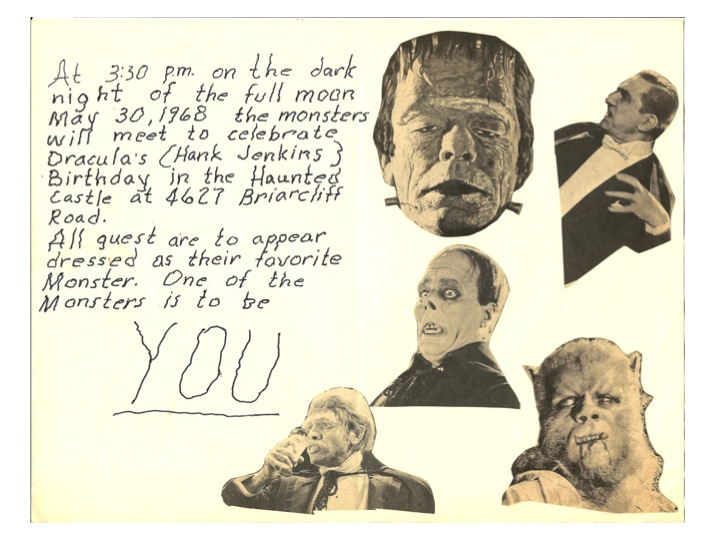
I cherish this invitation to my tenth birthday  which my mother carefully and lovingly packed away with other artifacts of my childhood.  The text, written in a quivering scrawl associated with old horror film posters, was accompanied by photographs of Boris Karloff’s Monster, Bela Lugosi’s Dracula, Lon Chaney’s Phantom of the Opera, Frederic March’s Hyde, and oddly, given my own strong preference for Lon Chaney Jr., Oliver Reed’s werewolf. The pictures had been cut from the pages of Famous Monsters of Filmland, almost certainly by my mother’s hands, given how precise the borders are, and then, attached with Elmer’s Glue, under my instructions, onto typing paper. The invitations were reproduced using a crude home photocopier machine my father used for his work, and then mailed to the other boys in the neighborhood.

I dug the invitation out of storage recently when I returned from seeing “The Art of Tim Burton” exhibition at the Los Angeles County Museum of Art (LACMA). Amidst concept art and film props, the exhibit devoted a room to his juvenaila,  including a childhood sketch of the Creature of the Black Lagoon (mostly likely drawn from the Aurora monster model) and  stop motion home movies (inspired by Ray Harryhausen). I was most taken with a collage (image 2), which mixes Burton’s own hand-drawn renderings of Frankenstein’s Monster, the Phantom of the Opera, and various space aliens, with pictures, including Lugosi’s Dracula, King Kong, and this time, appropriately, Lon Chaney Jr.’s Wolfman, almost certainly cut from Famous Monsters.  Burton chose Lugosi, his face partially wrapped by his cape, where-as I went with an image where the vampire’s hands are clutched, ready to strike an unsuspecting victim, but both were part of the image bank we shared with so many other boys and girls, around the country,  growing up in the mid-1960s.


Burton and I were born a little over two months apart, though his Burbank and my suburban Atlanta were on the opposite ends of the country.  What we shared -- with a good chunk of our generation -- was a series of powerful cultural influences, as described in the LACMA exhibit’s accompanying coffee table book:

“He revered the legendary Vincent Price and identified with such maestros of classic horror as Lon Chaney Sr. and Jr., Boris Karloff, Peter Lore, and Bela Lugosi....He was swept up by the magic of the stop-motion animation of Ray Harryhausen’s animated sequences and the unique color pallete of Basil Gogo’s illustrations on the covers of Famous Monsters of Filmland magazines (one of the few publications he avidly read).” (Frey, Gallo, and Kempf, 2009, p. 8)

For all our self perceptions of eccentricity, Tim Burton and I had more or less the same childhood. We read the same magazines, watched the same movies, admired the same artists, and fetishized the same images. As Bob Rehak writes in this issue, “Facilitated by Famous Monsters and shared by a subculture of baby boomers in their preteen and teenaged years, the constructive activities of 60s horror fandom laid both a generational and physical groundwork for today’s transformative, franchised, materialized media culture.”...

I read these historical accounts from the perspective of someone who, unlike the other authors, was part of the 1960s monster culture they are seeking to reconstruct. This is not to say my account is somehow more “authentic” or “unmediated” than theirs. As Erica Rand (1995) has suggested, we selectively rewrite our personal narratives about our childhoods to reflect our adult conceptions of ourselves, creating an aura of personal inevitability rather than reflecting the contingency of emerging identities. What we and our parents chose to box and save are not necessarily any more a part of who we are than those many things that were tossed in the trash. The LACMA curators were no doubt drawn to those childhood artworks suggesting the gothic sensibility we associated with Burton’s films; I am drawn to childhood artifacts which reflect my subsequent academic interests in film history and fan culture.  All of these accounts involve acts of interpretation and speculation, whether recovering the perspectives of Ackerman’s young fans from the photographs and letters in Famous Monsters or reconstructing my ten year old self from fading memories and yellowing party invites. So, I am writing this first person account to add another layer to our understanding of the period’s fan sensitivities and subjectivities.

As a starting point, we might add collage art to the mix of creative and performative activities, including model-making, super 8 filmmaking, costuming and make-up, that grew up around Famous Monsters. Cutting out and gluing down pictures to create a birthday party invitation may seem pretty banal -- not as transgresive as writing a homoerotic fan story or as transformative as posting a political remix video on YouTube. But, these material practices embody a similar expectation that consumers have the opportunity and right to meaningfully reshape their culture.

The fact that my parents sanctioned this bit of appropriation and remixing tells us something about Famous Monsters’ cultural status: my parents would not have allowed me to cut pictures from books or encyclopedias, they would happily allow me to cut pictures from old catalogs or newspapers, and magazines fell into a space in between -- National Geographic or Hightlights (no), Famous Monsters (yes).  The growing accessability of photocopying (first prototyped in 1959 and introduced to home consumers in the mid-1960s) supported the easy reproduction of such images, paving the way for the DIY zine culture Stephen Duncombe (1997) documented. Such cut and paste collages would become characteristic of the 1980s punk and 1990s riot grrl zines, for example. These practices also extend a much older history of children’s scrapbooking, a practice, as historians (Tucker, Ott, and Buckler, 2006; Garvey, 2004) note, that has often mixed personal (family photographs, drawings) and mass produced images (magazines and newspaper clippings).

The overlap between Burton and my respective choices reflects the degree to which Famous Monsters helped define a canon of works its most hardcore readers were expected to know. The images we selected were shared culture (in that Burton and I draw on almost identical repertoires) and personal culture (in that Burton and I would have no doubt had different personal preferences -- my strong identification with Dracula, his fascination with Vincent Price and giant Japanese monsters). The magazine helped to set a syllabus of sorts for my adolescent efforts to educate myself about the history of American movies (and still informs my dvd collecting).  I can draw a direct link from Famous Monsters  to my decision to focus my Seventh Grade term paper, several years later, on the history of American movies. My father used to joke that I had been rewriting that term paper throughout my educational and professional life.  My graduation from an elementary school monster movie buff to an undergraduate film snob was mirrored by the fact that George Ellis, the fright host for the Atlanta market, also owned the Film Forum, one of the city’s two major retro houses.

As Kevin Heffernan (2004) documents in Ghouls, Gimmicks and Gold, the Universal monster movies had been part of the large package of “Shock Theater” Screen Gems sold to television stations in the 1950s and still in active use on second tier local stations in the 1960s. After school, my friends would race home to check out which movies were playing, staying in doors if it was one featured in Famous Monsters, and otherwise going outside, often to play act those very same monster movies. At ten, we were not allowed to stay up for the “Friday Night Frights”, except in the summer time or over Christmas break, and then, often, with the carefully negotiated stipulation (shared by many of the neighborhood households) that we could stay awake only until we got to see the monster in action. This rule, designed to avoid conflicts over bedtimes, actually resulted in endless quiblings over whether a shadow or a movement in the branches really counted or in the case of The Wolfman, whether Lawrence Talbott counted as a monster before the moon turned full.  As David Bordwell (2011) has noted, the tendency of vintage film audiences to show up when they could and watch through until the point where they entered the theater surely complicates claims about narrative structure and closure. Something similar could be said of my childhood viewing practices, which put such a strong emphasis on the monster’s first appearance and meant that we almost never saw any form of containment. Much like the superheroes, who occupied our imagination around the same time, the neighborhood kids could have told you the primary “powers” and vulnerabilities of each monster (Dracula could transform into bats or fog and command wolf packs; he could be destroyed by a stake to the heart, by cutting off his head, by being exposed to sunlight), but not the plot of any particular film.

Our love for “classic” horror movies gave us a certain distinction among our classmates, many of whom raced home from school to watch Dark Shadows. We had a running battle around the school lunch table over the relative merits of Lugosi’s Dracula (never Christopher Lee’s) and Dark Shadow’s Barnabas Collins. Tom Patterson, sometimes friend, sometimes rival, held his own monster birthday party a few months later, adopting the persona of Collins, as much to cross my tastes as anything else. Ackerman’s magazine fostered a immediate and personal link between his young readers and the grand old men who had helped to create the monster movies decades earlier. When I learned that Lon Chaney Jr. was struggling with cancer, I sent him a hand drawn get well card and received a photograph of the Wolf Man, signed with his own quivering hand....

Famous Monsters contained a wealth of information about these old films and the people who made them, but it was above all a picture magazine, and our favorites often reflected what we imagined from those images.  I had seen few of the movies represented on the birthday invitation. For example,  I had not seen the original Universal Dracula by age ten; I knew the character almost entirely from the magazine, the Aurora monster models, and my Famous Monsters Speak record. Several years later, I saw the 1930 Bela Lugosi film and found it surprisingly dull. I was even more frustrated (and bored) by my aborted attempt to read Bram Stoker’s novel. The blood curdling account of Dracula in Famous Monsters, much like The Princess Bride, contained only the “good parts”. So, the Dracula I loved and admired was largely a product of my own imagination, what I extrapulated from and mapped onto the stills Ackerman published.


Matthew, perhaps you can get us started by sharing how this special issue focused on Famous Monsters of Filmland came about.

Matt:  This project began to percolate in the fall of 2007.  I had just moved to southern California and visited Ackerman at the “mini-Ackermansion” during one of his Saturday open houses.  I lingered after the official visiting hours were over and found that, with just me as his audience, Ackerman wanted to talk about his life - not just his work on FM or his life as a fan, but his family history, his relationship with his brother, etc.  This first conversation quickly evolved into regular visits with prepared questions.  Over the course of six months I accumulated about 20 hours of recorded conversation.  At the same time I began to purchase 1960s-era issues of FM on Ebay with the idea of writing something scholarly about FM, as this was a subject near to my heart and which had been almost completely overlooked in academia.  Around this time, I met you for the first time and seeing an Aurora model kit in your office felt like a bit of serendipity. This led to the SCMS panel with you, Mark, and Natasha, which was received so positively that finding a home to publish this work seemed the logical and inevitable next step.   In another bit of serendipity, these essays crossed paths with Katherine Larsen, who was very receptive to the idea of an FM-theme for the debut issue of The Journal of Fandom Studies.


As I note in my essay, there’s a certain generational difference in experience represented within this group. I was a first generation Famous Monsters fan reading the magazine growing up in the 1960s, where-as most of you are quite a bit younger. How did each of you first encounter the magazine?

Matt: I have a vivid memory of being 4 years old in 1970 and seeing FM #80 at the local supermarket.  The cover image was from Beneath the Planet of the Apes and I was absolutely transfixed.  My aunt, whom I was with, refused to buy it for me and I had to wait a painfully long time before I actually purchased my first issue (#95 in late 1972).   I loved FM but could only afford an issue every so often.  I would look longingly at the gallery of back issue covers in each issue and wish I could have them all.  It was a longing matched by my desire to see many of the films featured in every issue.  Reading FM directed my weekly investigation of the latest issue of TV Guide to see if any of these films were going to be broadcast on the local station that had a Friday night horror show.

Bob: Matt and I are the same age, and my first encounter with Famous Monsters and subsequent experience of Monster Culture are similar to his. I came across FM at an Ann Arbor comic book store called the Eye of Agamotto, on a rack with other Warren publications such as horror comics Creepy and Eerie, and “mature” content like National Lampoon and Heavy Metal. At 9 or 10 I was too young to be drawn to those magazines, but FM, which my parents indulged me in buying, formed the nexus of my love of monster movies new and old, which I took in both at film society screenings on the University of Michigan campus, and on TV through creature features with hosts like “The Ghoul” on WKBD-50 and WJBK’s Sir Graves Ghastly. While I don’t remember the first issue of FM I owned, I do recall the first issue whose cover I found too frightening to look at directly: #111, October 1974, which bore a Basil Gogos portrait of Linda Blair in Dick Smith’s Exorcist makeup.

Mark: I’m a couple of years younger than Matt and Bob, and I didn’t really like FM that much or read it regularly, although I do have a strong memory of reading an issue while in the hospital (the negative associations are hard to shake). At the risk of sounding like a snobby little kid, I didn’t like FM’s irreverent tone and all the pun-based captions, although I did wear a T-shirt printed with an FM cover on the first day of third grade. Right before the class recited the Pledge of Allegiance, the teacher looked over at me and said “everyone put your hands over your monsters” (not surprisingly, he was one of my favorite teachers). Around that age, I was more drawn to books like Ed Naha’s Horrors from Screen to Scream and William Everson’s Classics of the Horror Film than to FM. My parents--my dad in particular--were very indulgent of my monster-mania, and would take me to see age-inappropriate films and let me stay up late on the weekends to watch old movies. I grew up in Omaha, where the local NBC affiliate broadcast Dr. Sanguinary’s Creature Feature every Saturday. I recall being absolutely livid when it was preempted by the appearance of Saturday Night Live.

I think in terms of generational difference in reception, by the time we were old enough to be interested in monster culture and horror films, there were simply more options to explore: more publications, more books, more toys, more ways to actually see some of the films. Undoubtedly, FM paved the way for this, but it may also be the reason my own response to FM was so cool. Interestingly, my partner, who is roughly a generation older than I am, has a big stash of FMs from when he was a kid.


Mark Hain is a PhD candidate in the Department of Communication and Culture at Indiana University, and is currently working on his dissertation, which is a historical reception study looking at star image and how audiences interpret and find use for these images, with a specific focus on Theda Bara.

Bob Rehak is an Assistant Professor in the Film and Media Studies Program at Swarthmore College. His research interests include special effects and the material practices of fandom.

Natashia Ritsma is a PhD candidate in the Department of Communication and Culture at Indiana University. Her research interests focus on documentary, experimental and educational film and television.

Matt Yockey is an Assistant Professor in the Department of Theater and Film at the University of Toledo. His research interest is on the reception of Hollywood genre films.


The Cultural Context of Chinese Fandom: An Interview with Xiqing Zheng(Part Three)

You suggest that Chinese fans often see themselves as belonging to an elite group. In some other parts of the world, fans are considered anything but because of the low cultural status of the materials they embrace. In what ways have Chinese Otaku sought to legitimate their interests and activities through appeals to elite cultural status?

This situation is resulted from the specific history of current fan culture in China. This fan culture, however hard people try to make a connection with the older “rewriting” fiction tradition, or older tradition of appreciating a fiction on a community level, is for its majority, an import from Japan. This fact has two results: first, Chinese fan culture was at first highly restricted to a group of comparatively well-educated people, but second, the Japanese heritage of this culture is often neglected, replaced by a lineage reconstructed by Chinese fans between Chinese fandoms and canonical high art literature.

When fandoms began to emerge at the end of the 20th century in China, people having access to such cultural environment and cultural practices are highly restricted to the young, urban, highly-educated and well-informed people such as college students, or young urbanites that were at least wealthy enough to afford a computer and internet surfing fees when both of them were comparatively difficult to have in the 1990s China. Of course, universities usually have better technological condition than other places, and young students were the major target consumers of the internet cafes when they were in a fad at the turn of the century. Such condition put a restriction on the people who were able to access fandom. Comparing to the condition right now, the major difference was that the hardware difficulty stopped most young teenagers and children from entering the fandoms. And the content centered on Japanese anime further restricted the age of participants to the urbanites who were born after the late 1970s. Fan fiction created during this period is of good quality both in content and style, while many fan authors paid close attention in making their products fit the elite image. Both the age span and the social origin of the fans have enlarged in fandoms now, but the early elitism still continues.

The other aspect that I mentioned above is the self-constructed lineage of the fandoms to the elite, avant-garde literature. This is exceptionally observable in the case of slash fiction, in which fangirls try to establish a lineage between their writings with traditional Chinese literature with homoerotic contents, and also, between slash fiction and avant-garde literature with queer materials. Even though in fact Chinese slash fiction / yaoi culture has little to do with either the pre-modern homoerotic novels, nor does it bear many resemblances with avant-garde literature except both of them are standing on a marginal position in the society, and both of them present something taboo of the mainstream society. Yet still, such a self-claimed lineage constitutes a good position of self-defending, and a good way of self-disciplining.

I think the elitism of Chinese fans, and the generally mild reaction towards the fan culture from the public has another crucial reason. In both pre-modern and modern Chinese literature, there are various types and forms of fan-fiction-like literary products. For example, there were dozens of sequels dedicated to The Dream of Red Chambers 红楼梦, usually considered the greatest traditional Chinese colloquial novels, which was written in the 18th century. The novel Jin Ping Mei 金瓶梅 (written around the 16th century) can be considered as an elaboration of a comparatively small segment in another great novel Water Margins 水浒传 (possibly written in the 14th century). Indeed, such rewritten stories and sequels can be seen as the remnant of the folk literature tradition in pre-modern Chinese literature, but similar things happened in the 20th century also. At the turning of the 19th and the 20th century, when the first wave of translation of Western literature into Chinese started, genre literature such as detective fiction and science fiction attracted much attention from the translators and readers. And the first wave of “new fiction” writing in the genre of science fiction, which directly imitated the Western sci-fi, often presents a science Utopia through rewriting old novels. For example, Wu Jianren 吴趼人, in his New Tale of Stones 新石头记, puts the protagonist from Dreams of Red Chambers into the contemporary Chinese society as an observer and commentator. During the 1920s to the 1940s, many authors created so-called “re-written fiction,” including the single most important writer in modern Chinese literature, Lu Xun 鲁迅. His Old Tales Retold 故事新编 is a collection of parody of various old Chinese legends. Other similar stories involve, for example, Shi Zhecun’s 施蛰存 “Shi Xiu” 石秀, a short story in which the author retells the story of the character Shi Xiu from The Water Margins, using psychoanalysis to explain his motivation.

I am not claiming that the present Chinese fan fiction has a direct relationship with this trend, yet after some fan fiction stories started to become famous in the 21st century, many people explains the idea of “fan culture” to their curious friends by using the example of canonical literature. I have seen several cases in which people explain the definition of “fan fiction” with the example of Lu Xun’s Old Tales Retold. Even though the current fan culture does not have a directly heritage from this tradition, this “rewriting of old canon” tradition is in the large social background both for the creation and for the circulation of Chinese fan fiction. I also want to add, that such “rewritten” stories are widely seen around the world; it is never a China-only phenomenon. But I haven’t seen any scholarship trying to establish this literary tradition with popular fan culture.

One last issue I have to stress here is: there hasn’t been a hierarchy that clearly distinguishes “high culture” and “popular culture” in Chinese fiction; fiction was considered low-brow in general before the end of 19th century, when a group of literati called on a literary revolution. The historical reasons for this condition are complicated, which I will not explain in detail here. Even the word “genre literature” has only existed in Chinese language for less than two decades. Consumers of media products such as Japanese anime, especially those who are no longer young enough to be considered an appropriate consumer for anime, are generally viewed in a biased perspective. And people who love Hollywood blockbusters are despised by those who love European art films. But the bias has not yet supported a deep grained stereotype for popular fans. These might be the ultimate reason for the comparatively high status for fans in China.


You write particularly about female fans of slash or Yaoi. How might these young women use this genre to negotiate around tensions surrounding the status of women and female sexuality in China?

Another question that I am personally very interested in. Of course the popularity for slash or yaoi is a very complicated issue. But if we consider specifically the topic of gender and female sexuality, I want to stress the issue of gender equality. (The word choice between slash and yaoi is again a difficult one. In China the term for this genre has another name: danmei 耽美, also with a complicated history. It is originally the Japanese translation of the word “aestheticism,” yet after being imported to China, its meaning shifted. Only for the convenience, I will use the term yaoi here.)

To understand the rapid fad of yaoi culture, one has to understand the population that takes part in reading and writing yaoi fan fiction and original stories. In all of the three areas that I am examining, the rise of female created and female oriented homoerotic stories is directly associated with the issue of female autonomy and independency. In the US, the slash fiction reading and writing is not only a “women’s enterprise” outside the market economy, it also signals women’s rebellion against the dominant social norms of sexuality. In Japan, the emergence of yaoi culture eventually came from the female manga artists who was blocked out of the manga industry because of their gender, started their career in amateurish market of dōjin manga publication, which, ultimately led to their professional career as revolutionary shōjo manga artists. In China, however, the case is different. As I have already mentioned, Chinese contemporary fan culture was marked by its exceptionally elitism. In the case of yaoi culture, the case is more obvious. The first generation of Chinese fangirls, in this case the ones who are active around the year 2000, usually self-considered as the social elite. There was a very famous quote by a yaoi forum titled “Lucifer”: “Fangirls have the responsibility to be more civilized than others.” The claim holds true considering the situation that many fangirls of that age are the ones who go to good universities or high schools, well-educated in Chinese and Western literature, and have excess to the internet before many others in the country. Even though with the internet technology enters more and more people’s household, the existence of the fangirls community and yaoi culture is no longer a secret among young women students in a handful of best universities in China, the tradition of elitism still lingers.

For many girls of the one child generation, their family, especially their parents have exceptional expectation on them. The traditional patriarchy thoughts still persist in some way, especially the older tradition in a family that girls have to sacrifice for boys, that only sons are considered important, but these thoughts lose their meaning and survival environment in the generation when every family has only one child. A predictable consequence is that the only daughters are treated with all attention from their families. Some girls are raised as boys to earn fame and fortune for the family, especially to earn more success than their male cousins. To my own knowledge, most urban girls of my age have the experience of being educated that women are no worse than men, and what a man can do, can certainly be done by a woman. Being inculcated with such words, most girls of this generation, especially the ones that have gained their success according to the mainstream criteria, i.e. those who achieve high academic success and the ones who find well-paid jobs, will ultimately be forced to face with the still highly unequal gender relationship in China. Within the long tradition of women-oriented romance in Sinophone area persists, in which no matter how a woman character is successful, has to finally become an obedient daughter, a loyal wife and a responsible mother, and be restricted again into the family trivial, and to rely on the marriage to determine the success of one’s life. Then any attempt of creating a strong female character risks the danger of falling into the stereotypes of de-feminized female characters of Maoist Socialist Realism. The new possibility in recent popular fiction, though, is turning the female characters into those that encourage over identification and self-projection, i.e. Mary Sue. Mary Sue characters are too easy a role for female readers to identify with; the readymade identification choice is largely degraded in the fan community as an unhealthy indulgence. Many argue that Mary Sue as a fan fiction may not even invite female audience, because the character may bear too much characteristics of the fan fiction writer and as a consequence prevents a general identification. Recently, some new types of romance written for the young women audience and teenager girls, such as Twilight series in English speaking areas, and the time-travel fiction (chuanyue xiaoshuo 穿越小说) in China are considered Mary Sue, even if they do not necessarily fall in the category of fan fiction.

Considering the easy pitfalls for the original female characters, the retreat into yaoi material for the female readers of this generation is a logical result: if you cannot find a solution to the current male-female relationship, then get rid of the female characters all together. At least in between male characters, there can be the possibility of an equal love relationship, in which there is no such thing as one has to subject to the other. This is a temporary and escapist retreat, and probably not a healthy one, because in one way or another, one has to come back to the reality to deal with the male-female relationship. Yet still, the popularity of the yaoi material, from a special perspective, shows the current crisis in gender relationship in Chinese society.

Yet the tendency of surpassing the issue of male-female gender relationship sometimes ends in misogyny in yaoi writings online. While celebrating the pure love between two male characters, the female characters who develops a romantic relationship with one of the male lovers in yaoi materials usually have very tragic ending: for the sake of the two male characters who love each other, female characters have to get away ultimately, so they either die or being tragically dumped by the male character, and also, should never has the importance of the other male character to her ex-husband or boyfriend. I will explain this situation with the reason of jealousy, but I also want to point to the complexity and ambiguity of ideology expressions in Chinese yaoi culture. Even though the explanation of gender equality issue holds true to me and many of my friends around, it might not work on every fangirl. Even if fangirls are attracted to the gender equal expression in certain slash fiction, they might not always stick to this norm when reading other pieces of slash fiction.

Most recent writings in English on Chinese fan communities have emphasized the phenomenon of fan subbing. What roles do fan subbing practices play in promoting other kinds of fan productivity?

I personally feel that fansubbing is the core and root for many fan activities in China, especially in media fandoms. And as you have mentioned in the question, it has become one of the most observable aspects of Chinese fan culture as a whole since more than six or seven years ago, both domestically and internationally, with little of other aspects of Chinese fan culture widely mentioned (I believe the earliest occasion that brought fansub to the foreground was the unintended popularity of the US series Prison Break in China, which was largely in debt to the online fansub groups. Even New York Times had this story covered.). A fansub group is not only a volunteer that translate certain foreign texts into Chinese; it plays the role of raw material selector, the role of linguistic translator, and at the same time, the role of cultural introducer. The final function usually cannot be served in the “official” translations of foreign materials. Because of the informal nature of fansubs, fansubbers are free to add notes, comments and detailed background information introduction for cultural details in order to facilitate the audience in understanding the media materials. Besides, since the fansubbers have a general idea of the identities of their audiences (usually young fans who stay online all the time), fansubbers are able to target the direct concerns and questions of their audiences more accurately.

Fansubs are sometimes the only choice for the Chinese audience to get access to foreign media products. Because Chinese government has a strong restriction on media product imports, and also because there is no rating system in China, imported media products are very limited in number, and even if they are imported, many of which have to go through a thorough censorship first. This censorship is much more on explicit reference to sex, than on politically sensitive issues. (A famous example would be the American sitcom Friends. Despite its tremendous popularity in China, it never was able to appear on TV in China. According to certain rumors—which I believe is true—it was only because there are so many sex-related jokes that after censorship, some episodes would have little left. And as we all know, Friends is so much milder than many US series). Then in order to get access to foreign media products, audiences are forced on to an illegal way. Therefore p2p download and online streaming becomes necessary. Even though students are required to learn English from a young age, the language barriers set by media products are daunting. Because “official subtitles” are usually hard to find for TV series, not to say Chinese dubbing, it is mainly the fansub groups that translate and introduce the foreign media products to the Chinese audience. Though I do not have too much information of the fansubs in English speaking countries, from what I read and heard from conferences on fan activities, fansubs in China have a surprisingly high quality. Many fansub groups require interviews and tests before accepting new members. Some fansub groups on Japanese materials even directly ask the prospective members for their levels and grades for the Japanese Language Proficiency Test (is a standardized test to evaluate and certify Japanese language proficiency for non-native speakers, held internationally twice a year). Fansubs depend highly on reputation to thrive in a fandom. I have to emphasize that fansubbing is totally voluntary, not for profit, and open to the general public. But since fansubbers are doing this totally because of their love and interest for the original texts, they usually would do the translation with their best effort. Therefore once a fansub group has established its fame, people tend to believe in it even more than “official subtitles,” if there is any, because after all, fansubs are made “by people of our own community.”

Fan subbing is the starting point of every fan activities on certain media products, therefore it is very crucial. For example, it is not rare to see fan fiction written in Chinese that directly use dialogues in a media product translated by a favorite fansub group. Besides, since Chinese fan culture is especially open to foreign media materials, the role of fan subbing becomes even more significant under this condition.

Again, I am standing on the position of a “native informant” here. I have worked in various fansubbing and fan translation groups, including one on a Japanese radio program (named “Dear Girl~ Stories~,” hosted by two famous Japanese voice actors Kamiya Hiroshi and Ono Daisuke), another on the BBC TV series Sherlock, and I am still an active translator and subber of a fan group on J.R.R. Tolkien’s writings. The last fan translation group I am working in is based on a “little site” on a Chinese SNS website Douban (豆瓣, which is a very unique SNS site for people to exchange information on books, films, music, etc. and to post their reviews), called “Red Book of Middle Earth” 中土红皮书, a fan created and fan maintained site that introduces and updates everything about and around The Lord of the Rings trilogy and other Tolkien’s writings. If you have interest, here is the link to it: http://site.douban.com/120385/. Right now we are working on news and videos on the Hobbit films. The collection and translations of related materials do require English proficiency (and good Chinese language skills also), and much time and effort. But besides a dozen central figures that participate in the actual translation process, the fans of the fan translation group actually are able to form a small and active fan community.


Author's Bio: As an academic fan from China, I entered the fandom around 2003 when I was still an undergraduate student of Chinese Literature at Peking University. I am currently a PhD candidate at the Department of Comparative Literature at the University of Washington. My dissertation topic is Chinese online fan culture, as well as its relationship with the media and fandoms from Japan and the English speaking areas. I have done several presentations on Chinese fan fiction and fan culture in conferences, but up to now I do not have any publication in English. By the way, I am now translating Professor Jenkins's Textual Poachers into Chinese, not as a voluntary fan translator, though.

The Cultural Context of Chinese Fan Culture: An Interview with Xiqing Zheng (Part Two)

Fandom constitutes a particular form of leisure. How does it fit within the exam culture which so shapes the lives of Chinese youth?

I do not feel in a confident position in answering this question. Basically I have personal experience to draw upon on all other questions, save this one. I myself had passed the age of being afflicted by the most tediously part of the exam culture when I entered the Lord of the Rings online fandom as a collective community for the first time; I was a sophomore in college then. Before then, yes, I was a fan, but I didn’t know there is something called fandom (and the fandom before 2003 did have much less observable a presence in Chinese society).

Fandom activity is a very good complimentary to the tedious exam culture for the youth in China, especially when exams are not consuming all time of the students. It is difficult for fandom to take much of their time, but leisure times? Very possible. I often find a fan fiction author explaining his/her slow update with the reason “I am a senior in high school, and you know, I don’t have time at all.” Or “I am a high school student living on campus and can only be back home to use the computer on weekends…” or “I live on campus and I can only use my cellphone to update my fic! Please forgive me for the problems on the format.” etc. Some young students may post on fan forums their art products or doodles made in their classrooms, at the back of an exam paper, in a lined notebook; in some online chat, some young fans express their excitement when they encounter anything relevant to their beloved products in a classroom situation. Fandom activities do find a way squeezing into their busy life. However busy the students are, there is always some time left for themselves.

Fan culture has actually existed in Chinese high schools for a long time. I have heard of people who started to write fan fiction with pen and paper in high school years to communicate with other fans, even before the internet is available to average urban families, but such sporadic phenomena cannot be compared to the current situation, when more and more young students are at least aware that there are fandoms for them to participate if they are interested in. We can see that the fan culture is really becoming a major choice for leisure time activities for the busy students in China, and probably a type of convenient refuge for them. Yet I am also reluctant to claim that it is unique comparing to other types of leisure time activities and hobbies for young people in China. After all, even if the fandoms are more and more widespread and observable in Chinese society right now, fan culture still belongs to a small audience and remains a comparatively marginal community.

What are the dominant modes of fan cultural production and participation in China?

I guess that fan fiction is still one of the dominant modes of fan cultural production and participation, and of course, fan art and fan video are also immensely important. The fan fiction I discuss here, which is characterized by female perspectives and commercial consumptions, started around the mid-1990s, and has been prosperous since then. Considering fan art, it is now not only restricted to originally created paintings, but sometimes involves technical manipulation on screen grabs to make them present certain effects. There was not a VHS age for Chinese fan videos so far as I know. The earliest ones I encounter were produced around the turn of the century and are directly circulated online. The earliest ones are usually flash video files; then the production shifted to other formats when online streaming sites become popular. Fan music exists, but the creation of which is more restricted to certain groups of people. Yet even though only a limited number of people participate in fan music writing, these people are very prolific. There are other types of fan activities, for example, fan game designing. But video game designing requires technical expertise of quite a high level, and therefore is very rarely seen. But if created successfully, fan video games are highly welcomed by fans. I have also seen friends who participated in designing fan board games. Fan translation is another type of activities that are able to connect and gather fans of a certain media product. Fan translation is not restricted to subbing a video of reports or interview or other media products related to the original material; it also involves translating certain news and interviews, and even fan fictions, fan arts and fan videos. Another fan activity online recent called “language-cosplay” cannot be categorized in any of the types I stated above. It is an activity for a group of people, with each of them role-plays a character in the original media and interacts with one another online in dialogues as if s/he is the characters.

Fan books and fanzines started later than fan fiction and fan arts in China, and in early 2000s, digital versions of fanzines were more frequently seen than printed ones. Recently the trend changes: fanzines and fan books in printed forms are becoming popular. One reason is the easy access to direct online merchandize with the emergence of platform website such as Taobao 淘宝, and the rapid development of convenient private postal delivery systems, thus direct one to one merchandizes have become possible. Nowadays most fan books and fanzines are planned and pre-ordered online. There is a website called Tianchuang lianmeng 天窗联盟 (Alliance of Roof Windows), which is the largest online search engine of any Chinese language fanbooks and fanzines. Tianchuang, meaning roof windows, is a jargon in the fan community: if a fan artist or fan author is not able to finish his/her work on time, the fanzine or fanbook will not be available for the proposed cons. Then it is called “roof windowed.” (And this jargon is originally from a slang in the publish industry.) This is the link to the website in case that you are interested: http://doujin.bgm.tv/. From this website we can see clearly that the production and circulation of materialized fan products now still has direct connection to the digital media.

For the activities in the “real world,” cosplay and cosplay photography are of the most eye-catching and prevalent phenomena in the fan communities, and have attracted attention in the mainstream media. These activities often take place in fan conventions, though cosplay photography also takes place outside the conventions. The number of conventions is rapidly growing each year and has spread from several major cities to almost all large cities in China. For example in the year 2011, there were more than 100 fan conventions across the country, though the size varies (most conventions register on Tianchuang Lianmeng, you may want to explore that website to see). Sales of fan books and fanzines are one of the major functions of fan conventions in China. Comparing to the conventions held in the US, Chinese conventions are totally supported by the fan artists and fan writers who bring their works to the conventions to sell, since it is usually impossible to invite media celebrities or producers in the media industry for panels and autography—because a large portion of the original materials that the fans consume do not even have a legal distribution channel in China (though, celebrities’ participation is not totally impossible, Chinese manga authors, writers, illustrators, and most recently, celebrities as Japanese voice actors begin to attend conventions). Since there has not been such a tradition for holding panels and discussion sessions in cons, many Chinese fan conventions usually look exactly like flea markets with sellers and customers all dressed up in costumes. Smaller fan gatherings have been a longer tradition from before the 21st century, but such gatherings usually are much smaller in scale, usually turn out to be a dinner, a Karaoke party, or an afternoon spent together in a board game café.

I personally feel that concerning the types of fan activities, fandoms around the world are very similar to each other. Even though some details may vary because of different social historical context, in the end all fan activities are about consumption, interpretation and appropriation. Indeed there are cultural differences, but fans’ communities around the world share astonishing amount of similarities. Because of the possibility of instant interaction and communication brought by the internet, the fan communities around the world is gradually breaking the language boundary, which is more observable in a third world country as in China, as people volunteer translating and reposting the fan products in other languages they like. But sadly, in most cases, it is still a unidirectional process.

Are there distinctive forms of fan production which have originated in China?

Since it is hard to determine all the fan production forms in other culture, I am not sure whether there is some form that is authentically “made in China.” But I feel that fan sub, or more broadly speaking, fan translation is specifically important in China, much more so than in many other countries. One reason is of course, the imported media products have from the beginning held special significance to the development of Chinese fan culture. The original media products are not the only things that Chinese fans translate; but also foreign fan productions, including fan fiction, fan art and other relevant periphery productions and news surrounding the original media products. I am not sure whether it is the condition of all fandoms in other third world countries, but just as I mentioned above, you do feel the powerful existence of globalization in fandoms. Even in the case of fandoms on pure Chinese materials, we find interactions and communications among different Chinese speaking regions (I have encountered fans from Malaysia in several fandoms I participate in). Again, I am not claiming that it is exclusively “made in China,” but fan translation is something that makes Chinese fandom more complicated than the fandoms I see in the US and in Japan, but beyond my scope, it is still hard to say.

Author's Bio: As an academic fan from China, I entered the fandom around 2003 when I was still an undergraduate student of Chinese Literature at Peking University. I am currently a PhD candidate at the Department of Comparative Literature at the University of Washington. My dissertation topic is Chinese online fan culture, as well as its relationship with the media and fandoms from Japan and the English speaking areas. I have done several presentations on Chinese fan fiction and fan culture in conferences, but up to now I do not have any publication in English. By the way, I am now translating Professor Jenkins's Textual Poachers into Chinese, not as a voluntary fan translator, though.

The Cultural Context of Chinese Fan Culture: An Interview with Xiqing Zheng (Part One)

From time to time, I have shared with my readers glimpses into the forms fan culture has taken around the world. For example, see this discussion of Harry Potter fandom in Russia or this discussion by one of my former USC graduate students about Chinese vids made in response to Kung Fu Panda or see this interview regarding the growth of Otaku Studies in Japan. This week, I am sharing with you the insights of Xiqing Zheng, a PhD candidate in Comparative Literature at the University of Washington. We have been corresponding off and on for the past year because she is working on a translation of Textual Poachers for the Chinese market. In the course of our correspondence, she shared with me some of her work which touches on the relationship between Chinese fandom and Japanese Otaku culture. She was nice enough to let me interview her about her work, which touches on some fascinating issues concerning fandom, the global circulation of media, gender and sexuality, fan subs and digital piracy, and issues of cultural, economic, and political change in contemporary China.

You have been doing research about “otaku” cultures in China. “Otaku” as a concept originates in Japan. Why is this the most appropriate word to describe what has developed in China? Are Chinese Otaku draw primarily to Japanese media content or are they adopting and localizing Otaku practices but applying them to specifically Chinese content?

Frankly, I have to admit that the wording choice for this is partly determined by the fact that the article I sent you was written for a Japanese journal: I was trying to make their translator’s work easier, as well as to save some work on my own side—you really do not need to explain what is “Otaku” to a Japanese reader, while a strict definition of “fan” may take some time and space. Out of the Japanese context, I prefer using the word “fan” as a descriptive term for the community that I am interested in. Yet I do not see a clear distinction between the so-called otaku culture, in its current meaning, and the media fan culture in the Euro-American context. So I am against the tendency of connecting either of the identities with a fixed type of media, whether it is Japanese ACG (abbreviation of “anime”, “comic” and “game,” I will use this word constantly in below), or Euro-American sci-fi TV series.

But at the same time, I feel the word “otaku” especially appropriate in describing the situation in Chinese online fan community, because: First of all, the Japanese material actually was the starting point of the current Chinese fandoms, which was imported from Japan at the end of the 20th century. Secondly, generally the condition of Chinese fandoms looks similar to the Japanese ones, more than the US media fandom, with a boundary more thoroughly torn-down between high art and popular culture, the readers and the writers. Thirdly, in daily usage, the word “otaku” is often more connected to a certain media or a group of media, while “fan” can be linked to a media, but is more frequently associated with a single text or a single individual.

Usually if we talk about “sub-community” in Chinese fan community, there are several ways to divide up the group, and one of them is a division according to the origin of the original media text. Using this criterion, the fan community in China can be divided into Euro-American media and literature fans, Japanese ACG and literature fans, Korean media fans, Chinese media and literature fans, etc. According to the statistic of a fan author, Wang Zheng, around the year 2007, 70% of the whole fan fiction writing in China is based on Japanese original texts, especially anime and manga, 20% of Chinese fan fiction is based on Chinese texts while the other is based on Euro-American texts. I do not trust her statistic completely because such statistic is hard to conduct accurately in the internet age, but from one aspect, we can see the strong presence of Japanese media in Chinese fandoms.

However, the distinction among each group is very vague, as one person can be simultaneously put in all groups mentioned above. For example, I am personally a fan of Lord of the Rings, which is a British novel and a Hollywood film trilogy; a fan of Legend of Galactic Heroes, which is a Japanese space opera and a long series of anime; a fan of Three Kingdoms, which is a traditional colloquial historical novel written in China in the 14th century and derivative media products in China and Japan.

Most of my friends in fandoms are in exactly the same situation. And in many ways, the materials from all nations are treated in a similar way from the ending point of the media distribution and acceptance. In other words, different original places for media products do not necessarily lead to different types of acceptance and re-appropriation, while the same can be said that about the cultural value of the texts, for high art and popular culture can be treated the same way at the receiving end, also.

The naming issue for the Chinese fan culture has to be taken carefully but sometimes restricted by many other unexpected troubles. The word “otaku” has been imported to Chinese; because of the same writing system of Chinese characters shared by the Chinese language and the Japanese language, the Chinese character of otaku “御宅” is the one being imported to China, while in Japan, this word is more often written in hiragana or katakana as “おたく” or “オタク”. The word was originally a respective address to another person (referring the other person in conversation not directly, but indirectly to his/her house to show respect), and has been used jokingly inside the otaku communities for each other, as acknowledging each other as fellow “geeks.” Currently it generally refers to fans of ACG media, but terms such as “sci-fi otaku,” “railway otaku,” “board game otaku,” also exist. However, the word in Chinese has shifted its meaning mainly because it has crossed the boundary of subculture and entered the public vocabulary, or at least the urban public, but with a meaning very different from the original one.

While with the word “宅” meaning “house” in Chinese, the public is using this word as the synonym of “staying-at-home-type of people,” or those who do not go out in their spare time, or do not go out at all, which is described with another Japanese word “hikikomori”引き篭もり in Japan; such behavior is not necessarily a trait for otaku. This meaning is more widely spread in Chinese society that I have already found people using this word with the new meaning in academic environment. Therefore except that I am conducting comparisons with the Japanese otaku community, I really am reluctant to use the word otaku to refer to the Chinese fan community now. Therefore I will still use the word “fan culture” to refer to the cultural phenomenon of cultural recirculation and re-appropriation in China.


There is a strong history of cultural conflict between Japan and China. What role (if any) does this history play in shaping potential contacts between Chinese and Japanese Otaku?

This is one of the questions that intrigue me most. I have read and heard some presentations by Japan scholars that the popularity of Japan media materials may relieve the influence of “anti-Japan” education in many Asian countries, and therefore play a beneficial role in construction of a better image for Japan in the younger generation, and make these young people grow an attitude more friendly to Japan. (I personally feel rather repelled by the ideology connotation of the wording of “anti-Japan” education.) It is true that every media product is political, and it is also true that in Japan the otaku culture is often considered right wing, though not always so. But it does not mean that as a foreign consumer, a Chinese fan will take in everything that the producers want her to take, especially in the case like here, that the social historical and ideological circumstance of the audience is distinctive from the producers’. And here is where the complicated Sino-Japan relationship comes into play.

Interestingly enough, there is a tendency in Chinese fans to divide a “cultural Japan” and a “political Japan” when consuming Japanese media material. There is a certain tendency in Chinese otaku to clearly distinguish two “Japans” in their perception of this country: one is the governmental Japan, who still refuses to formally apologize for their imperialist invasion in Asia and its military nationalism, and the other the cultural (and especially popular cultural) Japan, who represents a fashion and “Japan cool.” Chinese fans generally accept that the products are from Japan, and they are very good, intriguing, and worth becoming a fan for. But at the same time, they refuse to identify with the political national identity of Japan linked with the media product. In fact, they try to sever the role of Japanese government and politics out of the media products.

This phenomenon is very different from the situation in the US. As I have observed so far in the US, if a consumer becomes a fan of the media products from a certain country, he/she may in a large probability become a fan of the country as a whole. But in China, many friends of mine complain about their parents’ attitude towards their cultural preferences: “Who tells them that I will love Japan if I just love to watch Japanese anime?” And this is at least the fact for a large portion of ACG otaku in China. Moreover, when there is any conflict between the cultural preference and political identification, the political identification often prevails. For example, there was an anime called Night Raid 1931, broadcasted in Japan in 2010, which is set in the background of Shanghai right before Japan invaded China, and features much denigrated representation of the Chinese people. This anime was refused totally by most large fansub groups, who usually translate literarily all new Japanese anime episodes available. Several comparatively marginal groups did the fansub, eventually, but this anime is generally intentionally ignored by the Chinese otaku group for a whole season. As the media product is never imported to China, there is no other way to show our upset about it anyway.

However, the story is usually not an easy one. For more explanation, I want to raise one fandom as an example. I actually have presented on this topic at a conference, but I feel there is still more to develop. There is a Japanese web comic, titled Axis Powers: Hetalia (referred to APH below) by Himaruya Hidekazu, and has been adapted into manga and anime. APH is a set of media products of parody descriptions of the world military and political history, especially of the World War II era, with vignettes about various countries’ culture; each character is an anthropomorphizations of various countries and areas. These anthropomorphized characters, different from the traditional fixed national personifications such as John Bull for Britain, Uncle Sam for America, are created by the author Himaruya himself and does not intend to carry any political significations. APH is now immensely popular in the US also, by the way.

APH is widely circulated in Chinese otaku community basically through online video websites and through non-copyrighted fansubbed video files, downloadable through p2p venue. Similar to many other Japanese anime, APH inspires a large amount of fan creation, including fan fiction and fan video, and also cosplay shows. Usually in the APH fandom, audience attempts to create a non-political neutral perspective that is far away from the debate of the real life political discussion. In the Chinese speaking world, there is a set of “internet etiquette,” first promoted by the Taiwan fandom, then spread into mainland China. This set of etiquettes are promoted mainly to prevent any possible conflicts between the fan writers and some “outsider” readers that happens to see the fan writings that probably will enrage him/her because of the less serious political presentation in the stories.

Despite the political neutral intention from the author and most of its fandom globally, what happens in the Chinese APH fandom is that many fans eagerly celebrate and reinforce the Chinese identity, history and culture in a way close to the mainstream narrative or sometimes even clichéd official narrative in China. I argue the main reason is the clear self-alienation from totally identifying with the Japanese text, or in other words, an identity creation process with the background of understanding otaku as mainly a Japanese-exported phenomenon.

What I mean by this self-alienation and identity creation roots from, the deep rooted Sino-Japanese conflict, which is only half relieved or hidden by Japanese media products’ popularity in China, including the immergence of the otaku culture itself. With this clear split in the “Japan” idea, the accepting Japanese culture no longer becomes a critical issue even if one is unhappy with the Japanese government’s attitude. However, it also makes the acceptance for the Japanese culture much less complete. It is already difficult to separate a pure “culture” totally devoid of political narratives; the acceptance of narratives with certain reference to real world politics, such as APH becomes further difficult with the Japanese ideology involved in the story. Therefore, the interpretation and fan creation basing on such narrative takes on a mode of accepting the “Japan” on the cultural level, i.e. taking the setting and the moe characters, while refusing Japan’s self-interpretation on the political level, instead using the Chinese mainstream narrative of the history to adapt the original narrative and create new narrative. The alienation caused by the Japanese social historical narrative then pushes the Chinese fans back to their own familiar zone of Chinese self-narrative.

Take one dōjinshi (fan book or fanzine) published in 2008, Wei Long (为龙, Being a Dragon) as an example. This dōjinshi has already become a legend in Chinese fan community. It is a dōjinshi centering on the China character, Wang Yao王耀, and it is consisted of about 25 illustrations, several four-grid comics, and several short manga stories. Highly well-known in the fandom, its original price was 75 RMB, but the price of a used copy now usually exceeds 500 RMB (this speed of price increase is very rare in China). After the release of this dōjinshi, there was also a theme song of very high quality written by fans specifically for it. If you are interested, here is a link for it on YouTube: http://www.youtube.com/watch?v=0gwB8vPGDIM.

The popularity of this dōjinshi comes from not only the quality of the pictures (there were more than ten professional manga authors participated in the creation of this dōjinshi), but also the content, which celebrate passionately the glorious long history of China and the strong will that China experienced in the 19th and 20th century to overcome all the difficulties to rise up again from defeat and invasion. Such usage of the original materials, especially the setting, is never intended by the original author, but has become at least one of the most important traits of Chinese APH fandom. As far as I know, such modes of consumption are rare in the APH fandom elsewhere.

There is another issue that I want to point out here, even though Himaruya as well as most APH fans repeatedly claim that the characters are merely created for entertainment purposes and not for political interpretations, still one cannot really separate one’s perception of a certain country with the cute personages in the anime. However, the historical truth in this narrative becomes then largely simplified and single-lateral. I want to note one specific example in the original narrative of APH. All country characters in the anime speak standard Japanese, with occasional utterance of several sentences in their respective native languages. The only character that does not speak standard Japanese is the China character, Wang Yao. Adding a redundant “aru” (ある) at the end of most sentences he speaks, this trait presents clearly the characteristics of a specific Creole language called “kyowago” (協和語) promoted by the Japanese colonial government in Manchuria during the 1930s and 1940s.

Even though Japanese colonization is never directly mentioned in APH, the using of this specific linguistic trait implicitly alludes to this history. Yet, curiously enough, this linguistic trait has also become a forgotten history on the Chinese side, with most Chinese fans interpreting this linguistic trait as a simple personal style. As my observation goes, Japanese fans also do not explicitly take this issue very seriously. Yet it at least shows in one aspect the political and historical complications behind this seemingly simple setting. It also tells us that it is really impossible to imagine a cultural product totally independent from social political issues in the real world.

Therefore, I suggest it is erroneous to imagine that the Sino-Japanese historical political conflicts can be easily remedied by developing Chinese fans of Japanese media products (or vice versa), nor should we over-emphasize the power for the audience to totally subvert or ignore the ideology embedded in cultural materials. But at the same time, how audiences interpret or appropriate a certain fictional narrative is definitely cannot be totally controlled by the producers, therefore the fandoms based on the same media product could be very different from country to country.


Author's Bio: As an academic fan from China, I entered the fandom around 2003 when I was still an undergraduate student of Chinese Literature at Peking University. I am currently a PhD candidate at the Department of Comparative Literature at the University of Washington. My dissertation topic is Chinese online fan culture, as well as its relationship with the media and fandoms from Japan and the English speaking areas. I have done several presentations on Chinese fan fiction and fan culture in conferences, but up to now I do not have any publication in English. By the way, I am now translating Professor Jenkins's Textual Poachers into Chinese, not as a voluntary fan translator, though.

Spreading Independent and Transnational Content

As we count down to the wide spread release of our new book, Spreadable Media: Creating Value and Meaning in a Networked Culture, which I co-authored with Sam Ford and Joshua Green, we are rolling out this week five more essays -- in this case, dealing with core issues from the book's chapters on independent media and transnational media flows. One final crop of essays from the project will go on-line next week. By now, some of you may well be receiving copies of the book advanced ordered through Amazon or New York University Press. We'd love to know what you think. I was lucky enough to be able to share some thoughts about this project this past week with faculty and students at Concordia University. This post is available in Czech language (provided by Alex and Nora Pozner from bizow reviews team).


The Long Tail of Digital Games

In the raging debate over the legitimacy and consequences of the “Long Tail” theory (Anderson 2006), few markets have received more attention than those dedicated to digitally distributed video games. Proponents of the Long Tail have argued that digital distribution will finally turn the historically hit-driven game industry on its head—that future revenues will be driven by consumer activity distributed across a huge catalog of video games developed, in large part, by independent game developers as opposed to titanic publishers; that it will prove consistently more profitable to focus on niche audiences in this new world of digital game distribution, rather than to focus on the development of broadly appealing hits; and (for those of us interested in the spreadability model) that a new generation of empowered consumers will actively seek and promote the highest-quality content, driving revenues to the most deserving game developers and leading to a healthier and more vibrant video game ecosystem overall.

There can be no doubt that encouraging signs of this development have begun to crop up everywhere. Many now-prominent independent game developers, such as The Behemoth and 2D Boy, have leveraged console-based digital distribution platforms such as Xbox LIVE, Wiiware, and the Playstation Network (PSN) to reach markets that were previously only accessible via the long arm of a traditional publisher. These developers have not only created award-winning games that have generated significant amounts of profit. They have, in many cases, retained the rights to their intellectual property (IP) and operated with near-total independence, an unthinkable situation for small console game developers only a few years ago. And, while digital distribution on the console typically generates the most buzz, independent developers have made equally great strides on mobile devices, the web, and the PC thanks to a wide variety of channels (stores such as iTunes, Android Market, and Steam; portals such as Kongregate.com; and more generalized distribution through social network sites such as Facebook, to name just a few). Savvy observers have noted that in mobile ecosystems in particular, independent developers have consistently had greater success than traditional publishers in cracking into the “top 10.”

MORE

(Sp)reading Digital Comics

Comic books—especially single issues, or “floppies”—have always been spreadable. As kids in the 1980s, my friends and I would head into our local comic shop, each emerge with an armful of floppies, then spend the afternoon first reading through our own haul and then each other’s. Usually, at least one of my friends’ floppies would be from some larger multipart story arc, and, if it was any good, I’d either go digging through my friend’s collection or thumbing through the store’s back issues to find out what was going on. Sharing, recommendation, drillability, and vast narrative complexity were all part of our everyday lives long before we could even drive.

Webcomics have emerged as an alternative form of publishing that makes such practices even easier. Many webcomics use RSS feeds to deliver new installments via email or RSS reader applications, and many webcomics offer forums where fans can chat and bicker and share their favorite comics with one another, much as my friends and I did in person so many years ago. Now, I can recommend comics to friends around the world either by emailing them a link to a webcomic’s site (and thus the latest comic) or a “permalink” to the archived page or, more commonly now, by texting, IMing, or Facebook messaging them such a link. Many webcomics, such as Emily Horne and Joey Comeau’s A Softer World, include built-in widgets for fans to recommend them on online services such as Digg, Facebook, Reddit, StumbleUpon, Del.icio.us, Technorati, and Twitter. Scott Kurtz’s PVP includes widgets to share each strip on twenty different services.

Unlike traditional print comics, for which most writers and artists labor under “work for hire” contracts for large publishers such as Marvel and DC, webcomics are typically owned and operated by their creators and rely on revenues generated by advertising, fan subscriptions/memberships, or sales of ancillary merchandise. As a result, for creators, getting individuals to purchase a single instance of their work (such as a traditional print floppy) is less important than establishing an ongoing relationship, aggregating a large recurring audience over time. The simplicity of the URL system supports this—when recommending a comic to a friend, I could copy and paste an image of the comic itself into an email, stripping out the context, ads, and links to the related merchandise, but why bother when sharing a link is so easy?

MORE


The Use Value of Authors

A key dilemma for both media consumers and producers in today’s media environment is discoverability: with so much media spreading, and even more desperately wanting to be spread, how do we choose what to consume? Consequently, consumers need highly effective filters to direct them to the media they are most likely to enjoy and away from that which they are unlikely to enjoy; producers, meanwhile, need to develop techniques to ensure that their content enjoys safe passage through such filters and finds the audiences most likely to enjoy their work. Herein lies the importance of, and the use for, authors.

As compared to creative figures—producers, writers, artists, designers, and a wealth of other terms in common parlance to describe those who make media—an “author” is someone to whom we attribute a heightened level of authority and autonomy over the item of media in question. Most consumers operate on the assumption that a vast amount of media isn’t worth personally consuming, either because it is corporate hackery written by committee just to make a fast buck, because it is amateurish and incompetent, or simply because it doesn’t appeal to any of their interests. An author, though, is a totem of sorts that signifies a certain level of skill and singularity of vision. To talk of authors for professionally produced content is to assert creativity and self-expression in what can too often be characterized as a faceless, paint-by-numbers industry, while to talk of authors for amateur-produced content is to attribute artistry in what can too often be characterized as a world full of everyone’s uploaded cat videos. Discussing authors can be a way to validate the product of said authors, and hence to allow ourselves to discuss art, meaning, and depth in some popular media without attributing artistry or depth to all popular media.

At the same time, precisely who the author is can be hotly contested and variable, as the content industries may pose one author, while fans may look to others, sometimes working to uncover who the “real” author is. For instance, while The Simpsons is often popularly spoken of as Matt Groening’s, many fans have nominated other individuals in the show’s production as the true source(s) of the show’s perceived brilliance, and hence as its author(s). The fact that people would bother to argue over who the author is should signify how much the title of author matters, and it offers an initial sign of the importance of authors. MORE


The Swedish Model

Sweden is a small country, yet it has one of the world’s biggest and best-selling music scenes. You might think ABBA, and you wouldn’t be wrong, but they’re just the best-known starting point of a very long tail, with thousands of bands spanning every genre and degree of success. Sweden is also home to The Pirate Bay, the world’s top torrenting site, which ABBA songwriter Björn Ulvaeus has decried as made by and for those who are lazy and stingy and don’t understand that, if creators can’t anticipate payment, they will never release music (“ABBA Star” 2009). Since the advent of recording in the early twentieth century, recorded music has been the central economic good of the music business. Hence, it is no wonder that the mainstream industry has been so vociferous in its efforts to demonize and sue uploaders and to support national policies that limit the ability of listeners to spread music.

Further down the tail, though, Sweden is home to many artists and labels trying to forge a new way through this thicket, one that rejects the notions that certain payment is a precondition for artistic expression or that file sharing detracts from the economics of their business. The attitudes and actions of The Swedish Model, a consortium of seven independent labels committed to a more optimistic dialogue on music’s future, and other Swedish labels and musicians put spreadability at the center of their hopes for the future of the music business. The tiny label Songs I Wish I Had Written, headed by Martin Thörnkvist, who also heads The Swedish Model, shared an office with a Pirate Bay cofounder, and Thörnkvist uploads his label’s catalog in the highest quality to Pirate Bay. Labrador, another Swedish independent label, gives away annual samplers through Pirate Bay and posts all its singles for free download on its website.

These entrepreneurs have taken to heart that if their music doesn’t spread, it may as well be dead. The logic goes like this: We are small and have minimal budgets. There are few mainstream venues that will promote our music, so few people will have the opportunity to hear it through mass media. The more people who hear it, the larger the audience will become. Even if most of that audience does not pay for CDs or mp3s, the slice that does will be bigger than the entire audience would otherwise have been. And the slice that doesn’t pay to buy music may well pay for other things. As Thörnkvist put it when addressing the music industry audience at MIDEMNet, “I’d rather have one million listeners and one hundred buyers than one hundred listeners and one hundred buyers” (2009).

MORE


Transnational Audiences and East Asian Television

Consider a clip from the Japanese variety show Arashi no Shukudai-kun that recently made its way onto YouTube in early 2009: a small group of Japanese pop singers are challenged to eat a “surprisingly large” hamburger named after a city in the Ibaraki prefecture and are joking about how “Super American” the situation is. They suggest that the burger inspires them to don overalls and grow “amazing” chest hair, while Bruce Springsteen’s “Born in the U.S.A.” blares in the background. The clip was then subtitled in English by two fans based in Australia and circulated based on its appeal to English-speaking audiences of the “J-pop” performers in the video as an embodied spectacle of Japanese popular culture. Various versions of the clip were distributed online through fan communities on LiveJournal, a Russian-owned social blogging platform with offices headquartered in San Francisco, and other forums, and fans shared the links through their blogs, Facebook, Twitter, Delicious, and other social media channels. In the process, the Arashi no Shukudai-kun clip was recontextualized, reformatted, resubtitled, and diverted to new (and sometimes unexpected) audiences at every step along the way. Far from exceptional, there are countless clips like this one on YouTube: in the global spreadable media environment, its crisscrossing path back and forth across multiple national, linguistic, and cultural boundaries is becoming perfectly common.

Not only is the transnational movement of media becoming increasingly pervasive; it has also become significantly more—and more visibly—multinodal. Thus, we must go beyond the use of Bruce Springsteen in the background of a Japanese variety show as part of a parody and indigenization of Western cultural materials to consider its subsequent movement as it is taken up, translated, and circulated by grassroots intermediaries, passing through divergent and overlapping circuits, often outside the purview of established media industries and markets. In short, we must look beyond sites of production and consumption to consider the practices of transmission and the routes of circulation—the means and manner by which people spread media to one another—which are increasingly shaping the flow of transnational content.

MORE


More Spreadable Media: Rethinking Transmedia Engagement

Let it spread, let it spread, let it spread. By now, you know: Spreadable Media: Creating Value and Meaning in a Networked Culture is a new book, being released by New York University Press at the end of January 2013, written by myself, Sam Ford, and Joshua Green. Around the book will live thirty or so online essays written by colleagues, former students, and others who have been associated with the Futures of Entertainment Consortium through the years, which both engage with the content of the book, and are, in turn, taken up as part of the book's core argument.  We are hoping you will do your part to help spread these essays throughout your own social networks, and let the conversation start before the book even gets released to the world.

Today's crop, the last before the new year, offers new perspectives on transmedia entertainment and more generally, on the issue of audience engagement, both central themes in the book, as those of you who regularly read this blog might imagine. For more information, check out the book's home page.

Forensic Fandom and the Drillable Text


While the rise of spreadable media is a major trend of the contemporary era, another development within media seems to pull in an opposite direction: narrative complexity of media storytelling, especially on television. Since the late 1990s, dozens of television series have broadened the possibilities available to small-screen storytellers to embrace increased seriality, hyperconscious narrative techniques such as voice-over narration and playful chronology, and deliberate ambiguity and confusion. These trends, which I’ve explored at length elsewhere (Mittell 2006), are tied into transformations within the television industry and technologies of distribution that have enabled programs to be viewed more consistently by smaller audiences and to still be considered successful.

Such long-form complex narratives as Lost, The Wire, 24, and The Sopranos seem to run counter to many of the practices and examples of spreadable media found elsewhere in this book. These shows are not the ephemeral “video of attractions” common to YouTube that are shared and commented on during downtime at work. They are the DVD box sets to be shelved next to literary and cinematic collections, long-term commitments to be savored and dissected in both online and offline fora. They spread less through exponential linking and emailing for quick hits than via proselytizing by die-hard fans eager to hook friends into their shared narrative obsessions. Even when they are enabled by the spreadable technologies of online distribution, both licit and illicit, the consumption patterns of complex serials are typically more focused on engaging with the core narrative text than the proliferating paratexts and fan creativity that typify spreadable media.

Perhaps we need a different metaphor to describe viewer engagement with narrative complexity. We might think of such programs as drillable rather than spreadable. They encourage a mode of forensic fandom that invites viewers to dig deeper, probing beneath the surface to understand the complexity of a story and its telling (Mittell 2009a). Such programs create magnets for engagement, drawing viewers into story worlds and urging them to drill down to discover more. READ MORE


A History of Transmedia Entertainment

As embraced by industry professionals and media consumers alike, transmedia storytelling promises to bring greater institutional coordination, added narrative integrality, and deeper engagement to the various pieces of contemporary media franchises. Comic books, video games, and other markets once considered ancillary now play increasingly significant and recentered roles in the production and consumption of everyday film and television properties such as Heroes, Transformers, and the reenvisioned Star Trek in ways that only very few innovators (such as George Lucas and his carefully elaborated and expanded Star Wars empire) had previously conceived in the twentieth century. Yet, while contemporary convergence culture has set the stage for a greater embrace of transmedia entertainment, the processes by which stories have been spread across institutions, production cultures, and audiences from different media have a much longer history. Although we might recognize transmedia storytelling as something newly emergent, we also cannot deny its relationship to long-established models of media franchising whereby the creative and economic resources owned by monolithic corporate entities were nevertheless widely used and shared across production communities and industry sectors. The franchise models that multiplied one Law & Order into several sister series and turned X-Men comic books into action figures worked by spreading resources among a network of stakeholders brought into social relations by virtue of their parallel (though often imperfectly aligned) interests. Thus, neither transmedia entertainment nor convergence point to the end of industrial models of cultural production in favor of some new social media; instead, the transmedia storytelling of convergence offers an opportunity to see how spreadable media extend, reorient, and reimagine existing historical trajectories in the industrial production and consumption of culture.

Understanding transmedia in terms of cultural exchange across and transformation through different media experiences means recognizing traditional processes of adaptation and translation of content as a foundation for the social exchange of spreadable media today. READ MORE.


Performing with Glee

Some producers developing cross-platform media franchises are experimenting with distribution models that engage consumers on a quotidian level, capitalizing on personal audience networks and not-quite-official distribution routes to help content spread. For FOX’s television franchise Glee, the network integrates traditional, legal distribution practices with experimental tactics that engage loyal fans, in addition to harnessing unofficial distribution channels that fall into legal gray areas.

The production team has embraced the show’s fans—known as gleeks, a fusion of “Glee” and “geek”—fashioning a popular (brand) identity and catering specifically to them. In addition to conventional broadcast, Hulu and FOX.com allow viewers to catch previous episodes, and FOX offers additional content such as cast interviews and behind-the-scenes clips. Glee’s thematic fusion of high school comedy and Broadway musical provide opportunities for musical guests from both Broadway (such as Kristin Chenoweth) and the popular music circuit (such as Britney Spears and Josh Grobin), bringing new viewers into the Glee fan club while keeping current fans engaged.

To retain fan interest after season one ended, FOX partnered with CoincidentTV to create the “Glee Superfan Player.” The online platform integrates social network sites such as Facebook and Twitter with other fan-enticing elements—such as links to buy music on iTunes and to create “photobooth” pictures with the cast—in a unified space that plays episodes while viewers multitask. While the player only provides access to material on Hulu and FOX.com, rendering the experimental platform useless once episodes eventually expire, it at least represents an attempt to create a consolidated cross-platform fan experience. Other recent experiments include a MySpace karaoke contest, in which fans record themselves singing hits from Glee, and live concert tours that sold out in four American cities—so successful that the cast plans to tour the UK in mid-2011. READ MORE

Valuing Fans

Why work toward a model for valuing fans?

The U.S. media industry has run into some significant economic problems in recent years. Study after study suggests that Americans are watching more television and consuming more movies, music, and information than ever before, but, at the same time, it is neither as captive nor as concentrated as before. New ways to discover emerging artists and projects, as well as increasing choice in media platforms and content, are challenging how ad-supported media is bought and sold and rendering direct funding for some media content much harder to come by.

It was this situation that gave rise to the popularity of “engagement” a few years ago, a tactic to sell advertisers audiences whose enthusiasm is believed to translate to more awareness of and receptivity to product placement and commercials. How much more “engaged” and receptive this new audience is than the older, bigger one was considered crucial in setting a price for the advertising that supports media production. Conspicuously absent from these discussions was the role that fan communities (groups whose various interests in a media property may range widely) play in contributing economic value beyond paying attention to commercials. READ MORE


The Online Prime Time of Workspace Media

Ask a producer of digital content about website usage patterns, as I have, and they will tell you how important the audience accessing their content from work is to daily website traffic. According to NBC’s vice president of digital content and development, Carole Angelo, NBC.com designs its daily production schedule to service its workweek “lunch hour” audience. Fox Sports Digital (2009) also adopts this production strategy, as it summed up in its 2009 slogan “lunchtime is the new prime time.” Reporting on this trend, the New York Times observed that American cubicle dwellers were increasingly choosing to spend their break time watching online videos, playing Flash games, and engaging in social network sites instead of heading to the water cooler (Stelter 2008). The entertainment industries are creating digital content for the work space because they see this audience as a dependable online consumer demographic.

Programming for the workspace media audience is crucial to entertainment industry efforts in the online space. It allows producers to adapt familiar television programming strategies for the Internet. In television, producers have long programmed according to “day parts”—segments of the broadcast day designed for particular audiences and viewing contexts. Nick Browne has argued that the scheduling of day parts enabled television companies to reflect and reinforce a “socially mediated order of the workday and workweek” to “mediate between the worlds of work and entertainment” (1994, 71). Each day part carries with it certain assumptions about the needs and desires of audience segments, as well as expectations of modern labor. The scheduling of a workday day part demonstrates the influence that technology has had on the blending of work and entertainment. READ MORE

Spreadable Media Goes Retro: Pass It Along!

We continue this week with the process of rolling out the essays commissioned to accompany Spreadable Media: Creating Meaning and Value in a Networked Culture,   the book I wrote with Sam Ford and Joshua Green and which is being released to the world at the end of January, 2013. You can start to get a sense of the shape of the book's argument by reading these essays, week by week, as they get unleashed upon the world. This week, for example, we are sharing essays which are designed to accompany the book's second chapter -- Reappraising the Residual -- which explores competing regimes of value, competing processes of appraisal, and especially the ways that old media content might regain value from the ways it moves within and across social networks online.

For those who would like a bit more of a road map of Spreadable Media, below is the breakdown of the chapters:

Introduction: Why Media Spreads                                                                                                               

Chapter One: Where Web 2.0 Went Wrong

Chapter Two: Reappraising the Residual

Chapter Three: The Value of Media Engagement

Chapter Four: What Constitutes Meaningful Participation?

Chapter Five: Designing for Spreadability

Chapter Six: Courting Supporters for Independent Media

Chapter Seven: Thinking Transnationally

Conclusion


To learn more about the book, check out our main website. You can go there to read the whole essays (or follow the links below).

We strongly encourage you to spread these essays through your own social networks, repost them on your blogs -- all we ask is that you acknowledge the authors and the fact that they are associated with our book.   Thanks to all of you who have recirculate previous essays we've released.

RETROBRANDS AND RETROMARKETING

Today’s big brands are all rooted in the past. Tide, Coca-Cola, BMW, and even Apple are all connected to bygone decades. When these brands extend and use their existing brand name to introduce a new product or service, the past meanings and images that it invokes become an important element to be managed, understood, wielded, and shaped by managers. This short essay discusses and analyzes a form of brand extension strategy that has gained prominence, in which tired or even abandoned brands have been reanimated and successfully relaunched. Management will deliberately reach into the past and consciously seek to gain new value from old brands and the meaningful relationships they convey. Stephen Brown (2001) terms this a “retro revolution” in which the revival of old brands and their images have become an increasingly attractive option for marketing managers. Over the past decade, I have been involved either independently or with coauthors in a growing body of research that looks at how the past is consumed, valued, revalued, and managed, beginning with a study of the values and images of the Wal-Mart retail chain (Arnold, Kozinets, and Handelman 2001). Stephen Brown, John Sherry, and I define retrobranding as “the revival or relaunch of a product or service brand from a prior historical period, which is usually but not always updated to contemporary standards of performance, functioning, or taste,” seeing retro goods as “brand-new, old-fashioned offerings” (2003b, 20). Old brands retain value simply by being old: the value of nostalgia, the so-called retro appeal. There is also value in the communal or cultural relationships that the brand has built over its lifetime. Finally, there are values on an individual level that relate to the former two other values.

In a set of studies cutting across three different retro, “cult brand” products—the Volkswagen Beetle, Star Wars, and Quisp breakfast cereal—Brown, Sherry, and I have sought to explain the underlying principles of retrobranding and the way consumers responded to it (2003a, 2003b). The VW Beetle was a popular car associated with the 1960s era and hippies and also immortalized in Disney’s Herbie films, a series of four films originating with 1968’s hit The Love Bug (the series itself later updated and retrobranded into Herbie: Fully Loaded, a 2005 motion picture starring Lindsay Lohan). Star Wars is one of the most successful media franchises of all time. And Quisp cereal is an American breakfast cereal released in the 1960s using cartoon advertising created by Jay Ward, the creator of cult animation hit Rocky and Bullwinkle, and employing some of the same voice talents.

In each case, the entertainment connections of the brand have helped spur a type of residual and actual “brand fandom” that led to the possibility of a revival. In the case of the VW Beetle, this was the 1998 launch of the VW New Beetle. For Star Wars, it was the much-maligned 1999 prequel The Phantom Menace. For Quisp cereal, it was the quiet and limited redistribution of the cereal into select markets in the 1980s, after it had languished without support since the late 1970s. As well, Quisp’s fan-spurred and eBay-supported emergence in the mid-1990s marked it as the first so-called Internet cereal.

READ MORE

THE VALUE OF RETROGAMES

Existing in dialectical tension with contemporary games which trumpet their photorealistic graphics, sprawling storyworlds, and intricate, extended, networked play, retrogames preserve and celebrate a prior era of gaming often referred to as a “golden age” of arcade standards (such as Asteroids, Tempest, and Donkey Kong) from the late 1970s and early 1980s. Increasingly, the category also covers the decade that followed the industry crash of 1983, when the locus of gaming shifted to home consoles such as the Nintendo and Super Nintendo Entertainment Systems (NES and SNES), the Sega Genesis and Dreamcast, and home microcomputers such as the Commodore 64 and Amiga, as well as the first generation of PCs and Macintoshes. Compared with games for contemporary consoles such as the Xbox 360 and PlayStation 3 that occupy gigabytes of memory, resurrections of 8-bit, 16-bit, and 32-bit video and computer games look like the mathematically downscaled primitives they are: their blocky resolutions, limited color palettes, and blip-bleep-bloop sound reproduction are matched by equally simple and repetitive gameplay. However, retrogames are not hopelessly antiquated museum pieces lacking the good sense to stay buried in gaming history. Their continued presence complicates easy (and industry-friendly) conceptions of technological and aesthetic progress, in which the newest equals the best equals the most expensive.

Older games thrive alongside their more sophisticated descendants, gaining popularity and influence with each passing year. Retrogames continue to be played in both authorized and unauthorized forms. Their minuscule memory footprint, easily grasped rules, and convenient fit within the interstices of daily routine make them ideal content for mobile devices. For instance, the App stores for iTunes and Google Android phones devote sections to retrogames. The Xbox Live Arcade markets “updated retro classics” alongside its “newest hits,” while the Wii Virtual Console sells downloads from “the greatest video game archive in history”—actually licenses owned by Nintendo. These monetized properties coexist uneasily with the thriving emulator scene, where every conceivable old game has its software simulacrum and renegade read-only memories (ROMs)—files containing data images copied from memory chips, computer firmware, or the circuit boards of arcade machines—circulate beyond the bounds of copyright. For both legal and illegal purposes, the Internet functions as both archive and distribution network, supporting the sharing, spreading, and mutation of content

READ MORE


A GLOBAL HISTORY OF SECONDHAND CLOTHING

Clothing, almost by definition, is a medium of transmission within a spreadable media ecology. It is both the means and the site for the storage and spread of information. Clothes are made to be carried by the human body (as in the French porter and the Haitian Creole pote). Textile skins were, from their origins, portable artifacts and temporary prostheses, shaped by the demands of a mobile body and inscribed with markers of that body’s history. The demands on clothing have always been high—armor (protection against shame, enemies, and the elements) and aesthetics, comfort and durability. Clothing is portable, proximate to the human body, and eminently changeable. Clothes remain artifacts in continual flux. They convey messages to the world, and they also provide the raw material for subversion of precisely these messages.

Before the industrial era, vestments were few and far between. Their production took a great amount of human and material resources. Into their tailored forms much was literally and culturally invested. In the Western tradition, throughout the Middle Ages and Renaissance, clothing—once shaped to a given body—might be worn for years, sometimes carried for a lifetime. The clothing wore its owner as much as the owner wore the clothing, bearing comparable markers of a personal narrative. Through the movements of a body in time, its clothes would acquire increasingly personal and human characteristics—worn knees and elbows, a stretched waist. Stains, patches, tears, and color changes accompanied a life journey, or at least several decades thereof.

Sometimes an article’s function was portable. This was especially true when even the simplest clothing was scarce: its production costly, time consuming, and labor intensive. A coat might be cut down into a vest, or a dress into a scarf. As a garment’s function evolved, so too might the identity of its wearer. A dress might be handed from mother to daughter through a gift economy. In such instances, it carried with it signs and markers of generational passing. A master might give his worn-out shirt to his servant, for whom it could serve as either bodily cover or portable currency. In the Renaissance, it was common for servants to sell their masters’ old clothing to peasants in neighboring villages. Itinerant rag and old clothes dealing grew into a veritable calling within a commodity-based economy. This was a profession of portability. The dealer became an intermediary between wearers, marking a transitional phase in an article’s mobile life history.

Spread That!: Further Essays from the Spreadable Media Project

  Spreadable Media: Creating Meaning and Value in a Networked Culture, my new book with Sam Ford and Joshua Green, is launching at the end of January. Each week, we are releasing new essays written by friends and affiliates of the Futures of Entertainment Consortium which expand upon core ideas in the book. You will see that these essays are an integral part of the book, even though they are being distributed digitally. We also see these essays as a means of sparking key conversations in anticipation of the book's release. So, in the spirit of this project, "if it doesn't spread, it's dead," so we are asking readers to help circulate these essays far and wide to as many different networks and communities as they seem relevant to the ongoing conversation.

Readers are already responding, including through the creation of "memes." Over the weekend, we received this "Slap Robin" announcement via Twitter from @amclay09.

Share with us your own creations and I will showcase this here as I am posting upcoming essays.

This week, we are releasing essays which are tied to the Introduction and first Chapter of the book. Before I do so, let me share some of the early responses to the book (i.e. the solicited blurbs):

“Something new is emerging from the collision of traditionIal entertainment media, Internet-empowered fan cultures, and the norms of sharing that are encouraged and amplified by social media. Spreadable Media is a compelling guide, both entertaining and rigorous, to the new norms, cultures, enterprises, and social phenomena that networked culture is making possible. Read it to understand what your kids are doing, where Hollywood is going, and how online social networks spread cultural productions as a new form of sociality.”—Howard Rheingold, author of Net Smart

“By critically interrogating the ways in which media artifacts circulate, Spreadable Media challenges the popular notion that digital content magically goes ‘viral.’ This book brilliantly describes the dynamics that underpin people’s engagement with social media in ways that are both theoretically rich and publicly meaningful.”—danah boyd, Microsoft Research

“The best analysis to date of the radically new nature of digital social media as a communication channel. Its insights, based on a deep knowledge of the technology and culture embedded in the digital networks of communication, will reshape our understanding of cultural change for years to come.”

—Manuel Castells, Wallis Annenberg Chair of Communication Technology and Society, University of Southern California

“Finally, a way of framing modern media creation and consumption that actually reflects reality and allows us to talk about it in a way that makes sense. It’s a spreadable world and we are ALL part of it. Useful for anyone who makes media, analyzes it, consumes it, markets it or breathes.”—Jane Espenson, writer-producer of Battlestar Galactica, Once Upon a Time, and Husbands

“It’s about time a group of thinkers put the marketing evangelists of the day out to pasture with a thorough look at what makes content move from consumer to consumer, marketer to consumer and consumer to marketer. Instead of latching on to the notion that you can create viral content, Jenkins, Ford, and Green question the assumptions, test theories and call us all to task. Spreadable Media pushes our thinking. As a result, we’ll become smarter marketers. Why wouldn’t you read this book?”—Jason Falls, CEO of Social Media Explorer and co-author of No Bullshit Social Media

This week's selections include discussions of historical predecessors,  Memes and 4Chan, the debates about free labor, co-creation in the games culture, and the power of consumer recommendations. Read the sample. Follow the links (....) back to the main site. Read.  Enjoy. Spread. Repeat next week.

The History of Spreadable Media

Media have been evolving and spreading for as long as our species has been around to develop and transport them. If we understand media broadly enough to include the platforms and protocols—to use Lisa Gitelman’s (2006) terms—that carry our stories, bear our messages, and give tangible expression to our feelings, they seem intrinsic to the human experience. Some people might even argue that the developments of vocal communication systems (language) and visualization strategies (paintings and carvings) represent defining moments in human evolution, demonstrations of man’s social nature. Human mastery of media was every bit as important as the mastery of tools. Stories of the spread and appropriation of media run across our history, each shaped by the logics of social organization and production characteristic of any given era.

Early traces of the spread and reach of media abound, even if some historical forms of media fall outside our familiar categories. For example, our contemporary understanding of the reach and influence exercised by ancient empires owes much to discoveries of coins—a medium of abstract exchange if we follow Karl Marx’s argument in Capital ([1867] 1999) and elsewhere but also a system of representation and meaning (from the value of the gold or silver to the inscribed monetary value, to the messages or portraits etched on its surface) with precise culturally defined borders. The coin, as a medium, spread with the state’s citizens, enabling their interactions with one another and at the same time attesting to the state’s reign. Ceramic dishes and tiles offer an example of a medium that was seized on for reasons of cultural exchange. The rich intermingling of styles and techniques characteristic of early-seventeenth-century Dutch, Chinese, and Ottoman ceramics speaks to the period’s trade routes and export markets and the creative appropriations of these various cultural models by its artisans. But these ceramics were also platforms, complete with highly nuanced systems of signification, hierarchies of value, and attendant associations of taste. They were carried, traded, collected, and displayed by a surprisingly large cross-section of the northern European population. As the ceramics circulated within different social groups as the vogue for ceramics rose and fell and were handed down to our present as family heirloom or antique shop curio, the journeys they undertook, and the meanings accorded them as media, attest to the energies and interests of those who helped to spread them....


In Defense of Memes

Although I agree that the terms “viral” and “meme” often connote passive transmission by mindless consumers, I take issue with the claim that “meme” always precludes active engagement—or that the term has a universal, static meaning. As understood by trolls, memes are not passive and do not follow the model of biological infection. Instead, trolls see (though perhaps “experience” is more accurate) memes as microcosmic nests of evolving content. Contrary to the assumption that memes hop arbitrarily from self-contained monad to self-contained monad, memes as they operate within trolldom exist in synecdochical relationship to the culture in which they inhere. In other words, memes spread—that is, they are actively engaged and/or remixed into existence—because something about a given image or phrase or video or whatever lines up with an already-established set of linguistic and cultural norms. In recognizing this connection, a troll is able to assert his or her cultural literacy and to bolster the scaffolding on which trolling as a whole is based, framing every act of reception as an act of cultural production. Consider the following example.

Founded in the early nineties by rappers Violent J and Shaggy 2 Dope, the Insane Clown Posse (ICP) is a Detroit-based hip-hop group infamous for its violent lyrics, rabid followers, and, as it was recently revealed, secret evangelical Christianity. ICP, which performs in full-face clown makeup, has always been a target for trolling humor. The 2010 release of the group’s single “Miracles,” however, opened the floodgates—in the video, Violent J and Shaggy earnestly extol the virtues of giraffes, rainbows, cats, and dogs, not to mention music (“you can’t even hold it!”) and the miracles of childbirth and the cosmos. The song itself, which is regarded as the group’s evangelical “outing,” is peppered with expletives and features the line “Fuckin’ magnets—how do they work?” a question which inspired immediate and seemingly endless repurposing.

Within a few days of the video’s release, dozens of remixed images and .gifs were posted to 4chan’s infamous /b/ board, many of which merged with existing memetic content. A well-known image of a cross-eyed, bespectacled man captioned with the phrase “are you a wizard,” for example, inspired a series of related macros, including one featuring a close-up shot of Violent J in full makeup. “are you a magnet,” the caption reads, referring not just to the cluster of memes related to the “Miracles” video but also to all the permutations of the “are you a wizard” family of macros.

In short, trolls pounced on the phrase “fuckin’ magnets” not just because it was memorable and amusing on its own (although that played a large part in its popularity, as did the thrill of a gratuitous f-bomb) but because it was easily integrated into an existing meme set. Once the protomeme had been integrated, its resulting permutations—“are you a magnet” being a prime example—became memes unto themselves, establishing further scaffolding onto which new content could be overlaid. By choosing to repost “are you a magnet” on 4chan or off-site, the contributing troll was able to assert his own cultural fluency and, in the process, ensure the proverbial (and, in some ways, the literal) survival of his species. In this sense, the creation and transmission of memes can be likened to the process of human reproduction—specifically the decision to have a child in order to protect one’s legacy. The sexual act is decidedly active, but the resulting zygote is a passive (that is to say, unwitting) vessel for genetic information....

Interrogating “Free” Fan Labor

Over the past two decades, large swaths of the U.S. population have been engaged in copyright wars. On one side, copyright holders struggle to defend their property against what they perceive to be unlawful appropriation by millions of would-be consumers via digital technologies. On the other, millions of Internet users fear or fight expensive lawsuits, filed by entities far wealthier and more powerful than they, that seek to punish them for sharing media online. In this combative climate, fans who produce their own versions of mass-media texts—fan films and videos, fan fiction, fan art and icons, music remixes and mash-ups, and game mods, for example—take comfort and refuge in one rule of thumb: as long as they do not sell their works, they will be safe from legal persecution. Conventional wisdom holds that companies and individuals that own the copyrights to mass-media texts will not sue fan producers, as long as the fans do not make money from their works (for instance, Scalzi 2007 and Taylor 2007).

“Free” fan labor (fan works distributed for no payment) means “free” fan labor (fans may revise, rework, remake, and otherwise remix mass-culture texts without dreading legal action or other interference from copyright holders). Many, perhaps even most, fans who engage in this type of production look upon this deal very favorably. After all, movie studios, game makers, and record labels do not have to turn a blind eye to fan works; U.S. law is (as of this writing) undecided on the matter of whether appropriative art constitutes fair use or copyright infringement, so companies could sue or otherwise harass fan appropriators if they chose. But, even if both sides of the copyright wars consider the issue of fan labor settled, one aspect of the issue has not been sufficiently explored: can, or should, fan labor be paid labor?....


Co-creative Expertise in Gaming Cultures

Gamers increasingly participate in the process of making and circulating game content. Games such as Maxis’s The Sims franchise, for example, are routinely cited as exemplary sites of user-created content. Games scholar T. L. Taylor comments that players are co-creative “productive agents” and asserts that we need “more progressive models” for understanding and integrating players’ creative contribution to the making of these game products and cultures (2006b, 159–160; see also 2006a). Significant economic and cultural value is generated through these spreadable media activities. The usual phrases such as “user-created content” and “user-led innovation” can overlook the professional work of designers, programmers, and graphic artists as they make the tools, platforms, and interfaces that gamers use for creating and sharing content. Attention should also be paid to the work of producers, marketing managers, and community relations managers as they grapple with how best to manage and coordinate these co-creative relations.

The Maxis-developed and Electronic Arts–published Spore thrives on user-created content. Players use 3-D editors to design creatures and other in-game content, to guide their creatures through stages of evolution, and then to share their creations with other players. Since Spore’s release in September 2008, more than 155 million player-created creatures have been uploaded to the online Sporepedia repository. Players can also upload directly from within their game videos of their creatures to the Spore YouTube channel. Spreading content is a core feature of Spore; the game is perhaps best understood as a social network generated from player creativity. This spreadability is not just about content, as the players are also sharing ideas, skills, and media literacies....

The Value of Customer Recommendations

With new channels of communication and old, marketers can deliver a dizzying number of advertising messages to consumers—by many accounts, the average American sees between 3,000 and 5,000 ads a day. Yet, perhaps in response to this fusillade, consumers have learned to better armor themselves against the marketing messages they encounter. The Persuasion Knowledge Model (PKM) describes the extent to which consumers develop a radarlike ability to discern content whose aim is to persuade and, further, how they develop a set of skills to deal with such messages (Friestad and Wright 1994). Some of my own recent research (with colleagues Adam Craig, Yuliya Komarova, and Jennifer Vendemia) uses fMRI technology to explore brain activity as consumers are exposed to potentially deceptive product claims. Our findings show that consumers’ deception-detection processes involve surprisingly rapid attention allocation. Potential advertising lies seem to jump out of the marketing environment and rivet our attention like a snake on a woodland trail.

Advertisements are often informative as well as persuasive; consumers know this and don’t dismiss ads out of hand. But they do assess the extent to which they trust or are willing to use such information. First, and most critically, consumers seek to evaluate the credibility of a marketing message’s source. Source credibility is the bedrock of trust that precedes persuasion. People judge a source to be credible if the source shows evidence of being authentic, reliable, and believable. In the old days of marketing, firms sought to increase the source credibility of their ads by featuring the endorsements of doctors, scientists, and other authoritative experts. Once consumers became more aware that these experts were being paid handsomely for their testimony, the practice became less effective. Celebrity endorsers, who often were not product experts, provided warm affective responses but little in the way of believable, persuasive arguments.

Consumers themselves are particularly important endorsers via word-of-mouth (WOM) messages. Our past understanding of WOM (when one consumer recommends a product to another) was that consumers perceive other consumers as highly authentic but of dubious reliability. As when one’s Uncle Joe touts the superior performance of the Brand X computer, the recommender is clearly a real person but may or may not be knowledgeable enough about the product category to make credible claims. Now, with WOM increasingly occurring through spreadable media, it is more difficult for a consumer to assess both the authenticity and reliability of unknown recommenders. The practice of rating consumers’ online opinions and recommendations (e.g., Yahoo! Answers) is a direct attempt to resolve the audience’s uncertainty about who really knows something worth knowing....


HOT.SPOT: The Dark Side(s) of DIY

From time to time, I have written here about the work of the Civic Paths research team in the Annenberg School of Communications and Journalism at the University of Southern California. I helped to start this research group when I arrived in Los Angeles three and a half years ago; it has been the seedbed for our Media Activism and Participatory Politics project which has generated a series of case studies of innovative activist groups (and will be the basis of an upcoming book). But, the group has become something more than that -- a space where students and faculty gather to discuss the participatory turn in contemporary culture and politics. Such discussions thrive on our internal discussion list, and we've been experimenting with various ways to get these ideas out to the world both formally through op ed pieces and informally through blogging. The team recently launched a new project -- HOT.SPOT to encourage as many of the members as possible to write short blog posts around a related theme -- think of it as a mini-anthology. Lead by my journalism colleague Kjerstin Thorson and our post-doc Liana Thompson, the first of our "HOT.SPOT" blogs deals with the "Dark Side(s) of DIY."  Our work has been so focused on the values and practices of participatory politics, it seems inevitable that reservations and concerns would rise to the surface. If only Nixon could go to China, perhaps our group has an obligation to also call out the abuses, misuses, and failures of DIY culture and politics.

So, let me pass the microphone over to Kjerstin Thorson who will set up this special issue, and you can follow the links out to the individual posts.


Hotspot Philosophy

Welcome to the first of what we hope will be a series of Civic Paths “hotspots.” These collections of mini-blog posts are organized around themes that cut across the diverse interests of participants in our research group. They’re about the things we love to talk about. And, like our in-person conversations, they play with ideas at the intersection of participatory culture, civic engagement, and new media. Our rules for the hotspot are these: No one gets to spend a million hours wordsmithing -- these are idea starters, not finishers -- and posts shouldn’t be a whole lot longer than five hundred words.

Kicking it off: The Dark Side(s) of DIY

Don’t get me wrong: I love DIY. I muddled through the acquisition of basic sewing skills (thanks, Internet) to make a much-loved, crooked crib skirt for my daughter. My now-husband and I navigated the complexities of his immigration to the U.S. without hiring a lawyer, relying entirely on a discussion board about fiancée visas. Last year, we even put a fountain in our backyard (it was crooked, too).

In fact, I venture to say we all love DIY—and are genuinely excited about the role of new media technologies for amplifying the possibilities to make stuff, share stuff, spread stuff and generally participate in public life in a million different ways. But we also believe that DIY (or at least the mythology of DIY) has some dark sides.

Liana [1] and Sam [2] remind us that just because you do it yourself doesn’t mean that what you make will find an audience, or even that what you make will be any good. Kevin [3] considers the often-fraught relationship some DIY practitioners have to potentially dubious funding streams, and Lana [4] points out that the business of DIY can often be the selling of awful. Andrew [5] looks at what happens when crowdfunding goes awry and DIY communities try to mete out justice online. Rhea [6] also examines online communities taking matters into their own hands, highlighting the misunderstandings and mishaps that get created in the process.

Neta [7] and I [8] share an interest in the ways that beliefs about DIY political knowledge—everyone should be a fact checker! Figure out everything for yourself!—may shut down possibilities for political engagement. Mike [9] takes on the contradictions behind the idea of DIY news, and Raffi [10] wonders whether the race to make and spread the pithiest, funniest political nuggets is taking away from other forms of online political talk.

With these posts, we hope to collectively shed light on some of the difficulties that arise from an otherwise celebrated mode of creation and engagement. And while we all love DIY and its range of possibilities for civic life, we think pulling back the curtain to show when it goes wrong is an important step in figuring out how DIY can take us even further in the future.

-- Kjerstin Thorson (Assistant Professor of Journalism)

[1] On Finding an Audience, or Why I'm Not a Rock Star, by Liana Gamber Thompson

[2] Producing Poop, by Sam Close

[3] Makerspaces and the Long, Weird History of DIY Hobbyists & Military Funding, by Kevin Driscoll

[4] Blogging and Boycotting in the "Schadenfreude Economy", by Lana Swartz

[5] Gatekeepers of DIY?, by Andrew Schrock

[6] The Role of Japanese & English-language Online Communities in the Mitsuhiro Ichiki Incident, by Rhea Vichot

[7] DIY Citizenship & Kony 2012 Memes, by Neta Kligler-Vilenchik

[8] Figure It Out for Yourself, by Kjerstin Thorson

[9] Why “DIY News” Could Be a Contradiction in Terms, by Mike Ananny

[10] Memed, Tumbled, & Tweeted, by Raffi Sarkissian

Futures of Entertainment 6 Videos (Part One)

Over the next few installments, we are going to be sharing videos of the panels from this year's Futures of Entertainment conference, now in its sixth year, and developing a really strong community of followers who come back again and again to participate in our ongoing conversations. For those who do not know, FoE is a conference designed to spark critical conversations between people in the creative industries, academics, and the general public, over issues of media change. The Futures of Entertainment consortium works hard to identify cutting edge topics and to bring together some of the smartest, most thoughtful people who are dealing with those issues. It is characterized by extended conversation among the panelists in a format designed to minimize "spin," "pitch" and "pontification," and in a context where everything they say will be questioned and challenged through Backchan.nl, Twitter, and (this year) Etherpad conversations. As someone noted this year, one of the biggest contributions of the conference has been close interrogation of the language the industry uses to describe its relationship with its publics/audiences, and this year was no exception, with recurring concepts such as "curation" getting the full FoE treatment. And we came as close as we've ever come to a Twitter riot breaking out around the "Rethinking Copyright," session on which I participated.

The conference, traditionally, opens on Thursday with a Communications Forum event. This year, the focus was on New Media in West Africa, part of our ongoing exploration of the global dimensions of entertainment. There was much discussion of what we could learn from Nollywood (even hints of the coming era of Zollywood) and a spontaneous live performance by Derrick “DNA” Ashong.

New Media in West Africa Despite many infrastructural and economic hurdles, entertainment media industries are burgeoning in West Africa. Today, the Nigerian cinema market–”Nollywood”–is the second largest in the world in terms of the annual volume of films distributed, behind only the Indian film industry. And an era of digital distribution has empowered content created in Lagos, or Accra, to spread across geographic and cultural boundaries. New commercial models for distribution as well as international diasporic networks have driven the circulation of this material. But so has rampant piracy and the unofficial online circulation of this content. What innovations are emerging from West Africa? How has Nigerian cinema in particular influenced local television and film markets in other countries across West Africa, and across the continent? What does the increasing visibility of West African popular culture mean for this region–especially as content crosses various cultural contexts, within and outside the region? And what challenges does West Africa face in continuing to develop its entertainment industries?

Panelists: Fadzi Makanda, Business Development Manager, iROKO Partners Derrick “DNA” Ashong, leader, Soulflége Colin Maclay, Managing Director, Berkman Center for Internet & Society, Harvard University Moderator: Ralph Simon, head of the Mobilium Advisory Group and a founder of the mobile entertainment industry

Opening Remarks from FoE Fellows Laurie Baird and Ana Domb

Listening and Empathy: Making Companies More Human Media properties have long measured audiences with Nielsen ratings, circulation numbers, website traffic and a range of other methods that transform the people who engage with content into that aggregate mass: the audience. Meanwhile, marketing logic has long been governed by survey research, focus groups, and audience segmentation. And, today, executives are being urged to do all they can to make sense of the “big data” at their fingertips. However, all these methods of understanding audiences–while they can be helpful–too often distance companies from the actual human beings they are trying to understand. How do organizations make the best use of the myriad ways they now have to listen to, understand, and serve their audiences–beyond frameworks that aim to “monitor, “surveil,” and “quantify” those audiences as statistics rather than people? What new understandings are unearthed when companies listen to their audiences, and the culture around them, beyond just what people are saying about the organization itself? What advantages do companies find in embracing ethnographic research, in thinking about an organization’s content and communications from the audience’s perspective, and in thinking of “social media” not just as a new way to market content but a new and particularly useful channel for communicating, collaborating and conducting business?

Panelists: Lara Lee, Chief Innovation and Operating Officer, Continuum Grant McCracken, author, Culturematic, Chief Culture Officer Carol Sanford, author, The Responsible Business Emily Yellin, author, Your Call Is (Not That) Important to Us Moderator: Sam Ford, Director of Digital Strategy, Peppercomm

The Ethics and Politics of Curation in a Spreadable Media World–A One-on-One Conversation with Brain Pickings’ Maria Popova and Undercurrent’s Joshua Green We live in an environment where the power of circulation is no longer solely–arguably, even primarily–in the hands of media companies. However, if that means we all now play a role as curator and circulator of content, what responsibilities does that bring with it? How is curation becoming an important aspect of the online profile of professional curators? And, for all of us who participate in social networking sites or who forward content to family and friends via email, what are our obligations to both the creators of that content and to the audiences with whom we share it? If we possess the great power to spread content, what are the great responsibilities that come along with it?

The Futures of Public Media Public media creators and distributors often face a wide variety of strains on resources which impact their ability to innovate how they tell their stories. Yet, in an era where existing corporate logics often restrain how many media companies and brands can interact with their audiences–or how audiences can participate in the circulation of media content–public media-makers are, at least in theory, freed from many of the constraints their commercial counterparts face. How have the various innovations in producing and circulating content that have been discussed at Futures of Entertainment impacting public media-makers? How do the freedoms and constraints of public media shape creators’ work in unique ways? How have innovations happening in independent media, civic media, and the commercial sector impacting those creators? And what can we all learn from their innovation and experiences?

Panelists: Rekha Murthy, Director of Projects and Partnerships, Public Radio Exchange, Annika Nyberg Frankenhaeuser, Media Director, European Broadcasting Union, Andrew Golis, Director of Digital Media and Senior Editor, FRONTLINE Nolan Bowie, Senior Fellow and Adjunct Lecturer in Public Policy, Kennedy School of Government, Harvard University

Moderator: Jessica Clark, media strategist, Association of Independents in Radio

From Participatory Culture to Political Participation Around the world, activists, educators, and nonprofit organizations are discovering new power through their capacity to appropriate, remix, and recirculate elements of popular culture. In some cases, these groups are forging formal partnerships with media producers. In other cases, they are deploying what some have called “cultural acupuncture,” making unauthorized extensions which tap into the public’s interest in entertainment properties to direct their attention to other social problems. Some of these transmedia campaigns — Occupy, for example — are criticized for not having a unified message, yet it is their capacity to take many forms and to connect together diverse communities which have made these efforts so effective at provoking conversation and inspiring participation. And, as content spreads across cultural borders, these activists and producers are confronting new kinds of critiques —such as the heated debates surrounding the rapid spread of the KONY 2012 video. Are new means of creating and circulating content empowering citizens, creating new forms of engagement, or do they trivialize the political process, resulting in so-called “slactivism”? What are these producers and circulators learning from media companies and marketers, and vice versa? What new kinds of organizations and networks are deploying this tactics to gain the attention of young consumer-citizens? And, for all of us, what do we need to consider as we receive, engage with, and consider sharing content created by these individuals and groups? Panelists: Sasha Costanza-Chock, Assistant Professor of Civic Media, MIT Dorian Electra, performing artist (“I'm in Love with Friedrich Hayek”; “Roll with the Flow”) Lauren Bird, Creative Media Coordinator, Harry Potter Alliance Bassam Tariq, co-creator, 30 Mosques in 30 Days Moderator: Sangita Shresthova, Research Director of CivicPaths, University of Southern California

Closing Remarks from FoE Fellows Maurício Mota and Louisa Stein

And for your added entertainment pleasure, check out Dorian Electra's new music video, "FA$T CA$H: Easy Credit & The Economic Crash" which premiered at this year's conference.

http://www.youtube.com/watch?v=l4L_-4LbWRk

Textual Poachers Turns Twenty!

This past week, I received in the mail my author's copy of my book, Textual Poachers: Television Fans and Participatory Culture. This book, my first, is now twenty years old (meaning that it is old enough to drink and vote) and that means that I am old enough to... (well, never mind that part!) When I wrote this book as a first year assistant professor, I would never have anticipated the impact it would have and I certainly would not have imagined that Routledge would be willing to reissue it to mark the twentieth anniversary of its publication. One of the challenges of producing this edition was the struggle to come up with the right approach to the cover design. To be honest, it was very hard for me to let go of the original cover, which was constructed around a wonderful piece of Star Trek fan art by Jean Kluge, which my wife, Cynthia, had bought for me as a gift at MediaWest and which had been close at hand throughout the process of drafting the book.


But, in the end, we were able to produce a cover I am really very proud of -- in collaboration with a contemporary fan artist who has chosen to go here by the name of GLM:

Here's part of the explanation for the cover design I wrote for the book:

My hopes for the new cover were that it should represent, as the original did, the work of a fan artist and it should employ an aesthetic that grows out of the fan community's own modes of cultural production; that it should represent a transformative use of existing source material; and that it should suggest the dynamic nature of fandom, which has absorbed new content and embraced new forms of production since the original book was published....

This cover embodies the new aesthetic of photo-manipulation, which remains controversial among some fans but which has also represented a clear demonstration of the way that fans turn borrowed materials into resource for their own collective expression. While the original cover was based on a pre-existing fan work, this new cover was commissioned from and developed in conceptual collaboration with the artist. As with the original, we wanted to suggest the play with alternative universes, which is a staple of fan fiction. We chose four characters -- Spock, Darth Vader, Buffy and Xena -- who represented four key fantoms that span the past two decades, and we positioned them in an alternative reality fantasy that allowed us the chance to imagine interactions between them. Keep in mind that Jean Kluge's original was an alternative universe version of Star Trek: The Next Generation read through the lens of Arthurian romance. These characters are meant to stand in for the hundreds of fictional figures who have inspired fan devotion and creativity since Textual Poachers first appeared.

The selection of these figures was a challenge: we needed characters that were likely to be recognized by non-fan readers but which also had a rich role in the history of fan culture, and the press was a little nervous about certain rights holders who had a reputation for being a bit litigious in going after infringers (so no Disney, no Harry Potter...). So this is what we came up with.

It has occurred to me that there is probably more than one fan story to be written to explain the configuration of characters and settings presented here. So, let me throw out my own fan challenge: I will happily send along one autographed copy of the new edition of Textual Poachers to any fan author who wants to write the story to accompany this picture (especially if you will let us publish the story through my blog.) Send it to me at hjenkins@usc.edu.

The book also includes a detailed artist's statement in which GLM explains the process of photographic manipulation through which she generated the core image. The finish image, she tells us, involved 200 layers and 242MB of data.

For the reissue of the book, Suzanne Scott, a rising young fan scholar, did an extensive interview with me, in which she posed challenging questions about what has happened to fandom and fan studies over the past twenty years. Here's a small excerpt from that exchange:

Like many first wave fan studies, Textual Poachers spoke back to dominant representations of fans as “brainless consumers”(10).  Fans have moved from the margins to the mainstream within convergence culture, and echoing this shift we’ve seen a proliferation of fan and geek characters within popular culture.  Many of these representations still trade in stereotypes, suggesting that fans “get a life” (e.g. The 40 Year Old Virgin, The Big Bang Theory), and the etymological ties between “fandom” and “fanaticism” continue to be reinforced by the popular press (e.g. coverage of Twilight fangirls), but there are notable exceptions.  Do you think the trend towards recasting fanboys as superheroes (Heroes, Kick-Ass) or action heroes (Chuck, Ready Player One) has dulled the dominant representation of fans as feminized through their ties to mass culture?  Has hegemonic masculinity shifted to tentatively incorporate the fanboy, as a character archetype as well as a consumer identity?


Suzanne, you’ve spent more time looking at this question than I have, but I was struck rereading Chapter One by how much these contemporary representations continue to play around with the same themes as earlier fan stereotypes rather than offering us an alternative conception of what it might mean to be a fan. So, in 40 Year Old Virgin, a key step into heterosexual normality comes when the protagonist sells his action figure collection; we can see Virgin as a prototype for a whole cycle of comedies which celebrate “arrested development” as a masculine virtue/priviledge, but the more manly the characters are, the more likely their interests are in sports or rock, rather than in science fiction and comics. Fan boys have been, by and large, better served by literary representations by authors such as Nick Hornby (1996), Michael Chabon (2000), Jonathem Letham (2004), or Junot Diaz (2008), than in media depictions.

The Big Bang Theory is a much more complex text than the “Get a Life” sketch for a number of reasons, but it starts with the same core cliches: Leonard has been given a love life, but despite a sort of romantic entanglement with Amy Farrah Fowler, Sheldon is still depicted as asexual; Howard still lives in his mother’s basement, even as he is engaged to be married; there are running jokes which queer the relations between Howard and Rajesh (not that there’s anything wrong with it); we have had episodes which hinged on the value of Leonard Nimoy’s autograph and the boy’s collecting impulses are sometimes depicted as bordering on the irrational. At the same time, though, we are encouraged to see the world from the fan characters’ perspectives, we value their friendship and intellectual mastery, and over multiple seasons, they have become more complex than the stereotypes upon which they were based. Most significantly, the show insures that it gets its geek references right, anticipated that the show is being watched by people who will know what “frak” and “grok” mean, who have opinions about the comics or video games the characters are buying, who might actually play “Rock, Paper, Scissors, Lizard, Spock,” and who will appreciate cameo appearances by Wil Wheaton, Brent Spiner, Katee Sackoff, and Summer Glau.

What’s striking, though, is that even though Big Bang has added female characters in recent seasons, the women remain largely outside the fannish circle: it’s almost a crisis anytime women venture into the comic shop; Bernadette and Amy are both female scientists, but they do not show much interest in science fiction. Big Bang shows some sympathy to fan boys, but doesn’t share the love with fan girls.

I have spent less time looking at Chuck, so I can’t really comment there,  but it seems to me that Kick-Ass and Super, among the new action films, still pathologize their fan characters (seeing them as acting out unfulfilled fantasies or turning personal frustrations into violent rage), even if they have become the protagonists rather than the antagonists (as in, say, King of Comedy or Unbreakable). I tend to like these newer representations better because they often address us as “fans” but we still lack alternative forms of fan identities in popular culture that might reflect several decades of academic research on fans and fandom.

The exception may be in nonfiction. More and more journalists are themselves fans and thus openly display fan expertise and engagement. Commercial blogs, such as io9, Blastr, and the Los Angeles Time’s Hero Complex, take fans seriously as a demographic, and San Diego Comic-Con gets cover stories in Entertainment Weekly, which often assume a fan rather than “mundane” reader. Documentaries like The People vs. George Lucas have taken the side of the fan over the producer (though here, again, with a strong gender bias; the history of female fan complaints about Star Wars get little to no attention). And, as you’ve suggested, more and more show runners and filmmakers have used their blogs, podcasts, and director’s commentary, to construct a “fan boy auteur” identity, to help authenticate their relationship with a more participatory audience (an option which has so far not been open to female showrunners) (Scott, 2012). This is where the mainstreaming of fan culture has taken place (and in turn, this process may make some of the more sympathetic elements in Big Bang, say, more accessible to a general audience.)

Big Bang Theory’s dual address seems to perfectly encapsulate the industry’s conflicted desire to acknowledge fans’ growing cultural influence, while still containing them through sitcom conventions.  I agree that the recent influx of fanboy characters reinforce old stereotypes more frequently than they challenge or complicate them, but as you note above the comparative scarcity of fangirl representations - Liz Lemon on 30 Rock aside - suggests that while the industry is beginning to take fanboys seriously as a demographic, fangirls (or women, generally) are still considered a surplus audience.  While I’m an avid reader of  the Los Angeles Time’s Hero Complex, it’s difficult not to notice the gendered language of their tagline, “for your inner fanboy.”


Some of this, I think, has to do with the particular role of San Diego Comic-Con as the primary point of intersection between Hollywood and the fan community (Jenkins, 2012a). Coming out of comics and science fiction fandom, rather than out of media fandom, Comic-Con has very much been shaped by male-centric fan traditions, norms, and assumptions, and until very recently, the attendees were overwhelmingly male. So, when Hollywood went to talk to the fans, or when the news media did its annual fandom story, they mostly encountered men, and this served a particular push right now within the media industry to try to hold onto the young male demographic, which is the “lost audience segment,” because they have been abandoning television for games and other digital media. So, even as fan studies has suggested the centrality of women to fan culture, the media industry clings to somewhat outmoded understandings of what kind of people are fans. Over the past few years, we’ve seen an increase of women coming to Comic-Con (partially in response to Twilight and True Blood, but really, across the board), so there may be some hope that the industry might develop a more diverse understanding of the fan audience.  Witness a largely sympathetic account of female “shippers” in Entertainment Weekly (Jensen, 2012) which included acknowledgement by industry insiders of their increasing significance in shaping the reception of especially procedural programs like Castle and Bones. Because of its location in San Diego, Comic-Con is more racially and ethnically diverse than most other fan gatherings. As a consequence, it is becoming a key site for minority fans to organize and call out the industry for its often stereotyped representations of people of color.

Another factor that may change this pattern has to do with the growing number of cult television shows produced by women -- in many cases, they are produced by husband and wife teams, but there are also a number of female show runners who inherit series from male mentors (such as the relationship between Joss Whedon/Ron Moore and Jane Espensen). It says something positive about the so-called “fan boy auteurs” that so many of them have invested in helping women break into the industry. You can argue that the industry’s address to male fans reflect the male producer’s intuitive understanding of what fans want to see and thus diversifying who produces media can help diversify the kinds of media produced. Of course, it remains to be seen if these women will have the same freedom to proclaim their fan investments their male counterparts now take for granted or whether they are still under a lot of pressure to demonstrate their professionalism and are not “simply fan girls.”

And the book closes with a study guide by Louisa Ellen Stein, exploring what Textual Poachers might contribute in the contemporary classroom, providing questions for discussion, readings for further consideration, and other resources which might help educators in using this work more effectively with their students.

If I was delighted to be working with a next generation fan artist for the cover, I was also very proud to be working with two next generation Aca-fen to help me reflect on the book's legacy. We all hope that the book's re-release encourages you to revisit Textual Poachers or perhaps read it for the first time.

The whole process has left me nostalgic about the experience of creating Textual Poachers. At the time, I sent out copies of the manuscript to everyone quoted, and I still have a bulging file of letters I received in response from countless fan women. I know some of you are still reading this blog twenty years later, and I'd love to encourage you to post comments here, sharing your own reflections about what has happened to fandom over the past two decades since this book first appeared. I think our blog response software is working much better than it has sometimes done in the past, but if you have any problems posting your comments, send them to me at hjenkins@usc.edu

Batman and Beyond: An Interview with Will Brooker (Part One)

Since 2001, Will Brooker has emerged as one of Great Britain's top thinkers about cult media, having tackled Star Wars (Using the Force: Creativity, Community and Star Wars Fans), Alice in Wonderland (Alice's Adventures: Lewis Carroll in Popular Culture), Bladerunner (The Blade Runner Experience: The Legacy of a Science Fiction Classic) , and Batman (Batman Unmasked: Analyzing a Cultural Icon). Brooker's work starts where Tony Bennett and Janet Woollacott's Bond and Beyond: The Political Career of a Popular Hero (1987) or Roberta Pearson and William Uricchio's The Many Lives of the Batman (1991) left off. Both of these earlier works sought to explore difference and continuity in the ways "popular heroes" or "migratory characters" evolve over time, across media, and across media audiences. Brooker's work has pushed this tradition to a whole new level -- his writing moves fluidly between history, textual analysis, media theory, and audience ethnography, tracing the ways media franchises (old and new) have left their traces upon popular culture. Such an approach is interested in issues of authorship and fandom, in both how formulas emerge and how elastic they are in responding to shifting tastes and interests. For me, this represents one powerful model for how we can take a comparative media studies approach towards the texts which matter most in our lives.

This summer, I ran into Will Brooker in London where we were both speaking at the Symposium on Popular Media Cultures: Writing in the Margins and Reading Between the Lines, which was being hosted by the Center for Cultural and Creative Research at the University of Portsmouth and by Forbidden Planet, London’s best known comic book shop. Brooker shared some reflections on the construction of Christopher Nolan as an author around the then impending release of The Dark Knight Rises. Anticipating the cultural significance of the film, I asked him if he'd be willing to conduct an interview around the release of his new book, Hunting the Dark Knight: Twenty-First Century Batman, and he agreed. Will being Will has been tweeting to the world about the difficulty of my questions, so now you have a chance to see for yourself what I asked him and how he has risen to the challenge.

What neither of us could know at the time we started this process was the degree to which the opening of this new film would be linked to an act of unspeakable violence. So, this first part of the interview offers some of his thoughts about the tragedy, while subsequent parts will dig deeper into the theoretical issues around multiplicity and seriality in the Dark Knight series.

Let’s start with the elephant in the room. In what ways did the Aurora shooting impact the meaning of the Dark Knight film franchise? Conversely, how did the intertextual construction you discuss in the book play into the ways that this news story was covered?  


It’s hard to say, a month after the shooting (at the time of writing), how that event has affected the way Nolan’s Dark Knight trilogy is framed and discussed. The intertextual nature of Batman, as a ‘mosaic’, did shape the news response to the Colorado events, in that reporters dug back through the archive of Batman texts to find any possible echoes or precursors that could be foregrounded as ‘causes’ of the violence. So a single page from Frank Miller’s 1986 Dark Knight Returns, depicting a shooting in a cinema, was identified as a possible influence.

It’s ironic and unfortunate, I think, that it takes a violent tragedy to prompt reporters to treat comics seriously and study them so closely.

My sense is that the Colorado shootings are currently seen as a footnote to discussion of the third and most recent movie, and that this news story serves as a kind of tag or hypertext link, a postscript that is still pulled into view when we talk about Dark Knight Rises.

It would be impossible not to acknowledge that the shooting is now part of the broader intertextual matrix of meanings that both surrounds and constitutes the Dark Knight trilogy.

That trilogy is essentially a construction and circulation of texts, including the feature films themselves, the stories about Ledger’s death and the ‘Jokerised Obama’ images, the comic book adaptations and the DVD extras. The Colorado shootings, on one level, join that cluster of meanings around the three films.

I think the question is how closely this story will stick and how significant it will seem, over time: whether it will drift to the wider outskirts of what Nolan’s Dark Knight Trilogy signifies, as a more distant footnote, or whether it will play a more major, longer-term role in shaping how the film is discussed and remembered.

I’m hoping for the former, for a range of reasons.

Firstly because I would rather not see a criminal given the notoriety he seeks; second, because the discussion around the shootings and the film seems to fall into a ‘media effects’ category, which I don’t find especially useful; and third, because I think those involved in the Colorado event, and their families, would probably rather not have their loss trivialised as a ‘Batman shooting’, and have their own personal tragedy permanently associated with a movie.

The shootings were not the first tragedy associated with these films. In what ways did the death of Heath Ledger become part of the meaning of the Dark Knight franchise and how have the producers sought to manage the morbid associations with Ledger's death in handling this current situation?


My impression is that these two tragedies were managed by the film’s producers in very different ways. Ledger’s death can be understood within the already-established context of Brandon Lee’s accidental death during The Crow and Oliver Reed’s during Gladiator, and if anything I think it was seen as adding poignancy and mystery to Ledger’s performance and his role as Joker, and in turn, did the film’s publicity no harm.

I don’t believe any connection was explicitly made in reviews and production materials, but the rumour (circulated by fans and journalists) that Ledger’s intense preparation for and immersion in the role led him to emotional torment, drug abuse and possible suicide echoes the movie’s association with brutal ‘realism’ that was articulated in production discourses through foregrounding of Bale’s physical training regime, the dangerous stunts, the avoidance of CGI, and the military hardware.

I don’t think there was any attempt on the part of the producers to exploit Ledger’s death, but I equally don’t recall any obvious attempt to contain or limit the stories surrounding it, whereas my sense is that the producers aimed to disassociate the film text from the Colorado shootings, and to short-circuit the interpretations of negative cause-and-effect between the two, as quickly and efficiently as possible.

The idea that The Dark Knight could have been so ‘realistic’ and absorbing that it consumed and possessed one of its lead actors was, I think, allowed to circulate because of its exceptional, isolated nature and because of the way we perceive Hollywood stars as unique and distinct from ourselves.

That it could have influenced a previously unknown individual to murder other ‘regular’ people in a suburban cinema carries quite a different meaning, because it is too close to the everyday lives of the average viewer and comes across as a reproducible event, rather than an isolated exception.

Will Brooker is currently Director of Research in Film and Television at Kingston University, London, and incoming editor of Cinema Journal. His books include Batman Unmasked, Using the Force, Alice's Adventures, The Blade Runner Experience, the BFI Film Classics volumeStar Wars, and Hunting the Dark Knight (I B Tauris, 2012).

Fan Studies at the Crossroads: An Interview with Lynn Zubernis and Katherine Larsen (Part Four)

Hurt/Comfort, which is a major focus of this book, has gotten far less attention than slash in recent fan scholarship, despite Bacon-Smith's assertion that it is at the heart of fandom. Why has this genre been neglected and what do you see when you examine it?


Lynn: H/C seems like the last subgenre to remain determinedly in the closet. Slash has been written about. BDSM has come out of the closet with a flourish thanks to 50 Shades of Grey. Hurt/comfort remains less discussed and more hidden – perhaps because it is less displaced and therefore more vulnerable to shaming. In some ways, H/C is a more primitive drive than even sex. We are all, at some level, still helpless and frightened little children, dependent on others for comfort and, quite literally, survival. H/C fic taps into those primal needs, expresses the depths of pain and fear, and then rewrites the ending of the story to include the healing that may never have happened in ‘real life’ but is continually wished for. The increased ability to comfort and heal oneself seems to result from the unfolding of the narrative, and especially from the willingness to accept the support and comfort of the group after the telling.


While H/C fanfiction carries the built-in displacement of using recognized fictional characters instead of being autobiographical, the genre seems less displaced than slash. In the Supernatural storyfinders community on Live Journal, posters commonly request fanfic about their own physical and emotional afflictions, explicitly seeking mastery through reading H/C fic about their own challenges. Writers in the genre are less likely to tie their topics to their own experience, maintaining the distance that displacement offers, but some do discuss their motivations as the same drive for mastery.  This tendency to consciously recognize the individual writer or reader’s motivation may be part of the need to keep H/C secret.


H/C fic tackles themes that cultural norms strongly discourage us from expressing openly – namely vulnerability and rage/revenge. Acknowledging vulnerability only makes one feel more vulnerable. For women especially, rage is disallowed and unacknowledged, the human desire for revenge something nobody wants to accept. Incorporating all of these themes into H/C fic is both subversive and personally dangerous, but the drive to do so is powerful. Bacon-Smith recognized the role of emotional expression as integral to coping and healing twenty years ago when she identified hurt/comfort as the heart of fandom, but she also recognized her own negative reaction as one of the reasons that heart remained so hidden.


I think the genre’s secrecy has made it less visible to researchers. It seems, at least at first inspection, to be a smaller genre than slash, but that may just be a reflection of the layers of protection that have grown up around it and the fact that fanfiction which tackles H/C themes may not be labeled H/C. It may be labeled slash, het, or gen, yet essentially be hurt/comfort.


Kathy: It’s another one of those things that seems to reflect badly on women – the desire to see our men bloody. It’s a real turn on for (some) women to see men vulnerable, exposing aspects of themselves that are normally so closely guarded.  H/C knocks down those barriers, and it’s sexy as hell. It’s another glimpse into female sexuality.

You talk throughout the book about the "fourth wall" that many fans feel needs to exist between the producers/stars and the fans. What do you see as the value of this "fourth wall" and in what ways has Supernatural threatened the "safe space" of fandom as it has sought to reconfigure the relations between the industry and the audience?


Kathy: I should preface this by saying that I’m all for fourth wall breaking.  Fan practices serve as critical engagement with the text and breaking that fourth wall encourages dialog which enriches both sides.  That said, it can be done well or poorly and I think Supernatural in particular has done it both ways. “The Monster at the End of This Book” acknowledged fan practices (detailed knowledge, writing fan fiction, factions within fandom, criticism of story lines) and allowed the characters to playfully respond.  Where it erred, in my opinion, was in choosing to portray a particular fan “Becky” who is over invested, inappropriate, and eventually crosses the line into plain creepiness.  She eventually becomes a sad figure of derision and all playfulness is lost, all dialog suspended.


As far as protecting the “safe space” of fandom, I don’t think it was ever really in jeopardy.  The actors don’t have the time or the inclination to hang out in fan spaces (with a few notable exceptions – Joss Whedon commenting on a fan video or members of various bands acknowledging that they’ve regularly read fan fiction about themselves) and showrunners are more interested in what fans think about particular episodes – what works and what doesn’t. There was some anxiety in the SPN fandom when Becky was portrayed writing slash, but this anxiety was more over “outing” fans and exposing their fan practices to non-fans (among them family, friends, co-workers).  Given the levels of shame that surround being a fan this was certainly understandable.


Lynn: Fans see the value of the fourth wall as keeping their valued (and yet shamed) practices secret – and thus safe – from outsiders, including the actors who might be starring in their fanworks. As recently as Comic Con in July, someone asked Supernatural actor JaredPadalecki, “What do you think of this?” and showed him (and the entire gigantic Hall A audience) a piece of fanart depicting him and his costar Jensen Ackles in a slashy embrace, both shirtless in only low-slung jeans. Padalecki, ever the diplomat, replied dryly, “I never wear jeans without a belt.”  Fan response (directed toward the fan who crossed the line)  was predictably scathing.


When Supernatural first changed the rules by depicting fanfiction – and even Wincest – in canon, fan response was mixed, but the ever-present fear of being “outed” as a kinky, slash-writing fangirl prompted many meta posts and some powerful fanart, including a widely-circulated comic expressing a fan’s fear of her husband’s disapproval of her fannish community and interaction after seeing the episode. Most of Supernatural’s forays into fourth wall breaking have been affectionate insider portrayals of fans, poking fun but also affirming fans, and often giving them the role of hero or heroine at the end of the day – or even having them end up in bed with the creator of the show himself (or at least the character who was not-so-loosely portraying him). That changed with a much reviled episode in Season 7, “Time For a Wedding.”  Becky the fangirl somehow morphed from an overly amorous but ultimately heroic Wincest-writing fangirl to a scheming, manipulative stalker, who drugged Sam Winchester and tied him to a bed ala Misery. Fandom was not divided this time – gone was the affectionate poking fun, and in its place was a mean-spirited, seemingly misogynistic and shaming censure. That episode is how not to do fourth wall breaking – at least not if you want to keep your fans.


You spent considerable time interviewing the production team around Supernatural about how they perceive their fans. What surprised you the most about their response?


Kathy: Given the continuing tone of most mass media coverage of fans and fan practices (crazy, needy, cranky, a force to be courted but not necessarily embraced) what we found most surprising was how appreciative the production side was of the fans and how normalizing the encounters were between fans and producers at every level, and how willing they were to understand fan practices.  In many cases we'd get just as many questions about the fans from the production side as we asked.  The actors would often ask us to clarify something - the level of investment, a particular fan practice.


Lynn: What surprised me most was the level of appreciation and respect. Fans continually step up to the microphone at conventions and ask the actors “What’s the craziest thing a fan has ever done?” Actors continually shake their heads and say “Actually our fans are really cool.” That’s not to say that we haven’t heard cautionary tales about fans being outed to actors as ‘slash-writing perverts,’ with very real repercussions. Bacon-Smith writes about the Professionals actor who became close to many of the female fans writing fanfiction about his character, but was so disgusted by his discovery that some of them were writing slash that he banned those fans from his ‘inner circle’ and attempted to get them banned from fandom itself. He didn’t succeed, but that and other cautionary tales have been passed down through the decades and continue to inspire fear in fans of all genres. We heard similar – and more recent – stories from several fans we interviewed for this book, but none of these occurred within the Supernatural fandom.


In our own experience interviewing the Supernatural production team, we never heard a negative reaction. Surprise, even shock – but not censure or judgment. Most of the people on the creative side had worked out where the boundary should be between them and fans. They had been able to locate areas of commonality and connection, but also maintain a distance, especially from fan activities that they understood were intended as fan-only spaces. The vast majority self-identified as fans themselves, and could empathize with fannish passion, even if it seemed jarring when directed at them. They tended to code fans as same instead of different, and thus to avoid too much stereotyping.

What might the back and forth between Supernatural fans and creatives suggest about the future of fandom, given the increasingly personal exchanges facilitated by social media as opposed to the more controlled, regulated access fans historically had in an autograph line?


Kathy: I would caution against reading too much into the “personal exchanges” or the power of Twitter and Facebook.  The technology is quicker, more immediate, and gives the illusion of intimacy,  but by and large these are still anonymous exchanges – the 21st century version of the snail mail fan letter.  It allows producers to have a better idea of what appeals to fans (and what they will absolutely hate), but I don’t think it influences the actual product all that much.  Fan service is just that – in many cases merely a marketing tool. (A fantastic example of this would be the MTV sponsored video asking fans to vote for Teen Wolf as favorite summer show.  The video plays up the slashy relationship between the two main characters.)  Which is not to say that actors who tweet birthday greetings are doing it simply to further their careers, or that meaningful relationships don’t occasionally occur, they certainly do.  I just think too much has been attributed to social media exchanges between fans and producers.


Lynn: It’s a mixed blessing. While the lines of communication are more open than ever, they are also filtered and constricted and misunderstood on both sides. Many of the actors have confided their struggles with how to use Twitter and Facebook effectively – they’ve found out how easily one sentence can be misconstrued, and how sensitive fans can be about what the celebrities they fan are saying to them (and might think of them). If a celebrity tweets you back, it’s too important to dismiss – if it’s received positively, the fan is euphoric. If it’s received as a negative, the fan is crushed – and in turn may lash back at the celebrity to save face and self esteem.However, the new expectations for communication are not going away, and are likely to expand as platforms proliferate. Both sides are likely to continue struggling to accommodate as technology and associated cultural norms change faster than any of us can keep up with them!


Lynn Zubernis is a clinical psychologist and teaches in the Counselor Education program at West Chester University of Pennsylvania.

Katherine Larsen teaches courses on fame, celebrity and fandom in the University Writing Program at George Washington University. She is the principal editor of the Journal of Fandom Studies.

Dr Zubernis and Dr Larsen are co-editors of the forthcoming Fan Culture: Theory and Practice. They have also published four articles in Supernatural Magazine.

Fan Studies at the Crossroads: An Interview with Lynn Zubernis and Katherine Larsen (Part Three)

  Before we continue with our regularly scheduled interview, I wanted to share with my readers this very interesting segment of PBS's Off Book series, which explores many different dimensions of fandom and fan studies, featuring among others, Francesca Coppa and Whitney Phillips.

http://www.youtube.com/watch?v=B9Zum7azNIQ&feature=player_embedded&list=PLC3D565688483CCB5


Now, back to Zubernis and Larsen...

I am struck by the ways you use collages of fan macros and juxtapositions of fan meta to comment throughout the text on your key themes. In a sense, the voices of fans function as a Greek chorus to comment upon and challenge academic claims. What do you see the value of these kinds of insertions of fan voices into your analysis?


Lynn: As we struggled mightily with the aca-fan boundaries in ourselves and our writing, we wanted to find a way to bring fan voices into the book as they were actually expressed, whether posted online or told to us directly, in the hopes of conveying the messages the fans intended to convey.  We included fan interviews, in the same way that many fan studies researchers have, with full disclosure that the interviews would be part of an academic text. However, as many have acknowledged, fans who are talking to an interviewer are always speaking to an outsider, and what they say is limited and modified by that knowledge. So we alsosampled from fan meta discussions that had been publicly posted, wanting to bring the fan voices over without interpretation before adding our own analysis. Including fan voices from discussions within the community, even though these were public posts and accessible to outsiders, we hoped would provide a less censored and more genuine expression of fan opinion, thoughts and emotions.


We also felt that much academic analysis had focused on fanfiction – our own included. (The recent issue of TWC on vidding is a delicious exception). Yet fandom is such a visual medium, and so much is conveyed in photos and art and vids, instead of in text. We wanted to incorporate icons and photo/art posts to bring some of that visual language to the printed book. And again, we felt this was a way to bring fan voices into the book in a “pure” form, uncensored and unedited. We had become fascinated with the use of icons as a language all its own, especially in the early days of LJ, when fans changed their icons on a daily basis to comment on fandom current events – and now on Tumblr, as fans comment visually on a minute-by-minute basis to do the same. Our incorporation of this visual language into the book, we hoped, would allow fans to do the same, essentially ‘commenting’ on what we were saying in the text.


You deal explicitly here with the idea that fan practices operate as a kind of therapy. I have to admit to feeling some discomfort with this move, given how much fans pushed back on Camille Bacon-Smith's use of a similar analysis twenty years ago, suggesting that discussing fandom as a site of therapy was necessarily pathologizing to fans, since, minimally, it implied that fans were somehow in special need of therapy. How does your analysis differ from Bacon-Smiths? What has shifted about fandom or about the discourse of therapy which makes a re-engagement with this model productive at the present moment?


Lynn: Several things have shifted, and our hope is that these shifts are reflected in our analysis of fandom as a site of individual change. The first shift is simply the passage of time. We’ve had twenty years since Bacon-Smith’s ethnography of fandom in Enterprising Women, and since Joli Jensen challenged ‘fandom as pathology’. Much has been written since that time in an attempt to carry on Jensen’s defense of fandom as not inherently pathological. I think aca-fans (and perhaps fans as well) are slightly less defensive at this point in time, allowing a more open exploration of the therapeutic elements of fandom – hopefully without engaging a defensive reaction that wants to discount the possibility of anything therapeutic for fear of lumping all of fandom into the ‘needs therapy right the hell now’ category.


The second shift is perspective. The fan studies field has moved toward a more auto-ethnographic approach, and we wanted to continue that movement.  One of the reasons it was important to us to write from an insider (or at least a hybrid) position, was to minimize the knee-jerk defensive reaction of both fans and academics to the suggestion that fandom can be therapeutic, at least long enough to consider the possibility. We weren’t standing on the outside looking in, examining a community of fan women under a microscope and trying to figure out what makes ‘them’ tick. (Otherwise, we’d have been standing in line behind Ogi Ogas and company and incurring fandom’s defensive – and quite justified – response).  Because of the strong sense of internalized shame around fan practices like slash and hurt/comfort fanfiction, the assumption of negative judgment by outsiders is quickly made.


Bacon-Smith’s account of fandom is consistently even-handed and non-judgmental, but even seemingly insignificant comments can appear otherwise when it’s clear they are made by someone who is an outsider. When Bacon-Smith recounts her discoveries – of fanfiction, of slash, of hurt/comfort – she does so from an explicitly articulated motivation of “curiosity”. Even this can raise the hackles of someone who knows the value of secrecy and the risk inherent in being different. We are rarely curious about something we understand, and just the fact of non-understanding can be threatening, and thus perceived as coming from a position of aggression, or at the very least of unintended threat. In keeping with the ethical position of an ethnographer, Bacon-Smith rightly maintains the outsider position, periodically reminding her subjects that she is not, in fact, one of them. Thus, when she analyzes fans’ motivations, there is at times a subtle “fly under the microscope” dynamic that is created. Bacon-Smith, to her credit, is candid about her own struggle with some types of fannish participation – her emotional reaction to discovering hurt/comfort, for example, is one of extreme discomfort. She remarks at one point that she wanted to close her eyes and cover her ears, so she could shut out the material. She recognized h/c as the “heart of fandom”, but her personal feeling was that she did not want it to be.  Her reaction is perfectly understandable to anyone who’s ever been overcome by their own empathy, but because it was an outsider’s reaction, it takes on a tone of judgment: this thing you do is something I don’t want to see or hear or know about.  This carries the risk of shaming, which is perceived as a threat to the women who are already feeling ashamed of what they’re motivated to create and express.


Because of this risk, we wanted to make it clear that we were part of the community we were studying, not just as observers, but as participants. We read – and wrote – gen and slash and het and hurt/comfort. We went on fan pilgrimages and attended conventions and stood in line for photo ops and autographs. Our hope was that by sharing our own often-shamed fan practices, we could analyze the therapeutic aspects – as well as all the other aspects – of fandom with less risk of judgment. (And possibly less objectivity, which we saw as a trade-off). Bacon-Smith says she was pushing back against what she perceived as Joanna Russ’ over-valuation and over-estimation of the importance of slash in fandom, and against what she perceived as Jenkins’ under-estimation (at the time) of the importance of slash and sexuality. She consciously attempted to cast a wider net and use a larger sample, trying to show the diversity and variety of fan practices and motivations. We wanted to cast a wider net still, enabled by the way online fandom has expanded fan participation and provided numerous fan spaces -- which are all accessible if you’re already a fan. Like Bacon-Smith, we didn’t attempt to write until we’d been immersed for years, since even from the inside, fandom reveals itself slowly, like the peeling of an onion.


Part of the shift in perspective, and thus the return to a consideration of fandom as therapeutic, is also the greater incorporation of fans’ actual voices in the text. Fans talk openly within their own communities about the therapeutic value of fandom, in a million different idiosyncratic ways. “Fandom saved my life” is a phrase repeated so often that it’s a mantra of sorts; almost every fan can identify some way in which this is true. That does not, however, mean that all – or even most – of those ways are literal. It’s not that fans are more often suicidal, or more often depressed, or lonely, or isolated, or socially awkward, or unattractive, or any of the other stereotypes hurled our way. Some fans are, because some humans are. Some fans have dealt with trauma with a capital “T”, just like many non-fans. Some fans have been impacted by trauma with a small “t” – the seemingly small, relatively ordinary, bad things that befall all of us over the course of all lives, and sometimes have a seemingly out-of-proportion impact on sense of self, identity, mood, etc. Outside of fandom, people work through their “stuff” by talking to a close friend, finding a hobby, seeing a rabbi, taking up a sport, writing in a journal, joining a book club, finding a therapist. They look for a sense of community and acceptance and belongingness; they seek validation, searching for that sense of “I’m okay.”  We all do this – we all need this.  Within fandom, the motivation is the same. Fans look for acceptance and validation and a sense of belonging, and find it within the fandom community. They work through their “stuff” by sharing their experience with other fans, sometimes in autobiographical posts and sometimes in more displaced form in fanworks. We looked mostly at fanfiction, because that is how we happened to participate in fandom ourselves, but other fan spaces and types of fanworks offer similar means to change. The difference between fans and non-fans is not in the need for therapeutic change, but the means employed to accomplish it.


The third shift is also of perspective. Kathy comes from a background of literary analysis. I come from a psychodynamic theoretical background, which is often the psychological lens used in fan studied, but I was trained as a clinician as well as a researcher, so a wide range of theories colors both -- cognitive behavioral therapy, group dynamics, narrative therapy, positive psychology. My background influences the way I conceptualize ‘therapy’ and what constitutes a ‘therapeutic’ modality –  like Seligman, I tend to view therapeutic change as normative, a developmental process that allows all of us to grow and change over time – not as something focused solely on pathology.  My work as a therapist also influenced my perspective. Fifteen years of clinical practice working with clients taught me more than grad school about how people hurt and how people change. I saw firsthand the power of reworking life scripts through narrative change and expressive writing, so the parallel process that played out for fans through fanfiction was striking. I’m indebted to the anonymous reviewers from TWC who gave me constructive criticism on an early iteration of these ideas and helped me recognize the glaring omission of hurt/comfort fic in my analysis (which focused mostly on slash).


I hope we made it clear that we recognize that fans write fanfiction and make fanvids and create fanart and do everything else fannish for a thousand different reasons. Many of them have nothing to do with a dictionary definition of therapeutic change and everything to do with having fun and being creative. At the same time, having fun and being creative and expressing oneself is, in the broadest sense, therapeutic. So is belonging to a group, and exploring sexuality, and consolidating identity, and expressing emotions.


Kathy: I'm just going to add to this that I think that we're all in special need of therapy. Don't we all do things that could be characterized as therapeutic? Some people exercise, or throw themselves into work, rescue animals, travel, knit, whatever.  We bristle at the idea that fandom is therapeutic only because we spend so much time pathologizing it.  Lose that shame and I don't think this suggestion remains that bothersome.  I used to spin wool and I found every step in that process enormously therapeutic,from getting the fleece off the sheep to knitting the final product.  It was soothing, it connected me back to the land and linked me to (female) traditions, and it was empowering - taking back the means of production and making something that I wanted rather than having to settle for what was available to me in stores (not unlike fan practices, when you get down to it). I don't think anyone in my spinning group would have disagreed if I had said that I found it therapeutic.   In all likelihood they would have just said "Of course!"


While my generation of fan scholars sought to downplay conflict within fandom, you devote considerable space here to the consideration of "fan wank." How are you defining "wank"? What role does it play within fandom? And what does a close consideration of this phenomenon contribute to our understanding of fan practices as a whole?


Kathy: Wank, as we're using it, is simply the same kind of contentiousness that occurs in any group. I think the first wave of fan studies needed, for good reasons, to see fandom as a united front, a powerless group seizing power.  The "us against them" construction of fandom served a purpose, but it also set up a utopian view of fandom as a safe haven for those othered by mainstream culture - what  Sandvoss, Gray, and Harrington characterized as the "fandom is beautiful" phase of fan studies. I think it's important to acknowledge that fandom is not one homogenous whole, otherwise we run the risk of doing to fans the very thing many have gotten into fandom to challenge - the notion that we all consume things in the same way and that we are all comfortable in the one size fits all garment we've been handed by our culture.  This was initially a problem for us, the tendency to see fandom as a uniformly happy place -  because we were limiting ourselves to certain corners of fandom based on our own interests. We repeatedly overlooked all the other fan spaces that didn't like the things we liked or weren't engaging in the practices we were engaging in.  It's easier to overlook the fact that there are people strenuously disagreeing with what you are doing in fandom if you limit yourself to certain Live Journal orTumblr communities.  One of the great things about fandom's migration to the internet is that it allows for niche communities, but it also means that as researchers we need to cast a wider net if we want to understand a fandom - including its contentiousness. I became fascinated eventually with Fandom Secrets because it was a space where disagreement was voiced. And since all posts are anonymous, it was also a place where the performance  of  disagreement highlighted  how difficult it is for all of us - both fans and academics - to acknowledge it.


Lynn: When we first encountered the fandom mantra “You can’t stop fandom from wanking,” we were honestly a bit surprised. We were still, at the time, in our fandom honeymoon phase, with the corresponding tendency to view fandom through rose-colored glasses as a place of inclusion and mutual support. The level of fan-on-fan aggression that periodically broke out was striking to us, simply because it seemed to fly in the face of those norms. We felt it was important to include an acknowledgment of fan wank in the book because it is present in all fandoms, and impacts the way the fandom as a whole functions, and how fandom is perceived by those outside the community as well.


Fandom is, by definition, a group. And group theory tells us that whenever humans are in a group (which we are constantly motivated to be, lest we succumb to our evolutionarily ingrained fear of being rejected and thus eaten by a saber tooth tiger), there will be intra-group aggression. Hierarchies develop, as people define themselves and their place through shoring up in-group and attacking out-group behaviors. When shame is added to the mix, it serves as fuel to the fire. Fans are on the lookout for outside criticism, and will censure their own if a fan is perceived as behaving in a way that invites that outside censure.  The constant accusations of “You’re doing fandom wrong” are an example of this type of censure, which attempts to shore up the safety of the group by policing fans who are too “extreme” or who do something that attracts outside shaming.

Many of the fan-actor encounters you discuss throughout the book occur at the professionally run Creation Cons. I wouldhave said previous fan scholars have had some bias towards focusing on the activities which occur at fan-run gatherings. What have we missed in not dealing with Creation Cons as a space for fan engagement and participation?


Lynn: Our experience at fan-run conventions and for-profit conventions has been vastly different, with each space offering something unique to fans. The fan-run gatherings have been intimate, in many ways duplicating the feeling of a ‘safe space’ which online fandom offers. Since our experience is limited to Supernatural cons, the fan-run conventions were almost entirely female gatherings, reiterating the online female fan space. Fan-only gatherings allow the same kind of genuine communication that online fandom offers, with the added benefit of face-to-face and physical interaction. We can squee together, commiserate, read badfic out loud and laugh together, or put our plastic Winchester dolls into compromising positions for each other’s amusement and titillation. Fan-run cons are validating, the sense of acceptance and belongingness heady.

For-profit cons are organized to bring fans face-to-face with their fannish objects in the form of actors, writers, musicians, etc.  This interaction mirrors the newer forms of online interaction between fans and celebrities on Twitter and Facebook, but with the added intensity of “personal” and physical interaction. This interaction, of course, is not really personal at all, but highly structured and boundaried. Fans, however, find and savor moments of connection, however brief. What surprised us about the for-profit cons is how much of the experience is not about the celebrities – much like the fan-run gatherings, these cons are as much about fans coming together as they are about meeting actors. The celebrity moments are emotionally satisfying but fleeting; the rest of the three-day weekend is spent meeting up with other fans, sharing stories and squee and support.

Kathy: I think a significant part of the equation has been left out by excluding the actors and creators.   There still seems to be a strong bias toward looking only at fan behavior among fans, and fan practices as enacted in the enclosed world of fandom, but if we're going to talk about the increasingly intimate relationship between fans and producers, we need to talk to the producers directly.

One of the things that’s missed goes back to the idea of fan shame. You see it enacted at fan conventions where the actors are present - fans policing other fans, voicing their disapproval when certain fan practices are mentioned to actors.  The fan fiction questions, for instance, are almost always booed. At one convention we attended someone had posted rules of behavior in the women's room on all the stall doors.  Fans want to get close, but they also want that gaze to work in only one direction for the most part. This isn’t something you’ll necessarily see if you’re only looking at fan interactions with other fans – or even fan reaction to fan/producer encounters posted online.

You argue that some early accounts of slash, which were focused on the reconfiguration of male identity, missed the degree to which it also involves the reconfiguration of female identity. In what senses? Explain.


Lynn: Some early theorizing of slash focused on the transgressive potential – the desire of women writers to reconfigure males in a way that would challenge cultural stereotypes of masculinity and allow males to express emotions and experience greater levels of intimacy than the culture allowed (and which women might have wished for in the men in their own lives). These motives probably remain true, but seemed to us to tell only part of the story. Women want men to feel, to emote, to allow intimacy – but women also want to be able to feel themselves, to express their genuine emotions and desires, to achieve the intimacy which only comes from being real with someone. Perhaps, we thought, women were telling and reworking their own stories in slash, displaced enough to allow open expression, and told over two male bodies who were, simply because they were male, freed from certain cultural expectations. Bacon-Smith identified similar motivations twenty years ago, but did not analyze these individual motivations extensively, instead emphasizing the cultural change which might result from women reconfiguring the discourse of power and desire. We wanted to build on what Bacon-Smith said about fanfiction being a displaced way of expressing fans’ real life fear, rage, desire, etc – and about slash providing an additional degree of distance for safe exploration of their own identities and life narratives.


Again, we aren’t saying that all slash is about reconfiguring female identity – or male identity. Sometimes, as has been said so perfectly, it’s merely normal female interest in men bonking.


 Kathy:  I agree and I would take that further to say that I'm not sure that it does reconfigure female identity so much as it exhibits what was always there.  It’s just being publically enacted.


Lynn Zubernis is a clinical psychologist and teaches in the Counselor Education program at West Chester University of Pennsylvania.

Katherine Larsen teaches courses on fame, celebrity and fandom in the University Writing Program at George Washington University. She is the principal editor of the Journal of Fandom Studies.

Dr Zubernis and Dr Larsen are co-editors of the forthcoming Fan Culture: Theory and Practice. They have also published four articles in Supernatural Magazine.

Fan Studies at the Crossroads: An Interview with Lynn Zubernis and Katherine Larsen (Part Two)

What you call "fan shame" is a central issue running through the book. What factors make fans feel shame about their passions and what strategies have fans adopted to deal with that shame?

Kathy: I think on one level the factors that excite fan shame in both men and women still stem from our own discomfort with championing anything that smacks of mass culture. I began my career in 18th century studies, looking closely at the beginnings of mass/popular culture as we know it today, so this debate is all too familiar.  And it hasn't changed all that much.  Mass=crass and we try to distance ourselves or to find some way of rehabilitating our own interests.  We used to do this ourselves, framing discussions of what we were doing - going to fan conventions, interviewing actors, watching the show - as "research". And I don't think it's limited to people who purportedly make their living studying "serious" texts.

I'm often amazed at the pushback I get from students who sign up for a class on fan culture and then spend the better part of the semester denigrating the topic.  I got one particularly harsh comment last semester from a student who complained that she felt ashamed that she was not getting an A in a class whose topic she felt was "not impressive" (The title of the course was Geeks, Fanboys and Stalker Chicks).   It was the topic more that the grade that she felt reflected badly on her.  I was also struck by an article I read recently about the Swedish couple who wrote The Hypnotist.  They each had careers as “serious” authors before teaming up to write crime thrillers under a pseudonym.  Their outing caused something of a scandal in Sweden. As one of them said, “it was like we broke the biggest taboo” by crossing the cultural divide.

On another level there is the explicitly female brand of fan shame that grows out of the cultural push back against women's pleasures.  This hasn’t changed all that much and I think evidence of this can be found in the resonance a film like Hysteria has with audiences, and the fact that it's a comedy, as if that is the only way we can even discuss female (sexual) pleasure.  And "deviant" or unchecked sexuality almost inevitably comes into discussions of female fans, still.  An article on the death of a fan at Comic Con   includes a description of the woman as a 53 year old  Twilight fan.  The first comment left on the article describing her death was "It's a good start." and many of the others question what a woman her age was doing at Comic Con, and why she wasn't home with her kids.  I have my doubts whether this would have been the reaction if we were talking about a 53 year old man running to get back on the line to buy playoff tickets.  Combine this with the fact that popular culture has traditionally been coded female and marginalized from its inception in the eighteenth century, and shame becomes the natural reaction. It doesn't help that mainstream media continues to report on fans in a sniggering, derogatory fashion, and that shame is only reinforced. I'm surprised at how often the media that exists to report on entertainment, as an arm of the industry itself, engages in this sort of rhetoric.  An example would be the piece by Eric McCormack in a recent Entertainment Weekly.  He was asked to write about crazy things fans have said to him over the years.  And right now IMDB has a collection of photos of fans taken at Comic con titled Photos from Comic-Con 2012: The Cute, The Crazy and The Creepy. This is on a website that is read predominantly by fans.

Lynn: I think fan shame is multiply determined, and plays out differently depending on type of fandom (sports, media, literary, sci fi, etc.) and gender. I had an interesting conversation recently with Dan Wann, who researches sports fandom – we’re both psychologists with similar backgrounds, but he researches a fandom that skews male and is probably the least shamed type of fan behavior, while I research a fandom that skews female and seems to encounter shaming at every turn, including a whopping dose of internalized shame. While we both recognized these differences, we were also able to identify many common motivations and challenges across fandoms and genders. Nevertheless, the degree of ridicule that a male sports fan experiences – even if he paints himself half green and half white and goes to an Eagles game half naked – is vastly different than the potential ridicule tossed at a male media fan who paints himself green and white and goes to Comic Con half naked as an alien something-or-other. Eagles fans, no matter how extreme their presentation and participation in their chosen object of affection, are rarely described as “creepy.”

The strategies fans adopt (both consciously and unconsciously) to deal with internalized shame mirror the ways all humans react to shame. Fans sometimes construct impenetrable boundaries around the perceived shameful behavior, thoughts and feelings, attempting to avoid outside ridicule by keeping their fannishness secret and hidden. For female fans, this seems to be a primary strategy – thus the emphasis on the “safe space” of fandom and the stringent policing of those boundaries. The first rule of fandom is “Tell no one about fandom,” after all. Bacon-Smith recognized the ‘conservation of risk’ inherent in female fandom twenty years ago, locating both the risk and the reward in the need to express forbidden emotions (rage, revenge, fear, sexuality) and rewrite cultural scripts that challenge the status quo in a dangerous manner.

Io9 recently ran an article describing the behavior of "self-hating" fans. To what degree do the behaviors described here represent a male counterpart to the kinds of female "fan shame" you discuss throughout the book?

Kathy: Well, you read enough articles like the ones on IMDB and Entertainment Weekly and the logical response is to differentiate yourself from "those" fans.  If you follow the links back through that article you arrive at a New York Times book review that sneers at sci-fi fans throughout, beginning by saying  "Colson Whitehead is a literary novelist, but his latest book, Zone One, features zombies, which means horror fans and gore gourmands will soon have him on their radar. He has my sympathy."  The sympathy comes from having essentially stupid people reading his work.  Glen Duncan, the author of the review, bemoans the mass market reader: "Broad-spectrum marketing will attract readers for whom having to look up ‘cathected’or ‘brisant’ isn’t just an irritant but a moral affront."  He’s at pains to establish himself as an intelligent cultured reader and that is done at the expense of all those he deems as less discerning.  This kind of treatment of fans might be expected from the New York Times (and they certainly live up to the expectation) but it's everywhere. Even the things that seem to celebrate male fandom/geekdom have to show fans as laughable (I'm thinking here of things like Big Bang Theory, Community, The IT Crowd, etc.). This isn't male fan shame so much as it's a response to our rejection of any sort of investment in mass culture.  It's not deviant female behavior, it's "just" mass culture.

Lynn: Some of this is the shame that crosses gender boundaries – of liking something popular, because ‘popular’ is still overtly devalued (and covertly consumed voraciously) in our culture. Some of it is the result of being passionate about something, which tends to result in rants and nitpicking and what one commenter to that article calls “snobbishness”. Being an “angry nerd”, as another commenter puts it, is sometimes the corollary of passion. When we love something, we’re invested in keeping it just the way we like it. It’s meeting our needs, so god forbid someone (producers, writers, networks, other fans, etc) changes it – then, we fear, it won’t meet our needs any longer. And that, frankly, is terrifying when you’re passionate about something and invested in the emotional pay-off that it’s providing.


Some of this is the (also cross-gendered) wank that comes from internalized shame – the criticism that others are ‘doing fandom wrong’ is usually a fear that someone else is liking something even ‘more’ shameful, or engaging in a fan practice that’s even ‘more’ embarrassing – often one that reiterates the stereotypes that fans are constantly trying to challenge. “They’re weird, but I’m normal” is the underlying projection.


The part that might be more common for female fans is the desire to keep a particular fandom community small, selective, and insulated – and secret. That secrecy is difficult to maintain if everyone and their brother and sister has suddenly discovered your particular little corner of fandom. This desire intersects with the dislike and mistrust of anything that’s ‘too popular’, so fans often have a love/hate relationship with their fannish object going ‘mainstream’. On the one hand, it keeps the band/show/film/book/whatever on the air or on the shelves or in the concert venues; on the other hand, it expands the audience and makes the fandom less intimate, and perhaps less safe. The desire to be part of something ‘special’ – selective and exclusive – is a basic human one, not unique to fandom certainly. But it plays out in fandom in obvious ways, creating wank when it does.


Early on, you describe the ways that the underground status of fan fiction has provided some protection for the women who participate. What do you see as the consequences of the amount of publicity which 50 Shades of Gray has received as a commercial best-seller which originated as Twilight fanfic?

Kathy: It certainly furthers the image of deviant female behavior, as well as reigniting the criticism of fan productions as bad, poorly executed and lacking in value, pandering to the masses. It's conjured the worst stereotypes and then been used as proof that all those stereotypes are actually true.

Lynn: Fandom – or at least the fan spaces that I tend to inhabit – has had a relatively strong negative reaction to 50 Shades and its runaway success and mainstream media coverage. A recent post in LiveJournal asked fellow fans the blunt question – “Why do fans hate 50 Shades of Grey?” Fans responded that they don’t like having what is widely reputed to be badly written fiction representing the entire genre of fanfic. The derision and bad-writing ridicule leveled at 50 Shades seems to reiterate the already condescending “oh, it’s fanfic, it’s not real writing” attitude that fans struggle against. Fans also don’t appreciate the glare of mainstream attention focused on the safe (and secret) space of fandom, as non-fans who heasr about 50 Shades’ origins go online to investigate this “new thing” called fanfic.

Much of the media coverage of 50 Shades includes derogatory comments about fanfiction, including this tidbit:"Fan-fiction is the written word equivalent of taking two naked dolls and mashing them together to make what you think sex looks like when you’re 10 years old. And it’s written at that level…..The book has been called “mommy porn,” a label that denotes that grown women can’t enjoy pornography unless it’s poorly written garbage re-purposed as more poorly written garbage. But also it makes us think our mom likes fan-fic, and I respect my mom too much to believe this."

That article also makes some of the same points that we touched on in Crossroads – that discovering fandom is, for some women, also a discovery of an alternative discourse on sexuality that is freeing and liberating and normalizing.  It may not be well-written, but 50 Shades has provided some of the same for non-fans.

And so it’s no surprise that 50 Shades of Grey has become so wildly popular with women of all ages because we’ve been made to feel repressed and believe that porn is just this primitive, icky thing guys watch. If porn is a cave-drawing and 50 Shades is Monet, I think we need to invent fire already so we can burn this thing down.

Lynn Zubernis is a clinical psychologist and teaches in the Counselor Education program at West Chester University of Pennsylvania.

Katherine Larsen teaches courses on fame, celebrity and fandom in the University Writing Program at George Washington University. She is the principal editor of the Journal of Fandom Studies.

Dr Zubernis and Dr Larsen are co-editors of the forthcoming Fan Culture: Theory and Practice. They have also published four articles in Supernatural Magazine.

Fan Studies at the Crossroads: An Interview With Lynn Zubernis and Katherine Larsen (Part One)

Lynn Zubernis and Katherine Larsen's new book, Fandom at the Crossroads: Celebration, Shame and Fan/Producer Relationships is already generating buzz in the academic and fan communities where I travel. For one thing, it is an academic book about Supernatural. Some years back, when I asked my fan readers to "pimp their show," on this blog, I was met with a systematic campaign on behalf of this CW-hosted drama. Following the sound advice of my readers, I checked out the first season of DVD and shared my impressions here. I still consider Supernatural one of the most under-appreciated genre shows on American television -- at least among critics and mainsteam viewers -- but I have also come to appreciate the dedication, creativity, and passion of its fans. This book, however, is more than the study of a single fandom. It raises some substantive challenges about the theories and methods which have shaped fan studies as a field over the past twenty plus years.  I will be honest: Parts of this book made me a little uncomfortable, because they trod close to either spaces which I made conscious decisions not to discuss in my own work (real person slash and incest themed stories, among them) or because they are returning to old debates which have ended badly before (fandom as therapy, primarily), but I think Zubernis and Larsen handle these issues with sympathy and nuance and in the end, I felt some important new insights emerged as a consequence of revisiting some of these spaces. I especially appreciated their ongoing engagement with the concept of the Aca-fan and the ways that this framing has and has not brought about better relations between fans and academics. And the authors had unprecedented access to the cast and producers of the series, interviewing them at great length about the ways they perceive and interact with their fans and also the ways that those interactions have impacted the production of the series.

One very valuable contribution the book makes is to revisit Camille Bacon-Smith's Enterprising Women, which came out the same year as my Textual Poachers and remains, to my mind, one of the defining works in the field of fan studies. Over the years, the book has been controversial within the fan community for several reasons: its rhetorical structures (which cast Bacon-Smith as "The Ethnographer" exploring the fan phenomenon from the outside), its treatment of fan productivity through a therapeutic lens, and its focus on Hurt/Comfort as the "heart of fandom." All of these are issues worth raising, and Zubernis and Larsen offer some fresh new perspectives on these topics in Fandom at the Crossroads, but I also think there is an enormous amount of valuable material in Bacon-Smith's book, which sometimes has gotten unjustly neglected by more contemporary researchers. She offers us a vivid picture of a key moment in the history of American media fandom. I always recommend that my students read Poachers and Enterprising Women side by side to see how researchers with different theoretical and methodological commitments deal with the same topics. Fandom at the Crossroads returns to Bacon-Smith and mines it productively, building on and reworking some of its key concepts, and considering how they might help inform our engagement with such issues as "fan shame" and going back to a theme central to Enterprising Women, the "management of risk."


In the interview that follows, Zubernis and Larsen share some core insights about how they approached the project, how it relates to the larger Fan Studies tradition, and how and why aca-fen need to work past their discomfort with certain aspects of their subject matter. I am sure people will find what they have to say here both thoughtful and provocative, and I look forward to the response this post will generate.


In many ways, Fandom at the Crossroads is as much a book about Aca-fandom as it is about fandom. You are critical of some of the ways that Aca-fans describe their relationships to the academy and to fandom. What are your primary concerns here?


Kathy: We began the project out of a feeling that academics weren't "doing it right" in the sense that there was a lot of theorizing going on that seemed to have little relation to what fans were feeling and doing in fandom.  We were concerned that pleasure had been taken out of the equation and that fans' voices were being lost in the rush to apply theory.  While some of that theory definitely applied, and still applies, there are also other reasons people come to fandom that did not always fit neatly into the dominant theoretical models.


Lynn: We were also frustrated with how little aca-fans wrote about the ‘fan’ side of their identity; while it seemed most theorists were now proclaiming that they were fans as well as academics, few were talking about what they actually did as fans. This seemed to imply a lingering sense of shame about the fannish part of the aca-fan identity, or perhaps a fear that cosplaying as a Klingon or waiting in line at Comic Con at 3 am or spending money on photo ops with Jensen Ackles might negatively impact one’s credibility as a researcher. We wanted to “confess” the fan side of our identity up front and in detail, instead of in general claims of “I’m a fan myself.”


We also felt that some types of fannish motivation were under-theorized – that there had been an early emphasis on fandom as subversive in a societal sense, challenging gender and other norms, which had continued, but less on fandom as individually transformative. We wanted to build on some of Bacon-Smith’s early ideas about fan participation, community and writing as a source of emotional expression and narrative change, but as a site of individual change as much as cultural change. We also wanted to explore the drive for individual change as healthy and universal, not pathological – while at the same time recognizing the very real impact of oppressive societal norms and the realities of women’s experiences of violence, pain and loss.


How do you deal with your own fan participations throughout the book? You write, for example, "the Squeeful Fangirl...has no place in an academic text, and yet it is precisely that fangirl who informs everything we write about. How do we go about banishing our subject from our text?" And you conclude, "What we learned is that 'co-existence is futile."  Is there no way to write as an academic about how we know what we know as fans?


Kathy: Yes, but we are then writing as academics and not as fans. It's like trying to speak with two different accents at the same time. It can't be done.  And in any other field, I don't think we'd even try it.  I love Byron, but I wouldn't write an academic paper about how I have fallen hook, line and sinker for the "bad boy" persona he projected.  I could perhaps analyze the reasons that persona was so appealing during his time, but I would not discuss my own infatuation.


And I also think there is always a danger that we do disservice to one group or the other.  We've certainly been guilty of this no matter how much we were aware of it and tried to avoid it. Even the act of trying to describe the split runs the risk of privileging one group over the other. To say that I "write like a fan" when I'm participating in fandom and that I “write like an academic” when I write about fandom has the appearance of placing one above the other rather than simply acknowledging that there are two different audiences involved.  The moment we pull ourselves out of fandom to begin writing about it as academics, we assume a superior position - we are outside and above.  It's no wonder fans distrust us.  On the other side, if we didn't write as academics, then our colleagues wouldn't take us seriously.  It's impossible to please both audiences simultaneously.


Lynn: There is, but as Kathy’s comments make clear, it requires a lot of painful fence-straddling. We attempted to write from a hybrid perspective, because we felt it was important and would add something unique to the knowledge base. Writing from an outside perspective, as Bacon-Smith acknowledged thirty years ago, affords a different, and necessarily limited, view of a culture. While ethnographic accounts of fandom uncovered and explicated an amazingly detailed study of the culture, even after years of immersion in the community, there were things that remained hidden to an outsider. What Bacon-Smith refers to as the “heart” of the fandom community, the hurt-comfort genre, is eventually understood by her as an ethnographer on a rational level, but she remains someone who had to overcome an initial revulsion, describing the process as having to desensitize herself to the content and wanting to cover her eyes and ears at one point. The difference between writing from the outside and writing from the inside is similar to the difference between sympathy and empathy. We didn’t need to work towards understanding; we understood many fannish motivations already. We had no need to imagine ourselves in the shoes of fans. We had our own.


What we didn’t realize, at first, was that attempting such an insider perspective distorts one’s point of view as much as taking an outsider one. We were often too quick to assume we understood something simply because we’d experienced it ourselves – or so we thought. In reality, while we gave frequent lip service to the vast variety of ways to “do fandom”, we repeatedly fell into the trap of using the lens of our own experience too broadly, obscuring the reality of fans who were participating in fandom indifferent ways and in different spaces than we were. Ultimately, the attempt to write from both an academic and a fannish perspective turned out to be much more difficult than we’d anticipated. And all that scrambling back and forth over the fence left us with a lot of splinters.

Lynn Zubernis is a clinical psychologist and teaches in the Counselor Education program at West Chester University of Pennsylvania.

Katherine Larsen teaches courses on fame, celebrity and fandom in the University Writing Program at George Washington University. She is the principal editor of the Journal of Fandom Studies.

Dr Zubernis and Dr Larsen are co-editors of the forthcoming Fan Culture: Theory and Practice. They have also published four articles in Supernatural Magazine.