DIY Media 2010: Fan Vids (Part Two)

This is the third in an ongoing series of curated selections of DIY Video prepared in relation to the screening of DIY Video 2010 at the Hammer Museum in Los Angeles and organized by Mimi Ito, Steve Anderson, and the good folks at the Institute for Multimedia Literacy. The following selection was curated and written by Francesca Coppa, a long time fan and media professor researching the feminist tradition of fan vids. Women's Work, by Luminosity and Sisabet (Supernatural, 3:14)

A controversial and massively popular video that deliberately cut Supernatural's beloved male protagonists out of the picture to offer a critique of the eroticization of violence against women in media. As Luminosity noted in

an online profile by New York Magazine, "Women are sexually assaulted, murdered, and then laid out in artistic tableaux, chopped into pretty, bloody pieces. They usually further the plot, but they're hardly ever a part of the plot. We wanted to point out that in order for us to love a TV show--and we do--we have to set this horrible part of it aside." If it is women's work to be menaced and killed on tv, it is also clearly women's work to make a vid like this. (Note also that despite being cited in several academic articles and featured in New York Magazine, the vid is not available on YouTube; the audio has been disabled.)

Still Alive, by Counteragent (Supernatural, 3:07)

This vid is part of a conversation in fandom started by "Women's Work", above; or as one fan put it, "Women's Work/Still Alive = problem/solution, yes?" This vid speaks in the voice of both Supernatural's female characters and its fans; the vid's thesis, broadly simplified, is that, yes, female fans are angry at the show's sexism, but we'll keep making our female-oriented fanworks ("doing science") for those of us (women) who are "still alive." The vid ends by moving away from the show's violence to a celebration of female fanworks and fan communities.

Origin Stories, by Gianduja Kiss (Buffy/Angel, 3:47)

"Origin Stories" was released with the tag line, "It's Nikki Wood's fucking coat." This vid is about race and appropriation in the Buffyverse, hung on the fact that fan-favorite Spike's trademark leather coat turns out to be a trophy taken from the body of a black Slayer named Nikki Wood, whose son Robin shows up in season seven to avenge her. The vid not only critiques the text but also the fan response to it, both of which tended to privilege Spike's redemption arc over the stories of Buffy's minority characters. This vid circulated widely through fandom in 2008 as part of a larger conversation about race in both source and fannish texts.

In Exchange For Your Tomorrows, by lim (Harry Potter, 4:01)

A beautifully made character vid about Severis Snape that tells his story through the end of the books using footage from what were then only five films. Lim compensates not only through skillful editing but through making her own footage and special effects, which blend seamlessly with the movie's own magical effects. As Obsessive24 wrote, in her analysis of the vid, "Given that the vid uses existing and limited footage to tell a bigger story, the narrative is nonlinear and driven largely by emotional connectivity and symbolism. Lim uses object symbolism to astonishing effect: in terms of character representation (e.g. repetition of umbrella blowing in the wind) but also in general setting of atmosphere."

* Piece of me, by Obsessive24 (Britney Spears, 3:21)

RPF--or real person fandom--has been increasingly popular within traditional media/science fiction fandom in recent years. This vid uses one of Britney Spears' own songs to analyze not only the tabloid version of Spears' story (divorce, custody battles, substance abuse, bad behavior, etc.) but also Spears' counter-narrative of control. The vid also uses visuals from unconventional sources: including YouTube, tabloid photos, etc.

How Much Is That Geisha In The Window? by Lierduoma (Firefly, 2:55)

A critique of race, this time in Firefly, a show which imagines an Asian-influenced world without any Asian protagonists. Lierduoma brings the show's "Oriental" background to the foreground, focusing on the use of Chinese people and artifacts as set dressing and cutting multiple times to a sign that reads, meaningfully, "Good Dogs." This vid was influential at the DMCA hearings on noncommercial remix as an illustration of the ways in which vidders shift visual emphasis to people and objects on the margins. It became a crucial example of why vidders need to work with high-quality DVD footage - where these background items are visible - rather than lower quality digital video, where details of anything not central might be muddied or lost.

* Art Bitch, by Hollywoodgrrl (Battlestar Galactica, 2:19)

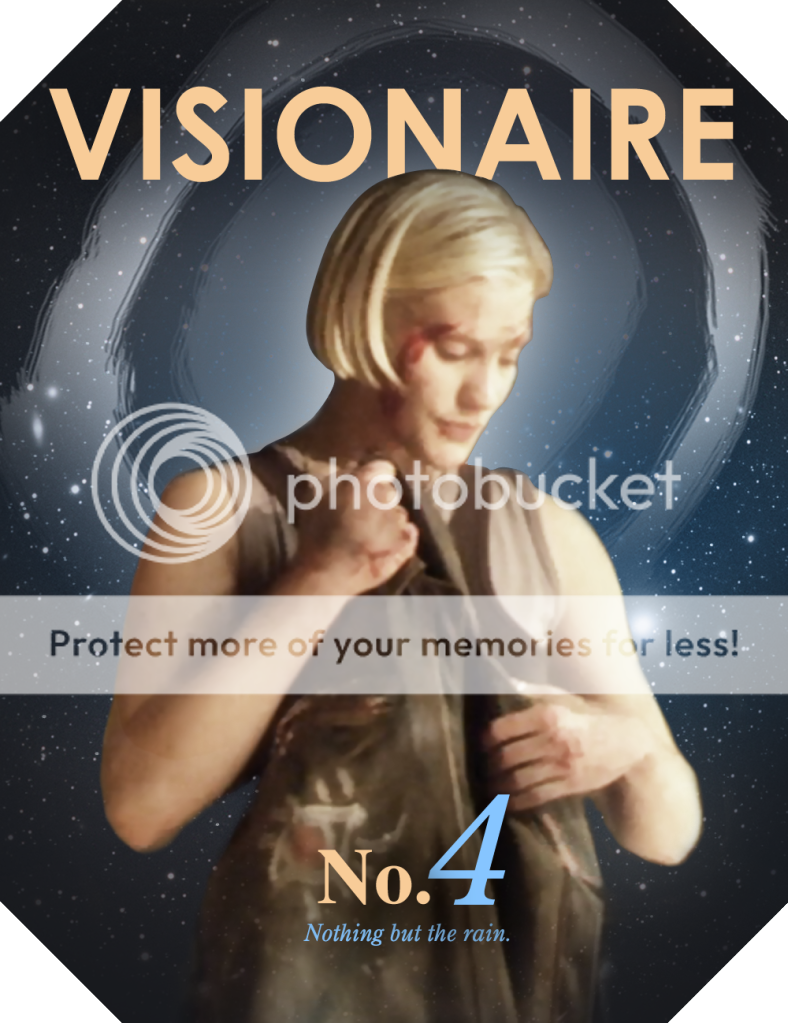
This character study of Starbuck reframes her bad girl behavior as Romantic, self-destructive artistic temperament. The vidder - herself an artist, of course - paints extravagantly over BSG's footage and collaborates with fanartist Deej to put Starbuck on the covers of the art magazine's I-D and Visionaire - which of course also both work as puns, considering Starbuck's identity quest and prophetic powers.

cover of I-D

cover of Visionaire

Destiny Calling: A Tribute To Vidding, by Counteragent (multi, 4:22)

A jubilant metavid made for "More Joy Day" (a fannish holiday dedicated to spreading joy) which demonstrates the vidding community's ability to articulate its own aesthetics, build its own canon, and celebrate its own talent. (Many of these vids and vidders will be easily recognizable to DIY 24/7 participants!)

Francesca Coppa is Director of Film Studies and Associate Professor of English at Muhlenberg College. She is also a founding member of the Organization For Transformative Works (OTW), a nonprofit organization established by fans to provide access to and preserve the history of fanworks and culture. Coppa and OTW recently worked with the Electronic Frontier Foundation to get a DMCA exemption for noncommercial remixers like vidders. Coppa also writes about vidding both as a feminist art form and as fair use.

DIY Media 2010: Fan Vids (Part One)

This is the third in an ongoing series of curated selections of DIY Video prepared in relation to the screening of DIY Video 2010 at the Hammer Museum in Los Angeles and organized by Mimi Ito, Steve Anderson, and the good folks at the Institute for Multimedia Literacy. The following curator's statement was written by Francesca Coppa, a long time fan and media professor researching the feminist tradition of fan vids. Vidding is one of the oldest forms of DIY remix. Invented and still largely practiced by women, vidding is an art form in which mass media texts, primarily television and movies, are remixed into fan music video. In the mid-1970s, women created vids with slides; in the 1980s, they used VHS footage, editing with home equipment and tape-to-tape machines. Today, vids are made with digital footage using computers and sophisticated digital tools, and vidders - who have always been interested in aesthetics as well as argument - have more and more opportunities to bend the both style and content of pop culture to their will and taste.

Many people still don't "get" fan vids, seeing them either as incomprehensible mashups or mere celebratory slideshows. In fact, vidding, like most forms of remix, is about critical selection and the editing eye: deciding what to put in and what to leave out. Vids can make very sophisticated arguments about the source text's plot and characters, and even its ideology. While some vids are edited to broadly emphasize certain themes, images, or characters, and are thus easily understandable to the uninvested spectator, other vids are made specifically for fellow fans who are assumed to be familiar not only with the source text but also with the conventions and established aesthetics of vidding.

At the most basic level, turning film and television into music video represents a fundamental change of genre. While most mass media stories have a forward-moving, plot-driven structure, music video is more like poetry: expressive rather than descriptive, concerned with feelings and rhythm rather than the distanced narration of events. Like poetry, music video is also a highly concentrated form, distilling hours, days, or even weeks of footage into three or so minutes! Consequently, looking away from the screen during a vid is considered to be as offensive as arbitrarily deciding to skip words in a poem, since every moment, every conjunction of image and music, carries meaning.

While not all vidders are part of the organized communities, there is a longstanding tradition of vidding within shared groups, partly because in the pre-digital age, vidding was complicated and expensive, and so the mostly all-female vidding collectives shared equipment and skills. (See Henry's 1991 chapter on fanvidding in Textual Poachers.) While today most vids are released straight to the web, fans making vids in the 1980s and 1990s had to take their vids to conventions if they wanted anyone to see them, so even today many vidders debut their vids at conventions like MediaWest, Escapade, Bascon, and Vividcon, which is entirely devoted to vidding.

Moreover, the fans who attend these conventions have developed their own critical vocabulary for talking about vidding, and an institutionalized "vid review" based on art show reviews. Escapade features a 2 hour vid review; Vividcon not only has that, but also an additional "in-depth vid review" focused on only one or two vids. Even more recently, vidder bradcpu has been making a series of vidder profiles: short documentary films historicizing and analyzing the work of particular vidders. Like any advanced art form, vidding has developed its own conferences, critical literature, and theoretical apparatus.

Vidding Programme.

* vids marked with an asterisk appeared in the main programme.

The following represent a selection of notable vids made from 2007 - 2010.

* I'm On A Boat, by kiki miserychik (Star Trek, 2:36)

This vid expresses the widespread fannish joy over the 2009 Star Trek movie; it also captures the reboot's younger, more frat-boyish tone compared to the original series. It's worth noting that this vid, along with a wave of others, was made from a camcorder copy in May 2009. (See also: Too Many Dicks on the Dance Floor by Sloane in the political remix section.)

Handlebars, by Flummery (Doctor Who, 3:27)

Probably the most successful vid of 2008, this meticulously-crafted character study of the Tenth Doctor spread beyond its community and intended audience almost immediately, eventually reaching--and being praised by--the show's creative team. As one fan noted, "Flummery completely called Ten's character development, and well over a year ago at that. The Doc has, indeed, gone completely handlebars on us."

Francesca Coppa is Director of Film Studies and Associate Professor of English at Muhlenberg College. She is also a founding member of the Organization For Transformative Works (OTW), a nonprofit organization established by fans to provide access to and preserve the history of fanworks and culture. Coppa and OTW recently worked with the Electronic Frontier Foundation to get a DMCA exemption for noncommercial remixers like vidders. Coppa also writes about vidding both as a feminist art form and as fair use.

From a Cyberspace of Their Own to Television 2.0: An Interview with Rhianon Bury (Part Two)

You closed A Cyberspace of Their Own with a call for more research which dealt with issues of race and class as they relate to fan practices. While some such work has been done, this still remains largely unexplored territory. Why do you think it has been so hard to deal with race in fandom as compared to issues of gender and sexuality?

I think it's because fandom is predominately white as are the scholars that study it. This is not to say that people of colour are not fans! But I suspect that they are a minority in many of the participatory cultures that are being studied. Moreover, many do not mark themselves out in terms of their racial identity and therefore are assumed to be white by the other participants.

In contrast, there is a solid body of literature dealing with race and ethnicity in media and film as well as in cyberspace and digital culture. In general, critical discussions of race are started by scholars of colour who have investments in a politics of social transformation much the way that critical discussions of gender were started by feminists (most of whom are women). I chose to work with female X-Files fans, in part, to underscore both their experiences of marginalization in public cyberspace and their strategies of resistance. The subtitle of my book is an intentional reference to Virginia Woolf's famous essay, "A Room of One's Own."

Your book discussed the function of humor in the female-centered fandoms around The X-Files and Due South. There is still relatively little writing on fan humor as compared to the more romantic, erotic, and melodramatic aspects of fan production. Why? What has Fan Studies missed by not focusing more on fan humor?

I haven't a clue why so little is written about humor. Having a background in sociolinguistics, I have a particular interest in language practices and in how things get said, not just in what gets said. Humor plays such an important role in the community making process, cutting across fan interactions and practices, including romantic and erotic talk. As I argued in Cyberspaces, humor is bound up with class, gender and by extension race and ethnicity and nationality. I looked specifically at the repartee, the plays on words and witty exchanges by white, middle-class educated "elite" fans. I'd be very interested to learn about the role of humor in other contexts.

Your discussion of Due South explored the ways that fans did or did not connect with its "Canadian" origins. We are seeing ever more international content develop American fan followings, increasingly based on its accessibility on the internet. Does this process of acquiring the content change how fans think about its national origins?

When I look back, I'm struck by how ahead of their time the American Due South fans were. Many of the MRKS members I worked with in 2000 had never seen the series when its first two seasons were originally broadcast on CBS (Due South was a Canadian-US coproduction at that time.) They either picked it up in syndication or heard about it from fans in other fandoms. There were no opportunities to even rent or buy commercial DVDs.

Due South with its American fan base was part of what Chris Barker calls reverse flow. In his 1999 book, Television, Globalization and Cultural Identities, he challenged the notion that the one-way flow of American programming to the rest of the world would lead to the homogenization of culture and the erasure of local and national identities. The more likely outcomes, he argued, were fragmentation and hybridization. You're certainly correct to suggest that online accessibility is providing more opportunities for Americans to become fans of series from other countries.

Whether this changes their sense of national identity (and there are differing notions of what constitutes being American) remains to be seen. I think that will depend on the type of content being viewed, the viewer's other identifications (e.g., race, ethnicity, gender) and the context of viewing. My sense is that the majority of non-US programming with large American fan followings is British--Dr Who and now Sherlock come to mind. The Anglo-American flow is hardly new although the ability to download episodes almost immediately after they are broadcast in the UK instead of waiting months for the series to be broadcast in North America does offer the opportunity for American fans to hang out in fan spaces dominated by British fans. Considering that most Americans and Canadians outside of Quebec are monolingual, their opportunities to consume a range of international media content and participate in discussions are rather limited.

In your more recent work on Six Feet Under, you have questioned some of the founding assumptions of fan studies. In particular, you have challenged a tendency to equate fan resistance with progressive politics. What do you find in your work on HBO discussion boards which led you towards a different understanding of fan politics?

I was a huge fan of Six Feet Under but only occasionally perused the HBO boards until I watched the fourth season episode, "That's my Dog." As some folks may recall, this episode focused almost exclusively on the psychological and physical violence inflicted on David Fisher by a young man whom David had stopped to help after his car broke down. I had strong but very mixed emotions: on one hand, I was horrified by what had happened to a character I was emotionally attached to; on the other, I felt manipulated by the writers.

So off I went to the HBO boards, where I discovered a number of posts containing vitriolic homophobic comments, blaming David for his victimization (a fantasy scene indicated his initial sexual attraction to the young man). I was shocked that such comments were made by fans of a show with a central gay character.

My later analysis of the posts for the episodes of Season 4 revealed a remarkable pattern of interaction around every storyline in which David expressed explicit gay desire (e.g., giving a blowjob to a plumber in the funeral home; having sex with Sarge, a man he and Keith had picked up and played with after a paintball tournament). First the man-on-man sex scenes were flagged as "excessive," with negative references made to Queer as Folk. These were followed by complaints that David's expression of desire was out of character or morally questionable, and finally by complaints that there was too much "gayness" on television in general.

Of course not all fans responded this way but even the well-meaning comments made in defense of David's actions served to erase his identity as a gay man. I described these fans as textual gamekeepers. Unlike the slash fiction writers who poach by queering the characters that have been written by the producers as straight, these fans "straightened out" the gay storylines. I bet there's a whole lot more textual gamekeeping going on in fandom that has yet to be uncovered.

While your earlier research seemed to focus on relations within the fan community and on interpretive and evaluative responses of fans to the series texts, this new research seems to focus much more on the technologies we deploy in accessing content. Will these strands ultimately come together? What relation exists between whether fans consume content on Hulu and the kinds of social and meaning-making practices that evolve around that content?

It's true that in my previous work I did not pay attention to modes of viewing or the accessing of content. Until recently, fan scholars just assumed that fans as committed viewers watched the original broadcast or a home recording shortly thereafter if they had to miss it. Even the technologies that enabled the creation of fan cyberspaces I studied were in the background. These new modes of consumption, production and interaction are unlikely to change the ways in which fans make meaning out of texts or the community-making process.

However, they certainly have the potential to change what it means to be a fan, how one becomes a fan, what one does as a fan and the kinds of relationships one has with other fans. These are the types of questions that I hope to begin to answer with the survey and interview data.

Let me close by saying that Web 2.0 technologies are changing the way I disseminate research on fandom. The norm in academia is to analyze our data behind closed doors and not report on it until we have a finished "product" in the form of a conference paper, a journal article, a book chapter, etc. With the use of blogging and microblogging technologies, I plan to informally report on findings as I work my way through the data in the coming months. I hope this will provide opportunities for dialogue with fans and fan scholars, and in turn provide feedback to inform my analysis.

Rhiannon Bury is an Assistant Professor of Women's and Gender Studies at Athabasca University, Canada's Open University. Her research interests include communication technologies, identity and community, and media fan culture. Her book, Cyberspaces of Their Own, was published by Peter Lang in 2005. She is currently collecting data for her Television 2.0 project. To take the survey, visit here. Check out her blog.

From a Cyberspace of Their Own to Television 2.0: An Interview with Rhianon Bury (Part One)

Several months ago, I was contacted by Rhianon Bury, an early contributor to the scholarly research on female online fan communities through her book, A Cyberspace of Their Own, asking me to help her publicize a survey she was conducting on how fans engaged with new delivery platforms for television content. Bury agreed to do an interview for my blog which deals with this new initiative and what it means in terms of her own methodological approaches (an expansion from primarily ethnographic to a more hybrid approach), as well as shifts in the field of fan studies and new media since 2005 when her book first appeared. Like many of us, Bury is finding it hard to separate out the study of media audiences, creative industries, and new media practices, at a time when some aspects of fan culture have become more central to the operations of convergence culture, while, as many recent scholars note, others remain marginalized and in some cases, continue to be fully hidden from outside attention.

You have recently launched an online survey designed to better understand the shift in the media consumption patterns of fans in response to the changing affordances of the new media environment. What kinds of shifts are you hoping to explore?

I am interested in learning more about shifts in both modes of viewing and fan practices afforded by time shifting, streaming, downloading and Web 2.0 technologies. Industry data has provided a starting point for my "Television 2.0" project. According to Nielsen, 38 percent of US households now have DVR/PVRs, up from 33 percent in 2009 and 24.4 percent in 2008 (TVbytheNumbers). In addition to its traditional Live data stream, Nielsen produces two additional streams: Live+SD (same day) and Live+7 (seven days). Although the latter are not significant in setting advertising rates, their effects are starting to be felt in network decision making. Writing in the New York Times, Bill Carter suggests that NBC's The Event was spared early cancellation on the strength of its Live+7 numbers. NBC subsequently ordered a full season, although it remains to be seen whether all will be broadcast given that the live/live+sd numbers continue to fall (Toni Fitzgerald).

A number of recent surveys by marketing research companies attempt to quantify the popularity of viewing of time shifted and online content. Say Media, for example, found that 56 million Americans are "off the grid viewers," 13 percent of whom can be classified as "opt outs" who have no longer watch live TV at all (GigaOM). This matches Strategy Analytics findings that 13 percent of Americans are planning to cancel their cable subscription in the next year. The large majority of "cord cutters" are under 40 and are college educated.

This type of industry data, however, cannot capture the complexity of viewer and fan engagement with multiple screens and platforms. I want to know how much television programming people are watching in front of the television screen, the computer screen and/or on a mobile device. I also want to learn more about what kinds of programming people watch (and rewatch) on which platform(s) and under what circumstances. Television programming is not a homogenous category and viewing is not a homogenous activity.

In terms of media fandom, anecdotally we know social media looms large. Web analytics software can quantify views, hits and clicks of primary and ancillary content on network sites, Hulu, and YouTube. The resulting data, however, tells us very little about the heterogeneity of fandom in terms of the range of practices that fans engage in (or not) and their varying levels of investments and involvement in participatory cultures.

Until now, you have been seen primarily as a qualitative researcher. What has motivated you to adopt a more quantitative approach to this project?

First of all, I am trying to fill what I see as a large gap in the study of fan and participatory cultures. It is of great concern to me that eighteen years after the publication of your very important work, Textual Poachers, no large-scale quantitative academic studies have been conducted. Without valid and reliable data, we cannot make generalizable claims about fan practices. We know fans watch television programming on a variety of platforms, go to cons, participate in online discussion forums, are members of online fan communities, read and write fiction, make vids, live tweet episodes, etc., but we have no idea how widespread these practices actually are among the fan population to use research terminology. Getting a snapshot of this population is not only interesting but critical to establishing a legitimate field of study, at least in the social sciences.

Moreover, unlike my previous research, my starting point is not a particular fandom but rather the individual viewer/fan. There is a tendency among fan scholars to study the fandoms of which they are a part. Methodologically, there's nothing wrong with this choice as long as one is sufficiently reflexive. Such an approach also foregrounds research questions on community and community making. I'm sure we all know people who really enjoy particular television shows but who don't actually do much more than watch the show, talk about it face-to-face, add it to their list of "likes" on Facebook and/or go to the broadcasting network website on occasion.

The Television 2.0 project is actually a mixed methods study. I will be doing not only a quantitative analysis of the data collected in the survey but a qualitative one as well. The second phase will consist of follow up interviews with interested survey respondents, starting (I hope) in early 2011. I still consider myself primarily a qualitative researcher because my interest in measurement is not an end in itself.

You published Cyberspaces of Their Own: Female Fandoms Online in 2005 and it reflects research done much earlier than that. What do you see as the biggest changes in online fandom over that time?

It's hard to believe that almost fifteen years have passed since I started working with members of the David Duchovny Estrogen Brigades (DDEBs). In the preface to Cyberspaces, I recounted first discovering their websites using a lynx browser on Mozilla using a monochrome monitor. I can't even visualize that interface today!

Beyond the obvious technological changes, one of the biggest shifts has been in the gender composition of fan-based cyberspaces. Research on internet access and use shows that gender parity was reached around 2000 in North America. Would the DDEBs be set up as private female-only listservs today? I doubt it, not because listserv technology is obsolete (at least for this purpose), but because the Usenet group (alt.tv.x-files) where the founding members originally met likely would have had far more participation from women, thereby "diluting" the sexist attitudes of more vocal male members of that forum. In other words, the practices engaged in by the majority of members would have created different community standards or norms.

More significantly, online X-Files fandom would not have been concentrated in one space. A range of alternatives would have been available: discussion forums on Fox and Television Without Pity; LiveJournal and Dreamwidth, particularly for fan fiction writers and vidders; Second Life and Facebook. Fans who had felt personal affinities with others on the various forums they visited would have become personal Facebook friends. Earlier this year, I reconnected with some of my research participants from the DDEBs on Facebook, which has been fun. And just this week, I read the status update from one of the members of the original DDEB indicating that she has created a private Facebook group for the community.

A second major shift that I would like to mention is related to the production of television's secondary texts or paratexts. There was been a lot of "industry creep" into the areas that were once exclusively the domain of fans. Most networks host discussion boards and produce a range of ancillary content for their series websites, including quizzes, polls, games, as well as facebook pages and twitter feeds. The reasons for this move are obvious: fans are also consumers and media content producers want to foster fan loyalties to their brand. Combine easily accessible sites with the power of Google and YouTube, the latter which allows for far wider distribution of fan vids than in the past, and the result is a multiplicity of entry points into fandom.

Rhiannon Bury is an Assistant Professor of Women's and Gender Studies at Athabasca University, Canada's Open University. Her research interests include communication technologies, identity and community, and media fan culture. Her book, Cyberspaces of Their Own, was published by Peter Lang in 2005. She is currently collecting data for her Television 2.0 project. To take the survey, visit here. Check out her blog.

When Politics Meets Pop Culture: The Mid-Term Election Report

I am writing this well before any election returns have come in. At the moment, I do not know for sure how well any of these candidates fared in the American mid-term elections last night (and given the likely results, I might prefer to remain in blissful ignorance for a bit.) Actually, if you are reading this it is probably because I stayed up way too late last night watching the returns. Over the past few weeks, I've been picking up a range of political ads which are, in one way or another, inspired by contemporary popular culture. As many of you know, I'm doing research right now on the concept of "fan activism" and the related concept of the "consumer-citizen," both ways of getting at the blurring of the lines between politics and entertainment. This has been a key theme running through the campaign season here -- especially as journalists and academics alike have come to grips with the Jon Stewart and Steven Colbert rally for sanity in Washington last weekend. I thought these spots, drawn from races around the country and a range of organizations, might spark some productive conversations on the day after the election.

Here's one produced by the John Manchin (Democrat) campaign for the U.S. Senate in West Virginia.

Don't blame Manchin. The title of George Lucas's science fiction classic has been linked to missile defense systems since the Reagan era. In this case, the candidate just knows how to build on that imagery to transform the campaign in a space opera.

This spot, produced by GOP Proud, uses knowledge of reality television (in this case, Real Housewives of New Jersey) to construct a critique of three leading Democratic figures.

Here, the Pat Quinn (Dem.) for Governor campaign in Illinois borrows a few notes from Glee to try to catch voters up to what they've missed so far in that election cycle. Of course, Quinn took office after the previous governor Rod Blagojevich resigned (under scandal) and went on Celebrity Apprentice.

Here, Young Republicans take aim at the president who has become famous for campaigning on Facebook, representing youth voters as recovering from a bad online romance with an abusive boyfriend. This seems the logical followup to the celebrity-themed spots which the McCain campaign ran during the 2008 election campaign, though they are created by someone who knows what Facebook is and who is also no doubt aware that The Social Network has been generating buzz at the box office.

This last spot, produced by Jerry Brown, has been credited with helping turn around the Governor's race in California. I've included it not because it features our Terminator governor (we've gotten used to that) but because in many ways, its juxtaposition of Meg Whitman and Arnold Schwartzenegger resembles one of the segments on The Daily Show which digs into the news archive to contextualize contemporary news footage.

So here are some questions to consider about these videos:

  • Which genres or forms of popular culture did they each evoke?
  • What kinds of fan knowledge or consumer interests do they tap?
  • What tone or attitude do they adopt towards the popular culture forms in question?
  • What kinds of rhetorical work are the pop culture references doing here?
  • Do the spots situate the candidate and the viewer as equally in the know about popular culture?
  • Do any of them seem pandering or patronizing in their use of pop culture images? If so, why?
  • How might we relate such spots to the "culture wars" which have long defined national politics? Is there a difference in running against popular culture as "cultural pollution" and mobilizing popular culture towards other political ends?
  • Are there differences in liberal and conservative strategies for deploying pop culture references?

I'd love to have readers send in other examples from this campaign season where candidates drew upon pop culture references to help frame their political messages.

theaskanison, one of my Twitter followers, has added this Twilight Zone themed spot to the mix:

Henry Jenkins The Movie or How Does Fandom Happen?

Around the same time as Teenage Paparazzo first appeared on HBO, I was participating in a Social Media week event billed as a "Fanthropology" workshop here in Los Angeles, hosted by Cimarron Digital, and intended to share insights with area media makers about how they might productively reframe their relations with their fans. I was asked to deliver some opening remarks as a "fan expert" and then join a panel of entertainment bloggers as they talked about their relations with the media industry. My fellow speakers were:

  • Alex Billington, FirstShowing.net movie blog, Owner and Executive Editor
  • Brett Erlich of Current TV, host of The Rotten Tomatoes Show and the Webby Award winning Viral Video Film School segment on infoMania.
  • Babette Pepaj, CEO of BakeSpace.com, the Webby-award nominated largest food-themed social network, which has created social campaigns for Desperate Housewives, Julie & Julia, Grey's Anatomy, It's Complicated, Ugly Betty, etc.
  • Scott Perry, New Music Tipsheet music blog founder
  • Eloise Hess, 15on15, 15-yr-old Creator, Producer, Host. 15on15 is a live music, video web series and music blog which has interviewed bands including Dead Man's Bones, Local Natives and Titus Andronicus @15on15
  • Jovana Grbic is the Creator, Editor and Creative Director of ScriptPhD.com, a blog and creative consulting company focused on science and entertainment

and the event was moderated by Digital LA founder Kevin Winston and Cimarron's Kristen Olson.

How Does Fandom Happen? from Cimarron Digital on Vimeo.

Stitched through the discussion was a power point presentation created by the Cimarron Digital team which explored the stages through which the media industry fed and responded to fan interest surrounding the emergence of a media property.

Much to my amusement, the slides were organized around Henry Jenkins the Movie. A highlight for me was a photoshopped image that shows what the more or less appropriately aged and built Bruce Willis would look like wearing suspenders, glasses, a grey beard, and my alternately bald and shaggy pate -- that is, in the branded, trademarked, and copyrighted persona of Professor Jenkins which I sometimes play in the media.

Here's part of a synopsis created for the rather unlikely Henry Jenkins vehicle:

In the Summer of 2011, America's attention is held in thrall by the 24/7 news machine, focusing on the deterioration of the Space Station and last-minute rescue attempts to remove the scientists and experiments aboard it before it potentially crashes to earth. For Henry Jenkins, however, business goes on as usual in preparing to attend the San Diego Comic Con... until a mysterious woman leaves a mildew-ed, yellowing packet of papers in his office containing an ancient prophecy predicting the space station's crash, and suggesting that only George Takei can stop it. He brushes it off until reaching Comic Con and discovering the situation is dire: not only are several major cities threatened by the crash, but the suggestion of sabotage has the makings of an international incident. As San Diego is one of the cities under threat, organizers have curtailed activities in cooperation with local authorities.

Though he dismisses his own concerns as foolish, the product of an idle mind, Henry is compelled to find George Takei and show him the papers. Despite being a respected professor, he can't even get close; Takei's people won't let Henry see him, and the papers are scattered. He can only recover a few, but as he does, he realizes that the George Takei depicted isn't the George Takei of today, but of 1967, during Star Trek's second season. Confused and frustrated, and figuring someone has played a practical joke on him, he makes his way out of the exhibition hall, colliding with a young woman in steampunk gear, Sally. The papers go flying again, but this time he leaves them. Sally picks them up and returns them to him anyway, and noticing their content, offers to help him with his "time travel problem."

Of course, he's still going to need Takei - otherwise he won't be able to find his past self. So Henry waits for an opportune moment during the Con and grabs Takei, stuffing him into an elaborate costume to avoid detection. When Takei wakes up, they're in the basement of a San Diego hotel with Sally and her steampunk friends. One of whom is suspiciously military-looking. He hands them a couple of devices that don't look anything like steampunk technology, and, before Takei can object, zaps them back to 1967. No explanations, instructions, or anything. Just zap!

Takei is furious. He immediately attempts to kill Henry in an epic fight, before calming down and remembering he's a pacifist. Henry shows him the few papers he has left, and by his reaction, it becomes clear that they mean something different to George than to Henry. He immediately recognizes the nickname of a man he met in 1967 called "The Dreamer." He doesn't know what he has to do with it, but he agrees to take Henry to where he was when he met The Dreamer... The Monterey Pop Festival in San Francisco. But neither one of them has a car...

I don't know about you but I'd certainly buy multiple tickets to that movie and almost certainly grab it when it came out on DVD! Your stakes might be a bit lower than mine, but still, you can surely see why this movie would generate buzz. We might call it William Shatner In Love With Himself or as the Hollywood team preferred, The Redemption of Sulu.

As it happens, I do not know George Takei, but I did have a chance to moderate a panel featuring the Star Trek actor at MIT where he was taping narration for a game in which he played one of my faculty colleagues, Shigeru Miyagawa, so sometimes reality is almost as strange as fiction. At the time, our biggest concern was heading off likely audience questions that might attempt to out the still closeted Star Trek performer, though today, he's a poster child for gay marriage in California.

For the presentation, the Hollywood types had mocked up everything from Tweets and Facebook updates to blog posts, suggesting how the fan community would respond to news about the production -- from its initial announcement through to subsequent announcements and promotions. The goal was to prod the panelists into reflecting on the ways that they, as entertainment bloggers, interfaced with the publicity machine surrounding a major studio release. They did a very effective job at simulating the courtship dance between producers and fans, including unauthorized leaks (and strategies for dealing with them) and fan objections to race-bending casting decisions as well as more carefully controlled PR releases. Below are a sample of the materials generated for this event.

As the presentation's narration explains:

A film is in social media as soon as it's announced - because today, that announcement always occurs through an online news source. An aggressive social media strategy means you leverage every drop of content, using it when it will be most effective. As soon as you announce a film, there will be people - we call them "bleeding edges" - that will be looking for information. Setting up channels for information early establishes the studio as an accessible and important news source.

Their presentation worked through how the studio gradually reveals information about the production, how it responds to fan speculation and gossip, how it fuels and expands audience interest, and how it incorporates grassroots intermediaries into the information flow. It is a strategy designed to build buzz and cultivate but not regulate the growing fan base around this property. I've included some samples from their slides below.

All in all, I felt they did a plausible job of modeling fan response, including how the fan base emerges from existing fan communities, how interest gets expressed initially through speculation and later through various kinds of cultural production, how fans develop a sense of ownership over the property and sometimes doubt the legitimacy of the people producing it, and how this buzz may or may not translate into box office success.

After all, Scott Pilgram went through this entire cycle only to disappoint its producers, though I have argued this has as much to do with inflated budgets leading to inflated expectations. After all, if Scott Pilgram was a small budget indie film (on the same level as the comic on which it was based), it would have been fantastic to see it ranked fifth in that week's box office, where-as seeing a highly touted major studio release there was a devastating disappointment.

After all of this excitement, I will now go back to my normal life as a mild-mannered, absent-minded, and over-worked USC professor who wants to make the world safe for participatory culture. But you never know when I may get pulled back into duty as a time-traveling adventurer or when I may find myself being played on screen by Bruce Willis. When duty calls, I hope to have the smart folks at Cimarron Digital build the PR campaign for my big screen adventures.

How YouTube Became OurTube

In 2008, the University of Southern California hosted 24/7: A DIY Video Summit, which was organized by Steve Anderson, Mimi Ito, and the fine folks at the Center for Multimedia Literacies. Here's some of what I wrote about the conference at the time:

The conference featured screenings focused on 8 different traditions of production-- Political Remix, Activist Media, Independent Arts Video, Youth Media, Machinima, Fan Vids, Videoblogging, Anime Music Video. The inclusiveness of the conference is suggested by the range of categories here -- with avant garde and activist videos shown side by side with youth media, machinima, anime music videos, and fanvids. The curators were not outsiders, selecting works based on arbitrary criteria, but insiders, who sought to reflect the ways these communities understood and evaluated their own work. Paul Marino, who directed Hardly Workin', and who has helped organize the Academy of Machinima Arts & Sciences, put together a crackerjack program which took us from the very earliest use of games as animation engines through the most contemporary and cutting edge work, spanning across a range of different gaming platforms, and mixing videos which are about the games world with those which have a more activist or experimental thrust. Laura Shapiro, an experienced video-maker, brought together a range of fan music videos, again representing a diverse cross-section of fandoms, while Francesca Coppa offered informed critical commentary which identified the schools represented and their aesthetic and thematic goals for their works. Tim Park, an experienced AMV producer, put together a program of anime videos drawn from more than half a dozen different countries.Even in those categories I thought I knew well, I was familiar with only a fragment of the works shown, and even where I thought I knew a work well, I understood it differently when read in the context the curators provided. In some cases, these materials were being shown outside their subcultural community for perhaps the first time. Having written about fanvids since the 1980s, I was delighted to see them gain a public exhibition in this context and for media students to get a sense of the aesthetic complexity and emotional density that is possible working within this form.

Ito and Anderson recently returned to these same curators to see if they could offer us an updated view of their corners of DIY video culture. The IML team edited together a remarkable compilation representing of the key trends in contemporary online video for a screening last month at Los Angeles's Hammer Museum.

24/7 DIY 2010: Collective Action from IML @ USC on Vimeo.

I was asked to give some remarks after the screening and I thought I would write out some of my core ideas below. I have also asked the various curators to share their selections (with commentary) through my blog over the next few months. So, keep an eye open for what should be a fascinating series of snapshots of the best of contemporary DIY video.

How YouTube Became OurTube

I always stumble over pronouns when thinking about YouTube. After all, in the English language, "You" is both singular and plural. Most accounts of YouTube assume that it is a space for personal expression, yet if this is the case, why used networked technologies. It is not simply a site for self-branding or "broadcasting". Rather it is a site for collective expression, with many of the videos posted there coming from specific subcultural communities, each of which has a longer history than YouTube itself, each of which has evolved its own traditions of cultural production and circulation. So, for my purposes, let's consider the "You" in "Do-it-Yourself" as plural, multiple, collective, rather than singular, personal, individual.

This sense of YouTube as composed of many different production communities is vividly illustrated by the opening segment of this video, which shows how "I'm On a Boat," traveled from a Feb. 2009 sketch on Saturday Night Live, across many of the different subcultural communities represented in this program -- as it gets applied to anime and Star Trek, as it gets performed by A Capella groups and by the U.S. Navy, as it gets rewritten into "I'm on a Blimp" or "I'm on a Broom" to better fit the interests of specific fan communities. What we see here are the consequences of these various DIY media production communities coming together to a shared site where they can see what each is doing and where they can quickly apply what they learn to their own work. We can see this process as one which both impacts these various subgroups and starts to create a shared culture which runs across all of those populations who have chosen to use YouTube as a site for distributing their work.

All of this is a vivid illustration of what I've described elsewhere as "participatory culture." In a participatory culture, there are relatively low barriers for engagement and participation, there is strong support for sharing your creations with others, there is a system of informal mentorship where experienced participants help train newbies, and there is a sense that others care about what you say and create. Each of the subcultures represented here have some if not all of the properties of a participatory culture, and when YouTube provides a home for these communities, it acquires some of those properties as well, though it is less clear whether anyone has a primary identification with YouTube and it is very clear that in some ways YouTube itself (especially in its comments sections) can be hostile to the diversity that a participatory culture needs to thrive.

All of this is to say that Web 2.0 is not participatory culture. The Web 2.0 companies seek to court, capture, and commercialize aspects of participatory culture but they do not create it and they do not own it and often, their commercial interests are imperfectly alligned with the noncommercial interests which motivate DIY cultural production. What I am calling participatory culture has a long history -- we can trace its roots back to the folk cultural logic which has shaped human expression throughout much of its history; throughout the late 19th and 20th centuries, participatory culture has run through many struggles of everyday people to capture the means of cultural production and to communicate their own stories to the world, a history which runs across many different technological platforms and many different cultural communities.

As I suggested in my essay, "What Happened Before YouTube?," our society was ready for YouTube when it appeared, which is why it was flooded so quickly with all forms of amateur and noncommercial media production, many of which had been looking for a site for circulation and exhibition. While the mad rush to get their work on YouTube is impressive by any criteria, it was a byproduct of long-standing interests within these various groups in producing and sharing media with each other. Some of the practices represented in this program build on those traditions, while others reflect the new potentials which have emerged as a consequence of the hybrid media ecology which has formed at the cultural crossroads which YouTube represents.

Confronting the quick spread of themes and sounds represented by the "I'm On a Boat" phenomenon, many fall back on empty phrases, such as "viral" or "meme" to explain what is going on. In our forthcoming Spreadable Media book, Sam Ford, Joshua Green, and I dissect these concepts, suggesting that they each mystify rather than clarify the process of cultural production and circulation by treating culture as if it were "self-replicating" rather than acknowledging the human agency involved. In particular, the "I'm on a Boat" videos break down the notion of "fidelity" which runs through writing on Memes and Viruses: we do not simply pass these songs on from mind to mind, rather each new group makes its own contributions, leaves its own mark on what the others have produced. These videos are not simply spreading rapidly, like a contagion, but they are evolving rapidly, through a high speed and high tech version of the folk process.

Some of what gets produced for YouTube may start as self-branding, but the work that matters to people matters because it invites their participation, because it encourages them to join the action, even if only through spreading the word. We see this process at work in the segment featured here showing Matthew Harding's "Where the Hell is Matt?" videos, which began as one man's tour of the world, dancing to the sound of his own drummer, but ends with larger and larger groups of people dancing along with Matt. Other featured videos turn our attention towards collective action -- encouraging people to share images of their communities working towards shared interests or agendas. This tendency is spectacularly represented here by the 350 Movement and The GayClic Collab Against Homophobia, both represented in the "All Together Now" portion of the video. In other cases, the videos function as a call and response system, encouraging people to jam together, even though they remain geographically dispersed, as can be seen in "The Mother of All Cords." This desire to express collaborative or collective expression may be what fuels the proliferation of windows, a set of formal practices which gets singled out later in the program.

The program also offers us some examples of how the community passes along knowledge to newer members, shown here in "AMV Technique Beat," an Anime Music Video about the conventions shaping the Anime Music Video genre. And elsewhere, we get the sense of the video platform as a site for important community conversations, as the curators brought together a selection of the different responses to the Derrion Albert beating. As Jean Burgess and Joshua Green have noted in their book about YouTube, even seemingly unprocessed clips, segments taken from commercial films and television series, may serve as resources for the community's conversations, with the comment sections on the site and elsewhere being as important to the process as the video itself. YouTube has become a platform where we go to talk about, through, and around videos, and the site's willingness to make it possible for us to embed these videos on social networking sites and blogs is another key factor in enabling it to support these kinds of dialogues between and within diverse populations.

As I reflect on this process of transforming media content into resources for conversation and communication, I am reminded of the work of my mentor, John Fiske:

"If the cultural commodities or texts do not contain resources out of which the people can make their own meanings of their social relations and identities, they will be rejected and will fail in the marketplace. They will not be made popular."

Fiske insisted that mass culture texts only became popular culture when the public took them up as "resources" through which they could express their own perspectives.

Fiske's theories in the 1980s helped prepare me and many media scholars of my generation for contemporary remix culture. The "Deconstructing Our Icons" and "Putting Words in Our Mouths" sections here show this remix process at work. Each of the subcultures that are reflected in the current program draws some of its raw materials from popular culture, but several of them -- the Fan Vidders, the Anime Music Vids, Machinema, and the Political Remix vids -- in particular are built around different strategies for appropriating and remixing video content. In some cases, the original content is abstracted beyond the point of recognizability, while in others, the point is for us to recognize it both in terms of its original context and the new context into which it has been inserted. There are several striking examples here from the last presidential campaign, including "Terrorizing Dissent" where McCain's convention speech is juxtaposed against the police's assault on protesters outside, "Dance Off" where McCain, Obama, and Palin dance for their awe-struck publics, and "Synchronized Presidential Debating" which makes visible the candidate's reliance on preset soundbytes rather than spontaneous engagement with their rivals. The selections from the Fan Vidding world also show us how the form is being increasingly used to make critical comments on the culture around them, as illustrated by the "Art Bitch" video based on Battlestar: Galactica and the "Piece of Me" video commenting on Brittany Spears and celebrity culture.

A striking shift from the 2008 to the 2010 videos has been the increasingly globalized nature of this grassroots media production. We see this in playful ways as media makers from the developing world join the "lip dub" movement or contribute to pass-along video compilations, but we also saw it in the ways that protesters in Iran were able to capture and transmit powerful footage of the action in the streets in the aftermath of their failed elections. The images of Neda gave a face to the movement and will remain key icons of the 21st century. If some have described, with a certain degree of mythologization, what happened in Iran as a "Twitter Riot," we need to also recognize that it was also a YouTube and Flickr riot. In each case, though, we need to recognize that these media were directed towards us in the west rather than being resources used in Tehran to mobilize the revolution that never quite came. The Iranians tapped new technologies and their strong diasporic network to get word out of their often closed country and to court public opinion around the world. This too is part of the story of DIY media in recent years.

Through this process of media sharing, we have collectively distilled attention around key images and moments which now form key elements of our cultural archive -- some of these elements come from mass media (such as Kanye West's disruptions and eruptions), some from the grassroots media (such as "Charley Bit Me," "Keyboard Cat," or "Double Rainbow,"). In either case, these images have become culturally central because they have provided many different groups with expressive resources. They have gained resonance as they have been deployed and redeployed through countless other videos and thus they have become part of the shared culture of the various networks which pass through YouTube.

In this context, each new formal innovation (capacities to autotune sounds, to layer on windows, or to use Little Big Planet to design characters and levels) travels rapidly from one producing community to another. Early on, the tool may become a source of fascination in its own right, while later, it simply becomes one more device which can be used to create a fan vid or score a political point. In such a context, it becomes challenging to maintain any sharp dividing line between different kinds of subcultural practices. What seemed relatively distinct in 2008 seems less so in 2010.

For me, one of the most compelling segments of this video involved the "lip dub," a practice of grassroots performance where communities of people get together and produce elabroate, single-take music numbers. As I watched these, I was delighted by the sense of collective joy as places of work -- stores, offices, and schools primarily -- get transformed into performance spaces, taken over as sites of play. Behind each such video there is a story of collaborative production, often creative expression which straddles other kinds of hierarchies - as bosses and workers, teachers and students, doctors and patients, work together to create something which allows each of them to feel a moment of stardom. Compared to many traditional societies our culture has surprisingly few such moments of collective joy, few chances to transcend fixed relationships and imagine new ways of singing and dancing together.

Here's a complete list of the videos featured in the program:

Get on the #@&$! Boat

"I'm on a Boat" A Capella | Acquire A Capella of UC Santa Cruz | 2009

I'm on a Boat - Star Trek | kiki_miserychic | 2009

I'm on A Boat (Wind Waker Version) | Matthew Gallant | 2009

Pokemon I'm on a Boat Music Video | DJPhiUp | 2009

I'm on a Blimp (ft. Teddy) | LittleKuriboh | 2009

In a Snuggie | Mikey and Big Bob | 2009

I'm on a Boat Navy Edition | Eychner | 2009

One Piece Tribute: "I'm on a Boat" | fishytoothy | 2009

I'm on a Broom (I'm on a Boat parody) | heynadine | 2009

All Together Now

Day 18 NaVloPoMo | Ermander |2009

Day 10 NaVloPoMo | miglsd | 2009

navlopomo#08 | Miguel Serradas Duarte | 2009

shadow out of time | AliaK | 2009

It's Time | Videolution | 2009

Why Would Anyone Want to Stop You from Voting? | Ian Inaba | 2008

The Day the World Came Together - The 350 Movement: October 24, 2009 | 350org | 2009

Where the Hell Is Matt? | Matthew Harding | 2008

THE BIG FAT GAY COLLAB! | steviebeebishop | 2009

The GayClic Collab Against Homophobia (from France) - Fuck You by Lily Allen | GayClicTube | 2009

SOUR '日々の音色 (Hibi no neiro)' | Masashi Kawamura + Hal Kirkland + Magico Nakamura + Masayoshi Nakamura | 2009

Deconstructing Our Icons

Ian Fleming's Property of a Lady | qwaga | 2009

Buffy vs Edward: Twilight Remixed | Jonathan McIntosh | 2009

Piece of Me | obsessive24 | 2008

Art Bitch | hollywoodgrrl | 2009

Creepy Mario 64 | LightningWolf3 | 2008

Terrorizing Dissent RNC08 - Trailer | terrorizingdissent.org | 2008

See it, Shoot it, Share it

Neda Agha Soltan, killed 20.06.2009, Presidential Election Protest, Tehran, IRAN | AliJahanii | 2009

DERRION ALBERT- BEATIN TO DEATH SEP, 27 2009 | laurenmonique19 | 2009

RE:Chicago student Derrion Albert KILLED in a FIGHT | lovelyti2002 | 2009

DERRION ALBERTS BEAT TO DEATH AT 16YRS OLD (Fenger Highschool) | dncmoneyblogtv1 | 2009

RE: Raw Video of Derrion Albert 16 teen year old beaten to death in chicago sep 27 2009 | nate4keys, 2009

Teach it Yourself

The Story of Stuff | Annie Leonard | 2009

RSA Animate - Crises of Capitalism | theRSAorg | 2010

Charts Music | Johannes Kreidler | 2009

Marines - The Red Stripe | Patrick St. John | 2009

The Cycle of Insanity: The Real Story of Water | The Surfrider Foundation | 2010

Little Big Mods

Little big planet COSTUMES SACKBOY | xxxNUCKxxx | 2008

Little Big Planet: Takeshi's Castle | IGNentertainment | 2008

Little Big Planet: Love and Marriage (Engagement Proposal) | Jed05 | 2008

Frost* - Toys - Little Big Planet Music Video | Pete Waite | 2008

Little Big Revenge | Michael Van Ostade and Kaat Schellen | 2009

LittleBigPlanet - This is Sparta (300 parody) | DarkAslox | 2009

Little Big Planet - Watchmen Trailer | Machinima.com | 2009

Little Daft Punk | DanteND | 2009

MTBig Planet | DanteND | 2009

Put Some Words in My Mouth

AMV Technique Beat | Douggie | 2007

Davos Annual Meeting 2010 - Queen Elizabeth II of England | World Economic Forum | 2010

HTC Evo VS iPhone 4 | Brian Maupin | 2010

White Wedding: Literal Video Version | DustoMcNeato | 2009

Davos Annual Meeting 2010 - ADM CEO Patricia Woertz | World Economic Forum | 2010

Total Eclipse of the Heart: Literal Video Version | David A. Scott | 2009

Obama and McCain - Dance Off! | David Morgasen | 2008

Gimme More Windows

Kutiman-Thru-you - 01 - Mother of All Funk Chords | Kutiman | 2009

Mario Kart Love Song (Original) | Sam Hart | 2008

Mario Kart Love Song Matlock Project ( cover ) | matrockrecords | 2009

Alice - Pogo Remix | Pogo | 2009

Alice - Pogo Remix - YooouuuTuuube Remix | David Kraftsow (YooouuuTuuube) | 2009

Only Bob | Infinity Squared | 2009

Synchronized Presidential Debating | 236.com | 2008

A Soundtrack for our Life

A Day at the Office | sfeder331 | 2009

The first LIP-DUB in the Arab World and Africa | Anas Benkirane | 2010

Hey Ya: A music video | Shorecrest Video Department | 2009

Shorewood Lip Dub | Shorewood High School | 2009

Hôpital Sacré-Coeur Lip Dub | HSCM2009 | 2009

Lip Dub TOYS R US NANTES Martin Solveig | Toys R Us Nantes | 2009

University LipDub - Brazil - FACCAMP | Campo LImpo Paulista College | 2009

Weird Science- Office Lip Dub! | rancidbry | 2010

lipdub MINI STORE rennes | Mini Store Rennes | 2009

Lip Dub - "Miley Cyrus" by KIIS FM Staff | KIIS-FM Staff | 2008

Tune it Yourself

Dude You Have No Quran AUTOTUNE REMIX | Bart Baker | 2010

This Year in Auto-Tune 2009 - That Really Happened?! | DJ Steve Porter | 2009

Auto-Tune Cute Kids and Kanye | The Gregory Brothers | 2009

Auto-Tune the News #2: pirates. drugs. gay marriage | The Gregory Brothers | 2009

Yosemitebear Mountain Giant Double Rainbow 1-8-10 | Yosemitebear | 2010

Double Rainbow Song | The Gregory Brothers and Yosemitebear | 2010

Carl Sagan - 'A Glorious Dawn' ft Stephen Hawking (Symphony of Science) | John Boswell | 2009

Wedding Dance Videos

JK Wedding Entrance Dance | TheKheinz | 2009

JK Divorce Entrance Dance | NYVideoProduction | 2009

Spanish Wedding Dancers | Gonzalo Garcia Martinez | 2009

wedding entrance dance spain- entrada boda bailando Miguel y Loida Forever | rbkme | 2009

DK Wedding Reception Entrance Dance | MrPandit33 | 2009

VIJAY & NISHA BEST EVER ASIAN RECEPTION | cookiesclients | 2009

Moran & Irit's wedding Entrance Dance surprise | irimori | 2009

MK Wedding Entrance Dance by Chippendales | chippendales | 2010

JK Wedding Entrance Dance Webkinz Style | PuppyDawg1022 | 2009

JK Wedding Entrance Dance Baby | http://lifeinarabia.org | 2009

Credits

Event Coordinators: Steve Anderson, Mimi Ito, Gabriel Peters-Lazaro and Holly Willis

Program Editor: Ana Shepherd Video Coordinator: Miranda Peter-Lazaro Legal Advisor: Jason Schultz

24/7 2010 Curators: Matteo Bittanti, Francesca Coppa, Sasha Costanza-Chock, Ryanne Hodson, Jonathan McIntosh, Tim Park and Mike Wesch

Special thanks to Jonathan Wells, Meg Grey-Wells and the staff of The Hammer Museum

Sponsored by the Institute for Multimedia Literacy, School of Cinematic Arts, University of Southern California

How I Became Part of Adrian Grenier's Entourage ... For a Night

Several years ago, I was interviewed for the HBO documentary, Teenage Paparazzo, playing this month. The following is my story of that strange evening and my reflections on what it taught me about the nature of celebrity culture. Let's be clear: I have been an enthusiastic viewer (if not a hardcore fan) of the HBO comedy series, Entourage, since it launched, so you can imagine my excitement and disbelief when I received an email from someone associated with lead performer Adrian Grenier asking if I'd be willing to on camera with the star for an HBO documentary. Even with short notice, I was able to rearrange my schedule to meet Grenier at Boston's Fenway Park. (This was back when I was still based at MIT, mind you.) Grenier originally planned to conduct a conversation with Noam Chomsky and me in the "Green Monster," the elite seats, during a Red Sox vs. Yankee's home game. Talk about one of the strangest trios you are likely to ever encounter. Despite twenty years at MIT, I only met Chomsky twice and both were intensely unpleasant experiences for everyone involved. Chomsky turns out to have been characteristically less accommodating (with the result that while his name appears on the credits of the completed film, he ended up on the cutting room floor.)

As I was walking from the Subway station to Fenway, I wondered how I was going to find Grenier and his production crew. I shouldn't have worried. As I arrived, there was a massive sea of fans engulfing a small cluster of people. Elbowing my way through a rough and tumble Boston mob, I soon found Genier at the throng's center. It turned out to be more difficult to separate myself out from all the others shouting for his attention than it was to find the charismatic actor at an already crowded location.

And that's how it ran for the rest of the night. Everywhere we went, the crowds pushed and shoved to get close to us -- well, him, really, but a boy can fantasize. He posed for pictures, signed autographs, hugged people, and remained surprisingly good-natured about the constant intrusions and interruptions. Of course, if he wanted privacy he would not be shooting at such a public location.

Filming a documentary during a Red Sox game worked about as well as you might expect. Every time I started to say something interesting, one of the teams would score a point, the crowd would go wild and it would drown out what I was saying. By the time they got to the part they included in the documentary, my voice was hoarse from trying to be heard over the cheering fans.

Even if there was not a baseball game going on, it would be hard to maintain my usual focus sitting just a few feet away from Vinnie Chase, I mean, Adrian Grenier, and sinking into the gravitational pull of his intense blue eyes. There's an aura about meeting someone you've seen on the screen face to face -- I don't care who you are. It's a heady, intoxicating experience, one which can scramble your sense of the borders between fantasy and reality, between fiction and everyday life. And it didn't help things that Grenier is in person so much like the character he plays on the screen -- puppy-dog likable, somewhat impulsive, deeply earnest, yet not necessarily inhabiting the same reality as the rest of us. It's not hard to picture Vinnie being so touched by meeting a teenage paparazzo that he decides to make a movie about him or that he later feels a need to try to make an impression on the young man and change his life or that he wants to become friends with him outside the shooting of a movie which is necessarily going to change their relationships with each other, or for that matter, that he would try to interview an MIT professor in Fenway Park during a game.

As I watched Grenier interact with his old time buddies and his camera crew, it became clear just how autobiographical Entourage is. I watched him exchange text-messages with a certain female pop star who plays a key role in the documentary and who was put out by someone from Granier's camp who may have said some not nice things about her. Off and on, for the rest of the night, he was grilling people, even phoning his mom, to see who may have made the unattributed comments that hurt his relations with said pop star. At another point, I watched a standoff between Grenier and a certain horror writer who also was in the Green Monster that night to see which was going to leave their box seats to interact with the other. Once the interview was completed, the star decided he wanted to go get Sushi and removed his team from the park, even though the Sox were still battling it out with the Yankees in a highly competitive game. Whatever else was going on, we were not there to watch the ballgame.

In fact, it turns out that we were there to be interrupted. I was there to interpret those interruptions, to bear witness to what it was like to live in a fishbowl. I was there to explain Grenier's life to him. Whereas normally my job in conducting an interview is to abstract from the person asking the questions and help them disappear from the viewer, the opposite was true here. I ended up addressing my comments directly to Adrian, telling him about why his celebrity status matters to his fans.

It doesn't matter to anyone, except maybe me, that while my son has been a season-pass holder for the Red Sox Nation (and has always wanted to sit in the Green Monster), I have little to no interest in baseball. This is not a place where I would be found if it wasn't for the film shoot. For that reason, I was perplexed when I got texts and emails from friends who claimed to have seen me on the sportscast sitting in the stands with Grenier. I mean, given my well-known lack of interests in the game, how likely was that? Of course, when I saw the shot in question in the documentary, I had a better understanding of how a shaggy bearded academic in suspenders, waving his hands around like a crazy man, might be recognizably me even in a blurry and long-distanced shot on ESPN. So, you have to decide which was less likely -- that I would be having an intense (and seemingly one-sided) conversation with the Entourage star at a ballgame or that someone who looked, dressed, and moved like me would be doing so.

My segment in Teenage Paparazzo shows a particularly insistent fan interrupting the interview, demanding a cell phone photograph of himself with Grenier, and praising him for the performance which Mark Ruffalo gave in The Devil Wears Prada. It is admittedly a very funny sequence -- one which The New York Times and many other reviewers have singled out. In fact, such disruptions occurred all night long. Fans seemed not in the slightest deterred by the presence of a camera and production crew. They had no hesitation about stepping into the shot, though I would note that the crew could have been more effective at blocking off the traffic if they had wanted. The fans feel like they already know Grenier or at least his on-screen counterpart and they feel entitled to a moment of attention given the amount of attention they've given him over the years. This is, as the film tells us, an attention-based economy.

The part of the interview which made it into the film centered around the social and cultural functions gossip about celebrities performs in our culture. I argued that the focus of gossip shifted as we moved from a face-to-face culture where we talked about people we know directly -- the town drunk, the village idiot, the school slut -- to a networked and broadcast culture where we gossiped about people we knew through media -- the drunken, crazed, and slutty celebrity. Indeed, the more we communicate with each other through networked computers, the more we need to discuss people who are known over a broader geographic scale. We use celebrities as "resources" which allow us to talk about our concerns, interest, and values. Here, I am drawing on John Fiske's discussion of the O.J. Simpson case in Media Matters where he outlined the range of different ways the case got framed in conversations about class, race, gender, and justice across diverse communities. And I was also building on feminist writers -- from Patricia Specks to Mary Ellen Brown -- who have stressed that the value of gossip rests not on what it said about the object of the exchange but what kinds of communications it facilitated between the gossiping parties. We use gossip as a way of talking through our values by applying them to specific situations which are abstracted from our immediate circumstances. The film picked up on these themes and showed a range of young fans who used celebrities as an excuse for social interactions, for sharing values, and for talking about their own lives.

What got cut from the analysis though was another key point I made -- celebrities need to learn how to mobilize this attention towards their own ends, not just to advance their screen careers but also to help shape the values of the society. I have always been disappointed by the ending of The Truman Show where having discovered that the attention of the world is focused upon him, Truman seeks to escape its gaze rather than direct it towards things that matter to him. (Of course, Truman is such a product of television culture that there may not be much that really matters to him beyond television itself, and the same may be true of some of the celebrities in question.) Around the world, some celebrities have stood for something (or stood up for something) bigger than themselves -- whether it was Bob Hope visiting the troops in Vietnam in the midst of an unpopular war or the Dixie Chicks questioning Bush's policies during their concerts, whether it is Bollywood stars running for political office or American celebrities promoting disaster relief. One can argue that Grenier is doing something like this in making a documentary about the pressing issue of celebrities who are made uncomfortable by being stalked by teenage photographers. Yet, the person who comes through in the film (and despite meeting him in person and even sharing Sushi with the guy, I don't know him much better than I did after the two hour broadcast) is deeply ambivalent about the attention he is receiving: there's a side of him who understands it as part of his obligation to his audience, a side that enjoys it as his rewards for his hard work, and a side that wants to deflect the cameras and hold onto as much privacy as he can. I understand all of those sides, even if the film risks portraying him as a tad self-indulgent in focusing more on his needs as a celebrity than on the larger social context within which celebrity culture operates.

Shooting the film gave me a chance to see close up what it is like to be a celebrity -- it was frankly overwhelming. I don't see how anyone can withstand the intense attention they receive, even though, experiencing it for a night, was pretty damn fun.

Avatar Activism and Beyond

A few weeks ago, I published an op-ed piece in Le Monde Diplomatique about what I am calling "Avatar Activism." The ideas in this piece emerged from the conversations I've been having at the University of Southern California with an amazing team of PhD candidates, drawn from both the Annenberg School of Communications and Journalism and the Cinema School and managed by our research director, Sangita Shreshtova (an alum of the MIT Comparative Media Studies Program). Every week, this volunteer army gets together and explores the blurring line between participatory culture (especially as manisfested through fandom) and participatory politics (with a strong focus on youth engagement). Collectively, we've begun to generate conference presentations and publications, including jointly editing a forthcoming issue of Transformative Works and Culture, which is going to deal with fan activism. We've now received funding from the MacArthur and Spencer Foundations to do field work looking at political organizations which are engaging youth with the political process often through unconventional means. Our current focus is on Invisible Children and The Harry Potter Alliance, though other members of our group have been looking at a range of other examples. You can see some of our earliest accounts of this process on the web here.

Those of you who follow my Twitter account will already have seen the Avatar Activism piece in its published form, but I thought I would share here the extended version, including the bits that ended up on the cutting room floor. And after the article, I want to talk about an interesting response to the piece which was recently posted.

Avatar Activism

By Henry Jenkins

In February, five Palestinian, Israeli and International Activists painted themselves blue to resemble the Nav'I from James Cameron's science fiction blockbuster, Avatar, and marched through the occupied village of Bil'n. The Israeli military assaulted the Azure-skinned protestors, whose garb combined traditional Keffiyeh and Hijab scarfs with tails and pointy ears, with tear gas and sound bombs. The camcorder footage of the incident was juxtaposed with borrowed shots from the Hollywood film and circulated on YouTube. We hear the movie characters proclaim, "We will show the Sky People that they can not take whatever they want! This, this is our land!"

By now, most of us have read more than we ever wanted to read about Avatar so rest assured that this essay is not about the film, its use of 3D cinematography and digital effects, or its box office. Rather, my focus is citizens around the world are mobilizing icons and myths from popular culture as resources for political speech. Call it Avatar Activism.

Even relatively apolitical critics for local newspapers recognized that Avatar spoke to contemporary political concerns. Conservative publications, such as The National Review or the Weekly Standard, denounced Avatar as anti-American, Anti-military, and Anti-capitalist. A Vatican film critic argued that it promoted "nature worship," while some environmentalists embraced Avatar as "the most epic piece of environmental advocacy ever captured on celluloid." Many on the left ridiculed the film's contradictory critique of colonialism and embrace of white liberal guilt fantasies, calling it "Dances with Smurfs." One of the most nuanced critiques of the film came from Daniel Heath Justice, an activist from the Cherokee nation, who felt that Avatar was directing attention on the rights of indigeneous people even as Cameron over-simplified the evils of colonialism, creating embodiments of the military-industrial complex which are easy to hate and hard to understand.

Such ideological critiques encourage a healthy skepticism towards the production of popular mythologies and are a step above critics who see popular culture as essentially trivial and meaningless, as offering only distractions from our real world problems. The meaning of a popular film like Avatar lies at the intersection between what the author wants to say and how the audience deploys his creation for their own communicative purposes.

The Bel'in protestors recognized potential parallels between the Nav'I's struggles to defend their Eden against the Sky People and their own attempts to regain lands they feel were unjustly taken from them. (The YouTube video makes clear the contrast between the lush jungles of Pandora and the arid, dusty landscape of the occupied territories.) The film's larger-than-life imagery offered them an empowered image of their own struggles. Thanks to Hollywood's publicity machine, Images from Avatar would be recognized world-wide. The site of a blue-skinned alien writhing in the dust, choking on tear gas, shocked many into paying attention to messages we too often turn off and tune out, much as Iranian protestors used Twitter to grab the interest of the digitally aware outside their country.

As they appropriate Avatar, the actvists rendered some of the most familiar ideological critiques beside the point. Conservative critics worried that Avatar might foster Anti-Americanism, but as the image of the Nav'I has been taken up by protest groups in many parts of the world, the myth has been rewritten to focus on local embodiments of the military-industrial complex: in Bel'in, the focus was on the Israeli army; in China, it was on the struggles of indigeneous people against the Chinese government; In Brazil, it was the Amazon Indians against logging companies. Without painting themselves blue, intellectuals such as Arundhati Roy and Slavoj Zizek have used discussions around Avatar to call attention to the plight of the Dongria Kondh peoples of India, who are struggling with their government over access to traditional territories which are rich in Bauxite. It turns out that America isn't the only "evil empire" left on Planet Earth. Leftist critics worry that the focus on white human protagonists gives an easy point of identification, yet protestors consistently seek to occupy the blue skins of the Nav'I,.

The Avatar activists are tapping into a very old language of popular protest. Cultural historian Natalie Zemon Davis reminds us in her now classic essay "Woman on Top" that protestors in early Modern Europe often masked their identity through various forms of role play, often dressing as peoples, both real (the Moor) and imagined (The Amazons), who were a perceived threat to the civilized order. The good citizens of Boston continued this tradition in the New World when they dressed as native Americans to dump tea in the harbor. And African-Americans in New Orleans formed their own Mardi Gras Indian tribes, taking imagery from Buffalo Bill's Wild West Show, to signify their own struggles for respect and dignity (a cultural practice being reconsidered in HBO's Treme).

In his book, Dream: Reimagining Progressive Politics in the Age of Fantasy, media theorist Stephen Duncombe argues that the American Left has adopted a rationalist language which can seem cold and exclusionary, speaking to the head and not the heart. Duncombe argues that the contemporary cultural context, with its focus on appropriation and remixing, may offer a new model for activism which is spectacular and participatory, rejects the wonkish vocabulary of most policy discourse, and draws emotional power from its engagement with stories that already matter to a mass public. Duncombe cites, for example, a group called Billionaires for Bush, which posed as mega-tycoons straight out of a Monopoly game, in order to call attention to the corporate interests shaping Republican positions. Yet, he might have been writing about protestors painting themselves blue or Twitter users turning their icons green in solidarity with the Iranian opposition party.

Working with a team of researchers at the University of Southern California's Annenberg School of Communications and Journalism, we have been mapping many recent examples of groups repurposing pop culture towards social justice. Our focus is on what we call participatory culture: in contrast to mass media's spectator culture, digital media has allowed many more consumers to take media in their own hands, highjacking culture for their own purposes. Shared narratives provide the foundation for strong social networks, generating spaces where ideas get discussed, knowledge gets produced, and culture gets created. In this process, fans are acquiring skills and building a grassroots infrastructure for sharing their perspectives on the world. Much as young people growing up in a hunting society may play with bows and arrows, young people coming of age in an information society play with information.

The Harry Potter Alliance's Andrew Slack calls this process "cultural acupuncture," suggesting that his organization has identified a vital "pressure point" in the popular imagination and sought to link it to larger social concerns. The Harry Potter Alliance has mobilized more than 100,000 young people world wide to participate in campaigns against genocide in Africa, in support of workers rights and gay marriage, to raise money for disaster relief in Haiti, to call attention to media concentration, and many other causes. Young Harry Potter, Slack argues, realized that the government and the media were lying to the public in order to mask evil in their midst and he organized his classmates to form Dumbledore's Army and went out to change the world. Slack asks his followers what evils Dumbledore's Army would be battling in our world. In Maine, for example, the Alliance organized a competition between fans affiliated with Griffindor, Ravenclaw, and the other Hogwarts houses, to see who could get the most voters to the polls in a referendum on equal marriage rights. The group's playful posture may mobilize young people who have traditionally felt excluded or marginalized from the political process.

Sack acknowledges that journalists are apt to pay much more attention to what's happening at Hogwarts (or at least the opening of the new Harry Potter theme park) than what's happening in Darfer. Such efforts may sound either cynical (giving up on the power of reason to convert the masses) or naïve (believing in myths rather than realities). Actually, these new style activists show a sophisticated understanding of how utopian fantasy often motivates our desires to change the world. In traditional activism, there has been less and less room to imagine what we are fighting for rather than becoming overwhelmed by what we are fighting against. In such movements, there is always a moment when participants push aside the comforting fantasy to deal with the complexities of what's happening on the ground.

This new style of activism doesn't necessarily require us to paint ourselves blue; it does ask that we think in creative ways about the iconography which comes to us through every available media channel. Consider, for example, the ways that Dora the Explorer, the Latina girl at the center of a popular American public television series, has been deployed by both the right and the left to dramatize the likely consequences of Arizona's new "Immigration Reform" law or for that matter, how the American "Tea Parties" have embraced a mash-up of Obama and the Joker from Dark Knight Returns as a recurring image in their battle against health care reform.

Such analogies no more capture the complexities of these policy debates than we can reduce the distinctions between American political parties to, say, the differences between elephants and donkeys (icons from an earlier decade's political cartoonists). Such tactics work only if we read these images as metaphors, standing in for something bigger than they can fully express. Avatar can't do justice to the century old struggle over the occupied territory and the YouTube video the protestors produced is no substitute for informed discourse about what's at stake there. Yet their spectacular and participatory performance does provide the emotional energy they need to keep on fighting and it may direct attention to other resources.

A growing number of people know how to Photoshop images, sample and remix sound, and deploy digital editing tools to mash up footage from their favorite film or television shows. This public is developing a new kind of media literacy, learning to read such deployments of popular icons for what they express about ourselves and our times. And where Photoshop fails us, protestors are turning to blue body paint in their effort to get the attention of potential supporters on Facebook and YouTube.

So, that's where I left it in the original draft of the essay, but the great thing about the blogosphere is that others add to your ideas in unexpected ways and they do so with much more rapid turnaround than would be possible in the sluggish realm of traditional academic publishing. Over the weekend, a response to my essay appeared on line, written by an expert about the tactics and rhetoric shaping politics in the Occupied Territories, and placing the Avatar video from Bilen into the larger context of the ongoing tactics of the group of protestors who created it. The entire post is must-read for anyone who cares about either the politics of the region or the general theme I am exploring here, how activists can use participatory media practices in order to direct greater attention onto their struggles and engage with new supporters. But I thought I would share a few chunks here in the hopes of enticing more of you to check out what Simon's Teaching Blog has to say.

Thus viewers of a video of the Bil'in demonstration on YouTube, or photographs of the same demonstration on Flickr might turn to text-based forms of communication as a means of informing themselves about why these images were produced. Robert Hariman and John Louis Lucaites have suggested that the Abu Ghraib photographs disseminated internationally in 2004 encouraged people to read documents that were already in the public realm, but which had not gained as much attention as they should. Thus they state: 'Strong images can activate strong reading.' (Robert Harimen and John Louis Lucaites, No Caption Needed: Iconic Photographs, Public Culture, and Liberal Democracy, Chicago, 2007)

The organisers of the Avatar demonstration in Bil'in aimed to produce strong images that would have an impact upon those who saw them and would attract the attention of a much wider audience. The video of this demonstration posted on YouTube by Bil'in based video maker Haitam Al Katib has received 245,440 views, at the time of writing, as opposed to the video of Naomi Klein's visit to Bil'in in August 2009 which has received 9,498 views. Taking the motif of blue aliens from a science fiction film and relocating it within the political reality of the West Bank could not be anything but a strong image, generating an uncanny effect and one hopes encouraging reflection and 'strong reading' that might help explain what was being seen. But the potential effects of strong images are not restricted to media audiences. The strength of these images can also shape how these audiences encounter them in the media. Thus Kevin Michael DeLuca and Jennifer Peeples have argued that the strong images created by acts of symbolic violence performed by anarchists during the protests against the World Trade Organisation conference in Seattle in 1999 focussed the media spotlight on the concerns of the demonstrators, allowing their ideas to be aired and given a greater degree of serious attention (Kevin Michael DeLua and Jennifer Peeples, 'From Public Sphere to Public Screen: Democracy, Activism, and the "Violence" of Seattle', Critical Studies in Media Communication, Volume 19, Number 2, June 2002). With these considerations in mind, it can be suggested that whatever loss of conceptual understanding occurs through the immediate impact of the images of 'Avatar activism' can be made up for in how these images relate to the written word.

Considering Jenkin's fleeting discussion of Bil'in it should be added that the Avatar demonstration was just one instance in which demonstrators in the village appropriated motifs from other contexts, most of which were not related to popular culture. More usual has been imagery related to the broad historical frame of the Israeli-Palestinian conflict and current events related to the occupation. Thus the Bil'in Popular Committee have set up demonstrations themed to reference, for example, the iconography of the Holocaust and the storming of the Free Gaza flotilla. This affirms that the image repertoire of the Bil'in demonstrators is much broader and more historically and politically aware than the appropriation of imagery from a Hollywood blockbuster might suggest.

The key point here is that the people of Bil'in have repeatedly appropriated imagery for their demonstrations that is in some way relevant to their cause and that enables them to not only keep going, but also to break out of their isolation. To do this they have had to constantly innovate themes for their demonstrations and develop new props that can become the focal point for demonstrators and the media alike. What this suggests is that although the imagery used in the demonstrations is often simple and involves the reinforcement of crude binaries between oppression and freedom defined in terms of a contrast between the Israeli state and the Palestinian struggle, this mobilisation of simple imagery is the result of a sophisticated understanding of what resources politically weak agents can mobilise in a long term struggle against the power of a sovereign state. The people of Bil'in have committed themselves to non-violence and consequently have had to turn to other media oriented means of resistance to the classic 'weapons of the weak' utilised in the armed struggles of guerrilla and national liberation movements.

It was fantastic to see someone place the Avatar protest in this larger context of other interventions and tactics deployed by this same group of protesters. As someone who lacks expertise on the Middle East, I didn't know anything more about this situation than I had read in existing news reports, though it spoke to the global context where these appropriations are occuring. When we launched our paper call for the Transformative Works and Culture special issue on "Fan Activism," we were surprised that the overwhelming number of submissions on this issue came from researchers working outside of the United States and recounting very powerful examples of such tactics being deployed all over the world. I look forward to sharing more about these issues in future blog posts.

How New Media is Transforming Storytelling: A New Video Series

Kurt Reinhard from the Institut für Theorie, Zurich University of Applied Sciences and Arts, recently posted on Vimeo a fascinating series of short videos on the future of storytelling. The videos juxtapose the perspectives of some key thinkers in this space, including Clay Shirkey (NYU), Joshua Green (UCSB), Ian Condry and Nick Montfort (MIT), Dean Jansen from the Participatory Culture Foundation, Joe Lambert from the Center for Digital Storytelling, and, hmm, Henry Jenkins (USC), among others. Each video is between five and ten minutes long and tackles some of the ways that shifts in the media environment are changing the nature of stories and storytelling. This opening installment sets the stage with a broad overview of the nature of media change.

Storytelling Part 1: Change of Storytelling from ith storytelling on Vimeo.

Here's a segment that deals specifically with the issues around transmedia storytelling and entertainment.

Storytelling Part 3: Transmedia from ith storytelling on Vimeo.

This one deals with storytelling in relation to social networks.

Storytelling Part 4: Potential of Social Media from ith storytelling on Vimeo.

Another explores collaborative production of stories through processes like crowdsourcing.

Storytelling Part 5: Collective Storytelling from ith storytelling on Vimeo.

And this one explores issues of motivation within participatory culture.

Storytelling Part 8: Motivation to Participate from ith storytelling on Vimeo.

I certainly intend to use these videos in my own teaching. Indeed, I am using segment one to launch my Medium Specificity course later today. There's a real power in hearing the voices of people who are so passionate and thoughtful about the nature of media change and its impact on the kinds of experiences we are able to share with each other.

The video series is intended to call attention to the launch of a new collaboration between European institutions to explore the processes, practices, and literacies surrounding stories and storytelling. Beyond Reinhard's own people at Zurich, he says that the following other researchers are going to be contributing to this project:

* Goethe-University Frankfurt am Main, Verena Kuni

* European Institute for Participatory Media Berlin, Jasminko Novak

* Lucerne University of Applied Sciences and Arts, Axel Vogelsang

* University of Zurich, Chair of Marketing and Market Research, Wolfgang Kotowski

* Zurich University of Applied Sciences and Arts, Jörg Huber

* coUNDco Online Marketing Agency Zurich, Florian Wieser

ARGS, Fandom, and the Digi-Gratis Economy: Interview with Paul Booth (Part Three)

As I read your discussion of "database" narratives, I was reminded of Otaku: Database Animals which was recently translated into English from the original Japanese and has a number of key arguments to make about the way the model of the database is impacting fan creative expression. Do you know this work? If so, how would you position your arguments in relation to its core claims about the encyclopedic nature of Otaku culture?

I hadn't heard of Otaku: Database Animals until I saw your question, but after reading it, I can definitely see the connection between Hiroki Azuma's work with database cultures and my own work with database narratives. I think there are some truly interesting parallels as well as some differences between my thinking and Azuma's which elucidate some of the more conceptual ideas in both. For Azuma, Otaku culture seems to reside in a similar place in society as does fan culture: "those who indulge in forms of subculture strongly linked to anime, video games, computers, science fiction, special-effects films, anime figurines, and so on" (p. 3). But I think what intrigues me most about his analysis of Otaku is the way it plays so heavily into cultural theory.

Namely, the shift from modernist culture to postmodernist culture in Japan can be chartered, according to Azuma, through the relationship Otaku have to the media texts they enjoy. This philosophical sea change represents a shift from a mode of fan action based on narrative to a mode of fan action based on the database. I hate to simplify the complex philosophical argumentation and the wealth of examples Azuma brings to the table; but in brief, modernist media texts maintain a "grand narrative" behind the tale - that is, we watch to try and figure out the "deep inner layer" of the story. Each individual mode of narrative - television show, action figure, video game, etc. - represents a minute glimpse into this grand narrative, and by piecing them together, we can find the "truth" behind the complex narrative. In contrast, the postmodernist media text has no "grand narrative," and instead each individual media text exists solely in relation to other media texts, forming a database of information. From this database, Otaku can construct any number of individual narratives. Thus, for Azuma, even derivative works (what I would call fan-created texts) have equal value in this model, for these derivative works contribute equally to this database.

I agree that fan-created texts can, indeed, have equal value for fans as do extant texts. However, while Azuma focuses his work on the move from narrative culture to database culture, I tend to look more at the relationship between the database and the narrative in fans' digital texts. Indeed, I look at how fans represent the linear causality of narrative within the inherently non-linear structure of the database. For example, Azuma describes the encyclopediazation of characters from Otaku culture into massive online databases that allow Otaku to create their own characters from common attributes (TINAMI searches). He writes that this database culture is opposed to narrative, even describing it as "non-narrative." In contrast, I describe the way wikis promote modes of fan expression that use and play with narrative form, like narrative re-purposing and textual spoiling.

For example, I examine Lostpedia as a fan-created wiki that reconceptualizes narrative from a linear model to a hypertextual model. Delving into narrative theory, I argue that fans read the discourse of Lost, re-write the story, and then re-present that story in a new context on the wiki, thus transferring the temporality of Lost into a spatial reconstruction of the narrative events. Ultimately, like in Otaku: Database Animals, this argument presents a postmodern view of media texts as divorced from definitive authorship, but one that emphasizes the connection between narrative and database.

You talk in the book about "ludicity." Can you explain what you mean by this word and what it might suggest about the relationship between fan expression and play?

Ludicity is related to one key concept that I return to again and again throughout the book: a particular "philosophy of playfulness" that seems to inhabit contemporary media use. By using the word "ludic," I don't necessarily mean that all media are games, or even game-like, but rather that the manner in which contemporary audiences use media is playful, fun and exuberant. We don't watch YouTube, for example - we interact with it, play with it, and search for clips that match the mood we may be in. Today's media are certainly interactive, but the manner of that interaction simulates more closely the way one might play with a game rather than the way one might watch a film.

This playfulness is one reason I believe the Alternate Reality Game features heavily as a metaphor for contemporary media. To "play" an ARG is a vastly different experience from "playing" a board or video game. For one, playing an ARG relies on not knowing whether you are playing or not - the "magic circle" defined by Johan Huizinga envelopes all media. To play an ARG hinges on making all media interactions playful, for a player may never know if an interaction is part of the game or merely real. In contrast to traditional games, therefore, ARGs are boundless.

For fans, this philosophy of playfulness emerges in their interactions with the extant media text. One can often read a sly "wink wink/nudge nudge" feeling from fan-created texts, one that playfully remarks upon the intertextual relationship between fan worlds. I call this feeling "ludicity" in the book, poaching the term from Tom Brown's "The DVD of Attractions'?: The Lion King and the Digital Theme Park." I use the term "ludicity" to refer to the playfulness - silliness, even - with which contemporary media audiences can engage with media texts. For fans, the playfulness of the fan content indicates a close, lively relationship with the text. For example, fans seem to assert this ludicity in the way they articulate the illegality of their fan fiction in their disclaimers. One fan text remarked, "Yes, I blatantly stole ideas from both Battlestar Galactica and Return of the Jedi ... please don't sue me for doing it. This is for amusement and nothing more." The author here understands copyright ("I blatantly stole ideas") and the necessity for acknowledgment ("This is for amusement and nothing more"), but playfully skirts the issue of legality/illegality ("please don't sue me") with a humorous comment.

Ludicity as a concept of (and in) media studies helps to acknowledge that, despite the seriousness with which we examine fans and other media audiences, it is often matched with a converse silliness - which simply makes studying fans much more interesting.

Some critics might argue that your book is drawn towards the fan boy cannon, focusing on such works as Heroes, Lost, Doctor Who, and Battlestar Galactica. Is there something specifically masculine about the forms of fan productivity you are discussing? What would your argument look like if you applied it to shows, such as Supernatural, White Collar, or True Blood, which have a stronger female fan following?

I think it's important to note, though, that just because a show may be weighted masculine, that doesn't mean the fan culture that surrounds it is. While there may be a more masculine bent towards the fan objects I examine, I'm not entirely convinced that a show necessarily geared "feminine" or "masculine" plays out that way in fan discussion. Especially in the cases of Doctor Who and Heroes, I see many female fans participating in online discussions and fandom (and of course both BSG and Lost have many female fans).

But your larger question is quite intriguing - is there something specifically masculine about the fan creativity I discuss in the book? To be honest, I don't think there is. One of the conceptual guides I use to describe fan content creation throughout the book is the "Web Commons," or a conception of the web as a source for community and communal action. To conceptualize the web as a commons (and I am far from the first to do so: Lawrence Lessig's Creative Commons is instructive here, as is Yochai Benkler's in-depth The Wealth of Networks) is to see its primary function as facilitating communities. My research on fans looks at fans from this angle - not as primarily producers but as members of a community. If anything, I would gender this emphasis on community as a more feminine-style discourse; but I'm cautious to do so because I don't think fans in the Web Commons can be so essentialized. Ultimately, I think that fans do what we all do - join communities, discuss their passions, and find commonalities with others which they can share.

An interesting concern here is the attempt to link work on the narrative complexity of contemporary television (such as the work of Jason Mittell) on the complex practices which fans deploy in processing those narratives. Do the new complex narratives depend on the kinds of participatory infrastructure fandom expands? If so, do they rise and fall with their fan bases?

I'm really interested in complex narratives and how they function within our culture of decaying attention spans. We are often warned that we live in a multi-tasking society, where students spend more time on Facebook than they do writing papers, that we are faced with so many screens we can't focus, and that our attention span is atrophying. But the success of shows like Lost, Heroes, The Sopranos, and other long-form complex narratives seems to indicate that at least some portion of the population embraces complexity. Even contemporary cinema provides a glimpse into this tension: Christopher Nolen's Inception is one of the most complex narratives from Hollywood in a long time, and it's also been incredibly popular this summer, raking in nearly 150 million dollars in its first two weeks. It has also led to hundreds, if not thousands, of online discussions.

I think that there is a link between the complexity of a narrative and the fan practices that accompany it. If there wasn't an audience for complexity, these types of narratives wouldn't get made. But success is not always guaranteed. The case of FlashForward is a good example, as on the surface it would seem to be a textbook case of narrative complexity: a serial narrative, an expansive cast of character, multiple (global) locations, deep mysteries and mythic undertones. Yet, the show never truly caught on, and lost viewers nearly every week. Perhaps with some more time, the show would have succeeded - a second season may have saved FlashForward. But the networks seem to want television that hits that perfect storm of complexity and clarity - a tall order given that many complex narratives deliberately take time to understand. For every Lost there are loads of Happy Towns.

Of course there are a multitude of factors that play into whether or not a show succeeds, not least of which is the quality of the writing (a fault that is difficult to forgive in today's market). But fan participation does, I think, have a major factor on shows that air. The work of fans to keep Star Trek alive and thriving is well documented, and other shows have had similar help: Roswell, Jericho, Firefly, Family Guy, and Futurama, just to name a few. But I think, just as Sharon Ross does in Beyond the Box and Jonathan Gray does in Show Sold Separately, that it's also the indirect work that has a great effect on whether shows survive or not. What I mean is that fans can actively petition a network to keep a show on the air, and/or they can participate online to keep communication about the show alive. By keeping a show in the popular discourse, by creating spreadable media that can be shared among fans and non-fans alike, fans can have a grassroots effect on media, and I think this is where the Internet and digital texts have the greatest power.

Along these same lines, fans also demonstrate that our society's attention span isn't necessarily atrophying - it's simply moving onto different texts than what we've concentrated on before. We are intrigued by complexity, narratives, and games - playful texts that challenge as well as entertain. By using the lessons learned from studying complex (fictional) narratives, we can experiment with new ways to harness this attention. Games such as World without Oil or Ghosts of a Chance tell stories in ways that connect with the types of complexity that we do concentrate on, but also harness that storytelling for social good and educational purposes.

You offer a fascinating rethinking of the gift economy in relation to digital media: "The new gift, the digital gift, is a gift without an obligation to reciprocate. Instead of reciprocity, what the gift in the digital age requires for 'membership' into the fan community, is merely an obligation to reply." Can you explain the distinction you are making here between reciprocation and response? Does the obligation to reply create as strong a set of social ties as the obligation to reciprocate?

This is one of the key assertions of the book: that the gift economy itself functions differently in a digital space than it does in traditional spaces. The reason for this difference is, I think, due to the fact that it has to be situated complementary to the commodity economy. The mashup of the two, the "Digi-Gratis" economy, isn't just about the interaction between the gift and the commodity, but is also about the way each changes the other through that interaction. In traditional gift economies, of the type originally described by Marcel Mauss, there is a three-part structure that governs gift exchange: the giving of the gift, the receiving of the gift, and the reciprocation of the gift. Mauss is quite direct about this third obligation: "The obligation to reciprocate worthily is imperative. One does lose face for ever if one does not reciprocate, or if one does not carry out destruction of equal value. The punishment for failure to reciprocate is slavery for debt" (p. 54).

To envision the digital economy as a type of gift economy, as Rheingold's The Virtual Community does, means a change in the type of interaction presented both by the communities and by the technologies involved. Instead of reciprocation, which implies equality in interchange, I argue that digital environments instead embrace the reply. That is, instead of giving back equally, as would participants in a traditional gift economies, fans in the Digi-Gratis economy need merely respond to the "gifts" they've been given. For example, posting a video on YouTube may garner a few video responses, but to participate in the community formed from this content-creation, one need only respond with a comment. To "give" a blog fan fiction post to a community does not mean that the author wants the community members to each write their own story, but rather to comment on the original post. To create a MySpace profile of a character from Gilmore Girls or Doctor Who doesn't mean that everyone must create a profile, but that fans should reply through accepting a friend request.

In traditional gift economies, the power of the gift resided in its tangibility and transferability. That is, it was valuable because once it was given, the owner no longer possessed it. In the digital, unlike in a traditional gift economy, the gift does not disappear after the giving. When one "gives" a blog fan fiction entry, it is public and universal, and one does not lose it. To reciprocate is therefore unnecessary - one acknowledges the presence of the blog gift (usually with positive reinforcement or constructive criticism) through a response, but does not have to fill the void the gift left.

While I think the social ties created by replying instead of reciprocating are different, I don't think they're any less valued in the fan community. The community lies at the heart of the fan practices I observed for the book, and both the gift and the reply function to cohere that community. It's not that members of the community necessarily fit into prescribed roles. Many repliers also write their own fan-texts and similarly await their requisite replies. But at least in the fan communities I observed, the heart of the interaction remained the strength of the community that was formed by the social ties. In that respect, at least, the gift and the reply seemed to form a more consubstantial relationship with each other - that is, they go hand-in-hand in constructing a digital community.

Paul Booth, Assistant Professor of new media and technology at DePaul University, is a passionate follower of new technological trends, memes, the viral nature of communication on the web, and popular culture (especially film, television and new media). He studies the interaction between traditional media and new media and the participation of fans with media texts. He received his Ph.D. in Communication and Rhetoric from Rensselaer Polytechnic Institute.

Paul teaches classes in communication and technology, popular culture, science fiction, fandom, new media, and the history of technology. His book Digital Fandom: New Media Studies investigates how fans are using "web 2.0" participation technology to create new texts online, and how their works fits into our contemporary media culture. He has also published articles in Critical Studies in Media Communication, New Media and Culture, Narrative Inquiry, The Journal of Narrative Theory, American Communication Journal, and in the book Battlestar Galactica and Philosophy. He explores topics in video games, science fiction, social media, politics, philosophy and narrative theory. He is currently enjoying a cup of coffee.

ARGS, Fandom, and the Digi-Gratis Economy: An Interview with Paul Booth (Part Two)

You describe the role which British fans have played in helping to reconstruct and restore missing episodes of Doctor Who. Can you describe the situation for us and tell us what it suggests about possible collaborations between media companies and their consumers?

The case of the missing Doctor Who episode is, I think, one of the clearest cases of the "Digi-Gratis" economy, and particularly instructive in the way media companies and media audiences can reciprocally empower one another. During the early years of Doctor Who, the BBC erased many of the recordings of the show in order to save tape (this was a common practice at the time and not considered unusual at all). Richard Molesworth has written an extensive history of the production of Doctor Who that describes the multitude of reasons why this erasure occurred. One of the most pivotal early serials, "The Invasion" (1968), came from the sixth season of Doctor Who - and the BBC did, in fact, erase episode one and portions of episode four. They simply did not exist.

Or so the BBC thought. It turns out that many fans of Doctor Who, especially in the early years of the show before the invention of the VCR, collected bootlegged audio recordings of the episodes. These fans would hold microphones connected to cassette recorders up to the television speakers and audio record entire episodes as they were broadcast. Some kept these recordings for years, tucked away in shoe boxes under beds or carted from one home to the next.

When the BBC started to release DVD collections of Doctor Who serials, the erasure of the tapes became an issue: how to release an "authorized" collection if huge portions were missing? The short answer is that some of these audio recording fans of Doctor Who collaborated with the BBC and an animation studio called Cosgrove Hall to present an authorized animation of the missing episode that included a remastered original audio track culled from the scores of illegally bootlegged recordings from forty years previous. By combining the audio tracks from these recordings, the BBC created a master-track that was then animated by Cosgrove Hall to re-present the missing footage.

To me, it is a perfect representation of how the "Digi-Gratis" economy functions. For the commodity economy, the BBC was able to sell its DVD and finance the restoration. For the gift economy, the fans were able to respond to the positive emotion they had gotten from Doctor Who by giving back to the show. To look at this interaction as only one or the other is to limit that interaction: it is more meaningful to the fans that they participated and more meaningful to the BBC that they were able to create a product to sell. Both groups benefited; neither one at the others' particular detriment. I think it's particularly instructive for both media companies and audiences to see this interaction as a lesson. Doctor Who has a strong emotional resonance with fans, much stronger than many shows on the air. It would have been just as easy - and probably cheaper - for the BBC to link the episodes with voice-over, or had actors re-create the script. But by respecting the work and energy of fans, the BBC ultimately created a more robust product that acknowledged those fans' illegal practices.

(The story of Cosgrove Hall and the re-making of the serial can be found in the documentary Love Off-Air, produced by James Goss and Rob Francis, for the DVD of Doctor Who: The Invasion.)

Throughout the book, you draw heavily on a novel called Club Dumas. What new insights does this book offer for those of us working in fan studies?

Arturo Pérez-Reverte's The Club Dumas tells the story of Lucas Corso, an expert antique book collector, who uncovers a literary conspiracy among the world's elite book collectors. What fascinates me about this book is the way it specifically details two different popular conceptions of fans. On the one hand, Corso is an active reader of classic literature, who is able to piece together clues that have been inserted into various books throughout the ages to assemble a vast meta-narrative of literature. On the other hand, the evil literati in the book represent the opposite conception: the popular image of fans as fanatical, anti-social, and limited in human encounters.

While an interesting yarn in its own right, Pérez-Reverte's novel also demonstrates something that Roberta Pearson pointed out in her chapter of Fandom: namely, while we associate fan studies most strongly with genre fiction (mainly sci-fi, horror, romance, mystery, etc.), one can truly be a fan of anything - including, in the case of the characters in The Club Dumas, even ancient occult manuscripts. By opening up fandom to outlet, we universalize fandom. Fan scholars can apply the tenets of fan studies in a variety of cultural arenas, to explore new dimensions in cultural studies.

Indeed, good fiction can often spark relevant cultural studies arguments in new and exciting ways. For example, the Footage in William Gibson's Pattern Recognition is a direct and prescient representation of both spreadable media and what I call database narratives. In the novel, Cayce and other Footage followers have to reconstruct a meta-narrative from individual units of the film presented to them as narrative information. Published in 2003, though, Pattern Recognition helps us in 2010 recognize different ways media is spread - this fiction has become useful for analyzing contemporary cultural endeavors.

You examine Star Wars Uncut as offering an alternative model of fan authorship. Explain. How does it resemble or differ from the forms of fan fiction which other accounts have explored?

It seems that empirical data about fans can really only come from one of two sources. We can either ethnographically study fan communities, by joining fan groups, participating in fan discussions, or otherwise involving ourselves with fans; or, we can analyze fan-created texts that populate fan culture. In the ethnographic study, we can easily look at groups of fans - at fandoms - and see how the interaction between fans helps to stimulate interest in the objects of study. In the textual analysis, we can easily look at the creations of individual fans to form inductive conclusions about fandom. It is relatively easy to study either communities or texts, but it is relatively difficult to do both at once.

Star Wars Uncut is, in my opinion, a way of tying the two objectives together: at once, it is a textual analysis of a fan community and a study of a fandom-created text. According to its website, the creator of Star Wars Uncut, Casey Pugh "became interested in using the internet as a tool for crowdsourcing user content. Star Wars was a natural choice to explore the dynamics of community creation on the web - the response from fans has been overwhelming worldwide and the resulting movie is incredibly fun to watch." In practicality, individuals choose a 15-second clip from the original Star Wars (Episode IV, thank you very much) and remake it however they want as long as they follow the timing of the original precisely. Fans have submitted animated scenes, scenes filmed in restaurants or garages, and even one "acted" by the fans' dogs. The 15-second clip is then uploaded to the Star Wars Uncut server where the original music and dialogue from the film are inserted. All the clips are reassembled in the "Star Wars" order. The finished movie is thus the collaboration of literally hundreds of fans, each creating one moment out hundreds for the finished product.

To see Star Wars Uncut as a fan-authored text is slightly erroneous - not only is it the product of a collective, but it's also so completely adherent to the original Star Wars (the timing has to be perfect) -- it can hardly be called fan fiction. Instead, I like to think of this as a form of "Digi-Gratis Fandom." It's not fan fiction because it's the work of a collective (a fandom), and it's representative of this mashup between the commodity economy (Star Wars) and the gift economy (individual submission to Star Wars Uncut).

I think it's also telling that other groups have started to emulate the Star Wars Uncut model. For example, David Seger is crowdsourcing Footloose as Our Footloose Remake, and noted filmmakers Ridley Scott and Kevin Macdonald are making "Life in a Day" by compiling hundreds of YouTube videos. More ecologically-minded participants may also be interested in projects like "One Day One Earth," which similarly documents one day in the world's history via YouTube. To study fandom presents a useful way of examining these new crowdsourcing initiatives.

Throughout the book, you are exploring new forms of fan productivity and creativity which have emerged in response to the emerging affordances of the wiki, the blog, and other web 2.0 platforms. What do you see as some of the most promising experiments in fan expression? Why have fans been such early adapters and innovators of new media platforms?

In my opinion, one of the delights of studying fans and fan-created texts lies in observing how fan expression can be applied in areas outside fandom. As new technologies have emerged in our digital culture, we tend to examine them using traditional media descriptions; so, for example, when we talk about blogs we're mainly talking about blog entries and we tend to slight the important contribution of the blog comments (the important work of Roger Ebert in this discussion is a valuable exception). In my analysis of Battlestar Galactica fan blogs, for instance, I observed that the fiction itself functioned differently from what we might expect: that is, the blog entry (which was the main fiction story) served as a starting-off point for many complicated and intricate discussions about the meaning of that entry in the comment section of the blog. The community of fans, actualized through the comments, seems to be the focus of the blog in its entirety. The entry presupposes the comments, in a Derridean reversal of sorts.

Ultimately, the way fans interact with new technologies presents new forms of expression online. Another example I look at in the book is the wiki. Fans who contribute to Lostpedia, for instance, rework the confusingly multi-linear narrative of Lost into an inherently linear story on the wiki. But the way fans do this is through intense interaction and group collaboration. Like with Star Wars Uncut, the crowdsourcing inherent in Lostpedia indicates a shift in the manner of textual creation by fans.

One danger that I faced while writing this book was in mythologizing fans. Fandom, it must be noted, is not a panacea that cures all that ails media. At the risk of waxing lyrical about fandom, though, fans do seem to populate the extremes of media use, and many early adaptors of technology do seem to be fans of one sort or another. One thing that I've noticed about fans is that there seems to be a desire to delve incredibly deeply into whatever text they're examining: it's not enough to understand the plot as we see it, but we have to understand character motivations, subconscious desires, etc. Perhaps this intense commitment to the text extends to technology as well: the desire to learn everything about a technology may lead fans to greater and more rapid adoption of new technology?

You write of two competing pulls on all forms of fan writing - "one connecting it to a larger corpus of work and the other building a more cohesive document." What are some of the strategies fans deploy to try to resolve these competing tensions?

At its most basic, fan writing lies at the intersection of a palpable tension. On the one hand, fan writers must somehow link their writing to the extant text. Whether it's a relatively weak connection (setting the action in the same universe), or a strong connection (filling in the gaps between moments on screen, perhaps), the effect is the same: there must be some sort of intertextual link between the fan writing and the main text. On the other hand, though, fan writers must also create a work that stands on its own, that becomes its own text. To be too subservient to the extant text is to rely too heavily on unoriginal material. Fans must put their own spin on the larger corpus, but must also create a document unique unto itself. In order to do this, fans have to reference internally unique moments in the fan text - an "intra-textual" reference. Even an inherently derivative work - Star Wars Uncut - has to make itself somewhat unique to stand out and be noticed (hence the self-conscious nature of many of the clips).

These competing pulls, it should be noted, are not entirely unique to fandom. Mikhail M. Bakhtin described a similar type of tension inherent in language in his "Discourse in the Novel." For Bakhtin, language has two distinct pulls. One, the centripetal, pulls all language to a single, unified language, a correct way of speaking. The other, the centrifugal, pulls language away from a central discourse, towards a constructed view where language mutates and adapts to changes in culture. For Bakhtin, every utterance exists between these two pulls: one, trying to tie the utterance to a larger, unified discourse and the other trying to find alternate meanings and themes within the utterance.

To resolve these tensions, speakers of a language must make sense of a slew of material, much of it intuitively. Through context, genre, and other methods of cultural organization, the "proper" form of language becomes apparent. For example, we train children in school to write in the "correct" way, which is often vastly different (and may not be applicable in) their "real world" lives. To teach grammar and "proper" English is to take a decidedly monolithic look at language - yet the language students use on Facebook or in text messaging is decidedly different. SMS shorthand, Leetspeak, or Netlingo are not incorrect, given their situational context.

One of the interesting things that I found in my exploration of fan fiction on blogs is that the resolution of this intertextual/intra-textual tension resides in the dual nature of the blog form. Since fan blogs are made up of both fiction entry and non-fiction comments, the blog form as a technology helps to solidify this tension - one half of the blog document can refer back to the extant text (intertextually) while the other half can refer to the blog itself (intra-textually). The technology complements the writing. Taken as a whole, then, fan writing online uses technology in a new way to resolve old tensions.

Paul Booth, Assistant Professor of new media and technology at DePaul University, is a passionate follower of new technological trends, memes, the viral nature of communication on the web, and popular culture (especially film, television and new media). He studies the interaction between traditional media and new media and the participation of fans with media texts. He received his Ph.D. in Communication and Rhetoric from Rensselaer Polytechnic Institute.

Paul teaches classes in communication and technology, popular culture, science fiction, fandom, new media, and the history of technology. His book Digital Fandom: New Media Studies investigates how fans are using "web 2.0" participation technology to create new texts online, and how their works fits into our contemporary media culture. He has also published articles in Critical Studies in Media Communication, New Media and Culture, Narrative Inquiry, The Journal of Narrative Theory, American Communication Journal, and in the book Battlestar Galactica and Philosophy. He explores topics in video games, science fiction, social media, politics, philosophy and narrative theory. He is currently enjoying a cup of coffee.

ARGS, Fandom, and the Digi-Gratis Economy: An Interview with Paul Booth (Part One)

This week marks the official release date for a new book, Digital Fandom: New Media Studies, which makes a substantial contribution to our understanding of a range of topics which run through this blog. It's author, Paul Booth, has consented to give me an interview where we talk together about the ways that he thinks Alternate Reality Games can shed light on the practices of online fandom, about how we might push beyond the opposition between producer and consumer, about how we might better understand the interplay of the commercial and gift economy as it effects fandom, and about new forms of expression which have emerged as fans work together through social networking sites.

His responses here only sample the richness of this particular book, which draws heavily on digital and literary theory, to encourage us to rethink some of the classic paradigms in fan studies. The work is cutting edge both conceptually and in terms of its range of examples (which include various forms of crowd-sourced and wiki-based forms of fan collaboration that have received limited attention elsewhere.)

The central metaphor for understanding digital fan culture comes from the world of Alternate Reality Games. What can ARGs teach us about new media platforms and processes? What do you see as the similarities and differences between fans and gamers?

To me, Alternate Reality Games are an incredible synthesis of media texts, platforms and outlets. Constructed through a variety of technologies, ARGs are paradoxical: they seem to be ubiquitous and yet they are also fleeting and ethereal. As such, it's very difficult to point to a particular space and say "this is an ARG." They seem to exist in a sort of "space between" media; that is, they are only visible through the contrast with what they are not. They seem to thrive through media camouflage. I'm reminded of the David Fincher film The Game (1997), where Nicholas Van Orton (Michael Douglas) is caught up in a game that he can't tell from reality. Events that occur in the narrative may or may not be authentic interactions, and he is never sure whether he's playing a game or actually caught up in a series of dangerous adventures.

By viewing the ARG in this liminal state, we can begin to see connections to the way new media platforms and processes function in a converged media environment. That is, ARGs, like new media texts, function precisely because they exist as transmedia entities. Similarly, we're beginning to see media texts that transmediate: shows like Lost and Heroes, which tell much of their stories outside of the television; Webkinz, which takes real-world plush toys and lets children play with them in a web environment; or YA book series like The 39 Clues, which ask participants to read the book and investigate clues online.

These examples, of course, bring up another similarity between ARGs and contemporary media: the economics of them. Many ARGs exist to promote or advertise a product, as "ilovebees" promoted Halo and "The Beast" promoted the film A.I. As we embark upon a more mediatized culture, so too do we find ourselves immersed in a more commercialized culture as well.

It is this connection to contemporary digital media that provides a link between ARGs and fan culture as well. I don't mean to suggest that only fans play ARGs, or that only ARGs cater to a fan base; rather, the connection is more symbolic. Fans of contemporary media and players of ARGs both interact with their requisite text in similar fashions. Fans make explicit the implicit active reading we all do when we pick up a book, watch a television show, or experience some form of media. Similarly, ARG players have to actively participate in the construction of the game itself, often uncovering hidden facets of the game, or participating in the development of narrative elements. Both for fans and for players of ARGs, the contemporary transmedia environment facilitates and encourages playfulness and engagement with many different media.

You are trying to push back on metaphors based on "market or commodity economics." What do you see as the key limits of such metaphors and how does your focus on ARGs seek to transform them?

So much of our discussion about media is based on these metaphors that we often forget that they are, indeed metaphors at all. For example, when we talk about "consumers" and "producers" of media, we're engaging in a discourse that uses gastronomic language to describe commodity economics. In other words, we talk about media in the same way that we talk about food. And the natural end result of this metaphor certainly portrays fans (and other active audiences) in a rather negative light: if media companies "produce" and audiences "consume," then what fans create through rewriting or remixing is "garbage" (or worse: a very nasty metaphor indeed). I think this metaphor ultimately limits the conversation, so even if one talks about "productive consumption," one still remains mired in this commodity mindset.

I think that while there is value in seeing media companies as "producers" and audiences as "consumers," a great deal of excellent work has also recently problematized this conception. I'm thinking of your work in Convergence Culture, Axel Bruns' research in Blogs, Wikipedia, Second life, and Beyond, and Lawrence Lessig's excellent Remix. What these books have done, and what I've tried to do in my book, is to look at the metaphors we use to describe media creation and media reception in different ways.

One of the main paths I follow in the book to re-look at these metaphors is to see how a different economic model - the gift economy - could work to establish a new way of describing fandom in the digital age. Both Lewis Hyde's The Gift and your blog post about the gift economy were quite influential to my thinking in this respect. In contrast to a traditional commodity economy, a gift economy values the social relationships the exchange of gifts brings. I think that if we re-examine the media creation process from a gift economy point of view, what we find is that the categories of "producer" and "consumer" simply don't function in the same way anymore. Instead of media "products" being made for "consumers," content "gifts" are exchanged between both creators and receivers. The media text is a gift, which the receiver can reciprocate through attention, feedback, fandom, or even purchasing advertised products. A gift economy metaphor implies a stronger relationship between content creators and content receivers, with more potent feedback implied between the groups. There is also a greater collaborative potential between audiences and creators, and a more fluid dynamic between the two. I certainly don't deny the economic imperative behind media consumption in general, but I think that in concert with a commodity economy metaphor, the gift economy helps create a more complete picture.

To me, ARGs represent an amalgam of the gift and the commodity economies. I've already mentioned that ARGs are often marketing campaigns, which is a strongly commoditized cultural activity. But I think it's crucial to mention that participants in ARGs can devote hours and hours of time and energy to completing the ARG without ever once purchasing the product or watching the media text the ARG advertises. When I mention I study ARGs, the most common question I receive is, "why would someone invest so much time, for free, on a game"? And I think that's a commodity way of looking at ARGs. Instead, if we look at them as gifts, we can argue that players and participants are using their time and energy to respond to the pleasures they experience in the game. The gift and the commodity economies are not enemies; but rather mutually react with each other. This union of the gift and the commodity is what I call the Digi-Gratis economy.

You discuss the emergence of a "Digi-gratis" culture which operates as a "mashup" between market and gift economies. Explain. How is this different from the hybrid economy Lawrence Lessig has discussed in some of his work?

The "Digi-Gratis" economy is a term that I use to describe the mutually beneficial relationship between the gift and the market economies within contemporary media and culture. As I was saying above, it is difficult to see either the commodity metaphor or the gift metaphor as the ultimate metaphor for understanding the relationship between media audiences and media creators. But through a lens which ties both metaphors together, we can more fully appreciate the extent of contemporary content creation.

The term "mashup" is particularly instructive here, because it implies that neither metaphor dominates the relationship. We typically think of a mashup as a sample from one text remixed with a sample from another text to form a third text. Importantly, a mashup relies on the knowledge of both requisite texts that the audience brings with it: for example, in Mark Vidler's "Carpenter's Wonderwall," the music of The Carpenters is remixed with the music of Oasis to form a unique entity, the power of which comes from that particular interaction. We have to know The Carpenters' and Oasis' original songs in order to fully appreciate Vidler's masterful mashup.

I believe that the concept of the mashup can be instructive for understanding more than media issues, and in fact can describe cultural concerns as well. The "Digi-Gratis" economy is one such mashup. As the name implies, it becomes most relevant in observing the way audiences and creators interact in digital environments. The "Digi-Gratis" economy thrives because neither the gift nor the commodity economy outweighs the other. Instead, through mutual reciprocity, their mashup forms a third type of encounter - the "Digi-Gratis." In many ways, it is similar to Lessig's conception of the hybrid economy, insofar as it does describe an interaction between two different economic styles, and that this interaction blossoms through digital technology.

But one crucial difference between the hybrid and the "Digi-Gratis" economies is that issue of the mashup metaphor. For Lessig, the hybrid emerges in spaces where one economy must dominate over the other. In turn, this dominance implies a focus on one end of the production/consumption dynamic. As Lessig says in Remix, the hybrid economy "is either a commercial entity that aims to leverage value from a sharing economy, or it is a sharing economy that builds a commercial entity to better support its sharing aims" (177). One always dominates.

Alternately, the "Digi-Gratis" implies a mutual relationship between the two economies, and places no emphasis between production and consumption: both are weighted equally. To give a recent example, Old Spice's use of viewer questions and the Old Spice man's (Isaiah Mustafa) answers has been a web hit on YouTube, Reddit, Twitter and other social media. To look at the interaction solely through a commodity metaphor limits the range of complex meanings available to the audience/viewers/responders. Audiences have had a powerful role to play not just in the creation of content, but in the focus of their attention as well. The "Digi-Gratis" metaphor offers a chance to view these interactions as meaningful in and of themselves, while not ignoring the complex interactions between commodities and gifts.

Biography

Paul Booth, Assistant Professor of new media and technology at DePaul University, is a passionate follower of new technological trends, memes, the viral nature of communication on the web, and popular culture (especially film, television and new media). He studies the interaction between traditional media and new media and the participation of fans with media texts. He received his Ph.D. in Communication and Rhetoric from Rensselaer Polytechnic Institute.

Paul teaches classes in communication and technology, popular culture, science fiction, fandom, new media, and the history of technology. His book Digital Fandom: New Media Studies investigates how fans are using "web 2.0" participation technology to create new texts online, and how their works fits into our contemporary media culture. He has also published articles in Critical Studies in Media Communication, New Media and Culture, Narrative Inquiry, The Journal of Narrative Theory, American Communication Journal, and in the book Battlestar Galactica and Philosophy. He explores topics in video games, science fiction, social media, politics, philosophy and narrative theory. He is currently enjoying a cup of coffee.

The Night Of a Thousand Wizards

hogsmeade 2.jpg It's 1:15 AM and the natives are getting restless. Young lasses dressed as British school girls are bumping and grinding to "Let's Do the Time Warp Again!" in front of the Three Broomsticks pub. Us older folks have taken to the benches outside the Owl Post, watching the festivities with wistful eyes. Harry and Voldermort have locked arms together and are skipping through the streets of Hogsmeade. And the Buttertbeer is flowing freely tonight!

This is the Night of a Thousand Wizards -- well, in the end, when they got some more guest passes, it ended up being something like 1.7K wizards, but who is counting. Altogether, more than two thousand hard core Harry Potter fans have come to Orlando to attend Infinitus 2010, which the organizers described to me as the largest gathering of enthusiasts of J.K. Rowling's franchise ever.

And as a result of arrangements made before they even started construction on The Wizarding World of Harry Potter, they've been invited into the park after hours (from 11-1:30 or thereabouts) to see for themselves what Universal's Islands of Adventure had constructed. My wife, Cynthia (my photographer) and I are embedded journalists amongst the fans --and I put it that way because while I consider myself a serious enthusiast of the Harry Potter world, I do not know a fraction of what most of the people around me know about the series. For the past three summers, I've come to speak and spend time with these fans and each year I come away with a deeper respect for their knowledge, their commitment, their creativity, and their passion.

There have been discussions at the past few conferences about whether the fandom will survive the completion of the current film series, which wraps up with the two part version of Deathly Hollows all too soon, and how they are going to make the transition to a world where there will be no new Rowling-sanctioned Harry Potter content. Anyone who questions the strength and commitments of these fans must not have heard that the Harry Potter Alliance, an activist/charity group which has used Rowling's world as a platform for their own civic activities, had just won $250,000, beating out more than 200 other organizations, in an online competition to show support, sponsored by the Chase Manhattan Bank.

For tonight, at least, as people are singing Wizard Rock songs on the boats transporting them from the hotel to the theme park, as they are parading through Seuss Landing, across the Lost Continent, and into the Eight Voyages of Sinbad auditorium, there's no question in anyone's mind that Harry Potter fandom is here, loud and strong. As I look around the auditorium waiting for the program to begin, I see Snape dancing in the aisles and I see Harry and Voldermort, not yet the BFF they will become before the nights over, staging their own duels in front of the crowd. They don't need anyone from the park to entertain them.

But I see something more -- I see the fans who have spent more than a decade editing websites, writing fan fiction, organizing conferences, producing podcasts, performing and recording their own Wizard Rock songs, and creating activists organizations, all gathered together in one place and one time to celebrate what they had built together from the resources that Rowling, Scholastic Press, and Warner Brothers has provided them. There will be no Muggles in Hogsmeade tonight! We are indeed all Wizards here!

If there was a mainstream journalist in the house, they would no doubt have had trouble seeing past the costumes: that seems to be where the line between the fan and the mundane world comes. Not every fan wears a costume but the wearing of costumes seems to be where the nonfans start to draw the line, start to look at us as strange, so for the moment, look past the costumes and think about what the people in this room have created around a book they cared about and the costume just becomes another extension of the creative spirit.

The conference organizers had to negotiate hard for the fans to be allowed to wear the costumes into the park that night. Universal didn't want there to be any confusion between who the "guests" were and who the "cast members" were -- largely for liability purposes. They wanted to demarcate who worked there and who played there. The fans were to wear their membership bags at all time, but in the end, the fan organizers were allowed to bend the rules for this one night and the fans were invited to come dressed as they wished, a hodge-podge mixture of characters, some named, some generic, from the world Rowling created.

Before the fans even arrived in the park, they had an emotionally intense experience. Lena Gabrielle had written and Mallory Vance had directed an original musical depicting the final battle from Deathly Hollows, which was performed by a large cast of amateur and semi-professional performers, many of whom had surprisingly strong voices and acting skills, and the rest made up in spirit for what they lacked in polished. The play should not have been anywhere near as good as it was. A Soul number performed by the Death Eaters after the presumed death of Harry Potter was a highlight here. And tears were flowing (mine among them) as certain key moments of loss and transformation were restaged for an audience that knew the original book inside and out. There were more than thirty named characters in the production and this crowd knew each of their stories well. Watching this, I had a clearer sense of the challenge the filmmakers are going to face in turning Deathly Hollows into a feature, given the sheer density and intensity of its final chapters.

Sinbad.jpg

Now, inside the Sinbad auditorium, there's a little bit of friction. The Park's PR people and designers have plopped themselves in front of the room clearly wanting to hear the fan's praise for the years of work which went into the design, development, and construction of this attraction. And they get plenty of appreciation from the crowd. But they also get a bit more than they expected, given that your best fans are also often your sharpest critics.

They've basically brought us to a holding area while they finish sweeping the regular guests out of the park and making the Hogsmeade area pristine and clean. Cluster by clusters, the fans are walking down the aisle and pushing out the doors again -- they don't want to wait, they want to get inside as soon as possible. Sure, they want to hear about the design process which included substantial contributions by the production designers and art directors, not to mention the cast, of the Warner Brothers films. But most of them have already seen the promotional videos that have been circulating on the web and on television for months. They already know this stuff. What they want to do is come and spend as much time as they can in the Wizarding World area which these guys have built for our entertainment. (And I am hoping as I watch this that the designers know what a compliment this really is). Enough words, time to play.

Others, however, have some questions to raise. For one thing, because this is Universal, where most of the attractions are thrill rides, the rides have weight and size limits, and some of the folks gathered here are not going to be able to ride them. There's a humiliating process outside several of the rides where people get stuffed into a cart to see if they can lower the protective rails over their bodies. Fandom is a place where people of all shapes and sizes are accepted, while the Wizarding World has more exacting and discriminating standards which leave some of the participants feeling crushed (literally and figuratively). Keep in mind also that height requirements will leave many of the books' youngest fans waiting outside, though there are not very many of them in the house tonight.

Others are expressing the usual fan concerns about continuity issues -- how is it that Ollivanders, the wand shop, which the books and films tell us is in Diagon Alley, gets included in Hogsmeade, while the Novelty Shop there is Zonko's Joke Shop, the Hogsmeade establishment rather than the more fan friendly shop owned by Fred and George Weasley. And all the park can say is that this is the way Rowling wanted it and that she authorized Ollivanders to have a branch office closer to the school, which just never got mentioned in the books.

Others are expressing their concern that so many of the dishes created for the park -- from Pumpkin Juice and Butter Beer to Chocolate Frogs, Candied Humbugs, and Gummy Skulls -- are confections which should be off limits to people with diabetes and other diet-based concerns, while the park designer explains, not fully convincingly, that there is less sugar in Butterbeer than in some of the things served at Starbucks and tells the fan who had expressed the health concerns about the high sugar content that she should simply indulge herself for the evening. (As a Diabetic myself, I wasn't very pleased with the suggestion that we can just opt out of our conditions.) Just when it starts to look like this could get ugly, the program ends and people start to move through the gates and past the Hogwarts Express train and into the streets of that enchanted village.

train.jpg

Make no mistake about it. This is a magical place. Some of the fans spoke of weeping the first time they entered this space. Others described it as a kind of homecoming as they were at last able to enter a world they had previously known only through their imagination. Suddenly, it became clearer that The Wizarding World is not about rides and attractions: it's about an environment which conveys through sights, sounds, taste, smell and touch, which makes tangible what had felt so vivid in our minds before, and as the fans said again and again all night, they really cared about the details. You can sip the Butterbeer (a concoction which mixes Root Beer and Butterscotch); you can smell the steam coming out of the train; you can feel the speed of a Quidditch match; you can see the wonders of the magical school; and everything is accompanied with the movie's soundtrack.

Please do not quote me Baudrillard's comment that Disneyland is fake so it can trick us into believing the rest of America is real. Don't pull out Umberto Eco's discussion of "Hyperreality" and the ways that the "absolute fake" is realer than the real. These are, to put it bluntly, pseudo-insights.

Everyone here knows that Hogwarts isn't real. What would it even mean to create a "real" Hogwarts. At best, they can judge this environment for its fidelity to the details of the film -- and that's a set of criteria which comes up frequently here. Even there, the analogy is not right. As we are told, the film producers never made a large scale version of Hogwarts -- what we see is a combination of models and digital effects and some isolated sets. There never was a full reconstruction of Hogsmeade -- we don't get to wander its streets and see from one end to the other in the films.

But just as often the fans are talking about how it "feels right," how it achieves a kind of emotional integrity, which fits their impressions of the world where one of their favorite stories is set. This is where the postmodernists get it wrong. They start with a basic contempt for the content of the stories represented in the theme park and so they do not invest themselves deeply enough in the experience. For them, it is about surfaces and empty signifiers. There's nothing empty here -- all of the details matter here and are meaningful in relation to the books and the fantasies they inspire.

For the people here, the park is a play set, and I mean this in two senses. First it is a site of play -- a invitation to flesh out this world through their own creative and imaginative acts of performance. The Wizarding World is something like the action figures I discussed in my essay on He-Man a few months ago. And second, it is a set -- a place where they perform, where community rituals can be staged.

I don't like to draw analogies between fandom and religion, since the comparison is always misleading, especially given the historic association of the word, fan, with false worship. But let's think of this as a ritual space. When tribal communities dance wearing clay masks and straw costumes, they re acting "as if" they were the animal spirits. The performance is a recognition of shared beliefs and mutual emotional experiences. They've all worked to construct the costumes so they know that they are not "real" but it does not diminish the emotional intensity of the experience.

Cornel Sandvoss has proposed we use the concept of "Heimat", "homeland," to describe the kinds of emotional experiences when fans are allowed to visit spaces associated with the production of their favorite programs. For Sandvoss, we experience this Heimat when we visit these places through texts or physical places. That seems a very good concept for talking about what these fans, myself among them, were experiencing -- a sense of coming home. I like this analogy because it pulls the intensity of experience out of the realm of the spiritual and plants it much more appropriately in the realm of the cultural.

Hogworts is a special place in the utopian imagination of the fan community. For many who grew up reading the books, it represented a vivid alternative to their own school experiences, a space where their gifts were recognized and valued, where learning served a higher purpose, where they were part of a community that grew to feel a deep commitment to each of its members, and where their acts of resistance to unreasonable authority had a larger significance. As they grew deeper into the fandom, they set their stories here and fleshed it out with their own imaginations: it is a space they created through their own ink, blood, and tears. And it was also a shared space which became associated with close and lasting friendships and a larger sense of collective identity. And this space, however over-commercialized, represents the closest the community is going to come to an actual homeland.

One of the great things about the design of the park is that once you are inside the Harry Potter area, you don't see outside it -- you can't see the other attractions and areas; nothing jars you from the immersiveness of the experience. Well, very little. It is a typically hot and muggy night in Orlando. During the day, the sun can broil your flesh through your SunScreen and at night, you are going to be soaked with sweat no matter what you do, so there was something pretty amusing about the piles of snow on the roofs of the Hogsmeade buildings or the Snow Wizard and Snow Owl (pun no doubt included) which decorates one of the spaces. The snow looks real but unless they pumped substantial air conditioning into the open air attraction, it isn't ever going to feel quite real.

candy shop 2.jpg

owl post.jpg

But you can wander past the various shops mentioned in the books, looking through the windows to see the wands, the Quidditch equipment, a display showcasing Prof. Lockhart's books, the Owl Post Office, the Boars Head on the wall of the pub, and a display for Puking Pestles which features a green-faced victim spewing an endless flow of purple vomit. Go inside the Hogwarts castle and you will pass through Prof. Sprout's greenhouse, Dumbledore's study, the halls full of talking paintings, and the dorm space where the Gryffindor Students live. And then you enter an intense, multimedia experience, which combines digital effects, cinematic projections, and physical models, to send you flying through the Chamber of Secrets, past the Whomping Willow, into the Forbidden Forest, and across a Quidditch match in progress. Here, you are lead on by Daniel Radcliffe's Harry Potter, in new footage shot specifically for the attraction. It is intense and jolting, but oh so very immersive.

harry potter orlando july 2010 043.jpg

I can't tell you about the other two rides, both of which are roller coasters, since I am a notorious roller coaster wimp, and I spent much of my time wandering the streets, watching people, and yes, buying stuff. I was personally disappointed that most of the merchandise targets fans of the two Houses most often discussed in the books -- Gryffindor (Harry, Hermione, and Ron) and Slytherin (Draco), but under-represents the two other houses (Hufflepuff and Ravenclaw.) I have been sorted several times -- an important ritual inside the fandom -- and have always ended up Ravenclaw (Luna Lovegood's House) so I have to dig around to find a Ravenclaw banner to take back for my office. This is certainly an area where the park's priorities could better allign with those of the fans.

pub.jpg

The park has made a conscious decision not to feature impersonators of the major characters here. Since they involve the film's actors in the rides and presentations, they did not want to try to recast them with street performers in the park. So one of my favorite moments came when I saw a row of Beauxbatons, who were hired to pose for photographs with guests, taking great pleasure in being photographed next to fans dressed as Snape, McGonigle, Sprout, and some of the other Hogwarts teachers. This is the moment that the Park management had feared where the lines between staff and guests were starting to break down. Indeed, everywhere I looked, the working staff was getting into the spirit of the evening, asking the fans questions, trying to learn the lyrics to Wizard Rock songs, showing off their own knowledge of the mythology, and otherwise, paying respect to how much the fans knew and loved these stories. In practice, the staff were themselves fans -- even if they hadn't been before they got these jobs -- as they had come to spend so much time inside this park.

harry potter orlando july 2010 034.jpg

If the park is empty, except within the rides, of the characters from the series, the shops evoke moments from the novels -- for the most part, happy parts when they went on holiday down to the nearby village, where they congregated over food and drink, where they stuffed themselves with candy, and where they played pranks on each other. In many ways, Hogsmeades functions for the characters much as it functions for us as tourists -- as a place to escape your fears and worries. Rowling does a good job establishing this space and then gradually as the series continues, introduces threats and dangers here, showing how the evil that can not be named has penetrated even the safe spaces in the students' lives, leaving them no escape to do battle. But the Hogsmeades here is not a dark place -- indeed, it has been removed from a narrative context. The park is structured around places and not events. We see no signs that the Dark Lord may be returning. And that frees us to construct our own stories here, much as fans construct their own stories on the blank screen and share them through cyberspace. There is such a strong contrast between the emphasis on character and incident in the play we saw earlier this evening and the emphasis on place and activity here, yet we need to realize how much the fans bring the characters, the stories, the events, with them where-ever they travel.

When it came time to leave, there was some experience of trauma. Some of the fans grumbled it was like being thrown out of their home. But many of them were already making plans to come back.

Here's a final treat -- a photograph shot at the China Pavilion at EPCOT. One of the men depicted in this image is the author of the above blog post. The other is a subtle impersonator. I leave it to the reader to decide which is which.

me and minime.JPG

Call for Papers: Transformative Works and Fan Activism

My team at USC is partnering with the fine folks at Transformative Works and Culture to put together a special issue dealing with our current research focus -- how we can forge a bridge between participatory culture and civic engagement. Here are the particulars. I am hoping some of you out there are either doing work on this topic or have graduate students who are and might be looking for a common space to publish your work. I am going to be speaking more around these topics at the Fiske Matters Conference and the Games Learning and Society conference this coming week, both in Madison, Wisconsin. Looking forward to seeing some of you there. If you read the blog, be sure to introduce yourself to me. I like meeting people who read -- especially at academic conferences. :-) Transformative Works and Fan Activism

March 2012

Edited by Henry Jenkins and Sangita Shresthova, University of Southern California
How might research on fandom and participatory culture inform our understanding of citizenship and activism? Cultural theorists have long speculated about how our fantasy lives and cultural engagements might inspire broader forms of public participation. In his book Understanding Popular Culture, for example, John Fiske describes one potential route which might lead a young woman from fannish interest in Madonna towards the resources, skills, and identities she needs to contribute to social change. Fan studies have long located localized resistances within the cultural productions and practices associated with fandom, looking at how fan fiction, say, might lead to new understandings of gender, sexuality, and race. Yet there has been less work that examines how these imaginative practices, at times facilitated by digital media, might lead to an enhanced sense of agency or a new vision of social change, or how the skills developed through fandom might be mobilized for getting people out to vote, protesting public policies, or encouraging contributions and volunteerism around emergency situations.

In Convergence Culture, Henry Jenkins describes how popular culture, and more broadly participatory culture, can function as a civic playground, where lower stakes allow for a greater diversity of opinions than tolerated in political arenas. Jenkins argues, "One way that popular culture can enable a more engaged citizenry is by allowing people to play with power on a microlevel...Popular culture may be preparing the way for a more meaningful public culture." Building on these observations, we begin with the premise that participatory culture, like popular culture, encourages active participation, lively discussion, and even mobilization around particular topics and issues, leading to civic engagement. Clearly, a fan group online is apt to be far more diverse in its perspectives than a group defined around, say, a political candidate or a social issue. This is not to suggest that fan communities do not form firm consensus perspectives that block some other ideas from being heard, but they form them around different axes, such as desired sets of romantic partnerships between characters, which may or may not reflect ideological schisms. Our understanding of these synergies between participatory culture and civic participation creates many possible intersections with grassroots activism.

We seek contributions premised on a dynamic understanding of citizenship that will help us understand how participatory culture interactions encourage people to create, discuss, and organize as a way of engaging with specific civic issues and events, and whether (or how) these interactions may lead to new forms of social organizing and action. Researchers have long noted that people who participate in after-school programs or who contribute to the arts are more likely to become involved in other civic activities; we are just starting to understand whether or not interest-driven activities, such as fandom, which typically occur outside of formal educational settings, may have a similar impact on individual trajectories toward public participation. A growing number of groups, such as the Harry Potter Alliance, and specific campaigns, such as Racebending, are seeking to mobilize fans as potential political agents. In the process, these groups may support the development of long-term civic identities as well as the applied skills of fan activism, such as letter-writing campaigns to keep programs on the air. Both are likely to be useful for future civic and movement mobilization.

This special issue emerges from work being done by the Participatory Culture and Civic Engagement Project at the University of Southern California (Henry Jenkins, Principal Investigator).
We seek articles and other work that explores the continuities between online participatory culture and civic engagement, including, but not limited to:

  • Case studies of U.S.-based and international fan communities who have moved toward civic engagement (including efforts to protect or promote the fandom, charity efforts, and direct forms of political activism).
  • Examples of how practices from fandom and participatory culture are informing more traditional activist organizations and political debates.
  • Examinations of how fan discussions flow into more overtly political conversations, with constructive or destructive consequences.
  • Interdisciplinary explorations of ways in which participatory cultures may encourage some forms of civic engagement, as well as the possible limitations of such engagement.
  • Considerations of how work in fan studies might contribute to ongoing discussions in cultural studies about the relationship between audiences and publics, consumers, and citizens.
  • Theoretical discussion relevant to the trajectories that exist between participatory culture and civic engagement.
  • Reflections on how a focus on "cultural citizenship" might challenge more traditional definitions of civic engagement.
  • Analyses of digital media participatory practices in the context of civic engagement.
  • Methodological discussions of how we might study the shifting relationship between participatory culture and public engagement.
  • Investigations of how participatory modes of civic engagement intersect with questions of race, ethnicity, gender, sexuality, and class.
  • Mappings of the dynamics of the local and mediated in communities that form around participatory culture in the context of new media technologies.
  • Discussions of how fiction and fantasy can captivate us on an emotional level, providing a narrative structure that can motivate us to seek change in the real world.

Writing from fans, independent researchers, community leaders, and practitioners is actively encouraged. We are especially interested in case studies that deal with these fan practices outside of the United States.

Submission guidelines

TWC accommodates academic articles of varying scope as well as other forms that embrace the technical possibilities of the Web and test the limits of the genre of academic writing. Contributors are encouraged to include embedded links, images, and videos in their articles or to propose submissions in alternative formats that might comprise interviews, collaborations, or video/multimedia works. We are also seeking reviews of relevant books, events, courses, platforms, or projects.

Theory: Often interdisciplinary essays with a conceptual focus and a theoretical frame that offer expansive interventions in the field. Peer review. Length: 5,000-8,000 words plus a 100-250-word abstract.

Praxis: Analyses of particular cases that may apply a specific theory or framework to an artifact; explicate fan practice or formations; or perform a detailed reading of a text. Peer review. Length: 4,000-7,000 words plus a 100-250-word abstract.

Symposium: Short pieces that provide insight into current developments and debates. Editorial review. Length: 1,500-2,500 words.

Submissions are accepted online only. Please visit TWC's Web site for complete submission guidelines, or e-mail the TWC Editor (editor AT transformativeworks.org).

Contact

You are encouraged to contact the guest editors with advance inquiries or proposals:

Henry Jenkins, hjenkins AT usc.edu

Sangita Shresthova, sangita.shresthova AT usc.edu

Due dates

Contributions for blind peer review (Theory and Praxis essays) are due by April 1, 2011. Contributions that undergo editorial review (Symposium, Interview, Review) are due by May 1, 2011.

Reblog this post [with Zemanta]

The Hollywood Geek Elite Debates the Future of Television

Editor's note: It looks like we were sent two copies of the same segment. We are tracking down the missing piece of this and will get it up as soon as possible.

Earlier this spring, Denise Mann from the University of California-Los Angeles and I organized a panel of showrunners and other transmedia experts to speak at the Society for Cinema and Media Studies conference which was being hosted in our city. The industry participants were Carlton Cuse and Damon Lindelof from Lost, Tim Kring from Heroes, Javier Grillo-Marxuach from The Middleman and Day One, Kim Moses from Ghost Whisperer, and Mark Warshaw (The Alchemists) who developed online content for Smallville, Heroes, and Melrose Place.

We wanted to bring the smartest people we knew from the entertainment world face to face with leading film, television, and media researchers for a conversation about the future of entertainment. In some ways, this was a mini version of what we do with the Futures of Entertainment conference on the East Coast and the new Transmedia Hollywood conference on the West Coast.

Today, I am able to share with you the web-version of that program. Part of what is fascinating about this exchange is how much these producers of cult television shows are thinking and rethinking their relations with their audiences, trying to understand how to court and hold active and engaged consumers in an era of competing media options and multiple delivery platforms. The value of fan participation runs through this conversation.

SCMS presents: Transmedia Storytelling in the Digital Age from UCLA Film & TV on Vimeo.

SCMS presents: Transmedia Storytelling in the Digital Age Part 2 from UCLA Film & TV on Vimeo.

Below, I've included some transcribed highlights from the event. But so much is conveyed by the emotional tone and stylistic self-presentation of the various participations, which include the two head guys from Lost who had flown in just the day before from shooting the final episode in Hawaii. We didn't get any real spoilers but we did get to understand their thinking and sense the glow they had after finishing this key phase of their work.

Ironically, their shows have all ended. Heroes and Ghost Whisperer were canceled in the latest wave of network decisions and Day One never reached the air. Without knowing it, we captured a moment of transition in American television.

In a recent Variety article, you were quoted as saying that all of Lost's loose ends will not be wrapped up or answered in the series finale. Other sources are reporting that ABC is interested in keeping the Lost franchise alive after the finale. Are those two bits of news related? That is, does leaving loose ends have to do with sustaining a franchise beyond the series' completion?

CARLTON: Most of these things are very narrative driven for us and it's a hard thing to try to articulate specifically when we want the audience to understand that every small little niggling question will be impossible to answer watching the show. Our goals as storyteller were to tackle the big questions and try to bring the story to a satisfactory resolution. But if you're wondering who's the guy is, etc, you're not gonna get that answer in the series. The story we were telling in Lost, we planned to end on May 23rd, we have no plan to do any kind of sequel or spin off, anything. We set out to tell the story of the most significant thing that happened. Telling the story was our ability to negotiate with ABC in the 3rd season of the show. Now we're bringing the story that we plan to tell to a conclusion. Now that said, we've also acknowledged that we're not the owners of Lost. It is owned by the Walt Disney company and it is an incredibly valuable franchise. Worth billions as opposed to millions of dollars. And we completely understand that the Disney company will choose to continue to make money under the Lost franchise at some future point...

There's no way when you tell a story that you can tie up all the loose ends, there are many creative minds who'll come stories to ABC and propose to take Lost, using franchise label in the future, and that's great. The story we wanted to tell was that tv series and that ends in May.

The previous transmedia series you worked on--Smallville and Heroes--both had strong ties to the comic book realm--one directly from comic books, and the other owing a lot to the comic book tradition. Melrose Place is on the other side of the spectrum. Has the difference in genre affected where the online stories come from? Or do you find that teen soap lends itself as much to a transmedia story as the sci-fi fantasy genre?

MARK: It's definitely different. You have people who want to get immediately after online and play games. But that's part of why I jumped out of the Melrose Place thing, and we're doing other things kind of that side of the spectrum. If you look at the spectrum, all, at the core, it's about extending a narrative and dipping into the fandom. On a soap opera, there's tons of different worlds and relationships to dive deeper into. That's a really rich photogram for telling transmedia stories. So it was really fun to dive in there, instead of feeding people with the ways to get your light saver. This is fun to go into the most stylish person on Melrose Place's cast and go into her closet, and learn about stuff she had in her closet. Or the diaries, you can just dive deeper. These are just fertile places to make buckets to tell stories. It was a very fun challenge and I think that anything with a story has a good place to go in the transmedia world.

CBS is primarily known for an older demographic which, stereotypically, is not known for frequenting the web. Yet Ghost Whisperer has thrived beautifully both on the network and online. What did you do to make the series and its online components accessible and appealing to an audience that is normally not attracted to this type of content?

KIM: I think that first of all CBS demographics has changed in the last 5 years that we've been on the air. At first when we started with Friday night and Ghost Whisper, we made the announcement for CBS, my partner and I knew we had a math problem, which was 82% of all the shows that had been launched on a Friday night since the X Files which was 10 years prior had not gone to its second year. And before that we had run a show Profiler which was on a Saturday night, so we knew what the challenges were. And we had been working for about 4 years before Ghost Whisperer got ordered, and we were working at the intersection of the Internet had some amazing discoveries when we were doing Profiler, that we were able to continue on and then fold onto our experience with Ghost Whisperer. So what we did was that we created this thing called the "Total Engagement Experience", which is a model that Professor Jenkins and I have talked a while about....CBS had never done this before. We also felt that moving into the 21st century, that our obligation is just developing, pitching and selling tv shows and delivering the film was not the end of our obligation as executive producers and showrunners. Our commitment to any network and studios that we've worked for is...to deliver the audience as well. And I believe that going into the future of tv and feature films, everybody is gonna need to get on board with that, and figure out how to deliver an experience, as opposed to just something that you watch, because we are in the experience era. So when we had layered that out for CBS, and our approach, unlike the CBS at the time, was to go out and find our audience, and court them, and create a playground for them so that they could experience the Ghost Whisperer world rather than just watch. And then, bring them back to the tv show in a very gentle way, that became very successful. Because what we built was a very, very loyal audience, not just a substantial audience on a Friday night, but a loyal audience, which has... this whole thing has served as a model for us to moving forward in the business. And be in the 21st century. It's an important time to do it.

Many academics are describing a push in popular television towards more "complex narratives" (longer story arcs, greater seriality, larger ensemble casts, and so forth) and you represent some of the series which are most often held up as illustrating this turn. What factors do you see leading towards these developments? What obstacles have made it harder to shift television in this direction?


JAVIER: I think that part of the reason why shows are becoming more complicated and novelistic and all that is also the fragmentation of media. It's crucial in that. All of a sudden you have a venue like AMC which can put on a show like Mad Men. And you know, Mad Men is beloved, it's critically loaded, it's a fantastic show, but it only needs to hold onto an audience of about 2 to 3M people in order to make it or not, and then sell a bunch of DVDs and all that. So when you've got networks that are able to hold shows at lower margins, I think there's more room for experimentation. It's a fragment of the audience that watches Law & Order, but they're loyal and they'll watch the show, and that model keeps repeating itself. You'll get Battlestar Galactica, Breaking Bad... which are deeply serialized. And I think that the network follows suit on that. The network looks at those shows and says: "why don't we have a show like that" and they try to put those shows on the air as well. And then, you got a show like Lost that succeeds for having that kind of longitudinal storytelling and I think that there're a kind of chicken and the egg thing going on, but at the same time, the climate for that wouldn't exist if you didn't have a vastly fragmented media where more experimental shows are able to survive for longer periods of time.

TIM: The whole idea of the serialized show, I mean it hasn't caught on, in a way, Lost and Heroes and things like that seem to be paving the way for these... it's not really caught on cause there's this season so many procedurals are back in favor. And the whole model, one of the dirty little secrets of serialized tv is there's usually a attrition right. You've got a lot of people who come at the beginning and as it goes on, it gets harder and harder to watch, and harder and harder to stay fans of. The upside though is that you get a tremendous ability to have and hit big, you also have the ability to sell DVDs. It used to be that the rerun and the syndication would pay for most of the back ends, for 95% of the show, and this is now being sort of changed, almost exactly percentage wise to foreign sale and DVD sales. And that's where shows like Lost and Heroes do really well. Now that we're in a year round programming, we're reruns are no longer part of the normal network programming. These shows that run at 16 episodes become actually a viable way to program a season.

DAMON: I think that the key thing that a serialized show had going forward is... there's a "what's gonna happen next factor", that doesn't exist on Law & Order, CIS, or this idea that basically you watch Heroes on a Monday night or Lost on a Tuesday night, and it ends, and that's a serialized: what's gonna happen next? What do I do right now on Tuesday night, the show's over? I wanna go somewhere and I wanna find out water coolers that used to exist in my office and now that water cooler is your computer. You go to it, and you can find whatever community you want to, and you not only disassemble the episode that you just saw, what does it mean and the grand skim of the overall story that they're telling, and the overall world that I'm in, but now I'm gonna try to project, and in the case of Lost it's "let's figure out, let's come up with theories." In the case of Heroes, it's a little bit more of a cliff hanger scenario: what's gonna happen next? That idea was such taboo. Tim and I were working on a show called Crossing Jordan and from 2001 to 2004, and I come up with Carlton and both procedural shows / but the word serialized was such a dirty word, because re runs were disaster. And Alias was successful, so we asked ourselves what does Alias has that we don't have, and the answer is: a fandom, and a serialized storyline. You get activated. This idea that a serialized storyline invites the audience in. It basically says: "what do you think?" it's something that non serialized shows do not do. Law & Order doesn't care what you think. They don't! but the fact that Lost and Heroes seem to care, go and basically solicit the opinion of fans saying "what do you think", that can only happen I think on a show with a sort of serialized spine to it.

TIM: The serialized genre sort of lends itself to this social currency is your knowledge of the show. So that becomes what you trade on. If you're able to know one more thing than the guy next to you, you're slightly cooler than the guy next to you. So if you give the audience a chance to dive in deeply, there are always these people who will dive as deeply as you invite them in.

JAVIER: When I was a network executive in the mid 90s, one of the heads of research for NBC came and talk to us, and one of the things that he used to say is that "why is Stay By The Bell so successful?" when it is so hooky and so corny? And he said look: the audience is fragmented, into two very big pots: either there's 20% of your audience is A audience. This is the taste making audience, the audience that goes online, the audience that buys new clothing, the audience that does all of these stuffs. And there's your B audience, that is your audience who's content to go and watch a self contained show, have a laugh and then leave. And the funny thing was that some networks wanted to have A audience cause it would get that magazine cover, some people wanted the A audience, and NBC was going for the B audience at that time. And I think that there's a sweet spot which is sort of where Man Men is right now, with challenging serialized show, but they can have that audience and that's all they need. They don't have the pressure, which Lost had for its first 3 years. They're trying to get to that more mainstream audience without trying to alienate the one audience and I think that the success of Lost and Heroes is in a way, countered to that social wisdom.

The media industry talks often about the value of "audience engagement." And your series are often cited as having produced particularly engaged audiences. Can you describe the relationship you've created with your consumers and what value you place in their active participation around the franchise?

CARLTON: We very consciously try not to write the show outwardly but write the show inwardly. I mean we started basically this Lost just sitting around in my office every morning, we'd have breakfast and just talked about story [...] We stuck with that same methodology all the way through. We were working in the office until 11pm yesterday for the finale of the series, and we've kind of kept that same protocol. Now the advent of the Internet has provoked profound differences of what you can do as a storyteller. I mean for us, we were actually kind of building Lost and at the beginning, one of the things that we found ourselves doing was that breaking a lot of fundamental rules of television, which was: we had a large cast, a sprawling complex narrative, and we infused that narrative a lot of intentional ambiguity. I think we were influenced in a certain way by European filmmaking; this idea that we'd give a chance to make up their mind about certain narrative aspects of the show and it get the audience talking about the show really evoked a sense of discussion and the Internet became a place where people gathered. I remember actually when Javier and I went to this fan event at the Hollywood renaissance hotel the first year, and there were these people who'd flown from all over the world, who were kind of happy to see us, but they were more happy to see each other. They had created an online community. Lost was the catalyst for that community, but the community transcended the show very quickly and there were people who got married, there were relationships that were formed, it was a way of sort of finding a shared interest, but that shared interest ultimately was transcended by the relationships between all these people, and there was all the people from the Fuselage who were basically all meeting each other for the first time. That was really an interesting experience to see that, and I think that over time, we have used the Internet as a way to gage what the responses to the show. Usually we're so far ahead, it doesn't influence the storytelling. Now of course we're done pretty much with the writing of the show, so any surprising responses now, the ship has sort of sailed... The other sort of example we cite al the time is Nicky and Paula. The fans were clambering and saying: what about those other people, there's always those other people on the beach. We see them, they never talk, who are they? So we were actually influenced by the audience to make a narrative decision that actually backfired. So we actually said, "well okay, " [ laughs ]. We started to write those two characters and it felt wrong, but people wanted it, and then, we realized it was kind of a disaster. And then we decided to burry them alive. And the audience was in that same cycle, but they were behind us. We came to that realization week by week, and then the audience was sort of reacting because they were seeing episodes, it was like looking at life from a distance star, when the event had already occurred. But it was something we did because of the fans and then they hated these characters and then they were happy when we killed them, and they thought it was their doing.

TIM: It's an amazing process when you're in this loop with the fandom. As the writer's room, you often emulate, or you basically mirror the fan base. When you start to feel you've gone too far with the story line or not gone far enough, and the characters are working for you, sure enough, it sort of mirrors the same reaction that the fans have except we're still three or more months ahead when... so, you often want to say to people "wait, and see: we're getting exactly to the place where you are" and this whole idea of how to communicate with the fans... it's very interesting. When Damon and I did Crossing Jordan, there was this "one way street" that you had. You pushed the narrative out in the world and two or three months later people saw it, and if people liked it they sort of voted with their Nielsen box.

CARLTON:You got a Nielsen number, that was the entirety of your feedback.

TIM: Yeah, that was it. So the feedback loop was really a one way street. Then the Internet created this two way street where you immediately had an obligation to the fans who were connected to the show. And all of the transmedia components of the show become that part of the show that allows them to have a more immediate feedback.

JAVIER: yeah but the thing is that no matter how mediated you are, and how much of a two way street of communication you have, you're inviolate right as a storyteller, is the right to hold on to your ability to give the audience what it needs rather than what it wants and to be the judge of that, right or wrong! And I think that especially in the early days of the internet, it became very porous, because there was an oversize reaction to Internet reaction to shows. And then you realize: wait a minute, this is still an audience of 10,000 people who read Television Without Pity, and maybe 20 who post on the board. So I think that we're kind of cycling back to a place where storytellers were less likely to be swayed cause we have a better understanding of what that audience is and what our rights as storytellers need to be.

DAMON: There's this incredible Catch 22 that exists, exactly on the point that everybody is talking. And I'm sure you experienced it too, which is: the question that Carlton and I get asked by far, above any other mythological question on the show is: are you making it up as you go along? People ask us that question, they want the answer to be "absolutely not". We have a big binder, we open it up, we go "hop", we're completely functioning by our plans. However, then they also say to us: "do you guys ever go on the boards and listen to what the fans have to say?" and they want the answer to that question to be "yes, absolutely". Now these two things are in direct opposition to each other. Because, unless the fans are saying exactly what's in the binder, which of course, they wouldn't be, so they want us to be making it up as we go along, they just don't want us to admit to it. And they want us to listen to their feedback, ... we're all in the gladiator arena: they're there, and they're giving us the thumb up or down. They want the gladiator to look to them to decide who lives and who dies. And when we kill characters which are popular, they get angry at us, and when we kill characters which are unpopular, they cheer us. And that's the game.

KIM: Last year season 4, we killed Millie's husband and there was a huge push back from the audience. The thing that's valuable for us on the Internet is we're all subjected to testing. Even if you're in your 4th or 5th year, they're still testing the show, and the network and studios are giving you numbers and responses. The testing group is not that big. On the Internet, it's a very, very democratic voice. And that's really exciting. It can be dangerous at time, but I mean (we got death threats, ...) but it's also exhilarating where you're taking your show. And so, I would say, had we done this 10 years ago, when the Internet wasn't what it is today, I don't know what would have happened to our show. But because we did it, we knew that there was gonna be push back, but we also had a plan for it. We were able to go on the Internet and court the audience, and explain to them that there was more coming and that he was going to be a ghost... and it was a great experience. And CBS called us at one point and said "what are you guys doing over there, you're affecting all of our websites, it's because your fans have taking everything over". As you guys know, that happens. And that was very exciting for us. But it is very valuable. Even if you don't act on what you're getting, it's valuable to take the pulse yourself rather than have it filtered through different kinds of agendas.

The television industry is struggling with the reality that consumers are pursuing the content they want through means other than broadcast television - both legally through iTunes, Hulu, and other such sites, and illegally through Bittorrents. How does this reality impact the way you approach your series? One recent study, for example, found that many television series, including several represented on this panel, were watched by more people illegally than legally.

CARLTON: The Internet has kind of changed the world of distribution internationally. So now Lost has moved closed to a day and day model that's basically what's happened to the theatrical film business, to avoid piracy and to capitalize on sorts of marketing campaigns that aren't just now national but international.... TV used to be sort of a gentlemany business where you'd open the show here, and then a foreign buyer would come over and they'd look and they'd watch, and they'd see how it'd do. And then months, sometimes years later, the show would actually run there. Now, because of how the world has shrunk because of the Internet things have gone much more day and day. So we've actually changed.... So this year... each episode of the show has to be done 5 days earlier in order for it to be sent all around the world....One of things that's come up in China too is that there was a race amongst pirates in China to dub the latest issue of Lost. And they were telling me that within 48 hours of the broadcast on NBC, there would be fully dubbed versions of that episode of Lost on Chinese websites. And I was like: these guys are doing it for free! You guys are professional dubbers, why is it taking you 3 months to dub a show? And it was hard to argue with that. So they've actually really shrunk the window of time, and we're on a couple of days later on the English speaking territories, and really the window in terms of dub territory is going down. The studios are doing this for two reasons: one is primarily policy, but secondly, the ability to sort of capitalize on global marketing initiatives which reconnected these ARGs. All the ARGs that we've done have been done in constant with international broadcast partners. Around the world it contributed money and resources to these Internet things. And actually the Internet component of Lost has significantly impacted the actual way in which the show itself ended up being distributed.

TIM: The interesting thing is that the networks, are in a sense, they shoot themselves in the foot a little bit by driving these audience towards these alternate platforms. Heroes, we show commercials where we promote coming to the website, to NBC.com, coming there to be able to watch the show online with extra content and commentary etc. so we're actually incentivizing the audience to go to these different platforms and the fact that you can watch the show on your DVR where you want it and when you want it, without commercials, or watch online with commentary or content, we are incentivizing this audience to go and find another places. Heroes was the number 1 downloaded show last year, Lost right there with it. And the general attitude of the networks towards this massive audience that's out there has been to stand on the sideline and heckle these people when, in fact, these are people who actively sought these shows out. They went some place and actively pirated the show. These are fans that should be embraced, and, somehow, figured out how to monetize. An interesting thing would be product placement as a way to sort of create favor with the network. The interesting thing about that is that when we do a Nissan product placement in the show, those 55 million people who download our show illegally are all getting a Nissan commercial. So in some way that may be the solution there.

JAVIER: Activity creates fertility--especially when you're dealing with a niche show like The Middleman. If people are downloading it illegally in China...my God, please do! Because, ultimately, what I find is that, the more people talk about the show, the more other people will end up buying the DVD. Eventually, anybody who looks at a pirated copy will tell somebody to buy the T-shirt or the DVD or the keychain, and the money will come back to us. I mean that's something...I'd rather have the show I work on be seen, and, frankly, given the way that the studios have dealt with the royalty compensation for writers on alternative platforms...I'm so sorry about your pirating problem, really!

Enhanced by Zemanta

What Can Teachers Learn from DIY Cultures: An Interview with Colin Lankshear and Michele Knobel (Part Three)


What do you say to an educator or parent who feels that making music remix videos, say, has nothing to do with literacy? In what senses are you describing such forms of expression as literacy practices?

The common sense view of literacy is that it refers to reading and writing alphabetic print and that to be literate is simply a matter of knowing how to encode and decode printed text; that is, to recognise the letters and convert them into words and sequences of words as a reader or a writer. According to this view, literacy is the same thing for everyone. It is the same tool, or the same skill using that tool. Some people might be faster at it and others slower; some may spell better than others, and some may be better at applying text comprehension strategies than others; but at the end of the day, the common sense view is that literacy one single thing, and it is the same for everyone.

This view is flawed, however, and on a number of levels. It's a bit like saying that computing is the same for everyone, just that some are more fluent with it or more skilled. But in the hands of different people who have different purposes and different understandings of what can be done with computers, and so on, computing takes on many different forms. There are many different practices of computing, such that you could give two people what look like the same tool, but what you see going on subsequently might be so very different that you can't really even begin to see them as doing "the same thing" or using the same tool. The example may be even better made by reference to "telephoning." To say that a person calling the dentist on their landline to make an appointment is doing the same thing, using the same tool, employing the same skill - telephoning - as a person in 2010 who uses their mobile phone to video an eyewitness account of what goes on to become a major news event, then uses the phone to upload the video to a social news discussion site along with an explanatory written commentary, and to check back regularly to see what comments have been left by others as well as to track how news of the event itself is playing out across the internet and broadcast media, is to miss the point. What looks like "the same kind of machine" is taken up in very different ways by different people, and has very different meanings for different people. It is to all intents and purposes a "very different thing" in the hands of different people; not the same thing at all.

So it is with literacy, and that is why we think it is best to talk about literacies in the plural rather than literacy in the singular. The singular form focuses our attention on the wrong thing - on thinking that the all-important thing is managing alphabetic text. This is important, but it's only a part of it.

There are two key points to make here. The first is to recognize what is most important about literacy as a social phenomenon, which is that it enables people to do what cannot be done by orality alone. Literacy enables human beings to communicate and share meanings in ways that go beyond the use of voice within face-to-face settings (which is orality). Literacy checks in when the conditions of everyday life are such that people need more than the use of voice alone to get the meaning-making work done that needs to get done for life to go on. The bottom line for literacy is that it enables meaning-making to occur or "travel" across space and time, mediated by systems of signs in the form of encoded texts of one kind or another. Encoded texts "freeze" or "capture" thought and language in ways that free them from their immediate context of production so that they are "transportable." Unencoded texts like speech and hand signs "expire" at the point of production other than to the extent that they can live on - fallibly - in the memories of whoever was there at the time. Encoded texts give (semi) permanence and transcendence to thought and language in the sense that they can "travel" without requiring particular people to transport them. Literacies can involve any kind of codification that "captures" language and thought in this sense. Literacy includes letteracy (the alphabet bits), but goes far beyond that. Speech recorded on tape or digitally is frozen and counts as encoded language and thought. The same applies to still and moving images. It is not that memory and speech alone cannot sustain considerable meaning making across distance and contexts. It is just that this is exponentially enabled and facilitated by literacy as encodification, which permits all kinds of procedures and institutions and practices that would be impossible, or impossibly cumbersome, without encoded thought and language.

During the centuries of mass print, following the invention of the printing press, the dominance of print as the paradigm of encoded texts has made it "natural" to associate literacy with alphabetic text. But this is really just an historical contingency. Many centuries prior to that humans used pictorial inscriptions of one kind or another (as well as other markings) to encode language and thought independently of voice. As new ways of encoding come and go, encoding system paradigms change. And right now we are at a point where the dominance - previously, almost the monopoly - of the print paradigm is being challenged by the ease of digital encoding that can combine multiple modes and mixes of multiple modes. Where it is more effective to use alternative sign systems from alphabetic text to mediate meaning-making within mainstream everyday interactions, the alternatives will be used. And people's ideas about literacy will change accordingly.

The second key point is that literacies vary with contexts. What we mean by context has to do with who the people are within a particular setting, what they are aiming to do, how they are trying to do it, what they are trying to do it with, and who they are or are trying to be within that context. So, if we think about something as obvious as reading a particular text, it is clear that different people, coming from different cultural spaces and possessing different cultural knowledge may read the same text in very different ways and make different meanings from it. For example, during the 1980s, many liberation theology priests who worked with Latin American peasants in ways they hoped would encourage them to mobilise to demand a better share of social wealth interpreted key biblical passages very differently to how conservative urban priests who identified with the existing social order interpreted them. Moreover, both groups worked with biblical texts in different ways and in different settings; liberationists would pore over the texts with peasants within settings where evidence of poverty was immediate, and would encourage the group to think about the meaning in relation to a change agenda. By contrast, other priests would read at large anonymous assemblies, making the interpretation amidst ornate decorative milieux that often dripped gold and spoke to divine rather than popular power. Same text, different people, different purposes, different procedures, different knowledge informing the meaning making and, indeed, a different technology. A bible being read by one person set apart from the listeners is utterly different from a bible being pored over, passed from person to person, and being used to stimulate thought intended to guide political action. Within Latin American settings both of these "ways" of "reading bibles" have been common - along with many other variations we can think of.

Now the point is that these kinds of differences in "ways with encoded texts" can be multiplied many times over. In a famous example, Shirley Brice Heath showed how different social groups within a region of the United States "did bedtime reading" in very different ways. Experts on the philosophy of Kant read and discuss Kant's works in very different ways from first year philosophy students, and (can) make very different meanings from them. That is why philosophers try to induct philosophy students into sophisticated reading practices, of which following letters and words across a page is only a tiny (albeit very important) part. The expert philosophers are trying to recruit the students to a new social practice, and this involves having to teach them how to read and write philosophically (which involves a lot more than just eyes and texts). Jim Gee uses the word Discourse (with a capital "D") to signify the idea that there are all different kinds of combinations of types of people and kinds of purposes and goals, and ways of setting about them, and ways of using language within them, and ways of dressing (liberationists in outdoor garb and metropolitan priests in ornate robes) and so on. We can say that different Discourses tend to involve different literacies, and will often involve different (forms of) technologies or tools, and different ways of using them, and so on. And participants in these different Discourses will make different meanings from what look like the same resources, and they will use what look like the same resources (think: computer, phone, bible) in very different ways.

So if we put all of these ideas together (along with others there is not space to mention here) it suddenly becomes very obvious why we would think of making remix music videos as having everything to do with literacy, rather than having nothing to do with literacy. It is one of a very large number of literacies that exist (not to mention new ones that are emerging all the time). That is, when we think of literacies in terms of "so many socially recognized ways in which people who are participating in particular Discourses generate, communicate and negotiate meanings through the medium of encoded texts," it's perfectly natural to think of people who are producing and sharing and interacting with remix music videos as engaging in (a) literacy. They are decoding and encoding sophisticated multimedia texts, with a view to communicating and sharing and negotiating meanings with others of their ilk (other members of their Discourse). They set about this in ways that others recognize as appropriate to doing this literacy well. They are freezing thought and "language" so that it can travel and be experienced and negotiated within practices of giving and taking meaning.

When we look at things from this perspective it is the people who cannot see remix music video in terms of literacy that have the problem; not those for whom it is self-evidently a legitimate, pleasurable, widely-practised, and potentially incredibly powerful literacy.

In my Afterword, I raise the question about the value of learning these skills as an isolated set of practices rather than as part of a more diverse affinity space. In other words, is there a difference between learning to make a remix video and learning to be an Otaku (who happens to display his or her skills and knowledge through contributing remix videos to a larger fan culture)?

Yes, there certainly is a difference, although learning to make something like a remix video can - and often does - lead to becoming a fan of something one previously was not a fan of, and to becoming more the kind of fan who happens to display their skills and knowledge through contributing artifacts to a larger fan culture and through other characteristically Otaku practices. Indeed, this is precisely the route that Matt, the co-author of our chapter on AMV remix in the book, took. We came across Matt's anime music video remixes via YouTube, where his "Konoha Memory Book" video at the time had over half a million views (take-down notices unfortunately mean the video is no longer on YouTube). Half a million views is a significant marker of popularity online, and so we interviewed him about his anime music video production process, and his involvement in remixing AMVs. He was 17 years old at the time, and he explained that he'd started creating AMVs two years earlier. It turns out that prior to that, he hadn't been a fan of anime or manga or anything like that at all. What happened was that a mate showed him "Narutrix" (an AMV faux movie trailer parodying the Matrix movies) which got Matt interested in watching the Naruto anime series in particular, and then anime in general. It didn't take him long to start tinkering around with creating his own AMVs, even before he became what could be described a full participant in anime culture. He's subsequently gone on to become such an avid anime fan that not only does he create AMVs which he posts to AMV.org and YouTube, submit AMVs to convention contests (and for which he regularly wins awards), draw his own original manga figures and comics which he posts online at DeviantArt.org, maintain a blog about his anime interests, contribute to anime dicussion boards, write generous reviews of and comments' on others' AMVs, but he spends his weekends cosplaying a rich range of anime characters, and organizes cosplay chess games for different anime conventions as well. He's now--thanks to his initial interest in AMVs as an expressive form in their own right--most definitely an Otaku!

Other ideas arise here, however, which are relevant to questions about the relationships between identity and practices and to ideas and ideals of learning. For example, it may not be that a person learns DIY media practices as an isolated set of skills but, rather, as skills and knowledges and values and mastery of systems and the like as part of becoming a kind of person that just happens not to be a fan. Hence, a person who identifies as the kind of person who practises the ideal of being as self-sufficient as possible might learn a particular skill and knowledge set under this kind of motivation (e.g., knowing how to sew clothes; knowing how to preserve or can home-grown fruit; knowing how to make solar-powered things). Moreover, we often find a paradox associated with self-sufficiency: people who identify with being self-sufficient often are closely linked with like minded people and inter-relate with them, sharing points of view, solidarity, and resources and so on. But they do this under a much more diffuse kind of identity than members of specific affinity groups. When people who are into "self-sufficiency" interact with one another their specific interests and things they create may have little or no overlap whatsoever, other than as expressions of participating in a general ideal of being as self-sufficient as possible.

Alternatively, the kind of audience we have for this book is of people who might want to get some experience of DIY creativity and production as part of how they see themselves becoming a more effective teacher or, perhaps, a more in touch parent. Here again, the skills and knowledge being learned would not be "isolated". They might be a long way, at least initially, from Otaku culture or other avid fan cultures, but, equally, they may not at all be isolated but connected to something that is very important to them. In fact, isolation would actually be very difficult to sustain in the context of learning some digital DIY media. The very process tends to put people very quickly into the realm of affinity spaces and, as Matt's case indicates, from there anything can happen - including the development of full-fledged fan affinities and approximations to Otaku ways of doing and being.

At the same time, there are some important differences and distinctions at stake. One is the difference between a more instrumental orientation to practice and a more intrinsic orientation. There is all the difference in the world between dropping in on a Linux forum to get some help with a problem, leaving feedback, making the information available to others and maybe making a Paypal contribution to an open source software fund, on one hand, and being a full-on contributor who helps code open source software and build the open source movement, on the other. In the first case the relationship is instrumental: minimal participation as a means to an end. In the second, it is intrinsic; one is a devotee of open source ideals and practices and, in effect, becomes a steward of those ideals and practices. Lawrence Eng's classic statement about fanship and stewardship is a supreme expression of the intrinsic orientation that defines many Otaku identities. Explaining why he proactively sought out other fans of Sasami from the Tenchi Muyo anime and developed the Sasami Appreciation Society as an affinity space, Eng said "it's our devotion to Sasami ... we're dedicated to bringing her the fanship that she deserves" (as cited by Mimi Ito). This is activity as an end in itself rather than to some further end. It is done for its own sake, as an expression of devotion, rather than as a means to producing an artifact, getting a reputation, or reaping other personal benefits. These may occur, of course, but they are not the point and purpose of the engagement within an intrinsic orientation. Of course, one can learn an incredible amount along the way, but even this is not the motivation to participate.

There is much that is important and valuable about this kind of orientation and way of being. In many ways it constitutes an ideal of active citizenship - of being committed to building something because one believes in it, and of putting that first, and of dedicating one's activity to contributing to its fullest realisation. At its best, this is what communities of academic practice become, and if we need any reminders of how valuable this ideal can be we need only think of negative examples that are always available of academics who are largely or mainly there for "career prospects", and of the ugliness that can so quickly surface in the form of academic jealousies, back-biting practices, resentment, clique formation and turf battles and so on. Apart from the quality of learning that can occur within bona fide affinity practices, the fact is that there is much of human beauty to be found there: selflessness, promotion of the greater good, humility, stewardship, generosity, reciprocity and so on. Anyone who doesn't think we need as much as we can get of such values has not looked outside in a while.

This said, however, it is worth making a couple of cautionary observations about the "structure" of participation and learning within affinity spaces. While we have identified the qualities of stewardship, humility, commitment to a greater (assumed) good, and the priority of intrinsic worth to fan practices, it may be helpful to remind ourselves that humans can be(come) fans of anything, and for these qualities to remain intact and yet, potentially, have regrettable consequences. While becoming a fan of many popular culture practices and icons, as with becoming a fan of environmental science, or mathematics, or democracy might typically be expected to have more or less benign and positive outcomes, the same might not apply to becoming a fan of the Third Reich or Pol Pot or any number of contemporary examples that could be named, where people do in fact become fans (although "bad" fans are often called, fanatics), and do pursue intrinsic goods (as they see them), practice stewardship, collaborate, share, put other people and ideals before themselves and so on. To be a fan has no limits so far as objects of affinity are concerned, and while we may limit the word "Otaku" to some specific range of fanships it may be more difficult to so limit the general concept and its deep grammar. Hence, the "good" of displaying skills and knowledge through contributing to a larger (fan) culture will always be to some extent contingent.

A related point here concerns the structure of learning within practice affinities or, as they are often called, communities of practice. The New Work Order (1996) argues that communities of practice seed values without these values needing some apparent central controlling agency to insist upon them or maintain them: "Immersion into a community of practice [an affinity] can allow individuals or units to internalize values and goals - often without a great deal of negotiation or conscious reflection and without the exercise of very much top-down authority" (p. 65). Participants collaborate, participate, share, reciprocate, "scaffold" and support, for all they are worth, and the net effect of this is building the practice and the community. But it does not necessarily transcend what Kevin Harris (1979), many years ago, referred to as "supportive rhetoric". It can, and usually does, support critical scrutiny that is internal to the practice/community, but at the same time this critique insulates participants against possibilities of external critique. The more a person invests in an affinity the less space there is for countenancing alternatives. The learning is, to be sure, often "deep," and deeply social. But "learning works best - it is most enculturating, but (alas) also most indoctrinating - when it is done inside the social practices of a Discourse" such as a fan affinity practice (New Work Order p. 15). It is not for nothing that many "fast capitalist" enterprises have encouraged the development of fandoms around their products, seeding the core values and leaving it to fan collaboration, participation and celebration to build the community (and the profits).

For us, the important thing is trying to keep the baby with the bathwater, in the sense of encouraging multiple fandoms - memberships of multiple affinities - and multiple orders of affinities, such that we strive for Otaku-like membership of practices that embrace intrinsic ends linked to distribution of material social goods as well as to pleasures. Becoming fans of understanding how social practices work for better and for worse so far as contributing materially to promoting long-term human good is concerned seems to us to be of the utmost importance.

Michele Knobel is Professor of Education at Montclair State University, New Jersey. Her research examines new literacy practices across a broad range of contexts. She is joint editor, with Colin Lankshear, of DIY Media: Creating, Sharing and Learning with New Technologies. They have also jointly edited A New Literacies Sampler and Digital Literacies: Concepts, Policies and Practices.

Colin Lankshear is an Adjunct Professor of Education at McGill University in Montreal, and James Cook University, in Cairns, Australia. His research interest is in sociocultural studies of literacy practices and new technologies. He is joint author, with Michele Knobel, of The Handbook for Teacher Research and New Literacies: Everyday Practices and Classroom Learning.

Reblog this post [with Zemanta]

What Can Teachers Learn from DIY Cultures: An Interview with Colin Lankshear and Michele Knobel (Part One)

Last time, I shared a chunk from my afterword for DIY Media: Creating, Sharing and Learning with New Technologies. There's plenty more where that came from, including a report on some of the core insights from our "Reading in a Participatory Culture" initiative. Over the next few installments, I am sharing an extensive and substantive interview with Colin Landkshear and Michele Knobel, the two editors of that book, which digs deep into the implications of DIY culture for contemporary education. Lankshear and Knobel are legends in the space of new media literacies, having authored or edited a series of first rate books, which explore how education is and should be responding to shifts in public access to the means of cultural production. I draw heavily on their collections and on their personal writings when I teach my New Media Literacies class at USC. One reason I feel such kinship with this dynamic duo is that they often ground their considerations of the nature of literacy and the purpose of learning through reference to field work they have done on Anime fans and their video production practices.

Like their other books, DIY Media brings together young and established writers looking at a range of digital media practices; this book is especially targeted at educators who want to roll up their sleeves and get their hands dirty mucking about with media. In some ways, this is a "How to" book explaining how to make podcasts or edit vids; in some ways it is a "why to" book explaining why these alternative media practices will change our understanding of what it means to be literate. The essays move from pragmatic advice to theoretical ruminations without ever missing a beat and will be incredibly useful to educators struggling to find their footing in these unfamiliar spaces.

In this opening installment, Lankshear and Knobel will explain some of the core premises which shaped the project. As you will see, we do not always agree, but we arrive at what I see as complimentary positions. One reason why I reproduced a chunk from my essay yesterday was to allow you to better understand the points of debate which emerge in the passages that follow.

What is the DIY Media book about?

It's an edited collection, and is an eclectic sampling of do-it-yourself media practices under current conditions of digital technologies and people's ideas about how these technologies can be used within everyday life, and how experience with engaging in such practices might help contribute to enhancing formal education. The authors address music remix, podcasting, photoshopping and photosharing, machinima movie making, stop-motion and flash animation, and anime music video practices. Each chapter begins by talking a little about cultural aspects of the practice it's addressing, and then provides a brief "tutorial" on how to get started technically and socially in that practice, before discussing some educational connections and implications.

The book is "eclectic" partly in the sense that it covers quite a spread of media practices. But it's also eclectic in terms of how "DIY media" is understood. In your Afterword for the book, Henry, you suggest a distinction between DIY/Do-It-Yourself and DIO/Do-It-Ourselves (or DIT/Do-It-Together) to reflect varying degrees of engagement in participatory culture, as you and colleagues so usefully have conceived it. So, at one pole, the concept of DIY media might involve an individual using the generous affordances of the internet (as well as drawing on face-to-face and offline resources) to learn how to create a music video or a stop-motion animation artifact, and to then get on with creating it. This might involve quite minimal participation in affinity spaces - let's say, acknowledging support given by others and reciprocating by making one's own knowledge available to others and, perhaps, posting the animation online. At the other pole, a full-blown DIO/DIT media practice as a full expression of participatory culture involves aficionados of a particular interest working together and in deeply collaborative ways to build a rich and deep affinity space - a kind of cultural community - in which the act of creating a particular artifact is not the end in itself but much more a part (and maybe a relatively insignificant part) of contributing to building the affinity. In this sense of DIO media practices, as we see them, a person's commitment to the space can take a number of active forms. They may participate directly in collaborative artifact production and promotion (such as can be found within the machinima community, for example). Just as importantly, a person can devote much of their energies to regularly visiting a site central to the shared affinity or interest, say, Animemusicvideos.org, and viewing recently uploaded videos, and commenting on them; following up favourite videos on YouTube and commenting there, too; following particular anime music video remixers' work across the internet; voting in viewers' choice awards hosted by AMV.org or other online entities; recommending favourite AMVs to friends; physically attending anime music video screenings at comic conventions; watching a wide range of anime in order to better appreciate anime music video remixers' work, and so on. They actually may be relatively little engaged in creating - albeit with input and support of others - their "own" media artifacts, but still be very much participating within this shared, collaborative affinity space.

The contributing authors in DIY Media cover most of this spectrum themselves as DIY media creators, and as editors we think that having a wide spectrum is important, since the main audience for this book is intended to be formal educators (teachers, teacher educators, teacher education students) and, hopefully, some parents/caregivers. For some serious fans it may be too goal-directed and "instrumental," although we hope that fans will read and interact with it because that interchange is essential for getting a sense of how to bridge the gap between the worlds of formal and less formal learning. Indeed, that role is already really nicely begun by your Afterword to the collection

Our own perspective on DIY generally, and DIY media specifically, in terms of our work as educators may be worth spelling out a little here: starting with the "D." All DIY work involves doing: some degree of producing and not merely consuming. There is still plenty of room for consumption, but when we focus on the "D" we are focusing on being producers. We believe this emphasis has particular importance for formal education, precisely because it is so powerfully and deeply immersed in consuming. In his wonderful and important attack on the disempowering effect of disabling professions, Ivan Illich referred to school as the "reproductive organ of the consumer society," and argued that once our imaginations have been "all schooled up" to accept "full time attendance at an obligatory curriculum" as the learning paradigm, people are ready prey for all the other manipulative institutions that dominate our social system and force us to use their services because they are the only ones sanctioned or authorized to "deliver" them. School learning becomes, in effect, consumption of subject knowledge organised into various pre-determined sequences, and with little or no opportunity to learn how to produce that knowledge in the ways that experts do. Instead, the production within schooled learning is pretty much limited to recycling consumed information within standardized essay writing formats or school projects. There is little opportunity for Doing in the sense involved in doing for oneself at any point on the DIY-DIO spectrum, which is based on creating use values for oneself and for others, in accordance with personal goals, interests and purposes.

The operating conditions of schooling increasingly are becoming as consumer-dominated for teachers as they are for learners. Competency benchmarks, standardized assessment protocols and tests, textbooks and resources, curriculum frameworks and reporting mechanisms are presented to teachers, along with batteries of "professional development opportunities" to consume information about how to enact the requirements imposed from above. Many teacher education students quickly catch onto this and are soon asking to be shown how to do this or that step-by-painful-step. In addition, many teachers are not at home with new technologies and are often reluctant to use them, or become anxious when confronted with getting up to speed - which is often "delivered" as a one-off professional development session that accompanies the arrival of some new technology in the school (Smartboards are a classic case of this kind of thing).

So, for us, the "D" in DIY, as we thought about it for the book, is about trying to challenge at least some of this massive emphasis on consumption/being a consumer within the teaching and learning roles found in formal education through the process of encouraging readers to get started in some digital media practices. In the process, readers who are new to these practices can introduce themselves to some of the opportunities for learning and engaging within the kinds of affinity spaces that have evolved around DIY-DIO media practices and that exemplify participatory culture.

As your book notes, the current moment of digital culture reflects a much older tradition of DIY media production. Can you share with us your sense of that history and what specifically digital media has brought to the kinds of DIY media communities being discussed.

Our take on the DIY tradition is quite literal and pragmatic. We note that as a term in popular use, "DIY" really only dates to the 1950s although, of course, the idea of communities of enthusiasts and others with a will to bypass what is produced for them and to produce their own versions for constituencies they identify with is, as you note in your Afterword, very much older. In some of our earliest published work, for instance, we looked at the determined efforts of working class people in early 19th century Britain to establish a press that would help further their pursuit of better economic and social conditions, through organizing en masse to win voting rights, the right to organize their labour in syndicates or unions, and to generate their own material for reading pleasure and edification. Such doing-it-for-themselves media, however, was scarcely an intrinsic pursuit. It was much closer to a matter of necessity, although it was certainly a major exercise in building affinities and affinity spaces.

In this book we are talking about DIY media in terms of digital entertainment and expressive media--animation, live action video, music video, music, spoken voice tracks, other artistic works--produced by everyday people to meet their own goals and personal satisfactions. Often, these goals and satisfactions are associated with fanship in some larger phenomenon and close affiliation with some social group. At the same time it often emerges out of opportunities to tinker with and explore the means for producing a media artifact of one kind or another. DIY media in this sense is very much characterised by people being able to produce their "own" media--whether it be radio-like podcasts, "original" remixed music, animated video shorts, music videos, etc.--by making use of software, hardware and "insider" skills, techniques and knowledge that were previously the domain of highly-trained experts who had access to specialised and typically very expensive media production know-how, resources and spaces.

Our view of DIY runs multiple strands together. One is the idea of a DIY ethic in the sense of being able to do things oneself that are otherwise the preserve of experts or professionals - a kind of self reliance that lends a measure of independence. Another is the idea that, when it needs to be, this "self reliant production" is nonetheless of good quality and standing. Sometimes a "folksy" look and feel is fine and apropos. But at other times a professional feel and finish is sought, and the proficient DIY creator can achieve that (e.g., furniture construction, intricate quilts). A third strand is the idea that for some DIYers a key purpose is to resist corporate, commercial, and consumerist values per se. We note the way in which the punk subculture that emerged in the '70s not only encouraged personal styles of self-presentation, self- expression, and identity work within self publishing, music creation, clothing oneself and making oneself up; it also - through fanzine, and later general zine publication - impacted the ways fans interacted with musicians, and touched bases with other DIY/DIO traditions by providing gateways to access for novices via zines that offered tutorials on a wide range of creative pursuits.

By comparison with your own position on DIO media, Henry, our view takes a shorter historical sweep, and tends to emphasize the use of tools/technologies, techniques and know how, and generating artifacts. We talk quite a bit about getting up to speed on production aspects and quality aspects, via interactions with others who share the same interest. But we do not emphasize the Otaku-like dimensions of the practices to any extent. We recognize them, but do not emphasize or prioritize them here.

What this means is that our sense of what digital technologies have brought to the kinds of media practices and communities being discussed in DIY Media is less "communitarian" and more "functional", "quality-oriented", and "informational" than a full on "participatory culture" approach involves. For example, we talk about the way these new technologies make it possible in principle for everyday people to produce artifacts that have the kind of sophistication that could previously only be obtained via very high cost infrastructure. We talk about the way networked technologies open up rich opportunities for on-demand or just-in-time learning: the idea that "google is your friend" when you need to know something. This includes cultural knowledge about "cool" and "quality" as well as technical knowhow. We talk about DIY media creators often having a good sense of relevant professional standards, although they will not always prioritize these. Sometimes, basic explorations of a new tool or technique are satisfying and sufficient. At other times, posting a video recording online of a friend riding a bike off a pier and into deep water has much more to do with maintaining social relationships within a friendship network than producing an acclaimed artifact. But we highlight the satisfactions and use values that can be gained from tapping the affordances of contemporary tools and (especially online) learning resources to produce professional-like artifacts and resources. Sophisticated tools are augmented by online how-to guides, dedicated open discussion forums where experts and novices alike can participate, help boards and blogs, user-created media content review and comment spaces, and ready access to what are regarded as exemplary models of the media artifact being created. Such resources make many elements of "professional standards" explicit and accessible to the everyday person (e.g., amateur anime music video makers committed to professional standards know that good quality AMVs don't include clips that are subtitled or have different image resolutions from one another, that they avoid clichéd transitions between clips, and so on).

TO BE CONTINUED

Michele Knobel is Professor of Education at Montclair State University, New Jersey. Her research examines new literacy practices across a broad range of contexts. She is joint editor, with Colin Lankshear, of DIY Media: Creating, Sharing and Learning with New Technologies. They have also jointly edited A New Literacies Sampler and Digital Literacies: Concepts, Policies and Practices.

Colin Lankshear is an Adjunct Professor of Education at McGill University in Montreal, and James Cook University, in Cairns, Australia. His research interest is in sociocultural studies of literacy practices and new technologies. He is joint author, with Michele Knobel, of The Handbook for Teacher Research and New Literacies: Everyday Practices and Classroom Learning.

Reblog this post [with Zemanta]

Star Trek, Darkover, Thunderbirds and Fan Fiction: An Interview With Joan Marie Verba (Part Two)


You are now writing professional novels surrounding Thunderbirds. Many Americans may not know this franchise. What can you tell them about the series which might prompt their interest?

I was watching the Gerry and Sylvia Anderson productions (starting with Supercar) before Star Trek came on the air. The premise of Thunderbirds is that Jeff Tracy and his five adult sons and associates have a secret base on a South Pacific island. They call their organization International Rescue, and they're dedicated to helping people in danger who are otherwise unable to be reached by traditional first responders. They have aircraft and equipment which is years ahead of their contemporaries: Thunderbird 1, a rocket-reconnaissance vessel; Thunderbird 2, a heavy-rescue aircraft; Thunderbird 3, a rocket used for space rescues; Thunderbird 4, a submarine for underwater rescues; and Thunderbird 5, their communications satellite.

Each of my Thunderbirds novels is written so that readers don't have to know anything about International Rescue in order to follow it. I have had many readers coming to these novels with no knowledge of the TV series who have enjoyed them immensely.

Thunderbirds dates back to the mid-1960s, roughly the same time period as Star Trek. What similarities and differences do you see between the two? Has Thunderbirds maintained a continuing presence in British culture over the years between?

Thunderbirds is similar to Roddenberry's Star Trek in that it has an optimistic vision of the future. Thunderbirds is set in the 2060s, and the speed of light has not been exceeded, so they're limited in missions on Earth and within the solar system. As with Star Trek, Thunderbirds features a lot of futuristic technology and innovation, and the consequences of such developments (that is, new technology sometimes works great, and other times, new technology causes new problems that the characters have to deal with). In both series, the characters often wrestle with the ethics and consequences of what they're doing, debate as to what the correct approach to the situation is, and regularly have to make more than one attempt before achieving their objectives. Both series have elements of drama and humor, and in both series, each character seems to have a unique following among the fans. So there's a similar subtext as well as a similar futuristic outlook.

In Great Britain, Thunderbirds has been on the air constantly since the 1960s (much as Star Trek has been in the U.S.). Its characters are featured in commercials all the time. (I viewed 2 of them last year on YouTube.) As with Star Trek in the U.S., there are ongoing cultural references, as well. (I have seen a "Photoshopped" photo of Prime Minister Gordon Brown dressed in an International Rescue uniform, for instance, and have been told that former Prime Minister Tony Blair had the Thunderbirds theme played when he took office.)

Thunderbirds is popular in many places around the world, as well. For instance, when she was on the International Space Station, NASA played the Thunderbirds introduction as a "wake-up call" for Canadian Astronaut Julie Payette, who is a Thunderbirds fan.

I've read that Gerry Anderson is planning a new Thunderbirds series, substituting computer animation for the original puppetry. What factors suggest there may be a new potential audience out there for this franchise?

Gerry Anderson definitely wants to produce a new Thunderbirds series with CGI, similar to what he did with New Captain Scarlet, which was based on his 1960s series with marionettes. I think that CGI is the way to go, since the most common dismissal one hears of Thunderbirds is that it's "just a puppet show." For some, it seems that the marionettes distract attention from the characters and the stories.

I found, when I bought the DVD set back in 2003, and was able to study Thunderbirds at length and in depth, is that the scripts were more sophisticated than a lot of people give them credit for. The Thunderbirds TV series was written both for children and adults (which is what I also try to do with my novels). While the series can be enjoyed on a superficial level, there's an undercurrent of substance that adults can relate to as well. In seeing and reacting to "just puppets," I think a lot of people miss that subtext.

My opinion is that in order to re-create a series in any form (movie, television, novels, etc.), it's essential to have a grasp of the original text, as well as the original subtext. Yes, any re-creation of the original will be controversial among fans, because fans have so many different approaches to the original it's impossible to please them all, but a superficial approach to the original will result in pleasing no one, because it will seem "fake," even to those who have no knowledge of the original concept. In contrast, when a series seems "genuine," it appears to attract a more favorable response, even among those who aren't aware of the original series. That's the reason I think the franchise can draw a new audience.

Sheenagh Pugh has argued that fan fiction is written from a desire for "more of" and "more from" the original text. The same is often true of professional extensions. Which is the urge which led you to write these novels and how do they satisfy your fannish interest in the property?

I agree that the desire for "more" is a strong motivation. The original Thunderbirds lasted only one and a half seasons. I felt there were a lot more stories to tell, and a lot of potential that had been left untapped.

Writing officially licensed Thunderbirds novels is very satisfying for me as a fan, because I can spend time with the characters that I love and the alternate universe that is Thunderbirds, which I find very attractive. As is the case with Star Trek, Thunderbirds shows a future that I would be happy to live in.

Joan Marie Verba earned a bachelor of physics degree from the University of Minnesota Institute of Technology and attended the graduate school of astronomy at Indiana University, where she was an associate instructor of astronomy for one year. She has worked as a computer programmer, editor, publisher, and health/weight loss coach. An experienced writer, she is the author of the nonfiction books Voyager: Exploring the Outer Planets, Boldly Writing, and Weight Loss Success, as well as the novels Countdown to Action, Action Alert, and Deadly Danger, plus numerous short stories and articles. She is a member of the Science Fiction and Fantasy Writers of America, and the Society of Children's Book Writers and Illustrators. She has served on the board of directors of both the Minnesota Science Fiction Society and the Mythopoeic Society.

Reblog this post [with Zemanta]

When Fans Become Advertisers: Smallville Becomes Legendary

When we hear that fans are rallying support behind a favorite television series, we might imagine the letter writing campaign in the late 1960s which kept Star Trek on the air; we might imagine fans of Jericho sending crates of peanuts to network executives; we might even picture fans of Chuck organizing a large scale "buycot," getting people to purchase foot long sandwiches at Subways to show their enthusiasm for the series. What we probably do not picture is fans raising the money to support and air their own commercial paying tribute to the star of their favorite series. So, I was impressed when I received this press release the other week:

Smallville fans have funded a professionally-filmed tribute commercial for the CW leading lady Allison Mack and her tv character, Chloe Sullivan, to air this Spring in Los Angeles before this season concludes. Starring on Smallville since 2001, Ms. Mack has gained a large and devoted fan base as one of the CW's most beloved stars. For the completion of her 9th year on the series, Smallville fans decided to celebrate Allison Mack and her tv character, Chloe Sullivan, with a commercial project entitled Legendary. Scripted and funded entirely by fans, this first of its kind tribute ad was filmed in Los Angeles in late February. In the capable hands of the director, Jon Michael Kondrath, cast and crew created a tribute ad focusing on who Chloe Sullivan is and what she means to Smallville fans. The ad highlights milestones in Chloe Sullivan's journey from her introduction as a high school student in Smallville to being hired at the Daily Planet as well as becoming Clark Kent's confidante

.

I wanted to know more of the story behind this project and reached out to Maggie Bridger, who is one of the organizers, to learn more about how fans have been able to mount such an ambitious undertaking and to explore with her what it's implications might be for future forms of fan activism.

Your project represents a unique example of fan-supported and generated advertising in support of a commercial television program. What are you trying to accomplish here?

We are hoping to celebrate our adoration for a character whom we feel serves as a positive representation of a heroine in popular culture and in fandom. Part of it is about gratitude for DC Comics, Warner Brothers, the CW, Smallville Productions and Allison Mack for bringing us Chloe. The other part of it is about showing that we love Chloe and want to see her as the series goes forward.

Why Chloe Sullivan? What does this character mean to you?

Chloe Sullivan represents the meeting of two worlds---the fantastic and the ordinary. We watch her and see the journey of a driven career woman who, from her first days at her high school paper through her career at The Daily Planet and beyond, has served as a role model for many of us. A lot in our group started watching the show and Chloe Sullivan when we were still in high school and college. We have doctors and lawyers and grad students among us. Chloe didn't make us into those, of course, but she was a girl out there in the media who was going through our same journey. She gave us hope and confidence. If she could accomplish her goals, then we could. That common drive was how Legendary was conceived in the first place.

When we watch Chloe Sullivan, we also see a woman who has been asked to play above her head. She's smart; she's capable. However, she's still a normal human who is dealing with a world of superheroes and aliens. She stands shoulder to shoulder with the future Superman and with the Green Arrow and the rest of the Justice League and she does it with her wits and will. It's inspiring.

Can you describe the process you've gone through to produce the advertisement?

Sleeplessness?

In all seriousness, it's been a long process. We started with planning back in January. The executive producer, Liz De Razzo, called me about this idea she had. We all clearly love Chloe and had felt some disappointment over her reduced screen time this season. This commercial came to Liz as a way to draw some attention onto fans' love for Chloe Sullivan and the actress who plays her, Allison Mack.

We worked in a whirlwind---getting funds raised, auditioning actresses, recruiting the crew, and getting details assembled. We got legal finalized about 24 hours before shooting time.

It was a marathon!

Then we went into post-production. We did extra fund raising to obstain money for sound mixing. Again, it's been a two pronged process. I've been working a lot with the fandom as a whole while Liz, our contact in Los Angeles, has done the amazing on-the-ground work. She's been the one leading this through editing by the very talented Avi Quijada.

Where are you at in terms of meeting your goal for this project?

Currently, we are finishing our sound mixing and score for the completed edit. We will be sending it off via our air agency to KTLA this coming week. We had a lot of goals going through this process. One was to get the commercial shot and finished and we're almost there with post-production. The next was to get funds and purchase air time on KTLA, the Los Angeles CW affiliate. Again, we're finalizing a deal with them.

However, while these initial goals are finishing up, we have a bigger goal---taking the Legendary commercial to other markets. We're eying WPIX, the New York affiliate, and would love to air there as well. It all depends on funds!

How many people have contributed - time, ideas, money -- to make this all work?

I have honestly lost count.

It's not just the online Chloe fans who have contributed. It's also the production company, Rekon, and the crew. There's the director Jon Michael Kondrath and the actresses. Then there's been other producers added to the project and all those involved in post production and securing air time. It's really grown into an amalgamation of fans and professionals in Los Angeles dedicated to make Legendary come to life. Without Liz, we never would have been able to do all this. She blended her fandom love and her real life connections in the industry and made this happen.

What has been the biggest challenge in terms of pulling this together?

Murphy's law. I have to be honest and admit that something unexpected always comes up. If you budget out X amount for a project like this, I think it'll probably double or triple by the end. I know it has for us. The other huge problem is distance. That's a unique aspect of online fandom. While many Chloe fans are from the United States, we also have a large international community. Our script writer lives outside of Tokyo; one of the copy editors for our press releases and our website is in Australia; I live in the Deep South on central time and Liz, of course, is in Los Angeles. It's been hard coordinating virtual teaming meetings for a time we could all make it. Basically, it took me and Megan Butler, our script writer, being insomniacs to pull it off.

I definitely received my share of 1 A.M. phone calls from L.A.!

Do you think this is a model other fan groups can or should follow -- not only in terms of paying tribute to characters but also as a way of increasing the visibility of favorite programs?

Well, I'm not sure yet. As far as increasing visibility for favorite characters and for favorite programs, I hope this is an exciting new direction. I know we've all seen fans send in favorite items like peanuts for Jericho or the Tabasco bottles for Roswell as well as putting out Variety ads. I think fan ads, even if it's specific like for an actor/actress or a character, can change how marketing is done. It can help form a partnership in a new way between shows and their fanbases.

But I do have to preface that with "not sure yet." We've had some luck so far with Legendary. In a month, the vimeo preview vid has had over 3,000 hits. We've had supportive blog coverage and twitter notice. I'm not sure what the larger print or television media will think of it when it hits airwaves. I hope they love it as we do. Similarly, I don't know what the network's reaction will be yet. Again, I hope it's all positive. This project is our baby and we are extremely proud of it. I guess, then, that you'd have to ask me again in about six months, if I think this is a model that should be emulated.

I do have to say one thing. I don't think this will catch on completely as a "save our show" type of campaign. I know that Jericho, Farscape, and I believe Star Trek: Voyager fandoms have done fan sponsored commercials for their favorite shows. I'd say it's an iffy proposition, not just because it might fall flat but because it takes a long time. The fundraising, the coordination of efforts, getting a crew and such...it all takes more time than I think the average canceled/on-the-bubble show has before its final death throes.

However, if you're asking me if I'd love to see commercials for Dr. Temperance Brennan or for Cara from Legend of the Seeker, then why not? Bring on the love for favorite characters. Bring on another Jericho-style commercial. It might not make complete waves in the industry but it shows fan love and devotion matters and that's extraordinary to me.

Maggie Bridger is an aspiring graduate student in developmental psychology at a university in the Deep South of the United States. Always interested in fandom studies, she's been published in Slayage, the online journal of Buffy studies. She is currently working toward her masters doing research hippotherapy and autism. One day, she hopes to also be able to write a scholarly piece on fandom campaigns, citing Legendary as a prime example.

Reblog this post [with Zemanta]