Choose Your Fictions Well

By now, hopefully, you have read Peter Ludlow's account of recent events in Second Life and perhaps have also followed along with the comments and disputes that have surrounded this post. By now, hopefully, you've started to form your own opinion about what happened, why it happened, what it all means, and perhaps, what constitutes the borders between griefing and anti-griefing in this context. The following set of comments were crafted between Ludlow and myself as we reflected on these events and what they may tell us about the interplay between fantasy and politics in virtual worlds. We hope it will provide a springboard for further discussion both on this blog and elsewhere. Choose your fictions well.

by Henry Jenkins and Peter Ludlow

In 2004, the two of us spent a lot of time reflecting on the Alphaville elections in The Sims Online. Those elections culminated in a contest between the self-declared incumbent Mr-President and Ashley Richardson, an avatar guided by a 14 year old girl from Palm Beach Florida. Initially, both of us marveled over the intensity of political activity surrounding the campaign, including a debate on national radio, and then, the aftermath of those elections, when it was discovered that the voting system had been rigged on Mr-President's behalf by notorious Alphaville mafioso, JC Soprano.

Coming so shortly after the 2000 elections, there was a sense that even in play, American democracy was broken. That was our first thought. But as we looked more closely, we discovered that the two candidates were playing very different games, understanding their investments in this online game world in very different terms -- one earnestly seeking to represent the interests of her constituency as if this were a student government election being played out on a much larger scale, the other playing a game where his transgressive fantasies of being a corrupt politico in a world controlled by organized crime could be more fully explored.

The problem was that the open-ended structure of The Sims Online, which both was and was not a game, and which supports, like James Paul Gee suggests, multiple sets of goals and multiple paths to success, did not force players to actively negotiate between competing perceptions of what was going on. Both could play their own games, explore their own fantasies, and it became an issue because their actions impinged on each other's experience and impacted a much larger community of players. In other words, at least two different games collided in that moment.

As we flash forward to this new set of entanglements involving the Justice League in Second Life, we are struggling to figure out if we've made any real progress - in terms of making more explicit the competing frames of play which shape our experiences of online worlds, in having conceptual models which help us to figure out how seriously to take player's actions within virtual worlds, or even in terms of making real any hopes we have that virtual worlds can allow us to experiment with alternative models of what democracy looks like. Clearly, Second Life is if anything even more open ended than Sims Online in terms of its capacity to support participants with very different orientations and interests. It is perhaps the best embodiment of what Yochai Benkler talks about in The Wealth of Networks -- a place where differentially motivated groups and individuals co-exist within a mixed media ecology or a shared virtual world. Clearly, both the Alphaville elections and the recent JLU incident in Second Life reflect this feature of virtual worlds --different goals and narratives can coexist -- but apparently they cannot coexist peacefully indefinitely. Eventually the diverse goals and narratives collide.

Colliding narratives are a matter of routine in large virtual sandboxes like Second Life. Furries collide with Goreans, and both collide with military roleplay groups. In one famous case reported in the Alphaville Herald, a group of refugees from World War II Online colonized Second Life and soon came into conflict with a virtual gangster known as One Song and his plans to build a megamall next to their WWII roleplay sim (a conflict which led to One Song torching their headquarters -- a scale model of the Reichschtag -- which in turn led the WWII Onliners to dress as jihaddists and attack One Song's cybersex brothel, eventually taking it offline for a while). Even the military roleplay groups can come into conflict, as when one roleplay army attacked a space age Second Life army using only muskets.

Of course whether the goals and narratives are in collision, it is fair to say that not all of them are created equal. Some are praiseworthy and some demand reflection and critique.

Consider the praiseworthy first. We are interested in the ways that participatory culture can pave the way for greater civic participation and political engagement. The point of interest is the trajectory which takes a young person from being engaged creatively and expressively with a popular culture phenomenon to being courted as a potential activist whose actions matter in the "real world." For example, consider how the members of the Harry Potter Alliance have sought to make real the fantasy identities constructed around "Dumbledore's Army" in the J.K. Rowling books -- seeking to model their real world efforts at social change on the representations of activist identities constructed across the Harry Potter franchise, including organizing public interventions in the guise of "House competitions."

Or we might point to the ways that indigenous groups and environmental activists in many parts of the world (China, Brazil, the Middle East) have adopted the identity of the Na'Vi from James Cameron's Avatar as a mask through which to engage in real world interventions. Doing so gives them an empowering fantasy which can shape their own behavior and doing so can deploy a shared vocabulary of images which may generate much greater media attention. There is of course a long history of adopting the mask of the "other," or even fictional identities, in the name of social change. Isn't there a similarity to be drawn between painting yourself blue as a Na'Vi and painting yourself red for the original Boston Tea Party? Utilizing the trappings of fictional narratives can empower us to do things in the real world that perhaps we otherwise could not.

It is easy to see that the JLU incident in Second Life began with a similar sort of motives; clearly being a superhero in Second Life was an empowering fantasy for the participants. It allowed them a model of what meaningful intervention might look like and they were able to map that model onto the politics of Second Life in ways that made them feel heroic and larger than life, which empowered them to take action on behalf of their communities. Yet, at the same time, what we see is that it matters what fantasy provides your starting point.

As a long time comics fans, we can't help but note that the Justice League offers a problematic set of fantasy identities -- certainly a different set of utopian visions of political transformation, than say the characters within the Marvel Universe. The problem is that there is a kind of moral certainty which runs through the DC universe -- a sense that good guys can do no wrong, a troubling alignment of their interests with those of the state ("truth, justice, and the American way"), and a representation of pure evil in the form of the bad guys, all of which attract people with a certain way of seeing the world.

Reflecting on the consolidation of data in the JLU wiki and the violations of expectations about privacy, we cannot help but think of the ways the recent Dark Knight movie dealt with precisely the same issues: Batman can solve crimes more quickly if he can deploy surveillance equipment to spy on the citizens of Gotham City yet he faces an ethical debate about whether it is the right thing to do. The film ends up allowing him to spy on the public this one time, not to mention to take such actions as kidnapping business leaders, yet he pays a price in terms of moving back into the shadows, falling out of the good graces of the public.

It is worth pondering whether such fantasies entered into the mind of Kalel Venkman, as he pushed his campaign against griefers further and further. And we wonder what would have happened if the popular culture which inspired his particular kind of role play had adopted a different set of ethical and political values. We might ask "Who Watches the Watchmen?" though we are also reminded of Spider-man's "With Great Power Comes Great Responsibility." Both Watchmen and Spider-Man offer more complex representations of what motivates superheroes to act and what factors can or should offer a check on their relentless war against the bad guys? The problem with Superman, oddly enough, was diagnosed by Lex Luthor himself (in the recent movie), in a passage that Haruhi Thespian quoted when he informed the JLU that he was working for their enemies at Woodbury University: "Gods are selfish beings who fly around in little red capes and don't share their power with mankind. No, I don't want to be a god. I just want to bring fire to the people. And... I want my cut."

Many of the revisionist superhero fantasies which came out of the 1980s -- including those by Frank Miller and Alan Moore -- raised the question of whether superheroes helped to create the villains they battled or at least attracted them to particular geographic locations. Think about the Batman/Joker relationship: "You created me and I created you," Tim Burton told us. Would there be costumed bad guys if there were no costumed good guys?

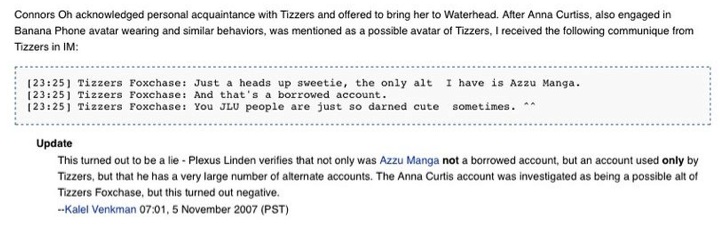
The Superhero's battle against evil becomes meaningless if there is no more evil to be battled. And so this revisionist argument goes, the Superhero starts to manufacture villains for his or her rogues gallery to fight, or perhaps, in the more fascistic versions of the superhero genre, starts to project evil onto innocent bystanders. Would the Woodbury campus on Second Life even exist without Kalel Venkman as an enemy? Woodbury leader Tizzers Foxchase has confided that he uses Kalel to keep the Woodbury kids engaged and to prevent their virtual campus from turning into the ghost town that most virtual campuses have become.

So, again, we can see what happened here as an outgrowth of a particular kind of fantasy being played out in the virtual world. Maybe Kalel Venkman even took a certain pleasure in "crossing lines," moving from the pure virtue of the classic DC superheroes towards a darker vision of the dark knight working from the shadows, doing what constitutionally regulated authorities could not do, in order to redeem a world which is otherwise beyond hope.

That said, we can only speculate on what sort of civic fantasies are at play here -- for example, what fantasies motivate the various griefer groups (the W-Hats, the channers etc) as they seek to get their LOLs by engaging in what they surely know is anti-social behavior? There is often a sense that virtual worlds allow us to enact transgressive fantasies freed of their real world consequences and if anyone objects, they are just taking things too seriously. This takes us all the way back to Julian Dibbel's "A Rape in Cyberspace" and the debate about Mr. Bungle the Clown and whether his actions are simply a form of nasty-minded play or whether they can be understood as "rape" by those most invested in their characters and the integrity of their virtual community.

On the other hand, perhaps the greifer memes about "serious business" do offer an important counterpoint to the corporate take-over of the internet. Maybe someone should take issue with the corporatist narrative about the purpose of the world wide web by offering that it ought also to be a place for play and silliness. Whether or not such lines of defense are exculpatory, they are certainly taken on by griefers, as interview after interview with griefers in the Herald has shown.

For that matter, what kinds of civic fantasies have governed the Woodbury group, with their sense of rightous indignation at being falsely accused, with their efforts to plant spies in Kalel's headquarters and thus flirt with risk? Or for that matter, what about the Alphaville Herald's conception of itself as a muckraking publication trying to rip the masks off the members of the Justice League? Are they all playing different games here or does each contribute something to the game which the others need in order to work through their fantasies, a warped version of Richard Bartle's ecology of player types?

Our point is not that these competing narratives are wrong or disingenuous, it is rather that they need to be investigated and critiqued, for these are the narratives and strategies for play that are weaving the foundations not just for virtual worlds but for our future online lives. And of course, as cases like the Harry Potter Alliance show, they also motivate our "real life" actions and attitudes.

No doubt by this point some readers are thinking that all of these people have too much time on their hands, that they are taking events in virtual worlds too seriously. This criticism actually packs two criticisms within it. First, there is the assumption that the virtual world itself is of little interest. Second there is the assumption that only the confused would use fictional narratives and trappings guide their real lives. On this latter point, no one who is using Harry Potter or the Na'vi to inspire their real life actions is confused into thinking they are wizzards or very tall blue extraterrestrial beings. Similarly, Kaleel Venkman presumably does not believe he has superman powers. These features of fictional characters do not transfer into the real world. Clearly. But what does transfer are the norms, attitudes, virtues and vices of these characters. We cannot jump over tall buildings with a single bound, but we can adopt Superman's ideas of what is right and his sense of self-certainty. The question, of course, is whether we *ought* to adopt such norms and attitudes.

As for the first question -- whether what transpires in virtual worlds matters -- this is a question that could have been intelligibly raised several years ago, but not today. Virtual worlds are rapidly becoming important platforms for work, socializing, education, and play, and given the amount of time that our children will spend in such worlds it is important to reflect on the norms that are being uploaded into those worlds today.

Clearly for virtual worlds to work they have to be open to play and experimentation, which requires suspending some of the rules that govern real world civic life. Yet, at the same time, some forms of political play fray the social contract which holds the world together, disrupting the experience of others, and destroying the infrastructure they all need in order to have meaningful experiences there. The story of the JLU invites us to ask the question -- at what point did the campaign against griefers become itself a kind of griefing, which did more to damage than to defend the integrity of other participant's virtual lives? Or to put it another way, the sandbox can allow many forms of roleplay and many competing narratives, but when the game becomes too big it impinges on the play and narratives of others. Playing well together is something we were supposed to have learned in kindergarten, but as this story shows, doing so is not as easy as it seems.
Watching the Watchers: Power and Politics in Second Life (Part Two)

This is the second part of an account of recent events in Second Life written by Peter Ludlow, a long-time observer of virtual worlds, a professor in the Philosophy Department at Northwestern University, and the co-author, with Mark Wallace, of The Second Life Herald: The Virtual Tabloid Which Witnessed the Dawn of the Metaverse, published by the MIT Press. As with any other representation of complicated and controversial events, different people will have different perspectives on what happened and different assessments of the motives and actions of the people involved. The essay is presented here in the hopes of sparking discussions about the blurring of politics and fantasy in virtual worlds, a topic to which we will return in the next installment. Watching the Watchers

by Peter Ludlow

In 2008, a member of the Justice League quit and gave an interview to the Herald, detailing the operations of the Justice League, claiming that they were keeping massive intel on Second Life users, were abuse reporting people capriciously, sometimes successfully getting them banned without cause, and that members of Linden Lab were complicit in these operations. These charges were dismissed by the League. Tizzers Foxchase and the Woodbury kids needed the smoking gun if their charges were going to stick, and so they began to plot an infiltration operation.

Infiltrating the Justice League would not be easy. Clearly any friend links to Woodbury would raise red flags. Nor would it work to just create a new avatar and ask if it could join Woodbury. New avatars are dangerous for obvious reasons. What one needed was a clean avatar with a reasonable age on it. Kalel certainly knew that it would be a nightmare if details of his operations ever made it into the wrong hands. So whoever took ran the avatar would have to be special - someone who had a reasonable rez date on their avatar, no friendship links to Woodbury, and who could disarm the seemingly paranoid Kalel and pass as an anti-griefing do-gooder. In 2009, the Woodbury kids found just such a player.

Haruhi Thespian was an avatar without an agenda, and a certain kind of élan. As it turns out, she was a thespian in real life and an award winning improv actor. Perhaps she had just the right stuff to infiltrate the Justice League. One day she was chatting with the Woodbury kids and they asked if she would be willing to undertake the operation. Harui decided that it sounded like fun and Operation Wrong Hands was born.

Watchmen 12.jpg

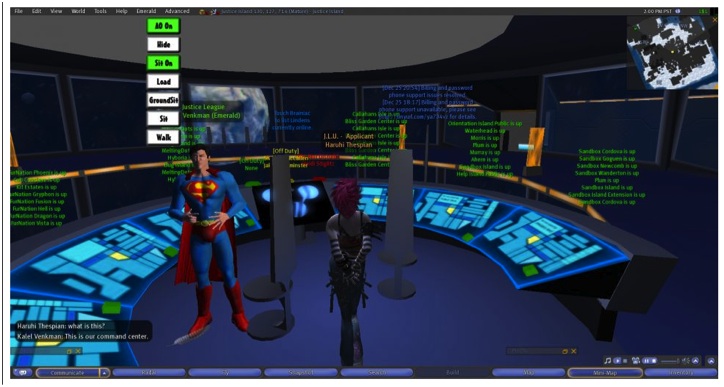
Kalel shows Haruhi the JLU "command center"

Haruhi was quickly admitted into the Justice League, but there were lingering suspicions. One day it seemed to Harui that her cover had been blown:

13:57] Kalel Venkman: I have to admit I'm having trouble figuring you out.

[13:57] Kalel Venkman: You just seem like the perfect applicant, and that's just uncommon.

[13:58] Haruhi Thespian: hehe, is that a compliment?

[13:58] Kalel Venkman: Every now and then we get a really good one that hits all the marks.

[13:59] Kalel Venkman: Anyway, it's just so rare, it takes me by surprise when it happens.

[13:59] Haruhi Thespian: I dont know what to say hehe

[13:59] Haruhi Thespian: >.<

[14:00] Haruhi Thespian: I'm so good its Criminal? (quote from the anime Melancholy of Haruhi Suzumiya)

[14:01] Kalel Venkman: Sort of.

[14:01] Kalel Venkman: We've got a pile of people from Woodbury trying to sneak their way into the JLU, and on the whole they're not very clever.

[14:01] Kalel Venkman: If somebody did get in, it would have to be somebody who looked like as good an applicant as you do.

[14:02] Haruhi Thespian: it seems I've applied at a bad time >.<

[14:02] Haruhi Thespian: thats unfortunate

[14:02] Kalel Venkman: And at the same time, we've just gone through an episode with JB Hancroft.

[14:03] Kalel Venkman: Now he was a problem, because nobody trusted him, and everybody was afraid to say so.

[14:03] Kalel Venkman: And I had nagging doubts too, but I suppressed them, thinking it was just me.

[14:03] Haruhi Thespian: Its understandable I guess

[14:03] Kalel Venkman: Always listen to your gut feelings, Haruhi. They'll never steer you wrong.

[14:04] Haruhi Thespian: I'll take that advice to heart

While in chat with Kalel, Haruhi was also in skype with Tizzers Foxchase and other Woodbury students. Haruhi told them she thought her cover was blown. Tizzers suggested that Haruhi talk to Kalel about boy troubles. The misdirection worked.

[14:04] Haruhi Thespian: So... this is kinda awkward? hehe, I'm sorry

[14:06] Haruhi Thespian: Hey Kalel, can I ask you for some advice?

[14:06] Haruhi Thespian: its about RL boy troubles

[14:07] Kalel Venkman: Sure.

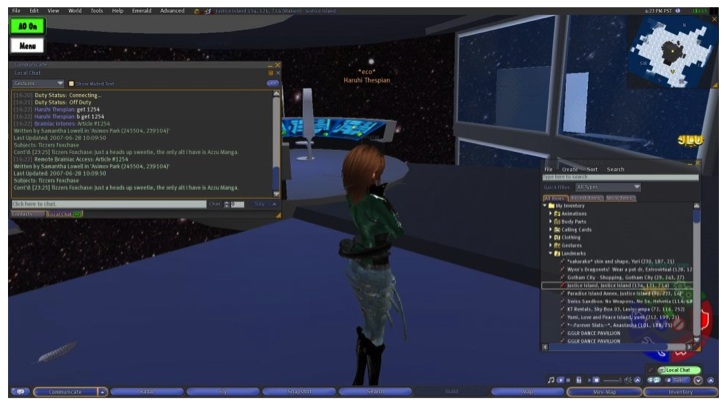
Days later, Haruhi downloaded the JLU wiki and posted it to the Woodbury IRC channel, and from there it was reposted to numerous locations on the Internet. Within days it had been reproduced all over the internet.

Watchmen 13.jpg

Haruhi gets access to the JLU database

In an interview given to the Herald after the fact, Haruhi described Kalel as a kind and loving man who thought he was doing good. How Haruhi was able to maintain the disconnect is far from clear. In comments to the interview a disgusted reader summed up his feelings about the act of betrayal: "this makes for really unappetizing reading. Ick.". Another reader offered that this is simply the price one has to pay for being a spy:

It's the nature of spying that those who find themselves in that role have to go to unpleasant places and do things that in normal circumstances they would balk at. ... Personally I take my hat off to Haruhi for being willing to carry out this role and to then show a sense of morality and decency in her subsequent actions.

Watchmen 14.jpg

Haruhi informs the JLU of her actions

Whatever the moral standing of Haruhi's actions, one thing is clear: Haruhi had opened a Pandora's Box.

The Justice League did not merely have a data base on Second Life users. It had a massive data base on Second Life users. It contained 1,700 pages of information and misinformation on users, ranging from chat logs, to presumed real life identities of avatars (including real life information), to a history of the abuse reports that they had filed -- and many many abuse reports had been filed.

Predictably, the content of the Justice League data base was posted on various web sites. Kalel, understandably furious, responded in a scattershot fashion by filing Digital Millennium Copyright Act take-down notices, bizarrely arguing that the chat logs etc were his intellectual property. When some Internet service providers complied, the materials were moved to safer havens in Canada and ultimately Montenegro. Woodbury sympathizers organized the material into a searchable database.

Watchmen 15.jpg

Meanwhile Herald editor Pixeleen Mistral began combing through the database and found example after example of disturbing revelations. Not only was she surprised to learn that she had been declared a griefer, but the claims of Linden complicity appeared to be supported. One particularly telling Wiki entry seemed to suggest that Linden employee Plexus Linden was revealing the real life identity of avatars.

Watchmen 16.jpg

Pixeleen published a series of stories to the Herald, including passages like the above. Then the other shoe dropped. Kalel filed a DMCA take-down notice against the Herald! Six Apart, which owns the Typepad blog hosting service used by the Herald, removed the material, apparently without giving any thought at all as to whether the charges were frivolous. Pixeleen would have to counterfile.

This was going to be no simple matter. Counterfiling would require Pixeleen to reveal her real life information, and she had guarded her privacy for years. Understandably so. Crossing people in Second Life can lead to real life stalking. As previous Herald editor Peter Ludlow had learned, angering someone with an article could lead to real life confrontations that ranged from angry phone calls from the United Arab Emirates to orchestrated campaigns by users to call his university and try to get him fired (not unlike what had happened to a Woodbury University instructor).

Pixeleen Mistral was a petite 20 something female avatar with a sharp fashion sense and a bit ditzy on technical matters. Her typist, turned out to be Duke University computer scientist Mark McCahill, who in addition to being male, 6'5'' tall, and having no apparent fashion sense at all, had been team leader in the development of the Gopher search program, team leader in the development of POPmail, and had worked with Tim Berners-Lee on the protocols for the World Wide Web. He was one of the gods of the Internet. He was also going to have to out himself.

Watchmen 17.jpg

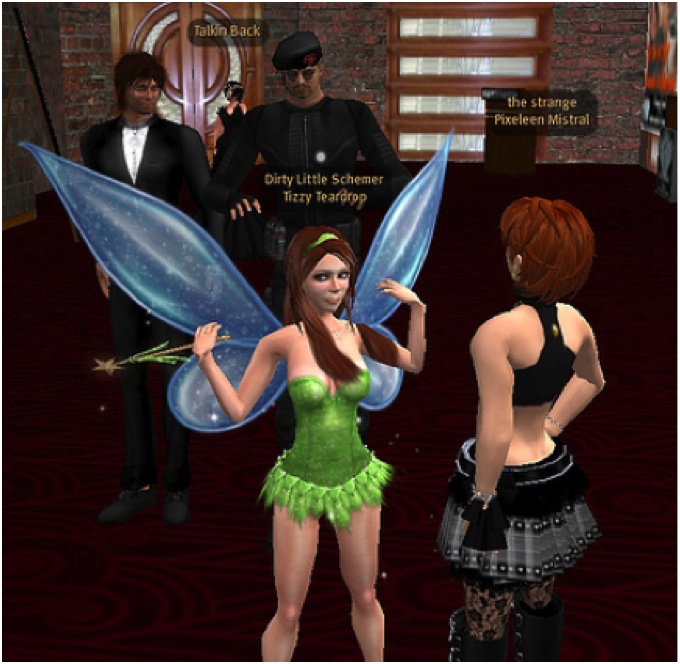
Tizzers' alt and Pixeleen Chat (Intlibber Brautigan stands behind Tizzers)

Legally, if you file a DMCA counter notice, the service provider is required by law to restore the missing material in 14 working days. Several weeks after filing the counter claim McCahill contacted Typepad and asked them why they hadn't restored the material. They responded that they had lost it and couldn't restore it. McCahill of course had backed up the material, but disgusted, he moved the Herald from Typepad to another service.

As of today, this is where matters stand. Second Lifers continue to pour over the leaked materials, Kalel continues to file bogus DMCA actions, and feeble service providers like Typepad continue to enforce them.

It's a sad state of affairs on many levels, not least because of what it says about our future in both the real and virtual worlds. How does this keep happening to us? Even in play are we condemned to be "defended" by institutions that overreact to evil and effectively become a greater danger than what they are trying to defend us from?

One cannot help but think of George W. Bush when reading Haruhi's account of Kalel Venkman. A good hearted guy who "trusted his gut", and decided he needed to protect us from some distant and obscure and poorly defined axis of evil, constructed out of a kind of guilt by association. A guy who would turn the place he cares about and wants to protect into a massive surveillance state. A guy who would recklessly apply laws in ways for which they were not intended, and a guy who just did not no how to back off or change his mind when it was clear that the only sane thing to do was to stop digging. And must it always be the case that the institutions that we rely on for communication and other infrastructure needs will roll over at the drop of a hat, forever opting to side with the censor whatever the legal position of the censor?

And then too one has to wonder how much more dangerous our world is because of people like Kalel and George W. Bush. Tizzers once confided to Pixeleen that the only way he kept the Woodbury crew together and engaged was by giving them an enemy to fight against: Kalel. Is it not at least equally plausible that what enemies we have are held together and galvanized by enemies like George W. Bush? - people with no sense of proportion and who fight blindly, not caring about the effectiveness of their methods or the innocents that are harmed along the way.

In the end, this isn't a story about the virtual world imitating the real world, nor is it a story about how the real world imitates the virtual world. The problem is that neither the real world nor the virtual worlds are prior. They both seem to bubble up from some deep dark corner of the human mind. These events aren't really about games or virtual spaces. The events are really about us and who we are.

Reblog this post [with Zemanta]

Watching the Watchers: Power and Politics in Second Life (Part One)

In early 2007, I ran an interview on this blog with Peter Ludlow, who teaches in the Philosophy Department at Northwestern University, and who has emerged as a key observer of how people are interacting within virtual worlds, such as The Sims Online and Second Life. Ludlow, along with his coauthor, Mark Wallace, wrote a book for MIT Press, The Second Life Herald: The Virtual Tabloid Which Witnessed the Dawn of the Metaverse, which I am planning to teach as part of a course I am developing this fall for the USC Journalism school on civic media. Ludlow emailed me recently with news of some fascinating new developments in Second Life. It was a story which raised such fascinating issues about fantasy and play, about the shifting borders between pro-social and anti-social behavior, about rights and responsibilities, and about the governance of virtual worlds that I felt like I had to share it now. Over the next two installments, I will be sharing Ludlow's account of what's been happening in Second Life, an account which places it in the context of the larger history of virtual worlds. Afterwords, I will share a joint statement which emerged from our conversations together about what this all means.

Watching the Watchers

By Peter Ludlow

Dept. of Philosophy

Northwestern University

People who have spent time inside virtual worlds are familiar with griefers - game players (stereoptypically adolescent males) who engage in transgressive online gameplay to disrupt the online experience for others. The transgressive behavior might range from profanity, scatological behavior and racism to the writing of programs (scripts) that tax the servers of the virtual world to the point where it goes offline.

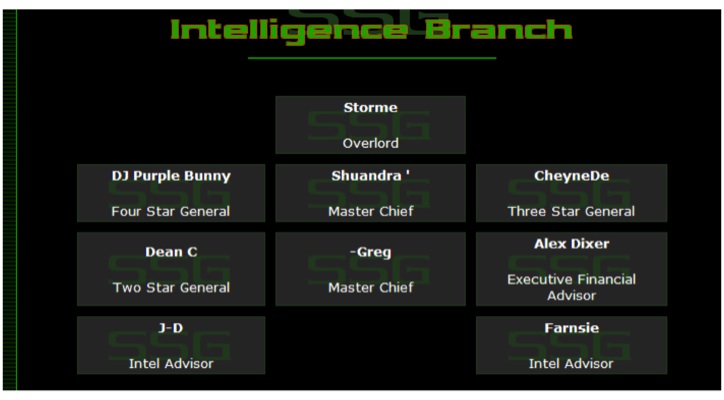
If you are familiar with griefers, then you are probably also familiar with user created virtual security operations that have emerged to counter griefers. For example, Ludlow and Wallace (2008) describe a case inside of (the now defunct) virtual world The Sims Online. Fed up with the behavior of a handful of griefers, a group of players formed a virtual paramilitary organization called "The Sim Shadow Government" (SSG). Organized into an executive branch, an intel branch, and a "war department", the SSG monitored the movement of griefers inside of The Sims Online, followed them in the game, warned other users about them by using negative reputational tags, and often filed "abuse reports" with the game company (for example, reporting players for violations of the terms of service of the game company).

Watchmen 1.jpg

SSG Intelligence Branch, organizational chart.

Some players inside of The Sims Online felt that the SSG went too far in their operations. Members of the SSG were quite capable of hounding people out of the game without benefit of fair hearing or trial, and they were also very close to the game monitors of the game company, yielding charges of favoritism. Protest organizations with names like "Freedom Gameplay" and "The Lightsavers" (dedicated to casting out the shadows) emerged and pushed back with anti-SSG propaganda and with griefing attacks against the SSG itself.

Watchmen 2.jpg

Freedom Gameplay organizes against the SSG

This might seem like an odd and fleeting phenomenon, but in fact it is replicated many times over in virtual worlds. Trouble makers enter the world, and antibodies form to fight the trouble makers, apparently as a completely emergent phenomenon. The only difference is that as virtual worlds become more important and visually rich the intensity of the battles has risen dramatically. A recent episode from Second Life illustrates just how dramatically.

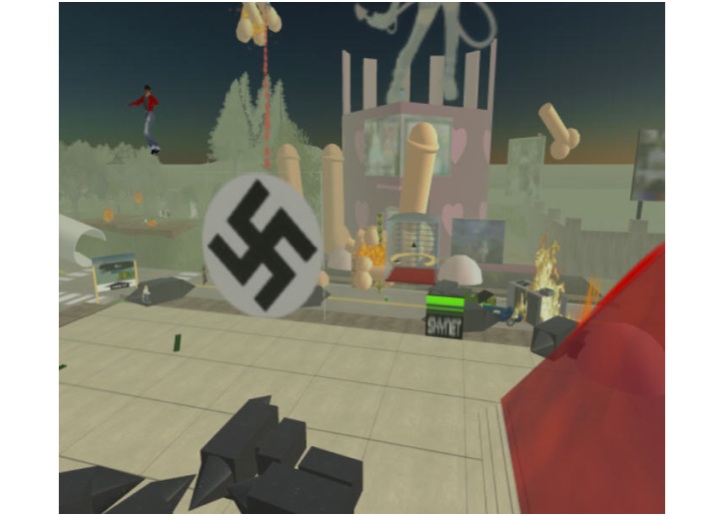
Second Life, of course, is a virtual world in which the developers provide users with robust tools to build and "script" objects, ranging from clothing and homes to vehicles and weapons. The result is that there is much user created content - some of it very edifying, some of it junk, and some of it obscene. For example, a Second Life griefer group known as the W-Hats had a property featuring giant penises, swastikas, and a "build" with a Death Star blasting the World Trade Center.

Watchmen 3.jpg

The W-Hat "build"

Another griefer group, called the Patriotic Nigras (PN) routinely engaged in racist and transgressive behavior, targeting clubs inside of Second Life and took credit for griefing the Second Life political campaign headquarters for John Edwards (The W-Hats also took credit. The Edwards campaign blamed Second Life Republicans).

Watchmen 4.jpg

John Edwards' virtual campaign headquarters griefed. PN take credit.

The PN in turn had been spawned by an infamous internet web site known as 4chan - an online site famous for its adolescent hijinxs that included spamming their enemies with famous scatological internet content like "Tub Girl" and "Goatsee". More specifically, the PN had been organized on /b/, a section of the 4chan site dedicated to transgressive behavior.

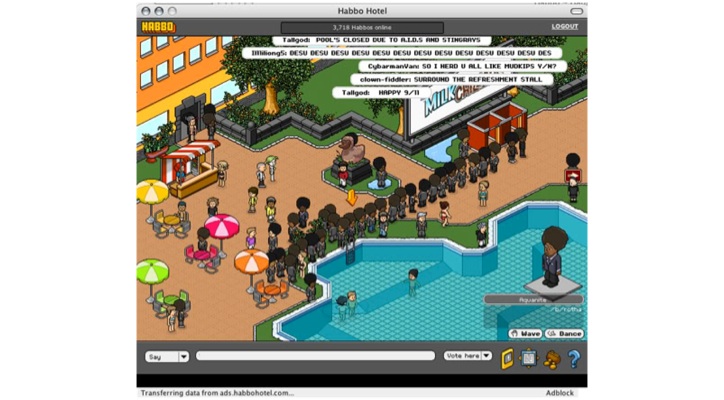
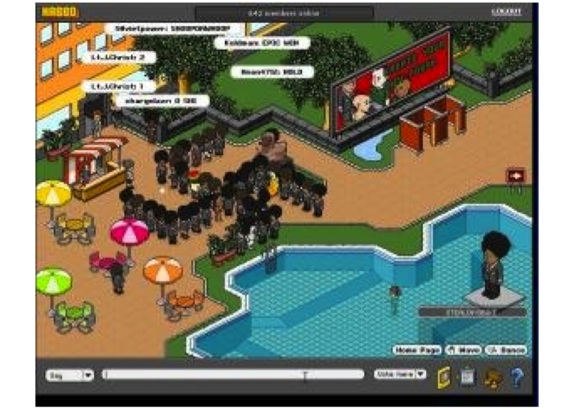
The PN actually came into existence in 2005, when members of 4chan ("channers") decided to raid Habbo Hotel, a virtual world aimed at younger children. The channers created black presenting avatars with afros, and surrounded Habbo's virtual swimming pool warning the children that "the pool is closed because of aids." Thus were born the PN, and their slogan (still used) "Pool's Closed". A griefer organization like that with a permanent presence inside of Second Life was bound to be the virus from which a virtual vigilante group emerged.

Watchmen 5.jpg

Pool is closed: 4chan invades Habbo Hotel, 2005

Watchmen 6.jpg

Channers get transgressive.

Watchmen 7.jpg

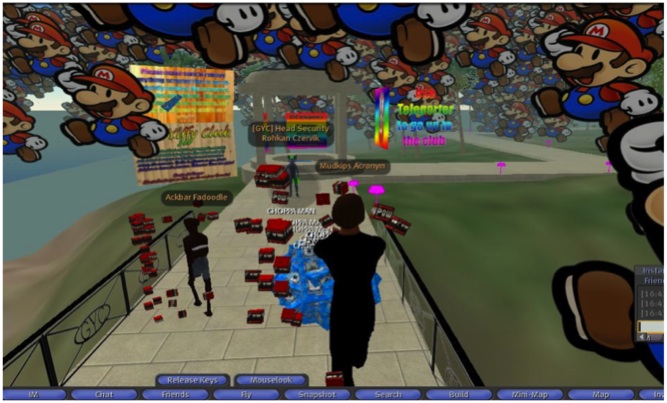
The PN comes to SL and attacks the Gay Yiffing Club (GYC) with self-replicating Marios

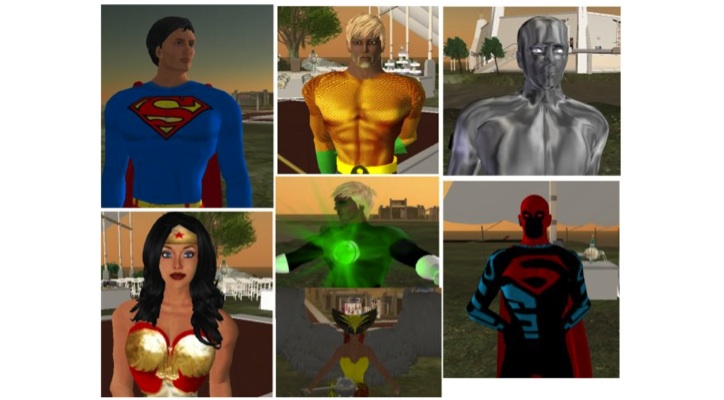
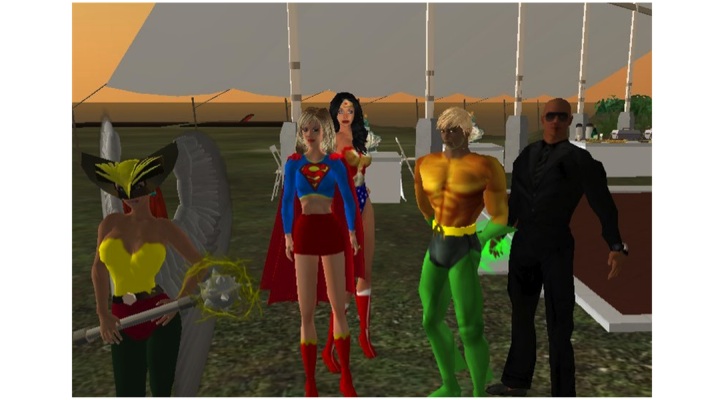
In 2006, a Second Life avatar by the name of Kalel Venkman decided to create a vigilante group to fight the likes of the PN, and he decided it would be fun to do it in the guise of comic book superheroes. He donned a Superman skin, and he named his group the "Justice League Unlimited." Other familiar superheroes soon followed, including The Green Lantern, Batman, Wonder Woman, and others.

Watchmen 8.jpg

A New Sheriff in town: the JLU

Watchmen 9.jpg

JLU Members in happier times.

In real life, Kaleel was a late middle aged technical writer living in Simi California. He apparently had flex time, and he also appeared to have sufficient charm and gravitas to attract members to the Justice League and to keep them well organized and on mission. Their Justice League headquarters had a marvelous NASA quality control room, with monitors that displayed constant updates coming in from sensors all over the Second Life grid. The updates also informed the League members what representatives from the game company were online. As with the SSG, the Justice League had close contacts with employees of the game company (Linden Lab), and utilized those relationships in filing abuse reports against other players.

What perhaps began as a fun exercise in roleplay soon began to go awry. Overzealous Justice League members began abuse reporting heavily, and also began picking fights with unlikely groups within Second Life. For example, the Justice League was banned from Furnation (an area inside Second Life dedicated to players that like to don anthropomorphized animal costumes), because of their excessive vigilantism.

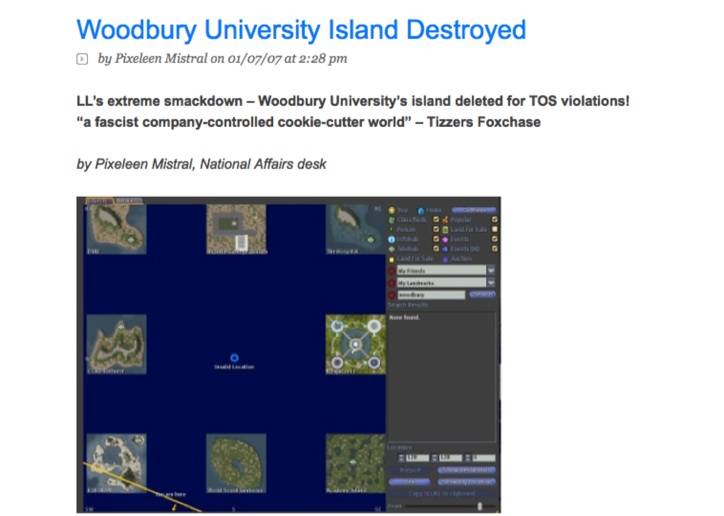
The JLU of course clashed with the PN, but the problem became determining who was really a member of the PN and who was simply in the orbit of the PN. Matters took on fractal complexity when some students of Woodbury University (a real life University with a virtual campus inside Second Life) became associated with 4chan and the PN. In what seemed like a bizarre case of guilt by association, the members of the Justice League took on the students of Woodbury University, at one point successfully getting Linden Lab to shut down Woodbury Island (the virtual campus). Naturally matters quickly escalated.

Watchmen 10.jpg

Someone (presumably from the Justice League) contacted the administration at Woodbury University to complain about the faculty supervisor of Woodbury and to argue (in effect) that he was corrupting innocent youth and inspiring them to griefer ways. In turn, the students, led by the avatar Tizzers Foxchase (Jordan Belino in real life) turned up the heat on Kalel, to the point where a number of Woodbury students went trick or treating at Kalel's house on Halloween. Kalel wasn't home, so the students told his wife to tell him that Woodbury had been there. Kalel naturally flipped out.

Watchmen 11.jpg

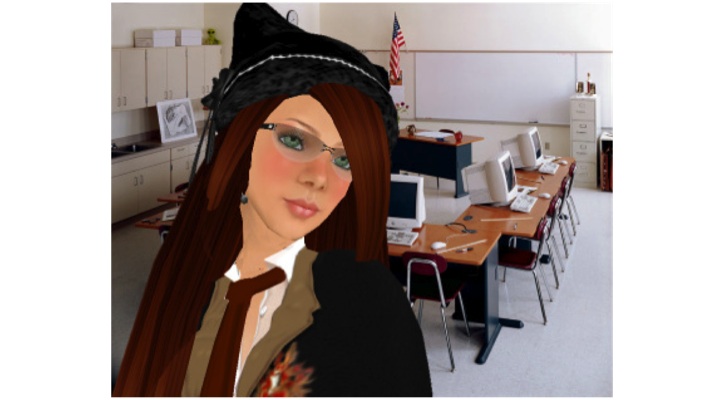
Tizzers Foxchase

Tizzers herself was not a member of the PN; she seemed to have not much more of an agenda than to fight the Justice League and defend Woodbury. For Kalel, however, the Woodbury claims of innocence were nothing more than Eddie Haskelling ("lovely hair Mrs. Cleaver"). Tizzers was a griefer in spite of her nice young lady rap, and that was that. The problem was that more and more people were starting to look like griefers to Kalel, including people who were his competition in the virtual world security business - or at least this was the claim of Intlibber Brautigan, a Second Life real estate mogul, famous for posting libertarian manifestos on the forums. If Intlibber was to be believed, the harassment from the Justice League had been financially motivated and astoundingly heavy handed.

"How about the meanness of the JLU in getting countless innocents permabanned from SL for the mere act of being a black avatar, or saying an internet meme in chat, or being falsely abuse reported with impossible charges (like "copybotting a megaprim owned by Michael Linden"), or participating in public protests.

Yes, these people deserve a lot more than "a little meanness". Lets get it straight, they are snitches, rats, stool pigeons, LIARS, defamers, collaborators, trespassers, and instigators. Siobahn McCallen, who resided in my sims with her girlfriends yet worked with JLU in defaming me and encouraging my residents to leave. These sort of people don't deserve niceness."

Intlibber also complained that the tactics of the JLU worked to get innocent gamers banned:

"Anybody who teleports into a monitored sim within 5 minutes before a sim crashes gets logged to their db as a suspect, and given a score. The number of times this happens jacks up your score. Your score is further handicapped by how young your avatar is and what your payment status is (helps to catch throwaway alts quickly)."

Any account that scores too highly on this system gets automatically abuse reported by a bot to Linden Lab, no further investigation done by human hands.

The JLU contended that IntLibber had hired the PN to grief his enemies in the virtual real estate business, but no evidence was brought forward.

It wasn't just their competitors that were marked as griefers; the Alphaville Herald, which had been reporting on griefers in virtual worlds since 2003, was a griefer media organ in Kalels eyes. The Herald's editor, an avatar Pixeleen Mistral was therefore also a griefer. Kalel came to falsely believe that Pixeleen was identical with me, and so I must be a griefer too. There were griefers everywhere, it seemed.

(More to Come. Same Bat Time, Same Bat Channel)

Reblog this post [with Zemanta]

"A Kind of Vast Game": An Interview with Ethan Gilsdorf (Fantasy Freaks and Gaming Geeks) (Part Two)


Throughout the book, you hint at a mainstreaming of geek culture, which is also evoked in the quotation above. How close are we to seeing this happen? What is gained or lost for the communities you studied if geek goes mainstream?

I think the mainstreaming has happened already. Once you see the term "geek" being co-opted and used by other subcultures --- wine geek, film geek, fixed gear bicycle geek --- you know the word, at least in its pejorative sense, has passed. And films like Lord of the Rings, Star Wars, Harry Potter, Twilight, Spider-Man and Batman have made the previously cloistered worlds of comic books, superheroes, horror, fantasy, science fiction and fandom a palatable experience, at least in a superficial way. There's an entire generation of kids --- millions --- who have now grown up either reading Harry Potter or having it read to them. Jocks and dweebs equally play Xbox and Playstation games. That guarantees (I think) that these kids aren't going to be ostracized for having geekly hobbies.

To be "cool" is to like things because everyone else does. To be a "geek" is the opposite: to have a passion, to care about the details of a thing, to care about getting it right, to go deep into a subject matter --- and not care what people think. Geeks are the keepers of that secret flame for something long before it's cool, or long after the fad has passed, whether or not the thing they loved was ever in fashion or not. The downside of the mainstreaming of geek culture is that a lot of geeks have forged their identities as being counter to the mainstream --- i.e. we are weird and therefore special, and you all are boring and mainstream. Now that traditional geek areas have gone mainstream, I suspect that those who want to remain "geeks" will need to find new areas to colonize. The fringe will have to move further to the edge.

In many ways, your book can be seen as an argument for the value -- no, values -- of escapism. How would you define escapism and to what degree is it a positive force in the lives of the people you interviewed?

I struggled with using the terms "escapism" and "escapist" because of the negative associations with them (both mine and the culture's) and also because I wanted to discover how fantasy and gaming had real meaning, not just as mindless distraction. But aside from the "healthy" aspects of gaming and fantasy that I mention above (that these activities provide community, rites of passage, ethics and values, personality development through role-playing, etc), I do think that "escapism" --- defined as a release, as mental downtime --- is essential. In that regard, it doesn't really matter what you escape into, as long as it isn't taken to the extreme. America's obsession with watching TV is a perfect, and totally acceptable way to escape. No one really thinks it's weird to watch 4 hours of TV reality programming or basketball playoffs each day. But if you play 4 hours of WoW, then many think you're anti-social.

Of course, anything can be taken too far. Sex, drugs, gambling, pornography, eating, shopping, the Internet --- all of these activities, when taken to the extreme, can be dangerous. They can be used to blot out the self. No one, in their right mind, should use any one experience, like a movie or game or book, to find meaning and attribute so much meaning to it that it looms large to the exclusion of other influences, or is a substitute for intimate human relationships. We all need balanced lives.

What bothers me with the "escapist" label for fantasy in particular is that many who don't get it accuse Tolkien, for example, of being frivolous. But Lord of the Rings is full of fully-realized characters who grapple with tough moral choices, endure great hardship, and make mistakes. Gollum is a great example of this: psychologically complex, twisted, haunted, damaged. Nothing "escapist" about that!

You end with this call: "so, my fellow freaks and geeks, if we must escape, let us escape for a reason." What kinds of reasons did you discover amongst the people you spoke with?

Fantasy escapism can be a way to retreat from the world --- not to avoid the world, but to take pause, and recharge our psychic batteries. In my book I went to New Zealand to play out my own obsessive Lord of the Rings movie location quest. When I was in Wellington, I interviewed Erica Challis, a blogger for the Tolkien movie fan site TheOneRing.net , which she co-founded as a way to report on news about the Rings movies shoot. She told me something about fantasy and escapism I had never considered: for people in oppressive societies who read Tolkien, the books gave them hope in hopeless times. "Fantasy is a genre people can read and retreat [to] and gather strength to face the real world," she said. Likewise, I think we need downtime to escape, but also to work out problems and issues and roles. Imaginary worlds offer solutions to problems --- they're a testing ground for ideas, a place to imagine other possibilities, other futures, other ways to live, to govern, to be. Then, with our D&D manuals put away and our Xbox consoles turned off, we can return to real life, rejuvenated to kick ass.

As you note, the stereotype of fantasy fans and gamers is that they are socially isolated. How central are the social dimensions of the play experiences you describe? How strong were the communities and relationships you observed in your travels?

The social aspects of gaming can't be underestimated. For many, like me, who never found their community in high school or college, gaming is huge. Same for the disabled, who can find a world of liberation in gaming that's free from judgment. Specifically with online games, where one's identity is masked, no one knows if you're in a wheelchair; you're judged based on how you play the game, not what you look like. Similarly, the social dynamics of gaming guilds can reinforce values; guilds are often founded on ethical codes and ideals the players share (even religious values - there are Christian groups who go on raids together in WoW!). Many gaming and live-action role-playing groups like the Society for Creative Anachronism are involved in public service and charity work. Conventions like DragonCon and Gen Con organize blood drives and donate to food banks. In a fantasy setting, the games end up creating shared values, which is something we all crave, and a re-entry point to connect with the real world.

The need to hang out and do things together, to participate in shared interests, I think is hardwired into our DNA. But we can't all be on the football team. For me, a misfit boy, I needed things to do with my peers. I craved the camaraderie and fellowship that team sports denied me, minus the perils of a testosterone-charged locker room. Dungeons & Dragons was that collaborative refuge, outlet, and playing field. This desire is the same for many others. And I think the various geek communities we encounter in Fantasy Freaks and Gaming Geeks are among the most welcoming of all subcultures. They are accepting, kind, generous, because they know what it's like to sit alone at the cafeteria table, to not have friends. And I think we geeks carry that memory of loneliness through our lives, and reach out to those who need a safe haven of their own.

There's a wonderful organization called The Game Loft in Belfast, Maine that I found out about (alas!) after I wrote my book. The Game Loft is run similar to a traditional youth development-oriented organization like the Boy or Girl Scouts, except that it uses role-playing and table-top strategy games to teach kids (in a sort of underground, indirect way) how to be social, make friendships, take risks, form bonds with mentors, become assertive, become leaders and become involved in their communities. They have a safe and supervised space for kids to interact and test out these "roles" so they can be functioning adults in society. It's a wonderful example of turning the "gaming is anti-social" stereotype on its head.

One of the closing images of the book is of you burying your Lord of the Ring collectibles in the soil of New Zealand and walking away. Are you really ready to walk away from the fantasy and play you describe in the book? What aspects of this culture will you carry with you?

Spoiler alert! Just kidding. I think that moment in the book was impulsive, but also a kind of rite of passage for me. But rather than see that as leaving those plastic figurines behind, and fantasy behind, I see that moment as leaving a part of ME behind in New Zealand. I wanted to be part of that movie experience, but couldn't. Leaving part of me there was the next best thing. It was my homage to my fandom. I still have all my old D&D gear, and I still have other trophies from my quest. I'm not willing to walk away. My quest put me in touch with so many people who felt no shame about their geekly passions. They embraced their inner geek. And they gave me courage to "out" myself as a geek. I'm back.

Reblog this post [with Zemanta]

More Talk of TRONSmedia

A week or so ago, I shared the first installment of a series of videos, produced by Mike Bonifer, based on a conversation which I had with Tron creator Steve Lisberger. I've jokingly compared the exchange to My Dinner with Andre, except we were both so busy geeking out that we forgot to order any food! You never know what people will pick up on once your brain children move out and get their own apartments. Over the weekend, Ain't It Cool News picked up on the series, focusing on a brief exchange early in the conversation where I referenced the Scott Brothers returning to Bladerunner as a parallel to Lisberger's return to Tron. From there, fan speculation has grown that somehow I have inside information about the state of the Bladerunner sequel or that we were both confused and really meant to be refering to the Aliens sequel in production.

I can't speak for what Steve was thinking about or might know, but for my part, I was drawing on a panel we did about Purefold at the Futures of Entertainment conference at MIT last November. Here's the panel in question which went into some detail about their plans for this project. Unfortunately, the project has apparently been dropped, or so I learned by reading some of the fan blogs which were responding to this speculation. In this case, like so many others, fans were much more immersed in what was going on than the academics are and thus were closer to the truth than they realized.

I was bemused by the idea that I somehow had access to the inner workings of Hollywood. This blog is not focused on scoops, folks; my focus is on analysis and insights into long-term developments. I am having more and more conversations with Hollywood types since moving to LA, but they rarely tell me anythng that isn't already public knowledge. Those exchanges look more like this conversation -- the trading of insights about media change and larger entertainment trends rather than the sharing of secrets. I am not the guy to go to if you are looking for spoilers, sorry. In any case, it would have been clear that we were talking about Purefold if people had watched the full conversation, since there was a segment devoted to it later in the series.

We finally start to dig into issues of transmedia in this segment, which uses District 9 and its park benches as a taking off point. In what sense are those benches part of the exposition for the movie and how do they help to shape our experiences before we enter the theater?

Here, we talk more generally about the basic functions which transmedia extension plays, including some consideration of what it might add to Tron and also why Avatar is less successful at deploying transmedia than District 9.

What does it mean to "geek out" on culture? And what do we learn by looking at cultural experimentation as both a fan and an academic?

We talk about what it means to make transmedia as James Cameron and what it means to make transmedia as Lance Weiler, i.e. as the producer of Hollywood blockbusters and as the creator of low budget independent genre films.

This next section deals with what we can learn about world building by looking at Martin Scorsese and the Three Stooges (I kid you not!).

Here, Steve and I talk about what it would mean to establish the basis of a story on the web rather than via a major film release.

Steve worries about the "democratization" of the arts and what it does to the creative process, while I talk about continuity and multiplicity as competing tugs on transmedia properties.

We finally get back to Bladerunner and discuss Purefold as a model for collaboration between fans and professional storytellers.

Steve talks about the way Hollywood calibrates around the Zietgeist and I connect this to the conception of genre.

Here, Steve builds out on the differences between science fiction focused around the alien and outer space and science fiction based within cyberspace.

And this leads us to a larger consideration of the politics of fantasy and fan engagement, using the Harry Potter Alliance as a point of entry.

And finally, we return to Tron with Steve explaining what sets his film apart from other science fiction works in terms of its exploration of inner space and our moral responsibilities as humans over what we create.

All told, this was a fascinating meeting of two minds, both obviously immersed in the worlds being created by science fiction cinema, each excited about expanding the expressive capacities of amateur and professional storytellers. I hope you enjoy watching some of these segments half as much as Steve and I enjoyed talking through these issues.

Thanks once again to Mike Bonifer for all the work he put into bringing this material to the public. This whole exchange was Bonifer's brain child: he wanted to bring the two of us into the room to see what would happen; he made all of the arrangements and did all of the production work. And we all have him to thank for all of the creative labor which made these videos possible.

The author of GameChangers-Improvisation for Business in the Networked World, and the co-founder of GameChangers‚ LLC, Mike Bonifer has consistently been in the forefront of emerging trends in media and communication. Beginning with his role as the publicist for the gamechanging movie, Tron, through his work as a writer, director and creative executive, his work has explored new technologies and business processes, and has always been informed by storytelling. He has studied and performed improvisation at I.O. West Theater in Los Angeles. Mike is a really cool guy who has been very involved in the launch of a Transmedia LA meet up group and has been a big supporter of the work I am doing here at USC.

What the Chinese Are Making of Avatar

Several years ago, I met a remarkable young man named Lucifer Chu in Shanghai. Chu had been the person who first translated the works of J.R.R. Tolkien into Chinese, after a considerable push to convince publishers that there was a market for fantasy and science fiction in China. He took the proceeds from the sales of the Lord of the Rings to launch a fantasy foundation, which promoted fantastical literature in Taiwan and mainland China, and he translated more than 30 fantasy novels for the Chinese market. As of a few years ago, almost all of the fantasy novels and role playing games available in Taiwan were translated by Chu and he was making in roads into getting these same works published for the mainland. He argued that the fantastic played crucial roles in Chinese folk and literary traditions but the genre had largely been eradicated there as a consequence of Maoist policies during the Cultural Revolution which promoted socialist realism and saw fantasy as western and decadent. Chu argued that bringing fantasy literature back into China was a way of helping his people rediscover their dreams and reimagine their future. As I have been speaking with my USC student Lifang He about her work on the fan cultures which have quickly grown up around Avatar in China, I've wondered what connections, if any, exist between these two efforts to promote the fantastical imagination in that country. Are the young men and women we read about here the offspring of Chu's efforts? Are they connecting with western fan culture on line? This piece offers us some tantalizing glimpses into the many different ways Chinese fans have mobilized around and fantasized about James Cameron's blockbuster.

The American press has been following the commercial success of Avatar in China primarily as a business issue -- exploring what it might tell us about other opportunities for selling media in this country, using it to shadow Google's turmoil in the country, and marginally exploring why China was pushing the film from many of the nation's movie theaters. Yet, this piece takes us inside the world of Chinese Avatar fans, helping us to better understand what the film looks like from their perspective.

Avatar and Chinese Fan Culture

Lifang He

James Cameron's new movie Avatar is breaking the box office record in China. It is the highest grossing movie in Chinese movie history, achieving around 1.02 billion USD (Xinhua News, 2010). The influence and popularity of Avatar is spectacular and fans were crazy about the movie. Because of the limited IMAX 3D theaters in China, the movie tickets are in short supply and the price is very high. The tickets are officially priced at USD 18-26 but resold at up to USD 60. There are only11 IMAX 3D theaters in China.

Despite the ticket prices, Chinese fans waited overnight outside the store for many hours, similar to people waiting outside the Apple Store for the new iPhone. White collared professionals in small cities took their annual leave and made group trips to nearby big cities for the IMAX 3D version. Enthusiastic fans watched it multiple times in three different versions: IMAX 3D, 3D and 2D.

Being a fan of Avatar goes beyond the theater screens; it floods into a variety of online fan activities. When the Chinese government wanted to pull the 2D Avatar off most of the theaters to provide screens to the new released movie Confucius, many online fans called for a boycott of Confucius. Chinese audiences are becoming more and more active, embracing aspects of participatory culture and fandom, and seeking to more directly shape their entertainment options.

In this essay, Chinese fan culture will be discussed by examining various Avatar fan activities on one of the growing online communities, Baidu Tieba, a user driven network. Fan produced media will give us some clues as to how the young people react to the movie Avatar and why they are enthusiastic about the movie.

Collecting and Sharing Information

As of February 2010, users at Baidu Tieba generated 36,187 topics and 452, 509 posts about Avatar (Baidu, 2010). These posts involved the sharing of relevant information and the discussion of the characters, director, story, plot and other interests.

The planet Pandora draws most of the attention. Fans are very interested in the Pandora world because the movie only provides a glimpse of its ecology and culture. Fans established an online study group to learn the Na'vi language, planet, trees, customs, colors, lifestyle in Pandora etc. A fan bought an English version of Avatar: A Confidential Report on the Biological and Social History of Pandora and shared the content with other fans (link). Some fans can't understand English very well, so they are waiting for the Chinese version of the book. As one fan explained "no matter how expensive the book is, I still want to buy the Chinese version although my monthly salary is only 800 RMB (120USD) a month."

Some fans complained that the Chinese translation of the movie were really bad and posted the correct translation for other people. Similar to the Chinese translation team who volunteered to work on English and Chinese translation of American TV shows like Lost, 24, and CSI, they are very dedicated.

As Neytiri draws many discussions on the web, fans wanted to make Jake as popular as Neytiri so they tried to build the buzz online. In these efforts, they collected all kinds of pictures and posters from the movie and other media. They also discussed Jake's hair, dress style, facial expression, and his pure smile in the movie. For instance, fans chatted about when Jake had the best smile in the movie. The first time Jake ran out of the research institute when he first got his avatar, his smile was regarded as the most pure and innocent.

Fans were also eager to explore all kinds of information from the production, back-story to the reception process. For example, they talked about the sex scene that was cut off from screen, explored the different versions of trailers, the couple's relationship in the movie, and their stories in the future. Other interesting discussions included the best time to use the restroom during the movie. They indicated that it is better to go to the toilet when the movie was at 56 minutes so they won't miss a lot of exciting moments.

Fans share the knowledge with all the members of Tieba community, circulating the information and inviting other members to participate in the discussion. As Pierre Levy wrote "no one knows everything, everyone knows something, all knowledge resides in humanity" (Levy, 1998).

Fan Writing

Besides collecting and sharing information about the movie, fan writing is another emerging form of fan activity on the web. Because of the restrictions of the Chinese publication rules, the internet provides more free space for fans to publish their work and most of their work is much better than what has been written by the professional journalists, covering comprehensive stories about the evolution of IMAX 3D technology, the background of director, back-stories of the characters.

Some fans also wrote a parallel story based on the Chinese current social issues. As a famous blogger, Chenpeng Li wrote, the story of how the alien Na'vi are pulled off their homeland by humans is similar to Chinese residents being forced to leave their homes and land by the Chinese government (Sina.com, 2010). Avatar is a great metaphor of nail house dwellers against big property developers. "Nail House" refers to home or buildings of people who refused to move when the property needs to be demolished by the government for development (Wiki, 2010). In Li's blog, he wrote

"in 2154, a land development company RDA went to Pandora to get more land and living resources with the assertion that the residents who agree to move out can get attractive compensation. The residents refused to move out since they have lived there for many generations, just like the Na'vi people who didn't want to move because their roots were under the tree. RDA has a strong relationship with the government and also has other supports such as city managers acting as low-level government officials, responsible for maintaining city laws and rules. A disagreement erupted and started a fight between the RDA and the residents. "

Li regarded Jake as the leader who betrayed the Housing Demolition Office, referred Colonel Quarles as the chief city manager and the Na'vi people as the Chinese residents who are pulled off their land. The last scenario about Neytiri beating Colonel Quarles represents the extreme military power that was defeated by the Chinese mass residents.

Chinese fans also associated themselves with another Hollywood movie UP, which tells a story of a 78-year-old man Carl Fredricksen who refused to move out from his neighborhood. He made his house as a makeshift airship to fly to his dream place Paradise Falls using thousands of the balloons. A popular Chinese blogger, Han Han commented on his blog:

"UP provides the Chinese citizens with a new perspective toward house demolition. Chinese residential tenants only have the right to use the land for 70 years, and after 70 years the land use rights belong to the government and the houses are regarded as private owned property. Both the movie UP and Chinese government provided us a solution to cope with the house demolition. UP tells us to lift the house off the ground by the helium balloons; and the Chinese government tells us that don't think too much because after 70 years, the houses will probably collapse" (Han, 2009).

In recent years, China has been experiencing a fast period of urbanization and many old buildings and neighborhood have been torn down for modern shopping malls and skyscrapers. Over 30 million residents have been forced to move from their homes (Hays, 2008). Li referred the movie to some cases in China that residents refused compensation deals and fighted with the government. Fuzheng Tang who poured gas and burn herself to protect her three floor home from Chengdu violent home demolition, Pan Rong who threw self-made petrol bomb to the demolition crew, and Chongqing nail house are the all real cases for anti-demolition.

Avatar and UP are a good reflection of recent Chinese social problems, showing a lack of citizen rights and choices. As Han said " brutal demolition can only happen in foreign planets and China, which foreigners can't image" (Sina.com, 2010). Chinese fans found both movies quite related to their life and both provide them with a story that they can share and discuss. The only Chinese popular TV series Snail House (Wo Ju), also titled Dwelling Narrowness, that can truly reflect their life tells a real story about how average Chinese people became house slaves in Shanghai in an environment of rising home prices and official corruption, was eventually banned by the government. Li regarded Avatar as the best movie that eulogizes the nail house successfully fighting against forcible demolition in China. The forcible city managers, house demolition office, Chinese City Demolition Ordinance was vividly analogized in the movie (Sina, 2010).

Fans Creative Work

Besides collecting and sharing knowledge and fan writing, fans also use other ways to create their own works such as costume play, Avatar paintings, etc. One of the most popular works online is the costume play by a couple from Chongqing. They dressed like Jake and Neytiri and posted their Avatar pictures online, which has over 94630 viewers (Baidu, 2010).

Vidding is another way for them to participate in the creation. Three kinds of videos will be shown here to showcase the vidding culture in China. The first one is a theme song vid, which remixes the video "I See You" and "My Heart Will Go On." Fans find that the stories of two theme songs are very similar: both are love stories and the main actors in the two movies both died. For example, the lyrics of "My Heart Will Go On" has the words "I see you" that can match with the content of Avatar. Here is the video of "I See You."

Also fans made another version of Titanic with "I See You."

In another video, fans used photoshop to make Avatar posters for the celebrities such as Obama, Yao Ming and Li Yuchun and used their Avatar photos as materials to make the video, which can be played here. Similar to the fans of Kung Fu Panda, they like using Photoshop software to make posters with different themes such as Harry Potter, Lust, Caution, Pirates of the Caribbean, etc.

Another vid is created by a World of Warcraft fan J J. Because the worlds of Warcraft and Pandora are very similar, he incorporated the video clips from the WOW game and made a WOW version of Avatar, which is very popular among Chinese fans. Here is the video.

Why fans are so enthusiastic?

The Internet and digital technology has given fans unprecedented access to information and has changed the concept of freedom of choice and creative expression. Because of the national system and media censorship, Chinese people can not say anything they want. But online community provides a good platform for the fans to say something they can't in real life.

Online community also provides them a way to relieve the stress and escape from the reality because they face so much pressure from all aspects of society such as intense high school graduation examination, competitive job hunting, etc. In addition, playing around in the Internet is not regarded as a serious hobby by Chinese old generation who are very realistic and more concerned about their children's future such as going to a good university and having a decent job.

Chinese youth are tired of Chinese serious mainstream film culture because Chinese films lack the creativity that American TV shows and movies have. Avatar created a dream and an ideal world that Chinese fans can't have in reality. As a famous movie director Lu Chuan said, "Avatar made me realize that what we lack is not technology. I suddenly realized how far away our films are from simple beauty, crystal-clear purity and passionate dreams" (Sina.com, 2010).

Conclusion

Since its launch, Avatar has developed a huge enthusiastic fan base in China. Although Chinese fans are not exposed to as much media products as Americans because of the unequal international distribution, they are very active in learning and understanding what's happening with the movie. Internet and new technologies provide them a medium to participate in the media production and distribute their work online. They collect and circulate information, participate in the discussion, and create their own works to contribute to the Avatar community. It is a great representation of creativity and self-expression.

Avatar has also had a revolutionary impact on Chinese movie industry, stimulating the development of the local movie making. Chinese Film Association and Chinese Film Art Research Center hosted a conference meeting in January 2010, discussing how to improve Chinese movies. The professor Shixian Huang from Beijing Film Academy criticized the famous Chinese film director Yimou Zhang's recent work A Simple Noodle Story, which was only taken several months to be finished and is a very low quality movie. The secretary-general from China Movie Forums indicated that the main film audience is generation 80s and 90s who are enthusiastic with the non-reality films which lacks in China. He appealed to the Chinese government that China should give support and help to such kind of films. Some other interesting questions are also raised in this meeting such as how to nurture the audiences by the series films, how to cultivate the young talents, how to bring the technology to the movie making, etc.

China is in a transition period where old system and new system are colliding and they haven't developed a very stable system yet. In the future, with political and social policy more and more open and transparent, there will be more freedom for movie production. It will be also be easier for the Hollywood filmmakers to promote their films and other media extensions.

Lifang He is from China, where she received her undergraduate degree in Journalism. After college, she was hired by two global advertising agencies Wieden & Kennedy and Euro RSCG Worldwide. At these agencies, she worked as a strategic planner for a variety of international brands including but not limited to Nike and Nokia and gained experience in consumer and market research and developing brand strategies. Since August of 2009, she has been pursuing her Master's degree in Communication Management at USC Annenberg School for Communication. It was while attending a USC class taught by Henry Jenkins that her academic interest turned toward transmedia planning and studying fan culture. Her specific areas of interest in these fields revolve around digital culture, brand communities, and how brands relate to and engage fans.

References:

Baidu (2010). Retrieved Jan. 20, 2010

Baidu Tieba (n.b.). Retrieved Jan.20, 2010

Chuan, Lu (2010). Avatar Critics. Sina.com. Retrieved Jan.20, 2010.

Han, Han (2010). Sina Blog. Retrieved Jan.20, 2010, f

Hays, Jeffrey (2008). Urban Life in China. Retrieved Jan.20, 2010

Itzkoff, Dave (2010). You Saw What in Avatar? New York Times.

Jenkins, Henry (2006). Fans, bloggers, and gamers: exploring participatory culture.

Levy, Pierre (1998). Collective Intelligence: Mankind's Emerging World in Cyberspace.

Li, Chenpeng (2010). Story of Avatar and Nail House. Sina.com. Retrieved Jan.20, 2010.

Nail House. Wikipedia. Retrieved Jan.20, 2010.

Sentinel, Asia (2010). Avatar vs. Confucius in China. Korea Times. Retrieved Jan.20, 2010.

Xin Hua News (2010). Retrieved Jan. 20, 2010.

Enhanced by Zemanta

Vidding Kung Fu Panda in China

From time to time, I use this space to showcase the global dimensions of the kinds of participatory culture which so often concern us here. When I first started to write about fan culture, for example, the circuit along which fan produced works traveled did not extend much beyond the borders of the United States, Canada, the United Kingdom, and perhaps Australia. American fans knew little about fan culture in other parts of the world and indeed, there was often speculation about why fandom was such a distinctly American phenomenon. Now, fans online connect with others all over the world, often responding in real time to the same texts, conspiring to spread compelling media content from one culture to the other, and we are seeing a corresponding globalization of fan studies. Yet, some countries remain largely outside of field of view, because of language barriers, cultural differences, political policies, and alternative tech platforms.

Consequently, most of us know very little about how fan production practices have spread to China -- which is too often described in terms of its piracy of American content and too little discussed in terms of its creative repurposing of that content to reflect their own cultural interests. So, I am really excited over these next two installments to share some glimpses into fan culture in China -- specifically focusing on the vidding community there (but also discussing other forms of fan participation.)

These two posts were created by Lifang He, an Annenberg student who took my transmedia entertainment class in the fall and who is doing an independent study with me this term to expand her understanding of the concept of participatory culture. Here, she talks about how Kung Fu Panda got read in relation to the economic crisis in China, and next time, she will tackle the array of different fan responses to Avatar.

Kung Fu Panda vidding and Chinese fan culture

Lifang He

In this paper, I'm going to write about a Chinese vid based on a movie Kung Fu Panda as it is a great example of fan made extensions in China. I'll introduce the background of the movie, discuss the relationship between the vid and the original movie, and also I'll talk about fan's role in the vidding and Chinese fan culture.

Kung Fu Panda is a 2008 animated comedy movie directed by John Stevenson and produced by DreamWorks Animation SKG, Inc. It tells a story of a clumsy panda bear Po, who unenthusiastically works as a waiter for his father's noodle restaurant and eventually achieves his dream and becomes a master of martial arts.

According to Sina Entertainment (2008), this movie achieved significant monetary success after it was released on July 20, 2008 in China, which had hit approximately 14 million USD box office sales in the first ten days.

This Hollywood made Chinese movie is much better than other Chinese made Chinese movies, which proves American's leading ability to create entertainment and market Chinese culture. The movie is filled with Chinese elements. The key character Panda is China's national treasure and the other characters in the movie such as the monkey, snake, red crowned crane, tiger and mantis are the classic representatives of Chinese martial arts. Moreover, the Chinese imagery was used so well that Chinese audience felt very excited to discuss how great the movie is. As a famous Chinese film director Lu Chuan commented on his blog, " the movie brought big laugh to Chinese people. It was a big surprise. Our familiar culture is no longer a burden for the creativity, instead it becomes an active and vivid entertainment" (Lu Chuan, 2008).

In response to the success of the movie, a lot of discussion was generated online between the audience and the animation filmmaker after its first release. Fans posted reviews on their blogs and discussed their favorite characters on Bulletin Board System (BBS). Also hey used Photoshop software to make posters with different themes such as Harry Potter, Lust, Caution, Pirates of the Caribbean, which attracted a lot of buzz. They also created music videos and wrote lyrics to compliment the movie, which were posted on social networking sites. After knowing that The Kaboom of Doom, a sequel of Kung Fu Panda, has been currently in pre-production and will be released in 2011 (Wiki, 2009), fans started to make their own versions of the movie.

Among all of these fan activities, producing vids and sharing with other fans on Chinese social networking sites is one of the most popular ways for them to express their love to the movie. They wrote scripts, re-edited video clips using the original footage and did the voice over to tell a new story. Unlike American viding culture that has a relatively long history, Chinese vidding only emerged a couple of years ago owing to the video sharing websites such as Youtube.com, Tudou.com. There's no centralized grassroots community for vidding in China and Chinese vidding culture is very casual. An example to help exemplify how fans use this to publicize their opinions is a vid called Gu Piao Panda (Stock Panda), which is widely spread online and applauded by the fans.

Gu Piao Panda is a three-minute short film, which links Po to China's unsound stock market and tells a parallel story about stock panda. The story starts from a scene that Po was a legend in the stock market, but it turns out that it is just a dream. In reality, he is a rookie stock investor and his money is all tied up in stock because of the global recession. Po is so sad that he goes back home to talk to his goose father and his father persuades him to withdraw money from the stock market because of the bearish market situation. Po has a strong belief that he will become a guru in the financial world someday and the only reason he hasn't achieved that yet is because he hasn't met his teacher. His father has no choice and encourages him to attend a stock master competition at somewhere in the mountain. Po tries so hard to get into the competition and there are three competitive groups --- the happiness group with monkey in it, the fighting group with tiger in it and the desire group with red crowned crane in it. These three groups represent the three different types of stock operators. Then, Po attends the competition and finally his teacher finds him and teaches him how to become a successful fund manger. In the vid, the creator doesn't show an ending in the video, and instead he poses a question that if Po will become a stock master finally.

There are many similarities between the original movie and fan made vid. First of all, both of the film and fan vid chose Po as a main character as he is a good character to conceive the new stories and has become a prototype based on which fans have developed distinct characters in various contexts. In Kung Fu Panda, Po is an every Panda who masters some area through his persistent effort. Gu Piao Panda is a rookie stock operator and finally achieves success as a stock master. In other vids such as Real Estate Price, the key character panda is portrayed as a junior real estate developer who finally becomes a hero to save the real estate from subprime lending crisis. Moreover, the storylines of the two movies are very similar. Specifically, Gu Piao Panda creates a story that Po is a rookie stock operator who wants to become a stock master. In Kung Fu Panda, Po is a worker at his father's noodle restaurant who wants to become a kungfu fighter. Also, they both fight for an evil in the two videos. In Gu Piao Panda, he fights for the stagnant stock market. In Kung Fu Panda, he fights for Tai Lung. Furthermore, Po attends the competition to become a master in two movies either as a kung fu master or financial guru. In the original movie, he fights for a kung fu secret book. In the vid, he fights for two cars as the competition awards. When examining the video clips, it is apparent that fans use the same video clip to convey the same meaning in the different context. They just choose the video clips they like from the original movie to tell their stories. Other vids such as Real Estate Price, Kung Fu Competition, Certificates are all associated with the current social issues to tell different stories.

Real Estate Price

Kung Fu Competition

Certificates

This parody is so popular that fans keep spreading it online because there's so much fun in the video. Some popular terms and events used in this vid are funny in the context of Chinese culture. For example, they use the word "Niu Bi" (newby) to describe how successful Po is in the stock market in his dreams. They also use the word "Tao" (trapped in the market) to explain that his money is all tied up to the stock account. Real figures are also incorporated to make the audiences feel more attached to the story. For instance, Po's goose father persuades him to withdraw the money because the current stock index is above 2000 points - which is where the Chinese stock market was registering at that time when this vid was made. In addition, they use Dong Bei language, a northern Chinese dialect that often associated with Chinese cross talk to voice over the video. This brought more joy to the audiences, especially during the global depression era.

Gu Piao Panda and other vids are great examples showing that Chinese fans' role has changed from audience to active producers. They are not just passively receiving the information, but becoming publishers. The Internet has become a platform for them to distribute their works. This emerges an Internet culture called kuso, which is very popular in China. Kuso, originated from a Japanese word, is a popular subculture in China that deconstructs serious themes to entertain people (Wiki, 2009). Some interesting quotes from ESWN Culture Blog that can explain the popularity of Chinese kuso culture are, "Kuso is people deconstruct burning satire." "Kuso is an art criticism loved by people". "Kuso is people's ordinary, yet interesting, spiritual pursuit." (Soong, Roland & Qing, Huang, 2006)

The most classic case of Chinese Kuso culture is a fan-made short movie called The Bloody Case That Started From A Steamed Bread based on a famous movie Wu Ji (The Promise) directed by Kaige Chen. A Chinese fan, Hu Ge, felt disappointed with Wu Ji and made his own spoof right after the movie was released. This fan-made movie joked about the film Wu Ji and dominant serious journalistic work, attracting huge fan following. From this fan made film, kuso has become more and more popular in China and represents a type of Chinese fan culture in the Internet.

There are two main reasons can account for the popularity of kuso culture in China. One important reason is that Chinese youth are suffering from social pressure and kuso provides a way for them to relieve themselves from the real pressure. They are a new generation who is tired of serious mainstream culture and kuso becomes a way for them to express themselves online. Moreover, kuso requires less technical skills and technology requirement and cheaper cost of movie production makes it possible for fans to make their own videos. Also the video sharing websites give the audiences a good platform to distribute and create a huge opportunity to show their own works.

Lifang He is from China, where she received her undergraduate degree in Journalism. After college, she was hired by two global advertising agencies Wieden & Kennedy and Euro RSCG Worldwide. At these agencies, she worked as a strategic planner for a variety of international brands including but not limited to Nike and Nokia and gained experience in consumer and market research and developing brand strategies. Since August of 2009, she has been pursuing her Master's degree in Communication Management at USC Annenberg School for Communication. It was while attending a USC class taught by Henry Jenkins that her academic interest turned toward transmedia planning and studying fan culture. Her specific areas of interest in these fields revolve around digital culture, brand communities, and how brands relate to and engage fans.

References:

Chuan, Lu (2008). Kung Fu Panda and Hollywood Movie. Retrieved Dec.10, 2009

Kung Fu Panda Ticket sales(2008). Sina entertainment. Retrieved Dec.10, 2009

Kung Fu Panda. Wikipedia. Retrieved Dec.10, 2009

Kuso Culture. Baidu. Retrieved Dec.10, 2009.

Maureen Fan (2008). Kung Fu Panda Hits A Sore Spot in China: Why a Quintessentially Chinese Movie Was Made in Hollywood. Washington Post Foreign Service. Retrieved Dec.10, 2009.

Qi, Cai & Ying, Xie (2009). The Internet kuso culture in China. CulChina.Net. Retrieved Dec.10, 2009.

Qing, Huang (2006). Parody can help people ease work pressure. ESWN Culture Blog. Retrieved Dec.10, 2009

Soong, Roland (n.d.). The Bloody Case That Started From A Steamed Bun. ESWN Culture Blog. Retrieved Dec.10, 2009.

Reblog this post [with Zemanta]

On Anti-Fans and Paratexts: An Interview with Jonathan Gray (Part One)

If you are interested in Lost, The Simpsons, The Daily Show, Star Wars, Fan Studies, or Transmedia Entertainment and you are not reading the work of Jonathan Gray, then you aren't doing it right! And let's face it, if you weren't interested in at least one of the above, then you probably have simply stumbled onto my blog by mistake. Given that I am interested in all of the above, I keep stumbling onto Gray's work and each time I do, I come away a little better educated than I did before. Gray has got to be one of the most productive -- and provocative -- writers working in media studies today. This guy really is an extratextual! And he's someone I'm finding myself working with more and more. He's a member of the Convergence Culture Consortium network of scholars; he's edited several books where my essays have appeared; and he's been working behind the scenes to help pull together our Transmedia, Hollywood events this month. And he's now teaching at the University of Wisconsin-Madison, where I did my PhD.

So, it's a pleasure to share this interview with you. The first installment covers everything from his recent work on parody, popular culture, and politics to his long-standing interest in fans and anti-fans. Mostly, Part Two focuses around his significant new book, Show Sold Separately: Promos, Spoilers, and Other Media Paratexts (NYU Press, 2010). I wrote a blurb for this book, so I got to read it months ago, but it is just now hitting the shelves and starting to have a real impact on how we theorize and criticize everything from movie trailers to action figures.

Jonathan, you are a highly prolific writer who has published books on a broad range of topics. What do you see as the unifying theme(s) running through your work?

One of my key interests lies in how audiences operationalize media, or, in simpler terms, how meaning is created between items of media and their audiences. More specifically, I'm intrigued with how meaning for something can be created outside of that thing itself. Thus my first book was about how parody aims to "hijack" the meanings of various other genres, recontextualizing how we make sense of them. And the recent book, Show Sold Separately, is about how all those things that surround a film or television show, from DVD bonus materials to ad campaigns, merchandise to fan-created texts, actually play a key role in creating meaning. Satire TV, meanwhile, was in one sense a book about how politics and the news come to make sense in entertainment television. Television Entertainment was a little different, but is most clearly indicative of another central and intersecting strand of my work, which involves exploring the social, cultural, and political uses of media entertainment.

One of your primary contributions to the space of fan studies has been to focus attention on "nonfans" and "antifans." Why have these groups been neglected in audience research for so long? How do they relate to older categories like negotiated and oppositional readers? And what do they add to our understanding of fan culture?

Functionally, fans tend to be easier to study, at least from a cultural studies, qualitative perspective. When one is going to spend a portion of one's life sitting down and chatting with people about their media consumption, or reading their postings online, it's understandable that one would gravitate towards those audiences who are most literate about their subject, and most excited. "Snowball" sampling tends to pick up more fans too, since they can often be keen to be interviewed. Theoretically, a lot of qualitative audience research was motivated in part by a desire to show media consumers as not so hopelessly lost in the system as some suggest, and thus it was rhetorically important to make that case with fans.

But along the way, the risk has developed that fans stand in for audiences in general, when many audiences aren't fans, or define their fandom in very different terms. A particular danger here is that fans tend to know the whole object, and they tend to be very close to it. But what about those audiences who, for instance, know they hate something, even though they haven't ever watched it, or have only seen bits? They also have a relationship to the text, and it's created meaning for them, but it's a relationship that we've not studied too closely. Hence my interest in anti-fans. And then somewhere in the middle are those people who might watch semi-regularly, who have opinions on a show, and to whom the show means something, but who miss episodes and who have poor knowledge of background information. Surely much media consumption is casual and "meh"-ish: non-fans. But what is the show to them, and how do they construct it?

I'd see fandom, non-fandom, and anti-fandom as a completely different dimension from oppositional, dominant, or negotiated readings. After all, as fan studies have shown, some fan readings are deeply oppositional, some are dominant. Similarly with anti-fans and non-fans. As to your final question about what studying such viewers would add, they'll allow us to understand how affect works more clearly. Fandom involves anti-fandom (think of the Star Wars fan who hates Trek, since his galaxy isn't big enough for both franchises, or of X-Philes who hated the addition of the Terminator in the final seasons), and vice-versa (many haters are performing a love for something else). So just as we can't truly understand a concept like gender without interrogating both "masculinity" and "femininity," we won't truly get how affect works generally, or even how fandom works specifically, till we explore anti-fandom a little more.

Some critics have argued that news parody programs cheapen political discourse, trivializing important matters, and represent the further shift away from hard news and towards "news entertainment." Your Satire TV book takes a different perspective. What impact do you think such programs have on civic engagement and democratic participation?

That complaint, that The Daily Show and its colleagues take viewers away from hard news, always seems to forget that very few satiric shows actually compete with the news in timeslot. It also seeks to blame satire for the failings of the news. If people aren't watching the news, it's not because Jon Stewart is doing magic tricks in the circus tent down the road: it's because the news is often a seriously debased entity, reporting in a slack, half-ass way, addressed to an older white male audience, often with little interest in others, in a manner that is often the true circus act. So first off, I'd respond to that criticism by saying that if satire TV is so often being compared to the news, that's because the news is doing something wrong. And if people are trusting Stewart more than many newscasters, the productive question would be what is the news doing wrong and what is Stewart doing right, not how is Jon Stewart responsible for the fall of democracy.

But if we move away from comparing them, and consider the shows in and of themselves, their contributions are many. On one level, they're not afraid to be critical or to ruffle feathers. They also speak in a language that many understand, inviting us in, not just using "inside the Beltway" lingo. When successful, they encourage many of us to care about politics in the first place, and they encourage us to be savvy, attentive, critical citizens, watching and listening to politicians and newscasters with our guard up. They are media literacy teachers, while also being voices that empower us to be citizens, rather than cajole us or guilt trip us into caring about politics.

Satire TV mostly focuses on the role such programs played under the Bush administration. We are now a year into the Obama administration. How has his presidency changed the relevance and tone of The Daily Show, the Colbert Report, and other such programs? Why are there not shows about Obama in the same way that Lil Bush made fun of his predecessor?

Satirists aren't going after Obama as much, as you note. Which is a pity, since every person in power needs to be subjected to a satirist's sting. I'm a big fan of the medieval Fool model. But we're in a two party system, and therein lies the problem, since too often it requires a binaristic way of looking at politics, whereby criticism of one "side" becomes, whether it wants to be or not, support for the other. On one hand, then, if your job is to make fun of stupid things said and done by people in power, how could you be expected to see the Democrats when at times you need to look through Rush Limbaugh is encouraging people note to donate to Haitian relief since it'll only embolden Obama, when Rudy Guiliani and Dana Perino are claiming there were no terrorist attacks under Bush, when Glenn Beck is being Glenn Beck, when Jonah Goldberg is saying the Na'vi should've been Catholic in Avatar, when Sarah Palin thinks universal healthcare is a secret Nazi "death panel" plot, and when Dick Cheney is doing his best Emperor Palpatine impression? As they did under Bush, the Republicans just give way too much A-grade material to satirists. And on the other hand, if your sympathies lean left, as most satirists' do, it must prove hard to focus on Obama when it means supporting the Birthers and the Tea Baggers as a result.

I'm not someone who feels it's impossible to satirize Obama. But satirists go after crazy politics, and until the Republicans find a way to instill a semblance of sanity in their ranks, Jon Stewart, Stephen Colbert, and co. will likely continue to focus on the Republicans. While that takes the eye off the presidency - which worries me - it's still a vital task.

You've written about "news fans" and I find myself returning to this concept in trying to think about the cult that currently surrounds Glen Beck or Rush Limbaugh. Are we at a moment where reactionary politics is fueled as much by the fan followings of talk show and news personalities as it is by Washington-based leaders?

It certainly seems that way, doesn't it? Limbaugh, Beck, and Hannity on the right are all doing pretty well. And I'd bet that more folk on the left identify with Rachel Maddow or Keith Olbermann than with many politicians. Rumor has it that Lou Dobbs is even planning a presidential run [shudders]. Granted, few other fan objects get the chance to "cover" their fans on a weekly basis, so there is something of an echo chamber effect. But the more that we find political mobilization looking like fandom, the more that we need to think seriously about the connections. Liesbet Van Zoonen has an excellent book called Entertaining the Citizen in which she broaches the topic, Cornel Sandvoss has done some thinking about this, and you have too. But sadly the folk who study fans and the folk who study politics and journalism have been so successfully segregated from one another in most instances that there's nowhere near enough analysis along those lines.

Jonathan Gray is Associate Professor of Media and Cultural Studies at University of Wisconsin, Madison, where he researches and teaches on various aspects of television, film, and convergent media, including satire, comedy, audiences, and textuality. His most recent book is Show Sold Separately: Promos, Spoilers, and Other Media Paratexts (NYU Press, 2010), though he has also written Television Entertainment (Routledge, 2008) and Watching With The Simpsons: Television, Parody, and Intertextuality (Routledge, 2006), and is co-editor with Jeffrey P. Jones and Ethan Thompson of Satire TV: Politics and Comedy in the Post-Network Era (NYU Press, 2009), with Robin Andersen of Battleground: The Media (Greenwood, 2008), and with Cornel Sandvoss and C. Lee Harrington Fandom: Identities and Communities in a Mediated World</em>. He also blogs at The Extratextuals and Antenna: Responses to Media and Culture.

Camille Bacon-Smith and Henry Jenkins at Gaylaxicon 1992 (Part Two)

Transcript of a panel discussion between Henry Jenkins and Camille Bacon-Smith, moderated by Shoshanna, at Gaylaxicon 92, a science fiction convention by and for gay fandom and its friends, on 18 July 1992. At that time Henry was about to publish Textual Poachers: Television Fans and Participatory Culture (Routledge, 1992); Camille had published Enterprising Women: Television Fandom and Popular Culture (U. of Penn. Press, 1992). Shoshanna is a fan. All fans identified here are identified with the name/pseud they requested. Shoshanna: I wanted to ask you guys to bring this back to media fandom a bit, and talk about the ways that you see media fans doing something different, and what--since the title of this is "The sociology of media fandom"--how do fans behave that's not the way Lucasfilm behaves? If you find that interesting. And where do you think that comes from?

Camille: Well, first... I don't do sociology, I do anthropology. It's a little bit different. But that's okay, because that's what we called this panel anyway. So if there's any sociologists out there who are sitting there saying, "That's not sociology," I know that.

NB: That's another territorial battle in itself.

Camille: Yes, it is.

Henry: I'd say we poach right across that one and keep going...

Shoshanna: And we're not going to fight that one.

Camille: It's hard for me to say because one of the things that I really feel strongly about is that media fans are doing something, in a particular way, that is a folk process that goes on in all kinds of ways, for all kinds of things, everywhere all around the world. The problem we have is that we tend to think that what happens in straight white male America is the norm. In fact, it is the exception. And what women in media fandom, what the guys who come into media fandom, are doing is what everybody else all over the world is doing. They are taking the items of their culture, they are recombining them, remanufacturing them... The notion of originality has to do with how well you can represent the norm, what you can bring to the aesthetic conventions of what you already hold dear. The important thing is not to write a slash story that's completely different from every other slash story. This would be a total waste of effort. No one would want to read it. The point is, you want to write the slash story that is the best slash story because it does what everybody else does, better. It does the same theme, but does it with a little more insight. Or even with the same amount of insight as this other story you liked. Or you're recombining this element instead of that element. But this whole notion that you have to be different to be good is different from--it's what we think of as high art, but it's different from the way most of the world conducts its art.

Henry: If I could follow up on that... The other thing that I think is radically different is the economic relations involved in fandom. What excites me is the degree to which fandom is really based on the communal notion that you have something that you want to share with the community, not you have something you want to make a profit off of. And fandom at its best is when fans... The circuit is a good example of this. Things are distributed at cost. Ideally, zine publishing as it started was a matter of, I will charge you what it cost to produce the zine, with maybe enough more to let me start up the next zine. You're not profiteering off of zine publishing. The fan filk clubs trade tapes back and forth. The fan video artists make, you know, "Send me a tape and I'll give you a copy of my videos." I see some danger of that changing, and I'm a little concerned at the advent of semi-pro filk organizations that publish conglomerate filk, or at some of the new conglomerates of zine publishing that are just sucking in zines and selling them, and there's now a middleman between the writer and the reader. What I like about fandom is that, unlike in professional publishing, the writer and the reader actually have something to say to each other. I write a letter to a zine editor and say, "I'd like to read your zine." She sends it back to me. I write back and say, "That was a great story. I really liked this, this, and this." That creates a channel in which the reader can become a writer, the writer is always a reader, the roles are not as rigidly bound up apart from each other, and that sense of possessiveness and profiteering is absent, in favor of a sense of community, of sharing, of giving back. You write your stories to be read by your friends, you don't write them to be read by your customers, and I think that that is something that's really important about fandom, and very different from the notions of intellectual properties that we've been talking about, in corporate America.

Camille: And again, much like the rest of the world has conducted its art since time began.

Henry: Absolutely.

BT: [mostly unintelligible; then:] ...having their [i.e. fans'] own community, partly because no one else wants to be in it [Laughter] and partly because it's something that's theirs and they don't want other people in it. So fans become possessive about some of the academic interest in the community.

<

em>Shoshanna: I would suggest that it's not just possessive, it's defensive. Because we've seen so many Newsweek magazine articles that begin, "Hang on! You're being beamed to one of those weirdo Trekkie cons!" And there's a sense of being made fun of. It's very exciting for me to be up here sitting on this panel between two academic authors who are not making fun of us. And that's because they are us.

Camille: Oh, I saw the first review of my book. It was written by a literary scholar, and the funny thing was, several of the people who brought this to my attention laughed and said, it doesn't look like he even quite knows what anthropology is. But his positive evaluation of the book, and he really thought this was a positive evaluation of the book, was that when he started reading this book he thought these people were really really weird. And I was sufficiently persuasive that by the end he didn't think they were quite as weird as he had when he started. And it's like, wait a minute. Wait a minute. Back up. Read it over again. Read my lips, you know? You're weird.

Henry: I talk in the book some about this policing of boundaries. There are these stereotypes out there. And I've had the same sets of experiences, where in the academic community they read it and say, you took a subject that I thought was indefensible, you took a subject that... I thought I could not be made sympathetic with these people at all, and I started to understand where they were coming from. And that to me is powerful praise, because that's the fight we're fighting out here. The mundane world does not get it. It simply does not get what fandom's about, and it needs to be explained to them. Once it's explained, I think there's not the hostility, maybe, as much. There's a certain fear... slash provokes its own anxieties within the homophobia of the culture we live in, there's a certain fear about women writing their own stories about men--that spooks the daylights out of a lot of men in our society--but the notion of, once you start thinking intelligently about what's going on here, one can change. But fandom is defensive, for very good reasons.

Camille: But you don't want those guys poking around in your dresser drawers.

NB: You can answer this question, or not answer this question, because this particular fan convention is a Gay-laxicon, and... I've read countless analyses of how the straight mundane community reacts to fandom, or media fandom or what have you, and I've gotten varied reactions from people in the--when I say "gay," I mean gay, lesbian, bisexual, trisexual, whatever--I've gotten varied responses from people within the gay community. Depending on which parts... I mean, anything from politically correct lesbian feminists who say, why are you writing about all these men, to again, the breaking up of the notion that it's all a bunch of heterosexual... I mean, I am a fanzine editor, and I thought I was the only lesbian who liked to read and write male slash stories, until I met a whole bunch of other lesbians, and bisexuals and what have you, and met a couple of gay men. And so you've got a significant part of the gay community in this. And then there are gay men, a few, a minority, that like to write slash stories, and then other gay men who sit there and say, this is not realistic, or a man I talked to was saying, "Slash writers aren't writing about me," was one reaction I talked to somebody about. So I'd like to see whether you have any comments about, or what you would think about sociological, anthropological, what have you, about how all this impacts on the gay community, and gay fandom.

Camille: What I did when I was working on my book, particularly when I hit slash, was, my field, folklore, is overwhelmingly gay. It's overwhelmingly gay. So this may be one of the few fields in academia where heterosexual people are in the minority. And so it was very easy for me to just go to any number of my classmates and just, cold, slap a fanzine on their desk and say, tell me what you make of this. Generally speaking, the gay men thought it was hysterically funny, and there was this Professionals story called "Masquerade." [It's on the circuit.] When they hit "Masquerade," they would come back to me and they would say, "I've seen it." Not, "I've seen this story," but "I've seen this in real life. I have seen this dance," they would call it, this first-time dance. There were some stories that were totally ludicrous, and in fact one very dear friend, who is a gay man and who does write the stories, and in fact likes the most romantic, just to be authentically slash will deliberately put at least five impossible sexual acts into his stories. [Laughter.] And he called me up one day and he was devastated, because his library had just gotten in a copy of the Joy of Gay Sex and he discovered one of his impossible sexual acts was in fact possible. [Laughter.] So now he had to think up another one. I'm looking for a picture here, I can't find it... Because one of the things that--yes, I found it. However, one day... [She is getting ready to hold her book up; laughter.] Now this is not a wildly filthy picture I'm going to open this book up to. However, this picture came in one day and I showed it to one of my friends, and first his mouth dropped open. Then a couple of hours later, we were in the archives, he came back with a friend of his, and said, show him the picture. And his mouth dropped open. Now the thing is, that's the picture. [She holds it up. It's on page 185, for all you folks reading along; it's a TACS portrait of Doyle, shrouded in mist and gazing piercingly out at you, with his shirt and jacket open to show his chest and his trousers unzipped to show pubic hair but no genitalia. It originally appeared in Discovered in a Graveyard.] Now these are people who had no idea who this person was, but it sort of got them. The gay women that I showed it to had no interest in it at all; they thought that this was totally politically incorrectly stupid. And they basically said, you know, if I want to read men together, I'll read The Deerslayer; I don't have to read these, you know? And they would say to me, where are the stories about the two women? And I would say, I don't have any. Or I only have these, and I'd give them copies of this one fanzine that I had, and it would be, like, this thick, and it maybe had two pages [of female slash]. And they would say, well, I'm not interested in this anyway, and they'd put it aside [? unclear].

<

Henry: I could address your question. Your question poses a number of possible responses to me, all of which, I think, are important to raise. One is that one of the problems I've had with Joanna Russ and other writers who have written about slash--is that the question is often posed as, why do straight women want to write sex about gay men? And it became immediately clear to me, as I was doing this, exactly what you're saying: there are large numbers of lesbians and bisexual women in the slash community, and there needs to be a way to account for that pleasure. I'm not sure I fully address it, but at least I think it comes up in my book, with accounts that don't hinge on heterosexual fantasies, which I think some of the earlier accounts did pose a very heterocentrist conception of what is going on when people read and write slash. The second point I'd make, and I'm going three different directions here, is that I've shared this with David Halperin, a colleague of mine and a noted gay historian, and he became very excited and has written an essay comparing the myths of Gilgamesh and the Iliad to slash. [Laughter.] Because his work is about Greek sexuality, and his point was, the ancient Greeks went back and reread Homer, and the Greeks had a sexuality which was based on a much broader range of sexual object choices than present-day society--he doesn't like to use the word "homosexual," or "gay," because it's inappropriate historically--but same-sex relationships were quite regular. When they reread the Iliad , they slashed it, in effect. And there are lots of Greek manuscripts about Achilles and his charioteer, that Homer probably didn't read those relationships as lovers. But many of the Greeks did, and, in fact, began to rewrite it. So he sees slash as continuing with that, and there's now a great deal of excitement in the gay and lesbian studies community about it. And the third point I would make is more personal, which grows out of my own experience reading slash, as someone who had thought of himself in primarily heterosexual terms; I'm married, I have a son. But in the process of reading slash, I discovered that I was bi. I discovered something that was very important to me, that I really did take pleasure in this, that this fantasy really appealed to me, it opened me up to a variety of other types of experiences to think about, [to think about] my sexuality in very different terms. And I think that that process is potentially going on more large scale in our society right now. If you look at Penthouse Letters right now, for example, they've moved gradually over the ten years of porn reading that I've gone through from having ménage à trois scenarios that involved two men and one woman and the two men don't touch, to having the woman direct the men to suck each other off, to now there are now columns of gay scenarios, first-time stories, published for the predominantly straight readership of Penthouse, which are completely two gay men, or a gay man introducing a straight man to the experience of gay sex is what normally the scenario is. That's just a broadening of acceptance of this in the straight male community. And I think slash is part of--could potentially be part of that process of changing the homophobia in our society, or at least opening straight men to admit their own bisexuality, and to admit desires that they're not publicly allowed to express, the very desires that are repressed in the television narratives slash builds on.

Camille: I just wanted to add something that I thought was very interesting. I started my study in 1982. And what I found was that the representation of gay and bisexual women in particular increased dramatically in fandom after 1986, when Joanna Russ's article came out. [This article was published in two versions. One, aimed at non-fans and entitled "Pornography By Women, For Women, With Love," was in her collection of essays Magic Mommas, Trembling Sisters, Puritans, and Perverts (Crossing Press, 1985); the other, aimed at fans and entitled "Another Addict Raves About K/S," was published in a K/S zine--I think it was Nome 8 but I'm not certain. It has been circulating informally in fandom since.] That article seemed to make-- It was not really just a matter of that an audience became aware of this that didn't know about it, but an audience also was told that it was for them. And I think that was a very important thing for many people, because many people said that that's where they heard about it.

NB: [unclear; in Darkover fandom, lesbian slash is written] not only by lesbians, and bisexuals maybe, but by perfectly straight women who maybe are just exploring that tiny bit of bisexuality, and some of them... a couple of the best lesbian slash--I mean, they have that lesbian slash feel that's been in the professionally published anthologies, have been written by women I know are straight, and some of them by straight men... [something unclear, suggesting that Darkover fandom/fan writing isn't segregated by gender or orientation, unlike media fandom, which] is kind of segregated, you know... I am a writer of lesbian as well as male slash, and I can't, you know... I just wrote a Thelma and Louise story, and it was published, and the editor called me up and said it's getting a positive response, and I'd like to think that there are some straight women who are responding positively, as well as gay women and everybody else. One of the big problems with lesbian media slash is the lack of credible women; it probably is the main problem, that tv and movies don't give us... They are terrified of women in pairs; look at the big brouhaha over Thelma and Louise.

Henry: But I think it's possible to reclaim those characters in the margin. I've read Yar/Troi stories, for example--which are a stretch, and a big one--but there is a way in which you're playing two different styles of femininity against each other that works on the printed page.

NB: I wrote an Uhura/Saavik story, which will be published in the fall--I mean, that's a real stretch, but I was just fantasizing...

Henry: Blake's 7 characters... The treatment of women on Blake's 7 lends itself to some interesting slash pairings as well.

Male audience member: [unclear; he'd like to bring it back to] the question of appropriating cultural icons for dissemination. I don't know--how large is the typical circulation for a fanzine? How many fanzines are there? What is the approximate composition of the people who write and read fanzines? [something unclear; then] Part of the question for the art is that people tend, in my knowledge of folk culture, people tend to appropriate, but they produce art for local consumption, a very small community rather than a mass community, which gets back to the difference between Lucasfilm, which is producing a mass amount of stuff [laughter], or now we have the technology for self-publishing large amounts of [unclear; of slash SW stories] for your family, for your friends, for your local club. My real question is, what is the population? I don't know.

Henry: Maybe you can answer this better than I can, Camille; you have numbers in the book. I swore off counting things in my book.

Camille: Yeah, okay. There's thousands and thousands and thousands of fanzines. There were over thirty thousand people who had written in them when I stopped counting in 1986. The fanzines that I know that have sold the most are pretty much mainstream genzines--well, not genzines; what that word means has changed its meaning in fandom, in the fan community. The ones that have sold the most are some of the oldest zines, and they're still selling. Jean Lorrah's Night of the Twin Moons has sold--each individual fanzine has sold over five thousand copies. DL regularly will sell out her Star Trek, basically PG-rated fanzines with no slash content, and she can sell out fifteen hundred copies regularly, and she comes out with two or three different ones a year. Slash... the most explosively distributed fanzine that I recall in slash was Courts of Honor. It sold six hundred--they printed six hundred copies. And I believe Nome, which is another very big, very well-respected Trek zine, does between six and seven hundred copies. So we're talking very different numbers for slash. And once you leave Star Trek, the numbers drop dramatically, so that a print run for a minor... less... for what used to be called a "fringe" fandom, but fandom has changed, is between two hundred and a hundred copies. So the numbers really start to drop off pretty sharply when you get into slash, and that's a major move up in slash. Now what was the other question?

Shoshanna: In terms of number of fans, it's worth saying that there are fan communities on every English-speaking continent. There are very large ones in the States, obviously; there are very large ones in Great Britain; there's a good-sized fan community in Australia; there are also smaller fan communities that I know of, because I've visited them, in France and in the Netherlands. The Netherlands is really small, the one I know of. But anywhere that these media products are available, there are fans.

Camille: It is also not true that the appropriation of materials is only done in very small communities for very small distribution. Because what often happens, and has happened since at least the fifteenth century, or actually the twelfth, I suppose, is stories may start in a small community, but they will travel very rapidly. So for example, the story of Cinderella originated in China in the fourth century, traveled all over, all over the world. So these kinds of folk articles have as much globe-trotting capacity as what we're doing today. It takes a little bit longer; it may take a few hundred years instead of a few hundred milliseconds, but this stuff has always traveled.

Henry: One of the things that interests me is precisely the global circulation of zines. You read zines from England, Australia, Iceland. These zines are read, and people can build a national or even international reputation in fandom that nobody on the street would have even heard of. Artists at cons... I have JK's artwork on the cover of the book, and that may mean something to media fans, and her name on a painting at MediaWest, say, will up its price six, seven hundred dollars fairly regularly. My publisher, of course, never heard of her. This is, so far as I know, the first commercial book cover that JK has ever done. But I chose it with the confidence that that name recognition would be there for media fans, and it would be a signal that this book, despite its kind of academic title, is addressed to them as well. The notion in our society that women, particularly, have so few outlets for gaining status, that women who are in low-paying jobs, who are in secretarial positions, who are, you know, in service sector jobs, can gain a national and international reputation as an artist, as a writer, as an editor, is a very important aspect of fandom, I think; precisely that it is a larger community that you can become important in. And I think that matters to people on a lot of levels; I think it's really important that such a space exists.

Camille: It really matters if you travel, because you can travel from house to house all around the world; it's really great fun.

Henry: And at the same time, the process, like the folk process... I ran into Leslie Fish's filk songs in the southern cons, for example, where people sang the songs but had no idea that Leslie Fish had written them. They had become so much part of a community and had traveled, like your Cinderella story, across these spaces, often without people knowing, intermediate, where they had come from, and they really had been taken up as a folk text, in a very traditional sense, the same way, presumably, earlier folk songs lost their authors in the process.

Shoshanna: And, circularly enough, there is a filk song--filk music is science fiction folk music--there is a filk song entitled "Look What They've Done to My Song," which is the filk singer who goes to a convention and hears other people singing his song, only they've changed it. [Laughter.]

Camille: Yes, and he probably stole the tune anyway.

Shoshanna: We have about three minutes left. Do you guys have wrap-up comments, or does any audience member want to get something in quick? [Pause.] All right, sum your books up in two minutes each.

Henry: Well, rather than summing my book up, I wanted to stress that we're not unique in this. There are large numbers of graduate students and junior faculty people out there who, like me, came up through fandom, who are part of the fan community and who are now choosing, in whatever discipline they're in, to write about it. I know of so many projects out there that I think are real important dialogue beginning to take place, at least in media studies and film studies, between fans and the academic way of approaching media. And I think fandom offers the academy new models for criticism, new models of engaging with texts that are going to be very productive. We're learning from you, and I'm glad to be part of you at the same time.

Camille: Well, I suppose that it's time to 'fess up. All the while that I was doing my book, I was an academic, and that's all I did. And I would actually write stories, and I would go around from group to group, and get them to finish the stories for me, and tell me what to write, so that I'd know what was going on, and what the process was. But when I finished the book and put it all away, I discovered there was this one little set of stories that I couldn't put away. And so somehow I had gone native in this one little tiny section, and the problem is... It's not the big section like, you know, Star Trek--If I ever saw Kirk and Spock again...well, you know, I'm here. One of the reasons we don't have many people here [at the con] is they're probably all over watching Bill and Len's Excellent Adventure as we speak, because they're at the Civic Center, Shatner and Nimoy [at a CreationCon the same weekend]. But there's this little tiny group called Pros--The Professionals. And it's a show that you've never seen, unless you're from England, in which case you won't admit to having seen it because it is total trash. Oh, it is, it is...if it wasn't trash I wouldn't like it. [Laughter.] But I couldn't--some of the stories were really neat and I couldn't stop. So, if anybody's got anything that's been written in the last two years about the Professionals, I want it. And I want it now! [Laughter.]

Henry Jenkins and Camille Bacon-Smith at Gaylaxicon 1992 (Part One)

This week, I am continuing to share a second piece from the historic archives of the Aca-Fan world: an exchange between Camille Bacon-Smith and myself at Gaylaxicon 1992. You should know that both Enterprising Women and Textual Poachers were very new books at the time this exchange took place, having appeared just a few months apart, and that the fan world was still trying to process what it meant to be the object of academic study. I would later, in fact, write an essay on the Gaylaxians themselves which appeared in my book (written with John Tulloch), Science Fiction Audiences, and was reprinted in an edited form in Fans, Bloggers and Gamers. I am hoping that these documents may be a source of nostalgia for some and a historical resource for others. In this segment, the two authors introduce themselves, their relations to fandom, and the central arguments of their books, and then instantly get pulled into a discussion of copyright and authorial rights, issues never far from the surface when fandom is concerned.
Transcript of a panel discussion between Henry Jenkins and Camille Bacon-Smith, moderated by Shoshanna, at Gaylaxicon 92, a science fiction convention by and for gay fandom and its friends, on 18 July 1992. At that time Henry was about to publish Textual poachers: Television Fans and Participatory Culture (Routledge, 1992); Camille had published Enterprising Women: Television Fandom and Popular Culture (U. of Penn. Press, 1992). Shoshanna is a fan. All fans identified here are identified with the name/pseud they requested.

Shoshanna: Welcome to the panel on Sociology of media fandom. My name is Shoshanna, and I'm moderating this panel because I'm not actually one of the experts on it. [Camille and Henry laugh.] I'm here to introduce people. On my left is Henry Jenkins, whose book Textual Poachers: Television Fans and Participatory Culture is about to be released [it is, of course, now available]; and on my right is Camille Bacon-Smith, whose book Enterprising Women: Television Fandom and Popular Culture is already out. Camille and Henry have been studying, and have written books on, media fandom, which is a little different from science fiction fandom in that we're talking about fans of television and movie characters, mostly, rather than of science fiction books. But it's a similar kind of community. And they've written very interesting books from somewhat different perspectives. Camille came out of anthropology and ethnology, and she was a science fiction fan but she was not a media fan when she began the study--she went into the community because it looked like an interesting thing to study. Henry, on the other hand, comes from a different academic discipline--he's coming out of popular culture and media studies--and he was a media fan already. That's part of the reason he went into that academic field; he was a fan, and it looked like an interesting tool with which to look at what he was already doing. So we have two people with two interesting books coming at the same community with two different takes, looking at some of the interesting things that people in this community do. For instance, the community is largely female, as you can see if you look around the room--we welcome men [Henry laughs]--but heavily focused on male characters. When female characters are used by the fans who write stories about television characters, it can be problematic; that's one of the things we're going to talk about. And in particular one of the things that fans do--I am a media fan, and I do all the things I'm talking about, I am the community that they're studying [Laughter; Camille sings "We are the world..."]... One of the things that we fans do frequently--not always, and not even most of us, but many of us--is write homoerotic, homosexual stories, where we take two characters, almost always male, like Kirk and Spock, or Starsky and Hutch, and create them as lovers. And we write pornography, or erotica, or whatever word you like, but definitely one of the reasons is because it turns us on, and one of the reasons is because we're really interested in the characters. These range from PG-rated to triple-X-your-mother-would-die. And the question of why does this almost entirely female community write all this almost entirely gay male erotica is a really interesting question that I hope we can get into. I'm just laying out some introductory comments on these people; I'm going to now ask each of them to talk about takes they want to take and things they want to talk about on this panel. Camille, why don't you start, since your book is already out, and some of these people may have read it?

Camille: Okay. What did you want me to say about it?

Shoshanna: Bring up some interesting questions, or particular things that surprised you about the community that you found, so we can talk about them.

Camille: Okay, well... The reason I studied this community at all was because I'd actually started to study the science fiction community; that's my next book. But while I was studying science fiction fans, I kept bumping into these attitudes, or I'd talk to these guy fans and they'd say, "Well, gee, you should have been here before all these women came in with their Spock ears, and screaming teenybopper things." And then I was, of course, talking to women, and they'd say, "I am in Star Trek fandom." And I'd say, "How did you get into it?" and they'd say things like, "Well, I'd been reading science fiction since I was nine or ten..." and a funny thing about that--when I asked guys how they got interested in science fiction, they'd say, "Well, I started reading it when I was nine or ten." And so it was like, hmm...something's wrong here. You know? These women, who seemed to be in their twenties and thirties and forties and fifties, didn't look like the teenyboppers with Spock ears who went screaming after stars, and passing out, and behaving like I did when I was thirteen and the Beatles were on Ed Sullivan. They have master's degrees, this woman is a chemist, this woman is a botanist, this woman is an English literature professor... So I had this real peculiar dichotomy, difference, between the perception of women in the science fiction community and what those women really turned out to be. So I decided that the more interesting question at that time was, well, if these women are not doing what everybody thinks they're doing, what the hell is it that they're doing? So that's what I went to find out. What I found out was that they were writing. Just thousands and thousands of stories. Billions and billions of stories. And every one of them had sentient life. Well, most of them had sentient life; some of them just had mad rutting sex, and they're the ones I collect the most. [Laughter.] Can you say "hatstand"? That is a very insider word for a story that is very very short and exists only for the purpose of presenting a sex scene.

Shoshanna: It originates from a British fan who looked at these stories once and said of the men in them, "They're all bent as bloody hatstands!"

Camille: Yes. So I started studying this, and then I started studying what people were reading and writing, and then... why were they writing this? I mean, not just for slash but for just about everything I read, I sort of had this question: Why do all the women have to be so young, so smart, so god-awful perky, and in particular, at the end, why do they have to be so dead?

Shoshanna: In the stories that the women are writing?

Camille: Yes, in the stories that the women are writing. And with the slash stories, you know, gee...hmm... Where are the women? Where are the women in these stories? Why are there no women? And of course in the hurt/comfort story, "you only hurt the one you love"...and why? So I had all these "why" questions, and I spent years in school being told that "why" was a question you couldn't answer, that it was an inappropriate question to ask, and that I had to restructure my question into something that was more askable. But unfortunately I never got past six years old. So "why" remained my question, and that's what I'm trying to answer.

Henry: Well, as Shoshanna mentioned, I have been part of the fandom, I guess for fifteen years now. I discovered it when I was in high school. I'd always been attached to television shows like Batman when I was a kid, playacting in the back yard, reading Forrest Ackerman publications and so forth. Between high school and college I started going to cons, and met a number of people that I liked. At that time I was involved with the woman who is now my partner, and she really introduced me to the fanzine scene. And part of getting to know her was getting to know fanzines, and understanding them. Initially I thought, "This is not something I'm interested in." The questions they were asking, trying to patch up holes in episodes, I said, "Well, it's because the production crew screwed up." My initial move as a male fan and male reader was to say, any problems I couldn't account for within the text, I accounted for by appealing to outside forces, like authors and producers. And this [what the female fans were doing] is a very unusual way to read, to actually feel comfortable making up part of the story, to be involved enough with these characters to feel that I have the right to speak about them, and to move beyond my respect for the author. And that growth process really changed the way I thought about television, and the way in which I thought about the media, and really got me excited about media.

So I decided to go to graduate school and study media, so that I could teach and talk about television. And what I encountered there was a variant of "Get a life." That is, the way in which academics talk about the audience, by and large, is not unlike the way mundane journalists talk about fandom: as mindless consumption, as stupid passive acceptance of whatever the text gives out; you just sort of suck it in, "yes, I've been programmed by the television show." And I said, this doesn't make any sense, given what I'm seeing going on out there in fandom; be it panel discussions of episodes, or zine writing, or other forms of fan creativity, it just doesn't match up with the stereotypes. So I decided that it was important to me, as a fan, to write a book that addressed that set of stereotypes, and is addressed doubly to a fan readership, which I think needs to hear about itself and needs to be proud of itself, and to an academic readership, which I think needs to hear what's going on out there, what fandom is about. And I wrote it in communication with the fan community; some of the people I worked with on the book are in this room. It was an ethnographic project in some senses; it was also text-based. I spend a fair amount of time talking about what goes on in letterzine criticism, what goes on in certain forms of fanzine writing. And it's also aware of structures of television, the way in which the fanzine stories relate to the structures of the original episode.

I should explain the title, Textual Poachers. Camille, I think, has a much more reader-friendly title, Enterprising Women; you know more or less what she's getting at, there. "Textual poachers" is a metaphor that runs through the book, and one that has a certain resonance in many academic communities, but I've found that fans don't always know what to do with it. It comes out of the work of a French sociologist, Michel de Certeau, who argues that reading, essentially, is a matter of appropriation. As we read, we take up materials that someone else created for their reasons, and we make them our own. We take them over and reallocate them, to speak to alternative interests. And I think that's certainly, dramatically, what takes place in Star Trek fandom or other fandoms. People don't just literally reproduce the episode; they rewrite it. They restructure its orientation. I have a subsection in my book called "Ten Ways to Write a Television Show." It identifies ten very different ways that fans restructure the television shows they're given, to make them speak to the alternative interests of that particular community. And the term "poaching" refers to that.

And I think what's important about it is that it also recognizes the power relations that are involved, and the political dimension of what it means to be a fan. Which is that there's someone out there who controls the means of production and the networks, who controls what makes it on the airwaves, and controls the content. And we as viewers are in subordinate positions; but we have the power that the traditional poachers, the original peasant rebel groups, had to take up the resources belonging to the landowners and reroute them, and make them our own. You can think about Robin Hood as a classic poacher, who steals from the rich and gives to the poor. And, essentially, what I see taking place in fandom is that process, where we steal the cultural resources that belong to the networks and we remake them, to speak to what we as fans want them to be, be they concerns as women, or racial concerns, sexual politics questions or whatever. That's what I think happens most of the time, when people are engaged in fan writing, in one way or another. And I'd like to talk some about intellectual property at some point in this, but I wanted to move on to other questions.

Camille: Could I address one other thing?

Henry: Sure.

Camille: One of the things that's real interesting about Henry's book is that, historically... I'm an anthropologist, but my specialty is folklore. And I study folk esthetic production, and I've studied it historically as well as contemporary folklore. And one of the interesting things is that the "folk" have done precisely the same thing, historically, as far back as you can imagine.

Henry: Absolutely.

Camille: In the forties, people would appropriate the tunes to pop songs so that they could write their own ballads, and even our national anthem is appropriated from a drinking song. So this concept of appropriating the artifacts of our culture is a long-standing tradition; it has been in practice far longer than copyright or trademark law have been.

Henry: Just to follow up on that...this is absolutely right. One reason we don't see it as political--and fans often don't talk about themselves as political, even though this tactic is one that most marginal groups and political groups have used, and certainly is part of folklore going way way back--is that we don't have a politics of cultural preference that mirrors things like the politics of sexual preference. We don't think of our cultural choices as political, or as part of our political life. But if the personal is political, in that aesthetic judgements have a great deal of political dimension as well, and even if we don't talk about the political content of fan writing, simply the act of choosing a text that means something to you, and using it in a way that violates intellectual property, that violates copyright law, to make it your own, is, to my mind, a profoundly political act.

BT, in audience: [unclear; suggesting that women may understand texts differently than men do.]

Camille: Mm-hmm.

Henry: Absolutely.

Shoshanna: And what we're looking at here is women--the fan community being largely women--understand Kirk and Spock differently from the way straight male culture does, and the way that Gene Roddenberry did, and reappropriate what they see, and recontextualize it for their own use.

    Henry: I had said I would say something about intellectual property... There's a slogan that I've heard--I don't even know the source of it--that says, "If creativity is a field, copyright is a fence." And I like that as a statement of what I think fandom is about. That is, we as a culture have crushed the potential for cultural production, by creating fences around intellectual property. And I'm very much opposed-- I think copyright is ultimately the death of culture. That the notion of individual authorship, individual possession, and corporate right to control characters ultimately prevents the kind of growth and cross-pollination of culture that we see in classic folktales, for example. The character of Coyote, and the character of Bre'r Rabbit, and the character of King Arthur have been rewritten countless times without regard to any boundaries separating authors and readers. What fandom does is precisely refuse to recognize those boundaries. It's our perfect right-- They beam into our living room every week, and we have the right to tell stories about them, because they are part of our culture.

Camille: I remember in--I think it was eighty-three, the Baltimore WorldCon--does anybody remember when Baltimore's WorldCon was? [Pause.] You're all too young to have been alive then, I know. There was a really interesting panel among the professional science fiction writers, the commercially published science fiction writers, because it was right about that time that the controversy over Marion Zimmer Bradley's sponsored fanzines came up. Because writers were very much afraid of the precedent that Marion Zimmer Bradley's allowing fans who did not ask her specific permission to write stories in her universe, what implications that would have as a precedent for their ownership of their own characters and universes. Because what they feared was that, if this terrible movement got out of hand, there was the potential for a change in the law, and they would by precedent have the right to control their own characters taken away from them. So this was right at the point where shared universes were coming into being; it was before Merovingian Nights, before Damnation Alley--I think that's Roger Zelazny's shared universe--and this whole concept of, if you share the universe, have you lost the rights to it? And if you share the universe today, and want it back tomorrow, do you have the right to take it back, or have you lost the right altogether? It was a huge controversy at the time, it was a major, major controversy in the Science Fiction Writers of America [a world-wide, not just US, professional organization], and the entire thing pretty much died down, not because it was even tested by law, but simply because people began to realize that there is a certain etiquette and courtesy that goes on. That material that is borrowed tends to remain at the folk level, and in material that moves out of the folk level, there is a very carefully maintained sense of etiquette. So that people ask people if they can use their characters; even fans ask other fans if they can use the characters they created. And this very interesting thing goes on in fan writing, that they will use the commercial characters with impunity, but ask permission for the character that the fan writer created. And I think that this has been a very interesting balancing force in this whole ownership of creativity kind of argument.

Shoshanna: I want to mention in this context the Lucasfilm flap, which happened at about the same time as what Camille is talking about. Fans were writing Star Wars fan stories, and some of these were slash stories, and that means stories that pair two characters and set them up as gay, so we're talking Han and Luke as lovers, or whatever.

BT: Actually, the stories Lucasfilm saw and objected to were all straight stories.

Shoshanna: Oh, I didn't know that. Okay. So Lucasfilm was objecting to explicit straight stories. And what they said was, "You may not do this. This is our property. We will let you use the characters for things that we approve of, but you are not currently following the family values of the Star Wars films, and so we will not let you do this. We will sue." And what happened was, first of all, Lucasfilm's lawyers were bigger than our lawyers, and so people stopped publishing this stuff, but it went underground, and it throve underground, and I've seen a number of stories that begin, "Lucasfilm says we can't do this. Lucasfilm has no right to say we can't do this. I am doing this partly to piss Lucasfilm off." And there were other fans who said Lucasfilm did have the right. So the whole issue of intellectual property became crucial there, and it centered around sexuality, which I find interesting.

Henry: I actually in the book have a quote from the Lucasfilm lawyers, which says, [reading from the book] "Lucasfilm LTD does own all rights to the Star Wars characters, and we're going to insist upon no pornography. This may mean no fanzines if this measure is what is necessary to stop the few from darkening the reputation our company is so proud of. Since all of the Star Wars saga is PG-rated, any story these publishers print should also be PG. Lucasfilm does not produce any X-rated Star Wars episodes, so why should we be placed in a light where people think we do? You don't own these characters and can't publish anything about them without permission." And so that's the language that Lucasfilm was using. And many fans, as Shoshanna was suggesting, turned that back and said, "no. You don't have the right to determine what these characters mean, you don't have the right to determine what our fantasies involving them are going to look like, and we will continue to do so," but to protect themselves, pushed themselves further underground, toward a circuit structure rather than a fanzine structure. Because I've got in my files a number of circuit stories involving Star Wars characters that came out after that.

Camille: But I didn't talk about them in my book, and I don't recall your talking about those particular stories...

Henry: I just acknowledge the existence of them, but I don't discuss them directly, because I didn't want to--

Camille: --didn't want to get sued, didn't want the other person to get sued.

NB, in audience: That's kind of died down, Lucasfilm, because I just recently read a Star Wars story that has been published in a zine.

Shoshanna: Oh, yeah. It's died down. On the other hand, Chelsea Quinn Yarbro has just sicced her lawyers on a fanzine publisher and confiscated all unsold issues because they made unauthorized use of a character of hers. It still goes on. It's still a fight.

NB: Oh, yeah. C. J. Cherryh, I heard her in a panel at Darkover Grand Council, where she said anyone--she has a trademark, not a copyright, it's a trademark, and anyone who writes in her universe without her permission, she's going to sue them. I'm a fanzine editor, and I had to reject a story because it was based in C. J. Cherryh's universe, and I can not afford to be sued, and the story is now on the circuit. I haven't read it, I understand it's wonderful--I've read the author's other stories--and I'm sorry I couldn't use it.

Henry: The interesting thing about trademark is that trademark originated to protect the consumer against false advertising. The whole point of trademark law two hundred years ago, three hundred years ago, when it was set up in this country, was that you want to be able to tell that this is an authentic good by a producer, not a fake one. The legal precedent over the last how-many-umpteen years has rewritten it completely, so that it's now to protect the producers against the consumers taking up, for their own use, those characters. And it's even gotten to the point where academics have difficulty writing about trademarked characters. Camille and I were both involved in a book on Batman, in which no artwork was allowed to be reproduced, because DC had trademark control over everything, and had not authorized the project, with the result that the cover of The Many Faces of the Batman has to suggest "Batman-ness" without having anything on it that is literally Batman. And its potential for stifling, again, intellectual growth, cultural growth, communication of subcultures, is astonishing.

Male audience member: I think it goes beyond media fiction, and goes on into all fiction; and not just fiction, but even in things like software, there's a movement to patent ideas for computer programs, and it's really very disturbing. And I wonder what is behind it [? unclear] in our society, what is the sociological phenomenon that's going on.

Camille: Property. It's territory and property. It's the sort of thing that you can say, "My wife, my husband, my child. My book." We tend to perceive things in terms of property, and what we have, we hold, and we'll fight to protect the fact that it's ours. Even though we want desperately for everybody else to make use of it, we want to control that use as well, because it's ours.

(TO BE CONTINUED)

Escapade 1993: A Blast From the Past (Part One)

Next week, I will be joining Constance Penley and Shoshanna at Escapade, a long-running Southern California slash convention, for a discussion of fandom and academia. The event marks the 17th anniversary of a public conversation the three of us, along with Meg G. had held at the same convention shortly after my book, Textual Poachers: Television Fans and Participatory Culture was published. As we have been preparing for this reunion (I'm bummed that Meg is not going to be able to join us), Shoshanna pulled out of some long forgotten trunk the hard copy transcript of that original conversation, which was circulating in fandom for some years, but which has never been published. The conversation represents an interesting snap shot to how the slash fan world was responding to the growing academic attention being pointed in their direction. The early 1990s had been a bumper period for fan studies since it also saw the publication of some of Penley's ground-breaking essays on slash and of Camille Bacon-Smith's Enterprising Women: Television Fandom and the Creation of Popular Myth. Some have described this moment as the birth of fan studies, though as this discussion makes clear there was a long history of academic writing about fandom and about slash before our work was published. Yet, it is fair to say that our three projects exerted a very strong influence on subsequent academic research on this topic and helped to pave the way for Aca-Fen who have followed us.

This transcript captures the raucous, free-floating character of that original conversation and helps us to situate this moment of fan research in a larger historical context. I've been thinking a lot about this as I have been teaching my USC seminar on fan culture. In many ways, these books emerged at a key crossroads in American cultural politics -- on the one hand, they came just as the Third Wave of American feminism was starting to emerge, defining itself as much around its cultural preferences as around specific policy differences with the previous generation. In some ways, Bacon-Smith's focus in her book still reflects the Second Wave rhetoric and agenda, no doubt also a product of the fan women with whom she did much of her research, while Penley and I, in different ways, were grasping towards the concepts about gender and sexual politics which would be further articulated in the coming years.

At the same time, there are passing jokes here which remind us that the early Clinton years were a period of increased visibility for issues of sexual identity in American society: while the first generation of slash scholarship had wondered why straight women would read stories about gay men, there are many fans here who are out of the closset and eager to complicate such a framing of the issue. Shoshana, along with Cynthia Jenkins, was my collaborator on "Normal Female Interest in Men Bonking," which was one fo the first academic essays to acknowledge the strong presence of queers in slash fandom.

And we can see here that fandom itself is still defining its language and practices -- note the use here of "songtapes" throughout rather than the term, "vids," which is apt to be how we would describe these fan-made music videos today.

Next week, I am going to share a second transcript from the archives of the history of fan research -- this one a panel at Gaylaxicon which dealt more directly with issues of sexuality and fandom. If you enjoy these transcripts, please thank Shoshanna for her hard work compiling them and seeking permission from the fans quoted to share them with you. You will note some fans choose to remain nameless (or remained so because we were no longer able to identify them or reach them for permission). We have respected, as far as we know, fan's own choices about how to be identified in this transcript.

Transcript of a panel discussion between Henry Jenkins, Constance Penley, Meg G, Shoshanna, and others, at Escapade III, 6 February 1993.

Escapade is an annual slash convention. At that time Henry had published Textual Poachers: Television Fans and Participatory Culture, Routledge, 1992. Constance had published, among other things, "Brownian Motion: Women, Tactics, and Technology," in Penley and Ross, eds., Technoculture; and "Feminism, Psychoanalysis, and the Study of Popular Culture," in Grossberg, Nelson, and Treichler, eds., Cultural studies, Routledge, 1992. Meg and Shoshanna were fans. Many other speakers could not be identified on tape, and are listed as "?". All fans identified here are identified with the name/pseud they requested.

Shoshanna: This is the panel on academia and fandom, the way academia looks at fandom and the way we look back.

Meg: You have to first of all give the two alternative titles that we came up with for this panel.

Shoshanna: Oh, yeah. My alternative title that, for some reason, they would not accept, was The ivory tower meets the collapsible jade pagoda [Laughter]. They wouldn't accept that.

Constance: Inflatable jade pagoda.

Shoshanna: I thought it was "collapsible," but then, I don't like K/S. What was the other one? If not Acamedia...

Meg: Oh, when we talked about fans among the academics, you know, wandering lonely in this alien land... [Laughter]

Shoshana: Um, if there's anyone at this con who hasn't noticed me yet--because I'm fairly pushy--I'm Shoshanna, I'm just a fan. [Laughter] Well, I'm not just a fan. This is Constance Penley, who has written several articles on fandom and the community and intellectual-type stuff; I really meant to reread them the week before I came [to the con], but I moved the week before I came, and that took priority, so I can't say a lot specific about your work, but you will in a minute.

Constance: Yep.

Shoshanna: This is Henry Jenkins, who just wrote a book called Textual poachers, a study of fandom, particularly focussing on slash, on filk, on songtapes, on community, on reading strategies. Both these people are also fans; they're not just academics who come in and go, "Oh, look at the weird ones!"

Meg: Insiders and outsiders at the same time.

Shoshanna: Yeah. Bicultural, sort of. [Laughter] Well, they are two different cultures. They really are. I mean, I straddle the line too. I'm a fan and an academic... This panel [in the program book] listed "Jenkins, Penley, et al." [Pointing to Henry, to Constance, to herself, and to Meg,] Jenkins, Penley, "et," and "al."

Meg: You can call me Al. [Laughter]

?: But where's Sam?

Shoshana: He's leapt into, um...Henry? [Laughter; Henry says, "Oh, boy..."] Can you imagine Sam's face if he leapt into this art show? [Laughter] Can you imagine Al's face if Sam leapt into this art show? Meg, what do you want to say about yourself?

Meg: Well, let's see. I guess I can say that I sort of straddle the line because I'm an academic librarian in my mundane, day-to-day life. I have had an interest for quite some time in how academics view fandom, and once academics started viewing slash fandom I got even more interested in it. I wouldn't say that I'm really an academic, in that the only Master's I have is a library one, and not a real one, as anyone else in these other fields would tell you, so I don't count that way. I did however do some librarian-like things for this panel which include this. I run into some people still who say, well, slash should be private, and shouldn't be studied, and I wanted to make the point with this that it's too late. [Holds up a binder.] This is the bibliography, this is the academic and public media things discussing slash. Not fandom, slash. [Oohs and ahs; a cry of "where?"] This is a bibliography of all of that stuff, everything that I've found.

Shoshanna: [responding to an audience question on the side] It's almost certainly not complete.

Henry: It's not; I've got stuff that isn't on her list.

Meg: Anybody that has anything I don't have, send it to me so I can keep expanding it. If there's anything on here you want to look at, hit me up to look at the notebook; the chapters from the books [i.e. Henry's and Camille Bacon-Smith's books on fandom] are in here but you should buy the full books if you're interested in them. So this sort of validates the reality of the topic of the panel, in that it's too late, and it's been too late for years now; they found us. We have met the enemy and he is us.

Constance: I was happy that Jennifer and Christine [the convention chairs] wanted to put this panel together, because it made me go back and think about how I got into this. And I realized that one of the things I can say about my interest in slash fandom--I know Henry's going to talk a bit about how he was a fan before he was an academic, but I wasn't. And I came to slash fandom when I first started seeing stuff and started ordering it, and more of it, and more of it [Laughter] and for me it was the best--call it pornography, call it erotic writing, whatever--I had ever responded to, you know? I just thought it was great. But then just the idea that all of these women were getting together to--I do feminist film theory and television studies. And a lot of what I do is dealing with people who have these ideas about women consumers of mass culture.

?: Yes, but are they accurate ideas?

Constance: No, they are not; no, they are not.

Meg: There's something to do with passivity...

Constance: Yes, there's something about... You know, consumers are supposed to be bad enough, but you know, the most passive, degraded consumers are supposed to be women consumers of mass culture. So much of this just seemed wrong to me in every way. And interestingly, even some of the women, some of the feminists who are writing about women in mass culture who are quite sympathetic, still came up with what I thought were really very reductive descriptions of what went on when women were dealing with mass culture. So I got an invitation to IdiCon IV; I guess I'd just been ordering so much stuff that you know, somehow... And I went to that, and one of the things I realized was that I'm a fan of slash fandom. [Laughter] That's what my fan activity is. I mean, of course I--you know, to read K/S I went back and completely made myself over as a Star Trek fan, because I couldn't understand any of it, unless I understood the show.

Shoshanna: Are you a fan of slash, or a fan of slash fandom?

Constance: I'm a fan of--well, both! But if I really have to say where my biggest fannishness is, it's slash fandom. The idea of it and the actuality of it. So in terms of how that intersected with my interests or how that influenced me, at this point it's so difficult to say. But I do know that the three areas that I've been working in are so congruent with what goes on in slash fandom. I've been very interested in popular science or technoculture, so I wrote this one piece on how slash fans make decisions about technology in everyday life in the fan culture. So it was about making songtapes, and about fans and VCRs, and then the last half of this piece was on fantasies of technology in the stories themselves. I'm just interested in various parts of American culture where Americans are thinking through the human relation to technology, and how that might be a democratic relation to technology, with equal access to all. So this was like a perfect example, to be able to talk about this in a very positive way. So just to shamelessly hustle my own publication, that chapter is in this book that I co-edited called Technoculture, and it's all original essays that we got people to write, about hackers, AIDS activists, radical office workers, slash fans, in other words all these people out there who are just, shall we say, appropriating high technology and mass media in ways that they were not supposed to be able to do. So that was the context [of her piece]; I wanted to put that in. The other areas of work that I do have been kind of responsible for helping to start the notorious field of masculinity studies in academia [Laughter], and just this week a book that I edited called Male Trouble came out. And Henry is in that. And all those essays deal with new configurations of masculinity that are found, you know, all over American film and television right now. Fraught versions of it, slashed versions of it--even when they don't know they're slashed [Laughter]--

Shoshanna: Lethal Weapon 3.

Constance: --utopian versions of masculinity. So that was an interest I already had, but certainly what was going on in slash fandom, with the attempt to try to come up with better versions of masculinity--I learned a lot from that. And then the third area I've been interested in is pornography. I just always felt that as a feminist, I was just so sick of the pornography debates, so sick of the Women Against Pornography movement, I was so sick of everybody assuming that every feminist was anti-pornography. And I also saw this as a major obstacle to feminism becoming more accepted and more popular in this country, largely because of the way the media have taken this up; so many people think that all feminists are anti-pornography, and of course anti-sex, and anti-men, and everything else. So anyway, I decided that I really had to go ahead and confront this head-on. So I'm now doing, as far as I know, about the only course in this country--I teach at U. C. Santa Barbara, and I'm doing a course on hard-core pornographic film. And if you read the Santa Barbara News Press tomorrow morning [Laughter] you can see a little comment on my course. The Santa Barbara County Citizens Against Pornography lodged a protest with my chancellor, so... This is, you know, kind of historical pornography, stag films, things like that, going all the way back to the teens and twenties; it's right on up to the big high-production-value films of the seventies: Deep Throat, Inside Misty Beethoven, Behind the Green Door, and right up through lesbian sex videos, gay male hardcore; I'm showing a bunch of the safer-sex shorts from Gay Men's Health Crisis in New York, where you've got these really hot vignettes that are meant to demonstrate safer-sex techniques that are still really hot. And I introduce my students to the slash idea in this course, because the emphasis of the course is on people knowing what pornography actually is, rather than what they're told it is, and also on how pornography figures into people's lives. Because one of the things that I've really learned from slash fandom is that so few people have any description or any idea of what pornography means for people, what it can mean for people, what just being able to write your sexual ideas and desires can mean, for a sense of personal liberation, but other kinds of liberation as well. So by this time, I mean, to sum it up, my academic ideas are my fannish ideas, and my involvement is slash fandom is--they're just so tied up together it's impossible to tell. I never thought of myself as studying the fandom, maybe because I was too involved in it, but also because I was--I think of my work as trying to write, so that other people working on women in popular culture, women in consumer culture, women in pornography, so that they can learn from slash fandom what I've learned from slash fandom. So it seems like a kind of work of translation.

Henry: As Constance suggested, I came to academia via fandom to begin with. I have been a media fan for about fifteen years now, starting back in late high school/early undergraduate days, going to cons, meeting the woman who's now my wife via fandom, and she started me reading zines, which were very alien to where I as a male fan was coming from. I can remember early conversations where we'd be discussing an error, or problem, in one of the Star Trek episodes, and I would keep saying well, that problem is there because continuity screwed up, and because the director didn't do his research; I would always refer to the production process to explain the problem. And she would say, well, maybe this is going on in Kirk's life... [Laughter] And it was very curious to me, as we were dating and getting to know each other, that there was such a profound difference in the way in which we read. And I learned, through her, to really appreciate that style of playing with the text, that openness, that flexibility, and started reading zines, and it really started me-- At that time I was planning to be a political scientist. It was not at all what I had planned to do in my life, to go into media studies. But I got so excited about film, about television, by being a fan, by listening to people talk passionately about popular culture and their engagement with it, that I decided that the thing to do was to go to graduate school and study film and television, because that's where my excitement was, that's what did it for me; maybe I could become a professional fan in some fashion [Laughter]. And I arrived at the University of Iowa, and the very first course I took there, I got assigned an article called "Star Trek and the bubble-gum fallacy," by Lawrence and Jewett, which I take on early on in Textual Poachers. But essentially it argued, well, this is an incredible cult religion that has grown up around Star Trek, and it's very much like the Manson family [Laughter]. Like, the Manson family was really attached to the Beatles, and they read it [the Beatles' music] oddly, and they went out and killed people, and these people have just devoted their entire lives to Star Trek. And it begins with an assertion that, well, when you ask these people why they like the show they really can't tell you why they like the show; it's just like bubble gum. And I thought, how incredibly odd, if these guys dealt with the cons that I've dealt with, that they think fans are inarticulate! And it was highly disingenuous, because it included cites to Star Trek Lives, and The World of Star Trek, and other early books that were in fact quoting fans very extensively, so he knew that these writers knew that fans were articulate, and had closed the door to them. So I, in my very first class as a graduate student, said to the instructor, look, I'm going to write an essay that responds to this. Because I was really irked. And so I wrote what was the earliest draft of my first essay on Star Trek, "Star Trek Reread, Rerun, Rewritten" was first coming into being as a graduate student, writing out of anger at the way in which fans had been written about. And it ended up getting published, one of my first publications, in a journal, and from that I got asked to write a book. [Laughter; Meg is holding up each piece he mentions as he mentions it.] She's got it all right here, my entire oeuvre.

Meg: I don't have the bubble-gum one, because it's only about fandom, it's not about slash. This is just slash.

Henry: Slash was something I discovered fairly late in this whole process. And I have to admit I was initially a little uneasy about the idea of plunging into slash. The first couple of pieces [that he read] were really painful pieces; they were hurt/comfort slash stories and they sort of threw me out. And part of it was, even when I read nice stories, there was a sense of, not with my body! [Laughter] Not that I was homophobic exactly, but that I was uncomfortable with the way in which women were writing about men's bodies, and having them doing things that it didn't seem to me would cause me a great deal of pleasure to have done to my body, and I had some trouble reading this fantasy and projecting it outward. As it's gone along, though, slash has really changed how I think about my own sexuality, in a very direct way. I had for years fought an awareness of gay impulses in myself, had fled away from those with a great deal of fear. I now talk of myself as bisexual. I'm in a monogamous relationship more than a decade old that is heterosexual, but my sense of myself, and the label that I attach to myself, have changed through reading slash and recognizing the meaningfulness of those fantasies, and tapping them into thoughts and fantasies I had going very very far back.

So slash really changed me in that way, and has led me to be much more open about dealing with questions of sexuality in my work as a scholar. I just got through teaching a course called "Gender, sexuality, and popular culture," that included some slash stories in it, some of M. Fae Glasgow's stories, and that really was an attempt to engage more fully with the whole issue of sexual identity, and it started with writing about slash for Textual Poachers. So now I can honestly say, as my button [which he's wearing on his shirt] suggests, yes, I am both a male and a slash fan, and have really become excited, because I think that slash really speaks to men, including straight men, in a way that a lot of popular culture doesn't. The sorts of themes I talk about in terms of slash in the book, that breaking through of the barriers to intimacy between men, the creation of communication across the kind of walls that we as men put up around ourselves, is a very profound fantasy that a lot of men have. And I think back about the reality of my friendships with other men...

One of my best friends as an undergraduate just about died of cancer, and I didn't know it. He just had disappeared for nine months. He couldn't communicate to me this vulnerability, and he was seriously ill before I ever found out and went to his bedside and we talked about it for the first time. But that was the reality, that I didn't notice, he wasn't communicating, and we were both into our little walls to the point that none of the stuff that's in slash was a possibility. The thought of crying, of communicating, of talking between men is so rare in our culture that slash really represents to me one of the few places where you can talk about those questions, where you can engage with it and fantasize about it. And I wish I had friendships with other men that were as good as the sorts of images that crop up in slash. But it's something that politically is very important to me, that I, going back to an undergraduate, during the same time period, ironically enough, was doing male consciousness-raising sessions. And I had been talking about masculinity as an issue, and a lot of my own writing that isn't about fandom deals with questions of gender or masculinity in one way or another. But it was slash, I think, that really opened me up fully to the implications at a most personal level of what I was actually talking about, and helped me understand that much better.

So this book has been both personally and professionally a really important one to me. It's one that was intended to be written as a fan as well as an academic, to both academic and fan audiences. I've been gratified by the responses on both sides.

One last thing I want to say before we open it up was what had changed within the academy over the last ten years that allows this work to be done. That is--I'm thinking about film and media studies--we as a discipline had to define ourselves in opposition to fans and buffs in order to gain admission to the academy. That is, if you're going to be taken seriously, and you're writing about popular culture, the last thing you want to do is be accused of being a fan. Right? You want to say, I am an academic. I'm studying this just like you study art history and you study music history, and you study literature. And you push away those personal implications of this stuff in your own life, and you devalue them. And I think a lot of the attacks on fans by academics previous to us grew out of their desire and discomfort at the relationship or parallel between academic engagement with popular culture and fan engagement with popular culture. I began a conference paper recently by turning to the audience and saying, you know, we've been talking about television this entire weekend, many of you traveled all the way across the country to be here with us today, and I just wanted to say--get a life, will you? [Laughter] And sort of turn the table around and realize that the stereotype of the academic and the fan are virtually the same.

It's only now that there is a secure base for film and media studies within the academy that it is possible for people like me to go through graduate school publicly as a fan, to assert, to out myself as a fan, which a number of people, academics and fans, have referred to in letters about Textual Poachers, that I outed myself as a fan within the academy. And I've in fact heard very negative things from some academics as a result of that. I was quoted in Lingua Franca as saying that I'm a fan first and an academic second, which is actually a misquote. It was a chronological statement; it wasn't a statement of priority. But I said that the things I write about grow out of things that I care about as a fan, and that I choose to write about them and engage with them as an academic as well. But I got a lot of ribbing and uncomfortable remarks from other academics because of that statement.

But I think it is now possible to be a fan academic in the infrastructure of the academy as it's now evolved. And now I get letters from all over the country from graduate students who are writing about their fandoms. Not just fandoms that are included in our world of media fandom, but Stevie Nicks fans, or soap opera fans, and any number of people are beginning to write as fan academics. I know of at least one anthology of fan academic stuff that's in the pipeline right now, of academics writing about fandom, and almost all of the people in it are graduate students or junior faculty who came to the academy as fans of one sort or another, and are writing about things they passionately care about. And so that's why this year Camille's book came out, and my book came out, and Constance's work has been coming out over the last couple of years on this stuff, that it suddenly seems like all of a sudden the academy has discovered fandom. It isn't, in fact; academics have written about fans for a long time. But we discovered a way to talk to fandom about our work, and to talk as fans within the academy. And that's what's changed, is the ability for you to talk back to us, and for us to try to create some dialogue. And it's something that as a student of popular culture I care about very much, is taking what's going on in the academy about popular culture, and breaking down those barriers to talk to the popular communities about it, and it's something I keep struggling in my own work to find more and more ways to do, to engage in discussions like we're having today.

?: But the question we need to know is, should fans be allowed to serve in the military? [Laughter]

Henry: It's probably too late for that...it's a question of identity versus practice. You can have the identity of a fan and be in the military, just don't practice it. [Laughter] I mean, I wouldn't want to take a shower with one... [Laughter]

?: It's too late; they've already got pictures of Spock and Kirk hanging in astronauts' mess halls.

Shoshanna: As a fan, I've been really fascinated to read a lot of the academic work on fandom because it gives me a new language in which to think about what I'm doing. Sometimes it manages to put into words things that I had not been able to put into words before. Sometimes it tells me things I didn't know before. Sometimes it tells me things I didn't know, and I still don't know after they've told me, because I don't believe them for a minute. [Laughter] But even then, unless it's just complete garbage, it forces me to sit down and think about what they're saying, and why it's wrong, and how it works. Camille Bacon-Smith's book I have some real problems with--a lot of people are nodding--but the fact that she wrote it, in the language that she did, meant that I could then try to think about it in that language, and come up with, why doesn't this work, and what's going on...

Constance: What is she on?

Shoshanna: Yeah... um... I'm sorry, train of thought derailed.

Constance: The language it gives you.

Shoshanna: Yeah, um... We have a language we use as fans to talk, and I also speak academic--I have a Master's in history, although I'm now grading classes for Henry in film and television--and I like being able to speak both languages. I gave a copy of Henry's book to my parents--a copy to my father and a copy to my mother, because they're divorced--partly as a way of saying, this is what I've been doing for the last ten years; here it is described in a language you can understand, a language that maybe won't make it seem so stupid to you. It didn't work for my mother; she was infuriated by the book, she was really angered by it. It made her very angry.

?: Why? The book or the subject?

Shoshana: Both. As far as I could tell--and you have to understand, I don't get along with my mother, and I don't share many values with her--as far as I could tell, she was angered that fans spend so much effort on this worthless pastime--

Constance: Oh, yes.

Shoshanna: --and that academics spend so much effort studying this worthless pastime. [Laughter] She thought both of these were a waste.

Meg: It's okay to spend that much time and effort studying Shakespeare, but not Star Trek.

Shoshanna: There's a line I heard somebody say yesterday--I don't remember who said it, just in the middle of a panel or something, talking to someone, and talking about somebody who was particularly impassioned on a subject, and they turned to this person and said, get a hobby! [Laughter] I thought that was beautiful.

Jane: [unclear; what she always thinks of are] those guys that sneer at the big fat media girls, with their Trekkie stuff, who sit in their shows with their friends, and they watch them over and over, and talk about them; as they sit there with their beer guts and watch the Super Bowl, and talk about the plays over and over with all their buddies... [more, unclear; laughter]

?: It was it interesting that you said "Shakespeare," or whoever it was who said "Shakespeare," because that is exactly what was said in a discussion that I had with people who were studying Shakespeare, until I said, yes, but Shakespeare was the television of his time.

Meg: Shakespeare is popular culture. [General sounds of agreement.]

?: And we didn't continue the dialogue, because I think they're still thinking about it.

Meg: Well, the usual comeback to that is that now there's been hundreds of years and it's been proven to be more than popular culture, because it has staying power and it's a classic.

Henry: But the point is that Shakespeare was still popular culture as of the turn of the century. We're not talking hundreds of years ago. It was still a lively part [of popular culture]. And the academy robbed it from popular culture and killed it and stuffed it and put it in a museum. [Laughter] And then sits around and feels proud of itself, that it's done something vital for the survival of mankind.

Meg: Getting it out of the hands of those horrible populists.

(MORE TO COME)

How to Get Academic Credit While Attending San Diego Comic-Con: An Interview With Matthew J. Smith

Today, I wanted to share with you a fascinating experiment in media education which is conducted each year as part of the San Diego Comic-Con. I've written about the centrality of Comic-Con as a meeting point between fans and producers and as a site where academics interested in promoting the study of comics co-exist side by side with dealer's rooms and discussions with comics creators. This past year, I had a chance to consult with two students who were part of a program being offered by Matthew J. Smith, a comics scholar who teaches classes in media studies at Wittenberg University in Springfield, OH. Every year, he organizes a team of students who conduct individual and collective ethnographic projects trying to make sense of the complexity and diversity of Comic-Con. He's now in the process of recruiting students for this year's program so I told him I'd help him spread the word. What follows is an interview with Smith about his ethnographic instruction and about the culture of Comic-Con. At the end, I tell you where you can go to be considered as a recruit for this educational program.

Can you give me some sense of the approach you take to teaching ethnographic research on the ground at Comic-Con?

Students are responsible for several readings before they get to San Diego, so that we can have an informed discussion about ethnographic tools when we meet. But from our first night onward, students are thrown into the deep end of the pool, being asked to record observations and make modest interpretations starting with "Preview Night" on the floor of the convention hall floor. Thereafter, there's a good deal of note taking, and of course talking through observations and constructing interpretations with peers in daily "Breakfast Briefings." After the first few days, students are encouraged to compliment their observations by doing interviews with informants. Some students find their individual topics evolving as we progress through the week, which is just fine with me! However, they do have a week to process the experience and think through their material more before their final narratives are due.

What goals do you set for your participants?

My primary goal is to help students become more media literate for having had the experience. Popular culture is created and marketed with them in mind. If nothing else, I really want them to be aware of their role in this process and exercise greater agency in their future interactions with it.

In addition, I'd like students to realize that they can discover meaning through ethnographic methods. I don't think that the tools of ethnography are taught as widely as they should be and this is an opportunity to expose students to them in what is essentially a laboratory setting.

Comic-Con has emerged as perhaps the most important interfaces between the entertainment industry and the public. What shifts have you and your students noticed in terms of the industry's engagement with fans in recent years?

What stands out to me is the way in which Con is now a multi-media experience in and of itself. I'm not just talking about the multiple media industries that are represented on site, but the way that Con is experienced by both those who are physically there--supplemented by constant Twittering, for example--and also by those who are elsewhere around the country. I return from San Diego feeling like one of the fortunate few who get to attend the Super Bowl, as friends and colleagues come up to me and say, "I saw Con on TV (or read about it online or got the feed) and knew you were there." For that moment, I am the coolest person in the room.

Within the more than 100,000 people gathered at Comic-Con, there are representatives of a broad range of different fan subcultures. How do you and your students deal with the diversity of different fan interests represented?

Some students find the scale overwhelming for the first few days. Given so much to process, I encourage students to focus their individual projects on areas of interest to their individual intellectual interests or pop culture tastes (e.g., Marvel Comics panels). With some filters in place, the stimuli become a bit more manageable. However, I love it when students start to look out for things for one another. Often at our "Breakfast Briefings" they begin to ask one another if they are aware of this event or that person's signing appearance in the hall latter in the day. These moments of overlapping interest really make us a learning community within the 100,000 person crowd.

Many attending the con now beline to the major presentations in Hall H and Hall 20. Yet, this is only the tip of the iceberg of what goes on at Comic-Con. What aspects of Comic-Con culture have emerged through your collaborative research efforts that we would miss if the focus was only on the major events?

Where to start!? My students have found nooks and crannies of popular culture that I would not have thought to explore in twenty trips to Con. Let me share a small sample of some of the project titles to give you a sense of what they have focused on in the past:

• Twitter as a Means of Direct Dialogue between Creators & Fans

• Aggressive Marketing & its Impact on Consumers at San Diego Comic Con

• "State Your Name and Your Purpose": The Talk of Marvel Comics Fans

• Fanbois at Comic-Con: Queer Consumer/Producer Interface & the Intransitive Writing of Comics

• Hollywood Comes to Comic-Con International: An Examination of Glamour & Glitz

• Video Games: On the Bottom Looking Up

Comic-Con is one of the most racially diverse fan gatherings I've ever attended. Has your research offered any insights into how and why this con attracts more minority participants than most other fan gatherings?

In three years my students have initiated eighteen different projects, and while a number have investigated demographics like gender and sexual orientation, none have addressed race explicitly. It's a great topic that some student could investigate this summer! My own impression is that California's diversity helps set up the climate for Con's diversity. Beyond that, is it that popular culture fans judge you by your interests first and not the color of your skin?

There has been a dramatic increase of female attendees at Comic-Con in recent years, partially in response to Twilight and True Blood, and this has generated some tensions with long-time attendees. What insights has your team's research yielded into these sources of friction?

I'm waiting for the student who wants to tackle this project! Over the last two years my students and I have certainly noted the outright hostility directed towards the Twilighters and found ourselves at a loss for how one minority (the comics fan) can turn on another. Is it anger at the encroachment of Hollywood on the Con finding an outlet at long last? Is it a matter of gender? Is it that the cross-over between interests doesn't quite overlap as much as other groups present (e.g., a video gamer can also be a comics fan)? I hope we have a student or two who will want to tackle these kinds of questions this summer.

Your students give a public presentation of their findings every year as part of the Con. How has the Comic-Con community responded to their representations of their norms and practices? How does this public presentation impact the kinds of work your students do?

The reception for my students has been tremendous. Whereas most academic presentations are lucky to draw an audience larger than the number of presenters behind the dais, my students typically draw a crowd of 80+ curious minds. The best audience members are those who want to challenge or extend my students' claims, weighing their own perceptions against those of my students. I love to see that kind of interaction as the students are challenged to either further defend their conclusions or engage in expanding/refocusing their thoughts. I think knowing that a public presentation is an integral part their task focuses their work for the week that we are there and makes them accountable to an audience of more than just me as the instructor.

Critics might argue that the duration of a con is not sufficient time to really immerse yourself into any kind of rich cultural community and that there are serious problems with performing "instant ethnography." What do you see as the strengths and limits of the work your team does each year?

That's entirely a fair critique. I try to keep the course from making the pretension that it is the only course in ethnography one would ever need. To the contrary, I explicitly state that this experience is a mere appetizer meant to whet one's appetites for more and richer ethnographic projects in the future. In Communication Studies in particular, I see a lot of programs where students are typically trained as either survey administers or rhetorical critics, and I want to introduce them to another viable way of coming to know the world around them.

What qualifications are you looking for from prospective students in your program?

There are no academic prerequisite, per se, other than that one be currently enrolled in an undergraduate or graduate program and in good academic standing at one's home institution (which usually means minimally a 2.0 cumulative higher grade point average). The course is really designed to be introductory in its approach, although I've had graduate students participate each year who report learning something new. Beyond that, I've found that the most successful students are intellectual curious, open-minded, and willing to work hard. The experience is intensive: Students find themselves on the go for five consecutive days and that takes stamina. Even so, it is terrifically rewarding to come to the end of the experience and know that you discovered something new about culture and its exercise.

Matthew J. Smith teaches courses in media studies at Wittenberg University in Springfield, OH, including "Graphic Storytelling: Comic Books as Culture," "The Graphic Novels of Alan Moore," and a week-long field study at Comic-Con International each summer (details of the latter may be found at www.powerofcomics.com/fieldstudy). In 2009, Wittenberg University's Alumni Association recognized him with its Distinguished Teaching Award. Along with Randy Duncan, he is co-author of The Power of Comics: History, Form & Culture (Continuum, 2009), a textbook for college-level comics arts studies courses. The two are also editing the forthcoming Comics Criticism: Methods and Applications.

The Field Study at Comic-Con

Earn academic credit while studying the dynamics of marketing and fan culture at the largest comic arts event on the continent, July 21-25, 2010.

For complete program details and costs go here.

Application deadline is March 1, 2010

The Last Airbender or The Last Straw?, or How Loraine Became a Fan Activist

This is another installment in our ongoing series about fan-activism and the ways certain kinds of groups are bridging between our experiences with interest-driven networks in participatory culture and public participation. This chapter tells the story of Loraine Sammy and the Racebender campaign, which challenged the white-washed casting of the feature film version of The Last Airbender. Thanks to the production chops of Anna Van Someren, we are able to share much of Sammy's story in her own words, so do take time to watch the video segments attached to this piece. As I have been working with Van Someren and Shesthova, two members of our research team, to prepare this piece for publication, I am reminded of work I did more than a decade ago around the Gaylaxians, a gay-lesbian-bi-trans science fiction fan group which made a concerted effort to get a sympathetic queer character on Star Trek: The Next Generation. The campaign failed in the short run in that the producers ultimately deflected or misdirected their requests, continually rephrasing them into how Star Trek might deal with the "issue" of gay rights, while the group wanted to show a future where being gay was not an issue. I am struck now by the growing number of science fiction series, British and American, which have matter of fact portrayals of same sex relationships, including Battlestar Galactica (whose show runner Ron Moore cut his teeth working on the Star Trek franchise.) I've never seen any one directly trace these shifts in the representation of sexuality in science fiction back to the Gaylaxians, but I have a sense that in the end, the campaign had some impact on our culture, even when its initial goal was lost. I hope the same can be said for the efforts of the Racebending efforts -- they have lost the battle but will they win the war? (For more on the Gaylaxians, see Science Fiction Audiences or Fans, Bloggers and Gamers.)

Our connection to Racebending and Loraine Sammy came through a member of the research group Lori Kido Lopez, a doctoral student at Annenberg.... who is including Racebending in her Ph.D. research.

Loraine and The Last Airbender

by Anna Van Someren and Sangita Shresthova

Loraine Sammy grew up in Vancouver, Canada reading and collecting comic books. It was her love of comics that drew her to "this new thing called the internet", where she hoped to connect with others who liked comics too. She became involved with many fandoms, including those of Star Trek and Harry Potter, and participated in several forums, mostly online. She is now conscious of the ways in which her own race, or rather its invisibility online, played out in these spaces. She also recalls how the online debates now referred to as Racefail'09, the issues surrounding race in science fiction worlds brought out by these discussions, and the people she met through this raised her awareness of racism within fantasy spaces and its impact on every day life.

Although she was a quiet observer during the Racefail discussions, Loraine's personal investment in and commitment to the fantasy worlds she loved eventually led her to take action on issues of race and representation. Like many other fans, she was captivated by the world portrayed in Avatar the Last Airbender. Nickelodeon's production of the cartoon drew heavily from Asian cultures throughout history and around the world. The meticulous research informing the characters, clothing, and practices of the tribes and characters has resulted in a show so rich and accurate in detail that teachers have been known to use it for school projects.

For some fans, the show provided the excitement of recognizing familiar cultural symbols; for others, it offered an invitation to identify, explore, and trace East Asian, Chinese, and Japanese cultural identities woven between real life and fantasy. When Paramount Pictures cast the live-action movie version of the epic, and chose white actors to play the four main characters, Loraine and many others were galvanized to take action.

"Narratives that people put faith in"

What is the role of an engaged citizen? What would a high school civics teacher most hope her students learn? Typical lists of civic competencies prioritize content knowledge about the workings of government, but are more and more likely to include intellectual skills such as "critical thinking", "perspective-taking" and dispositions such as "personal efficacy" and "desire for community involvement". Loraine is thinking about the ways in which market forces control how culture and identity get represented in society. She feels empowered enough to voice her opinion and - as we will see - transform the monologue that is the Hollywood apparatus into an open conversation across dispersed networks. How is it that a cartoon on television can motivate this kind of engagement? In our research, we're particularly interested in exactly how and why stories - often fictional - launch, support, and frame social and political movements.

At Futures of Entertainment, we recorded a conversation between Henry Jenkins and Stephen Duncombe, NYU Professor and author of Dream: Re-Imagining Progressive Politics in an Age of Fantasy. Their discussion, about how we interact with narratives in ways that can motivate participation, illuminates Loraine's trajectory from a rather private engagement with popular culture to a more public engagement with society:

Democracy as Communal Creation

Fans of The Last Airbender initially organized under the slogan Aang Ain't White, using a Live Journal account to explain their argument, offer resources for joining the effort, and track their own visibility in the news. Live Journal worked well as an online headquarters, as many of the fans already had accounts at the site. Loraine herself had "a good amount of people" following her on LiveJournal, so in that way she was "able to be a trumpet for the cause".

The main strategy of Aang Ain't White was a letter-writing campaign, alerting Paramount Pictures about fans' disappointment in the casting process, and asking for the film to be re-cast. Fans also created a sister Facebook group to protest the casting.

Along with fan activist Marissa Minna Lee, Loraine worked to evolve this first campaign into the broader "Racebending" movement, and became one of the movement's primary leaders as it grew and drew in more supporters.

The existence of the Racebending campaign is "an act of communal creation" itself, and boasts an abundance of enthusiastic, active and creative production efforts. A search of the word "racebending" on Youtube yields over eighty videos, including videos like "Fighting Casting Racism", personal pledges to boycott the movie, and a slideshow called "A Brief History of Yellowface in Pictures".

airbender 2.jpg

A visual essay posted on the Aang Ain't White LiveJournal account inspired Youtube user chaobunny12 to produce the video essays, including Asian Culture in the Avatar World, juxtaposing images from the Airbender cartoon with images showing the Asian architecture, dress, and practices which inform and style the story world. Chaobunny's work in turn roused doldolfijntje to create a response video, similar in construction but focused specifically on comparing images of Airbender's water tribe to images depicting Inuit culture.

Pooling their skills in illustration and design, fanartists have created a compelling campaign of smart taglines paired with a simple representation of Aang, powerful in its recollection of street-art stenciling techniques. This collectively produced work has been distributed via postcards, banners, stickers, buttons, a visual guide to the controversy, and t-shirts.

airbender 1.jpg

[Read the fascinating story of the campaign's copyright battle with Viacom and Zazzle here and here].

At the 2009 San Diego Comic-Con, Racebending organizers Mike Le and Dariane Nabor invited artists to collaborate on a sketchbook, which they've now shared online. Response from the larger fan network included more creative endeavors: a comic titled "Heresies" at penny-arcade.com, blog posts at angryblackwoman.com, and more, and "a brief and incomplete history...of white actors taking strong Asian roles", featuring 10 video clips with commentary on Hyphen Magazine's blog.

Partnerships and Alliances

These actions encouraged The Last Airbender protest - specifically Racebending - to towards a network of alliances with other groups, many of which did not grow out of popular culture fandom. In particular, the Racebending's alliance with the Media Action Network for Asian Americans (or MANAA), a activist organization which advocates "balanced, sensitive and positive portrayals of Asian Americans" in American media. The collaboration with MANAA moved Racebending into a new space and group's website now indicates that they view The Last Airbender within the larger context of a systematic mis-and-under representation of minorities in media. In many ways, the alliance between Aang Ain't White and MANAA becomes a productive meeting place for two communities that mobilize and work in very different ways. Aang Ain't White emerged quickly, in response to a particular problem and is now on the cusp of more sustained political action. More established and broader in scope, MANAA also plays a watchdog role, although it relies more on actions based in protest, rather than creative production.

Through its interaction with organizations like MANAA, the Racebending movement in general and Loraine specifically now align themselves with activism around race representation. Racebending now defines it's mission as follows:

"We want Paramount Pictures - and all Hollywood studios - to know that supporting and hiring actors of color in prominent roles will help build passionate, devoted audiences. The appeal of Hollywood's films will expand with greater attention to the face of modern America." (source: Racebending)

Mobilization around The Last Airbender became a first step towards a deeper, sustained and overtly political engagement with race in popular media.

From Fandom to Activism: A "thick" politics

For Loraine, The Last Airbender became a point of entry into a growing and sustained mobilization around race in popular media. Through her deepening involvement in Racebending, Loraine journeyed from participatory culture towards an active engagement with participatory democracy. In thinking about her personal trajectory, we recall Henry Jenkins' discussion of the Digital Youth Project in "'Geeking Out' for Democracy" published in Threshold magazine:

"In a recent report, documenting a multi-year, multi-site ethnographic study of young people's lives on and off line, the Digital Youth Project suggests three potential modes of engagement which shape young people's participation in these online communities. First, many young people go on line to "hang out" with friends they already know from schools and their neighborhoods. Second, they may "mess around" with programs, tools, and platforms, just to see what they can do. And third, they may "geek out" as fans, bloggers, and gamers, digging deep into an area of intense interest to them, moving beyond their local community to connect with others who share their passions.... For the past few decades, we've increasingly talked about those people who have been most invested in public policy as "wonks," a term implying that our civic and political life has increasingly been left to the experts, something to be discussed in specialized language. When a policy wonk speaks, most of us come away very impressed by how much the wonk knows but also a little bit depressed about how little we know. It's a language which encourages us to entrust more control over our lives to Big Brother and Sister, but which has turned many of us off to the idea of getting involved. But what if more of us had the chance to "geek out" about politics?"

For Loraine "geeking out" as a fan of Avatar the Last Airbender was a key and crucial step towards "geeking out" on politics. Throughout this journey, her perspectives, approaches and motivations remain rooted in participatory culture, moving us towards a richer definition what Stephen Duncombe calls "thick politics":

In this conversation, Henry Jenkins speaks to the "changing the norms of your society rather than changing the rules of your society", and Racebending is an effort to do just that, by "advocating just and equal opportunity in film and television." For Loraine, Racebending has become journey from fandom to activism; from participatory culture to civic engagement.

"Going Bonkers" (Revisited): A Father-Son Conversation About Pee-Wee (Part Two)

Henry 3: Parents at the time were nervous about the show and the influence it might have on young people because they were "spooked" by the Pee-Wee personality. Mr. Rogers seems much more contained in his effeminacy while Pee-Wee was flamboyant and in your face, yet they are drawing on the same cultural reservoir, where men who spend too much time and show too much interest in children as seen as, well, a little abnormal. Yet, children always felt a strong kinship with Pee-Wee, embraced his innocence and playfulness, and that may be why the character is receiving such an out-pouring of love and affection from young adults right now. Where adults some ambiguities about gender and sexuality, kids saw a "mystery" about how an adult could act like a kid or how a kid could look like an adult. Here's what I wrote in "Going Bonkers" about the appeal of the show to you and your kindergarten classmates: "What makes Pee-Wee's Playhouse 'fun' for the preschoolers, then, is the way that it operates as a kind of anti-kindergarten where playful 'misbehavior' takes precedence over 'good conduct,' children are urged to 'scream real loud' at the slightest provocations, making a mess is an acknowledged source of pleasure, 'grown-ups' act like children and parental strictures no longer apply."

So, it sounds like I may have gotten it right if you imagine yourself seeing Pee-Wee's campy moments in terms of "getting wacky...being snotty...going cuckoo" as the title song for the old series put it or "going bonkers" as you described it to me so many years ago. The point I made was that you and the other kids used the phrase, "going bonkers" to refer to what they found amusing about Pee-Wee and what embarrased them about the behavior of their classmates at school. Pee-Wee somehow created a space where it was OK to "go bonkers" and it may also have been a space where sexually charged jokes can never-the-less come across as sexually innocent.

Pee-Wee always surrounds such jokes with an air of plausible deniability. That's why one of the most striking moments in the stage performance for me was when the show does an overt shout out to the progress towards gay marriage in response to a "why don't you marry her" joke between Pee-Wee and Chairy. It's impossible to imagine such a joke on the original show, where the gay references were a matter of coding -- the use of iconic gay figures like the black cowboy or the fireman, use of sexually ambiguous figures like Reba the Mail-Lady or the drag queen like persona of Miss Yvonne, campy re-readings of vintage educational films (like the manners film so ripe in subtext shown during the play), and prissy gestures (especially around Pee-Wee and Jambi) and campy jokes (like the Sham-Wow or other infomercial themed gags running through the show) -- but this gag rests on a shared understanding between the performers and the audience that the show is actively promoting gay marriage.

We can think of this as the moment Pee-Wee comes out of the closet, only to close the door again. By comparison, characters spend half of the play coming in and out of the bathroom and Pee-Wee could joke about "playing with himself" on the original series while taping up his face in front of the bathroom mirror. The networks famously prohibited the show from depicting Pee-Wee exiting the bathroom with tissue stuck to the bottom of his shoe, a joke that nevertheless made it on the air during the first season.

So, yes, adults and children watch different shows -- and that's always been part of the fun. The original stage production had both late night shows with all-adult audiences and early matinees just for kids, but they met happily in the middle, laughing at the same gags, often for very different reasons.

Henry 4: One of the best discoveries for me in reading you article was your fairly deep psychological analysis of the ways kids distance themselves from Pee Wee, even as they identify with him. You're certainly right that I cringed when classmates ran around knocking things over and screeching because I wanted to feel more grown up than they were. I was an only child, and I wanted to feel special. In a family of graduate students that meant being serious all the time. But watching Pee-Wee's Playhouse did give me a safe time to be a kid, if only vicariously.

One of the kids you interviewed, Kate, described her dream of opening a construction company - a surprisingly practical goal for a five year old girl. But when you asked her if she would build a playhouse for Pee-Wee she said, "I would tell them that I saw that show that they wanted, but I have a lot of work to do and I can't do it... And I don't like, when I go home home, you see, my boss, he likes me to work and not go home and watch TV all the time." Kate's story makes me really sad. She's trying so hard to earn respect that she can't allow herself to be five. It starts that young.

I could be way off, but I'm guessing Kate's father worked for a construction company, and that she was basically modeling her ideal future self after him.

You, of course, spent a lot of your time writing; so one of the ways I learned to feel grown up and earn approval was to write. Perhaps partially because you studied fan cultures, and partially because I had such a mismatched pile of action figures, I found it natural to write crossover stories about TV characters. As you accurately describe one of my typical plots, "Batman and Dr. Who can join forces to combat Count Dracula and the Stay-Puft Marshmallow Man." (That's The Doctor, by the way. Not Dr. Who.)

Anyway, I may not have put myself in a room with Pee-Wee either, but I liked the idea that I could control what happened next in the story. I came up with hypotheses - "What if...?" or "What would Pee-Wee say if...?"

I therefore find it all the more revealing that I ended up following such a similar path when I grew up.

For a while after college I became a screenwriter for a regional professional wrestling company. As it happens, wrestlers, like Pee-Wee, tend to go bonkers and act like children in grown up bodies. Every Saturday night we held another show - another installment of the story - and I had a definite role in deciding what happened next. In learning to write for the characters, I often tried to capture the voice of particular WWF and WWE wrestlers who represented similar archteypes.

I thought of my job in very practical terms. I was trying to build my resume, collect a portfolio, make industry contacts. But turn the picture around just slightly and you see a very different picture. In a sense, I was able to make my childhood idols act out stories like giant action figures and use the crowd the way a child would use teddy bears at a tea party. They were there to enjoy my presentation.

Currently I am a TV critic and entertainment reporter at BuddyTV, a Seattle dot com. Last week I attended a party at CBS to celebrate the 10th Anniversary of Survivor. 250 of the 301 former contestants were there, dancing and talking all around me. Since I have seen every episode of the show's 19 seasons to date, that was a hair-raisingly exciting opportunity for me as a fan, let alone a reporter. To add to the crossover feel, I was especially excited to run into former WWE wrestler and Survivor contestant Ashley Massaro, who I had previously only encountered from the stands of 70,000 seat stadiums.

As it happens, I had already been friends with past contestants, and had known a few before they became TV "characters." I have a far more nuanced sense than most of the line between the people and their on-screen counterparts, the real life events and the TV storylines. But none the less, blogging could legitimately be seen as another opportunity for me to tell stories surrounding my favorite TV characters. Since I have no control over what they say or do, the only thing left to dream up are the questions. It may sound like a loss but it doesn't feel like one. There are no action figures here. You don't have to pull anyone's red bow tie to make them talk. I can just ask them questions and they'll tell me things.

My original goal had been to set up a face to face interview with Paul Reubens (or, if he preferred, Pee-Wee Herman.) It would have been a surreal and awesome moment of life coming full circle. Lots of people had childhood dreams. I guess, in a way, that was mine. Unfortunately, I couldn't ascertain who his agent is, or how to contact them, as we normally rely heavily on long standing relationships with network laisons. Perhaps I'll work that one out eventually.

I would like to see these career directions as a very happy ending to the dilemmas you pose about children feeling pressured to become practical and to deny their impulse to play. I play for a living, and then I do improv theater and compete on a co-ed kickball team with other young professionals for fun.

Still, I do have to admit that the fact I can't remember Pee Wee's Playhouse very well - or that reading about my five year old self feels like reading a fictional story - is disconcerting. Did I, at some point, divorce this other, playful personality in order to join the adult world? Are they gone? Or did I simply incorporate them?

Henry 3: When we were packing up our stuff at Senior House to get ready to move from Cambridge to Los Angeles, we stumbled upon your old Pee-Wee's Playhouse action set in the basement. It had already survived multiple moves since Madison, but we've never wanted to be the parents who could be accused of tossing out our son's old collectibles and besides, if you didn't want it, I sure as hell did, so even though it was a bit musty and mal-shapen at this point, we packed it for another move and it remains in our new storage unit. I don't know what it says that I can still tell you where the toy resides, more or less, while you may well have forgotten you had it.

What does this say about how childhood experiences inform parent's cultural memory as much or more than they inform children's recollections?

For me, there was something breathtaking when the curtains opened for the first time and we saw the playhouse there on stage (redesigned slightly by Gary Panther but more or less as we remembered it) and when we saw Pee-Wee being cradled in the loving and anthropomorphic arms of Chairy once again. The Playhouse itself was a magical place -- whether as a small scale play set or as a full sized set in front of us in the theater. I felt a similar sense of breaking down the walls between fantasy and reality when I visited the Hollywood Museum recently and discovered that Pee-Wee's legendary missing bicycle was on display there. No wonder he couldn't find it in the basement of the Alamo, I thought; it's been on the third floor of the old Max Factor factory all along.

In the essay, I wrote about how central the playhouse itself was in the kids drawings and the stories. Certainly they were fascinated by Pee-Wee but the Playhouse was a space "where anything could happen" and that incited their own interactions with the story. They might imagine themselves playing with Pee-Wee or not (as in Kate's story above, where Pee-Wee could only exist as a character on a television show or another classmates where Pee-Wee lived "once upon a time in a place called Pee-Wee Land where everyone looked and acted like Pee-Wee") but the playhouse was a space where they, too, could come and play -- if only in their fantasies.

And part of what I described in the essay was the ways they interacted with and around the television show, how they "played" with its content, activity that often looked very different from adult expectations about what it meant to watch the show. Indeed, it's content was being integrated into their everyday life and as your action figure reference above suggests, mixed up with other stories. Here's part of how I described the party: "A large stuffed He-Man doll was used alternately as a 'seat belt,' lying across the lap of several children or as an imaginary playmate, addressed as a 'naughty' child and even spanked to the objection of some participants who felt he was not being 'bad.' One girl watched part of the episode through the eyes of a Man-At-Arms mask....A Silverhawks doll, with a telescopic eye, was passed around the circle so that all could get a chance to look at the 'tiny tiny tiny TV set' with its distorting lens." In another words, Pee-Wee's Playhouse had become the site of play (and provided the soundtrack for play with other television content), with kids drawing each other's attention back to the screen when something silly or interesting happened.

A very different mode of engagement takes place when these 5 year olds, now in their late 20, go to see Pee-Wee on stage now. The Pee-Wee Herman Show is one of the most richly interactive experiences I've ever had in the theater. Some of it starts with Pee-Wee's invitation to "shout real loud" whenever he says the secret word and thus the encouragement to make ourselves part of the experience of the show -- an act which breaks down the fourth wall and gives us a much more immediate access to what's happening in the playhouse. Often, interactive theater crashes and burns, producing displeasure, because the audience doesn't know what's expected of it, and here, we know the rules, we know what our role is, and participating is a way of returning to a more child-like state of enjoyment.

Of course, this level of passionate engagement starts well before we are invited to join -- with the opening ovation we talked about earlier -- and extends beyond the requested participation -- the audience ended up singing along with an opening segment that incorporates familiar television jingles or in response to Magic Screen's "connect the dots" jingle. Here, as with the Playhouse Play Set, we are invited not just to watch the show but to join the play. And for me, that was an experience I faced with uninhibited delight.

Of course, I'm still trying to adjust to a world where I can shout loud enough that Pee-Wee actually hears me. Last week, when I sent out a tweet expressing my enthusiasm about the show, Pee-Wee Herman retweeted the message to his followers with the simple addition, "fun!!" I certainly hope Pee-Wee's having the time of his life up there. He deserves it.

Welcome back, Pee-Wee. We love you and we've missed you.

"Going Bonkers" (Revisited): A Father-Son Conversation About Pee-Wee (Part One)

This conversation contains mild spoilers about The Pee-Wee Herman Show.

Photo of actor Paul Reubens as "Pee-Wee H...

Image via Wikipedia

Henry 3:In the late 1980s, when Pee-Wee's Playhouse was in its prime, I was a graduate student at the University of Wisconsin-Madison and you were in Kindergarten and we were each in our own ways huge fans of the series. My essay, "'Going Bonkers': Children, Play and Pee-Wee," was one of my first academic publications, appearing in Camera Obscura in 1988, and subsequently reprinted in Constance Penley and Sharon Willis's Male Trouble and in my own The Wow Climax.

In the process of writing the article, we hosted a Pee-Wee Party at our apartment and you played a central role in the research process, identifying who to invite and why, discussing with me what you observed about the experience. At the party, your kindergarten classmate watched and commented on episodes, made up stories, drew pictures, and play games around the Pee-Wee characters, though as you noted, they were often "going bonkers" and not totally focused on the series.

The essay is still taught today and I often encounter people who still imagine that you are in kindergarten, since you are such a vivid voice in the piece, forgetting that several decades have past since "that crazy show" (as one of your friends called it) was on the air. Paul Reubens, who played Pee-Wee Herman, is now 57 years old, after all, though still extraordinarily nimble. He's bringing back The Pee-Wee Herman Show after all of this time, reconstructing something approximating the sets of the Pee-Wee's Playhouse, and giving live performances at Club Nokia here in Los Angeles.

Your mother, you, and I were lucky enough to get sixth row tickets to the opening performance of the show. I thought we could use this blog post to reflect on that experience and at the same time, reflect back on what Pee-Wee meant in our lives several decades ago.

I don't know about you but I felt positively misty-eyed when Pee-Wee walked back on the stage in character for the first time in several decades, only to be met with an extended, impassioned standing ovation from the audience.

When I was young, I remember reading about a stage revival of The Howdy Dowdy Show, where Buffalo Bill and Clarabell took to the road to visit college campuses and reconnect with members of the Peanut Gallery who had grown up watching the series. I'm sure the experience must have been very similar for you and others of your generation.

Henry 4: 24 years have passed since our Pee-Wee Party.

This morning I read "Going Bonkers" for the first time as an adult. It was a great read, but sort of unsettling. The Henry in the story - the 5 year old me - feels like a stranger. There are some similarities. We're both fans, and as storytellers we steal heavily from TV. We have playful sides, but we're irked by classmates whose behavior seems age-inappropriate. We're both close with our dads.

Really, though, I'm tempted to say I've never met this Henry kid. I don't remember what it was like to be him.

I do remember a few details of the party. I know that I was excited to be the center of attention, and to enjoy the show with my friends from school. But I was worried they wouldn't have seen Pee-Wee's Playhouse before. I didn't know some of them as well as I wanted to, and even at the age of 5 I was afraid they would think it was strange that I was so excited about the show.

I also remember that I insisted on inviting a pretty little girl from my kindergarten class named Stephanie. I had met her on the first day of school and proceeded to break down sobbing in front of her when my mom left. Awkward! I was intensely curious about her story and her crayon drawing. Some things never change.

I almost feel guilty telling you, my memories of Pee-Wee's Playhouse were very vague before I saw the play. I couldn't have told you that Conky was a robot or that Jambi The Genie was a disembodied head. The moment when the curtain lifted and everyone sang was something of a revelation for me because so many memories came rushing back at once.

Perhaps it speaks to the disconnected way kids watch television that the stage and puppets reminded me of the toy replicas I used to play with more so than the TV show originals. Ask me to describe the plot of even one episode of the series and I still couldn't do it. Pee-Wee's Playhouse has become, for me, a set of props, sets, catch phrases, funny voices and mannerisms, rather than a story. Judging from your article, it always was.

Pee-Wee's Big Adventure is an ordered narrative I could quote scene for scene, and at moments line for line. I have watched that movie around once every other year since I was in kindergarten. But it's that Pee-Wee I remember far better than the Pee-Wee from television.

None the less, like you, I was thrilled to see Pee Wee step on stage, and it was emotional to see him get such an exceptional standing ovation. I know what a long road this has been for him because it stretches back before most of my memories formed. To me, Paul Reubens' appearance in Batman Returns had seemed like a long-awaited comeback. That was 18 years ago.

He really did look exactly the same with all that makeup on. His voices and body language seemed so displaced from time that they almost shouldn't have been possible today. We were seeing the past come to life. But your experience was sure to have been different from mine because you saw Pee-Wee originally as a parent.

Henry 3: Pee-Wee's Playhouse always had a double address. Pee-Wee told an interviewer at the time, "The most fun we had writing the show was when we could come up with stuff we knew was going to kill the five-year-olds." yet it was also clear that he was fully aware of addressing a large adult population -- some of whom were parents watching the show with their children, but many of whom were young single, often queer adults, watching the show for their own entertainment. How could it be otherwise? The character and some of his friends emerged through The Groundlings, one of the legendary improv comedy groups; The original Pee-Wee Herman Show, on stage and then as an HBO special, was intended as an adults-only spoof of traditional kiddie show. Only gradually was the project reconceived as an actual Saturday morning program for children, one cast mostly with veterans of experimental theater. The great underground comics creator Gary Panther was a key contributor to the set design. The music for Pee-Wee's Big Adventure came from Danny Elfman who at the time was crossing over from Oingo Boingo and the Negative Zone to become a more mainstream composer. And of course, Pee-Wee's Big Adventure was directed by Tim Burton who was crossing over from doing animated shorts into live action feature.

At the time, most of the adult discussion centered around the "queerness" of Pee-Wee at a moment of increased gay visibility in American culture and on the eve of the gays in the military debate which would shape the early years of the Clinton administration. So, the show adults saw was radically different from the show that kids saw. Even so, before you can say there was nothing like it on television before, keep in mind it was also evoking memories, also very faint in my case, of earlier children shows with almost equally surreal hosts and characters -- specifically those associated with Soupy Sales (who passed away last year) and Pinky Lee.

On a more personal level, I also have some difficulty recovering who I was when I watched the show. I was a young graduate student still trying to find my voice as a scholar, doing some of my first explicitly ethnographic research. I remember writing the essay sitting in a walk in closset in our apartment which we had converted into a home office. It was incredible narrow and there was still a coat bar hanging over my desk. The computer cord stretched down the hall and into the bathroom. On the day I was writing this essay, I wrote in a burst of inspiration for several hours without thinking to hit the save key. All of a sudden, young Henry came racing down the hall in desperation for the john, tripped over the cord, and I watched with sputtering rage as all of that writing -- the better part of the essay -- disappeared in a flash. That moment came to mind when Pee-Wee did an extended bit in the stage show centering around an out of date computer and the sputtering sounds it made when trying to go online. So, for me, too, there is something unnerving about seeing the Pee-Wee character, seemingly unchanged, a figure of eternal youth, which allows me to reflect on the changes in my own life and which embodies a new beginning at the same time.

Your point about remembering Pee-Wee as a series of fragmented impressions is a key one. Lynn Spigel and I did an essay on the Adam West Batman series which found something similar. When we interviewed people who had grown up watching the series, some 25-30 years earlier, they recalled isolated elements, mostly recurring details, from the show, but had difficulty reconstructing whole storylines. They were much better at connecting elements of the show to aspects of their own personal identity, using it to explain who they were, who they had become, and how they had gotten there, than they were at discussing the show as a series of episodic narratives.

I do think this is consistent with the distracted, interactive, ways that the children in our study watched the show, but it may also tell us something bigger about how our memories of popular culture work. I am finding myself thinking about how many recurring elements from the show Pee-Wee included in this performance -- not simply reconnecting the character to popular memory but also the Playhouse world. After all, he's talking about making a Pee-Wee's Playhouse movie and not simply a Pee-Wee movie. And that may be why both of us felt flashes of recognition as we recovered things we once knew and had forgotten as we watched the show. To some degree, the producers are shrewdly reigniting smoldering memories, even as they are playing on our more generalized affection for the host's persona and as they are tapping a pent up anger many felt that Pee-Wee was prematurely and unjustly removed from circulation. The new show seems very much aimed at adults who happened to be the same five year olds who Pee-Wee enjoyed entertaining two decades ago and for many of them, it is all about rediscovering a place which is at once faintly remembered and beloved. In a way, it is an experience of re-remembering things that are on the threshold of our consciousness and bringing it back to a more central place in the popular imagination.

Henry 4: Maybe you shouldn't have put the computer cord in the bathroom. I'd trip over that now.

I do feel dreadful, though, and all the more impressed by your essay, knowing it was a repeat. There's nothing worse than losing a work of perfect self-expression and then needing to mechanically repeat yourself. When I was in college I used to write these long, meticulous posts on a message board that would automatically log you off if you weren't active within an hour. Then if you tried to hit the back button to reclaim your message you just got a blank form. There was nothing that topped off a frustrating day quite like losing one of those posts. I had some long walks home knowing I'd spent all evening without anyone even being able to enjoy my geeky insights.

I think as a five year old I was fairly unaware of the queerness in Pee-Wee. Rewatching some of my childhood favorites as an adult was very eye opening. The Ghostbusters swilled liquor, swore and had one night stands? Danny Zucko in Grease sings about female orgasms? And don't even get me started on Roger and Jessica Rabbit. Where was I during this? 'Going bonkers' on the Hoppity Hop apparently.

I do remember thinking there was something amusing about the scene in Pee Wee's Big Adventure where Pee-Wee offers Francis' father a choice of gum - fruit or licorice. You could just tell from Pee-Wee's tone of voice that fruit was a peculiar answer, though really, when was the last time you saw licorice gum? That's why I'm convinced that kids must watch all movies the way I watch foreign movies. They know they won't understand more than every other line, but they can still get the drift.

I was very struck during the new Pee Wee Herman Show by how the audience would laugh uproariously when Pee Wee did the old bits I remember but go quiet when he made jokes that seemed out of place. When he tells Chairy how glad he is he doesn't have to deal with all that mushy girl stuff, she asks him how he avoids it and he holds up his left hand. The audience blanched and then, at the perfect moment, he explained. "Abstinence ring! Haha!" If I'd been five I would have vaguely wondered what an abstinence ring was and just enjoyed his laugh. Now, there was no doubt in my mind what he was talking about but it sort of took my breath away. For viewers who haven't seen him since they were kids, those jokes ran the risk of being pop culture blasphemy in the middle of this sentimental journey. I actually don't think the audience liked some of those jokes.

On the other hand, the jokes where a mute man in a giant bear costume plays charades to explain he's got gas from eating chili were almost inexplicably hilarious to me. They relied on a five year old's sense of humor. I'm telling you: Even though I can't remember the plots of the old episodes, I still sense that I was watching the new play from a kid's point of view as much as an adult's.

It sort of points to the old philosophical question: Is perception reality? If most kids perceived the Pee-Wee Herman Show to be sarcastic, rebellious, gross, but basically clean, then wasn't that show as real as the one about queerness that you saw?

(More To Come)

Reblog this post [with Zemanta]

Fandom, Participatory Culture, and Web 2.0 -- A Syllabus

I'm back at my desk after what was far too short a break! MIT gave us all of January off to focus on our own research as well as to participate in their Independent Activities Period. USC's semester starts, gulp, today, so my rhythms felt all wrong through late December and early January. But here we are -- once more into the breech. Today, I am going to be teaching the first session of a graduate seminar on "Fandom, Participatory Culture, and Web 2.0," and so I wanted to share the syllabus with my readers here, given the level of unexpected interest I received when I posted my syllabi last fall for the Transmedia Storytelling and Entertainment and New Media Literacies classes. I am in a very happy place right now with my teaching -- starting over at USC is freeing me to form new kinds of classes which grow more from my own research interests rather than the institutional needs of sustaining an under-staffed program. I am thus developing classes around key concepts in my own work which are allowing me to introduce myself and my thinking to this new community. Surprisingly, given how central the study of fans has been to the trajectory of my research from graduate school forward, this is the first time I have ever taught a full class around this topic.

There are many ways you could conceptualize such a subject. A key choice I faced was between a course on fan culture, which would be centrally about what fans do and think, and a course in fan studies, which would map the emergence of and influence of a new academic field focused on the study of fandom and other forms of participatory culture. On the undergraduate level, I would have taken the first approach but on the graduate level, I opted for the second -- trying to map the evolution of a field of research centered around the study of fan communities and showing how it has spoken to a broader range of debates in media and cultural studies over the past two decades. As you will see, teaching a course right now, I found it impossible to separate out the discussion of fan culture from contemporary debates about web 2.0 and so I made that problematic, contradictory, and evolving relationship a key theme for the students to investigate. Do not misunderstand me -- I am not assuming an easy match between the three terms in my title. The shifting relations between those three terms is a central concern in the class.

I think it speaks to the richness of the space of fan research that I have included as many works as I have and I still feel inadequate because it is easy to identify gaps and omissions here -- key writers (many of them friends, some of them readers of this blog) that I could not include. Some of the topics I am focusing on are over-crowded with research and some are just emerging. I opted to cover a broader range of topics rather than focusing only on works which are canonical to the space of fan studies. All I can say is that I am sorry about the gaps but rest assured that this other work will surface in class discussion and no doubt play key roles in student papers.

I am hoping that in publishing this syllabus here, I can introduce some of the lesser known texts here (as well as the overall framework) to others teaching classes in this area and to researchers around the world who often write me trying to identify work on fan cultures. I'd love to hear from either groups here and happy to share more of what you are doing. Regular readers may anticipate more posts this semester in the fan studies space, just as last term saw more posts on transmedia topics.

COMM 620

Fandom, Participatory Culture and Web 2.0

Speaking at South by Southwest several years ago, I joked that "Web 2.0 was fandom without the stigma." By this, I meant that sites like YouTube, Flickr, Second Life, and Wikipedia have made visible a set of cultural practices and logics that had been taking root within fandom over the past hundred-plus years, expanding their cultural influence by broadening and diversifying participation. In many ways, these practices have been encoded into the business models shaping so-called Web 2.0 companies, which have in turn made them far more mainstream, have increased their visibility, and have incorporated them into commercial production and marketing practices. The result has been a blurring between the grassroots practices I call participatory culture and the commercial practices being called Web 2.0.

Fans have become some of the sharpest critics of Web 2.0, asking a series of important questions about how these companies operate, how they generate value for their participants, and what expectations participants should have around the content they provide and the social networks they entrust to these companies. Given this trajectory, a familiarity with fandom may provide an important key for understanding many new forms of cultural production and participation and, more generally, the logic through which social networks operate.

So, to define our three terms, at least provisionally, fandom refers to the social structures and cultural practices created by the most passionately engaged consumers of mass media properties; participatory culture refers more broadly to any kind of cultural production which starts at the grassroots level and which is open to broad participation; and Web 2.0 is a business model that sustains many web-based projects that rely on principles such as user-creation and moderation, social networking, and "crowdsourcing."

That said, the debates about Web 2.0 are only the most recent set of issues in cultural and media studies which have been shaped by the emergence of a field of research focused on fans and fandom. Fan studies:

  • emerged from the Birmingham School's investigations of subcultures and resistance
  • became quickly entwined with debates in Third Wave Feminism and queer studies
  • has been a key space for understanding how taste and cultural discrimination operates
  • has increasingly been a site of investigation for researchers trying to understand informal learning or emergent conceptions of the citizen/consumer
  • has shaped legal discussions around appropriation, transformative work, and remix culture
  • has become a useful window for understanding how globalization is reshaping our everyday lives.

This course will be structured around an investigation of the contribution of fan studies to cultural theory, framing each class session around a key debate and mixing writing explicitly about fans with other work asking questions about cultural change and the politics of everyday life.

By the end of the course, students will be able to:

  • trace the history of fandom from the amateur press associations of the 19th Century to its modern manifestations
  • describe the evolution of fan studies from the Birmingham School work on subcultures and media audiences to contemporary work on digital media
  • discuss a range of theoretical framing and methodologies which have been used to explain the cultural, social, political, legal, and economic impact of fandom
  • arbitrate the most common critiques surrounding the Web 2.0 business model
  • situate fan practices in relation to broader trends toward social networks, online communities, and remix culture
  • develop their own distinctive contribution to the field of fan studies, one which reflects their own theoretical and methodological commitments

Assignments:

  • Students will be expected to post regular weekly comments reacting to the readings on the Blackboard site for the class. (20 percent)
  • Students will write a short five-page autoethnography describing their own history as a fan of popular entertainment. You should explore whether or not you think of yourself as a fan, what kinds of fan practices you engage with, how you define a fan, how you became invested in the media franchises that have been part of your life, and how your feelings about being a fan might have adjusted over time. (15 percent) (Due on January 19)
  • Students will develop an annotated bibliography which explores one of the theoretical debates that have been central to the field of fan studies. These might include those which we've identified for the class, or they might also include other topics more relevant to the student's own research. What are the key contributions of fan studies literature to this larger field of inquiry? What models from these theoretical traditions have informed work in fan studies? (20 Percent) (Due on Feb 23)
  • Students will read Tim O'Reilly, "What is Web 2.0" [http://oreilly.com/web2/archive/what-is-web-20.html] and Tim O'Reilly and John Batelle, "Web Squared: Web 2.0 Five Years On" [http://assets.en.oreilly.com/1/event/28/web2009_websquared-whitepaper.pdf and write a five-page response which discusses what you see as the most significant similarities and differences between fan practice (as we've read about it in the class) and the business model associated with Web 2.0. (15 percent) (Due on April 6)
  • Students will write a 10-15 page essay on a topic of your own choosing (in consultation with the instructor) which you feel grows out of the subjects and issues we've been exploring throughout the class. The paper will ideally build on the annotated bibliography created for the earlier assignment. Students will do short 10 minute presentation of their findings during final exam week. (40 percent) (Due on Last Day of the Class.)

Books:

Henry Jenkins, Fans, Bloggers, and Gamers: Exploring Participatory Culture. (New York: New

York UP, 2006)

Karen Hellekson and Kristina Busse, Fan Fiction and Fan Communities in the Age of the

Internet (Jefferson, NC: McFarland, 2006)

Jonathan Gray, Cornel Sandvoss, and C. Lee Harrington, Fandom: Identities and Communities in A Mediated World. (New York: New York UP, 2007)

Jean Burgess and Joshua Green, YouTube: Online Video and Participatory Culture (New York: Polity, 2009)

Seth, Wimbledon Green (Montreal: Drawn and Quarterly, 2005)

Hiroki Azuma, Otaku: Japan's Data Base Animals (Minneapolis: U of Minnesota P, 2009)

Stephen Duncombe, Dream: Reimagining Progressive Politics in an Age of Fantasy. (New York: New Press, 2007)

DAY 1

From Subculture to Fan Culture, From Fan Culture to Web 2.0

Screening: "Hey Watch This! Sharing the Self Through Media" (In-progress by Patricia Lange)

Recommended Reading:

Jonathan Gray, Cornel Sandvoss, and C. Lee Harrington, "Why Study Fans?" (Gray, Sandvoss, and Harrington)

Karen Hellekson and Kristina Busse, "Introduction: Works in Progress" (Hellekson and Busse)

DAY 2

Fan Studies and Cultural Resistance

Janice Radway "The Readers and Their Romances," Reading the Romance: Women, Patriarchy and Popular Literature (Chapel Hill: U of North Carolina P, 1984)

John Fiske, "The Cultural Economy of Fandom," in Lisa A. Lewis (ed.) The Adoring Audience: Fan Culture and Popular Media (New York: Routledge, 1992)

Camille Bacon-Smith, "Identity and Risk" and "Suffering and Solace," Enterprising Women: Television Fandom and the Creation of Popular Myth (Philadelphia: U of Pennsylvania P, 1992)

Constance Penley, "Feminism, Psychoanalysis, and the Study of Popular Culture" in Cultural Studies (edited by Lawrence Grossberg, Cary Nelson, Paula A. Treichler)

Henry Jenkins, "It's Not a Fairy Tale Anymore!': Gender, Genre, Beauty and the Beast," Textual Poachers: Television Fans and Participatory Culture (New York: Routledge, 1992)

Matt Hills, "Fan Cultures Between Community and 'Resistance'," Fan Cultures (New York: Routledge, 2002)

Recommended Reading:

Kathleen Rowe Karlyn, "Scream, Popular Culture, and Feminism's Third Wave: 'I'm Not My Mother," Genders Online Journal 38, 2003

Henry Jenkins, "Star Trek Rerun, Reread, Rewritten: Fan Writing as Textual Poaching," (Jenkins)

John Tulloch, "Cult, Talk and Audiences," Watching Television Audiences: Cultural Theories and Methods (London: Arnold, 2000)

DAY 3

Tracing the History of Participatory Culture

Robert Darnton, "Readers Respond to Rousseau: The Fabrication of Romantic Sensibility," The Great Cat Massacre And Other Episodes in French Cultural History (New York: Basic, 2009)

Paula Petrik. "The Youngest Fourth Estate: The Novelty Toy Printing Press and Adolescence, 1870-1886," in Elliot West and Paula Petrik (eds.) Small Worlds: Children and Adolescents in America, 1850-1950. (Kansas City: U of Kansas P, 1992)

Andrew Ross, "Getting Out of the Gernsback Continuum," Strange Weather: Culture, Science and Technology in the Age of Limits (New York: Verso, 1991).

Barbara Ehrenreich, Elizabeth Hess and Gloria Jacobs, "Beatlemania: Girls Just Want to Have Fun," in Lisa A. Lewis (ed.) The Adoring Audience: Fan Culture and Popular Media (New York: Routledge, 1992)

Recommended Reading:

Susan J. Douglas, "Popular Culture and Populist Technology: The Amateur Operators, 1906-1912," Inventing American Broadcasting, 1899-1922 (Baltimore: Johns Hopkins

UP, 1989)

Chad Dell, "Lookit That Hunk of a Man': Subversive Pleasures, Female Fandom and

Professional Wrestling," in Cheryl Harris and Anne Alexander (eds.) Theorizing

Fandom: Fans, Subculture and Identity (Cresskill, NJ: Hampton, 1998).

DAY 4

Fans and Online Community

Henry Jenkins, "Do You Enjoy Making the Rest of Us Look Stupid': alt.tv.twinpeaks, the

Trickster Author, and Viewer Mastery" (Jenkins)

Sharon Marie Ross, "Fascinated With Fandom: Cautiously Aware Viewers of Xena and Buffy," Beyond the Box: Television and The Internet (New York: Wiley-Blackwell, 2008).

Rebecca Lucy Busker, "LiveJournal and the Shaping of Fan Discourse," Transformative Works and Cultures 1, 2008

Alan Wexelblat, "An Auteur in the Age of the Internet: JMS, Babylon 5, and The Net" in Henry Jenkins, Tara McPherson and Jane Shattuc (eds.) Hop on Pop: The Politics and Pleasures of Popular Culture (Durham: Duke UP, 2002).

DAY 5

Fandom and Queer Studies

Kristina Busse, "My Life is a WIP on My LJ: Slashing the Slasher and the Reality of Celebrity and Internet Performances" (Hellekson and Busse)

Eden Lacker, Barbara Lynn Lucas, and Robin Anne Reid, "Cunning Linguists: The Bisexual Erotics of Words/Silence/Flesh" (Hellekson and Busse)

Richard Dyer, "Judy Garland and Gay Men," Heavenly Bodies: Film Stars and Society (London: McMillian, 1986)

Henry Jenkins, "Out of the Closet and Into the Universe" and "Normal Female Interest in Men Bonking" (Jenkins)

Recommended Reading:

Erica Rand, "Older Heads on Younger Bodies," Barbie's Queer Accessories (Durham: Duke UP, 1995).

Sean Griffin, "'You've Never Had a Friend Like Me': Target Marketing Disney to a Gay

Community," Tinker Bells and Evil Queens: The Disney Company From Inside Out (New York: New York UP, 2000).

DAY 6

Performing Fandom

Kurt Lancaster, "Welcome Aboard, Ambassador: Creating a Surrogate Performance with the Babylon Project," Interacting with Babylon 5 (Austin: U of Texas P, 2001)

Francesca Coppa, "Writing Bodies in Space: Media Fan Fiction as Theatrical Performance" (Hellekson and Busse)

Robert Drew, "Anyone Can Do It': Forging a Participatory Culture in Karaoke Bars," in Henry Jenkins, Tara McPherson and Jane Shattuc (eds.) Hop on Pop: The Politics and Pleasures of Popular Culture (Durham: Duke UP, 2002).

Sharon Mazer, "'Real' Wrestling, 'Real' Life" in Nicholas Sammond (ed.) Steel Chair to the Head: The Pleasures and Pain of Professional Wrestling (Durham: Duke UP, 2005).

Cornel Sandvoss, "A Text Called Home: Fandom Between Performance and Place," Fans (Cambridge: Polity, 2005)

Recommended Reading:

Nick Couldry, "On the Set of The Sopranos: 'Inside' A Fan's Construction of Nearness" (Gray, Sandvoss, and Harrington)

DAY 7

Fan Aesthetics; Fan Taste

Abigail Derecho, "Archontic Literature: A Definition, a History and Several Theories of Fan Fiction"(Hellekson and Busse)

Catherine Driscoll, "One True Pairing: The Romance of Pornography and the Pornography of Romance" (Hellekson and Busse)

Sheenagh Pugh, "What Else and What If," The Democratic Genre: Fan Fiction in a Literary Context (London: Seren, 2006)

Roberta Pearson, "Bachies, Bardies, Trekkies and Sherlockians" (Gray, Sandvoss, and

Harrington)

Jonathan Gray, "Anti-Fandom and the Moral Text: Television Without Pity and Textual

Dislike," American Behavioral Scientist 48(7), 806-22

Alan McKee, "Which is the Best Doctor Who Story?: A Case Study in Value Judgment Outside the Academies," Intensities 1, 2001

Recommended Reading:

Mafalda Stasi, "The Toy Soldiers from Leeds: The Slash Palimpsest" (Hellekson and Busse)

DAY 8

Vidders and Fan Filmmakers

Francesca Coppa, "Women, 'Star Trek' and the Early Development of Fannish Vidding," Transformative Works and Cultures 1, 2008.

Joshua Green and Jean Burgess, YouTube: Online Video and Participatory Culture (New York: Polity, 2009)

Louisa Ellen Stein, "This Dratted Thing: Fannish Storytelling Through New Media" (Hellekson and Busse)

DAY 9

Fans or Pirates?

Lawrence Lessig, "Two Economies: Commercial and Sharing," Remix: Making Art and

Commerce Thrive in the Hybrid Ecology (New York: Penquin, 2008)

Andrew Herman, Rosemary J. Coombe and Lewis Kaye, "Your Second Life?: Goodwill and the Performance of Intellectual Property in Online Digital Gaming," Cultural Studies 20, 2006

J.D. Lasica, "Inside the Movie Underground," "When Personal and Mass Media Collide,"

"Remixing the Digital Future," Darknet: Hollywood's War Against the Digital Generation (Hoboken: John Wiley and Sons)

Hector Postigo, "Video Game Appropriation through Modifications: Attitudes Concerning

Intellectual Property among Modders and Fan," Convergence, 2008.

Recommended Reading:

Rebecca Tushnet, "Copyright Law, Fan Practices, and The Rights of the Author" (Gray,

Sandvoss, and Harrington)

DAY 10

Collectors

John Bloom, "Cardboard Patriarchy: Adult Baseball Card Collecting and the Nostalgia for a Presexual Past," in Henry Jenkins, Tara McPherson and Jane Shattuc (eds.) Hop on Pop: The Politics and Pleasures of Popular Culture (Durham: Duke UP, 2002).

Chuck Tyron, "The Rise of the Movie Geek: DVD Culture, Cinematic Knowledge, and The Home Viewer," Reinventing Cinema: Movies in the Age of Media Convergence (Rutgers UP, 2009)

Seth, Wimbledon Green (New York: Drawn and Quarterly, 2005)

Mary DesJardin, "Ephemeral Culture/eBay Culture: Film Collectables and Fan Investments," Ken Hillis, Michael Petit, and Nathan Scott Epley (eds.), Everyday eBay: Culture, Collecting and Desire (New York: Routledge, 2006)

DAY 11

Fan Labor, Moral Economy, and the Gift Economy

Joshua Green and Henry Jenkins, "The Moral Economy of Web 2.0: Audience Research and Convergence Culture," in Jennifer Holt and Alisa Perren (eds.) Media Industries: History, Theory and Method (New York: Wiley-Blackwell, 2009)

Tiziana Terranova, "Free Labor," Producing Culture for the Digital Economy (Pluto, 2004)

Suzanne Scott, "Repackaging Fan Culture: The Regifting Economy of Ancillary Content

Models," Transformative Works and Cultures 3, 2009

Lewis Hyde, "The Bond" and "The Gift Community," The Gift: Creativity and The Artist in the Modern World (New York: Vintage, 2008)

Mark Andrejevic, "Exploiting YouTube: Contradictions of User-Generated Labor," in Pelle Snickars and Patrick Vonderau (eds.) The YouTube Reader (Stockholm: National Library of Sweden)

DAY 12

Produsers and Lead Users

John Banks and Mark Deuze, "Co-Creative Labor," International Journal of Cultural Studies 12(5), 2009

Darren Brabham, "Crowdsourcing as a Model for Problem Solving: An Introduction and Cases," Convergence, 2008.

Axel Bruns, "The Key Characteristics of Produsage," Blogs, Wikipedia, Second Life and Beyond: From Production to Produsage (London: Peter Lang, 2008)

Sam Ford, "Fandemonium: A Tag Team Approach to Enabling and Mobilizing Fans,"

Convergence Culture Consortium White Paper, 2007

Recommended Reading:

Stephen Brown, "Harry Potter and the Fandom Menace," Bernard Cova, Robert Kozinets, and Avi Shankar (eds.) Consumer Tribes (Oxford and Burlington, MA: Butterworth-Heinemann, 2007)

Eric Von Hippel, "Development of Products by Lead Users," Democratizing Innovation (Cambridge: MIT Press, 2006)

DAY 13

Learning Through Fandom

Lauren Lewis, Rebecca Black, and Bill Tomlinson, "Let Everyone Play: An Educational

Perspective on Why Fan Fiction Is, or Should Be, Legal," International Journal of

Learning and Media 1(1), 2009

Patricia G. Lange and Mizuko Ito, "Creative Production," Hanging Out, Messing Around, and Geeking Out: Kids Living and Learning with New Media (Cambridge: MIT Press, 2010)

Erica Rosenfeld Halverson and Richard Halverson, "Fantasy Baseball: The Case for Competitive Fandom," Games and Culture 3(3-4), 2008

Henry Jenkins, "How Many Star Fleet Officers Does It Take to Screw in a Light Bulb: Star Trek at MIT," Science Fiction Audiences: Watching Dr. Who and Star Trek (London: Routledge, 1995)

Jason Mittell, "Sites of Participation: Wiki Fandom and The Case of Lostpedia," Transformative Works and Cultures 3, 2009

DAY 14

Fan Activism

Steven Duncombe, Dream: Reimaginaing Progressive Politics in an Age of Fantasy (New York: New Press, 2007)

Henry Jenkins, "How Dumbledore's Army is Transforming Our World: An Interview with HP Alliance's Andrew Slack," Confessions of an Aca-Fan, July 23 2009

Derek Johnson, "Enfranchising the Consumer: Alternate Realities, Institutional Politics, and the Digital Public Sphere," Franchising Media Worlds: Content Networks and the Collaborative Production of Culture, diss., University of Wisconsin-Madison, 2009

Henry Jenkins, "How Slapshot Inspired a Cultural Revolution (Part One): An Interview with the Wu Ming Foundation", Confessions of an Aca-Fan, October 5 2006

DAY 15

Global Fans

Henry Jenkins, "Pop Cosmopolitanism: Mapping Cultural Flows in the Age of Media

Convergence" (Jenkins)

Nancy K. Baym and Robert Burnett (2009). "Amateur Experts: International Fan Labor in Swedish Independent Music." International Journal of Cultural Studies. 12(5): 1-17

Xiaochang Li, "New Contexts, New Audiences," Dis/Locating Audience: Transnational Media Flows and the Online Circulation of East Asian Television Drama, Unpublished Master's Thesis, Comparative Media Studies, MIT, 2009

Hiroki Azuma, Otaku: Japan's Data Base Animals (Mineappolis: U of Minnesota P, 2009)

Aswin Punathambekar, "Between Rowdies and Rasikas: Rethinking Fan Activity in Indian Film Culture" (Gray, Sandvoss, and Harrington)

Reblog this post [with Zemanta]

How Fictional Story Worlds Influence Real World Politics

Last time, I shared with you the first of a series of occassional field reports and thought pieces from a team I have been putting together at MIT and USC to reflect on what we perceive as a potential continuum from engagement with participatory culture (especially fan communities and practices) and public participation in civic and political activities. As we described last time, this work is currently at a conceptual level as we gather examples of groups which are using elements from popular culture to provide a bridge into real world social and political concerns. Eventually we hope to do more indepth case studies working with organizations and their members to identify best practices that may be increasing young people's civic engagement and from there, develop materials which may foster even greater public participation. This reserarch has been funded in part by the Center for Future Civic Media at MIT (funded by the Knight Foundation) and reflects my involvement in a new John D. and Catherine T. MacArthur Foundation initiative focused on youth, new media, and public participation. This time, Flourish Klink, a Master's Candidate in the MIT Comparative Media Studies Program, shares some of our current thinking about "fictional story worlds" which offer resources that these groups are deploying to think through and intervene in complex real world problems.

The idea may seem radical at first -- breaking with the largely rationalist drive of most contemporary activism. We have had less trouble accepting the premise that works of realist literature -- Uncle Tom's Cabin, The Jungle, The Grapes of Wrath -- can become the focal point for movements for social change than we have buying the idea that fantastical realms may do so, even though there is a long history. As someone who has spent much of my life in fandom, I have long seen examples of science fiction inspiring fans to rally support around NASA and manned space flight, say, or more recently, slash fans being moved to actively engage with issues of concern to the gay-lesbian-bisexual-transsexual community or to join fights against censorship and for free expression.

But what has intrigued me the most in recent years is the way fan communities, especially around fantasy texts, are inspiring activism around human rights issues. The green politics often implicit in Anime has sparked growing awareness of environmental issues while J.K. Rowling's background in Amnesty International helps to explain why the Harry Potter books are leading young people to be concerned with repressive governments and human dignity.

The temptation is to evaluate such movements through a focus on the author's implicit or explicit political commitments, yet we may also explore how fans have used these popular platforms as raw materials for their own public engagement, seeking inspiration there for ways they might work through complex real world issues. It is this focus on fandom as a site for exploring and engaging with social concerns that is the central focus of this second installment in the series.

If you know of any groups who are doing interesting work which fuses participatory culture and public participation, please contact me at hjenkins@usc.edu. We are trying to identify as many examples as we can at this stage in our research.

How Fictional Story Worlds Influence Real World Politics

by Flourish Klink

Once upon a time, a hare saw a tortoise ambling along, and began to mock him. The hare challenged the tortoise to a race, and the tortoise accepted. When they began, the hare immediately shot ahead. After running for some time, the hare was very far ahead of the tortoise, so he decided to sit down and have a rest before continuing the race. Sitting under a shady tree, the hare soon fell asleep. The tortoise, plodding on, overtook him, and by the time the hare woke up, the tortoise had already passed the finish line. The moral of this story is that slow and steady wins the race.

As they read stories like this one, out of Aesop's fables, children are primed to seek meanings and morals in the stories they read. What we are taught as children follows us throughout our lives. As teens and adults, we continue to look for meanings in the stories we read. "That was such an inspiring book," we say, or "that movie was so depressing. It really made me feel like there's nothing I can do to fix this messed-up world."

Sometimes, we are inspired to emulate aspects of our favorite stories. For example, when reading The Lord of the Rings, a fan might be inspired by Frodo's willingness to embark upon a long, perilous and dangerous journey, even before he really knows what it will entail, and even though every part of him wants to take the easier route:

"

A great dread fell on him, as if he was awaiting the pronouncement of some doom that he had long foreseen and vainly hoped might after all never be spoken. An overwhelming longing to rest and remain at peace by Bilbo's side in Rivendell filled his heart. At last with an effort he spoke, and wondered to hear his own words, as if some other will was using his small voice. 'I will take the Ring," he said, "though I do not know the way."

Frodo's self-sacrifice and bravery might inspire us to take a chance - to try something new, perhaps. One can imagine that a person might read about Frodo's choice and decide that they, too, can take a journey to a dangerous place for the good of mankind - and sign up for the Peace Corps. Or, on a smaller scale, someone might just decide to start serving the homeless and mentally ill, overcoming her cultural revulsion against and fear of people less fortunate than herself.

This kind of inspiration really relies on you "buying into" the story's world. It doesn't matter whether Frodo is saying heroic things if you find Lord of the Rings boring and Tolkien's style dry as dust. In some sense, if you really care about a story, the characters in it become figures that live in your mind, role models, if you will.

Now think of a different situation. Imagine that, instead of our fictional do-gooder being inspired by Frodo's speech, she is inspired by a persuasive person. Perhaps she goes to a lecture about the issue of homelessness in her town, and at this lecture she meets a woman who runs a soup kitchen and who convinces her to overcome her nervousness at volunteering there. How is this situation different from the first? How is it the same? Is the first situation even realistic? Is the second situation? These are some of the sub-questions we're struggling with in our civic engagement research.

It is well known that people who are involved in the high arts are more likely to volunteer in their communities. However, the reasons for this correlation are not clear. Are people actually inspired to volunteer by high arts? Is it only high arts that can inspire people to become more civically engaged, or can popular culture do it, too? Or is there a more complex situation underpinning the NEA study and these questions?

As Anna ably chronicled in the last post in this series, there are plenty of civically engaged organizations which, to a greater or lesser degree, have formed around particular pop culture texts. There's a wide variety of ways that these organizations activate popular culture. Some of them grew organically out of a fan culture; others were concerned with a particular issue and then decided to use a story to make that issue more compelling. Some started off as very tightly focused on one issue - for instance, Racebending began life as a protest against white actors being cast in Asian roles in the movie The Last Airbender - and eventually branched out into more concerns. Others have always cast their net a bit wider. Still others began as tightly focused and continue to be tightly focused, such as Verb Noire, an e-publishing company dedicated to publishing fiction about groups that have been historically underrepresented in sci-fi and fantasy. What all these organizations have in common, however, is that they mobilize stories to encourage people to become more civically engaged - and in many cases, they were inspired and mobilized by stories.

There's a lot more complexity in the way that these organizations deal with the stories they refer to than might initially meet the eye. In Textual Poachers, Henry refers to fandom as a mix of "fascination and frustration." Never is that more clear than in these organizations. Some of them, like Verb Noire, are dealing directly with aspects of their fandom that they don't like. Other organizations have to negotiate complex and differing understandings of their core story: the Harry Potter Alliance's "What would Dumbledore do?" campaign relies on a perception of Dumbledore as a positive or "good" character, which not all Harry Potter fans share. Some, like Racebending, are dealing with multiple instantiations of a single story and their slight variations, drawing inspiration from some but not all of these versions.

Then, too, relatively simple fictional worlds often provide a starting point for hard thinking about the nuanced real world - hard thinking that goes beyond just "I want to be like Frodo." For example, the Harry Potter Alliance is doing this sort of hard thinking about the issue of witch hunts in Nigeria. In these witch hunts, parents are persuaded to ostracize and abuse their disobedient children, calling them "witches," in the name of performing an exorcism. The pastors who perform the exorcisms frequently charge a great deal of money for the service; if the parents cannot pay, they are told their only option is to completely ostracize or even kill their child. The children who survive often have suffered horrific wounds and incredible emotional trauma, and they are left alone in the world, if they aren't lucky enough to be taken into an orphanage or shelter.

Naturally, witches and wizards are an important part of the Harry Potter books - and the persecution of witches and wizards is an important part of the Harry Potter books. In fact, Harry's aunt and uncle subject him to fairly horrible neglect as a result of his wizarding talents. On the surface, there would seem to be a very direct correlation between the witch-hunts in Nigeria and Harry Potter's childhood in the Harry Potter books, a correlation which the Harry Potter Alliance might rally around.

In reality, however, this correlation was only the start of the conversation. Rather than simply seeing the similarities between Harry's life and the life of a persecuted African child, members of the Harry Potter Alliance also looked for the differences. They discussed, and are still discussing, how the cultural differences between Africa and the developed West might be clouding their understanding of the issue. They discussed the differences between the witch hunts in Nigeria and persecution of Wiccans in the United States (and came to the conclusion that Harry Potter fandom's typical claim - that the books don't lead to witchcraft - is, on some level, complicit with the idea that it is wrong to be Wiccan). And they discussed the ways that cultural flows between churches in the United States and churches in Africa may have contributed to the increased number of witch hunts that are taking place today. In fact, the conversation is still continuing, as they struggle with the question of how to make an intervention without behaving paternalistically towards the African groups involved.

This sort of discussion can take place because the Harry Potter Alliance exists in the context of participatory culture. Rather than receiving information from a central source, group members have access to a social network and to easy email communication with organizers: there's plenty of opportunity for group members to become engaged in debate about the organizations' understanding of the stories they're focused on, and the organizations' actions. This increased communication can sometimes lead to unending debate, it's true: in some more decentralized groups, it can be difficult to come to a decision. When making choices quickly is important, there's nothing like centralized authority. But sometimes, like when the Harry Potter Alliance was thinking about witch hunts in Africa, a longer, slower thought process is appropriate, leading to better decisions. To quote a story with a moral: "slow and steady wins the race!"

On Chuck and Carrot Mobs: Mapping the Connections Between Participatory Culture and Public Participation

One of my proudest moments at the Futures of the Entertainment 4 conference was moderating a session on Transmedia for Social Change, which closed off the first day of the event. This panel brought together a number of people who I have encounter recently through my research on the relations between participatory culture and public participation: Stephen Duncombe - NYU, author of Dream: Re-Imagining Progressive Politics in the Age of Fantasy (The New Press); Andrew Slack - The Harry Potter Alliance; Noessa Higa - Visionaire Media; Lorraine Sammy - Co-creator Racebending; and Jedidiah Jenkins-Director of Public & Media Relations, Invisible Children.

For many attending this event, their discussion of new forms of activism that have emerged around the borders of transmedia entertainment were particularly eye opening While we were able to draw connections across these various projects, none of the panelists had met before and most did not know what the others were doing. It was exciting to see the shift in tone at the conference as we moved from talking about business plans to talking about human rights and social justice. I wanted to share the video of this session with you here.

During my introduction to the panel, I referenced the research we've begun to do trying to better understand how engagement with participatory culture, especially with fandom, may be teaching the skills and creating identities which can be applied to campaigns for social change. This project has launched since my move to California and is being conducted jointly with researchers at USC, MIT, and Tufts. What follows is the first of a series of reports on this still new research initiative, written by members of my team. Anna Van Someren, who wrote this first installment, joined the team having already served as the production manager on Project New Media Literacies, and with a background in media production, media literacy instruction, and social activism. Here, she gives an overview of what we are trying to do.

On Chuck and Carrot Mobs: Mapping the Connections Between Participatory Culture and Public Participation

by Anna Van Someren

I was on my 8th (excruciating) rep, struggling with some kind of bowflex-looking machine when my personal trainer asked what I do for work. As usual, I had the fleeting wish that I could say something short and concrete, something like "preschool teacher" or "novelist". Because really, did this woman care any more than the typical dentist who asks such questions with both hands inside your mouth? Could I finally come up with something a little less opaque than "researcher at MIT"? If I did, could I for once muster the self-discipline it takes not to ramble incomprehensibly?

I tried a new approach, and asked if she had a favorite television show. "Battlestar Galactica!" - her face lit up as she described the Starbuck costume her friend was helping her create for Halloween. "Well, say a Battlestar Galactica fan group became interested in doing some work for social change, work that maybe addresses an issue brought up by the show. The group I'm working with is looking at how people who organize around a story they love, and then decide to take some kind of public action." She seemed genuinely interested, so I continued with more detail during front lunges. I think I may have gotten a bit rambly, but I'll try not to here.

As readers of this blog know, Henry has moved to LA and is now the Provost's Professor of Communications, Journalism, and Cinematic Art at the University of Southern California. Although he has relinquished his role as principal investigator at MIT's Center for Future Civic Media (funded by the Knight Foundation), his work on participatory culture and civic engagement has spawned a new research project supported in part by the center. This project is bi-coastal; on the east coast we have myself, research advisor Clement Chau and research assistant Flourish Klink. Representing the west coast out at USC with Henry we have research director Sangita Shresthova (CMS alum '03) along with more than a dozen Annenberg School students whose work relates directly to our research interests.

Our early conversations circled around the skills needed to become involved in public discourse. We discussed emerging forms of engagement, such as the Carrotmob project, which might be considered civic because of its socially beneficial goal of protecting the environment. Carrotmob organizes competitions in which local businesses pledge to make ecological improvements to their practices. The business with the best pledge enjoys an environmentally-motivated flash mob: 'carrotmobbers' receive instructions via blog posts and twitter about where and when to show up and spend.

The 'Finale & a Footlong' Save Chuck campaign is another recent initiative working to leverage consumer power. In April 2009, organizers mobilized fans of the television show Chuck to buy footlong sandwiches at Subway, a main sponsor, on the night of the show's finale. Fans were instructed to leave a note in the Subway suggestion box mentioning the campaign, and Chuck star Zach Levi described it as "a way for non-Nielson fans to show their love of the show by directly supporting one of Chuck's key advertisers".

These two projects have entirely different goals, and some might say Save Chuck is a far cry from civic engagement, but it's interesting to note that the skills and strategies being used are so similar. We began to wonder if participants in campaigns like Save Chuck might stand to gain some of the skills and knowledge needed to become active citizens. With so many young people so engaged with popular culture, this potential is critical to understand. In Convergence Culture, Henry describes how popular culture can function as a civic playground, where lower stakes allow for a greater diversity of opinions than tolerated in political arenas. "One way that popular culture can enable a more engaged citizenry is by allowing people to play with power on a microlevel ...popular culture may be preparing the way for a more meaningful public culture."

Of course, there are differing definitions of what an 'engaged citizenry' looks like. CIRCLE, the Center for Information and Research on Civic Engagement, works with three primary categories: civic activities, electoral activities, and political voice activities. In Civic Life Online, Kate Raynes-Goldie and Luke Walker define civic engagement broadly and simply as "any activity aimed at improving one's community". In his book Bowling Alone, sociologist Robert Putnam considers civic engagement to be on the decline, and bemoans the social ties we've lost now that we spend more time "isolated" in front of the television. Some share his pessimism, worrying that the millennial generation lacks an interest in the workings of government, but it's important to remember that we're not talking about something static or stabilized. In their paper Young Citizens and Civic Learning: Two Paradigms of Citizenship in the Digital Age Lance Bennett, Alison Rank and Christopher Wells remind us that "citizenship is a dynamic social construction that reflects changing social and political conditions."

So how does the dimension of popular culture fit into our understanding of citizenship? Voting, joining a political party, or doing community service are concrete, measurable activities that have long been defined as civic. What does loving a television show have to do with any of this? It's helpful here to consider two opposing views of democracy described by Stephen Coleman in Civic Life Online. Although he's talking specifically about youth e-citizenship here, he offers a useful model, describing the conflict between democracy viewed as "an established and reasonably just system, with which young people should be encouraged to engage" and as "a political as well as cultural aspiration, most likely to be realized through networks in which young people engage with one another". The second view is expansive; it describes a realm where citizens are empowered not only to participate in the public arena, but to shape it. It's a view that does not contain activity within a strictly political sphere, but embraces cultural citizenship. This aligns well with Peter Levine's definition of civic engagement as not only political activism, deliberation, and problem-solving, but also cultural production, or participation in shaping a culture.

If we want to see how engagement with popular culture can fuel social action, Loraine Sammy and her activities with racebending.com provide a rich case study. Fans of Nickelodeon's Avatar: the Last Airbender animation series were frustrated and disappointed by the casting process for the live-action movie version. Paramount cast the main characters, who are Asian in the original series, with white actors. Avatar fans came together to create the LiveJournal-based Aang Ain't White campaign, which attempted to pressure Paramount with a letter-writing campaign. Loraine, who spoke on the Transmedia for Social Change panel at Futures of Entertainment 4, helped grow Aang Ain't White into the racebending movement, "a coalition and community dedicated to encouraging fair casting practices". She and other participants volunteer their time, talents and skills to advocate on behalf of this cause, which has now reached beyond the Avatar movie and may begin to play a watchdog role in Hollywood.

There are so many aspects we want to explore about the racebending community, and others like it. It's intriguing to think about how fiction and fantasy can captivate us on an emotional level, providing a narrative structure that can motivate us to seek change in the real world. We're also curious about how individuals develop their identities as citizens - is it possible that participants in the Save Chuck campaign were developing a sense of empowerment and efficacy in the world - exercising their civic muscles, as it were? Our primary interest right now lies with the nature of participatory culture communities, like racebending.

We consider a participatory culture to be one where:

  1. there are relatively low barriers to artistic expression and civic engagement
  2. there is strong support for creating and sharing one's creations with others
  3. there is some type of informal mentorship whereby what is known by the most experienced is passed along to novices
  4. members believe their contributions matter
  5. members feel some degree of social connection with one another

How do these characteristics work together to encourage and support civic engagement? To find out, we'll be looking at participatory culture communities engaged in some type of social or public action. We're specifically interested in groups which originally gelled around shared interest in popular culture and then become somehow involved in public discourse. Racebending is an excellent example, and is one of our planned case studies, along with the Harry Potter Alliance, Invisible Children, Browncoats, Anonymous, and possibly the hacktivism inspired by Cory Doctorow's novel Little Brother.

This winter we'll be conducting interviews with members and founders of these groups, asking questions about their operations, their membership, and their activities. By spring we hope to have a stronger grasp on our research question, how do the characteristics of participatory culture environments support the kinds of social learning, deliberation, debate, and advocacy practices that allow entry into a shared public discourse? In order to share our thoughts and findings in advance of our white paper, we'll be posting updates here. This introduction marks the start of our series, so stay tuned for more from our team, and please share your ideas, critiques, and comments.

If you know of other groups or projects who are deploying fan culture/popular culture as a springboard for social change, please let us know. We are trying to cast a wide net right now to identify examples which might help us better understand these emerging forms of activism. We are especially interested in examples from outside the United States.

If you are interested in this discussion of civic engagement and participatory culture, you might also want to check out this video produced by the MacArthur Foundation and showcasing the thinkin of Joe Kahne, who is part of the new research hub MacArthur is creating to think about these issues.

Joe Kahne on Civic Participation Online and Off from Spotlight on Vimeo.

Transmedia Storytelling and Entertainment -- A Syllabus

Given the interest out there in transmedia or cross-media entertainment, I thought I would share the syllabus for the course I am teaching this fall at the University of Southern California. I am still shifting some details, as I deal with the scheduling of guest speakers, but all of the speakers listed have agreed to come. The readings are a good starter set for people wanting to do more thinking on this emerging area of research. I will be sharing reflections about the course material here throughout the fall, since I'm sure working through these readings in a class context is going to spark me to do some fresh thinking on the topic. I'd love to hear from others out there teaching transmedia or cross-media topics. If you know someone at USC who you think might want to take this class, let them know. I still have room for more students.

Course Description and Outcomes:

We now live at a moment where every story, image, brand, relationship plays itself out across the maximum number of media platforms, shaped top down by decisions made in corporate boardrooms and bottom up by decisions made in teenager's bedrooms. The concentrated ownership of media conglomerates increases the desirability of properties that can exploit "synergies" between different parts of the medium system and "maximize touch-points" with different niches of consumers. The result has been the push towards franchise-building in general and transmedia entertainment in particular.

A transmedia story represents the integration of entertainment experiences across a range of different media platforms. A story like Heroes or Lost might spread from television into comics, the web, computer or alternate reality games, toys and other commodities, and so forth, picking up new consumers as it goes and allowing the most dedicated fans to drill deeper. The fans, in turn, may translate their interests in the franchise into concordances and wikipedia entries, fan fiction, vids, fan films, cosplay, game mods, and a range of other participatory practices that further extend the story world in new directions. Both the commercial and grassroots expansion of narrative universes contribute to a new mode of storytelling, one which is based on an encyclopedic expanse of information which gets put together differently by each individual consumer as well as processed collectively by social networks and online knowledge communities.

The course is broken down into five basic units: "Foundations" offers an overview of the current movement towards transmedia or cross-platform entertainment; "Narrative Structures" introduces the basic toolkit available to contemporary storytellers, digging deeply into issues around seriality, and examining what it might mean to think of a story as a structure of information; "World Building" deals with what it means to think of contemporary media franchises in terms of "worlds" or "universes" which unfold across many different media systems; "Audience Matters" links transmedia storytelling to issues of audience engagement and in the process, considers how fans might contribute unofficial extensions to favorite media texts; and "Tracing the History of Transmedia" pulls back to consider key moments in the evolution of transmedia entertainment, moving from the late 19th century to the present.

In this course, we will be exploring the phenomenon of transmedia storytelling through:

• Critically examining commercial and grassroots texts which contribute to larger media franchises (mobisodes and webisodes, comics, games).

• Developing a theoretical framework for understanding how storytelling works in this new environment with a particular emphasis upon issues of world building, cultural attractors, and cultural activators.

• Tracing the historical context from which modern transmedia practices emerged, including consideration of the contributions of such key figures as P.T. Barnum, L. Frank Baum, Feuillade, C.S. Lewis, J.R.R. Tolkien, Cordwainer Smith, Walt Disney, George Lucas, DC and Marvel Comics, and Joss Whedon.

• Exploring what transmedia approaches contribute to such key genres as science fiction, fantasy, horror, superhero, suspense, soap opera, teen and reality television.

• Listening to cutting-edge thinkers from the media industry talk about the challenges and opportunities which transmedia entertainment offers, walking through cases of contemporary projects that have deployed cross-platform strategies.

• Putting these ideas into action through working with a team of fellow students to develop and pitch transmedia strategies around an existing media property.

Required Books:

Pat Harrington and Noah Wardrip-Fruin, Third Person: Authoring and Exploring Vast Narratives (Cambridge: MIT Press, 2009), 636 pages.

Kim Deitch, Alias the Cat (New York: Pantheon, 2007), 136 pages.

Kurt Busiek and Alex Ross, Marvels (Marvel Comics, 2003), 216 pages.

Kevin J. Anderson (ed.), Tales from the Mos Eisley Cantina (New York: Spectra, 1995),

416 pages.

Joss Whedon, The Long Way Home (New York: Dark Horse, 2007), 136 pages.

All additional readings will be provided through the Blackboard site for the class.

Grading and Assignments:

Commercial Extension Paper 20 percent

Grassroots Extension Paper 20 percent

Final Project - Franchise Development Project 40 percent

Class Forums 20 percent

In order to fully understand how transmedia entertainment works, students will be expected to immerse themselves into at least one major media franchise for the duration of the term. You should consume as many different instantiations (official and unofficial) of this franchise as you can and try to get an understanding of what each part contributes to the series as a whole.

COMMERCIAL EXTENSION PAPER: For the first paper, you will be asked to write a 5-7 page essay examining one commercially produced media extension (comic, website, game, mobisode, amusement park attraction, etc.). You should try to address such issues as its relationship to the story world, its strategies for expanding the narrative, its deployment of the distinctive properties of its platform, its targeted audience, and its cultural attractors/activators. (Due Sept. 23)(20 Percent)

GRASSROOTS EXTENSION PAPER: For the second paper, you will be asked to write a 5-7 page essay examining a fan-made extension (fan fiction, discussion list, video, etc.) and try to understand where the audience has sought to attach themselves to the franchise, what they add to the story world, how they respond to or route around the invitational strategies of the series, and how they reshape our understanding of the characters, plot or world of the original franchise. (Due Nov. 18) (20 Percent)

FINAL PROJECT - FRANCHISE DEVELOPMENT PROJECT: Students will be organized into teams, which for the purpose of this exercise will function as transmedia companies. You should select a media property (a film, television series, comic book, novel, etc.) that you feel has the potential to become a successful transmedia franchise. In most cases, you will be looking for a property that has not yet added media extensions, though you could also look at a property that you feel has been mishandled in the past. By the end of the term, your team will be "pitching" this property. The pitch should include a briefing book that describes:

1) the core defining properties of the property

2) a description of the intended audience(s)

3) a discussion of the specific plans for each media platform you are going to deploy

4) an overall description for how you will seek to integrate the different media platforms to create a coherent world

5) a business plan which includes likely costs and revenue and the time table for rolling out the various media elements

6) parallel examples of other properties which have deployed the strategies being described

The pitch itself will be a 20 minute group presentation, followed by 10 minutes of questioning. The presentation should give us a "taste" of what the property is like as well as to lay out some of the key elements that are identified in the briefing book. For an example of what these pitches might look like, watch the materials assembled at http://www.educationarcade.org/SiDA/videos, which shows how a similar activity was conducted at MIT. Each member of the team will be expected to develop expertise around a specific media platform as well as to contribute to the over-all strategies for spreading the property across media systems. The group will select its own team leader who will be responsible for contacts with the instructor and will coordinate the presentation. The team leader will be asked to provide feedback on what each team member contributed to the effort, while team members will be asked to provide an evaluation of how the team leader performed. Team Members will check in with the instructor on Week Ten and Week Fourteen to review their progress on the assignment. Presentation (Dec.7, 9) Briefing Book (Dec. 14) (40 Percent)

CLASS FORUM: For each class session, students will be asked to contribute a substantive question or comments via the class forum on BlackBoard. Comments should reflect an understanding of the readings for that day as well as an attempt to formulate an issue that we can explore through class discussions or with the visiting speakers. (20 Percent)

Class Schedule:

*Guest Speakers are tentative, subject to availability. Shifts in speakers and thus topics and readings may occur after the semester starts.

Part One: Foundations

Week 1

August 24: Transmedia Storytelling 101

Henry Jenkins, "Transmedia Storytelling 101" Confessions of an Aca-Fan, http://henryjenkins.org/2007/03/transmedia_storytelling_101.html

Henry Jenkins, "Searching for the Origami Unicorn: The Matrix and Transmeda Storytelling," Convergence Culture: Where Old and New Media Collide (New York: New York University Press, 2006), pp. 93-130.

Geoff Long, "What Is Transmedia Storytelling", Transmedia Storytelling: Business, Aesthetics and Production at the Jim Henson Company, pp. 13-69.

August 26 Intertextual Commodities?

P. David Marshall, "The New Intertextual Commodity" in Dan Harries (ed.) The New Media Book (London: BFI, 2002), pp. 69-81.

Derek Johnson, "Intelligent Design or Godless Universe? The Creative Challenges of World Building and Franchise Development," Franchising Media Worlds: Content Networks and The Collaborative Production of Culture, PhD Dissertation, University of Wisconsin-Madison, 2009. pp.170-279.

Watch:

Battlestar Galactica: The Face of the Enemy

Week 2

August 31: Media Mix in Japan

Anne Allison, "Pokemon: Getting Monsters and Communicating Capitalism," Millennial Monsters: Japanese Toys and the Global Imagination (Berkeley: University of California Press, 2006), pp. 192-233.

David Buckingham and Julian Sefton-Green, "Structure, Agency and Pedagogy in Children's Media Culture" In Joseph Tobin (ed.) Pikachu's Global Adventure: The Rise and Fall of Pokemon (Durham: Duke University Press, 2004), pp. 12-33.

Mizuko Ito, "Gender Dynamics of the Japanese Media Mix," Beyond Barbie and Mortal Kombat: New Perspectives on Gender and Gaming (Cambridge, MIT, 2008), pp. 97-110.

September 2: Toys and Tales

Jeff Gomez, "Creating Blockbuster Worlds" (unpublished)

Henry Jenkins, "Talking Transmedia: An Interview with Starlight Runner's Jeff Gomez," Confessions of an Aca-Fan, http://www.henryjenkins.org/2008/05/an_interview_with_starlight_ru.html

Mark Federman, "What is the Meaning of the Medium is the Message," http://individual.utoronto.ca/markfederman/article_mediumisthemessage.htm

Guest Speakers:

Jeff Gomez, Starlight Runner

Jordan Greenhill, DivX

Week 3

September 7 is the Labor Day holiday

September 9: Transmedia Branding

Faris Yacob, "I Believe Children are the Future," http://www.slideshare.net/NigelG/ipa-thesis-i-believe-the-children-are-our-future

Henry Jenkins, "How Transmedia Storytelling Begat Transmedia Planning...", Confessions of an Aca-Fan, http://henryjenkins.org/2006/12/how_transmedia_storytelling_be.html

http://henryjenkins.org/2006/12/how_transmedia_storytelling_be_1.html

Guest Speaker: Faris Yacob, McCann Erickson New York

Week 4

September 14 Heroes and Alchemists: The New Storytelling

The 9th Wonders, Chapters 1-9 http://www.nbc.com/Heroes/novels/novels_library.shtml?novel=9

Henry Jenkins, "We Had So Many Stories to Tell': The Heroes Comics as Transmedia Storytelling," Confessions of an Aca-Fan, http://henryjenkins.org/2007/12/we_had_so_many_stories_to_tell.html

Carolyn Handler Miller, Digital Storytelling: A Creator's Guide to Interactive Entertainment (Amsterdam: Focal Press, 2006), "Using a Transmedia Approach", pp. 149-164 (Rec.)

Guest Speakers: Mauricio Mota, Mark Warshaw, Here Come the Alchemists

Part Two: Narrative Structures

September 16: Seriality

Angela Ndalianis, Neo-Baroque Aesthetics and Contemporary Entertainment (Cambridge: MIT Press, 2004), "Polycentrism and Seriality: (Neo-)Baroque Narrative Formation," pp. 31-70.

Jason Mittell, "All in the Game: The Wire, Serial Storytelling and Procedural Logic" (Harrington and Wardrip-Fruin, pp. 429-438.

Watch:

The Wire

http://www.amazon.com/Wire-Complete-Fourth-Season/dp/B000QXDJLI/ref=pd_bbs_sr_1?ie=UTF8&s=dvd&qid=1197321529&sr=8-1

"Young Prop Joe"

"Bunk and McNulty"

"Young Omar"

Jennifer Haywood, Consuming Pleasures: Active Audiences and Serial Fictions from Dickens to Soap Opera (University of Kentucky Press, 1997), "Mutual Friends: The Development of the Mass Serial," pp. 21-51. (rec)

Week 5

September 21: Soaps Go Transmedia

Sharon Marie Ross, "Managing Millennials: Teen Expectations of Tele-Participation," Beyond the Box: Television and the Internet (London: Blackwell, 2008), pp. 124-172.

Sam Ford, "From Oakdale Confidential to L.A. Diaries: Transmedia Storytelling for ATWT," As the World Turns in a Convergence Culture (Master's Thesis), pp. 141-162.

Louisa Stein, "Playing Dress Up: Digital Fashion and Game Extensions of Televisual Experience in Gossip Girl's Second Life," Cinema Journal, pp. 116-122.

Watch:

Gossip Girl: Tales From the Upper East Side

http://www.cwtv.com/thecw/gossip-girl-tales-from-the-upper-east-side

LA Diaries

http://www.cbs.com/daytime/specials/la_diaries/episodes.php

September 23: Creating Alternate Realities

Christy Dena, "Emerging Participatory Culture Practices: Player-Created Tiers in Alternate Reality Games," Convergence, February 2008, pp. 41-58.

Jane McGonigal, Why I Love Bees: A Case Study in Collective Intelligence Gaming." Ecologies of Play. Ed. Katie Salen. (Cambridge: MIT Press, 2008), pp. 199-228. http://www.mitpressjournals.org/doi/pdfplus/10.1162/dmal.9780262693646.199

Dave Szulborski, "Puppetmastering: Creating a Game" and "Puppetmastering: Running a Game,"This Is Not A Game: A Guide to Alternate Reality Gaming (New York: New Fiction, 2005), pp. 207-284.

Guest Speaker: Evan Jones, Stitch Media

COMMERCIAL EXTENSION PROJECT DUE

Week 6

September 28: Speaking of Serials

Kim Deitch, Alias the Cat (New York: Pantheon, 2007) (Required Book)

David Kalat, "The Long Arm of Fantomas" (Harrington and Wardrip-Fruin), pp. 211-225.

September 30: The Unfolding Text

Neil Perryman, "Doctor Who and the Convergence of Media: A Case Study in Transmedia Storytelling," Convergence, February 2008, pp. 21-40.

Lance Perkin,"Truths Universally Acknowledged: How the 'Rules' of Doctor Who Affect the Writing," (Harrington and Wardrip-Fruin), pp. 13-24.

Matt Hills, "Absent Epic, Implied Story Arcs, and Variations on a Narrative Theme: Doctor Who (2005) as Cult/Mainstream TV," (Harrington and Wardrip-Fruin), pp. 333-343.

Part Three: World-Building

Week 7

October 5: Migratory Characters

William Uricchio and Roberta E. Pearson, "I'm Not Fooled By That Cheap Disguise," in Roberta E. Pearson, The Many Lives of the Batman: Critical Approaches to A Superhero and His Media (New York: Routledge, 1991), pp. 182-213.

Will Brooker, "Establishing the Brand: Year One," Batman Unmasked: Analyzing a Cultural Icon (London: Continuium, 2001), pp. 36-67.

Bob Kane, "The Legend of the Batman" (1938) and Bob Kane, "The Origins of the Batman," (1948) in Dennis O'Neil (ed.) The Secret Origins of the DC Superheroes (New York: DC, 1976), pp. 36-50.

Bob Kane, "The First Batman" (1956) and Dennis O'Neil, "There Is No Hope in Crime Alley," (1978) The Greatest Batman Stories Ever Told (New York: DC, 1988).

Guest Speaker: Geoffrey Long, GAMBIT

October 7: World Building in Comics

Matthew J. Pustz, Comic Book Culture: Fanboys and True Believers (Jackson: University of Mississippi Press, 1999), pp. 129-133.

Jason Bainbridge, "Worlds Within Worlds: The Role of Superheroes in the Marvel and DC Universe," Angela Ndalianis (ed.), The Contemporary Comic Book Superhero (New York: Routledge, 2008) pp. 64-85.

Sam Ford and Henry Jenkins, "Managing Multiplicity in Superhero Comics," (Harrington and Wardrip-Fruin), pp. 303-313.

Kurt Busiek and Alex Ross, Marvels (New York: Marvel Comics, 1993) (Required Book)

Alec Austin, "Hybrid Expectations, Expectations Across Media, CMS Thesis, pp. 97-127.

Week 8

October 12: Who Watches the Watchman?

Stuart Moulthrop, "See the Strings: Watchmen and the Under-Language of Media" (Harrington and Wardrip-Fruin), pp. 287-303.

Watch:

NBS Nightly News With Ted Philips http://www.youtube.com/watch?v=nd5cInmK6LQ&playnext_from=PL&feature=PlayList&p=878F6464EEBE32F9&index=10

The Keene Act and YOU http://www.youtube.com/watch?v=qkWGZ1G7TAE&playnext_from=PL&feature=PlayList&p=878F6464EEBE32

Saturday Morning Watchmen

http://www.youtube.com/watch?v=YDDHHrt6l4w

Guest Speaker: Alex McDowell, Production Designer, Watchmen

October 14: World Building in Science Fiction

Walter Jon Williams, "In What Universe?" (Harrington and Wardrip-Fruin), pp. 25-32.

George R.R. Martin, "On the Wild Cards Novels," in Pat Harrington and Wardrip-Fruin (eds.) Second Person: Role-Playing and Story in Games and Playable Media (Cambridge: MIT Press, 2007).

Cordwainer Smith, "The Dead Lady of Clown Town," and "The Ballad of Lost C'mell," J. J. Pierce (ed.) The Best of Cordwainer Smith (New York: Del Rey, 1975), pp. 124-209, pp. 315-337.

Week 9

October 19: Launching a New World

David Lavery, "Lost and Long-Form Television Narrative" (Harrington and Wardrip-Fruin),

pp. 313-323.

Guest Speaker: Jesse Alexander, Executive Producer, Year One

October 21: Transmedia and Social Change

TBA

Guest Speaker: Bram Pitoyo, Wild Alchemy

Part Four: Audiences

Week 10

October 26: The Logic of Engagement

Ivan Askwith, "The Expanded Television Text, "Five Logics of Engagement,"; "Lost at Televisions' Crossroads," Television 2.0: Reconceptualizing TV as an Engagement Medium, CMS thesis, pp. 51-150.

Guest Speaker: Ivan Askwith, Big Space Ship

October 28: Expanding the Audience

Kim Moses and Ian Sander, selections from Ghost Whisperer: The Spirit Guide (New York: Titan Books, 2008).

Guest Speaker: Kim Moses, Executive Producer, The Ghost Whisperer

Week 11

November 2: Fan Productivity

Jesse Walker, "Remixing Television: Francesca Coppa on the Vidding Underground," Reason, August/September 2008, http://www.reason.com/news/show/127432.html

Francesca Coppa, "Women, Star Trek, and the Early Development of Fannish Vidding," Transformative Works and Cultures (2008), http://journal.transformativeworks.org/index.php/twc/article/view/44/64

Bud Caddell, "Becoming a Mad-Man," http://drop.io/becomingamadman

November 4: The Encyclopedic Impulse

Janet Murray, "Digital Environments are Encyclopedic," Hamlet on the Holodeck: The Future of Narrative in Cyberspace (Cambridge: MIT Press, 1997), pp. 83-90.

Bob Rehak, "That Which Survives: Star Trek's Design Network in Fandom and Franchise" (Unpublished), pp. 2-79.

Robert V. Kozinets, "Inno-Tribes: Star Trek as Wikimedia" Consumer Tribes (London: Butterworth-Heinemann, 2007), pp. 194-209.

Watch:

Star Trek: Phase II "In Harms Way"

http://www.startreknewvoyages.com/episodes.html

Week 12

November 9: The Power of Details

Kristin Thompson, "Not Your Father's Tolkien" and "Interactive Middle Earth," The Frodo Franchise: The Lord of the Rings and Modern Hollywood (Berkeley: University of California Press, 2007), pp.53-74, p. 224-256

C.S. Lewis, "On Stories," Of Other Worlds: Essays and Stories (New York: Harvest, 2002), pp. 3-21.

November 11: Ephemeral Fascinations

Michael Bonesteel, "Henry Darger's Search for the Grail in the Guise of a Celesttial Child" (Harrington and Wardrip-Fruin), pp. 253-267.

Amelie Hastie, "The Collector: Material Histories, Colleen Moore's Dollhouse, and Ephemeral Recollection," Cupboards of Curiosity: Women, Recollection, and Film History (Durham: Duke University Press, 2007), pp. 19-72.

Week 13

November 16 Independent Horrors

James Castonguay, "The Political Economy of the Indie Blockbuster: Fandom, Intermediality, and The Blair Witch Project," in Sarah L. Higley and Jeffrey Andrew Weinstock (eds.) Nothing That Is: Milllennial Cinema and the Blair Witch Controversies (Detroit: Wayne State University, 2004), pp. 65-86.

The Blair Witch Project Website http://www.blairwitch.com/

Head Trauma Website http://www.headtraumamovie.com/

Guest Speaker: Lance Weiller, Head Trauma

Part Five: Tracing the History of Transmedia

November 18: Before the Rainbow

Neil Harris, "The Operational Aesthetic," Humbug: The Art of P.T. Barnum (Chicago: University of Chicago Press, 1973), pp. 59-90.

Mark Evan Swartz, "A Novel Enchantment," Before the Rainbow: L. Frank Baum's The Wonderful Wizard of Oz on Stage and Screen to 1939 (Baltimore: Johns Hopkins University Press, 2000), pp. 161-172.

Week 14

November 23: What Uncle Walt Taught Us

J.P. Telotte, Disney TV (Detroit: Wayne State, 2004), pp. 1-91.

Karal Ann Marling, "Imagineering the Disney Theme Parks," in Karal Ann Marling (ed.) Designing Disney's Theme Parks: The Architecture of Reassurance (Montreal: Centre Canadian d'Architecture, 1997), pp. 29-178. (Rec.)

November 25: Franchises and Attractions

Henry Jenkins, "The Pleasure of Pirates And What It Tells Us About World Building in Branded Entertainment", Confessions of an Aca-Fan, http://henryjenkins.org/2007/06/forced_simplicity_and_the_crit.html

Don Carson, "Environmental Storytelling: Creating Immersive 3D Worlds Using Lessons Learned from the Theme Park industry," Gamasutra, http://www.gamasutra.com/features/20000301/carson_pfv.htm

Week 15

November 30: Lessons From Lucas

Jonathon Gray, "Learning to Use the Force: Star Wars Toys and Their Films," Show Sold Separately (Forthcoming), pp. 232-247.

Will Brooker, Using the Force: Creativity, Community and Star Wars Fans (New York: Continuum, 2002), "The Fan Betrayed," pp. 79-99, "Canon," pp. 101-114.

Kevin J. Anderson (ed.), Tales from the Mos Eisley Cantina (New York: Spectra, 1995) (Required Book)

December 2: Across the Whedonverse

Tanya Krzywinska, "Arachne Challenges Minerva: The Spinning Out of Long Narrative in World of Warcraft and Buffy the Vampire Slayer" (Harrington and Wardrip-Fruin), pp. 385-399.

Joss Whedon, The Long Way Home (New York: Dark Horse, 2007) (Required Book)

Watch:

Dr. Horrible's Sing-Along Blog

http://www.hulu.com/watch/28343/dr-horribles-sing-along-blog

December 7 Student Presentations

December 9 Student Presentations

And to Think That I Saw It At Comic-Con

Last time, I shared some textual impressions of this year's San Diego Comic-Con. My son, Henry Jenkins IV, took his camera and has agreed to allow me to share with you some of the images he captured of the festivities. The first two try to capture the experience of the dealer's room at the convention -- the congestion of the floor and the spectacle of the displays (in this case, Mattel was showcasing the continued cultural value of He-Man, Masters of the Universe with this Castle Greyskull replica).

comiccon 9.jpg

comiccon 10.jpg

Much of the pleasure of wandering the floor is the chance encounter with costumed fans dressed up as characters from across the full spectrum of popular culture -- in this case, we see the rabbit from Donnie Darko and the Riddler.

comiccon 8.jpg

comiccon 6.jpg

If you ever want a precise illustration of the differences between geeks and fan boys, you might want to listen to this exchange between Peter Jackson (fan boy supreme) and James Cameron (the geek's geek) as they talk about their approaches to the filmmaking process. Jackson's fascination is with the rich details of fictional worlds, many of them remembered from childhood viewings and readings, while Cameron is someone who wants to always push to the outer limits of existing cinematographic technologies. When we look at them on stage, we recognize parts of ourselves reflected back. (Alas, I missed a chance to see Tim Burton, another filmmaker, whose work I consistently admire.)

comiccon 1.jpg

I didn't go to many Hall H style panels but I did wait in a long line to get a chance to see the Lost cast and producers talk about the final season of the series. They made it worth our while with a very lively presentation, including cast members emerging from the audience, and the sharing of year's worth of fan-produced content.

comiccon 2.jpg

The other time I waited hours in line was to see David Tennant and Russell T. Davies talk about Doctor Who. It's hard to get a non-blurry photograph of Tennant who is full of gawkish energy. But this was as good as my son's camera could get, stretched to the limits of its focal lengths.

comiccon 11.jpg