How "Dumbledore's Army" Is Transforming Our World: An Interview with the HP Alliance's Andrew Slack (Part Two)

So you're using a language of play, of fantasy, of humor to talk about political change? Much of the time, political leaders deploy a much more serious minded, policy-wonky language. What do you think are the implications of changing the myths and metaphors we use to talk about political change?

I think it's so freaking important to break things down for people in a way that they can understand. We get into this wonky-talk. There are so many organizations doing amazing things, and they mobilize their membership really well - but it doesn't connect to young people. Young people, by and large, care about issues like genocide. They care about issues like poverty, discrimination, environment. They want to be engaged in these things, but the people who are going to be inviting them to engage, have to be thinking about "how do I authentically talk from my heart to this young person in a way that's authentic to their experience and to our shared experience?" One of the reasons why I was successful in beginning the Harry Potter Alliance is because I'm such a hardcore Harry Potter fan. Had I not been such a passionate Harry Potter fan, had I not been caring about this myth so much myself, I wouldn't have been able to translate the message as well.

And so it's important, I think, when talking with people to find out what you have in common, what you're both passionate about, and then to translate that into the real world in a way that makes sense. Activism should be fun. Activism is fun, but of course, the issues can get so heavy. We can get paralyzed by a sense of guilt of not wanting to even look at the problems because they seem so big. And if I look at them, we often ask, "how can I go on with my life?" This is similar in Harry Potter to people saying, ' I can't say Voldemort's name. I'm too scared to even say his name, so I say, you-know-who.' In our world we think, "I can't say AIDS. I can't say poverty. I can't say genocide because if I open my eyes, I'll never be able to look away, and it will ruin my life." And that's not a helpful attitude for anybody. We have to learn how to say the name Voldemort in stride, and how to say these words - genocide, etc. - in stride, and not get caught in this idea that we have to fix it all. We can be part of a larger community playing our part. And that experience can be empowering and fun.

We had a meeting a couple days ago - a conference call. It was for something called Stand Fast. We're working with this amazing organization called STAND, which refers to itself as the student arm of the anti-genocide movement, and they are building a constituency across the world of students who are standing up against genocide in Darfur and now against ethnic cleansing in Eastern Burma. They are funding a civilian protection program in Darfur, where $3.00 protects one woman from being raped for a whole week, and $5.00 protects a whole family in Eastern Burma by providing them with radios. And this is such an empowering concept because you can say to a young person, 'instead of going to a Starbucks and getting a latte, instead of going to a movie, on this particular date, we're going together not go to a movie or give up some sort of luxury item, and $10.00 will fund the protection of one woman in Darfur for a week and a whole family in Eastern Burma - just $10.' A young person can understand that, can grasp that, and can also understand that this is not just about charity - it's not just about your money. It's a political statement when 15 year olds are protecting the lives of people in Darfur and Eastern Burma because their governments have been unable to do it regardless of how many resources they have. That is a political statement, and so we talk about that. But here's how we did it - we got the leaders of the Harry Potter fan community, the biggest names in the Harry Potter fan community of the Websites that - the Leaky Cauldron, Mugglenet, the biggest wizard rock bands - we got them all together to make an announcement that we are going to have a live conference call where you can all come. We had over 200 people come on the conference call under short notice to talk about this one day where we'd all be donating, December 3rd, it just happened. And people can still do this at theHPAlliance.org/civilianprotection. But, and here's where part of the fantasy comes in: we didn't just call it a conference call. We called it a meeting of Dumbledore's Army. We're going to have a Dumbledore's Army meeting - that we're going into a Room of Requirement, where you're given a code to get in. You press pound, and you're in the room of requirement. We talk about, we're in the Room of Requirement now, and just like Harry got up and taught people how to do this, we're going to talk to you about the issues. And everybody was briefed, all the speakers on what to say, and how to talk about this issue - but they did it from their own place and what they're passionate about. And it was just incredible. The response we've had from the people on the call was unbelievable. People giving up smoking. People giving up coffee. People saying, "I'm taking half the money I would have spent on Christmas, and giving it to this. And I'm going to tell all my family that the reason I'm not giving them as much this year is because I gave it to people who need it in Darfur and Burma, and I'm sure they'll be proud of me. And I feel so proud of myself right now."

It was an amazing experience, but it was done through fantasy. We didn't just say we're like Harry. We actually pretended that we are in a Room of Requirement. We are Dumbledore's Army, and we're doing it. And it was really empowering last year when J. K. Rowling said that this is truly an organization that is fighting for the same kinds of values that Dumbledore's Army fought for in the books, and to everyone involved in this organization, the world needs more people like you. And it was a real boost for our morale, and it was an incredible thing to get a message like that from one of our favorite authors.

You've already started down this path - so why don't you say a little more about how the fan community provides part of the infrastructure for something like the HP Alliance?

Yeah, it couldn't happen without the fan community. When we started, I was blogging about these ideas - about the parallels between discrimination in Harry Potter and discrimination based on race or sexuality in our world. Or about political prisoners in Harry Potter and political prisoners in our world. About ignoring Voldemort's return, and ignoring the genocide in Darfur in our world. So I was blogging about this, but no one was reading my blog. You know that wasn't really taking off too fast. Then I met Paul and Joe deGeorge of the wizard rock band Harry and the Potters. These are two guys that started a band where they sang from the perspective of Harry Potter. They still do. They loved the idea of a Dumbledore's Army for the real world, and soon enough we began brainstorming ideas - and I took my blogs, where I provided action alerts for how people can be like Harry and the members of Dumbledore's Army, and they reposted it on their Myspace page. Their Myspace at the time was going out to about 40 or 50,000 profiles. Now it's going out to about 90,000 Myspace profiles. Soon other musicians began to form bands that were wizard rock - bands based off of other characters in the book. Draco and the Malfoys were the bad guy band. The Whomping Willows based off of a tree at Hogwart's . The Moaning Myrtles - there's so many of these bands, and they all began to repost together, collectively, the messages that I was writing. Soon, through these wizard rock bands, we were communicating with over 100,000 Myspace profiles, and then the biggest Harry Potter fan sites wanted to be a part of it as well because this is a community that is just so incredibly enthusiastic, idealistic - believes in the values that are in Harry Potter about love and social change and the values in Amnesty, and they began to post what we were doing.

And they put up our first podcast right before Deathly Hallows, the last book, came out. Thanks to their putting it on their podcast feed at the time, at the peak of Harry Potter's popularity - that podcast was downloaded over 110,000 times, and STAND, one of our partner organizations, saw a huge spike in involvement that month thanks to our efforts. They saw a 40% increase in high school chapter sign ups compared to a normal two week period in July, and over a 50% increase in calls to their hotline - 1-800-GENOCIDE in a two week period compared to a regular two week period in July. This year the wizard rock bands and Mugglenet posted this special project that we were doing with a group in the UK, called Aegis Trust. Aegis Trust works on all sorts of genocide remembrance issues around the Holocaust, around Rwanda, but they had a special project where they were sending letters to the United Nations, asking the Security Council to do something about war criminals that were being given protection, impunity in Sudan, and they ended up sending 10,000 letters to the UN Security Council. Of those 10,000 letters, over three-quarters of them came from the Harry Potter Alliance. We weren't members of government. They were getting a lot of members of governments to write. We got young people. We brought Dumbledore's Army. The Harry Potter Alliance - we have about 3500 people on our e-mail list. We have about 50 chapters. We have about 12,000 Myspace members - about 1500 Facebook members, but we could not have done that without this larger network of wizard rock bands sending it out and of fan sites posting - here's what Dumbledore's Army is doing now. Here's what Harry Potter Alliance are doing now. We're all part of this alliance. Let's all step up to the plate, and even though we reach sometimes about 100,000 people, getting about 8,000 signatures, that's almost 1 in 10 of who we're reaching, and that's a lot as far as action goes because different people are engaged in different ways through our organization.

So that's just one example. In the last year, we've raised well over $15,000 from small donations to fund the protection of thousands of women in Darfur and villagers in Eastern Burma.

In the process we educate young people through podcast interviews with survivors of the Rwandan genocide in 1994, with policy experts, as well as with partnerships with groups like the Genocide Intervention Network and it's student arm STAND, the ENOUGH Project, Amnesty International, Aegis Trust and several other human rights organizations.

And now we are building these chapters and we want them to exist in schools and after school programs. And we want to help shape curriculum on how Social Studies and English are taught, if schools would be open to it.

At the same time, you've been able to build an alliance with some very traditional political organizations and governmental leaders. Could you say a little bit of how they've responded to the Harry Potter Alliance approach?

When I first started calling traditional organizations letting them know that I wanted to help them, I was very afraid that they were going to hang up when I told them the name of the organization is the Harry Potter Alliance. And if I said, HP Alliance, they would think it was The Hewlett Packard Alliance. In fact, one of our board members has been getting mail to the Hewlett Packard Alliance. We've never referred to ourselves as the Hewlett Packard Alliance, but people see HP, and they think Hewlett Packard. (laughter) And that's an alliance I don't want to be part of. So (laughter) when I tell the organizations at first who we are, there's this initial insecurity that I have on how they're going to react, and at first that insecurity proved to be warranted because they didn't know what to do with a group that is named after a fictitious book for young adults and plus, we had no track record. Though despite some challenges here and there, I must say that I was actually impressed with how open minded some people were. I think the best example of this is the Co-Founder of the ENOUGH Project John Prendergast. John is a policy expert on issues of international crisis and truly is a celebrated activist. But John actively looks for outside of the box ideas. When I met him in 2005 and told him about our new organization, my heart was pounding with nerves and he looked at me very intensely and basically said, "Dude. Comic books turned me into an activist. The least I can do is mention this in the book I'm writing with Cheadle." And that's Don Cheadle who starred in Hotel Rwanda. And this was crazy to me. And we are in that book, which was a New York Times best seller. It's called Not On Our Watch: the Mission To End Genocide in Darfur and Beyond and it's an excellent book.

But now when I call up organizations to form coalitions and partnerships I can tell them that we can get you thousands of people to see what they're doing. This strategy is very important to us: connecting Harry Potter fans to NGO's that are doing impressive work. We see they need more people, and we provide them with the people. We tell them, 'look, you know Harry Potter, and you know there's a lot of enthusiasm here. We can channel some of that enthusiasm to this noble work that you're doing by just using examples from the books and this incredible community of people, and we've been in Time magazine - and we've been in The Los Angeles Times.' So you know that sort of helps them take us more seriously now. Now, they want the Harry Potter Alliance to be involved, and then sometimes I'm thinking, I have to kind of pinch myself that now they're coming to us - and there's been a couple examples of them paying us as consultants to help them with recruiting young people to become part of their movement. The best example of that has been with our efforts to get young people educated on the issue of media reform.

We've worked with an organization called Free Press which can be found at freepress.net - Free Press leads a group called the Stop Big Media coalition. And we have a whole campaign where we compare things in Harry Potter that involve media consolidation to media consolidation in our world. Most people don't know much about media consolidation, but when you begin looking at how minorities are not represented fairly in the media, ethnic and racial minorities make up about a third of the US population, and they own I believe less than 3% of commercial TV. Women and minorities make up about 66% of this country, and yet are on television news about 12% of the time. What we see on TV, what we are shown visually, what is defined as "normal" in our culture are white men. The problem here is that the Federal Communications Commission has stacked the deck in the favor a handful of conglomerates to own most media in any given city. And this wipes out independent local media. And we want the FCC to change that, because it affect our outlook on race, it affects our outlook on our own communities, it even affects how foreign news like the genocide in Darfur is covered. The big conglomerates have cut foreign news by around 80% since the 1980's and replaced that with celebrity gossip -which would explain why Brittney Spears is covered more than a genocide that would be stopped if the political will was there.

This issue has gotten our membership really fired up, and we say what media reform activists always say: "whatever your number one issue is, media reform should be your number two issue because your issue can't be communicated if the media is not free." It's been really exciting - but yeah, so these traditional organizations, whether it's the Save Darfur coalition and the ENOUGH Project, STAND and the Genocide Intervention Network and Aegis Trust, all issues - all organizations that work on genocide related things - or Free Press or the No on Proposition 8 campaign, which we worked on. We recently did something called Wizard Rock the Vote, where we registered close to 900 people. I think they were almost all new voters at wizard rock concerts across the country and online, and that was in partnership with the organization Rock the Vote. They loved us, and it's a lot of fun. It's a lot of fun for them, too, because these organizations have staff members that are Harry Potter fans. And I personally have put out a couple of videos satirizing Wal-Mart, and because of this fan base, we were able to get two of the videos over 2 million views on YouTube. It just sped out of control, and I mean it's incredible. I call it cultural acupuncture, when you can take something where there's a lot of energy, and then translate it to something else. A lot psychic energy you - psychological energy being placed on something, and you move to make it healthier. It's a remarkable thing to see what we can do, and for teachers and youth workers, I think it's really important to think about what are your students interested in?

I think one of the biggest problems with our education system - I mean I can't stand No Child Left Behind, not just because it hasn't gotten proper funding, but because I wasn't very good at standardized tests in school - and I think they are generally about regurgitating information. I call it, Leave No Imagination Recognized. When engaging young people to become civically minded, find out what they care about. If you're working at an after-school program with inner-city youth, find something that's going to speak to inner-city youth. Are they interested in a specific kind of music? A lot of the kids that I've worked with from inner-city environments have been interested in hip-hop, so can you find yourself a teacher who knows about hip-hop, and gets the people to be part of a contest that's hip-hop oriented - but that involves research to say that the greatest hip-hop music out there, not the kind you hear in clubs per se, but the greatest hip-hop artists have reflected what's been going on in their communities and how things can change. That's the real hip-hop, and to you really work on that - and do some sort of hip-hop activism through organizations like the League of Young Voters, who often times refer to themselves as the League of Pissed Off Voters - that gets young people engaged. Show them episodes of The Wire, the HBO series, and then talk about the issues of crime, poverty, and drugs that are depicted in that series. And then right after that discussion, begin working on a project together. My idea for The Wire is show one episode that's an hour, then the next hour, discuss the issues that are in that episode, and how that reflects your own personal life - and in a third hour, start a project that addresses those issues.

So it should start with a piece of art that provokes the discussion, then have the discussion, and then after the discussion, don't leave it there, turn it into action. And that's one way to engage a specific population of young people, but that same method can be replicated for any group of young people, especially if you have access to video equipment. If you had access to video equipment, if the kids know how to write, you can show them how they can produce videos that will be seen by a lot of people, and how there's more to their world than just where they are - that they really now more than ever - we don't need to be paying lip service to young people that they can change the world. They can do it today, they can do it right now. If they care about something, they can do it, and they will be better at coming up with a video than the teachers. Find writing teachers. Find acting teachers to help them refine their jokes - make their videos funny or emotionally powerful. Have them interview people in their communities on what they care about. Get that stuff up on YouTube - where ever a young person's voice can be heard by the world. Tom Friedman has a great quote that the only competition that now exists is the one between us and our own imaginations. And now it's purely a matter of getting young people the access to these resources to do it, and then getting them to learn how to most effectively make those ideas and things viral. All you got to do is get them to care about something, and then they'll take care of it from there.

We've talked about a number of new media platforms in all of this-- blogs, podcasts, social network sites, YouTube. How important is that infrastructure of new media to enabling the kind of work that you guys are doing?

Without new media, I don't know what we would be doing. I don't think we would exist. We would be like students at Hogwarts without wands. We would be a club at one or two high schools, which would be fine. It's great to be a club at a high school. But we probably would have a hard time being an organization that has 50 clubs that are really active, which we have right now as far as chapters go, and a message that gets out to 100,000 young people in Japan and in places...just all over. We've got kids in Japan that are working on media reform issues in the United States. New media has provided us with an opportunity where you know we always say to young people that they have a voice, that their voice matters. The Harry Potter Alliance communicates with over 100,000 young people across the world. We've gotten to old media, Time magazine, front cover of The Chicago Tribune "Business" section - The Los Angeles Times, etc. None of this could've happened without new media platforms.

Andrew Slack is the founder and executive director of the Harry Potter Alliance where he works on innovative ways to mobilize tens of thousands of Harry Potter fans through a vibrant online community. Andrew has also co-written, acted in, and produced online videos that have been viewed more than 7 million times. He has taught theater workshops and served as a youth worker for children and adolescents throughout the US and Northern Ireland. A Phi Beta Kappa graduate of Brandeis University, Andrew is dedicated to learning and extrapolating how modern myth and new media can transform our lives both personally and collectively.

I am looking for other compelling stories of how fans are becoming activists. If your fandom is doing something to make the world a better place, drop me a note. I will try to feature other projects through my blog in the future.
How "Dumbledore's Army" Is Transforming Our World: An Interview with the HP Alliance's Andrew Slack (Part One)

Last weekend, Cynthia and I drove up to San Francisco where I spoke about "Learning From and About Fandom" at Azkatraz, a Harry Potter fan convention. The key note speaker at this year's event was Andrew Slack of the HP Alliance. Slack is a thoughtful young activist whose work is exploring the intersection between politics and popular culture. He's really helped to inspired some of the research I am going to be doing in the coming year about "fan activism" and how we can build a bridge between participatory culture and democratic participation. I interviewed Slack for Journal of Media Literacy earlier this year and I thought this would be a good opportunity to share that interview with my blog readers. Slack's work is gaining greater visibility at the moment because of the release of the new film, including a recent profile in Newsweek magazine (warning -- the piece is typically patronizing and ill-informed about things fannish but that it exists at all speaks to the impact this group is starting to have in terms of rallying young people to support political change). At the con, Slack spoke about his "What Would Dumbledore Do" campaign, an effort to help map what the "Dumbledore Doctrine" might mean for our contemporary society. You can read more about it here.

The HP Alliance has adopted an unconventional approach to civic engagement -- mobilizing J.K. Rowling's best-selling Harry Potter fantasy novels as a platform for political transformation, linking together traditional activist groups with new style social networks and with fan communities. Its youthful founder, Andrew Slack, wants to create a "Dumbledore's Army" for the real world, adopting fantastical and playful metaphors rather than the language of insider politics, to capture the imagination and change the minds of young Americans. In the process, he is creating a new kind of media literacy education -- one which teaches us to reread and rewrite the contents of popular culture to reverse engineer our society. One can't argue with the success of this group which has deployed podcasts and Facebook to capture the attention of more than 100,000 people, mobilizing them to contribute to the struggles against genocide in Darfur or the battles for worker's rights at Wall-Mart or the campaign against Proposition 8 in California.

The Harry Potter novels taught a generation to read and to write (through fan fiction); Harry Potter now may be teaching that same generation how to change their society. The Harry Potter novels depicted its youth protagonists questioning adult authority, fighting evil, and standing up for their rights. It offers inspirational messages about empowerment and transformation which can fuel meaningful civic action in our own world. For example, in July 2007, the group worked with the Leaky Cauldron, one of the most popular Harry Potter news sites, to organize house parties around the country focused on increasing awareness of the Sudanese genocide. Participants listened to and discussed a podcast which featured real-world political experts -- such as Joe Wilson, former U.S. ambassador; John Prendergast, senior advisor to the International Crisis Group; and Dot Maver, executive director of the Peace Alliance -- alongside performances by Wizard Rock groups such as Harry and the Potters, The Whomping Willows, Draco and the Malfoys, and the Parselmouths. The HP Alliance has created a new form of civic engagement which allows participants to reconcile their activist identities with the pleasurable fantasies that brought the fan community together in the first place.

In this interview, Slack spells out what he calls the "Dumbledore Doctrine," explores how J.K. Rowling infused the fantasy novels with what she had learned as an activist for Amnesty International, and describes how the books have become the springboard for his own campaign for social change. Along the way, he offers insights which may be helpful to other groups who want to build a bridge from participatory culture to participatory culture.

Why don't we begin with the big picture? Can you just describe what the HP Alliance is, and what it's core goals are?

The Harry Potter Alliance, or the HP Alliance is an organization that uses online organizing to educate and mobilize Harry Potter fans toward being engaged in issues around self empowerment as well as social justice by using parallels from the books. With the help of a whole network of fan sites and Harry Potter themed bands, we reach about 100,000 people across the world.

The main parallel we draw on comes from Harry Potter and the Order of the Phoenix where Harry starts an underground activist group called "Dumbledore's Army" to wake the Ministry of Magic up to the fact that Voldemort has returned. The HP Alliance strives to be a Dumbledore's Army for the real world that is trying to wake the world up to ending the genocide in Darfur.

Recently we have expanded our scope, discussing human rights atrocities in Eastern Burma, and we're going to be incorporating Congo into our vision soon. I'll talk more on exactly what we have done regarding these issues in a moment, but the parallels don't stop with this notion of Dumbledore's Army waking the world up to injustice. The Harry Potter books hit on issues of racism toward people who are not so called "pure blooded" Wizards just as our world continues to not treat people equally based on race. House elves are exploited the way that many employers treat their workers in both sweat shops in developing nations and even in superstores like Wal-Mart. Indigenous groups like the Centaurs are not treated equally just as Indigenous groups in our world are not treated equally. And just as many in our world feel the need to hide in the closet due to their sexual orientation, a character like Remus Lupin hides in the closet because of his identity as a werewolf, Rubeus Hagrid hides in the closet because of his identity as a half-giant, and Harry Potter is literally forced to live inside a closet because of his identity as a Wizard. With each of these parallels, we talk to young people about ways that we can all be like Harry, Hermione, Ron and the other members of Dumbledore's Army and work for justice, equality, and for environments where love and understanding are revered.

The average person we reach is somewhere between the ages of thirteen and twenty-five, very passionate, enthusiastic, and idealistic - but often have very few activist outlets that speak to them. And this is no coincidence. Unfortunately, so much of our culture directed at young people is about asking them to consume. It's looking at them as dollar signs, as targets for advertising. But Harry Potter is a great example of a book that hasn't done that. Of course there's merchandising and all that kind of thing, but fundamentally the message of the book is so empowering for young people.

Young people are depicted in the books as often smarter, more aware of what's happening in the world, than their elders, though there are also some great examples where very wise adults have mentored and supported young people as they have taken action in the world. These books represent a very empowering tool for young people, and young people have taken it into their hands - and created Websites and fan fiction, and a whole genre of music called "wizard rock" around Harry Potter. And it's been extraordinary. So we are utilizing all of that energy and momentum to make a difference in the world for social activism. We are essentially asking young people the same question that Harry poses to his fellow members of Dumbledore's Army in the fifth movie, "Every great Wizard in history has started off as nothing more than we are now. If they can do it, why not us?" This is a question that we not only pose to our members, we show them how right now they can start working to be those "great Wizards" that can make a real difference in this world. Whose imprint can have a value that is loving, meaningful, and nothing short of heroic. And the enthusiasm we've seen from young people is just astounding.

By translating some of the world's most pressing issues into the framework of Harry Potter, it makes activism something easier to grasp and less intimidating. Often we show them fun and accessible ways that they can take action and express their passion to make the world better by working with one of our partner NGO's. Not to mention, our chapter members and participants on our forum section come up with their own ideas which they collaborate on together - so while we often make decisions from the top-down, we also are building a way for each member to direct the destiny of what they and the larger organization are working on.

J.K. Rowling used to work with Amnesty International. How do you think that background impacted the books?

Well there's definite parallels between Amnesty's themes and the themes in Harry Potter. One of the main human rights issues that Amnesty works on is for the release of political prisoners.

Harry's godfather, Sirius Black, was a political prisoner. His best friend James Potter and James' wife Lily were murdered and his godson Harry was orphaned. But on top of that trauma, he was accused of committing the murders. Now if he had had a trial, he could have made a case for why he was innocent and how the real killer was still on the loose. But that couldn't happen because the Ministry of Magic had suspended habeas corpus. This all happened at a time of great terror and in times of great terror, governments often lock people away without a fair trial. We need not look very far for that. It's happening right now in our own country. And not only are these prisoners, many of them innocent like Sirius, not only are they locked up without trial, they are subsequently tortured--another issue which Amnesty works hard to stop.

In Harry Potter, the Wizarding prison known as Azkaban is guarded by Dementors. Dementors suck all the happiness from you, and live you in a state of tortured non-stop panic attack/depression. They literally feed off of the unhappiness in your soul until they suck your soul dry. This is the essence of torture and this is what's been getting done to people in Guantanomo Bay and Abu Ghraib and Eastern European prisons that the CIA helped build. People are locked away without a fair trial and then tortured. This is all done under the rationalization that in times of terror, justice must be suspended in the name of freedom. But then the very freedom we profess to stand for gets suspended as well in the name of preying on people's greatest fears rather than praying for our better angels. And this hurts the cause. A society that becomes a tyranny in order to fight for its freedom has destroyed the very purpose for which it is fighting. And in doing so, such a society gives strength to it's opponent. We need not go very far in our research to understand that the torture that our country has committed in Abu Ghraib and Guantaomo Bay has not only been immoral, it has been dreadful on a public relations front. Images of tortured Muslims has become one of al Qaeda's most effective recruiting methods.

And this aspect of a government shooting itself in the foot while selling out it's ideals happens in Harry Potter too. After Dumbledore's Army forces the Ministry of Magic to acknowledge Voldemort's return, the Ministry returns to the days when people are no longer given trials. And in order to look like they are making some headway, they arrest someone innocent named Stan Shunpike. They know the guy is innocent. They arrest him anyway, and he ends up being released by the Death Eaters, and put under the Imperius Curse, thereby becoming one of the Death Eaters.

So these Amnesty themes of political prisoners getting the right to a fair trial and the end of torture are consistent with the Harry Potter books and the values of Amnesty International.

But JK Rowling in her personal work outside of the books, takes that a step further. This can be seen in her charitable work and advocacy on many fronts, including helping children who are caged in Eastern Europe. Besides this incredible work, there's the words that she speaks outside of the confines of the books and these words help articulate the messages of Harry Potter.

Her commencement speech at Harvard in the spring of 2008 was unbelievable. One of the main themes of the speech was around the power of imagination and how we must "imagine better." She said, this doesn't necessarily mean imagining a magical world like she has done, but about building the capacity to imagine oneself in other person's shoes, and in that speech she talks about her experience at Amnesty International as being formative for her imagination. She got to work with people that were so passionate about imagining themselves in other peoples' shoes. And she became one of those people - imagining herself in the shoes of political prisoners, in the shoes of people that have fought for democracy under tyranny. There's a horrific story she tells where she is helping somebody who had been in prison, and as she was guiding this person to the airport, she heard a blood curdling scream. She said she had never heard a scream like this in her life, and it was from a political refugee that had just been informed that because of his dissident activities in his own country, his mother had just been killed. She said it was a scream that will always stay with her. And in talking to the students at Harvard, she was really very, very adamant that those in the United States, which is for now the only world super power, those of us who have the privilege of education also have both an opportunity and a responsibility to to imagine better, and imagine ourselves in other people's shoes. Let me read her quote directly. She says, "If you choose to use your status and influence to raise your voice on behalf of those who have no voice; if you choose to identify not only with the powerful, but with the powerless; if you retain the ability to imagine yourself into the lives of those who do not have your advantages, then it will not only be your proud families who celebrate your existence, but thousands and millions of people whose reality you have helped transform for the better. We do not need magic to change the world, we carry all the power we need inside ourselves already: we have the power to imagine better."

What can you tell us about your own relationship to these books? How was the idea of the HP Alliance born?

I already had a very strong interest in the power of a story to grab people and to get them more engaged in living a healthier life and in contributing more in a way that is civically engaged and civic minded. As a college student at Brandeis University I got to explore my feelings around this while at a center for peace and reconciliation in Northern Ireland, while interviewing Civil Rights activists in person throughout the US, and while studying at an acting conservatory in London. It was when I graduated from college, however, that I found Harry Potter. I had heard of the books but had little interest in them.

Upon graduating, I was teaching at a creative theater camp, and I was amazed at the way these children discussed and debated Harry Potter - with so much passion. It was insane. I was intimidated to start reading the books; there was just so many of them. There were four released at the time. The teachers were enthralled by them, and urged me to read them.

I was still resistant. And then I started working in the Boys & Girls Club in Cambridge, and I was working with a completely different socio-economic group of kids - racially and ethnically diverse - yet they, too, were lovers of Harry Potter. One of my colleagues at the Boys & Girls Club of a different race and ethnic and socio-economic background from me was obsessed with the books. She would read them constantly and I couldn't understand how it could be so great - and finally I asked her to hand me the first book, and she did - and I read that first chapter, and I just started laughing so hard.

The first sentence - " Mr. and Mrs. Dursley, of number four, Privet Drive were proud to say that they were perfectly normal, thank you very much. " I was surprised. This is a subversive book that right away begins to indict what I eventually started to call a Muggle Minded attitude -- being obsessed with "normalcy," not being interested in imagination, not being able to see outside of one's self. So I was swept away, right away, and by the end of that first chapter, I turned to this young woman who handed me the book and I said, 'I think this book just changed my life.' I raced through those first four books. Read them again and again, and I began making personal connections with them for myself. I think when you read a book about a hero, often times you become the hero, and for me, I would see myself as Harry in specific situations - and issues that I have dealt with in my life around anxiety - fighting Dementors became similar to that. There's a lot of loved ones I have that suffer from addiction, and their struggle with addiction seemed to mirror some characters' struggle to get out of the hold that Voldemort has on them when they follow him as Death Eaters. There's a very addictive quality, and watching what happened to one of the characters and his family around being a Death Eater is interesting because you see the tragedy of what happens to anyone who has a family member that is an addict, as so many young people do. In the case of Voldemort's followers, it's a cult, but it's still got this very addictive element to it, and I'm sure if you go into areas where there's terrorism in the world, a lot of families - like the ones I met and worked with in North Ireland -- experienced that addictive quality. It might not be drug addiction, but having a family member who is in a paramilitary group is a very, very difficult thing to cope with. Even families that sided with them intellectually couldn't deal with the idea of them being imprisoned and all of the horrible things they were doing.

So these books were speaking to such a broad range of very human experiences - including the wish to live a normal life despite adversity. The wish to, in Harry's case, play Quidditch and Exploding Snap and to have a crush on a girl like Cho Chang or Ginny Weasley. And all the while having to contend with darker forces in the world that he is internally connected to. Well I was just swept away by all of this. And the feeling of the story: Harry Potter brought me to this child-like state where everything was fun. I mean the books are so fun. What's different about these books than a lot of other fantasy books is how hilarious they are. They're just full of jokes that go into the day to day existence of characters, and then all of a sudden we're back into that fantasy realm of suspense that you see in books like the wonderful series His Dark Materials, more commonly known as The Golden Compass books. Harry Potter has all of that but it has humor to it, and so it really--I spent years as a comedian and I really connected to her sense of humor. I really connected to her sense of fantasy and imagination - how utterly playful the books are. So I was connecting to them from the point of view of how well written they were, how fun they were, and how much they spoke to me on a personal level in my own life, but then at the end of the fourth book, I was just amazed at what Dumbledore says to Cornelius Fudge, the Minister of Magic at the time. He says, in the wake of Voldemort's return, we've got to get rid of dementors, form alliances with those in foreign lands, and end our attitudes of racism. He then gets up in front of the whole school and says that we must be able to say what we're scared of, which I think is essential for young people to do, and to vocalize their fears and to name their fears. And we must understand that Voldemort's greatest gift is spreading discord and enmity, and that's what we see in our world.

With terrorism, it's not just about killing and the number of people they kill. It's also about the fear that they inflict in those who survive. And that's the same as Voldemort, and Dumbledore says, we can only combat this discord and enmity with an equally strong bond of friendship and trust. And this is what I call this Dumbledore Doctrine - that as the band "Harry and the Potters" say, "the greatest weapon we have is love." That this can actually translate into policy that is really important. And I began thinking, wow, the world needs Dumbledore. The world needs a Dumbledore, and then when I read that fifth book, where Harry starts an activist group named after Dumbledore - Dumbledore's Army - I thought, the world needs a Dumbledore's Army, and I began imagining myself going into the Room of Requirement and meeting with young people as if we were part of Dumbledore's Army - and each of us could be like Harry Potter - could see ourselves in the hero role, not where we're the chosen one to bring down all evil or anything like that, but where each of us plays a valuable part in changing this world, where we are the shapers rather than the spectators of history. I think it's amazing how we in this country with all of our resources have an opportunity to connect with people in our communities as well as people all over the world. And to do so in our relationships but also through volunteering in our communities and service as well as through civic engagement in the political process. That doesn't mean to engage in a partisan fashion, although people can feel free to do that, but the Harry Potter Alliance doesn't advocate for anything in a partisan way. However, we do want people to both volunteer with people at a local AIDS clinic as well as advocate for better treatment of AIDS victims in Africa. We want our young people tutoring underprivileged kids and helping them read, getting them engaged in the Internet and learning those things, but then also challenging the rules of the game that are making it possible for kids to go without food. And to challenge our politicians on both sides of the aisle that need to do something about that.

I think a key part of Harry Potter's popularity is that it is an example of a myth that the world is so hungry for, not just that they are funny books or that they're entertainment or that they're suspenseful or that they help us escape. They do all those things, but these books open our minds and our hearts to benefiting humanity in a way that I think secretly we all know unconsciously needs to happen. And that there's something truly profound about the love that Dumbledore speaks about and the love that Harry has for his friends that ends up being the thing that defeats Voldemort. And we need that love now. Not in any flaky sense of the word, but in a way that comes from deep within us and that we can share from our hearts.

Communal Growing Pains: Fandom and the Evolution of Street Fighter

This is another in a series of essays by my CMS graduate students exploring what personal narrative might contribute to the development of media theory. In this case, Begy blurs the line between games research and fan studies to talk about how he reads the Street Fighter games. Communal Growing Pains: Fandom and the Evolution of Street Fighter

By Jason Begy

Invasion

In mid October 2007, Japanese game developer Capcom announced what many fans, myself included, thought they never would: the fourth series in the long-running Street Fighter franchise. It had been some eight years since the release of the last official installment, Street Fighter III: Third Strike, and the declining popularity of 2D fighting games made another entry seem unlikely. The announcement of the new game generated enormous buzz within the community: for years whenever Capcom mentioned "unannounced projects" our collective heart skipped a beat, only to be disappointed. This time our wishes were granted, but we were ill-prepared for the full ramifications.

The online focal point of the Street Fighter community is the forum at Shoryuken.com. Here fans gather to discuss strategy (for Street Fighter and countless other fighting games), organize local meet-ups and online matches, share fan fiction and fan art, buy and sell all manner of goods, and generally hang out. The forums are known to be somewhat rough: new members are expected to quickly figure things out on their own. This is partially because many of the members are expert players and they come to interact with each other, not guide beginners through the basics. The community is at once tightly-knit and tightly-wound, which makes gaining acceptance extremely difficult yet extremely rewarding.

When Street Fighter IV was released on February 17, 2009 in the United States, all of the gaming press pointed to Shoryuken.com as the place to go for information, strategies, and tips, and the forums were literally and figuratively crippled. Literally because the servers could not handle the traffic, causing the site to continuously crash for several weeks; figuratively because many of the new members created severe social disruption. The best way to illustrate this is probably an analogy: imagine a thousand people spontaneously showing up at Gary Kasparov's house demanding to know how the pawn moves and you are not far off. The publicity also drew in countless trolls simply looking to cause trouble. This influx lead to the phrase "09er," which is derogatory slang for members who joined in 2009. It generally means someone who is disruptive, ignorant, and a fair-weather fan. This is not to say that all new members exhibited such behavior, but a great many did.

External tensions aside, the new members have created conflicting emotions in myself and other older fans. On the one hand, our genre of choice has been declining for nearly fifteen years, so a major new release and public approval is a nice affirmation of our tastes. Furthermore, fighting games are fundamentally social. Playing against other people is the only way to experience these games to their fullest, so a large group of new, eager players is certainly a welcome sight. On the other hand, these new members are quick to say that they have "always" been fans, which usually means they played Street Fighter II (the most popular game in the series) and not the eleven or so games between then and now, which begs the question of whether they will jump ship again when they get bored.

While it sounds strange, I find such statements deeply troubling: to leap from one entry to another while maintaining that you have "always" been a fan is to completely disregard what makes Street Fighter special. But even worse they cast a shadow of doubt over my own status as a "fan."

Origin

The source of these feelings is rooted in my own long history with the Street Fighter franchise. I first encountered Street Fighter II sometime in early elementary school and was immediately mesmerized. It was like nothing I had experienced before: two characters face off in one-on-one martial arts combat, first to win two rounds wins the match. The game could be played against a computer-controlled opponent or against another person. To control their character each player had an eight-way joystick and six attack buttons, corresponding to three punches and three kicks of different speed and strength.

In addition to their basic punches and kicks, each of the eight characters had a variety of "special moves" that were activated via special sequences of directional inputs and button presses. The inputs for these special moves were not given to the players, who were left to discover them for themselves. Each character also had a variety of "combos." A combo is a sequence of normal and special moves that is uninterruptible and usually requires a higher degree of skill to execute. These too were different for each character and left to the players to discover.

I am not sure what it was exactly that I found so compelling. I certainly found the game fun, but there was something else. The Street Fighter characters themselves were unique: each was full of personality, hailing from different countries and having different fighting styles. Each character's punches, kicks, combos and special moves were different, often drastically so. (Well mostly different anyway, back then Ken and Ryu were practically identical, but I will return to their divergent evolution later.) This meant that the experience of playing the game was dependent on the character used, leading to a great deal of variability.

As time wore on, my interest in the game waned; I became focused on other games and activities, and the series carried on without me. While I was peripherally aware of the new games and spin-offs, I was not particularly interested. Then during my sophomore year of college some friends introduced me to Street Fighter Alpha 3. This was the first Street Fighter game I had played in at least five years. In many ways Alpha 3 is far beyond Street Fighter II: the graphics and sound are far superior, there are many more characters, and the combat system is much deeper. My introduction to this game brought two significant realizations. The first was that I still loved playing Street Fighter, and the second was that I had missed out on a lot.

While I was ignoring Street Fighter, Capcom had been quite prolific in the genre. In total five Street Fighter II games were released, followed by four Street Fighter Alpha games, and three Street Fighter III games. There were also two spinoff series: Marvel vs Capcom and Capcom vs SNK. The former series saw four releases, and pitted characters from Street Fighter and other Capcom franchises against characters from the Marvel universe. These games were preceded by two Marvel-only fighting games. The latter series saw two releases, and included characters from Street Fighter and various SNK-developed fighting games (SNK is another Japanese game developer famous for their 2D fighting games). The games were not released in the order I have listed them here, rather multiple series were simultaneously "current." For example, Street Fighter Alpha 3 was released after the first Street Fighter III game. Needless to say this was an enormous amount of content, and since my initial exposure to Alpha 3 I have invested a lot of time, money and effort locating, acquiring and playing all of these games.

Reflection

I recognize that the story of my own "return" to Street Fighter is not unlike those I labeled "invaders" into the community. To be fair, to dedicate oneself to a single genre for fifteen years is to severely limit one's gaming experiences, and one can hardly be blamed for wanting to play other games. For me personally, as I aspire to be a scholar of the medium, devoting large amounts of time to a single genre becomes counter-productive. So am I not in some ways also a fair-weather fan, devoting time and attention when I can, or is convenient? I have not played seriously for almost two years now, and have never played in a tournament setting. These are troubling questions: who am I to say who is or is not a fan when I myself ignored Street Fighter for so many years? When I no longer have the time to dedicate to the game? Do I have a right to call myself a fan, and if so, to distinguish between established fans and newcomers? Something of an answer, I hope, lies in what I have learned by exploring the series' development.

In playing all of the old games, I discovered that just as the series as a whole has a history, so do the game's characters, some of whom have been included in every entry. In each game every character has his or her own story, which changes from game to game. Ryu's story in Street Fighter II is not the same as in Street Fighter III; it is not even consistent between the various entries in each series. A character's story in a game is presented at the end of the single-player mode, after the player has defeated his or her final opponent. As such a given game will contain many contradictory stories, resulting in the continual question of what is or is not canon. However, these ongoing narratives are far less significant than the formal history of the characters.

In a long-running, multi-branched series like Street Fighter there is a constant tension between providing new content and maintaining the brand. For 2D fighters in particular there is also the question of character balance: in an ideal world all characters are equally powerful and viable, yet provide unique play experiences. This is of course impossible, and the games are constantly being adjusted to improve game balance. Characters are added and removed with each release; those that stick around never play exactly the same way twice. Moves and combos are added, removed, and altered. Each character thus has two stories: the traditional story shown when the game is beaten, and the history of their mechanics. The fun of finding and learning long-forgotten Street Fighter games is tracing this history of form, which tells the story of the characters' development in a much more direct and immediate way than a traditional narrative. By looking at these games in sequence one can literally watch a character grow and evolve, learning new techniques, altering the old, removing the ineffective.

Sometimes this mode of storytelling is more intentional than others. The characters Ken and Ryu are perfect examples. In Street Fighter I these two are the only selectable characters; in terms of mechanics they are identical. In Street Fighter II there were eight selectable characters, but Ken and Ryu were still identical: they had the same attacks and special moves, and were distinguishable only by minor differences in appearance. As the Street Fighter II series progressed, Ken and Ryu slowly drifted apart. Ken became weaker and faster, while Ryu became slower and stronger. While these changes were originally intended to create greater variability in the gameplay, they began to become incorporated in the backstory as well. Ken became the hot-headed American, Ryu the stoic Japanese warrior.

While this evolution is interesting, it creates an inherent contradiction. As discussed above, Ken and Ryu were mechanically identical in the first two Street Fighter games. Later on the Street Fighter Alpha series was released, and Ken and Ryu's differences are fully realized. Yet, according to the diegetic narrative, the Alpha series occurs between Street Fighter I and Street Fighter II. Furthermore, games in the spinoff Marvel vs Capcom and Capcom vs SNK series were released alongside the main Street Fighter games, but are not part of the official chronology. So while characters were evolving throughout those games as well, their stories in them do not count in the larger narrative. As a result, the characters exist in two separate timelines: the formal timeline, which tracks the evolution of fighting game design, and the narrative timeline, which is the character's diegetic history. Consequently, players unfamiliar with the formal history miss the enormous amount of meaning being transmitted through the game's mechanics. There is much more meaning and information here than in the diegetic history because most of the latter is deemed non-canon.

This dualistic history then gives rise to the possibility of different "interpretive strategies," to borrow a phrase from Stanley Fish (168). Fish was interested in how readers make sense of texts, so in an application to video games it is worth noting that players make sense of both the fiction and mechanics of the game. In the case of Street Fighter, a player "interprets" both who the character is and how he or she functions in the game. For example, consider an experienced player sitting down to a new Street Fighter game. This player's interpretive strategy will likely be to apply franchise knowledge to this new game. The player may recognize the character Ken and interpret him as the "same" Ken from other games. When playing as Ken he or she will naturally look for special moves and combos that exist in other games and have carried over into the new game. The experienced player thus sees the characters are dynamic and evolving, an impression that becomes stronger as more games in the series are played.

A player new to the series, however, is more likely to see the characters as static, or will at least be unaware of any change. In the games themselves references to formal changes are very rare, almost nonexistent, hence new players can only interpret the character within the context of the one game. This is a conscious design choice: if Capcom required players to be familiar with prior games many potential new players would be alienated. As such in any given game the characters must seem complete enough to provide a satisfying experience and not confuse the player.

In Fish's terms one could say these two types of players belong to different "interpretive communities:"

Interpretive communities are made up of those who share interpretive strategies not for reading (in the conventional sense) but for writing texts, for constituting their properties and assigning their intentions. In other words, these strategies exist prior to the act of reading and therefore determine the shape of what is read rather than, as is usually assumed, the other way around

(Fish 171).

The two interpretive communities to which fans of Street Fighter belong can generally be described as those who base their understanding of a game on other Street Fighter games, and those who do not; or to put it a different way, those who see the characters as dynamic and those who see them as static.

As with readers of a text, players of a game will likely assign intentions to the author (the developer), in this case Capcom, and here we can see the difference between the two communities. The characters-are-dynamic community will assign intentionality based on formal changes from game to game. For example, if a combo is made harder to execute from one game to the next, this community assumes Capcom thought it was too powerful before, while the removal of a character indicates Capcom thought they were unpopular. As Fish says, such strategies exist prior to reading, or playing, because the player is already aware that some aspects of the game will be different (even if that assumption is based solely on the title it will almost certainly be correct). On the other hand, those who see the characters as static will likely assign intentionality differently because for them there is no prior context. As such each community "writes" their own version of a new Street Fighter game.

However, unlike the processes of interpreting literature that Fish was writing about, within the overall Street Fighter fan community there is a fairly consistent flow from one community to the other. Currently there are many people playing Street Fighter IV who are not familiar with any other game in the franchise, but as soon as they play a second Street Fighter game they will look for familiar characters and try similar strategies, thus beginning movement to the other community. In this instance Fish's model breaks down because the characters-as-constant interpretation can be definitively disproven, whereas Fish was interested in how people can effectively maintain and defend drastically different interpretations of the same text. Even if there is disagreement within the Street Fighter community over the reasons for the change, the fact that the characters do change is fairly apparent. One could argue that Ken in Street Fighter II is not the same character as Ken in Street Fighter III, and hence there are two separate, constant characters named Ken, but this debate seems unlikely to arise amongst the fan community. Regardless it is clear that Capcom wants us to regard them as the same.

Conclusions

While I find these ideas fascinating, the question remains: am I a fan? Can one distinguish between a fan and someone who is merely interested? I may have just demonstrated a relatively large body of esoteric knowledge, but it is entirely possible to come to the same conclusions while despising these games. I think that, at the very least, I can say that the effort expended here qualifies me as fan of Street Fighter, even if not in the traditional sense. (This is sort of a Cartesian approach: I write obsessively, therefore I am.) This idea shows how fandom is a spectrum where the rewards gained are proportional to the investments made. By investing in the series as a whole one gains access to the multiple layers of meaning present in each game and acquires new interpretive strategies. However, different people will invest differently and should not be criticized for making different choices.

In the Street Fighter community new players are essential. They bring new challenges, new opportunities, and give Capcom more reason to keep Street Fighter alive. Right now there is a great fear that new and returning fans will eventually get bored and stop playing, just like they did after Street Fighter II. If they do it will prove to Capcom that there is no market for 2D fighting games anymore, and then there might never be another Street Fighter game. To prevent that the best thing is to be patient with newcomers and make them feel welcome, regardless of where they fall on the spectrum. Hopefully with time their investment in the series will grow and they will decide to stick around.

References

Fish, Stanley. Is There A Text In This Class? Cambridge: Harvard University Press, 1980.

Jason Begy graduated from Canisius College in Buffalo where he earned a BA in English (2004) and spent much of his time working for Canisius' Department of Information Technology Services. Begy's undergraduate thesis argued that the rules and mechanics of chess and go were a reflection of the religious traditions of Catholicism and Buddhism, respectively. In 2008, Begy completed an MS in Technical Communication at Northeastern University in Boston, where his coursework focused on information design for the Web and information architecture for internal corporate and university networks. When it comes to game studies, Begy would describe himself as a ludologist and as such believes that the best way to study games is through their rules and mechanics. Begy is part of the research team supporting the Singapore-MIT GAMBIT games lab.

My Secret Life as a Klingon (Part Two)

So, there's a second trip out to Hollywood, this time in order to try on the actual costumes, to make sure that they fit. And I got to wander around through the costume racks, taking note of references to a Cantina sequence and a Vulcan Tea Ceremony, among other things. I overheard the people working there chatting about what color lingerie the blue-skinned Orion girl should wear for the movie. (Pink really would have been a bad choice!) And I got fit for my costume. Now, by this point, I was starting to get a little anxious about how I am going to pull off a Klingon part when the other Klingons were a good foot taller than me, sometimes more, and most of them naturally had much broader builds. I was going to be the scrawniest Klingon in the Galaxy. They kept reassuring me that they would build me up through the padded costume, though I am fully aware that they are going to be using padded costumes for the other guys too, so we were locked into an armour race that I was never going to win.

That said, the costume they gave me was breathtaking. They had designed helmets for the extras to wear which have built in head-bumps so that they wouldn't have to spend hours in a make-up chair with each of us. I had a floor length great coat made out of a rubbery material designed to look like elephant skin or some alien equivalent. I have big shiny black boots.

Once I put all of this on and looked in the mirror, I felt Klingon down to the souls of my feet.

But there was one small problem: the pants they gave me were way too baggy and kept sliding down. There's a reason why I always wear suspenders and it's only partially a fashion statement. They took my measurements again and then promise me that they will take up the pants more so this won't be a problem on the set. After all, this is the whole reason why I've flown out to LA just to do a costume fitting and am about to fly back to teach class the following morning.

A week later, I met the other cast and crew of the film on the piers at Long Beach for what was going to be an all night long shoot at the secret location they have transformed into a Klingon prison compound. There was an army of us sitting there, waiting, eating the best array of junk food I've ever seen, and trying to cope with what promises to be a "hurry up and wait" kind of evening. There was a minor crisis when the casting director comes around to ask us to take off our jewelry and I realize that there's no way I can take off my wedding ring. It's not that I wasn't willing but after almost 30 years of marriage, my finger has grown around it, and it would take a jeweler's saw to cut it off me. Luckily, just as they were about to throw me off the set, I remembered that my character is supposed to be wearing heavy black gloves and so no one will ever see my ring finger, and they let it pass.

We were led back to the make-up tent, where I spent about half an hour in the chair, as they blacken the bottom part of my face and add a bristle goatee on top of my already scraggly looking beard. From here, we were supposed to wear robes and hoods so that the spoilers who were camped out around the location can't take our pictures. Once we got into costumes and make-up, we began to separate ourselves off by our races: the Klingons start to hang out with the Klingons, the Romulans with the Romulans, and then there are all of the other prisoners who represent an array of classic Trek races, including a guy in a really spectacular costume as a Salt Vampire.

Once everyone is in make-up, costume, and robe, we all wereloaded onto a bus and driven some distance away. As we steped off the bus, I set eyes on the set for the first time -- there were cameras on cranes and huge lighting units; there were synthetic boulders and giant fans blowing across the set; and there were massive fire pits in the ground which erupted into flames as the crew test the equipment. It's about this point that it occurs to me that Klingons are not known for their designer eye-wear and that I am very nearsighted. This was going to be the first and last chance I was going to get to see the set in focus. A few minutes later, someone circulated through and asked those of us who are visually impaired to remove our glasses.

You can ask me if J.J. Abrams was on the set that night and I couldn't tell you because I never saw him. I did hear the amplified voice of someone who was directing the scene coming down from on high. I never met the man, though people kept saying that I really should see if I could meet him, if he had specifically asked for me in the movie. It was clear some of the other extras in the scene were there because they had been hardcore fans of the series. Some bragged that they had also done extra work for Battlestar, Star Wars, and even Doctor Who, so some of these fans get around. By this point, there were persistent rumors that I speak fluent Klingon. I do not. I barely speak English and have no gift for foreign languages. And even before I get into conversations with anyone, they are already calling me "the Professor." I suppose that being a professor isn't something I do: it's who I am. In any case, it seemed that when people heard I had written a book on Star Trek, the only mental image they had was that I had written a book on the Klingon language.

They moved us out on the set and gave us our positions. We weren't told very much about what's happening in the scene. Everything is on a need-to-know basis. All we know is that we are Klingons who are guarding prisoners and that things are falling from the sky and exploding all around us. We were told that if we really got into our characters, we'd have a much stronger chance of ending up on screen in the final film, and there was a roving camera just trying to grab expressive closeups. We got no instruction on how to hold our weapons and as I look around, its clear that there's not exactly trained consistency in things like whether guards hold the gun barrel pointing down or up. Some of the guys had military training and we consult with them trying to at least understand human practices in this regard. I don't think I realized before how much extras really are improvising, creating their own characters, with very limited attention from the production staff. I find myself much more attentive watching extras in the backgrounds of shots having gone through this experience. But many of us had real fear that nit-picking fan boys were going to nail us for not holding our weapons the Klingon way!

And then they start staging a range of different vignettes -- at one point, I am trying to keep a group of increasingly unruly prisoners at bay using a disrupter rifle; at another point, I am on guard duty looking out over the prison complex. The most spectacular moment came when I was handed a torch (which are heavier than they look!) and told to lead a group across the compound as the wind blows down upon us and things are blowing up on other sides. Of course, being near sighted, I can't see more than a few feet ahead of me, so the group was zig-zagging like crazy as I try to avoid getting myself blown to bits or running into the blades of the giant fans. There was a real look of terror on my face for those sequences! I know I caused more than a little frustration for the assistant director who is trying to stage this little scene.

And, oh yes, my pants kept sliding lower and lower down my butt: at first, it was hip hop style but in one scene, I had to grab my waist to keep my pants from sliding off altogether. I suppose that the Klingon army like other military organizations is indifferent to matching guards with the right size uniforms. Periodically throughout the evening, I had to have a costume girl try yet again to stitch up the costume so it didn't slide off me. But they never seemed to fully solve the issue.

By this point, between my clumsiness with the guns, my near-sightedness, my slight size, and my baggy pants, I am starting to think of myself much more as a comic than a heroic figure. I am K'henry the Hapless! Fear my fumbles!

As the evening went along, everything starts to become more and more casual. The Salt Vampire is letting us feel his rubby tentacles and everyone seems to want to hold my disrupter. If at first we sorted ourselves by race, we start to just collapse in the green room between takes, indifferent to whoever is sitting next to us. If at first we take everything too seriously, a row of Klingons started singing "I Feel Pretty" from West Side Story or doing the "Crank Dat Soulja Boy" dance.

At one point, they planted me on a rock to wait for instructions and forgot about me in the fog of war. I ended up dozing off in the wee hours of the morning and woke up vaguely disoriented, sitting in a Klingon prison compound, holding a disrupter in my hands.

At another point, they lined us all up in various action poses for photographs and we started to joke that we were posing for the action figures, and indeed, the set up reminded me of those little green army guys I played with as a kid.

Somehow, we all managed to stay more or less awake through the night, though I gradually started to feel a level of exhaustion I hadn't felt in decades. They loaded us on the buses, collected our costumes, and sent us along the way.

No, I didn't meet any members of the cast, though I did see some of the Romulans characters with tatooed faces and so I am starting to wonder if one of them was Nero. No, I never met J.J. Abrams. And No, I don't have any photographs of myself dressed as a Klingon. They didn't allow any cameras on the set because they didn't want any of us leaking images prematurely to the media.

I had been telling friends that I had played one of the classic alien races in the film: some imagined a Vulcan, some suggested a Ferengi, but for months, there were no reference to Klingons in the build up to the movie, there was no Klingon footage in the previews, and I got really anxious. I knew from the beginning that as an extra in a scene which involved more than 60 extras, my odds of ending up on screen were pretty small, and I had to keep lowering expectations from the students and staffs who imagined something bigger. I figured that once we had some footage of Klingons, I could start to tell people, but I didn't want to be the blogger who spilled the beans. Eventually, Abrams announced through the blogosphere that he was going to cut the Klingon sequence from the film: "There was a big Klingon subplot in this and we actually ended up having to pull it out because it confused the story in a way that I thought was very cool but unnecessary. So we have these beautiful designs that we're going to have to wait and do elsewhere I guess."

I've read various reasons for his decision, having to do with trying to streamline the character motivations, trying to avoid confusion about the current relationship between Klingons and the Federation for those viewers who only know some of the later Treks where the Klingons are our friends, and having to do with keeping the opening of the film crisp and taunt. It's pretty clear from the dialogue included more or less where the Klingon sequence would have gone. And I'm personally hoping we get to see this footage as a DVD extra.

My biggest disappointment is that we probably will never see Klingon action figures for this film. I had fantasies of getting a figurine of a Klingon in a floor-length elephantine coat holding either a torch or a disruptor.

So, now you have it, the saga of K'Henry the Hapless, the most scrawny Klingon in the Galaxy, and how he ended up on the cutting room floor.

My Secret Life as a Klingon (Part One)

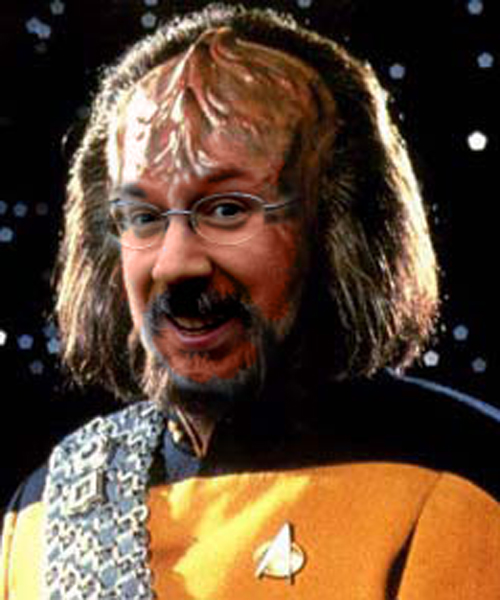
klingonJenkins.jpg Artist's Approximation created by Ivan Askwith

At long last, I can share with you, oh loyal reader, the utterly true, sometimes comical story of how I became a card-carrying Klingon in the new Star Trek film (well, almost). I've been itching to share this yarn for the past year and a half but had wanted to wait until the film was in the theaters and many of you would have had a chance to see it.

The adventure began with an unexpected e-mail: a Hollywood casting director wrote me to say that J.J. Abrams wanted to include me in the then upcoming Star Trek reboot. At first, to be honest, I thought it was a joke. I had no idea that J.J. Abrams knew who I was. We had not and still haven't ever had any direct contact with each other, though my mind starts to race trying to figure out the chain of events which might have led him to discover me. Might J.J. be a reader of this blog?

My loyal and trustworthy assistant, Amanda, did some followup and got on the phone with the Hollywood type to try to determine what would be involved in shooting "my" scene for the movie. Doing so would require me to take three trips to Los Angeles in a little under a month -- not a small demand given the number of long-standing commitments I had -- and I would need to do so on my own dime. What I was being offered was a chance to become an extra and in Hollywood, in some cases, as I would discover, extras are literally recruited off the streets, and all of them are paid only a minimal wage.

The idea of a full professor at MIT flying to Hollywood to appear as an extra was absurd, but given my life-long love of this particular media franchise, which had inspired two of my books and several more articles, not flying to LA to be an extra in a freaking Star Trek movie would have been equally absurd.

I had to do it, even though it meant postponing some significant meetings, ducking out early from academic conferences, and taking a series of red eye flights, not to mention spending several thousand dollars. I have often joked about boldly going where no humanities scholar has ever gone before and this was going to be a wild ride.

So, I flew out to Hollywood and made my way, straight from the airport, to the Paramount Studio backlots, dragging my suitcase behind me. I was greeted by the casting agent, and was then led along with an army of other people out to what literally amounted to a cattle call. I was lined up against the wall with about fifty or sixty other men as people with clipboards moved along the line, discarding some, shifting some to another wall, and otherwise sorting us out into smaller groups. I was trying to make sense of the patterns: along my wall were men who are for the most part bald and have ample facial hair. So far, I fit the category they were looking for.

But then I became acutely aware that I needed to strain my neck to see the tops of the other men's heads. Most of them looked like they were tall enough to play professional basketball and most of them were black. Indeed, by the time the sorting out process was done, I was the shortest, whitest guy left standing. They then took us one by one into a dressing room area to take our measurements and to get us to try on some costumes for size. I was fit with some heavy leather gloves, some pants which looked like they come from a military uniform, some tall black boots, and a helmet. I glanced down at a clipboard when the costumer wasn't looking and saw the notice, "Klingon Guard," and my heart beat a bit faster. It wasn't until the second trip out to Hollywood that the costumers confirmed that I was indeed going to be given a chance to play a Klingon part. (Indeed, some of the other extras only learned they were in a Star Trek movie when they arrived on the set for our actual shoot.)

Now, keep in mind that being a Klingon has been one of my life-long ambitions. When I was in high school, I went to the DeKalb County Honors Camp, where I majored in drama. I spent the summer in the company of some of the most wacky friends I ever had, doing skits and plays, and when we were not doing that, just cutting up in the hallways. One of the girls in our cohort was a hardcore Trek fan. At this point, I had watched the series as a casual viewer but I had not taken the plunge. But she decided she was going to adapt the script from David Gerrold's "Trouble with Tribbles" for the stage and we were all going to play parts. I met a guy, Edward McNalley (who is still one of my best friends) when he got pulled in from another group to play Spock. I was cast as the Klingon officer who sparks a bar fight with the Enterprise crew when he insults first its captain and then the ship itself. In getting ready to play the part, I started reading every book I could find on the series -- The Making of Star Trek, The World of Star Trek, Star Trek Lives, and of course, the James Blish novelizations of all of the episodes, even the photonovels and the viewmaster slides. That's how you kept up on a series back in the days before any of us had a VCR, though my wife still has audio tapes recorded through alligator clips attached to the television sound system, which she recorded when the series was first being aired. It was through all of this reading that I discovered not only Star Trek but also the fan culture around it.

Flash forward several decades to when I was doing research for Science Fiction Audiences, the book I wrote with John Tulloch. That's when I became a Klingon for a second time. I was trying to do research on Klingon fan culture as a contrast to the female fanzine writers, the GLBT actvists, and the MIT students who figured prominently in that study. In true participant observation fashion, I joined a Klingon role-playing group, seeking to better understand what it was like to walk that particular swagger. In many ways, this Klingon fandom was a branch of the men's movement which was taking shape around Robert Bly's Iron John. Most of those I met were working class men who were embracing a warrior mythology to work through anger and frustrations they had encountered in life. Both men and women involved struck me as experimenting with power and trying to reclaim aspects of masculinity which they saw as under threat elsewhere in the culture. In the end, my research on Klingons was a failed project which never found its way into the final book.

I never really could figure out how to perform Klingon masculinity in a convincing manner and I got lost in the role-play activity. I had been cast as a Klingon ambassador, which I took to be an oxymoron, and so I was proceeding by insulting and abusing the Federation ambassadors with whom I was interacting, much as my character in "Trouble with Tribbles" had intentionally picked a fight with the Enterprise crew. But the guy representing the Federation took it all too personally, could never grasp that I was playing a character, that we were operating in a magic circle, and eventually filed a protest against me, which led to the Klingon high council suggesting that I step down from my post. I guess I played too rough to be a Klingon, go figure.

Skip forward a few more years and I'm being profiled in the Chronicle of Higher Education. The photographer is scoping out my living room when he stumbles on my Bat'leth, a Klingon battle sword, which I have propped up against my fireplace. And he asks if I would be willing to pose with it for a photograph. As a long-time fan, I smell a trap. After all, I've written critically about the ways news coverage depicts fans in costumes with program-related trinkets as people who can't separate fantasy from reality. Even with the release of the new film, I am reading lots of prose about "rubber Vulcan ears" and the like, despite two decades of trying to dismantle those hurtful cliches. But I also relished the absurdity of appearing in the Chronicle of Higher Education showing off my Klingon cutlery and so, once again, in for a penny, in for a pound.

So, given that history, I can't tell you the excitement I felt when I called my wife, a fellow lifelong Trekker, to tell her that I was about to become an official Klingon. She was jealous, of course; what wife wouldn't be? But she also was really supportive of this fantasy-fulfilling opportunity.

Next Time: Going on Set, Shooting the Scene, and How the Klingons Ended Up on the Cutting Room Floor.

Five Ways to Start a Conversation About the New Star Trek Film

Spoiler Warning: The following post assumes you saw the new Star Trek film this weekend. If you didn't, you probably shouldn't be reading this post. You should be heading to a multiplex. Cynthia and I went to see the new Star Trek film this weekend. We have managed to see every Star Trek film together as a couple on opening weekend since the film franchise lost with Star Trek: The Motionless Picture in 1979.

So, the two of us proceeded to spend the better part of the evening going through the film scene by scene armed with a lifetime of fan and critical perspectives on the franchise, trying to figure out what it signals about the future of Trek.

We certainly went into the film with high hopes but also with a certain sense of dread. J.J. Abrams has worked hard to demonstrate to the world that "this is not your father's Star Trek," and the problem is that we are, well, sorta, when you look at our birth certificates and all, part of 'your father''s generation. People like 'Your Father' and even more likely 'Your Mother' have kept Star Trek a viable franchise for more than four decades. None of us object to bringing in new souls for the faith or attracting younger followers but you don't have to write off the old fans to do so.

We certainly were not opposed to the recasting of cherished characters: quite the opposite, many of the franchises we care about -- Robin Hood, Sherlock Holmes, Cyrano, Hamlet, Sam Spade -- have been recast many times with differing results but always with new discoveries to be made. We certainly hoped that having someone other than William Shatner playing the part would rekindle our respect and affection for Kirk, as a character, for example, while we remained skeptical that a new actor could capture the complexity which Leonard Nimoy has achieved through his portrayal of Spock through the years. As a fan of the new Battlestar Galactica series, I'd be hypocritical if I objected to them rethinking the characters or revamping the worlds depicted on the series.

When Cynthia was asked what she thought upon walking out of the theater, she responded that it felt like a Star Trek movie precisely because there were things we loved and things we hated about it. It's been like that from the beginning and it will always be thus.

Rather than write a review of the film, though, I figured I'd throw out some discussion topics. After all, it's exam season around here and so the genre of essay questions comes readily to hand. The following are some of the things we've been debating since we saw the film:

1. For us, the coolest thing in the movie was the image of Vulcan educational practice, which is consistent with previous representations (most notably the scenes of Spock retooling himself in Star Trek III) but also gave us new insights. Vulcans seemingly learn in isolation yet immersed in a rich media landscape. Each climbs down into a well surrounded by screens which flash information, allowing them to progress at their own rate, dig deeper into those things which interest them, and at the same time, develop a certain degree of autonomy from other learners. There are no teachers, at least none represented in the segment we are shown here, but rather the individual learner engaging with a rich set of information appliances. In some ways, this is the future which many educators fear -- one where they have been displaced by the machine. In other ways, it is the future we hope for - one where there are no limits placed on the potentials of individual learners to advance.

But if learning is individualized, why do people come together into what can only be described as a school? Why not locate the learning pod in each home? Why have a structured school day?

In the midst of all of this well-considered if somewhat alien pedagogy, we are introduced to the issue of Spock's bullying by his classmates. The scene where he confronts the Bullies is oddly ritualized, as if he was reporting to them for today's insults and abuses, and as if they were testing his ability to develop the toughness and emotional control to push aside those insults. It's clear elsewhere that he faces a certain degree of prejudice as a result of his half-human/half-Vulcan background -- see the casual deployment of race as a handicap as he is admitted to the Vulcan Science Academy. But here, it is as if there is a system of ritualized bullying designed to test and toughen each student. What if bullying was incorporated into the pedagogical regime as it is more or less in several other educational systems on our planet? Certainly the content of the insults would be different in each case, but the logic of ritualized insults as a way of developing emotional control is not actually alien to the way Earth cultures operate.

2. I've read reviews which suggest that the Uhura in this film represents a progressive reworking of the character from classic Trek. I'm not convinced yet, even though I very much liked the actress who played the part. However limited her role might be ("hailing frequencies are open, Captain"), the original Uhura was defined first and foremost by her contributions as a member of the Enterprise Crew. Whatever subtext there was suggesting a Kirk/Uhura romance, it was just that -- a subtext -- left for fans to infer from a few telling moments in the trajectory of the series, among them, the first interracial kiss on American television -- albeit executed under mind control -- albeit an implied projection of one or both of the character's actual desires.

In the new film, Uhura asserts her professional competence but she never really demonstrates it. How does that make her different from many of the female professionals in classic Trek who are introduced in terms of their professional abilities and then reduced to being the girlfriend of the week for one of the primary characters? Here, more screen time is devoted to her but she's ultimately a love object in some kind of still to be explored romantic triangle between Kirk and Spock. Basically, she's been inserted into the story to discourage fans from writing slash stories, though most of us won't have any trouble figuring out how the exchange of women facilitates an expression of homosocial/homoerotic desire.

The classic definition of a Mary Sue is someone who is claimed to have extraordinary mental abilities, who manages to gain the romantic interests of multiple members of the crew, and who manages to have the information needed to save the ship. In way sense, then, is the new Uhura anything other than a Mary Sue figure in the body of an established character? Surely after forty plus years, Trek can imagine a more compelling female character.

3. I'm still trying to make sense of the implications of Kirk's absurdly rapid rise to command in this version of the story. In the past, we were allowed to admire Kirk for being the youngest Star Fleet captain in Federation history because there was some belief that he had managed to actually earn that rank. Here, he manages to gain command in large part because Captain Pike was an old family friend, and because he had one really successful mission. It's hard to imagine any military system on our planet which would promote someone to a command rank in the way depicted in the film. In doing so, it detracts from Kirk's accomplishments rather than making him seem more heroic. This is further compromised by the fact that we are also promoting all of his friends and letting them go around the universe on a ship together.

We could have imagined a series of several films which showed Kirk and his classmates moving up through the ranks, much as the story might be told by Patrick O'Brien or in the Hornblower series. We could see him learn through mentors, we could seem the partnerships form over time, we could watch the characters grow into themselves, make rookie mistakes, learn how to do the things we see in the older series, and so forth. In comics, we'd call this a Year One story and it's well trod space in the superhero genre at this point.

But there's an impatience here to give these characters everything we want for them without delays, without having to work for it. It's this sense of entitlement which makes this new Kirk as obnoxious as the William Shatner version. What it does do, however, is create a much flatter model for the command of the ship. If there is no age and experience difference between the various crew members, if Kirk is captain because Spock had a really bad day, then the characters are much closer to being equals than on the old version of the series.

This may be closer to our contemporary understanding of how good organizations work -- let's think of it as the Enterprise as a start-up company where a bunch of old college buddies decide they can pool their skills and work together to achieve their mutual dreams. This is not the model of how command worked in other Star Trek series, of course, and it certainly isn't the way military organizations work, but it is very much what I see as some of my students graduate and start to figure out their point of entry into the creative industries.

4. If the narrative makes it all look too easy for the characters, the narrational structure makes it much too easy for the viewers. There's a tendency not so much to ask questions as to hand us answers to the questions fans have been struggling with over the past four decades. So, for example, classic Trek was always carefully not to fully explain how Sarek and Amanda got together, allowing Vulcan restraint to prevent Sarek from fully articulating what he feels towards Spock's mother. As a consequence, there were countless fan fiction narratives trying to imagine how Sarek and Amanda got together -- Jean Lorrah, for my money, wrote the best of these narratives, though there were other great fan novels out there on precisely this theme. Yet, here, the question is asked and answered, overtly, in a single scene.

Ditto the issue of whether Vulcans are incapable of feeling emotion on some biological level or if they have simply developed mental discipline to bring their emotions under their control. Again, this question inspired decades of fan fiction writing and speculation and is here dispatched with a few short sentences.

The mystique that surrounded Spock from the start had to do with things he was feeling but could not express: he is a deeply divided character, one who broods about where he belongs and how he relates to the other Enterprise crewmembers. But this film makes it look ridiculously easy for him to get a girl friend and he is surprisingly comfortable necking with his pretty in the transporter room, an act that it is impossible to imagine Spock prime doing. The original Spock was a deeply private person. It isn't that the new film has made Spock Sexy. The old Spock was a whole lot sexier than the new Spock for all of his hidden depths and emotional uncertainties: the new Spock is just too easy all around and there's no real mystery there. He isn't sexy; he's having sex and that's not the same thing at all.

5. As a stand alone film, it's reasonably engaging: I like most of the cast and think they achieve good chemistry together. The pace is, as has been suggested, good, though most of the action scenes -- except for the free fall sequence -- seem pretty average. It's a flawed work but I'm certainly in for more adventures. My problem is that the film didn't give us much to anticipate for the sequel. In answering its mysteries so easily and not setting up new ones, there's just not that much room for speculation and anticipation.

This would work if it were the pilot episode of a new television series. I haven't loved any of the pilot episodes but they gave me enough reasons to like the characters that I kept watching. It usually takes a good number of episodes for the cast to jell with their characters, for the writers to figure out what they are doing, and for the audience to figure out what is distinctive about the new series. I think I need more momentum to get over the hump than a movie every few years and that's why television would have worked better to relaunch the franchise than a feature film is going to do.

Is this a space where transmedia storytelling practices can create a bridge between this film and the next? Is there other ways that they can allow us to have encounters with these characters as embodied by the new cast? If so, what strategies will be the most effective at strengthening what ever level of identification was created for this new film?

Finally, if there are new fans who are created through this relaunch of Star Trek, which is certainly what Abrams and company are claiming is their goals, what has the film left them to do? What are the gaps and kernels they will work with? It's clear enough what the cultural attractor here is but what is the cultural activator?

Then, again, there's nothing wrong with this film that couldn't have been improved by the addition of Klingons. I will explain later in the week.

History and Fan Studies: A Conversation Between Barbara Ryan and Daniel Cavicchi (Part One)

A little over a year ago, this blog hosted an extended series of conversations between male and female academics doing work around fan studies, cult media, transmedia storytelling, and related topics. The exchanges have become a repository for contemporary work in these areas, a place I regularly send people looking for speakers on panels, contributors to books, or simply resources to support their own research projects. Whatever did or did not get resolved in the space of gender politics, the conversations have helped to promote fan studies more generally. With that in mind, I remain open to further conversations involving researchers who were not featured during the last round but who have interesting things to say to each other. BARBARA RYAN, of the National University of Singapore, is working on a book about the Ben-Hur event. She invited DANIEL CAVICCHI of the Rhode Island School of Design to discuss some of the issues involved in pushing fan studies back into the 19th century. She got in touch with Dan because of his work on 19th-century U.S. music fans.

BR: Dan, we might begin by mapping our respective routes to this conversation. I think of you as a fan studies scholar who decided to go back in time, while I think of myself as an historian of reading who is trying to learn from fan scholarship. Your first book, on Bruce Springsteen, includes extraordinary conversations with present-day fans. So that's a sociological approach -- if I can just say this in a simple way. Too simple? Anyway, my first book analyzes 19th-century print culture that tried to emphasize how that print was put to use. Something of a reception study, then, but a social history, too. Now, here we are looking at 19th-century U.S. fans, yours being fans of music and mine being fans of Ben-Hur. Is this a new line of inquiry or one we're joining, in progress?

One could say, I guess, that some histories of fandom already exist, that go back as far as we're trying to go. But I see big differences between fan scholarship and even excellent histories of, say, the Astor Place Riot of 1849 or demotic activity in and around Helen Jewett's murder and the trial of her alleged killer, somewhat earlier. We needn't get stuck on specific examples - except maybe to identify some great histories. The point I'm making is that in those histories, I'm aware of not getting a good sense of what was true, or vital, for people who made up the Astor Place mob, or who wore "Robinson caps" to show their support for the clerk accused of murdering Jewett. Obviously, you can't expect full documentation from all participants when you go back that far. And you sure can't do interviews! But the first consideration is: when it is, and when it isn't, right to speak of fandom(s). One way to proceed could be to examine media's role on the grounds that, ultimately, media creates fandom. Does it all come down then, if only in the U.S. setting, to steam-driven printing and cheaper paper, or/and to the profit motive that inspired what has been called "a riot of words" from about the 1840s?

DC: My initial interest in fandom was actually sparked by histories of reading, especially the work of Robert Darnton and Cathy Davidson. But you are correct to say that my primary approach to fandom until now has been rooted in the social sciences. My fieldwork with Springsteen fans, in particular, came out of my studies in ethnomusicology and anthropology in graduate school. After immersing myself in the theories of the cultural studies movement of the late 1980s/early 1990s, I wanted to recover what I thought cultural studies had erased: actual people. My historical study of music fans is similar. I've always loved cultural histories of audiences, but I've found that they often rely on journalistic sources. Given what I know about how contemporary journalism has distorted fan culture, I'm a little suspicious about journalistic accounts.

Instead, I've been trying do "historical anthropology," searching for people's own explanations and testimony about their fandom. It's true that you can't get full documentation and you can't do interviews, but you can find amazingly resonant experiential fragments from untapped sources, like diaries and novels. I'm quite interested in exploring whether those sources might lead one to a fuller "emic" or "experience-near" understanding--as they say in anthropology--of audience passion for theater, literature, music, and other cultural forms. In this regard, I've been much inspired by books like Jonathan Rose's The Intellectual Life of the British Working Classes.

Beyond method, though, which is something we should discuss further, I think there remains a need to more fully historicize the subject of fandom, which will both help us think about its definition and its personal, social, and political functions. I think it is true that there are, already, histories of fan-like behavior, but they are not necessarily intended as such. What historians of fandom might bring to the historical study of popular culture (and events like the Astor Place Riot or the Columbian Exposition, etc.) is a re-interpretation of the evidence and the historical events through the prism of fan studies. Like any of the micro-histories that seem to be popular these days (the history of walking, the history of salt, etc.), "fandom" is a concept that, when used as a focus, might reveal new layers of meaning that were not evident before.

Still, the danger is revisionism--mapping "fandom" onto people and events in the past without justification or with gross distortion. As you note, the key problem in all of this is whether or not we can even speak of "fandom" before 1900, when the word started to gain currency in print as a description of a people or an attitude. It depends on how you define fandom, of course. The narrower or more historically-specific the definition, the less able one will be able to identify it in other contexts and time periods. The broader or general the definition, the less useful it becomes as a description of a distinct phenomenon.

I tend not to think of fandom in terms of "media," actually, which is the luxury of someone who is not housed in a media or communications department. Instead, I tend to think of it as a degree of audiencing, a realm of marked cultural participation that is always relative to, and defined against, "normal" or unmarked cultural participation. These degrees of audiencing might manifest themselves in all sorts of ways in different historical and social contexts.

The "fandom" that scholars have studied thus far have had very much to do with mass-mediated forms of culture and have thus concerned modes of production and reception, commodification, the star system, the twists of encoding/decoding, etc. But I think there might be other modes of marked cultural participation--both in other cultures and in our own past--that might be legitimately brought into, or at least aligned with, "fan studies." Are there behaviors and values that we might identify in, say, music lovers of the 1840s, Ben Hur readers at the turn of the century and contemporary Lost fans today? At the moment, what I see uniting those instances of audiencing has mostly to do with the commodification of culture, which depends on a radical--and sometimes playfully manipulative--reworking of the relationships between performer and audience.

BR: You speak of the functions of fandom, and the possibility that historicization will reveal new things about fans and their activities. That's a motivation for my project, too. But the main thing I want to point out is that your word 'marked' will please many historians because in this field there's much discomfort about having to read minds rather than looking to the documentary record. That said, the Springsteen book includes several vibrant discussions of your own fandom. I wonder if you feel you have a purchase on past fans and fandoms that reflects your experiences of being a Springsteen fan. Maybe more so when past fans or fandoms include music . . . or maybe not.

This raises a general question: is autoethnography still important when analysts move into historical fan studies? Could it help reveal, for instance, 'marks' on certain acts of cultural participation? This is on my mind because autoethnography isn't the norm among historians. I don't see it becoming a norm, either, due to the disciplinary freight on teasing out "how it really was then." I'd like to see autoethnography make headway among historians because I've become aware of how it sometimes helps me figure things out. I tend to agree, though, with Nick Couldry that we don't want autoethnography to become something every fan scholar must do, in print. I tend to agree because I read too much autoethnography -- even from some of its proponents -- that seems to me as uninformative as non-historians' accounts of change over time.

One way I was thinking I might introduce positionality into my Ben-Hur project is to do some ruminating in sidebars. I'm playing with this in a current draft because I think it might materialize for readers outside fan studies how fan scholarship can develop a richer historical field. Some days, this feels crazed: where do I call a halt? Other days, it seems that's the right way to feel about what it means to analyze something as big and amorphous as "culture."

But back to your remarks. It's interesting to hear that you turned to fan studies after reading Davidson and Darnton. They were helpful to me, too. But my first wake-ups came from books by Janice Radway and Barbara Herrnstein Smith. This will date me, but pop culture wasn't taught in my graduate program in 19th-century U.S. literature. I mean, not even best-sellers like Uncle Tom's Cabin on the grounds that they weren't literature. In that setting, Reading the Romance was pretty thrilling for me. Smith's Contingencies of Value is a different kind of project. But it did more than anything else to alert me to the value of historicizing . . . which is part of your project, too. I like your term "historical anthropologist." You see my eagerness to talk about methods!

DC: I like the word "marked," too! Though I must say that I was using it in the original Jakobsonian sense from linguistics, where it indicates the one side of a binary opposition that is aberrant and therefore significant. When we say "how tall are you?" instead of "how short are you?", we weight the opposition of tall and short by making tall "unmarked" and short "marked." That relational approach actually helps me understand fandom better than notions of "excess" or "resistance." (I'm being totally pedantic, I know...you can imagine how my family suffers).

But you are right about "marks" and their importance. I certainly understand the concern with creating an empirical (not empiricist) understanding of the history of fandom. If fandom is about emotional attachment, something that is largely experiential and outside the realm of official institutions and documentation, what evidence would exist from the past to show that it was developing or even existed?

In the opening to his book, Making American Audiences, Richard Butsch recounts an abandoned project on "the change from music making to music listening associated with the dispersion of the phonograph & radio." He admits, "After some preliminary explorations of dusty archives and old books, I concluded it would be difficult to document such private practices...." This is true, but I don't agree that the private practices of audience history are totally lost.

Instead, I've found inspiration in newer approaches to history--the history of the senses, especially, as practiced by Mark M. Smith, Richard Cullen Rath, Emily Ann Thompson and others. Sensory history does what I want to do with audiences--it builds on the innovations of social history in the 1960s to recover a past that was long thought lost. These scholars use the close study of materials, tastes, landscapes, visual imagery, and sounds--combined with biological science and detailed contextual mapping--to articulate ordinary people's sensations of the past.

Autoethnography is a part of this approach, though it isn't called that. One of the useful things that Richard Cullen Rath did in How Early America Sounded, for example, was visit a colonial-era Quaker meeting house and analyze his own experience of the acoustics in the structure as a way to begin making sense of how colonial Quakers might have experienced it. I, too, have visited King's Chapel in Boston for an afternoon organ concert in order to experience how the space might have resonated for 19th century music lovers.

Of course, there's a danger in this: there is no guarantee that my experience of a church in 2007 will be at all the same as someone in the same space in 1842. In fact, most historians of sound would say that our cultural understanding of sound is so different, so changed, that any comparison would be suspect. However, at the same time, the wood, the paint, the instruments, and the acoustics are the same. And I have historical diary accounts from people enthusing about hearing music in that space. It's a matter of taking one's own experience and weighing it with that of someone else, using the materiality of the space and the human body as a sort of constant.

If anything, I really see my approach as that of an historical ethnographer. Historical fieldwork is a little weird, since the implication is that I am conducting observation and interviews with the dead, but in many ways I really do see that as being true. In my research in archives, I am encountering all sorts of people and experiences--through diaries, images, even personal objects--and trying to make sense of those encounters.

The encounters contain the familiar but at the same time there are unexpected things that I don't understand: odd language or design, misplaced emphasis, or, as Robert Darnton pointed out in The Great Cat Massacre, jokes that aren't funny. As an anthropologist tries to make sense of his or her accumulation of encounters with the unexpected in the field, I am trying to do the same in historical research and build some meaning out of the enterprise. The difference is that I can't ask questions and receive answers; but I pursue questions and expect answers and, in general, value the paths opened up to me as I move from diary to diary, object to object. This is most definitely not traditional history, in that it sees the past as a "field" and derives meaning from the means, or process, of historical research rather than the ends. But I don't know how else to do it.

In the end, I have to say that I never thought I was doing auto-ethnography in Tramps Like Us; I just thought I was being a reflexive ethnographer. There's a difference: I'm sympathetic with the phenomenological premise behind the valuing of one's own experience but it seems to me that that approach works best (and is tested) only in tandem with the examination of the experiences of others. How do you see auto-ethnography informing your understanding of Ben Hur readers? What's the relationship between those sidebars and the text you are writing? In general, how do you approach making sense of the evidentiary fragments that inform your work--the letters from readers? How far can you go with that to create convincing or meaningful conclusions?

BR: On historical fieldwork, I remember when a friend in Classics expressed envy of my ability to go visit the home of a 20th-century writer who received fan mail. 'You're so lucky!' he kept saying; 'all I have is scraps of parchment and heaps of rubble.' I recall this because I think there's a point at which we can't speak, even metaphorically, about doing fieldwork in the past.

We can do research but its basis is distinct; I do wonder how that relates to the sorts of things scholars will be able now or later to identify as fandoms. This is just a brain-teaser, really. But it was thought until quite recently that fan mail wasn't a resource for historians of reading because so little has survived. When that turned out to be less true than had been assumed, the next objection was sampling: ok, this school said, now we have fan mail but it isn't representative of all readers. The clearest statement of this position, that I know, isn't at all aware of fan studies scholarship. But it wouldn't be strange if the scholar who took this stand, as recently as 2008, looked at fan studies scholarship, found nothing there about fan mail, and therefore fell back on common sense that, as so often, is hard on the non-normative role - here, that of avid enthusiasts. I haven't figured out why fan researchers who go to great lengths to find subjects to interview are so chary about fan mail. But I plan to do something about this oversight.

So that's me on my soapbox. Where this gets us is "sources untapped" . . . to misquote you . . . that exist to be tapped because of two State-funded institutions. One is libraries that undertake the fairly expensive job of preserving authors' papers but which do so under the lit history rubric of authors as artists. This institutionalization girds the idea, affirmed by the few historians of reading who examine fan mail, that this evidence of reception is best framed in terms of author-reader intimacy.

Backing up this affirmation is the other institution in the mix: the U.S. mail. I explore its impact with help from Friedrich Kittler's sense of "the semi-media monopoly of the post." Kittler is a controversial figure. But I think his radical historicization of media, during the period of most interest to me, helps nudge analysis of the Ben-Hur event toward art/civic topics probed by Couldry, Butsch, Joke Hermes and others.

Where, therefore, you're looking to historians of the senses -- a great initiative -- I'm looking to fan and audience studies that discuss crowds and publics, cohesion and pop culture. As you'd expect, I contextualize the handful of letters saved by the author of Ben-Hur (or someone near him) by looking at clippings scrapbooks commissioned by him or his wife, news articles about Ben-Hur's value as literature, and 19th-century reports of its soaring sales.

I think of my project as step-by-step charting of an event/uality 20th-century critics were happy to telescope into a flat narrative: after critics dissed Ben-Hur, "ordinary" Americans cherished it to best-seller status. My research reveals that that isn't sound chronicling. But we can't see that unless we take fans' letters seriously, probe them as thoroughly as we'd probe any other document, and pay close attention to each letter's date. I use the term 'event/uality' to emphasize that there was nothing inevitable about Ben-Hur's success, understood as an arts enactment of democratic citizenship.

Where do sidebars fit in? In my Introduction, I'm trying out two. The longer summarizes Ben-Hur's plot because it's been my experience that a lot of experts in 19th-century literature and culture haven't read this fan favorite. Usually, books like mine offer plot-summary in the body-text. But I think a sidebar signals more forcefully that I'm not going to analyze Ben-Hur; I'm interested instead in how specially avid readers shaped its event.

The second sidebar will tackle my relationship to Ben-Hur. I want to be up-front that I didn't read this book as a fan, or become a fan by reading it. But I want to clarify too that I'm embedded nonetheless in the Ben-Hur event as - I'll argue - are all my readers, whether they've read Ben-Hur or not. Do you see how these sidebars lace into each other? I hope that that will make them operationalize, for more readers, a sense of the literary politics exposed in Contingencies of Value.

The other thing to say about sidebars is that they'll give readers a chance to skip, or think about skipping, reflexive passages. Quite fun, isn't it, to have this chance to swap thoughts about work in progress? Thanks, Henry!

You mentioned unfunny jokes; in my case, this could be a lexical leap in an archived fan letter, or an illustration on a product sold along with the stage-show of Ben-Hur. Findings of both sorts helped me dig deeper into event/uality in ways that helped me range more widely. The illustration, in particular, led me down unexpected pathways. It's part of the reason, for instance, that just a few weeks ago, a book I'd picked up for leisure reading sprang into focus as more evidence of the global impact of the Ben-Hur event . . . which was, and remains, amazing to me: how far this novel reached, how many lives it touched - how many people it irritated! It was partly with a view to that amazement that I said earlier, where does research stop? But it's more central to my interest in fan mail that researchers devise methods resistant to what Raymond Williams called "the long dominative mode." It's been exciting for me to explore media studies that challenge the premises of literary history, a discipline that found its footing by, among other things, shooting down Ben-Hur and all who liked it.

Do you find similar put-downs or posturing in your project? I think you end before Americans heard reports of women standing on their chairs at open-air concerts, to get closer to Wagner's music. But you're seeing, I'm sure, concern about over-avid or rawly untutored reactions to Lind, Bull, Paderewski and so on. What space do you make for anti-fans? Do you feel you need to present a 'fair and balanced' account of those days, or that it's more valuable to focus on all that's currently unknown about receptors 'marked' as lacking or aberrant?

DC: You raise many issues about evidence, here, Barbara, that are worth considering in fan studies. Of course, evidence has always been an issue in the discipline of history--from basic questions of origin and access to standards for evaluation and interpretation. It is generally true that physical traces of the past tend to disappear and become increasingly scattered as time goes on, making the process of piecing together a coherent understanding of past events and experience more and more difficult. That difficulty arises from the principle of accumulation, that one can make conclusions only when enough of the evidence warrants a claim. Worry about conclusions occurs when the evidence is "thin."

However, debates in anthropology have taught me that what constitutes "enough evidence" is often defined by the subject being investigated. Not having enough evidence is often a problem when the goal is to build a general field theory about a past culture or time period; the generalization required at that level of analysis requires a great deal of support to be convincing. A solution to that problem, however, is to scale back and recognize that writing about a fragment, a very limited moment or experience, or even a single voice, can be as worthwhile in creating meaning. In my own work, I can spend months trying to learn as fully as I can about a single person I have encountered in archives--a young clerk and avid music listener trying to make his way in Philadelphia in 1849, the first winner of P.T. Barnum's ticket auction for Jenny Lind's 1850 concert in Boston, etc. At one point I contemplated writing a whole book about the latter! Would that have enabled me to still think through the emergence of music fandom in the United States? Yes, but in a very particular way that might prove unsatisfying to those looking for broader understandings of the sweep of culture and history.

I would emphasize in all this, though, that the one thing that fan studies has taught me is that while much evidence is lost, perhaps even more of it is ignored or overlooked, thanks to the politics of collective memory. In other words, there are traces of the past everywhere, if only someone were to interpret them as so. Maybe that's too literary, or radically postmodern, for a lot of historians. There is something subversive about researching popular fandom at state and private archives like the American Antiquarian Society, the Massachusetts Historical Society, or the Boston Athaeneum. When I did so, I was mis-using the sources in those places, which were collected and preserved as antiquities or aesthetic treasures, by elites who likely disapproved of the activities I was seeking to value. I should say that I was supported by a competitive fellowship at one of these institutions, so there was nothing really under-handed about doing fan research there, but at the same time, the institutionalized understanding of "history" that shapes research practices at such archives is not set up for a quirky, left-field mining of the collections.

In my case, none of the finding aids so carefully prepared by past curators and archivists were useful for locating materials related to music audiences, or listening, or passionate engagement. Instead, it was a matter of experimenting with lots of open-ended searching in diaries and ephemera. I also started systematically perusing sources catalogued for other histories (religious debates, women's diaries, military history, etc.) and then reading them for what those sources might lend to a study of music loving.

It seems to me that your use of fan letters is similar: you are looking at something that has always existed but has been ignored by researchers or whose meaning has been narrowly prescribed by institutionalized frameworks of interpretation. As you suggest, by taking such letters seriously as historical documentation, we can see (or to be more accurate about it, create) a different history of Ben-Hur's reception.

I do agree that my very focus on music lovers is a way to bring them into a musicology (and a culture) that has spent much time denigrating fan behavior and demoting practices of audiencing to secondary status. I seek to recover such behavior, quite simply, because it's missing, and I think our understanding of American musical life suffers in its absence.

Does that lead me to avoid anti-fans in the research? Not really. The more work I've done on the emergence of music loving, the more I've learned that the binary opposition of fan and anti-fan is itself historical, developing in from the sacralization of high culture and the disciplining of public spectatorship described by Lawrence Levine, John Kasson, and others. After the turn of the century, you are either high or popular, good or bad, etc. In the antebellum period, the valuing of different kinds of audience participation is far more variable and complicated. "Music loving" could be exercised as a focus on the space of the concert hall and a focus on the "work;" an outer enthusiasm, a kind of communal sociability, and/or an internal intensity; and a means for circumventing, embracing, or strategically using the increasingly rigid frameworks of commercial entertainment. Preferred and less-preferred kinds of engagement are sorted out on an institutional and cultural level between 1850 and 1880, but the process is messy and confusing.

I'm not sure that I could focus only on marked receptors, if I tried, because the people I'm investigating are clearly working through the process of "marking" in the first place. In fact, I found myself seeing what I initially thought was elitist and dismissive "anti-fandom" (insisting on reverent silence in the concert hall, for example) as a complexly unfolding reform of previously established behaviors of passionate engagement. There is no doubt that in the context of urbanization and immigration in the mid-19th century that such revisions had ideological consequences that reinforced growing class divisions; I am less certain, however, that the motivations of the particular people who argued for such revisions were uniformly and/or simply about class prejudice. As in Tramps Like Us, I am wrestling a bit with the seeming contradictions of macro- and micro- interpretative frameworks.

I do have my own strategies in writing, of course. Your separating out, in sidebars, of the text of Ben-Hur and your own relationship to Ben-Hur from the event of Ben Hur is necessary for uninformed readers but also highlights the politics involved in your analysis. In my case, I am consciously resisting any privileging of "the work" in my analysis. In part, that absence is meant to re-orient (or perhaps disorient!) my readers so that they can think about music outside of the common frame of composer/text/performance that is so incredibly entrenched in both the academic study of music (musicology has never really experienced a postmodern crisis of definition) and in the music industry.

I am intensely uninterested in working out the lineages of styles or performers that typically occupy music history; instead my focus is resolutely on an alternative history of audience behaviors. I did go out and find some recordings of the operas that music lovers mentioned in their diaries, but I see such texts as only part of the many details that make up the event of reception.

In fact, initially, I prefer NOT knowing what symphony or song is being referenced by an auditor or an artifact--it makes it easier to avoid the work and focus solely on reception behaviors. It allows me, for a brief moment, to explore audiencing in a more open-ended way before my own musicological knowledge and associations narrow my thinking. That suspension of knowing also gets me psychologically closer to the "newness" of musical works that music lovers themselves were experiencing. Maybe it's all pretend, but I find, at least, that experimenting with how I am positioned in my own processes of research and of writing can be worth while.

>

Home-Made Hollywood: An Interview With Clive Young (Part Two)

What role have science fiction conventions played in fostering this amateur film

culture? Why has fan cinema been slower to emerge around other genres?

Science Fiction conventions are often run on a shoestring budget, so amateur films constitute free programming; at the same time, sci-fi fans are often attracted to technology-oriented hobbies--like filmmaking. Put them together and it's a tight fit. The modern pop culture and sci-fi conventions blossomed during the 1970s when 1960s sci-fi TV shows entered reruns, most famously Star Trek and Lost In Space. If you were a hobbyist filmmaker and you went to a convention, it was easy to see that a homemade sci-fi flick presenting new adventures of a beloved old franchise could find an appreciative audience at such an event.

Likewise--and I'm hardly the first to suggest this--men bond by 'doing,' so a group of male sci-fi fans getting together to explore their fandom through a group activity like filmmaking makes sense. Additionally, since many guys collect memorabilia as an expression of their fandom, a fan production provides a convenient way to rationalize some purchases: "Yes, Honey, I spent $700 on a Stormtrooper costume--but it's for my fan film!"

What place does the female fan practice of "vidding" hold in your account of fan

cinema?

To be honest, it's barely present in my book, which is not to imply that Vidding is insignificant. Rather, it's a very different art form, deserving its own in-depth exploration, such as the Vidding History project by the Organization of Transformative Works. I discussed Vids in passing a few times in the book, because to ignore them would be disingenuous; however, it would be presumptuous and insulting to that community for me as an outsider to attempt to tell Vidding's story.

The fan remake of Raiders of the Lost Ark has generated much greater visibility than any other fan film in my memory. How typical is that production of fan filmmaking practice in general and what brought that film to such a high level of public consciousness?

There's a lot of elements at play when it comes to the (relative) success of Raiders of the Lost Ark: The Adaptation. Primary among them is the fact that you can't see the film. Despite the fact that it has gained a high profile, it isn't readily available on the internet or home video; the only way to see it is to attend one of the scattered screenings held around the country each year by the filmmakers at non-profit cinemas and the like. By using the media to spread the word about the film--but not the film itself--the filmmakers have created a pent-up demand to see it...and fortunately, it is one of those rare cases where the movie actually beats audiences' expectations.

As far as fan filmmaking practice goes, the level of work that went into Raiders was unprecedented up to that point. For three pre-teens in the 1980s to spend seven years shooting a movie without any parental help is unusual enough; once you throw in the fact that they recreated all the major set-pieces of the original--Indiana Jones being chased by a boulder, getting dragged under a truck, fighting in a bar that's on fire, and so forth--it becomes astounding. Besides rooting for the kids--how are they going to pull off the next part?--I think many viewers relate to the film because everyone role-played as a child, whether it was "Cowboys & Indians," "Superheroes" or something else. These kids elevated that experience to the next level by videotaping it. At the same time, the sheer scope of what they achieved is inspiring--they had an impossible, idyllic dream as 11-year-olds and tenaciously made it happen, despite overwhelming odds. That's an experience anyone can get behind.

One of the things I talk about in Homemade Hollywood is how fan films are the offspring of scripted entertainment and Reality TV, and the Raiders adaptation is a great example of this, because you're seeing familiar scripted characters enacted by regular people in real-world settings without the perfect Hollywood sheen. When you see 13-year-old Chris Strompolos as Indy, trying to outrun a 100-lb. boulder made out of fiberglass or hanging off the front of a rolling truck, the look of terror on his face is undeniably real. It's a very analog, visceral experience to view the film and it sucks viewers in, because these days, that's something you often can't get from professional movies.

Ironically, Hollywood reacted to that analog, visceral experience by buying the life-rights to the filmmakers' story in a six-figure deal that made the front page of Variety. In a few years, you can expect to find a professional tribute movie about their amateur tribute movie about yet another movie at your local multiplex.

How has the web reshaped amateur film production, publicity, and distribution?

The web has certainly become the lifeline of the fan film community and has affected all the aspects you listed. Before the mid-Nineties mainstreaming of the internet, there were plenty of fan filmmakers out there, but they weren't aware of each other. In fact, the term "fan film" didn't exist because no one realized that this was a filmmaking movement instead of merely a few isolated movies mentioned in the back pages of enthusiast magazines like CineMagic.

In terms of production, sure, amateur filmmakers use the internet for obvious things like buying costumes or equipment (or, in some cases, pirating editing and effects software), but now they can build a virtual crew as well. For instance, the 2005 fan film, Star Wars: Revelations, was an ambitious, 40-minute effort covered by all the major news channels and downloaded over a million times in its first 48 hours on the web. Part of the appeal was its eye-popping special effects, which were created by a volunteer team of CGI enthusiasts around the world that used the web to recruit artists, exchange files and compile the finished effect shots.

The internet also provides varied levels of distribution, from simple YouTube clips to over-the-top efforts like Revelations, which was available in a variety of forms, from iPod-friendly MP4 files to a Bit Torrent package that that could be burned to DVD-Rs to create a two-disc set--one for the movie and one for the behind-the-scenes extras, naturally.

As for publicity, websites and the blogosphere are certainly the main forum for spreading the word about fan films today, because a simple link will get your work seen. I run a daily fan film blog called FanCinemaToday.com, and I get everything from illiterate emails ("Dude, U rite on my movie?") to professional-quality digital press kits. No press junkets or swag yet, but I can dream (just kidding). Like the films themselves, the publicity efforts range all over the map.

You describe a number of cases where studios have struggled with how to respond to fan films produced about their franchises. What factors have shaped their decisions in regard to fan cinema? How would you characterize the current perceptions in Hollywood towards fan films?

Hollywood has been fairly alarmed by them--and with good reason. While I'm an advocate of fan filmmaking, I think the studios are right to be concerned. If you owned a sleek Maserati and the 12-year-old next door took it for a joyride, you'd be furious even if it came through without a scratch. That's something like what's going on with the studios, because amateurs are basically hijacking these billion-dollar franchises and doing whatever they want with them.

Now, to be fair, 99.9 percent of all fan films are tributes in some form or another, they pose no real monetary threat to a studio's franchise and they don't impact the public consciousness when you compare the number of people who saw The Dark Knight last summer to 6,000 people watching Batman's Bad Day on YouTube. Studios realize this and I think that fuels the current take on such flicks--that they're relatively harmless. At the same time, going after fan filmmakers with IP lawsuits would be a waste of resources because they'd cost more than could be won, plus they'd be a PR nightmare similar to the travails that Warner Brothers experienced when it tried to shut down Harry Potter websites a few years ago.

On the other hand, the current state of things where most studios are looking the other way is going to end sooner or later. To make up an example, let's say you make a $20,000 fan film where Superman goes crazy because of Kryptonite and starts graphically killing babies with his X-ray vision. If it's a well-made film that grabs the eye of a cable news pundit on a slow news day, that could blow up into a serious problem and potentially damage the franchise.

A more likely scenario, however, is that studios will get involved with fan films simply because there's money to be made, whether it's through some form of licensing out characters to the filmmakers, or making the best flicks available on a studio-sanctioned X-Box channel for a buck apiece, or something else entirely.

Lucasfilm has taken an interesting approach to dealing with fan films with its annual Star Wars Fan Movie Challenge. The contest is used to reach out to the fanbase, it appears to show fans great largesse because George Lucas is "allowing" them to make fan tribute movies, and yet it gives Lucasfilm indirect control over what material goes into such flicks, because if you're going to go through all the effort to make a Star Wars fan film, why wouldn't you follow the content guidelines so that you could enter it in the contest?

As you note, far fewer women than men have been involved in the production of

original fan films. Why do you think this pattern has emerged and are there

signs that more women are producing fan movies now than in previous decades?

There are lots of theories about this out there--for instance, that women are more interested in characters' internal lives--an aspect more easily explored through fan fiction--or the comment earlier that guys bond by 'doing' so they gravitate toward a group activity like film production.

I think one overlooked aspect is sheer momentum. Fan fiction took off in the 1960s and 70s with zines and quickly became an outlet for female fans. I suspect that since then, women looking to create new stories for a favorite franchise have looked at the fanfic community and said "That's where my peers are; I guess I'm going in that direction." It's self-perpetuating at this point.

Of course, I'm not a female fan filmmaker and never will be, so I can't speak from a place of authority. As a result, in Homemade Hollywood, I spent a chapter interviewing women filmmakers and a number of them spoke of women being uncomfortable with being in charge. One filmmaker who teaches film to girls noted that the idea of being a director never occurred to her students and when she suggested it, they couldn't envision themselves in that position at all.

With all that in mind, I don't see the current male-to-female amateur filmmaker ratio changing anytime soon. One thing I would like to see is more collaboration between the fanfic and fan film communities. Most fan films would benefit from better characterization and more fully rounded stories; who better to write them than fanfic authors? It's happened in a few cases--most noticeably the aforementioned Star Wars: Revelations--and I think both sides of the equation could benefit from it.

In the case of Star Trek, we are seeing increased collaboration between fans and some of those involved in the commercial franchise itself, including actors,

script writers, and technicians. What are the implications of this kind of collaboration for the future of fan cinema?

There are a number of high-profile fan efforts with sophisticated production values now, most noticeably Star Trek: Phase II, a fan series which sports a $100,000 Enterprise bridge set. They've been known to feature Trek alumni such as George Takei ("Sulu") and Walter Koenig ("Checkov") recreating their original roles, and have had original series writers script and sometimes direct their episodes

Quasi-pro efforts like Phase IIdo point the way towards a number of possibilities for fan films in the future beyond obvious things, such as that they may prove to be a "farm league" for tomorrow's professional casts and crews. For instance, fan productions may wind up being used by Hollywood to see if the time is right to bring back a shuttered franchise. Similarly, analyzing fan films based on properties that are still up-and-running may provide insight into what aspects resonate most with die-hard fans. Alternately, if fan films show a trend of including a specific characteristic not in the original--for example, many Star Trek fan films pointedly feature gay characters--they may provide insight into what would realign a troubled franchise with its fanbase.

And as noted before, studios are likely to eventually get involved with fan filmmakers simply because there's money being left on the table under the current arrangement of pretending they're not there. If fans are going to make an amateur production based on your IP, why not sell them a specialized set of rights, props, costumes, digital filmmaking "toolkits" customized to the franchise with trademark sounds, music and "greenscreenable" effects, and rent them space on a special website just for "official fan productions" based on your franchise? Once there are enough decent flicks, they can be repackaged as a TV special, a DVD, or some other product. There's a lot of way studios and fans can work together in a symbiotic fashion that would benefit all parties.

Getting into bed with the studios works for fan films primarily because most filmmakers in the hobby daydream of breaking into Hollywood; such a model would be far less successful if applied to other media like fan fiction, where similar efforts have failed.

Also, another concern is that high-end, high-profile fan productions are a lot of fun to watch, but they can be intimidating to potential fan filmmakers--"Why should I bother if that's what a fan film is supposed to be? I can't do that." Phase II, in particular, is far removed from the underground, "punk rock" aesthetic that has powered so many fan efforts throughout the years.

Ironically, that sheen of perfection is exactly what Hardware Wars parodied back in the 1970s, showing that a fan production didn't have to be perfect--much less made with professional help--to be enjoyable. Perhaps things are coming full-circle and we need a new low-rent flick like Hardware Wars to burst that bubble again. Who knows?

Clive Young is an author/lecturer covering the crossroads between high tech and popular culture. He is the author of the first book about fan films, Homemade Hollywood: Fans Behind The Camera (Continuum, 2008). He is also senior editor for Pro Sound News and has written for MTV, VH1.com, American Songwriter and numerous other outlets; additionally, he is the author of Crank It Up, an exploration into the world of rock concert roadies. Young has lectured extensively on film and music at many universities, libraries and conventions, and lives in New York with his wife and daughter. Visit his website,

www.cliveyoung.com, and his daily fan film blog, www.fancinematoday.com

Locating Fair Use in the Space Between Fandom and the Art World (Part One)

Earlier this year, I received the following account of the experiences of Stacia Yeapanis, a young artist who straddles the art world and fandom: she produces videos which appropriate footage from popular television shows for the purposes of critical commentary and artworks which use as fannish television shows or deploys The Sims game world as their raw materials. Her videos, produced for art installations, very much resemble those produced by female fan vidders. As an experiment, she posted one of her vids on YouTube to see how people would respond and as a consequence, she found herself confronting the mechanisms by which corporate media regulates the production and circulation of participatory culture.

I found that her story raised important issues which I wanted to focus attention on through this blog. It came at a time when organizations like the Electronic Frontier Foundation have been raising concerns about YouTube policies to police content which push well beyond established norms in copyright protection and erode Fair Use rights of contributors. The EFF's Fred Von Lohmann posted some important critiques of YouTube's new practices in early February, including some recommendations which would have a big impact on the vidding world: "YouTube should fix the Content ID system. Now. The system should not remove videos unless there is a match between the video and audio tracks of a submitted fingerprint." While I have sometimes been critical of the EFF for adopting stances which undercut the Fair Use rights of fans, this time they are defending the rights of anyone to make transformative use of media content via videos.

Today, I am sharing her story and her video. On Friday, I will be sharing response to the stories from others who have been on the front lines of the struggles over fair use and grassroots expression. I'm hoping this will spark some further discussions in fandom, in the art world, and in the circles that shaping intellectual property law.

"Confessions of an Aca-Arta-Femi-Fan"

By Stacia Yeapanis

On December 1st, 2008, I received a takedown notice from YouTube in reference to my first fanvid "We Have a Right to Be Angry." Fox Broadcasting had blocked the video using an automated video ID system that identifies copyrighted content. After much anxiety, I removed my video on December 5th.

In "We Have a Right to be Angry" I appropriate footage from Buffy the Vampire Slayer, Xena: Warrior Princess, and Charmed. It is edited to "Invincible" sung by Pat Benatar. By uniting the fictional feminist icons of my adult life, Buffy, Xena, and the Halliwell sisters, with a real-life feminist icon from my childhood, Pat Benatar, I explore my own complicated position as a feminist in contemporary society. The women in the video vacillate between running, lying low, and fighting back. As these women from different TV shows pass a sword around, they share collective power that extends beyond the boundaries of their fictional universes. They are fighting cultural patriarchy on its own terms and they are doing it together.

During the 5 days between getting the notice and removing the video, I was extremely conflicted about what to do. As an appropriation artist, I already had a basic understanding of copyright law, and I believe my video falls under fair use. But I was only vaguely aware of the Digital Millennium Copyright Act (DMCA) and the takedown notice procedures. For example, YouTube did inform me that I had the option to dispute Fox's claim, but I didn't know how long I had to make this decision. If I took too long to consult an attorney, could the situation escalate to an official Cease and Desist letter? If I disputed based on the doctrine of fair use, would Fox back down or take me to court?

I watched my own fanvid over and over again. It seemed to have the answers. In light of the takedown notice, a new meaning that was floating beneath the surface emerged for me. The video was always about the struggle of any feminized (read: marginalized or disadvantaged) group. It was about aggression and injustice. It was about collective power that takes place on many fronts. But now it is also a metaphor for the struggle over meaning between producers and consumers. Mass media corporations are clinging to rigid ways of thinking about who controls meaning and how meaning is made. The feminist icons in my video are now also fighting outdated copyright laws that have begun to prevent the free flow of culture. Their swords are metaphors for fair use. I felt that if I didn't dispute, I would be letting Buffy and the others down. I wanted to fight with them.

At the same time I also began to worry about the difference between theory and practice. Theoretically, fanvids fall under fair use. Most legal scholars who are writing about fanvids in law reviews come to this conclusion, at least where the video is concerned. I would argue that even the uncut audio, which is more often assumed to be infringing, is transformed merely through juxtaposition with the video. But there don't seem to be any case precedents to this effect. Theoretically, appropriation art also falls under fair use. But as we learned from Rogers vs. Koons, conceptual art that rests on a foundation of postmodern theory does not fare well in court. Understanding appropriation art, like fanvids, it isn't a matter of intelligence. It's a matter of having specialized information and understanding how context affects meaning. The Art World is a subculture that is as misunderstood by non-members as Fandom is.

In all of my research since the takedown notice, I have yet to find any discussion online about the shared interests of the Contemporary Art World, Media Fandom and Media Scholarship. Professional appropriation artists seem to have flown under the radar, except in cases when the artist begins to make a lot of money. The few cases I know of (Jeff Koons, Andy Warhol, Richard Prince) have all involved appropriation of printed images and only Koons actually had his day in court. (He lost.) At this stage in my research, I'm not aware of any cases involving appropriation art that uses video or audio. The distribution of contemporary art seems to still have the invisibility that fanvid distribution used to have before the advent of the Internet.

I have this suspicion that if I just show my work inside the traditional gallery system, I will be safer from litigation. But if I want to reach across the boundaries of the art world and blur the line between mass-media culture and fine art by posting my work on YouTube, I better watch out. It's almost as if the law is barring me from pursuing hybridity. And that's really the foundation of my practice. My work is a synthesis of conceptual art, already a synthesis of cultural theory and art, and fandom. I'm responding to the ironic appropriation art of the '80s and '90s by adding my sincere Fandom into the mix in order to question cultural hierarchy (i.e. the idea that "high" culture is better or more important than "low" culture). If I can't appropriate, then I can't make my work.

I removed the video from YouTube with the intention of arming myself. It was clear I wasn't quite ready for the big battle against the Big Bad. I want to be part of the movement for reform of copyright law, but there are two problems. One is financial. I don't have any money to go to court. Even if I were to win the case, the costs alone could have a devastating effect on my life. I am an emerging conceptual artist. That means I don't really get paid to make artwork at this point in my career. And two, I'm not sure if I could win. I fear that my hybrid position as artist/ fan and the fact that my art practice rests on conceptual, not visual, strategies would be detrimental to my case and to the cause.

In the next 5 years, maybe this fear will seem absurd. Maybe by then, the law will have stretched itself to make room for the various cultural developments of the last 40 years, namely, postmodern theory and the destabilization of cultural hierarchy through appropriation art, fanvids and other forms of remix culture. In the meantime, it would be beneficial to have more conversation about the parallel development of appropriation in the Art World and in Fandom. It seems pretty significant that fanvids and appropriation art have been developing simultaneously since the '70s and yet their creators seem utterly unaware of each other. There needs to be a stronger acknowledgement of the overlap in the cultural work we are all doing as scholars, artists, fans and lawyers. We are all producers and consumers of our culture. We are all warriors, slayers and witches.

Stacia Yeapanis is a Chicago-based emerging artist and a media fan. Using strategies of accumulation, collection, appropriation and juxtaposition, she explores the emotional, political, and philosophical significance of various forms of cultural participation. By creating hybrid works that employ the histories and languages of both "Low" Culture and "High" Culture, she reveals the cultural and personal spaces where these binaries overlap. Yeapanis currently uses embroidery, video and photography to explore how individuals create meaning from mass media products.

Going "Mad": Creating Fan Fiction 140 Characters at a Time

Fan fiction. Brand hijacking. Copyright misuse. Sheer devotion. Call it what you will, but we call it the blurred line between content creators and content consumers, and it's not going away. We're your biggest fans, your die-hard proponents, and when your show gets cancelled we'll be among the first to pass around the petition. Talk to us. Befriend us. Engage us. But please, don't treat us like criminals. -- WeAreSterlingCooper

This is a pretty good statement about the contradictions many fans are experiencing

as they try to interact with media producers in what we've been promised is a

new era of "interactive media". This was written by Bud Caddell, a strategist for

a New York based digital think-tank, Undercurrent, who is also a fan of the AMC

television drama, Mad Men, and "tweets" under the name of Bud Melman, a mailroom clerk at Sterling Cooper advertising. In short, he's an industry insider who is also a fan and someone who consults in advertising who in his spare time enjoys pretending to be a mail clerk at an advertising firm in the 1960s.

Got that? Good. Don't make me repeat myself.

Seriously, the fact that Caddell can be both an industry insider and a fan simply demonstrates the degree to which those lines are blurring from all sides in our contemporary convergence culture; the fact that his fantasies have something to do with his real world identity should also not be a shock to anyone who understands the

psycho-sociology of fandom. Some have argued that Caddell is not a "true

fan" because he's also a "marketer," but that's like saying one can't be both an academic and a fan at the same time. For the record, I'd also call myself a fan of Mad Men! We're all all multitudes within ourselves.

In his 'mundane' guise as Bud Caddell, media consultant, he's posted a fascinating account of how fan fiction emerged around Mad Man through the unlikely channel of Twitter and how this fandom, like so many others, faced legal challenge from the producers of the program they were hoping to help promote.

I am sure that I will lose cool points if I confess that the joys of Twitter have largely escaped me. Anyone who reads this blog knows that brevity is a virtue I do not possess and the idea of blogging at 140 characters at a time is not a hobby I plan to embrace anytime soon. I like to tell people that I am a marathon runner, not a sprinter, but the reality is I just don't know when to stop. But I've been following this story peripherally for a while and was glad to finally get a more detailed and systematic account of what happened. Caddell's account should be required reading for all fans and aca-fen but also for all brand executives and content producers.

As Caddell explains, sometime around the start of the second season of Mad Men, fans began to use the blog platform, Tumblr.com, to post a kind of advice

column, written in the voices of the program's characters, responding to questions from fans, capturing the twisted sexual and interpersonal politics of the early 1960s. Soon, some of these same fans migrated, in character, to Twitter. With a few days after Don Drapper (the ad man protagonist of the series) began tweeting, he had some 3000 subscribers to his update, and his Twitter feed was soon joined by others written by Peggy Olson, Pete Campbell, Betty Draper, Roger Sterling, and a dozen or so other characters -- primary and secondary -- from the series.

We can think of these tweets as fan fiction in its most spared down form -- these tweets

represented attempts to get inside the heads (or inhabit the bodies) of fictional characters and see the represented events from their perspective. Francesca Coppa has made the provocative argument that fan fiction might be understood as much as a kind of theater performance as it is a prose genre. (See her essay in Fan Fiction and Fan Communities in the Age of the Internet). So, lets think of what was going on here as a kind of performance art.

Initially, many assumed that the tweets were a new promotional device launched

by AMC and their digital advertising agency, Deep Focus. Deep Focus CEO

Ian Schaffer, after all, runs a blog which has enlightened things to say about social media and audience engagement around brands.

Caddell says that he himself initially believed the activity was a deft example of what brand guru Faris Yacob calls "transmedia planning" (Check out this blog post

where I account how the concept of "transmedia planning" has emerged in the brand realm in response to Convergence Culture's account of "transmedia storytelling.") Caddell created his own character, Bud Melman, so he could join the fun:

As an employee in the mailroom, he could have the curse and the good fortune of being invisible, which means I could tweet about what happened before or after the scene you saw on television.

Caddell, the industry insider became an unlikely fan advocate, when Twitter suspended the accounts of nine of the primary Mad Men characters, including Draper, Olson, and Joan Holloway, in response to a Digital Millennium Copyright Act "cease and

desist" notice from AMC's lawyers. Caddell created the website, WeAreSterlingCooper.com, (and the manifesto quoted above), in order to call attention

to this conflict between the fans and the network, not to mention to aggregate the various Mad Men feeds.

As an industry insider, Caddell notes, he was deeply confused by the industry's response to these practices. Mad Men's viewership had been declining sharply during the second season and there was every reason to think that these activities, small scale though they might be, were helping to generate fan interest and buzz again. The fans involved had offered to work with the series producers and promoters, seeking to better coordinate their efforts rather than creating brand confusion. As Caddell explains:

One element of entertainment and media that consumed me at the time as a marketer was the idea of what to offer fans to consume between commercial breaks, episodes and seasons. The twitter characters could provide other fans a way to play and interact between Sundays when the show aired. From a practical perspective, each single character by themselves was a novelty, but together they could weave an intricate web of conversations and events to follow.

Some sense of this potential was realized when Melman and some other fans staged a Twitter-based short story arc involving "a meeting at the Tom Tom Club for drinks and

shenanigans" just to show what could happen if they coordinated their efforts.

(Here, they start to sound more like the kinds of Role Play Game/Fan Fiction

writing activities that occurs in LiveJournalLand.)

So far, these overtures have had a chilly reception. Mark Deuze has suggested at

least two reasons why production companies get anxious around such activities:

the creative department's desire for creative control, the legal department's concerns about controlling copyright. Here, we can add a third: the promotional department's fears about losing control over their brand message. Of the three, the last is perhaps the most absurd, since in reality, these companies lost control a long time ago; the fans can do pretty much anything they want with these brands and with a high level of visibility and going after them is a bit like Brier Rabbit pummeling away at the tar baby. Yet, even pretty innovative companies are getting trapped in the internal politics around television production and promotion, incapable of forming meaningful partnerships with their most active and visible fans, and thus almost certain to start acting in ways that are going to leave them, to continue the metaphor, looking "stuck up".

As Caddell writes as a fan in the report's conclusions:

AMC saw most of us as stealing something that was theirs. When in reality, we were expressing our affinity for the characters and the show.

Shifting perspectives and writing as an industry insider, he concludes:

We shouldn't threaten fans with legal notices and we shouldn't isolate them. We should cultivate the relationships we're either lucky or gift to have and help them with their expression of their fandom. Brands should offer as much content in as many types to its audiences with the hopes that they feel to compelled to rearrange them and add novel elements to tell their own stories. We fight to insert ourselves in the conversations of real people, and that is exactly what happened with the Mad Men characters on Twitter. If we cling to this sense that we are the sole owner of creative work, we'll continue to isolate that work from the actual world and the human beings we work to affect.

Fans have consistently raced out ahead of content producers and brand executives in their understanding of the potential of "transmedia entertainment." They are testing new tools, moving into new communities, embracing new forms. Rather than seeking to silence or control them, creative agencies need to observe, document, and where-ever possible, join the game. Caddell's dual status allows him to quickly translate what he's learned as a fan into what his industry needs to learn. I just hope some of them are ready to read and take notes.

Thanks to Joshua Green for calling this report to my attention. Green, a CMS postdoc, and Madeline "Flourish" Klink, a CMS grad student, are listed as consultants on the report.

Capturing Cosplay: The Photographs of Brian Berman (Part Two)

Editor's note: this is my last post for 2008. I will be back after the start of the new year.

Last time, I shared with you a series of photographs of Furry fans taken by Brian Berman and encouraged us to reflect a bit on what they show or fail to show us about this particular subcultural community. To me, these photographs speak to a core issue in fan studies: the question of how we position ourselves vis-a-vis the subjects of our research. Put in its broadest terms, we see different things and say different things if we are writing about a community which we are a member of than when we are dealing with that same community as an outsider.

Brian is very explicit in his artistic statement and in his bio that while he is fascinated by these fan communities, he looks at them as an outsider, a non-participant. This does not mean that his photographs are necessarily hostile to the communities being depicted, but they do, to some degree, hold these fans at a distance. This is the strength of the images in many ways, but it is also what may make them more than a little disturbing to some of us who claim a much closer set of social and emotional ties to fan communities.

By way of contrast, I thought we might look at some of the videos we've been producing about Cosplay for Project New Media Literacies's learning library project. These videos, filmed at an anime convention in Ohio, reflect a perspective much more sympathetic to the fan experience. Indeed, many of the students who worked with us on these videos were themselves anime fans and some of them had a long history of cosplay. Our goal was precisely to escape the outsider perspective of many commercial documentaries about fans, to treat cosplay as a normal and valued mode of cultural expression, and to hopefully introduce these practices to young people who may not have found their way into the cosplay community before.

These photographs were taken by Brian Berman at Onnafest, Newark Gateway Hilton, Newark, NJ 2005.

CP1.jpg

Anime Family

CP03.jpg

Chris

CP3.jpg

Mark and Holly

CP04.jpg

Rebekah as Avian Firefly

CP07.jpg

Patricia, Callie & Sonya

Brian Berman was born in New York City in 1971 and grew up in the suburbs of New Jersey. After graduating from both the University of Michigan in Ann Arbor and the School of Visual Arts in NYC he started shooting professionally in New York in 1996. He shoots for, and has been featured in, publications such as the New York Times, Esquire, Ojo de Pez, and Capricious Magazine. He has also been featured in shows at the Houston Photo Festival and Wallspace Gallery. The project featured here is part of larger project about how people fulfill a basic human need to fit in by creating their own subcultures. He does not watch anime or own a fursuit.

Letting the Fur Fly: The Photographs of Brian Berman (Part One)

A month or so ago, I got e-mail from Brian Berman, a photographer who often works with fannish subjects. Here's part of what Berman shared with me about the trajectory of his work:

Several years ago I was watching a television report about a group of men who get together once a year, show each other their vacuum cleaners, and then race the vacuums against each other to see who can pick up the most dirt. I was immediately riveted, for obvious reasons, and then rushed to contact the president of the club. I was convinced I had to photograph them. Two months later, while flying back from Los Angeles after having done the shoot, I knew I was on to something. Since then I have been to quite a few conventions/competitions (About fifteen or so). Some of the others include Taxidermy, Furry, Cosplay, Ventriloquism, Dog Disco etc. In the summer of 2007 I photographed at Anthrocon in Pittsburgh, Pennsylvania and the fall prior at Onnafest in Newark, N.J. These events are represented by the photos here. I really enjoyed these events and photographing the people that attend them.

The subculture that the participants created is extremely fascinating and something which I admire. It is as if it's their second family. It is an environment where people can create a new visions of themselves and find a place to fit in. At home they live their normal lives, and maybe they aren't happy with that, but at the furry convention they are a sexy tiger skunk or a vicious wolf. At a Cosplay convention they possess super hero powers. They can see through walls and leap over tall buildings. For the other 362 days of the year they exist anonymously on the periphery of their high school or at their jobs or within society in general. But, on that one weekend a year when the convention happens, they can be something completely different.

These photos act as a simple catalog of these unique events, the people that attend them and the worlds they have created.

Brian was willing to let me share these images with the readers of my blog.

I've struggled a lot with my own reactions to these images, which sometimes strike me as haunting, sometimes comic, sometimes highly sympathetic to the subjects and sometimes coldly distanced. I am very much reminded of the work of Diane Arbus, who similarly adopted an almost clinical gaze upon subjects who are often considered "freaks" or "outcasts." Arbus's work continues to evoke controversy because it is often hard to tell what she feels towards the people she photographs, but the very nature of being photographed by Arbus pushes these people from the fringes of society towards greater visibility. Arbus's photographs invite us to take a second look and in some cases, to see ourselves in people who otherwise would not garner that attention.

My sense is that Berman's photographs will spark debates among aca-fen and I see that debate as potentially very productive. Technically, these photographs are beautifully constructed and each one shows us a distinctive human personality underneath the costumes. Does the objective gaze of the camera necessarily leave us trapped outside or is it possible for us to see some of ourselves in these people? Do these images estrange us from these Furries (featured today) or Cosplayers (featured next time)? Or do they allow us to recognize the creativity and craftsmanship of their work, the ways that they draw together personal mythology to move beyond the more mundane aspects of their everyday lives? What do you see when you look at these images?

Today's images were taken at Anthrocon 2006 in Pittsburgh Convention Center, Pittsburgh, Pennsylvania.

Ringenwald_05.jpg

Dehner and Tank

Furry2.jpg

Firehopper

Furry3.jpg

Fisk Black and Shane LaFleur

Furry5.jpg

Phoenix D

Furry6.jpg

Smash

Furry7.jpg

Zig Zag

Furry13.jpg

Lucy

Furry15.jpg

Lucky Dog

Furry19.jpg

Moonshadow Luna

Furry18.jpg

Silk Paws

Brian Berman was born in New York City in 1971 and grew up in the suburbs of New Jersey. After graduating from both the University of Michigan in Ann Arbor and the School of Visual Arts in NYC he started shooting professionally in New York in 1996. He shoots for, and has been featured in, publications such as the New York Times, Esquire, Ojo de Pez, and Capricious Magazine. He has also been featured in shows at the Houston Photo Festival and Wallspace Gallery. The project featured here is part of larger project about how people fulfill a basic human need to fit in by creating their own subcultures. He does not watch anime or own a fursuit.

From Neil Gaiman to J. Michael Straczynski: News on the Julius Schwartz Lecture Series

Late last spring, we held the first in what we hope will be a continuing series of Julius Schwartz Memorial Lectures at MIT. Schwartz had been a founding figure in science fiction fandom and a influential editor at DC comics who was a key influence on the so-called Silver Age of American comics and on genre entertainment more generally. When he passed away, some of his friends put together seed money for us to start a series of public talks by key figures in the space of comics, science fiction, and genre entertainment. Our first speaker, appropriately enough, was Neil Gaiman, whose work spans comics (The Sandman), fiction (American Gods), cinema (Mirrormask), television (Neverwhere), the blogosphere, and much much more. Gaiman gave a memorable opening lecture on the nature of genre and its influence on the creative process, which is best known for an extended rift on how pornography and musicals follow similar conventions. It was inspired by Linda Williams' Hard Core, but Gaiman took it in his own idiosyncratic directions. As the evening continued, we had a great conversation, which ranged across his career, talked about some of the key themes in his work, and especially dug deep into his ideas about myth, storytelling, and popular entertainment. Anyone whose ever heard Gaiman knows he's a charming and engaging speaker with lots of interesting insights into cultural history and media theory.

In this excerpt from the event, Gaiman talks about his "pulp roots" and his ongoing relationship to genre entertainment

And here, Gaiman talks about the "dark" qualities of his children's fiction:

Gaiman was consistently this witty, engaging, and intelligent for the entire evening!

Too bad you weren't there!

Well, the good news is that CMS and New England Comics are offering you the chance to order a DVD of the Neil Gaiman lecture and discussion with most of the proceeds going to help fund future events in the Julius Schwartz Lecture series. You can order your very own copy here for ONLY $19.99.

We are already making plans for the second lecture in the series to be held on May 22nd at 7pm in Kresge Auditorium. Tickets will go on sale early next year.

This year's speaker is another transmedia creator – J. Michael Straczynski. Straczynski is best known for his role as the creator of the cult science fiction serial Babylon 5 and its various spin-off films and series. Straczynski wrote 92 out of the 110 Babylon 5 episodes, notably including an unbroken 59-episode run through all of the third and fourth seasons, and all but one episode of the fifth season. His television writing career spans from work on He-Man, She-Ra, and Real Ghostbusters through to The New Twilight Zone and Murder She Wrote. He followed up Babylon 5 with anothe really solid science fiction series, Jerimiah. In more recent years, he's enjoyed success as a screenwriter, most recently writing the script for The Changling, Clint Eastwood's period drama, and as a comic book writer, who both works on established superhero franchises, such as Spider-Man, Supreme Powers, Fantastic Four, and Thor, and creates his own original series, such as Rising Stars, Midnight Nation, The Twelve, The Book of Lost Souls, and Dream Police. He was one of the first television producers to actively engage his fan community online and has consistently explored the interface between digital media and other storytelling platforms.

This January, CMS will be hosting a screening series some key episodes from his television work, intended to revive awareness of the extraordinary contributions Straczynski has made to the evolution of American television.

I thought I would share her a passage from my forward to Kurt Lancaster's 2001 book, Interacting with Babylon 5: Fan Performance in a Media Universe, which spells out some of the cultural and historical significance of Straczynski's series:

Midway through Babylon 5's first season, in an episode called "And the Sky Full of Stars," Security Chief Michael Garibaldi picks up a copy of the newspaper Universe Today and the camera quickly pans over the various headlines on the cover. Some of the headlines refer to narrative issues raised on previous episodes; others introduce issues and topics that will surface more directly in subsequent episodes. What initially might seem like a throwaway detail -- a character reading a newspaper -- becomes an important turning point when we return to it for a second viewing. Of course, these headlines are only fully decipherable if you freeze-frame the image for closer scrutiny, and their full importance was made clear only through the ongoing Net and Web discussions of the series.

For me, this moment is emblematic of why Babylon 5 was such a remarkable experiment in television storytelling. First, it reminds us of the elaborate narrative planning that went into the production of the series. J. Michael Straczynski understood television as a long-form storytelling medium, and he planned and developed the basic story arc for all five seasons before the first episode was produced. His careful calculations certainly left him room to respond to shifting conditions (ranging from the loss of cast members to the perpetual threat of premature cancellation) and offered space for one-shot episodes. Such long-range planning also enabled him to build into the series elaborate foreshadowing and references to its history episode by episode. Not many television producers could have built plot details for the second season into a mid-first season episode.

Second, this moment suggests the degree of self-consciousness about media that ran through Babylon 5. The series' characters inhabit a world profoundly shaped by the flow of news and information across various channels of communication. They read about events that affect them in the newspaper or watch them unfold on television. They give interviews to reporters, and we watch as what they say is distorted to serve various agendas. They grumble over attempts to merchandise their identities as part of the ongoing propaganda and public relations warfare that shapes the complex intergalactic politics at the center of the series.

Third, the fact that these details are burried within the text, waiting to be discovered by the tacticla use of the VCR as an analytic tool and the collaborative efforts of Net discussion lists, points to the awareness and exploitation of fan competencies that transformed Babylon 5 into one of the most significant cult television programs since Star Trek. Like Star Trek's Gene Roddenberry, Straczynski understood the fans to be central to the program's success from the outset. Straczynski saw his fans as a group of opinion leaders to be courted through prebroadcast publicity and convention appearances, as a group of niche marketers and activist whose support could keep the program on the air during the rough times, and as students in an ongoing classroom where he could share his views about the production process and the aesthetics of television storytelling. Straczynski's relationship with fans was rocky. He was worshiped for his extraordinary productivity and personal vision and feared for his slashing flames in response to some fan comments. He at once sought to facilitate fan discussion and regulate fan speculations to avoid potential intellectual property issues. Yet whatever that relationship with his audience became, Straczynski sought to use digital media to directly and personally engage them, not just occasionally, but week in and week out.

Straczynski sought to validate the new styles of reading and interpretation that have been facilitated by the shifting media environment. The introduction of the videotape recorder and the Internet has significantly altered the informational economy surrounding American television. It is significant that Stephen Bochco's Hill Street Blues (1981-1987) was the first major success story of the videotape era and that David Lynch's Twin Peaks (1990-1991) was one fo the first new cult television series to develop an important Internet following. These series, with their ever-more-elaborate use of story arcs and program history, rewarded a viewer who carefully scrutinized the images using the freeze-frame function, who watched and rewatched the episodes on video tape, and who used the Internet as a vehicle for discussion with a larger interpretive community and the Web as a means of annotation. The succession of new media technologies since the late 1970s has encouraged the emergence of a culture based around the archiving, annotation, transformation and recirculation of media content.

Straczynski's genius was in recognizing the shape and potential of that new culture and in producing a science fiction series that rewarded these participatory impulses. He trusted his audience to ferret out information craftily hidden within the text, awaiting our discovery; he trusted the audience to make meaningful connections from episode to episode and season to season; he trusted the fans to be invested enough in the series to watch his ambitious story unfold and flexible enough in their understanding to cope with the complex shifts in character allignment. He made demands on the audience almost unprecedented in American television history, and for those of us who stuck with him over the five year run of the series, our patience and commitment were fully rewarded!

For these reasons, it is vitally important that media and cultural scholars look closely at Babylon 5, which seems, in retrospect, as rich an embodiment of what television storytelling can do in an age of media convergence as Star Trek represented the full potential of television storytelling in the network era. If you didn't watch Babylon 5, you missed something important."

Hope to see many of you at the event in May!

Fan Vidding: A Labor Of Love (Part Two)

In many ways, the emergence of these videos represents the culmination of a several year long process through which some in the fan vidding world have decided to come out out of their bedrooms and hotel suites and share what they are producing with the world. I wrote about part of this story in a forthcoming essay for Joshua Green and Jean Burgess's book on Youtube:

When a recent news story traced fan videos back to "the dawn of YouTube," many female fans expressed outrage. For more than two decades, a community, composed mostly of women, had been producing such videos, using two vcrs and patch cords, struggling with roll back and rainbow lines, when it seemed an act of sysiphian patience. Francesca Coppa (2007) traces the history of this form back to 1975 when a woman named Kandy Fong first put together slide show presentations set to popular songs for Star Trek conventions. Over the years, these fan vidders developed more sophisticated techniques as they embraced and mastered digital editing tools, constructed their own distribution channels, and defined and refined multiple aesthetic traditions.

Yet, even as other "remix" communities found a supportive home on YouTube, the community struggled with how public they wanted to make their practices. When I wrote Textual Poachers in 1992, the vidders were reluctant to talk and most asked not to be named. Fans were nervous that their works were vulnerable to prosecution for copyright violation from film studios, networks, and recording studios alike. They were also anxious that their videos would not be understood outside of the interpretive context fandom provided. For example, when a Kirk/Spock vid, set to Nine Inch Nails's "Closer," leaked onto Youtube without its creator's permission, its queer reading of the Star Trek characters as lovers was widely read as comic, even though this particular work was seen as disturbing within the slash fan community because of its vivid depiction of sexual violence.

Some vidders circulated their works through less visible channels, such as IMeem, often friend-locked so that they could only be accessed within their own close-knit community. Debates broke out on LiveJournal and at fan conventions as veteran vidders were torn between a fear of being written out of the history of mashup culture and an anxiety about what would happen if the Powers That Be (producers and networks) learned what they were doing. In Fall 2007, New York magazine (Hill) ran a profile of Luminosity, a leader in the viding movement, while fan vids were showcased, alongside the work of other subcultural communities, at a DIY Media conference hosted by University of Southern California.

As Laura Shapiro (2006), a contributor to the USC event, explained in a Live Journal post:

"However legitimate a vidder's fears may be, the fact is that the vids are already out there. The minute we put our vids online, we expose ourselves to the world...We can't stop people from sharing our vids without our consent or even our knowledge. We can't control the distribution of our own work in a viral medium....We also can't control other people's attitudes. New vidders arrive on the scene every day, without any historical context or legal fears, and plunk their vids onto YouTube without a second thought. They post publicly and promote themselves enthusiastically, and why not? That's what everybody does on the Internet, from the AMV creators to machinima-makers to Brokeback Mountain parodists to political remixers."

Shapiro's post to the Live Journal viding community suggests the complex creative, personal, institutional, ideological, and legal motivations which might draw such a historically sheltered subculture towards greater public outreach:

  • recognition of our history and traditions, academically and socially (new vidders learn, older vidders are venerated).
  • the opportunity to provide context and normalize our fannish work the way traditionally male fannish work is becoming normalized
  • the potential for vidders to connect fannish work with professional work, working professionally in the entertainment industry if they want to
  • more widespread appreciation and recognition of great vids and great vidders
  • the potential to generate widespread support for us in any legal battles we may encounter (joining forces with other DIY video communities, representation of the Electronic Frontiers Foundation, creation of legal defense funds, etc.)
  • the potential for cross-pollination or even unification of disparate vidding communities and the chance to connect isolated vidders with those communities
  • the chance to influence Big Media to create more of the kinds of TV shows and movies we value
  • the potential to influence the wider viewing world with themes and portrayals of sexual and gender equality, homosexuality, etc."

Shapiro's comments help to explain why the fan community has become increasingly public in promoting its agenda in recent years, including the emergence of the Organization for Transformative Works, which has taken on a range of projects, ranging from legal and public advocacy to the development of an online journal and participation in our efforts to promote New Media Literacies. These documentaries on vidding suggest one of the ways that fans can deploy new media platforms to help expand public awareness and understanding of the transformative potentials displaed in their remix practices.

Those of us at Project New Media Literacies were delighted to see what Coppa, Shapiro, and the others working on this project were able to accomplish. The filmmakers manage to represent a broad range of different source material, to showcase fans of different generations, to display a range of techniques, and to convey something of the spirit of the vidding community. It is great to be able to share a fan's eye view of this phenomenon without any of the exoticism that often surrounds dominant representations of fans. I love the way that the films move through many different voices rather than focusing on a small number of individuals. This is very consistent with our own interests in collaboration, collective intelligence, and community.

Teachers often complain that they lack aesthetic criteria for talking about what constitutes good or bad work in regards to new media production practices. In particular, as we've begun to integrate materials from participatory culture into the classroom, we find that teachers and students clash over the relative value of the examples selected and such clashes can often break down opportunities for discussion and learning. As Pierre Bourdieu notes, tastes are most often defended through the expression of distastes. We deflect criticism of our own tastes by launching into an attack on some one else's cultural preferences. Fans have long gotten bogged down in what I've described as the politics of cultural preferences. From without, fans are often isolated by a public which doesn't understand their tastes or how they choose to express them. From within, fans are often isolated from each other through clashes of tastes -- even among people who share a favorite book or television series, they may disagree over "ships" (that is, preferred relationships). For that reason, we were particularly eager to have a segment exploring how fans determine what constitutes a good or bad vid. Here, we get some understanding of the aesthetic judgments shaping vidding and in the process, we may learn to be better viewers and more informed critics of vids.

In the context of the NML Learning Library, these videos will become resources for classroom teachers, after school programs, and home schoolers. They will be explored through the framework provided by our new media literacies skills including in this case, appropriation, collective intelligence, and networking. When the learning library rolls out in the spring, we will include more than 30 challenges (clusters of resources and activities organized around the skills) and more than 80 videos produced either by our NML team or by outside collaborators like the Organization for Transformative Works or American University's Center for Social Media. These materials will provide raw materials for teachers and students alike to develop their own challenges and share them with the larger NML community.

Many of our videos center around fannish topics including vidding, cosplay, and animation. I'm hoping that fan communities may want to take on the responsibility to develop their own challenges which help introduce their innovative production practices to a larger public.

Thanks to Francesca Coppa, Laura Shapiro, and the others on their team for offering such a rich model for the value of this kind of collaboration between fandom and academia.

Fan Vidding: A Labor Of Love (Part One)

Project New Media Literacies has been collaborating with the Organization for Transformative Works to develop a series of short documentaries, designed for inclusion in our Learning Library, which explain the phenomenon of fan vidding. These videos have been produced by Francesca Coppa and Laura Shapiro, both long time contributors to vidding culture. Their stated goal is to introduce vidding to a larger public, whether in support of the classroom and after-school deployment of our resources for promoting the new media literacies or as a tool within fandom for passing along the craft and poetics of vidding to future generations or for that matter, as resources for teaching about participatory culture in undergraduate and graduate classes. We've been delighted by the level of enthusiastic support this project has received from the vidding community -- some of whom shared time with the production team via fan conventions and others sent in footage of themselves working in their homes. Over the next two installments, I am going to be sharing these videos with my readers. The videos are designed to be relatively self-contained, though in the context of our learning library, we hope they will eventually be linked with creative activities designed to encourage participants to try their hand at appropriating and remixing media content.

Here's some of Francesca Coppa's thoughts about the process of producing these videos:

We made these videos--well, like vidders; collaboratively. The OTW put together a project and together we brainstormed what questions to ask. I shot some footage, but we also sent cameras around (vidders are, after all, visually smart people.) Other people used their own cameras and interviewed their friends, and still others used webcams. Laura all did the hard work of editing; she's totally the rock at the center of this project. AbsoluteDestiny is a superhero; he did the audio-postproduction. We got our drafts betaed by our friends who are vidders.

We premiered all six segments in a show at Vividcon, 2008, and everyone seemed to like them. OTW is developing a vidding project page on the OTW site, and we hope to have them streaming there as well in the near future.

While these videos do not explicitly address the issue of gender and fandom, it should be clear from watching them what a high percentage of the people who produce and consume fan vids are female (women of all ages, professional backgrounds, and races), who work individually and collectively to sustain this particular set of remix practices. Francesca Coppa comments::

We were happy to showcase the female-domination of vidding (so rare and different from fan--and regular--filmmaking; still male dominated) and I think we do a pretty good job of showing some of the key ways vidders intervene in popular culture. I will say, too, that more and more, when I think about vidding, I shorthand it as "It's the network, stupid." I think the network of vidders--who are mostly women willing to teach other women the technical ins and outs, to share practical information and expertise--is really inspiring. I think women really need to see other women as filmmakers and artists. I know I would never have dared to think about making these OTW/NML videos if I hadn't had someone sit me down in front of a computer a few years ago and say, "No, really, it's not that hard. I'll show you how."

I hope middle and high school girls will see these videos and think--I want to do that! That looks like fun. *g*

Race in Digital Space (Revisited): An Interview with Sarah N. Gatson (Part Two)

Your work on Buffy Fandom, specifically the Bronze, explores the ways that online communities empower some participants at the expense of others. What lessons might we take from this research which would help us to better understand the ways that racial exclusion operates in fandom?

Last week I was reading the N'Gai Croal commentary on the Resident Evil 5 trailer - I read both his interview with MTV and the online discussion that followed, and I think that the interchange is a good representative of the ways in which a fandom community (or in this particular case, a fandom public sphere or audience) exposes its multiple boundaries The dominant themes therein were 1) that talking about race is racist, 2) that Croal and anyone else that saw anything racist about the trailer were, in addition to racist, unhealthily focused upon race and/or crazy, and 3) that if the trailer did contain disturbing racial imagery, it was not the intent of the designers, and thus those who did see such imagery should either ignore it, or forgive, forget, and move on, since the fault of seeing it was their own problem. While Croal kept making the point that he was talking about the trailer, not the game (which no one had seen or played), and that he was talking about it in its larger cultural context, the general exhortation to "move on" from race was repeated quite a bit.

This audience response contains several classic narrative points in what we might call the post-civil rights or indeed post-racial era, discussed in #1 above, that critical race scholars have identified. 1) Rearticulation of race and racism (Omi & Winant; Feagin; Bonilla-Silva; Moore); 2) Innocence/Intent (Moore) (usually of whites, but in the commentary responding to Croal it is extended to the Japanese game designers, as if Japan has no history of its own racial and ethnic constructions); and 3) Rearticulation of objectivity. Critical race scholars argue that the frame that only racists see race functions to turn the legal notion that race is a suspect class on its head by decontextualizing it from its historical and legal intent.

This whole framework can be seen in this statement from one of the responses to Croal: "Well, how about you flip that around and consider the possibility that you are trying to make something out of nothing. Maybe these gamers don't see the racism because they aren't racist and they don't see it as an issue of color. If you want to know what is keeping racism alive in America, then I suggest you start by looking in the mirror and build from there."

Croal and a few members of the audience/fandom address this framing of the issue several times in the course of the discussion, although the dominant narrative likely remains the take-away message, as the bulk of the comments remain in the post-racial frame. The discussion is itself an example of a great deal of discussions about race in the U.S. - people mostly talking past each other with a distinct lack of empathy - I saw the exact same narratives played out during the recent election, particularly in comments responding to Obama's speech on race that appeared online at the New York Times, with one of the most mind-boggling (to me, a biracial person whose family members don't seem to be all that angst-ridden about having discussions about race and racism) being a comment that Obama was a horrible, horrible person for talking about his grandmother's having told him about her own fears of black men. That outing her in this way was disrespectful.

That this is a framework reflective of available cultural narratives, and not something which naturally resides in people based on their group memberships per se is reflected in that comments in the critical race frame are made by whites, and comments in the dominant racial frame are made by non-whites,

Michelle says:

July 22nd, 2008 at 2:07 am

Hello,

Im black...I've seen the trailer... It is a video game; if you dont like it don't watch it or play it! Maybe you, instead of writing about a video game trailer, you should be discussing something important like the AIDS problem in Africa or anything else of importance in the world. Games are for fun; an escape. Nothing else.

Sucka.

This comment also reflects the frame I noted above that entertainment media, being non-serious, does not matter. Anything goes because it's "for fun," and to "escape" the real world where serious and "important" problems occur. This frame is addressed by some in the discussion, as they argue that media is art, and games involve artistic expression, and thus have cultural meaning, which is as appropriate an arena for serious discussion and deconstruction as anything else.

It is well established at this point that the highest rated television shows among African-Americans are often the lowest rated shows among white Americans and vice-versa. (A notable exception are reality television programs, such as Survivor and American Idol). What are the implications of this data for the future of fandom? Are there things that fan communities might do to become more racially diverse? And is this even the best response to this configuration of tastes and interests?

I'm reminded how integration is defined by whites (10% black) and by blacks (50% black) (see Larry Bobo's work on residential integration). I'm also reminded of Herbert Gans's argument that people are entitled to the culture they want. That we value different media because we have different taste cultures shouldn't be either surprising or problematic per se. I think it becomes a problem when, in part because we're mainly talking about commercial products, taste cultures reflective of smaller and/or less powerful parts of the overall potential audience don't actually get to reach the audiences that are entitled (in Gans's terms) to access those media. The Tyler Perry empire is an interesting phenomenon - his media is extremely popular in the African-American community, and within that market segment, he dominates stage, TV, and film; he's a mogul, and in "mainstream" venues like Entertainment Weekly, his success has come as quite the shock, although his stage work has a deep connection to the historical "chitlin' circuit." Obviously, his success reflects not just an existent market for black multimedia, but a change in the buying power of those who make up that market - this segment can support not just media, but multiple forms of media, and increasingly expensive media. It's one thing to have your market segment and "mainstream" audiences buy your work (see hip hop); it's another to gross $5,000,000 on one play in 5 months in one city when the vast majority - if not all - of the audience comes from one group. These are market concerns that producers are certainly paying attention to. As I suggested above, I don't think audiences are necessarily as segmented as we are when we are talking about things like residence - media flows more freely than does real estate. Perhaps the most a particular fandom community might do in terms of diversity is recognize that freer flow, and not police their boundaries quite so vehemently when it comes to discussions of race, gender, sexuality, class, etc. vis-à-vis their favorite media products.

You've written an essay explaining the ways you draw on your own autobiography to inform your pedagogy about race across a range of academic subjects. How would you mobilize your autobiography to talk about race in a course on fan studies?

Okay, here I guess I should provide an autobiographic brief, so here are some possibly relevant facts about me: I am a 39-year-old, heterosexual, biracial African American woman, nominal Unitarian, sociologist who is 8 1/2 weeks post-partum with my first child, and married to a white man. I was born and raised in Kansas City, MO, attended college in Iowa, and graduate school in Illinois. I now live in Texas. I'm about as Midwestern (and I'd like to deconstruct that identity with you when you have the time) as you can get, although I am also fairly well-traveled and not particularly "small-town," and due to my advanced degrees, part of a statistical elite. I was raised, by both my parents, as a feminist, and self-labeled as such before the age of eight. I'm a geek, and get my original fan cred mostly from Trek and comics. This is what you get when you're raised by Linc and Julie in their real world sci fi/comic fan, history/political science major, social worker incarnations. Or something.

Anyway, this is the answer in which I get more ranty, and less academic. A while ago, I was reading an article about the Sabbath in Israel, and I was struck by the following, "Who talks of 'public culture' anymore? Everybody talks about popular culture, but ours is the era of segmented markets, when hip-hop fans share no common ground with, say, OC addicts. Communitarians talk of civil society, but the voluntarism and community activity they demand is (and ought to be) local, not national; there's no obvious way to bring all those Knights of Columbus councils and bowling teams in contact with each other."

This part in particular is what chapped my hide: when hip-hop fans share no common ground with, say, OC addicts.

Because. You know. I think that's a creation of marketing and market research which, I think, is like a lot of survey research - people are more likely to be forced into boxes, and those boxes are more likely to be reified into mutually exclusive categories, when you only have boxes to check, and when your analysis is driven by a methodology (e.g. regression analysis) that forces you towards parsimony. It's not that there aren't patterns and segments, but I think a lot of that may be overdrawn... I mean, if I have to read one more article about fanboys that ignores the documented history of the myriad of ways in which women have participated in the fan-culture of the supposedly male bastion of science fiction, I may have to hit someone with my shoe. I think this Slate author is ignorant of fandom in general, and did the thing that many do - looked at the surface of hip-hop and The O.C., and decided he knew who the actual audience is for each, and that never the twain shall meet (and he also ignored the already widely documented potential of the Internet to bring together Knights of Columbus bowlers). That's easy to do when the face of the product is fairly homogeneous, but from this example alone, it seems to me that he never talked at length with any hip-hop or O.C. fan - just on my LJ flist alone I can name five people who like both of these things. I myself have been known to put Missy Elliot, the Dixie Chicks, Bob Marley, and The Clash in the CD player (yeah, I don't have an iPod) while I read back issues of X-men. It's possible that I am just weird, and that I just hang around with weird people, but as a researcher, I prefer to think we should at least investigate audiences before pronouncing who likes what and who doesn't talk to whom...

I suppose, then, I would mobilize my autobiography and the autoethnographic technique - in the same way I already do - to question the clear-cut boxes of market segments and fandom identities. Both of these ways of seeing the audience are focused upon a concern with boundaries - on the one hand, the audience is defined by outsiders (the market researcher) and on the other the audience is being defended from outsiders by those on the inside (the fans), race is ultimately about group boundaries as well. Examining how these three concepts interact and overlap would, I think, be useful in a course on fandom.

I am seeing more and more stories out there discussing Barack Obama's

background as a fan (someone who cites Star Trek in casual conversations, who reads comics, who enjoys Harry Potter, etc.). What kind of role model might Obama represent as we rethink the relationship between race and fandom? How does this geek image connect to historical constructions of black identity in the United States?

Hmmmm. I think the relationship between race, media and fandom, like that between gender, media and fandom, is very interesting - again, media constructions of media geeks tend to be dominated by images of white heterosexual men, and my personal favorite media-geek-media (is that a word???) are those that acknowledge that reality, and comment upon it. Free Enterprise's Eric when he says, "Robert. Dude. Great party but... where are all your friends of color?" The same film's Claire, who takes down Robert in the comic book store for assuming she's buying a comic for her boyfriend. Chasing Amy's Hooper X, the gay black comic artist who must front a particular black identity to be taken seriously. Currently, I'm sort of in love with The Big Bang Theory, as it's peopled with academics who are media geeks, even if it mostly does replicate the fanboy stereotype... I have conversations like those guys do, that start in my professional jargon and end in letting everyone know that Ho-ho's are a vital part of my cognitive process. In a subculture that is into dressing up as our favorite characters, Black geeks usually have Uhura on one end, and Urkel on the other - liking geeky pop culture is different than getting any kind of cred by actually being a geek. But really, Wu-Tang Clan is pretty damn geeky if you ask me, especially The Rza. I mean. Wu-Tang Clan. Let's announce our geekstyle love of subcultual fandom in a more blatant way!

Geek and Black are not normalized co-identities, but really, if geeks' specialized knowledge is more or less impenetrable to outsiders, who's geekier than Samuel R. Delany?

Have we ever had a geek president? The intellectual aspects of geekitude (geekness? geekosity?) have certainly always (okay, mostly) been present in the oval office. But there's a certain aspect of pop culture savvy to being a geek, however much we might be marginalized by the, um, extremity of our fandom love. If Barack Obama's election says something about deconstructing aspects of political power as white, it says just as much about deconstructing elite intellects as bastions of whiteness, and deconstructing the geek as a white's only identity...

Sarah N. Gatson is an Associate Professor of Sociology at Texas A&M University-College Station. She earned her B.A. at Cornell College in 1991, and her M.A. (1992) and Ph.D. at Northwestern Univserity (1999). In addition to her work on Internet community (Interpersonal Culture on the Internet - Television, the Internet, and the Making of a Community, with Amanda Zweerink, The Edwin Mellen Press, 2004), she collaborated on a NIH/NIDA-funded project looking at Computer-Mediated Communication as it intertwines with Rave and Drug-using subcultures, which has just been released as a book: Real Drugs in a Virtual World: Drug Discourse and Community Online, edited by Edward Murguia, Melissa Tackett-Gibson, and Ann Lessem (Lexington Books). Her research interests are centered on how people organize themselves in terms of community and citizenship. Her graduate work focused upon gender and race as they intersect with these processes, their significance as cultural systems, and as ideologies that permeate all our lives. Her work has moved back and forth from a focus on policy and law, and thus the more formal process of citizenship, to a more generalized focus on the micro- to macro-level processes of identity, community, and citizenship, and the connections between these processes. Some of her work has been published in Contemporary Sociology, Law & Social Inquiry, Research in Community Sociology, Qualitative Inquiry, Qualitative Research, and Feminist Media Studies. Currently, she is a collaborator on a project whose focus is the development of scientific learning and professional communities and future scientists, particularly focusing on access to education, mentors, and scientific networks for underserved segments of the population. Innovation in both offline and online methods to increase access are being explored. This project currently has NSF funding as a Research Experiences for Undergraduates site, a Research Experiences for Teachers site, and a Bioengineering and Bioinformatics Summer Institute site, and NIH funding as an R25 site to increase diversity in research personnel, and is housed at the TAMU College of Veterinary Medicine, Department of Physiology & Pharmacology. Her teaching interests include the sociology of law, race and ethnicity, popular culture, qualitative methodology, marriage and family, and the introduction to sociology; all her course are framed with attention to intersections of race, gender, class, & sexuality.

Race in Digital Space (Revisited): An Interview with Sarah N. Gatson (Part One)

"In Cyberspace, nobody knows your race unless you tell them. Do you tell?" Several years ago, I put this slogan on a poster advertising an MIT-hosted public forum about race and digital space. The resulting controversy was an eyeopener.

Like many white liberals, I had viewed the absence of explicit racial markers in cyberspace with some optimism-seeing the emerging "virtual communities" as perhaps our best hope ever of achieving a truly color-blind society.

But many of the forum's minority participants-both panelists and audience members-didn't experience cyberspace as a place where nobody cared about race. Often, they'd found that people simply assumed all participants in an online discussion were white unless they identified themselves otherwise. One Asian American talked of having a white online acquaintance e-mail him a racist joke, which he would never have sent if he had known the recipient's race. Perhaps covering up for his own embarrassment, the white acquaintance had accused the Asian-American man of "trying to pass as white." Even when more than one minority was present in a chat room, the forum participants said, they didn't recognize each other as such, leaving each feeling stranded in a segregated neighborhood. If they sought to correct ignorant misperceptions in online discussions, they were accused of "bringing race into the conversation." Such missteps were usually not the product of overt racism. Rather, they reflected the white participants' obliviousness about operating in a multiracial context.

Perhaps when early white Netizens were arguing that cyberspace was "color-blind," what they really meant was that they desperately wanted a place where they didn't have to think about, look at or talk about racial differences. Unfortunately, none of us knows how to live in a race-free society. As Harvard University law professor Lani Guinier explains, "We don't live next door to each other. We don't go to school together. We don't even watch the same television shows." Computers may break down some of the hold of traditional geography on patterns of communication, but we won't overcome that history of segregation by simply wishing it away.

This passage comes from an essay I published in Technology Review in 2002. (The article still periodically generates whole class sets of angry letters when it gets taught at various universities. Almost no one wants to accept that the taken-as-given "color-blindedness" of cyberspace could be anything other than the realization of Martin Luther King's Dream.) The forum the article describes was held four or five years before that and was intended to foreground the relative lack of research on race and cyberspace.

Yet, I fear that the same conversation could be held today (though I am less likely to make the same mistake in my framing of the event) and despite some ground breaking work on race in digital spaces by writers like Anna Everett and Lisa Nakamura, among many others, there is still far less scholarship about race in digital theory than there is about gender, generation, or sexuality. You should certainly check out Anna Everett's edited collection, Learning Race and Ethnicity, which is part of the MacArthur Digital Media and Learning book series and can be read for free online.

This gap between gender studies and critical race studies looms especially large in research on fan and geek culture, as was suggested again and again in the conversations we held here last year about "Gender and Fan Culture." I've been struggling ever since to try to figure out the most productive way to open this blog to conversations around this topic. All suggestions welcome.

Knowing of this interest, Robin Reid, a participant in those discussions, recently introduced me to a colleague of hers, Sarah Gatson, whose work straddles fan studies, digital theory, and critical race studies, who is currently organizing a conference on race and digital media, and who is co-editing with Reid a forthcoming special issue of the Transformative Works and Culture which tackles this topic.

Here's the call for papers for Gatson's forthcoming conference:

Race, Ethnicity, and (New) Media April 30-May 2, 2009

The Race & Ethnic Studies Institute at Texas A&M University convenes a symposium every other year, and the proposed theme for the 2008-2009 year is Shifting Terrains: Inequalities in the 21st Century, and the symposium itself is to focus on Race, Ethnicity, and (New) Media. The explosion of work on New Media (including the Internet, mobile devices, Web 2.0) and the juxtaposition and overlap between 'old' media (radio, television, film, and mass-print media) and New Media is a rich field of cultural production and scholarly research in which scholars of race and ethnicity have not been particularly well-represented. However, there are cutting edge scholars who do indeed explore various aspects of race/ethnicity and (New) Media (including audience/fan studies, representations of racial and ethnic identities in a variety of media, identity-focused online communities, etc.). We invite such scholars to submit papers with the intention of presenting work that deals with these topics during a 2 1/2 day interdisciplinary symposium, with several keynote speakers, including Dr. Lisa Nakamura and Dr. Henry Bial. We intend that a number of these papers will be compiled into an edited volume intended for publication, and that all papers and participants will have the opportunity to upload their papers on our developing interactive website for scholarly exchange on working papers.

500 word abstracts or full papers of no more than 8000 words (including notes and references) should be submitted to: gatson@tamu.edu and resi@tamu.edu by December 31, 2008. Submissions will be reviewed by an organizing committee, and authors will be notified of acceptance/rejection by March 15, 2009.

In the following interview, Gatson spoke with me about the current state of research on race and new media, about what critical race studies could contribute to our understanding of fan culture, and about how Barack Obama is transforming our understanding of the "black geek."

You are currently organizing a conference on "Race, Ethnicity, and (New) Media." Almost a decade ago, I was part of a group at MIT, UCSB, and USC which organized a series of similar events on "Race in Digital Space." There has been a massive amount of research and reflection on digital media over that decade. Why do you think there has been relatively little reflection on the place of race in the new mediascape?

A recurring myth is that the online world is essentially color-blind. As the classic cartoon explains, "in cyberspace, nobody knows you are a dog." What is wrong with this argument? Why do you think it carries such persistent force?

I think this second question is the beginning of an answer to the first. Since I think that discursive and narrative frames have some influence on how people understand things - especially new things with which they may actually have very little direct experience - the insertion of the color-blind (or post-racial) discourse into the online context is important. On the one hand, color-blind discourse has as one of its often implicit foundations the idea that racial identity in particular is or should be invisible. This idea is obviously rooted in the discourse of the civil rights movement itself, but its use after the last successes of this movement in 1968 has arguably (as pointed out in the now classic work of Michael Omi and Howard Winant, Racial Formation in the United States) been turned on its head (or, rearticulated in Omi and Winant's terms). Instead of focusing on race and what it does (what we make it do, what it does to us) in the real world, we are told not to focus on race because in an ideal world, it does not (should not) matter. Cyberspace, as in some ways it is the ideal "ideal world" (this is arguably one of the two dominant narratives about cyberspace), fits very well with this post-racial/civil rights discourse. I think that sometimes we don't want the problems of the "old world" invading our shiny new cyberspace, especially when so much of what many of us ordinarily do online involves leisure and entertainment.

Most often considerations of race and new media get subsumed into discussions of the digital divide. What do you see as the limitations of this framing of the issues?

Obviously issues of access to media are important, especially when we are talking about access to the creation and dissemination networks involved in the processes of media production. While it is understood generally that new media technology - being both expensive and powerful - is pervasive, its relative lack of penetration into and use by racial minority communities, some of the most prominent research on the digital divide however (e.g. Van Dijk's most recent book) is fundamentally disconnected from the vast literature on race and ethnicity. The digital divide framework in one sense replicates one strand of race/ethnicity theory (I think it tends to be more grounded in assimilation theory), but does not engage with more contemporary theories.

When I hosted the "Gender and Fan Culture" conversations last summer, there was a persistent agreement that the field of fan studies needed to address issues of race, though we could find few examples of scholarship which did so in any systematic way. What do you think critical race studies would contribute to our understanding of fandom? And conversely, what do you think an understanding of fandom would contribute to our understanding of the way racial identities operate in the online world?

I think the starting point for a fruitful discussion between these two research agendas would be first and foremost understanding fandoms as bounded groups (with more or less permeable boundaries). A crucial component of critical race theory (which is influenced by black feminist theory) explicitly examines the interplay between salient identities, how they interact, and how they are prioritized in macro and micro situations, by both those who hold the identities, and everyone else. Like any other group-identity, one's membership in a fandom may have more or less salience given a particular situation. While one might assume that a fandom identity takes the ultimately salient position in a fandom space, what exactly might that fandom identity entail, and who is to say what is the "appropriate" salience a fan's other identities should take in that fan-expressive space? Not talking about race, gender, class, sexuality - or being pressured not to do so - in a fandom space ends up offering a "generic" or "normalized" fan. If that fan is generic, what has typically been the go-to generic fan identity? The fanboy, who also has a presumed race, class, and sexuality, right? We're being disingenuous if we pretend that this isn't so.

Going online, we have to make decisions about self-presentation and identity in more purposeful ways than in offline situations. At least initially, we control a great deal more information about ourselves when we decide to go online - we may even present ourselves in anonymous ways not available to us offline (while letter-writing and graffiti are in many ways analogous to anonymous posting, the opportunities for near-thorough anonymous synchronous discussion are unique to cyberspace). However, those self-presentations still involve our offline identities, both those aspects we have more control over, and those we have less control over. Assuming either that these selves are or should be shed before entering into online space, or fandom space, or indeed online fandom space, is highly problematic.

Sarah N. Gatson is an Associate Professor of Sociology at Texas A&M University-College Station. She earned her B.A. at Cornell College in 1991, and her M.A. (1992) and Ph.D. at Northwestern Univserity (1999). In addition to her work on Internet community (Interpersonal Culture on the Internet - Television, the Internet, and the Making of a Community, with Amanda Zweerink, The Edwin Mellen Press, 2004), she collaborated on a NIH/NIDA-funded project looking at Computer-Mediated Communication as it intertwines with Rave and Drug-using subcultures, which has just been released as a book: Real Drugs in a Virtual World: Drug Discourse and Community Online, edited by Edward Murguia, Melissa Tackett-Gibson, and Ann Lessem (Lexington Books). Her research interests are centered on how people organize themselves in terms of community and citizenship. Her graduate work focused upon gender and race as they intersect with these processes, their significance as cultural systems, and as ideologies that permeate all our lives. Her work has moved back and forth from a focus on policy and law, and thus the more formal process of citizenship, to a more generalized focus on the micro- to macro-level processes of identity, community, and citizenship, and the connections between these processes. Some of her work has been published in Contemporary Sociology, Law & Social Inquiry, Research in Community Sociology, Qualitative Inquiry, Qualitative Research, and Feminist Media Studies. Currently, she is a collaborator on a project whose focus is the development of scientific learning and professional communities and future scientists, particularly focusing on access to education, mentors, and scientific networks for underserved segments of the population. Innovation in both offline and online methods to increase access are being explored. This project currently has NSF funding as a Research Experiences for Undergraduates site, a Research Experiences for Teachers site, and a Bioengineering and Bioinformatics Summer Institute site, and NIH funding as an R25 site to increase diversity in research personnel, and is housed at the TAMU College of Veterinary Medicine, Department of Physiology & Pharmacology. Her teaching interests include the sociology of law, race and ethnicity, popular culture, qualitative methodology, marriage and family, and the introduction to sociology; all her course are framed with attention to intersections of race, gender, class, & sexuality.

Obama: The Candidate For All Platforms

Whew! I am still trying to collect my thoughts after the Obama victory last week, which has come during a particularly hectic period of the term for me. I haven't been able to keep pace with the journalists and professional pundits who have already written much of what I might have had to say, but I did promise you folks a few reflections. I've been traveling around the country in recent weeks, giving talks on the relationships between politics and participatory culture. A key theme of the talks has been that political campaigns, much like wars, pushing existing technologies to their breaking points and often give rise to innovations and experimentations which have a lasting impact on our mediascape. This has certainly been the case this go around where Obama has been the man for all platforms -- a campaign which was as comfortable on YouTube or Second Life as it was on network television (think about that final informercial, for example) and more importantly, understood the political process through a lens of media convergence, seeing old and new media, grassroots and corporate media working hand in hand to shape his public image and the campaign messages. The Obama campaign broke so much new ground (in the use of user-generated content, social networks, mobile technologies, and game-based advertising, in particular) and set new records (in the use of the web to raise money or track supporters). Digital media were absolutely central to his much praised "get out the vote" efforts and critical to his ability to court younger voters. By contrast, the McCain candidacy failed across all platforms -- not exploiting fully the potentials of new media and often, getting hurt by its mismanagement of traditional media (Think about Sarah Palin and Katie Couric).

The New York Time's David Carr and Brian Selter ran an especially strong article about "campaigns in a web 2.0 world" in the final days of the campaign, which perfectly describes the interplay of media platforms which shaped this election cycle. Here's a few highlights:

  • "We should be careful of these zero-sum games where the new media drives out the old," said Andrew Heyward, a former president of CBS News who consults for the Monitor Group. "I think what we see is growing sophistication about making the channels work together effectively."
  • "What is striking here is not the dominance of any one medium, but the integration of various channels," said Lee Rainie, the director of the Pew Internet & American Life Project.
  • "I think that this time around, campaigns got used to the fact that anything that they put out there could be pirated, remixed, mashed-up and recirculated," said Henry Jenkins, a professor at the Massachusetts Institute of Technology. "It is a much more rapid environment."
  • "At a time when almost anyone can check voter turnout in certain neighborhoods in Cuyahoga County, I don't think everyone is going to sit there and wait to be spoon-fed the election results in the order Brian Williams thinks is appropriate," said Joan Walsh, the editor of Salon, referring to a closely watched county in Ohio.
  • This last comment seems especially cogent. I was struck watching the election returns on CNN by how little the networks recognize that they no longer have a monopoly on information. Again and again, they were showing state-wide returns which were relatively meaningless without drilling down to explain what districts were reporting and what their previous voting patterns have been. One consequence of the Democrats having run in all fifty states during the primaries was that the news has already educated many of us about the local specifics of many of these districts and we know to be skeptical if the returns reflect a particularly skewed sample of the state. There was for example a moment when Texas was running something like 51 McCain- 49 Obama and it is clear in hindsight that this must have been heavily skewed towards returns from Austin and San Antonio, yet the newscasters were giving us no way of knowing what we were looking at. Anyone who was watching simultaneously with a wireless laptop in their hands could find very sophisticated data on a precinct by precinct level emerging in real time, making some of the information delivery functions of cable news more or less obsolete.

    But it's not clear the anchors really understand how porous the information environment was. At one moment, CNN had just announced the results from Ohio, which produced wild cheers from Grant Park, where the Obama supporters were gathered, and the newscasters were asking whether the people there understood what this meant. (Of course, the newscasters themselves were being coy about the full implications of this moment, since they did not want to declare Obama the victor before voting closed on the west coast, and so they were hinting but not saying that Ohio was the end of any hope for McCain's candidacy.) But, in a year where people have had unprecidented access to state by state, day by day polling, and where there have been countless news stories about every "battleground" state, it's hard to imagine anyone in Grant Park didn't know exactly what the Ohio outcome meant for their guy.

    At another moment, they suggested that the televisions were turned off at McCain's headquarters so no information was getting through. Come on! Has anyone at CNN heard about cell phones, blackberries, and wireless internet connections? The point is that the networks are going to need to start thinking about what their function is in a world where a growing number of people are processing election returns through multiple platforms rather than one where the only information they are receiving is streaming through cables into their televisions.

    Then, there were all of the new devices the networks were using to display their results. Some of them -- like the manipulable maps we've been learning how to use all year -- have started to develop their own rhetoric and serve specific functions. Though much parodied on places like The Daily Show and Saturday Night Live, I love the ways the news has created new ways to visualize contingencies and hypotheticals, running through different game plans. This device was at its strongest when they were trying to show -- but not state directly -- that McCain had lost the election even before returns came in from California and the Pacific Northwest.

    The much publicized use of "holographic technology" by CNN, on the other hand, seemed like a display device with no clear function: what new information value was conveyed by having the ability to look at remote reporters from every possible angle? So far, we don't know. Isn't the point of having the reporter be on the ground that we can see the context where the events is ocurring? So what happens when we send them into a tent, cut them off from the crowd, and "beam" them back to CNN? Isn't the point of the use of holography for distanced communication that it allows participants to feel a stronger sense of telepresence? But then what happens when the anchor and the reporter are both still staring at a monitor and the 3d effect is layered in for the audience only?

    And of course the newscasters couldn't decide which metaphor was operating. Early in the evening, when it was first displayed, I said to my wife, "Obama-Wan, You are Our Only Hope!" and no sooner were the words out of my mouth then the announcers was making her own Princess Leia jokes. And that metaphor really did capture the texture of this new device which was still more than a little patchy. But later, they started cracking jokes about the transporter in Star Trek, which seemed to this fan boy to be particularly bad news. Any time a transporter signal has been this broken up, it's been early warning of an impending red shirt death, their atoms scattered rather than collected by the technology.

    Late in the evening, though, we saw television do what television did best. It was an extraordinarily powerful moment when the news anchors called the election for Obama and we cut to the faces of the people in Grant Park -- including tears streaming down Jesse Jackson's face, Oprah's joy, the wild excitement of his young and minority supporters -- or when we saw Martin Luther King's daughter struggling to be heard over the background noise of the choir at Ebenezer Baptist Church in Atlanta. What television communicated so well was the immediacy of the experience, the social connection we felt with people across the country and around the world, and all of the emotions which surrounded this moment of political transformation. People who only followed the data on line missed the intensity of that experience. In my discussions at the Center for Future Civic Media, we often have debated whether civic engagement is a structure of information or a structure of feeling. CNN seemed to lose the battle to the internet in terms of providing meaningful access to information but it won the war in terms of offering us a shared emotional experience which may be vital to connecting the nation together in the wake of hard-waged campaign.

    Ellen Hume has shared with me a particularly rich site which gathers together the front pages from newspapers from around the country and across the globe the morning after Obama's victory. It's a great resource for teaching, since it allows you to see how the same news gets a different spin depending on the headline and imagery used.

    So what happens next? Will Obama deploy the convergence between old and new media as effectively to govern the country as he did to campaign for office? More and more, we see presidents in continuous campaign mode, trying to build public support behind their policies and preserve their public approval ratings between election cycles. Will we see Obama tap his social network of supporters to organize collectively when Congress balks at his legislative agenda? Will he use the web to gather collective intelligence about public policy issues and to conduct "national conversations" about core challenges confronting the country? Some hints may be seen at the Change.gov site which the Obama transition team put up the day after the election. "The story of the campaign and this historic moment has been your story," the website states. "Share your story and your ideas, and be part of bringing positive lasting change to this country."

    If this is the first step in the process, it already suggests a desire for real input from diverse groups and a commitment to transparency which will be a breath of fresh air after the secrecy culture and executive privilege claimed by the Bush administration.

    Is Obama now America's most powerful fan boy? Early returns suggest that it may just be the case: there are so many stories now about the Obama family voting on American Idol and reading the Harry Potter books together. The President-Elect is rumored to know how to give a Vulcan salute (to Leonard Nimoy no less), to drop casual references to Star Trek and other science fiction and comics texts into conversation. He's even alleged to have attended San Diego Comic Con one year. Of course, some of his street cred as a fan was damaged by a story in Newsweek during which he was qouted as comparing Michelle's belt buckle to "Lithium Crystals." Any Star Trek fan worth their salt monster knows that should be "Dilithium Crystals." We can only hope that the reporter misunderstood what he said but if so, he should demand an apology for the slander it poses to his fannish reputation. Let the fun begin!

    Be sure to check out the new blog and website for the Center for Future Civic Media.

What Would You Say to The Corporations?

One of our CMS grad students, Flourish Klink, has taken the opportunity to speak to some media companies about fan fiction, and she's looking for input. She asks:

What would you say to the people who own the stories you write fanfic for?

I'm going to have a number of opportunities in the future (some of them in the immediate future) to talk to media companies, the people who set policies about how their company views fanfic. To them, I'm a window into the fan community. I'm an expert. I'm a chance for them to learn more about what we all do. But I don't want this to just be about what *I* think. I might forget something that's important.

So what would you like to say to the corporations? What would you tell them about how they can work with fans? What would you explain to them that they don't understand? How would you suggest that they balance their interests and yours? I want to know. And if you tell me, I might be able to pass them on.

You can reply here or at the appropriate post on her weblog.

Aca-Fen Raise Their Banners High: Transformative Works and Culture

This week, the first issue of a new online, open source journal, Transformative Works and Culture, emerged, offering what promises to be an exciting new space for the work of my fellow aca-fen. The journal hopes to be a site for important new discussions around fan studies and cult media from a range of different disciplinary perspectives and represents the next logical step in the evolution of fan studies as a legitimate academic field. Kristina Busse and Karen Hellekson serve as the journal's primary editors. The first issue includes essays, provocations, interviews, and reviews, featuring some of the smartest young writers working in this terrain, with topics ranging from politics (the relationship between the Obama and Clinton campaigns understood in terms of fan politics), horror, soap operas, digital media, fan labor, intellectual property law, and of course, lots about fan fiction, blogging, and vidding practices.

Think you know what academics have to say about fandom -- well, there's probably at least one essay here certain to provoke surprise, shock, even outrage, and that's part of the fun. And while they want to provide an academically respectable place for young scholars to publish their work, they also see the site as a point of contact between academic and non-academic fans, anyone who wants to go "meta" about their favorite shows and their followings.

I was honored to be

interviewed in the first issue. Here's part of what I had to say reflecting back on the "Gender and Fan Culture" conversation we ran on this blog:

What the gender and fan culture debate forced me to think about was that there might be a connection between my new emphasis on the relations between producers and consumers and the more male-heavy, less feminist-focused nature of my new work. I need to be concerned that one group of fans may be gaining visibility and influence while other groups are still being excluded and marginalized. My friend Tara McPherson has noted that in general, gender and race have dropped out of academic discussions of digital media, and we need to find ways to reintegrate them into this work. And so, rising to her challenge, I am working much harder now to try to reengage with issues of gender and sexuality through my work. As I note above, my most recent work is about the exclusions within participatory culture and about the unequal relations between corporations and different kinds of fan communities. I am struggling to reconnect my work on participatory culture with the latest rounds of work in feminist scholarship. Fan scholars should try to acknowledge and address these questions of inequality and exclusion in their work. It's one reason why I speak so much right now about the participation gap and make the point again and again that a participatory culture is not necessarily a diverse or inclusive culture.

Fandom is certainly not exempt from these concerns. For a long time, as a Star Trek fan, I was concerned that we spoke about "Infinite Diversity in Infinite Combinations," yet those attending conventions are overwhelming white. I now worry a lot about the generational segregation of fan communities. When my wife goes to Escapade, she hears lots of talk about the graying of fandom and sees far fewer fans who are not middle-aged; when I speak at a Harry Potter con, I am shocked by how young most of the fans are. What does this suggest about the social structures of fandom?

Might something similar be going on with race, where we define what shows count as "fannish" according to a set of criteria that may marginalize or exclude minority participants at a time when the shows watched by most white Americans are rather different from those watched by most minority Americans? Interestingly, reality television has been the point of overlap racially, so it would be interesting to know more about how race operates in the fandoms around reality television. But in most cases, reality fandom is cut off from the fiction-focused fandoms.

Incidentally, gender seems to operate differently within some of these fandoms: younger men and women are interacting more together through Harry Potter or anime fandom than was the case with the highly female-centered fan cultures I observed a decade ago.

We need to be asking hard questions within the fan community about how we define our own borders and how different groups of fans interact. They are also questions we need to ask as academics about how we bridge between different scholarly communities that are studying related topics through different language and that may be breaking down along the lines of gender or race. I hope that OTW and TWC can extend the conversation we started on my blog and build connections to other such discussions taking place in and around fandom. But we are only going to achieve that goal if we embrace the broadest possible understanding of what constitutes fan culture and what models might motivate fan studies research.

Many of those featured here -- including Louisa Ellen Stein, Anne Kustritz, Francesca Coppa, Catherine Tosenberger, Sam Ford, and Bob Rehak -- were participants in my extended series of dialogues on fan studies last year, but there are many new voices which I had not encountered before as well. Those who read this blog will be pleased to see an interview with

Wu Ming 1 as well as to discover the interesting and provocative collaborative, the Audre Lorde of the Rings.

Here are a few other excerpts from the journal that spoke to some of the topics we've been discussing here in recent months:

Francesca Coppa on how Star Trek influenced the origins of fan vidding:

"All of these vids work to heal wounds created by the marginalization, displacement, and fragmentation of female characters like Star Trek's Number One, restoring female subjectivity and community by editing together what was put asunder. To be a vidder is to work to reunite the disembodied voice and the desiring body, and to embark on this project is to be part of a distinctive and important tradition of female art."

Catherine Tosenberger on Supernatural's cult status:

"Supernatural's pedigree gives some clues to its popularity among slash fans. The format of the show links it to classic male-male buddy series such as Starsky and Hutch and The Professionals, both of which have venerable slash fandoms. Moreover, Supernatural shares not only a thematic resemblance but an actor (Jensen Ackles) with its lead-in show, Smallville....In addition, Supernatural is a direct descendant of The X-Files: in addition to similar themes, structures, moods, and styles, the two shows share many writing and production personnel. Supernatural's most striking inheritance from The X-Files is its focus upon the intense relationship between its two main characters: as critic Whitney Cox (2006) remarks, Supernatural "is fueled past its failings almost entirely by the chemistry between the two principals, the boys who, like Mulder and Scully, generate enough sexual tension to power a small city". The fact that Sam and Dean are brothers in no way detracts from the slashy vibe. In fact, as brothers, they are given a pass for displays of emotion that masculinity in our culture usually forbids, which intensifies the potential for queer readings. Executive story editor Sera Gamble described her conception of the show as "the epic love story of Sam and Dean" (Borsellino 2006); while she quickly avowed that her comment was made in jest to tease creator Eric Kripke, many fan writers consider her statement to be a perfectly accurate description of the show, and they use their own narratives to explore all the implications of the "epic love story." These fan-fictional narratives are known as Wincest."

Rebecca Lucy Busker on how LiveJournal is changing fandom:

LiveJournal ... is made up of many interconnected spaces, most of which are focused on individual people. On any given fan's LiveJournal, she herself is the topic, choosing what to discuss or not discuss. Even LiveJournal communities sometimes serve only as link repositories, taking a reader back to a poster's individual journal. The impact of this shift has been profound, and in many ways it has served to take the focus off the source and put it on the fan, and in turn, on fandom.

One such impact has been an increasing awareness of multiple fandoms. When LiveJournal was just beginning to overtake mailing lists as a dominant medium, one of the purported benefits was customization of the fannish experience. Simply put, each fan could choose which LiveJournals she did or did not read, and thus which other fans she did or did not read. However, this customization extends only to people, not to topics. Although LiveJournal does allow the creation of custom filters, a given journal can only be on the filter or not. No mechanism for filtering posts on a given topic exists. In concrete terms, a person who reads my journal for my posts about Batman must also see my posts about Supernatural (2005-present), at least for however long it takes her to scroll past them. And that assumes I keep my fandoms in discrete posts. Pressure not to spam one's friends list with multiple posts (not to mention just our own pressures on time and attention) encourages the posting of several topics in one post. Thus, if I watch Doctor Who (2005-present) and The Middleman (2008) in one night (something more and more likely the age of TiVo and torrents), I might very well comment on both in one post. The fan who wants to see my reaction to the new Who episode will thus at least run her eyes over names like Wendy Watson and Ida.

As a result, fans have an increased peripheral, and sometimes even very specific, knowledge of other fandoms. Indeed, a popular meme that recurs every so often involves posting "what I know about fandoms I am not in." The results are sometimes humorous, but are also often fairly accurate. There was a time I could perhaps identify one song by *NSync if I heard it on the radio. And yet I knew the names of all the members, I could identify them by sight, and I even knew a few personal details.

If any of this grabs your interest, there's plenty more where this came from. So, check out Transformative Works and Culture.