The Informal Pedagogy of Anime Fandom: An Interview with Rebecca Black (Part Two)

To what degree are the pedagogical advances you saw simply a product of being motivated to spend more time writing? to what degree can they be traced back to Beta-Reading and Reader Responses providing greater feedback to the writer?

Well, I believe that one of the best ways to learn a new language and to improve your literacy skills is to practice using the language in meaningful, communicative tasks. So, I think that a good amount of the progress that the English language learners from my study made can be attributed to their motivation to write and read fan fiction and related texts. I also think that their success within the fan community allowed them to develop confidence and begin seeing themselves as people who write and use English effectively. For Nanako and Cherry-Chan, this was very different than how they were viewed in school--basically, in school they were seen as students who struggled with all literacy-based (as opposed to Math or Science-based) tasks. So, if you're constructed as "bad" at something for long enough, after a while you start to believe it. Fortunately, for Nanako at least, her success in the fan community helped her achieve success and popularity as an online author--which in turn provided her with motivation to continue writing and improving her English. Cherry-Chan, on the other hand, used her participation in the fan community to improve her social connections. Still, she used her language and literacy skills to make her own LiveJournal pages, forums, and web sites, and to post reviews of other people's fictions and to leave comments on other people's web pages.

In terms of the effect that beta-reading and peer-feedback might have had on their language abilities--it's important to note that they were both in English classes at school, so I can't really make any causal statements; however, over the 3 years that I followed her participation, Nanako's readers very clearly pointed out grammatical errors that she consistently made in her texts. And, she would acknowledge their feedback and then go back and correct her errors. In terms of second language acquisition, this is an important aspect of learning-- actually noticing errors and then figuring out how to correct them. For Nanako, sometimes her readers would tell her how to correct the errors, but other times they would simply point out the phrases, sentences, or paragraphs with errors and leave her to figure out how to correct them. In my opinion, I think these activities helped her to improve her English composition skills. Most of the fan fiction authors that I've talked with say that their reviewers and beta-readers were definitely responsible for helping them learn to be better writers.

Some argue that the fan fiction world supports literacy skills precisely because it doesn't operate under the structures and constraints of formal education. These critics would argue that we would destroy what's valuable here if we tried to integrate it back into formal schooling. Do you agree or disagree with this claim? What, if anything, can traditional educators learn from this affinity space?

I tend to agree that assigning fan fiction in classrooms would probably ruin its appeal for many students. However, other students might really appreciate having fan fiction texts or gaming-related texts available as options for their in-school composing. For example, many adolescents might feel more comfortable mastering the compare and contrast genre if they were able to write about subject matter that they have some expertise in, such as comparing and contrasting the merits of certain video game character classes or using Inuyasha or Harry Potter to discuss character development. Educators can create lesson plans that include or even encourage different options for students to incorporate their extracurricular literacy activities and/or interests in popular media texts into their classroom activities. Educators can also help students make the connections between their in and out-of-school practices. However, I think it ultimately should be up to students to decide to what extent their out-of-school activities will inform or work in concert with school-based tasks.

What do you see as the value of studying the process of fan fiction writing as opposed to studying fan fiction as a series of texts?

Well, one of the primary values that I see in studying fan fiction writing as a process is that it provides a mechanism for understanding the role of audience participation in the creation of texts. All of my focal participants' received a great deal of feedback from readers--for example, Grace has received around 9400 reviews, Nanako 7600, and Cherry-chan around 650. I don't know about you, but I've never had that many people respond to anything that I've written, especially not when I was a teenager. Hmmm... on second thought, you probably *have* had that many people respond to things that you've written. Anyway, the fan fiction audience often plays a significant role in determining the direction that a text will go in. As you pointed out in Textual Poachers, the audience has a vested interest in the media series, and they have strong opinions about what should and should not happen with the characters. So, they are happy to provide suggestions for how things should go and complaints about how things should not go in a story. Nanako in particular was very responsive to readers' suggestions about her texts. Sometimes she would incorporate their ideas into the narrative, other times she would go back and revise her chapters based on reader feedback. She would also use her Author's Notes to explicitly request guidance on certain parts of her texts, and the audience would respond to these requests. So, simply studying her fan fictions as a body of texts would be missing a great deal of the reciprocal interaction taking place as she goes through the process of writing, negotiating with readers, revising, and finalizing her texts.

Traditional notions of literacy have tended to see it in fairly individual and personalized terms. Yet, one could read your book as making a case for social and collaborative notions of literacy. Would you agree?

Absolutely. I think we have this whole focus in classrooms that's based around "keep your eyes on your own paper," and testing for what each individual learner knows, and it really stifles a lot of the potential for collaborative learning. Using language to effectively communicate ideas, negotiate perspectives, and even collaboratively complete projects is important for all students, but it's especially important for English language learners to have these kinds of interactive learning experiences. Through collaborative interaction, they're able to build on and extend the knowledge that each participant brings to the space. And, they're able to further develop their own skills and knowledge by using language for authentic purposes in meaningful contexts.

Appadurai suggests that the contemporary imagination is collaborative in nature--that people are growing accustomed to creating and thinking through things in collaborative contexts. We can see examples of this in how many people will post their projects or ideas on a blog or publish their creative texts online and await feedback. It seems to me that this sort of approach to creation and even thought might be a very effective way to come up with robust representations, perspectives, and solutions to difficult problems. So, it may not just be a matter of social and collaborative forms of literacy, but rather a turn towards all sorts of collaborative activities that are facilitated by new media and technologies.

Tell us about the cover of the book. You mentioned to me that it was designed by a fan artist. How did that come about and how did the press respond to working with a fan artist?

Well, after one of my talks, a professor from the audience told me that his daughter was actively involved in the anime fan community, creating fan art and scanlations (which are fan-created translations of Japanese manga) and suggested that I contact her. We stayed in contact a bit over the years, and when I started the book, she seemed like the perfect person to create the cover. I told her about the main themes of the book, and she came up with this fantastic cover with an original anime character actually drawing herself onto the page with a pencil. I thought this had a nice parallel with one of the points I was making in the book--that many of the focal participants were writing different aspects of their identities into their fictions. They weren't really writing Mary Sue's, but they did integrate different aspects of themselves and their lives into their fan fiction texts. The series editors, Colin Lankshear and Michele Knobel, and the press, Peter Lang, were all very supportive of using this artwork for the cover. I think it speaks to a strong ethos of valuing the communities and the practices that are represented in the text.

Rebecca W. Black is an assistant professor in the Department of Education at the University of California, Irvine. Her research centers on the forms of literacy and social engagement that are emerging in online environments. In particular, Black has focused on the ways that popular culture-inspired environments, such as fan communities, provide adolescent English language learners with opportunities to develop their language skills, establish social connections with global networks of youth, and construct powerful identities as successful authors and knowledgeable fans. Her work has been published in journals such as Reading Research Quarterly, TeacherÂ’s College Record, and the Journal of Adolescent and Adult Literacy. In addition, Prof. Black 's book titled Adolescents and Online Fan Fiction was recently published in the Peter Lang series on Digital Epistemologies.
The Informal Pedagogy of Anime Fandom: An Interview with Rebecca Black (Part One)

One of the central animating idea behind the New Media Literacies movement has been the observation that young people often learn better outside of schools -- through their involvement in informal communities, such as those formed around fandom or gaming -- than they do inside the classrooms. Researchers have sought to better understand these sites of informal learning and the often unconsciously developed pedagogical practices by which they communicate skills and information to newbies. James Paul Gee has used the term, "affinity space," to describe such sites of grassroots creativity and learning. Kurt Squire and Constance Steinkuehler deploy the "affinity space" concept to talk about communities of gamers. I've used the same concept in my discussion of young fan fiction writers. Rebecca W. Black, one of Gee's former students, has recently released an outstanding new book, Adolescents and Online Fan Fiction, which uses the study of anime fan fiction as the focus for a consideration of informal learning. Her central focus are on how fandom helps students for whom English is a second language refine their linguistic abilities and sharpen their expressiveness. She argues fandom has allowed many young people -- especially those from Asia -- to find their voice and gain greater social acceptance because the community is so eager to learn what they know about the cultures where anime is produced and circulated. This book reflects some of the best thinking in the current field of educational research on the value of participating in popular culture and will be of interest to parents, educators, policy makers, and fans.

I had a chance to meet Black some years ago when she was at the beginning of her research; my early conversations with her and with Gee helped to inform my own writing about "Why Heather Can Write" in Technology Review and Convergence Culture. I am proud to share her insights through the following interview.

The central claim of your book is that the practices and processes around the writing and sharing of anime-related fan fiction show many of the signs of a very robust and effective learning community. What aspects of fandom do you think support this kind of learning?

Well, for one I think that the openness and scope of the fan community really fosters learning. And, I should clarify that I don't just mean traditional school-based forms of learning but rather learning in a broad sense. For instance, in terms of openness, you don't have to pass any kind of a test, and there aren't any requirements for gaining access to all the sections of Fanfiction.net. Therefore, youth at all different skill levels have the opportunity to tackle any sort of communication or writing task that they choose. However, in schools the activities that students participate in are often determined by ability level. And while I think it's important to make sure that curricular materials are accessible, I also think that lessons are often oversimplified for certain groups of students, such as English language learners (ELLs) and struggling writers and readers, to the extent that these students aren't offered many opportunities to use language in rich and creative ways or to participate in challenging literacy activities. In contrast, ELL youth participating in the fan community often take on challenging tasks, such as writing stories with multiple chapters or creating their own fan-based websites. In addition, they're able to draw on an array of resources in the community for support. Other fans are available and happy to peer-review their fictions, they visit other websites to receive tips on how to compose their texts or to build their websites, to name just a few examples. Interestingly enough, schools often seem to discourage activities with these distributed forms of knowledge and resources, instead focusing on testing for what students have "inside their heads". However, I think it's just as important to recognize, evaluate, and help develop students' strategies for learning, collaborating, and accessing knowledge that they don't already possess, as this seems to be much more aligned with what we do as adults. I mean, I don't know all sorts of things, but I have pretty good strategies in place for finding them out.

You deploy James Paul Gee's concept of an "affinity space" to talk about FanFiction.net. Can you explain this concept and share some of your thinking about FanFiction.net?

Well, this is related to the previous question. For Gee, there are several defining features of affinity spaces that make them particularly effective sites for informal learning, and many of these features can be seen in fan fiction writing communities. For example, one defining feature is that experts and novices participate in the same areas and activities in affinity spaces. So, as I mentioned previously, novices aren't prevented from engaging in creative activities that they find interesting, even if these activities are challenging for them. And, through working in the same space as experts, novices are able to benefit from this exposure, by asking questions, collaborating, and by observing how experts go about certain tasks.

Another defining feature of affinity spaces is that they are organized around a common interest or goal rather than around age, socio-economic status, ethnicity, gender, or ability. One of the ways that this is really salient in anime fan fiction communities is in how they provide points of contact for individuals from diverse backgrounds. For example, the participants in my study had people from over 20 different countries reading and leaving feedback on their stories. I used to write fan fiction when I was younger, and the only people who read my stories were my closest friends who lived in the same town, went to the same school, and had similar backgrounds. And even they only saw the stories that I wasn't too shy to show them. Publishing on the web wasn't really an option back then. But now, the internet really provides unprecedented options for either anonymously (or somewhat anonymously) sharing content, and for exchanging information and ideas with people from all over the world. As one example, if a fan fiction writer wants to write a story that's based on high school students in Japan, s/he can post questions to a fan fiction forum asking for specifics about what everyday school and home life is like in Japan, and s/he can be pretty sure of getting some accurate responses from audience members who currently are living or have lived in Japan. And, the diverse and networked nature of affinity spaces also opens up a space for youth to discuss different culturally grounded practices and perspectives. For instance, one of my focal participants wrote a story that involved an arranged marriage between cousins. Now, this arranged marriage wasn't even a big part of the story, but it was something that several of the readers reacted pretty strongly to. Her response to this was to write a couple of fan fiction stories that focused on anime characters and their arranged marriages as part of a cultural practice that is grounded in familial duty. This was her way of pushing some of these readers to move beyond their limited scope of knowledge and learn more about a practice that is very common in many parts of the world.

These points of cultural connection also are providing many youth with the incentive to learn different languages and to find out about different cultures. I think this is related to the "pop cosmopolitanism" that you discuss in your book Convergence Culture. Many anime-based fan fiction texts are linguistically hybrid, in that they contain more than one language, and, as I mentioned previously, they're often set in Asian countries. But, it's important to note that this isn't limited to anime communities and Asian elements. Fan fiction authors use many different languages and cultural elements to enhance their stories. Sirpa Leppanen has some interesting insights into these hybrid language practices in the article "Youth language in media contexts: Insights into the functions of English in Finland". I think that reading and trying to write these hybrid texts creates a cosmopolitan sensibility and a culture of interest in learning about new things. For example, online anime translation dictionaries have become very popular; there are forums specifically for fan fiction authors trying to do historical and cultural research to make their narratives more accurate; there are discussions about the historical, cultural, and linguistic accuracy of fan fiction narratives taking place between authors and reviewers on fanfiction.net. And these are just a few examples that come immediately to mind. On a related note, Eva Lam has pointed out that these points of contact in online communities don't necessarily or automatically bring about empathy and acceptance, and the previous example about arrange marriages clearly supports this. Still, I think that the shared interest of the affinity space provides unprecedented exposure to other linguistic and cultural traditions that just wasn't available before, and exposure is the starting point for moving toward understanding.

What led you to an interest in fan fiction as a space for understanding informal learning?

Well, I was actually a fan fiction writer as a child. It started when I read Tolkien's trilogy for the first time. I was pretty upset that Arwen Evenstar had to give up her immortality to be with Aragorn. So, I came up with my own version of how this part of the story might go. I'd rather not go into detail about that particular fic, but I'll at least say that it involved a magic immortality potion and a bird carrying letters back and forth between Middle Earth characters. Unfortunately, I didn't really have any friends who were interested in this sort of writing; they were more interested in television and MTV, so I gradually abandoned these writing activities for others. Almost 20 years later I went to UW Madison to work on my doctorate with Jim Gee, and I started looking at the literacy practices of fans in gaming communities. This led me to online fan fiction, and to be honest, I was pretty excited to find that there were so many people like me, writing their own versions of popular texts. Also, my background is in linguistics and teaching English as a second language, so I became particularly interested in the communities where non-native English speakers were composing and interacting in English. At the time, there was very little discussion of fan fiction in relation to literacy--in fact, I think that only Kelly Chandler-Olcott & Donna Mahar and you had even remotely touched on the literacy aspect. So, I decided that a dissertation based on English language learners and online fan fiction might help us to understand how this literacy phenomenon might be impacting immigrant youth's literacy development and language socialization and providing a significant venue for informal learning.

You offer detailed accounts of how and what several young fans learn through their participation in the world of fan fiction. How was the world of fan fiction able to facilitate and support their different goals and styles as learners?

My focal participants were all in very different situations as English language learners, and they had very different goals for and outcomes from their participation in the site. For example, Grace lived in the Philippines, and she learned English as a third language there. Most of her experience with English had been in writing academic texts in her classrooms. In an interview, she explained that participation in fan sites helped her learn how to "speak American" and that made her feel more comfortable developing the texts for her own websites and interacting with people online. So, for Grace, the value of writing these texts in English was that it provided her with feedback and input on how to "Americanize" her existing English skills. Nanako, on the other hand, didn't learn English until she moved from China to Canada with her family when she was about 11. She used to start many of her fictions with an Author's Note explaining that she was just learning English and really wanted to improve her language and writing skills. And, the audience was pretty receptive to this. They would comment on her grammar and spelling errors, but in supportive or constructive ways. Some readers would give her very specific feedback on grammatical errors that were common in her writing, and she would take note of this and actually go back and correct these errors in her writing. The audience also would give her a lot of positive feedback about her plotlines which helped bolster her confidence enough to continue writing in spite of her early struggles with grammar and spelling. As a very different example, another focal participant, Cherry-chan, found it taxing to write the sort of long, narrative texts that Grace and Nanako would write (for example, Grace has one fan fiction that's 30 chapters long, and Nanako has one that's 14 chapters long). So, she got into Role Play (RP) Writing, which is a type of fan fiction that takes place on a synchronous medium such as instant messenger. RP writers will take on the personas of different characters and then take turns constructing the narrative from each character's point of view. Cherry-chan liked the social aspect of this collaborative kind of writing. RP writing also gave her immediate feedback on how her co-author was responding to her text, and it more or less forced her to continue writing.

Angela Thomas has done some interesting work interrogating adolescents' identity construction in RP writing that helped me think about how this form of composition was a way for Cherry-chan to extend her social relationships and use the anime characters to "ventriloquate" some of her own identity issues and perspectives. I think this is a common element of both RP and traditional fan fiction-- in that the authors use the characters to represent issues that they are struggling with in their own lives. As one example (that might be a little bit off topic), while I was conducting my study, I came across a "suicide fic" in which the teenage author depicted the anime protagonist committing suicide. The author concluded this fiction with an Author's Note stating that this would be his final story. Basically, he was implying that he was considering suicide himself. What was so powerful about this event was the outpouring of support he received from the audience of readers. There were youth and young adults alike offering up supportive advice, encouraging him not to give up, and providing their instant messenger addresses so that he could contact them at any time when he felt like giving up. Now, I've had some people ask me if it was actually harmful to have all these untrained people offering this young man encouragement and wouldn't it be better for him to reach out to a suicide hotline or a counselor where someone trained in such matters could help? This is where I think the affinity space aspect of fan communities comes into play again. Specifically, I think a lot of youth who are in crisis might have a difficult time approaching total strangers with whom they have nothing in common. However, in the anime fan community, they feel at least some point of affiliation and contact with the people that they've been sharing stories and feedback with. This might make it easier for them to reach out within the affinity space where they feel comfortable, when they might otherwise not reach out at all.

Rebecca W. Black is an assistant professor in the Department of Education at the University of California, Irvine. Her research centers on the forms of literacy and social engagement that are emerging in online environments. In particular, Black has focused on the ways that popular culture-inspired environments, such as fan communities, provide adolescent English language learners with opportunities to develop their language skills, establish social connections with global networks of youth, and construct powerful identities as successful authors and knowledgeable fans. Her work has been published in journals such as Reading Research Quarterly, TeacherÂ’s College Record, and the Journal of Adolescent and Adult Literacy. In addition, Prof. Black 's book titled Adolescents and Online Fan Fiction was recently published in the Peter Lang series on Digital Epistemologies.
DJ Le Clown Rocks the Total Recut Contest

A while back, I posted an interview with Total Recut's Owen Gallagher to publicize their video competition around the theme, "What is Remix Culture?" I had been asked to join a panel of judges ranging from intellectual property expert Lawrence Lessig to fan vidder Luminosity in assessing the finalists in the competition. This weekend, Total Recut announced the winners of the contest and I wanted to give a shout out to the finalists here. The First Place prize went to DJ Le Clown for his haunting and hypnotic Xmas in New York City. In his artist's statement, the DJ writes:

I'm a perfect product of the TV generation. I was raised with TV; through it I discovered cinema and music. I think cinema is now old enough to become an international langage - maybe the strongest one, along with music and painting.

Hazards of life led me to be a musician, and each song or piece of music I created brought images into my mind. Then came the computers time, that gave anybody - through the screen again - the opportunity to create whatever they could imagine.

3 years ago I started to work on "Mashups" ; it consists of melting songs from differents horizons together. I must confess that I first considered "Mashups" or "Bootlegs" as the most vulgar form of music possible, before I realized - trying it myself - that it was another way of giving songs a kind of second chance...A second life.

Songs (especially since they're recorded) are like Movies - somewhere a kind of lifes trap, and the good one always survive their creators...so as I decided to make videos for each of my tracks to play them live, it was natural for me to use any image sources I wanted - movies, the artist's images, of course, but also TV series, shows, commercials - well all bits of what I consider like our common cultural backup, and that you can now find easily on the web!

I really think that all of these belong to us - from Popeye the Sailor Man to David Vincent and Dracula or Dr Mabuse; it's now part of our culture ; like a bank of symbols anyone can use to express his own ideas.

His video starts with fairly comforting images of Bing Crosby and Frank Sinatra sharing egg nog and talking about the Yuletime season. Before the video is over, Sinatra's "Santa Clause is Coming" begins to feel more like a warning than a promise. The soundtrack samples and remixes Sinatra with AC/DC, The Rolling Stones, Benzio and the Pogues while the visual track creates complex layers and juxtapositions drawn from music videos, old Christmas specials, and disaster films. There is an unnerving suggestion of dystopian or appocalyptic futures awaiting us as Santa descends on New York City, such that the snowflakes normally associated with Christmas carry hints of nuclear fallout or cataclysmic climate change, depending on what your generation is and what you've been taught to fear. As one of the judges notes, the video may go on a tad too long but it never the less creates its own aesthetic through both sound and images which suggests how we may plow through the image banks and sound files of the past to give them new life through remix culture.

The Second place winner, Jata Haan's Composition, is perhaps even more original and provocative in its approach, but it is not as self contained and depends more heavily on its written statement to achieve its full effect. As she explains:

For my first experiment in remix video I wanted to create a short work entirely from creative commons licensed media, with an aim to simply illustrate the vast amount of this content that is available online, and the potential for using it in creative ways. I was also very interested in demonstrating the opportunities that remix culture combined with the Internet present for collaborative work, which for me reflects exciting new ways of communicating and interacting globally. I chose the Sydney Opera House as the subject of my piece not only for it's connection with my homeland, but also for it's iconic appearance and the amount of material available online. This short video was made possible through the use of creative commons content (with an attribution or attribution share-alike license) from more than 100 individuals, which when remixed together brings to life this beautiful building in a unique composition.

This is a fascinating experiment in collaborative authorship: the filmmaker is able to integrate snap shots produced by a range of photographers to create a continuous flow of images of the Sydney Opera House seen from many different angles. The use of retro sounds of slide and super 8 projectors adds to the effect of a home movie, although in this case, the film is actually a composite of snap shots taken by a range of amateur photographers. It suggests the way remix allows us to bridge between personal and collective memory.

Many of the other videos in the competition are worth visiting as well. Each of the finalists has something to recommend them and taken as a whole, the videos give us a snap shot of the current state of remix culture. When I agreed to judge the competition, I had expected to see documentaries which explicitly addressed the politics and poetics of remix culture -- and some of the finalists do that more or less -- but in the end what impressed me about the top place videos was how they embodied the expressive potential of remix and suggested rather than stated the opportunities for collaborative production embodied in these practices.

Photoshop for Democracy Revisited: The Sarah Palin File

During the 2004 presidential election season, I ran a column in Technology Review Online which described the way that average citizens were exploiting their expanded capacity to manipulate and circulate images to create the grassroots equivalent of editorial cartoons. These images often got passed along via e-mail or posted on blogs as a way of enlivening political debates. Like classic editorial cartoons, they paint in broad strokes, trying to forge powerful images or complex sets of associations that encapsulate more complex ideas. In many cases, they aim lower than what we would expect from an established publication and so they are a much blunter measure of how popular consciousness is working through shifts in the political landscape. Many of them explore the borderlands between popular culture and American politics. I called this "Photoshop for Democracy" and the ideas got expanded in the final chapters of Convergence Culture. I thought back on my arguments there this past week as I've begun to search out some of the images being generated in response to John McCain's choice of Sarah Palin as his running mate. Given the intense flood of news coverage around this decision, the ways that it has shaken up the terms of the campaign, and the ways that it challenges gender assumptions surrounding the Republican leadership, it is no surprise that it has provoked a range of response. And I thought it might be interesting to dissect some of these images here.

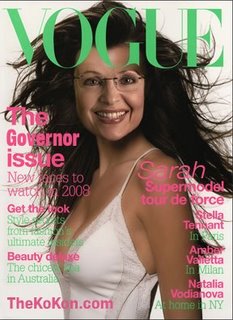
Some of the first images that circulated around the Palin appointment were, in effect, frauds. They sought to tap into the media feeding frenzy and the blogosphere's search for any incriminating evidence. Some of these images were probably already in circulation in Alaska before the announcement, while others may have emerged quickly as the nation started to learn who this woman is. Here are two examples. Both suggest the ways that Palin doesn't fit our expectations about what a female politician looks like. For the first time, we have a vice presidential candidate who is young, feminine, and well as she is one of the first to acknowledge, "hot." She was after all a runner up for the Miss Alaska competition and this couldn't be further removed from our current Vice President or for that matter, the tough matronly style adopted by America's most successful female politicians. Camile Paglia celebrates Palin in a recent Salon article: "In terms of redefining the persona for female authority and leadership, Palin has made the biggest step forward in feminism since Madonna channeled the dominatrix persona of high-glam Marlene Dietrich and rammed pro-sex, pro-beauty feminism down the throats of the prissy, victim-mongering, philistine feminist establishment." Needless to say, Palin's appearance and persona provokes strong reactions, ones which struggle to separate anxieties that she may be a Stepford Wife or a Barbie from a more generalized dismissal of attractive women. This first image plays on the fact that Palin did pose for photographs for Vogue by constructing a mock cover of the magazine.

sarah-palin-vogue2.jpg

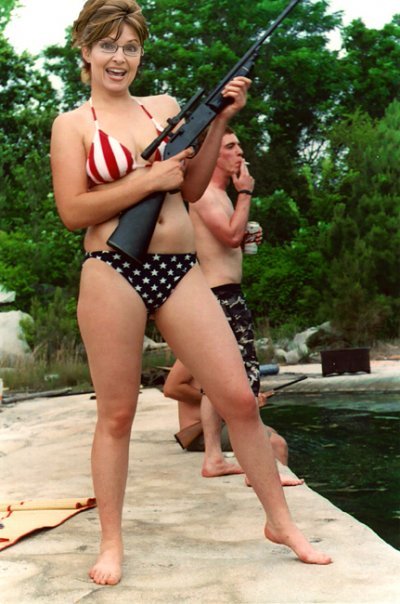
This second plays with the contradiction between the sexy mom] and the rough and tumble Alaskan. She's a "babe," in this case, a Bikini-clad "Babe," who also knows how to shoot and skin her own meat. This image was deemed sufficiently plausible that it needed to be discredited at the Urban Legends site.

palin_rifle_bikini.jpg

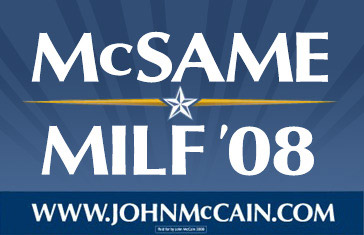
Those of you who watched the televised convention no doubt caught the disconcerting images of 70 something male delegates bearing buttons bragging about how "hot" Governor Palin is. Given the actual buttons circulated at the convention, this mock button is not as far fetched as it might seem, though now we are moving into the space of political humor rather than anything that was meant to deceive the viewer.

mcsame-milf.jpg

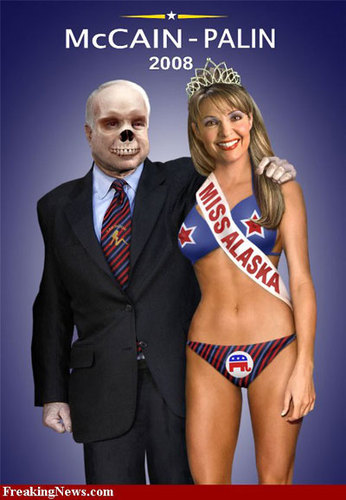
This next one juxtaposes erotic images of Palin with the very real anxieties about mortality raised by McCain's age. One of the most powerful arguments against the Palin appointment has been the concerns about what would happen if McCain were to die in office. And before he announced her pick, pundits had said that he needed to choose someone who would reassure voters that the VP would be prepared to move into the top office and stabilize the country.

mac-picks-palin.jpg

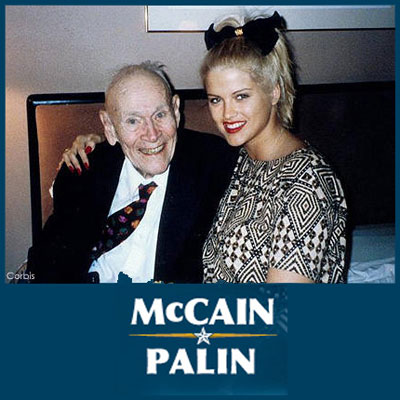
This Photoshop collage also calls attention to the vast age difference between the 70-something McCain and his 30-something running mate -- in this case, by reading the pairing in relation to the Anna Nicole Smith case. This is a classic example of how grassroots political humor maps politics onto popular culture, thus allowing us to mobilize our expertise as fans or simply readers of People magazine to make sense of the complexities of American politics.

mccain-palin-anna-nicole.jpg

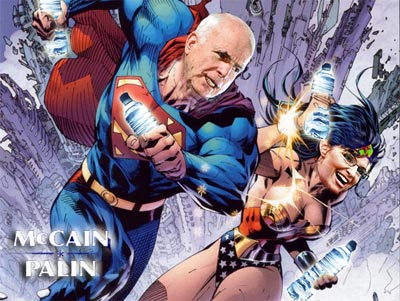
Several images in circulation read Palin as a superhero. Indeed, I was struck when I first saw her that she had adopted many of the stylistic choices of female superheroes in their alterego disguises -- her hair up in a bun, big librarian glasses. These "serious" trappings no more mask the beauty queen underneath than Clark Kent's glasses hide Superman and in the real world, they can come across as inauthentic. You add that with the stories of her braving the elements and slaughtering Alaskian wildlife and you can imagine the Amazon underneath the librarian disguise. I have been imagining that moment which would be inevitable if this were a movie where she takes off her glasses, lets out her hair, and gives a sultry look to the American voters.

mccain-palin-bottledwater.jpg

This next image pushes the conception of Palin as superhero in an entirely different direction -- this time, she's Batgirl. Here, she fits into an ongoing series of popular images which depict McCain as Bush's "sidekick," one of the ways that the idea that McCain represents a continuation of the Bush administration, a constant refrain at the Democratic convention, is entering the popular imagination. So, she's now the "sidekick" of a "sidekick," who will likewise continue the Bush Administration's policies for "four more years."

mccain-w-sidekick.jpg

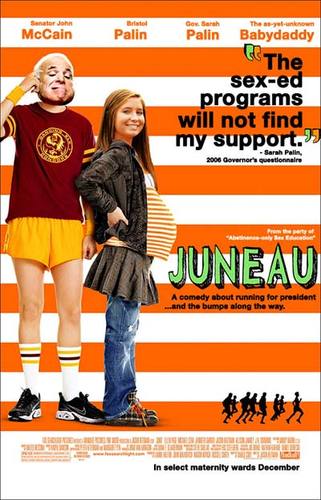
Given the ways that Palin's announcement has been intertwined with debates about teen pregnancy, it is no surprise that the poster for Juno has become a basic resource for people wanting to comment on these issues. Many feminists have already critiqued the film for making teen pregnancy and adoption seem like the only viable option for its protagonists. And of course, it doesn't hurt that Juneau is one of the larger cities in Palin's home state.

palin-juneau-sex-ed.jpg

palin-juneau.jpg

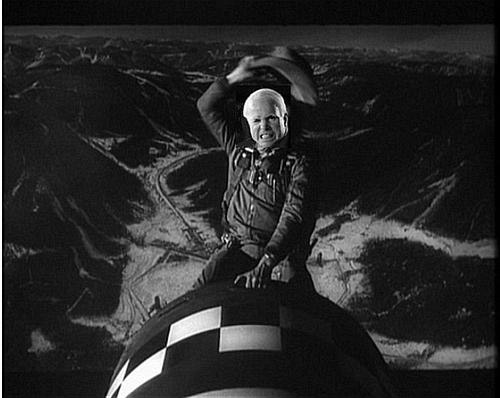
I couldn't resist throwing in two additional examples surrounding the McCain campaign. This first links McCain himself to Doctor Strangelove as a way of conveying the fear that the candidate may be a war-mongerer.

mccain-strangelove.jpg

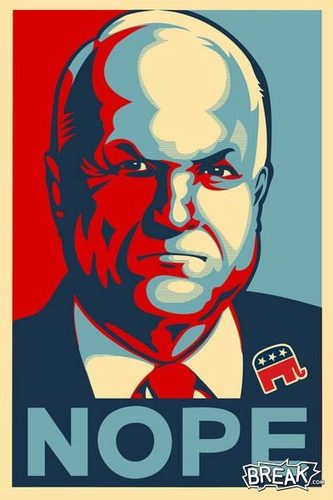
The second playfully reworks an Obama poster, one of the most vivid visual icons of the campaign to date, and in the process, sets up the contrast between Obama's politics of "Hope" and McCain's politics of "Nope."

john-mccain-nope.jpg

We can expect to see many more such images produced and circulated as the campaigns intensify even more over the coming two months.

Most of these examples are taken from the Political Humor site which regular collects such Photoshop images. You can find many more examples here.

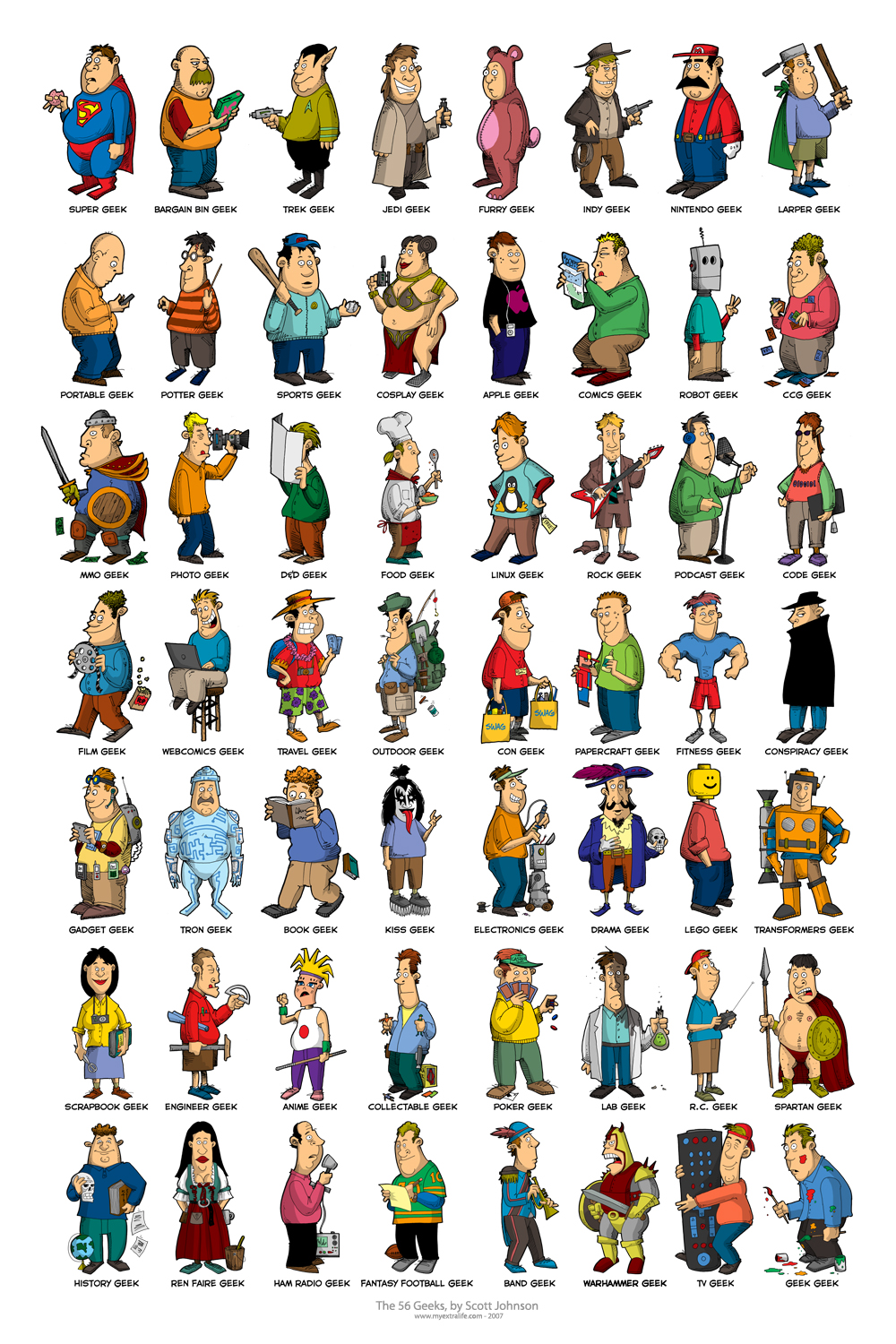
How Big a Geek Are You?

A few weeks ago, MIT launched a new video through its home page which was intended to prove to the world that MIT folks are not all geeks. (By the way, sorry not to be able to embed the video here but in the name of Youtube, the MIT geeks have decided they need to lock down their content rather than allowing it to spread!) It's an effective video which calls attention to many of the things I love about MIT but it left me frustrated. For one thing, most of the folks they depict still come across looking like geeks, not that there's anything wrong with that! And I thought the video would have been more effective if it broadened our definition of geek to include all of the rest of us at MIT who don't participate in the robotics competition or spend most of our time talking to our shoes. I'm proud to be a geek -- and to be geekish about culture and art. To my mind, saying that MIT isn't all geekish because it teaches the humanities is another way of saying that the humanities are cut off from the things that made MIT famous and I don't accept that core premise.

geeks2.jpg

So, rather than teaching our incoming students to feel proud because they aren't geeks, we hit them with a geek entrance exam, inspired by our colleague Junot Diaz's The Brief, Wondrous Life of Oscar Wao, which won the Pulitzer Prize for Literature. Diaz's writing is full of in joke references to games, comics, animated series, and pop music, all of which form the raw material for the various characters to construct their own personal mythologies.

Make no mistake -- Junot Diaz is a geek; he's also a hep cat. Both sides of his personality were on display during his appearance on The Colbert Report earlier this summer. In writing this book, it is clear that Diaz was struggling to make sense of his own geekish impulses and perhaps, this award winning book is his way of reflecting on how and why he belongs at MIT. It's an amazing book which I recommend to anyone reading this blog.

Every year we select a book to send to our graduate students to read over the summer. The books are carefully chosen to help set the tone and establish some key themes for the coming year. This year, we chose Oscar Wao and our graduate students are lucky enough to be able to sit down for a conversation with the author later this week. To get in the spirit, I put together a little quiz which includes many, though not all, of the geek references in the novel. We used it to break the ice as the graduate students got to show off their geek expertise. I thought you might also enjoy working their way through the quiz. I didn't bother to put together the answers. That's what Wikipedia is for, silly!

To show how geeky my students are, they ended up using ChaCha, the new text-message based research service, to track down answers to some of the hard to identify terms.

How Big a Geek Are You?

The following are geek culture references from Junot Diaz's The Brief Wondrous

Life of Oscar Wao.

How many of them can you identify?

How many other CMS students do you need to talk with to figure out what they all

are?

What digital resources would you use to track down this information?

Muhammad Ali

Akira

Lloyd Alexander

Appleseed

Isaac Asimov

Atari

Jeans Pierre Aumont

Balrogs

Billy Batson

Battle of the Planets

"Beam Me Up"

Big Blue Marble

Biggie Smalls

Blake's 7

Ben Bova

Bon Jovi

Brotherhood of Evil Mutants

Edgar Rice Burroughs

Captain America

Captain Horlock

Chaka

Chakobsa

Champions

Clay's Ark

Daniel Clowes

Dark Knight Returns

DC

D&D

Samuel Delaney

Deathstroke

DM

Doctor Who

Dr. Manhattan

Dr. Zaius

Dorsai

Dune

Eightball

Elvish

Encyclopedia Brown

The Exorcist

The Eyes of Mingus

Fantasy Games Unlimited

Final Fantasy

George Foreman

The Fountainhead

Galactus

Galadriel

Gamma World

Gen. Urko

Ghost

Gondolin

Good People of Sur

Gorilla Grod

Gary Gygax

Green Lantern

Hardware

Hector Lavoe

Robert Heinlein

Frank Herbert

Herculoids

Hernandez Brothers

Tracy Hickman

Harry Houdini

Robert E. Howard

Ill Will

Incredible Journey

Intellivision

Jabba the Hutt

Jack Kirby

Jedi

The Jeffersons

Kaneda

The Great Kazoo

Stephen King

Land of the Lost

Stan Lee

Ursula Le Guin

Lensman

Lothlorien

H.P. Lovecraft

Luba

Magic

Manhunter

Man Without a Face

Marvel

Mary Jane

Master Killer

John Merrick

Frank Miller

Minas Tirith

Miracle Man

Maria Montez

Alan Moore

Mordor

Morlock

My Side of the Mountain

"Nanoo-Nanoo"

Neo Tokyo

New Order

Andre Norton

"Oh Mighty Isis"

Palomar

Phantom of the Opera

Phantom Zone

Planet of the Apes

Roman Polaski

Project A

Rat Pack

Lou Reed

Return of the King

Robotech Macross

Rorshach

The Sandman

Sauron

Doc Savage

Shazam

Sindarin

Slan

"Doc" Smith

Robert Smith

Solomon Grundy

Sound of Music

Space Ghost

Squadron Supreme

Olaf Stapledon

Star Blazers

Star Trek

Street Fighter

Tom Swift

Sycorax

Take Back the Night

Teen Titans

Tetsuo

The Terminator 2

This Island Earth

Three's Company

J.R.R. Tolkien

Tomoko

Tribe

Tripods

Twilight Zone

U2

Ultraman

Adrian Veidt

Veritech Fighter

Virus

The Watcher

Watchman

Watership Down

Margaret Weis

H.G. Wells

What If

What's Happening

Wonder Woman

X-Men

Zardoz

Impressions from Two Comic-Con Newbies

By now, some of you will have seen the spot NBC has been running during the Olympics celebrating the enormous audience response to the screening of the first episode of Heroes' third season at Comic-Con. I was lucky enough to be there in Hall H and if anything, the advertisements underplays the excitement of watching an episode of one of my favorite series with some 6000 other fans. There were so many crowd pleasing moments in the episode and so much evidence that they had gone back to the drawing board and responded to fan reactions to the lackluster second season. It was as if the episode had been designed and produced simply to be shown at Comic-Con!

And indeed, this may be the case, given the growing centrality of this convention to the way cult media operates in America today and given the particular history of Heroes at this convention.

I went to Comic Con for the first time this year. As it happens, a long time friend, Kristin Thompson, was also attending for the first time. Thompson, a noted film scholar, is the co-author of the Observations on film art and Film Art blog. I featured her here last year in an interview ( Part One, Part Two, Part Three) focused on her recent book, The Frodo Franchise, which studies the production of Lord of the Rings and its related media offshoots. She was speaking on a panel focused on the forthcoming Hobbit movie, while I was at San Diego purely in vacation mode with my wife and son along. We got together Sunday night after all of the events were over to record our initial impressions of the event. This transcript is being cross-posted on both of our blogs.

Next time, I am going to share some impressions of the specific previews and panels I attended.

On Different Tracks

We started off by talking about what we had each concentrated on.

HJ: It's very clear that it's like six or seven different conventions I could have gone to in the course of the weekend, and it would be a totally different experience depending on which one you went to.

KT: Yeah, I had that impression that there were probably people here mainly to buy stuff, some people here mainly to see celebrities and get autographs and so on.

HJ: And even on that there was a split between the film and the TV people. And there's a whole comics track. Under other circumstances I would have just been spending my entire time at comics panels, because they're the strongest comics sessions anywhere in the country.

Coming Alone vs. Having Something Specific To Do

KT: I was happy that I had something to anchor myself, though. I don't think I'd like to come here, at least for the first time, alone and not having anything specific to do.

HJ: Luckily Henry and Cynthia were along, but it was overwhelming a bit, trying to negotiate and keep up with three people in a space that congested. So that was its own kind of challenge. Sometimes I was thinking it would be great just to be a single person navigating through the space and not have to have large-scale logistics! The scale of it just blows you away. I've been on the floor at E3, which is supposed to be one of the largest entertainment trade shows. I've done South by Southwest. But neither of them are anywhere near the scale of Comic-Con.

The Scale of the Event

KT: They always say 125,000, because that's the number of tickets they sell, but then you've got all the exhibitors and the people who are presenting on panels. It must be another few tens of thousands packed into that building.

HJ: Yeah, at least.

KT: I was kind of amazed that it worked as well as it did.

HJ: Yeah, they did a remarkable job in just managing crowd control. Getting people in and out of things with some degree of order. Some more bullying guards than others, but it was probably necessary to keep the peace.

KT: Yeah, there were a LOT of guards and guides and so on, but people seemed really to be polite, on the whole. I was taking the shuttle bus from a hotel down the street [from my hotel] every day and then coming back by shuttle bus. This morning the bus was quite late compared to other days. It was supposed to come every ten minutes, and we were there maybe twenty. And people who were arriving made this very neat horse-shoe shaped line on the sidewalk. It was very orderly.

HJ: Almost no signs of anyone breaking in line, despite the intensity of some people's desire to get into things. Someone commented behind me about 'honor among geeks,' and that's probably a good description. There's a strong honor code.

KT: The venue seems to be up to having that many people in it. I hardly had to wait for rest rooms at all.

HJ: No, the facilities are good.

We ended up doing a fair amount of what they call here 'camping,' which is sitting in several panels in a row because there was something we really wanted to see. But you end up trapped in a space with no access to food. Hall H at least has rest-room facilities in the space.

KT: I didn't try camping myself. But I was going to this action-figure panel because it involved Toy Biz, which did the action figures for Lord of the Rings. I heard from people in line that a lot of them were there for the next panel, which was on Sanctuary, which I know nothing about, but they were very devoted and were saying, "They shouldn't have put this in such a small room."

HJ: There is a sense that you vote with your body at Comic-Con. One of my newest fandoms is Middleman, which is a new ABC family show, and it was in a small room, but we packed it. There was a sense of accomplishment. The producer looked out and said, 'This may be the whole audience for the show,' because it hasn't gotten much publicity yet. There was a sense that just being there was show of support for things.

KT: I wonder how many of the companies have people at those panels--in the audience. I hadn't realized it, but there was somebody from New Line--who's probably not from New Line anymore--and then some Warner Bros. people, supposedly, sitting out in the audience for the Hobbit one. That kind of surprised me. Why bother?

HJ: At the larger sessions it seemed they had blocked off four or five rows of space just for the studio people. Rarely were they occupied to anywhere near that extent, so it was maybe overkill. But there were a few sessions where there were a significant number of people. The Battlestar Gallactica, for example. There was a large studio contingent there for that. Suits and friends and family and other writers, because that was a kind of last hurrah for that production. They just wrapped shooting the last episode two weeks ago, so this would have been a major last gathering of a lot of those people. They said they really hadn't had a chance to have a wrap party yet, so in a sense it probably was.

The Hall H Experience

KT: Did you have the Hall H experience at all?

HJ: We went to see Heroes one morning, which was the first time, they said, a TV show had made it into Hall H. We managed to be there for Watchmen and a few of the other movies that followed it.

KT: I avoided it for a while because I kept hearing that there would be incredibly long lines, and I pictured just sitting there for hours and hours and hours reading and possibly not getting into what I wanted to see anyway. So I avoided it until yesterday [Saturday], and I went to the Terminator Salvation one. I wanted really to go to the Pixar one, so I went to get in line very early, and ended up getting in on time for Terminator Salvation.

HJ: Well, for Heroes we waited for about an hour outside and then got in. Then there was a fairly long wait to get started, but then we knew that there were several things after that that we wanted to see as well.

KT: And was it full?

HJ: It was packed. But Heroes has been a kind of success story of Comic-Con. They showed the pilot there before it debuted, and Heroes is pretty desperate at this point to rekindle fan enthusiasm. Last season is largely seen as a bust. Hence their decision not to come back from the strike. They did a partial season and put it off to the fall, because the ratings were plummeting and they were getting bad buzz from fans. So they wanted to come back this year with a killer. They showed the entire opening episode, which was definitely a fan-pleaser. They had figured out what had gone wrong the first season and had put together something that was going to please. So there was lots of extended applause at key moments. It's kind of fascinating to watch an episode of a TV show with 6500 other people.

The Exhibition Hall

KT: I only discovered the comics section today, as I was about ready to leave, because I hadn't really been aware of which sections were devoted to it. I sort of thought it was all random, but obviously they do devote one big section to all the people who are selling old comic books. I suppose you could just stay in one part of the hall and never see the rest of it.

HJ: I felt I barely made a dent in the hall. The first day I didn't quite realize how big it was, so I was just going up every aisle, and the second and third day I was going on targeted missions. But it still was just so immense that there's no way you could see it all.

KT: And it's so congested.

HJ: Especially if you get to the studio side of things.

Autographs and Planning

KT: I could not figure out what was going on at the Warner Bros. exhibit, but they were constantly surrounded by lines and lines and lines of people who were obstructing the aisles around them. I guess they had people from their TV shows signing.

HJ: They seemed to. I kept stumbling into people. You wander around one corner and there's Peter Mayhew of Chewbacca fame sitting there, and Will Frakes suddenly would pop up at another table. Neither was particularly advertised. Then there were all the advertised autographed stuff. There were a lot of people there that you would know in another context.

KT: I don't know how you would find out about all of those things in advance. I don't think Lynda Barry was listed in the program as doing autographs, but she was at the Drawn and Quarterly booth at certain times. I missed her entirely. I got her autograph because I was sitting in the audience before her presentation and she sat down beside me.

HJ: They seemed to have a certain number of people who were there to do autographs, but then there were all these other people randomly. I guess you had to follow a particular company and maybe they posted on the Web.

KT: Yes, I was doing autographs at certain times for my book, and it was just on TheOneRing.net and The Frodo Franchise. You have to really investigate, go in with a plan.

HJ: It seems to be the case: The more you plan, the more you can get out of the experience.

KT: We were selling copies of my book at this very small booth, and I was there for an hour at different times of day on three days. I think almost everyone, if not everyone, who bought a copy came to the booth specifically to buy it. There were no impulse purchases. I don't think people buy books at Comic-Con.

HJ: I looked at comics while I was there, but I would buy them from my dealer back in Boston or online at Amazon or Mile High Comics. Why I would weigh my suitcase down with comics in the age when it's so easy to buy stuff digitally?

KT: Not new ones.

HJ: Not new ones. Collectibles, sure.

KT: Unless you have them signed.

Fan Culture hangs on at Comic-Con

HJ: Usually the cons I go to are small-scale, very intimate, you know a high number of the people who are coming. It's fan-driven and fan-focused. This was like Creation Con on steroids!

KT: Though technically speaking, it is run by fans; there's a committee.

HJ: There were still places and niches and corners where the fan stuff still ruled. You wouldn't see fanzines there, but then you wouldn't see them at most fan-run cons these days, since everything's moved to the Web.

KT: Well, there's Artists' Alley, which is way over in the corner. That seems to be fans who are aspiring to be pros but haven't really made it yet.

HJ: Well, it was a mix. I mean, you'd see Paul Chadwick there [author of Concrete series, published by Dark Horse Comics] or Kim Deitch [author of graphic novels such as The Boulevard of Broken Dreams and Shadowland], who were independent and weren't necessarily going to be there with a company, but yeah, it's definitely a lot of wannabes in some of that space.

And then fans show themselves through costumes. For all the jokes about women in Princess Leia costumes--and I saw maybe a dozen Princess Leia slave-girl outfits--it was still a way in which fans asserted their presence. There were some quite remarkable pieces of fan performance going on there. There was someone doing Cocteau's Beauty and the Beast, which had quite a spectacular Beast costume--a little more arty than one expects at a fan con.

Genre

KT mentioned having seen Focus Features' Hamlet 2 preview.

HJ: The role of comedy here interests me a lot. I'm always intrigued: What're the borders of what a fan text is and what isn't a fan text? Here comedy seems to creep into fandom in a more definitive way than I've seen elsewhere. So there was the focus on Hamlet 2, there was Harold and Kumar, The Big Bang Theory [TV series, 2007-08], but then just a bunch of panels on writing for sit-coms. So it's probably just the industry's priorities, but it's interesting that it doesn't extend to drama. You can imagine a lot of people there being into The Wire or The Shield or some equivalent, and it didn't cross over in that direction.

KT: I suppose it's what the studios think the fans want. It's true there was a lot of comedies, and martial arts, and war material.

HJ: I think martial arts probably has crept into fandom pretty definitively over time. But it's interesting to see where the boundaries are. We stumbled across one booth that had just a porn star signing her pictures, and it sort of outraged my son. Pornography isn't fandom in his world view, but he thought nothing of going up to get wrestlers to sign autographs. Probably in any other fan con, the strong presence of wrestling performers would be out of keeping with fandom.

The Economics of It

KT: I was struck by how cheap it is, basically. How much was it for a single day pass?

HJ: Twenty-five dollars for a single day pass. It's not bad at all for the scale of what you get. [Four-day passes are $75.]

KT: Some of the smaller tables rented for something like $380 for the full period, which I thought was kind of cheap. But obviously they need both sides of it. They need the exhibitors to attract the people and they need the people to attract the exhibitors, so keeping the cost down makes perfect sense.

HJ: The scale at which companies brought in people was also truly remarkable. I certainly have been to cons where they might have two or three performers from a show, but they brought the entire regulars of Heroes down, as well as the entire writing team. And Heroes is a large, large cast. They scarcely had time for anyone to say anything, but all lined up there on a panel, it was a pretty spectacular display. And Watchmen did pretty much the same thing. All the main characters in Watchmen were there with the director.

KT: That reminds me of the coverage that the film events and I suppose the television events, too, get in the trade press. I'm sure you read some of these articles about how, 'Oh, it's all becoming so much Hollywood. The big media companies are coming in and taking over,' and so on. It struck me that Hall H is really kind of a world unto itself.

HJ: It is.

KT: It's separate. You have to go out of the building and get in this line, and then you have to go out of the building when you exit. It's quite a hike to get there if you're around D or C in the exhibition hall. I think probably they don't see much of the rest of the con.

HJ: It does seem largely cut off. That's the sort of classic place where people camp. And so there's almost an interesting tactical advantage in being one of the filler programs between the main events, if you can really maneuver into that. It's like being right after a hit TV show or between two hit TV shows. You're going to get exposure to people who wouldn't otherwise. Yesterday Chuck was between Battlestar Gallactica and the Fringe panel. I've never seen Chuck, but I wanted to see Battlestar and I wanted to see J. J. Abrams [executive producer of Lost and one episode of Fringe], so we stuck through it. And we'll probably give Chuck a shot come fall as a result of being exposed to it in that way. There's lots of things that get sandwiched in that probably get a boost off of this. Or they could hurt themselves.

KT: Bring the wrong scenes or whatever.

HJ: Wrong scenes or just the people are inarticulate. There's certainly a range of comfort level up there.

In terms of the press coverage, the fact that Entertainment Weekly put Watchmen on its cover this week a year before the film comes out, purely on the basis of it playing at Comic-Con, says something about the publicity value of this thing.

KT: Yes, for the films there's no doubt about its publicity value. I just think that if the big entertainment journalists plant themselves in Hall H and don't pay a lot of attention, then you get coverage that makes it sound as though the movies are just taking over everything.

<

strong>HJ: It's odd. It's certainly every bit as spectacular a place to do TV as it is to do film. And comics. I couldn't believe the betrayal I was committing in not seeing the full writers of Mad magazine in the 1960s or seeing Forrest J. Ackerman and his staff--things that were really significant to me as a kid. But they were competing with other things that I valued even more. So there are things that you would have killed to get to in any other context that you pass up because there's so much going on at once. You can't get to it all.

The Gender Composition of the Attendees and the Industry

HJ: One of the things that struck me was the gender composition here was much--well, certainly there were more guys than girls, but compared to, say, E3 or many other cons I've gone to, the gender balance was surprisingly solid. There were an awful lot of women there.

KT: Yeah, they remarked on that on the Harry Potter panel this morning, saying that, unlike those cons, there were probably more women than men in that particular room.

HJ: That makes sense.

KT: When I went to the One Ring Celebration, it was maybe 95% women. I suspect it's partly a factor of whether a con has gaming facilities. Gamers will come, and they're mostly going to be guys, although probably not as much as it used to be.

HJ: Historically, if you go to Creation cons, which are more star-centered, men turn out much more, whereas if you go to a fan-driven con, which is fanzine oriented, women turn out much more. But because this combines everything, you've got just such a spread of people.

I've seen people argue that Comic-Con is becoming powerful and it's exaggerating the power of fan men at the expense of fan women, that the fan-boy mafia is taking over the entertainment industry. Certainly you see it on the producers' side, that an awful lot of the guys onstage would have been in the audience a decade before--and they're mostly guys. But what's interesting is to see the audiences that they're trying to respond to and engage with has a large female component, and that's got to have an impact over time on what plays here and what doesn't.

KT: One of the people on the 'Masters of the Web' panel on Thursday morning was making the point that now the younger studio executives are either people who had their own Websites a few years ago or they were in college when the big Websites were being formed. Now they've grown up into adulthood reading that stuff, and they're now in position of power and will continue to be in the industry.

HJ: It was fascinating just to watch the producers, writers, stars, to see which ones were really comfortable in the space and which ones weren't. Someone like Joss Whedon just grew up in that space. That's his world. He was totally in his element, and he would understand what questions were being asked and how to respond to them and could use in-joke references to the culture, whereas someone like Alan Ball (executive producer), who no doubt in another context would be totally articulate and interesting, seemed to feel uncomfortable. Moving from Six Feet Under to True Blood, he doesn't yet know how to "speak fan." On the other hand, Zack Snyder [director of 300] has got to be the most totally inarticulate person I've seen on a stage in a long time. Watchmen is going to be his second movie, and he totally works with images, but the ability to use words did not seem to be his strong suit. Some of them who have done multiple fan shows seem really comfortable, and others just looked in shellshock up there.

McCain to Obama Supporters: "Get a Life!"

One of the most powerful tools in the Karl Rove arsenal was a form of political Judo: take your opponent's strengths and turn them into vulnerabilities. For example, coming into the 2004 convention, Democrats had seen war hero John Kerry as pretty much unassailable on issues of patriotism and they made it a central theme of their event. Within a week or two, the Swift Boat Campaign made Kerry's service record an uncomfortable topic to discuss, flipping Kerry's advantage (that he had served in Vietnam and neither George W. Bush nor Dick Cheney had done so) on its head. This added the phrase, "Swiftboating," to the language of American politics. Coming into the Primary season, several things stood out about Barack Obama: First, he had developed a reputation as the Democrat who was most comfortable talking about his faith in the public arena; many Democrats felt that he gave them a shot at attracting some more independent-minded evangelical Christians, especially given the emergence of more progressive voices that linked Christianity to serving the poor, combating AIDS, and protecting the environment. (Indeed, we saw signs of that pitch during Obama's appearance at the Saddleback Church Forum last week, when he clearly knew and deployed evangelical language better than McCain). Yet, the circulation of the Rev. Wright videos -- not to mention the whisper campaigns charging that he is secretly Islamic -- blunted his ability to use faith as a primary part of his pitch to voters. Similarly, the Obama campaign showed an early comfort with talking about American traditions in lofty and inspirational values, so he has been confronted with attacks from reactionary talk radio questioning his patriotism.

Over the past three weeks, we've seen the McCain campaign take aim at a third of Obama's strengths -- the so-called "enthusiasm gap." Basically, pundits have been talking a good deal about the lack of enthusiasm for the Republican nominee among his rank and file in comparison with the extraordinary passion Obama has generated, especially among young and minority voters. To confront this "enthusiasm gap," the McCain campaign has clearly decided that it needs to pathologize enthusiasm itself, suggesting that emotional investments in candidates are dangerous, and thus positioning himself as the only "rational" choice. In doing so, he has tapped deeply rooted anxieties about popular culture and its fans.

This is not the old culture war rhetoric where candidates accused each other of being soft on "popular culture," a tactic which Joseph Lieberman has turned into an art form. No, this time, the attack is on politics as popular culture. Both tactics strike me as profoundly anti-democratic. After all, how do you found a democratic society on the assumption that the public is stupid and has bad judgment?

In my concluding chapters of Convergence Culture, I argue that there is an increased blurring of the lines between popular culture and civic discourse and that our experiences within participatory culture may be raising higher expectations for participatory democracy. In a new chapter I wrote for the paperback edition of the book, which is due out in late September, "Why Mitt Romney Wouldn't Debate a Snowman," I extend this argument to examine the Youtube/CNN debates last year to illustrate the many roles which popular culture -- parody video in particular -- played in establishing public perception of Obama and the other candidates.

In some cases, parody was deployed within the campaigns itself -- such as the Clinton campaign's spoof of the final moments of The Sopranos -- and in other cases, parody was deployed by outside groups who were not directly affiliated with the candidate -- as in the Obama Girl spots or the 1984 spoof. Such parodies speak to voters who are turned off by the policy wonk language of conventional politics, offering a new way of connecting with the candidate, and mobilizing their knowledge as consumers to make sense of the political process.

The recent round of McCain commercials, by contrast, uses a language of parody not simply to spoof the candidate but to discourage democratic participation, telling the many first time voters who have been excited by the Obama campaign to "get a life." Consider, for example, this spot, "Obama Fan Club."

In Textual Poachers, I examined some of the core elements of the anti-fan stereotype, one which surfaces in news articles and comedy sketches depicting science fiction conventions. It's striking how many of these same tropes surface in this particular commercial. The Obama supporters might as well be wearing Star Fleet uniforms and rubber Spock ears! Stereotypical fans:

  • Are brainless consumers who will buy anything associated with the program or its cast.
  • Devote their lives to the cultivation of worthless knowledge,
  • Place inappropriate importance on devalued cultural materials.
  • Are social misfits who have become so obsessed with the show that it forecloses other types of social experiences.
  • Are feminized and/or desexualized through their intimate engagement with mass culture.
  • Are infantile, emotionally and intellectually immature.
  • Are unable to separate fantasy from reality.

Such anti-fan depictions are often drawn towards nerdy guys and over-weight women as standing in for fandom as a whole. And metaphors of religion run through this anti-fan discourse. "Fan" is an abbreviated form of the word, "fanatic," which has its roots in the Latin word, "fanaticus." In its most literal sense, "fanaticus" simply meant "of our belonging to the temple, a temple servant, a devotee" but it quickly assumed more negative connotations, "of persons inspired by orgiastic rites and enthusiastic frenzy" (Oxford Latin Dictionary). As it evolved, the term "fanatic" moved from a reference to certain excessive forms of religious belief and worship to any "excessive and mistaken enthusiasm," often evoked in criticism to opposing political beliefs, and then, more generally, to madness "such as might result from possession by a deity or demon" (Oxford English Dictionary). Its abbreviated form, "fan," first appeared in the late 19th century in journalistic accounts depicting followers of professional sports teams (especially in baseball) at a time when the sport moved from a predominantly participant activity to a spectator event, but soon was expanded to incorporate any faithful "devotee" of sports or commercial entertainment. One of its earliest uses was in reference to women theater-goers, "Matinee Girls" who male critics claimed had come to admire the actors rather than the plays. If the term "fan" was originally evoked in somewhat playful fashion, and was often used sympathetically by sports writers, it never fully escaped its earlier connotations of religious and political zealotry, false beliefs, orgiastic excess, possession and madness, connotations that seem to be at the heart of many of the representations of fans in contemporary discourse.

In short, the word, "fan," when deployed negatively, seems to be a rhetorical tool designed to exclude some groups from participation -- in this case, from participation in the political process -- or to describe some works as unworthy of recognition -- in this case, to depict Obama as unprepared for public office.

For the most part, mainstream journalism over the past decade or so has moved away from the most extreme deployment of these anti-fan stereotypes as more and more people are entering fan communities on line and as a growing number of journalists have had first hand experience of fan culture. Yet, given how deep these stereotypes run through our culture, we should not be surprised to see that they can still be effectively deployed to express discomfort with the excitement and enthusiasm which has surrounded the Obama campaign in some sectors.

This connection between fans and "false worship" is especially potent in this spot. Speaking on the Sunday morning news shows, Joseph Leiberman, who was once a Democratic Senator and Vice Presidential candidate, defended these spots as "funny" and "playful," suggesting that you can scarcely call comparing someone to Moses an attack ad. Explicitly the spot targets Obama, who is struggling to overcome the "elitist" charge which Hillary Clinton leveled against him in the spring, and implicitly the ad targets his associations with Oprah, who coined the term, "The One." But just beneath the surface is a barely suppressed contempt for the public that has embraced this candidate with such passion as if such enthusiasm was dangerous and out of control.

The news media was quick to pick up on the analogy between Obama and Paris Hilton in the original "Celebrity" ad, which they have read as part of a longer history of racist discourse which links white women and black men. It might be more accurate to suggest that the ad reflects the reality that for much of the 20th century, African-Americans could enter the public eye primarily by becoming athletes or show business personalities and thus we are more comfortable seeing them as celebrities than as political leaders.

The Obama campaign has sought to reverse the charge, using the metaphor of "celebrity" to suggest that McCain is a Washington Insider and that like many celebrities, he re-invents himself periodically in order to remain in the public spotlight. There's also an undercurrent here suggesting that McCain may simply lack the charisma to become a true celebrity and that this may be why his campaign wants to take aim at Obama's popularity. And we might read this spot as also deploying a bit of that Rove Judo -- transforming McCain's claims to be the more "experienced" candidate into evidence that he is too entangled with the Washington establishment, not to mention linking him with the current president whose negative ratings the GOP candidate hopes to escape.

But so far, the best response has come from Paris Hilton, who seems bemused at being pulled into the political campaign, and has fun with audience expectations that she is an air head who knows nothing of public policy. In fact, this spoof suggests, all of us have a responsibility to become more politically aware, all of us should participate in the political process, and we should be open to a range of different languages through which to speak to our fellow voters.

We can see all of this anti-fan rhetoric as part of the McCain effort to deflate media coverage of Obama's trip to Europe and to anticipate the excitement which will surround his speech next week to the Democratic National Convention. Keep in mind that Obama's speech will fall on the 40th anniversary of Martin Luther King's "I Have a Dream" speech and that Obama had opted to build on his public support by moving the acceptance speech from the convention center to a sports arena so that he could open the event to the general public. Now, for at least some viewers, the huge showing of popular support represented by that event will be tainted by anxieties about this "celebrity" and his "fan club."

Is Obama a Secret Vulcan?

The following is adapted from my opening remarks at the Future of Civic Media conference we hosted at MIT last week. A few weeks ago, I was interviewed by National Public Radio about Star Trek's Mr. Spock for their "In Character" series. Midway through the interview, the reporter asked me a question which in retrospect was an obvious one but which I had never really given much thought before: What contemporary figure has the same qualities as Mr. Spock?

The fan boy in me immediately went searching through contemporary science fiction television. I considered and then discarded Gaius Baltar from Battlestar Galactica as probably too obscure to make sense to an NPR audience. I thought about Syler from Heroes as another prospect, no doubt influenced by the casting of Zachary Quinto to play Spock for the forthcoming Star Trek prequel movie. In both cases, you had characters who are defined through their otherworldly intelligence. Syler, like Spock, is someone who can bitch slap you with his brain. And in both cases, there is a deep distrust of that intelligence and their rationality is seen not as impartial but as self-absorbed and antisocial.

But, then, my mind went in a very different direction and before I quite knew what I was saying, I found myself talking about Barack Obama. Now, I grant you, I've got Obama on the mind these days but hear me out.

At the time, my main point was that Spock was an explicitly mixed race character on American television at a time when most programs hadn't come to grips with identity politics. Star Trek's Spock was born of a human mother and a Vulcan father. Throughout the course of the series and especially in the feature films, he struggles to make his peace with the conflicting pulls on his identity. And because he is a man literally of two worlds, he is seen as being capable of translating between Terrans and many of the other races they encounter as they "boldly go where no man [one] has gone before."

A similar construction of multiracial identity has taken shape around Obama who has sought to construct himself as not only post-partisan but also post-racial. It's striking what a high percentage of media coverage of Obama describes him as African-American, despite the fact that he has a white mother. Early on, there was a lot of press about whether he would be "black enough" to gain the support of African-American voters, just as the press was quick to remind us that Toni Morrison had once described Bill Clinton as the first Black President (a phrase now totally removed from its context). Now, the press is trying hard to get us worried about whether white voters are ready to support an African-American candidate for president. But, if you look at how Obama has constructed himself, it is as someone at home with both blacks and whites, someone whose mixed racial background has forced him to become a cultural translator, and thus he is someone who can help America work through some of its racial divides. This was very much a subtext in his speech about race in the wake of the Rev. Wright controversy and it is precisely this sense of Obama as a man of two worlds which was called into crisis by those videos.

Listen to the speech which Amanda, Spock's mother, delivers in the NPR broadcast about being beaten up as a child because the others don't think he's Vulcan enough and you will hear echoes there of some of the stories we've heard about Obama's struggle to figure out who he was growing up.

I've been surprised by how quickly the blogosphere picked up on the Spock/Obama comparison. Almost immediately, I started to see people construct graphics around the Spock/Obama theme, which clearly resonated with people other than myself.

Obamawhite1.png

This image predates the interview and was submitted to a contest to depict what would happen if Trekkers ruled the world, so I am certainly not the only one to see a connection.

obama spock 2.jpg

I have to say I would have chosen a picture where Obama wasn't smiling. A smiling Vulcan is just plain creepy!

Take a look at these two photographs and see if you don't start to think that Spock and Obama were separated at birth.

rolling_stone_obama.jpg

spock2.GIF

After all, editorial cartoonists are already starting to play up Obama's over-sized ears as the feature they can get away with caricaturing, because it wasn't part of the minstrel show stereotypes through which racists have historically constructed images of African-Americans. Add to this the long and angular shape of his face and the way he turns his face slightly upward as he speaks and you have someone who looks like he could have been born a Vulcan and had an "ear job."

But from there, we can see more complex analogies: for example, might we see his search for his spiritual identity in an Afro-centric church as a parallel to Spock's return to Vulcan to participate in the purifying ritual of Kolinahr as a way of reclaiming his roots in his father's culture? Is there any question that McCoy sees Spock as an "elitist," because he is frightened by his intelligence and because he is uncomfortable making small talk? And surely we can see Obama as the living embodiment of the Vulcan philosophy of IDIC ("Infinite Diversity in Infinite Combination"?)

Gene Roddenberry, the producer behind the classic Star Trek series, consciously modeled James T. Kirk (JTK) after the qualities that he admired in John F. Kennedy (JFK) and that he saw the series as a way of keeping the ideal of "Camelot" alive during the more cynical LBJ era. Kirk is the youngest captain in the history of Star Trek, much as Kennedy first burst of the national consciousness as a charismatic, courageous, P.T. Boat captain and was at the time the youngest person elected as president. The original Star Fleet was modeled in part on the Peace Corps and was also clearly intended to build on growing public interest in NASA's plans for putting a man on the moon, both aspects of the JFK agenda. And there's some possibility that the "Final Frontier" was a self conscious reworking of JFK's "New Frontier." Much as Kennedy's foreign policy sought to win over unaligned developing nations through "weapons of peace" in a cold war context, Classic Trek sees Star Fleet as doing ideological battle with the Romulan-Klingon Alliance and trying to hold onto the loyalty of unaligned and developing planets. So, in so far as people are reading Obama in relation to our shared myths about the Kennedy era, then it also makes sense to think of his campaign through the lens of Star Trek.

For me, the connection makes sense on a somewhat deeper and more personal level. I am a first generation Star Trek fan and I've long argued that many of my deepest political convictions - especially those surrounding equality and diversity - emerged from my experience of watching the program as a young man growing up in Atlanta during the Civil Rights era. In many ways, my commitments to social justice was shaped in reality by Martin Luther King and in fantasy by Star Trek. Star Trek did this not through the explicit and heavy handed social commentary in episodes like "Let This Be Your Last Battlefield" which featured aliens who were half white and half black (in the most literal sense) but because of the idealized image of a multiracial community depicted on the series. Later generations have looked upon the figure of Uhura as tokenism, pointing out rightly that she never got to do anything more than tell the captain that "hailing frequencies" were open. Yet, Nichols has long told the story of talking with Martin Luther King during a civil rights march and being told that her mere presence on the Bridge was a visual reminder that his dream might come true in the future. Star Trek featured the first inter-racial kiss on American television. My colleague, Shigeru Miyagawa, tells the story of growing up in Alabama and having Sulu be the only Asian-American character he saw on American television. And then there's Chekov, a Russian character on American television, in the midst of the Cold War - a friendly acknowledgement of the Soviet contributions to space exploration.

So, we should read Spock in this context - as one more example of the ability of the Enterprise crew to embrace diversity. The program often fell short of its ideals, then and in subsequent decades, and it is easy to find points to criticize Star Trek's racial politics. For a good discussion of these issues, check out Daniel Bernardi's Star Trek and History: Race-Ing Toward a White Future. But for me and many others of my generation, it held up a set of ideals; it encouraged us to imagine a more utopian society which escaped the limitations which I saw all around me growing up in a South which was actively struggling with the legacy of segregation. And I have found through that years that this idealized image of a multiracial and multicultural, hell, multiplanetary community, was part of what Star Trek meant to a large number of first generation fans of the series. For more discussion of this theme, check out my essay on the Gaylaxians movement, originally in Science Fiction Audiences, later reprinted in Fans, Bloggers, and Gamers.

In its own small way, Star Trek and Spock may have helped to prepare the way for Obama's victory in the Democratic primaries, helping us to imagine a different set of relationships between the races. Nowhere was this social utopian vision more fully expressed than the "great friendship" between Kirk and Spock and so we can see some legacy of this theme of acceptance across racial boundaries emerging through the slash fan fiction which became one of the major legacies of early Star Trek fan culture. The other "non-white" characters may have been more suggestions than fully developed figures - at least on the original series - but Spock was someone we got to know and care about because, not despite, his differences. This is one reason why so many fans of my generation were upset when Kirk praises Spock for being "the most human" person he has ever known during his funeral eulogy in Star Trek: The Wrath of Khan. Can you imagine the uproar if someone praised Obana's "whiteness"?

Of course, Roddenberry's embrace of science fiction as a vehicle for the utopian imagination was itself informed by more than a century of science fiction being deployed as a political tool - going back to the novels of H.G. Wells and Edward Bellamy, taking shape around 1950s novels like Space Merchants and City, and extending into the feminist science fiction of the 1960s, all of which shaped Star Trek in one way or another. Given this tradition, it was scarcely a surprise when I stumbled onto a whole line of SF-themed shirts supporting Obama, including not only one linking him with Spock, but also those connecting him with Buffy the Vampire Slayer, Battlestar Galactica, and The Matrix. And surely, we can see the political uses of science fiction when we see how the Anonymous movement is deploying Guy Fawlkes masks clearly inspired by V for Vendetta. Or, for that matter, is it any accident that Rolling Stone describes Obama as "A New Hope," evoking the title of the original Star Wars film.

I wish I could say all of this flashed in my mind when I started babbling about Spock and Obama. In reality, I was improvising, but the more I've thought about it, the more helpful the analogy has become as a way of thinking about why Obama's candidacy has so sparked my imagination.

And, by the way, check out this video on Youtube from one of Leonard Nimoy's appearances at a science fiction convention in which he describes an encounter with none other than Barack Obama. So, Obama is not a "secret moslem," he's not a "secret vulcan," but he may be a secret Trekker! :-)

MC Lars, "Ahab," and Nerdcore

My major focus this month is on developing a teachers strategy guide for Project nml on "Reading in a Participatory Culture," which uses as its major case studies: Herman Melville's Moby Dick and Ricardo Pitts-Wiley's Moby Dick: Then and Now. I've written about this project here before in essays on "The Whiteness of the Whale" and "Was Herman Melville a Proto-Fan?" A central theme in the project has to do with how we bring contemporary cultural concepts of remix culture into conversation with the study of more traditional literary texts. We want to get teachers to think a bit more about writers as existing in conversation with their cultures rather than as original creators. Teachers have long asked students to write about Biblical Allusions in Moby Dick, say, without fully working through what it means that Melville draws upon, reworks, and ascribes new meaning to the story of Jonah, who surfaces directly through sermons or discussions of whaling lore and implicitly through the fate of Ahab's crew.

As I was speaking on this project recently, a member of the audience shared with me via his iPod a recording of MC Lars's song, "Ahab," which has now become an integral part of my work on the project. I thought I would share with you today some work in progress which looks at MC Lars and the Nerdcore movement as a way into thinking about contemporary remix culture. Hope you Enjoy.

MC Lars, along with Sir Frontalot, mc chris, Optimus Rhyme and Baddd Spellah, is widely considered to be a founder of the so-called "nerdcore" movement. Nerdcore refers to a subgenre of hip hop music whose themes and images are drawn from subject matter generally considered of interest to geeks: games, science and science fiction, computers and digital culture, and cult media in particular. Like other nerdcore performers, MC Lars often incorporates allusions to films, television shows, comics, and novels into his work.

For example, consider his video for "Space Game" which not only celebrates the virtues of early arcade games but also makes references to characters from Star Wars (Darth Maul, Boba Fett, Sith girls, etc.), Lost in Space (Dr. Smith), Classic Star Trek (Captain Kirk, Scotty, Spock) Star Trek: The Next Generation (Q, The Borg) , 2001:A Space Odyssey (Hal), The Matrix (Neo and Morpheus), X-Men (Magnito), Superman (Zod), even Doctor Seuss ("The Obleck"). In the later verses, the song lays claim to being "postmodernist" (under the banner of Robert Ventura and Andy Warhol) and lays smack down on modernists such as T.S. Elliot, Ezra Pound, Virginia Wolfe, Joseph Conrad, Franz Kafka, e.e. cummings, Wallace Stephens, and Frank Lloyd Wright. Watching this video with your students might be a good way to help them understand what an allusion is and how it creates a juncture between old and new stories and in this case, between high art and popular culture.

Several of MC Lars songs, including "iGeneration" and "Download this Song,"constitute manifestos for those who have grown up in a world where music is easy to access and where remix is part of what it means to consume popular culture. As one critic explained, "MC Lars is a member of what he dubs the "iGeneration," a group born and raised in the time of the Ninja Turtles, cassette tapes and new wave music, who now live in the age of Desperate Housewives, Sidekicks and screamo bands. These are the kids who have grown up using the Internet as a part of their every day life. They can conveniently carry 5,000 songs in their pocket, but are faced with the glooming fact that the world's oil supply and Social Security will both run out in their lifetime. MC Lars is the hero of this new generation, addressing their thoughts and every day struggles in his music."

The "iGeneration" has in return deployed all of the resources of participatory culture to do their own mash-ups to MC Lars songs, such as this version of "iGeneration" which combines characters from the Japanese Anime, Naruto, with a visual style associated with iPod advertising, and another fan video which deploys images from advertising, news, The Matrix, and Battleship Potemkin. So, how do the two different image tracks deployed here change the meaning or bring to the surface different aspects of the original song?

"Ahab" should be understood in this larger context, one of several songs which MC Lars, has composed based on cannonical literary works which he reads with the same playful irreverence with which he approaches icons of science fiction culture. "RapBeth" represents his hip hop ode to William Shakespeare, while "Mr. Raven" signals his respect for Edgar Allen Poe.

MC Lars has a degree in English Literature from Oxford University and has said that he would have pursued a career as an English teacher if he hadn't found success as a hip hop performer.

He jokingly told one interviewer, "I read Moby Dick, and I thought it was a great book but it was really long, so I tried to put it into three minutes." "Ahab" does manage to include a high number of reference points in the novel, some of which are expressed through the lyrics (such as the reference to the gold doubloon which Ahab nails to the mast or the shoutouts to Queequeg), some through the visual iconography of the video (for example, the scar on Mc Lars's face or his peg leg). For example, the line, " Hey Ishmael... can I call you annoying?," plays upon "Call Me Ishmael," which is probably the single most famous phrase in Melville's novel. The repeated chorus, " Peg leg, sperm whale, jaw bone, what!," not only refers to some of the recurring icons of the narrative but also hints at the novel's linkage of Ahab's leg with the Ivory of the whale. The conflict between Ahab and Starbuck is hinted at by "You're Never going to find him! He's a big sperm whale. The ocean is enormous!" while other lines hint at Ahab's self absorption and solitude, "excuse me while I go be melancholy in my room!" Another lyric neatly captures a key subplot in the novel: "Pip went insane when he almost drowned, So profound when he shrieks like a little sailor clown." The visual logic of the video, which takes us under water and then into the mouth and through the belly of the whale, may hint at the story of Jonah, who is swallowed by a great fish, which Melville reads as a whale, while the hectoring figure in the turban here may suggest Elijah's warning.

What other references to the novel do you and your students identify here?

Would the song even make sense if the listener did not have at least a broad exposure to the major themes and plot twists of this classic American novel? That's the essence of an allusion: MC Lars is able to shorthand Moby Dick because so many of his listeners will already know the story through other media representations if not through a direct experience of the book. MC Lars simply has to point us in the right direction and our mind fills in all the rest with much of the humor here stemming from the brevity with which he is able to sum up elements of such a vast and intimidating work.

Yet, the song also suggests some of the interpretations of the song which arise in high school literature classes. Ahab described himself as a "monomaniac," draws parallels to Oedipus, talks about "hubris" as his "tragic flaw," defines the book's conflict as "man vs. beast," and sums up the book's message as "revenge is never sweat." All of this is the stuff of Spark Notes and bad high school essays, suggesting a work which isn't simply familiar to us the first time we read it, but also may come predigested, neatly broken down into familiar modes of literary analysis.

The sense that "Ahab" is responding to the rituals of the English classroom is further hinted at through the visuals here, which depict a group of students re-enacting Moby Dick, and ends with a shot from the wings as the performance concludes and the audience applauds. The Nerdcore movement, in general, tends to embrace low tech and amateur looking graphics in many of its videos, hinting at the Do-It-Yourself culture which inspires them and their audiences. Ironically, here, the stagecraft is more elaborate than would be likely to be seen in any school play, making, perhaps, a reference to the spectacular and equally unlikely high school productions of films like Apocalypse Now depicted in the cult classic, Rushmore. Either way, though, the visuals reinforce lyrics which connect Moby Dick back to the classroom, suggesting that the video may be in some sense a thumbing of the nose at the practices of secondary education, even as it is also an affectionate tribute to the novel itself.

Like many examples or remix, the song combines its primary source -- Moby Dick -- with a range of other allusions. "Ahab" evokes a range of contemporary reference points which would have been anachronistic in Melville's novels, such as Steve Wozniak, the Mariana Trench, Titanic, and Finding Nemo (suggested by the clown fish at the end of the video) Is the suggestion here that the novel remains relevant to contemporary concerns or that it is hopelessly out of date?

A tossed off reference to "a Supergrass beat" acknowledges another group whose music MC Lars has sampled for this song. Remix often gets described as "plagiarism," yet in fact, it can be seen as the opposite of plagiarism: plagiarists usually seek to cover their tracks, masking the sources of their material, and taking claim for them. Remix, on the other hand, depends on our recognition of that the material is being borrowed and often depends on our understanding of the specific contexts it is borrowed from. This song would be meaningless if we did not recognize its references to Herman Melville. And it says something about the ethics within this community that the songwriter wanted to acknowledge the beats that he sampled, even if the reference makes little sense within the context of its re-purposing of Moby Dick.

So, the above discussion suggests some questions which you and your students might want to ask about any remix:

What was the context within which the remix was produced?

In this case, we read "Ahab" in relation to Nerdcore as a specific subgenre of hip hop, one which makes extensive use of allusions to forms of culture which are valued by its "nerd" audience, including video games, science fiction, and cult media. In this case, we also saw it as part of a larger strand in MC Lars's work which appropriates themes from works commonly taught in high school and college literature classes, acknowledging his own educational background and professional experiences.

What content is being repurposed here?

In this case, the primary source material is Moby Dick and to beats taken from a song by Supergrass. The song also makes a series of topical references.

What relationship is being posited between the remix and the original work?

"Ahab" is a good natured parody, one which deflates the elevated reputation of the original novel, even as it pays respect to its potential continued relevence to the present day. The song may be harsher towards some of the ways novels get taught through schools. Like several of MC Lars' other songs, "Ahab" blurs between high art and popular culture, suggesting an ongoing criticism of cultural hierarchies.

Are the works of the same or different genre?

Moby Dick is a literary epic with tragic overtones; "Ahab" is a music video with comic overtones.

Are the works of the same or different media?

Moby Dick was a printed novel; "Ahab" was a music video distributed primarily through YouTube.

How does the remix tap or transform the original meaning?

Some of both. The song remains surprisingly faithful to the themes and narrative of the original novel, even as it shifts the tone by which we understand these elements.

What techniques are deployed in reworking the original?

There's a lot going on here. First, the song compresses the complex and lengthy novel into a series of evocative phrases which summarize key themes and plot elements. Second, the song relies on anachronisms to hint at the relationship between past and present. Third, the song incorporates key phrases from literary analysis to suggest a particular set of interpretations of the novel. Fourth, the staging of the music video is intended to evoke a school pageant, again hinting at the relationship of this text and higher education. Fifth, the song's bouncy beat transforms the tone and spirit of the original book, inviting us to have fun with the story rather than taking it totally seriously.

I welcome any feedback from serious nerdcore fans: "Ahab" was really my introduction to the genre and I want to get this right. I'd also love to be in touch with MC Lars, if he's out there reading this.

"What Is Remix Culture?": An Interview with Total Recut's Owen Gallagher (Part Two)

What criteria should we use to evaluate good and bad remixes?

I think that, as with any work of art, the criteria for judging whether a remix is 'good' or 'bad' is largely subjective and what some people passionately love, others will think is a complete waste of time. I believe there is no artistic work in existence that everyone on planet earth would unanimously agree is 'good.'

Having said that, for the purposes of the Total Recut Video Remix Challenge, I have set some general criteria for the public and for the judges to use as guidelines when rating the videos. These are overall impact, which will account for 50% of the marks, creativity for 25% and communication for the remaining 25%. If you were to analyse a video remix that is generally accepted as being 'good', for example Titanic 2: the Surface by Robert Blankenheim, we can see that the video is exceptionally well produced, so much so that you could easily believe that is a genuine trailer for a new Titanic movie! The basic idea behind the piece is very clever and well executed on every level. Personally, I think that believability is a recurring theme in many of the most popular and well received video remixes. For these types of remixes, it is a huge challenge to convince the viewers that what they are watching is real. There is a long history of people messing with media channels to communicate a message effectively, e.g. Orson Welles War of the Worlds broadcast and I feel that speaking to an audience in a language that they are intimately familiar with, e.g. movie trailers, is an excellent way to communicate a message. The Adbusters movement have been 'culture-jamming' for decades, mostly in the medium of print, but I expect a lot of video remixed work to emerge in this niche in the future.

But what about 'bad' remixes? Well, it is fantastic to see that so many amateur video makers are trying their hand at producing video remixes, however, as with every art form, the ratio is usually about 10% quality, 90% garbage. The ratio holds true in the case of video remixes. Here is an example of a particularly poor effort, but hopefully the creator will stick at it and improve as they produce more work. Having said that, production skills are not necessarily the be all and end all. Sometimes, the idea is strong enough to bring the video popularity even if the production values are not 100%.

An interesting debate has sprung up around so-called 'YouTube Poop' videos. To some people, these types of videos seem to make no sense, are offensive and are even difficult to watch. People said similar things about punk. Personally, I think that YouTube Poop videos are some of the most potent examples of remixed videos out there, and although they may not be attempting to communicate a particular underlying message, bearing more resemblance to stream-of-consciousness poetry, they have their own artistic merit. But I am certain that many people would consider them to be 'bad' remixes.

The statement above implies that you think the current influx of remixes and recuts is a product of shifts in the technological environment. Yet, we could point to a much older history of cut-ups, collages, montages, scratch video, fan video, running back across much of the 20th century. Remix was part of 20th century life well before digital tools and platforms arrived. What factors do you think have given rise to our current remix culture?

I agree with you that remix itself is by no means a new phenomenon. In fact, it dates back as far as we can trace human history. The earliest example I am aware of is the anagram, which is essentially taking the building blocks of a word, i.e. the letters, remixing them into a new order that creates a new word and a secondary meaning and association by connecting the first word to the newly formed second word. There have been examples of remix in every creative art since time immemorial. For example, in art, the obvious one is collage. In music, folk music was spread by word of mouth, and so when one person would learn a new song from someone else, they would often apply their own variations to it, essentially remixing it to suit their own style.

In more recent times, in the history of recorded music, music remixes date back at least to the 1950's, when Bill Buchanan and Dickie Goodman remixed Orson Welle's War of the Worlds with various musical snippets. In the world of film and video, recuts and remixes have been in existence since the art of editing was invented. Some of the most well known filmmakers that experimented in the field of remix and montage as far back as the 1920s include the Russians, Sergei Eisenstein and his mentor Lev Kuleshov. Joseph Cornell and Hans Richter also experimented in the genre in the early part of the 20th Century.

The distinct difference between the work that was produced by these masters and the video remixes that we see today on Total Recut and YouTube, are that now the tools of production have been democratized. What was once an art form confined to professionals who could afford expensive film-making equipment and distribution companies with established networks and connections, is now affordable to the majority of creators in the western world. Anyone with a computer and an internet connection today can produce and distribute their work for costs close to zero. Every new computer comes shipped with editing software, video content is widely available on video sharing networks like YouTube and the Internet Archive, and it is easy to reach a potentially large audience by uploading your video to one of these sites.

The net result is that the medium is evolving. Video remix includes everything from movie trailer recuts, political parodies, music mash-ups, subvertisements, fan made vids, machinima, overdubs and many others. There is no doubt in my mind that many other sub-genres will evolve as more and more people begin to experiment in this area.

In your thesis, you suggest that video recuts are "stifled by overzealous copyright owners who are over-protective of their work." What can you tell us about current legal responses to the remix community? Are there any signs that the studios are becoming more accepting of remix culture as remixes become more widespread on sites like YouTube and are finding their way back into commercial media channels?

Of recent times there has been a serious crackdown on video sites like YouTube where copyright owners have made claims of copyright infringement and the videos have been taken down, in compliance with the DMCA. Unfortunately, many remixed videos that legitimately make fair use of copyrighted content are being caught in the crossfire of outright piracy. I feel it is very important to highlight the distinction here as this is possibly the number one reason why the remix community gets targeted and bullied by 'overzealous' copyright owners. If somebody rips an episode of Lost from DVD, for example, and uploads five ten minute segments of the episode to YouTube unchanged and without permission, this is piracy and should definitely not be condoned. ABC Studios would be completely within their rights to request that YouTube remove these infringing videos from their site. However, if someone were to sample small clips from various episodes of Lost, recut them, add effects and overlay a soundtrack from the classic 80's TV show The A-Team, this would clearly be a fair use of the copyrighted material.

Unfortunately, the filtering technology that has been developed to track copyrighted material cannot distinguish between these different types of videos, and fair use video remixes are being wrongfully taken down from YouTube every day. One of the problems here is that the creators of these ingenious videos are unaware that they are within their rights to file counter notifications against copyright infringement claims that they believe to be false. In my own case, I had three of my remix videos removed by the BBC, Paramount Pictures and 20th Century Fox, which led to my YouTube account being disabled. Three strikes and you're out. Each of the videos were less than three minutes long, and the use of copyrighted material in them was clearly fair use. I filed counter notification claims with each of the allegators through YouTube, which is a relatively straightforward process. The BBC conceded that my video was a fair use and the other two companies did not respond within the DMCA time limit and so my three videos were put back up and my account was reinstated.

I am certain that there are many other people out there who have had similar experiences but did not realise they could do anything to get their videos put back up. I would encourage anyone who feels that their work is fair use to file counter notifications and to make sure that their videos are put back online. Alternatively, they can upload them to Total Recut!

On a more positive note, I have noticed a trend among some of the larger media corporations that suggests that they are becoming more accepting of user generated remix videos that sample from their copyrighted material. Some, including Sony Pictures, Lionsgate and Warner Bros have even dabbled with remix contests of their own to coincide with the release of their movies including School of Rock, A Scanner Darkly and Rambo. We have also recorded a significant exponential increase in the number of video recuts being uploaded to the web every day and less being taken down, which suggests that more people are getting interested in the area and that copyright owners are beginning to realise the potential benefits of allowing, and possibly even encouraging their fans to play with the content they produce.

In my opinion, video remixes are a free form of advertising for copyright owners and also create more devoted fans of the original work. In a few years, we will all look back and it will be mind boggling to think that big media companies tried to stop fans of their content from creating remixed videos that actually served to promote the original work, as well as being entertaining pieces in themselves.

Your site features a space for political remixes. Do you see remix as an important form of political speech?

I personally feel that remix is one of the best ways for people to voice their opinions and increase their chances of being heard. What better way is there of communicating how you would like George Bush to act than to literally change the words that come out of his mouth? With the current build up to the presidential elections in the United States, we are seeing and hearing a lot of media surrounding the actions and words of Barack Obama, Hillary Clinton and John McCain. A plethora of remixed videos have sprung up with Obama , Clinton and McCain as the subjects. I think that having the tools to be able to create videos like these and express personal opinions to a wide audience is extremely empowering for individual users in the digital age. Members of Obama's campaign realise the potential power of grass roots creativity and a video contest has been hosted this month by the folks at moveon.org with a view to creating a 30 second spot for the presidential candidate that will air on national television. No doubt, many of these will be video remixes and we look forward to seeing the finished pieces.

Many people use political parodies as a way to highlight the issues that particular politicians are facing and suggesting courses of action. When Tony Blair was considering his resignation as Prime Minister, a fantastic remix appeared illustrating Blair's internal debate. Another classic video that has done the rounds is the Blair Bush Endless Love remix. This video is interesting in that it pokes fun at the perceived notion of the apparently odd relationship between a submissive Tony Blair and a dominant George Bush.

I have tried my own hand at one or two political remixes in the past. Being from Ireland, I decided to poke a little fun at the two candidates for the Irish General elections last year, Bertie Ahern and Enda Kenny, the two candidates for Taoiseach (Prime Minister) of the country at the time. One video showed Enda Kenny as if he was auditioning for American Idol and coming up against a decidedly unimpressed Simon Cowell. The other clip showed Bertie Ahern as if he were pitching a business idea in the Dragons Den I think it is very important that citizens of a country can air their views about their political leaders, and I feel that video remix is one of the most powerful ways to do this.

What are your hopes for the future of remix culture? How do remixes relate to the larger Free Culture movement?

I see remix gradually becoming more mainstream and more widely accepted as a creative form in its own right. Ever more examples of commercialised remix are appearing on our TV and computer screens every day. Many people involved in remix culture detest the idea of the commercialisation of this type of work as they see it as a grass roots, perhaps even rebellious movement, and one that gives a voice to the individual. I don't see this going away. Even if a lot more commercial remix work is created, the tools that enable individuals to transform and recreate the media and culture around them and the new channels of free distribution that enable their work to reach huge audiences are here to stay. My hopes for the future of remix culture would be for this type of work to seep into all walks of life. I would love to see even more educational institutions adopting it as a technique of learning, for example, asking students to create a remixed video about George Washington rather than handing in a written report. In the professional arena, I would love to see more video remix artists being headhunted by studios based on the remix work they showcase online or being commissioned to create new work.

Before this can happen, however, remix artists need to stop being afraid of frivolous legal threats. A large number of remix artists are very careful about revealing their true identities online and use anonymous alter-egos for fear of being sued. I would hope that remix artists will eventually feel as though they don't need to do this anymore, as it could be stifling potential opportunities for them. The copyright issues surrounding remix work are a headache for everyone interested in freely expressing themselves using digital media. Of course, fair use enables the use of small samples of copyrighted material for non-commercial purposes, but I envisage new business models emerging around copyright cleared remix work in the not too distant future.

In terms of the larger Free Culture movement, there are many people and organisations doing fantastic work to help combat the ongoing problem of corporate greed that has seen the copyright term extended to a ridiculous degree in the latter half of the 20th century. Organisations such as Creative Commons, the Electronic Frontier Foundation, the Center for Social Media, the Convergence Culture Consortium and FreeCulture.org are all doing incredible work to prevent the scales from tipping too far in the wrong direction and of course individuals, such as our judging panel for the Total Recut Video Remix Challenge, provide invaluable insights through their written and spoken words that help to raise much needed awareness of the issues surrounding remix culture.

We are hosting the Total Recut Remix Challenge primarily to the same end, and we invite anyone with an interest in this area to enter the contest and help us to raise awareness of the changes that need to take place so that we can build a society where copyright owners are fairly rewarded for their artistic labours and artists can freely express themselves by drawing inspiration from the culture around them. Every voice counts.

"What is Remix Culture?": An Interview with Total Recut's Owen Gallagher (Part One)

Several weeks ago, I announced here that I was serving as part of a panel of other "remix experts" as judges for a video competition being hosted by the website, toralrecut.com. Participants are being asked to submit videos which address the question, "What is Remix Culture?" The contest is intended to help educate the public about the debates surrounding remix, copyright, and fair use. As someone currently developing a teacher's strategy guide for teaching remix in the context of high school literature classes, I am very interested to see what kinds of materials emerge from this competition. The submissions will become visible on the site soon and the public is being encouraged to help rank the submissions. In the spirit of sparking further conversation around the issues the contest is exploring, I asked Owen Gallagher, the mastermind behind TotalRecut, if he would respond to some questions about the contest and about remix culture more generally. Alas, his responses got lost in my dreaded spam filter and are just now seeing the light of day. In this two part conversation, he explains why he created the site and sponsored the contest, identifies some of his favorite videos, and offers some insights into the politics and aesthetics of remix video.

Here's a brief bio Owen shared with us:

Owen Gallagher (28) is a graphic, web and digital media designer, an accomplished musician and a graduate of the University of Ulster, Northern Ireland with a first class honours Masters degree in Design Communications. Originally from Dublin, Ireland, he has been travelling around the United Kingdom and the United States for the past 12 months as part of the NCGE / Kauffman Foundation Global Scholars Entrepreneurship Program. Gallagher is the founder of TotalRecut.com, an online social networking community for fans and creators of video remixes, recuts, and mash-ups that facilitates online collaboration between video artists. Total Recut has been shortlisted for a number of prestigious awards including the Golden Spiders Awards, the NICENT 25k Awards and the BBC Innovation Labs.

Gallagher is the CEO and Creative Director of GDG Interactive, a web design and development business based in Ireland. In his spare time, he dabbles in video art and has created a number of political video remixes that received significant media attention in his home country. He is an avid piano and guitar player and has composed and recorded over 100 songs as well as performing in various bands since he was 16. He is a qualified music teacher and has taught piano and guitar to a number of students. He has also acted as a part time Assistant Lecturer of Design at the University of Ulster, Northern Ireland teaching web design, flash animation and digital video production.

Gallagher is passionately involved in remix culture and has a particular interest in Intellectual Property law as it applies to creative content. His Masters thesis, entitled 'Video Recuts and the Remix Revolution: Whose Rights Are Being Infringed?' explores some of the issues surrounding the appropriation of previously published content, focusing on the delicate balance between copyright and freedom of expression.

What can you tell us about your new contest? What are its goals? What kinds of videos are acceptable?

The Total Recut Video Remix Challenge is a contest that we are hosting to try to encourage people to think about the issues around remix culture and creating remixed media. We want people to create a short video remix that uses footage from any source to communicate the message: 'What is Remix Culture?' The video can be anything from 30 seconds to 3 minutes long. The idea of the contest is to produce a series of videos that raise awareness and help people to more clearly understand what is going on in the world of digital content creation, remix and intellectual property. Ideally, the videos will be educational and will communicate a clear message but we essentially want our entrants to be creative and portray what remix culture means to them. The prizes include a laptop computer loaded with all of the software needed to create high quality remixes, a digital camcorder, a digital media player and lots of Total Recut goodies.

The contest began taking entries in May and judging will begin in June. We have an exceptional judging panel of some of the elite thought-leading personalities involved in remix culture today including yourself, Larry Lessig, Pat Aufderheide, Kembrew McLeod, JD Lasica and Mark Hosler. The contest is open to everyone so I would encourage anyone who is even slightly interested in video remix to put a video together and enter the contest in May to be in with a chance of winning.

The Video Remix Challenge was an idea that developed out of my Masters project at the University of Ulster, Northern Ireland, which was very much focused on Remix Culture and intellectual property issues as applied to the digital creative arts, in particular, online video production. As part of the project, I developed a basic version of the Total Recut website and set up a small scale video remix contest where the idea was to create a 60 second PSA commercial using found footage to portray a particular theme e.g. Environmental Issues, Safe Sex or Drug Abuse. At the time, I was also working as a part time lecturer, teaching an interactive design class to undergraduate students at the University of Ulster, so I decided to use the students as guinea pigs and get them to produce a remixed video for their project, which had to be entered into my contest, as a requirement of their design brief. It worked like a charm and the end result was over thirty highly creative remixed videos on a diverse range of socially conscious issues which the students themselves rated and commented on, before a small judging panel decided on the final winners. Following the success of this contest and the ongoing development of Total Recut as a whole, I decided that I wanted to try and host a larger scale contest. My original idea was to try to open it up to other Universities in the U.K. and Ireland and build from there, but it has now scaled to the point where it is open to anyone who wants to enter. The basic premise of the Video Remix Challenge is to create a short form video remix that portrays what 'Remix Culture' means to you, using found footage from any source.

The reason this is such an interesting theme to pursue is because of the ongoing debate about copyright and freedom of expression in the developing landscape of user generated digital content. This is a debate that a lot of people feel very strongly about. There are extremists on both sides, some advocating the complete freedom of all content and others fighting tooth and nail to extend copyright terms and protect their assets. Then there are those who are trying to seek a middle ground - a balance between these two opposing views. This is where Total Recut and this contest reside.

The current landscape places too much emphasis on the copyright owner's control over how their content is used and leaves little room for new artists to exercise their rights to freedom of expression. However, a free-for-all where all content is free would result in no compensation for copyright owners, which would mean less incentives for people to produce new creative works. The balanced approach enables copyright owners to make money from their work, but also enables other artists to freely use samples from the entire pool of creative works to express themselves. This contest encourages people to draw inspiration from the culture around them, from the culture they grew up with and to use these images and sounds to produce something innovative with a brand new meaning.

The goals of the contest are to generate a number of creative video pieces that will help to raise awareness of these issues and perhaps help to educate people about the true nature of copyright, which is to promote the production of new creative works for society at large, by providing creators with a degree of protection over their work for a limited time. This message has been twisted and distorted almost beyond recognition by the likes of Disney and some of the larger corporations that own the copyrights to most of the content out there. Instead of creative works existing to benefit society, some of the corporations feel that creative works exist to make more money for them, for as long as possible. That is why they lobby for copyright term extensions and unfortunately, they have historically been successful in these attempts.

Ironically, many of Disney's most successful works are based on Public Domain stories, which they would not have been able to create in the first place, had the original copyright owners tried to exercise the kind of control that Disney now displays over their works. There is an excellent educational remix video created by Eric Faden of Bucknell University, that uses short samples from Disney movies to communicate messages about copyright and fair use. Here's the link.

In terms of the types of videos that are acceptable in our Video Remix Challenge, we are encouraging our entrants to be aware of, and exercise their fair use rights. The Center for Social Media at the American University of Washington have some excellent resources and guidelines. We are also encouraging people to use Public Domain and Creative Commons licensed material in their work, many of which can be found at the Internet Archive and Creative Commons respectively.

The videos will first be rated by the public and whittled down to the ten best videos, which will then be given to the judges to decide on three winners. We are very excited to see what kind of work will be produced. Going by my previous contest, there will be quite a mix of quality in terms of production skill, but sometimes the best ideas simply shine through.

Tell us more about Total Recut. How did this site come about? What are your overarching goals? What kinds of resources does it offer the remix community?

I remember very distinctly when I came up with the idea for Total Recut. I was lying out in the sun in Portugal, contemplating what I might consider putting forward as a proposal for my then upcoming Masters Degree, and the idea came to me. I wanted to create a collaborative environment for artists to be able to take existing media, remix it in some way and produce something completely new.

My interest in remix stemmed from an early age - I have always been into collage and mixed media and studied Fine Art in Dublin, Ireland before undertaking my Design degree in Donegal, but even before that, I always remember playing with toys as a young boy. My brother and I were the proud owners of many Star Wars figures and vehicles, Transformers, Thundercats, MASK, He-Man, G.I. Joe, Action Man and a whole host of other toys from various movies and TV shows. Our games always consisted of us combining these different realities and storylines, mixing them up and making up our own new narratives. It was not unusual to have Optimus Prime fighting side by side with Luke Skywalker against Mumm-Ra and Skeletor. So, from a very early age it seemed completely normal for me to combine the things I loved in new ways that seemed entertaining to me. I think that my generation and those younger than me have grown up expecting this sort of interaction with their media, on their own terms.

The idea that some corporation can tell you that you are not allowed to play with media seems ridiculous and wrong. Unfortunately, there are many who seem to believe that their control over how content is used should be absolute and unquestioned. I created Total Recut as a way to gather people together who believe that we, as a society, should be able to freely build on the works of the past. If this is successfully prevented by corporations, the practical result is that people will stop making new things out of old things for fear of being sued. Innovation will chill and the overall quality and quantity of new work being produced will be lower. Luckily, there are millions of people who refuse to accept the corporate line and they are continuing to produce new work, despite the veiled shallow threats by overzealous copyright owners.

So, when I was considering how to practically put a community of this nature together, my initial idea was to create a site for digital artists - I had the idea of taking public domain paintings and posting the images on the site, cutting them up into squares and then asking participants to choose a square each and reinterpret it in their own style. The remixed square would be uploaded to the site again and the end result would be a very interesting collaborative collage of styles inspired by the work of an artistic master.

Through my Masters research, I realised that one of the hottest technologies at the time was online video and so I decided to refocus the project to centre on remixed video work. I discovered a thriving underground community of video producers who were creating work as diverse as movie trailer recuts and machinima to remixed political parody and mashed-up music videos. One of the first remixed videos I saw was a movie trailer recut, created by Robert Ryang, of the Stanley Kubrick movie, 'The Shining', which casts the classic horror in a completely new light. Another amazing video remix that I came across early on was a political piece created by Chris Morris where segments of George Bush's State of the Union speech were recut to create a new narrative. Some of the most technically accomplished and entertaining remixes I have seen were created by a Parisian remix artist called Antonio da Silva, known online as AMDS Films. He created a number of remixes, one of the best of which is Neo vs Robocop.

So, I set about creating a site 'for fans and creators of video remixes, recuts and mash-ups that provides resources and collaborative opportunities for video remix artists in a social networking environment.' The end result was Total Recut, but the site is constantly developing. Each week, something new is added or changed based on the feedback from our members and advisors. The main focus at the moment is the Video Remix Challenge but we have a plethora of new ideas and potential directions of where we are going to steer the site in the future.

The site works on a number of different levels. Primarily it is a place where people can find and watch entertaining or thought-provoking remixed videos. Our current categories are Movie Trailer Recuts, Political, Machinima, Advertising, Educational, Music Videos and Others. This category list is by no means exhaustive and we are looking at adding to it in the near future.

Secondly, the site acts as a showcase for video remix artists, to enable them to put their work in front of the eyes of a receptive audience. We also provide a growing library of Public Domain and Creative Commons licensed video work for people to download and remix in their own projects. We are working on developing our Tutorials section, which will eventually become a 'Remix Academy' with courses and grades for people to learn everything they need to know to produce a video remix. Information and links to literature and websites about remix culture, intellectual property issues and key players in the scene are included in the Remix Culture section. We also provide remix tools where users can gain access to video editing software, conversion tools and video downloading software. The community section includes a blog, forums, user profiles and job opportunities. Virtually every aspect of the site is set up to be similar to a wiki environment, which essentially means that all registered members have the ability to add things to the site or update information about any of the content.

With regard to long term goals for Total Recut, we would love to build up the community to the point where we are considered the primary online location for people to find the very best in video remix work and talent. We intend to host more regular contests and provide links between our remix artist members and potential employers. As the site scales up, we intend to take it global and offer a multilingual version of the site to accommodate the Asian and European markets and eventually become a truly global community website for remix culture.

You write, "Video recuts...are a new art-form enabled by the convergence of emerging technologies." How do you respond to those who ask whether remixes and recuts are not creative because they build on the works of others rather than working with original material?

This is an area in which I have a huge amount of interest and have considered pursuing as a research area for my PhD - the origin of originality. It is of particular interest to me because I am what I consider to be an 'original content creator.' I write songs and lyrics using nothing but my mind, a pen and paper and a guitar. Are my songs original? If I use a combination of different chords and a variety of words to create sentences that rhyme, am I not using elements that have been used by other people in the past? What makes my songs original, in my opinion, is the unique way in which I composite the words, chords and melody. In this way, every song is created using the basic building blocks of language and music, but combined in a slightly different way.

Coming from a Graphic Design background, I often come across other designers who are adamant that their work is completely original. The nature of a Graphic Designer's work is to combine elements from different sources in creative ways to produce new pieces of work. Similar to a collage artist who takes pieces of different photos, images etc and brings them together to create new meanings. Is the finished piece not original because it is made up of building blocks from a variety of sources? In the same way, when a video remix artist combines pieces of video from different sources in new ways to create new meanings, is this not original and innovative?

Yes, remix artists build on the works of others. But do so-called creators of 'original material' not build on the works of others also? Would you consider Shakespeare's Romeo and Juliet to be an original piece of work? Even though the idea was based on a story by William Painter, which was based on a poem by Arthur Brooke? No matter how far back you go in the origin of a piece of work, you will find that the idea was built on or inspired by the work of someone else before it. I consider remixed videos to be original works. The finished piece is more than the sum of its parts.

More Transmedia News

I've been meaning to do another post on this topic for a while. First, I was inspired by a story in Fast Company, sent to me by Jesse Alexander, which described a gathering of Hollywood's fan boy elite to talk about the futures of cross-platform storytelling:

Tim Kring, the lanky, goateed guy at the head of the table, created Heroes, NBC's hit television show about superpowered people. To his right, in a black hoodie and narrow black-framed glasses is Damon Lindelof, cocreator of Lost, ABC's island-fantasy juggernaut, as well as producer of next year's eagerly anticipated Star Trek movie, directed by J.J. Abrams. Across the way is Lindelof's buddy Jesse Alexander, co-executive producer of Heroes (formerly of Lost and the pioneering she-geek hit Alias). Nearby is Rob Letterman, the self-described nerdy director of DreamWorks' next mega-franchise movie, Monsters vs. Aliens. He's chatting up video-game creator Matt Wolf, who's developing a project with Alexander....The long-haired bearded guy pouring straight bourbon is Ron Moore, creator of the new Battlestar Galactica, the SciFi Channel's acclaimed reimagining of the classic series. The guy eating pizza on the couch is Javier Grillo-Marxauch, a veteran producer of Lost and NBC's paranormal series Medium, who's now having his own fantasy graphic novel, Middleman, turned into a series on ABC Family.

so, how come I never get invited to parties like this?

The article goes on to introduce the concept of transmedia entertainment and to suggest that it is one of the hotest topics in the entertainment world today:

"In five years," Kring is saying, "the idea of broadcast will be gone."

"Right," says Lindelof. "Instead of watching Heroes on NBC, you'll go to nbc.com and download the show to your device, and the show will be deleted as soon as you finish watching it -- unless you pay $1.99; then you get audio commentary. You enhance it. It's like building your Transformer and putting little rocket ships on the side." ...

In the analog era, such efforts might have fallen under the soulless rubric of "cross-promotion," but today they have evolved and mashed up into a new buzzword: "transmedia." The difference is that cross-promotion has nothing to do with developing or expanding an established narrative. A Happy Days lunch box, in other words, does nothing to advance the story of Fonzie's personal journey.

While such merchandising campaigns still exist, transmedia offers one big plot twist: X-ray vision. Today's audience, steeped in media and marketing, sees through crass ploys to cash in. So the Geek Elite are taking a different approach. Rather than just shill their products in various media, they are building on new and emerging platforms to expand their mythological worlds. Viewers watch an episode of Heroes, then follow one character's adventure in a graphic novel. They tune in to Lost, then explore the island's twisted history in an online game. It is this "transmedia storytelling," as Alexander puts it, that ultimately lures the audience into buying more stuff -- today, DVDs; tomorrow, who knows what.

The article offers a pretty good snapshot of where the industry's thinking is at in terms of transmedia properties and certainly offers an up date on my discussion of The Matrix in Convergence Culture.

This week, the New York Times reported on the plans to release a suplamentary dvd to more or less coincide with the release of the Watchmen movie next year:

The second film, tentatively called Tales of the Black Freighter, follows a side Watchmen storyline about a shipwreck and will arrive in stores five days after the main movie rolls out in theaters. The DVD will also include a documentary-style film called Under the Hood that will delve into the characters' backstories.

Those of you who have read Alan Moore's original graphic novel will recognize both of those titles as materials which are complexly woven into the narrative, offering us a glimpse into the way popular culture might have evolved -- towards pirate comics -- in a world where superheroes are real (Black Freighter) and a sense of the ways superheroes might be covered as cultural celebrities (Under the Hood). As the producers have striped down Watchmen for the screen, they have pushed these elements to the margins. In another era, they would have been left on the cutting room floor, but instead, they are becoming the backbone of Warner Brother's transmedia strategy for the film.

The article also noted:

In addition, the studio plans a dozen 22- to 26-minute Webisodes to help make the complex story easier for the uninitiated to digest. Called "The Watchmen Motion Comic," it will be a panel-by-panel slide show of the graphic novel narrated by an actor.

Keep in mind that Warner Brothers was the studio which sponsored the Wachowski Brothers's transmedia development around the Matrix franchise.

All of this suggests how central transmedia entertainment has become to the thinking inside Hollywood today. So it is great to have a chance to share with my readers some insights from a real master of this practice.

Talking Transmedia: An Interview With Starlight Runner's Jeff Gomez (part one)

Jeff Gomez, the chief executive officer of Starlight Runner entertainment, spoke at Futures of Entertainment last fall as part of a panel discussion on Cult Media, which also included transmedia creator Danny Bilson, Heroes executive producer Jesse Alexander, and Gordon Tichell from Walden Media, the company which produces the Narnia films. Not surprisingly, given I was moderator, the session quickly became a geek out festival mostly centered around issues of transmedia entertainment. You can enjoy the podcast of the event here. As we were preparing for the session, we distributed a set of questions to the speakers, some of which were covered during the panel, some of which were not. Gomez recently wrote to send me his further reflections on many of those questions in the hopes to continue public conversation around recent developments in transmedia entertainment.

Here's a bio on Gomez:

As the Chief Executive Officer of Starlight Runner Entertainment, Jeff Gomez

is a leading creator of highly successful fictional worlds. He is an expert

at cross-platform intellectual property development and transmedia

storytelling, as well as at extending niche properties such as toys,

animation or video game titles into the global mass market.

After establishing himself in the tabletop adventure game industry, Jeff

helped to develop the super hero universe of Valiant Comics, adapting its

characters and storylines into videogames for Acclaim Entertainment. Jeff¹s

first transmedia effort was for the Wizards of the Coast trading card game

Magic: The Gathering, where he dramatized the mythology of the cards in an

elaborate storyline across a series of comic book titles, web sites and

videogames.

Jeff conceived and co-produced one of the most successful transmedia

storylines of the decade with Mattel's Hot Wheels: World Race and Hot Wheels

Acceleracers comic books, video games, web content and animated series for

television. He has gone on to work with such blockbuster properties as

Pirates of the Caribbean and Fairies for The Walt Disney Company, James

Cameron¹s Avatar for 20th Century Fox, and Happiness Factory for The

Coca-Cola Company.

Jeff has also spoken at M.I.T.'s Futures of Entertainment conference and

given his seminar, Creating Blockbuster Worlds: Developing Highly Successful

Transmedia Franchises, to the Game Developers Conference, New York State Bar

Association, International Game Developers Association and the Producers

Guild of America, as well as to such corporations as Disney, Fox, Microsoft,

Coca-Cola, Scholastic, Wieden+Kennedy, and Hasbro.

Jeff Gomez can best be reached at jeff@starlightrunner.com.

Let's start by examining the concept of "cult media." What does this phrase mean to you, and do you think it accurately describes the kinds of projects you've worked on? Why or why not?

To me "cult media" is exemplified by the slow crumbling of traditional media content aimed at huge swathes of the population, down to the more contemporary approach of designing content to engage subsections of that population or even smaller "niches."

My company Starlight Runner works on "cult media" in that we work on projects that already have mass appeal or have the potential to reach mass appeal, but what those projects always have to begin with is a specific genre appeal that almost guarantees an extremely loyal core "niche" audience.

Starlight Runner also consults with movie studios, comic book and fiction publishers, and videogame developers to take their niche or "cult" content and prepare it for extension across multiple media platforms. In this case, we are acting as transmedia storytellers, developing and producing "cult" properties for exposure to a much larger audience.

The idea of cult media historically referred to films that appealed to a fairly small niche of consumers. But many genres, which once were regarded as cult -- fantasy, science fiction, superheroes -- have emerged as increasingly mainstream. What's changing? What accounts for the mainstreaming of niche media?

There are five factors that seem to be contributing to the "coming out" of cult media:

  1. Baby boomers and gen-X'ers weaned on the explosion of pop culture spurred by the proliferation of television and movies in the aftermath of World War II have come of age and taken control of the entertainment industry. Naturally, they have a strong desire to recreate what they loved and share it with others who've had similar cultural experiences.
  2. Genre product such as science fiction serials and horror films, which had been relegated to Saturday matinees and second or third billing in movie theaters, could now be given A-list treatment. The new moguls and visionaries could now apply top grade production value to this content, and hire marquee talent for it, secure in the knowledge that genre fare is more than likely to turn a profit. In the international market, a growing hunger for action and genre content could boost domestic failures into profitability.
  3. Attention to quality extended to storytelling. Filmmakers, comic book writers, genre novelists and their ilk were better educated and more interested in stories that conveyed better character development and stronger verisimilitude. Star Wars was fueled by the work of Joseph Campbell.
  4. Genre content became more reflective of the mood and politics of the time, and therefore resonated more powerfully with mass audiences. Note the nuclear spawned monsters of the 1950s, the "acid trip" sci-fi of the '60s, the terrifying "evil children" of the early '70s, the "gee whiz" hope ofStar Wars and Close Encounters later that decade, the political morass and moral ambiguity of Battlestar Galactica currently.
  5. Like no other time in history, devotees of this type of content have complete access to one another via the Internet. Fans whose imaginations are fired by these stories make a deep and lasting connection with them. They become "specialists," intensely knowledgeable of the property, the way that sports fanatics memorize the accomplishments and statistics of their favorite teams. These fans become "apostles" for the property, devoting time, effort and creativity in celebrating the story and characters, collecting ephemera and licensed extensions of the brand, celebrating it with others of their ilk. They form the property's core fan base, which in turn fuels the continued success of the brand.

What do you see as the challenges of generating content that appeals to both niche and mass publics at the same time?

Like any good story, content designed for genre-lovers or niche markets should contain strong characters, evocative issues and clear, accessible throughlines. Story arcs must be designed from the outset to feel complete and deliver on their promise.

Also importantly, the audience needs to be able to appreciate and enjoy the content as it is presented solely on the driving platform of the trans-media production. With Heroes, for example, the driving platform is the television series. Much of the success of the franchise hinges on the audience finding the show exciting, intelligible and complete.

What the producers of Heroes are doing quite well is in providing fans of the show with a far more expansive experience of the fictional universe of the show on the complementary or orbiting platforms of the trans-media production. This additional content is presented in the form of web sites, graphic novels, prose fiction, etc., and this material all takes place within the canon of the Heroes chronology. So fans are provided with the level of depth, verisimilitude, sophistication and complexity that they crave, but casual viewers are not required to seek it out to enjoy the show.

When the two approaches cross over, we have seen the potential for pop culture phenomena. The media's coverage of "The Lost Experience" for example, conveyed the fact that there was a greater architecture to the fictional universe of the Lost TV series than was originally suspected. The excitement generated by the trans-media components of the show helped to boost broad interest in it. The same can be said of similar approaches for both the Batman: The Darknight and Cloverfield feature films.

Also powerful on the home front, as families gather to watch Heroes, a teen fan of the show might recognize a peripheral character making her first appearance on a given night's episode as one he originally read about in the online comic. So our fan takes on the role of gatekeeper for the show, filling in family and friends on the backstory of the character, and giving them a greater appreciation of the show with his "exclusive" knowledge, and making the whole experience more entertaining.

In short, depth and complexity are built around the show, rather than weighing it down by presenting it front and center.

What kinds of trade-offs have to occur in order to broaden the appeal of media properties?

Studios and entertainment companies are now learning that fewer and fewer trade-offs are necessary to broaden the appeal of niche or "cult media" properties. Contemporary audiences are now primed for high quality genre entertainment across all media platforms. So long as marketing efforts place focus on a driving platform, the launch platform and complementary content can be used to build anticipation, educate audience "gatekeepers" about the property, and enrich the overall experience.

There may be trade-offs, however, when it comes to the level of depth and complexity of the core property and how interdependent the driving platform content is with complementary content. The Wachowski Brothers ran into difficulty with the mass audience reception of the second and third Matrix films, because the films were hard to understand without a working familiarity with the characters and storylines of the orbiting platforms (graphic novels, video games, direct-to-video animation). Hence, at this point in the evolution of transmedia storytelling, it is still vital to present a full and complete entertainment experience within each component of the rollout.

It should be noted that niche productions such as alternate reality games don't tend to bother with these distinctions, trusting the sophistication and intense loyalty of their audience to follow plotlines and story nodes back and forth across multiple media platforms almost indiscriminately. I believe that some day soon, web-based alternate reality games and experiences will evolve into much more accessible and dynamic productions, playing a vital role in transmedia storytelling.

What are the risks involved in alienating the base of your audience?

Franchises are built on the energy and loyalty of their hardcore fan bases. While these bases are often a fraction of the size of the total audience, they are indispensable, because they are vocal, passionate and active. A tiny fraction of the genre television series Jericho sent tons of jars of peanuts to the network that had just cancelled the program--moving them to reinstate the series. A small group of fans that gathered at conventions and shared amateur publications centered on the original Star Trek series managed to bridge the period between that series' cancellation and the Star Wars-inspired relaunch of the franchise in the late 1970s.

When the producers of the television series Enterprise publicly stated that the show was being designed for a much wider audience than previous incarnations of Star Trek, and exhibited this intention by altering the shows music cues, pandering to sexual titillation and (perhaps most egregiously) ignoring at will the established continuity and thematic tone of the fictional universe, the result was a gradual erosion of the franchise's core fan base. Without the approval and loyalty of "Trekkers" there would be no reason for the greater audience to stick around.

The original Crow graphic novel and feature film generated an extremely loyal fan base. But with the second feature, producers chose to ignore the fictional rules and tenets set down by the original work, and so the franchise experienced the first of what would become many fractures. Dubbing the property an "anthology franchise" that could be wildly altered based on the vision of individual artists and storytellers, the producers continued to build and deconstruct The Crow into smaller and smaller pieces, each with its own dwindling following. They chose to place the needs of their artists above the integrity of the mythology of the universe--a mythology that the fan base deeply cared about. The property now languishes in limbo.

Dumbledore for a Day: The Things You Can Do in Second Life

dumbledore 1.jpg A while back, I shared with my blog readers my experiences in Teen Second Life, thanks to an organization called Global Kids. I've gotten a chance to work more closely with Barry Joseph, Rafi Santos, and others from the Global Kids organization over the past year or so and each encounter has left me even more impressed with their respect for their young participants and their imaginative use of virtual worlds to focus young people on issues impacting the real world.

Some of you may have seen the virtual documentary they produced on the Ugandan child soldiers, for example, or may be aware of their excellent advice on the educational use of Second Life.

Well, they invited me back for a return engagement -- what they billed as the Hogwarts Dance Party of Good and Evil -- this time focused around Harry Potter fandom and what it may tell us about the new media literacies. There's an extensive discussion of Harry Potter in Convergence Culture and ever since, I've found myself speaking to Harry Potter fan conventions -- including the Witching Hour in Salem, Phoenix Rising in New Orleans, and the upcoming Portus in Dallas. I am also featured in the documentary, We Are Wizards, which is currently making its way on the festival circuit.

dumbledore 2.jpg

For this event, a teen designer, Sylver Bu, developed a perfect melding of my own iconic persona and that of Dumbledore, the Wizard. As wizards go, I was not particularly skilled -- in part because I use Second Life so infrequently and because I am clumsy in my off-line persona too, so I muffed my dramatic entrance, but I got much more comfortable as the event went along. Barry Joseph, who conducted the interview, dressed up in a dragon avatar for the festivities.

The interview segment was enhanced by periodic trips to the dance floor -- this time to boogey to Wizard Rock recordings, most of which had some broad social message. The selections were chosen for Global Kids by USC's own Suzanne Scott, who is completing a dissertation which deals in part with Harry Potter fan music production and distribution. Our discussion ranged from the basics of fan culture to the particular ways that groups like the HP Alliance have used J.K. Rowling's world as a starting point for social and political activism, the ways Wizard Rock exploits social network technology,the current legal battles around the Harry Potter Lexicon, and the global nature of contemporary fan culture. For Rafi's account of the event, see this blog post.

Global Kids has posted a full recording of the event for anyone who wants to relive the experience:

And this is an edited highlights video which mostly focuses on the Wizard Rock dance:

More News for Aca-Fen

I wanted to send out two belated announcements: this past term has run away from me and I never seemed to have gotten around to posting these announcements, both of which are relevant of those of you who are fans but especially for those of you, across a range of different disciplines, who are involved in studying fan culture. The first comes from the Organization for Transformative Works and centers around the launch of a new online journal.

Transformative Works and Cultures (TWC) is an open access, international, peer-reviewed journal published by the Organization for Transformative Works edited by Kristina Busse and Karen Hellekson

TWC publishes articles about popular media, fan communities, and transformative works, broadly conceived. We invite papers on all related topics, including but not limited to fan fiction, fan vids, mashups, machinima, film, TV, anime, comic books, video games, and any and all aspects of the communities of practice that surround them. TWC's aim is twofold: to provide a publishing outlet that welcomes fan-related topics, and to promote dialogue between the academic community and the fan community.

We encourage innovative works that situate these topics within contemporary culture via a variety of critical approaches, including but not limited to feminism, queer theory, critical race studies, political economy, ethnography, reception theory, literary criticism, film studies, and media studies. We also encourage authors to consider writing personal essays integrated with scholarship, hypertext articles, or other forms that embrace the technical possibilities of the Web and test the limits of the genre of academic writing.

Theory accepts blind peer-reviewed essays that are often interdisciplinary, with a conceptual focus and a theoretical frame that offers expansive interventions in the field of fan studies (5,000-8,000 words).

Praxis analyzes the particular, in contrast to Theory's broader vantage. Essays are blind peer reviewed and may apply a specific theory to a formation or artifact; explicate fan practice; perform a detailed reading of a specific text; or otherwise relate transformative phenomena to social, literary, technological, and/or historical frameworks (4,000-7,000 words).

Symposium is a section of editorially reviewed concise, thematically contained short essays that provide insight into current developments and debates surrounding any topic related to fandom or transformative media and cultures (1,500-2,500 words).

Reviews offer critical summaries of items of interest in the fields of fan and media studies, including books, new journals, and Web sites. Reviews incorporate a description of the item's content, an assessment of its likely audience, and an evaluation of its importance in a larger context (1,500-2,500 words). Review submissions undergo editorial review; submit inquiries first to review@transformativeworks.org.

TWC has rolling submissions. Contributors should submit online through the Web site. Inquiries may be sent to the editors (editor@transformativeworks.org).

The editorial board for the journal reads like the roster from our Gender and Fan Cultures conversation here last summer:

Nancy Baym, U of Kansas - Will Brooker, Kingston U - Wendy Chun, Brown U - Melissa Click, U of Missouri - Abigail Derecho, Columbia C Chicago - Catherine Driscoll, U of Sydney - Kathleen Fitzpatrick, Pomona C - Sam Ford, Convergence Culture Consortium - Jonathan Gray, Fordham U - Judith Halberstam, USC - C. Lee Harrington, Miami U - Heather Hendershot, City U of New York - Matt Hills, Cardiff U - Henry Jenkins, MIT - Derek Johnson, U of Wisconsin - Roz Kaveney, Independent - Derek Kompare, Southern Methodist U - Anne Kustritz, U of Michigan - Elana Levine, U of Wisconsin, Milwaukee - Farah Mendlesohn, Middlesex U - Helen Merrick, Curtin U of Technology - Jason Mittell, Middlebury C - Lori Morimoto, Indiana U - Roberta Pearson, U of Nottingham - Sheenagh Pugh, U of Glamorgan - Aswin Punathambekar, U of Michigan - Bob Rehak, Swarthmore C - Robin Anne Reid, Texas A&M-Commerce - Sharon Ross, Columbia C Chicago - Cornel Sandvoss, U of Surrey - Avi Santo, Old Dominion - Louisa Stein, San Diego State U - Catherine Tosenberger, U of Florida

On other fronts, from Robin Anne Reid, a participant in this same Gender and Fan Culture conversation, comes news of the launch of a new scholarly organization focused on the study of fan cultures.

THE INTERNATIONAL ASSOCIATION OF AUDIENCE AND FAN STUDIES

Audience and Fan Studies are fields of scholarship that have developed in a number of traditional academic areas, including but not limited to anthropology, communication, composition/rhetoric, computer science, film studies, folklore studies, information technology studies, law, library science, literary studies, media studies, performance studies, psychology, sociology, television, studies, etc.

This new organization will promote cross-disciplinary communication, activities, and scholarship through traditional academic venues, including:

  • Creation and management of a web page with forums for announcements and discussions for scholars in a range of fields;
  • Creation and management of an e-mail listserv to serve the interests of scholars in the field;
  • Publication of an online newsletter;
  • Creation and management of interdisciplinary activities such as study days, mini-conferences, and, eventually, an online conference in Second Life;
  • Creation and management of on-line academic journal;
  • Other academic projects dictated by the interests of the membership.

Scholarship in any of the following areas can be considered to fall under the association's area of interest (although this list is selective not comprehensive):

  • Audience Research
  • Conventions
  • Convergence Culture
  • Cosplay/Costuming
  • Fan Art, Culture, Fiction, Film, Vids
  • Filking
  • Folklore/myth/urban legend
  • Hypertexts
  • Memorabilia and Collecting
  • Music
  • Role-playing Communities
  • Trading Cards
  • Video gaming (online, console, PC)
  • Virtual and face-to-face communities and cultures
  • Viral Marketing

As new media technologies and the World Wide Web offer more venues for creativity, more new topics for scholarship will develop.

If interested contact: iaafsorg@gmail.com

Yahoo Announcement List

LiveJournal Community

Both of these projects suggest signs of growth in the number of people doing work on fans and participatory culture.

Still More Toy Stories...

In what can only be perfect timing, I got e-mail this weekend from Damon Wellner of Probot Productions. Probot was one of the groups of Star Wars DIY filmmakers I discussed in Convergence Culture and continues to be a leader in the space of action figure cinema. Wellner shared their most recent production, Raiders of the Toy Box, which is being released just in time for the new Indiana Jones movie, and it's a great example of what Probot does. This amateur or semi-professional action figure filmmaking anticipated the emergence of commercial series such as Robot Chicken, as I suggested a while back here in the blog. Even more interesting to me was a press release describing some recent developments for the Probot producers:

Probot Productions was founded in 1998 by former Emerson College film students, Damon Wellner and Sebastian O'Brien, as an experimental attempt to create a universe of "living" toys, and to lampoon Hollywood with its own merchandise. Probot's world of Toy-Cinema was hatched out of the elaborate action-figure battles staged by Damon, Sebastian, and their toy collecting friends. Their first project, ALIEN 5, was made with no editing facilities, so the entire movie had to be shot in sequence, and edited in-camera, a painstaking process which took 6 months to complete. The resulting 22 minute video was finished for under $150....

Probot's epic Star Wars parody, PREQUEL, caught the attention of Hasbro, Inc. makers of the Star Wars toy line. Impressed, Hasbro commissioned Probot to produce recreations of scenes from the Star Wars Saga for their website. Probot met the challenge of reproducing the cinematography and effects shot-for-shot, using 4" action-figures. To help achieve this, the in-camera effects were enhanced in post-production with CGI elements, resulting in a unique blend of old and new-school styles. The video has had a resurgence as a hit viral-video on YouTube, and as a featured video on MySpaceTV, with over 420,000 views so far.

Since relocating to Hollywood in 2000, the team's production values have soared. Damon has learned more about the professional techniques of visual effects, miniature photography, and pyrotechnics, while working freelance for visual effects companies. Damon assisted the model-makers and pyrotechnics crews for big budget Hollywood features including Hellboy, Resident Evil 2, and The Punisher. Probot's 2004 release, ALIEN 5², a 30 minute sequel to ALIEN 5, was the culmination of all they had learned about storytelling and effects. Until now.

While the company continues to release a steady stream of new Toy-Cinema viral-videos each year, Probot's latest project, a feature film titled, The Gibbon, promises to take the company to the next level. It is a co-production of Cinefile Video, and after 18 months of pre-production, the film is in production now. The screenplay is an entirely original concept and story by Sebastian O'Brien, and is being shot and directed by Damon Wellner. The budget, just under $30,000, while microscopic by Hollywood standards, will be enormous in the microcinematic world of Probot Productions.

The entire cast consists of custom-designed, 7" scale action-figures, sculpted by a corral of talented sculptors and action-figure customizers. The original story combines elements of super-hero comics and classic monster movies. Probot's effects team will be pushing the envelope of Toy-Cinema with a newly developed technique by the director to digitally animate the character's faces. The result will be a truly unique film that will be hard to categorize, but easy to enjoy!

Thanks to my young nephew, Jacob Benson, I wanted to share another delightful example of how childhood play is giving rise to new forms of participatory culture -- in this case, through the use of hand puppets rather than through the animation of action figures.

"The Mysterious Ticking Noise" is my favorite of a series of episodes of an amateur produced Potter Puppet Pals series. It's hard to explain why this one brings a smile to my face but it just does.

Sometimes My Kids Seem Like a Bunch of Kangaroos!

This past week, I contributed a post to In Media Res, a site which I have mentioned several times before, where academics share clips of contemporary and historic media content with critical commentary. Each week, In Media Res adopts a specific theme and invites in five scholars who come at that theme from different angles. Last week's theme was "Toys," and the result was an interesting series of explorations of how toy branding and advertising connects to issues of gender, practices of childrearing, collector culture, and transmedia entertainment. Raiford Guins, State University of New York, Stony Brook, extends Roland Barthes' analysis of the move from wood to plastic in toys to examine collector culture and the practices which are designed to preserve value by keeping toys in their original packaging. Caryn Murphy, University of Wisconsin, Madison, shares a segment from Good Morning, America on Disney's "Princess" franchise, which she reads through a consideration of media conglomeration (reflected as much by what the piece doesn't say as in what it does). Derek Johnson, University of Wisconsin, Madison, shares some early animated commercials for G.I. Joe, which he describes as a prototype for the subsequent cartoon series; interestingly, these spots were developed for Marvel's G.I. Joe comics in order to skirt regulatory restrictions on the use of animation in toy commercials, representing one of the few times that comics have been directly advertised on television. And Avi Santo, Old Dominion University, shares some examples of cross-universe branding -- advertisements for Underoos and for action figures which mix and match characters from several different media companies, a practice common enough in actual play but far less common in the marketing of franchise related toys. As for my own piece, I've reposted it below since I thought it would be of interest to my regular readers. It is closely related to a series of essays I've been writing off and on for the past decade on post-war children's culture and its relationship to permissive childrearing. If you are interested in this line of investigation, you can find an essay on Benajmin Spock's ideas about child sexuality in The Children's Culture Reader, on Doctor Seuss and debates about the family as a seedbed for democracy in Hop on Pop: The Politics and Pleasures of Popular Culture, on the ways Hank Ketchem's Dennis the Menace retooled the "Bad Boy" tradition in The Revolution Wasn't Televised, and how Lassie got retooled to reflect shifting understandings of childhood and parenting in The Wow Climax. Someday, I hope to pull together a book which deals with the figure of the boy in the striped shirt as an embodiment of a particular conception of boyhood which shaped the baby boom generation. Needless to say, this involves looking closely at media texts, toys, and cultural practice which shaped my own boyhood through a historical and cultural lens.

"Sometimes My Kids Seem Like a Bunch of Kangaroos!"

These three commercials from the 1960's suggest the roles popular culture played in promoting some of the core premises of what I am calling Permissive Child Rearing Doctrine, a set of ideas most closely associated with Dr. Benjamin Spock, but which were shaped by a much broader array of post-war advice literature.

Writing in the 1950's, Martha Wolfenstein saw the shift from a culture of production (with its demands for discipline and regimentation) to a culture of consumption (with its expectations of a "fun morality") as a major force shaping child-rearing practices in the twentieth century. The emergence of permissiveness in the postwar era, she argues, was partially a response to the expansion of the consumer market place and the prospect of suburban affluence, both themes which should be clear from these sample commercials. Permissive conceptions of the child embraced pleasure as a positive motivation for exploration and learning. The home was being redesigned to accommodate children's impulses and urges. The family was being redirected from a Father-Centered to a Child-Centered model. Fathers were being taught to become tolerant and indulging playmates for their children. Mothers were being instructed to deploy pleasure to get children to do what was expected of them.

All of this is wonderfully summed up in this Madison Avenue fable of a mother who sees her pogo-stick-playing children as kangaroos bouncing through her kitchen. A previous generation would certainly have believed that they could, in fact, "change" their family through discipline and regimentation; she's being told, instead, to change her floor wax and otherwise create a space which can tolerate their rambunctiousness.

Similarly, consider the ways that Trik-Trak assumes the children will be able to play "all over the house" and that their father will be happy to have their toys racing under his feet even as he reads the evening newspaper.

The Dick Tracy radio watch commercial extends the children's play environment from the home into the entire suburban neighborhood, reflecting the freedom of movement experienced by the post-war generation. Sociologists in the early 1970's estimated that suburban boys enjoyed a free range of 1,200 yards while their sisters might travel only 760 yards without adult permission.

By the end of the decade, conservative cultural critics, such as Spiro Agnew, will be blaming Spock for the counterculture's anti-authoritarian views, suggesting that anti-war protestors should have been spanked when they were little boys and girls. Later child-rearing experts have rejected "permissiveness" in favor of more "authoritative" models for the relations between children and adults, insisting that adults need to set firmer limits on what happens in their homes. But, in the early 1960's, these commercials were selling permissiveness as much as they were selling particular toys and products.

We can see these assumptions at play from a historical distance. But, how are contemporary models of child-rearing impacting the ways children's toys are designed and marketed?

Remix: A Contested Practice

While we are on the subject of Remix Culture, I wanted to call attention to a contest being run this month by the website, Total Recut, designed to get remix artists of all types reflecting on what remix and fair use means to them. If you don't know Total Recut, you should check it out since it is one stop shopping for a range of diverse and interesting examples of remix video -- examples which run from fan vids to political propaganda and includes both obvious and obscure examples. Here's some of the details of the contest:

Create a short video remix that explains what Remix Culture means to you. Using video footage from any source, including Public Domain and Creative Commons licensed work, we want you to produce a creative, educational and entertaining video remix that communicates a clear message to a wide audience. The video is to be no shorter than 30 seconds and no longer then 3 minutes in duration.

This contest is being run to promote awareness of remix culture in an educational capacity by encouraging the fair use of a wide variety of content and also to create a new pool of work that explains what remix culture is to the general public....

The contest will begin in May '08 and will be open for 1 month. Public Voting will begin in June and will remain open for 2 weeks, after which the best 10 videos will be put forward into the final and the Judging Panel will vote on each one. The winner will be announced in July '08.

Entries should follow the guidelines on Fair Use issued by The Center for Social Media, guidelines we discussed here a while back.

I was proud to be asked to be a judge for this competition, which emerged in part in response to a discussion with Total Recut's Owen Gallagher about the work our Project New Media Literacies has been doing focusing on the ethics and poetics of remix culture as we are supporting the teaching of Appropriation as a cultural competency through our curricular materials. We have, for example, been collaborating with the fine folks at Organization for Transformative Works who are producing videos for our learning library about vidding. And we are developing a whole curriculum around Moby Dick which centers on historic and contemporary examples of remix. So, I am personally very excited at the prospect of this competition leading to the production of new materials which might help students, teachers, parents, and the public learn more about remix, creative commons, fair use, appropriation, and participatory culture.

Total Recut has pulled together a truly diverse and interesting group of judges, including Pat Aufderheide (from the Center for Social Media), legal legend Lawrence Lessig, Darknet author J.D. Lasica, fan vidder Luminosity, Documentary filmmaker Kimbrew McLeod, and Negativeland's Mark Hosler. I hope that this range of judges indicates just how open the competition is to a range of different communities who are finding remix an effective mode of creative expression and social commentary. Even if you are not interested in the contest per se, you should check out this resource page which already includes a number of useful materials for explaining why remix matters in contemporary culture.

What's Behind 'The Glass'?

Over the years, I have often been asked to explain the appeal of slash to people who really don't have a clue what the genre is all about. The topic crops up in class as I am teaching my work on fandom; in conversations with journalists doing the now obligatory fan fiction story; and with strangers who learn what I research and want to know why. I know many other aca-fen face this same question and that a range of different strategies have emerged for talking about it. My approach has been to try to connect them with an iconic moment from the history of fandom, one where the original text clearly expresses issues of desire and affection between two men, and one which historically packs an emotional wallop even for non-fans. I reproduced my basic argument in the essay, "Normal Female Interest in Men Bonking," which was reproduced in Fans, Gamers, and Bloggers:

When I try to explain slash to non-fans, I often reference that moment in Star Trek: The Wrath of Khan where Spock is dying and Kirk stands there, a wall of glass separating the two longtime buddies.

Both of them are reaching out towards each other, their hands pressed hard against the glass, trying to establish physical contact. They both have so much they want to say and so little time to say it. Spock calls Kirk his friend, the fullest expression of their feelings anywhere in the series. Almost everyone who watches the scene feels the passion the two men share, the hunger for something more than what they are allowed. And, I tell my nonfan listeners, slash is what happens when you take away the glass. The glass, for me, is often more social than physical; the glass represents those aspects of traditional masculinity which prevent emotional expressiveness or physical intimacy between men, which block the possibility of true male friendship. Slash is what happens when you take away those barriers and imagine what a new kind of male friendship might look like. One of the most exciting things about slash is that it teaches us how to recognize the signs of emotional caring beneath all the masks by which traditional male culture seeks to repress or hide those feelings.

This past weekend, I was delighted to learn that the passage in question had inspired a fan vidder, thingswithwings to produce an original work based around the iconography of the glass wall.

The Glass does what the best vids do: it not only demonstrates an interpretation of the original work through the manipulation and mobilization of visual evidence; it also makes us "feel" that interpretation from the inside out by tapping the emotional power of that original imagery and upping it a few levels through its juxtaposition through editing and the soundtrack.

We've had several discussions here of vidding in the past for those of you who are not familiar with the form. But this is a particularly vivid example of how an idea might move from theory into artistic practice. In the process, the artist has expanded my original insight about Star Trek to show how persistent this image has become across a range of fannish texts. It seems that fans are not the only ones who find the forced isolation of characters as a situation which produces intense longing and which gives physical expression to the emotional bonds between characters. Just wanted to share this particularly interesting example of the flow of ideas within the aca-fan world.

Thanks to thingswithwings for giving me permission to share her work with you.

Spy Stories

This is the fifth in a series of "intimate critiques" developed by CMS Masters Students as part of my Media Theory and Methods Proseminar. Here, Xiaochang Li interweaves her reflections on the Spy genre, especially Get Smart and Alias, and her own personal and family history. This distinctly cold war genre is deployed in an effort to understand her own identity as a Chinese-American. (Of course, though this will make sense to few outside our circle, but the most fannish gesture in this essay may be, in Xiaochang's case, the opening reference to Marcel Proust!) Spy Stories

by Xiaochang Li

Marcel Proust, working from the sinking grave of his bed, tells us that we are creatures

assembled from faulty memory, the eager sum of our desperate retellings, frantic

optimists. Autobiography is not the province of excavation but construction, and even

the most honest of us are careful architects of repetition and forgetfulness, deliberate

amnesiacs working to amass reasonable explanations for what we have become.

Recollection, I learned, is just another form of secrecy.

In the 60s spy satire, Get Smart, Maxwell Smart is a haphazard agent engaged in a long-term stand-off with an organization called KAOS, an epic battle against the perpetrators of general disarray. He fumbled his way through disarming death rays and and foiling assassination plots, assured in his aptitude even as he walked into the obvious traps and locked himself inside phone booths. This he taught me too: we are not always what we appear, even to ourselves.

****

In November of 1989, I was nearly six years old when my grandmother sewed my

identification documents to the inside of my shirt and took me to the Beijing airport. I

crossed the world with the rubbing itch of hastily tied-off threads against my skin and no

one to talk to for thousands of miles and on the other side, I managed to recognize both

my luggage and my parents. They had left China years before, while their university had

me as a sort of bureaucratic hostage, collateral for their return, though my parents had

no such intentions. Our reunion took over three years and exactly $764 (American),

including tax, a fancy camera secretly gifted to the right friend-turned-governmentfunctionary, a stamp-forger-turned-liberator. My life even now feels so clearly defined by that furtive transplantation one place to another, the bisection into before and after what was at once success and loss, discovery and displacement.

And in the weeks following, as if anticipating my arrival, footage of the Berlin Wall being

pulled apart seemed to play in a loop on every network station, the world coming

together again and again between spikes of static and weather disruption, people

spilling over, reaching out in miraculous recognition of the faces worn away to

unfamiliarity by the passage of years. Raised as I was to see all coincidence through

the lens of destiny and superstition, it seems prophetic to me now that the news footage

showed an endless cycle of reunion and celebration, but not the view after the flush of

victory had faded. What did the world look like when your physical geography no longer

bore the markers of your history?

In those first long rudderless years within an aggressively unfamiliar landscape -- the

squat sprawl of apartment complexes and strip malls and other structures of uniformity

-- I was raised by secret agents. Though finally in the same country, I still saw relatively

little of my parents -- dishwashers and pizza deliverers with graduate degrees,

consistent volunteers for double-shifts. With no one around to enforce bedtimes, the TV

had become confidant and oracle, a late-evening companion during the long, wintery

nights in rural Idaho. Knees clutched underneath my chin, I watched 60s reruns full of

covert operatives on missions to save the world from disorder, comforted by the

repeated inevitability of favorable outcomes. I cared less that these spies were saving

the world than that, however impossible the situation, they could always save

themselves.

Rewatching those episodes now, they are fraught with the almost too-obvious appeals

to racism and misogyny, a boys club of government agents fighting the good fight

against the unarticulated threats of foreign bodies. In one episode, Maxwell saves some

obscure european royalty from the aimless, but nevertheless dastardly, clutches of the

Asian arm of KAOS. America neutralizes the attacked upon the western (monarchial,

colonial) tradition, reified in the form of a swooning blonde princess, preserving the

world against uncanny reversals of power and the spiteful malevolence of the east.

But Maxwell's advantage was not in his ability, his comic incompetence, but the very

nature of his work. Episodes began with briefings, the transfer of information that left

him, however inept, knowing more about his opponents than they knew of him. Spies

appeared to me to live a thrilling carnival of carefully mistaken identity, wherein

information acquired, remembered, withheld, became the central ingredient in the

conversion of secrecy into strength. It seemed a landless utopia of well-pressed

tuxedoes and other uniforms of distinguished anonymity that existed in any place they

went, however alien. Mastery was just a matter of careful observation.

So the logic of my unlikely alliance was simple: my home was something likewise

unruly, threatening in its foreignness, and the fantasy of being a spy had everything to

do with knowing more, knowing better. Everyday I pushed further and further into

neighboring sections of the town, memorizing street patterns and license plates and

faces and behaviors: reconnaissance. Information seemed the best method by which to

wield difference as power.

*****

My great uncle was a spy. Before fleeing to Taipei with the rest of Chiang Kai Shek's

forces, he left my grandfather his military-issue binoculars, a dangerous artifact that, if

discovered, might have meant any number of unimaginable penalties. But even as he

burned all other counter-revolutionary trokens -- books, diaries, photographs -- my

grandfather kept those binoculars carefully hidden through the whole of the Cultural

Revolution and for decades after, until his death just a few years ago.

It's hard to say whether he had meant to leave them hidden for so long, whether he left

them secreted away out of habit, or of shame for compromising the safety of the family

he still had for a tangible relic of the one he lost. Or if he has simply forgotten where he

had left them, so thorough was his secrecy.

As I got older, the pressures of fitting in drew me further and further into narratives of

captivity and subterfuge, political and literal sleights of hand. I had always been resilient,

adaptable, and spies in the popular imagination and within my own history became

kindred spirits and strategic advisors, offering me a way around the oppositional

positioning of assimilated versus resistant, a framework where fitting didn't necessarily

mean selling out. Armed with an metaphor of assimilation as espionage, I found a back

door out of a system in which I was apparently so weak-willed that I wouldn't be able to

tell the difference between my clothes and my history.

In fourth grade, a classmate explained to me patiently, "You could never be president

because there's no way we can know for sure you aren't really a spy," and I thought,

fiercely, I must be doing something right.

Alias aired when I was in high school, and by then my adaptability had shifted from a desire to emulate and master my surroundings to a refusal of the assumptions that went along with being read as "Asian." Like my grandfather, I had recognized the dangers of letting others define you by what they thought your heritage meant, and understood that keeping your origins to yourself and meant keeping them for yourself, out of the hands of those who would use them against you.

On TV, Sydney Bristow embodied a vision of individual agency, and the pleasure of

watching people underestimate her was a simple, if not necessarily simplistic, feminist

revenge fantasy. She fulfilled the dream that we've all had every we've been not so

accidentally groped in a crowded room or had to walk home with our keys clenched

between our knuckles: that we can overcome the long histories of violence and trauma

and social logics that systematically privilege some people over others through personal

strength, through the fail-proof combination of karate-chop and witty retort.

She was also a double agent.

As such, she became too the fantasy of a preservable sense of self, despite the

demands of duty and survival. Her costumes were usually so flamboyantly unconvincing

that you couldn't help but recognize them for what they were, wigs and sequins and

trappings that somehow only manage to articulate the fact that she was still something

undeniably, essentially Sydney underneath. And even in her ambivalence over her

betrayal of her manipulated SD-6 colleagues, she never lost her brash devotion to a

cause.

Through her, blending in, passing, became not a denial of history but a tactical and

superficial obscuring of difference to meet your desired ends. It was an image in which

Otherness, especially hidden, was not only still meaningful, but a source of incredible

power, a knowledge of the motivating mechanisms of a world in crisis and a glock

strapped to your thigh.

The problem, of course, is this: I am no Sydney Bristow, and I've had more than one

person tell me, delighted, that I am "practically white."

The allegory of racial assimilation as espionage a nice fantasy, a neat justification, but it

falls apart at the realization that unlike Sydney, unlike Maxwell Smart, my battle is not

one for order, but representation. I have neither the conviction nor the comfortable

naïveté to stumble through the treacherous negotiations of racial identity, safe in the

knowledge that the sacrifices will always be justifiable and the outcomes always

favorable. In the struggle for visibility on my own terms, at what point is my "cunning"

disappearance of opposition and difference just another disappearance? At the end of

the day, does it matter if my camouflage is so convincing that it's always read as

assimilation, if "practically" means "strategically" to me, but "nearly" to everyone else?

Even more troubling: the last time I was in China, I spoke with an accent, unable to spit

out the slurring tightness of all my years away. How long before passing becomes

being, before your secrecy becomes so thorough that you forget where you hid your

history for safe keeping?

****

If I am honest with myself, I never quite outgrew the spy fantasies. Sometimes, I still

imagine that I'm a sleeper agent, that any day now I'll wake up knowing 13 languages

and as many ways to kill a man using a hair clip and remember, finally, who I was

supposed to be all along.

Because in the end, all of this conflicted, contested, treacherous allegory of identity

politics as espionage is fundamentally the enactment of wishful thinking: the fantasy that

beneath all of this is something more than the sum of what I've forgotten, that I might

one day be able to reassemble from the relics of memory and history, from the

trajectories of departure and return, seeking and displacement, an understanding of

what I have become. That somewhere in this mess, I have an exit strategy.

Xiaochang Li

New York University, BA 2006

Xiaochang Li completed a BA at New York University in 2006, where she wrote an undergraduate thesis on narrative structure in Proust's In Search of Lost Time while also exploring various aspects of media production through internships in film production, publishing, and web design and advertising. She then spent the interim year in Germany on fellowship through the Congress-Bundestag Youth Exchange, where she spent her time working with independent film production firms in Berlin and Saarbrücken and going 220km per hour on the autobahn.

Her current research interests include the emergence of narrative forms in the digital landscape that shift our understanding of, and interaction with, the structure of texts and the relationships of gender and sexual performativity between Eastern and Western media through the lens of fan-generated content. In the future, she hopes to see Roland Barthes resurrected from the dead to author a book about YouTube that consists entirely of a series of semi-related Cat Macros.