The Last Airbender or The Last Straw?, or How Loraine Became a Fan Activist

This is another installment in our ongoing series about fan-activism and the ways certain kinds of groups are bridging between our experiences with interest-driven networks in participatory culture and public participation. This chapter tells the story of Loraine Sammy and the Racebender campaign, which challenged the white-washed casting of the feature film version of The Last Airbender. Thanks to the production chops of Anna Van Someren, we are able to share much of Sammy's story in her own words, so do take time to watch the video segments attached to this piece. As I have been working with Van Someren and Shesthova, two members of our research team, to prepare this piece for publication, I am reminded of work I did more than a decade ago around the Gaylaxians, a gay-lesbian-bi-trans science fiction fan group which made a concerted effort to get a sympathetic queer character on Star Trek: The Next Generation. The campaign failed in the short run in that the producers ultimately deflected or misdirected their requests, continually rephrasing them into how Star Trek might deal with the "issue" of gay rights, while the group wanted to show a future where being gay was not an issue. I am struck now by the growing number of science fiction series, British and American, which have matter of fact portrayals of same sex relationships, including Battlestar Galactica (whose show runner Ron Moore cut his teeth working on the Star Trek franchise.) I've never seen any one directly trace these shifts in the representation of sexuality in science fiction back to the Gaylaxians, but I have a sense that in the end, the campaign had some impact on our culture, even when its initial goal was lost. I hope the same can be said for the efforts of the Racebending efforts -- they have lost the battle but will they win the war? (For more on the Gaylaxians, see Science Fiction Audiences or Fans, Bloggers and Gamers.)

Our connection to Racebending and Loraine Sammy came through a member of the research group Lori Kido Lopez, a doctoral student at Annenberg.... who is including Racebending in her Ph.D. research.

Loraine and The Last Airbender

by Anna Van Someren and Sangita Shresthova

Loraine Sammy grew up in Vancouver, Canada reading and collecting comic books. It was her love of comics that drew her to "this new thing called the internet", where she hoped to connect with others who liked comics too. She became involved with many fandoms, including those of Star Trek and Harry Potter, and participated in several forums, mostly online. She is now conscious of the ways in which her own race, or rather its invisibility online, played out in these spaces. She also recalls how the online debates now referred to as Racefail'09, the issues surrounding race in science fiction worlds brought out by these discussions, and the people she met through this raised her awareness of racism within fantasy spaces and its impact on every day life.

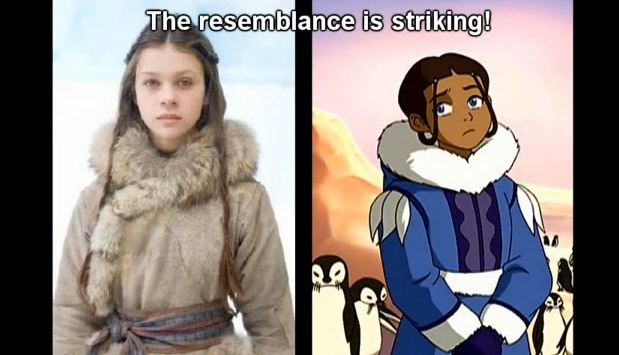
Although she was a quiet observer during the Racefail discussions, Loraine's personal investment in and commitment to the fantasy worlds she loved eventually led her to take action on issues of race and representation. Like many other fans, she was captivated by the world portrayed in Avatar the Last Airbender. Nickelodeon's production of the cartoon drew heavily from Asian cultures throughout history and around the world. The meticulous research informing the characters, clothing, and practices of the tribes and characters has resulted in a show so rich and accurate in detail that teachers have been known to use it for school projects.

For some fans, the show provided the excitement of recognizing familiar cultural symbols; for others, it offered an invitation to identify, explore, and trace East Asian, Chinese, and Japanese cultural identities woven between real life and fantasy. When Paramount Pictures cast the live-action movie version of the epic, and chose white actors to play the four main characters, Loraine and many others were galvanized to take action.

"Narratives that people put faith in"

What is the role of an engaged citizen? What would a high school civics teacher most hope her students learn? Typical lists of civic competencies prioritize content knowledge about the workings of government, but are more and more likely to include intellectual skills such as "critical thinking", "perspective-taking" and dispositions such as "personal efficacy" and "desire for community involvement". Loraine is thinking about the ways in which market forces control how culture and identity get represented in society. She feels empowered enough to voice her opinion and - as we will see - transform the monologue that is the Hollywood apparatus into an open conversation across dispersed networks. How is it that a cartoon on television can motivate this kind of engagement? In our research, we're particularly interested in exactly how and why stories - often fictional - launch, support, and frame social and political movements.

At Futures of Entertainment, we recorded a conversation between Henry Jenkins and Stephen Duncombe, NYU Professor and author of Dream: Re-Imagining Progressive Politics in an Age of Fantasy. Their discussion, about how we interact with narratives in ways that can motivate participation, illuminates Loraine's trajectory from a rather private engagement with popular culture to a more public engagement with society:

Democracy as Communal Creation

Fans of The Last Airbender initially organized under the slogan Aang Ain't White, using a Live Journal account to explain their argument, offer resources for joining the effort, and track their own visibility in the news. Live Journal worked well as an online headquarters, as many of the fans already had accounts at the site. Loraine herself had "a good amount of people" following her on LiveJournal, so in that way she was "able to be a trumpet for the cause".

The main strategy of Aang Ain't White was a letter-writing campaign, alerting Paramount Pictures about fans' disappointment in the casting process, and asking for the film to be re-cast. Fans also created a sister Facebook group to protest the casting.

Along with fan activist Marissa Minna Lee, Loraine worked to evolve this first campaign into the broader "Racebending" movement, and became one of the movement's primary leaders as it grew and drew in more supporters.

The existence of the Racebending campaign is "an act of communal creation" itself, and boasts an abundance of enthusiastic, active and creative production efforts. A search of the word "racebending" on Youtube yields over eighty videos, including videos like "Fighting Casting Racism", personal pledges to boycott the movie, and a slideshow called "A Brief History of Yellowface in Pictures".
airbender 2.jpg

A visual essay posted on the Aang Ain't White LiveJournal account inspired Youtube user chaobunny12 to produce the video essays, including Asian Culture in the Avatar World, juxtaposing images from the Airbender cartoon with images showing the Asian architecture, dress, and practices which inform and style the story world. Chaobunny's work in turn roused doldolfijntje to create a response video, similar in construction but focused specifically on comparing images of Airbender's water tribe to images depicting Inuit culture.

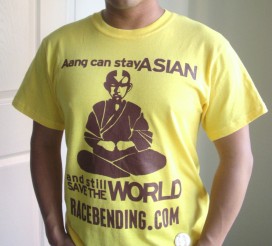
Pooling their skills in illustration and design, fanartists have created a compelling campaign of smart taglines paired with a simple representation of Aang, powerful in its recollection of street-art stenciling techniques. This collectively produced work has been distributed via postcards, banners, stickers, buttons, a visual guide to the controversy, and t-shirts.
airbender 1.jpg

[Read the fascinating story of the campaign's copyright battle with Viacom and Zazzle here and here].

At the 2009 San Diego Comic-Con, Racebending organizers Mike Le and Dariane Nabor invited artists to collaborate on a sketchbook, which they've now shared online. Response from the larger fan network included more creative endeavors: a comic titled "Heresies" at penny-arcade.com, blog posts at angryblackwoman.com, and more, and "a brief and incomplete history...of white actors taking strong Asian roles", featuring 10 video clips with commentary on Hyphen Magazine's blog.

Partnerships and Alliances

These actions encouraged The Last Airbender protest - specifically Racebending - to towards a network of alliances with other groups, many of which did not grow out of popular culture fandom. In particular, the Racebending's alliance with the Media Action Network for Asian Americans (or MANAA), a activist organization which advocates "balanced, sensitive and positive portrayals of Asian Americans" in American media. The collaboration with MANAA moved Racebending into a new space and group's website now indicates that they view The Last Airbender within the larger context of a systematic mis-and-under representation of minorities in media. In many ways, the alliance between Aang Ain't White and MANAA becomes a productive meeting place for two communities that mobilize and work in very different ways. Aang Ain't White emerged quickly, in response to a particular problem and is now on the cusp of more sustained political action. More established and broader in scope, MANAA also plays a watchdog role, although it relies more on actions based in protest, rather than creative production.

Through its interaction with organizations like MANAA, the Racebending movement in general and Loraine specifically now align themselves with activism around race representation. Racebending now defines it's mission as follows:

"We want Paramount Pictures - and all Hollywood studios - to know that supporting and hiring actors of color in prominent roles will help build passionate, devoted audiences. The appeal of Hollywood's films will expand with greater attention to the face of modern America." (source: Racebending)

Mobilization around The Last Airbender became a first step towards a deeper, sustained and overtly political engagement with race in popular media.

From Fandom to Activism: A "thick" politics

For Loraine, The Last Airbender became a point of entry into a growing and sustained mobilization around race in popular media. Through her deepening involvement in Racebending, Loraine journeyed from participatory culture towards an active engagement with participatory democracy. In thinking about her personal trajectory, we recall Henry Jenkins' discussion of the Digital Youth Project in "'Geeking Out' for Democracy" published in Threshold magazine:

"In a recent report, documenting a multi-year, multi-site ethnographic study of young people's lives on and off line, the Digital Youth Project suggests three potential modes of engagement which shape young people's participation in these online communities. First, many young people go on line to "hang out" with friends they already know from schools and their neighborhoods. Second, they may "mess around" with programs, tools, and platforms, just to see what they can do. And third, they may "geek out" as fans, bloggers, and gamers, digging deep into an area of intense interest to them, moving beyond their local community to connect with others who share their passions.... For the past few decades, we've increasingly talked about those people who have been most invested in public policy as "wonks," a term implying that our civic and political life has increasingly been left to the experts, something to be discussed in specialized language. When a policy wonk speaks, most of us come away very impressed by how much the wonk knows but also a little bit depressed about how little we know. It's a language which encourages us to entrust more control over our lives to Big Brother and Sister, but which has turned many of us off to the idea of getting involved. But what if more of us had the chance to "geek out" about politics?"

For Loraine "geeking out" as a fan of Avatar the Last Airbender was a key and crucial step towards "geeking out" on politics. Throughout this journey, her perspectives, approaches and motivations remain rooted in participatory culture, moving us towards a richer definition what Stephen Duncombe calls "thick politics":

In this conversation, Henry Jenkins speaks to the "changing the norms of your society rather than changing the rules of your society", and Racebending is an effort to do just that, by "advocating just and equal opportunity in film and television." For Loraine, Racebending has become journey from fandom to activism; from participatory culture to civic engagement.

Never Mind the Bollocks: Shepard Fairey's Fight for Appropriation, Fair Use, and Free Cultre (Part Two)

This is the second part of an essay written by cultural report and USC Annenberg student Evelyn McDonnell, being reprinted here with the author's permission.

Barack Obama "Hope" poster, original...

Image via Wikipedia

"Hope"

It was into this battleground that Fairey wandered with seemingly noble intentions. Since the mysterious and ambiguous days of the Andre stickers, Faireyʼs work had become increasingly political. Influenced by punk and Constructivism, he unabashedly referred to his work as propaganda. He made a series of posters attacking George W. Bush and the war on Iraq during the 2004 election. He also created posters for the campaign of Ralph Nader.

For the 2008 election, he decided to take a different tack.

"Iʼd spent a lot of time criticizing the Bush administration, the war in Iraq -- things unfortunately didnʼt have enough power to prevent but I could at least try to dissuade people from mistaking the same mistakes again," he says. "A lot of people really respond to negative images because venting is cathartic. I had started to think about why my anti-Bush images and other peopleʼs anti-Bush images had not kept Bush from being reelected in 2004. Maybe it makes more sense to support rather than oppose. And I looked at Obama as the unique opportunity to endorse a mainstream candidate... The ceiling to a lot of the rebel culture and the real activism and quasi-activism was these people are glad to talk but donʼt do anything to engage in this process enough to make an actual difference. I said Iʼm going to engage in this process. One of the most compelling things was having a two and a half year old and being about to have another baby. And thinking itʼs far more important to have them not growing up under McCain as for me to maintain my brand as anti mainstream."

So in January 2008, as Obama was emerging as a front runner in the Democratic race but before the Super Tuesday primaries, Fairey made the Progress poster. "I made the Obama poster just like I made any other poster. The week before it was a ballot box with a speaker on the front saying ʻEngage in democracy, vote.ʼ To me it was just another political image ... I had no idea it was going to be such a hit." Fairey purposefully created a piece that showed him reaching beyond the grassroots cultures that had been his comfortable home.

"I did purposefully try to make it something that I thought could cross over that would have enough appeal to my fan base to stylistically work for them and also not be quite as edgy or threatening. And not in any way to be ironic, to be sincere. And patriotic. My feeling was that all my friends are already going to vote for Obama. The people that hopefully this image will appeal to is the person whoʼs on the fence. It needs to be something thatʼs nonthreatening. Something -- this sounds really corny -- but something that would maybe be hopeful and inspirational."

Fairey originally did with the "Progress" poster what he had done with its predecessors: Made a limited print run of 3-400 that he sold, then used the money to make more posters to distribute for free. Oprah Winfrey and Michelle Obama held a rally at the University of California, Los Angeles, at which he gave away 10,000 copies. In the meantime, Fairey had been in contact with people inside the Obama campaign, who liked the artwork but preferred it carry a different textual message. "Hope" and "Change" were the keywords they were trying to promote, Fairey says. So he made a new version for the campaign. "I chose ʻhopeʼ because I think a lot of people are complacent and apathetic because they feel powerless," he says. "The first thing to motivate people to action is a level of optimism that their actions will make a difference. Hope is important because so many people feel hopeless."

The rest, as the saying goes, is history. Faireyʼs artful yet simple, dramatically chromatic message struck a chord. He made the poster available as a free download on his website, with the condition that any proceeds from sales go to the Obama campaign. Soon, "Hope" was everywhere, a powerful illustration of the way in which the Internet enables fast and direct communication. Fairey received a letter of thanks from the presidential candidate on February 22, 2008, that said in part: "The political messages involved in your work have encouraged Americans to believe they can help change the status-quo."25

On January 17, 2009, the Smithsonian unveiled a mural based on "Hope."For the artʼs maker, the experience, at that point, was a positive lesson in civic engagement.

"Iʼm proud of the image. I put all the money from it back into making more posters, giving money to the campaign, organizing the Manifest Hope art shows. It was all related to supporting Obama. There was no goal for personal gain. Of course publicity wise, it was great for me. Iʼm very fortunate that Iʼm doing that well in my career that I can dedicate that much time to supporting a candidate and not have to have an ulterior motive, like the ambassadorship to Puerto Rico. It was something that was really heartfelt and Iʼm really glad Obamaʼs President."

Backlash

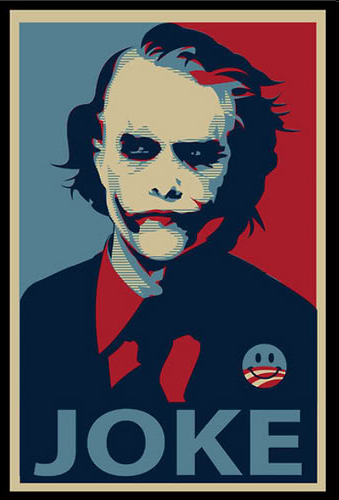
No good deed goes unpunished. "Hope" catapulted the already successful Fairey to a level of notoriety enjoyed by few contemporary artists. He was the subject of numerous articles and was commissioned by Leviʼs to design a line of jeans. He was hired to draw covers of Time and Rolling Stone. The style of the "Hope" poster was itself widely appropriated and parodied (more on that later). But with fame comes friction.

In February 2009, the prestigious Institute of Contemporary Art in Boston debuted an exhibition of Faireyʼs work. The show had been planned before "Hope," the artist says. But of course, the opening got a lot more attention as a result of Faireyʼs heightened profile. Not all of this attention was positive. The night of the opening, Fairey was arrested by Boston police for acts of vandalism related to Faireyʼs public admission that he had performed numerous acts of street art during his lifetime, including when he lived in nearby Providence.

"The Boston arrest was a lot of different things converging," he says. "I made the

mistake of being very candid about my practice as a street artist. The Boston police said

thatʼs an affront to the Commonwealth."

Fairey had been arrested for vandalism before. But he had never been sued by a large corporation for copyright infringement. Actually, it was the artist who, in response to letters and phone calls from AP lawyers, threw down the formal legal gauntlet; on Feb. 9, 2009, with the Stanford University Fair Use Project as his legal team, he filed suit in US District Court in New York to vindicate his rights to the image. AP, saying in a statement that they were disappointed that Fairey had broken off negotiations over the Garcia image, filed a countersuit.

Faireyʼs case centers on fair use. The suit argues that Fairey "altered the original with new meaning, new expression, and new messages," and did not create the art for commercial gain; that he "used only a portion of the Garcia Photograph, and the portion he used was reasonable in light of Faireyʼs expressive purpose"; and that his use "imposed no significant or cognizable harm to the value of the Garcia Photograph or any market for it or any derivatives; on the contrary, Fairey has enhanced the value of the Garcia photograph beyond measure."26

The AP argues that Faireyʼs use of the photograph was substantial and not transformative: "The Infringing Works copy all the distinctive and unequivocally recognizable elements of the Obama Photo in their entire detail, retaining the heart and essence of The APʼs photo, including but not limited to its patriotic theme."27 It also charges that as of September 2008, Fairey had made $400,000 off the image. In a statement available on the website, AP spokesman Paul Colford said the organization was itself acting in defense of creators: "AP believes it is crucial to protect

photographers, who are creators and artists. Their work should not be misappropriated by others."28!

In October 2009, there was a significant, but troubling, development in the case. Fairey admitted that he had misstated which Garcia photo he had originally used for the poster. Instead of a photo in which Obama was shown next to actor George Clooney, he used a photo of Garciaʼs face alone. He also admitted that he had altered evidence to cover up his misstatement.Faireyʼs lawyers have resigned from the case; he has replaced them with new counsel. He also faces possible legal censure.

Fairey says he was initially mistaken about the source and then, embarrassed, tried to hide his mistake.29 The change in source affects one tenet of his fair use argument: that he "used only a portion of the Garcia Photograph, and the portion he used was reasonable in light of Faireyʼs expressive purpose."

"I made some poor decisions that I can only blame myself for," Fairey says.

Does Shepard Have a Posse?

Even before Faireyʼs admitted lie, he had a credibility issue. The Internet is full of Shepard-haters. Diehard punks and radical left-wingers accuse Fairey of selling out not just because of his Leviʼs and Sakʼs Fifth Avenue campaigns, but because of the Obama posters. Thereʼs a whole website devoted to listing the artists and works Fairey has copied. Undoubtedly some attacks are from artists who are jealous of his success. Others have fairly well-thought-out critiques. When I wrote an article on Fairey for The Miami Herald in November 2009, it quickly accrued comments both from kneejerk radicals and reasoned liberals troubled by Faireyʼs questionable integrity (a fan posted first). Sometimes, it seems as if Fairey has a posse -- one thatʼs out to hang him.

Most disturbing are allegations that while Fairey unapologetically appropriates, he has been litigious toward people who have in turn appropriated his work. In 2008 he sent a cease and desist letter to Baxter Orr, an Austin artist and art dealer who had made a version of Faireyʼs Andre image with a surgical mask on it (this was during the SARS crisis). Orr told The Austin Chronicle, "It's ridiculous for someone who built their empire on appropriating other people's images. Obey Giant has become like Tide and Coca-Cola."30

Fairey says he was upset because Orr had been profiting off the artistʼs work by buying posters cheaply from Faireyʼs website -- in true punk rock fashion, Fairey keeps prices for his work low -- then flipping them for a substantial profit. Since this practice is only unethical, not illegal, Fairey went after the "parasite" over IP infringement instead. Orr, who later made the disturbing "Dope" poster parodies of Obama as a cokehead, had publicly bragged about his actions and needled Fairey. Fairey now says the letter was a mistake. "I didnʼt think about how it looked hypocritical. I was operating out of anger and frustration."

One could argue that Faireyʼs admitted "mistakes" make him human. Or the artist could just be caught up in the tangle of sometimes competing, sometimes converging editorial and market logics that drive contemporary media work, as defined by scholar Mark Deuze.31 My personal assessment is that as a white kid from South Carolina, Fairey will always be an outsider in the outsider worlds of punk and hip-hop. This makes him both vulnerable to attacks from those who consider themselves insider purists (like Orr) and insecure. I think Fairey considers the current, constrictive rules of copyright law a burdensome and unreasonable hindrance to the cultural practices to which he, and increasingly many new media workers, are accustomed, and that he felt therefore above the law when it came to admitting the source of the Obama image. His

hypocritical defense of his own IP against an intruder both reveals his ego and shows just how complicated copyright can be. Even those who see it as being intrusive may see it as also necessary, especially when it comes to their own works.

Fairey is not against IP. DJ Diabeticʼs views of copyright are influenced by his love of hip-hop.

"I completely believe in the concept of intellectual property. I just think itʼs got such broad latitude for interpretation that when someone wants to make someoneʼs life hell over some sort of creative transformation of something, itʼs far too easy. What I think IP is about is when someone makes something that directly impairs the market of the creator, thatʼs a problem. When something builds its own new market and may enhance the creatorʼs market, thatʼs a good thing. I think most hip-hop that uses samples should be fair use. I think itʼs completely unfortunate for that art form that the laws have gone the way they have, and thatʼs due to lawyers."

Fairey is much more careful about attribution and appropriation these days. He has begun a project on American pioneers in art, music, and culture, starting with Rauschenberg associate Jasper Johns -- thus saluting some of the figures others have accused him of stealing from. On his website, he carefully notes the Johns image is by photographer Michael Tighe.32

"Iʼm not trying to steal peopleʼs images and exploit them," Fairey says. "I feel like anything I make, Iʼm adding new value that doesnʼt usurp the value of the original. At the same time I donʼt want people to feel taken advantage of, so if I can make it be mutually beneficial, I will. This has never been about me trying to be selfish or greedy about the art I make. I try to use my art for good causes. Almost every print I do has some philanthropic element."

Free Speech + Free Culture = Democracy

Lessig and Litman have both described at length how the companies who are able to buy the most lawyers and legislators are currently winning the copyright wars. AP says it is out to defend the rights of creators, but the creator of the Obama photo has both contested the organizationʼs ownership of the image and said he thought Faireyʼs use of it had been a mostly positive experience:

"I donʼt condone people taking things, just because they can, off the Internet. But in this case I think itʼs a very unique situation ... If you put all the legal stuff away, Iʼm so proud of the photograph and that Fairey did what he did artistically with it, and the effect itʼs had."33

The Recording Industry Association of Americaʼs cynical deployment of the band Metallica aside, copyright wars are not being waged by creators against users: They are being waged by the companies who have purchased the rights from the creators and are now cynically fighting to control creativity. Copyright law was invented precisely to counter such monopolization, when England passed the Statute of Anne to break the stranglehold booksellers had on literature. Todayʼs mediacracy is every bit as powerful as those 18th century word lords.

In terms of legal precedent, Fairey may have a tough battle. You can read lawyersʼ own mixed takes on the case, if you want a bit of a head spin. But many scholars who are closely studying the way new media is redefining cultural practices see the case as an important landmark. Jenkins argues that images of public figures should be particularly seen as fair game, as the art practices of Reid and Prince have already put into practice.

"Artists -- whether professional or amateur -- need to be able to depict the country's political leadership and in almost every case, they are going to need to draw on images of those figures which come to them through other media rather than having direct access..."

"The question, then, boils down to what relationship should exist between the finished work and the source material. And my sense is that Fairey's art was transformative in that it significantly shifted the tone and meaning of the original image. The photograph as taken has nowhere near the power that Fairey's deployment of it had. The photograph was quicklyforgotten amid the flood of such images. And many other photographers captured essentially the same shot. Fairey's poster, on the other hand, is so iconic that it is likely to be reproduced in American History textbooks decades from now. The mythic power comes from what Fairey added to the image -- not from any essential property of the original, which was workmanlike photojournalism."34

The most disturbing ramification of the case against "Hope," should Fairey lose, may be not just its possibly deleterious effect on free culture, but its impact on free speech and civic engagement, the backbones of democracy. If Fairey were less of a punk-steeped radical and were to consider making the Obama poster now, he might not simply license the fee; he might remain silent all together. "I still donʼt regret it, though Iʼm a lot closer to regretting it than I ever thought I would be," he says. "Itʼs such a nightmare that Iʼm going through. Itʼs been really hard on my family."

Not just to punks, rappers, and appropriation artists, but to a large, growing segment of the population that is finding in the frontier world of the Internet a thriving creative environment, Faireyʼs actions make sense. Appropriation is part of how they create and communicate every day. "[Fairey] embodies this new dispersed, grassroots, participatory culture about as well as any contemporary figure," says Jenkins. "The battle between AP and Fairey is an epic struggle between the old media and new-media paradigms, a dramatization of one of the core issues of our times."35

In Free Culture, Lessig argues that the divergence between copyright law and

public practice is turning regular citizens into outlaws, and thus undermining the rule of law. Fairey probably didnʼt exactly mean to launch a grenade into this battleground when he created the most populist, crossover work of his life. But since his entire ouevre was rooted in practices attacking mediacracy, perhaps he couldnʼt help but be a guerrilla.

The "Hope" poster won its first objective: Barack Obama was elected president on Nov. 4, 2008. It made Shepard Fairey a celebrity. And it could just change the way we think about, and litigate, cultural creation.

1 Henry Jenkins, et al., Confronting the Challenges of Participatory Culture: Media Education for the 21st Century, Chicago: MacArthur Foundation, 2006,

2 Jenkins, Convergence Culture: Where Old and New Media Collide, New York: New York University Press, 2006, location 188-192, ebook version.

3 Lawrence Lessig, Free Culture, New York: Penguin, 2005, page 11.

4 This and all subsequent quotes from Fairey that are not footnoted are from an in-person interview conducted by Evelyn McDonnell Nov. 18, 2009.

5 Shepard Fairey, talk given at University of Southern California, Nov. 4, 2009.

6 "Sex Pistols Artwork," SexPistolsOfficial.com.

7 Shepard Fairey, et al, Obey: Supply and Demand: The Art of Shepard Fairey, Berkeley: Gingko Press, 2009.

8

Richard Whittaker, "Artist Cage Match: Fairey vs. Orr," The Austin Chronicle, May 16, 2008.

9 Peter Shapiro, The Rough Guide to Hip-Hop, London: Penguin, 2005, pages 160-61.

10 Fairey et al, page 18.

11 Randy Kennedy, "If the Copy Is an Artwork, Whatʼs the Original?", The New York Times, Dec. 6, 2007.

12 Jason Rubell, phone interview with Evelyn McDonnell, Oct. 28, 2009.

13 Rene Morales, email to Evelyn McDonnell, Nov. 23, 2009.

14 Greg Milner, Perfecting Sound Forever: An Aural History of Recorded Music, New York: Faber and Faber, 2009, page 302.

15 Lessig, pages 129-30.

16 Lessig, page 9.

17 Jenkins et al, page 32.

18 Jenkins et al, page 33.

19 Jessica Litman, Digital Copyright, Amherst, NY: Prometheus, 2006, page 13.

20 Paul Goldstein, Copyrightʼs Highway: From Gutenberg to the Celestial Jukebox, Stanford, Calif.: Stanford University Press, 2003, page 15.

21 Goldstein, page 27.

22 See Nas, Hip-Hop Is Dead, Def Jam Records recording, 2006. Also Sasha Frere-Jones, "Wrapping Up: A Genre Ages Out," The New Yorker, Oct. 26, 2009, and Simon Reynolds, "Notes on the Noughties: When Will Hip-Hop Up and Die?", www.guardian.co.uk, Nov. 26, 2009.

23 Lessig, page 181.

24 Litman, page 14.

25 Fairey et al, page. 273.

26 COMPLAINT FOR DECLARATORY JUDGMENT AND INJUNCTIVE RELIEF, SHEPARD FAIREY and OBEY GIANT ART, INC., against THE ASSOCIATED PRESS, page 11.

27 ANSWER, AFFIRMATIVE DEFENSES, AND COUNTERCLAIMS OF DEFENDANT, THE ASSOCIATED PRESS, SHEPARD FAIREY and OBEY GIANT ART, INC., against THE ASSOCIATED PRESS, page 10.

28 Paul Colford, AP Statement on Shepard Fairey Lawsuit, Feb. 9, 2009.

29 Fairey, Nov. 4, 2009.

30 Whittaker.

31 Mark Deuze, "Media Work & Institutional Logics," Deuzeblog, July 18, 2006.

32 "Jasper Johns," Obey website, Dec. 10, 2009, http://obeygiant.com/.

33 Randy Kennedy, "Artist Sues the A.P. Over Obama Image," The New York Times, Feb. 9, 2009.

34 Jenkins, email to Evelyn McDonnell, Nov. 22, 2009.

35 Jenkins, Nov. 22, 2009.

Evelyn McDonnell is doing life backwards: After more than two decades of writing about popular culture and society, she's getting her Master's in arts journalism as an Annenberg Fellow at the University of Southern California. She is the author of three books: Mamarama: A Memoir of Sex, Kids and Rock 'n' Roll; Army of She: Icelandic, Iconoclastic, Irrepressible Bjork; and Rent by Jonathan Larson. She coedited the anthologies Rock She Wrote: Women Write About Rock, Pop and Rap and Stars Don't Stand Still in the Sky: Music and Myth. She has been the editorial director of www.MOLI.com, pop culture writer at The Miami Herald, senior editor at The Village Voice, and associate editor at SF Weekly. Her writing has appeared in numerous publications and anthologies, including Rolling Stone, The New York Times, Spin, Travel & Leisure, Interview, and the LA Times. She codirected the conference Stars Don't Stand Still in the Sky: Music and Myth at the Dia Center for the Arts in New York in 1998. She has won several fellowships and awards. "Nevermind the Bollocks" is part of a larger project Evelyn is researching on artists in the age of content. You can contact Evelyn at evelyn@evelynmcdonnell.com.

Reblog this post [with Zemanta]

Never Mind The Bollocks: Shepard Fairey's Fight for Appropriation, Fair Use and Free Culture (Part One)

One of the many highlights of my first semester in LA was the chance to see and meet Shepard Fairey. who I regard as one of the most significant visual artists of our times and a focal point for debates about the politics/poetics of appropriation and fair use. Fairey spoke on stage with my new colleague, Sarah Banet-Weiser. I have been following Fairey for some time since he was an art student at the Rhode Island School of Design and "Andre the Giant has a Posse" stickers started to appear on lamp posts and underpasses around Boston. At first, I envisioned the stickers as a new kind of fan art -- since I was deeply into the World Wrestling Federation at the time -- and only gradually came to understand them as a form of culture jamming. Now, having seen and talked with the guy, I suspect they were an odd blurring between the two -- a bold experiment in tapping the power of participatory culture to spread images across the planet and relying on local contexts to shape what those images meant to participants. Pretty cool.

One of the students in my New Media Literacies class last term, Evelyn McDonnell took advantage of Fairey's visit to USC to interview him for the Miami Herald. McDonnell is a cultural reporter of the highest order -- the kind of student you hope you will get at a place where journalism and communications students co-mingle. She's already written three books and edited two more, mostly dealing with rock music, and she's now working on a project dealing with the shifting relationship between artists (popular and high) and their publics. She really dug deep for the Herald story and found out much more than could make it into a newspaper piece, so she asked if she could expand this work as her final paper for the class.

I was certainly intrigued to learn more about her thoughts on Fairey and especially on the current legal struggles he is engulfed in. But what she gave me was so much more -- an exploration of artistic and musical appropriation since the Punk era, how they have shaped Fairey's aesthetic project and how they have impacted the current state of law around Fair Use. Her interest in rock is very visible in the opening which shows how the album design for the Sex Pistal's Never Mind the Bollocks helped to inspire Fairey.

I timidly asked her if she'd be willing to share it via my blogs, knowing that the topics would be relevant to some many different readers, and I was grateful she agreed. I am running the essay in two installments -- today's part takes the long view situating Fairey's work in the larger trajectory of artistic appropriation; the second part, which will run on Friday, deals specifically with the Obama Hope poster, how and why it was created, and the legal battle that now surrounds it. Enjoy!

Never Mind The Bollocks: Shepard Fairey's Fight for Appropriation, Fair Use and Free Culture

By Evelyn McDonnell


Every sk8ter boi with a Clash album and a can of spray paint wants to change the world. In late January 2008, Shepard Fairey may have done just that. Thatʼs when he decided to create something he had never, in some 20 years of producing stickers, T-shirts, prints, stencils, tags, and canvases, made before: a poster endorsing a popular political candidate.

Since Barack Obama was not exactly available to pose for some grassroots graphic artist, Fairey found a photo of the senator online. With a couple mouse clicks, he copied a shot taken by Mannie Garcia in 2006 for the Associated Press. Then he turned a news photo into a propagandist art statement.

Fairey replaced the natural tones of the photo with the strong lines and bold colors -- in this case, red, white, and blue -- of Russian Constructivist art. He added oversized cartoon hatch-mark shadings in the style of Roy Lichtenstein. Across the bottom, he wrote: "Progress." In later iterations, he changed "Progress" to "Hope."

Faireyʼs Obama "Hope" poster is the most iconic, widely seen art work in recent history. Its dignified profile telegraphed both patriotism and change better than any other single image in a mediagenic campaign. "Hope" both captured and helped enable a historic moment.

And it got its maker into a heap of trouble. In ʼ09 Fairey and the AP sued each other over the artistʼs use of Garciaʼs photo. "Hope" may not have merely helped the United States elect its first African-American president. It could set new legal precedents for one of the most important issues of the digital age: intellectual property.

Faireyʼs lawsuits with the Associated Press are a test case for the changing rules of IP and a case study in what media studies scholar Henry Jenkins et al have described as the new media literacy of appropriation.1 The meeting of an underground artist with mainstream and commercial ideology is also an example of what Jenkins calls convergence culture: "a cultural shift as consumers are encouraged to seek out new information and make connections among dispersed media content."2 The story of the "Hope" poster is the story of divergence as well: of increasingly closed copyright law deviating from increasingly open-sourced public practice. In this case, the law and mainstream media are working at odds to both market capitalism and anarchist street culture.

A close analysis of the Fairey/AP battle -- or what could be called the case against "Hope" -- provides key insights into the status of appropriation, fair use, free culture, and engaged citizenry as we enter the final year of the first decade of the 21st century. The battle could be a strategic turning point in what Harvard professor Lawrence Lessig has called the war against free culture. "There is no good reason for the current struggle around Internet technologies to continue," he writes. "There will be great harm to our tradition and culture if it is allowed to continue unchecked. We must come to understand the source of this war. We must resolve it soon."3 By studying Faireyʼs employment of appropriation, we take another step toward understanding that war. Lessig may be optimistic in saying understanding can lead to resolution, but it can certainly inform further activism and creativity.

Anarchy in the Public Domain

Faireyʼs use of Garciaʼs image, and the entire NML conception of appropriation, have historical precedents in the cultural traditions in which the artist was steeped: punk, collage, street art, and Pop art. Frank Shepard Fairey grew up in Charleston, South Carolina. He discovered punk rock and its connected skateboard subculture as a teenager. "The Sex Pistols changed my life," he says. "That was the gateway band for me."4

The English band the Pistols, who sang about "Anarchy in the UK" in a music driven by over-amped guitars and Johnny Rottenʼs sarcastic snarl, were Faireyʼs gateway out of conservative Southern culture and into a global youth subculture characterized by rebellion against mainstream and corporate values. "Thereʼs not a lot of progressive culture there," he has said of his hometown. "I got into the skateboarding and punk life. That opened my eyes to political and social critique: How art could work with things that are political."5

The cover of Nevermind the Bollocks, Hereʼs the Sex Pistols, the bandʼs 1977 debut album, was designed by an English artist named Jamie Reid. Reid did for punk music what Fairey did for the Obama campaign, providing a distinctive iconography of cut-up, Xeroxed images and ransom-note-style lettering. In one famous piece, he put a safety pin through the lip of a reproduction of a photograph of Queen Elizabeth II, providing a visual complement to the Pistols song "God Save the Queen." As far as I can tell, Reid was not sued by royal photographer Peter Grugeon -- though there was certainly intense uproar over the song and artwork.6

There was a purpose to this playfulness. Do-It-Yourself -- the notion that culture should actively

be in the creative hands of the people, not just something produced by corporations and consumed by a passive audience -- is a guiding ethos of punk. In reaction to the showy musicianship of art-rock, such bands as the Clash advocated that music be simplified and demystified, so that anyone could play it. Cut-up art is similarly a way of claiming images that permeate public spaces (the queenʼs face was omnipresent in ʼ77 England, the year of the Silver Jubilee), asserting individual expression over them (the safety pin), and making them public domain (Reidʼs image was stickered around town). Through media bricolage, Reid and other punk ʻzine creators asserted individualsʼ right to exploit and manipulate commercial imagery, since commercial imagery exploits and manipulates the public. They were appropriating, creating visual remixes and mashups -- long before those were digital-culture buzzwords.

The graphic creation that first made Fairey famous in underground circles was also a punk sticker, one that looks strikingly like "God Save the Queen." Fairey went to the Rhode Island School of Design to study illustration. In 1989, he made a stencil of Andre the Giant and added the words "Andre the Giant Has a Posse," plus the wrestler/actorʼs height and weight. He plastered the stickers around Providence enough that a local weekly, The Nice Paper, took note. Soon, the Andre campaign spread to nearby Boston and New York. Fairey sent stickers to friends who put them up wherever they lived. He advertised in punk magazines and sold the stickers by mail order for five cents each.

Within seven years, he had printed and distributed a million of them. Fairey also made Andre posters and stencils. André René Roussimoff died in 1993, but he and his make- believe posse were ubiquitous on urban street lamps and walls for years afterwards.7

According to one news account, Fairey had to alter the image of Andre, as the owners of World Wrestling Entertainment threatened to sue over it.8 The face evolved into a Constructivist-inspired abstraction, and now the words just said "Obey" or "Giant." The forced change actually enabled Faireyʼs art to become more sophisticated and distinctive. The style that was to become famous with "Hope" was apparent in the "Obey" series of works of 1995.

In his street-art campaign, Fairey was inspired by another musical culture of the 1970s. Graffiti is considered one of the four main elements of hip-hop (the other three being DJing, breakdancing, and rapping). It, like punk cut-up art, is also an assertion of the individualʼs right to self-expression in the public domain, with the legal concept of public domain meant quite tangibly -- on subway cars and abandoned buildings. The art of spray-painting tags (aliases of graffiti artists) and street murals exploded during New Yorkʼs fiscal crisis, as colorful balloon letters and stylized characters proliferated. Such practitioners as Futura 2000, Rammellzee, Lady Pink, Revs, Cost, and Claw became famous for going "all-city."9 Street artists Keith Haring and Jean-Michel Basquiat were also accepted into the world of fine art, becoming celebrities of the Downtown scene of the 1980s.

Fairey saw this work all around him on a 1989 visit to New York, shortly before he launched the Andre sticker. "I saw graffiti in risky places that gave me new respect for the dedication of the writers," he writes in Obey: Supply and Demand: The Art of Shepard Fairey. "Stickers and tags coated every surface in New York City. I left the city inspired ..."10

Reclamation and transformation of commercial or public images is also an accepted method in the art world of museums and galleries. Marcel Duchamp virtually invented conceptual installation art with his famous urinal sculpture. Robert Rauschenbergʼs combines and collages of the ʻ50s mixed found objects and images. In the 1960s, Andy Warhol made brightly colored silkscreens of Campbellʼs soup cans, Marilyn Monroe, and Elvis Presley. In the ʻ70s Richard Prince rephotographed commercial shots of Marlboro Men and Brooke Shields.

Such appropriative art has been both highly successful -- a Prince work sold for $1.2 million in 2005 -- and controversial: He was sued over the Shields shot, and reportedly settled out of court for a small fee.11 Still, appropriation has become largely accepted as an artistic practice. "Good artists borrow, great artists steal," Pablo Picasso is reputed to have said. In 2009, Miamiʼs Rubell Family Collection named an exhibit of 74 of its artists engaged in various forms of mimickry, including Mike Kelley, Rashid Johnson, David Hammons, Paul McCarthy, and Sherrie Levine, "Beg Borrow and Steal." "Artists are acting as cultural curators; through their work theyʼre recurating history and recontextualizing it," says Jason Rubell, one of the exhibitʼs curators. "Theyʼre appropriating and reassessing imagery that came before."12

In the same way that Reid and the punks utilized it, appropriation by fine artists may be an effective tool against mass media bombardment. "Thereʼs an enormous difference between imitation and appropriation," says Rene Morales, a curator at the Miami Art Museum, which co-produced an installation by Fairey in December 2009. "Appropriation is a creative act; itʼs become one of the most effective ways to make art in a media-saturated word."13

The Pop Art of Rauschenberg, Warhol, Prince, and others influenced Fairey. "My favorite artists are people like Jamie Reid and Rauschenberg and Warhol, who incorporated existing art work in their work but did it in a way that made something that wasnʼt very special incredibly special," he says.

To those who decry lack of originality in Faireyʼs work, the artist agrees. "The idea of originality is pretty ridiculous. Itʼs virtually impossible to be original. Language is based on reference. To me as a visual artist, I use reference in my work all the time, both images that have a specific

connotation and styles that have a specific connotation."

For instance, in the Andre artworks, Fairey wrote "Obey" in red capital letters. This was his homage to ʻ90s art star Barbara Kruger, whom he calls "the most political, outspoken artist" of that time. "I liked her work and I thought that if I used that style, people were going to wonder what I was trying to say. I think she understood she should be flattered."

Russian Constructivism, Reid, Warhol, Kruger: The influences on Faireyʼs work are clear. The artist is as unapologetically derivative in his image choices as in his styles. He doesnʼt draw or paint the central figures of his pieces. He uses images created by others, either by photographers with whom he is collaborating, or images he finds online, or at agencies that sell stock photos, or that are already well known (such as his series on famous musicians). "Thereʼs no shortage of images," he says with a twinkle of ironic mischief. "Itʼs just that thereʼs an abundance of lawyers as well."

Prince simply rephotographed some of his most famous images, without modification. Fairey alters, sometimes radically, the works he appropriates, with exacto knives, computer tools, or by hand illustrating them. He defends his methods philosophically.

"Iʼm biased to my own idea that images are abundant but making them special is whatʼs important. Looking at how to distill what will make something iconic is what I think my skill is. Thereʼs some people who have great brush strokes and others who come up with cool color combinations. This is my skill, and whether the law says itʼs okay or not, itʼs what my skill is. ...

"Thereʼs a huge debate with new technology about what constitutes legitimate art. Does it have to be done with a paintbrush or with your hands? I enjoy illustrating with my hands. But really, your eyes make the art. You make the decisions by looking at things and transferring what you want to do in any number of ways, whether itʼs with your hands or digitally or with photography. The end result is whatʼs important. You may be Jeff Koons and have fabricators build it and never touch it. That to me is whatʼs art about: Whether that end result, however you got there, affects people and says what you wanted to say."

Sampling and Appropriation

Digital technology is radically changing the way the arts are made, transmitted, communicated, marketed, taught, learned, and controlled. Nowhere is this clearer than in the development of remixing and sampling. The ability to duplicate audio clips with commercially available technology became the basis for two important musical forms born in the 1970s: Jamaican dub and its descendent, hip-hop. In a Kingston recording studio, engineer King Tubby took preexisting musical tracks brought in by the artists and producers who had recorded them and cut and pasted, electronically tweaking along the way. "The salient point about Tubby is not that he invented the remix (although he did). Itʼs that the concept of the remix reinvented modern music," writes musical historian Greg Milner.14

A few years later in the Bronx, such DJs as Grandmaster Flash and Koolmaster Herc plugged their sound systems into lampposts and performed for block parties. MCs rapped over instrumental tracks; thus hip-hop was born. DJ/producers mixed hooks and beats from multiple records, obscure or famous, to create whole new songs -- the audio counterpart to Rauschenbergʼs combines, or Reidʼs and Faireyʼs collages. The commercial development of cheap samplers made what had been the high-art form of appropriation easy and ubiquitous. It also fueled the most important creative outpouring of music of the last 30 years, as rap artists emerged from ghettos, barrios, suburbs and small towns around the world. Hip-hop is an example of the environment of creativity that law professors James Boyle and Lawrence Lessig both argue is the core context of intellectual property law.15

The art of cutting, pasting, and remixing -- whether in word-processing software, Photoshop, iMovie, wherever -- is now intrinsic to computer culture. Lessig and many others see this as part of the radically transformative power of digital culture. "For the Internet has unleashed an extraordinary possibility for many to participate in the process of building and cultivating a culture that reaches far beyond local boundaries," Lessig writes. "That power has changed the marketplace for making and cultivating culture generally, and that change in turn threatens established content industries."16

Since 2006 the MacArthur Foundation has been funding a $50 million study of digital culture and learning. In a 2006 white paper written under funding from that study, Jenkins et al identify the skills that are enabled by new media and explore how they might be implemented in classrooms. The paper identifies appropriation as one of these main skills. "The digital remixing of media content makes visible the degree to which all cultural expression builds on what has come before," Jenkins et al write. "Appropriation is understood here as a process by which students learn by taking culture apart and putting it back together."17

Faireyʼs "Hope" poster is a definitive example of appropriation, as launched by his artistic and musical predecessors (Fairey also spins records under the name DJ Diabetic) and described by the white paper. "Appropriation enters education when learners are encouraged to dissect, transform, sample, or remix existing cultural materials," Jenkins et al wrote.18 Fairey was engaged in the essential appropriative processes of analysis and commentary when he remixed Garciaʼs photo.

The Clampdown

" Appropriation may be recognized and respected by artists, punks, rappers, scholars, and educational foundations. But it has become the center of a legal battleground. As an artist being sued for copyright infringement, Fairey follows in the footsteps of Richard Prince and rappers 2 Live Crew. But he is the first creative person to be engaged in litigation with a news giant during a time when internet communication technologies have fundamentally unsettled media organizations (or what I like to call the mediacracy).

IP law is complicated, to say the least. As Jessica Litman quips, "Copyright law questions can make delightful cocktail-party small talk, but copyright law answers tend to make eyes glaze over everywhere."19 Essentially, the law in America historically seeks a balance between the need to guarantee creators and inventors a financial incentive to create and invent, and the right of the public at large to participate in the free exchange of ideas. The overall goal, as stated in the Constitution, is "to promote the Progress of Science and useful Arts."

!ntrinsic to that progress and free expression, certain uses of copyrighted material are protected as fair use. "The Copyright Act allows the copying of copyrighted material if it is done for a salutary purpose -- news reporting, teaching, criticism are examples -- and if other statutory factors weigh in its favor," writes legal scholar Paul Goldstein.20

The Miami bass group 2 Live Crew took their fight for the right to appropriate all the way to the Supreme Court. In 1990 music publishers Acuff-Rose sued the salacious rappers for sampling the Roy Orbison song "Oh, Pretty Woman," to which they owed the rights. 2 Live Crewʼs lawyers defended the use as an act of parody and therefore an example of fair use. The Supreme Court agreed. "The goal of copyright, to promote science and the arts, is generally furthered by the creation of transformative works," Justice David Souter wrote, in a decision that has ramifications for Fairey.21

But other acts who have used samples have not been able to claim the parody fair use defense and lost their cases. Since the rapper Biz Markie was forced to remove a track from his 1991 album I Need a Haircut, musicians have repeatedly been sued over royalties. Now record companies are paranoid about any and all use of samples. What some artists and critics have called the genreʼs current demise could be in part related to the legal crackdown on sampling.22

Indeed, there is something about the digitization of pop music that has caused jurists and legislators to side with multimedia corporations in a clampdown on copying that is changing the rules of intellectual property. The courts shut down music distribution systems Napster and MP3.com and issued restrictive, expensive licensing rules that effectively silenced Internet radio for a time. Lessig, the founders of the Electronic Frontier Foundation, and others have documented and argued against this erosion of free culture. "In the middle of the chaos that the Internet has created, an extraordinary land grab is occurring," Lessig writes. "The law and technology are being shifted to give content holders a kind of control over our culture that they have never had before. And in this extremism, many an opportunity for new innovation and new creativity will be lost."23

Litman refers to this land grab by the vested interests of media conglomerates as the Copyright Wars. "If current trends continue unabated, however, we are likely to experience a violent collision between our expectations of freedom of expression and the enhanced copyright law," she writes.24

******************************(MORE TO COME)*******************************************************

Evelyn McDonnell is doing life backwards: After more than two decades of writing about popular culture and society, she's getting her Master's in arts journalism as an Annenberg Fellow at the University of Southern California. She is the author of three books: Mamarama: A Memoir of Sex, Kids and Rock 'n' Roll; Army of She: Icelandic, Iconoclastic, Irrepressible Bjork; and Rent by Jonathan Larson. She coedited the anthologies Rock She Wrote: Women Write About Rock, Pop and Rap and Stars Don't Stand Still in the Sky: Music and Myth. She has been the editorial director of www.MOLI.com, pop culture writer at The Miami Herald, senior editor at The Village Voice, and associate editor at SF Weekly. Her writing has appeared in numerous publications and anthologies, including Rolling Stone, The New York Times, Spin, Travel & Leisure, Interview, and the LA Times. She codirected the conference Stars Don't Stand Still in the Sky: Music and Myth at the Dia Center for the Arts in New York in 1998. She has won several fellowships and awards. "Nevermind the Bollocks" is part of a larger project Evelyn is researching on artists in the age of content. You can contact Evelyn at evelyn@evelynmcdonnell.com.

Reblog this post [with Zemanta]

Public Media, Public Education, and the Public Good: An Interview with Heather Chaplin (Part Two)

Editor's note: This is my last post of 2009. See you in the new year. I am going to take some time off with my family.
Much of your discussion centers around the impact of public media on public education. How would you describe the ideal learning environment for the 21st century and what blocks us from achieving that ideal?

One could write a book on that topic! Well, one of the intriguing things about creating a more intimate relationship between public media and public education is that public media is in possession of a national treasure of historical materials. Part of NPL would be assisting public media in digitizing that material and retooling it for teachers to use while teaching.

So imagine a science class where the teacher can pull out a segment from Nova on the spot to illustrate the answer to a particular question asked by a student. Or using a bit of an interview from a Jim Leher interview to make a political point. The examples could go on for ever. And, unlike the archives of corporate-owned media, these arches belong to the American public. We paid for them and we should take advantage of them.

There are also real opportunities for public media to be involved teaching kids media skills. Imagine a local PBS station also being a hub where kids could take classes on video editing, or putting together sound pieces, or making videogames. Part of public media 2.0 calls for local stations to take a greater role in serving their local communities directly.

In terms of the classroom of the future in general, I see digital media as a huge opportunity. I don't believe, however, that digital media tools replace things like smaller teacher-to-student ratios. And I do worry, on some level, about having so much of our lives mediated by machines. I see these digital media tools being used when appropriate to enhance the teaching experience and not as a replacement for teacher to student contact. For example, the idea of using 3-D models of molecules to teach science: that's probably just a better and more effective way of teaching what a molecule is than giving a lecture on one. Therefore, since it's something we can do, we should. On the other hand, discussing a great novel is probably best done by teacher-student discussion. That should go away. It's a matter of understanding the technology now at our disposal and making good choices of when to use it.

What blocks us from achieving these goals? A lot of things. The public school system in this country is messed up almost beyond belief and on every level. Bush's push towards more standardization certainly didn't help - it meant teachers teaching kids to pass certain standardized tests, and not teaching them to be critical thinkers, to be genuinely literate in the sense of being able to create meaning. Our schools are wildly underfunded, and even when money is available, the resistance to change is staggering. I asked one former state school superintendent what she'd do to fix the public education system in this country and she - a mild-looking women in a tweed suit - said she'd blow the whole thing up and start from scratch.

What's so scary is how high the stakes are. Democracy requires an educated citizenry. Without that, you regress to mob rule. Part of being free is knowing how to use your mind.

You are calling for improvements in the broadband infrastructure to bring richer media content into schools but schools are also seeking to police the flow of content into the classroom, blocking off access to social networking and media sharing sites, for example. How might we resolve this tension between the desire to broaden and to regulate access to information in the 21st century classroom?

Another excellent question and I wish I had the answer. It is true that schools and teachers fear the Internet desperately. In part, I think people fear the lack of control the vastness of the Internet implies, I think they fear the new, and I think on some level they simply fear and distrust new technology. People tend to think the things they didn't grow up with are somehow bad.

To me, however, it's like we've built a high-way system, said hey! our whole world is now going to be based on this new highway system - but we're not going to teach anyone to drive. It's sheer lunacy.

I think schools need to learn to teach kids how to use the Internet, not hide them from it. The reasons for this are too numerous - and too well elucidated by you, Henry!, to even go into right here. As to some sort of solution, I can't help but think the answer is working with teachers and parents.

We need to educate people as to what 21st century literacy will require - because being literate in the 21st century is going to be very different from being literate in the 20th century. You simply will not be literate in the future if you don't know how to handle the Internet in a meaningful way. I teach journalism, and I do several classes where everybody brings in their lap top and we do experiments on Internet research, for example. But then that's at the college level and I have freedom over what I get to teach. Again, I can't say enough how high I think the stakes are.

Think of the kid growing up in a small rural town that doesn't even have Internet access. How is that kid going to manage as an adult competing against kids who've been using the Internet since they were toddlers? If the schools don't take this on, children in rural and poor areas will suffer the most and will be left behind even more than they already are.

You argue that concerns about "station by-pass" have sometimes placed public television at war with the new digital tools and participatory culture. Explain. How might we resolve this conflict?

Local public media stations are afraid for their existence. If everything is digital and handled via the Internet, and broadcast becomes a thing of the past, the question does arise of why they even exist. What is their purpose?

The answer to this lies in re-envisioning the role of the local station in its community. A lot of the public media community is starting to image the local station as a community hub, doing serious local journalism, creating forums and town-hall-style meetings, and providing resources for solving local problems. Also, as I mentioned above, taking a greater role in teaching youth to be media literate. The network of local stations is an infrastructure aimed at serving the public good already in place; we shouldn't waste it. But we do need to re-imagine it.

A decade ago, the push to respond to the digital divide led to the wiring of classrooms often without adequate pedagogical goals or professional development. We wired the classroom-now what? How do we avoid the replication of this same problem where the expansion of technical infrastructure outstrips the educational vision needed to use these tools towards meaningful pedagogy?

This is another great question and I feel woefully unqualified to answer it. It's so easy to say what ought to happen, and another thing entirely to actually make something happen.

I think you put your finger on it before when you asked about teachers' wanting to keep the Internet, social networking, etc. out of the classroom. Or Jim Gee talks very eloquently about classrooms very methodically making kids leave everything they're interested in at the door, thus essentially ensuring the kids will be uninterested in the classroom, and, most obviously, failing to take advantage of a kid's natural interests to facilitate learning. Or I love the example I've heard you give of your Moby-Dick project getting stymied because the word "dick" had been blocked by school administrators from Internet searches.

I totally agree with you that having fancy technology is of no use whatsoever if there's no vision of how to use it.

Part of what NPL advocates is also providing content for teachers to use in the classroom and a major push for teacher training when it comes to digital tools. But I know that's kind of a cop-out answer, because how do you actually implement these things? How do you inspire vast change in a system notoriously mired in bureaucracy and seriously allergic to change? This is one of those questions of the ages.

It's probably worth remembering that we are in a period of transition. In another ten years or so, the people signing on to become teachers will have grown up with digital technology and may feel more comfortable using it. In the meantime, I think an assault from all sides is necessary - pressing the Obama administration, which seems pretty savvy and progressive regarding digital technology, to get involved; working with parents to understand what's at stake in terms of their kids' education; educating teachers, etc

.

Educational games figure prominently in this report. This is not surprising given your previous work on games. Why might games be a particularly rich test case for the kind of expanded public media system you are describing?

Yes, I am very passionate about using games to teach and foster civic engagement. One example: right now simulations exist at all levels of the government for all kinds of things, from weather predictions, to budget issues, to military scenarios. Simulations can be incredibly powerful tools for learning how things work - why not take these simulations, which already exist and which we, as tax payers, financed, and turn them into games made available to the public to play with?

It would be cheap, could reach vast amounts of people quicly and easily, and could educate people about important things like how tax cuts or break will effect the economy, what the potential outcomes of military decisions might be, etc. In other words these could be powerful tools for fostering transparancy, which is key to a real democracy. We now have more data than we know what to do with.

Making games so that people can play with the data is one way to help people make sense of everything that is out there. Government data should be available to the public so that we can make informed decisions about what our government ought to be doing. Taking something that already exists- government-created simulations - and making them available as games to people seems a really obvious way to foster democracy.

I also think public media needs to begin funding games in the same way it funds educational television. The inspiration for the act of Congress that funded the Corporation for Public Broadcasting and created PBS and NPR in the first place was this idea that here was this new media - TV - and that we ought to be using it for more than just entertainment purposes. Well, that was 1967. It's more than 30 years later and there's a new new media on the block and that's the videogame. Why leave such a powerful tool in the hands of corporate entertainment companies? As a society we want it in our arsenal of tools to educate the next generation of Americans to be active and engaged participants in our democracy.

Heather Chaplin is a professor of journalism at The New School and author of the book, Smartbomb: The Quest for Art Entertainment and Big Bucks in the Videogame Revolution. She recently participated in a Ford Foundation grant looking at issues of the public interest in the next generation of the Internet. She also works with the Corporation for Public Broadcasting on issues of digital literacy and journalism. She has been interviewed for and cited in publications such as The New Yorker, The Atlantic Monthly, The New York Times Magazine, Businessweek, and The Believer and has appeared on shows such as Talk of the Nation, and CBS Sunday Morning. Her work has appeared in The New York Times, The Los Angeles Times, GQ, Details, and Salon. She is a regular contributor on game culture for All Things Considered.

Public Media, Public Education, and the Public Good: An Interview with Heather Chaplin (Part One)

Heather Chaplin is one of the good guys -- she wrote one of the best books about the place of video games in contemporary culture; she's doing journalism which challenges some of the preconceptions about youth and new technology that run through most mainstream coverage; and she's been doing consulting work with some leading foundations -- MacArthur, Ford, among them -- as they think through what needs to be done to reallign public institutions with the risks and opportunities of the digital age. Heather interviewed me recently for the Digital Media and Learning project website, talking about participatory culture and public engagement. She was nice enough to allow me to turn the microphone (or in this case, the keyboard) the other way to talk with her about her recently published white paper, National Public Lightpath: Documentation and Recommendations, which seeks to map some future directions for how the internet might serve the public good.

Here's part of the summary of the white paper:

It's hard to remember life before the Internet. In the span of two decades it has entirely reshaped the way we do business, gather information, shop, play, and socialize. It's all moved so quickly, it's been hard to even stop and think. But do for a minute. Stop. Think. In all our rush to buy books and shoes online, and to find our lost high school friends on Facebook, we have failed to consider one thing. What part of the Internet is going to be devoted to the public interest?"

In part one of this interview, Heather offers some frank and provocative comments about how the internet might better serve the public good and critiques the "libertarian" perspective on how the web should grow. In the second part, which will run later this week, she shares some thoughts about digital literacy and public education.

Your white paper opens with the provocative question, "what part of the Internet is going to be devoted to the public interest?" How would you answer that question?

It's actually a really hard question to answer, based on what your notion of "in the public interest" is. I mean, NPR and PBS have presences on the Internet. And I suppose you could argue that there are probably millions of sites out there that serve the general public good. So, if I were to play devil's advocate against myself, I suppose I would argue that the very nature of the Internet - the anyone-can-publish idea - is in itself a public good.

But here's the thing, I'm not really the libertarian type. I don't believe that things will necessarily just sort themselves out if left alone. When I talk about creating a piece of the Internet in the public interest, I'm really talking about both public ownership of the infrastructure and content created specifically to educate, enlighten and enrich in the interests of genuine literacy and civic engagement.

I think ownership of the infrastructure is important here. There is no inherent financial incentive to create something like NPL so there is no reason on earth for Verizon or AT&T to get involved. As it is they want to create a pay structure where people pay more for faster connections, which would in effect wipe out any chance for the "little guy" to compete with corporate players. People forget in this country that corporations despite their sunny logos and appealing products, are not our friends. They have a PROFIT MOTIVE. This means, as the phrase would imply, they're motivated by profit not the public good. In fact, they're legally set up so that they're breaking the law if they stop to consider the public good over profits.

I have a real bee in my bonnet about the way the Internet infrastructure belongs to these companies when it was created by tax payer dollars. It's the same with the pharmaceutical companies - they make billions off drugs, the research for which was done by public universities funded by public citizens like you and me.

But now I digress.

What was the original question? Ah yes, well, in reality, I FEAR no part of the Internet will be devoted to the public interest in any sort of "official" capacity. I HOPE, however, that we are able to build an infrastructure that would, at first, connect public media to the schools, for educational purposes, and then build out from there to people's houses, libraries, museums etc.

Your paper proposes what you are calling the National Public Lightpath. What specifically are you advocating?

NPL proposes creating a publicly-owned piece of the Internet that links together important institutions devoted to the public good, such as public media, the public schools systems, and, eventually, museums and libraries. Ideally, it would eventually spread so that people could plug into NPL at home as well, to , say, complete a homework assignment given at school.

What many people don't understand is how the Internet works - that there are different modes of connecting households and institutions. Some Internet connections, for example, are still run over copper wires, even though copper wires don't permit for very fast transmission. The reason? In the early 1990s, a couple of the big providers bought a lot of copper wire, and don't want to lose out on their investment. NPL advocates using high speed fiber optic cable, which in essence means the "pipes" to your house or school or whatever, would be fatter and thus capable of transmitting a greater amount of data at faster speeds. This is something Japan, Korea and many European countries already have. Many scientific universities are also connected on a network they own communaly called National LamdaRail, a non-profit set up specifically for that purpose. (NPL would build off of the National LamdaRail infastructure, as it already circles the country.) Fatter pipes gives you the ability to transmit vast amounts of data in real time. Imagine your kid in school learning biology by playing with 3-D molecular models being piped into the classroom from a university on the other side of the world - or engaging in peer-to-peer learning by sharing, in real time, virtual worlds they'd built with kids in other country. The possibilities are endless.

Your talk about "empowering an agency to oversee these efforts and become the steward of the internet in the public interest" speaks of a centralized model of public media which is precisely what the internet has in many ways sought to overthrow. Have we gone too far towards decentralization and if so, what areas do require governmental intervention to promote the public interest?

This is a great question. As I mentioned, I don't really go with the whole libertarian thing. I don't have a problem with a society deciding, you know what, education is really important and we're going to create a way to make sure that kids all over the country, no matter where they're from or what color they are get a top notch one. I do think the culture of the Internet is so gung-ho on this idea of "freedom" that they sometimes forget what that word even means. I would argue that the kid who isn't given the skills she needs to be a functioning and engaged part of her society because she wasn't given the critical thinking skills for independent thinking is not really free. That's more important to me that making sure that no agency anywhere ever gets to decide about anything. I'm sick to death of the post-deconstructionist idea that nothing has any inherent meaning, that everything is subjective, etc. It's led to a lot of very smart people adopting a hands off attitude that I think is very dangerous to our future.

You note that most of the key tools which now support public discourse are owned by companies that are "designed to serve shareholders -- not the public." In what ways are these systems being deployed in ways which hurt rather than facilitate the public good?

Well this goes back to my earlier rant. I just always think it's worth pointing out what an organization's goal is. The goal of a for-profit corporation is to earn profits. That is its legal responsibility. So, if making money happens to coincide with the public good, than fantastic, everybody wins. But what happens when it doesn't? Say, keeping drug prices so high that most people in the world can't afford to buy them? Or letting cars go out on the road known to be dangerous because a recall is more expensive then settling law suits?

In the case of the Internet, one needs look no farther than the issue of Net Neutrality. The providers want to be able to charge more for faster speeds. Sounds OK. But all you need to do is think about it for one minute and realize that that's the end of the wonderful, brilliant democracy of the Internet right there and then. Why are they doing this? It's certainly not for the public good; it's to make money. Which, again, is their mandate.

I don't have a problem particularly with a company making money - we live in a capitalist society - I just don't think we should kid ourselves about the implications. We've gone so far towards being market-worshipers, and we've come to view anyone who wants to see the government get involved in any way as being anti-"freedom," that I think we've gotten ourselves into a bit of a mess. With this mind set, we've handed over a vast amount of power to extremely large entities who dont' even nominally have our best interests at heart. This is a problem.

Heather Chaplin is a professor of journalism at The New School and author of the book, Smartbomb: The Quest for Art Entertainment and Big Bucks in the Videogame Revolution. She recently participated in a Ford Foundation grant looking at issues of the public interest in the next generation of the Internet. She also works with the Corporation for Public Broadcasting on issues of digital literacy and journalism. She has been interviewed for and cited in publications such as The New Yorker, The Atlantic Monthly, The New York Times Magazine, Businessweek, and The Believer and has appeared on shows such as Talk of the Nation, and CBS Sunday Morning. Her work has appeared in The New York Times, The Los Angeles Times, GQ, Details, and Salon. She is a regular contributor on game culture for All Things Considered.

Reblog this post [with Zemanta]

How Fictional Story Worlds Influence Real World Politics

Last time, I shared with you the first of a series of occassional field reports and thought pieces from a team I have been putting together at MIT and USC to reflect on what we perceive as a potential continuum from engagement with participatory culture (especially fan communities and practices) and public participation in civic and political activities. As we described last time, this work is currently at a conceptual level as we gather examples of groups which are using elements from popular culture to provide a bridge into real world social and political concerns. Eventually we hope to do more indepth case studies working with organizations and their members to identify best practices that may be increasing young people's civic engagement and from there, develop materials which may foster even greater public participation. This reserarch has been funded in part by the Center for Future Civic Media at MIT (funded by the Knight Foundation) and reflects my involvement in a new John D. and Catherine T. MacArthur Foundation initiative focused on youth, new media, and public participation. This time, Flourish Klink, a Master's Candidate in the MIT Comparative Media Studies Program, shares some of our current thinking about "fictional story worlds" which offer resources that these groups are deploying to think through and intervene in complex real world problems.

The idea may seem radical at first -- breaking with the largely rationalist drive of most contemporary activism. We have had less trouble accepting the premise that works of realist literature -- Uncle Tom's Cabin, The Jungle, The Grapes of Wrath -- can become the focal point for movements for social change than we have buying the idea that fantastical realms may do so, even though there is a long history. As someone who has spent much of my life in fandom, I have long seen examples of science fiction inspiring fans to rally support around NASA and manned space flight, say, or more recently, slash fans being moved to actively engage with issues of concern to the gay-lesbian-bisexual-transsexual community or to join fights against censorship and for free expression.

But what has intrigued me the most in recent years is the way fan communities, especially around fantasy texts, are inspiring activism around human rights issues. The green politics often implicit in Anime has sparked growing awareness of environmental issues while J.K. Rowling's background in Amnesty International helps to explain why the Harry Potter books are leading young people to be concerned with repressive governments and human dignity.

The temptation is to evaluate such movements through a focus on the author's implicit or explicit political commitments, yet we may also explore how fans have used these popular platforms as raw materials for their own public engagement, seeking inspiration there for ways they might work through complex real world issues. It is this focus on fandom as a site for exploring and engaging with social concerns that is the central focus of this second installment in the series.

If you know of any groups who are doing interesting work which fuses participatory culture and public participation, please contact me at hjenkins@usc.edu. We are trying to identify as many examples as we can at this stage in our research.

How Fictional Story Worlds Influence Real World Politics

by Flourish Klink

Once upon a time, a hare saw a tortoise ambling along, and began to mock him. The hare challenged the tortoise to a race, and the tortoise accepted. When they began, the hare immediately shot ahead. After running for some time, the hare was very far ahead of the tortoise, so he decided to sit down and have a rest before continuing the race. Sitting under a shady tree, the hare soon fell asleep. The tortoise, plodding on, overtook him, and by the time the hare woke up, the tortoise had already passed the finish line. The moral of this story is that slow and steady wins the race.

As they read stories like this one, out of Aesop's fables, children are primed to seek meanings and morals in the stories they read. What we are taught as children follows us throughout our lives. As teens and adults, we continue to look for meanings in the stories we read. "That was such an inspiring book," we say, or "that movie was so depressing. It really made me feel like there's nothing I can do to fix this messed-up world."

Sometimes, we are inspired to emulate aspects of our favorite stories. For example, when reading The Lord of the Rings, a fan might be inspired by Frodo's willingness to embark upon a long, perilous and dangerous journey, even before he really knows what it will entail, and even though every part of him wants to take the easier route:

"

A great dread fell on him, as if he was awaiting the pronouncement of some doom that he had long foreseen and vainly hoped might after all never be spoken. An overwhelming longing to rest and remain at peace by Bilbo's side in Rivendell filled his heart. At last with an effort he spoke, and wondered to hear his own words, as if some other will was using his small voice. 'I will take the Ring," he said, "though I do not know the way."

Frodo's self-sacrifice and bravery might inspire us to take a chance - to try something new, perhaps. One can imagine that a person might read about Frodo's choice and decide that they, too, can take a journey to a dangerous place for the good of mankind - and sign up for the Peace Corps. Or, on a smaller scale, someone might just decide to start serving the homeless and mentally ill, overcoming her cultural revulsion against and fear of people less fortunate than herself.

This kind of inspiration really relies on you "buying into" the story's world. It doesn't matter whether Frodo is saying heroic things if you find Lord of the Rings boring and Tolkien's style dry as dust. In some sense, if you really care about a story, the characters in it become figures that live in your mind, role models, if you will.

Now think of a different situation. Imagine that, instead of our fictional do-gooder being inspired by Frodo's speech, she is inspired by a persuasive person. Perhaps she goes to a lecture about the issue of homelessness in her town, and at this lecture she meets a woman who runs a soup kitchen and who convinces her to overcome her nervousness at volunteering there. How is this situation different from the first? How is it the same? Is the first situation even realistic? Is the second situation? These are some of the sub-questions we're struggling with in our civic engagement research.

It is well known that people who are involved in the high arts are more likely to volunteer in their communities. However, the reasons for this correlation are not clear. Are people actually inspired to volunteer by high arts? Is it only high arts that can inspire people to become more civically engaged, or can popular culture do it, too? Or is there a more complex situation underpinning the NEA study and these questions?

As Anna ably chronicled in the last post in this series, there are plenty of civically engaged organizations which, to a greater or lesser degree, have formed around particular pop culture texts. There's a wide variety of ways that these organizations activate popular culture. Some of them grew organically out of a fan culture; others were concerned with a particular issue and then decided to use a story to make that issue more compelling. Some started off as very tightly focused on one issue - for instance, Racebending began life as a protest against white actors being cast in Asian roles in the movie The Last Airbender - and eventually branched out into more concerns. Others have always cast their net a bit wider. Still others began as tightly focused and continue to be tightly focused, such as Verb Noire, an e-publishing company dedicated to publishing fiction about groups that have been historically underrepresented in sci-fi and fantasy. What all these organizations have in common, however, is that they mobilize stories to encourage people to become more civically engaged - and in many cases, they were inspired and mobilized by stories.

There's a lot more complexity in the way that these organizations deal with the stories they refer to than might initially meet the eye. In Textual Poachers, Henry refers to fandom as a mix of "fascination and frustration." Never is that more clear than in these organizations. Some of them, like Verb Noire, are dealing directly with aspects of their fandom that they don't like. Other organizations have to negotiate complex and differing understandings of their core story: the Harry Potter Alliance's "What would Dumbledore do?" campaign relies on a perception of Dumbledore as a positive or "good" character, which not all Harry Potter fans share. Some, like Racebending, are dealing with multiple instantiations of a single story and their slight variations, drawing inspiration from some but not all of these versions.

Then, too, relatively simple fictional worlds often provide a starting point for hard thinking about the nuanced real world - hard thinking that goes beyond just "I want to be like Frodo." For example, the Harry Potter Alliance is doing this sort of hard thinking about the issue of witch hunts in Nigeria. In these witch hunts, parents are persuaded to ostracize and abuse their disobedient children, calling them "witches," in the name of performing an exorcism. The pastors who perform the exorcisms frequently charge a great deal of money for the service; if the parents cannot pay, they are told their only option is to completely ostracize or even kill their child. The children who survive often have suffered horrific wounds and incredible emotional trauma, and they are left alone in the world, if they aren't lucky enough to be taken into an orphanage or shelter.

Naturally, witches and wizards are an important part of the Harry Potter books - and the persecution of witches and wizards is an important part of the Harry Potter books. In fact, Harry's aunt and uncle subject him to fairly horrible neglect as a result of his wizarding talents. On the surface, there would seem to be a very direct correlation between the witch-hunts in Nigeria and Harry Potter's childhood in the Harry Potter books, a correlation which the Harry Potter Alliance might rally around.

In reality, however, this correlation was only the start of the conversation. Rather than simply seeing the similarities between Harry's life and the life of a persecuted African child, members of the Harry Potter Alliance also looked for the differences. They discussed, and are still discussing, how the cultural differences between Africa and the developed West might be clouding their understanding of the issue. They discussed the differences between the witch hunts in Nigeria and persecution of Wiccans in the United States (and came to the conclusion that Harry Potter fandom's typical claim - that the books don't lead to witchcraft - is, on some level, complicit with the idea that it is wrong to be Wiccan). And they discussed the ways that cultural flows between churches in the United States and churches in Africa may have contributed to the increased number of witch hunts that are taking place today. In fact, the conversation is still continuing, as they struggle with the question of how to make an intervention without behaving paternalistically towards the African groups involved.

This sort of discussion can take place because the Harry Potter Alliance exists in the context of participatory culture. Rather than receiving information from a central source, group members have access to a social network and to easy email communication with organizers: there's plenty of opportunity for group members to become engaged in debate about the organizations' understanding of the stories they're focused on, and the organizations' actions. This increased communication can sometimes lead to unending debate, it's true: in some more decentralized groups, it can be difficult to come to a decision. When making choices quickly is important, there's nothing like centralized authority. But sometimes, like when the Harry Potter Alliance was thinking about witch hunts in Africa, a longer, slower thought process is appropriate, leading to better decisions. To quote a story with a moral: "slow and steady wins the race!"

On Chuck and Carrot Mobs: Mapping the Connections Between Participatory Culture and Public Participation

One of my proudest moments at the Futures of the Entertainment 4 conference was moderating a session on Transmedia for Social Change, which closed off the first day of the event. This panel brought together a number of people who I have encounter recently through my research on the relations between participatory culture and public participation: Stephen Duncombe - NYU, author of Dream: Re-Imagining Progressive Politics in the Age of Fantasy (The New Press); Andrew Slack - The Harry Potter Alliance; Noessa Higa - Visionaire Media; Lorraine Sammy - Co-creator Racebending; and Jedidiah Jenkins-Director of Public & Media Relations, Invisible Children.

For many attending this event, their discussion of new forms of activism that have emerged around the borders of transmedia entertainment were particularly eye opening While we were able to draw connections across these various projects, none of the panelists had met before and most did not know what the others were doing. It was exciting to see the shift in tone at the conference as we moved from talking about business plans to talking about human rights and social justice. I wanted to share the video of this session with you here.

During my introduction to the panel, I referenced the research we've begun to do trying to better understand how engagement with participatory culture, especially with fandom, may be teaching the skills and creating identities which can be applied to campaigns for social change. This project has launched since my move to California and is being conducted jointly with researchers at USC, MIT, and Tufts. What follows is the first of a series of reports on this still new research initiative, written by members of my team. Anna Van Someren, who wrote this first installment, joined the team having already served as the production manager on Project New Media Literacies, and with a background in media production, media literacy instruction, and social activism. Here, she gives an overview of what we are trying to do.

On Chuck and Carrot Mobs: Mapping the Connections Between Participatory Culture and Public Participation

by Anna Van Someren

I was on my 8th (excruciating) rep, struggling with some kind of bowflex-looking machine when my personal trainer asked what I do for work. As usual, I had the fleeting wish that I could say something short and concrete, something like "preschool teacher" or "novelist". Because really, did this woman care any more than the typical dentist who asks such questions with both hands inside your mouth? Could I finally come up with something a little less opaque than "researcher at MIT"? If I did, could I for once muster the self-discipline it takes not to ramble incomprehensibly?

I tried a new approach, and asked if she had a favorite television show. "Battlestar Galactica!" - her face lit up as she described the Starbuck costume her friend was helping her create for Halloween. "Well, say a Battlestar Galactica fan group became interested in doing some work for social change, work that maybe addresses an issue brought up by the show. The group I'm working with is looking at how people who organize around a story they love, and then decide to take some kind of public action." She seemed genuinely interested, so I continued with more detail during front lunges. I think I may have gotten a bit rambly, but I'll try not to here.

As readers of this blog know, Henry has moved to LA and is now the Provost's Professor of Communications, Journalism, and Cinematic Art at the University of Southern California. Although he has relinquished his role as principal investigator at MIT's Center for Future Civic Media (funded by the Knight Foundation), his work on participatory culture and civic engagement has spawned a new research project supported in part by the center. This project is bi-coastal; on the east coast we have myself, research advisor Clement Chau and research assistant Flourish Klink. Representing the west coast out at USC with Henry we have research director Sangita Shresthova (CMS alum '03) along with more than a dozen Annenberg School students whose work relates directly to our research interests.

Our early conversations circled around the skills needed to become involved in public discourse. We discussed emerging forms of engagement, such as the Carrotmob project, which might be considered civic because of its socially beneficial goal of protecting the environment. Carrotmob organizes competitions in which local businesses pledge to make ecological improvements to their practices. The business with the best pledge enjoys an environmentally-motivated flash mob: 'carrotmobbers' receive instructions via blog posts and twitter about where and when to show up and spend.

The 'Finale & a Footlong' Save Chuck campaign is another recent initiative working to leverage consumer power. In April 2009, organizers mobilized fans of the television show Chuck to buy footlong sandwiches at Subway, a main sponsor, on the night of the show's finale. Fans were instructed to leave a note in the Subway suggestion box mentioning the campaign, and Chuck star Zach Levi described it as "a way for non-Nielson fans to show their love of the show by directly supporting one of Chuck's key advertisers".

These two projects have entirely different goals, and some might say Save Chuck is a far cry from civic engagement, but it's interesting to note that the skills and strategies being used are so similar. We began to wonder if participants in campaigns like Save Chuck might stand to gain some of the skills and knowledge needed to become active citizens. With so many young people so engaged with popular culture, this potential is critical to understand. In Convergence Culture, Henry describes how popular culture can function as a civic playground, where lower stakes allow for a greater diversity of opinions than tolerated in political arenas. "One way that popular culture can enable a more engaged citizenry is by allowing people to play with power on a microlevel ...popular culture may be preparing the way for a more meaningful public culture."

Of course, there are differing definitions of what an 'engaged citizenry' looks like. CIRCLE, the Center for Information and Research on Civic Engagement, works with three primary categories: civic activities, electoral activities, and political voice activities. In Civic Life Online, Kate Raynes-Goldie and Luke Walker define civic engagement broadly and simply as "any activity aimed at improving one's community". In his book Bowling Alone, sociologist Robert Putnam considers civic engagement to be on the decline, and bemoans the social ties we've lost now that we spend more time "isolated" in front of the television. Some share his pessimism, worrying that the millennial generation lacks an interest in the workings of government, but it's important to remember that we're not talking about something static or stabilized. In their paper Young Citizens and Civic Learning: Two Paradigms of Citizenship in the Digital Age Lance Bennett, Alison Rank and Christopher Wells remind us that "citizenship is a dynamic social construction that reflects changing social and political conditions."

So how does the dimension of popular culture fit into our understanding of citizenship? Voting, joining a political party, or doing community service are concrete, measurable activities that have long been defined as civic. What does loving a television show have to do with any of this? It's helpful here to consider two opposing views of democracy described by Stephen Coleman in Civic Life Online. Although he's talking specifically about youth e-citizenship here, he offers a useful model, describing the conflict between democracy viewed as "an established and reasonably just system, with which young people should be encouraged to engage" and as "a political as well as cultural aspiration, most likely to be realized through networks in which young people engage with one another". The second view is expansive; it describes a realm where citizens are empowered not only to participate in the public arena, but to shape it. It's a view that does not contain activity within a strictly political sphere, but embraces cultural citizenship. This aligns well with Peter Levine's definition of civic engagement as not only political activism, deliberation, and problem-solving, but also cultural production, or participation in shaping a culture.

If we want to see how engagement with popular culture can fuel social action, Loraine Sammy and her activities with racebending.com provide a rich case study. Fans of Nickelodeon's Avatar: the Last Airbender animation series were frustrated and disappointed by the casting process for the live-action movie version. Paramount cast the main characters, who are Asian in the original series, with white actors. Avatar fans came together to create the LiveJournal-based Aang Ain't White campaign, which attempted to pressure Paramount with a letter-writing campaign. Loraine, who spoke on the Transmedia for Social Change panel at Futures of Entertainment 4, helped grow Aang Ain't White into the racebending movement, "a coalition and community dedicated to encouraging fair casting practices". She and other participants volunteer their time, talents and skills to advocate on behalf of this cause, which has now reached beyond the Avatar movie and may begin to play a watchdog role in Hollywood.

There are so many aspects we want to explore about the racebending community, and others like it. It's intriguing to think about how fiction and fantasy can captivate us on an emotional level, providing a narrative structure that can motivate us to seek change in the real world. We're also curious about how individuals develop their identities as citizens - is it possible that participants in the Save Chuck campaign were developing a sense of empowerment and efficacy in the world - exercising their civic muscles, as it were? Our primary interest right now lies with the nature of participatory culture communities, like racebending.

We consider a participatory culture to be one where:

  1. there are relatively low barriers to artistic expression and civic engagement
  2. there is strong support for creating and sharing one's creations with others
  3. there is some type of informal mentorship whereby what is known by the most experienced is passed along to novices
  4. members believe their contributions matter
  5. members feel some degree of social connection with one another

How do these characteristics work together to encourage and support civic engagement? To find out, we'll be looking at participatory culture communities engaged in some type of social or public action. We're specifically interested in groups which originally gelled around shared interest in popular culture and then become somehow involved in public discourse. Racebending is an excellent example, and is one of our planned case studies, along with the Harry Potter Alliance, Invisible Children, Browncoats, Anonymous, and possibly the hacktivism inspired by Cory Doctorow's novel Little Brother.

This winter we'll be conducting interviews with members and founders of these groups, asking questions about their operations, their membership, and their activities. By spring we hope to have a stronger grasp on our research question, how do the characteristics of participatory culture environments support the kinds of social learning, deliberation, debate, and advocacy practices that allow entry into a shared public discourse? In order to share our thoughts and findings in advance of our white paper, we'll be posting updates here. This introduction marks the start of our series, so stay tuned for more from our team, and please share your ideas, critiques, and comments.

If you know of other groups or projects who are deploying fan culture/popular culture as a springboard for social change, please let us know. We are trying to cast a wide net right now to identify examples which might help us better understand these emerging forms of activism. We are especially interested in examples from outside the United States.

If you are interested in this discussion of civic engagement and participatory culture, you might also want to check out this video produced by the MacArthur Foundation and showcasing the thinkin of Joe Kahne, who is part of the new research hub MacArthur is creating to think about these issues.

Joe Kahne on Civic Participation Online and Off from Spotlight on Vimeo.

Inside the Computer Clubhouse (Part Three of Three)

Would it be possible to do what the Computer Clubhouses do in the context of more formalized educational structures? Why or why not?

YASMIN: We have many examples of schools that adopt the premise of self-directed work for students who with assistance of teachers and other peers dig deeply into projects rather than to follow textbooks. Schools and classrooms like these think about themselves as communities of learners rather than as a collection of individuals. Examples are the recently opened "Quest to Learn" school in New York City; here in Philadelphia, I know of the Science Leadership Academy.

But to become a school like this requires some fundamental changes in how we organize learning in general, what the roles of students and teachers are, and what the role of technology is - how it's being used for research, exchange and production. The Computer Clubhouse also reconceptualized the role of the coordinator. We conducted many interviews with coordinators, community organizers and network administrators to get a better sense on what a job description for clubhouse coordinator would be like - part social worker, youth support, art teacher, mentor - it's not a traditional role when you're there to support youth in creative endeavors. I think the same would apply to teachers, principals, and administrators who want to adopt the principles of the Computer Clubhouse model in their schools.

You write, "The Computer Clubhouse is not a computer lab." Explain the difference.

YASMIN: Actually Gail Breslow, the director of the Computer Clubhouse Network made this statement in an interview that we conducted with her. The picture that people have of a computer lab is one with rows of computers facing walls and students not interacting with each other as they're running programs. The picture of a Computer Clubhouse is very different: computers in clusters so that youth can talk to the person right next to them and see what they're doing and a green table in the middle with no computers on it that serves as play and meeting space.

ROBBIN: Computer labs provide an invaluable service by making digital technologies available to its clients. These labs, however, are not designed to generate a learning community and to respond to needs and situations outside of the use of computer equipment and computer resources. The Clubhouse provides access to digital technology, but that is just the beginning. In fact, the Clubhouse is primarily a learning community, both for learning to use technology for creative expression and becoming a lifelong learner.

You place a strong emphasis on helping young people to learn how to program. What do you see as the value of programming, as opposed to other kinds of digital skills, such as networking or storytelling?

KYLIE: It's not really an either/or proposition. Certainly, social networking and digital storytelling are important skills in the 21st Century. Learning to computer program is really about learning the language of the computer. Now, I'm an artist and not a programmer by trade, so it's probably surprising that I would see the value in learning to program. By championing programming as a critical skill for today's youth, I'm not advocating for a generation of hackers insomuch as I'm seeing programming as a key step in moving youth from consumers to producers, and learning to program provides transparency into how software and computers operate and give youth some degree of control over their interactions with the computer. Casey Reas and others have called this "software literacy" because at the heart of using the computer as a creative medium is learning how to manipulate it and to create your own software in a sense. You really don't need to look far to see how people are taking up this type of literacy on a widespread scale--The iPhone app phenomenon is one example where everyday people are creating their own apps. This is also catching on in youth communities. It's not as hard to do as it might seem--As the book illuminates, the field has produced several shortcut tools (see for example Scratch or Processing) that allow youth (and adults alike) to use programming concepts in a way that is more user-friendly to novices. As evidenced by burgeoning online communities of tween/teen game designers, animators and digital artists, learning to code creatively is becoming to today's generation what learning to read and write was to those growing up in the 20th Century. Furthermore, media projects (like the Scratch projects described in the book) emphasize graphic, music and video -- media at the core of youths' technology interests and thus provide new opportunities to broaden participation of under-represented groups in the design and invention of new technologies.

ROBBIN: Programming constructs can be viewed as another instance of Papert's "gears." In Papert's case, his play with gears gave him insight into more powerful mathematical ideas of differentials, etc. Programming can give learners insights into more powerful ideas such as convergence, iteration, etc. However, I disagree with the phrasing of your question, as it presupposes storytelling is not as important an activity at the Clubhouse as programming. Storytelling, or more specifically, being able to tell a good story, is important whether you're a researcher telling the story of your data or a Clubhouse member telling the story of your learning. Storytelling embodies many powerful ideas, including non-determinism. Storytelling also engages learners in various modes of critical reflection.

You write that when the Clubhouses started in 1993, 70 percent of your visitors had never used a mouse before. How have the users of the Clubhouses changed over this time and what shifts have you needed to make to keep pace with the nature of your learners?

ROBBIN: Members come into the Clubhouse with a greater familiarity and comfort with computer technologies. There are regional variances, of course. As a result, members can dive right in to using the equipment. At the Clubhouse, it is important that mentors support the members starting "where they are" along the user spectrum. What is unique about the Clubhouse experience is members are challenged to create and be expressive with rather than just use technology. If a member wants to play computer games, she must first create a computer game to play.

What processes have you built into the Computer Clubhouses to insure that participants reflect on their own practices and share what they have learned with others?

ROBBIN: At the Flagship Clubhouse, members use software called, Pearls of Wisdom, to share their meta-learning and creative experiences around their project development. There are also project showcases and presentations that take place at the Clubhouse. Additionally, the Clubhouse-2-College/Clubhouse-2-Career program provides opportunities for members to reflect on how their Clubhouse learning can leads to job and education opportunities beyond the Clubhouse itself.

How have you been able to tap the international network of Clubhouses to help foster greater global consciousness in your participants?

KYLIE: One experience that really stands out in my mind is the Teen Summit in Boston in 2006. I attended this summit along with several of the youth from the Youth Opportunities Unlimited, Inc. Computer Clubhouse in South Los Angeles. To give you a bit of background, the Computer Clubhouse Network hosts a teen summit every couple of years. Every Clubhouse is able to send a couple of their top members (15 years and older) to the event as well as one or two members of their staff to help with supervision. The youth come from across the globe and speak a variety of languages. Keep in mind that Clubhouses are mostly located in very low-income areas by design, so this is the first time that most of the youth have been outside of their city, let alone on a plane to another country or state. The youth coming from the Los Angeles Clubhouse really blossomed as a result of this experience and met youth from South America and elsewhere. Like with most similar experiences for teens, the intense amount of time spent together day and night forge deep bonds that were made deeper as they engaged in meaningful collaborative work during the workshops. Participating youth signed up for a range of workshops to explore new types of software and project ideas, including video workshops where they learned interview and editing techniques, Adobe Photoshop workshops, robotics labs, social network analyses labs and the list goes on and on. All of the youth participated in multiple workshops and were also able to visit local college campuses, museums, and stay in campus dorms. Some of the groups made videos about their darkest fears or learned new programming skills to put the latest Chris Brown dance video together. When the youth returned to Los Angeles, you could see their horizons had expanded and they worked hard to remain in contact with their new friends. The book highlights many other examples, including how a traveling puppet named Cosmo, which was based on the Flat Stanley books, moved between Clubhouses worldwide, bringing together youth from all over the world to create a collective narrative about the puppet's journeys in each country. Youth's stories were well documented on the intranet and new chapters (as well as Cosmo's arrival) were much anticipated by the youth. Additionally, in countries like Israel, there are Clubhouses in the Israeli and Palestinian areas of the country, which are geographically close to one another. Coordinators use creative projects to bring youth together and foster cross-cultural tolerance in meaningful ways through creating musical compositions or fostering meaningful dialogues among participants.

Yasmin Kafai, professor of learning sciences at the Graduate School of Education at the University of Pennsylvania, has led several NSF-funded research projects that have studied and evaluated youth's learning of programming as designers of interactive games, simulations and media arts in school and afterschool programs. She has pioneered research on games and learning since the early 90's and more recently on tween's participation in virtual worlds, which is now supported by a grant from the MacArthur Foundation. She has also been influential in several national policy efforts among them "Tech-Savvy: Educating Girls in the Computer Age" (AAUW, 2000). Currently, she is a member of the steering committee for the National Academies' workshop series on "Computational Thinking for Everyone". Kafai is a recipient of an Early Career Award from the National Science Foundation, a postdoctoral fellowship from the National Academy of Education, and the Rosenfield Prize for Community Partnership in 2007.

Kylie Peppler is an Assistant Professor in the Learning Sciences Program at Indiana University, Bloomington. As a visual and new media artist by training, Peppler engages in research that focuses on the intersection of the arts, media literacy, and new technologies. A Dissertation-Year Fellowship from the Spencer Foundation as well as a UC Presidential Postdoctoral Fellowship has supported her work in these areas. Her research interests center on the media arts practices of urban, rural, and (dis)abled youth in order to better understand and support literacy, learning, and the arts in the 21st Century. Peppler is also currently a co-PI, on two recent grants from the National Science Foundation to study creativity in youth online communities focused on creative production.

Dr. Robbin Chapman is currently the Manager of Diversity Recruitment for the MIT School of Architecture and Planning and Special Assistant to the Vice-Provost for Faculty Equity. She is responsible for strategic leadership and development of Institute-wide faculty development programs and graduate student recruitment initiatives. She is PI on a Department of Education grant project that is underway in schools in the Birmingham, Alabama public school system.

Inside the Computer Clubhouse (Part Two of Three)

What do you see as the biggest impact the Computer Clubhouse movement has made on our current pedagogies around new media?

ROBBIN: When I think of pedagogies and new media one thought is that new media can serve as a powerful amplifier of human sociality, in this case around learning. Such new media pedagogies should catalyze, facilitate, and propagate individual and collective learning and teaching experiences. The Clubhouse has been a test bed for exploring how learners and mentors can engage learning from each other through digital media. One outcome has been how members and mentors come to view digital media as a material for expressing their ideas about learning and their community.

The MacArthur Foundation will be hosting an upcoming conference on Diversifying Participation. What lessons might we take from the Computer Clubhouses about how to support diversity in access and engagement with digital media?

KYLIE: The Clubhouse definitely serves as a great model for successful scale-up across diverse contexts, including across racial, gender, religious and national boundaries. One of the programs that the Network has adopted to foster diversity within the Clubhouses is "Girls Day". Girls Day sets aside particular times and days where the Clubhouse is an all-girls site, where girls can feel comfortable learning new skills and trying out new projects in a safe space. As a result, the Computer Clubhouse Network has historically appealed equally to both boys and girls, which is uncommon in technology-rich settings.

It also seems to me that Clubhouse's emphasis on creative production allows for both local adaptability and the ability to make something personally meaningful. The tools that are available at the Clubhouse sites have been chosen precisely because they allow youth to design their own projects and give them flexibility in the process. For example, at the LA Clubhouse site, a popular activity was to manipulate digital pictures of expensive cars, inserting a picture of yourself next to "your" ride. A young bi-racial African-American and Latino youth named Dwight extended this practice by creating a culture of "Low Rida" interactive Scratch projects. A Low Rida (or lowrider) is a customized car associated principally with the Mexican American community that first emerged amongst migrant workers during World War II. Lowrider art is now an established art form where youth draw or depict lowriders and is featured in magazines, like Lowrider magazine, along with pictures of customized cars, political reports, and advertisements for parts and accessories. In one of Dwight's first projects, "Low Low," the viewer controls the hydraulics on two cars using arrow and letter keys. Dwight's contribution to the Clubhouse was to expand the genres of work in Scratch and incorporate new genres that are inclusive of his social practices. This resonated with others in the Clubhouse community, eventually drawing in several first-time users of Scratch who may have not otherwise engaged in this type of creative production. Low Ridas represent a conscientious and literate practice that stands in opposition to the pressure to assimilate into the American mainstream culture. In sum, the Clubhouse's emphasis on design and tools for design seems to facilitate the ability to adapt to local contexts more so than, say, games that are by nature more embedded in the culture that produced them.

Early in the book, you describe your goal as to "inspire youth to think about themselves as competent, creative, and critical learners and citizens." Break that down for us.

ROBBIN: Clubhouse member self-identification as critical thinkers is a product of their experiences in deep learning activities such as debugging, critical reflection, etc., and their exchanges with others learners in the Clubhouse. There are many ways to practice these skills, whether utilizing software (Pearls of Wisdom, for example), hardware (robotics, Legos, etc.), and people (working on team projects, exchanging ideas with other leaders, reacting to project feedback from other learners, etc.).

While the Clubhouse supports young people pursuing their own interests and projects, you also see adults as playing a strong role in the process. You describe these adults as "mentors" and not "teachers." How do you characterize the distinction?

KYLIE: While there is considerable overlap, the distinction is important with regard to two factors: the nature of afterschool learning environments and support for the constructionist philosophy of the Clubhouse. On the first point, when we think of the role of a "teacher", we're envisioning the type of direct instruction that is common in schools. While direct instruction has merit, there are numerous characteristics of afterschool learning spaces that don't look like those of your typical classroom--youth moving freely between activities in the Clubhouse, sporadic attendance, and the often irregular times that parents drop in to pick up their kids are a few of these factors. As a result, using a direct instruction model for projects that youth work on for a few days or weeks doesn't really work. The second, and perhaps more important, factor in this distinction between our view of a "teacher" and a "mentor" is the role of a mentor as a muse, someone who supports the kids on self-directed projects, even if the mentor has very little expertise in the area. Being a mentor extends way beyond helping members to debug their projects; it's about social networking and connecting youth with resources outside the Clubhouse; it's about listening, advice giving and supporting; and it's about co-creating with the youth. Some of the times that were most exciting for me at the Clubhouse in South LA were the times when neither of us (the member or me) knew the answer to a given problem. At one point, I was working with a youth that wanted to make a side-scrolling video game using Scratch. I had absolutely no idea how we were going to do this! We each came up with several ideas - none of them really worked, but he seemed to build some confidence in the fact that I didn't know what I was doing either and I was getting a Ph.D. at UCLA at the time. That evening he continued to work after I left. The next day, he was soooo excited to show me the solution that he had come up with - one that neither of us had originally thought of. You could see it in his eyes that he was beaming with pride and shortly thereafter he told me that he wanted to be a professional game designer. These types of experiences made me realize that you really don't need to know how to do everything in order for kids to discover new things. Being open to exploring the materials alongside youth is equally, if not more, valuable.

ROBBIN: I view the exceptional mentoring that takes place at the Clubhouse as a function of four core mentor "strengths;" mentor as model, cultivator, peer and network. While it is rare for a single individual to embody all these strengths, it is the combination and distribution of these attributes that determine the "feel" of a Clubhouse and the breadth and depth of the learning activities that take place. The "mentor as model" represents mentoring behaviors that expose members to how the adult goes about problem solving, learning new things, and how they articulate their meta-learning experiences. Members tend to be particularly drawn to mentors that exhibit this strength. The "mentor as cultivator" speaks to how mentors seed many of the "firsts" members discover during their time at the Clubhouse, including expectations of going to college, involved community citizenship, and connecting Clubhouse lessons to their dreams and aspiration. The "mentor as peer" is the person who encourages members to teach what they know to other Clubhouse members. These mentors tend also to encourage members to problem-solve and provide moral support while the member navigates this process. The members are then encouraged to share their understanding of meta-learning with their peers. Finally, the "mentor as network" refers to the mentor as a key resource, to people and ideas previously unavailable to the member through his or her personal networks. Exposure to a "larger world" than that experienced in their local neighborhood is a critical part of the learning and teaching that occurs at the Clubhouse.

You talk about the Computer Clubhouse as a "community of learners." How important is it that they function as communities rather than provide services to individual learners?

KYLIE: This question is really at the heart of what makes the Computer Clubhouse unique. During one of our interviews for the book, one of the Clubhouse Coordinators put it in terms that really resonated with me. He was someone who had made quite a bit of money in a former career as a computer engineer in the .com era but was increasingly dissatisfied with his former job. As a result, he quit his job and started working at a local Computer Clubhouse, sharing his knowledge about computer programming and engineering with the Clubhouse youth. His daughter, on the other hand, was still attending a wealthy private school. He noted that despite having access to all of the same equipment at home and at school, the crucial ingredient that was missing was the community of learners engaged in shared activity. Even learning about technologies en masse in a computer class in school doesn't provide the same arena for the development of personal interests, nor the amount of time to work in depth on your projects, using these technologies. Without it, he argued youth didn't have the support from adults and peers to creatively engage with the technologies as youth have at the Clubhouse. It's really not about the technologies, the communities and practices that emerge around the technologies are what are most important for meaningful and continued long-term engagement, which ironically is not part of technology programs even in wealthy and more well-off neighborhoods.

ROBBIN: A defining characteristic of a vibrant, productive community is its resiliency and strength. Such communities are themselves the "safety net" that protects its members and ensures their personal and professional development. Service providers may provide various safety net functions; however in most cases this requires the person being serviced to fit within a framework particular to the service provider. Clients must use the programs and services in particular ways that are determined by the service provider. The Clubhouse, as a learning community, provides a safety net without an excess of program constraints. Kids are members of the Clubhouse community. The resources of the Clubhouse belong to them and are their responsibility. They have a say in how their Clubhouse manages itself and how it grows. The Clubhouse is the launch point for new, future opportunities, including higher education and creative, successful careers based on the learning lessons of the Clubhouse. Also, the Clubhouse community is more than a group of learners and is deeply connected. Members and mentors develop lifelong relationships.

Yasmin Kafai, professor of learning sciences at the Graduate School of Education at the University of Pennsylvania, has led several NSF-funded research projects that have studied and evaluated youth's learning of programming as designers of interactive games, simulations and media arts in school and afterschool programs. She has pioneered research on games and learning since the early 90's and more recently on tween's participation in virtual worlds, which is now supported by a grant from the MacArthur Foundation. She has also been influential in several national policy efforts among them "Tech-Savvy: Educating Girls in the Computer Age" (AAUW, 2000). Currently, she is a member of the steering committee for the National Academies' workshop series on "Computational Thinking for Everyone". Kafai is a recipient of an Early Career Award from the National Science Foundation, a postdoctoral fellowship from the National Academy of Education, and the Rosenfield Prize for Community Partnership in 2007.

Kylie Peppler is an Assistant Professor in the Learning Sciences Program at Indiana University, Bloomington. As a visual and new media artist by training, Peppler engages in research that focuses on the intersection of the arts, media literacy, and new technologies. A Dissertation-Year Fellowship from the Spencer Foundation as well as a UC Presidential Postdoctoral Fellowship has supported her work in these areas. Her research interests center on the media arts practices of urban, rural, and (dis)abled youth in order to better understand and support literacy, learning, and the arts in the 21st Century. Peppler is also currently a co-PI, on two recent grants from the National Science Foundation to study creativity in youth online communities focused on creative production.

Dr. Robbin Chapman is currently the Manager of Diversity Recruitment for the MIT School of Architecture and Planning and Special Assistant to the Vice-Provost for Faculty Equity. She is responsible for strategic leadership and development of Institute-wide faculty development programs and graduate student recruitment initiatives. She is PI on a Department of Education grant project that is underway in schools in the Birmingham, Alabama public school system.

Inside the Computer Clubhouse (Part One of Three)

The Computer Clubhouse is a worldwide network of digital literacy programs in after-school settings. The first clubhouse program started in 1993 at the Boston Computer Museum, an outgrowth of the work being done at the MIT Media Lab by Mitchel Resnick and Natalie Rusk. By 2007, there were more than one hundred clubhouses world wide. I I have long admired the extraordinary impact of the Computer Clubhouse movement, having had the privilege to get to know Resnick and others associated with the project during my many years at MIT. Few other programs have had this kind of impact on learning all over this planet, getting countless young people more engaged with the worlds of programming and digital design through an open-ended, constructionist practice, which respects each learner's goals and interests. A new book, The Computer Clubhouse: Constructionism and Creativity in Youth Communities, pays tribute to the fifteen year plus history of the movement, sharing some of its key successes, and offering key insights into what has made the Clubhouses so successful. The highly readable book, addressed to educators of all kinds who want to make a difference in addressing the digital divide and the participation gap, was produced for the Teacher's College Press by some key veterans of the movement -- Yasmin B. Kafai, Kylie A. Peppler, and Robbin N. Chapman. I know this book is going to be of great interest to many of you who follow this blog because of your interest in new media literacies. The publisher was nice enough to arrange an interview with the editors for this blog and I will be sharing their perspectives over the next three installments. In this installment, they share something of the goals and history of the clubhouse movement. In future installments, we will dig deeper into its global impact and its governing pedagogical assumptions.

Kalfai's work will already be familiar to regular readers, since she participated in an interview I did a year or so back with the editors of Beyond Barbie and Mortal Kombat: New Perspectives on Gender and Gaming.

How would you describe the vision behind the Computer Clubhouse movement? What factors led to the creation of the first Computer Clubhouse?

YASMIN: It all started out in the Computer Museum. Yes, in the late 80's there was a museum with a walk-through computer in Boston (it has since then moved into the Museum of Science). Coincidentally it was right next to the Children's Museum with the mission to make information technology more accessible to the public. Many of the exhibits in the museum allowed visitors to take a closer look at the inner working of a computer and some even asked them to make things, like robots. Those turned out to be the really popular exhibits with kids; so popular that some kids would come back and sneak past admissions into the museum in order to play with the computers. Remember, computers at home or in school were rare in those days. This led Natalie Rusk, the education director at the computer museum, to talk with Mitchel Resnick and Stina Cooke to propose an after school space to which youth could come independent from the museum with a special focus on creating things with technology.

The idea was to provide access to the tools professionals actually used to make graphics, robots or games. There is a great paper titled "Access is not enough" that recounts this history in more detail as does a chapter in the book. What's important here is though that the focus was not just on giving access to computers but on promoting creative uses -- the very ones kids found so intriguing that they came back voluntarily (!) to the museum. All of this was a really bold proposal in the early 90's - that kids would actually be interested in designing technology, in making things. But we had ample evidence that indeed they were interested in challenging activities.

At the time, I was working in a local elementary school where hundreds of students were designing video games to learn about programming and mathematics and science and writing stories and advertisements. They were spending months on it. We knew that these kinds of creative activities with computers were popular with kids not just in school but also in museums and after school clubs.

ROBBIN: The vision of the Clubhouse can be described as a response to the need for space where equity, opportunity, and learning community membership become resources for young people. I often express this idea as the function, Clubhouse Vision = f{equity(learning, creativity) + opportunity(self-development, new areas for growth) + learning community(participation, citizenship)}

Can you define constructivism? How has this philosophy shaped the work of the computer clubhouses?

ROBBIN: Constructionism is project-based learning that occurs through the building and rebuilding of projects that you share with others. I view constructionism as an organic learning model because it grows in depth and breadth as it is expressed different local learning environments. This ability to adapt keeps the model regionally relevant and robust.

YASMIN: Seymour Papert who coined the term 'Constructionism' clearly distinguished it from 'Constructivism' that emphasizes the construction of knowledge by learners. Papert emphasized that indeed learners construct their own knowledge but they do so best by making things of social significance. In the end, you're constructing knowledge by constructing artifacts - be it a computer program, robot, or games - that represent your thinking. Equally important is the idea of 'social significance' that means that you do so with others and for others. I believe these two aspects, the artifacts and the social context, are what make constructionism a pedagogy of the 21st century. Today, we take it for granted that people socially interact and contribute via technology but twenty years ago this was a bold assertion.

Give us a sense of the scale of the Computer Clubhouse movement. What has allowed this project to achieve this level of scalability and sustainability?

KYLIE: Currently, the Computer Clubhouse Network is an international community of over 100 Computer Clubhouses located across 21 different countries around the world. The whole movement started with the opening of the Flagship Clubhouse in Boston in 1993 and grew with support from the Intel Foundation and several others to reach the point that it's at now. In my opinion, there are three crucial ingredients that led to the success of Computer Clubhouse movement.

First, the model establishes new Clubhouses within existing community organizations. This is helpful not just for management and advertisement in the local community, but also helps with long-term planning and additional funding support for the new Clubhouses. There are some challenges with this model of expansion, however. Primarily, local staff need training and support to adhere to the Clubhouse philosophy, which can be challenging for people coming from more traditional ways of thinking about informal learning spaces as "computer labs". Instead, Clubhouses are more like digital studios, and have a wide array of tools available for youth beyond just computers. Of course, there are other issues of coordinators gaining the technical expertise to run the Clubhouse but, as the coordinators will tell you, you can learn those skills on the job. Helping coordinators to uphold the ideals of the Clubhouse is an active central Network in Boston that provides ongoing support in the form of training for new Clubhouse staff, in-person visits from Network staff, and a cutting-edge intranet that connects all of the Clubhouses and coordinators.

The Clubhouse intranet provides a worldwide social network to share ideas, projects, host social events, and share insights on how to run a successful Clubhouse. Of course, what really sets Clubhouses apart is that these spaces are really youth-organized and run. At local Clubhouses, the youth run for executive offices and oftentimes take on leadership roles in the local community. If youth didn't find the Clubhouses to be engaging, the Network would cease to exist. Youth really drive the Clubhouses and return even after they graduate to help mentor future generations of members - another key sign of their commitment to the long-term success of these programs.

ROBBIN: The core principles of the Clubhouse model, with its grounding in the constructionist learning framework, are important because various mechanisms can be wrapped around the model to facilitate learning. In the case of the Clubhouse, digital technology is one layer. Other layers include local customs, materials, and modes of engagement. The model doesn't exist because of the technology; instead the technology is another material being used by the model. Because of this layering characteristic, the model is very adaptable to local needs and resources.

Yasmin Kafai, professor of learning sciences at the Graduate School of Education at the University of Pennsylvania, has led several NSF-funded research projects that have studied and evaluated youth's learning of programming as designers of interactive games, simulations and media arts in school and afterschool programs. She has pioneered research on games and learning since the early 90's and more recently on tween's participation in virtual worlds, which is now supported by a grant from the MacArthur Foundation. She has also been influential in several national policy efforts among them "Tech-Savvy: Educating Girls in the Computer Age" (AAUW, 2000). Currently, she is a member of the steering committee for the National Academies' workshop series on "Computational Thinking for Everyone". Kafai is a recipient of an Early Career Award from the National Science Foundation, a postdoctoral fellowship from the National Academy of Education, and the Rosenfield Prize for Community Partnership in 2007.

Kylie Peppler is an Assistant Professor in the Learning Sciences Program at Indiana University, Bloomington. As a visual and new media artist by training, Peppler engages in research that focuses on the intersection of the arts, media literacy, and new technologies. A Dissertation-Year Fellowship from the Spencer Foundation as well as a UC Presidential Postdoctoral Fellowship has supported her work in these areas. Her research interests center on the media arts practices of urban, rural, and (dis)abled youth in order to better understand and support literacy, learning, and the arts in the 21st Century. Peppler is also currently a co-PI, on two recent grants from the National Science Foundation to study creativity in youth online communities focused on creative production.

Dr. Robbin Chapman is currently the Manager of Diversity Recruitment for the MIT School of Architecture and Planning and Special Assistant to the Vice-Provost for Faculty Equity. She is responsible for strategic leadership and development of Institute-wide faculty development programs and graduate student recruitment initiatives. She is PI on a Department of Education grant project that is underway in schools in the Birmingham, Alabama public school system.

Counting on Twitter: Harvard's Web Ecology Project (Part Two)

Last time, I shared with you some of the work being done by Harvard University's Web Ecology Project, specifically focusing on the use of Twitter in the aftermath of the Iran Elections and around the death of Michael Jackson. Through qualitative and quantitative research, the team is seeking to develop a better understanding of the flow of ideas through the social networking world and how different participants exert influence on Twitter. My respondent last time was Dharmishta Rood, who I worked with when I was back at MIT. Today, I am showcasing the research being conducted by three other researchers on the Web Ecology team -- Erhardt Graeff, Tim Hwang and Alex Leavitt. I asked them each to share some of their current research and explain why they think it can contribute to our understanding of the new media environment. For more on the Web Ecologies Project, check out Alex Leavitt's recent post on the Convergence Culture Consortium Blog. Erhardt Graeff: One of our hopes for Web Ecology is a fusion of quantitative and qualitative approaches to studying social media phenomena. Our goal of constructing a scientific framework for tackling quantifiable data online is only possible when we recognize the cultural contexts. In Web Ecology, we see the formalization of these contexts as web ecosystems such as LiveJournal, Facebook, and Twitter.

Inspired by the ethnographic work of a number of researchers, including danah boyd, Mimi Ito, and Keith Hampton on Netville, we are beginning to profile individual social media networks. We call the outputs of our research "Web Ecosystem Profiles". The goal of each profile is to characterize the cultural landscape of a web ecosystem. As you might expect, much of this is done through participant observation.

Of course, the boundaries of each ecosystem are negotiable as in any study of a community. More importantly, a web ecosystem's state is in constant flux with users joining and leaving, new features being introduced, and memes propagating the network. Thus, Web Ecosystem Profiles must be dynamic documents. And to guide our work, we rely on a few of the central tenets of Web Ecology, first laid out in Reimagining Internet Studies:

• Interdependence: code and users are part of an inseparable aggregate web phenomenon;

• Boundedness: the web is constrained by various forces and configurations;

• Significance: content on the web retains inherent value.

Here is an abbreviated version of the outline we are currently using to build profiles. The full version is on our wiki (requires registration):

• Introductory Overview of the Ecosystem

• Common language for discussing components of the ecosystem

• "Typical" reasons that users register / access the ecosystem

• Technical affordances / Constraints of the ecosystem

• Requirements of site usage

• Landmarks of the ecosystem's evolution (e.g. eternal septembers, jumping the shark)

• Defined user cohorts

• Ecosystem-specific lexicon

• Phenomenology of 'Typical' Sessions in an Ecosystem

• Describe general experience of using the site

• Key use cases

• Possibilities for Quantitative Analysis

• Introduce available APIs

• List of atomized site components / activity that could be quantified (e.g. tweets, likes)

• Documentation of successful and unsuccessful approaches to this ecosystem

The last section is unique to the quantitative research Web Ecology hopes to undertake. On Twitter, this is easy because they provide a very open API, with decent documentation, and also the forms of interaction are easily quantified. For Twitter, a web ecosystem profile is particularly useful to help formalize the documentation of unconventional use cases (see excellent examples in danah boyd's draft of "Tweet, Tweet, Retweet"). Charting all the different ways users retweet can enable a better quantitative study of retweeting behavior by ensuring that we: 1) catch all of the various forms of retweets and 2) understand what the different forms might signify.

A more straightforward use of a Web Ecosystem Profile is when a social network has not been explored by many researchers. A few weeks ago, fellow Web Ecologist Seth Woodworth started to use the profile framework to document aspects of LibraryThing, which no one else in our community was using at the time. Did you know that the key demonym in the community is a "thingabrarian", or that one unconventional practice is the creation of fakester libraries for popular, dead authors?

Web Ecosystem Profiling is at a very early stage of preparation. But we believe the need for a peer-produceable way to continually document the contexts of social media phenomena is obvious and immediate. Hopefully, a larger community of researchers are willing to contribute and offer feedback.

Tim Hwang: The Era of Social Media has gifted us with two Big Ironies. First, there's the Big Irony of Business, where extensive practical experience with communities online hasn't successfully translated to the emergence of a science (or even a cluster of useful, concrete reliable methods) around building vibrant social spaces on the web. Second, there's also the Big Irony of Academia, where massive amounts of data, talent, and research on the dynamics of social networks fails to make it into informing the day-to-day practice of businesses (or, indeed, the popular discourse).

In both worlds, the irony is the same: we do in some sense have the key information right in front of us (either in terms of practical experience or reams of qualitative and quantitative research), but a notable lack of ability to convert it into specific, actionable knowledge.

Indeed, this has led us to kind of a sorry state, where good people -- some seriously sharp, brilliant people -- can spend hours talking about the really beautiful research about the social nature of the web. But when the key questions come down the pipe, "So what can I do to foster a community?," "So what factors are responsible for promoting the propagation of culture?," most folks are reduced to wandering generalities and the mantra-like suggestion that the person in question should really consider starting a Twitter account. Where we should be sifting through the available data and offering specific ideas, we've largely only got vague philosophies and anecdotes. Depressingly, the Emperor has no clothes. At the point we're sitting, he's not even really the Emperor, either.

And perhaps most scarily, there's a kind of superstition I feel that's starting to circle around the research, a suspicion that the whole idea of digging deep with data and getting scientific with our prescriptions is, in fact, a largely misguided idea. Social media expert Chris Brogan recently wrote about the quantitative side of things:

I'm writing this from a conference full of researches [sic]. They are all talking passionately about numbers, and I get this. I understand that they're passionate about exacting a science out of the crazy data of human passion. And yet, part of me thinks that numbers often serve us as little life rafts. [...]

We cling to numbers. In business, we use numbers as our primary gauges. But in relationships, we don't. Right? Do you count who hosted the holiday party and do you measure just how delicious the meal was on a chart? (If you do, I take it you like sleeping on couches.)

And he's dead on. But about the wrong point. It's true: you're are in fact a serious jerkface if you behave in the robotic way he's talking about. But we probably wouldn't , for example, blame the host for meticulously keeping track of what people liked and didn't like -- and using it to plan the menu for the next holiday party. This is a simple way of saying that, rigorous exploration isn't bad when it improves our results in a real way. And so, the responsibility for the flaw in Chris' voiced skepticism doesn't fall on him at all. I think it's a natural response to the failure of the research to actually step up to the plate and deliver some implementable knowledge beyond the generalities. If all of our experience and hard data can't come to anything practical, it's easy to believe that it might not be a worthwhile approach to rely on.

So how do we finally step up to the plate? And, before we get to that: how did we get here?

Largely, I'm willing to argue that the Big Ironies have emerged because there's no good space where people can playtest, experiment, and rapidly iterate on a variety of strategies, particularly where influencing the social space online is concerned. There's no good place to measure success, or even compare various approaches against one another to assess their usefulness. There's no way to prove that your methods and data mining can actually produce repeated success. Without that kind of lab, it's tough to take insights from both the research and business world, and try them again and again. Without trying and trying again, we never get to know how information might actually be transformed into useful, applied knowledge.

One of the big projects of the web ecology community has been to see if there's a way of providing that exact environment. Specifically, we've been talking about the concept of competitive games, and the fact that they provide the ideal social structure that we're looking for. Games create repeatable scenarios, allowing us to identify and test a given situation over and over again. Competitive games require measurable goals, and a structured way of assessing success. Finally (and, perhaps best of all) games are good experimental zones, places to try out tactics and strategies on low stakes.

Add the involvement of real people and social structures to take it out of an abstracted lab scenario, and you've gotten to an experiment that we're starting to undertake, something we call social wargaming.

The general premise is simple: beginning with a "battlefield" population of users (who are unaware that a game is going on -- indeed, revealing the existence of the game is against the rules of the game), teams compete to effect specific changes in their behavior. This goes from as simple as getting a social network to pass around a piece of content, to as complex as attempting to bridge the structural gaps between two unconnected clusters of users. We're starting out with single platforms, but the eventual idea is to level up to testing the ability of teams to create certain effects across various networks, and in the social ecosystem of the web as a whole.

The open, implicit challenge is equally simple, though perhaps provocative to the point of being considered trolling: if you're really so good at understanding what culture and community online is all about, if you're really so good at "engaging communities" and being a "trust agent," why not put the money where the mouth is and see if you can't straight up just do it?

The first iteration of this game, entitled "Triangles," builds around this premise. Essentially, teams are given a "terrain" of contested target users to study on Twitter that are connected in some way. The competition is for them to start fresh with an "ego account," which will compete with other groups to create as many tightly linked triangles of connection between their account and two other target users in a short period of time. Over a series of games, we can also change up the terrain and rules to ask other questions -- what tactics work best when trying to build new connections in an already tightly interconnected social group? Can robots achieve the same results as humans in fostering certain types of behavior?

The rules in more depth are available here (Social_Wargaming_Triangles.txt,) and we're actively looking for participants who want to play a role in this. First round begins November 20th, and will be running during the first week of December. Definitely drop an e-mail to tim@webecologyproject.org, if you'd like to be involved. And, with any hope, we're hoping that the outcome of this gaming will be something in actuality quite different that just mere entertainment: experiments towards forging an applied science of cultural and community spaces online.

Alex Leavitt: A primary goal of the Web Ecology Project aims to analyze how the relationship between social networking platforms and its users affects and is affected by the cultural practices of online communication and community building. To approach this goal, we had striven to establish a set of first principles for the Web on which to base our future research. Our analyses of influence on the Web usually started with these first principles. For example, the smallest units of communication might be a page view or a click. Using these measurements, how could we make declarative statements about how people interacted in mediated spaces like Twitter (which structure communication based on how the programmers design the platform)?

However, designing first principles proved a bit difficult, and when I wrote "The Influentials" I realized that we would have to shape sets of "elementary particles" (like chemical atoms and molecules) per each system. Basically, because each platform controls the possible modes of communication, first principles for Facebook are inherently different than those of Google Reader, for example. For Twitter, the platform analyzed in "The Influentials," these elements begin with the ordinary tweet, out of which we see related particles, like replies, retweets, and mentions.

For the elements on Twitter, I established an operational definition of influence (meaning that our analysis is ultimately separated from any theories of influence previously researched in academic circles). Tweets became actions on which replies, retweets, and mentions were enacted. Thus, we organized our arguments around influence as those messages sustaining a large amount of responses.

The focus on response is key to our results. The Web Ecology Project has attempted to respond to extremely generalized analyses of social media phenomenon, particularly with large amounts of quantitative evidence to support our claims. In "The Influentials," we wanted to criticize those analyses of influence that had primarily focused on follower counts, which of course are important; however, if a user has 10,000 followers and none of them respond to the user, then can we claim that this user is influential? Of course, we couldn't ignore follower counts, so we included equations and calculated graphs that accounted for both responses and numbers of followers, to weigh users that had smaller follower networks.

Probably the more interesting aspect of our initial analysis of influence of Twitter lay in our categorization of the cultural practices that lay underneath these interactions between popular users on Twitter and their followers. We split the ten users into three groups: celebrities, news outlets, and social media analysts. For the most part, the trends show that the members of these groups act fairly similarly (with discrepancies, of course, usually based on the number of followers).

The under-appreciated piece of our research ended up being our visualizations. We generated a colorful graph that illustrates the density of tweets and responses for each user in our report. It's intriguing to analyze our statistics visually, because you can occasionally pick out exceptional instances of response explosions. Although in our visualization our code could not parse out which responses corresponded to which original tweet, we can suppose that most of the wild groups of responses that follow occasional tweets are immediate responses that eventually ebb away.

To move beyond this initial, basic analysis of influence on Twitter, we would like to look closer at the networks of followers behind these mega-users. Looking at hypothetical extremes hints at the problems we might foresee in future research: If a user has a follower network that responds at an ordinary rate, but each of those users have extremely active responding networks (ie., the original user's secondary follower network), then that certainly affects how we might provide ratings or levels of influence for specific users.

Erhardt Graeff is a Lead Researcher and Developer for the Web Ecology Project, and also a social scientist and entrepreneur with an MPhil in Modern Society and Global Transformations from Cambridge University and a couple of bachelor's degrees from RIT. In addition to researching social media, he has studied rural internet use and social capital, digital divides, e-government, networked public spheres, and new media literacy. Beyond the Web Ecology Project, Erhardt is the Director of Technology and Strategy for BetterGrads, a startup aimed at preparing high school students for college life, and is a research assistant at the Berkman Center for Internet & Society at Harvard, studying OER and the political economy of the textbook industry.

Tim Hwang is the Director of the Web Ecology Project and an analyst with The Barbarian Group -- where he works on issues of group dynamics and web influence. He is interested in building a science around measuring the system-wide flows of content and patterns of community formation online. He is also the founder of ROFLCon, a series of conferences celebrating and examining internet culture and celebrity. He currently Twitters @timhwang, blogs at BrosephStalin, and is in the process of watching every homemade flamethrower video on YouTube.

Alex Leavitt is a Lead Researcher for the Web Ecology Project. His interests include geographical, linguistic, and transnational subcultures; the hybridization of popular culture and online humor; and the emergent cultural practices of (un)controlled online social networks. Alex also works as a research specialist with the Convergence Culture Consortium in the Comparative Media Studies department at MIT, and has previously worked with the Digital Natives Project at the Berkman Center for Internet & Society (Harvard Law School). In addition to his weekly articles on the Convergence Culture blog, Alex writes long-form about Japanese popular culture at The Department of Alchemy and short-form on Twitter (@alexleavitt).

Counting on Twitter: Harvard's Web Ecology Project (Part One)

Anyone who has read my blog long knows that I am not big on counting things. Some of it is that I have math anxiety -- a serious vulnerability for someone who spent the first 20 years of his career at MIT! Some of it is that I think people often act as if counting things is the same thing as analyzing things or that the only things that count are things that came be counted. I often wage a one-man struggle against the push to quantify the universe -- perhaps as if (arbitrary science fiction reference warning) the world would end if we could just capture all of the billions of names of God. That said, I am finding myself mellow more than a little now that I am at USC, am watching my former graduate students struggle to grasp quantitative methods, and getting to know some of my office mates and colleagues who count things for a living. And there is a particularly value in trying to understand the scale on which certain changes in our communication environment are occurring -- at least to capture some order of their magnitude. And that's why I have been following with some interest the emergence of a research team at Harvard focused on understanding Twitter and its place in the "web ecology." Many members of the team are graduate students I worked with in a range of capacities during my time at MIT and have come to value their insights into digital media. Their data is already helping me to reframe some of the thinking I am doing about spreadable media and knowing how many people come to this blog now through my tweets, my bet is that you will find what they are doing interesting as well. In this first installment, the responses come from Dharmishta Rood, who I met through the Knight news challenge a few years ago and who took several of my classes during my final year at MIT. I featured one of her essays on the blog last spring. Next time, she will be joined by some other members of the research team.

What do you mean by web ecology? What does the name of your group tell us about the assumptions guiding your research?

We summarize our research by the statement that Web Ecology studies the relationship of the nature of data and the behavior of actors on the internet.

Web Ecology as a field, rather than focusing on the Internet from various fields such as Sociology, Humanities, Business or Media Studies, focuses on the Web itself, combining methodologies from multiple, often interrelated disciplines, to decipher activity online both quantitatively and qualitatively. In our personal research practices we frequently use large-scale data mining to inform our research questions and to further our understanding about the cultures and communities evident online. In addition to providing quantitative analysis about the social layer of the web, we see our role as Web Ecologists to provide tools for other Web Ecologists in an open manner for the community of researchers. We also see the advantageous position of this type of resarch for businesses interested in marketing and online presence.

What can you tell us about the core methodology you are applying to understanding how Twitter works?

We try to break down Twitter into quantifiable interactions. We understand that there are many factors outside of Twitter--both time specific, such as breaking news, the hour of a TV show or a holiday, but also new trends and information being spread throughout the web. We try to look at all of it within the ecosystem of Twitter itself. At Web Ecology we try to look at what we can measure--namely retweets, mentions, @replies, #hashtags and common keywords within the sea of tweets.

We understand that the web is constrained by various forces and configurations. Rather than a utopian or deterministic perspective, Web Ecology recognizes that the web is not limitless or truly divorceable from various geographic, social, historical, and other realities.

Web Ecology endorses the systematic creation and testing of models, which leads us to a heavily quantitative approach, that can then be paired with a qualitatitive exploration of these findings. We also don't overlook Internet phenomena as transient cultural fads--we see cultural creation on the Internet as impartially as possible, and also that code and users are part of an inseparable aggregate web phenomenon.

Some of your earliest results dealt with the role of Twitter in the aftermath of the Iran elections. What kinds of data emerged from your investigation? What did that tell us we didn't already know about the twitter traffic surrounding these events?

Our report cites much of the popular media that both creates the term yet also criticizes the hasty declaration of a "Twitter Revolution" in Iran.

Using 12 keywords and hashtags, we found that 58% of relevant twitter conversation did NOT contain the common hashtag #iranelection. This allowed us to get a much more comprehensive overview of the Twittersphere during the Iranian election.

One of the most interesting findings to emerge out of the report were these two facts in conjunction: The top 10% of users in our study account for 65.5% of total tweets and one in four tweets were retweet of another user's content, showing that the users who tweet the most are not always the most influential.

twitter mj_dies(2).jpg

You've also looked at the Twitter traffic following Michael Jackson's death. What similarities and differences did you find in the discussion surrounding these two events?

Similarly to the Iran election, with Michael Jackson's death on Twitter there were many keywords. One of the most interesting findings was the trajectory of each event over the Twittersphere. In the case of Michael Jackson's death, there were over 279,000 tweets within the first hour of mainstream news reports of Jackson's death, whereas with the Iranian election, there were 2,024,166 tweets total (over eighteen days), but never more than 17,500 tweets in any given hour. These tweets fluctuated during times of unrest.

Since the excitement on twitter decreased over time, especially after the first hour, the type of content was inherently very different. We spent time hand-coding tweets (in the Social Science sense, having individuals read and analyze the tweets according to certain metrics) rather than strictly doing data analysis. The Michael Jackson report sought to understand sentiment on Twitter, rather than the trajectory of a real-time event spanning many days.

twitter mj_iran(2).jpg

How important is retweeting to the ecology of the web?

Within twitter specifically, retweeting is only one of the many ways people can interact with content. It becomes important when new audiences see content from users they do not follow, but another important feature of Twitter is search. Users following a particular topic of interest can come across new content to consume and share.

What do you think Twitter is doing that is different from other kinds of social networks?

Twitter allows users to follow one another asymmetrically, meaning that users do not have to follow those that follow them. From this an interesting dynamic emerges wherein follower counts are meaningful in a separate way than the number and type of people a user follows. A user is often valued more for the amount of followers--an account with immensely more users they are following than follow them is likely spam, whereas a user like Ashton Kutcher (@aplusk) only follows ~300 users but has almost 4,000,000 followers.

Twitter, as it's been deemed many times over is a "micro blogging service," meaning the updates contain news and information like blogs, but with many fewer characters. This micro-update style is now a relevant part of other social networks, both during and after the increase of Twitter's userbase.

Dharmishta Rood is Director of Research Relations at the Web Ecology Project and a recent graduate Harvard's Graduate School of Education. Her work deals with large scale and interpersonal communication systems like social networks and news. These types of platforms allow users to generate and consume information in ways that further social connections and learning. She is a 2008 Knight News Challenge winner for Populous Project, a free and open-source platform for online news, holds a degree in Design | Media Arts from UCLA and is a Fellow at the Center for Future Civic Media. She tweets @dharmishta and blogs at dharmishta.com.

Reblog this post [with Zemanta]

Click Click Ranger: A Transmedia Experiment for Korean Television (Part One)

I am offering today's post as part of the ongoing conversation I've been having throughout the semester about transmedia storytelling practices. Below you will find the first of two installments written by HyeRyoung OK, a recently minted USC PhD, who I have met through my work with a new MacArthur Foundation Research Hub on Youth, New Media, and Public Participation. She has done some groundbreaking research on the deployment of transmedia practices in Korean television, projects which have gotten very little attention on this side of the world, but which have a lot to offer as an alternative model for how mobile technologies and public space can be deployed as part of a transmedia strategy. Click Click Ranger: A Transmedia Experiment for Korean Television

by HyeRyoung Ok

By now we all know that the mobile phone is not simply a phone anymore. Since its introduction, the mobile phone has evolved into something that constantly broadens and transforms its boundary. Indeed, it is one of the most convergent media devices available that materializes the paradigm of media convergence. In most countries where mobile technology is widely adopted, the mobile phone is rapidly becoming a new outlet for traditional media industries responding to the "visions of wireless phones becoming hand-held entertainment centers." Yet the mobile phone's entry into the existing media environment is not a natural and homogeneous process. Continuing, disrupting, and mixing existing media practices to a newer form, rather, it came to terms with conventional media in heterogeneous ways depending on the socio-culturally specific contexts.

Then, here comes the story of the mobile phone in Korea, the country recently known as "IT powerhouse" where the adventure of the mobile phone ever continues. The mobile phone in Korea is literally a focal point where technical, industrial, and cultural innovations to explore the 'newer' forms of media service converge (see my blog posts on general review of Korean IT practices). What is particularly unique about Korean mobile culture is the continuing emphasis on the potential of mobile phones as 'screen' media. It is not surprising phenomenon considering the weight of 'screen' related - all dimensions of hardware and software - industries in Korean society. I would like to illustrate how the mobile screen is positioned in the flux of these transmedia experiments across new and old media in a culturally specific way through the case of Click Click Rangers: aka Mobile Rangers, an entertainment program on channel MBC in Korea.

Click Click Rangers: aka Mobile Rangers, is an interesting case that shows how the media content is designed to be produced/consumed based on the principle of "connecting" multiple forms of screens: mobile screen, television screen, and outdoor LED screen. Click Click Ranger is one of three sections in the popular Sunday prime time entertainment show, titled !: Exclamation Mark which was broadcast from December 2004 to August 2005 on channel MBC - one of three major television networks in Korea. In Click Click Ranger, the mobile screen is used in two significant ways: mobile phone imaging for moving image production and mobile TV for moving image circulation. Although it was short-lived, this show set up a model for employing mobile phone technology thematically as well as formally into the television program format and inspired other shows in competing networks. As a prototype, Click Click Ranger raises several interesting issues on the relation between new media technology, the existing media conventions, and culture. Taking Click Click Ranger as a starting point, let's begin to explore how Korean television mediates the mobile screen as part of the larger outdoor screen culture and thus complicates the issue of 'convergence of spaces.

Click Click Ranger (aka Mobile Ranger): Capture Korea's Today

Click Click Ranger's catchphrase of "Capture Korea's today" literally and symbolically sums up the goal and the structure of the show: To report the present realities of Korea. In terms of content, Click Click Ranger presents several short video clips of anonymous do-gooders and misbehaviors on the street in a fashion similar to citizen reports. These clips are captured and sent by random citizens and "mobile rangers," a group of pre-selected young college students and volunteers (in total, 100 members). Technically, mobile rangers and anonymous participants capture videos on the street and send clips 'in real time' to the studio while the program is being pre-recorded. It is reported that ninety percent of participants use a mobile phone camera and send clips through the wireless internet on their mobile phone. Most interestingly, Click Click Ranger adopts a multi-screen format of display that tackles the paradigm of media convergence by manipulating the 'flow' of content across media (Jenkins, 2007). The clips captured by mobile phone camera and selected for showing on regular television are simultaneously broadcast on a large LED screen installed over Seoul City Hall Plaza. In fact, the program itself is shot on the rooftop of the city hall building, where two MCs run the show as if they were news reporters as is illustrated in the picture above. Hence, what the viewers on a regular television set at home actually watch are alternating shots between the outdoor screen display, the MCs, and small video clips in quick-time movie format. Later on, the program re-runs on Mobile TV, particularly on the channel BLUE of Satellite DMB (Digital Multimedia Broadcasting) service on the following Monday. Following this path, the clips of Click Click Ranger finish their journey from the street to multiple screens encompassing all hot spots ('hot screens') in the current mediascape of Korea as diagram below illustrates.

diagram(HR)(3).png

Creating the Public: Private Imaging and Public Exhibition

To the savvy viewers, who got used to all sorts of strategies to utilize the mobile phone for the television show by now, early attempt of Click Click Ranger may not look so fresh. What makes this show unique is the way in which it attempts to employ the mobile phone, an icon of personal media, in the service of constructing the 'public space' within a commercial entertainment. As a matter of fact, from the beginning, ! : Exclamation Mark has built a reputation for being a 'public value concerned entertainment' program. Previous and current sub-sections of the show have adopted 'human documentary' or 'news report' format in which show hosts visit and follow various people, with the goal of promoting the 'good civilian life and consciousness' in the fashion of a public service campaign. So far, its campaigns have been successful in generating issues in public discourse and have had real consequences in social life in Korea. Some of its famous campaigns include: "Let's read books," "Let's obey the traffic sign," "Let's eat Breakfast," "Street Lessons," "Open your Eyes (Donation/Transference of cornea for the blind)," "Asia Asia (Illegal worker's home visiting project)" and so on.

Partially, the show's strategy to foreground public good within entertainment content reflects the unique hybrid characteristic of its network, MBC: MBC is private but at the same time closer to a public broadcasting network. It runs as a private company but is in fact indirectly owned by the government (by KBS, a major public network) and under the direct control of the Commission of Television Broadcasting. This dominant discourse of the program not only circumscribes the content of the clips in Click Click Ranger but also affects its program format. Typical clips of Click Click Ranger would feature various incidents such as violation of minor civil laws, misdemeanors, or good samaritans who help weak, elderly people at the subway station and so on. In each episode, if the best citizen is chosen among the good samaritans, the show's host calls up the mobile ranger on the scene and runs to there to give the samaritan a reward-a golden badge.

(To be continued)

HyeRyoung Ok is a postdoctoral researcher at the University of California Humanities Research Institute, Irvine, working for the Digital Media and Learning Hub. Currently she is carrying out research for the Public Participation Research Network led by Joe Kahne. As a cultural studies scholar, HyeRyoung looks at newly emerging transmedia culture from interdisciplinary perspective, with a focus on the transition of cinematic tradition to digital media, mobile media culture, and transnational flow of cultural content, particularly in East Asian context.

Reflections on Cultural Politics: My Interview for Poli (Part One)

Earlier this fall, the French cultural theory magazine, Poli, ran an extensive interview with me conducted by Maxime Cervulle. The interview explored a range of topics surrounding the cultural politics of participatory culture and web 2.0, specifically addressing concerns raised by European intellectuals about some of the themes I explored in Convergence Culture. I saw it as an opportunity to identify points of contact as well as differences in how we thought about digital media and political/economic change. The readership of this interview was academic so the language deployed may be a bit more high-flying than I usually would run in this blog. But I felt it would be valuable to distribute an English language translation of the exchange. By prior arrangements with the magazine's editors, I've waited several months since it's appearance in France and am now sharing it with you. Many of the themes are ones which have surfaced on this blog before but some of the topics were new to me and opened up some interesting lines of thinking. The interview came back to my mind this past week because of a series of exchanges with USC students about the relationship between work in cultural studies, such as my own, which was influenced by the work of John Fiske, my graduate mentor, and work in political economy, which has tended to be far more critical of developments in digital media. When you first published Textual Poachers: Television Fans and Participatory Culture in 1992, the active audience you analyzed through the figure of the fan seemed to be quite a marginal phenomenon. With the development of interactive cultures, participative audiences seem now to have taken center stage. How does this 20 years reconfiguration of media audiences change the way we think the relationship between culture and audience?

When I began my career, some cultural and media scholars were prepared to acknowledge an "active," "resistant" or "participatory" audience as a theoretical possibility. When I first began to document fan practices, it was assumed that this was a "minority" practice, that fans were "exceptional" readers. Increasingly, in the era of YouTube and FaceBook, it becomes clearer that many more people than even I imagined might want to actively engage with media content, appropriating and reshaping it to better reflect their personal and shared interests.

Today, it is meaningless to write about the changing media scape without paying close attention to various forms of audience participation and the various business models which have emerged under the banner of "web 2.0" to capitalize on the desire of consumers to play a more visible and active role in shaping the production and circulation of media content. It is inconceivable to study YouTube without understanding the behavior of media consumers in a way that previous generations of film scholars might have dealt with cinema exclusively through the analysis of auteurs.

It doesn't mean that media creators and media industries don't matter. Of course,

they do and they exert much more power than the more wide-eyed cyberenthusiasts might acknowledge. Contrary to what you may have heard, we do not yet and probably never will live in a world without gatekeepers. We need to be paying close attention to the mechanisms by which media industries frame some kinds of audience participation as acceptable and others as unacceptable, even as they claim to expand the power of consumers and diversify the contents of our culture. We need to be attentive to the limits of participation even as we are excited about the broadening franchise which consumers do enjoy in this new convergence culture.

The fans I described in Textual Poachers were in many ways the shock troops of

this cultural transformation: they lived in virtual communities decades before the rest of us; they knew how to tap collective intelligence long before the general population had ever heard of this context; they were remixing video and circulating it amongst themselves decades before Youtube; they were writing their own stories and sharing them with each other before anyone termed the phrase "user-generated content."

And it is significant that much of this early fan practice was done by women who are increasingly being written out of the history of digital media. Fan women played an important role in helping their friends make the transition into the new media scape and they modeled what a more participatory culture might look like when it meant patching two vcrs together. We should not forget that history even as we are fascinating with the broadening of participation that is being enabled by the lowering costs and ease of use embodied in the latest digital platforms.

How can we move from consumer participation to citizen participation, from a participatory culture to a participatory democracy? Are the two connected?

I am just now launching a new project to explore this issue more closely, so I can only paint in broad outlines here. I am interested in better understanding the mechanisms within fan communities that enable and sustain participation and in particular, the ways fan communities educate their members in order to prepare them to take collective action. So, for example, I think there's a lot we can learn about new forms of activism by understanding how fan communities launch letter-writing campaigns to keep their favorite programs on the air or

to defend their appropriations of intellectual property in the face of threats from studio lawyers.

From there, we might look at some recently launched organizations which self-consciously fuse together the identities of fan and citizen. I am thinking about groups like the HP Alliance, which has mobilized Harry Potter fans in the global human rights movement, or The

Organization for Transformative Works, which has brought together fan professionals to develop a

more rigorous defense of Fair Use, or Global Kids which is using Second Life as a platform for kids to educate each other about issues impacting youth around the world.

Such organizations tap the playful fantasies and popular metaphors and grassroots infrastructure of the fan community and turn it towards the goal of transforming the society. In some cases, they are relying on a politics of volunteerism, sometimes governmental advocacy, but in every case, they have lowered the threshold for participation and engagement with political change. I am interested in how popular culture may offer a different set of metaphors for thinking about the political processes. Those of us who are academics forget how exclusionary and specialized much of political discourse can be. You really can't understand this policy wonk talk unless you are already initiated into the language of politics and governance.

So, these groups are modeling a new kind of political language. They are also sites where average people are acquiring core skills at social networking, media production, collaborative problem solving, which are being turned to political causes.

What do you think of the use by political leaders, such as Barrack Obama in the U.S, of the rhetoric of "citizen participation" and/or "citizen expertise"?

The Obama campaign is a powerful example of how politics might play out in convergence culture. For one thing, the Obama campaign understood the need to spread its message across every available media platform. They not only worked with established media -- television networks, newspapers -- but they also experimented with the use of games systems, mobile phones, social networks, and YouTube as vehicles through which they could reach out and connect with voters. They saw campaigning not as the one-time delivery of a pitch but the building of a long-term network which linked the voters to each other to form a community of support. They embraced popular appropriations and remixing of Obama's image so that people felt a great sense of possession over this man and his message. They adopted a "we" language which was highly compatible with their supporters lived experiences of social networks and collective intelligence.

In many ways, the Obama campaign was less a political movement and more a fandom. And that's why the McCain people so actively sought to pathologize the emotional investments which Obama's supporters made in the candidate and the campaign. There were a number of commercials ridiculing the candidate as a "celebrity" and his supporters as "fans," suggesting that they were spooked by the "enthusiasm gap" between the two candidates -- justly so, as it turns out, because Obama was drawing record crowds at his campaign stops and this translated into an extraordinarily diverse and far-reaching base of support. I am certain we are going to see similar tactics emerge in countries all over the world, because the Obama campaign so perfectly tapped the affordances and "structure of feeling" of the new participatory culture.

Since you are speaking of the "fan base" of Obama, and of the way he was sometimes seen as a "celebrity", I'd like to ask you how you understand the political and cultural meaning of celebrity culture ? Can "celebrities" still be understood as a "mode of displacement" - as Richard Dyer argued in Stars - displacing politics to the "private" sphere, and displacing collective issues to a singular experience ; or is there a new relationship to celebrity

emerging ?

Richard Dyer's work on Stars was enormously important in opening up a whole new model for the analysis of motion pictures, one which recognized that stars were a central organizing principle of the Hollywood entertainment system and that the meanings of stars needed to be constructed intertextually -- across a range of different texts and media. I've learned a tremendous amount from his work.

But it's also worth keeping mind he is describing how stars functioned in a very particular information environment. He's describing a time when the meanings of stars were largely if not entirely articulated top down through mainstream media -- either through the studio's publicity mechanisms or through the scandel sheets which existed in parallel and sometimes in opposition to the studios. The stars, themselves, were under contracts which severely restricted their ability to exert their own voices through the public sphere and which thus gave them very little say in how the public perceived them. And the public might construct alternative fantasies around these stars, as we now know through, for example, Dyer's account of how the gay community took up Judy Garland, but those meanings could not be easily spread from local communities to a larger public.

All of this has changed. Today's celebrities are, for better and for worse, free agents who have their own publicity machines which help to shape their images. Many of them follow older patterns with an emphasis on their private lives and much of the news media focuses on the same kinds of romantic, sexual, and substance abuse scandals that titilated readers decades ago. But other stars are speaking out about political issues, endorsing candidates, lobbying for legislation, and supporting activist efforts. We might, for example, cite the example of the Will.i.am video produced for Obama in response to his "Yes We Can" theme as work that emerged from celebrities working together and using their power of publicity to increase public awareness of civic concerns. Or we might point to the role which hip hop performers like Chuck D, Kanye West, or Russell Simmons have played in rallying opposition to the Bush administration. Even a celebrity who might seem totally apolitical and focused purely on the private sphere may be pulled into political debates, as occurred when Paris Hilton produced her own video responding to McCain's comparison between her and Obama. The video was partially humorous but it also gave her a platform to speak out about global warming.

At the same time, the public has a much greater ability to appropriate, remix, transform, and recirculate celebrity images than ever before, mobilizing them towards alternative fantasies or politics. Because celebrities are widely known, appropriations of their images circulate more widely and swiftly than more conventional kinds of political messages. Because they are mythic, larger than life figures, their meaning is always up for grabs. This phenomenon is not unique to the United States: film stars in India often cross over from Bollywood into politics, carrying with them mythic associations from their best known film roles, while in Mexico, Lucha Libre wrestlers can become powerful spokespeople for the underclass.

Youtube in the Amazon: Rural Peru's Transition to the Internet

The following account will appear later this month in an issue of In Media Res, the newsletter of MIT's Comparative Media Studies program. It was written by Audubon Dogherty, one of the graduate students I am working with this year. She is affiliated with the Center for Future Civic Media, which is funded by the Knight Foundation. Youtube in the Amazon: Rural Peru's Transition to the Internet

by Audubon Dogherty

We arrived in Cajamarca in northern Peru just in time for an information and communications technology (ICT) training session for local internet entrepreneurs from rural villages across the country. The training site was picturesque - a large house surrounded by cows, streams, mountains, dirt. The minister of technology was in attendance, as was the project manager from FITEL - a public fund distributing subsidies to national telecommunications companies to set up wireless internet in thousands of villages - as well as representatives from various NGOs. I had come to film some of the trainings and try to get a sense of how technology for development was being implemented.

All this was part of a documentary I was making on the use of new wireless internet in extremely rural areas of the Peruvian Andes and Amazon, a project funded in part by the Carroll Wilson Award via MIT's Entrepreneurship Center. An old friend of mine had become the chief project manager for Rural Telecom, a Peruvian company based in Lima. The company had won a government subsidy to provide internet and basic tech and business management training to people in 2,000 rural villages, locals who volunteered to become entrepreneurs and start their own internet "cabinas" or cabins.

The idea was that cabina proprietors would independently finance the purchase of a few computers (often by selling cattle or taking out bank loans), and Rural Telecom would build a wireless tower to provide internet access and sometimes public pay phones, then conduct an initial training with end users in the community. Entrepreneurs would charge a small hourly fee for local internet users, often young people, which they would use to pay monthly connection fees (about $40 USD) to the telecom.

The project, dubbed Banda Ancha Rural, began in 2007, and I had come to assess its progress and the impact the internet was having on communities. Due to safety and language concerns, I hired Maurice, a bilingual Peruvian photographer and videographer, to accompany me on the trip and help conduct interviews in Spanish with entrepreneurs. He was an invaluable asset, but neither of us really understood what we were getting into.

Over the course of six weeks, we spent endless hours on buses, planes, taxis, four-by-fours and hiking on foot to visit communities in Andean regions (Cajamarca, Huancayo), rural areas outside Lima (Cañete, Huaral) and tribal areas in the Central Amazon (Satipo, Pangoa). I had expected to find mixed reactions by villagers: perhaps the adults are wary of the internet and computers, I thought. Perhaps they don't feel it's valuable for agricultural societies. Perhaps some entrepreneurs have gained advanced skills from the technology trainings and are now using the internet to sell their goods online and improve their local economy. Perhaps they've learned to blog but don't want to write about their village because they're not interested in encouraging tourism.

I was wrong about all that.

What we did find were communities that had embraced internet implementation, understood its value and its potential for education and business development, but who had not received enough training to fully utilize internet services and most often had huge problems with the wireless connection. We visited over 40 villages, more than half of which had slow or broken connections.

But telecom representatives had no idea there were problems because the government subsidy they received was not sufficient to cover further technical assessments or in-person trainings for every internet cabina, especially since these communities were often difficult or impossible to access by public transportation. And the communities that did have working internet still needed help promoting its use since their financial intake was usually barely enough to break even after paying for electricity and internet.

To counter this, Rural Telecom has endeavored to forge private contracts with NGOs, universities and technology corporations interested in supplementing funds for the project. They also hold ICT trainings a few times a year for groups of internet entrepreneurs who have the time and money to attend. Presently they are beginning a pilot project to provide online trainings (via the open source platform Moodle) to 120 entrepreneurs with reliable internet connections.

'Critical Hub' for Learning

What struck me was how internet proprietors see themselves: sure, they are entrepreneurs running a business, but they also see themselves as contributing to the cultural and technological development of their community. A majority of cabina owners define themselves as educators, responsible for training children and young adults in media literacy. Most villages have one local school, usually without internet, and no library; the internet cabina therefore becomes a critical hub for learning.

Cabina proprietors help kids with their homework online, teach them how to search for information and make sure they don't visit questionable websites. Although many adults lack the time or literacy level to use computers, some farmers come to research agricultural prices; mining areas often receive business from engineers and other professionals who rely on the internet for communication; and some local adults learn to use email and chat for communicating with family members in other areas.

It was striking to see how important computers became for cabina proprietors whose standard of living was otherwise extremely low. In one village outside of Cajamarca, we visited a cabina that was part of the entrepreneur's house. It had dirt floors, thatched roofs, chickens everywhere and an outhouse several meters away. But for the proprietor, keeping the computers in his home was a top priority. This man had studied computer science and was also an elementary schoolteacher; local kids saw him as a resource, and began to rely on the internet cabina as a place they could go to get help online with math or history lessons.

The proprietor's six-year-old son worked quietly at one computer as we interviewed his father. When the interview was finished, I asked the child what he was doing on the internet. "I'm looking for my favorite video," he told me in Spanish, inputting the word "dinosaur" (in English) into YouTube's search field. "This is it," he said, clicking on an animation about dinosaurs and hooking up external audio speakers into the hard drive so he could hear the narration. A few minutes later, he was searching for juegos, online games, from an educational gaming site in Spanish.

Although the proprietor joked with me about his son's technological prowess, it spoke to a crucial need for ICT projects in rural communities: sustainability. Many entrepreneurs start internet businesses but then leave the area to pursue job opportunities elsewhere; conversely, older cabina owners rely on their children to run the business, only to be left without managerial or technical skills once their kids go elsewhere for college or to find employment. Training the younger generation is essential, the proprietor told me, not just for their own education but for the continuation of the business itself, and to enable villagers to communicate with the outside world.

A few hours away was another teacher who doubled as an internet entrepreneur. She complained about the inconsistent internet connection and the competition from cheaper internet cafés in the nearby city of Cajamarca but explained that young customers from the village still preferred to come to her cabina because of the personal assistance they received. She envisioned turning her small cabina into a library of sorts, not with books but with online references and one-to-one teaching. She wanted to learn VoIP applications like Skype to allow users to make free calls online, as well as upload news and information about her community to a website. Although Rural Telecom offers a section of their website for entrepreneurs to upload information about their village (contactorural.com.pe), many proprietors don't receive enough training on the web interface or don't fully understand citizen journalism and the incentive for publicizing their village.

Paying for Access

The downside of garnering a loyal clientele is that internet users become upset when the connection goes down. We met young users, now used to relying on the internet for information and communication, who will commute to the nearest city to find an internet café - a trip that is often long and unsafe. A few proprietors we met have begun to supplement internet services with offline gaming consoles, such as Playstation, so that thy can stay open and make a little money even when the internet connection breaks. One woman used the revenue from gaming to pay her electricity bill, which had gone up with the installation of new computers.

Some entrepreneurs we met were also artisans, hoping to sell their stone carvings or painted crafts online, although still without the tech knowledge to do so. Alejandro Cipriano lives in a mountainous area outside Huancayo and runs a family business making traditional painted gourds (mates burilados). He became an internet entrepreneur after a friend in Lima started taking orders for his crafts via email, which came in from as far away as Japan. Although his internet connection has been down for months, he still hopes to eventually have his own website and sell his goods directly to international consumers online.

We also heard about a nearby Andean village that had transformed their economy through online self-education. A governmental ICT manager told us how the community made money from selling fresh river trout but could only sell the fish to local buyers. With the arrival of the internet, they found online resources outlining the process for canning trout. This revitalized their industry, allowing them to sell preserved river trout as far away as Lima.

The Peruvian jungle presented a completely different context. Native tribes still live throughout the Amazon, and despite tribal protests over land disputes that blocked roadways for weeks, we were able to visit two native villages where internet had been set up. Although leaders from both villages were wary of tourism and wanted to preserve their traditional way of life, culture and language, they saw technology as a critical means through which to develop their community - to further education for children, to stay informed about the latest prices for agricultural products, and to communicate with people in other areas.

We spoke to a teacher in one native community who emphasized the need for more governmental support for technology education, including more computers and lower rates for internet connections. "I would also like my school to have a video camera like yours," he told me, "so the students would be able to put footage from this village online."

Perhaps if I embarked on this project five years from now, I would be able to focus on the innovative uses of internet and communication technology in areas previously cut off from all forms of communication. But the rural internet project is still in development. Until the government or private telecoms can increase funding to secure stable, affordable wireless connections and expand training for entrepreneurs, there is little progress.

While pressing needs for basic services in extremely rural areas remain - for better education, phone lines, improved roads - there still exists a great desire by rural Peruvians to develop their communities through technology. Cell phones, for instance, have become the primary means of communication in remote areas. Perhaps the next time I visit Peru, internet will be in wider use through mobile devices, and I can make an entirely new documentary - from my phone.

Audubon Dougherty is a filmmaker and digital activist interested in the role of media in international development. She studied writing at Emerson College before transferring to Smith College to complete a degree in anthropology with a focus on visual culture. This led her to the field of human rights, where she traveled to Southeast Asia in 2006 as a blogger and photographer to assess disaster relief projects assisting tsunami survivors. She returned to Thailand the following year to provide multimedia training for an organization serving Burmese migrants and undocumented workers. As a communications specialist for a labor union, she helped develop a new media program which utilized e-communication, streaming video and mobile messaging to help organize 22,000 home care workers in Massachusetts. Outside of work, Dougherty formed her own video production collective, producing and directing films for exhibition at festivals and on the web.

"Why So Socialist?": Unmasking the Joker

Last fall, I spoke at the University of Oregon about the role of popular and participatory culture in the American Presidential campaign. Many of the ideas in that talk had taken shape through this blog. For example, here's a post which looked at the role of photoshop mash-ups in shaping how the public responded to the announcement of Sarah Palen as McCain's VP candidate. I also made passing reference in this talk to a discussion of the Anonymous movement which one of my graduate students posted on this blog. In the audience for the talk was a PhD candidate Whitney Phillips who is doing research on transgressive humor on the internet with particular focus on the group 4Chan. This past week, she shared with me a thought piece she had drafted about some recent images of Obama which are making their rounds online and have been deployed on both the left and the right in response to current debates about health care. In the piece below, Whitney Phillips dissects where these images come from and the different ways they have been deployed as they have circulated across the web. It's a compelling case study of the politics of spreadable media.

Unmasking the Joker

By Whitney Phillips

obama-joker-poster.jpg

A few weeks ago, a photoshopped image of President Obama surfaced online. In it, Obama is presented as Heath Ledger's Joker, complete with ghastly, blood-stained grimace and spooky blackened eyes. The image, which is disturbing enough on its own, is accompanied by the word "socialism," begging the question--who created this, and why?

So far, no one seems to know the answer. Rightwing bloggers insist that the image proves Obama's growing unpopularity. Tammy Bruce, a conservative radio host, tagged the photo with an almost audibly giddy caption proclaiming that "You know B. Hussein is in trouble when... "; on conservative blog Atlas Shrugs, the photo is filed under "The Worm Turns," complete with emoticon smiley-face .

obamajoker.jpg

In liberal circles, the Obama/Joker image is causing much more consternation. According to Philip Kennicott of the Washington Post, the poster equates Obama with everything that is dangerous and unpredictable within the urban landscape, and by extension, links the President to all those dark bodies that threaten the purity of some Palin-approved "real" America. Forget the ghoulish whiteness of the Joker's makeup; forget the apparent claim that Obama is a socialist; according to Kennicott, the take-away point is that Obama is quite literally a wolf in sheep's clothing.

One's political orientation, then, determines one's reaction. Either the Obama/Joker poster is yet another example of Wingnut lunacy or is proof that the Kenyan Usurper is finally getting his due.

That said, there is one point of agreement. No one knows who the culprit might be, leaving both sides quite puzzled. In an era of democratized fame, in which infamy is little more than a mouse click away, why wouldn't the artist take credit? Is he/she afraid to be outed as a Secret Republican? Is he/she lying low, as Patrick Courrielche suggests, to shield him/herself from the wrath of an Obama-worshipping art world? Or is it something else, something more sinister?

The answer to this riddle can be found on 4chan, an enormously popular--and much maligned--image board home to gamers and trolls. And, most significantly, to Anonymous, a loosely-organized Internet hive-mind responsible for, among other things, the hacking of Sarah Palin's personal email account and myriad attacks against the Church of Scientology. Intimate knowledge of this group is not necessary to feeling its influence; generally speaking, whenever an internet meme reaches critical mass, it is safe to assume that Anonymous had something to do with it.

Such is the case with the Obama/Joker image. When The Dark Knight was released in 2008, Anonymous immediately embraced the film and generated a veritable fleet of new memes. In one, several stills of Batman and the Joker are superimposed with the phrase "I just accidentally a Coca-Cola bottle is this bad"; in another, a particularly unflattering shot of Christian Bale is offset by the seemingly nonsensical claim that "this is why we can't have nice things."

Whysoserious.jpg

Most notably, however, Anonymous became obsessed with and delighted by an early viral ad campaign that featured one of the first official images of Heath Ledger's Joker. His head twisted like a psychopathic rag doll, the Joker has just scrawled the phrase "why so serious?" in what appears to be blood. Anonymous collectively revved up its photoshop engines, sparing very few targets. A simple search of the phrase "why so serious" on Encyclopedia Dramatica, Anonymous' unofficial archive, reveals the full extent of this meme, as cats , babies , Miley Cyrus and even Al Gore (modified slightly to read "why so cereal") have all been given the "Joker treatment."

Ysocereal.jpg

Srs_Cat.jpg

It shouldn't be surprising, then, that images of Obama as the Joker have been in circulation since before the election; it was only a matter of time before some clever Anon incorporated the Wingnut/ Birther/Teabag contingent into the joke.

Thus, why so socialist.

It is impossible to know how and when "Why so socialist?" was replaced by the simpler "socialism." Perhaps a Rightwing blogger encountered the original image somewhere, assumed the author was playing for his team, and tweaked the message in the name of clarity and/or font size. A more likely possibility, however, is that this image is the handiwork of some Anonymous troll who did it for the "lulz," a term trolls and gamers use to indicate shenanigans. A corruption of "lol," "lulz" is a kind of laughter associated with deliberate trickery. The more confusion one causes, the more "lulz" he/she earns; in the case of the Obama/Joker poster, the lulz have been epic.

Still, the question remains--what are we to make of this controversy? What does the image really mean? What were the author's intentions? So far, all evidence points to Anonymous; Anonymous is less concerned with politics than with controversy; more likely than not, the original artist wasn't trying to do anything, meaning there's a very real chance that the Obama/Joker image is in itself meaningless. This is not to say, however, that the context is meaningless, or that the image is worthless. Quite the contrary, in fact--just because we can't affix objective meaning to a given cultural artifact doesn't mean there is nothing to learn. Indeed, I would argue that what something actually says is less important than what it does.

In this case, the Obama/Joker poster elicits one of two reactions. The Birther crowd, for example, has taken particular interest in--and, amusingly, credit for--the Obama/Joker image. Their argument is simple: Obama is trying to destroy the country with Socialism, just like the Joker destroyed Gotham City. Of course, the Joker failed, but that's beside the point--to a Birther hell-bent on discrediting the Obama administration, the Joker image is just what the doctor ordered. Furthermore, because the image was plastered all over Los Angeles a la Shepard Fairey's "Hope" poster, Rightwing bloggers have tried to package its existence as an organized, grassroots effort to contest Obama's so-called Socialist agenda. Of course, there is no solid evidence to corroborate this assumption--the image may have been posted onto Conservative blogs, but that's the extent of the connection. This, however, is the narrative they have chosen to adopt.

Similarly, after weeks of racially-charged attacks against the president, including one particularly ham-fisted birth certificate forgery, liberals were primed to see racism in the Obama/Joker image--despite the fact that even the most careful analysis cannot account for its downright contradictory message(s). The argument might go something like this: Obama presented himself as a reasonable candidate; in short he presented himself as white. But now that he's revealed his Socialist agenda, he has unmasked himself as a psychopathic killer, one whose true face...actually...is white...which merely calls attention to the fact that he is Un-American, and therefore black, which is why he wants to euthanize both your grandmother and Trig Palin. If the Obama/Joker image were two images instead, one of Obama as the Joker and one featuring the President with the word "Socialism" stamped over his chest, such a conclusion might be plausible. As it is, the image of Obama/Joker simply does not make any sense--but by positing this argument, liberal commentators inadvertently reveal the extent to which they expect lunacy from Republicans.

In short, despite the fact that both camps have harnessed the Obama/Joker image for their own purposes, and despite the fact that no one, no one, has provided an airtight (not to mention fully coherent) account of what the Obama/Joker image is trying to express, each group has used the image to prove something nefarious about their political opponents. Whether or not the image was intended to take on any of the aforementioned meanings, it has--and good luck trying to wrench either set from those who need them to be true. Why so serious, indeed.

In 2004, Whitney Phillips graduated from Humboldt State University with a BA in Philosophy; in 2007, she received an MFA in Creative Writing (fiction) from Emerson College. Currently she is a second-year PhD student and writing instructor at the University of Oregon. Although her department is English, her research focuses on transgressive humor within online subcultures, specifically trolling and gaming communities. She is particularly interested in the political dimension of online humor, and the ways in which participatory culture frames and responds to cultural events.

I thought I would add a few more images, using the same trope of the Joker, but applied to GOP figures, such as George W. Bush, John McCain, and Sarah Palen, all of which had surfaced on my radar last fall when I was monitoring the role of Photoshop manipulations in the Presidential campaign.

Joker McCain.png

Joker Bush.png

Here are a few other variations which link Obama with the Joker, which are also in circulation at the moment. Clearly, once a powerful template exists out there for mapping politics onto popular culture, our shared expertise as fans allow for a wide array of different permutations and mutations over time.

joker 1.png

joker 2.png

For other examples of Batman images deployed during the campaign, check out this post from last fall.

Get Ready to Participate: Crowdsourcing and Governance

A year or so ago, Mark Deuze (Media Work) and I edited a special issue of the journal, Convergence, which explored some of the issues around "Convergence Culture." One of the best essays we received in our open paper call came from Daren C. Brabham, a Ph.D candidate at the University of Utah, who was doing his dissertation on "crowdsourcing." I've remained in touch with Brabham ever since and recently encouraged him to share some of his own recent thinking about how the crowdsource model can and is being adapted from the commercial arena to address issues of social welfare and public policy. I am happy to share Brabham's insights with the readers of this blog. Crowdsourcing and Governance

by Daren C. Brabham

It's been three years since Jeff Howe coined the term "crowdsourcing" in his Wired article "The Rise of Crowdsourcing." The term, which describes an online, distributed problem solving and production model, is most famously represented in the business operations of companies like Threadless and InnoCentive and in contests like the Goldcorp Challenge and the Doritos Crash the Super Bowl Contest.

In each of these cases, the company has a problem it needs solved or a product it needs designed. The company broadcasts this challenge on its Web site to an online community--a crowd--and the crowd submits designs and solutions in response. Next--and this is a key component of crowdsourcing--the crowd vets the submissions of its peers, critiquing and ranking submissions until winners emerge. Though winners are often rewarded for their ideas, prizes are often small relative to industry standards for the same kind of professional work and rewards sometimes only consist of public recognition.

Crowdsourcing is a killer business model, effectively stitching the market research process into the very design of products, minimizing overhead costs, and speeding up the creative phase of problem solving and design. Theories of collective intelligence and crowd wisdom help to explain why crowdsourcing works: broadcasting a challenge online taps far-flung genius in the network and aggregating that talent can, for some types of problems, be just as effective as solving the problem in-house.

What I have argued for a few years now, and what I am trying to make clear in my dissertation, is that crowdsourcing has the potential to work outside of for-profit settings. In fact, it may be a suitable model for solving government problems, supplementing traditional forms of public participation to help government make better decisions with more citizen input.

Though you'd be hard pressed to see them ever use the word "crowdsourcing," one such example of crowdsourcing in governance is Peer-to-Patent. Begun in June 2007, Peer-to-Patent is a project developed by New York Law School's Institute for Information Law and Policy, in cooperation with the U.S. Patent and Trademark Office (USPTO). The pilot project engages an online community in the examination of pending patent applications, tasking the crowd with identifying prior art and annotating applications to be forwarded on to the USPTO. The project helps to streamline the typical patent review process, adding many more sets of eyes to a typical examination process.

Another attempt to use crowdsourcing in public decision-making is Next Stop Design, a project with which I am involved that asks the crowd to design a bus stop for Salt Lake City, Utah. With Thomas W. Sanchez and a team of researchers from the University of Utah, we're working in cooperation with the Utah Transit Authority (UTA) and funded by a grant from the U.S. Federal Transit Administration. On the Next Stop Design Web site, you can register for free, submit your own bus stop designs and ideas, and rate and comment on the designs of others. Launched on June 5, 2009, the project runs through September 25, 2009, and the highest rated designs will be considered for actual construction at a major bus transfer stop in Salt Lake City. Winning designs will be publicly acknowledged and included on a plaque affixed to the built bus stop.

Traditional public participation methods, such as town hall meetings and design charrettes, often involve relatively few voices in the decision-making process. The goal with Next Stop Design--as with all crowdsourced governing projects--is to draw in more voices by taking the process online. And though the realities of the so-called "digital divide" persist with any online process, crowdsourcing may still bring in a more diverse set of viewpoints than typically exists at town hall meetings. Finally, broadcasting the process online may attract innovative ideas from everyday Web users that might not have ever appeared in local face-to-face processes or among even large panels of experts.

There is much potential for crowdsourcing in government, certainly as one of an array of social media methods quickly being embraced by all levels of government. President Obama has made his intentions with technology and transparency in government clear. His appointment of Beth Noveck, the New York Law School professor who launched Peer-to-Patent, as Deputy Chief Technology Officer for Open Government, makes his intentions very clear. I predict over the next two years we'll see in the U.S. a rapid proliferation of government by the crowd, for the crowd. Get ready to participate.

Daren C. Brabham is a Ph.D. candidate and graduate teaching fellow in the Department of Communication at the University of Utah. His article, "Crowdsourcing as a Model for Problem Solving," appearing in a special issue of Convergence edited by Mark Deuze and Henry Jenkins, was among the first research articles published on the crowdsourcing model. Directed by Professor Joy Pierce, his dissertation makes the case for crowdsourcing in public problem solving contexts.

The Struggle Over Local Media: An Interview With Eric Klinenberg (Part One)

Earlier this summer, I moderated a panel on "News, Nerds and Nabes': How Will Future Generations of Americans Learn About the Local" as part of a conference which the MIT Center for Future Civic Media hosted for the Knight Foundation. My panelists were Alberto Ibargüen, president and CEO of the John S. and James L. Knight Foundation and Eric Klinenberg, professor of sociology at New York University and author of Fighting for Air:The Battle to Control America's Media. Our topic of discussion was the crisis in American local media -- particularly the decline in local newspapers. In this exchange, I tried to take panelists through core assumptions about the value of local media, the current threats it confronts, and possible scenarios through which citizens could play a more active role in reshaping the flow of information in their communities.

Following from conversations we had at the conference, Klinenberg agreed to be interviewed for this blog. His book, Fighting for Air, emerged prior to the increased public visibility which has surrounded these issues and so it may not be fully on the radar of many invested in rethinking the infrastructure for civic media. I'd gotten to know Eric through our mutual participation in a series of conversations hosted by the Aspen Institute on media policy and was delighted to have the chance to share his perspective with the readers of this blog. In the conversation that follows, we not only discuss issues surrounding local media but also talk a little bit about the cultural politics of media reform.

You published Fighting For Air almost two years ago. How would you evaluate the state of local media now as opposed to then?

Let's start counter-intuitively, with some good news: There's actually strong demand for local news and information. We all know that paying subscribers of print newspapers are an endangered species, that fewer of us watch local news on TV, and that, except for a few public stations, local news and music on the radio died in the 1990s. But local content is flourishing online. For instance, no matter where you're reading this, odds are that the overall readership for your local paper is higher than it has been in years. The problem is that fewer of us are willing to pay for journalism, and now, as a consequence, stories that you may want or need to know are beginning to disappear.

Some have faith that the supply of local reporters who do primary journalism will be replenished by new players in the emerging media eco-system. Today they can point to any number of innovative local news websites, from Crosscut to Voice of San Diego, which offer a glimpse of the world after newspapers. Others go further, arguing that the next generation of news outlets will be better than the one that is now dying off. After all, how many of us were satisfied with our local news options before the current media crisis?

I'm not persuaded. At the very least, it would be hard to argue that bloggers and citizen journalists have already replaced the beat reporters who, not long ago, were the best watchdogs we had at the Statehouse, City Hall, the school system, the local business scene, and the like. And what a time to lose them! The federal government is spending trillions of dollars on an economic bailout and stimulus package, and much of this money will go directly to states, municipalities, or the private sector. Does anyone trust them to police themselves, especially now that so few reporters are covering them?

I agree with David Simon (creator of The Wire), who recently told Congress that there's never been a better time to be a corrupt politician.

Right now, the focus is on the closing or threatened closing of a number of local newspapers around the country. Yet, Fighting for Air situates this decline in local newspapers in a larger context where the consolidation of media ownership has also impacted local radio and television. To what extent is the current concern about newspapers linked to that larger set of trends?

Directly. First of all, key elements of the journalism crisis pre-date the broader economic crisis. Take the loss of reporters. The layoffs started when big chains - Gannett is the classic example - began buying up papers throughout the country, driving out their smaller competitors (sometimes by violating antitrust law, as Fighting for Air reports), and then slashing their own editorial staffs to raise revenue. As monopolies, newspapers were fantastically lucrative, earning annual profit margins of 20, 30, or 40 percent, while the typical Fortune 500 company was getting a margin of 5 or 6 percent. The most entrepreneurial companies - Gannett, Tribune, and Knight Ridder, to name a few - went on feeding frenzies. They borrowed heavily to finance acquisitions of new papers, television stations, and all kinds of entertainment enterprises. They wanted to become giants, but to do so they had to load up with enormous debts.

As we now know, many of the properties they acquired turned out to be losers. Today newspapers have plenty of competitors for revenue. They've lost most of their classifieds. Their advertisers are cutting back, or posting ads online at a fraction of the price they used to pay to be in print. Their audience is refusing to subscribe if they can get content for free. The local TV stations they purchased are also in trouble. And the industry's technological fantasy, that they could merge print, TV, and Internet reporters into efficient and more profitable multimedia operations, just hasn't panned out.

The challenges of transforming newspaper companies for the digital age are formidable. The current economic climate is brutal, especially because the most reliable sources of newspaper ad dollars - car dealers, real estate developers, and department stores, to name a few - are all on life support. But what's driving newspaper companies over the edge is that they cannot just deal with these crises. They also have to service their crippling debts, and some just can't pull it off.

Look at what's happened to the great newspaper chains: Knight Ridder is out of business. Tribune is bankrupt. Gannett may well follow. Even the New York Times is teetering. When we autopsy these great corporations, the rise of the Internet or the recession may well look like the primary causes of death. Less visible, but equally lethal, is the self-inflicted damage done by their own executives. They weren't satisfied to run newspapers. They wanted to run conglomerates. And now we are all paying the price.

Throughout your book, you keep returning to the question of how local communities respond to disasters -- from storms to chemical leaks. Can you use that problem as an example to walk through some scenarios for how local communities may receive information in the future?

Disasters have always shaped U.S. media policy. Miscommunication on the airwaves after the Titanic went down helped to inspire the nation's first broadcast regulations, and (as the opening of Fighting for Air reports a dramatic failure of communication after a toxic spill in Minot, North Dakota triggered the most important development in recent media policy history: the emergence of millions of media activists, who collectively helped block a radical de-regulatory push from President Bush's appointees on the FCC.

Since the Cold War, the core public service responsibility of American broadcasters has involved issuing alerts during emergencies (who doesn't remember those radio announcements saying, "This is a test of the Emergency Broadcasting System. It is only a test"?), and then reporting on the aftermath. But that system has broken down, in part because of technological failures, and in part because digital voice tracking systems have replaced so many of the live human beings who once worked as radio reporters and DJs. Given our tempestuous climate, today all of us should know where we would turn for information if disaster strikes. But if the power goes out and your Internet service shuts down, what are you going to do?

In theory, mobile communications technologies are ideal for circulating emergency alerts (with, say, a reverse 911 program) and urgent news items. In practice, however, they haven't worked because our communications infrastructure is so shoddy. If you were in New Orleans during Katrina or New York City on 9/11, you were much better served by a battery operated radio than by a cell phone. There are many lessons from these events, and one of them is that "securing the homeland" (as our federal officials like to say) is going to require a far greater investment in building an information infrastructure than we are currently making.

Eric Klinenberg is Professor of Sociology at New York University. His first book, Heat Wave: A Social Autopsy of Disaster in Chicago, won six scholarly and literary prizes (as well as a Favorite Book section from the Chicago Tribune). A theatrical adaptation of Heat Wave premiered in Chicago in 2008, and a feature documentary based on the book is currently in production.

Klinenberg's second book, Fighting for Air: The Battle to Control America's Media, was called "politically passionate and intellectually serious," (Columbia Journalism Review). Since its publication, he has testified before the Federal Communications Commission and briefed the U.S. Congress on his findings.

Klinenberg is currently working on two new projects. One, a study of the problem of urban security, examines the rise of disaster expertise, the range of policy responses to emerging concerns about urban risk and vulnerability, and the challenge of cultivating a culture of preparedness. The other project is a multi-year study of the extraordinary rise in living alone. He reported on parts of this research in a recent story for NPR's This American Life, and is now working on a book, Alone in America, which will be published by The Penguin Press.

In addition to his books and scholarly articles, Klinenberg runs the NYU Urban Studies seminar, and writes for popular publications such as The New York Times Magazine, Rolling Stone, The London Review of Books, The Nation, The Washington Post, Mother Jones, The Guardian, Le Monde Diplomatique, and Slate.

How "Dumbledore's Army" Is Transforming Our World: An Interview with the HP Alliance's Andrew Slack (Part Two)

So you're using a language of play, of fantasy, of humor to talk about political change? Much of the time, political leaders deploy a much more serious minded, policy-wonky language. What do you think are the implications of changing the myths and metaphors we use to talk about political change?

I think it's so freaking important to break things down for people in a way that they can understand. We get into this wonky-talk. There are so many organizations doing amazing things, and they mobilize their membership really well - but it doesn't connect to young people. Young people, by and large, care about issues like genocide. They care about issues like poverty, discrimination, environment. They want to be engaged in these things, but the people who are going to be inviting them to engage, have to be thinking about "how do I authentically talk from my heart to this young person in a way that's authentic to their experience and to our shared experience?" One of the reasons why I was successful in beginning the Harry Potter Alliance is because I'm such a hardcore Harry Potter fan. Had I not been such a passionate Harry Potter fan, had I not been caring about this myth so much myself, I wouldn't have been able to translate the message as well.

And so it's important, I think, when talking with people to find out what you have in common, what you're both passionate about, and then to translate that into the real world in a way that makes sense. Activism should be fun. Activism is fun, but of course, the issues can get so heavy. We can get paralyzed by a sense of guilt of not wanting to even look at the problems because they seem so big. And if I look at them, we often ask, "how can I go on with my life?" This is similar in Harry Potter to people saying, ' I can't say Voldemort's name. I'm too scared to even say his name, so I say, you-know-who.' In our world we think, "I can't say AIDS. I can't say poverty. I can't say genocide because if I open my eyes, I'll never be able to look away, and it will ruin my life." And that's not a helpful attitude for anybody. We have to learn how to say the name Voldemort in stride, and how to say these words - genocide, etc. - in stride, and not get caught in this idea that we have to fix it all. We can be part of a larger community playing our part. And that experience can be empowering and fun.

We had a meeting a couple days ago - a conference call. It was for something called Stand Fast. We're working with this amazing organization called STAND, which refers to itself as the student arm of the anti-genocide movement, and they are building a constituency across the world of students who are standing up against genocide in Darfur and now against ethnic cleansing in Eastern Burma. They are funding a civilian protection program in Darfur, where $3.00 protects one woman from being raped for a whole week, and $5.00 protects a whole family in Eastern Burma by providing them with radios. And this is such an empowering concept because you can say to a young person, 'instead of going to a Starbucks and getting a latte, instead of going to a movie, on this particular date, we're going together not go to a movie or give up some sort of luxury item, and $10.00 will fund the protection of one woman in Darfur for a week and a whole family in Eastern Burma - just $10.' A young person can understand that, can grasp that, and can also understand that this is not just about charity - it's not just about your money. It's a political statement when 15 year olds are protecting the lives of people in Darfur and Eastern Burma because their governments have been unable to do it regardless of how many resources they have. That is a political statement, and so we talk about that. But here's how we did it - we got the leaders of the Harry Potter fan community, the biggest names in the Harry Potter fan community of the Websites that - the Leaky Cauldron, Mugglenet, the biggest wizard rock bands - we got them all together to make an announcement that we are going to have a live conference call where you can all come. We had over 200 people come on the conference call under short notice to talk about this one day where we'd all be donating, December 3rd, it just happened. And people can still do this at theHPAlliance.org/civilianprotection. But, and here's where part of the fantasy comes in: we didn't just call it a conference call. We called it a meeting of Dumbledore's Army. We're going to have a Dumbledore's Army meeting - that we're going into a Room of Requirement, where you're given a code to get in. You press pound, and you're in the room of requirement. We talk about, we're in the Room of Requirement now, and just like Harry got up and taught people how to do this, we're going to talk to you about the issues. And everybody was briefed, all the speakers on what to say, and how to talk about this issue - but they did it from their own place and what they're passionate about. And it was just incredible. The response we've had from the people on the call was unbelievable. People giving up smoking. People giving up coffee. People saying, "I'm taking half the money I would have spent on Christmas, and giving it to this. And I'm going to tell all my family that the reason I'm not giving them as much this year is because I gave it to people who need it in Darfur and Burma, and I'm sure they'll be proud of me. And I feel so proud of myself right now."

It was an amazing experience, but it was done through fantasy. We didn't just say we're like Harry. We actually pretended that we are in a Room of Requirement. We are Dumbledore's Army, and we're doing it. And it was really empowering last year when J. K. Rowling said that this is truly an organization that is fighting for the same kinds of values that Dumbledore's Army fought for in the books, and to everyone involved in this organization, the world needs more people like you. And it was a real boost for our morale, and it was an incredible thing to get a message like that from one of our favorite authors.

You've already started down this path - so why don't you say a little more about how the fan community provides part of the infrastructure for something like the HP Alliance?

Yeah, it couldn't happen without the fan community. When we started, I was blogging about these ideas - about the parallels between discrimination in Harry Potter and discrimination based on race or sexuality in our world. Or about political prisoners in Harry Potter and political prisoners in our world. About ignoring Voldemort's return, and ignoring the genocide in Darfur in our world. So I was blogging about this, but no one was reading my blog. You know that wasn't really taking off too fast. Then I met Paul and Joe deGeorge of the wizard rock band Harry and the Potters. These are two guys that started a band where they sang from the perspective of Harry Potter. They still do. They loved the idea of a Dumbledore's Army for the real world, and soon enough we began brainstorming ideas - and I took my blogs, where I provided action alerts for how people can be like Harry and the members of Dumbledore's Army, and they reposted it on their Myspace page. Their Myspace at the time was going out to about 40 or 50,000 profiles. Now it's going out to about 90,000 Myspace profiles. Soon other musicians began to form bands that were wizard rock - bands based off of other characters in the book. Draco and the Malfoys were the bad guy band. The Whomping Willows based off of a tree at Hogwart's . The Moaning Myrtles - there's so many of these bands, and they all began to repost together, collectively, the messages that I was writing. Soon, through these wizard rock bands, we were communicating with over 100,000 Myspace profiles, and then the biggest Harry Potter fan sites wanted to be a part of it as well because this is a community that is just so incredibly enthusiastic, idealistic - believes in the values that are in Harry Potter about love and social change and the values in Amnesty, and they began to post what we were doing.

And they put up our first podcast right before Deathly Hallows, the last book, came out. Thanks to their putting it on their podcast feed at the time, at the peak of Harry Potter's popularity - that podcast was downloaded over 110,000 times, and STAND, one of our partner organizations, saw a huge spike in involvement that month thanks to our efforts. They saw a 40% increase in high school chapter sign ups compared to a normal two week period in July, and over a 50% increase in calls to their hotline - 1-800-GENOCIDE in a two week period compared to a regular two week period in July. This year the wizard rock bands and Mugglenet posted this special project that we were doing with a group in the UK, called Aegis Trust. Aegis Trust works on all sorts of genocide remembrance issues around the Holocaust, around Rwanda, but they had a special project where they were sending letters to the United Nations, asking the Security Council to do something about war criminals that were being given protection, impunity in Sudan, and they ended up sending 10,000 letters to the UN Security Council. Of those 10,000 letters, over three-quarters of them came from the Harry Potter Alliance. We weren't members of government. They were getting a lot of members of governments to write. We got young people. We brought Dumbledore's Army. The Harry Potter Alliance - we have about 3500 people on our e-mail list. We have about 50 chapters. We have about 12,000 Myspace members - about 1500 Facebook members, but we could not have done that without this larger network of wizard rock bands sending it out and of fan sites posting - here's what Dumbledore's Army is doing now. Here's what Harry Potter Alliance are doing now. We're all part of this alliance. Let's all step up to the plate, and even though we reach sometimes about 100,000 people, getting about 8,000 signatures, that's almost 1 in 10 of who we're reaching, and that's a lot as far as action goes because different people are engaged in different ways through our organization.

So that's just one example. In the last year, we've raised well over $15,000 from small donations to fund the protection of thousands of women in Darfur and villagers in Eastern Burma.

In the process we educate young people through podcast interviews with survivors of the Rwandan genocide in 1994, with policy experts, as well as with partnerships with groups like the Genocide Intervention Network and it's student arm STAND, the ENOUGH Project, Amnesty International, Aegis Trust and several other human rights organizations.

And now we are building these chapters and we want them to exist in schools and after school programs. And we want to help shape curriculum on how Social Studies and English are taught, if schools would be open to it.

At the same time, you've been able to build an alliance with some very traditional political organizations and governmental leaders. Could you say a little bit of how they've responded to the Harry Potter Alliance approach?

When I first started calling traditional organizations letting them know that I wanted to help them, I was very afraid that they were going to hang up when I told them the name of the organization is the Harry Potter Alliance. And if I said, HP Alliance, they would think it was The Hewlett Packard Alliance. In fact, one of our board members has been getting mail to the Hewlett Packard Alliance. We've never referred to ourselves as the Hewlett Packard Alliance, but people see HP, and they think Hewlett Packard. (laughter) And that's an alliance I don't want to be part of. So (laughter) when I tell the organizations at first who we are, there's this initial insecurity that I have on how they're going to react, and at first that insecurity proved to be warranted because they didn't know what to do with a group that is named after a fictitious book for young adults and plus, we had no track record. Though despite some challenges here and there, I must say that I was actually impressed with how open minded some people were. I think the best example of this is the Co-Founder of the ENOUGH Project John Prendergast. John is a policy expert on issues of international crisis and truly is a celebrated activist. But John actively looks for outside of the box ideas. When I met him in 2005 and told him about our new organization, my heart was pounding with nerves and he looked at me very intensely and basically said, "Dude. Comic books turned me into an activist. The least I can do is mention this in the book I'm writing with Cheadle." And that's Don Cheadle who starred in Hotel Rwanda. And this was crazy to me. And we are in that book, which was a New York Times best seller. It's called Not On Our Watch: the Mission To End Genocide in Darfur and Beyond and it's an excellent book.

But now when I call up organizations to form coalitions and partnerships I can tell them that we can get you thousands of people to see what they're doing. This strategy is very important to us: connecting Harry Potter fans to NGO's that are doing impressive work. We see they need more people, and we provide them with the people. We tell them, 'look, you know Harry Potter, and you know there's a lot of enthusiasm here. We can channel some of that enthusiasm to this noble work that you're doing by just using examples from the books and this incredible community of people, and we've been in Time magazine - and we've been in The Los Angeles Times.' So you know that sort of helps them take us more seriously now. Now, they want the Harry Potter Alliance to be involved, and then sometimes I'm thinking, I have to kind of pinch myself that now they're coming to us - and there's been a couple examples of them paying us as consultants to help them with recruiting young people to become part of their movement. The best example of that has been with our efforts to get young people educated on the issue of media reform.

We've worked with an organization called Free Press which can be found at freepress.net - Free Press leads a group called the Stop Big Media coalition. And we have a whole campaign where we compare things in Harry Potter that involve media consolidation to media consolidation in our world. Most people don't know much about media consolidation, but when you begin looking at how minorities are not represented fairly in the media, ethnic and racial minorities make up about a third of the US population, and they own I believe less than 3% of commercial TV. Women and minorities make up about 66% of this country, and yet are on television news about 12% of the time. What we see on TV, what we are shown visually, what is defined as "normal" in our culture are white men. The problem here is that the Federal Communications Commission has stacked the deck in the favor a handful of conglomerates to own most media in any given city. And this wipes out independent local media. And we want the FCC to change that, because it affect our outlook on race, it affects our outlook on our own communities, it even affects how foreign news like the genocide in Darfur is covered. The big conglomerates have cut foreign news by around 80% since the 1980's and replaced that with celebrity gossip -which would explain why Brittney Spears is covered more than a genocide that would be stopped if the political will was there.

This issue has gotten our membership really fired up, and we say what media reform activists always say: "whatever your number one issue is, media reform should be your number two issue because your issue can't be communicated if the media is not free." It's been really exciting - but yeah, so these traditional organizations, whether it's the Save Darfur coalition and the ENOUGH Project, STAND and the Genocide Intervention Network and Aegis Trust, all issues - all organizations that work on genocide related things - or Free Press or the No on Proposition 8 campaign, which we worked on. We recently did something called Wizard Rock the Vote, where we registered close to 900 people. I think they were almost all new voters at wizard rock concerts across the country and online, and that was in partnership with the organization Rock the Vote. They loved us, and it's a lot of fun. It's a lot of fun for them, too, because these organizations have staff members that are Harry Potter fans. And I personally have put out a couple of videos satirizing Wal-Mart, and because of this fan base, we were able to get two of the videos over 2 million views on YouTube. It just sped out of control, and I mean it's incredible. I call it cultural acupuncture, when you can take something where there's a lot of energy, and then translate it to something else. A lot psychic energy you - psychological energy being placed on something, and you move to make it healthier. It's a remarkable thing to see what we can do, and for teachers and youth workers, I think it's really important to think about what are your students interested in?

I think one of the biggest problems with our education system - I mean I can't stand No Child Left Behind, not just because it hasn't gotten proper funding, but because I wasn't very good at standardized tests in school - and I think they are generally about regurgitating information. I call it, Leave No Imagination Recognized. When engaging young people to become civically minded, find out what they care about. If you're working at an after-school program with inner-city youth, find something that's going to speak to inner-city youth. Are they interested in a specific kind of music? A lot of the kids that I've worked with from inner-city environments have been interested in hip-hop, so can you find yourself a teacher who knows about hip-hop, and gets the people to be part of a contest that's hip-hop oriented - but that involves research to say that the greatest hip-hop music out there, not the kind you hear in clubs per se, but the greatest hip-hop artists have reflected what's been going on in their communities and how things can change. That's the real hip-hop, and to you really work on that - and do some sort of hip-hop activism through organizations like the League of Young Voters, who often times refer to themselves as the League of Pissed Off Voters - that gets young people engaged. Show them episodes of The Wire, the HBO series, and then talk about the issues of crime, poverty, and drugs that are depicted in that series. And then right after that discussion, begin working on a project together. My idea for The Wire is show one episode that's an hour, then the next hour, discuss the issues that are in that episode, and how that reflects your own personal life - and in a third hour, start a project that addresses those issues.

So it should start with a piece of art that provokes the discussion, then have the discussion, and then after the discussion, don't leave it there, turn it into action. And that's one way to engage a specific population of young people, but that same method can be replicated for any group of young people, especially if you have access to video equipment. If you had access to video equipment, if the kids know how to write, you can show them how they can produce videos that will be seen by a lot of people, and how there's more to their world than just where they are - that they really now more than ever - we don't need to be paying lip service to young people that they can change the world. They can do it today, they can do it right now. If they care about something, they can do it, and they will be better at coming up with a video than the teachers. Find writing teachers. Find acting teachers to help them refine their jokes - make their videos funny or emotionally powerful. Have them interview people in their communities on what they care about. Get that stuff up on YouTube - where ever a young person's voice can be heard by the world. Tom Friedman has a great quote that the only competition that now exists is the one between us and our own imaginations. And now it's purely a matter of getting young people the access to these resources to do it, and then getting them to learn how to most effectively make those ideas and things viral. All you got to do is get them to care about something, and then they'll take care of it from there.

We've talked about a number of new media platforms in all of this-- blogs, podcasts, social network sites, YouTube. How important is that infrastructure of new media to enabling the kind of work that you guys are doing?

Without new media, I don't know what we would be doing. I don't think we would exist. We would be like students at Hogwarts without wands. We would be a club at one or two high schools, which would be fine. It's great to be a club at a high school. But we probably would have a hard time being an organization that has 50 clubs that are really active, which we have right now as far as chapters go, and a message that gets out to 100,000 young people in Japan and in places...just all over. We've got kids in Japan that are working on media reform issues in the United States. New media has provided us with an opportunity where you know we always say to young people that they have a voice, that their voice matters. The Harry Potter Alliance communicates with over 100,000 young people across the world. We've gotten to old media, Time magazine, front cover of The Chicago Tribune "Business" section - The Los Angeles Times, etc. None of this could've happened without new media platforms.

Andrew Slack is the founder and executive director of the Harry Potter Alliance where he works on innovative ways to mobilize tens of thousands of Harry Potter fans through a vibrant online community. Andrew has also co-written, acted in, and produced online videos that have been viewed more than 7 million times. He has taught theater workshops and served as a youth worker for children and adolescents throughout the US and Northern Ireland. A Phi Beta Kappa graduate of Brandeis University, Andrew is dedicated to learning and extrapolating how modern myth and new media can transform our lives both personally and collectively.

I am looking for other compelling stories of how fans are becoming activists. If your fandom is doing something to make the world a better place, drop me a note. I will try to feature other projects through my blog in the future.

How "Dumbledore's Army" Is Transforming Our World: An Interview with the HP Alliance's Andrew Slack (Part One)

Last weekend, Cynthia and I drove up to San Francisco where I spoke about "Learning From and About Fandom" at Azkatraz, a Harry Potter fan convention. The key note speaker at this year's event was Andrew Slack of the HP Alliance. Slack is a thoughtful young activist whose work is exploring the intersection between politics and popular culture. He's really helped to inspired some of the research I am going to be doing in the coming year about "fan activism" and how we can build a bridge between participatory culture and democratic participation. I interviewed Slack for Journal of Media Literacy earlier this year and I thought this would be a good opportunity to share that interview with my blog readers. Slack's work is gaining greater visibility at the moment because of the release of the new film, including a recent profile in Newsweek magazine (warning -- the piece is typically patronizing and ill-informed about things fannish but that it exists at all speaks to the impact this group is starting to have in terms of rallying young people to support political change). At the con, Slack spoke about his "What Would Dumbledore Do" campaign, an effort to help map what the "Dumbledore Doctrine" might mean for our contemporary society. You can read more about it here.

The HP Alliance has adopted an unconventional approach to civic engagement -- mobilizing J.K. Rowling's best-selling Harry Potter fantasy novels as a platform for political transformation, linking together traditional activist groups with new style social networks and with fan communities. Its youthful founder, Andrew Slack, wants to create a "Dumbledore's Army" for the real world, adopting fantastical and playful metaphors rather than the language of insider politics, to capture the imagination and change the minds of young Americans. In the process, he is creating a new kind of media literacy education -- one which teaches us to reread and rewrite the contents of popular culture to reverse engineer our society. One can't argue with the success of this group which has deployed podcasts and Facebook to capture the attention of more than 100,000 people, mobilizing them to contribute to the struggles against genocide in Darfur or the battles for worker's rights at Wall-Mart or the campaign against Proposition 8 in California.

The Harry Potter novels taught a generation to read and to write (through fan fiction); Harry Potter now may be teaching that same generation how to change their society. The Harry Potter novels depicted its youth protagonists questioning adult authority, fighting evil, and standing up for their rights. It offers inspirational messages about empowerment and transformation which can fuel meaningful civic action in our own world. For example, in July 2007, the group worked with the Leaky Cauldron, one of the most popular Harry Potter news sites, to organize house parties around the country focused on increasing awareness of the Sudanese genocide. Participants listened to and discussed a podcast which featured real-world political experts -- such as Joe Wilson, former U.S. ambassador; John Prendergast, senior advisor to the International Crisis Group; and Dot Maver, executive director of the Peace Alliance -- alongside performances by Wizard Rock groups such as Harry and the Potters, The Whomping Willows, Draco and the Malfoys, and the Parselmouths. The HP Alliance has created a new form of civic engagement which allows participants to reconcile their activist identities with the pleasurable fantasies that brought the fan community together in the first place.

In this interview, Slack spells out what he calls the "Dumbledore Doctrine," explores how J.K. Rowling infused the fantasy novels with what she had learned as an activist for Amnesty International, and describes how the books have become the springboard for his own campaign for social change. Along the way, he offers insights which may be helpful to other groups who want to build a bridge from participatory culture to participatory culture.

Why don't we begin with the big picture? Can you just describe what the HP Alliance is, and what it's core goals are?

The Harry Potter Alliance, or the HP Alliance is an organization that uses online organizing to educate and mobilize Harry Potter fans toward being engaged in issues around self empowerment as well as social justice by using parallels from the books. With the help of a whole network of fan sites and Harry Potter themed bands, we reach about 100,000 people across the world.

The main parallel we draw on comes from Harry Potter and the Order of the Phoenix where Harry starts an underground activist group called "Dumbledore's Army" to wake the Ministry of Magic up to the fact that Voldemort has returned. The HP Alliance strives to be a Dumbledore's Army for the real world that is trying to wake the world up to ending the genocide in Darfur.

Recently we have expanded our scope, discussing human rights atrocities in Eastern Burma, and we're going to be incorporating Congo into our vision soon. I'll talk more on exactly what we have done regarding these issues in a moment, but the parallels don't stop with this notion of Dumbledore's Army waking the world up to injustice. The Harry Potter books hit on issues of racism toward people who are not so called "pure blooded" Wizards just as our world continues to not treat people equally based on race. House elves are exploited the way that many employers treat their workers in both sweat shops in developing nations and even in superstores like Wal-Mart. Indigenous groups like the Centaurs are not treated equally just as Indigenous groups in our world are not treated equally. And just as many in our world feel the need to hide in the closet due to their sexual orientation, a character like Remus Lupin hides in the closet because of his identity as a werewolf, Rubeus Hagrid hides in the closet because of his identity as a half-giant, and Harry Potter is literally forced to live inside a closet because of his identity as a Wizard. With each of these parallels, we talk to young people about ways that we can all be like Harry, Hermione, Ron and the other members of Dumbledore's Army and work for justice, equality, and for environments where love and understanding are revered.

The average person we reach is somewhere between the ages of thirteen and twenty-five, very passionate, enthusiastic, and idealistic - but often have very few activist outlets that speak to them. And this is no coincidence. Unfortunately, so much of our culture directed at young people is about asking them to consume. It's looking at them as dollar signs, as targets for advertising. But Harry Potter is a great example of a book that hasn't done that. Of course there's merchandising and all that kind of thing, but fundamentally the message of the book is so empowering for young people.

Young people are depicted in the books as often smarter, more aware of what's happening in the world, than their elders, though there are also some great examples where very wise adults have mentored and supported young people as they have taken action in the world. These books represent a very empowering tool for young people, and young people have taken it into their hands - and created Websites and fan fiction, and a whole genre of music called "wizard rock" around Harry Potter. And it's been extraordinary. So we are utilizing all of that energy and momentum to make a difference in the world for social activism. We are essentially asking young people the same question that Harry poses to his fellow members of Dumbledore's Army in the fifth movie, "Every great Wizard in history has started off as nothing more than we are now. If they can do it, why not us?" This is a question that we not only pose to our members, we show them how right now they can start working to be those "great Wizards" that can make a real difference in this world. Whose imprint can have a value that is loving, meaningful, and nothing short of heroic. And the enthusiasm we've seen from young people is just astounding.

By translating some of the world's most pressing issues into the framework of Harry Potter, it makes activism something easier to grasp and less intimidating. Often we show them fun and accessible ways that they can take action and express their passion to make the world better by working with one of our partner NGO's. Not to mention, our chapter members and participants on our forum section come up with their own ideas which they collaborate on together - so while we often make decisions from the top-down, we also are building a way for each member to direct the destiny of what they and the larger organization are working on.

J.K. Rowling used to work with Amnesty International. How do you think that background impacted the books?

Well there's definite parallels between Amnesty's themes and the themes in Harry Potter. One of the main human rights issues that Amnesty works on is for the release of political prisoners.

Harry's godfather, Sirius Black, was a political prisoner. His best friend James Potter and James' wife Lily were murdered and his godson Harry was orphaned. But on top of that trauma, he was accused of committing the murders. Now if he had had a trial, he could have made a case for why he was innocent and how the real killer was still on the loose. But that couldn't happen because the Ministry of Magic had suspended habeas corpus. This all happened at a time of great terror and in times of great terror, governments often lock people away without a fair trial. We need not look very far for that. It's happening right now in our own country. And not only are these prisoners, many of them innocent like Sirius, not only are they locked up without trial, they are subsequently tortured--another issue which Amnesty works hard to stop.

In Harry Potter, the Wizarding prison known as Azkaban is guarded by Dementors. Dementors suck all the happiness from you, and live you in a state of tortured non-stop panic attack/depression. They literally feed off of the unhappiness in your soul until they suck your soul dry. This is the essence of torture and this is what's been getting done to people in Guantanomo Bay and Abu Ghraib and Eastern European prisons that the CIA helped build. People are locked away without a fair trial and then tortured. This is all done under the rationalization that in times of terror, justice must be suspended in the name of freedom. But then the very freedom we profess to stand for gets suspended as well in the name of preying on people's greatest fears rather than praying for our better angels. And this hurts the cause. A society that becomes a tyranny in order to fight for its freedom has destroyed the very purpose for which it is fighting. And in doing so, such a society gives strength to it's opponent. We need not go very far in our research to understand that the torture that our country has committed in Abu Ghraib and Guantaomo Bay has not only been immoral, it has been dreadful on a public relations front. Images of tortured Muslims has become one of al Qaeda's most effective recruiting methods.

And this aspect of a government shooting itself in the foot while selling out it's ideals happens in Harry Potter too. After Dumbledore's Army forces the Ministry of Magic to acknowledge Voldemort's return, the Ministry returns to the days when people are no longer given trials. And in order to look like they are making some headway, they arrest someone innocent named Stan Shunpike. They know the guy is innocent. They arrest him anyway, and he ends up being released by the Death Eaters, and put under the Imperius Curse, thereby becoming one of the Death Eaters.

So these Amnesty themes of political prisoners getting the right to a fair trial and the end of torture are consistent with the Harry Potter books and the values of Amnesty International.

But JK Rowling in her personal work outside of the books, takes that a step further. This can be seen in her charitable work and advocacy on many fronts, including helping children who are caged in Eastern Europe. Besides this incredible work, there's the words that she speaks outside of the confines of the books and these words help articulate the messages of Harry Potter.

Her commencement speech at Harvard in the spring of 2008 was unbelievable. One of the main themes of the speech was around the power of imagination and how we must "imagine better." She said, this doesn't necessarily mean imagining a magical world like she has done, but about building the capacity to imagine oneself in other person's shoes, and in that speech she talks about her experience at Amnesty International as being formative for her imagination. She got to work with people that were so passionate about imagining themselves in other peoples' shoes. And she became one of those people - imagining herself in the shoes of political prisoners, in the shoes of people that have fought for democracy under tyranny. There's a horrific story she tells where she is helping somebody who had been in prison, and as she was guiding this person to the airport, she heard a blood curdling scream. She said she had never heard a scream like this in her life, and it was from a political refugee that had just been informed that because of his dissident activities in his own country, his mother had just been killed. She said it was a scream that will always stay with her. And in talking to the students at Harvard, she was really very, very adamant that those in the United States, which is for now the only world super power, those of us who have the privilege of education also have both an opportunity and a responsibility to to imagine better, and imagine ourselves in other people's shoes. Let me read her quote directly. She says, "If you choose to use your status and influence to raise your voice on behalf of those who have no voice; if you choose to identify not only with the powerful, but with the powerless; if you retain the ability to imagine yourself into the lives of those who do not have your advantages, then it will not only be your proud families who celebrate your existence, but thousands and millions of people whose reality you have helped transform for the better. We do not need magic to change the world, we carry all the power we need inside ourselves already: we have the power to imagine better."

What can you tell us about your own relationship to these books? How was the idea of the HP Alliance born?

I already had a very strong interest in the power of a story to grab people and to get them more engaged in living a healthier life and in contributing more in a way that is civically engaged and civic minded. As a college student at Brandeis University I got to explore my feelings around this while at a center for peace and reconciliation in Northern Ireland, while interviewing Civil Rights activists in person throughout the US, and while studying at an acting conservatory in London. It was when I graduated from college, however, that I found Harry Potter. I had heard of the books but had little interest in them.

Upon graduating, I was teaching at a creative theater camp, and I was amazed at the way these children discussed and debated Harry Potter - with so much passion. It was insane. I was intimidated to start reading the books; there was just so many of them. There were four released at the time. The teachers were enthralled by them, and urged me to read them.

I was still resistant. And then I started working in the Boys & Girls Club in Cambridge, and I was working with a completely different socio-economic group of kids - racially and ethnically diverse - yet they, too, were lovers of Harry Potter. One of my colleagues at the Boys & Girls Club of a different race and ethnic and socio-economic background from me was obsessed with the books. She would read them constantly and I couldn't understand how it could be so great - and finally I asked her to hand me the first book, and she did - and I read that first chapter, and I just started laughing so hard.

The first sentence - " Mr. and Mrs. Dursley, of number four, Privet Drive were proud to say that they were perfectly normal, thank you very much. " I was surprised. This is a subversive book that right away begins to indict what I eventually started to call a Muggle Minded attitude -- being obsessed with "normalcy," not being interested in imagination, not being able to see outside of one's self. So I was swept away, right away, and by the end of that first chapter, I turned to this young woman who handed me the book and I said, 'I think this book just changed my life.' I raced through those first four books. Read them again and again, and I began making personal connections with them for myself. I think when you read a book about a hero, often times you become the hero, and for me, I would see myself as Harry in specific situations - and issues that I have dealt with in my life around anxiety - fighting Dementors became similar to that. There's a lot of loved ones I have that suffer from addiction, and their struggle with addiction seemed to mirror some characters' struggle to get out of the hold that Voldemort has on them when they follow him as Death Eaters. There's a very addictive quality, and watching what happened to one of the characters and his family around being a Death Eater is interesting because you see the tragedy of what happens to anyone who has a family member that is an addict, as so many young people do. In the case of Voldemort's followers, it's a cult, but it's still got this very addictive element to it, and I'm sure if you go into areas where there's terrorism in the world, a lot of families - like the ones I met and worked with in North Ireland -- experienced that addictive quality. It might not be drug addiction, but having a family member who is in a paramilitary group is a very, very difficult thing to cope with. Even families that sided with them intellectually couldn't deal with the idea of them being imprisoned and all of the horrible things they were doing.

So these books were speaking to such a broad range of very human experiences - including the wish to live a normal life despite adversity. The wish to, in Harry's case, play Quidditch and Exploding Snap and to have a crush on a girl like Cho Chang or Ginny Weasley. And all the while having to contend with darker forces in the world that he is internally connected to. Well I was just swept away by all of this. And the feeling of the story: Harry Potter brought me to this child-like state where everything was fun. I mean the books are so fun. What's different about these books than a lot of other fantasy books is how hilarious they are. They're just full of jokes that go into the day to day existence of characters, and then all of a sudden we're back into that fantasy realm of suspense that you see in books like the wonderful series His Dark Materials, more commonly known as The Golden Compass books. Harry Potter has all of that but it has humor to it, and so it really--I spent years as a comedian and I really connected to her sense of humor. I really connected to her sense of fantasy and imagination - how utterly playful the books are. So I was connecting to them from the point of view of how well written they were, how fun they were, and how much they spoke to me on a personal level in my own life, but then at the end of the fourth book, I was just amazed at what Dumbledore says to Cornelius Fudge, the Minister of Magic at the time. He says, in the wake of Voldemort's return, we've got to get rid of dementors, form alliances with those in foreign lands, and end our attitudes of racism. He then gets up in front of the whole school and says that we must be able to say what we're scared of, which I think is essential for young people to do, and to vocalize their fears and to name their fears. And we must understand that Voldemort's greatest gift is spreading discord and enmity, and that's what we see in our world.

With terrorism, it's not just about killing and the number of people they kill. It's also about the fear that they inflict in those who survive. And that's the same as Voldemort, and Dumbledore says, we can only combat this discord and enmity with an equally strong bond of friendship and trust. And this is what I call this Dumbledore Doctrine - that as the band "Harry and the Potters" say, "the greatest weapon we have is love." That this can actually translate into policy that is really important. And I began thinking, wow, the world needs Dumbledore. The world needs a Dumbledore, and then when I read that fifth book, where Harry starts an activist group named after Dumbledore - Dumbledore's Army - I thought, the world needs a Dumbledore's Army, and I began imagining myself going into the Room of Requirement and meeting with young people as if we were part of Dumbledore's Army - and each of us could be like Harry Potter - could see ourselves in the hero role, not where we're the chosen one to bring down all evil or anything like that, but where each of us plays a valuable part in changing this world, where we are the shapers rather than the spectators of history. I think it's amazing how we in this country with all of our resources have an opportunity to connect with people in our communities as well as people all over the world. And to do so in our relationships but also through volunteering in our communities and service as well as through civic engagement in the political process. That doesn't mean to engage in a partisan fashion, although people can feel free to do that, but the Harry Potter Alliance doesn't advocate for anything in a partisan way. However, we do want people to both volunteer with people at a local AIDS clinic as well as advocate for better treatment of AIDS victims in Africa. We want our young people tutoring underprivileged kids and helping them read, getting them engaged in the Internet and learning those things, but then also challenging the rules of the game that are making it possible for kids to go without food. And to challenge our politicians on both sides of the aisle that need to do something about that.

I think a key part of Harry Potter's popularity is that it is an example of a myth that the world is so hungry for, not just that they are funny books or that they're entertainment or that they're suspenseful or that they help us escape. They do all those things, but these books open our minds and our hearts to benefiting humanity in a way that I think secretly we all know unconsciously needs to happen. And that there's something truly profound about the love that Dumbledore speaks about and the love that Harry has for his friends that ends up being the thing that defeats Voldemort. And we need that love now. Not in any flaky sense of the word, but in a way that comes from deep within us and that we can share from our hearts.