How We Help Spread Political Messages...

Today's entry is being cross-posted to our new website for the MIT Center for Future Civic Media, a joint venture between the Comparative Media Studies and the Media Lab. The website will regularly receive blog posts from all of us involved in the center, will showcase new projects developed by our researchers, and will otherwise offer a guide to the ways people are using new media technologies to strengthen civic engagement at the local level. Check it out and tell us what you think.

I'm scarcely "General Betray-us" yet Moveon.org has declared war on me!

Or so it seemed when I opened my e-mail the other day and discovered that a former student (actually, now multiple former students) had sent me this customized video from the leftward leaning political organization, suggesting what would happen if I didn't vote for Obama. Of course, the jokes on them! -- I voted early since I will be speaking in Eugene, Oregon early next week and then racing back to Boston to watch the returns. If you are depending on my vote to put the guy over, it's already in the bag. Trust me, America, I'm not nearly as bad as this attack ad would seem to suggest.

Of course, what I'm doing right now -- sharing this video with you -- is precisely what the organization was hoping would happen. This is a beautiful example of how spreadable media is contributing to this campaign season. In Convergence Culture, I described the efforts of True Majority, a political organization founded around the principle of "serious fun," and how they had built playful campaign videos (like one where Donald Trump fires W.) in the hopes that people would pass them along to their friends and family members. Research suggests that political messages are far more effective if they are delivered by someone you know and so the challenge is to get average citizens excited enough about political media that they will help to circulate it.

Four years ago, the activists were using the term, "viral media," and I suppose they still are. If I had my way, the term and "memes" along with it would be retired from our vocabulary of talking about how media circulates. There's something sick and unhealthy about the concept of viral media. The term, "viral" operates off a metaphor of infection, assuming that the public are unwilling carriers of messages -- yet I doubt very much that the students who sent me this video were in any sense unwilling or unknowing about what they were doing. The concept of "viral media" strips aside the agency of the participants who are sending along this video for their own reasons -- in this case, a mixture of political zeal and personal affection and probably some sense that I would find the video intellectually interesting. The term, "meme," implies that culture is "self-replicating" rather than actively reshaped by the choices made by individual consumers and subcultural communities.

So, the folks at MoveOn probably thought they had created "viral media." In fact, they created a powerful example of "spreadable media." What makes it powerful is that they made it easy for individuals to customize the content of the video to make it more personally meaningful or more important, to make it meaningful in specific social contexts, to make it meaningful in relation to their social networks. The content is playful and fun; there's a certain fascination with the mechanisms which imprint personally significant names over the repurposed video content; there's some delight in seeing myself praised by conservative pundits and even by George W.

As we pass this content along, it facilitates conversations among friends and it allows us to signify to each other our mutual recognition and respect for the civic rituals which surround the political process. When people send me this video, they intend it as a gift -- which is to say, they intend it to reaffirm the social ties we feel towards each other. Its circulation is certainly meaningful on Moveon's terms -- they hope that I will not only affirm its message but pass it along to someone else -- but it is also meaningful on our terms which may be quite different. I could, for example, construct and send one to my socially conservative brother (as a friendly ribbing from Blue America to Red America) and he might pass it along to his friends at work (expressing outrage against what left-wing organizations are saying about that closet socialist and Moslem). And so the process continues.

We've been spending a fair amount of time through the Convergence Culture Consortium reflecting on the properties of spreadable media over the past year. One CMS graduate student, Sheila Seldes, applies this concept to the free circulation of Michael Moore's Slacker Uprising over at the Convergence Culture Consortium's blog and we will be discussing the concept of "spreadability" at the Futures of Entertainment III conference Nov. 21-22.

The political use of spreadability is particularly interesting: while media companies are clearly ambivalent about our ability to take their content and spread it among our friends, political campaigns actively solicit our help in moving their message throughout our social networks. Indeed, much of the emerging literature on civic engagement suggests that such social networks may be replacing the kinds of social organizations which Robert Putnam saw as at the center of American civic life. Most political organizations rely on us to relay meaningful content to others in our friendship circle because they lack the money to launch an all-out media blitz around their message (Obama's "shock and awe" advertising strategies for the final weeks of the campaign is a notable exception.) I believe that if we study the circulation of political content, we may develop a better understanding of the mechanisms which encourage spreadability and the kinds of choices consumer/citizens make when they decide to pass a video along to their friends.

So, here's another fascinating example of spreadable media content. While it lacks the built-in capacity for customization, it has the added feature of a certain kind of "remember when" nostalgia. This video specifically reminds us of the original Whazzup Budweisser Beer commercial from 2000. I'm sure that it's still stuck in your head if you were at all conscious in 2000 but here's a copy if you want to go back and compare notes.

The original spot has a special place in the literature on "viral media." Aired during the Super Bowl, the spot became an instant classic, one that people spoke about, but more importantly, one which was widely parodied across a range of digital communities. And each time we saw the soundtrack of the video applied in a new context -- members of the Clinton Administration, He-Man and the Masters of the Universe, Superfriends, and so forth -- the core branding message got repeated. Bud certainly spent a lot of money for the initial exposure but then many people furthered their promotional aims by sending a succession of pastiche videos along to their friends.

So, part of the power of the new video is that it reminds us of our own role in spreading the original video. it helps that the original video came out during the 2000 campaign which George W. Bush in the White House and thus represents an ideal marker of the passing of time and of what has happened to America over those eight years. The soundtrack implicitly asks us whether we are better off now than we were eight years ago and demands to know what we are going to do about it. The frat boy humor of the original video evokes a more carefree time (suggesting "goofing off" with college friends) as a contrast to the adult responsibilities and dire consequences which confront these same characters today. Even our annoyance over being reminded of the "Whazzup" campaign also can be directed towards a president who famously uses fraternity style nicknames for the members of his administration, as Oliver Stone's W has brought back to everyone's attention. Nostalgia is often a spur for the circulation of spreadable media content but in this case, memories of the past are designed to provoke a particular kind of historical consciousness.

Or let's tackle a final set of videos which have been spreading over the final weeks of the campaign. The first is a video where someone re-purposed footage of John McCain for comic effect: in this case, the video draws a parallel between McCain's mannerisms and those of a particular super-villain much beloved by comic book fans. The analogy between McCain and the Penguin is one that I've seen surface many different ways in recent weeks, but never more effectively than in this video. And the video works because it gives us a new comic frame through which to interpret McCain's mannerisms.The video doesn't offer us a deep political analysis: at best it allows us to put a name on something which might have been unnerving us all along. Whatever meaning it carries comes, however, from the social transactions which occur around us, through the ways that circulating the video to others reaffirms our own political commitments and links them to deeper social ties.

The Penguin analogy, however, may also allow us to make sense of this other video which has been circulating without much explicit commentary -- an excerpt from the 1966 Adam West Batman series featuring a debate between Batman and the Penquin. For people of my generation, this video carries enormous nostalgic value. This is a much valued segment of our childhood imaginary. Yet, the repurposing of this footage right now forces us to read the scene through a totally different lens and in turn, the content of the video gives us layer upon layer of satirical commentary on the recent Presidential debates. Once again, this is content I've felt compelled to share with my students, my friends, my family, and now, my blog readers for a variety of different reasons. I am not an unwilling or unknowing participant in this process; this is not "self-replicating" culture; there is simply a powerful alignment between my social goals and the political agendas of those who have excerpted and recirculated this content.

Thanks to John Campbell, Kelly Whitney, and Joshua Diaz for calling these examples to my attention.
A House United: How are Cultural and Political Preferences Related?

Earlier this year, I wrote a post for the PBS Media Shift Idea Lab blog, answering "What Does Popular Culture Have to Do With Civic Media?." The post was a reaction to a Communication Forum conversation I moderated between Cass Sunstein (Infotopia), now a legal advisor to the Obama campaign and his fellow Harvard Law School Professor Yochai Benkler (The Wealth of Networks). One of the CMS graduate students had tried to get the law professors to reflect on the political uses of popular entertainment and I sought to expand upon that issue here. Here's part of what I wrote:

While ideological perspectives certainly play a role in defining our interests as fans and media consumers, they are only one factor among others. So, we may watch a program which we find entertaining but sometimes ideologically challenging to us: I know conservatives who watched The West Wing and laugh at The Daily Show; I know liberals who enjoy 24 even if they might disagree about the viability of torture as a response to global terrorism. Television content provides a "common culture" which often bridges between other partisan divides within the culture, even in the context of culture war discourses which use taste in popular media as a wedge issue to drive us apart.

So, a fan group online is apt to be far more diverse in its perspectives than a group defined around, say, a political candidate or a social issue. This is not to suggest that fan communities do not form firm consensus perspectives which block some other ideas from being heard, but they form them around different axis -- such as desired sets of romantic partnerships between characters -- which may or may not reflect ideological schisms. There may be rich discussions, then, about the philosophy of education which should rule at Hogwarts, just not on which character constitutes the most appropriate life partner for Harry Potter.

At the same time, the nature of popular culture means that it continually raises social, political, and ethical issues; popular media projects something of our hopes and fears and as such, it provides us a context for talking through our values.

Two recently released studies shed further light on the relationship between our cultural preferences as fans and our political commitments as citizens, suggesting that our media consumption habits may break more sharply along political lines than I might have previously imagined.

The first comes from Nielsen IAG which looked at the ways cable viewership broke down according to political preferences. Specifically, the research is conducted as part of their ongoing effort to understand the nature of media "engagement." As they explain in their blog, "Engagement" refers to the amount of attention paid to a television program by the average viewer. Nielsen measures TV engagement by questioning a representative panel of viewers about their recall of specific telecasts' content."

Their research suggested that those programs on cable which received the highest overall engagement scores also received the most "bipartisan" interest -- meaning that they attracted and "engaged" viewers from across the political spectrum. Yet, they also identified some programs whose viewerships broke decisively along ideological lines.

Among those programs attracting the greatest Democratic viewership were: The Colbert Report (Comedy); The Deadliest Catch (Discovery); It's Always Sunny in Philadelphia (FX); Ax Men (History); Tin Man (SciFi); My Boys (TBS); and I Love New York (VH1).

Among those programs attracting the greatest Republican interest were South Park (Comedy); Cash Cab (Discovery); Damages (FX); Battle 360 (History); Doctor Who (SciFi); The Bill Engval Show (TBS) and Rock of Love With Bret Michaels (VH1).

Among those programs attracting the greatest interest among independents were The Cleaner (A&E), Real Housewives of Orange County (Bravo), The Next Food Network Star (Food), HGTV Design Star (HGTV); Army Wives (Life), The Hills (MTV), What Not to Wear (TLC), and Saving Grace (TNT).

It is significant that the study was conducted using cable-based programing. Historically, cable has been associated with narrow-casting strategies which target specific demographic groups and niche communities, while network television has adopted a broadcast or "consensus narrative" model which seeks to appeal to the broadest possible viewership.

Personally, I am a little surprised that I watch more shows on the Republican list (Damages, Doctor Who) than on the Democratic list (The Colbert Report). This takes me back to all of those old jokes that "my Tivo thinks I'm gay." Now, the Nielsen company thinks I'm Republican. But this brings us back to my original point that even where shows do seem to skew towards particular ideological perspectives (I suppose we can read Damages as expressing an outrage over the abuses of "trial lawyers" or Doctor Who fans make see John McCain as a bit like a Time Lord in that he had been an eyewitness during many other historical periods), they never absolutely break down according to purely ideological commitments and that makes them a particularly vital space for us to have conversations about our hopes, ideals, and values as a nation.

The Second Study was conducted by the University of Southern California's Norman Lear Center and Zogby International and released Sept. 19 2008. Their key finding was that consumption of entertainment properties broke decisively along political lines, though again, not absolutely. As their press release reported, "While 22% of conservatives said they 'never' enjoy entertainment that reflects values other than their own, just 7% of liberals felt the same way. At the other end of the scale, just 11% of conservatives said they 'very often' enjoyed programming that ran counter to their personal philosophies, compared to 20% of liberals and 18% of moderates who said the same thing." Their research identified House as "one of the very successful TV shows with almost an equal number of adherents across the political spectrum."

The report divided Americans into three different taste communities, Reds, Blues, and Purples. Here's part of their description of each:

Reds

Reds are the largest ideological group in the U.S. They tend to live close to other family members and they're much more satisfied with their spiritual, family and personal life than the rest of the nation. ....Reds tend to get their news from cable TV and radio, and they much prefer Leno to any other late-night programming.... Their favorite fictional TV shows are House and CSI; their favorite summer movies were Indiana Jones and The Dark Knight.

Blues

Blues are the second largest ideological group in the country. Almost all of them think the U.S. is on the wrong track, and they are far more likely than the rest of the country to be unsatisfied with their personal, family, business and social life. They are more tolerant of the media than other Americans, but they are more likely to get their news from comedy shows than from any of the network TV newscasts. More than any other group, they get their news online, and they use Wikipedia.... They like The Dark Knight and Iron Man, and their favorite TV show is 60 Minutes. Many Blues dislike reality programming - more than Reds and Purples. For late-night, they prefer The Daily Show.

Purples

Purples are the smallest ideological group, and in many ways they fall between the Red and Blue camps.... Like Blues, most get their news from the Web, but they are more likely than any other group to use the Web to find information about celebrity gossip, TV shows, movies, games, music, fashion, shopping, books, relationships and sports. Purples are more likely than Reds or Blues to say playing games and listening to music is the most enjoyable thing to do online. Unlike Blues, Purples prefer MySpace to Facebook (it's a tie for Reds).... Purples say watching TV is their favorite leisure time activity, and their top three shows are Law & Order: SVU, 60 Minutes, and CSI. Purples like reality programming more than any other group, and American Idol is their favorite. They prefer Letterman and Leno over all the other late-night programs.

Those of us who have read Pierre Bourdieu's Distinction shouldn't be surprised to learn that tastes operate as a system: those of us who share a significant number of preferences in common are more likely to find overlaps on other preferences, even those which superficially seem unrelated. Here, it is clear that political and cultural preferences are closely aligned, especially as they relate to openness to embrace new ideas or to experience works which reflect a "foreign" perspective.

Here are a few other data points from this research which I found particularly interesting (text taken directly from the Center's Press Release):

  • Fox News wins the prize for the most politically divisive TV channel (70% of conservatives watch it daily and only 3% of liberals).
  • Over 82% of conservatives say they never watch MTV. The only other station from our list that they watch less is Univision (84%).
  • Who has a sense of humor? Not only do liberals give Comedy Central a big thumbs up (31% watch it daily, compared to 6% of all other respondents), you are more likely to find them watching comedies than moderates or conservatives.
  • Out of 15 TV and film genres, "arts" emerged as the one with the highest positive correlation to liberal viewers and the highest negative correlation to conservative viewers. In other words, while 48% of liberals prefer arts programming, only 17% of conservatives do. At the other end of the scale, less than 5% of liberals say they do not like the genre at all, compared to almost 25% of conservatives.
  • Out of 15 musical genres, conservatives were more likely than the rest of the respondents to listen to only two of them: country and gospel. What genre are they least likely to listen to, compared to the rest of the respondents?...World music is also the music genre where we see the greatest difference between conservatives and liberals.

Given this data, here's the fun question to discuss over lunch today: If this presidential election represents a moment of political realignment, what impact will it have on the entertainment programming which gets produced and consumed over the next few years? And for that matter, might House turn out to be, ironically, the series which teaches us all how to get along? Or turning the lens around, does your fandom attract more red, blue, or purple viewers and why? Talk among yourselves -- but also talk to someone who believes differently than you do.

Thanks to Joshua Green for calling the Nielsen study to my attention.

Framing the Candidates (Part Three): The Daily Show Parodies

Over the past two posts, I've suggested ways educators could use the campaign bio videos produced for the two national conventions as a way of encouraging civic literacy. I've suggested that they are powerful examples of the different ways that the parties "frame" their candidates and platforms. The focus on personal biography brings to the surface what linguist George Lakoff calls the GOP's "Strict Father" and the Democrat's "Nurturing Parent" models, both of which see the family as a microcosm for the way a president will relate to the nation. I've also suggested that the videos surrounding the Vice-Presidential candidates help to broaden the appeal by bringing in aspects of the other party's "frame" so as to speak to swing voters. Today, I want to turn my attention to the parodies of these videos produced for The Daily Show. I've long argued that one of the program's greatest functions is to educate us to reflect critically on the discourse of news and politics, especially to focus attention on how issues get "framed" by commentators, how stories get handled by networks, and in this case, how the campaigns construct representations of candidates. As we laugh at its comedy, we learn to look at the "serious news" from a different angle.

In this case, we might see the parody videos as representing the "return of the repressed." That is, these videos include the elements the parties themselves could never feature, because they reintroduce gaps or contradictions in the candidate's personas or elements which would play badly in the heartland of the country. At the same time, the parodies are deft at capturing some of the conventions ( in terms of narrative structure, rhetorical framing, and audiovisual style) of the campaign bio as a genre. And, as with the Photoshop parodies of Palin I focused on the other week, these parody videos also use a language drawn from popular culture to help us make sense of a political process that is often insular in its use of specialized language.

Obama and Mother Africa

In subtle and not so subtle ways, the official Obama video engulfed the candidate in America, excluding anything exotic in his background, stressing his mother's side of the family to the exclusion of his father's, stressing Kansas and not Kenya. Here, Africa speaks back, asserting itself again and again as the central frame for understanding Obama, "the earthly son of a goat herder from darkest Africa and an anthropologist from whitest Wichita." The video uses images and music from The Lion King to continually return us to "Mother Africa" -- and in the process, to make fun of the often mythic language the Obama campaign uses to describe his candidate. A key moment in his biography here is his trip to Kenya during which he has a "vision" of a Goat who guides him to run for the state senate. Obama's African background has been a large part of his international appeal with some suggesting that he may be uniquely situated to restore America's image in the developing world because he is seen as "one of them." Yet it is an idea that can not be spoken in an American context where Republicans often ridicule Democratic concern with international reputation, one of several meanings of their theme of "putting the country first."

We also see a parody of the idea of "predestination," which as we've seen is played more seriously in the McCain campaign biography's suggestion that he escaped death because God had bigger plans for him. Here, this idea is pushed to its logical extremes with the birth of Obama seen as a cosmic event that will set right the rift between the continents created during the Earth's formation 180 Million Years Ago. We are told, "a child is born, destined to heal that rift." Or as the title of the video suggests, in a reference to Jerry McGuire, "He Completes Us." The Obama campaign often deploys his mixed race background to bring together contradictory views of America. Obama, according to this logic, can embody the "American Promise" because he contains within his family background so many different parts of a multicultural nation. As the narrator tells us, "he was black and white, Christian and Muslim, land mammal and sea creature." The idea that an early childhood experience might foreshadow later political philosophies is ridiculed here with the suggestion that in working at Baskin-Robbins, he "united an astonishing 31 flavors of ice cream." And there are later images of blacks and whites, Arabs and Jews, even cats and dogs, embracing, as he delivers his keynote address at the 2004 Democratic National Convention.

And of course, running throughout the video, there's a spoof of the excesses surrounding praise for Obama's rhetorical prowese. "Every time Barrack Obama speaks, an angel has an orgasm," we are told, alongside promises that he will "unite the world" and that "change is coming." The narrator is unable to contain his excitement about Obama's speeches, lapsing into profanity which can't make it onto the air, in his enthusiasm.

John McCain: "Reformed Maverick"

The Daily Show's spoof of the McCain video works amplifies certain tendencies within the Republican framing, especially the desire to depict McCain's youth as one of rebellion against authorities (here transformed into the ongoing motif of Marlon Brando which runs through the video) and acknowledges elements that might be repressed in the official videos (such as his involvement in the Keating scandal or his shifts on many major issues.) The video reminds us that the candidate many Democrats knew and admired in the 2000 election is a very different person than the candidate who is being presented this time around, suggested by the way the video divides his life into "The Wild Years, 1936-2006" and "Abandoning Everything He's Always Stood For, 2006-Present." As the video explains, "if John McCain was going to be president, something would have to give."

The closing moments of the video illustrate something The Daily Show does very well -- raiding the news archive for footage that sheds light on recent statements by political leaders, often catching them in overt contradictions. It's a pity more mainstream news programs don't do the same because such juxtapositions can be deeply illuminating about what's going on in American politics.

There is a fair amount going on here designed to parody the hypermasculine imagery surrounding the candidate's official self-representation. His military career is framed in terms of recurring images of failure (which sometimes gets reframed as rebellion). So, we are told, "Everyone assumed this son and grandson of admirals would be a star at the Naval Academy. He showed 'em." The slow pan down the list of his graduating class, showing McCain at 894, makes fun at the way old documents and family photographs are used to authenticate ideological assertions. McCain is depicted as fighting back "against The Man" by crashing five Navy airplanes, while his fellow servicemen are described as "pussies" for keeping them in the air.

The video treads lightly around his POW experiences, certainly hard targets for humor, but then, it makes fun of the fact that these experiences insulate him from criticism, seeing this "inoculation against all future political attacks" as one of the many awards he was given in recognition of his service, alongside the Purple Heart and a "hotter, richer wife." The video also suggests his wife's wealth has also "insulated" him from the harsh realities of everyday lives. Here, the POW is seen as "decorating and redecorating the rooms of ten different imaginary houses," a reference to a recent moment when he was unable to answer a reporter's question about how many homes he owned.

Media Literacy advocates have long argued that as we study a piece of media content, we should ask our students to reflect on what it doesn't show or say, what's missing from this picture. The Daily Show parodies give us a great resource for doing just this, asking students why the official campaigns would not use such framings to represent their candidates and looking at what gets left out of the official videos.

I hope I've inspired some of you to take these materials into your classrooms. I'd love to find out what happens when and if you do so. Drop us a line and share your experiences.

Framing the Candidates (Part Two): The Vice Presidential Videos

Last time, I introduced George Lakoff's argument that the two major American political parties adopt different frames, based on images of parenthood and the family, for understanding the political process: the Strict Father paradigm associated with Republicans and the Nurturing Parent paradigm associated with the Democrats. I applied these two frames to looking more closely at the videos shown at the two party conventions to introduce Obama and McCain to the voters. If anything, the models fit too easily onto those videos, reflecting the degree to which Lakoff has not simply described the rhetoric of the two parties, but perhaps helped to shape them. Both groups knew what they were doing in constructing videos which would appeal more solidly to their bases. And my hunch is that both sides read Lakoff as they sat down to produce the videos. Yet, Lakoff also makes the point that independent voters may be torn between conflicting understandings of the family and that all of us have within us some elements of the other model which also shapes our emotions and actions. So, we should be looking for the elements which contradict these dominant frames as offering ways that the campaigns might broaden their appeal. Last time, I discussed, for example, how the McCain video uses images of his mother, even the phrase "mother's boy," to soften his tough, military-based persona, and how he was able to use images of personal suffering to express both vulnerability and toughness. We see many more such contradictions -- or appeals across party -- when we look at the videos for the Vice Presidential candidates. Traditional logic is that the VP choice is for charging up your base while the Presidential candidates have to work across party lines. It's easy to see how this works in the two convention speeches. But I would argue that more bridge building takes place in the videos for the VP candidates than for Obama and McCain themselves.

Keep in mind as you watch that these videos are shorter than those for the top of their tickets and that they were produced under many more constraints. In both cases, the VP choices were announced just a few days before the conventions which means the teams would have had to scramble to pull these together, while the candidate's own videos were crafted over weeks and probably in planning from the moment they launched their campaigns.

One thing to look out for in these two videos is the role of the music in shaping how we respond to the still images and spoken words. In the case of the Obama video, the music borrowed heavily from Aaron Copeland to give the video a sense of national grandeur and yet to make it a "fanfare for the common man." The McCain video is much more martial in its tone, helping to establish his toughness and military background. Here, the music tracks are in effect reversed. The Biden soundtrack captures a more forceful tone, while the Palin soundtrack is softer, more wistful. Palin's music is being used to soften much tougher images and language, allowing her "feminine" side to emerge, even as we are trying to reconstruct the "strict father" model to include the prospect of a "hockey mom" who is like a "pitbull" in lipstick.

Biden and the Nuturing Parent Model

The opening story in this video is used to establish Biden's toughness: "My Dad used the expression, 'You don't measure success on whether or not you get knocked down. It's how quickly you get back up.' Because everybody gets knocked down. The measure is in getting back up. That's the measure of this country. It never failed to get back up." It's all here -- the appeal to the father who is represented as tough-minded and who demands toughness in his son yet there's also here the extension of that image to represent the country as a whole. In doing so, there is just a hint of Democratic "nurturing" in the suggestion that "everybody gets knocked down" and the question of what can be done to insure that everyone gets back up. Is this a test of individual character as the story begins or is it a test of the nation's commitment to its most vulnerable members, as the ending hints?

The most compelling family images here center around Biden as a father: the story of him returning to his son's bedside following the car crash that killed his wife and daughter and "he never left it." Here, we see both a suggestion of protection against a harsh world but also the image of nurturing a child who has suffered an emotional loss. There is a strong emphasis throughout the video on the dedication that Biden feels as a father to his children -- taking the train back home from Washington every night, always taking their call -- as expressed through the testimony of his now adult son. And underlying this is the suggestion that Biden will be a dedicated father to the country. These scenes depend on a post-Feminist conception of the father not as a stern patriarch but as a mutual caregiver. And there's that warm, fuzzy shot of Biden craddling his young grandchild in his arms, which gives us a vivid picture of his gentle side.

For me, one of the most interesting rhetorical moment here is Biden's statement: "When you see the abuse of power, you've got to speak whether it is a parent slapping around a child or a president taking the nation to war that costs lives that wasn't a necessary war. That's an abuse of power." The move from domestic violence to war, from family to nation, is breathtaking here. We can read the comment as a critique of the stern father model -- suggesting that the stern father may also be an abusive father, may not adequately care for his children, may abuse his authority in demanding respect he has not earned. This passage appeals to Democratic anxieties about the patriarchal logic of the Stern Father model. But it also contains the explicit image of another kind of father who cares enough about those who are suffering to stand up to such bullies and defend the weak. Again, there's just that hint of toughness here which adds some backbone to the images of the nurturing parent. We can also see this as connected with the other image of bullying in the video -- the reference to the ways Biden's classmates tormented him because of his stutter. In this formulation, Biden is someone who has endured pain and humiliation but learned how to stand up to bullies to defend others who might become victims.

Palin and the Strict Father Model

While the "nurturing parent" paradigm is gender neutral, reflecting the reconfiguration of responsibilities within the family and the kinder, gentler conception of the patriarch that it embodies, the "strict father" model gets defined along specifically masculine lines. Lakoff takes his inspiration from James Dobson and Focus on the Family, which sees men and women as playing different and complimentary roles within the family and sees the father as the head of the household. So, the construction of Sarah Palin within the terms of this discourse is a fascinating process. Much has been made among the GOP faithful about how she has retained her "femininity" even as she has broken into the "good Ol' Boys network," and the video must somehow suggest this without undercutting the core values the Party wants to attach to their candidates.

This contrast between the models has another implication. While Biden and Obama may stress their partnership, much as husbands and wives are life partners within the nurturing parent model, the Republicans clearly want to subordinate Palin to McCain without undercutting their need to build her up as having the authority and experience to take over from him as president should he die in office. Throughout, she is depicted as a junior version of McCain, as if she was taken from his rib. The opening language of the video, which lists various roles she plays, explicitly mirrors the opening list in the McCain video. McCain, "the original maverick," (gee, I thought that was James Garner, the star of the 1950s western series, Maverick.), made an "astute choice" when he asked her to join him in Washington as his helpmate. And in the end, she's described as "Alaska's maverick" in contrast with McCain who is "America's maverick."

But, as others have noted, Palin is probably the most "rugged" Republican to be on a national ticket since Teddy Roosevelt, who also happens to be McCain's own role model, and so the video wants to wrap her up with the "frontier" myth and thus link Alaska to a broader understanding of the American west. Much of this is carried by the persistent images of the great outdoors, which also serve to reinforce the hints here that she's an environmentalist, although the kind that likes to shoot and skin moose as opposed to the "tree huggers" and "nature lovers" that Democrats are most often accused of being. Again, we see a form of environmentalism consistent with tough love rather than nurturing. Alaska, here, gains credit for being "the far corner of America," where-as if we talked about Obama's Hawaii in such terms, it would be seen as signs that he was "outside" the American "mainstream" and lacked "touch" with "heartland" values. The frontier myth is particularly strong when the video describes her family's decision to move to Alaska: "attracted to Alaska by its unlimited promise and an environment suited to outdoor adventure."

And of course, we can't overlook all of the images here of Palin interacting with service men and women, including the Alaska National Guard, given the emphasis on military backgrounds running through the McCain video. This is another way that Palin gets associated with "strength" even as we are trying to emphasis her status as an average Mom who goes to PTA meetings. But then it's worth stressing that military images appear far more often in the Biden video than in the Obama video, suggesting the ways that the Vice President is being used to increase the "toughness" of the Democratic ticket.

Reason's Jesse Walker has written a very cogent critique of Lakoff's model, one which reflects upon how difficult it is to understand groups like Libertarians within the framework that it offers.

Framing the Candidates (Part One): A Closer Look at Campaign Biography Videos

George Lakoff's book, Don't Think About an Elephant, has been one of the most influential arguments about the nature of American politics to emerge in recent years. Lakoff, a linguist, turned his attention to the "framing" of political discourse. If you want to look more closely at his argument, "A Man of His Words" is an online excerpt which pulls out most of the ideas that are going to interest us here. Lakoff argues that the Democrats lose elections even though they often have the facts on their side because the Republicans typically frame the debate. Consider for example the ways McCain has transformed the current energy crisis from one which might deal with the environment or economics or alternative energy to one which rises and falls on the question of off-shore drilling. Or consider the ways that the Republicans have deployed terms like "maverick" and "reformer" to distance themselves from the Bush administration. To turn this around, the Democrats need to reinvent themselves -- not by shifting their positions but by altering the frame.

As Lakoff explains, "Reframing is social change.... Reframing is changing the way the public sees the world. It is changing what counts as common sense." Much of the early excitement around Obama was that he seemed to offer the most compelling new way to "reframe" progressive politics and thus offered a way out of failed rhetoric of the past. For some, this is about style over substance or a matter of "just words," but Lakoff argues that framing is about a structure of ideas that gets evoked through particular words and phrases but has its own deep logic that shapes how and what we think.

In a simple yet suggestive analysis, Lakoff characterizes progressive and reactionary politics in terms of what he calls the Nurturing Parent and the Strict Father frames. According to the Strict Father model, Lakoff writes, "the world is a dangerous place, and it always will be, because there is evil out there in the world. ...Children are born bad, in the sense that they just want to do what feels good, not what is right." The strict father "dares to discipline" his family and supports a president who will discipline the nation and ultimately, the world. According to the progressive "nurturing parent" scenario, "Both parents are equally responsible for raising the children. ...The parents' job is to nurture their children and to raise their children to be nurturers of others."

Swing voters share aspects of both world views. The goal of politics, Lakoff suggests, is to "activate your model in the people in the middle" without pushing them into the other camp.

We can see this as almost a reverse of old-style Christian doctrine in which the relation of a husband to his wife or a father to his child is supposed to mirror the relations of God to man. In this case, the family becomes a microcosm through which we can understand the relationship of the president to the nation and the world.

This is consistent with an argument that I put forth in the introduction to The Children's Culture Reader that the Republicans and the Democrats both use the figure of the child as a rhetorical device in talking about their visions for the future of the country, but they understand the family in very different terms. In an analysis of the 1996 GOP and Democratic national conventions, I contrasted Hillary Clinton's deployment of the phrase "It takes a village to raise a child" with oft-cited Republican images of the family as a "fort" defending its members against a hostile world.

As a teacher, I've found that one of the best ways to introduce this important argument to my classes has been to engage in a critical comparison between the official campaign biography videos, shown at the national conventions, and intended to link the candidate's personal narrative with the larger themes of the campaign. Here, we can see very explicit connections between the ways that the two parties understand the family and the nation. These videos are easy to access on the web and bring into your classrooms.

Over my next three posts, I will look more closely at first the videos for the two Presidential candidates, then the bios for the two Vice Presidential candidates, and finally parodies of these videos produced for The Daily Show. I am hoping that this will provide inspiration for educators who might want a way to talk about the campaigns, the differences between the parties, and the role of media in the process.

First, a few general points. Students often react to these videos when they first see them as if they were documentaries, straight forward presentations of the facts of the candidates' lives. If Obama and McCain tell very different stories, it is because they led very different lives. And this is of course partially true. The videos mobilize elements from the candidate's biographies to construct narratives about them which are designed to introduce them to the American people. For many votes, these videos and the acceptance speeches are the first time they are paying attention to these candidates.

Yet, keep in mind the role selectivity plays here -- we can't tell everything about their lives in a short video, so get students to think about what they decide to include and what they leave out of these videos. There's also the question of framing -- what gets said by the candidate, by the people in his or her family, by others, and by the narrator -- which helps us to understand this person in specific ways. And then there's the matter of technique -- what kinds of images do we see, what role does the music play in setting the tone for these stories.

I've found that these videos work best in a classroom setting where I show them side by side so that the students compare the differences in their approach. On one level, there's a well established genre here -- a general framing, followed by childhood experiences, early career, courtship and marriage, education, national service, early political life, fatherhood and family, and launch of the campaign. These similarities make it easy to see the differences in framing at work. If you are pushed for time, as I was in class the other day, you are better off showing the first 2-3 minutes of each, and then getting the discussion started, than showing one through all the way. It is through the comparison that we really understand how these videos deploy melodramatic devices and images of the family to shift how we think about the candidate's relationship to the nation.

Obama and the Nurturing Parent Frame

From start to finish, the Obama video is focused on constructing the ideal image of the nurturing parent who will insure the well being of all Americans. The very opening lines of the video already evoke the image of childhood: "It is a promise we make to our children that each of us can make what we want from our lives" and the climax of the video comes when we return to that opening statement and build upon it: "It was a promise his mother made to him and that he intended to keep." Think about the difference between talking about the "American promise" and the "American dream," and you know a great deal about the ideological differences between the two parties.

The idea of "empathy" is a central cornerstone of the family as depicted in this video. It emerges most powerfully in the story about Obama's mother urging him to "imagine standing in that person's shoes. How would that make you feel." and again, by the end of the video, this concept of empathy becomes a cornerstone of Obama's relationship to the nation, as he describes how he remembers his mother as he travels "from town to town." Empathy runs through the list of values Obama tells us that he and Michelle want to pass down to their children: "hard work, honesty, self-reliance, respect for other people, a sense of empathy, kindness, faith." And we can see this respect for nurturing and empathy when he talks about the death of his mother, who was "the beating heart" of their family. Indeed, moments when candidates talk about personal losses of family members and loved ones are often potent appeals to the viewer's own empathy, since many of us feel our common humanity most powerfully through our shared experience of mortality.

And this logic of empathy emerges through the suggestion that Obama knows first hand the suffering and anxieties felt by average Americans: "I know what it's like not to have a father in the house, to have a mother who's trying to raise kids, work, and get her college education at the same time. I know what it's like to watch grandparent's age, worrying about whether their fixed income is going to be able to cover the bills."

We can see this last comment as part of a larger strategy in the video to depict Obama's personal narrative as the "story" of America and his "search for self" as a quest to better understand the nation that gave him birth. As the narrator explains, "By discovering his own story, he would come to know what is remarkable about his country." And this is an outgrowth of the first thing we are told about his mother, that she knew her son was an American "and he needs to understand what that means."

This video works hard to combat images of Obama's background as exotic, as outside the mainstream. There is no reference here to Hawaii and only an implicit nod to the fact that he spent part of his life overseas, even though this last detail has been central to the candidate's appeal internationally. The focus is on the most "heartland" aspects of his family background -- a strong focus on his grandparents who come from Kansas, and their experience of the Depression and World War II. Obama got into trouble for suggesting that some people in rural Pennsylvania were "bitter," so the video is careful to say that his grandparents were not "complainers." When it comes time to capture his sense of pride in his country, he tells a story about sitting on his grandfather's shoulders and waiving a flag at the return of the astronauts.

The representation here of his marriage might be summed up with the old feminist slogan, "the personal is the political." Michelle describes the moment she fell in love with Barrack: watching him deliver a speech in the basement of a community center in which he spells out "the world as it is" and "the world as it should be." This story collapses Obama's hopes for his family and his hopes for his country in a sublime moment of utopian possibilities. Michelle emerges as the ideal arbiter of his political integrity because she can testify that he lives these values through his personal lives.

And the final statement of the "nurturing parent" model comes when Obama tells us, "One person's struggle is all of our struggles." The government becomes a mutual support system that looks after its weakest members in a world which is often unjust. The president's job is to insure that all of his children gets what they need and deserve and that the "American promise" gets fulfilled and transfered to the next generation.

McCain and the Strict Father Model

If the Obama video sets up issues of nurtering and empathy from its first images, suggested by the long panning shots across American faces and a voiceover about the "American Promise," the McCain video opens with us staring directly into the face of the candidate as a young naval officer, trying to read his character and understand the relationship of this national service to the "mission" ahead. The opening narration starts with descriptions of him as "a warrior, a soldier, a naval aviator, a Pow," before pulling us down to the family -- "a father, a son, a husband", then into his political career. And then we get that surprising moment when he is called "a mother's boy," one suggestion of softness amid a series of hypermasculine sounds, images, and terms. My students suggested that the reference to the mother helps him deal with issues of age and mortality, yet it also seems part of a strategy to manage the negative associations which many independents and Democrats may feel towards the repeated references to his toughness throughout the video.

Strength of character and conviction, coupled with physical toughness as proven through war, are the central virtues ascribed to McCain by the video and they are introduced here once again through the narrative of his family. As suggested by the gender specificity of the "Strict father" construction, the family here, except for the references to the mother, is represented almost entirely through patriarchal bloodlines -- again a contrast to the absent father and strong mother image in the Obama video. We learn about his grandfather who died the day he returned from World War II; we learn about his father who ordered the carpet bombing of a country where his son was held captive, even as he waited at the border hoping for his return. When we see him with his son in the opening series of shots, he is standing alone with his offspring on the side of a mountain. Fatherhood is an extension of manhood and it gets expressed through discipline and competition more than through images of cuddling and craddling.

The critical moments here, of course, deal with his Vietnam war experience which require a recognition of vulnerability and weakness even as the larger narrative centers around his toughness and will power. Consider this key description: "Critically injured, his wounds never properly addressed, for the next five and a half years, John was tortured and dragged from one filthy prison to another, violently ill, often in solitary confinement, he survived through the faith he learned from his father and grandfather, the faith that there was more to life than self."

So, again, we see the passing down of civic virtue through male bloodlines as a central motif in this video. There's no question that the video constructs these experiences as a form of martyrdom out of which a national leader emerged: "The constant torture and isolation could have produced a bitter, broken man. Instead he came back to America with a smile -- with joy and optimism. He chose to spend his life serving the country he loved." or consider the phrase, "he chose to spend four more years in Hell." Or the ways the video depicts his role in the normalization of relations with Vietnam -- "Five and a half years in their hell and he chose to go back because it was healing for America. That's country first." Note this is one of the few places where metaphors of "caring" or "healing" surface in the video and it is specifically in relation to the pain of wartime. A more complex metaphor emerges as Fred Thompson reads aloud a passage from McCain's autobiography about "living in a box" and ends with "when you've lived in a box, your life is about keeping others from having to endure that box."

This toughness and individualism carries over into the discussions of national policy. McCain doesn't believe that the country should care for each of its members but rather he has "a faith in the American people's ability to chart their own course." He is "committed to protect the American people but a ferocious opponent of pork barrel spending and would do most anything to keep taxes low and keep our money in our pockets." What is implied by that contrast between "protecting" the public and "pork barrel spending" and "higher taxes"? There is a clear sense that as a stern father he will give us what we really need but protect us from our own baser urges and desires.

While the Obama video distributed its points across a range of different voices, including a large number of women, the McCain video tends to rely on a voice of God narrator who speaks the unquestioned truth about this man and on comments from McCain himself. All of this creates a more authoritarian/authoritative structure where truth comes from above, rather than emerging from listening to diverse voices, and reflects this notion of stern responsibility rather than nurturing.

This centralized discourse is consistent with the videos focus on experience and its tendency to read McCain as "superior" to others -- "no one cherishes the American dream more," for example, but also no candidate has had his experiences in public service. There is an underlying suggestion here of predestination -- "McCain's life was somehow sparred -- perhaps he had more to do." In this case, the hint is that he is fulfilling God's plan for him and for the country. This issue of predestination resurfaces near the end when the video repurposes some of the core themes of the Obama campaign, including some that McCain has criticized and turns them around, "What a life, what a faith, what a family! What good fortune that America will chose this leader at precisely this time. The stars are aligned. Change will come. But change must be safety, prosperity, optimism, and peace. The change will come from strength -- from a man who found his strength in a tiny dank cell thousands of miles from home."

There's so much more that we could say about both of these videos and that's the point. They are great resources for teaching young people to reflect critically on the ways the campaigns are being "framed." Next time, I will look more closely at the Vice Presidential videos.

Youth, New Media Literacies, and Civic Engagement

Editor's note: I wrote this post originally for the Knight Foundation's Idea Lab blog where it appeared earlier this week. It has generated enough interest there that I figure it would also be relevant to my regular readers here. This fall, I am going to be teaching a course on New Media Literacies and Civic Engagement, which is designed to help facilitate conversations across two of the projects we run through the Comparative Media Studies program: the Center for Future Civic Media, funded by the Knight Foundation as a collaboration with the MIT Media Lab, and Project NML (New Media Literacies), which is funded by the MacArthur Foundation. My goal in the class is to systematically explore a rapidly expanding body of literature which deals with the ways that new forms of "participatory culture" are impacting how young people think about themselves as citizens and community members. Most of this material is available online and so I wanted to share with you some pointers in hopes that it may help spark larger conversations around these issues.

I plan to open the course with reflections on the current presidential campaign season, the role of both old and new media, and signs of increased voter registration and activity by young Americans. To set the stage, I am having my students read from several recent news stories on the campaign, including:

David von Drehle, "The Year of the Youth Vote," Time , Jan. 31 2008.

David Talbot, "How Obama Really Did It," Technology Review, September/October 2008,

Marc Ambinder, "HisSpace," The Atlantic, June 2008

In the first class session, we will be looking at the images constructed around the two candidates through their advertising, websites, and official biography videos. The best online resource for these materials is realclearpolitics, a site which aggregates recent media coverage of the campaigns, including collecting current political advertising. I plan to discuss the roles which YouTube played early in the campaign season, a topic which I discuss in a new "afterward" to the recently released paperback edition of Convergence Culture: Where Old and New Media Collide. And I plan to explore the ways that the McCain campaign is taking aim at Obama's blurring of the lines between popular culture and politics, a topic I addressed in a recent post on my blog. We also will be placing these materials in a larger historical context by looking at earlier forms of political advertising. You can find such materials through the Living Room Candidate, an archive created by the Museum of the Moving Image in Astoria, NY, and through Project Look Sharp's curricular materials on studying presidential campaigns.

From here, the course will progress across a range of related topics including:

  • New Media Literacies
  • Civic Engagement
  • Youth as Cybercitizens
  • Digital Ethics
  • Is There a Digital Generation?
  • Children's Fiction and the Fiction of Childhood
  • Expression and Participation
  • Games and Virtual Worlds
  • Collective Intelligence and Social Networks
  • Identity and Community
  • The Digital Divide and the Participation Gap

The only full book we are reading is Cory Doctorow's recent young adult novel, Little Brother, which deals with the politics of cyberactivism and homeland security. Check out my blog post on this important novel.

We will also be reading extensively from the recently published Born Digital: Understanding the First Generation of Digital Natives, written by John Palfrey and Urs Gasser from Harvard's Berkman Center.

We will also be drawing extensively from the new books, recently released by the MIT Press and the MacArthur Foundation, as part of their Digital Media and Learning Series -- Civic Life Online;Digital Media, Youth and Credability; Digital Youth, Innovation, and the Unexpected; The Ecology of Games; Learning Race and Ethnicity; Youth, Identity and Digital Media. All of these books are available online for free access and they include work by many of the most important contemporary thinkers on youth and media literacy.

I also anticipate working with the report out from an extensive ethnographic study of young people's online lives being conducted by Mimi Ito, Barrie Thorne, Michael Carter, and an army of graduate students from USC and Berkley; this document will be released later this term, but you can read about the research.

For a counter perspective on many of these issues, my students will also be reading from Mark Bauerlein's The Dumbest Generation: How the Digital Age Stupefies Young Americans and Jeopardizes Our Future (Or, Don't Trust Anyone Under 30).

And I will be having students look at parts of Ben Rigby's Mobilizing Generation 2.0. I recently interviewed Rigby for my blog.

Throughout the course, we will be looking at a range of recent white papers which offer cutting edge perspectives on these issues, including:

And we will be eagerly awaiting the report soon to be issued by the Pew Center on the Internet & American Life which deals with the ways young people's experiences as gamers might impact their lives as citizens.

Along the way, we will be exploring two significant PBS documentaries, both of which can now be accessed online -- Growing Up Online and By the People: Citizenship in the 21st Century

The Center will also be hosting two public events through the MIT Communications Forum this fall focused around the Presidential Campaign and the role of media. You can find out more information about these events and hear podcast versions of previous Forum events here.

I hope to offer some more reports on the class and how it is informing our work at the Center for Future Civic Media in the weeks ahead. But I'm hoping the above may introduce you to some materials you might not know about otherwise.

Photoshop for Democracy Revisited: The Sarah Palin File

During the 2004 presidential election season, I ran a column in Technology Review Online which described the way that average citizens were exploiting their expanded capacity to manipulate and circulate images to create the grassroots equivalent of editorial cartoons. These images often got passed along via e-mail or posted on blogs as a way of enlivening political debates. Like classic editorial cartoons, they paint in broad strokes, trying to forge powerful images or complex sets of associations that encapsulate more complex ideas. In many cases, they aim lower than what we would expect from an established publication and so they are a much blunter measure of how popular consciousness is working through shifts in the political landscape. Many of them explore the borderlands between popular culture and American politics. I called this "Photoshop for Democracy" and the ideas got expanded in the final chapters of Convergence Culture. I thought back on my arguments there this past week as I've begun to search out some of the images being generated in response to John McCain's choice of Sarah Palin as his running mate. Given the intense flood of news coverage around this decision, the ways that it has shaken up the terms of the campaign, and the ways that it challenges gender assumptions surrounding the Republican leadership, it is no surprise that it has provoked a range of response. And I thought it might be interesting to dissect some of these images here.

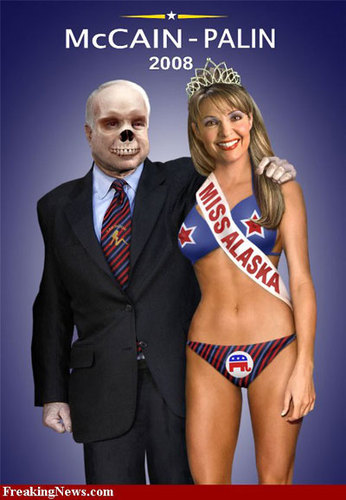
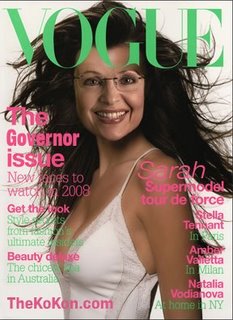
Some of the first images that circulated around the Palin appointment were, in effect, frauds. They sought to tap into the media feeding frenzy and the blogosphere's search for any incriminating evidence. Some of these images were probably already in circulation in Alaska before the announcement, while others may have emerged quickly as the nation started to learn who this woman is. Here are two examples. Both suggest the ways that Palin doesn't fit our expectations about what a female politician looks like. For the first time, we have a vice presidential candidate who is young, feminine, and well as she is one of the first to acknowledge, "hot." She was after all a runner up for the Miss Alaska competition and this couldn't be further removed from our current Vice President or for that matter, the tough matronly style adopted by America's most successful female politicians. Camile Paglia celebrates Palin in a recent Salon article: "In terms of redefining the persona for female authority and leadership, Palin has made the biggest step forward in feminism since Madonna channeled the dominatrix persona of high-glam Marlene Dietrich and rammed pro-sex, pro-beauty feminism down the throats of the prissy, victim-mongering, philistine feminist establishment." Needless to say, Palin's appearance and persona provokes strong reactions, ones which struggle to separate anxieties that she may be a Stepford Wife or a Barbie from a more generalized dismissal of attractive women. This first image plays on the fact that Palin did pose for photographs for Vogue by constructing a mock cover of the magazine.

sarah-palin-vogue2.jpg

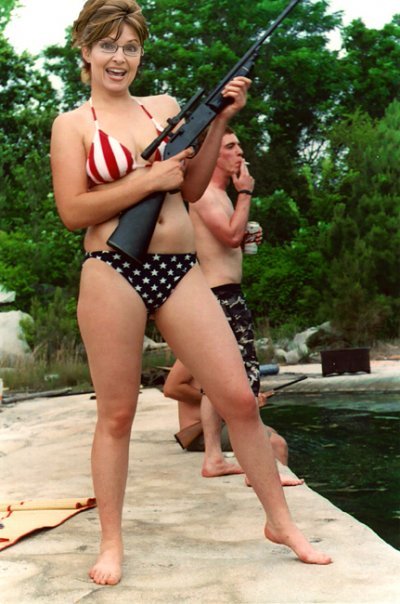
This second plays with the contradiction between the sexy mom] and the rough and tumble Alaskan. She's a "babe," in this case, a Bikini-clad "Babe," who also knows how to shoot and skin her own meat. This image was deemed sufficiently plausible that it needed to be discredited at the Urban Legends site.

palin_rifle_bikini.jpg

Those of you who watched the televised convention no doubt caught the disconcerting images of 70 something male delegates bearing buttons bragging about how "hot" Governor Palin is. Given the actual buttons circulated at the convention, this mock button is not as far fetched as it might seem, though now we are moving into the space of political humor rather than anything that was meant to deceive the viewer.

mcsame-milf.jpg

This next one juxtaposes erotic images of Palin with the very real anxieties about mortality raised by McCain's age. One of the most powerful arguments against the Palin appointment has been the concerns about what would happen if McCain were to die in office. And before he announced her pick, pundits had said that he needed to choose someone who would reassure voters that the VP would be prepared to move into the top office and stabilize the country.

mac-picks-palin.jpg

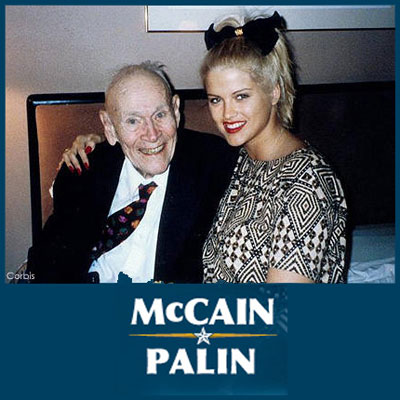
This Photoshop collage also calls attention to the vast age difference between the 70-something McCain and his 30-something running mate -- in this case, by reading the pairing in relation to the Anna Nicole Smith case. This is a classic example of how grassroots political humor maps politics onto popular culture, thus allowing us to mobilize our expertise as fans or simply readers of People magazine to make sense of the complexities of American politics.

mccain-palin-anna-nicole.jpg

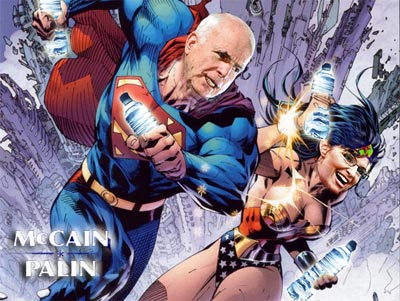
Several images in circulation read Palin as a superhero. Indeed, I was struck when I first saw her that she had adopted many of the stylistic choices of female superheroes in their alterego disguises -- her hair up in a bun, big librarian glasses. These "serious" trappings no more mask the beauty queen underneath than Clark Kent's glasses hide Superman and in the real world, they can come across as inauthentic. You add that with the stories of her braving the elements and slaughtering Alaskian wildlife and you can imagine the Amazon underneath the librarian disguise. I have been imagining that moment which would be inevitable if this were a movie where she takes off her glasses, lets out her hair, and gives a sultry look to the American voters.

mccain-palin-bottledwater.jpg

This next image pushes the conception of Palin as superhero in an entirely different direction -- this time, she's Batgirl. Here, she fits into an ongoing series of popular images which depict McCain as Bush's "sidekick," one of the ways that the idea that McCain represents a continuation of the Bush administration, a constant refrain at the Democratic convention, is entering the popular imagination. So, she's now the "sidekick" of a "sidekick," who will likewise continue the Bush Administration's policies for "four more years."

mccain-w-sidekick.jpg

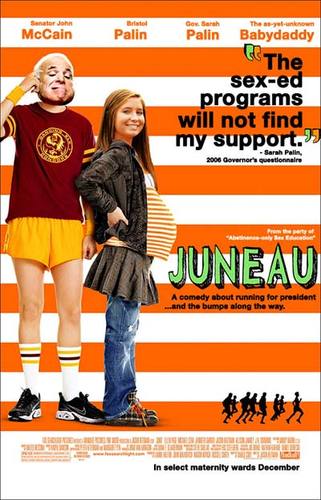
Given the ways that Palin's announcement has been intertwined with debates about teen pregnancy, it is no surprise that the poster for Juno has become a basic resource for people wanting to comment on these issues. Many feminists have already critiqued the film for making teen pregnancy and adoption seem like the only viable option for its protagonists. And of course, it doesn't hurt that Juneau is one of the larger cities in Palin's home state.

palin-juneau-sex-ed.jpg

palin-juneau.jpg

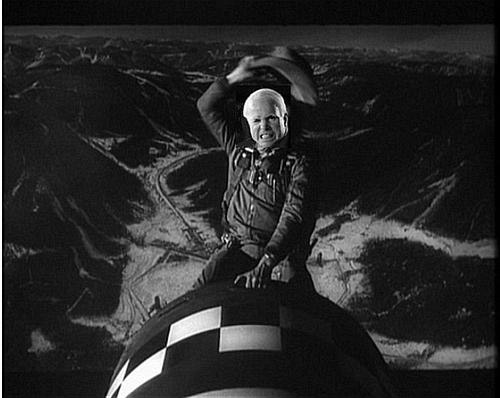
I couldn't resist throwing in two additional examples surrounding the McCain campaign. This first links McCain himself to Doctor Strangelove as a way of conveying the fear that the candidate may be a war-mongerer.

mccain-strangelove.jpg

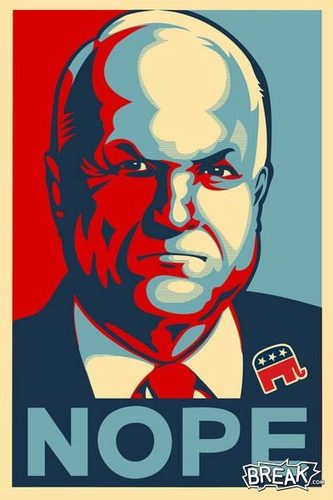
The second playfully reworks an Obama poster, one of the most vivid visual icons of the campaign to date, and in the process, sets up the contrast between Obama's politics of "Hope" and McCain's politics of "Nope."

john-mccain-nope.jpg

We can expect to see many more such images produced and circulated as the campaigns intensify even more over the coming two months.

Most of these examples are taken from the Political Humor site which regular collects such Photoshop images. You can find many more examples here.

Mobilizing Generation 2.0: An Interview with Ben Rigby

This fall, I will be teaching a course on New Media Literacies and Civic Engagement. The class is designed to provide a bridge between the research we are doing for the Center for Future Civic Media and Project New Media Literacies. It also hopes to explore in depth a range of current research about how the new media landscape is impacting how young people learn to think of themselves as citizens. Here's the course description:

New Media Literacies and Civic Engagement

What does it mean to be 'literate' and how has this changed as a consequence of the introduction of new communication technologies? What social skills and cultural competencies do young people need to acquire if they are going to be able to fully participate in the digital future? What are the ethical choices young people face as participants in online communities and as producers of media? What can Wikipedia and Facebook teach us about the future of democratic citizenship? How effective is Youtube at promoting cultural diversity? What relationship exists between participatory culture and participatory democracy? How is learning from a video game different from learning from a book? What do we know about the work habits and learning skills of the generation that has grown up playing video games? What impact are young voters having on the 2008 elections and why? What lessons can we take from the study of virtual communities which might help us enhance civic engagement at the local level? Who is being left behind in the digital era and what can we do about it? This class is designed to introduce students to a new wave of research which is bringing together scholars from many different disciplines to ask new questions, pose new models, and try new experiments to better imagine the future of American education and of democracy itself.

Much of the reading in the course will be drawn from a series of books recently produced by the MIT Press and the MacArthur Foundation. These books reflect a national push by the MacArthur Foundation to explore how young people are learning informally through the affordances of new media and what implications this has for the future of schools, libraries, public institutions, the workplace, and the American family. Researchers and guests from The MIT Center for Future Civic Media and Project New Media Literacies will play an active role in the course, sharing projects and curricular materials under development, grounding our more theoretical considerations with real world perspectives. Students will have an opportunity to explore these ideas through research papers but they will also be asked to get involved in the development of projects which are designed to have an impact on real world communities.

If you happen to be a student at MIT, Harvard, or Wellesley, I hope you will consider taking the class this fall. The class meets Mondays, 11-2 pm, and Weds, 3:30-5 pm. I am hoping to write here from time to time about some of the ideas that emerge from the class. We will also be hosting several discussions through the MIT Communications Forum this term focusing on the roles which new media played in the 2008 Presidential Campaigns.

To whet your appetite on this topic, I wanted to share here an interview with Ben Rigby, the author of a recent book, Mobilizing Generation 2.0, which offers case studies and insights for activists and campaigns as they think about how to reach and court young voters. The book includes discussions of blogs, social networks, mobile technologies, wikis, and virtual worlds, among other web 2.0 practices, and features contributions from a range of key thinkers including danah boyd, Seth Godin, Mitch Kapor, and Beth Kanter. Rigby, who has developed web and mobile strategies for a range of nonprofit and Fortune 1000 companies, founded MobileVoter.org, an organization dedicated to using new media to politically empower young people.

You organize your book around new technologies and platforms. Yet at every civic media event I've been at lately, the core debate has been whether the change is

being brought about by new technologies or by new social and cultural practices

which help to foster a greater sense of civic engagement. Is this a false

debate? Where do you fall in terms of the relative importance of technologies

vs. social and cultural practices?

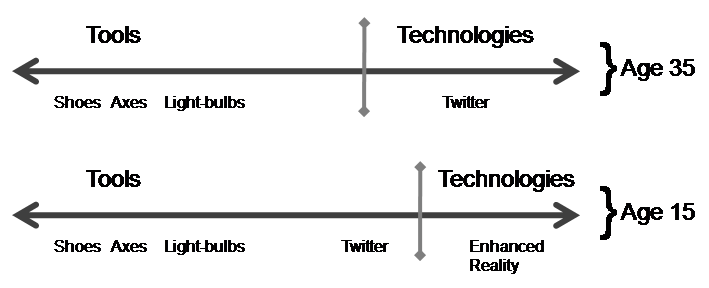
It's absolutely a false debate. Technology is a social and cultural practice. It means nothing outside of the context of the people who use it. This question led me to re-read the paper that inspired me to pursue a thesis program in Science, Technology, and Society back in college. It's called "Steel Axes for Stone-Age Australians" by Lauriston Sharp.

To summarize Sharp's brief ethnography: The Yir Yoront is a Western Australian aboriginal group that, by the early 1900s, had very little exposure to any social group outside of their limited radius (and virtually no contact with non-aboriginal peoples). The stone axe played a central role in their lives as a productivity tool, but most important, as a lynch-pin of social relations. Being difficult to manufacture, these axes were in short supply. While any Yir Yaront was permitted to use one, their use was controlled by adult men. Women and children who wanted to use an axe were required to get one from a man (usually a direct relation) and needed to return it promptly and in good condition. A man referred to his axe as "my axe," but women and children never did. The axe also figured prominently in trading relations with nearby groups. The Yir Yaront traded sting-ray-barb tipped spears for raw stone with their neighbors to the south (where quarries were located). Again, adult males figured prominently in these relations as they were the primary producers of spears and lead negotiators.

When an Anglican mission arrived in 1915, the missionaries set up a plan for "raising native living standards." In return for undertaking certain tasks or behaviors, the missionaries distributed incentive goods to the Yir Yaront. The missionaries quickly discovered that their steel axes were valued more than any other trading item. Thus, they'd give out these axes as incentives for participation in their programs and as gifts during holidays. They'd give them to men, women, and children indiscriminately.

Sharp describes the events that follow the introduction of the steel axe as "the collapse and destruction of all Yir Yoront culture." Wives and children no longer needed to defer to their superordinate male. Men, in turn, became insecure as they questioned their roles and masculinity. The hierarchy of 'ownership' melted, which resulted in the rise in stealing and trespassing. Trading links weakened as stone was no longer highly valued. Associated trade ceremonies took on less significance and became poorly attended.

Frustratingly, Sharp's ethnography leaves off there. It appears that he left the field just as these monumental transitions were taking place. I haven't been able to find any followup reporting. It's the ultimate cliff hanger (if any readers have additional information on this group, please send!). He reports, somewhat melodramatically, that the Yir Yaront's southern trading partners passed through a similar set of cultural transformations which resulted in an "appallingly sodden and complete cultural disintegration, and a demoralization of the individual such as has seldom been recorded elsewhere."

Even without the melodrama or the end of the story, it's clear that a technical innovation (or introduction of such) sparked the transformation of a society. However, because the technology in question is a simple axe, it's easy to disambiguate the tool from the social and cultural practice that surrounds it. Here, the tool gets moderately more effective at its ostensible task (chopping), but it's how the Yir Yaront wove it into their life that's critical. If it were any garden variety tool, that'd be one thing. But the axe was central to the Yir Yaront hierarchy and belief system. It's impossible to understand the axe without understanding its cultural context - it doesn't make sense.

Similarly, email, social networking, and YouTube don't mean anything by themselves. They are what we make of them - and how we believe in them. Peer production of media is significant because of the way that we value media. Technology is inherently social.

In fact, this question ties into my motivations for writing Mobilizing Generation 2.0. In order to make social change, you have to understand -a- what the axe does (chopping) and -b- how people value it (cultural context). Of course, there's a chasm in complexity between the axe and today's technologies such that even understanding -a- is something of a challenge. However, it's -b- that's really important. And you can't get to -b- without first getting to -a-.

So the book is organized around our most significant axes: blogs, social networking, mobile phones, wikis, video and photo sharing, online mapping, and virtual worlds. It intends to give readers a crash course in understanding -a-. Then, once that territory is covered, the book goes into -b-: how young people are using their technologies and how organizations are, in turn, using these same technologies to connect with youth.

We have a curious relationship with the word "technology." In common speech, we use it to define a subset of our tools which are unfamiliar to some, but not all, members our social group. Thus, tools such as tshirts, shoes, and axes are just "things"... things familiar to everyone. But microchips, cell phones, and Web sites are "technologies." Of course, they all belong to a kind of tool continuum - and it's helpful to understand "technology" in this context.

There's a moment when a tool stops being referred to as a "technology" and becomes just a thing. A light bulb, for example, has moved from being a technology to just a thing. However, a cell phone is still a technology. It will eventually move into the category of "thing" as it becomes more familiar to more people and as newer and less familiar tools take its place. The dividing line on this continuum differs among age groups - it sits forward for younger people. This rough diagram illustrates this idea.

tech.PNG

Of course the continuum varies from person to person. But for an older person running a nonprofit or political campaign (as most director level people tend to be), it's helpful to imagine that most of their "technologies" are just "things" in the minds of young people - nearly as natural and thoughtless as putting on shoes in the morning (which is not to say, however, that they're insignificant).

All along this continuum (and back to your question), each of these tools is embedded in our cultural context. I can't imagine it being any other way until the point at which our tools take on an agency that's quite outside of our collective control. To my thinking, this point happens when we start having earnest discussions about civic rights for intelligent computer systems - which means that these systems will have evolved into something entirely different from what they've been. I think that this moment will eventually arrive, but that it's many years away.

Over the past few years, organizations of all kinds have begun to explore the

value of virtual worlds. Yet, virtual worlds still arguably reach only a culture of early adapters. What is the current value of virtual worlds as a political platform? Are we experimenting with something that will have a long term impact but may offer only limited short term rewards? If so, how can you justify putting energy there in what may turn out to be a tight political contest?

I don't know much about the inception of Second Life, but I imagine it went something like this:

[Scene: friends sitting around a poker table drinking beer]

Philip Rosedale: Have you guys read Snowcrash?

Friend #1: Yea, it rocked.

Philip Rosedale: Wouldn't it be cool if we built that thing?

Friend #2: What thing?

Philip Rosedale: The thing! The actual virtual world that Stevenson describes. I know some tech guys.

Friend #1: Phil, you should do it. That would rock.

Philip Rosedale: Yea, maybe I will.

Then Rosedale takes the book, hires some coders, and transliterates the book into pixels. And so, we've got Second Life, which is Snowcrash come to life - irony and all. Second Life was such an early sensation that it has, thus far, defined what is meant by "virtual world." In fact, it's gone further by defining the common understanding of character-driven 3D space (which is distinct from a "virtual world").

Second Life's early success and recent woes have, in fact, put a damper on innovation in the 3D space. Second Life and its imitators (of which there are now dozens, including Google's recent project called Lively) continue to replicate Snowcrash. They recreate fantasy versions of something that approximates real-life. And social change efforts in these worlds are doomed. They are shoddy replications of experiences that are better in real life: walkathons, tschotchke giveaways, museum exhibits.

But these efforts are only the first forays into what will eventually be the next world changing technical movement. Snowcrash is not where we'll end up. The potential of immersive 3D space is much greater than imitating and fantasizing about our existing reality. Remember in 1995 when businesses would scan their paper brochures and use the resulting JPG as their Web site? That's where we are today with the use of 3D space.

So, for anyone concerned about the 2008 Election, there's very little of interest. I wouldn't spend any time at all in today's virtual spaces. From the candidate perspective, it's not worth the effort. My advice for social changemakers is to keep a close eye on the space and to wait for it.

You end the book with a suggestion that "web 2.0" constitutes a "tectonic shift" in the political landscape. Explain. What's the nature of that shift? How quickly is its impact being felt? What changes will traditional political organizations need to make in order to take advantage of this new model for reaching voters? And what do you think will be the biggest points of resistance in moving in this direction?

Yochai Benkler describes this shift wonderfully in the Wealth of Networks. We (I) owe him a debt of gratitude for the book. Benkler describes the shift as nothing short of a massive redistribution of the means of production. That's tectonic. It's a dozen steel axes put into the hands of everyone. And it's a power grab right now between:

a) Those who are trying to prevent the redistribution (ie: RIAA)

b) Those who don't recognize that massive shifts are underway (ie: most large nonprofits and traditional political organizations)

c) Those who love their newfound axes (ie: most young people and Web2.0 business owners)

So -a- will fight it; -b- will lose (most of the time); and -c- will fight to make -b- join them instead of joining -a- so that -a- doesn't win, which is not at all a certainty at this point in time.

All signs are that a record number of young people have been participating in the current presidential elections and that voter registration for those under 30 have increased dramatically in recent years. What factors do you see as contributing to this increase in youth participation? Will these trends continue to rise as we look towards the fall?

I don't have anything substantively new to say on this topic, other than to echo what you and other smart observers have been saying for the past couple of years. Young people's media has become participatory - and they're reacting positively to a candidate (Obama) who has shaped his campaign in a similar fashion. Moreover, he's using language and speaking about issues in ways that give him the air of authenticity. For the sake of increasing youth political involvement, it's a good thing he won the nomination.

You begin the book by discussing your experiences running a nonprofit, Mobile

Voter, which you suggest failed to meet its goals for registering and

mobilizing young voters. Why did Mobile Voter fail and what did you learn from

this failure?

There's such a finality implied by the word "failure." I don't believe in it. It's too black and white.

To take a recent example - this spring, we entered our newest initiative, Volunteer Now!, into the NetSquared Mashup Challenge. The Challenge involved two rounds. To make it into the first, we needed to generate votes on Net2's web site. I emailed my list asking for votes and we made it in. The second round involved two days at a conference center in San Jose. At the conference we met dozens of enthusiastic social change activists and several potential funders. We also demonstrated the product dozens of times. In sum, we met a ton of people, honed our pitch, and got great feedback for the project.

We didn't place in the top three. Did we fail? Of course not. There's so much value in this experience. I'm unsure what historical events brought us to consider our efforts in Manichaean terms (win/lose, evil/good, fail/succeed), but I think it's a big problem. We're afraid of nuance.

So, instead of slinking away from not winning the Net2 challenge, I sent out an email to my list again with the subject line "We didn't win!!" And funny enough, that email generated a response that was 10x higher than the initial email asking for votes. There was a lot of value in looking at the "loss" as an opportunity for engagement.

So, that's a long entree to your question about Mobile Voter's 2006 "TxtVoter" campaign. In 2006, we raised funds from the Pew Charitable Trusts to register 55,000 young voters. By Nov 5th, we'd registered about 35,000 - of which only about 2,000 came through our text messaging system. The rest came via our GoVote.org Web site which we built and operated in conjunction with Working Assets (now Credo, who put the lionshare of the effort into generating traffic to that site).

It would be disingenuous to say that we weren't disappointed by the numbers - especially since we started the season with a Dean-like yell and aspirations to register many more than 55K. However, there's a rich context to this "failure." In addition to TxtVoter's registration component, we helped to implement a get out the vote (GOTV) campaign that was studied (and party organized) by researchers from Michigan (Dale/Strauss) which has since become the seminal study on the effectiveness of text messaging for GOTV. We also developed a list of best-practices which is now being used to replicate the most successful instances of the TxtVoter campaign (there were some events in which response rates surged to 46% versus the 1% overall average). To boot, the experiences of the '06 campaign led directly to the writing of Mobilizing Generation 2.0, which intends to address some of the pain points that I saw across hundreds of nonprofits and political campaigns during the TxtVoter initiative.

In sum, the learning is: there is no failure and we need to better embrace nuance.

McCain to Obama Supporters: "Get a Life!"

One of the most powerful tools in the Karl Rove arsenal was a form of political Judo: take your opponent's strengths and turn them into vulnerabilities. For example, coming into the 2004 convention, Democrats had seen war hero John Kerry as pretty much unassailable on issues of patriotism and they made it a central theme of their event. Within a week or two, the Swift Boat Campaign made Kerry's service record an uncomfortable topic to discuss, flipping Kerry's advantage (that he had served in Vietnam and neither George W. Bush nor Dick Cheney had done so) on its head. This added the phrase, "Swiftboating," to the language of American politics. Coming into the Primary season, several things stood out about Barack Obama: First, he had developed a reputation as the Democrat who was most comfortable talking about his faith in the public arena; many Democrats felt that he gave them a shot at attracting some more independent-minded evangelical Christians, especially given the emergence of more progressive voices that linked Christianity to serving the poor, combating AIDS, and protecting the environment. (Indeed, we saw signs of that pitch during Obama's appearance at the Saddleback Church Forum last week, when he clearly knew and deployed evangelical language better than McCain). Yet, the circulation of the Rev. Wright videos -- not to mention the whisper campaigns charging that he is secretly Islamic -- blunted his ability to use faith as a primary part of his pitch to voters. Similarly, the Obama campaign showed an early comfort with talking about American traditions in lofty and inspirational values, so he has been confronted with attacks from reactionary talk radio questioning his patriotism.

Over the past three weeks, we've seen the McCain campaign take aim at a third of Obama's strengths -- the so-called "enthusiasm gap." Basically, pundits have been talking a good deal about the lack of enthusiasm for the Republican nominee among his rank and file in comparison with the extraordinary passion Obama has generated, especially among young and minority voters. To confront this "enthusiasm gap," the McCain campaign has clearly decided that it needs to pathologize enthusiasm itself, suggesting that emotional investments in candidates are dangerous, and thus positioning himself as the only "rational" choice. In doing so, he has tapped deeply rooted anxieties about popular culture and its fans.

This is not the old culture war rhetoric where candidates accused each other of being soft on "popular culture," a tactic which Joseph Lieberman has turned into an art form. No, this time, the attack is on politics as popular culture. Both tactics strike me as profoundly anti-democratic. After all, how do you found a democratic society on the assumption that the public is stupid and has bad judgment?

In my concluding chapters of Convergence Culture, I argue that there is an increased blurring of the lines between popular culture and civic discourse and that our experiences within participatory culture may be raising higher expectations for participatory democracy. In a new chapter I wrote for the paperback edition of the book, which is due out in late September, "Why Mitt Romney Wouldn't Debate a Snowman," I extend this argument to examine the Youtube/CNN debates last year to illustrate the many roles which popular culture -- parody video in particular -- played in establishing public perception of Obama and the other candidates.

In some cases, parody was deployed within the campaigns itself -- such as the Clinton campaign's spoof of the final moments of The Sopranos -- and in other cases, parody was deployed by outside groups who were not directly affiliated with the candidate -- as in the Obama Girl spots or the 1984 spoof. Such parodies speak to voters who are turned off by the policy wonk language of conventional politics, offering a new way of connecting with the candidate, and mobilizing their knowledge as consumers to make sense of the political process.

The recent round of McCain commercials, by contrast, uses a language of parody not simply to spoof the candidate but to discourage democratic participation, telling the many first time voters who have been excited by the Obama campaign to "get a life." Consider, for example, this spot, "Obama Fan Club."

In Textual Poachers, I examined some of the core elements of the anti-fan stereotype, one which surfaces in news articles and comedy sketches depicting science fiction conventions. It's striking how many of these same tropes surface in this particular commercial. The Obama supporters might as well be wearing Star Fleet uniforms and rubber Spock ears! Stereotypical fans:

  • Are brainless consumers who will buy anything associated with the program or its cast.
  • Devote their lives to the cultivation of worthless knowledge,
  • Place inappropriate importance on devalued cultural materials.
  • Are social misfits who have become so obsessed with the show that it forecloses other types of social experiences.
  • Are feminized and/or desexualized through their intimate engagement with mass culture.
  • Are infantile, emotionally and intellectually immature.
  • Are unable to separate fantasy from reality.

Such anti-fan depictions are often drawn towards nerdy guys and over-weight women as standing in for fandom as a whole. And metaphors of religion run through this anti-fan discourse. "Fan" is an abbreviated form of the word, "fanatic," which has its roots in the Latin word, "fanaticus." In its most literal sense, "fanaticus" simply meant "of our belonging to the temple, a temple servant, a devotee" but it quickly assumed more negative connotations, "of persons inspired by orgiastic rites and enthusiastic frenzy" (Oxford Latin Dictionary). As it evolved, the term "fanatic" moved from a reference to certain excessive forms of religious belief and worship to any "excessive and mistaken enthusiasm," often evoked in criticism to opposing political beliefs, and then, more generally, to madness "such as might result from possession by a deity or demon" (Oxford English Dictionary). Its abbreviated form, "fan," first appeared in the late 19th century in journalistic accounts depicting followers of professional sports teams (especially in baseball) at a time when the sport moved from a predominantly participant activity to a spectator event, but soon was expanded to incorporate any faithful "devotee" of sports or commercial entertainment. One of its earliest uses was in reference to women theater-goers, "Matinee Girls" who male critics claimed had come to admire the actors rather than the plays. If the term "fan" was originally evoked in somewhat playful fashion, and was often used sympathetically by sports writers, it never fully escaped its earlier connotations of religious and political zealotry, false beliefs, orgiastic excess, possession and madness, connotations that seem to be at the heart of many of the representations of fans in contemporary discourse.

In short, the word, "fan," when deployed negatively, seems to be a rhetorical tool designed to exclude some groups from participation -- in this case, from participation in the political process -- or to describe some works as unworthy of recognition -- in this case, to depict Obama as unprepared for public office.

For the most part, mainstream journalism over the past decade or so has moved away from the most extreme deployment of these anti-fan stereotypes as more and more people are entering fan communities on line and as a growing number of journalists have had first hand experience of fan culture. Yet, given how deep these stereotypes run through our culture, we should not be surprised to see that they can still be effectively deployed to express discomfort with the excitement and enthusiasm which has surrounded the Obama campaign in some sectors.

This connection between fans and "false worship" is especially potent in this spot. Speaking on the Sunday morning news shows, Joseph Leiberman, who was once a Democratic Senator and Vice Presidential candidate, defended these spots as "funny" and "playful," suggesting that you can scarcely call comparing someone to Moses an attack ad. Explicitly the spot targets Obama, who is struggling to overcome the "elitist" charge which Hillary Clinton leveled against him in the spring, and implicitly the ad targets his associations with Oprah, who coined the term, "The One." But just beneath the surface is a barely suppressed contempt for the public that has embraced this candidate with such passion as if such enthusiasm was dangerous and out of control.

The news media was quick to pick up on the analogy between Obama and Paris Hilton in the original "Celebrity" ad, which they have read as part of a longer history of racist discourse which links white women and black men. It might be more accurate to suggest that the ad reflects the reality that for much of the 20th century, African-Americans could enter the public eye primarily by becoming athletes or show business personalities and thus we are more comfortable seeing them as celebrities than as political leaders.

The Obama campaign has sought to reverse the charge, using the metaphor of "celebrity" to suggest that McCain is a Washington Insider and that like many celebrities, he re-invents himself periodically in order to remain in the public spotlight. There's also an undercurrent here suggesting that McCain may simply lack the charisma to become a true celebrity and that this may be why his campaign wants to take aim at Obama's popularity. And we might read this spot as also deploying a bit of that Rove Judo -- transforming McCain's claims to be the more "experienced" candidate into evidence that he is too entangled with the Washington establishment, not to mention linking him with the current president whose negative ratings the GOP candidate hopes to escape.

But so far, the best response has come from Paris Hilton, who seems bemused at being pulled into the political campaign, and has fun with audience expectations that she is an air head who knows nothing of public policy. In fact, this spoof suggests, all of us have a responsibility to become more politically aware, all of us should participate in the political process, and we should be open to a range of different languages through which to speak to our fellow voters.

We can see all of this anti-fan rhetoric as part of the McCain effort to deflate media coverage of Obama's trip to Europe and to anticipate the excitement which will surround his speech next week to the Democratic National Convention. Keep in mind that Obama's speech will fall on the 40th anniversary of Martin Luther King's "I Have a Dream" speech and that Obama had opted to build on his public support by moving the acceptance speech from the convention center to a sports arena so that he could open the event to the general public. Now, for at least some viewers, the huge showing of popular support represented by that event will be tainted by anxieties about this "celebrity" and his "fan club."

Reforming a Mean World: Hero Reports

"In times of terror, when everyone is something of a conspirator, everybody will be in

the position of having to play detective" --Walter Benjamin 1938

In the research on media effects, one of the most fully developed findings is what is known as the "mean world syndrome." Research finds that the average citizen grossly over-estimates how dangerous her neighborhood is because she reads the newspaper and assumes that the crime reports are actually a sample of the whole and thus amplifies them accordingly. In practice, a higher portion of violent crimes get reported than most people assume, although there are statistical biases as a result of the under-representation of crimes based on the race and class of the victims.

A larger problem is created by the over-representation of crime and the under-represented of everyday acts of kindness and generosity. The news often shows us people acting at their very worst without allowing us to see those moments where people help each other out. How might this under-reporting of good deeds also contribute to the mean world syndrome?

This is a question which is guiding a new research initiative being launched by Alyssa Wright, an MIT Media Lab student who is affiliated with the Center for Future Civic Media. The center is a collaboration between the Media Lab and the Comparative Media Studies Program and has been funded by the Knight Foundation. As one of the co-Directors of the Center, I've listened to lots and lots of proposals for projects that might enhance civic engagement and community consciousness, some good, some bad.

Alysa's project, Hero Reports, is among one of the very best I've heard. It's practical enough that she's already begun to implement it in New York City. It's provocative enough that it's already begun to attract media interest. It was featured several weeks ago on WNYC The Takeaway. And it is suggestive enough that it has generated great conversations with everyone I've mentioned it to.

Wright says the project was inspired by New York's "See Something, Say Something" Campaign in the wake of 9/11. The campaign sought to solicit everyday citizens in New York City to be on the look out for suspicious activity. They became, in effect, agents in the war on terror. Maybe playing this role left them feeling more in control over their situation. Or perhaps, the act of performing this role left them in a permenant state of alert and anxiety, depending on your perspective. Given how broad the mandate is, it is no surprise that the city received many many reports. One recent advertisement boasted that the government had received 1944 such reports. The New York Times found, however, that very few of these reports resulted in arrests and that the bulk of the reports were directed at brown people whose suspicious activity mostly consisted of being brown in public.

Often, we see what we are looking for and our cultural biases literally color what we see. A campaign that invites us to look for suspicious behavior forces us to scrutinize our neighbors for signs and symptoms of terroristic activity. So, Wright wants us to reverse our lens and look for people who are doing things that are socially constructive. She wants us to find evidence of the good conduct that surrounds us all the time and bring it to greater public attention - the person who goes out of their way to help someone else, the people who intervene to stop a domestic dispute or a violent act, the people who give up their seats on the subway to accommodate a passenger with special needs, the person who cares enough to contribute to the homeless or give directions to someone who seems lost.

She is collecting these reports via her website and she's investigating news reports of everyday heroicism that she reads in the newspaper trying to flesh out a portrait of the ways that her fellow New Yorkers are making life better within their communities. She is also deploying state of the art mapping tools to construct accounts of "everyday heroicism" in different neighborhoods, hoping that they can be read alongside maps which show crime rates and other negative factors, to give us a fuller sense of the places where we live. Ideally, such maps can become a source of local pride as people work to improve the perceptions of their communities by doing good deeds.

What follows are some of Wright's reflections about the project:

Hero Reports was inspired by the "See Something, Say Something" Campaign in NYC. What disturbed you about that campaign and how do you see Hero Reports as responding to that concern?

I was in New York on 9/11, and I was very scared. In its wake, I saw myself start to evaluate safety with different checklists. And it's still "different" than it was before. Just today, I was on a subway car and there were all these men with luggage. The trigger goes up. "Why are there so many attended packages on the train?" but then I pieced together another, probably more likely, story. It's the end of a 4th of July weekend and a lot of people travel at the end of a 4th of July weekend. and ohh right. i'm on the subway that goes to the airport. It's all about context but after 9/11 and after the anthrax scare in particular, the only context I absorbed was fear.

What got me thinking about a project, were 3 rather contemporaneous events:

1) how people responded to cherry blossoms. when i walked around with cherry blossoms, I was under the radar. i was a girl, white, wearing makeup. and yet i was walking around with a backpack that looked like a weapon. people didn't "see something" let alone "say something."

2) i went to Madrid and learned about March 11 bombings. and i rode their metro. and

guess what. they still had cans to throw away garbage (the MTA got rid of most garbage

cans, the few remaining are supposedly "bomb proof") AND they weren't surrounded by

instructions to say something. i'm not sure when it happened, but i left that trip CONVINCED that because of its history, Spain can recognize the encroaching signs of

facism.

but then there's 3) --> the followup in the See Something series. "Last Year, 1,944 New

Yorkers Saw Something and Said Something." I can't recall the first time I saw the

initial 'See Something, Say Something' campaign, but I do recall the first 1,944. It was

a bus. and as i watched it go by, I turned and said something to the effect of: "what

the fuck is that? what the hell does that number mean?"

And that's when things became a bit comical. Like the farce was over. I mean, are we

supposed to be impressed by that number?

These three combined with another lesson from Cherry Blossoms, the power of the Iraq Body Count (IBC) database. I am forever in debt to Hamit Dardagan who started keeping count of _news reports_. Now that was a number I wanted to see. And that was a number that gave context. They took what already existed and aggregated. Together these left-to-the-archives reports found new "life." A life whose range included my exploding backpack and a Bush speech citing IBC as his body count reference.

I see Hero Reports akin to IBC. Essentially Hero Reports starts with collecting what

already exists--the stories of everyday heroes. That aggregation holds the possibility

of for social change, and the seeds for many other projects. Artistic, academic,

political, economic. ..

But back to my thoughts about See Something: The campaign makes me feel caught in the role of civilian detective. In its most dramatic version, they tell me I can be a hero

no different than the army solider, engaging with the monster on the ground. But even as I reject that version, my vision and behavior is effected. I'm caught in a dichotomy.

Having grown up in the 80s, all of this feels soooooooo much like the war on drugs.

I believe that the MTA had best intentions. If there was ever a time when New Yorkers needed to know that they had agency in the city's security--that they weren't helpless--it was after 9/11. Whether intentional or not, the campaign has nonetheless been proven ineffective and most activism done in response has been critical in nature. Its important to have critical work, it has a strong place in the dialog. but because this is a formula that we have been doing for much longer than the war on terror, we also need to build another formula. So Hero Reports offers an alternative approach.

You've used the suggestive phrase, "Everyday Acts of Courage," to describe what you hope to find through your project. Give us a sense of what you mean by this concept?

Everyone can be a hero -- cape and all. At its beginning, I was very much inspired by the battles of Terrifca and Fantistico, dueling real life superhero and villain, that roam the streets of New York. They were not waiting around in silence or stirring in anger. They were taking matters into their own hands, and bringing the extravagance of camp into a dialog with the civilian detectives.

In my opinion, the term "hero" has been co-opted by institutions like Hollywood and the government. The firefighter is the hero. Iron Man is the hero. Because these her stories are so enrolling, the everyday person does not need to be heroic. Our myths

set it up so that its a loss and not a gain, to get involved. Our misinterpretations of

equity (e.g., should I help the old lady across the street, or will she be offended), our

laws (e.g., the Seinfeld Good Samaritan Law) and our technologies (e.g., the iPod) create an attention span where we select not to see others. And if we do see, we decide it is someone else's responsibility to help in an accident, someone else job to put out the

fire; someone else's good nature to return the wallet.

We are constantly trained not to get involved, and this is gendered and classed in

particular ways. And we continue to build systems that support this lack of involvement.

It helps explain, why I find myself pissed off at people---and at myself---all the time.

Why the hell does this man need to spread his knees three feet wide while we're all

packed in like sardines? Why the hell does this woman on crutches have to stand against a pole? And why doesn't anyone say anything? Why don't I say? And why when I saw an accident on 14th street, why was my instinct not to help?

Hero Reports proposes to value the opposite.

What is a Hero Map? What do you see as the value of mapping where "everyday acts of courage" occurs?

In its present iteration, a Hero Map is the positioning of a Hero Report to a GPS location, and correspondingly a neighborhood. This mapping gives the heroic moment a collective memory, which in turns gives the Hero Report political and economic weight.

Typically an heroic moment, particularly an everyday heroism, has a very narrow frame.

These moments are not connected to each other, but appear as disconnected blips on the radar. When they do appear, the attention is on the self and the individual. What did

it take for said person to take that risk? Would I do the same? It does not reflect other

cultural factors like race, gender, and class. This focus on the individual stops any

possibility of these moments gaining a larger perspective, and cultural impact. By

aggregating them, and mapping them, we give the heroic moment weight. This weight can be placed back onto a community, a cultural bias, and a neighborhood.

For instance, consider the power of the Hero Map in how we evaluate real estate. In the

search for a home (aka apartment) one might look at crime rates, school systems,

transportation access AND hero statistics. How would this inclusion change our

priorities? And our economy? The perspective fits into a more general trend of

aggregating neighborhood specific, qualitative data. Rottenneighbors' search for local

dirt is directly relates to potential power of Hero Reports. But also sites like

Outside.In and Everyblock illustrate this trend of filtering importance through

geography. It's as if ranking systems are no longer as useful.

You are hoping to present 1944 reports of civic heroism to the transit authority. What's the significant of that number and how far along are you towards meeting that goal?

The significance of this number is still being investigated by conspiracy theorists. The MTA claims that 1,944 New Yorkers Saw Something, and Said Something. It's an objectless number that can easily translate into racialized forms of perception. But this objectless number, also makes it useless. And comical. What does 1,944 number mean? In a city of 8 million?

I'm fascinated by the number's lack of context, its classified nature, its broadcasting

with pride and perhaps most circuitously its connections to D-Day. (read here the letter

Eisenhower wrote to the troops.

Because of this fascination, one goal of Hero Reports is to collect the same number of

reports into a book and present it to the mayor. How such a book will be curated/edited

is still unclear, but at its heart, it would be a transparent narrative of security.

We are 300 into this goal number, but much more are needed, before we being to edit.

(And editing here being akin to what the MTA did. About 4000 New Yorkers actually said

something.)

What is the most interesting story you've received so far? What kinds of incidents are

you hearing about the most?

Actually, I find what I'm hearing the most to be the most interesting. A LOT of things happen with taxi drivers. This is significant because the majority of taxi drivers are the skin color (brown) most targeted by this campaign. That means, that while only brown people were arrested in this See Something campaign, brown people are the city's most consistent heroes. This reinterpretation of a community bias I extremely powerful.

Another recurring theme is "proof" that a personal hero story wasn't as impossible as it

seemed. From my personal archives, there are two examples of this.

The first is a story about the stones of my engagement ring falling out and the women

who dropped on their knees to help find it. For me, this incredible moment is re-enacted with a story from taxi driver and his finding of a passenger's ring.

The second is when on a cold winter night transfer, an out of service train gave myself and a friend a subway ride home. This illegal moment of courage was verified when a transit worker told me of the time when he was out of uniform, and a train picked him up. (not written up yet). He concludes with: "See! We're not so mean. We're people too."

Besides the patterns, there are some amazing stories. A number of the more dramatic are covered in the press, and I've taken the content from such news articles. The latest in this category is someone giving birth on a subway platform. Here, the media did cover

how strangers came together to make it happen. (Though I suppose something would have happened regardless) Most times, however, the media coverage of these dramatic stories neglect the heroes. For instance, the other week there was a pitbull attack. When I interviewed him, the man had a story about police incompetence and expressed amazement towards a neighborhood. When this man screamed "Help!" it wasn't a Kitty Genovese moment. People came pouring out of their home to help. "And Louis was amazing." Now there's no mention of Louis in the news coverage. Louis doesn't sell. Part of Hero Reports is to spin Louis's story so that he sells. Turning the ordinary into the extraordinary. That's what Hollywood does, when Hollywood does it well. It is at the heart of novels, theater and comedy.

Its about the framing. Tackling how this sort of everyday heroism can sell is the

challenge of Hero Reports. ("Sell" here not being synonymous with "make money", but

rather sell meaning, create cultural weight and urgency.) Hero Reports is more likely to

fail than succeed. But personally I think technologists (especially at the lab) should

be taking on such challenges and such risk. We're so afraid it's not going to work, that

we don't play with failure. And when it comes down to it, not only do most things not

work, but by not tackling these questions we contribute to this society of suspicion and

isolation.

Fans, Fair Use, and Transformation

Earlier this year, I ran an interview with Pat Aufderheide and Peter Jaszi from American University's Center for Social Media about their work articulating the "fair use" rights of documentary filmmakers and media literacy teachers. I have been lucky enough to be one small part of a team they pulled together of media scholars and lawyers focused on better understanding how fair use might apply to remix practices now common online. Other members of the team included: Mimi Ito, Lewis Hyde, Rebecca Tushnet, Anthony Falzone, Michael Donaldson, Michael Madison, Panela Samuelson, and Jennifer Urban. Last week, the Center released their findings.

The resulting report offers a very strong, legally credible defense of many now common remix practices, including some language which should prove especially helpful in helping fan vidders to know how far they can go and stay within a common sense understanding of fair use rights. The report's recommendations center around two core questions:

  • Did the unlicensed use 'transform' the material taken from the copyrighted work by using it for a different purpose than that of the original or did it just repeat the work for the same intent and value as the original?
  • Was the material taken appropriate in kind and amount, considering the nature of the copyrighted work and of the use?

If the answers to these two questions are 'yes,' a court is likely to find a use fair. Because this is true, such use is unlikely to be challenged in the first place.

I was happy to have a chance to share news of this report when I spoke to Portus, a gathering of Harry Potter fans in Dallas this weekend, where the news generated lots of interest.

This focus on "transformation" clearly compliments the focus on "transformative works" in recent fan conversations in the wake of the creation of the Organization for Transformative Works.

And the report's findings will be especially relevant to fan vidders, who have been struggling to decide how public they want their work to be, given their historic vulnerability to legal prosecution and yet their concern that other remix communities are gaining greater visibility in the era of YouTube. The report certainly doesn't address every concern vidders will face -- in particular, it raises questions about whether vidders would be legally better off drawing on multiple songs rather than basing the entire video on a single piece of music. But the authors hope that the publication of this document will spark further conversations.

Adopting (and Defending) Little Brother

I don't get to read very many novels. The nature of my work means that there is always a massive pile of nonfiction for me to plow through and when I have time to relax, I tend to consume other media rather than read literary fiction (comics being the exception). But I always make time for the latest work of Cory Doctorow, who is my favorite contemporary science fiction writer. When I heard Cory's new novel, Little Brother, had hit the book shelves, I grabbed it to take with me on my long flight to Australia. (Gee, I've managed to get three blog posts just off of the media I consumed between here and Australia!) It turned out to be ideal reading on one level -- I didn't want to put the book down once I started reading it -- and less than ideal on another -- the book left me really paranoid dealing with airport security and customs people and when I tried to read it to cope with my jet lag in the hotel room, I stayed up all night just to finish it. Don't try this trick at home, Kids. But you will want to read Little Brother, the sooner, the better, because this book has the makings of a political movement.

The title of Little Brother pays tribute to George Orwell, but the content is shaped by our own "9/11 changed everything" society. It's as timely as the day's headlines: literally since I started reading the book just as the Supreme Court was ruling that Habeas Corpus applied at Gitmo. The book was written for young adult readers but, as the cliche goes, it's fun for children of all ages.

Marcus, the book's protagonist, is a hacker/gamer/geek who has learned how to work around the various control mechanisms of his school but he is ill-prepared for confronting what happens after a terrorist attack destroys the Bay Bridge in San Francisco and takes out a chunk of the BART tunnels as well. Homeland Security basically occupies San Francisco, which becomes more and more like a Police State as the book progresses. He and his friends, who had skipped school to play an ARG, are taken into custody, shipped off to a secret prison camp on Treasure Island, and subjected to torture -- well, assuming waterboarding DOES count as torture.

When Marcus is released, he takes everything he has learned about technology and uses it to try to overturn what the federally-sanctioned thugs have done to America's tradition of freedoms and liberties. He hacks game systems and deploys them as an alternative social network which allows young people to communicate under the noses of their parents and teachers. Along the way, the book addresses some core debates about whether we should trade off some of our freedom to insure greater security in a post-911 political landscape and provides very specific instructions on how to create an alternative political culture and technological infrastructure.

If the details supplied by the novel aren't enough on their own, the book ends with Afterwords by digital security expert Bruce Schneier on the importance of good Crypto and by XBox Hacker Andrew "Bunnie" Huang, as well as a bibliography for where to go to learn more about the technoculture and political dimensions of the narrative. And Doctorow has partnered with the DIY website, The Instructables, to provide some How To pieces. And the book takes seriously what we are calling the New Media Literacies, including the ability to network and pool knowledge to accomplish tasks far bigger than any individual can accomplish on their own. Indeed, I plan to assign the book in a class I'm teaching this fall on Civic Engagement and New Media Literacy. All of this reflects Doctorow's unique perspective as a key player in the Electronic Frontier Foundation and as one of the masterminds behind Boing Boing.

So far, I've made the book sound a bit too much like agit prop -- on the right side, to be sure, but pedantic at best -- but it's also a damn fine read. Sure, there's a little bit of preaching to the choir going on here, no doubt. I found the book affirmed many of my most deeply held political beliefs and as such, it is one which I plan to pass along to some of the young adult readers in my family in hopes of undoing the job the public schools have been doing on them lately. At heart, the book is about the right, no, the obligation to question authority and to stand up for the American tradition of civil liberties even when -- especially when -- it is hard. Little Brother articulates a very different notion of patriotism and what a hero is than we've seen from the dominant media in recent years.

The young people quickly adopt a slogan, "Don't Trust Anyone Over 25," which they think reflects the generational gap in perspective between those who grew up online and understand how the security hysteria is destroying cyberculture and those who didn't and who are drawn towards a more authoritarian mind set. But the book itself keeps complicating that distinction between Digital Natives and Immigrants, offering vivid vignettes of a teacher who forces the students to think for themselves even if it means that he will ultimately lose his job, of a reporter who is willing to speak truth to power, and of parents who stand by their kids when they need their support the most. Doctorow wants his young readers to take their own political agency seriously, to find their voice as citizens, and to tap the resources that are available to them to transform their society, but he also wants them to recognize allies where-ever they may find them and continually situates Marcus's contemporary resistance in a much longer history of countercultural politics.

It doesn't hurt that Doctorow fills the book with local color details about San Francisco, a city he knows well, or that he makes every step in the process seem plausible and only slightly amplified from things we've already seen happen in the past eight years. It also doesn't hurt that Little Brother is also the best plotted book Doctorow has ever written. Up until now, I've liked the tone and world building of his fiction better than the plots; like many contemporary SF writers, he has a tendency to build rich and interesting societies and then not really know what to do with them. I'm OK with that because Eastern Standard Tribe and Down and Out in the Magic Kingdom are some of the best drawn worlds I've seen in SF since the original cyberpunks.

But this time, he held his plot together throughout, allowing the action and relations to build chapter by chapter, and taking his protagonist on the trajectory from Rebel Without a Cause to the leader of a youth movement, even as he deals with the anxiety, fear, and confusion someone in that position would face. He manages to throw in issues with his peers, parents, and teachers, as well as a touchingly drawn first love story, which adds some emotional resonance to the high flying political drama. Most adults for young readers stop there, acknowledging all of the fears and uncertainties of growing up, without leaving their young fans with any sense that they hold in their hands the potential to change the world. Doctorow trusts his readers enough to take them seriously as political agents and in that sense, I am hoping it will do for my young nephews's generation what books like the ACLU Student Rights Handbook or Jerry Farber's The Student as Nigger did for mine.

Neil Gaiman has been similarly smitten with this book and shared on his blog his own hopes for how it will impact young readers:

I think it'll change lives. Because some kids, maybe just a few, won't be the same after they've read it. Maybe they'll change politically, maybe technologically. Maybe it'll just be the first book they loved or that spoke to their inner geek. Maybe they'll want to argue about it and disagree with it. Maybe they'll want to open their computer and see what's in there. I don't know. It made me want to be 13 again right now and reading it for the first time, and then go out and make the world better or stranger or odder.

Indeed, there are early signs that young readers are responding to the book's challenges by putting some of its ideas into action. Doctorow has created a website which documents the various ways his work is being appropriated and remixed. And there are already some interesting stories to be found there. For example, one group of coders is hard at work developing the ParanoidLinux program described in the novel:

Paranoid Linux is an operating system that assumes that its operator is under assault from the government (it was intended for use by Chinese and Syrian dissidents), and it does everything it can to keep your communications and documents a secret. It even throws up a bunch of "chaff" communications that are supposed to disguise the fact that you're doing anything covert. So while you're receiving a political message one character at a time, ParanoidLinux is pretending to surf the Web and fill in questionnaires and flirt in chat-rooms. Meanwhile, one in every five hundred characters you receive is your real message, a needle buried in a huge haystack.

~Cory Doctorow (Little Brother, 2008)

When those words were written, ParanoidLinux was just a fiction. It is our goal to make this a reality. The project officially started on May 14th, and has been growing ever since. We welcome your ideas, contributions, designs, or code. You can find us on freenode's irc server in the #paranoidlinux channel. Hope to see you there!

Doctorow has shared a YouTube video produced by some young readers who dfamatize the opening passages from the novel:

A reader and former Senior House resident Alec Resnick wrote me to ask me whether I could think of another book which had been so carefully designed to launch a resistance movement. Certainly science fiction authors have been trying to use the genre as a means of political commentary since before any one thought to call it science fiction. H.G. Wells saw himself as a political novelist and was only retrospectively understood as writing SF. The Futurians were an influential group in the early history of science fiction fandom who saw the genre as a tool for social change. They included Isaac Asimov, James Blish, Damon Knight, and Frederik Pohl. Check out Space Merchants for a good example of the kind of social criticism these guys smuggled into what were then dime paperbacks. On the conservative end of the spectrum, we could certainly read a writer like Robert Heinlein as making the case for mandatory military service as tied to voting in Starship Troopers, for example. We can see the feminist science writers of the 1960s as explicitly bound up with movements for social change and science fiction was very popular with the leaders of the anti-war movements of the 1960s. And then, of course, there's George Orwell himself who certainly saw the value of mixing politics and speculative fiction -- I'm never sure whether we can call 1984 science fiction or not but it's certainly swimming in the same stream. Many of these books include commentary on current developments and sometimes blue prints for alternative social structures.

But I don't know of another book which provides so much detailed information on how to transform its alternative visions into realities. And as such, this may be the most subversive book aimed at young readers in the past decade. I fear that in the current political climate a lot of teachers and librarians are going to end up battling school boards and angry parents to make sure young people have access to this book. If they do so, it will be a battle worth fighting.

If you want to sample the book, Doctorow has made it available for free download, but trust me, you are going to want to own a copy. What good is a political page turner without any pages to turn!

Searching for America in the Era of Web 2.0

Hitting the open road "in search of America" is a grand American tradition. Think On the Road! Think Easy Rider! Think National Lampoon's Summer Vacation! This summer, Alex, David, and Danbee, three MIT students are traveling across America, trying to get a sense of what the country is thinking, on the eve of a historic election, and they are reporting on what they see and hear using videoblogging, Twitter, and Flickr, among other digital tools. They even have a way that online readers can chip in towards gas money. You can follow their adventures over at This American Summer.

Here's how they describe their project:

Q: What do you hope to accomplish?

A: Collect stories, walk through a field of corn, see mountains, eat raw oysters, tour breweries, and talk to people. We want to see what this country has to offer. Gain a deeper understanding for the way people live their lives and interact with their neighbors.

Q: That sounds cool. Can I come?

A: Unfortunately our van is at maximum capacity, but thanks the power of the Internet you can still join us. With the help of wireless broadband, we will be online and hoping to hear from you. We have a forum where you can discuss issues you want us to address or just chew the fat. Our route is posted and flexible so if you know a fun or interesting place, drop us a line and we might take a look. We will be posting video, pictures, journals, GPS data, music playlists, and even our budget information.

Q: I thought the Internet was just for funny pictures of my cat. How can you do all that?

A: Let me break it down for you. We have a Canon Rebel XT digital camera for photos and Canon Vixia HF100 digital camcorder for video. Our editing is done in Final Cut Express HD 3.5. The online services we are using include...

* Wordpress: The blogging software we're using to run the whole show

* BBPress Forums: A place where you can post questions for us and all our audience members to see

* Blip.tv: The web service that is hosting our webisodes

* Flickr: Where we will have our online photo collection

* Google Maps: With a GPS tracker, we can show you exactly where we've been

* Twitter: For the most up to date information on what we are doing

* Last.fm: A playlist of every song we listen to in the van

* Facebook: A way for fans to keep in touch

The students involved are from East Campus, a dorm which is across the street from Senior House, where I am housemaster. I met them recently when I gave a talk at East Campus on the role of new media in the current presidential campaigns and I was very impressed by their ambition and persistence. I certainly plan to check in on their travels from time to time this summer and hope that some of my readers will find this project of interest.

Of course, they are not the only ones trying to get a sample of what America is thinking and doing this summer. Here are a few other projects that might interest you:

Think MTV -- MTV has brought on a team of 51 young citizen journalists to help them cover the presidential campaign. Here's some background:

Using short-form videos, blogs, animation, photos and podcasts, the reports will be distributed through MTV Mobile, Think.MTV.com, more than 1,800 sites in The Associated Press' Online Video Network and a soon-to-launch Wireless Application Protocol site. The Street Team '08 reporters were carefully selected after an extensive nationwide search, and they represent every aspect of today's youth audience -- from seasoned student-newspaper journalists to documentary filmmakers, the children of once-illegal immigrants and community organizers.

They are conservative and liberal, from big cities and small towns, but all are tied together through a passion for politics and a yearning to make the youth voice heard during this pivotal election. The correspondents will begin reporting early next month after an intensive MTV News orientation in New York, during which they'll be armed with laptops, video cameras and cell phones and challenged to uncover the untold political stories that matter most to young people in their respective states.

"Recent MTV research shows young people believe their generation will be a major force in determining who is elected in the upcoming local and national elections," said Ian Rowe, MTV's vice president of public affairs and strategic partnership, "and Street Team '08 will be a key way for our audience to connect with peers, as well as get informed and engaged on the local and political issues that matter to them most."

Patchwork Nation -- The Christian Science Monitor wants to move beyond the "Red State/Blue State" cliches and follow the campaign from the perspective of Eleven different kinds of communities. They explain:

We've identified 11 places across the US that represent distinct types of voter communities. They are Monied 'Burbs, Minority Central, Evangelical Epicenters, Tractor Country, Campus and Careers, Immigration Nation, Industrial Metropolis, Boom Towns, Service Worker Centers, Emptying Nests, and Military Bastions. For example, Sioux Center, Iowa, typifies Tractor Country.

As the 2008 campaign progresses, the Monitor will write about what issues matter in each of these communities, how the issues affect residents' votes, and how the candidates tailor their messages to a particular audience.

This site is based on evidence that people's voting patterns are at least partly informed by where they live. People of the same race and age and family situation may vote differently depending on whom they connect with and what they see on their streets and in their local news. In some areas, people live for NASCAR; in others, residents like opera. Some towns open for business early and some stay up late. Some cities see Sunday mornings as church time, others see it as $30 brunch time or more work time. And Starbucks and Wal-Marts aren't everywhere ... yet.

Off the Bus -- In an effort to break out of the themes and ideas most often covered by the professional media, the Huffington Post is offering what it calls "ground level coverage" of the presidential campaign. News is filed by bloggers across the country and periodically they are tapping the collective intelligence of their readers. Here's a description of a recent project they launched in concert with newstrust.net:

Think of this 'news hunt' as a scavenger hunt for good journalism on John McCain. All week, from Monday, June 2nd, through Sunday, June 8th, we will collectively review hundreds of news articles and opinions about the candidate, using the NewsTrust review tools. Together, we will rate the news based on quality, not just popularity -- by evaluating each article's fairness, sourcing, context and other core principles of good journalism. This focus on quality information and news literacy can help us all make more informed decisions as citizens, as well as re-build the trust that has been lost between the news media and the public.

So, want to 'find" America this summer? You can do so using the web! And given current gas prices, that's not a bad idea!

What Does Popular Culture Have to Do With Civic Media?

The following post originally appeared on the Media Shift Idea Lab blog, which is run by the Knight Foundation as part of their ongoing focus on civic media and citizen journalism. If you don't know this blog, you should. Regular contributors include such key thinkers in this area as Dan Gilmor, Jay Rosen, Gail Robinson, Ian Rowe, J.D. Lasica, Leslie Rule, Mark Glaser, Lisa Williams, and many others. It is a great space to go and learn about how new technologies and cultural processes are being deployed to enhance civic engagement. I had the chance to hang out with many of these folks last week at a conference we hosted at MIT. The Center for Future Civic Media is collaborating with the MIT Communications Forum to host an ongoing series of conversations about media and civic engagement. This past term, we hosted two such exchanges --- "Our World Digitized: The Good, the Bad and the Ugly," an exchange between University of Chicago law professor Cass Sunstein (Infotopia: How Many Minds Produce Knowledge) and Harvard University law professor Yochai Benkler (The Wealth of Networks) and "Youth and Civic Engagement" with University of Washington political science professor Lance Bennett, actvist Alan Khazei (Be the Change), and our own Ingeborg Endter (formerly with the Computer Clubhouse project, now a key player at the Center for Future Civic Media.) These events are now available on audiocast: you can find "Our World Digitized" here and "Youth and Civic Engagement" here. What follows are some personal reflections on a theme touched upon in the first exchange and explored more deeply in the second -- the relationship of popular culture to civic engagement.

Despite its title, the goal of the Benkler/Sunstein exchange was not to sort through which of us was "the good, the bad, or the ugly" or even to present a debate between an Internet critic and an advocate. My own sense is that both Sunstein and Benkler have more complex, more multivalent perspectives on contemporary digital culture than is generally acknowledged. I know that both writers are ones I regularly teach in my classes and both raise questions which we need to address if we are to develop a sophisticated understanding of how and why civic engagement operates in the digital era. Our discussion was far reaching and defies easy description or summary here. You will have to listen to it yourself.

Near the end of the session, one of my graduate students, Lana Swartz (bless her soul!), asked a question about how popular media and participatory culture fit into their ongoing discussion about the state of American democracy. Neither speaker was fully prepared to address this question, though Sunstein showed in the process a previously unsuspected enthusiasm for Lost. As a moderator, I had not felt it was my place to introduce my own perspectives on this question so I wanted to take advantage of this space to spell out a bit more about why I think Sunstein should pay more attention to the way popular culture gets discussed on the web.

A core premise running through Sunstein's two most recent books, Republic.com and Infotopia is this concern that despite or perhaps even because of the dramatic expansion of the information environment brought about by the introduction of the web, most of us are accessing a much narrower range of opinion than previous generations in part because of our tendency to filter out news that is not personally interesting to us, in part because many of the forums we frequent do not have strong mechanisms for insuring diversity of perspective, and in part because such groups tend to develop very firm yet polarizing consensus over time which further narrows what gets said. I first read Sunstein's argument when I was asked to be a respondent to his article, "The Daily We," for Boston Review.

At the time, I wrote:

Sunstein assumes that we join virtual communities primarily on the basis of ideological identifications. Yet, many, if not most, Net discussion groups are not defined along party affiliations but rather around other kinds of shared interests--hobbies or fandoms, for example--which frequently cut across political lines. The fact that you and I both watch Buffy the Vampire Slayer may or may not mean that we share the same views on gun control. Many ideological questions may surface in such contexts: aviation buffs debate the naming of an airport after Ronald Reagan, the fans of a particular soap opera debate the moral choices made by a character. Sometimes these exchanges produce flame wars, sometimes mutual understanding. Still, they bring together people who would have had little or no prior contact and thus constitute contexts where more diverse opinions can be heard. We should not underestimate such exchanges by maintaining a crisp separation of political dialogue from other kinds of social interaction.

Then as now, I find Sunstein's argument most convincing when he is speaking about those communities which are defined explicitly around political communication, i.e. the kinds of communities that law professors are most likely to spend time studying. Yet, they seem to break down as we move towards other kinds of communities, such as the fan communities which I most often explore.

While ideological perspectives certainly play a role in defining our interests as fans and media consumers, they are only one factor among others. So, we may watch a program which we find entertaining but sometimes ideologically challenging to us: I know conservatives who watched The West Wing and laugh at The Daily Show; I know liberals who enjoy 24 even if they might disagree about the viability of torture as a response to global terrorism. Television content provides a "common culture" which often bridges between other partisan divides within the culture, even in the context of culture war discourses which use taste in popular media as a wedge issue to drive us apart.

So, a fan group online is apt to be far more diverse in its perspectives than a group defined around, say, a political candidate or a social issue. This is not to suggest that fan communities do not form firm consensus perspectives which block some other ideas from being heard, but they form them around different axis -- such as desired sets of romantic partnerships between characters -- which may or may not reflect ideological schisms. There may be rich discussions, then, about the philosophy of education which should rule at Hogwarts, just not on which character constitutes the most appropriate life partner for Harry Potter.

At the same time, the nature of popular culture means that it continually raises social, political, and ethical issues; popular media projects something of our hopes and fears and as such, it provides us a context for talking through our values. Research for example shows that fans of reality television shows spend more time talking about ethical issues than trying to predict the outcomes. Indeed, on a fan discussion group, there is an active desire for diversity of background and perspective to sustain the conversation and allow all participants to get new insights which refreshes their relationship with the series. In some cases, the community is engaged in a collective activity of problem solving, as in the case of the Survivor spoilers I discussed in Convergence Culture or for that matter, the various groups online trying to figure out the mysteries of Lost.

In many cases, these groups are seeking to make predictions which have, in the end, right or wrong answers: someone's going to win Survivor; someday, we hope, we will know what's really going on on that island. As such, they split around competing theories, often adopting perspectives which are adversarial in the same sense that a court of law is adversarial: competing sides contest each claim made in the hopes of getting closer to the truth. Such communities, thus, have mechanisms built into them that insure that competing truth claims get heard and that the relationship between them get played out at a fairly deep level. Many of these mechanisms look very much like the solutions which Sunstein proposed for insularity and polarity in Infotopia, but they are being applied to less "serious matters."

Again, though, we can't assume that no important civic discussions take place here. Consider, for example, the representation of an American political campaign depicted in the final season of The West Wing, which was depicted as a contest between Alan Alda as a thoughtful maverick Republican (closely model on John McCain) and Jimmy Smitts as a minority candidate who refuses to play old style race politics (modeled on Barack Obama). In the course of the season, both fictional candidates rehearsed themes, issues, and rhetorical styles which were designed to play to a "purple America" and were intended to be a utopian alternative to the 2004 campaign cycle. More and more, it looks like this fictional campaign was in fact a rehearsal for our current presidential season and that the program, in effect, market tested a range of new ways of framing the relationship between the two parties. Surely, we have to see such a process as deeply bound up with our contemporary understanding of civic engagement. The program both educated us about core civic concerns and gave us a new framework for thinking about what a good candidate might look like. And because the program was watched by people from all ideological stripes, it offered a context for a bi-partisan or "post-partisan" exchange at the same time we were incapable of talking to our neighbors about politics in the real world.

In Convergence Culture, I argue that we are learning through play skills which we are increasingly deploying towards more serious purposes: in this case, a generation of young people may have found their voice in online debates and discussions around their favorite television programs. In this space, they felt empowered to express and argue for their points of view, precisely because talking about popular culture lowered the stakes for everyone involved. And it was through these conversations that they developed a strong sense of social ideals and values which they carry with them as they venture into real world political debates. I am unshamed to say that much of what I now believe about diversity and social justice I learned growing up watching Star Trek in the 1960s, watching a multiracial crew operate as friends and team members on the bridge, seeing how they responded to the challenges posed by alien societies radically different from their own.

And this brings us to the second of the MIT Communication Forum events on youth and civic engagement. For me, one of the most exciting development of the past year has been watching the dramatic increase in youth participation in the Democratic and Republican primaries, seeing so many young people vote for the first time. Our speaker, W. Lance Bennett, edited an important new collection of essays for the MacArthur Foundation's Digital Learning and Youth series at the MIT Press, which is essentially reading for anyone who wants to understand what current research tells us about young people's civic lives online. You can read the book for free online.

In his introduction to that book, Bennett outlines conflicting claims about young people's relations to civic life: one which sees them as apathetic, ill-informed, and disinterested because they tend to shy away from traditional civic organizations, tend to get news from nontraditional sources, and tend to be skeptical if not cynical about the claims made by political leaders. The other sees strong signs that their experience as media producers and participants in online communities, are giving them a much greater sense of empowerment, creating a stronger sense of shared social responsibilities, and are leading them to feel more comfortable speaking out about what they believe in. Bennett argues that those who want to get young people more involved in the political process, including the designers of future civic media or the developers of school curriculum about politics, need to spend more time studying the kinds of civic lives young people do find engaging and examining the language which speaks to this generation.

Bennett notes that most campaigns spend little time addressing young people's concerns because they are seen as a hard to reach demographic which rarely makes a difference in elections. We will see whether these patterns hold, given the amount of attention now being paid for the centrality of the youth vote to the Obama campaign. As we look back through the aftermath of the current campaign season, we will certainly want to think long and hard about what impact YouTube parodies, Saturday Night Live, The Daily Show, and Stephen Colbert had on young people's engagement and participation in this election and will want to pay attention to how each of the major candidates have tapped into references to these shows as a way of reaching young voters.

So, what does popular culture have to do with civic media? More than many law professors might assume...

Is Obama a Secret Vulcan?

The following is adapted from my opening remarks at the Future of Civic Media conference we hosted at MIT last week. A few weeks ago, I was interviewed by National Public Radio about Star Trek's Mr. Spock for their "In Character" series. Midway through the interview, the reporter asked me a question which in retrospect was an obvious one but which I had never really given much thought before: What contemporary figure has the same qualities as Mr. Spock?

The fan boy in me immediately went searching through contemporary science fiction television. I considered and then discarded Gaius Baltar from Battlestar Galactica as probably too obscure to make sense to an NPR audience. I thought about Syler from Heroes as another prospect, no doubt influenced by the casting of Zachary Quinto to play Spock for the forthcoming Star Trek prequel movie. In both cases, you had characters who are defined through their otherworldly intelligence. Syler, like Spock, is someone who can bitch slap you with his brain. And in both cases, there is a deep distrust of that intelligence and their rationality is seen not as impartial but as self-absorbed and antisocial.

But, then, my mind went in a very different direction and before I quite knew what I was saying, I found myself talking about Barack Obama. Now, I grant you, I've got Obama on the mind these days but hear me out.

At the time, my main point was that Spock was an explicitly mixed race character on American television at a time when most programs hadn't come to grips with identity politics. Star Trek's Spock was born of a human mother and a Vulcan father. Throughout the course of the series and especially in the feature films, he struggles to make his peace with the conflicting pulls on his identity. And because he is a man literally of two worlds, he is seen as being capable of translating between Terrans and many of the other races they encounter as they "boldly go where no man [one] has gone before."

A similar construction of multiracial identity has taken shape around Obama who has sought to construct himself as not only post-partisan but also post-racial. It's striking what a high percentage of media coverage of Obama describes him as African-American, despite the fact that he has a white mother. Early on, there was a lot of press about whether he would be "black enough" to gain the support of African-American voters, just as the press was quick to remind us that Toni Morrison had once described Bill Clinton as the first Black President (a phrase now totally removed from its context). Now, the press is trying hard to get us worried about whether white voters are ready to support an African-American candidate for president. But, if you look at how Obama has constructed himself, it is as someone at home with both blacks and whites, someone whose mixed racial background has forced him to become a cultural translator, and thus he is someone who can help America work through some of its racial divides. This was very much a subtext in his speech about race in the wake of the Rev. Wright controversy and it is precisely this sense of Obama as a man of two worlds which was called into crisis by those videos.

Listen to the speech which Amanda, Spock's mother, delivers in the NPR broadcast about being beaten up as a child because the others don't think he's Vulcan enough and you will hear echoes there of some of the stories we've heard about Obama's struggle to figure out who he was growing up.

I've been surprised by how quickly the blogosphere picked up on the Spock/Obama comparison. Almost immediately, I started to see people construct graphics around the Spock/Obama theme, which clearly resonated with people other than myself.

Obamawhite1.png

This image predates the interview and was submitted to a contest to depict what would happen if Trekkers ruled the world, so I am certainly not the only one to see a connection.

obama spock 2.jpg

I have to say I would have chosen a picture where Obama wasn't smiling. A smiling Vulcan is just plain creepy!

Take a look at these two photographs and see if you don't start to think that Spock and Obama were separated at birth.

rolling_stone_obama.jpg

spock2.GIF

After all, editorial cartoonists are already starting to play up Obama's over-sized ears as the feature they can get away with caricaturing, because it wasn't part of the minstrel show stereotypes through which racists have historically constructed images of African-Americans. Add to this the long and angular shape of his face and the way he turns his face slightly upward as he speaks and you have someone who looks like he could have been born a Vulcan and had an "ear job."

But from there, we can see more complex analogies: for example, might we see his search for his spiritual identity in an Afro-centric church as a parallel to Spock's return to Vulcan to participate in the purifying ritual of Kolinahr as a way of reclaiming his roots in his father's culture? Is there any question that McCoy sees Spock as an "elitist," because he is frightened by his intelligence and because he is uncomfortable making small talk? And surely we can see Obama as the living embodiment of the Vulcan philosophy of IDIC ("Infinite Diversity in Infinite Combination"?)

Gene Roddenberry, the producer behind the classic Star Trek series, consciously modeled James T. Kirk (JTK) after the qualities that he admired in John F. Kennedy (JFK) and that he saw the series as a way of keeping the ideal of "Camelot" alive during the more cynical LBJ era. Kirk is the youngest captain in the history of Star Trek, much as Kennedy first burst of the national consciousness as a charismatic, courageous, P.T. Boat captain and was at the time the youngest person elected as president. The original Star Fleet was modeled in part on the Peace Corps and was also clearly intended to build on growing public interest in NASA's plans for putting a man on the moon, both aspects of the JFK agenda. And there's some possibility that the "Final Frontier" was a self conscious reworking of JFK's "New Frontier." Much as Kennedy's foreign policy sought to win over unaligned developing nations through "weapons of peace" in a cold war context, Classic Trek sees Star Fleet as doing ideological battle with the Romulan-Klingon Alliance and trying to hold onto the loyalty of unaligned and developing planets. So, in so far as people are reading Obama in relation to our shared myths about the Kennedy era, then it also makes sense to think of his campaign through the lens of Star Trek.

For me, the connection makes sense on a somewhat deeper and more personal level. I am a first generation Star Trek fan and I've long argued that many of my deepest political convictions - especially those surrounding equality and diversity - emerged from my experience of watching the program as a young man growing up in Atlanta during the Civil Rights era. In many ways, my commitments to social justice was shaped in reality by Martin Luther King and in fantasy by Star Trek. Star Trek did this not through the explicit and heavy handed social commentary in episodes like "Let This Be Your Last Battlefield" which featured aliens who were half white and half black (in the most literal sense) but because of the idealized image of a multiracial community depicted on the series. Later generations have looked upon the figure of Uhura as tokenism, pointing out rightly that she never got to do anything more than tell the captain that "hailing frequencies" were open. Yet, Nichols has long told the story of talking with Martin Luther King during a civil rights march and being told that her mere presence on the Bridge was a visual reminder that his dream might come true in the future. Star Trek featured the first inter-racial kiss on American television. My colleague, Shigeru Miyagawa, tells the story of growing up in Alabama and having Sulu be the only Asian-American character he saw on American television. And then there's Chekov, a Russian character on American television, in the midst of the Cold War - a friendly acknowledgement of the Soviet contributions to space exploration.

So, we should read Spock in this context - as one more example of the ability of the Enterprise crew to embrace diversity. The program often fell short of its ideals, then and in subsequent decades, and it is easy to find points to criticize Star Trek's racial politics. For a good discussion of these issues, check out Daniel Bernardi's Star Trek and History: Race-Ing Toward a White Future. But for me and many others of my generation, it held up a set of ideals; it encouraged us to imagine a more utopian society which escaped the limitations which I saw all around me growing up in a South which was actively struggling with the legacy of segregation. And I have found through that years that this idealized image of a multiracial and multicultural, hell, multiplanetary community, was part of what Star Trek meant to a large number of first generation fans of the series. For more discussion of this theme, check out my essay on the Gaylaxians movement, originally in Science Fiction Audiences, later reprinted in Fans, Bloggers, and Gamers.

In its own small way, Star Trek and Spock may have helped to prepare the way for Obama's victory in the Democratic primaries, helping us to imagine a different set of relationships between the races. Nowhere was this social utopian vision more fully expressed than the "great friendship" between Kirk and Spock and so we can see some legacy of this theme of acceptance across racial boundaries emerging through the slash fan fiction which became one of the major legacies of early Star Trek fan culture. The other "non-white" characters may have been more suggestions than fully developed figures - at least on the original series - but Spock was someone we got to know and care about because, not despite, his differences. This is one reason why so many fans of my generation were upset when Kirk praises Spock for being "the most human" person he has ever known during his funeral eulogy in Star Trek: The Wrath of Khan. Can you imagine the uproar if someone praised Obana's "whiteness"?

Of course, Roddenberry's embrace of science fiction as a vehicle for the utopian imagination was itself informed by more than a century of science fiction being deployed as a political tool - going back to the novels of H.G. Wells and Edward Bellamy, taking shape around 1950s novels like Space Merchants and City, and extending into the feminist science fiction of the 1960s, all of which shaped Star Trek in one way or another. Given this tradition, it was scarcely a surprise when I stumbled onto a whole line of SF-themed shirts supporting Obama, including not only one linking him with Spock, but also those connecting him with Buffy the Vampire Slayer, Battlestar Galactica, and The Matrix. And surely, we can see the political uses of science fiction when we see how the Anonymous movement is deploying Guy Fawlkes masks clearly inspired by V for Vendetta. Or, for that matter, is it any accident that Rolling Stone describes Obama as "A New Hope," evoking the title of the original Star Wars film.

I wish I could say all of this flashed in my mind when I started babbling about Spock and Obama. In reality, I was improvising, but the more I've thought about it, the more helpful the analogy has become as a way of thinking about why Obama's candidacy has so sparked my imagination.

And, by the way, check out this video on Youtube from one of Leonard Nimoy's appearances at a science fiction convention in which he describes an encounter with none other than Barack Obama. So, Obama is not a "secret moslem," he's not a "secret vulcan," but he may be a secret Trekker! :-)

From Production to Produsage: Interview with Axel Bruns (Part One)

I have long regarded the Creative Industries folks at Queensland University of Technology to be an important sister program to what we are doing in Comparative Media Studies at MIT. Like us, they are pursuing media and cultural studies in the context of a leading technological institution. Like us, they are adopting a cross-disciplinary approach which includes the possibility of productive exchange between the Humanities and the business sector. Like us, they are trying to make sense of the changing media landscape with a particular focus on issues of participatory culture, civic media, media literacy, and collective intelligence. The work which emerges there is distinctive -- reflecting the different cultural and economic context of Australia -- but it complements in many ways what we are producing through our program. I will be traveling to Queensland in June to continue to conversation. Since this blog has launched, I have shared with you the reflections of three people currently or formerly affiliated with the QUT program -- Alan McKee; Jean Burgess

; and Joshua Green, who currently leads our Convergence Culture Consortium team. Today, I want to introduce you to a fourth member of the QUT group -- Axel Bruns.

Thanks to my ties to the QUT community, I got a chance to read an early draft of Bruns's magisterial new book, Blogs, Wikipedia, Second Life, and Beyond: From Production to Produsage (New York: Peter Lang, 2008), and I've wanted for some time to be able to introduce this project to my readers. Bruns tackles so many of the topics which I write about on the blog on a regular basis -- his early work dealt extensively on issues of blogging and citizen journalism and he has important observations, here and in the book, about the future of civic media. He has a strong interest in issues of education and citizenship, discussing what we need to do to prepare people to more fully participate within the evolving cultural economy. As his title suggests, he is offering rich and nuanced case studies of many of the core "web 2.0" sites which are transforming how knowledge gets produced and how culture gets generated at the present moment. He has absorbed, engaged with, built upon, and surpassed, in many cases, much of the existing scholarly writing in this space to produce his own original account for the directions our culture is taking.

In this interview, you will get a sense of the scope of his vision. In this first installment, he lays out his core concept of "produsage" and explains why we need to adopt new terms to understand this new model of cultural production. In the second part, he will explore its implications for citizenship and learning.

So, let's start with the obvious question. What do you mean by produsage? What are its defining traits?

Why coin a new and somewhat awkward word to refer to this phenomenon? How does Produsage differ from traditional models of production?

I'd like to answer these in combination if I may - the question "do we really need a new word to describe the shift of users from audiences to content creators?" is one I've heard a few times as people have begun engaging with the book, of course.

There's been some fantastic work in this field already, as we all know - from Yochai Benkler's work on 'commons-based peer production' to Michel Bauwens's 'p2p production', from Alvin Toffler's seminal 'prosumers' (whose exact definition has shifted a few times over the past decades as his ideas have been applied to new cultural phenomena) to Charles Leadbeater and Paul Miller's 'Pro-Ams'. I think it's fair to say that most if not all of us working in this field see these developments as an important paradigm shift - a "leap to authorship" for so many of the people participating in it, as Douglas Rushkoff has memorably put it.

But at the same time, it's no radical break with the past, no complete turning away from the traditional models of (information, knowledge, and creative) production, but a more gradual move out of these models and into something new - a renaissance and resurgence of commons-based approaches rather than a revolution, as Rushkoff describes it; something that may lead to the "casual collapse" of conventional production models and institutions, as Trendwatching.com has foreshadowed it.

I think that ironically, it's this gradual shift which requires us to coin new terms to better describe what's really going on here. A fully-blown revolution simply replaces one thing with another: one mode of governance (monarchy) with another (democracy); one technology (the horse-drawn carriage) with another (the motorcar). In spite of their different features, both alternatives can ultimately be understood as belonging to the same category, and substituting for one another.

A gradual shift, by contrast, is less noticeable until what's there today is markedly different from what was there before - and only then do we realise that we've entered a new era, and that we have to develop new ways of thinking, new ways of conceptualising the world around us if we want to make good sense of it. If we continue to use the old models, the old language to describe the new, we lose a level of definition and clarity which can ultimately lead us to misunderstand our new reality.

Over the past years, many of us have tried very hard to keep track of new developments with the conceptual frameworks we've had - which is why even work as brilliant as Benkler's has had to resort to such unwieldy constructions as 'commons-based peer production' (CBPP), and similar compound terms from 'user-led content creation' to 'consumer-generated media' abound.

Now, though, I think we're at the cusp of this realisation that the emerging user-led environments of today can no longer be described clearly and usefully through the old language only - and produsage is my suggestion for an alternative term. It doesn't matter so much what we call it in the end, but a term like 'produsage' provides a blank slate which we can collectively inscribe with new meanings, new shared understandings of the environments we now find ourselves in.

Why does the old language fail us? Because we've been used to it for too long. When we say 'production' or 'consumer', 'product' or 'audience', most of us take these words as clearly defined and understood, and the definitions can ultimately be traced back to the heyday of the industrial age, to the height of the mass media system. 'Production', for example, is usually understood as something that especially qualified groups do, usually for pay and within the organised environments of industry; it results in 'products' - packaged, complete, inherently usable goods. 'Consumers', on the other hand, are literally 'using up' these goods; historically, as Clay Shirky put it almost ten years ago, they're seen as no more than "a giant maw at the end of the mass media's long conveyor belt".

How do the (sometimes very random) processes of collaborative content creation, for example in something like the Wikipedia, fit into this terminology? Do they? Wikipedia may well be able to substitute for Britannica or another conventionally produced encyclopaedia, but it's much more than that. Centrally, it's an ongoing process, not a finished product - it's a massively distributed process of consensus-building (and sometimes dissent, which may be even more instructive if users invest the time to examine different points of view) in motion, rather than a dead snapshot of the consensual body of knowledge agreed upon by a small group of producers.

Similarly, are Wikipedia contributors 'producers' of the encyclopaedia in any meaningful, commonly accepted sense of the word? Collectively, they may contribute to the continuing extension and improvement of this resource, but how does that classify as production? Many individual participants, making their random acts of contribution to pages they come across or care about, are in the first place simply users - users who, aware of the shared nature of the project, and of the ease with which they can make a contribution, do so by fixing some spelling here, adding some information there, contributing to a discussion on resolving a conflict of views somewhere else. That's a social activity which only secondarily is productive - these people are in a hybrid position where using the site can (and often does) lead to productive engagement. The balance between such mere usage and productive contribution varies - from user to user, and also for each user over time. That's why I suggest that they're neither simply users nor producers (and they're certainly not consumers): they're produsers instead.

So having said all of this, let me get back to your first question: What do you mean by produsage? What are its defining traits?

I define produsage as "the collaborative and continuous building and extending of existing content in pursuit of further improvement", but that's only the starting point. Again, it's important to note that the processes of produsage are often massively distributed, and not all participants are even aware of their contribution to produsage projects; their motivations may be mainly social or individual, and still their acts of participation can be harnessed as contributions to produsage. (In a very real sense, even a commercial service like Google's PageRank is ultimately prodused by all of us as we browse the Web and link to one another, and allow Google to track our activities and infer from this the importance and relevance of the Websites we engage with.)

Produsage depends on a number of preconditions for its operation: its tasks must be optimised for granularity to make it as easy as possible even for random users to contribute (this is something Yochai Benkler also notes in his Wealth of Networks); it must accept that everyone has some kind of useful contribution to make, and allows for this without imposing significant hurdles to participation (Michel Bauwens describes this as equipotentiality); it must build on these elements by pursuing a probabilistic course of improvement which is sometimes temporarily thrown off course by disruptive contributions but trusts in what Eric Raymond calls the power of "eyeballs" (that is, involvement by large and diverse communities) to set things right again; and it must allow for the open sharing of content to enable contributions to build on one another in an iterative, evolutionary, palimpsestic process.

We can translate this into four core principles of produsage, then:

  • Open Participation, Communal Evaluation: the community as a whole, if sufficiently large and varied, can contribute more than a closed team of producers, however qualified;
  • Fluid Heterarchy, Ad Hoc Meritocracy: produsers participate as is appropriate to their personal skills, interests, and knowledges, and their level of involvement changes as the produsage project proceeds;
  • Unfinished Artefacts, Continuing Process: content artefacts in produsage projects are continually under development, and therefore always unfinished - their development follows evolutionary, iterative, palimpsestic paths;
  • Common Property, Individual Rewards: contributors permit (non-commercial) community use and adaptation of their intellectual property, and are rewarded by the status capital gained through this process.

I think that we can see these principles at work in a wide range of produsage environments and projects - from open source to the Wikipedia, from citizen journalism to Second Life -, and I trace their operation and implications in the book. (Indeed, we're now getting to a point where such principles are even being adopted and adapted for projects which traditionally have been situated well outside the realm of collaborative content creation - from the kitesurfing communities that Eric von Hippel writes about in Democratizing Innovation to user-led banking projects like ,Zopa, Prosper, and Nobel Peace Prize winner Muhammad Yunus's Grameen Bank, and beyond.)

Of course such traits are also continuing to shift, both as produsage itself continues to develop, and as it is applied in specific contexts. So, these characteristics as I've described them, and this idea of produsage as something fundamentally different from conventional, industrial, production, should themselves be seen only as stepping stones along the way, as starting points for a wider and deeper investigation of collaborative processes which are productive in the general sense of the term, but which are not production as we've conventionally defined it.

Your analysis emphasizes the value of "unfinished artifacts" and an ongoing production process. Can you point to some examples of where these principles have been consciously applied to the development of cultural goods?

My earlier work (my book Gatewatching: Collaborative Online News Production, and various related publications) has focussed mainly on what we've now come to call 'citizen journalism' - and (perhaps somewhat unusually, given that so much of the philosophy of produsage ultimately traces back its lineage to open source) it's in this context that I first started to think about the need for a new concept of produsage as an alternative to 'production'.

In JD Lasica's famous description, citizen journalism is made up of a large collection of individual, "random acts of journalism", and certainly in its early stages there were few or no citizen journalists who could claim to be producers of complete, finished journalistic news stories. Massive projects such as the comprehensive tech news site Slashdot emerged simply out of communities of interest sharing bits of news they came across on the Web - a process I've described as gatewatching, in contrast to journalistic gatekeeping -, and over the course of hours and days following the publicisation of the initial news item added significant value to these stories through extensive discussion and evaluation (and often, debunking).

In the process, the initial story itself is relatively unimportant; it's the gradual layering of background information and related stories on top of that story - as a modern-day palimpsest - which creates the informational and cultural good. Although for practical reasons, the focus of participants in the process will usually move on to more recent stories after some time, this process is essentially indefinite, so the Slashdot news story as you see it today (including the original news item and subsequent community discussion and evaluation) is always only ever an unfinished artefact of that continuing process. (While Slashdot retains a typical news-focussed organisation of its content in reverse-chronological order, this unfinishedness is even more obvious in the way Wikipedia deals with news stories, by the way - entries on news events such as the 2004 Indian Ocean tsunami and the 2005 London bombings are still evolving, even years after these events.)

This conceptualisation of news stories (not necessarily a conscious choice by Slashdot staff and users, but simply what turned out to make most sense in the context of the site) is common throughout citizen journalism, where community discussion and evaluation usually plays a crucial role - and it's fundamentally different from industrial journalism's conception of stories as discrete units (products, in other words) which are produced according to a publication schedule, and marketed as 'all the news that's fit to print'.

And that's not just a slogan: it's essentially saying to audiences, "here's all that happened today, here's all you need to know - trust us." If some new information comes along, it is turned into an entirely new stand-alone story, rather than added as an update to the earlier piece; indeed, conventional news deals relatively poorly with gradual developments in ongoing stories especially where they stretch out over some time - this is why its approach to the continuing coverage of long-term disasters from climate change to the Iraq war is always to tie new stories to conflict (or to manufacture controversies between apparently opposing views where no useful conflict is forthcoming in its own account). The more genuinely new stories are continually required of the news form, the more desperate these attempts to manufacture new developments tend to become - see the witless flailing of 24-hour news channels in their reporting of the current presidential primaries, for example.

By contrast, the produsage models of citizen journalism better enable it to provide an ongoing, gradually evolving coverage of longer-term news developments. Partly this is also supported by the features of its primary medium, the Web, of course (where links to earlier posts, related stories and discussions, and other resources can be mobilised to create a combined, ongoing, evolving coverage of news as it happens), but I don't want to fall into the techno-determinist trap here: what's happening is more that the conventional, industrial model of news production (for print or broadcast) which required discrete story products for inclusion in the morning paper, evening newscast, or hourly news update is being superceded by an ongoing, indeterminate, but no less effective form of coverage.

If I can put it simply (but hopefully not overly so): industrial news-as-product gets old quickly; it's outdated the moment it is published. Produsage-derived news-as-artefact never gets old, but may need updating and extending from time to time - and it's possible for all of us to have a hand in this.

Dr Axel Bruns (http://produsage.org/) is the author of Blogs, Wikipedia, Second Life, and Beyond: From Production to Produsage (New York: Peter Lang, 2008). He is a Senior Lecturer in the ,a href="http://www.creativeindustries.qut.edu.au/">Creative Industries Faculty at Queensland University of Technology in Brisbane, Australia, and has also authored Gatewatching: Collaborative Online News Production (New York: Peter Lang, 2005) and edited Uses of Blogs with Joanne Jacobs (New York: Peter Lang, 2006). In 1997, Bruns was a co-founder of the online academic publisher M/C - Media and Culture which publishes M/C Journal, M/C Reviews, M/C Dialogue, and the M/Cyclopedia of New Media, and he continues to serve as M/C's General Editor. His general research and commentary blog is located at snurb.info , and he also contributes to a research blog on citizen journalism, Gatewatching.org with Jason Wilson and Barry Saunders.

the following post is [about] anonymous

The following blog post was prepared by a CMS graduate student who, appropriately enough, wishes to remain anonymous. S/He has been watching with some interest the emergence of the Anonymous movement, a grassroots effort to protest against the Church of Scientology organization, which has adopted a range of references and models from popular culture to further its goals. It offers a rich reference point for those of us in better understanding the ways that participatory culture can offer a spring board for civic engagement. It seems like an appropriate followup to the interview I ran earlier this week with Witness's Sam Gregory in that it represents another example of how video sharing might contribute to civic discourse. The author closes the post with a call for academic discussion of the implications of this phenomenon. S/he and I offer this post as a resource for further study.

On March 15, 2008, over 9000* people worldwide took to the streets to protest practices of the Church of Scientology organization. Without any clear leadership, masked individuals descended upon local organizations with signs and flyers. They stood outside, chanting phrases like "tax the cult" and "why is Lisa Dead?" They gave speeches, recruited new members, and granted press interviews. Then, they sang and danced to Rick Astley's epic 1987 hit, "Never Gonna Give You Up."

Hi, We're from the Internet

The protesters call themselves "Anonymous" and their movement originated on several loosely affiliated web sites. The long-standing site Something Awful had built a community through its forums and a popular image manipulation competition called Photoshop Phriday. Other sites spun off of or grew up in parallel with Something Awful, including the always-offensive image posting site 4chan.org. The most popular "board" on 4chan was "/b/", which featured doctored photos, inside jokes, and porn. Through 2007, the community was pulling online pranks like taking down web sites and defacing Myspace pages. Their culture grew out of the pursuit of these sophomoric "lulz" and spawned several internet memes. Perhaps most well known is the LOLCats. Their language became filled with sarcastically self-referential bastardizations of English.

The community began coordinating "raids" against various sites, online games, and people that they deemed idiotic (or, in their words, had broken "teh Rules of teh Internetz"). They successfully shut down a white supremacist's page, lashed out at a site that copied one of their images, and flooded virtual games that they considered inane. They coordinated these efforts through several sites, but most prominently through a collaboratively maintained wiki. Plans would form as a result of many proposals, one of which would gain a critical mass of support. There were no leaders. At some point, the group decided to start calling itself "Anonymous," inspired by the largely anonymous web-posting tools they used. On July 26, 2007, KTTV Fox of Los Angeles did a news report on the group, calling them "hackers on steroids" and "domestic terrorists." The Fox report was quickly spread, parodied, and made fun of. It also formed the foundation for the group's ironic self-identity, and cemented the "Anonymous" moniker for months to come.

Throughout, Anonymous maintained a rough edge. Their "raids" often seemed more like cyberstalking or bullying. Their image boards continued to feature mostly porn, gore, and insults. Their conversations were peppered with what sounded like hate speech -- constant references to "fags" or "niggers". To be sure, it was a community made up largely of young white males acting somewhat immaturely. On the other hand, there have emerged more subtle undercurrents in their behavior. To some extent this language is used ironically and critically. Anons are equal opportunity offenders, and they seem to value free speech far more than they feel true hatred. They also use this harsh language when referring to each other just as much as when discussing the targets of their attacks. In a way, the phrases have been removed from their contextualized meanings in standard English discourse and reappropriated as part of the memetic language of the group.

On January 15, 2008, the online gossip site Gawker posted an internal Church of Scientology video featuring Tom Cruise riffing on the wonders of Scientology. The church had already successfully used legal tactics to remove the video from other sites, but Gawker claimed, "it's newsworthy; and we will not be removing it." Lawyers for the church claimed copyright infringement, and Gawker claimed fair use. At some point, some members of Anonymous became incensed at what they saw as an attempt to silence free speech and violation of internet principles. Debate ensued, and one member stated:

"Gentlemen, this is what I have been waiting for. Habbo, Fox, The G4 Newfag Flood crisis. Those were all training scenarios. This is what we have been waiting for. This is a battle for justice. Every time /b/ has gone to war, it has been for our own causes. Now, gentlemen, we are going to fight for something that is right. I say damn those of us who advise against this fight. I say damn those of us who say this is foolish. /b/ROTHERS, THE TIME HAS COME FOR US TO RISE AS NOT ONLY HEROES OF THE INTERNETS, BUT AS ITS GUARDIANS."

Scientology had thrown down the gauntlet, and Anonymous awoke. In a YouTube video addressed to the church, Anonymous explained that, "for the good of your followers, for the good of mankind, and for our own enjoyment, we shall expel you from the Internet and systematically dismantle the Church of Scientology in its present form." Anonymous promptly took down Scientology's web sites, endlessly faxed them black sheets of paper, and called their public phone numbers with loops of... you guessed it... "Never Gonna Give You Up."

A Funny Thing Happened on the Way to the LULZ

The initial objective of the campaign was a success. By all accounts, Anonymous was frustrating the Church of Scientology and generating amusement for Anonymous. The church replied publicly, counter-attacked Anonymous sites through legal (and, allegedly, technical) means, and was forced to move its servers to a more robust and costly provider. Soon, long-time Scientology critics began to take notice. Some of these critics had worked to expose the organization's practices for decades, and the massive influx of energy was both exhilarating and frightening. One critic, Mark Bunker, replied via YouTube:

"I think it's incredibly exciting to have an army of young, passionate people wanting to do something about Scientology's fraud and abuse. However, I think you're making some major mistakes that are going to hurt in the long run. They're going to make you look bad, they're going to get you in trouble... they're going to get us in trouble, those of us who have been long-time critics of Scientology. Scientology is good at tar-and-feathering us with other people's actions. It may seems like fun and games, but Scientology is serious, you have to be prepared... I'm mainly concerned because you shouldn't be doing things that are illegal. You just shouldn't. It's not morally right, it's not right when Scientology does it, and it's not right when we do it... a better way to get at them would be to try to get rid of their tax-exempt status... now I know that doesn't sound anywhere near as interesting as attacking their websites. It sounds dull, but that's going to hurt them. Going out and protesting, that's wonderful. I don't know if this makes any sense to you, but please please please reform your movement the way we want Scientology to reform their movement."

Bunker later commented that "I thought they'd lash out at me." Instead, they celebrated him and named him "Wise Beard Man." In his video, he sounds like an earnest and concerned parent. It's hard to imagine such an uncouth and authority-hating group taking him seriously. But, they did. They began to educate themselves about Scientology's various alleged abuses, including the 1995 death of Lisa McPherson who was under the care of the church at the time she died. When someone posted a YouTube video claiming to speak for families that had been torn apart by Scientology, one Anonymous replied:

"Fucking rise up, sons and daughters of the Internet. Rise the fuck up and stay up. Let 'em know we'll take the fight to them, and that we'll help every single person that wants to leave the cult. We have lawyers and social workers and therapists in our ranks, and we can, and will, give aid to those who want out. We are Anonymous. For the lulz, but moar than that now. For teh most epic win. Revoke Scientology's tax-exempt status. Great Justice for Lisa McPherson."

Nearly overnight, Anonymous shifted focus. The Anons began planning for a worldwide protest, they compiled research, started a lobbying campaign, and cranked out flyers and informational pamphlets. On February 10, they staged their first major protest with several thousand participating. Many Anonymous donned "guy fawkes" masks, made famous in the film "V for Vendetta", as a symbol of their resistence to oppression and their commitment to anonymity. There is a long history of Scientology protesters allegedly being harrassed and otherwise attacked by the church. When anonymous translated its digital anonymity into real-world anonymity, Scientology faced something it had never before experienced.

Nevertheless, just before the second wave of protests on March 15, the CoS began agressively pursuing members of Anonymous that it had managed to identify. In some jurisdictions, local anti-mask laws had actually made it difficult for Anons to protest anonymously--a sharp contrast to their accustomed protections online. The church posted videos "outing" members and accusing them of hate crimes and terrorism (Anonymous responded by cloning the site and replacing the videos with Rick Astley). The CoS claimed to have filed criminal complaints at federal agencies, with these allegations. It tried to get an injunction against protestors in Clearwater, and failed. The worldwide protests grew, and Anonymous declared March 15 a success. The protests had been timed to coincide with the birthday of Scientology founder L. Ron Hubbard. Anonymous donned birthday hats, ate cake, and danced to a cheesy song with the lyrics, "When it's time to party we will party hard."

After the March protests, CoS sent nastygrams to some de-masked Anons via at least two law firms, which in themselves constituted no legal action. In a couple of limited cases, CoS actually took demonstrable legal action. It accused LA-based Sean Carasov of making death threats, and the LAPD dismissed the charges. It also filed a complaint of Trespass and Criminal Harrassment against Boston-based "Gregg" who knocked on the door of the local CoS and attempted to give them fliers. Gregg has yet to be heard in court, but Anonymous feels confident that the legal merit is weak and that the actions were filed solely as an attempt to intimidate.

By all measures, the intimidation isn't working. The next protests occur on April 12th, and are focused on bringing attention to the families that have been "disconnected" by the CoS. Anonymous plans monthly protests for the forseeable future.

An Academic Opportunity

Anonymous presents an array of opportunities for interesting scholorship. It is a cultural community, a political movement, a legal battleground, and more. It straddles between internet and "real world" existence. We need to study Anonymous... and to study hard.

Academics from cultural studies, media theory, and anthropology might seek to better understand what holds this unique community together. How have they appropriated anime and internet culture into the core of their identity and used it to unify their movement? How do neighbor communities like cosplay and video gaming cross pollinate with Anonymous? How does Anonymous connect with the earlier Internet vs. Scientology effort? What do we make of their obscure and offensive language?

Legal academics also have a great deal to consider when it comes to Anonymous. How do our laws regarding online vs. real-world anonymity differ? For example, should a Kentucky bill banning anonymous online posting pass or should a New York statute banning anonymous protesting in real life be overturned? Is the CoS using official-looking lawyer letters to intimidate and chill free speech? What can be done to defend Anons who claim that they are the target of fair-gaming through the legal system? What about the larger questions of Scientology's tax-exempt status and their controversial 1993 settlement with the IRS?

Political scientists studying movements and agenda-setting might want to consider how this group organizes and affects political change. What has made Anonymous able to grow and adapt so dynamically? How can such a decentralized, leaderless collective maintain potency in the long term? What are the means that the group is using to lobby and advocate anonymously? How is the movement gaining newcomers while staying on message and not becoming fragmented?

Some academics have already begun to take notice, but their work is preliminary. PBS's digital news project "Idea Lab" recently posted a thought-provoking article on the Anonymous transition from the Internet to the "real world." Anonymous demonstrates the principles of digital learning as they translate their online skills into collective action. They leverage viral-like promotion strategies through efforts like youfoundthecard.com. They use language and tactics from the video game world. They have developed a decentralized news making and gathering service in support of their cause. What can academics learn from this?

Rise up, sons and daughters of the academy.

More About Anonymous

A Sample of Anonymous Media Coverage

Anonymous-related Sites

From Rodney King to Burma: An Interview with Witness's Sam Gregory (Part Two)

Yesterday, I ran the first part of a two part interview with human rights advocate Sam Gregory, who I met at USC's DIY Media event earlier this year. In this second part, Gregory explains why Witness is creating its own video distribution site, discusses the role of remix in the realm of human rights activism, and explores what it might mean to "do it with others" rather than "do it yourself." Tell us more about The Hub. What do you see as the advantages and disadvantages of creating a platform specifically for distributing human rights videos as opposed to tapping into the power of shared or general portals like YouTube?

The Hub, WITNESS' most recent project tries to address what's missing in the online media sharing ecosystem for human rights activists. It's in Beta at the moment, and launched on Human Rights Day, December 10, 2007. In our first four months of quiet beta, we've had in the region of five million views of media, and going on eight hundred items of media uploaded.

It's envisioned as the human rights channel for the online community, as a place where anyone can upload human rights-related footage, share it with others and self-organize into affinity groups, comment on material there, and most importantly access online tools for action, and guidance on how to turn their video into compelling advocacy material. It places a strong emphasis on security both for the uploader and for those filmed, on providing contextualization for imagery wherever possible, and also seeks to provide normative leadership around the impacts of participatory media creation and distribution in oppressive contexts. For me, that option to act is critical. There's nothing worse from the activists' point-of-view than risking your life to film a piece of footage, and to then to have that experience dismissed. From the viewer's point-of-view there's nothing worse than being exposed to scenes of misery, and to have no way to take action. It's deeply draining and de-motivating for people to watch and not be able to act, it misses the opportunity to engage support, and it contributes to the compassion fatigue that we all already experience.

We're not in favor of walled gardens, and to create something like that would be to waste so much of the potential of the networked online environment. So why not just use YouTube? (or Daily Motion? LiveLeak? etc.). In fact, many of the videos on the Hub have also been placed by activists on YouTube (it is possible to use YouTube or any other commercial or non-commercial site to host content, and then embed it on the Hub), and in many cases we can see real value in drawing on the mass public reached by YouTube. The power of YouTube is that it is increasingly becoming the most prominent platform (at least in the global North, and for English-language media) for video online - although finding an appropriate human rights video can be like looking for a needle in a haystack. From an advocacy perspective, we can see how IF a video achieves either prominent placement, or takes off virally on YouTube it can take off in terms of public prominence. Similarly for many non-governmental advocacy organizations that are trying to engage a general public either with a single video or via a channel, YouTube is likely to be the first place that public will look. And we also recognize that YouTube is a pushing-out point for footage that finds homes in many other subculture-specific media systems, including human rights, where it is embedded and re-contextualized - I particularly appreciate Michael Wesch's commentary on this.

However, we see some significant current limitations on YouTube as a platform for human rights activism. For some publics - namely concerned citizens on a global scale concerned about security, looking to ensure that their footage galvanizes action, and suspicious of corporate and government surveillance, it may not be the best choice. These issues of concerns include questions of being a small fish in a big pond raised by the Center for Social Media's report last year, opportunities for meaningful community and to generate action, and the dilemmas raised by the Transmission network and others of commercial exploitation of human rights imagery, safety and security for the uploaders and filmed, surveillance by corporations and state, inflexibility in redistribution, downloading and sharing, and where editorial control is vested.

To illustrate one of these points, human rights video is generally among the least-viewed content on YouTube amidst the proliferation of music videos, parodies and commentary. A March 2007 Center for Social Media study found (though this was before the launch of the YouTube Nonprofit Channel which has increased slightly the visibility of social issue videos, and the pro-active work of the Citizen Tube editor at YouTube), public-issue videos find themselves 'small fish in a vast sea' . The most popular social/public issue video in the Center for Social Media study had 150 times less viewers than the most popular video on YouTube, and the terms on which they must compete for the public audience are the co-option of the characteristics of humor, celebrities, popular culture touchstones and music that are most common in the top-ranked YouTube videos. You yourself talk about the vaudevillian aesthetic of online video in which 'the best YouTube content is content that is so unbelievable that it has to be shared'. Some human rights video can play in this field. A powerful example is the 'Waiting for the Guards' video developed by Amnesty UK for their Unsubscribe-me campaign that feature a recreation of the stress position enhanced interrogation technique used by the CIA, as the center-piece of a web 2.0 campaign focused on action via social networking sites. But with some exceptions much human rights material is not immediately powerful performance, and may not be most effectively or honestly presented in that mode.

Another aspect is what happens to grassroots human rights video on YouTube if it does secure viewers. WITNESS' own experience with YouTube has included two videos that were very fortunate to be picked as Editor's Picks - 'Shoot on Sight,' produced by partners Burma Issues documenting military attacks on ethnic minority civilians in eastern Burma, and picked during the height of the crisis in Burma in autumn 2007; and 'Awaiting Tomorrow' highlighting lack of access to HIV/AIDs treatment in Democratic Republic of the Congo, produced by locally-based partners Ajedi-Ka, and placed on YouTube's homepage on December 10, 2007, International Human Rights Day. Both videos received reasonably high viewer levels (approximately 380,000 and 225,000 as of now) and significant levels of comments ('Awaiting Tomorrow' ranks among the top forty most-discussed ever videos in the Non-Profit and Activism Channel with almost 1,400 comments before comments were disabled preventing further belligerent commentary). These levels of viewership are great in terms of reaching an audience that would know little about ethnically-targeted violence in eastern Burma, or access to anti-retrovirals in the Congo. However, the comments ranged from the constructive to the racist, and conspiracy-theory obsessed, and the framework of the YouTube page does not lend itself to using individual videos to focus action of the type WITNESS or local human rights advocates seek, or to foster discussion.

From the point-of-view of human rights advocacy, it was very hard to turn a transitory audience into an engaged public, or to measure the transition from viewing to action or impact. For human rights activism you want a community oriented towards action, recognizing also that online environments where no-one 'listens' to others and responds constructively are the opposite of the empowerment of voice that grounds WITNESS. As Howard Rheingold has observed in relation to youth participation online, in an analogy that could easily be extended to over-stretched, marginalized human rights advocates, "it isn't "voice" if nobody seems to be listening". Our experience illuminated the need for a channel dedicated to human rights and related action.

Recognizing that YouTube should not be viewed solely as a single site, but as a nexus of content that circulates in more detailed, niche contexts, I should note that the most effective uses of the YouTube version of 'Shoot on Sight' were in blog postings where it was embedded in additional context, commentary and recommendations for action, and in its use by venues such as the Facebook 'Support the Monks in Burma' action group.

As additional factors to consider -- in contrast to many commercial platforms -- the Hub carries no advertising, does not track IP addresses and advises users on how to avoid surveillance, and will soon include functionality allowing downloads so that people can use it in the most appropriate setting to generate action. Although we do currently have an editorial process to ensure fit of videos to guidelines, our hope is that the community will eventually monitor, rate and control the content that is on the site; and WITNESS does not claim ownership on the footage and allows the user to choose a Creative Commons license that will exactly lay out how they would like their work to be used

What, if any, kinds of remixing are appropriate in the space of human rights video? How can we reconcile this mash-up aesthetic with the evidentiary claims made for traditional documentaries?

Remixing is one of the most powerful aspects of the new participatory culture. From a human rights advocacy point-of-view, the positive dimensions of this are clear: the narrative possibilities of remixing footage are extensive and build on an increasingly reflexive contemporary media literacy, and there is a possibility to benefit from the creativity and capacity of a distributed network of peer production which can rework the 'raw' audiovisual material to appeal to diverse communities of interest, and within which the opportunity to be a 'co-'producer rather than just a user may promote sustained engagement.

Some of the most powerful political commentary in the US over the past 5 years has featured powerful remixes of news, archival and user-generated footage, especially around President Bush and his actions in Iraq, and groups WITNESS have worked with at a local and regional level around the world have used karaoke remix formats to communicate effectively around human rights issues. One example of the karaoke remix style I've seen in Southeast Asia is a video by one of our Video Advocacy Institute alumni, Dale Kongmonts's from the Asia-Pacific Network of Sex Workers. The rub is in how this remix culture relates to a human rights culture that is concerned for the dignity and integrity of victims and survivors, and the role of ethical witnessing. We love seeing George Bush remixed, but where would we draw the line? For me, that's a bigger concern than the evidentiary aspect. I think we have to recognize that the process of narrative creation is always subjective.

The remix question raises the underlying problem that bothers many human rights advocates when they consider visual imagery. WITNESS has wrestled for years with how to try and ensure that people filmed in human rights contexts understand how the video will be used, and the implications both positive and negative (we produced a whole chapter on 'Safety and Security' in our recent 'Video for Change' book), emphasizing model that relies on presenting worst case scenarios for impact, to enable genuine informed consent to be given. Simultaneously, human rights culture emphasizes the value of the integrity and dignity of the individual survivor of abuse on the basis of the first principle that every human being is possessed of 'inherent dignity', a concept which runs through every right articulated in the Universal Declaration of Human Rights. A particular concern in the victim and survivor-centered human rights model is to avoid re-victimization either directly or indirectly (as can happen when an image is distributed and exploited inappropriately). The most graphic issues - of violent attacks, or at the most extreme, sexual assault - is seen as the material that most easily translates into a loss of dignity, privacy, and agency, and to the potential for real re-victimization. Individuals featured in videos who are not victims or survivors, but bystanders or witnesses, are also understood to be in positions of vulnerability and risk.

But that's a practice that's difficult enough to promote in the 'professional' documentary world, and impossible to sustain in an online participatory media culture of user-generated citizen media. How do we support emerging norms in the emerging online culture that, promote respect, tolerance and an understanding of risks? Over at Internet Artizans Dan McQuillan talks about "propagating an online culture pervaded by a sense of fairness & justice" and suggests "writing the Universal Declaration of Human Rights in to all web 2.0 Terms of Service". I think this is really one of the key tasks ahead for a concerned community online, only brought home more and more as we increasingly experience global human rights crises - Burma, Tibet - via imagery circulated online. The urgency of this normative work is clear if we think about the implications of increasing live eventcasting from cell-phones facilitated by technologies like Flixwagon and Qik. These technologies will have powerful positive implications for sharing footage and engaging constituencies immediately, but at the same time consent and security norms become even more critical once more video is streamed immediately rather than edited/uploaded after the fact?

You are an advocate of a "DWO" (Do With Others) approach to video production.

Explain. What value does collaborative production and distribution bring to the field of advocacy and activism?

The biggest concern for human rights activists is how video can be deployed to create real change. Alongside renewed opportunities for individual production and targeted advocacy both online and offline, I think collaborative production, distribution and advocacy offer powerful new possibilities for a network-centered video advocacy.

This DIWO (Doing It With Others) recognizes the advocacy possibilities of drawing on some "audiences" as collaborating publics both between themselves and with you, and as co-producers and not just as consumers or passive distributors of advocacy video. This means attention to how to facilitate meaningful and responsible ways in a many-to-many environment for people to speak to each other and create locally-specific and contingent media.

Collaborative production, distribution and advocacy allows for the possibility of drawing on all the potential resources in a given advocacy community. At the most simple format, it includes efforts like the video collages created by campaigns including 24 Hours for Darfur, which gathers expert, citizen and refugee voices to speak out on the situation in Darfur and join an online montage of voices, that was also screened at the UN. It also includes the YouTube and MoveOn.org approaches to user-generated or citizen-generated video contests, and what Greenpeace did last year in the environmental community, where it provided a stock of footage to supporters and encouraged them to "... Download our footage from the e-waste yards in China and India to edit and use in your video. Use it to make your own video about e-waste and how Apple should be a leader in helping tackle this problem...only limitations are please use the logo provided, a positive campaign message and the website URL somewhere in your video"

What is often most effective in advocacy are trusted voices, and often advocacy videos are blunt weapons in terms of finding a trusted voice that will speak to a broad and divergent audience. You either do it by finding a powerful story of a non-famous individual and find ways to engage your audience emotionally, or you take a default option of going with figures with a broad-based of 'authority' or just plain recognition, such as a celebrity. But with collaborative production of advocacy video you can go beyond that - you can mix together, say the footage from Burma or Darfur with the most trusted voices for a specific audience, to create locally-specific advocacy videos.

As a concrete example of this approach, I am currently working with the US Campaign for Burma, which has student chapters across the country on how to facilitate student action around divestment campaigns in universities. One idea in involves collaborative video editing, in this case using a software called Kaltura. At an online editing site they will find a set of stock clips of what is going on in Burma, including some interviews and visual footage as well as tips and advice from the coordinators and their peers about how to construct an effective advocacy video. They will then shoot their own material (for example, someone at University of Iowa could include a clip from a supportive academic or community leader) and create a localized video. All these clips, as well as the contingently finished films are shared online for all the student groups, so that another group has the option to borrow a useful video from others in the campaign, use it straight or remix it, or if they like just one of U-Iowa's local-specific clips borrow it for their own.

This is an example of a situation where collaborative production produces a range of advocacy videos, each locally-specific and targeted. We see the potential here for pressuring at a local level, by using shared footage and adding material that taps into local power dynamics - drawing on influencers and authority figures with specific resonance, or who have the 'ear' of a key person - and by making calls to action as specific as possible. You could also imagine collaborative production being used to produce one product that drew on the capacity and collective knowledge of many to create a more effective advocacy strategy

This approach - which relies on dense information connections to allow individuals to draw on and act with networked, shared resources has been termed 'network-centric advocacy' by Marty Kearns. As he defines it, network-centric advocacy differs from traditional advocacy in the strategy used to 'form and deliver an argument as well as the methodology used to build alliances across stakeholders'. Where traditional advocacy involves the advocate organization picking and packaging an argument for delivery to an audience, a network-centric approach 'asks the network to find, package and select the arguments (think MoveOn Bushin30Seconds example). The network picks the message.' Similarly whereas a traditional advocacy campaign has a core communications team at its center 'managing' the campaign, a distributed network campaign trains 'many spokespeople to speak their own voice'. We're seeing this in political campaigns in the US - see for example the excellent analysis by Connect US (which is doing work on doing network-centered advocacy here in the foreign policy community in the USA) of Obama's campaign.

From Rodney King to Burma: An Interview with Witness's Sam Gregory (Part One)

I came back from the USC DIY Media Event with a whole range of new contacts. One hallmark of this outstanding conference was that it brought together people from very different social networks -- people who are working in parallel across different communities to explore the potentials of participatory culture. I've already featured through this blog an extensive interview with independent filmmaker and critic Alex Juhasz exploring her efforts to teach through and about Youtube. Today, I want to showcase another participant in the USC event -- human rights activist Sam Gregory. Gregory's comments about the strengths and limitations of Youtube as a site for media activism were eye-opening to me and I hope you will find them equally illuminating. In the interview which follows, Gregory describes the evolution in the thinking of his organization, Witness, from the aftermath of the Rodney King video, to the recent use of Youtube as a platform for the Burmese democracy movement. Drawing a phrase from Jamais Cascio, Gregory speaks here about the "participatory panopticon," the potentials of a world where citizens can use light weight portable cameras, including those built into their cellphones, and video distribution platforms to alert the world about human rights violations in their country. The past decade plus of DIY activism has taught veterans to be skeptical about some of the more utopian claims of the previous generation, even as they are learning to be more effective at exploiting every available opportunity to capture and distribute harsh realities that much of the world doesn't want to watch.

Sam Gregory, Program Director, is a video producer, trainer, and human rights advocate. In 2005 he was the lead editor on Video for Change: A Guide for Advocacy and Activism (Pluto Press), and in 2007 he lead the development of the curriculum for WITNESS' first ever Video Advocacy Institute. Videos he has produced have been screened at the US Congress,the UK Houses of Parliament, the United Nations and at film festivals worldwide. In 2004 he was a jury member for the IDFA Amnesty International/Doen Award. He was a Kennedy Memorial Scholar at Harvard's John F. Kennedy School of Government, where his Master's in Public Policy focused on

international development and media. He has worked as a television researcher/producer in both the UK and USA, and for development organizations in Nepal and Vietnam, and holds a BA from Oxford University in History and Spanish. He is on the Board of the US Campaign for Burma, and the Tactical Technology Collective. He speaks fluent Spanish, conversational French and basic Nepali.

Can you tell us something about the thinking which led to the creation of WITNESS? How has your organization's vision shifted over time in response to shifts in the nature of participatory culture?

In the late 1980's, our founder, Peter Gabriel had been participating in the Amnesty Human Rights Now Tour, travelling the world and meeting human rights activists at each concert stop. And in many cases, it struck him that their stories were not being heard, and that new tools like the consumer video-camera could perhaps change that. Fast-forward a couple of years, and the Rodney King incident brought the possibilities home. From the window of his apartment George Holliday filmed a sequence of graphic human rights violations that generated massive media attention. That provided the impetus for the creation of WITNESS - founded in the assumption that if you could place cameras in the hands of the people who chose to be "in the wrong place at the right time", i.e. human rights advocates and activists around the world living and working with communities affected by violations, then you would enable a new way to mobilize action for real change.

For the first decade of our work we wrestled with how best to operationalize this idea. In the early 1990's we were focused on the technology. We distributed hundreds of cameras to human rights groups around the world, assuming that they would be able to gather footage that could get on television or be used as evidence -two polar extremes of usage, one very specialized and targeted at a judicial fact-finder or jury, the other playing to a vast, undifferentiated court of public opinion.

In those first years we learnt that without technical training, you could shoot raw video but you could not create the finished narratives that matter in most advocacy contexts outside of providing raw footage to the news media. We evolved to a strategy of working intensely with a select group of 10-12 'core partners' - human rights groups on the ground who approach us to collaborate in helping them integrate video into their campaigns; as well as doing extensive trainings, producing online training materials like our Guide to Video Advocacy and writing books like 'Video for Change: A Guide for Advocacy and Activism' to promote effective ideas in our community. And most recently we embarked on a new project, the Hub, which is the most DIY part of our work - a participatory media site where individuals and organizations can safely upload footage of abuses and finished advocacy videos, share it, learn how to deploy it in their campaigns, and present clear context and links to more information, groups working to address the issues, and actions that viewers and supporters can take.

Over the past fifteen years, a number of factors came to characterize the WITNESS approach. We focus on the empowered voices of those who are closer or closest to rights violations - including victims, survivors, community members and engaged advocates on behalf of affected communities. And until recently we've generally sought to use "smart narrowcasting" rather than "broadcasting" to reach key audiences. So for example, the video 'Bound by Promises' was framed for and used in screenings to government officials and legislators in Brazil to push them to prioritize concrete programs to reduce rural slave labor. Our work has also always blurred the line between amateurs and professionals in terms of using video -we are training human rights workers, and now concerned citizens, to use video as an everyday facet of their work, rather than to turn them into documentary film-makers.

We've seen a progressive expansion of the participatory possibilities of video: first, increased access to cameras, the increased access to editing capacity, then the dramatic growth of online video-sharing for distribution. And in the past three years we see the possibilities for increased collaboration in editing and production, for online distribution, and for more immediate and widespread filming - all facilitated by a digitally-literate youth, by mobile technology with still image and video capability and by new online tools.

What role does do it yourself video play in heightening public awareness of human rights issues around the world?

I would identify three spheres of usage of DIY video in raising awareness of human rights issues around the world: advocacy videos, witness documentation and perpetrator video. All three are facilitated by ubiquitous technology for documentation (via video-cameras, digital still cameras with video functionality, and cell-phone cameras), by increasing digital literacy, and by increased opportunities for sharing, remixing and re-circulating.

To date most of our focus has been on advocacy video and on working to find the spaces where bringing the visual story into the virtual or real room can make a difference. Here we're trying to change the vernacular language of human rights advocacy, to make a space for the voices from outside, and to push a new way of communicating around rights abuses.

Frequently we've promoted an approach that's all about smart narrow-casting, speaking to a particular audience at a particular time, and seeking a distinct change in policy, behavior or practice. Videos are always part of a continuum of action -- and a strategy -- rather than stand-alone. Here we're working in the middle ground between the extremes of undifferentiated mass media attention and direct evidence in the courts. This could include showing video to an international or regional tribunal (we've been involved in a precedent-setting case to present video before the African Commission on Human and People's Rights, on land rights in Kenya), it could involve bringing to the voices of victims and the visual evidence of abuses in Burma into a Congressional briefing or a meeting of Security Council representatives, and it can involve engaging communities themselves to take action on a rights issues, for example by showing a video on voluntary recruitment of child soldiers in villages across eastern Congo. Videos always provide a 'space for action' by the audience, encouraging them to participate in solving the problem.

The scope of this use of video is increasing by the day, alongside more traditional human rights documentaries. We can see it on the Hub, where many of the videos uploaded are produced by NGOs, both at a national and an international level - for example, Video Volunteers' 'Stop the Privatization of Water, films by Amazon Watch, and 'Drying up Palestine.

The two modes that we're seeing now in increasing prevalence are witness documentation and perpetrator footage. Both are circulating increasingly in online video sharing contexts, and in the blogosphere. It's partly in response to the radically increased possibilities for participation in creating human rights video online that we've created our Hub project. In some senses with both witness documentation and perpetrator footage you're revisiting a Rodney King moment - only this time, there is a potential global audience of both activists and publics who can have access to the footage, and there are distribution options to get it to them, and knowledge about how to frame action around them. It's an exciting moment as people experiment with what can work with this radically expanded access to production and distribution.

Our founder, Peter Gabriel talks sometimes about "little brothers" and "little sisters" watching Big Brother, and this world of the 'participatory panopticon' as Jamais Cascio calls it - is one filled with emancipatory potential as long as we can make sure that the footage that circulates helps facilitate voice and change, rather than enable repression.

You've written that the project was initially shaped by assumptions about the "transparency" of the video medium. Explain. What happens to human rights video as we become more self conscious about the properties of the medium and the ways that it can be manipulated?

Our starting point was what the scholar Meg McLagan has succinctly termed a moment of "1990s technophilia and (with a) model of change based on the transparency of media". So it was very technology-focused and grounded in a perhaps naïve belief in the indexicality of the image - a firm conviction that 'seeing is believing' and that seeing would create action, in the same way that the Rodney King had seemingly inspired mass outrage and in the same way that at first.

Our initial assumptions about audience and how footage would be perceived and used, were not correct. In those days before widespread online video sharing, the modes to access broad publics were ineffective. We focused on video in judicial processes, and sharing video with the mass media - both of which are premised on the 'evidentiary' value of human rights footage. Yet both news media and evidentiary settings were challenging to access. The Rodney King experience was anomalous. Although George Holliday's footage permeated the mass media and was used in the subsequent state and federal trials, the overwhelming majority of human rights video cannot and does not reach those venues. And if it does, as many marginalized groups have experienced in their media advocacy, it is often presented in ways that are contradictory to the desires and intentions of the communities affected by the rights violations. The reasons for this - of course -- vary. But the result is the same. In some countries it may be that media is government, or corporate-controlled, or won't screen graphic imagery -- or is only interested in screening graphic imagery. And in many cases news media focuses on episodic framing that emphasize individual actions, victims and perpetrators, and is less interested in structural violence, systemic challenges or the ongoing problems that characterize many of the most pernicious abuses, and especially violations of economic, social and cultural rights. So, for example, a group I work with in Papua, Indonesia documents the systematic, ongoing and pervasive exclusion of indigenous Papuans in an economy dominated by migrants from other parts of Indonesia, and in a justice system that moves rarely against the powerful. In seeking widespread media attention they will face the triple barrier of government censorship, popular neglect and an issue that is not easily reduced to blow of a security force baton.

Similarly, trying to use the video as evidence frequently does not work. The rules of evidence are hard to navigate. And even if the evidence is admitted, we need only see how the Rodney King footage was flipped around and manipulated both to prove that the Los Angeles Police Department officers were following the training they had been provided to deal with a resisting suspect, and to demonstrate the grotesque abuse of power evident in the fifty-six strikes delivered on Rodney King.

So what this boiled down for us - alongside some re-thinking on audience --- was the need for framing and narrative to create effective advocacy videos. This framing can come both within the video and in the way it is presented within a campaign. Rather than relying on the 'visual evidence' in and of itself, you have to place this in a rhetorical framework that explains it, and offers ways to act. Seeing may be believing, but it may also lead to pessimism, and compassion fatigue in the absence of opportunities to act. We're not promoting a journalistic model of studious neutrality - our experience is that marginalized voices are excluded enough, without the need to balance their voices in a one-for-one ratio to the voices of authority or perpetrators. So most advocacy videos do have a point-of-view and an outcome in mind, but the best do this with clear respect for the facts of the situation.

You've argued that some of the most effective videos for dramatizing human rights issues have come not from activists but from the oppressive regimes themselves. Can you cite a few examples? Why were these videos produced in the first place? What new significance has been ascribed to them as they move into new contexts?

The futurist Jamais Casco has suggested that the 'Rodney King' moment of the digital camera era may hav e been the Abu Ghraib photos, and I would argue that the analogue for cell-phones was the footage of Saddam Hussein's execution. Yet both sets of images were filmed by perpetrators or by insiders, not by concerned citizens, advocates or observers. More broadly we can see a proliferation of images, particularly of torture by police, security force and military personnel.

One of the most viewed videos on the Hub is a redacted version of footage shot by Egyptian police in which they humiliate a Cairo bus driver by slapping him repeatedly. These and other more graphic videos that include the sodomization of another driver were filmed by the police themselves. They were then used to humiliate the victims - including by sending the images to other drivers-- and to intimidate other people by demonstrating what would happen if they didn't follow police orders. They share many similarities with the psychology of happy-slapping: adding for the victim the humiliation of the act of filming, as well as the humiliation of the probability of preservation, and allowing the perpetrator to relish the memory, and share it with their friends. Similar cases have galvanized debate in Greece, Malaysia (the notorious Squat-gate incident) and a number of other countries. And of course, footage is also shot increasingly by government to document and apprehend protestors and dissidents - here in the US, there has been the contentious suit around the NYPD and activists filming at the Republican National Convention in 2004, while most recently we can see official cameramen in the footage of protests from Burma and Tibet (for example, at 00:32 in this clip).

What happens is that these videos then circulate beyond the circles for which they were intended - and are re-ascribed new meanings. For example in Egypt, bloggers and journalists lead by Wael Abbas and Hossam el-Hamalawy circulated leaked cell-phone videos to challenge repeated denials of accountability for police brutality and torture by the government. By circulating the videos, and connecting online to both a local and international audience, they were able to generate media attention, and force an official response. Although the government initially tried to discredit the activists, it was very hard to deny the truth of the images, and for the first time, there was an investigation into the conduct of police officers in two of the leaked videos leading to a prosecution.

One issue that does arise is around the re-victimization of individuals featured in the footage. They are often doubly humiliated in the first instance - by what happens to them in custody, and by the act of filming, and then they are further exposed as the footage achieves widespread circulation. We've tried to address this in our own practice - for example, by respecting the victim's wishes in the Squatgate case and not re-posting the video on the Hub pilot project, but I think the most important thing we can do institutionally is to support the growth of norms in the online video community that are respectful of individuals' dignity and rights (the Transmission community has been leading on this concept)

Human rights videos, you've claimed, need to be thought of as "transnational stories." What are the implications of that statement? What factors insure that the video will achieve its desired effect as it encounters alternative audiences?

Much human rights activism is still about speaking to distant audiences, often to generate a 'boomerang' effect in your home country. In these cases you are telling transnational stories that must speak to an audience inevitably less grounded than you in the everyday realities of the oppression. So, the footage in the video produced by our partners working undercover in Burma 'Shoot on Sight' must speak to activists not only within Asia, but to government officials, decision-makers and solidarity supporters in North America and Europe. Most human rights situations are embedded in contexts of structural complexity, long histories of repression and reaction and many actors with different agenda. As activists and concerned citizens create human rights advocacy videos they face a dilemma. They want to resist a globalization of local images stripped of their meaning, by keeping intact local voices in local contexts, and in a way that is faithful both to the direct visible violence of a situation as well as the underlying structural causes. But at the same time as you move testimony and images between different advocacy and media arenas it often 'helps' to strip out some of the markers of specificity. From experience, I know that with many audiences too much analysis of the particularity and nuance of a testimonial story may undermine it as an advocacy call.

You are balancing the ethical demands to be true to the people who speak out, a recognition of the real complexities and the desire to make viewers genuine ethical witnesses, against the need to convince, shame or horrify a distant audience with a medium whose power often lies in directness both visually and in narrative. You also have to make tough choices in balancing the visceral power and problems of raw visual evidence (for example, of graphic violence) with the use of testimony.

Now as human rights video circulate increasingly unmoored from its original location - i.e. embedded, shared, remixed - it becomes key to place context and ways to act within the video and imagery itself rather than outside it since no sooner has your video been forwarded from YouTube, the Hub or elsewhere it becomes de-coupled from options to act unless those are built into the video itself, and unless your message comes through loud and clear.

If You Saw My Talk at South By Southwest...

On Saturday, Steven Johnson (Everything Bad is Good For You) and I delivered the opening remarks at the South by Southwest Interactive Conference in Austin, Texas. Conference organizers told me that we were heard by around 2000 people, including those in the large auditorium and in various overflow rooms. So, I've got to figure that a certain percentage of those people are going to be visiting this blog for the first time in the next week so I am pulling together a guide to where they can read more about some of the topics we discussed. For the rest of you, you might want to check out this very elaborate chart which was "live drawn" during our discussion and which does a reasonably good job of mapping out some of the core topics. For those of you who want to learn more about the New Media Literacies, you might want to check out the white paper my team wrote for the MacArthur Foundation which identifies 11 core skills and cultural competencies which we think young people need to acquire to become full participants in this emerging media culture. The MacArthur network has generated a series of books on key topics surrounding digital media and learning which can be downloaded for free.

If you'd like to read more about the politics of fear and the ways it blinds us to what's really going on as young people engage with media, you should consider this blog post and this document which danah boyd and I co-authored in response to the push to regulate school and library access to social network software.

I discussed the concept of collective intelligence in relation to Wikipedia in this post, which is an early draft of an article which will appear soon in The Journal of Media Literacy. For the distinction I raised between "collective intelligence" and "the Wisdom of the crowds," you might read this post which considers how both might be tapped through serious games.

Steven and I chatted a bit on the relative merits of The Wire (which I described as one of the best shows "inside the box") and Lost (which I characterized as one of the best shows "outside the box"). Here's an earlier discussion of Lost in relation to shifts in how we process television content. For a fuller consideration of Lost as a new form of television, you might check out CMS alum Ivan Askwith's Masters Thesis on engagement television. For an interesting take on The Wire, see Jason Mittell's essay here. And of course, Johnson's own Everything Bad is Good For You brought the debate about complexity in popular culture to a much larger public.

I spoke at some length about Harry Potter fandom. These ideas are more fully developed in the "Why Heather Can Write" chapter of my book, Convergence Culture: Where Old and New Media Collide. I expanded my thinking on Harry Potter fandom this summer here at the blog. The remarks on Harry Potter were inspired in part by the fact that I appear in a new film (which I still haven't seen), We are Wizards, which was premiering at the South by Southwest film festival.

I've had several people ask me about what I meant when I suggested that the amount of energy and creativity that surrounds fan culture might be understood, at least in part, in the context of a culture which fails to tap the full intelligence and creative energies of its citizens. I suggested that many of the women I had met in the fan fiction writing community, for example, held jobs, such as those of a librarian, school teacher, nurse, or nanny, which require high level of education for entry but often do not tap that knowledge as regularly as might be ideal. Many of these women use fan fiction as an outlet for their surplus creative energies, as a way of getting recognition for their accomplishments outside of the workplace, and as a means of forming community with others who share the same frustrations and fantasies. The same is true for fans of many other types: they are able to do much more outside of the workplace than they are allowed to do in their jobs. Someone asked me if I had meant women. Well, women are certainly as a group devalued and under-utilized in our society and this may account for why such a large number of them are participating in online communities of all kinds and accomplishing extraordinary things. But the same would be true of many other groups, including a larger number of young men. The point is that we look in the wrong direction when we pathologize fans for finding creative outlets through participatory culture rather than asking why America is not more actively cultivating that intelligence and creativity through every aspect of our society. (None of this is to suggest that fan activities are meaningless in their own right or need to be justified by appealing to more 'serious' values. As I also said during my remarks, humans do not engage in activities that are meaningless. If you think you see people doing things you find meaningless, look again and try to understand what the activities mean for them.)

We talked about the Obama campaign and its relationship to collective intelligence and social networks, a topic that I explored in my blog very recently. From there, we extended to talk about the concept of civic media, a topic which allowed Steve to talk about his new project, Outside.in, and for me to talk about the work we are doing through the newly launched Center for Future Civic Media at MIT.

In response to a question from the audience, I spoke about the newly created Organization for Transformative Works, a project by and for fans, in response to the commercial exploitation and legal threats surrounding their culture. It's a good example of how we can use the mechanics of participatory culture to exert pressure back on other institutions.

And if you want to hear my conversation last year with danah boyd, you can find it here.

For those of you who are new to this blog, welcome. Explore the backlog of posts. Stick around for more conversations on participatory culture, collective intelligence, and new media literacies.